

Submitted:
17 December 2025
Posted:
18 December 2025
You are already at the latest version
Abstract
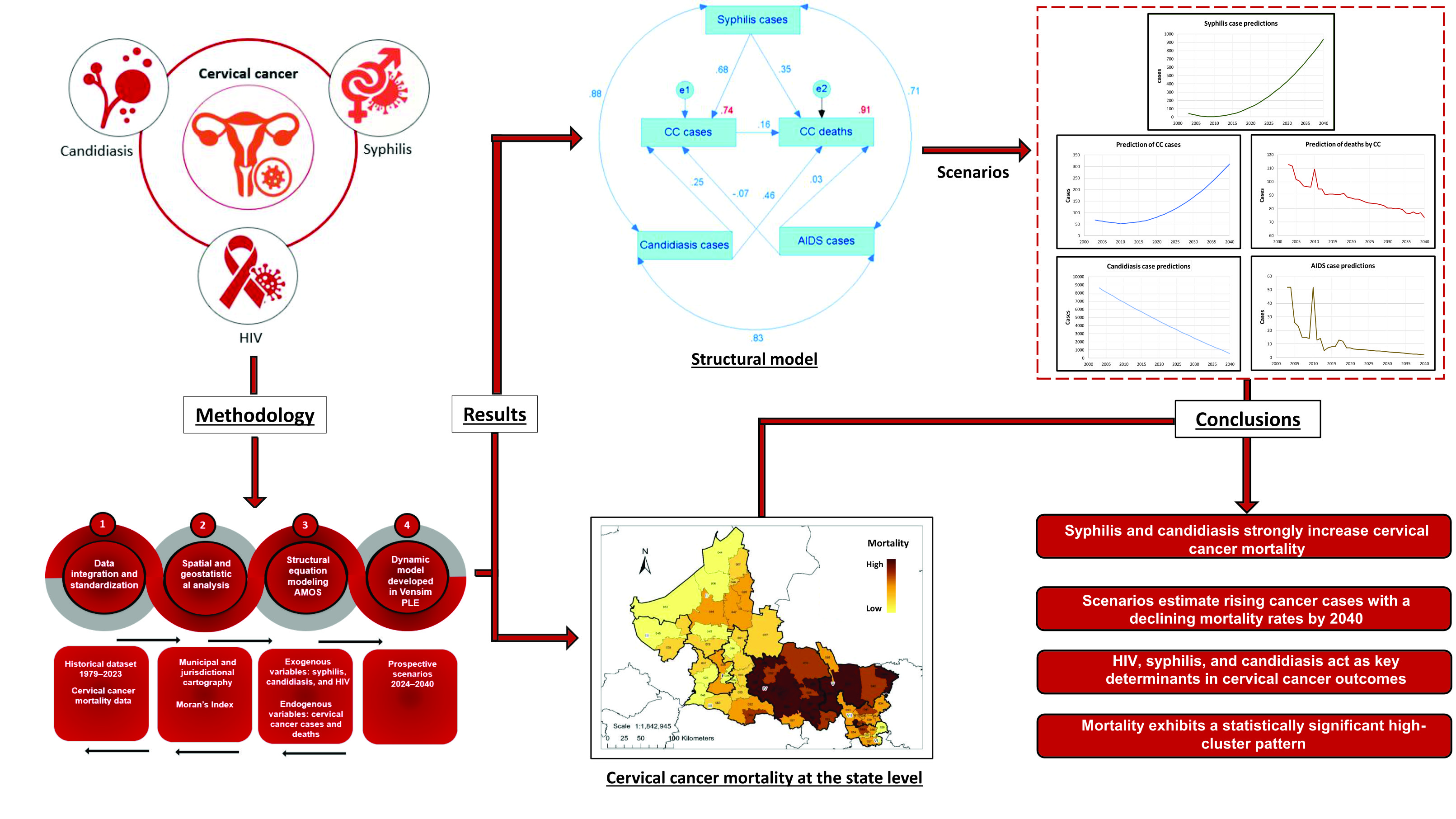
This study analyzes the evolution and spatial distribution of cervical cancer mortality. Furthermore, it develops a dynamic simulation model for estimating the evolution of the disease up to 2040. This manuscript details an ecological and retrospective study that an-alyzed official mortality, morbidity, and population data from the 58 municipalities that constitute the state of San Luis Potosi. We used Moran's index, linear correlation, structur-al equation modeling, Excel predictions, and Vensim simulation software to conduct this study. The evolution of deaths from cervical cancer shows a downward trend; mortality follows a clustered distribution pattern, and it is not random. The struc-tural model showed a correlation coefficient of 0.68 between syphilis cases and cervical cancer cases, with a coefficient of 0.35 for deaths. Candidiasis correlated with cervical cancer at a coeffi-cient of 0.25 and with deaths from the same disease at a coefficient of 0.46. The coefficients of determination for cervical cancer cases and deaths were 0.74 and 0.91, respectively. This shows that these co-infections—syphilis and candidiasis—are a risk factor for cervi-cal cancer mortality. The estimated mortality rates per 100,000 inhab-itants for 2025, 2030, 2035, and 2040 were 5.5, 5.1, 4.8, and 4.4, respectively. The prediction indicates an in-crease in the number of CC cases and deaths from this cause.
Keywords:
cervical cancer
; mortality
; dynamic model
; sexually transmitted infections
; risk factors
Copyright: This open access article is published under a Creative Commons CC BY 4.0 license, which permit the free download, distribution, and reuse, provided that the author and preprint are cited in any reuse.


