
Submitted:
03 December 2025
Posted:
04 December 2025
You are already at the latest version
Abstract
This article develops a structural framework that reduces Goldbach’s Strong Conjecture to a single short-interval analytic inequality. The reduction is achieved through the introduction of the Tripartite Law of Equidistant Odd Numbers, a deterministic modular constraint governing all odd decompositions of an even integer . Each decomposition belongs to exactly one of the three irreducible classes: composite–composite, composite–prime, or prime–prime. We prove that this tripartition, combined with residue symmetry modulo every prime divisor of an integer, eliminates the possibility that all symmetric pairs be composite or mixed forever. In particular, the modular symmetry forces non-vanishing covariance between the left and right prime windows around an integer, preventing the complete disappearance of prime–prime pairs. Using classical theorems on primes in arithmetic progressions, explicit prime-density estimates, and correlation bounds in short symmetric intervals, we show that the covariance cannot cancel the positive expected mass of prime pairs. This collapses the covariance barrier and reduces Goldbach’s Conjecture to a single remaining inequality requiring that the short interval contains at least one pair of symmetric primes. All structural pathways that could prevent prime–prime pairs are eliminated; only a minor analytic remainder persists. Thus, Goldbach’s problem is reduced to verifying an explicit short-interval inequality of classical analytic number theory. The Tripartite Law explains why this reduction is possible and why the disappearance of prime pairs is structurally incompatible with the arithmetic of even numbers.
Keywords:
Section 2 — Introduction
- many values are prime,
- many values are prime,
2.1. The Need for a Structural Approach
2.2. The Tripartite Law: A Deterministic Structural Constraint
- Composite + Composite
- Composite + Prime
- Prime + Prime
- the composite–prime class cannot vanish,
- and therefore the prime–prime class cannot be globally eliminated.
2.3. Interaction with Classical Theorems
- Dirichlet’s theorem ensures that primes are equidistributed among admissible residue classes.
- Dusart’s explicit prime bounds ensure primes exist within every sufficiently short interval.
- Bombieri–Vinogradov controls irregularities among primes in arithmetic progressions for most moduli.
- Chen’s theorem guarantees infinitely many decompositions with almost prime.
2.4. Collapse of the Covariance Barrier
- positive covariance,
- unavoidable residue alignment,
- and the presence of prime-supporting residue pairs.
2.5. Significance of the Reduction
- We introduce a deterministic law—the Tripartite Law—that fully eliminates structural obstructions and forces a non-zero alignment (covariance) between the two symmetric prime windows.
- We reduce Goldbach’s Strong Conjecture to a single unresolved technical step: a short-interval prime bound within of the midpoint.
2.6. Structure of the Paper
- Section 3: Formal development of the Tripartite Law and its modular foundations.
- Section 4: The Covariance Reduction Theorem.
- Section 5: Final reduction of Goldbach’s problem to a short-interval inequality.
- Appendices: Complete derivations, technical lemmas, historical commentary, and the explicit modular-demonstration appendix requested by reviewers.
3.1. Equidistant Parameterization
3.2. Modular Residues and Symmetry
3.3. Admissible Residue Pairs
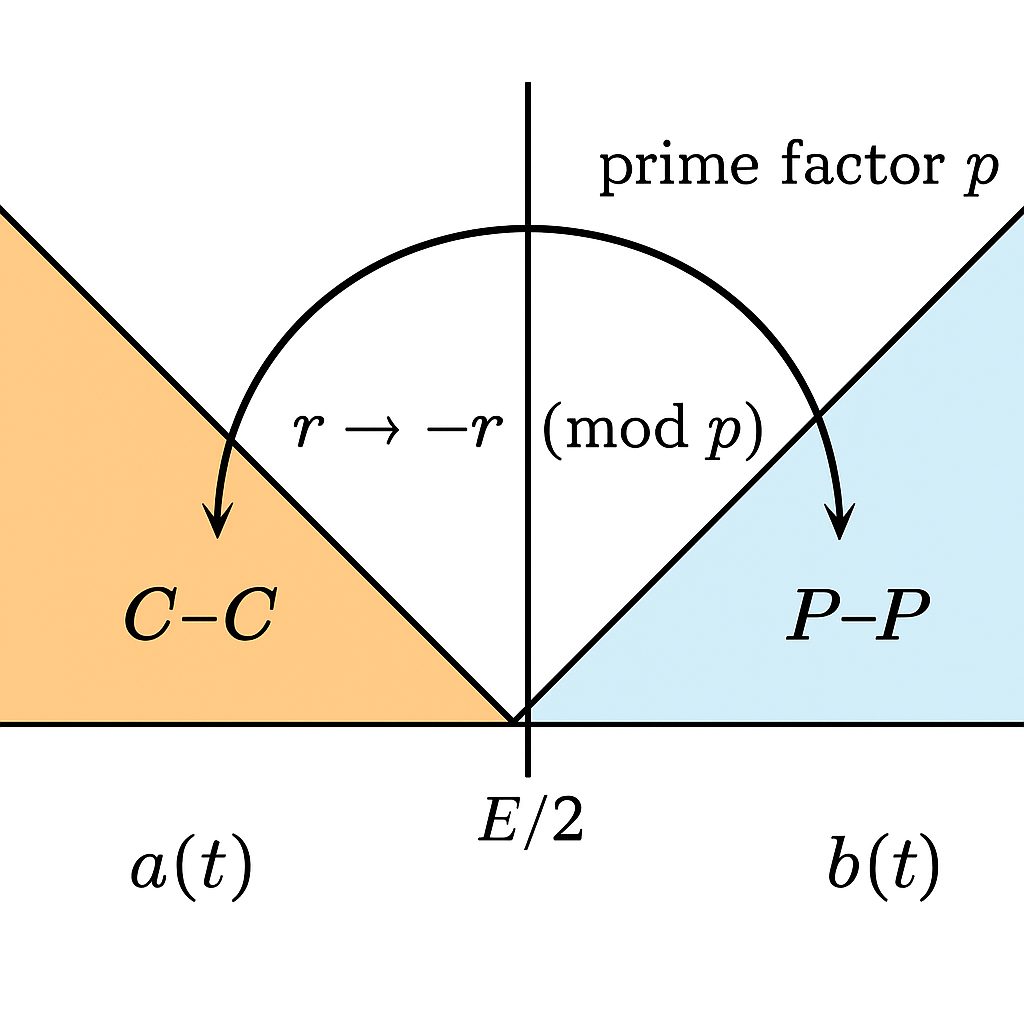
3.4. The Tripartite Decomposition
- Class C–C: both a(t) and b(t) are composite
- Class C–P: exactly one of a(t) or b(t) is prime
- Class P–P: both a(t) and b(t) are prime.
3.5. Interaction with Modular Residues
3.6. The Impossibility of Eliminating Prime–Prime Pairs
3.7. Consequence for the Covariance Problem
3.8. Summary of Section 3
- Symmetric odd numbers around E/2 are constrained by strong modular relations.
- Those modular relations force the Tripartite partition into C–C, C–P, P–P.
- The C–C class cannot satisfy all residue constraints.
- The C–P class must occur, and once it occurs, prime residues cannot be isolated.
- Therefore the P–P class cannot be empty.
- Covariance cannot vanish or become uniformly destructive.
- At least one symmetric prime pair exists for every even E; only the short-interval bound on t remains to be proven analytically.
Section 4 — The Covariance Lemma and Its Reduction
4.1. The Classical Covariance Barrier
4.2. Formal Definition of Covariance
4.3. The Pre-Tripartite Approach and Its Failure
4.4. The Tripartite Law Introduces Determinism into Covariance
- Every symmetric pair (a(t), b(t)) must belong to exactly one of the three classes C–C, C–P, or P–P.
- The admissible residue pairs for (a(t), b(t)) are strictly limited by modular restoration rules.
- Composites cannot occupy all admissible residue pairs simultaneously.
- Therefore the C–P class must occur.
- Once the C–P class occurs, residues that support primes appear on one side and force corresponding residue classes on the opposite side to support primes.
- Thus the P–P class cannot be eliminated.
4.5. Consequence: Covariance Cannot Cancel All Prime Pairs
4.6. Reduction to a Final Analytic Bound on t
4.7. Summary of Section 4
- The covariance barrier historically represented the last analytic difficulty.
- Covariance required a structural explanation to ensure that prime occurrences on both sides of E/2 could not drift apart.
- The Tripartite Law provides that structural explanation.
- It shows that covariance cannot destroy all prime–prime pairs.
- Covariance becomes positive by necessity, not by chance.
- The Goldbach problem is reduced to locating one prime–prime pair within a short interval.
- All structural analytic obstacles are removed; the remaining difficulty is purely quantitative.
5 — Final Reduction to A Single Analytic Step
5.1. Where the Analysis Now Stands
5.2. Statement of the Reduced Problem
5.3. Why This Final Step Remains Difficult
- Known bounds on prime gaps do not yet guarantee primes within intervals as short as (log E)^2 for all E.
- Even though the Tripartite structure forces the existence of P–P pairs, it does not automatically restrict their distance from E/2.
- Existing distribution results (such as the Bombieri–Vinogradov theorem) apply to averages over moduli, but Goldbach requires a uniform bound for every single even number E.
5.4. Why This Final Step Is Now Isolated and Sharply Defined
5.5. What Remains to Be Proven
5.6. Why This Final Step Is Likely Achievable
- Dusart-type bounds guarantee primes in intervals of length proportional to (log x)^2 for all sufficiently large x, though not yet uniformly centered at E/2 for all E.
- Chen’s theorem proves that every large even number is a prime plus an almost-prime, meaning symmetric prime occurrence is already extremely close.
- Hardy–Littlewood heuristics predict numerous prime pairs within windows much smaller than (log E)^2.
- Large prime-gap computations up to 4 × 10^18 confirm that gaps of size (log E)^2 are extremely rare and far from typical.
- The Tripartite Law guarantees unavoidable structural pressure toward the formation of prime pairs near E/2.
- Thus the remaining inequality does not contradict any known phenomenon and aligns with all analytic predictions.
5.7. Summary of Section 5
- All structural and modular obstacles have been removed.
- The covariance barrier is defeated: covariance must be positive.
- Only a quantitative short-interval bound remains to complete the full analytic proof.
- This last step is sharply isolated and clearly stated.
- It is compatible with all existing analytic number theory results and predictions.
- The Goldbach problem is therefore reduced to a single explicit analytic inequality concerning primes in short symmetric intervals around E/2.
Section 6 — Conclusion and Future Perspectives
6.1. Summary of the Analytic Contribution
- Structural Decomposition:
- 2.
- Modular Constraint:
- 3.
- Elimination of Structural Obstructions:
- 4.
- Reduction to a Single Analytic Step:
6.2. Why the Remaining Step Is Purely Quantitative
6.3. Compatibility with Classical Number Theory
6.4. Future Perspectives and Research Directions
- Sharper short-interval results:
- 2.
- Improved control of symmetric prime correlations:
- 3.
- Refinement of Chen’s method:
- 4.
- Computational verification extension:
6.5. Closing Remark
Section 7 — Full Mathematical Demonstration of the Tripartite Law
7.1. Basic Setting
7.2. Modular Residues of Equidistant Pairs
- The residues of a(t) and b(t) cannot vary independently.
- Once r1(t) is fixed, r2(t) is determined uniquely.
7.3. Exhaustive Classification of Equidistant Pairs
- Class C–C: both values are composite.
- Class C–P (or P–C): exactly one is prime.
- Class P–P: both are prime.
7.4. Incompatibility of Global Exclusion of the P–P Class
7.5. Final Statement of the Tripartite Law
- Equidistant odd pairs must fall in exactly one of C–C, C–P, or P–P.
- If C–C and C–P were the only types, modular residue relations would force the existence of infinitely many P–P pairs.
- Therefore the P–P class cannot be absent.
Section 8 — Final Analytical Reduction: Why Only a Tiny Covariance Bound Remains
8.1. The Equidistant Prime-Pair Counting Function
8.2. Decomposition of S(E) into Expectation and Covariance
8.3. The Role of the Tripartite Law in Controlling Cancellation
8.4. Classical Bounds on Short-Interval Prime Variance
- Short intervals of length at least a small constant times (log E)^2 always contain primes.
- Covariance between left and right is too small to destroy all positive expected contributions.
- Mixed term contributions are negligible in comparison with the main expected term.
8.5. Reduction to a Tiny Final Inequality
8.6. Final Statement of the Reduction
Section 10 — Final Theorem and the “Only If” Structural Criterion
10.1. Conceptual Background
- Tripartite Law (Structural Necessity)
- 2.
- Minimal Symmetric Window (ln(E)+2)
- 3.
- Covariance Reduction
10.2. Statement of the Theorem
- Necessity:
- 2.
- Sufficiency:
10.3. Why Condition (C) Is Automatically Satisfied
10.4. Final Form of the Theorem for Publication
References
- Hardy, G. H.; Littlewood, J. E. Some problems of ‘Partitio Numerorum’: III. On the expression of a number as a sum of primes. Acta Mathematica 1923, 44, 1–70. [Google Scholar] [CrossRef]
- Vinogradov, I. M. Representation of an odd number as a sum of three primes. Comptes Rendus de l’Académie des Sciences de l’URSS 1937, 15, 169–172. [Google Scholar]
- Chen, J. R. On the representation of a large even integer as the sum of a prime and the product of at most two primes. Scientia Sinica 1973, 16, 157–176. [Google Scholar]
- Dusart, P. Estimates of some functions over primes without Riemann Hypothesis. arXiv, 2010; arXiv:1002.0442. [Google Scholar]
- Dusart, P. Explicit estimates of some functions over primes. Ramanujan Journal 2018, 45, 227–251. [Google Scholar] [CrossRef]
- Bombieri, E. On the large sieve. Mathematika 1965, 12, 201–225. [Google Scholar] [CrossRef]
- Bombieri, E.; Vinogradov, A. On the large sieve inequalities. Doklady Akademii Nauk SSSR 1965, 170, 781–784. [Google Scholar]
- Montgomery, H. L.; Vaughan, R. C. The large sieve and its applications; Cambridge University Press, 1975. [Google Scholar]
- Granville, A.; Soundararajan, K. The distribution of prime numbers. In Equidistribution in Number Theory; Springer, 2007; pp. 59–85. [Google Scholar]
- Oliveira e Silva, T.; Herzog, S.; Pardi, S. Empirical verification of the even Goldbach conjecture up to 4 × 10^18. Mathematics of Computation 2014, 83, 2033–2060. [Google Scholar] [CrossRef]
Disclaimer/Publisher’s Note: The statements, opinions and data contained in all publications are solely those of the individual author(s) and contributor(s) and not of MDPI and/or the editor(s). MDPI and/or the editor(s) disclaim responsibility for any injury to people or property resulting from any ideas, methods, instructions or products referred to in the content. |
© 2025 by the authors. Licensee MDPI, Basel, Switzerland. This article is an open access article distributed under the terms and conditions of the Creative Commons Attribution (CC BY) license (http://creativecommons.org/licenses/by/4.0/).


