

Submitted:
03 December 2025
Posted:
04 December 2025
You are already at the latest version
Abstract
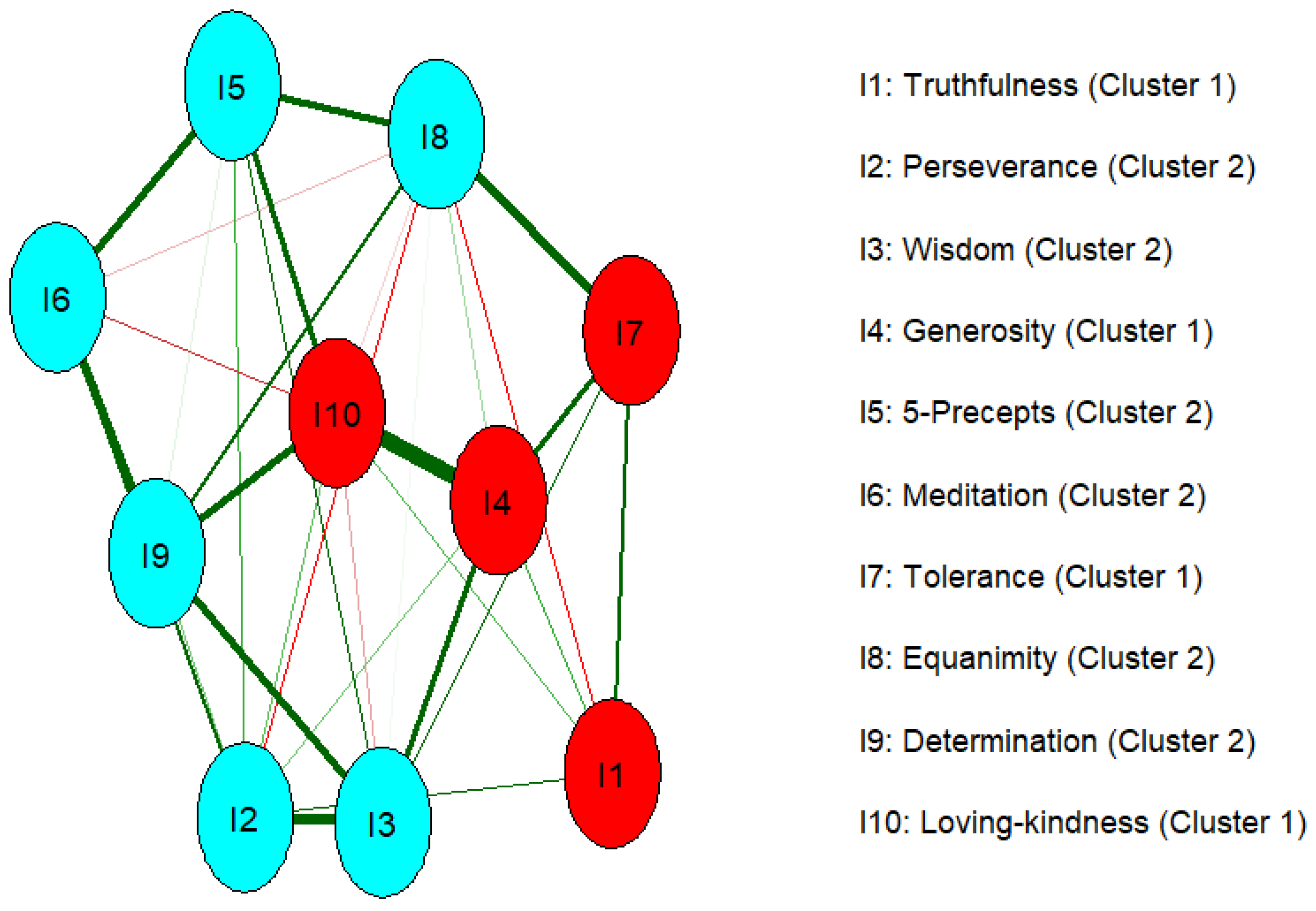
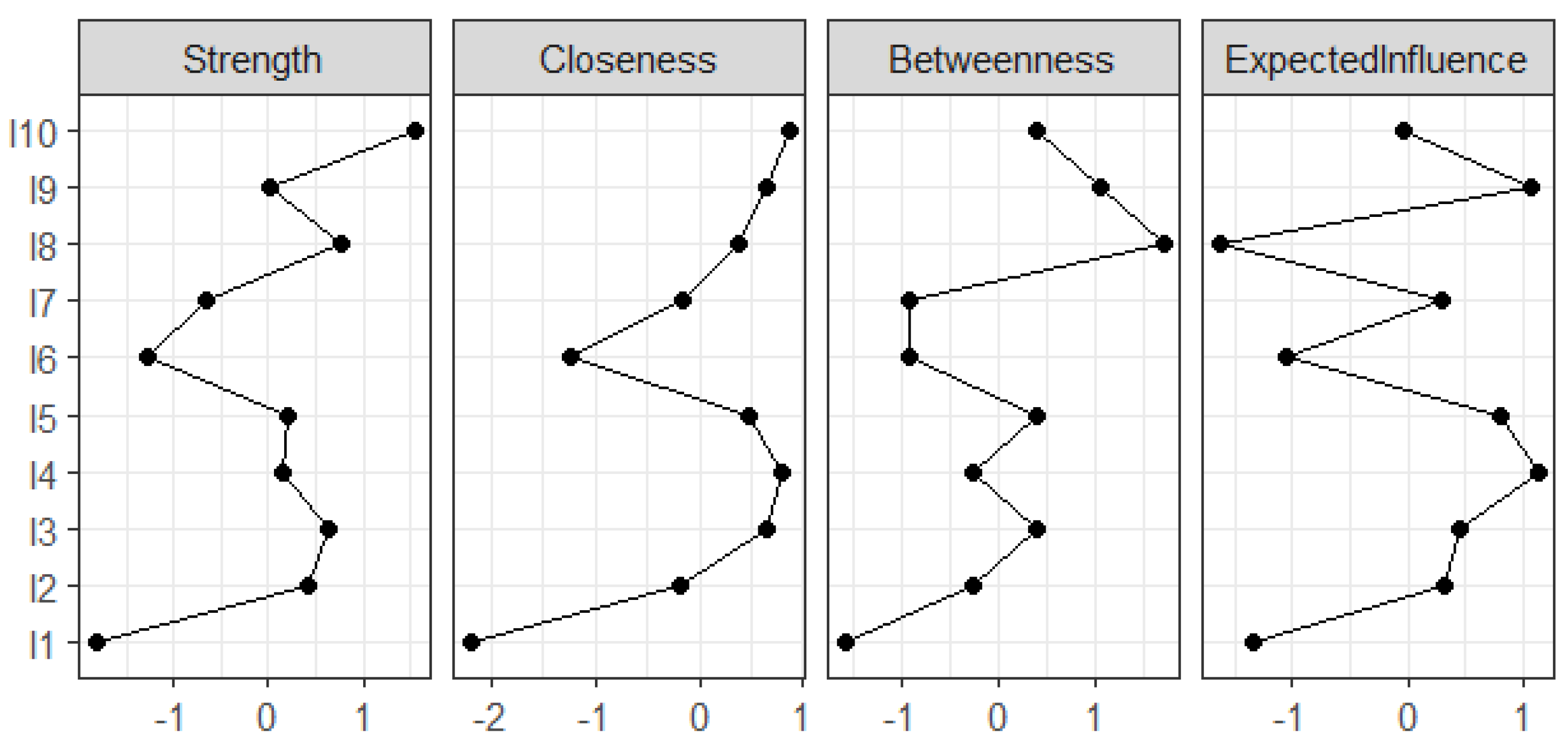
Inner strength is increasingly recognized as a protective factor in mental health, but its structure and dynamics remain underexplored, particularly in individuals with borderline personality disorder (BPD) symptoms. This study applied network analysis to investigate the complex relationships among inner strengths in individuals exhibiting BPD symptoms, aiming to identify core and bridging strengths that could inform targeted interventions. The sample consisted of 346 Thai university students (25.4% males, 74.6% females; mean age = 21.60 ± 2.24 years) who screened positive for BPD symptoms using the SI-Bord scale. Network analysis revealed that inner strengths formed an interconnected system with both core and peripheral features. The strongest association was observed between generosity and loving-kindness. A cognitive-behavioral cluster comprising perseverance, wisdom, and determination also emerged. Centrality analysis identified loving-kindness as the most influential node in terms of direct connections, while equanimity exhibited the highest bridge centrality. Generosity and determination demonstrated the greatest expected influence. A negative link between truthfulness and equanimity highlighted a potential conflict between absolute honesty and inner balance in this population. These findings suggest that fostering specific inner strengths, particularly equanimity and loving-kindness, may enhance psychological resilience and inform intervention strategies for BPD.
Keywords:
1. Introduction
2. Materials and Methods
2.1. Study Subjects
2.2. Instruments
2.2.1. Screening Instrument for Borderline Personality Disorder (SI-Bord)
2.2.2. Inner-Strength-Based Inventory (I-SBI)
2.3. Statistical Analyses
2.3.1. Descriptive Statistical Analysis
2.3.2. Network Analysis Overview
2.3.3. Network Estimation and Visualization
2.3.4. Community Structure Detection
2.3.5. Centrality Analysis
2.3.6. Network Stability and Accuracy
3. Results
3.1. Descriptive Statistics
3.2. Network Analysis
4. Discussion
4.1. Implication of the Study
4.2. Limitations and Future Study
5. Conclusion
Supplementary Materials
Author Contributions
Funding
Institutional Review Board Statement
Informed Consent Statement
Conflicts of Interest
Data availability
References
- Ariyabuddhiphongs, V. (2016). Buddhist generosity: Its conceptual model and empirical tests. Archive for the Psychology of Religion, 38(3), 316-344. [CrossRef]
- Association, A. P. (2013). Diagnostic and statistical manual of mental disorders. American psychiatric association.
- Baumeister, R. F., & Vohs, K. D. (2007). Self-Regulation, ego depletion, and motivation. Social and personality psychology compass, 1(1), 115-128. [CrossRef]
- Borsboom, D., & Cramer, A. O. (2013). Network analysis: an integrative approach to the structure of psychopathology. Annu Rev Clin Psychol, 9, 91-121. [CrossRef]
- Borsboom, D., Deserno, M. K., Rhemtulla, M., Epskamp, S., Fried, E. I., McNally, R. J., Robinaugh, D. J., Perugini, M., Dalege, J., & Costantini, G. (2021). Network analysis of multivariate data in psychological science. Nature Reviews Methods Primers, 1(1), 58. [CrossRef]
- Buddhaghosa, B. (2020). The path of purification: Visuddhimagga. Pariyatti.
- Cano, K., Sumlin, E., & Sharp, C. (2022). Screening for borderline personality pathology on college campuses. Personality and mental health, 16(3), 235-243. [CrossRef]
- Castro, D., Ferreira, F., de Castro, I., Rodrigues, A. R., Correia, M., Ribeiro, J., & Ferreira, T. B. (2019). The differential role of central and bridge symptoms in deactivating psychopathological networks. Frontiers in Psychology, 10, 2448. [CrossRef]
- Chapman, J., Jamil, R. T., Fleisher, C., & Torrico, T. J. (2025). Borderline Personality Disorder. In StatPearls. StatPearls Publishing Copyright © 2025, StatPearls Publishing LLC. https://www.ncbi.nlm.nih.gov/books/NBK430883/.
- Csikszentmihalyi, M., & Seligman, M. (2000). Positive psychology. American Psychologist, 55(1), 5-14. [CrossRef]
- Dammann, G., Hügli, C., Selinger, J., Gremaud-Heitz, D., Sollberger, D., Wiesbeck, G. A., Küchenhoff, J., & Walter, M. (2011). The self-image in borderline personality disorder: An in-depth qualitative research study. Journal of Personality Disorders, 25(4), 517-527. [CrossRef]
- Deng, Y., Du, T., Zeng, X., & Wang, W. (2025). Kindness is lesser preferable than happiness: investigating interest in different effects of the loving-kindness and compassion meditations. BMC psychology, 13(1), 443. [CrossRef]
- Dorjey, T. (2018). An aspect of Mahāyāna Buddhist ethics: the culture of generosity (dāna). SOSHUM: Jurnal Sosial Dan Humaniora, 8(2), 176-184. [CrossRef]
- Eaton, N. R., & Greene, A. L. (2018). Personality disorders: community prevalence and socio-demographic correlates. Curr Opin Psychol, 21, 28-32. [CrossRef]
- Epskamp, S., Borsboom, D., & Fried, E. I. (2018). Estimating psychological networks and their accuracy: A tutorial paper. Behavior research methods, 50(1), 195-212. [CrossRef]
- Epskamp, S., Cramer, A. O., Waldorp, L. J., Schmittmann, V. D., & Borsboom, D. (2012). qgraph: Network visualizations of relationships in psychometric data. Journal of statistical software, 48, 1-18.
- Fernandes, B., Newton, J., & Essau, C. A. (2022). The mediating effects of self-esteem on anxiety and emotion regulation. Psychological Reports, 125(2), 787-803. [CrossRef]
- Fried, E. I., & Cramer, A. O. (2017). Moving forward: Challenges and directions for psychopathological network theory and methodology. Perspectives on Psychological Science, 12(6), 999-1020. [CrossRef]
- Glass, I. V., Frankenburg, F. R., Fitzmaurice, G. M., & Zanarini, M. C. (2024). Levels of grit in patients with borderline personality disorder: Description and prediction. Personal Ment Health, 18(4), 414-423. [CrossRef]
- Hevey, D. (2018). Network analysis: a brief overview and tutorial. Health psychology and behavioral medicine, 6(1), 301-328. [CrossRef]
- Jia, N., Sakulsriprasert, C., Wongpakaran, N., Suradom, C., & O’Donnell, R. (2022). Borderline personality disorder symptoms and its clinical correlates among Chinese university students: A cross-sectional study. Healthcare,.
- Kang, C., & Whittingham, K. (2010). Mindfulness: A Dialogue between Buddhism and Clinical Psychology. Mindfulness, 1(3), 161-173. [CrossRef]
- Keng, S. L., & Tan, H. H. (2018). Effects of brief mindfulness and loving-kindness meditation inductions on emotional and behavioral responses to social rejection among individuals with high borderline personality traits. Behav Res Ther, 100, 44-53. [CrossRef]
- Khattiya, K., Wongpakaran, T., & Wongpakaran, N. (2025). [CrossRef]
- Kouklidou, A., Kouklidis, G., Dafoulis, V., & KOUKLIDOU, A. (2025). A Systematic Review of Risk and Protective Factors of Borderline Personality Disorder. Cureus, 17(5). [CrossRef]
- Lam, K., & Seiden, D. (2020). Effects of a brief mindfulness curriculum on self-reported executive functioning and emotion regulation in Hong Kong adolescents. Mindfulness, 11(3), 627-642. [CrossRef]
- Leichsenring, F., Heim, N., Leweke, F., Spitzer, C., Steinert, C., & Kernberg, O. F. (2023). Borderline Personality Disorder: A Review. Jama, 329(8), 670-679. [CrossRef]
- Leichsenring, F., Leibing, E., Kruse, J., New, A. S., & Leweke, F. (2011). Borderline personality disorder. The lancet, 377(9759), 74-84. [CrossRef]
- Linehan, M. (1993). Cognitive-behavioral treatment of borderline personality disorder. Guilford press. https://books.google.co.th/books?hl=zh-TW&lr=&id=UZim3OAPwe8C&oi=fnd&pg=PA3&dq=Cognitive-behavioral+treatment+of+borderline+personality+disorder++M.+Linehan&ots=qEVs5AWuC3&sig=nXF5H0PYyVZbxvEP_FoWLNpgsfs&redir_esc=y#v=onepage&q&f=false.
- Lohanan, T., Leesawat, T., Wongpakaran, T., Wongpakaran, N., Karawekpanyawong, N., Oon-Arom, A., & Kuntawong, P. (2020). Development and validation of a screening instrument for borderline personality disorder (SI-Bord) for use among university students. BMC Psychiatry, 20(1), 479. [CrossRef]
- Lundman, B., Alex, L., Jonsen, E., Norberg, A., Nygren, B., Fischer, R. S., & Strandberg, G. (2010). Inner strength—A theoretical analysis of salutogenic concepts. International journal of nursing studies, 47(2), 251-260. [CrossRef]
- Masten, A. S. (2001). Ordinary magic: Resilience processes in development. American Psychologist, 56(3), 227-238. [CrossRef]
- McNally, R. J. (2021). Network analysis of psychopathology: controversies and challenges. Annual review of clinical psychology, 17(1), 31-53. [CrossRef]
- McNeal, S. (2024). Inner strengths: Contemporary psychotherapy and hypnosis for ego-strengthening. Routledge.
- Meaney, R., Hasking, P., & Reupert, A. (2016). Prevalence of borderline personality disorder in university samples: Systematic review, meta-analysis and meta-regression. PloS one, 11(5), e0155439. [CrossRef]
- Meyers, L. S., Gamst, G. C., & Guarino, A. (2013). Performing data analysis using IBM SPSS. John Wiley & Sons.
- Morey, L. C., & Zanarini, M. C. (2000). Borderline personality: traits and disorder. Journal of Abnormal Psychology, 109(4), 733. [CrossRef]
- Mueller, T. (2023). Development and testing of the university student resilience scale. Journal of American College Health, 71(3), 967-972. [CrossRef]
- Pigott, T. D. (2001). A review of methods for missing data. Educational research and evaluation, 7(4), 353-383. [CrossRef]
- Pongpitpitak, N., Wongpakaran, N., Wongpakaran, T., & Nuansri, W. (2022). Buffering Effect of Perseverance and Meditation on Depression among Medical Students Experiencing Negative Family Climate. Healthcare,.
- Richetin, J., Preti, E., Costantini, G., & De Panfilis, C. (2017). The centrality of affective instability and identity in Borderline Personality Disorder: Evidence from network analysis. PloS one, 12(10), e0186695.
- Southward, M. W., Howard, K. P., Christensen Pacella, K. A., & Cheavens, J. S. (2023). Protective factors in borderline personality disorder: A multi-study analysis of conscientiousness, distress tolerance, and self-compassion. Journal of Affective Disorders, 338, 589-598. [CrossRef]
- Sripunya, P., Wongpakaran, T., & Wongpakaran, N. (2024). [CrossRef]
- Tsai, J., & Morissette, S. B. (2022). Introduction to the special issue: Resilience and perseverance for human flourishing. Psychological Trauma: Theory, Research, Practice, and Policy, 14(S1), S1. [CrossRef]
- Videler, A. C., Hutsebaut, J., Schulkens, J. E. M., Sobczak, S., & van Alphen, S. P. J. (2019). A Life Span Perspective on Borderline Personality Disorder. Curr Psychiatry Rep, 21(7), 51. [CrossRef]
- Wongpakaran, N., Oon-Arom, A., Karawekpanyawong, N., Lohanan, T., Leesawat, T., & Wongpakaran, T. (2021). Borderline personality symptoms: what not to be overlooked when approaching suicidal ideation among university students. Healthcare,.
- Wongpakaran, N., Wongpakaran, T., & Kuntawong, P. (2020). Development and validation of the (inner) Strength-Based Inventory. Mental Health, Religion & Culture, 1-11. [CrossRef]
- Wongpakaran, N., Wongpakaran, T., Wedding, D., Mirnics, Z., & Kövi, Z. (2021). Role of Equanimity on the Mediation Model of Neuroticism, Perceived Stress and Depressive Symptoms. Healthcare (Basel), 9(10). [CrossRef]
- Xu, S., Ju, Y., Wei, X., Ou, W., Ma, M., Lv, G., Zhao, X., Qin, Y., Li, Y., Li, L., Huang, M., Yang, S., Lu, Y., Chen, Y., Liu, J., Liu, J., Liu, B., & Zhang, Y. (2024). Network analysis of suicide ideation and depression-anxiety symptoms among Chinese adolescents. Gen Psychiatr, 37(2), e101225. [CrossRef]

| Characteristic | Category | Value |
| Age | - | 21.60±2.24 |
| Gender | Male | 88(25.4%) |
| Female | 258(74.6%) | |
| Year of Study | 1st year | 33(9.5%) |
| 2nd year | 85(24.6%) | |
| 3rd year | 95(27.5%) | |
| 4th year | 75(21.7%) | |
| Above 4th year | 58(16.8%) |
| Variables | Mean(SD) | Min | Max | Skewness | Kurtosis |
| Truthfulness | 3.20±1.27 | 1 | 5 | 0.18 | -1.37 |
| Perseverance | 2.41±1.03 | 1 | 5 | 0.61 | -0.05 |
| Wisdom | 2.95±1.19 | 1 | 5 | -0.11 | -0.80 |
| Generosity | 3.48±1.27 | 1 | 5 | -0.49 | -1.08 |
| 5-Precepts | 2.82±1.22 | 1 | 5 | 0.03 | -0.91 |
| Meditation | 1.49±0.78 | 1 | 5 | 1.98 | 4.58 |
| Tolerance | 3.17±1.13 | 1 | 5 | -0.07 | -1.05 |
| Equanimity | 2.95±1.01 | 1 | 5 | 0.03 | -0.64 |
| Determination | 3.02±1.11 | 1 | 5 | 0.18 | -0.96 |
| Loving-Kindness | 3.23±1.23 | 1 | 5 | -0.45 | -1.03 |
| Sum | 28.72±5.73 | 10 | 41 | -0.60 | 0.08 |
Disclaimer/Publisher’s Note: The statements, opinions and data contained in all publications are solely those of the individual author(s) and contributor(s) and not of MDPI and/or the editor(s). MDPI and/or the editor(s) disclaim responsibility for any injury to people or property resulting from any ideas, methods, instructions or products referred to in the content. |
© 2025 by the authors. Licensee MDPI, Basel, Switzerland. This article is an open access article distributed under the terms and conditions of the Creative Commons Attribution (CC BY) license (http://creativecommons.org/licenses/by/4.0/).


