

Submitted:
02 December 2025
Posted:
02 December 2025
You are already at the latest version
Abstract
Climate change poses a growing challenge for high Andean communities around the world, whose livelihoods depend directly on agriculture, livestock farming, and the stability of local ecosystems. In this context, the study sought to understand the construction of social imaginaries among agricultural producers around the dynamics of climate variability, with the aim of analyzing both the vulnerabilities and adaptive capacities that emerge in their daily practices. Based on a qualitative approach, supported by 32 interviews with key informants from 16 communities, four focus groups, and documentary analysis, data was collected in the field and, using Atlas.ti software, the testimonies of community members from Cojata, in Puno, Peru, were processed, revealing the social imaginaries and collective responses linked to the phenomenon. The findings reveal feelings of concern and uncertainty, diverse interpretations of the dynamics of climate change, a reconfiguration of cultural meanings, and the deployment of hybrid adaptation strategies that combine ancestral knowledge and contemporary resources. Taken together, these findings show that social imaginaries play a central role in how communities face the climate crisis, revealing both the persistence of structural inequalities and the need to strengthen intercultural territorial policies that recognize local knowledge, enhance community cooperation, and promote a horizon of resilience and climate justice.
Keywords:
climate change
; high Andean communities
; social imaginaries
; adaptation practices
; agricultural producers
; Peru
1. Introduction
Climate change is a global challenge that takes on critical characteristics in the high Andean communities of Peru, where agricultural producers depend on systems that are vulnerable to droughts, frosts, glacial retreat, and water variability. The impacts include crop losses, livestock mortality, and deterioration of food sovereignty and security, as well as effects on cultural practices linked to Pachamama [1,2,3]. In regions such as Puno, the fragility of water infrastructure has forced emergency measures to be taken in response to water shortages [4].
Beyond the biophysical, climate change is also a symbolic and social phenomenon. Social imaginaries, understood as constitutive matrices of meaning [5,6], shared horizons [7], and political devices [8], allow us to understand how communities interpret the crisis. In high Andean communities, Andean imaginaries conceive of nature as a subject of rights and reciprocity, in contrast to modern visions of instrumentalization [9,10]. These epistemic tensions are articulated with media discourses that project futures of collapse, incremental adaptation, or radical transformations [11,12], influencing young people and collective action. At the everyday level, high Andean producers develop narratives and practices that combine rituals, community pacts, and local technologies, reinforcing agency in the face of risk [13,14,15,16,17]
Thus, this article addresses climate change in the high Andean communities of Puno, Peru, as a multidimensional phenomenon, where global governance structures, economic and geopolitical disputes, tensions over water and agricultural resources, and cultural processes of producing meaning and significance of the phenomenon under study converge. The aim of the article is to analyze the social imaginaries and adaptation practices of agricultural producers in order to understand how communal social meanings shape responses to the climate crisis and thereby contribute to the construction of more just and sustainable policies and strategies.
1.1. Social Imaginaries Regarding Climate Change
The study of social imaginaries in relation to climate change is an emerging field in the social sciences that has gained relevance in recent decades. The category of “social imaginaries” developed by Castoriadis [5,6] refers to society’s instituting capacity to create meanings that shape collective experience and guide action. Far from being abstract images, these imaginaries are the deep fabric that gives meaning to social institutions and practices. Taylor [7] conceives them as shared frameworks that allow for the coordination of expectations and actions, while Baczko [8] emphasizes their political dimension, explaining how they legitimize social projects and ideological disputes. However, Gauna [15] warns that social imaginaries, while powerful tools for understanding cultural dynamics, present conceptual problems that must be critically addressed. He points out that there is a risk of confusing imaginaries with representations or ideologies, which requires rigorous conceptual delimitation. In line with this, Riffo-Pavón [17] articulates imaginaries with social representations and discursive re-presentations, showing that the three concepts complement each other at different levels of abstraction. García-Muñoz & Gómez-Gallego [14] agree on the need to move towards integrative methodologies that allow us to capture both the deep structures of imaginaries and their manifestations in discourse and everyday practices.
In this sense, social imaginaries about climate change can be understood as constitutive matrices that shape horizons of possibility. Social representations, for their part, operate as interpretive frameworks that enable action in everyday life. Discursive re-presentations are the narrative vehicles through which these frameworks are updated, disputed, and transformed in the public sphere. This theoretical basis allows us to understand that climate change, rather than a physical-natural phenomenon, is also a symbolic construction in which radical meanings, everyday practices, and media narratives are intertwined.
Approaches to imaginaries about climate change take various forms. On the one hand, Duque [13] points out that climate imaginaries in Latin America are configured as emotional and symbolic frameworks in which the fear of collapse and the hope for social transformation coexist. These imaginaries not only convey information about risks, but also articulate collective narratives that condition the capacity for social action. Murcia-Murcia [16] emphasizes that current environmental imaginaries are structured around three central dimensions: nature, development, and sustainability, where technocratic visions that reduce the crisis to a problem of efficient resource management clash with critical visions that interpret the climate crisis as a profound challenge to civilization. Thus, imaginaries constitute both horizons of meaning and fields of symbolic dispute in which possible futures are defined.
One of the most significant aspects of this debate is the contrast between Western and indigenous perceptions of nature. Gallegos [10] shows that the Western perception is based on an instrumental and extractivist view of nature, which conceives it as an exploitable resource for economic growth and modernization. In contrast, Andean imaginaries understand nature as a subject with rights, linked to the community and spiritual balance. This disagreement is reflected in areas such as education, politics, and development, where Western models impose criteria of linear progress that often conflict with the practices of reciprocity and care of indigenous communities. Elizalde & Elizalde [9] delve deeper into this contrast by highlighting how the territories of the global south are spaces where environmental rationalities clash: the modern rationality of capital versus ancestral knowledge that promotes interdependent relationships between humans and non- humans. This opposition between imaginaries shows that the climate crisis is not only ecological, but also epistemic and cultural.
From a more contextualized perspective, Quispe-Mamani et al. [18] analyze how local actors construct imaginaries about environmental pollution from mining. These imaginaries combine direct experiences of harm from community cultural frameworks, generating narratives of resistance to official discourses that minimize the impacts. This tension between technical discourse and local experiences illustrates how social imaginaries shape divergent interpretations of environmental issues. In this regard, Stein [19], when addressing neoliberal intergovernmentalism in Peru, argues that socio-environmental conflicts cannot be understood solely as disputes over resources, but rather as confrontations between imaginaries that legitimize different models of governance and development. In these cases, climate change is presented as a catalyst for tensions between hegemonic and counter- hegemonic imaginaries.
The role of discourse in the construction of imaginaries is addressed by Riffo-Pavón [17], who proposes the concept of discursive re-presentations to emphasize that discourses not only reflect reality, but also re-present and symbolically reconstruct it. In this sense, García-Muñoz & Gómez-Gallego [14] and Riffo-Pavón [20] argue that social imaginaries around climate change become visible and disputable through language or through media, political, and community discourses.
The media plays a significant role in this process. Prosser et al. [11] analyze the media’s construction of young people’s perceptions of climate change in the Chilean press, identifying that young people are represented both as passive actors who suffer from the crisis and as active subjects who confront it through social mobilization. This dual portrayal reveals how media imaginaries influence public perception and the possibilities for political action by young people. Similarly, Wright et al. [12] systematize three archetypes of climate imaginaries: inevitable collapse, gradual adaptation, and radical transformation. Each of these archetypes not only organizes narratives of the future, but also guides collective and political decisions in the present.
Regarding the relationship between social imaginaries and development, Riffo-Pavón [21] argues that dominant imaginaries of development have been marked by the Western paradigm of progress, economic growth, and technological modernization. This imaginary has produced social representations that associate well-being with consumption and industrialization, legitimizing policies oriented toward material accumulation. However, alternative imaginaries are emerging, such as that of good living, which propose civilizational horizons based on sufficiency, social equity, and ecological sustainability. Murcia-Murcia [16] agrees, noting that environmental imaginaries are contested between hegemonic narratives of efficient resource management and critical narratives that propose profound civilizational reconfigurations. Rodríguez et al. [22] complement this perspective by showing how the socioeconomic impacts of climate change in Latin America are mediated by risk imaginaries, which shape both collective perceptions and public policy responses.
Community adaptation strategies to climate change respond to their social imaginaries. Delgado et al. [23] in their research on rural areas in Chile, show that adaptation to climate change is articulated through imaginaries that combine ancestral knowledge with technical innovations, generating a cultural resilience that transcends technocratic calculations. Rodriguez-Morales [24] emphasizes that variations in precipitation patterns not only produce natural disasters, but also reconfigure imaginaries of vulnerability and resilience. Both studies show that social imaginaries influence the way communities interpret and address climate risks, demonstrating that responses are not only technical, but also deeply symbolic.
From a governance perspective, Stein [19] argues that neoliberalism has produced imaginaries of environmental management focused on decentralization and competitiveness, which often render local demands invisible. In response to this, alternative governance models are emerging that emphasize community participation and care for the territory. In Norway, climate imaginings are interwoven with community identities, where local experiences influence how the environmental crisis is interpreted and responded to, taking into account cultural, political, and territorial contexts [25].
According to the climate futures approach, imaginaries not only interpret the present but also project future horizons that guide action [12], expressed in the archetypes of collapse, adaptation, and transformation, which function as collective narratives, conditioning social policies and strategies in the face of climate change. In this regard, Stolz [26] warns that many of these future imaginaries are limited by a colonial gaze that reproduces Western perspectives, rendering alternatives from other cultures invisible. Faced with this limitation, Elizalde & Elizalde [9] propose recovering sociological imagination and knowledge from the South as sources for projecting alternative futures, beyond the logic of capital and modernity.
As a result of analyzing the various theoretical perspectives of social imaginaries regarding climate change, at least three major trends emerge: The first, hegemonic, conceives of climate change from a technocratic and economistic imaginary, focused on efficient resource management and technological innovation. The second, counter-hegemonic, interprets the climate crisis as a challenge to civilization and proposes alternative horizons based on good living, sustainability, and socio-environmental justice. The third trend, intermediate, is expressed in local and community contexts, where imaginaries are shaped by everyday experience, traditional knowledge, and territorial identities.
Therefore, climate change cannot be addressed solely from technical frameworks, but requires an understanding of the meanings that societies attach to nature, development, and the future [9,16,21], which implies placing research in a field of epistemological and political debate in which not only the interpretation of climate change is at stake, but also the possibilities of building more just, democratic, and sustainable societies.
1.2. Approaches to Climate Change
The study of climate change in high Andean rural communities cannot be approached in isolation from the global network of institutions, economic debates, geopolitical dynamics, sectoral tensions, and local capacities that shape this phenomenon. The theoretical approaches presented below show how, from the global to the local level, different ways of understanding and responding to the climate crisis are constructed. The articulation exercise seeks to place high Andean rural communities in a downward trajectory of analysis, where international norms, economic and geopolitical dilemmas, critical resource policies, and local perceptions form a complex system of interdependencies.
The first approach is linked to global environmental governance and climate justice. In this regard, Hincapié [27] argues that the international climate regime is riddled with a structural contradiction: while multilateral commitments have advanced in the formulation of norms and principles (sustainable development, intergenerational equity, and common but differentiated responsibility), their implementation has been partial and uneven. This is due to institutional fragmentation, overlapping mandates, weak political will, and corporate capture of key decision-making processes. For high Andean communities, these tensions are not abstract, but manifest themselves in the lack of concrete resources to deal with droughts, frosts, or glacial retreat. The gap between normative discourse and real effects translates into greater local vulnerability. In this sense, Hincapié’s proposal to democratize governance by incorporating social movements, indigenous peoples, and non-hegemonic knowledge constitutes a direct course of action for high Andean communities, which possess a historically undervalued cultural and technical adaptive heritage. The notion of climate justice takes on full meaning here: those who have contributed least to the crisis are the ones who suffer most from its effects, reproducing structural inequality on a global and local scale.
The second approach refers to the economics of climate change, understood as a debate between the neoclassical paradigm, which conceives climate change as the “greatest market failure” and ecological economics, which presents it as a biophysical limit to growth. Mora-Motta & León [28] explain how integrated assessment models have revolved around the dilemma of whether to act soon or postpone measures. Nordhaus [29] based on high social discount rates, advocated gradual mitigation, while Stern [30] argued that intergenerational ethics require immediate action, with a rate close to zero. For high Andean communities, this debate, rather than being technical, involves deciding whether to prioritize the present well-being of developed countries or the future survival of vulnerable ecosystems and peoples. Ecological economics questions the illusion that natural capital can be replaced by human or technological capital, raising the need for strong sustainability and, in extreme cases, degrowth in overdeveloped economies. This argument connects with the findings of López & Hernández [31], who show that agricultural productivity in Latin America will be seriously affected, with greater losses for small producers who do not have adaptation technologies. Similarly, Cartay et al. [32] argue that agriculture not only suffers from climate effects but is also a source of emissions, reinforcing the need to rethink intensive production models. In this context, high Andean communities, whose livelihoods depend on fragile ecosystems, are living testimony to the incompatibility between unlimited growth and sustainability.
The third approach analyzes the geopolitical dimension and environmental security. In this regard, Estenssoro [33] asserts that climate change has transformed global politics, shifting it toward a “geopolitics of the environment,” in which energy and natural resources become the focus of global dispute. This environmentalization of geopolitics poses a dilemma between national sovereignty and global commons. International negotiations are marked by North-South asymmetries, with industrialized countries seeking to transfer responsibilities to peripheral nations. Stein [19] complements this analysis from Latin America and the Caribbean, showing climate change as a multiplier of socio-environmental conflicts. Displacement due to droughts, tensions over water, and the overexploitation of fishing resources in Peru and Chile are examples of how climate change deepens pre- existing inequalities. In high Andean communities, glacier retreat not only threatens water security but also generates distributional conflicts between rural communities and cities that depend on the same resource. Rodriguez-Morales [24] warns that the lack of vulnerability maps and planning exacerbates the impacts of extreme events, such as floods or droughts, in marginal areas. The geopolitics of climate change is not only a power game between states, but also extends to rural areas, where it translates into daily disputes over access to water, land, sovereignty, and food security.
The fourth approach addresses water resources, agriculture, and support policies. Salazar et al. [34] reveal that agriculture accounts for the highest water consumption in Latin America, with inefficient irrigation practices and salinization and pollution effects that compromise sustainability. In Peru, agriculture consumes 86% of water, while glacier retreat and paramo degradation reduce natural water storage capacity, intensifying droughts and floods. Cartay et al. [32] demonstrate that agricultural production is highly vulnerable to temperature rises and variations in precipitation, while López & Hernández [31] identify Central America and the Andean region as the most exposed in Latin America, with disproportionate impacts on small producers. Studies by Delgado et al. [23] in Chile and Campos et al. [35] in Mexico and El Salvador illustrate how rural communities develop autonomous adaptation strategies, such as crop diversification, water harvesting, or forest conservation, which enable them to cope with short-term climate variability. However, these measures lack institutional support and coordination with long- term policies, limiting their sustainability. In addition, Wong et al. [36] show that agricultural incentives in Latin America often reinforce emission-intensive practices rather than promoting agroecological transitions. Redirecting this support toward general services (research, innovation, and rural extension) could generate environmental and social co- benefits. For high Andean communities, this debate translates into the urgent need to design policies that strengthen water efficiency and support small farmers, without reproducing historical inequalities in access to land and other resources.
Finally, the fifth approach refers to education, perceptions and adaptive capacities in rural communities. Gómez et al. [37] propose the SolarSPELL experience as an educational innovation that brings solar-powered digital libraries to rural communities without connectivity. Their experience in Fiji and later in Mexico shows that climate literacy requires not only access to information, but also contextualized and culturally relevant pedagogical processes. Plata-Rangel & Ibáñez-Velandia [38] show that, in the Colombian case, although producers recognize the seriousness of climate change, their understanding of its causes and adaptation strategies is limited, and their perceptions are more linked to empirical experiences than to scientific knowledge. This gap between awareness and agency limits the capacity for collective action. In this perspective, Rodriguez-Morales [24] highlights that poor institutional preparedness for extreme events exacerbates the exposure of vulnerable populations, confirming that environmental education must transcend awareness-raising and focus on building practical skills. In high Andean communities, the revival of traditional knowledge (terrace management, crop rotation, or water storage) can be integrated with appropriate technological innovations to create hybrid resilience systems. In this sense, education becomes a bridge between scientific knowledge and local practices, generating social capacity and strengthening community resilience.
Therefore, environmental governance reveals the gap between regulatory commitments and local effects; economics highlights the dilemmas of intergenerational equity and biophysical limits; geopolitics shows the reproduction of inequalities and conflicts around strategic resources; water and agricultural resources constitute the material arena where adaptation possibilities are played out; and education and community perceptions point to social capacities to address the crisis. Integrating these dimensions is essential to build frameworks for analysis and action that not only explain the vulnerability of high Andean communities, but also guide policies and practices toward a more just and sustainable socioecological transformation.
2. Materials and Methods
This research is based on a qualitative methodological approach, as it seeks to understand the units of analysis from the perspective of the high Andean communities of the Cojata district in Puno in the face of climate change and its repercussions on community life. The qualitative approach allows for the interpretation of social phenomena by exploring the imaginaries, discourses, and practices of the actors in their own context and natural environment [39].
The methodological design applied is phenomenology, which aims to explore, describe, and understand the subjective and intersubjective experiences of actors with respect to a phenomenon and discover the common elements of such experiences [40]. In this case, the aim was to deepen the analysis of the experiences and social imaginaries of agricultural producers with regard to climate change in the high Andean communities of Cojata. The main categories of analysis with regard to social imaginaries refer to the emotions or feelings, thoughts, social meanings, and actions or practices of social actors on climate change. Each of these categories translates into units of analysis of the socio-environmental phenomenon under investigation.
2.1. Participating Actors and Research Techniques
The reference population consisted of authorities and representatives from 24 rural communities in the District of Cojata. The sample was non-probabilistic, applying the technique of intentional and convenience sampling in conjunction with snowball sampling, through which key informants were identified who, in turn, facilitated contact with other participants until the required information was obtained [40]. The study population consisted of two representatives from 16 rural communities: a communal lieutenant governor and a natural community leader. In total, 32 key informants participated in the study, all of whom had relevant information about the phenomenon of climate change in the high Andean communities.
Various techniques were used to collect data in the field. Document review facilitated the identification of background information on climate change in the region, the definition of objectives, the comparison of perspectives, and the construction of the theoretical framework, as well as the detection of theoretical and methodological gaps [41]. Subsequently, semi-structured interviews were conducted, which allowed for the collection of testimonies through flexible conversations adapted to the community context, exploring social imaginaries about risks, adaptations, and strategies in the face of climate change [42]. A focus group was also used, which is a qualitative research technique that allowed for discussion about climate change in high Andean communities under the guidance of a moderator [43]. Finally, direct observation was used, which made it possible to record daily practices, community interactions, and adaptive responses in specific scenarios [40].
The instruments applied consisted of: bibliographic review sheets, which according to Santana [44] are useful in the initial stage for consulting key sources and supporting the argumentative basis; interview guides, understood as flexible resources that allow thematic areas to be organized through guiding questions [45]; and observation sheets, which facilitated the detailed description of specific aspects related to social and environmental practices in the face of climate change [46].
2.2. Data Analysis Procedure
The data analysis was carried out in five phases. First, the interviews were audio recorded, manually transcribed into Word documents, and reviewed by the research team to ensure the quality of the data collected. In addition, the bibliographic and observation records were digitized. Second, all data were processed using Atlas.ti v.25 qualitative data analysis software [47,48,49], which allowed us to organize, code, and categorize the data related to social imaginaries regarding climate change, facilitating the interpretation of the phenomenon studied [50,51].
In the third phase, through the strategy of constant comparative analysis and the coding process, 398 citations were identified, distributed into four main categories and various emerging subcategories of analysis that reflect the imaginaries, adaptive practices, and forms of community organization in the face of climate change. In the fourth phase, the most representative citations were selected by subcategory of analysis, and semantic networks were developed for each central category. Finally, in the fifth phase, based on the semantic networks, the results were analyzed, discussed, and interpreted using qualitative content analysis and discourse analysis techniques [48,52,53], which allowed us to understand how high Andean communities construct meanings, practices, and strategies around the issue of the climate crisis.
3. Results and Discussion
Addressing the issue of environmental crisis in high Andean communities, such as the district of Cojata, is vitally important for analysis and understanding, and thus for influencing the adoption and design of public policies. In this regard, the article simultaneously presents, analyzes, and interprets the most relevant findings on climate change from the perspective of the social imaginaries of agricultural producers, who have directly experienced climate variability in recent years. The findings of the study revolve around four main categories of social imaginaries, namely: feelings, thoughts, social meanings, and the practices of actors around climate change in 16 rural communities in the district of Cojata.
3.1. Feelings of Agricultural Producers Regarding Climate Change
In the empirical field research, five subcategories of analysis have emerged, such as: 1) Concern about low agricultural production and reduced income, 2) Shortage of rainfall and water: drought, 3) Lack of interest in climate change on the part of local and regional authorities, 4) Uncertainty about the future effects of climate change, and 5) Media coverage of climate change affects mental and physical health (see Figure 1).
With regard to concerns about low agricultural production and reduced income (E=49), findings that express fear of lower yields and income reflect the risk perceptions that guide everyday practices and decisions in agriculture. This concern is not just an “objective” climate fact, but a collective meaning that shapes expectations and action [5,6,7]. Thus, producers translate climate variability into interpretive frameworks that anticipate loss and productive adjustment, enabling or limiting strategies [14,20]. This gives rise to a debate from two perspectives: the technocratic-economicist perspective, which focuses on efficiency, innovation, and risk management within the same productive model [16], where the dilemma between gradual mitigation with high discount rates and early action for intergenerational equity is presented [29,30]. And the critical-civilizational perspective, which sees falling yields as a symptom of biophysical limits and the unsustainability of the growth model [9]. For small producers, postponing action is equivalent to externalizing costs onto vulnerable territories [28]. Sectoral evidence in Latin America indicates that agriculture is both a victim and a contributor, with the greatest impact on small producers with less access to technology [31,32]. This suggests that risk perceptions should be consistent with specific support policies: extension, climate insurance, efficient irrigation, with a focus on climate justice [27].
With reference to the scarcity of rain and water: drought (E=35), it functions as a semantic nucleus that condenses experiences and local water memory. It is a representation that links sensory experience (loss of pastures and delays in planting) with cultural frameworks [17]. Here, the tension in terms of environmental rationalities arises between the instrumental-Western view of water as a resource to be optimized and the Andean imaginaries that conceive of water as a relational subject and a community good [10,54]. Approaches to water resources and agriculture identify that agriculture consumes most of the water in Latin America and the Caribbean, glacier retreat and the degradation of high Andean ecosystems put pressure on supply and demand, and inefficient irrigation practices exacerbate scarcity [34]. Community responses (water harvesting, diversification, and conservation) show hybrid resilience that combines ancestral knowledge and technology [23,35], but without sufficient institutional support [36]. All of this explains why “drought” emerges not only as a physical problem but also as a field of dispute between water governance models [19].
Regarding the lack of interest in climate change among local and regional authorities (E=28), political disinterest is understood as a clash between two visions of governance: one neoliberal and decentralized, which transfers responsibilities without resources, rendering local demands invisible; and another community-based and participatory, which calls for co-management and care of the territory [19]. The gap between regulatory commitment and local effects, characteristic of the international climate regime, is projected “downwards,” generating frustration and a sense of abandonment [27]. From the perspective of imaginaries, this subcategory expresses a discursive re-presentation: local actors narrate authority as absent or reactive, legitimizing repertoires of self-organization [14,17]. Studies of intergovernmentalism show that socio-environmental conflicts are also collisions of imaginaries about development and management [18,19]. Therefore, in practice, it is necessary to strengthen binding participation, territorial climate budgets, and rural extension with an intercultural approach to align symbolic frameworks and institutional mechanisms.
In relation to uncertainty about the future effects of climate change (E=28), this finding is consistent with the archetypes of collapse, adaptation, and transformation, which organize expectations and policies [12]. Where the collapse archetype predominates, paralyzing emotions arise in the face of irreversible crises, as is the case in the high Andean communities of Cojata; the transformation archetype is sustained by collective or community agency. In this sense, for Prosser et al. [11], young people must assume the role of agents of change. However, Stolz [26] warns of the coloniality of the future, where Western visions render Southern alternatives invisible; therefore, he proposes the recovery of Southern knowledge to imagine futures beyond capital [9]. From economic and geopolitical perspectives, uncertainty is not only climatic but also political-distributive: who pays, when, and how [29,30,55,56]. In high Andean territories, such as Cojata, uncertainty is intensified by the lack of vulnerability maps and planning, which turns extreme events into social crises [24]. Hence, communal practices such as water storage, terraces, and crop rotation are key, but they require contextualized education and knowledge infrastructure—data, forecasts, and outreach—to translate uncertainty into adaptive capacity [37,38].
On the other hand, media coverage of climate change affects mental and physical health (E=11). This result reflects the role of media discourse in shaping imaginaries, the media not only reflects the crisis but also re-presents and amplifies emotional frameworks (fear/hope) that affect agency and well-being [11,17]. According to the imaginaries of Wright et al. [12], narratives of collapse can lead to eco- anxiety and somatization, while narratives of adaptation/transformation can catalyze pro- environmental behaviors and psychosocial support networks. This is where the tension arises between instrumental climate literacy (informing about risks and technologies) and situated pedagogy that works with emotions, identities, and senses of place [14,37]. International evidence on devices such as SolarSPELL suggests that information and cultural mediation reduce anxiety and improve responsiveness in rural communities [37]. In the Andean context, integrating local knowledge and intercultural communication rebalances imaginaries and generates psychosocial resilience in the face of catastrophic discourses [10,54].
3.2. Agricultural Producers’ Thoughts on Climate Change
In the rational and cognitive dimension of agricultural producers’ social imaginaries regarding climate change, according to Figure 2, four subcategories of analysis have emerged: 1) sources of climate change, 2) effects of climate change on agricultural production, 3) knowledge about climate change, and 4) knowledge of adaptation strategies to climate change.
With regard to the sources of climate change (E=23), human actions such as emissions, deforestation, and mining activate an imaginary of guilt that organizes responsibilities and courses of action. From the perspective of social imaginaries, these attributions are not mere “opinions,” but rather instituting meanings that stabilize interpretations and legitimize demands [5,6,7,8]. When agricultural producers connect the climate with extractive activities or consumption patterns, they link local experience with broader cultural frameworks [14,21]. From this, three imaginaries emerge: On the one hand, the technocratic-economicist imaginary, which sees climate change as a “market failure” and favors instruments of emissions management, efficiency, and carbon pricing [29]. On the other hand, the critical-civilizational imaginaries understand it as a biophysical limit and crisis of the development model, calling for post-extractive transitions and climate justice [9,27,30]. In the context of high Andean communities, there is a contrast between Western imaginaries of nature as a resource and Andean imaginaries of nature as a subject with rights, which redefine the “source” of the problem as a relational rupture and not just as CO₂ accumulation [10,54]. Finally, in mining territories such as Cojata, producers articulate local constraints (pollution, soil and water degradation) with the global climate narrative, disputing official versions that tend to minimize impacts [18,19]. These disputes show that identifying sources is also a political act that positions actors and responsibilities.
The finding on the effects of climate change on agricultural production (E=18) is evident in yields, calendars, and water availability. Agriculture is highly vulnerable to variations in temperature and precipitation, with disproportionate impacts on small producers with less access to technology [31,32]. In Latin America, agriculture accounts for the largest share of water use, while glacier retreat and the degradation of high Andean ecosystems reduce water storage, intensifying droughts and floods [34]. These conditions turn each extreme event into a multiplier of vulnerability when risk maps and agricultural planning are lacking [24]. Interpreting the findings, the material effects manifest themselves through imaginaries that shape action: where the narrative of efficient management predominates, the effects are addressed as technological gaps: irrigation, seeds, insurance; where the civilizing narrative prevails, the same effects are interpreted as symptoms of an unsustainable socio-ecological metabolism that requires productive reconfiguration: agroecology, diversification, and restoration [16,54]. According to Figure 2, for producers, the effects are neither “natural” nor neutral, but are related to historical inequalities (access to water/land) and policy decisions: agricultural incentives that can deepen emissions rather than support transitions [19,36]. Thus, the “production effect” is simultaneously biophysical and political.
In line with the above, knowledge about climate change (E=13) is very important, but it must be situated knowledge that combines empirical experience (droughts, frosts, and thaws) with public narratives. This knowledge is woven together on three levels: social imaginaries (horizons of meaning), social representations (practical frameworks), and discursive re-presentations (narrative vehicles). These levels are intertwined in everyday life [5,6,7,17]. The press and the media provide emotional scripts (victim/agent) that frame what people “know” and “can do” in the face of climate change [11]. Communities often recognize the seriousness of the phenomenon, but a gap persists between awareness and causal understanding, which limits agency [38]. From the perspective of “instrumental” climate literacy, technologies are prioritized, while situated pedagogy works with emotions, identities, and local knowledge to bridge the sense-action gap [14,37]. The SolarSPELL experience illustrates how access to content and cultural mediation improves understanding and participation in rural contexts without connectivity. In terms of climate futures, the quality of knowledge influences the dominant archetype (collapse, adaptation, transformation) and, therefore, present decisions [12,26]. Thus, strengthening local knowledge involves not only “downloading information,” but also co- producing knowledge with practical scope.
To address the problem of the environmental crisis, knowledge of climate change adaptation strategies is necessary (E=10). This finding implies the recognition of strategies such as diversification, water harvesting, terrace management, crop rotation, and conservation practices. In this regard, evidence in Latin America shows hybrid adaptations that combine ancestral knowledge and modern techniques, with positive effects on resilience, although often without sustained institutional support [23,35]. When strategies are not institutionalized due to a lack of extension, incentives, or financing, their potential is limited [36]. This leads to a dispute between the notions of adaptation “as management,” which promotes efficiency and security within the same productive regime, and adaptation “as transformation,” which requires fundamental changes: agroecological transitions, water re-governance, ecosystem restoration, and solidarity markets [27,57]. In high Andean communities, the technocratic bias can render invisible strategies that have been tried and tested for centuries: terraces, wetlands, water harvesting, and infiltration ditches, by not recognizing them as “technology,” despite their effectiveness in the face of climate variability [24]. Therefore, understanding adaptation involves mapping existing practices, co-designing support instruments (credit, insurance, and public procurement) with producers, and aligning incentives to avoid “misguided adaptations” that increase emissions or technological dependence [32,34].
3.3. Social Meanings of Agricultural Producers Regarding Climate Change
In the symbolic dimension of social imaginaries, as a result of empirical field research, and according to Figure 3, six subcategories of analysis have emerged: 1) Reciprocity between humans and nature, 2) Community members’ perspective on divine punishment, 3) Alteration of the seasons, 4) Cultural signs and symbols of nature preservation, 5) Trend toward depopulation in rural communities, and 6) Zoological and astronomical indicators. These subcategories of analysis allow us to understand the dynamics of climate change in high Andean communities.
The finding regarding reciprocity between humans and nature (E=29) reflects a relational imaginary that conceives of nature as a subject with rights and bonds of mutual care, rather than as a mere productive resource. This analysis contrasts with Andean imaginaries and the “environmental rationalities” of the South, which promote interdependencies between humans and non-humans [9,10]. From the perspective of social imaginaries, reciprocity operates as an instituting signifier that organizes relational practices: rituals, communal norms, soil and water management, and legitimizes certain orders of governance [5,6,7]. Thus, producers not only describe “caring for nature,” but also institute moral obligations of conservation that guide collective action. In this context, a debate emerges between the technocratic-economic imaginary, which reduces sustainability to efficient resource management and productivity metrics, and the critical-civilizational imaginary, which demands post-extractive transitions, good living, and socio-environmental justice [16,54]. The finding of reciprocity suggests that high Andean communities are shifting the focus from efficiency to the ethical-ecological link, opening space for water co-governance, ecosystem restoration, and agroecology as practical expressions of that ethic.
The community members’ perspective on divine punishment (E=18) reveals a moral grammar of climate, where environmental imbalances are interpreted as consequences of breaches in the pact of reciprocity with nature. From a social perspective, these are matrices of meaning that articulate cosmology, memory, and norms of coexistence [5,6,8]. Rather than “irrational beliefs”, these frameworks are devices of social regulation that induce practices of damage containment: prohibitions, rituals, and care for the territory. In the dialogue between paradigms, the secular-scientific narrative tends to explain the phenomenon by atmospheric forcing and anthropogenic emissions, while Andean imaginaries codify the imbalance as a breakdown of reciprocity with beings of nature [10]. The analytical key is not to oppose “science and faith,” but to translate between regimes of meaning in order to co-design culturally relevant policies: situated environmental education, intercultural communication, and recognition of ritual authorities in territorial management. However, it should be noted that an exclusive narrative of “blame” can overload psychosocial distress if it is not accompanied by repertoires of agency [11,12].
The experience of agricultural producers reveals changes in the seasons (E=15), i.e., this finding appears as a semantic node connecting agricultural experience (sowing/harvest dates, frosts, and off-cycle rains) with expectations for the future. This is because Andean agriculture is particularly vulnerable to variations in precipitation and temperature, with greater impacts on small producers [31,32]. When risk maps, local forecasts, and knowledge infrastructure are lacking, each event becomes a multiplier of vulnerability [24]. In this context, two interpretations of the change coexist: “manageable variability” (technological adjustments: irrigation, seeds, and insurance) and “structural mutation” that demands productive and territorial transformations: diversification, restoration of water sources, and reorganization of communal calendars [23,35]. The empirical result in Figure 3 suggests that producers do not perceive changes as “climate noise”, but rather as a reconfiguration of agricultural time, which legitimizes strengthening early warning systems, intercultural extension, and co-production of climate data at the micro-territorial scale.
The findings regarding cultural signs and symbols of nature preservation (E=9), expressed in festivals, place names, offerings, and communal norms, function as cultural preservation technologies that condense ecological memory and regulate the use of common goods. According to social imaginaries, these semiotic artifacts materialize profound meanings and make them operative in everyday life [7,21]. Hence, “caring for the lagoon” or “respecting the hill” are not metaphors, but rather governance devices that channel restrictions, agreements, and sanctions. However, two risks should be noted: folklorization, which turns symbols into depoliticized “heritage,” weakening their normative power; and technocratic co-optation, which instrumentalizes culture as a “social component” without altering the extractive matrix. Furthermore, evidence of hybrid adaptations shows that combining symbols with technical innovation increases resilience (water harvesting, terraces, and forest conservation) when there is sustained institutional support [23,35,36]. This requires co- governance that recognizes symbols as effective rules of preservation, not as cultural ornamentation.
The trend toward depopulation in rural communities (E=8) is one of the findings that emerges as a forced adaptive response to water stress, loss of yields, and institutional weakening. From a geopolitical and conflict perspective, climate change acts as a generator of displacement and disputes over resources, reconfiguring territories and accentuating asymmetries [19,33]. Internally, youth migration erodes social capital and the community’s capacity to manage common goods, feeding back into vulnerability [22]. This situation raises the debate: is mobility an “adaptation” or a social loss? Economism may celebrate it as an efficient reallocation of labor; climate justice emphasizes that those who contribute least to emissions are the ones who pay with their territory and their ties [27]. In this sense, Figure 3 suggests that depopulation is not an isolated individual decision, but rather the effect of imaginaries of the future (collapse or transformation) and policy arrangements that do not ensure decent living conditions in rural areas. Hence the urgency of territorial climate budgets, investments in green infrastructure, circular economy, and solidarity markets that retain agency in communities.
Finally, within social meanings, zoological and astronomical indicators (E=2) emerge as practices for controlling ecological time in high Andean communities, based on the use of birds, insects, winds, lunar phases, or stellar positions as climatic markers. Far from being superstitions, these indicators synthesize multigenerational observations and inform agricultural calendars and risk decisions [5,6,17]. Their practical value increases when they are coupled with scientific forecasts and local meteorological data, producing co-knowledge useful for planning [37,38]. The debate here is not “tradition vs. science,” but how to integrate scales and imaginaries. Experiences in situated climate education show that access to more culturally mediated content strengthens the interpretation of signals and prevents “maladaptations”, such as planting advances based solely on an isolated indicator. Politically, recognizing these indicators implies institutionalizing community observatories, validating them in early warning systems, and financing their maintenance as public goods of knowledge.
3.4. Adaptation Practices of Agricultural Producers to Climate Change
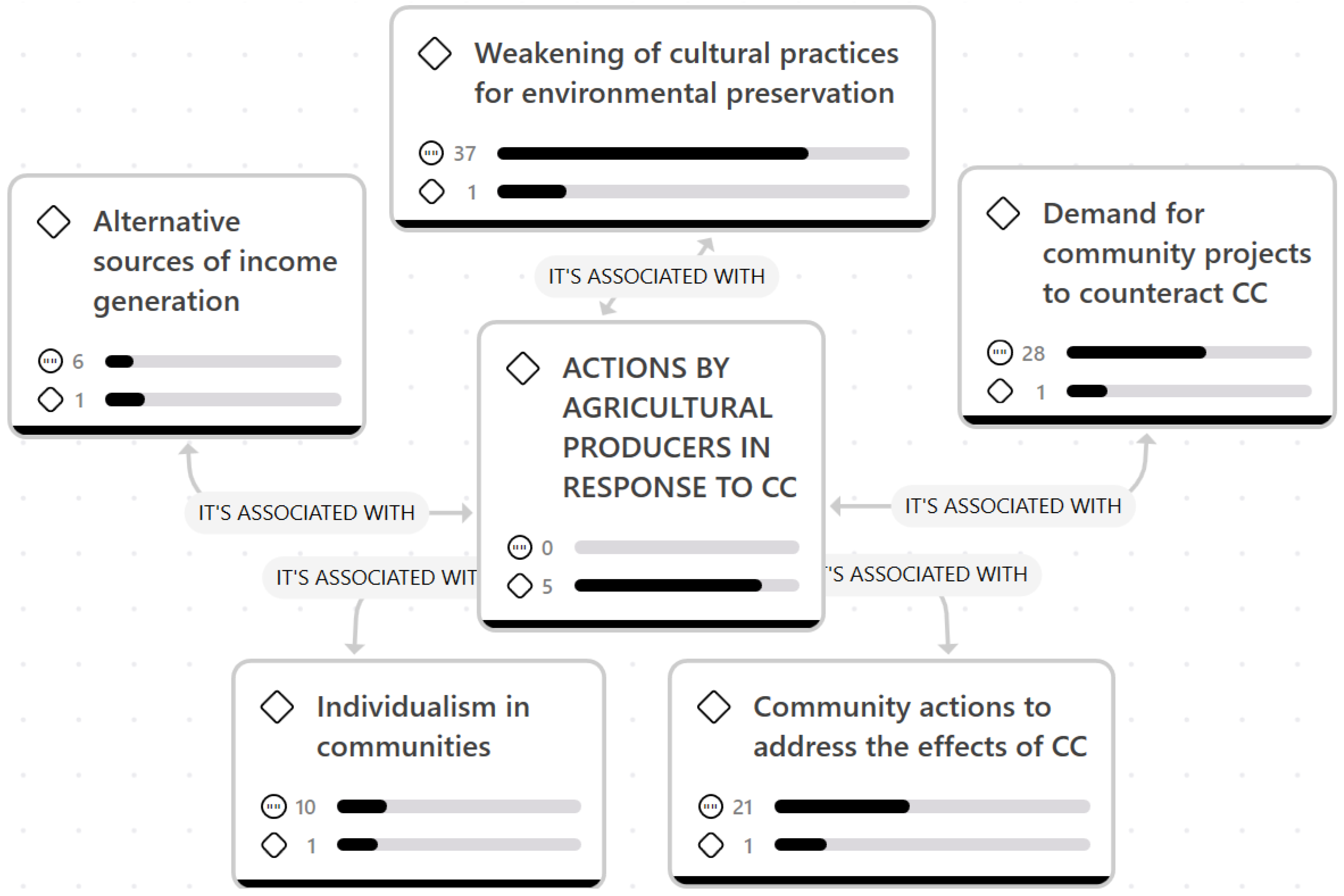
In the context of global climate change, high Andean communities are undertaking various strategies to adapt to this global phenomenon. According to Figure 4, these strategies can be analyzed and understood through five subcategories of analysis that have emerged from empirical field research: 1) weakening of cultural practices of environmental preservation, 2) demand for community projects to counteract climate change, 3) community actions to address the effects of climate change, 4) individualism in communities, and 5) alternative sources of income generation.
The weakening of cultural practices of environmental preservation (E=37) reflects a shift in social imaginaries, where nature goes from being a subject of reciprocity and harmony to an object of exploitation [5,6,7]. This imaginary transformation responds to the hegemony of projects that delegitimize local institutions and reconfigure the meaning of development [8,21]. The literature contrasts the technocratic view, which replaces cultural rules with market incentives [16], with the civilizational perspective, which understands these practices as social and ethical technologies of environmental care [9,10]. When cultural practices are folklorized or co-opted, they lose their normative force, increasing socio-ecological vulnerability. Therefore, there is a demand to re-establish communal authority and establish co-governance of common goods.
The second emerging subcategory of analysis in the attitudinal dimension is the demand for community projects to counteract climate change (E=28), which expresses a vision of the future that seeks to strengthen collective action in the face of the gap between international commitments and local resources [12,27]. However, the project-based perspective on development can fragment efforts and depoliticize conflicts [19]. In this context, the debate between gradual mitigation and early action for intergenerational equity resonates [28,29,30]. For high Andean communities, postponement means externalizing costs to communities that emit less. Empirical evidence recommends promoting projects aimed at rural public goods (research, extension, restoration, and climate services) rather than subsidies that reinforce emissions [34,36]. Thus, the demand is consistent, but its effectiveness depends on institutional design and the principles of climate justice.
Community actions to address the effects of climate change (E=21) show hybrid adaptations: water harvesting, terraces, diversification, and source monitoring, which combine ancestral knowledge with modern innovations [23,35]. These actions translate imaginaries of reciprocity into everyday protocols, and when combined with climate information and technical support, they increase resilience [37,38]. The debate here is not between “tradition and technique,” but rather around the co-production of knowledge, that is, integrating community observatories, local forecasts, and scientific validation to avoid maladaptations, such as the expansion of inefficient irrigation that exacerbates scarcity [34]. Politically, these actions demonstrate agency in the face of neoliberal intergovernmentalism, which tends to shift responsibilities to local and communal entities without resources [19]. Rescaling the community involves institutionalizing territorial climate budgets, public procurement from small-scale agriculture, and water governance with communal authority.
Another emerging subcategory in the attitudinal dimension is individualism in communities (E=10), that is, the increase in individualism in rural communities, expressed in competition for resources, weakening of the ayllu and the mink’a, reflects the transition towards hegemonic imaginaries of progress and consumption [16,21]. In this sense, environmental mediatization contributes to individualizing blame and shifting structural responsibilities [11], weakening cooperation and fueling migration [22], which accentuates vulnerabilities in a context of unequal climate geopolitics [33]. In response to this, it is necessary to re-establish imaginaries of good living and care [10,54] through communal rules for the use of goods, risk-sharing mechanisms (mutual insurance, revolving funds, etc.), and situated education that addresses emotions, belonging, and identities [14].
Finally, alternative sources of income generation (E=6) are one of the climate change adaptation strategies adopted by high Andean inhabitants, because income diversification through trade, tourism, remittances, and the bioeconomy are presented as adaptive strategies that reduce agricultural exposure [31,32]. However, some alternatives insert households into extractive or volatile chains, such as informal mining, creating new dependencies. Here, the debate distinguishes between adaptation as management: diversification without changing the productive regime; and adaptation as transformation: bioeconomy, agroecology, and payments for ecosystem services [9,27]. Empirical evidence suggests reorienting incentives toward general services: research, extension, and green infrastructure, rather than subsidies that perpetuate emissions [36]. In short, diversifying income is necessary, but under the principles of justice and sustainability, and not for mere individual survival.
4. Final Reflections and Conclusions
The analysis of social imaginaries surrounding climate change in high Andean communities shows that these are not simply subjective perceptions, but structures of meaning that mediate between local experience, knowledge, and collective action. In the district of Cojata, the feelings, thoughts, meanings, and practices of agricultural producers form a symbolic framework that not only reflects vulnerabilities but also guides forms of resistance and adaptation in contexts marked by asymmetry of resources and power. This research thus demonstrates that understanding the climate crisis from the perspective of social imaginaries allows us to broaden our view beyond technocratic diagnoses, recognizing the cultural, ethical, and political dimensions of the problem.
The feelings of agricultural producer’s express imaginaries of risk that translate into concerns about falling incomes, water scarcity, uncertainty, and the disinterest of the authorities. These emotions, far from being irrational, constitute collective frameworks that guide everyday practices and legitimize demands for climate justice, revealing that vulnerability is simultaneously climatic, economic, and political.
Thoughts about climate change show that understanding the issue of climate change is also a political act, because it involves challenging dominant narratives and highlighting structural responsibilities. Although producers have situated knowledge that combines empirical experience and public narratives, a gap between awareness and action persists. Overcoming this gap requires processes of intercultural climate literacy and the co- production of knowledge, capable of translating experience into collective agency.
The social meanings surrounding climate change reveal that categories such as reciprocity, divine punishment, cultural symbols, or ecological indicators operate as devices of social regulation and environmental ethics. These symbolic matrices support practices of land stewardship and preservation of the commons. However, risks such as rural depopulation and the folklorization of knowledge threaten to weaken their normative effectiveness, which makes it necessary to recognize them in public policy, not as decorative elements, but as true rules of environmental governance.
Community adaptation practices highlight the existence of hybrid strategies: water harvesting, terraces, income diversification, and others, which combine ancestral knowledge and modern technologies and have proven effective in the face of climate variability. However, their sustainability is limited by the weakening of cultural practices, the advance of individualism, and integration into extractive markets, which requires institutionalization, adequate financing, and intercultural outreach to transform these practices into long-term resilient capacities.
In summary, the study concludes that addressing the phenomenon of climate change in high Andean communities requires the design of an intercultural territorial climate policy aimed at recognizing local social imaginaries as the foundation for collective action. This involves promoting the co-production of knowledge between ancestral and scientific knowledge, guaranteeing territorial climate budgets for rural public goods, strengthening the community fabric in the face of social fragmentation, and promoting sustainable economic alternatives based on principles of climate justice. Only through the articulation of feelings, thoughts, meanings, and practices will it be possible to transform social imaginaries into collective resilience and horizons of good living in the face of the global climate crisis.
Supplementary Materials
The following supporting information can be downloaded at the website of this paper posted on Preprints.org.
Author Contributions
Conceptualization, F.F.C.C., D.A.S.A., and E.Q.M.; methodology, F.F.C.C., L.J.M.C, E.L.R.C., G.B.Q., D.A.S.A. and E.Q.M.; software, L.J.M.C., E.L.R.C., W.Q.B. and E.Q.M.; validation, F.F.C.C., L.J.M.C., E.L.R.C., W.Q.B., B.V.M.M. and Z.Z.; formal analysis, F.F.C.C., G.B.Q., D.A.S.A., W.Q.B., B.V.M.M. and E.Q.M.; investigation, F.F.C.C., L.J.M.C., E.L.R.C., G.B.Q., D.A.S.A., W.Q.B., B.V.M.M. and E.Q.M.; resources, F.F.C.C., G.B.Q., D.A.S.A., B.V.M.M. and E.Q.M.; data curation, L.J.M.C., E.L.R.C. and B.V.M.M.; writing—original draft preparation, F.F.C.C., L.J.M.C., E.L.R.C., G.B.Q., D.A.S.A., W.Q.B. and E.Q.M.; writing—review and editing, G.B.Q., D.A.S.A, W.Q.B., B.V.M.M. and E.Q.M.; visualization, F.F.C.C., L.J.M.C., E.L.R.C., G.B.Q., D.A.S.A., W.Q.B., B.V.M.M. and E.Q.M.; supervision, W.Q.B. and E.Q.M.; project administration, W.Q.B. and E.Q.M.; funding acquisition, G.B.Q., D.A.S.A., W.Q.B., B.V.M.M. and E.Q.M.; All authors have read and agreed to the published version of the manuscript.
Funding
No external funding was received for this research.
Informed consent statement
Taking into account the Declaration of Helsinki, the study was conducted with the informed consent of the participating communities. In this regard, at the beginning of the recorded interviews, consent was requested from the informants to record the audio of the interviews and focus groups.
Data Availability Statement
The original contributions presented in this study are included in the article. Further inquiries can be directed to the corresponding author.
Acknowledgments
Our thanks to all the key informants in the study, from the 16 high Andean communities of Cojata, in Puno, Peru.
Conflicts of Interest
The authors of the study declare that they have no conflicts of interest.
References
- Belizario, G. Efectos del cambio climático en l agricultura de la cuenca Ramis, Puno, Perú Rev. Investig. Altoandinas 2015, 47–52. [Google Scholar] [CrossRef]
- Najarro, R.J. En tiempos de cambio climático: Relación agua–hombre en localidades altoandinas de Paras y Chuschi, Ayacucho. Alteritas. Rev. Estud. Sociocult. Andin. Amaz. 2020, 89–126. [Google Scholar] [CrossRef]
- Sánchez, L.; Reyes, O. Medidas de adaptación y mitigación frente al cambio climático en América Latina y el Caribe. Santiago de Chile: Naciones Unidades, 2015. Available online: http://repositorio.cepal.org/bitstream/handle/11362/39781/S1501265_es.pdf?sequence=1 (accessed on 05 September 2025).
- INDECI. Déficit hídrico en el departamento de Puno.; Lima, 2023. [Google Scholar]
- Castoriadis, C. La imaginación radical desde el punto de vista filosófico y psicoanalítico; Rivista Zona Erógena: Buenos Aires., 1993; Volume 24. [Google Scholar]
- Castoriadis, C. La institución imaginaria de la sociedad, 1° Ed. ed; Buenos Aires, Arg., 2007. [Google Scholar]
- Taylor, C. Imaginarios sociales modernos. In Barcelona: PAIDÓS; 2006; Volume 25, p. 3. [Google Scholar]
- Baczko, B. Los imaginarios sociales. Memorias y esperanzas colectivas; Nueva Visión: Buenos Aires, 1999. [Google Scholar]
- Elizalde, R.; Elizalde, A. La apuesta por la vida. Imaginación sociológica e imaginarios sociales en territorios ambientales del sur, de Enrique Leff 2019, 54, 185–189. [Google Scholar] [CrossRef]
- Gallegos, E. Desencuentros entre el imaginario social occidental y el imaginario social indígena: elementos para una reflexión teórica sobre los imaginarios sociales nucleares en el marco del conflicto entre el estado-nación chileno y el pueblo mapuche. Rev. Cuhso 2021, 31, 548–571. [Google Scholar] [CrossRef]
- Prosser, G.; Caro-Zúñiga, C.A.; Arboleda-Ariza, J.C.; Schroder-Navarro, E.C.; González-Soto, M.L. Social imaginaries of youth in the Chilean press on climate change. Cuadernos.info 2023, 54, 293–317. [Google Scholar] [CrossRef]
- Wright, C.; Nyberg, D.; De Cock, C.; Whiteman, G. Future imaginings: Organizing in response to climate change. Organization 2013, 20, 647–658. [Google Scholar] [CrossRef]
- Duque, D.E. El cambio climático su imaginario social para la participación ciudadana. Facultad Latinoamericana de Ciencias Sociales, 2015. Available online: http://hdl.handle.net/10469/8754 (accessed on 10 August 2025).
- García-Muñoz, C.M.; Gómez-Gallego, R.Á. Aproximación epistemológica a los imaginarios sociales como categoría analítica en las ciencias sociales. Rev. Guillermo Ockham 2021, 19, 219–232. [Google Scholar] [CrossRef]
- Gauna, A.F. Alcance y problemas de la propuesta de Cornelius Castoriadis sobre los imaginarios sociales y el cambio social. Utopía y Prax. Latinoam. 2020, 25, 189–203. [Google Scholar]
- Murcia-Murcia, N. Imaginarios sociales sobre problemática ambiental: nuevos senderos para una educación ambiental. Educ. y Humanismo 2023, 25, 62–78. [Google Scholar] [CrossRef]
- Riffo-Pavón, I. Imaginarios sociales, representaciones sociales y re-presentaciones discursivas. Cinta de Moebio 2022, 74, 78–94. [Google Scholar] [CrossRef]
- Quispe-Mamani, E.; Chaiña Chura, F. F.; Salas Avila, D. A.; Belizario, G. Imaginario social de actores locales sobre la contaminación ambiental minera en el altiplano peruano. Rev. Ciencias Soc. 2022, XXVIII, 303–321. [Google Scholar] [CrossRef]
- Stein, A. Cambio climático y conflictividad socioambiental en América Latina y el Caribe. América Lat. Hoy 2018, 79, 9–39. [Google Scholar] [CrossRef]
- Riffo-Pavón, I.; Lagos-Oróstica, O. El ocultamiento del símbolo y la imaginación: repercusiones en el sistema educativo actual. Perseitas 2022, 10, 111–133. [Google Scholar] [CrossRef]
- Riffo-Pavón, I. La construcción del mensaje político a partir de los imaginarios sociales y el Framing. Atenea 2022, 525, 45–63. [Google Scholar] [CrossRef]
- Rodríguez, J.J.; et al. Impactos socioeconómicos del cambio climático en América Latina y el Caribe: 2020-2045. Cuad. Desarro. Rural 2016, 13, 11–34. [Google Scholar] [CrossRef]
- Delgado, L.E.; Torres-Gómez, M.; Tironi-Silva, A.; Marín, V.H. Estrategia de adaptación local al cambio climático para el acceso equitativo al agua en zonas rurales de Chile. América Lat. Hoy 2015, 69, 113–137. [Google Scholar] [CrossRef]
- Rodriguez-Morales, A.J. Climate change, rainfall, society and disasters in Latin America: Relationsand needs. Rev. Peru. Med. Exp. Salud Publica 2011, 28, 165–166. [Google Scholar] [CrossRef] [PubMed]
- Borgen-Eide, G.; Gubrium, E. Climate change in Norway: Destabilized social imaginaries of welfare, growth, and nature in a rich oil state. EPE Nat. Sp. 2025, 8, 1002–1019. [Google Scholar] [CrossRef]
- Stolz, L. A colonial lack of imagination: Climate futures between catastrophism and cruel eco-optimism. J. Polit. Ecol. 2024, 31, 759–769. [Google Scholar] [CrossRef]
- Hincapié, S. Global environmental governance, human rights and socio-state capabilities in Latin America. Rev. CIDOB d’Afers Int. 2022, 130, 19–43. [Google Scholar] [CrossRef]
- Mora-Motta; León, A.N. Cambiando de perspectiva en la economía de la mitigación del cambio climático. Cuad. Econ. 2017, 36, 169–195. [Google Scholar] [CrossRef]
- Nordhaus, W. A Question of balance. Weighing the options on global warming policies; Yale University Press: New Haven & London, 2008. [Google Scholar]
- Stern, N. The economics of climate change. Am. Econ. Rev. Pap. Proc. 2008, 98, 1–37. [Google Scholar] [CrossRef]
- López, A.J.; Hernádez, D. Cambio climático y agricultura: una revisión de la literatura con énfasis en América Latina. Trimest. Econ. 2016, 4, 459–496. [Google Scholar] [CrossRef]
- Cartay, R.; Poveda, E.; Buzetta, M.F. El cambio climático y la producción agrícola familiar y empresarial en América Latina. Agroalimentaria 2022, 28, 191–212. [Google Scholar] [CrossRef]
- Estenssoro, F. Crisis ambiental y cambio climático en la política global: Un tema crecientemente complejo para américa latina. Universum 2010, 2, 57–77. [Google Scholar] [CrossRef]
- Salazar, O.; et al. Water consumption by agriculture in Latin America and the Caribbean: impact of climate change and applications of nuclear and isotopic techniques. Int. J. Agric. Nat. Resour. 2022, 49, 1–21. [Google Scholar] [CrossRef]
- Campos, M.; Herrador, D.; Manuel, C.; Mccall, M.K. Estrategias de adaptación al cambio climático en dos comunidades rurales De México y el Salvador. Boletín la Asoc. Geógrafos Españoles 2013, 61, 329–349. [Google Scholar] [CrossRef]
- Wong, S.A.; Rondinone, G.; De Salvo, C.P. Agricultural support policies and GHG emissions from agriculture in Latin America: relationships and policy implications for climate change. Iberoam. J. Dev. Stud. 2023, 12, 102–140. [Google Scholar] [CrossRef]
- Gómez, M.G.; De la Garza, L.A.; Hosman, L. Uso de bibliotecas digitales solares para la enseñanza del cambio climático en comunidades rurales. Rev. Interam. Bibliotecol. 2022, 45, 1–16. [Google Scholar] [CrossRef]
- Plata-Rangel, Á.M.; Ibáñez-Velandia, A.Y. Education on climate change in rural communities in the municipality of la Calera (Cundinamarca, Colombia). Rev. Luna Azul 2020, 51, 198–222. [Google Scholar] [CrossRef]
- Hernández, R.; Fernández, C.; Baptista, P. Metodología de la investigación; McGraw-Hill / Interamericana Editores: S.A. de C.V., México D.F., 2014. [Google Scholar]
- Hernández-Sampieri, R.; Mendoza, C.P. Metodología de la investigación. Las rutas cuantitativa, cualitativa y mixta; McGraw-Hill Interamericana Editores: México D.F., 2018. [Google Scholar]
- Valencia, V.E. Revisión documental. 2018, 1432, 2017–2018. [Google Scholar]
- Díaz, L.; Torruco, U.; Martínez, M.; Varela, M. La Entrevista, Recurso Flexible y Dinámico. Investig. en Educ. médica 2013, 2, 162–167. [Google Scholar] [CrossRef]
- Valles, M. S. Técnicas cualitativas de Investigación social. Reflexión metodológica y práctica profesional; Editorial Síntesis S. A.: Madrid, España, 1999. [Google Scholar]
- Santana, L. Guías para Elaborar Fichas Bibliográficas En la Redacción de Ensayos. In Monografías y Tesis; Univ. Puerto Rico; 2008; pp. 1–19. [Google Scholar]
- Bracho, Y. Capítulo III Marco Metodológico. Gestión Calid. en las Empres. del Sect. Azucar. del Occident. Venez. 2007, 2006, 67–79. [Google Scholar]
- Gonzáles, J. Técnicas e Instrumentos de Investigación Científica, 1st ed.; Enfoques Consulting EIRL: Arequipa, 2019. [Google Scholar]
- Barquín, A.; Arratibel, N.; Quintas, M.; Alzola, N. Percepción de las familias sobre la diversidad socioeconómica y de origen en su centro escolar. Un estudio cualitativo. Rev. Investig. Educ. 2022, 40, 89–105. [Google Scholar] [CrossRef]
- Quispe-Mamani, E.; Porto, H.; Ayamamani, P.; Turpo, O. Mediatización y crisis sociopolítica en Perú. Imaginarios y prácticas de actores sociales. Cuadernos.info 2023, 56, 22–43. [Google Scholar] [CrossRef]
- San Martín, D. Teoría fundamentada y Atlas.ti: recursos metodológicos para la investigación educativa. Rev. electrónica Investig. Educ. 2016, 18, 112–127. [Google Scholar]
- Pertegal-Felices, M.L.; Espín-León, A.; Jimeno-Morenilla, A. Diseño de un instrumento para medir identidad cultural indígena: caso de estudio sobre la nacionalidad amazónica Waorani. Rev. Estud. Soc. 2020, 71, 51–73. [Google Scholar] [CrossRef]
- Quispe-Mamani, E.; Quispe, W.; Turpo, O. Recentralización, conflictos intergubernamentales y desigualdad territorial: perspectiva de gobiernos locales en Perú. Rev. Adm. Pública 2023, 57, 1–22. [Google Scholar] [CrossRef]
- Cáceres, P. Análisis cualitativo de contenido: Una alternativa metodológica alcanzable. 2003, II, 7–60. [Google Scholar] [CrossRef]
- Sayago, S. El Análisis del Discurso Como Técnica de Investigación Cualitativa y Cuantitativa en las Ciencias Sociales. Cinta de moebio 2014, 49, 1–10. [Google Scholar] [CrossRef]
- Leff, E. Imaginarios sociales y sustentabilidad. Cult. y Represent. Soc. 2010, 5, 42–121. [Google Scholar]
- Estenssoro, F. Crisis Ambiental Global: ¿Una Crisis Antropogénica o Capitalogénica? Rev. Divergencia 2021, 10, 106–127. [Google Scholar]
- Martínez-Alier, J. Los conflictos ecológicos-distributivos y los indicadores de Sustentabilidad. P. Rev. Latinoam. Conc. y Pod. Mund. 2006, 13, 1–15. Available online: http://journals.openedition.org/polis/5359 (accessed on 17 July 2025).
- Leff, E. La Ecología Política en América Latina. Un campo en construcción. P. Rev. Latinoam. 2003, 5, 1–16. [Google Scholar] [CrossRef]
Figure 1.
Feelings of agricultural producers about climate change.
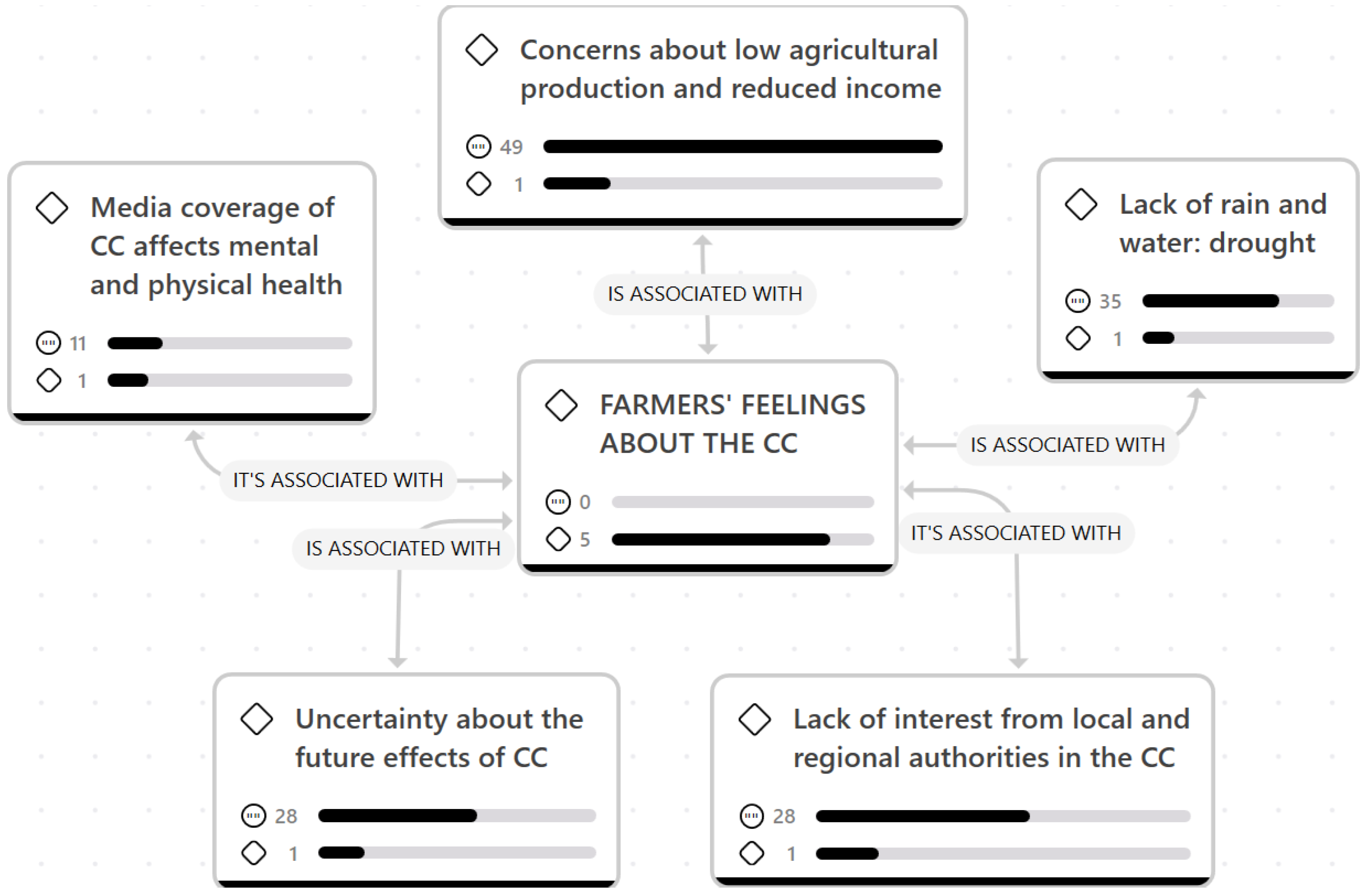
Figure 2.
Agricultural producers’ thoughts on climate change.
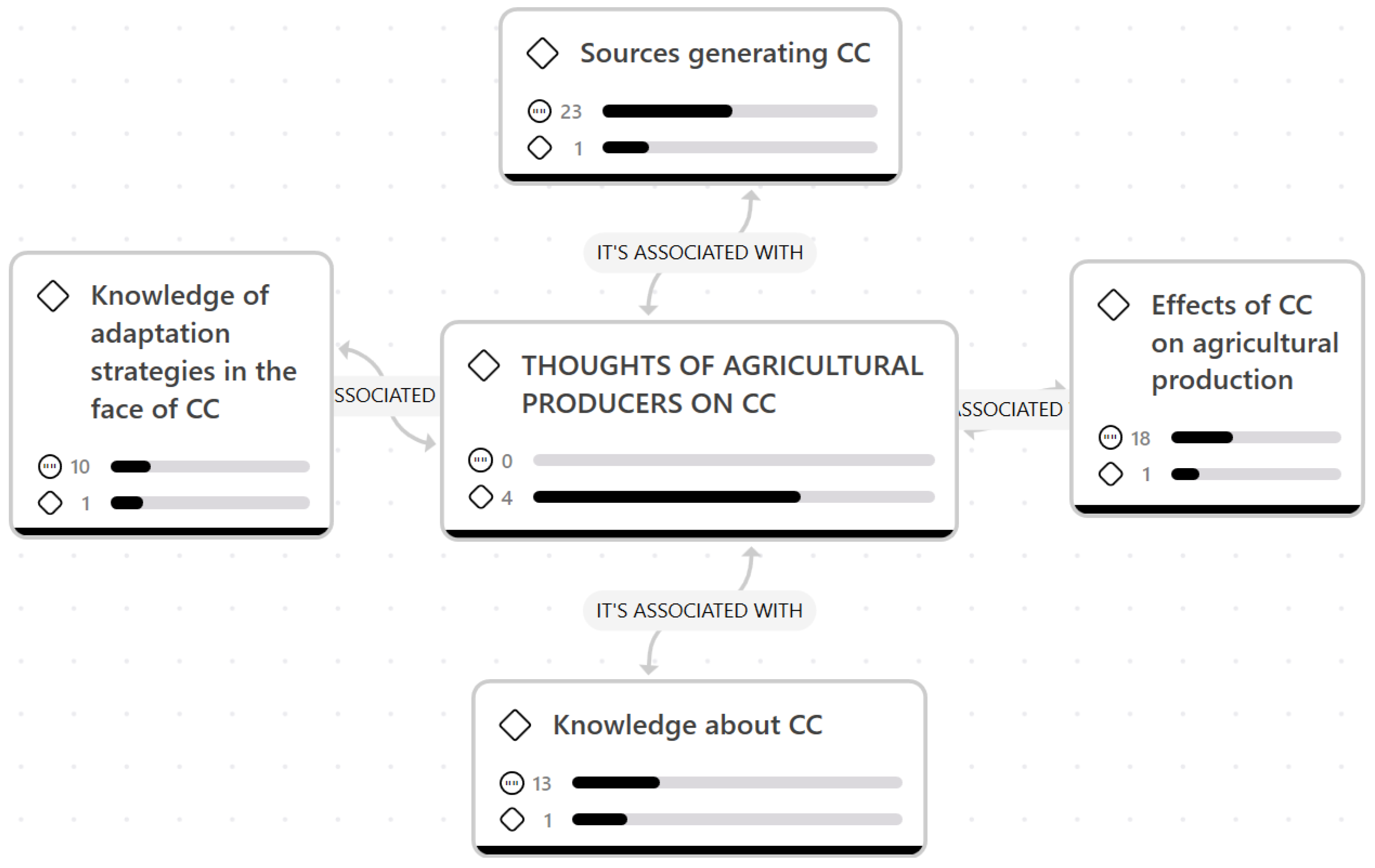
Figure 3.
Social meanings of climate change among agricultural producers.
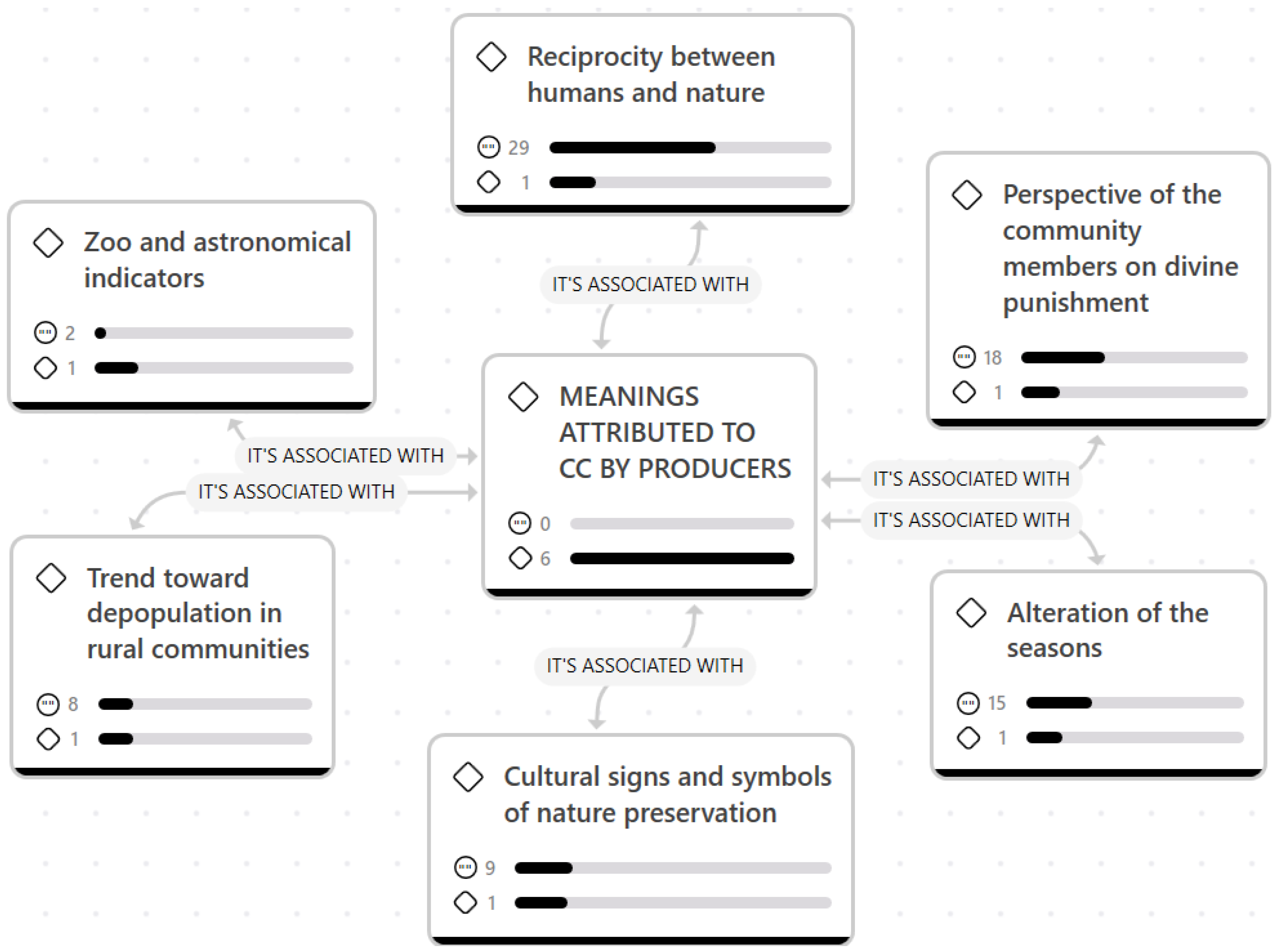
Figure 4.
Adaptation practices of agricultural producers to climate change.
Disclaimer/Publisher’s Note: The statements, opinions and data contained in all publications are solely those of the individual author(s) and contributor(s) and not of MDPI and/or the editor(s). MDPI and/or the editor(s) disclaim responsibility for any injury to people or property resulting from any ideas, methods, instructions or products referred to in the content. |
© 2025 by the authors. Licensee MDPI, Basel, Switzerland. This article is an open access article distributed under the terms and conditions of the Creative Commons Attribution (CC BY) license (http://creativecommons.org/licenses/by/4.0/).
Copyright: This open access article is published under a Creative Commons CC BY 4.0 license, which permit the free download, distribution, and reuse, provided that the author and preprint are cited in any reuse.


