
Submitted:
01 December 2025
Posted:
02 December 2025
You are already at the latest version
Abstract
This paper presents an extensive exploration of quantum computing as an emerging paradigm that operates on the principles of quantum mechanics to process information in ways unattainable by classical systems. It traces the evolution of quantum theory from its early conceptual foundations to its present-day technological applications, highlighting key milestones such as the development of qubits, quantum gates, and essential algorithms including Shor’s and Grover’s. The study examines the fundamental mechanisms of quantum superposition and entanglement, alongside the hardware and software innovations driving scalability and performance. By analysing experimental progress, programming models, and comparative advantages over classical and cloud computing, this paper underscores how quantum computing can transform industries such as data security, medicine, and artificial intelligence. Furthermore, it outlines future prospects involving error correction, neuromorphic integration, and commercialization trends that are shaping the next generation of computational technology.
Keywords:
quantum computing
; Qubits
; superposition
; entanglement
; quantum algorithms
; quantum hardware
; quantum software
; quantum key distribution
; artificial intelligence
; data security
; future computing paradigms
1. Introduction
Quantum computing is a revolutionary computer paradigm that uses quantum mechanics principles to process data in novel ways. Unlike conventional computing, quantum computing employs qubits (see Section 3.4 Qubit), which allow quantum computers to do calculations at exponentially faster speeds than classical computers in specific tasks, making them especially well-suited to challenges involving massive datasets and intricate computations.
This paper will offer an overview of quantum computing’s technological foundations and their implications in several industries. By delving into historical advances, comparative system analysis, and future applications, readers will obtain a thorough understanding of quantum computing’s theoretical foundations, important terminology, and predicted implications. With a focus on technological advancements and scaling issues, this study seeks to emphasise the enormous ramifications and transformational possibilities of quantum computing in domains such as cryptography, medicine, and artificial intelligence.
1.1. Methodology
This paper aims to explore the topic of Quantum Computing as a computing paradigm. This includes literature reviews such as reports, journals and videos, case studies, comparative analysis with classical computing and theoretical explorations. The structure of this paper includes the following main topics: Technical Drivers, Analysis on Quantum Computing, Lesson Learnt and Conclusion.
1.2. Expected Outcomes
Readers will have a deeper understanding of the applications of this computing paradigm, the comparisons between other computing methods and its future implications. The Report will include citations from latest reports to gather awareness of the latest research and developments in Quantum Computers.
The expected knowledge gained from this paper will include how this method of computing can be applied in current technologies, research, or industry. Hence, the importance of this paper is in its relevance to the current Industrial Revolution (IR 4.0) - Digitalization, and its assistance in creating headway towards Personalization Humanization (IR 5.0). (Raiche, 2022) To understand the future implications of Quantum Computing, it is important to comprehend the technological drivers so far.
2. Technological Drivers of Quantum Computing
Technological drivers refer to the changes in technological circumstances and requirements by the development or availability of new technologies and resources in the market (COIN - Continuous Innovation Framework, n.d.). This section of the report will explore the history of Quantum Computing, the essential technological drivers and delve into the impacts these inventions and innovative ideas have on the current and future technological developments.
2.1. General History of Quantum Computing
To understand the impacts of Quantum Computers, it is important to take a step back and observe its historical point of view to comprehend the changes in mentality made over the time.
2.1.1. Theoretical Foundations
The 1900s presented the beginning of Quantum Computers. In fact, it was the birth of a new field in physics: Quantum Mechanics (see Section 3.2 Quantum Mechanics). Max Planck, a German theoretical physicist, introduces the quantum hypothesis. His work had laid the groundwork for quantum theory. Following his discovery, Werner Heisenberg and Erwin Schrödinger developed matrix and wave mechanics respectively, forming the foundations of quantum mechanics.
A few years later, Albert Einstein theorized that objects can be influenced only by their surroundings and any influence cannot travel faster than light, this is known as the Local Realism theory. The development of the first computer had started and newer architectures made the world of number crunching much faster. By 1945, Von-Neumann had proposed his computer Architecture which is still used to this day. Following the creation of higher performance computers, physicists such as Richard Feynman started to explore the problems in physics that could potentially be solved by computers based on quantum mechanics.
At this time, the idea of Quantum Computers did not exist as it goes against Einstein’s theory in Quantum Mechanics. The vital idea of a Quantum Computer relies on the principles of quantum entanglement - when two unrelated energy particles are measured together, one of the particles may experience a similar energy shift at a different place without any information transmission. (Zou, 2021)
2.1.2. Conceptualization
Entering the conceptualization era of Quantum Computing. In 1980, Paul Benioff proposed the first quantum mechanical model of a computer. The following year, Richard Feyman proposed the idea of quantum computers to simulate quantum systems (see Section 3.1 Quantum). Finally, David Deutsch, a physicist at the University of Oxford, invented the idea of a universal quantum computer which significantly extended the theoretical framework. Hence, naming him “The Father of Quantum Computing.”
2.1.3. Development of Quantum Algorithms
The feasibility of a Quantum Computer was still required to fund its development. In 1994, Peter Shor developed the Shor’s algorithm which proved that Quantum Computers could factor large integers exponentially faster than classical computers. Two years later, Lov Grover Formulated the Grover’s algorithm, which shows a quadratic speedup for database searching. The development of the two algorithms were a pivotal moment that created an increasing interest and funding in quantum computing research.
2.1.4. Experimental Advances
Experiments were conducted by teams at IBM’s Almaden Research Center, Caltech, and MIT to demonstrate basic quantum gates as well as simple quantum algorithms to prove the theoretical principles of quantum computers. By 2010, the development of the first small- scale quantum processor had started, demonstrating basic quantum error correction and the entanglement of multiple qubits (see Section 3.6 Entanglement).
2.1.5. Scaling and Commercialization
Nearing the present day, companies such as Google, MASA and USRA collaborated to use a quantum computer from D-Wave Systems to inspect optimization problems. This was called the Quantum Artificial Intelligence Lab. Their contributions started a chain of events leading to the scaling and commercialization of Quantum Computers. By 2019, Google claimed to attain quantum supremacy via carrying out a particular quantum computation quicker than any classical computer.
2.2. Key Technological Drivers
The history of Quantum Computers produced technologies beyond what was thought to be possible in the 1900s. Hence, it is crucial that the key technological advances are highlighted before delving into how Quantum Computers work.
2.2.1. Hardware
There exist many factors that contribute to the enhancement of quantum computing. One of such factors is hardware. With the help of hardware such as quantum registers, quantum gates, and quantum processing units (QPU), quantum computing can thrive. (Gharibyan, 2023)
Quantum registers store and manipulate quantum information. It stores information in the form of qubits (see Section 3.4 Qubit) which enables quantum computers to store vast amounts of information simultaneously. Quantum registers are important to perform complex calculations and problem solving. As quantum hardware continues to develop, the capacity and performance of quantum registers will play a significant role in determining the capabilities of quantum computers.
Quantum Gates are responsible for manipulating qubits during computation. They perform operations on qubits by altering their states through a set of quantum logic operations such as CNOT gates. Quantum gates can create and manipulate entanglement (see Section 3.6 Entanglement) and superposition (see Section 3.5 Superposition), which are essential properties for the increased computational power of quantum computers.
A Quantum Processing Unit (QPU) is the core component of a quantum computer. It executes quantum algorithms by processing qubits through a series of quantum gates. With the help of qubits, QPUs can perform complex calculations exponentially faster. QPUs can vary in their underlying technology, such as trapped ions (see Section 3.4.2 Type of Qubit - Trapped Atoms and Ions), photonic qubits (see Section 3.4.3 Type of Qubit - Photons), or superconducting circuits (see Section 3.4.4 Type of Qubit - Superconducting Circuits), with each approach offering unique advantages and challenges.
2.2.2. Software
Another contributing factor to quantum computing enhancement is the software available. There are various programming languages that help with the integration of quantum computing like Qiskit, Cirq, Q# (pronounced as “Q sharp”) and so on (see Section 4.1.2 Programming Languages).
These languages provide intuitive constructs for defining quantum gates, composing quantum circuits, and executing quantum operations, thereby streamlining the development rocess. (Doug Finke, 2016) Moreover, they facilitate collaboration and knowledge-sharing within the quantum computing community by establishing common frameworks and libraries for quantum algorithm development. By democratising access to quantum programming and fostering a vibrant ecosystem of tools and resources, programming languages play a crucial role in accelerating research, innovation, and adoption in the field of quantum computing.
2.2.3. Networking
Quantum networks communicate with quantum data, usually stored in the form of qubits. By using the power inherent in quantum states, quantum networks can enable new applications like physics-based unhackable security, more powerful quantum computers that can solve tasks in minutes that would otherwise take years, and networks of entangled quantum sensors. (F, 2024) Quantum networks take advantage of the power of quantum mechanics, the strange physical properties that only appear at very small scales. Using qubits, quantum networks can create entangled quantum states across the globe. (Office of Science, n.d.) Quantum networks use quantum phenomena, like superposition, no-cloning (see Section 3.7 No- Cloning Theorem), and entanglement (see Section 3.6 Entanglement) that are not available to classical networks.
2.2.4. Data Management
Data management is one of the most important factors in ensuring the advancements in quantum computing. Managing complex quantum systems requires sophisticated data management techniques to maintain coherence and prevent errors. Additionally, quantum algorithms often involve vast amounts of data processing, demanding efficient storage, retrieval, and manipulation of quantum information. Due to the nature of quantum computing processing information at high speeds, appropriate data management is highly recommended as quantum computing could potentially reduce the time needed for data preprocessing, analysis, and insight generation, making real-time data analysis more feasible across various industries. (Davies, 2024)
2.3. Impact Review
2.3.1. Current Impact
Quantum computing, though still in its nascent stages, is beginning to demonstrate significant impacts across various fields. It has potential to evolve numerous encryption techniques currently used to protect sensitive data. (Siroshtan, 2024) Furthermore, it also presents the prospect of using quantum cryptography methods like Quantum Key Distribution (QKD) to enable more secure communication. QKD is a secure communication method that leverages the principles of quantum mechanics to ensure the integrity and confidentiality of data transmission. (Forbes Technology Council Expert Panel, 2023)
The next impact is in the medical industry, particularly in the areas of drug discovery and material science. This is because quantum computers can accurately model and predict the behaviour of molecules, they may speed up the process of finding new drugs by simulating molecular interactions. Similarly, by modelling atomic structures, quantum computing can help in the creation of new and unique materials with specific traits.
Quantum computers have plenty of benefits to offer sectors like finance, banking, and logistics because they can solve complicated optimization and simulation issues more quickly. These industries particularly benefit from the ability of quantum computers to solve problems requiring enormous datasets and complicated variables. Additionally, by processing and interpreting data at unimaginable speeds, quantum computing holds the potential to improve machine learning techniques. Further developing the capabilities and uses of quantum technology, quantum machine learning methods may lead to breakthroughs in data analysis, pattern identification, and natural language processing.
2.3.2. Future Outlook
The future of quantum computing has a huge potential for technological developments that could revolutionise the way we process information, interact with technology, and solve complex problems. Hence, this will lead to discoveries in other computer paradigms such as neuromorphic computing, photonic computing, molecular computing, and many others.
Quantum computing is at the top, with ongoing efforts to achieve quantum supremacy across multiple applications while improving scalability for practical use. Neuromorphic computing, inspired by the architecture of the brain, aims to construct adaptive systems capable of learning and reasoning in the same way that biological neural networks do, with the potential to improve fields such as artificial intelligence.
Photonic computing, that utilises light-based technology, offers rapid processing speeds with low energy usage, building the way for advances in data processing and communication. Meanwhile, DNA and molecular computing use biomolecules’ unique features for exceptionally high energy-efficient computations, which have applications in cryptography, data storage, and bioinformatics. Topological quantum computing, on the other hand, investigates unique forms for robust and fault-tolerant quantum systems, providing the stability and error correction required for practical applications.
Decentralised computing paradigms, such as federated learning and edge computing, allocate computational tasks across interconnected devices, allowing for collaborative and privacy-preserving data processing. These systems integrate advances in algorithms, edge technologies, and blockchain protocols to improve scalability, efficiency, and security. These speculative advances provide a view into the potential future of computing, where interdisciplinary study and technology innovation combine to open new frontiers in computation, communication, and problem solving.
3. Quantum Computing Basics
To ensure the readers’ understanding throughout the report, this section will cover all complex terminologies that are used in this paper. By understanding these terminologies, individuals will have a better understanding of how these complex systems work through the assistance of images and descriptive passages.
3.1. Quantum
A Quantum refers to a discrete natural unit that contains energy, charge, angular momentum, or other physical attributes. As an example, light is emitted and absorbed in discrete amounts also known as a “Quanta”. (The Editors of Encyclopaedia Britannica, 2020) In this context, a photon is a quantum of light. A quantum system then refers to an organisation of quanta which obeys the laws of Quantum Mechanics.
3.2. Quantum Mechanics
The literal meaning to Quantum Mechanics is the study of the behaviour (mechanics) of atomic and subatomic particles (quanta). It aims to describe and account for all properties of molecules and atoms as well as their components—neutrons, protons, electrons, photons, quarks, and other esoteric particles. (Squires, 2018) These behaviours can include the interactions of a particle with another through electromagnetic radiation.
3.3. Quantum Computer
A computer refers to a device that can process data in accordance with a set of instructions given to it. Hence, a quantum computer is a device that harnesses the abilities of quantum mechanics to produce an output. It takes an input data and changes it using a predefined unitary operation represented by a quantum circuit and is analogous to gate operations. (Amazon Web Services, Inc., n.d.)
3.4. Qubit
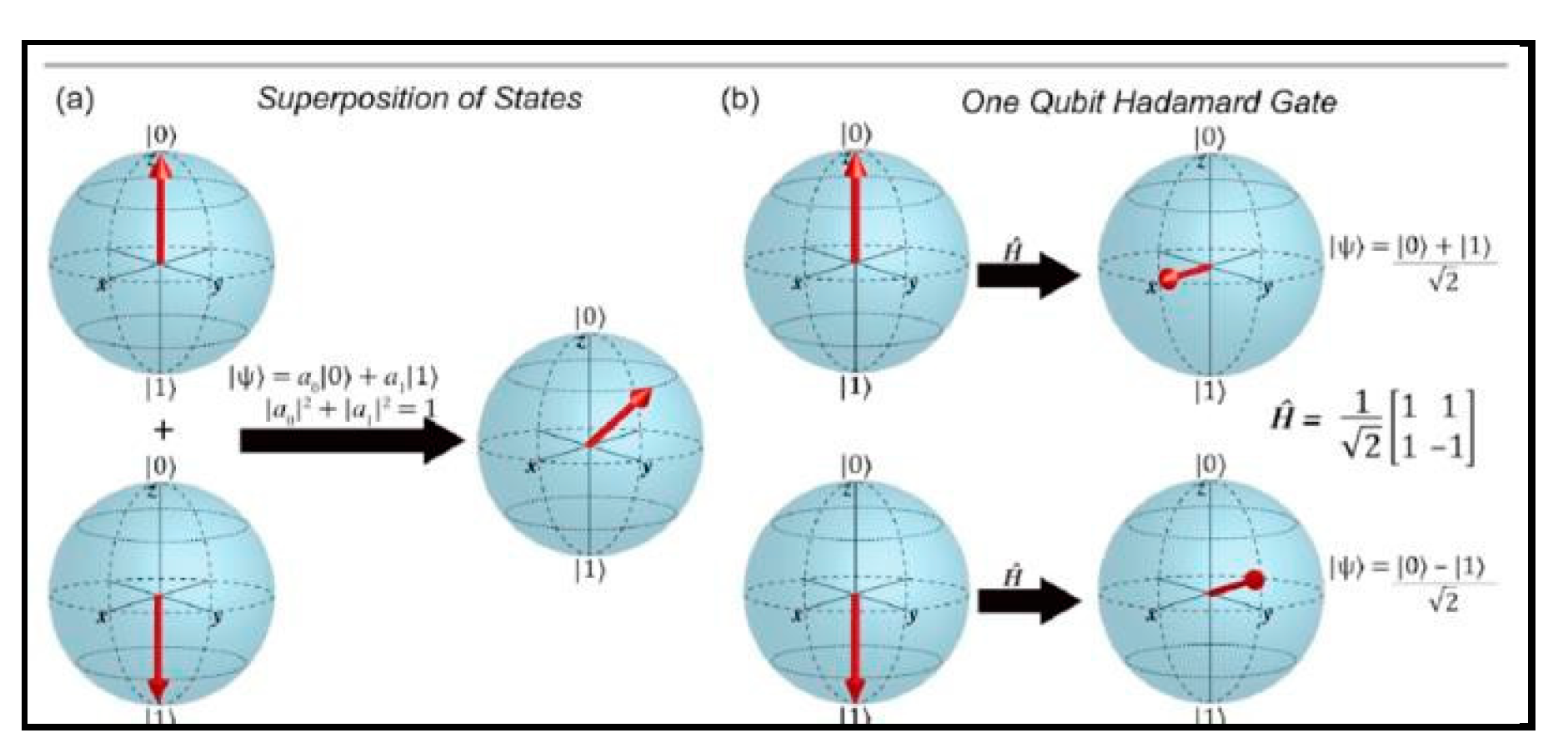
Similar to how classical computers work, they require a storage for data called bits. In classical computers, a bit can be represented by tiny ‘flip flops’ which act as switches that turn off (value 0) and on (value 1). For Quantum Computers, the usage of Quantum Bits, also known as “Qubits’’, as an object for storage is essential. A Qubit must have one of two distinct states that are similar to bits in contemporary computers: 0 and 1. However, unlike a classical bit, a quantum bit exists in superposition states and can be entangled. Qubits may exist in a superposition of the two states. These quantum states can be acted on by quantum gates that preserve valid probability distributions that sum to 1 and can guarantee reversibility. (Duckering, 2022) The ability to harness the power of superposition and entanglement classifies qubits as a much more powerful alternative to classical bits.
Figure 1.
Representation of a qubit’s superposition states on the Bloch sphere & how a Hadamard gate does the same (Moreno-Pineda et al., 2018).
Figure 1.
Representation of a qubit’s superposition states on the Bloch sphere & how a Hadamard gate does the same (Moreno-Pineda et al., 2018).
3.4.1. Type of Qubit - Spin
Most quantum particles behave like little magnets. This attribute is termed as “spin.” The spin orientation is always pointing fully up or fully down, never in between. We can create a spin qubit by using the up and down spin states as shown in Figure 2.
3.4.2. Type of Qubit - Trapped Atoms and Ions
Qubits can be created by manipulating the energy levels of electrons in neutral atoms or ions. In their natural state, these electrons have the lowest energy levels. By utilising lasers to “excite” them into greater energy states, values could be given to the qubits based on their energy states as seen in Figure 3.
3.4.3. Type of Qubit-Photons
There are multiple ways in which photons can be used as qubits including Polarisation Qubit, Path Qubit and Time Qubit as shown in Figure 4. Every photon delivers an electromagnetic field in a certain direction, known as polarisation. Qubits are defined in two states: horizontal and vertical polarisation (see Figure 4A). A qubit can also be defined by the path that a photon follows. Using beam-splitters, we can put a photon within a superposition to appear “here” and “there” (see Figure 4B). Additionally, it is possible to construct a photon qubit using the time of arrival. We can generate a quantum superposition of “photon arriving early” and “photon arriving late” (see Figure 4C).
3.4.4. Type of Qubit - Superconducting Circuits
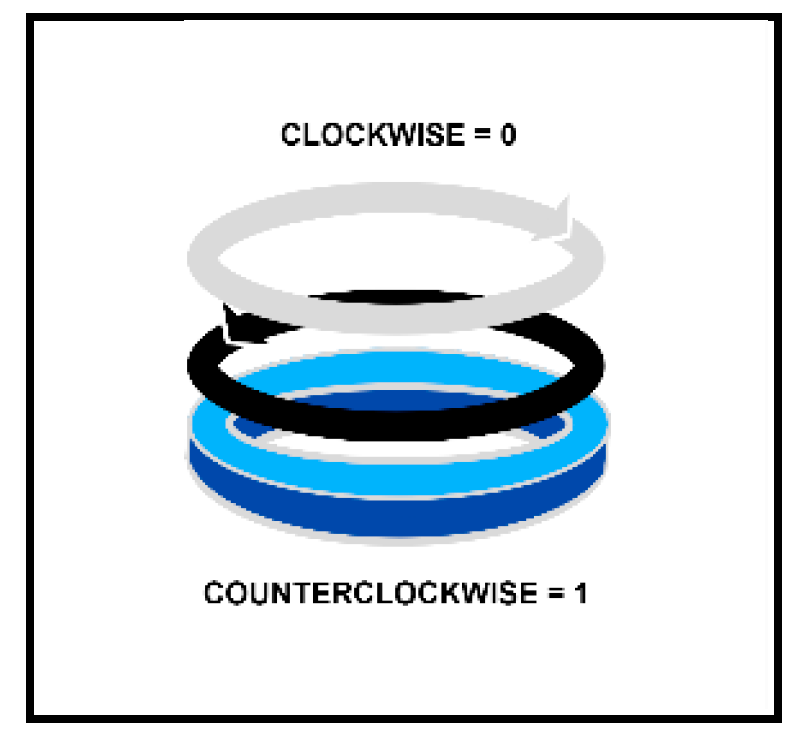
Certain materials allow electrical current to flow without resistance when chilled to a low temperature. These are labelled as superconductors. We can create electrical circuits based on superconductors that function like qubits. Unlike the other examples of qubits, these created systems consist of billions of atoms but function as a single quantum system. One technique to create a superconducting qubit is to assign a value to the direction in which current travels via an electrical circuit.
Figure 5.
Superconducting Circuits Qubit.
3.5. Superposition
Superstition is a theoretical concept that is hard to visualise. A famous way it has been described is with the Schrödinger’s cat experiment. If a cat was placed in a sealed box with a poisonous substance that has an equal chance of poisoning the cat to death or not within an hour, it is proposed that at the end of the hour, the cat could be said to “be both alive and dead,” in a superposition of states until the box is opened. (Wang, 2018) The act of observing the result randomly determines if the cat is alive or dead. However, this analogy creates confusion and doubt. Schrödinger intended to illustrate the absurdity of quantum science.
f(x) = x2 and f(x) = 4
A better way of understanding superposition is through mathematics. Take function 1 as an example. The value of x is determined by the value of 4 which is both +4 and -4. (Caltech Science Exchange, n.d.)
3.6. Entanglement
Entanglement is a quantum phenomenon in which two or more qubits become coupled in such a way that the state of one immediately changes the state of the others, no matter their distance. This characteristic allows for strong correlations and supports many quantum communication and computation advantages.
In Figure 6, NASA uses a short comic to explain what entanglement is. This analogy consists of entangled photons A and B. A is sent to Alice and B to Bob. Alice and Bob determine how to measure their photons independently. When they compared their findings, a surprising correlation was discovered: measuring one photon affects the other, regardless of distance. This illustrates that entangled photons behave as if they were part of the same system, regardless of their separation.
3.7. No-Cloning Theorem
The no-cloning theorem states that a quantum device cannot generate an exact replica of an arbitrary quantum state. (Djordjevic, 2012) There are many ways to prove this theorem however, this paper will make use of proof by contradiction to provide a better understanding of the no cloning theorem. Schrödinger’s cat analogy will be used to examine this phenomenon.
Here is the initial setup: Schrödinger’s cat is placed in a box. Its state is represented by a quantum state ∣ψ⟩ which is a superposition of being alive ∣alive⟩ and dead ∣dead⟩:
∣ψ⟩ = α∣alive⟩ + β∣dead⟩
Suppose that cloning is possible (for the sake of proving by contradiction) and we have a machine that can clone. This machine takes an initial state ∣ψ⟩ and a blank state ∣0⟩. It then produces two identical copies of ∣ψ⟩ where ⊗ (Tensor Product) combines two pieces of information into a single piece as shown in function 3.
U(∣ψ⟩⊗∣0⟩ ) =∣ψ⟩⊗∣ψ⟩
U(∣ψ⟩ ⊗ ∣0⟩ ) = U( ( α∣alive⟩ + β∣dead⟩ )⊗ ∣0⟩ )
= αU(∣alive⟩ ⊗ ∣0⟩ ) + βU(∣dead⟩ ⊗ ∣0⟩ )
∴ α(∣alive⟩ ⊗ ∣alive⟩ ) + β(∣dead⟩ ⊗ ∣dead⟩ )
= αU(∣alive⟩ ⊗ ∣0⟩ ) + βU(∣dead⟩ ⊗ ∣0⟩ )
∴ α(∣alive⟩ ⊗ ∣alive⟩ ) + β(∣dead⟩ ⊗ ∣dead⟩ )
( α∣alive⟩ + β∣dead⟩ )⊗ ( α∣alive⟩ + β∣dead⟩ )
=
α2∣alive⟩ ⊗ ∣alive⟩ + αβ∣alive⟩ ⊗ ∣dead⟩ + βα∣dead⟩ ⊗ ∣alive⟩ + β2∣dead⟩ ⊗ ∣dead⟩
=
α2∣alive⟩ ⊗ ∣alive⟩ + αβ∣alive⟩ ⊗ ∣dead⟩ + βα∣dead⟩ ⊗ ∣alive⟩ + β2∣dead⟩ ⊗ ∣dead⟩
Next, we consider cloning Schrödinger’s cat in a superposition state using the hypothetical cloning machine to get the function 4. However, the correct application of cloning on a superposition state should give the function in function 5.
When comparing the results, notice the expanded superposition includes terms that are missing in the linear distribution result. The contradiction implies that an assumption of a perfect quantum cloning machine is not possible. However, it is possible to clone a qubit to near 100% accuracy. (minutephysics, 2016)
3.8. Quantum Algorithms
The term “algorithm” refers to a set of steps for solving a problem or to accomplish a specific task. In the quantum computing environment, a quantum computer doesn’t use the same sets of algorithms a classical computer would. A classical processor operates on classical bits. Qubits are used by quantum computers to conduct multidimensional quantum algorithms. (IBM, 2024) Quantum Algorithms are commonly described by Quantum Circuits that have one or more Quantum Gates.
3.9. Quantum Circuits and Gates
A quantum circuit is an illustration of quantum computation in which the problem is solved using quantum gates on one or more qubits. A quantum gate is an operation on a qubit that alters its quantum state. Quantum gates or quantum logic gates are classified as single- qubit gates or two-qubit gates based on how many qubits are being used at the same time.
(Giovanni, 2024) Three-qubit gates, as well as other multi-qubit gates, are attainable as well. A quantum circuit is completed by a measurement on one or more qubits.
4. Analysis
With the understanding of Quantum Computing, we can now analyse the key components of a computing paradigm: programming model, performance, control flow, scalability, and application.
4.1. Analysis-Programming Model
As a general knowledge, programming models are defined as systems of equations involving an objective function along with a set of restrictions, including resource constraints at a minimum. In the context of computing paradigms, programming models refer to a conceptual framework that defies how software and hardware communicate. It demonstrates the rules used for programming within this specific paradigm, showing the system functionalities. This section of the report will delve into the programming abstractions, execution model, resource management, error handling, development complexity and programming languages of Quantum Computing.

Table 1.
Programming Model Comparison.
| Feature | Quantum Computing | Cloud Computing | Classical Computing |
|---|---|---|---|
| Execution Model | Operations are inherently probabilistic and non- deterministic. Relies on the principles of quantum mechanics. |
Execution is scalable and resources are allocated on- demand. | Execution is deterministic, following a sequential or parallel processing approach. |
| Programming Languages | Specific quantum programming languages. Q#, Qiskit, etc. |
Wide range of languages Python, Java, and Go. | Conventional programming languages. C, C++, Java, Python, etc. |
4.1.1. Execution Model
The execution model elaborates the computations and how they are performed within the computing environment including: task execution, data management, and error handling during execution.
- Task Execution
The execution of these systems are inherently probabilistic due to the nature of qubits (see Section 3.4 Qubit). (Tonkin, 2022) This means that the outcome is random or stochastic without the understanding of quantum mechanics to abstract the outcomes statistically.
- Resource Management
As an addition to the execution model, resource management is essential to efficiently disperse and manage computing resources to optimise performance and cost. Quantum computing requires managing a limited number of qubits and their coherence time to maximise the computational capabilities. Coherence time is the time it takes for a qubit to keep its quantum state (Streltsov, Adesso and Plenio, 2017). During coherence, qubits can exhibit quantum mechanical properties such as superposition and entanglement, which are necessary for quantum computation. When coherence is lost (decoherence), the qubit behaves like a conventional bit, losing the unique quantum processing capabilities. Decoherence can be induced by several events, including external interactions and quantum system failures.
- Error Handling
Error mitigation is another aspect of the programming model that is essential to a working quantum computer. Due to the nature of quantum systems being inherently probabilistic, it is crucial for quantum computers to have proper error handling methods to reduce the susceptibility to decoherence and quantum noise. Quantum Error Mitigation (QEM) is seen as a much more viable alternative to Quantum Error Correction (QEC), which involves encoding quantum states in multi-qubit entangled states to achieve universal fault-tolerant quantum computation. (Shaib et al., 2023) There are many different strategies documented to mitigate noise in quantum computing including Quantum Error Correction (QEC), Measurement Error Mitigation (MEM) and Zero-Noise Richardson Extrapolation.
- Quantum Error Correction (QEC)
Considered to be one of the most robust techniques for protecting quantum information from errors, QEC involves encoding quantum information, transforming into a broader space of qubits using quantum error-correcting codes. These codes may detect and repair faults without measuring the quantum state directly.
- Measurement Error Mitigation (MEM)
MEM is commonly used because it directly resolves measurement inaccuracies. It increases the result accuracy by modelling measurement mistakes and altering final quantum state probabilities. It is simple to implement and does not require any more qubits, making it ideal for near-term quantum devices (quantum computers with hundreds of qubits). According to Shaib (2023), MEM demonstrated improvements in Jensen-Shannon Divergence (JSD) values up to 69% compared to the unmitigated approach as shown in Figure 7. This proves its ability to correct errors occurring during quantum measurement processes.
- Zero-Noise Richardson Extrapolation
This strategy is known for its utility in near-term and Noisy Intermediate-Scale Quantum (NISQ) devices. This method works by scaling up the noise in a series of quantum computations to extrapolate the outcome in the absence of noise. This method is effective because it can be used in any quantum circuit and allows you to determine the ideal quantum state without additionally physically removing the noise sources.
4.1.2. Programming Languages
Quantum Computing requires more expertise because the programming languages differ for different quantum computers. Unlike classical computers that use universally recognized languages such as Java, C++ and Python, quantum computing is not universal, depending on the hardware or platform which they were developed in. Some Programming languages are shown in Table 2.
As an example, Cirq is an open-source Python toolbox for designing, updating, and optimising noisy intermediate scale quantum (NISQ) circuits, as well as testing them against quantum computers and simulators. It is currently in alpha release and can be combined with OpenFermion-Cirq (platform for developing quantum algorithms for chemistry problems). Cirq is sold by members of Google’s AI Quantum Team, although it is not an official Google product. (Doug Finke, 2016)
Quantum computers have various architectures that depend on the Qubit such as Spin, Trapped Atoms and Ions, Photons, and Superconducting Circuits (see Section 3.4 Qubit). Hence, it requires different operational methodologies, making it harder to set a universal standard in the programming language. Efforts for standardisation are ongoing with projects like Quantum Intermediate Representation (QIR) and OpenQASM who aim to make quantum computing cross-platform. (Cross et al., n.d.)
4.2. Analysis - Performance
Performance typically refers to how optimised the computer operates. It helps to provide information by identifying the strengths, weaknesses, and qualities of any computing paradigm to increase computer productivity. In this case, Quantum Computing, Classical Computing, and Cloud Computing would be measured in terms of speed, power consumption, scale, as well as efficiency.
Table 3.
Performance Comparison.
| Performance Measure | Quantum Computing | Classical Computing | Cloud Computing |
|---|---|---|---|
| Speed | Very Fast | Fast | Fast |
| Power Consumption | 600 kWh | 504 MWh | 460 TWh |
| Scale | 127 qubits | 64-bits | N/A |
| Efficiency | Exponential speedup for factoring large numbers and searching databases. | Able to solve problems using classical algorithms in less time. | Ensured through resource optimization, automation of routine tasks, and robust disaster recovery solutions. |
4.2.1. Speed
In terms of speed, each quantum computing is measured in different units. Quantum computing, for instance, is measured by using CLOPS (Circuit Layer Operations per Second). Classical computing is measured by FLOPS (Floating Point Operations per Second), and Cloud computing will be measured by Gbps. (Qkrishi, 2021)
IBM is one of the examples of quantum computing that has the speed of 1419 CLOPS located in Bogota, whereas Supercomputer from Fugaku has 415.5 petaFLOPS. Cloud computing such as Google Cloud Platform (GCP) has A3 which has network bandwidth at 1000 Gbps. (Google Cloud, n.d.)
4.2.2. Power Consumption
Power Consumption refers to the amount of the electrical energy that is consumed by any computing paradigm. Such high-power consumption can lead to increased energy costs and affects environmental impact. (Pasqal, n.d.)
Quantum Computing has the lowest amount of power consumption as superconducting qubits (see Section 3.4.4 Type of Qubit - Superconducting Circuits), consuming 600 kWh daily (25 kW x 24h). Classical Computers such as the Frontier supercomputer that is manufactured by Hewlett Packard uses 504 MWh daily, which is 840 times more wasteful than the superconducting qubits. Cloud computing currently holds the spot in comparison, at around 460 TWh used in 2022, as reported by the International Energy Agency (IEA).
4.2.3. Scale
Scale refers to the size of a computer to handle data and perform operations. In Quantum Computing, they are measured by qubits. A quantum processor from IBM called Eagle can deliver 127 qubits. (Gambetta et al., 2021) Classical Computer, however, measured by bits and ARM64 would be the prime example as they use 64-bits wide. (Kinzer, 2021)
4.2.4. Efficiency
Efficiency defines the effectiveness of the resources such as time, energy, space, in which they are utilised to perform computations. Quantum Computing holds the potential speedup in specific, yet complex problems and it is very suitable for solving quantum problems. Classical Computing analyses classical algorithms faster and can be very useful for normal everyday tasks. (Mind Commerce, 2023) Cloud Computing is useful in crucial situations as they can optimise resource utilisation, enables automation which reduces the risk of human errors, and is able to provide data backup and recovery. (Jai Infoway, 2023)
4.3. Analysis - Control Flow
Control flow in quantum computing refers to the sequence in which quantum gates, also known as operations, are carried out on qubits within a quantum algorithm. (Yuan, Villanyi and Carbin, 2024) There are three common types of control flow in quantum computing which are sequential, concurrent, and parallel. In sequential control flow, quantum gates are carried out sequentially which is like the classical sequential programming except it must account for quantum state coherence. Besides that, in the concurrent control flow, multiple quantum gates can be prepared and executed individually which allows parallelism at quantum level. In the parallel control flow, quantum parallelism is inherent through superposition which allows a quantum computer to analyse several possibilities simultaneously.
The entry point of a quantum algorithm is typically defined by a quantum instruction or a sequence of instructions that prepares the quantum register in the required initial state. This step is crucial because the initial state often determines the behaviour and outcome of the quantum algorithm. Tracing the execution path in quantum computing requires tracing the sequence of quantum gates (see Section 3.9 Quantum Circuits and Gates) applied to the qubits. This sequence can be visualised using a quantum circuit diagram, in which the qubits are represented as lines and the gates as symbols acting on those lines.
Function calls in quantum algorithms (see Section 3.8 Quantum Algorithms) are equivalent to invoking subroutines or subcircuits. These subcircuits can be reused within the main quantum algorithm, just like conventional functions. A quantum algorithm’s exit point is often the measurement step, which measures the end state of the qubits to extract classical information. This measurement reduces the quantum state to an output which is then used in the computation.
Control flow is a crucial aspect of quantum computing because it maintains the correct sequence of quantum operations while using quantum mechanics’ unique principles. Control flow management is critical for the efficiency and stability of quantum algorithms, including initialising qubits, tracing the execution path, handling subroutines, detecting exit points, and visualising with control flow graphs.
Table 4.
Control Flow Comparison (Google Cloud, n.d).
| Aspects | Quantum Computing | Cloud Computing | Classical Computing |
| Entry Point | Initialization of qubits in a defined quantum state. | Client request initiates a service on cloud infrastructure. | Start of the main function or program entry point. |
| Execution Path | Sequential application of quantum gates. | Managed by the cloud provider, can involve distributed systems. | Sequential or parallel execution of instructions. |
| Function Calls | Invoking quantum subroutines (subcircuits). | Invocation of remote services or microservices. | Standard function or method calls within the program. |
| Exit Points | Measurement of qubits to obtain classical bits. | Completion of service request, returning response to client. | End of the main function or program, or a return statement. |
| Control Flow Graphs | Nodes represent quantum gates. Edges represent qubit paths. |
Nodes represent services. Edges represent data/service flow. |
Nodes represent instructions. Edges represent execution flow. |
4.4. Analysis - Scalability
4.4.1. Definition of Scaling in Quantum Computing
The scalability of quantum computing can be defined as the ability to increase the number of qubits, and the computational power of a quantum computer without experiencing a large set of errors or consuming an immeasurable number of resources while being able to maintain or improve the performance, reliability, and error rates.
When looking at increasing qubit accuracy and decreasing error rates, as the number of qubits that are being used increases, the maintenance of high accuracy and low error rates becomes more demanding. Error correction techniques are necessary to ensure the reliability of the system but doing so increases the number of qubits needed thus increasing the complexity of the system. Achieving scalability is crucial to use for solving complex problems that are impossible to solve with current computers like cryptography, material science and large-scale simulations.
In today’s age, quantum computing is in its early phases of development being led by a few different companies and have achieved many things that are still far from achieving a fully practical and scalable quantum computing.
4.4.2. Leading Figures in Quantum Computing
Quantinuum is the world’s leading integrated quantum computing company, their quantum computing team has recently led to a breakthrough in advancing the scalability of quantum computing technology. Researchers from Quantinuum have presented an innovative method that solves two major challenges limiting the scalability and commercial viability of quantum computers, the “writing problem” and the “sorting problem”. (Matt Swayne, 2024)
IBM provides access to quantum processors and simulators through its IBM Q Network, offering cloud-based accessibility. Google had also showcased quantum supremacy, a milestone indicating a quantum computer’s ability to execute calculations far beyond the capabilities of classical computers within a feasible time frame.
Microsoft has been actively investing in quantum computing research, collaborating with universities and research institutions to pioneer novel technologies and applications. Additional contributors in the quantum computing arena include Rigetti Computing, IonQ, and D-Wave Systems.
Quantinum, in collaboration with Microsoft, has achieved a significant milestone by bringing fault-tolerant quantum computing closer to reality. Through showcasing the most dependable logical qubits with active syndrome extraction, they’ve achieved what was previously thought to be years away from attainment.
4.4.3. Technical Challenges
We face great challenges in trying to improve where we currently are in quantum computing, one aspect we face is the technical challenges to increase the scalability of it, some such challenges would be Quantum Error Correction (QEC), Qubit Quality and Accuracy, and Quantum Decoherence.
Error Correction isn’t anything new but when it comes to QEC it demands a more nuanced approach. Unlike classical error correction which only needs to correct bit flip errors where bits accidentally switch from 0 to 1 or vice versa, Quantum computers must tackle a broader spectrum of errors, such as phase errors that can compromise the extra quantum information within qubits. Additionally, QEC techniques need to correct these errors without copying unknown quantum states or damaging the underlying quantum state. (IBM, 2023)
Scaling up quantum computers requires high-quality qubits with low error rates. To ensure reliable quantum computations, it is crucial to significantly improve the accuracy of qubit operations.
Quantum Decoherence is the loss of quantum coherence due to environmental interactions, causing qubits to lose their quantum properties. Overcoming decoherence is crucial for maintaining qubit stability over time.
4.4.4. Breakthrough in Achieving Scalability
With the collaboration of Quantinuum and Microsoft’s quantum computing team has led to the creation of four logical qubits which has resulted in the development of four logical qubits demonstrating error rates 800 times lower than their corresponding physical error rates. The quantum computing teams were able to validate the ability to run 14000 independent instances of a quantum circuit error-free. The team was able to achieve this breakthrough due to the leading fidelity, scalability, and flexibility of Quantinuum’s 32-qubit H2 quantum processor, powered by Honeywell, combined with Microsoft’s highly innovative error correction capabilities. The joint team created four logical qubits using 30 of the 32 physical qubits available on the H2, leading to the creation of what both companies herald as the most “reliable logical qubits”. They also successfully demonstrated syndrome extraction, another critical milestone that is necessary for fault-tolerant quantum computing.
4.5. Analysis - Potential Applications
Application area, in computing paradigm, refers to specific categories, domains, or fields where these computing paradigms are used to address a problem, enhance solutions, and create new opportunities. Each computing paradigm offers strengths to different types of various problems. This section of the report will delve into potential applications of Quantum Computing and real-world problems of Quantum Computing. (Kanade, 2024)
Quantum Computing, an emerging field and machines of Computer Science are promising to handle complex problem solving due to its unique computational capabilities. Unlike Classical Computing and Cloud Computing whose processes are based on Binary Bits (0 and 1), Quantum Computing utilizes Quantum Qubits. Qubits can be used and solved
simultaneously for complex problems and entangled with one another, it allows one to perform a vast number of calculations. Some real-life problems are being solved using Quantum Computing. (PixelPlex, 2024) (IBM, 2024)
Table 5.
Application Area Comparison (Gossett, 2022).
| Application Area | Quantum Computing | Cloud Computing | Classical Computing |
|---|---|---|---|
| Data Security | Advantages: Highly encrypted data/information. Disadvantages: | Advantages: Encryption/decryption services. Disadvantages: Vulnerable to Quantum |
Advantages: Traditional cryptography. Disadvantages: |
| Limited technology. | Attacks & Cloud Operators. | Prone to cyber-attacks & inability to solve. | |
| Drug Discovery | Advantages: Accelerating molecular processes. Disadvantages: Accuracy problems. |
Advantages: Bioinformatic tools. Disadvantages: Privacy safety. | Advantages: Traditional methods. Disadvantages: High throughput screening. |
| Machine Learning/AI | Advantages: Accelerating AI algorithms. Disadvantages: Qubit stability. |
Advantages: Training models across multiple devices. Disadvantages: Latency issues. |
Advantages: Sequential processing/algorithms. Disadvantages: Slower processing/training. |
| Optimization | Advantages: Solving complex problems. Disadvantages: Limited resources. |
Advantages: Distributed optimization algorithms. Disadvantages: Scalability challenges. |
Advantages: Iterative methods. Disadvantages: Computational complexity. |
| Simulation | Advantages: Precise control & can be tackled in any size. Disadvantages: Scalability of many qubits. |
Advantages: Environment simulations. Disadvantages: Dependency on sources. | Advantages: Mathematical simulation systems. Disadvantages: Expensive systems are needed. |
- Drug Discovery
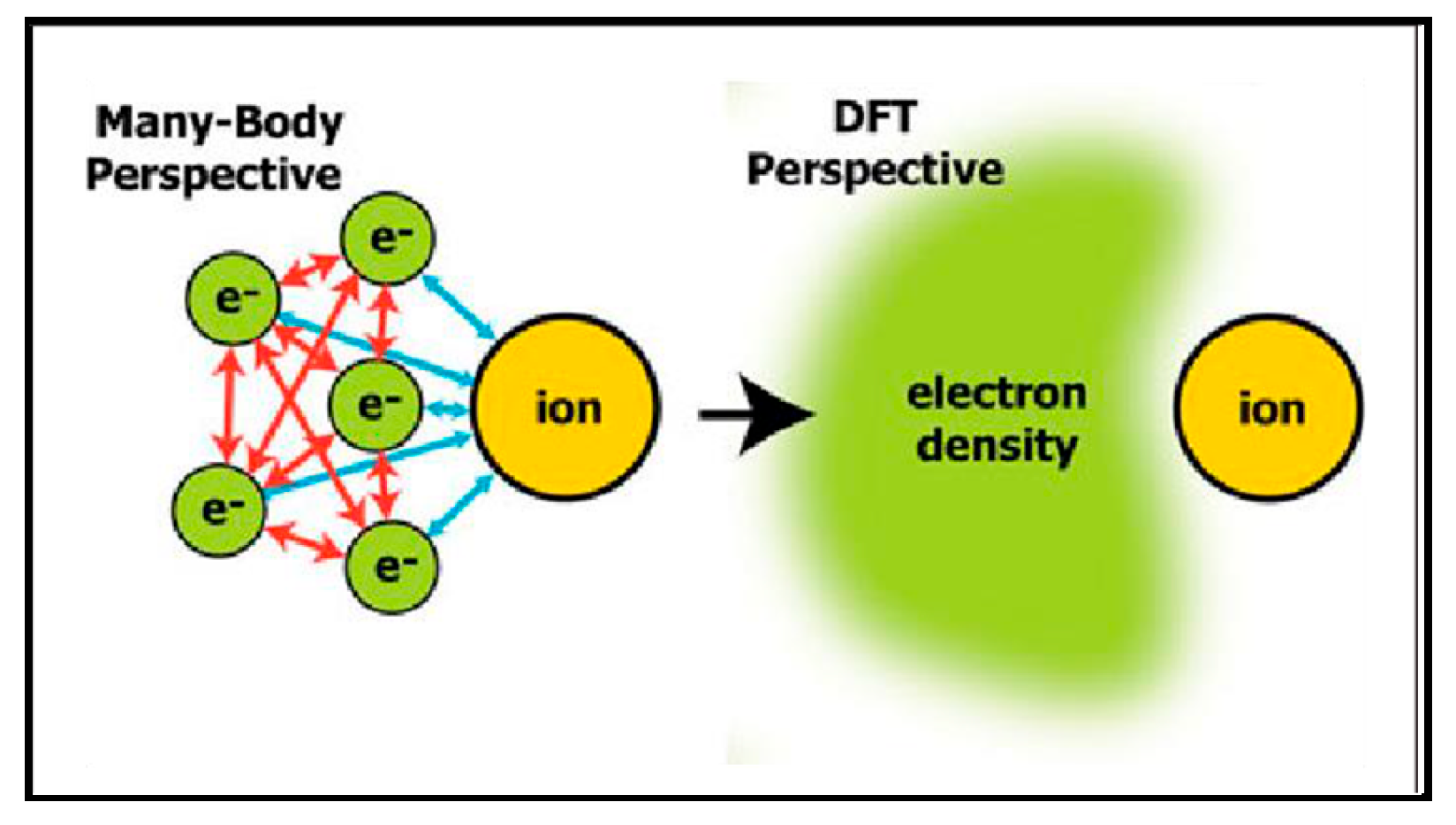
Quantum Computing integrated with high-performance systems has revolutionised and enhanced drug discovery through precise physical simulations. A key methodology is Density Functional Theory (DFT), a Quantum Computing technique renowned for its strong predicting power toward electronic structures of molecules, atoms, and nuclei. DFT facilitates a detailed understanding of the interactions at the quantum level, which is a crucial development for pharmaceuticals. (Synopsys, n.d.)
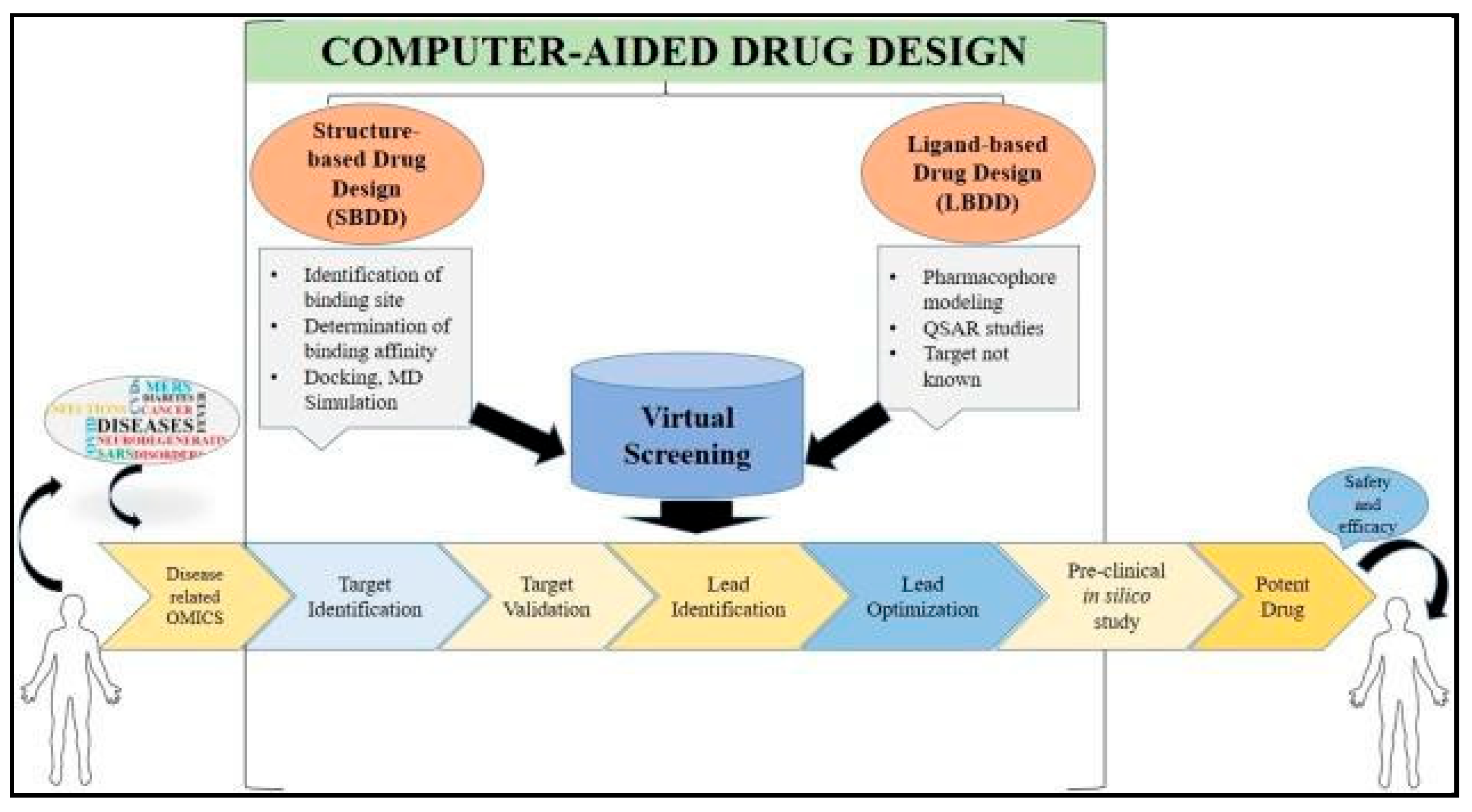
In the early stage of drug discovery, Computer-Aided Drug Design (CADD) is employed by scientists to discover through clinical trials. CADD refers to computational methods to predict the properties of the compounds and their potential impacts towards the human body. By combining DFT and AI, researchers can significantly enhance the accuracy, accelerated analysis, possibilities, and effectiveness of potential drug molecules against specific diseases. (Berglund and Rasmussen, 2024) (Thompson, 2023)
- A. Density Functional Theory (DFT)
Density Functional Theory is a Quantum Computing method used in Physics and Chemistry. DFT is among the most popular and versatile methods used in computational physics & computational chemistry. It has been very popular since the 1970s. (van Mourik, Bühl and Gaigeot, 2014)
Figure 8.
Density Functional Theory Modelling.
- B. Computer-Aided Drug Design
CADD represents computational pharmacological methods to discover and predict the properties of the compounds and their potential impacts towards the human body. It has become a major part of the drug discovery process, more efficient, and economical. (Yu, W. and MacKerrel, A.D. (2016)
Figure 9.
Computer-Aided Drug Design Modelling (C J, 2023).
- Machine Learning/AI
Machine Learning or Artificial intelligence is a machine that analyses vast quantities of data to help computers make better predictions and decisions. Quantum Computing, with its ability to process large quantities of data, can significantly enhance the capabilities of AI. By using Qubits, it revolutionises AI in various aspects including facial recognition, security detection, electric vehicles, and maritime logistics.
Quantum Computing AI can also be applied in the manufacturing sector and usually is monitored by workers. Including predictive maintenance and quality control. This synergy could lead to unequalled efficiency, precision, and innovation. (Siingh, 2023)
First is Enhanced Predictive and Decisions-Making. Previously, Traditional AI methods were used to monitor the performance of data in industry. While effective, it had limitations in time and accuracy. However, by applying Quantum AI, it enhances predictive analytics. It can detect pattern behaviour of the performance, predict failures, reduce cost & downtime, and be precisely accurate decisions. Second is Quality Control. Traditionally, AI is used to inspect the image due to resolution issues [55,56,57,58]. By using Quantum AI, it enhances not just an image but also visual, sensors, pattern recognition, infrared images, etc.
Overall, the combination of Quantum Computing and AI promises predictive systems and control towards the future[59,60,61,62].
- Optimization
Optimization problems are across various fields, we spend a lot of time solving them. Optimization problems are ubiquitous. These problems often use classical computers to run algorithms to seek out the best solution. However, as the complexity of these problems increases, classical algorithms can become slow and inefficient. Researchers and scientists have long theorized that Quantum Computers could tackle these problems quicker and have great solutions[62,63,64,65,66].
Quantum Computing has significant potential in the field of optimization due to algorithms. It has the potential to solve certain types of problems much faster than Classical Computing. It explores multiple solutions to a problem simultaneously. Microsoft, for instance, created a Quantum-based solution on a diverse selection of today’s Quantum hardware called “Quantum Azure”. It’s a technology that provides a robust development environment to create Quantum Algorithms for multiple platforms at once while maintaining flexibility. Moreover, it also helps to decrease manufacturing processes related to cost and shorten production time. (Qiskit, 2021)
Figure 10.
Azure Quantum Modelling (SoniaLopezBravo, 2024).
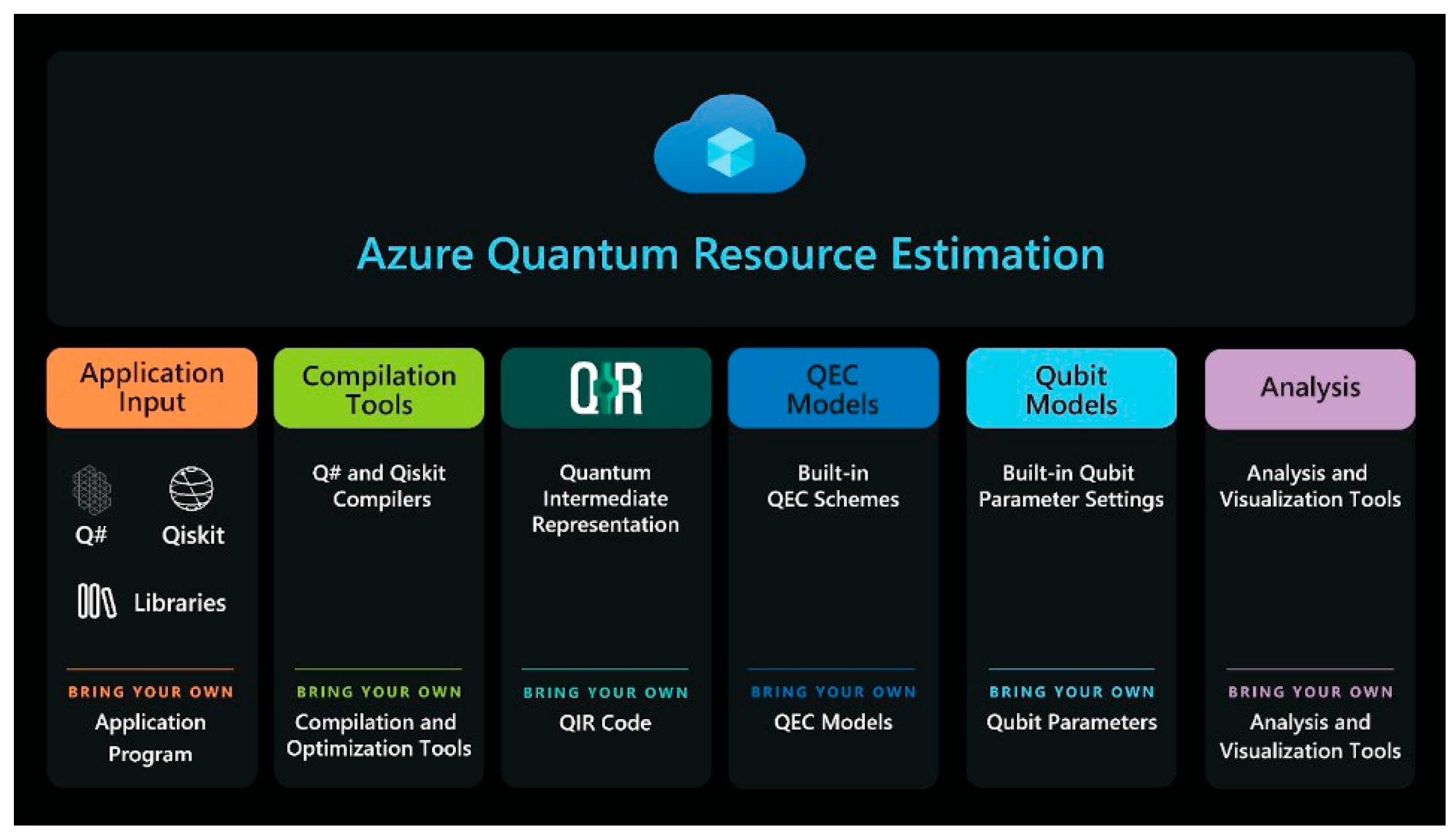
One industry that successfully integrated Quantum Azure is OTI Lumionics. OTI Lumionics has developed a fast materials design approach, tailored to OLEDs (Organic LED) that consists of a combination of machine learning algorithms, optimization, and testing. (Microsoft Azure Quantum Team, 2020)
Figure 11.
Quantum Simulation Used by OTI Lumionics (Microsoft Azure Quantum Team, 2020).
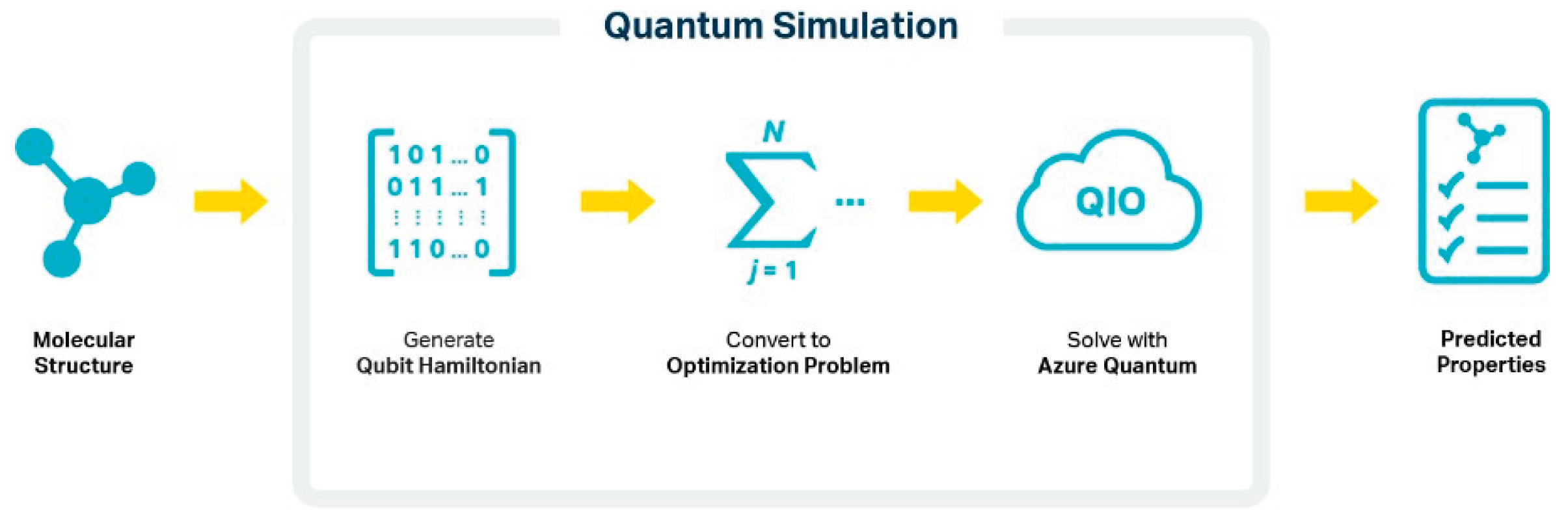
Quantum Computing also holds significant promise for enhancing the supply chain. Supply Chain is a powerful technology, it involves manufacturers, suppliers, and distributors to work together to deliver a product. However, due to classical optimization, it struggles to maintain the cost and time. When using Quantum Computing its power is dynamically enhanced, it keeps the supply chain on schedule, more accurate in decision-making, and improves efficiency. (Amazon Web Services, 2023).In the future, supply chain operators use AI technologies alongside Quantum Computing to provide significant data and insight into their performance where they monitor data in real-time, reduce material waste, and lead to more sustainable operations.
- Data Security
Quantum computing has the potential to revolutionise data security through several major applications. Traditional cryptography systems rely on mathematical complexity for security, which could be easily compromised by future quantum computers’ massive processing capability.Quantum computing has several important applications in data security, including Quantum Key Distribution (QKD) and Quantum Random Number Generation (QRNG). These breakthroughs provide fundamentally new methods for protecting information, assuring strong security against both current and future threats.
- A. Quantum Key Distribution
Quantum key distribution (QKD) is a secure communication technique for exchanging the encryption keys between parties securely. It employs quantum physics principles to exchange cryptographic keys in a method that is both proven and secure. The most well-known QKD protocol is BB84, which was designed by Charles Bennett and Gilles Brassard in 1984. (MR.Asif, 2021)
QKD works by transmitting many light particles, or photons, between parties over fibre optic cables. Each photon has a random quantum state, and the photons delivered together form a stream of ones and zeros which are called qubits. When a photon reaches its destination, it passes via a beam splitter, forcing it to take a random course into a photon collector. The receiver then returns to the original sender with information on the order of the photons sent, which the sender compares to the emitter, who would have sent each photon.
Photons in the wrong beam collector are eliminated, leaving a specified sequence of bits. This bit sequence can then serve as a key for encrypting data. Errors and data leakage are removed during the error correction phase and other post-processing procedures. Delayed privacy amplification is another post-processing step that removes whatever information an eavesdropper may have gleaned about the final secret key. (Gillis, 2022)
- B. Quantum Random Number Generation
Quantum random number generation (QRNG) utilises the inherent unpredictability of quantum processes to generate truly random numbers, which are critical for cryptographic applications. (iSocialWeb, n.d.) QRNG generates random numbers by utilising phenomena such as radioactive decay, photon arrival timings, and quantum vacuum fluctuations. These random outcomes are measured and translated into binary digits, resulting in a random number. Unlike pseudo-random number generators (PRNGs), QRNGs generate numbers that are truly random, increasing cryptographic strength due to their intrinsic unpredictability.
5. Lesson Learnt
Several key lessons have been discovered throughout the course of our research, offering valuable insight into quantum computing. These lessons consist of the history of quantum computing, key technological drivers, and many aspects of the basics of quantum computing which allowed us to analyse the key parts of quantum computing. Today, quantum computing is at its early stages, spreading across various fields such as cybersecurity, the medical industry, and the financial industry. The commercialisation of quantum computing has been in play for several years and it still faces its own considerable number of challenges. There are many companies that are developing quantum computing such as Quantinuum, IBM, Google, and Microsoft. Some of these companies have offered a cloud platform that allows the public to access quantum computing resources over the internet.
6. Conclusions
In conclusion, this paper dives into the fundamental and transformative characteristics of quantum computing, emphasising the revolutionary use of qubits and quantum algorithms, which enable exponentially quicker computations in certain applications than classical computers. While the field is still in its early stages, there are numerous research prospects for improving quantum computing stability, inventing error correction methods, and combining classical and quantum resources. Future technological breakthroughs are expected to include scalable quantum architectures and resilient quantum software frameworks, which could lead to new hybrid computing paradigms. As we stand on the brink of the Fourth Industrial Revolution and move towards the Fifth Industrial Revolution, quantum computing emerges as a key driver of innovation, providing unprecedented computational power that can redefine industry standards and enable personalised, humanised solutions. The future of quantum computing is not only interesting, but also a key frontier in the ever-changing technological world. The future of quantum computing holds much potential, whether it be in our security or improvements in calculations, but that is until we can break the current barrier and advance further.
References
- Mind Commerce (2023). Classical Computing vs. Quantum Computing. [online] www.linkedin.com. Available at: https://www.linkedin.com/pulse/classical-computing-vs- quantum-mind-commerce-publishing/.
- Amazon Web Services (2023). What is Quantum Computing? Quantum Computing Explained- AWS. [online] Amazon Web Services, Inc. Available at: https://aws.amazon.com/what- is/quantum-computing/.
- Amazon Web Services, Inc. (n.d.). What is Quantum Computing? - Quantum Computing Explained - AWS. [online] Available at: https://aws.amazon.com/what-is/quantum- computing/#:~:text=A%20gate%2Dbased%20quantum%20computer.
- Berglund, N.A. and Rasmussen, S.E. (2024). Redirect Notice. [online] www.google.com. Available at: https://www.google.com/url?q=https://www.kvantify.com/inspiration/the- convergence-of-quantum-computing-and-early-drug- discovery&sa=D&source=docs&ust=1716382133964402&usg=AOvVaw1HYdKanvr_62lw Zy6yt5A9. (accessed on 22 May 2024).
- C J, S. (2023). COMPUTER AIDED DRUG DESIGN. [online] www.linkedin.com. Available at: https://www.linkedin.com/pulse/computer-aided-drug-design-shammah-cj-0ifme/.
- Caltech Science Exchange. (n.d.). What Is Superposition and Why Is It Important? [online] Available at: https://scienceexchange.caltech.edu/topics/quantum-science-explained/quantum-superposition#:~:text=In%20mathematical%20terms%2C%20superposition%20can.
- COIN - Continuous Innovation Framework. (n.d.). Strategic Drivers. [online] Available at: https://continuousinnovation.net/strategic-drivers/#:~:text=Technology%20drivers%20describe%20changes%20in.
- Cross, A.W. , Bishop, L.S., Smolin, J.A. and Gambetta, J.M. (n.d.). Introduction — OpenQASM Live Specification documentation. [online] openqasm.com. Available at: https://openqasm.com/intro.html.
- Davies, N. (2024). The Role of Quantum Computing in Data Science - DATAVERSITY. [online] DATAVERSITY. Available at: https://www.dataversity.net/the-role-of-quantum-computing- in-data-science/.
- Djordjevic, I. (2012). Chapter 3 - Quantum Circuits and Quantum Information Processing Fundamentals. [online] ScienceDirect. Available at: https://www.sciencedirect.com/science/article/abs/pii/B9780123854919000034. (accessed on 11 May 2024).
- Doug Finke (2016). Tools of Quantum Computing - A List By Quantum Computing Report. [online] Quantum Computing Report. Available at: https://quantumcomputingreport.com/tools/.
- Duckering, C. (2022). New Abstractions for Quantum Computing. [online] arXiv.org. Available at: https://arxiv.org/abs/2303.02578. (accessed on 6 May 2024).
- Dwivedi, K. , Majid Haghparast and Mikkonen, T. (2024). Quantum software engineering and quantum software development lifecycle: a survey. Cluster Computing. [CrossRef]
- F, W. (2024). What is a quantum network? [online] www.aliroquantum.com. Available at: https://www.aliroquantum.com/blog/what-is-a-quantum-network. (accessed on 22 May 2024).
- Forbes Technology Council Expert Panel (2023). Council Post: 15 Significant Ways Quantum Computing Could Soon Impact Society. [online] Forbes. Available at: https://www.forbes.com/sites/forbestechcouncil/2023/04/18/15-significant-ways-quantum- computing-could-soon-impact-society/?sh=128c28c4648b. (accessed on 22 May 2024).
- Gambetta, J. , Wack, A., Jurcevic, P., Johnson, B., Javadi-Abhari, A. and Paik, H. (2021). Driving quantum performance: more qubits, higher Quantum Volume, and now a proper measure of speed | IBM Quantum Computing Blog. [online] ibm.com. Available at: https://www.ibm.com/quantum/blog/circuit-layer-operations-per-second. (accessed on 22 May 2024).
- Gharibyan, H. (2023). Discover The New Era of Quantum Computing Hardware. [online] www.bluequbit.io. Available at: https://www.bluequbit.io/quantum-computing-hardware. (accessed on 22 May 2024).
- Gillis, A. (2022). What is Quantum Key Distribution (QKD) and How Does it Work? [online] SearchSecurity. Available at: https://www.techtarget.com/searchsecurity/definition/quantum- key-distribution-QKD. (accessed on 23 May 2024).
- Giovanni, F.D. (2024). From Bits to Qubits: Mathematical Representation of Quantum Gates. [online] EE Times Europe. Available at: https://www.eetimes.eu/from-bits-to-qubits- mathematical-representation-of-quantum-gates/. (accessed on 22 May 2024).
- Google Cloud (n.d.). Flow control | Pub/Sub Documentation. [online] Google Cloud. Available at: https://www.google.com/url?q=https://cloud.google.com/pubsub/docs/flow-control- messages&sa=D&source=docs&ust=1716382133958481&usg=AOvVaw1GgbqLVZrhczFA mvwhfYo0. (accessed on 22 May 2024).
- Google Cloud (n.d.). Network bandwidths and GPUs | Compute Engine Documentation. [online] Google Cloud. Available at: https://www.google.com/url?q=https://cloud.google.com/compute/docs/gpus/gpu-network- bandwidth&sa=D&source=docs&ust=1716356022190603&usg=AOvVaw0809QEnQM_iPp WbC_EPmJY. (accessed on 22 May 2024).
- Gossett, S. (2022). Applying Paradigm-Shifting Quantum Computers to Real-World Issues. [online] Built In. Available at: https://builtin.com/hardware/quantum-computing-applications.
- IBM (2024). What is quantum computing? [online] IBM. Available at: https://www.ibm.com/topics/quantum-computing.
- Jai Infoway (2023). Cloud Computing: Empowering Scalability and Efficiency in Software Solutions. [online] www.linkedin.com. Available at: https://www.linkedin.com/pulse/cloud- computing-empowering-scalability-efficiency-software/. (accessed on 22 May 2024).
- Kanade, V. (2024). What Is Quantum Computing? Working, Importance, and Uses. [online] Spiceworks.com. Available at: https://www.spiceworks.com/tech/artificial- intelligence/articles/what-is-quantum-computing. (accessed on 22 May 2024).
- Kinzer, K. (2021). What Is ARM64 & Why Should You Use It? [online] JumpCloud. Available at: https://jumpcloud.com/blog/why-should-you-use-arm64.
- Microsoft Azure Quantum Team (2020). OTI Lumionics: Accelerating materials design with Azure Quantum. [online] Microsoft Azure Quantum Blog. Available at: https://cloudblogs.microsoft.com/quantum/2020/01/21/oti-lumionics-accelerating-materials- design-microsoft-azure-quantum/.
- minutephysics (2016). The No Cloning Theorem. [online] YouTube. Available online: https://youtu.be/owPC60Ue0BE?si=5gUQ-892SD8wOSpr (accessed on 17 May 2024).
- Moreno-Pineda, E. , Godfrin, C., Balestro, F., Wernsdorfer, W. and Ruben, M. (2018). Molecular spin qudits for quantum algorithms. Chemical Society Reviews, 47(2), pp.501–513. [CrossRef]
- MR.Asif (2021). Quantum Key Distribution and BB84 Protocol. [online] Quantum Untangled. Available online: https://medium.com/quantum-untangled/quantum-key-distribution-and-bb84- protocol-6f03cc6263c5.
- NASA Jet Propulsion Laboratory California Institute of Technology (2016). Particles in Love: Quantum Mechanics Explored in New Study. [online] NASA Jet Propulsion Laboratory (JPL). Available online: https://www.jpl.nasa.gov/news/particles-in-love-quantum-mechanics-explored- in-new-study.
- Office of Science (n. d.). DOE Explains...Quantum Networks. [online] Energy.gov. Available online: https://www.energy.gov/science/doe-explainsquantum-networks (accessed on 22 May 2024).
- Pasqal (n. d.). Redirect Notice. [online] www.google.com. Available online: https://www.google.com/url?q=https://www.pasqal.com/news/quantum-computing- rethinking-energy- consumption/%23:~:text%3DClassical%2520supercomputers%27%2520footprint%26text%3 DIt%2520uses%2520504%2520MWh%2520on (accessed on 22 May 2024).
- PixelPlex (2024). 9 Top Quantum Computing Applications: Advancing Science. [online] PixelPlex. Available online: https://pixelplex.io/blog/quantum-computing-applications/ (accessed on 22 May 2024).
- Qiskit (2021). Cutting Through the Hype of Quantum Optimization - Qiskit - Medium. [online] Medium. Available online: https://medium.com/qiskit/cutting-through-the-hype-of-quantum- optimization-6d4b5c95e377.
- Qkrishi (2021). CLOPS: A new metric to measure quantum computing speed. [online] Qkrishi. Available online: https://qkrishi.com/blog/f/clops-a-new-metric-to-measure-quantum-computing- speed (accessed on 22 May 2024).
- Raiche, J.-P. (2022). Industry 5.0: The Next Industrial Revolution is People-Centric. [online] blog.proactioninternational.com. Available at:https://blog.proactioninternational.com/en/industry-5.0-the-next-industrial-revolution-is- people-centric.
- Shaib, A. , Naim, M.H., Fouda, M.E., Kanj, R. and Kurdahi, F. (2023). Efficient noise mitigation technique for quantum computing. Scientific Reports, 13(1). [CrossRef]
- Siingh, R. (2023). Revolutionizing Manufacturing: The Synergy of Quantum AI and Industrial Innovation. [online] www.linkedin.com. Available online: https://www.linkedin.com/pulse/revolutionizing-manufacturing-synergy-quantum-ai-rahuul- siingh-0y4uf/.
- Siroshtan, D.; (2024). The Future of Quantum Computing: Discussing the potential impacts and current state of quantum computing technology. [online] www.linkedin.com. Available online: https://www.linkedin.com/pulse/future-quantum-computing-discussing-potential-impacts- denys-siroshtan-13jpe/ (accessed on 22 May 2024).
- SoniaLopezBravo (2024). What is Azure Quantum? - Azure Quantum. [online] learn.microsoft.com. Available online: https://learn.microsoft.com/en-us/azure/quantum/overview- azure-quantum.
- Squires, G.L. (2018). Quantum mechanics. In: Encyclopædia Britannica. [online] Available online: https://www.britannica.com/science/quantum-mechanics-physics.
- Streltsov, A. , Adesso, G. and Plenio, M.B. (2017). Colloquium: Quantum coherence as a resource. Reviews of Modern Physics, 89(4). [CrossRef]
- Synopsys (n.d.). What Is Density Functional Theory and How Does It Work? | Synopsys. [online] www.synopsys.com. Available online: https://www.synopsys.com/glossary/what-is- density-functional-theory.html#:~:text=Density%20functional%20theory%20(DFT)%20is (accessed on day month year).
- The Editors of Encyclopaedia Britannica (2020). quantum | Definition & Facts | Britannica. In: Encyclopædia Britannica. [online] Available online: https://www.britannica.com/science/quantum.
- Thompson, D. (2023). AI-Designed Drugs vs. Traditional Drug Discovery: Pros and Cons ⋆ Vial. [online] Vial. Available online: https://vial.com/blog/articles/ai-designed-drugs-vs- traditional-drug-discovery-pros-and-cons/?https://vial.com/blog/articles/ai-designed-drugs-vs-traditional-drug-discovery-pros-and-cons/?utm_source=organic.
- Tonkin, C.; (2022). How quantum computers work. [online] Information Age. Available online: https://ia.acs.org.au/article/2022/how-quantum-computers-work.html (accessed on 6 May 2024).
- van Mourik, T. , Bühl, M. and Gaigeot, M.-P. (2014). Density functional theory across chemistry, physics and biology. Philosophical transactions. Series A, Mathematical, physical, and engineering sciences, [online] 372(2011). [CrossRef]
- Voorhoede, D. (n.d.). What is a quantum algorithm? [online] Quantum Inspire. Available online: https://www.quantum-inspire.com/kbase/what-is-a-quantum-algorithm/.
- Wang, R.; (2018). #8 Schrödinger’s Cat. This Girl Reina. Available online: https://thisgirlreina.wordpress.com/2018/04/05/8-schrodingers-cat/ (accessed on 8 May 2024).
- Weder, B. , Barzen, J., Leymann, F. and Vietz, D. (2021). Quantum Software Development Lifecycle. arXiv (Cornell University), 1. [CrossRef]
- Yu, W. and MacKerell, A.D. (2016). Computer-Aided Drug Design Methods. Methods in Molecular Biology, [online] 1520, pp.85–106. [CrossRef]
- Yuan, C. , Villanyi, A. and Carbin, M. (2024). Quantum Control Machine: The Limits of Control Flow in Quantum Programming. Proceedings of the ACM on Programming Languages, [online] 8(OOPSLA1), pp.1–28. [CrossRef]
- Zou, N. (2021). Quantum Entanglement and Its Application in Quantum Communication. Journal of Physics: Conference Series, 1827(1), p.012120. [CrossRef]
- Sindiramutty, S. R. , Prabagaran, K. R. V., Jhanjhi, N. Z., Murugesan, R. K., Malik, N. A., & Hussain, M. (2025). Ethics and Transparency in Secure Web Model Generation. In Reshaping CyberSecurity With Generative AI Techniques (pp. 411-464). IGI Global.
- JingXuan, C. , Tayyab, M., Muzammal, S. M., Jhanjhi, N. Z., Ray, S. K., & Ashfaq, F. (2024, November). Integrating AI with Robotic Process Automation (RPA): Advancing Intelligent Automation Systems. In 2024 IEEE 29th Asia Pacific Conference on Communications (APCC) (pp. 259-265). IEEE.
- Al-Quayed, F. , Javed, D., Jhanjhi, N. Z., Humayun, M., & Alnusairi, T. S. (2024). A hybrid transformer-based model for optimizing fake news detection. IEEE Access, 12, 160822-160834.
- Mushtaq, M., Ullah, A., Ashraf, H., Jhanjhi, N. Z., Masud, M., Alqhatani, A., & Alnfiai, M. M. (2023). Anonymity assurance using efficient pseudonym consumption in internet of vehicles. Sensors, 23(11), 5217. 11).
- Gouda, W. , Sama, N. U., Al-Waakid, G., Humayun, M., & Jhanjhi, N. Z. (2022, June). Detection of skin cancer based on skin lesion images using deep learning. In Healthcare (Vol. 10, No. 7, p. 1183). MDPI.
- Barral, D. , Cardama, F. J., Diaz-Camacho, G., Faílde, D., Llovo, I. F., Mussa-Juane, M.,... & Gómez, A. (2025). Review of distributed quantum computing: from single QPU to high performance quantum computing. Computer Science Review, 57, 100747.
- Tennie, F., Laizet, S., Lloyd, S., & Magri, L. (2025). Quantum computing for nonlinear differential equations and turbulence. Nature Reviews Physics, 7(4), 220-230.
- Fajinmi, J. , & Oloyede, J. (2025). State-of-the-Art Robotic Technologies in Fighting the COVID-19 Pandemic.
- Javed, D. , Jhanjhi, N. Z., Ashfaq, F., Khan, N. A., Das, S. R., & Singh, S. (2024, July). Student Performance Analysis to Identify the Students at Risk of Failure. In 2024 International Conference on Emerging Trends in Networks and Computer Communications (ETNCC) (pp. 1-6). IEEE.
- Saeed, S. , Jhanjhi, N. Z., Abdullah, A., & Naqvi, M. (2018). Current Trends and Issues Legacy Application of the Serverless Architecture. International Journal of Computing Network Technology, 6(3).
- Humayun, M. , Sujatha, R., Almuayqil, S. N., & Jhanjhi, N. Z. (2022, June). A transfer learning approach with a convolutional neural network for the classification of lung carcinoma. In Healthcare (Vol. 10, No. 6, p. 1058). MDPI.
- Khandelwal, M. , Rout, R. K., Umer, S., Sahoo, K. S., Jhanjhi, N. Z., Shorfuzzaman, M., & Masud, M. (2023). A Pattern Classification Model for Vowel Data Using Fuzzy Nearest Neighbor. Intelligent Automation & Soft Computing, 35(3).
Figure 2.
Spin Qubit.
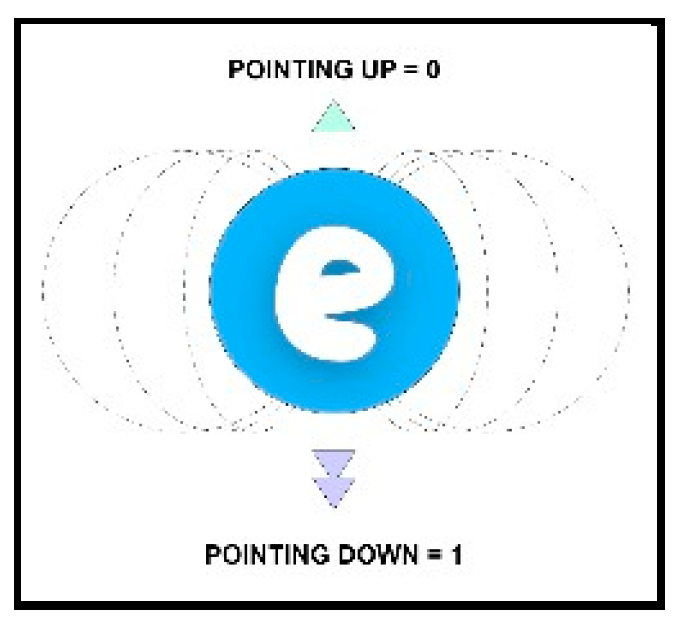
Figure 3.
Trapped Atoms and Ions Qubit.
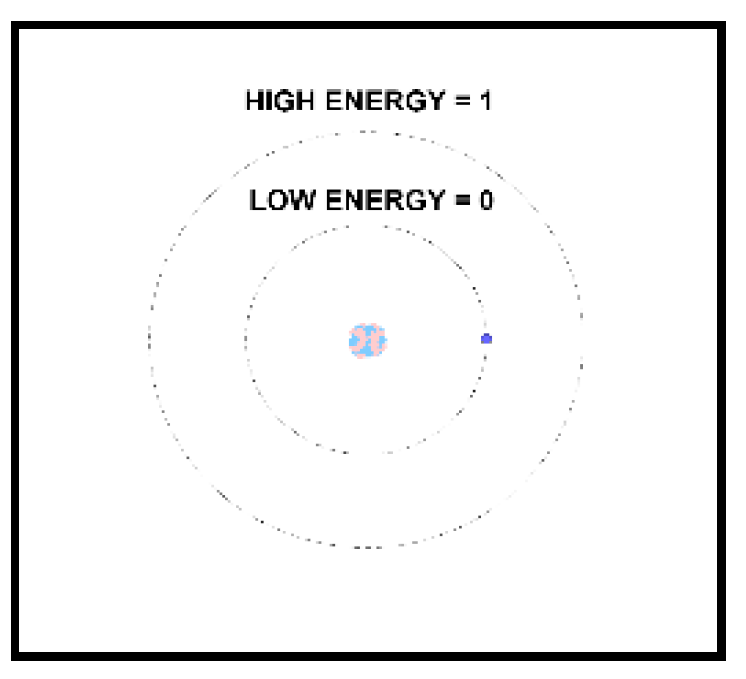
Figure 4.
Three Typres of Photon Qubits.
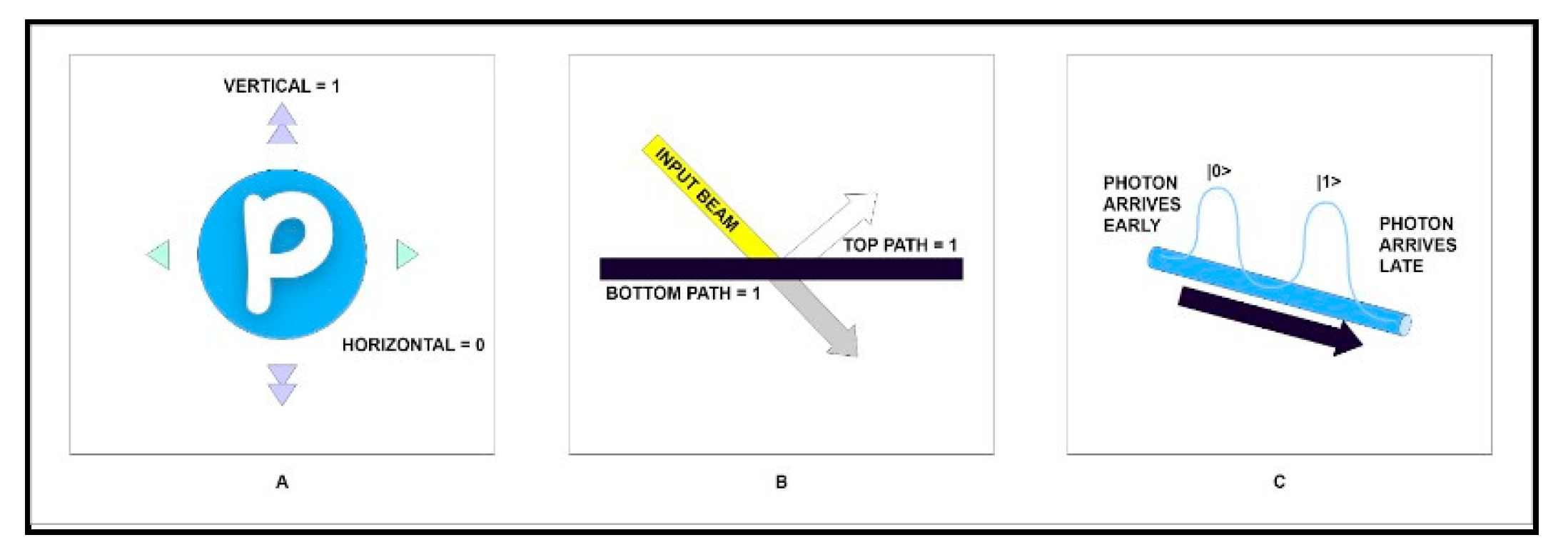
Figure 6.
Cartoon explaining the idea of entangles particles (NASA Jet Propulsion Laboratory California Institute of Technology, 2016).
Figure 6.
Cartoon explaining the idea of entangles particles (NASA Jet Propulsion Laboratory California Institute of Technology, 2016).
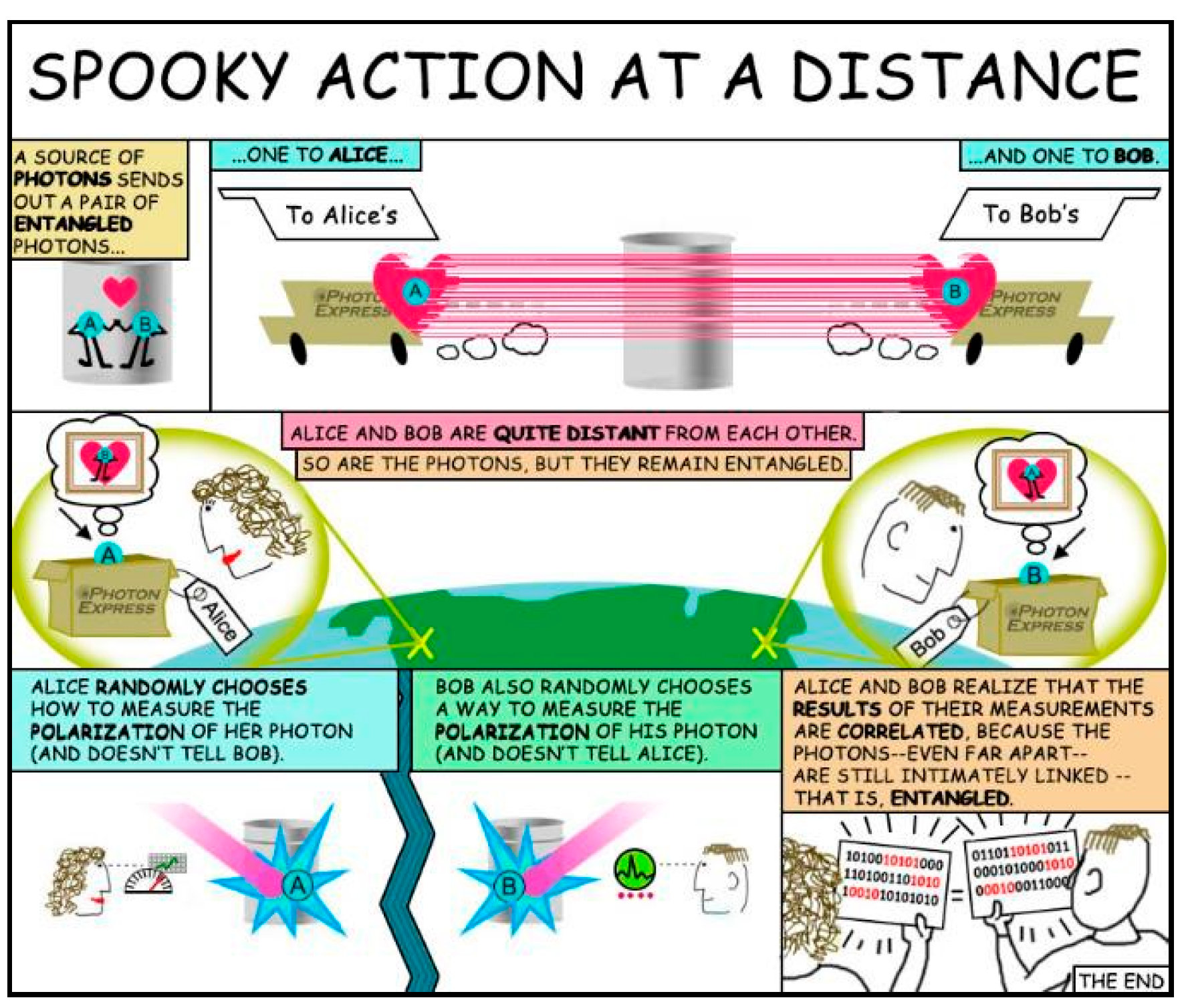
Figure 7.
Average JSD between the ideal output |in⟩ and each of the unmitigated output qˆ(m,s, |in⟩), mitigated output by the MEM protocol, and mitigated output by the suggested noise model for each depth m on IBM Q 5-qubit quantum computers. (Shaib et al., 2023).
Figure 7.
Average JSD between the ideal output |in⟩ and each of the unmitigated output qˆ(m,s, |in⟩), mitigated output by the MEM protocol, and mitigated output by the suggested noise model for each depth m on IBM Q 5-qubit quantum computers. (Shaib et al., 2023).
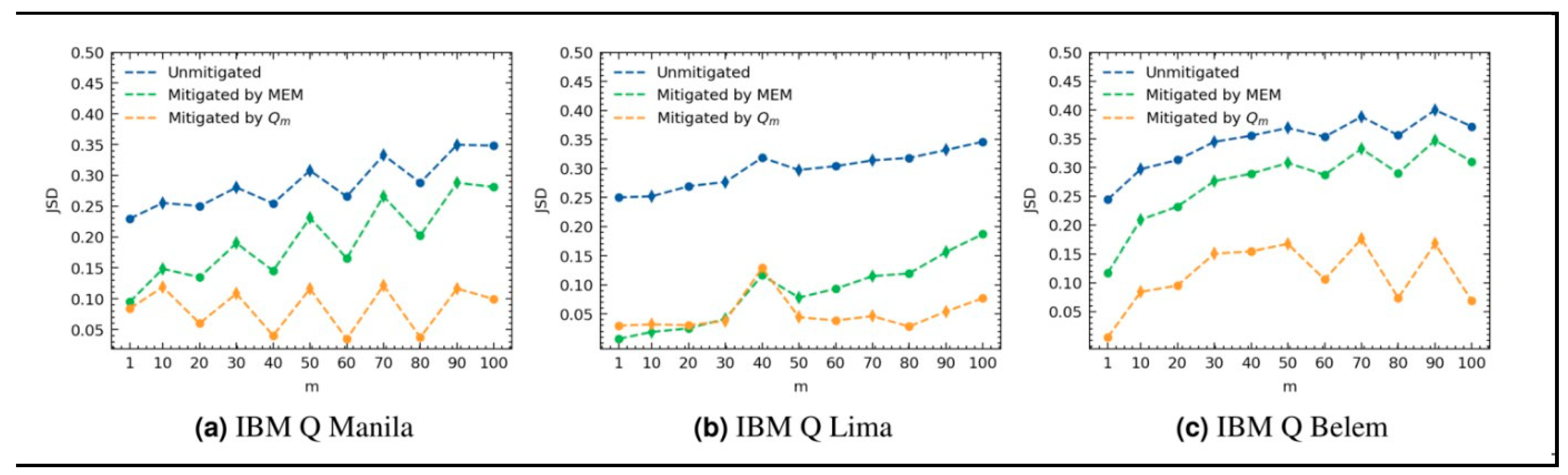
Table 2.
List of commonly used Quantum Programming Languages (Doug Finke, 2016).
| Programming Language | Product of | Used for |
|---|---|---|
| Qiskit | International Business Machines Corporation (IBM) | Create, simulate, and execute quantum circuits on IBM Quantum devices |
| Cirq | Create, simulate, and execute quantum circuits on Google Quantum processors | |
| Q# | Microsoft | Write quantum algorithms using Microsoft Quantum Development Kit, integrating with Azure Quantum |
| Quipper | University of Oxford, etc. | Algorithms development based on Haskell |
| pyQuil | Rigetti Computing | Create, simulate, and execute quantum circuits on Rigetti’s Quantum Virtual Machine and hardware. |
Disclaimer/Publisher’s Note: The statements, opinions and data contained in all publications are solely those of the individual author(s) and contributor(s) and not of MDPI and/or the editor(s). MDPI and/or the editor(s) disclaim responsibility for any injury to people or property resulting from any ideas, methods, instructions or products referred to in the content. |
© 2025 by the authors. Licensee MDPI, Basel, Switzerland. This article is an open access article distributed under the terms and conditions of the Creative Commons Attribution (CC BY) license (http://creativecommons.org/licenses/by/4.0/).
Copyright: This open access article is published under a Creative Commons CC BY 4.0 license, which permit the free download, distribution, and reuse, provided that the author and preprint are cited in any reuse.


