

Submitted:
19 November 2025
Posted:
19 November 2025
You are already at the latest version
Abstract
The worldwide drive for decarbonization, alongside digitalization and decentraliza-tion, has caused a complete overhaul of electricity distribution networks. Distribution network operators need to develop smart platforms that integrate distributed energy resources (DERs) into sustainable power systems to achieve operational excellence and system reliability. The research evaluates existing studies to understand current DER integration techniques, the methodological constraints they entail in smart grid systems, and innovative integration methods. The Web of Science database search used an advanced query to retrieve 4049 articles spanning 1993 to 2025, yielding 94 relevant publications for thematic evaluation. The study identifies six essential strategic elements that form the basis of a four-stage conceptual framework for network distribution transformation across technological, sustainability, economic, social, resilience, and integration. The research studies demonstrate both methodological variety and thematic development, yet they reveal inadequate regulatory systems, poor interconnections, and limited prosumer participation in rural areas. The article provides an operational strategic framework which helps decision-makers and grid operators develop effective energy policies to tackle current challenges.
Keywords:
smart energy distribution
; energy resource management
; energy sustainability
; operational efficiency
; decentralized electricity grids
1. Introduction
The electricity distribution sector serves as a fundamental base for economic and social development because it enables modern infrastructure construction and facilitates the transition to new energy systems. The current need for efficient, sustainable energy distribution systems arises from fast digital transformation, urban growth, and environmental shifts, all of which must support economic activities, reduce social inequalities, and enhance quality of life. Distribution networks achieve their status as fundamental technological frameworks for sustainable development through strategic deployment, enabling them to meet worldwide targets for energy accessibility and equity, as well as for carbon reduction.
According to a strategic report by TEHA Group in collaboration with Enel, electricity distribution is fundamental to the safety and success of the energy transition, through massive investments in smart grids, decarbonization, and improvements in the quality of electricity services [1]. The modern distribution network functions as an active platform which enables real-time demand management and renewable energy integration and supports prosumer participation. The literature shows that operational challenges remain a significant issue in implementing these transformations, due to difficulties in creating standardized regulatory systems, implementing technology, and managing local energy systems.
The availability of electricity shows a direct relationship with human development indicators, education levels, social inclusion, and economic status. Research conducted across 31 nations shows that renewable energy-based rural electrification systems lead to positive outcomes for human capital development and community participation, thereby supporting sustainable development [2].
The electricity sector operates under regulatory oversight that controls electricity costs for consumers, establishes how production expenses are passed between suppliers and buyers, and affects economic growth. The economic study led by Costa-Campi and Trujillo-Baute emphasizes the need for a well-balanced set of laws to promote sustainable energy market operations and market competitiveness [3].
The electricity distribution sector functions as a technological system that serves as a strategic public policy instrument, affecting social fairness, regional growth, and economic stability.
Research shows that current electricity distribution studies indicate that significant infrastructure funding has not led to substantial improvements in operational efficiency, sustainable energy integration, or environmental sustainability.
The energy transition requires distribution network investments according to research because transport electrification and increasing energy requirements demand them [4]. Research shows that organizations that use long-term strategic planning methods achieve better financial results than those that follow incremental methods, because incremental planning results in ongoing costs and uncoordinated decision-making [5,6].
The efficiency of these investments is hindered by strict regulatory frameworks, inadequate stakeholder coordination, and insufficient funding between investors and recipients [7]. The European region faces project delays and abandonment of cross-border interconnection initiatives due to conflicting interests and insufficient cost-recovery mechanisms [6].
Research shows that investment funds do not align with the actual performance of power grids or the degree of renewable energy system integration. The allocated funds have not led to optimal grid operations because many power systems operate below standard and lack sufficient flexibility to manage renewable energy fluctuations [7,8]. The different results across these studies highlight an essential research need: researchers have not yet conducted enough studies to determine whether infrastructure funding achieves its strategic goals of flexibility, resilience, and DER integration across various settings.
The financial investment results have been poor, requiring changes to investment planning and regulatory systems, as well as new governance models that promote transparency and collaboration. Research indicates that investment volume alone does not determine success because effective planning and coordination between investments and sustainability and efficiency targets are of greater importance. Different organizations use different definitions to measure the success of distribution network investments because they lack benchmarking tools and performance evaluation frameworks.
The justification for the theme on resource management strategies to promote sustainability and efficiency in electricity distribution systems is supported by the profound transformations affecting global energy infrastructure. Modern power distribution networks function as smart platforms that handle variable renewable energy sources and dynamic customer demands while maintaining climate resilience in our present era of decarbonization, digitalization, and decentralization.
According to [1,9], electricity distribution plays a central role in the energy transition, as it adapts networks to new technological and social requirements. The distribution infrastructure needs funding to achieve three main objectives: integrating local power generation systems, minimizing power losses, and delivering better electricity service quality.
The study by [10] demonstrates that future renewable energy security requires distribution networks to handle production fluctuations and cyber threats, as well as the transition of transportation and heating systems to electricity.
Multiple scientific studies in the literature support the observed relationship between these variables. Research studies show that modern energy systems require strategic network planning, distributed resource management systems (DERMS), and artificial intelligence-based energy flow optimization for effective operation [5,7]. The development of human capital and the reduction of social equity depend on rural electrification and universal energy access [11].
Research in this field serves both technological needs and has substantial effects on economic systems, social structures, and environmental preservation. The system enables the development of a flexible, efficient, and equitable energy system which supports Sustainable Development Goals and addresses upcoming challenges.
The research aims to study and organize resource management approaches for electricity distribution networks which support sustainable operations during the worldwide energy transformation. The research examines different methods to transform distribution networks into smart platforms through technological progress, economic incentives, and regulatory systems that support renewable energy adoption, flexible demand management, and carbon-free energy infrastructure development. Organizations achieve improved decision-making by structurally analyzing strategic models from peer-reviewed literature, thereby generating comprehensive multi-level knowledge of DER integration.
The literature demonstrates that distribution networks serve as key elements in the energy transition, as they must transform their infrastructure to support flexible, digitalised, and decentralised energy systems [9]. Research shows that significant investments in distribution infrastructure have not produced the expected efficiency and sustainability results, which requires a comprehensive critical evaluation [5,7].
The research aims to develop both theoretical and operational guidelines to help decision-makers, network operators, and industry stakeholders develop appropriate solutions for current and future distribution system problems.
The authors conducted a scoping review to analyze DER integration methods for smart distribution networks, as the current literature presents multiple unrelated approaches and integration techniques. The review used the Scoping Systematic Literature Review (SLR) method, following PRISMA-ScR guidelines, to produce a transparent and replicable synthesis of current research directions, strategic approaches, and their related challenges.
The article consists of five sections that begin by explaining the significance of the topic, then analyze basic concepts from previous studies, detail research objectives and methods, and finally present quantitative and qualitative results from the Web of Science database. At the end of the paper, based on the main findings of the relevant authors to date, we proposed a theoretical conceptual framework for the optimal integration of DER into smart grids, specifying the optimal conditions for subsequent validation. In the last section of the research, we presented the main conclusions, limitations, and proposals for future research, while also highlighting the article's original aspects.
The introduction serves as the basis for a systematic scoping review that follows PRISMA-ScR guidelines while.
1.1. Literature Review
The research requires definitions of essential terms which explain the resource management strategies for sustainable and efficient electricity distribution systems.
Distributed Energy Resources (DER) are energy generation, storage or control units located at or near the end consumer. These include photovoltaic panels, wind turbines, batteries, electric vehicles, and demand management systems. DERs contribute to grid flexibility and allow for prosumers' active participation in the energy market [12].
The Distributed Energy Resource Management System (DERMS) is an advanced software system that helps grid operators track, manage, and improve the performance of DER systems. DERMS operates through predictive control systems, automation algorithms, and responsiveness estimation to achieve network stability and operational efficiency [13].
The energy system demonstrates flexibility through its fast, efficient handling of supply and demand changes, especially when intermittent renewable energy sources are integrated. Flexibility is key to maintaining grid balance and avoiding congestion or energy loss [13].
The prosumer functions as an energy user who generates power, stores it, and then sends it back to the power grid to help stabilize the system. The growth of prosumers in decentralized networks depends on dynamic pricing systems and monitoring technologies [12].
PV Hosting Capacity is the maximum amount of solar energy that can be integrated into a distribution grid without compromising its safety and reliability. The calculation of this capacity remains vital for investment planning and for preventing network overload in local areas [13].
The electricity distribution sector plays a vital role in achieving the energy transition and building modern infrastructure, as it connects renewable energy sources to the grid while ensuring equal access to power [9]. The use of renewable energy for rural electrification produces significant benefits for human capital development and social equality improvement [11]. In addition, sector regulations directly influence the economic competitiveness and sustainability of the energy market [14].
Research shows that smart distribution systems now prioritize resource management by combining renewable energy systems with improved transmission methods and reduced grid power loss. A first set of work focuses on the optimal sizing and location of distributed energy resources (DERs), including solar and wind storage and generation, using metaheuristic algorithms such as Elephant Herding Optimization and Ant Lion Optimization to improve voltage stability and reduce power losses [15].
DERMS systems represent an essential direction for developing distributed energy resource management systems that allow grid operators to perform real-time control of edge resources, including batteries, solar panels, and smart appliances. The systems use predictive control, real-time optimization, and responsiveness estimation to enhance power grid flexibility and resilience [13].
The European energy transition requires circularity and sustainable resource management strategies to achieve strategic autonomy, efficient use of energy infrastructure, and critical material recycling [16]. The long-term sustainability of smart grids depends on these problems because value chain resilience determines the ability to decrease external resource usage and build lasting sustainability.
The research literature presents four main strategies for achieving sustainable energy systems: DER placement and sizing optimization; DERMS system implementation for distributed control and intelligent algorithms for loss reduction and stability improvement; and circular resource management in energy infrastructure. The methods enable distribution systems to transform into sustainable, flexible, and efficient models that adapt to climate change and modern market requirements.
The global energy transition and increasing need for sustainable solutions have led to multiple new research paths in energy, according to the literature. Research today focuses on three main areas: renewable energy optimization, artificial intelligence system integration, building efficiency improvement, and environmental impact evaluation of new technologies.
The research centres on developing renewable power infrastructure through solar and wind energy systems, as well as green hydrogen and biomass technologies. The journals Renewable Energy and Energy Conversion and Management publish studies on hybrid system performance, energy storage methods, and energy conversion rates [17,18]. Research studies autonomous microgrids and decentralized solutions which demonstrate potential for use in isolated areas and critical infrastructure systems [19].
The integration of artificial intelligence with optimization algorithms is the fundamental principle for managing energy systems. The research combines neural networks, evolutionary algorithms, and deep learning models to perform demand forecasting, predictive control, and resource distribution optimization [20,21]. The deployment of these technologies enables smart grids to achieve greater flexibility while reducing power transmission losses.
The construction sector receives detailed analysis in the literature about energy efficiency through smart building technology, sustainable materials, and optimized heating, ventilation, and air conditioning systems. Studies highlight the role of passive design, automation, and green certifications in reducing energy consumption and increasing thermal comfort [22,23].
The evaluation of environmental effects from energy technologies remains a persistent issue, and Life Cycle Assessment (LCA) methodologies help address it. The tools help measure the carbon impact, external costs, and long-term sustainability of the proposed solutions [24,25]. The discussion includes parallel analyses of energy policy matters, social equity, and international regulatory aspects, focusing on community participation in decision-making and decarbonization scenarios [26].
This research demonstrates how engineering, computer science, economics, and ecology unite to create sustainable energy systems which are both intelligent and resilient. Multiple unexplored areas in current research studies prevent the development and practical deployment of these proposed solutions, as indicated by evaluation results. Research on distributed energy resources (DERs) is abundant, yet most studies fail to examine their integration into smart grids under operational constraints, dynamic demand, and local energy market conditions. [The current demand management systems fail to address renewable energy variability and real-time storage operations according to [27]. The management of uncertainty in renewable generation exists as a documented knowledge deficit. The variability and stochastic nature of solar and wind energy create difficulties in grid planning and operation. [The authors in [28,29] emphasize the requirement for additional research on storage system intelligent control and adaptive predictive models that can handle uncertainty. The literature shows that Distributed resource management systems (DERMS) hold promise. However, researchers have not conducted enough studies to determine their economic sustainability and their ability to scale up and work across various national power systems [13]. Also, current regulations are not flexible enough to allow these technologies to be tested and deployed at scale. The research by [4] demonstrates that distribution network investment planning through incremental methods fails to produce long-term efficiency because current tools cannot evaluate post-investment network performance. The current literature provides insufficient guidance on integrating prosumers into distribution systems, particularly in rural and disadvantaged regions. The article argues that DER-based rural electrification requires governance systems that adapt to local conditions. The current knowledge gaps need a structured synthesis method which will unite innovative research directions with an action-oriented framework [11].
1.2. Objectives
The research uses a systematic, practical approach to study DER management strategies for smart grids, as these strategies address critical operational issues in the fast-changing energy industry. The main objective is to develop a strategic conceptual framework that optimizes distribution network operations through sustainable, adaptable solutions for the global energy transition.
The research will achieve its main objective through seven specific research steps.
- Identify the main categories of distributed energy resources (DER) and evaluate their contribution to network optimization.
- Analyse advanced smart-grid technologies by examining DERMS functionality and the operation of predictive control algorithms.
- Assess the influence of investment planning models on the operational performance and efficiency of distribution networks.
- Reveal regulatory and governance gaps that limit the effectiveness of current energy strategies.
- Examine the social and economic implications of DER integration, with particular attention to prosumer participation and energy equity.
- Develop an integrated conceptual framework that supports both sustainable and efficient energy policy formulation.
- Propose a four-stage methodological pathway designed to maximise DER integration within smart grid environments.
This study using a scoping review approach that follows PRISMA-ScR guidelines to combine evidence from diverse domains, including electricity distribution networks [30].
The electricity distribution systems continue to face operational challenges and sustainability issues, despite substantial funding and support for digital transformation and renewable energy adoption initiatives. The literature contains various strategic and adaptive Distributed Energy Resource (DER) management approaches for electricity distribution networks that enhance operational efficiency and sustainability, as well as resilience, during the global energy transition.
This research question aligns with the CCP (Population, Concept, Context) framework: the population comprises distribution networks and smart grids; the concept refers to the strategic integration of DERs; and the context is the global transition to sustainable and resilient energy systems.
The main goals derive from the fundamental principle that integrated resource management systems with smart investment planning, DERMS, prosumer participation, and flexible regulations produce superior outcomes than uncoordinated or delayed optimization methods for electricity distribution systems. The research findings from [4,5,13] support this hypothesis, showing that strategic planning outperforms incremental distribution network investments and that DERMS systems enhance distributed resource optimization and network adaptability.
2. Materials and Methods
The research team conducted a systematic literature review (SLR) following the PRISMA-ScR guidelines [30] to validate the theory and identify new avenues for research on resource management in electricity distribution systems. The method enables researchers to follow a systematic, transparent process for selecting appropriate scientific papers that can be easily replicated. The research method was chosen because it enables researchers to identify areas of fragmentation and detect missing themes and methodological weaknesses.
The research process began with creating the research question and selection criteria, then developing the search expression (query) used to search the database. Subsequently, the results were filtered according to the inclusion and exclusion criteria, duplicates were removed, and bibliographic metadata were exported and analyzed bibliometrically using the Bibliometrix package in RStudio [31]. The eligibility framework followed the PCC model structure, which defined Population as electricity distribution networks and smart grids, and Concept as strategic DER integration and Context as sustainable and resilient energy system development. The researchers detailed all inclusion and exclusion criteria in Figure 1.
The research was conducted on September 10, 2025, using an advanced query in the Web of Science database [32]. The search phrase consisted of the following terms: (Resource management OR Energy management OR Asset management OR Demand response OR Planning OR Optimization) AND (Sustainability OR Sustainable development OR Environmental impact OR Green energy) AND (Efficiency OR Energy efficiency OR Performance OR Loss reduction) AND (Electricity distribution OR Power distribution OR Distribution networks OR Smart grid OR Renewable energy).
Thus, 4,122 results were obtained following the advanced search by topic.
The filtering process selected scientific articles (3,079), review articles (590), conference papers (478), and early-access articles (116), which made up a total of 4,103 results. Of these, only those written in English (4,062) were retained for analysis.
The research excluded book chapters (11), withdrawn publications (10), articles from 2026 (11), and duplicate records (2). The application process produced 4,049 documents, which were analysed using bibliometric methods. The extracted metadata, along with search queries and screening logs, is archived in the OSF repository, enabling transparency and replicability. All inclusion and exclusion criteria, as well as the number of articles filtered at each stage, are detailed in the PRISMA 2020 flow diagram (Figure 1). Therefore, no additional table was included.
For quantitative analysis and visualization of bibliographic data, the Bibliometrix package in RStudio was used, an open-source tool for bibliometric analysis [31]. It allowed the study of annual article production, the identification of the most frequent keywords and emerging themes, the analysis of co-citations and international collaborations, the conceptual mapping of the field, and the determination of the authors, institutions, and sources with the most significant impact. For each included study, key metadata fields were extracted into a standardized Excel database. The fields included author(s), publication year, country of study, methodology type, DER technology addressed, strategic pillar focus, key findings, and reported limitations, as shown in Table 1.
The research method enabled a thorough, systematic evaluation of current studies, which served as the foundation for developing the proposed strategic model. During the preparation of this manuscript, generative artificial intelligence. The review protocol was registered prospectively on the Open Science Framework (OSF) under the accession link [https://osf.io/ewav2/metadata/osf] to ensure complete methodological transparency and reproducibility. The study contains no limitations regarding data accessibility, research materials, or methods. All metadata, queries, and logs are publicly accessible in the OSF repository [33].
3. Results
3.1. Descriptive Bibliometric Analysis
The bibliometric analysis of 4,049 Web of Science documents from 1993 to 2025 demonstrates that research on energy resource management strategies continues to grow at a slow, controlled pace. The recent literature shows ongoing interest in sustainability, operational efficiency, and the transformation of digital distribution networks, with a 2.12% annual growth rate and a 3.24-year publication period. The authors entered more than 11,000 keywords, and the system extracted an additional 5,000, indicating a wide thematic range and multiple concepts, warranting a systematic review (SLR) to determine the main research directions. The field demonstrates an international nature through its 37% global collaboration rate and its average of 4.24 co-authors per article. Research papers contain 71% scientific content, from which researchers can extract theoretical models and practical best practices. The research findings confirm the field's significance while showing that additional studies are needed to develop standardized terminology and integrate diverse research approaches.
3.1.1. Evolution of Publications over Time
The study of energy strategy's scientific development using bibliometric data from 1993 to 2025 shows a substantial pattern of changes in publication speed (Figure 2).
In the first two decades (1993–2012), research was relatively modest, averaging fewer than 10 articles per year, and there were evident periods of stagnation in 1995, 2001, 2004, and 2006. This early phase reflects the fact that sustainability and energy distribution efficiency were not yet high on the global scientific agenda. Since 2010, there has been a gradual increase, which has increased after 2015. From 69 articles in 2015 to 232 in 2020, this indicates the field's maturation and an increasingly consistent integration of concepts of energy optimization, digitalization, and green transition policies into applied research. A favourable international context, including the launch of the European Green Deal, increased investment in smart energy infrastructure, and the expansion of international research networks, supports this trend.
The year 2023 marks a notable acceleration, with 446 articles published, followed by a substantial increase in 2024 (880 articles) and an all-time high in 2025 (1,013 papers indexed). This development can be linked to increased funding for energy research, as well as to increased pressure on distribution systems to adapt to sustainability and efficiency requirements. At the same time, the methodological consolidation of the field through the development of robust theoretical and technological frameworks has enabled more systematic and interdisciplinary approaches.
The scientific production timeline shows how research developed from isolated, unimportant studies into a strategic global field which now holds significant power. This evolution validates the application of systematic review and in-depth bibliometric analysis to highlight dominant directions, methodological gaps, and potential areas for innovation in energy resource management strategies.
3.1.2. Authors and Relevant Papers
The analysis of the authors who have made the greatest contribution to the literature on energy strategies, based on the extracted bibliometric corpus, reveals an active international network characterized by interdisciplinary collaborations and expertise across complementary fields (Table 2).
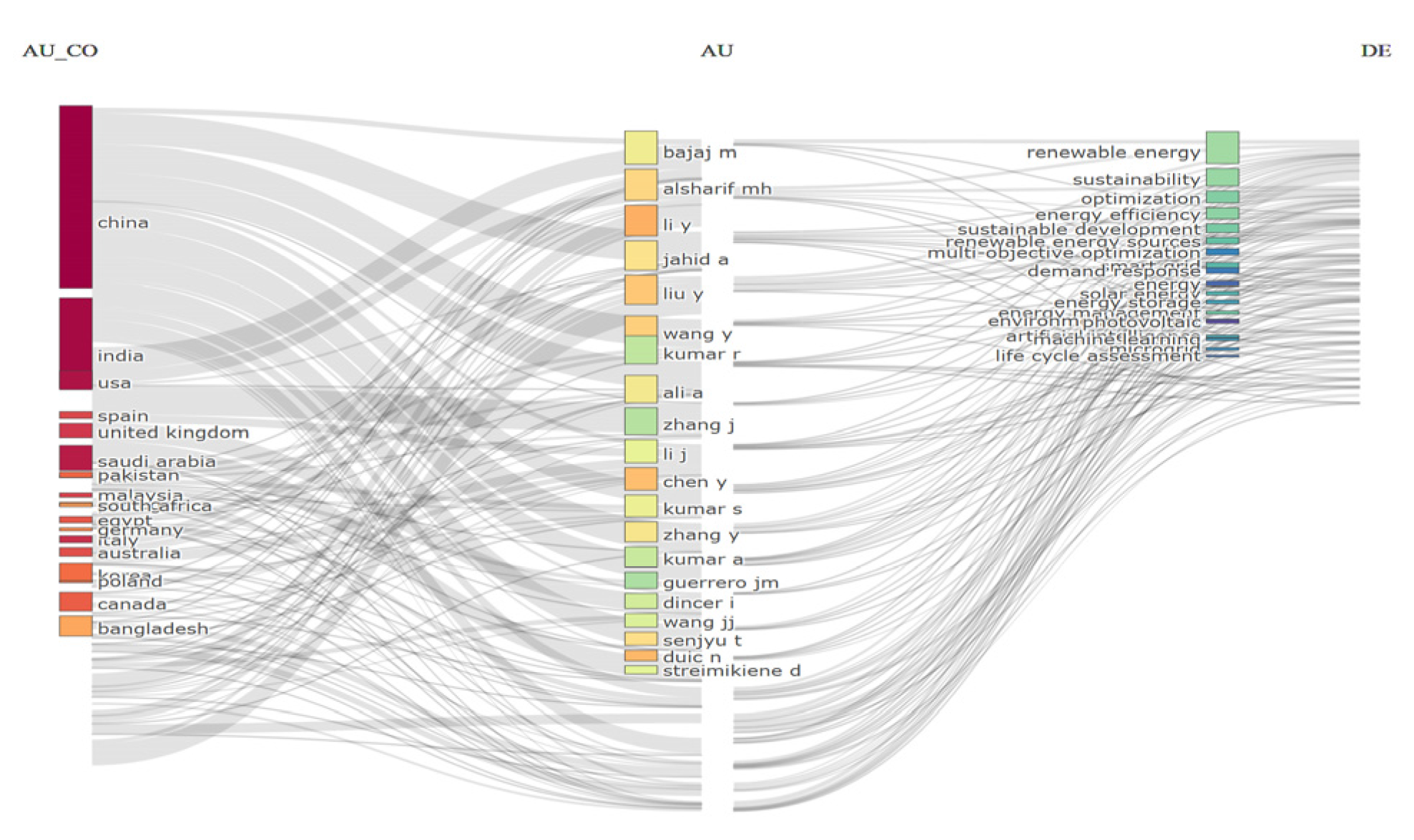
The author with the most articles is Li Y (17 papers), who is frequently involved in collaborative research and applied studies on energy optimization or the integration of renewable sources. This is followed by Duic N, with 15 articles, an author known for his research in energy sustainability and national-scale energy systems planning. Authors Chen Y, Liu Y, Wang Y, and Alsharif MH stand out for a similar number of publications (13–14) and active involvement in interdisciplinary research teams. Their topics include energy efficiency, smart grids, and demand response, reflecting current trends in the energy transition. A special case is Dincer I, who, although he has 10 articles, registers the highest fractional contribution (4.5), which suggests a majority involvement in individual works or as a main author. The field of thermodynamic efficiency and sustainable energy systems has benefited from Dincer's theoretical work, which established key concepts. The corpus's thematic diversity is further supported by Streimikiene D, Guerrero JM, and Kumar S/R/A, who study energy policies, distributed source integration, and system performance analysis. The researchers conducted studies on sustainable energy systems, but their work focused on socioeconomic and technological aspects without a single central theme. The field of network optimization, green technology integration, and adaptive energy policy development advances through worldwide expert collaboration, as shown by the author distribution pattern and their contribution percentages.
Figure 3.
Correlation between authors, their national affiliation and central research themes. Source: Authors based on data extracted from WoS.
Figure 3.
Correlation between authors, their national affiliation and central research themes. Source: Authors based on data extracted from WoS.
The analyzed corpus shows that MDPI distributes its publications mainly through Energies and Sustainability journals which together account for 264 and 216 articles respectively. The open-access model and fast review process of MDPI journals [40,41] draw researchers who study sustainability and energy to publish their work. The MDPI journals provide researchers with the ability to publish their work across various subjects which reaches readers from all over the world. The academic standing of Elsevier depends on its journals which include Renewable & Sustainable Energy Reviews (137) and Energy (136) and Applied Energy (107) and Renewable Energy (106) and Energy Conversion and Management (98). The journals continue to lead technical publications because they provide comprehensive content which directs industrial operations and supports advanced scientific investigations. The Journal of Cleaner Production (113 articles) published by Elsevier demonstrates complete sustainability analysis through its combination of economic and environmental and social elements which suits research about sustainable development and energy efficiency. The Journal of Energy Storage (80 articles) demonstrates academic researchers investigate systems which enable renewable energy integration and improve smart grid stability. IEEE Access (100 articles) from IEEE focuses on technological progress in automation and AI and distributed systems for energy network development. The research environment displays two opposing characteristics because open-access platforms provide immediate visibility, yet established journals enforce strict scientific standards which lead to an increasing diverse range of research.
The authors who worked on energy strategy scientific production demonstrated both quantitative growth and conceptual development in their research (Figure 4). Author Li Y, active since 2017, has gradually expanded his area of interest from thermal efficiency to advanced energy storage solutions and environmental performance assessment, with recent work published in Energy Storage [29]. Duic N has maintained a continuous presence from 2011 to 2025, transitioning from national energy planning to model-based decarbonization scenario development, resulting in publications in Energy Conversion and Management X [34]. Chen Y has been active since 2015, starting with energy conversion research before moving to life cycle assessment and urban sustainability studies, resulting in publications in Renewable & Sustainable Energy Reviews [35]. Wang Y conducted research from 2017 to 2025 on artificial intelligence applications for energy grid optimisation in microgrids and demand management systems [36]. Alsharif M.H. made substantial progress in his research after 2020, publishing his work on urban sustainability and ESG assessment in Energy Reports [37]. Jahid A has distinguished himself through his work on energy demand management and distribution optimization in smart grids. The author's research shows how distributed control algorithms operate in real-world urban microgrids powered by renewable energy [38]. The scientific community first documented Liu Y in 2016 when it examined energy efficiency, but current research uses artificial intelligence to study urban sustainability through interdisciplinary methods [39]. These authors complete the picture of an increasingly sophisticated energy research. In these topics, the range of interests includes technical optimization, public policy, ecological assessment, and the integration of emerging technologies.
3.1.3. Main Sources and Logs
The analysis of the bibliographic sources highlights a significant thematic and editorial concentration, reflecting the influence of several major scientific platforms on current research directions in energy strategies (Table 3).
The research base consists of articles from Energies and Sustainability journals which operate as open-access MDPI journals that use fast publication for worldwide interdisciplinary studies. The Elsevier journals Renewable & Sustainable Energy Reviews and Energy and Applied Energy and Renewable Energy and Energy Conversion and Management maintain their scientific reputation through strict peer-review processes which deliver detailed research findings for industrial and technical uses. The two Elsevier journals Journal of Cleaner Production and Journal of Energy Storage demonstrate how scientists in present times establish connections between sustainability and energy storage systems. The research published in IEEE Access focuses on automation and AI and distributed systems because it demonstrates the current interest in technological development. The present editorial system shows two separate research methods through its open-access platforms which emphasize quick publication and accessibility and its traditional publishers who concentrate on scientific quality and methodological complexity to build a complete energy research framework.
3.1.4. Thematic Evolution and Keywords
The analysis of key terms over time shows that the research followed a first period from 2012 to 2016, which focused on basic management concepts, energy balance, and electricity markets, with a concentration on market structure and infrastructure development. The thematic directions evolved toward process integration and energy planning optimization between 2017 and 2020, driven by increasing mentions of demand-side management (35) and energy planning (45). This evolution indicates a shift from general conceptualization to systemic approaches, centred on network efficiency and consumption adaptation. Research into sustainable digital themes began in 2019, driven by technological advances and the urgent need to reduce carbon emissions. The terms energy efficiency (331 mentions), smart grid (178), life cycle assessment (13), and green computing (11) emerge as key concepts that demonstrate a comprehensive strategy for energy management. The stage presents energy-harvesting and rural electrification concepts, as researchers aim to develop flexible solutions for areas with limited infrastructure or remote locations.
After 2023, research directions converge towards advanced technological fields, reflected in the increased frequency of the terms’ artificial intelligence (104), machine learning (98), green hydrogen (29) and biodiesel (29). The current research shows that smart algorithms and alternative sources must become essential components of resilient energy systems, as they play a key role in transforming energy network development. The terms renewable energy integration (60) and optimization (303) appear repeatedly in the text, indicating a strong emphasis on achieving efficient integration through digital technologies (Figure 5).
The bibliometric analysis conducted in RStudio using Biblioshiny, based on the authors' keywords, reveals a clear thematic convergence in the literature on energy strategies (Figure 6).
The body contains three main terms that appear 772 times for renewable energy, 423 times for sustainability, and 331 times for energy efficiency, indicating ongoing efforts toward renewable energy adoption and consumption optimization. The integration of artificial intelligence (104), machine learning (98), and smart grids (178) with digital technologies is growing stronger in energy planning and management systems, indicating a transition toward automated smart grid systems. The integration of life cycle assessment (83) with circular economy (49) and environmental impact (78) establishes a comprehensive sustainability framework that grounds all energy solution validation in environmental impact assessment. The various energy sources, including solar power (106), wind power (56), hydrogen (52), and biomass (58), indicate a shift toward decentralized, flexible energy systems. The research proves its commitment to global climate goals through its work on decarbonization (35) and energy transition (61). The visually synthesized keyword analysis reveals increasing complexity in the relationships among energy, technology, and ecology through the thematic cloud. The field has reached conceptual convergence, demonstrating its progress and commitment to developing sustainable solutions through comprehensive, multidisciplinary approaches.
3.2. Content Analysis
The bibliographic filtering process yielded 4,049 papers, and researchers selected 94 articles for detailed thematic analysis because they directly supported the research objectives. The research examined only studies that directly examined resource management approaches for electricity distribution networks, while emphasizing sustainable practices, operational optimization, renewable energy integration, digital network transformation, and consumer involvement in the system. The research included articles that demonstrated smart distribution through applied case studies and optimization models, advanced technological solutions (DERMS), and regulatory policy analysis and socio-economic impact assessments. The research excluded studies that explained fundamental energy concepts but failed to demonstrate their application to distribution systems or to present a coherent conceptual framework. The thematic selection provided a structured framework for studying the strategic aspects of the energy transition.
3.2.1. The Main Types of Distributed Energy Resources (DERs) and Their Role in Optimizing Distribution Networks
The energy transition towards sustainability requires the efficient integration of distributed energy resources (DERs) into existing electricity grids (Table 4). Recent research highlights that DERs, including photovoltaic (PV) systems, hybrid microgrids, biogas micro-cogeneration, and electric vehicles (EVs), play a critical role in optimising energy distribution by improving flexibility, reducing losses, and increasing system resilience [45,46,47]. Studies show that smart PV systems with storage can ensure a reliable power supply in rural areas, replacing diesel generators and reducing CO₂ emissions by up to 100% [45]. In addition, intelligent management of EV charging using targeted demographic approaches enables optimized planning of hybrid microgrids and balances energy supply and demand [45]. Cooperative torque control in fuel cell electric tractors, along with the integration of advanced harmonic lock filters, also helps maintain power quality and grid stability [28,29,48]. Overall, DERs, supported by multi-criteria decision-making tools and simulation models, facilitate a transition to more decentralised, efficient, and renewable distribution networks [49,50].
These results highlight not only the diversity of RED technologies but also their multiple applications in smart grids. Smart PV systems and hybrid solutions can provide reliable power in remote areas, while micro-cogeneration and electric vehicles help to make demand more flexible and optimize local consumption. In parallel, technologies such as harmonic lock filters and electric fuel cell tractors address the challenges of power quality and operational stability. Overall, these resources, supported by simulation and multi-criteria decision models, support the transformation of distribution networks into an adaptive, efficient, and long-term sustainability-oriented system.
3.2.2. Evaluation of Technological Strategies Used in Intelligent Distribution Systems
Modern power distribution networks require a complete transformation to support decentralized renewable energy systems in contemporary society. The implementation of sophisticated technological approaches becomes essential to address the complexity and variability of distributed generation (DG) during this transition. The growing need for stable power grid operation has led to the adoption of advanced distributed energy resource management (DERMS) platforms and predictive control algorithms (APCs) by intelligent distribution systems (SIDs). Recent research studies demonstrate that these strategies deliver effective results in improving network operations (Table 5). [The evaluation and selection process of microgrid systems with DERs through FWZIC-VIKOR multi-criteria methods is demonstrated in cases 49 and 50 to develop a decision framework that unites technical performance with environmental sustainability. The integration of electric vehicles with intermittent renewable sources requires advanced control systems that use FACTS devices and BESS to address power quality issues, such as harmonic distortion and voltage imbalance, as noted in [51,52]. An integral part of these strategies is predictive control algorithms, which, as suggested [39,53,54] in the context of powertrains for fuel cell electric tractors, allow for optimal torque and energy allocation by anticipating demand and operating conditions. It allows for proactive, not just reactive, network management. The paper [17] emphasizes the requirement for precise load models (ZIPs) to properly evaluate the success of energy conservation programs through voltage reduction (CVR), which serves as a fundamental SID tool for energy efficiency.
Therefore, the literature confirms that the synergistic integration of DERMS with predictive analytics and adaptive control capabilities is a fundamental pillar for transforming distribution networks into adaptive, resilient, and optimized infrastructures for a sustainable energy future [50,52]. These strategies not only enable demand management and energy flow optimization, but also facilitate flexible adaptation to the operational variability imposed by the global energy transition.
3.2.3. Analysing Investment Planning Models and Their Correlation with the Performance of Electricity Grids
Strategic planning for electricity grid infrastructure investments lays a critical foundation for building sustainable and resilient energy systems. Research evidence shows that organizations require new, integrated investment models with extended timeframes and holistic perspectives, as traditional step-by-step methods fail to address modern complexities (Table 6).
A relevant example is provided by [60], which analyses the reform initiated by Tata Power-DDL in Delhi. The partnership between public-private entities and advanced distribution management systems (ADMS) achieved significant reductions in technical and commercial (AT&C) losses, delivering financial benefits and operational improvements to the company. The strategic model enables coordinated implementation of new technologies through an approach that differs from incremental methods.
The research by [57] demonstrates that integrating wind energy through Power-to-Hydrogen-to-Power (P2H2P) and lithium-ion battery storage systems requires careful investment planning to achieve both financial stability and reliable power grid operation.
The public policy analysis in [61] shows that energy security improves when development planning teams use advanced intervention tools to create unified strategies rather than pursuing separate or delayed policy approaches.
The authors [62] state that power grid stability and sustainable outcomes depend on demand-anticipatory planning systems for the rapid electrification of transportation and the adoption of autonomous vehicles.
3.2.4. Investigating Regulatory and Governance Gaps That Limit the Effectiveness of the Implementation of Resource Management Strategies
The current regulatory and governance systems fail to provide the necessary elements, which results in significant implementation difficulties for resource management strategies (Table 7). The Decarbonization Agency in Ukraine serves as an example [63] that demonstrates the need for specialized agencies to lead the green transition through clear communication and decision-making processes, as Ukraine lacks an adequate institutional framework [63]. The study by [46] shows that current standardized methods for hybrid energy systems (HES) do not account for population characteristics, resulting in insufficient adaptive planning tools for EV charging infrastructure based on user behavior. The expansion of algae-based biofuel production, as outlined in [64], could worsen water scarcity unless proper water resource assessment methods are used for site selection within an integrated policy framework. Furthermore, [65] demonstrates that decentralized wastewater treatment systems can be more sustainable. The current regulatory systems prevent their use because they support centralized operations, which need new policies to allow innovation.
Overall, this research highlights the need for more adaptive, integrated and evidence-based governance that responds not only to technological but also to institutional, social, and environmental challenges. Only through such an approach can the conditions be created for an efficient and scalable implementation of resource management strategies.
3.2.5. Examining the Social and Economic Impact of Distribution Strategies, with a Focus on Prosumer Participation and Energy Equity
Renewable power generation systems linked to digitalized distribution networks have created new market connections between producers and consumers, leading to the development of prosumers who both produce and use electricity. The trend serves as a basic requirement for establishing power equality by providing electricity access to all people and supporting vulnerable social groups (Table 8). The research conducted in 46 and 54 demonstrates that HES systems that align with population traits and economic settings produce lower costs and more affordable energy expenses. The installation of solar microgrids in rural areas offers two main economic advantages: lower energy costs and self-sufficient power generation, enabling local people to become active energy producers. However, these benefits are not automatically distributed fairly. The report at point 50 warns that innovative technologies will increase current social gaps because they lack proper public policies and regulatory systems which protect disadvantaged regions. Implementing distribution strategies requires financial backing, educational programs, and flexible regulatory systems to achieve a fair energy transition.
The involvement of prosumers enhances system technological performance while fostering social unity and equal access to energy resources. Network planning requires integrating social elements to achieve lasting sustainability.
3.2.6. Formulating an Integrative Conceptual Framework for the Adoption of Sustainable and Efficient Energy Policies
A global energy transition requires an integrative conceptual framework for decision-makers to develop sustainable policies which adapt to changing circumstances. The framework recognizes that the energy sector faces various interlinked issues, as single solutions cannot address its challenges of decentralization, renewable energy integration, demand management, and supply stability. The current research demonstrates that decision-making requires a unified approach that combines technical evaluation with economic, ecological, and social assessment (Table 9). The research on energy system hybridization [46] and green supply chain management optimization [66] demonstrates that maximum efficiency emerges from analyzing technological solutions alongside environmental factors and market conditions simultaneously. The implementation of Life Cycle Assessment (LCA) enables the evaluation of real sustainability in policy proposals through its application in tourism impact assessment [67] and decentralized water treatment [65]. The proposed decision support framework needs to move beyond data delivery, requiring the creation of simulation models and a forecasting system to assess wind storage and photovoltaic potential, and to test various deployment scenarios to deliver optimal value with minimal adverse effects.
The framework operates as a knowledge-convergence system that converts complex energy transition barriers into specific steps that public organizations and investors can use to accelerate their sustainability goals.
3.3. Formulation of a Theoretical Conceptual Framework for Strategy to the Optimal Integration of DER in Smart Grids
3.3.1. Strategic Pillars of Sustainable and Efficient Smart Grids
The integration of distributed energy sources (DERs) into smart grids requires a multidimensional strategic approach grounded in six fundamental pillars that reflect the complexity of the current energy transition. These pillars define the theoretical framework through which sustainability, resilience and operational efficiency can be achieved coherently.
The first pillar relies on technological and innovative solutions, including hierarchical control algorithms and hardware-in-the-loop simulation platforms for real-time validation and monitoring of network operations, as described in [29,39]. The Sustainability and Environment Pillar aims to integrate the principles of the circular economy and reduce environmental impact through waste recovery and adaptation to climate change [55,68]. The economic and business pillar under the economic front works to achieve profitability through cost optimization and financial model innovation, thereby attracting investment and boosting operational performance [50,58]. The social aspect of the social and governance pillar seeks to build public support and community participation through robust institutional frameworks for public-private partnerships and clear regulatory systems [61,66]. The reliability of systems depends on the resilience and security pillar, which performs consumption forecasting and load management and defends critical infrastructure [52,59]. The network reaches functional unity through integration standards that combine interoperability standards to establish standardized protocols and unified control systems [39,61]. The framework consists of these pillars, presented in Table 10, to create a unified system for smart grid development that supports sustainability and long-term adaptability.
The six identified pillars operate as a unified system to develop an efficient distributed energy integration strategy, which enables both technical-economic and socio-ecological sustainability of the transition. The Technological Pillar is the backbone of the entire strategy, providing the concrete tools, from control algorithms to simulation platforms, without which the integration would be only theoretical. The Economic Pillar functions as a vital system component, enabling technological progress to become sustainable business opportunities that maximize financial resource distribution and create market systems that attract private funding. The Sustainability Pillar works in parallel to achieve technological and economic development, respecting planetary boundaries while accounting for environmental costs and following circular economy principles. The Social and Governance Pillar serves as the foundation for all other pillars because it establishes regulatory frameworks and secures social approval to achieve their full potential. The system functions as a unified whole through the Pillar of Resilience and the Pillar of Integration, which together deliver system-wide security and operational unity. The four pillars work together to solve fundamental problems which enable a paper strategy to become a lasting system transformation with real-world effects. The distribution system will achieve smart, sustainable, and resilient operation by integrating these pillars, which address current energy challenges.
3.3.2. A Strategic Model to Achieve the Best Integration of DERs into Smart Grid Systems
The proposed strategic model for integrating distributed energy resources (DERs) into smart grids through an optimal approach comprises four sequential phases that encompass planning and technology deployment, operational expansion, and ongoing system adaptation (Table 11).
The assessment and planning phase serves as the first stage and requires a complete infrastructure evaluation, DER potential assessment, electrical load modelling, and weather forecasting using ZIP/NTZIP tools [56,68]. The development of an adapted regulatory framework includes technical standards, financing mechanisms, and institutional partnerships according to [55,63]. The pilot implementation phase serves as the following stage to evaluate proposed solutions by creating smart microgrids, testing storage systems, and validating V2G applications at a small scale [52,54]. The verification process for predictive control algorithms occurs during this phase, as described in [29,39], and system performance monitoring operates continuously in real time, as described in [50,61]. The scaling and optimization phase aims to scale tested solutions across different areas, connect existing DER clusters, and improve algorithms through operational data analysis [39,46]. The project needs to achieve long-term sustainability through institutional growth, including staff development and improved collaboration among organizations [61,66]. The evaluation and improvement stage requires performance audits that use sustainability indicators to conduct comprehensive cost-benefit assessments [65,67] and to implement new technologies and policies based on the lessons learned [62,68]. The model provides an operational framework for network transformation, which needs suitable analytical tools and adaptable execution methods to address shifting circumstances.
3.3.3. Recommendations for Validating the Conceptual Strategic Framework Model
The proposed theoretical framework for optimal DER integration in smart grids requires validation through a controlled pilot study that tests its operational performance in real-world grid settings. The objective of this step is to confirm the shift from a centralized to a distributed architecture through the analysis of complex adaptive systems and the development of participatory economy models [63]. The technological validation process requires a hierarchical control system architecture, which is tested on hardware-in-the-loop platforms and through real-time management via PSO or MVSMC optimization algorithms, along with bidirectional converter and advanced storage system interoperability analysis for network coordination performance [39,52,58]. The team will employ ZIP or NTZIP tools in combination with multi-criteria analysis to model consumption and generation, optimize energy flow, and simulate production variability [50,56]. The economic validation process will assess adaptive financing systems for prosumers and market-based solutions for DER systemic services through a complete cost-benefit analysis [55], and a multi-level governance framework will be applied to evaluate regulatory aspects [61]. The validation process consists of four connected stages that begin with infrastructure assessment and regulatory framework development, followed by pilot implementation for field testing of technology components and business models, algorithms, and then scaling and optimization for geographic growth and operational process enhancement and conclude with evaluation and improvement through performance assessment and integration of innovations. The validation process operates within six essential pillars of sustainable smart grids, with specific stages outlined in Table 12. The system performance evaluation will use three sets of strict indicators, including technical metrics for DER penetration and energy quality, and economic metrics for net present value and sustainability indicators for emission reduction levels. Critical factors such as interoperability, cybersecurity, predictability of the regulatory framework and social acceptability will also be continuously monitored.
The pilot validation process will both verify the strong performance and practical use of the theoretical framework and reveal its current boundaries. The research will generate essential findings which will help future studies about artificial intelligence-based predictive management systems and DER standards development to create sustainable energy policies and support enduring strategic investments.
4. Discussion
The research results demonstrate both the advanced state of distributed energy integration technology and the unequal distribution of strategic elements across governance, regional equity, and behavioural factors in existing research.
Recent research shows that predictive control systems with AI-based coordination are becoming increasingly important for controlling DER variability and maintaining network stability [70,71]. The research shows that hybrid machine learning and control optimization systems outperform traditional rule-based models, speeding up energy dispatch operations in power grids with high levels of renewable energy integration. AI-based model deployment faces operational challenges that affect data accessibility, system processing requirements, and model adaptability [72]. The modern technological environment requires limiting access to digital services in areas with insufficient digital infrastructure.
The operational aspects of governance receive insufficient attention, as decentralization and energy democratization are fundamental governance elements. Some authors [61,63] state that developing adaptive multi-level regulatory frameworks that involve all stakeholders is a difficult task while remaining enforceable. DER scalability faces a significant barrier because different regions of the world have established distinct regulatory systems.
The reviewed literature demonstrates that empirical evidence is unevenly distributed across various geographic areas. The field trials and simulation-based explorations are led by China, India, and several EU member states [46,73]. The 2023 report indicates that Sub-Saharan Africa and Southeast Asia, which have high DER potential, are underrepresented. The current models face limitations in their ability to generalize to new situations which requires researchers to develop context-specific deployment strategies [68,74]. The proposed strategies require a balanced geographic distribution to prevent the current worldwide energy inequality from worsening.
The study investigates how DER integration produces various advantages that affect rural power distribution, agricultural activities, and water treatment facilities [45,65,75]. DERs create cross-sectoral synergies, demonstrating that they build systemic resilience across the energy system and the social and environmental sectors. The study lacks operational definitions of these benefits because it does not use multicriteria decision models or systems thinking frameworks, which offer opportunities for future interdisciplinary research collaboration.
Ref. [76] explain that the renewable energy project assessment depends mainly on its economic viability. Ref [77] sustain that the metrics used are often static, based on deterministic assumptions. The current situation demands that organizations implement stochastic, real-options, and scenario-based evaluation methods that better represent energy market volatility and uncertainty stemming from climate change and geopolitical instability.
The articles suggest various incremental enhancements instead of complete system transformations for achieving strategic alignment. Ref. [78] present specific research outcomes from their study that differ from what other studies have found. The authors [69] present revolutionary models which support a complete transition of the region toward net-zero systems. The proposed solutions demonstrate creative approaches but fail to provide workable methods which align with institutional frameworks and human behavioral tendencies.
The essential role of social acceptance and user engagement in smart grid adoption has not received adequate theoretical examination [79,80]. Future research needs to move beyond technocratic approaches by implementing participatory models, community ownership, and behavioral economics principles to design and implement DER strategies.
5. Conclusions
Summary of Results
The research analyzed the entire process of DER integration into smart grids across four main categories, linking technological elements to economic factors, regulatory systems, and social impacts. The system requires three fundamental technological components: DAUKF and MVSMC control algorithms, DERMS (distributed energy resource management systems), and ZIP/NTZIP load forecasting models. The research shows that adaptive financial systems and market-based solutions work together to support economic operations for systemic services. The regulatory framework faces two main challenges because of insufficient legal frameworks and unpredictable management systems, yet the public requires both participation and equal distribution of power. The main barriers to adoption include regulatory fragmentation, high investment requirements, interoperability challenges, and consumer reluctance to adopt new systems from established users.
Original Contributions
The research presents an original framework which combines six strategic pillars (technological, sustainability, economic, social, resilience, and integration) to develop a complete method for DER integration. The originality of the work consists in the development of a strategic model with four implementation phases (evaluation-planning, pilot implementation, scaling-optimization, and evaluation improvement) that guides the network transformation process. The integration of bibliometric analysis with content analysis represents a distinctive approach that enables researchers to study the complete development of the field. The research stands out for identifying new multi-level coordination systems that enable local authorities, grid operators, and prosumers to manage distributed energy systems.
Limitations
However, the research has some important limitations. The main one is the exclusive use of the Web of Science database, which, although it ensures the quality of the sources, can exclude relevant works indexed in other databases. The strict selection criteria reduced the corpus to 94 articles from the original 4,049 documents, potentially limiting the representation of subfields. Complementary to this, the theoretical nature of the proposed framework requires empirical validation through future case studies.
Practical Implications
The framework provides essential guidance to practitioners who want to transform their distribution networks through step-by-step DERMS technology implementation, strategic planning, and public-private funding partnerships, rather than incremental approaches and consumer education initiatives. Scientists need to follow the research directions outlined in this study to improve predictive control algorithms, study prosumer behaviour, and evaluate multiple regulatory frameworks.
Future Directions
Future research requires two essential steps: it needs to increase database coverage through new bibliographic resources for improved thematic analysis, and it must conduct practical case studies to prove the conceptual framework through empirical evidence and develop simulation models to study intricate DER integration situations and assess how artificial intelligence and new technologies influence smart grid management and assess multiple renewable energy integration strategies across different countries. The proposed research directions aim to create scientific evidence which will enable sustainable energy system development with both resilience and operational efficiency.
Funding
This research received no external funding.
Acknowledgements
This research was carried out within the Doctoral School of Management of the Bucharest University of Economic Studies
Conflicts of Interest
The authors declare no conflicts of interest.
Abbreviations
The following abbreviations are used in this manuscript:
| Acronym | Full name |
| DER | Distributed Energy Resources |
| PV | Photovoltaic |
| EV | Electric Vehicle |
| HES | Hybrid Energy System |
| LCOE | Levelized Cost of Energy |
| FC | Fuel Cell |
| HBF | Harmonic Blocking Filter |
| BESS | Battery Energy Storage System |
| RB-MG | Research-Based MicroGrid |
| ZIP | Impedance, Current, and Power Load Model |
| NTZIP | Non-Temperature ZIP Model |
| DAUKF | Dual Adaptive Unscented Kalman Filter |
| MVSMC | Multi-Variable Sliding Mode Control |
| DERMS | Distributed Energy Resource Management System |
| V2G | Vehicle-to-Grid |
| AI | Artificial Intelligence |
| RES | Renewable Energy Sources |
| GSCM | Green Supply Chain Management |
| LCA | Life Cycle Assessment |
| IoT | Internet of Things |
| NZE | Net Zero Emissions |
| GHG | Greenhouse Gases |
| DR | Demand Response |
| SDEWES | Sustainable Development of Energy, Water and Environment Systems |
References
- Enel Group. The role of electricity distribution for a safe energy transition. Enel, 2024. https://www.enel.com/content/dam/enel-com/documenti/azienda/storie/the-role-of-electricity-distribution-for-a-safe-energy-transition-teha-2024.pdf#:~:text=The%20study%2C%20%E2%80%9CThe%20Role%20of%20Electric%20Distribution%20for,energy%20for%20all%20key%20activities%20in%20advanced%20economies. (accessed Nov. 06, 2025).
- Rai, A.; Maheshwari, S. Understanding the nexus between community engagement and sustainable development goals in the context of renewable energy off-grid projects. International Journal of Energy Sector Management. 2024, 19(2), 429–454. [CrossRef]
- European Institute of Innovation and Technology. EIT – Driving innovation across Europe. 2024. https://www.eit.europa.eu.
- Giannelos, S.; Bellizio, F.; Štrbac, G.; Zhang, T. Machine Learning Approaches for Predictions of CO2 Emissions in the Building Sector. Electric Power Systems Research. 2024, 235, 110735. [CrossRef]
- Giannelos, S.; Zhang, T.; Pudjianto, D.; Konstantelos, I.; Strbac, G. Investments in Electricity Distribution Grids: Strategic versus Incremental Planning. Energies. 2024, 17(11) , 2724. [CrossRef]
- Heussaff, C.; Zachmann, G. Upgrading Europe’s electricity grid is about more than just money. Bruegel | the Brussels-based Economic Think Tank. 2025. https://www.bruegel.org/policy-brief/upgrading-europes-electricity-grid-about-more-just-money.
- Poudineh, R. Investment and efficiency in electricity networks. - Oxford Institute for Energy Studies, Oxford Institute for Energy Studies. 2015. https://www.oxfordenergy.org/publications/investment-and-efficiency-in-electricity-networks/.
- Yazar, O.; Coskun, S.; Zhang, F.; Li, L.; Huang, C.; Mei, P.; Karimi, H. R. A novel energy management strategy for hybrid electric vehicles using deep reinforcement incentive learning. Energy. 2025, 334, 137594. [CrossRef]
- TEHA Group; Enel. The role of electricity distribution for a safe energy transition, TEHA. 2024. https://www.enel.com/content/dam/enel-com/documenti/azienda/storie/the-role-of-electricity-distribution-for-a-safe-energy-transition-teha-2024.pdf (accessed Nov. 06, 2025).
- Cozzi, L.; Gould, T., International Energy Agency, IEA. 2025. https://www.iea.org/commentaries/scenarios-in-the-world-energy-outlook-2025 (accessed Nov. 06, 2025).
- Danti, P.; Pezzola, L.; Magnani, S. Performance analysis of an optimization management algorithm on a multi-generation small-size power plant. Energy Procedia. 2016, 101, 566–573. [CrossRef]
- Poudineh, R.; Elizondo, G. Harnessing the Power of Distributed Energy Resources in Developing Countries: What Can Be Learned from the Experiences of Global Leaders? Oxford Institute for Energy Studies. 2024. https://www.oxfordenergy.org/wpcms/wp-content/uploads/2023/10/EL49-Harnessing-the-Power-of-Distributed-Energy-Resources-in-Developing-Countries-RP.pdf.
- National Renewable Energy Laboratory (NREL). Distributed Energy Resource Management Systems. 2024. https://www.nrel.gov/grid/distributed-energy-resource-management-systems.
- Costa-Campi, M. T.; Trujillo-Baute, E. Regulatory frameworks and economic performance in the electricity sector. Journal of Cleaner Production. 2021, 143297. [CrossRef]
- Al-Mahammedi, M. T. F.; Onat, M. Optimal siting, sizing, and energy management of distributed renewable generation and storage under atmospheric conditions. Sustainability. 2025. 17(1), 300. [CrossRef]
- Blot, E.; Bergeling, E.; Watkins, E.; Marchetti, E. Circularity strategies and sustainable resource management to safeguard the clean energy transition. Institute for European Environmental Policy. 2024. Policy report.
- Yazar, O.; Coskun, S.; Zhang, F.; Li, L.; Huang, C.; Mei, P.; Karimi, H.R. A Novel Energy Management Strategy for Hybrid Electric Vehicles Using Deep Reinforcement Incentive Learning. Energy. 2025, 334, 137594. [CrossRef]
- Zhang, Q.; Xie, D.; Zeng, Y.; Liu, Y.; Yu, H.; Liu, S. Optimizing Wind-Solar Hydrogen Production through Collaborative Strategy with ALK/PEM Multi-Electrolyzer Arrays. Renewable Energy. 2024, 232, 121116. [CrossRef]
- Same, N.N.; Yakub, A.O.; Nsafon, B.E.K.; Owolabi, A.B.; Mih, T.A.; Suh, D.; Huh, J.-S. Performance Evaluation of Renewable-Based Sustainable Micro-Grid under Predictive Management Control Strategy: A Case Study of Gado Refugee Camp in Cameroon. Frontiers in Energy Research. 2022, 10. [CrossRef]
- Jahangir, H.; Tayarani, H.; Gougheri, S.S.; Golkar, M.A.; Ahmadian, A.; Elkamel, A. Deep Learning-Based Forecasting Approach in Smart Grids with Microclustering and Bidirectional LSTM Network. IEEE Transactions on Industrial Electronics. 2020, 68, 8298–8309. [CrossRef]
- Jiang, J.; Zhou, R.; Xu, H.; Wang, H.; Wu, P.; Wang, Z.; Li, J. Optimal Sizing, Operation Strategy and Case Study of a Grid-Connected Solid Oxide Fuel Cell Microgrid. Applied Energy. 2021, 307, 118214. [CrossRef]
- Wu, X.; Ding, L.; Zhou, G.; Shen, X.; Zhang, Q.; Xie, N. ASHP System Based on a Solar Photovoltaic Coupling Study of a Control Strategy for Variable Water Temperature and Variable Flow. Journal of Building Engineering. 2025, 108, 112907. [CrossRef]
- Ding, G.; Hua, J.; Duan, J.; Deng, S.; Zhang, W.; Gong, Y.; Sun, H. Research on the Strategy of Industrial Structure Optimization Driven by Green Credit Distribution. Sustainability. 2022, 14, 9360. [CrossRef]
- Lotrič, A.; Sekavčnik, M.; Kuštrin, I.; Mori, M. Life-Cycle Assessment of Hydrogen Technologies with the Focus on EU Critical Raw Materials and End-of-Life Strategies. International Journal of Hydrogen Energy. 2020, 46, 10143–10160. [CrossRef]
- Khan, K. I.; Nasir, A. Application of artificial intelligence in solar and wind energy resources: a strategy to deal with environmental pollution. Environmental Science and Pollution Research. 2023. 30(24), 64845–64859. [CrossRef]
- Çiçek, A. A Novel Resilience-Oriented Energy Management Strategy for Hydrogen-Based Green Buildings. Journal of Cleaner Production 2024, 470, 143297. [CrossRef]
- Panda, S.; Mohanty, S.; Rout, P.K.; Sahu, B.K.; Parida, S.M.; Kotb, H.; Flah, A.; Tostado-Véliz, M.; Abdul Samad, B.; Shouran, M. An Insight into the Integration of Distributed Energy Resources and Energy Storage Systems with Smart Distribution Networks Using Demand-Side Management. Appl. Sci. 2022, 12, 8914. [CrossRef]
- Li, T.T.; Liang, R.; Shang, Y.; Ding, C.X.; Hua, Y.; Wang, Z.; Alhazmi, M. SustainLLM: AI-Driven Lifecycle Sustainability Assessment and Energy Transition Optimization. Sustainable Energy Technologies and Assessments 2025, 82, 104475. [CrossRef]
- Li, Y.; Shaban, M.; Salih, S.Q.; Almadhor, A.; Aoudia, M.; Abdullaeva, B.; Alkhalaf, S.; Albalawi, H.; Mahariq, I.; Alalawi, A. P2P Trading and Energy Storage Technologies for Mitigating Balancing Challenges of RESs Integration into Multi-Energy Power Systems: A New Paradigm for DER Integration. Journal of Energy Storage. 2025, 124, 116848. [CrossRef]
- Moher, D.; Shamseer, L.; Clarke, M.; Ghersi, D.; Liberati, A.; Petticrew, M.; Shekelle, P.; Stewart, L.A. Preferred Reporting Items for Systematic Review and Meta-Analysis Protocols (PRISMA-P) 2015 Statement. Systematic Reviews. 2015, 4, 1. [CrossRef]
- Aria, M., & Cuccurullo, C. bibliometrix: An R-tool for comprehensive science mapping analysis. Journal of Informetrics. 2017, 11(4), 959–975. [CrossRef]
- Clarivate. 2025. Web of Science Core Collection. https://www.webofscience.com.
- Open Science Framework (OSF). 2025. https://osf.io/ewav2/metadata/osf.
- Garcia, D.A.; Dionysis, G.; Raskovic, P.; Duić, N.; Al-Nimr, M.A. Advanced Technological Options for Sustainable Development of Energy, Water and Environment Systems Upgrade towards Climate Neutrality. Energy Conversion and Management X. 2024, 22, 100528. [CrossRef]
- Yang, Y.-L.; Zhang, T.; Chen, Y.; Wang, C.-J.; Cai, G.-J. A Comprehensive Review on Application of Scrap Tire Rubber for Sustainable Thermal Insulation Material in Civil Engineering. Renewable and Sustainable Energy Reviews. 2025, 217, 115727. [CrossRef]
- Ma, Z.; Wang, Y. Hybrid AI-Based Forecasting of Green Hydrogen and Solar Power Using AdaBoost-BWOA. Chemical Product and Process Modeling. 2025. [CrossRef]
- Pandiyan, P.; Saravanan, S.; Usha, K.; Kannadasan, R.; Alsharif, M.H.; Kim, M.-K. Technological Advancements toward Smart Energy Management in Smart Cities. Energy Reports. 2023, 10, 648–677. [CrossRef]
- Singla, M.K.; Gupta, J.; Alsharif, M.H.; Jahid, A. Optimizing Integration of Fuel Cell Technology in Renewable Energy-Based Microgrids for Sustainable and Cost-Effective Energy. Energies. 2023, 16, 4482. [CrossRef]
- Li, X.; Xu, L.; Liu, M.; Yan, X.; Zhang, M. Research on Torque Cooperative Control of Distributed Drive System for Fuel Cell Electric Tractor. Computers and Electronics in Agriculture. 2024, 219, 108811. [CrossRef]
- Energies. Multidisciplinary Digital Publishing Institute (MDPI). 2025. https://www.mdpi.com/journal/energies.
- Sustainability. Multidisciplinary Digital Publishing Institute (MDPI). 2024. https://www.mdpi.com/journal/sustainability.
- Renewable & Sustainable Energy Reviews. Elsevier. 2023. https://www.sciencedirect.com/journal/renewable-and-sustainable-energy-reviews.
- Applied Energy. Elsevier. 2022. https://www.sciencedirect.com/journal/applied-energy.
- IEEE Access. Institute of Electrical and Electronics Engineers (IEEE). 2023. https://ieeexplore.ieee.org/xpl/RecentIssue.jsp?punumber=6287639.
- Desai, A.; Mukhopadhyay, I.; Ray, A. Techno-Economic-Environment Analysis of Solar PV Smart Microgrid for Sustainable Rural Electrification in an Agriculture Community. 2021 IEEE 48th Photovoltaic Specialists Conference (PVSC). 2021, 2281–2285. [CrossRef]
- Alanazi, A.; Jan, S.T.; Alanazi, M.; Khan, Z. Analysis of Hybrid Energy Systems for Electric Vehicle Charging of Different Demographics. Clean Technologies and Environmental Policy 2024, 27, 1067–1092. [CrossRef]
- Daniel, L.J.; King, C.W.; Tuttle, D.P.; Paxton, W.A. Computational Tool for Analysis of Vehicle-to-Home as Home Backup Solution during Power Outages. Energy Reports. 2024, 11, 1472–1486. [CrossRef]
- Aldosary, A.; Ali, Z.M.; Aleem, S.H.E.A.; Zobaa, A.M. Application of Stochastic Fractal Search Algorithm in Novel Harmonic Blocking Filter Design for Optimizing Harmonic Mitigation and Hosting Capacity in Electric Distribution Systems. PLoS ONE 2025, 20, e0320908. [CrossRef]
- Luna-Romero, S.F.; Serrano-Guerrero, X.; De Souza, M.A.; Escrivá-Escrivà, G. Enhancing Anomaly Detection in Electrical Consumption Profiles through Computational Intelligence. Energy Reports 2023, 11, 951–962. [CrossRef]
- Talal, M.; Tan, M.L.P.; Pamucar, D.; Delen, D.; Pedrycz, W.; Simic, V. Evaluation and Benchmarking of Research-Based Microgrid Systems Using FWZIC-VIKOR Approach for Sustainable Energy Management. Applied Soft Computing 2024, 166, 112132. [CrossRef]
- Deng, Y.; Chen, Y.; Wang, Y.; Wen, X.; Lan, L.; Xiang, M.; Jing, M. Cluster Analysis of Cloud-to-Ground Lightning Activities near Transmission Lines in Typical Terrains. Electric Power Systems Research 2023, 225, 109876. [CrossRef]
- Srivastava, A.; Manas, M.; Dubey, R.K. Integration of Power Systems with Electric Vehicles: A Comprehensive Review of Impact on Power Quality and Relevant Enhancements. Electric Power Systems Research. 2024, 234, 110572. [CrossRef]
- Quan, S.; Wang, Y.-X.; Xiao, X.; He, H.; Sun, F. Real-Time Energy Management for Fuel Cell Electric Vehicle Using Speed Prediction-Based Model Predictive Control Considering Performance Degradation. Applied Energy. 2021, 304, 117845. [CrossRef]
- Wang, Y., Zhou, J., Sun, Y., Fan, J., Wang, Z., & Wang, H. Collaborative multidepot electric vehicle routing problem with time windows and shared charging stations. Expert Systems with Applications. 2023, 219, 119654. [CrossRef]
- Jarosz, Z.; Kapłan, M.; Klimek, K.; Dybek, B.; Herkowiak, M.; Wałowski, G. An Assessment of the Development of a Mobile Agricultural Biogas Plant in the Context of a Cogeneration System. Applied Sciences. 2023, 13, 12447. [CrossRef]
- Zhang, Y.; Liao, Y.; Yadav, G. Experiences about Calculating ZIP and Exponential Load Model Parameters. International Journal of Emerging Electric Power Systems. 2024, 26, 549–562. [CrossRef]
- Xu, X.; Wang, B.; Shi, M.; Li, G.; Zhang, Y.; Wang, Q.; Liu, D. Research on Hydrogen Storage System Configuration and Optimization in Regional Integrated Energy Systems Considering Electric-Gas-Heat-Hydrogen Integrated Demand Response. International Journal of Hydrogen Energy. 2025, 135, 86–103. [CrossRef]
- Zhang, Y.; Wang, L.; Wang, N.; Duan, L.; Zong, Y.; You, S.; Maréchal, F.; Van Herle, J.; Yang, Y. Balancing Wind-Power Fluctuation via Onsite Storage under Uncertainty: Power-to-Hydrogen-to-Power versus Lithium Battery. Renewable and Sustainable Energy Reviews. 2019, 116, 109465. [CrossRef]
- Li, R.; Zhang, H.; Chen, H.; Zhang, Y.; Li, Z.; Zhao, J.; Wang, X.; Wang, H. Hybrid Techno-Economic and Environmental Assessment of Adiabatic Compressed Air Energy Storage System in China-Situation. Applied Thermal Engineering. 2020, 186, 116443. [CrossRef]
- Sinha, P.; Shankar, R.; Vrat, P.; Mathur, S. Power Distribution Reforms. Journal of Advances in Management Research. 2019, 17, 226–250. [CrossRef]
- Cheng, Q.; Chen, Z.; Lin, M.; Wang, H. Quantitative Evaluation of China’s Energy Supply Policies in the ‘13th Five-Year Plan’ Period (2016–2020): A PMC Index Modelling Approach Incorporating Text Mining. Energy Science & Engineering. 2024, 12, 596–616. [CrossRef]
- Stasinopoulos, P.; Shiwakoti, N.; Beining, M. Use-Stage Life Cycle Greenhouse Gas Emissions of the Transition to an Autonomous Vehicle Fleet: A System Dynamics Approach. Journal of Cleaner Production. 2020, 278, 123447. [CrossRef]
- Borodina, O.; Bratus, H.; Udovychenko, V.; Kaczmarzewski, S.; Kostrychenko, V.; Koval, V. Renovation Management of the National Economy in Ensuring Energy Decentralization. Polityka Energetyczna – Energy Policy Journal. 2022, 25, 67–84. [CrossRef]
- Xu, H.; Lee, U.; Coleman, A.M.; Wigmosta, M.S.; Wang, M. Assessment of Algal Biofuel Resource Potential in the United States with Consideration of Regional Water Stress. Algal Research. 2018, 37, 30–39. [CrossRef]
- Opher, T.; Friedler, E. Comparative LCA of Decentralized Wastewater Treatment Alternatives for Non-Potable Urban Reuse. Journal of Environmental Management. 2016, 182, 464–476. [CrossRef]
- Haiyun, C.; Zhixiong, H.; Yüksel, S.; Dinçer, H. Analysis of the Innovation Strategies for Green Supply Chain Management in the Energy Industry Using the QFD-Based Hybrid Interval Valued Intuitionistic Fuzzy Decision Approach. Renewable and Sustainable Energy Reviews. 2021, 143, 110844. [CrossRef]
- Michailidou, A.V.; Vlachokostas, C.; Moussiopoulos, Ν.; Maleka, D. Life Cycle Thinking Used for Assessing the Environmental Impacts of Tourism Activity for a Greek Tourism Destination. Journal of Cleaner Production. 2015, 111, 499–510. [CrossRef]
- Nwokolo, S.C.; Eyime, E.E.; Obiwulu, A.U.; Meyer, E.L.; Ahia, C.C.; Ogbulezie, J.C.; Proutsos, N. A Multi-Model Approach Based on CARIMA-SARIMA-GPM for Assessing the Impacts of Climate Change on Concentrated Photovoltaic (CPV) Potential. Physics and Chemistry of the Earth Parts a/B/C. 2024, 134, 103560. [CrossRef]
- Kılkış, B.; Kılkış, Ş. New Exergy Metrics for Energy, Environment, and Economy Nexus and Optimum Design Model for Nearly-Zero Exergy Airport (nZEXAP) Systems. Energy. 2017, 140, 1329–1349. [CrossRef]
- Gao, J.; Xia, L.; Ou, M.; Tan, Z. Metal Coordination Compounds for Organic Redox Flow Batteries. Batteries & Supercaps 2024, 7. [CrossRef]
- Calvillo, C.F.; Sánchez-Miralles, A.; Villar, J. Energy Management and Planning in Smart Cities. Renewable and Sustainable Energy Reviews 2015, 55, 273–287. [CrossRef]
- Xu, J.; Yao, Y.; Ehyaei, M.A.; Ahmadi, A. Performance Assessment of Biomass–Geothermal Configuration Energy Resources for Cooling and Power Generation. Energy Science & Engineering 2022, 10, 3650–3666. [CrossRef]
- Babayomi, O.; Zhang, Z.; Dragicevic, T.; Hu, J.; Rodriguez, J. Smart Grid Evolution: Predictive Control of Distributed Energy Resources—A Review. International Journal of Electrical Power & Energy Systems 2022, 147, 108812. [CrossRef]
- Salimon, S.A.; Adepoju, G.A.; Adebayo, I.G.; Adewuyi, O.B. Comparative Assessment of Techno-Economic and Environmental Benefits in Optimal Allocation of Distributed Generators in Distribution Networks. Scientific African 2023, 19, e01546. [CrossRef]
- Lee, S.; Kim, D.; Ha, H.; Kim, M.S. Pressure Energy Recovery of LNG Integrated with Multi-Stage Feedwater Fuel Preheaters in a Combined Cycle Power Plant. Energy 2023, 285, 128694. [CrossRef]
- Hafez, F.S.; Sa’di, B.; Safa-Gamal, M.; Taufiq-Yap, Y.H.; Alrifaey, M.; Seyedmahmoudian, M.; Stojcevski, A.; Horan, B.; Mekhilef, S. Energy Efficiency in Sustainable Buildings: A Systematic Review with Taxonomy, Challenges, Motivations, Methodological Aspects, Recommendations, and Pathways for Future Research. Energy Strategy Reviews 2022, 45, 101013. [CrossRef]
- Ancona, M.A.; Baldi, F.; Branchini, L.; De Pascale, A.; Gianaroli, F.; Melino, F.; Ricci, M. Comparative Analysis of Renewable Energy Community Designs for District Heating Networks: Case Study of Corticella (Italy). Energies 2022, 15, 5248. [CrossRef]
- Chu, W.; Vicidomini, M.; Calise, F.; Duić, N.; Østergaard, P.A.; Wang, Q.; Da Graça Carvalho, M. Review of Hot Topics in the Sustainable Development of Energy, Water, and Environment Systems Conference in 2022. Energies 2023, 16, 7897. [CrossRef]
- Hasan, S.; Meem, A.I.; Islam, M.S.; Proma, S.S.; Mitra, S.K. Comparative Techno-Economic Analyses and Optimization of Standalone and Grid-Tied Renewable Energy Systems for South Asia and Sub-Saharan Africa. Results in Engineering 2024, 21, 101964. [CrossRef]
- Kojonsaari, A. -r.; Palm, J. The Development of Social Science Research on Smart Grids: A Semi-Structured Literature Review. Energy Sustainability and Society 2023, 13. [CrossRef]
Figure 1.
PRISMA flow diagram. Source: Authors.
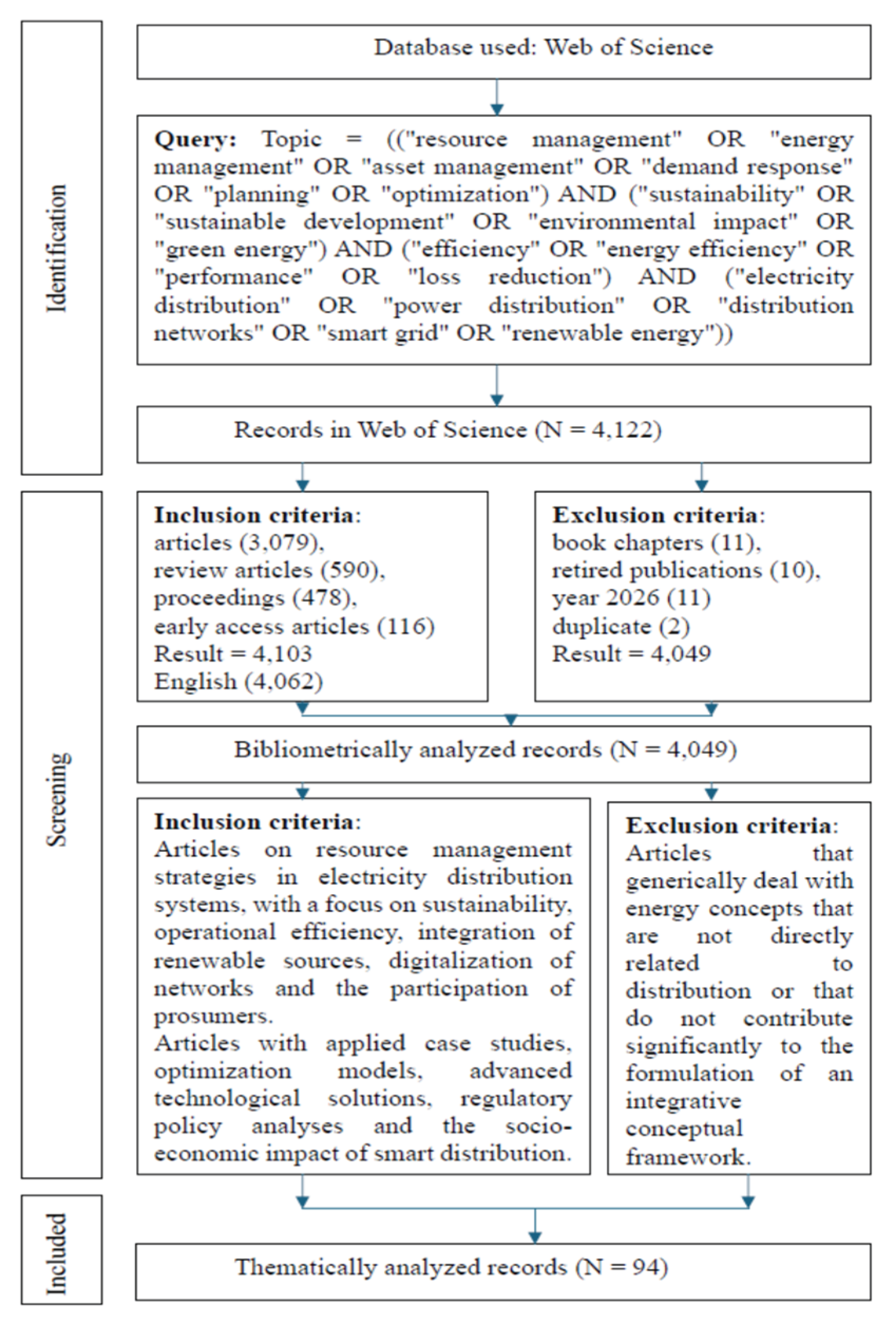
Figure 2.
Evolution of the annual production of articles. Source: Authors, based on data extracted from WoS.
Figure 2.
Evolution of the annual production of articles. Source: Authors, based on data extracted from WoS.
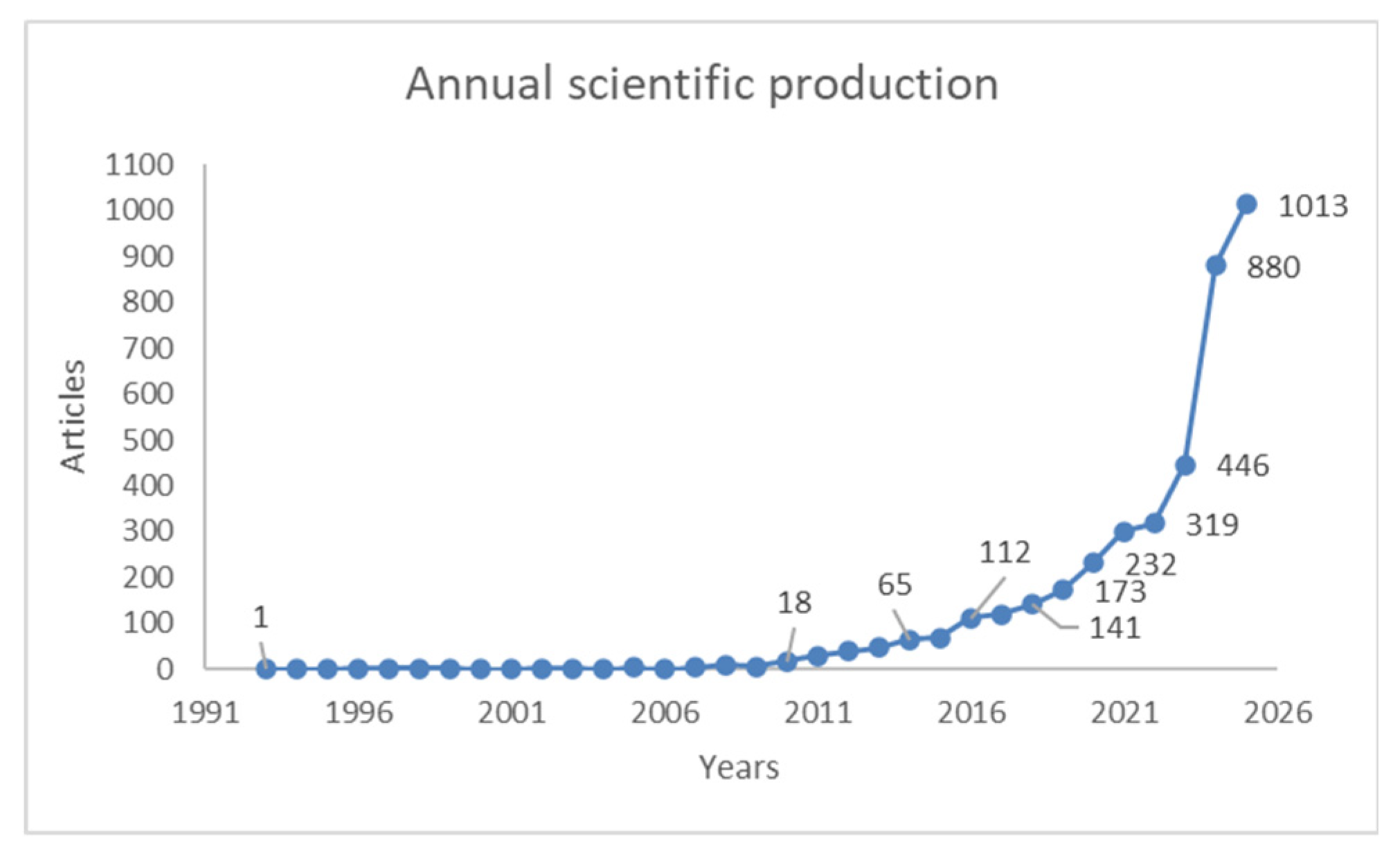
Figure 4.
Authors' production over time. Source: Authors, using Bibliometrix, based on data extracted from WoS.
Figure 4.
Authors' production over time. Source: Authors, using Bibliometrix, based on data extracted from WoS.
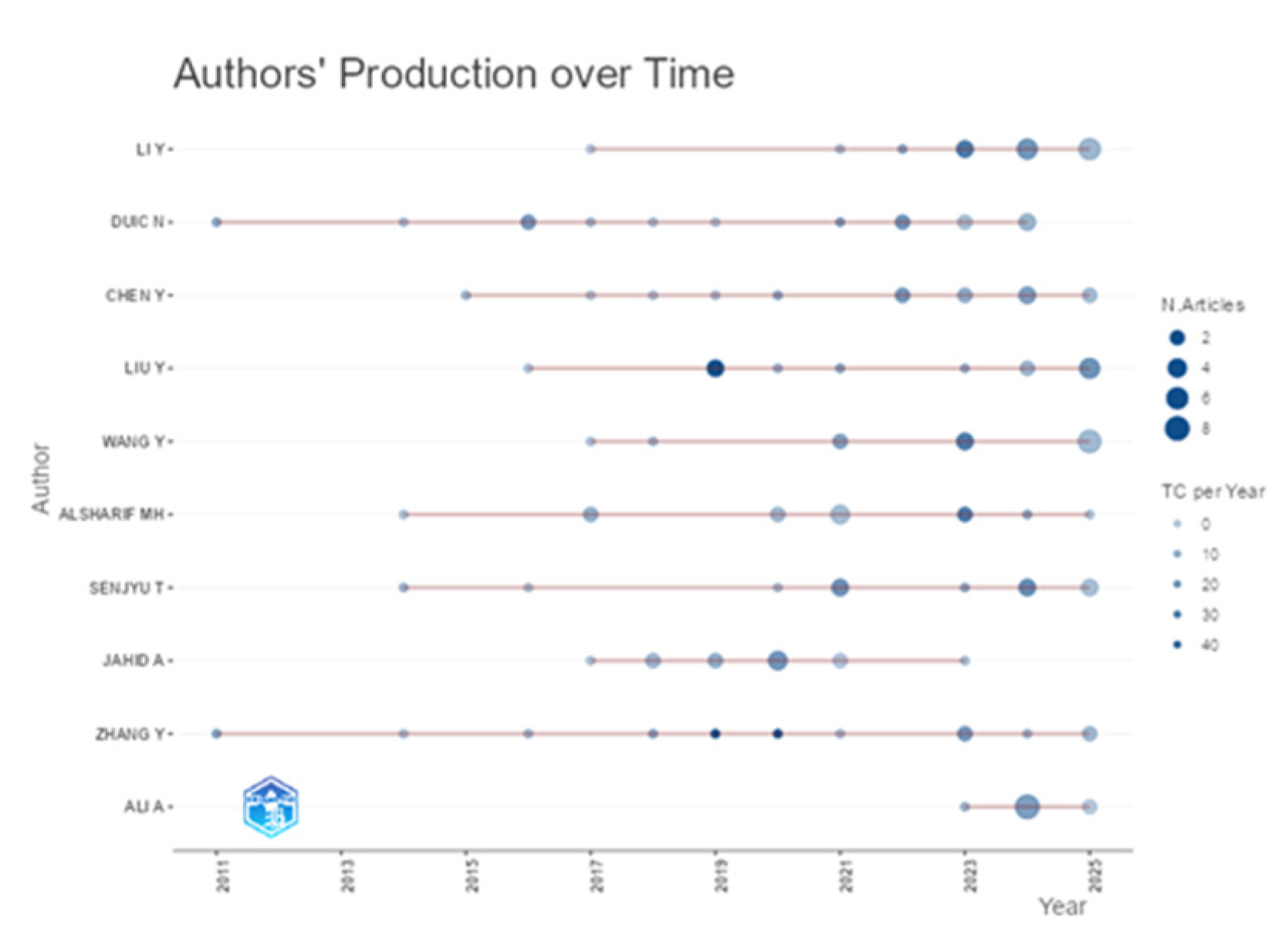
Figure 5.
Graphical representation of the trend of central topics over time. Source: Authors, using Bibliometrix, based on data extracted from WoS.
Figure 5.
Graphical representation of the trend of central topics over time. Source: Authors, using Bibliometrix, based on data extracted from WoS.
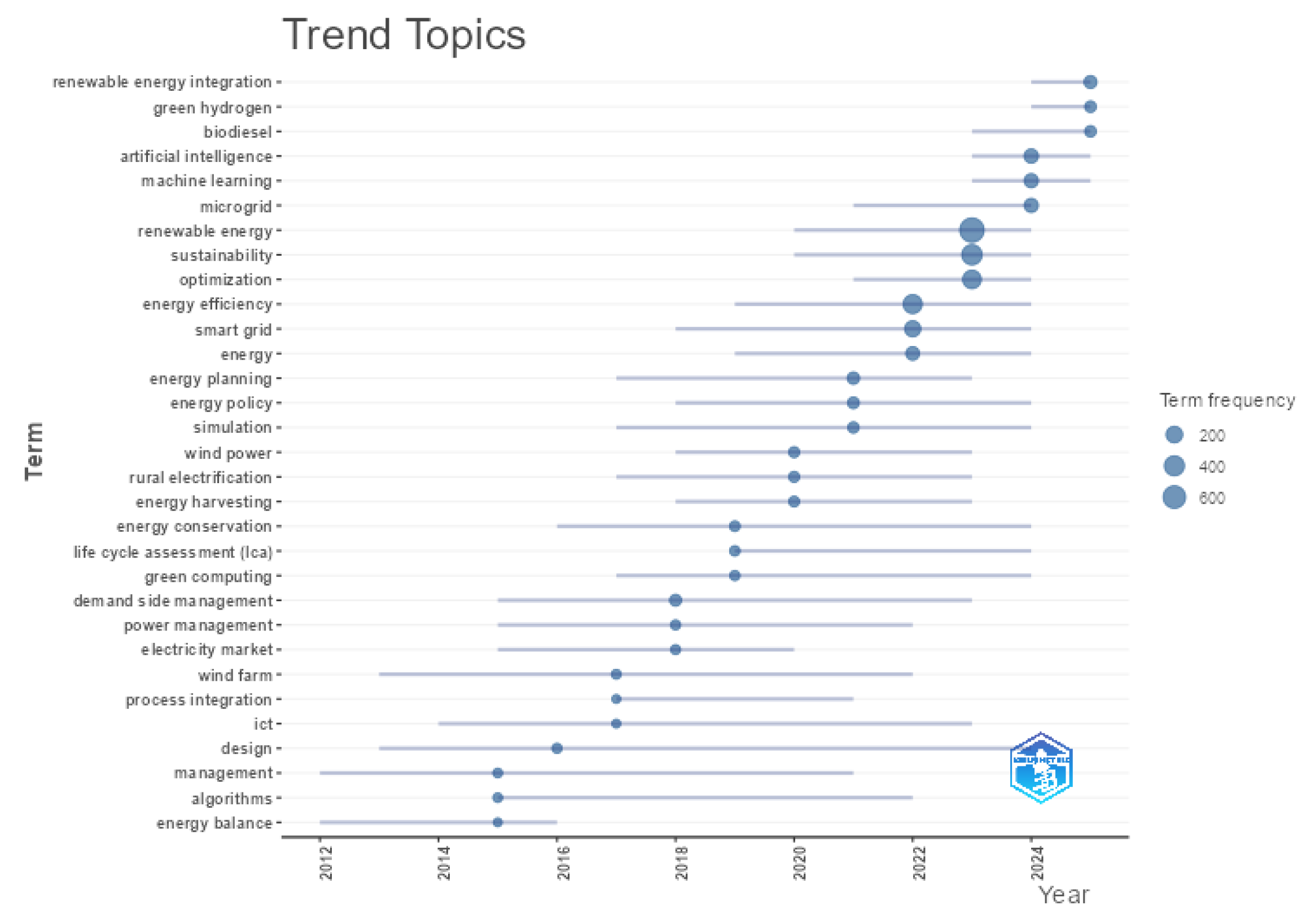
Figure 6.
Graphical representation of the author's common keywords. Source: Authors, using Bibliometrix, based on data extracted from WoS.
Figure 6.
Graphical representation of the author's common keywords. Source: Authors, using Bibliometrix, based on data extracted from WoS.
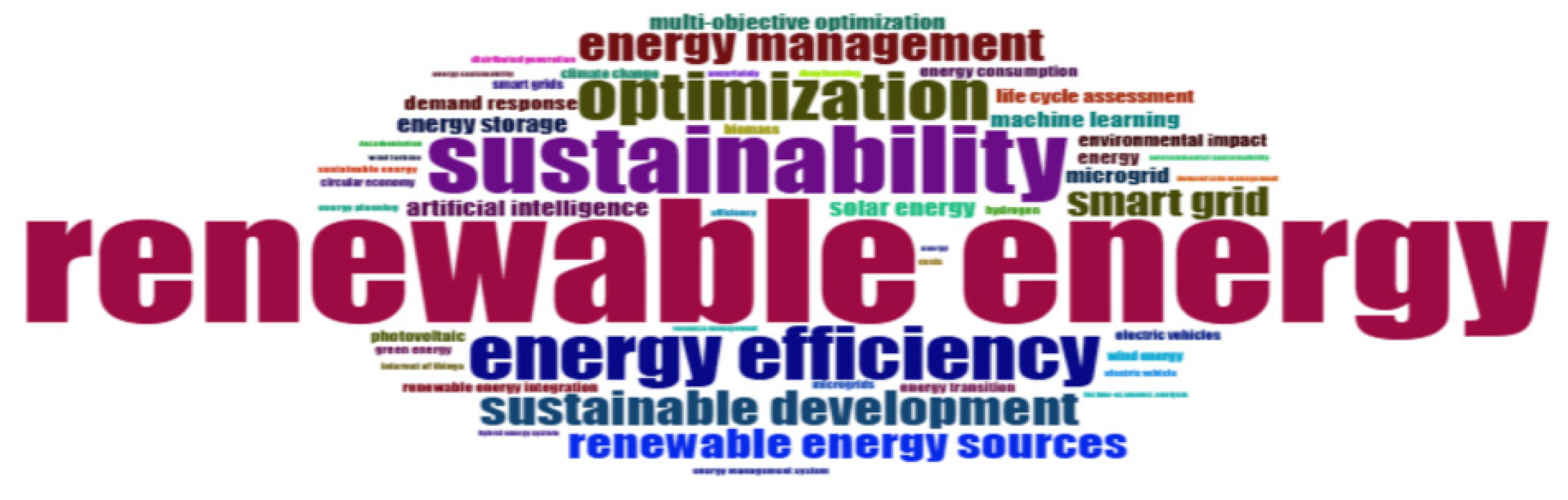

Table 1.
Data Extraction Fields.
| Field | Description |
|---|---|
| Author(s) & Year | Primary identification of the publication |
| Country/Region | Geographical scope of the case or study |
| Methodology | Simulation, case study, optimization, empirical |
| THE Focus | DERMS, predictive control, storage, prosumers |
| Strategic Focus | Technological, Economic, Regulatory, etc. |
| Main Findings | Summary of strategic insights |
| Limitations | Constraints reported by the authors |
Source: Authors.
Table 2.
The 10 most important authors of the analyzed period.
| Authors | Articles | Articles Fractionalized |
|---|---|---|
| Li Y | 17 | 3.61948052 |
| Duic N | 15 | 2.80793651 |
| Chen Y | 14 | 3.06904762 |
| Liu Y | 14 | 2.79642857 |
| Wang Y | 14 | 3.16230159 |
| Alsharif Mh | 13 | 3.28134921 |
| Senjyu T | 13 | 2.10238095 |
| Jahid A | 12 | 2.66785714 |
| Zhang Y | 12 | 2.45119048 |
| Ali A | 11 | 1.96190476 |
Source: Authors based on data extracted from WoS.
Table 3.
The 10 most important sources of information in the field.
| Sources | Articles |
|---|---|
| Energies | 264 |
| Sustainability | 216 |
| Renewable & Sustainable Energy Reviews | 137 |
| Energy | 136 |
| Journal Of Cleaner Production | 113 |
| Applied Energy | 107 |
| Renewable Energy | 106 |
| IEEE Access | 100 |
| Energy Conversion and Management | 98 |
| Journal Of Energy Storage | 80 |
Source: Authors, using Bibliometrix, based on data extracted from WoS.
Table 4.
Distributed energy resources (DER) and their role in optimizing distribution networks.
| Authors | DER Type | The role and way of optimizing the distribution network |
|---|---|---|
| [45] | Solar PV Smart Microgrid | Ensures sustainable rural electrification; replaces diesel generators; reduces CO₂ emissions and energy costs through optimized storage and load management. |
| [46] | Hybrid systems (PV, wind, batteries) for EV charging | Adapts the hybrid system configuration to the EV charging demographic; minimizes energy costs (LCOE) and maximizes the use of renewable resources in both isolated and grid-connected grids. |
| [55] | Micro-cogeneration on agricultural biogas | It produces heat and electricity on a small scale, increasing farm energy autonomy and reducing dependence on the centralized grid. |
| [39] | Fuel cell distributed drive systems for electric tractors | Optimizes traction and energy efficiency through cooperative torque control; reduces hydrogen consumption and wheel slip, thereby improving the stability of the local electricity grid. |
| [56] | Optimized harmonic blocking (HBF) filters | The system protects equipment while maintaining network stability by addressing power-quality issues stemming from renewable energy and EV inverter distortions. |
| [50] | Research Microgrids (RB-MG) | They serve as testing platforms for DER integration and assess the technical and economic performance of various microgrid configurations to support network planning decisions. |
Source: Authors based on data extracted from WoS article analysis.
Table 5.
Synoptic table of the technological strategies evaluated.
| Authors | Distributed Energy Resources (DER) assessed | Technology Strategies and Their Role in Network Optimization |
|---|---|---|
| [50] | Photovoltaic (PV) systems, wind turbines, batteries in microgrids (MG) | Evaluation and benchmarking with FWZIC-VIKOR provide a multi-criteria decision-making framework for selecting the most efficient MG configuration and optimising the technical and economic performance of DER integration. |
| [52] | Photovoltaics, electric vehicles (V2G/G2V), battery storage (BESS) | FACTS devices and harmonic mitigation techniques compensate for power quality issues (voltage imbalance, harmonics) caused by intermittent DERs and EV charging, ensuring grid stability. |
| [39] | Fuel cell electric propulsion systems (on tractors) | Hierarchical predictive control (DAUKF, MVSMC) optimizes torque distribution and real-time power management by anticipating system status and load requirements, increasing overall efficiency. |
| [17] |
N/A (focuses on load modelling) | Accurate Task Modelling (ZIP) is fundamental to strategies such as CVR; it enables accurate estimation of energy savings and network operational planning, optimizing consumption. |
Source: Authors based on data extracted from WoS article analysis.
Table 6.
Investment planning models and correlation with electricity grid performance.
| Authors | Field of study | Investment planning model | The role and correlation with the performance of the electricity grid |
|---|---|---|---|
| [60] | Energy distribution reform | Strategic (Public-Private Partnership - PPP) with Strategic Technology Implementation (ADMS). | The strategic model led to a significant decrease in AT&C's losses, improving the distribution company's financial sustainability and operational efficiency. |
| [58] | Wind Energy Integration | Strategic vs. incremental for onsite storage systems (batteries, P2H2P). | Strategic planning, which optimizes for cost and long-term reliability, correlates with better integration of renewables and increased grid stability. |
| [61] | Energy supply policies | Strategic (planning, development, comprehensive combinations of tools) vs. incremental. | Strategic planning policies correlate with increased energy security (a key aspect of system performance), while incremental approaches have a limited impact. |
| [62] | Transition to autonomous vehicles | It analyses the strategic impact of new technologies on energy demand and emissions. | Stresses the need for strategic grid planning models that anticipate systematic change (such as the electrification of transport) to maintain performance and sustainability. |
Source: Authors, based on data extracted from the analysis of WoS articles.
Table 7.
Relevant work analyzing regulatory and governance gaps.
| Authors | Main description of the identified gap |
|---|---|
| [63] | Lack of a coherent institutional framework (e.g. a decision-making agency) to effectively manage the decentralized energy transition. |
| [46] | Standardized regulatory approaches to energy infrastructure that do not consider demographic and behavioural variations limiting efficiency. |
| [64] | Decoupling energy policies that promote algae biofuels and water resources management policies, risking aggravating water stress. |
| [65] | Existing regulatory and planning frameworks favour centralized water treatment systems, thereby discouraging the deployment of more sustainable decentralized alternatives. |
Source: Authors based on data extracted from WoS article analysis.
Table 8.
The social and economic impact of distribution strategies.
| Authors | Social and economic impact of distribution strategies | Prosumer participation and energy equity |
|---|---|---|
| [46] | Optimization of hybrid energy systems based on demographics and cost reduction for EV charging. | Adapting networks to the needs of different user groups; increased accessibility. |
| [54] | Cooperative traction control for electric tractors increases energy efficiency in agriculture. | Involving farmers in energy management, reducing dependency on the centralized network. |
| [45] | Sustainable rural electrification, reducing emissions and costs for isolated communities. | Rural prosumers through solar microgrids: equity in access to energy. |
| [50] | Evaluation of microgrid systems for communities; impact on sustainability and costs. | User participation in network evaluation; the need for inclusive policies. |
| [55] | Cogeneration based on agricultural biogas; economic benefits for small farms. | Agricultural prosumers; recovery of waste and renewable energy. |
Source: Authors, based on data extracted from the analyzed articles.
Table 9.
The contribution of the Integrative Conceptual Framework to sustainable and effective policy-making.
Table 9.
The contribution of the Integrative Conceptual Framework to sustainable and effective policy-making.
| Authors | Energy Domain Revealed (DER) | Contribution to the Integrative Conceptual Framework | Support for Sustainable and Efficient Policies |
|---|---|---|---|
| [46] | Hybrid energy systems, electric vehicle charging | It demonstrates the need to tailor energy solutions based on demographic characteristics, supporting an adaptive planning policy. | It stresses that 'one-size-fits-all' policies are ineffective and instead promotes segmented approaches to EV charging infrastructure. |
| [66] | Green Supply Chain Management (GSCM) in Energy | It proposes a hybrid multicriteria optimization model (IVIF-DEMATEL/MOORA) to prioritize innovation strategies. | It provides a clear decision-making tool for energy companies to allocate their resources to the innovation initiatives with the highest impact. |
| [58] | Wind energy storage, grid integration | It analyses storage solutions (batteries vs. power-to-hydrogen-to-power) from a techno-economic perspective, under uncertainty, to balance wind fluctuations. | It provides decision-makers with a robust comparison of storage options, highlighting trade-offs to support the choice of reliable renewable energy integration policies. |
| [67] | Energy management in tourism, energy efficiency | Apply Life Cycle Assessment (LCA) to assess the environmental footprint of a tourist destination and identify 'hot spots'. | It provides a methodology for authorities to quantify the impact of tourism policies and prioritize energy efficiency measures and the deployment of renewable sources. |
| [65] | Water reuse, decentralized treatment | Compares, through LCA, the environmental impacts of centralized vs. decentralized wastewater treatment systems for urban reuse. | It argues in favour of policies that support decentralized treatment as a more sustainable solution, informing urban infrastructure investment decisions. |
| [68] | Solar energy (concentrated photovoltaics), planning | Develop a multi-model forecasting model to assess the impact of climate change and urban sprawl on energy potential. | It provides a planning tool to anticipate the vulnerabilities of future energy systems and guide investments towards resilient locations and technologies. |
| [69] | Near-zero energy airports, energy-environment-economy nexus | It introduces new exergy-based metrics and an optimization model for the design of sustainable energy systems in airports. | It provides a concrete framework for aviation authorities and urban planners to transform airports' energy infrastructure into a circular, low-emission system. |
Source: Authors, based on data extracted from the analyzed articles.
Table 10.
Strategic Pillars of Sustainable and Efficient Smart Grids.
| Strategic Pillar | Key Components | Main objectives | Authors |
|---|---|---|---|
| 1. Technological & Innovation | Hierarchical Control Systems, Intelligent Algorithms (DAUKF, MVSMC), Hardware-in-the-loop simulation platforms, IoT sensors and monitoring | Real-time management, Solution validation, Continuous monitoring | [29,39] |
| 2. Sustainability & Environment | Circular economy, Waste recovery, Emission reduction, Climate adaptation | Minimize losses, Maximize efficiency, Reduce environmental impact | [55,68] |
| 3. Economic & Business | Innovative Financial Models, Financing Schemes, Cost Optimization, Cost-Benefit Analysis | Attract investments, Reduce operational costs, Sustainable profitability | [50,58] |
| 4. Social & Governance | Community Engagement, Public Education, Regulatory Framework, Public-Private Partnerships | Social Inclusion, Acceptability, Institutional Cooperation | [61,66] |
| 5. Resilience & Security | Load Management, Consumption Forecasting, Robust Infrastructure, Cyber Protection | Reliability, Operational Safety, Self-Recovery | [52,56] |
| 6. Integration & Interoperability | Integrated Control Systems, Standardization, Common Protocols, Performance Evaluation | Compatibility, Multi-Objective Optimization, Systemic Performance | [39,61] |
Source: Authors, based on data extracted from the analyzed articles.
Table 11.
Strategic Framework for the Optimal Integration of DER in Smart Grids.
| The Strategic Phase | Operational Stages | Concrete Activities | Authors |
|---|---|---|---|
| Phase 1. Evaluation and Planning |
1.1. Analysis of the current state | Inventory of available DER resources Assessment of existing infrastructure Identification of critical points |
[45,50] |
| 1.2. Modelling and forecasting | Implementing Load Models (ZIP/NTZIP) Weather forecasts for variable generation Multi-criteria scenario analysis |
[56,68] | |
| 1.3. Development of the regulatory framework | Adaptation of technical standards Definition of financing mechanisms Establishing the collaboration framework |
[55,63] | |
| Phase 2 Implementing Pilot |
2.1. Demonstration projects | Deploying smart microgrids Advanced Storage System Installation V2G Electric Vehicle Testing |
[52,54] |
| 2.2. Technology validation | Testers' algorithmic control (DAUKF, MVSMC) Simulate hardware-in-the-loop Interoperability validation |
[29,39] | |
| 2.3. Performance monitoring | Real-time data collection Performance Indicator Analysis Impact reporting |
[50,61] | |
| Phase 3 Scaling and Optimization |
3.1. Geographical expansion | Implementation of solutions in new areas DER cluster connection Development of hybrid networks |
[46,63] |
| 3.2. Continuous optimization | Refining algorithms based on data Update predictive models Improved control mechanisms |
[39,56] | |
| 3.3. Institutional strengthening | Training of specialized personnel Strengthening partnerships Policy Update |
[61,66] | |
| Phase 4 Evaluation and Improvement |
4.1. Performance audit | Evaluation of sustainability indicators Extensive cost-benefit analysis International Benchmarking |
[65,67] |
| 4.2. Adaptive innovation | Integrating Emerging Technologies Adaptation to climate change Implementation of lessons learned |
[62,68] |
Source: Authors, based on data extracted from the analyzed articles.
Table 12.
Linking deployment phases with strategic pillars of sustainable smart grids.
| Pillars | Technological and innovation | Sustainability and environment | Economic and business | Social and governance | Resilience and security | Integration and interoperability |
|---|---|---|---|---|---|---|
| Strategic phase | ||||||
|
Phase 1 Assessment and Planning |
DER Infrastructure, Audit, ZIP Modelling, HIL Simulation | Environmental impact analysis, Identification of local renewables | Cost Estimation, Preliminary Cost-Benefit Analysis | Stakeholder identification, Regulatory framework development | Vulnerability analysis, Setting security requirements | Evaluation of compatibility of existing systems, Initial standardization |
|
Phase 2 Pilot Implementation |
Installation of hierarchical Tester PSO, MVSMC | Installation of low-impact microgrids for CO₂ emission measurement | Testing scheme tariff involving prosumers | Initiation of PPP partnerships, Local information, and education | Fault Protection Testing, Response Time Measurement | V2G/BESS interoperability testing, Communication protocol validation |
|
Phase 3 Scaling and optimization |
Smart Grid Expansion, Hardware, and software upgrades | Zonal energy optimization, Expansion of resource circularity | Data-driven refinancing ROI analysis | Institutional strengthening Feedback social structure |
Advanced monitoring, Adaptation to extreme conditions | Multi-Source DER Integration, Multi-Operator System Synchronization |
|
Phase 4 Evaluation and improvement |
Algorithm Performance Analysis: AI Testing for Forecasting | Sustainability Assessment (LCA) SDG Reporting |
Final Economic Assessment Plan for replicability |
Source: Authors, based on previously synthesized data.
Disclaimer/Publisher’s Note: The statements, opinions and data contained in all publications are solely those of the individual author(s) and contributor(s) and not of MDPI and/or the editor(s). MDPI and/or the editor(s) disclaim responsibility for any injury to people or property resulting from any ideas, methods, instructions or products referred to in the content. |
© 2025 by the authors. Licensee MDPI, Basel, Switzerland. This article is an open access article distributed under the terms and conditions of the Creative Commons Attribution (CC BY) license (http://creativecommons.org/licenses/by/4.0/).
Copyright: This open access article is published under a Creative Commons CC BY 4.0 license, which permit the free download, distribution, and reuse, provided that the author and preprint are cited in any reuse.