
Submitted:
17 November 2025
Posted:
19 November 2025
You are already at the latest version
Abstract
Video generation has rapidly advanced from early GAN-based systems to modern diffusion- and transformer-based models that deliver unprecedented photorealism and controllability. This survey synthesizes progress across foundational models (GAN, autoregressive, diffusion, masked modeling, and hybrids), information representations (spatiotemporal convolution, patch tokens, latent spaces), and generation schemes (decoupled, hierarchical, multi-staged, latent). We map applications in gaming, embodied AI, autonomous driving, education, filmmaking, and biomedicine, and analyze technical challenges in real-time generation, long-horizon consistency, physics fidelity, generalization, and multimodal reasoning. We also discuss governance and ethics, including misinformation, intellectual property, fairness, privacy, accountability, and environmental impact. Finally, we summarize evaluation methodologies (spatial, temporal, and human-centered metrics) and highlight future directions for efficient, controllable, and trustworthy video generation.
Keywords:
video generation
; generative AI
; diffusion models
; autoregressive models
; GANs
; Interactive Generative Video
; multimodal learning
; ethics
1. Introduction
Demand for interactive, high-fidelity video spans simulation, content creation, decision support, and education. Advances in adversarial learning [1], autoregressive transformers [2,3,4], and diffusion models [5,6,7] have enabled controllable and diverse video synthesis. We use Interactive Generative Video (IGV) to denote systems that couple video generation with user control signals (text, image, motion, audio, or programmatic constraints), enabling closed-loop interaction.
Scope and Contributions. We (i) unify model families and their training/decoding trade-offs; (ii) categorize information representations and control interfaces; (iii) review commercial/research systems; (iv) outline evaluation practices; and (v) surface open problems and governance directions. Figure 1 provides a top-level taxonomy.
2. Foundational Models
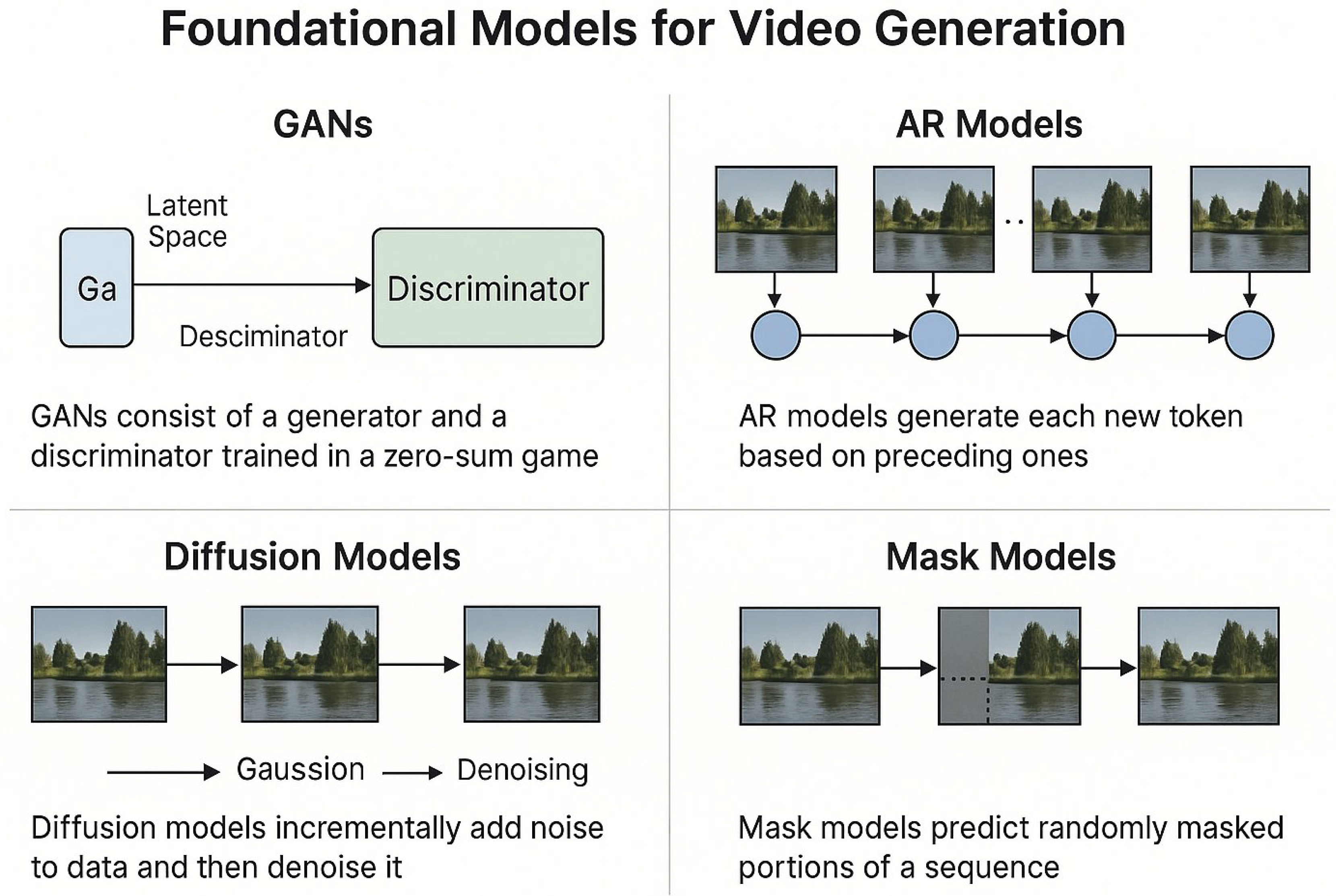
We group methods into GAN, autoregressive (AR), diffusion, masked/MAE-style, and hybrids. Below we emphasize objectives, architectures, and practical tips.
2.1. GAN-Based Approaches
Objectives. Minimax adversarial training with hinge loss is common; feature matching, perceptual losses, and temporal coherence losses (e.g., optical-flow smoothness) stabilize training. Architectures. Temporal discriminators, multi-scale critics (frame/few-shot sequence), 3D spatiotemporal convolutions, and motion/content disentanglement (MoCoGAN [8]). Style-based generators extend StyleGAN to video (StyleGAN-V). Pros/Cons. Pros: sharp frames, low-latency inference. Cons: training instability, mode collapse, and difficulty with long-horizon dynamics. Mitigations. R1/R2 regularization, spectral normalization, curriculum schedules, and two-timescale updates. Editing. Latent space arithmetic and GAN inversion enable post-hoc control.
2.2. Autoregressive (AR) Models
Tokenization. VQ-VAE/yu2023magvit [3,4] discretize videos into spatiotemporal tokens. Backbones. Causal transformers predict tokens with long-context attention (sliding windows, chunk-wise decoding, rotary/ALiBi temporal encodings). Training. Cross-entropy with teacher forcing; scheduled sampling reduces exposure bias. Decoding. Nucleus sampling, classifier-free guidance, speculative decoding, and lookahead caches speed generation. Strengths. Exact likelihood training, modular conditioning (text, audio). Limits. Serial decoding; error accumulation in long videos. Notable systems. VideoGPT [2], VideoPoet.
2.3. Diffusion Models
Backbones. U-Nets with 2D+time or full 3D attention; DiT-style transformer backbones are increasingly common [9]. Latent Diffusion. Compress frames with VAEs for efficiency [6]. Conditioning. Text (T2V), image (I2V), pose/depth/optical flow (ControlNet-style [10]), audio beat alignment, camera trajectories. Sampling. DPM-Solver, consistency models, and few-step distillation (progressive or adversarial) reduce steps. Cascades. Imagen Video [7] uses cascaded diffusion for resolution/fps upscaling. Limits. Expensive sampling, identity drift, camera jitter. Mitigations. Identity anchors, keyframe-guided attention, temporal token locking, and motion priors [11].
2.4. Masked/MAE-Style Models
Masked autoencoding over spatiotemporal patches improves representations and reduces compute. Generative variants decode masked tokens directly (BERT-like) or combine with diffusion for fidelity. Temporal masking schedules and cross-frame reconstruction improve consistency.
2.5. Hybrid and Emerging Paradigms
AR+Diffusion Hybrids. AR drafts long-range content; diffusion refines quality. World Models. Latent dynamics (RSSM variants) produce controllable rollouts. 3D-aware Video. NeRF/GS priors for multi-view consistency [12,13,14]. Streaming/Online.[15] Non-autoregressive decoders with keyframe memory enable low-latency streaming. Agents. LLM planners choose controls (pose/camera/story beats) for goal-driven video [16].
Figure 2.
Foundational model families with schematic examples.
3. Information Representations
3.1. Spatiotemporal Convolution and Patches
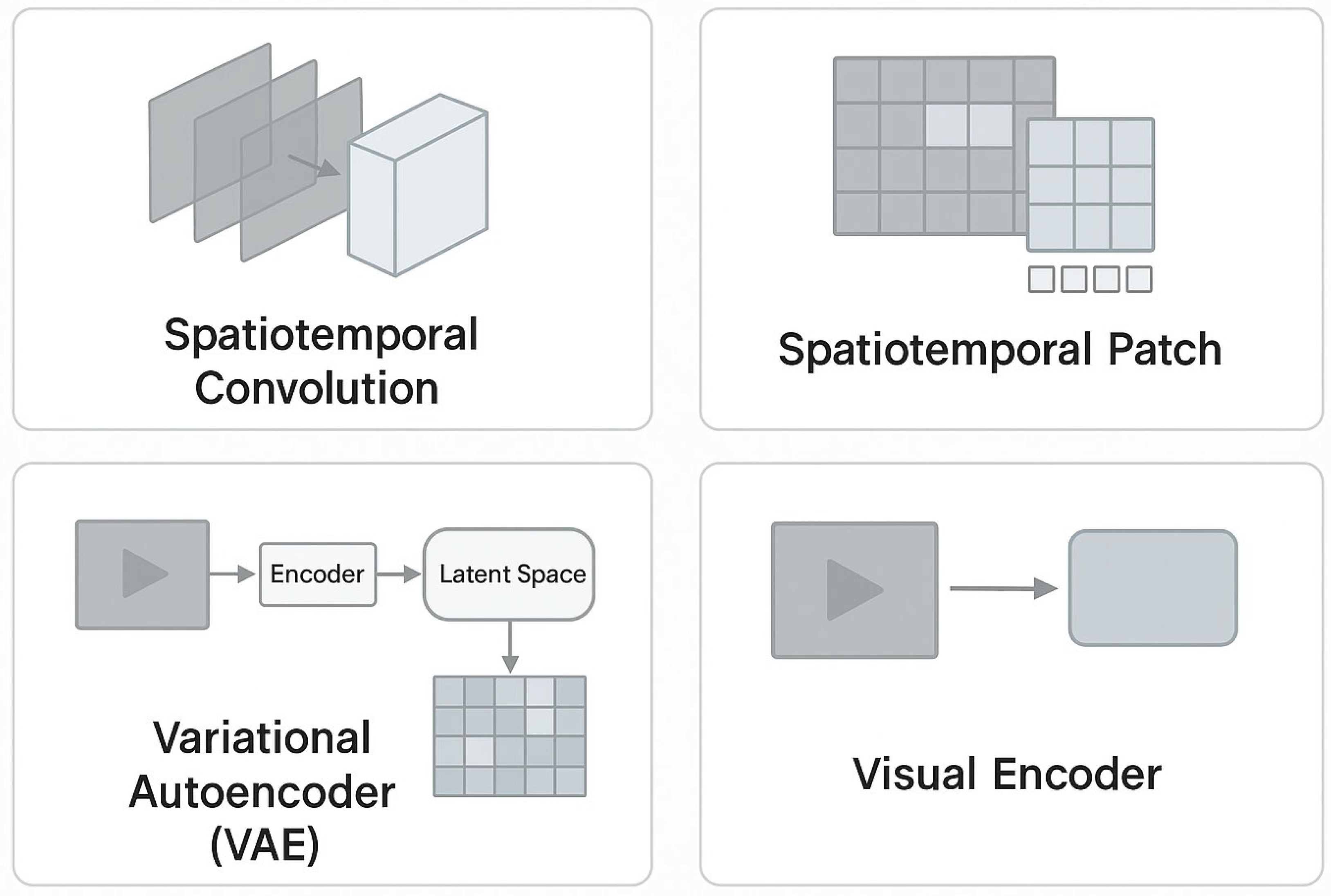
3D convolutions couple space and time; factorized (2+1)D reduces compute. Patch tokenization feeds video transformers with temporal encodings [17]. TokenLearner/Token Merging adaptively reduces tokens while preserving semantics.
3.2. Latent Spaces (VAE/VQ-VAE)
3.3. Multimodal Encoders
Vision + text (CLIP [18]), vision + audio (AST), and motion encoders (pose/flow) align heterogeneous inputs. Learned camera embeddings encode trajectories for cinematography control.
Figure 3.
Information representations for video generation.
4. Generation Schemes and Control
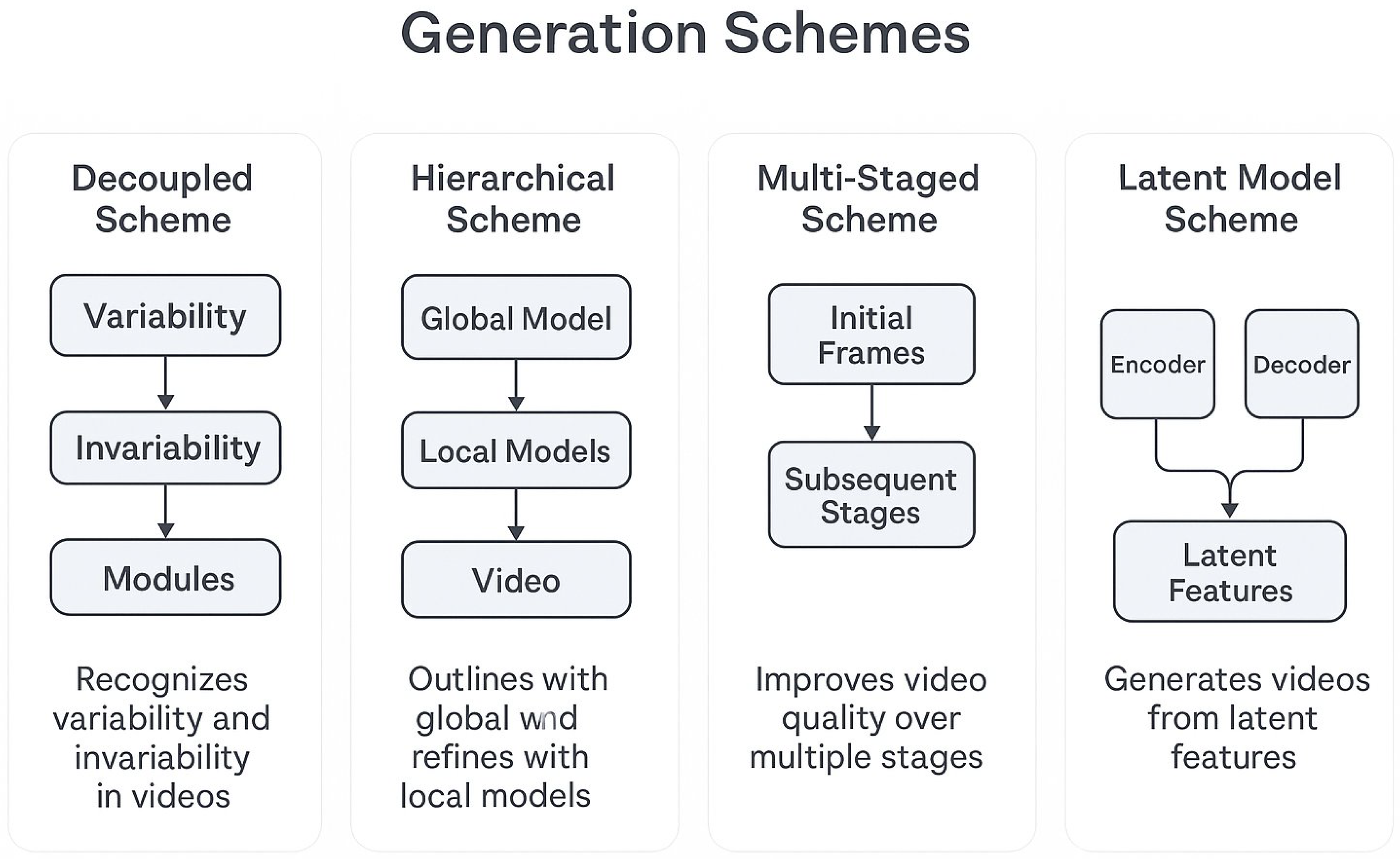
4.1. Decoupled and Hierarchical
4.2. Multi-Staged and Cascaded
Draft low-res/low-fps videos then upsample/densify; cascades split difficulty across scales with noise schedules matched to each stage [21].
4.3. Latent Model Scheme with Control
Encode → latent backbone (GAN/AR/diffusion) → decode; control via pose/depth/camera/audio. Cross-modal attention and FiLM-style conditioning inject guidance signals.
Figure 4.
Four common generation schemes used in modern systems.
4.4. Practical Control Interfaces
- Geometry: depth, normal, flow, keypoints, 2D/3D pose [22].
- Cinematography: camera path, focal length, shutter, DoF.
- Audio-driven: lip-sync, beat tracking, motion from music.
- Structure: layout maps, segmentation, scene graphs.
- Programmatic: constraints in code or node graphs (e.g., ControlNet-like blocks [10]).
5. Industry Landscape and Systems
The commercial and research ecosystem for video generation is evolving rapidly, with diverse approaches in backbone architecture, tokenization strategy, conditioning modalities, and deployment environments [23,24]. In this section, we group systems into commercial, research, and hybrid/industry-research collaborations.
5.1. Commercial Systems
- OpenAI Sora [25]: Latent diffusion with DiT-style transformer backbones. Excels in long-duration text-to-video (up to minutes) with cinematic camera controls and physics-consistent motion. Uses cascaded super-resolution and classifier-free guidance.
- Runway Gen-3 [26]: Latent diffusion with multi-modal control (text, image, pose). Designed for professional creatives, supports inpainting and frame interpolation for seamless editing.
- Pika [27]: Web-based T2V and I2V platform optimized for fast iteration. Prioritizes accessibility and speed, with resolution up to 1080p.
- Stability Video: Part of the Stability AI ecosystem, leveraging Stable Video Diffusion backbones with open-source checkpoints for community use.
- Google Veo [28]: High-fidelity text-to-video with camera trajectory conditioning and temporal super-resolution. Integrates with Google Workspace for productivity applications.
- Tencent Hunyuan Video [29]: Chinese-market oriented video generation system with strong support for pose guidance and cultural style templates.
- Adobe Firefly Video: Video generation integrated into Creative Cloud, emphasizing IP-safe training data and native integration with Premiere Pro/After Effects.
- ByteDance MagicVideo: Targets short-form social content with emphasis on style transfer and lip-sync from audio.
- NVIDIA ACE (Avatar Cloud Engine): Real-time digital human platform combining speech-to-video animation, facial reenactment, and generative backgrounds.
5.2. Research Systems
- Make-A-Video (Meta): Early diffusion-based T2V model combining image pretraining with temporal layers.
- Phenaki (Google): Transformer-based long video generation via token streams and mask prediction.
- Imagen Video [7] (Google): High-definition cascaded diffusion pipeline for text-to-video, noted for detailed textures.
- VideoPoet: Autoregressive transformer conditioned on text/audio for narrative or lip-synced content.
- DynamiCrafter: Diffusion model optimized for dynamic motion fidelity in complex scenes.
- Gen-1 / Gen-2 (Runway): Predecessors to Gen-3, with strong frame-to-frame consistency for video stylization and editing.
- MagicFight [29]: A system for personalized martial arts combat video generation.
5.3. Hybrid and Collaborative Efforts
Some systems emerge from joint academic–industry efforts, combining cutting-edge research with product polish. For example, collaborations between NVIDIA and universities have yielded NeRF-based view-consistent video synthesis, while ByteDance AI Lab publishes open technical reports alongside product releases.
5.4. Feature Comparison
Table 1 compares representative systems on backbone type, conditioning modalities, support for cascaded refinement, and target resolution.
5.5. Trends and Observations
- Modalities: Most modern systems accept at least text and image; adding audio, depth, or pose is becoming common.
- Cascades: Cascaded architectures remain dominant for high resolution, trading off latency.
- Deployment: Few systems offer real-time performance; those that do target lower resolutions or highly specialized domains (avatars, lip-sync).
- Integration: Increasing trend toward embedding generation tools directly into creative suites or productivity platforms.
6. Applications of IGV
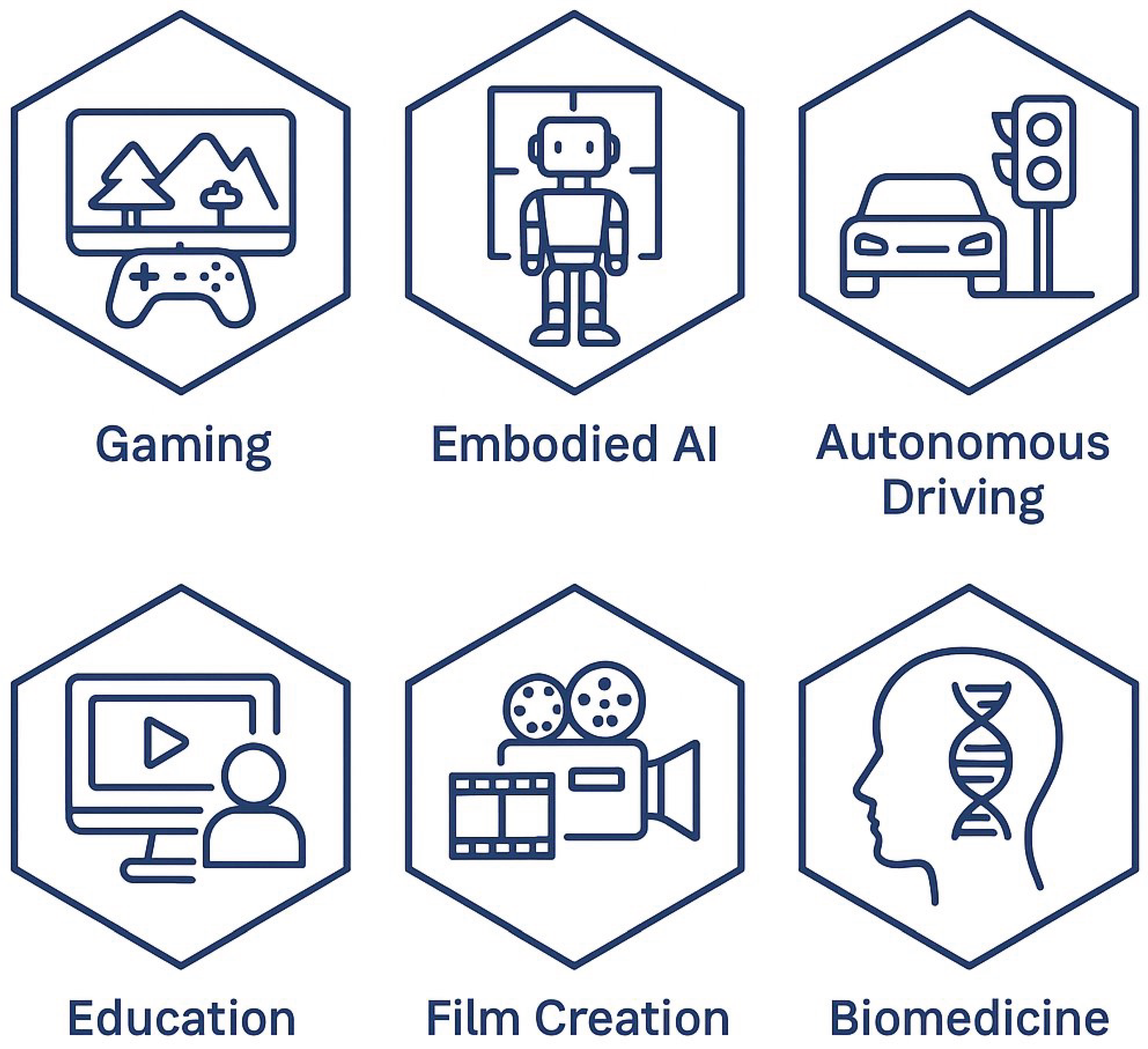
Interactive Generative Video (IGV) systems enable on-demand creation of dynamic content tailored to user intent, often with direct control over motion, appearance, and structure [30,31]. Applications span entertainment, industry, science, and public services, with varying requirements for fidelity, interactivity, and safety [32,33].
6.1. Gaming and Generative Engines
In gaming, IGV facilitates:
- Procedural World Generation: Creating expansive, explorable environments at runtime, with variation seeded from player history or random inputs [34].
- Dynamic Asset Creation: Generating characters, textures, and animations on-the-fly, reducing the need for large asset libraries.
- Player-Driven Narrative: Adjusting cutscenes or environmental changes based on in-game events or player choices.
- Simulation of NPC Behavior: Producing responsive, contextually appropriate animations for non-playable characters [35].
6.2. Embodied AI and Robotics
Embodied AI agents benefit from IGV for:
- Cross-Domain Adaptation: Training in synthetic environments with controllable complexity and noise, then transferring policies to the real world [41].
Sim-to-real transfer remains a challenge, requiring careful domain randomization and calibration [44].
6.3. Autonomous Driving
IGV supports the automotive sector through:
6.4. Education and Knowledge Transfer
In education, IGV enables:
- Automated Educational Video Creation: Turning lecture notes or textbooks into animated explainers with synchronized narration.
- Immersive Virtual Field Trips: Rendering historical sites or scientific phenomena from textual prompts, enabling experiences otherwise inaccessible.
Generative models like Genie3 can convert high-level descriptions into fully interactive 3D scenes for classroom VR.
6.5. Film and Media Production
Filmmakers use IGV for:
- Pre-Visualization: Quickly drafting scenes for pitch, budgeting, and planning.
- Special Effects: Generating or replacing complex shots without expensive location shoots or post-production [63].
- Storyboarding and Style Transfer: Maintaining consistent characters and environments across shots while applying artistic styles.
This accelerates the iterative cycle between concept and final cut.
6.6. Biomedicine and Healthcare
Biomedical applications demand domain-specific adaptations:
- Augmented Rehabilitation: Creating privacy-preserving frameworks for physical therapy, such as augmented knee rehabilitation programs [75].
Systems like Bora demonstrate multi-modal biomedical generation from text prompts.[76]
6.7. Security and Surveillance Simulation
Security agencies and researchers use IGV to:
6.8. Industrial and Civil Engineering Applications
- Prognostics: Simulating component wear-and-tear for AI-driven health prognostics, such as in Li-ion batteries [91].
6.9. Business and Finance Applications
- Decision Support: Using generative models to create scenarios for business decision support systems [94].
- Risk Analysis: Generating synthetic supply chain data to train GNNs for credit risk analysis [95].
Figure 5.
Representative application verticals for IGV, from entertainment to scientific and industrial domains.
Figure 5.
Representative application verticals for IGV, from entertainment to scientific and industrial domains.
6.10. Emerging Niches
- Virtual Fashion Try-On: Combining IGV with human pose transfer to simulate clothing on different body types.
- Telepresence and Digital Humans: Creating avatars that respond in real-time for meetings, events, and customer service.
7. Systems Design: Toward Real-Time IGV
Latency. Few-step diffusion and consistency models reduce sampling; early-exit decoders and keyframe interpolation further cut latency. Streaming. Sliding-window attention with recurrent latent caches; online conditioning buffers for pose/depth/audio. Scheduling. Quality-of-service schedulers allocate compute across stages; adaptive guidance strength stabilizes identity.
8. Data, Training, and Optimization
Data Quality. Long-video corpora with hierarchical metadata (shots, scenes, characters); deduplication and safety filtering. Objective Design. Multi-task training (recon + diffusion + adversarial + temporal).[98] Optimization. Mixed precision, gradient checkpointing, ZeRO/FS, [99]and distillation for deployment on edge devices.
9. Challenges and Future Directions
Real-time and Streaming. Reduce steps via distillation/consistency; non-autoregressive decoders.
Control and Editing. Open-domain conditioning (text, pose, depth, audio) and camera controls; interactive node-graph UIs.
Memory and Long-horizon Consistency. Segment memory, identity locking, and camera trajectory anchors.[100,101,102]
Physics and Dynamics. Learned physics priors, differentiable simulators, and safety constraints.
10. Evaluation
Spatial. FID, IS, SSIM, PSNR, LPIPS, CLIPSIM. Temporal. FVD, KVD, temporal LPIPS, warping error. Human Studies. MOS, task success, preference tests. Robustness. Sensitivity to prompt/seed, stability across edits, safety filters [108]. Domain Metrics. Driving safety proxies, clinical/educational utility, gameplay KPIs.
11. Ethical and Legal Considerations
Misinformation and Deepfakes. Risk of realistic fabricated content; invest in provenance and detection [109,110]. IP and Licensing. Data consent and derivative rights; licensing and opt-out mechanisms. Bias, Fairness, and Privacy. Inclusive datasets, audits, privacy-preserving learning (DP, federated)[111,112]. Accountability and Explainability. Responsibility for deployment harms; interpretable controls in sensitive domains [113]. Environmental Impact. Efficient architectures, mixed-precision, and renewable-powered training. Fraud Detection. Evaluating models for fraud on imbalanced transaction data is a key concern [114].
12. Conclusion
Video generation is converging toward interactive, controllable, and reliable media engines. Progress depends on efficient backbones, robust control, principled evaluation, and strong governance.
References
- Goodfellow, I.; Pouget-Abadie, J.; Mirza, M.; Xu, B.; Warde-Farley, D.; Ozair, S.; Courville, A.; Bengio, Y. Generative Adversarial Nets. Advances in Neural Information Processing Systems 2014, arXiv:1406.2661, [1406.2661]. [Google Scholar]
- Yan, R.; Jiang, Y.; Song, W.; et al. VideoGPT: Video Generation using VQ-VAE and Transformers. arXiv preprint arXiv:2104.10157 2021, arXiv:2104.10157. [Google Scholar]
- Yu, L.; Cheng, Y.; Sohn, K.; Lezama, J.; Zhang, H.; Chang, H.; Hauptmann, A.G.; Yang, M.H.; Hao, Y.; Essa, I.; et al. Magvit: Masked generative video transformer. In Proceedings of the Proceedings of the IEEE/CVF Conference on Computer Vision and Pattern Recognition, 2023; pp. 10459–10469. [Google Scholar]
- Yu, L.; Lezama, J.; Gundavarapu, N.B.; Versari, L.; Sohn, K.; Minnen, D.; Cheng, Y.; Birodkar, V.; Gupta, A.; Gu, X.; et al. Language Model Beats Diffusion–Tokenizer is Key to Visual Generation. arXiv preprint arXiv:2310.05737 2023, arXiv:2310.05737. [Google Scholar]
- J.; Jain, A.; Abbeel, P. Denoising Diffusion Probabilistic Models. NeurIPS 2020, [2006.11239].
- Rombach, R.; Blattmann, A.; Lorenz, D.; Esser, P.; Ommer, B. High-resolution image synthesis with latent diffusion models. In Proceedings of the Proceedings of the IEEE/CVF conference on computer vision and pattern recognition, 2022; pp. 10684–10695. [Google Scholar]
- Ho, J.; Chan, W.; Saharia, C.; Whang, J.; Gao, R.; Gritsenko, A.; Kingma, D.P.; Poole, B.; Norouzi, M.; Fleet, D.J.; et al. Imagen video: High definition video generation with diffusion models. arXiv preprint arXiv:2210.02303 2022, arXiv:2210.02303. [Google Scholar]
- Tulyakov, S.; Liu, M.Y.; Yang, X.; Kautz, J. MoCoGAN: Decomposing Motion and Content for Video Generation. In Proceedings of the CVPR; 2018. [Google Scholar]
- Huang, J.; Zhang, G.; Jie, Z.; Jiao, S.; Qian, Y.; Chen, L.; Wei, Y.; Ma, L. M4V: Multi-Modal Mamba for Text-to-Video Generation. arXiv preprint arXiv:2506.10915 2025, arXiv:2506.10915. [Google Scholar]
- Zhang, L.; Agrawala, M. Adding conditional control to text-to-image diffusion models. In Proceedings of the Proceedings of the IEEE/CVF International Conference on Computer Vision, 2023; pp. 3836–3847. [Google Scholar]
- Huang, Y.; Huang, J.; Liu, Y.; Yan, M.; Lv, J.; Liu, J.; Xiong, W.; Zhang, H.; Cao, L.; Chen, S. Diffusion model-based image editing: A survey. IEEE Transactions on Pattern Analysis and Machine Intelligence 2025. [Google Scholar] [CrossRef]
- Qu, D.; Chen, Q.; Zhang, P.; Gao, X.; Li, J.; Zhao, B.; Wang, D.; Li, X. Livescene: Language embedding interactive radiance fields for physical scene rendering and control. arXiv preprint arXiv:2406.16038 2024, arXiv:2406.16038. [Google Scholar]
- Chen, Q.; Qu, D.; Tang, Y.; Song, H.; Zhang, Y.; Zhao, B.; Wang, D.; Li, X. FreeGaussian: Guidance-free Controllable 3D Gaussian Splats with Flow Derivatives 2024.
- Ding, T.; Xiang, D.; Rivas, P.; Dong, L. Neural Pruning for 3D Scene Reconstruction: Efficient NeRF Acceleration. arXiv preprint arXiv:2504.00950 2025, arXiv:2504.00950. [Google Scholar]
- Li, J.; Zhou, Y. BIDeepLab: An Improved Lightweight Multi-scale Feature Fusion Deeplab Algorithm for Facial Recognition on Mobile Devices. Computer Simulation in Application 2025, 3, 57–65. [Google Scholar] [CrossRef]
- Liang, X.; He, Y.; Tao, M.; Xia, Y.; Wang, J.; Shi, T.; Wang, J.; Yang, J. Cmat: A multi-agent collaboration tuning framework for enhancing small language models. arXiv preprint arXiv:2404.01663 2024, arXiv:2404.01663. [Google Scholar]
- Tang, X.; Li, X.; Tasdizen, T. Dynamic Scale for Transformer. In Proceedings of the Medical Imaging with Deep Learning-Short Papers; 2025. [Google Scholar]
- Radford, A.; et al. Learning Transferable Visual Models From Natural Language Supervision. ICML, 2021; [2103.00020]arXiv:2103.00020. [Google Scholar]
- Li, Z.; Fu, Z.; Hu, Y.; Chen, Z.; Wen, H.; Nie, L. FineCIR: Explicit Parsing of Fine-Grained Modification Semantics for Composed Image Retrieval. https://arxiv.org/abs/2503.21309, 2025. [Google Scholar]
- Li, Z.; Chen, Z.; Wen, H.; Fu, Z.; Hu, Y.; Guan, W. Encoder: Entity mining and modification relation binding for composed image retrieval. In Proceedings of the Proceedings of the AAAI Conference on Artificial Intelligence, 2025; Vol. 39, pp. 5101–5109. [Google Scholar]
- Chen, Z.; Hu, Y.; Li, Z.; Fu, Z.; Song, X.; Nie, L. OFFSET: Segmentation-based Focus Shift Revision for Composed Image Retrieval, 2025, [arXiv:cs.CV/2507.05631]. arXiv:2507.05631.
- Liu, J.; Wang, G.; Ye, W.; Jiang, C.; Han, J.; Liu, Z.; Zhang, G.; Du, D.; Wang, H. DifFlow3D: Toward Robust Uncertainty-Aware Scene Flow Estimation with Iterative Diffusion-Based Refinement. In Proceedings of the Proceedings of the IEEE/CVF Conference on Computer Vision and Pattern Recognition, 2024; pp. 15109–15119. [Google Scholar]
- Wang, J.; Zhang, Z.; He, Y.; Zhang, Z.; Song, Y.; Shi, T.; Li, Y.; Xu, H.; Wu, K.; Yi, X.; et al. Enhancing Code LLMs with Reinforcement Learning in Code Generation: A Survey. arXiv preprint arXiv:2412.20367 2024, arXiv:2412.20367. [Google Scholar]
- Yi, Q.; He, Y.; Wang, J.; Song, X.; Qian, S.; Yuan, X.; Sun, L.; Xin, Y.; Tang, J.; Li, K.; et al. Score: Story coherence and retrieval enhancement for ai narratives. arXiv preprint arXiv:2503.23512 2025, arXiv:2503.23512. [Google Scholar]
- OpenAI. Video generation models as world simulators. https://openai.com/research/video-generation-models-as-world-simulators, 2024.
- Runway. Introducing Gen-3 Alpha. https://runwayml.com/blog/introducing-gen-3-alpha/, 2024.
- Pika. Pika. https://pika.art, 2024.
- Google. Veo: a generative video model. https://deepmind.google/technologies/veo/, 2024.
- Huang, J.; Yan, M.; Chen, S.; Huang, Y.; Chen, S. Magicfight: Personalized martial arts combat video generation. In Proceedings of the Proceedings of the 32nd ACM International Conference on Multimedia, 2024; pp. 10833–10842. [Google Scholar]
- Zheng, Z.; Liu, K.; Zhu, X. Machine Learning-Based Prediction of Metal-Organic Framework Materials: A Comparative Analysis of Multiple Models. arXiv preprint arXiv:2507.04493 2025, arXiv:2507.04493. [Google Scholar]
- Wang, J.; Ding, W.; Zhu, X. Financial analysis: Intelligent financial data analysis system based on llm-rag. arXiv preprint arXiv:2504.06279 2025, arXiv:2504.06279. [Google Scholar] [CrossRef]
- Yuan, T.; Zhang, X.; Chen, X. Machine Learning based Enterprise Financial Audit Framework and High Risk Identification. arXiv preprint arXiv:2507.06266 2025, arXiv:2507.06266. [Google Scholar] [CrossRef]
- Li, Z.; Qiu, S.; Ke, Z. Revolutionizing Drug Discovery: Integrating Spatial Transcriptomics with Advanced Computer Vision Techniques. In Proceedings of the 1st CVPR Workshop on Computer Vision For Drug Discovery (CVDD): Where are we and What is Beyond?, 2025.
- Li, Z.; Ke, Z. Cross-Modal Augmentation for Low-Resource Language Understanding and Generation. In Proceedings of the Proceedings of the 1st Workshop on Multimodal Augmented Generation via Multimodal Retrieval (MAGMaR 2025); 2025; pp. 90–99. [Google Scholar]
- Zhang, Z.; Wang, J.; Li, Z.; Wang, Y.; Zheng, J. AnnCoder: A Mti-Agent-Based Code Generation and Optimization Model. Symmetry 2025, 17. [Google Scholar] [CrossRef]
- Li, Z.; Ji, Q.; Ling, X.; Liu, Q. A Comprehensive Review of Multi-Agent Reinforcement Learning in Video Games. IEEE Transactions on Games 2025, 1–21. [Google Scholar] [CrossRef]
- Li, Z. Language-Guided Multi-Agent Learning in Simulations: A Unified Framework and Evaluation, 2025, [arXiv:cs.AI/2506.04251]. A; arXiv:2506.04251.
- Jin, S.; Wang, X.; Meng, Q. Spatial memory-augmented visual navigation based on hierarchical deep reinforcement learning in unknown environments. Knowledge-Based Systems 2024, 285, 111358. [Google Scholar] [CrossRef]
- Qian, H.; Jin, S.; Chen, L. I2KEN: Intra-Domain and Inter-Domain Knowledge Enhancement Network for Lifelong Loop Closure Detection. IEEE Robotics and Automation Letters 2025. [Google Scholar] [CrossRef]
- Gu, N.; Kosuge, K.; Hayashibe, M. TactileAloha: Learning Bimanual Manipulation With Tactile Sensing. IEEE Robotics and Automation Letters 2025, 10, 8348–8355. [Google Scholar] [CrossRef]
- Jin, S.; Dai, X.; Meng, Q. “Focusing on the right regions”—Guided saliency prediction for visual SLAM. Expert Systems with Applications 2023, 213, 119068. [Google Scholar] [CrossRef]
- Zhao, Z.; Chen, B.M. Benchmark for Evaluating Initialization of Visual-Inertial Odometry. In Proceedings of the 2023 42nd Chinese Control Conference (CCC); 2023; pp. 3935–3940. [Google Scholar]
- Zhao, Z. Balf: Simple and efficient blur aware local feature detector. In Proceedings of the Proceedings of the IEEE/CVF Winter Conference on Applications of Computer Vision, 2024; pp. 3362–3372. [Google Scholar]
- Liu, J.; Wang, G.; Liu, Z.; Jiang, C.; Pollefeys, M.; Wang, H. RegFormer: an efficient projection-aware transformer network for large-scale point cloud registration. In Proceedings of the Proceedings of the IEEE/CVF International Conference on Computer Vision; 2023, pp. 8451–8460.
- Zeng, S.; Chang, X.; Xie, M.; Liu, X.; Bai, Y.; Pan, Z.; Xu, M.; Wei, X. FutureSightDrive: Thinking Visually with Spatio-Temporal CoT for Autonomous Driving. arXiv preprint arXiv:2505.17685 2025, arXiv:2505.17685. [Google Scholar]
- Ma, Z.; Luo, Y.; Zhang, Z.; Sun, A.; Yang, Y.; Liu, H. Reinforcement Learning Approach for Highway Lane-Changing: PPO-Based Strategy Design. Preprints 2025. [Google Scholar] [CrossRef]
- Chen, Y.; Greer, R. Technical Report for Argoverse2 Scenario Mining Challenges on Iterative Error Correction and Spatially-Aware Prompting, 2025, [arXiv:cs.CV/2506.11124]. arXiv:2506.11124.
- Huang, Z.; Qian, H.; Cai, Z.; Wang, X.; Xie, L.; Niu, X. An intelligent multilane roadway recognition method based on pseudo-tagging. Cartography and Geographic Information Science 2025, 1–16. [Google Scholar] [CrossRef]
- Qian, Y.; Li, X.; Zhang, J.; Meng, X.; Li, Y.; Ding, H.; Wang, M. A Diffusion-TGAN Framework for Spatio-Temporal Speed Imputation and Trajectory Reconstruction. IEEE Transactions on Intelligent Transportation Systems 2025. [Google Scholar] [CrossRef]
- Zhou, S.; Tian, Z.; Chu, X.; Zhang, X.; Zhang, B.; Lu, X.; Feng, C.; Jie, Z.; Chiang, P.Y.; Ma, L. FastPillars: A Deployment-friendly Pillar-based 3D Detector. arXiv preprint arXiv:2302.02367 2023, arXiv:2302.02367. [Google Scholar] [CrossRef]
- Zhou, S.; Li, L.; Zhang, X.; Zhang, B.; Bai, S.; Sun, M.; Zhao, Z.; Lu, X.; Chu, X. LiDAR-PTQ: Post-Training Quantization for Point Cloud 3D Object Detection. In Proceedings of the The Twelfth International Conference on Learning Representations; 2024. [Google Scholar]
- Zhou, S.; Nie, J.; Zhao, Z.; Cao, Y.; Lu, X. FocusTrack: One-Stage Focus-and-Suppress Framework for 3D Point Cloud Object Tracking. In Proceedings of the Proceedings of the 33rd ACM International Conference on Multimedia; 2025. [Google Scholar]
- Liu, J.; Zhuo, D.; Feng, Z.; Zhu, S.; Peng, C.; Liu, Z.; Wang, H. Dvlo: Deep visual-lidar odometry with local-to-global feature fusion and bi-directional structure alignment. In Proceedings of the European Conference on Computer Vision; Springer, 2025; pp. 475–493. [Google Scholar]
- Yao, S.; Guan, R.; Peng, Z.; Xu, C.; Shi, Y.; Yue, Y.; Lim, E.G.; Seo, H.; Man, K.L.; Zhu, X.; et al. Exploring radar data representations in autonomous driving: A comprehensive review. IEEE Transactions on Intelligent Transportation Systems 2025, 26, 7401–7425. [Google Scholar] [CrossRef]
- Yao, S.; Guan, R.; Wu, Z.; Ni, Y.; Huang, Z.; Liu, R.W.; Yue, Y.; Ding, W.; Lim, E.G.; Seo, H.; et al. Waterscenes: A multi-task 4d radar-camera fusion dataset and benchmarks for autonomous driving on water surfaces. IEEE Transactions on Intelligent Transportation Systems 2024, 25, 16584–16598. [Google Scholar] [CrossRef]
- Yao, S.; Guan, R.; Huang, X.; Li, Z.; Sha, X.; Yue, Y.; Lim, E.G.; Seo, H.; Man, K.L.; Zhu, X.; et al. Radar-camera fusion for object detection and semantic segmentation in autonomous driving: A comprehensive review. IEEE Transactions on Intelligent Vehicles 2023, 9, 2094–2128. [Google Scholar] [CrossRef]
- Li, X.; Mangin, T.; Saha, S.; Mohammed, R.; Blanchard, E.; Tang, D.; Poppe, H.; Choi, O.; Kelly, K.; Whitaker, R. Real-time idling vehicles detection using combined audio-visual deep learning. In Emerging Cutting-Edge Developments in Intelligent Traffic and Transportation Systems; IOS Press, 2024; pp. 142–158. [Google Scholar]
- Li, X.; Mohammed, R.; Mangin, T.; Saha, S.; Kelly, K.; Whitaker, R.; Tasdizen, T. Joint audio-visual idling vehicle detection with streamlined input dependencies. In Proceedings of the Proceedings of the Winter Conference on Applications of Computer Vision; 2025; pp. 885–894. [Google Scholar]
- Lu, B.; Lu, Z.; Qi, Y.; Guo, H.; Sun, T.; Zhao, Z. Predicting Asphalt Pavement Friction by Using a Texture-Based Image Indicator. Lubricants 2025, 13, 341. [Google Scholar] [CrossRef]
- Lu, B.; Dan, H.C.; Zhang, Y.; Huang, Z. Journey into automation: Image-derived pavement texture extraction and evaluation. arXiv preprint arXiv:2501.02414 2025, arXiv:2501.02414. [Google Scholar]
- Cui, X.; Lu, W.; Tong, Y.; Li, Y.; Zhao, Z. Multi-Modal Multi-Behavior Sequential Recommendation with Conditional Diffusion-Based Feature Denoising. In Proceedings of the Proceedings of the 48th International ACM SIGIR Conference on Research and Development in Information Retrieval; 2025; pp. 1593–1602. [Google Scholar]
- Liu, S.; Zhang, Y.; Li, X.; Liu, Y.; Feng, C.; Yang, H. Gated Multimodal Graph Learning for Personalized Recommendation. INNO-PRESS: Journal of Emerging Applied AI 2025, 1. [Google Scholar]
- Zhang, H.; Xu, H.; Liu, H.; Yu, X.; Zhang, X.; Wu, C. Conditional variational underwater image enhancement with kernel decomposition and adaptive hybrid normalization. Neurocomputing 2025, 130845. [Google Scholar] [CrossRef]
- Yue, L.; Xing, S.; Lu, Y.; Fu, T. Biomamba: A pre-trained biomedical language representation model leveraging mamba. arXiv preprint arXiv:2408.02600 2024, arXiv:2408.02600. [Google Scholar]
- Wang, Y.; Fu, T.; Xu, Y.; Ma, Z.; Xu, H.; Du, B.; Lu, Y.; Gao, H.; Wu, J.; Chen, J. TWIN-GPT: digital twins for clinical trials via large language model. ACM Transactions on Multimedia Computing, Communications and Applications 2024.
- Zhong, J.; Wang, Y.; Zhu, D.; Wang, Z. A Narrative Review on Large AI Models in Lung Cancer Screening, Diagnosis, and Treatment Planning. arXiv preprint arXiv:2506.07236 2025, arXiv:2506.07236. [Google Scholar]
- Wang, Y.; Wang, Z.; Zhong, J.; Zhu, D.; Li, W. Applications of Small Language Models in Medical Imaging Classification with a Focus on Prompt Strategies. arXiv preprint arXiv:2508.13378 2025, arXiv:2508.13378. [Google Scholar]
- Zhao, Y.; Zhu, Z.; Yang, S.; Li, W. YeastSAM: A Deep Learning Model for Accurate Segmentation of Budding Yeast Cells. bioRxiv 2025, 2025–09. [Google Scholar]
- Ding, T.; Xiang, D.; Schubert, K.E.; Dong, L. GKAN: Explainable Diagnosis of Alzheimer’s Disease Using Graph Neural Network with Kolmogorov-Arnold Networks. arXiv preprint arXiv:2504.00946 2025, arXiv:2504.00946. [Google Scholar]
- Wang, Y.; Zhong, J.; Kumar, R. A systematic review of machine learning applications in infectious disease prediction, diagnosis, and outbreak forecasting 2025.
- Zhong, J.; Wang, Y. A Comparative Study of Ensemble Models for Thyroid Disease Prediction under Class Imbalance 2025.
- Zhao, Y.; Li, C.; Shu, C.; Wu, Q.; Li, H.; Xu, C.; Li, T.; Wang, Z.; Luo, Z.; He, Y. Tackling Small Sample Survival Analysis via Transfer Learning: A Study of Colorectal Cancer Prognosis. arXiv preprint arXiv:2501.12421 2025, arXiv:2501.12421. [Google Scholar]
- Lu, Y.; Wu, C.T.; Parker, S.J.; Cheng, Z.; Saylor, G.; Van Eyk, J.E.; Yu, G.; Clarke, R.; Herrington, D.M.; Wang, Y. COT: an efficient and accurate method for detecting marker genes among many subtypes. Bioinformatics Advances 2022, 2, vbac037. [Google Scholar] [CrossRef]
- Fu, Y.; Lu, Y.; Wang, Y.; Zhang, B.; Zhang, Z.; Yu, G.; Liu, C.; Clarke, R.; Herrington, D.M.; Wang, Y. Ddn3. 0: Determining significant rewiring of biological network structure with differential dependency networks. Bioinformatics 2024, 40, btae376. [Google Scholar] [CrossRef]
- Bačić, B.; Vasile, C.; Feng, C.; Ciucă, M.G. Towards nation-wide analytical healthcare infrastructures: A privacy-preserving augmented knee rehabilitation case study. arXiv preprint arXiv:2412.20733 2024, arXiv:2412.20733. [Google Scholar]
- Lu, Y.; Sato, K.; Wang, J. Deep learning based multi-label image classification of protest activities. arXiv preprint arXiv:2301.04212 2023, arXiv:2301.04212. [Google Scholar]
- Liu, Y. Robust Anomaly Detection in Network Traffic: Evaluating Machine Learning Models on CICIDS2017, 2025, [arXiv:cs.CR/2506.19877]. arXiv:2506.19877.
- Lyu, J.; Zhao, M.; Hu, J.; Huang, X.; Chen, Y.; Du, S. VADMamba: Exploring State Space Models for Fast Video Anomaly Detection, 2025, [arXiv:cs.CV/2503.21169]. arXiv:2503.21169.
- Chen, L.; Lu, Y.; Wu, C.T.; Clarke, R.; Yu, G.; Van Eyk, J.E.; Herrington, D.M.; Wang, Y. Data-driven detection of subtype-specific differentially expressed genes. Scientific reports 2021, 11, 332. [Google Scholar] [CrossRef]
- Chen, H.; Zhao, W.; Zhang, R.; Li, N.; Li, D. Multiple Object Tracking in Video SAR: A Benchmark and Tracking Baseline. IEEE Geoscience and Remote Sensing Letters 2025, 22, 1–5. [Google Scholar] [CrossRef]
- Lu, Y.; Shen, M.; Wang, H.; Wang, X.; van Rechem, C.; Fu, T.; Wei, W. Machine learning for synthetic data generation: a review. arXiv preprint arXiv:2302.04062 2023, arXiv:2302.04062. [Google Scholar]
- Zhao, C.; Hu, C.; Shao, H.; Liu, J. PipeMamba: State Space Model for Efficient Video-based Sewer Defect Classification. IEEE Transactions on Artificial Intelligence 2025. [Google Scholar] [CrossRef]
- Zhao, C.; Hu, C.; Shao, H.; Dunkin, F.; Wang, Y. Trusted video-based sewer inspection via support clip-based pareto-optimal evidential network. IEEE Signal Processing Letters 2024. [Google Scholar] [CrossRef]
- Hu, C.; Zhao, C.; Shao, H.; Deng, J.; Wang, Y. TMFF: Trustworthy multi-focus fusion framework for multi-label sewer defect classification in sewer inspection videos. IEEE Transactions on Circuits and Systems for Video Technology 2024. [Google Scholar] [CrossRef]
- Wu, C.; Huang, H.; Zhang, L.; Chen, J.; Tong, Y.; Zhou, M. Towards automated 3D evaluation of water leakage on a tunnel face via improved GAN and self-attention DL model. Tunnelling and Underground Space Technology 2023, 142, 105432. [Google Scholar] [CrossRef]
- Wu, C.; Huang, H.; Ni, Y.Q. Evaluation of Tunnel Rock Mass Integrity Using Multi-Modal Data and Generative Large Model: Tunnel Rip-Gpt. Available at SSRN 5348429 2025. [Google Scholar]
- Wu, C.; Huang, H.; Chen, J.; Zhou, M.; Han, S. A novel Tree-augmented Bayesian network for predicting rock weathering degree using incomplete dataset. International Journal of Rock Mechanics and Mining Sciences 2024, 183, 105933. [Google Scholar] [CrossRef]
- Sha, Y.; Gou, S.; Liu, B.; Faber, J.; Liu, N.; Schramm, S.; Stoecker, H.; Steckenreiter, T.; Vnucec, D.; Wetzstein, N.; et al. Hierarchical knowledge guided fault intensity diagnosis of complex industrial systems. In Proceedings of the Proceedings of the 30th ACM SIGKDD Conference on Knowledge Discovery and Data Mining; 2024; pp. 5657–5668. [Google Scholar]
- Sha, Y.; Gou, S.; Faber, J.; Liu, B.; Li, W.; Schramm, S.; Stoecker, H.; Steckenreiter, T.; Vnucec, D.; Wetzstein, N.; et al. Regional-local adversarially learned one-class classifier anomalous sound detection in global long-term space. In Proceedings of the Proceedings of the 28th ACM SIGKDD Conference on Knowledge Discovery and Data Mining; 2022; pp. 3858–3868. [Google Scholar]
- Sha, Y.; Faber, J.; Gou, S.; Liu, B.; Li, W.; Schramm, S.; Stoecker, H.; Steckenreiter, T.; Vnucec, D.; Wetzstein, N.; et al. A multi-task learning for cavitation detection and cavitation intensity recognition of valve acoustic signals. Engineering Applications of Artificial Intelligence 2022, 113, 104904. [Google Scholar] [CrossRef]
- Ding, T.; Xiang, D.; Sun, T.; Qi, Y.; Zhao, Z. AI-driven prognostics for state of health prediction in Li-ion batteries: A comprehensive analysis with validation. arXiv preprint arXiv:2504.05728 2025, arXiv:2504.05728. [Google Scholar]
- Wu, S.; Fu, L.; Chang, R.; Wei, Y.; Zhang, Y.; Wang, Z.; Liu, L.; Zhao, H.; Li, K. Warehouse robot task scheduling based on reinforcement learning to maximize operational efficiency. Authorea Preprints 2025. [Google Scholar]
- Yu, D.; Liu, L.; Wu, S.; Li, K.; Wang, C.; Xie, J.; Chang, R.; Wang, Y.; Wang, Z.; Ji, R. Machine learning optimizes the efficiency of picking and packing in automated warehouse robot systems. In Proceedings of the 2025 IEEE International Conference on Electronics, Energy Systems and Power Engineering (EESPE). IEEE; 2025; pp. 1325–1332. [Google Scholar]
- Zhang, Y.; Chen, N.; Zhang, Y.; Wu, W. Research on business decision support system based on big data and artificial intelligence. Available at SSRN 5332298 2025. [Google Scholar]
- Zhang, Z.; Shen, Q.; Hu, Z.; Liu, Q.; Shen, H. Credit Risk Analysis for SMEs Using Graph Neural Networks in Supply Chain. arXiv preprint arXiv:2507.07854 2025, arXiv:2507.07854. [Google Scholar]
- Bačić, B.; Feng, C.; Li, W. Jy61 imu sensor external validity: A framework for advanced pedometer algorithm personalisation. ISBS Proceedings Archive 2024, 42, 60. [Google Scholar]
- Feng, C.; Bačić, B.; Li, W. Sca-lstm: A deep learning approach to golf swing analysis and performance enhancement. In Proceedings of the International Conference on Neural Information Processing. Springer; 2024; pp. 72–86. [Google Scholar]
- Li, X.; Ma, Y.; Huang, Y.; Wang, X.; Lin, Y.; Zhang, C. Synergized data efficiency and compression (sec) optimization for large language models. In Proceedings of the 2024 4th International Conference on Electronic Information Engineering and Computer Science (EIECS). IEEE; 2024; pp. 586–591. [Google Scholar]
- He, L.; Wang, X.; Lin, Y.; Li, X.; Ma, Y.; Li, Z. BOANN: Bayesian-Optimized Attentive Neural Network for Classification. In Proceedings of the 2024 International Conference on Image Processing, Computer Vision and Machine Learning (ICICML); 2024; pp. 1860–1864. [Google Scholar] [CrossRef]
- Fei, Y.; He, Y.; Chen, F.; You, P.; Zhai, H. Optimal Planning and Design for Sightseeing Offshore Island Microgrids. In Proceedings of the E3S Web of Conferences. EDP Sciences; 2019; Vol. 118, p. 02044. [Google Scholar]
- Zhai, M.; Abu-Znad, O.; Wang, S.; Du, L. A Bayesian Potential-based Architecture for Mutually Beneficial EV Charging Infrastructure-DSO Coordination. IEEE Transactions on Transportation Electrification 2025, 1–1. [Google Scholar] [CrossRef]
- Zhai, M.; Tian, X.; Liu, Z.; Zhao, Y.; Deng, Y.; Yang, W. Advancing just transition: The role of biomass co-firing in emission reductions and employment for coal regions. Sustainable Energy Technologies and Assessments 2025, 75, 104246. [Google Scholar] [CrossRef]
- Li, X.; Ma, Y.; Ye, K.; Cao, J.; Zhou, M.; Zhou, Y. Hy-Facial: Hybrid Feature Extraction by Dimensionality Reduction Methods for Enhanced Facial Expression Classification, 2025, [arXiv:cs.CV/2509.26614]. arXiv:2509.26614.
- Zhao, M.; Chen, Y.; Lyu, J.; Du, S.; Lv, Z.; Wang, L. SDAFE: A Dual-filter Stable Diffusion Data Augmentation Method for Facial Expression Recognition. In Proceedings of the ICASSP 2025 - 2025 IEEE International Conference on Acoustics, Speech and Signal Processing (ICASSP); 2025; pp. 1–5. [Google Scholar] [CrossRef]
- He, Y.; Wang, J.; Wang, Y.; Li, K.; Zhong, Y.; Song, X.; Sun, L.; Lu, J.; Tang, J.; Zhang, M.; et al. Enhancing intent understanding for ambiguous prompt: A human-machine co-adaption strategy. arXiv preprint arXiv:2501.15167 2025, arXiv:2501.15167. [Google Scholar]
- Zhang, J.; Cao, J.; Chang, J.; Li, X.; Liu, H.; Li, Z. Research on the Application of Computer Vision Based on Deep Learning in Autonomous Driving Technology. arXiv preprint arXiv:2406.00490 2024, arXiv:2406.00490. [Google Scholar]
- Li, Z.; Guan, B.; Wei, Y.; Zhou, Y.; Zhang, J.; Xu, J. Mapping new realities: Ground truth image creation with pix2pix image-to-image translation. arXiv preprint arXiv:2404.19265 2024, arXiv:2404.19265. [Google Scholar]
- Li, Z. Investigating Spurious Correlations in Vision Models Using Counterfactual Images. In Proceedings of the First Workshop on Experimental Model Auditing via Controllable Synthesis at CVPR 2025, 2025.
- Tong, Y.; Lu, W.; Zhao, Z.; Lai, S.; Shi, T. MMDFND: Multi-modal multi-domain fake news detection. In Proceedings of the Proceedings of the 32nd ACM International Conference on Multimedia; 2024; pp. 1178–1186. [Google Scholar]
- Lu, W.; Tong, Y.; Ye, Z. DAMMFND: Domain-Aware Multimodal Multi-view Fake News Detection. In Proceedings of the Proceedings of the AAAI Conference on Artificial Intelligence; 2025; Vol. 39, pp. 559–567. [Google Scholar]
- Tao, Y.; Jia, Y.; Wang, N.; Wang, H. The FacT: Taming Latent Factor Models for Explainability with Factorization Trees. In roceedings of the Proceedings of the 42nd International ACM SIGIR Conference on Research and Development in Information Retrieval, New York, NY, USA, 2019; SIGIR’19. pp. 295–304. [Google Scholar] [CrossRef]
- Tao, Y.; Wang, Z.; Zhang, H.; Wang, L. NEVLP: Noise-Robust Framework for Efficient Vision-Language Pre-training. arXiv preprint arXiv:2409.09582 2024, [arXiv:cs.CV/2409.09582]. arXiv:2409.09582.
- Lu, Y.; Yang, W.; Zhang, Y.; Chen, Z.; Chen, J.; Xuan, Q.; Wang, Z.; Yang, X. Understanding the Dynamics of DNNs Using Graph Modularity. In Proceedings of the Computer Vision – ECCV 2022: 17th European Conference, Tel Aviv, Israel, October 23–27, 2022; Proceedings, Part XII, Berlin, Heidelberg. pp. 225–242. [Google Scholar] [CrossRef]
- Wang, C.; Nie, C.; Liu, Y. Evaluating Supervised Learning Models for Fraud Detection: A Comparative Study of Classical and Deep Architectures on Imbalanced Transaction Data. arXiv preprint arXiv:2505.22521 2025, arXiv:2505.22521. [Google Scholar]
Figure 1.
Taxonomy of video generation model families.
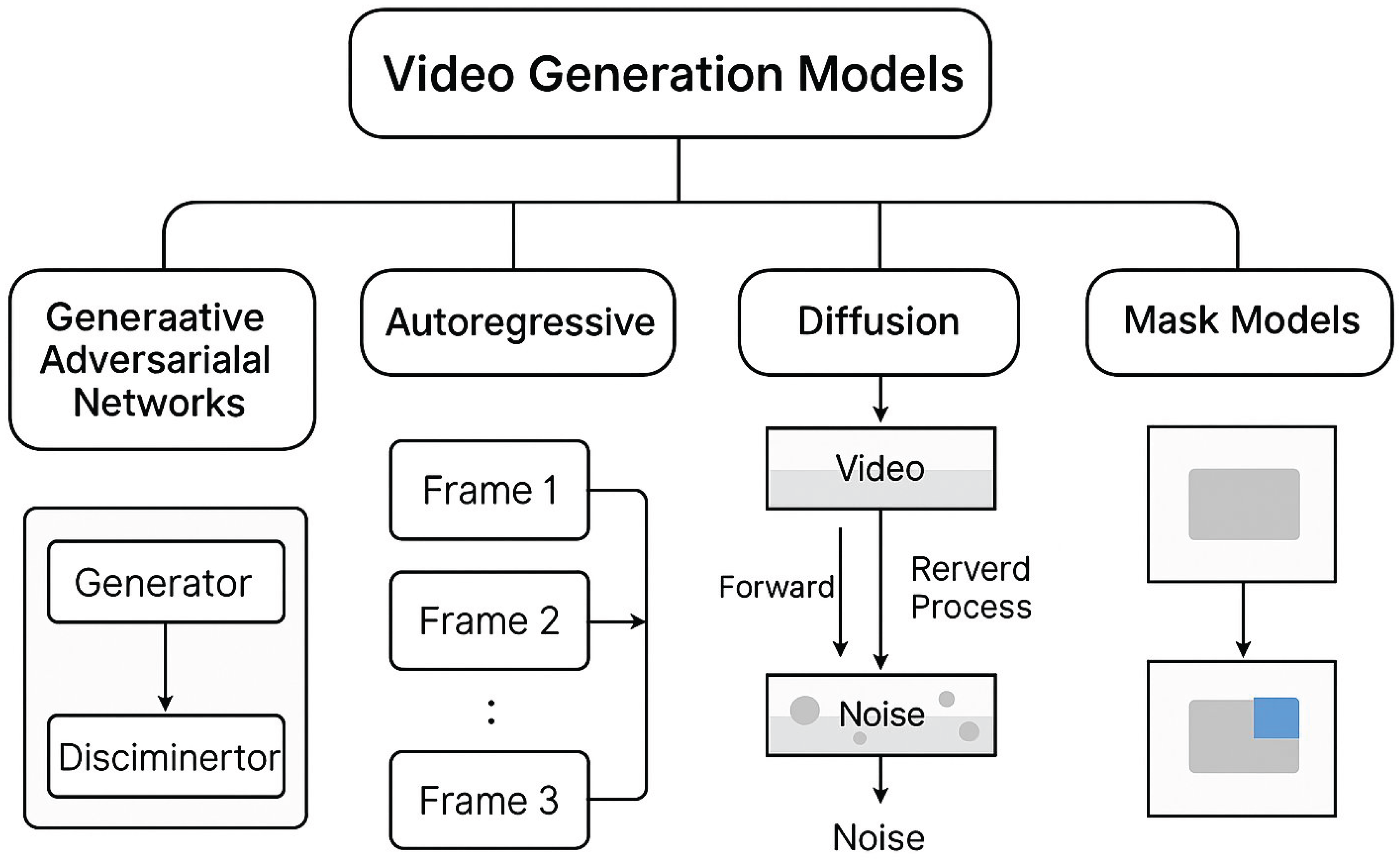

Table 1.
Representative video generation systems and key features. “Cascade” denotes multi-stage refinement; “Max Res.” is the highest publicly reported resolution.
Table 1.
Representative video generation systems and key features. “Cascade” denotes multi-stage refinement; “Max Res.” is the highest publicly reported resolution.
| System | Backbone | Conditioning | Cascade | Real-time Capable | Max Res. | Primary Use Case |
|---|---|---|---|---|---|---|
| Sora | DiT + Latent Diffusion | Text, Image, Camera Path | ✓ | ✗ | 1920×1080+ | Cinematic, long-form video |
| Runway Gen-3 | Latent Diffusion | Text, Image, Pose | ✓ | ✗ | 1920×1080 | Creative production |
| Pika | Latent Diffusion | Text, Image | ✗ | ✓ | 1920×1080 | Rapid prototyping |
| Stability Video | Latent Diffusion | Text, Image | ✓ | ✗ | 2048×1152 | Open-source creation |
| Veo | Latent Diffusion | Text, Camera Path | ✓ | ✗ | 1280×768+ | Productivity and creative |
| Hunyuan Video | Latent Diffusion | Text, Pose | ✓ | ✗ | 1920×1080 | Regional/cultural content |
| Firefly Video | Latent Diffusion | Text, Image, Audio | ✓ | ✗ | 1920×1080 | Professional editing |
| MagicVideo | Latent Diffusion | Text, Audio | ✗ | ✓ | 1080×1920 | Social media |
| NVIDIA ACE | Multi-Modal Transformers | Audio, Facial Pose | ✗ | ✓ | 1920×1080 | Digital humans |
Disclaimer/Publisher’s Note: The statements, opinions and data contained in all publications are solely those of the individual author(s) and contributor(s) and not of MDPI and/or the editor(s). MDPI and/or the editor(s) disclaim responsibility for any injury to people or property resulting from any ideas, methods, instructions or products referred to in the content. |
© 2025 by the authors. Licensee MDPI, Basel, Switzerland. This article is an open access article distributed under the terms and conditions of the Creative Commons Attribution (CC BY) license (http://creativecommons.org/licenses/by/4.0/).
Copyright: This open access article is published under a Creative Commons CC BY 4.0 license, which permit the free download, distribution, and reuse, provided that the author and preprint are cited in any reuse.


