

Submitted:
15 November 2025
Posted:
18 November 2025
You are already at the latest version
Abstract
Digital twins (DT) have emerged as transformative tools for smart city management, enabling urban planners and administrators to monitor infrastructure, simulate scenarios, and optimize operations through virtual representations of physical systems. As urban populations approach five billion people by 2030 and cities confront escalating challenges around congestion, housing, environmental quality, and resource management. A monitoring-only paradigm proves increasingly inadequate for enabling the proactive, adaptive, and participatory governance that future urban systems require. This paper articulates a vision for metaverse-enabled DTs that fundamentally reconceives urban management by transforming passive observation into immersive collaboration and automated action. We present a four-layer Metaverse-Enabled DIGital Twins Enterprise (MEDIGATE) architectural framework that creates capabilities that no isolated technology can achieve, including real-time information fusion across urban domains, immersive interfaces supporting collaborative decision-making among distributed stakeholders, anticipatory response to emerging challenges before they escalate, and continuous learning that improves system performance over time. Recognizing that comprehensive urban-scale implementation presents significant complexity and risk, we introduce the microverse concept as a practical pathway for incremental deployment through domain-specific immersive environments that generate immediate value while building toward eventual integration. We examine healthcare as an illustrative domain demonstrating how immersive DTs transform reactive service delivery into proactive wellness management through multi-modal information fusion and automated intervention. The paper addresses technical challenges around privacy, security, data reliability, computational requirements, and interoperability. We conclude by articulating a research agenda spanning technical development, social innovation, and policy frameworks necessary to realize genuinely proactive smart cities that anticipate needs, engage citizens meaningfully, and deliver equitable outcomes for all urban residents.
Keywords:
Digital Twins (DT)
; smart cities
; metaverse
; proactive urban management
; edge computing
; immersive collaboration
1. Introduction
The world stands at an unprecedented urban threshold. By 2030, approximately 60% of humanity will reside in cities, representing 5 billion urban dwellers who will depend on increasingly complex and interconnected infrastructure systems [1]. This rapid urbanization concentrates both opportunity and challenge within metropolitan boundaries. Cities generate over 80% of global gross domestic product (GDP) while simultaneously accounting for more than 70% of carbon emissions and consuming two-thirds of the world’s energy [2]. The urban environments of 2030 will confront multifaceted challenges including chronic traffic congestion that costs major cities billions annually in lost productivity, acute housing shortages that price essential workers out of the communities they serve, deteriorating air quality that causes millions of premature deaths worldwide, aging infrastructures that require hundreds of billions in deferred maintenance, and climate change impacts ranging from intensifying heat waves to catastrophic flooding [3,4].
Digital Twin (DT) technology has emerged as a promising approach for transcending these limitations by creating virtual representations of physical urban systems that enable integrated monitoring, analysis, and planning. A DT functions as a dynamic software model that continuously updates to mirror the state of its physical counterpart through data streams from sensors, databases, and other information sources [5,6]. Urban planners use DTs to visualize complex infrastructure relationships, simulate the impacts of proposed interventions, and optimize operations across interconnected systems in ways that physical prototyping and traditional planning tools cannot support [7,8].
Cities worldwide have begun implementing DT platforms that demonstrate the technology’s potential for urban applications [9,10]. However, current implementations function primarily as sophisticated monitoring and analysis tools accessed by technical specialists rather than as immersive platforms that engage diverse stakeholders in collaborative urban governance. DTs operate largely in isolation from one another, with a transportation twin unaware of energy system constraints, a water management twin disconnected from land use planning, and public health surveillance separated from environmental monitoring. These systems provide decision support for human administrators rather than enabling automated proactive response that anticipates challenges before they escalate into crises requiring reactive intervention.
Recent developments at the convergence of DTs, metaverse technologies, edge computing, artificial intelligence (AI), and robotics create possibilities for fundamentally reconceiving urban management systems. The metaverse represents shared virtual environments where users interact with digital content and with each other through immersive interfaces including virtual reality, augmented reality, and spatial computing [11,12]. While popular discourse often associates the metaverse with gaming and social media applications, the underlying technologies enable new paradigms for human-computer interaction that have profound implications for urban systems. When DTs operate within metaverse platforms, they transform from passive monitoring tools into immersive environments where stakeholders directly experience urban systems, collaborate in real-time despite physical distribution, explore scenarios through embodied interaction rather than abstract analysis, and influence system behavior through intuitive interfaces rather than technical command languages.
This paper articulates a vision for Metaverse-Enabled DIGital Twins Enterprise (MEDIGATE) that fundamentally transforms urban management from passive monitoring to proactive, collaborative, and citizen-engaged governance. We argue that integrating DT technology with metaverse platforms, edge computing, AI, and robotic actuation enables a new architecture for smart cities that creates capabilities impossible with current approaches. Immersive interfaces allow stakeholders to experience urban systems spatially and temporally in ways that conventional dashboards and reports cannot convey, enabling intuitive understanding of complex relationships and tradeoffs. Multi-modal information fusion across text, audio, video, sensor data, and immersive interaction synthesizes insights invisible to isolated analysis. Real-time collaboration within shared virtual environments supports distributed decision-making that transcends the constraints of physical meetings. Closed-loop systems that continuously sense conditions, predict developments through DT simulation, engage stakeholders through metaverse platforms, execute automated responses through robotic actuation, and learn from outcomes enable genuinely proactive urban management that anticipates challenges before they escalate.
This paper makes several contributions to the discourse on smart city futures. We present a conceptual framework that articulates how DTs, metaverse platforms, edge computing, AI, and robotics integrate to enable proactive urban management. We introduce the microverse concept as a practical implementation pathway that cities can pursue incrementally. We examine healthcare as an illustrative domain that demonstrates key principles while acknowledging that similar transformations apply across urban systems. This paper identifies technical challenges and research directions spanning computer science, urban planning, and social sciences. The paper explores ethical considerations around privacy, equity, transparency, and governance that must inform system design rather than being addressed as afterthoughts. Finally, a research agenda is presented that encompasses not only technical development but also the social innovations and policy frameworks necessary for responsible deployment.
The remainder of this paper proceeds as follows, shown by Table 1. Section 2 examines the current state of DT implementations in smart cities, analyzing representative deployments to establish both achievements and fundamental limitations of existing approaches. Section 3 presents the MEDIGATE four-layer architectural framework in detail, explaining how each layer functions and how their integration creates emergent capabilities for proactive urban management. Section 4 introduces the microverse concept and outlines a practical pathway for incremental implementation that builds from domain-specific deployments toward comprehensive urban-scale integration. Section 5 explores healthcare as an illustrative domain, demonstrating through concrete scenarios how metaverse-enabled DTs transform service delivery. Section 6 addresses the technical foundations and enabling technologies that make this vision feasible while identifying current limitations and required advances. Section 7 examines challenges spanning privacy, security, reliability, equity, and governance, framing these as research opportunities rather than insurmountable obstacles. Section 8 synthesizes our argument and articulates next steps toward realizing genuinely proactive smart cities that anticipate needs, engage citizens meaningfully, and deliver equitable outcomes.
2. Current State of Digital Twins in Smart Cities
The evolution of DT technology from its origins in aerospace engineering to contemporary urban applications represents a significant trajectory of conceptual and technical development. Understanding the DT evolution and examining current implementations reveals both the substantial achievements of existing approaches and their fundamental limitations that necessitate an architectural reconceptualization. Section 2 critically analyzes representative urban DT deployments to establish the current state of practice and articulate why incremental improvements to existing paradigms prove insufficient for addressing the challenges that future cities will confront.
2.1. Historical Context and Technological Evolution
As illustrated in Figure 1, the DT concept originated in the early years of space exploration when NASA (National Aeronautics and Space Administration) engineers created physical replicas of spacecraft systems on Earth to mirror and diagnose problems occurring in orbit during the Apollo missions [13]. These physical twins enabled ground-based analysis and simulation that proved essential for troubleshooting critical systems in environments where direct human intervention was impossible. As computing capabilities advanced through the 1980s and 1990s, engineers in automotive and aerospace manufacturing began replacing physical twins with computer-aided design (CAD) models and simulation environments that could predict product performance before physical prototypes existed [14]. The formal articulation of DT principles emerged in the early 2000s through the work of Michael Grieves at the University of Michigan, who defined DT as comprising a physical product, a virtual representation of that product, and bidirectional data connections between them [5].
The application of DT concepts to urban systems represents a natural extension of industrial practice to spatial domains of unprecedented complexity. Cities encompass millions of interconnected components spanning buildings, transportation networks, utility infrastructure, communication systems, and environmental processes, all operating simultaneously across spatial scales from individual structures to metropolitan regions. Early urban DT initiatives focused on creating three-dimensional geometric models that provided planning and visualization capabilities. The City of Zürich developed a detailed virtual city model in the 1990s primarily for urban planning visualization [15]. Singapore launched its Virtual Singapore initiative in 2014 as one of the first comprehensive attempts to create a dynamic, data-driven DT of an entire city rather than merely a static geometric representation [16].
Contemporary urban DTs have evolved beyond geometric visualization to incorporate real-time sensor data, predictive analytics, and simulation capabilities. The integration of Internet of Things (IoT) sensor networks enables DTs to continuously update their representation of physical system states rather than depending on periodic manual surveys. Machine learning (ML) models process historical and real-time data to predict future conditions ranging from traffic congestion to equipment failures. Simulation engines evaluate proposed interventions before physical implementation, reducing the risk and cost of urban infrastructure decisions. Cloud computing platforms provide the computational resources necessary to maintain complex models and serve multiple simultaneous users. These technological advances have enabled DTs to transition from static planning tools to dynamic operational platforms that support ongoing urban management [9,17].
2.2. Contemporary Urban Digital Twin Implementations
Examining specific implementations reveals both the capabilities and limitations of current urban DT practice. Virtual Singapore represents one of the most comprehensive and frequently cited examples. The platform integrates three-dimensional (3D) geometric models of buildings, infrastructure, and terrain with real-time data from sensors monitoring traffic flow, weather conditions, and environmental parameters across the island nation [16]. Government agencies and authorized private sector partners use Virtual Singapore for diverse applications including urban planning scenario analysis, infrastructure optimization, emergency response planning, and public engagement visualization. Urban planners simulate the environmental impacts of proposed high-rise developments by modeling how new buildings affect wind patterns, solar exposure, and views in surrounding areas. Transportation authorities evaluate how road closures for construction projects will affect traffic patterns throughout the network. Emergency managers simulate evacuation scenarios to identify bottlenecks and optimize response procedures for various disaster situations [18].
Despite its sophistication, Virtual Singapore exhibits limitations characteristic of current DT implementations. The platform functions primarily as an analysis and visualization tool accessed by trained specialists rather than as an immersive environment supporting broad stakeholder participation. While the 3D interface provides superior spatial understanding compared to two-dimensional maps and dashboards, users interact with the system through conventional computer screens using mouse and keyboard controls that maintain considerable distance between the user and the virtual environment. Citizens have limited ability to access or interact with Virtual Singapore directly, instead experiencing curated presentations prepared by government officials or urban planners. The Virtual Singapore DT operates largely independent from operational control systems, providing decision support recommendations that human administrators must manually implement rather than directly executing interventions in physical infrastructure. Integration across different urban systems remains partial, with transportation, environmental, and infrastructure twins maintaining separate data models and simulation engines that make holistic optimization challenging [8].
The City of Toronto and York Region’s DT for water systems management demonstrates different capabilities and faces different constraints. Toronto water system DT implementation focuses specifically on hydrological modeling to predict flood risks hours before events occur, enabling proactive response rather than purely reactive emergency management [19]. The system integrates data from weather forecasts, stream gauges, soil moisture sensors, and infrastructure monitoring systems with sophisticated hydraulic models that simulate how precipitation will flow through watersheds, drainage networks, and treatment facilities. When the models predict flooding risks exceeding defined thresholds, the system automatically alerts emergency management personnel who can pre-position equipment, implement temporary protective measures, and notify potentially affected residents well before water levels become dangerous. The economic benefits of this advance warning have proven substantial by preventing property damage and reducing emergency response costs.
However, the Toronto water system DT also illustrates the siloed nature of current implementations. While the platform excels at hydrological prediction, it operates largely independently from other urban systems that both affect and are affected by water management. Transportation networks experience significant disruption during flooding events, yet the water DT does not directly interface with traffic management systems to implement coordinated response such as closing vulnerable roadways before flooding occurs or rerouting traffic to maintain emergency access. Power utilities need to protect electrical infrastructure from water damage, but integration between the water twin and electrical grid management remains limited. Building management systems could activate protective measures such as deploying flood barriers or moving equipment to higher floors, yet these systems typically receive flood warnings through the same public notification channels available to all citizens rather than through direct machine-to-machine communication that would enable faster automated response. The lack of integration across urban domains reflects organizational boundaries between municipal departments and agencies more than technical limitations, but the result is DTs that optimize individual systems without enabling holistic urban management [20].
Dubai smart building management DTs have been implemented across thousands of structures as part of its broader smart city initiative. These building-level twins monitor energy consumption, heating and cooling system performance, lighting, occupancy patterns, and equipment health to optimize operational efficiency and predict maintenance needs [21]. The integration of building information models with real-time sensor data enables facility managers to identify anomalies indicating equipment degradation before failures occur, schedule maintenance during periods of low occupancy to minimize disruption, and optimize energy consumption by coordinating Heating, Ventilation, and Air Conditioning (HVAC) systems with occupancy predictions and weather forecasts. The aggregated data from thousands of buildings provides city-wide insights into energy consumption patterns that inform infrastructure planning and policy development. Buildings participating in demand response programs can automatically modulate consumption in response to grid conditions, helping balance electricity supply and demand.
The Dubai building twins demonstrate operational value at the structure level but reveal limitations in urban-scale integration. Individual buildings optimize their own performance without coordinating with neighboring structures or district-scale systems that might enable shared resource utilization. Building cooling systems operate independently despite opportunities for thermal energy sharing through district cooling networks. Rooftop solar installations on individual buildings do not coordinate with building energy storage or electric vehicle charging to optimize neighborhood-level grid interaction. The building twins focus narrowly on operational efficiency without incorporating broader urban factors such as transportation access, air quality impacts on occupant health, or resilience to climate extremes that require integration with city-wide environmental monitoring and emergency management systems [22].
Helsinki’s Kalasatama district DT represents an effort to address integration challenges by focusing on a specific geographic area rather than attempting city-wide coverage. The district twin incorporates buildings, infrastructure, transportation, and environmental systems within a defined urban neighborhood undergoing significant development [23]. Urban planners use the platform to evaluate how proposed developments affect the existing community by simulating changes to traffic patterns, pedestrian flows, sunlight exposure, and local climate conditions. Energy planners optimize district heating networks and evaluate renewable energy integration scenarios. Transportation authorities coordinate public transit services with development patterns and mobility demand. The geographic focus enables deeper integration between systems within the district while establishing patterns that could expand to broader urban coverage over time.
However, even a spatially focused approach encounters challenges that reveal deeper architectural limitations. The Kalasatama DT serves primarily as a planning and analysis tool used during the development process rather than as an ongoing operational platform that adapts in real-time to changing conditions. Citizens participate through consultation processes where planners present simulation results rather than directly interacting with the DT to explore scenarios and express preferences. The platform provides limited support for automated response, with insights that inform human decisions rather than directly controlling infrastructure. As the district matures from active development to ongoing operation, sustaining the DT requires organizational models and funding mechanisms that differ from project-based planning efforts [24].
2.3. Systematic Limitations of Current Approaches
Analysis across these and other contemporary implementations reveals several systematic limitations that constrain the transformative potential of DT technology for urban management. These limitations stem from fundamental architectural choices rather than temporary technical constraints, suggesting that incremental improvements to existing approaches will prove insufficient unless there is a middleware to connect the DTs.
Current DTs function predominantly as monitoring and analysis tools that support human decision-making rather than as platforms enabling direct stakeholder interaction and automated intervention. Technical specialists access DT platforms through conventional computer interfaces, interpret model outputs and simulation results, and translate insights into recommendations for decision-makers. The human-machine workflow introduces delays between sensing conditions, analyzing situations, making decisions, and implementing responses that prevent truly proactive management. When a transportation DT predicts congestion based on event schedules and weather forecasts, traffic management staff must manually adjust signal timing, implement lane controls, and communicate with drivers through variable message signs. The prediction provides valuable advance warning but the response remains fundamentally reactive, occurring after conditions have begun deteriorating rather than pre-emptively adapting to prevent problems from developing.
The isolation of individual DTs prevents holistic optimization across interdependent urban systems. Transportation twins optimize traffic flow without considering how routing decisions affect air quality in residential neighborhoods or how electric vehicle charging concentrations stress electrical distribution networks. Energy twins minimize cost and emissions without accounting for how demand response programs affect building occupant comfort or manufacturing production schedules. Water management twins operate independently from land use planning that determines impervious surface coverage affecting runoff patterns. Public health surveillance remains disconnected from environmental monitoring that reveals exposure to pollutants affecting disease incidence. These silos reflect organizational structures where different agencies manage different urban systems, but the result is suboptimal outcomes compared to what integrated management could achieve [7,25].
Limited stakeholder engagement constrains the democratic legitimacy and social acceptance of DT-informed decisions. Citizens experience smart city initiatives as passive consumers receiving services rather than as active participants shaping their communities. Urban planning consultations present simulation results through two-dimensional visualizations and verbal descriptions that fail to convey the experiential reality of proposed changes. Residents cannot directly explore how alternative development scenarios would affect their neighborhood character, property values, or quality of life. Community groups lack tools for constructing counter-proposals informed by the same analytical rigor that professional planners employ. The technical sophistication of DT platforms creates asymmetries of knowledge and power that can undermine trust even when officials act with good intentions [26,27].
The lack of immersive interfaces prevents intuitive understanding of complex urban systems. Conventional dashboards display data through charts, maps, and tables that require training to interpret correctly. Relationships between variables must be inferred from correlations rather than experienced directly. Temporal dynamics appear as time series graphs rather than as animated sequences showing system evolution. Spatial relationships emerge from map overlays rather than from 3D environments that preserve the geometric and topological properties of physical space. This abstraction distances stakeholders from the systems they seek to understand and manage, making it difficult to develop the intuitive comprehension necessary for effective decision-making in complex situations [28].
The reactive rather than anticipatory nature of current implementations limits DT’s ability to prevent problems before they escalate. DTs excel at detecting anomalies and predicting future states based on current conditions, but they lack mechanisms for proactive intervention that shapes conditions to avoid predicted problems. When models forecast equipment failure in three weeks, maintenance must be manually scheduled. When simulations predict traffic congestion during an upcoming event, mitigation measures require human planning and implementation. The gap between prediction and action creates opportunities for organizational delays, communication failures, and competing priorities to prevent timely response. Truly proactive systems would sense emerging conditions, simulate alternative responses, select optimal interventions, execute actions through automated actuation, and learn from outcomes to improve future performance, all with minimal human intervention except for high-stakes decisions requiring ethical judgment or political accountability [29].
2.4. The Need for Architectural Reconceptualization
These systematic limitations suggest that realizing the full potential of DT technology for urban management requires more than incremental improvements to existing platforms. Adding more sensors provides finer-grained monitoring but does not address the reactive nature of current systems. Improving visualization capabilities enhances analysis without enabling immersive interaction. Expanding to additional urban domains increases coverage without necessarily achieving integration. Cloud computing and AI deliver greater computational power and analytical sophistication while leaving the fundamental architecture of human-mediated decision-making intact.
The vision articulated in subsequent sections reconceives DTs as immersive platforms integrated with metaverse environments, edge intelligence, and robotic actuation rather than as monitoring and analysis tools operating in isolation. This reconceptualization addresses the limitations identified above by enabling stakeholders to directly experience urban systems through immersive interfaces rather than interpreting abstract visualizations by integrating information across urban domains through common platforms and data models rather than maintaining isolated silos. Engaging citizens as active participants through accessible immersive environments rather than relegating them to passive service consumption can anticipate challenges through continuous sensing and prediction coupled with automated proactive response rather than relying on reactive human intervention, as well as learning continuously from outcomes to improve system performance rather than treating each intervention as an isolated event.
The following Section presents the architectural framework that enables these capabilities by articulating how physical infrastructure, DTs, metaverse platforms, and action-taking systems integrate to create genuinely proactive smart cities. Before examining that framework in detail, it is essential to recognize that current DT implementations have delivered substantial value and represent important progress from previous urban management approaches. The critique presented above is not intended to diminish those achievements but rather to articulate why the next generation of smart city platforms requires fundamental architectural innovation rather than evolutionary refinement. The convergence of technologies, including immersive computing (i.e., virtual reality (VR), augmented reality (AR), mixed reality (MR), extended reality (XR)), edge intelligence, AI, and robotics, creates possibilities that were infeasible when current DT platforms were designed. By reconceiving urban DTs to exploit these emerging capabilities, cities can progress from reactive monitoring to proactive management that anticipates challenges, engages stakeholders meaningfully, and delivers equitable outcomes for all urban residents.
3. Architectural Framework for Proactive Smart Cities
The limitations of current DT implementations identified in the previous section stem from architectural choices that position these systems as passive monitoring and analysis tools rather than as active platforms enabling immersive interaction and automated response. Overcoming these limitations requires a fundamental reconceptualization of how digital technologies integrate to support urban management. As illustrated in Figure 2, this Section presents a four-layer Metaverse-Enabled DIGital Twins Enterprise (MEDIGATE) architectural framework that enables the transformation from passive mirroring to proactive immersion by articulating how physical infrastructure, DTs, metaverse platforms, and action-taking systems work in concert to create capabilities that no isolated technology can achieve. Each layer performs distinct functions while exposing interfaces that enable tight integration with other layers, producing emergent properties that characterize genuinely proactive smart cities.
3.1. Physical Layer: The Sensing and Actuation Substrate
The physical layer serves as the foundation of proactive urban systems, providing the sensory awareness and actuation capabilities necessary for real-time monitoring and intervention. This layer comprises IoT devices, communication networks, edge computing infrastructure, and robotic systems distributed throughout the urban environment. While conventional smart city architectures include similar components, the physical layer in the MEDIGATE framework differs fundamentally in its emphasis on local intelligence, low-latency response, and bidirectional interaction rather than merely collecting data for centralized processing.
IoT sensor networks enable continuous monitoring of urban conditions across diverse domains. Environmental sensors measure air quality parameters, including particulate matter concentrations, nitrogen dioxide levels, ozone, and volatile organic compounds that affect public health and quality of life [30]. Transportation sensors monitor vehicle flows, travel speeds, parking occupancy, and public transit ridership through technologies that include inductive loops, cameras with computer vision processing, and cellular network analytics. Building management systems track energy consumption, occupancy patterns, temperature, humidity, and equipment performance across thousands of structures. Utility infrastructure sensors monitor water pressure and flow rates, electrical grid voltage and current, and natural gas distribution. Public safety systems integrate video surveillance, acoustic gunshot detection, and emergency alert mechanisms. Personal devices, including smartphones and wearables, provide individual-level data about mobility patterns, physiological states, and user preferences when citizens consent to sharing this information [31].
The scale and diversity of urban sensing create data volumes that centralized processing cannot handle within the latency constraints required for real-time response. A metropolitan area of several million residents might generate terabytes of sensor data daily from millions of devices. Transmitting all this raw data to cloud data centers for processing introduces communication delays, consumes excessive bandwidth, and creates single points of failure that compromise system resilience. Edge computing addresses these challenges by distributing intelligence throughout the urban environment, processing data near where it originates rather than centralizing computation in remote facilities [32,33].
Edge computing nodes deployed at strategic locations, including cellular base stations, traffic signal controllers, building management systems, and utility substations, perform local analytics that extract actionable insights from raw sensor streams. A traffic management edge node analyzes video feeds from intersection cameras to detect congestion, accidents, and unusual patterns, transmitting only summarized information and alerts rather than raw video to centralized systems. An environmental monitoring edge node correlates measurements from multiple air quality sensors to identify pollution sources and predict dispersion patterns, triggering local alerts when thresholds are exceeded. A building management edge node optimizes heating, cooling, and lighting based on occupancy predictions and weather forecasts without requiring constant communication with centralized building automation systems. This distributed intelligence enables subsecond response times impossible with centralized architectures while reducing communication bandwidth requirements and improving system resilience to network failures [34].
The physical layer of our MEDIGATE framework extends beyond sensing and computation to encompass actuation mechanisms that enable automated intervention in urban systems. Traffic signal controllers adjust timing patterns in response to real-time flow conditions detected by local sensors and predicted by DT models. Building management systems modulate energy consumption by adjusting thermostat setpoints, dimming lighting, and shifting flexible loads in response to grid conditions and occupancy patterns. Water management systems operate valves and pumps to optimize pressure, prevent contamination, and respond to leak detection. Intelligent streetlights adjust brightness based on pedestrian and vehicle presence while serving as communication nodes and sensor platforms. Autonomous vehicles and delivery robots execute transportation and logistics tasks coordinated through DT platforms. Industrial robots perform infrastructure maintenance and inspection tasks in hazardous environments where human access is difficult or dangerous [35,36].
Communication networks bind these distributed components into coherent systems capable of coordinated action. Fifth-generation cellular networks provide high-bandwidth, low-latency wireless connectivity supporting mobile applications and dense sensor deployments [37]. Fiber optic infrastructure delivers the backhaul capacity necessary for aggregating data from edge nodes and supporting high-resolution video and immersive experiences. Low-power wide-area networks, including Long Range Wide Area Network (LoRaWAN) and Narrowband IoT (NB-IoT), enable long-lived battery-powered sensors deployed in locations where power infrastructure access is impractical. Mesh networking protocols allow devices to relay communications through peers when direct infrastructure connectivity is unavailable, improving resilience and extending coverage. Network slicing capabilities partition physical infrastructure into virtual networks optimized for specific applications, ensuring that critical public safety communications receive guaranteed bandwidth and latency even when consumer applications create congestion [38].
The physical layer design prioritizes several architectural principles that distinguish proactive urban systems from conventional smart city infrastructures. Local autonomy enables subsystems to function effectively even when connectivity to centralized systems is disrupted, preventing single points of failure from cascading through the urban environment. Standardized interfaces allow components from different vendors to interoperate, avoiding vendor lock-in and enabling incremental system evolution. Security mechanisms, including authentication, encryption, and intrusion detection, protect against malicious attacks that could compromise critical infrastructure [39]. Privacy preservation techniques, including differential privacy and federated learning, enable valuable analytics while protecting sensitive information about individual citizens [40]. Energy efficiency through careful hardware selection and software optimization extends the lifespan of battery-powered sensors and reduces the environmental impact of large-scale IoT deployments.
3.2. Digital Twins Layer: Predictive Insight and Simulation
The DTs layer builds upon the physical layer foundation by creating virtual representations of urban systems and generating predictive insights through simulation and AI. While this layer performs functions similar to current DT implementations, its design in our MEDIGATE framework differs by emphasizing continuous real-time operation, horizontal integration across urban domains, and tight coupling with both the underlying physical layer and the overlying metaverse, as well as action-taking layers.
DTs in the MEDIGATE architecture maintain dynamic virtual replicas of physical urban systems that continuously update as sensors report changing conditions, rather than being refreshed periodically for specific analysis tasks. A transportation DT incorporates real-time information about vehicle locations, traffic signal states, road closures, public transit operations, and parking availability, updating its representation multiple times per second as conditions evolve. An energy DT tracks electricity generation from conventional and renewable sources, transmission and distribution network states, building consumption patterns, and storage system charge levels, maintaining a current view of grid conditions that enables rapid response to disturbances. A water management DT monitors reservoir levels, treatment plant operations, distribution network pressures and flows, and consumption across the service area, detecting anomalies that might indicate leaks or contamination within minutes of occurrence [41].
These virtual representations serve multiple purposes beyond visualization. Physical twins enable operators to monitor system states through intuitive interfaces that present complex information more comprehensibly than raw data streams. Predictive twins apply ML models to forecast future conditions based on current states and historical patterns, warning of potential problems hours or days before they manifest. Experimental twins allow planners to evaluate proposed interventions through simulation before physical implementation, reducing risk and cost. Optimization twins search large solution spaces to identify configurations that maximize performance according to specified objectives such as minimizing cost, reducing emissions, or improving equity [6].
AI/ML technologies enable DTs to generate insights that would be invisible to traditional analysis approaches. Supervised learning models trained on historical data predict traffic congestion, energy demand, equipment failures, and public health trends with accuracy that improves as training datasets grow. Unsupervised learning techniques identify anomalous patterns that might indicate emerging problems such as water main degradation, electrical equipment malfunction, or disease outbreak precursors. Reinforcement learning algorithms discover optimal control strategies for complex systems, including adaptive traffic signal timing, building energy management, and grid stability control by exploring alternative policies through simulation and learning from outcomes [42].
The horizontal integration of DTs across urban domains represents a crucial distinction from current implementations that typically operate in isolation. In the MEDIGATE framework, DTs expose standardized application programming interfaces that allow other twins to query their state, subscribe to updates, and request simulations. A transportation DT considering route recommendations for electric vehicles queries the energy DT about charging station availability and grid conditions that might affect charging speeds. A building management DT optimizing energy consumption receives air quality forecasts from the environmental DT indicating when opening windows for natural ventilation would expose occupants to harmful pollutants. A public health DT monitoring disease transmission patterns accesses the transportation DT to understand mobility flows that might explain geographic spread patterns [22].
DT integration enables system-level optimization, which is impossible when individual domains operate independently. Consider a scenario where an approaching storm threatens to create both traffic congestion through accidents and flooding through overwhelmed drainage systems. The weather DT predicts precipitation timing and intensity. The water management DT simulates drainage system response and identifies areas at risk of flooding. The transportation DT evaluates how road closures and detours would affect traffic patterns. The emergency management DT coordinates response resources. Rather than each system responding independently, the integrated twins collaboratively develop a coordinated response that pre-positions emergency equipment, implements traffic restrictions that keep vehicles away from flood-prone areas, adjusts drainage system operations to maximize capacity, and alerts residents in affected areas hours before dangerous conditions develop. This holistic system-level DT delivers outcomes superior to what isolated domain optimization can achieve [43].
The DTs layer maintains physics-based simulation models alongside data-driven ML approaches to leverage the complementary strengths of each paradigm. Physics-based models encode expert knowledge about how systems behave according to fundamental principles including conservation laws, thermodynamics, and fluid dynamics. These models provide reliable predictions for conditions within their validated operating ranges and offer interpretable explanations for their outputs. However, they require detailed parameterization and may struggle with complex phenomena difficult to model from first principles. Data-driven ML approaches discover patterns directly from observations without requiring explicit physics models. They can capture complex nonlinear relationships and adapt to changing conditions through continuous learning. However, they may produce unreliable predictions when applied beyond their training distributions and offer limited interpretability regarding why they make particular predictions. Hybrid approaches, such as Dynamic Data Driven Applications Systems (DDDAS) [44] that combine physics-based and data-driven methods, increasingly demonstrate superior performance by using physics models to constrain ML to produce physically plausible predictions while using data to refine physics model parameters and capture phenomena that first-principles modeling cannot address [45].
The design of the DTs layer prioritizes several architectural principles of scalability, modularity, composability, and certainty. Scalability ensures that twins can represent metropolitan areas containing millions of components without computational performance degrading unacceptably. Modularity allows individual subsystem twins to be updated or replaced without requiring modification to the entire system. Composability enables complex twins to be constructed from simpler components that can be reused across different applications. Validation mechanisms ensure that twin predictions align with observed physical system behavior through continuous comparison and model calibration. Uncertainty quantification (UQ) provides confidence intervals around predictions rather than point estimates, enabling risk-aware decision-making that accounts for model limitations.
3.3. Metaverse Layer: Immersive Collaboration and Engagement
The metaverse layer transforms the DTs from analysis tools accessed by specialists into immersive environments where diverse stakeholders directly experience urban systems, collaborate in real-time despite physical distribution, and influence system behavior through intuitive interaction [46]. The metaverse layer represents the most distinctive element of our MEDIGATE framework compared to current practice, enabling capabilities that conventional interfaces fundamentally cannot support.
Immersive interfaces (VR, AR, MR, XR) create a spatial understanding of complex urban systems that 2D dashboards cannot convey. When urban planners explore a proposed development within a virtual twin of the neighborhood, they apprehend relationships between buildings, infrastructure, and public spaces through the same perceptual mechanisms humans use to understand physical environments. The visual impact of a new high-rise building becomes immediately apparent through direct observation from multiple vantage points rather than requiring mental reconstruction from elevations and perspectives. The acoustic environment created by traffic patterns emerges through spatial audio rendering that allows planners to experience how sound propagates through the urban landscape. Pedestrian circulation patterns manifest through animated flows that reveal bottlenecks and safety concerns more effectively than density maps. Wind patterns affected by building geometries become tangible through visualization techniques including particle systems and flow fields that make invisible aerodynamic effects visible and comprehensible [47].
The metaverse layer facilitates collaborative decision-making by allowing distributed stakeholders to inhabit the same virtual environment simultaneously. Emergency responders coordinating disaster response from different physical locations share a common operational picture where they can observe unfolding events, discuss response strategies, assign tasks, and monitor execution without the coordination challenges that voice-only communication creates. Transportation planners from multiple agencies collaborate on regional mobility improvements by directly experiencing how proposed changes to roads, transit, and bicycle infrastructure affect travel patterns throughout the network. Community members participate in urban planning processes by experiencing proposed changes to their neighborhoods alongside professional planners and elected officials, creating a shared understanding that verbal descriptions and architectural renderings cannot achieve [12].
Avatars provide digital representations of users within virtual environments that support identity and social presence. Users customize avatars to reflect their appearance, professional role, or creative expression, establishing identity in the virtual space. Avatar behaviors, including gaze direction, gestures, and proximity, communicate nonverbal information that enriches collaboration beyond what audio and text can convey. Spatial audio renders voices to appear to originate from avatar locations, creating natural conversation dynamics where multiple participants can hold separate discussions without the confusion that typically accompanies large video conferences. Pointing gestures allow users to direct attention to specific features within the environment more effectively than verbal descriptions. These social affordances make virtual collaboration feel more natural and effective than conventional remote communication technologies [48].
The metaverse layer enables scenario exploration at scales and speeds impossible in physical environments. Urban planners experience years of neighborhood development within minutes by accelerating temporal simulation, observing how alternative zoning decisions shape community character over decades. Citizens understand long-term implications of policy choices by experiencing simulated future states rather than interpreting statistical projections. Transportation authorities evaluate emergency evacuation procedures by simulating thousands of residents responding to various disaster scenarios, identifying bottlenecks and optimization opportunities through observation rather than abstract analysis. Building designers explore how alternative layouts affect occupant experience by inhabiting virtual representations at full scale before construction commits to particular configurations. The temporal and spatial flexibility of metaverse DTs transforms planning from a process of analyzing static alternatives into an experiential exploration of dynamic possibilities [11].
The metaverse layer creates possibilities for participatory governance that extend beyond consultation to active collaboration. Rather than soliciting citizen input through surveys or public meetings where verbal descriptions and two-dimensional visualizations constrain understanding, cities invite community members to experience proposed changes, experiment with alternatives, and express preferences through direct interaction with virtual environments. A neighborhood considering traffic calming measures explores various street configurations, experiencing how different designs affect vehicle speeds, pedestrian safety, parking availability, and aesthetic character. Residents vote on alternatives after this experiential exploration rather than based on abstract descriptions, leading to decisions better aligned with community values and more legitimate because participants feel genuinely informed. Public agencies use metaverse platforms for ongoing engagement rather than occasional consultations, building relationships with communities and enabling continuous dialogue about urban priorities and performance [49].
Accessibility represents a critical design consideration for the metaverse layer. If immersive experiences require expensive virtual reality headsets, specialized hardware, and technical sophistication, this approach would exacerbate existing inequities by giving wealthy, educated citizens greater influence over urban systems while excluding vulnerable populations. The metaverse layer in our framework supports progressive enhancement across diverse access technologies. Users with virtual reality systems experience fully immersive 3D environments with six-degree-of-freedom tracking and spatial audio. Users with standard computers access similar environments through conventional monitors, keyboards, and mice, sacrificing some immersion but maintaining functional access. Users with smartphones and tablets participate through mobile applications optimized for smaller screens and touch interfaces. Users with limited bandwidth access lightweight versions that reduce graphical fidelity while preserving essential functionality. This multi-modal approach ensures that immersive urban platforms remain accessible to diverse populations rather than creating new digital divides [50].
The metaverse layer incorporates natural language interfaces that allow users to query system states, request explanations, and issue commands through conversational interaction rather than requiring technical query languages. Large language models (LLM) process natural language inputs, translate them into formal queries against DT databases, execute those queries, and formulate responses in natural language that users can understand, regardless of their technical background. For example, a community member asks how a proposed development would affect traffic in their neighborhood, and the system responds with both quantitative predictions and qualitative descriptions expressed in accessible language. An emergency manager requests that the system identify evacuation routes least likely to become congested, and the system simulates alternatives and recommends optimal paths with explanations of its reasoning. This natural interaction reduces barriers to participation and enables non-technical stakeholders to engage meaningfully with complex urban systems [51].
The design of the metaverse layer prioritizes several architectural principles of optimization, interoperability, and security. Performance optimization ensures that virtual environments render smoothly even when representing large urban areas with millions of objects, using level-of-detail techniques, occlusion culling, and progressive loading to maintain responsiveness. Persistence mechanisms maintain the state of virtual environments across sessions, allowing users to return to previous work and enabling asynchronous collaboration where participants contribute at different times. Interoperability standards allow virtual environments created with different platforms and tools to share data and users, preventing fragmentation that would undermine the goal of creating shared urban platforms. Security controls protect against malicious users who might vandalize virtual environments or harass other participants, implementing moderation tools and access controls while preserving appropriate openness.
3.4. Action-Taking Layer: Automated Response and Closed-Loop Learning
The action-taking layer completes the architecture by executing interventions in the physical environment based on insights from DTs and decisions made through metaverse collaboration. This layer transforms the MEDIGATE framework from a sophisticated planning and analysis system into a genuinely proactive urban management platform that anticipates challenges and responds automatically with minimal human intervention except for high-stakes decisions requiring ethical judgment or political accountability.
Automated responses to routine conditions demonstrate the value of closed-loop systems that sense, analyze, decide, and act without delay. Traffic management systems adjust signal timing continuously based on real-time flow patterns predicted by transportation DTs, optimizing network throughput and minimizing delays without requiring human traffic engineers to constantly monitor conditions and make manual adjustments. Building management systems modulate energy consumption in response to grid conditions communicated by energy DTs, reducing demand during stress periods and increasing consumption when renewable generation exceeds demand, flattening load curves and enabling greater renewable integration. Water management systems operate valves and pumps to maintain optimal pressures throughout distribution networks, preventing both low pressure that compromises fire suppression capability and high pressure that stresses pipes and increases leakage. These automated responses occur within seconds of triggering conditions, preventing problems that would escalate if systems waited for human intervention [52].
The action-taking layer also supports human-authorized interventions for non-routine situations where an automated response would be inappropriate because ethical considerations, political sensitivity, or uncertainty about optimal actions require human judgment. When environmental DTs predict that air quality will deteriorate to unhealthy levels, the system generates recommendations for actions, including traffic restrictions, industrial emission controls, and public health advisories. Human decision-makers review these recommendations, consider broader context, including economic impacts and enforcement feasibility, and authorize selected interventions. The action-taking layer then executes the authorized actions by communicating with relevant control systems, implements the traffic restrictions through variable message signs and enforcement systems, notifies industries of temporary operating limits, and disseminates public health advisories through multiple communication channels. Utilizing a human-in-the-loop approach preserves appropriate oversight for consequential decisions while automating the execution once decisions are made [53].
Robotic systems extend the action-taking layer’s capabilities beyond digital control of infrastructure systems to physical interventions in the urban environment. Inspection drones equipped with cameras and sensors examine bridges, electrical transmission towers, and building facades to detect structural damage, corrosion, and other maintenance needs, generating work orders automatically when problems exceed defined thresholds. Maintenance robots perform routine tasks, including street cleaning, graffiti removal, and minor repairs, without requiring human labor for repetitive activities. Delivery robots transport goods through pedestrian spaces and buildings, coordinating with transportation DTs to optimize routes and avoid congestion. Autonomous vehicles provide flexible transportation services that respond dynamically to demand patterns predicted by DTs, improving mobility access without requiring fixed route schedules. These robotic systems operate under the supervision of DTs that coordinate their activities, assign tasks, monitor performance, and intervene when anomalies indicate potential problems [54].
The action-taking layer implements closed-loop learning by monitoring outcomes of interventions, comparing results against predictions from DT simulations, updating models to improve future predictions, and refining intervention strategies based on observed effectiveness. When a traffic management system implements signal timing changes to reduce congestion, it observes actual traffic flows after the intervention and compares them to the flows predicted by the transportation DT. If actual outcomes differ systematically from predictions, ML algorithms adjust model parameters to improve future accuracy. If the intervention proves less effective than simulated, the system explores alternative strategies through simulation before implementing them physically. This continuous learning enables urban systems to become increasingly sophisticated in anticipating challenges and optimizing responses over time [55].
The design of the action-taking layer prioritizes several architectural principles of safety, auditability, and functionality. Safety mechanisms prevent automated actions that could endanger public welfare through multiple layers of protection, including sanity checks that reject commands outside physically plausible ranges, rate limits that prevent rapid sequences of changes that might destabilize systems, and emergency stop capabilities that allow human operators to halt automated actions immediately when situations develop unexpectedly. Auditability requirements maintain detailed logs of all actions, the analyses that motivated them, and the outcomes they produced, enabling after-action review and accountability for system behavior. Reversibility considerations ensure that automated interventions can be undone if they prove ineffective or create unintended consequences, without requiring human approval. Graceful degradation allows systems to continue operating with reduced functionality when components fail rather than failing catastrophically, maintaining essential services even during disruptions.
3.5. Emergent Capabilities Through Layer Integration
The power of this architectural framework emerges from the integration of layers rather than from any individual component. The physical layer enables real-time awareness of urban conditions and provides actuation mechanisms for intervention, but without higher layers it merely generates data without producing insight or action. The DTs layer creates predictive models and simulations that reveal patterns and forecast futures, but without the physical layer, it lacks current information, and without the action-taking layer, its insights remain theoretical. The metaverse layer facilitates human understanding and collaboration, but without DTs to provide content, it would be an empty environment, and without action-taking capabilities, decisions made within it would lack consequence. The action-taking layer executes interventions, but without DT guidance, it would lack the intelligence to determine appropriate actions. Without the metaverse layer, it would exclude human judgment from consequential decisions.
Together, these layers create a system that senses conditions continuously through distributed physical infrastructure, synthesizes insights by fusing information across urban domains through integrated DTs, engages stakeholders through immersive environments that make complex systems comprehensible and enable collaboration, responds proactively through automated actions that prevent problems rather than merely reacting to them, and learns continuously from outcomes to improve future performance. The DT integration transforms urban management from an activity of monitoring problems and reacting to crises into a process of anticipating challenges, engaging communities, and shaping desirable futures.
The architectural MEDIGATE framework we have presented in Figure 2. provides the intellectual foundation for the practical implementation pathway discussed in the following section. Before examining that pathway, it is worth noting that this architecture does not require simultaneous implementation of all components across all urban systems. Cities can deploy individual layers incrementally, gaining value at each stage while building toward comprehensive integration. The microverse concept introduced in the next section provides a structured approach for this incremental deployment that generates immediate benefits while establishing patterns for broader adoption.
4. From Microverses to a Metaverse: A Practical Implementation Pathway
The architectural framework presented in the previous section articulates a comprehensive vision for proactive smart cities enabled by the integration of DTs, metaverse platforms, edge computing, AI, and automated actuation. However, implementing such a framework simultaneously across all urban systems at the metropolitan scale would present prohibitive complexity, enormous cost, and unacceptable risk. Cities require an approach that generates tangible value at each implementation stage while progressively building toward comprehensive integration. Section 4 introduces the microverse [56] as a practical pathway that enables incremental deployment through domain-specific immersive environments that initially operate with substantial autonomy while sharing architectural principles that facilitate eventual integration into a unified urban metaverse platform.
4.1. The Challenge of Comprehensive Urban-Scale Implementation
Attempting to deploy metaverse-enabled DTs across an entire metropolitan area simultaneously would encounter numerous obstacles that make such an approach impractical regardless of available resources. The technical complexity of integrating hundreds of thousands of sensors, thousands of buildings, extensive transportation and utility networks, and millions of citizens across multiple domains simultaneously exceeds the capacity of any implementation team to design, test, and deploy reliably. The organizational coordination required to align transportation agencies, utility providers, public health departments, emergency services, building operators, and other stakeholders around common platforms and data models would demand years of negotiation that delays beneficial deployment. The financial investment necessary to acquire hardware, develop software, train personnel, and maintain operations across all urban systems simultaneously would require budget allocations that few cities could justify, particularly when benefits remain uncertain until substantial implementation progress occurs. The operational risk of deploying untested systems at scale across critical infrastructure that millions depend upon daily creates unacceptable exposure to failures that could cascade through interconnected systems [57].
Historical experience with large-scale information technology projects reinforces the wisdom of incremental approaches over comprehensive deployments. Enterprise resource planning implementations that attempted to replace all legacy systems simultaneously have frequently experienced catastrophic failures that disrupted operations for months or years while costing billions of dollars beyond initial estimates [58]. Smart city initiatives that pursued ambitious visions without staged implementation have similarly struggled, with high-profile examples including Sidewalk Labs’ proposed development in Toronto that collapsed after years of planning when complexity and controversy overwhelmed the project’s capacity to deliver incremental value [59]. In contrast, successful digital transformations typically proceed through pilot projects that demonstrate value in constrained domains before expanding to broader organizational or geographic scope.
The microverse concept addresses these challenges by decomposing the comprehensive urban metaverse vision into domain-specific implementations that can proceed independently while maintaining compatibility for eventual integration. Rather than attempting simultaneous deployment across transportation, energy, water, healthcare, public safety, and environmental systems, cities can launch focused initiatives in individual domains where challenges are most acute, stakeholder support is strongest, and technology is most mature. These domain-specific microverses deliver immediate operational improvements and stakeholder benefits that justify continued investment while establishing organizational capabilities, technical infrastructure, and governance frameworks that enable subsequent expansion.
4.2. Domain-Specific Microverse Implementations
A healthcare microverse encompasses hospitals, clinics, community health centers, rehabilitation facilities, and individual patient DTs within an immersive environment that integrates clinical care delivery, public health monitoring, and wellness management. Healthcare providers use this platform to coordinate care across multiple facilities and specialties, accessing comprehensive patient DTs that synthesize electronic health records, wearable sensor data, genetic information, and environmental exposure histories. Patients engage with their own DTs through accessible interfaces that visualize health status, explain treatment options through interactive 3D anatomical models, and simulate expected outcomes of alternative therapeutic approaches. Public health officials monitor population health patterns within the microverse, identifying disease outbreaks, evaluating intervention strategies, and coordinating response across clinical and community settings [60].
The healthcare microverse connects with other urban systems through well-defined interfaces even when comprehensive metaverse integration has not yet occurred. Environmental monitoring systems provide air quality, pollen levels, and weather conditions that affect respiratory and cardiovascular health. Building management systems report indoor environmental quality that influences occupant wellness. Transportation systems facilitate non-emergency medical transport and emergency ambulance routing. However, these connections operate through standardized application programming interfaces rather than requiring full integration of all systems into a common platform. A layered approach allows the healthcare microverse to generate substantial value through improved care coordination and patient engagement while maintaining flexibility regarding the pace and scope of broader urban system integration.
An energy microverse integrates electricity generation, transmission, distribution, and consumption systems with building management, electric vehicle charging, distributed renewable energy, and energy storage within an immersive platform that optimizes grid operations and enables active consumer participation. Utility operators use this environment to visualize grid states, predict demand patterns, identify potential disturbances, and coordinate response across generation assets and network components. Building managers participate in demand response programs by observing how their consumption patterns affect grid conditions and adjusting operations during stress periods to earn financial incentives. Electric vehicle owners coordinate charging schedules with grid conditions and renewable generation availability to minimize costs and environmental impacts. Renewable energy project developers evaluate potential installation sites by simulating generation patterns and grid integration challenges within the DT environment before committing to physical deployment [61].
The energy microverse demonstrates particular value from integration with building systems because electricity consumption patterns correlate strongly with occupancy, weather, and building operational characteristics that building management systems already monitor. Rather than requiring utility operators to estimate consumption through historical patterns and weather correlations, the energy microverse directly accesses building DTs to obtain real-time occupancy forecasts and equipment status that improve demand predictions. Conversely, building management systems use grid condition information from the energy microverse to optimize consumption timing, shifting flexible loads, including heating, cooling, and water heating, to periods when electricity costs less and renewable generation availability is higher. This bidirectional integration delivers benefits that neither system could achieve operating independently, while demonstrating patterns that extend to integration with other domains.
A transportation and mobility microverse encompasses roadways, public transit, parking, bicycle infrastructure, pedestrian facilities, and shared mobility services within an immersive environment that optimizes network operations and improves user experience. Transportation agencies can use this platform to monitor traffic conditions, predict congestion, coordinate signal timing, manage incidents, and evaluate infrastructure improvements through simulation before physical implementation. Transit operators coordinate bus and rail services to minimize wait times and overcrowding while maintaining schedule reliability. Shared mobility providers, including ride-hailing services, car-sharing, and scooter operators, integrate their fleets into the microverse to coordinate with public transit and reduce conflicts with other road users. Individual travelers access trip planning tools that synthesize information across all transportation modes to recommend optimal routes considering cost, time, comfort, and environmental impact [62].
The transportation microverse benefits substantially from integration with other urban systems, even when those systems have not themselves implemented full microverse capabilities. Weather monitoring systems provide precipitation and visibility forecasts that affect travel speeds and safety. Event management systems communicate about concerts, sports events, and other activities that generate unusual travel demand. Emergency management systems coordinate road closures and detours during incidents. Public health systems identify accessibility needs for medical appointments and vaccination clinics that require transportation planning. These integrations demonstrate how microverses serve as focal points for information synthesis even when partner systems have not yet adopted immersive platforms, gradually building the network effects that justify broader microverse deployment across additional domains.
A water management microverse integrates source watersheds, treatment facilities, distribution networks, wastewater collection, and treatment systems within an immersive environment that optimizes operations and protects public health. Utility operators can use this platform to monitor system performance, predict equipment failures, detect leaks and contamination, coordinate maintenance activities, and simulate the impacts of infrastructure investments. The microverse incorporates hydrological models that forecast water availability based on precipitation patterns, snowpack conditions, and climate projections, enabling long-term planning that ensures supply reliability despite growing demand and increasing variability. Water quality monitoring throughout the system detects contamination events within minutes rather than hours or days, enabling rapid response that protects public health. Integration with building management systems identifies abnormal consumption patterns that might indicate leaks or equipment malfunctions, enabling proactive maintenance that reduces water waste [63].
Additional microverses can address public safety and emergency management, environmental monitoring and climate resilience, waste management and circular economy, education and workforce development, cultural facilities and civic engagement, or specific geographic districts within cities that face unique challenges requiring integrated management. The specific domains that cities prioritize for microverse implementation will reflect local circumstances including pressing challenges, available resources, stakeholder priorities, and organizational capabilities. The microverse architecture accommodates this diversity by defining common principles while allowing variation in specific implementations.
4.3. Evolution Through Three Implementation Stages
The microverse pathway to comprehensive urban metaverse platforms progresses through three evolutionary stages that reflect increasing integration maturity and expanding scope. Cities can advance through these stages at different paces in different domains according to local priorities and capabilities, with some microverses progressing rapidly while others develop more gradually.
Figure 3 illustrates the three-stage evolutionary pathway from independent microverses to comprehensive metaverse integration. Initial microverse deployment focuses on creating domain-specific immersive environments that demonstrate value and establish implementation patterns. During this stage, cities launch pilot microverses in one or two more domains where challenges are most acute and stakeholder support is strongest. A city experiencing chronic traffic congestion might prioritize the transportation microverse, while another facing public health disparities could emphasize the healthcare microverse. These initial implementations concentrate on delivering operational improvements within their domains rather than pursuing extensive integration with other urban systems. The transportation microverse optimizes the timing of the traffic signal and provides travelers with better information. The healthcare microverse improves care coordination and patient engagement. These domain-specific benefits justify the investment in immersive platforms and DT infrastructure while establishing technical capabilities, organizational processes, and governance frameworks that inform subsequent deployments.
Selective integration connects microverses where interdependencies are strongest and coordination delivers the greatest benefits. The transportation and energy microverses integrate to coordinate electric vehicle charging with grid conditions, reducing stress on electrical distribution networks during peak periods while enabling utilities to offer favorable rates that encourage off-peak charging. The healthcare and environmental microverses collaborate to investigate relationships between air quality and respiratory disease incidence, enabling public health officials to issue targeted advisories and recommend protective measures during pollution episodes. The water management and building microverses share consumption monitoring to detect leaks rapidly, reducing water losses and property damage. These selective integrations demonstrate the value of cross-domain coordination while maintaining manageable complexity by connecting pairs or small groups of microverses rather than attempting comprehensive integration simultaneously across all systems [23].
Comprehensive metaverse integration ultimately creates a unified platform where all urban systems connect, enabling holistic optimization and allowing stakeholders to seamlessly navigate between domains while maintaining a coherent understanding. A resident experiencing respiratory symptoms accesses their healthcare DT, which automatically incorporates environmental monitoring data showing elevated pollution exposure, building system information indicating potential indoor air quality issues, and suggestions for modifying travel routes and activity timing to reduce further exposure. Emergency managers coordinating response to natural disasters simultaneously visualize impacts across transportation, energy, water, healthcare, and communication systems within an integrated environment that reveals cascading effects and optimization opportunities invisible when examining domains independently. Urban planners evaluating proposed developments assess impacts holistically by simulating effects on traffic patterns, energy demand, water consumption, air quality, public health, and community character within a unified DT that maintains consistency across domains.
An evolutionary approach enables cities to progress from current fragmented DT implementations toward comprehensive metaverse-enabled platforms through a series of incremental steps that generate value continuously rather than requiring massive upfront investment with delayed returns. Cities need not commit to the complete vision before beginning deployment, instead launching focused pilots that test concepts and build capabilities while preserving flexibility regarding how extensively and rapidly to proceed with subsequent stages.
4.4. Architectural Principles Enabling Integration
The value of the microverse approach depends critically on ensuring that domain-specific implementations can eventually integrate into comprehensive urban metaverse platforms rather than creating permanent silos that replicate the fragmentation of current systems. Several architectural principles guide microverse design to facilitate this eventual integration while preserving the autonomy necessary for independent deployment and operation.
Figure 4 illustrates the key architectural principles that enable the integration. Standardized data models and application programming interfaces allow different microverses to exchange information even when initially designed independently. The energy microverse exposes interfaces that allow other systems to query current grid conditions, forecast future states, and request simulations of how alternative consumption patterns would affect operations. The transportation microverse provides interfaces for obtaining travel time predictions, road closure information, and public transit schedules. The healthcare microverse shares population health statistics and disease surveillance data with appropriate privacy protections. These interfaces follow common conventions regarding authentication, data formats, error handling, and versioning that reduce integration costs and enable automated information exchange without requiring manual coordination for incremental value [64].
Common authentication and authorization frameworks enable citizens and officials to access multiple microverses through unified credentials without requiring separate accounts and passwords for each domain. A resident authenticates once using city-provided digital identity credentials and then seamlessly accesses healthcare appointments, transportation planning, energy consumption monitoring, and water usage information without repeated logins. Role-based access controls implemented consistently across microverses ensure that healthcare providers can access patient information within the healthcare microverse, building managers can view facility operations within their respective buildings across multiple microverses, and public officials can monitor performance across domains according to their responsibilities. This unified authentication experience reduces friction for users while maintaining appropriate security and privacy protections [65].
Shared metaverse platforms and development tools reduce the cost of creating new immersive environments and facilitate consistent user experiences across domains. Rather than each microverse implementing custom virtual reality rendering engines, spatial audio systems, avatar representations, and collaboration tools, cities can provide a common infrastructure that all microverses utilize. Application developers building healthcare visualization tools, energy grid monitoring interfaces, or transportation planning environments work with familiar platforms rather than learning domain-specific technologies for each microverse. Users who become comfortable navigating the healthcare microverse can apply those skills when accessing other domains because fundamental interaction paradigms remain consistent. This commonality accelerates development, reduces training requirements, and enables developers to move between domains as priorities shift [66].
Federated governance models establish protocols for data sharing and coordinated decision-making while respecting domain autonomy. The transportation and energy microverses might establish formal agreements regarding how electric vehicle charging information flows between systems, what response time requirements apply when the energy microverse requests transportation demand modifications, and how disputes are resolved when recommendations conflict. These governance arrangements balance the benefits of integration against the risks of excessive coupling that could propagate failures or force domains to accommodate requirements that undermine their primary missions. Federated approaches enable progressive integration where domains that discover valuable collaboration opportunities can deepen their connections while others maintain looser coupling until benefits become clearer [67].
Privacy-preserving data sharing mechanisms allow microverses to exchange aggregate and statistical information necessary for coordination without exposing sensitive details about individuals. The healthcare microverse shares neighborhood-level disease prevalence patterns with the environmental microverse to investigate potential environmental determinants without revealing which specific individuals have been diagnosed. The transportation microverse provides traffic flow patterns to the energy microverse without identifying which vehicles belong to which owners. Differential privacy techniques add carefully calibrated noise to datasets, preserving statistical properties for analysis while preventing the identification of specific individuals. Federated learning approaches allow microverses to collaboratively train ML models without exchanging raw data by sharing only model parameters and gradients [40].
4.5. Practical Considerations for Microverse Implementation
Cities embarking on microverse implementations should consider several practical factors that influence success. Stakeholder engagement throughout the development process ensures that platforms address real needs rather than pursuing technological sophistication for its own sake. Healthcare providers, patients, community health workers, and public health officials should participate in designing the healthcare microverse to ensure it supports their workflows and addresses their priorities. Transportation agencies, transit operators, commercial fleet managers, and travelers should shape the transportation microverse. This participatory approach improves outcomes while building stakeholder commitment necessary for sustained operation after initial deployment.
The pilot project scope should be ambitious enough to demonstrate meaningful benefits while constrained enough to maintain manageable complexity and acceptable risk. A healthcare microverse pilot might focus on chronic disease management for patients with diabetes or heart disease within a single health system before expanding to additional conditions and providers. A transportation microverse pilot might address a specific corridor experiencing persistent congestion before extending to network-wide coverage. These focused pilots allow rapid learning and refinement based on operational experience without exposing entire populations to potential failures during early deployment stages.
Sustainability planning ensures that microverses transition successfully from project-based development efforts to ongoing operational services. The microverse maturity requires establishing funding mechanisms that support long-term maintenance, defining organizational responsibilities for platform management and user support, developing processes for continuous improvement based on operational experience and evolving user needs, and creating governance structures that enable stakeholder participation in platform evolution. Without attention to sustainability, promising pilots may fail to achieve lasting impact because enthusiasm during development does not persist through operational phases.
The microverse concept provides cities with a practical pathway for progressing from current DT implementations toward the comprehensive vision of metaverse-enabled proactive urban management. By focusing initially on domain-specific immersive environments that deliver tangible benefits while establishing technical infrastructure and organizational capabilities, cities can build incrementally toward integrated platforms that enable holistic urban optimization. The next Section examines healthcare as an illustrative domain that demonstrates the principles and benefits through concrete scenarios showing how metaverse-enabled DTs transform service delivery.
5. Immersive Healthcare: An Illustrative Case Study
Healthcare delivery provides a compelling domain for illustrating how MEDIGATE transforms urban services from reactive provision to proactive management. The principles demonstrated through healthcare scenarios apply broadly across transportation, energy, public safety, and other urban systems, but healthcare offers particular clarity because the human consequences of fragmented service delivery, delayed intervention, and inadequate engagement manifest directly in health outcomes and quality of life. Section 5 presents concrete scenarios showing how the architectural framework articulated earlier operates in practice, emphasizing capabilities that emerge from integrating physical sensing, DT analytics, immersive interaction, and automated response. Figure 5 illustrates the fundamental transformation from reactive to proactive healthcare management enabled by metaverse DTs. The current reactive paradigm depends on isolated clinical measurements, delayed recognition, and intervention after symptoms become severe. The proactive MEDIGATE paradigm enabled by metaverse-DT integration provides continuous multi-modal monitoring, predictive analysis, immersive collaboration, and automated protective interventions that prevent acute exacerbations. Figure 6 highlights the key transformations span timing (crisis response to early anticipation), data integration (isolated to multi-modal fusion), patient role (passive to active), and collaboration (2D screens to immersive shared environments).
5.1. Current Healthcare Delivery Challenges
Contemporary healthcare systems confront persistent barriers that limit effectiveness and exacerbate inequities despite substantial technological advancements in medical science and clinical practice. Geographic isolation leaves rural communities profoundly underserved, with 57% of rural counties lacking adequate healthcare facilities, and critical access hospitals closing at accelerating rates due to financial pressures [68]. Residents in these areas face travel times exceeding two hours to reach specialists, creating delays that allow manageable conditions to progress into serious illnesses requiring expensive interventions. Resource limitations extend beyond rural settings to urban neighborhoods where physician shortages, inadequate insurance coverage, and transportation barriers create healthcare deserts that perpetuate disparities. The national average wait time for specialist appointments exceeds 24 days, with substantially longer delays for patients using public insurance programs or seeking care in underserved areas [69].
Personalization remains elusive in healthcare systems designed around population averages and standardized protocols. Treatment decisions often follow one-size-fits-all approaches that fail to account for individual genetic variations, environmental exposures, social determinants, and personal preferences that profoundly influence therapeutic effectiveness and adherence. Patients receive medication dosages calculated for average body weights without considering metabolic differences that affect drug processing. Exercise and dietary recommendations ignore physical limitations, cultural food traditions, and neighborhood safety concerns that determine feasibility. This lack of personalization contributes to poor adherence rates, with approximately fifty percent of patients failing to take medications as prescribed, largely because treatment plans do not accommodate their life circumstances [70].
Patient engagement suffers when healthcare delivery positions individuals as passive recipients of professional expertise rather than active participants in their own wellness. Conventional medical consultations communicate complex information through verbal explanations and 2D diagrams that patients struggle to comprehend, particularly when stressed by illness or intimidated by clinical settings. Patients leave appointments with a limited understanding of their conditions, prescribed treatments, or expected outcomes, leading to confusion, anxiety, and inadequate self-management. The explosion of personal health monitoring through wearable devices and smartphone applications generates vast quantities of data that rarely integrate meaningfully into clinical decision-making because physicians lack tools for synthesizing this information with clinical assessments during brief appointment windows [71].
Social isolation compounds these challenges, particularly for individuals managing chronic conditions that require sustained lifestyle modifications and ongoing medical oversight. Patients feel alone in confronting diabetes, heart disease, respiratory conditions, or mental health challenges, lacking peer support networks that could provide practical advice, emotional encouragement, and accountability. Geographic dispersion prevents formation of in-person support groups for less common conditions. Stigma associated with certain diagnoses discourages public disclosure that might enable connection with others facing similar challenges. This isolation reduces treatment adherence, increases depression and anxiety, and contributes to worse health outcomes compared to patients who maintain strong social connections [72].
Current telehealth solutions partially address geographic and resource barriers by enabling remote consultations through video conferencing, but they offer limited interactivity beyond conventional in-person visits mediated through screens. Physicians cannot perform physical examinations remotely beyond what patients can demonstrate through cameras. Visual inspection of skin conditions, respiratory auscultation, joint mobility assessment, and neurological examinations remain difficult or impossible through standard video connections. Telehealth platforms rarely integrate with home monitoring devices, requiring patients to manually report measurements that might be inaccurate or selectively disclosed. The 2D screen interface maintains the same communication constraints that limit understanding during office visits, failing to leverage immersive technologies that could transform patient comprehension and engagement.
5.2. Immersive Healthcare Scenario: Chronic Respiratory Disease Management
Consider a patient managing chronic obstructive pulmonary disease, a progressive respiratory condition affecting millions of individuals worldwide that requires careful management to maintain quality of life and prevent acute exacerbations requiring hospitalization. In current healthcare paradigms, this patient would schedule periodic appointments with a pulmonologist, undergo pulmonary function testing during those visits, receive prescriptions for maintenance and rescue medications, and contact the clinic when symptoms worsen. Between appointments, the patient manages independently with limited professional guidance, often struggling to recognize early signs of deterioration until symptoms become severe enough to prompt emergency care. This reactive approach results in preventable hospitalizations, accelerated disease progression, and diminished quality of life.
The immersive healthcare microverse enables fundamentally different care delivery that transforms the patient from passive recipient to active participant while shifting clinical practice from reactive intervention to proactive management. The patient inhabits a personalized health environment accessible through devices ranging from virtual reality headsets providing full immersion to smartphones offering scaled experiences appropriate to available technology. This environment integrates the patient’s DT with real-time data streams from wearable sensors monitoring oxygen saturation, heart rate, respiratory rate, activity levels, sleep quality, and medication adherence through connected inhalers that record each dose administration [73].
On a morning when the patient experiences increased breathlessness and reduced energy for routine activities, the healthcare microverse immediately correlates this subjective symptom report with objective physiological measurements. Overnight oximetry data reveals declining oxygen saturation during sleep, with values dropping to ninety-two percent compared to typical baseline of ninety-five percent. Heart rate measurements show sustained elevation, suggesting a compensatory response to reduced oxygen delivery. Activity tracking indicates the patient climbed stairs more slowly than usual and rested more frequently during morning routines. Respiratory rate monitoring detects increased breathing frequency consistent with respiratory distress. This multi-modal information fusion reveals a pattern indicating disease exacerbation that subjective symptoms alone might not have prompted the patient to report promptly.
The healthcare microverse automatically incorporates contextual information from other urban systems through the integration mechanisms described in previous sections. The environmental monitoring microverse reports that local air quality has deteriorated significantly in the past 48 hours, with particulate matter concentrations reaching unhealthy levels due to the smoke from wildfires transported from distant fires. Pollen monitoring indicates elevated grass pollen counts coinciding with seasonal patterns. Weather data shows temperature inversion conditions that trap pollutants near ground level. The patient’s building microverse reveals that the residential building’s heating, ventilation, and air conditioning system has experienced recent malfunctions that compromised air filtration effectiveness, allowing outdoor pollution to penetrate indoor environments where the patient spends most of their time. This environmental context transforms the interpretation of the physiological changes from an isolated medical event into a comprehensive understanding of how external factors triggered the exacerbation [74].
The system generates a holistic health assessment by synthesizing information across these data streams, including patient symptom reports, physiological sensor measurements, environmental conditions from multiple sources, changes in activity patterns, medication adherence records tracked through connected devices, and historical health records spanning years of clinical encounters. ML models trained on data from thousands of similar patients predict that, without intervention, the current trajectory leads to a severe exacerbation requiring emergency care within 72 hours with 85% confidence. However, the models also indicate that early intervention through medication adjustments, activity modifications, and environmental controls can likely prevent hospitalization while returning the patient to a stable condition within 5 to 7 days.
Rather than waiting for a scheduled appointment that might be weeks away, the patient’s care team receives an automated alert that synthesizes this information and recommends immediate intervention. A respiratory therapist joins the patient in the immersive healthcare environment for a collaborative care session that occurs within hours of symptom onset rather than days or weeks later. Within this shared virtual space, both participants observe the patient’s DT visualization showing respiratory system anatomy with color-coded indicators revealing areas of inflammation and reduced function. Trend graphs display how key metrics have evolved over recent days, making the deterioration pattern visually apparent. The therapist explains connections between environmental triggers and respiratory function through interactive three-dimensional models that animate how particulate matter irritates airways, how inflammation reduces oxygen exchange capacity, and how the body’s compensatory responses increase work of breathing and create fatigue [75].
Together, the patient and therapist explore management strategies by interacting with the DT to simulate alternative approaches. The system models how increasing corticosteroid dosage would reduce airway inflammation over the next several days, displaying the expected symptom improvement trajectory. It projects how modifying activity patterns to avoid outdoor exposure during peak pollution hours would reduce harmful exposure while maintaining necessary physical activity for overall health. It demonstrates how improving indoor air quality through enhanced filtration and humidity control would create a safe environment for symptom recovery. The patient experiences these simulated outcomes not as abstract numbers on charts but as changes to their DT’s visualized respiratory function and predicted symptom severity, developing an intuitive understanding that supports informed decision-making and treatment adherence.
The immersive environment facilitates shared decision-making, in which the patient expresses preferences about intensity of treatment, activity restrictions, and lifestyle modifications based on direct experience of simulated outcomes rather than verbal descriptions of abstract possibilities. The therapist provides professional guidance informed by clinical expertise and evidence-based protocols while respecting the patient’s values and circumstances. Together, they develop a personalized management plan that balances medical effectiveness with practical feasibility and patient preferences, documented within the DT for ongoing monitoring and adjustment.
5.3. Community Integration and Social Support
The immersive healthcare microverse extends beyond individual patient-provider relationships to incorporate community dimensions that address the social isolation identified earlier as undermining health outcomes. The patient connects with a chronic respiratory disease support community where others managing similar conditions share experiences, strategies, and encouragement through the same immersive platform. This community space allows members to maintain anonymity or disclose identities according to personal comfort, reducing stigma barriers that might prevent participation in traditional support groups. Spatial audio rendering enables natural conversation dynamics where multiple simultaneous discussions occur without the confusion typical of large video conferences, recreating the social dynamics of in-person gatherings that foster connection and mutual support.
When multiple community members report similar symptom exacerbations over the same time period, the healthcare microverse recognizes this geographic and temporal clustering as potentially indicating a shared environmental trigger requiring public health investigation. The system automatically alerts public health officials who can investigate air quality data, pollen counts, weather patterns, and other environmental factors that might explain the cluster. This community-based surveillance provides earlier detection of environmental health threats than traditional approaches that depend on individuals seeking clinical care after symptoms become severe, enabling proactive public health responses, including targeted advisories and protective measure recommendations to vulnerable populations before widespread illness develops [76].
The community platform incorporates gamification elements that encourage adherence to management plans and healthy behaviors without trivializing serious health conditions. Members earn recognition for consistent medication adherence tracked through connected devices, regular physical activity measured by wearables, and participation in peer support conversations. Leaderboards and achievement badges create positive social pressure and friendly competition that improve outcomes while building camaraderie. These social dynamics leverage behavioral insights showing that peer influence often exceeds professional recommendations in motivating sustained behavior change, particularly for activities requiring daily discipline over extended periods [77].
5.4. Automated Proactive Interventions
The action-taking layer enables automated interventions that respond to detected health changes without requiring manual implementation after each detection. When the healthcare microverse identifies the respiratory exacerbation described above, it automatically executes several protective actions while alerting the care team for human oversight of more consequential decisions. The patient’s home air filtration system is set to maximum, improving indoor air quality by removing particulate matter and allergens that exacerbate respiratory symptoms. Smart home integration closes windows to prevent outdoor pollution infiltration and adjusts humidity levels to optimal ranges for respiratory comfort. The building microverse coordinates with the healthcare microverse to prioritize air quality in the patient’s apartment, even if this requires slightly suboptimal energy efficiency for the building overall, reflecting that health protection takes precedence over minor cost savings in appropriately designed systems.
The patient’s connected medication devices receive updated dosing schedules reflecting the treatment plan developed with the respiratory therapist, displaying reminders at appropriate times and recording each administration for adherence monitoring. Navigation applications receive instructions to recommend routes avoiding high-pollution areas and suggesting indoor activities during peak outdoor exposure periods. The patient’s employer receives notification through appropriate privacy-preserving channels that temporary work accommodation would support health recovery, enabling remote work arrangements without requiring detailed medical disclosure that might compromise privacy. Emergency contact networks receive automated alerts appropriate to exacerbation severity, informing family members that the patient is managing a health episode under professional guidance without causing unnecessary alarm.
These automated interventions demonstrate how closed-loop systems reduce the burden on patients and providers while ensuring a timely response that prevents minor symptoms from escalating into serious complications requiring expensive emergency care. The healthcare microverse continuously monitors outcomes of these interventions, comparing actual symptom trajectories against predictions to validate models and identify when adjustments are necessary. If symptoms fail to improve as expected or deteriorate despite interventions, the DT system escalates to more intensive care coordination, potentially including in-person clinical evaluation or direct medical supervision. This tiered response ensures that automation handles routine situations effectively while human expertise engages for complex cases requiring clinical judgment.
5.5. Information Fusion Across Multiple Modalities
The power of the immersive healthcare approach emerges particularly clearly in its sophisticated information fusion capabilities that synthesize insights from heterogeneous data sources, including structured clinical databases, unstructured text from medical notes, continuous physiological signals from wearable sensors, environmental monitoring data, behavioral tracking information, and patient-reported symptoms. Figure 7 illustrates the comprehensive architecture of the patient DT fusion engine that enables this multi-modal integration. The system processes diverse data streams through coordinated stages spanning preprocessing, feature extraction, integration, predictive analytics, and contextual reasoning to generate actionable insights ranging from early warning alerts to automated protective interventions.
The system integrates heterogeneous data streams from physiological sensing (wearable sensors, connected medication devices), environmental context (air quality, building HVAC systems), behavioral patterns (activity and sleep tracking), clinical records (electronic health records), contextual information (historical trends and patterns), and user interaction (patient symptom reports, avatar visual analysis). The fusion engine processes this multi-modal data through five stages: (1) data preprocessing for cleaning, normalization, and temporal synchronization; (2) feature extraction using signal processing, computer vision, and natural language processing; (3) multi-modal integration via deep learning models; (4) predictive analytics for risk assessment and intervention optimization; and (5) contextual reasoning that correlates physiological changes with environmental triggers and behavioral patterns. The system generates actionable insights including early warning alerts, causal analysis, personalized care recommendations, trajectory forecasts, and automated interventions, demonstrating the closed-loop integration of sensing, prediction, collaboration, and response that characterizes proactive healthcare management.
AI/ML models process sensor time series data to detect subtle patterns indicative of health changes hours or days before subjective symptoms become apparent to patients. NLP extracts relevant information from decades of clinical notes spanning multiple healthcare providers and institutions, identifying trends and risk factors buried in narrative text. Computer vision algorithms analyze patient movement within the immersive environment, detecting gait changes, posture abnormalities, and coordination difficulties that might indicate neurological issues, cardiovascular decompensation, or musculoskeletal problems. Speech analysis identifies changes in breathing patterns, modifications in voice quality, and variations in emotional tone, providing additional diagnostic information. Integration of these modalities through the DT creates a comprehensive representation of health status that informs both clinical decision-making and patient self-management [78].
This multimodal fusion addresses a fundamental limitation of current healthcare data systems, where electronic health records capture information generated during clinical encounters but miss 99% of life that occurs outside medical facilities. Wearable sensors provide continuous monitoring, but generate numerical streams that lack clinical context without integration with medical records. Patients self-report symptoms but struggle to communicate complex experiences through verbal descriptions alone. Environmental monitoring systems track exposures but operate independently from healthcare systems that treat resulting illnesses. The immersive healthcare microverse dissolves these boundaries by creating a unified platform where all relevant information converges within the DT framework, enabling analysis that considers the whole person in their complete environmental and social context.
5.6. Broader Applicability Beyond Healthcare
While Section 5 has focused specifically on healthcare to provide concrete illustrations, the principles demonstrated apply broadly across urban domains. Information fusion across multiple data modalities and urban systems reveals insights invisible to isolated analysis, whether the application involves transportation congestion prediction, energy demand forecasting, water quality monitoring, or public safety threat detection. Immersive interfaces enable stakeholder understanding and collaboration regardless of whether participants are navigating traffic networks, exploring energy grid operations, planning water infrastructure investments, or coordinating emergency response. Closed-loop systems that sense conditions, predict developments, engage stakeholders, and respond automatically create proactive management, whether applied to chronic disease management, adaptive traffic control, demand response programs, or infrastructure maintenance.
The MEDIGATE healthcare microverse demonstrates how domain-specific implementations generate immediate value through improved service delivery and stakeholder engagement while establishing technical infrastructure, organizational capabilities, and governance frameworks that inform deployments in other domains. The authentication systems, privacy protections, data integration mechanisms, and immersive interface platforms developed for healthcare can be adapted to transportation, energy, and other microverses with domain-specific customization but shared foundational architecture. The stakeholder engagement processes, pilot project management approaches, and sustainability planning practices learned through healthcare implementation transfer to other domains facing similar challenges regarding how to transition from conventional service delivery to immersive DT platforms.
Healthcare also illustrates the critical importance of addressing equity, accessibility, and inclusion in microverse design. If immersive healthcare platforms remain accessible only to wealthy, technologically sophisticated populations, they would exacerbate existing health disparities rather than reducing them. The progressive enhancement approach described earlier, where users access through devices ranging from virtual reality systems to standard smartphones, ensures that immersive capabilities benefit diverse populations. Support for multiple languages, accommodation of users with disabilities through alternative input and output modalities, and culturally sensitive interface design ensure that technology serves all community members rather than privileged subsets. These accessibility considerations apply equally to transportation, energy, and other urban microverses that must engage diverse stakeholders to achieve legitimacy and effectiveness.
5.7. Technical Foundations and Research Directions
The healthcare scenarios presented above rest on technical foundations that our research has explored through prototype implementations, including multi-modal information fusion for senior fall detection, decision-level fusion combining data from depth sensors and wearable devices, and real-time human activity recognition (HAR) through ML classification [79]. These implementations demonstrate the feasibility of core capabilities while identifying challenges requiring continued research including improving sensor accuracy and reliability in uncontrolled environments, reducing false positive rates that create alert fatigue when systems generate excessive warnings about non-existent problems, protecting privacy while enabling necessary data sharing for care coordination, managing computational requirements for real-time processing of multiple sensor streams, and achieving interoperability across devices and systems from different manufacturers operating with incompatible standards [80].
The progression from focused research prototypes to comprehensive immersive healthcare microverses serving entire populations requires substantial additional development across multiple dimensions. Sensing technologies must become more accurate, less intrusive, longer-lived, and lower-cost to enable population-scale deployment. ML models require training on diverse populations to ensure accuracy across demographic groups rather than primarily serving populations well-represented in development datasets. Immersive interface platforms need continued refinement to reduce cost, improve usability, and enhance accessibility for users with varying technical sophistication and physical capabilities. Security mechanisms must evolve to address emerging threats as attackers target healthcare systems containing highly sensitive personal information. Governance frameworks require development to establish appropriate boundaries on data collection and usage that balance individual privacy against collective health benefits.
These technical challenges represent opportunities for research programs spanning computer science, biomedical engineering, public health, and clinical medicine. Academic institutions, healthcare systems, technology companies, and government agencies can collaborate to advance capabilities while ensuring that developments serve societal needs rather than merely demonstrating technical possibilities. The next Section examines these and other challenges more systematically, framing them as research directions that must be addressed for metaverse-enabled DTs to realize their transformative potential for urban systems.
6. Technical Foundations and Enabling Technologies
The MEDIGATE architectural framework and implementation pathways presented in previous sections rest on technical foundations that determine whether the vision of metaverse-enabled DTs can progress from conceptual possibility to operational reality. Section 6 examines the enabling DT technologies that enable proactive smart cities, characterizing current capabilities and identifying limitations that require continued research and development. The analysis balances optimism about emerging possibilities with realism about challenges that must be addressed before urban-scale deployment becomes practical. Five technological domains provide the essential capabilities: (1) IoT and sensor networks, (2) edge computing infrastructure, (3) artificial intelligence and machine learning, (4) extended reality platforms, and (5) robotics and autonomous systems. The convergence of advances across these domains creates the foundation for transformative urban management that individual technologies cannot enable in isolation. Table 2 highlights the key deliveries of this Section.
6.1. Internet of Things and Sensor Networks
IoT technologies enable the physical layer sensing capabilities that provide real-time awareness of urban conditions across diverse domains. Contemporary IoT deployments demonstrate technical feasibility through millions of connected devices monitoring environmental conditions, infrastructure performance, building operations, and personal health metrics. Sensor costs have declined dramatically over the past decade, making deployment economically viable at scales previously impossible. Low-power wireless communication protocols, including LoRaWAN, Sigfox, and NB-IoT, support battery-powered sensors that operate for years without maintenance in locations where power infrastructure access is impractical. Miniaturization allows sensors to be embedded unobtrusively in infrastructure and environments without creating visual clutter or requiring extensive installation work [31,81].
However, urban-scale IoT deployments face several challenges that constrain power, reliability, and sustainability. Power management remains problematic despite low-power communication protocols, because sensing operations and computational processing consume energy that limits battery life, particularly for sensors performing frequent measurements or complex local analytics. Energy harvesting from solar, vibration, thermal gradients, or radiofrequency sources provides partial solutions but introduces dependencies on environmental conditions that may be unreliable in certain deployment locations. Sensor accuracy and calibration present ongoing concerns because environmental factors, including temperature, humidity, vibration, and contaminant accumulation, cause measurement drift over time. Manual calibration at scale proves impractical when deployments include thousands of devices distributed across large geographic areas, while automated calibration approaches remain research challenges requiring sensors to detect and correct their own degradation [53].
Security vulnerabilities create serious risks because compromised sensors could provide false data that misleads control systems into inappropriate actions or reveals sensitive information about individuals and infrastructure. Many IoT devices lack the computational resources necessary for robust encryption and authentication, making them vulnerable to spoofing, eavesdropping, and denial-of-service attacks. Firmware updates that patch security vulnerabilities prove difficult to deploy reliably across large distributed sensor networks, leaving known vulnerabilities exploitable for extended periods. The proliferation of devices from numerous manufacturers operating with incompatible security models creates attack surfaces that determined adversaries can exploit [82].
Interoperability challenges emerge from heterogeneous devices employing diverse communication protocols, data formats, and semantic models. A building management system from one manufacturer cannot easily exchange information with environmental sensors from another vendor without custom integration, which does not scale across the dozens of manufacturers active in smart city markets that offer machine-to-machine (M2M) products. Industry standardization efforts including OneM2M, Open Connectivity Foundation (OCF) [83], and Matter [84] make progress toward common frameworks, but adoption remains incomplete and competing standards sometimes create additional fragmentation rather than consolidation. Metadata standards that describe what sensors measure, what units they employ, and how measurements should be interpreted require broader adoption to enable automated interoperability [85].
Lifecycle management for large sensor deployments requires processes and tools for monitoring device health, detecting failures, scheduling maintenance, and eventually decommissioning devices whose operational life has ended. Urban IoT deployments might include hundreds of thousands of sensors with varying lifespans depending on environmental exposure, usage patterns, and component quality. Identifying which sensors have failed or provide degraded data quality among such large populations exceeds manual monitoring capacity, requiring automated approaches that detect anomalies and prioritize maintenance interventions. Environmental regulations regarding electronic waste disposal create obligations for responsible decommissioning that must be planned into deployment strategies from the beginning, rather than addressed as afterthoughts when devices fail [86].
6.2. Edge Computing Infrastructure
Edge computing enables the distributed intelligence necessary for real-time response by processing data near where it originates rather than transmitting everything to centralized cloud data centers. The fundamental motivation for edge computing emerges from physics: the speed of light imposes latency floors on communication that no networking technology can overcome, making subsecond response times impossible when computational processing occurs hundreds or thousands of kilometers away from sensors and actuators. Beyond latency, edge computing reduces bandwidth requirements by transmitting only processed results and alerts rather than raw sensor streams, improves resilience by enabling local operation during network disruptions, and enhances privacy by keeping sensitive data distributed rather than centralized in vulnerable repositories [32,34].
Contemporary edge computing deployments demonstrate capabilities through applications, including autonomous vehicles processing sensor data locally to enable immediate obstacle avoidance, industrial facilities analyzing equipment vibration patterns to detect impending failures, and smart buildings optimizing energy consumption through local control without requiring constant cloud connectivity. Hardware capabilities have improved substantially with specialized processors optimized for edge workloads, including graphics processing units, tensor processing units, and field-programmable gate arrays that deliver computational power previously available only in data centers within packages suitable for embedded deployment. Software frameworks, including TensorFlow Lite, PyTorch Mobile, and Open Neural Network Exchange (ONNX) Runtime, enable the deployment of ML models on resource-constrained edge devices [87].
However, edge computing faces challenges that limit how sophisticated processing can occur at the edge versus requiring cloud resources. Computational constraints remain significant despite hardware improvements because edge devices typically provide orders of magnitude less processing power, memory, and storage than cloud servers due to size, power, and cost limitations. ML models must be compressed through quantization, pruning, or knowledge distillation to fit within edge device capabilities, sacrificing accuracy for deployability. Complex analytics that consider data across large geographic areas or long time periods may exceed what local processing can accomplish without aggregating information in centralized facilities [88].
Distributed coordination challenges emerge when edge nodes must collaborate to achieve system-level objectives without centralized orchestration. Traffic signal controllers at multiple intersections optimizing network throughput must coordinate timing patterns, but direct communication between all controller pairs scales poorly as the number of intersections grows. Hierarchical approaches, where edge nodes communicate with local aggregators that coordinate regions, introduce latency and single points of failure. Fully distributed consensus protocols that enable peer coordination without central control create communication overhead that consumes bandwidth and energy. Research on multi-agent systems and distributed optimization provides theoretical foundations, but practical implementations at the urban scale remain challenging [89].
Software deployment and management across distributed edge infrastructure requires tools and processes for remotely updating applications, monitoring performance, diagnosing problems, and recovering from failures without requiring physical access to every edge node. Container technologies, including Docker, and orchestration platforms, including Kubernetes, demonstrate value in cloud environments, but their adaptation to heterogeneous edge devices with limited resources remains incomplete. Over-the-air firmware updates must be reliable to avoid rendering devices inoperable, requiring careful testing, staged rollouts, and rollback capabilities when updates cause problems. Configuration management, ensuring that diverse edge nodes operate with consistent parameters and policies, requires automation because manual approaches prove error-prone at scale [90].
Security for edge computing presents unique challenges because devices deployed in publicly accessible locations face physical tampering risks absent in secured data centers. Attackers who gain physical access can extract cryptographic keys, modify firmware to insert malicious code, or simply destroy devices to disrupt services. Trusted execution environments and hardware security modules provide protection through isolated processing environments and secure key storage, but add cost and complexity that limits adoption. Intrusion detection for edge devices must operate within computational constraints that make sophisticated analysis difficult while distinguishing actual attacks from benign anomalies in noisy real-world environments [91].
6.3. Artificial Intelligence and Machine Learning
Deep, reinforcement, and active machine learning (DRAML) enables predictive analytics and autonomous decision-making, transforming DTs from passive mirrors into proactive management platforms. Supervised learning models trained on historical data predict future conditions, including traffic congestion, energy demand, equipment failures, and disease outbreak progression, with accuracy that improves as training datasets grow. Deep learning approaches, including convolutional neural networks for computer vision, recurrent neural networks for time series analysis, and transformers for NLP, achieve performance exceeding traditional algorithms across diverse application domains. Active learning allows practitioners, patients, and administrators to interact with the data for online labeling and correction, model selection and tailoring, as well as DT predictive scenarios. Reinforcement learning discovers optimal control strategies through trial and error in simulation, learning policies for adaptive traffic signal timing, building energy management, and grid stability control that human experts struggle to derive analytically [42,92].
However, DRAML technology faces substantial challenges that become critical when systems inform interventions affecting public welfare. Model accuracy depends fundamentally on training data quality and representativeness, making predictions unreliable when applied to situations differing from training conditions. Historical bias in training data perpetuates discrimination when models learn patterns reflecting past inequities, causing predictive policing systems to over-patrol minority neighborhoods, hiring algorithms to favor demographic groups over-represented in historical employment data, and healthcare risk models to underestimate treatment needs for underserved populations. Adversarial attacks can manipulate model predictions through carefully crafted inputs that appear benign to humans but cause misclassification, creating security vulnerabilities when systems depend on computer vision, speech recognition, or other perception capabilities [93].
Model interpretability remains limited because deep neural networks (DNN) operate as black boxes where predictions emerge from millions of parameters interacting in ways humans cannot trace or understand. When a model predicts that a bridge requires immediate inspection or a patient faces high mortality risk, stakeholders reasonably ask why the model reached that conclusion, what evidence supports it, and how confident the prediction is. Explainable AI approaches, including attention mechanisms, saliency maps, and counterfactual analysis, provide partial transparency but often reveal that models rely on spurious correlations rather than causal relationships, undermining trust in their predictions. The tension between model performance and interpretability creates difficult tradeoffs because the most accurate models tend to be the least interpretable [94].
Computational requirements for training and deploying sophisticated models present practical obstacles, particularly for edge computing, where resources are constrained. LLMs contain billions of parameters requiring specialized hardware and substantial energy for training, making them impractical to retrain frequently as conditions change. Transfer learning and few-shot learning techniques allow models pre-trained on large datasets to adapt to new domains with limited additional training, but performance often degrades compared to models trained from scratch on domain-specific data. Model compression techniques including quantization, pruning, and distillation reduce deployment resource requirements but sacrifice accuracy that may be unacceptable for safety-critical applications [95].
Continual learning challenges emerge because models trained on historical data become stale as conditions evolve, requiring retraining or updating to maintain accuracy. Urban traffic patterns change as new developments alter origin-destination patterns, energy consumption evolves as building stocks turn over and weather patterns shift, and disease transmission dynamics transform as pathogens mutate and population immunity develops. Catastrophic forgetting occurs when models retrained on new data lose previously learned knowledge, requiring careful techniques to preserve prior capabilities while acquiring new ones. Online learning approaches that update models continuously as new data arrives risk overfitting to recent conditions while forgetting longer-term patterns that remain relevant [96].
6.4. Extended Reality Technologies
Extended reality (XR) technologies, including virtual reality, augmented reality, and mixed reality (VR, AR, and MR), enable immersive interfaces that define the metaverse layer. Virtual reality creates fully synthetic environments that replace the physical world with computer-generated scenes, providing complete immersion that allows users to focus entirely on virtual content without real-world distraction. Augmented reality overlays digital information on physical environments viewed through smartphones or specialized glasses, enhancing real-world perception with contextual information while maintaining awareness of physical surroundings. Mixed reality combines elements of both approaches, anchoring virtual objects in physical space so they appear to coexist with real-world elements, enabling interactions that bridge digital and physical domains [97,98].
Contemporary XR platforms demonstrate substantial capabilities through consumer products, including Meta Quest, Apple Vision Pro, Microsoft HoloLens, and smartphone-based augmented reality applications reaching millions of users. Graphics processing achieves photorealistic rendering at frame rates sufficient for comfortable viewing without motion sickness. Spatial tracking determines user head and hand positions with millimeter accuracy and millisecond latency, enabling natural interaction with virtual content. Spatial audio rendering creates three-dimensional soundscapes that enhance immersion and support natural conversation in shared virtual environments. Haptic feedback through controllers and gloves provides tactile sensations that improve interaction fidelity [99].
However, XR faces challenges that limit adoption, particularly for applications that require extended use across diverse populations. Hardware cost and accessibility remain obstacles because capable virtual reality systems cost hundreds to thousands of dollars, making them inaccessible to many potential users. Smartphone-based augmented reality provides broader access but delivers degraded experiences compared to dedicated hardware. Comfort during extended use proves problematic because head-mounted displays cause neck strain, heat discomfort, and eye fatigue when worn for hours, limiting practical session durations below what urban management applications might require. Visual vergence-accommodation conflict in current displays causes eye strain because focus distance differs from convergence distance, unlike natural vision, where these cues align [100].
Usability for non-expert users presents ongoing challenges because XR interfaces employ interaction paradigms differing substantially from familiar mice, keyboards, and touchscreens. Users must learn to navigate three-dimensional spaces, select and manipulate objects, and communicate with systems through gesture-based, voice-based, and gaze-based controls that lack the muscle memory built through decades of conventional computing. Accessibility for users with disabilities requires careful design because standard interaction modes may not accommodate visual, auditory, motor, or cognitive impairments. Alternative input and output modalities, adjustable interface scaling, and multimodal redundancy where information appears through multiple sensory channels improve accessibility but require deliberate design effort that remains incomplete across many platforms [101].
Content creation tools must evolve to enable domain experts to develop applications without requiring specialized programming or 3D modeling skills. Current XR development demands expertise in game engines, including Unity or Unreal Engine, 3D modeling tools, and spatial interface design principles that few urban planning, healthcare, or transportation professionals possess. Low-code and no-code platforms that allow experts to create immersive experiences through configuration rather than programming would accelerate application development. Still, such tools remain immature relative to established web and mobile development ecosystems. Generative AI shows promise for automating content creation through natural language descriptions, but reliability and quality control remain concerns [102].
Social acceptance and privacy concerns require attention because XR captures detailed information about user behavior, including gaze patterns revealing attention and interest, biometric data, including interpupillary distance and movement patterns that enable identification, and potentially intimate moments occurring in users’ homes when devices operate in private spaces. Policies and technologies protecting this sensitive information from misuse must keep pace with deployment to maintain user trust. Social norms regarding XR use in public spaces remain undeveloped, with questions about when augmented reality use becomes inappropriate or when recording capabilities violate others’ privacy expectations remaining contentious [103].
6.5. Robotics and Autonomous Systems
Robotics and autonomous systems execute physical interventions in the action-taking layer, extending DT capabilities beyond information processing into material manipulation and mobility. Autonomous vehicles demonstrate sophisticated perception and control through sensor fusion combining cameras, lidar, radar, and GPS to navigate complex traffic environments while predicting other road user behaviors. Delivery robots transport goods through pedestrian spaces and buildings using similar sensing and planning capabilities adapted to lower speeds and tighter spaces. Inspection drones equipped with cameras and sensors examine infrastructure including bridges, transmission towers, and building facades, identifying maintenance needs from perspectives difficult or dangerous for human inspectors to access. Manufacturing robots perform assembly, welding, painting, and material handling with precision and consistency exceeding human capability [104].
However, robotics faces challenges that limit deployment particularly in unstructured urban environments characterized by variability and unpredictability exceeding what controlled factory settings present. Perception reliability in diverse conditions remains problematic because sensors struggle with rain, fog, snow, darkness, glare, and occlusions that reduce visibility. ML models trained for object detection may fail to recognize novel obstacles, mistaking trash bags for pedestrians, or failing to detect unusual objects that did not appear in training data. Robotic grasping and manipulation proves difficult for objects with unknown shapes, deformable materials, or fragile structures requiring careful force control that current systems cannot reliably achieve [105].
Planning and control for contact-rich manipulation, where robots interact physically with environments, presents ongoing research challenges. Legged robots walking over uneven terrain must predict ground contact forces and adjust gait dynamically to maintain stability, requiring sophisticated models of robot dynamics and environmental properties. Manipulation tasks, including opening doors, turning valves, or handling tools, require reasoning about contact mechanics, friction, and force propagation that current approaches address imperfectly. Learning from demonstration and reinforcement learning show promise for acquiring manipulation skills, but sample efficiency remains poor, requiring thousands or millions of trials to learn tasks humans master in minutes [106].
Safety assurance for robots operating in environments with humans requires techniques guaranteeing that robots will not cause harm through collision, crushing, or other physical interactions. Formal verification methods can prove safety properties for simple systems but scale poorly to complex robots with high-dimensional state spaces and learned control policies. Runtime monitoring approaches detect when systems approach unsafe conditions and trigger emergency stops, but conservative detection thresholds may cause excessive false alarms, while permissive thresholds risk missing actual hazards. Human-robot interaction protocols, including shared control where humans and robots collaborate on tasks, must carefully allocate authority to leverage human judgment while benefiting from robot capabilities [107].
Standardization and interoperability challenges resemble those facing Internet of Things devices because diverse robot manufacturers employ incompatible communication protocols, control interfaces, and semantic models. A traffic management system coordinating delivery robots from multiple vendors must translate between proprietary APIs that each manufacturer implements differently. Middleware platforms including Robot Operating System provide common abstractions that facilitate integration but require adoption across manufacturers who may prefer proprietary approaches that create competitive differentiation. International standards for robot safety and electromagnetic compatibility exist but standards for interoperability and information exchange remain incomplete [108].
6.6. Information Fusion and Large Language Models
Information fusion across heterogeneous data sources represents a crucial capability enabling the comprehensive situational awareness necessary for proactive urban management. Multi-modal fusion synthesizes structured databases, unstructured text, images and video, audio, sensor time series, and human input through immersive interfaces into coherent representations that inform decision-making. Sensor fusion combines measurements from multiple devices observing the same phenomena to improve accuracy beyond what individual sensors provide, using techniques including Kalman filtering, particle filtering, and deep learning approaches that learn optimal combination strategies from data [109].
However, information fusion faces significant challenges particularly when modalities exhibit different characteristics regarding accuracy, temporal resolution, semantic content, and reliability. Structured databases provide precise information about known entities but lack coverage of unanticipated events. Unstructured text contains rich contextual information but requires NLP to extract structured representations. Video captures detailed visual information but generates massive data volumes requiring substantial processing to extract relevant features. Sensor time series provide precise temporal resolution but may suffer from noise, outliers, and systematic errors. Reconciling contradictions when sources provide conflicting information requires reasoning about source reliability and uncertainty quantification that remains challenging [110].
LLMs, including GPT-4, Claude, and domain-specific models fine-tuned for urban applications, provide enabling technology for natural interaction with complex DT systems. These models process natural language queries, translate them into formal database queries or simulation commands, execute those operations, and formulate responses in an accessible language that non-technical stakeholders can understand, regardless of their background. A community member asks how a proposed development would affect traffic congestion in their neighborhood, and the model translates this informal question into specific queries against transportation DTs, runs relevant simulations, and explains results through natural language and visualizations appropriate to the questioner’s apparent technical sophistication based on conversation history [51,111].
LLMs also enable synthesis of information from diverse sources into coherent narratives that humans can comprehend more readily than raw data streams or isolated facts. When predicting flood risks, the model combines hydrological simulation results, weather forecasts, infrastructure status reports, historical flood records, and vulnerable population demographics into explanations that convey risk levels, recommended protective actions, and response coordination requirements appropriate for emergency managers, elected officials, media, and affected residents. This narrative generation transforms technical system outputs into actionable guidance for diverse stakeholders [112].
However, LLMs face challenges that become critical when applied to urban management. Hallucination remains problematic because models sometimes generate plausible-sounding but factually incorrect information, creating risks when users trust erroneous guidance for consequential decisions. Retrieval-augmented generation (RAG) [113] approaches ground model outputs in verified information sources, reducing but not eliminating hallucinations. Bias in training data causes models to perpetuate stereotypes and discrimination present in the text corpora used for training, potentially amplifying inequities when models inform resource allocation or service delivery decisions. Interpretability limitations prevent us from understanding why models generate particular outputs, making debugging difficult when problematic behaviors emerge [114].
The computational requirements of LLMs challenge deployment, particularly for real-time applications that require sub-second response times. Models with billions of parameters demand substantial memory and processing power, which may exceed available resources in edge computing environments. Model compression and distillation create smaller models suitable for resource-constrained deployment but sacrifice capability and accuracy. Specialized hardware, including GPUs and custom AI accelerators, improves efficiency but increases costs and power consumption, which may be prohibitive for some applications [95].
6.7. Convergence Enabling Transformation
The power of a MEDIGATE architectural framework presented in this paper emerges from the convergence of these enabling technologies rather than from any individual advance. Internet of Things devices provide the sensory awareness necessary for understanding urban conditions. Edge computing enables real-time processing and response that centralized architectures cannot match. AI generates predictive insights and autonomous decisions that transform reactive monitoring into proactive management. XR creates immersive interfaces that make complex systems comprehensible and enable natural collaboration. Robotics and autonomous systems execute physical interventions that close the loop from sensing through analysis to action. LLMs facilitate natural interaction that makes sophisticated capabilities accessible to diverse stakeholders.
Many components exist in some form today through commercial products and research prototypes that demonstrate feasibility. However, substantial development work remains to achieve the integration, reliability, scalability, and usability required for urban-scale deployment. Technical advances must proceed in parallel with social innovations, including governance frameworks, participatory design processes, and sustainability mechanisms that ensure technology serves social needs. The following section examines challenges spanning technical, social, ethical, and governance dimensions, framing them as research opportunities that must be addressed for metaverse-enabled DTs to realize their transformative potential for urban systems.
7. Challenges and Research Directions
The vision of metaverse-enabled DTs that enable proactive smart cities presents substantial challenges across technical, social, ethical, and governance dimensions. These challenges do not represent insurmountable obstacles but rather define a research agenda requiring coordinated effort across multiple disciplines. Section 7 examines critical challenges systematically while proposing conceptual approaches and identifying research directions necessary for responsible deployment. The analysis emphasizes that technical solutions alone are insufficient and require social innovations and governance frameworks that ensure technology serves societal needs rather than creating new forms of dysfunction or inequity. Table 3 summarizes the key insights of Section 7.
7.1. Privacy Vulnerabilities in Immersive Ecosystems
The comprehensive data collection and integration that MEDIGATE requires creates privacy vulnerabilities exceeding those of current smart city implementations. Mitigation of security vulnerabilities could include privacy, encryption, and blockchain techniques. Conventional systems monitor aggregate flows and infrastructure states by using sensors that observe public spaces and utility operations, raising privacy concerns that existing regulatory frameworks partially address. Immersive platforms capture fundamentally more intimate information about individual behavior, cognition, and physiology through mechanisms including gaze tracking that reveals what captures attention and interest, biometric data including heart rate variability and stress indicators accessible through wearable sensors, movement patterns within virtual environments that enable behavioral profiling and identification, voice characteristics that convey emotional states and potentially health conditions, and interaction sequences that expose decision-making processes and cognitive patterns [103,115].
The metaverse layer amplifies these risks because immersive interfaces require detailed tracking to function effectively. Virtual reality systems monitor head position, hand movements, and sometimes full body motion at millisecond temporal resolution to render scenes correctly and enable natural interaction. Eye tracking improves rendering efficiency through foveated graphics that allocate computational resources to where users look while enabling gaze-based interaction, but simultaneously reveals attention patterns that expose interests, preferences, and cognitive states. Physiological monitoring through integrated sensors provides inputs for adaptive experiences that respond to user stress or fatigue while creating comprehensive records of emotional and physical states. The richness of this data creates opportunities for misuse ranging from manipulative advertising that exploits psychological vulnerabilities to discriminatory practices that use behavioral profiles for employment or insurance decisions to surveillance that enables authoritarian control over populations [116].
Community-based health microverses could expose particularly sensitive information because participants disclose medical conditions, treatment experiences, and personal challenges within peer support environments. While anonymity protections allow participation without identity disclosure, re-identification attacks can potentially link anonymous health discussions to real individuals through correlation with other data sources, including social media, location histories, and purchasing patterns. Even aggregate health statistics can reveal information about small populations when geographic areas contain few residents or when rare conditions affect limited numbers. The integration of health microverses with environmental monitoring, building systems, and transportation networks creates additional linkage opportunities, enabling inference about health conditions without direct disclosure [117].
Addressing these privacy challenges requires multi-layered approaches combining technical protections, policy frameworks, and transparency mechanisms. Federated architectures that keep sensitive data distributed across multiple nodes rather than centralized in vulnerable repositories reduce exposure by eliminating single comprehensive databases attractive to attackers or susceptible to mass breaches. Data remains in healthcare facilities, building management systems, or personal devices, with only aggregate statistics and temporary queries flowing through centralized platforms. Processing occurs close to data sources using edge computing approaches described in Section 6, minimizing information transmission while enabling necessary analytics [118].
Differential privacy techniques provide mathematical guarantees that individual records cannot be identified in aggregate datasets by adding carefully calibrated noise that preserves statistical properties while preventing re-identification. When public health officials query the prevalence of disease in neighborhoods, differential privacy ensures that responses do not reveal whether specific individuals appear in underlying databases, even when attackers possess additional information about the composition of the population. The technique trades accuracy for privacy protection, with noise magnitude determining the strength of privacy guarantees versus the precision of statistical results. Research directions include developing differential privacy mechanisms optimized for time-series data, spatial information, and interactive queries common in urban DTs [119].
Homomorphic encryption enables computation on encrypted data without decrypting it, allowing cloud platforms to perform analytics on sensitive information without accessing plaintext. A building management microverse could analyze energy consumption patterns across thousands of structures to identify optimization opportunities while building-specific data remains encrypted even during processing. However, homomorphic encryption introduces substantial computational overhead that limits practical applications to relatively simple operations. Research on efficient homomorphic encryption schemes, hardware acceleration, and hybrid approaches combining homomorphic encryption for sensitive computations with conventional processing for non-sensitive operations can expand applicability [120].
Blockchain technologies offer decentralized data governance where individuals control access to their information through cryptographic keys rather than depending on institutional policies. Smart contracts enforce data usage policies automatically, ensuring that healthcare providers access patient data only for approved purposes and durations while creating immutable audit trails recording all access. However, blockchain approaches face scalability challenges and energy consumption concerns requiring research on efficient consensus mechanisms, off-chain storage for large datasets, and integration with existing healthcare and urban information systems [121].
Policy frameworks must evolve beyond current privacy regulations designed for conventional databases to address immersive environments capturing behavioral and physiological information. Regulations should establish clear boundaries on what data can be collected, mandate transparency about system capabilities so users understand monitoring extent, provide meaningful consent mechanisms that allow informed decisions about participation rather than forcing acceptance through opaque terms of service, and create enforcement mechanisms with penalties sufficient to deter violations. International coordination remains essential because urban systems increasingly span jurisdictions and data flows cross borders, requiring harmonization that prevents regulatory arbitrage where organizations exploit weak privacy protections in particular locations [122].
7.2. Data Reliability and Algorithmic Accountability
DTs and DRAML models that inform automated interventions must provide reliable predictions and decisions, because errors can cause substantial harm when systems control critical infrastructure or influence health interventions. However, multiple factors undermine reliability including sensor failures and calibration drift that cause measurements to deviate from true values, data quality issues where missing values, outliers, and systematic errors corrupt datasets, model limitations arising from incomplete understanding of complex phenomena, training data biases that cause models to perpetuate historical inequities, and adversarial attacks that deliberately manipulate inputs to induce incorrect outputs [123].
The consequences of unreliable predictions vary by domain, but can be severe. Transportation DTs that incorrectly forecast traffic conditions may route vehicles into congestion rather than avoiding it, wasting fuel and time while increasing emissions. Energy management systems that mispredict demand could trigger blackouts by failing to secure adequate generation capacity or create unnecessary costs by procuring expensive reserves for load that does not materialize. Healthcare DTs providing flawed risk assessments might cause delayed treatment for patients who actually face serious conditions or unnecessary interventions for those at minimal risk. Building management DTs that respond to faulty occupancy predictions can create uncomfortable environments that reduce productivity or compromise air quality through inadequate ventilation [124].
Bias in algorithmic decision-making poses particular concerns because automated systems can perpetuate and amplify historical discrimination at scales exceeding human capacity. Predictive policing algorithms trained on historical crime data concentrate enforcement in neighborhoods that were previously over-policed, creating feedback loops where increased surveillance generates more arrests that reinforce predictions of high crime rates. Credit scoring models deny loans to applicants from demographic groups historically excluded from financial services, regardless of individual qualifications. Healthcare risk prediction models trained predominantly on data from wealthy populations provide less accurate assessments for underserved communities, potentially denying beneficial interventions to those who need them most. These biases emerge not from malicious intent but from data reflecting societal inequities that algorithms learn and automate [93,125].
Reliability and bias management require comprehensive approaches that span data quality assurance, model validation, interpretability, and accountability mechanisms. Sensor networks need automated health monitoring to detect failures, calibration drift, and anomalous readings that indicate malfunction or tampering. Redundant sensing, where multiple independent sensors observe the same phenomenon, enables cross-validation to identify outliers and improve accuracy through fusion. Periodic manual inspection and calibration maintain sensor accuracy, but must be scheduled efficiently given resource constraints, requiring optimization algorithms that prioritize sensors based on importance, failure likelihood, and time since last maintenance [126].
Data quality processes should clean datasets before training models by identifying and correcting errors, imputing missing values through statistical methods, and detecting outliers that may indicate measurement problems or exceptional conditions requiring special handling. However, aggressive cleaning risks introducing new biases by removing valid unusual cases or imputing values based on biased assumptions. Documenting data provenance creates audit trails showing how datasets were collected, processed, and curated, enabling investigators to trace errors to their sources and assess quality systematically [127].
Model validation must extend beyond standard accuracy metrics to evaluate performance across diverse subpopulations and conditions. A transportation prediction model might achieve excellent average accuracy while performing poorly for low-income neighborhoods with limited sensor coverage or atypical travel patterns. Testing on held-out datasets that were not used during training provides unbiased performance estimates. Stress testing with adversarial examples, distribution shifts, and worst-case scenarios reveals failure modes and robustness limitations. Ongoing monitoring after deployment detects performance degradation as conditions change, triggering retraining or manual review when accuracy falls below acceptable thresholds [128].
Interpretable and explainable AI enables human oversight by revealing why models make specific predictions and which features most influence their decisions. Attention mechanisms in neural networks show which input elements receive highest weight during prediction. Saliency maps visualize which regions of images drive computer vision classifications. Counterfactual explanations describe minimal input changes that would alter outputs, helping users understand decision boundaries. However, explanations can be misleading if they simplify complex model behavior or if models rely on spurious correlations that happen to work on training data but lack causal grounding. Research on causally grounded explanations and human evaluation of explanation quality remains essential [94,129].
Algorithmic accountability frameworks establish responsibility chains when automated systems make consequential decisions. Clear documentation specifies model purposes, training data characteristics, validation procedures, known limitations, and appropriate use cases. Audit mechanisms allow independent review of model behavior, bias testing, and compliance with fairness criteria. Appeal processes enable individuals affected by automated decisions to contest outcomes and demand human review. Organizations deploying automated systems should maintain insurance or reserve funds to compensate those harmed by errors, creating financial incentives for thorough testing and responsible deployment [130].
Fairness-aware ML develops algorithms that optimize for both accuracy and equity according to formal fairness criteria, including demographic parity, where predictions are independent of protected attributes like race or gender, equalized odds, where true positive and false positive rates are equal across groups, or individual fairness, where similar individuals receive similar predictions regardless of group membership. However, these criteria sometimes conflict mathematically, and determining appropriate fairness definitions requires normative judgments that technical analysis alone cannot resolve. Participatory processes involving affected communities in fairness criteria selection ensure that technical implementations align with social values [131].
7.3. Computational Demands and Environmental Sustainability
The computational requirements for processing real-time data from millions of sensors, maintaining dynamic DTs of complex urban systems, rendering immersive environments for thousands of simultaneous users, and training sophisticated ML models demand enormous computational resources. A metropolitan area might generate terabytes of sensor data daily requiring processing to extract actionable insights. DTs simulating traffic flows, energy networks, and building operations need substantial computing to update predictions continuously as conditions change. XR platforms rendering photorealistic 3D environments for collaborative planning sessions require graphics processing capabilities that scale with user counts. Training large ML models on years of historical data to discover patterns and generate predictions can consume weeks of processing on specialized hardware [132].
These computational demands translate into financial costs for hardware acquisition and operation, energy consumption with corresponding environmental impacts, and practical constraints on system responsiveness when processing requirements exceed available resources. Cloud computing platforms provide elastic capacity that scales with demand but charge based on usage, creating ongoing operational costs that must be justified through demonstrated value. Energy consumption for data centers contributes to carbon emissions when electricity comes from fossil fuels, potentially undermining smart city sustainability objectives if efficiency gains in transportation or buildings are offset by energy demands for computing infrastructure. Processing latency increases when computational loads approach capacity limits, degrading user experience and potentially preventing real-time response necessary for time-critical applications [133].
Addressing computational challenges requires multi-pronged approaches, including algorithmic efficiency improvements, specialized hardware, adaptive resource allocation, and careful consideration of environmental impacts. Algorithm optimization reduces computational requirements through more efficient implementations, pruning unnecessary calculations, and exploiting problem structure. ML model compression through techniques including quantization that reduces numerical precision, pruning that removes unnecessary parameters, and knowledge distillation that trains smaller models to mimic larger ones maintains acceptable accuracy while reducing computational costs by orders of magnitude. These compressed models enable deployment on edge devices with limited resources, reducing cloud communication and improving response times [134].
Specialized hardware, including graphics processing units, tensor processing units, and custom accelerators explicitly designed for neural network inference, delivers substantially better performance per watt than general-purpose processors. Neuromorphic computing architectures inspired by biological neural systems promise even greater efficiency through event-driven processing and analog computation, though practical implementations remain research prototypes [135]. Field-programmable gate arrays (FPGA) enable custom hardware configurations optimized for specific applications, providing a balance between fully custom chips and programmable processors. Investment in specialized hardware appropriate to urban computing workloads improves efficiency while reducing energy consumption [136].
Adaptive resource allocation matches the computational capacity to the actual needs by dynamically scaling resources. During periods of light load, such as overnight when traffic diminishes, build the number of active servers while maintaining sufficient capacity for monitoring and anomaly detection. When major events generate unusual patterns or emergency situations require intensive simulation, additional resources are activated to handle the increased load. Workload prediction using ML enables proactive resource provisioning that anticipates demand changes before they occur. Geographic distribution of computing across multiple data centers enables load balancing that utilizes available capacity efficiently while improving resilience to facility failures [137].
Environmental sustainability requires explicit consideration of energy sources and carbon emissions beyond pure computational efficiency. Locating data centers in regions with abundant renewable electricity reduces carbon footprint compared to fossil fuel-dependent grids. Waste heat recovery from data centers for district heating or agricultural applications improves overall energy efficiency. Demand response participation, where data centers shift flexible workloads to periods when renewable generation is abundant, helps integrate variable renewables into electricity grids. Lifecycle analysis accounting for manufacturing impacts, operational energy, and disposal considerations informs hardware procurement decisions that minimize environmental footprint across the full equipment lifecycle [138].
Research directions include developing computational models that bound resource requirements for urban DT applications, enabling infrastructure planning that provisions adequate capacity without excessive overbuilding. Approximate computing techniques that trade perfect accuracy for substantial efficiency gains may prove acceptable for many applications where approximate results suffice. Hierarchical simulation approaches that use detailed models only for critical subsystems while employing simplified representations elsewhere can reduce computational costs while maintaining adequate fidelity. These technical advances must combine with policy frameworks that internalize environmental costs and create incentives for sustainable computing practices.
7.4. Digital Divide and Inclusive Design
If metaverse-enabled DTs require expensive hardware, high-bandwidth connectivity, and technical sophistication, they risk exacerbating existing inequities by providing wealthy, educated populations with superior access to urban services and governance processes while excluding vulnerable groups. The digital divide among differing economic populations encompasses multiple dimensions including infrastructure access where low-income neighborhoods lack high-speed internet connectivity necessary for immersive experiences, device availability where purchasing virtual reality systems or even capable smartphones exceeds household budgets, technical literacy where users lack skills for navigating immersive interfaces and understanding complex visualizations, and disability accommodation where standard interfaces do not serve people with vision, hearing, motor, or cognitive impairments [139,140].
The consequences extend beyond unequal access to entertainment or convenience to fundamental questions of democratic participation and equitable service delivery. If urban planning processes require immersive platform access for meaningful participation, communities lacking such access become excluded from decisions affecting their neighborhoods. If healthcare microverses provide superior outcomes for patients who engage through immersive interfaces while offering only degraded alternatives for those without access, health disparities widen further. If transportation systems optimize primarily for connected vehicles whose owners can afford advanced technology while neglecting transit riders and pedestrians, mobility inequity increases. These scenarios violate principles of inclusive urban governance and contradict smart city rhetoric about improving quality of life for all residents [27].
Addressing the digital divide requires deliberate design for inclusion rather than assuming that market forces will eventually provide universal access. Infrastructure investment should prioritize underserved communities for high-speed internet deployment through municipal broadband initiatives, public-private partnerships, or regulatory requirements for private internet service providers. Public access points including libraries, community centers, and transit stations can provide immersive interface equipment for residents who cannot afford personal devices. Device subsidy programs modeled on telecommunications lifeline programs can make smartphones and headsets affordable for low-income households. These infrastructure and access programs require sustained public investment justified as necessary for democratic participation in increasingly digitized governance [141].
Progressive enhancement design ensures that immersive platforms remain accessible across diverse technologies. Users with advanced virtual reality systems experience full immersion through stereoscopic three-dimensional rendering, six-degree-of-freedom tracking, spatial audio, and haptic feedback. Users with standard computers access similar content through conventional monitors with mouse and keyboard controls, sacrificing some immersion but maintaining functional access to information and participation capabilities. Users with smartphones can interact through mobile-optimized interfaces that adapt content for smaller screens and touch interaction. Users with limited bandwidth could receive streamlined experiences that reduce graphical fidelity while preserving essential functionality. This multi-tier approach ensures that technological constraints do not exclude participation while preserving enhanced experiences for those with access to advanced equipment [142].
Accessibility for users with disabilities requires careful attention to alternative modalities and assistive technologies. Audio descriptions accompany visual content for blind users, while text transcripts and captions support deaf and hard-of-hearing participants. Voice control and switch access enable interaction for users with limited mobility. Cognitive accessibility features, including simplified language, clear navigation, and reduced sensory complexity, accommodate users with intellectual disabilities or neurodivergence. Following Web Content Accessibility Guidelines and conducting usability testing with diverse users, including people with disabilities, ensures that platforms serve broad populations [143].
Participatory design processes engage diverse communities in platform development from early stages rather than treating accessibility as an afterthought. Community members with lived experience of poverty, disability, limited education, or other marginalization provide insights that developers from privileged backgrounds might miss. Co-design workshops where residents experiment with prototypes and provide feedback shape interfaces to community needs. Community advisory boards maintain ongoing input as platforms evolve. This participatory approach improves the results while building community ownership and trust, which are necessary for successful adoption [144].
Cultural sensitivity recognizes that different communities have varying norms, preferences, and concerns about technology adoption and data sharing. Some populations maintain strong privacy expectations due to historical experiences with surveillance or discrimination. Others prioritize family and community input in decisions that Western design often treats as purely individual. The visual design, language, and interaction paradigms should accommodate cultural diversity rather than imposing universal assumptions. Multilingual support enables participation from immigrant communities and multilingual households. Research on culturally responsive design and evaluation across diverse populations ensures that platforms serve multicultural urban populations effectively.
7.5. Governance Frameworks and Democratic Accountability
The power of metaverse-enabled DTs to comprehensively monitor populations and intervene automatically raises fundamental questions about governance, accountability, and democratic control. Governance stakeholders include policy makers, designers, administrators, and users. Who decides what data gets collected and how it gets used? What consent mechanisms provide meaningful choice rather than forcing acceptance through opaque terms of service? How do citizens participate in determining system objectives and constraints? What recourse exists when automated systems make errors or inappropriate decisions? How do governance frameworks balance individual privacy against collective benefits from data sharing? These questions lack purely technical answers but require democratic deliberation and may be resolved differently across cultural contexts [145].
Current governance models prove inadequate for comprehensive urban DTs because they assume human administrators make consequential decisions after careful deliberation while automated systems merely provide information support. When systems automatically adjust traffic signals, modulate building energy consumption, or recommend health interventions, decision-making occurs at machine timescales without human oversight for most actions. Traditional accountability mechanisms assuming identifiable human decision-makers responsible for outcomes break down when algorithms trained on historical data by engineers who may no longer be available make automated choices affecting millions. Legal frameworks designed for discrete transactions poorly address continuous monitoring and adaptive systems that evolve over time [146].
Developing appropriate governance frameworks requires addressing several key dimensions. Data governance establishes rules for the collection, storage, sharing, and deletion of personal information generated through urban sensors and immersive platform interactions. Data minimization principles collect only information necessary for specified purposes rather than gathering everything possible for potential future use. Purpose limitation prevents collected data from being repurposed without explicit consent, so health information gathered for patient care cannot be used for employment decisions or law enforcement investigations. Retention limits require deleting data after defined periods unless individuals explicitly consent to longer storage. Access controls restrict who can view sensitive information to authorized personnel operating under professional obligations. These principles require institutional mechanisms, including privacy impact assessments before new data collection begins, data protection officers responsible for compliance, and regular audits verifying adherence [147].
Algorithmic governance addresses how automated decision systems are developed, validated, deployed, and monitored. Impact assessments evaluate potential harms before deployment, considering effects on different demographic groups and identifying mitigation strategies. Transparency requirements mandate documentation of algorithmic purposes, training data, validation procedures, and known limitations. Explanation mechanisms allow affected individuals to understand why systems made particular decisions affecting them. Appeal processes enable human review when people believe automated decisions were inappropriate. Sunset provisions require periodic reauthorization demonstrating continued appropriateness rather than allowing systems to persist indefinitely without review. Independent oversight through regulatory agencies, academic researchers, or civil society organizations monitors algorithmic governance compliance and investigates complaints [148].
Democratic mechanisms ensure that communities affected by urban DTs have meaningful input into system design and operation rather than serving as passive subjects of technocratic management. Participatory design processes discussed earlier in the accessibility context also serve democratic functions by involving citizens in technology development. Public advisory boards representing diverse community interests provide ongoing guidance on system priorities and constraints. Participatory budgeting processes allow residents to influence resource allocation for digital infrastructure and services. Regular public reporting on system performance, resource utilization, and outcomes creates transparency that enables informed evaluation. These mechanisms require genuine power-sharing rather than performative consultation, where officials predetermine decisions and seek input only for legitimacy [26].
Municipal data trusts provide alternative governance models where data collected through urban sensors and systems is held by independent entities serving public interests rather than being controlled by government agencies or private companies operating platforms. Trust structures include legal frameworks specifying fiduciary obligations to act in community interests, governance boards representing diverse stakeholders, including residents, and transparent processes for data access requests and usage approvals. Research and civic organizations can access data for legitimate public interest purposes while individuals and organizations that generated data maintain certain rights. These models remain experimental with limited deployment experience, requiring research on legal structures, governance mechanisms, and operational sustainability [149].
International coordination becomes necessary as urban systems increasingly interconnect across jurisdictions and as technology providers operate globally. Regulatory fragmentation, where different regions impose incompatible requirements, creates compliance challenges and may prevent beneficial system integration. However, premature standardization risks entrenching inappropriate approaches before adequate experience accumulates. Forums for sharing governance innovations, conducting comparative evaluations, and gradually harmonizing frameworks where experience demonstrates superiority help balance these tensions. International organizations, including the United Nations, the Organization for Economic Co-operation and Development (OECD), and regional bodies, can facilitate coordination while respecting legitimate variations reflecting different cultural values and political systems [150].
7.6. Organizational and Financial Sustainability
Metaverse-enabled DTs require sustained institutional commitment and financial resources extending decades beyond initial deployment. The organizational and financial challenges of maintaining these systems often receive less attention than technical development but determine whether promising pilots evolve into lasting urban infrastructure or fade as funding expires and staff move on. Successful sustainability requires establishing clear operational responsibilities, developing diversified funding streams, creating processes for continuous improvement, and building organizational capacity for long-term platform management [151].
The organization’s responsibility for the platform’s operation must be clearly assigned to agencies or entities with appropriate expertise, authority, and resources. Fragmentation, where multiple departments manage disconnected components, prevents integration benefits while creating coordination challenges. Excessive centralization, where single agencies control all urban systems, may lack domain expertise and can become bureaucratic bottlenecks. Federated models with domain agencies managing microverses, while shared service organizations provide common infrastructure platforms, often balance these concerns. Clear interagency agreements specifying responsibilities, service levels, and escalation procedures prevent disputes while enabling coordination [152].
Financial sustainability demands diversified funding rather than dependence on temporary grants or special appropriations that disappear when priorities shift or economic conditions tighten. Operating budgets must cover ongoing costs, including hardware maintenance and replacement, software licenses and updates, communication services, personnel for monitoring and management, and continuous improvement based on operational experience. Multiple funding sources reduce vulnerability to any single funding stream disruption. General tax revenues demonstrate public commitment to digital infrastructure as an essential public service, similar to roads or utilities. User fees from commercial services utilizing platforms can recover some costs without burdening general taxpayers. Public-private partnerships in which private-sector entities operate platforms under government oversight can leverage private-sector efficiency while maintaining public accountability. However, partnerships must be structured carefully to prevent private capture of public infrastructure and protect against conflicts where profit incentives misalign with public interests [153].
Personnel capacity for operating sophisticated technical platforms exceeds what many municipal governments traditionally maintain. Recruiting and retaining skilled staff requires competitive compensation comparable to private sector alternatives, career development opportunities, and work environments that attract technical talent. Training programs develop internal expertise rather than depending entirely on external consultants whose knowledge leaves when contracts expire. Partnerships with universities and research institutions provide access to emerging expertise while offering students and researchers authentic problems for investigation. Regional collaborations among multiple municipalities can share specialized expertise that individual cities cannot justify financially [154].
Continuous improvement processes evolve platforms based on operational experience, technological advances, and changing urban conditions. Monitoring system performance against defined metrics reveals what works well and what requires improvement. User feedback through surveys, interviews, and usage analytics identifies pain points and enhancement opportunities. Pilot programs test innovations in limited contexts before broader deployment. These improvement processes require budget allocations for evolution beyond mere maintenance, recognizing that static systems become obsolete as conditions change and technology advances. Innovation sandboxes, where experimental features can be tested safely without risking operational systems, encourage beneficial evolution while managing risk appropriately.
The combination of technical complexity, organizational challenges, financial requirements, and long time horizons creates substantial barriers to widespread adoption. However, analogies to previous urban infrastructure transformations, including water systems, electrical grids, and telecommunications networks, demonstrate that societies can undertake ambitious infrastructure programs when benefits justify investment and appropriate governance frameworks distribute costs and benefits equitably. Metaverse-enabled DTs represent infrastructure for the information age comparable to these historical physical infrastructure investments. Achieving widespread deployment requires sustained commitment across political cycles, substantial public investment, and governance frameworks ensuring that platforms serve public interests rather than narrow constituencies.
7.7. Research Agenda for Proactive Smart Cities
The challenges examined in this Section define a research agenda spanning multiple disciplines and requiring collaboration among computer scientists, urban planners, social scientists, ethicists, policy experts, and practitioners working together to ensure that metaverse-enabled DTs realize their potential for improving urban life. Computer science research must advance sensing technologies, edge computing, AI, XR, and robotics while addressing integration challenges that emerge when diverse technologies converge. Privacy-preserving analytics, fairness-aware ML, interpretable AI, and efficient computing require continued development. Urban planning research should investigate how immersive platforms transform planning processes, what organizational structures enable effective yet accountable automated urban management, and how DT insights inform policy decisions.
Social science research must examine how diverse populations interact with immersive urban platforms, what factors determine adoption and trust, how technology affects urban equity and social cohesion, and what unintended consequences emerge from comprehensive monitoring and automated intervention. Longitudinal studies tracking cities implementing these systems over years or decades generate evidence about actual outcomes rather than speculative scenarios. Comparative studies across cities with different approaches identify effective practices and cautionary lessons. Ethnographic research reveals lived experiences and cultural contexts that quantitative metrics miss.
Ethics research should explore appropriate boundaries for automated decision-making in urban contexts, principles for equitable algorithmic design and deployment, frameworks for balancing individual privacy against collective benefits, and governance structures ensuring democratic accountability. These investigations require normative analysis that technology development alone cannot provide, engaging philosophical traditions and contemporary debates about justice, autonomy, and collective decision-making. Participatory methods that involve affected communities in ethical deliberation ensure that scholarship addresses real concerns rather than academic abstractions.
Policy research must develop governance frameworks, regulatory approaches, and institutional models suited to comprehensively monitored and algorithmically managed urban environments. Comparative policy analysis examining different regulatory approaches across jurisdictions identifies effective strategies. Legal scholarship addressing questions about liability for automated decisions, property rights in personal data, and constitutional constraints on surveillance informs policy development. Economic analysis evaluating costs, benefits, and distributional impacts of metaverse-enabled DTs guides resource allocation and informs public deliberation about whether and how to proceed with deployment.
This research agenda demands sustained funding from government agencies, philanthropic foundations, and private sector entities with interests in urban technology. Academic institutions must create interdisciplinary programs bringing together diverse expertise rather than maintaining traditional departmental boundaries that fragment research. Research infrastructure, including testbeds where innovations can be evaluated under realistic conditions before urban-scale deployment, reduces risk while accelerating progress. Open data and open source approaches enable cumulative knowledge building rather than fragmented proprietary developments that prevent learning across projects.
The challenges identified in this Section are substantial but not insurmountable. Many cities have begun addressing these issues through privacy frameworks, algorithmic accountability mechanisms, inclusive design practices, and governance innovations. The research agenda builds on these foundations while pushing toward comprehensive approaches appropriate for fully realized metaverse-enabled DTs. Progress requires patience, persistence, and humility about what we do not yet know alongside confidence in what remains achievable through sustained effort. The following concluding section synthesizes the paper’s vision and articulates pathways forward for realizing genuinely proactive smart cities that serve human flourishing within democratic governance frameworks.
8. Conclusion: Toward Proactive Urban Futures
Urban areas worldwide confront interconnected challenges that exceed the capacity of current management approaches to address effectively. Rapid urbanization concentrates five billion people in metropolitan environments by 2030, creating demands on transportation, energy, water, healthcare, and other systems that strain aging infrastructure and outdated governance models. Climate change accelerates the frequency and intensity of extreme events that cascade through urban systems in ways that isolated monitoring fails to anticipate. The complexity and interdependence of contemporary cities require management paradigms that transcend departmental silos, reactive intervention, and limited stakeholder engagement that characterize conventional approaches.
This paper articulates a vision for metaverse-enabled DTs that fundamentally transform urban management from passive mirroring to proactive immersion. The convergence of DT technology with metaverse platforms, edge computing, AI, and robotic actuation creates possibilities for genuinely anticipatory urban systems that sense conditions continuously, synthesize insights across domains, engage stakeholders through immersive collaboration, respond automatically through coordinated intervention, and learn continuously to improve performance. The DT transformation addresses the fundamental limitations of current approaches by enabling capabilities that no isolated technology can provide. An example of MEDIGATE was shown for healthcare DT microverses connected with the Metaverse.
The path forward demands humility about what we do not yet know alongside confidence in what remains achievable. Urban systems resist simple solutions and produce unintended consequences when interventions ignore complexity. Pilot projects will reveal unanticipated challenges requiring adaptation. Stakeholder engagement will surface concerns that technical development alone cannot address. Governance frameworks will require evolution as experience reveals what works and what fails. This iterative learning represents not weakness but rather appropriate recognition that transformation of systems as complex as cities occurs through progressive refinement rather than comprehensive revolution. By beginning this journey with a clear vision, practical pathways, and a commitment to continuous improvement, cities can progress toward futures where technology genuinely enables human communities to thrive within sustainable, equitable, and resilient urban environments.
Author Contributions
Conceptualization, Y.C., L.C. and E.B.; methodology, Y.C., L.C, and E.B.; software, Y.C.; validation, Y.C. and E.B.; formal analysis, Y.C.; investigation, Y.C. and L.C.; resources, Y.C. and E.B.; data curation, Y.C.; writing—original draft preparation, Y.C., L.C. and E.B.; writing—review and editing, Y.C., L.C. and E.B.; visualization, Y.C.; supervision, Y.C. and E.B.; project administration, Y.C.; funding acquisition, Y.C.. All authors have read and agreed to the published version of the manuscript.
Abbreviations
The following abbreviations are used in this manuscript:
| 2D | Two-Dimensional |
| 3D | Three-Dimensional |
| AI | Artificial Intelligence |
| AR | Augmented Reality |
| CAD | Computer-Aided Design |
| DNN | Deep Neural Network |
| DDDAS | Dynamic Data Driven Applications Systems |
| DRAML | Deep, Reinforcement, and Active Machine Learning |
| DT | Digital Twin |
| FPGA | Field-Programmable Gate Arrays |
| GDP | Gross Domestic Product |
| HAR | Human Activity Recognition |
| HVAC | Heating, Ventilation, and Air Conditioning |
| IoT | Internet of Things |
| LLM | Large Language Model |
| LoRaWAN | Long Range Wide Area Network |
| M2M | Machine-to-Machine |
| MEDIGATE | Metaverse-Enabled DIGital Twins Enterprise |
| ML | Machine Learning |
| MR | Mixed Reality |
| NASA | National Aeronautics and Space Administration |
| NB-IoT | Narrowband IoT |
| NLP | Nature Language Processing |
| OCF | Open Connectivity Foundation |
| ONNX | Open Neural Network Exchange |
| RAG | Retrieval-Augmented Generation |
| UQ | Uncertainty quantification |
| VR | Virtual Reality |
| XR | Extended Reality |
References
- United Nations. 2018 Revision of World Urbanization Prospects, 2018.
- World Bank. Urban Development: Cities Are at the Forefront of Development, 2020.
- Woetzel, L.; Remes, J.; Boland, B.; Lv, K.; Sinha, S.; Strube, G.; Means, J.; Law, J.; Cadena, A.; von der Tann, V. Smart Cities: Digital Solutions for a More Livable Future, 2018.
- UNFCC. Human Settlements - Climate Action Pathway, 2021.
- Grieves, M.; Vickers, J. Digital twin: Mitigating unpredictable, undesirable emergent behavior in complex systems. In Transdisciplinary perspectives on complex systems: New findings and approaches; Springer, 2016; pp. 85–113.
- Tao, F.; Cheng, J.; Qi, Q.; Zhang, M.; Zhang, H.; Sui, F. Digital twin-driven product design, manufacturing and service with big data. The International Journal of Advanced Manufacturing Technology 2018, 94, 3563–3576. [Google Scholar] [CrossRef]
- Batty, M. Digital twins. Environment and Planning B: Urban Analytics and City Science 2018, 45, 817–820. [Google Scholar] [CrossRef]
- Shahat, E.; Hyun, C.T.; Yeom, C. City digital twin potentials: A review and research agenda. Sustainability 2021, 13, 3386. [Google Scholar] [CrossRef]
- Deng, T.; Zhang, K.; Shen, Z.J.M. A systematic review of a digital twin city: A new pattern of urban governance toward smart cities. Journal of management science and engineering 2021, 6, 125–134. [Google Scholar] [CrossRef]
- Mazzetto, S. A review of urban digital twins integration, challenges, and future directions in smart city development. Sustainability 2024, 16, 8337. [Google Scholar] [CrossRef]
- Lee, L.H.; Braud, T.; Zhou, P.Y.; Wang, L.; Xu, D.; Lin, Z.; Kumar, A.; Bermejo, C.; Hui, P.; et al. All one needs to know about metaverse: A complete survey on technological singularity, virtual ecosystem, and research agenda. Foundations and trends® in human-computer interaction 2024, 18, 100–337. [Google Scholar] [CrossRef]
- Mystakidis, S. Metaverse. Encyclopedia 2022, 2, 486–497. [Google Scholar] [CrossRef]
- Glaessgen, E.; Stargel, D. The digital twin paradigm for future NASA and US Air Force vehicles. In Proceedings of the 53rd AIAA/ASME/ASCE/AHS/ASC structures, structural dynamics and materials conference 20th AIAA/ASME/AHS adaptive structures conference 14th AIAA, 2012, p. 1818.
- Boschert, S.; Rosen, R. Digital twin—the simulation aspect. In Mechatronic futures: Challenges and solutions for mechatronic systems and their designers; Springer, 2016; pp. 59–74.
- Kolbe, T.H.; Gröger, G.; Plümer, L. CityGML: Interoperable access to 3D city models. In Geo-information for disaster management; Springer, 2005; pp. 883–899.
- Yang, J.; Rong, H. Site-Scale Digital Twinning: From City-Scale Modeling to Multiple Micro-Urban Interventions. Landscape Architecture Frontiers 2024, 12, 45–56. [Google Scholar] [CrossRef]
- Blasch, E.; Darema, F.; Metaxas, D. Introduction to the DDDAS2024 Conference Infosymbiotics/DDDAS and AI: Towards Reliable AI. In Proceedings of the International Conference on Dynamic Data Driven Applications Systems. Springer, 2024, pp. 3–20.
- Khajavi, S.H.; Motlagh, N.H.; Jaribion, A.; Werner, L.C.; Holmström, J. Digital twin: vision, benefits, boundaries, and creation for buildings. IEEE access 2019, 7, 147406–147419. [Google Scholar] [CrossRef]
- WSP. Fast Digital Twin of Water Systems for City of Toronto and York Region. WSP Project Profile, 2021.
- Kasznar, A.P.P.; Hammad, A.W.; Najjar, M.; Linhares Qualharini, E.; Figueiredo, K.; Soares, C.A.P.; Haddad, A.N. Multiple dimensions of smart cities’ infrastructure: A review. Buildings 2021, 11, 73. [Google Scholar] [CrossRef]
- Hiverlab. How UAE is Leading Digital Twins Integration in Urban Development and its future Smart Cities. Hiverlab, 2025.
- Peldon, D.; Banihashemi, S.; LeNguyen, K.; Derrible, S. Navigating urban complexity: The transformative role of digital twins in smart city development. Sustainable Cities and Society 2024.
- Ruohomäki, T.; Airaksinen, E.; Huuska, P.; Kesäniemi, O.; Martikka, M.; Suomisto, J. Smart city platform enabling digital twin. In Proceedings of the 2018 International Conference on Intelligent Systems (IS). IEEE, 2018, pp. 155–161.
- Jafari, M.; Kavousi-Fard, A.; Chen, T.; Karimi, M. A review on digital twin technology in smart grid, transportation system and smart city: Challenges and future. IEEe Access 2023, 11, 17471–17484. [Google Scholar] [CrossRef]
- White, G.; Zink, A.; Codecá, L.; Clarke, S. A digital twin smart city for citizen feedback. Cities 2021, 110, 103064. [Google Scholar] [CrossRef]
- Cardullo, P.; Di Feliciantonio, C.; Kitchin, R. The right to the smart city; Emerald Publishing Limited, 2019.
- Kitchin, R.; Perng, S.Y. Code and the City; Routledge, 2016.
- Puerta-Beldarrain, M.; Gomez-Carmona, O.; Sanchez-Corcuera, R.; Casado-Mansilla, D.; Lopez-de Ipina, D.; Chen, L. A multifaceted vision of the Human-AI collaboration: a comprehensive review. IEEE Access 2025. [Google Scholar] [CrossRef]
- Tao, F.; Zhang, H.; Liu, A.; Nee, A.Y. Digital twin in industry: State-of-the-art. IEEE Transactions on industrial informatics 2018, 15, 2405–2415. [Google Scholar] [CrossRef]
- Muller, C.; Chapman, L.; Johnston, S.; Kidd, C.; Illingworth, S.; Foody, G.; Overeem, A.; Leigh, R. Crowdsourcing for climate and atmospheric sciences: current status and future potential. International Journal of Climatology 2015, 35, 3185–3203. [Google Scholar] [CrossRef]
- Zanella, A.; Bui, N.; Castellani, A.; Vangelista, L.; Zorzi, M. Internet of things for smart cities. IEEE Internet of Things journal 2014, 1, 22–32. [Google Scholar] [CrossRef]
- Shi, W.; Cao, J.; Zhang, Q.; Li, Y.; Xu, L. Edge computing: Vision and challenges. IEEE internet of things journal 2016, 3, 637–646. [Google Scholar] [CrossRef]
- Abbas, N.; Zhang, Y.; Taherkordi, A.; Skeie, T. Mobile edge computing: A survey. IEEE Internet of Things Journal 2017, 5, 450–465. [Google Scholar] [CrossRef]
- Satyanarayanan, M. The emergence of edge computing. Computer 2017, 50, 30–39. [Google Scholar] [CrossRef]
- Chen, M.; Miao, Y.; Hao, Y.; Hwang, K. Narrow band internet of things. IEEE access 2017, 5, 20557–20577. [Google Scholar] [CrossRef]
- Hutter, M.; Gehring, C.; Jud, D.; Lauber, A.; Bellicoso, C.D.; Tsounis, V.; Hwangbo, J.; Bodie, K.; Fankhauser, P.; Bloesch, M.; et al. Anymal-a highly mobile and dynamic quadrupedal robot. In Proceedings of the 2016 IEEE/RSJ international conference on intelligent robots and systems (IROS). IEEE; 2016; pp. 38–44. [Google Scholar]
- Li, R.; Zhao, Z.; Zhou, X.; Ding, G.; Chen, Y.; Wang, Z.; Zhang, H. Intelligent 5G: When cellular networks meet artificial intelligence. IEEE Wireless communications 2017, 24, 175–183. [Google Scholar] [CrossRef]
- Foukas, X.; Patounas, G.; Elmokashfi, A.; Marina, M.K. Network slicing in 5G: Survey and challenges. IEEE communications magazine 2017, 55, 94–100. [Google Scholar] [CrossRef]
- Hatami, M.; Qu, Q.; Chen, Y.; Mohammadi, J.; Blasch, E.; Ardiles-Cruz, E. ANCHOR-Grid: Authenticating Smart Grid Digital Twins Using Real-World Anchors. Sensors 2025, 25, 2969. [Google Scholar] [CrossRef]
- Zhao, Y.; Li, M.; Lai, L.; Suda, N.; Civin, D.; Chandra, V. Federated learning with non-iid data. arXiv preprint arXiv:1806.00582 2018.
- Rasheed, A.; San, O.; Kvamsdal, T. Digital twin: Values, challenges and enablers from a modeling perspective. IEEE access 2020, 8, 21980–22012. [Google Scholar] [CrossRef]
- Mohammadi, M.; Al-Fuqaha, A.; Sorour, S.; Guizani, M. Deep learning for IoT big data and streaming analytics: A survey. IEEE Communications Surveys & Tutorials 2018, 20, 2923–2960. [Google Scholar] [CrossRef]
- Mohammadi, M.; Al-Fuqaha, A. Enabling cognitive smart cities using big data and machine learning: Approaches and challenges. IEEE Communications Magazine 2018, 56, 94–101. [Google Scholar] [CrossRef]
- Darema, F.; Blasch, E.P.; Ravela, S.; Aved, A.J. The dynamic data driven applications systems (dddas) paradigm and emerging directions. Handbook of Dynamic Data Driven Applications Systems: Volume 2 2023, pp. 1–51.
- Willard, J.; Jia, X.; Xu, S.; Steinbach, M.; Kumar, V. Integrating physics-based modeling with machine learning: A survey. arXiv preprint arXiv:2003.04919 2020, 1, 1–34.
- Hatami, M.; Qu, Q.; Chen, Y.; Kholidy, H.; Blasch, E.; Ardiles-Cruz, E. A survey of the real-time metaverse: Challenges and opportunities. Future Internet 2024, 16, 379. [Google Scholar] [CrossRef]
- Kim, J. Advertising in the metaverse: Research agenda. Journal of interactive advertising 2021, 21, 141–144. [Google Scholar] [CrossRef]
- Bailenson, J. Experience on demand: What virtual reality is, how it works, and what it can do; WW Norton & Company, 2018.
- Yeganeh, L.N.; Fenty, N.S.; Chen, Y.; Simpson, A.; Hatami, M. The future of education: A multi-layered metaverse classroom model for immersive and inclusive learning. Future Internet 2025, 17, 63. [Google Scholar] [CrossRef]
- Dionisio, J.D.N.; Iii, W.G.B.; Gilbert, R. 3D virtual worlds and the metaverse: Current status and future possibilities. ACM computing surveys (CSUR) 2013, 45, 1–38. [Google Scholar] [CrossRef]
- Zhao, W.X.; Zhou, K.; Li, J.; Tang, T.; Wang, X.; Hou, Y.; Min, Y.; Zhang, B.; Zhang, J.; Dong, Z.; et al. A survey of large language models. arXiv preprint arXiv:2303.18223 2023, 1.
- Pivoto, D.G.; De Almeida, L.F.; da Rosa Righi, R.; Rodrigues, J.J.; Lugli, A.B.; Alberti, A.M. Cyber-physical systems architectures for industrial internet of things applications in Industry 4.0: A literature review. Journal of manufacturing systems 2021, 58, 176–192. [Google Scholar] [CrossRef]
- Alavi, A.H.; Jiao, P.; Buttlar, W.G.; Lajnef, N. Internet of Things-enabled smart cities: State-of-the-art and future trends. Measurement 2018, 129, 589–606. [Google Scholar] [CrossRef]
- Deng, Y.; Zhang, T.; Lou, G.; Zheng, X.; Jin, J.; Han, Q.L. Deep learning-based autonomous driving systems: A survey of attacks and defenses. IEEE Transactions on Industrial Informatics 2021, 17, 7897–7912. [Google Scholar] [CrossRef]
- Rathore, M.M.; Ahmad, A.; Paul, A.; Rho, S. Urban planning and building smart cities based on the internet of things using big data analytics. Computer networks 2016, 101, 63–80. [Google Scholar] [CrossRef]
- Qu, Q.; Hatami, M.; Xu, R.; Nagothu, D.; Chen, Y.; Li, X.; Blasch, E.; Ardiles-Cruz, E.; Chen, G. The microverse: A task-oriented edge-scale metaverse. Future Internet 2024, 16, 60. [Google Scholar] [CrossRef]
- Bibri, S.E.; Krogstie, J. Smart sustainable cities of the future: An extensive interdisciplinary literature review. Sustainable cities and society 2017, 31, 183–212. [Google Scholar] [CrossRef]
- Panorama Consulting Solutions. The 2020 ERP Report, 2020.
- Doctoroff, D.L. Why We’re No Longer Pursuing the Quayside Project—and What’s Next for Sidewalk Labs. Medium, 2020.
- Kamel Boulos, M.N.; Lu, Z.; Guerrero, P.; Jennett, C.; Steed, A. From urban planning and emergency training to Pokémon Go: applications of virtual reality GIS (VRGIS) and augmented reality GIS (ARGIS) in personal, public and environmental health. International journal of health geographics 2017, 16, 7. [Google Scholar] [CrossRef]
- Andoni, M.; Robu, V.; Flynn, D.; Abram, S.; Geach, D.; Jenkins, D.; McCallum, P.; Peacock, A. Blockchain technology in the energy sector: A systematic review of challenges and opportunities. Renewable and sustainable energy reviews 2019, 100, 143–174. [Google Scholar] [CrossRef]
- Zhu, L.; Yu, F.R.; Wang, Y.; Ning, B.; Tang, T. Big data analytics in intelligent transportation systems: A survey. IEEE transactions on intelligent transportation systems 2018, 20, 383–398. [Google Scholar] [CrossRef]
- Chen, R.; Wang, Q.; Javanmardi, A. A Review of the Application of Machine Learning for Pipeline Integrity Predictive Analysis in Water Distribution Networks. Archives of Computational Methods in Engineering 2025, 32, 3821–3849. [Google Scholar] [CrossRef]
- Gyrard, A.; Gaur, M.; Shekarpour, S.; Thirunarayan, K.; Sheth, A. Personalized health knowledge graph. In Proceedings of the CEUR workshop proceedings, 2018, Vol. 2317, p. 5.
- Neuman, B.C.; Ts’o, T. Kerberos: An authentication service for computer networks. IEEE Communications magazine 1994, 32, 33–38. [Google Scholar] [CrossRef]
- Messinger, P.R.; Stroulia, E.; Lyons, K.; Bone, M.; Niu, R.H.; Smirnov, K.; Perelgut, S. Virtual worlds—past, present, and future: New directions in social computing. Decision support systems 2009, 47, 204–228. [Google Scholar] [CrossRef]
- Janssen, M.; Charalabidis, Y.; Zuiderwijk, A. Benefits, adoption barriers and myths of open data and open government. Information systems management 2012, 29, 258–268. [Google Scholar] [CrossRef]
- Al Rifai, M.; Jain, V.; Khan, S.U.; Nasir, K.; Zhu, D.; Vasudeva, R.; Lavie, C.J.; Dodani, S.; Petersen, L.A.; Virani, S.S. Social vulnerability and COVID-19: an analysis of CDC data. Progress in cardiovascular diseases 2021, 73, 91. [Google Scholar] [CrossRef] [PubMed]
- Creadore, A.; Desai, S.; Li, S.J.; Lee, K.J.; Bui, A.T.N.; Villa-Ruiz, C.; Lo, K.; Zhou, G.; Joyce, C.; Resneck, J.S.; et al. Insurance acceptance, appointment wait time, and dermatologist access across practice types in the US. JAMA dermatology 2021, 157, 181–188. [Google Scholar] [CrossRef]
- Brown, M.T.; Bussell, J.K. Medication adherence: WHO cares? In Proceedings of the Mayo clinic proceedings. Elsevier, 2011, Vol. 86, pp. 304–314.
- Piwek, L.; Ellis, D.A.; Andrews, S.; Joinson, A. The rise of consumer health wearables: promises and barriers. PLoS medicine 2016, 13, e1001953. [Google Scholar] [CrossRef]
- Holt-Lunstad, J.; Smith, T.B.; Baker, M.; Harris, T.; Stephenson, D. Loneliness and social isolation as risk factors for mortality: a meta-analytic review. Perspectives on psychological science 2015, 10, 227–237. [Google Scholar] [CrossRef]
- Häußermann, S.; Arendsen, L.J.; Pritchard, J.N. Smart dry powder inhalers and intelligent adherence management. Advanced drug delivery reviews 2022, 191, 114580. [Google Scholar] [CrossRef]
- Xu, Q.; Li, X.; Wang, S.; Wang, C.; Huang, F.; Gao, Q.; Wu, L.; Tao, L.; Guo, J.; Wang, W.; et al. Fine particulate air pollution and hospital emergency room visits for respiratory disease in urban areas in Beijing, China, in 2013. PLoS one 2016, 11, e0153099. [Google Scholar] [CrossRef]
- Seaborn, K.; Fels, D.I. Gamification in theory and action: A survey. International Journal of human-computer studies 2015, 74, 14–31. [Google Scholar] [CrossRef]
- Nsoesie, E.O.; Brownstein, J.S.; Ramakrishnan, N.; Marathe, M.V. A systematic review of studies on forecasting the dynamics of influenza outbreaks. Influenza and other respiratory viruses 2014, 8, 309–316. [Google Scholar] [CrossRef]
- Thaler, R.H.; Sunstein, C.R. Nudge: Improving decisions about health, wealth, and happiness; Penguin, 2009.
- Acampora, G.; Cook, D.J.; Rashidi, P.; Vasilakos, A.V. A survey on ambient intelligence in healthcare. Proceedings of the IEEE 2013, 101, 2470–2494. [Google Scholar] [CrossRef]
- Yuan, L.; Andrews, J.; Mu, H.; Vakil, A.; Ewing, R.; Blasch, E.; Li, J. Interpretable passive multi-modal sensor fusion for human identification and activity recognition. Sensors 2022, 22, 5787. [Google Scholar] [CrossRef]
- Chen, L.; Hoey, J.; Nugent, C.D.; Cook, D.J.; Yu, Z. Sensor-based activity recognition. IEEE Transactions on Systems, Man, and Cybernetics, Part C (Applications and Reviews) 2012, 42, 790–808. [Google Scholar] [CrossRef]
- Gubbi, J.; Buyya, R.; Marusic, S.; Palaniswami, M. Internet of Things (IoT): A vision, architectural elements, and future directions. Future generation computer systems 2013, 29, 1645–1660. [Google Scholar] [CrossRef]
- Alrawi, O.; Lever, C.; Antonakakis, M.; Monrose, F. Sok: Security evaluation of home-based iot deployments. In Proceedings of the 2019 IEEE symposium on security and privacy (sp). IEEE; 2019; pp. 1362–1380. [Google Scholar]
- Open Connectivity Foundation. OCF Security Specification, 2018.
- Zegeye, W.; Jemal, A.; Kornegay, K. Connected smart home over matter protocol. In Proceedings of the 2023 IEEE International Conference on Consumer Electronics (ICCE). IEEE, 2023, pp. 1–7.
- Noura, M.; Atiquzzaman, M.; Gaedke, M. Interoperability in internet of things infrastructure: Classification, challenges, and future work. In Proceedings of the International Conference on Internet of Things as a Service. Springer, 2017, pp. 11–18.
- Pandey, N.; Nayal, P.; Rathore, A.S. Digital marketing for B2B organizations: structured literature review and future research directions. Journal of Business & Industrial Marketing 2020, 35, 1191–1204. [Google Scholar] [CrossRef]
- Merenda, M.; Porcaro, C.; Iero, D. Edge machine learning for ai-enabled iot devices: A review. Sensors 2020, 20, 2533. [Google Scholar] [CrossRef] [PubMed]
- Zhou, Z.; Chen, X.; Li, E.; Zeng, L.; Luo, K.; Zhang, J. Edge intelligence: Paving the last mile of artificial intelligence with edge computing. Proceedings of the IEEE 2019, 107, 1738–1762. [Google Scholar] [CrossRef]
- Guerrero, J.M.; Vasquez, J.C.; Matas, J.; De Vicuña, L.G.; Castilla, M. Hierarchical control of droop-controlled AC and DC microgrids—A general approach toward standardization. IEEE Transactions on industrial electronics 2010, 58, 158–172. [Google Scholar] [CrossRef]
- Rausch, T.; Hummer, W.; Muthusamy, V.; Rashed, A.; Dustdar, S. Towards a serverless platform for edge {AI}. In Proceedings of the 2nd USENIX Workshop on Hot Topics in Edge Computing (HotEdge 19), 2019.
- Roman, R.; Zhou, J.; Lopez, J. On the features and challenges of security and privacy in distributed internet of things. Computer networks 2013, 57, 2266–2279. [Google Scholar] [CrossRef]
- Jordan, M.I.; Mitchell, T.M. Machine learning: Trends, perspectives, and prospects. Science 2015, 349, 255–260. [Google Scholar] [CrossRef]
- Mehrabi, N.; Morstatter, F.; Saxena, N.; Lerman, K.; Galstyan, A. A survey on bias and fairness in machine learning. ACM computing surveys (CSUR) 2021, 54, 1–35. [Google Scholar] [CrossRef]
- Arrieta, A.B.; Díaz-Rodríguez, N.; Del Ser, J.; Bennetot, A.; Tabik, S.; Barbado, A.; García, S.; Gil-López, S.; Molina, D.; Benjamins, R.; et al. Explainable Artificial Intelligence (XAI): Concepts, taxonomies, opportunities and challenges toward responsible AI. Information fusion 2020, 58, 82–115. [Google Scholar] [CrossRef]
- Yao, S.; Li, J.; Liu, D.; Wang, T.; Liu, S.; Shao, H.; Abdelzaher, T. Deep compressive offloading: Speeding up neural network inference by trading edge computation for network latency. In Proceedings of the Proceedings of the 18th conference on embedded networked sensor systems, 2020, pp. 476–488.
- Parisi, G.I.; Kemker, R.; Part, J.L.; Kanan, C.; Wermter, S. Continual lifelong learning with neural networks: A review. Neural networks 2019, 113, 54–71. [Google Scholar] [CrossRef]
- Milgram, P.; Kishino, F. A taxonomy of mixed reality visual displays. IEICE TRANSACTIONS on Information and Systems 1994, 77, 1321–1329. [Google Scholar]
- Speicher, M.; Hall, B.D.; Nebeling, M. What is mixed reality? In Proceedings of the Proceedings of the 2019 CHI conference on human factors in computing systems; 2019; pp. 1–15. [Google Scholar]
- Radianti, J.; Majchrzak, T.A.; Fromm, J.; Wohlgenannt, I. A systematic review of immersive virtual reality applications for higher education: Design elements, lessons learned, and research agenda. Computers & education 2020, 147, 103778. [Google Scholar]
- Kim, K.; Billinghurst, M.; Bruder, G.; Duh, H.B.L.; Welch, G.F. Revisiting trends in augmented reality research: A review of the 2nd decade of ISMAR (2008–2017). IEEE transactions on visualization and computer graphics 2018, 24, 2947–2962. [Google Scholar] [CrossRef] [PubMed]
- Dudley, J.; Yin, L.; Garaj, V.; Kristensson, P.O. Inclusive Immersion: a review of efforts to improve accessibility in virtual reality, augmented reality and the metaverse. Virtual Reality 2023, 27, 2989–3020. [Google Scholar] [CrossRef]
- Sengar, S.S.; Hasan, A.B.; Kumar, S.; Carroll, F. Generative artificial intelligence: a systematic review and applications. Multimedia Tools and Applications 2025, 84, 23661–23700. [Google Scholar] [CrossRef]
- Roesner, F.; Kohno, T.; Molnar, D. Security and privacy for augmented reality systems. Communications of the ACM 2014, 57, 88–96. [Google Scholar] [CrossRef]
- Siciliano, B.; Khatib, O. Robotics and the handbook. In Springer Handbook of Robotics; Springer, 2016; pp. 1–6.
- Bohg, J.; Morales, A.; Asfour, T.; Kragic, D. Data-driven grasp synthesis—a survey. IEEE Transactions on robotics 2013, 30, 289–309. [Google Scholar] [CrossRef]
- Lee, J.; Hwangbo, J.; Wellhausen, L.; Koltun, V.; Hutter, M. Learning quadrupedal locomotion over challenging terrain. Science robotics 2020, 5, eabc5986. [Google Scholar] [CrossRef] [PubMed]
- Haddadin, S.; De Luca, A.; Albu-Schäffer, A. Robot collisions: A survey on detection, isolation, and identification. IEEE Transactions on Robotics 2017, 33, 1292–1312. [Google Scholar] [CrossRef]
- Quigley, M.; Conley, K.; Gerkey, B.; Faust, J.; Foote, T.; Leibs, J.; Wheeler, R.; Ng, A.Y.; et al. ROS: an open-source Robot Operating System. In Proceedings of the ICRA workshop on open source software. Kobe, 2009, Vol. 3, p. 5.
- Castanedo, F. A review of data fusion techniques. The scientific world journal 2013, 2013, 704504. [Google Scholar] [CrossRef]
- Khaleghi, B.; Khamis, A.; Karray, F.O.; Razavi, S.N. Multisensor data fusion: A review of the state-of-the-art. Information fusion 2013, 14, 28–44. [Google Scholar] [CrossRef]
- Brown, T.; Mann, B.; Ryder, N.; Subbiah, M.; Kaplan, J.D.; Dhariwal, P.; Neelakantan, A.; Shyam, P.; Sastry, G.; Askell, A.; et al. Language models are few-shot learners. Advances in neural information processing systems 2020, 33, 1877–1901. [Google Scholar]
- Ouyang, L.; Wu, J.; Jiang, X.; Almeida, D.; Wainwright, C.; Mishkin, P.; Zhang, C.; Agarwal, S.; Slama, K.; Ray, A.; et al. Training language models to follow instructions with human feedback. Advances in neural information processing systems 2022, 35, 27730–27744. [Google Scholar]
- Ni, B.; Liu, Z.; Wang, L.; Lei, Y.; Zhao, Y.; Cheng, X.; Zeng, Q.; Dong, L.; Xia, Y.; Kenthapadi, K.; et al. Towards trustworthy retrieval augmented generation for large language models: A survey. arXiv preprint arXiv:2502.06872 2025.
- Bender, E.M.; Gebru, T.; McMillan-Major, A.; Shmitchell, S. On the dangers of stochastic parrots: Can language models be too big? In Proceedings of the Proceedings of the 2021 ACM conference on fairness, accountability, and transparency, 2021, pp. 610–623.
- Lebeck, K.; Ruth, K.; Kohno, T.; Roesner, F. Towards security and privacy for multi-user augmented reality: Foundations with end users. In Proceedings of the 2018 IEEE Symposium on Security and Privacy (SP). IEEE, 2018, pp. 392–408.
- Marr, B. The amazing ways coca cola uses artificial intelligence and big data to drive success. Forbes (Sep. 18, 2017) 2017.
- Sweeney, L.; Abu, A.; Winn, J. Identifying participants in the personal genome project by name (a re-identification experiment). arXiv preprint arXiv:1304.7605 2013.
- Kaissis, G.A.; Makowski, M.R.; Rückert, D.; Braren, R.F. Secure, privacy-preserving and federated machine learning in medical imaging. Nature Machine Intelligence 2020, 2, 305–311. [Google Scholar] [CrossRef]
- Dwork, C.; Roth, A.; et al. The algorithmic foundations of differential privacy. Foundations and trends® in theoretical computer science 2014, 9, 211–407. [Google Scholar] [CrossRef]
- Acar, A.; Aksu, H.; Uluagac, A.S.; Conti, M. A survey on homomorphic encryption schemes: Theory and implementation. ACM Computing Surveys (Csur) 2018, 51, 1–35. [Google Scholar] [CrossRef]
- Agbo, C.C.; Mahmoud, Q.H.; Eklund, J.M. Blockchain technology in healthcare: a systematic review. In Proceedings of the Healthcare. MDPI, 2019, Vol. 7, p. 56.
- Mercurio, B.; Yu, R. Regulating Cross-Border Data Flows: Issues, Challenges and Impact; Anthem Press, 2022.
- Amodei, D.; Olah, C.; Steinhardt, J.; Christiano, P.; Schulman, J.; Mané, D. Concrete problems in AI safety. arXiv preprint arXiv:1606.06565, arXiv:1606.06565 2016.
- Wu, Y.; Tan, H.; Qin, L.; Ran, B.; Jiang, Z. A hybrid deep learning based traffic flow prediction method and its understanding. Transportation Research Part C: Emerging Technologies 2018, 90, 166–180. [Google Scholar] [CrossRef]
- Noble, S.U. Algorithms of oppression: How search engines reinforce racism. In Algorithms of oppression; New York University Press, 2018.
- Schneider, M.; Ertel, W.; Ramos, F. Expected similarity estimation for large-scale batch and streaming anomaly detection. Machine Learning 2016, 105, 305–333. [Google Scholar] [CrossRef]
- Gebru, T.; Morgenstern, J.; Vecchione, B.; Vaughan, J.W.; Wallach, H.; Iii, H.D.; Crawford, K. Datasheets for datasets. Communications of the ACM 2021, 64, 86–92. [Google Scholar] [CrossRef]
- Breck, E.; Cai, S.; Nielsen, E.; Salib, M.; Sculley, D. The ML test score: A rubric for ML production readiness and technical debt reduction. In Proceedings of the 2017 IEEE international conference on big data (big data). IEEE, 2017, pp. 1123–1132.
- Miller, T. Explanation in artificial intelligence: Insights from the social sciences. Artificial intelligence 2019, 267, 1–38. [Google Scholar] [CrossRef]
- Diakopoulos, N. Accountability in algorithmic decision making. Communications of the ACM 2016, 59, 56–62. [Google Scholar] [CrossRef]
- Hutchinson, B.; Mitchell, M. 50 years of test (un) fairness: Lessons for machine learning. In Proceedings of the Proceedings of the conference on fairness, accountability, and transparency, 2019, pp. 49–58.
- Strubell, E.; Ganesh, A.; McCallum, A. Energy and policy considerations for modern deep learning research. In Proceedings of the Proceedings of the AAAI conference on artificial intelligence, 2020, Vol. 34, pp. 13693–13696.
- Verdecchia, R.; Sallou, J.; Cruz, L. A systematic review of Green AI. Wiley Interdisciplinary Reviews: Data Mining and Knowledge Discovery 2023, 13, e1507. [Google Scholar] [CrossRef]
- Cheng, Y.; Wang, D.; Zhou, P.; Zhang, T. Model compression and acceleration for deep neural networks: The principles, progress, and challenges. IEEE Signal Processing Magazine 2018, 35, 126–136. [Google Scholar] [CrossRef]
- AliAkbarpour, H.; Moori, A.; Khorramdel, J.; Blasch, E.; Tahri, O. Emerging Trends and Applications of Neuromorphic Dynamic Vision Sensors: A Survey. IEEE Sensors Reviews 2024. [Google Scholar] [CrossRef]
- Sze, V.; Chen, Y.H.; Yang, T.J.; Emer, J.S. Efficient processing of deep neural networks: A tutorial and survey. Proceedings of the IEEE 2017, 105, 2295–2329. [Google Scholar] [CrossRef]
- Rahman, A.; Liu, X.; Kong, F. A survey on geographic load balancing based data center power management in the smart grid environment. IEEE Communications Surveys & Tutorials 2013, 16, 214–233. [Google Scholar] [CrossRef]
- Whitehead, B.; Andrews, D.; Shah, A.; Maidment, G. Assessing the environmental impact of data centres part 1: Background, energy use and metrics. Building and Environment 2014, 82, 151–159. [Google Scholar] [CrossRef]
- DiMaggio, P.; Hargittai, E.; Celeste, C.; Shafer, S. Digital inequality: From unequal access to differentiated use. Social inequality 2004, pp. 355–400.
- Hargittai, E. Second-level digital divide: Mapping differences in people’s online skills. arXiv preprint cs/0109068 2001.
- Raihan, M.M.; Subroto, S.; Chowdhury, N.; Koch, K.; Ruttan, E.; Turin, T.C. Dimensions and barriers for digital (in) equity and digital divide: A systematic integrative review. Digital Transformation and Society 2025, 4, 111–127. [Google Scholar] [CrossRef]
- Warschauer, M. Technology and social inclusion: Rethinking the digital divide; MIT press, 2004.
- Chatziemmanouil, T.; Katsanos, C. Accessibility Academy: Interactive learning of the WCAG 2.1 web accessibility guidelines. In Proceedings of the 2024 IEEE Global Engineering Education Conference (EDUCON). IEEE, 2024, pp. 1–7.
- Lee, K.S.; Lee, J.J.; Aucremanne, C.; Shah, I.; Ghahramani, A. Towards democratization of digital twins: Design principles for transformation into a human-building interface. Building and Environment 2023, 244, 110771. [Google Scholar] [CrossRef]
- Zuboff, S. The age of surveillance capitalism: The fight for a human future at the new frontier of power, edn. PublicAffairs, New York 2019.
- Yeung, K. Algorithmic regulation: A critical interrogation. Regulation & governance 2018, 12, 505–523. [Google Scholar]
- Cavoukian, A.; et al. Privacy by design: The 7 foundational principles. Information and privacy commissioner of Ontario, Canada 2009, 5, 12. [Google Scholar]
- Reisman, D.; Schultz, J.; Crawford, K.; Whittaker, M. Algorithmic impact assessments: a practical Framework for Public Agency. AI Now 2018, 9. [Google Scholar]
- Delacroix, S.; Lawrence, N.D. Bottom-up data trusts: Disturbing the ‘one size fits all’approach to data governance. International data privacy law 2019, 9, 236–252. [Google Scholar] [CrossRef]
- Floridi, L.; Cowls, J.; Beltrametti, M.; Chatila, R.; Chazerand, P.; Dignum, V.; Luetge, C.; Madelin, R.; Pagallo, U.; Rossi, F.; et al. AI4People—An ethical framework for a good AI society: Opportunities, risks, principles, and recommendations. Minds and machines 2018, 28, 689–707. [Google Scholar] [CrossRef] [PubMed]
- Meijer, A.; Bolívar, M.P.R. Governing the smart city: a review of the literature on smart urban governance. International review of administrative sciences 2016, 82, 392–408. [Google Scholar] [CrossRef]
- Przeybilovicz, E.; Cunha, M.A.; Meirelles, F.d.S. The use of information and communication technology to characterize municipalities: Who they are and what they need to develop e-government and smart city initiatives. Revista de Administração Pública 2018, 52, 630–649. [Google Scholar] [CrossRef]
- Kitchin, R.; Lauriault, T.P.; McArdle, G. Knowing and governing cities through urban indicators, city benchmarking and real-time dashboards. Regional Studies, Regional Science 2015, 2, 6–28. [Google Scholar] [CrossRef]
- Angelidou, M. Smart cities: A conjuncture of four forces. Cities 2015, 47, 95–106. [Google Scholar] [CrossRef]
Figure 1.
Evolution of DTs: From Physical Mirroring in the 1960s NASA Apollo Program through computer-aided design (CAD) simulation, formal framework articulation, Internet of Things (IoT) integration, to contemporary metaverse-enabled implementations with AI and robotics.
Figure 1.
Evolution of DTs: From Physical Mirroring in the 1960s NASA Apollo Program through computer-aided design (CAD) simulation, formal framework articulation, Internet of Things (IoT) integration, to contemporary metaverse-enabled implementations with AI and robotics.
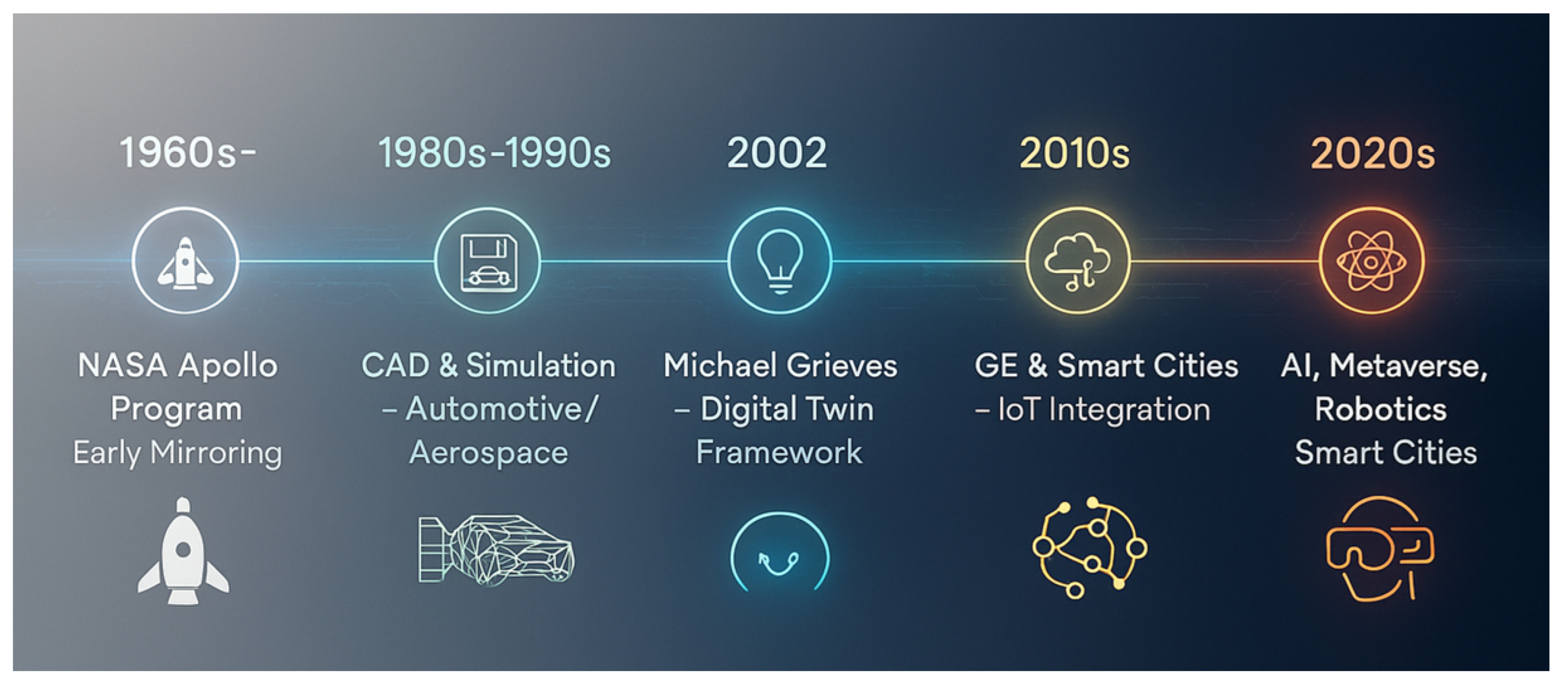
Figure 2.
Four-Layer Metaverse-Enabled DIGital Twins Enterprise (MEDIGATE) Architectural Framework for Proactive Smart Cities.
Figure 2.
Four-Layer Metaverse-Enabled DIGital Twins Enterprise (MEDIGATE) Architectural Framework for Proactive Smart Cities.
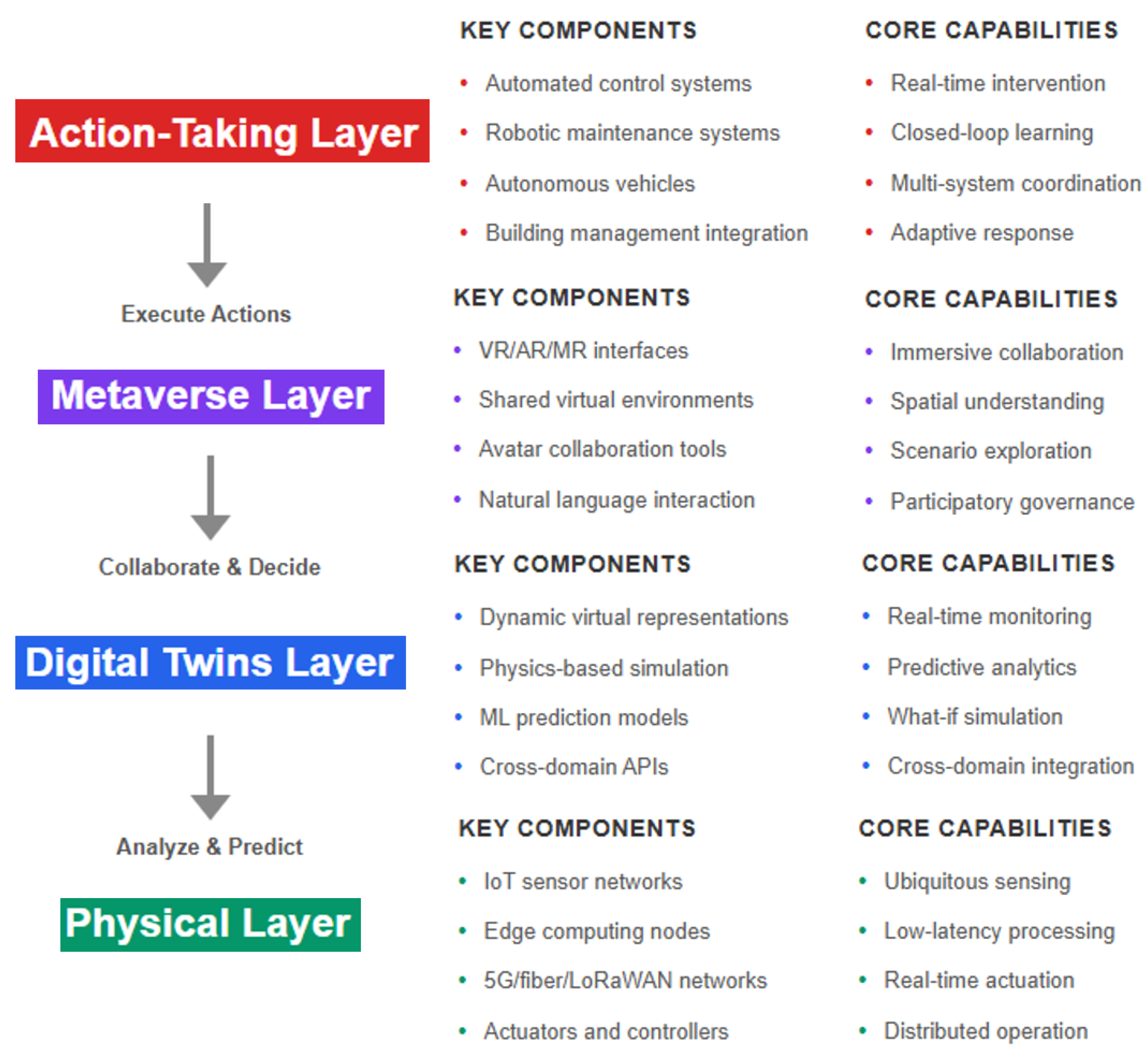
Figure 3.
Implementation Pathway from Microverses to Comprehensive Metaverse. Stage 1 focuses on domain-specific immersive environments operating independently to generate immediate value. Stage 2 implements selective integration where microverses with strong interdependencies coordinate through standardized interfaces. Stage 3 achieves comprehensive metaverse integration enabling holistic urban optimization.
Figure 3.
Implementation Pathway from Microverses to Comprehensive Metaverse. Stage 1 focuses on domain-specific immersive environments operating independently to generate immediate value. Stage 2 implements selective integration where microverses with strong interdependencies coordinate through standardized interfaces. Stage 3 achieves comprehensive metaverse integration enabling holistic urban optimization.
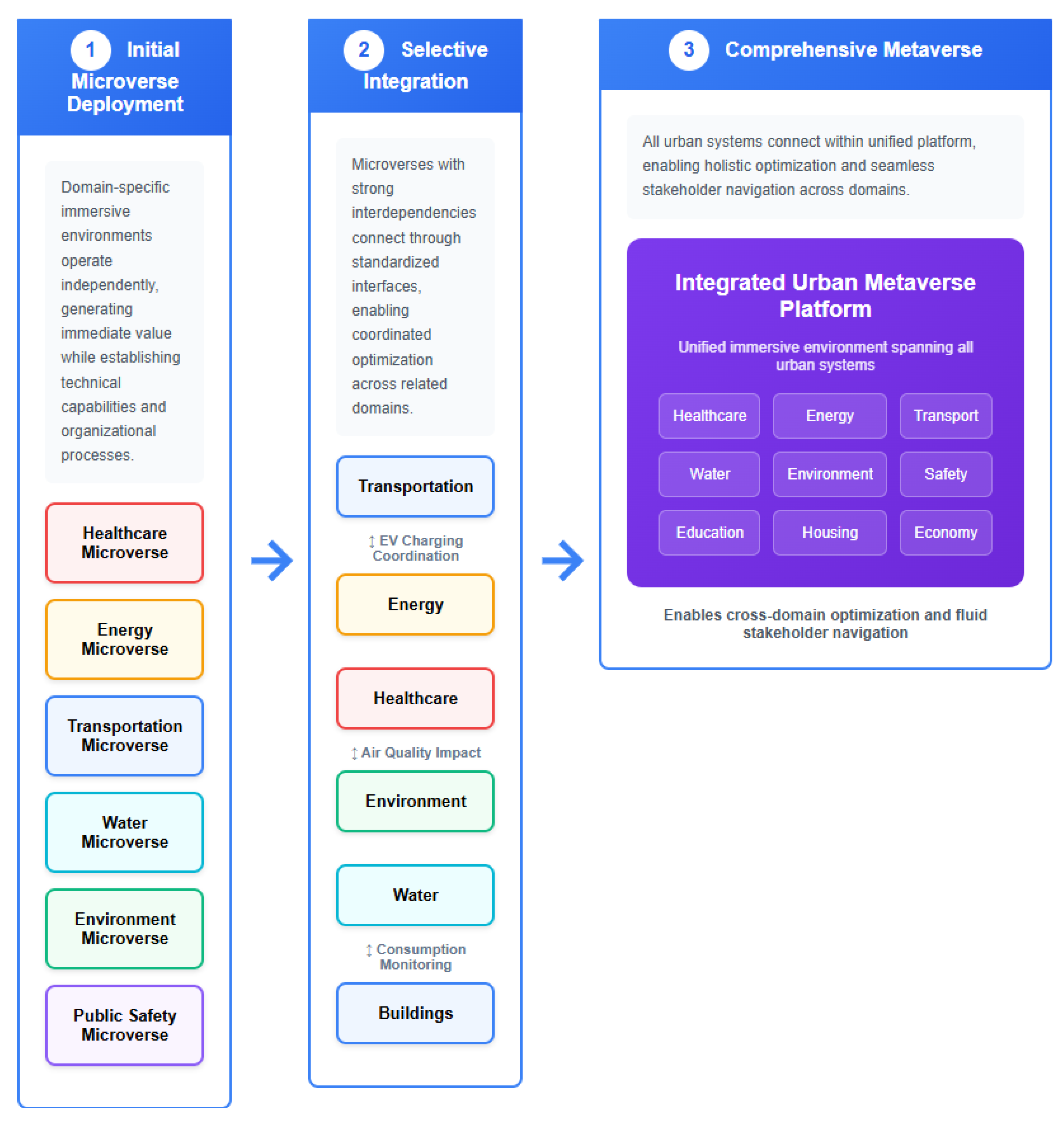
Figure 4.
Key architectural principles, including standardized interfaces, unified authentication, shared platforms, federated governance, privacy preservation, and incremental value generation, enable this progressive evolution.
Figure 4.
Key architectural principles, including standardized interfaces, unified authentication, shared platforms, federated governance, privacy preservation, and incremental value generation, enable this progressive evolution.
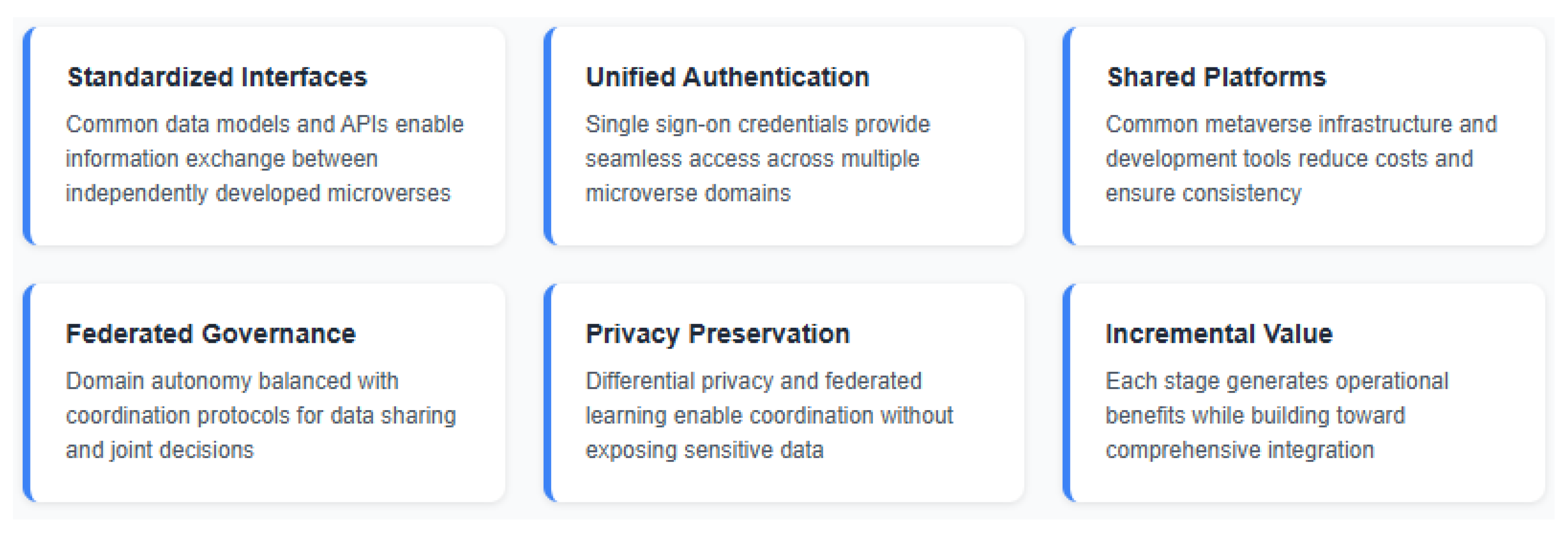
Figure 5.
Transformation from Reactive to Proactive Healthcare Management Through Metaverse-Enabled DTs.
Figure 5.
Transformation from Reactive to Proactive Healthcare Management Through Metaverse-Enabled DTs.

Figure 6.
Key Transformation Dimensions.

Figure 7.
Patient Digital Twin Fusion Engine Architecture.
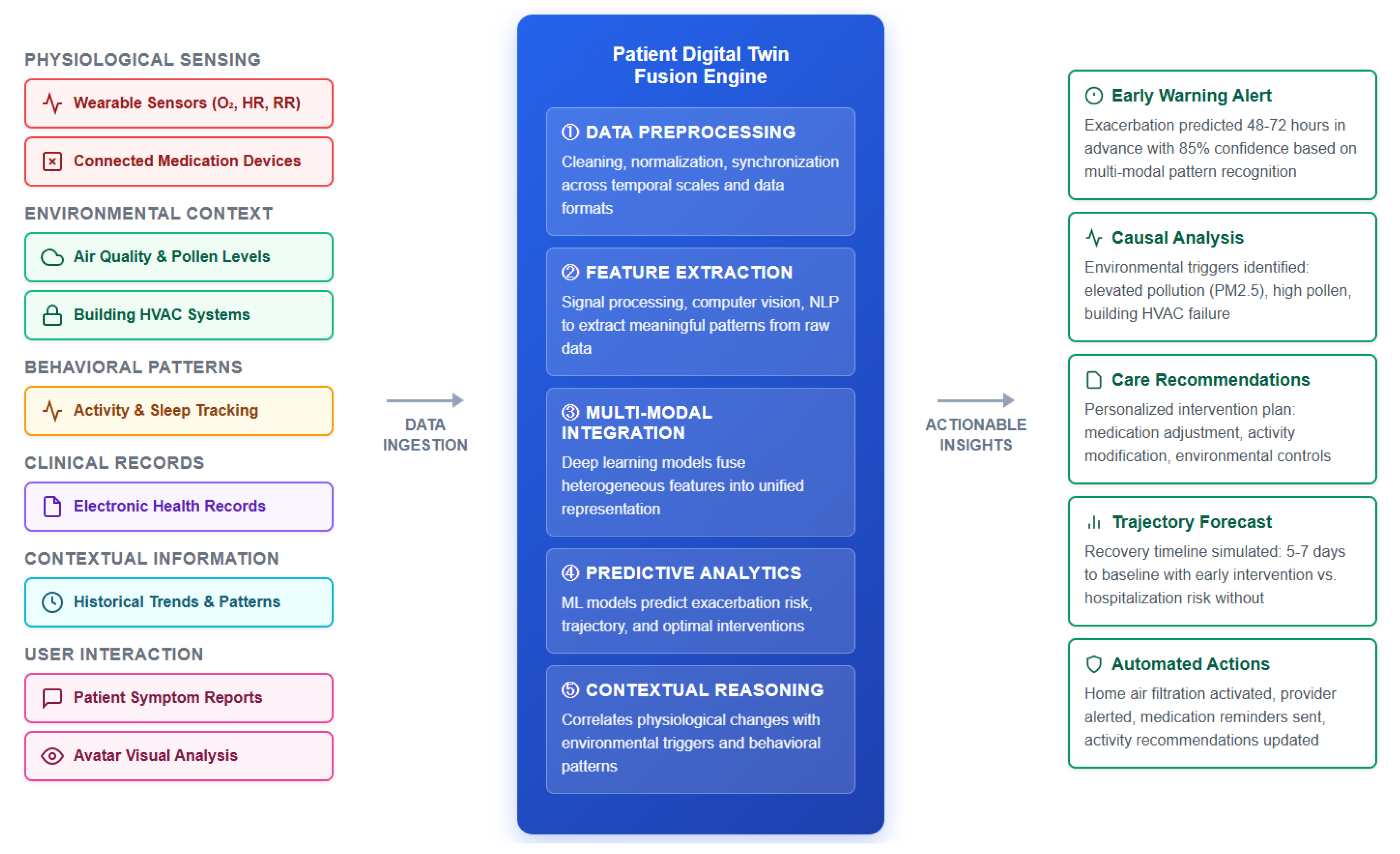

Table 1.
Forward Navigation.
| Next Section | Strategic Focus | What the Reader Should Expect |
|---|---|---|
| Section 2: Current State of Digital Twins in Smart Cities | Benchmark the landscape; identify structural gaps in today’s DT deployments | Evidence-based review of existing DT implementations, limitations of siloed systems, and why incremental refinement won’t cut it. |
| Section 3: MEDIGATE Architectural Framework | Introduce the four-layer architecture as the core operating model | Breakdown of physical, DT, metaverse, and action-taking layers; explanation of emergent capabilities achievable only through integration. |
| Section 4: From Microverses to a Metaverse | Define the scalable deployment path | Microverse strategy, incremental rollout logic, and principles enabling long-term integration across domains. |
| Section 5: Immersive Healthcare Case Study | Demonstrate the MEDIGATE architecture through a high-value domain | Walkthrough of proactive healthcare scenarios; multi-modal information fusion; automated intervention loops. |
| Section 6: Technical Foundations & Enabling Technologies | Translate vision into technical feasibility | Deep dive into IoT, edge computing, AI/ML, XR, robotics, and fusion models—what’s mature, what’s emerging, and what’s missing. |
| Section 7: Challenges & Research Directions | Surface systemic constraints and governance issues | Privacy, data reliability, equity, sustainability, governance, and organizational capacity requirements. |
| Section 8: Conclusion | Connect the entire narrative to actionable futures | Why proactive cities require immersive DT ecosystems and how to operationalize the transformation over time. |
Table 2.
Section 6 Key Points.
| Domain | Core Value | Primary Constraint |
|---|---|---|
| IoT & Sensors | City-scale situational awareness enabling real-time DT updates | Power limits, calibration drift, and environmental interference |
| Edge Computing | Low-latency local processing for responsive DT simulations | Resource constraints and coordination complexity across distributed nodes |
| AI / ML | Predictive modeling and automated decision support | Bias, opacity, and high computational demand |
| Extended Reality (XR) | Immersive collaboration and intuitive system interaction | Accessibility gaps, privacy risks, and immature tooling |
| Robotics & Autonomy | Physical actuation and on-site automated intervention | Perception unreliability in variable, unstructured environments |
| Information Fusion & LLMs | Multi-modal integration and natural language interfaces | Hallucination risks, bias, and deployment overhead |
| Technology Convergence | Synergistic DT–XR–AI–edge–robotics integration enabling proactive cities | Integration, scalability, and reliability barriers |
Table 3.
Section 7 Key Points: Challenges and Research Directions.
| Challenge Domain | Core Issue | Strategic Takeaway |
|---|---|---|
| Privacy in Immersive Ecosystems | XR and DT platforms capture intimate behavioral, biometric, and cognitive signals. | Protection requires multi-layer privacy architectures (federated data, differential privacy, policy guardrails). |
| Data Reliability & Algorithmic Accountability | Sensor drift, fused-data uncertainty, ML bias, and opaque models undermine trust. | Systems need auditable pipelines, interpretable AI, and accountability frameworks. |
| Computational Demands & Sustainability | LLMs, XR rendering, and DT simulations strain compute, memory, and energy budgets. | Scalable deployment depends on efficient models, compression, specialized hardware, and energy-aware design. |
| Digital Divide & Inclusive Design | Immersive platforms risk privileging well-resourced users and marginalizing vulnerable groups. | Multi-modal access, inclusive UX, and equitable distribution of benefits are mandatory. |
| Governance & Democratic Accountability | Integrated DT ecosystems intensify surveillance risks and power imbalances. | Transparent governance, participatory processes, and rights-preserving oversight are essential. |
| Organizational & Financial Sustainability | Long-term operation outlasts pilot enthusiasm; skills gaps and uncertain funding undermine continuity. | Cities need stable funding, workforce development, federated operating models, and continuous-improvement processes. |
| Research Agenda | Technical, social, ethical, and policy gaps require coordinated work across disciplines. | Progress hinges on interdisciplinary research, testbeds, open data, and long-horizon investment. |
Disclaimer/Publisher’s Note: The statements, opinions and data contained in all publications are solely those of the individual author(s) and contributor(s) and not of MDPI and/or the editor(s). MDPI and/or the editor(s) disclaim responsibility for any injury to people or property resulting from any ideas, methods, instructions or products referred to in the content. |
© 2025 by the authors. Licensee MDPI, Basel, Switzerland. This article is an open access article distributed under the terms and conditions of the Creative Commons Attribution (CC BY) license (http://creativecommons.org/licenses/by/4.0/).
Copyright: This open access article is published under a Creative Commons CC BY 4.0 license, which permit the free download, distribution, and reuse, provided that the author and preprint are cited in any reuse.


