

Submitted:
05 November 2025
Posted:
10 November 2025
You are already at the latest version
Abstract
Wearable light loggers and optical radiation dosimeters are increasingly used to quantify personal light exposure in research and clinical contexts. However, the growing diversity of devices poses challenges for researchers selecting appropriate instruments. We present an open-access, web-based specification tool for wearable light loggers and optical radiation dosimeters that provides a structured framework for defining, comparing, and communicating device requirements. The tool integrates expert-informed parameters spanning usability, fidelity, and data requirements and generates exportable Word or PDF specifications suitable for procurement or documentation. By supporting transparent and consistent specification, the tool contributes to harmonisation in light exposure research and facilitates reproducibility and interoperability.
Keywords:
wearable devices
; light exposure
; dosimetry
; circadian lighting
Introduction
Quantifying personal light exposure is central to research on circadian rhythms, visual performance, and light-related health outcomes [1,2,3,4]. Wearable light loggers and optical radiation dosimeters enable measurement of real-world exposure in ecological contexts, yet the landscape of available devices is highly fragmented [5]. Differences in spectral sensitivity [6], wearing position [7], battery life, and data access complicate comparison and reproducibility across studies.
To support researchers in selecting and specifying appropriate devices, we developed an online Wearable Light Logger and Optical Radiation Dosimeter Specification Tool (https://tscnlab-wearable-devices-specification.share.connect.posit.cloud/). The tool was created as part of the Metrology for wearable light loggers and optical radiation dosimeters (MeLiDos [8]) project.
Tool Description
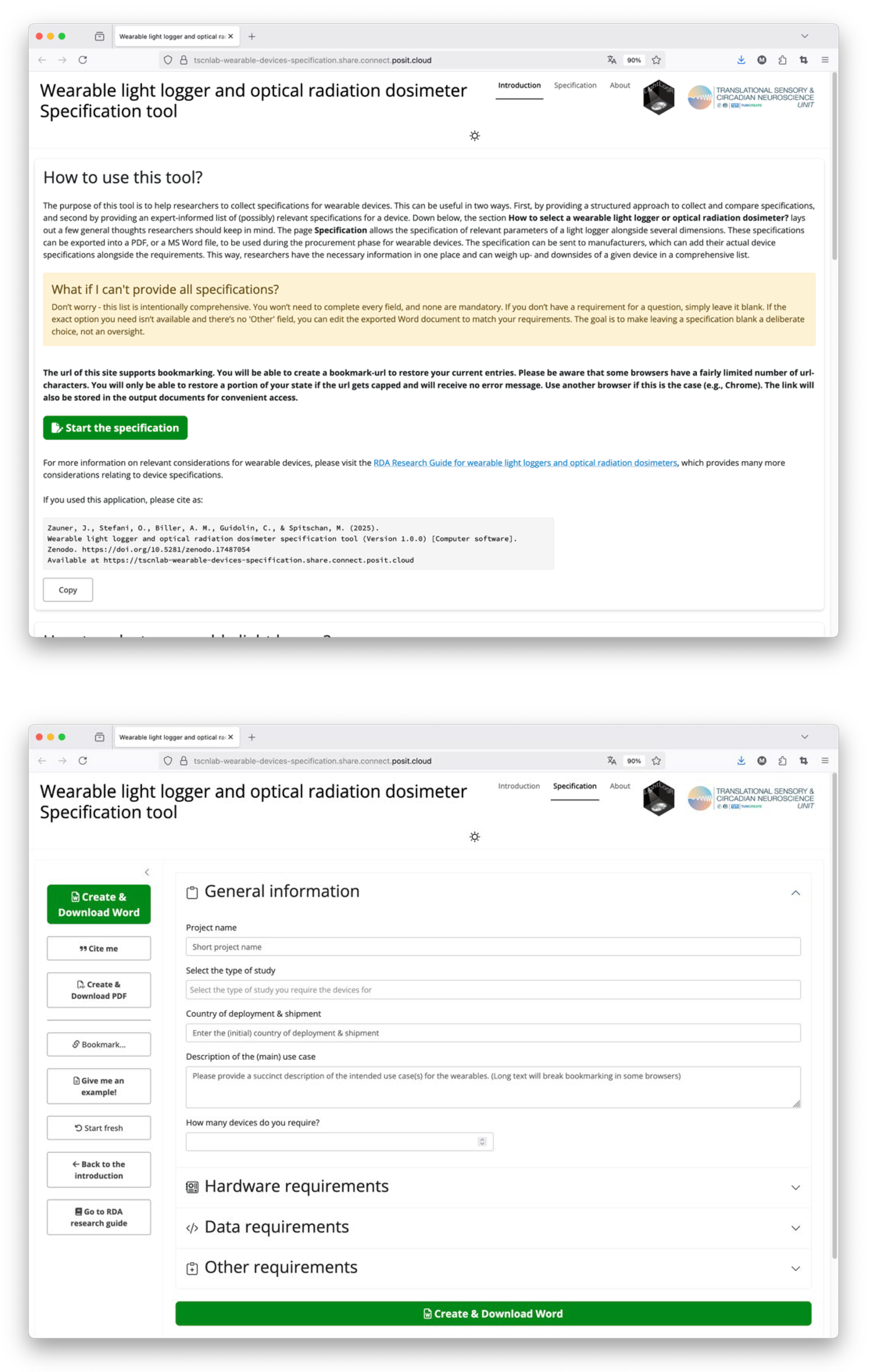
The Specification Tool provides a structured and interactive way to collect relevant device specifications, organised into three sections:
- General Information, including project name, country of deployment, and study type.
- Hardware Requirements, covering sensor type, spectral range, dynamic range, sampling frequency, field of view, attachment methods, and power characteristics.
- Data and Other Requirements, specifying data access (e.g., raw data export), privacy considerations, synchronisation options, and calibration needs.
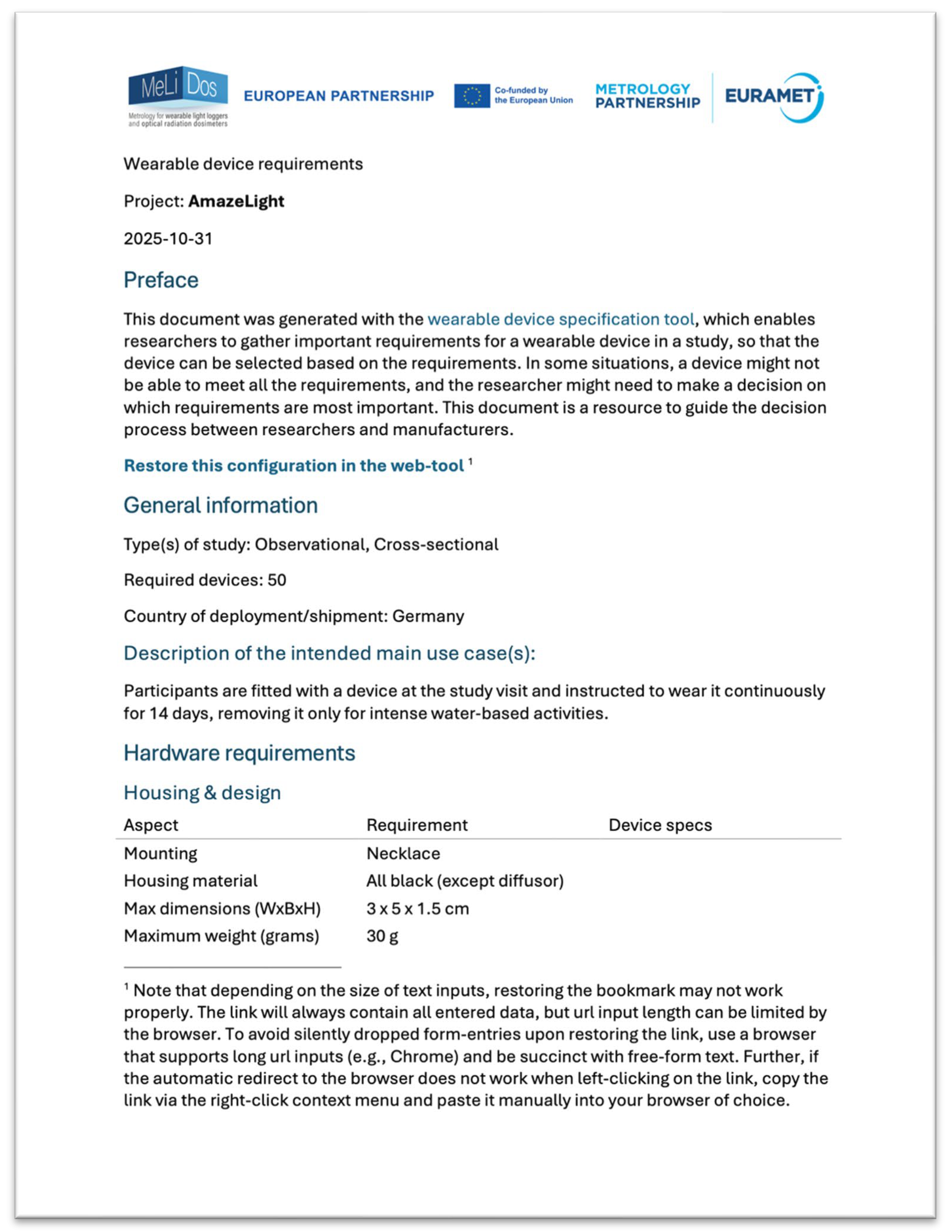
Each field is accompanied by short guidance notes to assist users in defining their requirements (see Figure 1). Once completed, the specification can be exported as a Word or PDF document (Figure 2), which may be shared with manufacturers to specify device requirements, or used in grant documentation and procurement workflows. While the tool offers comprehensive descriptions of device specifications, the user can select those relevant to their specific project, and leave unrelated or unnecessary fields empty. The tool automatically includes a unique, bookmarkable URL for restoring the specified configuration.

Table 1.
Overview of device specification requirements.
| Category | Aspect |
|---|---|
| Housing & Design | Mounting |
| Housing material | |
| Max dimensions (W×B×H) | |
| Maximum weight | |
| Special design considerations | |
| Measurement & Sensors | Spectral range |
| Spectral resolution | |
| Spectral sensitivity ≥ 1000 nm | |
| Illuminance range | |
| Field of view | |
| Modalities other than light | |
| Sampling frequency | |
| Battery & Storage | Continuous runtime |
| On-device capacity | |
| Operating Environment | Temperature range |
| Humidity range | |
| IP rating | |
| Controls & Indicators | Event marker button |
| Start/stop button | |
| User feedback | |
| Connectivity & I/O | Connectors |
| Wireless connectivity | |
| Software & Data | Operating systems |
| Export format | |
| Export variables | |
| Timestamp format | |
| Recording interval | |
| Interval flexibility | |
| DST handling | |
| Metadata storage | |
| Automation & Storage | Automated flagging |
| Storage location | |
| Budget & Calibration | Max. budget per device |
| Warranty/insurance | |
| Calibration validity | |
| Recalibration procedure | |
| Miscellaneous | Test device required |
| Protective case | |
| Participant instructions |
Conceptual Framework
The tool is informed by two key dimensions that shape the selection of wearable light loggers:
- Long-term usability: comfort, form factor, attachment, battery life, and storage capacity, which determine whether a device can be used for days or weeks in naturalistic conditions.
- Measurement fidelity and accuracy: spectral and directional sensitivity, linearity, and proximity to the corneal plane, determining how well recorded signals reflect biologically relevant exposure.
These dimensions are often in tension: devices worn near the eye yield the most accurate estimates of retinal irradiance but may be impractical for extended wear. The amount of light measured at different positions on the body may vary considerably [9,10,11,12]. The specification tool helps researchers make these trade-offs explicit during study planning.
Typical Use Cases
The framework distinguishes between short-, medium-, and long-term deployments:
- Short-term (< 24 h): e.g., verifying light stimulus delivery in laboratory or clinical protocols.
- Medium-term (up to 21 days): e.g., assessing habitual exposure in field studies or intervention monitoring.
- Long-term (> 21 days): e.g., longitudinal monitoring, capturing seasonal and environmental variability.
By articulating requirements within these categories, users can identify devices best suited to their scientific goals and practical constraints.
Integration with Community Standards
The specification tool complements ongoing community efforts to standardise wearable light exposure measurement. It links directly to the RDA Researcher Guide for Wearable Light Loggers and Optical Radiation Dosimeters (https://rda-wg-visualexperiencedata.github.io/ResearcherGuide/), which outlines best practices for calibration, metadata reporting, and data sharing. It further directly affects downstream analyses from specified devices, as these rely on device outputs aligned with researchers’ projects. The open-source package LightLogR [13] builds on standardised outputs that are specified within the tool. Together, these resources promote transparency and comparability in optical radiation exposure studies.
Outlook
As light and health research grows, there is a critical need for open, interoperable tools that bridge technical device specifications and experimental design. The Wearable Light Logger and Optical Radiation Dosimeter Specification Tool provides an accessible entry point for researchers, helping them make informed procurement decisions and supporting reproducible science. Future iterations will incorporate direct manufacturer input and allow for benchmarking of device performance against standardised test data.
Implementation
The Wearable Light Logger and Optical Radiation Dosimeter Specification Tool was implemented using the R Shiny framework and deployed through Posit Cloud (formerly RStudio Cloud), enabling accessible, browser-based use without local installation. The app’s modular structure separates user interface components (ui.R) from reactive server logic (server.R), facilitating easy updates and version control.
All content and selection options are defined in structured configuration files that can be modified independently of the app logic, allowing rapid extension as new device classes or specifications emerge. Outputs are generated dynamically using Quarto [14], a modern scientific publishing system, producing downloadable Word (.docx) and PDF (.pdf) files containing the user-defined specification (see Figure 2). The bookmarked session URL allowsreproducibility and intermittent sessions
Figure 2.
First page of an exemplary specification export.
The implementation emphasizes data privacy and offline compatibility: no user-entered information is stored on external servers beyond the active session. The app code and versioned releases are hosted on Zenodo (DOI: https://doi.org/10.5281/zenodo.17487054) for transparency and long-term accessibility.
Resource and Code Availability
The tool is available on the web:
Zauner, J., Stefani, O., Biller, A. M., Guidolin, C., & Spitschan, M. (2025). Web-based specification tool for wearable light loggers and optical radiation dosimeters (Version 1.0.1) [Software]. https://doi.org/10.17617/1.04ga-fd22
The underlying code is openly available via Zenodo:
Zauner, J., Stefani, O., Biller, A. M., Guidolin, C., & Spitschan, M. (2025). Web-based specification tool for wearable light loggers and optical radiation dosimeters (Version 1.0.1) [Code]. Zenodo. https://doi.org/10.5281/zenodo.17487054
Funding
European Partnership on Metrology, Metrology for wearable light loggers and optical radiation dosimeters (MeLiDos).
Wellcome Trust, 226787/2/22/Z.
Reality Labs Research.
Max Planck Society.
Declaration of Conflicting Interests
M.S. declares the following potential conflicts of interest in the past five years (2021–2025). Academic roles: Member of the Board of Directors, Society of Light, Rhythms, and Circadian Health (SLRCH); Chair of Joint Technical Committee 20 (JTC20) of the International Commission on Illumination (CIE); Member of the Daylight Academy; Chair of Research Data Alliance Working Group Optical Radiation and Visual Experience Data. Remunerated roles: Speaker of the Steering Committee of the Daylight Academy; Ad-hoc reviewer for the Health and Digital Executive Agency of the European Commission; Ad-hoc reviewer for the Swedish Research Council; Associate Editor for LEUKOS, journal of the Illuminating Engineering Society; Examiner, University of Manchester; Examiner, Flinders University; Examiner, University of Southern Norway. Funding: Received research funding and support from the Max Planck Society, Max Planck Foundation, Max Planck Innovation, Technical University of Munich, Wellcome Trust, National Research Foundation Singapore, European Partnership on Metrology, VELUX Foundation, Bayerisch-Tschechische Hochschulagentur (BTHA), BayFrance (Bayerisch-Französisches Hochschulzentrum), BayFOR (Bayerische Forschungsallianz), and Reality Labs Research. Honoraria for talks: Received honoraria from the ISGlobal, Research Foundation of the City University of New York and the Stadt Ebersberg, Museum Wald und Umwelt. Travel reimbursements: Daimler und Benz Stiftung. Patents: Named on European Patent Application EP23159999.4A (“System and method for corneal-plane physiologically-relevant light logging with an application to personalized light interventions related to health and well-being”). With the exception of the funding source supporting this work, M.S. declares no influence of the disclosed roles or relationships on the work presented herein. The funders had no role in study design, data collection and analysis, decision to publish or preparation of the manuscript.
J.Z. declares the following potential conflicts of interest in the past five years (2021-2025). Academic roles: Member of Joint Technical Committee 20 (JTC20) of the International Commission on Illumination (CIE); Member of Research Data Alliance Working Group Optical Radiation and Visual Experience Data; Speaker of group 2 (melanopic effects of light) of the Technical Scientific Committee (TWA) of the German Society of Lighting Technology and Design (LiTG) Remunerated roles: Examiner, Swiss Lighting Society; Teacher, LiTG; Teacher, University of Applied Sciences, Munich, Teacher, Technical University of Applied Sciences, Rosenheim. Associated partner, 3lpi lighting design + engineering, Munich. Tool- and 3D-model design, Zumtobel Lighting GmbH; Course design, University of Applied Sciences, Munich & Virtual University Bavaria. Honoraria for talks: Received honoraria from LiTG; Lamilux (Heinrich Strunz GmbH); Robert-Bosch Hospital Stuttgart; Ergotopia GmbH; German statutory accident insurance institution for the administrative sector (VBG); BRIXEN CULTUR, Italy; KITEO GmbH & Co.KG; University of Applied Sciences Augsburg. Travel reimbursements: Daimler und Benz Stiftung. Patents: Together with 3lpi holds a design patent for non-visually optimized luminaire (No 008194021-0001 through -0006) at the European Union Intellectual property office.
O.S. declares the following potential conflicts of interest in the past five years (2021-2025): Member of Joint Technical Committee 20 (JTC20) of the International Commission on Illumination (CIE), of the Daylight Academy, Good Light Group, Center for Environmental Therapeutics (CET) and the Board of Directors of the Swiss Lighting Society. O.S. is listed as an inventor on the following patents: “Display system having a circadian effect on humans”, US8646939B2; “Projection system and method for projecting image content”, DE102010047207B4; “Adaptive lighting system”, US8994292B2; “Projection device and filter therefor”, WO2006013041A1; “Method for the selective adjustment of a desired brightness and/or colour of a specific spatial area, and data processing device”, WO2016092112A1. O.S. has had the following commercial interests in the last five years related to lighting: investigator-initiated research grants from SBB, Skyguide, Zumtobel, Deutsche Flugsicherung (DFS), and Porsche.
C.G. and A.M.B. declare no potential conflicts of interested related to this project.
References
- Hartmeyer SL and Andersen M. Towards a framework for light-dosimetry studies: Quantification metrics. Lighting Research & Technology 2023; 56: 337-365. [CrossRef]
- Hartmeyer SL, Webler FS and Andersen M. Towards a framework for light-dosimetry studies: Methodological considerations. Lighting Research & Technology 2022; 55: 377-399. [CrossRef]
- Spitschan M, Smolders K, Vandendriessche B, et al. Verification, analytical validation and clinical validation (V3) of wearable dosimeters and light loggers. Digit Health 2022; 8: 20552076221144858. 20221225. [CrossRef]
- Danilenko KV, Stefani O, Voronin KA, et al. Wearable Light-and-Motion Dataloggers for Sleep/Wake Research: A Review. Applied Sciences 2022; 12. [CrossRef]
- van Duijnhoven J, Hartmeyer SL, Didikoglu A, et al. Measuring light exposure in daily life: A review of wearable light loggers. Building and Environment 2025; 274. [CrossRef]
- Price LL, Lyachev A and Khazova M. Optical performance characterization of light-logging actigraphy dosimeters. J Opt Soc Am A Opt Image Sci Vis 2017; 34: 545-557. [CrossRef]
- Zauner J, Biller AM and Spitschan M. Impact of light logger and dosimeter placement on wearability and appeal in real-life settings. Open Res Eur 2025; 5: 293. 20250922. [CrossRef]
- Spitschan M, Zauner J, Nilsson Tengelin M, et al. Illuminating the future of wearable light metrology: Overview of the MeLiDos Project. Measurement 2024; 235. [CrossRef]
- Stefani O, Marek R, Schwarz J, et al. Wearable Light Loggers in Field Conditions: Corneal Light Characteristics, User Compliance, and Acceptance. Clocks Sleep 2024; 6: 619-634. 20241025. [CrossRef]
- Aarts MPJ, van Duijnhoven J, Aries MBC, et al. Performance of personally worn dosimeters to study non-image forming effects of light: Assessment methods. Building and Environment 2017; 117: 60-72. [CrossRef]
- Yoshimura M, Kitamura S, Eto N, et al. Relationship between Indoor Daytime Light Exposure and Circadian Phase Response under Laboratory Free-Living Conditions. Biological Rhythm Research 2020; 53: 765-785. [CrossRef]
- Mohammadian N, Didikoglu A, Beach C, et al. A Wrist-Worn Internet of Things Sensor Node for Wearable Equivalent Daylight Illuminance Monitoring. IEEE Internet Things J 2024; 11: 16148-16157. 20240117. [CrossRef]
- Zauner J, Hartmeyer S and Spitschan M. LightLogR: Reproducible analysis of personal light exposure data. J Open Source Softw 2025; 10: 7601. [CrossRef]
- Allaire J, Teague C, Scheidegger C, et al. Quarto (Version 1.8). 2025.
Figure 1.
Graphical interface of the device specification tool.
Disclaimer/Publisher’s Note: The statements, opinions and data contained in all publications are solely those of the individual author(s) and contributor(s) and not of MDPI and/or the editor(s). MDPI and/or the editor(s) disclaim responsibility for any injury to people or property resulting from any ideas, methods, instructions or products referred to in the content. |
© 2025 by the authors. Licensee MDPI, Basel, Switzerland. This article is an open access article distributed under the terms and conditions of the Creative Commons Attribution (CC BY) license (http://creativecommons.org/licenses/by/4.0/).
Copyright: This open access article is published under a Creative Commons CC BY 4.0 license, which permit the free download, distribution, and reuse, provided that the author and preprint are cited in any reuse.


