

Submitted:
07 November 2025
Posted:
11 November 2025
Read the latest preprint version here
Abstract
In the modern microservice environment, the dependencies of libraries used for inter-system communication have become bloated, and conflicts and complications during build and operation have become problems. In particular, in the conventional communication architecture that depends on the MySQL database, the multi-layer dependencies included in \texttt{libmysqlclient} restrict the flexibility of system design. In this study, a replication-protocol-compatible patch was applied to the lightweight MySQL client library Trilogy, and a loosely coupled, low-footprint IPC library connecting the control plane and the data plane was implemented. The proposed method eliminates dependencies on the internal static library group of MySQL Server, while enabling binary log events to be processed directly at the application layer. Stable operation has been achieved for more than one year in a commercial system environment, and its effectiveness has been evaluated.
Keywords:
Inter-Process Communication (IPC)
; MySQL
; microservices
1. Introduction
In recent years, distributed and microservice systems have been strongly dependent on multilayered software stacks and external libraries. Therefore, with the increase in dependencies, the decrease in maintainability and the risk of conflicts have become apparent. In particular, in the MySQL [1] environment, libmysqlclient is highly functional, but its implementation dependency is deep, and when dealing with the replication protocol, linking with many static libraries inside the server source is required (Table 1). This structure makes it difficult to apply lightweight or embedded environments.
In contrast, the lightweight MySQL client library Trilogy [2] published by GitHub adopts a design optimized for asynchronous I/O while minimizing external dependencies. In this study, by extending this Trilogy with the client implementation of the replication protocol (COM_BINLOG_DUMP=0x12)1, a low-overhead inter-process communication (IPC) module between the MySQL server and applications was realized.
2. Background and Issues
2.1. Overview of the Replication Mechanism
MySQL Server replication is mainly performed through binlog (binary log). All transaction events are recorded and transferred through the Log_event class group inside the server. The normal client library (libmysqlclient) implements only SQL-level communication such as COM_QUERY and COM_PING, and the replication protocol (COM_BINLOG_DUMP) is implemented only inside the server.
2.2. Dependent Source Files and Build Issues
In order to use the replication mechanism of MySQL Server directly on the application side, it is necessary to depend on the internal source files of the main server. The list is shown below.
- sql/log_event.cc Binlog event generation and base class definition
- sql/rpl_utility.cc Common utilities for replication
- sql/rpl_gtid_tsid_map.cc GTID/TSID management
- sql/rpl_gtid_misc.cc GTID auxiliary functions
- sql/rpl_gtid_set.cc GTID set operation
- sql/rpl_gtid_specification.cc GTID definition structure
- sql/rpl_tblmap.cc Table Map event processing
- sql/basic_istream.cc Basic implementation of stream I/O
- sql/binlog_istream.cc Binlog input stream processing
- sql/binlog_reader.cc Binlog reader class
- sql/stream_cipher.cc Binlog encryption processing
- sql/rpl_log_encryption.cc Replication log encryption
- libs/mysql/binlog/event/trx_boundary_parser.cpp Transaction boundary analysis
These source files are designed on the premise that they are used only inside mysqld, and it is also necessary to depend on the static libraries in Table 1 at build time.
For this reason, even if only libmysqlclient is linked, compilation and linking will not pass, and it is necessary to reproduce the entire build environment of MySQL Server. In addition, since these libraries are provided under the GPL-2 license, there are also licensing constraints for use in proprietary products by static linking.
2.3. Summary of Problems
The above structural issues are summarized as follows.
- Build Complexity: The number of dependent objects is large, and the reproducibility of the build environment is low.
- Maintenance Difficulty: The internal ABI tends to change with MySQL version upgrades, making relinking difficult.
- License Risk: It is necessary to link GPL code, which is not suitable for MIT/BSD environments.
2.4. Issues of libmysqlclient
To process replication events of MySQL Server, it is necessary to link internal library groups (libmysys.a, libmysql_binlog_event.a, libmysql_serialization.a, etc.) (see Table 1). These are designed for internal use of the server, and since they are not intended to be used externally, the build configuration becomes complicated, and ABI compatibility is not guaranteed.

Table 1.
mysql libraries
| Library | Function Summary | |
|---|---|---|
| 1 | libmysqlclient.a | Basic C API |
| 2 | libmysys.a | Internal utility group |
| 3 | libmysql_serialization.a | Protocol serialization |
| 4 | libmysql_binlog_event.a | Binlog event construction and analysis |
| 5 | libclientlib.a | Client I/O layer |
| 6 | libmysql_gtid.a | GTID tracking |
| 7 | libjson_binlog_static.a | Binlog JSON parser |
Using these involves operational risks in terms of both licensing and technology.
2.5. MySQL Dependency and System Design Constraints
libmysqlclient is distributed under GPL-2, and when statically linked in commercial systems, license risks arise. Also, since the group of dependent libraries is complex, conflicts and compatibility problems are likely to occur due to differences in build environments. These are fatal in resource-constrained environments such as IoT and edge devices.
3. Proposed Method
3.1. Low-Dependency IPC Design Using Trilogy
In this study, we use the MIT-licensed lightweight MySQL client Trilogy as a foundation, and by extending it with replication protocol functionality, we construct a low-dependency and loosely coupled IPC layer (Figure 1).
trilogy_binlog_dump() requests a binary log stream from the MySQL server.
trilogy_binlog_dump_recv() sequentially receives and analyzes event packets.
The event header is analyzed by trilogy_parse_binlog_event_packet(), and FORMAT_DESCRIPTION_EVENT, TABLE_MAP_EVENT, and WRITE_ROWS_EVENT are reconstructed in user space.
By this method, it became possible to handle the replication protocol directly from the application layer without depending on the internal structure of MySQL Server.
3.2. Microservice Configuration
This IPC library functions as an intermediate layer between the control plane (ctrl-plane) and the data plane (data-plane) in a microservice architecture (Figure 2). Applications subscribe to the binary logs of the MySQL server through Trilogy and can asynchronously transmit session information and commands.
3.3. Comparison of Evaluation Results
In this section, we compared the build cost and runtime overhead between the proposed method (Trilogy extension) and the conventional configuration using libmysqlclient. Table 1 shows the container size and build time measured in the Docker environment, and the performance comparison in a simple SQL insertion load test (noop 4ch).
Table 2.
mysql Trilogy Dependencies
| Item | Conventional (libmysqlclient) | Proposed (Trilogy extension) |
|---|---|---|
| Number of dependent sources | 13 or more | 0 |
| Static link libraries | 7 | 1 (libtrilogy.a) |
| License | GPL-2 | MIT |
| Build time | about 30 minutes | a few seconds |
| Execution performance | High speed | High speed |
Table 3.
Comparison between Trilogy and libmysqlclient (Docker environment)
| Item | Trilogy | mysqlclient | desc |
|---|---|---|---|
| Container Size $docker images | 531 MB | 2.85 GB | In order to link the replication protocol parser, it is necessary to compile and link the entire mysql-server source. Therefore, the container size becomes large, and in the Trilogy configuration, approximately 82% weight reduction was achieved. |
| Container build cost $docker build | 107.1 s | 252.3 s | Because it is necessary to clone the mysql-server source and pre-build the replication target library group, the build cost is large. On the other hand, the Trilogy configuration reduced the build time by about 58%. |
| noop (4ch) SFU Application | 6223 (333) | 6169 (333) | Under the simple SQL traffic condition of INSERT ONLY, approximately 1% load reduction was confirmed. This result shows the lightweight effect of performing replication processing at the application layer. |
In the Trilogy-based configuration, significant improvements were confirmed in build cost, dependent libraries, and container size compared to the libmysqlclient configuration.
3.4. Context Switch Comparison
In this section, we verified the differences in I/O context management methods between the proposed method (Trilogy extension) and the conventional method (libmysqlclient), and analyzed the effect on the number of context switches. Measurements used pidstat -wt 1 and strace -fc -p (pid), and in addition, the call path of poll(2) was traced from symbol traces using gdb.
As shown in Figure 3, in the Trilogy implementation, the main thread contexts A, B, and C generate context switches in a stable cycle.
- Point A In SFU-0 (main thread) and SFU-2 (DB Ingress context), a polling loop with an interval of 1 ms as designed is maintained, and stable scheduling was confirmed even under increased load.
- Point B The RTC / SCTP / JUICE prefixes are internal threads of libdatachannel, and at PeerConnection initialization, std::threads equal to the number of CPU cores are generated, and event wait loops are resident.
- Point C The JUICE lower layer (UDP socket processing) uses a receive loop based on poll(2), and showed a tendency for CS to increase in proportion to the number of sessions.
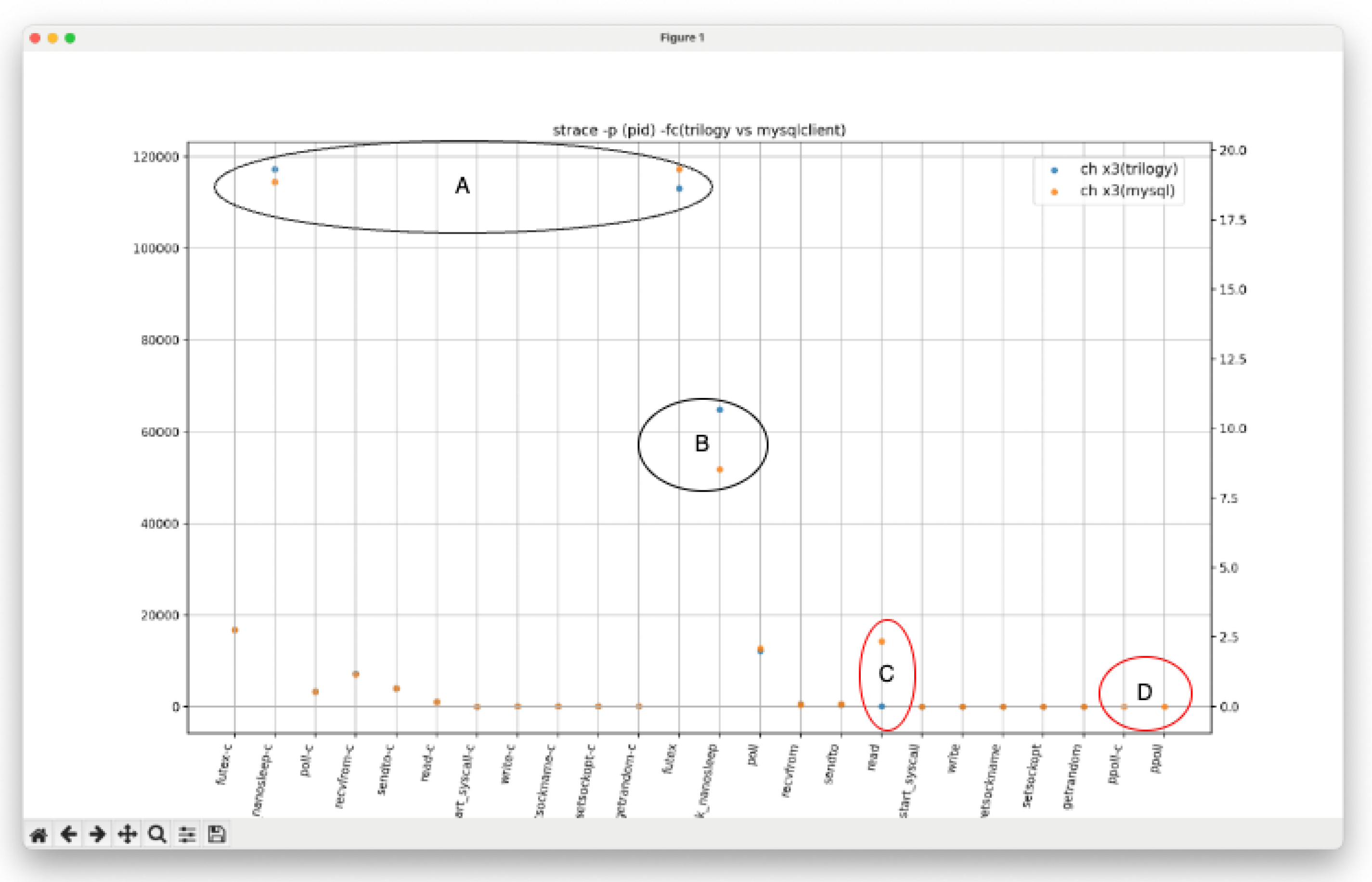
As shown in Figure 4, the number of poll(2) calls and the presence or absence of ppoll(2) usage were confirmed as the main differences between the two implementations.
- Point A/B The difference between Trilogy and mysqlclient appeared as a difference in lock waits and the number of usleep(2) calls.
- Point C/Dmysqlclient uses ppoll(2) and performs waits accompanied by signal mask processing. On the other hand, Trilogy specifies infinite waiting (timeout=-1) with poll(2) only, and waits for socket state changes while occupying the thread context.
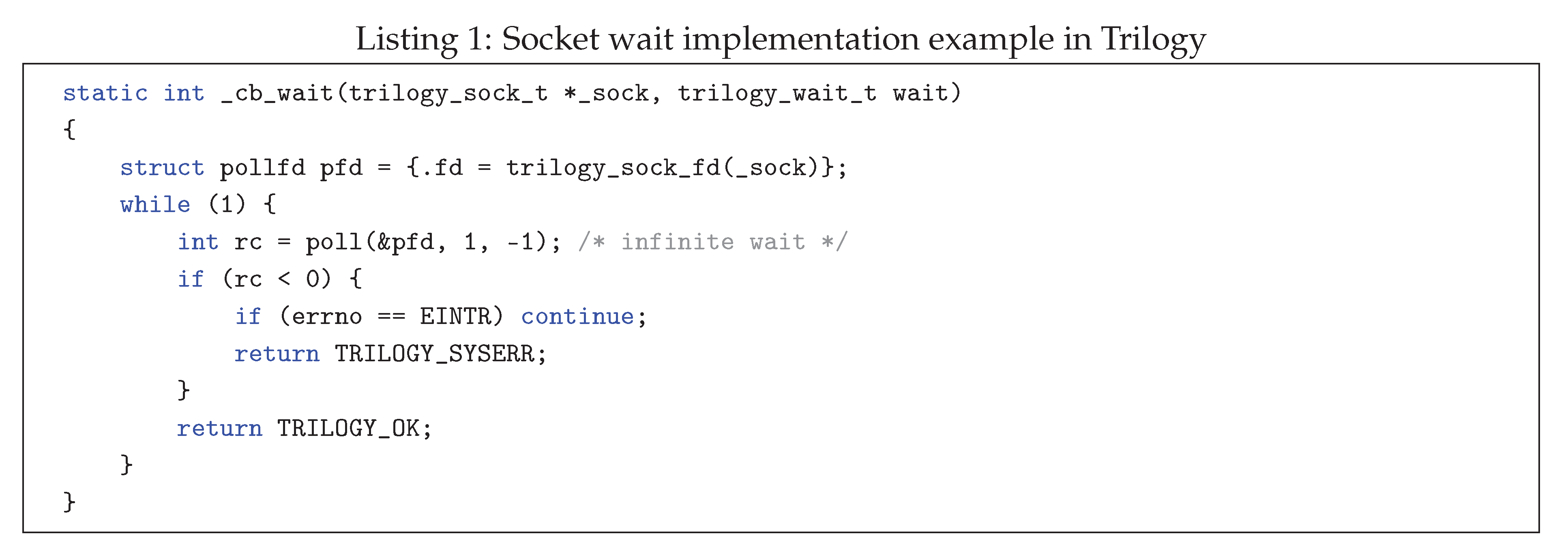
The design of Trilogy does not aim to improve throughput by asynchronous I/O, but aims at maintaining the performance of the main context by reducing context switches. By performing infinite waiting with poll(2), it can wait while keeping the CPU cache, and suppress unnecessary thread scheduling. In contrast, in the libmysqlclient implementation (vio/viosocket.cc), it was confirmed that 0 (non-blocking) is specified for the timeout of poll(2). This is as shown in the following excerpt.
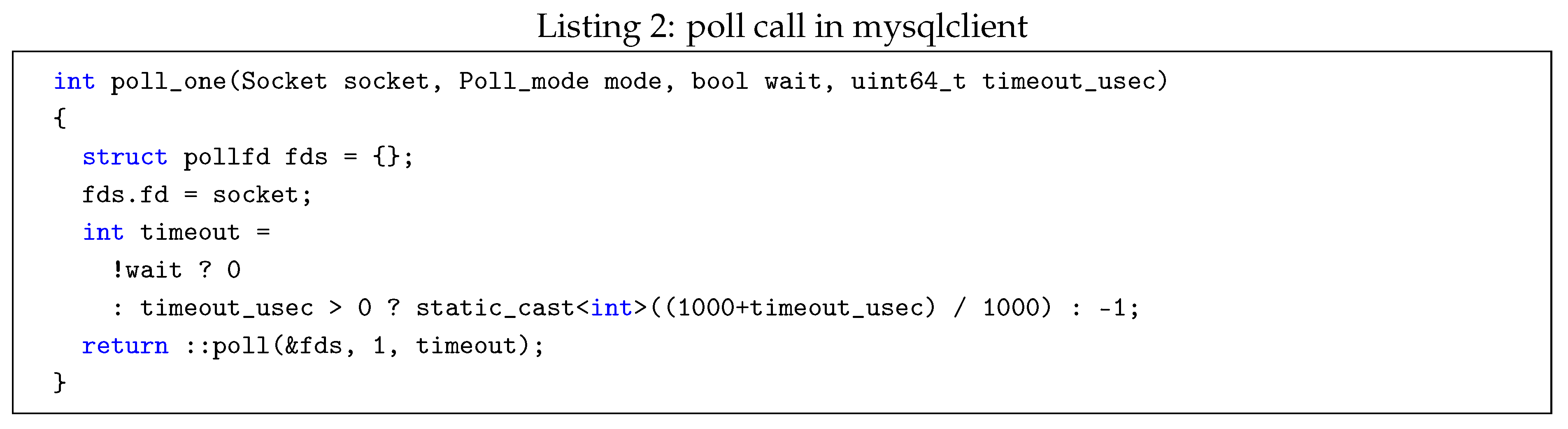
As a result of gdb analysis, in the mysqlclient implementation, non-blocking operation by poll(0) was frequently observed, and since this is combined with ppoll(2) accompanied by signal mask processing, the number of context switches tends to be larger than Trilogy.
3.5. Discussion
The reduction of context switches in Trilogy is based on a design that suppresses competition for CPU caches and memory access bandwidth, and maintains consistent performance of the application main context. In modern multi-core environments, it suggests that suppressing unnecessary scheduling contributes more to performance improvement than improving throughput through asynchronous I/O.
On the other hand, the design that causes frequent context switches by using short-timeout polling and signal masks as in libmysqlclient is effective in ultra-high-load and multi-connection environments. Because frequent scheduling distributes CPU usage and ensures fairness among waiting threads, the balance between fairness and throughput is improved. In a single IPC environment such as this study, rather, suppressing context switches by infinite waiting with poll(-1) contributes to maintaining main context performance, but in multi-connection environments, the strategy of signal mask + short-term polling tends to be advantageous.
4. Related Works
Regarding performance design and communication efficiency in microservice architectures, various studies have been conducted in recent years. The study “Experimental Evaluation of Architectural Software Performance Design Patterns in Microservices” by Meijer, Trubiani, and Aleti (2024) [3] is a comprehensive research work that experimentally evaluated the impact of microservice design patterns on system performance. In that study, three design patterns—Gateway Aggregation, Gateway Offloading, and Pipes and Filters— were targeted, and measurements were collected in actual cloud environments and consistency with the theoretical model (queueing network model) was verified. As a result, the differences between theoretical performance prediction and measured results in actual operation were clarified, particularly the occurrence of bottleneck switching and nonlinear behavior of CPU utilization. The study by Meijer et al. clarifies the performance impact of design choices across the entire microservice configuration, while this study is characterized by quantifying the specific impact of implementation choices in the communication layer (whether libmysqlclient or Trilogy) on system performance. While the former discusses macro-level optimization of design patterns, the latter (this study) presents micro-level optimization of the library layer that forms its basis, and the two are in a complementary relationship.
As a future prospect, by integrating the IPC optimization knowledge at the library level obtained in this study (such as CS reduction effects and asynchronous I/O control characteristics) into performance models at the design-pattern level, it may be possible to construct a more accurate performance prediction model for the entire microservice architecture.
4.1. Context Switch and Performance Degradation in ManyCore Environments
The effectiveness of context switch (CS) reduction focused on in this study is a particularly important issue in modern multi-core and many-core architectures. In multi-core CPU environments, it is known that frequent CS between threads causes significant performance degradation due to the following factors.
- Loss of cache locality. Every time a CS occurs, the CPU cache lines are flushed, and the working set of the next thread is reloaded. This increases the L1/L2 cache miss rate and makes memory access latency significant.
- Movement between NUMA (Non-Uniform Memory Access) nodes. When a thread is scheduled to a different core, the memory reference node changes, increasing memory latency.
- Increase in interrupt handlers and kernel lock contention. In environments with high CS frequency, contention for kernel locks increases, and CPU cycles are wasted due to spinlocks.
These phenomena are particularly serious in microservice platforms that employ high-thread-density IPC processing and highly parallel event loops, and it has been reported that stabilization strategies by CS reduction are effective.
4.2. Summary
In modern many-core (16–64 core) environments: The Trilogy-type is optimal for use cases that “pin the CPU to a small number of tasks” (for example, low-latency IPC). The mysqlclient-type is optimal for use cases that “rotate the CPU among many tasks” (for example, web servers or DB clients).
Therefore, which is superior depends on the use case. When MySQL is used as IPC together with CPU pinning, the Trilogy-type is better (to dominate the main loop with poll(-1)), whereas in cases such as MySQL Connector or DB Proxy, which handle hundreds of connections in one process without CPU pinning, the strategy of frequent CS (short poll/ppoll) is considered to be globally optimal.
References
- Oracle Corporation: MySQL Internals Manual, 2024.https://dev.mysql.com/doc/internals/en/.
- GitHub: Trilogy is a client library for MySQL-compatible database servers, designed for performance, flexibility, and ease of embedding., 2023.https://github.com/trilogy-libraries/trilogy.
- W. Meijer, C. Trubiani, A. Aleti: “Experimental Evaluation of Architectural Software Performance Design Patterns in Microservices,” Journal of Systems and Software, 2024. DOI: 10.1016/j.jss.2024.112183.https://doi.org/10.1016/j.jss.2024.112183.
Figure 1.
IPC session
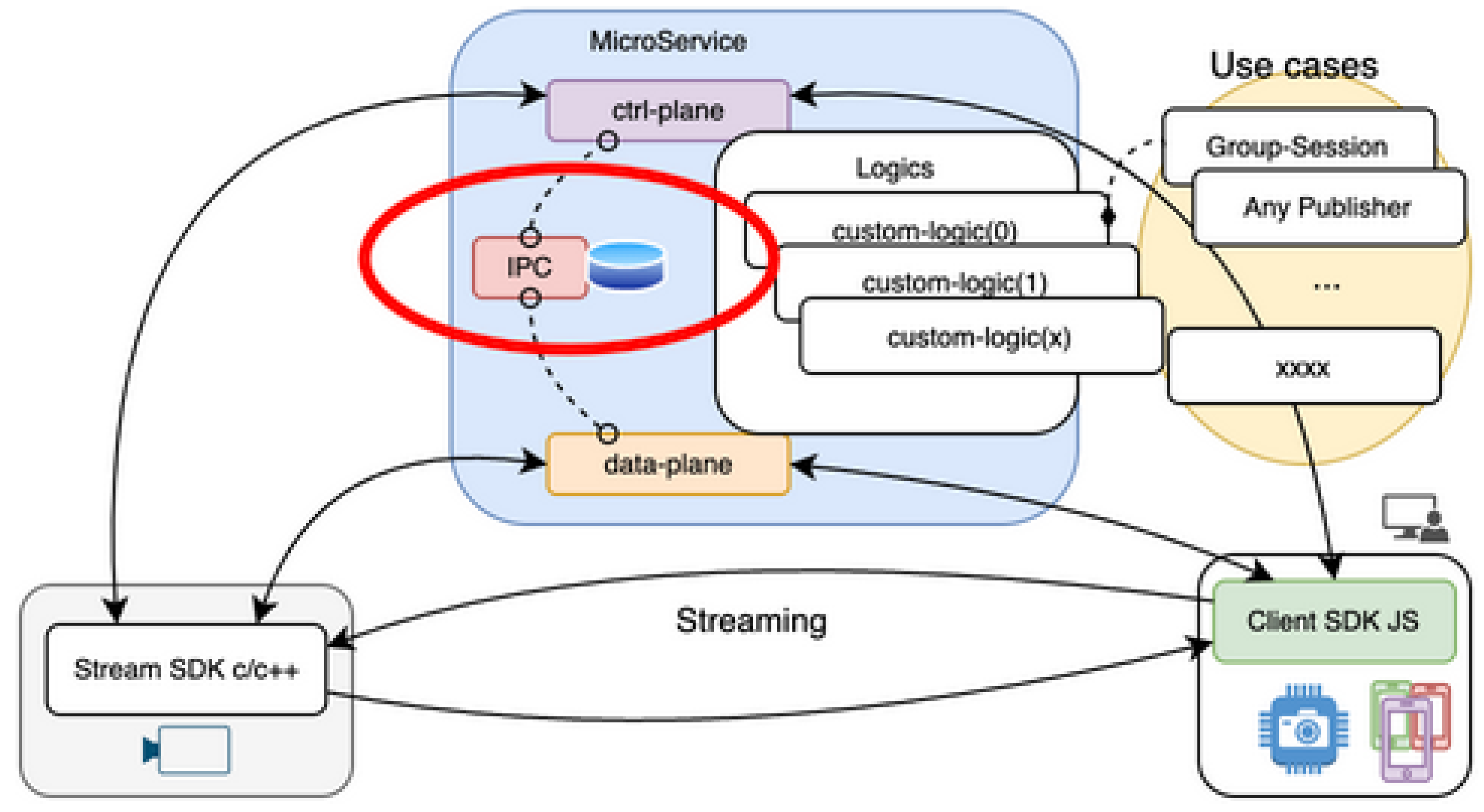
Figure 2.
IPC pub-sub
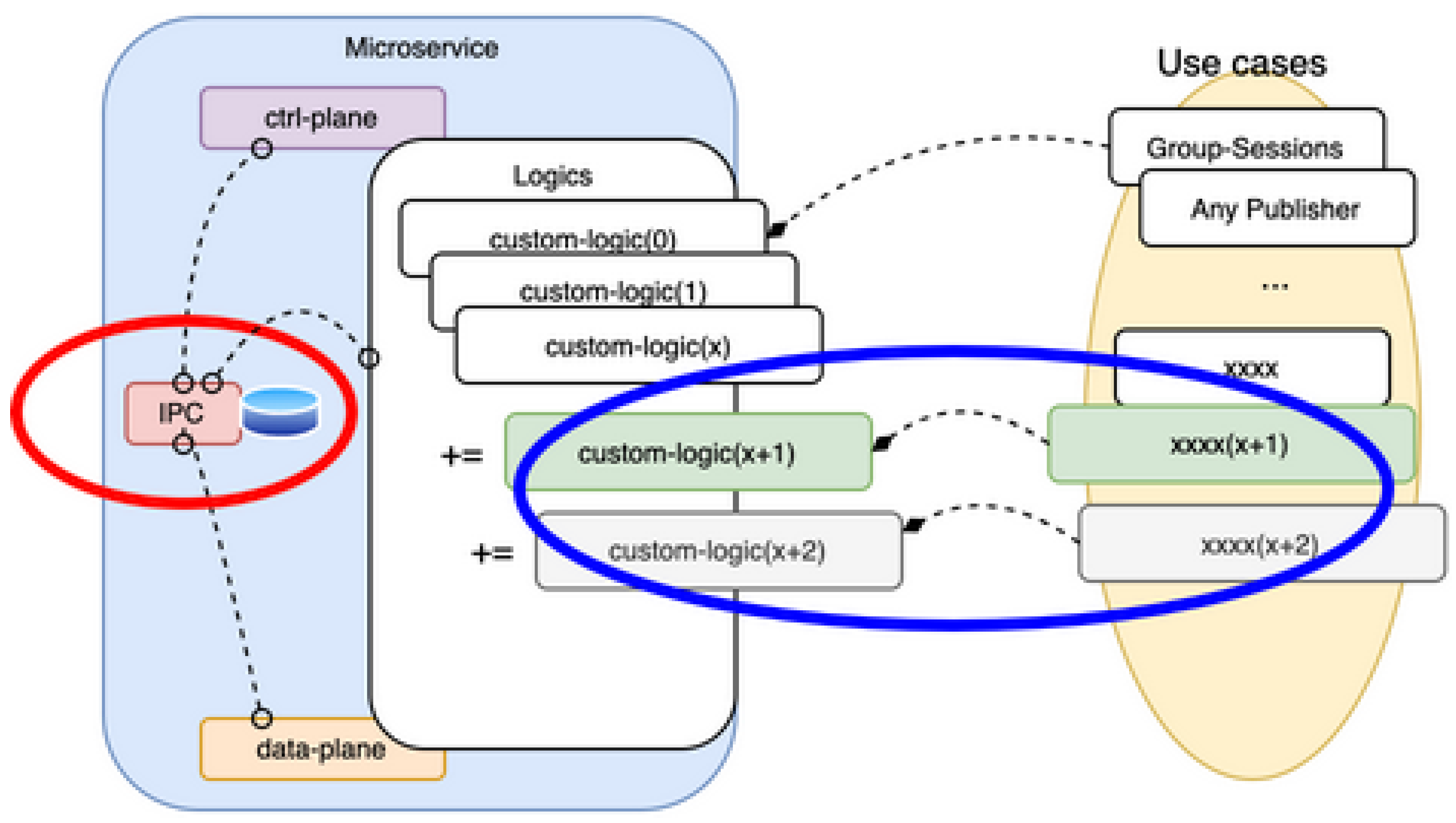
Figure 3.
CS distribution for each SFU context by pidstat (Trilogy)
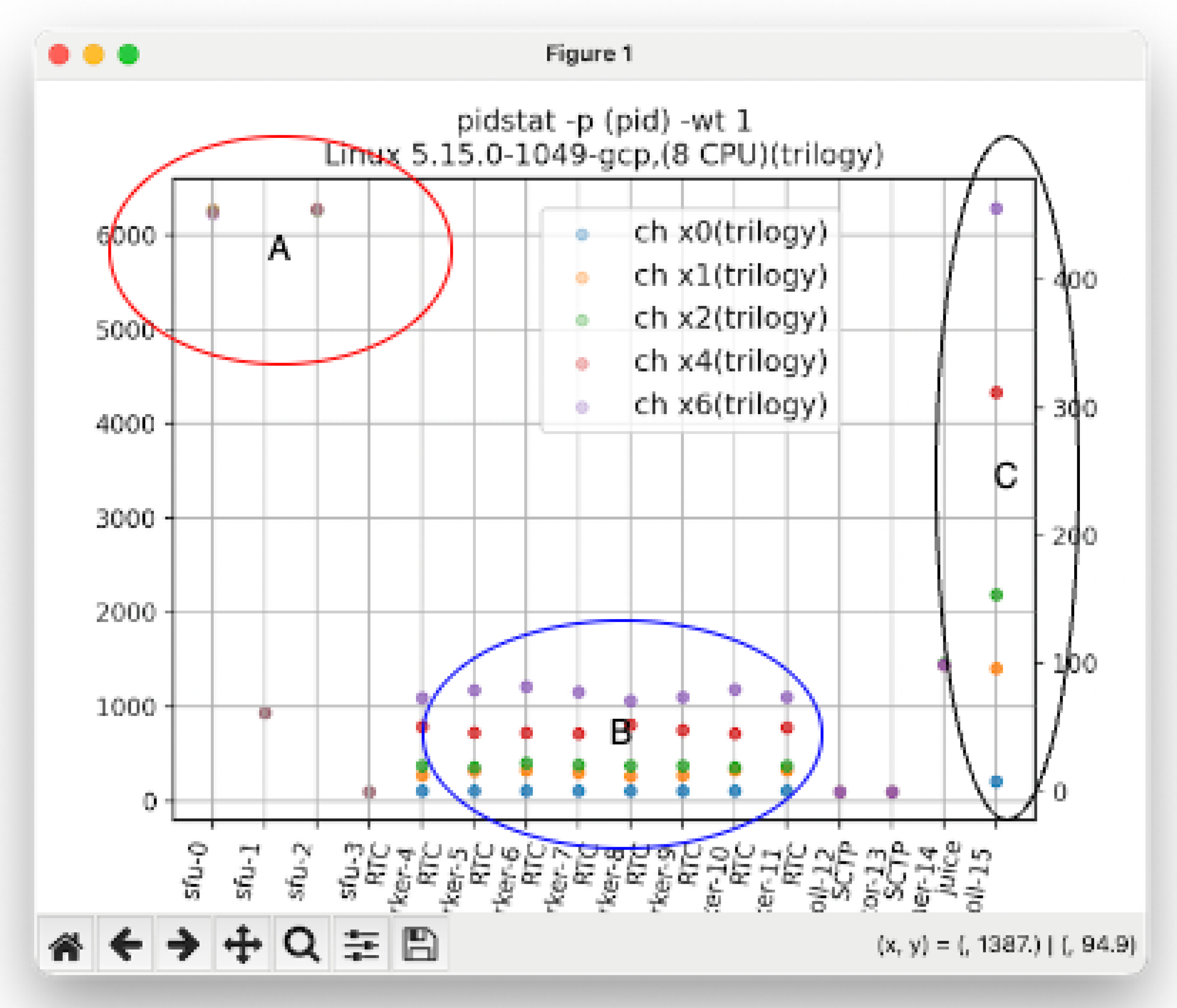
Figure 4.
System call comparison by strace (Trilogy vs mysqlclient)
Disclaimer/Publisher’s Note: The statements, opinions and data contained in all publications are solely those of the individual author(s) and contributor(s) and not of MDPI and/or the editor(s). MDPI and/or the editor(s) disclaim responsibility for any injury to people or property resulting from any ideas, methods, instructions or products referred to in the content. |
© 2025 by the authors. Licensee MDPI, Basel, Switzerland. This article is an open access article distributed under the terms and conditions of the Creative Commons Attribution (CC BY) license (http://creativecommons.org/licenses/by/4.0/).
Copyright: This open access article is published under a Creative Commons CC BY 4.0 license, which permit the free download, distribution, and reuse, provided that the author and preprint are cited in any reuse.