

Submitted:
31 October 2025
Posted:
31 October 2025
You are already at the latest version
Abstract
This paper develops a unified framework for project scheduling under uncertainty using Iterative MultiStructures. We introduce Fuzzy, Neutrosophic, and Plithogenic Project Iterative MultiScheduling, where schedules are composed across hierarchical levels as finite multisets and evaluated after canonical flattening and selection. Using componentwise extensions of sum and max, we propagate uncertain activity times and derive fuzzy expectations and credibility constraints (and their neutrosophic/plithogenic counterparts). We prove that the schedule space forms an Iterative MultiStructure and that our models strictly generalize classical fuzzy project scheduling, neutrosophic project scheduling, and plithogenic project scheduling, as well as their non-iterative multischeduling variants. The framework supports precedence networks, multi-criteria costs, and admits exact reductions under natural embeddings.
Keywords:
multi-structure
; iterative multi-structure
; fuzzy project scheduling
; neutrosophic project scheduling
; plithogenic project scheduling
1. Preliminaries
This section introduces the fundamental concepts and definitions that underpin the discussions in this paper. Throughout, all sets are assumed to be finite.
1.1. Fuzzy Set and Neutrosophic Set
A fuzzy set assigns to each element a grade in the interval , thereby representing uncertainty by degrees rather than by a strict binary split [1,2,3]. Related concepts include the Bipolar Fuzzy Set [4,5], the Spherical Fuzzy Set [6,7,8], the Picture Fuzzy Set [9,10], the Shadowed Set [11,12], and the m-polar Fuzzy Set [13]. Below we recall the relevant notions, together with their extensions.
Definition 1
Example 1
(Fuzzy set in project management: uncertain task duration). Let denote possible durations (days) of a software testing task. Model the expert estimate “about 10 days, realistically between 8 and 14” by the triangular fuzzy set with
Here expresses a moderate plausibility of finishing in 9 days, while quantifies a similar plausibility for 12 days. Such fuzzy durations can be propagated through a precedence network via Zadeh’s extension principle to compute fuzzy earliest/finish times and support time–cost tradeoffs under uncertainty.
Neutrosophic sets extend fuzzy sets by explicitly incorporating indeterminacy, thus covering statements that are neither entirely true nor entirely false, and offering a flexible representation of ambiguity [15,16,17,18]. Related concepts include the Bipolar Neutrosophic Set, the Hesitant Neutrosophic Set [19,20,21], Neutrosophic Rough Set [22,23,24], the Neutrosophic Cubic Set [25,26,27], the Complex Neutrosophic Set [28,29], and the Interval-Valued Neutrosophic Set [30,31,32]. Their formal specification is as follows.
Definition 2
Example 2
(Neutrosophic set in project management: on-time supplier delivery). Let be two hardware suppliers and consider the statement “deliver the batch by Day 20.” Represent each supplier by a single-valued neutrosophic triple capturing, respectively, the degrees of truth, indeterminacy, and falsity for that statement:
Supplier A has stronger supporting evidence () and less conflict (), with moderate ambiguity (); Supplier B is less convincing and more ambiguous. These triples let the project manager rank or threshold suppliers while explicitly accounting for conflicting information and residual indeterminacy in the schedule risk assessment.
1.2. Plithogenic Set
A plithogenic set [41,42,43,44,45,46] represents elements via membership driven by explicit attributes together with a contradiction mapping between attribute values, thereby subsuming and extending the frameworks of Fuzzy [1,47], Vague [48], Intuitionistic [49,50], Hesitant Fuzzy Set [51,52], and Neutrosophic sets [16,17,53].
Definition 3
(Plithogenic Set). [41,54] Let S be a universe and a nonempty subset. A plithogenic set is a 5–tuple
with the following ingredients:
- v — a chosen attribute;
- — the value domain of v;
- — the degree of appurtenance(DAF);1
- — the degree of contradiction(DCF).
For every , the DCF satisfies
Here are, respectively, the appurtenance and contradiction dimensions.
Example 3
(Plithogenic set in project management: sprint plan under attribute contradiction). Let be two sprint plans for a six-week release. Choose the attribute with value domain . Use a (scalar) degree-of-appurtenance to encode how strongly each plan fits “feasible within 6 weeks” under each risk value: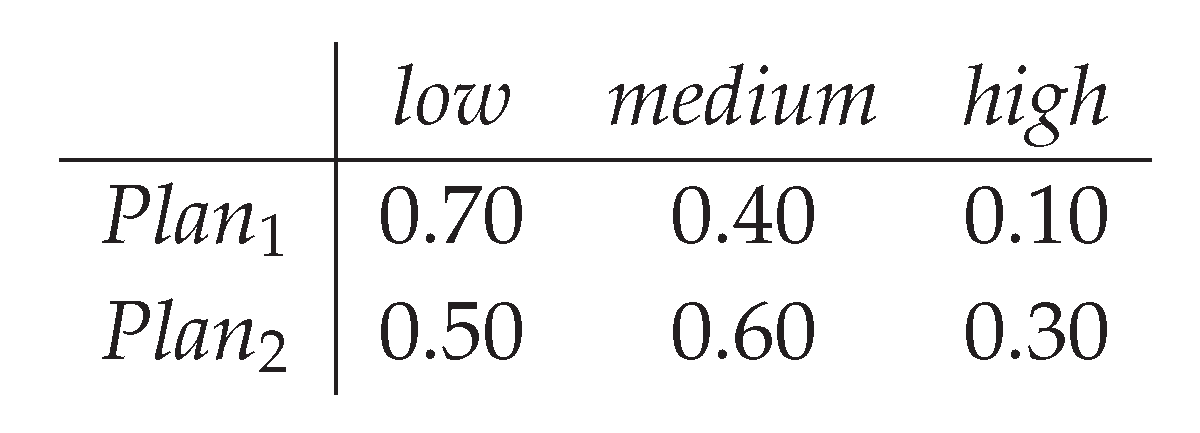
Specify a symmetric degree-of-contradiction with
and . The pair constitutes a plithogenic description of feasibility: attributes with stronger mutual contradiction (e.g., “low” vs. “high” risk) are penalized more by the plithogenic aggregation. A manager can aggregate these values to obtain an effective feasibility for each plan that respects both membership strengths and inter-value contradictions, then select the plan with the higher effective feasibility.
1.3. Multi-Structure
A Multi-Structure replaces classical operations with maps from tuples to finite multisets, enabling multiple outputs per input tuple flexibly simultaneously [56,57,58,59].
Definition 4
Definition 5
(MultiOperation). Let H be a nonempty set and fix an integer . A multi-operation of arity m on H is a map
Thus, instead of producing a single element of H, a multi-operation assigns a finite multiset of elements of H.
Definition 6
(MultiStructure). A MultiStructure is a pair
where H is a nonempty carrier set and indexes a family of multi-operations of various arities. No further axioms are imposed unless specified.
Example 4
(Multi-Structure in everyday project planning: combining schedule proposals). Let denote start times (in days) for three tasks. Given two proposed schedules and , define the binary multi-operation by three concrete combiners:
Then
Thus a single pair of inputs produces a finite multiset of candidate schedules: an aggressive timeline (min), a conservative one (max), and a compromise (). This models a common meeting where two teams propose timelines and the planner keeps multiple viable variants simultaneously.
1.4. Iterative Multi-Structure
An Iterative Multi-Structure extends multiset operations across levels, combining multisets of multisets iteratively through k hierarchical stages in layered aggregation [64,65].
Definition 7
(Iterative Multi-Structure of Order k). Let H be a nonempty set and fix an integer . Define iteratively the multiset powersets
where denotes the collection of finite multisets on X (Definition 4). Let index a family of arities. An Iterative Multi-Structure of order kis a tuple
where for each and each ,
Thus is an ordinary Multi-Structure operation on H, combines multisets of multisets, and so on, up to level k.
Example 5
(Iterative Multi-Structure in practice: two-level portfolio scheduling). Consider a company release involving two departments, Marketing (M) and Engineering (E). Let be start times for two key milestones. Each department supplies two proposals:
Level 0 (within-department mixing).
Define using the three combiners from the previous example. For Marketing,
For Engineering,
Level 1 (cross-department aggregation).
Define by the combiner
collecting every coordinatewise-feasible portfolio schedule. Hence
which is a multiset of multisets(each inner multiset is a finite set of combined schedules). Flattening by Unnest (as defined elsewhere) yields a finite multiset of portfolio schedules in H. This two-level construction is an Iterative Multi-Structure of order : level 0 mixes proposals within departments; level 1 aggregates department-level results into company-level candidates, reflecting a common real workflow in release planning.
1.5. Project Scheduling and Fuzzy Project Scheduling
Project scheduling assigns start/finish times to interdependent activities on a precedence network to optimize overall duration, cost, and resource usage [66,67,68,69,70,71]. Fuzzy project scheduling represents uncertain activity durations by fuzzy numbers, optimizing network objectives using expected values or credibility-constrained mathematical approaches [72,73,74,75,76,77,78].
Definition 8 (Project Scheduling (deterministic)). Let a project be represented by a directed acyclic graph with source 1 and sink . Each arc is an activity of deterministic duration and cost . For decision vector (e.g., release/start or funding times), define node start times by
and project completion time
If financing accrues at rate , the total cost is
The (deterministic) project scheduling problem is
This captures the classical tradeoff between completion time and total cost.
Example 6
(Project Scheduling in practice: office renovation with a critical path). Consider an office renovation with tasks arranged as a DAG :
Interpretation: “permit approval”, “demolition”, “electrical & HVAC”, “finishes”, “inspection & handover”. Durations (days) and costs (k$) are deterministic:
Choose start vector . Then
Thus the critical path is with project completion time 11 days. If financing accrues at , the total cost is
This mirrors a real renovation: parallel trades (demolition vs. MEP work) and a longer inspection stage determine the finish date and the capitalized cost.
Definition 9
(Fuzzy Project Scheduling). Assume each activity duration is a fuzzy quantity (e.g., a trapezoidal fuzzy number) on the same network . Let , and be the induced fuzzy start time, completion time, and cost. Using the credibility measure and fuzzy expectation , three concise formulations are standard:
These formulations are widely used to balance time and cost under fuzzy activity times via credibility/chance constraints and fuzzy expectation.
Example 7
(Fuzzy Project Scheduling in practice: software release under uncertain task times). Re-use the same network but model activity durations by triangular fuzzy numbers (TFNs):
These represent, for a software release, uncertain durations for “requirements approval”, “refactor legacy”, “infrastructure & CI”, “UI polish”, and “security review”. Using Zadeh’s extension principle, the fuzzy completion time is induced from path sums and the network max. For planning, apply centroid defuzzification to approximate expected durations:
Hence the expected path lengths are
so the latter remains the (expected) critical path with . If a budget accrual uses the same , an expected-cost proxy is
Decision-makers can also impose credibility constraints, e.g. require , to certify release dates at a chosen confidence level while comparing candidate schedules.
2. Main Results
This section presents the main results of the paper.
2.1. Neutrosophic Project Scheduling
Neutrosophic Project Scheduling models activity durations as Single-Valued Neutrosophic Numbers (SVNNs), propagating truth, indeterminacy, and falsity through the project network under credibility and expectation constraints. Several research works have investigated the Neutrosophic Set from the perspective of Project Scheduling, highlighting its capability to handle incomplete, inconsistent, and uncertain temporal information in practical project management scenarios (cf.[79,80,81,82]).
(NPS)).Definition 10 (Neutrosophic Project Scheduling Let the project network be a finite DAG with source 1 and sink . For each activity , its duration is modeled by a single-valued neutrosophic number
where , , and denote the degrees of truth, indeterminacy, and falsity for the statement “the duration equals x”. For a decision vector of planned release/start times, define the neutrosophic start times and the neutrosophic completion time as single-valued neutrosophic numbers on obtained by Zadeh’s extension principle applied componentwise to the operators and :
(Here “+” and “max” act via the extension principle on each of ; the symbol ⪰ indicates the induced partial order on neutrosophic numbers.) Let be a neutrosophic credibility that assigns to each neutrosophic event E a value in , and let be a compatible neutrosophic expectation functional. Given targets , , and a (possibly neutrosophic) cost functional , the NPS problem is any of the following equivalent chance/expectation formulations:
Example 8
(Neutrosophic Project Scheduling — Hospital Renovation). A hospital renovates an operating theatre over three serial activities on a DAG with and : demolition , HVAC installation , and inspection . Each activity duration is modeled by a single–valued neutrosophic number (time in days). For demolition,
so the most plausible duration is 5 days with small indeterminacy (permits, hidden pipes). Similarly,
Given planned releases , neutrosophic node times and completion time
are obtained by the componentwise extension of + and max (sup–min for T and its duals for ). Management sets a target deadline days and requires
while minimizing a neutrosophic expected cost (e.g., overtime penalties if the project extends). The scheduler chooses start times satisfying the credibility constraint and achieving the smallest , explicitly accounting for truth, indeterminacy, and falsity in each activity’s duration.
Theorem 1
(NPS generalizes fuzzy project scheduling). Assume each fuzzy duration is given by a membership . Embed fuzzy numbers into neutrosophic numbers via
Let and reduce on such embeddings to the fuzzy credibility and the fuzzy expectation computed from T (i.e. for any fuzzy event A, and ). Then, under the componentwise extension principle, the feasible set and optimal value of NPS coincide with those of the corresponding fuzzy project scheduling problem.
Proof.
By construction, the T–components of and are exactly the fuzzy start/finish-time membership functions obtained by applying Zadeh’s extension principle to with inputs . Since and are preserved by the same principle on these embeddings, every neutrosophic event of the form produces T–marginals identical to the fuzzy event membership for . By the reduction property of and , the chance and expectation constraints in (N-cred) and (N-exp) coincide with their fuzzy counterparts. Therefore the feasible region and objective values are the same in both models, proving that NPS strictly generalizes fuzzy project scheduling. □
2.2. Plithogenic Project Scheduling
Plithogenic Project Scheduling represents activity durations via attribute-driven memberships and contradiction degrees, aggregating to fuzzy or neutrosophic times for optimization.
(PPS)).Definition 11 (Plithogenic Project Scheduling Retain the network . For each activity , let its duration be described by a plithogenic description
where gives the degree(s) of appurtenance at duration x for each attribute value , and is the degree of contradiction. Let be a plithogenic aggregation operator that, for each x, merges into either:
- (i)
- an effective fuzzy membership, or
- (ii)
- an effective neutrosophic triple,
consistently across x and .
- Fuzzy-aggregated PPS:If (i) is chosen, define fuzzy start/finish membership by the extension principle on using , and solve the fuzzy chance/expectation model with credibility and expectation .
- Neutrosophic-aggregated PPS:If (ii) is chosen, define neutrosophic start/finish numbers via componentwise extension on using , and solve the NPS model with and .
In both cases, call the resulting optimization problem the PPS problem(with the chosen aggregation mode).
Example 9
(Plithogenic Project Scheduling — Coastal Bridge Repair). A coastal bridge repair project faces attribute–dependent durations due to weather. Let the attribute be with value domain . For the critical activity “deck resurfacing” (hours), the plithogenic duration is
with (componentwise) degrees of appurtenance
Contradiction between weather values is encoded by
With t–norm and t–conorm , the plithogenic aggregator for combining two steps with attribute values uses
Start/finish times and the project completion time are propagated by the plithogenic lifts of + and max using , i.e. for U with carrier a and V with carrier b,
The planner enforces a deadline via a plithogenic credibility and minimizes a plithogenic expected cost that includes weather-dependent crew premiums. Because is high, disagreement between “dry” and “stormy” pushes aggregation toward the t–conorm side, widening the effective duration and influencing the optimal start times and resource allocation under the bridge closure window.
Theorem 2
(PPS generalizes FPS and NPS).
- (a)
- (FPS as a special case) Let be a singleton, , and define with any . Choose to return . Then the fuzzy-aggregated PPS coincides with the fuzzy project scheduling problem.
- (b)
-
(NPS as a special case) Let and , and setwith any contradiction map satisfying and . Choose to return the triple (i.e., identity aggregation). Then the neutrosophic-aggregated PPS coincides with NPS.
Proof. (a) With a single attribute value, the aggregation yields pointwise, so the fuzzy forward/backward propagation via the extension principle and the resulting credibility/expectation constraints are exactly those of the fuzzy model. Hence PPS≡FPS.
(b) With and identity aggregation, the effective plithogenic description recovers the given neutrosophic triples . Therefore the componentwise extension of and the neutrosophic chance/expectation constraints coincide with those of NPS by definition. Hence PPS≡NPS. □
2.3. Fuzzy Project MultiScheduling
The Fuzzy Project MultiScheduling model treats schedules as multisets, combines candidates via multi-operations, and selects a representative minimizing fuzzy cost.
(FPMS)).Definition 12 (Fuzzy Project MultiScheduling Let be a finite DAG with source 1 and sink . For each activity , the duration is a fuzzy number (arbitrary normal, convex fuzzy number on ). A (single) schedule is a release/start vector . For any x, define the fuzzy node times and the fuzzy project completion time
via Zadeh’s extension principle applied to and . Let be a fuzzy cost (e.g. time–cost accrual under fuzzy times). Fix a fuzzy expectation and a credibility measure .
MultiStructure of schedules.
Let be the set of all (single) schedules. For each arity , fix a finite family of combiner maps
and define the multi-operation by
counting multiplicity when outputs coincide. Typical choices include
which keep . Then
is a MultiStructure in the sense .
Reachable multischedules and selection.
Given a finite seed set, let be the smallest subset of H that contains and is closed under: (i) extraction of elements from any multiset in the image of , and (ii) repeated application of all on tuples drawn from the current set. A multischedule is any finite multiset . A selector picks a representative schedule, e.g.
(with deterministic tie–breaking).
Optimization model.
The FPMS problem (EVM form) is
Equivalently (credibility form),
Example 10 (Fuzzy Project MultiScheduling — Software Feature Rollout)A software team releases a feature via three serial activities on a DAG with and : coding , testing , and deployment . Activity durations (days) are triangular fuzzy numbers
Two candidate (single) schedules on are (earliest starts) and (smoothed). The multi-operation of arity produces a multischedule . For a serial chain, the fuzzy completion time with is
whose centroid satisfies the target . Let the fuzzy project cost be , where penalizes burst staffing implied by tight starts. The selector chooses, among the support of M,
Because and the blend reduce without worsening for these durations, returns a smoothed option (typically the blend), illustrating how multi-scheduling aggregates candidate plans and picks a representative under fuzzy expectation and deadline.
Example 11 (Fuzzy Project MultiScheduling — University Data-Center Migration)A university IT office must migrate services from an on-premise data center to a new hybrid cloud. The migration project is modeled by a serial DAG
with activities: (1,2) “network backbone reconfiguration,” (2,3) “VM image export,” (3,4) “database switchover,” (4,5) “service validation.” Because each activity depends on staff availability and vendor coordination, durations are fuzzy.
Let the activity durations (in hours) be triangular fuzzy numbers:
Two realistic single schedules on are prepared:
Define, for arity , the multi-operation
so that from we obtain the multischedule
For a serial chain, the fuzzy completion time for a schedule x is
so, for , by summing TFNs componentwise,
Its centroid is hours. Suppose the university wants
Let the fuzzy cost be , where is a fuzzy “overtime or off-peak premium” that is higher for schedules starting at 0 and lower for off-peak/shifted schedules.
The selector
will typically pick the blended schedule , because it satisfies the time requirement (the chain is still about 16 hours in expectation) while reducing the fuzzy off-peak premium compared with the dense schedule. This shows how fuzzy project multischeduling keeps several candidate plans and then picks the best under fuzzy expectation and credibility.
Proposition 1 (Schedule space is a MultiStructure)The pair defined above is a MultiStructure: for every m and every , is a finite multiset in .
Proof. Each is finite, hence the image is a finite subset of H; counting duplicates yields an element of by Definition of finite multiset. Thus is well-defined for all m, which is precisely the MultiStructure axiom. □
Theorem 3 (FPMS generalizes fuzzy project scheduling)Let and take the degenerate MultiStructure given by
Let be the identity on singletons: . Then the feasible set of FPMS equals the set of (single) schedules H, and FPMS reduces exactly to the classical fuzzy project scheduling problem (in either EVM or credibility form).
Proof. With and only available, closure adds nothing: . Any admissible multischedule M must be a finite multiset of elements of H generated solely by identity, hence every singleton with is feasible and . The FPMS objective and constraints then read
or, in credibility form,
which are exactly the standard fuzzy project scheduling formulations. Hence FPMS strictly contains (and therefore generalizes) fuzzy project scheduling. □
Neutrosophic Project MultiScheduling
The Neutrosophic Project MultiScheduling framework aggregates multisets of schedules under truth–indeterminacy–falsity durations and selects representatives optimizing expectation and credibility criteria.
Definition 13 (Neutrosophic Project MultiScheduling (NPMS))Let the project be a finite DAG with source 1 and sink . For each activity , the duration is a single–valued neutrosophic number(SVNN)
interpreting, for , the degrees that “” is true(), indeterminate(), and false(). A (single) schedule is a vector .
Neutrosophic time propagation.
Write for Zadeh’s extension principle applied componentwise to the scalar maps and : for neutrosophic numbers and and an operation ,
(Any continuous t–norm/s–norm pair yields an equivalent formulation.) Define neutrosophic node times recursively by
where ⊕ (resp. ∨) denotes –lift of + (resp. max), and ⪰ is the product order on SVNNs. The neutrosophic completion time is
MultiStructure of schedules.
Let denote the set of finite multisets on H. For each arity choose a finite family of combiner maps
and define the multi–operation by
Typical choices include coordinatewise and rational convex combinations with . Then
is a MultiStructure.
Reachable multischedules, selection, and cost.
Given a finite seed set , let be the smallest subset of H that contains and is closed under taking elements of any –image and under repeated applications of all . A multischedule is any . Let select a representative schedule (e.g. by neutrosophic optimization below). Let the (possibly neutrosophic) project cost be an SVNN obtained from by –lifting a scalar cost model (e.g. time–cost accrual).
2.4. Neutrosophic optimization.
Let be a neutrosophic credibility and a neutrosophic expectation. Two canonical NPMS formulations are:
Example 12 (Neutrosophic Project MultiScheduling — City Vaccination Pods)
A city opens pop-up vaccination pods through three serial activities on : site preparation , cold-chain delivery , and station setup . Each duration is a single-valued neutrosophic number (hours). For delivery,
Analogous triples are specified for centered at 4 and for centered at 3. Two seed schedules are (fast) and (with buffers). The multi-operation yields the multischedule . Neutrosophic node/finish times use the componentwise extension of + and max (sup–min on and the standard dual on F). The health department imposes
and minimizes (overtime and spoilage risk). Evaluating the support of M, the buffered plan (or its blend) typically raises the credibility of meeting while controlling expected cost, so returns the buffered option, exemplifying neutrosophic multi-scheduling under truth–indeterminacy–falsity.
Example 13 (Neutrosophic Project MultiScheduling — Emergency Shelter Deployment)
A municipal disaster office needs to deploy an emergency shelter after a typhoon. The project is a DAG with
representing two parallel activity lines: “site preparation,” “supplies reception,” and finally and “setup and opening.” Because information after a disaster is incomplete, each duration is a single-valued neutrosophic number (SVNN).
Durations (hours) are specified as follows. For site preparation :
For supplies reception :
For the two final activities and we take SVNNs centered at 3 hours with indeterminacy.
Two seed schedules on (for nodes ) are
Define the neutrosophic multi-operation of arity 2 by
so that we obtain the multischedule
Neutrosophic start/finish times are computed by the componentwise extension of + and max, so the neutrosophic completion time for is
where ⊕ and ∨ are the neutrosophic lifts. The disaster office requires
where includes neutrosophic penalties for staff overtime (which increases falsity if staff is overstretched) and for late opening (which increases I).
Define the selector
The pure emergency schedule opens fastest but may have higher indeterminacy in the final setup because supplies can still be in flux; the staggered schedule reduces indeterminacy in the last step. In many parameter settings the selector chooses the blended , which balances truth (feasibility), indeterminacy (delays still possible), and falsity (overtime not too high). This illustrates neutrosophic project multischeduling in an emergency context.
Proposition 2 (The schedule space is a MultiStructure)
For every and , is finite. Hence is a MultiStructure.
Proof. Each is finite; therefore is a finite subset of H. Counting duplicates gives a finite multiset in , which is precisely the MultiStructure requirement. □
Theorem 4 (NPMS generalizes Neutrosophic Project Scheduling)Let , take the degenerate MultiStructure with and for , hence , and define . Then NPMS–EVM (resp. NPMS–Cred) reduces exactly to the neutrosophic project scheduling model (EVM, resp. credibility form).
Proof. With only as identity, and every feasible M can be chosen as a singleton . Because , the NPMS objectives/constraints become
or, respectively,
which are precisely the standard neutrosophic scheduling formulations. □
Theorem 5 (NPMS generalizes Fuzzy Project MultiScheduling)
Suppose each fuzzy duration has membership . Embed fuzzy numbers into SVNNs via
Assume and reduce on such embeddings to the fuzzy credibility Cr and fuzzy expectation : for any fuzzy event/value Z, and . Let the MultiStructure be the same one used in the FPMS model and keep the same selector . Then NPMS–EVM/NPMS–Cred coincide with FPMS (EVM/credibility).
Proof. Under , the T–components of all constructed SVNNs (node times, completion time, cost) are exactly the fuzzy memberships obtained by Zadeh’s extension principle, because our componentwise lifting uses the same sup–min (for T) as in the fuzzy case. Since and are preserved by the componentwise lift, the T–marginal of any neutrosophic event equals the fuzzy membership of . By reduction, and return Cr and on these embeddings. Because and are unchanged, the feasible multischedules and the selected representatives coincide with those in FPMS, and the objectives/constraints evaluate to the same real values. Hence the NPMS formulations are identical to FPMS. □
2.5. Plithogenic Project MultiScheduling
The Plithogenic Project MultiScheduling model integrates memberships and contradiction functions, forms multisets, and selects representatives optimizing expectation and credibility criteria.
Definition 14 (Plithogenic Project MultiScheduling (PPMS))Let the project network be a finite DAG with source 1 and sink . A (single) schedule is a vector . Fix a plithogenic attribute v with value domain and a degree of contradiction (reflexive and symmetric). For each activity we are given a plithogenic duration
where is the (fixed) appurtenance dimension and is the activity’s attribute value. For and component , write for the rth coordinate.
Plithogenic lift of + and max. Let be a fixed t–norm/t–conorm (e.g. , ). Given two plithogenic numbers U with carrier attribute and V with carrier attribute , set and define the plithogenic aggregator
For a binary operation , the componentwise plithogenic extension is
with carrier attribute propagated by a chosen rule, e.g. (any fixed policy suffices for the results below).
Node times and completion time. Let be the degenerate plithogenic number concentrated at (all coordinates equal to 1 at and 0 elsewhere). Define as the least family of plithogenic numbers (w.r.t. componentwise order on ) satisfying
where and are the –lifts of + and max, respectively, and ⪰ denotes the product order on –valued membership functions. The plithogenic completion time is
Let be a plithogenic cost obtained by –lifting a scalar cost model (e.g. time–cost accrual).
MultiStructure of schedules.For each arity , choose a finite family of combiner maps
and define the multi–operation by
Typical choices include coordinatewise and rational convex blends with . Set
Reachable multischedules and selection. Given a finite seed set , let be the smallest subset of H containing that is closed under taking elements of –images and under repeated applications of all . A multischedule is any . A selector picks a representative schedule (e.g. one minimizing an evaluation below).
Plithogenic optimization.Let be a plithogenic expectation and a plithogenic credibility that reduce to classical counterparts under the embeddings stated later. We consider the canonical PPMS formulations:
Example 14 (Plithogenic Project MultiScheduling — Offshore Turbine Maintenance)An offshore turbine maintenance campaign has attribute-dependent durations due to sea state. Let the attribute be with values and contradiction , . For the hoist operation (hours),
The plithogenic aggregator for combining steps with attribute values is
Two feasible (single) schedules are (tight window) and (robust slack). The arity-2 multi-operation produces . Start/finish and completion times propagate via the plithogenic lifts of + and max using . The planner requires
and minimizes a plithogenic expected cost that includes vessel standby premiums under rough seas. Because large drives aggregation toward the t–conorm side, rough/calm disagreements inflate effective durations; the selector therefore chooses the robust schedule (or its blend) from the support of M, demonstrating plithogenic multi-scheduling with attribute-driven uncertainty and contradiction.
Example 15 (Plithogenic Project MultiScheduling — Smart-City Streetlight Retrofit)
A smart-city team upgrades streetlights in one district. Each block requires two activities: “install LED and controller,” “integrate with IoT platform.” However, the duration of integration depends on a plithogenic attribute
For the integration activity (in hours), define the appurtenance functions
Contradiction between attribute values is encoded by
and . The plithogenic aggregator for combining two steps with attribute values is
Two crews propose two single schedules for three consecutive blocks. Let represent start times of the “integration” activity for blocks 1,2,3.
Define the arity-2 multi-operation on schedules by
From we obtain the multischedule
Plithogenic node and completion times are propagated by the plithogenic lifts of + and max using . Suppose the city wants the retrofit of all three blocks to be plithogenically completed within hours with credibility
and they minimize a plithogenic expected cost that includes: (i) night-work premium (higher when the schedule is earlier), (ii) rework premium (higher when is large because mixing fiber-ok with 5G-spotty inflates duration).
Define the selector
If the actual district has a mix of fiber-ok and 5G-spotty, the high contradiction pushes the aggregated durations upward for the very fast schedule , potentially violating the deadline. One of the blended schedules, for example , better balances attribute contradiction and allows the city to keep the credibility constraint while avoiding high night-work premiums. Thus, the plithogenic project multischeduling model selects a representative schedule that is not only time-feasible but also attribute-consistent under explicit contradiction management.
Proposition 3 (The schedule space is a MultiStructure)For every and , the image is a finite multiset in . Hence is a MultiStructure.
Proof. Each is finite; therefore is a finite subset of H. Counting duplicates yields an element of . □
Theorem 6 (PPMS generalizes Plithogenic Project Scheduling)Let , take the degenerate MultiStructure with and for , so that , and set . Then PPMS–EVM (resp. PPMS–Cred) reduces exactly to single–schedule plithogenic project scheduling (EVM, resp. credibility form).
Proof. With only the identity multi–operation, and every feasible multischedule can be taken as a singleton . Because , both PPMS formulations reduce to optimizing a single under the plithogenic propagation and the chosen /, i.e. to the standard plithogenic scheduling model. □
Theorem 7 (PPMS generalizes Fuzzy Project MultiScheduling)
Embed each fuzzy duration (membership ) as a plithogenic duration with
Fix , , hence . Assume the reductions and on this embedding. With the same MultiStructure and selector as in FPMS, PPMS–EVM/PPMS–Cred coincide with FPMS (EVM/credibility).
Proof. Since is a singleton and , the plithogenic aggregator becomes . Therefore the –lift of + and max equals Zadeh’s extension with t–norm min and t–conorm max, i.e. the standard fuzzy propagation of durations along paths. By reduction, and return the fuzzy expectation and credibility. Because and are unchanged, feasible multischedules and the selected representative schedules are identical to FPMS, and objective/constraints take the same values. □
Theorem 8 (PPMS generalizes Neutrosophic Project MultiScheduling)
Embed each single–valued neutrosophic duration as plithogenic with
Let act componentwise with (for truth/indeterminacy) and dual choice for falsity, matching the neutrosophic lift used in NPMS. Assume and reduce to the neutrosophic expectation and credibility on this embedding. With the same MultiStructure and selector as in NPMS, PPMS–EVM/PPMS–Cred coincide with NPMS.
Proof. With singleton and , the plithogenic aggregator reduces componentwise to the neutrosophic propagation rules (sup–min for T/I and the standard dual for F). Hence node/finish times and costs produced by coincide with those of NPMS. By reduction, and on the embedding. Keeping and fixed implies the feasible multischedules and the chosen representative schedules match NPMS exactly, yielding identical optimization problems. □
2.6. Fuzzy Project Iterative MultiScheduling
We formalize an iterative, hierarchical version of fuzzy project multischeduling in which schedules are combined across several levels by MultiStructure operators; feasibility and optimality are judged after flattening the hierarchy and selecting a representative schedule for fuzzy evaluation.
Notation 1 (Project and fuzzy times)
Let be a finite DAG with source 1 and sink . A (single) schedule is a vector . Each activity has a fuzzy duration (e.g. a normal, convex fuzzy number on ). For , define fuzzy node times and the fuzzy project completion time
by Zadeh’s extension principle applied to and . Let be a fuzzy total cost built from x and (e.g. time–cost accrual). Fix a fuzzy expectation and a fuzzy credibility .
Notation 2 (Multiset towers)
Let denote the set of finite multisets on X (Definition 4). Define the multiset towers
Definition 15 (Iterative MultiStructure on schedules of order k)Fix a depth . An Iterative MultiStructure of order k on His a family of multi-operations
where is a set of arities. For each level i and arity m, fix a finite family of combiners with (e.g. coordinatewise and rational convex combinations when , or their natural multiset lifts for ), and set
Definition 16 (Flattening (unnesting) operators)For , define the flattening multiset by multiplicity aggregation:
Recursively define and as maps .
Definition 17 (Reachable iterative multischedules and selector)Fix a finite seed set . Let be the smallest subset of containing that is closed under taking members of any -image and under applications of all . Inductively for , define as the smallest set containing for all and all , and closed under taking elements of multisets. An iterative multischedule of depth kis any that belongs to . Let be a deterministic level–1 selector (e.g. the lowest expected fuzzy cost over the support, with fixed tie–breaking). Define the derived selector for depth k by
i.e. flatten down to level 1 and then pick a representative schedule.
Definition 18 (Fuzzy Project Iterative MultiScheduling (FPiMS))Fix , an order-k Iterative MultiStructure on H, a seed set , and a level–1 selector . The FPiMS problem of order kis the optimization over depth-k iterative multischedules:
and, in credibility form,
Example 16 (Fuzzy Project Iterative MultiScheduling — Global Product Launch)
A consumer–electronics firm plans a three–task pipeline on a chain DAG with : design , assembly , QA . Task durations (days) are triangular fuzzy numbers
so the serial completion time at earliest starts is with centroid .
Level 0 (teams).Two regions propose candidate (single) schedules . For EMEA: and ; for AMER: and .
Level 1 (department).A multi–operation combines any pair by outputting the finite multiset . Thus each region forms a multischedule, e.g. and .
Level 2 (corporate).A level–1 combiner maps any pair of level–1 multischedules to a level–2 multiset of coordinatewise–max merges of their members, producing .
Flatten via to level–1 and select a representative schedule that minimizes subject to . Under a deadline , typically prefers a blended plan (e.g. ), which lowers staffing penalty while keeping fuzzy completion feasible.
Example 17 (Fuzzy Project Iterative MultiScheduling for Seasonal Retail Rollout)Consider a retail company that must roll out a new point-of-sale (POS) subsystem to stores across three regions (North, Central, South) over the next two quarters. The project manager plans several iterations(I1 = pilot, I2 = partial rollout, I3 = full rollout) and several parallel workstreams: (1) hardware delivery, (2) POS software configuration, (3) staff training, and (4) payment-gateway integration.
However, each task duration is imprecise because it depends on fuzzy factors such as “supplier responsiveness,” “availability of trainers,” and “store traffic”. For example:
Similarly, the training effort has fuzzy availability:
The project schedule for each iteration is therefore not a single crisp Gantt chart but a fuzzy family of feasible schedules:
where aggregates fuzzy task durations, fuzzy resource availability, and fuzzy regional readiness by a chosen fuzzy operator (e.g. min, product, or a bounded t-norm).
After iteration I1 (pilot in North) is completed, real execution data are collected (actual delivery time, actual training time, actual weekend traffic). The manager then updates the fuzzy membership functions (e.g. narrowing the support of the delivery-time fuzzy number for North) and re-runs the multischeduling for iteration I2. Thus the project becomes an iterative fuzzy multischeduling process:
where at each step multiple regions and multiple workstreams are co-scheduled under fuzzy uncertainty about time and resource usage.
Proposition 4 (Schedule carrier is an Iterative MultiStructure)
For every depth , the tuple
is an Iterative MultiStructure of order k in the sense of Definition 7.
Proof. Each index set is finite; hence, for any input , the image is a finite multiset of elements of and thus lies in . This is exactly the typing requirement in Definition 7. □
Theorem 9 (FPiMS generalizes Fuzzy Project MultiScheduling)Let . Choose the degenerate level-0 MultiStructure with and for , so that for all . Set and . Then FPiMS–EVM(resp.FPiMS–Cred) reduces exactly to the Fuzzy Project MultiScheduling model (EVM, resp. credibility form).
Proof. With we optimize over depth-1 objects . Because the only active multi-operation is and , the closure adds nothing: with all singletons () admissible. Flattening is vacuous: , hence and, in particular, . Consequently, FPiMS–EVM reads
Since any optimal multiset can be chosen as a singleton (the evaluation depends only on the selected representative), this is equivalent to
which is exactly the FPMS (EVM) formulation. The same argument with events and shows that FPiMS–Cred reduces to FPMS (credibility form). □
2.7. Neutrosophic Project iterative MultiScheduling
Neutrosophic Project Iterative MultiScheduling constructs hierarchical multisets with truth– indeterminacy–falsity durations, iteratively combines and flattens candidates, optimizing neutrosophic expectation and credibility.
Notation 3 (Network, schedules, and neutrosophic times)
Let be a finite DAG with source 1 and sink , and let be the set of (single) schedules . For each , the activity duration is a single–valued neutrosophic number on . Write for the componentwise extension principle on the scalar maps and introduced earlier. For , the neutrosophic node times and the project completion time are obtained by applying to + and max along the precedence constraints. Let be a (single–valued) neutrosophic project cost derived from via –lifting of a scalar cost model. Let and denote a neutrosophic credibility and a neutrosophic expectation, respectively.
Notation 4 ((Recall) Multiset towers and flattening)
Let be the set of finite multisets on a set X (Definition 4). Define the multiset towers and for . For , let be the flattening that sums multiplicities. Recursively set and .
Definition 19 ((Recall) Reachable iterative multischedules and selector)Let be finite. Define as the smallest subset of H that contains and is closed under taking elements of –images and under repeated applications of all . For , define as the smallest set containing all with and closed under taking elements of multisets. An iterative multischedule of depth kis any . Let be a deterministic selector on level 1. Define the derived selector on depth k by
Definition 20 (Neutrosophic Project Iterative MultiScheduling (NPiMS))Fix , an order–k Iterative MultiStructure on H, a seed set , and a selector . The NPiMS problem of order kis the optimization over depth–k iterative multischedules :
Example 18 (Neutrosophic Project Iterative MultiScheduling — Emergency Field Hospitals)
A city deploys field hospitals through tent erection, power, equipment. Each duration is a single–valued neutrosophic number (hours). For power delivery, for instance, peaks at 6, is on , and outside that range.
Level 0 (wards).Ward w proposes two schedules (fast vs. buffered).Level 1 (districts).A multi–operation applied to each district’s ward set outputs the multiset of all candidates and their rational convex blends. This yields district multischedules .Level 2 (city). merges district multischedules by taking feasible coordinatewise–max pairings to avoid crew conflicts, producing a city–level .
Flatten via and choose to
where times propagate by the componentwise neutrosophic lift of + and max. Buffered options increase credibility while controlling expected overtime, so typically returns a blended buffered plan.
Example 19 (Neutrosophic Project Iterative MultiScheduling for University Digitalization)A university is digitalizing student services (admission, course registration, tuition payment, and student support). The project is divided into four iterations: I1 = admission portal, I2 = course registration, I3 = payment, I4 = student support. For each iteration, tasks must be aligned with three stakeholder groups: (IT department, Registrar office, External vendor). Because policies may change suddenly (e.g. new compliance from the Ministry), some activities are not purely uncertain but truly indeterminate.
For task “Integrate Admission Portal with Legacy DB” in I1, the project office assigns a neutrosophic duration triplet
meaning: 55% truth that the task can be finished within 2 weeks, 30% indeterminacy because of unclear legacy documentation, and 15% falsity due to a known risk of vendor delay. Similarly, stakeholder approval for the Registrar office in I2 is modeled as
indicating a high indeterminate part: requirements are not yet fixed.
The neutrosophic multischeduling at iteration k seeks a schedule that maximizes the overall neutrosophic feasibility
subject to resource and precedence constraints over multiple concurrent subprojects (admission, course, payment). After each iteration is executed, the university observes which parts were really blocked (by policy) and which parts were simply delayed by workload. This observation is then used to update the indeterminacy component for future iterations, for example:
In this way, the project evolves by repeatedly (1) scheduling several subprojects in parallel, (2) measuring truth/indeterminacy/falsity of completion, and (3) re-scheduling with reduced indeterminacy.
Proposition 5 (The schedule carrier of NPiMS is an Iterative MultiStructure)
For every , the tuple
is an Iterative MultiStructure of order k in the sense of Definition 7.
Proof. Each level–i family of combiners is finite; thus, for any , the image is a finite multiset of elements of , i.e. an element of . This is precisely the typing requirement in Definition 7. □
Theorem 10 (NPiMS generalizes Neutrosophic Project MultiScheduling)Let . Take the degenerate level–0 MultiStructure with and for , hence for all . Let and . Then NPiMS–EVM(resp.NPiMS–Cred) reduces exactly to the Neutrosophic Project MultiScheduling model (EVM, resp. credibility form).
Proof. With , feasible objects are generated by . Thus and every singleton is admissible. Flattening is vacuous: , so and . Therefore NPiMS–EVM becomes subject to , and NPiMS–Cred becomes subject to the neutrosophic credibility constraints on and . These are exactly the NPMS formulations previously introduced. □
Theorem 11 (NPiMS generalizes Fuzzy Project Iterative MultiScheduling)
Embed each fuzzy duration (membership ) as an SVNN by
Assume that and reduce on such embeddings to the fuzzy credibility Cr and fuzzy expectation . Let , , and be the same as in the FPiMS model. Then NPiMS–EVM and NPiMS–Cred coincide with the corresponding FPiMS formulations.
Proof. Under , the T–components of all constructed neutrosophic quantities (node times, completion time, and cost) are exactly the fuzzy memberships obtained by Zadeh’s extension principle, because acts componentwise and uses the same sup–min mechanism for T as in the fuzzy case; and are preserved by the same lift. Hence for any event of the form , its T–marginal equals the fuzzy membership of . By the reduction property, and return Cr and on these embeddings. Since , , and are unchanged, the feasible depth–k multischedules, their flattenings , and the selected representatives coincide with those in FPiMS; consequently the objectives and constraints evaluate to the same real values. □
2.8. Plithogenic Project Iterative MultiScheduling
Plithogenic Project Iterative MultiScheduling integrates attribute memberships and contradiction, forms multisets, iteratively combines and flattens schedules, optimizing expectation and credibility.
Notation 5 (Plithogenic durations and propagation)Retain the project network and the schedule space . For each , let be a plithogenic duration as in the Plithogenic Project MultiScheduling (PPMS)section, with the plithogenic lift of + and max induced by the aggregator (based on a fixed t–norm/t–conorm and a contradiction degree). Write and for the plithogenic node and completion times computed via , and let be the plithogenic total cost. Denote by and a plithogenic expectation and credibility, respectively, consistent with the chosen plithogenic model.
Notation 6 (Iterative MultiStructure, flattening, closure, and selection)
Let be an Iterative MultiStructure of order k on H as in Definition 7, acting levelwise on the multiset tower . Use the flattening operators and the closure families built from a finite seed set as in Definition 17. Let be a deterministic level–1 selector and let the derived selector be
Definition 21 (Plithogenic Project Iterative MultiScheduling (PPiMS))Fix , an order-k Iterative MultiStructure on H, a finite seed , and a level–1 selector . The PPiMS problem of order kis the following optimization over depth-k iterative multischedules :
and, in credibility form,
Example 20 (Plithogenic Project Iterative MultiScheduling — Offshore Wind Maintenance)
A maintenance campaign’s durations depend on the attribute with values and contradiction , . For the hoist (hours),
The plithogenic aggregator for combining steps with attribute values is with .
Level 0 (turbines).Each turbine t offers two feasible schedules .Level 1 (arrays).Apply to turbine sets to form array multischedules that include candidates and convex blends. Durations propagate via the plithogenic lifts of + and max using .Level 2 (farm). merges array multischedules into a farm–level (coordinatewise–max to respect shared vessel availability).
Flatten with and select to
Because large contradiction drives aggregation toward the t–conorm side under mixed sea states, robust/blended schedules dominate, and the selector chooses a plan with deliberate slack.
Example 21 (Plithogenic Project Iterative MultiScheduling for Smart-Home Product Line)A technology company is developing a smart-home product line consisting of (1) smart hub, (2) energy monitor, (3) security camera, (4) AI-based mobile app. All four components must be released in a coordinated manner, but each task has multiple attributes that may agree or contradict:
- cost priority (low, medium, high),
- security level (basic, advanced),
- time-to-market urgency (urgent, normal),
- integration complexity (simple, complex).
For the task “Implement end-to-end encryption in camera module”, the team assigns a plithogenic membership
but with a contradiction degree
because advanced security typically raises cost. Similarly, for “Develop mobile AI features”, the attributes “time-to-market = urgent” and “integration complexity = complex” have a contradiction degree .
In plithogenic project iterative multischeduling, the schedule for an iteration (I1 = core hub; I2 = camera + energy; I3 = unified mobile app) is obtained by aggregating tasks’ plithogenic memberships with respect to the dominant attribute of that iteration. For example, in I1 the dominant attribute is “time-to-market = urgent”, so tasks whose attribute set contradicts this (e.g. high complexity, high cost) receive a lower aggregated membership in the schedule. Formally, for a task x with attribute value v and dominant attribute value ,
where the aggregation reduces proportionally to the contradiction.
After executing I1, the company observes market feedback: customers accept a slightly higher price but insist on advanced security. This changes the dominant attribute for I2 to “security = advanced”, thereby lowering the contradiction for camera-related tasks and raising their plithogenic membership in the next multischeduling run. Thus, at every iteration the project office:
- re-evaluates attribute dominance from market/manager feedback;
- re-computes contradiction degrees with respect to the new dominant attribute;
- re-runs the multischeduling over parallel component teams;
- locks the next release window.
This captures a realistic situation where several product components are co-developed, but attribute-level contradictions (cost vs. security vs. speed) must be negotiated iteratively in the schedule.
Proposition 6 (Schedule carrier of PPiMS is an Iterative MultiStructure)
If, for each level i and arity m, the combiner family defining is finite, then
is an Iterative MultiStructure of order k in the sense of Definition 7.
Proof. For any , the finite combiner family produces a finite set of outputs in ; counting multiplicities yields an element of . This verifies the typing requirement at every level i and arity m. □
Theorem 12 (PPiMS generalizes PPMS)Let , take the degenerate level-0 structure with and no higher-arity operators, set , and choose . Then(PPiMS–EVM)(resp.(PPiMS–Cred)) reduces exactly to the single-level Plithogenic Project MultiScheduling model (EVM, resp. credibility form).
Proof. With , the feasible objects are and flattening is vacuous: . Because any optimum can be taken at a singleton and , both formulations reduce to optimizing a single schedule x under the plithogenic propagation with and , i.e., to PPMS. □
Theorem 13 (PPiMS generalizes Fuzzy Project Iterative MultiScheduling)
Embed each fuzzy duration (membership ) as a plithogenic duration with
and fix t–norm , t–conorm , so . Assume reductions and on this embedding. Use the same Iterative MultiStructure , seed , and selector as in Fuzzy Project Iterative MultiScheduling(FPiMS). Then(PPiMS–EVM/Cred)coincides with FPiMS(EVM/credibility).
Proof. With a singleton and , the plithogenic lift reproduces Zadeh’s extension (sup–min for + and max). Hence the propagated node/finish times and costs match the fuzzy ones. By reduction, expectations and credibilities agree. Because , , and are unchanged, feasible (iterative) multischedules and their selected representatives are identical in both models, yielding identical optimization problems. □
Theorem 14 (PPiMS generalizes Neutrosophic Project Iterative MultiScheduling)
Embed each single–valued neutrosophic duration as plithogenic with
and let act componentwise so that, for T and I, (with the standard dual for F), thereby reproducing the neutrosophic lift used in Neutrosophic Project iterative MultiScheduling. Assume reductions and on this embedding. Use the same , , and as in the neutrosophic model. Then (PPiMS–EVM/Cred) coincides with Neutrosophic Project iterative MultiScheduling (EVM/credibility).
Proof. Under the stated embedding and componentwise aggregation, the plithogenic propagation of + and max produces the same node/finish times and costs as the neutrosophic extension. Reductions of expectation/credibility transfer objective and constraints verbatim. Keeping , , and fixed preserves the feasible iterative multischedules and selected representatives, so the optimization problems are identical. □
3.Conclusions
This paper developed a unified framework for project scheduling under uncertainty using Iterative MultiStructures. We introduced Fuzzy, Neutrosophic, and Plithogenic Project Iterative MultiScheduling, where schedules are composed across hierarchical levels as finite multisets and evaluated after canonical flattening and selection. In future work, we aim to explore possible extensions that incorporate frameworks such as Upside-Down Logic [83,84,85,86], hyperstructure [87,88,89,90,91], superhyperstructure [92], graph [93], hypergraph [94,95], superhypergraph [43,96,97], and HyperFuzzy Sets [98,99,100]. These directions may provide deeper insight into modeling inversion phenomena and hierarchical uncertainty within complex decision-making and analytical systems.
Research Integrity
The author confirms that this manuscript is original, has not been published elsewhere, and is not under consideration by any other journal.
Use of Computational Tools
All proofs and derivations were performed manually; no computational software (e.g., Mathematica, SageMath, Coq) was used.
Code Availability
No code or software was developed for this study.
Ethical Approval
This research did not involve human participants or animals, and therefore did not require ethical approval.
Use of Generative AI and AI-Assisted Tools
We use generative AI and AI-assisted tools for tasks such as English grammar checking, and We do not employ them in any way that violates ethical standards.
Disclaimer
The ideas presented here are theoretical and have not yet been validated through empirical testing. While we have strived for accuracy and proper citation, inadvertent errors may remain. Readers should verify any referenced material independently. The opinions expressed are those of the authors and do not necessarily reflect the views of their institutions.
Funding
No external funding was received for this work.
Data Availability Statement
This paper is theoretical and did not generate or analyze any empirical data. We welcome future studies that apply and test these concepts in practical settings.
Acknowledgments
We thank all colleagues, reviewers, and readers whose comments and questions have greatly improved this manuscript. We are also grateful to the authors of the works cited herein for providing the theoretical foundations that underpin our study. Finally, we appreciate the institutional and technical support that enabled this research.
Conflicts of Interest
The authors declare no conflicts of interest regarding the publication of this work.
References
- Zadeh, L.A. Fuzzy sets. Information and control 1965, 8, 338–353. [Google Scholar] [CrossRef]
- Zadeh, L.A. Biological application of the theory of fuzzy sets and systems. In Proceedings of the The Proceedings of an International Symposium on Biocybernetics of the Central Nervous System. Little, Brown and Comp. London, 1969, pp. 199–206.
- Mordeson, J.N.; Nair, P.S. Fuzzy graphs and fuzzy hypergraphs; Vol. 46, Physica, 2012.
- Zhang, W.R. Bipolar fuzzy sets and relations: a computational framework for cognitive modeling and multiagent decision analysis. NAFIPS/IFIS/NASA ’94. Proceedings of the First International Joint Conference of The North American Fuzzy Information Processing Society Biannual Conference. The Industrial Fuzzy Control and Intellige 1994, pp. 305–309.
- Akram, M. Bipolar fuzzy graphs. Information sciences 2011, 181, 5548–5564. [Google Scholar] [CrossRef]
- PA, F.P.; John, S.J.; et al. On spherical fuzzy soft expert sets. In Proceedings of the AIP conference proceedings. AIP Publishing, 2020, Vol. 2261. 2020. [Google Scholar]
- Akram, M.; Saleem, D.; Al-Hawary, T. Spherical fuzzy graphs with application to decision-making. Mathematical and Computational Applications 2020, 25, 8. [Google Scholar] [CrossRef]
- Kutlu Gündoğdu, F.; Kahraman, C. Spherical fuzzy sets and spherical fuzzy TOPSIS method. Journal of intelligent & fuzzy systems 2019, 36, 337–352. [Google Scholar]
- Cuong, B.C.; Kreinovich, V. Picture fuzzy sets-a new concept for computational intelligence problems. In Proceedings of the 2013 third world congress on information and communication technologies (WICT 2013). IEEE; 2013; pp. 1–6. [Google Scholar]
- Das, S.; Ghorai, G.; Pal, M. Picture fuzzy tolerance graphs with application. Complex & Intelligent Systems 2022, 8, 541–554. [Google Scholar]
- Pedrycz, W. Shadowed sets: representing and processing fuzzy sets. IEEE Transactions on Systems, Man, and Cybernetics, Part B (Cybernetics) 1998, 28, 103–109. [Google Scholar] [CrossRef]
- Cattaneo, G.; Ciucci, D. Shadowed sets and related algebraic structures. Fundamenta Informaticae 2003, 55, 255–284. [Google Scholar]
- Chen, J.; Li, S.; Ma, S.; Wang, X. m-Polar fuzzy sets: an extension of bipolar fuzzy sets. The scientific world journal 2014, 2014, 416530. [Google Scholar] [CrossRef] [PubMed]
- Zadeh, L.A. Fuzzy logic, neural networks, and soft computing. In Fuzzy sets, fuzzy logic, and fuzzy systems: selected papers by Lotfi A Zadeh; World Scientific, 1996; pp. 775–782.
- Smarandache, F. A unifying field in Logics: Neutrosophic Logic. In Philosophy; American Research Press, 1999; pp. 1–141.
- Wang, H.; Smarandache, F.; Zhang, Y.; Sunderraman, R. Single valued neutrosophic sets; Infinite study, 2010.
- Broumi, S.; Talea, M.; Bakali, A.; Smarandache, F. Single valued neutrosophic graphs. Journal of New theory 2016, 10, 86–101. [Google Scholar]
- Smarandache, F. Neutrosophic Overset, Neutrosophic Underset, and Neutrosophic Offset. Similarly for Neutrosophic Over-/Under-/Off-Logic, Probability, and Statistics; Infinite Study, 2016.
- Chen, Y.; Xie, Q.; Ma, X.; Li, Y. Optimizing site selection for construction and demolition waste resource treatment plants using a hesitant neutrosophic set: a case study in Xiamen, China. Engineering Optimization.
- Saha, A.; Deli, I.; Broumi, S. Hesitant triangular neutrosophic numbers and their applications to MADM. Neutrosophic Sets and Systems 2020, 35, 269–298. [Google Scholar]
- Zheng, Y.; Zhang, L. A Novel Image Segmentation Algorithm Based on Hesitant Neutrosophic and Level Set. In Proceedings of the 2021 International Conference on Electronic Information Technology and Smart Agriculture (ICEITSA). IEEE; 2021; pp. 370–373. [Google Scholar]
- Chen, R.; Liu, Q.; Zhang, Y.; Weng, W. A probabilistic plithogenic neutrosophic rough set for uncertainty-aware food safety analysis. Neutrosophic Sets and Systems 2025, 90, 59. [Google Scholar]
- Bo, C.; Zhang, X.; Shao, S.; Smarandache, F. Multi-Granulation Neutrosophic Rough Sets on a Single Domain and Dual Domains with Applications. Symmetry 2018, 10, 296. [Google Scholar] [CrossRef]
- Broumi, S.; Smarandache, F.; Dhar, M. Rough neutrosophic sets. Infinite Study 2014, 32, 493–502. [Google Scholar]
- Cui, W.H.; Ye, J. Logarithmic similarity measure of dynamic neutrosophic cubic sets and its application in medical diagnosis. Computers in Industry 2019, 111, 198–206. [Google Scholar] [CrossRef]
- Jun, Y.B.; Smarandache, F.; Kim, C.S. Neutrosophic cubic sets. New mathematics and natural computation 2017, 13, 41–54. [Google Scholar] [CrossRef]
- Ali, M.; Deli, I.; Smarandache, F. The theory of neutrosophic cubic sets and their applications in pattern recognition. Journal of intelligent & fuzzy systems 2016, 30, 1957–1963. [Google Scholar]
- Ali, M.; Smarandache, F. Complex neutrosophic set. Neural Computing and Applications 2016, 28, 1817–1834. [Google Scholar] [CrossRef]
- Ali, M.; Dat, L.Q.; Son, L.H.; Smarandache, F. Interval Complex Neutrosophic Set: Formulation and Applications in Decision-Making. International Journal of Fuzzy Systems 2017, 20, 986–999. [Google Scholar] [CrossRef]
- yu Zhang, H.; qiang Wang, J.; hong Chen, X. An outranking approach for multi-criteria decision-making problems with interval-valued neutrosophic sets. Neural Computing and Applications 2016, 27, 615–627. [Google Scholar] [CrossRef]
- Ye, J.; Du, S. Some distances, similarity and entropy measures for interval-valued neutrosophic sets and their relationship. International Journal of Machine Learning and Cybernetics 2017, 10, 347–355. [Google Scholar] [CrossRef]
- Broumi, S.; Talea, M.; Bakali, A.; Smarandache, F. Interval valued neutrosophic graphs. Critical Review, XII 2016, 2016, 5–33. [Google Scholar]
- Smarandache, F. Neutrosophy: neutrosophic probability, set, and logic: analytic synthesis & synthetic analysis 1998.
- Yan, R.; Han, Y.; Hao, L. An efficient neutrosophic weighted sum approach with insights into engineering project management performance assessment. Neutrosophic Sets and Systems 2025, 78, 452–469. [Google Scholar]
- Cizmecioglu, N.; Kilic, H.S.; Kalender, Z.T.; Tuzkaya, G. Selection of the Best Software Project Management Model via Interval-Valued Neutrosophic AHP. In Proceedings of the International Conference on Intelligent and Fuzzy Systems. Springer; 2021; pp. 388–396. [Google Scholar]
- Kungumaraj, E.; et al. An Evaluation of Triangular Neutrosophic PERT Analysis for Real-Life Project Time and Cost Estimation. Neutrosophic Sets and Systems 2024, 63, 5. [Google Scholar]
- Secretariat, B.A.; Pradesh, A. Solving neutrosophic critical path problem using Python. Journal of information & optimization sciences 2024, 45, 897–911. [Google Scholar]
- Pinda Guanolema, B.; Castro Morales, L.G.; Peña Suárez, D.; Cabezas Arellano, M.J. Design of a Model for the Evaluation of Social Projects Using Neutrosophic AHP and TOPSIS. Neutrosophic Sets and Systems 2021, 44, 19. [Google Scholar]
- Soltaninia, A.H.; Ravanshadnia, M.; Ghanbari, M. Identification and quantitative analysis of occupational health and safety risks in sustainable construction projects under Neutrosophic space. Industrial Management Studies 2024, 22, 271–312. [Google Scholar]
- Kumar, R.; et al. Critical Path Method and Project Evaluation and Review Technique under Uncertainty: A State-of-Art Review. International Journal of Neutrosophic Science (IJNS) 2023, 21. [Google Scholar]
- Smarandache, F. Plithogenic set, an extension of crisp, fuzzy, intuitionistic fuzzy, and neutrosophic sets-revisited; Infinite study, 2018.
- Sultana, F.; Gulistan, M.; Ali, M.; Yaqoob, N.; Khan, M.; Rashid, T.; Ahmed, T. A study of plithogenic graphs: applications in spreading coronavirus disease (COVID-19) globally. Journal of ambient intelligence and humanized computing 2023, 14, 13139–13159. [Google Scholar] [CrossRef] [PubMed]
- Smarandache, F. Extension of HyperGraph to n-SuperHyperGraph and to Plithogenic n-SuperHyperGraph, and Extension of HyperAlgebra to n-ary (Classical-/Neutro-/Anti-) HyperAlgebra; Infinite Study, 2020.
- Alkhazaleh, S. Plithogenic soft set; Infinite Study, 2020.
- Xu, L.; Peng, N. Plithogenic-Neutrosophic Rough Number for Reimagining Rural Education: Quality Evaluation of Early Childhood Programs. Neutrosophic Sets and Systems 2025, 87, 1073–1082. [Google Scholar]
- Smarandache, F.; Martin, N. Plithogenic n-super hypergraph in novel multi-attribute decision making; Infinite Study, 2020.
- Al-Hawary, T. Complete fuzzy graphs. International Journal of Mathematical Combinatorics 2011, 4, 26. [Google Scholar]
- Bustince, H.; Burillo, P. Vague sets are intuitionistic fuzzy sets. Fuzzy sets and systems 1996, 79, 403–405. [Google Scholar] [CrossRef]
- Atanassov, K.T. Circular intuitionistic fuzzy sets. Journal of Intelligent & Fuzzy Systems 2020, 39, 5981–5986. [Google Scholar] [CrossRef]
- Akram, M.; Davvaz, B.; Feng, F. Intuitionistic fuzzy soft K-algebras. Mathematics in Computer Science 2013, 7, 353–365. [Google Scholar] [CrossRef]
- Xu, Z. Hesitant fuzzy sets theory; Vol. 314, Springer, 2014.
- Torra, V.; Narukawa, Y. On hesitant fuzzy sets and decision. In Proceedings of the 2009 IEEE international conference on fuzzy systems. IEEE; 2009; pp. 1378–1382. [Google Scholar]
- Hadi, M.H.; Al-Swidi, L. The Neutrosophic Axial Set theory. Neutrosophic Sets and Systems, vol. 51/2022: An International Journal in Information Science and Engineering 2022, p. 295.
- Smarandache, F. Plithogeny, plithogenic set, logic, probability, and statistics. arXiv preprint arXiv:1808.03948, arXiv:1808.03948 2018.
- Sudha, S.; Martin, N.; Smarandache, F. Applications of Extended Plithogenic Sets in Plithogenic Sociogram; Infinite Study, 2023.
- Fujita, T. HyperDimensional, SuperHyperDimensional, MultiDimensional, and Iterative MultiDimensional Space. Authorea Preprints 2025. [Google Scholar]
- Fujita, T. Introduction for Structure, HyperStructure, SuperHyperStructure, MultiStructure, Iterative MultiStructure, TreeStructure, and ForestStructure 2025.
- Fujita, T. Iterative multistructure and curried iterative multistructure: Graph, function, chemical structure, and beyond 2025.
- Fujita, T. HyperMatrix, SuperHyperMatrix, MultiMatrix, Iterative MultiMatrix, MetaMatrix, and Iterated MetaMatrix 2025.
- Shinoj, T.; John, S.J. Intuitionistic fuzzy multisets and its application in medical diagnosis. World academy of science, engineering and technology 2012, 6, 1418–1421. [Google Scholar]
- Ejegwa, P. New operations on intuitionistic fuzzy multisets. Journal of Mathematics and Informatics 2015, 3, 17–23. [Google Scholar]
- Girish, K.; John, S.J. Rough Multisets and Information Multisystems. Advances in Decision sciences 2011. [Google Scholar] [CrossRef]
- Girish, K.; John, S.J. On rough multiset relations. International Journal of Granular Computing, Rough Sets and Intelligent Systems 2014, 3, 306–326. [Google Scholar] [CrossRef]
- Takaaki, F.; Mehmood, A. Iterative MultiFuzzy Set, Iterative MultiNeutrosophic Set, Iterative Multisoft set, and MultiPlithogenic Sets. Neutrosophic Computing and Machine Learning 2025, 41, 1–30. [Google Scholar]
- Fujita, T. Exploring a unified expression of many types of philosophies and structures 2025.
- Herroelen, W.; Leus, R. Robust and reactive project scheduling: a review and classification of procedures. International Journal of Production Research 2004, 42, 1599–1620. [Google Scholar] [CrossRef]
- Herroelen, W. Project scheduling-Theory and practice. Production and operations management 2005, 14, 413–432. [Google Scholar] [CrossRef]
- Demeulemeester, E.L.; Herroelen, W.S. Project scheduling: a research handbook; Springer, 2002.
- Herroelen, W.; De Reyck, B.; Demeulemeester, E. Resource-constrained project scheduling: A survey of recent developments. Computers & Operations Research 1998, 25, 279–302. [Google Scholar] [CrossRef]
- Mubarak, S.A. Construction project scheduling and control; John Wiley & Sons, 2015.
- Weglarz, J. Project scheduling: recent models, algorithms and applications; Vol. 14, Springer Science & Business Media, 2012.
- Hapke, M.; Jaszkiewicz, A.; Slowinski, R. Fuzzy project scheduling system for software development. Fuzzy sets and systems 1994, 67, 101–117. [Google Scholar] [CrossRef]
- Wang, J. A fuzzy project scheduling approach to minimize schedule risk for product development. Fuzzy sets and systems 2002, 127, 99–116. [Google Scholar] [CrossRef]
- Soltani, A.; Haji, R. A project scheduling method based on fuzzy theory. Journal of Industrial and Systems Engineering 2007, 1, 70–80. [Google Scholar]
- Ammar, M.A.; Abd-ElKhalek, S.I. Criticality measurement in fuzzy project scheduling. International Journal of Construction Management 2022, 22, 252–261. [Google Scholar] [CrossRef]
- Hapke, M.; Jaszkiewicz, A.; Slowinski, R. Fuzzy project scheduling with multiple criteria. In Proceedings of the Proceedings of 6th International Fuzzy Systems Conference. IEEE, 1997, Vol. 3, pp. 1277–1282.
- Khalaf, W.S. Solving the fuzzy project scheduling problem based on a ranking function. Australian Journal of Basic and Applied Sciences 2013, 7, 806–811. [Google Scholar]
- Yousefli, A.; Ghazanfari, M.; Shahanaghi, K.; Heydari, M. A new heuristic model for fully fuzzy project scheduling. Journal of Uncertain Systems 2008, 2, 75–80. [Google Scholar]
- Dash, P.; Mohanta, K.K. Enhancing project scheduling with neutrosophic sets: New solution approaches for solving neutro-sophic CPM/PERT. Uncertainty Discourse and Applications 2025, 2, 111–123. [Google Scholar]
- Pratyusha, M.N.; Kumar, R. Advancements in critical path method using neutrosophic theory: a review. Uncertainty discourse and applications 2024, 1, 73–78. [Google Scholar]
- Abdel-Basset, M.; Ali, M.; Atef, A. Resource levelling problem in construction projects under neutrosophic environment. Journal of supercomputing 2020, 76. [Google Scholar]
- Dey, A.; Broumi, S.; Kumar, R.; et al. Critical path method & project evaluation and review technique: a neutrosophic review. Neutrosophic sets and systems 2024, 67, 9. [Google Scholar]
- Li, W. A Plithogenic Upside-Down Neutrosophic Framework for Psychological Assessment: A Case Study on College Vocal Music Majors. Neutrosophic Sets and Systems 2025, 93, 77–87. [Google Scholar]
- Smarandache, F. Upside-Down Logics: Falsification of the Truth and Truthification of the False; Infinite Study, 2024.
- Lou, J.; Zhang, D.; Mo, Y. Upside-Down Neutrosophic Multi-Fuzzy Ideals for IT-Enhanced College Dance Teaching Quality Assessment. Neutrosophic Sets and Systems 2025, 93, 370–380. [Google Scholar]
- Paraskevas, A.; Madas, M.; Smarandache, F.; Fujita, T. Utility-Based Upside-Down Logic: A Neutrosophic Decision-Making Framework Under Uncertainty. Journal of Decisions and Operations Research 2025. [Google Scholar]
- Al Tahan, M.; Davvaz, B. Weak chemical hyperstructures associated to electrochemical cells. Iranian Journal of Mathematical Chemistry 2018, 9, 65–75. [Google Scholar]
- Davvaz, B.; Dehghan Nezhad, A.; Benvidi, A. Chemical hyperalgebra: Dismutation reactions. Match-Communications in Mathematical and Computer Chemistry 2012, 67, 55. [Google Scholar]
- Vougiouklis, T. Hyperstructures and their representations; Hadronic Press, 1994.
- Davvaz, B. Weak algebraic hyperstructures as a model for interpretation of chemical reactions. Iranian Journal of Mathematical Chemistry 2016, 7, 267–283. [Google Scholar]
- Lucchetti, R. Hypertopologies and applications. Recent Developments in Well-Posed Variational Problems 1995, pp. 193–209.
- Smarandache, F. Foundation of SuperHyperStructure & Neutrosophic SuperHyperStructure. Neutrosophic Sets and Systems 2024, 63, 21. [Google Scholar]
- Diestel, R. Graph theory; Springer (print edition); Reinhard Diestel (eBooks), 2024.
- Berge, C. Hypergraphs: combinatorics of finite sets; Vol. 45, Elsevier, 1984.
- Bretto, A. Hypergraph theory. An introduction. Mathematical Engineering. Cham: Springer 2013, 1. [Google Scholar]
- Smarandache, F. Introduction to the n-SuperHyperGraph-the most general form of graph today; Infinite Study, 2022.
- Hamidi, M.; Smarandache, F.; Davneshvar, E. Spectrum of superhypergraphs via flows. Journal of Mathematics 2022, 2022, 9158912. [Google Scholar] [CrossRef]
- Jun, Y.B.; Hur, K.; Lee, K.J. Hyperfuzzy subalgebras of BCK/BCI-algebras. Annals of Fuzzy Mathematics and Informatics 2017. [Google Scholar]
- Ghosh, J.; Samanta, T.K. Hyperfuzzy sets and hyperfuzzy group. Int. J. Adv. Sci. Technol 2012, 41, 27–37. [Google Scholar]
- Song, S.Z.; Kim, S.J.; Jun, Y.B. Hyperfuzzy ideals in BCK/BCI-algebras. Mathematics 2017, 5, 81. [Google Scholar] [CrossRef]
| 1 | In the literature, DAF is modeled in several equivalent ways (e.g., powerset–valued or vector–valued). We adopt the standard form; see [55]. |
Disclaimer/Publisher’s Note: The statements, opinions and data contained in all publications are solely those of the individual author(s) and contributor(s) and not of MDPI and/or the editor(s). MDPI and/or the editor(s) disclaim responsibility for any injury to people or property resulting from any ideas, methods, instructions or products referred to in the content. |
© 2025 by the authors. Licensee MDPI, Basel, Switzerland. This article is an open access article distributed under the terms and conditions of the Creative Commons Attribution (CC BY) license (http://creativecommons.org/licenses/by/4.0/).
Copyright: This open access article is published under a Creative Commons CC BY 4.0 license, which permit the free download, distribution, and reuse, provided that the author and preprint are cited in any reuse.


