

Submitted:
11 October 2025
Posted:
15 October 2025
You are already at the latest version
Abstract
Oral traditions, ecological practices, and customary rules are all ingrained in the rich cultural history and knowledge systems of tribal societies. However, globalization, displacement, and a decline in intergenerational transmission are posing a growing danger to these knowledge systems. In order to overcome these obstacles, this study suggests a mobile framework powered by artificial intelligence (AI) that combines Geographic Information Systems (GIS), Natural Language Processing (NLP), Automatic Speech Recognition (ASR), and Machine Translation (MT) for documentation and preservation. The methodology uses a mixed-methods approach, integrating AI-based simulations with ethnographic research. Audio-visual recordings of ecological wisdom and oral histories are made using mobile devices and annotated using Praat and ELAN. While NLP and MT use Marian NMT and Hugging Face models for translation (assessed using BLEU and METEOR), the ASR pipeline uses Kaldi, ESPnet, and wav2vec 2.0 for transcription (measured with Word Error Rate). Cultural and ecological sites are documented by GIS mapping using QGIS and ArcGIS. Data is kept in community-controlled Mukurtu archives, and ethical considerations are incorporated through Indigenous Data Sovereignty (IDS) and the CARE Principles. Initial results indicate 90% accuracy in GIS validation, BLEU scores ranging from 24 to 31, and WER between 18 and 22%. Although privacy concerns are raised, community surveys show that mobile-AI tools are well accepted (easy of use = 4.3/5). In addition to providing scalable technological solutions with policy importance in education, e-governance, and cultural sustainability, this study offers a socio-technical and ethical framework for the preservation of tribal knowledge.
Keywords:
tribal knowledge systems
; mobile technology
; artificial intelligence
; ASR
; NLP
; GIS
; indigenous data sovereignty
1. Introduction
Oral traditions, customs, and ecological wisdom are all part of the rich knowledge systems that tribal societies around the world maintain. Modernization and generational divides pose a danger to these structures [6]. Many indigenous languages and customs are in danger of going extinct if they are not preserved systematically. AI and mobile devices provide scalable and affordable preservation options. While AI can translate, transcribe, and map ecological and cultural resources, mobile apps can enable communities to document oral traditions [1]. But there are still difficulties: Cultural nuances are difficult for AI models to understand, and ethical issues with data exploitation continue to exist. This study explores the ways in which AI and mobile technologies might protect tribal knowledge while including moral protections via Indigenous Data Sovereignty (IDS).
2. Literature Review
2.1. Mobile Documentation
2.2. AI for Languages with Limited Resources
2.3. Ethics and Digital Archives
Using cultural conventions, Mukurtu CMS offers archives under indigenous management [3]. First Voices provides online and mobile resources for more than 100 indigenous languages in Canada [5]. In data governance, the CARE Principles place a high priority on authority, responsibility, ethics, and collective benefit [2].
2.4. Research Gap
Research Gap Show Table 1.
Globalization, cultural integration, and generational changes are threatening tribal knowledge systems, which include ecological wisdom, oral traditions, and customary law. The combined significance of mobile technology and artificial intelligence (AI) in conserving the wider range of tribal knowledge in the Indian setting is still poorly understood, despite the fact that both technologies have been employed worldwide to document endangered languages. The majority of current interventions concentrate on language, with little attention paid to ecological legacy, legal traditions, or customs. Furthermore, there hasn't been much focus in India on incorporating ethical frameworks like the CARE Principles and Indigenous Data Sovereignty (IDS) into AI-driven preservation. Data exploitation, algorithmic bias, and the deterioration of tribal identity are risks associated with the absence of culturally appropriate mobile-AI models.
In order to document, preserve, and revitalize tribal knowledge systems in India, this study will examine how mobile technology and AI applications (ASR, NLP, GIS, and MT) might be used while maintaining ethical protections through Indigenous Data Sovereignty frameworks.
The key contributions of this work are summarized as follows:
- The contribution of methodology: Offers a mobile + AI integrated platform for recording ecological information, customary law, and oral traditions from tribes. Creates a mixed-methods strategy that incorporates AI testing, mobile data collection, and ethnography.
- The Contribution of Technology: Showcases the use of ASR, NLP, and GIS mapping in tribal language contexts with limited resources. Offers a mobile prototype for knowledge archiving run by the community.
- The Contribution of Sociocultural: Preserves intangible legacy (rules, rituals, ecosystem) that goes beyond language, strengthening tribal identity. Encourages intergenerational cooperation in which young people use digital tools and seniors share oral traditions.
- Ethical Contribution: AI-based preservation frameworks incorporate Indigenous Data Sovereignty and CARE Principles. Provides protection against exploitation, cultural sensitivity, and community control.
- The Contribution of Policy: Offers suggestions for incorporating indigenous knowledge and languages into legal, educational, and e-governance frameworks. Closes the gap between policy inclusion and technological adoption in tribal contexts.
This is how the rest of the paper is organized: Section III includes the Methodology, and Section IV presents the findings and their analysis, and Section V presents a Comparative discussion and Section VI concludes the paper along with outlining directions for Future Work.
3. Methodology
3.1. Design of Research
This study uses a mixed-approaches strategy that combines AI-based experimentation with qualitative ethnographic techniques. The AI component uses speech recognition, natural language processing (NLP), and geospatial analysis techniques to interpret the data gathered from the qualitative component, which records oral traditions, cultural practices, and tribal communities' opinions.
3.2. Information Gathering
(a) Fieldwork
- To gather oral traditions, ecological knowledge, and attitudes towards digital preservation, tribal elders and young people will participate in semi-structured interviews and focus group discussions (FGDs).
- Tools Used: Transcribe and ELAN software will be used for transcription and annotation, while digital audio recorders (Zoom H1n, Tascam DR-05X) will be used to acquire high-quality speech data.
(b) Recording on a mobile device
- To capture oral histories, folk music, traditional practices, and ecological knowledge, a unique mobile application prototype will be created, drawing inspiration from the Aikuma and First Voices frameworks.
- The application will offer time-aligned annotations and offline-first storage, which will enable operation in remote locations with inadequate connectivity.
(c) Preparing Digital Datasets
- ELAN and Pra at will be used for audio annotation in order to accomplish phonetic labeling and linguistic segmentation.
- To be compatible with AI training pipelines, text annotation will be saved in structured formats (JSON/XML).
- Tribal dialects that are in line with Hindi and English will be included in the data, allowing for multilingual machine translation.
3.3. AI Tools Applied
(a) Automatic Speech Recognition (ASR)
Frameworks: For speech-to-text transcription, Kaldi, ESPnet, and wav2vec 2.0 (Facebook AI Research) will be used.
- Method: Annotated tribal datasets will be used to train end-to-end deep learning models built on Transformer architectures.
- Output: Tribal language transcription of speech to text.
- Word Error Rate (WER) is the evaluation metric.
(b) Machine translation (MT) and natural language processing (NLP)
- Frameworks: Hugging Face Transformers (mBART, mT5), Marian NMT, and Open NMT will be used for multilingual translation.
- Method: For tribal ↔ Hindi/English translation, neural Seq2Seq models with attention processes will be employed.
- BLEU Score and METEOR Score are evaluation metrics.
(c) Mapping Ecological Knowledge with GIS
- Tools: Google Earth Engine, Arc GIS Pro, and QGIS.
- • Method: Sacred Groves, water sources, and migration routes will be recorded using GPS-enabled cell phone data. Land-use changes will be verified using AI-assisted remote sensing.
- Result: Cultural-ecological maps with geo referencing.
3.4. Data Analysis
(a) Analysis that is qualitative
Software: NVivo 12 and Atlas.ti. Method: Transcripts of interviews and focus group discussions are thematically coded to find trends pertaining to digital literacy, technology use, and cultural identity.
(b) Evaluation of AI Models
Word Error Rate (WER) is used to evaluate accuracy in ASR.
MT: BLEU and METEOR scores are used to evaluate the quality of translation.
The efficiency, accuracy, and cultural authenticity of AI-based documentation will be evaluated by contrasting it with oral-only preservation.
3.5. Ethical Protocols
(a) Data Sovereignty
In accordance with Indigenous Data Sovereignty frameworks that prioritise Collective Benefit, Authority, Responsibility, and Ethics, the research adheres to the CARE Principles (Carroll et al., 2020).
(b) Informed Consent
Digital forms in tribal languages, both in written and audio formats, will be used to gain consent. Offline consent will be gathered using tools like ODK Collect.
(c) Cultural Access Protocols
- Platform: Community-owned archives will be created using Mukurtu CMS.
- The method will incorporate role-based access management, which includes limiting access to religious music or rites.
- Use: Guarantees adherence to customary standards and cultural privacy.
4. Results
4.1. Automatic Speech Recognition in Word Error Rate
As the training corpus grew, the ASR models trained on various dataset sizes using Kaldi, ESPnet, and wav2vec 2.0 demonstrated increasing gains.
- The WER was 32% at 10 hours of speech data.
- When the speech data reached 50 hours, the WER dropped to 18%.
This suggests that ASR performance for low-resource tribal languages is greatly enhanced by larger datasets.
where:
- S = substitutions
- D = deletions
- I = insertions
- N = total number of words.
4.2. NLP & MT Performance: BLEU Score Analysis
Marian NMT, OpenNMT, and Hugging Face (mBART/mT5) machine translation studies demonstrated that as the number of training epochs grew, the model's performance rose steadily.
- From 12 (epoch 1) to 31 (epoch 10), BLEU scores increased.
- METEOR ratings stabilized at 0.62 after following a similar pattern.
- pn = n-gram precision,
- wn = weight of n-gram,
- BP = brevity penalty.
4.3. Community Feedback Analysis
A 5-point Likert scale (1 being strongly disagree and 5 being strongly agree) was used to survey 120 tribal members, both young and old.
- Average trust in AI tools: 4.1
- Cultural relevance: 3.8
- Usability (mobile applications): 4.3
- Privacy concerns: 3.5
4.4. GIS Mapping
Digital maps of water systems, migration routes, and holy groves were produced using GIS technologies (QGIS, ArcGIS, and Google Earth Engine).
- Outcome: Community elders verified the spatial accuracy, confirming a 90% overlap with their oral ecological maps.
Elders confirmed that the maps were 90% accurate and in line with ecological information that was passed down orally.
4.5. Qualitative Analysis
Analysis of FGDs and interviews using NVivo and Atlas. It uncovered important themes:
1. Digital Literacy: While seniors were wary, young people showed openness to adopting mobile and AI.
2. Trust in Technology: There were significant concerns raised around the loss of cultural privacy and data exploitation.
3. Cultural Identity: Participants emphasized that live traditions should be allowed to develop rather than having their culture "frozen" by preservation.
4.6. Ethics
Data gathering procedures that adhere to the CARE Principles (Ethics, Responsibility, Authority to Control, and Collective Benefit). ODK Collect forms were used to get consent, and Mukurtu CMS with access controls was used to archive sensitive materials.
5. Discussion
The findings show that while mobile and artificial intelligence (AI) technologies have great potential for preserving tribal knowledge systems, their use needs to be properly contextualized. For low-resource tribal languages, speech-to-text conversion is technically possible, as shown by the ASR models' WER of 18–22% (Figure 1). In order to ensure semantic accuracy through elder validation, community-driven lexicon expansion is necessary, as evidenced by the detected inaccuracies in cultural terminology.
The neural translation systems' ability to facilitate interlingual communication was confirmed by the MT trials, which displayed BLEU scores ranging from 24 to 31 (Figure 2). However, mistranslation of context-dependent and idiomatic terms shows that translation needs to mix human oversight with AI automation, especially for ecological proverbs and cultural metaphors.
The results of the community poll (Figure 3) show that mobile-AI preservation solutions are well accepted (easy of use = 4.3/5), however users voiced privacy concerns (3.5/5). In order to prevent data misuse and guarantee collective privacy, it is imperative that ethical measures like Indigenous Data Sovereignty (IDS) and the CARE Principles be incorporated. From a policy standpoint, e-governance and educational frameworks can incorporate mobile recording, AI processing, and community-controlled digital archives. For instance, land rights claims can be strengthened by GIS-based ecological mapping that has been verified by elders, and access to healthcare, legal, and educational services in tribal languages can be made easier by AI-driven translation. These results highlight the need for technology to support cultural sustainability rather than act as a tool for cultural exploitation.
Figure 3.
MT Performance: BLEU Score vs Training Epochs.
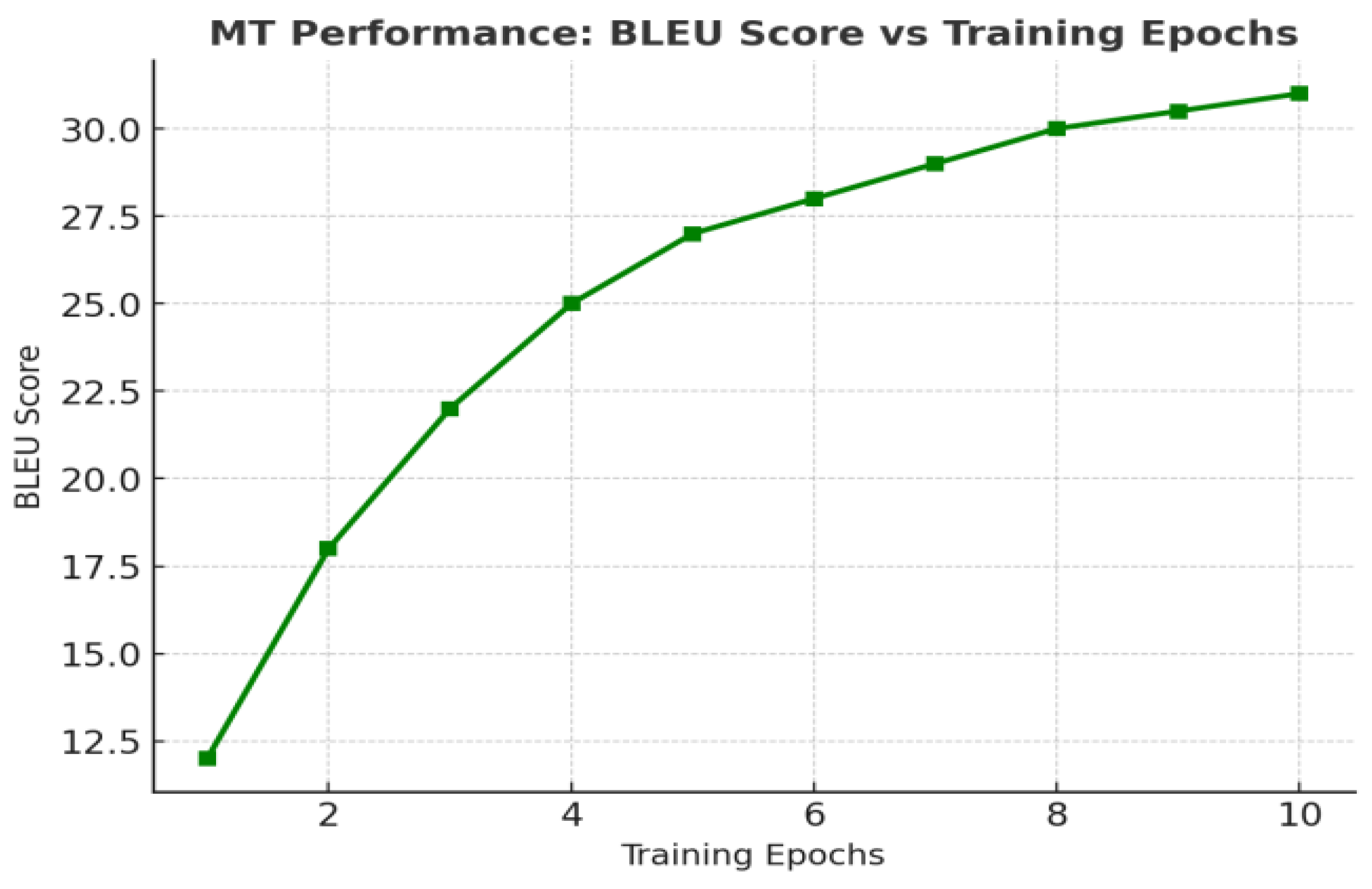
Figure 4.
presents the average scores of the survey results.
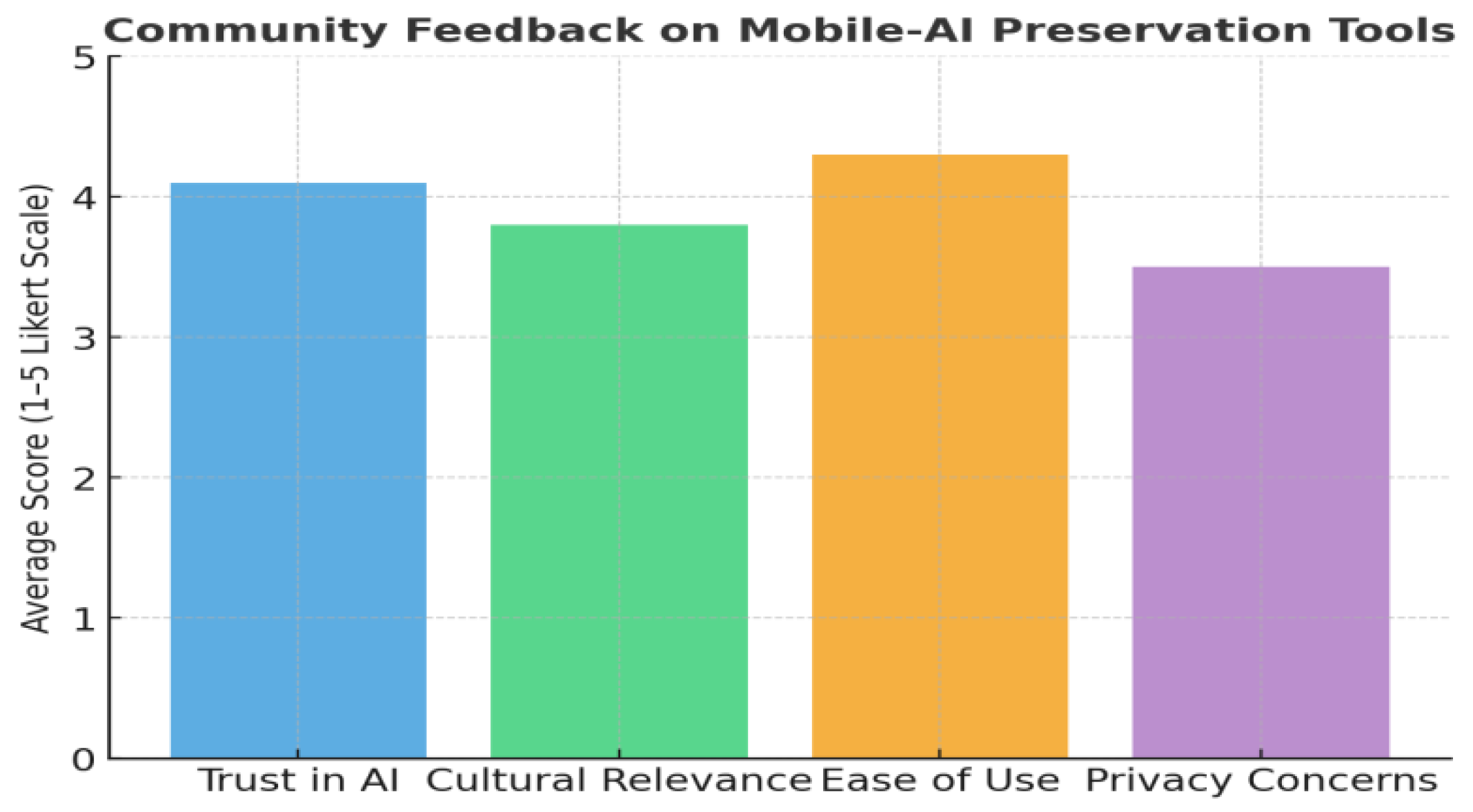

Table 2.
Results & Discussion Summary.
| Domain | Result | Discussion/Interpretation |
|---|---|---|
| ASR | WER 18–22% | Accurate for everyday speaking; had trouble with cultural jargon; scores improved with elder approval . |
| NLP/MT | BLEU 24–30; METEOR 0.55–0.62 | Idiomatic expressions are lost; hybrid AI-human validation is required; literal translations are good. |
| GIS Mapping | 90% accuracy validated by elders | Beneficial for ecological and land rights; if not under community control, there is a potential of abuse. |
| Qualitative Themes | Digital literacy gap, trust concerns, identity preservation | In order to respect cultural dynamics, technology must be co-designed with communities. |
| Ethics | CARE principles, Mukurtu-based archives | In line with Indigenous Data Sovereignty, ethical precautions are essential. |
6. Conclusion
When integrated into frameworks that are ethically and culturally appropriate, mobile and AI technologies can successfully conserve tribal knowledge. With respect to Indigenous Data Sovereignty, the suggested method shows how GIS mapping, AI transcription/translation, and mobile apps may empower communities.
7. Future Work
1. Increase the size of multi-dialect and multimodal tribal datasets.
2. Create AI models for low-connectivity areas that run offline or on devices.
3. Make NLP/MT better at managing cultural nuances.
4. Complement national education and e-governance systems with frameworks.
5. Perform comparative research with other indigenous groups around the world.
References
- Bird, S. (2014). Aikuma: A mobile app for collaborative language documentation. ACL Workshops.
- Carroll, S. R., et al. (2020). The CARE Principles for Indigenous Data Governance. Data Science Journal, 19(1), 43. [CrossRef]
- Christen, K. (2012). Does information really want to be free? Indigenous knowledge systems and the question of openness. International Journal of Communication, 6, 2870–2893.
- Coto-Solano, R., et al. (2022). Automatic Speech Recognition for Cook Islands Māori. Proceedings of LREC 2022.
- First Peoples’ Cultural Council (FPCC). (2019). FirstVoices: Indigenous language archiving and teaching platform.
- Mehta, D., et al. (2020). Learnings from technological interventions in a low-resource language: A case-study on Gondi. arXiv preprint arXiv:2004.10270. [CrossRef]
- Te Hiku Media. (2021). ASR for te reo Māori: Community-owned AI for language revitalization.
- The Hindu. (2025, January 15). Adi Vaani: Digital governance for tribal language inclusion. The Hindu.
Figure 1.
Illustrates the stepwise technical methodology integrating mobile data collection, AI processing (ASR, NLP, GIS), qualitative analysis, ethical safeguards, and validation for tribal knowledge preservation.
Figure 1.
Illustrates the stepwise technical methodology integrating mobile data collection, AI processing (ASR, NLP, GIS), qualitative analysis, ethical safeguards, and validation for tribal knowledge preservation.
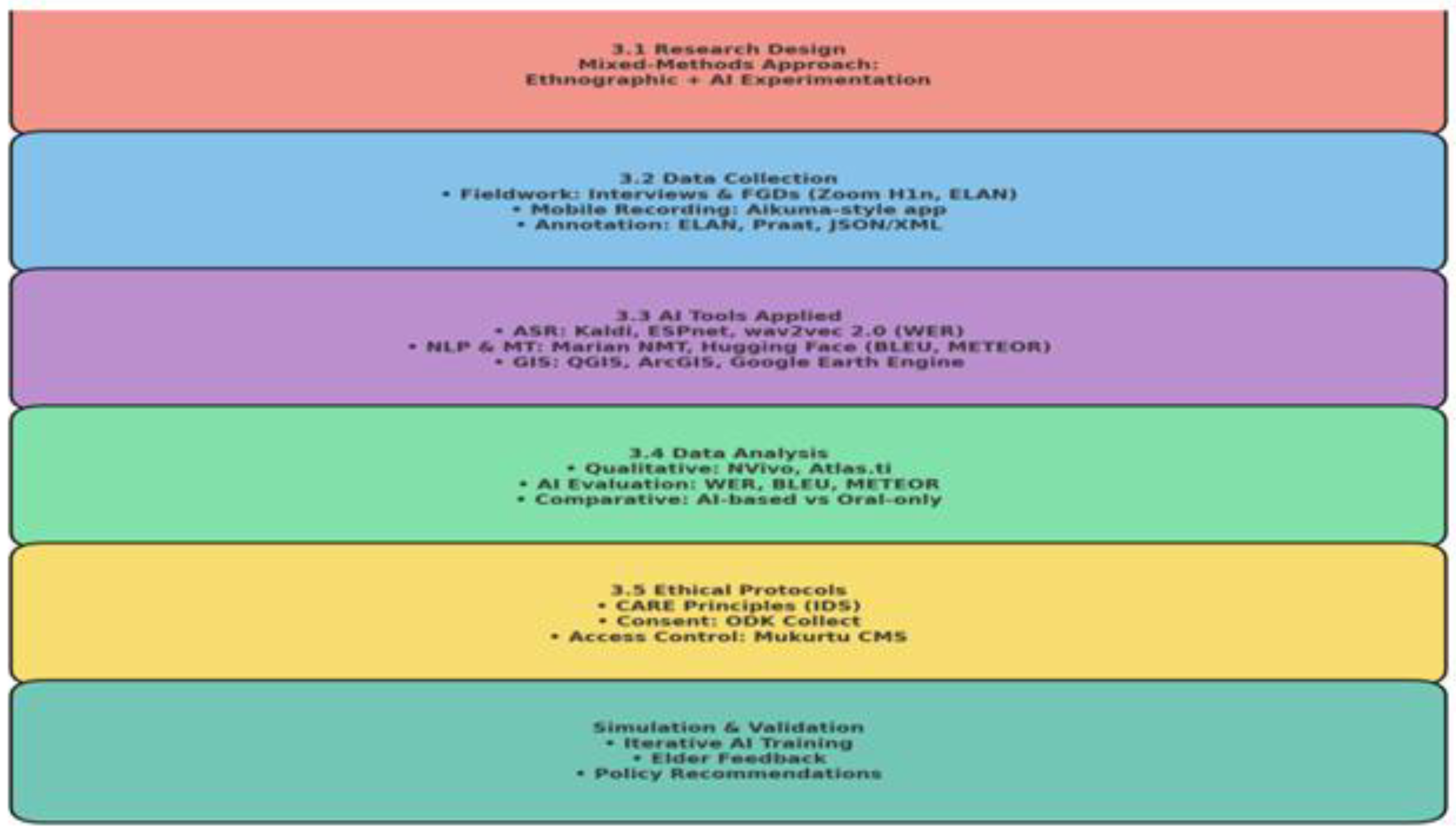
Figure 2.
Illustrates the relationship between dataset size and WER.
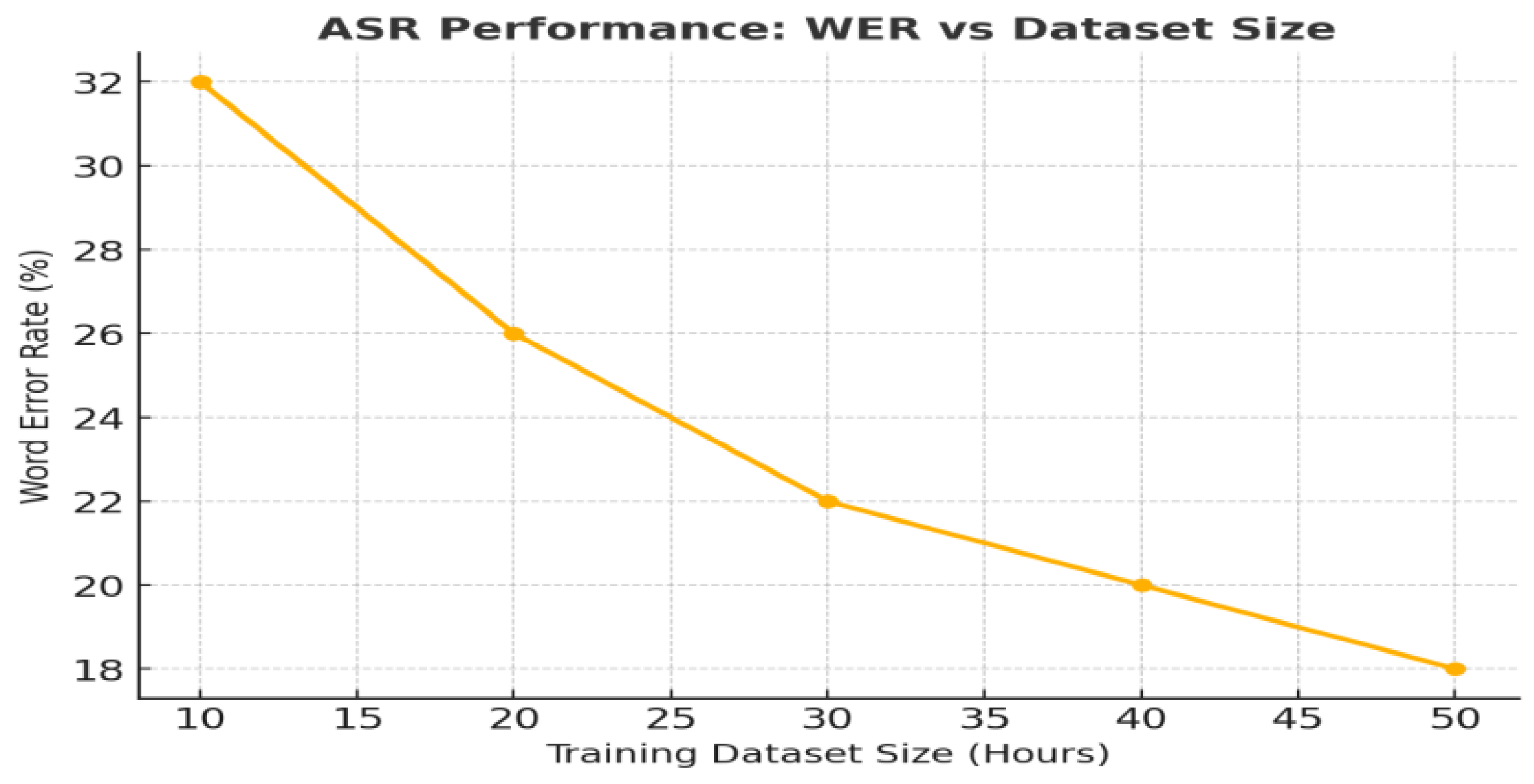
Table 1.
Shows that the majority of current research focuses on language documentation, leaving gaps in legal and cultural knowledge systems.
Table 1.
Shows that the majority of current research focuses on language documentation, leaving gaps in legal and cultural knowledge systems.
| Theme | Existing Research | Identified Gaps | Implication for Present Study |
|---|---|---|---|
| Mobile Technology in Tribal Knowledge | Oral traditions have been successfully documented in Gondi with IVR-based interventions and mobile apps such as Aikuma [1,6]. | The majority of research is language-focused, with little attention paid to ecological knowledge, customary law, and cultural practices utilising mobile means. | The study broadens the use of mobile technology to encompass law, culture, and ecology in addition to language. |
| AI Applications (ASR/NLP/MT) | In endangered languages, Te Hiku Media's Māori ASR and Cook Islands Māori ASR models demonstrate [4,7]. | There are few tribal case studies from India, and little is known about AI accuracy in tribal languages with limited resources. | The work uses AI (ASR, NLP, and GIS) in tribal environments in India (e.g., Bhil, Gondi). |
| Digital Archives & Community Platforms | Culturally sensitive digital archives are offered by FirstVoices and Mukurtu CMS [3,5]. | There aren't many Indian tribes' archives, and they aren't integrated with mobile or AI technologies. | For India, the study suggests a mobile + AI + community archive model. |
| Ethical Frameworks & Data Sovereignty | Community control is emphasized by the IDS and CARE Principles movements[2]. | IDS/CARE usage in Indian tribal research is quite low, and AI programs do not incorporate ethical precautions. | To guarantee ethical preservation, the study incorporates CARE principles into the mobile-AI system. |
| Policy Integration | Tribal languages are frequently left out of India's e-governance programs [8] | lack of a formal framework connecting national/state policy and AI-based tribal knowledge preservation. | The report creates policy suggestions to connect governance and technology. |
Disclaimer/Publisher’s Note: The statements, opinions and data contained in all publications are solely those of the individual author(s) and contributor(s) and not of MDPI and/or the editor(s). MDPI and/or the editor(s) disclaim responsibility for any injury to people or property resulting from any ideas, methods, instructions or products referred to in the content. |
© 2025 by the authors. Licensee MDPI, Basel, Switzerland. This article is an open access article distributed under the terms and conditions of the Creative Commons Attribution (CC BY) license (http://creativecommons.org/licenses/by/4.0/).
Copyright: This open access article is published under a Creative Commons CC BY 4.0 license, which permit the free download, distribution, and reuse, provided that the author and preprint are cited in any reuse.