

Submitted:
13 October 2025
Posted:
15 October 2025
You are already at the latest version
Abstract
Soil compaction from repeated mechanized traffic in sugarcane cultivation reduces porosity, root growth, water infiltration and nutrient availability. Pre-consolidation stresses (σP) in sugarcane soils (70–210 kPa) are frequently exceeded by machine loads up to 595 kPa, producing bulk density (b) above 1.65 Mg m-3 and soil resistance to penetration (SR) beyond 2.0 MPa within the upper 0.40 m; approximately 80% of root biomass concentrates in this zone. Conventional whole-area subsoiling is energy-intensive, destabilizes soil structure and accelerates re-compaction, limiting long-term efficacy. This review proposes integrating strip soil tillage (SST) with controlled traffic farming (CTF) via a multifunctional implement that performs selective subsoiling, in-row chemical correction and targeted input application. The system is designed to mobilize 53% of the area, preserve inter-row structure, reduce fuel consumption by 43.5%, decrease CO2 emissions by 163-315.4 kg ha-1 and lower operational costs by 53.5% relative to conventional approaches. The implement features adjustable-depth subsoiler shanks with dedicated input dispensers, rotary hoes for organic amendment incorporation and GNSS-guided autopilot for precise in-row operations. Expected outcomes include improved soil physical quality, enhanced root development beyond 1.30 m, increased input-use efficiency and sustainable productivity gains under CTF–SST management. A literature review search up to 31 May 2025 supported the integration of SST and CTF as a viable strategy for sustainable soil management in sugarcane production.
Keywords:
soil compaction
; controlled-traffic farming
; strip soil tillage
; soil physical quality
; input use efficiency
; circular economy
1. Introduction
The development of modern agriculture and the intensification of mechanization have led to significant gains in productivity and operational efficiency, but have also brought to light challenges related to the physical degradation of soil. Compaction occurs when vertical stresses (σZ) exceeding σP reorganize the porous matrix, resulting in irreversible plastic deformations, increased ρb, and reduced functional porosity. These effects impose limitations on root growth, water infiltration and storage, gas exchange, and nutrient availability, directly compromising the longevity and productivity of sugarcane fields [1,2,3,4,5,6,7,8,9].
The introduction of mechanized harvesting eliminated straw burning and brought environmental and social benefits, but intensified repetitive traffic and the weight of machines on the soil. While σP in sugarcane soils ranges from 70 to 210 kPa, the pressures exerted by transporters and harvesters can reach up to 595 kPa, propagating to depths of 0.40 m and laterally up to 0.90 m [10]. Mechanized harvesting, especially in wet soils, intensifies the surpassing of pre-consolidation pressure and accelerates structural soil degradation [11].
These values lead to ρb above 1.65 Mg m-3 and SR above 2.0 MPa, conditions that restrict root development [12,13,14,15,16]. Most of the root system is concentrated in the first 0.40 m of soil, with lateral distribution up to 0.30 m from the planting row [17]. Deep mobilization of the entire area, although it promotes immediate breaking of compacted layers, demands high energy costs, destroys essential structural pores, and accelerates the re-compaction process, reducing its effectiveness already in the first subsequent harvests [3,4,18].
To maximize root development and align soil preparation with the logic of controlled traffic, it is essential to define parameters for the depth and width of the mobilized strip, aligning them with the designated traffic lanes. This preserves the structure of the inter-rows, reduces progressive compaction, and improves the rolling efficiency of equipment, prolonging the productive life of the sugarcane field [12,13,18,19,20].
In this context, conservation practices such as CTF and Strip Soil Tillage (SST) emerge as strategic alternatives. CTF restricts traffic to specific lanes, reducing the compacted area and preserving soil structure in the inter-rows. SST focuses mobilization only on the planting row, promoting selective decompaction and favoring a more suitable root environment. These practices have the potential to improve soil physical quality, increase the efficiency of water and nutrient use, and generate sustainable productivity gains [19,21].
The joint adoption of CTF and SST also brings economic and environmental benefits: concentrating operations reduces fuel consumption by up to 43.5%, decreases CO2 emissions by 315 kg ha-1, and reduces operational costs by about 53.5%. Finally, localized management allows targeted application of soil amendments, mineral fertilizers, organic compounds, and biological inputs in the planting strip, optimizing nutrient availability, minimizing leaching losses, and creating a fertile, resilient, and sustainable soil profile.
The sugar-energy sector can benefit from mechanization technologies that promote the reduction of investments, operational costs, harvest losses, fossil fuel consumption, and associated emissions, optimizing the operational efficiency of the complex mechanized cycles involving multiple interactive equipment. However, these agricultural technologies must be improved with a focus not only on increasing productivity and reducing the demand for new areas, but also on mitigating the negative environmental impacts caused by mechanization [22,23,24,25,26,27,28,29,30,31].
2. Scope and Approach
A literature search was conducted in Scopus, Web of Science, SciELO, Google Scholar and CAB Abstracts up to 31 May 2025, including publications in English, Portuguese and Spanish. Search terms combined variations of “sugarcane / sugar cane / Saccharum”, “tillage / subsoiling / no-till / compaction / wheel traffic”, and “bulk density / penetration resistance / soil strength / yield / fuel”. We included field studies and other works directly applicable to field conditions that reported at least one soil physical metric (e.g., bulk density, penetration resistance, preconsolidation pressure) or productivity/energy indicators (e.g., cane yield, diesel consumption). Review articles and relevant grey literature were consulted to support the conceptual framework..
3. Review
3.1. Fundamentals of Soil Compaction and Recompactation
Soil compaction occurs when σZ exceeds σP, causing irreversible plastic deformations, an increase in ρb, and a reduction in functional porosity. In mechanized sugarcane areas, intensive mechanization and repetitive traffic, especially during harvest, often impose loads that exceed the typical σP values of 70–210 kPa for cultivated Latosols and Ultisols [32,33].
The loss of macroporosity compromises saturated hydraulic conductivity and air permeability, in addition to increasing soil resistance to penetration (SR). SR values above 2.0 MPa constitute severe limitations to root growth [14]. Even after 12 years without traffic, compacted layers maintain about a 50% reduction in macroporosity, with only partial recovery in the surface horizons [1]. In forest ecosystems, deep structural constraints can persist for more than 30 years [2], reinforcing the long-lasting nature of the problem. σP represents the limit between elastic and plastic deformations in the soil. In well-structured clay soils, σP can reach values close to 120 kPa, while in sandy soils it ranges from 20 to 80 kPa [35]. As water content increases, σP decreases, making the soil more susceptible to plastic deformation. Even when applied stresses are below σP, repeated loads can cause successive particle reorganizations, resulting in cumulative loss of functional porosity and structural degradation [3,33].
Recompaction is favored when intense disturbance disrupts the natural pore arrangement, making the soil more vulnerable to subsequent traffic, even under moderate loads [4]. Factors such as wetting-drying cycles and gravitational action accelerate this process [3,6]. In addition to the physical impacts, compaction reduces microbial activity and soil biodiversity [12], impairing processes such as residue decomposition and nutrient cycling. Chemically, it limits nutrient mobility, increases losses through denitrification and erosion, and raises dependence on external inputs to maintain productivity [7,34].
Therefore, understanding the limits of σP and the mechanisms of structural degradation is essential for establishing effective preventive and corrective strategies—the concept of the Virgin Compression Line (VCL) being a natural bridge for further analysis of the mechanical response of agricultural soils to traffic.
3.2. Mobilization and Alteration of Soil Structure
Soil sustains life by providing water, nutrients, and shelter for biota, but it quickly loses its integrity when subjected to improper management. Initial tillage breaks up the natural aggregates that ensure porosity, aeration, and structural stability. This momentary disaggregation is followed by the resettling of the soil under the action of gravity, moisture, and machinery traffic, resulting in a bulk density (ρb) higher than the original and a progressive loss of natural resilience [2,3].
Deep tillage of the entire area, although it promotes immediate rupture of compacted layers, requires high energy input, destroys essential structural pores, and accelerates the recompaction process, reducing its effectiveness as early as the first subsequent harvests [4,6].
To avoid this reverse effect, it is necessary to integrate conservation practices such as localized tillage and controlled traffic, which preserve the structure of the inter-row spaces and reduce the recurrence of loads on the soil.
Repeated mechanical operations concentrate stresses at similar depths, forming hardened subsurface layers that act as physical barriers to root growth. Macroporosity can remain up to 50% lower than the original state even after 12 years of spontaneous recovery, with effects still noticeable at a depth of 0.35 m [1]. These compacted layers increase energy consumption during tillage operations and intensify nutrient losses through denitrification and erosion, impacting the productivity and sustainability of the system [7,36].
3.3. Progressive Compaction Management
Soil compaction is a cumulative process that intensifies over agricultural cycles, even after mechanical interventions aimed at its mitigation. This recompaction occurs due to the recurrence of machinery traffic, gravitational action, and natural wetting and drying cycles, which promote the reorganization of soil particles and reduce its functional porosity [3,6]. As a consequence, essential physical attributes for crop development, such as hydraulic conductivity, air permeability, and soil resistance to penetration (SR), are compromised [12]. The limitation of these parameters directly affects root growth, water and nutrient uptake, and biological activity in the soil [37].
In addition to physical impacts, progressive compaction interferes with load distribution throughout the soil profile, favoring the formation of shear zones and stress bulbs that intensify structural degradation, even in previously corrected soils [13]. This condition creates a less favorable environment for plant development, reducing productive potential and hindering the natural recovery of soil structure. Reversing this process requires integrated approaches that simultaneously consider the physical, chemical, and biological aspects of the soil-plant system, and that are adapted to the edaphoclimatic and operational conditions of each production system [7,38].
Mitigating progressive compaction requires strategies that act preventively on the factors that trigger it. Among these, CTF stands out, which consists of delimiting specific lanes for machinery traffic, preserving the structure of the inter-row spaces and reducing mechanical impact on the soil. This technique has demonstrated effectiveness in maintaining functional porosity and reducing ρb in non-trafficked areas, contributing to improved hydraulic conductivity and air permeability [13,38].
The use of low-pressure tires or track systems has also been recommended as a way to minimize the formation of ruts and stress bulbs, especially in medium to clay-textured soils. These technologies reduce the pressure exerted on the soil, attenuating the effects of compaction in subsurface layers and preserving aggregate structure [12].
In addition to mechanical strategies, the incorporation of organic matter plays a fundamental role in soil resistance to compaction. The application of plant residues, green manures, or organic composts promotes the formation of stable aggregates, increases microbial activity, and improves water retention, creating a more resilient environment to the compacting action of agricultural traffic and hydrothermal cycles [7,37].
Localized tillage systems have emerged as effective alternatives to mitigate the effects of progressive compaction, especially in areas with a history of intensive mechanization. By limiting soil disturbance to the planting strip, these techniques preserve the structure of the inter-row spaces, maintaining functional corridors that favor drainage, aeration, and pore continuity. This configuration allows for greater hydraulic range and reduces SR in root growth zones, contributing to the initial establishment of crops and the efficient use of available water and nutrients in the profile [19].
Furthermore, SST reduces the energy consumption of agricultural operations, decreases soil exposure to erosion, and favors the maintenance of organic matter in non-disturbed areas. This approach has been especially effective in no-tillage systems and perennial crops, where the conservation of surface structure is crucial for productive sustainability. The adoption of equipment adapted for SST, such as localized subsoilers and scarifiers, has increased the technical and economic feasibility of this practice, making it compatible with different soil types and operational conditions [12].
3.4. Virgin Compression Line (VCL)
The VCL represents a fundamental concept for understanding the dynamics of soil deformation under external loads, especially in mechanized agricultural systems. It is a curve that describes the behavior of soil when subjected to increasing stresses, without a prior history of compaction, and is widely used to identify the critical point at which the soil begins to undergo irreversible deformations [3,6]. From the VCL, it is possible to identify the critical point where the soil starts irreversible deformations, characterized by particle reorganization and loss of functional porosity [6].
In agricultural soils, the VCL is often exceeded during mechanized operations, especially when there is inadequate traffic control or when the soil is at high moisture content. When structural limits are surpassed, there is physical degradation of the soil and impairment of hydraulic functionality. Once the VCL is exceeded, the soil exhibits pseudoelastic behavior only within limited stress ranges, becoming more susceptible to progressive recompaction [3,13].
Characterizing the VCL in different soil types has enabled significant advances in defining critical pressure limits and calibrating agricultural equipment. This approach contributes to the development of management strategies that respect the soil’s load-bearing capacity, avoiding permanent deformations and promoting the conservation of physical structure throughout production cycles [12]. This approach has been particularly useful in reduced tillage and no-till systems, where preserving the physical structure of the soil is essential for agronomic performance.
Under common operational conditions, especially in wet soils and with intense machinery traffic, the VCL is frequently exceeded, resulting in deep and long-lasting structural changes. Surpassing this line leads to changes in the soil’s mechanical behavior, with pseudoelastic response only in limited stress ranges, making it more susceptible to progressive recompaction [12,13]. Characterizing the VCL in different soil types has been essential for developing management strategies that respect the soil’s load-bearing capacity, avoiding permanent deformations and promoting the conservation of physical structure throughout production cycles.
Integrating the VCL into operational planning enables the adoption of strategies such as controlled traffic, which designates specific lanes for machinery movement, preserving the structure of the inter-rows and reducing repeated loads on productive areas. Additionally, the use of low-pressure tires and track systems helps distribute loads more evenly, reducing the risk of exceeding critical compaction thresholds [13,38].
Localized tillage, with disturbance restricted to the planting strip, also benefits from the practical application of the VCL by allowing targeted mechanical interventions that respect the soil’s load-bearing capacity. This strategy reduces the energy consumption of operations, preserves the structure of the inter-rows, and favors deep root growth, contributing to the physical and productive sustainability of the agricultural system [19].
3.5. Impact of Mechanized Traffic in Sugarcane Fields
Mechanized traffic in sugarcane cultivation areas is one of the main causes of physical soil degradation, especially in systems with high operational intensity. In sugarcane cultivation areas, intense traffic from harvesters and transshipment vehicles often occurs under unsuitable moisture conditions, favoring the surpassing of σP and the induction of irreversible deformations. Well-structured clay soils may have σP values close to 120 kPa when dry, while sandy soils typically range from 20 to 80 kPa [35]. As water content increases, σP decreases considerably, making the soil more vulnerable to plastic deformation under external loads—a key factor for planning operational windows in mechanized systems [33].
Transshipment is the equipment that most contributes to soil compaction during mechanized harvest, due to its high axle load and the frequency of traffic over productive areas [15]. This condition compromises the physical structure of the soil at depth, reduces functional porosity, and limits hydraulic conductivity, directly affecting root development and the efficiency of water and nutrient uptake by plants [3,6]. The recurrence of these operations over production cycles intensifies the process of progressive compaction, making structural recovery difficult even after mechanical interventions.
Compaction induced by mechanized traffic in sugarcane fields shows high spatial variability, reflecting differences in the intensity, frequency, and distribution of loads applied by machines. This structural heterogeneity is amplified by the absence of traffic control, resulting in high-traffic zones with bulk density up to 20% higher than non-trafficked areas [13]. The reduction in total porosity and hydraulic conductivity in these zones compromises agronomic performance, with localized productivity losses that can exceed 30% in fields with a history of uncontrolled traffic [12].
The limitation to root growth caused by compaction in subsurface layers restricts plant access to water and nutrients, even under favorable climatic conditions. The reduction in air permeability affects root respiration and microbial activity, impairing organic matter mineralization and nitrogen availability in the system [7,37]. These combined effects result in water and nutrient stress, directly impacting biomass accumulation and sugar concentration in the aerial part of the plant—critical factors for the industrial yield of sugarcane.
To mitigate these effects, the adoption of controlled traffic systems has proven effective in reducing structural variability and preserving the physical functionality of the soil. The designation of specific lanes for machinery movement allows for the conservation of inter-rows and the maintenance of porous structure in productive areas. Additionally, the use of cover crops between cycles, the application of organic compounds, and the adoption of localized tillage contribute to the recovery of soil structure and the improvement of agricultural input efficiency [12,19].
3.6. Controlled Traffic Farming (CTF)
CTF originated from research into the effects of agricultural machinery traffic on soil structure and is a conservation practice capable of drastically reducing the area affected by compaction. In conventional systems, random traffic can impact up to 80% of the cultivated surface, increasing soil resistance to penetration by up to 47%, bulk density by up to 15%, reducing total porosity by 10%, and decreasing water infiltration rates by up to four times [2,9,12,33,38].
CTF restricts traffic to fixed and permanent lanes, concentrating mechanical efforts in wheel tracks and preserving physical structure and biological activity in the inter-rows. This approach maintains porous functionality, favors carbon and nutrient cycling, and optimizes the root environment [8,39,40,41].
In clayey Oxisol under sugarcane, a reduction in bulk density from 1.74 Mg m−3 under random traffic to 1.38 Mg m−3 under CTF was recorded, accompanied by increased pore continuity and infiltration [13]. Under similar conditions, an 18% increase in root dry mass and an 8.2 Mg ha−1 increase in productivity were observed [12].
In wet conditions, the soil becomes more vulnerable to deformation, requiring greater operational control to avoid compaction. The adoption of CTF prevents traffic over planting rows under such conditions, avoiding irreversible structural degradation [33].
From an operational perspective, the designation of fixed lanes stabilizes rolling, reduces slippage, and provides substantial resource savings. Reductions of up to 50% in soil preparation costs and a doubling of nitrogen fertilizer use efficiency have been observed [19,38]. Prolonged use of CTF promotes natural structure recovery in planting rows, even without deep tillage, reducing the depth of future subsoiling operations and increasing input use efficiency [42].
The positive impact of CTF is also expressed in composite quality indicators, such as a 12% increase in the Soil Health Index in clayey sandy areas under CTF compared to random traffic, with improvement mainly attributed to the recovery of physical attributes [12].
The integration of CTF and critical compaction limits allows for more precise interventions, such as selective subsoiling. In clay soils, this approach prevents the formation of dense layers and maintains suitable conditions for infiltration and root growth.
Finally, CTF creates the necessary infrastructure for high-precision soil management practices, such as SST, ensuring repeatability in operation and alignment between selective tillage, chemical correction, and localized input application (Figure 1). This synergy reinforces the agronomic, economic, and environmental sustainability of modern sugarcane systems.
3.7. Soil Preparation in Sugarcane Cultivation
3.7.1. Conventional Tillage System (CST)
In conventional systems, the soil is mobilized across the entire sugarcane field every 4–10 years, using heavy harrows, disc plows, subsoilers, and levelers. Although effective in controlling weeds and incorporating soil amendments, these operations completely remove the plant cover, exposing the soil to erosion and accelerating the mineralization of organic matter. Total mobilization also destroys structural pores essential for drainage and water retention, intensifying recompaction as early as the first subsequent harvests and increasing preparation costs due to higher fuel consumption and equipment wear [2,43].
3.7.2. Reduced Tillage System (RST)
The RST combines chemical desiccation of the ratoon with targeted subsoiling and furrowing operations for direct planting. After applying systemic herbicides (glyphosate), subsoiling is performed in strips or across the entire area at depths of 0.40–0.60 m, followed by furrowing to deposit seedlings. This strategy preserves part of the straw on the surface, improves infiltration, and reduces the mobilized area, but can still cause recompaction between rows and requires monitoring of machine traffic to avoid structural damage [44,45].
Systems with less mobilization preserve the physical structure of the soil, reduce progressive compaction, and favor deep root growth [12].
3.7.3. Strip Soil Tillage (SST)
SST is a conservation practice that mobilizes only the strip intended for the planting row, preserving the structure between rows and naturally integrating with Controlled Traffic Farming (CTF). Its goal is to create a highly favorable root environment, with better water infiltration and retention, gas exchange, and nutrient access, while reducing costs and environmental impacts [19,44].
- SSTC – Strip Soil Tillage associated with a bed former: combines subsoiler shanks, rotary hoe, and simultaneous application of amendments and inputs in the planting row;
- SSTS – Strip Soil Tillage with Localized Subsoiling: replaces the rotary hoe with modified subsoilers, without rotary surface mobilization;
- SSTP – Variant of SSTC with deep incorporation of 25% of the lime (0.4–0.6 m), aimed at chemical correction in subsurface layers.
3.7.4. Physical and Structural Benefits
Mobilization restricted to 53% of the cultivated area preserves microporosity and structural stability between rows, delaying recompaction and keeping bulk density (ρb) below critical limits (1.50 Mg m−3) up to 0.40 m [19].
In Latosols and Ultisols, even with higher soil resistance (SR) between SST rows, productivity was statistically equivalent to that of the conventional tillage system (CST), confirming agronomic effectiveness and physical conservation [18].
3.7.5. Operational Efficiency and Sustainability
SST reduces diesel consumption by up to 43.5% and emissions by 315.4 kg CO2 ha−1, in addition to decreasing operational costs by 53.5%—notably due to lower use of herbicides, amendments, and fertilizers, thanks to localized application [18,21].
The controlled geometry of the bed, aligned with traffic lanes via GNSS, optimizes the repeatability of operations, rolling efficiency, and uniform distribution of inputs.
The definition of the geometric and operational parameters of the SSTC system is supported by experimental and bibliographic evidence relating mechanical stresses, root distribution, and hydrological performance. These evidences are summarized in Table 1, which consolidates the main research supporting the bed width, working depth, and the need to confine traffic outside the mobilized zone.
The functionality of the proposed SSTC geometry is demonstrated in Figure 2 [19], which shows the cross-section of the seedbed under real operating conditions. The delimitation of the mobilized strip (600 mm), the effective operating depth (400-450 mm), and the structural preservation of the regions adjacent to the seedbed are observed. The decompacted zone presents greater root density and functional porosity, while the traffic lanes maintain a consolidated structure, favoring operational efficiency and the segregation of mechanical damage. This configuration validates the geometric parameters defined for the SSTC and reinforces its agronomic functionality under real field conditions.
3.7.6. Hydrological and Root Performance
SSTC provides high infiltration rates (278 mmh-1 in the seedbed vs. 120 mmh-1 in the traffic lane) and root depths of up to 1.33 m 120 days after planting [19]. By avoiding mobilization below the compacted layer, the subsoil is maintained in a structurally balanced state, with good pore functionality, favoring the advancement of roots toward deeper water reserves.
3.7.7. Integration with Chemical and Biological Management
SST is an ideal platform for the integrated application of amendments, organic compounds, and bioinputs directly to the root zone. SST with deep limestone increased base saturation, reduced aluminum, and increased stalk yield by up to 12.4% compared to CST [46]. The localized incorporation of filter cake (fresh or composted) and phosphorus-solubilizing microorganisms enhances the release and absorption of P, allowing a reduction in the dose of phosphate fertilizers by up to 50% without loss of productivity [37,47,48].
3.7.8. Integrated Management Associated with the Strip Soil Tillage System (SSTC)
SSTC is no longer a limited mobilization solution, but rather a central axis for integrating high-precision chemical, organic, and biological practices, capable of deeply rehabilitating the soil profile and sustaining high productivity over multiple cuts. The controlled geometry of the site, combined with fixed traffic, ensures operational repeatability and precise application of inputs in the zone of greatest root density, optimizing efficiency and reducing waste [19,44]. Deep chemical amendment with limestone, calcium oxides (CaO), and magnesium oxides (MgO), incorporated between 0.40 and 0.60 m by the subsoiler shafts, neutralizes toxic aluminum, raises subsoil pH by up to 0.7 units, and doubles base saturation, with a long-lasting residual effect [49,50]. In the SSTP, which incorporates 25% of the limestone dose at depth, gains of 5.2% in stalk yield were observed compared to the SSTC and 12.4% compared to the CST, while sugar production increased between 4.9% and 13.4%. These results combine chemical and physical effects: calcium promotes clay flocculation, the formation of stable aggregates, and an increase in functional porosity, facilitating infiltration and water storage to support the crop during periods of drought [46,51,52]. The localized addition of organic matter, mainly in the form of fresh or composted filter cake, represents another essential pillar. Rich in P, Ca, Mg, and micronutrients, the cake applied to the SSTC bed improves water retention, increases organic matter by 20–30%, and intensifies beneficial microbial activity [37,53,54]. In Latosols and Quartzarenic Neosols, productivity increases ranged from 4.8% to 7.0% with isolated application, reaching up to 11.1% when combined with mineral fertilizer, with residual effects in the second harvest and more pronounced responses in soils with lower CEC. In addition to the agronomic benefits, the use of the cake reduces dependence on mineral fertilizers and integrates the reuse of waste from the sugarcane industry itself, reducing associated emissions [37]. Bioactivation with phosphorus-solubilizing microorganisms (PSM), such as Pseudomonas, Bacillus, and Penicillium species, completes the integrated management, releasing organic acids and phosphatases that increase soil P availability by up to 27% [55,56]. Sugarcane trials have shown an increase of up to 38.4% in stalk production, a 6.16% increase in ATR, and the possibility of reducing P2O5 dosage by 50–75% without compromising technological quality [47,48,57]. It was also observed that sugar production per hectare increased by 43% even with 25% less phosphate fertilizer. In SSTC, the deposition of these inoculants directly into the rhizosphere, via seedbed nozzles or solid application in the furrow, maximizes utilization and reduces losses due to fixation or leaching [48]. Inoculation with PSM adapted to the local soil profile can increase phosphorus use efficiency by up to 35%, with significant gains in sugarcane productivity and technological quality [58]. By integrating deep chemical correction, stabilized organic input, and phosphate bioactivation in a strip representing just over half the area, SSTC reduces diesel consumption and operating time, cuts CO2 emissions, and minimizes inter-row recompactation. This synergy builds a continuous and functional profile that sustains high yields even in restrictive environments, preserves the structural integrity of the inter-rows, and improves input efficiency over multiple cycles [18,21,59].
3.8. Advanced Soil Management Support Technologies Automatic
3.8.1. Positioning and Steering Systems
The use of GNSS receivers with RTK corrections and automatic steering systems allows for the mapping of traffic lanes and planting beds with centimeter precision, ensuring that SST implements operate precisely within the planting rows. This technology reduces overlapping passes and deviations, essential for keeping the tillage area restricted to 53% of the field, as recommended by the SSTC, and avoiding unwanted compaction between the rows [40,60,61].
3.8.2. Soil Sensors and In-Situ Monitoring
Sensors of ρb, volumetric moisture, temperature, and electrical conductivity sensors installed directly in the soil profile provide continuous readings that allow the identification of stress accumulation zones and recompactation points before they become irreversible. These real-time measurements guide the planning of traffic windows and the triggering of localized interventions, optimizing the use of subsoiling implements and reducing operating costs [62,63].
3.8.3. Aerial Photogrammetry and Drones
Unmanned aerial vehicles equipped with RGB, multispectral, and thermal cameras enable the mapping of spatial variability in water stress, leaf vigor, and compacted areas, based on indices such as NDVI and thermography. These high-resolution data enable visual and georeferenced diagnoses, guiding SST and CTF interventions more accurately and quickly than manual surveys [64,65,66].
3.8.4. Digital Platforms and Precision Agriculture
The integration of GNSS, soil sensor, and drone data into precision agriculture platforms creates thematic maps and performance reports on interactive dashboards. Geographic intelligence and predictive analytics tools support decision-making by suggesting traffic routes, subsoiling depths, and targeted input rates. This data-driven approach contributes to greater fertilizer efficiency, lower diesel consumption, and reduced greenhouse gas emissions [67,68,69].
4. Discussion
4.1. Integration of CTF, SST, and Compaction Control
Traffic restriction to specific lanes (CTF) and strip soil tillage (SST) establish a stable mosaic of decompacted “islands” interspersed with concentrated load corridors. This arrangement reduces the area effectively moved by up to 50% and maintains structurally preserved soil strips, minimizing recompactation cycles and accelerating water infiltration by 2–3 times [13,19]. The alignment between construction sites and traffic routes in the SSTC prolongs decompacting and maintains bulk density below 1.50 Mg m-3 down to 0.40 m depth, according to previously defined limits [70].
4.2. Improvement of Physical Structure and Root System
The combined action of localized subsoiling, rotary tillage, and organic matter incorporation stabilizes aggregates, increases functional macroporosity, and reduces soil mechanical strength by up to 60% in the seedbed strip [18,59]. This allows penetration of fine and coarse roots to greater depths, increasing total root length by up to 76.6% and rhizosphere volume by 74.2% under integrated systems [71]. The alternation between traffic zones and seedbeds promotes heterogeneous spatial distribution of roots, maximizing water and nutrient uptake throughout the soil column [7,19].
4.3. Chemical Correction and Fertility
The localized incorporation of limestone or Ca and Mg oxides corrects acidity up to 0.60 m depth, raises pH by 0.7 units and doubles base saturation, reducing toxic aluminum saturation [46,49]. SSTP systems increase stalk yield by 5.2% to 12.4% and sugar yield by 4.9% to 13.4% compared to CST, with a residual effect that persists for three years [50,51]. This approach concentrates the corrective in the zone of greatest root exploration, reducing total limestone requirement by up to 25% and avoiding overdosing between rows.
4.4. Organic Matter and Microbiota
Composting filter cake prior to application optimizes stable carbon and balances C:N, reduces phytotoxins and pathogens, and releases gradual-release organic P over up to 90 days [37]. This organic fraction increases organic matter content by 20–30%, improves cation exchange capacity, and stimulates microbial activity. In Oxisols, the filter cake alone increased stalk productivity by 4.8–5.9%, and, combined with mineral fertilizer, by up to 11.1% [37,53].
4.5. Bioactivation by Phosphorus Solubilizers
The inoculation of Pseudomonas, Bacillus and Penicillium in furrows or liquid solutions in SSTC releases organic acids and phosphatases that solubilize crystalline fractions and residual phosphate rock, increasing available P by up to 27% and allowing a reduction in phosphate fertilizer doses by 50% [55,56]. In sugarcane, PSM combined with DAP increased stalk yield by up to 38.4% and saved 75% of P2O5 without technological loss [47,57].
4.6. Operational Efficiency and Environmental Impact
SST substantially reduces the number of operations and concentrates the application of inputs in the field strip, 53% of the area, which has a direct impact on energy consumption and the use of inputs, resulting in lower CO2 emissions and operational savings. The adoption of SSTC reduces diesel consumption compared to CSP by 51.01 L ha-1 and a reduction of 163 kg CO2 ha-1 [21]. Taking the data for a projected planting area of 1.039 Mha for the 2024/25 harvest [72], a hypothesis of implementation in 50% of the area would imply an annual reduction of 84.7 Gg CO2. With a CBIO price adopted in the model of 10.39 USD Mg-1, the potential revenue estimated for the same exercise is 8.8 x10⁻⁵ USD per year. In a specific model for compost management, assuming a dose of 20 Mg ha−1 and a transportation radius of 10 km, a reduction in operational costs of 79.8% is observed between the compost planting operation and the localized application operation.
4.7. Limitations and Future Directions
The success of integrated management depends on continuous monitoring of pH, organic carbon, and microbial activity to prevent residual phosphorus migration to water bodies [50]. Stable inoculant formats, adaptation of CaO/MgO doses in crop rotations, and evaluation in extreme soils (very clayey or sandy) under prolonged drought are necessary [35,73]. Further study on native PSM consortia and optimization of filter cake composting processes in SSTC are recommended to maximize system resilience.
5. Conclusions and Practical Recommendations
5.1. Conclusions
The review demonstrates that compaction associated with mechanized traffic is one of the central limiting factors for sugarcane productivity and sustainability, and that the integration of CTF and SSTC currently constitutes the most consistent solution in agronomic, operational, and environmental terms. Based on the reviewed literature, the following conclusions are drawn:
- • Soil compaction caused by harvesting and transportation operations reduces porosity, root growth, infiltration, and water and nutrient availability, with measurable effects on productivity when soil density and stresses exceed critical limits;
- • The adoption of CTF reduces the area effectively subject to random traffic and defines contour zones that make SSTC feasible without mobilizing the entire production network; the combination of CTF and SSTC preserves structural interrows and concentrates mobilization only on the necessary strips;
- • To preserve root zones and avoid encroachment on traffic zones, the bibliographic constraints adopted here result in the following SSTC contour geometries: mobilized strip width = 0.60 m (derived from a 1.50 m planting spacing minus lateral propagation of stresses due to overflow = 0.90 m) and working depth of 0.40 m (functional root concentration at 0–0.40 m). These dimensions should be the baseline parameter for experimental evaluations and design models;
- • The coordinated implementation of CTF + SSTC presents quantifiable benefits in operational and environmental efficiencies: average mobilization of the production network close to 53%, observed average reductions in diesel consumption of 43.5% in compared scenarios, and estimated CO2 emission reductions of 163–315.4 kg ha-1;
- • Agronomic gains (porosity recovery, greater root exploration depth, and yield gains) tend to be observed when SSTC is applied in a targeted and repeated manner combined with conservation practices (cover crops, organic incorporation), but the magnitude of the benefit depends on soil texture, moisture content at the time of operation, and traffic history;
- • Localized subsoiling demonstrates a positive effect, but is often transient; the rate of recompactation is high in soils under continuous traffic and varies with texture, moisture content, and intensity of operations. Therefore, the effectiveness of SSTC is only maintained when accompanied by reduced traffic outside defined zones (CTF) and periodic monitoring;
- • There is a clear need for standardized experimental validation: field trials with designs that compare SSTC+CTF versus CST and CTF alone, measuring βb, SR, macroporosity, hydraulic parameters, production, and economic indicators in time series (pre- and post-intervention, multiple harvests);
- • Critical gaps identified: (i) lack of longitudinal studies (>5 years) on recompacting and the sustainability of its effects; (ii) quantified integration between localized input management (fertilization, amendments, filter cake/composts) and the agronomic response of SSTC;
- • From a policy and circular economy perspective, the adoption of SSTC integrated with CTF has the potential to reduce emissions and enable synergies with chemical/biological management (localized application of amendments and organic waste), creating opportunities for incentive mechanisms (carbon credits) and optimizing input use.
In summary, the available evidence indicates that the most robust technical approach to mitigate the effects of compaction on sugarcane is the combination of CTF with parameterized localized tillage (0.60 m × 0.40 m). It is recommended to prioritize standardized experimental research and economic analyses by scale before broad operational prescription, in order to consolidate implementation recommendations in different edaphoclimatic contexts.
5.2. Practical Recommendations
The suggested recommendations are systematized analytically in Table 2, with the aim of organizing parameters, operational ranges, and practical observations that support the adoption of SSTC under CTF.
Author Contributions
For research articles with several authors, a short paragraph specifying their individual contributions must be provided. The following statements should be used “Conceptualization, Américo Ferraz Dias Neto; methodology, Américo Ferraz Dias Neto; validation, , Américo Ferraz Dias Neto, Raffaella Rossetto, Daniel Albiero; formal analysis, Américo Ferraz Dias Neto; investigation, Américo Ferraz Dias Neto, Raffaella Rossetto; resources, Daniel Albiero; data curation, Américo Ferraz Dias Neto; writing—original draft preparation, Américo Ferraz Dias Neto.; writing—review and editing, Américo Ferraz Dias Neto and Raffaella Rossetto; visualization, Américo Ferraz Dias Neto.; supervision, Américo Ferraz Dias Neto and Daniel Albiero; funding acquisition, Daniel Albiero. All authors have read and agreed to the published version of the manuscript.”
Funding
not applicable.
Data Availability Statement
Data is contained within the article or supplementary material.
Acknowledgments
not applicable.
Conflicts of Interest
The authors declare no conflict of interest.
Abbreviations
The following abbreviations are used in this manuscript:
| CTC | Controlled Traffic Farming |
| SST | Strip Soil Tillage |
| SSTC | Strip Soil Tillage with Bed Former |
| SSTS | Strip Soil Tillage with Localized Subsoiling |
| SSTP | Strip Soil Tillage with Deep Lime Incorporation |
| CST | Conventional Tillage System |
| RST | Reduced Tillage System |
| σP | Pre-consolidation Pressure |
| σZ | Vertical Stress |
| ρb | Bulky Density |
| SR | Soil Resistance to Penetration |
| VCL | Virgin Compression Line |
| DAP | Days After Planting |
| GNSS | Global Navigation Satellite System |
References
- Schäffer, J. (2022). Recovery of soil structure and fine root distribution in compacted forest soils. Soil Systems, 6(2), 49. [CrossRef]
- Eggers, H. S., de Brito, D. L., Sprey, M. M., Pereira, L. E. S., Garcia, B. T., & de Souza Maia, J. C. (2025). Impactos do manejo agrícola na resistência a penetração do solo: comparação entre cultivos de cana-de-açúcar e floresta nativa. REVISTA DELOS, 18(63), e3467-e3467.
- Saljnikov, E., Eulenstein, F., Lavrishchev, A., Mirschel, W., Blum, W. E., McKenzie, B. M., ... & Mueller, L. (2022). Understanding soils: their functions, use and degradation. In Advances in understanding soil degradation (pp. 1-42). Cham: Springer International Publishing. [CrossRef]
- Horn, R. F. (2021). Soils in agricultural engineering: Effect of land?use management systems on mechanical soil processes. Hydrogeology, chemical weathering, and soil formation, 187-199. [CrossRef]
- Shaheb, M. R., Venkatesh, R., & Shearer, S. A. (2021). A review on the effect of soil compaction and its management for sustainable crop production. Journal of Biosystems Engineering, 1-23. [CrossRef]
- Keller, T., Lamandé, M., Naderi-Boldaji, M., & de Lima, R. P. (2022). Soil compaction due to agricultural field traffic: An overview of current knowledge and techniques for compaction quantification and mapping. Advances in understanding soil degradation, 287-312. [CrossRef]
- Ogorek, L. L. P., Gao, Y., Farrar, E., & Pandey, B. K. (2024). Soil compaction sensing mechanisms and root responses. Trends in Plant Science. [CrossRef]
- Misiewicz, P. A., Kaczorowska-Dolowy, M., White, D. R., Dickin, E. T., & Godwin, R. J. (2022). Agricultural traffic management systems and soil health. [CrossRef]
- Shaheb, M. R., Misiewicz, P. A., Godwin, R. J., Dickin, E., White, D. R., & Grift, T. E. (2024). The effect of tire inflation pressure and tillage systems on soil properties, growth and yield of maize and soybean in a silty clay loam soil. Soil Use and Management, 40(2), e13063. [CrossRef]
- Júnnyor, W. D. S. G., Diserens, E., De Maria, I. C., Araujo-Junior, C. F., Farhate, C. V. V., & de Souza, Z. M. (2019). Prediction of soil stresses and compaction due to agricultural machines in sugarcane cultivation systems with and without crop rotation. Science of the total environment, 681, 424-434. [CrossRef]
- Júnnyor, W. D. S. G., De Maria, I. C., Araujo-Junior, C. F., Diserens, E., da Costa Severiano, E., Farhate, C. V. V., & de Souza, Z. M. (2022). Conservation systems change soil resistance to compaction caused by mechanised harvesting. Industrial Crops and Products, 177, 114532. [CrossRef]
- Cherubin, M. R., da Luz, F. B., de Lima, R. P., Tenelli, S., Bordonal, R. O., de Oliveira, B. G., ... & Carvalho, J. L. N. (2024). Soil Health in Sugarcane Production Systems. Soil Health Series: Volume 3 Soil Health and Sustainable Agriculture in Brazil, 145-178. [CrossRef]
- da Luz, F. B., Gonzaga, L. C., Castioni, G. A. F., de Lima, R. P., Carvalho, J. L. N., & Cherubin, M. R. (2023). Controlled traffic farming maintains soil physical functionality in sugarcane fields. Geoderma, 432, 116427. [CrossRef]
- Barbosa, L. C., de Souza, Z. M., Franco, H. C. J., Otto, R., Neto, J. R., Garside, A. L., & Carvalho, J. L. N. (2018). Soil texture affects root penetration in Oxisols under sugarcane in Brazil. Geoderma regional, 13, 15-25. [CrossRef]
- Delmond, J. G., Junnyor, W. D. S. G., de Brito, M. F., Rossoni, D. F., Araujo-Junior, C. F., da Costa Severiano, E., & Severiano, E. C. (2024). Which operation in mechanized sugarcane harvesting is most responsible for soil compaction?. Geoderma, 448,116979. [CrossRef]
- Jimenez, K. J., Rolim, M. M., de Lima, R. P., Cavalcanti, R. Q., Silva, Ê. F., & Pedrosa, E. M. (2021). Soil physical indicators of a sugarcane field subjected to successive mechanised harvests. Sugar Tech, 23, 811-818. [CrossRef]
- Otto, R., Trivelin, P. C. O., Franco, H. C. J., Faroni, C. E., & Vitti, A. C. (2009). Root system distribution of sugar cane as related to nitrogen fertilization, evaluated by two methods: monolith and probes. Revista Brasileira de Ciência do Solo, 33, 601-611. [CrossRef]
- Mazaron, B. H. S., Coelho, A. P., & Fernandes, C. (2022). Is localized soil tillage in the planting row a sustainable alternative for sugarcane cultivation?. Bragantia, 81, e4222. [CrossRef]
- Neto, A.F.D., Albiero, D., Rossetto, R., Biagi, J.D., & da Silva, J. G. (2023). Strip soil tillage and traffic over the soil on sugar cane compared to conventional tillage systems. Sugar Tech, 25(5), 1025-1035. [CrossRef]
- de Lima, C. C., De Maria, I. C., da Silva Guimarães Júnnyor, W., Figueiredo, G. C., Dechen, S. C. F., & Bolonhezi, D. (2022). ROOT parameters of sugarcane and soil compaction indicators under deep strip tillage and conventional tillage. Scientific Reports, 12(1), 18537. [CrossRef]
- Neto, A.F.D. (2021). Análise econômica e operacional de preparo de solo e colheita mecanizada= Economic and operational analysis of soil tillage and mechanized harvesting (Doctoral dissertation, [sn]).
- Alesso, C. A., Cipriotti, P. A., Masola, M. J., Carrizo, M. E., Imhoff, S. D. C., Rocha-Meneses, L., & Antille, D. L. (2020). Spatial distribution of soil mechanical strength in a controlled traffic farming system as determined by cone index and geostatistical techniques. [CrossRef]
- Antille, D. L., Peets, S., Galambošová, J., Botta, G. F., Rataj, V., Macak, M., ... & Godwin, R. J. (2019). Soil compaction and controlled traffic farming in arable and grass cropping systems. [CrossRef]
- Bluett, C., Tullberg, J. N., McPhee, J. E., & Antille, D. L. (2019). Soil and Tillage Research: Why still focus on soil compaction? Soil and Tillage Research, 194, 1-2. [CrossRef]
- Botta, G. F., Antille, D. L., Nardon, G. F., Rivero, D., Bienvenido, F., Contessotto, E. E., ... & Ressia, J. M. (2022). Zero and controlled traffic improved soil physical conditions and soybean yield under no-tillage. Soil and Tillage Research, 215, 105235. [CrossRef]
- Etana, A., Holm, L., Rydberg, T., & Keller, T. (2020). Soil and crop responses to controlled traffic farming in reduced tillage and no-till: some experiences from field experiments and on-farm studies in Sweden. Acta Agriculturae Scandinavica, Section B - Soil & Plant Science, 70(4), 333-340. [CrossRef]
- Hefner, M., Labouriau, R., Nørremark, M., & Kristensen, H. L. (2019). Controlled traffic farming increased crop yield, root growth, and nitrogen supply at two organic vegetable farms. Soil and Tillage research, 191, 117-130. [CrossRef]
- Martins Filho, M.V., Siqueira, D. S. and Marques Júnior, J. (2015). The importance of knowing the variability of soil attributes - A importância de se conhecer a variabilidade dos atributos do solo. In: Processos agrícolas e mecanização da cana-de-açúcar. Cham: Sociedade Brasileira de engenharia Agrícola. pp. 149 - 173.
- Ró?ewicz, M. (2022). Review of current knowledge on strip-till cultivation and possibilities of its popularization in Poland. Polish Journal of Agronomy, 49, 20-30. [CrossRef]
- Voltr, V., Wollnerová, J., Fuksa, P., & Hruška, M. (2021). Influence of tillage on the production inputs, outputs, soil compaction and GHG emissions. Agriculture, 11(5), 456. [CrossRef]
- Wang, Y., Sha, Y., Ren, Z., Huang, Y., Gao, Q., Wang, S., ... & Feng, G. (2024). Conservative strip tillage system in maize maintains high yield and mitigates GHG emissions but promotes N2O emissions. Science of The Total Environment, 173067. [CrossRef]
- Toledo, M. P., Rolim, M. M., de Lima, R. P., Cavalcanti, R. Q., Ortiz, P. F., & Cherubin, M. R. (2021). Strength, swelling and compressibility of unsaturated sugarcane soils. Soil and Tillage Research, 212, 105072. [CrossRef]
- Esteban, D. A. A., de Souza, Z. M., Tormena, C. A., dos Santos Gomes, M. G., Parra, J. A. S., Júnnyor, W. D. S. G., & de Moraes, M. T. (2024). Risk assessment of soil compaction due to machinery traffic used in infield transportation of sugarcane during mechanized harvesting. Soil and Tillage Research, 244, 106206. [CrossRef]
- Pandey, B. K., & Bennett, M. J. (2024). Uncovering root compaction response mechanisms: new insights and opportunities. Journal of Experimental Botany, 75(2), 578-583. [CrossRef]
- Torres, L. C., Nemes, A., ten Damme, L., & Keller, T. (2024). Current limitations and future research needs for predicting soil precompression stress: A synthesis of available data. Soil and Tillage Research, 244, 106225. [CrossRef]
- Arruda, A. B., Souza, R. F. D., Brito, G. H. M., Moura, J. B. D., Oliveira, M. H. R. D., Santos, J. M. D., & Dutra e Silva, S. (2021). Resistance of soil to penetration as a parameter indicator of subsolation in crop areas of sugar cane. Scientific Reports, 11(1), 11780. [CrossRef]
- Crusciol, C. A. C., McCray, J. M., de Campos, M., do Nascimento, C. A. C., Rossato, O. B., Adorna, J. C., & Mellis, E. V. (2021). Filter cake as a long-standing source of micronutrients for sugarcane. Journal of Soil Science and Plant Nutrition, 21(1), 813-823. [CrossRef]
- Hussein, M. A., Antille, D. L., Kodur, S., Chen, G., & Tullberg, J. N. (2021). Controlled traffic farming effects on productivity of grain sorghum, rainfall and fertiliser nitrogen use efficiency. Journal of Agriculture and Food Research, 3, 100111. [CrossRef]
- Bayat, H., Zangeneh, Z., Heydari, L., & Hamzei, J. (2022). The effects of tillage, cover crop and cropping systems on confined compression behavior of a sandy loam soil. Dry Land Soil Research (DLSR), 1(1), 85-96. [CrossRef]
- D’Antonio, P., Mehmeti, A., Toscano, F., & Fiorentino, C. (2023). Operating performance of manual, semi-automatic, and automatic tractor guidance systems for precision farming. Research in Agricultural Engineering, 69(4), 179. [CrossRef]
- Ivanchenko, P. G., Astafiev, V. L., Polichshuk, Y. V., Binyukov, Y. V., Derepaskin, A. I., Kuvaev, A. N., ... & Murzabekov, T. A. (2023). Effectiveness of the use of automatic driving systems in technological processes of crop cultivation in the northern region of Kazakhstan. Acta Universitatis Agriculturae et Silviculturae Mendelianae Brunensis, 71(5). [CrossRef]
- da Luz, F. B., Carvalho, M. L., Castioni, G. A. F., de Oliveira Bordonal, R., Cooper, M., Carvalho, J. L. N., & Cherubin, M. R. (2022). Soil structure changes induced by tillage and reduction of machinery traffic on sugarcane-A diversity of assessment scales. Soil and Tillage Research, 223, 105469. [CrossRef]
- Braunbeck, O.A, and Magalhães, P.S.G. (2014). Technological evaluation of sugarcane mechanization. In Sugarcane bioethanol for Productivity and Sustainability. Cham: Edgard Blücher. pp. 451 - 464. São Paulo.
- de Maria, I. C., Drugowich, M. I., Bortoletti, J. O., Vitti, A. C., Rossetto, R., Fontes, J. L., ... & Margatho, S. F. (2016). Recomendações gerais para a conservação do solo na cultura da cana-de-açúcar. Campinas: IAC.. https://www.iac.sp.gov.br/publicacoes/arquivos/iacbt126.pdf.
- Ferreira, L. R. P. and Ferreira, M.N. (2015). Case study: Application of seedbed making in sugarcane fields - Estudo de caso: Aplicação de canteirização em canaviais. In: Processos agrícolas e mecanização da cana-de-açúcar. Cham: Sociedade Brasileira de Engenharia Agrícola. pp. 487 - 503.
- de Campos, M., Rossato, O. B., Marasca, I., Martello, J. M., de Siqueira, G. F., Garcia, C. P., ... & Crusciol, C. A. C. (2022). Deep tilling and localized liming improve soil chemical fertility and sugarcane yield in clayey soils. Soil and Tillage Research, 222, 105425. [CrossRef]
- Rosa, P. A. L., Galindo, F. S., Oliveira, C. E. D. S., Jalal, A., Mortinho, E. S., Fernandes, G. C., ... & Teixeira Filho, M. C. M. (2022). Inoculation with plant growth-promoting bacteria to reduce phosphate fertilization requirement and enhance technological quality and yield of sugarcane. Microorganisms, 10(1), 192. [CrossRef]
- Fernandes, G. C., Rosa, P. A. L., Jalal, A., Oliveira, C. E. D. S., Galindo, F. S., Viana, R. D. S., ... & Teixeira Filho, M. C. M. (2023). Technological quality of sugarcane inoculated with plant-growth-promoting bacteria and residual effect of phosphorus rates. Plants, 12(14), 2699. [CrossRef]
- Ning, T., Liu, Z., Hu, H., Li, G., & Kuzyakov, Y. (2022). Physical, chemical and biological subsoiling for sustainable agriculture. Soil and Tillage Research, 223, 105490. [CrossRef]
- de Moraes, F. A., Moreira, S. G., Peixoto, D. S., Silva, J. C. R., Macedo, J. R., Silva, M. M., ... & Nunes, M. R. (2023). Lime incorporation up to 40 cm deep increases root growth and crop yield in highly weathered tropical soils. European Journal of Agronomy, 144, 126763. [CrossRef]
- Enesi, R. O., Dyck, M., Chang, S., Thilakarathna, M. S., Fan, X., Strelkov, S., & Gorim, L. Y. (2023). Liming remediates soil acidity and improves crop yield and profitability-a meta-analysis. Frontiers in Agronomy, 5, 1194896. [CrossRef]
- Szczepanek, M., B?aszczyk, K., & Piekarczyk, M. (2025). The Spatial Distribution of Nutrients in the Soil, Their Uptake by Plants, and Green Bean (Phaseolus vulgaris L.) Yield Under the Strip-Tillage System. Agronomy, 15(2), 382. [CrossRef]
- Gonçalves, C. A., de Camargo, R., de Sousa, R. T. X., Soares, N. S., de Oliveira, R. C., Stanger, M. C., ... & Lemes, E. M. (2021). Chemical and technological attributes of sugarcane as functions of organomineral fertilizer based on filter cake or sewage sludge as organic matter sources. PLoS one, 16(12), e0236852. [CrossRef]
- Yarahmadi, F., Landi, A., & Enayatizamir, N. (2023). Effects of Filter Cake, Bagasse and Chemical Fertilizers Application on Some Quantitative and Qualitative Characteristics of Sugarcane. Iranian Journal of Soil and Water Research, 54(5), 811-827. [CrossRef]
- Elhaissoufi, W., Ghoulam, C., Barakat, A., Zeroual, Y., & Bargaz, A. (2022). Phosphate bacterial solubilization: a key rhizosphere driving force enabling higher P use efficiency and crop productivity. Journal of Advanced Research, 38, 13-28. [CrossRef]
- Rawat, P., Das, S., Shankhdhar, D., & Shankhdhar, S. C. (2021). Phosphate-solubilizing microorganisms: mechanism and their role in phosphate solubilization and uptake. Journal of Soil Science and Plant Nutrition, 21(1), 49-68. [CrossRef]
- Aye, P. P., Pinjai, P., & Tawornpruek, S. (2021). Effect of phosphorus solubilizing bacteria on soil available phosphorus and growth and yield of sugarcane. Walailak Journal of Science and Technology (WJST), 18(12), 10754-9. [CrossRef]
- Silva, A. M., Pimenta, L. S., Qi, X., & JBN Cardoso, E. (2022). Economic gains using organic P source and inoculation with P-solubilizing bacteria in sugarcane. Revista Brasileira de Engenharia Agrícola e Ambiental, 27, 101-107. [CrossRef]
- de Oliveira, I. N., de Souza, Z. M., Bolonhezi, D., Totti, M. C. V., de Moraes, M. T., Lovera, L. H., ... & Oliveira, C. F. (2022). Tillage systems impact on soil physical attributes, sugarcane yield and root system propagated by pre-sprouted seedlings.
- Masnello, O.D. & Molin, J.P. Tipos de pilotos automáticos para máquinas agrícolas. Cultivar Máquinas, 08 jan. 2021. https://revistacultivar.com.br/noticias/tipos-de-pilotos-automaticos-para-maquinas-agricolas.
- Topcueri, M., Keskin, M., & ?ekerli, Y. E. (2024). Efficiency of GNSS-based tractor auto steering for the uniformity of pass-to-pass plant inter-row spacing. Tekirda? Ziraat Fakültesi Dergisi, 21(1), 46-63. [CrossRef]
- Sanches, G. M., Magalhães, P. S., Remacre, A. Z., & Franco, H. C. (2018). Potential of apparent soil electrical conductivity to describe the soil pH and improve lime application in a clayey soil. Soil and Tillage Research, 175, 217-225. [CrossRef]
- Garcia, A. P., Umezu, C. K., Polania, E. C. M., Dias Neto, A. F., Rossetto, R., & Albiero, D. (2022). Sensor-based technologies in sugarcane agriculture. Sugar Tech, 24(3), 679-698. [CrossRef]
- Som-Ard, J., Atzberger, C., Izquierdo-Verdiguier, E., Vuolo, F., & Immitzer, M. (2021). Remote sensing applications in sugarcane cultivation: A review. Remote sensing, 13(20), 4040. [CrossRef]
- Canata, T. F., Wei, M. C. F., Maldaner, L. F., & Molin, J. P. (2021). Sugarcane yield mapping using high-resolution imagery data and machine learning technique. Remote Sensing, 13(2), 232. [CrossRef]
- dos Santos L., A. C., Picoli, M. C. A., Duft, D. G., Rocha, J. V., Leal, M. R. L. V., & Le Maire, G. (2021). Empirical model for forecasting sugarcane yield on a local scale in Brazil using Landsat imagery and random forest algorithm. Computers and Electronics in Agriculture, 184, 106063. [CrossRef]
- Jimenez, K. J., M. M. I. F. Rolim, R. P. Gomes, L. L. A. de Lima, and P. F. S. Ortiz. (2021). Numerical analysis applied to the study of soil stress and compaction due to mechanized sugarcane harvest. Soil and Tillage Research 206: 104487. [CrossRef]
- Ferraz Dias Neto, A., Bazo Bergamim, I., de Freitas Gonçalves, F. R., Rossetto, R., & Albiero, D. (2024). Use of Vegetation Activity Index for Evaluation of L-Alpha Amino Acid Treatment in Sugarcane. Agriculture, 14(11), 1877. [CrossRef]
- Vasconcelos, J. C. S., Speranza, E. A., Antunes, J. F. G., Barbosa, L. A. F., Christofoletti, D., Severino, F. J., & de Almeida Cançado, G. M. (2023). Development and validation of a model based on vegetation indices for the prediction of sugarcane yield. AgriEngineering, 5(2), 698-719. [CrossRef]
- Jimenez, K. J., Rolim, M. M., de Lima, R. P., Cavalcanti, R. Q., Silva, Ê. F., & Pedrosa, E. M. (2021). Soil physical indicators of a sugarcane field subjected to successive mechanised harvests. Sugar Tech, 23, 811-818. [CrossRef]
- Grande, L. H. Q., dos Santos, J. K., Pereira, M. B. N., da Silva, L. H. A., Muniz, L. F., Bolonhezi, D., ... & de Moraes, M. T. (2025). Modelling sugarcane root elongation in response to mechanical stress as an indicator of soil physical quality. Experimental Agriculture, 61, e3. [CrossRef]
- CONAB - COMPANHIA NACIONAL DE ABASTECIMENTO. Série histórica das safras. Março de 2025. https://www.conab.gov.br/info-agro/safras/serie-historica-das-safras/itemlist/category/892-cana-de-acucar-area-total.
- Prabhu, N., Borkar, S., & Garg, S. (2019). Phosphate solubilization by microorganisms: overview, mechanisms, applications and advances. Advances in biological science research, 161-176. [CrossRef]
Figure 1.
Integration of mechanized harvesting and SST processes, based on CTF for sugarcane production.
Figure 1.
Integration of mechanized harvesting and SST processes, based on CTF for sugarcane production.
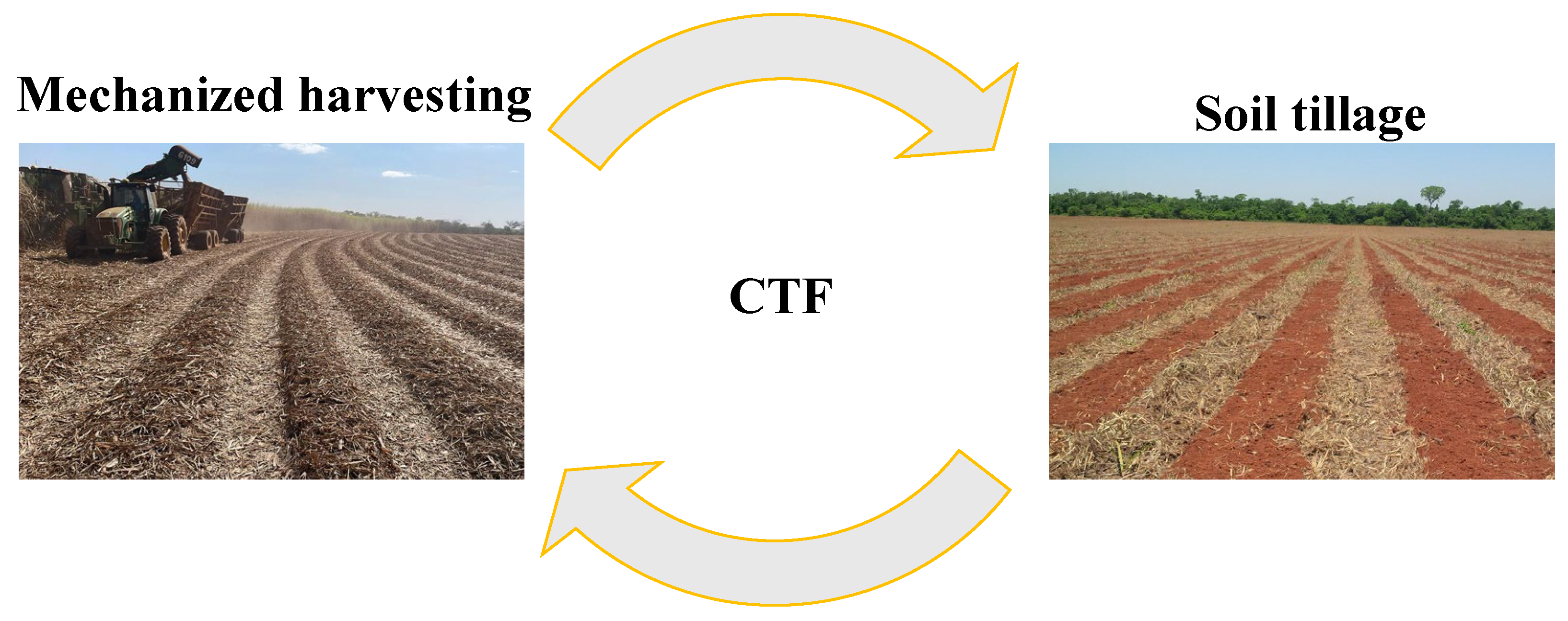
Figure 2.
Cross-sectional profile of the seedbed, under a strip soil tillage system with controlled-traffic farming. (1) decompacted region; (2) compaction; (3) region of disturbed soil.
Figure 2.
Cross-sectional profile of the seedbed, under a strip soil tillage system with controlled-traffic farming. (1) decompacted region; (2) compaction; (3) region of disturbed soil.
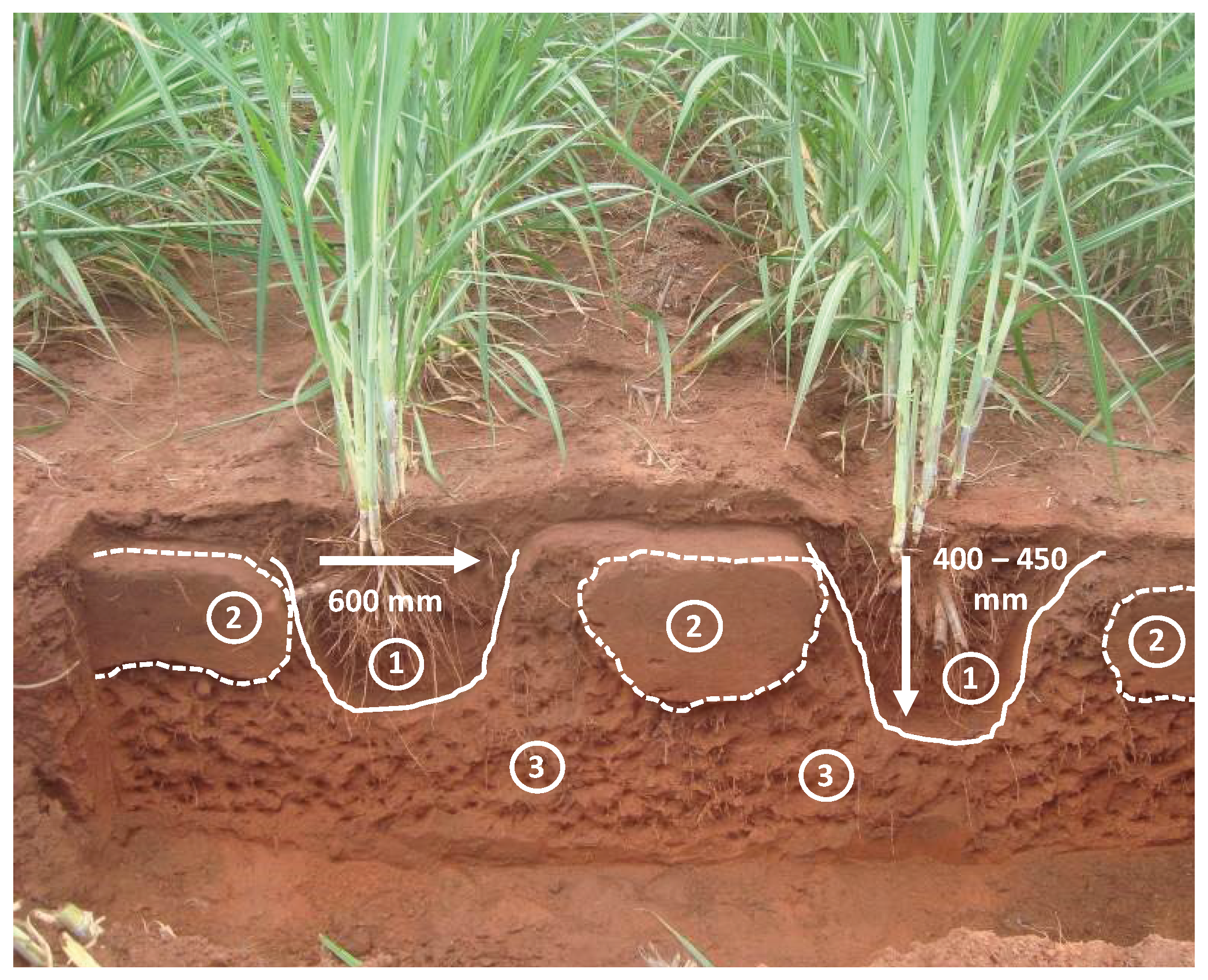

Table 1.
Evidence defining SSTC boundary parameters in sugarcane.
| Context/Conditions | Key Evidence | Implication for SSTC | Reference |
|---|---|---|---|
| Mechanized harvesting; wheels/tracks comparison; transshipment traffic | Lateral propagation of transshipment-induced stresses reaching the planting row; tracks reduce surface deformation | Bed width = 0.60 m (1.50 m – 0.90 m lateral influence); keep traffic confined outside the mobilized zone | [15] |
| Prediction of stresses and compaction risk in sugarcane | Harvester-transshipment sets exceed σP and propagate stress bulbs in the profile; higher risk under high moisture | Prerequisite: CTF to concentrate damage; avoid traffic over the row; adjust operational windows | [10,11] |
| Root system distribution | 80% of roots in 0–0.40 m and up to 0.30 m from the row center | Target depth for mobilization and inputs: 0–0.40 m | [17] |
| Compaction risk in infield transport | Stresses of 275–595 kPa; irreversible compaction when σP is exceeded | Reinforces fixed traffic lanes and exclusion of traffic over the bed | [13] |
| Hydrological performance under SSTC | Infiltration 278 vs 120 mm h−1 (bed vs track); roots up to 1.33 m at 120 DAP | Functional benefit of 0.60 m (width) × target 0–0.40 m (depth) geometry under CTF | [19] |
Table 2.
Recomendações operacionais do SSTC sob CTF.
| Axis | Parameter | Value / Window | Practical Observation |
|---|---|---|---|
| Planning and Diagnosis | Chemical profile sampling | 0–0.60 m | pH, V% and available P; use map for site-specific prescription |
| CTF | Lane delimitation | GNSS/RTK | Permanent traffic outside the planting row |
| Bed Geometry (SSTC) | Mobilized width | 0.60 m | Derived from spacing (1.50 m) and lateral propagation (0.90 m) |
| Bed Geometry | Target depth | 0–0.40 m | Zone of highest root density |
| Chemical Correction | Lime | According to technical criteria based on soil analysis | 75% on the surface + 25% in the subsoil via ducts |
| Chemical Correction | CaO / MgO | According to technical criteria based on soil analysis | Localized application as per subsoil analysis |
| Filter cake/compost | Applied dose | According to the chemical characteristics of the material | Homogenize with rotary hoes |
| Bioactivation (PSM) | Consortium | Pseudomonas, Bacillus, Penicillium | Prefer strains adapted to local soil |
| Bioactivation (PSM) | Concentration | 108–109 CFU mL−1 | Liquid or solid application in the furrow |
| Monitoring | Chemical | Annual | Review need for amendments every 2 years |
| Monitoring | Physical | ρb and SR at 0–0.40 m | Assess effectiveness and trigger |
| Technological Support | Sensing | Moisture, conductivity, drones | Map variability and prescribe locally |
| Indicators | Performance | Yield, diesel, emissions, costs | Evaluate time series |
Disclaimer/Publisher’s Note: The statements, opinions and data contained in all publications are solely those of the individual author(s) and contributor(s) and not of MDPI and/or the editor(s). MDPI and/or the editor(s) disclaim responsibility for any injury to people or property resulting from any ideas, methods, instructions or products referred to in the content. |
© 2025 by the authors. Licensee MDPI, Basel, Switzerland. This article is an open access article distributed under the terms and conditions of the Creative Commons Attribution (CC BY) license (https://creativecommons.org/licenses/by/4.0/).
Copyright: This open access article is published under a Creative Commons CC BY 4.0 license, which permit the free download, distribution, and reuse, provided that the author and preprint are cited in any reuse.