

Submitted:
01 October 2025
Posted:
01 October 2025
You are already at the latest version
Abstract
Efficient ventilation systems are crucial for maintaining optimal air quality in indoor and enclosed environments, both on and off Earth, such as buildings, space habitats, international space station crew quarters, tunnels, underground mines, and other structures. However, traditional ventilation systems face challenges, such as uneven air distribution, energy inefficiency, noise, and limited adaptability to dynamic environmental conditions. Meanwhile, many organisms in nature are capable of constructing structures that can facilitate efficient air exchange and heat regulation, such as ant nests, termite mounds and prairie dog burrows. This study explores, analyzes, and summarizes the mechanisms, structures, and strategies found in nature that can inspire the design of efficient and effective ventilation systems. To highlight the practical implications of such designs, this paper reviews the progress of bio-inspired ventilation research, with a focus on air regulation, component optimization, and environmentally adaptive strategies. A bibliometric analysis and research trend are presented to illustrate the key developments in this field for over the past 25 years. The potential of integrating the bio-inspired strategies into ventilation systems, particularly with the focus on the applications to the off-Earth habitats and underground mines, is discussed. This study presents comprehensive insight into developing bio-inspired ventilation systems, thus paving the way for achieving innovative and more efficient design solutions.
Keywords:
bio-inspired ventilation
; reduced noise fans
; adaptive ventilation systems
; ventilation systems for off-Earth habitats
; mine ventilation systems
1. Introduction
The on-Earth ventilation systems which are often an integral part of the heating, ventilation and air conditioning (HVAC) systems, commonly face issues associated mainly with the energy consumption and efficiency. The HVAC systems contribute approximately 40% to the building’s energy consumption globally [1] and almost 50% in the hot and arid regions [2]. They also account for around 40% of the primary energy use in the United States, with China projected to reach a similar level in the coming years [3]. While in some cases the natural ventilation can accommodate the supply of the fresh air to the buildings on Earth, often it is not capable of providing sufficient cooling to the incoming air during the high-temperature seasons, which results in the thermal discomfort for the occupants [4]. Consequently, a significant percentage of the modern buildings is still highly dependent on the mechanical ventilation systems, which are energy-intensive and take up a considerable amount of space due to their complexity and large volume [5].
A similar but a far more critical challenge exists in the mining industry. While the fundamental objective of the mine ventilation system appears straightforward, which is to deliver a sufficient air quantity and quality to all areas of the mine where personnel are present, the reality has become increasingly complex [6]. As easily accessible mineral reserves become depleted, the mining operations are forced to go deeper underground, where conditions are more hostile, hotter and gassier [7,8,9,10]. At greater depths, the ventilation system must not only supply fresh air but also address a range of compounding risks, including the serious threat of heat stress to workers and equipment, the increased likelihood of mine fires, the presence of explosive dust and gases, and the growing use of mechanized diesel-powered machinery, which generates more heat and emits toxic exhaust. Beyond safety, there is also the matter of economics, where ventilation systems generally account for a significant portion of the mine’s operating energy costs [10]. The combination of these factors creates a pressing need for optimizing mine ventilation systems so that they can effectively balance safety, health, and operational efficiency while minimizing energy consumption.
As space exploration advances and the focus shifts toward longer and more sustained crewed missions, the next frontier in the ventilation challenges lies beyond the Earth itself, where future off-Earth habitats will depend on effective systems to maintain safe and optimal indoor climates [13]. Unlike on Earth, where the natural convection driven by the temperature and density differences helps the movement of the air, the microgravity conditions of space eliminate this process [14,15]. Consequently, without an adequate forced airflow, the air with a high CO2 concentration from breathing tends to accumulate around the head of astronauts when they are in stationary positions such as sleeping [16,17], which could lead to various health risks, such as headaches and asphyxiation [18]. A prominent real-world example of the ventilation in space habitats is aboard the International Space Station (ISS). Although the general ventilation systems on the ISS are sufficient to accommodate most situations, this might not be the case for the astronauts’ sleeping quarters or crew quarters (CQ) [14,19,20]. According to several NASA and ESA reports, the crew members frequently wake up with symptoms of CO2 intoxication due to the localized build-up of CO2 around their heads, while the temperatures in CQs often exceed the standard for comfortable levels [21]. The ISS environment also becomes increasingly polluted with dust and particulate matter, primarily originating from the occupants themselves. As dust travels through the ducting of the ventilation systems, it can cause issues with the airflow sensors monitoring the flow variations [20]. Additionally, as much as 13% of the CQ’s total mass and 6% of its volume are dedicated to the noise reduction measures. Unlike the ISS, which is located in the low Earth orbit, this allocation of mass and volume specifically for the noise reduction of the ventilation system could be impractical for the deeper space missions beyond the current ISS [21].
With the need to provide effective and reliable life support systems for the future long-duration crewed space missions [22,23] and the growing demand to reduce the energy consumption as well as to optimize the ventilation systems of buildings and mines on Earth [2,11], developing an innovative, energy-efficient, and effective nature-inspired ventilation system could provide a sound solution to these challenges. For more than 3.8 billion years, many organisms in nature have evolved to be sustainable, efficient and adaptable. They are capable of a self-regulation through feedback mechanisms, resilient to sudden changes, and adaptable to new conditions [24]. Like the built environment, organisms in nature require effective air regulation and heat transfer mechanisms because sufficient oxygen and thermal comfort are vital for their survival. In the past 25 years, bio-inspiration has gained a significant attention across various fields of research [25], including the built environment, where researchers have adopted design principles found in nature to improve the performance of buildings [26,27]. Figure 1 shows an overview of various organisms with features or structures applicable to ventilation system designs.
Previous reviews on bio-inspired designs and technologies in the built environment have focused largely on the thermal regulation of buildings, including cooling strategies [37], energy-efficient built environment [38], thermal energy regulation [39], and applications of thermoregulation strategies in the architecture [40]. While these works provide valuable insights into improving the energy performance of buildings, the discussions specifically addressing the ventilation systems are often limited. Moreover, these studies lack a focused discussion of the research trends in the bio-inspired ventilation and its components over the past decade, which would reveal how the field has evolved in terms of design strategies, modelling approaches, application contexts, and performance outcomes. They overlook both the progress already achieved and the potential applications of the bio-inspired ventilation in the critical contexts such as underground mines and off-Earth habitats.
This paper presents a systematic review and evaluation of the bio-inspired features, structures, systems, mechanisms and strategies relevant to the ventilation systems and their components, taken from various stages of development, i.e. conceptual, numerical simulations and physical testing. Section 1 of the paper introduces the background and motivation for the study and outlines the research problem and objectives. Section 2 describes the methodology for identifying and reviewing the relevant literature, along with the research trend analysis to demonstrate the progress and focus of the bio-inspired ventilation research over the past 25 years. Section 3, Section 4, Section 5 and Section 6 discuss the various insights and inspiration from nature for effective and efficient ventilation systems and their components. Section 7 presents the potential applications and integration of such designs and principles for off-Earth habitats and on-Earth underground mines along with their associated challenges. Section 8 concludes the findings and provides recommendations for future research.
2. Methodology
This review has been conducted according to the preferred reporting items for systematic reviews and meta-analyses (PRISMA) guidelines, comprising four key stages: (1) identifying studies through database searches and other sources, (2) screening the studies to select relevant literature, (3) assessing the eligibility of full-text articles based on specific inclusion criteria, and (4) including the final set of studies for review.
2.1. Data Identification
Specific search queries, as shown in Table 1, were used across various literature databases, with Scopus and Web of Science being the primary sources and Google Scholar being a secondary source. Keywords such as “bio-inspired” and its various synonyms, e.g., biomimetic, nature-inspired, bio-inspiration, nature-based, biomimicry, bio-design, bionic, organism-inspired and plant-inspired, were used. These biomimicry-related keywords were combined with the terms related to the ventilation systems, their components and the built environment, such as vent, duct, fan, air regulation, wall, envelope, air circulation and HVAC systems. Boolean operators (AND/OR) were employed to refine the search. For the initial search in Scopus and Web of Science, to cover all relevant terms comprehensively, an asterisk (*) wildcard was added at the end of the subject-related words. For instance, using “vent*” ensures that variations like vents, ventilation, ventilating, and venting are included. To cover the progress of the research over the past 25 years, the results were limited to documents that have been published between 2000 and 2025 inclusive. For the literature search in Google Scholar, the advanced search tool was utilized using keywords similar to those used in Scopus and Web of Science. Only the first 100 articles returned by Google Scholar for each search query were selected for further screening, because the documents beyond this were generally found to be irrelevant to this review. To prevent the potential biases introduced by the Google Scholar's proprietary ranking algorithm, it was utilized only as a secondary data source. Additionally, the reference sections of the papers that passed the full-text evaluation were manually checked to identify the relevant literature missed during the initial database searches. The documents obtained through this process were categorized under the snowball search. Figure 2 illustrates the detailed process of this study, from identifying the gaps in the existing literature to finding, reviewing, analyzing and summarizing the relevant studies.
2.2. Data Screening and Inclusion
The initial search across multiple databases yielded a total of 13951 documents, covering a wide range of subject areas, which are discussed in detail under section 2.3. To refine the initial search results and to exclude irrelevant documents for this review, a systematic review tool, namely Rayyan was used before proceeding with the manual screening through abstract reading and full-text eligibility checks. This tool helps in identifying and removing duplicate entries due to the overlap of similar records across different databases. To further remove the irrelevant documents, the exclusion filter in Rayyan was used to exclude the literature with keywords outside of the scope of ventilation systems and the built environment, e.g. signal processing, peptides, bacteria, propulsion, robots, etc. The duplicate removal process reduced the total number of documents to 9679, while screening for irrelevant studies brought this down to 1379. After reviewing titles and abstracts, this was further reduced to 169 documents. At the final stage of the data collection, which involved a full-text evaluation or eligibility check, 73 documents were identified. Additionally, 12 more documents were obtained through a snowball search. The final number of documents included for analysis is 85. The inclusion and exclusion criteria used for this review are summarized in Table 2.
2.3. Data Analysis
2.3.1. Research Trend and Bibliometric Analysis
Although the pre-screened dataset comprises a large number of documents, examining its trends is crucial for understanding the impact of bio-inspiration in the engineering fields and related sciences. Such analysis highlights not only the growth and evolution of the field but also identifies the shifts in the research focus and emerging areas. The thematic analysis of the pre-screened records revealed that engineering constituted the largest segment at 22.3%, followed by materials science at 15.8%, physics and astronomy at 8.24%, chemical engineering at 8.18%, and chemistry at 7.8%, as shown in Figure 3A. The "others" category, accounting for 11.9%, includes additional disciplines such as medicine, social sciences, biological sciences, and agriculture. This diversity in subject areas is likely due to the widespread use of terms such as bio-inspired, vent, cooling, heating, and wall across multiple disciplines. Hence, this underscores the importance of further screening to ensure the inclusion of the most relevant articles for further analysis. In terms of the most productive countries, China and the United States lead the trend in the number of publications, contributing approximately 4,800 and 2,200 documents, respectively, as shown in Figure 3B. Several European countries are also among the top 10 most productive, including the United Kingdom, Germany, Italy and France. Meanwhile, in Asia, the most productive countries, in addition to China, are India, South Korea, and Japan. Australia is also among the leading contributors, ranking 10th in the trend. Figure 4 shows the scientific production of the ten most productive countries, expressed in percentages.
In addition to classifying the retrieved documents into various subject areas and countries, this study also examined the number of publications over the years. As shown in Figure 5, from 2000 to 2010 the number of published documents remained relatively low but exhibited an overall upward trend, despite some fluctuations. This trend demonstrates the growing interest in the field, along with the possibility of competing paradigms in its early stages, leading to fluctuations in the number of publications. From 2010 to 2017, there was a more noticeable increase in publication numbers compared to the previous decade, reflecting a sustained interest in this field of research. The most significant surge occurred between 2018 and 2025, during which the number of publications rose sharply, accounting for more than half of the total publications in the last 25 years. The surge is likely driven by the rising demand for more sustainable buildings and energy-efficient systems over the last few years. For 2025, although the data are still incomplete for the current year, the total number of publications has already surpassed that of 2023 and earlier years, indicating that interest in this field is likely to continue growing.
To further investigate the research trends, a keyword co-occurrence analysis was conducted on the dataset before and after the screening process using VOSviewer software (version 1.6.20). Two types of keyword co-occurrence visualizations are presented in this study: network visualization and density visualization. The density visualization highlights areas of high and low keyword occurrence across the dataset using a color gradient ranging from blue to green to yellow. A color closer to yellow indicates a more frequently appearing keyword, whereas a color closer to blue indicates a keyword that is mentioned less frequently. Meanwhile, the network visualization map is used to display the relationships between keywords as a network of nodes and links. The lines between the nodes indicate the strength of the co-occurrence relationships, with shorter distances between the nodes representing stronger connections or closer associations between the keywords. Before the screening process, even with an occurrence threshold of 20, the dataset still produced 1,640 terms due to the high volume of the records analyzed. As shown in Figure 6A, the most frequent keywords were bio-inspired, chemistry, bio-inspired material, robotics, and animal bone. Many of these terms are either unrelated to ventilation systems or are too broad in scope. Also, the relationships between these keywords were unclear (Figure 6B), as the excessive number of terms led to dense interconnections. To allow for a more focused analysis and to better understand the association between the keywords, further screening was required.
After the screening process, the keywords displayed in the density visualization map were more directly related to the ventilation systems and their components, with a total of 92 terms retained based on the occurrence threshold of 10. As shown in Figure 7A, the most frequently occurring terms included bio-inspired, biomimicry, ventilation optimization, swarm intelligence, energy saving, energy conservation, efficiency, building envelope, and responsive system. Figure 7B shows that these keywords were grouped into five interconnected clusters: the red cluster represents ventilation and optimization; the blue cluster focuses on buildings and their components; the green cluster represents the performance outcomes and environmental adaptability of the ventilation and buildings; the purple cluster focuses on the ventilation components such as duct tees and guide vanes; and the yellow cluster represents various aspects of the indoor environment.
Figure 8A shows that the keywords bio-inspired and biomimetics are linked to all clusters, which implies the significance of the bio-inspiration across various aspects of the ventilation systems. The keyword ventilation optimization is closely associated with the ventilation fans, swarm intelligence, mine ventilation systems, effective ventilation, and energy saving, as shown in Figure 8B. This indicates an interest of the research community in optimizing the ventilation systems, including mine ventilation, through the application of bio-inspired algorithms such as swarm intelligence, with the goal of improving their effectiveness and energy efficiency. Similarly, the term energy saving (Figure 8C) is strongly connected to responsive systems, smart systems, energy-efficient, intelligent buildings, and energy utilization, suggesting that the energy saving strategies in the ventilation and building designs are closely tied to the development of smart, intelligent, and responsive systems. The keyword natural ventilation (Figure 8D) shows strong links to smart systems and responsive systems, indicating that adaptive and responsive strategies are frequently considered in conjunction with or as enhancements to the natural ventilation. The duct tee and duct elbow (Figure 9A) are both associated with the resistance reduction, implying that the research in this area has focused on minimizing the resistance in the duct components to improve the ventilation performance. Finally, the keyword ventilation fans (Figure 9B) is closely associated with optimization, noise suppression, resistance reduction, biomimetics, and bio-inspired design, implying that the research community aims to improve the fan performance through nature-based strategies, such as reducing aerodynamic resistance, suppressing noise, and enhancing the overall efficiency.
2.3.2. Comparative Analysis
To better understand the progress and applications of the bio-inspired ventilation research, a comparative analysis of the fully screened documents was conducted in this study, focusing on the research methods, structural applications, relevance to mechanical versus natural ventilation, and suitability across various climate conditions. This analysis revealed a clear trend: most of the bio-inspired ventilation designs are intended for the natural ventilation, with fewer being applicable to both natural and mechanical systems, and only a small fraction is designed exclusively for the mechanical ventilation, as shown in Figure 10A. This trend is likely due to the inherent compatibility of the bio-inspired strategies with the natural ventilation. Organisms in nature often utilize simple yet effective strategies of structural or design solutions to harness the natural force-driven ventilation, as is evident in the prairie dog burrows [42], termite mounds [43], and leaf-cutter ants’ nests [44]. Generally, the natural ventilation systems require less maintenance and consume significantly less energy than the mechanical ventilation systems [45]. The bio-inspired ventilation research is often motivated by the goal of enhancing the energy efficiency in buildings [37,38]. While the bio-inspired principles can be integrated into the mechanical ventilation, their application is inherently challenging since the mechanical systems rely on active energy consumption, which is fundamentally different to the passive nature of the biological ventilation strategies. These factors collectively contribute to the higher prevalence of the bio-inspired research in the natural ventilation compared to the mechanical systems.
Most of the studies reviewed are conducted in temperate and arid climate regions (Figure 10B), particularly in China, while very few focus on the tropical countries. This trend is largely due to factors such as rapid urbanization [46], government policies promoting energy-efficient buildings [47], and climate diversity in China [48], which likely encourage the research into more adaptive, effective, and energy-efficient ventilation strategies. In contrast, many fully tropical countries, such as those in Asia, continue to rely on the mechanical ventilation due to the challenges of high humidity and year-round warm temperatures [49], which make the natural ventilation less effective [50]. Additionally, urban heat islands in major tropical cities trap heat [51], further reducing the efficiency of the natural ventilation in providing sufficient thermal comfort [52]. As a result, the bio-inspired ventilation research, which primarily focuses on enhancing the natural ventilation, is less prevalent in the tropical regions where the need for the mechanical cooling remains dominant.
Figure 10.
(A) Comparative analysis based on: (A) Ventilation types; (B) Climate types.

The comparison also showed that nearly half of the studies utilized numerical analysis, with only 21% conducting experimental and 24% implementing combined numerical-experimental approaches, as shown in Figure 11A. This is likely due to the fact that although the bio-inspired ventilation strategies offer innovative solutions for enhancing the airflow in the buildings, their lack of direct control makes it challenging to test them experimentally or implement them in the real-world settings. Computational methods such as CFD simulations are often used to model the airflow behavior before the experimental testing. In the reviewed studies, in terms of the structural types the most dominant structure incorporating the bio-inspired strategies are the building envelopes, followed by the residential buildings (Figure 11B). The high percentage of building envelope studies is likely due to their direct impact on the natural ventilation, as they serve as the primary barrier to the external environment. The bio-inspired building envelopes can integrate features such as porous materials or environmentally responsive components to improve the airflow and heat regulation.
The analysis presented above provided an understanding on how the field has developed and where further work is needed. Overall, the findings showed that the bio-inspired ventilation research is strongly oriented towards improving the ventilation efficiency and this is pursued through the optimization of both the ventilation system, its components, and the building itself, aiming to reduce the energy consumption, enhance the responsiveness to the environmental changes, enable a smarter operation, and improve the air distribution. These findings raise a fundamental question: Should we shift more decisively towards the bio-inspired solutions in the pursuit of achieving a higher efficiency of the ventilation systems? Nature’s designs and solutions, refined through millions of years of evolution, could provide valuable models for improving a wide range of engineered systems, including those for ventilation.
3. Designs and Strategies Inspired by Animal Dwellings for Improving Natural Ventilation
3.1. Insights from Prairie Dog Burrows
An excellent example of a structure with efficient ventilation in nature can be seen in the burrows of prairie dogs. As shown in Figure 12A, the burrow consists of interconnected passages with one entrance shaped narrowly and located at a higher elevation, while another with a wider opening is positioned lower [42]. Following the Bernoulli principle, the lower entrance which is exposed to slower wind speeds, experiences a higher pressure, thus drawing air into the burrow, which then exits through the elevated entrance where wind speed is higher and pressure is lower. This system allows for even a light breeze at the lower opening to ventilate the burrow, while the higher opening facilitates the removal of used air [53]. A comparative CFD analysis of various bio-inspired ventilation designs showed that the induced flow model inspired by the prairie dog burrows is the most optimal in terms of both ease of development and airflow improvement [54]. Compared to the baseline case with conventional openings (Figure 12B), the room with the prairie dog burrows-inspired openings (Figure 12C) achieved a 1.5- to 5-fold increase in the average air flow velocity. However, the air flow behavior changed when the model was scaled up, and the increase in the air flow rate was determined by the wind speed around the simulated room within the CFD domain.
In another study, Paar and Petutschnigg [42] developed a bio-inspired ventilated façade with extruded upper and lower openings, as shown in Figure 13A, to cool buildings and mitigate the urban heat island effect using a wind-driven air circulation. The initial calculations and laboratory tests on reduced-scale models, based on summer temperature conditions in the central European cities, demonstrated that the bio-inspired ventilated façade design nearly doubled the airflow speed within the ventilated slot compared to the conventional models. As a result, wall surface temperatures decreased significantly, reducing the building’s cooling load and improving the building's energy savings. However, because the design relies on the wind, its effectiveness across different climates remains uncertain, as the wind conditions vary considerably between regions. Moreover, structural limitations and scaling challenges may arise when applied to larger buildings, where ensuring a consistent performance under more complex conditions would become increasingly difficult. A related approach adapted for hot desert climate conditions was proposed by Alyahya [55]. To mimic the elevated entrance of the prairie dog burrows, an opening called the “top mound opening” was placed at the top of the double skin façade (Figure 13B), rather than placing it on the side (Figure 13C). This configuration aimed to reduce the inner skin surface temperature of buildings by accelerating the airflow within the ventilated slot. The simulation results indicated that the bio-inspired design increased the air velocity within the slot by approximately 350% compared to the baseline design, while also lowering the inner skin surface temperature by 5.4 °C under full sun conditions. However, the study focused on low-rise buildings, and therefore, the applicability of this design for other types of buildings such as high-rise and mid-rise, is uncertain.
This strategy has also been proposed for underground stations [53]. The numerical studies based on the fluid dynamics principles showed that elevating one tunnel opening, along with varying the heights, shapes, and sizes of the other openings, generates a pressure difference that drives the natural ventilation, thereby increasing both the air change rate (ACH) and the air flow rate in the tunnels [53]. However, the assumptions and simplifications applied in this study might not fully capture the complex and interconnected nature of the real-world tunnel networks, thus reducing the effectiveness of the proposed design in practical applications. For further research, laboratory testing in conjunction with computational fluid dynamics (CFD) analysis is recommended to validate the model and improve its reliability. In addition to indoor applications, this principle has also been employed to enhance the outdoor thermal comfort of residential blocks in New Aswan, Egypt, through strategic re-arrangement and re-orientation of the buildings. It was found that aligning the buildings along the east-west axis created pressure differences that improved the natural ventilation, thus reducing the Universal Thermal Climate Index (UTCI) and saving approximately 10,407.29 kWh of energy during the summer months [56]. However, this model is better suited for building blocks with planned gaps between them to allow for the pressure differences to develop. If buildings are constructed as a single attached block without gaps, the intended ventilation effect may be largely lost. In addition, since this model was developed for hot and arid climate conditions, its applicability to cold regions, where the goal is to reduce the heating loads, could be less effective.
Beyond the applications in the buildings and underground structures, Bernoulli’s principle and the asymmetric openings of the prairie dog burrows inspired Liu et al. [57,58] to develop a bionic duct (Figure 14A-D) incorporating contraction-expansion sections, venturi-shaped openings, and protrusions. The design enhances the mass flow into the duct while promoting a more uniform pressure distribution along the throat. The protrusions accelerate the airflow locally, generating a low-pressure region that drives the fluid motion from the duct into the conduit and toward the low-pressure zones. Notably, the protrusions reduced the normalized turbulent kinetic energy by approximately 94.5%, while the maximum wind speed within the optimized duct increased by about 107% compared to the conventional duct. Although originally developed for ducted wind turbine applications, this bio-inspired design also has the potential to be applied to the ventilation systems in buildings, where the ducting system plays a crucial role in the air distribution and energy efficiency.
3.2. Insights from Termite Mounds
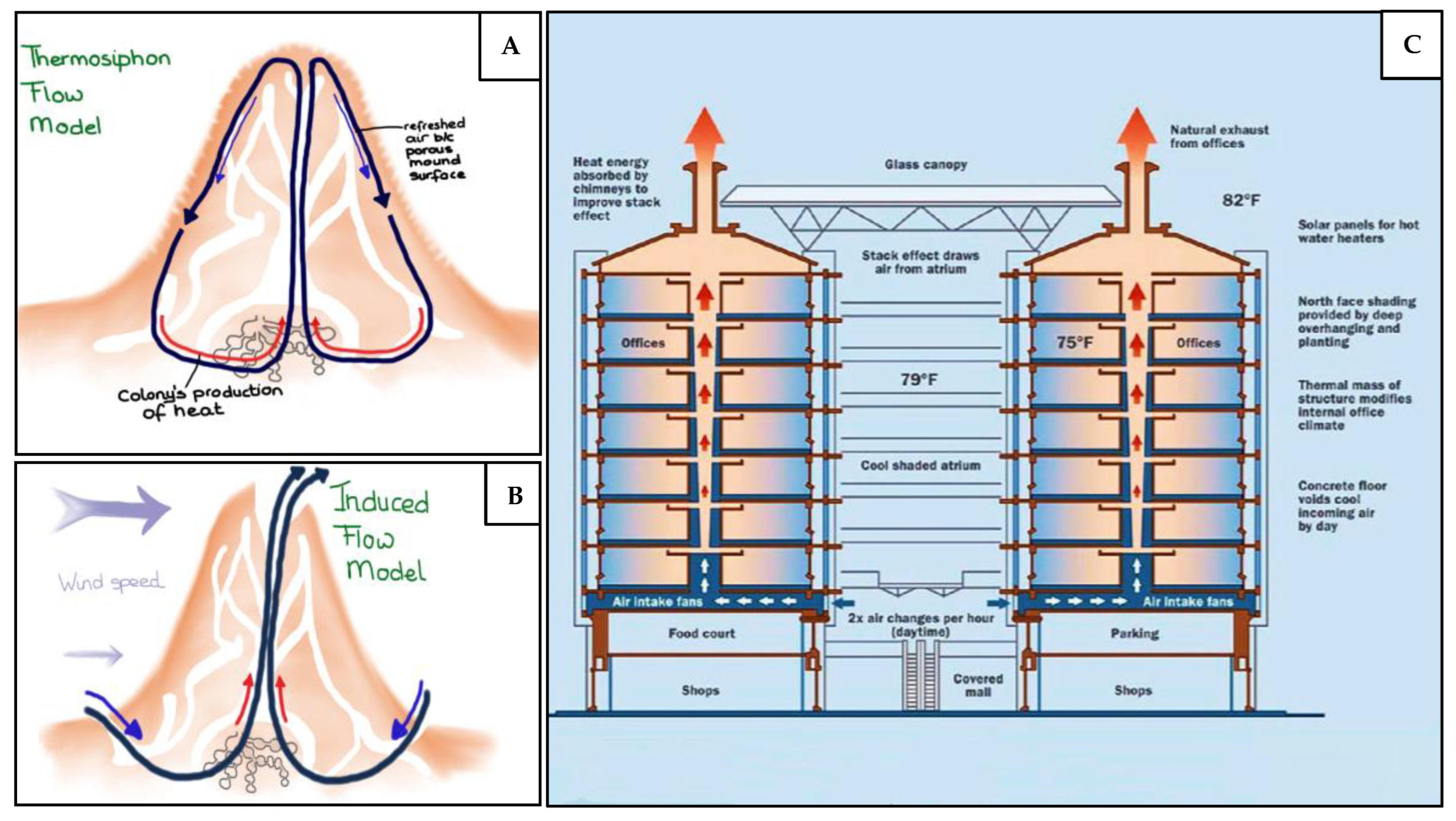
Over the years, various theories have been proposed to explain the air circulation and passive ventilation in the termite mounds. One theory attributed it to the thermosiphon effect (Figure 15A) [59], in which closed mounds without chimneys rely on the heat generated by the large number of termites inside. This heat creates buoyant air that rises to the top of the mound, where it mixes with fresh air entering through the porous upper structure and gains additional water vapor. The resulting denser air is then forced downward toward the nest, thus supplying it with fresh air. Another theory suggested that the air circulation is driven by the pressure difference between the openings at different heights, as shown in Figure 15B. In this model, the air enters through the lower openings, where slower wind speeds create a higher pressure, and exits via the upper chimneys, which are exposed to faster winds and lower pressure [43,60,61]. Further research suggested that the air circulation in the termite mounds is driven by the temperature difference between the mound’s periphery and its center. During the day, the warmer periphery creates a convection cell with an upward airflow along the outer walls and a downward airflow in the cooler center. At night, the pattern reverses, with the cooler periphery and warmer center producing an upward air flow in the center and a downward airflow along the periphery [62,63].
Termite mound-inspired designs have been applied or proposed for a range of buildings, from the low-rise residential structures to high-rise office towers. The Eastgate Centre in Zimbabwe, designed by Mick Pearce, is a notable example of this bio-inspired design that reduces the need for the traditional air conditioning by incorporating both thermosiphon effects and the induced flow principle, as shown in Figure 15C. The buildings are constructed from concrete slabs and bricks that can absorb heat without significant changes in their temperature due to their high thermal mass. Integrated into the design are tall chimneys which are open to the fresh air at the top, and low-power fans that assist in drawing in the outside air [64,65]. At night, these fans pull the cool air indoors and distribute it through the hollow floors, allowing the concrete to absorb the coolness and reduce the temperature of the circulating air. During the day, the heat from the occupants, equipment, and the surrounding environment warms the indoor air, triggering a thermosiphon effect that moves the warm air through the ceilings and upward into the chimneys, from where it is expelled outside [60]. This design is estimated to use only 10% of the energy consumed by the buildings of a similar size in the region [66]. The same principle has also been proposed for low-rise residential pavilions in desert climates such as Algeria [26]. The fresh air enters the building through the ground-level vents, while the stale air and heat are expelled via the vertical ducts connected to each floor and eventually are discharged through the chimneys. The simulation results showed that this bio-inspired design increased the air velocity in the occupied area and decreased the indoor temperature by 3.7°C, resulting in significant energy savings during the summer months [26]. In a more recent study, Ramasam et al. [67] applied the same strategies for a multi-story residential building in Chennai, India. By incorporating ventilation pipes at both the bottom and top of the structure, a stack effect was generated that enhanced the air circulation and reduced the indoor temperatures by up to 30%, maintaining a stable range of 28–32 °C even when the outdoor temperatures reached 40 °C.
Figure 15.
(A) Thermosiphon flow model of termite mounds; (B) Wind-induced ventilation of termite mounds. (A, B) Reproduced with permission from [68]; (C) Schematic diagram of the ventilation of the Eastgate Center inspired by termite mounds. Reproduced with permission from [69].
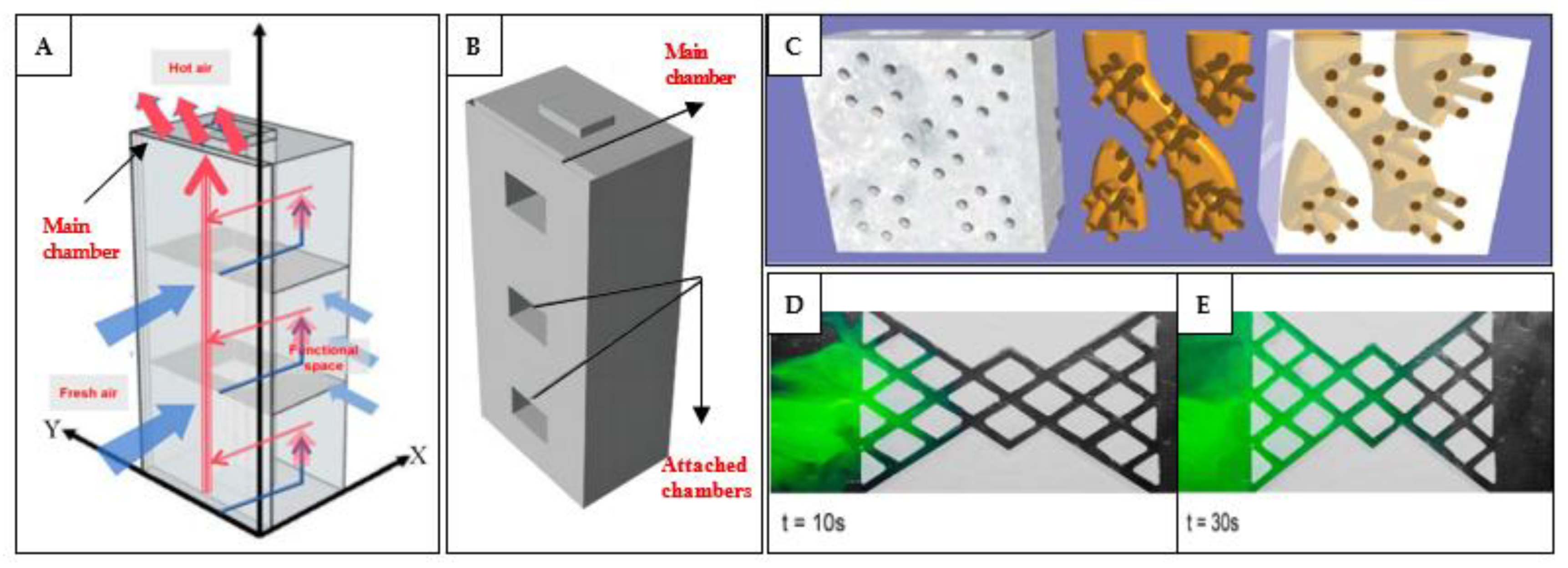
Apart from using chimneys, the termite-inspired ventilation approach has also been applied in the form of chambers positioned at different levels with varying numbers in high-rise buildings to generate a pressure difference that improves the natural ventilation [70]. The chambers are connected to the functional spaces through the ventilation openings that draw the stale air into the main chambers, from which it is discharged with the help of the wind-driven pressure difference (Figure 16A). The simulation for China's climate condition showed that the models featuring a main chamber combined with double-attached chambers, as shown in Figure 16B, were the most effective, achieving a maximum wind speed difference of 0.19 m/s between the floors and providing a stable wind environment. Even simpler configurations, such as the main chamber alone or the main chamber with a single attached chamber, still generated higher airflow rates within the interior space compared to an original chamber-free high-rise building [70]. A more innovative application has been proposed for the building envelopes, where artificial surface conduits or reticulated tunnels (Figure 16C) were integrated into the façade system to create a porous wall that facilitates a wind-driven natural ventilation [60]. The mechanical actuation through small oscillations can complement the natural forces such as the wind to drive the heat, air, and moisture exchange between a building’s interior and exterior. Andréen and Soar [71] found that reticulated tunnels (Figure 16D and E), both narrow and wide, exhibited a faster flow mixing under the high-amplitude oscillations compared to the non-reticulated channels. Specific combinations of the amplitude and frequency contribute to the turbulence generation, which drives the effective mass transport. The mass transfer was found to be the strongest at the oscillation frequencies of 30–40 Hz.
Despite its widespread adoption, the applications of the termite mound-inspired architecture and ventilation approach to functionally built environments present several challenges. For instance, although the Eastgate Centre successfully reduces the reliance on the air conditioning, it still depends on fans to meet its daily ventilation demands. The reliance on the wind in some cases also introduces additional challenges in adapting such bio-inspired strategies, as the wind is an inherently variable force, with speed and direction fluctuating across time and location. Therefore, to effectively harness the natural forces, the buildings must account for more reliable factors, such as the boundary layer gradient that develops with the height in the atmospheric flow [60].
Figure 16.
(A) Schematic depiction of the ventilation mechanism of termite mound-inspired chambers in a high-rise building; (B) Main chamber and single attached chamber of termite mound-inspired ventilation. (A, B) Reproduced from [70], CC BY 4.0 (C) Artificial surface conduits or reticulated tunnels. Reproduced from [60], CC BY-NC-ND 2.5; (D, E) Flow mixing of wide reticulated tunnels at 10 s and 30 s, respectively. (D, E) Reproduced from [71], © 2023 Andréen and Soar, CC BY 4.0.
Figure 16.
(A) Schematic depiction of the ventilation mechanism of termite mound-inspired chambers in a high-rise building; (B) Main chamber and single attached chamber of termite mound-inspired ventilation. (A, B) Reproduced from [70], CC BY 4.0 (C) Artificial surface conduits or reticulated tunnels. Reproduced from [60], CC BY-NC-ND 2.5; (D, E) Flow mixing of wide reticulated tunnels at 10 s and 30 s, respectively. (D, E) Reproduced from [71], © 2023 Andréen and Soar, CC BY 4.0.
3.3. Insights from Ant Nests
Leaf-cutter ants of the genus Atta construct some of the largest and most complex underground nests (Figure 17A) that can house up to 5 million individuals [72,73,74]. These nests rely on a passive ventilation to maintain optimal conditions for fungus cultivation, including temperatures of 25–30°C, suitable humidity levels, and efficient oxygen exchange [75,76,77,78,79]. The ventilation is achieved through the top-mounted turrets that exhaust the CO₂-rich air, while the lower openings draw in the fresh air (Figure 17B) [34,44,73]. Many human-made structures, particularly those built underground, resemble the architecture and ventilation systems found in the leaf-cutting ant nests, even if not explicitly designed with this inspiration in mind. A remarkable example of this is the ancient underground city in Cappadocia, Turkey, which features interconnected conduits, ventilation shafts and chimneys that open to the fresh air (Figure 17C) for the natural air circulation, allowing the city to remain well-ventilated with minimum need for the auxiliary air supply [80]. Another example is the Global Health Center concept (Figure 17D and E), proposed by the State Key Laboratory at the South China University of Technology. The structure spans approximately 120 m in depth and 500 m in diameter, designed to accommodate up to 2,000 people. Its ventilation strategy employs concentric cooling walls that act as cool heat sinks that cool the incoming air, while a central chimney expels the heat and stale air to maintain a stable indoor temperature between 18 °C and 22 °C [81,82]. While the ant nests offer valuable insights for the passive underground ventilation, applying these principles to deep underground dwellings pose serious challenges. The geological variability, flooding risks and gas accumulation require complex mitigation systems that reduce the practicality of such designs for the permanent habitation [80]. Therefore, the bio-inspired ventilation might be more suitable for underground tunnels, mines or workspaces, where people stay temporarily and where improved airflow can improve the energy efficiency.
Table 3 highlights the key features and structures of ventilation systems and their components inspired by the animal dwellings along with their advantages and challenges.
4. Learning from Biological Systems for Effective Ventilation
4.1. Inspiration from Mammalian and Avian Respiratory Systems
Like the ventilation systems, the respiratory systems of humans and animals play a crucial role in regulating the gas exchange between the internal and external environments. Understanding these natural systems can therefore provide valuable insights for designing a more efficient ventilation in the built environment. The mammalian lungs achieve an efficient ventilation by continuously replacing the used air with a fresh air from the external environment through the periodic movements of small volume connecting the interior and exterior of the lungs [85]. Zhang et al. [86] proposed a bionic ventilation system inspired by the periodic inhalation and exhalation process in the human and animal respiratory systems. Unlike the traditional ventilation systems that provide a constant air supply, this bionic system introduced a time-periodic air supply using either a single or dual inlet system (Figure 18A and B), regulated by a sine or rectangular wave functions. The results showed that both models improve the velocity distribution uniformity, reduce the pollutant concentrations in the stagnant zones, and achieve a higher ventilation efficiency compared to the conventional constant air supply systems. Under both single and dual inlet systems, the age of the air of the bionic ventilation was lower than in the traditional constant ventilation, as shown in Figure 18C. Among all the models tested, the single-sided supply under the rectangular wave functions demonstrated the best performance in terms of the age of the air and the inhomogeneity coefficient (reduced by 77% compared to constant supply).
Marom et al. [85] developed and numerically studied a biomimetic active ventilation (BAV) for the indoor spaces, inspired by the human breathing mechanisms, which actively replace the internal air with the fresh external air. The CFD domain comprised an unoccupied room with two window openings on one wall and BAV modules translating perpendicular to or rotating about the window openings, as shown in Figure 19A and B. The 2D simulations showed that the dominant parameter influencing the efficiency of the BAV concept was the phase shift between the translating modules. The best performance was registered at the zero-phase shift, where nearly all the indoor air was refreshed with at least 10% outdoor air within an about 10 minutes time. As shown in Figure 19C, the indoor air mass fraction (IAMF) index, which represents the ratio of the indoor (used) air mass to the total air mass, was the lowest at the zero-phase shift (case 04), while the average indoor velocity magnitude was the highest. This is likely because when the modules move fully in sync, larger volumes of air are exchanged during each cycle. With respect to the geometry, the flat modules were the most effective, as they trap less air within their structure and therefore transport greater air volumes in and out of the room. The 3D simulations further confirmed these findings: although the air movement and dispersion were more complex in three dimensions, the flat BAV modules refreshed the entire room height with at least 10% ambient air in just 10 minutes. However, this study employed a simplified room geometry and did not account for the human occupants, whose presence and exhaled CO₂ can significantly influence the air quality and ventilation demands. It also overlooked the thermal and acoustic comfort, as the periodic movement of the BAV may cause drafts and noise. The energy requirements were not evaluated; if the energy consumption exceeds that of the conventional mechanical ventilation, its efficiency becomes questionable. Finally, the findings are based solely on the CFD simulations without experimental validation, which introduces a high degree of uncertainty.
4.2. Inspiration from Kidney and Fractal Structures
Heat recovery is an important aspect of ventilation systems because a significant portion of the energy loss in buildings occurs through the HVAC systems [87]. Recovering the waste heat from the ventilation systems can increase the energy efficiency and reduce the cooling and heating demands [87,88,89]. Adamu and Price [90] proposed a biomimetic heat recovery system for the natural ventilation (Figure 20A), inspired by the kidney’s Loop of Henle, which efficiently extracts the useful substances before the waste elimination. This passive system was integrated into the building envelope to preheat the supply air using the indoor heat sources such as occupants, equipment, and lighting. It consisted of a U-shaped duct for the air return and external exhaust, an ∩-shaped duct for the air intake and internal supply, and a Z-shaped aluminum plate at their intersection serving as the heat exchanger. The results showed that with the active heating in place, this bio-inspired heat recovery ventilation reduced the heating energy consumption by 65.7%–72.1% compared to the traditional window-ventilated room without a heat recovery system. In the month of January, the system achieved a rate of 0.92 air changes per hour (ACH) and maintained indoor temperatures between 19.3°C and 22.3°C. However, the simulation domain was restricted to a single room, whereas the real buildings typically comprise multiple rooms or segmented areas, which could influence the efficiency of the heat recovery systems. It also overlooked the impact of the door opening and closing, a factor that contributes to the unintended cooling or heat losses.
Another nature’s source of inspiration for the ventilation efficiency is the fractal structures or networks commonly found in trees and roots. These self-repeating patterns, which optimize the space filling and resource distribution [91,92], have been proposed for the ventilation systems in a granary, as shown in Figure 20B and C [93]. The comparison between the non-fractal and fractal network-inspired ventilation systems showed that the fractal configuration enhances the airflow uniformity and cooling in the poorly ventilated areas, but this is achieved at the cost of a slower air diffusion, reduced penetration into the ventilated zone, and a lower overall cooling rate compared with the non-fractal networks. Table 4 summarizes the ventilation inspired by biological systems along with their advantages and associated challenges or limitations.
Figure 20.
(A) Schematic evolution of the biomimetic heat recovery system, showing the transition from a U-shaped duct with an additional ∩-shaped duct to a merged configuration forming the LoH chamber. Reproduced from [90], CC BY 4.0; (B) 3D model of the granary with fractal-inspired ventilation networks; (C) Sectional view of the fractal-inspired ventilation networks. (B, C) Reproduced from [93], CC BY-NC-ND 4.0.
Figure 20.
(A) Schematic evolution of the biomimetic heat recovery system, showing the transition from a U-shaped duct with an additional ∩-shaped duct to a merged configuration forming the LoH chamber. Reproduced from [90], CC BY 4.0; (B) 3D model of the granary with fractal-inspired ventilation networks; (C) Sectional view of the fractal-inspired ventilation networks. (B, C) Reproduced from [93], CC BY-NC-ND 4.0.
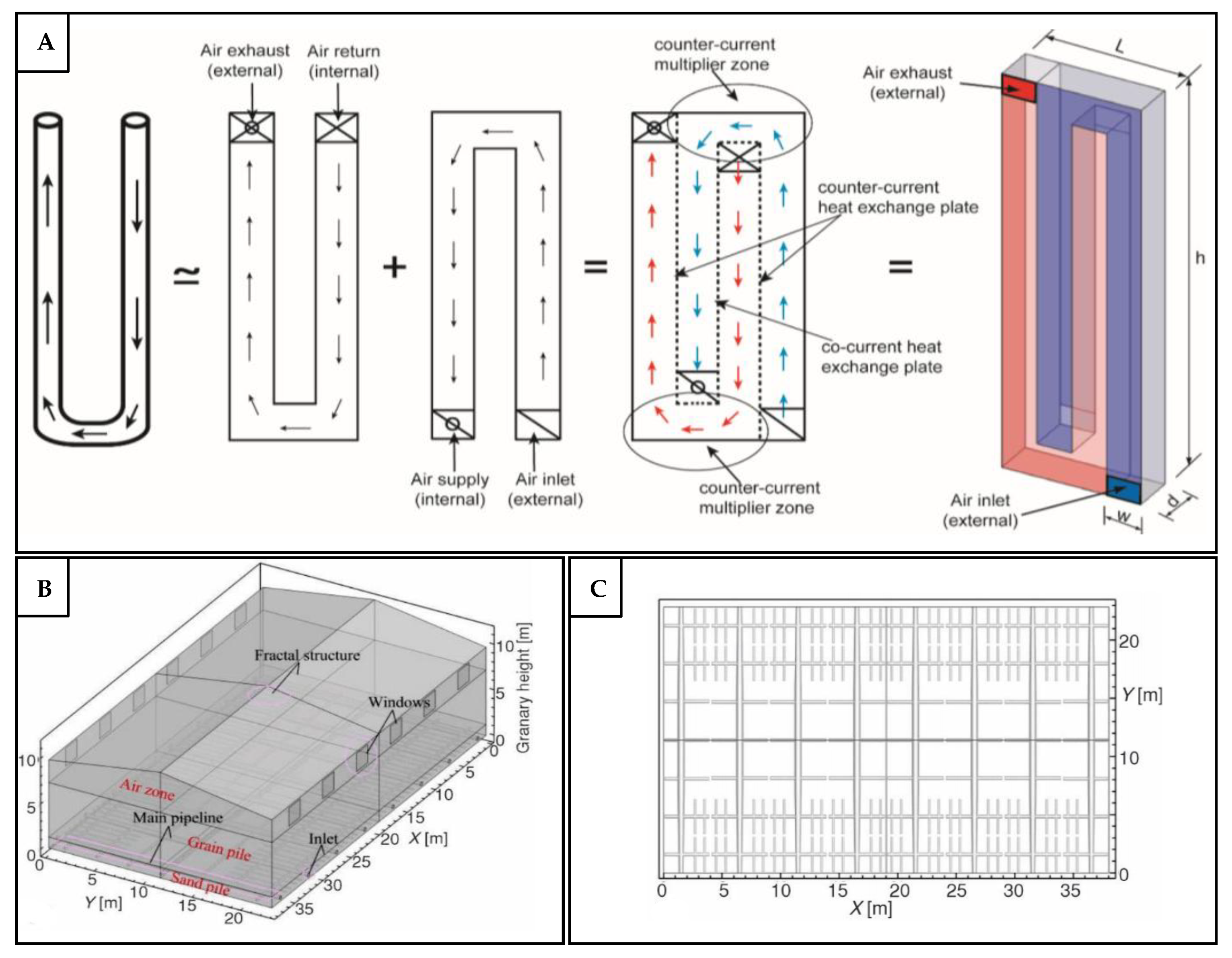

Table 4.
The summary of ventilation inspired by biological systems.
| Source of inspiration | Mimicked features | Applications | Advantages | Challenges/limitations | Study |
|---|---|---|---|---|---|
| Human and animal respiratory systems | Periodic inhalation–exhalation. | Time-periodic ventilation system with single or dual inlets. | More uniform velocity distribution; reduced pollutants in stagnant zones; higher ventilation efficiency; lower age of air. | Computationally demanding to simulate; impact on occupants’ thermal comfort not investigated. | [86] |
| Human respiratory system | Periodic movement of volumes between the lung interior and exterior. | Biomimetic active ventilation (BAV) modules that separate indoor and outdoor environments. | Faster air exchange rate between indoor and outdoor environments. | Model assumes advection-dominated transport; natural ventilation is only effective with wind inflow; the impact on occupants’ thermal comfort is not considered. | [85] |
| Kidney’s Loop of Henle | Substance extraction before waste removal. | Natural ventilation with a heat recovery system. | Lower heating load; improved airflow and reduced CO₂ when coupled with stack ventilation. | Does not meet thermal comfort needs in rooms with single occupancy; performance is influenced by the closing/opening of doors. | [90] |
| Fractal structures | Self-repeating branching patterns. | Fractal ventilation networks. | Improved airflow and cooling uniformity; enhanced cooling in weakly ventilated areas. | Reduced upward penetration; slower air diffusion and cooling rate. | [93] |
5. Bio-Inspired Structures and Strategies for Optimization of Ventilation System and Its Components
5.1. Nature-Inspired Algorithm for Ventilation in Underground Mines and Buildings
In addition to the physical designs, nature has also provided algorithmic solutions for the ventilation systems. For example, in the underground mines, where the ventilation is energy-intensive and critical for safety, several swarm intelligence and evolutionary algorithms, such as beetle swarm optimization (BSO), ant colony algorithm (ACA), beetle antennae search (BAS), particle swarm optimization (PSO), bare-bones PSO (BBPSO), and multi-strategy BSO (MBSO), have been proposed to reduce the power consumption [94,95,96,97], improve the energy efficiency [95,98], provide ventilation on demand [95], invert the gas explosion source point [99] and stabilize the airflow during the main fan switchovers [100]. Comparative studies highlight their different strengths. For example, Lu et al. [95] showed that the MBSO achieved the greatest reduction in the energy consumption, with a high accuracy, stable convergence, and improved volumetric flow rates, though at the expense of a longer convergence time. In contrast, the BSO provided the fastest convergence and good optimization but with a lower accuracy, while the BAS and PSO tended to underperform on the complex networks due to a lower convergence precision. Another study [96] comparing genetic algorithms PSO and BBPSO, reported that the BBPSO achieved the best balance of the convergence accuracy and computational efficiency, making it suitable for the large-scale ventilation systems. Apart from the network optimization, the bio-inspired algorithms have also been applied to the fan switchover control [100]. Since the coal mines typically operate dual main fans for the redundancy, the airflow instabilities often occur during the fan maintenance changeovers. An improved PSO method, which was tested in a coal mine in China, showed that it reduced the airflow volatility to below 0.4% during the switchover, thereby enhancing both the safety and efficiency of the ventilation system [100]. Similarly, the ACA has been used to optimize the ventilation network configurations, as demonstrated at the Handan Mine Bureau in China [94]. The ACA identified which airways should be retained, excavated, or abandoned, thus lowering the overall ventilation costs.
In the building ventilation, nature-inspired algorithms such as the Whale Optimization Algorithm (WOA) and Particle Swarm Optimization (PSO) have been applied to identify the pollutant sources of unknown heights [101]. These algorithms were programmed into source localization codes and executed by mobile robots. Results showed that both algorithms were highly adaptable to the changes in the pollutant source heights. However, the WOA_3D outperformed the PSO_3D, achieving a higher success rate of 77.8% compared to only 55.5% for the PSO_3D, though it required slightly more localization steps. Additionally, the WOA_3D’s random search strategy helped to prevent the robots from getting stuck in the local extremum areas, thus improving its success rate, whereas the PSO_3D was more prone to the premature convergence.
5.2. Fishbone Shape for Outdoor Ventilation
Although the wind facilitates the natural ventilation in the residential areas, it can also exert pressure on the buildings. To optimize the wind environment and improve the ventilation in the high-density urban residential areas in Changsha, China, Wei et al. [102] explored the application of fishbone-shaped building layouts and heights (Figure 21). Similar to how the fish are influenced by the hydrodynamic forces in the water, buildings are also affected by the dynamic forces in the form of wind. Thus, adopting a bionic fishbone form to reorganize the building layouts can help mitigate the wind effects on both the structures and occupants. The results showed that the bio-inspired layout significantly improved the pedestrian wind conditions, reduced the static air zones, enhanced the natural ventilation, and decreased the wind pressure on the windward buildings by 20%. To further optimize the wind environment, the study recommended placing the longer buildings at the center and positioning the taller buildings farther from the prevailing wind direction. While the results are promising, this study did not account for the key parameters of the ventilation comfort, such as the temperature, draft, and age of the air, which play an important role in assessing the performance of the ventilation systems. Particularly, although the wind can enhance the heat transfer between the human body and the surrounding environment, it may also increase the draft sensation. As a result, the occupants in windy environments often experience a lower thermal comfort compared to those in the windless conditions [103], even when the overall cooling effect is beneficial. Future research should therefore examine how the fish-bone building layouts influence such human comfort indices to better understand the practical implications of this bio-inspired ventilation strategy.
5.3. Designs Inspired by Bat Wings, Whale Fins, and Trees for Duct Resistance Reduction
A significant source of resistance in the ventilation and air-conditioning systems is duct elbows, which contribute significantly to the pressure loss and an increase in the building energy consumption [104,105]. Over the years, the use of the guide vanes has been a common strategy for reducing the elbow resistance, typically achieved by modifying the radius or curvature of the vane [105]. Recently, researchers have been exploring alternative methods, including adopting nature-inspired designs such as the sawtooth structures of the leading edges of the whale pectoral fins and bat wings, as shown in Figure 22A [105]. The results showed that the bionic guide vanes reduced the local resistance coefficient and improved the uniformity of the velocity distribution, with an expanded high-velocity region (in red) and a reduced low-velocity region (in blue) downstream of the elbow, as shown in Figure 22B. It also decreased the turbulence dissipation on the inner elbow surface, reducing the energy loss at the vane’s leading edge. However, the local resistance reduction is influenced by the vane’s dimensions. For example, the difference in the local resistance coefficient between the normal and bionic guide vanes was the smallest when the groove’s dimensionless height was 0.0312, but increased significantly at 0.00625. As the dimensionless height increased further, the reduction in the resistance coefficient became relatively insignificant. Therefore, to apply this design to the real-world ventilation ducts, the optimum sawtooth dimensions must be determined, which may vary from one duct to another.
Another source of a high local resistance often occurs at the duct tee. Gao et al. [106] proposed a method for reducing the resistance in the duct tees by incorporating a structure mimicking the shape of joints (protrusions) found in certain plant trunks, as shown in Figure 23A. The results showed that the biomimetic duct tees exhibited a significantly lower resistance than the traditional tees in all flow directions, with an average resistance reduction of 22–68% over the traditional duct tees. In cases with the high local flow rates and low aspect ratios, the resistance became negative, indicating a 100% reduction. They also exhibited smaller dissipation areas and lower energy dissipation rates than the traditional ducts, thereby reducing the energy consumption, as shown in Figure 23B. However, excessive protrusions could be counterproductive, as they induce fluid deformation and increase resistance. Therefore, to achieve maximum resistance reduction, the optimal protrusion height must be determined.
5.4. Insight from Animals for Ventilation Fan Optimization
Noise produced by the ventilation fans is a well-known issue in a wide range of indoor environments, from the domestic buildings [107] to the acoustically sensitive habitats such as the International Space Station [21]. Meanwhile, many organisms in nature have evolved specialized features or structures that reduce noise and improve their aerodynamic performance [108,109,110]. These features share a common characteristic: the presence of the non-smooth surface geometries, such as waviness, serrations, grooves, or forked edges, which are commonly found in the trailing and leading edges of the owl wings [111,112], the pectoral fins of the humpback whales [113,114,115], the abdomens of the mantis shrimp [116], the surface morphology of the desert scorpion [117], and the shells of various crustaceans [108]. Such designs have been studied in different types of fans, including axial, centrifugal, mixed-flow, and other types of airfoils, ranging from the small to large scales. To reduce the noise, these bio-inspired geometries can be applied to different fan components, such as the blade surface, leading and trailing edges, or the blade tips. At the leading edge of the axial fan blades, wavy structures or serrations help reduce the flow resistance and turbulent kinetic energy, suppress boundary layer separation, and consequently decrease noise [118]. However, they can also generate counter-rotating vortices and shift sound sources downstream, which may increase the broadband noise near the trailing edge [119]. When applied to the blade surface, the ridge or textured structures reduce the turbulent kinetic energy and delay the laminar-to-turbulent transition, thereby weakening the vortex formation at the trailing edge and lowering the noise levels [108]. These modifications also enhance the airflow inside the impeller by reducing the resistance and suppressing the boundary layer separation [108]. When incorporated at the trailing edge, the serrated structures reduce the noise but they often do so at the expense of the aerodynamic performance [120].
For the aerodynamic performance improvement, inspiration has been drawn from the butterfly wings, which demonstrate exceptional aerodynamic performance and efficiency due to their effective airflow control, structural flexibility, and precise wing positioning [121,122]. Inspired by this, Tian et al. [123] developed bionic fan blades with the depression structures along the blade’s outer edges to reduce the power consumption and enhance the aerodynamic performance of the axial flow fans. The increase in the depression depth initially improves the aerodynamic performance, evidenced by a higher flow rate and efficiency compared to the baseline design. However, when the depression depth exceeded 1.9 mm, the fan’s efficiency and volumetric flow rate began to decline, while the noise levels increased. Another example is the sycamore seed, whose winged structure enables gliding [124,125], spinning [126,127], and rolling [128,129] during descent. Gururaj et al. [130] applied this principle to ceiling fan blades, finding that the bio-inspired fan delivered slightly lower airflow overall, but it achieved higher air velocity at a greater distance compared to conventional fans. Figure 24 summarizes features and structures observed in various organisms in nature and their application to different types and components of fans.
Table 5 summarizes the structures and strategies in nature that can be used to optimize ventilation systems and their components.
6. Bio-Inspired Approaches for Adaptive Ventilation
6.1. Insights from Plants
6.1.1. Pine Cones
In addition to the efficient air exchange, the adaptability and responsiveness to the environmental changes are also crucial for enhancing the performance of the ventilation systems. A robust example of this in nature is pine cones, which respond to changes in the ambient humidity through reversible movements [138,139,140]. When the environmental humidity is low, i.e., dry conditions, the pine cones open their scales (Figure 25A) to facilitate seed dispersal, allowing seeds to be carried away by the winds. When the humidity level is high, i.e., rainy conditions, the scales close (Figure 25B) to protect the seeds, as the wet weather is unfavorable for germination [30,140,141]. Like the pinecone scales, the wood composites also exhibit hygroscopic behavior, enabling them to respond to the changes in the humidity levels [141,142,143,144,145]. These composites can be integrated into the building envelopes to function as a component of passive ventilation systems that adapt to the variations in the ambient air humidity [143,144,146]. One of the most prominent examples of this application is the HygroSkin-Meteorosensitive Pavilion, whose envelope contains numerous aperture elements, which can autonomously respond to the changes in the humidity levels [147,148]. The apertures were programmed to open (Figure 25C) when the external humidity around the Hygroskin is low and to close when the humidity is high (Figure 25D).
A similar mechanism, though operating in the opposite manner, is utilized in the HygroScope (Figure 26A) [144]. It consists of rectangular and circular apertures that increase their porosity as the humidity inside the enclosure rises to ventilate out the moisture-saturated air and close themselves when the humidity drops to retain the internal conditions. Apart from the envelope applications, similar components called ‘un-plywood’ have been proposed for the ceiling-mounted ventilation panels [143]. They were programmed to open at relative humidity levels above 50% (wet) and to close below this threshold (Figure 26B and C). For example, as the indoor air becomes warm and humid from the occupant activity, the panels autonomously open, allowing the excess heat and moisture to be expelled with the help of the natural convection process.
One of the important factors influencing the overall performance of the responsive components in the passive ventilation systems is the geometric arrangement, which can lead to significant variations in the degree and direction of the opening. For example, when the responsive elements were arranged tangentially to the reference surface (Figure 26D, type 1-3), an increase in the humidity caused them to curl and open through an increased curvature. In contrast, when the reactive elements were rotated out of the surface into a perpendicular orientation (Figure 26D, type 4), an increase in the curvature led to closing, whereas a decrease in the curvature resulted in the opening. Therefore, selecting the most suitable patterns or geometric arrangements of the responsive elements is crucial for their application in the ventilation systems because the percentage of opening of the responsive elements can significantly influence and regulate how much air can pass through the openings and the level of the humidity required to achieve the desired percentage of opening [144].
Figure 26.
(A) Hygroscope installation with humidity-responsive components in open and closed states depending on humidity levels. Reproduced with permission from [144]; (B) Un-plywood, closed when dry and open when wet; (C) Schematic diagram illustrating the opening and closing of ceiling-mounted ventilation panels in response to humidity levels. (B, C) Reproduced with permission from [143]; (D) Different geometric arrangements of the responsive components in open and closed states. Reproduced with permission from [144].
Figure 26.
(A) Hygroscope installation with humidity-responsive components in open and closed states depending on humidity levels. Reproduced with permission from [144]; (B) Un-plywood, closed when dry and open when wet; (C) Schematic diagram illustrating the opening and closing of ceiling-mounted ventilation panels in response to humidity levels. (B, C) Reproduced with permission from [143]; (D) Different geometric arrangements of the responsive components in open and closed states. Reproduced with permission from [144].

6.1.2. Ice Plants
Like the pine cones, certain species of ice plants exhibit a sophisticated seed-dispersal mechanism driven by the water-induced folding and unfolding of their seed capsules [29,149,150,151]. These capsules consist of several valves that remain closed under the dry conditions (Figure 27A) and autonomously unfold backward when hydrated (Figure 27B)[150]. Inspired by this, Khosromanesh and Asefi [150,151] developed a concept for hydro-actuated building façade to enhance the natural ventilation. The façade system comprises modular square grids with responsive elements, each consisting of four triangular valves connected to a central base. A sunlight sensor is integrated into the system to detect the increase in the sunlight and initiate the movement of the responsive elements. The valves and the middle base of the responsive elements consist of honeycomb frameworks filled with the hydrogel. When hydrated, the hydrogel swells, causing the responsive elements to open, thus allowing the fresh air to ventilate the building and the used air to be expelled. In the dry state, as the hydrogel loses water, the valves contract and close [150,151]. Figure 27B shows the responsive elements in their open and closed states. However, like many other bio-inspired designs, the practical applications of the hydro-actuated façades present several challenges. While the opening and closing mechanisms function relatively easily at small model scales, they can become far more complex and difficult to control as the system is scaled up. The precise synchronization of movements across larger surfaces may require more advanced actuation systems, increasing both the design complexity and the risk of malfunction. The use of the multiple interconnected and delicate components introduces higher maintenance demands, which in turn increase the operational costs. Therefore, before the real-world implementation, considerations such as durability, responsiveness under the real weather fluctuations, and long-term cost-effectiveness will be critical in determining whether this design solution can progress from the conceptual models to the practical applications.
6.1.3. Mimosa Pudica
Mimosa pudica is a highly sensitive plant that exhibits reversible movements, such as drooping its petioles, in response to external stimuli like wind, vibration, or touch [126,138]. Inspired by the this, Sankaewthong et al. [152] proposed an innovative façade design called the mimosa kinetic façade (Figure 28) to enhance the efficiency and performance of the natural ventilation. Similar to how the mimosa pudica reacts to the external stimuli, this bio-inspired façade can respond to the changes in the environmental conditions, such as temperature, humidity, and air velocity, through the use of sensors and motors. The results of their study showed that the mimosa kinetic façade enhances the natural ventilation efficiency, improves the quality of the indoor air, and promotes a better occupants’ comfort, compared to the traditional static façades. Most of the mimosa kinetic façade arrangements show a significant increase in the indoor air quality of up to 12 m/s, compared to the maximum of 2.5 m/s in the single-sided traditional static façade. This kinetic façade also achieves the lower concentration of CO2 being only 400 ppm (compared to more than 1000 ppm in a traditional façade) and a maximum of 14.50–19.50 air change per hour (ACH). These results demonstrate the potential of the kinetic façades in improving the quality of the indoor air and the occupants’ comfort. However, further research is required for achieving a balance between the improvement of the indoor air quality and promoting the occupants’ comfort. The future research could also explore the application of such a design in different settings and various climate conditions.
6.1.4. Stomata
The opening and closing of the stomata in plants follow the environmental conditions to achieve a balance between the gas exchange for photosynthesis and the loss of water vapor due to evaporation. When the concentration of CO2 in the atmosphere is low, the plants increase the density of stomata, but at the same time decrease their size [153,154]. Inspired by this, Lee and Lee [155] proposed and studied a bio-inspired pneumatic façade (Figure 29A) with different adaptive opening configurations (Figure 29B) to enhance the performance of the natural ventilation. To determine the optimum opening configurations for the occupant comfort, the indoor airflows were analyzed according to changes in the speed and direction of the external winds. The results showed that, to generate indoor airflow closer to the recommended levels for the occupant comfort, configurations with larger openings should be used under the lower wind speeds, while smaller openings are more suitable at the higher wind speeds. In addition, the larger openings should be positioned toward the windward side, with the smaller openings placed on the leeward side. However, it is important to note that this study relied solely on the CFD simulations. Since different turbulence models can produce varying results, a more detailed exploration and discussion of the turbulence model selection would strengthen the validity of the findings. Beyond the terrestrial applications, the concept of the adaptive façades could also be extended to the space habitats, where not only the external envelope but also the internal partitions could dynamically adjust to optimize the ventilation according to the occupants’ needs.
6.1.5. Crocus Flower
The crocus flowers (Figure 30A) exhibit a characteristic known as thermonasty, which is a kinetic movement of the plants due to the temperature changes. Certain species, such as Crocus vernus, can respond to the temperature shifts as small as 0.2°C [156]. The unique heat response of this flower is attributed to the bi-layer structure of its petals, composed of the inner and outer cell layers. At the colder temperatures, the outer layer expands faster than the inner layer, causing the petal to bend inward and close. Conversely, at warmer temperatures, the inner layer grows faster, resulting in the petals moving outward to open [157]. Inspired by this, LIFT Architects [157] developed a concept and prototype for thermally active ventilation panels, called The Air Flower (ER) (Figure 30B), which consists of “petals” that incorporate Shape Memory Alloy (SMA) wires as actuating components. When the temperature reaches the SMA’s transformation point, the wires contract, causing the petals to open, and as the temperature decreases and the wires cool, the petals close again. This mechanism can be adapted to a range of building components to provide a responsive (adaptive) ventilation, including the roof vents, double-skin ventilated façades, and traditional apertures. For example, when the indoor temperature rises to 26 °C, the Air Flower opens its petals to increase the airflow into the building, and once the interior cools, the petals close to seal it. The number and geometry of petals can be customized. For instance, to promote a buoyancy-driven natural ventilation generated by the temperature and humidity differences between the indoor and outdoor environments, a simplified version with two rectangular petals can be installed at both the upper and lower openings of a structure. In this configuration, the higher indoor temperature would cause the upper petals to open, allowing the warm air to rise and escape through the top opening, while the cooler, fresh air would enter the building through the petals at the bottom.
6.2. Insights from Simple Aquatic Animals and Lungs
Exchanging fluid through the inhalation and exhalation is a common mechanism found in many organisms, not only land animals but also organisms living deep in the sea, such as the sea sponges. The sea sponges lack organs, nervous systems, and muscles but rely on a canal system with chambers to pump the water in and out of their bodies, providing oxygen, nutrients, and food while removing the waste [158]. This pumping process is driven by the flagellated chambers that beat to increase the surface area, facilitating the water flow [159]. Inspired by the deep-sea sponges and the respiratory systems of the living organisms, Badarnah and Knaack [159,160] proposed a bio-inspired ventilating envelope with lung-like chambers (LLC) (Figure 31A and B), that expand and contract to perform air inhalation and exhalation. These LLCs were made of flexible or elastic materials, allowing them to dynamically adjust their surface area. Sensors were installed on the inner side of the skin to send signals to the breathing units, enabling them to execute the inhaling and exhaling processes. Each LLC consisted of two surfaces, namely the “sucking” and the “expelling” surfaces, which were interconnected within the basic component. Piezoelectric wires were attached to the sucking surfaces, causing them to expand and create low-pressure zones when electricity was applied. As a result, air entered the breathing chambers through the small holes on the sucking surface (Figure 31C). When the voltage was stopped, the chamber contracted, reducing the volume and creating a high-pressure zone. As a result, air was expelled through the holes on the other sides (Figure 31D). The holes were equipped with the unidirectional valves that ensure the air flows in one direction. When the air was pushed from the inner part of the chamber outward, the valves contracted and closed to prevent the backflow. To optimize the design, Badarnah, Kadri and Knaack [160] conducted numerical simulations of the breathing chambers by positioning the air expelling (outlet) and air intaking (inlet) units at various locations and using different quantities of units. They found that increasing the number of the breathing units does not necessarily improve the uniformity of the air distribution. To achieve a better air distribution, it is crucial to position the inlet and outlet at an optimal distance from each other. Additionally, determining the optimal number of components is essential. When the outlet and inlet are placed too close together, the increase in the number of components leads to the fresh air being expelled before a proper mixing occurs, hence, reducing the overall efficiency.
Table 6 summarizes bio-inspired approaches for adaptive ventilation along with the advantages and associated challenges.
Figure 31.
(A) Bio-inspired façade with lung-like chambers (LLC); (B) Front, side, and top views of the lung-like chambers (LLC); (C) Illustration of lung-like chambers (LLC) during expansion, drawing air in; (D) Illustration of lung-like chambers (LLC) during contraction, expelling air out. (A-D) Reproduced with permission from [159].
Figure 31.
(A) Bio-inspired façade with lung-like chambers (LLC); (B) Front, side, and top views of the lung-like chambers (LLC); (C) Illustration of lung-like chambers (LLC) during expansion, drawing air in; (D) Illustration of lung-like chambers (LLC) during contraction, expelling air out. (A-D) Reproduced with permission from [159].
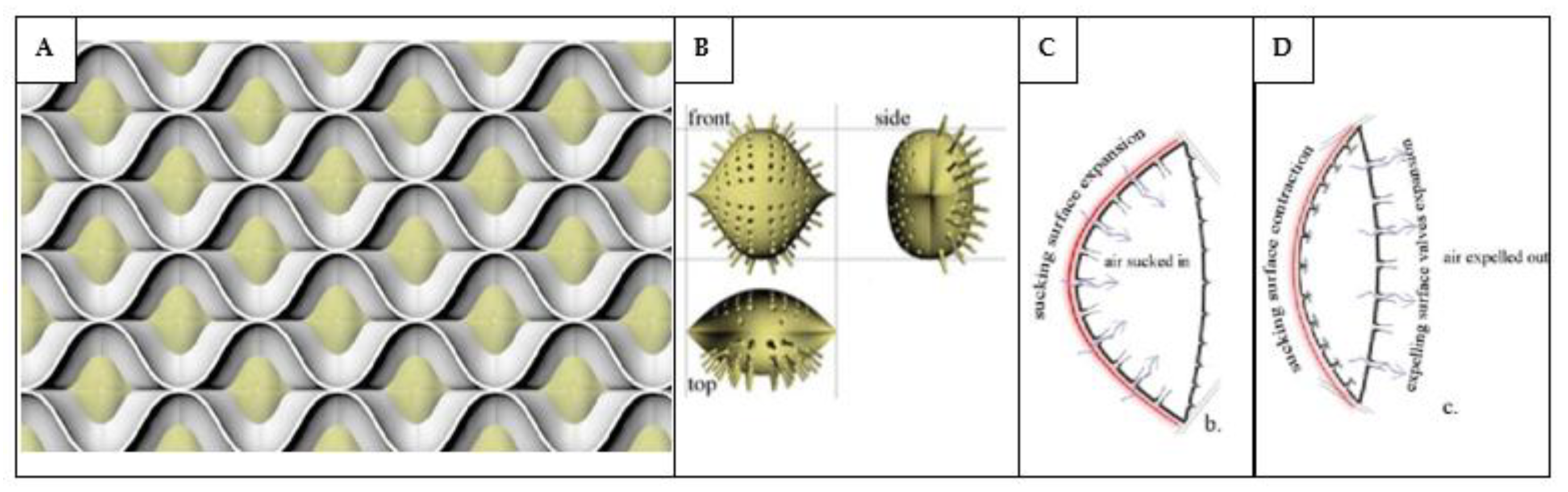
Table 6.
The summary of bio-inspired approaches for adaptive ventilation.
| Source of inspiration | Mimicked features | Applications | Advantages | Challenges/limitations | Study | ||
|---|---|---|---|---|---|---|---|
| Pine cone | Opening and closing of scales. | Adaptive envelope components for ventilation. | Energy-free operation due to autonomous response to humidity changes; lightweight construction; dynamic environmental adaptation. | Limited user control; reduced sensitivity over time from material fatigue; response time influenced by material thickness and size; performance dependent on geometric shape and arrangement. | [143,144,147,148] | ||
| Ice plant | Opening and closing of its seed capsules. | Adaptive envelope components for ventilation. | Dynamic environmental adaptation; responsive to changing conditions. | Manufacturing/upscaling challenges for large structures; precise synchronization of movements is challenging; risk of malfunction. | [150,151] | ||
| Mimosa pudica | Sensitivity and automatic response to external stimuli. | Kinetic façade that facilitates ventilation. | Enhanced ventilation efficiency; improved indoor air quality and airflow. | Difficult to balance between comfort and air quality. | [152] | ||
| Stomata | Opening and closing of guard cells. | Façade openings for natural ventilation. | Optimum configuration of opening shape and location ensures desirable airflow and occupant comfort. | Not experimentally verified; dependent on wind conditions and direction. | [155] | ||
| Crocus flower | Opening and closing of petals. | Smart and responsive (adaptive) ventilation panels. | Improved natural ventilation; reduced energy use with smart materials. | Requires maintenance; effectiveness decreases with material fatigue; limited temperature response range. | [157] | ||
| Sea sponge & human respiratory system | Active breathing or pumping in and out. | Façade with components that inhale and exhale to provide ventilation. | Improved permeability of envelope but still controllable; improved air velocity distribution and reduced age of air in optimized case. | Complex to manufacture and operate; the use of piezoelectric wire to generate a pressure difference may be inefficient and costly for large-scale buildings. | [159,160] | ||
7. Applications and Integration of Bio-Inspired Ventilation in Off-Earth Habitats and Underground Mines
7.1. Ventilation Challenges in Off-Earth Habitats and Underground Mines
To identify where the bio-inspired designs and strategies could enhance the ventilation in hostile environments such as off-Earth habitats and underground mines, it is essential to first understand the challenges faced by current systems. For off-Earth habitats, lessons can be drawn from existing facilities like the International Space Station (ISS) and other previous space missions. Reviews of reports and studies on the ISS, Apollo missions, and the Space Shuttle highlight noise as the primary ventilation issue [18,161,162]. Unlike terrestrial compartments, space habitats are isolated and confined, creating an acoustically challenging environment due to continuous noise sources from the Environmental Control and Life-Support Systems (ECLSS) [163,164]. Various mitigation measures, such as mufflers, isolators, wraps, covers and barriers, have been implemented, yet addressing noise at the source through quieter fans remains the most preferable approach [164]. Passive measures, while useful, often become costly over time, and consume valuable space needed for essential mission equipment [164,165,166].
Other challenges associated with the ventilation systems in space include the risk of CO₂ accumulation and poor air distribution. In the microgravity, the absence of the natural convection increases the likelihood of CO₂ buildup around an occupant’s head when they remain stationary, as the exhaled air does not disperse as easily as it does on Earth. Continued exposure to the elevated CO₂ concentrations can impair the cognitive function and, in the severe cases, cause unconsciousness or even death from asphyxiation [167,168]. The inadequate airflow also contributes to the temperature rises in the occupied zones, which is a major cause for the crew discomfort [21,161]. While the abrasive dust particles have not posed a major issue for the ventilation system aboard the ISS, dust is one of the most significant environmental challenges that the astronauts will face during the lunar or other planetary surface exploration, as has been demonstrated by the past lunar missions and is anticipated for the future missions to the Moon and Mars. On these planetary surfaces, the fine dust particles tend to adhere to astronauts’ spacesuits and equipment. Once brought into the habitat or spacecraft, the dust can become airborne and circulate throughout the cabin, potentially both compromising the equipment such as the ventilation systems and posing serious health risks to the crew [169,170].
Unlike the off-Earth environment, Earth benefits from the natural forces such as the wind and convection, which are the primary drivers for the natural ventilation. However, the ventilation systems in underground mines continue to face significant challenges. As the shallow coal and mineral deposits become depleted, mining operations are forced to move to the greater depths [171,172,173,174], which has profound implications on the ventilation efficiency and costs. With the increasing depth, the distance that air must travel also increases, leading to higher operating and maintenance costs, as well as greater leakage throughout the system, all of which contribute to rising the power consumption [11,175,176]. In addition, deeper mines experience elevated temperatures due to air auto-compression and increased heat transfer from the surrounding rock strata [11,172]. For example, in mines in Germany the temperature is approximately 40 °C at a depth of 900 m, increasing to about 50 °C at the depth of 1712 m. In one of the deepest underground mines in South Africa, operating at a depth of 3000 m, temperatures can reach up to 70 °C [172]. To counter this heat gain and maintain safe working conditions, substantially higher airflow rates must be supplied. However, the required additional air volume and the associated ventilation costs become increasingly dramatic beyond certain depths. For example, in Canadian mines operating at a depth of more than 2000 m, an additional 300 m increase in the depth requires a 20% increase in the air supply, resulting in the ventilation costs that are for 73% higher in these deeper mines [11].
The growing mechanization of mining, particularly through the use of diesel-powered equipment, introduces further challenges, as the ventilation systems must dilute higher concentrations of toxic emissions [174,177], thereby requiring even greater volume of airflow and energy consumption [11,178]. Mine ventilation systems are also a major contributor to the greenhouse gas emissions due to their substantial power consumption and dependence on the fossil fuels [178]. Depending on the mine, ventilation may account for 20–40% of the total energy demand and up to 50% of the electricity consumed in the underground operations [179,180]. In the United States, approximately 63% of the mine electricity is supplied by off-grid sources that generate power from the carbon-based fuels [181]. This heavy reliance on the fossil energy significantly elevates the carbon footprint of mining activities, making the ventilation systems a critical target for the energy efficiency improvements and sustainable practices. Lastly, the underground mine ventilation systems are often designed to operate continuously at the peak capacity, irrespective of the actual demand. While this approach is intended to guarantee the worker safety under all possible operating conditions, it also creates significant inefficiencies. For instance, the mines frequently supply air at the maximum volume around the clock, even in situations where it is unnecessary, such as during the periods of low activity or when the electric-powered equipment is used. This results in the over-ventilation of the mines and substantial unnecessary energy consumption [11].
7.2. Bio-Inspired Solutions for Ventilation in Off-Earth Habitats and Underground Mines
After the challenges stated under the section 7.1 of this paper are identified, the potential applications of the bio-inspired solutions for the ventilation systems in underground mines and space habitats can be explored. These solutions may be integrated into various components of the ventilation systems, including fans, ducts, and air distribution mechanisms. For example, mimicking the environmentally responsive movements of the plants could allow the ventilation systems to dynamically adapt to the environmental changes and occupant demands, enhancing the human comfort while reducing the energy consumption [143,147,152]. This adaptability is particularly valuable for the off-Earth habitats, such as future lunar and Martian colonies, where ensuring the crew's health, as well as comfort for the mission success is crucial, and where the energy resources are limited. In the underground mines, the bio-inspired approaches offer opportunities for the ventilation optimization, which is crucial to improving efficiency and reducing energy usage. Table 7 summarizes the relevant bio-inspired solutions to each identified challenge or issue associated with the underground mines and off-Earth habitats' ventilation.
Despite being a promising avenue, the application and integration of the bio-inspired approaches in space habitat ventilation remain very limited. These limitations stem from several factors. The interest in bio-inspiration within the research community has surged only in the past decade, and the opportunities to apply such concepts in real missions or habitats have been scarce. Human space missions are still relatively few, and the number of operational habitats in actual space environments has been extremely limited. Integrating such new untested technologies into the already existing systems presents significant challenges, including increased costs, time constraints, and compatibility issues. Although some bio-inspired technologies have been tested on Earth, accurately replicating the effects of the microgravity and human factors remains a challenge [182]. In addition, many bio-inspired ventilation strategies developed on Earth also rely on the natural forces like the natural convection, which do not exist in the microgravity of the off-Earth environment [15,183]. Furthermore, the numerical models used for simulation are often simplified, which may yield promising results for the basic designs but raise questions about their feasibility in the more complex and intricate designs. Hence, it is important to study the performance of the bio-inspired ventilation structures under various settings, including under the microgravity conditions.
Likewise, the application of the bio-inspired approaches to the underground mine ventilation has remained very limited. This could be due to the fact that the ventilation is a critical safety system for both the workers and equipment in the hostile underground mine environment. Consequently, the stakeholders are generally cautious about adopting new designs that have not yet been rigorously validated or demonstrated under real operating conditions. Nevertheless, the research on the applications of the nature-inspired algorithms for the mine ventilation optimization has grown significantly over the past decade, which has been proposed to improve the energy efficiency, deliver an optimum ventilation on demand, invert the gas explosion sources, and stabilize the airflow during the fan switchover. For the application of other bio-inspired approaches, it is essential to first simulate and evaluate the designs under a range of climate conditions, as some concepts may be more suitable for specific environments. In addition, developing prototypes and testing them under realistic operating scenarios is crucial to ensuring that the anticipated benefits of the proposed bio-inspired models do not come at the expense of the safety.
8. Conclusions
Ventilation systems are a critical component of the built environment, both on Earth and off-Earth. While the general ventilation systems on Earth ensure the comfort and health of the indoor occupants, their role in the off-Earth habitats and underground mines extends beyond the comfort to the survival. This study, through research trend and bibliometric analyses, found that most bio-inspired ventilation research has focused on enhancing the efficiency, which is achieved largely through the optimization of the systems, components, and buildings. Although the bio-inspired research in the built environment and related engineering fields has been developing for the past 25 years, a significant increase has occurred only in the last decade, which reflects the increasing demand for more efficient and sustainable designs.
The bio-inspired approaches in the ventilation systems have been proposed for a wide range of applications, including ducts, fans, and adaptive components capable of autonomously responding to the environmental changes such as temperature and humidity. However, the real-world applications of such innovative designs remain limited, and this gap is even more pronounced in the underground mines and off-Earth habitats such as the crew quarters in the ISS. The introduction of the untested and unverified designs in such high-risk environments is risky. While these systems may demonstrate effectiveness at a small scale, their application at a larger scale may encounter difficulties due to the complexity of mimicking nature’s designs as well as because of the constraints of the underground mines or space missions, such as limited energy resources and harsh environmental conditions. Addressing these challenges requires more advanced research to improve the reliability of the bio-inspired designs and increase their feasibility for practical implementation.
Author Contributions
Conceptualization, methodology, investigation, data curation, analysis, writing—review and editing, U.R.; supervision, review and editing, N.M., R.A. and D.H. All authors have read and agreed to the published version of the manuscript.
Funding
This research received no external funding.
Institutional Review Board Statement
Not applicable.
Conflicts of Interest
The authors declare no conflict of interest
References
- González-Torres, M.; Pérez-Lombard, L.; Coronel, J.F.; Maestre, I.R.; Yan, D. A Review on Buildings Energy Information: Trends, End-Uses, Fuels and Drivers. Energy Rep. 2022, 8, 626–637. [CrossRef]
- Sara, K.; Noureddine, Z. A Bio Problem-Solver for Supporting the Design, towards the Optimization of the Energy Efficiency. In Proceedings of the 2015 6th International Conference on Modeling, Simulation, and Applied Optimization (ICMSAO), Istanbul, Turkey, 27-29 May 2015; IEEE: Piscataway, NJ, USA, 2015; pp. 1–6.
- Li, Y.; Wang, W.; Wang, Y.; Xin, Y.; He, T.; Zhao, G. A Review of Studies Involving the Effects of Climate Change on the Energy Consumption for Building Heating and Cooling. Int. J. Environ. Res. Public. Health 2020, 18, 40. [CrossRef]
- Ahmed, T.; Kumar, P.; Mottet, L. Natural Ventilation in Warm Climates: The Challenges of Thermal Comfort, Heatwave Resilience and Indoor Air Quality. Renew. Sustain. Energy Rev. 2021, 138, 110669. [CrossRef]
- Zhang, H.; Yang, D.; Tam, V.W.Y.; Tao, Y.; Zhang, G.; Setunge, S.; Shi, L. A Critical Review of Combined Natural Ventilation Techniques in Sustainable Buildings. Renew. Sustain. Energy Rev. 2021, 141, 110795. [CrossRef]
- McPherson, M. Subsurface Ventilation Engineering, Mine Ventilation Services. Inc Fresno 2009.
- Wen, J.; Zuo, J.; Wang, Z.; Wen, Z.; Wang, J. Failure Mechanism Analysis and Support Strength Determination of Deep Coal Mine Roadways – A Case Study. Constr. Build. Mater. 2024, 443, 137704. [CrossRef]
- de Villiers, D.J.; Mathews, M.J.; Maré, P.; Kleingeld, M.; Arndt, D. Evaluating the Impact of Auxiliary Fan Practices on Localised Subsurface Ventilation. Int. J. Min. Sci. Technol. 2019, 29, 933–941. [CrossRef]
- Wang, J.; Xiao, J.; Xue, Y.; Wen, L.; Shi, D. Optimization of Airflow Distribution in Mine Ventilation Networks Using the Modified Sooty Tern Optimization Algorithm. Min. Metall. Explor. 2024, 41, 239–257. [CrossRef]
- Wallace, K.; Prosser, B.; Stinnette, J.D. The Practice of Mine Ventilation Engineering. Int. J. Min. Sci. Technol. 2015, 25, 165–169. [CrossRef]
- Hardcastle, S.G.; Kocsis, C.K. Mining at Depth▲ The Ventilation Challenge. Des. Methods 2004, 51.
- Halim, A. Ventilation Requirements for Diesel Equipment in Underground Mines–Are We Using the Correct Values. In Proceedings of the 16th North American Mine Ventilation Symposium, Golden, CO, USA, 17-22 June 2017; SME: Colorado, USA; Vol. 27, pp. 1–7.
- von Einem, M.; Groll, R.; Heinicke, C. Computational Modeling of a Ventilation Concept for a Lunar Habitat Laboratory. J. Space Saf. Eng. 2022, 9, 145–153. [CrossRef]
- Georgescu, M.-R.; Meslem, A.; Nastase, I.; Sandu, M.; Bode, F. Experimental Study of Carbon Dioxide Accumulation on a Model of the Crew Quarters on the ISS. In Proceedings of the 2019 International Conference on ENERGY and ENVIRONMENT (CIEM), Timisoara, Romania, 17-18 October 2019; IEEE: Piscataway, NJ, USA, 2019; pp. 269–273.
- Georgescu, M.R.; Meslem, A.; Nastase, I.; Tacutu, L. An Alternative Air Distribution Solution for Better Environmental Quality in the ISS Crew Quarters. Int. J. Vent. 2023, 22, 24–39. [CrossRef]
- James, J.T. The Headache of Carbon Dioxide Exposures. In proceedings of the 37th International Conference on Environmental Systems (ICES), Chicago, IL, USA, 9–12 July 2007; SAE International: Warrendale, PA, USA, 2007; pp. 411-416.
- Son, C.H.; Zapata, J.L.; Lin, C.-H. Investigation of Airflow and Accumulation of Carbon Dioxide in the Service Module Crew Quarters. In Proceedings of the 32nd International Conference on Environmental Systems (ICES), San Antonio, TX, USA, 15–18 July 2002; SAE International: Warrendale, PA, USA, 2002; 2002-01–2341.
- Broyan, J.L.; Borrego, M.A.; Bahr, J.F. International Space Station USOS Crew Quarters Development. In Proceedings of the 38th International Conference on Environmental Systems (ICES), San Francisco, CA, USA, 29 June–3 July 2008; SAE International: Warrendale, PA, USA, 2008; 08ICES-0222. [CrossRef]
- Georgescu, M.-R.; Nastase, I.; Meslem, A.; Sandu, M.; Bode, F. Design of a Small-Scale Experimental Model of the International Space Station Crew Quarters for a PIV Flow Field Study. In Proceedings of the E3S Web of Conferences; 2019; Vol. 111, p. 01045.
- Sandu, M.; Nastase, I.; Bode, F.; Croitoru, C.; Tacutu, L. Preliminary Study on a Reduced Scaled Model Regarding the Air Diffusion inside a Crew Quarter on Board of the ISS. E3S Web Conf. 2018, 32, 01015.
- Bode, F.; Nastase, I.; Croitoru, C.; Sandu, M.; Dogeanu, A.; Ursu, I. Preliminary Numerical Studies for the Improvement of the Ventilation System of the Crew Quarters on Board of the International Space Station. INCAS Bull. 2018, 10, 137–143.
- Jernigan, M.; Gatens, R.; Perry, J.; Joshi, J. The next Steps for Environmental Control and Life Support Systems Development for Deep Space Exploration. In Proceedings of the 48th International Conference on Environmental Systems (ICES), Albuquerque, NM, USA, 8–12 July 2018; ICES: USA, 2018; ICES-2018-276.
- Shaw, L.; Garr, J.; Gavin, L.; Hornyak, D.; Matty, C.; Ridley, A.; Salopek, M.; Toon, K. International Space Station as a Testbed for Exploration Environmental Control and Life Support Systems 2021 Status. In Proceedings of the 50th International Conference on Environmental Systems (ICES), 2021; ICES: 2021; ICES-2021-20.
- Karaarslan-Semiz, G. Education for Sustainable Development in Primary and Secondary Schools: Pedagogical and Practical Approaches for Teachers; Springer Nature, 2022; ISBN 978-3-031-09112-4.
- Pawlyn, M. Biomimicry in Architecture; Riba Publishing, 2019; ISBN 0-429-34677-8.
- Khelil, S.; Zemmouri, N. Biomimetic: A New Strategy for a Passive Sustainable Ventilation System Design in Hot and Arid Regions. Int. J. Environ. Sci. Technol. 2019, 16, 2821–2830. [CrossRef]
- Mahmoud, E. Biomimicry: A New Approach to Enhance the Efficiency of Natural Ventilation Systems in Hot Climate.; 2010.
- Lunau, K.; Konzmann, S.; Bossems, J.; Harpke, D. A Matter of Contrast: Yellow Flower Colour Constrains Style Length in Crocus Species. PLoS One 2016, 11, e0154728. [CrossRef]
- Harrington, M.J.; Razghandi, K.; Ditsch, F.; Guiducci, L.; Rueggeberg, M.; Dunlop, J.W.C.; Fratzl, P.; Neinhuis, C.; Burgert, I. Origami-like Unfolding of Hydro-Actuated Ice Plant Seed Capsules. Nat. Commun. 2011, 2, 337. [CrossRef]
- Quan, H.; Pirosa, A.; Yang, W.; Ritchie, R.O.; Meyers, M.A. Hydration-Induced Reversible Deformation of the Pine Cone. Acta Biomater. 2021, 128, 370–383. [CrossRef]
- Siirila, A. Black-Tailed Prairie Dog. Wikimedia Commons. 2007. Available online: https://commons.wikimedia.org/wiki/File:Prairie_Dog_Washington_DC_1.jpg (accessed on 5 July 2025).
- National Oceanic and Atmospheric Administration (NOAA) Ocean Explorer Sponges in Caribbean Sea, Cayman Islands in Wikimedia Commons. Wikimedia Commons. 2010. Available online: https://commons.wikimedia.org/wiki/File:Sponges_in_Caribbean_Sea,_Cayman_Islands.jpg (accessed on 5 July 2025).
- Vengolis Mimosa Pudica in Wikimedia Commons. Wikimedia Commons. 2020. Available online: https://commons.wikimedia.org/wiki/File:Mimosa_pudica_04215.jpg (accessed on 5 July 2025).
- Cosarinsky, M.I.; Roces, F. The Construction of Turrets for Nest Ventilation in the Grass-Cutting Ant Atta Vollenweideri: Import and Assembly of Building Materials. J. Insect Behav. 2012, 25, 222–241. [CrossRef]
- Gomon, M.F.; Bray, D.J. Perca Fluviatilis in Fishes of Australia. 2024. Available online: https://fishesofaustralia.net.au/home/species/3690 (accessed on 5 July 2025).
- Hoffman, D. Bamboo. Flickr. 2014. Available online: https://www.flickr.com/photos/universalpops/12770331525 (accessed on 5 July 2025).
- Fu, S.C.; Zhong, X.L.; Zhang, Y.; Lai, T.W.; Chan, K.C.; Lee, K.Y.; Chao, C.Y.H. Bio-Inspired Cooling Technologies and the Applications in Buildings. Energy Build. 2020, 225, 110313. [CrossRef]
- Shashwat, S.; Zingre, K.T.; Thurairajah, N.; Kumar, D.K.; Panicker, K.; Anand, P.; Wan, M.P. A Review on Bioinspired Strategies for an Energy-Efficient Built Environment. Energy Build. 2023, 296, 113382. [CrossRef]
- An, S.; Shi, B.; Jiang, M.; Fu, B.; Song, C.; Tao, P.; Shang, W.; Deng, T. Biological and Bioinspired Thermal Energy Regulation and Utilization. Chem. Rev. 2023, 123, 7081–7118. [CrossRef]
- Abdullah, A.; Said, I.; Ossen, D.R. Applications of Thermoregulation Adaptive Technique of Form in Nature into Architecture: A Review. Int. J. Eng. Technol. 2018, 7, 719–724. [CrossRef]
- Canuckguy World Map (BlankMap-World). Wikimedia Commons. 2006. Available online: https://commons.wikimedia.org/wiki/File:BlankMap-World.svg (accessed on 5 July 2025).
- Paar, M.J.; Petutschnigg, A. Biomimetic Inspired, Natural Ventilated Façade – A Conceptual Study. J. Facade Des. Eng. 2017, 4, 131–142.
- AbdUllah, A.; Said, I.B.; Ossen, D.R. Cooling Strategies in The Biological Systems and Termite Mound: The Potential of Emulating Them to Sustainable Architecture and Bionic Engineering. ARPN J. Eng. Appl. Sci. 2018, 13, 8127–8141.
- Kleineidam, C.; Ernst, R.; Roces, F. Wind-Induced Ventilation of the Giant Nests of the Leaf-Cutting Ant Atta Vollenweideri. Naturwissenschaften 2001, 88, 301–305. [CrossRef]
- Zhao, Y.; Sun, H.; Tu, D. Effect of Mechanical Ventilation and Natural Ventilation on Indoor Climates in Urumqi Residential Buildings. Build. Environ. 2018, 144, 108–118. [CrossRef]
- Ren, Z.; Fu, Y.; Dong, Y.; Zhang, P.; He, X. Rapid Urbanization and Climate Change Significantly Contribute to Worsening Urban Human Thermal Comfort: A National 183-City, 26-Year Study in China. Urban Clim. 2022, 43, 101154. [CrossRef]
- Liu, Z.; Yu, C.; Qian, Q.K.; Huang, R.; You, K.; Visscher, H.; Zhang, G. Incentive Initiatives on Energy-Efficient Renovation of Existing Buildings towards Carbon–Neutral Blueprints in China: Advancements, Challenges and Prospects. Energy Build. 2023, 296, 113343. [CrossRef]
- Ding, Y.; Xu, J.; Wang, X.; Cai, H.; Zhou, Z.; Sun, Y.; Shi, H. Propagation of Meteorological to Hydrological Drought for Different Climate Regions in China. J. Environ. Manage. 2021, 283, 111980. [CrossRef]
- Tong, S.; Wen, J.; Wong, N.H.; Tan, E. Impact of Façade Design on Indoor Air Temperatures and Cooling Loads in Residential Buildings in the Tropical Climate. Energy Build. 2021, 243, 110972. [CrossRef]
- Rahman, N.M.A.; Haw, L.C.; Fazlizan, A. A Literature Review of Naturally Ventilated Public Hospital Wards in Tropical Climate Countries for Thermal Comfort and Energy Saving Improvements. Energies 2021, 14, 435. [CrossRef]
- Sari, D.P. A Review of How Building Mitigates the Urban Heat Island in Indonesia and Tropical Cities. Earth 2021, 2, 653–666. [CrossRef]
- Yuan, C.; Zhu, R.; Tong, S.; Mei, S.; Zhu, W. Impact of Anthropogenic Heat from Air-Conditioning on Air Temperature of Naturally Ventilated Apartments at High-Density Tropical Cities. Energy Build. 2022, 268, 112171. [CrossRef]
- Ali, A.; Yecko, P. Bio-Inspired Passive Ventilation for Underground Networks. In Proceedings of the 11th International Conference on Mathematical Modeling in Physical Sciences, Belgrade, Serbia, 5–8 September 2022; AIP Publishing: Melville, NY, USA, 2022; 2872, 020010.
- Parr, D.R.G. Biomimetic Lessons for Natural Ventilation of Buildings: A Collection of Biomimicry Templates Including Their Simulation and Application. In Proceedings of the 2nd International Conference, Living Machines, London, UK, 29 July-02 August, 2013; Springer Berlin Heidelberg: Berlin, Heidelberg, 2013; Vol. 8064, pp. 421–423.
- Alyahya, A.; Lannon, S.; Jabi, W. Biomimetic Opaque Ventilated Façade for Low-Rise Buildings in Hot Arid Climate. Buildings 2025, 15, 2491. [CrossRef]
- Waheeb, M.I.; Hemeida, F.A.; Mohamed, A.F. Improving Thermal Comfort Using Biomimicry in the Urban Residential Districts in New Aswan City, Egypt. Environ. Dev. Sustain. 2024. [CrossRef]
- Liu, S.; Zhang, L.; Lu, J.; Liu, Z.; Jing, Z.; Zhang, X.; Cui, X.; Wang, H. A Novel Bio-Inspired Ducted Wind Turbine: From Prairie Dog Burrow Architecture to Aerodynamic Performance Optimization. Renew. Energy 2026, 256, 123941. [CrossRef]
- Liu, S.; Zhang, L.; Jiao, L.; Lu, J.; Liu, Z.; Jing, Z.; Zhang, X.; Cui, X.; Wang, H. Optimized Empty Duct Geometry for Ducted Wind Turbines: A Prairie Dog Burrow-Inspired Approach. Energy 2025, 335, 137950. [CrossRef]
- Lüscher, M. Air-Conditioned Termite Nests. Sci. Am. 1961, 205, 138–147. [CrossRef]
- Turner, J.S.; Soar, R.C. Beyond Biomimicry: What Termites Can Tell Us about Realizing the Living Building. In Proceedings of the 1st International Conference on Industrialized, Intelligent Construction (I3CON), Loughborough, United Kingdom, 14-16 May 2008; Loughborough University: Loughborough, UK, 2008; pp. 1–18.
- Noirot, C.; Darlington, J.P.E.C. Termite Nests: Architecture, Regulation and Defence. In Termites: Evolution, Sociality, Symbioses, Ecology; Abe, T., Bignell, D.E., Higashi, M., Eds.; Springer Netherlands: Dordrecht, 2000; pp. 121–139 ISBN 978-90-481-5476-0.
- King, H.; Ocko, S.; Mahadevan, L. Termite Mounds Harness Diurnal Temperature Oscillations for Ventilation. Proc. Natl. Acad. Sci. 2015, 112, 11589–11593. [CrossRef]
- Ocko, S.A.; King, H.; Andreen, D.; Bardunias, P.; Turner, J.S.; Soar, R.; Mahadevan, L. Solar-Powered Ventilation of African Termite Mounds. J. Exp. Biol. 2017, 220, 3260–3269. [CrossRef]
- Verbrugghe, N.; Rubinacci, E.; Khan, A.Z. Biomimicry in Architecture: A Review of Definitions, Case Studies, and Design Methods. Biomimetics 2023, 8, 107. [CrossRef]
- Yuan, Y.; Yu, X.; Yang, X.; Xiao, Y.; Xiang, B.; Wang, Y. Bionic Building Energy Efficiency and Bionic Green Architecture: A Review. Renew. Sustain. Energy Rev. 2017, 74, 771–787. [CrossRef]
- Claggett, N.; Surovek, A.; Capehart, W.; Shahbazi, K. Termite Mounds: Bioinspired Examination of the Role of Material and Environment in Multifunctional Structural Forms. J. Struct. Eng. 2018, 144, 02518001. [CrossRef]
- Ramasam, N.G.; Kaviarasu, V.; Adarsh, V.; Rohithraman, R. Termite Mould Building – A Comparative Study on Bio-Memetics Model. in Proceedings of the Advancements in Materials for Civil Engineering Applications, Kattankulathur, India, 9–11 March 2023; AIP Publishing: Melville, NY, USA, 2024; p. 030017.
- Alleyne, M. The Termite Mound: A Not-Quite-True Popular Bioinspiration Story. 2013. Available online: https://insectsdiditfirst.com/2013/09/18/the-termite-mound-a-not-quite-true-popular-bioinspiration-story/ (accessed on 5 July 2025).
- ElDin, N.N.; Abdou, A.; ElGawad, I.A. Biomimetic Potentials for Building Envelope Adaptation in Egypt. Procedia Environ. Sci. 2016, 34, 375–386. [CrossRef]
- Wei, Y.; Lin, Z.; Wang, Y.; Wang, X. Simulation and Optimization Study on the Ventilation Performance of High-Rise Buildings Inspired by the White Termite Mound Chamber Structure. Biomimetics 2023, 8, 607. [CrossRef]
- Andréen, D.; Soar, R. Termite-Inspired Metamaterials for Flow-Active Building Envelopes. Front. Mater. 2023, 10, 1126974. [CrossRef]
- Hölldobler, B.; Wilson, E.O. The Ants; Belknap Press of Harvard University Press, 1990;
- Jonkman, J.C.M. The External and Internal Structure and Growth of Nests of the Leaf-cutting Ant Atta Vollenweideri Forel, 1893 (Hym.: Formicidae): Part I1. Z. Für Angew. Entomol. 1980, 89, 158–173. [CrossRef]
- Moreira, A.; Forti, L.C.; Andrade, A.P.; Boaretto, M.A.; Lopes, J. Nest Architecture of Atta Laevigata (F. Smith, 1858) (Hymenoptera: Formicidae). Stud. Neotropical Fauna Environ. 2004, 39, 109–116.
- Bollazzi, M.; Forti, L.C.; Roces, F. Ventilation of the Giant Nests of Atta Leaf-Cutting Ants: Does Underground Circulating Air Enter the Fungus Chambers? Insectes Sociaux 2012, 59, 487–498. [CrossRef]
- Bollazzi, M.; Römer, D.; Roces, F. Carbon Dioxide Levels and Ventilation in Acromyrmex Nests: Significance and Evolution of Architectural Innovations in Leaf-Cutting Ants. R. Soc. Open Sci. 2021, 8, 210907. [CrossRef]
- Halboth, F.; Roces, F. The Construction of Ventilation Turrets in Atta Vollenweideri Leaf-Cutting Ants: Carbon Dioxide Levels in the Nest Tunnels, but Not Airflow or Air Humidity, Influence Turret Structure. PLOS ONE 2017, 12, e0188162. [CrossRef]
- Kleineidam, C.; Roces, F. Carbon Dioxide Concentrations and Nest Ventilation in Nests of the Leaf-Cutting Ant Atta Vollenweideri: Insectes Sociaux 2000, 47, 241–248. [CrossRef]
- Quinlan, R.J.; Cherrett, J.M. Aspects of the Symbiosis of the Leaf-cutting Ant Acromyrmex Octospinosus (Reich) and Its Food Fungus. Ecol. Entomol. 1978, 3, 221–230. [CrossRef]
- Nývlt, V.; Musílek, J.; Čejka, J.; Stopka, O. The Study of Derinkuyu Underground City in Cappadocia Located in Pyroclastic Rock Materials. Procedia Eng. 2016, 161, 2253–2258. [CrossRef]
- Tsui, E.; Wei, H.D.; Hua, Z.L.; Jie, S.; Su, B.; Tao, H.J. The Global Health Community (Termite’s Nest-Based Apartment Complex Design) Guangzhou, China. World Arch. 2010. Available online: https://warearthissue2010.blogspot.com/2010/08/global-health-community-termites-nest.html (accessed on 5 July 2025).
- Yang, G.; Zhou, W.; Qu, W.; Yao, W.; Zhu, P.; Xu, J. A Review of Ant Nests and Their Implications for Architecture. Buildings 2022, 12, 2225. [CrossRef]
- Caldwell, L.M. Nature Carved Rock Cappadocia. Wikimedia Commons. 2018. Available online: https://commons.wikimedia.org/wiki/File:Nature_carved_rock_Cappadocia_03.jpg (accessed on 5 July 2025).
- Claggett, N.; Surovek, A.; Capehart, W.; Shahbazi, K. Termite Mounds: Bioinspired Examination of the Role of Material and Environment in Multifunctional Structural Forms. J. Struct. Eng. 2018, 144, 02518001. [CrossRef]
- Marom, G.; Grossbard, S.; Bodek, M.; Neuman, E.; Elad, D. Computational Analysis of a New Biomimetic Active Ventilation Paradigm for Indoor Spaces. Int. J. Numer. Methods Heat Fluid Flow 2023, 33, 2710–2729. [CrossRef]
- Zhang, H.-L.; Li, B.; Shang, J.; Wang, W.-W.; Zhao, F.-Y. Airborne Pollutant Removal Effectiveness and Hidden Pollutant Source Identification of Bionic Ventilation Systems: Direct and Inverse CFD Demonstrations. Indoor Air 2023, 2023, 1–24. [CrossRef]
- Cuce, P.M.; Riffat, S. A Comprehensive Review of Heat Recovery Systems for Building Applications. Renew. Sustain. Energy Rev. 2015, 47, 665–682. [CrossRef]
- Kragh, J.; Rose, J.; Nielsen, T.R.; Svendsen, S. New Counter Flow Heat Exchanger Designed for Ventilation Systems in Cold Climates. Energy Build. 2007, 39, 1151–1158. [CrossRef]
- Zender–Świercz, E. A Review of Heat Recovery in Ventilation. Energies 2021, 14, 1759. [CrossRef]
- Adamu, Z.; Price, A. Natural Ventilation with Heat Recovery: A Biomimetic Concept. Buildings 2015, 5, 405–423. [CrossRef]
- Brown, J.H.; West, G.B. Scaling in Biology; Oxford University Press, USA, 2000;
- Niklas, K.J.; Spatz, H.-C. Plant Physics; University of Chicago Press, 2012;
- Lin, J.; Chen, K.; Liu, W.; Lu, X. Analysis of Flow Field and Temperature Distribution in Granary under Novel Ventilation Systems Based on Fractal Structure. Therm. Sci. 2024, 28, 1545–1559. [CrossRef]
- Wei, G. Optimization of Mine Ventilation System Based on Bionics Algorithm. Procedia Eng. 2011, 26, 1614–1619. [CrossRef]
- Lu, F.; Wang, K.; Wang, J.; Wang, Z.; Ma, Y. Research on Optimization and Regulation of Air Volume in Mine Ventilation Network Based on Multi-Strategy Beetle Swarm Optimization. Adv. Eng. Inform. 2025, 68, 103654. [CrossRef]
- Li, J.; Li, Y.; Zhang, W.; Dong, J.; Cui, Y. Multi-Objective Intelligent Decision and Linkage Control Algorithm for Mine Ventilation. Energies 2022, 15, 7980. [CrossRef]
- Babu, V.R.; Maity, T.; Burman, S. Energy Saving Possibilities of Mine Ventilation Fan Using Particle Swarm Optimization. In Proceedings of the 2016 International Conference on Electrical, Electronics, and Optimization Techniques (ICEEOT), Chennai, India, 03-05 March 2016; IEEE: Piscataway, NJ, USA, 2016; pp. 676–681.
- Babu, V.R.; Maity, T.; Burman, S. Optimization of Energy Use for Mine Ventilation Fan with Variable Speed Drive. In Proceedings of the 2016 International conference on intelligent control power and instrumentation (ICICPI), Kolkata, India, 21-23 October 2016; IEEE: Piscataway, NJ, USA, 2016; pp. 148–151.
- Lei, B.; Zhao, C.; He, B.; Wu, B. A Study on Source Identification of Gas Explosion in Coal Mines Based on Gas Concentration. Fuel 2021, 290, 120053. [CrossRef]
- Ge, H.; Xu, G.; Huang, J.; Ma, X. A Mine Main Fans Switchover System with Lower Air Flow Volatility Based on Improved Particle Swarm Optimization Algorithm. Adv. Mech. Eng. 2019, 11, 1687814019829281. [CrossRef]
- Chen, A.; Liao, Y.; Cai, H.; Guo, X.; Zhang, B.; Lin, B.; Zhang, W.; Wei, L.; Tong, Y. Experimental Study on 3D Source Localization in Indoor Environments with Weak Airflow Based on Two Bionic Swarm Intelligence Algorithms. Build. Environ. 2023, 230, 110020. [CrossRef]
- Wei, Y.; He, W.; Zhang, S.; Wang, X.; Peng, Y. CFD Simulation and Optimization of Ventilation for the Layout of Community Architecture Inspired by Fishbone Form. Int. J. Model. Simul. Sci. Comput. 2023, 14, 2350049. [CrossRef]
- Hou, Y. Effect of Wind Speed on Human Thermal Sensation and Thermal Comfort. In Proceedings of MATERIALS SCIENCE, ENERGY TECHNOLOGY AND POWER ENGINEERING II (MEP2018), Hangzhou, China, 14–15 April 2018; AIP Publishing, Melville, NY, USA, 2018; Vol. 1971, p. 030012.
- Wang, H.; Li, X.; Tang, Y.; Chen, X.; Shen, H.; Cao, X.; Gao, H. Simulation and Experimental Study on the Elbow Pressure Loss of Large Air Duct with Different Internal Guide Vanes. Build. Serv. Eng. Res. Technol. 2022, 43, 725–739. [CrossRef]
- Zhang, C.; Li, A.; Che, J.; Li, Y.; Liu, Q.; Zhao, Y. A Low-Resistance Elbow with a Bionic Sawtooth Guide Vane in Ventilation and Air Conditioning Systems. Build. Simul. 2022, 15, 117–128. [CrossRef]
- Gao, R.; Liu, K.; Li, A.; Fang, Z.; Yang, Z.; Cong, B. Biomimetic Duct Tee for Reducing the Local Resistance of a Ventilation and Air-Conditioning System. Build. Environ. 2018, 129, 130–141. [CrossRef]
- Harvie-Clark, J.; Conlan, N.; Wei, W.; Siddall, M. How Loud Is Too Loud? Noise from Domestic Mechanical Ventilation Systems. Int. J. Vent. 2019, 18, 303–312. [CrossRef]
- Wang, S.; Yu, X.; Shen, L.; Yang, A.; Chen, E.; Fieldhouse, J.; Barton, D.; Kosarieh, S. Noise Reduction of Automobile Cooling Fan Based on Bio-Inspired Design. Proc. Inst. Mech. Eng. Part J. Automob. Eng. 2021, 235, 465–478. [CrossRef]
- Lei, J.; Cui, Q.; Qin, G. Performance Improvement and Noise Reduction Analysis of Multi-Blade Centrifugal Fan Imitating Long-Eared Owl Wing Surface. Phys. Fluids 2023, 35, 125147. [CrossRef]
- Han, Z.; Mu, Z.; Yin, W.; Li, W.; Niu, S.; Zhang, J.; Ren, L. Biomimetic Multifunctional Surfaces Inspired from Animals. Adv. Colloid Interface Sci. 2016, 234, 27–50. [CrossRef]
- Jaworski, J.W.; Peake, N. Aeroacoustics of Silent Owl Flight. Annu. Rev. Fluid Mech. 2020, 52, 395–420. [CrossRef]
- Wang, Y.; Zhao, K.; Lu, X.-Y.; Song, Y.-B.; Bennett, G.J. Bio-Inspired Aerodynamic Noise Control: A Bibliographic Review. Appl. Sci. 2019, 9, 2224. [CrossRef]
- Fish, F.E.; Weber, P.W.; Murray, M.M.; Howle, L.E. The Tubercles on Humpback Whales’ Flippers: Application of Bio-Inspired Technology. Integr. Comp. Biol. 2011, 51, 203–213. [CrossRef]
- Miklosovic, D.S.; Murray, M.M.; Howle, L.E.; Fish, F.E. Leading-Edge Tubercles Delay Stall on Humpback Whale (Megaptera Novaeangliae) Flippers. Phys. Fluids 2004, 16, L39–L42. [CrossRef]
- Watts, P.; Fish, F.E. The Influence of Passive, Leading Edge Tubercles on Wing Performance. In Proceedings of the 12th International Symposium on Unmanned Untethered Submersible Technology, Durham, New Hampshire, USA, 19–22 August 2001; AUSI: New Hampshire, USA, 2001; pp. 2–9.
- Gu, Y.; Xia, K.; Zhang, W.; Mou, J.; Wu, D.; Liu, W.; Xu, M.; Zhou, P.; Ren, Y. Airfoil Profile Surface Drag Reduction Characteristics Based on the Structure of the Mantis Shrimp Abdominal Segment. Arch. Appl. Mech. 2021, 91, 919–932. [CrossRef]
- Zhang, J.; Han, Z.; Yin, W.; Wang, H.; Ge, C.; Jiang, J. Numerical Experiment of the Solid Particle Erosion of Bionic Configuration Blade of Centrifugal Fan. Acta Metall. Sin. Engl. Lett. 2013, 26, 16–24. [CrossRef]
- Sun, Y.; Li, R.; Wang, L.; Liu, C.; Yang, Z.; Ma, F. Bionic Noise Reduction Design of Axial Fan Impeller. J. Phys. Appl. Phys. 2024, 57, 345501. [CrossRef]
- Tieghi, L.; Czwielong, F.; Barnabei, V.F.; Ocker, C.; Delibra, G.; Becker, S.; Corsini, A. Aerodynamics and Aeroacoustics of Leading Edge Serration in Low-Speed Axial Fans with Forward Skewed Blades. J. Eng. Gas Turbines Power 2024, 146, 021007. [CrossRef]
- Ye, X.; Zheng, N.; Zhang, R.; Li, C. Effect of Serrated Trailing-Edge Blades on Aerodynamic Noise of an Axial Fan. J. Mech. Sci. Technol. 2022, 36, 2937–2948. [CrossRef]
- Le Roy, C.; Debat, V.; Llaurens, V. Adaptive Evolution of Butterfly Wing Shape: From Morphology to Behaviour. Biol. Rev. 2019, 94, 1261–1281. [CrossRef]
- Zhang, Y.; Wang, X.; Wang, S.; Huang, W.; Weng, Q. Kinematic and Aerodynamic Investigation of the Butterfly in Forward Free Flight for the Butterfly-Inspired Flapping Wing Air Vehicle. Appl. Sci. 2021, 11, 2620. [CrossRef]
- Tian, C.; Liu, X.; Wang, J.; Xi, G. Effects of Bionic Blades Inspired by the Butterfly Wing on the Aerodynamic Performance and Noise of the Axial Flow Fan Used in Air Conditioner. Int. J. Refrig. 2022, 140, 17–28. [CrossRef]
- Minami, S.; Azuma, A. Various Flying Modes of Wind-Dispersal Seeds. J. Theor. Biol. 2003, 225, 1–14. [CrossRef]
- Azuma, A.; Okuno, Y. Flight of a Samara, Alsomitra Macrocarpa. J. Theor. Biol. 1987, 129, 263–274. [CrossRef]
- Volkov, A.G.; Foster, J.C.; Ashby, T.A.; Walker, R.K.; Johnson, J.A.; Markin, V.S. Mimosa Pudica : Electrical and Mechanical Stimulation of Plant Movements. Plant Cell Environ. 2010, 33, 163–173. [CrossRef]
- Ladera, C.L.; Pineda, P.A. The Physics of the Spectacular Flight of the Triplaris Samaras. Lat.-Am. J. Phys. Educ. 2009, 3, 11.
- Green, D.S. The Terminal Velocity and Dispersal of Spinning Samaras. Am. J. Bot. 1980, 67, 1218–1224.
- McCutchen, C.W. The Spinning Rotation of Ash and Tulip Tree Samaras. Science 1977, 197, 691–692. [CrossRef]
- Gururaj, F.; Vijayakumar, N.; Satish, J.; Madhusudhana, H.K.; Aakash, C.; Siddhi, R. Design and Analysis of Nature-Inspired Design for Ceiling Fan Inspired by Sycamore Seeds to Ensure a More Optimal Air Flow. In Proceedings of the 4th International Conference on Advances in Physical Sciences and Materials (ICAPSM), Coimbatore, India, 17–18 August 2023; AIP Publishing: Melville, NY, USA, 2024; p. 100039.
- Su, L.; Qiang, X.; Zheng, T.; Teng, J. Effect of Undulating Blades on Highly Loaded Compressor Cascade Performance. Proc. Inst. Mech. Eng. Part J. Power Energy 2020, 235, 17–28. [CrossRef]
- Fan, M.; Dong, X.; Li, Z.; Sun, Z.; Feng, L. Numerical and Experimental Study on Flow Separation Control of Airfoils with Various Leading-Edge Tubercles. Ocean Eng. 2022, 252, 111046. [CrossRef]
- Xu, Z.; Liu, X.; Liu, Y.; Qin, W.; Xi, G. Flow Control Mechanism of Blade Tip Bionic Grooves and Their Influence on Aerodynamic Performance and Noise of Multi-Blade Centrifugal Fan. Energies 2022, 15, 3431. [CrossRef]
- Weger, M.; Wagner, H. Morphological Variations of Leading-Edge Serrations in Owls (Strigiformes). PLOS ONE 2016, 11, e0149236. [CrossRef]
- Jung, B.K.; Rezgui, D. Sectional Leading Edge Vortex Lift and Drag Coefficients of Autorotating Samaras. Aerospace 2023, 10, 414. [CrossRef]
- Gao, R.; Fang, Z.; Li, A.; Liu, K.; Yang, Z.; Cong, B. A Novel Low-Resistance Tee of Ventilation and Air Conditioning Duct Based on Energy Dissipation Control. Appl. Therm. Eng. 2018, 132, 790–800. [CrossRef]
- Zhang, J.-Q.; Han, Z.-W.; Cao, H.-N.; Yin, W.; Niu, S.-C.; Wang, H.-Y. Numerical Analysis of Erosion Caused by Biomimetic Axial Fan Blade. Adv. Mater. Sci. Eng. 2013, 2013, 1–9. [CrossRef]
- Ahamed, M.K.; Wang, H.; Hazell, P.J. From Biology to Biomimicry: Using Nature to Build Better Structures – A Review. Constr. Build. Mater. 2022, 320, 126195. [CrossRef]
- Dawson, C.; Vincent, J.F.; Rocca, A.-M. How Pine Cones Open. Nature 1997, 390, 668–668. [CrossRef]
- Reyssat, E.; Mahadevan, L. Hygromorphs: From Pine Cones to Biomimetic Bilayers. J. R. Soc. Interface 2009, 6, 951–957. [CrossRef]
- Zhan, T.; Li, R.; Liu, Z.; Peng, H.; Lyu, J. From Adaptive Plant Materials toward Hygro-Actuated Wooden Building Systems: A Review. Constr. Build. Mater. 2023, 369, 130479. [CrossRef]
- Correa, D.; Papadopoulou, A.; Guberan, C.; Jhaveri, N.; Reichert, S.; Menges, A.; Tibbits, S. 3D-Printed Wood: Programming Hygroscopic Material Transformations. 3D Print. Addit. Manuf. 2015, 2, 106–116. [CrossRef]
- Pelliccia, G.; Baldinelli, G.; Bianconi, F.; Filippucci, M.; Fioravanti, M.; Goli, G.; Rotili, A.; Togni, M. Characterisation of Wood Hygromorphic Panels for Relative Humidity Passive Control. J. Build. Eng. 2020, 32, 101829. [CrossRef]
- Reichert, S.; Menges, A.; Correa, D. Meteorosensitive Architecture: Biomimetic Building Skins Based on Materially Embedded and Hygroscopically Enabled Responsiveness. Comput.-Aided Des. 2015, 60, 50–69. [CrossRef]
- Vailati, C.; Hass, P.; Burgert, I.; Rüggeberg, M. Upscaling of Wood Bilayers: Design Principles for Controlling Shape Change and Increasing Moisture Change Rate. Mater. Struct. 2017, 50, 250. [CrossRef]
- López, M.; Rubio, R.; Martín, S.; Ben Croxford How Plants Inspire Façades. From Plants to Architecture: Biomimetic Principles for the Development of Adaptive Architectural Envelopes. Renew. Sustain. Energy Rev. 2017, 67, 692–703. [CrossRef]
- Krieg, O.D. HygroSkin–Meteorosensitive Pavilion. In Advancing Wood Architecture; Routledge, 2016; pp. 125–138.
- Menges, A.; Reichert, S. Performative Wood: Physically Programming the Responsive Architecture of the HygroScope and HygroSkin Projects. Archit. Des. 2015, 85, 66–73. [CrossRef]
- Guiducci, L.; Razghandi, K.; Bertinetti, L.; Turcaud, S.; Rüggeberg, M.; Weaver, J.C.; Fratzl, P.; Burgert, I.; Dunlop, J.W.C. Honeycomb Actuators Inspired by the Unfolding of Ice Plant Seed Capsules. PLOS ONE 2016, 11, e0163506. [CrossRef]
- Khosromanesh, R.; Asefi, M. Form-Finding Mechanism Derived from Plant Movement in Response to Environmental Conditions for Building Envelopes. Sustain. Cities Soc. 2019, 51, 101782. [CrossRef]
- Khosromanesh, R.; Asefi, M. Towards an Implementation of Bio-Inspired Hydro-Actuated Building Façade. Intell. Build. Int. 2022, 14, 151–171.
- Sankaewthong, S.; Miyata, K.; Horanont, T.; Xie, H.; Karnjana, J. Mimosa Kinetic Façade: Bio-Inspired Ventilation Leveraging the Mimosa Pudica Mechanism for Enhanced Indoor Air Quality. Biomimetics 2023, 8, 603. [CrossRef]
- Doheny-Adams, T.; Hunt, L.; Franks, P.J.; Beerling, D.J.; Gray, J.E. Genetic Manipulation of Stomatal Density Influences Stomatal Size, Plant Growth and Tolerance to Restricted Water Supply across a Growth Carbon Dioxide Gradient. Philos. Trans. R. Soc. B Biol. Sci. 2012, 367, 547–555. [CrossRef]
- Franks, P.J.; Beerling, D.J. Maximum Leaf Conductance Driven by CO2 Effects on Stomatal Size and Density over Geologic Time. Proc. Natl. Acad. Sci. 2009, 106, 10343–10347. [CrossRef]
- Lee, J.; Lee, H. Pneumatic Skin with Adaptive Openings - Adaptive Façade with Opening Control Integrated with CFD for Natural Ventilation. In Proceedings of the 23rd International Conference on Computer-Aided Architectural Design Research in Asia: Learning, Prototyping and Adapting (CAADRIA), Beijing, China, 17-19 May 2018; CAADRIA, Hongkong, 2018; pp. 143–151.
- Andrews, F.M. The Effect of Temperature on Flowers. Plant Physiol. 1929, 4, 281–284.
- Payne, A. The Air Flower (ER). LIFT Archit. 2007. Available online: https://www.liftarchitects.com/air-flower (accessed on 5 July 2025).
- Deep-Sea Sponge Grounds: Reservoirs of Biodiversity; United Nations Environment Programme, World Conservation Monitoring Centre, World Wide Fund for Nature, Eds.; UNEP regional seas report and studies; World Conservation Monitoring Centre: Cambridge, 2010; ISBN 978-92-807-3081-4.
- Badarnah, L.; Knaack, U. Bio-Inspired Ventilating System for Building Envelopes. In Proceedings of the International Conference of 21st Century: Building Stock Activation, Tokyo, Japan, 5–7 November 2007; TIHEI: Tokyo, Japan; pp 431-438.
- Badarnah, L.; Kadri, U.; Knaack, U. A Bio-Inspired Ventilating Envelope Optimized by Air-Flow Simulations. In Proceedings of the 2008 World Sustainable Building Conference (SB08), Melbourne, Australia, 21-25 September 2008; CSIRO: Melbourne, Australia: pp. 230-237.
- Berville, C.; Georgescu, M.-R.; Năstase, I. Numerical Study of the Air Distribution in the Crew Quarters on Board of the International Space Station. E3S Web Conf. 2019, 85, 02015.
- Bode, F.; Nastase, I.; Croitoru, C.V.; Sandu, M.; Dogeanu, A. A Numerical Analysis of the Air Distribution System for the Ventilation of the Crew Quarters on Board of the International Space Station. E3S Web Conf. 2018, 32, 01006.
- Allen, C.S. International Space Station Acoustics-A Status Report. In Proceedings of the 45th International Conference on Environmental Systems (ICES), Bellevue, WA, USA, 2015; ICES, 2015; ICES-2015-286.
- Goodman, J.R.; Grosveld, F.W. Acoustics and Noise Control in Space Crew Compartments. 2015, JSC-CN-34152.
- Broyan, J.; Welsh, D.; Cady, S. International Space Station Crew Quarters Ventilation and Acoustic Design Implementation. In Proceedings of the 40th International Conference on Environmental Systems, Barcelona, Spain, 11-15 July 2010; AIAA: Reston, VA, USA, 2010; AIAA 2010-6018 J.
- Koch, L.D.; Stephens, D.; Goodman, J.M.; Mirhashemi, A.; Buerhle, R.; Sutliff, D.L.; Allen, C.S. Spacecraft Cabin Ventilation Fan Research at NASA. In Proceedings of the 30th AIAA/CEAS Aeroacoustics Conference, Rome, Italy, 4-7 June 2024; AIAA: Reston, VA, USA, 2024.
- Law, J.; Watkins, S.; Alexander, D. In-Flight Carbon Dioxide Exposures and Related Symptoms: Association, Susceptibility, and Operational Implications. NASA Tech. Pap. 2010, 216126, 2010.
- Broyan, J.; Welsh, D.; Cady, S. International Space Station Crew Quarters Ventilation and Acoustic Design Implementation. In Proceedings of the 40th International Conference on Environmental Systems, Barcelona, Spain, 11-15 July 2010; AIAA: Reston, VA, USA 2010; AIAA 2010-6018.
- Wagner, S.; Thomas, G.; Laws, B. An Assessment of Dust Effects on Planetary Surface Systems to Support Exploration Requirements. NASA JSC Report CTSD-AIM-0029, Lyndon B. Johnson Space Center: Houston, TX, USA, 20 August 2004.
- Kobrick, R.L.; Agui, J.H. Preparing for Planetary Surface Exploration by Measuring Habitat Dust Intrusion with Filter Tests during an Analogue Mars Mission. Acta Astronaut. 2019, 160, 297–309. [CrossRef]
- He, M.C.; Guo, P.Y. Deep Rock Mass Thermodynamic Effect and Temperature Control Measures. Chin. J. Rock Mech. Eng. 2013, 32, 2377–2393.
- Nie, X.; Wei, X.; Li, X.; Lu, C. Heat Treatment and Ventilation Optimization in a Deep Mine. Adv. Civ. Eng. 2018, 2018, 1529490. [CrossRef]
- Ranjith, P.G.; Zhao, J.; Ju, M.; De Silva, R.V.; Rathnaweera, T.D.; Bandara, A.K. Opportunities and Challenges in Deep Mining: A Brief Review. Engineering 2017, 3, 546–551. [CrossRef]
- Demirel, N. Energy-Efficient Mine Ventilation Practices. In Energy Efficiency in the Minerals Industry; Awuah-Offei, K., Ed.; Green Energy and Technology; Springer International Publishing: Cham, 2018; pp. 287–299 ISBN 978-3-319-54198-3.
- Costa, L. de V.; Silva, J.M. da Strategies Used to Control the Costs of Underground Ventilation in Some Brazilian Mines. REM-Int. Eng. J. 2020, 73, 555–560.
- Kamyar, A.; Aminossadati, S.M.; Leonardi, C.; Sasmito, A. Current Developments and Challenges of Underground Mine Ventilation and Cooling Methods. In Proceedings of the 2016 Coal Operators' Conference, Wollongong, Australia, 18-20 February 2019; University of Wollongong: Wollongong, Australia; pp. 277-287.
- Acuña, E.I.; Lowndes, I.S. A Review of Primary Mine Ventilation System Optimization. Interfaces 2014, 44, 163–175. [CrossRef]
- Pouresmaieli, M.; Ataei, M.; Qarahasanlou, A.N.; Barabadi, A. Integration of Renewable Energy and Sustainable Development with Strategic Planning in the Mining Industry. Results Eng. 2023, 20, 101412. [CrossRef]
- De Souza, E. Cost Saving Strategies in Mine Ventilation. CIM J. 2018, 9, 2018.
- De Vilhena Costa, L.; Margarida Da Silva, J. Cost-Saving Electrical Energy Consumption in Underground Ventilation by the Use of Ventilation on Demand. Min. Technol. 2020, 129, 1–8.
- Palchak, D.; Cochran, J.; Deshmukh, R.; Ehlen, A.; Soonee, R.; Narasimhan, S.; Joshi, M.; McBennett, B.; Milligan, M.; Sreedharan, P. Greening the Grid: Pathways to Integrate 175 Gigawatts of Renewable Energy into India’s Electric Grid, Vol. I—National Study. 2017.
- Stockman, B.; Boyle, J.; Bacon, International Space Station Systems Engineering. Case Study; Defense Technical Information Center: Fort Belvoir, VA, 2010.
- Georgescu, M.R.; Meslem, A.; Nastase, I. Accumulation and Spatial Distribution of CO2 in the Astronaut’s Crew Quarters on the International Space Station. Build. Environ. 2020, 185, 107278. [CrossRef]
Figure 1.
Overview of various structures and features in nature that are relevant to ventilation systems: (A) Yellow crocus flower. Adapted from [28], CC BY 4.0 (cropped from original); (B) Ice plant. Reproduced with permission from [29]; (C) Pine cone. Reproduced from [30], CC BY 4.0; (D) Black-tailed prairie dog. Reproduced from [31], CC BY-SA 2.5; (E) Sea sponge. Reproduced from [32], public domain; (F) Mimosa pudica. Adapted from [33], CC BY-SA 4.0 (cropped from original); (G) Ant nest. Reproduced with permission from [34]; (H); Perca fluviatilis by Gunther Schmida. Adapted from [35], CC BY-NC-SA 3.0 (rotated from original); (I) Bamboo trees. Adapted from [36], CC BY-NC-SA 3.0 (cropped from original) [36].
Figure 1.
Overview of various structures and features in nature that are relevant to ventilation systems: (A) Yellow crocus flower. Adapted from [28], CC BY 4.0 (cropped from original); (B) Ice plant. Reproduced with permission from [29]; (C) Pine cone. Reproduced from [30], CC BY 4.0; (D) Black-tailed prairie dog. Reproduced from [31], CC BY-SA 2.5; (E) Sea sponge. Reproduced from [32], public domain; (F) Mimosa pudica. Adapted from [33], CC BY-SA 4.0 (cropped from original); (G) Ant nest. Reproduced with permission from [34]; (H); Perca fluviatilis by Gunther Schmida. Adapted from [35], CC BY-NC-SA 3.0 (rotated from original); (I) Bamboo trees. Adapted from [36], CC BY-NC-SA 3.0 (cropped from original) [36].
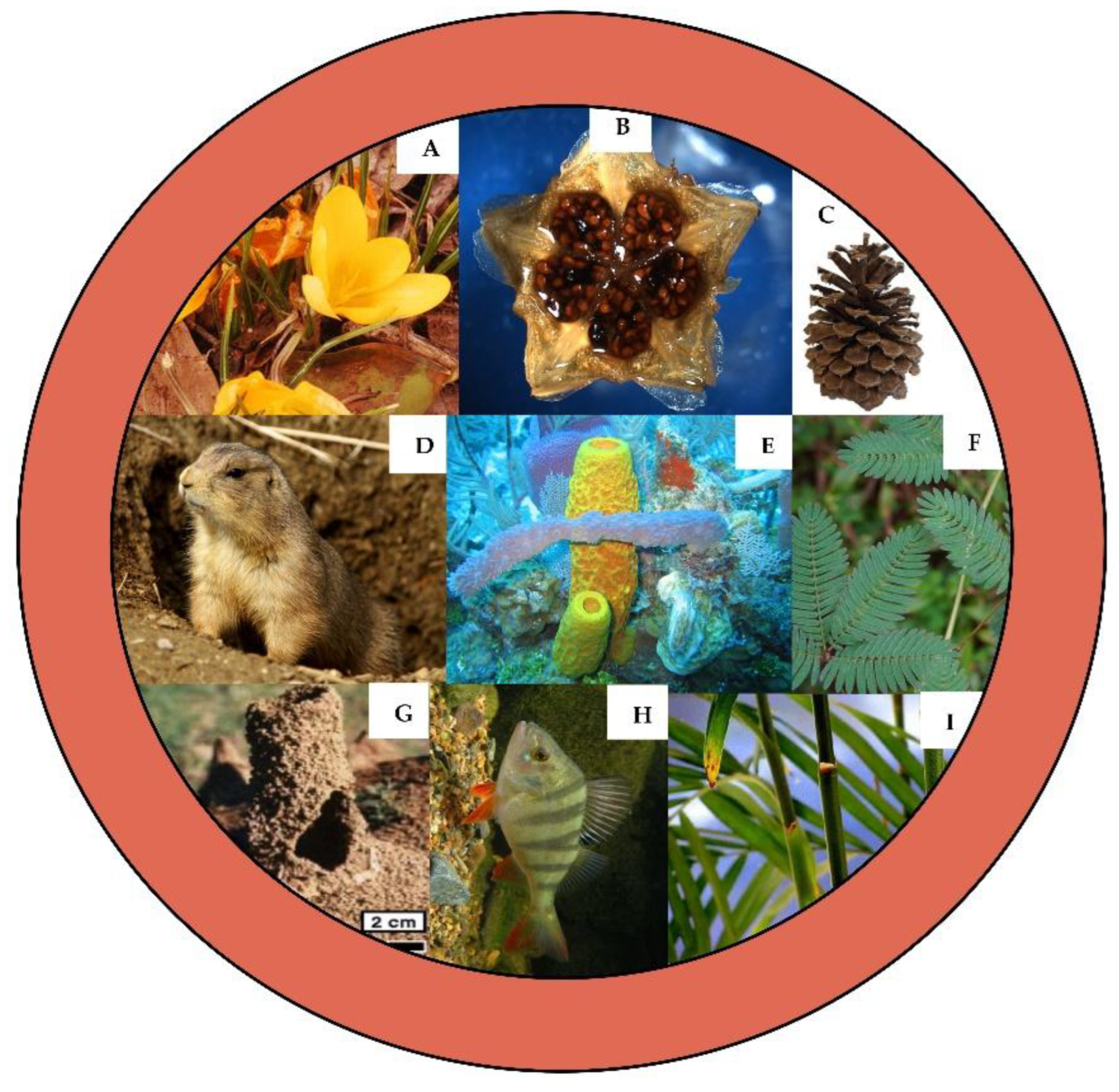
Figure 2.
The workflow and search process of the presented review developed based on PRISMA approach.
Figure 2.
The workflow and search process of the presented review developed based on PRISMA approach.
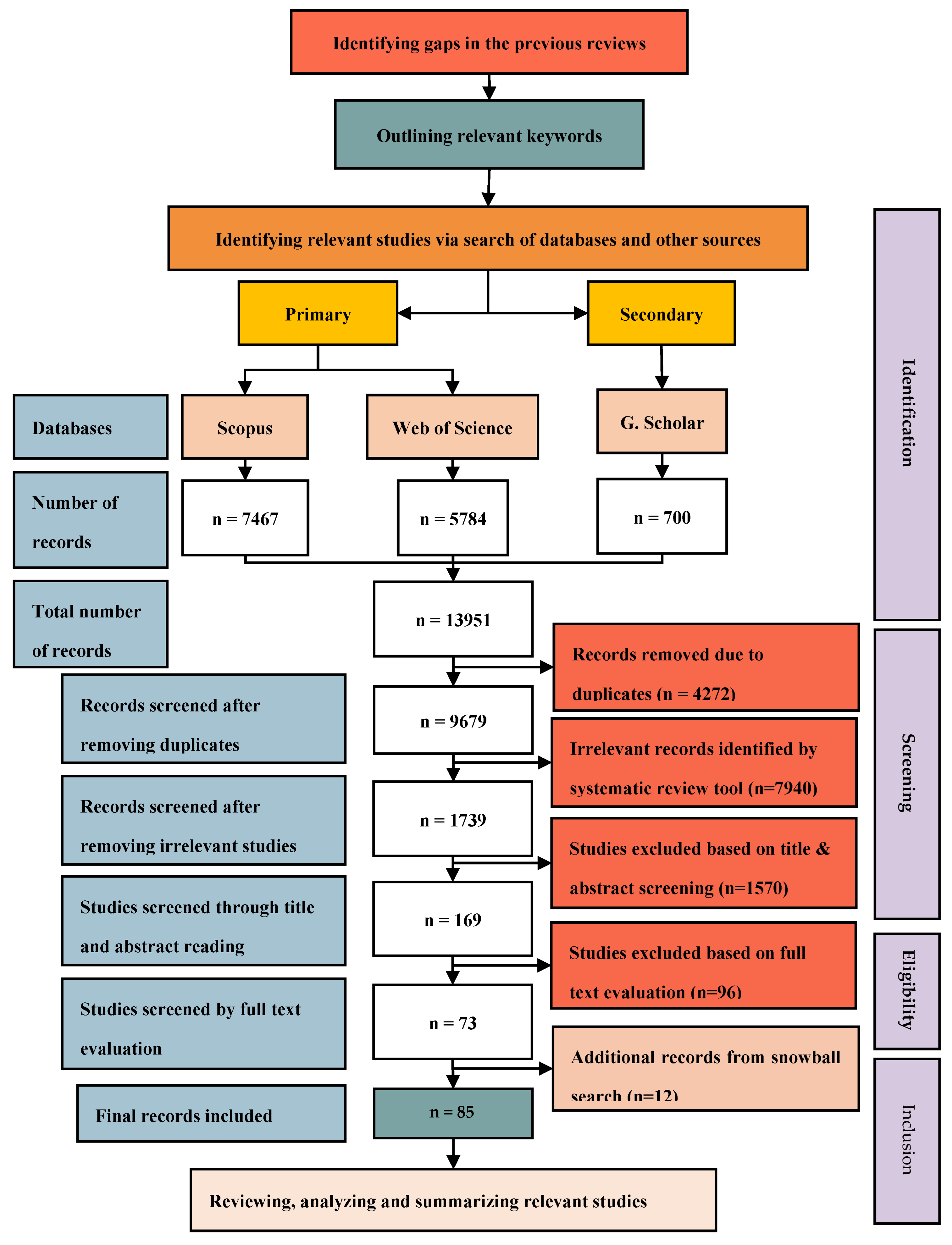
Figure 3.
(A) Percentage of published documents categorized by different focus areas before screening; (B) Number of published documents by the top 10 most productive countries.
Figure 3.
(A) Percentage of published documents categorized by different focus areas before screening; (B) Number of published documents by the top 10 most productive countries.
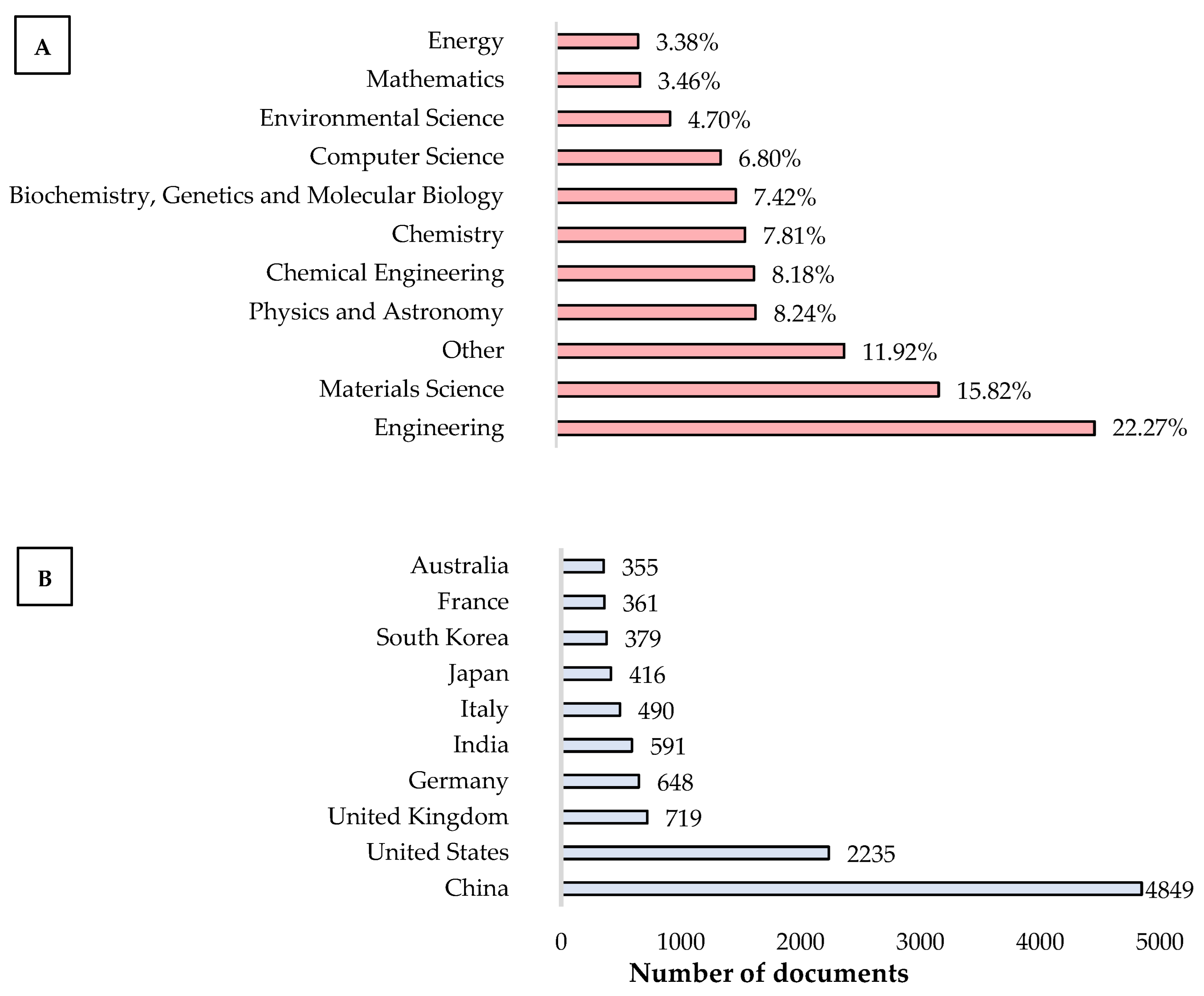
Figure 4.
World map showing the percentage of scientific output of the top 10 most productive countries in the field of bio-inspired ventilation systems and the built environment before the screening process. Adapted from [41], public domain.
Figure 4.
World map showing the percentage of scientific output of the top 10 most productive countries in the field of bio-inspired ventilation systems and the built environment before the screening process. Adapted from [41], public domain.
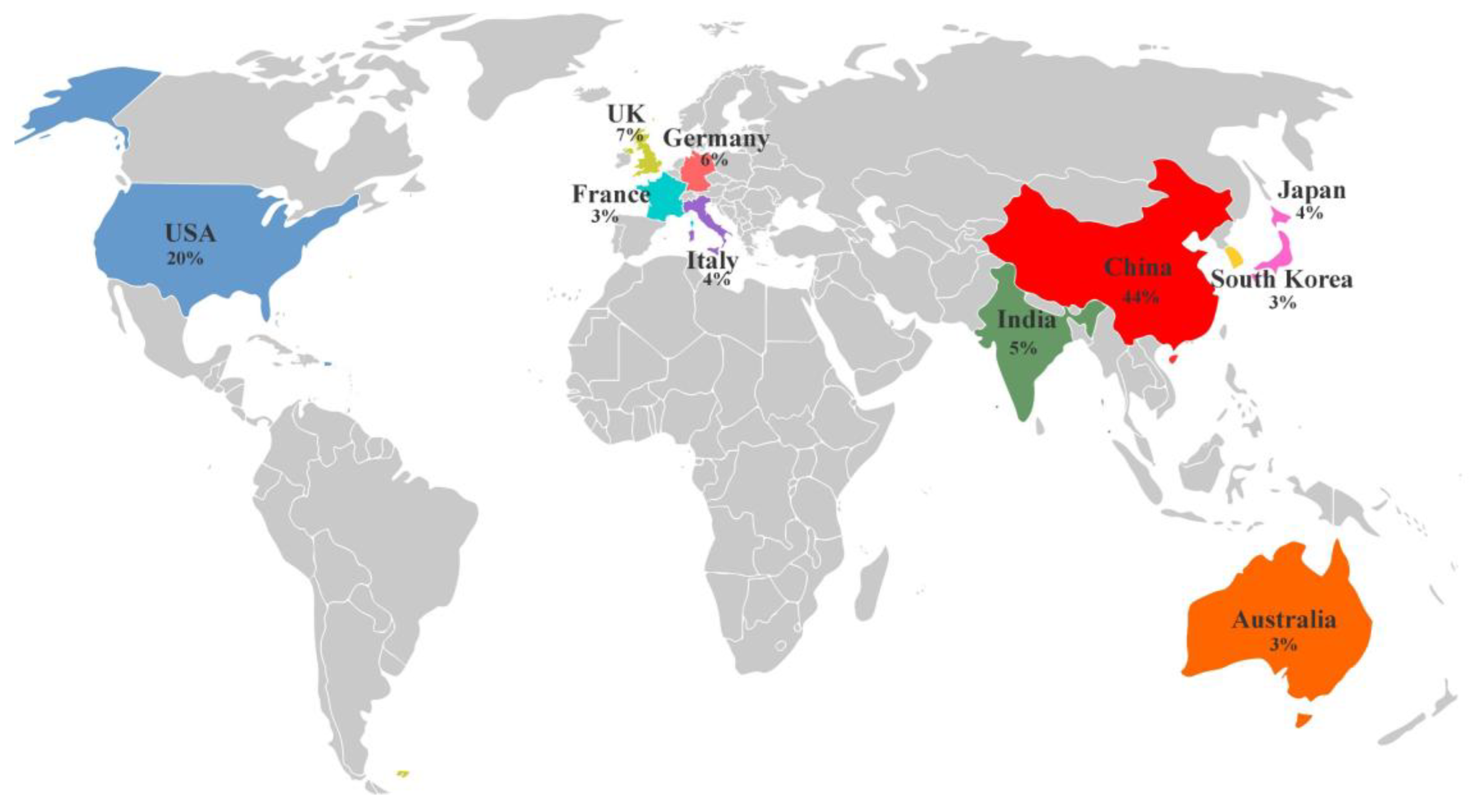
Figure 5.
Number of published documents categorized by year.
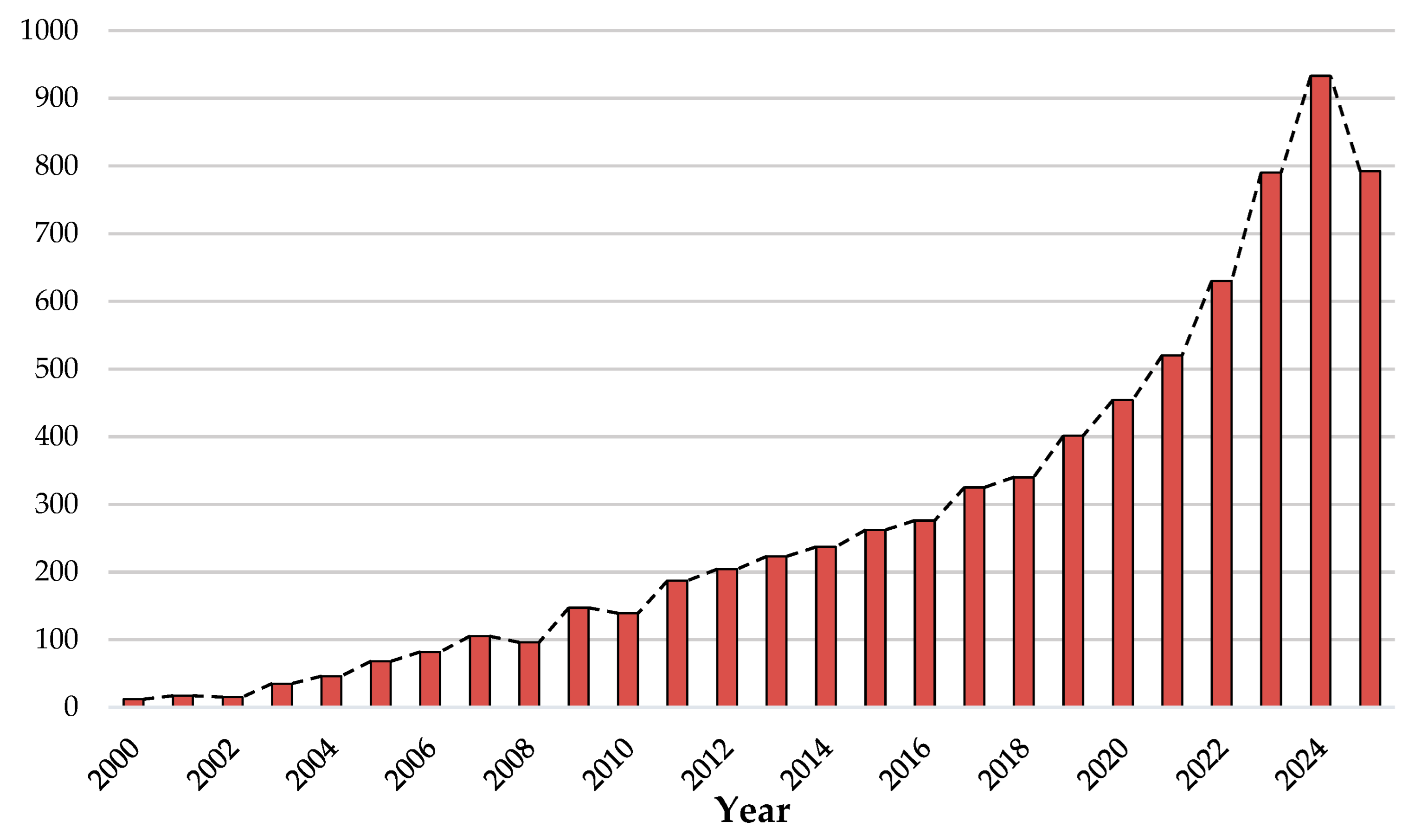
Figure 6.
Keyword co-occurrence maps before the screening process: (A) Density visualization; (B) Network visualization.
Figure 6.
Keyword co-occurrence maps before the screening process: (A) Density visualization; (B) Network visualization.
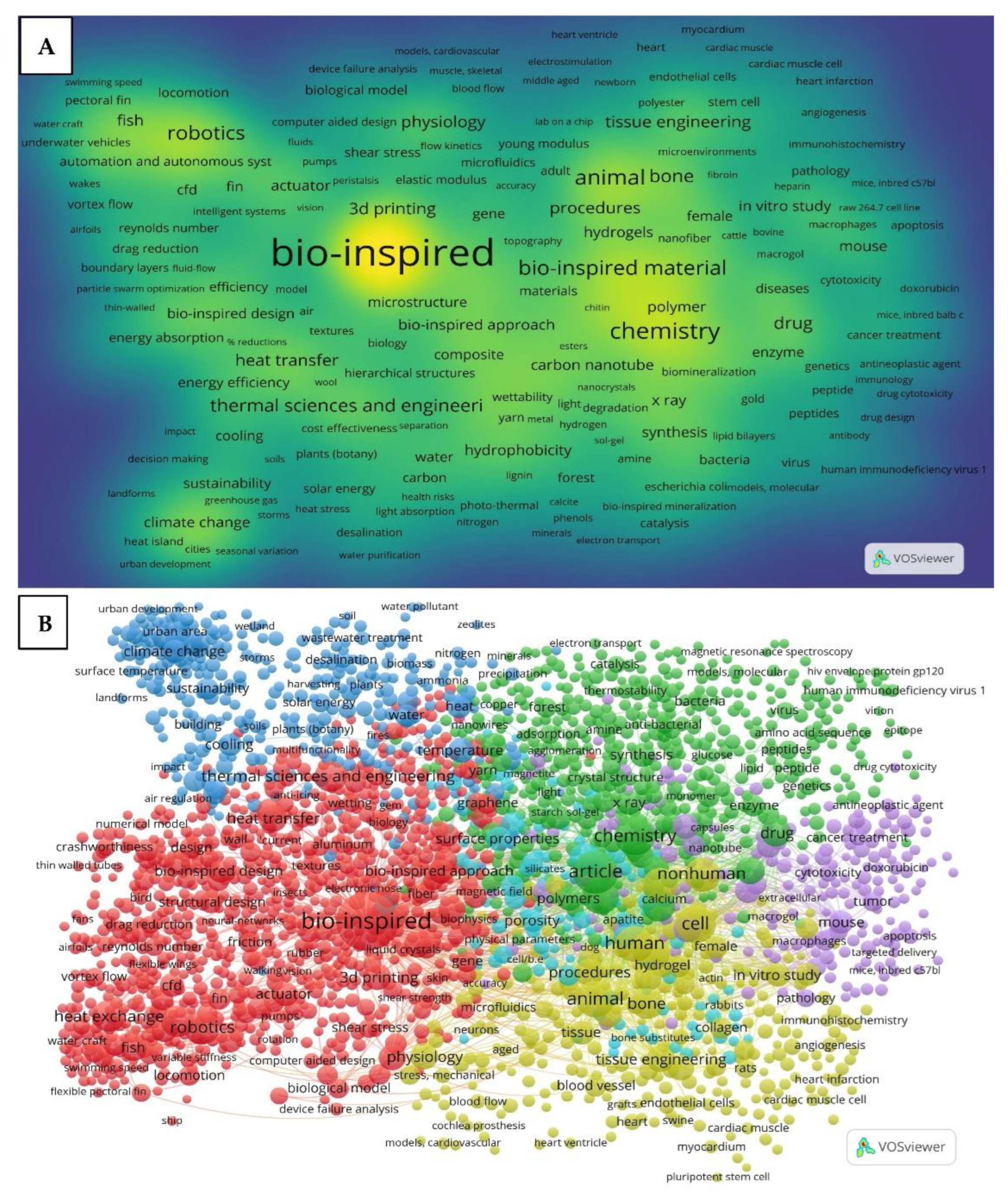
Figure 7.
Keyword co-occurrence maps after the screening process: (A) Density visualization; (B) Network visualization.
Figure 7.
Keyword co-occurrence maps after the screening process: (A) Density visualization; (B) Network visualization.

Figure 8.
Links and co-occurrence of keywords: (A) Biomimetics and bio-inspired; (B) Ventilation optimization; (C) Energy saving; (D) Natural ventilation.
Figure 8.
Links and co-occurrence of keywords: (A) Biomimetics and bio-inspired; (B) Ventilation optimization; (C) Energy saving; (D) Natural ventilation.
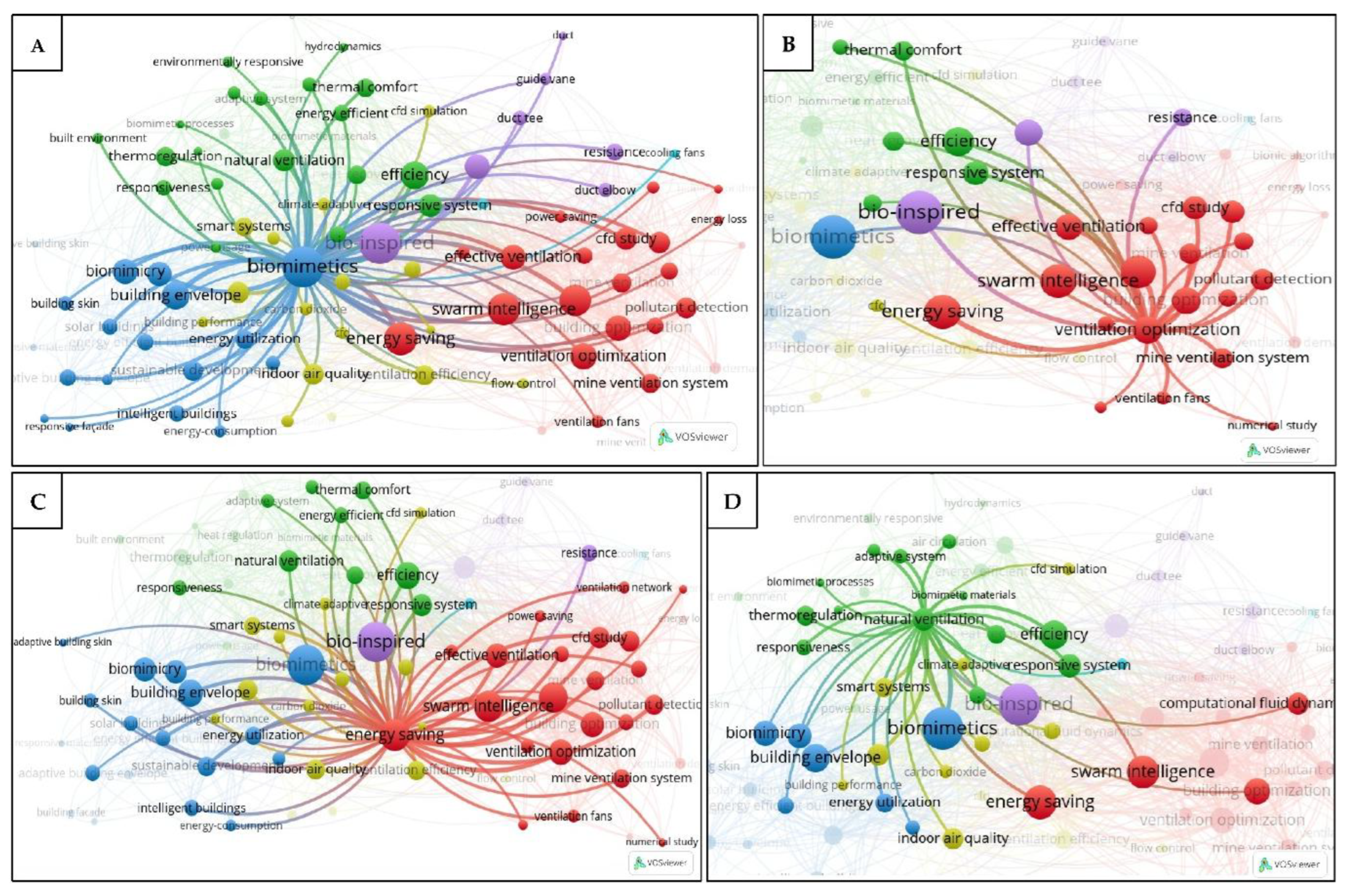
Figure 9.
Links and co-occurrence of keywords: (A) Duct tee, duct, and guide vane; (B) Ventilation fans.
Figure 9.
Links and co-occurrence of keywords: (A) Duct tee, duct, and guide vane; (B) Ventilation fans.
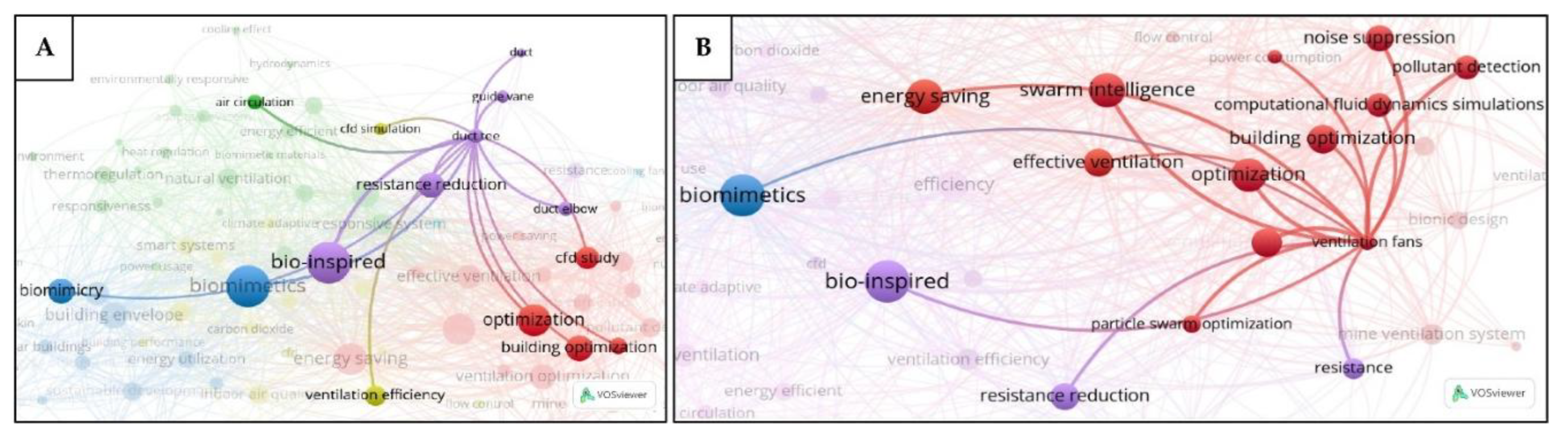
Figure 11.
Comparative analysis of the studies according to: (A) Study type; (B) Built environment and structure type.
Figure 11.
Comparative analysis of the studies according to: (A) Study type; (B) Built environment and structure type.
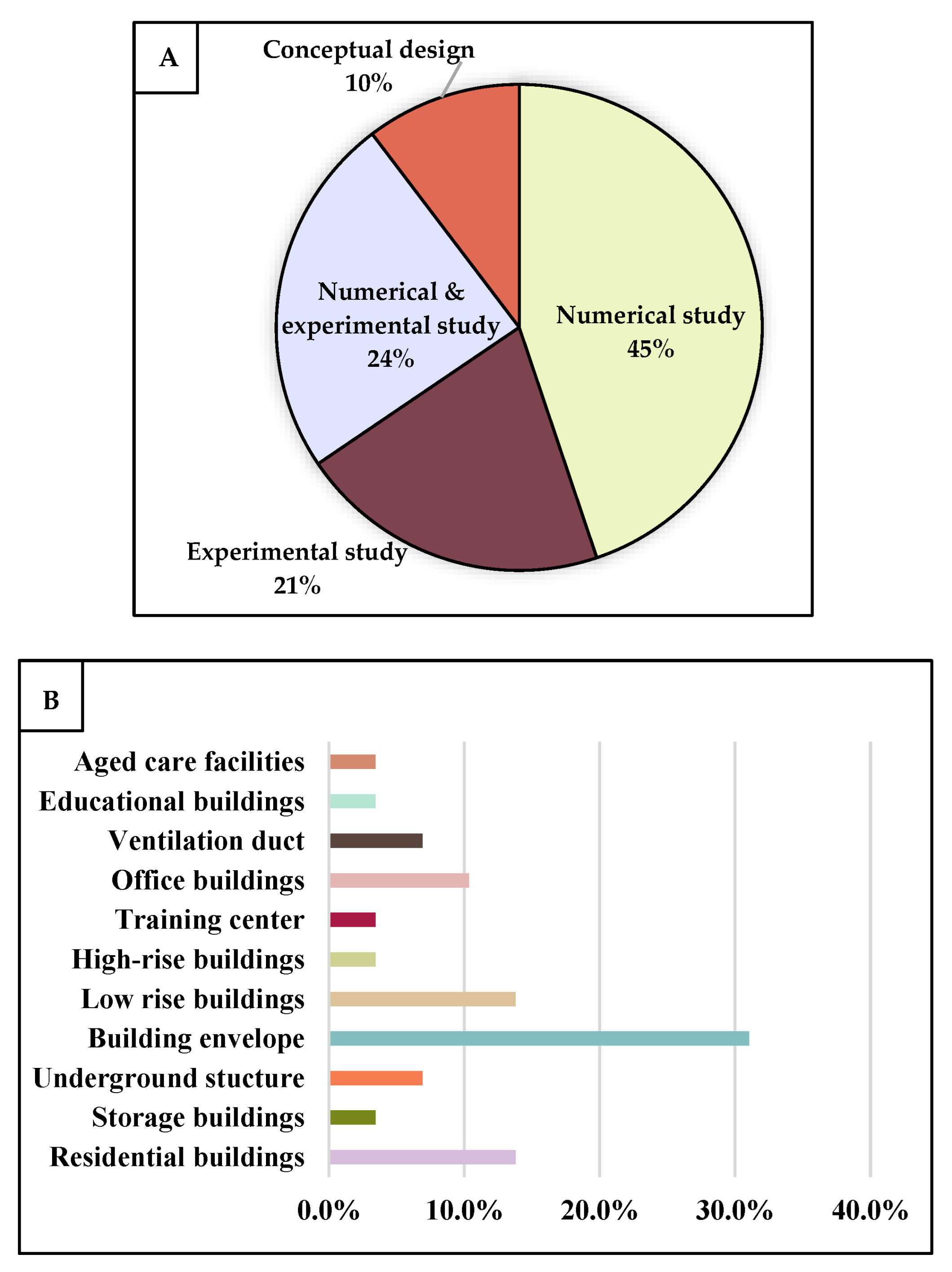
Figure 12.
(A) Mechanisms of ventilation in the prairie dog burrows. Reproduced from [42], CC BY-NC 4.0; (B) Room with traditional openings; (C) Room with prairie dog burrows-inspired openings (with frame). (B, C) Reproduced with permission from [54].
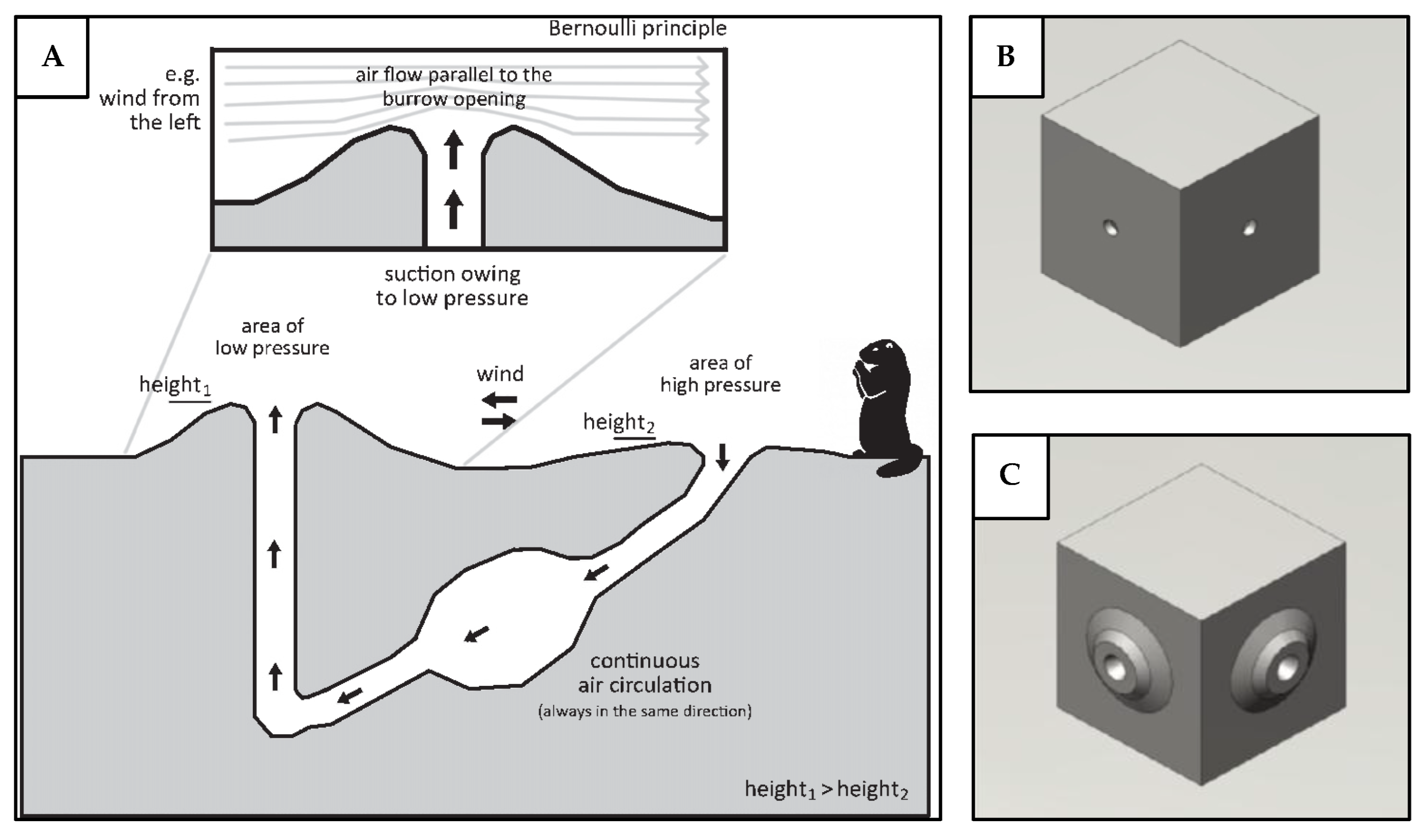
Figure 13.
(A) Prairie-dog burrows-inspired ventilated façade. Reproduced from [42], CC BY-NC 4.0; (B) Prairie-dog-burrow-inspired ventilated façade (top opening), compared with (C) baseline façade with a side opening. (B, C) Reproduced from [55], CC BY 4.0.
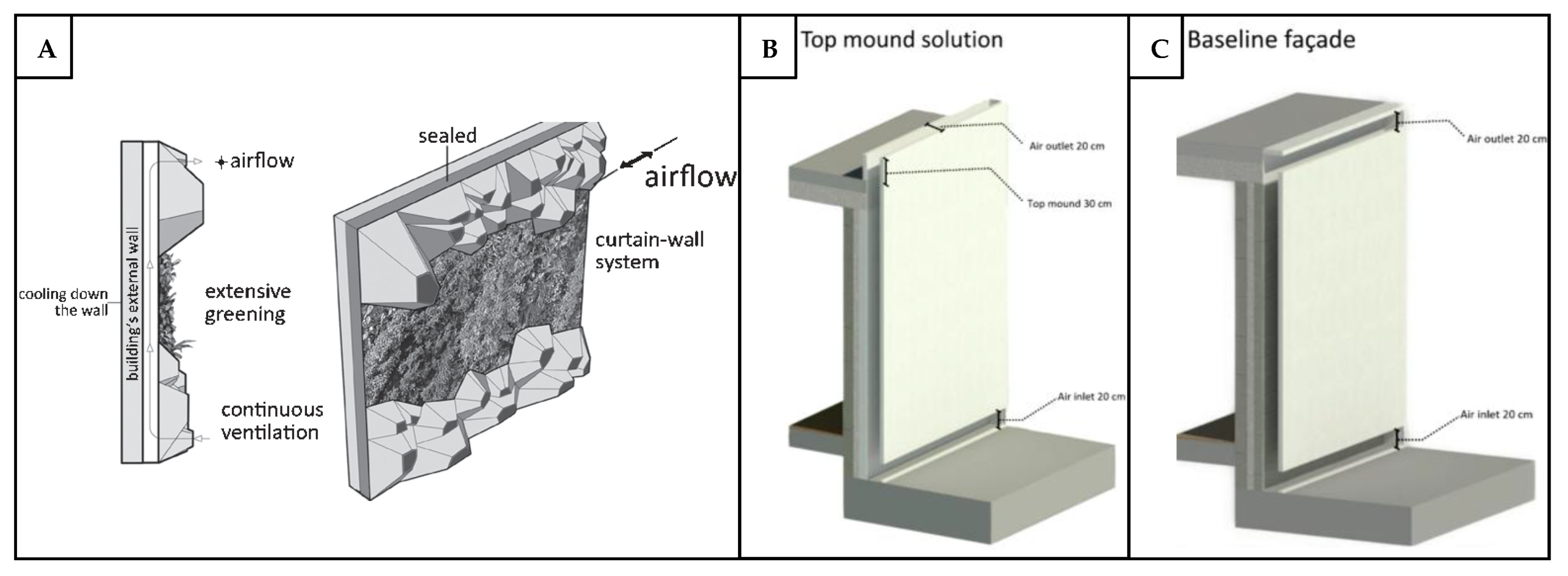
Figure 14.
(A) Schematic diagram of the prairie dog burrows-inspired duct, where C1 denotes the nozzle, C2 the venturi-shaped duct, C3 the diffuser duct, C4 the straight duct, C5 the conduit, and C6 the protrusion; (B) The ventilation principle of prairie dog burrows adopted for the bionic duct. (A, B) Reproduced with permission from [58]; (C) Side profile of the bionic duct. Reproduced with permission from [57]; (D) Prototype of the bionic duct. Reproduced with permission from [58].
Figure 14.
(A) Schematic diagram of the prairie dog burrows-inspired duct, where C1 denotes the nozzle, C2 the venturi-shaped duct, C3 the diffuser duct, C4 the straight duct, C5 the conduit, and C6 the protrusion; (B) The ventilation principle of prairie dog burrows adopted for the bionic duct. (A, B) Reproduced with permission from [58]; (C) Side profile of the bionic duct. Reproduced with permission from [57]; (D) Prototype of the bionic duct. Reproduced with permission from [58].
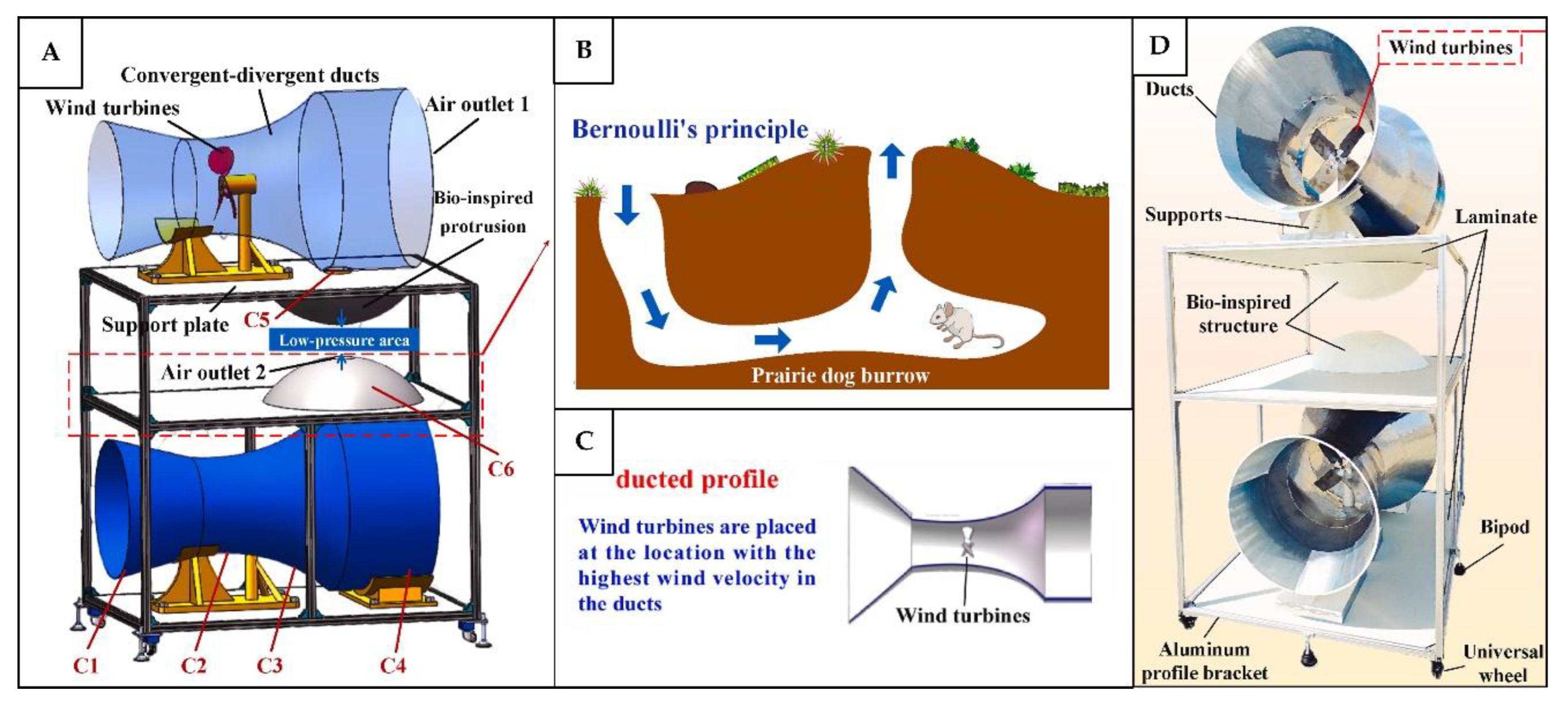
Figure 17.
(A) Leaf-cutter ants’ nests. Reproduced with permission from [75]; (B) Ant nest with turret and multiple openings. Reproduced from [77], CC BY 4.0; (C) The structure in Cappadocia that resemble ant nest. Reproduce from [83], CC BY-SA 4.0; (D, E) The design concept of the global health center inspired by ant nests. (D, E) Reproduced from [82], CC BY 4.0.
Figure 17.
(A) Leaf-cutter ants’ nests. Reproduced with permission from [75]; (B) Ant nest with turret and multiple openings. Reproduced from [77], CC BY 4.0; (C) The structure in Cappadocia that resemble ant nest. Reproduce from [83], CC BY-SA 4.0; (D, E) The design concept of the global health center inspired by ant nests. (D, E) Reproduced from [82], CC BY 4.0.
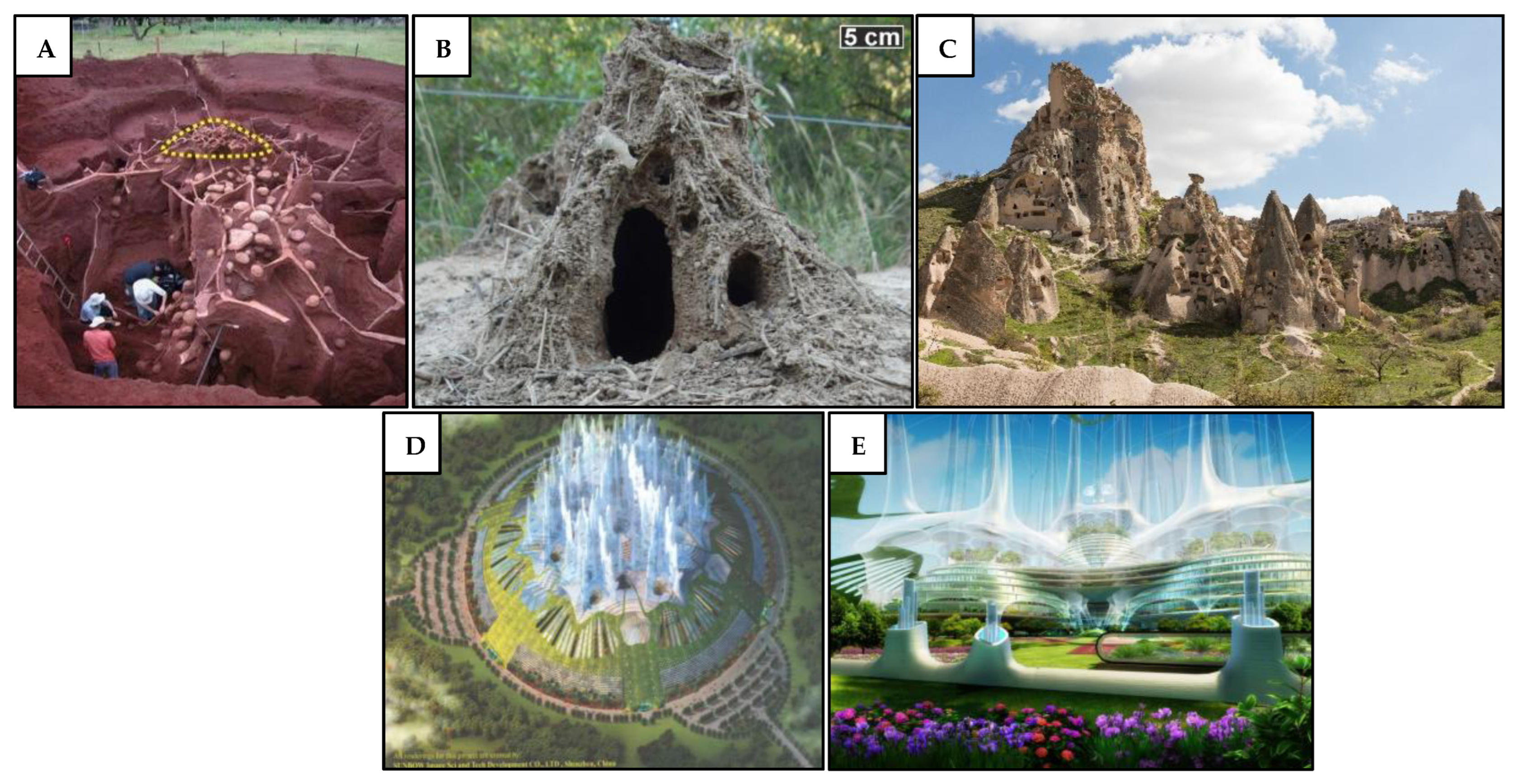
Figure 18.
(A) Single-inlet system of bionic time-periodic ventilation; (B) dual-inlet system of bionic time-periodic ventilation; (C) age-of-air contours for steady (constant) and bionic time-periodic supply ventilation under single or dual inlets. (A-C) Reproduced from [86], CC BY 4.0.
Figure 18.
(A) Single-inlet system of bionic time-periodic ventilation; (B) dual-inlet system of bionic time-periodic ventilation; (C) age-of-air contours for steady (constant) and bionic time-periodic supply ventilation under single or dual inlets. (A-C) Reproduced from [86], CC BY 4.0.
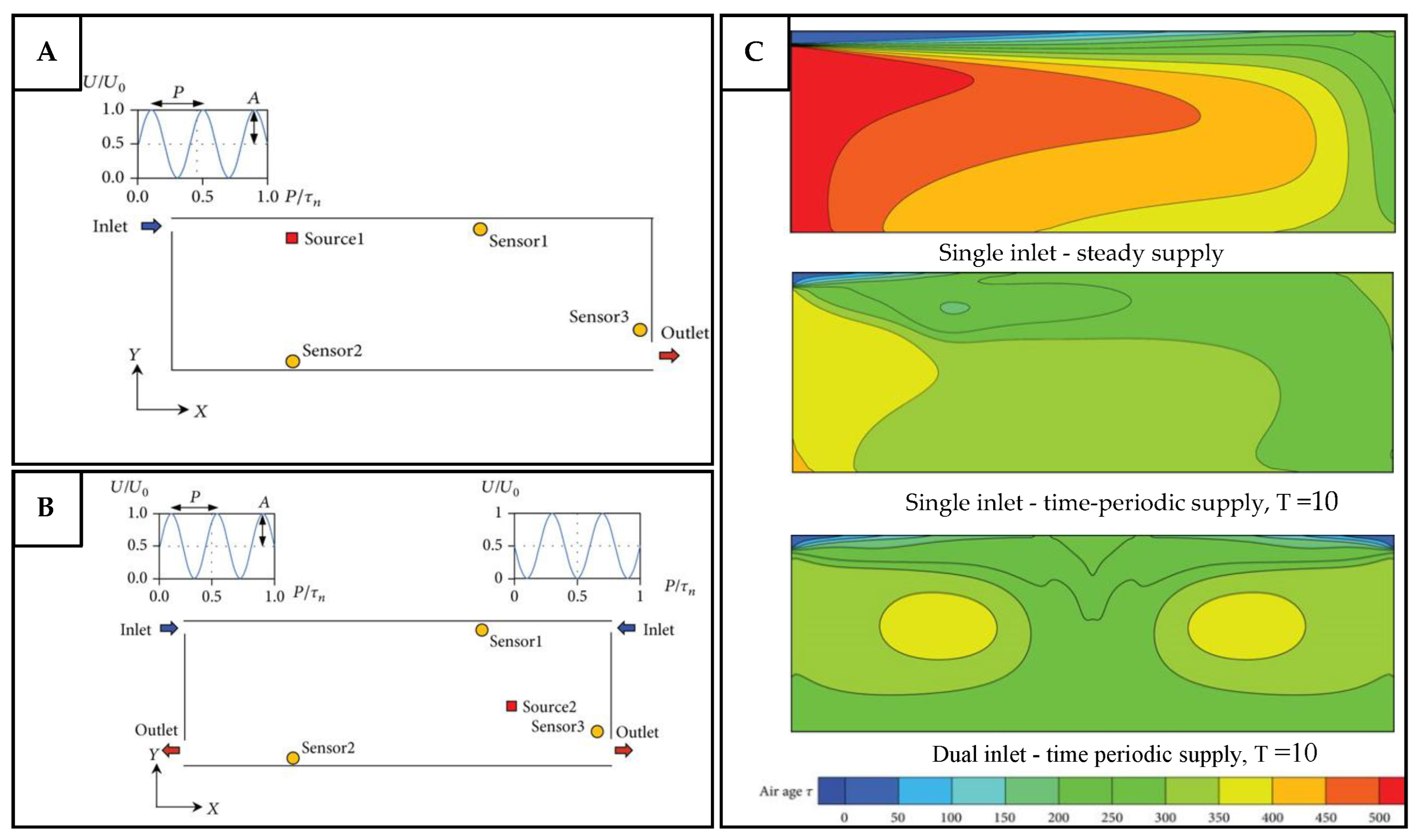
Figure 19.
(A, B) 3D and 2D room model with hemispherical BAV modules, respectively; (C) comparison of indoor air mass fraction (IAMF) index and velocity magnitude (VM) for different phase shifts (∆φ). (A-C) Reproduced with permission from [85].
Figure 19.
(A, B) 3D and 2D room model with hemispherical BAV modules, respectively; (C) comparison of indoor air mass fraction (IAMF) index and velocity magnitude (VM) for different phase shifts (∆φ). (A-C) Reproduced with permission from [85].
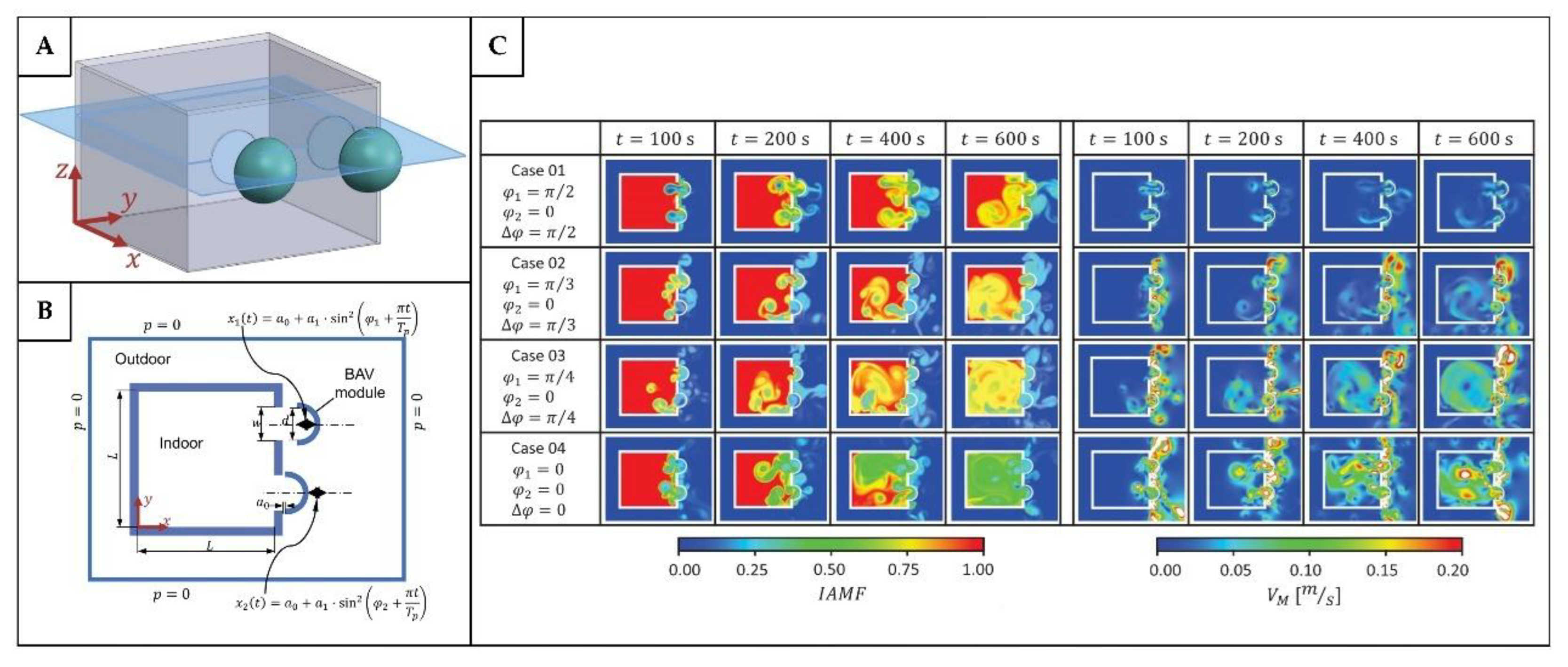
Figure 21.
Schematic diagram of: (A) different forms of fish; (B) Fishbone shape; (C) Building layout inspired by the fishbone shape; (D) Building height inspired by the fishbone shape. (A-D) Reproduced with permission from [102].
Figure 21.
Schematic diagram of: (A) different forms of fish; (B) Fishbone shape; (C) Building layout inspired by the fishbone shape; (D) Building height inspired by the fishbone shape. (A-D) Reproduced with permission from [102].
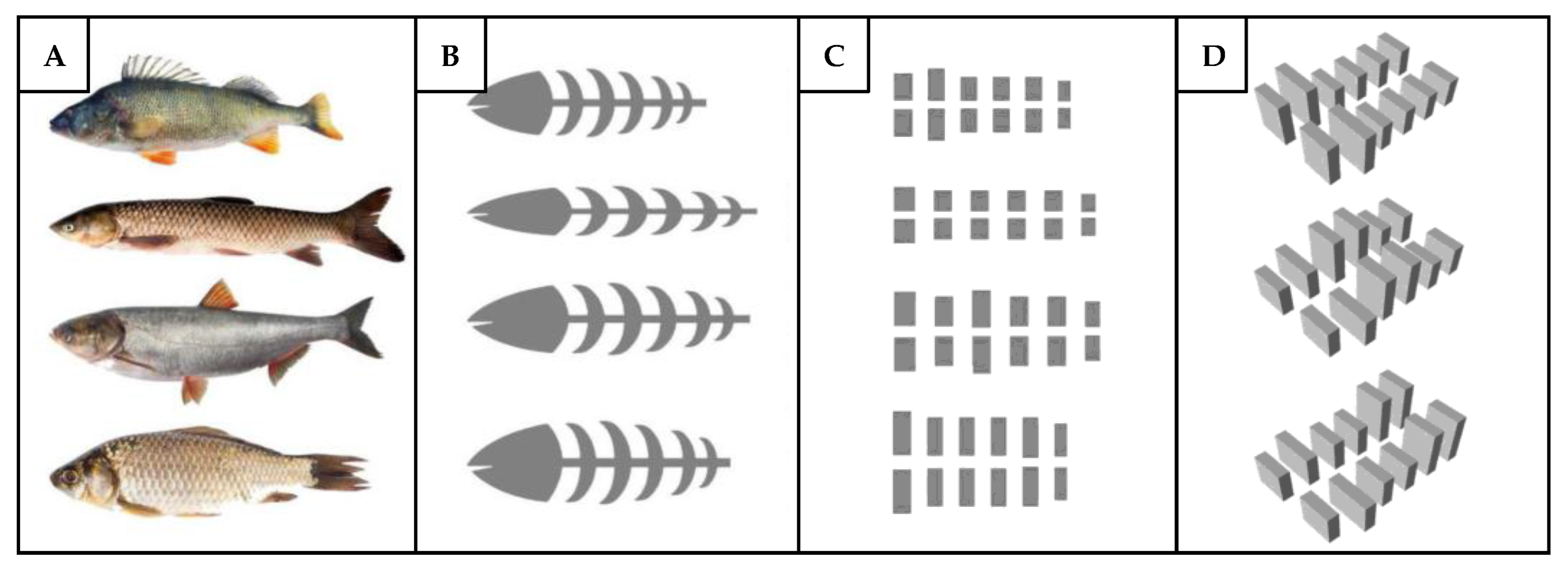
Figure 22.
(A) Leading edge of duct guide vanes inspired by bat wings and whale pectoral fins; (B) comparison of velocity distribution downstream of the duct elbow between normal and biomimetic guide vanes. (A, B) Reproduced with permission from [105].
Figure 22.
(A) Leading edge of duct guide vanes inspired by bat wings and whale pectoral fins; (B) comparison of velocity distribution downstream of the duct elbow between normal and biomimetic guide vanes. (A, B) Reproduced with permission from [105].
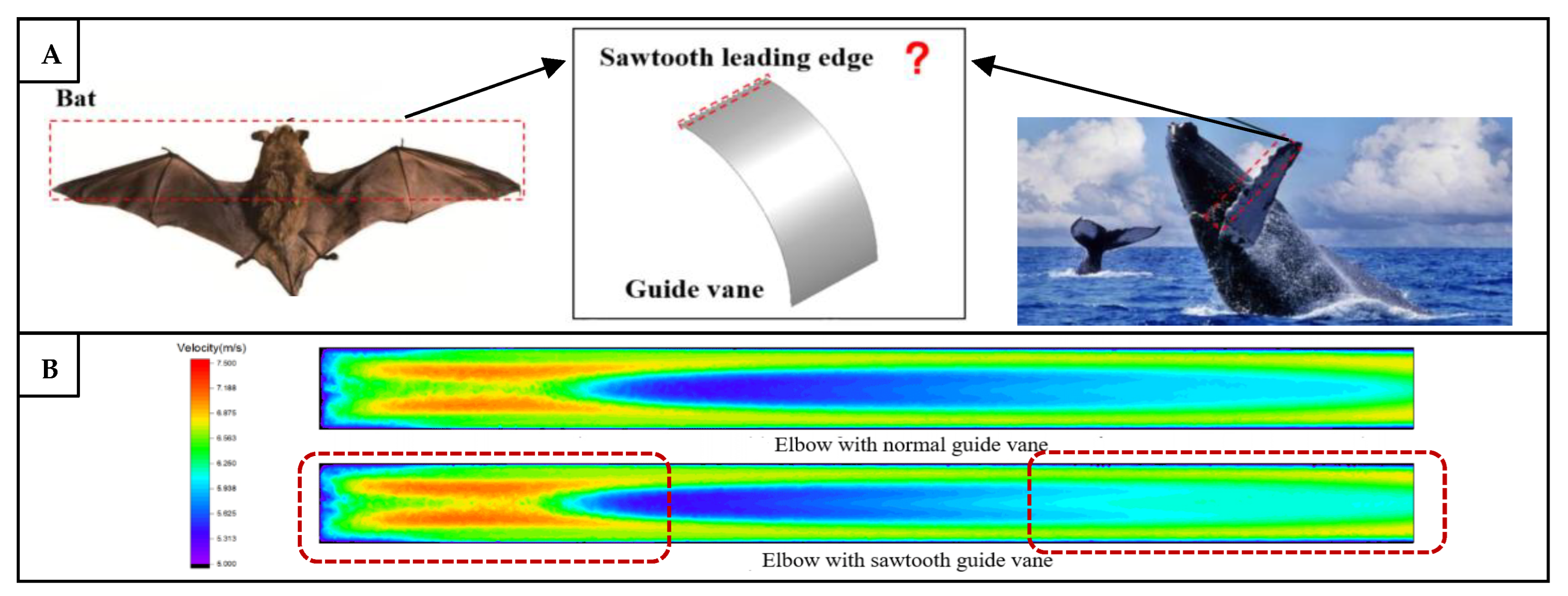
Figure 23.
(A) Adoption of tree protrusion feature from various plants for a biomimetic duct tee; (B) comparison of turbulent dissipation rates between the traditional (normal) duct tee and the biomimetic duct tee with protrusions. (A, B) Reproduced with permission from [106].
Figure 23.
(A) Adoption of tree protrusion feature from various plants for a biomimetic duct tee; (B) comparison of turbulent dissipation rates between the traditional (normal) duct tee and the biomimetic duct tee with protrusions. (A, B) Reproduced with permission from [106].
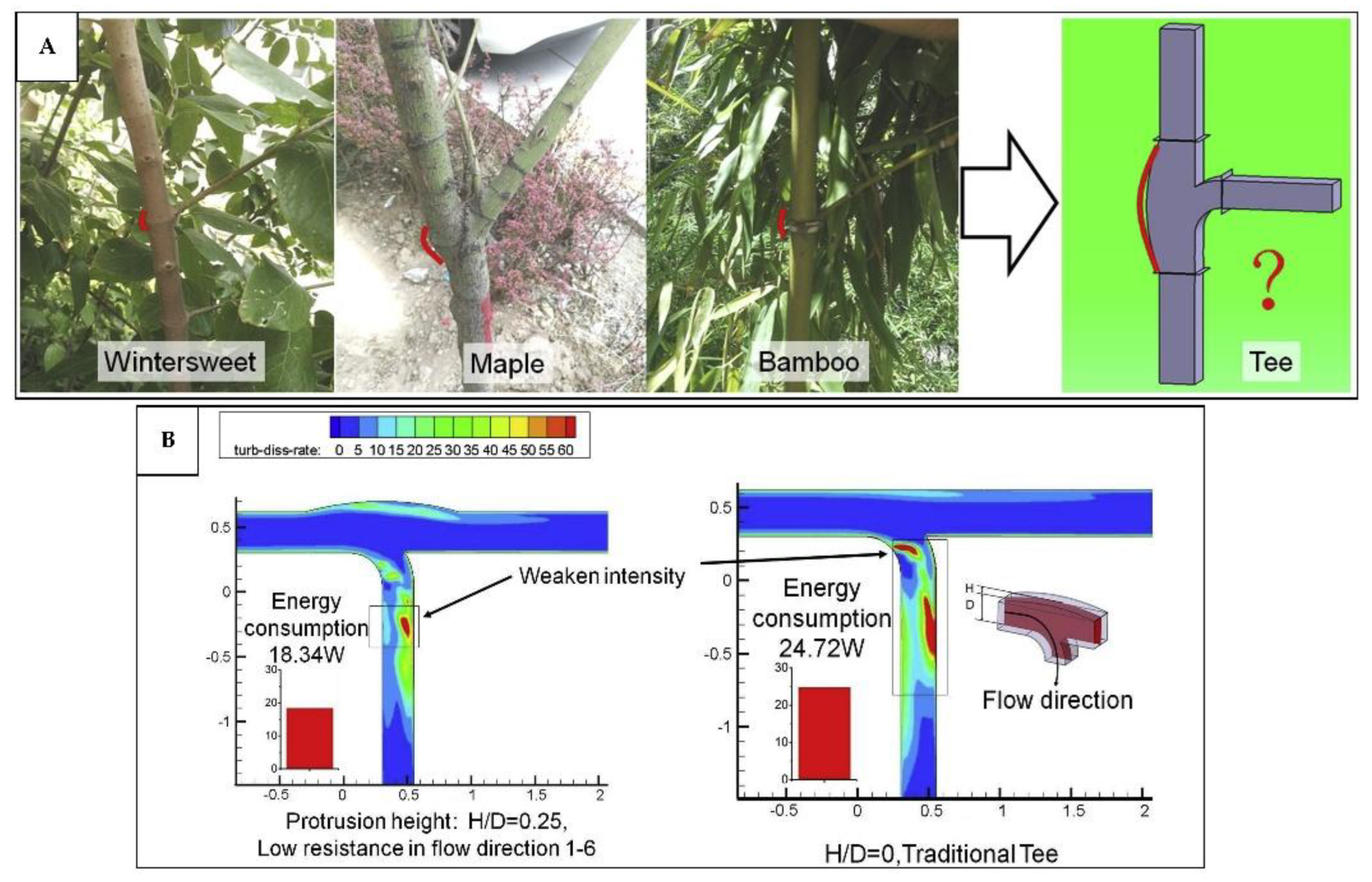
Figure 24.
(A) Humpback whale pectoral fins. Reproduced with permission from [131], © 2020 Institution of Mechanical Engineers; (B) Blade leading edge inspired by humpback whale. Reproduced with permission from [132]; (C) Mantis shrimp abdomen; (D) Blade tip inspired by the abdomen of mantis shrimps. (C, D) Reproduced from [133], CC BY 4.0; (E) Desert scorpion; (F) Blade surface inspired by desert scorpion. (E, F) Reproduced with permission from [117]; (G) Owl wing. Reproduced from [134], CC BY 4.0; (H) Blade leading edge inspired by owl wings. Reproduced from [118], CC BY 4.0. (I) Shellfish; (J) Blade surface inspired by shellfish. (I, J) Reproduced with permission from [108], © 2020 Institution of Mechanical Engineers; (K) Samara seed. Reproduced from [135], CC BY-SA 4.0; (L) Blade profile inspired by samara seed. Reproduced with permission from [130].
Figure 24.
(A) Humpback whale pectoral fins. Reproduced with permission from [131], © 2020 Institution of Mechanical Engineers; (B) Blade leading edge inspired by humpback whale. Reproduced with permission from [132]; (C) Mantis shrimp abdomen; (D) Blade tip inspired by the abdomen of mantis shrimps. (C, D) Reproduced from [133], CC BY 4.0; (E) Desert scorpion; (F) Blade surface inspired by desert scorpion. (E, F) Reproduced with permission from [117]; (G) Owl wing. Reproduced from [134], CC BY 4.0; (H) Blade leading edge inspired by owl wings. Reproduced from [118], CC BY 4.0. (I) Shellfish; (J) Blade surface inspired by shellfish. (I, J) Reproduced with permission from [108], © 2020 Institution of Mechanical Engineers; (K) Samara seed. Reproduced from [135], CC BY-SA 4.0; (L) Blade profile inspired by samara seed. Reproduced with permission from [130].
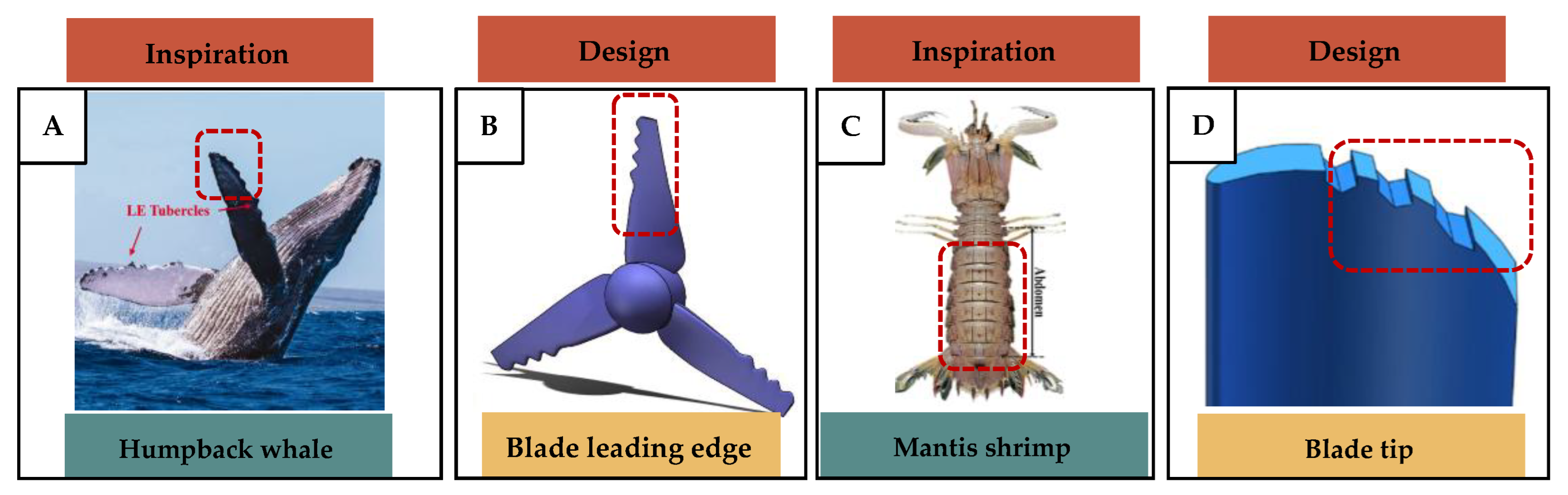
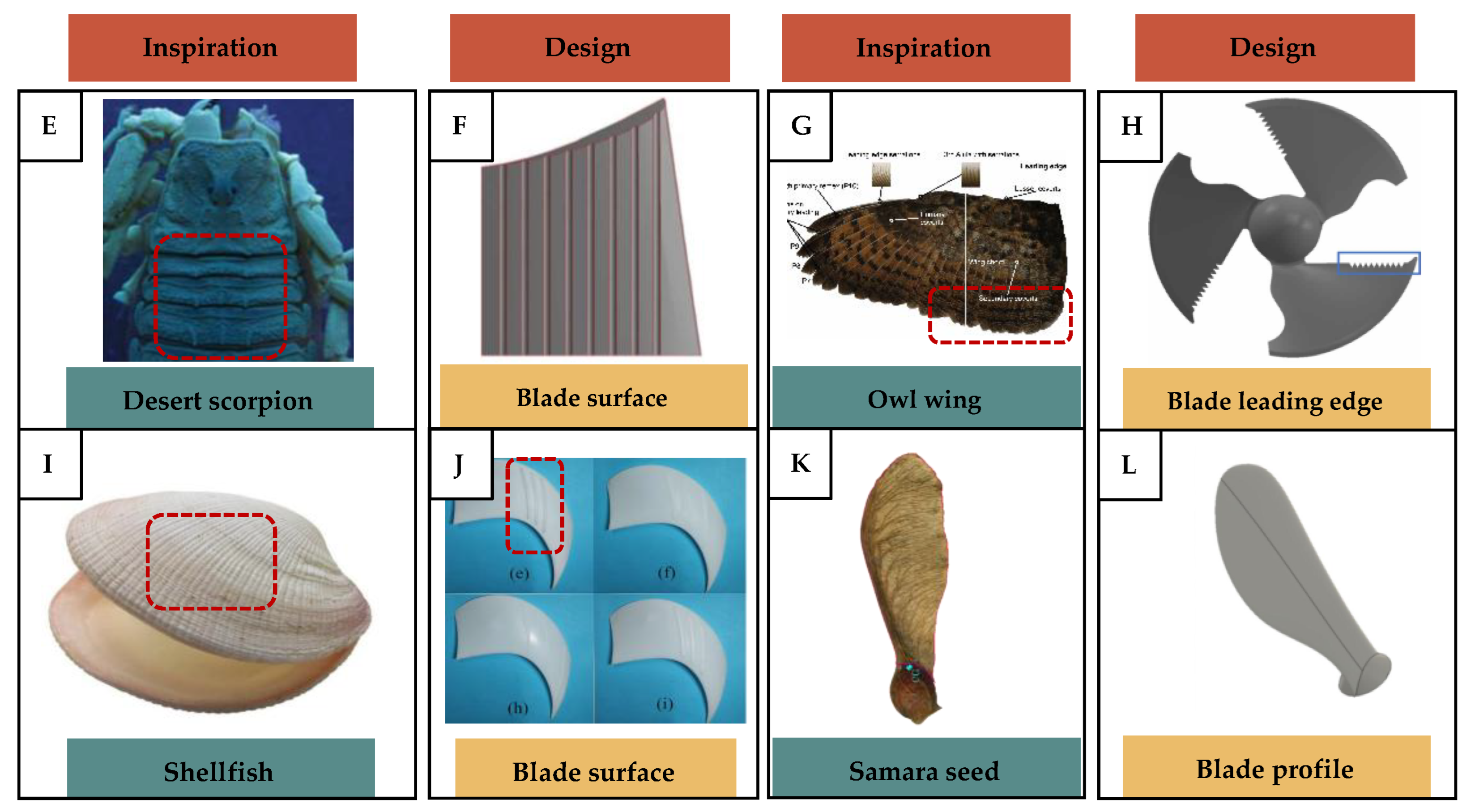
Figure 25.
(A) Pine cone scales in dry conditions; (B) Pine cone scales in wet conditions. (A, B) Reproduced from [30], CC BY 4.0; (C) HygroSkin envelope apertures in the open state (low humidity); (D) HygroSkin envelope apertures in the closed state (high humidity). (C, D) Reproduced with permission from [144].
Figure 25.
(A) Pine cone scales in dry conditions; (B) Pine cone scales in wet conditions. (A, B) Reproduced from [30], CC BY 4.0; (C) HygroSkin envelope apertures in the open state (low humidity); (D) HygroSkin envelope apertures in the closed state (high humidity). (C, D) Reproduced with permission from [144].
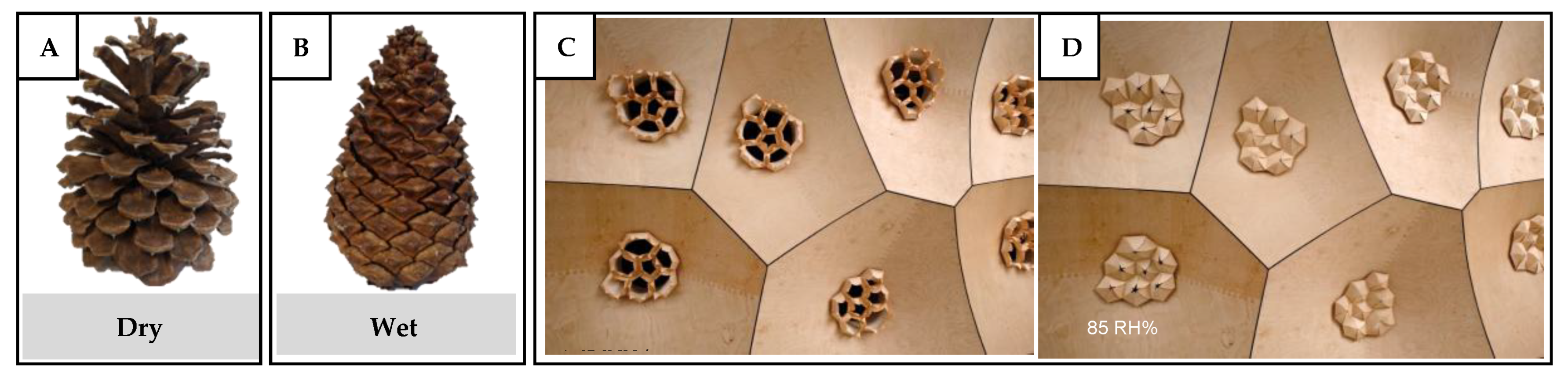
Figure 27.
(A) Folding (dry) and unfolding (wet) of ice plant seed capsules. Reproduced with permission from [29]; (B) Responsive element closed when dry and open when hydrated (wet). Reproduced with permission from [150].
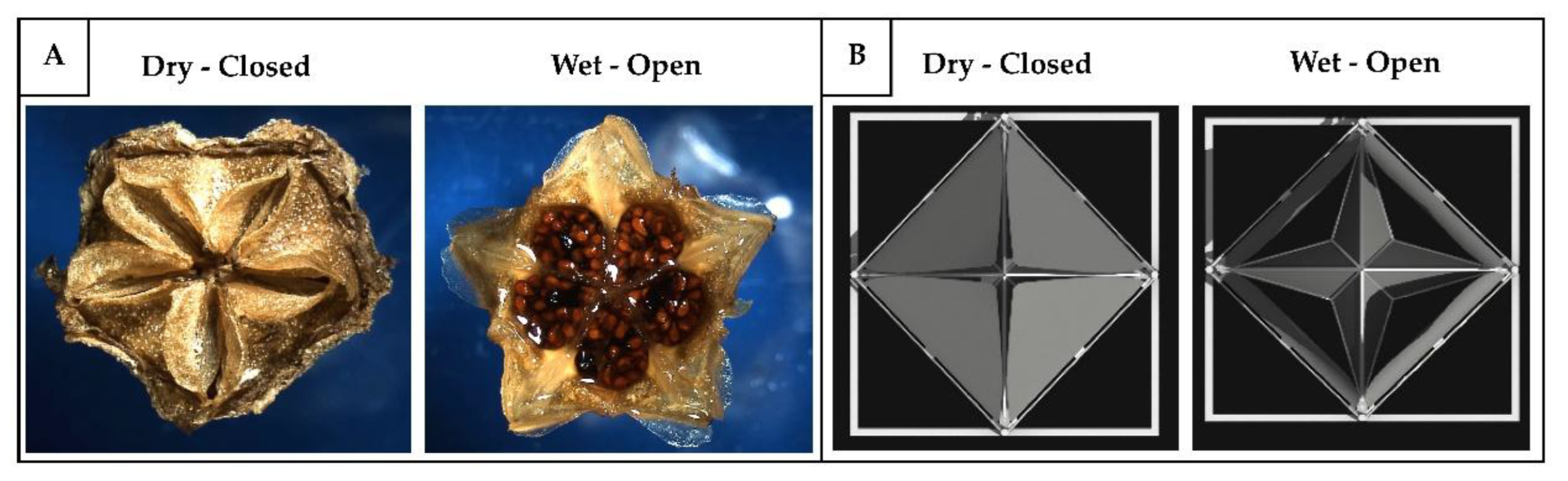
Figure 28.
Different patterns of kinetic façade inspired by Mimosa pudica. Reproduced from [152], CC BY 4.0.
Figure 28.
Different patterns of kinetic façade inspired by Mimosa pudica. Reproduced from [152], CC BY 4.0.
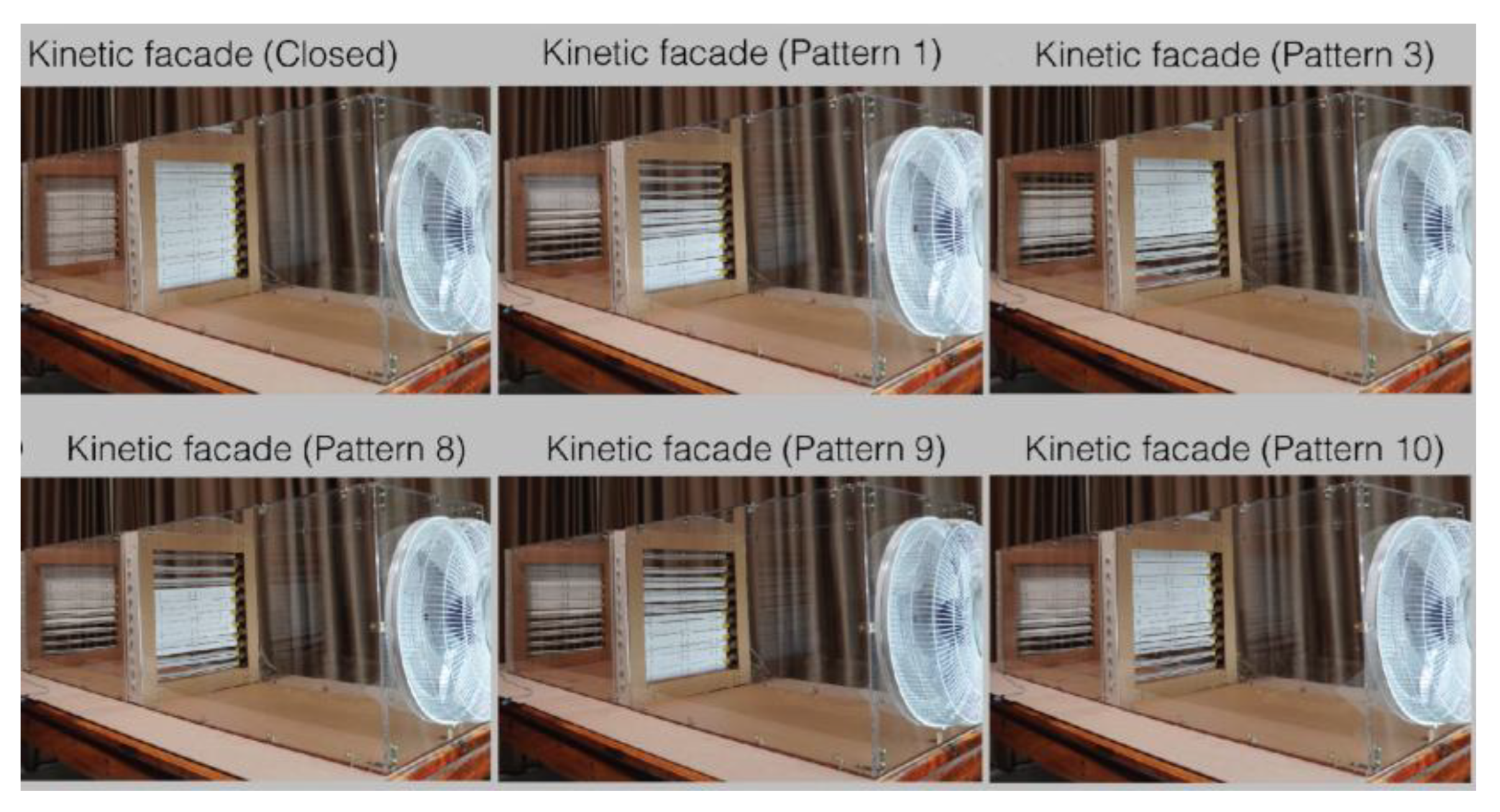
Figure 29.
(A) Pneumatic façade with adaptive openings for natural ventilation; (B) Different configurations of façade openings: Gradual-a (0–100%), Gradual-b (50–100%), and Gradual-c (75–100%). (A, B) Reproduced with permission from [155].
Figure 29.
(A) Pneumatic façade with adaptive openings for natural ventilation; (B) Different configurations of façade openings: Gradual-a (0–100%), Gradual-b (50–100%), and Gradual-c (75–100%). (A, B) Reproduced with permission from [155].
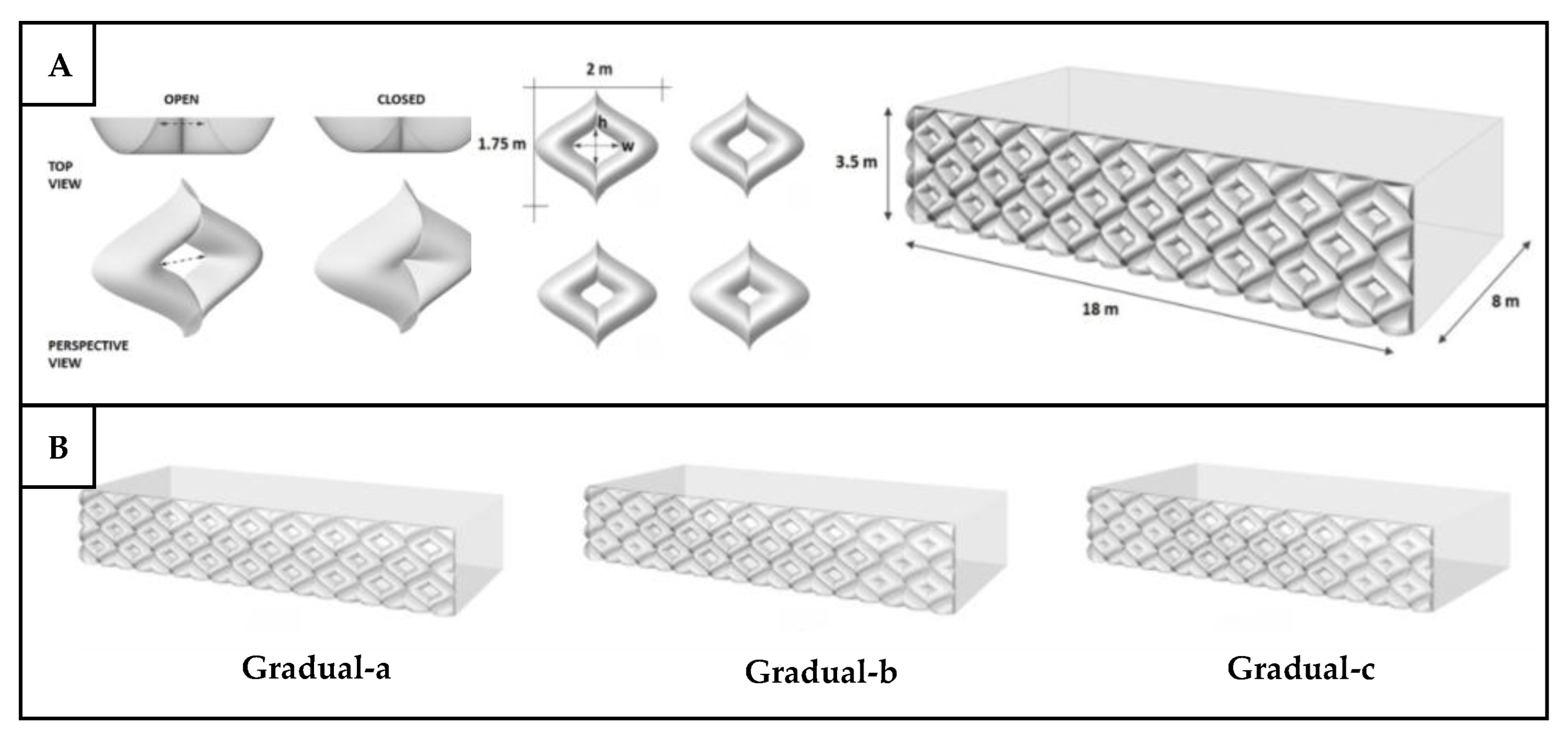
Figure 30.
(A) Yellow crocus flower (B) Crocus flower-inspired ventilation panels in open and closed states, responding to temperature changes. (A, B) Reproduced with permission from [157].
Figure 30.
(A) Yellow crocus flower (B) Crocus flower-inspired ventilation panels in open and closed states, responding to temperature changes. (A, B) Reproduced with permission from [157].
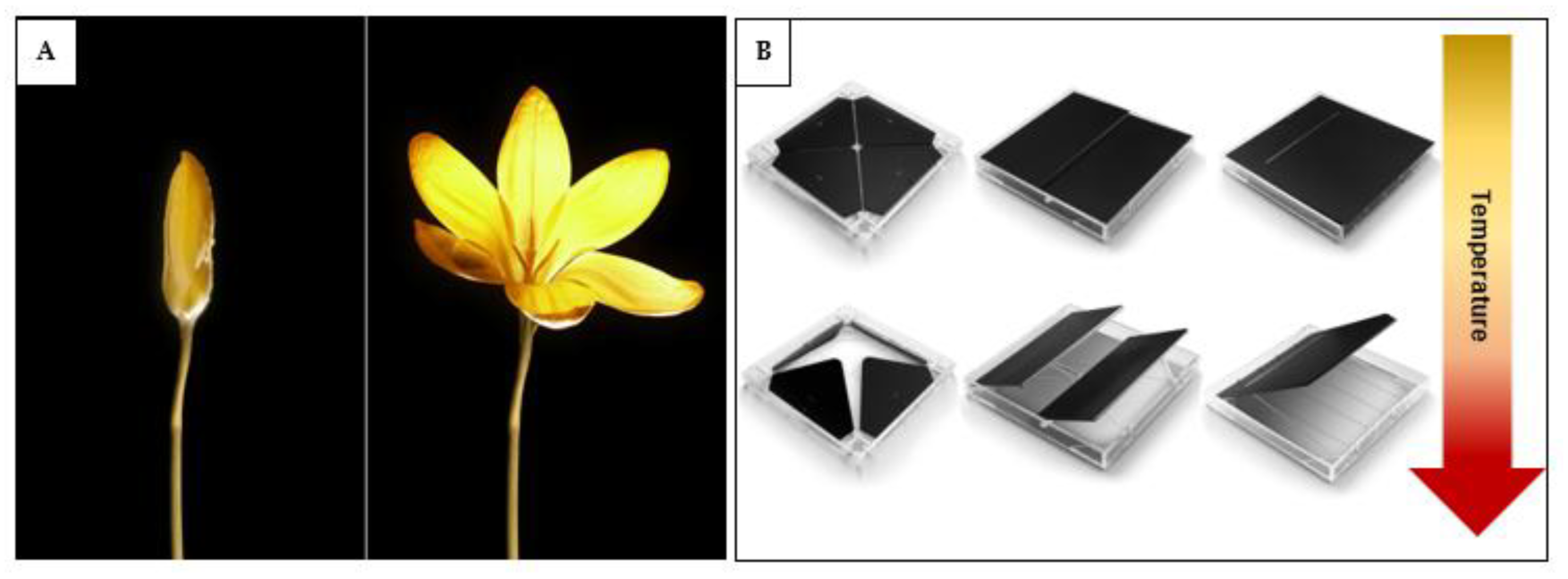
Table 1.
Keywords for literature search.
| Biomimicry-related keywords | Boolean | Subject-related keywords |
|---|---|---|
| bio-inspired* OR bioinspired* OR biomimetic* OR bioinspiration* OR bio-inspiration* OR nature-inspired* OR nature-based* OR biomimicry* OR bio-design* OR bionic* OR organism-inspired* OR plant-inspired* | AND | vent* OR fan* |
| duct* | ||
| air AND regulat* | ||
| wall* OR envelope* | ||
| air AND circulat* | ||
| bio-inspired* OR bioinspired* OR biomimetic* OR bioinspiration* OR bio-inspiration* OR nature-inspired* OR nature-based* OR biomimicry* OR bio-design* OR bionic* OR organism-inspired* OR plant-inspired* | AND | HVAC* OR “heating ventilation and air conditioning” |
Table 2.
Inclusion and exclusion criteria.
| Criteria for inclusion | Criteria for exclusion |
|---|---|
| Documents published between 2000 and 2025 inclusive | Duplicate studies or multiple reports from the same research with no additional data or insights |
| Studies on ventilation for the indoor and outdoor environment | Studies lacking bio-inspired designs/strategies |
| Studies relevant to ventilation systems and their components | Documents written in other languages or containing a significant portion of confusing and unintelligible discussions |
| Studies considered important for improving the ventilation systems, even if they are not solely focused on ventilation | Pure review studies that do not present new conceptual designs |
| Written in English language | Only a small portion of the study is relevant to the ventilation systems, or it is not deemed significant for the improvement of the ventilation systems. |
Table 3.
The summary of ventilation inspired by the animal dwellings.
| Source of inspiration | Mimicked features | Applications | Advantages | Challenges/limitations | Study |
|---|---|---|---|---|---|
| Prairie dog burrow | Height difference between entrance and exit to the burrow. | Ventilated façade with upper and lower openings or with random extruded openings. | Improved airflow speed within the slot; reduced wall surface temperature; reduced cooling load; improved energy saving. | Climate/wind dependency; manufacturing and upscaling challenges of the complex extruded openings; unverified across building types/heights. | [42,55] |
| Prairie dog burrow | Asymmetric height, shape, and size of openings. | Entrances and exits to subway tunnels. | Higher air exchange and flow rate; improved natural ventilation. | Implementation for complex, interconnected tunnel networks is challenging and may be less effective in practice; the effect of urban microclimate is overlooked. | [53] |
| Prairie dog burrow | Pressure difference due to the strategic placement of openings. | Strategic building orientation and layout to generate a pressure difference. | Improved natural ventilation and thermal comfort; reduced cooling load and energy consumption. | Ineffective in extreme cold; unsuitable for buildings with multiple attached blocks. | [56] |
| Prairie dog burrow | Elevated entrance and convergent-divergent channels. | Duct with contraction-expansion sections and protrusions. | Increased mass flow rate; accelerated airflow; reduced turbulent kinetic energy. | Structural complexity; protrusions and sudden geometric changes may cause noise, vibration, and flow instability. | [57,58] |
| Termite mound | Thermosiphon flow and wind-induced ventilation. | Buildings with chimneys and lower openings; multi-chamber systems connected to occupied spaces and external air. | Reduced cooling load and reliance on air conditioning; lower energy consumption; cooler indoor temperatures; increased airflow rate and speed. | Application in high-rise buildings still relies on fans; sensitive to wind availability; performance depends heavily on geometry and weather conditions. | [26,43,60,64,65,67,68,84] |
| Termite mound | Reticulated tunnels and surface conduits. | Artificial surface conduits or reticulated tunnels that connect the indoor and outdoor environment. | Improved natural ventilation and cooling of living spaces using wind. | Dependence on wind availability and weather conditions; limited control over airflow may cause drafts and discomfort (in a fully passive system); manufacturing challenges for real-scale buildings. | [60,71] |
| Ant nest | Top turrets and lower openings. | Underground or buried habitat. | Enhanced passive ventilation; more stable indoor thermal conditions. | Construction complexity; high maintenance; risk of flooding. | [75,77,80,82] |
Table 5.
The summary of bio-inspired structures and strategies for optimization of ventilation system and its components.
Table 5.
The summary of bio-inspired structures and strategies for optimization of ventilation system and its components.
| Source of inspiration | Mimicked features | Applications | Advantages | Challenges/limitations | Study |
|---|---|---|---|---|---|
| Beetle (swarm) | Behavioral patterns. | Algorithm for underground mine ventilation optimization. | Reduced energy use; high accuracy; stable convergence; improved volumetric flow. | Requires a longer time for convergence or optimization. | [95] |
| Beetle (swarm) | Foraging mechanisms. | Algorithm for underground mine ventilation optimization. | Faster convergence and good optimization. | Lower accuracy. | [95] |
| Animal social behavior | Collective behavior, such as the flocking of birds or schooling of fish. | Algorithm for underground mine ventilation optimization. | Balanced convergence accuracy and efficiency; suitable for large-scale ventilation systems. | Complex real mine conditions and sensor errors may reduce the reliability of the algorithm. | [96] |
| Animal social behavior | Collective behavior, such as the flocking of birds or schooling of fish. | Optimization of mine fan switchover | Reduced airflow volatility; improved safety and efficiency during the switchover. | Airflow fluctuations still occur during the switchover when some doors are almost fully closed or open. | [100] |
| Ant colony | The foraging mechanism of ant colonies to find the shortest path to food. | Algorithm for underground mine ventilation optimization. | Applicable to new and old mines; reduced ventilation cost; optimizes airway use. | Limited validation in real mines; simplified assumptions. | [94] |
| Humpback whale | Hunting behavior | Algorithm for pollutant source identification. | Higher success rate; can prevent robots from getting stuck in a local extremum area. | Required more localization steps; prone to premature convergence. | [101] |
| Fish | Fishbone shape | Building layouts and heights. | Improved pedestrian wind comfort; reduced static zones; improved natural ventilation; lowered wind pressure on windward buildings. | The effect on occupants’ thermal comfort is not assessed; performance indicators such as age of air, temperature, and humidity are not included. | [102] |
| Bat wings and whale pectoral fins | Sawtooth structures | Guide vanes for ventilation ducts. | Reduced local resistance coefficient; improved uniformity of the velocity distribution. | Resistance reduction depends on duct dimensions; local resistance is based on the average value; the noise effect is not considered. | [105] |
| Tree branch | Protrusions | Ventilation ducts. | Reduced resistance and energy consumption; smaller energy dissipation rate. | Excessive protrusions can cause flow deformation and increase resistance instead of reducing it. | [106,136] |
| Owl wings, whale fins, mantis shrimp, desert scorpion | Wavy/sinusoidal/non-smooth structures | Ventilation fans. | Reduced flow resistance; lower turbulent kinetic energy; reduced noise. | Performance and effectiveness depend on fan types, placement, and component types. | [108,109,110,111,113,115,116,119,137] |
Table 7.
Bio-inspired solutions for ventilation in underground mines and off-Earth habitats.
| Challenges | Context | Relevant solutions | Integration/Application |
|---|---|---|---|
| Thermal comfort issue - heat | Off-Earth habitats | Temperature-responsive ventilation panels that open or close autonomously with the increase or decrease in temperature levels. | Integrated into habitat walls or panels to regulate airflow and heat autonomously. |
| Thermal comfort issue - humidity | Off-Earth habitats | Humidity-sensitive components or wall systems that adjust permeability depending on the humidity levels. | Integrated into wall panels or habitat envelopes for passive humidity regulation. |
| Air mixing issue | Off-Earth habitats | Manipulating the height and shape differences between the inlet and outlet openings so that a greater pressure difference can be generated to increase the airflow; using a time-periodic ventilation supply instead of a steady supply. | Incorporated into the habitat duct layouts or the inlet and outlet openings. |
| CO2 build-up issue | Off-Earth habitats | Ventilation system or components that are responsive to the CO₂ level. | Sensor-actuator system integrated into adaptive ventilation to detect regions with low CO₂ concentration and supply air based on demand. |
| Air mixing issue | Underground mines | Height, size, and shape differences between tunnel entry/exit; venturi-shaped openings at tunnel entrances or exits located at higher elevations; time-periodic ventilation supply. | Integrated into mine tunnel designs and auxiliary ventilation systems to enhance airflow. |
| Air mixing and power consumption issue | Underground mines | Nature-inspired algorithms to balance ventilation demand, safety, and energy use. | Implemented in real-time mine ventilation control systems or in fan operation systems. |
| Power consumption issue | Underground mines | Heat recovery ventilation to capture waste heat from the exhaust air and reuse it to warm the intake air in cold regions. | Integrated into mine HVAC and heating systems. |
| Resistance issue | Underground mines and off-Earth habitats | Duct geometry modifications (protrusions and sawtooth guide vanes). | Applied in junctions, tees, and bends to reduce airflow resistance and save more energy (power). |
| Noise issue | Underground mines and off-Earth habitats | Sawtooth or non-smooth structures in ventilation fans. | Incorporated into appropriate components and locations of ventilation fans. |
| Dust issue | Underground mines and off-Earth habitat | Lotus-inspired dust-repellent surface materials. | Applied to duct linings and filter housings to minimize dust accumulation. |
Disclaimer/Publisher’s Note: The statements, opinions and data contained in all publications are solely those of the individual author(s) and contributor(s) and not of MDPI and/or the editor(s). MDPI and/or the editor(s) disclaim responsibility for any injury to people or property resulting from any ideas, methods, instructions or products referred to in the content. |
© 2025 by the authors. Licensee MDPI, Basel, Switzerland. This article is an open access article distributed under the terms and conditions of the Creative Commons Attribution (CC BY) license (http://creativecommons.org/licenses/by/4.0/).
Copyright: This open access article is published under a Creative Commons CC BY 4.0 license, which permit the free download, distribution, and reuse, provided that the author and preprint are cited in any reuse.


