
Submitted:
29 September 2025
Posted:
30 September 2025
You are already at the latest version
Abstract
Agro-industrial sector in Indonesia produces significant amounts of nutrient-rich waste and wastewater, which pose environmental risks but also present opportunities for valorization within a circular bioeconomy. Microalgae provide a promising solution for transforming these wastewaters into valuable products such as biomass for bioenergy, biofertilizers, pigments, nutraceuticals, and animal feed, all while helping to remediate pollutants. This review synthesizes current knowledge on the use of major Indonesian agro-industrial effluents, specifically palm oil mill effluent (POME), byproducts from cassava and sugarcane, and soybean residues, as substrates for microalgal biomass production and cultivation. Furthermore, various cultivation strategies are summarized, including autotrophic, heterotrophic, and mixotrophic methods, as well as the use of open ponds, photobioreactors, and hybrid systems. These cultivation processes influence biomass yield, metabolite production, and nutrient removal. Reported studies indicate high removal efficiencies for organic loads, nitrogen, and phosphorus, along with considerable production of lipids, proteins, pigments, and biofuels. Yet, effluent pretreatment, concerns about heavy metal and pathogen contamination, high downstream processing costs, and biosafety issues remains as challenges. Nonetheless, the application of microalgal cultivation into Indonesia’s agro-industrial wastes treatment can provide the dual benefits of waste mitigation and resource recovery, helping to advance climate goals and promote rural development.
Keywords:
agro-industrial waste
; microalgae
; value added byproducts
; circular (bio)economy
; Indonesia
1. Introduction
Indonesia is an archipelago country that comprises 17,000 islands and is nestled between the Pacific and Indian Oceans. Moreover, this country resides within the equator line with a tropical environment. This strategic and unique geographical location provides Indonesia with abundant marine and agricultural resources crucial for its economy [1]. The agricultural sector is the foundation of Indonesia’s economy and has been showing progress towards self-sufficiency [2]. Agro-industry, particularly, is providing a strategic importance and contribution to Indonesia’s economy and gross domestic product (GDP) [3]. According to the Indonesian Ministry of Industry, the agro-industry managed to record 5.20% growth in 2024 and contributed 8.89% to the GDP [4]. In the first quarter of 2025, the contribution of the agro-industry increased to 9.13% of the GDP [5].
The downstream, however, is the abundance of agricultural crop residues and agro-industrial waste [6]. For example, the tofu industry in Indonesia could produce around 33 kg of total waste and 17 kg of liquid waste per kilogram of processed soybeans for tofu production [7,8]. Moreover, the palm oil production, one of the biggest agro-industries in Indonesia, generated around 38-51% and 50-70% of solid and liquid waste, respectively [9]. Yet, the agro-industrial wastes still contain organic matters (e.g., protein, lipids, carbohydrate, and/or fat), which can be valorized further into valuable products [10,11]. Adopting circular (bio)economy principles in agro-industries is essential to minimize resource flows and extend product life cycles through reuse and recycling using biotechnological approaches [12,13].
Using these agro-industrial wastes for microalgae cultivation is one adaptation of the approach. Microalgae, as phototrophic organisms, could convert the waste into biomass for biofuels, biostimulants/biofertilizers, additives, or pigments. Studies have reported the potential and application of microalgae strains (e.g., Chlorella, Nannochloropsis, or Arthospira) for downstream valorization of the industrial wastes [14,15,16,17]. These studies highlight both opportunity and risk: while nutrient/organic loads can support high biomass yields at reduced media cost, co-contaminants (heavy metals, phenolics, pathogens) and variable composition raise operational and product-safety concerns, necessitating pretreatment, staged cultivation, or post-processing controls to meet safety.
This review aims to discuss the potential of using agro-industrial wastewaters for microalgae production in Indonesia, starting from the types of waste available, potential cultivation systems, and the benefits of these systems for the environment and society. Furthermore, the challenges and limitations that might persist within this process are also discussed.
2. Agro-Industrial Waste in Indonesia
Agro-industrial waste is defined as any material that is generated throughout the production in the agricultural-based industry [6]. Globally, it represents a major fraction of solid and liquid waste streams, which can broadly be categorized into solid residues (e.g., husks, peels, shells, bagasse, and pressed fibers) and wastewater effluents rich in organic and inorganic compounds [18]Click or tap here to enter text.. As previously mentioned, these wastes are known for their potential as alternative resources for microorganisms' biomass production, thanks to their high sugar, mineral, and protein contents [6,19]. In this section, the four most abundant agro-industrial wastes in Indonesia will be discussed: palm oil mill effluent (POME), cassava waste, sugarcane waste, and soybean wastes (especially from tofu/tempeh production).
2.1. Palm Oil Mill Effluent (POME)
Indonesia is the largest palm oil producer in the world, providing more than 30% of the global vegetable oil demand. The production of palm oil from Elais guineensis Jacq. is expected to rise by 3% in 2025 to 47 million metric tons to fulfill the local and global demand [20]. Nonetheless, this sector also generates major agro-industrial wastes, such as oil palm trunks, oil palm fronds, empty fruit bunches, palm pressed fibers, palm shells, and POME [21]. POME is a brown, viscous liquid waste that contains organic matter, nutrients, and suspended oil, which is usually generated from the sterilization, clarification, and hydrocyclone stages in palm oil mills [21,22]. Unfortunately, during the production of crude palm oil, around 5-7.5 L of water is used, and 50% of it ends up as POME [22].
Pre-processed POME usually contains nitrogen (0.18–1.4 g l−1), phosphorus (0.094–0.13 g l−1), and potassium (1.28–1.92 g l−1), with biological oxygen demand (BOD) around 8,200–35,400 mg l−1, chemical oxygen demand (COD) between 15,103–65,100 mg l−1 or total solid waste reaching 16,580–94,106 mg l−1. Furthermore, calcium (Ca; 0.27–0.40 g l−1), iron (Fe; 0.07–0.16 g l−1), magnesium (Mg; 0.25–0.34 g l−1), manganese (Mn; 0.021–0.004 g l−1), zinc (Zn; 0.0012–0.0018 g l−1), and cobalt (Co; 0.04–0.06 g l−1) are present in POME [23,24]. These chemical characteristics and pollutants are hazardous if released without being treated [21,24]. Nonetheless, these micronutrients, along with the macronutrient content, are still valuable for microorganism biomass production [25]. Recent studies have investigated the potential of POME for biogas production [21,26,27,28], bioethanol [29,30], or fertilizer [31] in Indonesia.
The Ministry of Environment of the Republic of Indonesia released Regulation No. 5 in 2014, stating that the palm oil industrial waste should not exceed 100 mg l−1 BOD, 350 mg l−1 COD, 250 mg l−1 suspended solids, 25 mg l−1 oil and fat, 50 mg l−1 total nitrogen, and pH 6-9 [32]. A new regulation is expected in 2025 to achieve the national target of carbon neutrality by 2060 [33]. Recent studies have reported the characteristics of post-processed POME from several plantations in Indonesia (Table 1).
2.2. Cassava Wastes
As of 2021, Indonesia is the sixth-largest producer of cassava (Manihot esculenta Crantz) in the world, with a total production of 17.75 million tons [36]. Tapioca starch and flour are two important products from the species. During the processing stage from raw materials into flour or starch, solid (cassava pulp/bagasse and cassava peel) and liquid (starchy wastewater) wastes were produced.
Cassava peel is the outer and inner layers, and contributes around 15% of cassava waste. However, it consists of valuable components, such as starch (42.6-64.6 g/100 g), fibers (11.7-12.5 g/100 g), ash (5.0-6.4 g/100 g), and around 1.6-8.2 g/100 g of proteins [37]. Amalia et al. further characterized that cellulose and hemicellulose are the major fiber components in cassava peels, and they exist in equal proportions [38].
Cassava pulp/bagasse is the residual produced from the processed cassava roots. The ash and protein contents were relatively low, with 1.50-1.70 and 1.52-1.55 g/100 g, respectively. The pulp has higher starch content than cassava peel, with 66-68.89 g per 100 g. Similarly, the fiber content in pulps reaches 21.10-27.75 g/100 g, two times higher than that of its peel [37]. Interestingly, Amalia et al. measured lower fiber contents in cassava pulp than in cassava peels with 35.9 and 65.4 g/100 g, respectively. Moreover, the proportion of cellulose (18.3 g/100 g) is almost four times higher than that of cellulose (4.8 g/100 g) in cassava pulp [38]. It is hypothesized that the tapioca starch production process affected the pulp chemical composition.
The liquid wastewater from cassava mills is usually produced during the washing and grinding steps [39]. Similar to POME, cassava wastewater could cause pollution to the aquatic environment due to high concentrations of BOD (2,000-7,500 mg l−1), COD (4,000-30,000 mg l−1), and total suspended solids (700-5,000 mg l−1) [39,40]. The wastewater generally has an acidic pH of around 4-6.5. However, cyanide content is also detected in cassava wastewater, worth mentioning that the 0.3 mg l−1 is the Indonesian safety threshold of cyanide content in wastewaters [39,40].
As these cassava solid and water wastes are rich in organic material, starch, and fibers, they are usually reused in Indonesia as sources of bioenergy (biogas and bioethanol) production [38,41], bioproducts (such as biodegradable packaging and adhesive) [36], animal feed [42], or fertilizer production [41].
2.3. Sugarcane Wastes
Sugarcane (Saccharum officinarum L.) is the most common raw material for food and beverage sweeteners in Indonesia. In 2021, Indonesia produced a total of 2.4 million tons of sugarcane. The processing of sugarcane generates several types of wastes: bagasse (fibrous solid), molasses, and liquid effluents [43].
Sugarcane bagasse as waste is generated for about 20-30% of every sugarcane processed. The sugarcane bagasse has abundant lignocellulolytic materials, approximately 35% cellulose, 24% hemicellulose, and 22% lignin [44,45]. Furthermore, it contains proteins (1-2%), fat (0-2%), ash (2-9%), and minerals such as calcium, magnesium, phosphorus, potassium, sodium, iron, zinc, manganese, and copper [46]. Hence, its nutritious contents are still a potential for other bioproducts. Studies have shown that these materials are valuable and can be hydrolyzed into fermentable sugars for bioethanol production, as substrate for biodegradable plastic, as bioadsorbents, or as feedstock and fish feed after lignin removal [44,45,46,47].
Molasses is a by-product generated after the crystallization stage during sugar production. It is estimated that the molasses yield from sugarcane is between 2.2% and 3.7% per ton [48]. Generally, sucrose is the major component of molasses (29-40%), followed by water content around 17-25%, glucose 4-14%, and ash with 7-15%. It also contains minerals such as potassium (4-51%), calcium (0.8-15%), magnesium (1-14%), and sodium (0.1-9%). In addition to the major components and minerals, molasses contains 0.5–4.5% protein, 2.24–9.91% sulphates, 0.3–1.5% amino acids, and 1.5–8% non-nitrogenous acids. Minor components such as wax, sterols, and phosphatides are present in amounts ranging from 0.1–1%. Vitamins like biotin and riboflavin are found in small quantities, with biotin ranging from 0.1–2 mg l−1 and riboflavin from 1–6 mg l−1 [48]. Although molasses is a waste, it is the most valuable waste from sugarcane processing. Molasses has been used as an animal feed supplement, substrate for bioethanol, vitamins, or monosodium glutamate production. Even so, Indonesia has contributed as the second largest molasses supplier in world trade with 14.7% in 2019 [49].
Bioethanol production from sugarcane molasses resulted in liquid waste, vinasse, in large quantity. As the bottom product of the distillation process, vinasse contains more than 50,000 mg l−1 of COD and 30,000 mg l−1 of BOD. Similar to other agro-industrial wastewaters, vinasse is composed of high organic matter and low acidity (pH 3.9-4.3). Additionally, macro and micronutrients are detected in vinasse, including sodium, phosphorus, potassium, calcium, magnesium, iron, manganese, zinc, and copper [43].
2.4. Soybean Waste
The waste generated from soybean production in Indonesia primarily comes from the manufacturing of tofu and tempeh. In 2014, it was estimated that for every 80 kg of tofu produced, approximately 2,610 kg of waste was created [10]. This solid waste includes tofu dregs (okara) and soybean husks. Tofu dregs contain approximately 74–80.25% moisture, 9.91–32.8% protein, 6.22–21.98% fat, and 4.1–23.4% crude fiber. Additionally, they provide 50–80 mg of calcium, 0.08–1.3 mg of iron, and less than 0.1–1.46 mg of copper per 100 grams. Tofu dregs also retain about 12–30% of soybean isoflavones and have a total phenolic content of 3.33 mg gallic acid equivalents per gram. In Indonesia, tofu dregs/okara have been repurposed to make fermented food (e.g., tempe gembus, oncom, and soy sauce) or used as animal feed [50].
The production of 1 kg of tempeh results in the generation of 12.2 liters of wastewater. The generated tempeh wastewater composed of BOD 6,097.49 mg l−1, a COD of 29,695.13 mg l−1 , and total suspended solid reaching 1,712.78 mg l−1 [51]. Similarly, liquid waste from tofu production generated around 5,000-10,000 mg l−1 BOD, 7,000-12,000 mg l−1 COD, and 6,000-8,000 mg l−1 of total suspended solids with acidic characteristics (pH 4-5) [52]. Despite this, the nutritional value from the liquid waste is still suitable for microorganism growth. Therefore, it can be repurposed as a biofertilizer [53].
3. Microalgae Cultivation on Agro-Industrial Wastewaters
Microalgae provide a sustainable biotechnological platform for converting organic residues into valuable bioproducts while simultaneously removing pollutants [54,55]. This dual function makes them ideal for integration into waste-to-resource frameworks, thereby advancing the circular economy [56]. Agro-industrial wastewater has recently gained attention as a cost-effective and sustainable substrate for microalgal cultivation, given its high nutrient content and the adaptability of microalgae to variable conditions [57]. Beyond supporting resource recovery, this approach reduces reliance on freshwater, synthetic fertilizers, and CO2 inputs, thereby lowering operational costs [58]. To enhance substrate utilization and light capture, cultivation systems, including growth modes and bioreactor designs, have been optimized based on microalgal physiology [59].
3.1. Growth Modes
In natural ecosystems, microalgae survive under fluctuating conditions, but in controlled cultivation systems, physicochemical parameters and nutrient concentrations can be optimized to maximize growth and metabolite production. Microalgae can grow under autotrophic, heterotrophic, and mixotrophic modes [60,61]. Photoautotrophs rely on light, CO2, and inorganic nutrients [62]. By fixing CO2, photoautotrophic microalgae contribute to greenhouse gas mitigation while also removing pollutants from waste streams [63]. However, photoautotrophic growth is highly dependent on temperature and light availability. Moreover, photoautotrophic systems typically achieve relatively low biomass concentrations and product yields, often below 5 g l−1 in photobioreactors and less than 0.5 g l−1 in open ponds, limiting economic viability [64].
Heterotrophic cultivation relies on organic substrates such as sugars, acetate, and organic acids as carbon sources in the absence of light [65,66]. Compared with photoautotrophic, this mode offers several advantages: it allows growth in simpler and less expensive bioreactors; eliminates dependence on light, thereby reducing equipment and energy costs; achieves higher cell densities and product yields; and provides flexibility to tailor biomass composition through substrate selection. In addition, heterotrophic cultivation enables efficient removal of organic carbon, nitrogen, and phosphorus from waste streams, supporting both biomass production and wastewater remediation [57,67]. Under optimized conditions, heterotrophic systems can enhance biomass concentrations by up to 25-fold compared with phototrophic cultivation [67].
Mixotrophy combines photoautotrophy and heterotrophy, supplying light alongside organic and inorganic carbon sources [68]. This strategy enhances growth flexibility and allows wastewater and agro-industrial residues to be directly utilized as nutrient sources, preventing improper disposal and reducing environmental burdens. For instance, Braun et al. demonstrated that supplementing wastewater-based media with whey improved growth rates and biomass concentrations in Spirulina platensis, Chlorella homosphaera, and Scenedesmus obliquus [69]. Yun et al. reported that cultivation conditions causing compositional changes and resulting in different bioresource productivity suggest that mixotrophic and heterotrophic cultivation of Chlorella vulgaris and Chlorella sorokiniana could improve biomass yield and the yields of lipid and pigment [70].
The choice of cultivation mode depends on factors such as the microalgal species’ characteristics, the available resources, and the desired product profile, and can be coupled with the carbon supply strategy [66]. Replacing synthetic media with wastewater is therefore considered a cost-effective and sustainable strategy, reducing cultivation costs from 2.71 to 0.73 USD per kg biomass [71]. In addition to lowering costs, microalgae cultivated in wastewater act as phytoremediators, removing organic matter, nitrogen, phosphorus, and heavy metals while mitigating eutrophication [60].
3.2. Cultivation Systems
At the industrial scale, microalgae cultivation is primarily carried out in open ponds or closed systems, each with distinct advantages and limitations [72]. Open pond systems remain the most widely used due to their low construction cost, simple operation, scalability, and low energy demand [66,73]. Common designs include natural unstirred ponds, circular ponds with paddle wheels, and raceway ponds (Figure 1) [74,75].
These ponds are typically shallow to ensure sufficient light penetration for photosynthesis, with depths around 50 cm for unstirred ponds and 30–70 cm for circular ponds and open raceway ponds [73,76]. Raceway ponds, consisting of paddle wheels, baffles, and circulation channels, are the most common configuration for large-scale outdoor cultivation. These systems can achieve biomass productivities of 60–100 mg l−1 d−1 under optimal conditions. Robust strains such as Dunaliella (saline environments), Spirulina (alkaline waters), and Chlorella (nutrient-rich media) are commonly cultivated, often in combination with wastewater treatment or CO2 capture from flue gases, which enhances both environmental and economic benefits [75].
Despite their widespread use, open systems face significant challenges. They are highly susceptible to contamination, experience considerable evaporative losses, and are strongly affected by environmental fluctuations such as temperature, light intensity, and weather conditions [66,68]. Moreover, CO2 mass transfer efficiency in open ponds remains low (0.03–0.06%), land requirements are extensive, and downstream processing is costly, all of which contribute to limited scalability for high-value product generation [73]. Consequently, productivity in open ponds has plateaued. Velásquez-Orta et al. showed through multivariate analysis that large-scale microalgal productivity in wastewater-based open systems is primarily governed by solar radiation and NH4+ concentration. High-rate algal ponds (HRAPs) offer strong synergistic potential, achieving removals of 90% NH4+, 70% chemical oxygen demand (COD), and 50% PO43−. Although their productivity is limited, HRAPs remain favored for their low construction and operating costs. Performance can be enhanced by selecting optimal sites and seasons or by adopting hybrid cultivation systems [61].
In contrast, photobioreactors (PBRs), which can be designed as closed, semi-closed, or hybrid systems using transparent, waterproof materials with integrated illumination, enable precise control over cultivation conditions. Common configurations include tubular, flat-panel, bubble column, air-lift, stirred-tank, plastic bag, and membrane PBRs, each with specific strengths and limitations [66,68,72]. Flat-panel PBRs, for instance, provide efficient light exposure and are well-suited for outdoor cultures and algal immobilization, supporting high biomass productivity. However, they present challenges in temperature regulation and hydrodynamic stress, despite offering minimal oxygen accumulation and high photosynthetic efficiency compared with other designs [75,77]. Air-lift PBRs employ a baffle or draft tube to create strong circulatory currents, ensuring excellent mixing at relatively low operational cost. Their adaptability across scales makes them attractive for the commercial production of high-value products [73]. Stirred-tank PBRs, originally developed with external light sources such as fluorescent lamps or optical fibers, are versatile, scalable, and widely applied in industry, particularly in large-scale biofuel production [66,75]. Tubular PBRs, available in horizontal and helical designs, use narrow transparent tubes to maximize sunlight exposure and are easily scalable, making them one of the most common outdoor systems [77,78]. Plastic bag PBRs represent a simple, low-cost option that is easy to handle and replace, though their performance is often constrained by uneven light distribution and poor mixing [78]. Bubble column PBRs are efficient for gas exchange, aeration, and mixing, and can be scaled through parallel operation, but they require careful control of hydrodynamics and may suffer from limited light penetration [66]. Membrane PBRs offer high biomass retention and system expandability, though they demand frequent cleaning to prevent fouling [73]. Overall, PBRs provide higher productivity and are particularly advantageous for cultivating sensitive or slow-growing strains. Nevertheless, their high capital and operational costs, combined with challenges in large-scale implementation, restrict their application primarily to high-value sectors such as nutraceuticals, pharmaceuticals, and specialty pigments [66].
Kwon and Yeom reported that Nannochloropsis sp. KMMCC 290 cultivated in a flat-panel photobioreactor achieved a lipid productivity of 26.7 × 10⁻³ g l−1 day−1. This was 16.6-fold higher than that obtained in a raceway pond, 4.8-fold higher than the flask-grown control culture, and 2.1-fold higher than the flat-panel under its initial operating conditions. Moreover, the flat-panel photobioreactor outperformed both bubble column and air-lift photobioreactors, highlighting its superior efficiency for lipid production [79]. In practice, the choice of cultivation system depends on strain tolerance, water and nutrient availability, climate, and the intended application of the biomass [66]. Open ponds are more suitable for large-scale, low-cost production linked with wastewater treatment and biofuel generation, while PBRs are preferred where quality and contamination control are critical. Increasingly, hybrid strategies, integrating the low-cost benefits of open ponds with the precision of PBRs, are being explored to maximize both economic and environmental sustainability [61,73,75,77]. For instance, Liu et al. demonstrated that in a hybrid system combining an open pond with a PBR, Scenedesmus dimorphus achieved a biomass concentration of 1.34 g l−1, representing a 116% increase compared with non-hybrid cultivation [80].
3.3. Cultivation of Microalgae on Different Agro-Industrial Wastewaters
Freshwater scarcity remains a major limitation for large-scale microalgal cultivation, making the use of agro-industrial wastewater an attractive alternative to reduce the water footprint of these systems [81]. In addition to providing a sustainable water source, wastewater supplies nutrients required for algal growth, thereby lowering the cost of cultivation while enabling simultaneous pollutant remediation [61,82].
Given these opportunities and challenges, the selection of appropriate agro-industrial wastewater streams is crucial for optimizing microalgal productivity. Different wastewaters vary widely in nutrient composition, carbon availability, turbidity, and potential toxicity, which in turn affect biomass yield, metabolite accumulation, and pollutant removal efficiencies. This review focuses exclusively on liquid effluents, specifically POME, cassava processing wastewater, sugarcane vinasse, and soybean wastewater, as these streams provide readily available nutrients for microalgal assimilation and generally require less pretreatment than solid residues. The microalgal strains employed, cultivation conditions, biomass yields, and nutrient removal efficiencies in these representative wastewater systems are summarized in Table 2.
POME is particularly suitable for algal cultivation, given its high nitrogen, phosphorus, and carbon content, coupled with abundant solar radiation in tropical regions [82]. Under mixotrophic conditions, Chlorella sorokiniana CY-1 demonstrated enhanced growth compared to photoautotrophy, achieving a biomass concentration of 1.68 g l−1 and a lipid content of 15.07% in 30% POME supplemented with 200 mg l−1 urea, glucose, and glycerol in a photobioreactor. This system also achieved pollutant removal efficiencies of 63.85% COD, 91.54% TN, and 83.25% TP [62]. Co-cultivation strategies further increase the robustness of wastewater-based cultivation. For instance, outdoor polycultures of Dunaliella sp., Spirulina sp., Nannochloropsis sp., and Chaetoceros calcitrans achieved a growth rate of 0.35 d−1 and 40% lipid content when cultivated in 75% POME at 30 PSU salinity with 450 mg l−1 urea [83].
Cassava processing wastewater (CPW), is a carbohydrate-rich effluent from flour and starch industries, is marked by high COD and mild toxicity, necessitating strain-specific adaptation for successful algal cultivation [90,98]. In diluted CPW (25%) without nutrient supplementation, Haematococcus pluvialis and Neochloris oleoabundans achieved maximal biomass concentrations of 1.79 g l−1 and 3.18 g l−1, with corresponding lipid productivities of 0.018 and 0.041 g l−1 d−1 after 13 days. Pollutant removal was also notable, with COD reduced by 60.80–69.16%, nitrate by 51.06–58.19%, and phosphate by 54.68–69.84% [87]. By contrast, cultivation in undiluted CPW has also shown promising results. Nannochloropsis salina TSD06 reduced 95% of inorganic pollutants within 10 days, while achieving high biomass productivity (7.25 mg ml−1), lipid accumulation (276.65 mg g−1), carbohydrate content (125.34 mg ml−1), and biodiesel yield (3.75 ml g−1), underscoring its tolerance to harsher conditions [90]. Further, C. sorokiniana strains P21 and WB1DG cultivated in unsterilized cassava biogas effluent wastewater (CBEW) demonstrated the ability to utilize soluble organic carbon effectively, with native microbial communities coexisting without negatively affecting algal performance [88]. This suggests that cassava-derived wastewaters can serve as both nutrient sources and compatible environments for microalgal growth, provided strain-specific tolerance and process conditions are carefully considered.
Sugarcane vinasse, a high-strength wastewater generated during bioethanol production, poses challenges for algal cultivation due to its intense color and turbidity, which restrict light penetration and limit photosynthetic efficiency [81,99]. Nevertheless, promising results have been reported under different cultivation strategies. For instance, Coelastrella sp. grown in media supplemented with 20% and 30% vinasse achieved biomass concentrations of 3.16 g l−1 (30% carbohydrate, 20% lipid) and 3.05 g l−1 (24% carbohydrate, 51% lipid), respectively, within 96 h, while significantly reducing COD and nutrient levels. In contrast, Chlorella vulgaris-dominated mixed cultures cultivated in anaerobically digested vinasse reached a productivity of 139 mg l−1 d−1, with a biomass dry weight of 2.7 g l−1 and maximum lipid content of 265 mg l−1, alongside nitrogen removal efficiencies of up to 98% [92].
Tofu wastewater is a nitrogen- and phosphorus-rich effluent generated from the soybean processing industry, can support diverse microalgal species, including Chlorella sp., C. pyrenoidosa, Euglena sp., Nannochloropsis oculata, Scenedesmus sp., and Spirulina platensis [96,100,101]. A mixed culture of C. vulgaris and N. oculata cultivated in 16% tofu wastewater supplemented with 20 μM salicylic acid in a 55 L open raceway pond achieved a specific growth rate of 0.66 d−1, a biomass concentration of 0.83 g l−1, productivity of 0.12 g l−1 d−1, chlorophyll-a content of 6.38 mg l−1, and astaxanthin accumulation of 0.30 mg g−1 (w/w) [101]. Similarly, C. pyrenoidosa cultivated in tofu whey wastewater (TWW) as a basal medium yielded biomass productivities of 0.28, 0.73, and 1.06 g l−1 d−1 under autotrophic, heterotrophic, and mixotrophic conditions, respectively. The highest lipid and protein productivities, 254.9 and 321.2 mg l−1 d−1, were obtained under mixotrophic growth, with TWW pretreated by filtration after protein coagulation [102]. These findings highlight that POME, CPW, sugarcane vinasse, and tofu wastewater demonstrate the potential of agro-industrial effluents as cost-effective, nutrient-rich media, while also contributing to wastewater remediation and circular bioeconomy strategies.
4. Environmental Benefits of Bioproducts from Agro-Industrial Residues
4.1. Nutrient Removal, COD/BOD Reduction, and Biomass Production
The utilization of agro-industrial residues for algal cultivation offers potent environmental advantages by integrating resource recovery with waste treatment in Indonesia’s agriculture-driven economy. Several studies demonstrate that microalgal systems can effectively mitigate organic pollution. For instance, a consortium of Chlorella species using a moving-bed biofilm reactor (MBBR) achieved biochemical oxygen demand (BOD) reduction of 71.5% and COD reduction of 74% in soy sauce wastewater, as well as TN reduction of 71.9% [103].
High-nutrient POME has also been treated using Chlorella vulgaris and C. pyrenoidosa, achieving up to 95.6% removal of COD and total dissolved solids (TDS), highlighting the bioremediation potential of microalgae [104]. Beyond water remediation, redirection of POME for algal growth enables the recovery and reuse of nutrients. Chlamydomonas and Chlorella-based pretreatment systems of POME with 4-fold dilution have reduced COD levels significantly to approximately 128.3 mg l−1, enabling robust Spirulina growth [105]. Similarly, when cultivated on POME, Spirulina sp. and Nannochloropsis oculata produced substantial biomass of 4.67 ± 0.95 g l−1 and 4.43 ± 0.36 g l−1, respectively, followed by COD reduction and protein/lipid content, demonstrating value-add potentials beyond wastewater treatment [95].
This transformation of waste into valuable biomass recovers essential nutrients such as nitrogen and phosphorus from POME for algal growth while simultaneously treating the water [82]. These findings emphasize how integrating algal cultivation into industrial wastewater management can deliver dual benefits: substantial pollutant mitigation and biomass production.
4.2. CO2 Capture and Potential Climate Mitigation
Algae serve as crucial agents in greenhouse gas mitigation through their photosynthetic capacity, which allows for effective CO2 sequestration while also preventing greenhouse gases emissions, such as CO2 and CH4, from the anaerobic breakdown of agro-industrial residues by bacteria. A notable report demonstrated that a mixed culture of Chlorella sp. and Scenedesmus sp. cultivated in POME achieved significant pollutant reductions, removing approximately 86% TN, 85% PO4−3, 77% total organic carbon (TOC), and 48% COD, highlighting both remediation and carbon capture potential [106].
A major limitation in current cultivation practices is the low CO2 absorption efficiency of conventional aeration methods (13–20%), which hampers carbon utilization and raises costs. To address this, recent innovations in CO2 supplementation technologies have demonstrated improved utilization rates of over 50%, resulting in faster growth and reduced cultivation expenses [107]. Hollow-fiber membrane photobioreactors can reach a maximum CO2 removal efficiency of 85% [108], while innovative raceway-pond designs with CO2 supplementation trap devices have achieved over 90% CO2 utilization efficiency [107]. These findings underscore the scalability and efficacy of algal-based bioremediation systems for simultaneous pollutant removal and high-efficiency carbon sequestration.
4.3. Other Multi-Benefit Strategies for Water, Energy, and Land Sustainability
Moreover, algal biomass obtained from agro-industrial residue treatment systems represents a valuable feedstock for renewable bioproducts. It can be processed into biogas, liquid biofuels such as biodiesel and bioethanol, and solid biofuels like briquettes and pellets, as well as bioplastics and other higher-value compounds, thereby replacing fossil-based resources and contributing to greenhouse gas mitigation [109] Beyond their carbon-neutral life cycle, algal-derived fuels have demonstrated significant reductions in combustion-related pollutants, with algal biodiesel blends lowering CO2, carbon monoxide (CO), nitrogen oxides (NOₓ), unburnt hydrocarbons (HC), and smoke emissions compared to conventional diesel [110]. Global research consistently highlights microalgae’s versatility in producing energy-rich and value-added compounds. Furthermore, the residual biomass can be utilized as biofertilizer or soil amendment, biostimulant, enhancing soil quality, reducing reliance on synthetic fertilizers, and promoting nutrient recycling within agricultural ecosystems [111].
Another compelling environmental benefit is the mitigation of land-use pressures. Algal systems can be operated on non-arable lands or wastewater, preventing competition with food crops and avoiding deforestation, while also maintaining biodiversity. For example, Scenedesmus obliquus has demonstrated effective nutrient removal in poultry wastewaters as high as 97% for both ammonium and phosphate. Higher sugar content was obtained from microalgae biomass and therefore suitable as raw materials for biodiesel and bioethanol/biohydrogen production [112].
In summary, converting agro-industrial residues into algal bioproducts creates an integrated environmental strategy: it cleans water, captures carbon, produces renewable and high-value biomass, recycles waste nutrients, and protects ecosystems from land-use conversion.
5. Value-Added Bioproducts from Microalgal Biomass
5.1. Bioenergy
Algal biomass has attracted considerable attention as a sustainable feedstock for the generation of value-added bioenergy products, particularly biodiesel and biogas. Unlike first- and second-generation biofuels derived from edible crops and lignocellulosic residues, microalgae offer distinct advantages, including rapid growth rates, high photosynthetic efficiency, and cultivation potential on non-arable land or in wastewater streams [113]. These features position microalgae as a third-generation biofuel source with significant potential to contribute to global energy sustainability.
Among algal-derived fuels, biodiesel represents one of the most widely studied applications. Lipid-rich microalgae can accumulate substantial amounts of triacylglycerols, which are trans-esterified into fatty acid methyl esters (FAMEs), the main constituents of biodiesel. Compared to terrestrial oil crops, microalgae can achieve much higher lipid yields per unit area while avoiding competition with food resources [114]. However, challenges remain in reducing the costs of cultivation, harvesting, and lipid extraction. Advances in photobioreactor design, strain engineering, and integration with CO2 or wastewater streams are being explored to enhance biodiesel yields and improve the economic viability of algal-based biodiesel production [113].
In parallel, biogas production via anaerobic digestion (AD) provides another pathway for value addition from algal biomass. Unlike biodiesel, AD can utilize the entire algal biomass irrespective of lipid content, converting carbohydrates, proteins, and residual lipids into methane-rich biogas. This process is less energy-intensive, compatible with wet algal feedstocks, and well-suited to integration with wastewater treatment, where microalgae serve the dual role of nutrient removal and biomass generation [114]. Furthermore, coupling biodiesel extraction with AD of the residual biomass maximizes energy recovery while minimizing waste, exhibiting a circular biorefinery approach.
The integration of biodiesel and biogas pathways enhances the value-added potential of algal biorefineries. Beyond energy, these processes yield useful co-products such as glycerol, biochar, and nutrient-rich digestate, which can be applied in agriculture or further converted into bio-based chemicals [115]. This complete utilization not only improves process economics but also supports environmental goals by recycling nutrients and reducing greenhouse gas emissions. Overall, microalgae-derived biodiesel and biogas represent complementary and synergistic value-added bioenergy streams, underscoring the critical role of algal biomass in advancing third-generation biofuels.
5.2. Pigments and Nutraceuticals
Microalgae and cyanobacteria produce pigments and nutraceuticals due to their unique biochemical composition and environmental advantages. Their biomass contains a wide range of bioactive compounds, including proteins, peptides, polyunsaturated fatty acids (PUFAs), pigments, polysaccharides, vitamins, and minerals. These metabolites support human health through antioxidant, anti-inflammatory, antidiabetic, cardioprotective, neuroprotective, and immune-modulating activities, making them promising candidates for next-generation functional foods and nutraceuticals. Pigments such as astaxanthin, β-carotene, chlorophylls, lutein, phycoerythrin, and phycocyanin are already used commercially as natural colorants with dual roles as health-promoting agents. Nutraceutical components, including omega-3 fatty acids (EPA, DHA), bioactive peptides, and sulphated polysaccharides, provide sustainable alternatives to fish oils, animal proteins, and synthetic additives (Table 3).
Despite challenges such as high production costs, sensory limitations, and regulatory barriers, advances in strain selection, metabolic engineering, encapsulation technologies, and process optimization are expanding the feasibility of algal biomass utilization. The integration of algal-derived pigments and nutraceuticals into global food systems aligns with sustainability and health priorities, offering a dual benefit of addressing malnutrition and reducing ecological impact.
5.3. Biofertilizers, Biostimulants, Biocontrol Agents
The growing interest in sustainable agriculture has highlighted microalgae as a promising resource for generating value-added products. Wastewater treatment systems, particularly those based on microalgae cultivation, provide not only an efficient method for nutrient removal and water purification but also a supply of algal biomass. This biomass is rich in nitrogen, phosphorus, organic matter, and bioactive compounds, and can be transformed into agricultural products such as bio-fertilizers, soil conditioners, and bio-stimulants [133].
Biofertilization involves the use of living microorganisms or natural algal-derived substances that improve soil nutrient content, stimulate plant growth, and restore soil fertility. Cyanobacteria such as Anabaena sp., Nostoc sp., and Oscillatoria angustissima are well known for their nitrogen-fixing ability, while green microalgae, including Chlorella vulgaris, Spirulina platensis, Scenedesmus dimorphus, Anabaena azolla, Nostoc sp., and Acutodesmus dimorphus have been successfully applied to boost crop performance. Among these, C. vulgaris is recognized as one of the most widely studied species. In addition, seaweed species like Sargassum sp. and Gracilaria verrucosa can act as soil conditioners, improving organic content, normalizing soil pH, and reducing the C/N ratio in sandy and clay soils [111].
Beyond their role as biofertilizers, microalgal products also function as biostimulants (MBS), which, even when applied in small amounts, can enhance seed germination, rooting, and plant development under both optimal and stress conditions. Rich in biologically active compounds such as phytohormones, amino acids, and antioxidants, MBS improve crop yields, quality, and tolerance to abiotic stresses, including drought and salinity. These products can be applied through soil amendment, foliar spraying, or seed priming, and may serve either as alternatives or complements to synthetic fertilizers, crop protection products, and growth regulators [133].
Microalgae, particularly cyanobacteria, are gaining attention as sustainable biocontrol agents against plant pests and diseases. Their effectiveness lies in producing diverse antimicrobial metabolites such as benzoic acid, majusculonic acid, ambigol A, carbamidocyclophane A, and hydrolytic enzymes that suppress bacteria, fungi, and nematodes by disrupting membranes, inhibiting enzymes, or blocking protein synthesis. Species like Anabaena sp., Nostoc sp., Oscillatoria sp., and Calothrix sp. have been shown to reduce infections caused by pathogens (such as Fusarium sp., Pythium sp., or Rhizoctonia sp.), while others like Microcoleus vaginatus and Oscillatoria chlorina effectively control root-knot nematodes in tomato and cowpea, and Nostoc calcicola suppressed nematodes in cowpea. Some strains also produce peptide toxins with insecticidal or anti-feeding activity against pests such as Helicoverpa armigera. In addition to direct suppression, microalgae can colonize plant tissues and elicit defense enzymes like peroxidase, polyphenol oxidase, and β-1,3-endoglucanase, enhancing plant immunity. Unlike chemical pesticides, these biocontrol agents also enrich soil fertility, offering a dual role in crop protection and sustainable agriculture [134].
5.4. Animal and Aquaculture Feed
Wastewater streams from agro-industries and food processing are often rich in nitrogen, phosphorus, and organic carbon, making them suitable substrates for cultivating microalgae. This process not only reduces nutrient pollution but also generates high-value algal biomass that can be applied in animal farming and aquaculture.
One example is the cultivation of Arthrospira (Spirulina) platensis using confectionery industry effluents. Studies have shown that growth on diluted wastewater improves the biochemical composition of the biomass, particularly protein, carbohydrates, lipids, and pigments such as β-carotene. When used as feed for rotifers (Brachionus plicatilis), a critical live prey in marine hatcheries, this wastewater-derived Spirulina enhanced growth, reproduction, and fatty acid content of the rotifers, thereby improving their nutritional quality as feed for fish larvae. This highlights the dual role of microalgae in wastewater remediation and as a functional ingredient in aquaculture feed [135].
Microalgae also serve as alternative protein and lipid sources to replace traditional fishmeal and fish oil in aquafeeds, which are under increasing pressure due to overfishing and rising costs. The species from Chlorella, Nannochloropsis, Isochrysis, and Schizochytrium produce essential amino acids (leucine, valine, and threonine), vitamins, carotenoids (lutein, astaxanthin, and β-carotene), β-1–3-glucan, and long-chain PUFAs (e.g., EPA and DHA). These compounds are vital for fish growth, stress resistance, pigmentation, and immune modulation. In shrimp, fish, and mollusk culture, the addition of microalgal biomass or extracts in the diet has been shown to improve feed conversion ratios, boost antioxidant activity, and enhance survival rates [136].
From an economic perspective, marine microalgae are considered the primary producers of EPA and DHA in marine food webs and are increasingly recognized as sustainable substitutes for fish oil. Techno-economic analyses suggest that with improvements in photosynthetic efficiency, cultivation systems, and strain development, microalgal biomass could become cost-competitive with fish oil for aquafeeds in the near future. The ability to cultivate microalgae in photobioreactors or open pond systems using industrial waste streams and CO2 further strengthens their role in sustainable feed production [137].
6. Environmental Conditions and Opportunities for Microalgae Cultivation in Indonesia
Indonesia's status as a tropical archipelago offers unique environmental and industrial conditions that are highly favorable for the development of microalgae-based biorefineries. Light serves as the primary energy source in photoautotrophic growth, where microalgae utilize solar energy to fix CO2 into chemical energy, leading to their growth and biomass production [73,138]. Light intensity, wavelength, and irradiance time are significant factors for the photosynthetic growth and biomolecule synthesis in microalgae [139]. A key advantage is the equatorial climate, characterized by consistent solar radiation and relatively stable annual temperatures. For instance, mean solar insolation in Yogyakarta exceeds 821 kWh m−2, which is substantially higher than that of many European countries where large-scale algal cultivation is already practiced [140,141]. This ensures an abundant and continuous supply of light energy for photosynthesis throughout the year. Equally important, Indonesia’s mesophilic ambient temperatures (25–30 °C) align closely with the optimal growth range for many industrially relevant microalgal strains, thereby minimizing the need for external energy inputs for water heating or cooling, a significant operational cost in temperate regions [57,138].
Beyond climatic suitability, the widespread availability of nutrient-rich agro-industrial wastewater streams represents a critical enabling factor for large-scale microalgae cultivation in Indonesia. These effluents provide essential macronutrients, nitrogen and phosphorus, at low or negative cost, simultaneously reducing cultivation expenses and providing a remediation service. POME, generated in substantial volumes from processing facilities concentrated in Riau and Central Kalimantan, offers a readily available nutrient source for algal growth [142]. Cassava starch wastewater, produced by industries in Lampung, Banten, and Yogyakarta, is characterized by high organic loads suitable for mixotrophic cultivation [143]. Sugarcane vinasse, a by-product of ethanol production, notably from facilities in Central Java, is rich in organic carbon and potassium [144]. Additionally, the tofu industry is widespread, with approximately 84,000 factories, mostly classified as small- or home-scale industries, distributed across the country [145]. At this scale, most producers lack adequate wastewater treatment facilities, leading to effluents being discharged untreated, even though they represent a nutrient-rich substrate suitable for microalgal cultivation. In Giriharja, whey effluents from nine small-scale tofu factories are managed collectively in an anaerobic treatment facility that also generates biogas [146]. As AD does not fully remove nutrients, the residual effluent remains a viable feedstock for microalgae, underscoring opportunities to integrate algal cultivation within existing waste-to-resource frameworks.
Carbon availability is another critical parameter strongly shaped by Indonesia's industrial landscape. While agro-industrial wastewaters are generally rich in organic carbon, excessively high concentrations can inhibit certain algal growth, requiring dilution or process adaptation [57,73]. At the same time, Indonesia provides abundant point sources of CO2 from biogas plants, palm oil processing, and biomass combustion, offering valuable inputs for microalgal cultivation [63,147]. Microalgal systems can simultaneously enhance nutrient uptake from AD effluents and efficiently capture CO2 emissions [148]. For instance, Tongprawhan et al. used Chlorella sp. for CO2 capture and lipid production with biogas (50% v/v CO2 in methane). In parallel, biogas upgrading via algal–bacterial consortia has emerged as a cost-effective and environmentally sustainable platform, enabling simultaneous CO2 and H2S removal in a single-step process [149]. Rodero et al. demonstrated this approach at semi-industrial scale by coupling algal–bacterial co-cultivation with wastewater treatment in an outdoor HRAP, producing biomethane with up to 90% CH4 [150]. The strategic capture and reinjection of CO2 into cultivation systems not only improves photosynthetic efficiency and biomass yields but also advances circular carbon capture and utilization models, thereby contributing to greenhouse gas mitigation [63].
The synergistic combination of constant solar energy, stable thermal conditions, diverse nutrient streams, and accessible carbon sources creates an ideal environment for scaling microalgae production. This integration transforms waste management challenges into valuable inputs, supporting a circular bioeconomy that generates renewable biomass for bioenergy (e.g., biogas, biodiesel, bioproducts, and biofertilizers), while also providing water treatment and carbon mitigation. However, this promising potential is tempered by significant barriers. Technological readiness for large-scale, cost-effective cultivation systems (both open ponds and photobioreactors) remains low. Challenges also persist in downstream processing, strain selection for local conditions, and access to finance and investment [151]. Realizing this opportunity, therefore, necessitates focused research on adaptive biology and engineering, coupled with strong policy support, financial incentives, and capacity building to transition from pilot-scale studies to commercially viable, nationwide implementation.
7. Challenges and Limitations for Microalgae Cultivation in Indonesia
Agro-industrial wastewaters represent a promising, nutrient-rich alternative to conventional microalgal cultivation media, offering a pathway for sustainable biomass production while aiding effluent remediation. However, their direct application is fraught with challenges, primarily due to the presence of hazardous contaminants, including suspended solids, heavy metals, dark-coloured ligninic compounds, and pathogens that compromise culture conditions and final biomass quality [83,152,153]. This complex and variable matrix often necessitates robust pretreatment strategies such as dilution, filtration, and coagulation-flocculation to improve light penetration and culture stability [87,102,148]. More advanced techniques like acid–heat treatment can further decolorize effluents by breaking down lignin, simultaneously liberating sugars to support desirable mixotrophic growth regimes [81,154].
Two specific contaminant classes critically constrain the safe application of the resulting biomass: heavy metals and pathogens. Heavy metals may accumulate in algal biomass and limit downstream applications [148]. Mitigation requires targeted removal strategies, such as adsorption, chemical precipitation, or electrochemical treatment, each entailing distinct trade-offs in cost, efficiency, and scalability [152]. Concurrently, pathogen contamination (from bacteria, viruses, protozoa, etc.) necessitates a separate suite of physical, chemical, or biological control measures to ensure biosafety [63,152].
AD emerges as a particularly strategic pretreatment, especially within the Indonesian context [155]. Already widely implemented for POME management, AD is a mature technology that reduces organic load, stabilizes pH, diminishes pathogenic microorganisms, and generates methane as a valuable byproduct [57,92,155]. While heavy metals are not fully removed, lowering their concentration in the liquid phase used for cultivation [152]. Thus, AD offers a dual function: integrated wastewater management and renewable energy generation, while simultaneously preconditioning effluents for microalgal nutrient recovery [148].
Beyond pretreatment, industrial-scale cultivation faces persistent bottlenecks in downstream processing. Harvesting, dewatering, drying, and extraction are among the most energy-intensive operations, and the capital cost of advanced photobioreactors further exacerbates economic constraints [139,156]. These limitations are magnified in Indonesia, where high electricity costs and limited domestic supply chains for cultivation technologies restrict scalability. Low-cost harvesting approaches, such as coagulation–flocculation followed by gravity sedimentation, are commonly employed [139]. Microalgae–bacteria consortia also offer a promising pathway, as synergistic microbial interactions can enhance nutrient removal, stimulate lipid and carbohydrate accumulation, and facilitate both flocculation and cell disruption, thereby improving downstream efficiency [65,148,157].
Among dewatering methods, belt press filtration is considered one of the most energy-efficient and scalable options [56,158]. Drying, however, remains the most energy-demanding stage of biomass processing, accounting for approximately 60–80% of total energy consumption [158]. In tropical Indonesia, solar drying represents a low-cost possibility, but its large land requirements limit its feasibility near industrial centers. Microwave drying has emerged as a more efficient alternative, reducing energy demand compared to spray- or freeze-drying while preserving biomass quality [56]. Importantly, these constraints may be mitigated through integration with Indonesia’s renewable energy initiatives. The country’s National Energy Policy targets 23% renewable energy in the primary energy mix by 2025, with emphasis on solar expansion and biogas utilization. Coupling algal cultivation systems with biogas plants for energy supply, or exploiting abundant solar irradiation for low-cost drying, could significantly reduce operational costs while aligning with circular economy and emission-reduction goals.
Finally, wastewater-grown microalgae face restrictions in end-use applications due to safety risks. Contamination of biomass with heavy metals, pathogens, or other hazardous compounds limits its safe integration into food and feed chains [81]. Accordingly, the most viable near-term applications in Indonesia are in non-food sectors, including biofuels, bioplastics, biofertilizers, and pigments. This trajectory is consistent with national policies promoting renewable energy and bio-based materials [155], positioning wastewater-derived microalgae as a strategic component of Indonesia’s waste-to-value initiatives and broader circular economy agenda.
8. Future Perspectives: Advancing Waste-to-Resource Strategies for Microalgal Bioproducts in Indonesia
The integration of algal biorefineries with agro-industrial clusters offers a promising pathway to utilize residues such as palm oil effluent, bagasse, soybean waste, and cassava waste. Placing algal biorefineries close to agro-industrial hubs (co-location) reduces transport costs, ensures continuous feedstock supply, and enables multiproduct biorefineries producing biofertilizers, feed, pigments, and nutraceuticals.
Coupling algal systems with anaerobic digestion further enhances resource recycling, as digestate can serve as a nutrient source for algal cultivation after appropriate treatment. At the same time, biogas can provide heat and electricity to operate algal facilities, while recovered CO2 supplies phototrophic reactors, thereby boosting productivity and contributing to carbon sequestration. Such symbiosis increases resource efficiency, lowers emissions, and strengthens energy self-sufficiency.
Government support is vital to expand waste-to-resource strategies for algal products. Financial incentives such as subsidies, tax breaks, and renewable energy credits can attract investment, while clear rules on the safe use of microalgae in feed, fertilizer, and digestate can make approvals faster and easier. Creating markets through public purchasing and cooperative links with aquaculture would boost demand, and networking platforms can help agro-industries, digesters, and algal producers work together. At the same time, policies should protect health and the environment without creating heavy barriers that slow down early innovation.
Community and cooperative models offer strong opportunities, especially in Indonesia’s island regions and smallholder-based economy. Small local biorefineries can turn cassava or palm residues into algal meal for poultry and fish, while digesters provide cooking gas and electricity, and algal biofertilizer returns nutrients to fields. Cooperatives allow farmers to pool resources, share investment costs, and gain more profit, for example, by selling algal supplements or pigments. These systems create jobs, stabilize incomes from price swings, and improve nutrition with omega-3–rich products. A practical approach is to start with low-cost open ponds for training, then move to enclosed systems as markets and skills grow.
Future research should focus on genetic engineering, omics, as well as systems biology approaches, and microbial consortia-based cultivation to enhance yields, robustness, and nutrient recovery. Integrating microalgae with bacteria or other microbes can improve stability and waste conversion. In parallel, techno-economic and life-cycle assessments tailored to Indonesian agro-residues are needed to guide scale-up. Overall, advancing waste-to-resource strategies through integrated biorefineries, policy support, and targeted research could transform agro-industrial residues into high-value algal bioproducts, contributing to both resource-efficient economies and rural development.
Author Contributions
All authors worked equally and have read and agreed to the published version of the manuscript.
Funding
This research received no external funding.
Institutional Review Board Statement
Not applicable.
Informed Consent Statement
Not applicable.
Data Availability Statement
No new data were created or analyzed in this study.
Acknowledgments
During the preparation of this manuscript/study, the author(s) used ChatGPT for the purposes of improving the English writing workflow. The authors have reviewed and edited the output and take full responsibility for the content of this publication.
Conflicts of Interest
The authors declare no conflicts of interest
Abbreviations
The following abbreviations are used in this manuscript:
| AD | Anaerobic Digestion |
| BOD | Biochemical Oxygen Demand |
| CBEW | Cassava Biogas Effluent Wastewater |
| COD | Chemical Oxygen Demand |
| CPW | Cassava Processing Wastewater |
| DHA | Docosahexaenoic Acid |
| EPA | Eicosapentaenoic Acid |
| FAME | Fatty Acid Methyl Esters |
| GDP | Gross Domestic Product |
| HC | Hydrocarbon |
| HRAP | High-Rate Algal Pond |
| MBBR | Moving-Bed Biofilm Reactor |
| MBBR | Moving-Bed Biofilm Reactor |
| MBS | Microalgal Biostimulants |
| PBR | Photobioreactors |
| POME | Palm Oil Mill Effluent |
| POME | Palm Oil Mill Effluent |
| PUFA | Polyunsaturated Fatty Acid |
| TDS | Total Dissolved Solids |
| TN | Total Nitrogen |
| TP | Total Phosphorus |
| TOC | Total Organic Carbon |
| TWW | Tofu Whey Wastewater |
References
- Yuniarto, B.; Nurani, R.; Apriyono, A.; Rahmawati, R.; Nurfadilah, N. The Role of Geopolitics on Economic Growth in Indonesia. OPSearch Am. J. Open Res. 2024, 3, 251–257. [CrossRef]
- Nugraha, H.; Nurmalina, R.; Achsani, N.A.; Suroso, A.I.; Suprehatin, S. Indonesia’s Position and Participation in The Global Value Chain of The Agriculture Sector. J. Manaj. Dan Agribisnis 2025, 22, 105. [CrossRef]
- Sarma, M.; Septiani, S.; Nanere, M. The Role of Entrepreneurial Marketing in the Indonesian Agro-Based Industry Cluster to Face the ASEAN Economic Community. Sustainability 2022, 14, 6163. [CrossRef]
- Mileno, M.F. Industi Agro Indonesia Jadi Magnet Investasi, Serap Hingga 9 Juta Tenaga Kerja Available online: https://www.goodnewsfromindonesia.id/2025/04/02/industi-agro-indonesia-jadi-magnet-investasi-serap-hingga-9-juta-tenaga-kerja (accessed on 18 September 2025).
- Kurniawan, R.D. Industri Agro Melemah di Q1 2025, Kemenperin Ungkap Biang Masalahnya Available online: https://wartaekonomi.co.id/read570500/industri-agro-melemah-di-q1-2025-kemenperin-ungkap-biang-masalahnya (accessed on 18 September 2025).
- Hidayat, N.; Suhartini, S.; Arinda, T.; Elviliana, E.; Melville, L. Literature Review on Ability of Agricultural Crop Residues and Agro-Industrial Waste for Treatment of Wastewater. Int. J. Recycl. Org. Waste Agric. 2022, 11. [CrossRef]
- Widayat; Philia, J.; Wibisono, J. Cultivation of Microalgae Chlorella Sp. on Fresh Water and Waste Water of Tofu Industry. E3S Web Conf. 2018, 31, 04009. [CrossRef]
- Hadiyanto, H. Ozone Application for Tofu Waste Water Treatment and Its Utilisation for Growth Medium of Microalgae Spirulina Sp. E3S Web Conf. 2018, 31, 03002. [CrossRef]
- Dwi Januari, A.; Warno Utomo, S.; Agustina, H. Estimation and Potential of Palm Oil Empty Fruit Bunches Based on Crude Palm Oil Forecasting in Indonesia. E3S Web Conf. 2020, 211, 05003. [CrossRef]
- Dianursanti; Rizkytata, B.T.; Gumelar, M.T.; Abdullah, T.H. Industrial Tofu Wastewater as a Cultivation Medium of Microalgae Chlorella vulgaris. Energy Procedia 2014, 47, 56–61. [CrossRef]
- Zahroh, S.F.; Syamsu, K.; Haditjaroko, L.; Kartawiria, I.S. Potential and Prospect of Various Raw Materials for Bioethanol Production in Indonesia: A Review. IOP Conf. Ser. Earth Environ. Sci. 2021, 749, 012060. [CrossRef]
- Marthalia, L.; Tumuyu, S.S.; Asteria, D. Economy Circular Adoption toward Sustainable Business (Study Case: Agro-Industry Company in Indonesia). J. Pengelolaan Sumberd. Alam Dan Lingkung. J. Nat. Resour. Environ. Manag. 2024, 14, 58–65. [CrossRef]
- Mesa, J.A.; Sierra-Fontalvo, L.; Ortegon, K.; Gonzalez-Quiroga, A. Advancing Circular Bioeconomy: A Critical Review and Assessment of Indicators. Sustain. Prod. Consum. 2024, 46, 324–342. [CrossRef]
- Pagels, F.; Amaro, H.M.; Tavares, T.G.; Amil, B.F.; Guedes, A.C. Potential of Microalgae Extracts for Food and Feed Supplementation-A Promising Source of Antioxidant and Anti-Inflammatory Compounds. Life Basel Switz. 2022, 12, 1901. [CrossRef]
- Suhartini, S.; Indah, S.H.; Rahman, F.A.; Rohma, N.A.; Rahmah, N.L.; Nurika, I.; Hidayat, N.; Melville, L. Enhancing Anaerobic Digestion of Wild Seaweed Gracilaria verrucosa by Co-Digestion with Tofu Dregs and Washing Pre-Treatment. Biomass Convers. Biorefinery 2023, 13, 4255–4277. [CrossRef]
- Sahaq, A.B.; Hadiyanto The Bioelectricity of Tofu Wastewater in Microalgae-Microbial Fuel Cell (MMFC) System. Int. Adv. Res. J. Sci. Eng. Technol. 2019, 6, 37–39. [CrossRef]
- Elystia, S.; Saragih, L.R.; Muria, S.R. Algal-Bacterial Synergy for Lipid Production and Nutrient Removal in Tofu Liquid Waste. Int. J. Technol. 2021, 12, 287. [CrossRef]
- Mishra, B.; Mohanta, Y.K.; Reddy, C.N.; Reddy, S.D.M.; Mandal, S.K.; Yadavalli, R.; Sarma, H. Valorization of Agro-Industrial Biowaste to Biomaterials: An Innovative Circular Bioeconomy Approach. Circ. Econ. 2023, 2, 100050. [CrossRef]
- Sadh, P.K.; Duhan, S.; Duhan, J.S. Agro-Industrial Wastes and Their Utilization Using Solid State Fermentation: A Review. Bioresour. Bioprocess. 2018, 5, 1. [CrossRef]
- Rahmanulloh, A. Oilseeds and Products Annual: Indonesia (Report No. ID2025-0015).; U.S. Department of Agriculture, Foreign Agricultural Service, 2025;
- Sodri, A.; Septriana, F.E. Biogas Power Generation from Palm Oil Mill Effluent (POME): Techno-Economic and Environmental Impact Evaluation. Energies 2022, 15, 7265. [CrossRef]
- Putra, S.E.; Dewata, I.; Barlian, E.; Syah, N.; Iswandi, U.; Gusman, M.; Amran, A.; Fariani, A. Analysis of Palm Oil Mill Effluent Quality. E3S Web Conf. 2024, 481, 03001. [CrossRef]
- Handayani, T.; Djarot, I.N.; Widyastuti, N.; Arianti, F.D.; Rifai, A.; Sitomurni, A.I.; Nur, M.M.A.; Dewi, R.N.; Nuha, N.; Haryanti, J.; et al. Biogas Quality and Nutrient Remediation in Palm Oil Mill Effluent through Chlorella vulgaris Cultivation Using a Photobioreactor. Glob. J. Environ. Sci. Manag. 2024, 10. [CrossRef]
- Handayani, T.; Santoso, A.D.; Widyastuti, N.; Djarot, I.N.; Sitomurni, A.I.; Rifai, A.; Aziz, A.; Apriyanto, H.; Nadirah, N.; Kusrestuwardhani, K.; et al. Opportunity of Smart Aquaculture and Eco-Farming Integration in POME Bioremediation and Phycoremediation System for Environmental Sustainability. Evergreen 2025, 12, 903–931. [CrossRef]
- Sari, F.Y.A.; Suryajaya, I.M.A.; Christwardana, M.; Hadiyanto, H. Cultivation of Microalgae Spirulina platensis in Palm Oil Mill Effluent (POME) Media with Variations of POME Concentration and Nutrient Composition. J. Bioresour. Environ. Sci. 2022, 1, 57–62. [CrossRef]
- Firdaus, N.; Prasetyo, B.T.; Sofyan, Y.; Siregar, F. Palm Oil Mill Effluent (POME): Biogas Power Plant. Distrib. Gener. Altern. Energy J. 2017, 6–18. [CrossRef]
- Hasanudin, U.; Sugiharto, R.; Haryanto, A.; Setiadi, T.; Fujie, K. Palm Oil Mill Effluent Treatment and Utilization to Ensure the Sustainability of Palm Oil Industries. Water Sci. Technol. 2015, 72, 1089–1095. [CrossRef]
- Nuryadi, A.P.; Raksodewanto A, A.; Susanto, H.; Peryoga, Y. Analysis on the Feasibility of Small-Scale Biogas from Palm Oil Mill Effluent (POME) – Study Case: Palm Oil Mill in Riau-Indonesia. MATEC Web Conf. 2019, 260, 03004. [CrossRef]
- Sinaga, A.R.I.; Nur, T.; Surya, I. Aspen Plus Simulation Analysis on Palm Oil Mill Effluent (POME) Recycling System into Bioethanol. J. Adv. Res. Fluid Mech. Therm. Sci. 2023, 109, 41–50. [CrossRef]
- Hariyadi, T.P.; Jelita, M. Analisis Potensi Dan Evaluasi Emisi Biodiesel Dari Palm Oil Mill Effluent. J. Al-AZHAR Indones. Seri Sains dan Teknol. 2024, 9, 115. [CrossRef]
- Ratnasari, I.F.D.; Devi, D.; Yanuar Setyawan, I.A. Aplikasi Limbah Palm Oil Mill Effluent (POME) Terhadap Sifat Kimia Tanah Pada Perkebunan Kelapa Sawit. J. Media Pertan. 2024, 9, 113. [CrossRef]
- Kementerian Lingkungan Hidup Republik Indonesia Peraturan Menteri Lingkungan Hidup Nomor 5 Tahun 2014 Tentang Baku Mutu Air Limbah 2014.
- Media Bisnis Sawit Regulasi Baru Limbah Sawit Segera Terbit, KLHK Dorong Industri Hijau 2025.
- Pujono, H.R.; Kukuh, S.; Evizal, R.; Afandi; Rahmat, A. The Effect of POME Application on Production and Yield Components of Oil Palm in Lampung, Indonesia. IOP Conf. Ser. Earth Environ. Sci. 2021, 648, 012058. [CrossRef]
- Siahaan, M.; Sakiah; Sutanto, A.S.; Lawary, A.; Mahmuda, R. The Study of Soil Biological and Chemical Properties on Palm Oil Plant Rhizosphere with and without Palm Oil Mill Effluent Applications. IOP Conf. Ser. Earth Environ. Sci. 2021, 819, 012003. [CrossRef]
- Marsa Chairani, A.; Lestari, P.; Yuni Susanti, D.; Ngadisih; Clara Dione, N.; Labiba Azzahra, R.; Shiba Dhiyaul Rohma, A. Tropical Agricultural Waste Management: Exploring the Utilization of Cassava Husk for Extracting Cellulose and Starch as Sustainable Biomass Resources. IOP Conf. Ser. Earth Environ. Sci. 2025, 1438, 012072. [CrossRef]
- Edama, N.A.; Sulaiman, A.; Abd. Rahim, S.N. Enzymatic Saccharification of Tapioca Processing Wastes into Biosugars through Immobilization Technology. Biofuel Res. J. 2014, 1, 2–6. [CrossRef]
- Amalia, A.V.; Fibriana, F.; Widiatningrum, T.; Hardianti, R.D. Bioconversion and Valorization of Cassava-Based Industrial Wastes to Bioethanol Gel and Its Potential Application as a Clean Cooking Fuel. Biocatal. Agric. Biotechnol. 2021, 35, 102093. [CrossRef]
- Setyawati, R.; Katayama-Hirayama, K.; Kaneko, H.; Hirayaman, K. Current Tapioca Starch Wastewater (TSW) Management in Indonesia. World Appl. Sci. J. 2011, 14, 658–665.
- Kurniadie, D.; Wijaya, D.; Widayat, D.; Umiyati, U.; Iskandar Constructed Wetland to Treat Tapioca Starch Wastewater in Indonesia. Asian J. Water Environ. Pollut. 2018, 15, 107–113. [CrossRef]
- Hasanudin, U.; Kustyawati, M.E.; Iryani, D.A.; Haryanto, A.; Triyono, S. Estimation of Energy and Organic Fertilizer Generation from Small Scale Tapioca Industrial Waste. IOP Conf. Ser. Earth Environ. Sci. 2019, 230, 012084. [CrossRef]
- Triani, H.; Yuniza, A.; Marlida, Y.; Husmaini, H.; Astuti, W.; Yanti, G. A Novel Bacterial Approach to Cassava Waste Fermentation: Reducing Cyanide Toxicity and Improving Quality to Ensure Livestock Feed Safety. Open Vet. J. 2025, 1. [CrossRef]
- Kusumaningtyas, R.D.; Hartanto, D.; Rohman, H.A.; Mitamaytawati; Qudus, N.; Daniyanto Valorization of Sugarcane-Based Bioethanol Industry Waste (Vinasse) to Organic Fertilizer. In Valorisation of Agro-industrial Residues – Volume II: Non-Biological Approaches; Zakaria, Z.A., Aguilar, C.N., Kusumaningtyas, R.D., Binod, P., Eds.; Applied Environmental Science and Engineering for a Sustainable Future; Springer International Publishing: Cham, 2020; pp. 203–223 ISBN 978-3-030-39207-9.
- Adila, H.; Wisnu, W.; Handayani, E.T.; Fathin, H.R.; Rusdianto, A.S. Effectiveness of Sugarcane Bagasse Adsorbent Combined with Aquaponics System as an Innovation for Absorbing Contaminants in Sugar Industry Wastewater. Int. J. Food Agric. Nat. Resour. 2023, 4, 70–76. [CrossRef]
- Restiawaty, E.; Gani, K.P.; Dewi, A.; Arina, L.A.; Kurniawati, K.I.; Budhi, Y.W.; Akhmaloka, A. Bioethanol Production from Sugarcane Bagasse Using Neurospora intermedia in an Airlift Bioreactor. Int. J. Renew. Energy Dev. 2020, 9, 247–253. [CrossRef]
- Suryaningrum, L.H. Challenges and Strategies for the Utilization of Sugarcane Bagasse (By-Products of Sugar Industry) as Freshwater Fish Feed Ingredient. Perspektif 2022, 21, 26. [CrossRef]
- Kustiyah, E.; Novitasari, D.; Wardani, L.A.; Hasaya, H.; Widiantoro, M. Utilization of Sugarcane Bagasses for Making Biodegradable Plastics with the Melt Intercalation Method. J. Teknol. Lingkung. 2023, 24, 300–306.
- Jamir, L.; Kumar, V.; Kaur, J.; Kumar, S.; Singh, H. Composition, Valorization and Therapeutical Potential of Molasses: A Critical Review. Environ. Technol. Rev. 2021, 10, 131–142. [CrossRef]
- Bandriyo, M.T.I.A.; Saukat, Y.; Rifin, A. Indonesian Molasses Export Supply in World Trade. J. Perspekt. Pembiayaan Dan Pembang. Drh. 2022, 10, 23–32. [CrossRef]
- Ginting, E.; Elisabeth, D.A.A.; Khamidah, A.; Rinaldi, J.; Ambarsari, I.; Antarlina, S.S. The Nutritional and Economic Potential of Tofu Dreg (Okara) and Its Utilization for High Protein Food Products in Indonesia. J. Agric. Food Res. 2024, 16, 101175. [CrossRef]
- Pakpahan, M.R.; Ruhiyat, R.; Hendrawan, D. Evaluation of Wastewater Quality of Tempeh Industry (Case Study of Tempeh Semanan Industrial Estate).; Bandung, Indonesia, 2023; p. 020015.
- Wulansarie, R.; Fardhyanti, D.S.; Ardhiansyah, H.; Nuroddin, H.; Salsabila, C.A.; Alifiananda, T. Combination of Adsorption Using Activated Carbon and Advanced Oxidation Processes (AOPs) Using O3/H2O2 in Decreasing BOD of Tofu Liquid Waste. IOP Conf. Ser. Earth Environ. Sci. 2024, 1381, 012041. [CrossRef]
- Bintari, S.H.; Herlina, L.; Wicaksono, D.; Sunyoto; Purnamaningrum, S.P.D.; Laksana, W.D.; Ulfa, B.M. Training on Making Liquid Organic Fertilizer from Tofu Whey Waste to Reduce Environmental Pollution. Abdimas J. Pengabdi. Masy. Univ. Merdeka Malang 2025, 10, 157–166. [CrossRef]
- Gupta, R.; Mishra, N.; Singh, G.; Mishra, S.; Lodhiyal, N. Microalgae Cultivation and Value-Based Products from Wastewater: Insights and Applications. Blue Biotechnol. 2024, 1, 20. [CrossRef]
- Muthukumaran, M.; Rawindran, H.; Noorjahan, A.; Parveen, M.; Barasarathi, J.; Blessie, J.P.J.; Ali, S.S.; Sayyed, R.Z.; Awasthi, M.K.; Hassan, S.; et al. Microalgae-Based Solutions for Palm Oil Mill Effluent Management: Integrating Phycoremediation, Biomass and Biodiesel Production for a Greener Future. Biomass Bioenergy 2024, 191, 107445. [CrossRef]
- Santos, B.; Freitas, F.; Sobral, A.J.F.N.; Encarnação, T. Microalgae and Circular Economy: Unlocking Waste to Resource Pathways for Sustainable Development. Int. J. Sustain. Eng. 2025, 18, 2501488. [CrossRef]
- Nur, M.M.A.; Buma, A.G.J. Opportunities and Challenges of Microalgal Cultivation on Wastewater, with Special Focus on Palm Oil Mill Effluent and the Production of High Value Compounds. Waste Biomass Valorization 2019, 10, 2079–2097. [CrossRef]
- Dias, R.R.; Deprá, M.C.; De Menezes, C.R.; Zepka, L.Q.; Jacob-Lopes, E. Microalgae Cultivation in Wastewater: How Realistic Is This Approach for Value-Added Product Production? Processes 2025, 13, 2052. [CrossRef]
- Sun, H.; Zhao, W.; Mao, X.; Li, Y.; Wu, T.; Chen, F. High-Value Biomass from Microalgae Production Platforms: Strategies and Progress Based on Carbon Metabolism and Energy Conversion. Biotechnol. Biofuels 2018, 11, 227. [CrossRef]
- Machado, R.L.S.; Dutra, D.A.; Schneider, A.T.; Dias, R.R.; Deprá, M.C.; Zepka, L.Q.; Jacob-Lopes, E. Future Prospect of Development of Integrated Wastewater and Algal Biorefineries and Its Impact on Biodiversity and Environment. In Algal Biorefinery; Elsevier, 2025; pp. 371–383 ISBN 978-0-443-23967-0.
- Velásquez-Orta, S.B.; Yáñez-Noguez, I.; Ramírez, I.M.; Ledesma, M.T.O. Pilot-Scale Microalgae Cultivation and Wastewater Treatment Using High-Rate Ponds: A Meta-Analysis. Environ. Sci. Pollut. Res. 2024, 31, 46994–47021. [CrossRef]
- Cheah, W.Y.; Show, P.L.; Juan, J.C.; Chang, J.-S.; Ling, T.C. Enhancing Biomass and Lipid Productions of Microalgae in Palm Oil Mill Effluent Using Carbon and Nutrient Supplementation. Energy Convers. Manag. 2018, 164, 188–197. [CrossRef]
- Alavianghavanini, A.; Shayesteh, H.; Bahri, P.A.; Vadiveloo, A.; Moheimani, N.R. Microalgae Cultivation for Treating Agricultural Effluent and Producing Value-Added Products. Sci. Total Environ. 2024, 912, 169369. [CrossRef]
- da Silva, T.L.; Moniz, P.; Silva, C.; Reis, A. The Role of Heterotrophic Microalgae in Waste Conversion to Biofuels and Bioproducts. Processes 2021, 9, 1090. [CrossRef]
- Chia, S.R.; Ling, J.; Chia, W.Y.; Nomanbhay, S.; Kurniawan, T.A.; Chew, K.W. Future Bioenergy Source by Microalgae–Bacteria Consortia: A Circular Economy Approach. Green Chem. 2023, 25, 8935–8949. [CrossRef]
- Penloglou, G.; Pavlou, A.; Kiparissides, C. Recent Advancements in Photo-Bioreactors for Microalgae Cultivation: A Brief Overview. Processes 2024, 12, 1104. [CrossRef]
- Morales-Sánchez, D.; Martinez-Rodriguez, O.A.; Martinez, A. Heterotrophic Cultivation of Microalgae: Production of Metabolites of Commercial Interest: Heterotrophic Cultivation of Microalgae: Products. J. Chem. Technol. Biotechnol. 2017, 92, 925–936. [CrossRef]
- Do, S.; Du, Z.-Y. Exploring the Impact of Environmental Conditions and Bioreactors on Microalgae Growth and Applications. Energies 2024, 17, 5218. [CrossRef]
- Braun, J.C.A.; Balbinot, L.; Beuter, M.A.; Rempel, A.; Colla, L.M. Mixotrophic Cultivation of Microalgae Using Agro-Industrial Waste: Tolerance Level, Scale up, Perspectives and Future Use of Biomass. Algal Res. 2024, 80, 103554. [CrossRef]
- Yun, H.-S.; Kim, Y.-S.; Yoon, H.-S. Effect of Different Cultivation Modes (Photoautotrophic, Mixotrophic, and Heterotrophic) on the Growth of Chlorella Sp. and Biocompositions. Front. Bioeng. Biotechnol. 2021, 9, 774143. [CrossRef]
- Kang, Z.; Kim, B.-H.; Ramanan, R.; Choi, J.-E.; Yang, J.-W.; Oh, H.-M.; Kim, H.-S. A Cost Analysis of Microalgal Biomass and Biodiesel Production in Open Raceways Treating Municipal Wastewater and under Optimum Light Wavelength. J. Microbiol. Biotechnol. 2015, 25, 109–118. [CrossRef]
- Mubarak, M.; Shaija, A.; Prashanth, P. Bubble Column Photobioreactor for Chlorella pyrenoidosa Cultivation and Validating Gas Hold up and Volumetric Mass Transfer Coefficient. Energy Sources Part Recovery Util. Environ. Eff. 2023, 45, 9779–9793. [CrossRef]
- Abdur Razzak, S.; Bahar, K.; Islam, K.M.O.; Haniffa, A.K.; Faruque, M.O.; Hossain, S.M.Z.; Hossain, M.M. Microalgae Cultivation in Photobioreactors: Sustainable Solutions for a Greener Future. Green Chem. Eng. 2024, 5, 418–439. [CrossRef]
- Shekh, A.; Sharma, A.; Schenk, P.M.; Kumar, G.; Mudliar, S. Microalgae Cultivation: Photobioreactors, CO2 Utilization, and Value-added Products of Industrial Importance. J. Chem. Technol. Biotechnol. 2022, 97, 1064–1085. [CrossRef]
- Ting, H.; Haifeng, L.; Shanshan, M.; Zhang, Y.; Zhidan, L.; Na, D. Progress in Microalgae Cultivation Photobioreactors and Applications in Wastewater Treatment: A Review. Int. J. Agric. Biol. Eng. 2017, 10, 1–29.
- Shokravi, Z.; Mehravar, N. Optimization of Photobioreactor and Open Pond Systems for Sustainable Microalgal Biomass Production: Challenges, Solutions, and Scalability. In Microalgal Biofuels; Elsevier, 2025; pp. 45–62 ISBN 978-0-443-24110-9.
- Manu, L.; Mokolensang, J.F.; Ben Gunawan, W.; Setyawardani, A.; Salindeho, N.; Syahputra, R.A.; Iqhrammullah, M.; Nurkolis, F. Photobioreactors Are Beneficial for Mass Cultivation of Microalgae in Terms of Areal Efficiency, Climate Implications, and Metabolites Content. J. Agric. Food Res. 2024, 18, 101282. [CrossRef]
- Chanquia, S.N.; Vernet, G.; Kara, S. Photobioreactors for Cultivation and Synthesis: Specifications, Challenges, and Perspectives. Eng. Life Sci. 2022, 22, 712–724. [CrossRef]
- Kwon, M.H.; Yeom, S.H. Evaluation of Closed Photobioreactor Types and Operation Variables for Enhancing Lipid Productivity of Nannochloropsis sp. KMMCC 290 for Biodiesel Production. Biotechnol. Bioprocess Eng. 2017, 22, 604–611. [CrossRef]
- Liu, W.; Chen, Y.; Wang, J.; Liu, T. Biomass Productivity of Scenedesmus dimorphus (Chlorophyceae) Was Improved by Using an Open Pond–Photobioreactor Hybrid System. Eur. J. Phycol. 2019, 54, 127–134. [CrossRef]
- de Carvalho, J.C.; Molina-Aulestia, D.T.; Martinez-Burgos, W.J.; Karp, S.G.; Manzoki, M.C.; Medeiros, A.B.P.; Rodrigues, C.; Scapini, T.; Vandenberghe, L.P.D.S.; Vieira, S.; et al. Agro-Industrial Wastewaters for Algal Biomass Production, Bio-Based Products, and Biofuels in a Circular Bioeconomy. Fermentation 2022, 8, 728. [CrossRef]
- Low, S.S.; Bong, K.X.; Mubashir, M.; Cheng, C.K.; Lam, M.K.; Lim, J.W.; Ho, Y.C.; Lee, K.T.; Munawaroh, H.S.H.; Show, P.L. Microalgae Cultivation in Palm Oil Mill Effluent (POME) Treatment and Biofuel Production. Sustainability 2021, 13, 3247. [CrossRef]
- Nur, M.M.A.; Djarot, I.N.; Boelen, P.; Hadiyanto; Heeres, H.J. Co-Cultivation of Microalgae Growing on Palm Oil Mill Effluent under Outdoor Condition for Lipid Production. Environ. Pollut. Bioavailab. 2022, 34, 537–548. [CrossRef]
- Fernando, J.S.R.; Premaratne, M.; Dinalankara, D.M.S.D.; Perera, G.L.N.J.; Ariyadasa, T.U. Cultivation of Microalgae in Palm Oil Mill Effluent (POME) for Astaxanthin Production and Simultaneous Phycoremediation. J. Environ. Chem. Eng. 2021, 9, 105375. [CrossRef]
- Ding, G.T.; Mohd Yasin, N.H.; Takriff, M.S.; Kamarudin, K.F.; Salihon, J.; Yaakob, Z.; Mohd Hakimi, N.I.N. Phycoremediation of Palm Oil Mill Effluent (POME) and CO2 Fixation by Locally Isolated Microalgae: Chlorella sorokiniana UKM2, Coelastrella sp. UKM4 and Chlorella pyrenoidosa UKM7. J. Water Process Eng. 2020, 35, 101202. [CrossRef]
- Palanisamy, K.M.; Bhuyar, P.; Ab. Rahim, M.H.; Govindan, N.; Maniam, G.P. Cultivation of Microalgae Spirulina platensis Biomass Using Palm Oil Mill Effluent for Phycocyanin Productivity and Future Biomass Refinery Attributes. Int. J. Energy Res. 2023, 2023, 1–9. [CrossRef]
- Sorgatto, V.G.; Soccol, C.R.; Molina-Aulestia, D.T.; De Carvalho, M.A.; De Melo Pereira, G.V.; De Carvalho, J.C. Mixotrophic Cultivation of Microalgae in Cassava Processing Wastewater for Simultaneous Treatment and Production of Lipid-Rich Biomass. Fuels 2021, 2, 521–532. [CrossRef]
- Padri, M.; Boontian, N.; Teaumroong, N.; Piromyou, P.; Piasai, C. Application of Two Indigenous Strains of Microalgal Chlorella sorokiniana in Cassava Biogas Effluent Focusing on Growth Rate, Removal Kinetics, and Harvestability. Water 2021, 13, 2314. [CrossRef]
- Cerqueira, K.; Coêlho, D.; Rodrigues, J.; Souza, R. Production of Scenedesmus sp. Microalgae in Cassava (Cassava Wastewater) for Extraction of Lipids. Int. J. Dev. Res. 2021, 11, 48393–48398.
- Tamil Selvan, S. Sustainable Bioremediation of Cassava Waste Effluent Using Nannochloropsis salina TSD06: An Eco-Technological Approach. Discov. Appl. Sci. 2024, 6, 642. [CrossRef]
- Silva, S.; Melo, L.B.U.; Borrego, B.B.; Gracioso, L.H.; Perpetuo, E.A.; Do Nascimento, C.A.O. Sugarcane Vinasse as Feedstock for Microalgae Cultivation: From Wastewater Treatment to Bioproducts Generation. Braz. J. Chem. Eng. 2024, 41, 911–921. [CrossRef]
- Serejo, M.L.; Ruas, G.; Braga, G.B.; Paulo, P.L.; Boncz, M.À. Chlorella vulgaris Growth on Anaerobically Digested Sugarcane Vinasse: Influence of Turbidity. An. Acad. Bras. Ciênc. 2021, 93, e20190084. [CrossRef]
- Candido, C.; Cardoso, L.G.; Lombardi, A.T. Bioprospecting and Selection of Tolerant Strains and Productive Analyses of Microalgae Grown in Vinasse. Braz. J. Microbiol. 2022, 53, 845–855. [CrossRef]
- Quintero-Dallos, V.; García-Martínez, J.B.; Contreras-Ropero, J.E.; Barajas-Solano, A.F.; Barajas-Ferrerira, C.; Lavecchia, R.; Zuorro, A. Vinasse as a Sustainable Medium for the Production of Chlorella vulgaris UTEX 1803. Water 2019, 11, 1526. [CrossRef]
- Putri, N.A.; Dewi, R.N.; Lestari, R.; Yuniar, R.A.; Ma’arif, L.M.; Erianto, R. Microalgae as A Bioremediation Agent for Palm Oil Mill Effluent: Production of Biomass and High Added Value Compounds. J. Rekayasa Kim. Lingkung. 2023, 18, 149–161. [CrossRef]
- Ajijah, N.; Tjandra, B.C.; Hamidah, U.; Widyarani; Sintawardani, N. Utilization of Tofu Wastewater as a Cultivation Medium for Chlorella vulgaris and Arthrospira platensis. IOP Conf. Ser. Earth Environ. Sci. 2020, 483, 012027. [CrossRef]
- Elystia, S.; Nasution, F.H.M.; Sasmita, A. Rotary Algae Biofilm Reactor (RABR) Using Microalgae Chlorella sp. for Tofu Wastewater Treatment. Mater. Today Proc. 2023, 87, 263–271. [CrossRef]
- Coutinho Rodrigues, O.H.; Itokazu, A.G.; Rörig, L.; Maraschin, M.; Corrêa, R.G.; Pimentel-Almeida, W.; Moresco, R. Evaluation of Astaxanthin Biosynthesis by Haematococcus pluvialis Grown in Culture Medium Added of Cassava Wastewater. Int. Biodeterior. Biodegrad. 2021, 163, 105269. [CrossRef]
- Nunes, N.S.P.; De Almeida, J.M.O.; Fonseca, G.G.; De Carvalho, E.M. Clarification of Sugarcane (Saccharum officinarum) Vinasse for Microalgae Cultivation. Bioresour. Technol. Rep. 2022, 19, 101125. [CrossRef]
- Naser, A.S.; Asiandu, A.P.; Sadewo, B.R.; Tsurayya, N.; Putra, A.S.; Kurniawan, K.I.A.; Suyono, E.A. The Effect of Salinity and Tofu Whey Wastewater on the Growth Kinetics, Biomass, and Primary Metabolites in Euglena Sp. J. Appl. Biol. Biotechnol. 2023. [CrossRef]
- Taufikurahman, T.; Irene, J.; Melani, L.; Marwani, E.; Purba, L.D.A.; Susanti, H. Optimizing Microalgae Cultivation in Tofu Wastewater for Sustainable Resource Recovery: The Impact of Salicylic Acid on Growth and Astaxanthin Production. Biomass Convers. Biorefinery 2024. [CrossRef]
- Wang, S.-K.; Wang, X.; Miao, J.; Tian, Y.-T. Tofu Whey Wastewater Is a Promising Basal Medium for Microalgae Culture. Bioresour. Technol. 2018, 253, 79–84. [CrossRef]
- Oktaviani, Z.; Hendrasarie, N. Efektivitas Konsorsium Mikroalga Chlorella sp. dan Mikroba Indigenous Dalam Menurunkan BOD, COD, dan TN Air Limbah Industri Kecap Menggunakan MBBR. J. Serambi Eng. 2024, 9, 10724–10730.
- Faturrahman, A.; Rahmawati, A.; Anggoro, A.D.; Rahmah, A.F.; Haksara, M.F. Optimasi Konsorsium Mikroalga Chlorella Sebagai Upaya Revitalisasi Lingkungan Berbasis Biodegradasi Limbah POME (Palm Oil Mill Effluent). J. Ilmu Lingkung. 2025, 23, 721–729. [CrossRef]
- Basra, I.; Silalahi, L.; Pratama, W.D.; Joelyna, F.A. Pretreatment of Palm Oil Mill Effluent (POME) for Spirulina Cultivation. J. Emerg. Sci. Eng. 2023, 1, 57–62. [CrossRef]
- Hariz, H.B.; Takriff, M.S.; Mohd Yasin, N.H.; Ba-Abbad, M.M.; Mohd Hakimi, N.I.N. Potential of the Microalgae-Based Integrated Wastewater Treatment and CO2 Fixation System to Treat Palm Oil Mill Effluent (POME) by Indigenous Microalgae; Scenedesmus sp. and Chlorella sp. J. Water Process Eng. 2019, 32, 100907. [CrossRef]
- Sun, Z.; Bo, C.; Cao, S.; Sun, L. Enhancing CO2 Fixation in Microalgal Systems: Mechanistic Insights and Bioreactor Strategies. Mar. Drugs 2025, 23, 113. [CrossRef]
- Kumar, A.; Yuan, X.; Sahu, A.K.; Dewulf, J.; Ergas, S.J.; Van Langenhove, H. A Hollow Fiber Membrane Photo-bioreactor for CO2 Sequestration from Combustion Gas Coupled with Wastewater Treatment: A Process Engineering Approach. J. Chem. Technol. Biotechnol. 2010, 85, 387–394. [CrossRef]
- Samoraj, M.; Çalış, D.; Trzaska, K.; Mironiuk, M.; Chojnacka, K. Advancements in Algal Biorefineries for Sustainable Agriculture: Biofuels, High-Value Products, and Environmental Solutions. Biocatal. Agric. Biotechnol. 2024, 58, 103224. [CrossRef]
- Sharma, A.K.; Sharma, P.K.; Chintala, V.; Khatri, N.; Patel, A. Environment-Friendly Biodiesel/Diesel Blends for Improving the Exhaust Emission and Engine Performance to Reduce the Pollutants Emitted from Transportation Fleets. Int. J. Environ. Res. Public. Health 2020, 17, 3896. [CrossRef]
- Ammar, E.E.; Aioub, A.A.A.; Elesawy, A.E.; Karkour, A.M.; Mouhamed, M.S.; Amer, A.A.; EL-Shershaby, N.A. Algae as Bio-Fertilizers: Between Current Situation and Future Prospective. Saudi J. Biol. Sci. 2022, 29, 3083–3096. [CrossRef]
- Oliveira, A.C.; Barata, A.; Batista, A.P.; Gouveia, L. Scenedesmus obliquus in Poultry Wastewater Bioremediation. Environ. Technol. 2019, 40, 3735–3744. [CrossRef]
- Gaurav, K.; Neeti, K.; Singh, R. Microalgae-Based Biodiesel Production and Its Challenges and Future Opportunities: A Review. Green Technol. Sustain. 2024, 2, 100060. [CrossRef]
- Wiley, P.E.; Campbell, J.E.; McKuin, B. Production of Biodiesel and Biogas from Algae: A Review of Process Train Options. Water Environ. Res. 2011, 83, 326–338. [CrossRef]
- Zhang, K.; Zhang, F.; Wu, Y.-R. Emerging Technologies for Conversion of Sustainable Algal Biomass into Value-Added Products: A State-of-the-Art Review. Sci. Total Environ. 2021, 784, 147024. [CrossRef]
- Spínola, M.P.; Mendes, A.R.; Prates, J.A.M. Chemical Composition, Bioactivities, and Applications of Spirulina (Limnospira platensis) in Food, Feed, and Medicine. Foods 2024, 13, 3656. [CrossRef]
- Mendes, A.R.; Spínola, M.P.; Lordelo, M.; Prates, J.A.M. Chemical Compounds, Bioactivities, and Applications of Chlorella vulgaris in Food, Feed and Medicine. Appl. Sci. 2024, 14, 10810. [CrossRef]
- Savvidou, M.G.; Georgiopoulou, I.; Antoniou, N.; Tzima, S.; Kontou, M.; Louli, V.; Fatouros, C.; Magoulas, K.; Kolisis, F.N. Extracts from Chlorella vulgaris Protect Mesenchymal Stromal Cells from Oxidative Stress Induced by Hydrogen Peroxide. Plants 2023, 12, 361. [CrossRef]
- Zhou, L.; Li, K.; Duan, X.; Hill, D.; Barrow, C.; Dunshea, F.; Martin, G.; Suleria, H. Bioactive Compounds in Microalgae and Their Potential Health Benefits. Food Biosci. 2022, 49, 101932. [CrossRef]
- Christaki, E.; Bonos, E.; Florou-Paneri, P. Innovative Microalgae Pigments as Functional Ingredients in Nutrition. In Handbook of Marine Microalgae; Elsevier, 2015; pp. 233–243 ISBN 978-0-12-800776-1.
- Prates, J.A.M. Unlocking the Functional and Nutritional Potential of Microalgae Proteins in Food Systems: A Narrative Review. Foods 2025, 14, 1524. [CrossRef]
- García-Encinas, J.P.; Ruiz-Cruz, S.; Juárez, J.; Ornelas-Paz, J.D.J.; Del Toro-Sánchez, C.L.; Márquez-Ríos, E. Proteins from Microalgae: Nutritional, Functional and Bioactive Properties. Foods 2025, 14, 921. [CrossRef]
- Strauch, S.M.; Barjona Do Nascimento Coutinho, P. Bioactive Molecules from Microalgae. In Natural Bioactive Compounds; Elsevier, 2021; pp. 453–470 ISBN 978-0-12-820655-3.
- Ramos-Romero, S.; Torrella, J.R.; Pagès, T.; Viscor, G.; Torres, J.L. Edible Microalgae and Their Bioactive Compounds in the Prevention and Treatment of Metabolic Alterations. Nutrients 2021, 13, 563. [CrossRef]
- Conde, T.; Neves, B.; Couto, D.; Melo, T.; Lopes, D.; Pais, R.; Batista, J.; Cardoso, H.; Silva, J.L.; Domingues, P.; et al. Polar Lipids of Marine Microalgae Nannochloropsis oceanica and Chlorococcum amblystomatis Mitigate the LPS-Induced Pro-Inflammatory Response in Macrophages. Mar. Drugs 2023, 21, 629. [CrossRef]
- Vieira, M.V.; Pastrana, L.M.; Fuciños, P. Encapsulation of Microalgae-Based Products for Food and Feed Applications. In Handbook of Food and Feed from Microalgae; Elsevier, 2023; pp. 371–393 ISBN 978-0-323-99196-4.
- Martínez-Ruiz, F.; Andrade-Bustamante, G.; Holguín-Peña, R.; Renganathan, P.; Gaysina, L.; Sukhanova, N.; Puente, E. Microalgae as Functional Food Ingredients: Nutritional Benefits, Challenges, and Regulatory Considerations for Safe Consumption. Biomass 2025, 5, 25. [CrossRef]
- Molino, A.; Iovine, A.; Casella, P.; Mehariya, S.; Chianese, S.; Cerbone, A.; Rimauro, J.; Musmarra, D. Microalgae Characterization for Consolidated and New Application in Human Food, Animal Feed and Nutraceuticals. Int. J. Environ. Res. Public. Health 2018, 15, 2436. [CrossRef]
- Bernaerts, T.M.M.; Gheysen, L.; Kyomugasho, C.; Jamsazzadeh Kermani, Z.; Vandionant, S.; Foubert, I.; Hendrickx, M.E.; Van Loey, A.M. Comparison of Microalgal Biomasses as Functional Food Ingredients: Focus on the Composition of Cell Wall Related Polysaccharides. Algal Res. 2018, 32, 150–161. [CrossRef]
- Eltanahy, E.; Torky, A. CHAPTER 1. Microalgae as Cell Factories: Food and Feed-Grade High-Value Metabolites. In Microalgal Biotechnology; Shekh, A., Schenk, P., Sarada, R., Eds.; Royal Society of Chemistry: Cambridge, 2021; pp. 1–35 ISBN 978-1-83916-003-5.
- Dhandwal, A.; Bashir, O.; Malik, T.; Salve, R.V.; Dash, K.K.; Amin, T.; Shams, R.; Wani, A.W.; Shah, Y.A. Sustainable Microalgal Biomass as a Potential Functional Food and Its Applications in Food Industry: A Comprehensive Review. Environ. Sci. Pollut. Res. 2024, 32, 19110–19128. [CrossRef]
- Çelekli, A.; Özbal, B.; Bozkurt, H. Challenges in Functional Food Products with the Incorporation of Some Microalgae. Foods 2024, 13, 725. [CrossRef]
- Ronga, D.; Biazzi, E.; Parati, K.; Carminati, D.; Carminati, E.; Tava, A. Microalgal Biostimulants and Biofertilisers in Crop Productions. Agronomy 2019, 9, 192. [CrossRef]
- Renuka, N.; Guldhe, A.; Prasanna, R.; Singh, P.; Bux, F. Microalgae as Multi-Functional Options in Modern Agriculture: Current Trends, Prospects and Challenges. Biotechnol. Adv. 2018, 36, 1255–1273. [CrossRef]
- El-Kassas, H.Y.; Heneash, A.M.M.; Hussein, N.R. Cultivation of Arthrospira (Spirulina) platensis Using Confectionary Wastes for Aquaculture Feeding. J. Genet. Eng. Biotechnol. 2015, 13, 145–155. [CrossRef]
- Idenyi, J.N.; Eya, J.C.; Nwankwegu, A.S.; Nwoba, E.G. Aquaculture Sustainability through Alternative Dietary Ingredients: Microalgal Value-Added Products. Eng. Microbiol. 2022, 2, 100049. [CrossRef]
- Chauton, M.S.; Reitan, K.I.; Norsker, N.H.; Tveterås, R.; Kleivdal, H.T. A Techno-Economic Analysis of Industrial Production of Marine Microalgae as a Source of EPA and DHA-Rich Raw Material for Aquafeed: Research Challenges and Possibilities. Aquaculture 2015, 436, 95–103. [CrossRef]
- Chavan, K.J.; Chouhan, S.; Jain, S.; Singh, P.; Yadav, M.; Tiwari, A. Environmental Factors Influencing Algal Biodiesel Production. Environ. Eng. Sci. 2014, 31, 602–611. [CrossRef]
- Akter, F.; Songsomboon, K.; Ralph, P.J.; Kuzhiumparambil, U. A Comprehensive Overview of Microalgae- and Cyanobacteria-Derived Polysaccharides: Extraction, Structural Chemistry, Techno-Functional and Bioactive Properties. Bioresour. Technol. Rep. 2025, 31, 102280. [CrossRef]
- Habibah, E.; Suyono, E.A.; Koerniawan, M.D.; Suwanti, L.T.; Siregar, U.J.; Budiman, A. Potential of Natural Sunlight for Microalgae Cultivation in Yogyakarta. IOP Conf. Ser. Earth Environ. Sci. 2022, 963, 012041. [CrossRef]
- Sofiyah, E.S.; Septiariva, I.Y.; Suryawan, I.W.K. The Opportunity of Developing Microalgae Cultivation Techniques in Indonesia. Ber. Biol. 2021, 20, 221–233. [CrossRef]
- BPS-Statistics Indonesia Statistik Kelapa Sawit Indonesia 2023 (Indonesia Oil Palm Statistics 2023); BPS-Statistics Indonesia: Jakarta. Indonesia, 2024; Vol. 17; ISBN 1978-9947.
- Pusat Data dan Sistem Informasi Pertanian (Kementrian Pertanian) Outlook Ubi Kayu Komoditas Pertanian Subsektor Tanaman Pangan; Pusat Data dan Sistem Informasi Pertanian (Kementrian Pertanian), 2020; ISBN 1907-1507.
- Yuliansi, R.; Yuliastuti, R.; Setyaningsih, N. Biogas Production from Sugarcane Vinasee: A Review. J. Ris. Teknol. Pencegah. Pencemaran Ind. 2021, 12, 34–44.
- Derosya, V.; Ihsan, T. Assessing the Environmental Impact of Tofu Production: A Systematic Review for a Sustainable Industry. Agrointek J. Teknol. Ind. Pertan. 2025, 19, 261–272. [CrossRef]
- Lubis, D.M.; Sintawardhani, N.; Hamidah, U.; Astuti, D.I.; Dwiartama, A.; Widyarani Sustainability Assessment of Small-Scale Tofu Industry Based on Water Resource 2021.
- Cahyono, R.B.; Nugraha, M.G.; Pratama, A.R.; Insani, V.F.S.; Irianto, D.; Anugia, Z.; Sasmita, F.A.; Hadiyati, K.R.; Ariyanto, T. Biogas Potential for Sustainable Power Generation in Indonesia: Opportunity and Techno-Economic Analysis. Bioresour. Technol. Rep. 2025, 30, 102143. [CrossRef]
- Yang, W.; Li, S.; Qv, M.; Dai, D.; Liu, D.; Wang, W.; Tang, C.; Zhu, L. Microalgal Cultivation for the Upgraded Biogas by Removing CO2, Coupled with the Treatment of Slurry from Anaerobic Digestion: A Review. Bioresour. Technol. 2022, 364, 128118. [CrossRef]
- Tongprawhan, W.; Srinuanpan, S.; Cheirsilp, B. Biocapture of CO2 from Biogas by Oleaginous Microalgae for Improving Methane Content and Simultaneously Producing Lipid. Bioresour. Technol. 2014, 170, 90–99. [CrossRef]
- Rodero, M.D.R.; Lebrero, R.; Serrano, E.; Lara, E.; Arbib, Z.; García-Encina, P.A.; Muñoz, R. Technology Validation of Photosynthetic Biogas Upgrading in a Semi-Industrial Scale Algal-Bacterial Photobioreactor. Bioresour. Technol. 2019, 279, 43–49. [CrossRef]
- Suhartini, S.; Pangestuti, M.B.; Elviliana; Rohma, N.A.; Junaidi, M.A.; Paul, R.; Nurika, I.; Rahmah, N.L.; Melville, L. Valorisation of Macroalgae for Biofuels in Indonesia: An Integrated Biorefinery Approach. Environ. Technol. Rev. 2024, 13, 269–304. [CrossRef]
- Markou, G.; Wang, L.; Ye, J.; Unc, A. Using Agro-Industrial Wastes for the Cultivation of Microalgae and Duckweeds: Contamination Risks and Biomass Safety Concerns. Biotechnol. Adv. 2018, 36, 1238–1254. [CrossRef]
- Santoso, A.; Hariyanti, J.; Pinardi, D.; Kusretuwardani, K.; Widyastuti, N.; Djarot, I.; Handayani, T.; Sitomurni, A.; Apriyanto, H. Sustainability Index Analysis of Microalgae Cultivation from Biorefinery Palm Oil Mill Effluent. Glob. J. Environ. Sci. Manag. 2023, 9, 559–576.
- Cavalcanti Pessôa, L.; Pinheiro Cruz, E.; Mosquera Deamici, K.; Bomfim Andrade, B.; Santana Carvalho, N.; Rocha Vieira, S.; Alves Da Silva, J.B.; Magalhães Pontes, L.A.; Oliveira De Souza, C.; Druzian, J.I.; et al. A Review of Microalgae-Based Biorefineries Approach for Produced Water Treatment: Barriers, Pretreatments, Supplementation, and Perspectives. J. Environ. Chem. Eng. 2022, 10, 108096. [CrossRef]
- Djarot, I.N.; Pawignya, H.; Handayani, T.; Widyastuti, N.; Nuha, N.; Arianti, F.D.; Pertiwi, M.D.; Rifai, A.; Isharyadi, F.; Wijayanti, S.P.; et al. Enhancing Sustainability: Microalgae Cultivation for Biogas Enrichment and Phycoremediation of Palm Oil Mill Effluent - a Comprehensive Review. Environ. Pollut. Bioavailab. 2024, 36, 2347314. [CrossRef]
- Jeevanandam, J.; Harun, M.R.; Lau, S.Y.; Sewu, D.D.; Danquah, M.K. Microalgal Biomass Generation via Electroflotation: A Cost-Effective Dewatering Technology. Appl. Sci. 2020, 10, 9053. [CrossRef]
- Padri, M.; Boontian, N.; Teaumroong, N.; Piromyou, P.; Piasai, C. Co-Culture of Microalga Chlorella sorokiniana with Syntrophic Streptomyces thermocarboxydus in Cassava Wastewater for Wastewater Treatment and Biodiesel Production. Bioresour. Technol. 2022, 347, 126732. [CrossRef]
- Min, K.H.; Kim, D.H.; Ki, M.-R.; Pack, S.P. Recent Progress in Flocculation, Dewatering, and Drying Technologies for Microalgae Utilization: Scalable and Low-Cost Harvesting Process Development. Bioresour. Technol. 2022, 344, 126404. [CrossRef]
Figure 1.
Cultivation systems which are commonly used for microalgae cultivation: (A) Unstirred pond; (B) Open race pond; (C) Circular open pond; (D) Tubular pond; (E) Flat panel PBR; (F) Bubble column PBR; (G) Airlift PBR; (H) Stirred tank; (I) Membrane PBR; or (J) Plastic bag.
Figure 1.
Cultivation systems which are commonly used for microalgae cultivation: (A) Unstirred pond; (B) Open race pond; (C) Circular open pond; (D) Tubular pond; (E) Flat panel PBR; (F) Bubble column PBR; (G) Airlift PBR; (H) Stirred tank; (I) Membrane PBR; or (J) Plastic bag.
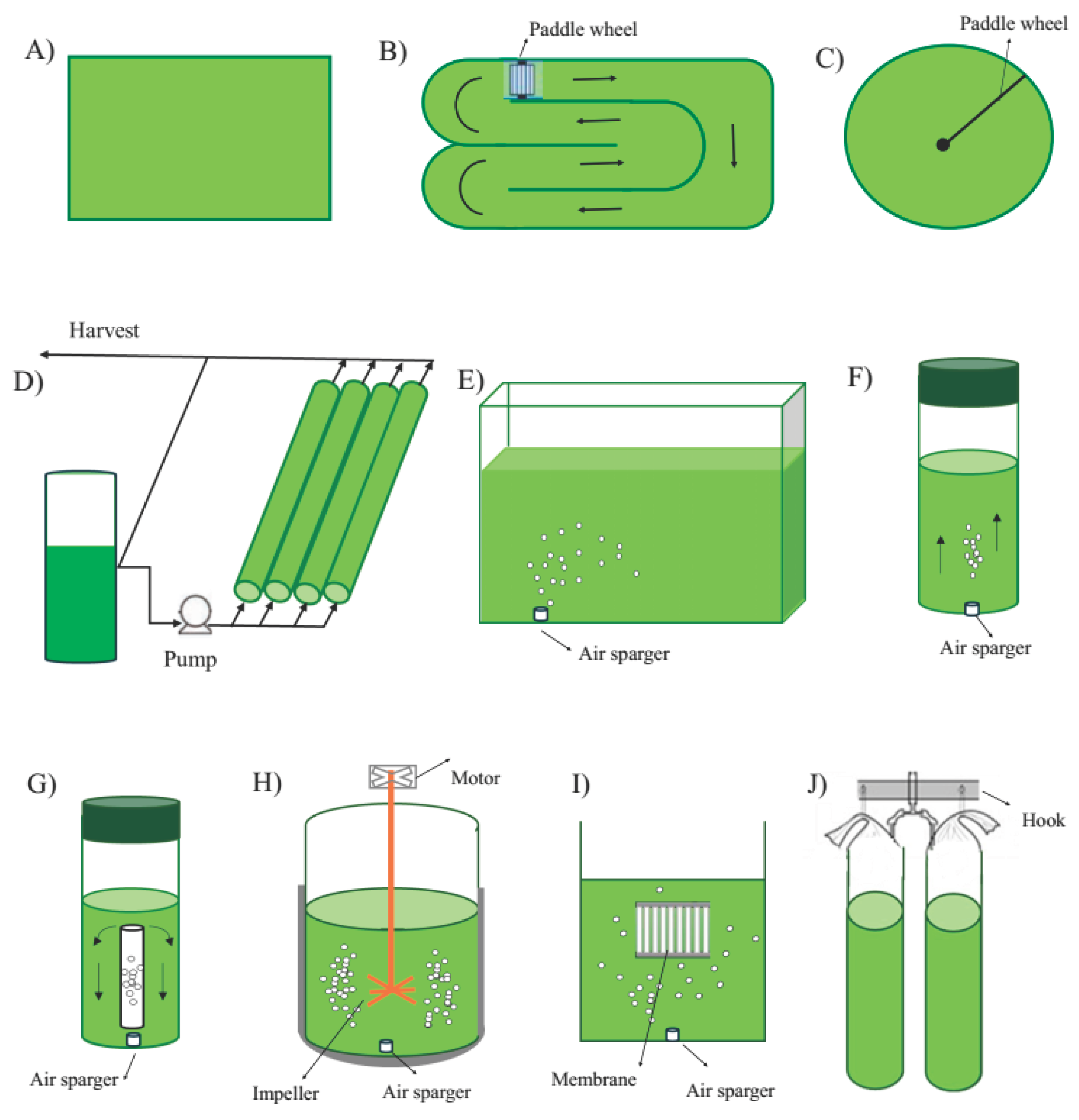

Table 1.
Post-treatment POME characteristics from different plantations in Indonesia.
| Parameters | National threshold [32] | Study 1 [34] | Study 2 [35] | Study 3 [22] |
|---|---|---|---|---|
| pH | 5-9 | 8 | 7.71 | 7.5 – 8.9 |
| Total solid | 250 mg l−1 | 96 mg l−1 | 45 mg l−1 | 30 – 40 mg l−1 |
| Total nitrogen | 50 mg l−1 | 265.25 mg l−1 | 160 mg l−1 * | 1 – 18 mg l−1 |
| BOD | 100 mg l−1 | 189 mg l−1 | 180 mg l−1 | 20 – 300 mg l−1 |
| COD | 350 mg l−1 | 402 mg l−1 | 593 mg l−1 | 30 – 200 mg l−1 |
Abbreviation: BOD – Biological Oxygen Demand; COD – Chemical Oxygen Demand. *Reported as NH3-N instead of total nitrogen.
Table 2.
Microalgae cultivation in agro-industrial wastewater.
| Agro-industrial effluent | Microalgae | Medium pretreatment | Cultivation system | Biomass production/ Growth rate | Product | Removal efficiency |
Ref |
|---|---|---|---|---|---|---|---|
| POME | Co-cultivation Dunaliella sp, Spirulina sp., Nannochloropsis sp, Chaetoceros calciltrans |
F, D, A | Outdoor, 200 ml plastic bag, 75% POME added urea 450 mg l-1 | Growth rate 0.35 d-1 | Lipid 40% | - | [83] |
| POME | Haematococcus pluvialis, | F, D, A | Indoor, 2 L glass bottle, 7.5% POME | Growth rate 0.21 d-1 | Astaxanthin 22.43 mg l-1 | 50.9% COD, 49.3% TN, 69.4% TP |
[84] |
| POME | Chlorella sorokiniana UKM2 | F, D, A | Indoor, 2 L flask, 10% POME, 1% CO2 mixed with air |
Growth rate 1.06 d-1 | - | CO2 uptake rate 567 mg l-1 d-1, 100% ammonium, 65% TN, 56% TP | [85] |
| POME | Spirulina platensis | F, C, D, A | Indoor, 1 L conical flask-controlled conditions, 30% POME |
Biomass production 1.16 g l -1 | Phycocyanin 175,12 mg, Lipid 28.6 % |
- | [86] |
| POME | Different microalgae: Nannochloropsis oculate, Chlorella vulgaris, Spirulina platensis, | F, D | Outdoor, raceway ponds, direct sunlight, 25 and 30 °C, indoor, using a 1 L Erlenmeyer flask. Using POME at varying concentrations (10 %, 25 %, 50 %, and 100 %) | Growth rate: 0.21, 0.29, 0.152 d-1, respectively | Lipid 39.10, 14.34, 28.6%, respectively |
COD: 71-75, 97-99, 84.9%, respectively | [55] |
| CPW | Haematococcus pluvialis, Neochloris oleoabundans | F, D, A | Indoor, 2 L flask, 25% CPW | Biomass production 3.18 and 1.79 g l -1, respectively | Lipid 0.018 and 0.041 g l-1 d-1, respectively | 60.80 and 69.16% COD, 51.06 and 58.19% TN, 54.68 and 69.84% TP, respectively | [87] |
| CBEW | Chlorella sorokiniana P21 and WB1DG | F | Indoor, 12L acrylamide flask, 100% CBEW | Biomass production 2.6 and 1.3 g l-1, respectively | - | 73.78 and 63.42% COD, 92.11 and 91.68% TP, 67.33 and 70.66% TN, respectively | [88] |
| CPW | Scenedesmus sp. | F, D, A | Indoor, 500 mL Erlenmeyer flask, synthetic medium (ASM-1) supplemented with 5-10% CPW | Biomass 0.7 g l-1 | Lipid 35.5% | - | [89] |
| CPW | Nannochloropsis salina | F | Indoor, PBR 1500 L, 100% CPW | Biomass 7.25 g l-1 | Lipid 210.32 mg g-1, carbohydrates 125.34 mg ml-1, biodiesel 3.75 ml g-1 | 8.26% nitrate, 93.94% phosphate, 97.43% sulfate | [90] |
| Sugarcane vinasse | Coelastrella sp | C, CL, DC | Indoor, 250 ml Drechsler flask, 20% vinasse with 0.04% CO2 | Biomass 3.16 g l−1 | Carbohydrate 30%, lipid 20% | 53.9% COD | [91] |
| Sugarcane vinasse | Mixed culture is predominantly composed of Chlorella vulgaris |
No pretreatment | Indoor, 3 L glass bottle, raw vinasse containing anaerobic sludge from reactor treating vinasse |
Biomass 2.7 g l-1 | Lipid 265 mg l-1 | 98% TN | [92] |
| Sugarcane vinasse | Chlorella vulgaris | C, D | Indoor, 250 ml flask, 20% vinasse | Growth rate 1.41 d-1 | Protein 45.98 mg l-1, carbohydrate 6.67 mg l-1 | - | [93] |
| Sugarcane vinasse | Chlorella vulgaris | n.a. | Indoor, Tubular 6 L air-lift reactors, fully dark, 1% CO2, 75% vinasse | Biomass 8.7 g l-1, growth rate 0.72 g l-1 d-1 | Protein 45.95%, lipid 1.67% | - | [94] |
| TW | Spirulina sp., Nannochloropsis oculata | D, A | Indoor, 1 L polyethylene flask, 20% TW | Biomass 0.23 and 0.53 g l-1, respectively | Lipid 2.44 and 1.21%, respectively. Protein 1.71 and 1.51%, respectively | - | [95] |
| TW, TW-ADE |
Chlorella vulgaris, Arthrospira platensis |
D, A | Indoor, 1 L polyethylene flask, 5% TW, 3% TW, 100% TW-ADE | Biomass: C. vulgaris 2.0 g l-1 in 5% TW, A. plantesis 1.4 g l-1 in 5% TW; No growth at TW-ADE |
Protein: C. vulgaris 135.8 mg l-1 in 5% TW, A. platensis 42.5 mg l-1 in 3 % TW, Protein was not detected in TW-ADE |
- | [96] |
| TW | Chlorella sp. | D | Indoor, 18 L rotating algal biofilm reactor, 40% TW | Microalgae cells 3.99×10⁶ cells m l-1 | - | 75.88% COD, 80.45% NH3 | [97] |
Abbreviation: A – Autoclave; C – Centrifugation; CBEW - Cassava Biogas Effluent Wastewater; CL – Clarification; COD – Chemical Oxygen Demand; CPW - Cassava processing wastewater; D – Dilution; DC – Decantation; F – Filtration; PBR – Photobioreactor; POME – Palm Oil Mill Effluent; TN – Total Nitrogen; TP – Total Phosphorus; TW - Tofu wastewater; TW-ADE - Tofu wastewater anaerobic digestion effluent; n.a. – not available.
Table 3.
Microalgae species and their implementation in the nutraceutical or food industry.
| No | Algal Species | Main Products | Applications | Health Benefits | References |
|---|---|---|---|---|---|
| 1 | Spirulina (Arthrospira platensis/Limnospira platensis) | Phycocyanin (blue pigment); Proteins; Bioactive peptides | Natural blue food colorant, protein powders, supplements | Antioxidant, neuroprotective, immunomodulatory, antihypertensive | [14,116] |
| 2 | Chlorella vulgaris / C. pyrenoidosa | Chlorophylls; Proteins; Vitamin B12; Folate; Sulphated polysaccharides | Detox/immune supplements, bakery & beverage enrichment, vegan protein | Detoxification, gut microbiota modulation, antioxidant, ACE-inhibitory, antidiabetic | [117,118,119] |
| 3 | Haematococcus pluvialis | Astaxanthin; Carotenoids; PUFAs | Anti-ageing nutraceuticals, sports nutrition, antioxidant-rich supplements | Potent antioxidant, cardiovascular & skin protection, anti-inflammatory | [120,121,122] |
| 4 | Dunaliella salina | β-carotene; Luteins | Natural orange-red colorant, provitamin A supplements, functional foods | Eye health, antioxidant, and immune support | [121,123] |
| 5 | Nannochloropsis spp. | Eicosapentaenoic acid (EPA); Proteins; Peptides; Chlorophyll; Carotenoids; Phytosterols | Vegan Omega-3 oil, aquafeed, functional beverages | Cardiovascular health, lipid metabolism, cognitive support, anticancer peptides | [124,125] |
| 6 | Isochrysis galbana | Docosahexaenoic acid (DHA); Proteins; Fucoxanthin; Phytosterols | Infant formulas, nutraceuticals | Neurological development, cardiovascular health, neuroprotective, antioxidant | [121,126,127] |
| 7 | Scenedesmus spp. | Lutein; Proteins; Carotenoids | Functional foods, eye health supplements | Antioxidant, ocular health, anti-inflammatory | [121,128] |
| 8 | Porphyridium spp. | Sulphated polysaccharides; Phycoerythrin (red pigment) | Food stabilizers, antiviral nutraceuticals | Antiviral, immune modulation, prebiotic functions | [129,130] |
| 9 | Muriellopsis spp. | Lutein | Eye health supplements, natural yellow colorants | Antioxidant, visual health | [131,132] |
| 10 | Schizochytrium | DHA (long-chain omega-3); EPA | Infant nutrition, vegan omega-3 oils | Brain & eye development, anti-inflammatory; cardiovascular health | [14,124] |
Disclaimer/Publisher’s Note: The statements, opinions and data contained in all publications are solely those of the individual author(s) and contributor(s) and not of MDPI and/or the editor(s). MDPI and/or the editor(s) disclaim responsibility for any injury to people or property resulting from any ideas, methods, instructions or products referred to in the content. |
© 2025 by the authors. Licensee MDPI, Basel, Switzerland. This article is an open access article distributed under the terms and conditions of the Creative Commons Attribution (CC BY) license (http://creativecommons.org/licenses/by/4.0/).
Copyright: This open access article is published under a Creative Commons CC BY 4.0 license, which permit the free download, distribution, and reuse, provided that the author and preprint are cited in any reuse.