

Submitted:
19 September 2025
Posted:
22 September 2025
You are already at the latest version
Abstract
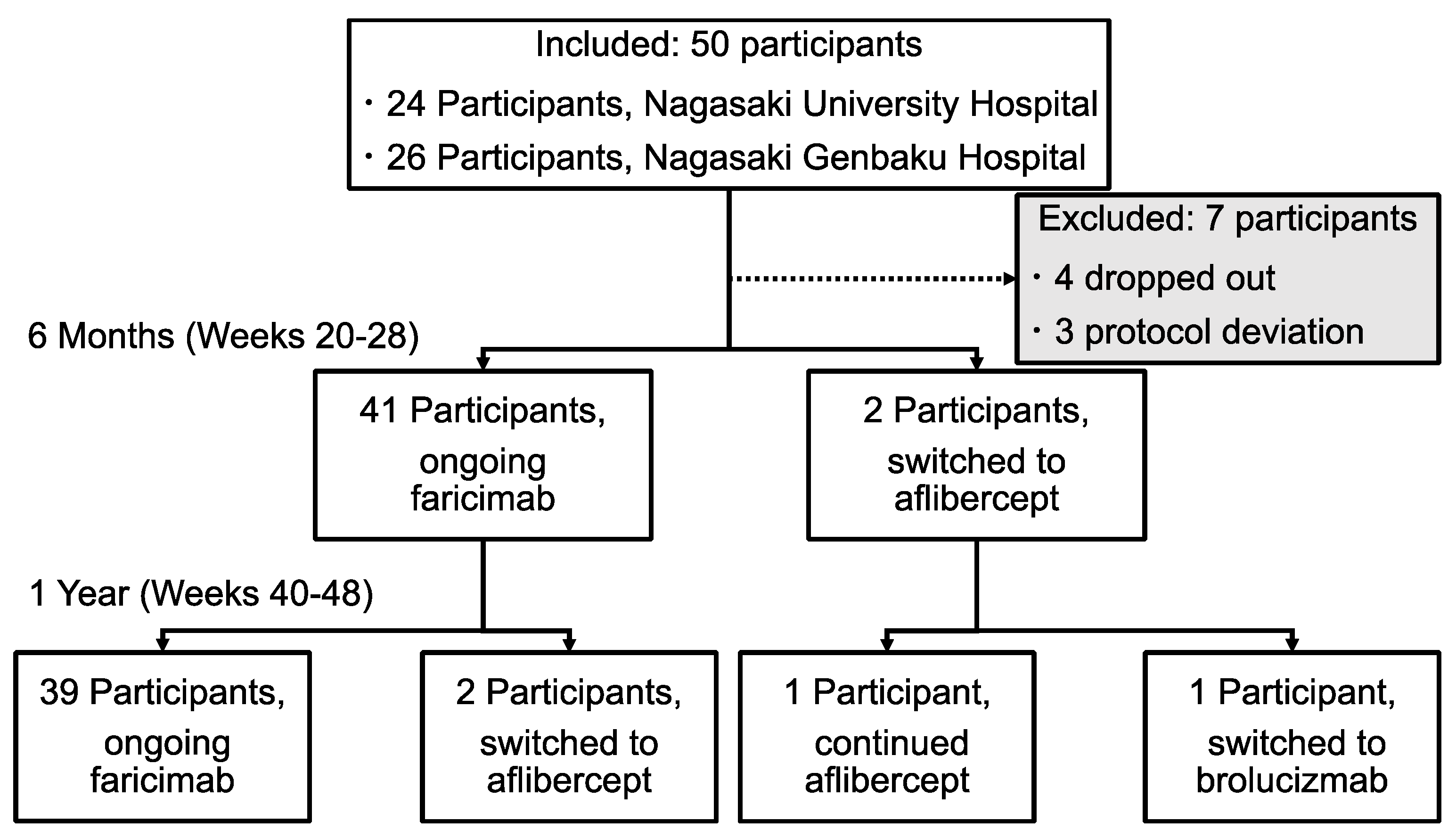
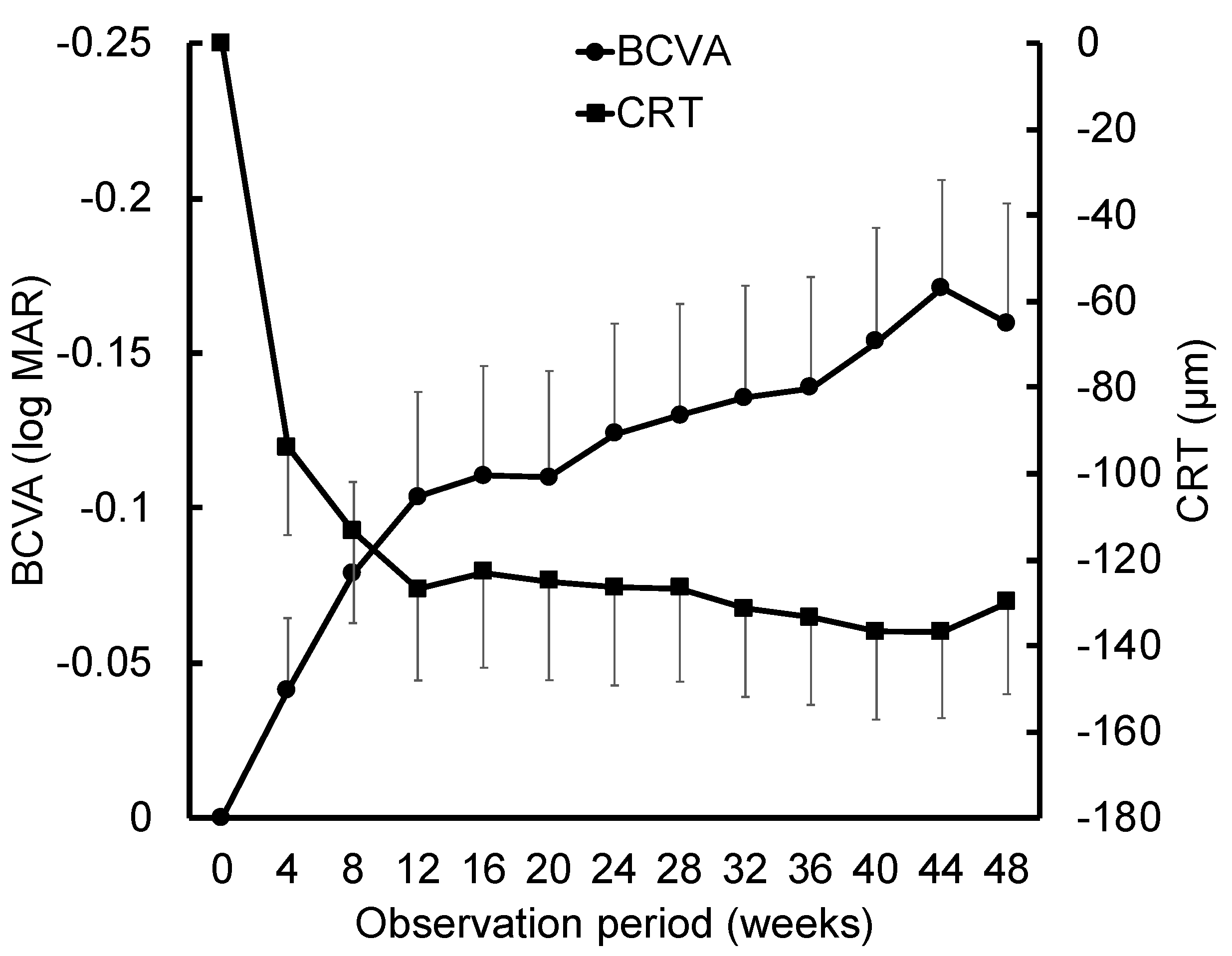
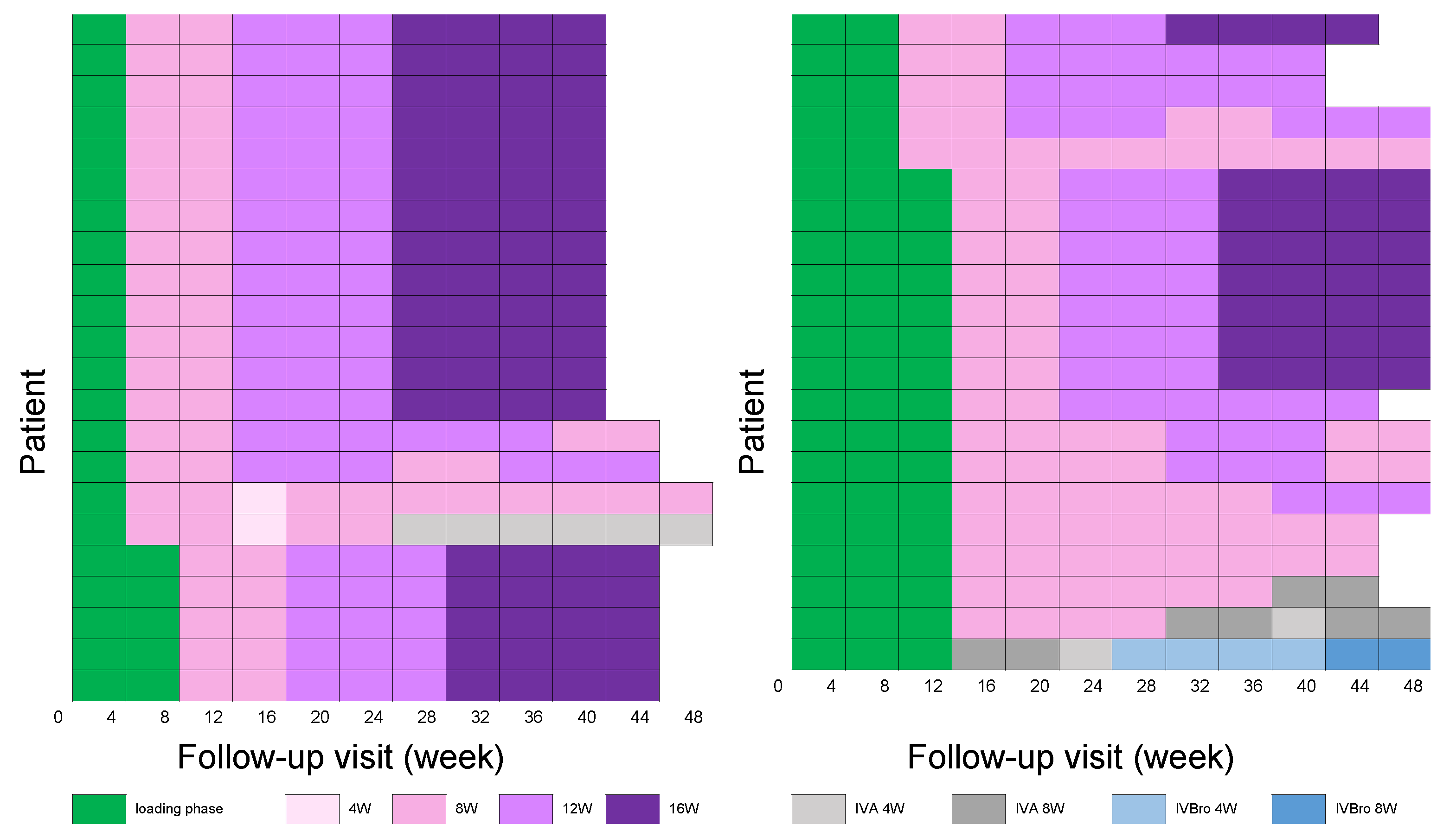
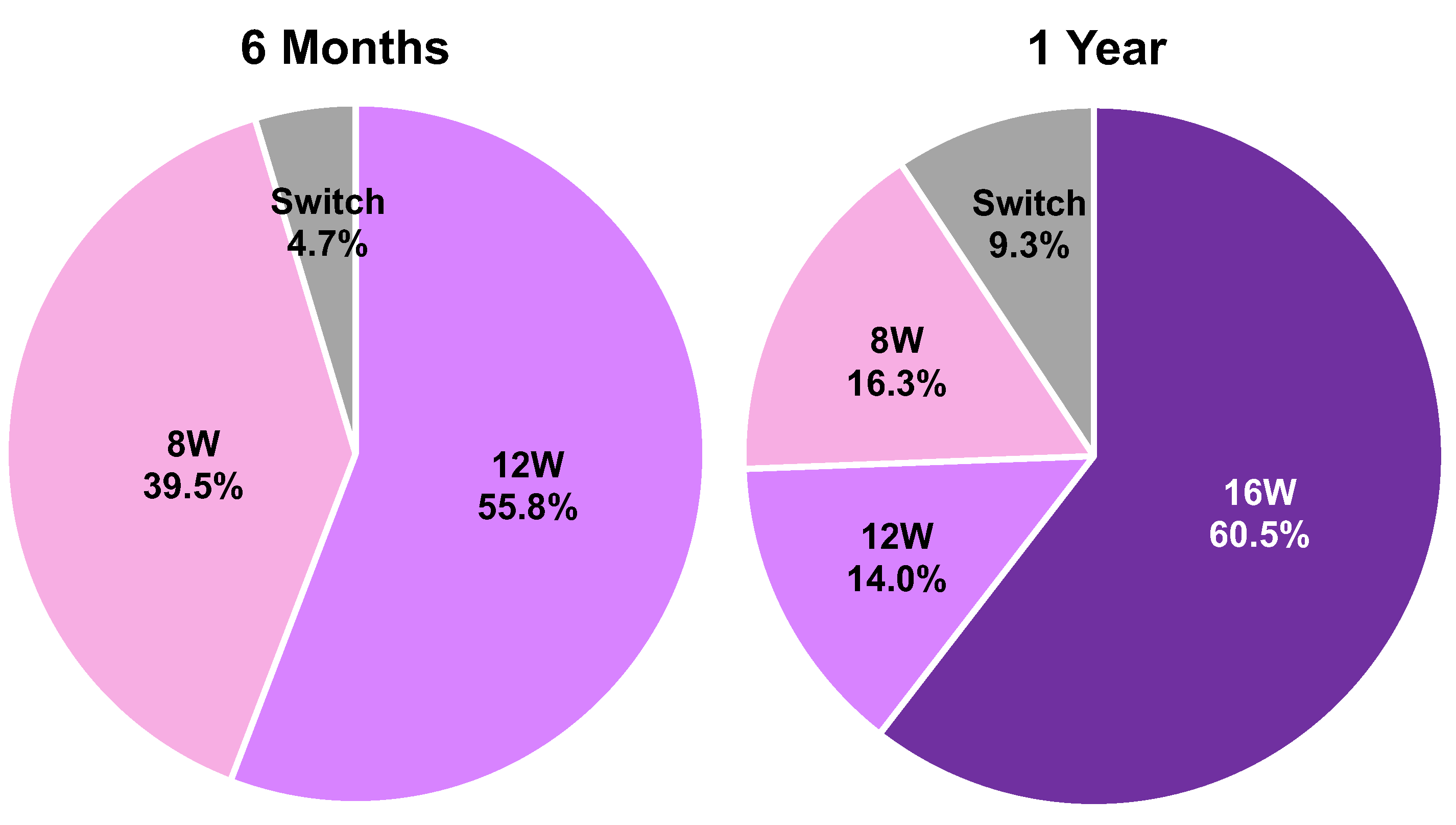
Background/Objectives: To evaluate the efficacy of a flexible loading-phase treat-and-extend regimen using faricimab, in which the number of initial injections was tailored to individual disease activity. Methods: This observational cohort study included 50 treatment-naïve eyes with neovascular age-related macular degeneration, treated with faricimab in Japan. Disease activity after one injection was assessed at the second visit (4 weeks later) to determine the treatment interval for subsequent injections. The primary outcome measure was the injection interval and visual/anatomical outcomes at 1 year after treatment initiation. Results: Overall, 43 of 50 eyes completed a 1-year follow-up. The mean logarithm of the minimum angle of resolution best-corrected visual acuity improved from 0.35 ± 0.32 to 0.19 ± 0.3 at the 1-year follow-up. Overall, 60.5% achieved 16-week intervals, and 74.4% reached intervals of ≥12 weeks. A shorter loading phase (two or three injections) was associated with fewer total injections and higher rates of fluid resolution, without compromising visual outcomes. The presence of polypoidal choroidal vasculopathy and ellipsoid zone disruption were identified as risk factors for failure to extend treatment intervals beyond 16 weeks. Conclusions: A flexible loading-phase treat-and-extend regimen using faricimab yields outcomes comparable to those of the TENAYA protocol, with fewer injections. This simple approach is straightforward in design and may reduce treatment burden while maintaining efficacy.
Keywords:
1. Introduction
2. Materials and Methods
2.1. Study Design and Participants
2.2. Treatment Protocol
2.3. Assessments
2.4. Main Outcome Measures
2.5. Statistical Analysis
3. Results
4. Discussion
Limitations
5. Conclusions
Author Contributions
Funding
Institutional Review Board Statement
Informed Consent Statement
Data Availability Statement
Acknowledgments
Conflicts of Interest
Abbreviations
| nAMD | Neovascular age-related macular degeneration |
| VEGF | Vascular endothelial growth factor |
| AMD | Age-related macular degenration |
| MNV | Macular neovascularization |
| TAE | Treat-and-extend |
| PED | Pigment epithelial detachment |
| BCVA | Best-corrected visual acuity |
| PCV | Polypoidal choroidal vasculopathy |
| CRT | Central retinal thickness |
| OCT | Optical coherence |
| SRF | Subretinal fluid |
References
- de Jong, P.T. Age-related macular degeneration. N Engl J Med. 2006, 355, 1474–1485. [Google Scholar] [CrossRef] [PubMed]
- Lim, L.S.; Mitchell, P.; Seddon, J.M.; Holz, F.G.; Wong, T.Y. Age-related macular degeneration. Lancet. 2012, 379, 1728–1738. [Google Scholar] [CrossRef] [PubMed]
- Brown, D.M.; Kaiser, P.K.; Michels, M.; Soubrane, G.; Heier, J.S.; Kim, R.Y.; Sy, J.P.; Schneider, S.; ANCHOR Study Group. Ranibizumab versus verteporfin for neovascular age-related macular degeneration. N Engl J Med. 2006, 355, 1432–1444. [Google Scholar] [CrossRef]
- Rosenfeld, P.J.; Brown, D.M.; Heier, J.S.; Boyer, D.S.; Kaiser, P.K.; Chung, C.Y.; Kim, R.Y.; MARINA Study Group. Ranibizumab for neovascular age-related macular degeneration. N Engl J Med. 2006, 355, 1419–1431. [Google Scholar] [CrossRef]
- CATT Research Group; Martin, D. F.; Maguire, M.G.; Ying, G.S.; Grunwald, J.E.; Fine, S.L.; Jaffe, G.J. Ranibizumab and bevacizumab for neovascular age-related macular degeneration. N Engl J Med 2011, 364, 1897–1908. [Google Scholar] [CrossRef]
- IVAN Study Investigators; Chakravarthy, U. ; Harding, S.P.; Rogers, C.A.; Downes, S.M.; Lotery, A.J.; Wordsworth, S.; Reeves, B.C. Ranibizumab versus bevacizumab to treat neovascular age-related macular degeneration: one-year findings from the IVAN randomized trial. Ophthalmology. 2012, 119, 1399–1411. [Google Scholar] [CrossRef]
- Honda, S.; Yanagi, Y.; Koizumi, H.; Chen, Y.; Tanaka, S.; Arimoto, M.; Imai, K. Impact of neovascular age-related macular degeneration: burden of patients receiving therapies in Japan. Sci Rep 2021, 11, 13152. [Google Scholar] [CrossRef]
- Dugel, P.U.; Koh, A.; Ogura, Y.; Jaffe, G.J.; Schmidt-Erfurth, U.; Brown, D.M.; Gomes, A.V.; Warburton, J.; Weichselberger, A.; Holz, F.G.; et al. HAWK and HARRIER: Phase 3, multicenter, randomized, double-masked trials of brolucizumab for neovascular age-related macular degeneration. Ophthalmology 2020, 127, 72–84. [Google Scholar] [CrossRef]
- Heier, J.S.; Khanani, A.M.; Quezada Ruiz, C.; Basu, K.; Ferrone, P.J.; Brittain, C.; Figueroa, M.S.; Lin, H.; Holz, F.G.; Patel, V.; et al. Efficacy, durability, and safety of intravitreal faricimab up to every 16 weeks for neovascular age-related macular degeneration (TENAYA and LUCERNE): two randomised, double-masked, phase 3, non-inferiority trials. Lancet. 2022, 399, 729–740. [Google Scholar] [CrossRef]
- Lanzetta, P.; Korobelnik, J.F.; Heier, J.S.; Leal, S.; Holz, F.G.; Clark, W.L.; Eichenbaum, D.; Iida, T.; Xiaodong, S.; Berliner, A.J.; et al. Intravitreal aflibercept 8 mg in neovascular age-related macular degeneration (PULSAR): 48-week results from a randomised, double-masked, non-inferiority, phase 3 trial. Lancet 2024, 403, 1141–1152. [Google Scholar] [CrossRef] [PubMed]
- Regula, J.T.; Lundh von Leithner, P.; Foxton, R.; Barathi, V.A.; Cheung, C.M.; Bo Tun, S.B.; Wey, Y.S.; Iwata, D.; Dostalek, M.; Moelleken, J.; et al. Targeting key angiogenic pathways with a bispecific CrossMAb optimized for neovascular eye diseases. EMBO Mol Med 2016, 8, 1265–1288. [Google Scholar] [CrossRef] [PubMed]
- Khanani, A.M.; Aziz, A.A.; Khan, H.; Gupta, A.; Mojumder, O.; Saulebayeva, A.; Abbey, A.M.; Almeida, D.R.P.; Avery, R.L.; Banda, H.K.; et al. The real-world efficacy and safety of faricimab in neovascular age-related macular degeneration: the TRUCKEE study - 6 month results. Eye (Lond) 2023, 37, 3574–3581. [Google Scholar] [CrossRef]
- Raimondi, R.; Falfeli, T.; Bogdanova-Bennet, A.; Varma, D.; Habib, M.; Kotagiri, A.; Steel, D.H.; Grinton, M. Outcomes of treatment resistant neovascular-age related macular degeneration switched from Aflibercept to Faricimab. Ophthalmol. Retina 2024, 8, 537–544. [Google Scholar] [CrossRef]
- Spaide, R.F.; Jaffe, G.J.; Sarraf, D.; Freund, K.B.; Sadda, S.R.; Staurenghi, G.; Waheed, N.K.; Chakravarthy, U.; Rosenfeld, P.J.; Holz, F.G.; et al. Consensus nomenclature for reporting neovascular age-related macular degeneration data: consensus on neovascular age-related macular degeneration nomenclature study group. Ophthalmology 2020, 127, 616–636. [Google Scholar] [CrossRef]
- Kanda, Y. Investigation of the freely available easy-to-use software 'EZR' for medical statistics. Bone Marrow Transplant. 2013, 48, 452–458. [Google Scholar] [CrossRef]
- Regillo, C.D.; Brown, D.M.; Abraham, P.; Yue, H.; Ianchulev, T.; Schneider, S.; Shams, N. Randomized, double-masked, sham-controlled trial of ranibizumab for neovascular age-related macular degeneration: PIER Study year 1. Am J Ophthalmol 2008, 145, 239–248. [Google Scholar] [CrossRef] [PubMed]
- Schmidt-Erfurth, U.; Eldem, B.; Guymer, R.; Korobelnik, J.F.; Schlingemann, R.O.; Axer-Siegel, R.; Wiedemann, P.; Simader, C.; Gekkieva, M.; Weichselberger, A.; et al. Efficacy and safety of monthly versus quarterly ranibizumab treatment in neovascular age-related macular degeneration: the EXCITE study. Ophthalmology 2011, 118, 831–839. [Google Scholar] [CrossRef]
- Lalwani, G.A.; Rosenfeld, P.J.; Fung, A.E.; Dubovy, S.R.; Michels, S.; Feuer, W.; Davis, J.L.; Flynn, H.W., Jr.; Esquiabro, M. A variable-dosing regimen with intravitreal ranibizumab for neovascular age-related macular degeneration: year 2 of the PrONTO Study. Am J Ophthalmol 2009, 148, 43–58.e1. [Google Scholar] [CrossRef]
- Gupta, B.; Adewoyin, T.; Patel, S.K.; Sivaprasad, S. Comparison of two intravitreal ranibizumab treatment schedules for neovascular age-related macular degeneration. Br J Ophthalmol 2011, 95, 386–390. [Google Scholar] [CrossRef] [PubMed]
- Spaide, R. Ranibizumab according to need: a treatment for age-related macular degeneration. Am J Ophthalmol 2007, 143, 679–680. [Google Scholar] [CrossRef]
- Wykoff, C.C.; Ou, W.C.; Brown, D.M.; Croft, D.E.; Wang, R.; Payne, J.F.; Clark, W.L.; Abdelfattah, N.S.; Sadda, S.R.; TREX-AMD Study Group. Randomized Trial of Treat-and-Extend versus Monthly Dosing for Neovascular Age-Related Macular Degeneration: 2-Year Results of the TREX-AMD Study. Ophthalmol Retina 2017, 1, 314–321. [Google Scholar] [CrossRef]
- Rosenberg, D.; Deonarain, D.M.; Gould, J.; Sothivannan, A.; Phillips, M.R.; Sarohia, G.S.; Sivaprasad, S.; Wykoff, C.C.; Cheung, C.M.G.; Sarraf, D.; et al. Efficacy, safety, and treatment burden of treat-and-extend versus alternative anti-VEGF regimens for nAMD: a systematic review and meta-analysis. Eye (Lond) 2023, 37, 6–16. [Google Scholar] [CrossRef]
- Mori, K.; Horie-Inoue, K.; Gehlbach, P.L.; Takita, H.; Kabasawa, S.; Kawasaki, I.; Ohkubo, T.; Kurihara, S.; Iizuka, H.; Miyashita, Y.; et al. Phenotype and genotype characteristics of age-related macular degeneration in a Japanese population. Ophthalmology 2010, 117, 928–938. [Google Scholar] [CrossRef]
- Heier, J.S.; Singh, R.P.; Wykoff, C.C.; Csaky, K.G.; Lai, T.Y.Y.; Loewenstein, A.; Schlottmann, P.G.; Paris, L.P.; Westenskow, P.D.; Quezada-Ruiz, C.; et al. THE ANGIOPOIETIN/TIE PATHWAY IN RETINAL VASCULAR DISEASES: A Review. Retina 2021, 41, 1–19. [Google Scholar] [CrossRef] [PubMed]
- Joussen, A.M.; Ricci, F.; Paris, L.P.; Korn, C.; Quezada-Ruiz, C.; Zarbin, M. Angiopoietin/Tie2 signalling and its role in retinal and choroidal vascular diseases: a review of preclinical data. Eye (Lond) 2021, 35, 1305–1316. [Google Scholar] [CrossRef]
- Arnold-Vangsted, A.; Schou, M.G.; Balaratnasingam, C.; Cehofski, L.J.; Chhablani, J.; van Dijk, E.H.C.; Eriksen, N.S.; Grauslund, J.; Hajari, J.N.; Sabaner, M.C.; et al. Efficacy of intravitreal faricimab therapy for polypoidal choroidal vasculopathy: A systematic review and meta-analysis. Acta Ophthalmol 2025, 103, 247–256. [Google Scholar] [CrossRef]
- Machida, A.; Oishi, A.; Ikeda, J.; Kurihara, J.; Yoneda, A.; Tsuiki, E.; Hirata, Y.; Murakami, R.; Kitaoka, T. Factors associated with success of switching to faricimab for neovascular age-related macular degeneration refractory to intravitreal aflibercept. Life (Basel) 2024, 14, 476. [Google Scholar] [CrossRef] [PubMed]
- Hwang, J.U.; Yang, S.J.; Yoon, Y.H.; Lee, J.Y.; Kim, J.G. Recurrent submacular hemorrhage in patients with neovascular age-related macular degeneration. Retina 2012, 32, 652–657. [Google Scholar] [CrossRef] [PubMed]
- Kaufmann, G.T.; Boucher, N.; Sharma, C.; Aggarwal, N.; Starr, M.R. Submacular hemorrhage rates following anti-vascular endothelial growth factor injections for exudative age-related macular degeneration. Am J Ophthalmol 2025, 270, 172–182. [Google Scholar] [CrossRef]
- Mori, R.; Honda, S.; Gomi, F.; Tsujikawa, A.; Koizumi, H.; Ochi, H.; Ohsawa, S.; Okada, A.A.; TENAYA and LUCERNE Investigators. Efficacy, durability, and safety of faricimab up to every 16 weeks in patients with neovascular age-related macular degeneration: 1-year results from the Japan subgroup of the phase 3 TENAYA trial. Jpn J Ophthalmol 2023, 67, 301–310. [Google Scholar] [CrossRef]
- Menghini, M.; Kloeckener-Gruissem, B.; Fleischhauer, J.; Kurz-Levin, M.M.; Sutter, F.K.; Berger, W.; Barthelmes, D. Impact of loading phase, initial response and CFH genotype on the long-term outcome of treatment for neovascular age-related macular degeneration. PLoS One 2012, 7, e42014. [Google Scholar] [CrossRef]
- Khanani, A.M.; Kotecha, A.; Chang, A.; Chen, S.J.; Chen, Y.; Guymer, R.; Heier, J.S.; Holz, F.G.; Iida, T.; Ives, J.A.; et al. TENAYA and LUCERNE: two-year results from the Phase 3 neovascular age-related macular degeneration trials of faricimab with treat-and-extend dosing in year 2. Ophthalmology 2024, 131, 914–926. [Google Scholar] [CrossRef] [PubMed]
- Koizumi, H.; Gomi, F.; Tsujikawa, A.; Honda, S.; Mori, R.; Ochi, H.; Iwasaki, K.; Okada, A.A.; TENAYA and LUCERNE Investigators. Efficacy, durability, and safety of faricimab up to every 16 weeks in patients with neovascular age-related macular degeneration: 2-year results from the Japan subgroup of the phase III TENAYA trial. Graefes Arch Clin Exp Ophthalmol 2024, 262, 2439–2448. [Google Scholar] [CrossRef] [PubMed]

| Total | Type 1 | Type 2 | Type 3 | ||
| Without polyp | With polyp | ||||
| Number of eyes | n = 43 | n = 13 | n = 26 | n = 3 | n = 1 |
| Clinicodemographic characteristics | |||||
| Age (years), mean (SD) | 76.6 (8.9) | 78.1 (12.4) | 75.6 (7.2) | 78.1 (8.4) | 80.3 (NA) |
| Sex: Female, n (%) | 12 (27.9) | 3 (23.1) | 6 (23.1) | 3 (100.0) | 0 (0.0) |
| Hypertension, n (%) | 29 (67.4) | 8 (61.5) | 17 (65.4) | 3 (100.0) | 1 (100.0) |
| Diabetes mellitus, n (%) | 8 (18.6) | 3 (23.1) | 4 (15.4) | 1 (33.3) | 0 (100.0) |
| Malignancy, n (%) | 9 (20.9) | 2 (15.4) | 6 (23.1) | 0 (0.0) | 1 (100.0) |
| History of cardiovascular events, n (%) | 6 (14.0) | 1 (7.7) | 3 (11.5) | 1 (33.3) | 1 (100.0) |
| Anticoagulant use, n (%) | 9 (20.9) | 3 (23.1) | 3 (11.5) | 2 (66.7) | 1 (100.0) |
| Smoking history, n (%) | 23 (53.5) | 7 (53.8) | 15 (57.7) | 0 (0.0) | 1 (100.0) |
| BCVA, logMAR, mean (SD) | 0.35 (0.32) | 0.32 (0.28) | 0.32 (0.33) | 0.58 (0.39) | 0.70 (NA) |
| Anatomical parameters at baseline | |||||
| CRT at fovea (μm), mean (SD) | 312.4 (140.5) | 251.4 (76.0) | 332.4 (164.0) | 353.7 (27.4) | 460.0 (NA) |
| CCT at fovea (μm), mean (SD) | 258.6 (99.1) | 240.1 (113.5) | 274.3 (93.9) | 196.7 (86.6) | 277.0 (NA) |
| PED height at fovea (μm), mean (SD) | 67.1 (125.0) | 40.2 (39.1) | 82.8 (154.9) | 10.7 (18.5) | 177.0 (NA) |
| Disrupted EZ at fovea, n (%) | 28 (65.1) | 8 (61.5) | 16 (61.5) | 3 (100.0) | 1 (100.0) |
| SRH, within 6 mm, n (%) | 18 (41.9) | 4 (30.8) | 11 (42.3) | 2 (66.7) | 1 (100.0) |
| SHRM within 6 mm, n (%) | 29 (67.4) | 7 (53.8) | 19 (73.1) | 3 (100.0) | 0 (0.0) |
| HRF within 6 mm, n (%) | 24 (55.8) | 5 (38.5) | 17 (65.4) | 2 (66.7) | 0 (0.0) |
| Intraretinal fluid in fovea, n (%) | 14 (32.6) | 4 (30.8) | 6 (23.1) | 3 (100.0) | 1 (100.0) |
| Subretinal fluid in fovea, n (%) | 36 (83.7) | 11 (84.6) | 22 (84.6) | 2 (66.7) | 1 (100.0) |
| Presence of PED in fovea, n (%) | 31 (72.1) | 10 (76.9) | 19 (73.1) | 1 (33.3) | 1 (100.0) |
| Number of loading phase injections | ||||
| 2 Injections | 3 Injections | 4 Injections | P values | |
| Number of eyes | 17 | 10 | 16 | |
| Clinicodemographic characteristics | ||||
| Age (years), mean (SD) | 77.6 (8.9) | 74.4 (8.8) | 77.0 (9.4) | 0.656 |
| Sex: Female, n (%) | 1 (23.5) | 4 (40.0) | 4 (25.0) | 0.685 |
| Hypertension, n (%) | 12 (70.6) | 5 (50.0) | 12 (75.0) | 0.415 |
| Diabetes mellitus, n (%) | 4 (23.5) | 1 (10.0) | 3 (18.8) | 0.882 |
| Malignancy, n (%) | 4 (23.5) | 2 (20.0) | 3 (18.8) | 1.000 |
| History of cardiovascular events, n (%) | 4 (23.5) | 1 (10.0) | 1 (6.2) | 0.470 |
| Anticoagulant use, n (%) | 4 (23.5) | 2 (20.0) | 3 (18.8) | 1.000 |
| Smoking history, n (%) | 8 (47.1) | 6 (60.0) | 9 (56.2) | 0.793 |
| BCVA, logMAR, mean (SD) | 0.31 (0.28) | 0.39 (0.39) | 0.37 (0.32) | 0.818 |
| Anatomical parameters at baseline | ||||
| CRT at fovea (μm), mean (SD) | 257.8 (86.4) | 393.1 (182.6) | 319.9 (139.7) | 0.048 |
| CCT at fovea (μm), mean (SD) | 251.2 (103.0) | 251.1 (103.4) | 271.3 (97.5) | 0.820 |
| PED height at fovea (μm), mean (SD) | 99.0 (185.4) | 33.2 (38.0) | 54.3 (64.5) | 0.375 |
| Disrupted EZ at fovea, n (%) | 11 (64.7) | 8 (80.0) | 9 (56.2) | 0.514 |
| SRH, within 6 mm, n (%) | 6 (35.3) | 6 (60.0) | 6 (37.5) | 0.455 |
| SHRM within 6 mm, n (%) | 10 (58.8) | 10 (100) | 9 (56.2) | 0.030 |
| HRF within 6 mm, n (%) | 6 (35.3) | 7 (70.0) | 11 (68.8) | 0.098 |
| Intraretinal fluid in fovea, n (%) | 7 (41.2) | 4 (40.0) | 3 (18.8) | 0.346 |
| Subretinal fluid in fovea, n (%) | 11 (64.7) | 10 (100.0) | 15 (93.8) | 0.036 |
| Presence of PED in fovea, n (%) | 12 (70.6) | 6 (60.0) | 13 (81.2) | 0.516 |
| Subtype | 0.091 | |||
| Type 1 | 8 (47.1) | 2 (20.0) | 3 (18.8) | |
| Type 1 with polyp (PCV) | 6 (35.3) | 7 (70.0) | 13 (81.2) | 0.022 |
| Type 2 | 2 (11.8) | 1 (10.0) | 0 (0.0) | |
| Type 3 (RAP) | 1 (5.9) | 0 (0.0) | 0 (0.0) | |
| Clinical course at 1 year | ||||
| BCVA (logMAR), mean (SD) | 0.17 (0.35) | 0.20 (0.48) | 0.20 (0.25) | 0.974 |
| CRT at fovea (μm), mean (SD) | 167.6 (37.7) | 210.0 (51.1) | 191.4 (98.0) | 0.295 |
| Intraretinal fluid in fovea, n (%) | 0 (0.0) | 1 (10.0) | 1 (6.2) | 0.511 |
| Subretinal fluid in fovea, n (%) | 1 (5.9) | 2 (20.0) | 3 (18.8) | 0.540 |
| Treatment interval ≥12 weeks, n (%) | 14 (82.4) | 9 (90.0) | 9 (56.2) | 0.140 |
| Treatment interval ≥16 weeks, n (%) | 13 (76.5) | 6 (60.0) | 7 (43.8) | 0.163 |
| Total number of injections, mean (SD) | 5.7 (1.6) | 6.3 (0.7) | 7.8 (1.1) | 0.001 |
| Switched to another drug, n (%) | 1 (5.9) | 0 (0.0) | 3 (18.8) | 0.339 |
| Treatment interval extended to ≥16 weeks | |||
| Success | Failed | P values | |
| Number of eyes | 26 | 17 | |
| Clinicodemographic characteristics | |||
| Age (years), mean (SD) | 77.5 (9.4) | 75.2 (8.3) | 0.403 |
| Sex: Female, n (%) | 9 ( 34.6) | 3 (17.6) | 0.306 |
| Hypertension, n (%) | 19 (73.1) | 10 (58.8) | 0.507 |
| Diabetes mellitus, n (%) | 6 (23.1) | 2 (11.8) | 0.446 |
| Malignancy, n (%) | 4 (15.4) | 5 (29.4) | 0.445 |
| History of cardiovascular events, n (%) | 5 (19.2) | 1 (5.9) | 0.376 |
| Anticoagulant use, n (%) | 7 (26.9) | 2 (11.8) | 0.281 |
| Smoking history, n (%) | 13 (50.0) | 10 (58.8) | 0.756 |
| BCVA (logMAR), mean (SD) | 0.32 (0.25) | 0.40 (0.40) | 0.433 |
| Anatomical parameters at baseline | |||
| CRT at fovea (μm), mean (SD) | 294.9 (109.3) | 339.2 (178.6) | 0.317 |
| CCT at fovea (μm), mean (SD) | 251.3 (105.2) | 269.8 (90.9) | 0.555 |
| PED height at fovea (μm), mean (SD) | 35.3 (41.9) | 115.7 (184.8) | 0.038 |
| Disrupted EZ at fovea, n (%) | 13 (50.0) | 15 (88.2) | 0.020 |
| SRH, within 6 mm, n (%) | 8 (30.8) | 10 (58.8) | 0.114 |
| SHRM within 6 mm, n (%) | 17 (65.4) | 12 (70.6) | 1.000 |
| HRF within 6 mm, n (%) | 14 (53.8) | 10 (58.8) | 1.000 |
| Intraretinal fluid in fovea, n (%) | 9 (34.6) | 5 (29.4) | 1.000 |
| Subretinal fluid in fovea, n (%) | 22 (84.6) | 14 (82.4) | 1.000 |
| Presence of PED in fovea, n (%) | 18 (69.2) | 13 (76.5) | 0.735 |
| Subtype | 0.103 | ||
| Type 1 | 10 (38.5) | 3 (17.6) | |
| Type 1 with polyp (PCV) | 12 (46.2) | 14 (82.4) | 0.026 |
| Type 2 | 3 (11.5) | 0 (0.0) | |
| Type 3 (RAP) | 1 (3.8) | 0 (0.0) | |
Disclaimer/Publisher’s Note: The statements, opinions and data contained in all publications are solely those of the individual author(s) and contributor(s) and not of MDPI and/or the editor(s). MDPI and/or the editor(s) disclaim responsibility for any injury to people or property resulting from any ideas, methods, instructions or products referred to in the content. |
© 2025 by the authors. Licensee MDPI, Basel, Switzerland. This article is an open access article distributed under the terms and conditions of the Creative Commons Attribution (CC BY) license (http://creativecommons.org/licenses/by/4.0/).