
Submitted:
17 September 2025
Posted:
18 September 2025
You are already at the latest version
Abstract
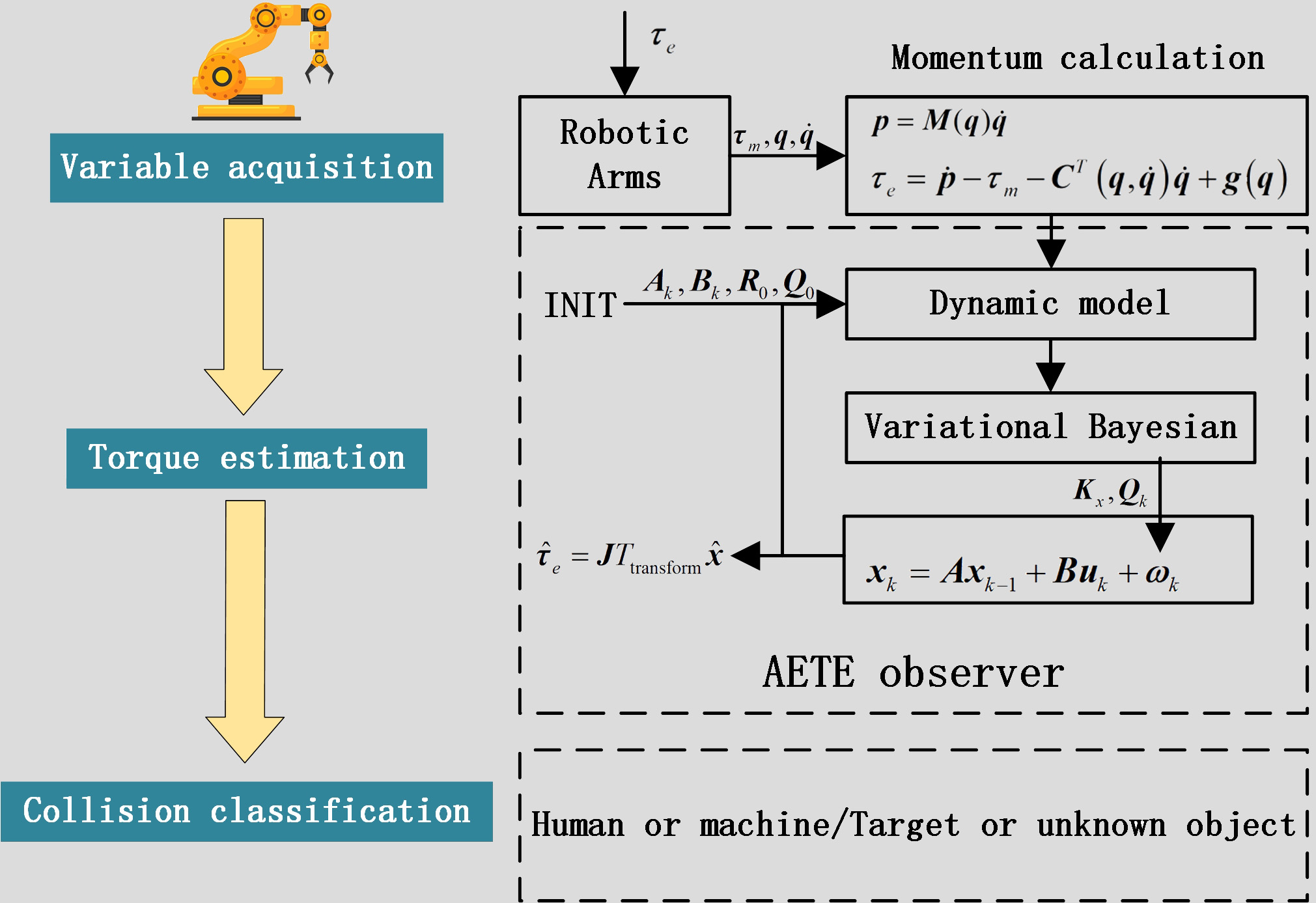
As robotic applications rapidly expand into increasingly complex and dynamic environments, greater emphasis is being placed on the intelligence and safety of human–robot collaboration at the task execution level. In shared human–robot workspaces, even the most precise motion planning cannot fully prevent collisions. To address this critical safety concern, we propose a variational Bayesian Kalman filtering–based external torque estimation algorithm that integrates the robot’s dynamic model while avoiding additional system complexity. We begin by reviewing the robot dynamics framework and the classical external torque estimation method based on generalized momentum. We then derive a Kalman filter–based approach for external torque estimation in robotic manipulators and analyze the adverse effects arising from mismatches in process noise covariance. Finally, we introduce a sliding window–based variational Bayesian Kalman filter, which dynamically estimates the current process noise covariance while simultaneously mitigating the accumulation of recursive errors.
Keywords:
robotic arm
; Bayesian estimation
; collision detection
; torque estimation
1. Introduction
In physical human–robot interaction (pHRI) [1,2], quantifying the severity of collisions on the human body provides critical guidance for higher-level systems in managing post-collision events. Haddadin et al. [3,4] systematically investigated this problem through extensive experiments, quantifying the severity of impacts on different parts of the human body. Their results demonstrated that relative velocity, effective mass, and the elastic modulus of the contact surface all influence collision severity, with the relative velocity at impact identified as the dominant factor. In contrast, the contribution of the robot’s reflected mass exhibits a saturation effect [5,6]. Building on this work, Haddadin later introduced the concept of a “collision event pipeline” [7], a generic stage-based framework that decomposes the collision process into multiple phases to facilitate systematic analysis.
A generalized momentum–based collision detection method was first introduced by Haddadin [3] and experimentally validated in various pHRI scenarios. This approach is simple to implement, requires no external sensors, and has demonstrated broad applicability. At its core, the first-order momentum observer (FOMO) estimates external torques by computing momentum residuals, without relying on joint angular accelerations or the inverse of the inertia matrix, thereby substantially reducing sensitivity to measurement noise [8]. Building on this framework, the second-order momentum observer (SOMO) [9] exhibits stronger robustness to velocity noise, albeit at the expense of slower response and without a complete theoretical proof. An improved second-order observer [10,11] enhances dynamic performance by incorporating a feedforward term, which shortens response time but compromises disturbance rejection relative to the standard SOMO. More recently, Liu [12] proposed a higher-order generalized momentum observer that achieves stronger disturbance rejection by adopting a higher cutoff frequency, though at the cost of increased computational burden inherent to higher-order systems.
Kalman filtering has shown strong potential for suppressing noise in external torque estimation. Wahrburg et al. [13] first applied Kalman filtering to robotic manipulators, formulating a state-space model based on generalized momentum that effectively attenuated noise but exhibited limited performance in handling nonlinearities such as friction. Moreover, due to the inherent properties of Kalman filtering, inaccuracies in covariance matrices led to amplified estimation errors. To address these limitations, Yigit et al. [14] employed the extended Kalman filter (EKF), which improved robustness against nonlinear factors including friction, though estimation accuracy remained suboptimal. Wang et al. [15] further advanced this approach by integrating encoder and accelerometer measurements within an EKF framework to estimate link-side states, achieving substantial improvements in estimation precision and dynamic responsiveness. However, the reliance on accelerometers increased both system cost and complexity. More recently, Dong et al. [14] proposed a sliding-window variational adaptive Kalman filtering method grounded in an error-probability model. By adaptively updating the external force parameters of the ECM within the process model, this approach significantly reduced estimation error without requiring additional sensors.
In recent years, extensive efforts have been devoted to adaptive Kalman filtering algorithms and external torque estimation [16,17,18] in robotic systems. A defining feature of adaptive Kalman filters is their ability to provide real-time estimates of noise covariance. For example, Ref. [19] employed perturbation analysis of the discrete-time algebraic Riccati equation (DARE) to examine the sensitivity of Kalman filters to deviations in noise covariance estimates, thereby assessing estimation accuracy. Building on this line of work, Zhenwei Li et al. [20] developed a variational Bayesian maximum correntropy cubature Kalman filter with adaptive kernel bandwidth, where the bandwidth was updated online using Mahalanobis distance. This approach substantially reduced the influence of non-Gaussian measurement noise on the estimation results. However, the method suffers from high computational cost and sensitivity to parameter tuning, which constrains its applicability in broader scenarios.
In this work, we propose a Kalman filtering–based algorithm for estimating interaction torques in robotic manipulators under conditions of uncertain or time-varying process noise covariance. The method employs variational inference to estimate unknown process noise covariances, decoupling noise parameters from manipulator configurations and payload characteristics. At each measurement cycle, the posterior probability density function of the noise covariance is iteratively updated within a closed-form variational Bayesian framework, yielding an approximate Gaussian posterior of the process noise. This enables optimal external torque estimation through Kalman filtering. The approach is experimentally validated on a Franka manipulator and benchmarked against several state-of-the-art methods for external torque estimation in real robotic systems.
2. Materials and Methods
2.1. System Dynamics of Robotic Manipulators
When a robotic manipulator interacts with the external environment through force exchange, and assuming rigid joints and rigid links, the system dynamics can be described by the following equation of motion [21]:
where the position and velocity of the linkage are denoted by where n is the number of joints, respectively, and the two variables are the states of the robot. denotes the symmetric positive definite inertia matrix, denotes the Coriolis matrix satisfying passivity and is the gravity torque vector. The torque generated by the motor and the external torque are the inputs to the system.
From the reformulation of the manipulator dynamics under the momentum concept, we obtain:
The standard KF provides the optimal linear estimate of system states under the assumption of an accurate model, even in the presence of noisy measurements. To estimate the interactive torque of a robotic arm using the KF, a model of the robotic arm must be formulated. In this context, and a noise term . The time derivative of momentum can be interpreted as the resultant of all forces acting on the system at that moment. Consequently, the dynamic equation of the robotic arm can be rewritten as:
Following the design principle of the classical disturbance observer, the driving torque is modeled as a constant, whereas the derivative of the external torque is treated as noise-driven. Set , , and the system state variables are defined as , can thus be formulated in the following state-space form:
Here, denotes the measured generalized momentum, represents the system measurement noise, and by augmenting the system state variable , it follows that the process noise is assumed to follow the normal distribution:
Here, and denote components of the system process noise covariance matrix, while represents the system measurement noise covariance matrix.
Accordingly, the state-space representation can be rewritten as:
where, , , upon discretization, the equation can be written as:
Discretization of the above equation yields:
Meanwhile, the parameters of the system state equation can be expressed as: , , , and is sampling time.
2.2. Effects of Noise Modeling Inaccuracies on External Torque Estimation
The optimality of the Kalman filter fundamentally depends on accurate knowledge of process and measurement noise covariances. However, in robotic manipulators, process noise varies with configuration and joint velocity, making fixed covariance assumptions unrealistic. Such mismatches reduce estimation accuracy, leading to false collision detections or erroneous external torque estimates that may compromise system safety. Prior work [14,22] analyzed these effects by comparing filter-calculated (FMSE), true (TMSE), and ideal (IMSE) mean squared errors, providing a quantitative view of estimation error under covariance mismatch.
To analyze the performance of the filter under conditions of process noise covariance mismatch, the process noise covariance matrix is defined as follows:
Here, denotes the process noise covariance matrix employed in the filtering equations, represents the true process noise covariance matrix of the system, and denotes the deviation between them. When the practically applied process noise covariance matrix is substituted into the Kalman filter framework, the recursive form of the filter can be expressed as:
Here, the superscript f denotes the output term computed by the filter. According to the recursive equations, at time step k, the covariance matrix must be calculated under the current state estimate . However, due to the substitution of , the state estimates across two consecutive time steps are given by:
In the presence of covariance mismatch , the covariance matrix under the ideal mean squared error (IMSE) fails to capture the true estimation error of the Kalman filter, thereby distorting the update of the Kalman gain .
2.3. Variational Inference–Based Adaptive External Torque Estimation Algorithm
The complexity of robotic systems makes process noise difficult to model, which limits the accuracy of Kalman filter–based external torque estimation. To address time-varying and non-Gaussian noise, we employ variational inference to approximate latent variable distributions from historical system data, enabling online estimation of the noise covariance. This adaptive framework allows dynamic parameter adjustment in response to noise variations, thereby improving the accuracy of external torque estimation for robotic systems.
Building on the feasibility of Kalman filtering for external torque estimation in robotic manipulators, the modeling error of ultimately leads to inaccuracies in torque estimation. The problem addressed in this section therefore reduces to deriving an approximate distribution of in order to improve the accuracy of external torque estimation.
Using variational inference, this subsection provides a detailed derivation of the implementation of variational Kalman filtering within robotic dynamics, with the estimation procedure encapsulated into an algorithmic module. It is assumed that the system noise is governed by an independent dynamic model, decoupled from the system state variable :
According to the Chapman–Kolmogorov relation, the prior of the system state jointly with the process noise covariance is given by:
with the incorporation of the subsequent measurement, Bayes’ theorem yields the posterior distribution:
Variational inference approximates an intractable posterior with a tractable distribution, reformulating inference as the optimization of a closed-form variational distribution. Recalling the prediction step of the classical Kalman filter:
In this formulation, denotes the state transition matrix. The predicted covariance matrix depends not only on the process noise covariance matrix , but also on . To fully characterize the predicted covariance, we introduce a latent variable , leading to the representation .
The process noise covariance matrix is assumed to have a prior governed by an Inverse-Wishart (IW) distribution.According to mean-field theory, one obtains:
For brevity, is used in place of , yielding:
Formally, the divergence between and is defined as:
By the evidence lower bound (ELBO) property, we obtain:
Expanding yields:
It is straightforward to derive the approximate posterior distributions of , , and .
where is an indeterminate constant, and set , we obtain:
Under the stated assumption, , , :
accordingly, we have:
The variational Kalman-based external torque estimation method employs a closed-loop iterative scheme to estimate the process noise covariance, which is then incorporated into the momentum-based Kalman filter torque observer. This formulation preserves the linear optimality of the Kalman filter even under covariance mismatch.
3. Results
To evaluate the performance of the proposed torque estimation algorithm, experiments were conducted on the Franka robotic arm, chosen as the platform for collision detection and external torque estimation. Developed by Franka Emika in Germany, Franka integrates high precision, flexibility, and safety, and is widely employed in research and industry. Each joint is equipped with a high-resolution torque sensor (<0.05 N), making it particularly suitable for experimental validation.
Figure 1.
Robotic arm experimental platform.
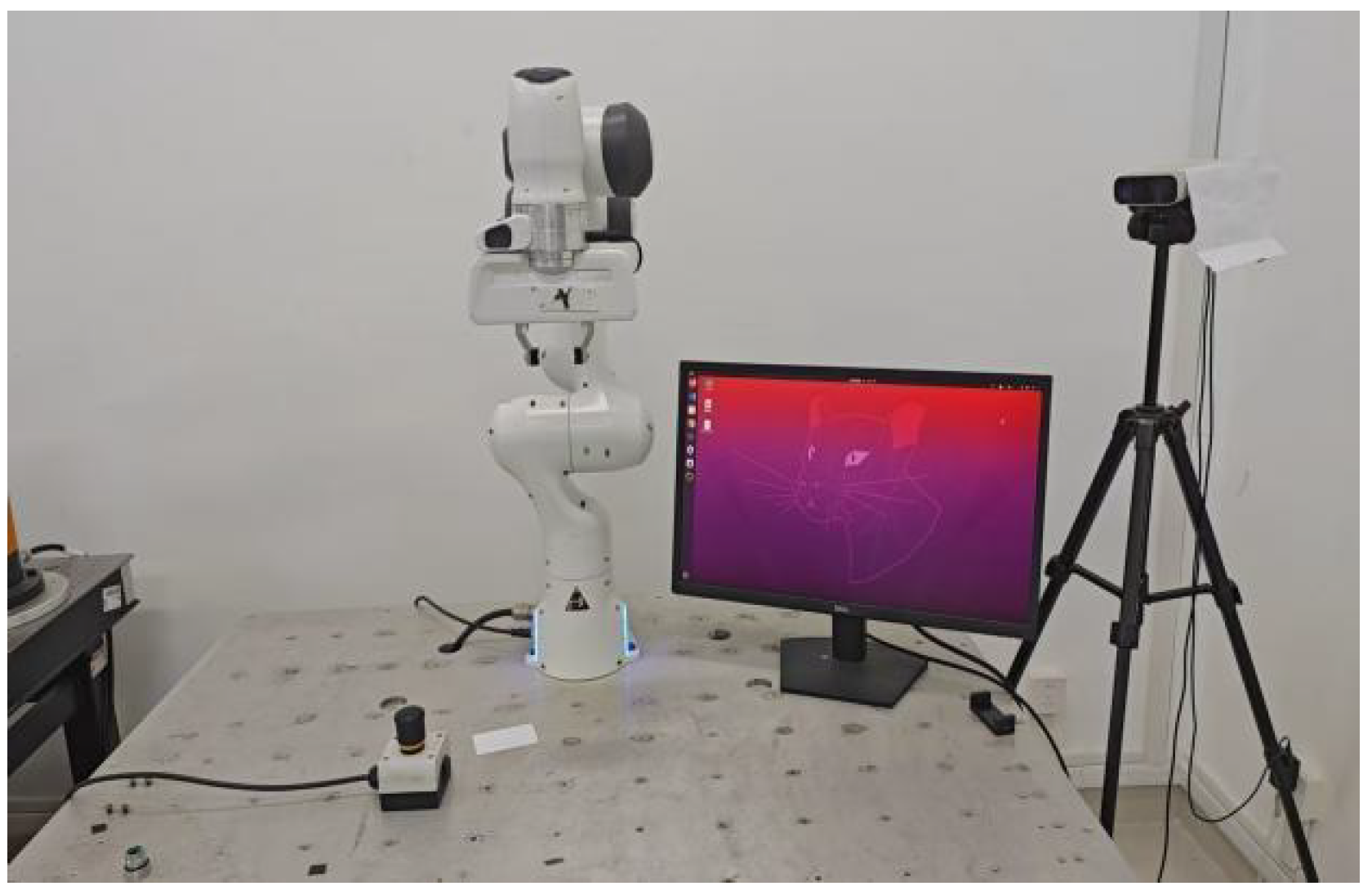
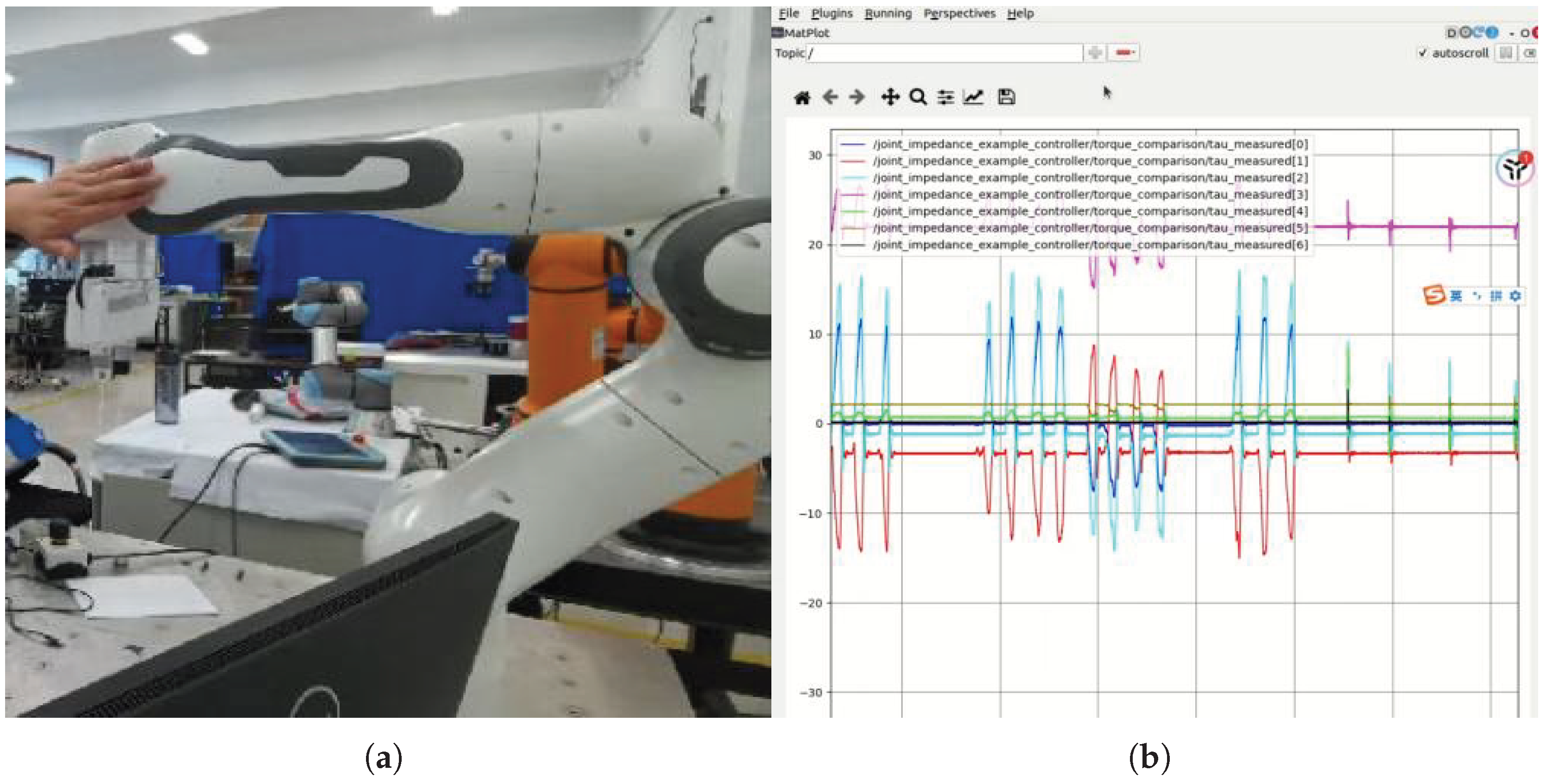
The experimental protocol comprised three scenarios: torque estimation under fixed-configuration, no-load conditions to assess noise suppression; rigid-box impacts at the end-effector to evaluate collision detection; and transient human-hand interactions to examine external torque estimation under compliant contact.
Figure 2.
(a)Transient hand-induced impact and push on the robotic arm. (b) Corresponding sensor data recorded during the interaction.
Figure 2.
(a)Transient hand-induced impact and push on the robotic arm. (b) Corresponding sensor data recorded during the interaction.
External torque of the Franka arm under collision-free conditions was estimated using ESO, KFMO, SH-AKFMO, and VBKFMO-Q.
Figure 3 indicates that, even in the absence of external forces, all considered momentum observers exhibit non-negligible estimation bias arising from modeling inaccuracies. During external torque estimation, abrupt transients may be erroneously interpreted as collisions. However, the observations presented in Figure 4 reveal that the absolute estimation errors remain low across the different observers, minimizing the likelihood of false collision detection. This pattern is further substantiated by the results summarized in Table 1.
Figure 5 and Figure 6 depict the observer outputs and corresponding joint-wise external torque estimation errors during collisions with a rigid object. Notably, for joints 1 through 4, ESO and KF exhibit substantial overshoot and discernible phase lag, whereas joints 5 through 7 show comparable performance across all four observers. This discrepancy arises because the collision occurs near the end-effector, with proximal joints (5–7) experiencing minimal perturbation, resulting in estimation behavior akin to collision-free conditions.
Evaluation based on root-mean-square error indicates that VBKFMO-Q achieves marginally superior external torque estimation relative to SH-AKFMO, while ESO and KF demonstrate considerably lower accuracy.
Figure 7 depicts joint torque estimation during a brief ( 0.5 s) interaction with a compliant object (human hand) at the robotic arm’s end-effector, showing the external torque observations from the different observers. The corresponding joint-wise estimation error curves are presented in Figure 8, and Table 2 summarizes the root-mean-square errors for each observer throughout this interaction. Notably, the red dashed line represents the proposed VBKFMO-Q observer, which exhibits superior rapid response and estimation accuracy under soft contact conditions, closely approximating the actual external torque. Its smooth output profile further underscores its suitability for practical engineering applications.

Table 2.
Joint torque estimation RMS errors during high-stiffness impacts.
| Algorithm | ESO | KFMO | SH-AKFMO | VBKFMO-Q |
|---|---|---|---|---|
| RMSE(J1) | 1.3122 | 1.3756 | 0.4347 | 0.331 |
| RMSE(J2) | 2.9709 | 2.7695 | 1.4114 | 1.3468 |
| RMSE(J3) | 2.4096 | 2.1156 | 1.0478 | 1.1456 |
| RMSE(J4) | 0.8097 | 0.8055 | 0.2118 | 0.1577 |
| RMSE(J5) | 0.429 | 0.4187 | 0.4582 | 0.4479 |
| RMSE(J6) | 0.1144 | 0.099 | 0.1173 | 0.1154 |
| RMSE(J7) | 0.1181 | 0.0917 | 0.1124 | 0.1143 |
Table 3.
Joint torque estimation RMS errors during compliant contact (human hand).
| Algorithm | ESO | KFMO | SH-AKFMO | VBKFMO-Q |
|---|---|---|---|---|
| RMSE(J1) | 1.0266 | 0.8956 | 1.0259 | 0.286 |
| RMSE(J2) | 0.8367 | 0.6369 | 0.8364 | 0.4485 |
| RMSE(J3) | 1.3626 | 1.2528 | 1.3612 | 1.0145 |
| RMSE(J4) | 1.0637 | 0.9181 | 1.0622 | 0.4996 |
| RMSE(J5) | 0.1237 | 0.0791 | 0.1244 | 0.042 |
| RMSE(J6) | 0.1017 | 0.0876 | 0.1439 | 0.0968 |
| RMSE(J7) | 0.0715 | 0.0661 | 0.0737 | 0.0762 |
Root-mean-square error analysis demonstrates that, in line with the preceding two experimental scenarios, the proposed algorithm consistently yields lower RMS errors, with torque trajectories exhibiting both smoothness and rapid dynamic response. A consistent observation across all three experiments is that, given end-effector contact, torque estimations and corresponding RMS errors progressively smooth with increasing joint indices. This phenomenon reflects that, under sufficiently accurate modeling, joints distal to the collision site are subject to attenuated perturbations, thereby providing a rigorous basis for subsequent collision isolation and identification.
4. Conclusions
In this work, an adaptive external torque estimation algorithm for robotic manipulators was proposed, capable of automatically adjusting the system process noise covariance matrix. First, commonly used generalized momentum observers were reviewed and derived based on the robot dynamics model to address human-robot safety requirements. Then, an external torque estimation method grounded in generalized momentum was described, and the effects of covariance mismatch on Kalman filter estimation were analyzed. To handle practical situations where the system process noise is unknown and difficult to model, a method was developed to adaptively adjust the process noise covariance matrix using historical data, which was then incorporated into the Kalman filter recursive equations to improve estimation accuracy. The algorithm was validated experimentally on the Franka manipulator under three scenarios: static with no external torque, collision with a rigid object, and brief contact with a compliant object. The results demonstrate that the proposed method provides fast and accurate external torque estimates without additional sensors, offering a reliable basis for safe operation in human-robot collaborative tasks.
Author Contributions
The authors’ main tasks were as follows: C.Y. performed the data analysis and wrote the manuscript; M.L. performed the formal analysis; Y.C. performed the validation; Y.C. made article changes; J.Z. performed the supervision. All authors have read and agreed to the published version of the manuscript.
Funding
This work was not commercially funded.
Institutional Review Board Statement
Not applicable.
Informed Consent Statement
Not applicable.
Data Availability Statement
Data available upon request from the authors. The data that support the findings of this study are available from the corresponding author, upon reasonable request.
Acknowledgments
Throughout the writing of this dissertation I have received a great deal of support and assistance. I would like to thank my supervisor, Jie Zhang, who gave me guidance and financial support for this work. I would also like to thank my team members who assisted me in completing the project together.
Conflicts of Interest
The authors declare no conflict of interest.
References
- Ajoudani, A.; Zanchettin, A.M.; Ivaldi, S.; Albu-Schäffer, A.; Kosuge, K.; Khatib, O. Progress and prospects of the human–robot collaboration. Autonomous robots 2018, 42, 957–975. [Google Scholar] [CrossRef]
- Yokoyama, M.; Petrea, R.A.B.; Oboe, R.; Shimono, T. External force estimation in linear series elastic actuator without load-side encoder. IEEE Transactions on Industrial Electronics 2020, 68, 861–870. [Google Scholar] [CrossRef]
- Haddadin, S. Towards safe robots: approaching Asimov’s 1st law; Springer, 2013; Vol. 90. [Google Scholar]
- Haddadin, S.; Albu-Schaffer, A.; De Luca, A.; Hirzinger, G. Collision detection and reaction: A contribution to safe physical human-robot interaction. In Proceedings of the 2008 IEEE/RSJ International Conference on Intelligent Robots and Systems; IEEE, 2008; pp. 3356–3363. [Google Scholar]
- Siciliano, B.; Khatib, O. Robotics and the handbook. In Springer Handbook of Robotics; Springer, 2016; pp. 1–6. [Google Scholar]
- Li, W.; Han, Y.; Wu, J.; Xiong, Z. Collision detection of robots based on a force/torque sensor at the bedplate. IEEE/ASME Transactions on Mechatronics 2020, 25, 2565–2573. [Google Scholar] [CrossRef]
- Haddadin, S.; De Luca, A.; Albu-Schäffer, A. Robot collisions: A survey on detection, isolation, and identification. IEEE Transactions on Robotics 2017, 33, 1292–1312. [Google Scholar] [CrossRef]
- Nosratollahi, M.; Delalat, M. Comparison of dynamic models for aerial target tracking maneuvers based on stability and measurement loss. Iranian Journal of Science and Technology, Transactions of Mechanical Engineering 2023, 47, 541–556. [Google Scholar] [CrossRef]
- Park, K.M.; Park, Y.; Yoon, S.; Park, F.C. Collision detection for robot manipulators using unsupervised anomaly detection algorithms. IEEE/ASME Transactions on Mechatronics 2021, 27, 2841–2851. [Google Scholar] [CrossRef]
- Wan, H.; Chen, S.; Zhang, C.; Chen, C.Y.; Yang, G. Compliant control of flexible joint by dual-disturbance observer and predictive feedforward. IEEE/ASME Transactions on Mechatronics 2023, 28, 1890–1899. [Google Scholar] [CrossRef]
- Jiang, Y.; Wu, Y.; Wu, X.; Zhao, B. Research on collision detection of collaborative robot using improved momentum-based observer. In Proceedings of the 2023 IEEE IAS Global Conference on Emerging Technologies (GlobConET). IEEE; 2023; pp. 1–6. [Google Scholar]
- Liu, H.; Wang, X.; Chen, L. Disturbance observer-based force estimation and fault detection for robotic manipulator in radioactive environments. IEEE Access 2022, 10, 105303–105318. [Google Scholar] [CrossRef]
- Wahrburg, A.; Bös, J.; Listmann, K.D.; Dai, F.; Matthias, B.; Ding, H. Motor-current-based estimation of cartesian contact forces and torques for robotic manipulators and its application to force control. IEEE Transactions on Automation Science and Engineering 2017, 15, 879–886. [Google Scholar] [CrossRef]
- Yigit, C.B.; Bayraktar, E.; Kaya, O.; Boyraz, P. External force/torque estimation with only position sensors for antagonistic VSAs. IEEE Transactions on Robotics 2020, 37, 675–682. [Google Scholar] [CrossRef]
- Wang, Z.; Liu, S.; Huang, B.; Luo, H.; Min, F. Forced servoing of a series elastic actuator based on link-side acceleration measurement. Actuators 2023, 12, 126. [Google Scholar]
- Xiang, Q.; Chen, C.; Jiang, Y. Servo Collision Detection Control System Based on Robot Dynamics. Sensors 2025, 25, 1131. [Google Scholar] [CrossRef] [PubMed]
- Oščádal, P.; Kot, T.; Spurnỳ, T.; Suder, J.; Vocetka, M.; Dobeš, L.; Bobovskỳ, Z. Camera arrangement optimization for workspace monitoring in human–robot collaboration. Sensors 2022, 23, 295. [Google Scholar] [CrossRef] [PubMed]
- Dong, J.; Xu, J.; Wang, L.; Liu, A.; Yu, L. External force estimation of the industrial robot based on the error probability model and SWVAKF. IEEE Transactions on Instrumentation and Measurement 2022, 71, 1–11. [Google Scholar] [CrossRef]
- Sassano, M. Policy Algebraic Equation for the Discrete-Time Linear Quadratic Regulator Problem. IEEE Transactions on Automatic Control 2024. [Google Scholar] [CrossRef]
- Li, Z.; Ouyang, S.; Cheng, Y.; Wang, H.; Chen, K. A Variational Bayesian Maximum Correntropy Cubature Kalman Filter with Adaptive Kernel Bandwidth. In Proceedings of the 2023 IEEE International Conference on Signal Processing, Communications and Computing (ICSPCC). IEEE; 2023; pp. 1–6. [Google Scholar]
- Na, J.; Jing, B.; Huang, Y.; Gao, G.; Zhang, C. Unknown system dynamics estimator for motion control of nonlinear robotic systems. IEEE Transactions on Industrial Electronics 2019, 67, 3850–3859. [Google Scholar] [CrossRef]
- Shao, T.; Duan, Z.; Ge, Q.; Liu, H. Recursive performance ranking of Kalman filter with mismatched noise covariances. IET Control Theory & Applications 2019, 13, 459–466. [Google Scholar] [CrossRef]
Figure 3.
Joint torque estimates for all seven joints under zero external torque.
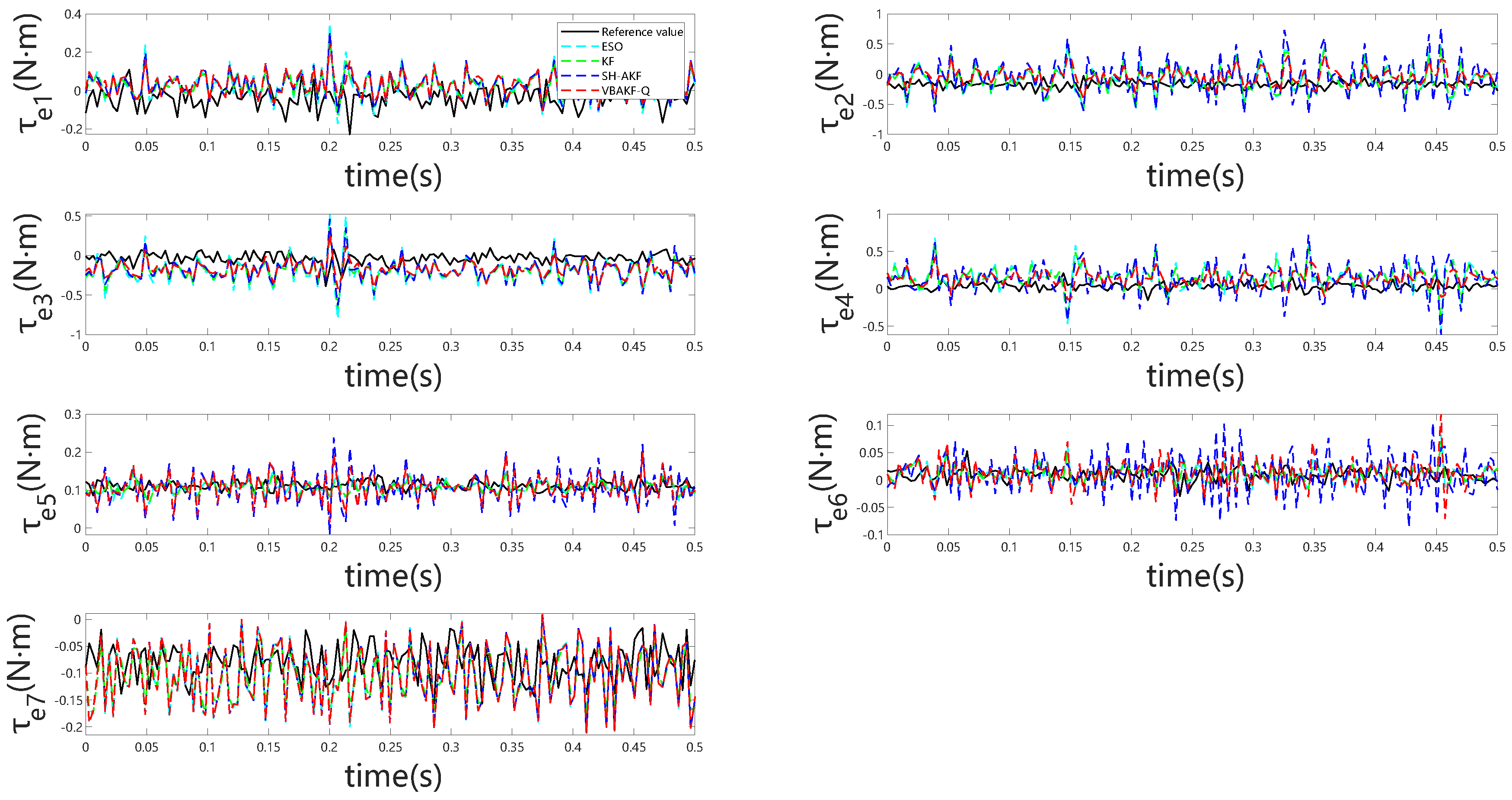
Figure 4.
Joint torque estimation errors for all seven joints under no external torque.
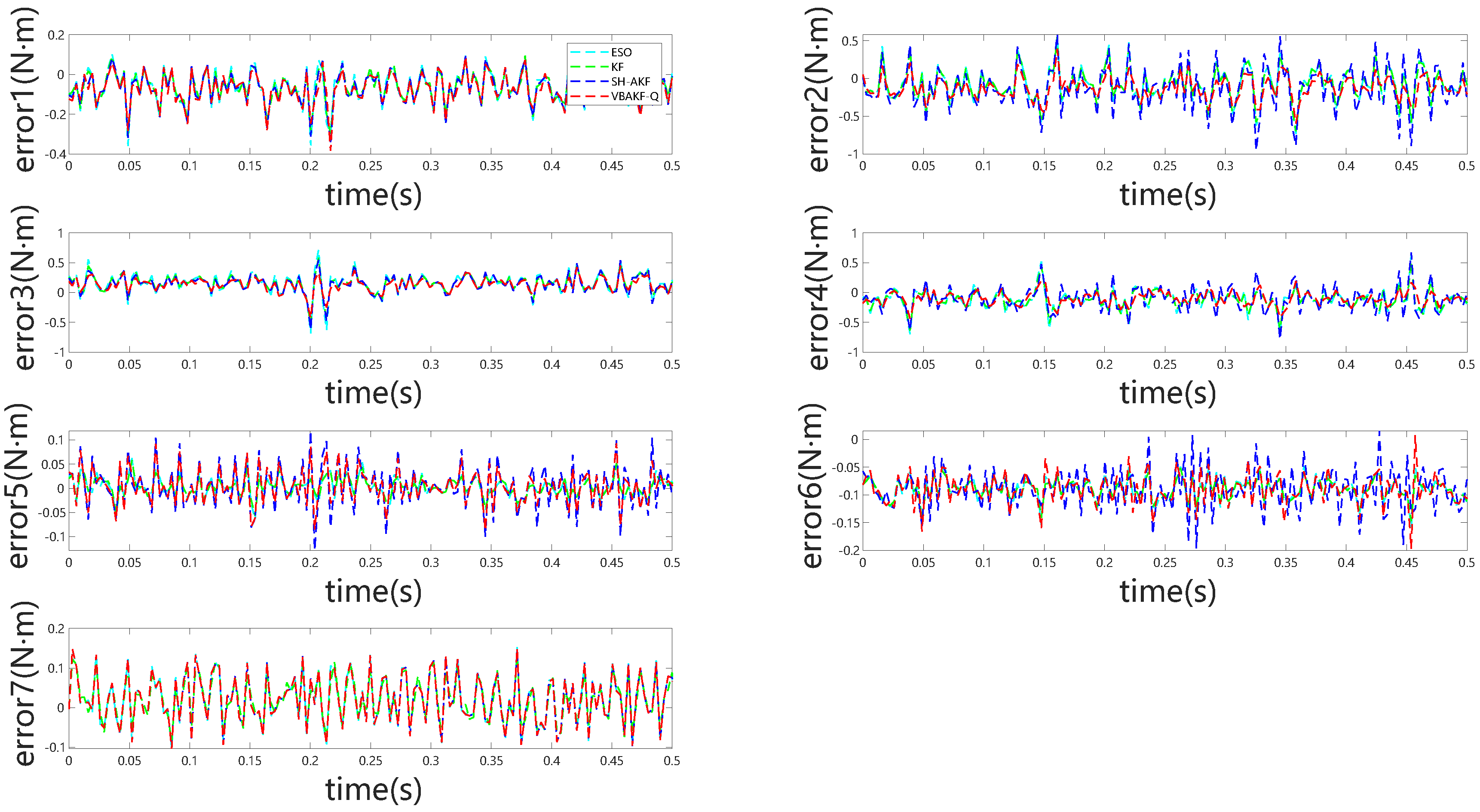
Figure 5.
Joint torque estimates for all seven joints during collision with a rigid object.
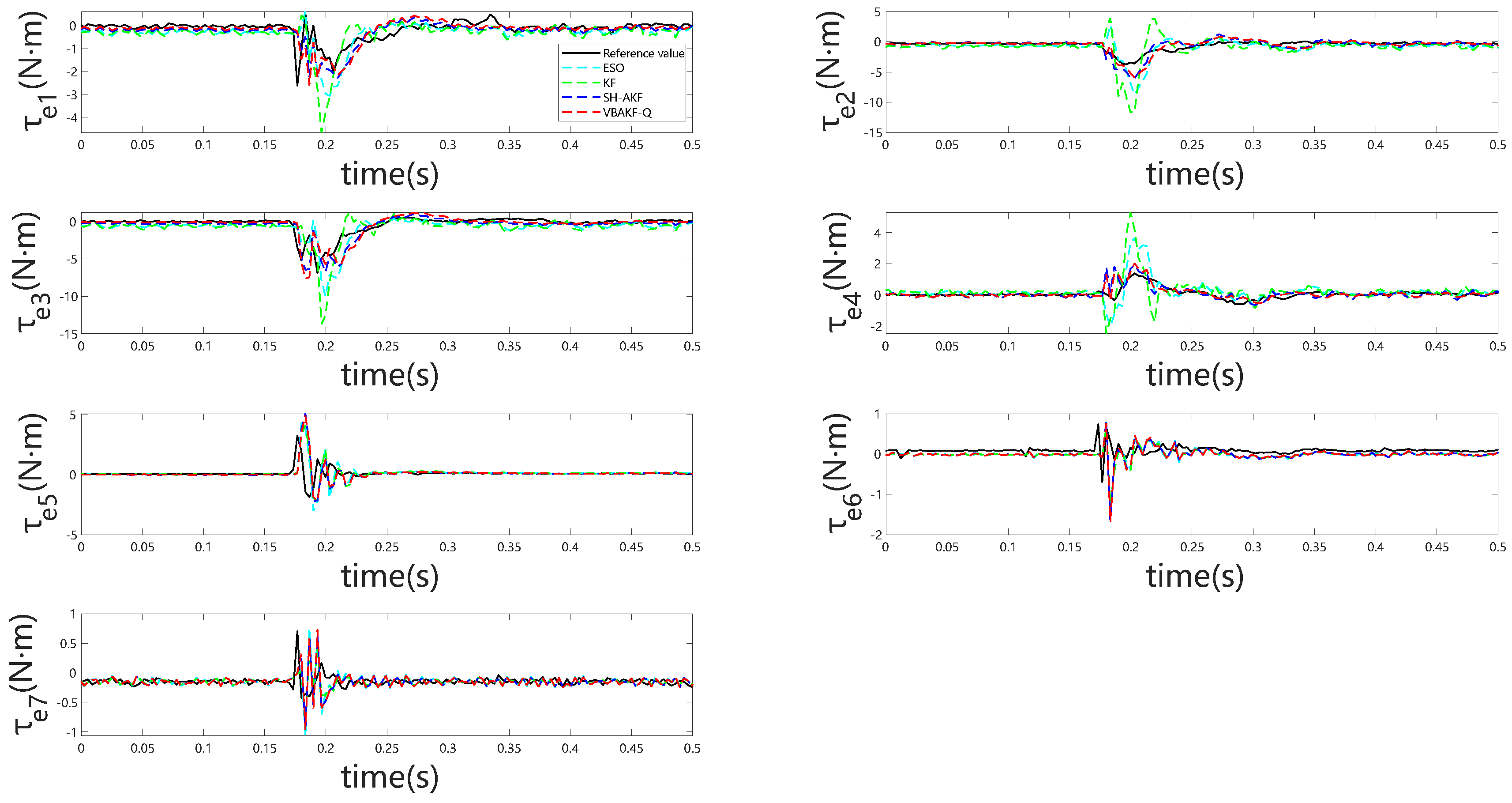
Figure 6.
Joint torque estimation errors for all seven joints under rigid object collision.
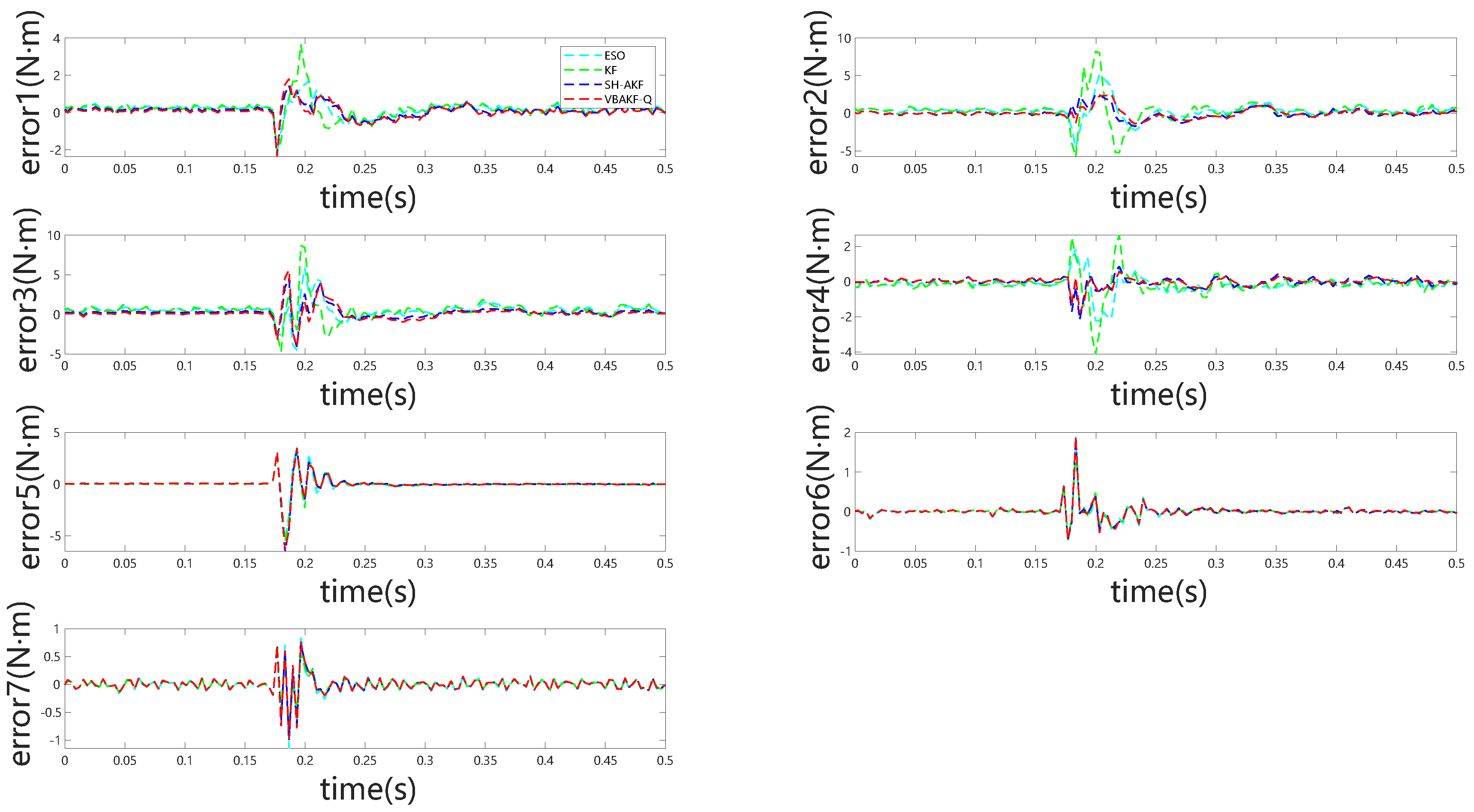
Figure 7.
Joint torque estimates during interaction with a soft object (human hand).
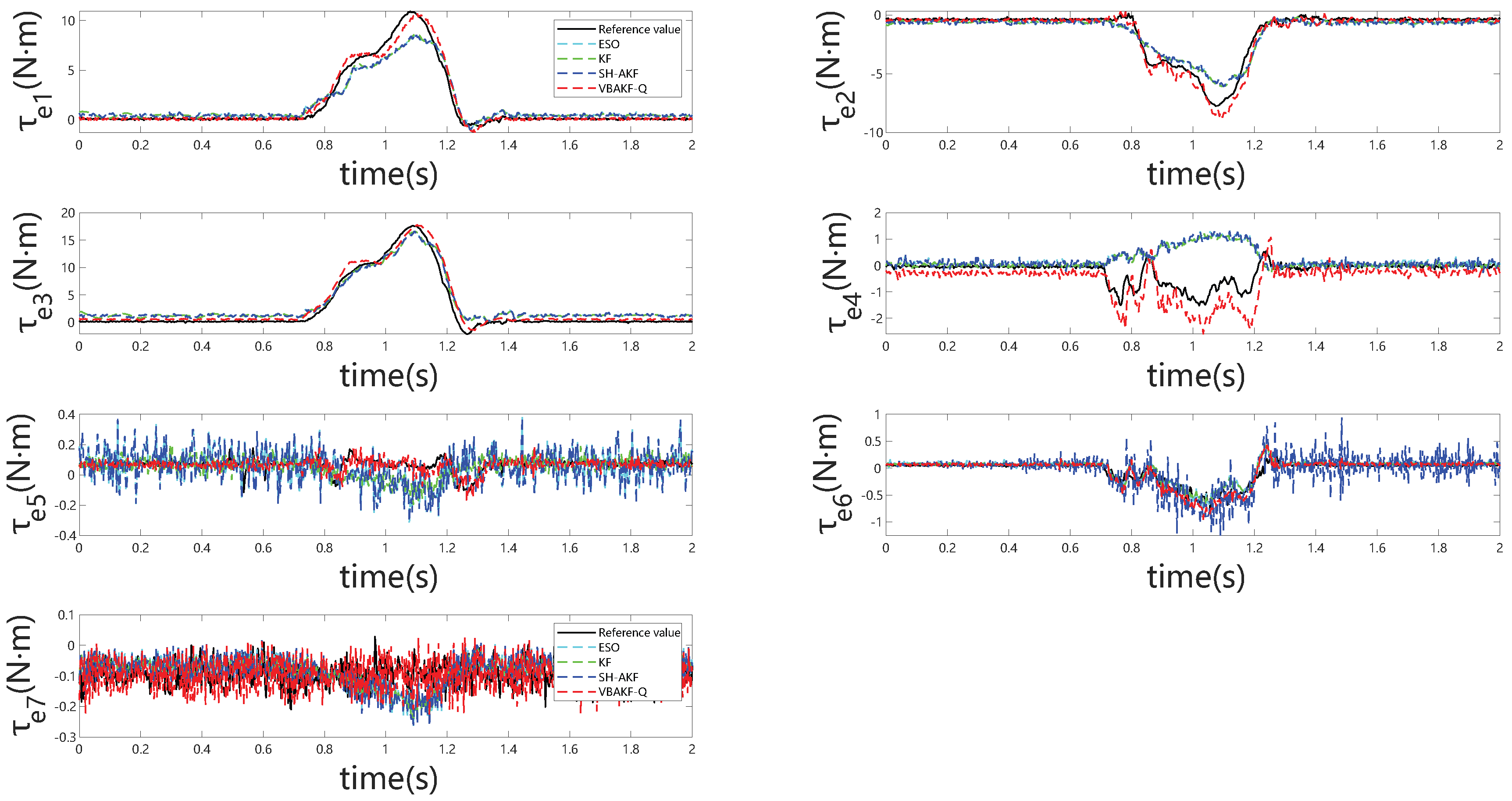
Figure 8.
Joint torque estimation errors during interaction with a soft object (human hand).
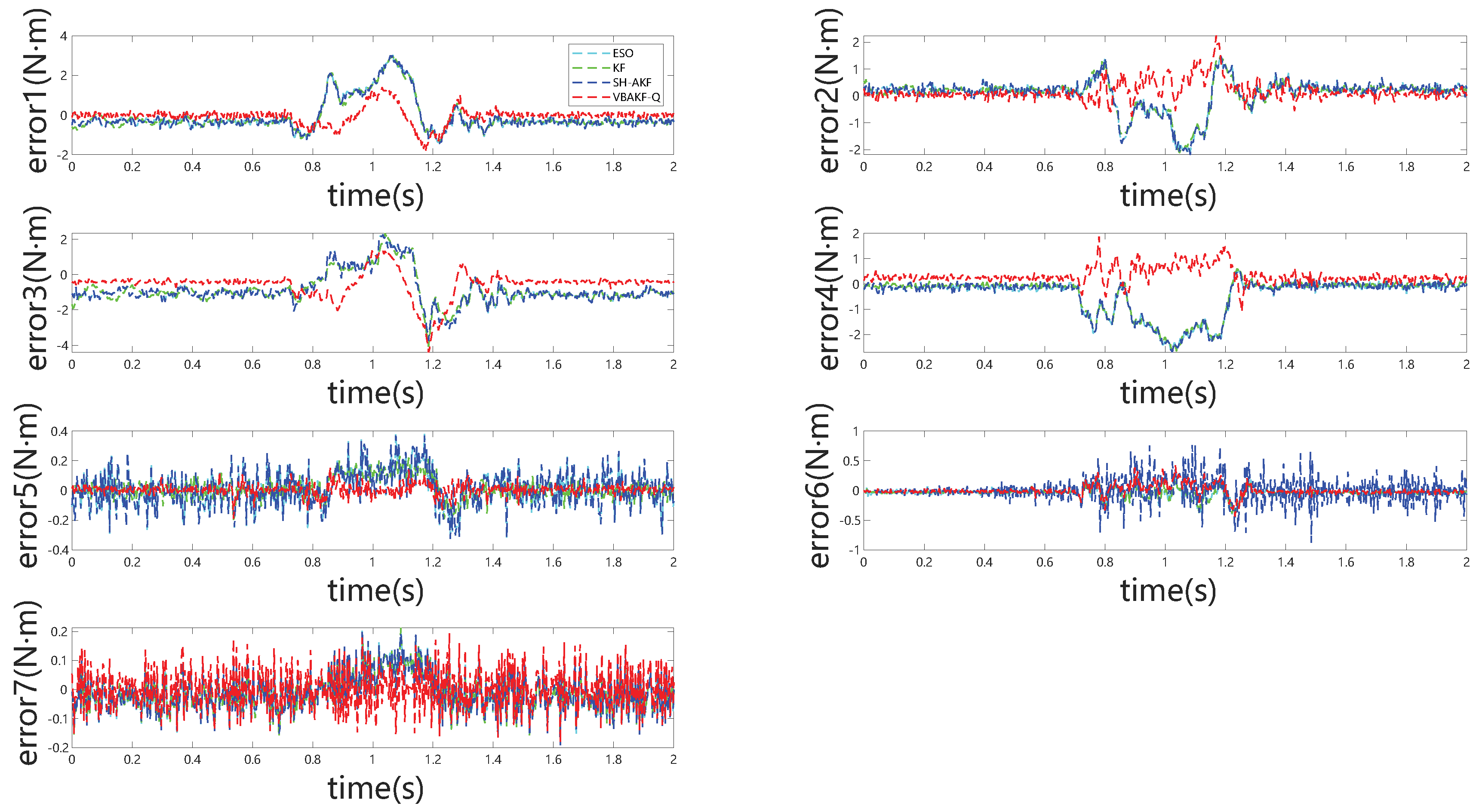
Table 1.
Joint torque estimation RMS errors under collision-free conditions.
| Algorithm | ESO | KFMO | SH-AKFMO | VBKFMO-Q |
|---|---|---|---|---|
| RMSE(J1) | 0.1091 | 0.0935 | 0.1068 | 0.1045 |
| RMSE(J2) | 0.085 | 0.0819 | 0.1314 | 0.1261 |
| RMSE(J3) | 0.2358 | 0.1827 | 0.2113 | 0.1773 |
| RMSE(J4) | 0.2844 | 0.1166 | 0.0975 | 0.1001 |
| RMSE(J5) | 0.032 | 0.0166 | 0.0478 | 0.0377 |
| RMSE(J6) | 0.1105 | 0.0895 | 0.0894 | 0.0896 |
| RMSE(J7) | 0.0692 | 0.0594 | 0.0687 | 0.0688 |
Disclaimer/Publisher’s Note: The statements, opinions and data contained in all publications are solely those of the individual author(s) and contributor(s) and not of MDPI and/or the editor(s). MDPI and/or the editor(s) disclaim responsibility for any injury to people or property resulting from any ideas, methods, instructions or products referred to in the content. |
© 2025 by the authors. Licensee MDPI, Basel, Switzerland. This article is an open access article distributed under the terms and conditions of the Creative Commons Attribution (CC BY) license (http://creativecommons.org/licenses/by/4.0/).
Copyright: This open access article is published under a Creative Commons CC BY 4.0 license, which permit the free download, distribution, and reuse, provided that the author and preprint are cited in any reuse.


