

Submitted:
13 September 2025
Posted:
15 September 2025
You are already at the latest version
Abstract
This survey paper explores the integration of Blockchain and the Internet of Things (IoT) in healthcare, focusing on how these technologies can address critical challenges such as data security, interoperability, and privacy. It aims to provide an overview of the current applications and future potential of these technologies in enhancing healthcare delivery. The paper employs a comprehensive survey methodology, reviewing literature published between 2015 and early 2025. Studies were selected based on their relevance to the intersection of Blockchain and IoT within healthcare systems, and key challenges and opportunities were identified from the research findings. The integration of Blockchain and IoT is shown to offer significant improvements in areas such as remote patient monitoring, medication management, and predictive analytics. However, challenges remain regarding scalability, regulatory compliance, and data interoperability. The paper identifies emerging applications and discusses the current state of adoption in healthcare. Blockchain and IoT have the potential to revolutionize healthcare by providing secure, transparent, and efficient systems for managing patient data. Despite challenges, the paper suggests that focused research on scalability, interoperability, and regulatory frameworks is essential to successfully integrate these technologies into healthcare infrastructures.
Keywords:
blockchain
; Internet of Things (IoT)
; healthcare security
; data interoperability
1. Introduction
Numerous health providers, including pharmacies and hospitals, are now equipped with various resources facilitated by Information and Communication Technology (ICT). Blockchain, a decentralized digital architecture, holds significant potential for enhancing healthcare record security, validity, and auditability. Blockchain operates by storing data in a distributed ledger across multiple computers or nodes, ensuring the same ledger copy is accessible to all parties involved in a transaction. Data blocks are connected to form a chain, protected by encryption and verified using cryptographic hash functions [73,74]. Unlike centralized databases, blockchain enables greater trust due to its decentralized nature, offering enhanced security, transparency, and traceability. Permissioned blockchains restrict network participation and data access [75]. Blockchain applications in healthcare span various areas, including patient data management, interoperability, clinical trial management, and mHealth integration. Many blockchain efforts are still in early stages, with major tech companies investing in its research. By 2026, the World Economic Forum predicts that 10% of global GDP will be stored on blockchain [76]. Currently, healthcare and life sciences are in the early phases of blockchain adoption [77]. Despite the evident benefits, implementing blockchain requires careful consideration of legal, regulatory, privacy, and business challenges specific to healthcare. A "fit-for-purpose" blockchain design framework is essential to address these issues [76].
IoT architecture, comprising five layers Perception, Network, Middleware, Application, and Business ensures system security by focusing on confidentiality, integrity, and availability (CIA). IoT attacks are categorized into physical, software, network, and encryption attacks [74]. In blockchain-based healthcare record management, patient data is protected while facilitating secure information exchange across institutions, enhancing predictive modeling without compromising data privacy [84,85,86,87,88,89]. Blockchain's application in healthcare is vital for improving patient care, biological research, and comparative studies [119,120]. Decisions on blockchain architecture, privacy, governance [121], and off-chain data management are critical for optimizing its implementation [76,77]. Despite advances in healthcare technology, the integration of data from various sources remains fragmented, leading to inefficiencies in patient care. This paper explores how Blockchain and IoT can overcome these issues by enhancing data security, ensuring interoperability, and streamlining patient monitoring processes. The healthcare sector faces pressing challenges related to data security, patient privacy, and interoperability across systems. Blockchain technology offers a decentralized solution that secures healthcare data, while IoT facilitates continuous and real-time monitoring of patient health. The convergence of Blockchain and IoT promises to tackle these challenges by enhancing the security, transparency, and accessibility of health data. This paper explores the synergy between these technologies, identifies key research gaps, and proposes directions for their integration into existing healthcare infrastructures.
This paper provides a comprehensive survey on the integration of Blockchain and the Internet of Things (IoT) in healthcare, highlighting the synergies between these technologies to address critical challenges such as data security, privacy, and interoperability. It reviews current applications, examines existing research, and identifies gaps in the literature, particularly focusing on the sustainable integration of Blockchain with IoT in healthcare systems. Additionally, the paper offers insights into the market opportunities for these technologies, presenting a roadmap for future research to enhance healthcare delivery and patient outcomes. By exploring these emerging trends, this paper contributes valuable perspectives to both academic research and industry practice in the evolving healthcare landscape.
2. Methodology
A systematic approach was employed to identify and select relevant literature for this comprehensive survey. The search was conducted across major academic databases, including IEEE Xplore, ACM Digital Library, Scopus, Web of Science, and PubMed, for studies published between 2015 and early 2025. The primary search strings used were: ("Internet of Things" OR IoT) AND (blockchain) AND (healthcare OR health), and their variants. The initial search yielded 1,250 records. After removing 350 duplicates, 900 records were screened based on their titles and abstracts.
Studies were included if they focused on the integration of IoT and blockchain technologies within healthcare applications. 650 records were excluded at this stage for not meeting the inclusion criteria, primarily for focusing on only one technology or on non-healthcare domains. The full text of the remaining 250 articles was assessed for eligibility. A further 100 studies were excluded due to a lack of technical implementation details or because they were deemed out of scope. Ultimately, 150 studies were selected for in-depth analysis and synthesis in this review. The study selection process is summarized in Figure 1.
3. Background and Fundamentals
Anonymous authentication with shown security for the WBAN, Tawalbeh et al. [17]. The role and capabilities of mobile cloud computing and big data analysis in networked healthcare were investigated. The applications of big data analytics in healthcare, methodology and tools are examined by this article. Ha and Hong [26] provided an overview of augmented reality (AR). They examined contemporary pharmaceutical uses. After discussing the fundamental idea, concise characteristics of the three AR-related parts (hardware, software, and application) are provided [122,123]. The authors evaluate numerous laboratory applications. Sreekanth and Nithya [54] studied healthcare system applications, ideas, and current technology. They underlined the distinctions between these strategies and provided a concise explanation about tailored IoT healthcare. They concentrated mostly on ubiquitous wearable devices that capture different patient-specific data. Khan [8] suggested and constructed an efficient healthcare monitoring system (HCMS) using IoT and RFID tags. This article's findings demonstrate the effectiveness against many medical crises. A mix of microcontrollers and sensors is employed in the proposed system to consideration evaluation results, track and measure the patient ’s progress, and expand the IoT's capabilities. Baker et al. [15] performed comprehensive research that examined the benefits, drawbacks, and general applicability of the wearing body sensor network (BSN) in the IoT healthcare system. Safety, confidentiality, hygiene, and reduced intake, as well as research proposals for the future are focused on paper. Minoli et al. [71] provided an OSiRM-based network framework and examined IoT deployment-related security tools and methodologies. These safeguards are particularly vital for e-health and assisted living. Blythe and Johnson [6] centered their development efforts on the CSI technique. When assessing the importance, attractiveness, or potential engagement of a security label, a team of IoT security professionals examines the desired security aspects. Oueida et al. [10] proposed an RPN architecture based on Pedi Net that blends edges and cloud technologies and is appropriate for emergency department systems (EDs). The RPN can relevant in actual conditions where critical performance metrics such as patient length of stay (LoS), patient health status, and treatment wait times are shaped and improved. A paradigm for an intelligent medicine box (iMedBox) was suggested by Srinivas et al. [33] The enabled devices alert sufferers to their medicine at the right moment and provide feedback via Android smartphone notifications. Pallavi and Tripti [31] presented an HCMS for troops based on IoT. Using the GPS tracker, the suggested system can monitor the troops and their present position. Moreover, it helps to safeguard cloud data using cryptographic techniques. Ngankam et al. suggested the creation of an ambient assisted living (AAL) system for smart cities. [70] In the laboratory, the suggested architecture, which is based on a microservices system, has been tested and assessed. Dwivedi et al. [63] suggested a fresh framework for IoT-compatible blockchain models with modifications. Using the blockchain, the framework attempts to resolve healthcare issues. Using the technology, data transmission across a blockchain-based network is more secure. Sharma et al. [34] presented a concept of intelligent collaborative security to mitigate security concerns. They assessed Internet - of - things safety and confidentiality, in addition to other aspects of medical care security demands, vulnerability assessments, and classifications. Those named Kadhim et al. [65] provided the fundamental overview of the pros and limitations of the Internet-based HCMS.
They debated the use and constraints of IoT healthcare so a bid to establish boundaries in various health sectors and enhance healthcare quality. Lemlouma et al. [66] developed for e-health solutions a framework for the intelligent and autonomous assessment of geriatric dependence. The usefulness of such frameworks is found in effective and efficient health solutions deployed in a smart dwelling or smart town scenario, where quick assistance may be offered if someone is in danger. The most essential problems about how to leverage the benefits of context and characterization modeling were addressed by mHealth services and applications. Under the pressing circumstances of sensible condition monitoring for the elderly, mHealth becomes a more difficult subject. Bouletafes et al. [67] offered a method for developing and evaluating situationally accessibility healthcare tracking systems. The framework was theoretically validated, however they requested additional simulation-based validation. Lemlouma et al. [68] created a methodology for integrating e-Health services into the IP multimedia subsystem (IMS) to ensure that the facility is informed of something like a patient's status. The adaptable paradigm does not represent a core tech, instead it is an improvement to the current IMS, making it more flexible and easier for connect to existing e-Health services. Internet - of - things healthcare apps and gadgets, surpassing the present healthcare system's incapacity to collect specialized data, authentic accessibility, advanced analytics via web service, and so on [1,139], as well as lessening complexity and obstacles. To encourage and promote a better lifestyle, effective m-health and e-health apps are deployed. [62] Table 1 provides a brief comparison of healthcare technology between 2016 and 2020. In this research, we investigated a variety of scientific articles on IoT and healthcare and compared the methodology utilized in these publications.
4. Medical Application and Analysis
The integration of the Internet of Things (IoT) into healthcare systems offers significant improvements in various aspects, from reducing emergency department (ED) wait times to enhancing patient monitoring [143,144,145,146,147,148,149,150]. Below are some key applications of IoT in medical settings, in Figure 2 track the growth of Blockchain adoption in healthcare over time.
A holistic architecture for integrating IoT and Blockchain in healthcare can be conceptualized through a layered model, as illustrated in Figure 2. This architecture begins with the Perception Layer, comprising IoT devices such as wearable sensors, smart pillboxes, and ECG monitors that collect physiological data [155,156]. This data is then transmitted to the Network/Edge Layer, where gateways and edge nodes perform essential pre-processing [154], filtering, and aggregation to reduce latency and bandwidth usage [124]. The core innovation resides in the Blockchain Layer, where a distributed ledger records immutable hashes of the IoT data and executes smart contracts for critical functions like access control and data integrity verification [157]. It is crucial to note that only cryptographic hashes and access logs are stored on-chain, while the voluminous raw sensor data is maintained off-chain in secure cloud storage or decentralized file systems [153]. Application Layer provides interfaces for end-users including patients, healthcare providers, and researchers to interact with the system, enabling secure data sharing, remote monitoring, and auditable access to medical information [158,160].
4.1. Reducing Emergency Department (ED) Wait Times
Reducing wait times in EDs is a top priority for many healthcare systems. A new study has developed a framework for hospitals to manage these challenges using large data sets. By utilizing IoT and predictive analytics, this system can identify the usual flow of patients through an emergency department. It calculates processing times during patient admission and tracks the typical patient flow, helping healthcare systems maintain appropriate average wait times [55,159]. A partnership between a New York hospital and GE has led to the installation of IoT-based sensors in emergency rooms, displaying real-time occupancy status of beds [56].
4.2. Telehealth and Remote Monitoring
Telehealth enables individuals to monitor their health remotely, providing the opportunity for active and real-time participation from patients, hospitals, caregivers, and physicians. IoT-based real-time monitoring systems have been proposed to facilitate this interaction [30]. For example, a system in CyberMed integrates IoT and telemedicine to deploy patient-specific medical equipment, storing the data on the cloud for real-time access by healthcare providers [59]. Additionally, an IoT-based telemetric system has been introduced for bedridden patients to monitor their health remotely [61].
4.3. Information Monitoring and Data Collection
The combination of IoT with existing medical technologies has greatly enhanced data collection and decision-making. IoT devices are now being utilized to improve health outcomes and ensure accuracy in medication and drug distribution. Key innovations, such as RFID and IoT integration, facilitate intelligent remote patient monitoring. RFID allows for real-time tracking of health records, while IoT supports the analysis and storage of personal information. ZigBee and GSM technologies have been implemented in wireless body area sensor networks (WBASN) to monitor human health and movement continuously [74]. Moreover, small wearable biological sensors combined with cryptographic methods help track both health status and location [74].
4.4. Medication Management
Medication adherence and adverse drug reactions (ADRs) are major concerns in healthcare. A significant percentage of patients experience drug dosage errors, leading to negative effects. IoT has introduced systems for medication tracking and drug recognition. Wisepill Technologies and Aeris offer IoT-enabled digital pillboxes to ensure adherence to treatment plans [60]. Additionally, smart medication containers, integrated with mobile applications, notify patients when to take their medication and allow for better communication between patients and physicians [33]. A mobile or wearable device-based approach monitors the real-time impact of drugs, identifying side effects and improving treatment efficacy [34].
4.5. Food and Nutrition Management
Nutrition monitoring plays a critical role in health management, especially in neonatal and adult health development. An innovative IoT-based solution, Smart-Log, automates food intake monitoring by using a unique 5-layer perceptron neural network and a Bayesian Network for meal forecasting [35]. Another system employs vibration signals from wrist-mounted detectors to analyze eating patterns, including the number of chews and the tempo of meals [36]. Smart dining tables that use RFID and weight sensors to measure food intake have also been proposed to enhance nutritional tracking [36].
4.6. Glucose Level Monitoring
Diabetes, a metabolic disorder characterized by high blood glucose levels, can lead to significant health complications if not managed properly. Regular monitoring of glucose levels is essential for managing diabetes. An IoT-based system has been developed that uses a glucose level collector, smartphones, and microprocessors to continuously monitor and transmit data on insulin levels [38]. Additionally, this multi-parameter IoT sensor ensures high data accuracy, leveraging wireless technologies like ZigBee, Wi-Fi, and 3G/4G to provide fast and precise information [37].
4.7. Electrocardiogram (ECG) Monitoring
IoT-based ECG monitoring systems use wireless technology to capture and transmit ECG signals for real-time heart function diagnosis. A Cypress wireless Internet connection platform allows for data sharing and management of ECG monitoring systems [39]. Various studies have focused on IoT-enabled ECG systems that capture signals using wearable devices, process them via advanced algorithms (like wavelet transforms), and identify abnormal heart rhythms [40,41,83]. These systems provide a high level of accuracy, with a detection error rate of only 0.89%[42].
4.8. Blood Pressure Monitoring
IoT-based systems for blood pressure (BP) and pulse rate monitoring allow for real-time measurement and transmission of physical signs. Smart BP monitors connected to mobile phones or computing devices enable patients to track their health remotely [43,45]. A near-field communication (NFC)-enabled BP sensor integrated with a mobile phone has been developed for continuous monitoring, providing valuable data to healthcare providers [46].
4.9. Oxygen Saturation Monitoring
Continuous monitoring of blood oxygen levels is essential for patients with respiratory conditions. IoT-based pulse oximeters, integrated into wireless sensor networks (WSNs), allow for continuous oxygen saturation monitoring. These systems use Bluetooth and CoAP-based techniques for communication and data transmission [47,48]. A low-cost IoT-optimized pulse oxygen concentrator has been developed to ensure consistent monitoring of patients' health [49].
4.10. Rehabilitation Systems
IoT-based rehabilitation systems are gaining traction as solutions to address the aging population and limited healthcare infrastructure. A wireless IoT management system connected to sensors and trained bots is being utilized for the rehabilitation of hemiplegic patients [50]. Additionally, ontology-based decision-making systems help improve the rehabilitation process, and augmented reality (AR) environments are being developed for stroke patient rehabilitation [51,52]. Although IoT-based language training systems for children with autism have shown promise, these applications are still under investigation [53,54].
Figure 3.
A stacked bar chart could show the adoption of various IoT applications in healthcare over the years.
Figure 3.
A stacked bar chart could show the adoption of various IoT applications in healthcare over the years.
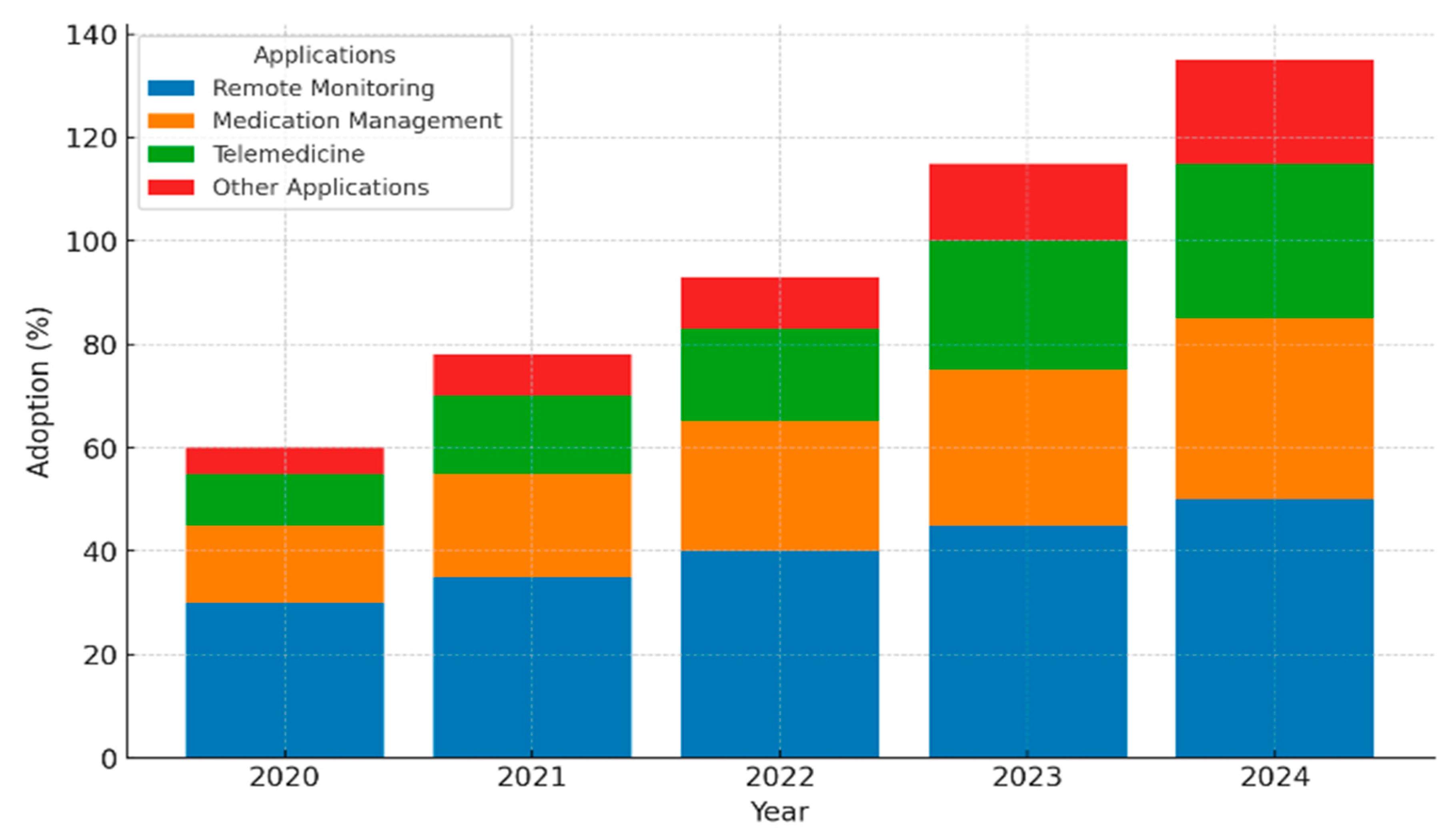
IoT's integration into healthcare systems has led to significant advancements in patient monitoring, medication management, food tracking, and rehabilitation. These applications not only enhance the efficiency and effectiveness of healthcare services but also provide patients with greater autonomy in managing their health. As IoT technologies continue to evolve, their impact on healthcare systems worldwide is expected to grow, improving patient outcomes and streamlining medical operations (Table 2).
5. IoT and Machine Learning in Healthcare
This module discusses how to gather data via wearable technology and biomaterials, whether they are worn by patients or those who are present in the setting where patients are observed. To put it another way, a wearable sensor is the ideal way to keep track of the data that a patient generates every single second while getting mild treatment and undergoing medical testing. The patient's wearable may capture the following data: pulse rate, metabolic flow, breathing enhancement, and sleeping phase tracking. Furthermore, if indeed the patient has pacemakers or blood pressure measurement devices implanted, these signals may well be automatically monitored utilizing the Iot. module. There is a high demand for IoT sensors or bio sensors to be placed on patients who are bedridden or have been taken to the hospital. These sensors must be capable of detecting environmental conditions and taking necessary response.
5.1. Module for Machine Learning
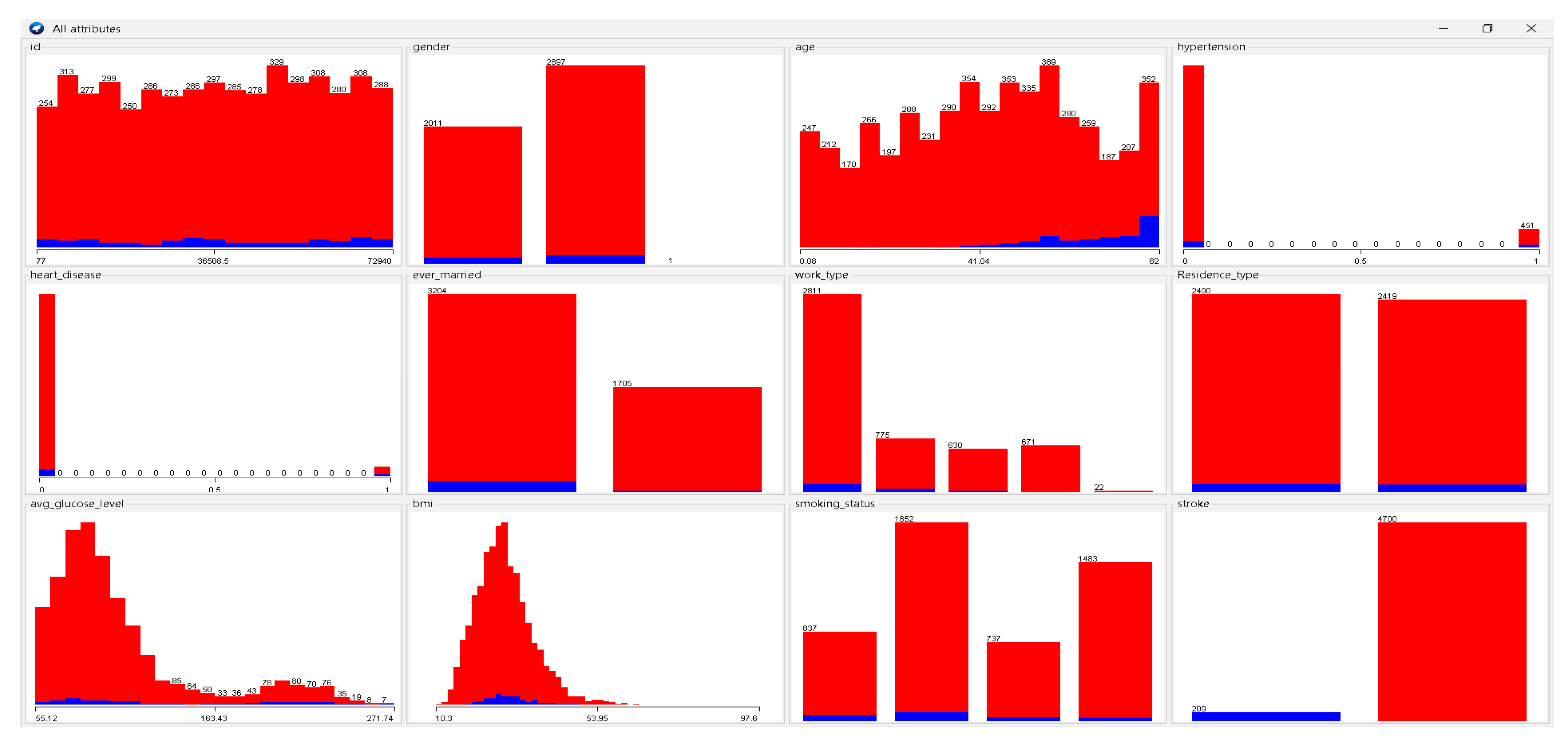
The Deep Learning Method analyzes the patient's data for abnormalities. Training the model to identify anomalies in the data being gathered may substantially benefit in anomaly detection [114,115]. When an abnormality is discovered, the doctor is contacted, and based on the circumstances, the necessary course of action may be taken. It also attempts to predict whether or not the patient has a deadly disease. If anything, odd is identified, the report will provide those facts for the physicians to investigate further. Given that the predictions are based on a model, there may be some margin for error that must be considered in this circumstance. In Fig 3 diabetes prediction and Figure 4 cancer patient data set. Figure 5, stroke prediction using iot-enabled sensors and machine learning.
Figure 3.
An illustration of the diabetes prediction model, demonstrating how IoT devices collect real-time health data and machine learning algorithms analyze it for anomaly detection [111].
Figure 3.
An illustration of the diabetes prediction model, demonstrating how IoT devices collect real-time health data and machine learning algorithms analyze it for anomaly detection [111].
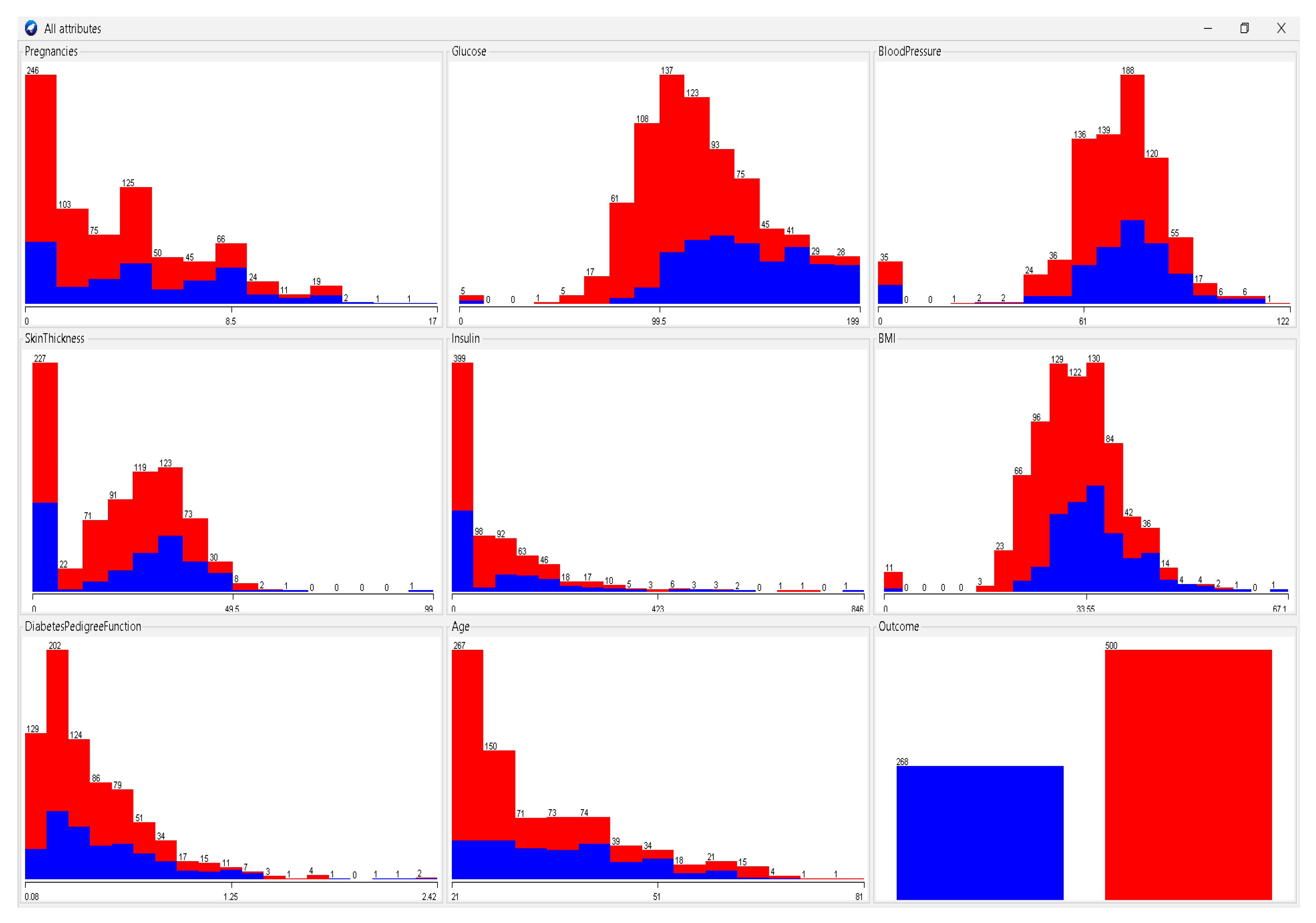
Figure 4.
A representation of the cancer patient dataset, showing the integration of IoT sensors with machine learning techniques for predicting patient outcomes [112].
Figure 4.
A representation of the cancer patient dataset, showing the integration of IoT sensors with machine learning techniques for predicting patient outcomes [112].
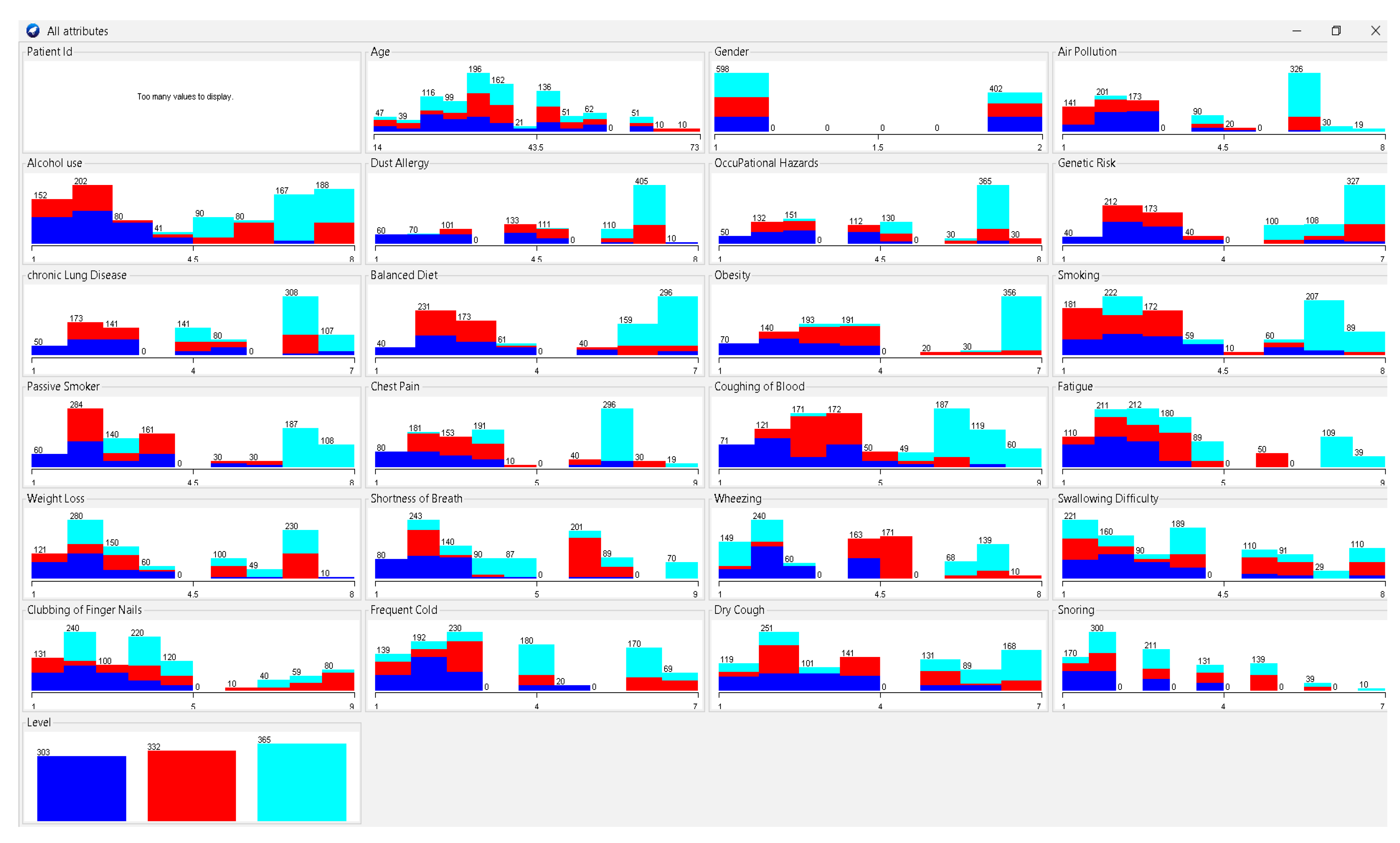
Figure 5.
Visualization of the stroke prediction model, using real-time data from wearable IoT sensors to predict potential stroke events through machine learning analysis [113].
Figure 5.
Visualization of the stroke prediction model, using real-time data from wearable IoT sensors to predict potential stroke events through machine learning analysis [113].
5.2. Data Exchange and Integration
Poor interoperability causes two types of problems [108]: trouble identifying patients and information blocking, in which healthcare providers impose arbitrary constraints on the transmission of clinical information and computerized health - related information. A fundamental hindrance to good healthcare delivery is the inadequacy of universally recognised user identities and info restriction mechanisms. Furthermore, compatibility is crucial, particularly during a pandemic like the corona virus. The pandemic's timing highlights the critical requirement for a stronger comprehensive information framework that may aid in improving physician communication and data flow to address concerns about public health. When visiting a doctor who isn't their main care provider, patients need easy access to their whole medical history. With enhanced health data flow, the possibility for remote monitoring and telemedicine consultations grows significantly. Patients may use this method to keep their physicians up to date on their health state [109].
5.3. Blockchain-Based Solution Frameworks for Distributed Data Exchange
The healthcare industry's interoperability issue might be overcome by using blockchain technology, which could substantially simplify the process of transmitting healthcare data. A patient's hash ID serves as a distinctive identify in a crypto currency healthcare blockchain. This hashing ensures that perhaps the ID is absolutely remarkable and conceals the identity of the user. Patients would be responsible for supplying the decryption key to their associated data blocks to their chosen healthcare practitioner (s). As a consequence, the patient may become the focal point of the ecosystem, increasing safety, privacy, and interoperability [110]. Access to full, up-to-date medical records would be very beneficial to both patients and physicians.
5.4. Current Situation with Medical Records
Modern healthcare data recording and retrieval systems may exhibit the following qualities [98,99,100]: Building relationships between doctor and patient is critical. It consistently disregards the information. Making healthcare more difficult and time-consuming to get. Critical patient data is dispersed across several platforms. Many healthcare systems are unable to deliver required therapy to patients due to a lack of vital data availability. As a consequence, since so many individuals are ill-equipped to handle things smoothly, the management system suffers. It does not offer enough security or dependability for critical medical information [115]. Most medical records are still retained on paper and stored in several places, adding to the healthcare industry's overall inefficiencies. They are ineffective for coordinating treatment, assessing quality, and decreasing medical mistakes [101]. Several sites gather healthcare data via digital data capture. It is critical to extract as much value from this healthcare data as possible while without adding undue complexity to current operations. The capacity to swiftly and economically capture and retain information, as well as securely communicate it across various applications and systems, is a critical challenge in the healthcare business [98]. Furthermore, information must be transferrable between systems and platforms must continuously interoperate [102,116].
6. Services of IoT Healthcare Blockchain
This section discusses various services and technologies within IoT healthcare solutions, focusing on integration with blockchain technology to improve data accessibility, security, and efficiency. Table 3 comparative analysis of blockchain platforms for healthcare IoT.
6.1. Identification and Tracking via RFID Technology
Radio Frequency Identification (RFID) technology enables the tracking of medical instruments in real time, improving healthcare logistics. Through the Real-Time Location System (RTLS), RFID helps monitor the movement of labeled objects within healthcare settings. This system is highly beneficial in tracking patient health and ensuring device accessibility. RFID and IoT systems can monitor environmental factors such as temperature, humidity, and gases, providing real-time data collection for body-centric systems [7,8]. A proposed system combines microcontrollers and sensors to monitor patients’ health in real-time, extending IoT capabilities for enhanced accessibility and interoperability in healthcare systems. The development of platforms like iHome Health-IoT and iMedBox supports device integration, enhancing communication and healthcare delivery [8].
6.2. Edge Computing for Improved Healthcare Performance
Edge computing is a networking architecture that enhances performance by placing computational and storage capabilities within the radio access network (RAN). This approach optimizes healthcare systems, particularly in Emergency Departments (EDs), by improving patient care, resource scheduling, and minimizing wait times [10]. Edge computing is particularly effective for intensive care units, where sensors and devices need to process real-time data for immediate decision-making, such as monitoring physiological parameters like hormone levels and heartbeats [57]. Other applications include regional care, health data distribution networks, and reduced healthcare costs [58].
6.3. Semantics and Interoperability in IoT
To facilitate seamless integration across diverse IoT devices in healthcare, the Internet of Things Semantic Interoperability Model (IoT-SIM) uses semantic annotations. By leveraging frameworks like the Resource Description Framework (RDF) and SPARQL queries, this model enables meaningful interactions with patient data, ensuring compatibility among smart healthcare devices [12,13]. Semantic gateways and protocols such as XMPP, CoAP, and MQTT further enhance communication between systems, promoting data exchange across heterogeneous networks [13,14].
6.4. Cloud Computing for Healthcare Data Management
Cloud computing integrates IoT with healthcare information systems, enabling the storage and management of patient data collected by wearable sensors. Cloud services offer three essential models: Software as a Service (SaaS), Platform as a Service (PaaS), and Infrastructure as a Service (IaaS), which are fundamental for managing vast amounts of healthcare data [15,16]. The use of cloud technology enhances healthcare operations by enabling big data analysis, trend detection, and secure data sharing [17,18]. This system improves healthcare accessibility, reduces costs, and provides a scalable solution for managing patient data efficiently.
6.5. Big Data in Healthcare
The integration of big data in healthcare allows for better patient care and the sustainability of medical systems. Big data is defined by five Vs: volume, velocity, variety, veracity, and value. A digital storage system for medical emergencies is built using this large volume of data to enable real-time access to critical health information [19]. Cloud-based services like IaaS and SaaS help manage heterogeneous physiological parameters, ensuring that health providers have immediate access to accurate data [20]. However, securing patient data and ensuring its confidentiality remain major concerns, and additional development in deep learning and big data management is being explored [21,29].
6.6. Grid Computing for Healthcare Innovation
Grid computing addresses the technical challenges in healthcare, especially for complex tasks like drug development. It provides the necessary computational power to handle real-time data transmission in medical environments. Wireless grid management systems facilitate the integration of smart healthcare technologies, making them a key enabler for pervasive IoT-based healthcare [22,23]. The Medi GRID system, for example, allows location-independent collaboration among scientists, providing access to a wide range of applications for genomics, scientific visualization, and medical trials [24].
6.7. Augmented Reality (AR) and Virtual Reality (VR) in Healthcare
Augmented Reality (AR) and Virtual Reality (VR) technologies are revolutionizing healthcare by enhancing education, patient care, and medical training. AR allows healthcare professionals to interact with 3D models of the human body, improving diagnostic accuracy and patient engagement [25,27]. It also serves as a valuable tool for educating patients about their conditions, enhancing their understanding and involvement in the treatment process [6]. Additionally, AR has applications in ultrasonic imaging and optical diagnostics, making it a versatile tool in medical diagnostics [28]. In Table 4 technological advancements in IoT healthcare systems.
7. IoT Healthcare Blockchain Networks
This section discusses the design, organization, and platforms of the IoT healthcare blockchain network, focusing on the IoThNet system architecture, its data handling, and the integration of healthcare services through IoT and blockchain technology.
7.1. Design of the IoThNet
The IoThNet system is a composite network designed to manage and process a large volume of critical patient data and sensor information in real-time. This architecture is particularly useful in common healthcare scenarios, enabling remote monitoring of patients’ vital signs and medical conditions [13,135]. The data collected from various sensors is processed and stored in suitable databases, allowing caregivers to monitor patient health remotely, irrespective of their location [15,22]. The system architecture relies on various communication technologies, including IP-based networks and GSM, to ensure seamless data flow and integration with healthcare systems [136,137]. The IoThNet infrastructure connects clinical equipment and IoT devices to the health-IoT cloud via healthcare gateways, enabling the collection, evaluation, and storage of health data [139]. Key components such as iMedPack and iMedBox play a significant role in this integration by combining multiple sensors and connectors for smart healthcare solutions [136,137].
7.2. IoThNet Organization
The architectural framework of IoThNet outlines the methods and structure of its physical components, focusing on ensuring the competence of IoT devices, caregivers, wireless local area networks (WLAN), and encrypted data connections [132]. Studies have demonstrated that IoThNet can efficiently handle biosensor data and wearable device data transmission using the 802.15.4 standard within IPv6 and 6LoWPAN networks [13]. Data security is a critical aspect, with data packets often including authentication headers using the User Datagram Protocol (UDP)[13]. IoThNet’s architecture incorporates four mobility techniques, where routers manage data notifications and maintain optimal routing paths within the network. The system uses Directed Acyclic Graphs (DAG) and DIO (Destination Information Object) messages to identify the best routes for data transmission [142,147].
Furthermore, IoThNet’s operational structure includes three primary e-Health delivery services:
- Composition: Organizing the network components and data flow.
- Signalization: Ensuring the Quality of Service (QoS) and resource allocation.
- Data Transmission: Facilitating data exchange across the network with efficiency and security.
IoThNet’s signalization protocols are designed to ensure a high level of service quality by configuring heterogeneous services, which is essential for efficient resource allocation in dynamic healthcare environments [19].
7.3. IoThNet Platforms
IoThNet’s platform serves as the backbone for managing healthcare data and integrating various IoT devices in the healthcare environment. It functions as the residential medical knowledge platform, categorizing healthcare systems based on how caregivers interact with various databases [148]. The platform is built on a multi-layer approach, providing smart object middleware and a business layer that supports interoperability and automation within the IoT healthcare ecosystem [83].
The system’s architecture emphasizes automation and the normalization of healthcare information interactions, ensuring that electronic medical records (EMRs) and other health data are securely transmitted and interoperable across different devices and systems [83]. IoThNet’s platform also supports security devices and protocols to safeguard data and ensure compliance with healthcare regulations. The IoThNet Automated Handling Technique (ADM) is employed for recovery and restoration purposes, ensuring the smooth operation of healthcare processes during failures or disruptions [19]. Additionally, the platform is supported by a three-layer cloud technology structure, which captures and processes ubiquitous user information, providing a scalable solution for healthcare data management [19].
7.4. Blockchain Transaction and Access Management:
A safe approach should be performed in order to manage and evaluate the enormous amount of information that the patient has provided. Moreover, when many users are connected to the information being created, a secret component user access scheme be developed, which is another issue addressed by the Blockchain Network. The proposed architecture calls for the usage of two essential blockchain networks: the Personal Health Care Blockchain (PHC) and the External Record Management (ERM) Blockchain. For most cases, the patient is the individual who manages the personalized health blockchain because it identifies and collects data via wearables [145]. Whenever a physician obtains access to data, he or she may use it to help understand the condition of the patient and recommend the best prescription for them [150,151,152,153,154]. In additional to just being kept inside the blockchain network, data collected by wearables is saved inside an outside cloud server managed by the blockchain network. When a patient sees a doctor, data is created that must be maintained, which is accomplished via the use of an external record management blockchain [160]. The ERM Blockchain often tracks pharmaceutical expenses, medical test results, prescriptions, imaging data, and data generated by healthcare institutions [117]. The data is added to the chain in line with the "Proof of Stake" process, which has been authorized by all blockchain stakeholders. Given that the Healthcare Center and the Doctor own the majority of the ownership in the ERM Blockchain project, they control the bulk of the equity.
In this situation, all patient data will be encrypted before being stored in the cloud using strong blockchain technology. To read or access the data, everyone needs a decryption key, in this instance the patient's fingerprint. After decrypting the data, the patient may transmit it to whoever he wants. Insurance companies are also permitted to use the Blockchain network to authenticate patient data in the event that a patient makes a claim. Data encryption in a digital catalog involves complex mathematical procedures, making it nearly impossible to alter or remove data once stored in the blockchain [103,104,105]. Blockchain should not be confused with typical web infrastructure . With blockchain, hospitals can eliminate the need for physical archives by storing patient data, including test results and treatment records, securely. In emergencies, the system allows quick access to the patient’s medical information. Patients control who can access their data, enhancing transparency and privacy in healthcare [106,107].
8. Market Overview
In 2018, hospitals and medical facilities dominated the Internet of Things (IoT) in the health technology industry. Growing use of IoT-enabled medical equipment by healthcare professionals to enhance care delivery effectiveness as well as provide patient-centric care delivery services represents one of the main reasons boosting the market's rise. Bangladesh's healthcare business is expanding, with hospital, pharmacies, diagnostic centers, clinical studies, outsourced, videoconferencing, plus medicinal gadgets and technology all on the rise [140,141,142,143,144,145,146,147]. The healthcare industry has nearly tripled in size over the past eight years, rising at an annual average growth rate (CAGR) of 10.3% from USD 3.92 billion in 2010 to USD 6.76 billion in 2018. Collegiate hospitals and diagnostics facilities, both important parts of the healthcare delivery system, have witnessed tremendous increase in the private industry.
The General Authority of Health Care services had recognized 255 public hospitals, 5,054 commercial hospital and clinics, and 9,529 diagnostic facilities as of the end of 2019. (DGHS). There have been 143,394 medical beds available across the country by the end of 2019. This includes 54,660 public hospital beds and 91,537 private hospital beds. As medical and pharmaceutical expenses continue to climb, the healthcare sector is looking for ways to lower these costs while also increasing the quality of treatment offered [139]. As a consequence of the significant technological problems, concerns, and possibilities it confronts, the healthcare business is fast developing in a number of ways. To begin, pharmaceutical firms, governments, and highly skilled medical experts no longer collaborate. Tech titans are making inroads into the healthcare business with the objective of enhancing patient access to treatment and provider quality at a reduced cost. Large corporations are investing a growing share of their huge R&D spending to improving people's health (Figure6). Second, traditional medical treatment focuses on symptom relief rather than core cause resolution [140]. COVID-19 has the potential to accelerate the transition to continuous healthcare, in which choices are increasingly backed up by layered data. Apple, Google, Amazon, and others sell wearables that use sensors to continuously monitor vital indicators including such temperatures, pulse rate, respiration sounds, heart rate variability and step count. Seven days a week, twenty-four hours a day. In the future, food routines, sleeping routines, as well as other activity data may be analyzed with the data and health evaluations gathered by these gadgets. These companies' software was designed to improve patients' lives in whatever conceivable way by tracking their behaviors and habits and delivering preventative counsel based on the findings of digital biomedical research. In the following COVID-driven initiative, Apple and Google will release a full Bluetooth-based opt-in contact tracking system. Individual mobility monitoring, precise interactions between tracked persons, health data accurate interactions between tracked individuals, and whole contact tracing utilizing publicly accessible mass consumer data are all proposed implementations [90].
Figure 6.
Projected growth of the IoT healthcare market, showing the increase in market size from 2020 to 2026 with the CAGR of 11.6%.
Figure 6.
Projected growth of the IoT healthcare market, showing the increase in market size from 2020 to 2026 with the CAGR of 11.6%.
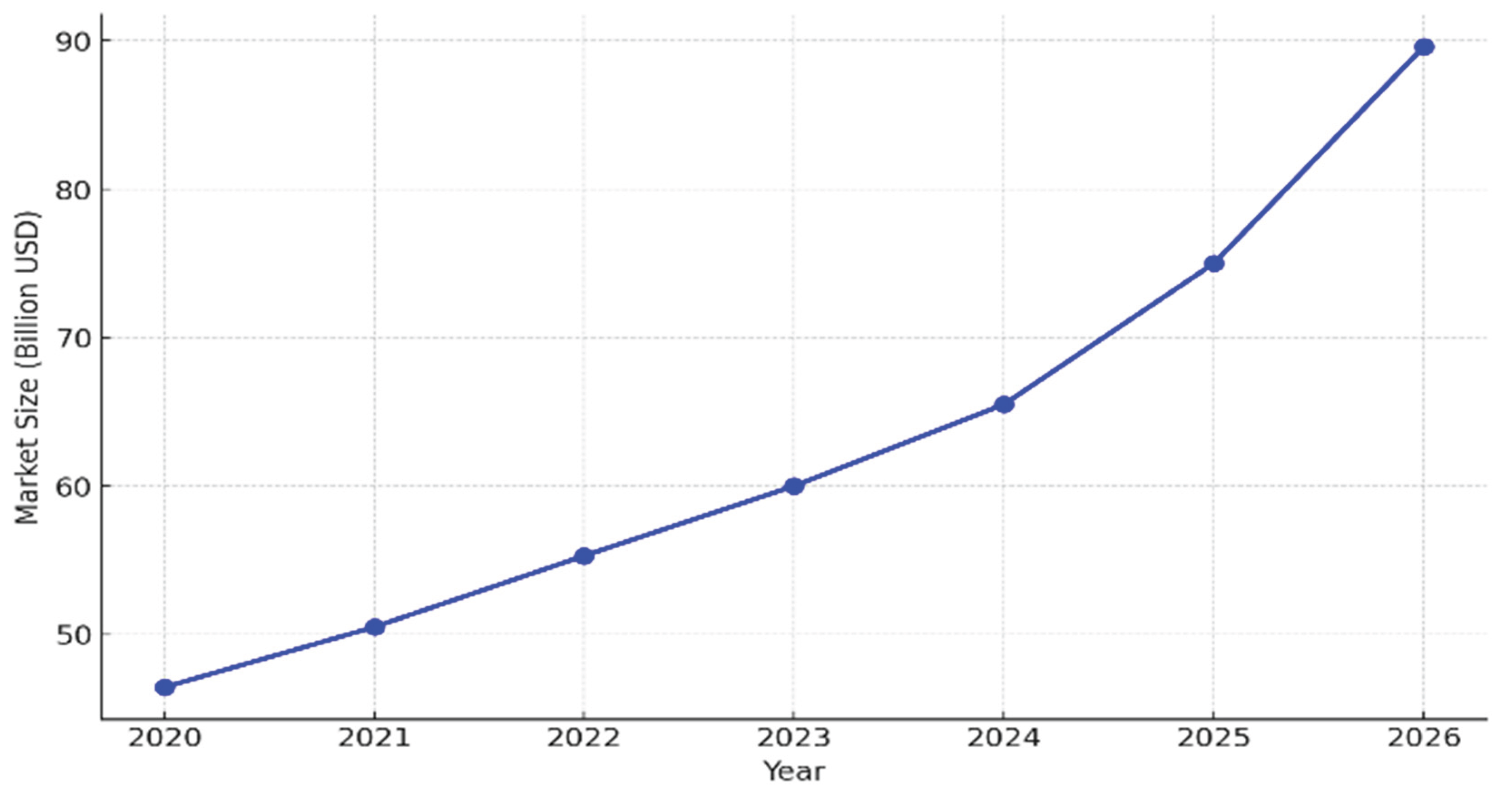
Any technological solution to improving healthcare must be mindful of the specific obstacles that the healthcare business has in comparison to other economic sectors, as well as the real demands of customers, patients, providers [159], and regulators Many businesses are looking at blockchain technology to see if it may assist them speed up processes, conserve money, enhance clinical outcomes, enforce standards, and create good use of health records [91]. The blockchain-based healthcare system is becoming more popular. More than two-thirds of the over 200 health sciences leaders polled by IBM from 18 countries think blockchain would help them reduce wasteful bureaucratic procedures and obsolete systems that stymie innovation and adaption [92]. Anthem, the ranked as the second insurance company, said in 2019 that it will use blockchain technology to keep the medical information of 40 million individuals [93,161]. The possibilities and applications of blockchain technology in healthcare and life sciences are summarized in Table 1 [93,94,95,96,97]. After that, we'll examine at how blockchain technology can help with healthcare information management difficulties. The Internet of Things (IoT) in health industry was estimated to be worth 46.44 billion in 2020 and is expected to be worth 89.6 billion by 2026, growing at an 11.6% CAGR between 2021 and 2026. The rising use of healthcare systems, the rise of big data in healthcare, the increase of gadget reliability and connection, and the expanding prevalence of linked medical equipment are driving the IoT industry [164].
9. Open Research Challenges and Future Directions
Achieving real-time data processing from millions of IoT devices on a blockchain remains a fundamental challenge. Future work must focus on sharding, hybrid on/off-chain architectures, and lightweight consensus protocols like Proof of Authority (PoA) for healthcare networks [160]. The lack of universal data standards severely limits interoperability. Research is needed into semantic ontologies that can be integrated with smart contracts to enable automatic, meaningful data exchange between different healthcare systems. How can decentralized systems comply with strict regulations like HIPAA and GDPR? Future architectures must design 'privacy-by-design' features and clear governance models for data ownership, auditability [163], and right-to-be-forgotten requests [162]. The energy consumption of certain consensus mechanisms is at odds with sustainable healthcare. Exploring energy-efficient alternatives like Proof-of-Stake or delegated protocols is a critical future direction [164]. As AI models become more integral to diagnosis, ensuring their decisions are transparent and auditable is crucial [165]. Research into recording AI model parameters and decisions on a blockchain could provide a new layer of trust and accountability. Future work should focus on developing lightweight consensus protocols, such as Proof-of-Authority (PoA), that can support fast transaction speeds in healthcare networks without compromising security. Additionally, research into hybrid on/off-chain architectures could overcome data storage limitations inherent in current Blockchain systems
10. Conclusions
This paper provides a comprehensive survey on the integration of Blockchain and the Internet of Things (IoT) in healthcare, addressing the transformative potential these technologies hold for improving data security, interoperability, and patient care. Blockchain’s decentralized and immutable nature, combined with the real-time data collection and monitoring capabilities of IoT, offers a promising solution to many of the current challenges in healthcare, such as securing patient data, enhancing transparency, and ensuring privacy. The paper has examined a wide range of IoT applications in healthcare, including remote patient monitoring, medication management, and telemedicine, while highlighting the critical role Blockchain can play in securing these systems. It has also explored the market opportunities for IoT and Blockchain integration, underscoring the growing demand for these technologies in the healthcare sector. Despite the considerable advantages, the integration of Blockchain with IoT in healthcare faces several hurdles, including scalability, regulatory compliance, and data interoperability. This paper has also identified these challenges, suggesting that future research should focus on developing scalable Blockchain solutions, addressing regulatory requirements, and ensuring seamless integration with existing healthcare infrastructures. The convergence of Blockchain and IoT has the potential to revolutionize healthcare by providing a secure, transparent, and efficient system for managing patient data and improving healthcare delivery. However, for these technologies to be widely adopted, it is crucial to address the technical, legal, and operational challenges that currently limit their implementation.
Author Contributions
RV: contributed to the conceptualization of the study, conducted the literature review, and wrote the manuscript. TK: was responsible for the methodology, data analysis, and manuscript editing. SK: contributed to the technical implementation details and reviewed the final draft. KR: provided valuable insights during the manuscript review and assisted with data interpretation.
Funding
not applicable.
Data Availability Statement
The data supporting the findings of this study are available from the corresponding author upon reasonable request.
Acknowledgments
not applicable
Conflict of Interest
The author declares no competing interests.
References
- Siyal, A.A.; Junejo, A.Z.; Zawish, M.; Ahmed, K.; Khalil, A.; Soursou, G. Applications of blockchain technology in medicine and healthcare: Challenges and future perspectives. Cryptography 2019, 3, 3. [Google Scholar] [CrossRef]
- Dwivedi, A.D.; Srivastava, G.; Dhar, S.; Singh, R. Decentralized privacy-preserving healthcare blockchain for IoT. Sensors 2019, 19, 326. [Google Scholar] [CrossRef] [PubMed]
- Dubovitskaya, A.; Xu, Z.; Ryu, S.; Schumacher, M.; Wang, F. (2017). Secure and trustable electronic medical records shared using blockchain. In AMIA annual symposium proceedings (Vol. 2017, p. 650). American Medical Informatics Association.
- Zheng, Z.; et al. (2017). An overview of blockchain technology: Architecture, consensus, and future trends. In Big Data (BigData Congress), 2017 IEEE International Congress on. IEEE. [CrossRef]
- Zhao, H.; et al. (2017). Lightweight Backup and Efficient Recovery Scheme for Health Blockchain Keys. In Autonomous Decentralized System (ISADS), 2017 IEEE 13th International Symposium on. IEEE. [CrossRef]
- Blythe, J.M.; Johnson, S.D. (2018). The consumer security index for IoT: A protocol for developing an index to improve consumer decision making and to incentivize greater security provision in IoT devices. In Proc. Living Internet Things Cybersecurity IoT (IET), London, U.K.; p. 7.
- Amendola, S.; Lodato, R.; Manzari, S.; Occhiuzzi, C.; Marrocco, G. RFID technology for IoT-based personal healthcare in smart spaces. IEEE Internet of Things Journal 2014, 1, 144–152. [Google Scholar]
- Khan, S.F. (2017). Health care monitoring system in Internet of Things (IoT) by using RFID. In Proc. 6th Int. Conf. Ind. Technol. Manag. (ICITM), 198–204.
- Abinaya, G.; Sampoornam, K.P. An efficient healthcare system in IoT platform using RFID system. Int. J. Adv. Res. Electron. Commun. Eng. 2017, 5, 421–424. [Google Scholar]
- Oueida, S.; Kotb, Y.; Aloqaily, M.; Jararweh, Y.; Baker, T. An edge computing-based smart healthcare framework for resource management. Sensors Multidiscipl. Digit. Publ. Inst. 2018, 18, 4307. [Google Scholar] [CrossRef] [PubMed]
- Otoum, S.; Ahmed, M.; Mouftah, H.T. (2015). Sensor medium access control (SMAC)-based epilepsy patients monitoring system. In Proc. IEEE 28th Can. Conf. Elect. Comput. Eng. (CCECE), Halifax, NS, Canada, 1109–1114.
- Jabbar, S.; Ullah, F.; Khalid, S.; Khan, M.; Han, K. Semantic interoperability in heterogeneous IoT infrastructure for healthcare. Wireless Commun. Mobile Comput. 2017, 2017, Art. [Google Scholar] [CrossRef]
- Desai, P.; Sheth, A.; Anantharam, P. (2015). Semantic gateway as a service architecture for IoT interoperability. In Proc. IEEE Int. Conf. Mobile Serv.; New York, NY, USA, 313–319.
- Yrard, A.; Serrano, M. (2016). Connected smart cities: Interoperability with SEG 3.0 for the Internet of Things. In Proc. 30th Int. Conf. Adv. Inf. Netw. Appl. Workshops (WAINA), Crans-Montana, Switzerland, 796–802.
- Baker, S.B.; Xiang, W.; Atkinson, I. Internet of Things for smart healthcare: Technologies, challenges, and opportunities. IEEE Access 2017, 5, 26521–26544. [Google Scholar] [CrossRef]
- Sultan, N. Making use of cloud computing for healthcare provision: Opportunities and challenges. IEEE Access 2014, 34, 177–184. [Google Scholar] [CrossRef]
- Tawalbeh, L.A.; Mehmood, R.; Benkhlifa, E.; Song, H. Mobile cloud computing model and big data analysis for healthcare applications. IEEE Access 2016, 4, 6171–6180. [Google Scholar] [CrossRef]
- Vargheese, R.; Viniotis, Y. (2014). Influencing data availability in IoT enabled cloud based e-health in a 30-day readmission context. In Proc. 10th IEEE Int. Conf. Collab. Comput. Netw. Appl. Worksharing, Miami, FL, USA, 475–480.
- Xu, B.; Xu, L.D.; Cai, H.; Xie, C.; Hu, J.; Bu, F. Ubiquitous data accessing method in IoT-based information system for emergency medical services. IEEE Trans. Ind. Informat. 2014, 10, 1578–1586. [Google Scholar]
- Ghanavati, S.; Abawajy, J.; Izadi, D. (2016). An alternative sensor cloud architecture for vital signs monitoring. In Proc. Int. Joint Conf. Neural Netw. (IJCNN), Vancouver, BC, Canada, 2827–2833.
- Lin, K.; Xia, F.; Wang, W.; Tian, D.; Song, J. System design for big data application in emotion-aware healthcare. IEEE Access 2016, 4, 6901–6909. [Google Scholar] [CrossRef]
- Viswanathan, H.; Lee, E.K.; Pompili, D. (2012). Mobile grid computing for data- and patient-centric ubiquitous healthcare. In Proc. 1st IEEE Workshop Enabling Technol. Smartphone Internet Things (ETSIoT), Seoul, South Korea, 36–41.
- Brust, C. (2009). Grid computing in a healthcare environment: A framework for enterprise design and implementation. In Proc. Annu. Conf. Midwest United States Assoc. Inf. Syst. (MWAIS), 33.
- Weisbecker, A.; Falkner, J.; Rienhoff, O. (2009). MediGRID—Grid computing for medicine and life sciences. In Grid Computing. Springer, 57–65.
- Hamza-Lup, F.G.; Rolland, J.P.; Hughes, C. (2018). A distributed augmented reality system for medical training and simulation. arXiv:1811.12815, arXiv:1811.12815.
- Ha, H.-G.; Hong, J. Augmented reality in medicine. Hanyang Med. Rev. 2016, 36, 242–247. [Google Scholar] [CrossRef]
- State, A.; et al. (1994). Observing a volume rendered fetus within a pregnant patient. In Proc. Vis.; Washington, DC, USA, 364–368.
- Argotti, Y.; Davis, L.; Outters, V.; Rolland, J.P. Dynamic superimposition of synthetic objects on rigid and simple-deformable real objects. Comput. Graph. 2002, 26, 919–930. [Google Scholar] [CrossRef]
- Sahoo, P.K.; Mohapatra, S.K.; Wu, S.-L. Analyzing healthcare big data with prediction for future health condition. IEEE Access 2016, 4, 9786–9799. [Google Scholar] [CrossRef]
- Al-Majeed, S.S.; Al-Mejibli, I.S.; Karam, J. (2015). Home telehealth by Internet of Things (IoT). In Proc. IEEE 28th Can. Conf. Elect. Comput. Eng. (CCECE), Halifax, NS, Canada, 609–613.
- Pallavi, K.; Tripti, K. Secure health monitoring of soldiers with tracking system using IoT: A survey. Int. J. Trend Sci. Res. Develop. 2019, 3, 693–696. [Google Scholar]
- Jara, A.J.; Zamora, M.A.; Skarmeta, A.F. Drug identification and interaction checker based on IoT to minimize adverse drug reactions and improve drug compliance. Pers. Ubiquitous Comput. 2014, 18, 5–17. [Google Scholar] [CrossRef]
- Srinivas, M.; Durgaprasadarao, P.; Raj, V.N.P. (2018). Intelligent medicine box for medication management using IoT. In Proc. 2nd Int. Conf. Inventive Syst. Control (ICISC), Coimbatore, India, 32–34.
- Prajapati, B.; Parikh, S.M.; Patel, J. (2018). An IoT-based model to monitor real-time effect of drug. In Proc. 3rd Int. Conf. Internet Things Connected Technol. (ICIoTCT), 26–27.
- Sundaravadivel, P.; Kesavan, K.; Kesavan, L.; Mohanty, S.P.; Kougianos, E. Smart-Log: A deep-learning-based automated nutrition monitoring system in the IoT. IEEE Trans. Consum. Electron. 2018, 64, 390–398. [Google Scholar] [CrossRef]
- Mendi, E.; Ozyavuz, O.; Pekesen, E.; Bayrak, C. (2013). Food intake monitoring system for mobile devices. In Proc. 5th IEEE Int. Workshop Adv. Sens. Interfaces (IWASI), Bari, Italy, 31–33.
- Istepanian, R.S.H.; Hu, S.; Philip, N.Y.; Sungoor, A. (2016). The potential of Internet of m-health things ‘m-IoT’ for non-invasive glucose level sensing. In Proc. Annu. Int. Conf. IEEE Eng. Med. Biol. Soc.; 5264–5266.
- Lijun, Z. (2013). Multi-parameter medical acquisition detector based on Internet of Things. Chinese Patent CN202 960 774U.
- Deshpande, U.U.; Kulkarni, M.A. (2014). IoT-based real-time ECG monitoring system using Cypress WICED. Int. J. Adv. Res. Elect. Electron. Instrum. Eng.; 6.
- Castillejo, P.; Martinez, J.-F.; Rodriguez-Molina, J.; Cuerva, A. Integration of wearable devices in a wireless sensor network for an e-health application. IEEE Wireless Commun. 2013, 20, 38–49. [Google Scholar] [CrossRef]
- Agu, E.; et al. (2013). The smartphone as a medical device: Assessing enablers, benefits, and challenges. In Proc. IEEE Int. Workshop Internet Things Netw. Control (IoT-NC), New Orleans, LA, USA, 48–52.
- Liu, M.-L.; Tao, L.; Yan, Z. (2012). Internet of Things-based electrocardiogram monitoring system. Chinese Patent CN102 764 118A.
- Xin, T.J.; Min, B.; Jie, J. (2013). Carry-on blood pressure/pulse rate/blood oxygen monitoring location intelligent terminal based on Internet of Things. Chinese Patent CN202 875 315U.
- Puustjärvi, J.; Puustjärvi, L. (2011). Automating remote monitoring and information therapy: An opportunity to practice telemedicine in developing countries. In Proc. IST Africa Conf.; 1–9.
- Tarouco, L.M.R.; et al. (2012). Internet of Things in healthcare: Interoperability and security issues. In Proc. IEEE Int. Conf. Commun. (ICC), Ottawa, ON, Canada, 6121–6125.
- Dohr, A.; Modre-Opsrian, R.; Drobics, M.; Hayn, D.; Schreier, G. (2010). The Internet of Things for ambient assisted living. In Proc. 7th Int. Conf. Inf. Technol. New Gener.; Las Vegas, NV, USA, 804–809.
- Larson, E.C.; Lee, T.; Liu, S.; Rosenfeld, M.; Patel, S.N. (2011). Accurate and privacy-preserving cough sensing using a low-cost microphone. In Proc. 13th Int. Conf. Ubiquitous Comput.; 375–384.
- Khattak, H.A.; Ruta, M.; Di Sciascio, E.E. (2014). CoAP-based healthcare sensor networks: A survey. In Proc. 11th Int. Bhurban Conf. Appl. Sci. Technol. (IBCAST), Islamabad, Pakistan, 499–503.
- Larson, E.C.; Goel, M.; Boriello, G.; Heltshe, S.; Rosenfeld, M.; Patel, S.N. (2012). SpiroSmart: Using a microphone to measure lung function on a mobile phone. In Proc. ACM Conf. Ubiquitous Comput.; 280–289.
- Guangnan, Z.; Penghui, L. (2012). IoT (Internet of Things) control system facing rehabilitation training of hemiplegic patients. Chinese Patent CN202 587 045U.
- Fan, Y.J.; Yin, Y.H.; Xu, L.D.; Zeng, Y.; Wu, F. IoT-based smart rehabilitation system. IEEE Trans. Ind. Informat. 2014, 10, 1568–1577. [Google Scholar]
- Tan, B.; Tian, O. (2014). Short paper: Using BSN for tele-health application in upper limb rehabilitation. In Proc. IEEE World Forum Internet Things (WF-IoT), Seoul, South Korea, 169–170.
- Liang, S.; Zilong, Y.; Hai, S.; Trinidad, M. (2011). Childhood autism language training system and Internet-of-Things-based centralized training center. Chinese Patent CN102 184 661A.
- Sreekanth, K.U.; Nitha, K.P. A study on health care in Internet of Things. Int. J. Recent Innovat. Trends Comput. Commun. 2016, 4, 44–47. [Google Scholar]
- ED wait times in the news - 3 keys to lower them for patients. (2020). Retrieved April 26, 2020. Available online: http://www.healthcarebusinesstech.com/ed-wait-times-analytics/.
- Healthcare Business Tech. (n.d.). Future of IoT in hospitals. Retrieved April 26, 2020. Available online: http://www.healthcarebusinesstech.com/iothospital-future.
- Will Edge Computing Transform Healthcare? (2019). Retrieved April 26, 2020. Available online: https://healthtechmagazine.net/article/2019/08/will-edge-computing-transform-healthcare.
- 5 Use Cases to Know for Edge Computing and Healthcare. (2019). Retrieved April 26, 2020. Available online: https://www.vxchnge.com/blog/edge-computing-use-cases-healthcare.
- How IoT Is Enabling the Telemedicine of Tomorrow. (2018). Available online: https://www.iotforall.com/how-iot-enables-tomorrows-telemedicine/.
- Medication Management for Patients Through IoT-Enabled Smart Pillboxes. (2017). Available online: https://iiot-world.com/smarthealthcare/medication-management-for-patients-through-iot-enabled-smart-pillboxes/.
- Ojas, S.; Akshay, S.; Rohitkumar, S.; Trupti, A. (2017). IoT-based telemedicine system. In Proc. IEEE Int. Conf. Power Control Signals Instrum. Eng. (ICPCSI), Chennai, India, 2840–2842.
- Saminathan, S.; Geetha, K. Real-time health care monitoring system using IoT. Int. J. Eng. Technol. 2018, 7, 484–488. [Google Scholar] [CrossRef]
- Dwivedi, A.D.; Srivastava, G.; Dhar, S.; Singh, R. A decentralized privacy-preserving healthcare blockchain for IoT. Sensors Multidiscipl. Digit. Publ. Inst. 2019, 19, 326. [Google Scholar] [CrossRef]
- Sharma, D.; Tripathi, R.C. (2020). Performance of Internet of Things (IoT) based healthcare secure services and its importance: Issue and challenges. In Proc. Int. Conf. Innovat. Comput. Commun. (ICICC), 4.
- Kadhim, K.T.; Alsahlany, A.M.; Wadi, S.M.; Kadhum, H.T. An overview of patient’s health status monitoring system based on Internet of Things (IoT). Wireless Pers. Commun. 2020, 114, 2235–2262. [Google Scholar] [CrossRef]
- Lemlouma, T.; Laborie, S.; Roose, P.; Rachedi, A.; Abdelaziz, K. (2014). A study of mobility support in wearable health monitoring systems: Design framework. Cleveland, OH, USA: CRC Press.
- Boulemtafes, A.; Rachedi, A.; Badache, N. (2015). A study of mobility support in wearable health monitoring systems: Design framework. In Proc. IEEE/ACS 12th Int. Conf. Comput. Syst. Appl. (AICCSA), Marrakech, Morocco, 1–8.
- Lemlouma, T.; Rachedi, A.; Chalouf, M.A.; Chellouche, S.A. (2013). A new model for NGN pervasive e-Health services. In Proc. 1st Int. Symp. Future Inf. Commun. Technol. Ubiquitous HealthCare (Ubi-HealthTech), Jinhua, China, 1–5.
- He, D.; Zeadally, S.; Kumar, N.; Lee, J.H. Anonymous authentication for wireless body area networks with provable security. IEEE Syst. J. 2017, 11, 2590–2601. [Google Scholar] [CrossRef]
- Ngankam, H.K.; et al. An IoT architecture of microservices for ambient assisted living environments to promote aging in smart cities. In Proc. Int. Conf. Smart Homes Health Telematics 2019, 11, 154–167. [Google Scholar]
- Minoli, D.; Sohraby, K.; Occhiogrosso, B. (2017). IoT security (IoTSec) mechanisms for e-Health and ambient assisted living applications. In Proc. IEEE/ACM Int. Conf. Connected Health Appl. Syst. Eng. Technol. (CHASE), Philadelphia, PA, USA, 13–18.
- Boulos, M.N.K.; Wilson, J.T.; Clauson, K.A. Geospatial blockchain: promises, challenges, and scenarios in health and healthcare. Int. J. Health Geogr. 2018, 17, 25. [Google Scholar] [CrossRef]
- Chen, Y.; Ding, S.; Xu, Z.; Zheng, H.; Yang, S. Blockchain-based medical records secure storage and medical service framework. J. Med. Syst. 2018, 43, 5. [Google Scholar] [CrossRef] [PubMed]
- Kuo, T.-T.; Kim, H.-E.; Ohno-Machado, L. Blockchain distributed ledger technologies for biomedical and health care applications. J. Am. Med. Inform. Assoc. 2017, 24, 1211–1220. [Google Scholar] [CrossRef] [PubMed]
- Mamoshina, P.; Ojomoko, L.; Yanovich, Y.; Ostrovski, A.; Botezatu, A.; Prikhodko, P.; et al. Converging blockchain and next-generation artificial intelligence technologies to decentralize and accelerate biomedical research and healthcare. Oncotarget 2017, 9, 5665–5690. [Google Scholar] [CrossRef]
- Mettler, M. (2016). Blockchain technology in healthcare: The revolution starts here. In 2016 IEEE 18th International Conference on e-Health Networking, Applications and Services (Healthcom), 1–3. IEEE. Available online: https://ieeexplore.ieee.org/document/7749510.
- Furlonger, D.; Kandaswamy, R. (2018). Hype Cycle for Blockchain Business. Retrieved December 3, 2018. Available online: https://www.gartner.com/doc/3884146/hype-cycle-blockchain-business.
- Kuo, T.-T.; Kim, H.-E.; Ohno-Machado, L. Blockchain distributed ledger technologies for biomedical and health care applications. J. Am. Med. Inform. Assoc. 2017, 24, 1211–1220. [Google Scholar] [CrossRef]
- Angraal, S.; Krumholz, H.M.; Schulz, W.L. Blockchain technology: applications in health care. Circulation: Cardiovascular Quality and Outcomes 2017, 10, e003800. [Google Scholar] [CrossRef]
- Mettler, M. (2016). Blockchain technology in healthcare: The revolution starts here. In 2016 IEEE 18th International Conference on e-Health Networking, Applications and Services (Healthcom), 1–3. IEEE. Available online: https://ieeexplore.ieee.org/document/7749510.
- Kuo, T.-T.; Zavaleta Rojas, H.; Ohno-Machado, L. (2019). Comparison of blockchain platforms: a systematic review and healthcare examples. JAMIA. [CrossRef]
- Ivan, D. (2016). Moving Toward a Blockchain-based Method for the Secure Storage of Patient Records. ONC/NIST Use of Blockchain for Healthcare and Research Workshop. Available online: https://www.healthit.gov/sites/default/files/9-16-drew_ivan_20160804_blockchain_for_healthcare_final.pdf.
- Azaria, A.; Ekblaw, A.; Vieira, T.; Lippman, A. (2016). MedRec: Using Blockchain for Medical Data Access and Permission Management. In International Conference on Open and Big Data (OBD), Vienna: IEEE, 25–30.
- Kuo, T.-T.; Ohno-Machado, L. (2018). ModelChain: decentralized privacy-preserving healthcare predictive modeling framework on private blockchain networks. arXiv. arXiv:1802.01746.
- Kuo, T.-T.; Gabriel, R.A.; Ohno-Machado, L. (2019). Fair compute loads enabled by blockchain: sharing models by alternating client and server roles. JAMIA. [CrossRef]
- Sweeney, L. Simple demographics often identify people uniquely. Health 2000, 671, 1–34. [Google Scholar]
- Munro, D. (2015). Data Breaches in Healthcare Totaled Over 112 Million Records in 2015. Forbes. Available online: https://www.forbes.com/sites/danmunro/2015/12/31/data-breaches-in-healthcare-total-over-112-million-records-in-2015/#15b74ef7b07f.
- Wang, S.; Jiang, X.; Wu, Y.; Cui, L.; Cheng, S.; Ohno-Machado, L. Expectation propagation logistic regression (explorer): distributed privacy-preserving online model learning. J. Biomed. Inform. 2013, 46, 480–496. [Google Scholar] [CrossRef]
- Wu, Y.; Jiang, X.; Kim, J.; Ohno-Machado, L. Grid Binary LOgistic REgression (GLORE): building shared models without sharing data. JAMIA 2012, 19, 758–764. [Google Scholar] [CrossRef]
- Sainz, F. (2020). Apple and Google partner on COVID-19 contact tracing technology. Apple News. Available online: https://www.apple.com/newsroom/2020/04/apple-and-google-partner-on-covid-19-contact-tracing-technology/.
- Mackey, T.K.; Kuo, T.; Gummadi, B.; et al. ‘Fit-for-purpose?’ - Challenges and opportunities for applications of blockchain technology in the future of healthcare. BMC Med. 2019, 17, 68. [Google Scholar] [CrossRef]
- IBM Institute for Business Value. (2018). Team medicine: how life sciences can win with blockchain. IBM Corporation. Retrieved March 12, 2018. Available online: https://public.dhe.ibm.com/common/ssi/ecm/03/en/03013903usen/team-medicine.pdf.
- Rosenbaum, L. (2019). Anthem will use blockchain to secure medical data for its 40 million members in three years. Forbes, December 12. Retrieved March 17, 2020. Available online: https://www.forbes.com/sites/leahrosenbaum/2019/12/12/anthem-says-its-40-million-members-will-be-using-blockchain-to-secure-patient-data-in-three-years/#305bc9be6837.
- Kuo, T.-T.; Kim, H.-E.; Ohno-Machado, L. Blockchain distributed ledger technologies for biomedical and health care applications. J. Am. Med. Inform. Assoc. 2017, 24, 1211–1220. [Google Scholar] [CrossRef]
- Hoy, M.B. An introduction to the blockchain and its implications for libraries and medicine. Med. Ref. Serv. Q. 2017, 36, 273–279. [Google Scholar] [CrossRef] [PubMed]
- Yaeger, K.; Martini, M.; Rasouli, J.; et al. Emerging blockchain technology solutions for modern healthcare infrastructure. J. Sci. Innov. Med. 2019, 9, 2–7. [Google Scholar] [CrossRef]
- Leon, K. (2018). How is blockchain revolutionizing healthcare? The Startup, October 23. Retrieved January 17, 2020. Available online: https://medium.com/swlh/how-is-blockchain-revolutionizing-healthcare-d971d351528f.
- Pirtle, C.; Ehrenfeld, J.M. Blockchain for healthcare: the next generation of medical records? J. Med. Syst. 2018, 42, 172. [Google Scholar] [CrossRef] [PubMed]
- Paranjape, K.; Parker, M.; Houlding, D.; et al. (2019). Implementation considerations for blockchain in healthcare institutions. Blockchain in Healthcare Today, 2.
- Singh, N. Blockchain for healthcare: use cases and applications. 101 Blockchains, November 21. Retrieved January 18 2019, 2020. Available online: https://101blockchains.com/blockchain-for-healthcare/.
- Hillestad, R.; Bigelow, J.; Bower, A.; et al. Can electronic medical record systems transform health care? Potential health benefits, savings, and costs. Health Aff. 2019, 24, 1103–1117. [Google Scholar] [CrossRef] [PubMed]
- Yaeger, K.; Martini, M.; Rasouli, J.; et al. Emerging blockchain technology solutions for modern healthcare infrastructure. J. Sci. Innov. Med. 2019, 9, 2–7. [Google Scholar] [CrossRef]
- Drescher, D. (2016). Blockchain Basics: A Non-Technical Introduction in 25 Steps. ISBN 13: 978-1484226032.
- Laurence, T. (2018). Blockchain For Dummies (For Dummies (Computers)). ISBN 978-1-119-36559-4.
- Reed, J. (2018). Blockchain, Smart Contracts, Investing in Ethereum, FinTech (Kindle Edition).
- Mitnick, G. (2018). Blockchain: Learn Blockchain Technology FAST! Everything You Need to Know About Blockchain in 1 Hr! (Kindle Edition).
- Ethereum Foundation. (2017). Update on integrating Zcash with Ethereum. Available online: https://blog.ethereum.org/2017/01/19/update-integrating-zcash-ethereum.
- Gordon, W.J.; Catalini, C. Blockchain technology for healthcare: facilitating the transition to patient-driven interoperability. Comput. Struct. Biotechnol. J. 2018, 16, 224–230. [Google Scholar] [CrossRef] [PubMed]
- Postelnicu, L. (2020). How the world of health and tech is looking at the coronavirus outbreak. Mobihealthnews, March 11. Retrieved March 22, 2020. Available online: https://www.mobihealthnews.com/news/europe/how-world-health-and-tech-looking-coronavirus-outbreak.
- Paranjape, K.; Parker, M.; Houlding, D.; et al. (2019). Implementation considerations for blockchain in healthcare institutions. Blockchain in Healthcare Today, Volume 2, July.
- Diabetes Prediction. Available online: https://www.kaggle.com/code/mvanshika/diabetes-prediction/data.
- Cancer Patients Data. Available online: https://www.kaggle.com/datasets/rishidamarla/cancer-patients-data.
- Stroke Prediction Dataset. Available online: https://www.kaggle.com/datasets/fedesoriano/stroke-prediction-dataset.
- Vavekanand, R.; Sam, K.; Kumar, S.; Kumar, T. Cardiacnet: A neural networks based heartbeat classifications using ecg signals. Studies in Medical and Health Sciences 2024, 1, 1–17. [Google Scholar] [CrossRef]
- Vavekanand, R.; Kumar, T. Data augmentation of ultrasound imaging for non-invasive white blood cell in vitro peritoneal dialysis. Biomedical Engineering Communications 2024, 3, 10–53388. [Google Scholar] [CrossRef]
- Vavekanand, R. SUBMIP: smart human body health prediction application system based on medical image processing. Studies in Medical and Health Sciences 2024, 1, 14–22. [Google Scholar] [CrossRef]
- Jan, M.B.; Rashid, M.; Vavekanand, R.; Singh, V. Integrating explainable AI for skin lesion classifications: A systematic literature review. Studies in Medical and Health Sciences 2025, 2, 1–14. [Google Scholar] [CrossRef]
- Sam, K.; Nawaz, S.; Vavekanand, R. CardioMix: A Multimodal Image-Based Classification Pipeline for Enhanced ECG Diagnosis. Med Data Min 2025, 8, 6. [Google Scholar] [CrossRef]
- Attaran, M. Blockchain technology in healthcare: Challenges and opportunities. International Journal of Healthcare Management 2022, 15, 70–83. [Google Scholar] [CrossRef]
- Ressi, D.; Romanello, R.; Piazza, C.; Rossi, S. AI-enhanced blockchain technology: A review of advancements and opportunities. Journal of Network and Computer Applications 2024, 225, 103858. [Google Scholar] [CrossRef]
- Hawashin, D.; Nemer, M.; Gebreab, S.A.; Salah, K.; Jayaraman, R.; Khan, M.K.; Damiani, E. Blockchain applications in UAV industry: Review, opportunities, and challenges. Journal of Network and Computer Applications 2024, 230, 103932. [Google Scholar] [CrossRef]
- Farah, M.B.; Ahmed, Y.; Mahmoud, H.; Shah, S.A.; Al-Kadri, M.O.; Taramonli, S.; Aneiba, A. A survey on blockchain technology in the maritime industry: Challenges and future perspectives. Future Generation Computer Systems 2024, 157, 618–637. [Google Scholar] [CrossRef]
- Wu, H.; Yao, Q.; Liu, Z.; Huang, B.; Zhuang, Y.; Tang, H.; Liu, E. Blockchain for finance: A survey. IET Blockchain 2024, 4, 101–123. [Google Scholar] [CrossRef]
- Taloba, A.I.; Elhadad, A.; Rayan, A.; Abd El-Aziz, R.M.; Salem, M.; Alzahrani, A.A.; Park, C. A blockchain-based hybrid platform for multimedia data processing in IoT-Healthcare. Alexandria Engineering Journal 2023, 65, 263–274. [Google Scholar] [CrossRef]
- Khan, A.A.; Bourouis, S.; Kamruzzaman, M.M.; Hadjouni, M.; Shaikh, Z.A.; Laghari, A.A.; Dhahbi, S. Data security in healthcare industrial internet of things with blockchain. IEEE Sensors Journal 2023, 23, 25144–25151. [Google Scholar] [CrossRef]
- Azbeg, K.; Ouchetto, O.; Andaloussi, S.J.; Fetjah, L. A taxonomic review of the use of IoT and blockchain in healthcare applications. Irbm 2022, 43, 511–519. [Google Scholar] [CrossRef]
- Namasudra, S.; Sharma, P.; Crespo, R.G.; Shanmuganathan, V. Blockchain-based medical certificate generation and verification for IoT-based healthcare systems. IEEE Consumer Electronics Magazine 2022, 12, 83–93. [Google Scholar] [CrossRef]
- Kamruzzaman, M.M.; Yan, B.; Sarker, M.N.I.; Alruwaili, O.; Wu, M.; Alrashdi, I. Blockchain and fog computing in IoT-driven healthcare services for smart cities. Journal of Healthcare Engineering 2022, 2022, 9957888. [Google Scholar] [CrossRef] [PubMed]
- Raj, K.; Kumar, T.; Mileo, A.; Bendechache, M. (2024, August). OxML Challenge 2023: Carcinoma classification using data augmentation. In IET Conference Proceedings CP887 (Vol. 2024, No. 10, pp. 303–306). Stevenage, UK: The Institution of Engineering and Technology.
- Barua, M.; Kumar, T.; Raj, K.; Roy, A.M. Comparative analysis of deep learning models for stock price prediction in the Indian market. FinTech 2024, 3, 551–568. [Google Scholar] [CrossRef]
- Raj, K.; Mileo, A. (2024, September). Towards Understanding Graph Neural Networks: Functional-Semantic Activation Mapping. In International Conference on Neural-Symbolic Learning and Reasoning (pp. 98–106). Cham: Springer Nature Switzerland.
- Darwish, A.; Hassanien, A.E.; Elhoseny, M.; Sangaiah, A.K.; Muhammad, K. The impact of the hybrid platform of internet of things and cloud computing on healthcare systems: opportunities, challenges, and open problems. Journal of Ambient Intelligence and Humanized Computing 2019, 10, 4151–4166. [Google Scholar] [CrossRef]
- Singh, N.; Sasirekha, S.P.; Dhakne, A.; Thrinath, B.S.; Ramya, D.; Thiagarajan, R. IOT enabled hybrid model with learning ability for E-health care systems. Measurement: Sensors 2022, 24, 100567. [Google Scholar] [CrossRef]
- Yu, J.; Fu, B.; Cao, A.; He, Z.; Wu, D. (2018, December). EdgeCNN: A hybrid architecture for agile learning of healthcare data from IoT devices. In 2018 IEEE 24th International Conference on Parallel and Distributed Systems (ICPADS) (pp. 852–859). IEEE.
- Rathee, G.; Sharma, A.; Saini, H.; Kumar, R.; Iqbal, R. A hybrid framework for multimedia data processing in IoT-healthcare using blockchain technology. Multimedia Tools and Applications 2020, 79, 9711–9733. [Google Scholar] [CrossRef]
- Alkhateeb, A.; Catal, C.; Kar, G.; Mishra, A. Hybrid blockchain platforms for the internet of things (IoT): A systematic literature review. Sensors 2022, 22, 1304. [Google Scholar] [CrossRef]
- Mathur, S.; Sharma, A.K.; Meesad, P. (2021). Hybrid AI and IoT Approaches Used in Health Care for Patients Diagnosis. In Hybrid Artificial Intelligence and IoT in Healthcare (pp. 97–108). Singapore: Springer Singapore.
- Bibani, O.; Mouradian, C.; Yangui, S.; Glitho, R.H.; Gaaloul, W.; Hadj-Alouane, N.B.; Polakos, P. (2016, December). A demo of IoT healthcare application provisioning in hybrid cloud/fog environment. In 2016 IEEE International Conference on Cloud Computing Technology and Science (CloudCom) (pp. 472–475). IEEE.
- Palanisamy, S.; Thangaraju, V.; Kandasamy, J.; Salau, A.O. Towards precision in IoT-based healthcare systems: a hybrid optimized framework for big data classification. Journal of Big Data 2025, 12, 190. [Google Scholar] [CrossRef]
- Prabha, P.; Chatterjee, K. Design and implementation of hybrid consensus mechanism for IoT based healthcare system security. International Journal of Information Technology 2022, 14, 1381–1396. [Google Scholar] [CrossRef]
- Onyema, E.M.; Lilhore, U.K.; Saurabh, P.; Dalal, S.; Nwaeze, A.S.; Chijindu, A.T.; Simaiya, S. Evaluation of IoT-Enabled hybrid model for genome sequence analysis of patients in healthcare 4.0. Measurement: Sensors 2023, 26, 100679. [Google Scholar] [CrossRef]
- Rashid, M.; Singh, H.; Goyal, V.; Parah, S.A.; Wani, A.R. (2021). Big data based hybrid machine learning model for improving performance of medical Internet of Things data in healthcare systems. In Healthcare Paradigms in the Internet of Things Ecosystem (pp. 47–62). Academic Press.
- Naik, N.; Surendranath, N.; Raju, S.A.B.; Madduri, C.; Dasari, N.; Shukla, V.K.; Patil, V. Hybrid deep learning-enabled framework for enhancing security, data integrity, and operational performance in Healthcare Internet of Things (H-IoT) environments. Scientific Reports 2025, 15, 1–27. [Google Scholar] [CrossRef]
- Liu, Y.; Dong, B.; Guo, B.; Yang, J.; Peng, W. Combination of cloud computing and internet of things (IOT) in medical monitoring systems. International Journal of Hybrid Information Technology 2015, 8, 367–376. [Google Scholar] [CrossRef]
- Asghari, P.; Rahmani, A.M.; Haj Seyyed Javadi, H. A medical monitoring scheme and health-medical service composition model in cloud-based IoT platform. Transactions on Emerging Telecommunications Technologies 2019, 30, e3637. [Google Scholar] [CrossRef]
- Almaiah, M.A.; Hajjej, F.; Ali, A.; Pasha, M.F.; Almomani, O. A novel hybrid trustworthy decentralized authentication and data preservation model for digital healthcare IoT based CPS. Sensors 2022, 22, 1448. [Google Scholar] [CrossRef]
- Kang, M.; Park, E.; Cho, B.H.; Lee, K.S. (2018). Recent patient health monitoring platforms incorporating internet of things-enabled smart devices. International neurourology journal, 22(Suppl 2), S76.
- Thota, C.; Sundarasekar, R.; Manogaran, G.; MK, P. (2018). Centralized fog computing security platform for IoT and cloud in healthcare system. In Exploring the convergence of big data and the internet of things (pp. 141–154). IGI global.
- Catarinucci, L.; De Donno, D.; Mainetti, L.; Palano, L.; Patrono, L.; Stefanizzi, M.L.; Tarricone, L. An IoT-aware architecture for smart healthcare systems. IEEE Internet of Things Journal 2015, 2, 515–526. [Google Scholar]
- Akram, F.; Liu, D.; Zhao, P.; Kryvinska, N.; Abbas, S.; Rizwan, M. Trustworthy intrusion detection in e-healthcare systems. Frontiers in Public Health 2021, 9, 788347. [Google Scholar] [CrossRef]
- Raju, K.; Ramshankar, N.; Shathik, J.A.; Lavanya, R. Blockchain assisted cloud security and privacy preservation using hybridized encryption and deep learning mechanism in IoT-Healthcare application. Journal of Grid Computing 2023, 21, 45. [Google Scholar] [CrossRef]
- Elbagoury, B.M.; Vladareanu, L.; Vlădăreanu, V.; Salem, A.B.; Travediu, A.M.; Roushdy, M.I. A hybrid stacked CNN and residual feedback GMDH-LSTM deep learning model for stroke prediction applied on mobile AI smart hospital platform. Sensors 2023, 23, 3500. [Google Scholar] [CrossRef]
- Abikoye, O.C.; Oladipupo, E.T.; Imoize, A.L.; Awotunde, J.B.; Lee, C.C.; Li, C.T. Securing critical user information over the internet of medical things platforms using a hybrid cryptography scheme. Future Internet 2023, 15, 99. [Google Scholar] [CrossRef]
- Karthikeyan, M.P.; Bareja, L.; Gupta, M.; Malviya, A.; Dev, S.; Iqbal, M.A. (2025). Revolutionizing healthcare: data privacy based on novel approach in hybrid cloud networks. International Journal of System Assurance Engineering and Management, 1–9.
- Kar, E.; Fakhimi, M.; Turner, C.; Eldabi, T. Hybrid simulation in healthcare: a systematic exploration of models, applications, and emerging trends. Journal of Simulation 2025, 19, 231–249. [Google Scholar] [CrossRef]
- Damery, S.; Jones, J.; Harrison, A.; Hinde, S.; Jolly, K. Technology-enabled hybrid cardiac rehabilitation: Qualitative study of healthcare professional and patient perspectives at three cardiac rehabilitation centres in England. PloS One 2025, 20, e0319619. [Google Scholar] [CrossRef]
- Seifi, N.; Ghoodjani, E.; Majd, S.S.; Maleki, A.; Khamoushi, S. Evaluation and prioritization of artificial intelligence integrated blockchain factors in healthcare supply chain: A hybrid Decision Making Approach. Computer and Decision Making: An International Journal 2025, 2, 374–405. [Google Scholar] [CrossRef]
- Sharma, D.K.; Kumar, A. A blockchain based solution for efficient and secure healthcare management. International Journal of Critical Infrastructures 2025, 21, 168–186. [Google Scholar] [CrossRef]
- Alamoudi, E.; Solaiman, E. (2025). EHSAN: Leveraging ChatGPT in a Hybrid Framework for Arabic Aspect-Based Sentiment Analysis in Healthcare. arXiv preprint, arXiv:2508.02574.
- Adapa, C.S.R. Leveraging integrated master data management for enhanced healthcare decision-making. World Journal of Advanced Engineering Technology and Sciences 2025, 15, 2397–2403. [Google Scholar] [CrossRef]
- Ahn, M.; Park, G.T.; Shukla, A.K.; Kwon, B.; Kim, J.H.; Sung, E.S.; Kim, B.S. (2025). 3D Bioprinting-Assisted Engineering of Stem Cell-Laden Hybrid Biopatches With Distinct Geometric Patterns Considering the Mechanical Characteristics of Regular and Irregular Connective Tissues. Advanced Healthcare Materials, 2502763.
- Kasralikar, P.; Polu, O.R.; Chamarthi, B.; Rupavath, R.V.S.S.B.; Patel, S.; Tumati, R. (2025). Blockchain for securing AI-driven healthcare systems: a systematic review and future research perspectives. Cureus, 17.
- Zahed, M.A.; Rana, S.S.; Faruk, O.; Islam, M.R.; Reza, M.S.; Lee, Y.; Park, J.Y. Self-Powered Wireless System for Monitoring Sweat Electrolytes in Personalized Healthcare Wearables. Advanced Functional Materials 2025, 35, 2421021. [Google Scholar] [CrossRef]
- Alghanim, M.H.; Attar, H.H.; Rezaee, K.; Solyman, A.A. Medical diagnosis decision-making framework on the internet of medical things platform using hybrid learning. Wireless Networks 2024, 30, 6901–6913. [Google Scholar] [CrossRef]
Figure 1.
PRISMA flow diagram of the study selection process.
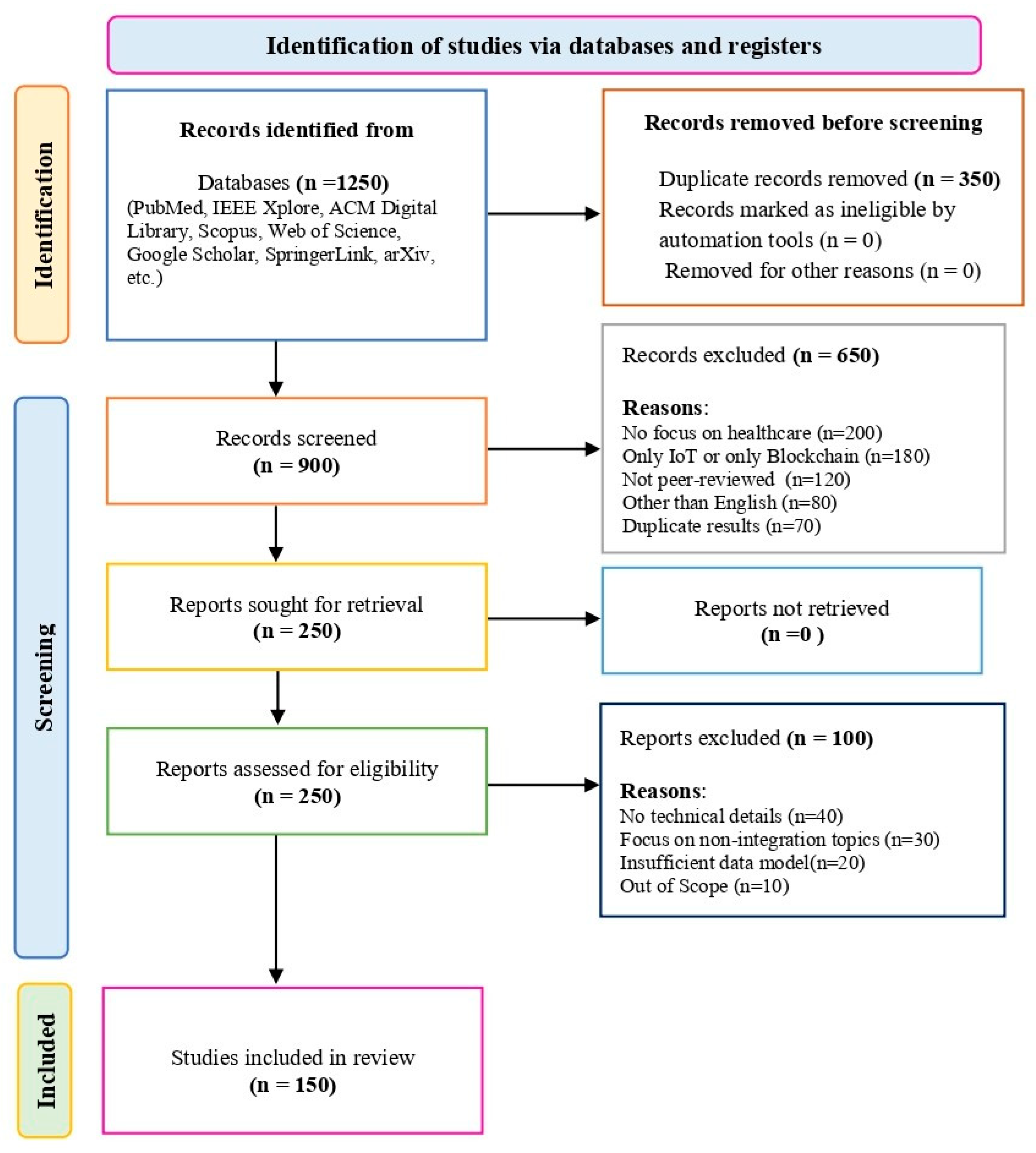
Figure 2.
A layered architecture for integrating IoT and Blockchain in healthcare, showcasing data flow and security [145,152].
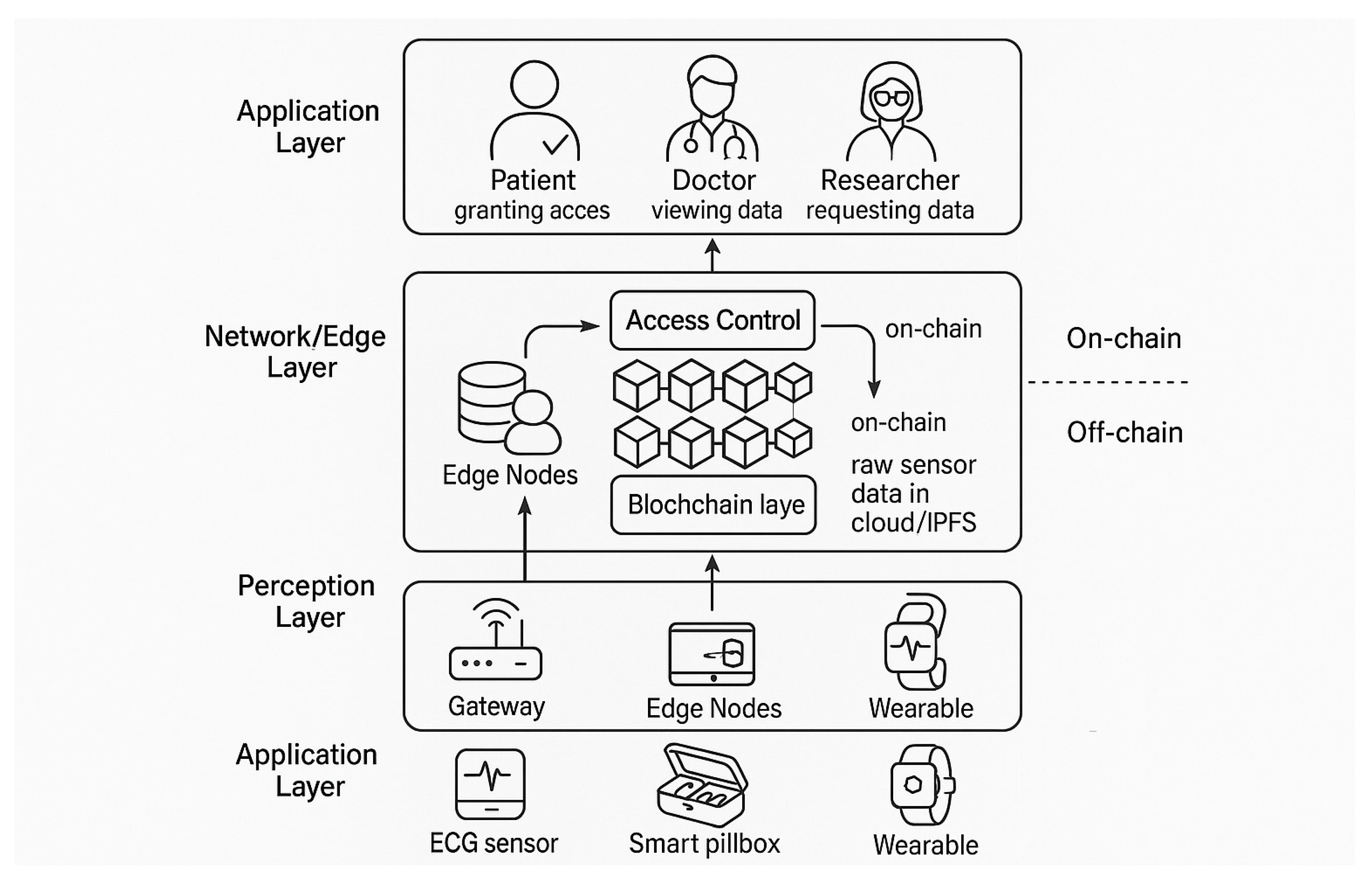

Table 1.
A comparison of healthcare technologies highlighting the methodologies, merits, and limitations of technologies such as cloud computing, IoT, RFID, and augmented reality.
Table 1.
A comparison of healthcare technologies highlighting the methodologies, merits, and limitations of technologies such as cloud computing, IoT, RFID, and augmented reality.
| Year | References | Technologies/Methodologies | Merits | Limitations |
|---|---|---|---|---|
| 2016 | [17,26,54] | Cloud Computing, Big Data, Augmented Reality, Wearable Devices | Efficient data storage, enhances perception, patient alert systems | High memory requirements, costly AR devices, wearables not always standalone |
| 2017 | [8,15,122] | RFID, Body Sensor Networks, Open Systems IoT Reference Model (OSIRM) | Health history monitoring, long-distance data collection, precise activity differentiation | Expensive, vulnerable to security attacks, service duplication issues |
| 2018 | [6,10,33] | Consumer Security Index (CSI), Resource Preservation Net (RPN) Framework, Intelligent Medicine Box | Improves consumer security, optimized patient waiting times, timely medication notifications | Implementation delays, storage issues, potential incorrect drug dispensing |
| 2019 | [31,63,120] | Healthcare Monitoring System for Soldiers, Ambient Assisted Living, Blockchain Security Models | Tracking soldier’s location, resilient data storage, optimized daily activities | Battery drain, high cost, limited data modification options |
| 2020 | [64,65] | WSN Security Model, IoT-based Healthcare Monitoring Systems | Secures data collection, real-time health tracking | Data theft risks, expensive maintenance |
| 2021 | [125,126,127,128,129] | Smart Health Systems, e-Health Frameworks, mHealth | Effective for remote health management, better accessibility in emergencies | Simulation-based validation required, security concerns |
| 2022 | [129,130,131,133] | IoT-based Health Monitoring, Data Collection with IoT Devices | Enhances patient monitoring, supports real-time health data analysis | Connectivity issues, requires high security, high data storage needs |
| 2023 | [132,134,135] | Smart Hospitals with RFID, IoT, and Blockchain | Real-time location tracking of devices, secure data exchange | High setup costs, security vulnerabilities |
| 2024 | [136,137,138,140,161] | IoT-enabled Diagnostic Tools, Smart Medication Management | Improves diagnostic speed and accuracy, optimizes medication adherence | Limited scalability, dependency on reliable connectivity |
| 2025 | [141,142,150] | Blockchain for Interoperability, AI-powered IoT Healthcare | Provides transparency, secure data exchange, enhanced patient privacy | Energy consumption in consensus mechanisms, compliance with regulations (e.g.; GDPR, HIPAA) |
Table 2.
An overview of key IoT healthcare applications summarizing the contributions.
| Year | Application | Advantages | Limitations | Accessing Technology |
|---|---|---|---|---|
| 2020 | Dropping Emergency Room Waiting Time [2,55,56] |
Use predictive analytics for flow of patients Monitor physiological data during emergency |
Scalability needs to be improved. increase energy consumption | Special sensors based on IoT, wireless sensor network MEDiSN |
| 2018 | Telehealth [30,59,61] |
Minimum time for separating messages Ensure wear ability and data quality Track bed-ridden patients |
Requires a high-quality security module, requires technical training, server problems can make virtual communication impossible |
Real-time monitoring, telemetric system. CyberMed |
| 2018 | Tracking of Information [7,71,72,106] |
Track patient information Continuous monitor human location |
Security of information, continuous Internet connections | RFID tag ZigBee, and GSM wireless technology Wireless body area networks (WBASNs) sensor |
| 2017 | Drug Management [32,33,34,60] |
Drug identification and monitoring of medication 10T-enabled smart pillboxes Give alerts for medication |
Interruption can cause problem | Wisepill technologies and Aeris wireless connection |
| 2018 | Food Management [35,36] |
Real-time food intake monitoring system Construct a smart dining table |
Need cost effective sensor system A Bayesian Network |
Novel 5-layer perceptron neural network Weighing sensor |
| 2016 | Glucose Level [37,38,80] |
Ensure the long-distance data transmission's stability and correctness. Keep track of blood glucose |
Need operator technique, exposure, environmental and patient factors 6LoWPAN protocol |
ZigBee wireless network, Bluetooth radio network IEEE 802.15.4 |
| 2014 | Electrocardiogram [39,40,41,42,83,84] |
Detect threshold parameters Transform of ECG signal Determine a certain form The P and T wave (QRS) wave group's position. |
Data stream mining and context awareness technologies MATLAB simulation |
CoAP/HTTP, MQTT, TLS/TCP, DTLS/UDP |
| 2012 | Blood Pressure (BP) [43,44,45,46] |
Real-time BP measurement | Continuous Internet connection Keep in Touch (KIT) blood pressure meter RFID |
NFC stands for Near-Field Communication |
| 2014 | Oxygen Saturation [47,48,49] |
Monitor blood oxygen saturation | Low power/low-cost pulse oximeter Realtime monitoring |
Wireless Sensor Networks (WSN) wearable pulse oximeter CoAP protocol |
| 2016 | Rehabilitation System [50,51,52,53,54] |
Provide rehabilitation exercise Rehabilitation training of hemiplegic patients |
Proper knowledge about training IOT sensors. |
Body Sensor Networks (BSN) |
Table 3.
A comparative analysis of prominent blockchain platforms based on key metrics relevant to healthcare IoT applications.
Table 3.
A comparative analysis of prominent blockchain platforms based on key metrics relevant to healthcare IoT applications.
| Platform | Consensus Mechanism | Throughput (TPS) | Latency | Permissioned | Smart Contracts | Suitability for Healthcare IoT | Key Challenges | Key References |
|---|---|---|---|---|---|---|---|---|
| Hyperledger Fabric | PBFT/RAFT | High (100s-1000s) | Low (secs) | Yes | Yes (Chaincode) | High | Complex setup, Steep learning curve | [73,81] |
| Ethereum (PoW) | Proof-of-Work (PoW) | Low (10-15) | High (mins) | No | Yes (Solidity) | Low | High gas fees, Low scalability, High energy consumption | [4,81] |
| Ethereum (PoS) | Proof-of-Stake (PoS) | Medium (10-100) | Medium | No | Yes (Solidity) | Medium | Evolving ecosystem, Past scalability concerns | [107] |
| IOTA | Tangle (DAG) | Very High | Low | No | Yes | High | Network maturity, Centralization concerns in Coordinator node | [120] |
| Quorum | QBFT/RAFT | High (100s) | Low | Yes | Yes (Solidity) | High | Enterprise-focused, Less community data than Fabric | [81] |
Table 4.
A summary of the technological advancements in IoT healthcare systems covering areas like edge computing, semantic interoperability, RFID, and augmented reality, and their respective benefits and limitations.
Table 4.
A summary of the technological advancements in IoT healthcare systems covering areas like edge computing, semantic interoperability, RFID, and augmented reality, and their respective benefits and limitations.
| Year | Technology | Contributions | Limitations |
|---|---|---|---|
| 2017 | Radio Frequency Identification (RFID) [7,8,9] |
Collect data on the user's living surroundings. Monitor the health condition and boost the power of IOT. Allows for pharmaceutical packing (iMedPack). |
High costs, interference issues, and certain signal problems |
| 2018 | Edge Computing [10,11,57,58] |
Calculate the average patient waiting time, length of stay (LOS), and resource consumption rate. Use wireless body area networks. and increases the power of IOT. Closed-loop processes keep the body in a state of equilibrium. Rural medicine, enhanced patient experience, and cost reductions |
Less scalable, lacks cloud awareness, and cannot do resource pooling |
| 2017 | Semantic [12,13,14] |
Provide data annotations. Enable XMPP, CoAP, and MQTT protocol communication. less scalable security level Provide Semantic Interoperability in 10T domain. |
Reduce scalability and flexibility, high level processing, lack data confidentiality technical problem and privacy |
| 2017 | Cloud Computing [15,16,17,18,57] |
E Patient records are stored electronically. Keep a vast database. Time spent waiting. Enforce regulations and forecast cloud data mobility for IOT enabled e-health. |
Relying on an internet connection, a lower degree of security, and a technological issue |
| 2016 | Big Data [1,20,21,29] |
During an emergency, organize disparate physiological data. The patient's data is completely protected. and personal. Remove unnecessary data and extract crucial information. |
Data quality, cyber security risk, compliance, and cost are all considerations. |
| 2012 | Computing on the Grid [22,23,24] |
Drug development Extends healthcare and private decision making. Provide infrastructure for medical and bioinformatical research. |
Lack of grid software and standards |
| 2018 | Augmented Reality [25,26,27,28] |
Train medical practitioners’ hand-eye coordination. Participants' sensation of presence is increased. technology, low performance level Make infrastructure available for medical and bioinformatics research. |
AR is expensive to deploy and develop, and it lacks security. |
Disclaimer/Publisher’s Note: The statements, opinions and data contained in all publications are solely those of the individual author(s) and contributor(s) and not of MDPI and/or the editor(s). MDPI and/or the editor(s) disclaim responsibility for any injury to people or property resulting from any ideas, methods, instructions or products referred to in the content. |
© 2025 by the authors. Licensee MDPI, Basel, Switzerland. This article is an open access article distributed under the terms and conditions of the Creative Commons Attribution (CC BY) license (http://creativecommons.org/licenses/by/4.0/).
Copyright: This open access article is published under a Creative Commons CC BY 4.0 license, which permit the free download, distribution, and reuse, provided that the author and preprint are cited in any reuse.