
Submitted:
14 September 2025
Posted:
15 September 2025
You are already at the latest version
Abstract
Chronic inflammation is mediated by interleukins (ILs), which are key in autoimmune, cardiovascular, and metabolic diseases. We report a novel hybrid molecule designed by combining pharmacophoric features of amentoflavone and vitamin D3. Molecular docking against IL-1β, IL-2, IL-4, IL-6, IL-8, IL-11, IL-12, and IL-17A demonstrated that the hybrid binds strongly across all IL targets, with affinities intermediate between amentoflavone (high potency, poor pharmacokinetics) and vitamin D3 (lower potency, favorable safety). ADMET prediction indicated improved drug-likeness, bioavailability, and reduced toxicity relative to amentoflavone. The hybrid scaffold integrates the hydrophobicity and rigidity of the steroid core with the polar, hydrogen-bonding capacity of the flavonoid moiety, representing a promising natural product-inspired NCE. These findings suggest potential for multi-target modulation of pro-inflammatory cytokines and support further experimental evaluation.
Keywords:
amentoflavone
; Vitamin D3
; hybrid molecules
; interleukins
; cytokines
; docking
; ADMET
; drug design
1. Introduction
Interleukins (ILs) are central regulators of immune and inflammatory processes. Dysregulated IL signaling contributes to autoimmune diseases, cardiovascular conditions, and chronic inflammation [1,2,3,4]. Targeting ILs is an effective therapeutic strategy (e.g., monoclonal antibodies against IL-6 or IL-12), but biologics have limitations such as high cost, immunogenicity, and parenteral administration [5,6]. Natural products like amentoflavone (a biflavonoid with anti-inflammatory activity [7,8,9]) and vitamin D3 (a secosteroid with immunomodulatory effects [10,11,12]) show promise but face significant ADMET barriers. Natural products offer alternative strategies for immunomodulation. Amentoflavone, a biflavonoid, exhibits strong anti-inflammatory activity [7,8,9], but suffers from poor bioavailability. Vitmin D3, a secosteroid, is well-tolerated in humans [10,11,12] but shows limited direct binding to cytokines.
Several studies have reported that amentoflavone possesses anti-inflammatory properties but suffers from poor bioavailability[13,14], whereas vitamin D3 is well-tolerated in humans but exhibits limited direct cytokine binding [15,16].
Here, we present the rational design of a novel hybrid molecule combining the pharmacophoric features of both compounds. The hybrid was evaluated using molecular docking against a panel of human interleukins (IL-1β, IL-2, IL-4, IL-6, IL-8, IL-11, IL-12, IL-17A), alongside ADMET prediction and drug-likeness assessment.
2. Computational Methods
Protein Targets
2.1. Protein Structures
Human interleukin structures were obtained from the RCSB Protein Data Bank (https://www.rcsb.org/) with the following PDB codes: IL-6 (1ALU), IL-12 (1F45), IL-8 (1IKL), IL-2 (1M47), IL-17A (4HR9), IL-11 (6O4O), IL-4 (8A4F), and IL-1β (9ILB and 8C3U). All protein structures were prepared by removing water molecules, adding hydrogen atoms, and subsequently energy-minimized using Swiss PDB Viewer to optimize geometry prior to docking studies.
2.2. Ligand Preparation
Amentoflavone, vitamin D3, and the hybrid molecule were retrieved in 3D SDF format from the PubChem database (https://pubchem.ncbi.nlm.nih.gov/). Ligands were prepared using PyRx, where geometry optimization was performed with the MMFF94 force field and a gradient-based algorithm. After energy minimization, hydrogen atoms and Gasteiger charges were assigned, and the ligands were converted to PDBQT format, making them ready for docking with AutoDock Vina. Figure 1 shows a comparative representation of the chemical structures of amentoflavone, vitamin D3, and the hybrid.
2.3. Docking Protocol
Blind docking studies were performed using AutoDock Vina [17,18]. The exhaustiveness parameter was set to 8, and grid boxes were centered on the active or ligand-binding sites of each protein. Binding energies (kcal/mol) were calculated for each ligand, and the top-ranked poses were analyzed to identify hydrogen bonds, π-π stacking, and hydrophobic interactions. All docking simulations were performed following standard protocols, and results were visualized and analyzed using PyMOL and Discovery Studio for interaction mapping. Binding energies (kcal/mol) were calculated; lower energy indicates stronger predicted binding.
ADMET
ADMET properties, including absorption, distribution, metabolism, excretion, and toxicity, of amentoflavone, vitamin D3, and the hybrid molecule were predicted using ADMETlab 3.0 (https://admetlab3.scbdd.com/). This platform employs the Directed Message Passing Neural Network (DMPNN) framework, which enhances message aggregation and updating by fusing vectors of neighboring bonds in the molecular graph. Furthermore, the integration of molecular graph vectors with traditional molecular descriptors significantly improves model performance and robustness, enabling accurate prediction of pharmacokinetic profiles, drug-likeness, and potential toxicity.
3. Results and Discussion
Interleukins (ILs) are a subset of cytokines that play central roles in regulating the immune system and inflammatory responses. They are secreted primarily by leukocytes and mediate communication between immune cells, influencing cell proliferation, differentiation, and activation. Dysregulation of IL signaling contributes to the pathogenesis of autoimmune disorders, chronic inflammation, cardiovascular diseases, and metabolic syndromes.[1,2,3,4,5]
Amentoflavone, a biflavonoid, exhibits strong anti-inflammatory activity [13,14] but suffers from poor bioavailability, whereas vitamin D3 is well-tolerated but has limited direct cytokine binding [15,16].
The goal of this study was to design a novel hybrid molecule combining the pharmacophoric features of amentoflavone and vitamin D3, aiming to ( See below Figure 1):
- Achieve multi-target binding across several human interleukins.
- Improve pharmacokinetic and drug-likeness properties.
- Reduce predicted toxicity relative to the parent compounds.
In silico Molecular hybridization
Molecular hybridization has emerged as a powerful strategy in drug design, enabling the combination of distinct scaffolds to optimize biological activity. In this study, we present a steroid-flavonoid hybrid molecule that integrates structural features of vitamin D3 and amentoflavone. The resulting compound is expected to leverage the complementary physicochemical and pharmacological properties of both scaffolds [21,22]. Hybrid molecules are generated by covalently linking two or more bioactive moieties, thereby combining their individual advantages into a single entity[21,22].
Steroids, such as vitamin D3, confer lipophilicity, structural rigidity, and favorable membrane interactions, whereas flavonoids like amentoflavone contribute aromaticity, hydrogen-bonding capacity, and antioxidant potential. The union of these scaffolds may yield novel bioactive compounds with enhanced therapeutic profiles.
In this study, we specifically investigated
Amentoflavone (SMILES:C1=CC(=CC=C1C2=CC(=O)C3=C(O2)C(=C(C=C3O)O)C4=C(C=CC(=C4)C5=CC(=O)C6=C(C=C(C=C6O5)O)O)O)O)
Vitamin D3 (SMILES:C[C@H](CCCC(C)C)[C@H]1CC[C@@H]\2[C@@]1(CCC/C2=C\C=C/3\C[C@H](CCC3=C)O)C) to design a series of hybrid molecules.
These hybrids were subsequently evaluated for their ADMET properties, with the goal of identifying compounds with optimized pharmacokinetic and safety profiles.
The hybrid molecule selected (See Figure 2) , represented by the SMILES:CC(C)C1CCC2CC(OCc3ccc(O)c4c(=O)c(O)cc(O)c4c3O)=CC2C1 consists of two principal components:
- Steroid-derived core: The cyclic backbone mimics the sterol scaffold of vitamin D3, providing a hydrophobic, rigid structure favorable for interaction with protein targets and cellular membranes.
- Flavonoid-derived fragment: The aromatic portion features hydroxyl and carbonyl groups, characteristic of amentoflavone, allowing hydrogen bonding, π–π interactions, and enhanced polarity.
- Linkage: A methylene-oxygen bridge covalently connects the two domains, preserving the integrity and independent functionality of each scaffold.
This steroid-flavonoid hybrid (Hybrid Molecule (Amentoflavone–Vitamin D3 scaffold) exemplifies a rational design approach in medicinal chemistry. The steroidal portion supports target engagement in hydrophobic environments, while the flavonoid fragment enhances solubility and enables specific polar interactions. The covalent linkage ensures that the compound retains the pharmacological benefits of both moieties.
By integrating these two bioactive scaffolds, the hybrid is anticipated to exhibit improved biological activity and pharmacokinetic properties compared to the individual components. This design strategy may open avenues for developing multifunctional therapeutic agents targeting complex biological pathways.
The proposed molecule represents a true hybrid (Hybrid Molecule (Amentoflavone–Vitamin D3 scaffold) between a steroid and a flavonoid scaffold, effectively combining hydrophobicity, structural rigidity, and polar functionality. Such molecular hybridization strategies provide a promising platform for novel drug development, with potential applications across diverse therapeutic areas.
The hybrid has been subjected to ADMET analysis to evaluate its bioavailability, pharmacokinetic profile, and potential side effects, in comparison with those of amentoflavone and vitamin D3. This approach aims to determine whether hybridization can improve the pharmacological properties and reduce the limitations of the parent compounds.
Comparative Discussion of ADMET Profiles
The goal of this study was to design a novel hybrid molecule combining the pharmacophoric features of amentoflavone and vitamin D3, aiming to:
- Achieve multi-target binding across several human interleukins.
- Improve pharmacokinetic and drug-likeness properties.
- Reduce predicted toxicity relative to the parent compounds.
ADME is crucial in pharmacokinetics, helping predict drug concentrations over time, optimize dosing, and evaluate safety and efficacy [23,24,25]. Generally, the components are:
- A – Absorption: How a drug enters the bloodstream.
- D – Distribution: How the drug spreads through tissues and organs.
- M – Metabolism: How the body chemically modifies the drug.
- E – Excretion: How the drug or its metabolites are eliminated from the body.
When toxicity (T) is also considered, the acronym becomes ADMET, which adds:
- T – Toxicity: The potential harmful effects of the drug on the body.
In this paper, the ADMET properties of Amentoflavone, Vitamin D3, and their designed Hybrid molecule were systematically evaluated using the ADMETlab 3.0 server (https://admetlab3.scbdd.com/== ) to assess drug-likeness, pharmacokinetics, and safety profiles. This analysis provides critical insights into the strengths and limitations of each compound, highlighting their potential and challenges for therapeutic development.
1. Physicochemical Properties
Amentoflavone is a large polyphenol (MW = 538.09 Da) with high TPSA (181.8 Ų), extensive hydrogen bonding, low flexibility, and poor water solubility, which collectively suggest low passive absorption and poor oral bioavailability. Vitamin D3 is smaller (MW = 384.34 Da) and highly lipophilic (logP = 6.737) with low TPSA (20.23 Ų), but its poor solubility and moderate flexibility limit intestinal uptake. The Hybrid molecule (MW = 412.19 Da) shows intermediate properties, including balanced TPSA (107.22 Ų), moderate lipophilicity (logP = 3.705), and improved solubility (logS = -4.411), indicating potentially better pharmacokinetics than Amentoflavone while maintaining favorable drug-likeness.
2. Drug-likeness and Medicinal Chemistry
Amentoflavone has low drug-likeness (QED = 0.177) and fails Lipinski’s rule, whereas Vitamin D3 shows moderate drug-likeness (QED = 0.499) and passes Lipinski, despite some metabolic liabilities. The Hybrid molecule demonstrates the highest drug-likeness (QED = 0.59) and compliance with multiple medicinal chemistry rules (Lipinski, Golden Triangle), suggesting it is a more promising candidate for oral development. Notably, all compounds are free of PAINS alerts, minimizing risk of assay interference.
3. Absorption
All three compounds exhibit poor predicted intestinal absorption (Caco-2, HIA), with Amentoflavone and the Hybrid being weakly absorbed, while Vitamin D3 shows some dose-dependent uptake at higher concentrations. P-glycoprotein interactions are minimal for the Hybrid and Vitamin D3, but Amentoflavone may be effluxed (+). These findings indicate that formulation strategies could improve oral bioavailability, especially for the Hybrid and Amentoflavone.
4. Distribution
Amentoflavone and the Hybrid molecule show high plasma protein binding (PPB > 96%), limiting free drug concentration, whereas Vitamin D3 has moderate PPB (72.1%) and higher unbound fraction (Fu = 20.9%). All compounds exhibit poor BBB penetration, suggesting limited CNS activity, which may be advantageous or disadvantageous depending on therapeutic targets.
5. Metabolism
Amentoflavone strongly inhibits several CYP450 isoforms, raising drug-drug interaction concerns, though it is metabolically stable. Vitamin D3 is metabolically labile (HLM Stability = -) and interacts with CYP3A4 and CYP2B6, whereas the Hybrid shows moderate CYP inhibition and high metabolic stability (HLM Stability = +++). These results suggest that the Hybrid may offer predictable pharmacokinetics with manageable interaction potential.
6. Excretion and Half-life
Vitamin D3 is rapidly cleared (CLplasma = 9.791 mL/min/kg, T1/2 = 0.221 h), whereas Amentoflavone and the Hybrid display moderate clearance and half-lives (~2 h), indicating longer systemic exposure and potentially more convenient dosing regimens.
7. Toxicity
Amentoflavone exhibits significant hepatotoxicity, genotoxicity, and carcinogenicity, with moderate skin sensitization. Vitamin D3 shows moderate hepatotoxicity and skin sensitization, while the Hybrid demonstrates lower overall toxicity, with minimal genotoxicity (0.032) and reduced hepatotoxic risk relative to Amentoflavone. hERG blockade risk is low for all compounds, reducing cardiotoxicity concerns.
8. Tox21 Pathways
Amentoflavone displays broad activity across nuclear receptors (AhR, AR, Aromatase, ER, PPAR-gamma) and stress pathways, consistent with high pleiotropy but increased promiscuity. Vitamin D3 is active primarily in stress response pathways (ARE, HSE, MMP, p53) without nuclear receptor engagement. The Hybrid selectively modulates ER and stress response pathways (ARE, HSE, MMP), suggesting more targeted biological effects with reduced promiscuity.
The ADMET analysis of Amentoflavone, Vitamin D3, and their designed Hybrid molecule using ADMETlab 3.0 highlights distinct differences in physicochemical properties, pharmacokinetics, and toxicity that influence their therapeutic potential. Amentoflavone, a large polyphenolic natural product, exhibits limited drug-likeness, poor oral absorption, and low free plasma availability. Although metabolically stable, it strongly inhibits several CYP isoforms and shows significant hepatotoxicity, genotoxicity, and carcinogenicity, suggesting its utility primarily as a lead for structural optimization rather than as a direct oral therapeutic.
Vitamin D3 demonstrates moderate drug-likeness and favorable oral properties, with better absorption potential than Amentoflavone. However, high lipophilicity, poor aqueous solubility, and metabolic lability limit its bioavailability, while moderate hepatotoxicity and skin sensitization indicate potential safety considerations. Its activity is mainly focused on stress response pathways rather than nuclear receptors, reflecting a distinct biological modulation profile.
The designed Hybrid molecule achieves a balance between the two natural compounds, combining moderate molecular weight, TPSA, and lipophilicity with improved solubility and drug-likeness (QED = 0.59). While absorption remains limited, the Hybrid is metabolically stable, exhibits lower toxicity than Amentoflavone, and selectively modulates stress response and ER pathways, reducing promiscuity and highlighting its potential as a safer, more targeted bioactive compound.
Overall, the comparative ADMET evaluation indicates that the Hybrid molecule represents a promising lead candidate, combining enhanced pharmacokinetic properties, manageable toxicity, and selective biological activity, making it suitable for further optimization and therapeutic development.
Docking Analysis
A comparative docking study was performed to evaluate the binding affinities of Amentoflavone, Vitamin D3, and a Hybrid molecule against a panel of interleukins (IL-1β, IL-2, IL-4, IL-6, IL-8, IL-11, IL-12, IL-17A) ( See below Table 1) . Amentoflavone consistently exhibited the strongest binding, with affinities ranging from –7.4 to –10.2 kcal/mol, likely due to its planar, polyphenolic structure capable of multiple hydrogen bonds, π-π stacking, and hydrophobic interactions. Vitamin D3 showed weaker binding (–6.1 to –7.9 kcal/mol), reflecting limited polar contacts and reliance on hydrophobic interactions. The Hybrid molecule demonstrated intermediate affinities (–7.2 to –8.8 kcal/mol), suggesting that combining structural features of Amentoflavone and Vitamin D3 enhances binding relative to Vitamin D3 but does not fully reach the potency of Amentoflavone.
Interleukin-specific analysis revealed particularly strong interactions of Amentoflavone with IL-12 (–10.2 kcal/mol) and IL-17A (–9.5 kcal/mol), while the Hybrid molecule preserved many of these interactions, outperforming Vitamin D3 across all targets. Binding to IL-4 was less discriminating, with all molecules showing comparable affinities, suggesting a less selective binding pocket. Overall, the binding ranking was Amentoflavone > Hybrid > Vitamin D3, highlighting the Hybrid as a promising compromise for multi-target engagement, potentially combining strong interleukin modulation with favorable pharmacokinetic properties. These results support further residue-level analysis to identify binding hotspots and inform the rational design of interleukin-targeted therapeutics.
Conclusions from Docking Results
- Binding Potency – Amentoflavone: Exhibits the strongest affinities across all tested interleukins (–7.4 to –10.2 kcal/mol), likely due to extensive hydrogen bonding, π-π stacking, and hydrophobic interactions.
- Binding Potency – Vitamin D3: Shows weaker binding (–6.1 to –7.9 kcal/mol), primarily through hydrophobic contacts, with fewer stabilizing polar interactions.
- Binding Potency – Hybrid: Displays intermediate affinities (–7.2 to –8.8 kcal/mol), combining Amentoflavone’s hydrogen-bonding capability with Vitamin D3’s hydrophobic character.
- Interleukin-Specific Trends: IL-12 and IL-17A exhibit the strongest binding for both Amentoflavone and the Hybrid molecule, whereas IL-4 shows minimal discrimination among the three molecules.
- Molecular Design Implications: The Hybrid molecule offers potential for multi-target interleukin modulation; further residue-level analysis is recommended to identify critical interaction hotspots.
- Overall Ranking: Amentoflavone > Hybrid > Vitamin D3, highlighting Amentoflavone as the primary candidate for interleukin modulation.
Conclusions
We report a novel amentoflavone–vitamin D3 hybrid as a natural product-inspired NCE for multi-target modulation of human interleukins. Computational studies indicate strong binding across IL targets, improved pharmacokinetics, and reduced toxicity relative to the parent compounds. The hybrid integrates steroidal rigidity with flavonoid polarity, representing a promising scaffold for next-generation anti-inflammatory therapeutics. These findings warrant further experimental validation.
Supplementary Materials
The following supporting information can be downloaded at the website of this paper posted on Preprints.org.
Author Contributions
Ivan Vito Ferrari conceived the idea, designed the studies, carried out the research, interpreted the results, and wrote the manuscript.
References
- Mizel, S. B. (1989). The interleukins 1. The FASEB journal, 3(12), 2379-2388.
- Kaiser, P.; Rothwell, L.; Avery, S.; Balu, S. Evolution of the interleukins. Dev. Comp. Immunol. 2004, 28, 375–394. [CrossRef]
- Dinarello, C. A., & Mier, J. W. (1986). Interleukins. Annual review of medicine, 37, 173-178.
- Strober, W., & James, S. P. (1988). The interleukins. Pediatric research, 24(5), 549-557.
- Chung, K.F. Targeting the interleukin pathway in the treatment of asthma. Lancet 2015, 386, 1086–1096. [CrossRef]
- Ridker, P. M. (2019). Anticytokine agents: targeting interleukin signaling pathways for the treatment of atherothrombosis. Circulation research, 124(3), 437-450.
- Kim, H.K.; Son, K.H.; Chang, H.W.; Kang, S.S.; Kim, H.P. Amentoflavone, a plant biflavone: A new potential anti-inflammatory agent. Arch. Pharmacal Res. 1998, 21, 406–410. [CrossRef]
- Yu, S.; Yan, H.; Zhang, L.; Shan, M.; Chen, P.; Ding, A.; Li, S.F.Y. A Review on the Phytochemistry, Pharmacology, and Pharmacokinetics of Amentoflavone, a Naturally-Occurring Biflavonoid. Molecules 2017, 22, 299. [CrossRef]
- Xiong, X.; Tang, N.; Lai, X.; Zhang, J.; Wen, W.; Li, X.; Li, A.; Wu, Y.; Liu, Z. Insights Into Amentoflavone: A Natural Multifunctional Biflavonoid. Front. Pharmacol. 2021, 12, 768708. [CrossRef]
- Di Rosa, M.; Malaguarnera, M.; Nicoletti, F.; Malaguarnera, L. Vitamin D3: A helpful immuno-modulator. Immunology 2011, 134, 123–139. [CrossRef]
- Meza-Meza, M.R.; Ruiz-Ballesteros, A.I.; de la Cruz-Mosso, U. Functional effects of vitamin D: From nutrient to immunomodulator. Crit. Rev. Food Sci. Nutr. 2020, 62, 3042–3062. [CrossRef]
- Adorini, L. Immunomodulatory effects of vitamin D receptor ligands in autoimmune diseases. Int. Immunopharmacol. 2002, 2, 1017–1028. [CrossRef]
- Qiu, H.; Guo, Z.; Xu, Q.; Mao, S.; Wu, W. Evaluation on absorption risks of amentoflavone after oral administration in rats. Biopharm. Drug Dispos. 2021, 42, 435–443. [CrossRef]
- Zhang, J.; Zhou, J.; Zhang, T.; Niu, Z.; Wang, J.; Guo, J.; Li, Z.; Zhang, Z. Facile Fabrication of an Amentoflavone-Loaded Micelle System for Oral Delivery To Improve Bioavailability and Hypoglycemic Effects in KKAy Mice. ACS Appl. Mater. Interfaces 2019, 11, 12904–12913. [CrossRef]
- Mohammed, H.A.; Mirshafiey, A.; Vahedi, H.; Hemmasi, G.; Khameneh, A.M.N.; Parastouei, K.; Saboor-Yaraghi, A.A. Immunoregulation of Inflammatory and Inhibitory Cytokines by VitaminD3 in Patients with Inflammatory Bowel Diseases. Scand. J. Immunol. 2017, 85, 386–394. [CrossRef]
- Guha, C.; Osawa, M.; Werner, P.A.; Galbraith, R.M.; Paddock, G.V. Regulation of human Gc (vitamin D — binding) protein levels: Hormonal and cytokine control of gene expression in vitro. Hepatology 1995, 21, 1675–1681. [CrossRef]
- Butt, S.S.; Badshah, Y.; Shabbir, M.; Rafiq, M. Molecular Docking Using Chimera and Autodock Vina Software for Nonbioinformaticians. JMIR Bioinform. Biotechnol. 2020, 1, e14232. [CrossRef]
- Trott, O.; Olson, A.J. AutoDock Vina: Improving the speed and accuracy of docking with a new scoring function, efficient optimization, and multithreading. J. Comput. Chem. 2010, 31, 455–461. [CrossRef]
- Pawar, R. P., & Rohane, S. H. (2021). Role of autodock vina in PyRx molecular docking. Asian Journal of Research in Chemistry, 14(2), 132-134.
- Dallakyan, S.; Olson, A.J. Small-molecule library screening by docking with pyrx. Methods Mol. Biol. 2015, 1263, 243–250.
- Viegas-Junior, C.; Danuello, A.; da Silva Bolzani, V.; Barreiro, E.J.; Fraga, C.A.M. Molecular Hybridization: A Useful Tool in the Design of New Drug Prototypes. Curr. Med. Chem. 2007, 14, 1829–1852. [CrossRef]
- Bosquesi, P. L., Melo, T. R. F., Vizioli, E. O., Santos, J. L. D., & Chung, M. C. (2011). Anti-inflamm.
- Norinder, U.; Bergström, C.A.S. Prediction of ADMET Properties. ChemMedChem 2006, 1, 920–937. [CrossRef]
- Chandrasekaran, B.; Abed, S.N.; Al-Attraqchi, O.; Kuche, K.; Tekade, R.K. (2018). Computer-aided prediction of pharmacokinetic (ADMET) properties. In Dosage form design parameters (pp. 731-755). Academic Press.
- Dearden, J. C. (2007). In silico prediction of ADMET properties: how far have we come?. Expert Opinion on Drug Metabolism & Toxicology, 3(5), 635-639.
Figure 1.
Chemical structures of Amentoflavone, Vitamin D3, and their hybrid.
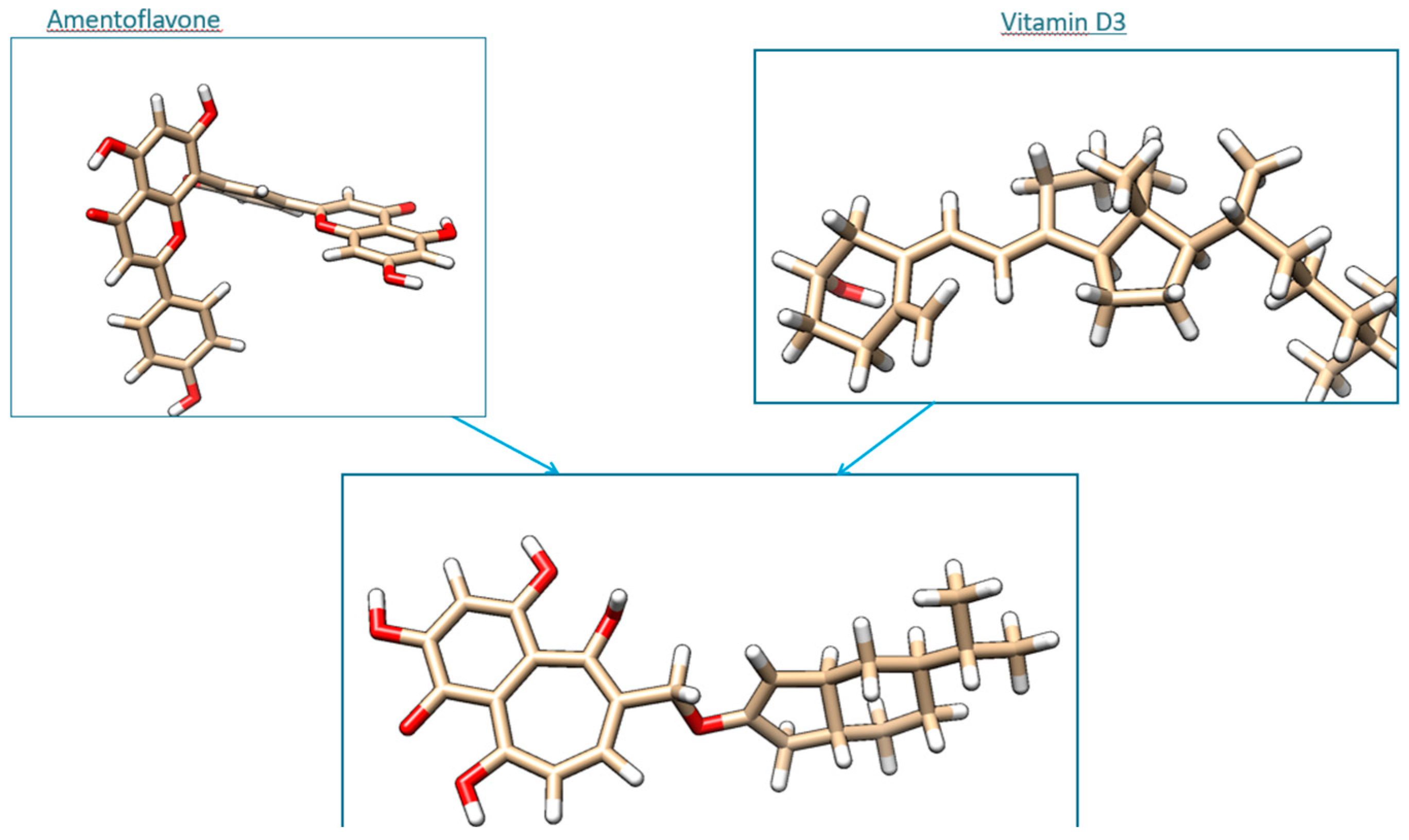
Figure 2.
Chemical structure of hybrid ( Hybrid Molecule (Amentoflavone–Vitamin D3 scaffold).
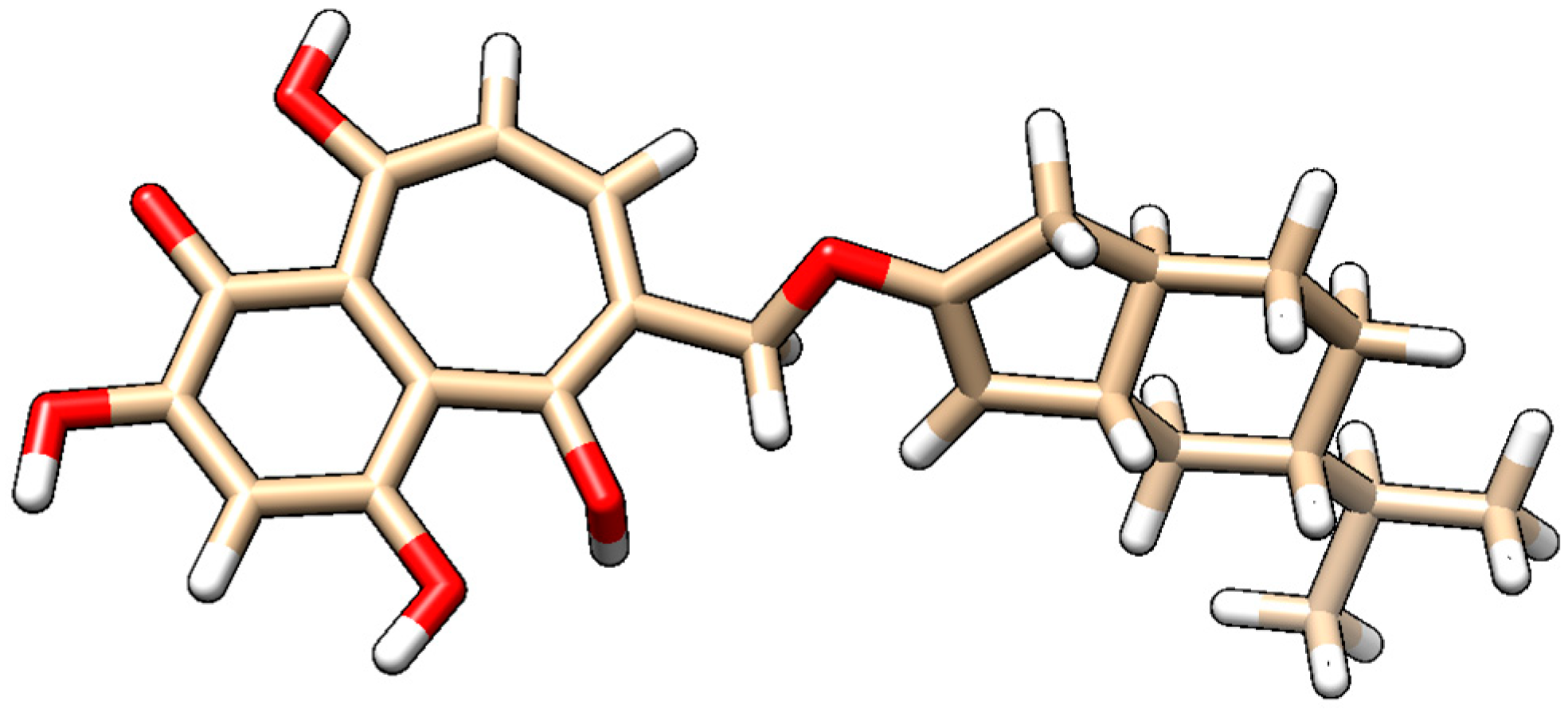

Table 1.
Comparison of blind docking results showing binding energies (kcal/mol) of Amentoflavone, Vitamin D3, and their proposed Hybrid in complex with various interleukins. Docking simulations were performed using AutoDock Vina via the PyRx software platform.
Table 1.
Comparison of blind docking results showing binding energies (kcal/mol) of Amentoflavone, Vitamin D3, and their proposed Hybrid in complex with various interleukins. Docking simulations were performed using AutoDock Vina via the PyRx software platform.
| Interleukin (PDB) | Amentoflavone (kcal/mol) | Vitamin D3 (kcal/mol) | Hybrid (kcal/mol) |
| IL-6 (1ALU) | –8.2 | –6.4 | –7.2 |
| IL-12 (1F45) | –10.2 | –7.0 | –8.8 |
| IL-8 (1IKL) | –7.8 | –6.1 | –7.3 |
| IL-2 (1M47) | –7.4 | –6.4 | –7.3 |
| IL-17A (4HR9) | –9.5 | –7.8 | –8.8 |
| IL-11 (6O4O) | –9.1 | –7.3 | –7.8 |
| IL-4 (8A4F) | –8.1 | –7.9 | –7.8 |
| IL-1β (9ILB) | –8.8 | –6.9 | –7.5 |
| IL-1β site (8C3U) | –8.4 | –6.8 | –7.5 |
Disclaimer/Publisher’s Note: The statements, opinions and data contained in all publications are solely those of the individual author(s) and contributor(s) and not of MDPI and/or the editor(s). MDPI and/or the editor(s) disclaim responsibility for any injury to people or property resulting from any ideas, methods, instructions or products referred to in the content. |
© 2025 by the authors. Licensee MDPI, Basel, Switzerland. This article is an open access article distributed under the terms and conditions of the Creative Commons Attribution (CC BY) license (http://creativecommons.org/licenses/by/4.0/).
Copyright: This open access article is published under a Creative Commons CC BY 4.0 license, which permit the free download, distribution, and reuse, provided that the author and preprint are cited in any reuse.


