
Submitted:
11 September 2025
Posted:
15 September 2025
You are already at the latest version
Abstract
Anticipating disruptive technologies often reveals deep social divides in how individuals interpret change. This paper examines the psychological consequences of imagining an Artificial Intelligence (AI) revolution in the Democratic Republic of Congo (DRC), with particular attention to perceived behavioral control (PBC). Drawing on the Theory of Planned Behavior, we conceptualize PBC through two key dimensions: self-efficacy and locus of control. Using a randomized experimental design with treatment, placebo, and control conditions, participants were primed with narratives of AI disruption, after which shifts in their sense of agency were measured. Findings indicate that AI primes significantly reduced perceptions of controllability, especially among disadvantaged groups, while self-efficacy remained largely stable. Conversely, individuals with relative advantages, proxied by car ownership and male gender, demonstrated resilience, and in certain cases even a rebound effect, suggesting that access to material and symbolic resources protects against the disempowering effects of disruptive change. These results underscore a critical psychological cleavage: whereas advantaged participants are inclined to view AI as opportunity, marginalized participants experience it as an uncontrollable threat. The study contributes to debates on inequality, perceived behavioral control, and technology adoption by revealing how social class moderates psychological responses to anticipated technological transformations. Policy implications emphasize that reducing inequality requires not only digital infrastructure and skill-building, but also the cultivation of psychological resources such as Locus of control, inclusion, and self-efficacy to mitigate the risk of AI amplifying existing divides.
Keywords:
AI revolution
; perceived behavioral control
; social classes
; inequality
; D.R.Congo
1. Introduction and Hypotheses
The AI revolution, often heralded as the “fourth industrial revolution,” is reshaping labor markets, production systems, and modes of social interaction worldwide [1,2,3]. In high-income countries, debates have revolved around the automation of skilled and unskilled jobs, the emergence of new forms of employment, and the ethical implications of machine learning. In low- and middle-income countries, however, the conversation remains relatively underdeveloped, despite the likelihood that these societies will experience both the disruptive risks and potential transformative benefits of AI [4,5]. In fragile economies such as the DRC, where over 60 % of the population lives below the poverty line and formal employment opportunities are scarce, the arrival of AI-based technologies raises critical questions about who perceives themselves as able to adapt, benefit, and innovate, and who feels condemned to marginalization.
In popular discourse, AI is frequently described either as a source of unprecedented opportunity or as a disruptive technology that threatens to undermine human autonomy and control. These divergent narratives are not merely rhetorical: they reflect profound differences in perceived behavioral control (PBC), the psychological construct that captures individuals’ beliefs about their capacity to enact desired behaviors given internal abilities and external constraints [6,7,8] . In contexts where AI is seen as a tool of empowerment, individuals may report extremely high levels of perceived control, captured in the assertion “I can do anything and everything.” Conversely, in contexts where AI is viewed as opaque, inaccessible, and monopolized by elites, individuals may articulate a sense of learned helplessness, resonating with the claim “There is nothing we can do.”
To address these questions, it is essential to situate them within the psychological construct of perceived behavioral control. Originally embedded in [8] Theory of Planned Behavior, PBC refers to individuals’ perception of their ability to perform a given behavior, determined both by internal resources (self-efficacy) and external constraints (locus of control). Self-efficacy captures one’s belief in personal competence and skills to carry out an action, while locus of control reflects the extent to which outcomes are attributed to personal agency versus external forces. In contexts of technological change, PBC becomes a central predictor of whether individuals engage in proactive adaptation, entrepreneurial initiatives, and innovative behaviors or withdraw into resignation.
Beyond its theoretical role in the Theory of Planned Behavior, Perceived Behavioral Control has repeatedly been shown to function both as a mediator and a moderator in pathways leading to positive behavioral and economic outcomes. As a mediator, PBC channels the effects of background factors such as social support, education, and prior experience into concrete intentions and behaviors. For instance, entrepreneurial education has been found to increase self-efficacy and internal locus of control, which in turn raise entrepreneurial intentions and persistence [9,10]. Similarly, access to supportive social networks enhances perceptions of control, thereby mediating their impact on business start-up activity [11]. As a moderator, PBC has been shown to buffer adverse effects of external threats such as economic insecurity, uncertainty, and resource constraints, while amplifying the benefits of favorable environments [12,13]. Individuals with higher PBC tend to sustain motivation, resilience, and adaptive behaviors even under conditions of instability or disruption [14].
This dual function underscores the broader developmental significance of PBC. In health psychology, PBC mediates the impact of attitudes on health-promoting behaviors such as physical activity, smoking cessation [15] and environnemental activism [16] . In organizational research, PBC moderates the relationship between job demands and burnout, with higher perceived control mitigating stress effects [17]. Within the domain of technological adoption, it has been demonstrated that individuals’ sense of efficacy and control significantly shape the translation of digital literacy into actual technology use and innovation [18,19,20]. Taken together, these findings highlight that PBC not only predicts intention but also operates dynamically, mediating background resources and moderating contextual challenges. This makes it an indispensable lens for analyzing adaptive responses to disruptive phenomena such as the AI revolution, particularly in unequal societies where structural constraints interact with psychological perceptions of agency.
Crucially, perceptions of behavioral control are not evenly distributed across populations. Social class plays a central role in shaping whether individuals interpret disruptive change as an opportunity or a threat. Individuals from more privileged backgrounds, with access to education, financial resources, and supportive social networks, are more likely to internalize a sense of control and capability. They can afford to experiment, fail, and try again [21,22,23], which reinforces their belief that “I can do everything.” Conversely, those from disadvantaged backgrounds often face persistent structural constraints—limited access to quality education, precarious employment, exposure to poverty, and exclusion from decision-making structures. These constraints shape a more external locus of control, fostering beliefs that outcomes are largely determined by forces beyond individual agency, leading to sentiments such as “There is nothing we can do.”
The DRC offers a particularly fertile ground for investigating these dynamics. Despite being one of the most resource-rich countries in the world, the DRC consistently ranks among the lowest on the Human Development Index [24]. Political instability, weak governance, conflict, and a lack of infrastructure exacerbate socioeconomic inequalities [25]. Access to digital technologies remains highly uneven: while urban elites in Kinshasa, Goma, or Lubumbashi increasingly access smartphones, internet, and global networks, rural populations remain disconnected, locked in subsistence economies, and dependent on informal labor markets. In this stratified context, the perception of one’s ability to participate in, or even respond to, the AI revolution will likely vary dramatically across social classes.
At the same time, the DRC’s youthful population, more than 70 % under the age of 24 [26], represents both a challenge and an opportunity. The youth are often portrayed as potential drivers of innovation, adaptation, and entrepreneurship. However, whether this demographic dividend materializes depends on whether young people perceive themselves as having the agency, skills, and resources to seize opportunities created by AI technologies. For some, AI may symbolize a gateway to digital entrepreneurship, new forms of employment, and global connectivity. For others, it may reinforce existing barriers, amplifying feelings of exclusion and helplessness[27]. The contrast between “I can do everything” and “There is nothing we can do” thus reflects more than individual attitudes; it signals a fault line that could widen social and economic inequalities in the country.
Existing research on technology adoption in Africa has emphasized infrastructural constraints, affordability, and digital literacy [28]. However, far less attention has been paid to the psychological and social-class dimensions of perceived control over technological change. By integrating insights from psychology, behavioral economics, and development studies, this paper seeks to fill that gap. Specifically, it investigates how individuals from different social classes in the DRC perceive their ability to navigate the AI revolution, focusing on the two sub-dimensions of perceived behavioral control: self-efficacy and locus of control.
The contribution of this study is twofold. First, it advances theoretical understanding of PBC by examining its role in contexts of radical technological change and extreme inequality. While most studies of PBC have been conducted in Western or relatively stable contexts, examining it in a fragile, low-income country illuminates how structural barriers interact with psychological perceptions of control. Second, it offers empirical insights into how social-class differences shape orientations toward AI in the DRC. Such insights are not only academically relevant but also have policy implications. If AI is to be harnessed for inclusive development, interventions must go beyond infrastructure and skills training to also address the psychological dimensions of empowerment and perceived agency. Without this, the AI revolution may deepen, rather than reduce, existing inequalities.
In sum, this paper argues that perceptions of behavioral control provide a crucial lens for understanding differential responses to the AI revolution in the DRC. While some individuals, typically those with greater resources and higher social category, may embrace AI with confidence and optimism, others, often those marginalized by poverty and structural exclusion, may feel powerless in the face of change. This divergence in control beliefs is not merely a matter of individual psychology but is embedded in broader social-class structures. Recognizing and addressing these dynamics is essential if the AI revolution is to contribute to inclusive growth rather than exacerbate existing divides.
This research therefore focuses on the following central question: How do different social classes perceive their ability to act within the context of the AI revolution? Addressing this question will contribute not only to the literature on perceived behavioral control and technology adoption but also to debates on global justice, technological governance, and development.
This paper situates these contrasting perceptions within the Democratic Republic of Congo (DRC), a country characterized by stark social inequalities, fragile institutions [29], and recurrent political and economic crises [30,31]. The DRC is a particularly revealing context in which to study PBC in relation to AI because the diffusion of digital technologies unfolds against a backdrop of extreme disparities in education, income, and infrastructural access. While elites may imagine AI as a resource for limitless professional and entrepreneurial possibilities, marginalized groups in rural or conflict-affected provinces may view the technology as another external force reinforcing their exclusion. Thus, the contrast between “I can do anything” and “There is nothing we can do” reflects not only individual psychology but also the stratification of social classes and the structural determinants of perceived control.
The proposed causal mechanism is summarized in the Directed Acyclic Graph (DAG) presented in Figure 1 [32].
The remainder of this paper proceeds as follows.Section 2 details the experimental design, The Econometric Model and the proxies for social Classes. Section 3 presents the empirical findings. Section 4 interprets the results and discusses implications. Section 5 concludes with directions for future research while Section 6 presents limitations.
2. Methods
2.1. Experimental Design
Participants were randomly assigned to either the treatment, placebo, or control condition. first, the participants had to read intructions for the experminet and sign a consent form fro participation. Participants in the "treatment" group were asked to reflect on their thoughts and feelings regarding the possibility that AI could replace humans in various domains, as well as on their perceptions of the revolutionary nature of AI, the questions were crafted to subconsciously prime a near AI revolution. The priming used a subliminal way to ancer the fact that an AI revolution is in a near future. Participants in the "control" group only answered banal questions questions about their height or favorite meal.
The participants in the "placebo" group were asked questions about some possible non-AI technological revolutionary advancement, the full experimental conditions for the three are presented in Table A1.
We measured perceived behavioral control through its two core components, namely self-efficacy and controllability. Following [6], self-efficacy refers to individuals’ belief in their own capacity to organize and execute the actions required to attain a specific goal, while controllability captures the extent to which the outcome of a behavior is perceived as being under one’s own control rather than external forces. Measuring both dimensions allows for a more comprehensive operationalization of perceived behavioral control, as relying on only one aspect may lead to an incomplete or biased assessment. This dual measurement strategy is consistent with the theory of planned behavior, which emphasizes the role of both efficacy beliefs and perceptions of control in shaping intentions and actions. By disentangling these two facets, our study ensures greater construct validity and aligns with established practices in behavioral research.
Nonetheless, we incorporated an attention check within the perceived behavioral control section. Participants were instructed to select the number “5” as the exclusive response to a specific control item embedded in the questionnaire. Those who failed to comply with this instruction were classified as inattentive and subsequently excluded from the analyses.
I conducted an exploratory factor analysis (EFA) on the PsyCap scale to reduce the initial pool of items into a smaller set of theoretically meaningful dimensions. Items were retained according to their factor loadings, with a minimum threshold of on a single factor and at least on one component. To preserve the clarity of the factor structure, items displaying cross-loadings (i.e., loadings above on multiple factors) or failing to load at or higher on any component were excluded. In addition, items with communalities below , indicating insufficient shared variance with other items, were removed to strengthen the reliability of the solution. Factors were extracted only if their eigenvalues exceeded one, thereby ensuring that each dimension explained a non-trivial proportion of the variance. Finally, the retained dimensions jointly accounted for more than 50 % of the total variance, which confirms that the extracted structure adequately represents the underlying construct. [33,34]
All the analyses were done using R 4.5.1.
The Experimental protocol is summarized in Figure (Figure 2).
2.2. Econometric Model
Our analyses follow an Intention-to-Treat (ITT) framework: we estimate the causal effect of assignment to the prime rather than the effect of participants’ subjective engagement with it. This approach is standard in experimental designs where excluding non-compliers could bias treatment effects [35].
While we did not include a direct manipulation check, this choice avoids well-documented concerns that such checks can (a) alter participants’ interpretation of the manipulation [36], or (b) artificially inflate compliance-based analyses. In line with ITT principles, our estimates reflect the average effect of exposure to the prime under realistic conditions of partial compliance.
The baseline regression model was specified as:
where () denotes the extracted score of factor i for individual j from the specified dimension in exploratory factor analysis (EFA), is a treatment-group indicator variable equal to 1 if individual i belongs to the treatment group, and is a vector of control variables.
Here, the represents the mean score of the given factor in the control group, while captures the mean score difference between the treatment and control groups, conditional on . As a robustness check, an alternative specification estimated difference-in-differences (interactions) effects across groups by Social category.
2.3. Arguments of Gender as a Proxy for Social Class
In the context of the Eastern Democratic Republic of Congo (DRC), gender serves as a significant proxy for social class, with women predominantly occupying lower social strata and men being associated with higher social status. This gender-based stratification is deeply rooted in historical, cultural, and socio-economic factors [37].
Historically, Congolese society has been structured around patriarchal norms that grant men authority in political, economic, and social spheres. These norms were further entrenched during colonial times and have persisted into the present day. For instance, men have traditionally controlled land and economic resources, while women have had limited access to these assets, relegating them to lower economic classesn [38].
Economically, women in the Eastern DRC face significant challenges. They are underrepresented in formal employment sectors and often engage in informal, low-paying jobs. Additionally, women have limited access to education and healthcare, which hinders their economic mobility and reinforces their lower social status.
Socially, women are disproportionately affected by gender-based violence and discrimination. High rates of intimate partner violence and early marriages contribute to their marginalization. These factors not only affect their physical and mental well-being but also limit their participation in public life and decision-making processes [39].
In contrast, men in the region often benefit from higher social status. They are more likely to hold formal employment, own property, and participate in political processes. This disparity in opportunities and resources underscores the use of gender as a proxy for social class in the Eastern DRC [40,41,42].
Understanding this gender-based social stratification is crucial for addressing the underlying inequalities and promoting social justice in the region.
these claims justify why employing a gender-based classification to investigate the impact of anticipating an AI revolution provides a meaningful and insightful analytical framework.
2.4. Arguments of Possessing a Car or More as a Proxy for Social Classes
In the urban context of Goma, the possession of a private car represents a powerful proxy for socioeconomic status. Unlike smaller durable goods, car ownership requires substantial financial resources for acquisition, maintenance, and fuel, which are often beyond the reach of the majority of households. In settings where income data are scarce or unreliable, researchers frequently rely on asset ownership as an indicator of social class, with the Demographic and Health Surveys (DHS) and related work [43] establishing durable goods such as cars as markers of wealth quintiles. Within this framework, owning a car in Goma signals relative financial stability and resilience, distinguishing middle- and upper-class households from those who depend on walking, motorcycles, or shared transport.
Beyond material capacity, cars function as highly visible symbols of prestige and social recognition in Congolese cities. In Goma, car ownership provides not only improved mobility and access to economic opportunities but also a means of asserting social identity and class position. This aligns with broader findings in African urban studies, where vehicles are tied to both economic capital and cultural status ([44]. Consequently, car possession captures both the economic and symbolic dimensions of stratification, making it an appropriate and contextually salient proxy for social class in this setting.
3. Results
3.1. Sample and Balance Ckeck
The information in Table 1 suggest that randomization was generally successful in producing comparable groups, though, as emphasized by [45] perfect balance across all covariates is rarely achieved in practice, particularly with modest sample sizes. In their seminal review, Bruhn and McKenzie argue that randomization ensures unbiased treatment effect estimation, but does not guarantee exact equality in sample means across treatment arms. The small number of statistically significant differences in Table 1 should therefore be interpreted as the normal by-product of random variation, rather than a failure of the experimental design.
Nevertheless, several imbalances deserve careful attention. First, participants in the placebo group are noticeably younger than those in the other groups. While average age in both the control and AI conditions is around 28 years, the mean in the placebo group is only 24 years. This difference is highly significant (), and remains significant when the control group is compared to the pooled treatment groups (p = 0.034). Given that age can correlate with risk preferences, political attitudes, and family responsibilities, this imbalance may influence outcomes and thus warrants statistical adjustment.
Second, marital status is not evenly distributed across conditions. About 45 % of participants in the control and AI groups are single, compared to 64 % in the placebo arm. The difference between control and placebo is statistically significant (), further reinforcing the demographic profile of the placebo group as younger and less family-embedded. Consistently, the number of children also differs: respondents in the control and AI groups report having, on average, two children, while those in the placebo group report only about one. This difference is again highly significant (). Together, these results suggest that the placebo group consists of younger, more single, and less family-oriented individuals.
Third, socioeconomic characteristics show some divergence. Car ownership is more prevalent in the AI group () compared to the control () and placebo () groups. The difference between control and AI is significant at the 1 % level (), and the pooled test is also significant (). Since car ownership is plausibly associated with wealth, this imbalance may indicate that participants in the AI treatment arm are relatively better-off. In addition, educational attainment shows a marginally significant imbalance: 54 % of the control group hold a college degree, compared to 44 % in the AI group (p = 0.079).
For the remaining covariates, including gender, religious affiliation (Protestant), nativity (being from Goma), sports preferences (FC Barcelona supporter), sibling order (eldest child), iPhone ownership, and whether the respondent has a sister, the groups do not differ significantly. These non-results provide reassurance that most characteristics are balanced across treatments.
Taken together, the pattern of imbalances is consistent with the observation by [45] that statistically significant differences should be expected by chance when multiple balance tests are conducted. Importantly, randomization guarantees that treatment assignment is orthogonal to potential outcomes in expectation, even if sample means differ for some covariates. Nonetheless, in line with best practice, we address the observed imbalances by including controls for age, marital status, number of children, car ownership, and education in all main regression analyses. Adjusting for these pre-treatment characteristics reduces residual variance and ensures that treatment effects are not confounded by baseline demographic differences.
In conclusion, although a handful of covariates differ significantly across groups, the balance checks are consistent with what is commonly observed in randomized experiments. [45] emphasize, exact balance is the exception rather than the rule, and the presence of a few imbalances does not undermine the validity of the experimental design. By controlling for the most salient demographic differences, our empirical strategy ensures robust estimation of causal effects.
3.2. Exploratory Factory Analysis for Perceived Behavioral Control
The results of EFA are presented in Table (Table 2), the Goodness-of-fit indexes are presented in Table (Table 3).
The results presented in Table 2 detail the Exploratory Factor Analysis (EFA), a statistical procedure conducted to validate the underlying structure of the Perceived Behavioral Control (PBC) questionnaire. The analysis aimed to confirm that the survey items would empirically group into the two distinct, theoretically-grounded dimensions of PBC, (1) Self-Efficacy, which reflects an individual’s belief in their own capabilities, and (2) Locus of Control, which captures the extent to which they believe outcomes are determined by their own actions versus external forces. The EFA was highly successful, revealing a clean two-factor solution. The survey items loaded strongly onto their intended dimensions, with most factor loadings exceeding , indicating a clear and robust association. Collectively, these two factors accounted for 55 % of the total variance in the data, underscoring the strength and clarity of this two-dimensional structure. This outcome provides strong evidence that the questionnaire is a valid instrument, capable of effectively distinguishing between participants’ self-confidence and their sense of agency.
Building on the EFA, Table 3 presents the goodness-of-fit indices, which offer a rigorous statistical assessment of how well the identified two-factor model aligns with the collected data. The results indicate an excellent model fit across multiple criteria. The Comparative Fit Index (CFI ) and the Tucker-Lewis Index (TLI ) both surpassed the 0.95 threshold for excellent fit. Furthermore, the Standardized Root Mean Square Residual (SRMR ) was well below the conventional benchmark for a good fit, while the Root Mean Square Error of Approximation (RMSEA ) also fell within the range considered to be excellent. Taken together, these strong indices provide compelling statistical evidence that the theoretical structure of the questionnaire is a near-perfect representation of the empirical data. This confirms that the instrument is both valid and reliable, thereby establishing a methodologically sound foundation for the main experimental analyses of the study.
3.3. Main Results and Robustness Checks
The main regression results presented in Table 4 and informations in Figure 4, Figure 5 and Figure 3 provide mixed evidence regarding the effect of anticipating an AI revolution on perceived behavioral control (PBC). On the dimension of self-efficacy, coefficients associated with the AI prime are small and statistically insignificant across specifications, suggesting that the treatment did not meaningfully alter participants’ confidence in their entrepreneurial abilities.
Figure 3.
Diff-in-Diff-in-Diff by gender and Car possesssion on Locus of Control. Note. [*] p < 0.05, [**] p < 0.01, [***] p < 0.001.
Figure 3.
Diff-in-Diff-in-Diff by gender and Car possesssion on Locus of Control. Note. [*] p < 0.05, [**] p < 0.01, [***] p < 0.001.
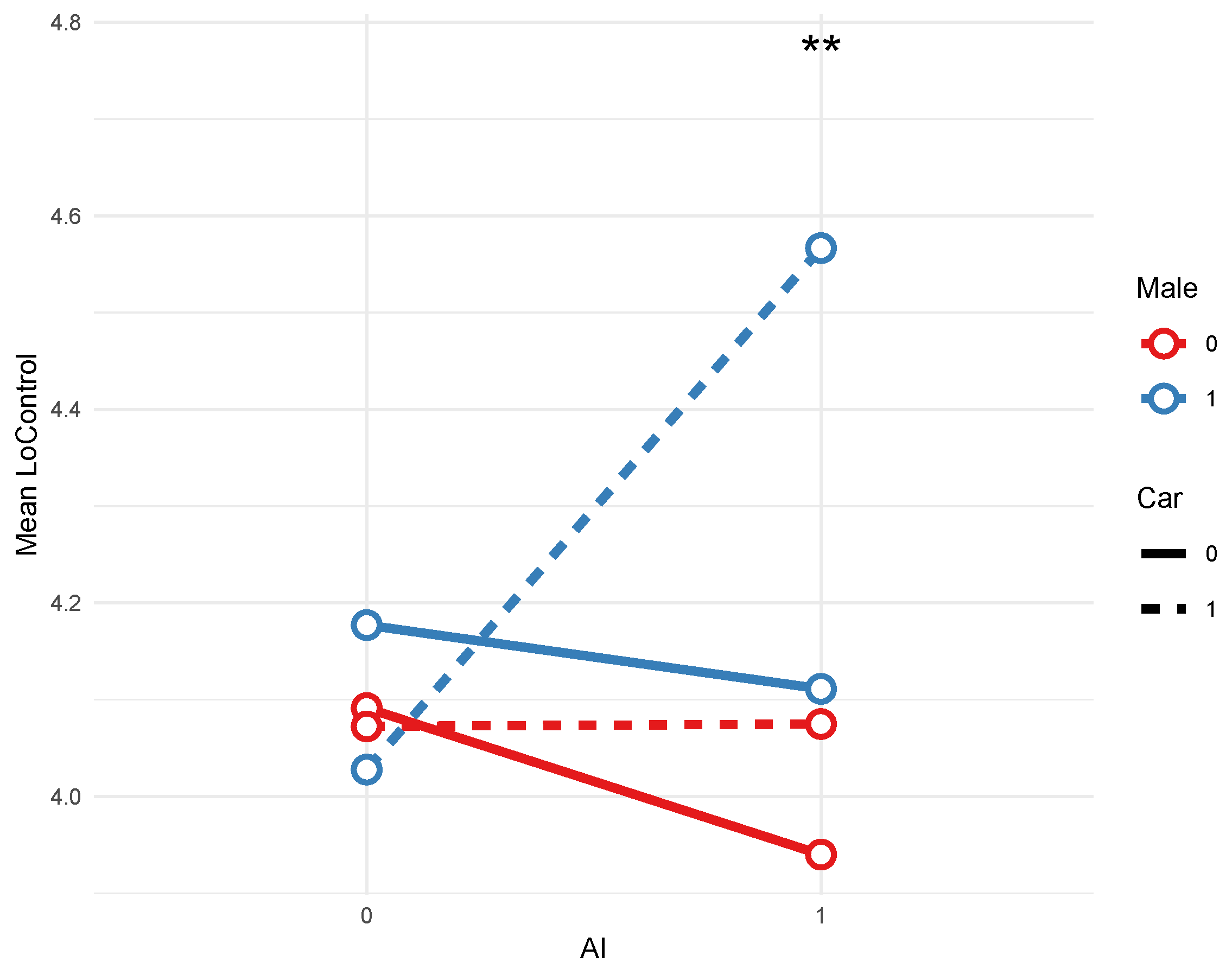
Figure 4.
Treatment effect of an AI revolution vs Effect of the placebo on Locus of Control by gender. Note. Each boxplot illustrates the distribution (median, inter-quartile range), while red dots indicate group means and red lines represent standard errors (± 1.96SE). The significance bar denotes the result of a comparison test between conditions.
Figure 4.
Treatment effect of an AI revolution vs Effect of the placebo on Locus of Control by gender. Note. Each boxplot illustrates the distribution (median, inter-quartile range), while red dots indicate group means and red lines represent standard errors (± 1.96SE). The significance bar denotes the result of a comparison test between conditions.
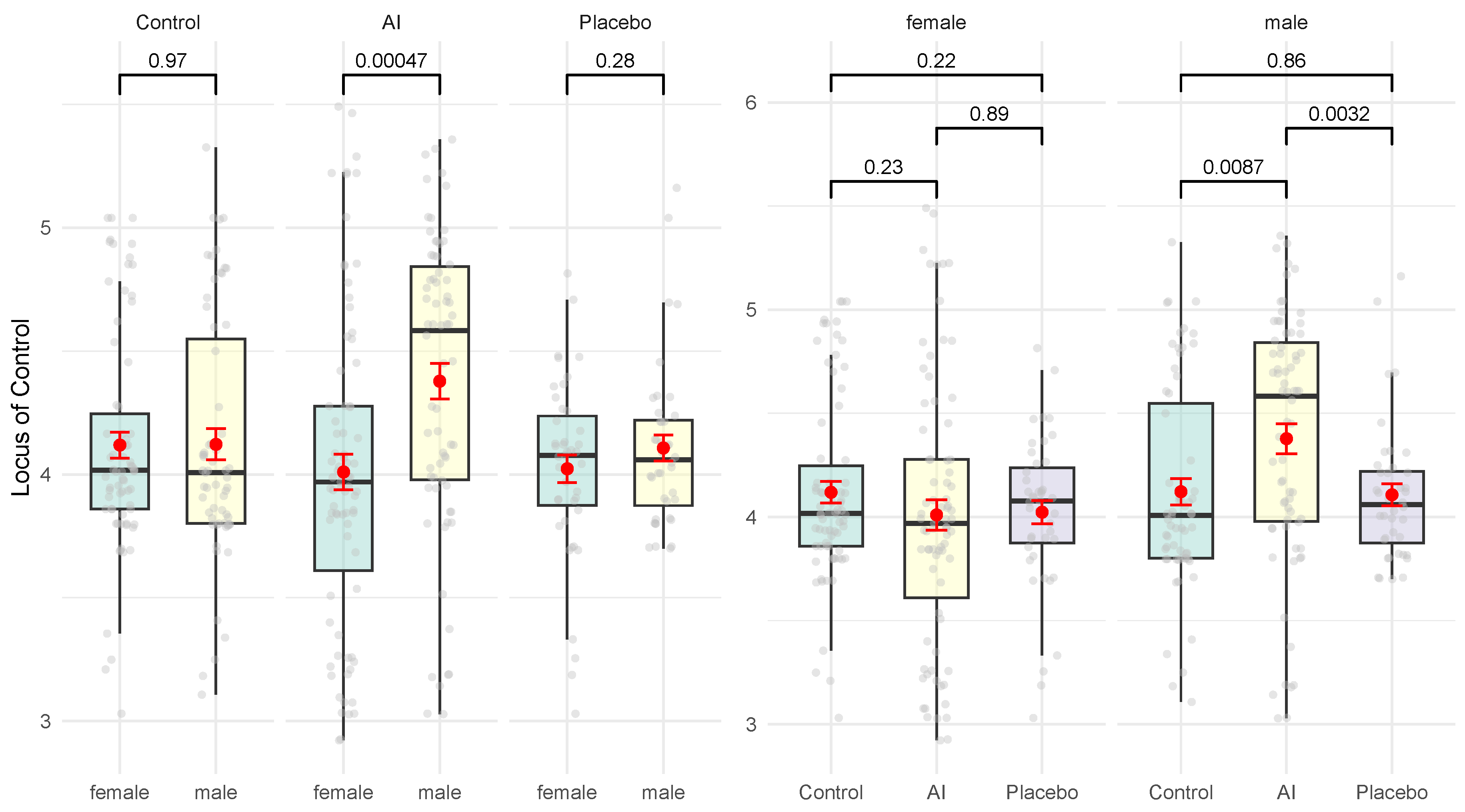
Figure 5.
Treatment effect of an AI revolution vs Effect of the placebo on Locus of Control by Car possession. Note. Each boxplot illustrates the distribution (median, inter-quartile range), while red dots indicate group means and red lines represent standard errors (± 1.96SE). The significance bar denotes the result of a comparison test between conditions. "1" : Car possession, "0" : No Car Possession.
Figure 5.
Treatment effect of an AI revolution vs Effect of the placebo on Locus of Control by Car possession. Note. Each boxplot illustrates the distribution (median, inter-quartile range), while red dots indicate group means and red lines represent standard errors (± 1.96SE). The significance bar denotes the result of a comparison test between conditions. "1" : Car possession, "0" : No Car Possession.
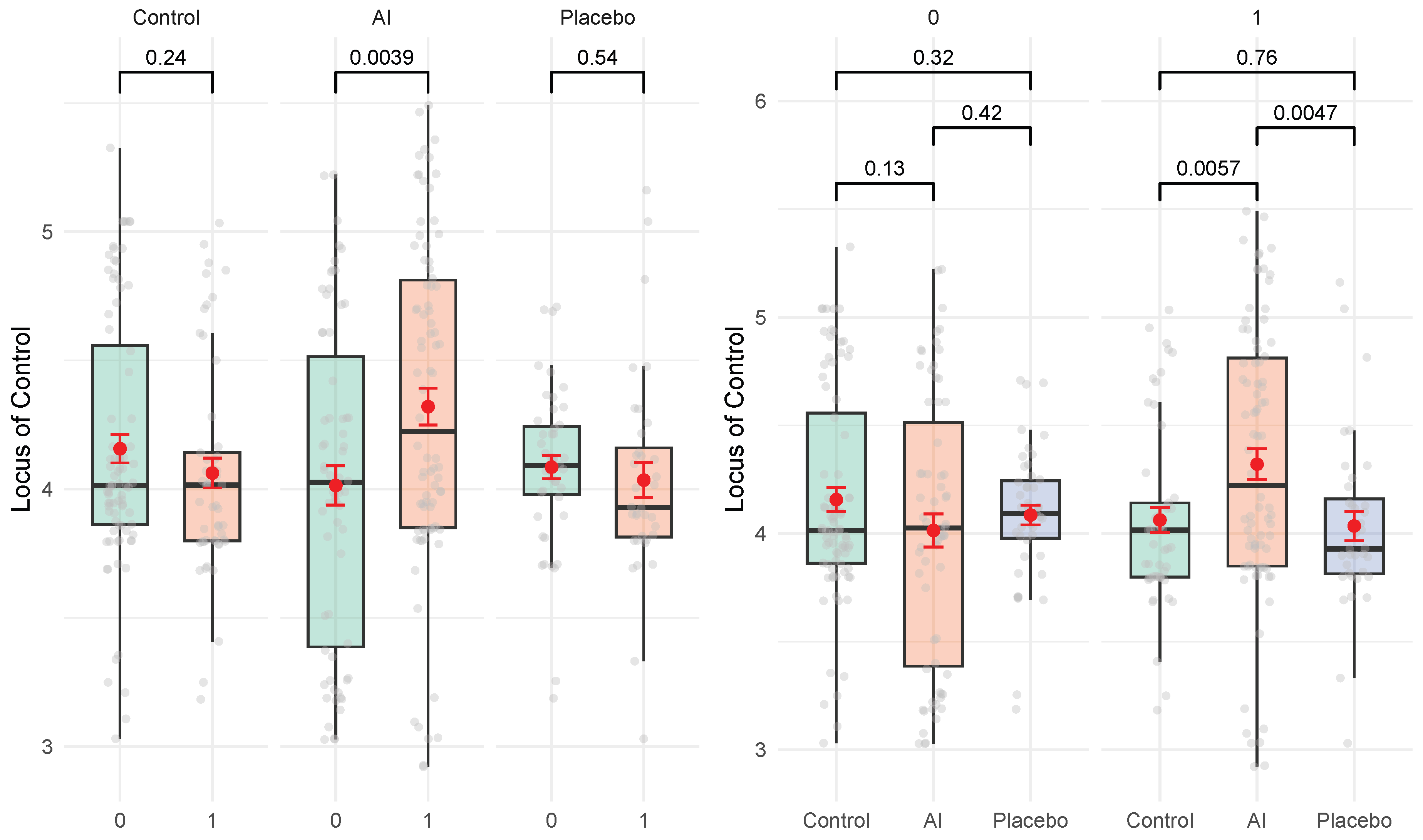
By contrast, the results for locus of control are more pronounced: exposure to the AI condition significantly reduced perceived controllability (, in column 4), indicating that the AI revolution was more likely to be internalized as an external, constraining force rather than an empowering one for people from certain social category.This finding aligns with the hypothesis that disruptive technological narratives may trigger feelings of helplessness, particularly in relatively low status people.
Figure 3 further refines this pattern through a triple-difference analysis: men who both anticipate AI disruption and possess a car (a proxy for higher social class) exhibit a statistically significant rebound in perceived control (AI × male × car, , ). This suggests that relatively advantaged individuals may reframe AI not as a constraint but as an opportunity for agency and adaptation, consistent with their stronger access to resources. Conversely, disadvantaged groups, particularly those without car ownership, register consistently negative or null responses, reinforcing the role of material assets in shaping psychological resilience.
Taken together, these results highlight a dual dynamic. While the AI revolution broadly depresses perceptions of control, especially among those lacking economic resources, individuals embedded in higher social strata may mobilize their advantages to buffer or even invert the negative psychological effect. The robustness of these patterns across multiple specifications (Table 4, columns ) underscores the reliability of the findings. The observed asymmetries suggest that AI discourse may exacerbate existing inequalities, with advantaged groups internalizing technological disruption as empowerment, while disadvantaged groups experience it as disempowerment.
4. Discussions
The findings of this study reveal several important dynamics at the intersection of technological anticipation, social class, and perceptions of control. First, the results demonstrate that anticipating an AI revolution has a measurable impact on perceived behavioral control (PBC). Specifically, exposure to AI-related primes significantly reduced participants’ sense of control over future opportunities. This aligns with evidence from global labor studies showing that technological disruption often heightens uncertainty and feelings of helplessness, particularly in fragile contexts [46,47]. The fact that individuals projected reduced capability in the face of AI mirrors broader debates about automation as both a source of opportunity and a driver of precarity.
Second, our analyses highlight the role of social class in moderating these perceptions. Respondents from higher socioeconomic backgrounds reported relatively stable perceptions of control even under AI primes, whereas those from lower socioeconomic strata displayed sharp declines. This asymmetry echoes existing literature on structural inequality, which emphasizes that material and symbolic resources buffer against uncertainty [48,49]. Individuals with greater access to education, capital, and social networks may reinterpret technological disruption as an opportunity for reinvention, while those without such safety nets perceive it as an existential threat. In this sense, our findings reinforce the importance of considering socioeconomic position not merely as a demographic control, but as a psychologically consequential factor shaping reactions to global technological change.
Moreover, the results resonate with the literature on poverty identity and attentional avoidance [50,51]. Just as scarcity captures attention and narrows cognitive bandwidth, anticipating AI seems to function as a contextual stressor that diminishes perceived efficacy. The erosion of control among lower-class participants may therefore be partly understood through the lens of scarcity psychology: when future uncertainty compounds existing insecurity, individuals may disengage or withdraw rather than mobilize. This mechanism is consistent with our observed interaction effects, where the compounding of AI anticipation with low social class produced the most negative evaluations of control.
The broader theoretical implication is that narratives of technological revolutions cannot be divorced from questions of inequality. As [52] argues in his work on the “precariat,” disruptions in labor markets disproportionately unsettle groups already at the margins. Our findings show that this is not only a material effect but also a psychological one: the anticipation of disruption alone is sufficient to depress perceived agency among disadvantaged groups. This anticipatory mechanism may have downstream consequences for motivation, entrepreneurship, and even civic participation, echoing [53] argument that perceptions of capability are foundational to human development.
At the same time, the relative boost of locus of control of higher-class respondents suggests a stratification of hope and despair. Whereas the privileged maintain or even enhance their sense of control in the face of disruption, the disadvantaged lose ground. This bifurcation risks widening not only material but also psychological inequalities. Recent literature on digital divides in Africa has similarly emphasized that unequal access to infrastructure and literacy generates differential perceptions of digital opportunities [28,54]. Our study adds to this by showing that such divides are not merely about present access but about imagined futures.
Another contribution of this work is its linkage to the theory of moral disengagement [55,56]. Reduced perceptions of control have been linked in prior studies to a greater tendency to rationalize unethical behavior, as individuals justify inaction or harmful actions when they feel powerless [57]. In fragile contexts like Eastern DRC, where insecurity and poverty already erode social trust, the additional psychological burden of technological uncertainty may accelerate disengagement processes. This opens a new line of inquiry into how anticipations of AI interact with broader moral and civic behaviors.
From a policy perspective, these findings suggest that interventions aimed at bridging technological divides must go beyond infrastructure and training. They must also address the psychological dimensions of inequality. Programs that foster self-efficacy, Locus of control, and a sense of inclusion may buffer against the despair that accompanies perceptions of uncontrollable change. This aligns with Amartya Sen’s capabilities approach, which emphasizes expanding individuals’ real freedoms to act and to aspire. Without such interventions, the AI revolution may exacerbate rather than alleviate inequalities, creating a bifurcated society where some embrace the future and others retreat into helplessness.
The study contributes to three strands of literature. First, it extends the Theory of Planned Behavior by showing how global technological narratives influence perceived behavioral control, a key predictor of motivation and intention. Second, it integrates insights from inequality research by demonstrating the moderating role of social class in shaping responses to disruption. Third, it suggests a novel link between technological anticipation and moral disengagement, opening avenues for future exploration. Together, these contributions underscore the importance of situating technological change within a psychosocial framework that accounts for both material conditions and subjective perceptions.
5. Conclusions
This study provides novel empirical evidence on how the anticipation of an AI revolution shapes perceptions of behavioral control across social classes in the Democratic Republic of Congo. The findings demonstrate that priming individuals with narratives of technological disruption significantly reduces their perceived controllability, particularly among participants from disadvantaged backgrounds. In contrast, respondents with greater socioeconomic resources exhibit relative resilience, and in some cases even a rebound effect, suggesting that material and symbolic assets buffer the psychological impact of disruptive change.
Theoretically, this research contributes to the literature on the Theory of Planned Behavior by situating perceived behavioral control within the context of radical technological transformation. Whereas prior studies have emphasized infrastructure, affordability, and digital literacy as determinants of technology adoption, this study highlights the psychological dimension: how individuals imagine their ability to act when confronted with technological futures. By integrating insights from inequality studies, scarcity psychology, and moral disengagement, the findings suggest that the anticipation of AI may deepen social stratification not only materially but also psychologically.
From a developmental perspective, the implications are profound. If disadvantaged groups increasingly internalize technological change as uncontrollable, the digital revolution may exacerbate cycles of exclusion and helplessness. Conversely, if privileged groups reframe disruption as opportunity, the gap between “I can do everything” and “There is nothing we can do” will widen further, reinforcing inequalities of both agency and outcome. Addressing this challenge requires policies that go beyond digital infrastructure and skills provision to also strengthen psychological resources such as self-efficacy, resilience, and inclusion. Programs rooted in Sen’s capabilities approach and positive psychological capital can help ensure that technological change translates into empowerment rather than disempowerment.
Ultimately, the study underscores that the social consequences of AI in fragile and unequal societies will be determined not only by technological diffusion but also by the distribution of perceived control. Recognizing and addressing these psychological divides is essential if the AI revolution is to become a vehicle for inclusive growth rather than a new frontier of exclusion.
6. Limitations
Despite its contributions, this study has several limitations that should be acknowledged. First, the sample size, while adequate for experimental estimation, remains modest and geographically concentrated in urban Eastern DRC. This constrains the generalizability of the findings to rural populations or to other fragile states with different cultural, political, or technological contexts. Second, the proxies used for social class (gender and car ownership) capture meaningful aspects of inequality in the local setting but may oversimplify the multidimensional nature of socioeconomic stratification, which also involves education, income, and networks. Third, while we employed rigorous psychometric validation for the perceived behavioral control instrument, the absence of a direct manipulation check for the priming task leaves open the possibility that participants interpreted the primes in heterogeneous ways. Fourth, the cross-sectional design captures short-term psychological responses but does not allow us to assess whether changes in perceived control persist over time or translate into actual behavioral adaptations. Fourth, although the study emphasizes psychological dimensions, it cannot fully disentangle them from structural determinants such as access to technology or institutional trust, which likely co-evolve with perceptions of control. Future research would benefit from longitudinal designs, richer measures of social stratification, and comparative studies across different low- and middle-income settings to deepen understanding of how global technological transformations intersect with local inequalities.
Finally, While gender and car ownership provided contextually meaningful proxies for social class in this study, they cannot fully capture the multidimensional nature of socioeconomic stratification. Factors such as education, income stability, and access to networks also shape class boundaries. By focusing on only two indicators, our analysis may overlook these subtler dimensions of inequality. Future work should integrate richer and more composite measures of social class.
*equationsection *figuresection *tablesection
Funding
This project was conducted without the support of any institutional or private funding body.
Informed Consent Statement
All participants gave informed consent before taking part. The research adhered to internationally recognized ethical standards for studies involving human participants. Respondents were informed of the voluntary nature of their participation, their right to withdraw at any time without penalty, and the guaranteed anonymity and confidentiality of their responses.
Data Availability Statement
The data underlying this study are available from the corresponding author upon reasonable request.
Acknowledgments
The author wishes to express sincere gratitude to all participants in the experiments, whose time, engagement, and candor were essential to making this study possible.
Conflicts of Interest
The author declares no conflict of interest.
Appendix A

Table A1.
Experimental Conditions.
| AI Revolution | Control | Placebo |
|---|---|---|
| When you imagine the labor market in the next 10 to 15 years, which professions, from doctors and lawyers to drivers and artists, do you believe will be mostly carried out by artificial intelligence rather than by humans? | Who is your favorite and least favorite artist, and why? | What if a computer could understand what your body feels, such as pain or illness, simply by scanning you, without needles or surgery? |
| Historians speak of the Industrial and Digital Revolutions as moments that completely transformed society. On a scale from 1 to 10, how likely is it that the changes brought by AI will represent a transformation just as significant, or even greater, in our lives? | What is your favorite and least favorite sport (football, basketball, tennis, …) and why? | We have mapped the moon, but what about the ocean floor? What would it take to explore the depths of the oceans as easily as we explore a new city? |
| Thinking about your daily life, how likely do you find the scenario where major personal decisions—such as managing your health, planning your finances, or even choosing a life partner—are primarily guided by AI recommendations? | Between Bukavu and Goma, which city is more populated? What is the approximate population of these cities? | What if you could have perfect Internet connection anywhere on Earth—on a mountain, in the middle of the ocean, or in a rainforest—without cables or relay antennas? |
| Considering the skills needed for the future, how concerned are you that the education and professional training received today will become obsolete due to the rapid advancement of AI systems? | Talk about your favorite and least favorite leisure activity | What if you could travel anywhere in the world in less than two hours? |
| As AI becomes integrated into our economy and society, do you think this change is something we can control and shape, or rather an inevitable force to which we must simply adapt? | What is your favorite and least favorite meal, and why? | What if we could grow any kind of food, anywhere, in any season, without needing a large farm or perfect weather? |
| Imagine a future where AI manages critical infrastructures such as power grids, traffic systems, and supply chains. How much confidence do you have in our current social and legal systems to deal with the consequences if these AI systems make large-scale mistakes? | Who is your favorite African person, from the one you like most to the one you like least | What if you could have a smooth and natural conversation with anyone on the planet, in real time, without knowing their language? |
| When you consider the current pace of technological change, does the idea of a world fundamentally reshaped by AI seem to you like a distant science-fiction possibility, or an urgent reality that is already unfolding? | Tell us about a “crazy experience” you have lived through | What if you could learn a complex skill, like playing the guitar or speaking a new language, in a fraction of the time? |
References
- Lund, B.D.; Agbaji, D.; Mannuru, N.R. Perceptions of the Fourth Industrial Revolution and AI’s Impact on Society. https://ci.unt.edu/computational-humanities-information-literacy-lab/4irlund.pdf, 2025. Accessed: 2025-08-31.
- Philbeck, T.; Davis, N. THE FOURTH INDUSTRIAL REVOLUTION: SHAPING A NEW ERA. Journal of International Affairs 2018, 72, 17–22. [Google Scholar]
- Chou, S.Y. THE FOURTH INDUSTRIAL REVOLUTION: DIGITAL FUSION WITH INTERNET OF THINGS. Journal of International Affairs 2018, 72, 107–120. [Google Scholar]
- Freire, C. Is this time different? Impact of AI in output, employment and inequality across low, middle and high-income countries. Structural Change and Economic Dynamics 2025, 73, 136–157. [Google Scholar] [CrossRef]
- Vang, J.; Clifton, L.; Dung, N.T.; et al. Mitigating Machine Learning Bias between High Income and Low-Middle Income Countries for Enhanced Model Fairness and Generalizability. Scientific Reports 2024, 14, 13318. [Google Scholar] [CrossRef]
- Bandura, A. Social cognitive theory of self-regulation. Organizational Behavior and Human Decision Processes 1991, 50, 248–287. [Google Scholar] [CrossRef]
- Ajzen, I. Perceived behavioral control, self-efficacy, locus of control, and the theory of planned behavior. Journal of Applied Social Psychology 2002, 32, 665–683. [Google Scholar] [CrossRef]
- Ajzen, I. The theory of planned behavior. Organizational Behavior and Human Decision Processes 1991, 50, 179–211. [Google Scholar] [CrossRef]
- Zhao, H.; Seibert, S.E.; Hills, G.E. The Mediating Role of Self-Efficacy in the Development of Entrepreneurial Intentions. Journal of Applied Psychology 2005, 90, 1265–1272. [Google Scholar] [CrossRef]
- Fayolle, A.; Liñán, F. The future of research on entrepreneurial intentions. Journal of Business Research 2014, 67, 663–666. [Google Scholar] [CrossRef]
- Liñán, F.; Chen, Y.W. Development and cross-cultural application of a specific instrument to measure entrepreneurial intentions. Entrepreneurship Theory and Practice 2009, 33, 593–617. [Google Scholar] [CrossRef]
- Armitage, C.J.; Conner, M. Efficacy of the Theory of Planned Behaviour: A meta-analytic review. British Journal of Social Psychology 2001, 40, 471–499. [Google Scholar] [CrossRef]
- Wu, S.; Matthews, L.; Dagher, G.K. Need for achievement, business goals, and entrepreneurial persistence. Management Research News 2007, 30, 928–941. [Google Scholar] [CrossRef]
- Luthans, F.; Avolio, B.J.; Avey, J.B.; Norman, S.M. Positive Psychological Capital: Measurement and Relationship with Performance and Satisfaction. Personnel Psychology 2007, 60, 541–572. [Google Scholar] [CrossRef]
- Sniehotta, F.F.; Scholz, U.; Schwarzer, R. Bridging the intention–behaviour gap: Planning, self-efficacy, and action control in the adoption and maintenance of physical exercise. Psychology & Health 2005, 20, 143–160. [Google Scholar] [CrossRef]
- Lin, Y.C.; Liu, G.Y.; Chang, C.Y.; Lin, C.F.; Huang, C.Y.; Chen, L.W.; Yeh, T.K. Perceived Behavioral Control as a Mediator between Attitudes and Intentions toward Marine Responsible Environmental Behavior. Water 2021, 13, 580. [Google Scholar] [CrossRef]
- Hagger, M.S.; Cheung, M.W.L.; Ajzen, I.; Hamilton, K. Perceived behavioral control moderating effects in the theory of planned behavior: A meta-analysis. Health Psychology 2022, 41, 155–167. [Google Scholar] [CrossRef]
- Prior, D.D.; Mazanov, J.; Meacheam, D.; Heaslip, G.; Hanson, J. Attitude, digital literacy and self efficacy: Flow-on effects for online learning behavior. The Internet and Higher Education 2016, 29, 91–97. [Google Scholar] [CrossRef]
- Getenet, S.; Cantle, R.; Redmond, P.; et al. Students’ digital technology attitude, literacy and self-efficacy and their effect on online learning engagement. International Journal of Educational Technology in Higher Education 2024, 21, 3. [Google Scholar] [CrossRef]
- González-Prida, V.; Chuquin-Berrios, J.G.; Moreno-Menéndez, F.M.; Sandoval-Trigos, J.C.; Pariona-Amaya, D.; Gómez-Bernada, K.O. Digital Competencies as Predictors of Academic Self-Efficacy: Correlations and Implications for Educational Development. Societies 2024, 14, 226. [Google Scholar] [CrossRef]
- Brändle, L.; Kuckertz, A. Inequality and Entrepreneurial Agency: How Social Class Origins Affect Entrepreneurial Self-Efficacy. Business & Society 2023, 62, 1203–1235. [Google Scholar] [CrossRef]
- Hollander, J.A.; Howard, J.A. Social Psychological Theories on Social Inequalities. Social Psychology Quarterly 2000, 63, 338–351. [Google Scholar] [CrossRef]
- Low, M.B.; MacMillan, I.C. Entrepreneurship: Past research and future challenges. Journal of Management 1988, 14, 139–161. [Google Scholar] [CrossRef]
- World Bank. The World Bank in the Democratic Republic of Congo: Overview. https://www.worldbank.org/en/country/drc/overview, 2024. Accessed: 2025-08-31.
- House of Commons International Development Committee. DFID’s work on education: Leaving no one behind? https://publications.parliament.uk/pa/cm201617/cmselect/cmintdev/99/9904.htm, 2017. Accessed: 2025-08-31.
- UNICEF. Youth at the Forefront of Change in the Democratic Republic of Congo. https://www.unicef.org/drcongo/en/stories/youth-forefront-change, 2024. Accessed: 2025-08-31.
- Abramson, L.Y.; Seligman, M.E.; Teasdale, J.D. Learned helplessness in humans: Critique and reformulation. Journal of Abnormal Psychology 1978, 87, 49–74. [Google Scholar] [CrossRef]
- World Bank. Digital Transformation Drives Development in Africa. https://projects.worldbank.org/en/results/2024/01/18/digital-transformation-drives-development-in-afe-afw-africa, 2024. Accessed: 2025-08-30.
- Lake, M. Building the Rule of War: Postconflict Institutions and the Micro-Dynamics of Conflict in Eastern DR Congo. International Organization 2017, 71, 281–315. [Google Scholar] [CrossRef]
- Phiri, S.S.; George, N.S.; Iseghehi, L. Protecting the health of the most vulnerable in the overlooked Democratic Republic of Congo crisis. Health Science Reports 2024, 7, e70011. [Google Scholar] [CrossRef]
- Titeca, K.; Edmond, P. The political economy of oil in the Democratic Republic of Congo (DRC): Corruption and regime control. The Extractive Industries and Society 2019, 6, 542–551. [Google Scholar] [CrossRef]
- Pearl, J. Causality: Models, Reasoning and Inference, 2nd ed.; Cambridge University Press, 2009. [CrossRef]
- Kaiser, H.F. The application of electronic computers to factor analysis. Educational and Psychological Measurement 1960, 20, 141–151. [Google Scholar] [CrossRef]
- Nunnally, J.C. Psychometric Theory, 2nd ed.; McGraw-Hill: New York, 1978. [Google Scholar]
- Gerber, A.S.; Green, D.P. Field Experiments: Design, Analysis, and Interpretation; W. W. Norton & Company: New York, 2012. [Google Scholar]
- Hauser, D.J.; Ellsworth, P.C.; Gonzalez, R. Are manipulation checks necessary? Frontiers in Psychology 2018, 9, 998. [Google Scholar] [CrossRef]
- UN Women. Democratic Republic of the Congo. https://africa.unwomen.org/en/where-we-are/west-and-central-africa/democratic-republic-of-congo, 2024. Accessed: 2025-08-30.
- Pugliese, F. Mining companies and gender(ed) policies: The women of the Congolese Copperbelt, past and present. The Extractive Industries and Society 2021, 8, 100795. [Google Scholar] [CrossRef]
- World Bank. Changing social norms and values to end widespread violence against women and girls in DRC. https://blogs.worldbank.org/en/africacan/changing-social-norms-and-values-end-widespread-violence-against-women-and-girls-drc, 2022. Accessed: 2025-08-30.
- World Bank. Obstacles and Opportunities for Women’s Economic Empowerment in DRC. https://blogs.worldbank.org/en/africacan/obstacles-and-opportunities-womens-economic-empowerment-drc, 2023. Accessed: 2025-08-30.
- UN Women. Gender Country Profile: Democratic Republic of Congo. https://www.lauradavis.eu/wp-content/uploads/2014/07/Gender-Country-Profile-DRC-2014.pdf, 2014. Accessed: 2025-08-30.
- PeaceWomen. Gender Inequality in the DRC. https://www.peacewomen.org/sites/default/files/hrinst_genderinequalityinthedrc_wilpf_december2010english_0.pdf, 2010. Accessed: 2025-08-30.
- Filmer, D.; Pritchett, L.H. Estimating wealth effects without expenditure data—or tears: An application to educational enrollments in states of India. Demography 2001, 38, 115–132. [Google Scholar] [CrossRef] [PubMed]
- Sheller, M.; Urry, J. Places to play, places in play. In Tourism Mobilities: Places to Play, Places in Play; Sheller, M., Urry, J., Eds.; Routledge: London, 2004; pp. 1–10. [Google Scholar] [CrossRef]
- Bruhn, M.; McKenzie, D. In Pursuit of Balance: Randomization in Practice in Development Field Experiments. American Economic Journal: Applied Economics 2009, 1, 200–232. [Google Scholar] [CrossRef]
- Frey, C.B.; Osborne, M.A. The future of employment: How susceptible are jobs to computerisation? Technological Forecasting and Social Change 2017, 114, 254–280. [Google Scholar] [CrossRef]
- Acemoglu, D.; Restrepo, P. Robots and Jobs: Evidence from US Labor Markets. Journal of Political Economy 2020, 128, 2188–2244. [Google Scholar] [CrossRef]
- Kraus, M.W.; Piff, P.K.; Keltner, D. Social class, sense of control, and social explanation. Journal of personality and social psychology 2009, 97, 992. [Google Scholar] [CrossRef]
- Stephens, N.M.; Markus, H.R.; Phillips, L.T. Social class culture cycles: How three gateway contexts shape selves and fuel inequality. Annual Review of Psychology 2014, 65, 611–634. [Google Scholar] [CrossRef]
- Mullainathan, S.; Shafir, E. Scarcity: Why Having Too Little Means So Much; Times Books: New York, 2013. [Google Scholar]
- Mani, A.; Mullainathan, S.; Shafir, E.; Zhao, J. Poverty impedes cognitive function. Science 2013, 341, 976–980. [Google Scholar] [CrossRef] [PubMed]
- Standing, G. The Precariat: The New Dangerous Class; Bloomsbury Academic: London, 2011. [Google Scholar]
- Sen, A. Development as Freedom; Oxford University Press: Oxford, 1999. [Google Scholar]
- Donou-Adonsou, F. Technology, education, and economic growth in Sub-Saharan Africa. Telecommunications Policy 2019, 43, 353–360. [Google Scholar] [CrossRef]
- Bandura, A. Moral disengagement in the perpetration of inhumanities. Personality and Social Psychology Review 1999, 3, 193–209. [Google Scholar] [CrossRef]
- Moore, C. Moral disengagement. Current Opinion in Psychology 2015, 6, 199–204. [Google Scholar] [CrossRef]
- Shalvi, S.; Dana, J.; Handgraaf, M.J.J.; De Dreu, C.K.W. Justified ethicality: Observing desired counterfactuals modifies ethical perceptions and behavior. Organizational Behavior and Human Decision Processes 2011, 115, 181–190. [Google Scholar] [CrossRef]
Figure 1.
Directed Acyclic Graph of the Stated Hypothses.
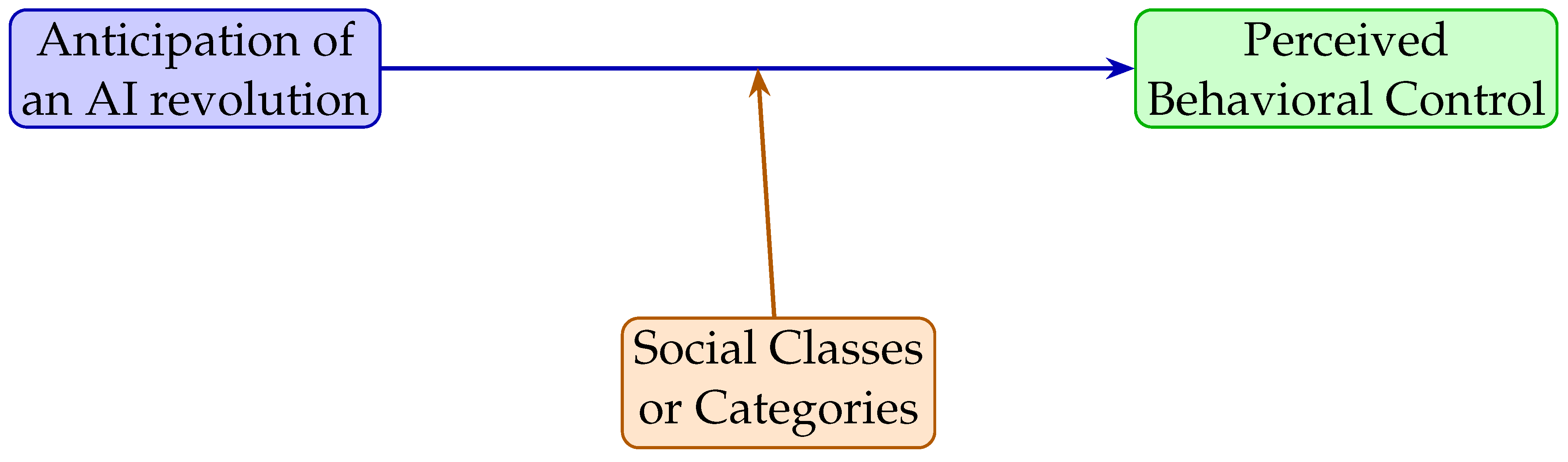
Figure 2.
Experimental Protocol.
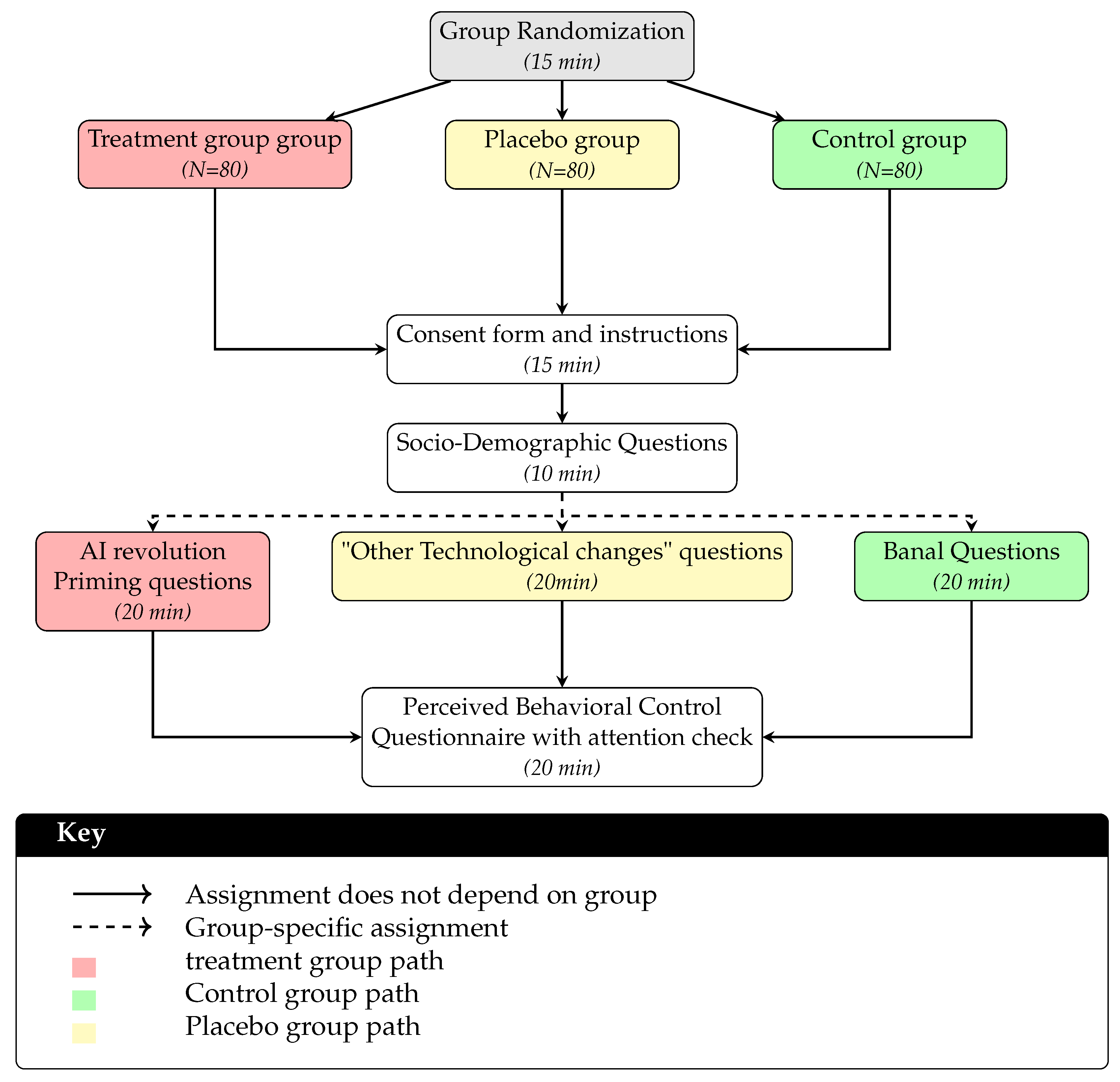
Table 1.
Balance Table for Main Demographics.
| Treatment groups | p value for test of: | |||||
|---|---|---|---|---|---|---|
| Control | AI | Space (placebo) | 1=2 | 1=3 | 1=(2 ∪ 3) | |
| (1) | (2) | (3) | (4) | (5) | (6) | |
| Age | 28.14 | 28.12 | 24.28 | 0.980 | 0.000 | 0.034 |
| (1.37) | (2.05) | (1.15) | ||||
| male | 0.460 | 0.470 | 0.481 | 0.867 | 0.752 | 0.791 |
| (0.49) | (0.43) | 0.47) | ||||
| Single | 0.452 | 0.456 | 0.638 | 0.948 | 0.007 | 0.20 |
| (0.52) | (0.40) | (0.44) | ||||
| Protestant | 0.430 | 0.396 | 0.457 | 0.554 | 0.696 | 0.814 |
| (0.51) | (0.50) | (0.46) | ||||
| Possess at least one car | 0.386 | 0.550 | 0.434 | 0.005 | 0.497 | 0.022 |
| (0.51) | (0.50) | (0.49) | ||||
| Number of Kids | 2.08 | 1.99 | 1.14 | 0.719 | 0.0003 | 0.073 |
| (0.49) | (0.49) | (0.51) | ||||
| Originate from Goma | 0.67 | 0.55 | 0.42 | 0.49 | 0.15 | 0.13 |
| (0.49) | (0.51) | (0.50) | ||||
| FC barcelona Fan | 0.510 | 0.450 | 0.602 | 0.301 | 0.187 | 0.902 |
| (0.51) | (0.50) | (0.49) | ||||
| Is the Eldest | 0.474 | 0.442 | 0.518 | 0.595 | 0.533 | 0.931 |
| (0.51) | (0.50) | (0.49) | ||||
| Has a college Degree | 0.540 | 0.436 | 0.530 | 0.079 | 0.885 | 0.193 |
| (0.51) | (0.50) | (0.49) | ||||
| Possess and Iphone | 0.576 | 0.510 | 0.554 | 0.26 | 0.747 | 0.344 |
| (0.51) | (0.50) | (0.49) | ||||
| Has a sister | 0.584 | 0.644 | 0.590 | 0.297 | 0.925 | 0.439 |
| (0.51) | (0.50) | (0.49) | ||||
Notes: This table shows balance checks for main demographics across the treatment groups. Columns 1 through 3 show sample means for individuals in the Control Group (1), AI salience Revolution group (2), and the Placebo group Group (3), respectively. Standard deviations are in parentheses. Columns 4 through 6 show p-values of OLS regressions of each variable on dummies for each treatment group. Columns 4 and 5 show p-values of tests for equality of means between the AI and Placebo Groups compared to the Control Group, respectively. Column 6 shows the corresponding p-values for comparisons between the Control Group and the AI and Placebo Groups combined.* p < 0.10, ** p < 0.05.
Table 2.
Exploratory factor analysis for PBC.
| Retained Items | Dimensions | Communalities | ||
|---|---|---|---|---|
| Self-Efficacy | Locus of control | |||
| Selfficacy1 | I am confident in my ability to start and run my own business even if it is difficult | 0.74 | 0.55 | |
| Selfficacy2 | For me, starting and running a business would be easy. | 0.73 | 0.53 | |
| Selfficacy3 | I am certain that I can successfully start and manage a business if I really want to. | 0.72 | 0.52 | |
| Selfficacy4 | I believe I have the skills necessary to start and run a business. | 0.80 | 0.64 | |
| Selfficacy5 | Even with limited resources, I am sure I could still manage to start a business. | 0.74 | 0.54 | |
| Locontrol1 | Whether or not I start and run a business is entirely up to me. | 0.83 | 0.69 | |
| Locontrol2 | External circumstances prevent me from starting and running a business. (reverse-coded) | 0.62 | 0.48 | |
| Locontrol3 | The decision to become an entrepreneur lies within my control. | 0.80 | 0.63 | |
| Locontrol4 | Other people often prevent me from starting and running a business. (reverse-coded) | 0.76 | 0.58 | |
| Locontrol5 | Successfully starting and managing a business depends mostly on me, not on factors outside my control. | 0.68 | 0.82 | |
| Variance explained | 0.28 | 0.27 | ||
| Eigenvalues | 3.3503523 | 3.0584156 | ||
Table 3.
Goodness-of-Fit Indices for the Exploratory Factor Analysis Model.
| Indices | df | CFI | TLI | SRMR | RMSEA [90% CI] | |
|---|---|---|---|---|---|---|
| EFA Model | 1571.39 | 26 | 0.985 | 0.97 | 0.025 | 0.053 [0.032, 0.073] |
Note. = Chi-Square; df = degrees of freedom; CFI = Comparative Fit Index; TLI = Tucker-Lewis Index; RMSEA = Root Mean Square Error of Approximation; CI = Confidence Interval; p-value for the model was .
Table 4.
Main results and Robustness Check.
| Dependent variable: | |||||
| Selfficacy | Locontrol | ||||
| (1) | (2) | (3) | (4) | (5) | |
| AI | 0.017 | 0.057 | 0.045 | −0.273** | −0.176 |
| (0.065) | (0.090) | (0.069) | (0.106) | (0.119) | |
| Car | −0.061 | −0.067 | 0.060 | −0.106 | −0.024 |
| (0.061) | (0.088) | (0.054) | (0.078) | (0.079) | |
| Placebo | 0.023 | 0.022 | −0.048 | −0.041 | −0.041 |
| (0.087) | (0.088) | (0.059) | (0.058) | (0.058) | |
| male | −0.018 | 0.024 | 0.167*** | 0.003 | 0.075 |
| (0.056 | (0.0799) | (0.058) | (0.078) | (0.080) | |
| AI:Car | 0.017 | 0.343*** | 0.140 | ||
| (0.109) | (0.122) | (0.171) | |||
| male:Car | 0.054 | −0.122 | |||
| (0.122) | |||||
| AI:male | −0.104 | 0.327*** | 0.112 | ||
| (0.106) | (0.124) | (0.182) | |||
| AI:male:Car | 0.433* | ||||
| (0.245) | |||||
| Constant | 4.108*** | 4.095*** | 3.974*** | 4.079** | 4.055*** |
| (0.123) | (0.127) | (0.112) | (0.113) | (0.114) | |
| Observations | 369 | 369 | 369 | 369 | 369 |
| R2 | 0.044 | 0.047 | 0.056 | 0.105 | 0.115 |
| Adjusted R2 | 0.012 | 0.009 | 0.024 | 0.067 | 0.075 |
| F Statistic | 1.377 | 1.237 | 1.751* | 2.773*** | 2.856*** |
we controlled for all the socio-Demographics variables in all the five specifications.
In parentheses are HC3 huber-White Robust Standard errors
* p < 0.10, [**] p < 0.05, *** p<0.01
Disclaimer/Publisher’s Note: The statements, opinions and data contained in all publications are solely those of the individual author(s) and contributor(s) and not of MDPI and/or the editor(s). MDPI and/or the editor(s) disclaim responsibility for any injury to people or property resulting from any ideas, methods, instructions or products referred to in the content. |
© 2025 by the authors. Licensee MDPI, Basel, Switzerland. This article is an open access article distributed under the terms and conditions of the Creative Commons Attribution (CC BY) license (http://creativecommons.org/licenses/by/4.0/).
Copyright: This open access article is published under a Creative Commons CC BY 4.0 license, which permit the free download, distribution, and reuse, provided that the author and preprint are cited in any reuse.


