

Submitted:
08 September 2025
Posted:
12 September 2025
You are already at the latest version
Abstract
This study contributes to contemporary debate on transformative changes in the digital age, which with special attention to women's visibility, representation and special attention to the agency, especially the focus. Digital media has revolutionized methods where information is produced, spread and consumed, leading to both opportunities and challenges for female communicators. By drawing on a feminist and gender -oriented structure, research checks how the female author and producer group provide navigation, interaction and shape to the dynamics of digital media platforms. By incorporating various theoretical, analytical and methodological personal contact. Conclusions reveal the frequent patterns of gender representation that highlight both progress and permanent differences in the digital field. In particular, analysis indicates how female communication materials affect the creation, the frame for messages and the audience's busy, while facing structural and cultural obstacles to visibility.The results outline the importance of a feminist approach to highlight the nature of the penis of digital communication and challenge traditional gatekeepers. Kvinne fokuserer fokusert og brukt på feminister, dette arbeidet gir verdifullt bidrag i studiet av kjønnskommunikasjon, intimitet og mediepresentasjon. This forward researchers' interactions that women change digital journalism, defy communication practices and claim a place in modern media contexts.
Keywords:
digital journalism
; gender representation
; gatekeeping theory
; media power
; intersectionality
; women communicators
; feminist media studies
1. Introduction
Researchers have received significant attention to gender studies or gender principle in media and communication science, and it is no exaggeration to say that it is always one of the major approaches to the early study of the media event. This interest in gender approaches in the media study may come from a certain belief that there is an excellent difference between gender (male, female) in the use of different media and each has their own perspective and the method of contacting media content. However, the reality of practicing the media business has seen - for some time - especially in the form of medium and the methods of employing it, dealing with it and dedicating it to serve specific media goals, the entity of it, and mainly in its contents and messages, where the practice and structure is required. To revive the legacy of media studies, and to analyze the events formed in the light of technical development and what is happening in Junoweltge societies, will be added to the past to diagnose the nature of their research, to diagnose the nature of their research. Examples of the interactioner's activities, hide, What are the most prominent representations of the relationship between the gender and network getkeeper theory of the Communicator "contributors" and the network getkeeper theory of the communicator "the central question of the problem of our study? To accommodate different coordinates of our problem, many sub -questions were included in the main question, which requires the answer. The most important of these is as follows:
a) Is there a relationship between the communicator’s gender and the content he publishes
b) Is there a relationship between the gender of the communicator and the form of what he publishes?
c) Is there a relationship between the communicator’s gender and his audience?
This study, therefore, tries to combine two research approaches in the field of media and communication, that is, communicator and gender study. It also combines images of research literature in traditional media and the presence of these concepts in its concepts and new media. However, our research is important because it has re -admitted to the establishment of a communicator and the climate of communications separate from its predecessor, and has thus created an important research aspect in research related media and communications on new communicators.This study also searches for a set of additional varieties, of its systematic, theoretical, and field structure. The most important of which is an attempt to diagnose the communication process in the medium of the collective digital media platform, and then the underlying cause and functions of the media.
At the same time, it assumes that the gender of the communicator, in principle - like the previous reality of the traditional media - the demand for the same medium (digital media platform), as men use more than women, and the content of what they publish, its form and target audience differ in the gender of the communicator.
1.1. The Contributor
The concepts and concepts that the initiating element carries in the communication process are many, as the communicator's name takes on many meanings and connotations to express the person or the amount behind a specific media outlet, based on gathering information for publication and following it up; News editors and news representatives are all included in the extensive concept of the communicator. In communication theories, the term "sender" is used to identify the source of the media message, and both can be lifeless - radio or broadcast channel - or living - people. The term also takes the name "addresses" in communication models such as Roman Jakobson's model in the sixties to indicate that communication is interactive and two -way. The sender is generally known as the creator of the text of the media, whether it is TV shows or ads (Danesi, 2013, p. 574).
In the communication model of American Political Entist Manic Harold Laswell, the question "Who?" The communication represents the purpose or source in the theory. In collective communication, this purpose is a group of senders working in a particular media organization, whether it's television or advertising (Galishian, 2002, p. 11). In a different area. In the field, Jacobson sees the communicator under the other name, "Le Destination" - while studying the relationship between language and poetry - as a person, who is generally common to the recipient, where the communications acts as an expressive name to the recipient. It is also a deliberate task; It focuses on the desires and goals of the speaker by carrying out the communication process, and, on the other hand, what can be shared in terms of goals and desires of the process (Veregan, 2010, p. 23).
In this regard, the word communicator indicates the one that begins the sending action, which receives from the word communication. In Christianity, a communist means a missionary or a person who says for Christianity. In addition to many well -known communication models delts, Christian Communication model was developed at Santo Tomas University of Manila. This model originated from Gustin's teachings, as it keeps the communication process at the center of the communication process. Christians to communicate, the message remains central, which is the word of God or Christ, and he, the communicator, sends the word. It not only carries the sending process but lives a reflected message in it. This technical means does not depend on the spirituality of Christians who communicate (Bog, 2006, p. 197). In Christianity, the use of the word in Christianity may be different from what is in Islamic religion, as long as the process of sending or communicating religious materials - Call L - is normal among Muslims. They are also ordered to do so, "Express me even if it is a verse" (al-Bukhari, 2002, p. 875). However, the role of a communicator in Islamic religion is not only about delivering a message, but also about embodiment and living it, which is the main difference from a Christian point of view. This is not considered a situation that closes the communication process and itself. Some communicators consider the fourth element of mass communication, in addition to the medium of audiences, communications and communications or media. In this regard, communicators represent the last element of mass communication elements.
Communications are divided into two types according to the range of communication and nature. The first is a mass communicator, namely, professional who works in the field of media or advertising or various mass media, and individual communicators, that is, those who contribute to influencing the audience through media messages and individual communication - instead of relying on mass media - and which are considered to be leaders of opinions in various societies at national and local levels. Rai's leaders are individuals who are influential in their social circles and are often adopted early ideas or products. They represent advocates of change in society towards new ideas (Hussain, 1993, page 153). This communicator, or a person who appears on screen or other traditional and modern communication channels, gives the characteristics of his audience embodied. The most important challenges faced by him in this regard are producing and presenting programs and messages to diverse sections and audiences in terms of their contexts and mentality, and identifying the communicator can provide insight into possible objectives behind their contribution in the media process. “Communications effectively use triangular relations between them, the content of their message, and then they use the stress treating the audience.
Communator should balance stress that connects its experiences and abilities to one side and audience needs, and he works to bring and ensure the continuity of his work and production (Silverbat, Ferry, and Finen, 2009, Page 26). Thus, the state of transmission in this complex process is not an easy task or function because it requires a lot of effort to make it successful at a personal level, or to be used by controlgic means, but in many cases cannot be controlled, which is the party receiving.
The media communicator, especially the press, may not be very different because it is in advertising or public relations, because messages are considered legitimate only when the communicator agrees to publish it, and this is a similarity between these forms of communication. However, these editorial samples or press publications are often interpreted as "ghostrite" or "ghestright", such as Tom Beavins, which presents many moral difficulties because they do not express or represent the truth of the identity of the communicator, that is, the process of uniformity. In this regard, Richard Johanicen proposed a series of mentor elements that could eliminate some of the potential moral errors in this process: Understanding the purpose of the communicator and the recipient's awareness is not only important, it is crucial. This understanding not only involves the audience, but also asks to think about the message they receive, which makes them actively involved in the communication process.
1 - Does the communicator use this type of writing to project or achieve personal qualities that they are not naturally? This question is not just a question, an invitation for the audience to reflect the role of honesty in communication.
2 - Does the circumstances around the work of the communicator need to resort to this kind of writing?
3 -To what extent does the person who participated in editing his message? And crucally, do they accept the responsibility of the messages presented? This question is not just a question, the call to consider the need for responsibility in communication for the audience (Bivins, 2009, p. 119).
The first step in decompression and analysis and understanding the communication process is to identify the communicator. The latter may seem very difficult to identify, unlike personal communication, where communications and recipients are found directly, unlike collective communication, where there is temporal and spatial isolation among them and the recipients are anonymous. For example, this message was made by someone decades ago by someone by which we do not listen much today. However, we assume that the Camera is responsible for what is called a mera or a microphone. However, he only repeated what he received from the script writer or the editing department and what he was asked to say. Therefore, it gives valuable parameters to the material, expectations and possibilities for the media production to define the common structure of this process or identify the identity of the hidden person behind this activity. (Silverblat et al., 2014, p. 21). The viewer of the media can be specified by some techniques such as editing decisions, signs, images, and challenges of communicators in the media, in the space of global communication, its academic and its academic as the academics, as the academic of all of them, film producers, and film producers. Studied, and often not enough information about this organization or party to fund a television program or text, and these funds are the functions and objectives of the party and which frame it, and focus on the communicator (s) in the media, such as some demographic information: (nationality, income, and other). Some summarize it in three simple questions:
1- Who is responsible for producing the media material?
2- What are the demographic elements of the communicator?
3- How do these characteristics affect the content and the media producer’s expectations?
In its wider sense of collective communication is the servant of the warehouse of these tools and communication artifacts that gives society the meaning and relevance that has gone through the long -term to add to subsequent pay -generations, and the work done by the mass communicator is new, which is more control, and more control of it, and more control of it, and more control of it, and more control of it, and more control of it, and more control over its functions. And he is more control, and he is more control. It is also abundant and easy, and it will be practical to maintain the difference or difference between the technical - mass communication system - and mass communicators that operate this technology as a means of distribution of its products and messages (educational technology, 1973, p. 97). Therefore, it is the responsibility of the communicator to ensure that the information is not transmitted by the uncontrolled message - or by the unwanted means. Nevertheless, the communicator is responsible for the meaning delivered to this message, whether or not it is intended. It is responsible for confirming the content that his message is not subject to potential confusion between him and the recipient. (Pillai, 2011, p. 60)
1.2. Gatekeeping in Perspective: From Theory to Practice
Talk About Gatekeeping Began With the Development and Analysis Development About The News Values Contained in the News, Especially After Article With the Rise of the Names of Johanna Galtung and Mari Ruga (A Discussion of the Structure of Foreign News Newspapers, which was published in the International Journal Peace Research in 1965. The Criteria was pushed towards a circular street where the gatekeeping process Takes Place (Watson, 2012, p. 109).In addition to this argument, some media support the idea of increasing news consumption and academic interest in it as a product of the media as a product. In the mid -fifty decade, the word gatekeeper became more noticeable. Perhaps the most comprehensive model for gatekeeping in media circles is the model of David Manning (1917–1993), which explained how the news waves travel through a specific channel, including gates, where communicators or decision -making functions to influence the way to influence the path of communication or the decision and finally rebuild. White emphasized the role of Telegraph editor, or what he calls Sri gate is to decide whether he wants to accept or reject news topics as one of the most important port guards. Later, studies showed that the sources of Gatekeeping, people's ability to follow news, the media outlets news policy, media include different effects, such as legal limitations or financial requirements, and as a fact, as a matter of facts, which include space for special subjects with special subjects, which is necessary. To incorporate high news values (fourie, 2008, p. 237).
In the light of reality, the concept of the door is no longer just a word that expresses a form of dealing with information but it has become the principle that controls the communication process, because it was the subject of the principle of sociology and psychology. An Kurt Levin's expert, which he developed as a wide social change in society. Since then, it has been adopted and worked with in many other enclosure of media and communication science and journalism. The concepts of protected doors or doors are used to understand and understand the social system in health and technical development, while the traditional concept of gatekeeping is mainly used in the field of media and communication, mainly to refer to the selective passage, which includes the media process. It provides researchers a structure to analyze, evaluate and explain how the communication process and news are selected and why special news topics are chosen. Generally, it provides a structure to continue the research that began in the study of sources of Levin social change and cultural diversity (Fisher et al., 2006, p. 247).
However, it ought to be emphasised that the difficulty of selection does now not most effective have an effect on news. Alan Bryman and Cheryl Haslam raised the difficulty of media bias in supplying and displaying sociologists’ studies, specifically with researcher Weiss in 1985, and it become discussed in the introduction to his ebook. This trouble is of paramount significance because it influences the very fabric of sociological studies representation. Many researchers also confirm that the media suggests its bias in its insurance and is thus taken into consideration a gatekeeper to the dissemination of understanding in preferred. This argument changed into elaborated through Jane Ussher, who noted at that time that there are phrases from sociology that receive extra interest and discussion than different phrases from the same subject of studies. Therefore, the approach of choice or screening influences not best the sector to which the data might be reached however additionally the sociologists from whom the media transmits it. It gives a suspicious picture of the truth of sociology, the social troubles and issues it is concerned with, and different areas of existence consisting of politics, religion, and sports activities. Therefore, the gatekeeping performed by means of the media dramatically influences our society.
In addition to Lewin, we find many of the pioneers of research and investigation into the “social industry of information” White 1950, Gieber 1956, Breed 1960, and Donohew 1967, who superior their studies and studies to what's called gatekeeping or the journalist's gatekeeping characteristic, reporters as people, the editorial personnel or the company, which were defined because the leading forces inside the manufacturing of news, and in 1965, researchers Galtung and Ruge had mentioned the technique of selecting what information is and what isn't, but the information isn't always most effective decided on, it's far fashioned, and the primary technique may be referred to as “information production,” and it has come to be clear that the information that we examine and watch every day isn't an goal record of lived truth, but as a substitute a construction based on a expert base unique to journalists as well as institutional and technical elements, that are from time to time known as media logic (Schaap, 2009, p. 21).
News is a construction - such a principle is itself and a single journalist, editor, or more and more, there are many choices in this construction of a civil journalist. More importantly, Fishman argues that the general focus of the initial work on getkeeping was a "news selection", with the assumption that the media had the power to distort reality by this choice. However, many scholars and thinkers' writings - such as Fishman's newsmaking, Althide's reality composition (1976), and Tuchman Making the News (1978) - at that time it contributed to the scholar movement that the reality was that the reality was the same as the media wanted to appear. It was assumed that the news made a reality and the work of the scholars was not only to understand the process of that product, but was to be critically analyzed and deconstructure, there to be critically assessed and playing it, so significantly influenced our understanding of the world (Coe, 2008).
This research interests - and many others have contributed to the development of gatekeeping theory and the dominance of media and communication science in itsoretical field. However, they have also revealed many gaps around its construction, which invalidate it with changing circumstances and time expansion (Cheriti, 2024, p. 916). In addition, what we can record is that the theory did not die in reality but evolved. In line with the research efforts on what was discussed in the Gatekeeping Theory and what was discussed in the literature of communication or what was discussed with the radical changes affecting many aspects of the communication process, researcher Barzili Naho was notified in the Network Gatekeeping Theory (NGT), and it is included. Based on the study of the power of relationships in the Internet and Media Environment, their theory has given a new definition for the concept of gatekeeper or gatekeeping by integrating traditional concepts in social networking communities, as the network shows the process of distributing information and information. It can also allow us to analyze the centralization in the social network that has a decentralized design and structure, as they are often seen as similar spaces. In this principle we include many results about the process of information proliferation and the behavior of Internet users, and includes five basic concepts: (Fisher et al., 2006, p. 249).
1- Gateway: The entrance or exit of information is the network and its sections.
2- Gateway guarding: The process of monitoring information as it moves through the gate and various activities, including selection, addition, blocking, display, direction, manipulation, formation, repetition, auditing and timing, determining location, integration, ignoring, and deleting information.
3- Gateway guarding mechanism: Technological and methodological means to implement the gatekeeping process.
4- Network gatekeeper: It is a public entity (person, organization, government authority, ..) that has the authority and ability to practice gatekeeping through this mechanism in social networks, and it can also choose the scope in which this process is practiced.
5- The guarded: It is the entity subject to the gatekeeping of the network (recipients).
This development is also evident in the change in the term and concept with which the theory is viewed. In 2005, when Axel Bruns published his book entitled (Gate-watching), he assumed the use of the term gate-watching itself about the growing role of the citizen journalist and his contribution to news production. As its author says, this book was considered a regular documentation of emerging trends in news production (Bruns, 2006). The recipient is the producer of information via social networks and its source. The points of disagreement between the two theories increase when dealing with the elements of power, which in the context of gatekeeping theory, refer to the control and influence over the flow of information. These elements seem to have less impact than their counterparts in traditional media, with the growing negotiating power of the recipient (the guarded) despite the presence of more mechanisms for monitoring information in the network theory.
2. Methodology
Given the nature of the problem, the research field to which it belongs, and the limited capabilities available to the researcher, we relied on the content analysis tool in our descriptive-analytical study (descriptive method). The research community is all the content and media materials - such as texts, images, videos, etc. - in digital media platforms that rely on the WordPress platform as a work base (editing and publishing), as it is the most popular digital media contribution platform for ( journalists, blogger, content editors, ..) whether individuals or companies, according to Alexa statistics and taking into account many scientific and technical reasons and controls that are summarized in the services it provides to both the contributors and the researcher as well as to content editors in general, as these sites contain many services that facilitate this mediatic activities provided by the platform in terms of returning to the archive of entries and posts. Due to the massive size of this content on the one hand and the multiplicity of it in this framework on the other hand, we relied on the most important international classifications of the most prevalent collective platforms. We used the annual classification prepared by Alexa, which specializes in tracking and providing global statistics on the status of various websites, and EBIZ and Quantcast, which specialize in statistics and web audience measurements, as well as providing advice to companies and governments in this field. Given the difficulty of analyzing the contents of these posts together, we relied on a deliberate sample; we carefully chose the first five (05) platforms with the highest visit rates to analyze their content because they are more representative of what we are looking for than others due to the high number of visits and thus the richness of the communication process in them.

Table 1.
shows the analytical study sample.
| Ranking | platforms | Average number of monthly visits (in millions) |
|---|---|---|
| 1 | Huffington Post | 110 |
| 2 | TMZ | 30 |
| 3 | Business insider | 25 |
| 4 | Mashable | 24 |
| 5 | Gizmodo | 23 |
Many statistical analysis programs were used, as well as the application of many statistical transactions that are considered necessary to study and analyze new media events that are characterized by their depth and complexity, in the hope of getting more accurate information, which leads us to honest research results. Most important in these methods and programs:
(A) frequencies and percentage.
(B) Central trend measures and dispersed matrix.
(C) Statistical Analysis Program (SPSS Version 20).
3. Results
We focused on presenting the results of the relationship between the activities of gender variables and specific digital media contributors operating under the principles of network gatekeeper theory. We have chosen the most notable information that addresses some of the study questions and directly related to the problem of study.
3.1. Gender
A proper reading of the table data shows the following:
The title reflects two variables: the first is independent; The research is a sample platform, and secondly dependent, which is the gender of the message content contributors; Male or female or it was made by two contributors, or cannot be specified by their gender; In addition, it shows the size of the variation between the five platforms of the research sample. The use of units of the analysis is the frequency and percentage of the community, which translates its distribution according to the size of the material in the digital media platform and the gender variable, and the extent of the connection with the contributors, the null value in each platform of the prefix, which constructs each of them, which constructs, which constructs. (Subscriber) About the obvious conversion between gender, percentage of men and women, and the defined gender, the overall figures indicate the proportional increase of the female related to their male counterparts.
Table 2.
Distribution of Contributor Gender in Percentage Terms.
| Platform | Male % | Female % | Common % | Unspecified % |
|---|---|---|---|---|
| Huffington Post | 3.86% | 6.07% | 0.36% | 1.01% |
| TMZ | 3.59% | 4.88% | – | 16.66% |
| Business Insider | 3.03% | 4.69% | – | – |
| Mashable | 18.04% | 14.82% | – | 14.08% |
| Gizmodo | 3.59% | 4.97% | – | 0.27% |
| Total | 32.11% | 35.34% | 0.36% | 32.02% |
Overall inequality reached its maximum, about (03.03%) or (33) posts produced by (edited) business insider men (18.04%) or (196) Posts. In comparison, this inequality edited by females, (14.82%) or (161) pieces of material, edited by females, almost (69.69%) or () 1) posts. On the contrary, inequality reached its maximum, about the percentage of (uncertain) contributors, who do not indicate their gender, (0.27%) or (03) in Gizmodo (16.66%) or (181) posts in TMZ. According to the relatively and classic indicators, we record the density of the female contribution community, which indicates a lot of interest in this category in using this medium. Returning to the statistical data and proportions included in the table, we can distinguish between two things; the first is related to the large percentage of contributors who do not specify their gender in their publications compared to the total of the male and female categories, as it then constitutes approximately the same percentage of males, and has a large percentage of the total posts as a whole, while the second thing is; the lack of a “subscriber” percentage or the sending activity in which both males and females participate.
In any case, this can occur for several reasons, perhaps to specify the most important penis and not to consider the presence of a secondary case or a tendency towards love to hide, not to disclose personality, mainly if it is not related to some subjects, it's not anything, for another person, whatever is there, no, that is nothing, which can not pay attention to many opportunities for the penis, and the digital media, and the digital media, and the digital media, and the digital media. Sensitivity behind the initiative to mention and specify gender on the pages of platforms (cultural, social, ..). On average, we find that the number of contributors (men) in the study samples (69.8) and (77) (women) are in addition to (69.9) in the ranked category (69.9). According to the value of the medium, half of the total number of male communicators (39) is less than the contributors, and the other half is more than that value, while half of them is less than (female) (54) (54) while the other half is more than that value.
3.2. Content Orientation in Relation to Gender
The correlation coefficient (R) indicates a strong connection to the relationship between gender variables and message content in the digital media platform of the study sample; This indicates that both gender variables and message content indicate the increase and decrease together. A positive indication of (R) indicates that being a male contributor, the technical sophistication of the content of the message in the communication process also increases, and. Given that the probability value (SIG) is equal to 0.05 for the relationship between the two variables, we accept the alternative hypothesis, strongly state the significant relationship between gender and message content, while rejecting the null hypothesis, which shows that the relationship is not attributed to the opportunity.
Table 3.
Contributor Gender and Content Orientation in Digital Media Platforms.
| Platform | Male (%) | Female (%) | Shared (%) | Undefined (%) | Tech-Related Articles |
|---|---|---|---|---|---|
| Huffington Post | 42 (3.86%) | 66 (6.07%) | 24 (2.20%) | 11 (1.01%) | 12 |
| TMZ | 39 (3.59%) | 53 (4.88%) | – | 181 (16.66%) | – |
| Business Insider | 33 (3.03%) | 51 (4.69%) | – | – | 33 |
| Mashable | 196 (18.04%) | 161 (14.82%) | – | 153 (14.08%) | 249 |
| Gizmodo | 39 (3.59%) | 54 (4.97%) | – | 3 (0.27%) | 93 |
| Aggregate | 349 (32.11%) | 385 (35.34%) | 24 (2.20%) | 348 (32.02%) | 387 |
3.3. Relationship of Gender to Message Structure
Correlation coefficient (R) displays a strong relationship between gender variables and message format in the communication process of the digital media platform. This relationship is direct and positive, indicating that both variables move in the same direction, growing or decreasing. In other words, the more male "contributors", the more textual message and the .that. Since the probability value is less than 0.05 for the relationship between the two variables, we reject the null hypothesis and accept the alternative hypothesis that the relationship between the nature of the textual message in the gender and communication process is not the result of the opportunity.
Table 4.
Maps the Connection Between Gender Representation and Content Formats.
| Content Format | Huffington Post | TMZ | Business Insider | Mashable | Gizmodo | Total |
|---|---|---|---|---|---|---|
| Text Posts | 50 (4.60%) | 123 (11.32%) | 38 (3.49%) | 240 (22.09%) | 35 (3.22%) | 486 (44.72%) |
| Picture Posts | 49 (4.51%) | 123 (11.32%) | 37 (3.40%) | 240 (22.09%) | 35 (3.22%) | 484 (44.54%) |
| Video Posts | 24 (2.20%) | 27 (2.48%) | 9 (0.82%) | 30 (2.76%) | 26 (2.39%) | 116 (10.65%) |
| Gender Split | Male: 42 / Female: 66 | Male: 39 / Female: 53 | Male: 33 / Female: 51 | Male: 196 / Female: 161 | Male: 39 / Female: 54 | Male: 349 / Female: 385 |
3.4. Gender and Audience Orientation
The correlation coefficient (R) reveals a strong relationship between the gender variables and the target audience in the digital platform communication process. This relationship is direct and positive, indicating that both variables move in the same direction, growing or decreasing. In other words, more female communicators, the target audience is more diverse, and .Light. Since the potential value is less than 0.01 for the relationship between the two variables, we reject the null hypothesis and accept the alternative hypothesis that there is a significant relationship between the nature of the target audience in the gender and communication process of a woman, and therefore it is not the result of the opportunity.
Table 5.
Patterns of Target Audience by Contributor Gender in Online Media.
| Category | Male (%) | Female (%) | Shared (%) | Undefined (%) | Total (%) | Platform |
|---|---|---|---|---|---|---|
| Contributions | 39 (3.59) | 53 (4.88) | – | 181 (16.66) | 273 (25.13) | TMZ |
| Contributions | 33 (3.03) | 51 (4.69) | – | – | 84 (7.72) | Business Insider |
| Contributions | 196 (18.04) | 161 (14.82) | – | 153 (14.08) | 510 (46.94) | Mashable |
| Contributions | 39 (3.59) | 54 (4.97) | – | 3 (0.27) | 96 (8.83) | Gizmodo |
| Contributions | 42 (3.86) | 66 (6.07) | 24 (2.20) | 11 (1.01) | 143 (13.14) | Huffington Post |
| Overall Total | 349 (32.11) | 385 (35.34) | 24 (2.20) | 348 (32.02) | 1,106 (100) | All Platforms |
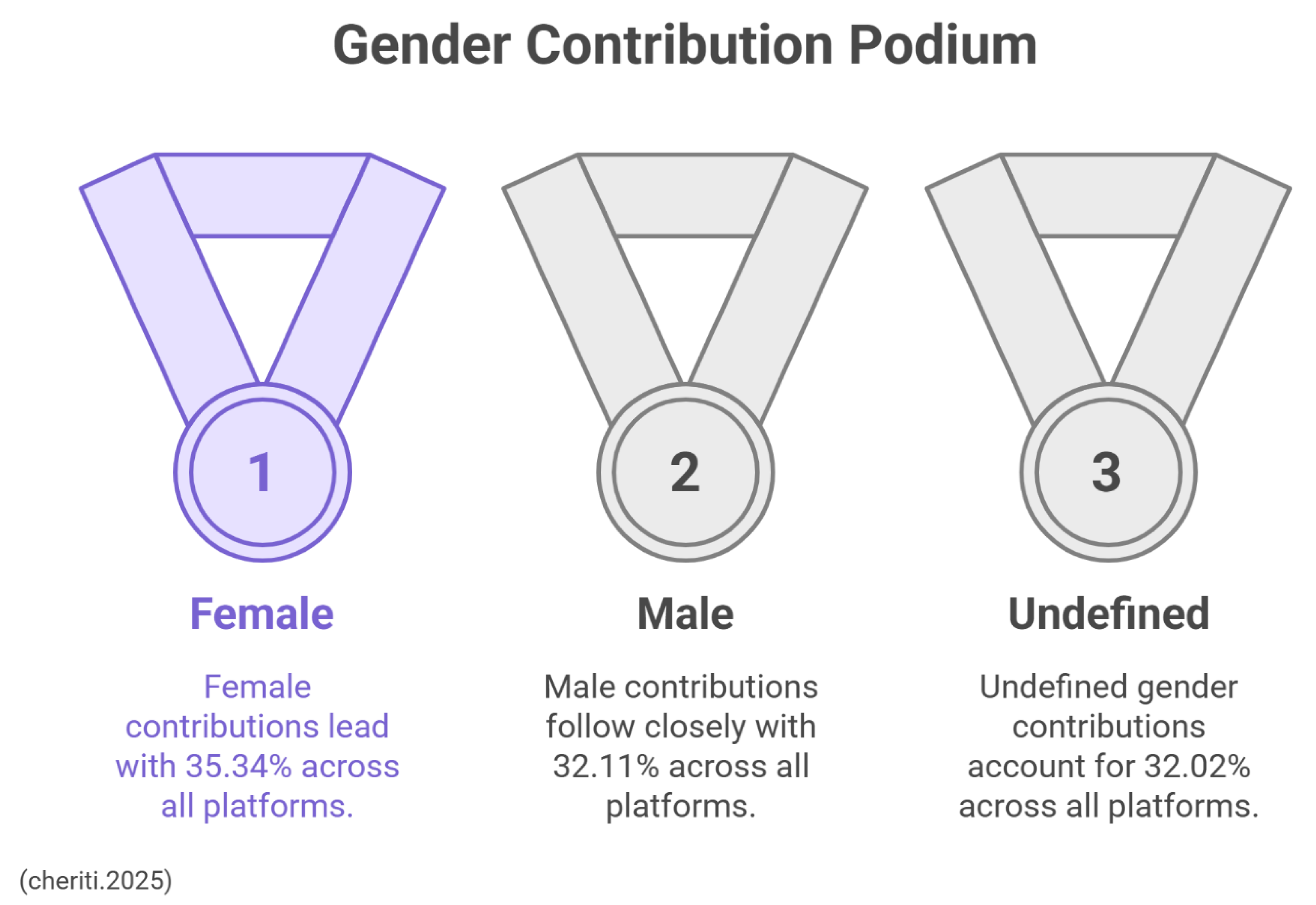
Figure 1.
Visualization of gender-based contribution levels presented in podium format.
4. Discussion
This study helped us discover the major axes and coordinates of relations between the contributing gender and communication processes, which was set within the network gatekeeper theory, especially with the most important using digital media platforms, with the most important:
4.1. The Role of Gender in Shaping Digital Content
According to the results, producing digital materials is a common communication activity that appeals to both men and women, which is in the form of audience interactions with traditional media. Nevertheless, findings highlight a clear penis pattern in digital material activities. Compared to 35.34% of the sample, female contributors show more active participation in this activity, so male contributors highlight their importance in this field relative to contributors. In addition, the gender of the contributors is very correlated with target audiences and such materials. Male contributors show a remarkable correlation with text-based communication; Female contributors show a strong connection with the audience, which they aim. These results fit other studies on gender media preferences, with women bending towards chain and music, while men move to action-oriented fare like war movies and cowboys (Chandler, 1997, page 9).
Moreover, affecting the style of object and communication sent to digital media is the contributor's gender and family situation. It is dynamic clear how the authors will form their messages to suit their readers' expectations. The digital platform offers a variety of formats, including text and visuals, the communication method maintains traditional gender roles and indicates the ongoing social standards within the virtual environment. In addition to all this, a central insights concern about the context and the role of mediator. Teaching continuously shows that the quality of the material and the degree of adult involvement of the strong shape (Cheriti, 2025, p. 9).
4.2. Features and Dynamics of Digital Communication
Study emphasizes more important features of digital information as a communication tool. Considering 80.91% messages, most digital content aims to the general audience. With 44.72% and 44.52%, respectively, text and graphics rule the message forms. Images are most commonly used on digital pages at a rate of 46.38%. They occupy a significant field. This focus on graphic content attracts the growing relevance of images into network communication systems. Another interesting tendency is openness among contributors: 74.09% of individuals reveal their real name, title and personal images, so show an attitude towards authenticity in online interactions. With these developments, the study focuses on the difference, especially in platforms in gender representation between audience and contributors, suggests underlying inequalities in digital engagement. These Results Support the Perspective that Digital Media Platforms are changing interaction structures, therefore promoting efficiency and accessibility (geriş & özdener, 2021). In particular for professional users, dependence on tools including email, instant messaging, and video conferences has simplified communication, so saving time and money (Ram et al., 2023) .yet, including moral questions, potential misinformation caused by moral questions, a possible misconception, and a result of digital divisive technology (Yusoff E -AL, 202222) As a result of inequality. Apparently appears in many different regions, the variety of digital media platforms requires continuous research to adapt to inclusive methods along with its vast ability and adapt to its use.
4.3. Gendered Patterns of Participation in Digital Media
The analysis of this study manifests sensitive deviations from previous findings about the relationship between the gender and the digital media platform, especially as a type of digital media contribution. Contrary to the report of the Pew Research Center (2005) that 57% of the blog makers are male, our findings publishes that in a third of the analyzed materials were written by women. This diversion can arise from factors such as inconsistency or choice of giving gender specifying, especially when discussing sensitive or individual subjects. Hiding gender can hinder potential communication opportunities among contributors, reflecting cultural and social sensitivity that discourages clear gender identity on these platforms. Powered by different causes and experiences, women and non-drugs often participate more actively on digital media platforms than men, according to Boxes (2023), whose growing methods of digital partnerships with these observations. These differences show a complex connection between gender and digital media, where patterns of use vary not only by the type of activity, but also vary by more common social results of these interactions. Significant in the digital environment, Daniel Chandler (1997) is that mass media regularly support traditional gender preferences - that is, men who are leaned towards action styles and women. This contradiction reflects the stratified yet dynamic nature of the digital media partnership, in which new possibilities for involvement are collected with previous interests.
4.4. Gender Representation Across Digital Media Platforms
The gender and societal roles of contributors directly impact digital media messages, therefore influencing their content, audience targeting, and message forms. Mostly expressed through books and multimedia, these concepts reveal variations depending on the context. Female contributors especially exhibit more involvement in publication than male ones since their work is less text-centric, more multimedia-oriented, and usually directed toward public audiences. This represents many societies tastes and roles impacting digital media environments. The dynamics of gender presence in digital media may expose a contrast of vulnerability and empowerment. For instance, Wilhelm (2020) notes that whereas digital platforms provide visibility and means for expression, they also expose women to hazards like harassment, therefore compromising their representation. Likewise, Nazir's (2012) sociolinguistic study of online platform use emphasizes different language habits between sexes, therefore underlining more general societal norms and expectations represented in digital interactions.
These trends show the changing terrain for digital communication, where participation and content creation are shaped by social conventions and platform development together. Despite differences, the linked character of digital platforms emphasizes continuous changes in how people interact with and support digital ecosystems, then promotes a transforming transformation in interpersonal communication. Furthermore, the challenges of digital journalism, including the need for improved digital literacy among journalists and the public, are critical to navigating the complexity of the digital information landscape. We argue that although digital journalism offers new engagement opportunities, it also requires a higher level of statistical and digital literacy from journalists to effectively use data journalism techniques. This necessity of continuous learning and adaptation emphasizes the developing character of journalism in the AI age. (Cheriti, 2025, p. 210).
5. Conclusion
This study states that gender plays a significant role in shaping digital media contributions and extensive communication dynamics, with a significant increase in female participation in various forms of material creation. This trend reflects both the sequential re -configuration of the established social roles and the gradual re -configuration of the standards because women claim more visibility in digital spaces. When the digital platform promotes more open and interactive modes of communication, the patterns of uneven representations remain clear, suggesting who influences systemic barriers to speak, whose voices are expanded, and how the content is obtained by the audience. At the same time, this platform provides unique opportunities to challenge traditional gatekeeping practices, expand descriptions, and reshape public lectures for women communicators.
These findings underline the growing character of digital interaction, where gender mobility intersects with widespread technical and cultural transformation. The rapid integration of artificial intelligence, auto tomatoes and algorithmic systems in the media environment adds more levels of complexity, as these technologies shape not only the mediation of visibility, but also the rotation and development of the material. Looking forward, the future of communication is likely to be affected by both social shifts towards gender equality and the disturbing influence of emerging technologies. Together, these forces will continue to redefine how the agency, presentation and power are negotiated in contemporary digital communication landscapes.
6. Limitations and Future Directions
This study focuses on a selection set of global digital platforms provides valuable insights in gender communication, but also limits the generalization of the findings. Dataset, despite the widespread, will not fully represent the diversity of women's participation in other regional, linguistic or emerging media environments. In addition, the dependence on content analysis attracts representation and important patterns of the agency, but does not establish the factor relationship between platform structures, audience behavior and gender results. Increased integration of artificial intelligence in digital journalism represents new complications that were beyond the scope of this study. The visibility and influence of automated material creation, algorithmic curination and AI-powered moderately female communicators is not yet fully understood. Therefore, future research should be expanded to include longitude and comparative studies in platforms and contexts, how feminist media methods adapt to AI-medium communication, and investigate the intersection dynamics of the gender with age, socio-economic status and technical access cess. Addressing these fields, future work can intensify our understanding of how digital media is more and more shaped through AI - it influences women's representation, agency, and power over communication places..(Cheriti, 2025, p. 3).
Funding
This research received no financial support or grants from universities, government agencies, funding organizations, or other entities.
Conflicts of Interest
The author declares no conflicts of interest related to this study.
References
- Bryman, Alan; Haslam, Cheryl. Social Scientists Meet the Media; Routledge: london, 2013. [Google Scholar]
- Al-Bukhari, A. A. b. I. Sahih al-Bukhari; Dar Ibn Kathir: Beirut, Lebanon, 2002. [Google Scholar]
- Baugh, L.; et al. Cross connections; Gregorian University: Rome, Italy, 2006. [Google Scholar]
- Bivins, T. Mixed media: Moral distinctions in advertising, public relations, and journalism; Lawrence Erlbaum Associates: New York, NY, 2009. [Google Scholar]
- Bokase, M. Exploring the transformative impact of social media on behavior in contemporary society. Interdisciplinary Journal Papier Human Review 2023, 4(1), 10–19. [Google Scholar] [CrossRef]
- Bruns, A. Gatewatching: Collaborative online news production. Canadian Journal of Communication 2006, 31(3). Available online: http://www.cjc-online.ca/index.php/journal/article/view/1740/1851. [CrossRef]
- Chandler, D. An introduction to genre theory. Aberystwyth University, 1997; Available online: http://www.aber.ac.uk/media/Documents/intgenre/chandler_genre_theory.pdf.
- Cheriti, F. Breaking the gate: Gender dynamics in digital media contributions—A content analysis study. Psychology and Education 2024, 61(12), 908–930. Available online: https://www.psychologyandeducation.net.
- Cheriti, F. Intelligent news and intellectual property: Legal challenges in the age of AI journalism—Legal challenges of AI-generated journalism: Intellectual property rights and regulations [التحديات القانونية لصحافة الذكاء الاصطناعي: حقوق الملكية الفكرية و الاطار التنظيمي المستقبلي]. Algerian Journal of Legal and Political Sciences 2025, 62(2), 203–217. Available online: https://asjp.cerist.dz/en/article/270606.
- Cheriti, F. McLuhan today: AI as medium, shaping the global village and extending human intellect. Preprints 2025. [Google Scholar] [CrossRef]
- Cheriti, F. Smartphone screens and growing minds: The benefits and risks of teaching kids in a digital world. Preprints 2025. [Google Scholar] [CrossRef]
- Danesi, M. Encyclopedia of media and communication; University of Toronto Press: Montreal, Canada, 2013. [Google Scholar]
- Educational Technology Publications Incorporated. Audio-visual technology and learning; Educational Technology Publications Incorporated: New York, NY, 1973. [Google Scholar]
- Galician, M.-L. Sex, love, and romance in the mass media: Analysis and criticism of unrealistic portrayals and their influence; Lawrence Erlbaum Associates: New York, NY, 2002. [Google Scholar]
- Geriş, A.; Özdener, N. The illusions on digital citizenship: what we know and what we do? Acta Educationis Generalis 2021, 11(3), 125–151. [Google Scholar] [CrossRef]
- Hussein, S. M. Media and communication with the public and public opinion; Alam al-Kutub: Cairo, Egypt, 1993. [Google Scholar]
- Watson, James; Hill, Anne. Dictionary of media and communication studies; london Bloomsbury, 2012. [Google Scholar]
- Fisher, Karen E. Theories of Information Behavior; Asist: New York, 2006. [Google Scholar]
- Coe, Kevin M. Words of War: Presidential Rationales for Military Action from World War II, New York, ProQuest; 2008. [Google Scholar]
- Nazir, B. Gender patterns on facebook: a sociolinguistic perspective. International Journal of Linguistics 2012, 4(3). [Google Scholar] [CrossRef]
- Fourie, Pieter J. Media Studies: Media History, Media and Society, policy management and media representation; Juta and Co Ltd: Cape Town, 2008. [Google Scholar]
- Schaap, G. Interpreting television news; Mouton de Gruyter: Berlin, 2009. [Google Scholar]
- Silverblatt, A. The Praeger handbook of media literacy; ABC-CLIO: New York, NY, 2013. [Google Scholar]
- Silverblatt, A.; et al. Approaches to media literacy; M.E. Sharpe: New York, NY, 2009. [Google Scholar]
- Silverblatt, A.; et al. Media literacy: Keys to interpreting media messages; ABC-CLIO: New York, NY, 2014. [Google Scholar]
- The Pew Internet & American Life Project The state of blogging; Pew Research Center, 2005. [CrossRef]
- Verhaegen, P.; Pillai, K. Signe et communication. Bruxelles, Belgium: Groupe De Boeck.Pillai, K. (2011). Essence of a manager. Berlin: Springer.
- Yusoff, Y. H.; Yusof, R. M.; Razak, M. A. A.; Aziz, H.; Khir, M. H. F. M. Limitations on digital communication in malaysia: concept paper. International Journal of Academic Research in Business and Social Sciences 2022, 12(11). [Google Scholar] [CrossRef] [PubMed]
Disclaimer/Publisher’s Note: The statements, opinions and data contained in all publications are solely those of the individual author(s) and contributor(s) and not of MDPI and/or the editor(s). MDPI and/or the editor(s) disclaim responsibility for any injury to people or property resulting from any ideas, methods, instructions or products referred to in the content. |
© 2025 by the authors. Licensee MDPI, Basel, Switzerland. This article is an open access article distributed under the terms and conditions of the Creative Commons Attribution (CC BY) license (http://creativecommons.org/licenses/by/4.0/).
Copyright: This open access article is published under a Creative Commons CC BY 4.0 license, which permit the free download, distribution, and reuse, provided that the author and preprint are cited in any reuse.