

Submitted:
03 September 2025
Posted:
04 September 2025
You are already at the latest version
Abstract
Across Africa, governments are embracing digital health by launching ambitious platforms for electronic records, AI applications, and national data exchanges. Nigeria's recent Nigeria Digital in Health Initiative signals similar intent. Yet ambition without foundations, such as a reliable identity, usable addresses, and enforceable standards, risks failure.This commentary argues that Nigeria's digital health trajectory cannot succeed without first addressing key system enablers: accurate population data, stable power, and strong governance. Drawing on evidence from Nigeria, South Africa, and Ghana, we show how these foundational elements shape readiness. South Africa demonstrates that a Master Patient Index, facility lists, and interoperability standards form the backbone for integrated systems. Ghana's national ID and early telemedicine scale-up demonstrate the value of identity systems, while persistent data silos highlight the limitations of tools without effective coordination.Nigeria, by contrast, faces repeated census delays, weak addressing infrastructure, and unreliable electricity, constraints that stall even well-designed platforms. Donors and ministries must resist investing primarily in front-end tools or fragmented pilots. Instead, funding should be tied to verifiable milestones, such as the implementation of broadband access in clinics, the integration of national IDs into health records, and the national adoption of open interoperability standards. "Truth before tools" is not pessimism; it is the shortest route to digital health systems that work for people.
Keywords:
digital health
; interoperability
; Nigeria
; South Africa
; Ghana
; policy
; infrastructure
1. Summary Box
2. Introduction
When glossy reports describe health information exchange in Africa, they often depict images of strong, seamless, and nationwide systems. For practitioners, the reality is less glamorous. Nigeria is frequently portrayed as on the verge of digital transformation, yet frontline experiences suggest otherwise. The question is not whether digital tools matter; they do. However, the question remains whether Nigeria is prepared for a national-scale implementation of these tools.
South Africa offers a useful contrast, demonstrating that strong governance, identity, and interoperability frameworks are prerequisites. Ghana demonstrates gradual advancements in identity and telemedicine, but also faces the risk of siloed data.
The reasoning is simple: truth before tools. Groundworks come before identity, addresses, facility lists, standards, and utilities. Without such preparation work, one would be constructing castles in the air while clinics operate in the dark and without bandwidth.
The Missing Plumbing: Identity, Addresses, and Census Data
Digital health involves understanding who the patient is, where they are, and how many need care. Nigeria has issues with all three.
On mail addresses, only 20% of Nigerians can get mail at their residences; close to 80% of homes and businesses cannot be accessed for deliveries. The adoption of the what3words platform made by Nigerian Postal Services, NIPOST, in 2017 was an attempt to bypass this chronic weakness [1]. While innovative, it highlights the vulnerability of fundamental infrastructure for household-based care, logistics, and telemedicine.
In terms of identity, Nigeria has registered more than 121 million citizens in its National Identity Number (NIN) system, which accounts for approximately 40% of the estimated 300 million population, leaving a significant gap toward establishing a universal patient identifier [3]. Coverage gaps persist, however, and NIN is not often used for patient matching at health facilities. In contrast, Ghana’s “Ghana Card” has achieved near-universal coverage, with real-time cross-agency sharing across revenue, insurance, and telecommunications [2]. The takeaway is unmistakable: identity systems are not just necessary; they need to become integral to service delivery.
Regarding population data, Nigeria has consistently delayed its census, most recently in 2023, resulting in a 17-year gap without a national count [4]. This hinders denominator-based planning for vaccines, facilities, and human resources. In contrast, South Africa conducts frequent censuses, providing it with more reliable population data for health planning.
Nigeria’s Digital Health Landscape: Ambition Without Foundation
Nigeria has recently re-launched its Nigeria Digital in Health Initiative (NDHI), with the promise of electronic records, a health information exchange, standards, and governance committees [9]. It is good to hear such rhetoric. However, on the ground, most clinicians are still paper-bound.
Empirical evidence links EHR implementation failures to infrastructural issues, including unreliable electricity, poor internet connectivity, inadequate hardware, and insufficient funding [7]. Health workers are eager but limited. Telemedicine faces similar challenges: reviews often cite power outages, bandwidth shortages, a lack of controls, and a shortage of technical expertise as the most common difficulties [8].
The risk is familiar. Nigeria has had a history of fragmented, donor-led platforms. For instance, HIV programs once operated more than ten parallel EMRs that did not communicate with each other, rendering national patient tracking impossible [7]. Unless interoperability rules are enforced and utilities prioritized, NDHI may replicate this siloed model at a greater scale.
South Africa’s Experience: Foundations First
It demonstrates the significant impact that can be made when governments prioritize “boring but essential” infrastructure. Its National Digital Health Strategy (2019–2024) prioritizes a Master Patient Index tied to the national ID, a Master Facility List, and a National Health Normative Standards Framework for Interoperability, initially released in 2014 and refreshed in 2021 [10,11,15]. These tools enable systems to communicate with one another and establish a governance framework for exchanging health data.
South Africa also benefits from near-universal ID coverage, regular censuses, and comparatively better infrastructure. Although not perfect, load-shedding still disrupts services; most facilities have mains electricity and growing broadband coverage [5]. A nationwide patient registration system is already operational in public facilities, and conformance testing enforces adherence to standards [12,15].
These investments are not glamorous. They do not receive the same level of publicity as AI chatbots or blockchain pilots. Nevertheless, they help digital health systems scale, connect, and endure.
Ghana: Proof of Concept and Cautionary Tale
Ghana is located between South Africa and Nigeria. The Ghana Card has facilitated over 18.9 million registrations, with about 18 million cards issued and actively linked across various agencies serving a population of 34 million, which amounts to 53% coverage [2]. This demonstrates the potential of a universal ID system in West Africa.
Ghana also led a pilot of telemedicine in 2011, which it expanded nationally by 2016, demonstrating that simple digital tools can increase reach when governance endorses them [13,14]. It still has weaknesses, however. Hospitals still rely heavily on paper, and digital systems are often still siloed [6]. Data governance and interoperability frameworks are still in development, which constrains the full benefits of identity and telemedicine.
For Nigeria, Ghana is both an inspiration and a warning: it is possible to move forward, but without enforceable governance and interoperability, silos persist.
What Donors and Ministries Must Prioritize
The takeaway from these three countries is simple: foundations first. To be successful, Nigeria would do well to prioritize these five areas:
- Addressability: Whole-country address systems (digital or hybrid) that enable accurate location of patients for care and logistics [1].
Global frameworks reinforce these priorities. The WHO’s Global Strategy on Digital Health (2020–2025) emphasizes the need for robust governance, comprehensive workforce training, and robust foundational digital infrastructure before scaling up solutions [16]. The African Union’s continental frameworks echo this, urging member states to prioritize standards, IDs, and infrastructure. Nigeria’s partners should align with these imperatives (see Table 1 and Figure 1).
Table 1 Key system foundations in digital health across Nigeria, South Africa, and Ghana.This comparative snapshot highlights readiness gaps in identity, infrastructure, and governance that must be addressed for digital health systems to scale sustainably.
Figure 1 “Truth Before Tools” Infographic.
3. Conclusions
Nigeria’s digital health ambition is real—but ambition without foundation is fragile. South Africa demonstrates that identity, standards, and governance can foster conditions for effective exchange. Ghana demonstrates both progress and limits. Donors, ministries, and global agencies must resist the temptation to fund flashy pilots or prematurely celebrate “national” exchanges. Instead, they should invest in plumbing: IDs, addresses, registries, standards, and electricity.
“Truth before tools” is not pessimism; it is the most direct route to digital health that works for citizens, clinicians, and systems alike.
References
- Gbadeyanka M. NIPOST adopts 3 word addresses. Business Post Nigeria [Internet]. 2017 Aug 1 [cited 2025 Sep 2]. Available from: https://businesspost.ng/general/nipost-adopts-3-word-addresses/.
- National Identification Authority (Ghana). Registration statistics [Internet]. 2025 Aug 20 [cited 2025 Sep 2]. Available from: https://nia.gov.gh/nia-registration-statistics/.
- National Identity Management Commission (Nigeria). NIN enrolment report—June 2025 [Internet]. 2025 Jun 30 [cited 2025 Sep 2]. Available from: https://nimc.gov.ng/nin/enrolment-report/june-2025.
- Reuters. Nigeria again postpones first census in 17 years. Reuters [Internet]. 2023 Apr 29 [cited 2025 Sep 2]. Available from: https://www.reuters.com/world/africa/nigeria-again-postpones-first-census-17-years-2023-04-29/.
- South African National Department of Health. Annual Report 2023/24 [Internet]. Pretoria: NDoH; 2024 [cited 2025 Sep 2]. Available from: https://www.health.gov.za/wp-content/uploads/2024/10/NDoH-Annual-Report-2023-24.pdf.
- IQVIA Institute. Digital Health Systems in Africa: A convergence of opportunities [Internet]. 2023 Sep 29 [cited 2025 Sep 2]. Available from: https://www.iqvia.com/-/media/iqvia/pdfs/mea/white-paper/iqvia-digital-health-system-maturity-in-africa.pdf.
- Babatope AE, Adewumi IP, Ajisafe DO, Adepoju KO, Babatope AR. Assessing the factors militating against the effective implementation of electronic health records in Nigeria. Sci Rep. 2024;14:31398. [CrossRef]
- Cole OK, Abubakar MM, Isah A, Sule SH, Ukoha-Kalu BO. Barriers and facilitators of provision of telemedicine in Nigeria: A systematic review. PLOS Digit Health. 2025;4(7):e0000934. [CrossRef]
- Federal Ministry of Health and Social Welfare (Nigeria). Nigeria Digital in Health Initiative—overview and updates [Internet]. 2024–2025 [cited 2025 Sep 2]. Available from: https://www.digitalhealth.gov.ng/.
- National Department of Health, South Africa. National Digital Health Strategy for South Africa 2019–2024 [Internet]. Pretoria: NDoH; 2019 [cited 2025 Sep 2]. Available from: https://www.health.gov.za/wp-content/uploads/2020/11/national-digital-strategy-for-south-africa-2019-2024-b.pdf.
- Knowledge Hub (South Africa). National Digital Health Strategy for South Africa 2019–2024—summary [Internet]. 2019 [cited 2025 Sep 2]. Available from: https://knowledgehub.health.gov.za/elibrary/national-digital-health-strategy-south-africa-2019-2024.
- IQVIA Middle East & Africa. Digital Health Systems in Africa—landing page [Internet]. 2023 Sep 29 [cited 2025 Sep 2]. Available from: https://www.iqvia.com/locations/middle-east-and-africa/library/white-papers/digital-health-systems-in-africa.
- Amon S. De facto health governance policies and practices in the decentralized health system of Ghana: implications for digital health. Health Policy Technol. 2024;13(2):100847. [CrossRef]
- Novartis Foundation. Ghana Telemedicine Program Evaluation. 2018. https://www.novartisfoundation.org/sites/novartisfoundation_org/files/2020-11/2018-the-promise-of-digital-health-exsum-en.pdf.
- Department of Health, South Africa. National 2021 Normative Standards Framework for Interoperability in Digital Health. Government Gazette No. 47337. Pretoria: Government of South Africa; 2022 Oct 21. Available from: https://www.health.gov.za/wp-content/uploads/2022/10/HNSF_Gazette_21_October_2022.pdf.
- World Health Organization. Global strategy on digital health 2020–2025 [Internet]. Geneva: WHO; 2021 [cited 2025 Sep 2]. Available from: https://www.who.int/publications/i/item/9789240020924.
Figure 1.
Summary infographic highlighting foundational gaps in Nigeria’s digital health readiness, lessons from peer countries, and key priorities for national and donor investment.
Figure 1.
Summary infographic highlighting foundational gaps in Nigeria’s digital health readiness, lessons from peer countries, and key priorities for national and donor investment.
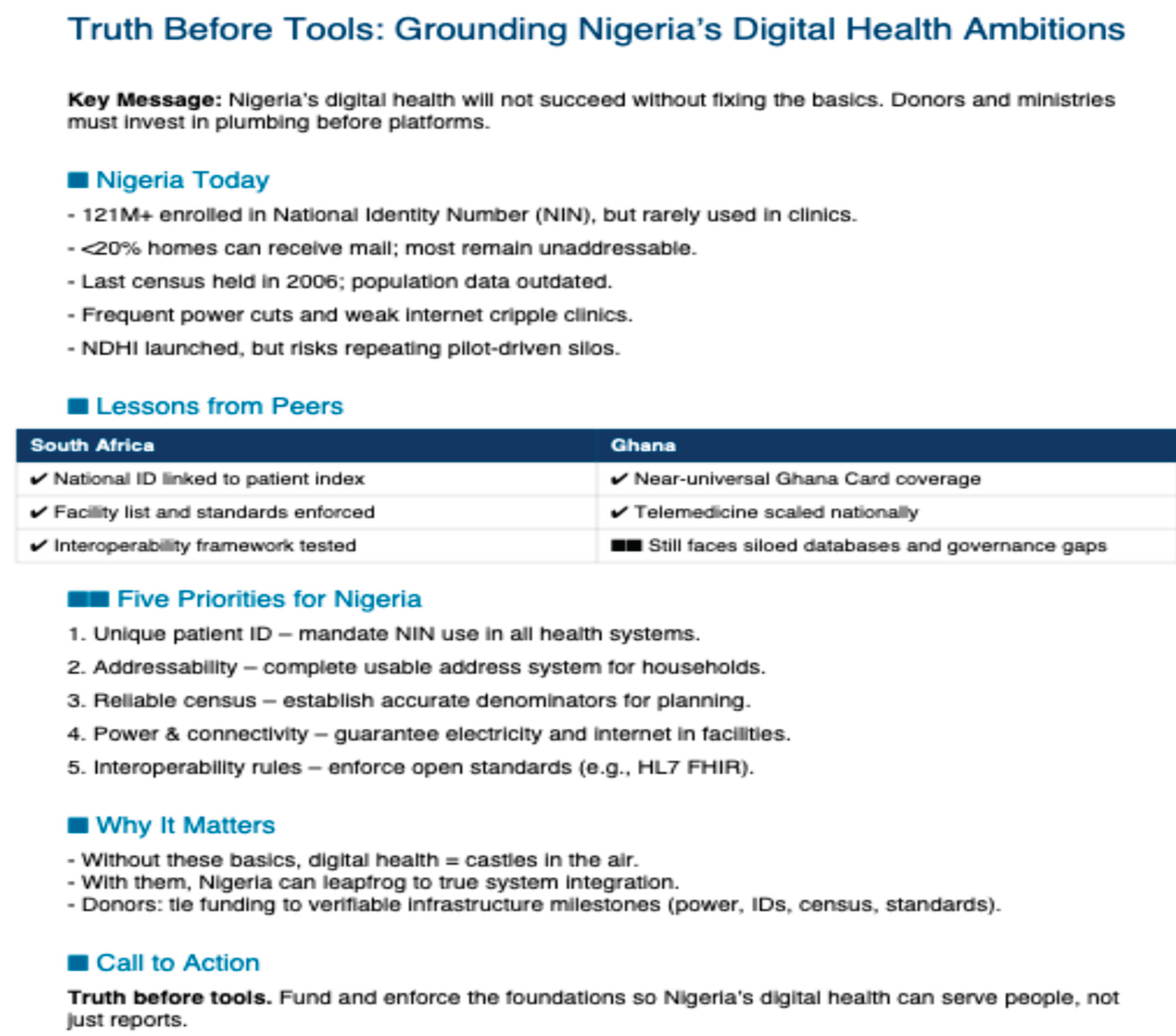

Table 1.
Key System Foundations Across Nigeria, South Africa, and Ghana.
| Dimension | Nigeria | South Africa | Ghana |
|---|---|---|---|
| Unique ID | NIN enrolment > 121M; limited health use [3] | Universal national ID used in health [5,10] | Ghana Card with 18.9M enrolments [2] |
| Address system | Weak; 20% coverage; what3words adopted [1] | Functional postal and civic addressing [5] | Stronger urban addressing; rural gaps remain [13] |
| Census data | Last census 2006; repeated delays [4] | Regular censuses; reliable denominators [5] | Regular census updates [13] |
| Infrastructure | Frequent power cuts, poor connectivity [7,8] | Load-shedding but widespread broadband [5] | Mixed; better telecoms than Nigeria [6] |
| Interoperability | Fragmented, siloed systems [7,9] | National standards framework, enforced [10,14] | Siloed systems; weak enforcement [6,13] |
| Governance | NDHI launched; early stage [9] | National strategy (2019–2024) [10] | Emerging frameworks; partial implementation [6] |
Disclaimer/Publisher’s Note: The statements, opinions and data contained in all publications are solely those of the individual author(s) and contributor(s) and not of MDPI and/or the editor(s). MDPI and/or the editor(s) disclaim responsibility for any injury to people or property resulting from any ideas, methods, instructions or products referred to in the content. |
© 2025 by the authors. Licensee MDPI, Basel, Switzerland. This article is an open access article distributed under the terms and conditions of the Creative Commons Attribution (CC BY) license (http://creativecommons.org/licenses/by/4.0/).
Copyright: This open access article is published under a Creative Commons CC BY 4.0 license, which permit the free download, distribution, and reuse, provided that the author and preprint are cited in any reuse.


