

Submitted:
28 August 2025
Posted:
29 August 2025
You are already at the latest version
Abstract
Approximately 292 million tons or more of municipal solid waste (MSW) is produced annually in the United States, and over 50% of this waste is landfilled. Municipal solid waste landfills are known stationary sources of air pollution and public health concerns for surrounding communities. For more than 40 years, the Agency for Toxic Substances and Disease Registry (ATSDR) completed more than 300 municipal solid waste landfills or open dumps (MSWLFs) site-specific public health assessments (PHAs). The purpose was to review ATSDR’s history evaluating air pathway concerns at MSWLFs and identify factors that were associated with public health hazards due to toxic chemical exposures or unsafe landfill gas accumulations over time. We reviewed ATSDR PHAs, health con-sultations (HCs), and exposure investigations (EIs) completed between 1988 and early 2025. In-depth discussions focused on 125 reports that evaluated the air exposure path-way out of more than 300 inhalation and oral route of exposures assessments. We re-trieved documents from ATSDR’s internal and external databases and organized them in a Microsoft Excel Spreadsheet. Site-specific environmental data and information on health concerns were generally provided by the United States Environmental Protection Agency (EPA), other governmental agencies, businesses, and the public. ATSDR devel-oped science-based procedures for estimating exposure and its potential for harmful health effects through the PHA process. When necessary, ATSDR recommended further assessments to determine health hazard category, protect public health, and prevent fu-ture exposures or health effects. Of 125 MSWLFs assessments that focused on an inhala-tion exposure pathway, mostly were located in the Midwest and Northeast of the U.S. Only 25 percent were active and accepting waste. In 86 percent of the documents, ATSDR concluded that the site did not present a public health hazard by the air exposure path-way. In the documents that identified air-related public health hazards, common indica-tors included (a) potentially harmful levels of toxic substances found in outdoor air (4 sites); (b) unhealthy levels of toxic substances found in indoor air, because of vapor intru-sion from site-related subsurface contamination (2 sites); and (c) unsafe accumulations of methane at or near the landfill (11 sites). Major contaminant of concerns included sulfur compounds (RSCs) [e.g., hydrogen sulfide (H2S)], volatile organic compounds (VOCs) [(e.g., benzene)], halogenated organic compounds (e.g., trichloroethylene), and trace heavy metals [e.g., mercury (Hg)]. Factors that contributed to public health hazards included sites constructed and operated prior to promulgation of EPA regulations, sites without ef-fective landfill gas collection systems, sites experiencing underground fires or smoldering events, and sites with homes located very close (< 100 feet) to landfill property lines. At every site with a public health hazard, corrective actions were recommended to effectively reduce toxic chemical exposures or methane accumulation and eliminate the public health hazards. The evaluated sites that posed no public health hazards by inhalation, likely because they are properly sited, constructed, and maintained MSWLFs best practice operations or more sensitive and sophisticated assessment methods are needed. Over the years, more MSWLFs are closing and alternative solid waste management technologies such as recycling, composting and combustion with energy recovery are becoming avail-able and the demand of waste landfilling is steadily increasing. Future studies are war-ranted to assess current and predict exposure levels and controls consistent with the new clean and sustainable technologies.
Keywords:
emissions
; landfills
; community actions
1. Introduction
The Agency for Toxic Substances and Disease Registry (ATSDR) protects communities from the harmful effects of hazardous substances in the environment. ATSDR does this by investigating environmental health threats in communities and taking action to reduce harmful exposures and their health consequences. For more than 40 years, ATSDR have applied this mission to a broad array of anthropogenic and natural sources of environmental contamination [1,2]. The sources include municipal solid waste landfills (MSWLFs) and open dumps.
According to the United States (U.S.) Environmental Protection Agency (EPA), an MSWLF is a “discrete area of land or excavation that receives household waste [1,2]. MSWLFs may receive other types of wastes such as non-hazardous commercial and industrial solid waste. MSWLFs are regulated under Subtitle D of the Resource Conservation and Recovery Act (RCRA). Each state is responsible for ensuring that all MSWLFs within their jurisdiction meet federal criteria for operation. The states may also set more stringent requirements. Approximately 1,900 active MSWLFs currently operate in the United States [1-3]. In addition, nationwide, several thousand MSWLFs are closed. Millions of Americans live near these waste sites and may inhale site-related air pollution. MSWLFs pose environmental contamination concerns and disproportionately located in communities of low-income populations [2-4].
Subtitle D of the RCRA regulations prohibits open dumping of solid waste, with a few exceptions. However, before 1979, open dumping was common practice throughout the United States. Open dumps received many of the same wastes that MSWLFs receive today. Both open dumps and MWSLFs emit air pollutants through many of the same processes. As a result, open dumps and MSWLFs are both considered throughout this article.
When organic waste decomposes in landfills or open dumps, primarily through bacteria activity, it produces a mixture of gases including carbon dioxide (CO2) and methane (CH4) as the main components of “landfill gas”. MSWLFs and open dumps also emit smaller amounts of pollutants like hydrogen sulfide (H2S), ammonia (NH3), and volatile organic compounds (VOCs) in ambient air [1]. Also, chemicals may form in a landfill or open dump as different waste materials contact and react with each other. For example, chloramines are formed when discarded bleach reacts with NH3; particulate matter is formed through various processes, including oxidation of H2S and the sulfur dioxide (SO2) to form sulfate particles, nitrogen oxides can react with newly formed sulfates to produce nitrate-containing particulate matter. Physical processes can emit particulate matter, like decomposing plant litter, breakdown of plastic waste into microplastics, and resuspension of silicate dusts when trucks travel on dirt roads [1-3].
Various pollutants released by MSWLFs, and open dumps are toxic. Whether these pollutants might cause harmful health effects among exposed populations depends on many factors including the [4]
- -
- Number of chemicals involved (i.e., a single chemical or a mixture of chemicals)
- -
- Size of landfill and magnitude of emissions
- -
- Proximity to and susceptibilities of nearby populations
- -
- Levels of contaminants of concern (i.e., concentration at or above effect level), and
- -
- Environmental conditions (e.g., prevailing wind patterns).
Future studies involving multiple regression analysis can evaluate the contributions of the various factors. Many epidemiological studies have investigated associations between exposure to landfill-related air pollutants and harmful health effects. Several review articles have analyzed the published literature [2-9]. These studies indicated that there is limited or inadequate evidence supporting connections between MSWLFs and health effects (e.g., cancer, birth defects, and harmful respiratory outcomes). Most of the studies failed to provide significant evidence of a causal link between MSWLFs and health effects due to a lack of reliable exposure assessment data [10]. Our review is unique because it is based on 40 plus years of ATSDR site-specific assessments of 125 MSWLFs and open dump sites with air pathway evaluations overtime. In addition, we used exposure assessment data that were consistently evaluated or collected using the National Institute for Occupational Safety and Health (NIOSH) Manual of Analytical Methods [11] and U.S. EPA air monitoring methods [12]. Lessons learned on potential exposures, health impacts and recommended public health actions were discussed.
Background on ATSDR Site-Specific Evaluations
Federal law requires ATSDR to conduct public health assessments (PHAs). PHAs are evaluations for National Priorities List (NPL) sites (commonly referred to as “Superfund” sites). ATSDR also evaluates sites in response to petitions that the public, elected officials, government agencies, and other parties submit to the agency. These evaluations typically culminate in ATSDR preparing and issuing a PHA or HC [13].
PHAs and HCs are site-specific assessments that evaluate whether exposures to environmental contamination present a public health hazard (i.e., have the potential to result in harmful health effects in exposed community members). The site-specific documents generally evaluate existing environmental sampling data, which may be collected by site owners, government agencies, academics, community groups, and other parties. In some instances, ATSDR will collect environmental or biological samples to fill important data gaps. All data considered by ATSDR are reviewed for quality before being used [13]. The PHA process includes three general steps: initial screening of maximum contaminant data against substance- and media-specific comparison values; estimating site specific exposures for comparison against health guideline values; and in-depth toxicological evaluation considering how exposures compare to effect levels in the toxicological literature. Additional information can be found in ATSDR’s online public health assessment guidance manual (PHAGM) at the following link: Home | PHA Guidance Manual [13]
ATSDR developed procedures for estimating exposure data and its potential health effects through the PHA process [13]. This is the first time that anyone has comprehensively aggregated and analyzed the MSWLFs PHA results and conclusions in a scientific review paper [2, 9, 10]. The purpose of this article is to summarize what ATSDR learned from reviewing air pathway evaluations for MSWLFs and open dumps. Air pathway evaluations include assessments of both outdoor air exposures and indoor air exposures (e.g., vapor intrusion of contaminants that originated at MSWLFs). These evaluations consider health hazards resulting from exposure to toxic substances and safety hazards from fire or explosions associated with the unsafe accumulation of flammable gases.
2. Materials and Methods
Document Identification
Figure 1 summarizes the process ATSDR applied to identify PHAs and HCs. First, ATSDR reviewed its internal files to identify ATSDR PHAs and HCs for landfills or open dump sites. ATSDR also considered input from state agencies that hold cooperative agreements under ATSDR’s Partnership to Promote Localized Efforts to Reduce Environmental Exposure (APPLETREE) program. Through this effort, ATSDR identified 302 PHAs and HCs for consideration. These documents were issued between 1988 and early 2025.
Second, ATSDR classified these 302 documents by type of waste disposal facility. This step determined that 82 out of the 302 documents were outside the scope of this effort. The 82 documents pertained to hazardous waste landfills, construction and demolition debris landfills, industrial waste landfills, and composting facilities. Those documents were not considered for further assessment. The remaining 220 publications were for MSWLFs or former open dumps.
Third, ATSDR reviewed the 220 documents to determine which subset considered the air exposure pathway. This step was needed because PHAs and HCs may address different exposure pathways (e.g., inhalation, ingestion, dermal contact). This assessment focuses on ATSDR’s evaluations of air emissions from MSWLFs and open dumps. Among the 220 documents that were reviewed at this step, 125 included an ATSDR conclusion pertaining to the air exposure pathway. These 125 documents are examined in this review.
Characterization of the Selected MSWLFs and Open Dumps
ATSDR developed an Excel database of site characteristics. Fields in the database included various parameters and landfill features expected to affect the magnitude of air emissions. Examples include:
- -
- the year of construction,
- -
- the landfill’s size in acres,
- -
- whether the site was active or closed at the time of ATSDR’s publication,
- -
- whether the site had a landfill gas collection system, and if so, whether it was a passive or active system,
- -
- whether or not the site had been an open dump,
- -
- whether the site had ever had a landfill fire, and
- -
- whether redevelopment activities occurred resulting in public uses atop previous disposal sites.
Some documents did not provide enough detail on these factors or did not address them at all. In these cases, ATSDR classified the information as “unclear” or “missing.”
In most cases, ATSDR used only information from the PHA or HC to populate site-specific fields in the database. However, when necessary, ATSDR considered other information sources. For instance, ATSDR used EPA’s Landfill Methane Outreach Program (LMOP) database to confirm whether certain sites had landfill gas collection systems. The LMOP database was also used to determine whether the landfill was active or closed and the type of landfill gas collection systems used [14].
ATSDR designated a site as an MSWLF if any of these criteria were met: (1) the ATSDR publication specifically identified the site as an MSWLF; (2) EPA listed the site as a MSWLF, either in the agency’s 1992 List of Municipal Solid Waste Landfills or in LMOP resources; or (3) online research clearly indicated the site was an MSWLF. The remaining sites were considered open dumps. For these, ATSDR indicated that some portion of the waste received was MSW (e.g., “general household waste”) [1].
Public Health Conclusion Categorization
The final step in the document evaluation was categorizing the public health conclusion for the air exposure pathway. Categories used for this characteristic were: “no conclusion / not evaluated,” “not enough data to evaluate (uncertain public health hazard),” “not a public health hazard,” or “public health hazard.”
ATSDR’s database also recorded the underlying reasons for a “public health hazard” finding. These fell into three categories: exposures to toxic substances; presence of physical hazards; and exposures to odors. These three categories roughly reflect the communities’ concerns expressed to ATSDR. Additional information on determining conclusions of PHAs can be found at PHAGM [13].
Data Analysis
We retrieved documents from ATSDR’s internal and external databases and organized in a Microsoft Excel Spreadsheet. Site-specific environmental data and information on health concerns were generally provided by the United States Environmental Protection Agency (EPA), other governmental agencies, businesses, and the public.
ATSDR developed science-based procedures for estimating exposure and its potential for harmful health effects through the PHA process. When necessary, ATSDR recommended further assessments to determine health hazard category, protect public health, and prevent future exposures or health effects.
3. Results
ATSDR reviewed findings from 125 publications that addressed air emissions from MSWLFs or open dumps and reached a public health conclusion for the air exposure pathway. Figure 2 shows a map with locations of the sites evaluated in these documents. While the sites were found throughout the country, a greater proportion were in the Midwest and the Northeastern United States.
Red squares identify the 17 sites considered to pose a public health hazard by inhalation pathway. Gray dots depict sites with no apparent or indeterminate public health hazard by inhalation. It is important to note that these 125 documents address a very small portion of the nationwide active and closed MSWLFs and open dumps. In addition, the sites considered in this evaluation are not a representative sample of MSWLFs and open dumps in the United States. Rather, the sites are a subset of MSWLFs and open dumps that are NPL sites or sites for which ATSDR accepted petitions for conducting PHAs.
Table 1 summarizes selected characteristics of the 125 documents. Half of the documents (N=62) were issued in the 1990s; approximately one-third of the documents (N=40) were issued in the 2000s; the remainder were issued in the 1980s (N=2) and the 2010s (N=21). Most of the documents (N=100) pertained to MSWLFs and open dumps that were closed and no longer accepting waste; 20 percent of the documents (N=25) addressed active disposal sites.
Among the 125 documents, 24 percent (N=30) addressed closed sites that had unrestricted public access to some portions of the disposal surface at the time of the evaluation. Examples of public uses include residential developments, office buildings, parks, and walking paths; sites without fencing were also considered in this category. The remaining 76 percent of documents (N=95) were for sites that, at the time of evaluation, did not have current public uses. Finally, 11 percent (N=14) of the documents referred to a subsurface fire having occurred at some point during the landfills or open dump’s history.
As Table 2 shows, in 107 of the documents, ATSDR did not conclude that there was a public health hazard. That was for one of two reasons. First, the investigators may have found that the MSWLF or open dump released various toxic substances into the air, but the air concentrations did not result in exposures that would be harmful; thus, there were classified as not a public health hazard. Second, the authors may have concluded that not enough information was available to determine whether a public health hazard exists; thus, the site was classified as uncertain health hazard. Those documents without public health hazards identified included recommendations to collect additional exposure, health concern information, and information on best practices to eliminate or reduce exposures to safe levels.
In 17 of the documents in which ATSDR reached a public health conclusion for the air exposure pathway, the authors reached a conclusion of a “public health hazard.” Table 2 also indicates issues associated with the public health hazard designation: for 5 sites, the public health hazard conclusion was due to inhalation exposures at sufficiently high level to cause harmful effects; for 11 sites, the public health hazard conclusion was due to physical hazards associated with methane gas reaching flammable levels; and at one site, the public health hazard conclusion was due to both toxic substance exposures and methane-related physical hazards.
Public Health Hazards Associated with Inhalation Exposures to Toxic Substances
Table 3 summarizes the landfill characteristics and exposure evaluations for the six sites for which ATSDR concluded a public health hazard occurred due to inhalation exposures to toxic substances. Below we discuss different categories of air pollutants.
Reduced sulfur compounds (RSCs). The toxic substances most associated with public health hazards at MSWLFs and former open dumps were sulfur compounds. The compounds include H2S, dimethyl sulfide, methyl mercaptan, dimethyl disulfide, and other sulfur compounds such as SO2. In this review, RSCs are expressed as H2S, as the major component of the RSC mixture. In every case, the public health hazards were due to acute exposures to peak, short-term concentrations of these compounds.
At two NPL sites, the elevated concentrations of sulfur compounds clearly resulted from landfill operational issues. At one site, a subsurface smoldering event (i.e., an underground landfill fire) led to significant settling of previously disposed wastes, and the landfill owner eventually had to reconstruct the site’s leachate and landfill gas collection systems to reduce the landfill’s air emissions and offsite air quality impacts. During this construction period, offsite H2S concentrations averaged over 1 to 3 minutes reached 3,700 ppb. Offsite SO2 concentrations for the same averaging time reached 1,600 ppb [15,16]. At the second site, the landfill’s leachate collection system experienced operational issues, which resulted in the accumulation of several million gallons of leachate in the landfill. The accumulation resulted in increased H2S emissions. Onsite air concentrations of H2S reached 3,100 ppb and offsite concentrations exceeded 1,000 ppb. The averaging time for these measurements was not specified [17]. In both cases, remediation efforts at the landfills (particularly, upgrades to the leachate and landfill gas collection systems) reduced the sulfur compound emissions to safe levels. Outdoor air concentrations of H2S in urban areas are typically less than 1 ppb [18].
Two other cases were for MSWLFs constructed in the early 1970s that were not on the NPL. At one of these sites, instantaneous offsite H2S concentrations (less than 2-minute average) reached 8,906 ppb. Instantaneous SO2 concentrations (also less than 2-minute average) reached 436 ppb [19]. This site was included in this evaluation because it contained two MSWLFs and a construction and demolition (C&D) landfill; however, the isolated and short-lived peak concentrations appeared to have been due primarily to air emissions from the C&D landfill. Subsequent installation and operation of a landfill gas collection system addressed the issue. At the other site, an instantaneous offsite H2S concentration reached 9,745 ppb, but the documents provide few additional details to allow further interpretation [20-21].
Volatile organic compounds: VOCs were associated with public health hazards at three MSWLF sites. The VOC exposures of concern at two of these sites were due to vapor intrusion. At one site, the VOCs of greatest concern in offsite indoor air samples at nearby residences were benzene, chloroform, and 1,2-dichloroethane [22]. At the other site, an NPL site, the VOCs of greatest concern in offsite indoor air were benzene and vinyl chloride [17]. Both landfill sites share several common features including absence of liners; the absence of gas collection systems; and households close to the landfill boundary (e.g., homes less than 100 feet away). Vapor intrusion concerns were addressed through landfill remediation efforts like sub-slab depressurization units in homes and expansion of gas collection capacity of the landfills. The principal concern in both cases was chronic exposures to carcinogenic benzene and vinyl chloride.
At the third site, methylamine and acetaldehyde had isolated concentrations that reached levels that could have caused odor-induced acute effects. Acute effects include irritation of the eyes, nose, throat, and respiratory tract [20-21]. At each of the three air monitoring stations for this landfill, methylamine was detected in 1 out of 29 samples, and acetaldehyde was detected in 2 out of 29 samples. The reason for the infrequent and elevated measurements is unclear.
Other air pollutants. The review identified three landfill sites that had public health hazards due to inhalation exposures to toxic substance other than those listed above. First, phosgene, mercury, and combustion byproducts were identified as presenting a public health hazard at a landfill that was experiencing an underground fire and that previously engaged in open burning of some wastes [23]. Second, NH3 and fine particulate matter (PM2.5) were identified as presenting a public health hazard at a different landfill [19-20]. However, the evidence for NH3 rested on a single sampling event with suspected data quality issues and emissions from the landfill, combined with emissions from many other sources contributed to the elevated PM2.5 concentrations. Finally, in one case, an HC noted a public health hazard due to observed naturally occurring radon levels, but this hazard was unrelated to the MSWLF being evaluated.
Synthesis. ATSDR and its cooperative agreement partners identified 125 PHAs and HCs that had air exposure pathway conclusions for MSWLFs or open dumps. For 6 of the sites (5 percent of the sites), the documents identified public health hazards due to concerns regarding inhalation exposure to toxic substances. One should not infer from this statistic that 5 percent of MSWLFs in the United States have public health hazards due to air emissions of toxic substances. The sites that ATSDR evaluate are not a representative sample of MSWLFs in the United States. ATSDR may conduct evaluations at sites with heightened concerns because they involve (a) environmental releases with potential for harmful health effects occurring among neighboring communities, (b) environmental emergency response, or (c) National Priority List (NPL) sites. During the PHA process, environmental data and information on health concerns are obtained from EPA, the potentially responsible party, or other agencies responsible for conducting environmental investigations. When the available data are of poor quality or there is a data gap, ATSDR may collect its own data to fill the gap.
Some public health hazards associated with toxic substance exposures were due to outdoor air pollution (most frequently due to sulfur compounds), which resulted from landfill emissions moving through the air to offsite locations. In most cases, the elevated emissions were tied to operational issues, such as landfill fires and lack of effective landfill gas or leachate management. In nearly every case, the landfill owners addressed the underlying operational issues, which reduced the air emissions and eliminated the public health hazard.
Other hazards associated with toxic substance exposures were due to vapor intrusion of migrating landfill gas via the subsurface into offsite residential structures. The vapor intrusion hazards only occurred at unlined landfills with ineffective landfill gas control and where offsite residential structures were in very close proximity (less than 100 feet) to the disposal cells. ATSDR’s experience at these landfills, which were not constructed according to today’s standards, suggests that indoor air exposures could be reduced to safe levels by actions taken at the landfill (e.g., more effective landfill gas control) and at the affected households, whether through passive mitigation methods (e.g., venting) or active mitigation methods (e.g., sub-slab pressurization).
Public Health Hazards Associated with Methane Gas Reaching Flammable Levels
Table 4 summarizes the landfill gas migration characteristics for the 12 sites for which ATSDR and its cooperative agreement partners concluded a public health hazard occurred in onsite or offsite structures or in outdoor air due to methane gas at or near a flammable range (5 to 15 percent, by volume). The conclusions regarding methane hazards do not mean fires or explosions occurred. Rather, the PHAs and HCs identified methane concentrations of concern, typically near or above the lower explosive limit (LEL) and noted that fires or explosions could have occurred if the flammable atmosphere met an ignition source.
The sites in Table 4 share several characteristics. First, the MSWLFs and former open dumps that had methane explosion hazards were all older sites: their dates of construction (or initial operation) ranged from 1920 to 1975. Notably, this entire range predates the promulgation of RCRA regulations, indicating that the sites with methane hazards all began accepting wastes before important federal regulations applied. Second, 9 out of the 12 open dumps and landfills with the methane explosion hazards were NPL sites. This trend partially reflects the fact that ATSDR’s mandate requires the agency to conduct PHAs for NPL sites, but it is also consistent with expectations, given that NPL sites typically have some amount of offsite contamination. Third, all 12 open dumps and landfills with the methane explosion hazards were already closed, and none was actively accepting waste. This finding is also consistent with expectations for two reasons: (a) if the landfills were active at the time ATSDR evaluated them, they would have likely been subject to current environmental regulations (and may therefore not have had methane migration issues) and (b) caps on closed landfills can inhibit methane migration through the surface, resulting in methane gases moving laterally through the subsurface to offsite locations. Fourth, at the time that ATSDR and its cooperative agreement partners issued the PHAs or HCs, the 12 sites either did not have a landfill gas collection system or had one that performed poorly. ATSDR has yet to identify an open dump or MSWLF equipped with an effective landfill gas collection system that has an offsite methane explosion hazard. Fifth, other factors that contributed to the methane explosion hazards pertained to land use atop and adjacent to former dumps or landfills. At two of the sites, residential structures were already built over the former waste sites or were in the process of being constructed over the former waste sites. Further, the sites with the most serious outcomes pertaining to the methane hazard (i.e., abandonment of homes, small “puff” explosions in basement furnaces) occurred at sites where the nearest residents were 100 feet or less from the landfill property line. The shorter distances between the disposed wastes and the structures likely contributed to the hazards [23-38].
4. Discussion
Review of Key Findings
This analysis identified some common features and factors at MSWLFs and former open dumps where ATSDR and its cooperative agreement partners identified public health hazards. Examples included site design features (e.g., lack of liners) not consistent with today’s landfill design standards, lack of properly functioning landfill gas collection systems, underground fires or smoldering events, redevelopment of former disposal sites for other uses (e.g., using the landfill property for residential or commercial developments), and short distances between landfills and the nearest offsite residents. Currently, we do not know the specific contribution of each identified feature or factor. Further research is needed to estimate the contribution of each factor in predicting public health hazards.
Overall, at the majority (86 percent) of MSWLFs and open dumps evaluated by ATSDR the air exposure pathway did not present a public health hazard. Two potential scenarios can be considered: (i) the MSWLF or open dump released various toxic substances into the air, but the air concentrations did not result in exposures that would be harmful; (ii) or the authors concluded that not enough information was available to determine whether a public health hazard exists. When exposure levels are lower than the health-based guidelines, initial consideration were that MSWLFs were sited, designed, operated, and maintained in a manner that limits health risks to neighboring communities, even though these sites can contain extremely large volumes of toxic substances. The assessments in these sites were completed and closed with stakeholder specific recommendations. Moreover, even in cases where these sites present public health hazards, ATSDR’s experience suggests that a range of actions can be taken over relatively short time frames to reduce emissions of concern or to monitor for unsafe conditions, thus eliminating or reducing the public health hazards. The results are consistent with various science and technology efforts being taken by the EPA to protect human health and environment, including:
promoting the installation of a gas collection and control system at existing MSWLFs,
- -
- using engineered sanitary landfills,
- -
- using the revised criteria in Title 40 of Code of Federal Regulations (CFR) part 258, integrations of the final rule technical revisions and clarifications of the national emission standards for hazardous air pollutants (NESHAP) for MSWLFs, and
- -
- implementing the landfill gas energy project/landfill methane outreach program2,10.
- -
Whenever new data become available and the public concern is not resolved, ATSDR along with federal, state, tribal and local partners may re-evaluate the situation. Also, a regular basis checks on the progress of the recommended public health actions given in the site-specific PHA [13].
Limitations of this paper include, (i) focusing on emissions released into air and the inhalation exposure pathways only. Oral exposure pathway (e.g., through contaminated water and food consumption) is the subject of a separate paper under development. (ii) the review of ATSDR PHAs documents cannot be generalized. To improve coverage of the review, we additionally integrated the results of the most recent review papers on municipal solid waste management environmental emissions and their public health impacts [6,7,9]. Also, the LMOP project and landfill data by state provide a better picture of MSWLFs throughout the nation [14]. (iii) the ATSDR PHAs considered in this paper were published between 1988 and 2025, and many things have changed over the years including the type of landfills (e.g., uncontrolled or dumpsite, sanitary and green waste landfill), changing sampling methodology, and availability of toxicological information, etc., which means, conclusions reached in the past would not necessarily be the same conclusions reached today. Published research and EPA work is indicating an increasing trend of gas landfill conversion to energy and adoption of sanitary landfills and environmentally sustainable technologies that are known to lower environmental missions [3,14,42]. EPA and NIOSH sampling and analytical reference methods used for RSCs, VOCs, NH3 and trace heavy metals measured from outdoor and indoor air near MSWLFs, mostly did not change except some innovations (e.g., gas chromatographic accoupled mass spectrometry; portable instead of on the benchtop instruments). However, the access and availability has increased significantly due to innovations and the rapid grow of direct-reading and sensor technologies [11,12].
5. Conclusions
In general, our review and the published reviews results are consistent with the public health concerns associated with population living in the vicinity of municipal solid waste landfills. Robust environmental epidemiological methods are needed to both integrate new emission control technologies and better estimate human health risks from air emissions of MSWLFs.
ATSDR’s recommended public health actions usually include site-specific community environmental health education and online resources. Site-specific assessments and publicly accessible documents are available at ATSDR’s Public Assessments & Health Consultations website13. Furthermore, ATSDR published chemical specific toxicological profiles available at Toxicological Profiles | ATSDR (cdc.gov) for most of the air toxic substances reported in the MSWLFs’ PHAs considered [39].
Author Contributions
Conceptualization, C.M. and J.W.; methodology, C.M.; data extraction, J.W.; data analysis, C.M., J.W.; resources, C.M.; data curation, J.W. and C.M.; writing—original draft preparation, J.W.; writing—review and editing, C.M., J.W., J.P., M.S., and G.Z.; visualization, M.S.; supervision, C.M and J.w.; project administration, C.M. All authors have read and agreed to the published version of the manuscript.”
Funding
This research received no external funding. The paper is result of FTE and Contractor Support time in routine ATSDR public health services.
Institutional Review Board Statement
Not applicable. All public health assessment documents reviewed were released and available for public. All were cited accordingly to the style of the journal. No additional ethics approval and informed consents were necessary.
Informed Consent Statement
Not applicable. All public health assessment documents reviewed were released and available for public. All were cited accordingly to the style of the journal. No additional ethics approval and informed consents were necessary.
Data Availability Statement
PHA documents were the major data sources, All PHAs reviewed were released and available for public.
Acknowledgments
The authors are thankful to CAPT Peter Kowalski, MSPH, CIH (retired), Charles Grosse, and Debra Gable, Senior Environmental Health Scientist and ATSDR Region 10 Representative for their earlier contribution to this review article. We thank the Write Editors (Nadonnia Jones and Allison Chatham) for their technical review of the advanced drafts of this article.
Conflicts of Interest
The authors declare no conflicts of interest.
Disclaimer: The findings and conclusions in this report are those of the author(s) and do not necessarily represent the official position of the Centers for Disease Control and Prevention/the Agency for Toxic Substances and Disease Registry.
References
- ATSDR (Agency for Toxic Substances and Disease Registry). 2001. Landfill Gas Primer – An Overview for environmental health professionals. November 2001. Division of Health Assessment and Consultation. ATSDR. Department of Health and Human Services. Available online at: ATSDR - Landfill Gas Primer - An Overview for Environmental Health Professionals [Accessed on January 17th, 2025].
- Sudweeks S, Elgethum K, Abadin H, Zarus G, Irvin E. 2024. Applied toxicology at the Agency for Toxic Substances and Disease Registry (ATSDR). Encyclopedia of Toxicology. 4th Edition. Available online at: Applied toxicology at the Agency for Toxic Substances and Disease Registry (ATSDR) (Accessed on January 17th, 2025).
- U.S. EPA (U.S. Environmental Protection Agency). 2025. Municipal Solid Waste Landfills website. https://www.epa.gov/landfills/municipal-solid-waste-landfills. [accessed on January 21st, 2025].
- De Titto E, Savino A. 2024. Human health impact of municipal solid waste mismanagement: A review. Advances in Environmental and Engineering Research. LiDSEN Publishing Inc. 5(2). Available online at: Advances in Environmental and Engineering Research | Human Health Impact of Municipal Solid Waste Mismanagement: A Review [Accessed on July 9, 2025].
- Fazzo L, Minichilli F, Santoro M, Ceccarini A, Seta MD, Bianchi F, Comba F, Martuzzi M. 2017. Hazardous waste and health impact: systematic review of the scientific literature. Environmental Health. 16:107. [CrossRef]
- Siddiqua A, Hahladakis JN, Al-Attiya WA. 2022. An overview of the environmental pollution and health effects associated with waste landfilling and open dumping. Environmental Science and Pollution Research. 29:58514-58536. [CrossRef]
- Ncube F, Ncube EJ, Voyi K. 2017. A systematic critical review of epidemiological studies on public health concerns of municipal solid waste handling. Perspectives in Public Health. 137 (2) 102-108. Available online at: A systematic critical review of epidemiological studies on public health concerns of municipal solid waste handling [Accessed on July 9, 2025].
- Mattiello A, Chiodini P, Bianco E, Forgione N, Flammia I, Gallo C, Pizzuti R, Panico S. 2013. Health effects associated with the disposal of solid waste in landfills and incinerators in populations living in surrounding areas: a systematic review. Int J Public Health, 58(5), 725-735. [CrossRef]
- Vinti G, Bauza V, Clasen T, Medlicott K, Tudor T, Zurbrugg C, Vaccari M. 2021. Municipal solid waste management and adverse health outcomes: A systematic review. Int. J. Environ. Res. Public Health. 18(4331): 1-26. [CrossRef]
- Duan Z, Schutz C, Kjeldsen P. Trace gas emissions from municipal solid waste landfills: A review. Waste Management 119 (2021) 39–62. [CrossRef]
- NIOSH (The National Institute for Occupational Safety and Health). 2023. NIOSH Manual of Analytical Methods. 5th Edition. NIOSH Manual of Analytical Methods (2014-151). Available online at: NIOSH Manual of Analytical Methods (2014-151) | NIOSH | CDC [Accessed on January 21, 2025].
- U.S. EPA (U.S. Environmental Protection Agency). 2022. Air Monitoring Methods. Ambient Monitoring Technology Information Center. Available online at: Air Monitoring Methods | US EPA [Accessed on January 21, 2025].
- ATSDR (Agency for Toxic Substances and Disease Registry). 2025. Public Health Assessment Guidance Manual (PHAGM). Home | PHA Guidance Manual (cdc.gov) [Accessed on January 21, 2025].
- U.S. EPA (U.S. Environmental Protection Agency). 2025. Landfill methane outreach program (LMOP). Available online at: Landfill Methane Outreach Program (LMOP) | US EPA [Accessed on January 21, 2025].
- Semkiw E, Wenzel J, Garoutte J, LeCoultre TD, Frazier L, Evans E. 2018. Evaluation of exposure to landfill gases in ambient air. Bridgeton sanitary landfill. Health Consultation. Public Comments Version. Bridheton, St. Louis County, Missouri. Missouri Department of Health and Senior Services & Agency for Toxic Substances and Disease Registry. U.S. Department of Health and Human Services. Atlanta, GA 3033. Available online at: Health Consultation - Evaluation of Exposure to Landfill Gases in Ambient Air - Public Comment Version [Accessed on July 9, 2025].
- Semkiw E, Wenzel J, Garoutte J, LeCoultre TD, Frazier L, Evans E. 2022. Evaluation of exposure to landfill gases in ambient air. Bridgeton sanitary landfill. Health Consultation. Bridheton, St. Louis County, Missouri. Missouri Department of Health and Senior Services & Agency for Toxic Substances and Disease Registry. U.S. Department of Health and Human Services. Available online at: Bridgeton Sanitary landfill [Accessed on July 9, 2025].
- NYSDOH (New York State Department of Health). 1995. Public Health Assessment: Port Washington Landfill, North Hempstead, New York. New York State Department of Health & Agency for Toxic Substances and Disease Registry. ATSDR-PHA-HC-Port Washington Landfill-p-toc (archive.org) [accessed on August 31st, 2022].
- Chou S, Ogden J, Pohl HR, Scinicariello F, Ingerman L, Barber L, Citra M. 2016. Toxicological Profile for H2S and Carbonyl Sulfide. U.S. Department of Health and Human Services. Agency for Toxic Substances and Disease Registry. Public Health Services. Hydrogen Sulfide Carbonyl Sulfide | Toxicological Profile | ATSDR (cdc.gov).
- Elgethun K. 2015. Bridger Creek Community Vapor Intrusion, Bozeman, Montana. Health Consultation. Agency for Toxic Substances and Disease Registry. Atlanta, GA 30333. Bridger Creek Community Vapor Intrusion Health Consultation (cdc.gov) [accessed on August 31st, 2022].
- Sutton DS, Schnell FC, Guevara-Rosales L, Moore S, Kowalski P, Pomales A, Sagendorph WK. 2010. ERSI Landfill Taylor, Lackawanna County, Pennsylvania. Health Consultation. EPA Facility ID: PAD069601763. Cost Recovery Nr. A903. Agency for Toxic Substances and Disease Registry. Microsoft Word - ERSI Landfill_HC_03-22-2010.doc (cdc.gov).
- Arunachalam S, Ahmed F, Helverson R, Wener LS, Tobinson R. 2017.Keystone sanitary landfill. Dunmore, Lackawanna County, Pennsylvania. Health Consultation. Public comment version. Pennsylvania Department of Health and Agency for Toxic Substances and Disease Regitry. Keystone Sanitary Landfill Draft Health Consultation 12_6_2017 (cdc.gov) [Accessed on 30 August 2022].
- Langmann DM, Schnell FC, Johnson RH, Gouzie G. 1998. Petitioned Public Health Assessment. Bovoni Dump, St. Thomas, U.S. Virgin Islands. Public Health Assessments & Health Consultations. ATSDR (Agency for Toxic Substances and Disease Registry). Available online at: ATSDR-PHA-HC-BOVONI DUMP-p1 (archive.org) [accessed August 31st , 2022].
- Morse L, Mechant R, Freed J. 2008. On- and Off-site Surface Soil. Former Proctor Rad Landfill. Health Consultation. Sarasota County, Florida. EPA Facility ID: FLN000409986. Florida Department of Health and the Agency for Toxic Substances and Disease Registry. http://www.atsdr.cdc.gov/HAC/pha/FormerProctorRoadLandfill/Former_Proctor_Road_Landfill%20HC%209-30-2008.pdf.
- Pestana E, Geschwind S, Toal B, Perman G, House G, House L, Gilling R, UliH2Sh G. 1995. Old Southington Landfill Public Health Assessment. Southington, Hartford County, Connecticut. CERCLIS Nr. CTD980670806. Connecticut Department of Public Health and Addiction Services & Agency for toxic Substances and Disease Registry (ATSDR).
- Sweet W, McRae T. 2005. Public health evaluation of gas vent sampling data reports. Old Southington landfill. Health Consultation. Southington, Hartford County, Connecticut. CERCLIS Nr. CTD980670806. Connecticut Department of Public Health and Addiction Services & Agency for toxic Substances and Disease Registry (ATSDR). Health Consultation (cdc.gov).
- Rusnak SM, Sweet W, UliH2Sh G. 2006. Technical Review of the Risk Assessment for Gas Vent Volatile Organic Compound Data. Southington landfill. Health Consultation. Southington, Hartford County, Connecticut. CERCLIS Nr. CTD980670806. Connecticut Department of Public Health and Addiction Services & Agency for toxic Substances and Disease Registry (ATSDR). Microsoft Word - Old Southington Landfill Gas Vent worker Health Consultationredo1.doc (cdc.gov).
- Baughman TA, Runkle K, Fabinski L. Godfrey G, Inserra S, Baldwin G. 1997. Yeoman Creek and Edwards Field Landfills. Public Health Assessment. Waukegan, Lake County, IL. CERCLIS Nr. ILD980500102. September 30, 1997. Illinois Department of Public Health and Agency for Toxic Substances and Disease Registry. ATSDR-PHA-HC-Yeoman Creek and Edwards field Landfills-p-toc [Accessed on July 9, 2025].
- Baughman TA, Godfrey G, Yeoman Creek Landfill Health Consultation. Waukegan, Lake County, IL. CERCLIS Nr. ILD980500102, June 17, 1998. Illinois Department of Public Health and Agency for Toxic Substances and Disease Registry. ATSDR-PHA-HC-Yeoman Creek Landfill-p-toc [Accessed on July 9, 2025].
- Baughman TA, Robison A, Erlwein B. 2004. Yeoman Creek Landfill Health Consultation. Waukegan, Lake County, IL. Illinois Department of Public Health and Agency for Toxic Substances and Disease Registry. DRAFT HEALTH CONSULTATION [Accessed July 9, 2025].
- Jackson D, Hossom C, Sudweeks S, Metcalf S, Gillig R, Wilder L. 2012. Gary Development Landfill Health Consultation. Gary, Lake County, Indiana. Agency for Toxic Substances and Disease Registry. Microsoft Word – Gary Development Landfill, IN_HC (cdc.gov).
- Smith VA, Lee R, Fabinski. 1995. South Macom Disposal Authority #9, 9A Public Health Assessment. St. Clair Shores, Oakland County, Michigan. CERCLIS Nr. MID069826170. February 23, 1995. and Agency for Toxic Substances and Disease Registry. https://www.atsdr.cdc.gov/HAC/pha/PHA.asp?docid=455&pg=0.
- Crua J, Kaplan J, Block A, Gillig, R, UliH2Sh G. 1996. Islip Municipal Sanitary Landfill Public Health Assessment. a/k/a Blydenburgh Road Landfill, Hauppauge, Suffolk County, New York. CERCLIS Nr. NYD980506901. January 22, 1996. New York State Department of Health and the Agency for Toxic Substances and Disease Registry. ATSDR-PHA-HC-Islip Municipal Sanitary Landfill-p-toc [Accessed on July 9, 2025].
- Rafferty CJ, Kaplan J, Block A, Gillig R, UliH2Sh. 1995. Johnstown City Landfill Public Health Assessment. Johnstoen, Fulton County, New York. CERCLIS Nr. NYD980506927. March 8, 1995. New York State Department of Health and the Agency for Toxic Substances and Disease Registry. ATSDR-PHA-HC-Johnstown City Landfill-p-toc [Accessed on July 9, 2025].
- Schuck ME, Wilson LR, Kaplan JH, Block A Gillig R, UliH2Sh G. 1995. Port Washington Landfill Public Health Assessment. North Hempstead, Nassau County, NY. CERCLIS Nr. NYD980654206. November 2, 1995. New York State Department of Health and the Agency for Toxic Substances and Disease Registry. ATSDR-PHA-HC-Port Washington Landfill-p-toc [Accessed on July 9, 2025].
- [ODH] Ohio Department of Health and ATSDR (Godfrey GD, Greim W, North Sanitary (AKA Valleycrest) Landfill Health Consultation. Dayton, Montgomery County, OH. CERCLIS Nr. OHD980611875. July 30, 1998. Bureau of Environmental Health & Toxicology Ohio Department of Health and the Agency for Toxic Substances and Disease Registry. ATSDR-PHA-HC-North Sanitary Landfill, Dayton-p-toc [Accessed on July 9, 2025].
- Shelley T, Safay B, Freed J. 2004. Old Simpsonville Dump #2 Health Consultation. Simpsonville, Greenville, County, SC. EPA Facility ID: SCD981474893. November 5, 2004. Agency for Toxic Substances and Disease Registry. https://www.atsdr.cdc.gov/HAC/pha/OldSimpsonvilleDump2-111204-SC/OldSimpsonvilleDump111504-SC.pdf [Accessed on July 9, 2025].
- Nehls-Lowe H, Fabinski L, Greim W. 1994. Spickler Landfill Public Health Assessment. Spencer, Marathon County, Wisconsin. EPA Facility ID: WID980902969. April 9, 1994. Wisconsin Department of Health and Social Services and theAgency for Toxic Substances and Disease Registry. ATSDR-PHA-HC-Spickler Landfill-p-toc [Accessed on July 9, 2025].
- Goldrina J, Fabinski L, Jordan-Izaquirre, Greinm W, Williams RC. 1994. Stoughton City Landfill Public Health Assessment. Stoughton, Dane County, Wisconsin.
- ATSDR (Agency for Toxic Substances and Disease Registry). 2024. Toxicological Profiles. Available online at: Toxicological Profiles | Toxicological Profiles | ATSDR.
- Burg T and Zarus, G. 2013. Community exposures to chemicals through vapor intrusion: A Review of Past ATSDR Public Health Evaluations. J Environ Health. 75(9): 36-41. Available online at: nihms745636.
- Eklund B, Regan C, Rago R, Beckley L. Overview of state approaches to vapor intrusion: 2023 Update. Groundwater Monitoring & Remediation published by Wiley Periodicalls LLC on behalf of National Ground Water Association. Available online at: Overview of State Approaches to Vapor Intrusion: 2023 Update - Eklund - 2024 - Groundwater Monitoring & Remediation - Wiley Online Library [Accessed on January 21, 2025].
- Ozbay G, Jones M, Gadde M, Sah S, and Attarwala T. 2021. Design and operation of effective landfills with minimal effects on the environment and human health. Review article. Journal of Environmental and Public Health. ID 6921607, 13 pgs. [CrossRef]
Figure 1.
Selection criteria for the ATSDR* publications on MSWLFs† PHAs‡ or HCs‡ assessment .
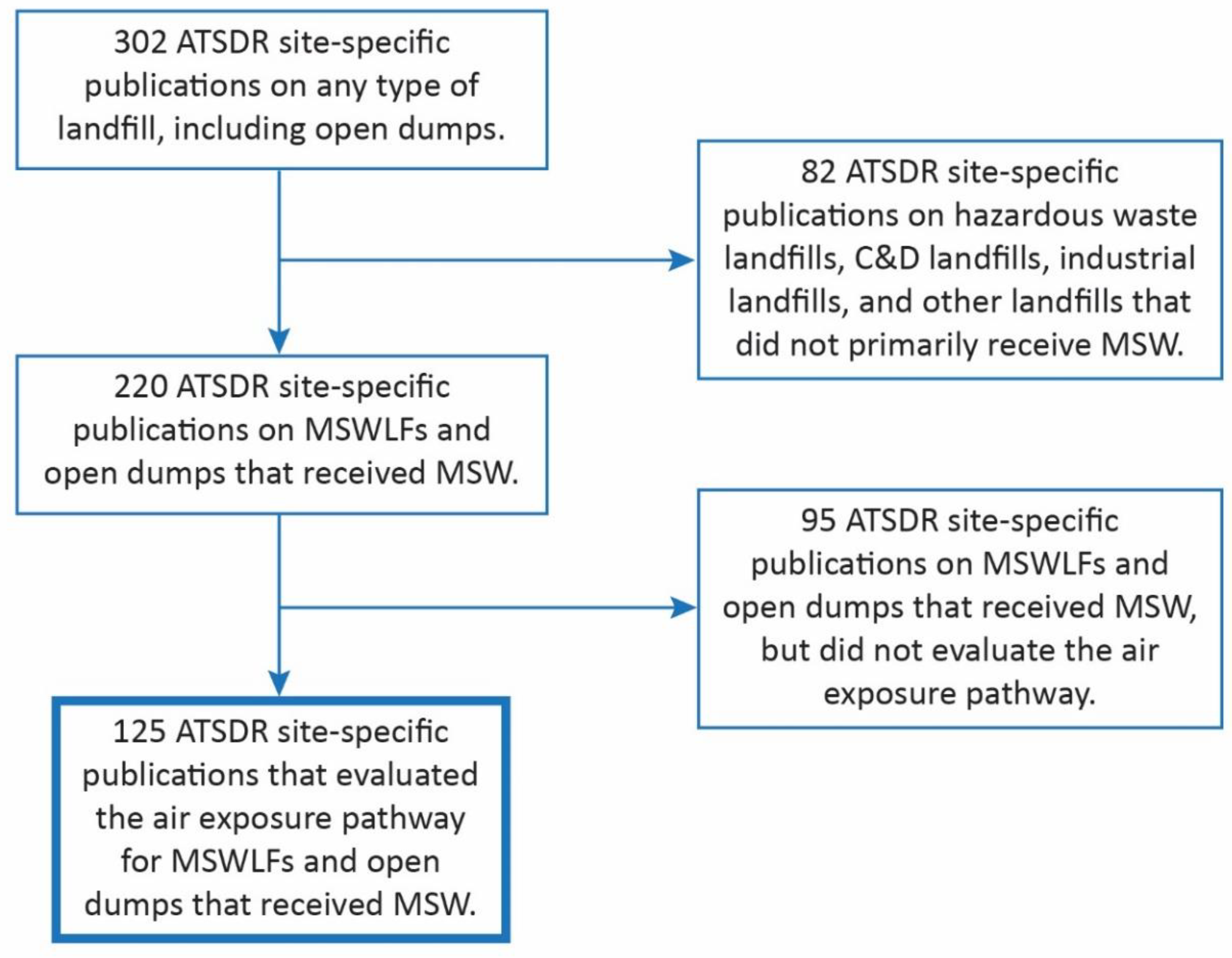
Figure 2.
Locations of the 125 MSWLFs and open dumps considered in this analysis.
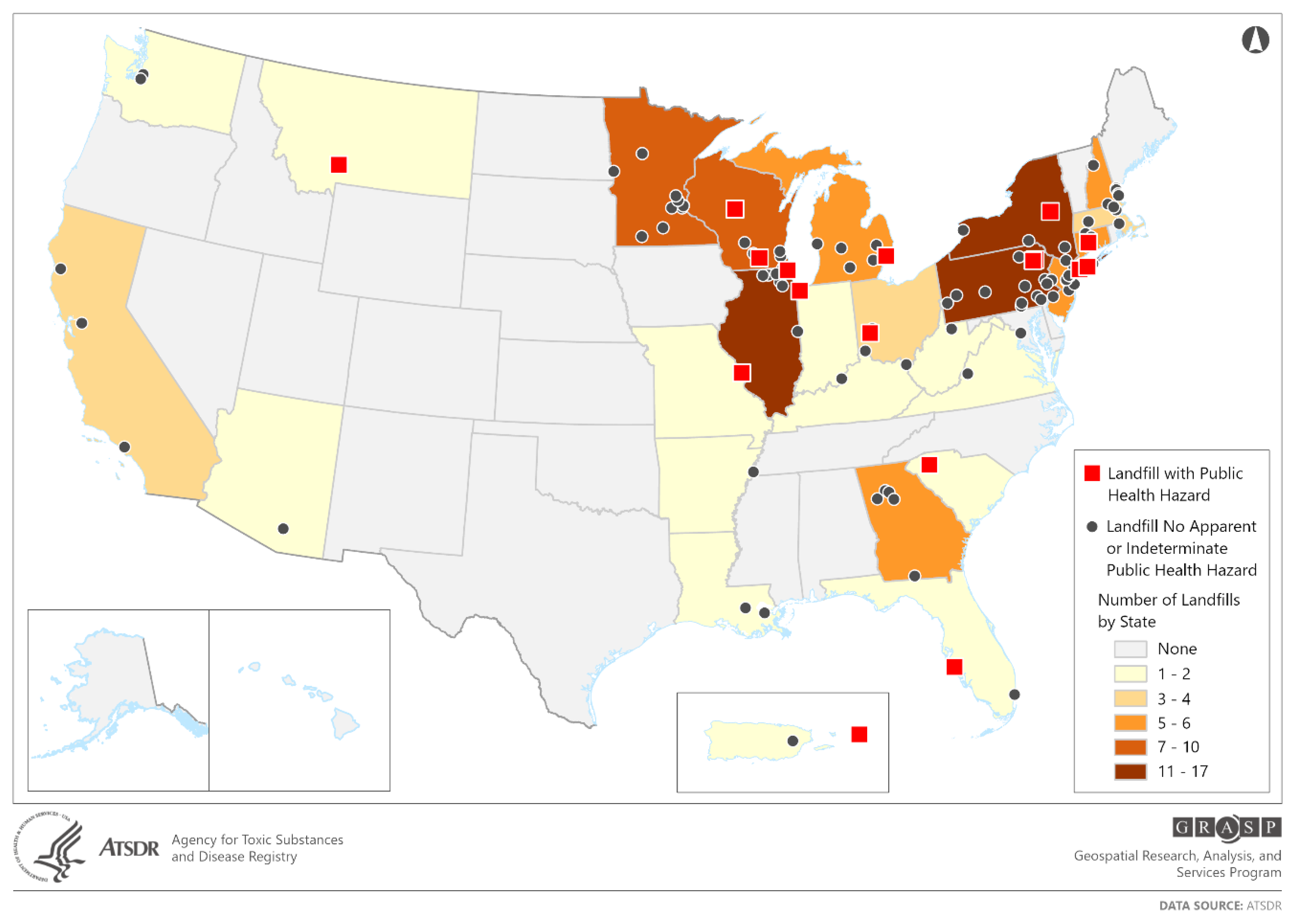

Table 1.
Breakdown of the 125 MSWLFs* and Open Dump Sites with Air Pathway Conclusions in ATSDR Documents, by Selected Characteristics.
Table 1.
Breakdown of the 125 MSWLFs* and Open Dump Sites with Air Pathway Conclusions in ATSDR Documents, by Selected Characteristics.
| Data Element | Count | Percentage (%) |
|---|---|---|
| Decade PHAⱡ or HCⱡ was issued. | ||
| 1980s | 2 | 2 |
| 1990s | 62 | 50 |
| 2000s | 40 | 32 |
| 2010s | 21 | 17 |
| Landfill or open dump status at time of evaluation. | ||
| Active | 25 | 22 |
| Closed | 100 | 78 |
| Public use/access of landfill or open dump surface?§ | ||
| Yes | 30 | 20 |
| No | 95 | 80 |
| According to the PHA/HC, did the site have a subsurface fire? | ||
| Yes | 14 | 11 |
| No or not specified | 111 | 89 |
| _________________ *MSWLFs – Municipal solid waste landfills ϯ ATSDR– Agency for Toxic Substances and Disease Registry ⱡPHA or HC – Public Health Assessment or Health Consultation §Public access to the landfill or open dump surface applies to closed sites that have undergone redevelopment activities. They may include sites with residential developments, parks, walking paths, or other usage. | ||
Table 2.
Breakdown of the 125 MSWLFs* and Open Dump Sites with Air Pathway Conclusions by Public Health Hazard Conclusion.
Table 2.
Breakdown of the 125 MSWLFs* and Open Dump Sites with Air Pathway Conclusions by Public Health Hazard Conclusion.
| Data Element | Count | Percentage (%) |
|---|---|---|
| PHAs and HCs for MSWLFs* and open dumps that reached a conclusion for the air exposure pathway | 125 | 100 |
| Subset of PHAs Ϯ and HCs Ϯ that evaluated the air exposure pathway and found either no or no apparent public health hazard. | 107 | 86 |
| Subset of PHAs Ϯ and HCs Ϯ for which ATSDR‡ or its public health partner concluded a public health hazard for the air exposure pathway. Further breakdown: Public health hazard due to exposure to toxic substances Public health hazard due to unsafe methane accumulations Public health hazard due to exposure to both toxic substances and unsafe methane accumulations |
18 5 12 1 |
14 |
| _____________________ * MSWLFs – Municipal solid waste landfills !ϮPHA and HC – Public Health Assessment and Health Consultation ‡ATSDR - Agency for Toxic Substances and Disease Registry | ||
Table 3.
Overview of Sites with Public Health Hazards Due to Inhalation Exposures to Toxic Substances.
Table 3.
Overview of Sites with Public Health Hazards Due to Inhalation Exposures to Toxic Substances.
| Site | Year Disposal Began | Operational Status | Acres | Substances with Public Health Hazard |
Description | References and additional notes |
|---|---|---|---|---|---|---|
| 1 | 1950s | Closed | 52 | RSCs and SO2 | The closed landfill is a former limestone quarry, with mostly municipal solid waste disposed of at the site. It is part of an NPL site. Community concerns about emissions increased after a “subsurface smoldering event” (i.e., underground landfill fire) was detected. This event led to considerable remediation efforts at the landfill. Ambient air monitoring for RSCs and SO2 found levels that might be harmful to health. Exposures to the highest concentrations might have aggravated chronic respiratory disease (e.g., asthma), aggravated chronic cardiopulmonary disease, and caused other respiratory effects (e.g., difficulty breathing, tightness in the chest). These concerns were greatest during the remediation efforts following the landfill fire, and the remedial efforts effectively reduced the landfill’s air quality impacts. |
Semkiw et al. 2018, 2022 [12,16] |
| 2 | 1974 | Closed | 113 | H2S and VOCs | The closed landfill is an NPL* site. The location was originally used to mine sand and gravel, before it was used as a construction and demolition debris landfill, and eventually as a MSWLF. In the early 1990s, the landfill’s leachate collection system did not function properly, and several million gallons of leachate accumulated in a landfill section. This caused increased H2S emissions, with fenceline ambient air concentrations greater than 1 ppm—levels that ATSDR concluded were a public health hazard. Installation of an active landfill gas venting system and upgrades to the leachate collection system reduced H2S concentrations to safe levels. VOCs in indoor air (particularly benzene and vinyl chloride) were a public health hazard, due to vapor intrusion of landfill gases that migrated in the subsurface and into homes, some of which were located 100 feet from the landfill boundary. This hazard was addressed through installation and operation of an active gas venting system. |
NYSDOH (New York State Department of Health). 1995 [17] |
| 3 | 1970 | Closed | 200 | Radon and VOCs (Benzene, 1,2,4-Trimethylbenzene, 1,2-Dichloroethane, and 1,2-Trans Dichloroethene) | The closed, unlined landfill accepted municipal solid waste for nearly 40 years. Two residential developments were constructed while the landfill was active, with some homes being located less than 500 feet from the landfill cells. Due to concerns regarding vapor intrusion, indoor air sampling occurred at nearby houses. The public health hazard finding was based on estimated lifetime cancer risks greater than 1-in-10,000 from multiple VOCs (including benzene, chloroform, and 1,2-dichloroethane). The document also noted that exposures to naturally occurring radon contributed to considerably higher cancer risks, though the radon issues were not attributed to landfill releases. Affected homes were equipped with sub-slab depressurization units, which has reduced cancer risks below levels of health concern. |
Elgethun K. 2015 [19] |
| 4 | 1973 | Closed | Not specified | Odors, H2S and SO2 | Multiple landfills operated on adjacent properties, including two MSWLF cells and a construction and demolition (C&D) debris landfill. Residences were located less than 100 feet from the C&D landfill cell. Ambient air monitoring revealed H2S levels “high enough to cause temporary respiratory discomfort to those with asthma, and perhaps even in some without asthma who suffered from other preexisting respiratory conditions.” One peak SO2 concentration reached levels that could have caused clinically significant symptoms among residents with asthma. In response to the air quality impacts, landfill operators installed a gas collection system that helped prevent landfill gases from reaching nearby residents. The HC focuses on the C&D landfill at the site but acknowledged that all three adjacent landfills have sulfur compound emissions. |
Sutton et al. 2010 [20] |
| 5 | 1970s | Active | ~1,000 | H2S, NH3, VOCs (Benzene and formaldehyde, and particulate matter; | Approximately three-fourths of the 7,000 tons of wastes disposed of daily at the landfill was municipal solid waste, with the remainder were C&D debris, non-hazardous industrial waste, and other non-hazardous waste. Ambient air monitoring conducted in the area found several toxic substances that occasionally reached concentrations that could have caused transitory health effects among sensitive populations, such as irritation to the eyes, nose, throat, and respiratory tract. Substances of concern were NH3, H2S, methylamine, and acetaldehyde; and only the highest sampling results reached levels of potential concern. Some data quality concerns were noted for the sampling data. PM2.5 concentrations also reached levels of potential health concern on a few sampling dates and when winds blew from the direction of the landfill, but other emission sources also contributed to the airborne levels. |
Arunachalam et al. 2019 [21] |
| 6 | 1979 | Active | 34 | Phosgene, mercury, and combustion byproducts, VOCs including benzene, 1,2,4-Trichloropropane; Chlorobenzene; Acetaldehyde and metals (e.g., Ni, Hg, As) | The landfill primarily accepts municipal solid waste, but also accepted C&D debris and industrial waste. ATSDR became involved with the site after residents voiced concern about air emissions from an underground landfill fire, which had been burning for at least several months, by multiple accounts. The landfill also experienced an aboveground fire in a pile of tires, and the landfill previously had a “burn pit” and “smolder pit” on its property. The nearest residents were approximately 500 feet from the landfill’s active section. Air samples collected on the landfill found concentrations of phosgene and mercury at levels of potential health concern. Elevated levels of several aldehydes were also noted. The public health hazard reported in the PHA was attributed to the combined effect of such respiratory irritants as smoke, various aldehydes, phosgene, and mercury vapor. The principal recommendation made in the PHA was to extinguish the underground landfill fire that was believed to contribute to the public health hazard. | Langmann et al. 1998 [22] |
| ____________________ *NPL – National Priority List † MSWLF – Municipal solid waste landfills ‡ATSDR - Agency for Toxic Substances and Disease Registry § C&D – Construction and demolition §§ Chemical substances (RSC – reduced sulfur compound; SO2 – sulfur dioxide; VOC – volatile organic compound; H2S = hydrogen sulfide; NH3 – ammonia; Metals – e.g, Ni – nickel; Hg – mercury; As – arsenic. | ||||||
Table 4.
Overview of Sites with Public Health Hazards Due to Methane Gas Reaching Flammable Levels.
| Site | Year Disposal Began |
Operational Status | Acres | Description | Reference |
|---|---|---|---|---|---|
| 1 | 1974 | Closed | 10 | This unlined landfill, an NPL* site, primarily accepted municipal solid waste, but also received non-hazardous industrial waste (e.g., oily sludge, metal grindings). Soil gas sampling occurred at various onsite locations, with methane concentrations in one portion of the landfill near the main office ranging from 10 to 90 percent. The HC† refers to an “elevated gas measurement near the landfill office” but does not document the observed methane level. The HC concluded that the potential migration of methane to the landfill office may present a public health hazard. The landfill evidently did not have a landfill gas collection system at the time ATSDR‡ evaluated the site. |
Morse et al. 2008 [23] |
| 2 | 1920 | Closed | 13 | This unlined landfill accepted municipal, commercial, and industrial waste for nearly 50 years. The landfill area was then covered with clean fill and developed for commercial, residential, and industrial uses, with no landfill gas collection system in place. At three commercial properties built atop the former landfill, indoor air concentrations of methane exceeded the lower explosive limit (LEL); and occupants raised concerns that landfill gas was entering through foundation cracks and that could be ignited. Multiple actions were taken to address this physical hazard: buildings were equipped with continuous methane monitors to detect atmospheres of concern; cracks in building foundations were identified and sealed; and passive vents were installed at multiple landfill locations to release landfill gas into the ambient air. |
Pestana et al. 1995; McRae 2005; Rusnak et al. 2006 [24-26] |
| 3 | 1963 | Closed | 49 | This unlined landfill, an NPL site, previously accepted municipal solid waste, C&D debris, and sludge. Multiple residential and commercial properties are located immediately north of the landfill boundary. Even though steps had been taken to reduce migration of landfill gases, methane concentrations in a floor drain in one of the affected buildings exceeded the LEL on 9 out of 12 sampling days in the late 1990s. Elevated methane levels were also observed in the building floor cracks and sumps. ATSDR concluded that the observed methane levels in the affected buildings was an urgent public health hazard and recommended that actions be implemented to monitor indoor methane levels, to reduce the methane levels to below 10 percent of the LEL, and to ready occupants for evacuation if methane levels continue to exceed 10 percent of the LEL. |
Baughman et al. 1997; Baughman et al. 1998; Baughman et al. 2004 [27-29] |
| 4 | 1975 | Closed | 62 | Although originally approved as a “private sanitary landfill,” this unlined landfill accepted a wide range of wastes (including hazardous wastes) for nearly 25 years, until the landfill ceased operating. Passive vents were installed with the intent of collecting landfill gas for reuse, but the project was not completed, and the gas is vented to ambient air, without flaring. The methane concentrations at the landfill, an NPL site, were high enough to trigger alarms on explosimeters used by state agency staff who visited the site. The PHA did not document the methane concentration that triggered the alarms, though many of these meters are typically set to alarm when flammable gas levels exceed 10 percent of the LEL. The methane releases from the onsite vents were deemed a public health hazard, due to the possibility of trespassers or site visitors encountering flammable atmospheres and the lack of warning signs. |
Jackson et al. 2012 [30] |
| 5 | 1968 | Closed | 145 | The unlined landfill, an NPL site, received municipal solid waste from multiple municipalities for at least 7 years. The landfill was not equipped with a landfill gas collection system. Methane was detected in soil gas samples at the landfill and its perimeter, but the measured concentrations were not reported in the PHA. The document concluded that the methane gas detections at the site presented a potential explosive hazard. |
Smith et al. 1995 [31] |
| 6 | 1963 | Closed | 108 | This landfill, an NPL site, received municipal and commercial solid waste for 27 years. The landfill included two disposal cells: one lined and the other unlined. While the landfill was still operating, elevated methane concentrations were measured in the basements of two homes, both located less than 100 feet from the site boundary. The local city eventually purchased the homes because indoor methane concentrations had reached “explosive levels.” Following these events, a landfill gas collection system was installed and continuously operated to prevent further migration of methane gases. Routine soil gas monitoring has demonstrated the system’s effectiveness. ATSDR concluded that the site presented a past public health hazard due to the migration of methane gas to nearby households and recommended that the performance of the landfill gas collection system be continuously monitored to ensure methane gas does not migrate offsite at unsafe levels in the future. |
Crua et al. 1996 [32] |
| 7 | 1947 | Closed | 34 | This unlined landfill, an NPL site, received municipal, commercial, and industrial waste for more than 40 years, before closure. Two studies (a soil gas survey and a methane migration study) examined the potential for methane gas to migrate offsite at explosive levels. The soil gas survey identified four methane “hot spots” at the landfill, and the migration study reported elevated methane concentrations at a neighboring property. Another study detected methane concentrations above the LEL on three different occasions at a location outside of the landfill property. These observations contributed to the finding of a potential explosion hazard. Proposed remediation measures for the landfill were to include monitoring and controlling methane migration, but further details on the specific remediation measures were not specified. |
Raffert et al. 1995 [33] |
| 8 | 1974 | Closed | 113 | This unlined landfill, an NPL site, primarily received municipal solid waste for 23 years. Migration of landfill gas to offsite locations was extensively documented. Methane concentrations greater than the LEL were measured in several homes within 100 to 500 feet of the landfill; and methane concentrations greater than 50 percent of the LEL were measured in buildings in a nearby industrial park. The elevated methane concentrations caused “furnace puff-backs” at several homes, indicating explosive levels of methane. Concern about methane migration heightened in winter months when surface soils were often frozen. The landfill operators eventually installed a series of active and passive gas vents, some of which became part of the “landfill perimeter gas collection system.” ATSDR recommended development of an operations and maintenance plan for the collection system, given its critical role in ensuring landfill gas does not cause unsafe methane accumulations in offsite structures. |
Schuck et al. 1995 [34] |
| 9 | 1966 | Closed | 100 | This NPL site is comprised of multiple former quarries that were used for disposal of municipal, commercial, and industrial solid waste, over a 23-year period starting in 1966. Soil gas samples were collected around the perimeter of the landfill, and methane concentrations exceeded the LEL at multiple locations, including within 200 feet of high-density residential areas. Methane soil gas concentrations above the LEL at the landfill perimeter were confirmed in multiple rounds of additional sampling. These observations led to a conclusion of a public health hazard, which was to be addressed through several actions. These include installation of a network of passive vents around the landfill perimeter and operation of combustible gas monitors inside the homes nearest to the landfill. | ODH and ATSDR 1998 [35] |
| 10 | 1972 | Closed | 4 | This unfenced and unlined open dump accepted municipal and industrial wastes for 6 months. The waste was eventually covered with soil, but no access restrictions were in place and a home was being built atop a former disposal area at the time the site was assessed. Gas monitoring probes placed around the perimeter of the landfill found methane concentrations above the LEL at two locations. Subsequently monthly monitoring of landfill gas had multiple measurements of methane gas above the LEL, and additional measurements marginally below the LEL. Methane concentrations also exceeded the LEL at a crack in the dump surface. The HC conclusion was that the site presented a future public health hazard due to the risk of explosion, should methane gases accumulate in the crawl space of the home that was under construction. |
Shelley et al. 2004 [36] |
| 11 | 1970 | Closed | 80 | This unlined landfill, an NPL site, received municipal and industrial wastes for 5 years, before being closed. Following detection of methane gas in a groundwater monitoring well, a soil gas monitoring network was deployed to determine the nature and extent of methane migration away from landfill property. At four soil gas monitoring sites along the site perimeter, methane concentrations exceeded the LEL on multiple occasions. Methane gas monitoring in nearby homes (all within 500 feet of the site) had not found elevated concentrations, but the site was considered a physical hazard due to the potential for further gas migration to occur. |
Nehls-Lowe et al. 1994 [37] |
| 12 | 1952 | Closed | 27 | For 30 years, this unlined dump, an NPL site, received municipal, industrial, and C&D waste. During site investigations, elevated methane concentrations were detected at a monitoring well. A comprehensive methane survey followed, in which soil gas methane concentrations above the LEL were identified in multiple onsite areas, including under an onsite building. The nearest homes (approximately 1,000 feet from the dump) were also monitored for methane gas, but the measured concentrations were not elevated. The document concluded that potential buildup of methane gas beneath structures at the dump was an explosion hazard. | Goldrina et al. 1994 [38] |
| ______________________ *NPL – National Priority List †HC – Health consultation ‡ATSDR - Agency for Toxic Substances and Disease Registry §LEL – Lower explosive limit | |||||
Disclaimer/Publisher’s Note: The statements, opinions and data contained in all publications are solely those of the individual author(s) and contributor(s) and not of MDPI and/or the editor(s). MDPI and/or the editor(s) disclaim responsibility for any injury to people or property resulting from any ideas, methods, instructions or products referred to in the content. |
© 2025 by the authors. Licensee MDPI, Basel, Switzerland. This article is an open access article distributed under the terms and conditions of the Creative Commons Attribution (CC BY) license (http://creativecommons.org/licenses/by/4.0/).
Copyright: This open access article is published under a Creative Commons CC BY 4.0 license, which permit the free download, distribution, and reuse, provided that the author and preprint are cited in any reuse.