

Submitted:
26 August 2025
Posted:
27 August 2025
You are already at the latest version
Abstract
As circular economy (CE) strategies become mainstream in policy and business practice, concerns have emerged about their narrow focus on techno-economic efficiency - i.e. part of "weak sustainability" efforts. In response, a growing number of grassroots, public, and hybrid initiatives have taken root at the local level, bridging product and material recovery with social inclusion, education, and ecological care - within what is being called "strong sustainability". This paper conceptualises these actors as Community-Oriented Reuse Organisations (COREOs): organisations that operate at the convergence of CE and strong sustainability. We conduct a scoping review of academic and grey literature to identify and synthesise empirical evidence about such organisations. From this, we introduce six narrative archetypes that reflect self-identifications found through coding the sources (e.g., reuse shops, repair cafés, and makerspaces). We then propose the COREOs model, comprising four interrelated dimensions: resource stewardship, social capital, physical infrastructure, and organisational permanence, supported by four elementary theoretical propositions. A classification framework is developed to map organisational profiles based on structural and functional characteristics, which we use to derive illustrative organisational types. This theory-building work clarifies the overlooked yet pivotal role that community-oriented reuse organisations can play in circular transitions, providing a conceptual foundation to inform future research, policy, and practice at the intersection of CE and strong sustainability.
Keywords:
community-oriented reuse organisations
; circular economy
; strong sustainability
; resource stewardship
; reuse ecosystems
; organisational archetypes
1. Introduction
Despite growing attention to the circular economy (CE) as a pathway to sustainability, most progress is centered on resource efficiency and profitability - a logic often aligned with weak sustainability thinking [1,2]. Business models based on reuse, repair, sharing, or remanufacturing frequently struggle to scale, largely due to their limited financial returns and dependence on consumer markets [3,4,5]. This has led to what the Circularity Gap Reports have repeatedly diagnosed as a global stagnation in circular material flows [6,7,8,9], despite increasing volumes of academic and policy literature on circular business models - e.g. [10,11,12,13].
In contrast, the framework of strong sustainability emphasizes ecological boundaries, social cohesion, and participatory governance [1,2]. From this perspective, communities have begun to fill the gaps left by markets and institutions by creating grassroots and civic initiatives that embody circular principles. Organizations like repair cafés, reuse shops, community makerspaces, and local recycling hubs have proliferated across regions - building circularity from the bottom up.
While such initiatives have gained visibility in policy reports— for example, [14], the classification of Urban Resource Centres [3], circular practices Burton et al. [15], Resourceful Cities [16], and ReFlow [17] —, they remain under-theorized in the academic CE literature, particularly when viewed through a strong sustainability lens [18]. There is a lack of a comprehensive, systematic understanding of these organizations’ identity, their operation, evolution, and how they sustain themselves over time.
This study addresses this gap by introducing the concept of Community-Oriented Reuse organizations (COREOs), initiatives that advance circularity while focusing on community well-being and long-term resilience. Through a scoping review of academic and grey literature, we identify dozens of organizations around the world. In addition, organizational archetypes [19] could be identified, drawn from structured coding and analysis.
The collection of a substantial quantity of features and indicators subsidised the proposal of the COREOs model - a conceptual framework encompassing four interrelated elements. This model supports a structural–functional classification of organizations, enables development path analysis, and provides the basis for four theoretical propositions on what sustains COREOs in the long term.
2. Methods
This study followed the research method and process illustrated in Figure 1. The development process can be understood in three distinct phases: scoping review, model development, and analysis of the COREOs identified, employing the model developed. The outputs of each phase are highlighted in orange. These phases are detailed in the following subsections.
2.1. Scoping Review
A scoping review was conducted in accordance with the Joanna Briggs Institute’s methodological guidance for scoping reviews [20]. Scoping reviews are particularly well suited for exploratory studies that engage with diverse bodies of literature, incorporating a wide range of methodological approaches and, consequently, uneven empirical coverage [21,22]. We adopted the definitions of formal (“white”) and grey literature as proposed by Garousi et al. [23], enabling the inclusion of both peer-reviewed academic sources and practitioner-generated reports that met our inclusion criteria.
2.1.1. Database Search and Source Selection
A systematic search was conducted across four major academic databases: Scopus, Web of Science, Emerald Insight, and Engineering Village, covering articles from 1946 until May 2024. To broaden the review and include non-academic yet substantively rich sources, grey literature was also retrieved via Google Scholar and targeted platforms, including the European Circular Economy Stakeholder Platform, the Trickle Out Africa Project, and Forbes’ 100 Largest U.S. Charities List. For Google Scholar, only the first ten pages of results were screened. No temporal or geographical restrictions were applied, and while English was the primary language, relevant non-English studies were considered on a case-by-case basis.
The eligibility criteria were guided by the SPIDER tool [24], which is appropriate for qualitative and mixed-methods synthesis. Full inclusion and exclusion criteria are detailed in Appendix A. Sources included described organizations that are currently operational and engaged in community-based circular strategies focused on maximizing value retention: share, maintain/prolong, reuse/redistribute, refurbish, remanufacture, or repurpose - as illustrated in the butterfly diagram [25]. Organizations were required to demonstrate a degree of formalization—such as legal status or long-term operations—aligned with definitions of organizational permanence [26]. Industrial facilities (e.g., waste-to-energy plants or composting centers) and traditional for-profit businesses without community engagement were excluded. Organizations handling hazardous waste were assessed on a case by case basis.
To reduce bias and improve coverage, search strings were developed using the litsearchr R package [27], which applies a keyword co-occurrence approach to extract equivalent terms from titles and abstracts. The final search strategy combined free-text terms and subject headings related to reuse, the circular economy, and social inclusion. The complete search strings are available in the Appendix B. Reference lists of selected articles were also reviewed, and additional organizations were identified using snowball techniques. Two reviewers independently selected all titles, abstracts, and full texts, with a third reviewer consulted in cases of disagreement. Reasons for exclusion at the full text stage included a lack of organizational detail, irrelevance to the R-strategies, and insufficient information on social or physical infrastructure. For each identified organization, additional sources (e.g., websites and annual reports) were consulted to supplement the data.
2.1.2. Data Extraction and Coding
Information about sources and organizations was extracted using Microsoft Excel and MAXQDA. Custom data extraction templates were developed to systematically capture details about each document (e.g., authorship, publication year, country of origin) and each identified organization (e.g., name, location, legal structure, reuse activities, materials handled, social engagement mechanisms, funding sources).
Three rounds of data collection were carried out: one for formal literature, one for grey literature, and a final round based on websites and annual reports. The coding approach was inductive, allowing organizations, archetypal descriptions, and morphological patterns (i.e., features, metrics, and impact indicators) to emerge from the data. The archetypical descriptions were later grouped by similarity, and overarching names for these groups were proposed.
2.2. Model Development
As organizations and patterns emerged across the coded sources, the COREO construct was inductively developed to synthesize the organizations facilitating R-strategies, combining infrastructure, social inclusion, and organizational stability. The features identified across the organisations were classified into structural or functional elements. As a result, the COREO model represents four core elements identified as shared by the studied organizations: Organizational Permanence, Physical Infrastructure, Social Capital, and Resource Stewardship. Four guiding propositions, one for each element, are proposed and supported by arguments. All features identified were categorized in one of the four elements; for example, products handled were placed in the resource stewardship category.
2.3. Analysis of Organisations
Building on the COREOs model, we developed an analytical framework to structure further synthesis and typology formation. First, we operationalized each dimension via binary-coded features, enabling normalized scoring across organizations. Second, we introduced two composite axes—Functional (Resource + Social) and Structural (Permanence + Infrastructure)—to support a quadrant-based typology. Finally, we conducted k-means clustering in the four-dimensional space to identify emergent empirical groupings and compare them to the quadrant-based schema.
This iterative process ensured that the framework remained empirically grounded while enabling conceptual interpretation and strategic differentiation of organizational types.
2.3.1. Scoring and Clustering
All features were gathered in a morphological matrix and encoded as binary variables (present/absent) per organization. Each feature was categorized in one of the four dimensions of the model, which was also organized by sub-dimensions — e.g., Funding Sources or Engagement Mechanisms. These groupings were derived through iterative axial coding and were informed by existing social enterprise modeling approaches, based in [13,28].
For each organization, a density score was computed for every dimension by summing the number of all present features. A coverage ratio () was calculated using Equation 1 for every organization n and dimension d, where the numerator counts the number of features (e.g., reuse, refurbish, product categories, etc.) with non-zero values () for every n-th organization, and the denominator is the total number of coded feature categories within that dimension, - the same for all organizations. Each organization’s score was adjusted according to its using Equation 2. These raw counts were min–max normalized to a 0–1 scale within the sub-dimension to control for differences in cardinality.
All dimensions showed an acceptable discriminative power, with the exception of Organizational Permanence scores. In this case, a rarity-weighting scheme had to be applied. Some features (e.g., legal incorporation, revenue streams) were near-universal, while others (e.g., crowdfunding, regional tenders) were rare but strategically distinct. To adjust for this, we applied a weighting based on the inverse document frequency (IDF-style), commonly used in text mining and clustering ([29], p. 108):
where N is the total number of organizations and is the number of organizations where feature f was observed. Each binary feature was multiplied by its rarity weight before summation and normalization. This adjustment increased the score sensitivity to nuanced institutional configurations. Each dimension score was then calculated as the arithmetic mean of its sub-dimension scores, giving equal weight to each dimension. This choice supports interpretability and avoids overfitting the scoring to any one particular configuration.
We applied an unsupervised clustering algorithm (K-Means) to the normalized 4D score matrix—where each row represents an organization and each column corresponds to one of the four COREOs dimensions. The optimal number of clusters was determined using both the Elbow Method, which examines the inertia curve for diminishing returns, and the average Silhouette Scores, which assess intra- and inter-cluster cohesion. Organizations were then assigned to clusters based on Euclidean distance in the four-dimensional space, and the centroids of each cluster were computed to characterize the average profile of each group.
2.3.2. Quadrant Analysis
To explore organizational diversity and synthesize our findings visually, we developed a two-axis framework based on the four dimensions defined in the COREOs model. The Structural (X-)axis reflects the organizational robustness and infrastructural support, combining scores for Organizational Permanence and Physical Infrastructure. The Functional (Y-)axis captures the activities and contributions of an organization, combining its scores in Resource Stewardship and Social Capital. This conceptual bifurcation allows us to distinguish between how organizations act (functional logic) and how they persist (structural logic).
Organizations were color-coded based on their cluster assignment derived from the K-means analysis. This visualization facilitated the identification of quadrant-based patterns and helped interpret the positions and trajectories of different COREOs; each quadrant corresponds to a state defined by combinations of structural robustness and functional maturity. Furthermore, by observing the distribution of organizations across quadrants, we can identify four developmental states that reflect distinct organizational profiles and potential development paths.
3. Results
3.1. Source Selection & Organisational Archetypes
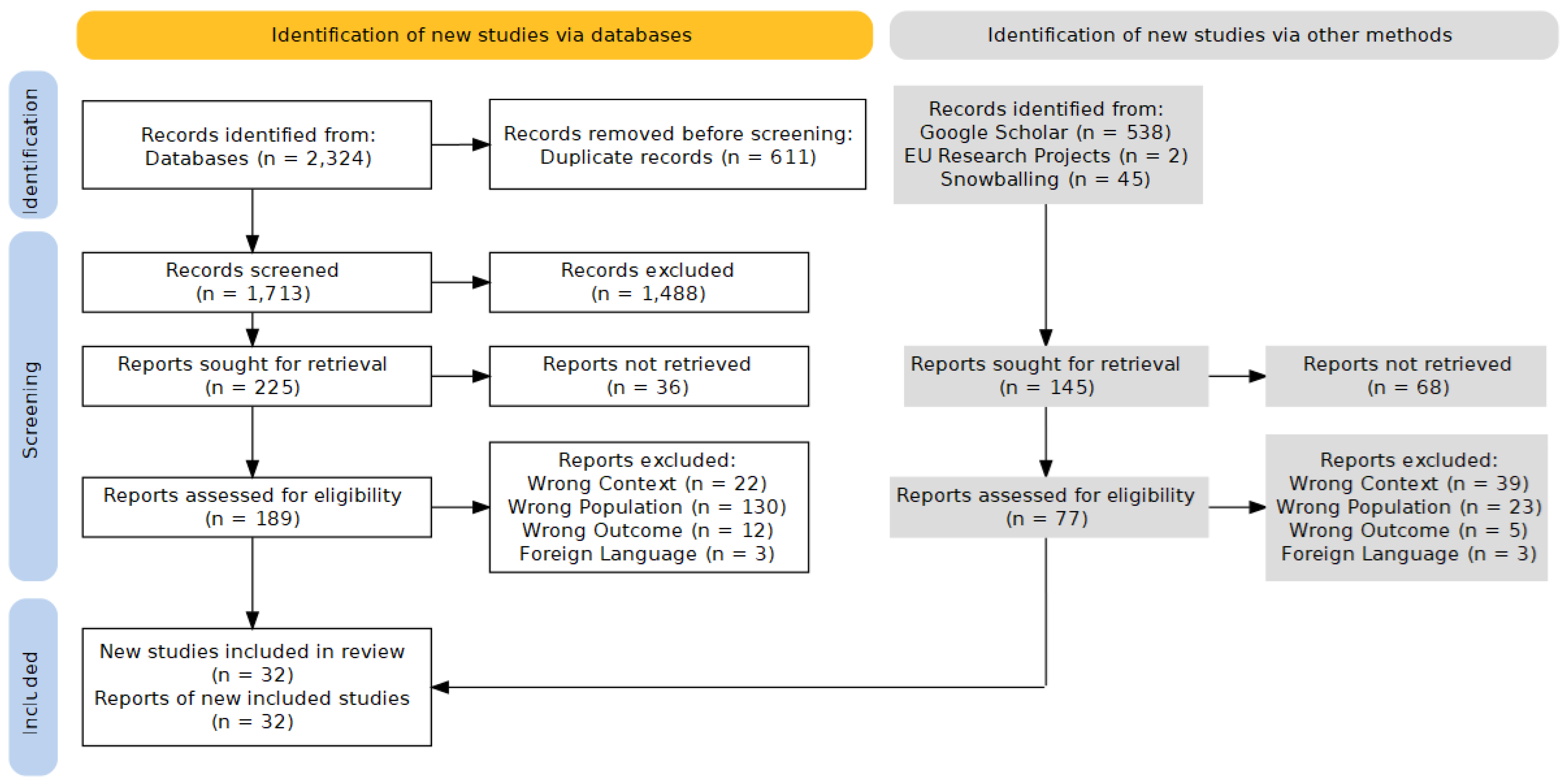
A total of 2,324 records were retrieved through database searches, and an additional 585 were obtained through grey literature and hand-searching. The process of identifying, screening, and selecting sources is depicted in a PRISMA-ScR flow diagram in Appendix C. After removing duplicates and screening titles and abstracts, 266 sources were evaluated for eligibility, after reading their full-texts and further applying the eligibility criteria. Of these, 30 sources were included in the review, from which 42 unique organizations were identified and analyzed.
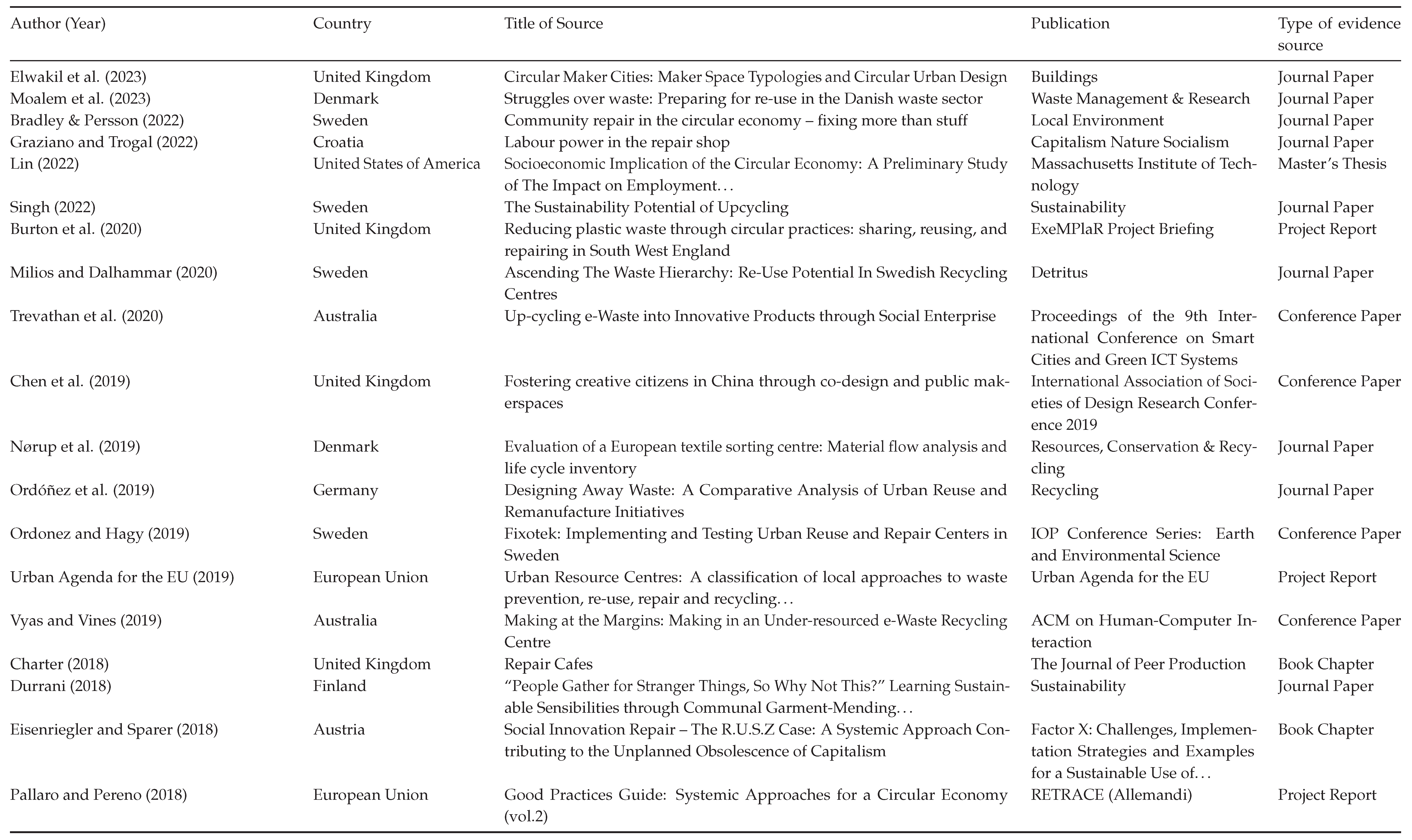
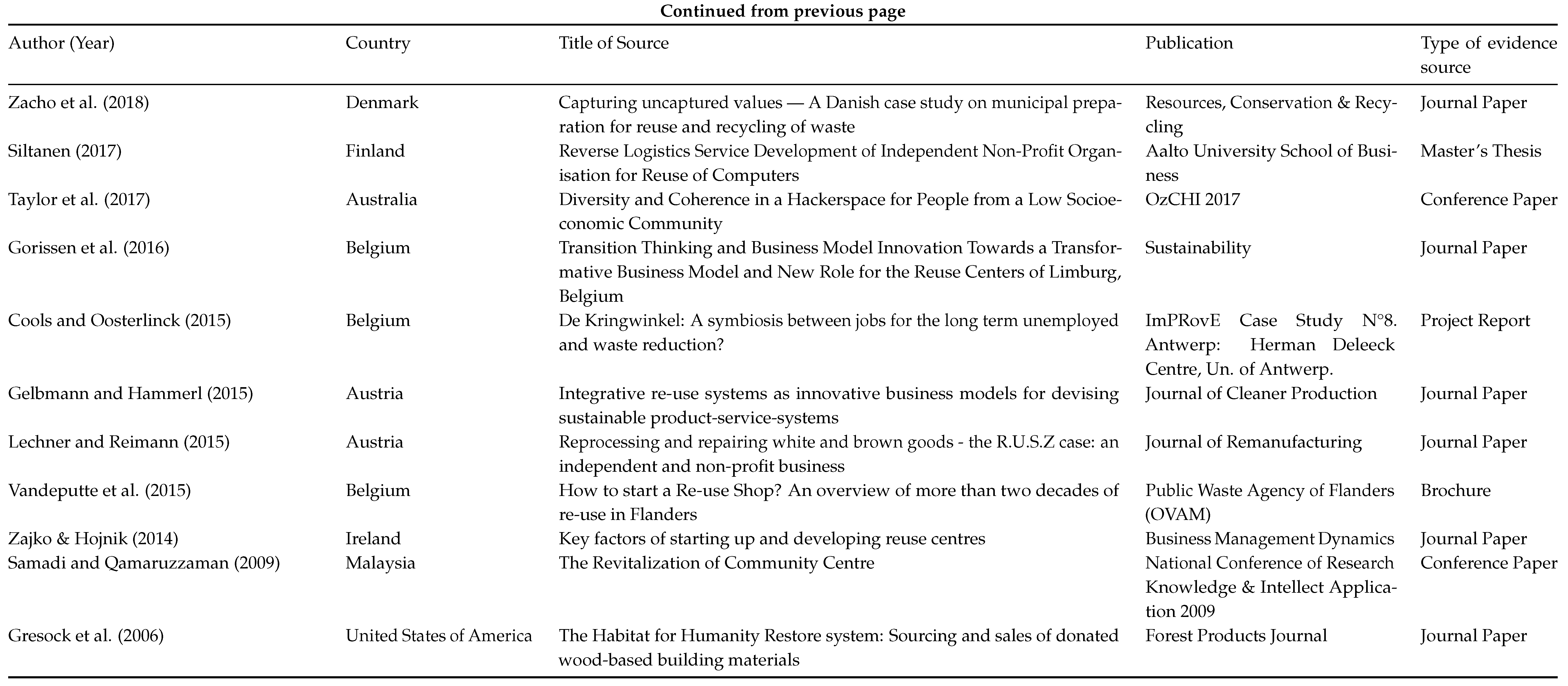
The complete list of sources selected and analyzed can be found in Appendix D, including the country that hosted the research and the type of evidence source. Among the countries hosting the most sources, Sweden and the United Kingdom stand out with 4 each, while Austria, Belgium, Denmark, and Australia have hosted three sources each. Appendix E summarizes the research methods employed by the 23 scientific studies. Case Study is the most commonly employed method, found in 12 studies, followed by mixed-methods (4) and Action Research (3). Appendix F presents the list of 42 organizations retrieved from the sources, the number of units, and the source(s) in which they were identified.
Table 1 presents the archetypes identified during the coding process. Six main archetypes and five sub-types were identified, organized by the CE’s recovery possibilities in the Butterfly Diagram, with one additional category, hereby called "Multi-purpose Social CE". Most of the archetypes identified are explicitly used by the organizations themselves—e.g., Library of Things, Repair Cafés, or Reuse Shops—while "Sorting and Recovery Hubs" and "Social-support Enterprises" are inferred; no explicit naming was identified other than their functional labeling (e.g., recycling center). With a Share functional emphasis, the Library of Things (LoT) lends or rents household appliances, toys, kitchenware, and musical instruments—services normally offered via e-commerce platforms. LoTs are often constituted as Social Enterprises and funded via membership fees and donations. Three such organizations are identified.
With a Maintain/Prolong functional emphasis, Repair Workshops (RpW) mainly run repair events called Repair Cafés—sessions where you can bring defective appliances with the expectation of getting them fixed by some of the volunteers also attending those sessions. These venues often offer toolkits for the repair of many different products. They are frequently constituted as associations and are supported by public and private funding. Seven of these organizations are identified, with the Stitching Repair Café Association, based in The Netherlands, achieving international status as it gathers thousands of initiatives promoting repair cafés around the world. Most of these initiatives are not legally constituted, however. Out of the seven RpW identified, four are a special type of RpW: the Do-it-yourself bicycle repair (), which provides the tools and support for any bicycle owner to take their bicycle there and fix it on their own.
With a Reuse/Redistribute emphasis, Reuse Centres (RuC) focus on recovering, redistributing, and/or reselling second-hand products such as household appliances, toys, bicycles, textiles, and books, which are sourced from collection points and individual pick-ups. Constituted as social enterprises (SEs) or Charities, RuCs are granted public and private funding, employing socially vulnerable individuals, e.g., long-term unemployed persons or refugees. They can also be called second-hand shops, reuse stores/labs, reuse networks, reuse centers, or community reuse centers/hubs. From the 13 such organizations identified, seven of them are structured as chains: the , sharing brand, label, and work methods. Makerspaces () have the functional emphasis of refurbishing and repurposing products. They can also be called hackerspaces, located in warehouses where they incubate design or art projects developed by social innovators or socially vulnerable employees. These projects can be funded via employment subsidies or other private sources. Six such organizations are identified.
With an emphasis on Recycling, Sorting and Recovery Hubs (SRH) are often conceived as purpose-built centers that handle construction materials and recyclables, such as paper and plastic, facilitating the recycling of materials received from retailers and companies. SRHs can be funded through municipal waste management fees collected. They can also employ socially vulnerable individuals and are called "recycling centers/stations". Eight SRHs have been found, three of which also feature small shops where second-hand products are redistributed or recommercialized. Finally, another category is added to the typology to include those organizations that are primarily focused on social wellbeing: the Multi-purpose social CE, for which the archetype Social-support enterprise (SsE) is proposed based on the four organizations identified.
The proliferation of terminology in the analyzed literature reflects a broader conceptual fragmentation. Multiple definitions have been proposed, each covering a different perspective on these organizations. These definitions are also gathered and compared in the following subsection.
3.2. A Fragmented Conceptual Landscape
Although numerous terms are used to describe organizations operating in this space, these labels are often inconsistently defined and rooted in context-specific policy or project discourses. Furthermore, constructs supported by formal disciplinary theorization have limited analytical utility and transferability. This fragmentation reflects the plural origins of these initiatives, which emerge from such different domains as social entrepreneurship, waste management, grassroots innovation, urban sustainability, and community development. Thus, the same or similar organizational forms can be classified differently, depending on the analytical framework employed: in terms of their physical infrastructure (e.g., Circular Maker Spaces), their governance logic (e.g., work-integrated social enterprises),or by their function within policy agendas (e.g., Urban Resource Centres).
Table 2 presents seven overlapping definitions proposed as a result of a focused study or formalized as theoretical frameworks, along with their stance regarding physical space and formal constitution. Community Organisations and ECO-WISES arise from studies in the health sector and policy, respectively. Both definitions are specific about the legal constitution - Social Enterprise -; however, neither is explicit about a physical space. The Reuse Centre’ is also specific about social enterprise as a legal constitution and about the physical space. Definitions of URC, CURE, Repair Cafés, and Circular Makers explicitly state the need for a physical space without specifying any formal constitution as a requirement. Furthermore, the term URC has been previously used in scientific literature in the context of a Pakistani NGO involved in the settlement of low-income populations. CURE refers to remanufacturing as multiple recovery processes, which can be misleading since little evidence of remanufacturing activities taking place within any of the 42 organizations investigated was found.
The identification and analysis of the seven definitions, their limitations, and the observation of consistent patterns across diverse examples led to the emergence of a construct. This construct specifies the need for a physical space, explicitly calling for a formal constitution—one that is not limited to SEs, but that can assume the most convenient formal constitution for the organization’s mission. Such constructs should also support positioning such initiatives more clearly within CE discourse and policy design. The Community-oriented Reuse Organisation model (COREO), which represents an ideal version of organizations recovering products and materials while engaging local communities and generating social wellbeing, is proposed and explained in the following subsection.
3.3. The Community-Oriented Reuse Organisation Model
Departing from the concept of URC, the COREO construct emerged inductively during data synthesis. The primary objective was to identify initiatives that exhibited characteristics similar to those found for the URCs. As evidence was gathered and synthesized, it became evident that, despite being presented through fragmented terminology, a subset of initiatives working with R-strategies consistently exhibited a localized physical infrastructure aimed at fostering social engagement through community-facing activities and some sort of organizational structure that conferred legitimacy, stability, and resilience. These features co-occurred across diverse contexts and institutional settings, suggesting the presence of an emergent model not yet coherently conceptualized in the literature. Through the inductive synthesis of the reuse initiatives analyzed, the Community-Oriented Reuse Organization (COREO) is defined as a
formally structured organisation that operates systems for reuse, repair, or redistribution, engaging local communities through dedicated physical spaces, combining material stewardship with social inclusion.
Based on the COREO definition, we propose four interdependent core elements through which COREO’s operations can be understood:
- Resource Stewardship stems from the commitment to preserve material value across a wide range of circular strategies;
- Social Capital refers to both the input and outcome of community engagement, social trust, and collective empowerment;
- Physical Infrastructure anchors activities spatially and enables public access and visibility;
- Organizational Permanence reflects the ability to maintain structure, partnerships, and financial stability over time.
The four core elements of the model should not be seen in isolation but as interwoven capabilities, as depicted in Figure 2. Together, they constitute a viable configuration for sustained, community-integrated circular practice. Each element addresses a necessary domain of organizational functioning: social legitimacy, institutional resilience, environmental effectiveness, and spatial embedding. Although individually observable, their full significance becomes apparent in their interaction. Physical infrastructure without permanence risks precarity; material recovery without social engagement limits public trust and uptake; permanence without community ties can lead to institutional inertia. In this sense, COREOs exemplify the logic of strong sustainability, where environmental goals are inseparable from social and institutional foundations.
The following subsections articulate the four elements as mutually reinforcing conditions that empower reuse organizations to drive sustainability transitions at multiple levels.
3.3.1. Resource Stewardship
The COREO plays an important role in extending product lifecycles and reducing material waste through diverse and adaptive recovery practices. Their stewardship approach encompasses a wide range of strategies, from sharing and maintenance to refurbishment and preparation for recycling. These recovery efforts span a broad array of materials, including textiles, electronics, furniture, household goods, and construction materials. Rather than specializing in a single activity, most organizations operate across multiple strategies, often in combination, enabling them to intervene in the material lifecycle at various points, creating multiple recovery loops that maximize value retention.
What distinguishes COREOs is not only the breadth of recovery strategies but also the systemic coordination of these strategies across various input sources. Items are sourced from a mix of private donations, drop-offs, community waste centers, take-back systems, and commercial partners (e.g., retailers, demolition contractors). This diversity highlights COREOs’ embeddedness in multiple material flows and their capacity to adapt practices based on available streams.
Their contribution to the CE and sustainability is legitimized through the monitoring of outcomes listed in Table 3. Among the most commonly reported metrics are recovery and rejection rates—with remarkable medians of 0.935 and 0.060, respectively—and GHG emissions avoided—with an average of 130,170 tonnes of avoided in one year. These main aspects of COREOs are summarized in our first proposition:
Proposition 1: COREOs enact resource stewardship by bridging diverse product and material streams for which recovery strategies are mobilised, resulting in high yields of resource recovery and indirect environmental benefits in the form of avoided emissions.
COREOs apply a layered logic of reuse; for instance, household goods may be received via drop-off, sorted for repair or redistribution, and then offered through second-hand retail, lending schemes, or donation platforms. By dealing with a broad set of materials—from furniture and e-waste to clothing, garden waste, and even hazardous or construction waste—these organizations expand the scope of circularity beyond conventional categories. Moreover, COREOs operate through diverse sourcing mechanisms, from private donations and collection points to partnerships with retailers, community waste centres, and construction take-back schemes. This infrastructural openness is key to their effectiveness, enabling them to bridge gaps in public waste systems while tailoring recovery efforts to local contexts.
The recovery rates observed suggest that many COREOs outperform typical municipal waste management facilities in terms of material efficiency. Although reporting inconsistencies remain, the data reflect COREOs’ potential to redefine circularity as a place-based, socially integrated system for environmental impact.
3.3.2. Social Capital
In addition to managing material flows, COREOs play an important role in cultivating the social foundations that support CE transitions. These organizations engage the public through a variety of channels—from communication platforms and pop-up events to volunteer programs and educational activities. These forms of engagement build familiarity, trust, and a sense of inclusion in circular practices. Three main types of engagement mechanisms are observed. First, communicative strategies such as websites, social media, newspapers, and public campaigns are used to raise awareness and maintain visibility. Second, COREOs organize occasional activities like repair cafés, workshops, exhibitions, and school visits, which offer low-barrier opportunities for participation and learning. Third, they foster more sustained, binding relationships through volunteering, internships, social employment, and co-creative projects. This combination enables multiple entry points for engagement—each tailored to different levels of commitment and capacity.
A wide range of social impact indicators can be monitored, as summarized in Table 4, including current personnel—with an average of roughly 7,500 people, including employees and volunteers—a median of 732 employees trained, and millions of people benefitted. Importantly, the target audiences extend beyond individual citizens to include local businesses, charities, schools, waste operators, and authorities. These connections help COREOs build legitimacy and strengthen their role as civic actors embedded in the community. In doing so, COREOs do not only divert waste or provide goods—they create inclusive, participatory environments where circular practices become socially meaningful and culturally embedded.
Proposition 2. COREOs cultivate social capital by engaging diverse audiences through communication, learning, and participation mechanisms that strengthen trust and embed circular practices in the community.
Community-oriented reuse initiatives activate and produce social value. Many of the initiatives studied involved marginalized groups, promoted local skills, facilitated volunteering, or enacted participatory governance. Social capital appears as both a resource, enabling operational execution, and an outcome, building trust, reciprocity, and empowerment. This dimension positions COREOs as a social infrastructure: embedded, inclusive, and capable of contributing to community cohesion and wellbeing. It also opens space to connect circularity with broader equity and justice goals, reinforcing the argument for integrating social metrics into circular economy assessment frameworks.
3.3.3. Physical Infrastructure
COREOs operate across a diverse set of physical spaces that support their recovery, redistribution, and educational functions. These infrastructures vary in typology, function, and specific facilities, reflecting how COREOs creatively adapt available space to meet circular and community needs. In terms of typology, COREOs operate out of shops, warehouses, garages, depots, cultural centers, and even churches or libraries. Some spaces are purpose-built for reuse or repair activities, while others are repurposed from existing retail, industrial, or civic infrastructure. This adaptability enables COREOs to function in both dense urban and peripheral settings, using whatever spatial resources are available.
These physical infrastructures are not limited to material processing. Many COREOs incorporate educational and civic functions through facilities such as classrooms, meeting rooms, DIY workspaces, and conference areas. Others offer public-facing spaces, such as swap corners or exhibition areas, to engage the community more directly. In this regard, COREOs can monitor how their spatial configurations contribute to their mission using the indicators presented in Table 5.
Proposition 3. COREOs adapt and combine diverse physical spaces to create circular infrastructures that support recovery, redistribution, and community engagement. These spaces play a crucial role in shaping community reuse practices.
Whether in the form of reuse depots, repair workshops, or makerspaces, these dedicated sites provide not only logistical capacity but also public visibility, community anchoring, and spaces for informal social exchange. The availability and layout of physical spaces influence the types of activities that can be hosted—ranging from retail to co-creation—and directly affect user access and engagement. Physical presence is not only functional; it also fosters a tangible identity that entails legitimacy and reach. This dimension is closely aligned with the perspectives of architectural and urban studies on social infrastructure and place-based engagement.
3.3.4. Organisational Permanence
To maintain their activities over time, COREOs rely on a mix of legal, financial, and institutional strategies that help stabilize their operations. These mechanisms fall into four main categories: legal frameworks, income sources, clustering forms, and compliance practices. COREOs operate under a wide range of legal forms, including social enterprises, charities, associations, cooperatives, and public–private partnerships. This legal diversity reflects both national regulatory environments and strategic decisions regarding mission alignment, access to funding, and eligibility for public support.
To sustain their activities financially, COREOs draw from multiple income sources: membership fees, donations, repair reimbursements, grants, crowdfunding, and even waste management fees. Many also benefit from employment subsidies, particularly when engaging vulnerable or long-term unemployed populations. This diversification supports resilience and reduces over-reliance on any single funding stream. In terms of clustering, COREOs often belong to broader networks, brands, or federations that provide visibility, knowledge sharing, or shared principles. Some operate as franchises or community-led initiatives within urban or regional networks. These connections support scale and coordination while retaining local autonomy. Finally, COREOs employ various compliance mechanisms to demonstrate accountability. These include audits, performance reports, customer satisfaction surveys, product warranties, and formal procedures or policy documents.
Organizational permanence supports strategic planning, the accumulation of technical and relational capital, and the development of institutional memory. Many of the most impactful cases in the sample were embedded in local governance or public-private ecosystems that grounded their positions and extended their influence. In contrast, ad hoc or project-based initiatives often struggle with high turnover, mission drift, and financial precarity. Table 6 shows indicators that can help track financial health. Permanence, in this context, does not equate to size or centralization, but to structural anchoring and resilience within their socio-institutional setting.
Proposition 4. COREOs stabilise their operations through diverse legal forms, income streams, partnerships, and compliance practices that support long-term viability and accountability.
COREOs consistently exhibit formal structures—such as legal incorporation, multi-year funding, or enduring partnerships—that enable operational continuity. While many COREOs operate as registered non-profits, others exhibit more hybrid characteristics; several initiatives maintain close institutional ties with municipal or national governments yet operate with considerable self-governance.
3.4. Interpreting Organisational Diversity Through the COREO Lens
The COREO model offers a conceptual lens for understanding the recurring characteristics of the COREOs. Currently at the forefront at the forefront of short-loop CE initiatives, COREOs tend to be economically fragile, and formally unstable, risking to shut down their operations due to disturbances, or transforming themselves into regular for-profit businesses and loosing their social character. This model can be used as a benchmark for assessing the COREOs and establishing development pathways that may increase their economic sustainability and legitimacy within the community they are embedded.
In this section, we examine the degree to which the organizations analyzed and archetypes identified align with the four core dimensions of the model. By synthesizing both structural diversity and available performance indicators, we assess how COREOs are realized in practice and explore the flexibility and coherence of the model across a variety of contexts. Without aiming for empirical verification, our analysis demonstrates its interpretive utility in describing current configurations and development paths.
Figure 3 depicts the resulting three clusters along the structural (X-axis) and functional (Y-axis) dimensions. Archetypes feature one shape each, while Clusters receive different colors. Cluster A (red) groups organizations with lower scores on both functional and structural dimensions, suggesting smaller scale, early-stage, or niche configurations. Cluster B (blue) includes organizations with mid-range functionality and moderate structural embeddedness. Cluster C (yellow) features organizations that score highly on both axes, reflecting strong operational capabilities and institutional maturity. In the figure, the centroids for each cluster are plotted, as well as the medians for structural and functional dimensions. The medians divide the graph area into four quadrants: Q1 (bottom-left), Q2 (bottom-right), Q3 (upper-left), and Q4 (upper-right). Clusters and Quadrants are employed to outline current states and potential development paths in the following subsections.
3.4.1. Current States and Potential Development Paths
Organizations in Q1 are typically lean in structure and modest in reach, operating on the strength of reuse and repair practices, civic engagement, and informal economies. Most rely on earned income from second-hand retail and repair services, often focusing on furniture, clothing, and bicycles. Their infrastructure is minimal: DIY spaces, toolkits, and basic storage facilities. Social capital is strong: citizens are engaged through volunteering, workshops, and educational formats. They often lack long-term funding or extensive governance structures, serving as incubators of resource circularity.
Organizations in Q2 distinguish themselves by the strength of their physical and operational infrastructure. Equipped with permanent facilities such as retail shops, industrial workshops, and donation reception systems, they serve as reliable nodes in urban reuse ecosystems. Their focus is on processing volume and material flow — furniture, clothing, and textiles feature prominently — often through repair, resale, and upcycling. While functionally competent, they show fewer signs of civic engagement or participatory programming than their community-centric counterparts. Many draw support from a blend of earned income, private donations, and occasional municipal funding.
Organizations in Q3 operate at the intersection of repair culture, community education, and grassroots material circularity. Common to both clusters is a strong orientation toward public-facing services: reuse and repair workshops, informal education, and donation-based product flows. They work across household goods, electronics, and wood/furniture, often in response to local needs. These organizations are locally embedded, with strong ties to schools and community groups, broader social engagement, and basic infrastructure such as depots or multi-use warehouses.
Last, organizations in Q4 represent the mature, high-capacity end of the spectrum. Combining robust physical infrastructure with expansive community programming, they are embedded in local economies through material reuse, civic engagement, and hybrid governance. Their activities span resale, repair, upcycling, and recycling, often complemented by education, employment services, and volunteering. Cluster C organisations in this quadrant are typically mainstream actors — civic reuse centres or social enterprises with policy alignment, stable funding, and diverse operational formats.
When organizations in the same archetype but spread across different quadrants and clusters are linked, potential development paths can be drafted. For example, a makerspace like AIU could enhance their infrastructure by following what TRM presents, later developing mechanisms and programs adopted by S33. In the same way, A RuC like HL2 can expand their engagement mechanisms to resemble more closely those of PKO, and even further, like KOP—if there is the opportunity and desire. Other development paths for the archetypes SRH and RpW are also depicted; LoT organizations are too few and too similar to allow for a development pathway to be drafted.
4. Discussion
Compared to this study, a few other studies have reached a comparable scale. Elwakil et al. [30] surveyed 326 organizations to develop five “maker typologies”. Another large-sample study by Gresock et al. [36]—based on 120 Habitat for Humanity ReStores—reported high reliance on volunteers and donations, low staff numbers, and modest financial returns per square foot—challenges were also observed across many sources in our sample. We could only find one other scoping review that addressed comparable organisations: [35], which focused on community-based health organisations, not CE. We accounted for and expanded on the findings of these studies, by proposing the COREOs model, identifying and establishing the archetypes, and analysing the organisations using the model, tracking their states and potential development paths.
In the following subsections, the Archetypes, the COREOs model and its propositions, and potential development paths will be discussed; furthermore, contributions to CE theory, implications for policymaking, and limitations and future research are also detailed.
4.1. Organisational Archetypes: Mapping the Community Reuse Ecosystem
The six narrative archetypes identified in the results reflect a vibrant ecosystem of organizations that share a community orientation toward reuse and circularity. Unlike typologies derived from theoretical frameworks or formal modeling, these archetypes are grounded in how organizations self-identify or are described in the literature. They function as social identities—heuristics that make the role and purpose of COREOs intelligible to local communities, funders, policymakers, and researchers.
In this sense, they operate similarly to business model archetypes in the Circular Economy (CE) literature, which categorize recurring value creation and delivery patterns [13,37,38]. However, while CE business models often emphasize private-sector innovation and economic value capture, COREOs foreground collective use, social value, and civic engagement. Their archetypes thus extend CE theorizing into the civic, cooperative, and public institutional domains. This emphasis fills a well-documented blind spot in CE research. As shown in a recent review of reviews, CE scholarship has largely prioritized technocentric and business model-oriented approaches, with limited focus on socially embedded or community-led solutions [18]. The COREOs archetypes contribute to closing this gap by highlighting grassroots organizational forms that are often overlooked in mainstream CE narratives.
It is worth noting that the term "archetype" has different meanings across literature. In CE business model research, archetypes tend to refer to prescriptive templates or configurations that can be applied to design new ventures [12]. In contrast, we follow the definition used in sustainability science by [19], where archetypes represent empirically grounded, recurring patterns that help explain the diversity of observed systems. Our archetypes are inductively derived narrative portraits based on organizational self-descriptions and secondary data, rather than prescriptive or idealized templates.
These archetypes also intersect with the five "maker typologies" identified in [30]: Reuse, Repair, Redistribute, Fabricate, and Upcycle. The COREOs archetypes help anchor those functional profiles into more stable organizational forms. For instance, Repair Cafés align with the Repair maker type, Libraries of Things with Redistribute, Makerspaces with Fabricate, and Reuse Shops with Reuse. Yet COREOs are often broader in scope, combining education, infrastructure, and employment with their core recovery strategies.
4.2. The COREOs Model and Propositional Framework
The COREOs model is a conceptual synthesis of the structural and functional characteristics observed across the organizations in our review. Each dimension corresponds to a core proposition that encapsulates a theoretical claim about how community-oriented reuse organizations enact circularity. However, it is important to note that the COREOs model is not a general theory, nor does it represent a universally applicable maturity model. Rather, it serves as an ideal-type heuristic: a diagnostic and generative tool that can help make sense of the diversity of organizational forms. Each proposition identifies a necessary, but not a sufficient, condition for robust circularity. Omitting any one of the four dimensions risks undermining the integrity of the system. For instance, strong infrastructure without social embeddedness may result in underused facilities, while robust community networks without organizational permanence may struggle with long-term sustainability.
COREOs enact resource stewardship by bridging material streams (Proposition 1), emphasizing that social capital is not incidental but constitutive of COREOs’ success (Proposition 2). In this regard, the physical infrastructure (Proposition 3) acts as a facilitator for both material recovery and social gathering. This aligns with observations from the Urban Resource Centres initiative [3], which demonstrates how shared physical sites support decentralized circular practices in cities. A physical space is legitimized when the organization features organizational permanence (Proposition 4), potentializing a legal structure, financial durability, clustering, and compliance, conferring resilience and continuity.
Taken together, these propositions resonate with established principles in other domains, as the COREOs model builds upon the structural-operational definition of civil society organizations proposed by [26]. In particular, they closely mirror the five characteristics used to define community-based organizations in the health sector [35]: (1) organized or institutionalized to some degree; (2) separate from government; (3) non-profit distributing; (4) self-governing; and (5) inclusive of voluntary participation. COREOs share this DNA, even if their missions center on circularity rather than public health. The overlap affirms COREOs’ place within a broader tradition of grassroots and community-based organizing.
By naming and operationalizing these four dimensions, we address key limitations in the prevailing circular economy literature. Most circular economy models and business strategies privilege technological innovation, market mechanisms, or firm-level efficiency. By contrast, the COREOs model foregrounds the social infrastructures and community capabilities required to deliver circular outcomes at scale and with equity. It invites a shift in attention—from business model innovation to organizational ecology, from performance metrics to institutional enablers. As such, the COREOs model is both a contribution to CE theory and a bridge to related fields such as social enterprise, commons governance, and grassroots innovation.
4.3. Quadrant States and Development Paths
The quadrant typology emerging from the COREOs model offers a heuristic lens to assess the diverse configurations of community-based reuse organizations. Importantly, the quadrant states reflect distinct balances—sometimes tensions—between structural consolidation (e.g., legal frameworks, infrastructure, funding mechanisms) and functional engagement (e.g., recovery strategies, social capital, community practices). Organizations can remain within a particular quadrant by design or necessity, or shift in response to evolving contexts, leadership, or policy frameworks.
From this perspective, Q1 organizations emerge driven by strong social motivations while being vulnerable due to limited institutional stability. Support for these actors might emphasize formalization tools, legal advice, or seed funding mechanisms that preserve their participatory ethos. Q2 organizations demonstrate more developed structural traits but often lack deep community embedment or robust performance monitoring. Here, development could focus on enhancing social capital and feedback mechanisms, potentially through participatory governance models or cross-learning platforms. Conversely, Q3 organizations reflect strong social and functional engagement but remain structurally precarious. For these, strategies such as federated networks, shared infrastructure, or multi-actor alliances may bolster resilience without compromising agility. Finally, Q4 organizations, which combine robust structures with engaged practices, are frequently perceived as mature or exemplary. Yet they may risk mission drift or bureaucratization. Their challenge is to scale responsibly, maintaining openness and adaptability while preserving their community anchoring.
Viewed through the quadrant lens, distinct patterns can be observed across the archetypes. LoTs, for example, tend to cluster tightly, reflecting their high community engagement and limited structural formalization. SRHs and SsEs, while positioned across two quadrants, show their strongest examples not even midway through the structural-functional spectrum. In contrast, RuCs and MkSs are spread across the whole spectrum. Furthermore, the clustering analysis offers a complementary empirical lens by revealing latent groupings based on the similarities among multivariate indicators. The centroids derived for each cluster illustrate contrasts between the three clusters, confirming that they capture meaningful structural-functional profiles. Thus, the quadrant and clustering approaches should be viewed as mutually enriching, each revealing a different layer of insight into COREOs’’ organizational diversity.
4.4. COREOs: CE’s (Strong) Sustainability
COREOs offer a systems-level contribution to CE and sustainability theory by operationalizing strong sustainability [1]. Recent scholarship acknowledges this shift from "weak" sustainability—centered on technological innovation and eco-efficiency—toward "strong" sustainability, which emphasizes place-based embeddedness, a defining feature of COREOs. As such, COREOs contribute to the territorialization of circularity, rooting CE practices in specific geographies and social ecologies. These forms of embeddedness reflect values that are non-substitutable: community trust, civic participation, and spatial accessibility cannot be replicated by market or technological solutions alone [39]. Therefore, CE transitions must be evaluated based on their capacity to foster equity, inclusion, and democratic participation [2].
COREOs also underscore the importance of social and civic infrastructures in enabling circularity. Their operations frequently depend on spaces and practices that support volunteering, informal knowledge sharing, repair culture, and mutual aid. These infrastructures facilitate forms of social learning and collective agency that go beyond the transactional nature of typical CE interventions. In this regard, COREOs resonate with urban sustainability literature that frames reuse and repair not simply as material processes but as culturally and spatially situated practices with deep relational value [40].
4.5. Implications for Policymaking
The high recovery rates and low rejection rates observed among COREOs suggest that they could play a significant role in meeting CE targets—particularly in urban settings where decentralized reuse infrastructures are viable. However, COREOs often operate under structurally precarious funding conditions. As documented in prior work [3,5,32,41,42,43,44,45], financial sustainability remains a key challenge, even for organizations with diverse income streams. Those reliant on public funding are vulnerable to political shifts and austerity measures that deprioritize social value creation in favor of cost-efficiency [33,46]. Others who depend on private or philanthropic sources face similar exposure to economic downturns. Recognizing and institutionalizing metrics for social and environmental return on investment (SROI and EROI) could help justify longer-term, mission-aligned public support and increase resilience against short-term funding cycles.
Political and cultural contexts play a pivotal role in fostering the emergence of COREOs. For instance, initiatives like De Kringwinkel in Belgium and R.U.S.Z. in Austria originated in response to social development policies targeting unemployment and social vulnerability [44,45]. In Sweden, municipal mandates for extended producer responsibility, along with evolving right-to-repair legislation, facilitated the development of reuse centers such as Alelyckan, Återbruket, and Fixoteket [4,41,47,48]. In the UK, the Fixer Movement and broader DIY repair culture have similarly influenced reuse initiatives [49], while EU projects like URBACT have actively supported reuse network formation [3]. The origin of Substation33 in Australia is linked to the maker movement and supported by the “Work for the Dole” program, which connects reuse work with socially vulnerable populations [5]. In contrast, the Footprints Environmental Centre in Africa emerged in a context of limited existing infrastructure—a response to systemic neglect rather than formal policy support [50].
Power dynamics and market competition can also act as significant barriers to COREOs upscaling, again calling for protective and enabling policies that shield COREOs from market exclusion. Wholesalers and Original Equipment Manufacturers (OEMs) may perceive COREOs as competitors, particularly in second-hand and repair markets, and may be reluctant to collaborate out of fear of losing market share [4,51]. In some cases, OEMs have employed restrictive design choices, lobbying, or other tactics to actively obstruct the growth of repair ecosystems [52].
4.6. Limitations and Future Research
This review has a number of limitations that must be acknowledged. First, the sample of organizations is limited to cases reported in scientific publications, thus omitting many community reuse initiatives that have only been described in grey literature or documented through practice-based networks. As identified in the earlier review by [35], academic attention to community-based organizations (CBOs) varies widely across sectors and geographies. In the case of COREOs, many operate informally or semi-formally and may not meet the inclusion criteria of peer-reviewed studies.
Second, the availability and quality of empirical data varied significantly across the reviewed sources. Many indicators, especially those regarding environmental performance, were not consistently reported, and quantitative results often relied on self-reported figures without third-party verification. While our synthesis captures emerging patterns, it also reflects the heterogeneity and data gaps typical of research on grassroots and third-sector initiatives.
Third, while the COREOs model and its propositions were derived from empirical patterns, they remain conceptual frameworks rather than tested causal claims. Further research is needed to validate the relationships between resource stewardship, social capital, infrastructure, and organizational permanence in different institutional contexts. In particular, the performance indicators identified for each dimension could serve as the basis for survey-based research or case studies designed to test the model’s explanatory power. The clustering and typological classification of organizations introduced in this study—based on a structural-functional matrix and the k-means algorithm—offers a useful heuristic but must be interpreted cautiously. Future research could focus on refining these clusters or testing their relevance in other national or regional settings.
Finally, this review reflects a systematic snapshot of the literature available during a specific period. While new studies may have emerged since, this time-bound scope is consistent with practices in scoping and systematic reviews. Bibliometric analyses suggest that in maturing research areas such as reuse and the CE, newer publications often reinforce rather than fundamentally reshape established patterns. Therefore, while additional studies could expand the dataset and add further nuance, the conceptual model and typologies proposed here are likely to remain relevant. Future research could update this review through a longitudinal or “living review” approach, continuously integrating new evidence and refining the COREOs framework accordingly.
5. Conclusions
This review synthesizes empirical knowledge on community-oriented reuse organizations (COREOs) and introduces a multidimensional model to conceptualize their structural and operational characteristics. Drawing on 30 sources, we identified six narrative archetypes, developed a typology grounded in organizational maturity and performance, and proposed four interdependent dimensions—resource stewardship, social capital, infrastructure, and organizational permanence—as foundational for advancing strong sustainability through reuse.
Rather than testing hypotheses, this study aimed to construct a conceptual framework grounded in empirical regularities and qualitative insights. The COREOs model and accompanying propositions should, therefore, be viewed as an invitation for further empirical validation and refinement.
By bridging circular economy theory and community-based practice, the COREOs model offers a conceptual foundation for further empirical research, policy innovation, and cross-sector collaboration. As the circular economy agenda continues to evolve, these organizations exemplify grassroots pathways that combine environmental recovery with social purpose—reminding us that circularity is not only about material flows but also about organizational forms and collective agency.
Acknowledgments
This project received funding from the European Union’s Horizon 2020 research and innovation programme under the Marie Skłodowska-Curie grant agreement No 899987. The authors would also like to thank Dr. Paula Hembecker for her great support during the design phase of this review.
Appendix A. Selection Criteria
Appendix A.1. Inclusion Criteria
-
Sample
- Organisations currently operational, preparing solid waste to reuse, while also promoting community engagement through (i) activities like fairs, seminars, workshops, lectures and courses, or (ii) employing the socially vulnerable. Some degree of organisational permanence must also be evidenced, like being legally framed as a social enterprise.
-
Phenomena of Interest
- Performing PfR activities like sharing/renting, reuse/selling, repair, recycling, remanufacturing, refurbishing, repurposing (upcycling);
- Engaging the community via (i) activities like fairs, seminars, workshops, lectures and courses, or (ii) employing the socially vulnerable;
- Defining, measuring and/or monitoring performance and impacts;
- Declaring how the organisation(s) is/are structured;
- Reporting on which products they handle;
- Describing the social engagement mechanisms used;
- Informing about the sources of income.
-
Design
- On-site observations;
- Consultation to documents;
- Workshops;
- Surveys;
- Interviews;
- Focus Groups.
-
Evaluation
- Types and quantities of input and/or output material flows;
- Environmental im pacts and/or benefits caused by the organisation - e.g. Greenhouse Gases (GHG) emissions;
- Impacts obtained from LCI/LCA;
- Description of activities performed in the centre;
- Societal effects, like job creation or quality of life;
- Technical and economic feasibility.
-
Research type
- Qualitative studies;
- Case Study(ies);
- Ethnographic studies;
- Quantitative studies like Material Flow Analysis (MFA), Lifecycle Inventory and/or Assessment (LCI/LCA);
- Mixed-methods studies.
Appendix A.2. Exclusion Criteria
-
Sample
- For-profit companies, e.g., businesses;
- Centres for the recovery of industrial waste, wastewater, sewage water
- Waste-to-Energy Facilities - formerly known as “Resource Recovery Facilities”;
- Composting plants;
- Organisations handling hazardous wastes, like acids and batteries, are evaluated case by case.
- Repair shops associated to a business entities - like the ones studied in Djeunang Mezafack et al. [53].
-
Phenomena of Interest
- Organisations performing in a single PfR;
- Performing chemical or thermal processing of waste;
- Performing landfill activities;
- Organisational permanence cannot be evidenced;
- Focusing on organic waste.
-
Design
- No limitations are defined concerning Design.
-
Evaluation
- No limitations are defined concerning Evaluation.
-
Research type
- Studies concerning optimization will be evaluated by case;
- Studies not published in English. Other languages are considered in a per case evaluation.
Appendix B. Search Methods
A systematic search strategy was developed to identify evidence that describe COREOs currently operational. In the following sections, databases searched, search limits, on-line resources and grey literature, de-duplication procedures and search strategies are described.
Appendix B.1. Databases Searched
| Database | Database Coverage | Date of final search |
| Scopus | 1946 to 31 December 2023 | May 2, 2024 |
| Web of Science | 1974 to 31 December 2023 | May 2, 2024 |
| Emerald Insight | 1974 to 20 January 2022 | January 20, 2022 |
| Engineering Village | 1806 to Week 2 January | January 20, 2022 |
Appendix B.2. Search Limits
There are no timing restrictions for studies included. It is a worldwide search; no geographical restrictions are applied. The main language considered is English; other languages are considered in a per case evaluation.
For the formal database, search filters applied are on document type: only articles, conference papers, reviews, book chapters and books are selected.
Appendix B.3. Online Resources and Grey Literature
The following online and grey literature sources were searched:
- Google Scholar. The first ten pages of results in Google Scholar were evaluated.
Appendix B.4. De-Duplication
For deduplication, litsearchr features an algorithm. Potential keywords are retrieved from the title and the abstract using the Rapid Automatic Keyword Extraction (RAKE) algorithm [54]. A search terms list was created and manually categorised, following concept groups defined through the PICO framework. After merging and refining the automatically and the manually generated keywords lists, the search string is generated.
The first ten pages of results are considered relevant for this study. Research results of each database are exported as RefMan files .ris, and loaded in R for deduplication using the litsearchr package. The deduplicated .ris file containing 1713 results were imported into the Rayyan™ platform [55], an internet-based tool for collaborative article base management, for one last removal of duplicates and screening.
Appendix B.5. Search Strategies
| Database (Results) | Search Strategy |
| Scopus (894) | TITLE-ABS-KEY ( ( “circular* econom” OR ”circular busines” OR ”demolit wast” OR ”e-wast manag” OR ”electron equip” OR ”materi flow* analysi” OR ”materi recover” OR ”municip solid* wast” OR ”prepar for reus” OR ”revers logist” OR ”solid wast* manag” OR ”wast electr” OR ”electron wast” OR ”extend produc* respons” OR ”household wast” OR ”mechan recycl” OR ”municip wast” OR ”packag wast” OR ”plastic materi” OR ”plastic wast” OR ”post-consum plastic” OR ”recoveri process” OR ”recycl process” OR ”recycl program” OR ”recycl system” OR ”resourc recoveri” OR sustain OR”wast* generat” OR “wast* manag* option” OR ”wastmanag* system” OR ”wast process” OR ”wastrecycl” OR ”waststream” OR ”preparfor re-us” OR restartOR”communiti repair*” OR “resourc* circular” OR ”circular index” OR ”circular gap” OR “repair* target” OR ”reus target” OR ”re-us target” OR ”circular materi* use rate” ) AND ( ”materi recoveri* facil” OR ”recoveri facil” OR ”urban resourc* cent” OR ”urban resourc* facil” OR ”reus cent” OR ”re-us cent” OR ”repair cent” OR ”repair cafe” OR ”repair facil” OR ”repair station” OR ”repair shop” OR “collect* point” OR ”collecti station” OR ”sort cent” OR ”secondhand store” OR ”second-hand store” OR ”secondhand shop” OR ”second-hand shop” OR ”recycl station” OR ”recycl cent” ) AND NOT ( sludge OR wastewater* OR soil* ) ) AND ( LIMIT-TO ( DOCTYPE ,”ar” ) OR LIMIT-TO ( DOCTYPE , “cp” ) OR LIMIT-TO ( DOCTYPE , “re” ) OR LIMIT-TO ( DOCTYPE , “ch” ) OR LIMIT-TO ( DOCTYPE , “bk” ) ) |
| Web of Science (498) | TITLE-ABS-KEY ( ( “circular* econom” OR ”circular busines” OR ”demolit wast” OR ”e-wast manag” OR ”electron equip” OR ”materi flow* analysi” OR ”materi recover” OR ”municip solid* wast” OR ”prepar for reus” OR ”revers logist” OR ”solid wast* manag” OR ”wast electr” OR ”electron wast” OR ”extend produc* respons” OR ”household wast” OR ”mechan recycl” OR ”municip wast” OR ”packag wast” OR ”plastic materi” OR ”plastic wast” OR ”post-consum plastic” OR ”recoveri process” OR ”recycl process” OR ”recycl program” OR ”recycl system” OR ”resourc recoveri” OR sustain OR”wast* generat” OR “wast* manag* option” OR ”wastmanag* system” OR ”wast process” OR ”wastrecycl” OR ”waststream” OR ”preparfor re-us” OR restartOR”communiti repair*” OR “resourc* circular” OR ”circular index” OR ”circular gap” OR “repair* target” OR ”reus target” OR ”re-us target” OR ”circular materi* use rate” ) AND ( ”materi recoveri* facil” OR ”recoveri facil” OR ”urban resourc* cent” OR ”urban resourc* facil” OR ”reus cent” OR ”re-us cent” OR ”repair cent” OR ”repair cafe” OR ”repair facil” OR ”repair station” OR ”repair shop” OR “collect* point” OR ”collecti station” OR ”sort cent” OR ”secondhand store” OR ”second-hand store” OR ”secondhand shop” OR ”second-hand shop” OR ”recycl station” OR ”recycl cent” ) AND NOT ( sludge OR wastewater* OR soil* ) ) AND ( LIMIT-TO ( DOCTYPE ,”ar” ) OR LIMIT-TO ( DOCTYPE , “cp” ) OR LIMIT-TO ( DOCTYPE , “re” ) OR LIMIT-TO ( DOCTYPE , “ch” ) OR LIMIT-TO ( DOCTYPE , “bk” ) ) |
| Emerald Insight (387) | TITLE-ABS-KEY ( ( “circular* econom” OR ”circular busines” OR ”demolit wast” OR ”e-wast manag” OR ”electron equip” OR ”materi flow* analysi” OR ”materi recover” OR ”municip solid* wast” OR ”prepar for reus” OR ”revers logist” OR ”solid wast* manag” OR ”wast electr” OR ”electron wast” OR ”extend produc* respons” OR ”household wast” OR ”mechan recycl” OR ”municip wast” OR ”packag wast” OR ”plastic materi” OR ”plastic wast” OR ”post-consum plastic” OR ”recoveri process” OR ”recycl process” OR ”recycl program” OR ”recycl system” OR ”resourc recoveri” OR sustain OR”wast* generat” OR “wast* manag* option” OR ”wastmanag* system” OR ”wast process” OR ”wastrecycl” OR ”waststream” OR ”preparfor re-us” OR restartOR”communiti repair*” OR “resourc* circular” OR ”circular index” OR ”circular gap” OR “repair* target” OR ”reus target” OR ”re-us target” OR ”circular materi* use rate” ) AND ( ”materi recoveri* facil” OR ”recoveri facil” OR ”urban resourc* cent” OR ”urban resourc* facil” OR ”reus cent” OR ”re-us cent” OR ”repair cent” OR ”repair cafe” OR ”repair facil” OR ”repair station” OR ”repair shop” OR “collect* point” OR ”collecti station” OR ”sort cent” OR ”secondhand store” OR ”second-hand store” OR ”secondhand shop” OR ”second-hand shop” OR ”recycl station” OR ”recycl cent” ) AND NOT ( sludge OR wastewater* OR soil* ) ) AND ( LIMIT-TO ( DOCTYPE ,”ar” ) OR LIMIT-TO ( DOCTYPE , “cp” ) OR LIMIT-TO ( DOCTYPE , “re” ) OR LIMIT-TO ( DOCTYPE , “ch” ) OR LIMIT-TO ( DOCTYPE , “bk” ) ) |
| Engineering Village (545) | TITLE-ABS-KEY ( ( “circular* econom” OR ”circular busines” OR ”demolit wast” OR ”e-wast manag” OR ”electron equip” OR ”materi flow* analysi” OR ”materi recover” OR ”municip solid* wast” OR ”prepar for reus” OR ”revers logist” OR ”solid wast* manag” OR ”wast electr” OR ”electron wast” OR ”extend produc* respons” OR ”household wast” OR ”mechan recycl” OR ”municip wast” OR ”packag wast” OR ”plastic materi” OR ”plastic wast” OR ”post-consum plastic” OR ”recoveri process” OR ”recycl process” OR ”recycl program” OR ”recycl system” OR ”resourc recoveri” OR sustain OR”wast* generat” OR “wast* manag* option” OR ”wastmanag* system” OR ”wast process” OR ”wastrecycl” OR ”waststream” OR ”preparfor re-us” OR restartOR”communiti repair*” OR “resourc* circular” OR ”circular index” OR ”circular gap” OR “repair* target” OR ”reus target” OR ”re-us target” OR ”circular materi* use rate” ) AND ( ”materi recoveri* facil” OR ”recoveri facil” OR ”urban resourc* cent” OR ”urban resourc* facil” OR ”reus cent” OR ”re-us cent” OR ”repair cent” OR ”repair cafe” OR ”repair facil” OR ”repair station” OR ”repair shop” OR “collect* point” OR ”collecti station” OR ”sort cent” OR ”secondhand store” OR ”second-hand store” OR ”secondhand shop” OR ”second-hand shop” OR ”recycl station” OR ”recycl cent” ) AND NOT ( sludge OR wastewater* OR soil* ) ) AND ( LIMIT-TO ( DOCTYPE ,”ar” ) OR LIMIT-TO ( DOCTYPE , “cp” ) OR LIMIT-TO ( DOCTYPE , “re” ) OR LIMIT-TO ( DOCTYPE , “ch” ) OR LIMIT-TO ( DOCTYPE , “bk” ) ) |
| Google Scholar | (“urban resource centre” OR “repair cafe” OR “repair centre” OR “reuse shop” OR “reuse centre” OR “reuse centre” OR “second-hand store” OR “recycling centre”) AND (“circular business” OR “social enterprise”) |
Appendix C. PRISMA2020 diagram Generated for This Review, as Prescribed in Haddaway (2022)
Appendix D. List of Sources Selected and Analysed
Appendix E. Research Methods Employed by the 23 Scientific Studies Identified (Conference and Journal Papers, and Master’s Theses)
| Research Method | Total of Sources | Sources |
| Case Study(ies) - Case Study Review | 12 | Zajko and Bradač Hojnik [33]; Gelbmann and Hammerl [56]; Lechner and Reimann [51]; Siltanen [57]; Taylor et al. [58]; Chen et al. [43]; Ordóñez et al. [32]; Trevathan and Sharp [59]; Bradley and Persson [47]; Lin [60]; Singh [42]; Graziano and Trogal [61] |
| Mixed-methods | 4 | Durrani [62]; Zacho et al. [41]; Moalem et al. [63]; Elwakil et al. [30] |
| Action Research | 3 | Gorissen et al. [46], Samadi and Qamaruzzaman [50], Nørup et al. [64] |
| LCA, Ethnography, Qualitative Analysis, or Survey Research | 1 | Milios and Dalhammar [4], Vyas and Vines [5], Gresock et al. [36], Ordonez and Hagy [48] |
Appendix F. List of Organisations Collected, with Code, Archetype, and Sources Where It Was Cited
| Name (Code) | No. of Units | Country | Source | |
| 48-er Tandler (48T) | 2 | AT | [3] | |
| Alelyckan/Aterbruket (ALK) | 3 | SE | [3,4] | |
| Api’Up (AIU) | 1 | FR | [14] | |
| Bagarmossens Cykelköket (BMC) | 1 | SE | [42] | |
| Bike Kitchen (BKK) | 1 | SE | [42] | |
| Bike Kitchen North East (BKN) | 1 | DE | [32] | |
| Borrow Don’t Buy (BDB) | 1 | UK | [15] | |
| CPU Slovenia (CPU) | 11 | SI | [3,14] | |
| De Kringwinkel (KWL) | 125 | BE | [3,4,33,45,46,65] | |
| Demontage- und Recycling-Zentrum (DRZ) | 1 | AT | [3] | |
| Devonport Community Recycling Centre (DCC) | 1 | NZ | [62] | |
| Edinburgh Remakery (ERM) | 1 | UK | [14] | |
| Emmaus-Oselya (EOY) | 1 | UA | ||
| Farnham Repair Café (FRC) | 1 | UK | [49] | |
| Fixotek (FXK) | 4 | SE | [32,47,48] | |
| Footprints Env. Centre (FEC) | 1 | SA | [50] | |
| Goodwill Industries Int’l (GII) | 155 | US | [60] | |
| Halle2 (HL2) | 1 | DE | [3] | |
| Heidenspass (HSP) | 4 | AT | [56] | |
| HFH ReStores (HRS) | 1000 | US | [36,60] | |
| Koopera (KOP) | 33 | ES | [14] | |
| Made in Moerwijk (MMK) | 1 | NL | [3] | |
| Material Mafia (MTM) | 1 | DE | [32] | |
| Minigjenbruksstasjon (MGS) | 36 | NO | [3] | |
| Point Vélo (PTV) | 1 | CH | [42] | |
| Proper Job (PPJ) | 2 | UK | [15] | |
| Pääkaupunkiseudun Kierrätyskeskus Oy (PKO) | 12 | FI | [57] | |
| R.U.S.Z. (RUZ) | 1 | AT | [4,44,51] | |
| Rehab Recycle (RHR) | 3 | IL | [33] | |
| ReVital (RVL) | 14 | AT | [56] | |
| RiMaflow (RMF) | 1 | IT | [61] | |
| Sekundär-Schick (SKS) | 1 | DE | [32] | |
| Share & Repair (SAR) | 1 | UK | [15] | |
| SHARE (SHR) | 1 | UK | [15] | |
| Stillbruch (STB) | 2 | DE | [32] | |
| Substation33 (S33) | 2 | AU | [5,58,59] | |
| Sydhavn Genbrugscenter (SGC) | 1 | DK | [3] | |
| The Loop (TLP) | 2 | UK | [61] | |
| The Remakery (TRY) | 1 | UK | [43] ?? | |
| UAB Humana LT (HPL) | 65 | LT | [64] | |
| Vollebekk Fabrikker (VBF) | 1 | NO | [3] | |
| Waste Center Vendsyssel West (AVV) | 18 | DK | [4,41,63] |
References
- Giddings, B.; Hopwood, B.; O’Brien, G. Environment, Economy and Society: Fitting Them Together into Sustainable Development. Sustainable Development 2002, 10, 187–196. [CrossRef]
- Liu, Z.; Schraven, D.; de Jong, M.; Hertogh, M. The societal strength of transition: A critical review of the circular economy through the lens of inclusion. International Journal of Sustainable Development and World Ecology 2023, 30, 826–849. [CrossRef]
- Partnership on CE. Urban Resource Centres: A classification of local approaches to waste prevention, re-use, repair and recycling in a circular economy. Technical report, Urban Agenda for the EU, 2019. [CrossRef]
- Milios, L.; Dalhammar, C. Ascending the waste hierarchy: Re-use potential in Swedish recycling centres. Detritus 2020, 9, 27–37. [CrossRef]
- Vyas, D.; Vines, J. Making at the Margins: Making in an Under-resourced e-Waste Recycling Center. Proceedings of the ACM on Human-Computer Interaction 2019, 3, 1–23. [CrossRef]
- Haigh, L.; de Wit, M.; von Daniels, C.; Colloricchio, A.; Hoogzaad, J.; Fraser, M.; Sutherland, A.B.; McClelland, J.; Morgenroth, N.; Heidtmann, A. The Circularity Gap Report 2021. Technical report, Circle Economy, Amsterdam, 2021.
- de Wit, M.; Hoogzaad, J.; von Daniels, C. Circularity Gap Report 2020. Technical report, Circle Economy, Amsterdam, 2020.
- Fraser, M.; Haigh, L.; Soria, A.C. Circularity Gap Report. Technical report, Circle Economy, Amsterdam, 2023.
- Economy, C. Circularity Gap Report 2024. Technical report, Circle Economy, Amsterdam, The Netherlands, 2024.
- acatech.; Circular Economy Initiative Deutschland (CEID) Office.; Ltd., S. Circular Business Models: Overcoming Barriers, Unleashing Potentials. Technical report, Germany, 2021.
- Geissdoerfer, M.; Pieroni, M.P.; Pigosso, D.C.; Soufani, K. Circular business models: A review. Journal of Cleaner Production 2020, 277. [CrossRef]
- Pieroni, M.P.P.; Mcaloone, T.C.; Pigosso, D.C.A. From theory to practice: systematising and testing business model archetypes for circular economy. Resources, Conservation and Recycling 2020. [CrossRef]
- Lüdeke-Freund, F.; Gold, S.; Bocken, N.M.P. A Review and Typology of Circular Economy Business Model Patterns. Journal of Industrial Ecology 2019, 23, 36–61. [CrossRef]
- Pallaro, A.; Pereno, A. Good Practices Guide: Systemic Approaches for a Circular Economy. Technical report, 2018.
- Burton, K.; Smith, J.; Darker, E. Reducing plastic waste through circular practices: sharing, reusing, and repairing in South West England. Technical report, ExeMPlaR Project Briefing Report 2, 2020.
- URBACT. RESOURCEFUL CITIES Spaces for circular co-creation and action BASELINE STUDY, 2019. Citation Key: resourcefulcities.
- Reflow. REFLOW – Co-creating circular and regenerative resource flows in cities, 2021.
- Hossain, M.; Park, S.; Suchek, N.; Pansera, M. Circular Economy: A Review of Review Articles. Business Strategy and the Environment 2024. [CrossRef]
- Oberlack, C.; Sietz, D.; Bürgi Bonanomi, E.; de Bremond, A.; Dell’Angelo, J.; Eisenack, K.; Ellis, E.C.; Epstein, G.; Giger, M.; Heinimann, A.; et al. Archetype analysis in sustainability research: meanings, motivations, and evidence-based policy making. Ecology and Society 2019, 24, art26. [CrossRef]
- Peters, M.D.; Godfrey, C.; McInerney, P.; Munn, Z.; Tricco, A.C.; Khalil, H., Chapter 11: Scoping Reviews (2020 version); JBI, 2020. DOI: 10.46658/JBIMES-20-01, . [CrossRef]
- Paré, G.; Kitsiou, S. Chapter 9 Methods for Literature Reviews. In Handbook of eHealth Evaluation: An Evidence-based Approach [Internet]; University of Victoria, 2017.
- Munn, Z.; Pollock, D.; Khalil, H.; Alexander, L.; Mclnerney, P.; Godfrey, C.; Peters, M.; Tricco, A. What are scoping reviews? Providing a formal definition of scoping reviews as a type of evidence synthesis. JBI evidence synthesis 2022, 20, 950–952. Publisher: JBI Evid Synth PMID: 35249995, . [CrossRef]
- Garousi, V.; Felderer, M.; Mäntylä, M.V. Guidelines for including grey literature and conducting multivocal literature reviews in software engineering. Information and Software Technology 2019, 106, 101–121, [1707.02553]. [CrossRef]
- Cooke, A.; Smith, D.; Booth, A. Beyond PICO: the SPIDER tool for qualitative evidence synthesis. Qualitative Health Research 2012, 22, 1435–1443. PMID: 22829486, . [CrossRef]
- EMF. Towards a Circular Economy: Economic and Business Rationale for an Accelerated Transition. Technical report, Ellen MacArthur Foundation, 2013.
- Anheier, H.K. Nonprofit Organizations: Theory, Management, Policy, 1 ed.; Routledge: London, 2005. DOI: 10.4324/9780429299681, . [CrossRef]
- Grames, E.M.; Stillman, A.N.; Tingley, M.W.; Elphick, C.S. An automated approach to identifying search terms for systematic reviews using keyword co-occurrence networks. Methods in Ecology and Evolution 2019, 10, 1645–1654. [CrossRef]
- Sparviero, S. The Case for a Socially Oriented Business Model Canvas: The Social Enterprise Model Canvas. Journal of Social Entrepreneurship 2019, 10, 232–251. [CrossRef]
- Manning, C.D.; Raghavan, P.; Schutze, H. Introduction to Information Retrieval; Cambridge University Press: New York, 2008.
- Elwakil, R.; Schroder, I.; Steemers, K. Circular Maker Cities: Maker Space Typologies and Circular Urban Design. Buildings 2023, 13, 2894. Number: 11 Publisher: Multidisciplinary Digital Publishing Institute, . [CrossRef]
- Moalem, R.M.; Mosgaard, M.A. A Critical Review of the Role of Repair Cafes in a Sustainable Circular Transition. SUSTAINABILITY 2021, 13. [CrossRef]
- Ordóñez, I.; Rexfelt, O.; Hagy, S.; Unkrig, L. Designing Away Waste: A Comparative Analysis of Urban Reuse and Remanufacture Initiatives. Recycling 2019, 4, 15. Citation Key: Ordonez2019, . [CrossRef]
- Zajko, K.; Bradač Hojnik, B. Key factors of starting up and developing reuse centres. Business Management Dynamics 2014, 4, 14–25.
- Anastasiadis, M. ECO-WISE - Social Enterprises as Sustainable Actors: Concepts, Performances, Impacts; BoD – Books on Demand, 2013. Google-Books-ID: Pm9mAgAAQBAJ.
- Wilson, M.G.; Lavis, J.N.; Guta, A. Community-based organizations in the health sector: A scoping review. Health Research Policy and Systems 2012, 10, 36. PMID: 23171160 PMCID: PMC3511187, . [CrossRef]
- Gresock, A.R.; Michael, J.H.; Echols, A.E.; Smith, P.M. The Habitat for Humanity Restore system: Sourcing and sales of donated wood-based building materials. Forest Products Jornal 2006, 56, 37–41.
- Bocken, N.M.P.; Short, S.W.; Rana, P.; Evans, S. A Literature and Practice Review to Develop Sustainable Business Model Archetypes. Journal of Cleaner Production 2014, 65, 42–56. [CrossRef]
- Salvador, R.; Barros, M.V.; Pieroni, M.; Lopes Silva, D.A.; Freire, F.; De Francisco, A.C. Overarching Business Models for a Circular Bioeconomy: Systematising Archetypes. Sustainable Production and Consumption 2023, 43, 349–362. [CrossRef]
- Valencia, M.; Bocken, N.; Loaiza, C.; De Jaeger, S. The social contribution of the circular economy. Journal of Cleaner Production 2023, 408, 137082. [CrossRef]
- Bulkeley, H.; Coenen, L.; Frantzeskaki, N.; Hartmann, C.; Kronsell, A.; Mai, L.; Marvin, S.; McCormick, K.; van Steenbergen, F.; Voytenko Palgan, Y. Urban Living Labs: Governing Urban Sustainability Transitions. Current Opinion in Environmental Sustainability 2016, 22, 13–17. [CrossRef]
- Zacho, K.O.; Mosgaard, M.; Riisgaard, H. Capturing uncaptured values — A Danish case study on municipal preparation for reuse and recycling of waste. Resources, Conservation and Recycling 2018, 136, 297–305. [CrossRef]
- Singh, J. The Sustainability Potential of Upcycling. Sustainability 2022, 14, 5989. [CrossRef]
- Chen, X.; Lam, B.; Choi, Y. Fostering Creative Citizens in China through Co-Design and Public Makerspaces. In Proceedings of the Design Revolutions. IASDR 2019, Vol. 1.
- Eisenriegler, S.; Sparer, G., Social Innovation Repair – The R.U.S.Z Case: A Systemic Approach Contributing to the Unplanned Obsolescence of Capitalism; Springer International Publishing: Cham, 2018; Vol. 32, chapter 18, pp. 287–295. Series Title: Eco-Efficiency in Industry and Science DOI: 10.1007/978-3-319-50079-9_18.
- Cools, P.; Oosterlynck, S. De Kringwinkel: A symbiosis between jobs for the long term unemployed and waste reduction. Technical report, Antwerp, 2015. Citation Key: Cools2015 Issue: March.
- Gorissen, L.; Vrancken, K.; Manshoven, S. Transition Thinking and Business Model Innovation-Towards a Transformative Business Model and New Role for the Reuse Centers of Limburg, Belgium. SUSTAINABILITY 2016, 8. [CrossRef]
- Bradley, K.; Persson, O. Community repair in the circular economy – fixing more than stuff. Local Environment 2022, pp. 1–17. [CrossRef]
- Ordonez, I.; Hagy, S. Fixotek: Implementing and Testing Urban Reuse and Repair Centers in Sweden. IOP Conference Series: Earth and Environmental Science 2019, 225, 012007. [CrossRef]
- Charter, M. Practice reflection piece: repair cafes. Journal of Peer Production 2018, 3, 37–45.
- Samadi, Z.H.; Qamaruzzaman, N. THE REVITALIZATION OF COMMUNITY CENTRE. In Proceedings of the National Conference of Research Knowledge and Intellect Application, Perak, 2009.
- Lechner, G.; Reimann, M. Reprocessing and repairing white and brown goods - the R.U.S.Z case: an independent and non-profit business. Journal of Remanufacturing 2015, 5, 1–29. Publisher: SpringerOpen, . [CrossRef]
- van der Velden, M. ‘Fixing the World One Thing at a Time’: Community repair and a sustainable circular economy. Journal of Cleaner Production 2021, 304, 127151. [CrossRef]
- Djeunang Mezafack, R.A.; Di Mascolo, M.; Simeu-Abazi, Z. Systematic literature review of repair shops: focus on sustainability. International Journal of Production Research 2021. [CrossRef]
- Rose, S.; Engel, D.; Cramer, N.; Cowley, W., Automatic Keyword Extraction from Individual Documents; John Wiley and Sons, Ltd, 2010; chapter 1, pp. 1–20. Section: 1 _eprint: https://onlinelibrary.wiley.com/doi/pdf/10.1002/9780470689646.ch1 DOI: 10.1002/9780470689646.ch1, . [CrossRef]
- Ouzzani, M.; Hammady, H.; Fedorowicz, Z.; Elmagarmid, A. Rayyan - a web and mobile app for systematic reviews. Systematic Reviews 2016, 5, 210.
- Gelbmann, U.; Hammerl, B. Integrative re-use systems as innovative business models for devising sustainable product–service-systems. Journal of Cleaner Production 2015, 97, 50–60. [CrossRef]
- Siltanen, J. Reverse Logistics Service Development of Independent Non-profit Organization for Reuse Of Computers. Master’s thesis, Aalto University, 2017.
- Taylor, J.L.; Vyas, D.; Sharp, T. Diversity and coherence in a hackerspace for people from a low socioeconomic community The Role of ICTs in Promoting Social Capital for Refugees. In Proceedings of the Proceedings of 29th Australian Conference on Human-Computer Interaction, Brisbane, QLD, Australia November 2017 (OzCHI 2017), Brisbane, 2017. [CrossRef]
- Trevathan, J.; Sharp, T. Up-cycling e-Waste into Innovative Products through Social Enterprise. In Proceedings of the 9th International Conference on Smart Cities and Green ICT Systems, Prague, Czech Republic, 2020; pp. 185–193. [CrossRef]
- Lin, W.C. Socioeconomic Implication of the Circular Economy: A Preliminary Study of The Impact on Employment and Local Economy in the United States. PhD thesis, Massachusetts Institute of Technology, Boston, Massachusetts, 2022.
- Graziano, V.; Trogal, K. Labor Power in the Repair Shop: Circuits of Repair Between Solidarity and Poor Economy. Capitalism Nature Socialism 2023, 34, 69–87. [CrossRef]
- Durrani, M. “People Gather for Stranger Things, So Why Not This?” Learning Sustainable Sensibilities through Communal Garment-Mending Practices. Sustainability 2018, 10, 2218. [CrossRef]
- Moalem, R.M.; Remmen, A.; Hirsbak, S.; Kerndrup, S. Struggles over waste: Preparing for re-use in the Danish waste sector. Waste Management and Research: The Journal for a Sustainable Circular Economy 2023, 41, 98–116. [CrossRef]
- Nørup, N.; Pihl, K.; Damgaard, A.; Scheutz, C. Evaluation of a European textile sorting centre: Material flow analysis and life cycle inventory. Resources, Conservation and Recycling 2019, 143, 310–319. [CrossRef]
- Vandeputte, A.; Lemahieu, V.; Van Rumst, T.; Pauwels, H.; Wagendorp, T.; Poelmans, E.; Blondeel, J.; Willem, M. How to start a Re-use Shop? An overview of more than two decades of re-use in Flanders, 2015.
Figure 1.
Research design and methodological workflow. Outputs are highlighted in orange.
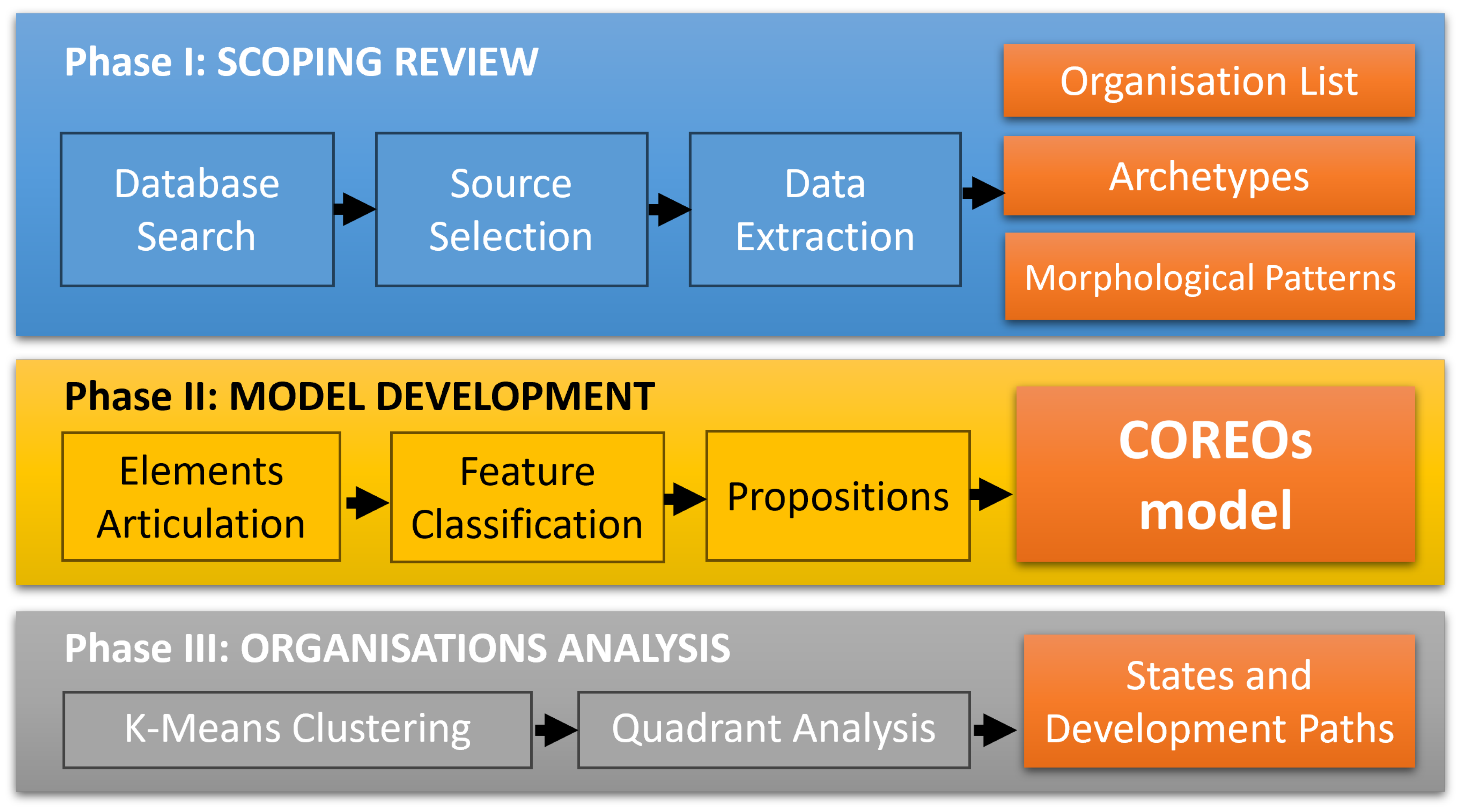
Figure 2.
Systemic representation of the COREO model. Each arrow indicates a functional relationship; e.g. infrastructure anchors permanence, which structures stewardship, and so on. The categories identified for each dimension are also outlined. Dashed arrows represent cross-dimensional enablers that further strengthen their impact.
Figure 2.
Systemic representation of the COREO model. Each arrow indicates a functional relationship; e.g. infrastructure anchors permanence, which structures stewardship, and so on. The categories identified for each dimension are also outlined. Dashed arrows represent cross-dimensional enablers that further strengthen their impact.
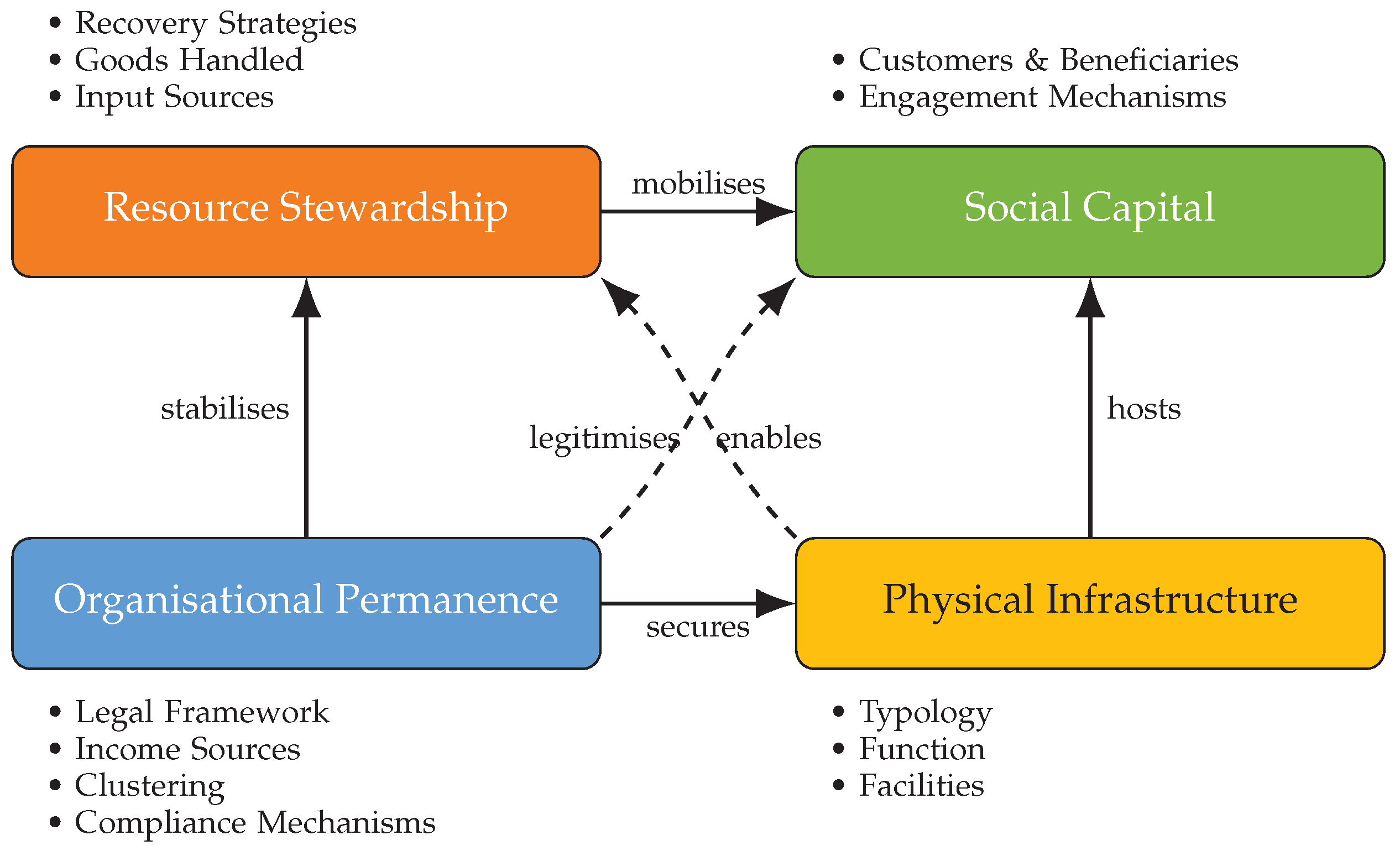
Figure 3.
Clustering of COREOs along structural and functional dimensions. Organisations are grouped into three clusters based on similarity across these dimensions. Dotted lined represent the potential pathways of development organisations could follow. Many organisations are omitted to improve clarity of the graph.
Figure 3.
Clustering of COREOs along structural and functional dimensions. Organisations are grouped into three clusters based on similarity across these dimensions. Dotted lined represent the potential pathways of development organisations could follow. Many organisations are omitted to improve clarity of the graph.
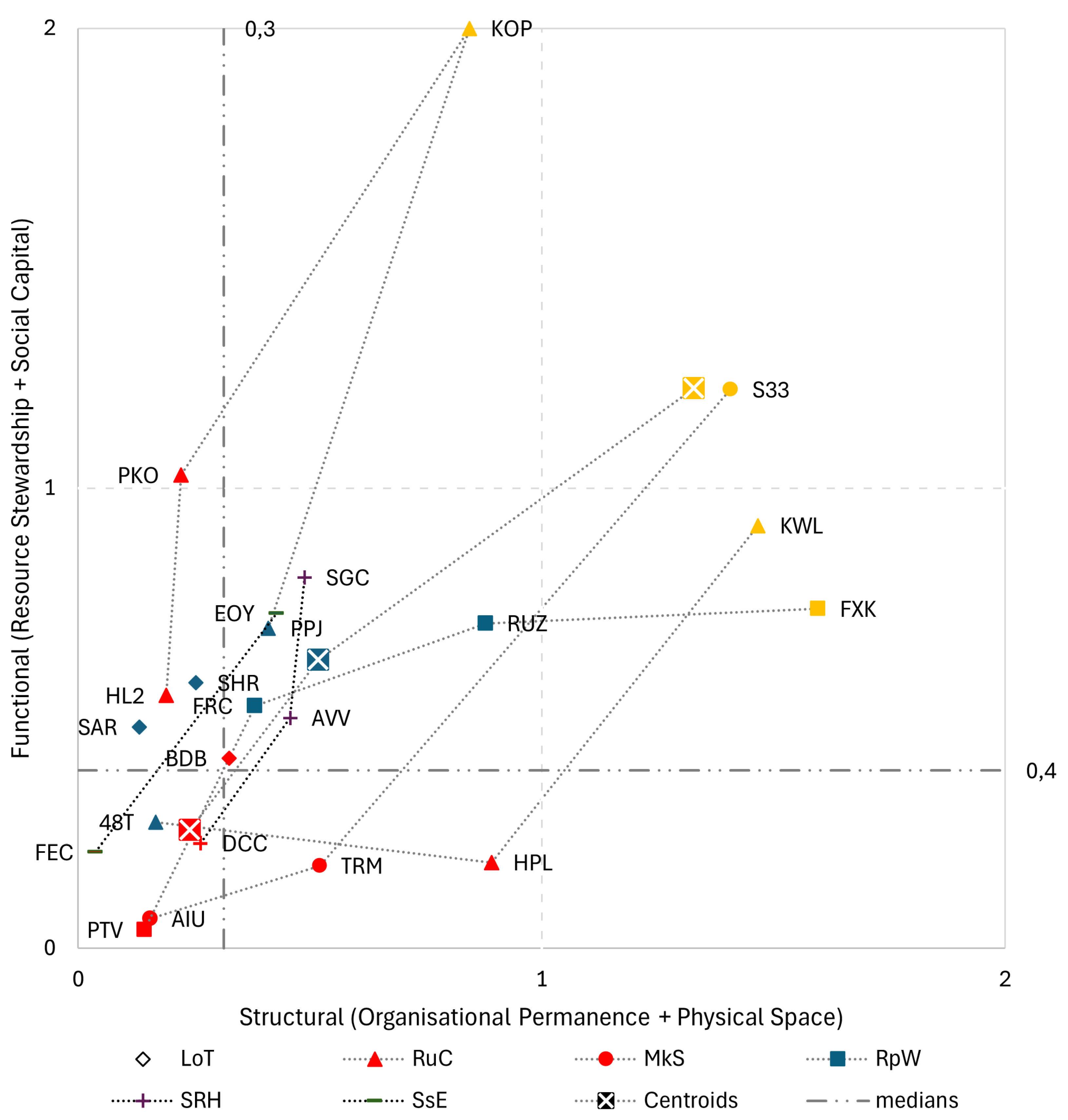

Table 1.
Summary of archetypes identified and organisations classified.
| Functional emphasis | Description | Archetype | Sub-type | Organisations | CODE |
|---|---|---|---|---|---|
| SHARE | Centres for borrowing goods (e.g., tools, appliances, recreational items) | Library of Things | - | BDB, SAR, SHR | |
| MAINTAIN/ PROLONG | Centres for repair and maintenance, often volunteer-run and community-based |
Repair Workshop | - | FXK, ERM, FRC | |
| DIY bicycle repair | BKK, BKN, BMC, PTV | ||||
| REUSE/ REDISTRIBUTE | Organisations recovering, redistributing and/or reselling 2nd-hand products |
Reuse Center | - | CPU, RVL, HL2, RUZ, TLP, PPJ, RVL | |
| Shop Chains | KOP, HRS, GII, HPL, 48T, KWL, PKO | ||||
| REFURBISH/ REPURPOSE | Centres for upcycling, making, or artisan reuse with educational or social missions | Makerspaces | - | SKS, TRY, AIU, MMK, VBF, S33 | |
| RECYCLE | Often municipally operated, integrating reuse, recycling, and sorting functions |
Sorting & Recovery Hubs | - | MGS, ALK, MTM, RHR, DRZ | |
| w/ shop | AVV, DCC, SGC | ||||
| MULTI-PURPOSE | Organisations blending reuse with social missions (training, reintegration, etc.) | Social-support enterprise | - | FEC, EOY, HSP, RMF |
Table 2.
Definitions found across the sources selected - either proposed as a result of the study, or employed as analytical framework (marked with an *). SE = Social Enterprise.
Table 2.
Definitions found across the sources selected - either proposed as a result of the study, or employed as analytical framework (marked with an *). SE = Social Enterprise.
| Denomination | Proposed in/ Defined by(*) | Physical Space? | Formal Constitution? |
|---|---|---|---|
| Circular Makers | Elwakil et al. [30] | Yes | No |
| Repair Cafés | Moalem and Mosgaard [31] | Yes | No |
| Centres for urban re-manufacture (CUREs) | Ordóñez et al. [32] | Yes | No |
| Urban Resource Centres (URCs) | Partnership on CE [3] | Yes | No |
| Reuse Centre | Zajko and Bradač Hojnik [33] | Yes | SE |
| Ecologically oriented, Work Integration Social Enterprises (ECO-WISEs)* | Anastasiadis [34] | No | SE |
| Community Organisations* | Wilson et al. [35] | No | SE |
Table 3.
Most Reported Indicators ( by COREOs Related to Resource Stewardship. The references from where the indicators were extracted can be consulted in the supplementary data.
Table 3.
Most Reported Indicators ( by COREOs Related to Resource Stewardship. The references from where the indicators were extracted can be consulted in the supplementary data.
| Metric (Indicators) | Unit(s) | n |
|---|---|---|
| Recovered Goods/Items (reused/sold, recyclables, exchanged, repaired, donated, borrowed) | tonnes, items/year | 26 |
| Recovery Rate (reuse, reusable items sold, repair, refurbishing, recycling/non-reusable) | % | 20 |
| Input of Goods/Items (received, pre-sorted, collected) | tonnes, items/year | 12 |
| Recovered Items/Goods (Items reused, sold, borrowed, repaired, donated; Goods recyclable(ed), avoided waste, diverted from landfill, incinerated) | tonnes, items | 10 |
| GHG avoided | tonnes /year | 9 |
| Processed Goods/Items (Recovered, repaired, refurbished) | tonnes, items/year | 9 |
| Rejection Rate (non-recoverable) | % | 5 |
Table 4.
Indicators most used by COREOs to monitor social capital (). The references from where the indicators were extracted can be consulted in the supplementary data.
Table 4.
Indicators most used by COREOs to monitor social capital (). The references from where the indicators were extracted can be consulted in the supplementary data.
| Metric (Indicator) | Unit(s) | n |
|---|---|---|
| Current Personnel (Employees: current, full/part-time, temporary, % disabled; Volunteers; TOTAL) | no. | 17 |
| Personnel trained (work experience, qualification, % completed in one year) | no./year | 6 |
| People benefitted (companions, attending Christmas Eve/workshops, using the workshop facilities, receiving lunch, St. Nickolas gifts, clothes and shoes, social services, Easter packages) | no., no/[period] | 6 |
| Workers back into regular jobs | no. | 4 |
| Visitors (daily avg., per year, total) | visitors | 4 |
| Events hosted (Repair Cafés) | no., no/year | 4 |
Table 5.
Indicators used by COREOs to assess physical infrastructure. The references from where the indicators were extracted can be consulted in the supplementary data.
Table 5.
Indicators used by COREOs to assess physical infrastructure. The references from where the indicators were extracted can be consulted in the supplementary data.
| Metric (Indicators) | Unit(s) | n |
|---|---|---|
| Customers (avg., paying, memberships) | no., no./year | 4 |
| Sales Efficiency (per avg. consumer, area) | $/sq2, cap/year | 2 |
| Inventory (monetary value) | $ | 1 |
| Job positions opened | no. | 1 |
Table 6.
Indicators most used by COREOs to assess organisational permanence (). The references from where the indicators were extracted can be consulted in the supplementary data.
Table 6.
Indicators most used by COREOs to assess organisational permanence (). The references from where the indicators were extracted can be consulted in the supplementary data.
| Metric (Indicator) | Unit(s) | n |
|---|---|---|
| Revenue (total/sales income/turnover, yearly, fraction) | $/year | 11 |
| Revenue (breakdown, %) | %/total revenue | 8 |
| Economic value (national economy, reused goods, reused/borrowed items, savings - aggregated ENV/SOC/ECO, savings with borrowing/repairing) | $ | 7 |
| Expenditures (total, yearly) | $/year | 6 |
| Expenditures (breakdown, fraction) | % | 3 |
Disclaimer/Publisher’s Note: The statements, opinions and data contained in all publications are solely those of the individual author(s) and contributor(s) and not of MDPI and/or the editor(s). MDPI and/or the editor(s) disclaim responsibility for any injury to people or property resulting from any ideas, methods, instructions or products referred to in the content. |
© 2025 by the authors. Licensee MDPI, Basel, Switzerland. This article is an open access article distributed under the terms and conditions of the Creative Commons Attribution (CC BY) license (http://creativecommons.org/licenses/by/4.0/).
Copyright: This open access article is published under a Creative Commons CC BY 4.0 license, which permit the free download, distribution, and reuse, provided that the author and preprint are cited in any reuse.


