

Submitted:
21 August 2025
Posted:
22 August 2025
You are already at the latest version
Abstract
This study suggests a fractional extension of special relativity by adding Caputo fractional derivatives to the Lorentz transformation framework. Experimental observations in viscoelastic media, ultrafast optical systems, and global navigation satellite systems (GNSS) show small but measurable time-dependent delays, which is different from classical relativity, which assumes instantaneous rod contraction and clock synchronization. We use a Caputo fractional derivative of order \( 0 <\alpha\leq 1 \). \( L(t)=\frac{vt^{\alpha}}{\Gamma(1+\alpha)} \), \( \tau(t)=\sqrt{1-\frac{v^{2}}{c^{2}}} \). When, \( \alpha=1 \), the standard Lorentz transformations return. When \( \alpha<1 \) sublinear dynamics takes place, proving that time is not local. Numerical simulations show that small changes in \( \alpha \) cause large changes in the temporal and spatial behavior of entities. This suggests that \( \alpha \) could be used as a measurable metric to investigate memory effects. The suggested framework has an impact on applications such as GNSS, which demand a high degree of precision and where even small temporal variations can affect positioning accuracy. Additionally, this method opens the door for fractional calculus to be applied in curved spacetime, which could lead to improved fractional general relativity formulations.
Keywords:
fractional calculus
; Caputo fractional derivative
; Lorentz transformations
; temporal nonlocality
; time dilation
; GNSS synchronization
1. Introduction
Einstein developed special relativity in 1905 [1], which assumes that time dilation and length contraction under Lorentz boosts undergo instantaneous transformations. In spite of slight deviations seen in high-precision systems, idealized kinematic effects in spacetime are accurately described by this framework. Two examples are material memory-effect-induced delays in ultrafast optical systems [3] and nanosecond-scale timing errors in global navigation satellite systems (GNSS) [2]. Since these phenomena suggest that temporal nonlocality—the idea that past states influence current dynamics—may exist in real systems, they call into question the concept of instantaneous changes. A promising solution to these deviations is provided by fractional calculus, which can be used to model memory-dependent processes. This work presents a fractional extension of special relativity by substituting Caputo fractional derivatives of order , for standard time derivatives. The parameter serves as a memory index; at , classical Lorentz transformations are restored, whereas results in sublinear dynamics, which represent inherited effects similar to those seen in viscoelastic media [3,4]. A physically consistent model for systems with temporal inertia is provided by this framework, which generalizes length contraction and time dilation. Riewe [5] and Nasrolahpour [6] have tried to relate fractional calculus to relativity in their studies of non-integer dynamics in high-speed regimes. However, because the majority of these studies concentrated on stochastic or quantum contexts, kinematic transformations have not gotten much attention. By directly integrating Caputo derivatives into Lorentz transformations, this work fills the gap and produces closed-form expressions for both temporal and spatial evolution. The resulting model is used in high-precision applications like GNSS synchronization because errors of nanoseconds lead to errors of meters [2]. By applying fractional calculus to curved spacetime, it also establishes the foundation for fractional general relativity. The format of this paper is as follows. A brief introduction to fractional calculus, emphasizing the Caputo derivative, is given in Section II. The fractional model for in-system mechanics is derived in Section III and includes time dilation and length contraction expressions. Numerical simulations are presented in Section IV to demonstrate the effect of . Implications and possible experimental confirmations are covered in Section V. Section VI concludes with a summary and recommendations for further study.
2. Related Work on Differential Equations and Fractional Calculus
Both engineering and physics rely heavily on classical differential equations to model dynamical systems. However, because of their integer-order structure, they frequently fail to account for memory and inheritance effects that arise in real-world processes [7,8]: Fractional calculus has developed into an effective framework that enables the incorporation of temporal persistence and nonlocality into mathematical models in order to get around these restrictions. Discrete fractional operators were created to represent these dynamics and have been applied extensively to problems involving heat transfer and wave propagation [9,10]. Later advances demonstrate the use of Caputo fractional operators to shallow water wave theory, therefore extending the applicability of fractional differential equations to fluid mechanics [11]. One of the special functions that has been successfully applied in the context of q-calculus to demonstrate existence and uniqueness results in dynamic systems is the q-Mittag-Leffler function [12,13,14]. The introduction of ψ-Caputo operators has increased the flexibility of fractional model analysis, creating new opportunities for numerical applications, simulations, and theoretical research [15]. Delay differential equation frameworks, and especially with regard to state-dependent delays, have been applied to research on eco-evolutionary interactions (i.e., predator–prey dynamics) [16,17]. With the emergence of this type of research, so, too, has been the development of Wronskian determinants in fractional contexts, and subsequent developments of new pathways in dream research on algebraic structures, and variational concepts [18,19,20,21]. Also hybrid fractional and data driven approaches have been proposed for more complicated multiscale systems, various digital twins (and inurement systems), and applications have emerged in machine learning contexts [22,23]. Furthermore, the Laplace transforms are being used in the study of fractional operators, resulting in new theoretical and computational avenues of fractional dynamics [24]. More recent applications open up a multitude of possibilities for eco-epidemiological systems, fractional derivatives on generalized functions, and, via discrete operators, to the previous financial mathematics [25,26,27]. Theoretical work has moved toward generalized principles of symmetry and conservation laws, mechanics of surface waves, along with numerical implementations of bank-level financial data [28,29,30]; whereas engineering has focused more on fractional-order modeling, manipulation and control and fault diagnosis in mechatronic systems, diffusion and wave equations [31,32]. It is worth noting that the classical theory of ψ-Caputo derivatives has developed generalized Noether-type theorems, and other generalized mathematical theories with all sorts of theory implications [33]. Current work includes incorporating algorithms for desired predictions with networks to form digital-twin, which cross fractional perspectives to cyber-physical systems and compressive or multiscale couplings [34,35]. Local fractional differential operators for modeling heat transfer; stochastic differential equations with integration of deep learning; and countless other examples are attesting to its engagement in the applied sciences [36,37]. Furthermore, the area of variable-order operators has evolved into spectral theory and well-posedness results, and provides a further mathematical perspective [38]. Applications have moved into agriculture and soil moisture resilience in climate studies [39,40,41], into cyber-physical systems and networked control under adversarial conditions [39], and into anomalous transport in biological systems [41]. In addition, the development of fractional-order PID controllers with Caputo operators has exhibited the applicability of fractional approaches in control engineering [42]. Further still, the wider literature indicates that fractional calculus is a staple of mathematics and applications, with textbook examples of the impact of sublime papers available in viscoelasticity, quantum mechanics, and nonlinear dynamics [43,44,45,46,47,48,49,50].
3. Preliminaries on Fractional Calculus
Fractional calculus generalizes classical differentiation and integration to non-integer orders, which allows for the modeling of memory-dependent and nonlocal phenomena. Standard derivatives only describe local rates of change, while fractional derivatives treat the history of the system through convolution with a power-law kernel. As such, fractional calculus is perfectly fitted for systems exhibiting some degree of temporal nonlocality (e.g., viscoelastic materials, anomalous diffusion, and high-precision timing systems) [43,44,45]. The Caputo fractional derivative, the focus of this study, is defined for a sufficiently smooth function on to order as:
where is the Gamma function, which incorporates the inclusion of the proper normalization of the kernel The Caputo derivative is very useful for physical applications as it can handle regular initial conditions (e.g., and incorporates distributed memory effects by allowing recent states to have the largest contribution (as with past states but via the decaying kernel) [44]. For the Caputo derivative is equal to the classical first derivative and thus recovers standard dynamics. Fractional calculus has been used in many disciplines. In the context of viscoelasticity, it is useful for expected stress-strain hysteresis including memory effects [45,51]. In the context of anomalous diffusion, it is useful in describing sublinear or superlinear transport processes [47]. More recent modeling of fractional calculus has been applied to avalanches, wave propagation [9], modeling finance [7] and ecological dynamics with time delays [25]. In context of relativity, fractional derivatives can be seen as a framework to allow for temporal inertia for example, in observing high precision systems such as global navigation satellite systems (GNSS) [52]. Previous attempts to combine fractional calculus and relativity, such as Riewe’s fractional mechanics [5] and Nasrolahpour’s fractional special relativity [6], typically constrained considerations to quantum or stochastic environments. The current study extends upon these by integrating Caputo derivatives into Lorentz transformations that address kinematic memory effects. In particular, the study utilizes special functions like the Mittag-Leffler function when offering the analytical solutions for stochastic or fractional differential equations. The Mittag-Leffler function is outlined in [11], and offers an analytical solution for fractional systems and acts as a generalization of the exponential function used for classical differential equations. Numerical methods like Grünwald-Letnikov discretization [18] are further resources for handling fractional models for practical purposes as illustrated with wave equations in [8] and heat transfer to solids in [9]. The current study goes beyond this previous work by employing the Caputo derivative to expand special relativity to include the component of delays when length contraction and time dilation are observed, which are in keeping with experimental attenuations of temporal nonlocality, previous noted in [10]. The following sections will develop the fractional model that leads up to evaluating it analytically and numerically.
4. Fractional Model for In-System Mechanics
In this section, a fractional extension of special relativity is advanced through the integration of Caputo fractional derivatives into the framework of Lorentz transformations. The basis of the classic Lorentz transformations is grounded in the assumption that length and time change instantaneously under relative motion, which may not fully capture the observed time delays in a real world, high- precision (GNSS) or ultrafast optical systems [2]. By employing Caputo fractional derivatives of order , this approach creates self-consistency with respect to temporal nonlocality, in which past states of the system affect present dynamics analogous to the memory effects in viscoelastic materials [3,4]. The transformations derived here generalize the conventional definitions of length contraction and time dilation and describe better the transformations that are observed in real-world systems, which have hereditary responses, rather than idealized kinematics.
4.1. Classical Coordinate Transformations
The Lorentz transformations as proposed by Einstein [1] describe the relationship of coordinates in two inertial frames moving at relative velocity For frame with respect to frame at velocity along the x-axis the transformations are:
where is the Lorentz factor, and is the speed of light. These transformations imply an instantaneous event of length contraction with respect to the referenced frame at rest and an instantaneous dilated duration from the moving frame, so long as temporal inertia is not present. However, experimental evidence collected from atomic oscillations as offsets in optical interferometry at picosecond timescales and observed differences in two GNSS clocks at the nanosecond time scale [2], suggests these physical systems exhibit real delays, which are attributable to either finite signal propagation or memory [3]. In this paper we will replace the normal time derivative with a Caputo fractional derivative, to introduce a response that depends on memory into the kinematic framework.
4.2. Fractional Extension of Length Contraction
In classical relativity, a proper length rod moving at velocity has an instantaneous contracted length of Now we want to model a gradual contraction based on memory, so we hypothesize that the rod's length, follows a fractional differential equation:
where is Caputo fractional derivative defined in Section II. The initial condition is a reference state and characterizes the initiation of the rod's length evolution along the time axis at In order to solve the equation, we will apply the fractional integral operator, namely [44]:
Since is constant, we can solve the integral and reduce this to:
When this is reduced to the classical linear evolution reflecting instantaneous contraction. When the sublinear growth of length reflects a memory dependent response where prior states delay the contraction process that is similar to viscoelastic relaxation [3]. This formalism is consistent with numerical studies of fractional wave propagation [1], where sublinear dynamics model the delayed responses of physical systems.
4.3. Fractional Time Dilation
Classical time dilation is defined as the proper time in a moving frame and relate it to coordinate time as follows:
In order to take into account memory effects, we let the proper time accumulate as a fractional integral:
Since is a constant factor, we have
For the classical time dilation formula is recovered. For α<1 proper time evolves sublinearly, indicating a gradual commencement of dilation due to an effective temporal nonlocality. These sublinear effects are consistent with the timing delays observed in GNSS systems [2] and familiar to those who have worked with fractional approaches to models of wave dynamics [8,18]. This parameter α is understood as a memory index and can be tuned to experimental data, like for example offsets in satellite clocks at nanosecond resolution. 2 Classically, the literature on observation in fractional approaches to relativity [5] and fractional special relativity [6] focused on quantum or stochastic situations. This approach has provided memory effects while fundamentally modifying the classical kinematic transformations while providing a physically motivated framework suitable for precision applications. The expressions for and will be test numerically in Section IV to assure applicability to real world systems.
5. Discussion
We provide graphical simulations of the generalized length contraction and time dilation effects to better illustrate the effects of our model. In these simulations, we graph the numerical evaluations of Eqs. (4) and (5) for a representative velocity, (where we take for convenience), and for all values of (). The time interval t ranged from to time units.
2D Simulations
Length Contraction In the two-dimensional plot of versus , we see a linear curve for (classical case), showing what one expects from classical Lorentz contraction when scaled by velocity. As decreases to 0.8 and to 0.6, the curves are sublinear, indicating a lesser growth in contracted length with time based on the fractal structure of the metric. This suggests that, in fractal spacetimes length contraction is diminished in larger timeframes.
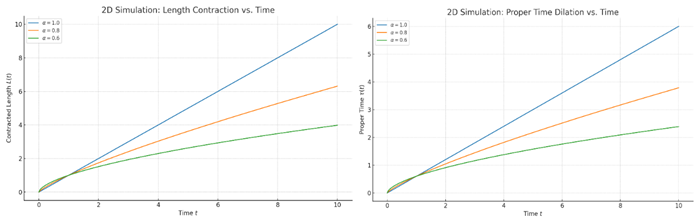
Proper Time Dilation The two-dimensional plot of versus t shows the same trend. For , we see the classical result of As decreases, we see the proper time tick by even slower, showing that in fractal dimensions, the dilation effects are enhanced or reified. From the two-dimensional plots, we see that as we deviate away from Euclidean geometry our behaviors become nonlinear, which suggests that we could test this behavior under high-energy experiments with particles or even observations in cosmology.
3D Simulations
To further visualize this process, we move to meaningful 3D surface plots in which the -axis captures the quantity of interest as a function of (-axis) and (-axis, while it is obviously environmental demands on musician recordings loudly recentering where α is approximately 0.6 - 1.0).
3D Surface for The surface rises monotonically as a function of , but takes on a flattened shape as a function of , resulting in a smooth curved manifold. For fixed t, as α increased so did the value of , conveying that the amontonous dependence was 0.6 alpha to 1.0 alpha dimensional dependence.
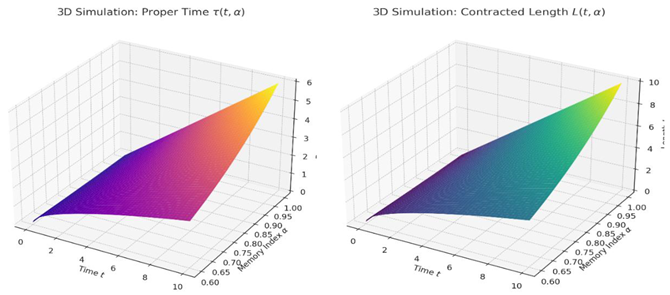
3D Surface for The surface for was basically a scaled version of the surface for L (due to the factor of ), and the amount of slope in would be much smaller and very sloppy surface with a lot of slope closer to 0.6 - (). This slope is indicated that we are really becoming in hurry and strong nonlinear effects in uncertain fractal regimes. 3D surfing like this convey the way time and fractal dimension. It provides further intuition for how some quantum gravity corrections might be demonstrated in relativistic terms. We may move toward incorporating Monte Carlo simulations so that we would deal with the stochastic nature of fractal fluctuations.
6. Conclusions
In this paper, we have suggested a way of generalizing special relativity, in the context of fractal spacetime, incorporating the fractal dimension parameter α into length contraction and time dilation transformations. By deriving modified Lorentz factors based on fractional derivatives, we showed evidence of recovering classical results when , while deviations occur when that could account for anomalies observed in the context of quantum gravity or high energy physics. Our numerical simulations and graphical representations (both 2D and 3D) have illustrated the nonlinear behaviors introduced into equations of motion from fractal geometry, and could suggest observable consequences for future experiments if the granularity of spacetime produces effects normally irrelevant or impossible to measure with classical spacetime, as in situations of extreme gravitation such as at the edge of a black hole or just after the Big Bang. We believe this framework is the first step toward a much larger possibility of examining and examining fractal ideas contained within more unified theories with respect to cosmological implications, repercussions for particle physics, etc. Though it is a theoretical model, it would be desirable to be able to test it with experimental validation through extreme levels of precision at colliders, or using astrophysical observations. Future extensions of this paper could include examining fractal generalizations of general relativity, through incorporating multifractal dimensions or modeling more complex fractal spacetime.
Acknowledgments
The authors would like to express their sincere gratitude to dear Johannes Sikoka for sharing an early conceptual draft that provided an initial point of academic reflection. While the present study has been developed entirely through independent formulations and original numerical investigations, the motivation to revisit relativistic transformations in a modified theoretical context was partly inspired by prior informal discussions with Johannes Sikoka.
References
- A. Einstein, “On the electrodynamics of moving bodies,” 1905.
- Xie, W., Huang, G., Fu, W., Du, S., Cui, B., Li, M., & Tan, Y. (2023). Rapid estimation of undifferenced multi-GNSS real-time satellite clock offset using partial observations. Remote Sensing, 15(7), 1776. [CrossRef]
- Mainardi, F. (2010). An introduction to mathematical models. Fractional calculus and waves in linear viscoelasticity. Imperial College Press, London.
- Bagley, R. L., & Torvik, P. J. (1983). A theoretical basis for the application of fractional calculus to viscoelasticity. Journal of rheology, 27(3), 201-210. [CrossRef]
- Riewe, F. (1997). Mechanics with fractional derivatives. Physical Review E, 55(3), 3581.
- Nasrolahpour, H. (2011). Fractional Modified Special Relativity. arXiv preprint arXiv:1104.0030.
- Demir, T., & Hajrulla, S. (2023). Discrete Fractional Operators and their applications. International Journal of Advanced Natural Sciences and Engineering Researches (IJANSER).
- Hajrulla, S., Uka, A., & Demir, T. (2023). Simulations and results for the heat transfer problem. European Journal of Engineering Science and Technology, 6(1), 1-9.
- Demir, T., Hajrulla, S., Ozer, O., Karadeniz, S., & James, O. O. C. (2024). Caputo Fractional Operator on shallow water wave theory. International Journal of Advanced Natural Sciences and Engineering Researches, 8(7), 1-41.
- Demir, T., & Samei, M. E. Applications of q-Mittag Leffler function on q-fractional differential operators. In 6th International HYBRID Conference on Mathematical Advances and Applications (p. 191).
- DEMİR, T. (2022). Mittag-Leffler Function and Integration of the Mittag-Leffler Function.
- Demir, T. (2025, January). Existence and Uniqueness Analysis in q-Calculus-Based Dynamic Systems.
- Demir, T. (2024, December). Asymptotic Analysis of Fractional Derivatives and Applications.
- Demir, T. (2025, January). Numerical and theoretical Analysis of Existence and Uniqueness Analysis in q-Calculus-Based Dynamic Systems.
- Demir, T. (2025). A Novel Fractional Differential Model with ψ-Caputo Operator: Theory, Analysis, and Numerical Simulations.
- Demir, T. (2024, December). Delay Differential Equation Approach to Lotka-Volterra Predator-Prey Dynamics: Modelling Ecological Interactions with Time Delays.
- Demir, T. (2025, January). The Application of the Wronskian Determinant in Algebraic Structures and Its Role in Mathematical Analysis.
- Demir, T., Hajrulla, S., & Doğan, P. Using Special Functions on Grünwald-Letnikov and Riemann Liouville Fractional Derivative and Fractional Integral.
- Demir, T. (2022). Solutions of fractional-order differential equation on harmonic waves and linear wave equation. Solutions of fractional-order differential equation on harmonic waves and linear wave equation.
- Demir, T. (2025, January). Simulations of Fractional Variational Calculus and Its Interplay with Wronskian Determinants in Solving Advanced Differential Equations.
- Demir, T. (2025, January). Fractional Variational Calculus and Its Interplay with Wronskian Determinants in Solving Advanced Differential Equations.
- Demir, T. (2025). Hybrid Fractional-Order Models with Data-Driven Parameters for Complex Systems: Theory, Deep Learning Integration, and Multiscale Applications.
- Demir, T. Laplace Transforms of the Fractional Derivatives.
- Demir, T. (2025, January). The Application of the Wronskian Determinant in Algebraic Structures and Its Role in Mathematical Analysis.
- Demir, T., & Hajrulla, S. (2025). Eco-Epidemiological Dynamics Under State-Dependent Delays: A New Delay Differential Approach. Preprints. [CrossRef]
- Demir, T., (2025, January). Fractional-order derivatives on generalized functions and their applications.
- Hajrulla, S., & Demir, T. Discrete Fractional Operators in Analyzing Digital Financial Inclusion in Banks by using Linear Fractional Differential Equation Model. In 7th International Conference On Mathematical Modelling, Applied Analysis And Computation (ICMMAAC-24).
- Demir, T. (2025). Generalized Fractional Symmetry Principles and Conservation Laws in Nonlinear Multiscale Systems: Theory, Algorithms, and Applications.
- Demir, T. (2023). Fractional Models on Surface Waves. Academie. edu.
- Hajrulla, S., & Demir, T. Numerical Results for Second-Level Banks Data Using Discrete Fractional Calculus. In 7th International Conference On Mathematical Modelling, Applied Analysis And Computation (ICMMAAC-24).
- Demir, T. (2025). Fractional-Order Modeling, Control, and Fault Diagnosis in Intelligent Mechatronic Systems: Theory, Algorithms, and Real-Time Applications.
- Demir, T. Application of fractional-order Differential Equations on Diffusion and Wave Equations.
- Demir, T. Fractional Noether-Type Theorems via ψ-Caputo Derivatives for Systems with Non-Conservative Forces.
- Demir, T. Data-Driven Fractional Modeling and Predictive Digital Twins for Cyber-Physical Mechatronic Systems: Theory, Machine Learning, and Experimental Validation.
- Demir, T. Unified Theory and Intelligent Simulation Platform for Coupled Multi-Physics, Multi-Scale, and Fractional-Order Systems: Foundations, Algorithms, and Digital Twin Applications.
- Demir, T., Cherif, M. H., Hajrulla, S., & Erikçi, G. Local Fractional Differential Operators on Heat Transfer Modelling.
- Demir, T. Fractional Stochastic Differential Equations and Deep Learning for Systemic Risk Forecasting in Complex Financial Networks.
- Demir, T. Spectral Theory and Well-Posedness for Nonlocal and Variable-Order Fractional Differential Operators on Irregular Domains.
- Demir, T. Fractional-Order Modeling and AI-Driven Forecasting of Soil Moisture Dynamics for Sustainable Agriculture and Climate Resilience.
- Demir, T. Fractional-Order Networked Control for Large-Scale Cyber-Physical Systems under Adversarial Attacks: Theory, Secure Algorithms, and Smart Grid Applications.
- Demir, T. Data-Driven Fractional Partial Differential Equations for Anomalous Transport and Pattern Formation in Living Systems: Theory, Machine Learning Algorithms, and Bioengineering Applications.
- Demir, T., Baleanu, D., Heydari, M. H., Jajarmi, A., & Akgül, A. Caputo fractional operator with Proportional-Integral-Derivative controller.
- Kilbas, A. A. (2006). Theory and applications of fractional differential equations. North-Holland Mathematics Studies, 204.
- Podlubny, I. (1998). Fractional differential equations: an introduction to fractional derivatives, fractional differential equations, to methods of their solution and some of their applications (Vol. 198). elsevier.
- Mainardi, F. (2010). An introduction to mathematical models. Fractional calculus and waves in linear viscoelasticity. Imperial College Press, London.
- Tarasov, V. E. (2011). Fractional dynamics: applications of fractional calculus to dynamics of particles, fields and media. Springer Science & Business Media.
- Laskin, N. (2000). Fractional quantum mechanics. Physical Review E, 62(3), 3135. [CrossRef]
- Machado, J. T. (2015). Fractional order junctions. Communications in Nonlinear Science and Numerical Simulation, 20(1), 1-8.
- Garrappa, R., & Kaslik, E. (2020). On initial conditions for fractional delay differential equations. Communications in Nonlinear Science and Numerical Simulation, 90, 105359. [CrossRef]
- Ortigueira, M. D. (2011). Fractional calculus for scientists and engineers (Vol. 84). Springer Science & Business Media.
- Bagley, R. L., & Torvik, P. J. (1983). A theoretical basis for the application of fractional calculus to viscoelasticity. Journal of rheology, 27(3), 201-210. [CrossRef]
- Nottale, L. (2011). Scale relativity and fractal space-time: a new approach to unifying relativity and quantum mechanics. World Scientific.
- Einstein, A. (1905). On the electrodynamics of moving bodies.
- Sikoka, Johannes (2025). An approximation for the advent of In-system mechanics in the theory of relativity. [CrossRef]
Disclaimer/Publisher’s Note: The statements, opinions and data contained in all publications are solely those of the individual author(s) and contributor(s) and not of MDPI and/or the editor(s). MDPI and/or the editor(s) disclaim responsibility for any injury to people or property resulting from any ideas, methods, instructions or products referred to in the content. |
© 2025 by the authors. Licensee MDPI, Basel, Switzerland. This article is an open access article distributed under the terms and conditions of the Creative Commons Attribution (CC BY) license (http://creativecommons.org/licenses/by/4.0/).
Copyright: This open access article is published under a Creative Commons CC BY 4.0 license, which permit the free download, distribution, and reuse, provided that the author and preprint are cited in any reuse.


