

Submitted:
19 August 2025
Posted:
20 August 2025
You are already at the latest version
Abstract
With the rapid development of the laying hen industry and the continuous innovation of farming technology, egg production continues to grow. Eggs are rich in proteins and lipids, and chicken egg yolk immunoglobulins (IgY) antibodies, which play an im-portant role in the treatment of human diseases, the prevention of bacterial and viral infections. In addition, IgY has advantages over IgG in biological structure and func-tion and is characterised by high specificity, safety, yield and economic efficiency. This review describes the basic structure and properties of IgY, lists a variety of IgY purifi-cation methods and outlines measures to maintain and enhance its activity, focuses on the current status of its research in immunoprevention and treatment of human dis-eases and outlines its importance, and finally proposes the current challenges and fu-ture research priorities of IgY in the field of biomedical research to provide a scientific basis for the wide range of applications of IgY in human health.
Keywords:
egg yolk immunoglobulins (IgY)
; purification
; activity enhancement
; health benefits
1. Introduction
The chicken belongs to the class of birds, order Galliformes, and is among the earliest animals to be domesticated by human, and is one of the poultry that is an important source of protein for human beings. In recent years, the laying hen industry has undergone 20 years of rapid development, and global egg production has continued to grow. As consumers emphasize a healthy diet, the demand for high-quality, pollution-free eggs grows, and researchers are conducting extensive studies on the various protein fractions in eggs to deeply explore their potential application value [1]. In 1960, scientists found that a large number of antibodies similar to mammalian immunoglobulin (IgG) existed in the egg yolk of laying hens after antigen immunization. This antibody is chicken egg yolk immunoglobulin (IgY), which is generated by a series of immune responses after stimulation of hens with foreign antigens. The IgY antibodies pass through the bloodstream into the egg cell and are stored in the egg yolk. It is an immunoglobulin that exists only in the yolk and is characterized by high specificity, high safety, easy accessibility, and low acquisition cost [2]. IgY and IgG differ in terms of constant structural domains, heavy chains, side chains, and molecular size, which results in variations in activity and several biological activities. Studies have shown that IgY has potential benefits in the treatment of human diabetes mellitus, human immunodeficiency virus (HIV), ovarian cancer, dental caries, viral hepatitis type B (HBV), diarrhoea, hand-foot-and-mouth disease (HFMD), ebola virus (EBOV), as well as showing varying degrees of immunoprophylaxis against enteroviruses and COVID-19. In addition, in animal health, it is beneficial in preventing pathogenic bacterial and viral infections, regulating intestinal flora to alleviate diarrhea and improving growth performance. There is a growing interest in the use of IgY as an alternative to traditional antibiotics because IgY is sustainable, does not develop resistance, is suitable for both terrestrial and aquatic animals of different ages, is effective as a prophylactic drug, and is often used for the preparation of passive immunisation vaccines in aquaculture [3]. Domestic and foreign scholars continue to explore the medical value of IgY, it is expected that it will be widely used in the diagnosis and prevention of human and livestock diseases in the future. Scientific and reasonable protection of IgY, dosage form design, and delivery are crucial to transform functional IgY antibodies into desired IgY products for therapeutic and prophylactic administration [4].
In summary, this paper searched the PubMed database with IgY as the keyword to systematically analyse the literature related to IgY in the past 20 years, to providing scientific references for further research and application of IgY. Based on this, we describe the structural features of IgY and its functional differences with IgG, summarise various methods of IgY extraction and measures to enhance its biological activity, and finally review the progress of its application in the prevention and treatment of a variety of human diseases, and put forward the current challenges faced by IgY and future research directions.
2. Structure and Functions of IgY
2.1. Biological Structure
IgY consists of two heavy chains (H chains) and two light chains (L chains) connected by disulfide bonds to form a stable Y-shaped tetrapeptide structure. The CH region of IgY contains glycosylation sites, and glycosylation plays an important role in the stability and solubility of the antibody. The N-glycosylation chain of IgY contains two glyco-structures, namely, the high-mannose chain and the composite glycan chain, and is predominantly a high mannose chain, with the presence of sialic acid and galactose modifications at the end of the glycan chain. In addition, IgY has two functional regions, Fab and Fc, with a short region rich in proline and glycine residues between the Fab and Fc segments [5]. The Fab region is responsible for antigen binding, whereas the Fc region is involved in immune effects such as antibody-dependent cell-mediated cytotoxicity (ADCC). Compared to IgG, IgY has a longer heavy chain and a higher molecular weight of 180 kDa compared to 150 kDa for IgG, and IgY has more glycosylated side chains and constant structural domains, which are more hydrophobic and inhibit hydrolysis of the protein catalyzed by proteinase. In addition, IgY has no hinge region between CH1 and CH2, which cannot undergo conformational changes, is less flexible, and has additional CH4 structural domains.
2.2. Biochemical Functions
IgY is similar to other antibodies in that the variable region possesses the ability to bind specifically to antigen and the Fc region has an immunomodulatory function. The Fc binds specifically to three characterised Fc receptors, such as chicken Ig-like receptor AB1 (CHIR-AB1), the chicken yolk sac IgY receptor (FcRY) and Gallus gallus Fc receptor (ggFcR) [6,7]. Its Fc region cannot interact with mammalian Fc receptors (IgG-FcγR and IgE-FcεR), rheumatoid factor (RF), complement factor (CF), and Staphylococcal protein A, Streptococcal protein G, and Peptostreptococcal protein L [8]. Based on the fact that IgY cannot bind to mammalian immunomodulatory proteins, it does not interact in immune recognition and disease treatment, reduces endogenous interference and cross-reactivity effects, and is valuable in immunotherapy and prophylaxis.
3. Characteristics and Action Mechanisms of IgY
3.1. Biological Characteristics
IgY has strong heat, acid and enzyme degradation resistance and immunological properties. It still holds activity at pH 3, can be heated to 60°C in the presence of protein hydrolyzing enzymes, and has excellent thermal stability. It was demonstrated that IgY extracted from egg yolk did not significantly reduce antibody activity when tested by immunodiffusion assay at temperatures less than 70°C, In contrast, the activity was significantly reduced after treatment at 80°C and 90°C for 15 minutes [9]. IgY activity was stable at pH 4.0-11.0 but decreased at pH 3.0-3.5 and 12. IgY is more resistant to pepsin but more sensitive to trypsin, and the activity of IgY remained 39% and 41% after 8 h of mixed reaction with trypsin and pancreatic rennet protease, respectively [10]. Additionally, IgY is almost 20 times more stable than IgG at 60°C and maintains high activity after 8 hours of storage. This is because IgY's heavy chain contains the CH4 structural domain, which is crucial for molecular stability [11]. Glycosylation is one of the very important post-translational modifications of proteins, immunoglobulins belong to glycoproteins, and IgY mainly relies on N-glycosylation to resist hydrolysis by pepsin and papain [12]. IgY has more glycosylation sites than IgG molecules and is distributed in different regions of IgY. Glycosylation modifications enhance the structural stability of IgY, and the presence of N-glycosylation chains can place the IgY resistance to guanidine hydrochloride-induced defolding by 0.6 M, which is about 0.1 M guanidine hydrochloride higher than that of IgG. Glycosylation modifications also prolong the half-life of immunoglobulins in serum [13]. It has a stronger immune response to antigens in mammals, and is specific for antigen detection, so laying hens can be used as a source of animals for the production of high-quality antibodies.
3.2. Immune Mechanisms
Chickens have cellular and humoral immune systems, regulated by the thymus and bursa, respectively. When chickens are stimulated by foreign antigens, B cells differentiate into plasma cells, which secrete a specific antibody that binds specifically to the antigen to produce immunoglobulin. This antibody gradually accumulates in chicken oocytes to form IgY, which is transported from the maternal serum to the egg yolk with the assistance of oocyte membrane receptors. IgY enters the bloodstream of the chicken embryo during egg incubation and provides a specific immune protective barrier against disease in the chick. Immunoglobulins are mainly used to remove pathogenic microorganisms from the organism by binding to antigens, thus achieving the purpose of the organism's defense against bacterial and viral aggression. IgY promotes specific immune responses during organismal infections mainly through three pathways [14,15]. The first one can directly adhering to its cell wall, destroying the integrity of pathogenic microorganisms, and inhibiting directly the reproduction of pathogenic bacteria. The second by adhering to the bacterial hairs, so that they can’t attach to the intestinal mucosal epithelial cells, and the third by the action of intestinal digestive enzymes, degraded into binding fragments, these fragments contain part of the antibody variable small peptides, these small peptides are highly susceptible to intestinal absorption into the bloodstream to bind to the specific pathogenic bacterial recognition factors, so that the pathogenic bacteria can not adhere to susceptible cells and lose their pathogenicity.
4. Extraction and Activity Enhancement of IgY
4.1. Methods for IgY Isolation and Purification
The main components in egg yolk are proteins and fats. Livetin is an important protein constituent in egg yolk, accounting for about 9.3% of the dry matter of the yolk, and it exists in the yolk in the form of α-, β-, and γ-yolk globulins in three forms. α-livetin's main component is albumin, the β-livetin's main component is the α-2-glycoprotein, and the γ-livetin main component is Immunoglobulin Y [16]. Due to the difficulty of removing the lipid fraction of egg yolk as well as the immaturity of the purification process of IgY, chloroform is traditionally used to denature the lipoproteins in egg yolk and then remove them by centrifugation; however, the yield of recovered IgY in this method is low, and the chloroform is highly toxic, which can be carcinogenic if ingested seriously. In recent years, IgY isolation and purification methods have been improved, with convenient operation and higher extraction purity, such as ammonium sulfate precipitation (AMS), polyethylene glycol (PEG), ethanol, ultrafiltration, ion exchange chromatography (IEC) and water dilution etc (Table 1). It has been shown that purification of IgY by PEG precipitation of egg yolk and affinity chromatography based on human mycoplasma proteins with protein M can significantly increase the product content [17]. As people continue to explore the biomedical value of IgY, efficient and standardized extraction and purification methods can meet the needs of actual industrial production. According to statistics, the production of IgY accounts for about 2% of the total amount of polyclonal antibodies produced in the world, so the investigation of the isolation and purification of IgY and the preparation technology is the focus and difficulty of the current.
4.2. Enhancement of IgY Activity
IgY is sensitive to pepsin, and its activity decreases rapidly and its biological function is weakened when it is orally administered into a poor gastric acid environment. In recent years, exploring how to enhance the activity of IgY has received widespread attention, therefore, selecting appropriate antigens and optimizing the immunization program of chickens, including the dose, frequency and interval of immunization as well as the process of antigen emulsification, are useful for enhancing the activity of IgY. Secondly, efficient purification methods are effective in removing other proteins and impurities from the yolk, increasing the purity of the antibody and indirectly enhancing the activity. It has been found that the use of adjuvants to improve immunity in laying hens can increase the yield and activity of antibodies in egg yolk, Freund's incomplete adjuvant (FIA) and C-phosphate-guanosine oligodeoxynucleotides (CpG-ODN) can enhance the immune response against interleukin-10 (IL-10) peptide in laying hens and increase the antibody titer in egg yolk [30]. In addition, liposome embedding, microencapsulation, stabilizer development, glycosylation modification, and IgY monoclonal antibodies production show potential advantages in enhancing IgY affinity, prolonging the half-life of antibodies, and improving utilization efficiency.
Affinity is a measure of the strength of the interaction between an antigen and an antibody, and its magnitude directly affects the function of the antibody. the higher the affinity, the longer the antigen-antibody interaction, and the further the antibody triggers a biological response to clear the antigen [31]. IgY was embedded in liposomes with lecithin and cholesterol and incubated in pepsin solution at pH 3 for 1 h at 37°C, and 80% of the activity of IgY was still preserved, suggesting that liposome embedding can assist IgY in resisting acidic environments and inhibiting pepsin hydrolysis [32]. Microencapsulation of IgY in egg yolk with 20% β-cyclodextrin and gum arabic can effectively protect the bioactivity of IgY from inactivation due to pepsin hydrolysis [33]. Embedding of IgY in chitosan and alginate microcapsules significantly improves its stability in simulated gastric fluid (pH=1.2) and the residual antibody activity is unaffected by the pH of the embedding medium [34], and when IgY was encapsulated in alginic acid and carrageenan microgels, it was able to exert normal biological activity in the simulated gastrointestinal tract [35], demonstrating that microencapsulated IgY is resistant to hydrolysis by pepsin. Sorbitol, a polyol commonly used to enhance protein stability [36], was found to maintain the stability of IgY under acidic conditions by enhancing hydrophobic interactions and encapsulating the pepsin protein hydrolysis site, preventing the exposure of its aromatic and carboxylic acid amino acid residues. The acid-induced stability of IgY was significantly enhanced in 30% sorbitol solution when the pH was 3. In 50% sorbitol solution, the activity of IgY was not affected by pH, and also high concentration of sucrose maintained the stability of IgY, and high activity was retained in 50% sucrose solution at 80°C [37]. Therefore, sorbitol and sucrose can serve as effective stabilizers of IgY under acidic conditions.
Extraction of specific egg yolk antibodies and application in chitosan coating, that use of chitosan coating containing IgY increases the microbial and sensory quality of fish flesh at 4℃ [38]. However, Glycosylation of the conserved asparagine residue in each heavy chain of IgG in the CH2 domain is known as N-glycosylation [39]. Glycosylation modification can also enhance the structural stability and biological activity of proteins. The chemical modification of protein by methoxy polyethylene glycol (mPEG) was studied, and the results showed that the modified protein retained its primary structure intact, and had a better stability in pepsin and trypsin solutions, and better resistance to acid and alkali than the unmodified natural protein [40]. The IgY primary structure was retained intact. glycosylation modification of IgY using the Melad reaction showed that the thermal denaturation temperature of glucosylated IgY was as high as 79.8°C, and the immunoreactivity was increased by 30.3%, which proved that monoglycosylation modification could improve the thermal stability and immunoreactivity in gastric fluid of IgY. It is one of the most common post-translational modifications and important critical quality attributes of monoclonal antibody therapeutics [41]. And recombinant monoclonal IgY antibodies (mIgY) after hybridoma technology and phage characterization are highly specific in drug target binding, have good affinity to target molecules, and can accurately localize cellular target sites [Error! Reference source not found.,43]. In the future, monoclonal IgY antibodies as therapeutic agents for diseases will focus on novel infectious diseases, rare diseases and specific therapeutic applications.
5. IgY Applications in Human Health
5.1. The Mechanism of IgY Treatment and the Prevention of Human Diseases
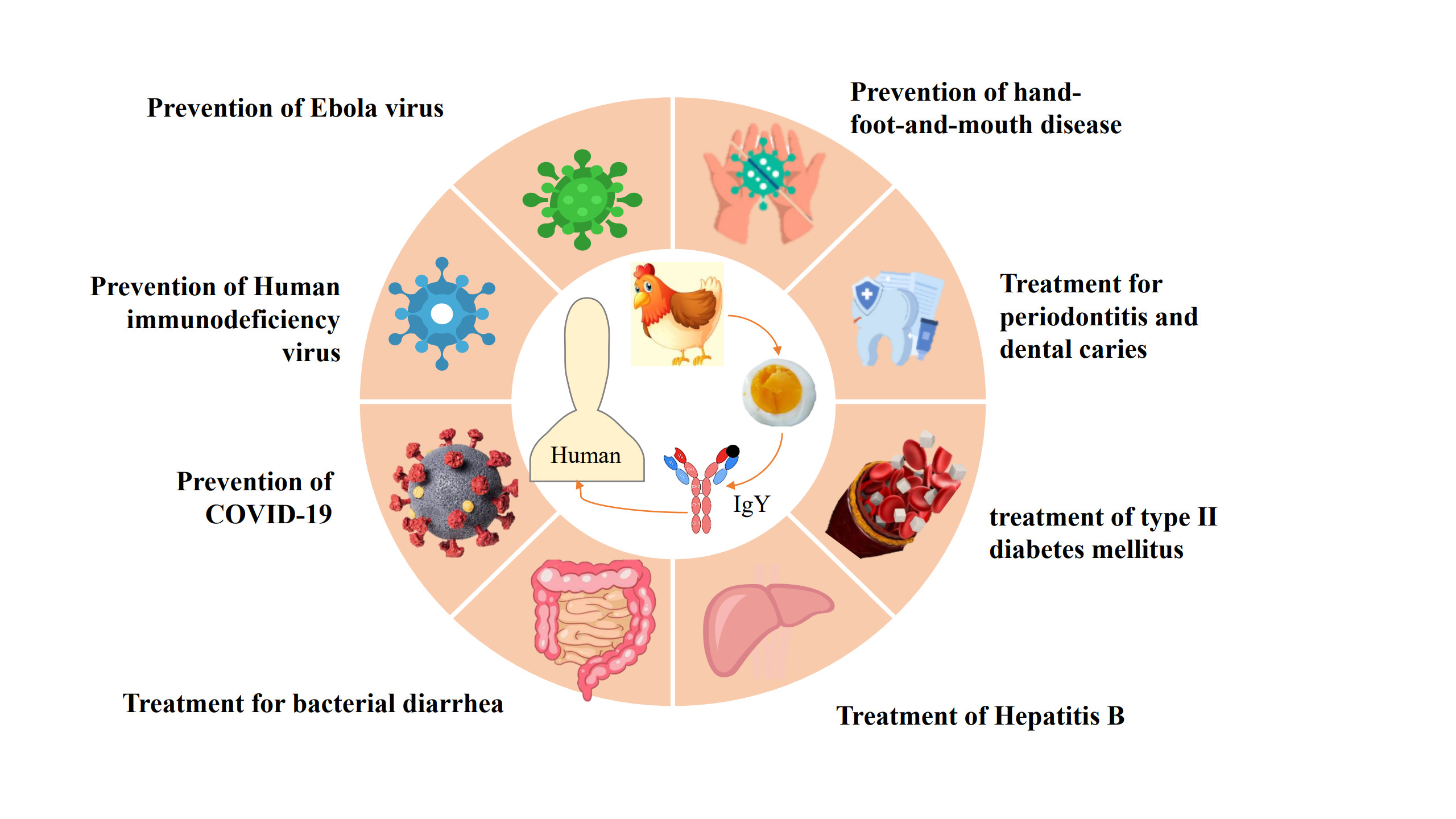
IgY primarily functions through specific recognition and targeted blockade. It exerts its protective effects by neutralising pathogens and toxins, regulating intestinal immunity and inhibiting inflammation and allergies. Due to its safety and accessibility, IgY has great potential for application in fields such as the treatment of gastrointestinal infections, enhancement of mucosal immunity, and prevention of allergies (Figure 1). The author elaborates on its mechanism of action from the following four perspectives.
Firstly, there is the specific neutralisation of pathogens: IgY binds to antigens in a specific manner, thereby preventing viruses from binding to receptors on the surface of human cells and directly blocking the infection process [44,45]. For instance, rotaviruses require binding to lactose receptors on intestinal epithelial cells in order to infect them, and IgY can block this process, alleviating viral diarrhoea [7]. Secondly, inhibition of bacterial adhesion and colonisation: IgY can bind specifically to adhesion proteins on the surface of bacteria, thereby blocking their binding to mucosal cells and preventing them from colonising. This facilitates their expulsion from the body [46]. For instance, anti-Helicobacter pylori IgY reduces bacterial adhesion to the gastric mucosa, which aids the treatment of gastritis. Thirdly, IgY can regulate intestinal immunity and the mucosal barrier to maintain microecological balance. IgY binds to pathogenic antigens in the intestine, reducing the stimulation of intestinal mucosa by antigens and lowering mucosal inflammatory responses [47]. IgY can also promote intestinal epithelial cell repair, regulate the balance of intestinal microbiota, and enhance the physical defensive capabilities of the mucosal barrier. Fourthly, IgY has anti-inflammatory and anti-allergic effects, alleviating immune overactivation. IgY binds to self-antigens or inflammatory mediators, preventing the formation of immune complexes and reducing the aggregation and activation of neutrophils and macrophages [48,49]. This alleviates tissue damage and relieves allergic symptoms .
5.2. Potential Human Health Benefits of IgY
The development of IgY for the prevention and treatment of human diseases is safe, non-invasive to animals, and highly efficient in antibody production. IgY will be able to overcome the limitations of traditional antibiotic treatments when microorganisms, such as bacteria, viruses, fungi and parasites, change in ways that make targeted therapeutic drugs ineffective and lead to antibiotic resistance, which has become a global health emergency. Avian and mammalian species are more distantly related, and there are more differences between IgY and IgG, the most notable of which is that they do not bind to mammalian Fc receptors. Therefore, it has stronger specificity and higher sensitivity in disease detection and prevention, and its application in human disease treatment and prevention research has gained considerable interest. It has been shown that prepared IgY-related antibodies exhibit great potential in combating human diseases such as diabetes, HIV, tumors, inflammation and viruses (Table 2).
6. Conclusions
To summarize, this review systematically described the biological properties and principles of action of IgY, compare various methods for the isolation and purification of antibodies, introduce existing methods for enhancing antibody activity, and focus on the current status of research in the prevention and treatment of human diseases. However, IgY as a highly effec-tive, high-quality, and sustainable non-antibiotic antibody, is widely available from a wide range of sources and is much cheaper to obtain, more productive, and more cost-effective. Importantly, IgY has low amino acid sequence homology with human immunoglobulin, does not trigger human immune rejection, does not form immune complex precipitation, can be used long-term, and is particularly suitable for infants, young children, and people with low immunity.
IgY shows great potential in the fields of health maintenance and disease treatment, but its widespread use still faces many challenges. In the treatment of disease, IgY has demonstrated promising results in studies on antibacterial and antiviral infections. However, the pathways through which different pathogens infect the human body, and the complex and diverse immune responses they trigger, pose significant challenges. The precise and efficient exertion of its effects in the complex physiological environment of the human body requires further exploration. Furthermore, the pharmacokinetic characteristics, absorption and metabolic processes of IgY in the human body remain understudied, hindering the precise determination of clinical dosages and treatment regimens. In terms of production, scaling up and standardising IgY production is challenging. Factors such as chicken breed, immunisation protocols and separation and purification methods can have a significant impact on yield and quality, resulting in inconsistent product quality that fails to meet stringent clinical and market requirements. Looking ahead, the continuous advancement of biotechnology means that further investigation into the mechanisms of IgY metabolism in the human body, combined with technologies such as gene editing and protein engineering, could enable structural modifications to enhance specificity and affinity. This would improve therapeutic efficacy. On the other hand, continuous optimisation of production processes, precise control of chicken rearing and immunisation procedures, development of new extraction and purification technologies, and creation of new biocompatible materials for incorporation could improve bioavailability and enhance activity, achieving large-scale, standardised production of IgY. Once current challenges have been overcome, chicken immunoglobulin will open up new avenues for human health and play a crucial role in disease prevention.
Author Contributions
Conceptualization, methodology, L.W.; software, validation, K.C.; formal analysis, investigation, resources, X.J. and Z.X.; data curation, writing—original draft preparation, writing—review and editing, H.Q.; visualization, supervision, project administration, funding acquisition, J.H. All authors have read and agreed to the published version of the manuscript.
Funding
This work was supported by the National Key R&D Program of China (2022YFD2101003), Science and Technology Special Project of Zaozhuang City, Shandong Province, China (2024SFQZX014) and the 111 project from the Education Ministry of China (B18053).
Institutional Review Board Statement
Not applicable.
Informed Consent Statement
Not applicable.
Data Availability Statement
links to publicly archived datasets analyzed or generated during the study.
Acknowledgments
The authors have reviewed and edited the output and take full responsibility for the content of this publication.”
Conflicts of Interest
The authors declare no conflicts of interest. The funders had no role in the design of the study; in the collection, analyses, or interpretation of data; in the writing of the manuscript; or in the decision to publish the results.
References
- Metheenukul, P.; Surachetpong, W.; Prasertsincharoen, N.; Arreesrisom, P.; Thengchaisri, N. Comparison of immunoglobulin Y antibody production in new and spent laying hens. Vet World. 2024, 17, 2177–2184. [Google Scholar] [CrossRef]
- Wang, H.; Zhong, Q.; Lin, J. Egg Yolk Antibody for Passive Immunization: Status, Challenges, and Prospects. J Agric Food Chem. 2023, 71, 5053–5061. [Google Scholar] [CrossRef] [PubMed]
- Grzywa, R.; Łupicka-Słowik, A.; Sieńczyk, M. IgYs: on her majesty's secret service. Front Immunol. 2023, 14, 1199427. [Google Scholar] [CrossRef] [PubMed]
- Yakhkeshi, S.; Isah, M.B.; Sadeghi-Abandansari, H.; Zhang, X. Advances in IgY antibody dosage form design and delivery strategies: Current status and future perspective. Int J Biol Macromol. 2025, 140291. [Google Scholar] [CrossRef] [PubMed]
- Zhang, X.; Calvert, R.A.; Sutton, B.J.; Doré, K.A. IgY: a key isotype in antibody evolution. Biol Rev Camb Philos Soc. 2017, 92, :2144–2156. [Google Scholar] [CrossRef]
- Lee, W.; Syed-Atif, A.; Tan, S.C.; Leow, C.H. Insights into the chicken IgY with emphasis on the generation and applications of chicken recombinant monoclonal antibodies. J Immunol Methods. 2017, 447, 71–85. [Google Scholar] [CrossRef]
- Lee, L.; Samardzic, K.; Wallach, M.; Frumkin, L.R.; Mochly-Rosen, D. Immunoglobulin Y for Potential Diagnostic and Therapeutic Applications in Infectious Diseases. Front Immunol. 2021, 12, 696003. [Google Scholar] [CrossRef]
- Okamoto, M.; Sasaki, R.; Ikeda, K. FcRY is a key molecule controlling maternal blood IgY transfer to yolks during egg development in avian species. Front Immunol. 2024, 15, 1305587. [Google Scholar] [CrossRef]
- Larsson, A.; Karlsson-Parra, A.; Sjöquist, J. Use of chicken antibodies in enzyme immunoassays to avoid interference by rheumatoid factors. Clin Chem. 1991, 37, 411–414. [Google Scholar] [CrossRef] [PubMed]
- Dávalos-Pantoja, L.; Ortega-Vinuesa, J.L.; Bastos-González, D.; Hidalgo-Alvarez, R. A comparative study between the adsorption of IgY and IgG on latex particles. J Biomater Sci Polym Ed. 2000, 11, 657–673. [Google Scholar] [CrossRef]
- Gandhi, S.; Alshehri, S. M. Molecular stability of the rabbit and chicken egg yolk immunoglobulins. Front Biosci. 2021, 13, 185–194. [Google Scholar] [CrossRef]
- Liew, C.Y.; Yen, C.C.; Chen, J.L. Structural identification of N-glycan isomers using logically derived sequence tandem mass spectrometry. Commun Chem. 2021, 4, 92. [Google Scholar] [CrossRef]
- Zhou, Q.; Qiu, H. The Mechanistic Impact of N-Glycosylation on Stability, Pharmacokinetics, and Immunogenicity of Therapeutic Proteins. J Pharm Sci. 2019, 108, 1366–1377. [Google Scholar] [CrossRef]
- Yang, Y.E.; Wen, J.; Zhao, S.; Zhang, K. Prophylaxis and therapy of pandemic H1N1 virus infection using egg yolk antibody. J Virol Methods. 2014, 206, 19–26. [Google Scholar] [CrossRef] [PubMed]
- Müller, S.; Schubert, A.; Zajac, J.; Dyck, T.; Oelkrug, C. IgY antibodies in human nutrition for disease prevention. Nutr J. 2015, 2015 14, 109. [Google Scholar] [CrossRef] [PubMed]
- Wang, L.Y. Study on the isolation and purification, mPEG modification and stability of chicken egg yolk immunoglobulin. Huazhong Agricultural University. 2012. (In Chinese) [Google Scholar] [CrossRef]
- Zhang, X.; Wu, R.; Chelliappan, B. Proteomic investigation and understanding on IgY purification and product development. Poult Sci. 2023, 102, 102843. [Google Scholar] [CrossRef] [PubMed]
- Zhou, X.; Wang, Y.; Ahn, D.U.; Cai, Z. An easy and simple separation method for Fc and Fab fragments from chicken immunoglobulin Y (IgY). J Chromatogr B Analyt Technol Biomed Life Sci. 2020, 1141, 122011. [Google Scholar] [CrossRef]
- Redwan, E.M.; Aljadawi, A.A; Uversky, V.N. Simple and efficient protocol for immunoglobulin Y purification from chicken egg yolk. Poult Sci. 2021, 100, 100956. [Google Scholar] [CrossRef]
- Pauly, D.; Chacana, P.A.; Calzado, E.G.; Brembs, B.; Schade, R. IgY technology: extraction of chicken antibodies from egg yolk by polyethylene glycol (PEG) precipitation. J Vis Exp. 2011, 51, 3084. [Google Scholar] [CrossRef]
- Madera-Contreras, A.M.; Solano-Texta, R.; Cisneros-Sarabia, A. Optimized method for the extraction of contaminant-free IgY antibodies from egg yolk using PEG 6000. Methods X. 2022, 9, 101874. [Google Scholar] [CrossRef]
- Ren, H. Yang, W.; Thirumalai, D. Zhang, X.; Schade, R. A comparative evaluation of six principal IgY antibody extraction methods. Altern Lab Anim. 2016, 44, 11–20. [Google Scholar] [CrossRef]
- Li, C.; Ren, H.; Schade, R.; Zhang, X. A novel and efficient immunoglobulin Y extraction method using poloxamer-polyethylene glycol. Prep Biochem Biotechnol. 2017, 47, 739–743. [Google Scholar] [CrossRef]
- Kim, H.; Nakai, S. Simple separation of immunoglobulin from egg yolk by ultrafiltration. Journal of Food Science. 1998, 63, 485–490. [Google Scholar] [CrossRef]
- Jiang, X.; Diraviyam, T.; Zhang, X. Affinity purification of egg yolk immunoglobulins (IgY) using a human mycoplasma protein. J Chromatogr B Analyt Technol Biomed Life Sci, 1012. [Google Scholar] [CrossRef]
- Cassedy, A.; O'Kennedy, R. Antibody Purification Using Affinity Chromatography. Methods Mol Biol. 2022, 2466, 3–22. [Google Scholar] [CrossRef]
- Hatta, H.; Kim, M.; Yamamoto, T. A novel isolation method for hen egg yolk antibody, IgY. Agric Biol Chem. 1990, 54, 2531–2535. [Google Scholar] [PubMed]
- Tong, C.; Geng, F.; He, Z.; Cai, Z.; Ma, M. A simple method for isolating chicken egg yolk immunoglobulin using effective delipidation solution and ammonium sulfate. Poult Sci. 2015, 94, 104–110. [Google Scholar] [CrossRef]
- Akita, E.M.; Nakai, S. Comparison of four purification methods for the production of immunoglobulins from eggs laid by hens immunized with an enterotoxigenic E. coli strain. J Immunol Methods. 1993, 160, 207–214. [Google Scholar] [CrossRef] [PubMed]
- Nolden, C.; Grisham, A.; Schaefer, D.; Akins, M.; Cook, M. PSVIII-2 Antibody yield for polyclonal egg yolk antibody (IgY) production in laying hens. J Anim Sci. 2020, 98, 252–3. [Google Scholar] [CrossRef]
- Oostindie, S.C.; Lazar, G.A.; Schuurman, J.; Parren, P.W. Avidity in antibody effector functions and biotherapeutic drug design. Nat. Rev. Drug Discov. 2022, 21, 715–735. [Google Scholar] [CrossRef] [PubMed]
- Shimizu, M.; Miwa, Y.; Hashimoto, K.; Goto, A. Encapsulation of chicken egg yolk immunoglobulin G (IgY) by liposomes. Biosci Biotechnol Biochem. 1993, 57, 1445–1449. [Google Scholar] [CrossRef] [PubMed]
- Chang, H.M.; Lee, Y.C.; Chen, C.C. Microencapsulation protects immunoglobulin in yolk (IgY) specific against Helicobacter pylori urease. Journal of Food Science. 2002, 67, 15–20. [Google Scholar] [CrossRef]
- Li, X.Y.; Jin, L.J.; McAllister, T.A. Chitosan-alginate microcapsules for oral delivery of egg yolk immunoglobulin (IgY). J Agric Food Chem. 2007, 55, 2911–2917. [Google Scholar] [CrossRef]
- Luping, G.; David, Julian, McClements. ; Jiaying, L, Yujie, S. Formulation of alginate/carrageenan microgels to encapsulate, protect and release immunoglobulins: Egg Yolk IgY. Food Hydrocolloids. 2021, 112, 106349. [Google Scholar] [CrossRef]
- Kamee, N.A.; Shuib, A.S.; Tayyab, S. Effect of Various Polyols on the Acid-Denatured States of Champedak Galactose-Binding Lectin. Protein Pept Lett. 2018, 25, 314–324. [Google Scholar] [CrossRef]
- Lee, K.A.; Chang, S.K.; Lee, Y.J.; Lee, J.H.; Koo, N.S. Acid stability of anti-Helicobacter pyroli IgY in aqueous polyol solution. J Biochem Mol Biol. 2002, 35, 488–493. [Google Scholar] [CrossRef]
- Ehsani, A.; Naghibi, S.S.; Aminzare, M.; Keykhosravi, K.; Hashemi, M. Extraction of specific egg yolk antibodies and application in chitosan coating: effect on microbial and sensory properties of rainbow trout fillet during chilled storage. J Sci Food Agric. 2019, 99, 2356–2364. [Google Scholar] [CrossRef]
- Wada, R. Matsui, M.; Kawasaki, N. Influence of N-glycosylation on effector functions and thermal stability of glycoengineered IgG1 monoclonal antibody with homogeneous glycoforms. MAbs. 2019, 11, 350–372. [Google Scholar] [CrossRef]
- Duran-Romaña, R.; Houben, B. De, Vleeschouwer, M. N-glycosylation as a eukaryotic protective mechanism against protein aggregation. Sci Adv, 2024; 10, eadk8173. [Google Scholar] [CrossRef]
- Tabll, A.A.; Shahein, Y.E.; Omran, M.M. Monoclonal IgY antibodies: advancements and limitations for immunodiagnosis and immunotherapy applications. Ther Adv Vaccines Immunother. 2024, 12, 25151355241264520. [Google Scholar] [CrossRef]
- Leiva, C.L.; Gallardo, M.J.; Casanova, N.; Terzolo, H.; Chacana, P. IgY-technology (egg yolk antibodies) in human medicine: A review of patents and clinical trials. Int Immunopharmacol. 2020, 81, 106269. [Google Scholar] [CrossRef]
- Cunningham, O.; Scott, M.; Zhou, Z.S.; Finlay, W.J. Polyreactivity and polyspecificity in therapeutic antibody development: risk factors for failure in preclinical and clinical development campaigns. MAbs. 2021, 13, 1999195. [Google Scholar] [CrossRef]
- Schön, J.; Aebischer, A.; Halwe, N.J. Evaluation of SARS-CoV-2-Specific IgY Antibodies: Production, Reactivity, and Neutralizing Capability against Virus Variants. Int J Mol Sci. 2024, 25, 7976. [Google Scholar] [CrossRef] [PubMed]
- Lu, Y.; Wang, Y.; Zhang, Z.; et al. Generation of Chicken IgY against SARS-COV-2 Spike Protein and Epitope Mapping. J Immunol Res. 2020, 2020, 9465398. [Google Scholar] [CrossRef] [PubMed]
- Capotă, R.; Ciaușu-Sliwa, D.; Bostănaru-Iliescu, A.C.; Năstasă, V. Latest Findings in Immunoglobulin Y Technologies and Applications. Int J Mol Sci. 2025, 26, 6380. [Google Scholar] [CrossRef]
- Lisicka, W, Earley, Z. M.; Sifakis, J.J.; et al. Immunoglobulin A controls intestinal virus colonization to preserve immune homeostasis. Cell Host Microbe. 2025, 33, 498–511. [Google Scholar] [CrossRef] [PubMed]
- Pacheco, B.L.; Nogueira, C.P.; Venancio, E.J.; et al. IgY Antibodies from Birds: A Review on Affinity and Avidity. Animals (Basel). 2023, 13, 3130. [Google Scholar] [CrossRef]
- Wei-Xu, H.; Wen-Yun, Z.; Xi-Ling, Z.; et al. Anti-Interleukin-1 Beta/Tumor Necrosis Factor-Alpha IgY Antibodies Reduce Pathological Allergic Responses in Guinea Pigs with Allergic Rhinitis. Mediators Inflamm. 2016, 2016, 3128182. [Google Scholar] [CrossRef]
- Wang, X.Y.; Wang, D.; Feng, K.; et al. Preparation of egg yolk antibodies against human isomaltase and determination of their biological activities. Journal of Medical Postgraduates. 2018, 31, 137–141. [Google Scholar] [CrossRef]
- Vaillant, A.; Mcfarlane-Anderson, N.; Akpaka, P.; et al. Use of dot blots analysis in the separation of Anti-HIV Antibodies in Animals. J Chromat SeparationTechniq. 2013, 4, 5. [Google Scholar] [CrossRef]
- Sadhasivam, S.; Chen, J.C.; Savitha, S.; Lin, F.H.; Yang, Y.Y.; Lee, C.H. A real time detection of the ovarian tumor associated antigen 1 (OVTA 1) in human serum by quartz crystal microbalance immobilized with anti-OVTA 1 polyclonal chicken IgY antibodies. Mater Sci Eng C Mater Biol Appl. 2012, 32, 2073–2078. [Google Scholar] [CrossRef]
- Li, X.; He, P.; Yu, L. Production and characteristics of a novel chicken egg yolk antibody (IgY) against periodontitis-associated pathogens. J Oral Microbiol. 2020, 12, 1831374. [Google Scholar] [CrossRef] [PubMed]
- Su, H.; Wei, K.; Zhao, M.; Li, X.; Zhang, Y. Research Note: A novel method for preparation of egg yolk immunoglobulin Y against Porphyromonas gingivalis. Poult Sci. 2023, 102, 102863. [Google Scholar] [CrossRef]
- Bachtiar, E.W.; Soejoedono, R.D.; Bachtiar, B.M.; Henrietta, A. Effects of soybean milk, chitosan, and anti-Streptococcus mutans IgY in malnourished rats' dental biofilm and the IgY persistency in saliva. Interv Med Appl Sci. 2015, 7, 118–123. [Google Scholar] [CrossRef] [PubMed]
- Hatta, H. Tsuda, K.; Ozeki, M. Passive immunization against dental plaque formation in humans: effect of a mouth rinse containing egg yolk antibodies (IgY) specific to Streptococcus mutans. Caries Res. 1997, 31, 268–274. [Google Scholar] [CrossRef]
- Du, P. Isolation of anti-HBV immunoglobulin of egg yolk (IgY). Tianjin University. 2004. (In Chinese).
- Mulvey, G.L.; Dingle, T.C.; Fang, L.; Strecker, J.; Armstrong, G.D. Therapeutic potential of egg yolk antibodies for treating Clostridium difficile infection. J Med Microbiol. 2011, 60, 1181–1187. [Google Scholar] [CrossRef]
- Gao, E.; Wu, S.; Xu, Q. Enterovirus type 71-immunized chicken egg yolk immunoglobulin has cross antiviral activity against coxsackievirus A16 in vitro. Exp Ther Med. 2019, 18, 332–341. [Google Scholar] [CrossRef]
- Shen, H.; Cai, Y.; Zhang, H. Anti-SARS-CoV-2 IgY Isolated from Egg Yolks of Hens Immunized with Inactivated SARS-CoV-2 for Immunoprophylaxis of COVID-19. Virol Sin. 2021, 36, 1080–1082. [Google Scholar] [CrossRef]
- Frumkin, L.R.; Lucas, M.; Scribner, C.L. Egg-Derived Anti-SARS-CoV-2 Immunoglobulin Y (IgY) With Broad Variant Activity as Intranasal Prophylaxis Against COVID-19. Front Immunol. 2022, 13, 899617. [Google Scholar] [CrossRef]
- Zhang, Y.; Wei, Y.; Li, Y. IgY antibodies against Ebola virus possess post-exposure protection in a murine pseudovirus challenge model and excellent thermostability. PLoS Negl Trop Dis. 2021, 15, e0008403. [Google Scholar] [CrossRef] [PubMed]
Figure 1.
Potential applications of IgY in human health.
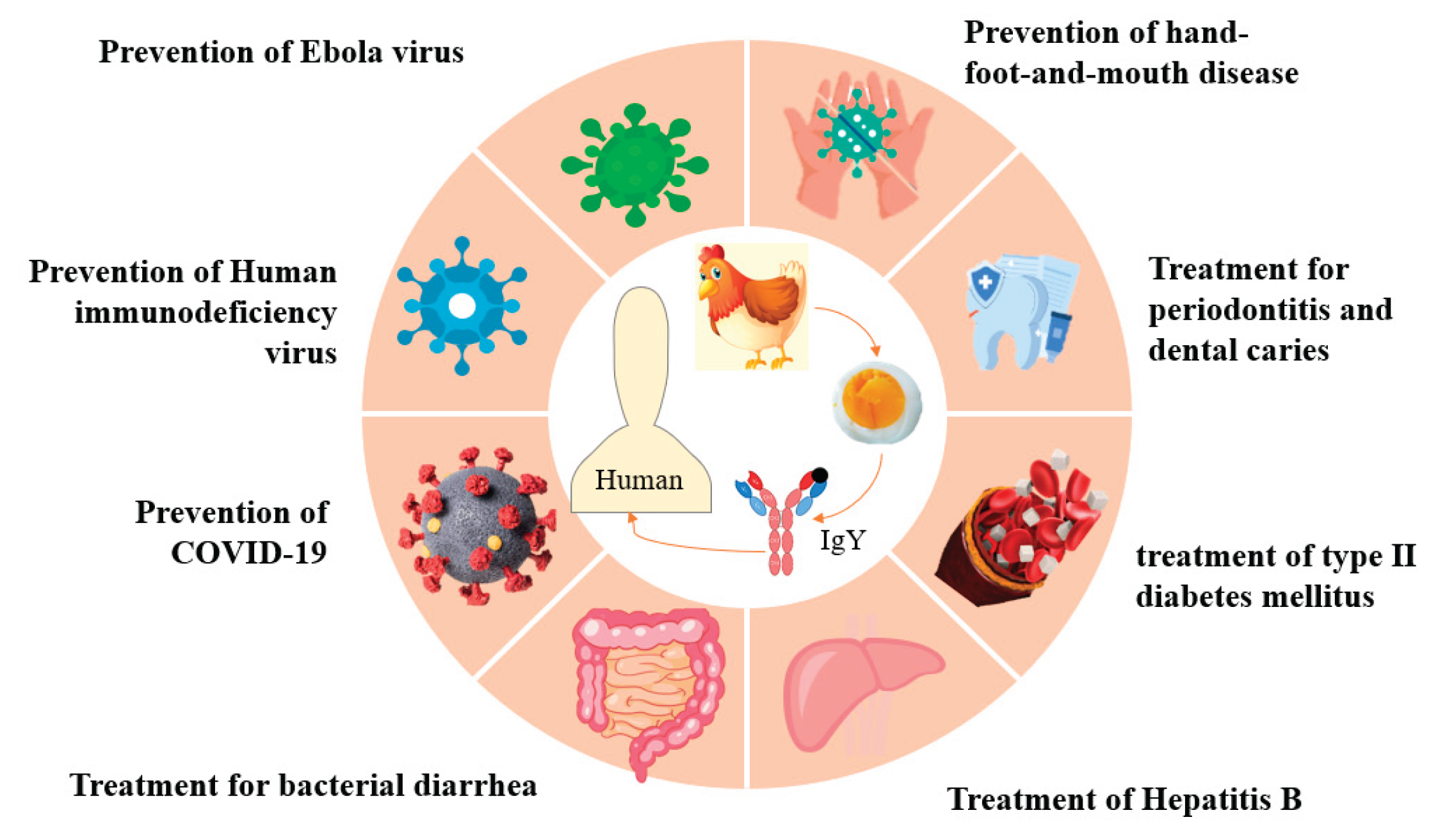

Table 1.
Methods of IgY isolation and purification.
| Methods | Reagents or devices | Steps or principles | Purification results | Reference |
| Inorganic precipitation | ammonium sulfate | Hydrolysed with papain for 6 h, 45% saturated ammonium sulphate to remove low molecular weight peptides. | Fab and Fc purity of 88.7% and 90.1%. | [18] |
| Organic solvent precipitation | Octanoic acid | ultrafiltration at pH 9.0 after addition of 2% caprylic acid in two batches. | 97.9% purity after ultrafiltration at pH 9.0, 99% activity. | [19] |
| Polymer organic polymer precipitation | PEG precipitates | better isolation and purification of IgY at 6% PEG concentration | 84% purity, 72% recovery. | [16] |
| PBS was mixed with egg yolk and then 3.5% PEG, 8.5% PEG, 12% PEG were added. | 80% purity, average 60 mg IgY per egg. | [20,21] | ||
| PEG and ammonium sulfate union | 3.5% PEG neerslaat, 15% ammonium sulfate added to filtrate. | 85% purity, protein yield 6.8 mg/mL. | [22] | |
| poloxamer-PEG method | dilute the egg yolk by adding skimming solution, then add PEG-6000 and mix with shaking. | 92.71% purity, total protein yield 30 mg/mL. | [23] | |
| Ultrafiltration | ultrafiltration centrifuge | IgY forms dimers in 1.5 mol/L NaCl. | 74%~99% purity, 80%~85% recovery. | [24] |
| Chromatography | ion exchange chromatography | PBS conditions, with more net charge on the protein surface, resulted in a more complete separation. | 95% purity, 94% recovery. | [16] |
| affinity chromatography | epichlorohydrin and cyanuric chloride methods highly stable affinity ligand named as ligand 8-6 purification by ligand. |
92.1% purity, 78.2% recovery. | [25,26] | |
| Natural rubber law |
xanthan and carrageenan gums | Acidic natural gums remove lipoproteins. | 98% purity, fat removal rates are 99.3% and 99.7%. | [27] |
| pectin | dilution of egg yolks with 0.1% pectin in a 6-fold defatted solution. | 83.3% purity, protein yield 8.36 mg/mL. | [28] | |
| Water dilution | proteins and lipids were separated by water dilution, and IgY was purified by sedimentation and ultrafiltration. | 94% purity, protein yield 9.8 mg/mL. | [29] | |
Table 2.
The role of specific IgY antibodies in the control of human diseases.
| Type of diseases | Preparation of specific IgY antibodies | potential role | Reference |
| Diabetes mellitus | Human iso maltase (HISO) recombinant protein, emulsified with Freund's adjuvant, was used to immunize laying hens for specific IgY. Antibodies were extracted via water dilution and sodium sulfate extraction. | Anti-HISO IgY targets HISO and inhibits alpha-glucosidase activity for the possible treatment of type Ⅱ diabetes mellitus. | [48] |
| Human immunodeficiency virus (HIV) | Keyhole limpet hemocynin (KLH) by the glutaraldehyde method and chicken immunization with KLH-gp120 HIV fragment, antibodies were extracted by PEG precipitation. | HIV-gp120 antibodies produced in chickens for diagnosis or treatment of HIV-positive patients. | [51] |
| Ovarian cancer | Chicken immunization with ovarian tumor associated antigen 1 (OVTA 1) and generation of anti-OVTA 1 polyclonal IgY antibodies. | Anti-OVTA 1 polyclonal IgY can specifically diagnose ovarian cancer with high sensitivity and can be used for early screening of ovarian cancer. | [52] |
| Periodontitis | Porphyromonas gingivalis (Pg) and Actinobacillus actinomycetemcomitans (Aa) from dental plaque were used as antigens to immunize chickens for the preparation of anti-periodontitis-causing bacterial complex IgY, and antibodies were extracted by PEG precipitation. | Specific complex IgY inhibits the formation of Pg and Aa bacterial biofilms and exerts an antibacterial effect, which can be used for targeted treatment of periodontitis. | [53,54] |
| Dental caries | Streptococcus sobrinus as antigen, Freund's complete adjuvant fully emulsified to immunize laying hens, IgY antibody purified by anion exchange chromatography. | IgY inhibits the adhesion and acid production of Streptococcus sobrinus, reduces the abundance of oral Streptococcus, and effectively prevents dental caries. | [55,56] |
| Viral hepatitis type B(HBV) | Preparation of anti-HBV IgY for specific immunotherapy in laying hens immunized with hepatitis B vaccine (HepB). | Anti-HBV IgY showed strong antigen-specific binding activity as determined by ELISA. | [57] |
| Diarrhoea | Clostridium difficile (CD) was detoxified with formaldehyde and mixed 1:1 with Freund's complete adjuvant (FCA), and anti-CD IgY was prepared by immunizing laying hens, and the antibody was purified by ammonium sulfate precipitation. | Anti-CD IgY specific egg yolk antibodies (IgY) for potentially treating acute and recurring Clostridium difficile infection (CDI) in humans. | [58] |
| Hand-foot-and-mouth disease, (HFMD) | Anti-EV71 IgY was prepared by mixing EV71 strain as antigen with Freund's incomplete adjuvant, 1:1 emulsion, immunizing laying hens and purifying the antibody by ammonium sulfate precipitation. | Anti-EV71 IgY recognizes the envelope proteins of EV71 and effectively inhibits viral infections. | [59] |
| COVID-19 | Anti-SARS-CoV-2 IgY was prepared by immunizing laying hens with a mixture of formaldehyde-inactivated SARS-CoV-2 and Freund's incomplete adjuvant emulsified in water, and antibodies were extracted by water dilution. | Anti-SARS-CoV-2 IgY has strong activity in the upper respiratory tract and can inhibit SARS-CoV-2 infection with good safety and drug resistance. | [60,61] |
| Ebola virus (EBOV) | A thermostable therapeutic antibody against EBOV was developed modelled on the IgY, encoding the EBOV glycoprotein could enhance antibodies against EBOV. | Anti-EBOV IgY exhibits excellent thermostability and protective efficacy. | [62] |
Disclaimer/Publisher’s Note: The statements, opinions and data contained in all publications are solely those of the individual author(s) and contributor(s) and not of MDPI and/or the editor(s). MDPI and/or the editor(s) disclaim responsibility for any injury to people or property resulting from any ideas, methods, instructions or products referred to in the content. |
© 2025 by the authors. Licensee MDPI, Basel, Switzerland. This article is an open access article distributed under the terms and conditions of the Creative Commons Attribution (CC BY) license (http://creativecommons.org/licenses/by/4.0/).
Copyright: This open access article is published under a Creative Commons CC BY 4.0 license, which permit the free download, distribution, and reuse, provided that the author and preprint are cited in any reuse.