

Submitted:
09 August 2025
Posted:
11 August 2025
You are already at the latest version
Abstract
Wireless sensor networks (WSNs) provide the foundation for the advancement of smart transportation systems (STS) to enable real-time monitoring, maximum traffic management, and improved urban mobility. WSNs make it possible to have permanent data exchange among infrastructure, cars, and control centers, offering support for intelligent transport solutions. However, the maintenance of consistent wireless data transfer in the networks is an enormous challenge from dynamic environmental conditions, increasing network density, and increasing application sophistication. Problematic phenomena such as network saturation, delay, interference, power constraints, and security risks can impair system performance and compromise safety-critical functions. They are fully addressed in this paper, and the full scope of recent technological advances to make reliable wireless communication available in transport environments is surveyed. It focuses on future tools and technologies like 5G and future 6G wireless communication, adaptive routing, and traffic prediction based on AI, low-latency edge computing, and blockchain technology for data reliability and secure identity management. It also focuses on adaptive communication protocols, low-power and long-distance wireless technologies like LoRaWAN, Zigbee, and BLE, and AI-based optimization techniques that enhance scalability, energy efficiency, and network resilience. Besides, the review integrates lessons gained in current deployments, like Singapore and London's smart traffic systems, South Korea and the Netherlands' intelligent highway initiatives, and autonomous vehicle platforms like Waymo and Tesla, all of which rely on high-speed wireless connectivity. A comparison of wireless communication standards utilized in smart transport is also presented to guide future technology adoption. The work highlights the need for scalable, secure, and energy-efficient WSNs to enable heterogeneous and dynamic transportation applications. Through overcoming long-standing transmission issues and tapping into recent advancements, WSNs can greatly improve the efficiency, security, and sustainability of urban mobility systems and thereby contribute toward the vision of intelligent and interconnected smart cities. Sensor networks (WSNs) are foundational to the development of smart transportation systems.
Keywords:
wireless sensor networks
; smart transportation systems
; intelligent transport systems
; wireless data transmission
; 5G and emerging communication technologies
1. Introduction
Smart Transportation Systems (STS) leverage advanced communication, computing, and sensing technologies to optimize traffic management, improve safety, and enhance overall reliability in the transportation systems [1]. This transportation model integrates with IoT, AI, big data analytics, and WSNs to enable real-time data collection and decision making [2]. As urbanization and vehicle usage increase, STS play a crucial role in addressing challenges in traffic obstruction, air pollution, and road safety.
One of the primary components of STS is ITS, which uses smart sensors, integrated vehicles, and traffic control mechanisms to enhance mobility [3]. ITS applications include adaptive traffic signals, automation in toll collection, real-time traffic monitoring, and vehicle-to-everything (V2X) communication. This technology helps to optimize road usage, minimise delays, and provides updated traffic information to the drivers. This leads to a more efficient and safer transportation environment [4]. WSN serves as a backbone of STS, facilitating continuous data transmission between vehicles, infrastructure, and traffic management centres. Sensors embedded in roads, bridges, and vehicles continuously monitor conditions such as traffic flow, road surface quality, and environmental parameters [5]. This data enables predictive maintenance, reduces accident risks, and enhances overall transport safety. However, ensuring reliable and secure wireless data transmission remains a critical challenge, as issues like interference, latency, and network congestion can arise. These limitations can affect the system’s overall performance [6].
Another important aspect of STS is the integration of smart mobility solutions, including autonomous vehicles, electric vehicles, and shared transportation services [7]. Autonomous vehicles depend on WSNs and AI-driven algorithms for safe navigation and collision avoidance. Also, electric vehicles benefit from smart charging infrastructure and optimisation in energy consumption [8]. Meanwhile, sharing rides and on-demand transportation services reduce the number of private vehicles on the roads. This leads to lower carbon emissions and reduced traffic congestion [9]. As smart cities evolve, the development of reliable, efficient, and safe wireless communication networks will be essential for the success of STS. Addressing data transmission issues in sensor networks is important for ensuring reliable connectivity and real-time decision making. By leveraging advancements in wireless communication technologies, smart transportation systems can significantly enhance urban mobility, safety, and sustainability [10]. Despite significant advancements in wireless sensor networks and communication technologies, the deployment of smart transportation systems faces continuous challenges in data latency, network scalability, signal interference, energy consumption efficiency, and cybersecurity. These limitation delays the real-time responsiveness and reliability required for advanced intelligent transport applications. This paper presents a comprehensive review of wireless data transmission challenges in smart transportation systems, analyzes emerging technological solutions including AI, blockchain, and 5G/6G integration, and highlights real-world case studies that demonstrate practical implementations. The paper also identifies future research directions to address unresolved issues in the field. This paper organises the role of sensor networks in transport applications in Section II. The importance of Reliable Wireless Data Transmission in Transport Applications has been discussed in Section III. In section IV, we discuss Emerging Trends in Wireless Sensor Networks for Transport Systems. Real-time challenges in WSNs have been discussed in Section V. Case studies and future directions have been discussed in Sections VI and VII. The conclusion has been given in Section VIII.
2. Role and Importance of Sensor Networks in Smart Transportation
Sensor networks play an important role in modern transportation systems by enabling real-time data collection, monitoring, and communication [11]. These networks consist of interconnected sensors employed in vehicles, road infrastructure, and traffic management centres to enhance intelligent decision-making and improve transportation reliability. In order to reduce the complexity in urban transportation, sensor networks are essential for optimising traffic flow, enhancing road safety, and supporting smart transportation applications. One of the main applications of sensor networks in transportation is traffic monitoring and management. WSNs deployed on roads, highways, and intersections collect data on vehicle speed, congestion levels, and road conditions. This data is used to control traffic signals dynamically, manage lane usage, and provide real-time updates to drivers through navigation systems. By leveraging WSNs, smart cities can reduce congestion, reduce travel time, and improve overall travel comfort. Another important application is V2X communication, where vehicles communicate with infrastructure (V2I), other vehicles (V2V), and pedestrians (V2P). Sensor nodes enable seamless exchange of data regarding road hazards, weather conditions, and accident warnings. This information enhances situational awareness, allowing drivers and autonomous vehicles to make informed decisions, thereby improving road safety and reducing the likelihood of collisions [12]. Sensor networks also influence predictive maintenance and infrastructure monitoring. Smart sensors embedded in bridges, tunnels, and roads detect structural weaknesses, temperature fluctuations, and environmental changes. By continuously assessing the condition of transportation infrastructure, authorities can take advanced measures to prevent failures, schedule timely maintenance, and ensure passenger safety [13].
In the context of public transportation and smart mobility, sensor networks enhance operational efficiency by road vehicles, trains, and other transit systems in real time. Computer receives live updates on arrival times, service delays, and route optimizations, making public transport more reliable and user-friendly. Additionally, ridesharing services leverage sensor data for optimized route planning, reducing fuel consumption and environmental impact [14]. Despite their numerous advantages, sensor networks in transportation face challenges related to wireless data transmission, including network congestion, interference, and security threats [15]. Addressing these issues is crucial for ensuring uninterrupted communication and maximizing the potential of smart transportation systems. As sensor technology and wireless communication continue to evolve, their role in transportation applications will become even more indispensable, driving innovation and sustainability.
Reliable wireless data transmission is essential for the seamless operation of smart transportation systems, as it ensures accurate, real-time communication between vehicles, infrastructure, and traffic management centres. WSNs play a crucial role in gathering and transmitting data related to traffic conditions, road safety, and environmental factors [13]. However, for these networks to function effectively, they require stable, low-latency, and secure data transmission. One of the primary benefits of reliable wireless communication in transport applications is traffic optimization. ITS relies on real-time data from sensors to dynamically control traffic signals, manage congestion, and provide route recommendations. Delays or disruptions in data transmission can lead to traffic inefficiencies, longer travel times, and increased fuel consumption [16]. In V2X communication, consistent wireless data exchange is vital for collision avoidance, hazard detection, and autonomous vehicle navigation. A weak or unstable connection could result in delayed warnings, increasing the risk of accidents. Additionally, public transportation systems depend on wireless communication for live tracking, schedule updates, and fleet management, ensuring operational efficiency and passenger convenience.
Despite its importance, wireless data transmission in sensor networks faces challenges such as interference, bandwidth limitations, and cybersecurity threats. Addressing these challenges through advanced networking technologies, such as 5G, edge computing, and adaptive communication protocols, is crucial for enhancing the reliability and efficiency of smart transportation systems. By ensuring robust data transmission, transportation networks can become safer, more efficient, and sustainable
3. Emerging Trends in Wireless Sensor Networks for Transport Systems
The field of wireless communication has witnessed more development, which has encourages the WSNs for transportation systems. Later the influence of 5G technology has revolutionized data transmission by offering ultra low latency, high bandwidth, and enhanced connectivity [17]. These attributes are particularly beneficial for applications demanding rapid data exchange, such as autonomous vehicle navigation and real-time traffic management [18].
The integration of IoT with WSNs has also extended the functions of transportation systems. Different wireless communication protocols, including LoRaWAN, Zigbee, and Bluetooth Low Energy (BLE), help for energy-efficient data transmission over different ranges and conditions [19]. Cutting-edge technologies further improve the network reliability by enabling local data processing. This leads to a reduction in dependence on centralized cloud systems and minimization of latency. These developments encourage a wide range of ITS applications, including dynamic traffic signal control, V2X communication, and public transportation optimization [20]. AI algorithms play a critical role in analyzing sensor data, predicting traffic patterns, and supporting real-time decision making [21]. However, the full potential of these technologies can only be utilised by addressing the constant challenges associated with wireless data transmission.
3.4. Renewable Integration and Energy Optimization
Figure 1 shows the WSN Architecture for a smart transportation system. It’s integration of vehicles, road infrastructure, edge computing, and cloud-based data centers. It shows Vehicle to Vehicle (V2V) and Vehicle to Infrastructure (V2I) communication, conventional sensors connected through a breakout box to a wireless sensing platform, and real-time data processing through edge computing before transmission to the cloud [22].
4. Applications in Intelligent Transport Systems (ITS)
Intelligent Transport Systems (ITS) leverage wireless sensor networks to improve traffic efficiency, enhance safety, and provide seamless mobility solutions. These systems rely on interconnected sensors, data analytics, and automated decision-making to optimize transportation networks in real time [8]. One of the most useful applications of ITS is real-time traffic monitoring and management, where sensors placed on roads, traffic lights, and vehicles collect data on traffic flow, congestion levels, and accident occurrences. This information is processed by ITS platforms to continuously adjust traffic signals, suggest alternate routes to drivers, and improve overall traffic flow efficiency. Wireless communication systems, particularly 5G and dedicated short-range communication (DSRC), play a crucial role in enabling fast and reliable data exchange between vehicles and infrastructure [9].
Another important application of wireless sensor networks in ITS is vehicle-to-everything (V2X) communication, which includes vehicle-to-vehicle (V2V), vehicle-to-infrastructure (V2I), and vehicle-to-pedestrian (V2P) communication. These systems enhance road safety by enabling real-time hazard detection, collision avoidance, and emergency response coordination [24]. For instance, V2V communication allows vehicles to share information about sudden braking, road conditions, or potential accidents, providing drivers with early warnings and helping prevent crashes. Similarly, V2I communication ensures that vehicles receive updates on traffic signal timing, roadwork zones, and weather conditions, enabling more efficient and safe navigation [25]. Wireless sensor networks are also instrumental in public transportation optimization. Sensors installed in road vehicles, trains, and metro stations provide real-time location tracking and service status updates to commuters through mobile applications [26]. Automated ticketing systems, enabled by contactless payment methods and wireless communication, streamline fare collection and reduce wait times at transit hubs. Additionally, predictive analytics powered by AI and WSN data helps transportation authorities optimize transit schedules, reduce fuel consumption, and enhance service reliability [27].
Beyond conventional transport applications, wireless sensor networks encourage the development of autonomous and integrated vehicles. Self-driving vehicles rely on high-speed wireless communication and sensor fusion to navigate safely and interact with other vehicles and infrastructure. Technologies such as LiDAR, radar, and computer vision, combined with AI-based decision making and enable autonomous vehicles to perceive their environment and make real-time driving decisions [13]. Furthermore, smart parking systems, which use sensor networks to identify the available parking spots and guide drivers through mobile applications, are reducing urban congestion and improving parking efficiency [26]. Although the transformative impact of wireless sensor networks in ITS, challenges related to data security, network scalability, and interoperability must be addressed to ensure seamless integration across different transportation modes [28]. As technology advances, ongoing research in cybersecurity measures, spectrum optimization, and adaptive networking will play to overcoming these challenges. Eventually, the repeated evolution of wireless sensor networks in ITS will drive smarter, safer, and more efficient transportation systems, significantly improving the way people and goods move within urban environments [29].
Despite technological progress, several challenges continue to impede the performance of WSNs in smart transportation [30]. Data latency poses a serious problem, especially in applications requiring real-time responses [28]. High latency can delay crucial information, compromising functions such as collision avoidance and dynamic signal adjustments. Solutions like edge computing and 5G integration are essential to overcome these latency issues. Scalability is another concern as urban environments expand and require the deployment of extensive sensor networks [31]. Traditional wireless protocols often fail to efficiently manage large-scale data traffic, resulting in packet loss and network congestion. Hierarchical architectures and cloud-based data management systems can enhance scalability and maintain consistent performance [32].
Urban settings have considerable interference and signal degradation due to complex infrastructure and competing wireless signals. Technologies like Multiple Input Multiple Output, dynamic spectrum allocation, and millimeter wave communication can mitigate these effects and ensure robust signal quality. Energy efficiency is critical for the sustainability of sensor nodes, which are often battery-powered and deployed in hard-to-reach locations [33]. Excess energy consumption leads to excessive maintenance and system downtime. Utilizing energy-harvesting technologies, low-power communication protocols, and smart data aggregation techniques can increase the lifespan of sensors by many folds. Security and data privacy are priorities because WSNs are susceptible to cyberattacks. Data breaches, signal jamming, and unauthorized access are potential attacks on WSNs, and these can halt transportation systems and compromise public safety. Employing robust encryption, secure authentication mechanisms, and blockchain-based systems can enhance network security and protect sensitive data [34,35].
5. Challenges in Wireless Data Transmission
Wireless data transmission is an important component of sensor networks in smart transportation systems, enabling real-time communication between vehicles, infrastructure, and traffic management centres. However, several challenges exist to achieving the higher efficiency, reliability, and security of these networks. Factors such as data latency, scalability, interference, energy efficiency, and security concerns must be addressed to ensure seamless operation. To address these challenges, various technological solutions and best practices have been developed [36].
Low-power communication protocols like Zigbee, LoRaWAN, and BLE are widely employed because of their energy efficiency and reliability. The protocols find usage in different transportation environments ranging from near-distance vehicle tracking to long-distance traffic monitoring [37]. Dynamic spectrum allocation techniques, such as cognitive radio and machine learning-based spectrum management, optimize bandwidth usage and reduce interference. These techniques allow sensor networks to be adaptive to changing network situations, and continuous communication is ensured [38]. Advanced signal processing techniques and adaptive transmission protocols, such as adaptive modulation and coding (AMC), MIMO, and ultra-wideband (UWB) communication, enhance the quality and reliability of transmission [39]. Error detection algorithms also ensure data integrity at the time of transmission. Security architectures are vital to safeguard transportation networks [40]. End-to-end encryption, intrusion detection, and blockchain-based identity management provide robust protection against cyber threats. Secure firmware update and over-the-air patching tools guarantee system integrity.
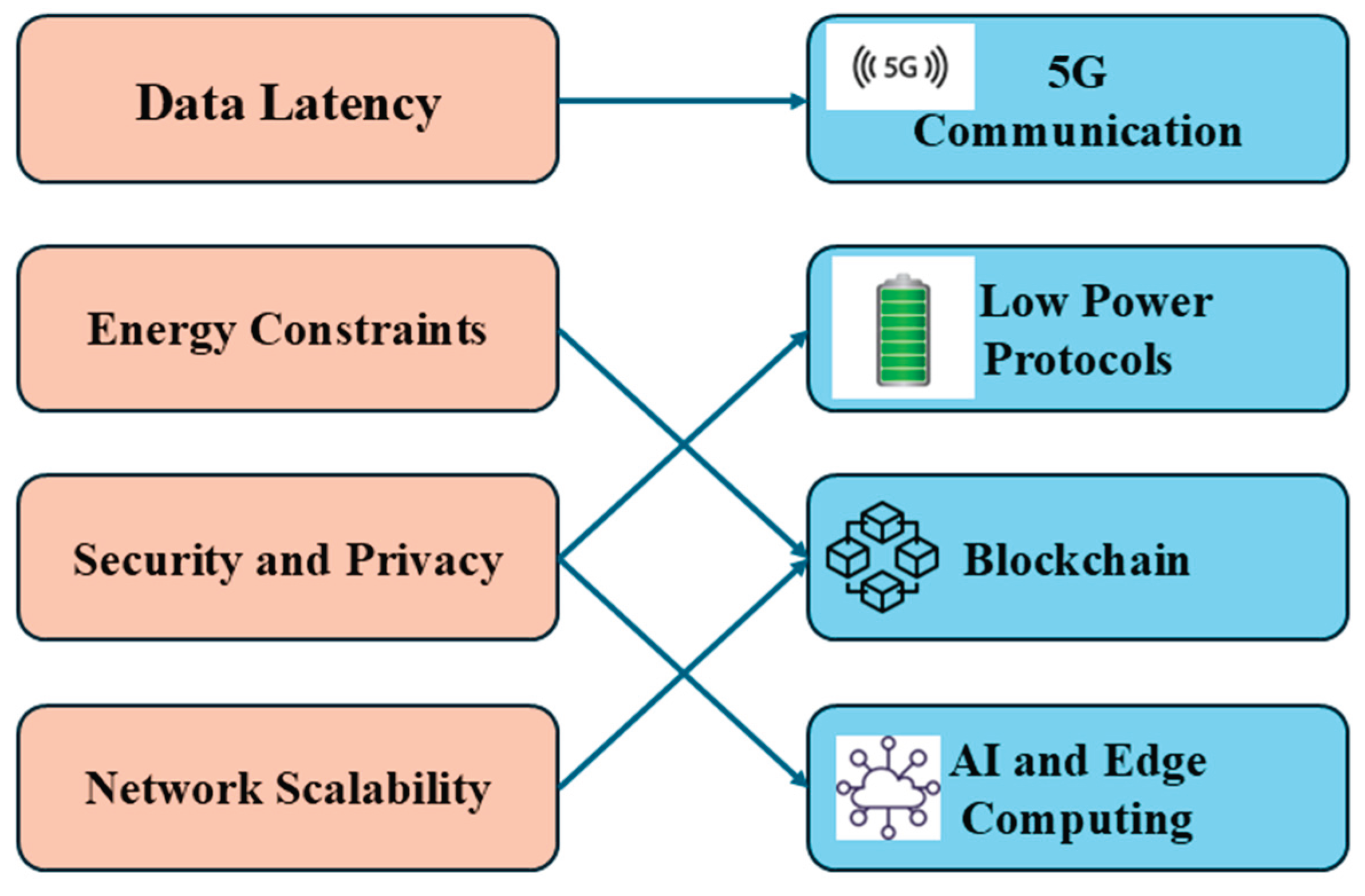
One of the most important problems in wireless data communication is latency reduction to support real-time communication. Intelligent transportation systems rely on real-time data exchange for applications including vehicle-to-everything (V2X) communication, adaptive traffic control, and collision avoidance [41]. High latency in data transmission can result in delayed decision-making, increasing the risk of accidents and reducing the effectiveness of intelligent traffic control [42]. Latency issues are induced by network overload, inefficient protocol routing, and sluggish data processing. Further, as more and more devices become connected, the complexity of supporting real-time communication rises. To offset latency, emerging wireless technologies such as 5G, edge computing, and software-defined networking (SDN) are being implemented in smart transportation infrastructures to support faster data transmis-sion and processing. The application of WSNs in real life for intelligent transportation can be seen in some global initiatives. In cities like Singapore and London, there are adaptive traffic management systems that utilize wireless sensors to monitor traffic density and dynamically adjust traffic lights. Surtrac in Pittsburgh has demonstrated a 25% decrease in travel time and 20% decrease in vehicle emissions. South Korean and Dutch smart roads employ WSNs to offer environmental sensing and communication for autonomous vehicles. The systems detect hazardous conditions and alert approaching vehicles. Autonomous vehicle services such as Waymo in Phoenix and Tesla Autopilot employ real-time wireless data exchange to drive safely [43]. Despite their success, the applications still have problems with latency, signal interference, and security vulnerabilities. The use of 5G networks, V2X communication, and blockchain-based security systems is mitigating such impediments and paving the way for more robust and smart transportation networks [44]. The Figure 2. wireless transmission problems in smart transportation systems like data latency, energy constraint, privacy and security, and network scalability. Each challenge is accompanied by an emerging technological solution: 5G communication, low-power protocols, blockchain, and AI with edge computing. These technologies together offer more reliable, effective, and secure wireless communication for intelligent transport applications
5.1. Energy Efficiency Constraints in Sensor Nodes
Another important issue with wireless sensor networks, especially for battery-powered sensor nodes deployed in remote or inaccessible locations, is energy efficiency. Since these nodes need to gather and send data around the clock, wastage of energy may lead to continuous battery replacement, and this can contribute to maintenance costs as well as downtime for operations. Evidence such as ineffective data transmission protocols, excessive retransmissions due to packet loss, and maximum power wireless communication modes are the causes of energy drain in sensor nodes. Power-saving mechanisms such as duty cycling, energy harvesting (kinetic or solar energy), and power-efficient communication protocols such as Zigbee and LoRaWAN are being utilized for energy efficiency. Further, intelligent data collection methods can minimize redundant transmissions by compressing or filtering data before transmission, reducing overall energy consumption.
The integration of WSNs with 5G and future 6G networks promises revolutionary improvement in wireless data transportation. The networks enable ultra-reliable, low-latency communication and support for massive device connectivity required by real-time transportation use cases. AI-driven optimization strategies are transforming network management. Machine learning foresees improved adaptive routing, spectrum allocation, and predictive maintenance. Federated learning enables decentralized AI models to preserve data privacy while improving model accuracy. Blockchain technology offers a decentralized and tamper-evident approach to securing transport information. Blockchain technology guarantees data integrity, enables secure identity administration, and permits automated transactions based on smart contracts. Additional research can be focused on developing lightweight blockchain frameworks to overcome scalability and energy consumption challenges [45].
5.2. Security and Data Privacy Concerns
Security and privacy take precedence in intelligent transportation systems, since cyber attacks pose real threats to data integrity and network availability [46]. Unauthorized access, data intrusions, and DoS attacks have the potential to bring down wireless sensor networks’ functionality, leading to potentially unsafe situations such as traffic light manipulation or unauthorized vehicle usage. In addition, the sheer volumes of data shared on intelligent transportation networks like location tracking and personal driving patterns heighten users’ privacy issues [38]. In response to security threats, robust encryption processes, secure authentication mechanisms, and intrusion detection controls must be employed in wireless communication platforms. Additionally, blockchain is also being taken under serious consideration as a decentralized security element that assists in data integrity and tampering protection [30]. Privacy protective techniques such as anonymization and secure multiparty computation can also protect user information while enabling efficient data exchange in transportation networks..
6. Technological Solutions and Case Studies
Artificial intelligence (AI) is revolutionizing wireless data transmission with the assistance of network performance optimization, congestion mitigation, and transport sensor network optimization [47]. AI-enabled algorithms such as machine learning (ML) and deep learning (DL) can automatically assess network conditions, predict traffic patterns, and allocate resources in real-time. These improve the reliability and scalability of smart transport networks considerably [48]. One of the primary applications of AI in wireless sensor networks (WSNs) is adaptive routing and network management. Traditional routing protocols do not perform well under dynamic traffic conditions, leading to packet loss and latency [49,50]. AI models can learn to dynamically select the optimal communication channels, adjusting transmission parameters based on factors such as congestion, interference, and energy levels [51]. This ensures that critical transport information, such as accident alerts and traffic congestion real-time reports, is spread with minimal latency [37].
AI enhances predictive maintenance for transportation infrastructure by processing excessive amounts of sensor data to identify probable failures in advance [52]. This reduces downtime, facilitates safety, and maximizes road, bridge, and railway maintenance schedules. AI-based analytics can also support smart spectrum management to guarantee optimal utilization of wireless resources and minimize interference among connected devices. Moreover, the inclusion of federated learning (FL) in sensor networks can enable privacy-preserving AI models that are trained from decentralized data sources without transmitting sensitive data to centralized servers [53]. This is particularly beneficial for intelligent cities and intelligent transport systems, where data privacy issues are of greatest concern. Future research must explore how AI can be utilized further to improve self-healing networks, traffic forecasting algorithms, and real-time congestion management to ensure smooth and efficient data transmission within transport systems [54,55].
6.1. Enhancing Security Through Blockchain
With increasing sensor networks included in smart transport, safe and tamper-free data transmission becomes the most serious challenge. Wireless communication networks are vulnerable to cyber attacks such as data leakage, denial-of-service (DoS) attacks, and signal jamming that can put the safety and reliability of smart transport systems at risk [56]. All data transactions in a blockchain framework are encrypted, time-stamped, and saved in a distributed ledger, hence making them tamper-proof. This proves useful where the accuracy and authenticity of data are critical, like in scenarios of vehicle-to-infrastructure (V2I) communications, tolling, and traffic surveillance [57,58]. Each data transaction in a blockchain network is encrypted, timestamped, and stored in a distributed ledger, making it resistant to manipulation. This is particularly beneficial for applications such as vehicle-to-infrastructure (V2I) communication, toll collection, and traffic monitoring, where data accuracy and authenticity are critical [59].
Yet another vital application of blockchain in transport is secure identity management for networked vehicles and IoT devices. Using decentralized digital identities (DIDs), blockchain can guarantee that network resources are not accessed by unauthorized users, reducing cyber-attack threats to vehicle communication systems [60]. Cyber-attack threats to vehicle communication systems [60]. Blockchain-based smart contracts can also automate transactions such as vehicle registration, insurance claims, and ride-sharing contracts, increasing operational efficiency and reducing fraud [61].
Blockchain integration with AI and 5G can also help push real-time threat intelligence and tamper-evident data exchange protocols even further. Anomaly detection methods based on AI can scan network traffic for malicious activity independently, while blockchain assures that only valid nodes participate in data exchange [62]. Additionally, hybrid blockchain architectures integrating the best of both public and private blockchains can help overcome scalability and energy consumption issues [63].
While it holds promise, right now, blockchain technology also has issues relating to scalability, processing rate, and power utilization. Future research must focus on creating light chain blockchain platforms, consensus mechanisms, making them effective, and researching blockchain-based edge computing options to make this technology viable for application in real-time smart transportation applications [64].
6.2. Case Studies and Real-World Applications
6.2.1. Wireless Solutions in Urban Traffic Monitoring
Wireless sensor networks (WSNs) have also significantly improved urban traffic monitoring by providing real-time data to manage congestion, enhance road traffic flow, and enhance road safety [65]. In the majority of smart cities worldwide, intelligent transportation systems (ITS) utilize wireless sensors, cameras, and communication technology to collect and analyze traffic flow [66]. For instance, towns like Singapore and London have established wireless-based intelligent traffic management systems that learn dynamically to adjust traffic signals following real-time vehicle density [67]. These are founded on networked sensors embedded in roads and intersections that transfer data wirelessly to central traffic control centers. The data collected allows authorities to make decisions such as rerouting traffic during rush hours and providing congestion notifications to travelers through mobile applications [26].
One of the most intriguing examples is the Surtrac adaptive traffic control system, which was applied in Pittsburgh, USA. The system relies on a network of roadside sensors and artificial intelligence algorithms to sense traffic conditions and adjust signal timings accordingly [68,69]. In turn, it has reduced travel time by 25% and cut vehicle emissions by 20%. Similarly, in Barcelona, Spain, wireless sensor networks facilitate effective parking management through the detection of available parking spaces and guiding motorists to them through a mobile app, reducing unnecessary idling and congestion [70]. Despite their advantages, wireless data transfer in urban traffic monitoring is prone to challenges such as network congestion, building and other electrical device interference, and cyber attacks [71]. To overcome such challenges and issues, cities are implementing cutting-edge wireless technologies such as 5G, edge computing, and dedicated short-range communication (DSRC) to enable high-speed, secure, and reliable data exchange [72]. Their deployment enhances the performance of urban traffic management, which enhances the responsiveness and responsiveness of road networks towards dynamic situations [73,74].
6.2.2. Sensor Networks for Smart Highways and Autonomous Vehicles
Self-driving vehicles and smart highways rely on high-performance sensor networks to provide secure and efficient transport [75]. Sensor networks enable real-time vehicle-to-vehicle communication, predictive maintenance, and driverless vehicle features. Smart highways have been launched in nations like the Netherlands and South Korea by implementing IoT-enabled sensors, wireless communication networks, and AI-based analytics to monitor road conditions, weather patterns, and vehicle traffic [76,77].
One very notable example is the Smart Highway Project in the Netherlands, which applies interactive road markings, LED lighting powered by solar energy, and temperature paint to increase road safety [78]. Wireless sensors placed on highways measure environmental conditions like fog, icing, and excessive rain and send warnings to vehicles approaching the affected areas [43]. This predictive measure allows drivers to adjust their driving styles according to changing road conditions and lowers the risks of accidents. Further, South Korea’s K-City, a test bed dedicated to autonomous vehicles, uses wireless sensor networks to simulate on-road conditions and support vehicle-to-infrastructure (V2I) communication [79]. For autonomous vehicles, wireless data delivery with no disruption is crucial for driving, collision avoidance, and decision-making. LiDAR, radar, and GPS-based sensors mounted in cars frequently exchange data with roadside infrastructure and other autos (V2V communication) to create a real-time map of traffic [80,81]. A working example is Phoenix’s Waymo autonomous taxi service, in which self-driving cars rely on a mixture of wireless networks and AI algorithms to navigate city streets safely [82]. Similarly, Tesla Autopilot and Full Self-Driving (FSD) utilize sensor fusion and over-the-air software updates to enhance driving function and road perception [83].
However, incorporating wireless sensor networks into intelligent highways and autonomous vehicles poses problems of data transmission delay, physical blockage interference, and vulnerability to cyberattacks [84]. 5G networks, vehicle-to-everything (V2X) communication, and blockchain-based cybersecurity technologies are attempting to address these challenges. Ultra-low latency and high-speed connectivity of 5G enable autonomous vehicles to process vast amounts of sensor data in real-time, improving response time and safety [85,86]. In the coming years, with urbanization gathering pace and autonomous vehicle deployment becoming increasingly prevalent, integrating high-speed, secure wireless communication networks will be instrumental to intelligent transport systems and smart highways [87]. Edge computing, AI-driven traffic analysis, and advanced encryption methods will further enhance sensor network reliability, ensuring seamless data transmission for new mobility solutions [88].

Table 1.
Comparative Analysis of Wireless Communication Protocols for Smart Transportation Systems.
| Protocol | Frequency Band | Range | Data Rate | Latency | Power Usage | Mobility Support | Security Features | Key Applications | Ref. |
| Zigbee | 2.4 GHz | 10–100 m | 20–250 kbps | Low | Very Low | Low | AES 128-bit encryption | V2P alerts, short-range sensing | [1,4] |
| LoRaWAN | 868/915 MHz (Sub-GHz) | 2–15 km | 0.3–50 kbps | High | Low | Low | AES 128-bit encryption | Long-range traffic/environment monitoring | [90,103] |
| BLE | 2.4 GHz | <100 m | Up to 2 Mbps | Very Low | Low | Medium | 128-bit AES encryption | Vehicle diagnostics, in-cabin communications | [1,3] |
| Wi-Fi (802.11n/ac) | 2.4/5 GHz | 50–100 m | 100 Mbps–1 Gbps | Medium | High | Medium | WPA2/WPA3 encryption | Surveillance, infotainment | [1,4,89] |
| DSRC (802.11p) | 5.9 GHz | <300 m | 6–27 Mbps | Very Low (~10 ms) | Medium | High | Digital signature, message authentication | V2V, V2I communications | [2,3,90] |
| 5G NR | Sub-6 GHz / mmWave | <1 km (urban) | 1–20 Gbps | Ultra-low (<1 ms) | High | Very High | Network slicing, encryption | Real-time V2X, connected/autonomous vehicles | [3,4,91] |
| NB-IoT | Sub-GHz | 1–10 km | ~250 kbps | High | Very Low | Low | SIM-based, 3GPP encryption | Infrastructure sensors, status monitoring | [1,4,92] |
| WiMAX (802.16) | 2.5/3.5 GHz | 1–10 km | 1–10 Mbps | Medium | High | Medium | AES encryption | Backhaul connectivity, emergency alerts | [1,3,93] |
| UWB | 3.1–10.6 GHz | <100 m | Up to 480 Mbps | Very Low | Medium | Low | Low interference, precise time-of-flight | Precision tracking, radar in autonomous cars | [1,3,94] |
| LTE-V2X | 5.9 GHz | <1 km | Up to 100 Mbps | Low (~10 ms) | Medium | Very High | End-to-end encryption, LTE security suite | Cooperative awareness messages (CAM), V | [95,96] |
7. Future Directions and Research Opportunities
7.1. Integration with 5G and Beyond
The 5G and beyond convergence with sensor networks provides an immense opportunity for wireless data communication improvement in intelligent transportation systems [97]. Traditional wireless communication technologies are inclined to be plagued by latency, bandwidth limitations, and congestion of traffic, which can adversely influence the real-time operation of intelligent transport applications [98]. The advent of 5G networks based on ultra-low latency, high-speed data transfer, and massive device connectivity resolves these issues by providing a much stronger and more scalable communication infrastructure [99,100].
In smart transportation systems, 5G offers enhanced Vehicle-to-Everything (V2X) communication, where vehicles can exchange information with each other (V2V), roadside structures (V2I), and pedestrians (V2P) with zero latency [101]. This is crucial in autonomous and connected vehicle deployments, where decisions must be made in real-time to avoid accidents as well as streamline traffic. In addition, 5G networks support edge computing, under which data is processed locally near the source, reducing the dependence on cloud servers and lowering transmission latency [102]. This aspect is particularly beneficial for smart traffic management, real-time navigation updates, and emergency systems [52,103]. Further in the future, beyond 5G, 6G networks are expected to introduce even more transformative changes to wireless data communication in transportation [104]. With features such as terahertz (THz) communication, embedded AI, and quantum security, 6G will enhance the reliability and security of sensor networks [105]. Future research should focus on developing energy-efficient and scalable network architectures, optimizing spectrum utilization, and addressing interoperability challenges between legacy communication systems and next-generation networks [106,107]. The problem-free integration of sensor networks with 5G and 6G will be instrumental in bringing to fruition the dream of a smart, autonomous, intelligent, and sustainable transport ecosystem [108,109].
8. Conclusions
Wireless sensor networks (WSNs) are the foundation upon which building and operating smart transport systems, as the prime infrastructure for real-time monitoring, traffic management, predictive maintenance, and vehicle communication, take shape. Although their revolutionary effect on urban mobility, safety, and sustainability is undeniable, these networks are prone to a range of technical and operational difficulties in wireless data transfer. Foremost among them are data latency, network congestion, interference with signals, low energy levels for sensor nodes, and increasing cybersecurity threats. These problems dampen the efficiency, reliability, and scalability of transportation networks, especially in urban networks where the population of interconnected devices is heavy and the requirement for fast communication is paramount.
To counter these restrictions, a range of emerging technologies has come as alternatives. The intersection of computer networks, 5G, and future 6G networks achieves ultra-low latency and high-bandwidth connectivity, making real-time applications like computer networks vehi-cle-to-everything (V2X) communication and autonomous driving more feasible and reliable. Artificial intelligence (AI), particularly through the implementation of machine learning and deep learning algorithms, enhances adaptive routing, traffic prediction, and dynamic spectrum control, which are most essential for efficient network operation. Additionally, edge computing enables near-source data processing, minimizing latency and dependency on centralized servers. Blockchain technology is increasingly used to secure sensor networks against data breaches and unauthorized access. Its decentralized, tamper-evident nature provides data integrity, raises transparency, and enables secure identity management for connected infrastructure and vehicles. Practical implementations in the real world, such as Surtrac in Pittsburgh, Waymo in Phoenix, and smart highways in the Netherlands and South Korea, have already demonstrated the practical benefits of integrating such technologies into transportation systems.
More interdisciplinary research as well as cross-sector collaboration will be required in the future to design lightweight, scalable, and interoperable wireless sensor network frameworks. Policymakers will need to determine regulatory standards for safe and standard communication between different transportation platforms. As urbanization speeds up and mobility requirements change, the effective implementation of strong wireless data communication systems will be crucial in determining the future of smart, responsive, and sustainable transport. By overcoming current challenges and adopting new technologies, we can fully utilize the potential of smart transport systems over the next decades.
Author Contributions
Investigation, conceptualization, writing—original draft preparation, V.S.; Conceptualization, writing—review and editing, validation, S.R.; riting—review and editing, M.S.P.; Writing—review and editing, T.Y.M.; Conceptualization, writing—review and editing, funding acquisition, G.G. All authors have read and agreed to the published version of the manuscript.
Funding
This project is funded under the National Recovery and Resilience Plan (NRRP), Mission 4 Component 2 Investment 1.3 - Call for tender No. 3138 of 16.12.2021 of Ministero dell'Universit‘a e della Ricerca (MUR); funded by the European Union - NextGeneration, Project code CN00000023, Concession Decree No. 1033 of 17/06/2022 adopted by the Italian Ministry of University and Research, CUP F23C22000360001, 'Sustainable Mobility Center' (CNMS).
Conflicts of Interest
The authors declare no conflicts of interest.
References
- Cunha, F.; Villas, L.; Boukerche, A.; Maia, G.; Viana, A.; Mini, R.A.F.; Loureiro, A.A.F. Data Communication in VANETs: Protocols, Applications and Challenges. Ad Hoc Networks 2016, 44, 90–103. [Google Scholar] [CrossRef]
- Zhu, L.; Yu, F.R.; Wang, Y.; Ning, B.; Tang, T. Big Data Analytics in Intelligent Transportation Systems: A Survey. IEEE Transactions on Intelligent Transportation Systems 2019, 20, 383–398. [Google Scholar] [CrossRef]
- Guerrero-Ibáñez, J.; Zeadally, S.; Contreras-Castillo, J. Sensor Technologies for Intelligent Transportation Systems. Sensors 2018, 18, 1212. [Google Scholar] [CrossRef]
- Kandris, D.; Nakas, C.; Vomvas, D.; Koulouras, G. Applications of Wireless Sensor Networks: An Up-to-Date Survey. Applied System Innovation 2020, 3, 14. [Google Scholar] [CrossRef]
- Tacconi, D.; Miorandi, D.; Carreras, I.; Chiti, F.; Fantacci, R. Using Wireless Sensor Networks to Support Intelligent Transportation Systems. Ad Hoc Networks 2010, 8, 462–473. [Google Scholar] [CrossRef]
- Faouzi, N.-E.E.; Leung, H.; Kurian, A. Data Fusion in Intelligent Transportation Systems: Progress and Challenges – A Survey. Information Fusion 2011, 12, 4–10. [Google Scholar] [CrossRef]
- Tewolde, G.S. Sensor and Network Technology for Intelligent Transportation Systems. In Proceedings of the 2012 IEEE International Conference on Electro/Information Technology; May 2012; pp. 1–7.
- Shaukat, N.; Khan, B.; Ali, S.M.; Mehmood, C.A.; Khan, J.; Farid, U.; Majid, M.; Anwar, S.M.; Jawad, M.; Ullah, Z. A Survey on Electric Vehicle Transportation within Smart Grid System. Renewable and Sustainable Energy Reviews 2018, 81, 1329–1349. [Google Scholar] [CrossRef]
- Oladimeji, D.; Gupta, K.; Kose, N.A.; Gundogan, K.; Ge, L.; Liang, F. Smart Transportation: An Overview of Technologies and Applications. Sensors 2023, 23, 3880. [Google Scholar] [CrossRef]
- Li, X.; Li, D.; Wan, J.; Vasilakos, A.V.; Lai, C.-F.; Wang, S. A Review of Industrial Wireless Networks in the Context of Industry 4.0. Wireless Netw 2017, 23, 23–41. [Google Scholar] [CrossRef]
- Networked Wireless Sensor Data Collection: Issues, Challenges, and Approaches | IEEE Journals & Magazine | IEEE Xplore. Available online: https://ieeexplore.ieee.org/abstract/document/5497857 (accessed on 6 February 2025).
- Mozaffari, M.; Saad, W.; Bennis, M.; Nam, Y.-H.; Debbah, M. A Tutorial on UAVs for Wireless Networks: Applications, Challenges, and Open Problems. IEEE Communications Surveys Tutorials 2019, 21, 2334–2360. [Google Scholar] [CrossRef]
- Darwish, T.S.J.; Abu Bakar, K. Fog Based Intelligent Transportation Big Data Analytics in The Internet of Vehicles Environment: Motivations, Architecture, Challenges, and Critical Issues. IEEE Access 2018, 6, 15679–15701. [Google Scholar] [CrossRef]
- Handte, M.; Foell, S.; Wagner, S.; Kortuem, G.; Marrón, P.J. An Internet-of-Things Enabled Connected Navigation System for Urban Bus Riders. IEEE Internet of Things Journal 2016, 3, 735–744. [Google Scholar] [CrossRef]
- Usman, A.; Shami, S.H. Evolution of Communication Technologies for Smart Grid Applications. Renewable and Sustainable Energy Reviews 2013, 19, 191–199. [Google Scholar] [CrossRef]
- Qureshi, K.; Abdullah, H. A Survey on Intelligent Transportation Systems. Middle-East Journal of Scientific Research 2013, 15, 629–642. [Google Scholar] [CrossRef]
- Low Latency Geo-Distributed Data Analytics | ACM SIGCOMM Computer Communication Review. Available online: https://dl.acm.org/doi/abs/10.1145/2829988.2787505 (accessed on 6 February 2025).
- Kumar, S.A.A.; Ovsthus, K.; Kristensen, L.M. An Industrial Perspective on Wireless Sensor Networks — A Survey of Requirements, Protocols, and Challenges. IEEE Communications Surveys Tutorials 2014, 16, 1391–1412. [Google Scholar] [CrossRef]
- Bandyopadhyay, D.; Sen, J. Internet of Things: Applications and Challenges in Technology and Standardization. Wireless Pers Commun 2011, 58, 49–69. [Google Scholar] [CrossRef]
- Akyildiz, I.F.; Jornet, J.M.; Han, C. Terahertz Band: Next Frontier for Wireless Communications. Physical Communication 2014, 12, 16–32. [Google Scholar] [CrossRef]
- Niyato, D.; Kim, D.I.; Maso, M.; Han, Z. Wireless Powered Communication Networks: Research Directions and Technological Approaches. IEEE Wireless Communications 2017, 24, 88–97. [Google Scholar] [CrossRef]
- Rault, T.; Bouabdallah, A.; Challal, Y. Energy Efficiency in Wireless Sensor Networks: A Top-down Survey. Computer Networks 2014, 67, 104–122. [Google Scholar] [CrossRef]
- Lin, Y.; Wang, P.; Ma, M. Intelligent Transportation System(ITS): Concept, Challenge and Opportunity. In Proceedings of the 2017 ieee 3rd international conference on big data security on cloud (bigdatasecurity), ieee international conference on high performance and smart computing (hpsc), and ieee international conference on intelligent data and security (ids); May 2017; pp. 167–172.
- Shaheen, S.; Finson, R. Intelligent Transportation Systems. 2013.
- Zantalis, F.; Koulouras, G.; Karabetsos, S.; Kandris, D. A Review of Machine Learning and IoT in Smart Transportation. Future Internet 2019, 11, 94. [Google Scholar] [CrossRef]
- Siuhi, S.; Mwakalonge, J. Opportunities and Challenges of Smart Mobile Applications in Transportation. Journal of Traffic and Transportation Engineering (English Edition) 2016, 3, 582–592. [Google Scholar] [CrossRef]
- Menouar, H.; Guvenc, I.; Akkaya, K.; Uluagac, A.S.; Kadri, A.; Tuncer, A. UAV-Enabled Intelligent Transportation Systems for the Smart City: Applications and Challenges. IEEE Communications Magazine 2017, 55, 22–28. [Google Scholar] [CrossRef]
- Gungor, V.C.; Sahin, D.; Kocak, T.; Ergut, S.; Buccella, C.; Cecati, C.; Hancke, G.P. A Survey on Smart Grid Potential Applications and Communication Requirements. IEEE Transactions on Industrial Informatics 2013, 9, 28–42. [Google Scholar] [CrossRef]
- Mainetti, L.; Patrono, L.; Vilei, A. Evolution of Wireless Sensor Networks towards the Internet of Things: A Survey. In Proceedings of the SoftCOM 2011, 19th International Conference on Software, Telecommunications and Computer Networks; September 2011; pp. 1–6.
- Jing, Q.; Vasilakos, A.V.; Wan, J.; Lu, J.; Qiu, D. Security of the Internet of Things: Perspectives and Challenges. Wireless Netw 2014, 20, 2481–2501. [Google Scholar] [CrossRef]
- Salih, A.; Zeebaree, S.; Abdulraheem, A.; Zebari, R.; Ahmed, O. Evolution of Mobile Wireless Communication to 5G Revolution. Technology Reports of Kansai University 2020, 62, 2139–2151. [Google Scholar]
- Wang, F.-Y. Parallel Control and Management for Intelligent Transportation Systems: Concepts, Architectures, and Applications. IEEE Transactions on Intelligent Transportation Systems 2010, 11, 630–638. [Google Scholar] [CrossRef]
- Chowdhry, B.S.; Poncela, J.; Aamir, M.; Otero, P.; Newe, T. Special Issue: Technological Advancements in Wireless and Optical Communication Systems. Wireless Pers Commun 2019, 106, 1669–1676. [Google Scholar] [CrossRef]
- Yuan, Y.; Wang, F.-Y. Towards Blockchain-Based Intelligent Transportation Systems. In Proceedings of the 2016 IEEE 19th International Conference on Intelligent Transportation Systems (ITSC); November 2016; pp. 2663–2668.
- Ali, M.F.; Jayakody, D.N.K.; Chursin, Y.A.; Affes, S.; Dmitry, S. Recent Advances and Future Directions on Underwater Wireless Communications. Arch Computat Methods Eng 2020, 27, 1379–1412. [Google Scholar] [CrossRef]
- Visser, H.J.; Vullers, R.J.M. RF Energy Harvesting and Transport for Wireless Sensor Network Applications: Principles and Requirements. Proceedings of the IEEE 2013, 101, 1410–1423. [Google Scholar] [CrossRef]
- Ferdowsi, A.; Challita, U.; Saad, W. Deep Learning for Reliable Mobile Edge Analytics in Intelligent Transportation Systems: An Overview. IEEE Vehicular Technology Magazine 2019, 14, 62–70. [Google Scholar] [CrossRef]
- Palattella, M.R.; Accettura, N.; Vilajosana, X.; Watteyne, T.; Grieco, L.A.; Boggia, G.; Dohler, M. Standardized Protocol Stack for the Internet of (Important) Things. IEEE Communications Surveys Tutorials 2013, 15, 1389–1406. [Google Scholar] [CrossRef]
- Rashid, B.; Rehmani, M.H. Applications of Wireless Sensor Networks for Urban Areas: A Survey. Journal of Network and Computer Applications 2016, 60, 192–219. [Google Scholar] [CrossRef]
- Wang, B. Coverage Problems in Sensor Networks: A Survey. ACM Comput. Surv. 2011, 43, 32:1–32:53. [Google Scholar] [CrossRef]
- Pimentel, V.; Nickerson, B.G. Communicating and Displaying Real-Time Data with WebSocket. IEEE Internet Computing 2012, 16, 45–53. [Google Scholar] [CrossRef]
- Wen, L.; Gao, S.; Luo, Q.; Hu, W.; Yin, Y. Wideband Dual Circularly Polarized Antenna for Intelligent Transport Systems. IEEE Transactions on Vehicular Technology 2020, 69, 5193–5202. [Google Scholar] [CrossRef]
- Ingelrest, F.; Barrenetxea, G.; Schaefer, G.; Vetterli, M.; Couach, O.; Parlange, M. SensorScope: Application-Specific Sensor Network for Environmental Monitoring. ACM Trans. Sen. Netw. 2010, 6, 17:1–17:32. [Google Scholar] [CrossRef]
- Mahmood, A.; Javaid, N.; Razzaq, S. A Review of Wireless Communications for Smart Grid. Renewable and Sustainable Energy Reviews 2015, 41, 248–260. [Google Scholar] [CrossRef]
- Du, J.; Zou, Z.; Shi, Y.; Zhao, D. Zero Latency Real-Time Synchronization of BIM Data in Virtual Reality for Collaborative Decision-Making. Automation in Construction 2018, 85, 51–64. [Google Scholar] [CrossRef]
- Hahn, D.; Munir, A.; Behzadan, V. Security and Privacy Issues in Intelligent Transportation Systems: Classification and Challenges. IEEE Intelligent Transportation Systems Magazine 2021, 13, 181–196. [Google Scholar] [CrossRef]
- Kandris, D.; Nakas, C.; Vomvas, D.; Koulouras, G. Applications of Wireless Sensor Networks: An Up-to-Date Survey. Applied System Innovation 2020, 3, 14. [Google Scholar] [CrossRef]
- Sodhro, A.H.; Rodrigues, J.J.P.C.; Pirbhulal, S.; Zahid, N.; de Macedo, A.R.L.; de Albuquerque, V.H.C. Link Optimization in Software Defined IoV Driven Autonomous Transportation System. IEEE Transactions on Intelligent Transportation Systems 2021, 22, 3511–3520. [Google Scholar] [CrossRef]
- Elbamby, M.S.; Perfecto, C.; Bennis, M.; Doppler, K. Toward Low-Latency and Ultra-Reliable Virtual Reality. IEEE Network 2018, 32, 78–84. [Google Scholar] [CrossRef]
- Ma, Z.; Xiao, M.; Xiao, Y.; Pang, Z.; Poor, H.V.; Vucetic, B. High-Reliability and Low-Latency Wireless Communication for Internet of Things: Challenges, Fundamentals, and Enabling Technologies. IEEE Internet of Things Journal 2019, 6, 7946–7970. [Google Scholar] [CrossRef]
- Demigha, O.; Hidouci, W.-K.; Ahmed, T. On Energy Efficiency in Collaborative Target Tracking in Wireless Sensor Network: A Review. IEEE Communications Surveys Tutorials 2013, 15, 1210–1222. [Google Scholar] [CrossRef]
- Abduljabbar, R.; Dia, H.; Liyanage, S.; Bagloee, S.A. Applications of Artificial Intelligence in Transport: An Overview. Sustainability 2019, 11, 189. [Google Scholar] [CrossRef]
- Jing, Q.; Vasilakos, A.V.; Wan, J.; Lu, J.; Qiu, D. Security of the Internet of Things: Perspectives and Challenges. Wireless Netw 2014, 20, 2481–2501. [Google Scholar] [CrossRef]
- Sharma, P.K.; Moon, S.Y.; Park, J.H. Block-VN: A Distributed Blockchain Based Vehicular Network Architecture in Smart City. Journal of Information Processing Systems 2017, 13, 184–195. [Google Scholar] [CrossRef]
- Jain, P.; Gyanchandani, M.; Khare, N. Big Data Privacy: A Technological Perspective and Review. J Big Data 2016, 3, 25. [Google Scholar] [CrossRef]
- Cui, L.; Xie, G.; Qu, Y.; Gao, L.; Yang, Y. Security and Privacy in Smart Cities: Challenges and Opportunities. IEEE Access 2018, 6, 46134–46145. [Google Scholar] [CrossRef]
- Velmurugadass, P.; Dhanasekaran, S.; Shasi Anand, S.; Vasudevan, V. Enhancing Blockchain Security in Cloud Computing with IoT Environment Using ECIES and Cryptography Hash Algorithm. Materials Today: Proceedings 2021, 37, 2653–2659. [Google Scholar] [CrossRef]
- Menouar, H.; Guvenc, I.; Akkaya, K.; Uluagac, A.S.; Kadri, A.; Tuncer, A. UAV-Enabled Intelligent Transportation Systems for the Smart City: Applications and Challenges. IEEE Communications Magazine 2017, 55, 22–28. [Google Scholar] [CrossRef]
- Jeong, J.; Shen, Y.; Oh, T.; Céspedes, S.; Benamar, N.; Wetterwald, M.; Härri, J. A Comprehensive Survey on Vehicular Networks for Smart Roads: A Focus on IP-Based Approaches. Vehicular Communications 2021, 29, 100334. [Google Scholar] [CrossRef]
- Teräs, M.; Suoranta, J.; Teräs, H.; Curcher, M. Post-Covid-19 Education and Education Technology ‘Solutionism’: A Seller’s Market. Postdigit Sci Educ 2020, 2, 863–878. [Google Scholar] [CrossRef]
- Du, J.; Zou, Z.; Shi, Y.; Zhao, D. Zero Latency Real-Time Synchronization of BIM Data in Virtual Reality for Collaborative Decision-Making. Automation in Construction 2018, 85, 51–64. [Google Scholar] [CrossRef]
- Alam, M.M.; Malik, H.; Khan, M.I.; Pardy, T.; Kuusik, A.; Le Moullec, Y. A Survey on the Roles of Communication Technologies in IoT-Based Personalized Healthcare Applications. IEEE Access 2018, 6, 36611–36631. [Google Scholar] [CrossRef]
- Alotaibi, B. Utilizing Blockchain to Overcome Cyber Security Concerns in the Internet of Things: A Review. IEEE Sensors Journal 2019, 19, 10953–10971. [Google Scholar] [CrossRef]
- Mahmood, M.A.; Seah, W.K.G.; Welch, I. Reliability in Wireless Sensor Networks: A Survey and Challenges Ahead. Computer Networks 2015, 79, 166–187. [Google Scholar] [CrossRef]
- Han, S.; Zhu, X.; Mok, A.K.; Chen, D.; Nixon, M. Reliable and Real-Time Communication in Industrial Wireless Mesh Networks. In Proceedings of the 2011 17th IEEE Real-Time and Embedded Technology and Applications Symposium; April 2011; pp. 3–12.
- Mehmood, Y.; Ahmad, F.; Yaqoob, I.; Adnane, A.; Imran, M.; Guizani, S. Internet-of-Things-Based Smart Cities: Recent Advances and Challenges. IEEE Communications Magazine 2017, 55, 16–24. [Google Scholar] [CrossRef]
- Bakken, D.E.; Bose, A.; Hauser, C.H.; Whitehead, D.E.; Zweigle, G.C. Smart Generation and Transmission With Coherent, Real-Time Data. Proceedings of the IEEE 2011, 99, 928–951. [Google Scholar] [CrossRef]
- Al-Hourani, A.; Kandeepan, S.; Jamalipour, A. Modeling Air-to-Ground Path Loss for Low Altitude Platforms in Urban Environments. In Proceedings of the 2014 IEEE Global Communications Conference; December 2014; pp. 2898–2904.
- Strode, P.R.R.; Groves, P.D. GNSS Multipath Detection Using Three-Frequency Signal-to-Noise Measurements. GPS Solut 2016, 20, 399–412. [Google Scholar] [CrossRef]
- Yunas, S.F.; Valkama, M.; Niemelä, J. Spectral and Energy Efficiency of Ultra-Dense Networks under Different Deployment Strategies. IEEE Communications Magazine 2015, 53, 90–100. [Google Scholar] [CrossRef]
- Zou, Y.; Zhu, J.; Wang, X.; Hanzo, L. A Survey on Wireless Security: Technical Challenges, Recent Advances, and Future Trends. Proceedings of the IEEE 2016, 104, 1727–1765. [Google Scholar] [CrossRef]
- Lin, Y.; Wang, P.; Ma, M. Intelligent Transportation System(ITS): Concept, Challenge and Opportunity. In Proceedings of the 2017 ieee 3rd international conference on big data security on cloud (bigdatasecurity), ieee international conference on high performance and smart computing (hpsc), and ieee international conference on intelligent data and security (ids); May 2017; pp. 167–172.
- Zhu, L.; Yu, F.R.; Wang, Y.; Ning, B.; Tang, T. Big Data Analytics in Intelligent Transportation Systems: A Survey. IEEE Transactions on Intelligent Transportation Systems 2019, 20, 383–398. [Google Scholar] [CrossRef]
- Lei, A.; Cruickshank, H.; Cao, Y.; Asuquo, P.; Ogah, C.P.A.; Sun, Z. Blockchain-Based Dynamic Key Management for Heterogeneous Intelligent Transportation Systems. IEEE Internet of Things Journal 2017, 4, 1832–1843. [Google Scholar] [CrossRef]
- Shaukat, N.; Khan, B.; Ali, S.M.; Mehmood, C.A.; Khan, J.; Farid, U.; Majid, M.; Anwar, S.M.; Jawad, M.; Ullah, Z. A Survey on Electric Vehicle Transportation within Smart Grid System. Renewable and Sustainable Energy Reviews 2018, 81, 1329–1349. [Google Scholar] [CrossRef]
- Elgala, H.; Mesleh, R.; Haas, H. Indoor Optical Wireless Communication: Potential and State-of-the-Art. IEEE Communications Magazine 2011, 49, 56–62. [Google Scholar] [CrossRef]
- Sodhro, A.H.; Rodrigues, J.J.P.C.; Pirbhulal, S.; Zahid, N.; de Macedo, A.R.L.; de Albuquerque, V.H.C. Link Optimization in Software Defined IoV Driven Autonomous Transportation System. IEEE Transactions on Intelligent Transportation Systems 2021, 22, 3511–3520. [Google Scholar] [CrossRef]
- Ramasamy, S.; Sivasubramaniyam, V.; Gatto, G.; Kumar, A. DC Link Voltage Control Based Energy Management Strategy for Standalone Solar PV Fed Hybrid System. In Proceedings of the 2023 AEIT International Conference on Electrical and Electronic Technologies for Automotive (AEIT AUTOMOTIVE); IEEE, 2023; pp. 1–6.
- Ferdowsi, A.; Challita, U.; Saad, W. Deep Learning for Reliable Mobile Edge Analytics in Intelligent Transportation Systems: An Overview. IEEE Vehicular Technology Magazine 2019, 14, 62–70. [Google Scholar] [CrossRef]
- Cross, E.S.; Williams, L.R.; Lewis, D.K.; Magoon, G.R.; Onasch, T.B.; Kaminsky, M.L.; Worsnop, D.R.; Jayne, J.T. Use of Electrochemical Sensors for Measurement of Air Pollution: Correcting Interference Response and Validating Measurements. Atmospheric Measurement Techniques 2017, 10, 3575–3588. [Google Scholar] [CrossRef]
- Cross, E.S.; Williams, L.R.; Lewis, D.K.; Magoon, G.R.; Onasch, T.B.; Kaminsky, M.L.; Worsnop, D.R.; Jayne, J.T. Use of Electrochemical Sensors for Measurement of Air Pollution: Correcting Interference Response and Validating Measurements. Atmospheric Measurement Techniques 2017, 10, 3575–3588. [Google Scholar] [CrossRef]
- Han, S.; Zhu, X.; Mok, A.K.; Chen, D.; Nixon, M. Reliable and Real-Time Communication in Industrial Wireless Mesh Networks. In Proceedings of the 2011 17th IEEE Real-Time and Embedded Technology and Applications Symposium; April 2011; pp. 3–12.
- Zhang, J.; Wang, F.-Y.; Wang, K.; Lin, W.-H.; Xu, X.; Chen, C. Data-Driven Intelligent Transportation Systems A Survey. IEEE Transactions on Intelligent Transportation Systems 2011, 12, 1624–1639. [Google Scholar] [CrossRef]
- Hashem, I.A.T.; Chang, V.; Anuar, N.B.; Adewole, K.; Yaqoob, I.; Gani, A.; Ahmed, E.; Chiroma, H. The Role of Big Data in Smart City. International Journal of Information Management 2016, 36, 748–758. [Google Scholar] [CrossRef]
- Elbamby, M.S.; Perfecto, C.; Bennis, M.; Doppler, K. Toward Low-Latency and Ultra-Reliable Virtual Reality. IEEE Network 2018, 32, 78–84. [Google Scholar] [CrossRef]
- Ultrareliable and Low-Latency Wireless Communication: Tail, Risk, and Scale | IEEE Journals & Magazine | IEEE Xplore. Available online: https://ieeexplore.ieee.org/abstract/document/8472907 (accessed on 6 February 2025).
- Akyildiz, I.F.; Jornet, J.M.; Han, C. Terahertz Band: Next Frontier for Wireless Communications. Physical Communication 2014, 12, 16–32. [Google Scholar] [CrossRef]
- Groves, P.D.; Jiang, Z. Height Aiding, C/N0 Weighting and Consistency Checking for GNSS NLOS and Multipath Mitigation in Urban Areas. The Journal of Navigation 2013, 66, 653–669. [Google Scholar] [CrossRef]
- Nellore, K.; Hancke, G.P. A Survey on Urban Traffic Management System Using Wireless Sensor Networks. Sensors 2016, 16, 157. [Google Scholar] [CrossRef]
- de Carvalho Silva, J.; Rodrigues, J.J.P.C.; Alberti, A.M.; Solic, P.; Aquino, A.L.L. LoRaWAN — A Low Power WAN Protocol for Internet of Things: A Review and Opportunities. In Proceedings of the 2017 2nd International Multidisciplinary Conference on Computer and Energy Science (SpliTech); July 2017; pp. 1–6.
- Calabrese, F.; Colonna, M.; Lovisolo, P.; Parata, D.; Ratti, C. Real-Time Urban Monitoring Using Cell Phones: A Case Study in Rome. IEEE Transactions on Intelligent Transportation Systems 2011, 12, 141–151. [Google Scholar] [CrossRef]
- Rana, M.M.; Hossain, K. Connected and Autonomous Vehicles and Infrastructures: A Literature Review. Int. J. Pavement Res. Technol. 2023, 16, 264–284. [Google Scholar] [CrossRef]
- Eletreby, R.; Zhang, D.; Kumar, S.; Yağan, O. Empowering Low-Power Wide Area Networks in Urban Settings. In Proceedings of the Proceedings of the Conference of the ACM Special Interest Group on Data Communication; Association for Computing Machinery: New York, NY, USA, August 7 2017; pp. 309–321.
- Shi, L.; Fapojuwo, A.O. TDMA Scheduling with Optimized Energy Efficiency and Minimum Delay in Clustered Wireless Sensor Networks. IEEE Transactions on Mobile Computing 2010, 9, 927–940. [Google Scholar] [CrossRef]
- Zhang, J.; Chen, B.; Zhao, Y.; Cheng, X.; Hu, F. Data Security and Privacy-Preserving in Edge Computing Paradigm: Survey and Open Issues. IEEE Access 2018, 6, 18209–18237. [Google Scholar] [CrossRef]
- Djahel, S.; Doolan, R.; Muntean, G.-M.; Murphy, J. A Communications-Oriented Perspective on Traffic Management Systems for Smart Cities: Challenges and Innovative Approaches. IEEE Communications Surveys Tutorials 2015, 17, 125–151. [Google Scholar] [CrossRef]
- Bakken, D.E.; Bose, A.; Hauser, C.H.; Whitehead, D.E.; Zweigle, G.C. Smart Generation and Transmission With Coherent, Real-Time Data. Proceedings of the IEEE 2011, 99, 928–951. [Google Scholar] [CrossRef]
- Sharma, S.K.; Bogale, T.E.; Le, L.B.; Chatzinotas, S.; Wang, X.; Ottersten, B. Dynamic Spectrum Sharing in 5G Wireless Networks With Full-Duplex Technology: Recent Advances and Research Challenges. IEEE Communications Surveys Tutorials 2018, 20, 674–707. [Google Scholar] [CrossRef]
- Ma, Z.; Xiao, M.; Xiao, Y.; Pang, Z.; Poor, H.V.; Vucetic, B. High-Reliability and Low-Latency Wireless Communication for Internet of Things: Challenges, Fundamentals, and Enabling Technologies. IEEE Internet of Things Journal 2019, 6, 7946–7970. [Google Scholar] [CrossRef]
- Rumble, S.M.; Ongaro, D.; Stutsman, R.; Rosenblum, M.; Ousterhout, J.K. It’s Time for Low Latency.
- Wang, C.-X.; Haider, F.; Gao, X.; You, X.-H.; Yang, Y.; Yuan, D.; Aggoune, H.M.; Haas, H.; Fletcher, S.; Hepsaydir, E. Cellular Architecture and Key Technologies for 5G Wireless Communication Networks. IEEE Communications Magazine 2014, 52, 122–130. [Google Scholar] [CrossRef]
- Ahmad, W.S.H.M.W.; Radzi, N.A.M.; Samidi, F.S.; Ismail, A.; Abdullah, F.; Jamaludin, M.Z.; Zakaria, M.N. 5G Technology: Towards Dynamic Spectrum Sharing Using Cognitive Radio Networks. IEEE Access 2020, 8, 14460–14488. [Google Scholar] [CrossRef]
- Lee, H.-C.; Ke, K.-H. Monitoring of Large-Area IoT Sensors Using a LoRa Wireless Mesh Network System: Design and Evaluation. IEEE Transactions on Instrumentation and Measurement 2018, 67, 2177–2187. [Google Scholar] [CrossRef]
- Zhang, Z.; Xiao, Y.; Ma, Z.; Xiao, M.; Ding, Z.; Lei, X.; Karagiannidis, G.K.; Fan, P. 6G Wireless Networks: Vision, Requirements, Architecture, and Key Technologies. IEEE Vehicular Technology Magazine 2019, 14, 28–41. [Google Scholar] [CrossRef]
- Jha, A.V.; Appasani, B.; Khan, M.S.; Zeadally, S.; Katib, I. 6G for Intelligent Transportation Systems: Standards, Technologies, and Challenges. Telecommun Syst 2024, 86, 241–268. [Google Scholar] [CrossRef]
- Jha, A.V.; Appasani, B.; Khan, M.S.; Zeadally, S.; Katib, I. 6G for Intelligent Transportation Systems: Standards, Technologies, and Challenges. Telecommun Syst 2024, 86, 241–268. [Google Scholar] [CrossRef]
- Yang, P.; Xiao, Y.; Xiao, M.; Li, S. 6G Wireless Communications: Vision and Potential Techniques. IEEE Network 2019, 33, 70–75. [Google Scholar] [CrossRef]
- Yang, P.; Xiao, Y.; Xiao, M.; Li, S. 6G Wireless Communications: Vision and Potential Techniques. IEEE Network 2019, 33, 70–75. [Google Scholar] [CrossRef]
- Zhang, Z.; Xiao, Y.; Ma, Z.; Xiao, M.; Ding, Z.; Lei, X.; Karagiannidis, G.K.; Fan, P. 6G Wireless Networks: Vision, Requirements, Architecture, and Key Technologies. IEEE Vehicular Technology Magazine 2019, 14, 28–41. [Google Scholar] [CrossRef]
Figure 1.
WSN Architecture for Smart Transportation.
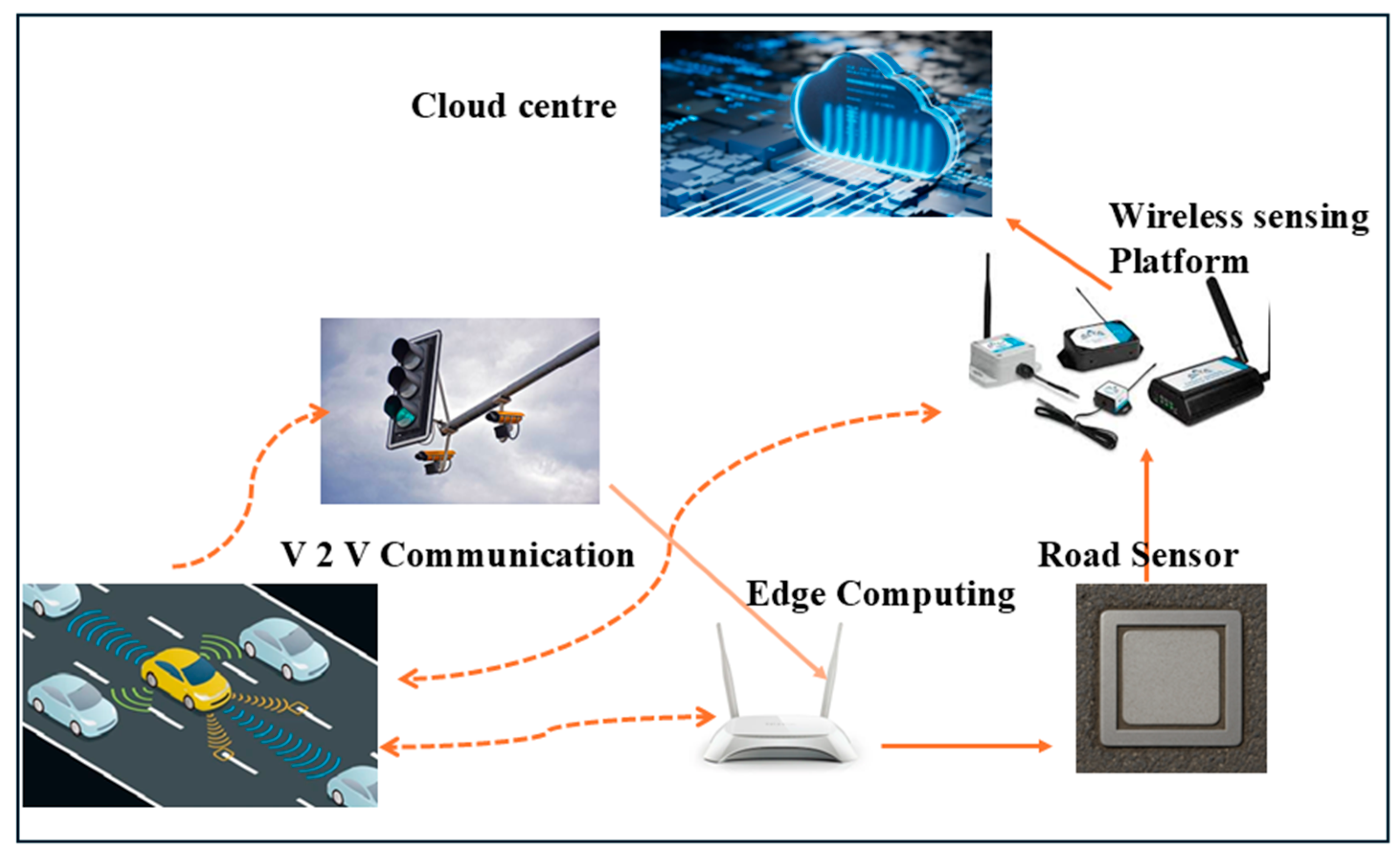
Figure 2.
Wireless Transmission and Technological challenges.
Disclaimer/Publisher’s Note: The statements, opinions and data contained in all publications are solely those of the individual author(s) and contributor(s) and not of MDPI and/or the editor(s). MDPI and/or the editor(s) disclaim responsibility for any injury to people or property resulting from any ideas, methods, instructions or products referred to in the content. |
© 2025 by the authors. Licensee MDPI, Basel, Switzerland. This article is an open access article distributed under the terms and conditions of the Creative Commons Attribution (CC BY) license (http://creativecommons.org/licenses/by/4.0/).
Copyright: This open access article is published under a Creative Commons CC BY 4.0 license, which permit the free download, distribution, and reuse, provided that the author and preprint are cited in any reuse.


