

Submitted:
07 August 2025
Posted:
08 August 2025
You are already at the latest version
Abstract
Energy consumption in the industrial sector accounts for a substantial share of global energy usage, leading to increasing interest in solutions that can optimize efficiency and reduce operational costs. Advances in the Internet of Things (IoT) and Artificial Intelligence (AI), including Machine Learning (ML), offer powerful ways to monitor industrial systems, perform predictive analytics, and integrate renewable resources into manufacturing and power distribution processes. This paper reviews the state-of-the-art in AI and IoT for energy conservation within industrial settings. It discusses key applications such as real-time monitoring and control, AI-based optimization, predictive maintenance, and energy theft detection. The review concludes by highlighting challenges, including data heterogeneity and scalability, and proposes future directions such as federated learning, quantum-enhanced optimization, and robust ethical frameworks.
Keywords:
AI
; IoT
; energy conservation
; industrial sector
; predictive maintenance
1. Introduction
The industrial sector is a primary consumer of energy globally, encompassing diverse activities like manufacturing, mining, and construction, as well as emerging robotic applications in agriculture [18]. Growing environmental concerns and cost pressures have placed a premium on developing sustainable energy strategies [26]. Over the last decade, IoT and AI have emerged as powerful technologies to address inefficiencies in industrial energy usage [19].
IoT devices, including sensors and actuators, enable real-time data collection, giving plant managers unprecedented visibility into energy flows [21]. AI techniques, particularly ML and deep learning, can then analyze these data streams to optimize resource allocation, detect anomalies, and predict maintenance needs before costly failures occur [16]. Furthermore, advanced cloud infrastructures facilitate large-scale data processing, helping to integrate AI-driven insights into existing industrial processes [7].
This review synthesizes recent research on the use of AI and IoT for energy conservation in industrial contexts, covering topics from sensor-based monitoring and control to deep learning architectures for advanced analytics. Challenges such as data integration, ethical considerations, and scaling to heterogeneous industrial environments are also addressed, along with emerging trends in federated learning and quantum computing that promise to reshape the future of industrial energy management [8,12].
Figure 1.
Timeline: AI and IoT Technologies.

2. Literature Review

Table 1.
Systematic Literature Review.
| Approach | Key Findings | Relevance |
| IoT architectures for smart energy grids | Provided frameworks for real-time data ingestion and control in large-scale energy systems [23] | Emphasizes the role of IoT in collecting granular data for optimizing power usage in industrial settings |
| AI-driven predictive maintenance in manufacturing | Achieved a 30% reduction in manufacturing downtime using ML-based anomaly detection [16] | Demonstrates how AI can proactively identify operational inefficiencies, reducing both energy consumption and downtime |
| Machine learning for energy consumption forecasting | Showed that ML approaches outperform traditional models in predicting energy loads [20] | Helps industrial plants schedule resource usage more effectively, minimizing peak demand and overall energy expenditure |
| IoT-based smart plug systems for energy conservation | Reported up to 20% reduction in residential energy consumption through adaptive control [22] | Though focused on residential use, illustrates IoT’s potential for industrial demand management through similar real-time monitoring and control |
| Data analytics in power systems for renewable integration | Highlighted AI-based scheduling for integrating renewables into large power grids [23] | Relevant for industrial sectors increasingly incorporating solar, wind, or other renewables, enabling more efficient and stable energy supply |
| AI-driven industrial energy optimization | Demonstrated that AI-based systems can automate load distribution and reduce operational costs [24] | Showcases optimization techniques that can be applied to lower energy use and expenses in various industrial processes |
| AI-based energy theft detection in smart grids | Collaborative approach reduced non-technical losses by flagging anomalous consumption patterns [25] | Addresses the issue of industrial energy theft, underscoring the importance of AI in safeguarding industrial power systems and reducing revenue losses |
| Neural architecture search (NAS) for edge devices in energy conservation | Enabled resource-efficient deep learning models suitable for IoT-based monitoring [28] | Suggests how pruning and architecture search can reduce model size for real-time industrial deployment on edge devices |
| Hybrid cloud strategies for scalable AI workloads | Proposed scalable cloud solutions and cost management approaches for large-scale IoT and AI data processing [7] | Industrial energy systems can leverage hybrid clouds to process data from multiple facilities efficiently, balancing performance and cost |
| Neural network pruning techniques | Achieved substantial model compression (up to 90%) with minimal accuracy loss [11] | Facilitates real-time analytics on resource-limited industrial devices, enhancing the feasibility of deploying AI models for energy monitoring |
| Transfer learning methods (NLP domain) | Demonstrated reduced data requirements for new tasks by transferring knowledge from large pretrained models [4] | Potentially applicable for industrial energy tasks where labeled data may be limited; accelerates AI model adaptation across different factory environments |
| Reinforcement learning (RL) for robotic manipulation | Showed that RL is effective in adapting control policies in dynamic, real-time environments [5] | Could be adapted for industrial process control and energy efficiency, allowing rapid response to changing conditions (e.g., batch process manufacturing) |
| Blockchain for supply chain management | Highlights blockchain’s potential for transparency and traceability in supply chains [13] | Could be extended to industrial energy supply chains to ensure accountability and reduce fraud; scalability challenges remain |
3. Challenges and Future Trends
A key challenge in the industrial sector is dealing with data integration and heterogeneity. Manufacturing facilities often rely on a mosaic of data sources—from legacy machinery to modern IoT sensors, as well as external energy market data. This diversity complicates data fusion and can necessitate sophisticated integration platforms or strict standardization [9]. Future interoperability frameworks, possibly championed by industry consortia or open-source communities, aim to reduce complexity and foster scalability.
In terms of privacy and security, many industrial settings face serious risks, such as cyberattacks targeting critical infrastructure. While AI-driven methods can detect theft or unauthorized access, robust governance frameworks are still crucial for safeguarding data and protecting intellectual property [8,13]. Future approaches will likely include end-to-end encryption, advanced authentication, and policy frameworks that enforce stringent controls on industrial data collection and use.
Scalability and compute constraints also pose significant concerns. Large-scale facilities generate enormous volumes of time-series data that demand real-time processing [28,11]. Neural network pruning and federated learning are among the strategies to manage computational loads while maintaining performance [12].
Quantum computing, while still constrained by hardware limitations, is another avenue for large-scale optimization [10]. Researchers anticipate breakthroughs using quantum annealing and variational quantum eigen solvers (VQEs) for complex tasks like multi-plant coordination and production scheduling as technology matures.
Finally, ethical and regulatory considerations must not be overlooked. Incorporating AI into industrial processes raises concerns about transparency, fairness, and accountability for automated decisions [1]. Emerging guidelines and regulations will likely shape how industries adopt these technologies responsibly. Notably, frameworks in other domains—such as named entity recognition in sensitive data [1] or sparse techniques for deep generative models [6]—show that interpretability and robust governance are critical cross-sector.
Meanwhile, advanced battery technologies, typically discussed in the context of electric vehicles, could offer on-site energy storage for industrial applications [15,27]. Autonomous robotics, drawn from fields like agriculture or vehicle automation, also highlight how data from multiple sensors can be integrated for real-time decisions [2,9,18]. Gamified approaches, though more common in pro-environmental education, might encourage workforce engagement in energy-saving practices [29]. Further, AI- and IoT-based solutions in other sectors, such as hospitality [30], signal how cross-industry adoption may spur innovative strategies in manufacturing.
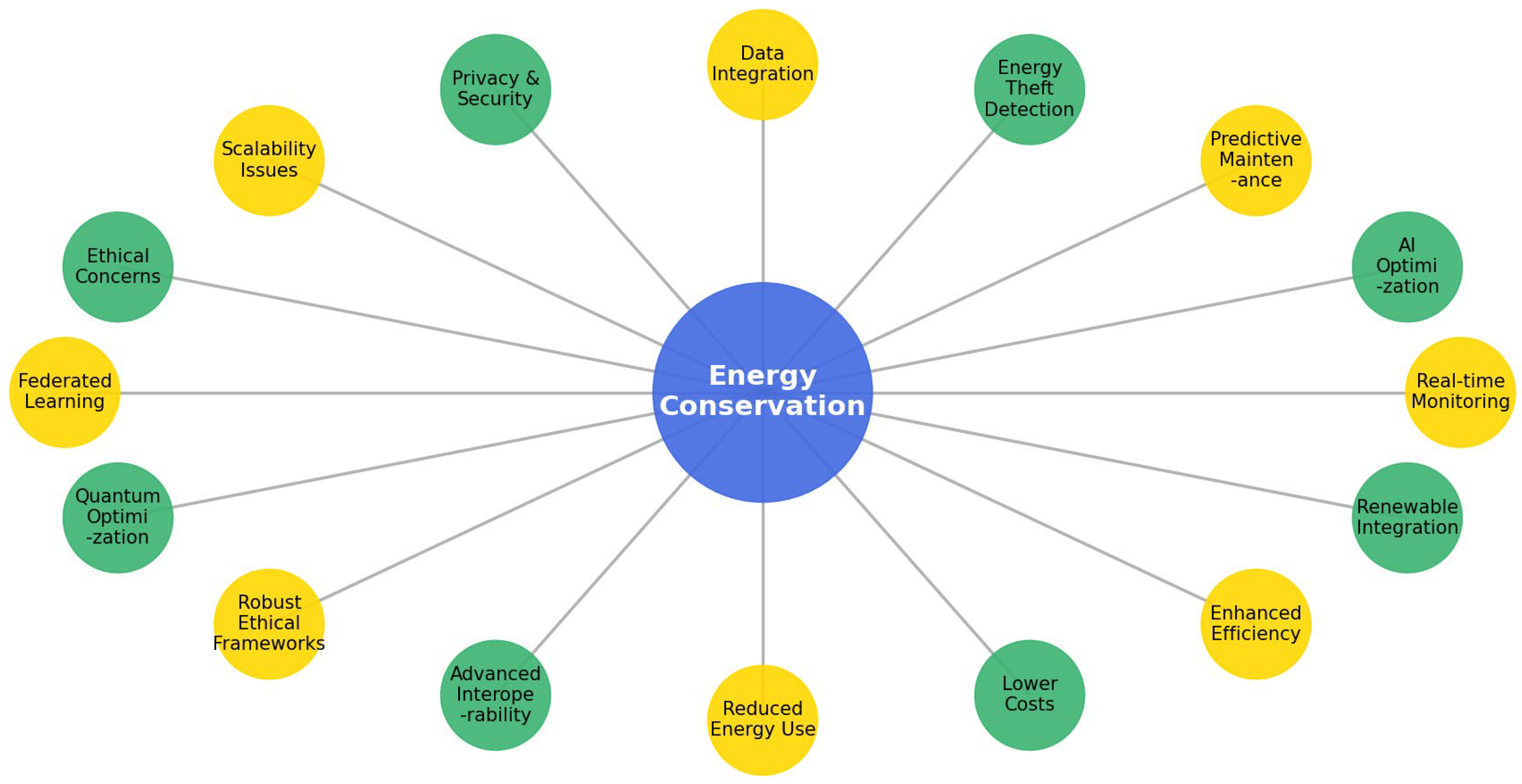
Figure 2.
Methods of Energy Conservation.
4. Conclusions
AI and IoT have become indispensable tools for energy conservation in the industrial sector, combining real-time data collection with predictive analytics and automated control. IoT platforms provide granular insight into industrial processes, while AI algorithms—ranging from traditional machine learning to deep learning and reinforcement learning—enable precise interventions that reduce waste, lower costs, and boost operational efficiency.
Despite challenges related to data heterogeneity, privacy, and infrastructure, promising advances in federated learning, quantum computing, and secure blockchain frameworks point toward a transparent and sustainable industrial landscape. As collaboration among academia, industry, and policymakers grows, AI and IoT solutions will continue to evolve, further optimizing how energy is produced, distributed, and consumed in industrial settings.
References
- Munnangi, M. A brief history of named entity recognition. arXiv, 2024; arXiv:2411.05057. [Google Scholar]
- Ji, C.; Shen, H.; Xiong, Z.; Chen, F.; Zhang, M.; Yang, H. Prototypical Model with Novel Information-theoretic Loss Function for Generalized Zero Shot Learning. arXiv, 2021; arXiv:2112.03134. [Google Scholar]
- Griffioen, N.; Rankovic, N.; Zamberlan, F.; Punith, M. Efficient annotation reduction with active learning for computer vision-based Retail Product Recognition. Journal of Computational Social Science 2024, 7, 1039–1070. [Google Scholar] [CrossRef]
- Alyafeai, Z.; AlShaibani, M.S.; Ahmad, I. A survey on transfer Learning in Natural Language Processing. arXiv arXiv:2007.04239, 2020.
- Kilinc, O.; Montana, G. Reinforcement learning for robotic manipulation using simulated locomotion demonstrations. Machine Learning 2021, 111, 465–486. [Google Scholar] [CrossRef]
- Zhu, J.; Yang, C.; Zheng, K.; Xu, Y.; Shi, Z.; Shen, Y. Exploring sparse MOE in GANs for text-conditioned image synthesis. arXiv, 2023; arXiv:2309.03904. [Google Scholar]
- Chen, D.; et al. Transforming the hybrid cloud for emerging AI workloads. arXiv, 2024; arXiv:2411.13239. [Google Scholar]
- Kaur, M. Exploring the ethical implications of AI algorithms in Decision-Making Systems. 2024.
- Bathla, G.; et al. Autonomous vehicles and intelligent automation: Applications, challenges, and opportunities. Mobile Information Systems 2022, 2022, 1–36. [Google Scholar] [CrossRef]
- Abbas, A.; et al. Challenges and opportunities in quantum optimization. Nature Reviews Physics 2024. [CrossRef]
- Chee, J.; Renz, M.; Damle, A.; Christopher, D.S. Model preserving compression for neural networks. arXiv, 2021; arXiv:2108.00065. [Google Scholar]
- Oh, W.; Nadkarni, G.N. Federated Learning in Health care Using Structured Medical Data. Advances in Kidney Disease and Health 2023, 30, 4–16. [Google Scholar] [CrossRef] [PubMed]
- Liu, R.; Ran, W.; Liu, S. Blockchain Technology Applied to Supply Chain Management: A Systems’ Analysis. Mobile Information Systems 2023, 2023, 1–23. [Google Scholar] [CrossRef]
- R. C. K; KC, S.; V. K. R, “Personalized Recommendation Systems (PRES): A comprehensive study and research issues. International Journal of Modern Education and Computer Science 2018, 10, 11–21. [Google Scholar] [CrossRef]
- “Advancements in Battery Technology for Electric Vehicles: A Comprehensive analysis of recent developments. Deleted Journal 2023, 1–28. [CrossRef]
- Keleko, A.T.; Kamsu-Foguem, B.; Ngouna, R.H.; Tongne, A. Artificial intelligence and real-time predictive maintenance in industry 4.0: A bibliometric analysis. AI And Ethics 2022, 2, 553–577. [Google Scholar] [CrossRef]
- Ariai, F.; Demartini, G. Natural Language Processing for the legal domain: A survey of tasks, datasets, models, and challenges. arXiv, 2024; arXiv:2410.21306. [Google Scholar]
- Cheng, C.; Fu, J.; Su, H.; Ren, L. Recent Advancements in agriculture Robots: Benefits and challenges. Machines 2023, 11, 48. [Google Scholar] [CrossRef]
- “Internet of Things: A survey on enabling technologies, protocols, and applications. IEEE Journals & Magazine | IEEE Xplore 2015. https://ieeexplore.ieee.org/document/7123563.
- Shin, J.; Moon, H.; Chun, C.-J.; Sim, T.; Kim, E.; Lee, S. Enhanced data processing and machine learning techniques for energy consumption forecasting. Electronics 2024, 13, 3885. [Google Scholar] [CrossRef]
- “Smart home energy management, using IoT system. IEEE Conference Publication | IEEE Xplore 2019. https://ieeexplore.ieee.org/document/8734979.
- Oh, J. IoT-Based smart plug for residential energy Conservation: An empirical study based on 15 months’ monitoring. Energies 2020, 13, 4035. [Google Scholar] [CrossRef]
- Krioukov, A.; Goebel, C.; Alspaugh, S.; Chen, Y.; Culler, D.E.; Katz, R.H. Integrating renewable energy using data Analytics Systems: Challenges and opportunities.. IEEE Data(Base) Engineering Bulletin 34, pp. 3–11, Jan. 2011, [Online]. Available: http://sites.computer.org/debull/A11mar/IntegratingRenewableEnergy_final1.pdf.
- Okuyelu, O.; Adaji, O. AI-Driven real-time quality monitoring and process optimization for enhanced manufacturing performance. Journal of Advances in Mathematics and Computer Science 2024, 39, 81–89. [Google Scholar] [CrossRef]
- Mbey, C.F.; Bikai, J.; Souhe, F.G.Y.; Kakeu, V.J.F.; Boum, A.T. Electricity theft detection in a smart grid using hybrid Deep Learning-Based data analysis technique. Journal of Electrical and Computer Engineering 2024, 2024. [Google Scholar] [CrossRef]
- Lu, Y.; Khan, Z.A.; Alvarez-Alvarado, M.S.; Zhang, Y.; Huang, Z.; Imran, M. A Critical review of sustainable energy Policies for the promotion of renewable energy sources. Sustainability 2020, 12, 5078. [Google Scholar] [CrossRef]
- Farman, M.K.; Nikhila, J.; Sreeja, A.B.; Roopa, B.S.; Sahithi, K.; Kumar, D.G. AI-Enhanced Battery Management Systems for electric Vehicles: Advancing safety, performance, and longevity. E3S Web of Conferences 2024, 591, 04001. [Google Scholar] [CrossRef]
- Speckhard, D.T.; Misiunas, K.; Perel, S.; Zhu, T.; Carlile, S.; Slaney, M. Neural architecture search for energy efficient always-on audio models. arXiv, 2022; arXiv:2202.05397. [Google Scholar]
- Ouariachi, T.; Li, C.-Y.; Elving, W.J.L. Gamification Approaches for Education and Engagement on Pro-Environmental Behaviors: Searching for Best Practices. Sustainability 2020, 12, 4565. [Google Scholar] [CrossRef]
- Gajić, T.; Petrović, M.D.; Pešić, A.M.; Conić, M.; Gligorijević, N. Innovative approaches in hotel management: Integrating artificial intelligence (AI) and the internet of things (IoT) to enhance operational efficiency and sustainability. Sustainability 2024, 16, 7279. [Google Scholar] [CrossRef]
- Bhardwaj, E.A.K. Social Innovation in the Algorithmic Mind: Navigating the psychological landscape of artificial intelligence reimagined. International Journal on Recent and Innovation Trends in Computing and Communication 2023, 11, 4527–4534. [Google Scholar] [CrossRef]
Disclaimer/Publisher’s Note: The statements, opinions and data contained in all publications are solely those of the individual author(s) and contributor(s) and not of MDPI and/or the editor(s). MDPI and/or the editor(s) disclaim responsibility for any injury to people or property resulting from any ideas, methods, instructions or products referred to in the content. |
© 2025 by the authors. Licensee MDPI, Basel, Switzerland. This article is an open access article distributed under the terms and conditions of the Creative Commons Attribution (CC BY) license (https://creativecommons.org/licenses/by/4.0/).
Copyright: This open access article is published under a Creative Commons CC BY 4.0 license, which permit the free download, distribution, and reuse, provided that the author and preprint are cited in any reuse.


