

Submitted:
31 July 2025
Posted:
01 August 2025
You are already at the latest version
Abstract
Film and television play a key role in shaping cultural perceptions of disability, yet they often rely on recurring stereotypes that may reinforce stigma and exclusion. While schol-arly interest in this issue has grown, academic literature remains fragmented and lacks a comprehensive synthesis. This critical review examines how disability is represented through stereotypical portrayals in narrative audiovisual media, specifically scripted films and television series. It synthesizes peer-reviewed studies that explicitly analyze these representations and their narrative or sociocultural functions. The review identifies dominant tropes, theoretical frameworks, and disciplinary approaches while offering a qualitative synthesis of key trends and findings. Although persistent stereotypes remain prevalent, the review also highlights a growing presence of more inclusive and complex portrayals that challenge traditional norms. By providing a structured overview of exist-ing research, this study contributes to a better academic understanding of how disability is portrayed on screen and supports efforts to foster more inclusive and accurate repre-sentations in popular media.
Keywords:
disability representation
; media stereotypes
; critical review
; film and television
; inclusive portrayals
1. Introduction
1.1. Audiovisual Media and Social Construction
We are currently in the golden age of television fiction and cinema. The growing volume of productions, together with globalization, the internet, and streaming platforms, has amplified the impact of audiovisual products and their capacity to shape habits and social customs [1]. Furió Alarcón [2] argues that this impact is rooted in cinema’s ability to convey messages that gradually influence individual opinions and, over time, society as a whole.
García Amilburu et al. [3] describe a film as a sequence of shots that conveys a discourse about reality. Goyes Narváez [4] expands on this idea, emphasizing that audiovisual culture goes far beyond the use of technology or storytelling; it reconfigures reality through the production of images, sounds, and narrative structures that shape how individuals perceive themselves and others.
In the digital era, audiovisual media connects science, art, and technology, stimulating imagination and generating new knowledge that affects social imaginaries [4].Thus, cinema and reality maintain a bidirectional relationship: cinema serves artists as a medium to portray reality, while reality itself is influenced by the norms, values, behaviors, and social models proposed by films and television series [1].
Domingo Moratalla [5], analyzing Julián Marías’ work, states that cinema allows viewers to “gain life experience,” bringing them closer to diverse contexts while providing escapism and comfort [5]. He highlights its potential for human experimentation, for playing with possibilities, and its strong educational value [5]. This potential, combined with more realistic representations, may help counteract stereotypes and foster the inclusion of people with disabilities.
Images, meanwhile, have been a key element in the social, cultural, and economic development of societies from the late 20th century to the present. Within audiovisual culture, what we consume visually not only stimulates us but also shapes behaviors, consolidates habits, and contributes to the formation of personal and social imaginaries, often reinforcing preexisting stereotypes [6]. In audiovisual content creation, elements such as color, light, and music play decisive narrative roles that intensify the conveyed message. For example, color can trigger automatic responses in viewers, and some theorists even argue that certain colors act as somatic triggers [7]. These formal decisions, although subtle, directly influence how viewers interpret and emotionally engage with narratives, affecting how disability and other social issues are portrayed on screen.
1.2. Representation and Discourse in Audiovisual Works
Cinema and the messages conveyed through images can function as tools of social control, as many productions have portrayed specific groups as threats, depicting them as villains within a dichotomous “good versus evil” framework [8]. This conception of cinema as a shaper of reality is reinforced by Aguilar Carrasco [9], who argues that we are not born with a predefined ideology or ethical system; rather, these are constructed from imaginaries and symbols generated by humanity and, particularly, by our immediate environment. This environment—which includes family, friends, schools, laws, media, and audiovisual narratives—transmits values that operate visually and implicitly, making them difficult to detect rationally. Even when viewers are aware that it is fiction, its impact persists, as cinema teaches us how to interpret our own reality, what is acceptable or not, how we should act, and even with whom we should or should not interact [9].
From this perspective, it becomes essential to address the role of stereotypes in shaping social imaginaries. Lippmann, as cited in Lombardinilo [10] (p. 234), defines stereotypes as:
An ordered, more or less consistent image of the world, to which our habits, tastes, capacities, comforts, and hopes have adjusted.
This conceptualization highlights the structuring power of stereotypes as cognitive frameworks that simplify social reality and reinforce preexisting belief systems. Understanding how media discourses operate as mechanisms of symbolic construction raises the fundamental question of this study: How is disability represented in these audiovisual narratives?
1.3. Theoretical Models of Disability and Their Impact on Representation
There are various perspectives on disability, including the individual, medical, social, biopsychosocial, and functional diversity models, the latter prioritizing abilities over limitations [11]. This study adopts the definition promoted by CERMI, which supports the use of the term “person with a disability” from a legal and sociological perspective, rejecting euphemistic or stigmatizing expressions [12].
We position ourselves within the biopsychosocial model, aligned with the International Classification of Functioning, Disability and Health (ICF) developed by the WHO. This framework allows for the classification of health-related factors that influence human functioning and disability [13]. However, despite legislative progress, society continues to perceive disability predominantly through the medical or rehabilitative model, which favors representations focused on demonstrating “worth” through exceptionality, neglecting its social dimension [14].
From this perspective, representations of people with disabilities in audiovisual works tend to be unrealistic and stereotyped, reinforcing ableist views [14]. Ableism, as a system of oppression, imposes a single vision of the “functional” body, limiting the rights and spaces of those who do not conform to that norm or hegemonic characteristics [15]. This bias is present in social relationships, within families, in educational and cultural institutions, and in the media [15].
Within this framework, Robbins [16] analyzes how cinema employs “narrative prostheses” (editing, camera work, sound, lighting) that allow viewers to construct an image of disability, in the same way that some people with disabilities use physical prostheses. This audiovisual construction influences social perceptions of normality and difference.
Beyond explicit content, narrative and aesthetic forms also play a role. Hyperrealistic representations may reinforce stigmas, whereas more symbolic or stylized portrayals open spaces for critique and resignification [17].
1.4. Need for a Scoping Review
Despite the growing interest in the representation of disability in the media, there is still no systematic review synthesizing the stereotypes present in film and television. Most available studies focus on specific genres, characters, or productions, which makes it difficult to obtain a global view of the phenomenon. Moreover, the diversity of theoretical frameworks employed generates fragmentation, preventing the construction of a coherent narrative about the stereotypes shaping social imaginaries. This dispersion highlights the need for a scoping review that identifies the most recurrent themes in audiovisual representations, the predominant theoretical frameworks, and existing research gaps.
This review differs from studies such as that of ter Haar et al. [18], which focus on the lived experiences of people with disabilities regarding their public representation. While that study analyzes subjective perceptions of social discourses, the present work examines audiovisual products themselves as narrative objects. By analyzing the content—film and television—it aims to identify common stereotypes, how they are conceptualized in the literature, and the shared characteristics of disability representations. Thus, both approaches complement each other: one analyzes the impact of representations, while the other focuses on their construction.
We therefore start from the hypothesis that the representation of characters with disabilities in audiovisual media significantly influences the construction of social imaginaries, either by reinforcing stereotypes or by promoting inclusive attitudes, thereby shaping how non-disabled people relate to the disability community.
2. Materials and Methods
2.1. Study Design and Theoretical Framework
A scoping review is the most appropriate methodology for this purpose, as it allows for systematically mapping a broad field without being restricted to critically assessing the methodological quality of the included studies, while maintaining standardized protocols for study inclusion and exclusion [19]. This approach is particularly useful for examining how stereotypes related to disability have been studied in audiovisual media and for establishing a foundation to guide future research.
We conducted this scoping review following the PRISMA Extension for Scoping Reviews (PRISMA-ScR) checklist proposed by Tricco et al. [20], based on the methodology outlined by Arksey and O’Malley [21] and later refined by Levac et al. [22]. This framework suggests five steps for conducting scoping reviews: (1) identifying the research questions; (2) identifying relevant studies; (3) selecting the studies; (4) charting the data; and (5) collating, summarizing, and reporting the results. Additionally, it encourages adopting a more reflexive stance rather than limiting the review to a purely quantitative description of the data obtained [22].
2.2. Identification of Research Questions
The purpose of our study is to identify which stereotypes have been used to represent people with disabilities in audiovisual works according to existing academic literature. To achieve this objective, we address the following research questions: (1) What stereotypes have been identified in the representations of characters with disabilities in audiovisual media? (2) What theoretical and conceptual approaches have been used to analyze these representations? (3) What genres, themes, and character traits predominate in audiovisual works representing disability? (4) What gaps or limitations does the literature identify regarding the representation of disability in audiovisual products?
2.3. Search Strategy
The search terms were structured around two main elements: the population and the key concepts. The population comprised academic studies focused on characters with disabilities and their representations in audiovisual works, whether films or television series. No restrictions were applied regarding the type of disability represented, including physical, sensory, intellectual, or psychosocial conditions.
Regarding the key concepts, the studies had to focus on the media representation of disability, emphasizing stereotypes, visual or symbolic discourses influencing social perception. Research addressing ableism and the narrative use of disability was also included.
Concerning the context, this study was limited to narrative audiovisual productions in film and television (movies, series, soap operas, and miniseries), excluding video games, documentaries, reality shows, news content, social media, or literature.
The search strategy was designed to identify relevant studies in both Spanish and English, using Boolean operators such as “AND” and “OR,” and adapting the key terms to the technical specifications of each database.
The searches were conducted in June 2025 in a structured manner across Scopus, Web of Science (WOS, all available collections), and ERIC. These sources were selected due to their scope, academic quality, multidisciplinary coverage, and their ability to retrieve both consolidated literature and recent studies not yet formally indexed.
For each research question, a specific search string was developed with the support of artificial intelligence tools (ChatGPT), resulting in a total of 12 strings (see Table 1).
Additionally, a complementary manual search was carried out to ensure the exhaustiveness of the corpus, using broader terms such as “disability,” “representation,” and “film and stereotypes.” Citation tracking and reference checking of the included studies were also performed.
In total, 58 articles were retrieved through this manual search, which were included in the screening process under the same conditions as those retrieved from the databases (a total of 960 records before applying filters).
2.4. Study Selection Process
The study selection process was organized into several consecutive stages carried out by the three authors, combining automated filters with manual screening according to the predefined inclusion and exclusion criteria (Table 2).
The initial automatic filtering of search results limited the records to English and Spanish languages, open access, and a time frame between 2015 and 2025. This preselection reduced the records from 960 to 180 (from databases) and from 58 to 41 (from the manual search), resulting in a total of 221 records. This phase ensured linguistic, temporal, and access relevance. The methodological decision to limit the time frame was based on the increase in audiovisual productions featuring characters with disabilities since the 2010s, as noted by García-Borrego and González-Cortés [23].
Subsequently, all results were exported to Mendeley to remove duplicates, reducing the corpus to 172 studies (131 from databases and 41 from the manual search). A two-phase manual review was then conducted: first titles and abstracts, followed by full-text screening. Each author independently reviewed the studies to minimize the risk of bias, achieving 97.7% agreement (168 texts), and disagreements were resolved by consensus.
Eligible studies included research using qualitative, quantitative, or mixed methods analyzing representations of disability, stereotypes, or visual discourses, including conceptual frameworks such as ableism or disability models. Studies focusing solely on subjective perceptions without analyzing audiovisual content, as well as publications lacking empirical grounding, duplicates, incomplete, or inaccessible works, were excluded.
Only peer-reviewed studies were included. In the case of gray literature, only doctoral theses available in institutional repositories were considered, excluding undergraduate or master’s theses.
During the manual review of titles, 90 studies were excluded. Of the 82 remaining abstracts, 40 were removed for the following reasons: 22 did not address audiovisual representations of disability, 14 analyzed other types of media, 2 were master’s theses, and 2 lacked a clear methodology.
A total of 42 full-text studies were assessed. Three were excluded: one was inaccessible, and two doctoral theses could not be processed in MAXQDA. Finally, 39 studies were included in the synthesis. These are marked with an asterisk (*) in the references.
2.5. Data Selection and Extraction
After completing the review of the included studies, key bibliographic information (authorship, year, country, journal, and SJR quartile) was extracted into an Excel spreadsheet as part of the PRISMA record. These data are presented in the Results section.
In addition, MAXQDA software was used to qualitatively analyze the corpus, coding aspects such as the type of disability represented and recurrent stereotypes. Coding was performed manually, combining a deductive approach—based on the theoretical framework and research questions—with openness to emerging categories identified during reading.
2.6. Collating, Summarizing, and Reporting the Results
A qualitative thematic analysis was conducted to synthesize the content of the included studies, aiming to identify and group the main representation patterns in the analyzed audiovisual works. Coding was carried out in MAXQDA, primarily following a deductive approach guided by the theoretical framework, while remaining open to emerging subcategories.
The studies were classified according to audiovisual production type, genre, methodology, disability represented, identified stereotypes, conceptual frameworks used, and other relevant communicative aspects. This coding enabled the construction of a structured narrative of accumulated knowledge about stereotypes of disability in film and television.
Across the 39 analyzed studies, 875 coded segments were identified. Figure 2 shows the thematic structure used during the coding process. Additionally, artificial intelligence (specifically ChatGPT) was used solely as a support tool to generate preliminary drafts of the coding matrix, which were fully reviewed and refined by the researchers.
3. Results
This section presents the findings obtained from the review of the 39 articles included in the analysis. After an initial overview detailing the characteristics of the selected studies, the results are organized into thematic blocks that address our research questions. The thematic coding developed in MAXQDA allowed us to structure the corpus around analytical categories linked to these questions, including the characteristics of the studies, the types of disability represented, the identified stereotypes, and the theoretical frameworks used to analyze these representations. This organization aims to provide a comprehensive and systematic view of how disability is represented in audiovisual works, as well as the ideological frameworks shaping these representations.
3.1. Characteristics of the Studies
A total of 39 studies were analyzed in the final synthesis (marked with an asterisk in the reference list). These works cover a publication period between 2015 and 2025 and examine representations of disability in narrative audiovisual products, mainly films and television series. The studies show notable geographical and methodological diversity and have been published in peer-reviewed scientific journals with varying levels of indexation according to the SJR quartile.
Table 3 presents the main bibliographic characteristics of the included studies, organized by authorship, country of the journal’s publication, analyzed medium, type of disability represented, journal title, and SJR quartile (when applicable).
As shown in Table 3, the final corpus of 39 studies presents considerable geographical and contextual diversity. The articles analyze works from a total of 17 countries, with Spain (n = 10), the United States (n = 9), the United Kingdom (n = 8), and India (n = 5) being the most represented. Most studies originate from middle- to high-income contexts, which may influence the cultural frameworks from which disability representation is approached.
Regarding language, English predominates, particularly in studies published in indexed journals. However, Spanish-language articles from Spain and Latin America were also included, enriching the linguistic diversity of the corpus.
With respect to the indexing level of the journals according to the SJR indicator, 85% of the reviewed articles were published in journals with an identified quartile: 10 studies in quartile 1 (Q1), 15 in quartile 2 (Q2), 6 in quartile 3 (Q3), and 2 in quartile 4 (Q4). In six cases, it was not possible to determine the quartile due to a lack of updated information or publicly available data.
3.2. Stereotypes of Disability in Audiovisual Media
One of the central questions of this scoping review was to identify the most frequent stereotypes in the representation of disability in films and television series. To this end, the descriptions and critical assessments provided by the studies about the represented characters were analyzed, thematically coding these references using MAXQDA (see Figure 3).
A total of 21 different stereotypes—both negative and positive—were identified. The most recurrent was the Supercrip stereotype (n = 14), which portrays people with disabilities as heroic figures who overcome their limitations through individual effort, even acquiring extraordinary abilities. Although sometimes perceived as positive, this figure reinforces ableism by requiring exceptional achievements to grant social value [24,25,26]. This archetype is common in superhero films or in stories where characters possess supernatural abilities that “compensate” for their disability [24,27,28].
Also with 14 mentions, the stereotype of people with disabilities as monstrous, dangerous, or dehumanized figures stands out, associated with villains, criminals, or unstable individuals, as noted by Álvarez Ramírez, Solís García, and Kramer [15,29,30]. Some characters, such as the antagonist in Don’t Breathe, are not even given names, as Wischert-Zielke [31] points out, which accentuates their depersonalization.
The third most frequent stereotype, with 13 mentions, was the representation of disability as a source of inspiration for non-disabled people. In this pattern, characters are used as catalysts for others’ personal growth, as reported by Maestre Limiñana, Gauci and Callus, and Lopera-Mármol et al. [25,32,33,34].
The stereotype of the unsexualized character (n = 12) reflects the presumed inability to engage in romantic or sexual relationships, often overlapping with the “sweet innocent” figure (n = 11). Examples can be found in Oasis [35] and in analyses of the original version of The Little Mermaid [36].
Another frequent pattern was that of the passive victim (n = 12), depicted as defenseless or resigned to their fate [37,38,39]. Related to this is the stereotype of disability as a burden on the surrounding environment, especially within the family context [40,41,42].
Finally, the stereotype of the person with a disability whose death is seen as a narrative resolution was identified, as in The Sea Inside, where the disabled body is portrayed as a prison [25].
Overall, these stereotypes reveal a narrative focused on exceptionality, suffering, or otherness, which reinforces ableist imaginaries. Although some authors highlight progress toward more positive representations, the identified patterns reflect limited diversity and emphasize the need for more inclusive and complex discourses [39].
3.3. Theoretical and Conceptual Approaches
The second research question focused on identifying the theoretical approaches used to analyze audiovisual representations of disability. Although the frameworks were diverse, two lines of analysis stood out for their frequency and cross-cutting relevance (Figure 4).
The most frequent approach is ableism, explicitly mentioned in 12 of the analyzed documents. On multiple occasions, it is further highlighted through its more critical perspective, the queer-crip approach, cited in several studies within the corpus, such as those by García León and García León [43,44]. As discussed in the theoretical framework, ableism refers to social, institutional, political, cultural, and educational structures that discriminate against people with disabilities for the mere fact of “being.” This approach emphasizes how audiovisual products legitimize the duality between people with and without disabilities, privileging bodily and cognitive normativity. In some cases, it is complemented by references to the social model of disability, which shifts the focus from the body to the environment and symbolic barriers.
Other works rely on concepts such as the disabled body or the notion of narrative prosthesis (Figure 5) to interpret the role of disability in the plot as a symbolic or structural resource, appearing 12 times across all studies. These approaches highlight how disability functions as a metaphor, obstacle, or element of narrative transformation. Studies such as those by Wang-Xu [45] or Biernoff [46] explore how the disabled body is constructed as the “other” within visual frameworks that reproduce binaries between normality and deviance.
Finally, although not included due to temporal criteria, Martin F. Norden was cited in eight studies as a key reference in film analysis of disability.
3.4. Genres, Themes, and Character Traits
The third research question addressed the genres of the productions, themes, and characters. In the reviewed studies, no specific emphasis was placed on the personal characteristics of the characters; therefore, this section discusses the type of production (whether films, series, or both), the film industry (e.g., analyses of Hindi cinema, Western cinema, or independent productions), the genre of the audiovisual work analyzed, and the type of disability represented.
Most studies examined films (n = 24), followed by television series (n = 8) and combined analyses (n = 2) [47]. The remaining five studies did not specify the type of production, focusing instead on character analysis itself (Figure 6).
Regarding origin, 26 productions were Western, 7 came from Hindi or Arab industries, and 3 were independent. The remaining 3 studies focused on identifying characters with specific types of disabilities, without specifying the industry of the productions analyzed [48,49,50] (Figure 7).
Regarding genre, dramatic productions predominated (n = 12), followed by comedies (n = 9), children’s films (n = 4), science fiction (n = 3), action/adventure and coming-of-age (n = 2 each), and finally mystery and horror (n = 1). Three studies did not specify the genre (Figure 8).
Finally, the most frequently represented type of disability was physical disability (n = 17), followed by intellectual and sensory disabilities (n = 11 each), autism spectrum disorder (n = 9), and rare and mental illnesses (n = 5 each) (Figure 9).
3.5. Gaps and Limitations Highlighted by the Studies
As a conclusion to our research questions, many of the studies included in this review point to more positive trends in these representations, as noted by Lopera-Mármol et al. [51] and Wohlmann and Harrison [52]. However, the limited representation of certain disabilities, such as rare diseases [53] or stuttering [54], is also noteworthy. As shown in the previous section, visually recognizable disabilities, such as physical or sensory ones, predominate, to the detriment of intellectual disabilities or mental illnesses, thus continuing to reproduce negative stereotypes.
Several studies also highlight the lack of intersectionality in the analyzed narratives. Characters with disabilities are rarely portrayed as simultaneously being women, racialized individuals, LGBTQIA+, older adults, or from disadvantaged social classes. This omission reinforces a view of disability as a circumstance affecting only white, cisgender, heterosexual men from middle-class families, as indicated by Aspler et al. [42], Deb [55], and Dean and Nordahl-Hansen [49], thus failing to reflect the diversity of this phenomenon.
Regarding the research itself, some authors point out that many current studies on media representations focus on a specific type of disability [51]. There is also a lack of empirical work including representations created by members of the disability community, such as the study analyzed by Carter-Long [56]. Tharian et al. [47] stated that characters were significantly richer when their creators belonged to the community, or in the case of productions, when portrayed by actors and actresses with disabilities—a gap in the film industry also identified by Aspler et al. [42] and Zaptsi et al. [39].
These gaps highlight the need for continued research adopting broader, intersectional, and participatory approaches that can contribute to a more plural, critical, and realistic representation of disability in audiovisual media, as well as foster the artistic expression of people with disabilities [56].
4. Discussion
4.1. Main Findings
The analysis provides an overview of the current state of research on disability stereotypes in audiovisual products. Based on the synthesis of 39 studies, recurrent patterns were identified in the theoretical approaches used, the predominant narrative genres, the characteristics of the represented characters, and the main limitations of the field.
The most frequent stereotypes—such as the Supercrip, the inspirational figure, the monster, or the victim—continue to occupy a central place in disability representations. These patterns reinforce normative and ableist perspectives, in which disability is portrayed as an exceptional condition, emphasize the binary distinction between people with and without disabilities, and depict the disabled body as abject or morbid [25]. The persistence of these stereotypes confirms what several authors have noted regarding the simplifying and emotionally instrumental nature of media narratives about disability. Nevertheless, numerous more inclusive representations aimed at diverse audiences have emerged [57,58], suggesting that significant progress is indeed being made.
4.2. Predominant Theoretical Approaches
Regarding analytical approaches, most studies adopt critical perspectives linked to ableism and the social model, although there are also clear references to the rehabilitative model—addressed from a critical standpoint and emphasizing the need to avoid falling back into it.
Symbolic or narrative frameworks, such as the disabled body or narrative prostheses, were also identified, offering interpretations of how disability holds strong symbolic value. Merely by visualizing the disabled body, it can be stripped of its negative connotations and resignified as a metaphor of beauty and desire [43,45].
4.3. Genres, Themes, and Character Representation
With regard to the characteristics of works and characters, there was a clear concentration in dramatic fiction productions, with a predominance of characters with physical or sensory disabilities, consistent with the findings of García-Borrego and González-Cortés [23]. Intellectual or psychosocial disabilities, as well as intersections with gender, age, race, or social class, are scarcely represented [51,55,59], which may limit the accuracy of these portrayals or their potential use as effective educational resources, as noted by Deb [55], Ressa [41], and Solís García [29].
4.4. Identified Gaps and Future Research Directions
The included studies highlight relevant gaps: the lack of intersectional perspectives [30,38,44,51] and the limited participation of people with disabilities in creating their own stories or appearing in front of the camera [39,42,56]. These aspects open future research lines focused on access to representation, the social perspective from which these portrayals are constructed, and the need to involve the perspective of people with disabilities.
4.5. Study Limitations
This study presents some limitations inherent to the scoping review methodology. First, although studies in English and Spanish were included, the search was limited to specific academic databases and did not include literature in other languages or exhaustive searches of gray literature beyond accessible doctoral theses. This may have excluded relevant studies from other cultural or linguistic contexts.
Additionally, the analysis focused exclusively on what was reported in the included articles; therefore, the results largely depend on the approaches and level of detail provided by the cited authors.
Finally, coding and interpretation were conducted from a single research perspective, which may have influenced certain readings or thematic emphases. This was also affected by the generalization of some coding categories, possibly biased due to the impossibility of delving into minute details, despite constant efforts to systematize the information through the analytical tool employed.
5. Conclusions
This study aimed to map the current state of academic research on the representation of disability, primarily in narrative audiovisual works (mainly films and series), based on the analysis of 39 studies published between 2015 and the present, using an ad hoc coding matrix created by the three researchers.
The findings show that representations remain dominated by classic stereotypes, such as the Supercrip, the victimization of disability, or desexualization. However, the theoretical approaches used to analyze these representations are strongly critical of the rehabilitative model and ableism, reflecting an academic interest in adopting critical positions, questioning established paradigms that have shaped the field since its beginnings in the 1980s. Additionally, there is a growing line of research on the use of disability as a narrative element and on the use of disabled bodies as devices that draw the viewer’s attention by highlighting “what they are not” (while ignoring the fact that anyone could become part of this community at any point in life).
Representations continue to focus on highly visible and normatively profiled disabilities, overlooking the fact that disability is a cross-cultural and intersectional phenomenon, affecting racialized, transgender, and non-heteronormative individuals, as well as those living in low-income countries. This lack of perspective is reinforced by the fact that the Western market, particularly the American industry, is the largest producer of disability-related works, excluding other markets such as Hindi cinema or independent films.
Another major critique is the predominance of drama as the preferred genre, as it tends to favor victimizing or pitiful portrayals where the character’s entire plot revolves around their disability. Little attention is paid to what motivates these characters or what they aspire to achieve (beyond overcoming barriers imposed by their disability). In other words, the focus is often on “what they are” rather than “who they are,” without portraying the everyday lives of people with disabilities who simply want to exist without being portrayed as examples to follow or as everyday superheroes.
As a solution to this issue, several authors cited in this study, such as Carter-Long [56] and Aspler et al. [42], stress the urgent need to place people with disabilities both in front of and behind the camera, as those who live these realities are the ones best equipped to tell them realistically. While academia may not directly fulfill this premise, it can encourage more inclusive, intersectional, and contextualized research that incorporates alternative theoretical models, new voices, and narrative formats through education. For future research, we suggest developing tools that invite reflection on the role of media in shaping the social construction of disability and in generating more plural, realistic, and transformative imaginaries. Such tools could be applied to educational practices, helping to generate small changes that, ideally, may plant the seeds for structural transformation.
Author Contributions
Conceptualization, Ana Guadalupe Gallego, Camino Ferreira and Ana Rosa Arias-Gago.; methodology, Ana Guadalupe Gallego, Camino Ferreira and Ana Rosa Arias-Gago; validation, Camino Ferreira., Ana Rosa Arias-Gago.; formal analysis, Ana Guadalupe Gallego.; investigation, Ana Guadalupe Gallego.; resources, Camino Ferreira., Ana Rosa Arias-Gago.; data curation, Ana Guadalupe Gallego.; writing—original draft preparation, Ana Guadalupe Gallego.; writing—review and editing, Camino Ferreira and Ana Rosa Arias-Gago.; visualization, Ana Guadalupe Gallego.; supervision, Camino Ferreira and Ana Rosa Arias-Gago.; project administration, Camino Ferreira and Ana Rosa Arias-Gago.; funding acquisition, Camino Ferreira and Ana Rosa Arias-Gago. All authors have read and agreed to the published version of the manuscript.
Funding
This research was funded by University of León (Spain), through its own Predoctoral Grants Program, in the 2024 call for applications.
Institutional Review Board Statement
Not applicable.
Informed Consent Statement
Not applicable.
Data Availability Statement
No publicly available datasets were generated or analyzed during the current study. The data are stored on the authors’ personal devices and are available upon reasonable request.
Acknowledgments
During the preparation of this manuscript, the authors used ChatGPT (OpenAI, GPT-4) as a support tool exclusively for technical and organizational purposes, such as drafting preliminary versions of the coding matrix and suggesting search strings for database queries. All outputs generated by the tool were carefully reviewed, validated, and refined by the authors, who take full responsibility for the final content of this publication.
Conflicts of Interest
The authors declare no conflicts of interest. The funders had no role in the design of the study; in the collection, analyses, or interpretation of data; in the writing of the manuscript; or in the decision to publish the results.
Disability Language/Terminology Positionality Statement
In this study, person-first and identity-first language are both used, depending on the terminology employed in the original articles analyzed. This decision was made to maintain fidelity to the language choices of each author and cultural context, while also respecting the diversity of perspectives within disability communities. Additionally, in our own writing, we primarily use person-first language (e.g., "person with a disability") as it aligns with widely accepted norms in Spanish-speaking academic and legal frameworks. However, we acknowledge that identity-first language is increasingly embraced within some disability movements, particularly among those who view disability as a central and empowering part of their identity. Our intention is to approach disability respectfully and critically, avoiding deficit-based narratives and embracing inclusive and socially-oriented frameworks such as the social model and the concept of ableism.
Note
The references followed by * are the references analyzed on the corpus.
References
- Salar Sotillos, M.J. Cine, realidad social y educación. Docencia y Derecho 2021, 7, 117–131. [Google Scholar] [CrossRef]
- Furió Alarcón, A. Cinema, a Tool for Social Change. Eur. Public Soc. Innov. Rev. 2024, 9, 01–17. [Google Scholar] [CrossRef]
- García Amilburu, M.; De Santiago Ruiz, P.; Orte García, J.M. El Cine En 7 Películas. Guía Básica Del Lenguaje Cinematográfico; UNED: Universidad Nacional de Educación a Distancia: Madrid, Spain, 2017; ISBN 978-84-362-7234-5. [Google Scholar]
- Goyes Narváez, J.C. Audiovisualidad, Cultura Popular e Investigación-Creación. Cuad. Cent. Estud. Diseño Comun. 2020, 79, 103–120. [Google Scholar] [CrossRef]
- Domingo Moratalla, T. Figurarse La Vida. A Propósito de La Antropología Cinematográfica de Julián Marías. THÉMATA Rev. Filos. 2012, 46, 517–527. [Google Scholar]
- Osácar Marzal, E. La Imagen Turística de Barcelona a Través de Las Películas Internacionales. PASOS Rev. Tur. Patrim. Cult. 2016, 14, 843–858. [Google Scholar] [CrossRef]
- Bramesco, C. Colores de Cine: La Historia Del Séptimo Arte En 50 Películas; Blume: Barcelona, Spain, 2023; ISBN 978-84-100-4819-5. [Google Scholar]
- Vázquez Couto, D. Imágenes Del Control Social. Miedo y Conmoción En El Espectador de Un Mundo Bajo Amenaza. Re-Visiones 2024, 5. Available online: https://revistas.ucm.es/index.php/REVI/article/view/94597.
- Aguilar Carrasco, P. El Papel de La Mujer En El Cine; Santillana Educación: Madrid, Spain, 2017; ISBN 978-84-141-0839-0. [Google Scholar]
- Lombardinilo, A. La Transformación de Las Noticias: Walter Lippmann y La Opinión Pública. Rev. Estud. Socioeducativos RESED 2023, 11, 229–241. [Google Scholar] [CrossRef]
- Pérez Dalmeda, M.E.; Chhabra, G. Modelos teóricos de discapacidad: un seguimiento del desarrollo histórico del concepto de discapacidad en las últimas cinco décadas. Rev. Esp. Discapac. 2019, 7, 7–27. [Google Scholar]
- Gascón-Cuenca, A.; Bernabé Padilla, I.; Hernández Azcón, A.; Ramos Miralles, A.; Martínez Trigo, A.; Martínez Cameros, C.E.; Costa Navarro, D.; Jusue Moñino, N.G.; Muñoz Ruíz, R.; Fierrez Soria, S.; et al. El Ordenamiento Jurídico Español y Las Personas Con Discapacidad: Entre La Autodeterminación y El Paternalismo. Clínica Juríd. Justícia Soc. Inf. [CrossRef]
- Organización Mundial de la Salud ICF : The International Classification of Functioning Disabilities and Health : Short Version; WHO, 2001; p. 228; ISBN 92-4-154544-5.
- Rodríguez Díaz, S.; Sánchez Padilla, R.; Ferreira, M.A.V. La Discapacidad Como Diversidad Funcional: Imágenes de Una Construcción Social. Intersticios Rev. Sociológica Pensam. Crít. 2024, 18, 7–33. [Google Scholar]
- Álvarez Ramírez, G.E. El Capacitismo, Estructura Mental de Exclusión de Las Personas Con Discapacidad; CERMI, Ed.., Ediciones Cinca: Madrid, Spain, 2023; ISBN 978-84-18433-67-2. [Google Scholar]
- Robbins, J. Violencia, género y discapacidad: la ideología de la normalidad en el cine español. Hispanófila 2016, 177, 167–178. [Google Scholar] [CrossRef]
- Carney, J. Culture and Mood Disorders: The Effect of Abstraction in Image, Narrative and Film on Depression and Anxiety. Med. Humanit. 2020, 46, 430–443. [Google Scholar] [CrossRef] [PubMed]
- ter Haar, A.; Hilberink, S.R.; Schippers, A. Lived Experiences of Public Disability Representations: A Scoping Review. Disabilities 2025, 5, 38. [Google Scholar] [CrossRef]
- López-Cortes, O.D.; Betancourt Núñez, A.; Bernal Orozco, M.F.; Vizmanos- Lamotte, B. Scoping Reviews: Una Nueva Forma de Síntesis de La Evidencia. Investig. En Educ. Medica 2022, 11, 98–104. [Google Scholar] [CrossRef]
- Tricco, A.C.; Lillie, E.; Zarin, W.; O’Brien, K.K.; Colquhoun, H.; Levac, D.; Moher, D.; Peters, M.D.J.; Horsley, T.; Weeks, L.; et al. PRISMA Extension for Scoping Reviews (PRISMA-ScR): Checklist and Explanation. Ann. Intern. Med. 2018, 169, 467–473. [Google Scholar] [CrossRef] [PubMed]
- Arksey, H.; O’Malley, L. Scoping Studies: Towards a Methodological Framework. Int. J. Soc. Res. Methodol. Theory Pract. 2005, 8, 19–32. [Google Scholar] [CrossRef]
- Levac, D.; Colquhoun, H.; O’Brien, K.K. Scoping Studies: Advancing the Methodology. Implement. Sci. 2010, 5. [Google Scholar] [CrossRef] [PubMed]
- García-Borrego, M.; González-Cortés, M.E. Cultural Journalism and Disability in Cinema: A View of Its Historical Evolution through Specialized Critique. Vis. Rev. Int. Vis. Cult. Rev. Rev. Int. Cult. Vis. 2022, 11, 1–16. [Google Scholar] [CrossRef]
- Fahn, C.W. Marketing the Prosthesis: Supercrip and Superhuman Narratives in Contemporary Cultural Representations. Philosophies 2020, 5 (3), 11. https://doi.org/10.3390/philosophies5030011*.
- Maestre Limiñana, S. La Mirada Rehabilitante En Campeones y Mar Adentro. Rev. Esp. Discapac. 2024, 12, 241–252. https://www.cedid.es/redis/index.php/redis/article/view/1032*.
- Martausová, M. Authenticity in Representations of down Syndrome in Contemporary Cinema: The “Supercrip” in the Peanut Butter Falcon (2019). Ekphrasis 2021, 25, 26–40. https://doi.org/10.24193/EKPHRASIS.25.3*.
- Shaji, S.; C, S. Challenging conventional heroism: redefining heroism through the representation of disabled superheroes in daredevil and x-men. ShodhKosh J. Vis. Perform. Arts 2023, 4 (2), 349-356. https://doi.org/10.29121/shodhkosh.v4.i2.2023.452*.
- Gawande, V.; Kashyap, G. Discovering Impaired Superheroes in Hindi Movies: A Study of Characterization of Disabled in Movies and Its Impact on Their Social Life; Community & Communication Amity School of Communication; 2017, 5, 52-59. *.
- Solís García, P. La Visión de La Discapacidad En La Primera Etapa de Disney: Blancanieves y Los 7 Enanitos, Alicia En El País de Las Maravillas y Peter Pan. Rev. Med. Cine 2019, 15, 73–79. https://doi.org/10.14201/rmc20191527379*.
- Kramer, R. Crime Media as Cinematic “Freak Show”: Ableism and Speciesism in Retelling Dahmer. Crime Media Cult. 2024, 20, 388–404. https://doi.org/10.1177/17416590231218739*.
- Wischert-Zielke, M. The Impulse-Image of Vampiric Capital and the Politics of Vision and Disability: Evil and Horror in Don’t Breathe. Cinej Cine. J. 2021, 9, 492–525. https://doi.org/10.5195/cinej.2021.382*.
- Gauci, V.; Callus, A.M. Enabling Everything: Scale, Disability and the Film The Theory of Everything. Disabil. Soc. 2015, 30, 1282–1286. https://doi.org/10.1080/09687599.2015.1071942*.
- Lopera-Mármol, M.; Jiménez-Morales, M.; Jiménez-Morales, M. Narrative Representation of Depression, ASD, and ASPD in «Atypical», «My Mad Fat Diary» and «The End of The F***ing World». Commun. Soc. 2023, 36, 17–34. https://doi.org/10.15581/003.36.1.17-34*.
- Planella Ribera, J.; Piquer, M.P.; Bartoll, Ó.C.; Escalada, M.C.M. The Vision of Disability through Cinema. The Campeones Film as a Case Study. Encuentros Maracaibo 2021, 13, 11–18.*.
- Santana Quintana, M. del P. Impossible Paradise: Sex and Functional Diversity in Oasis (Oasiseu, 2002). Anclajes 2019, 23, 101–113. https://doi.org/10.19137/anclajes-2019-2338*.
- Roshini, R.; Rajasekaran, V. An Analysis of Disability in The Little Mermaid: Examining Disparities and Similarities in the Fairytale and Its Movie Adaptation. Stud. Media Commun. 2023, 11, 220–226. https://doi.org/10.11114/smc.v11i4.6128*.
- Clark, R.E. Azeem and the Witch: Race, Disability, and Medievalisms in Robin Hood: Prince of Thieves. Open Libr. Humanit. 2023, 9, 1–26. https://doi.org/10.16995/olh.9796*.
- Mishra, S. Portrayal of Disability in Hindi Cinema. Int. J. Multidiscip. Res. 2024, 6. https://doi.org/https://doi.org/10.36948/ijfmr.2024.v06i04.25030*.
- Zaptsi, A.; Vera Moreno, B.; Garrido, R. Análisis Psicosocial de La Representación Televisiva de La Diversidad Funcional Como Estrategia de Alfabetización Mediática. Ámbitos Rev. Int. Comun. 2024, 65, 32–52. https://doi.org/10.12795/ambitos.2024.i65.02*.
- Martos Contreras, E. The Treatment of Disability in El Cochecito (1960) | El tratamiento de la discapacidad en el cochecito (1960). Rev. Med. Cine 2024, 20, 257–268. https://doi.org/10.14201/rmc.31838*.
- Ressa, T. Histrionics of Autism in the Media and the Dangers of False Balance and False Identity on Neurotypical Viewers. J. Disabil. Stud. Educ. 2021, 2, 1–26. https://doi.org/10.1163/25888803-bja10009*.
- Aspler, J.; Harding, K.D.; Cascio, M.A. Representation Matters: Race, Gender, Class, and Intersectional Representations of Autistic and Disabled Characters on Television. Stud. Soc. Justice 2022, 16, 323–348. https://doi.org/10.26522/ssj.v16i2.2702*.
- García León, D.L. Body and Disability in Recent Colombian Cinema. The Case of Porfirio (2019) by Alejandro Landes | Cuerpo y Discapacidad En El Cine Colombiano Reciente. El Caso de Porfirio (2019) de Alejandro Landes. Bull. Hisp. Stud. 2021, 98, 507–529. https://doi.org/10.3828/bhs.2021.29*.
- García León, D.L.; García León, J.E. Representing Male Disability in Colombian Audiovisual Media: The Masking of Social and Political Intersections inLos Informantes. Lat. Am. Res. Rev. 2022, 57, 867–886. https://doi.org/10.1017/lar.2022.62*.
- Wang-Xu, S. The ambivalent vision: the “crip” invention of “blind vision” in blind massage. Int. J. Film Media Arts 2023, 8, 89–107. https://doi.org/10.24140/ijfma.v8.n2.06*.
- Biernoff, S. Sacha Polak’s Dirty God and the Politics of Authenticity. Cine. Cie 2022, 22, 21–36. https://doi.org/10.54103/2036-461X/17384*.
- Tharian, P.R.; Henderson, S.; Wathanasin, N.; Hayden, N.; Chester, V.; Tromans, S. Characters with autism spectrum disorder in fiction: Where are the women and girls? Advances in Autism 2019, 5(1), 50–58. https://doi.org/10.1108/AIA-09-2018-0043*.
- Coronel-Hidalgo, J.; Cevallos-Solorzano, G.; Torres-Galarza, A.; Bailón-Moscoso, N. Down Syndrome Cinematography Analysis | Análisis de La Cinematografía Del Síndrome de Down. Educ. Medica 2023, 24. https://doi.org/10.1016/j.edumed.2023.100823*.
- Dean, M.; Nordahl-Hansen, A. A Review of Research Studying Film and Television Representations of ASD. Rev. J. Autism Dev. Disord. 2022, 9, 470–479. https://doi.org/10.1007/s40489-021-00273-8*.
- Mendivelso Leal, R.; Hoyos Cuartas, L.A. Las Representaciones Sociales En La Discapacidad a Partir de La Cinematografía Infantil. Rev. Fac. Cienc. Salud UDES 2016, 3, 27.*.
- Lopera-Mármol, M.; Jiménez-Morales, M.; Jiménez-Morales, M. Communicating Health: Depictions of Depression, Antisocial Personality Disorder, and Autism without Intellectual Disability in British and U.S. Coming-of-Age TV Series. Humanities 2022, 11(3), 66. https://doi.org/10.3390/h11030066*.
- Wohlmann, A.; Harrison, M. To Be Continued: Serial Narration, Chronic Disease, and Disability. Lit. Med. 2019, 37(1), 67–95. https://doi.org/10.1353/lm.2019.0002*.
- Domaradzki, J. Treating Rare Diseases with the Cinema: Can Popular Movies Enhance Public Understanding of Rare Diseases? Orphanet J. Rare Dis. 2022, 17. https://doi.org/10.1186/s13023-022-02269-x*.
- Martínez, G.M.; Mangado, M. Stuttering in Cinema: Textual Analysis of the Paradigm Shift in Its Representation. Fonseca J. Commun. 2022, 24, 53–86. https://doi.org/10.14201/fjc.28288*.
- Deb, P. Nuances of the Unique and Evolving Conceptualisation of Intellectual Disability in India: A Study of the Changing Artistic Parlance of Representing Intellectually Disabled People in Mainstream Hindi Cinema. Br. J. Learn. Disabil. 2022, 50, 166–177. https://doi.org/10.1111/bld.12467*.
- Carter-Long, L. Disability cinema’s next wave: observational agency subverts the ableist gaze. Film Q. 2022, 76, 55–60. https://doi.org/10.1525/FQ.2022.76.2.55*.
- Sanz-Simón, L. The Construction of Characters with Disabilities in Film: The Importance of Verbal and Non-Verbal Communication. Vis. Rev. Int. Vis. Cult. Rev. Rev. Int. Cult. 2022, 11(4), 1- 16. https://doi.org/10.37467/revvisual.v9.3701*.
- Anand, R.; Gupta, K. From Representation to Re-Presentation: A Study of Disability in Literature and Cinema. Int. J. Innov. Multidiscip. Res. 2022, 5.*.
- Wilkins, C. Adaptation, Parody, and Disabled Masculinity in Motherless Brooklyn. Humanit. Switz. 2023, 12, 66. https://doi.org/10.3390/h12040066*.
- Sharma, A. Representation of Disability-A Space of One’s Own in Literature and Cinema. Lapis Lazuli Int. Lit. J. 2022, 12.*.
- Alkayed, Z.S.; Kitishat, A.R. Language Teaching for Specific Purposes: A Case Study of the Degree of Accuracy in Describing the Character of Mental Disabilities in Modern Arabic Drama (Egyptian Film Toot-Toot as an Example). J. Lang. Teach. Res. 2021, 12, 1039–1050. https://doi.org/10.17507/jltr.1206.20*.
- Al-Zoubi, S.M.; Al-Zoubi, S.M. The Portrayal of Persons with Disabilities in Arabic Drama: A Literature Review. Res. Dev. Disabil. 2022, 125. https://doi.org/10.1016/j.ridd.2022.104221*.
Figure 1.
Flow diagram of the study selection process following the PRISMA-ScR guidelines. Adapted from Tricco, A.C. et al. [20]. PRISMA Extension for Scoping Reviews (PRISMA-ScR): Checklist and Explanation.
Figure 1.
Flow diagram of the study selection process following the PRISMA-ScR guidelines. Adapted from Tricco, A.C. et al. [20]. PRISMA Extension for Scoping Reviews (PRISMA-ScR): Checklist and Explanation.
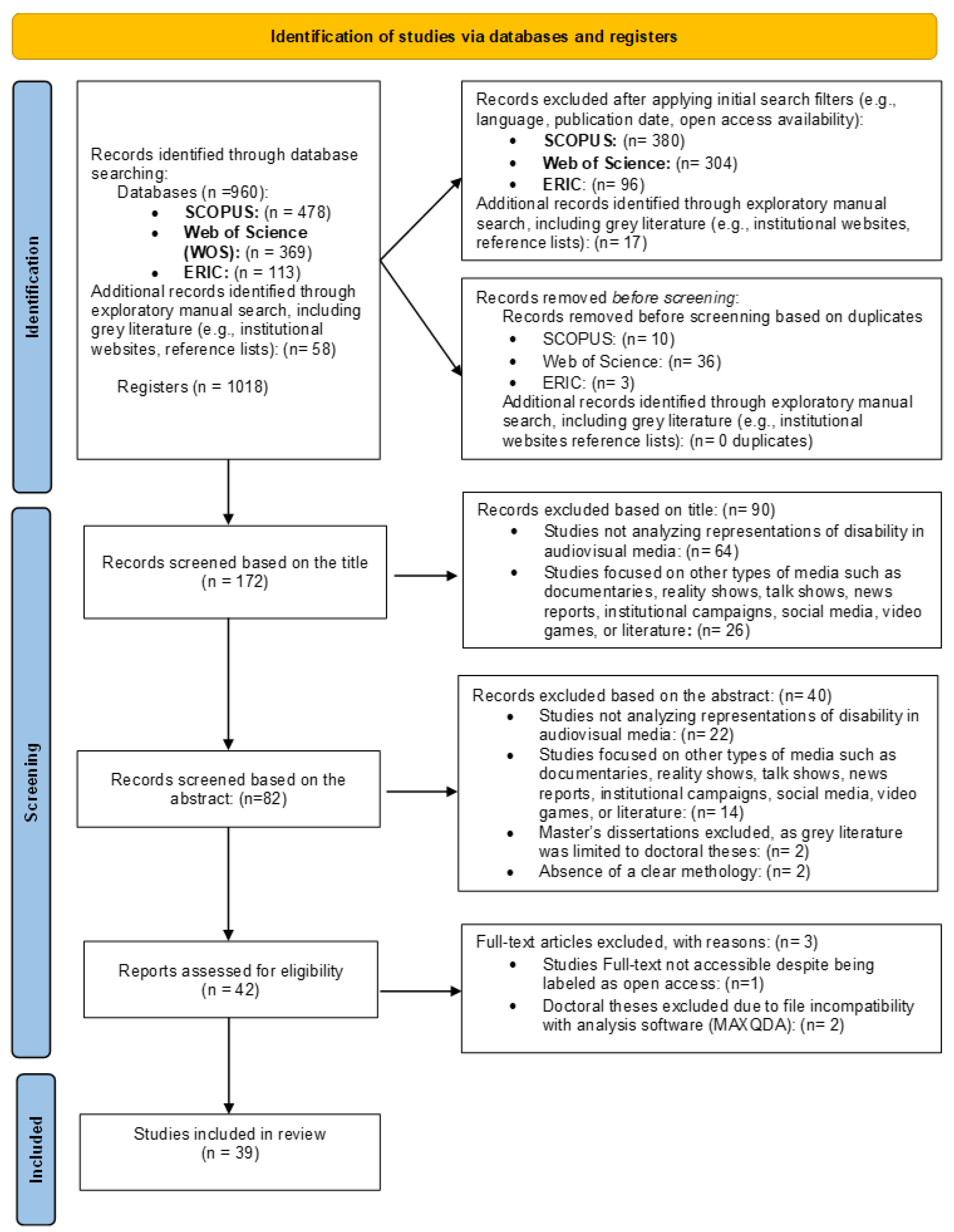
Figure 2.
Coding categories used in MAXQDA for thematic analysis of the selected studies.
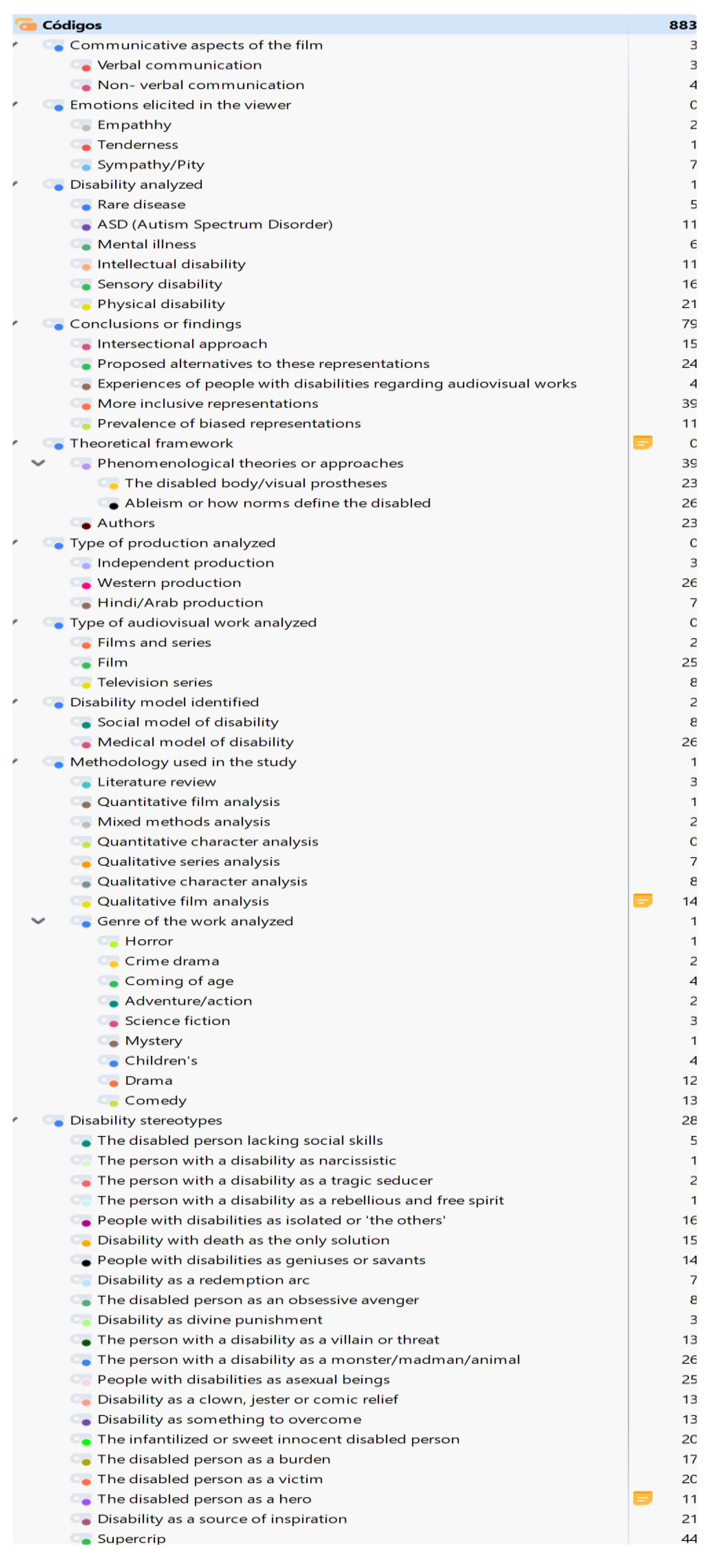
Figure 3.
Disability stereotypes used in media (Excel, using data from MAXQDA).
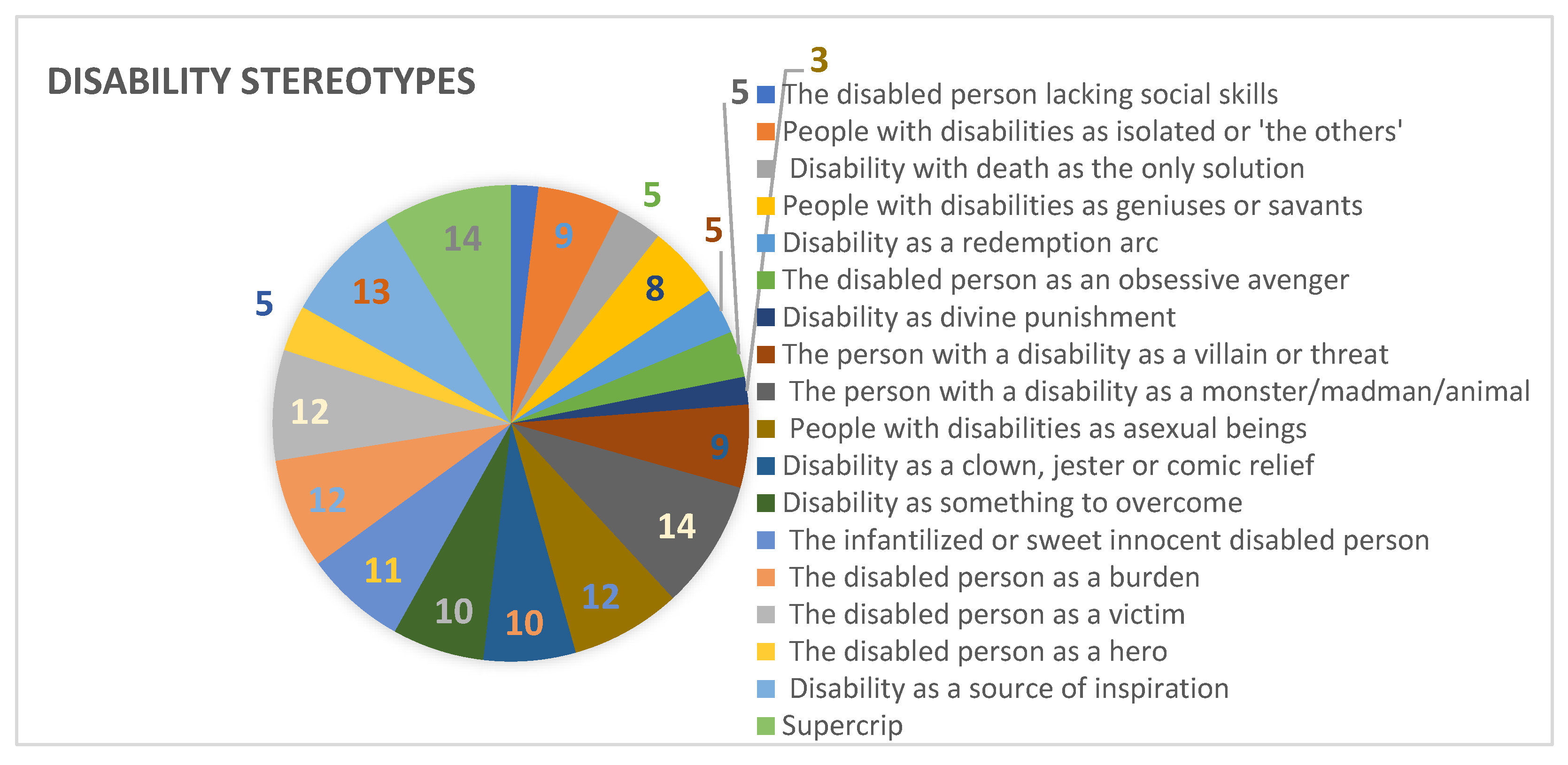
Figure 4.
Theorical approaches most mentioned (Excel, using data from MAXQDA).
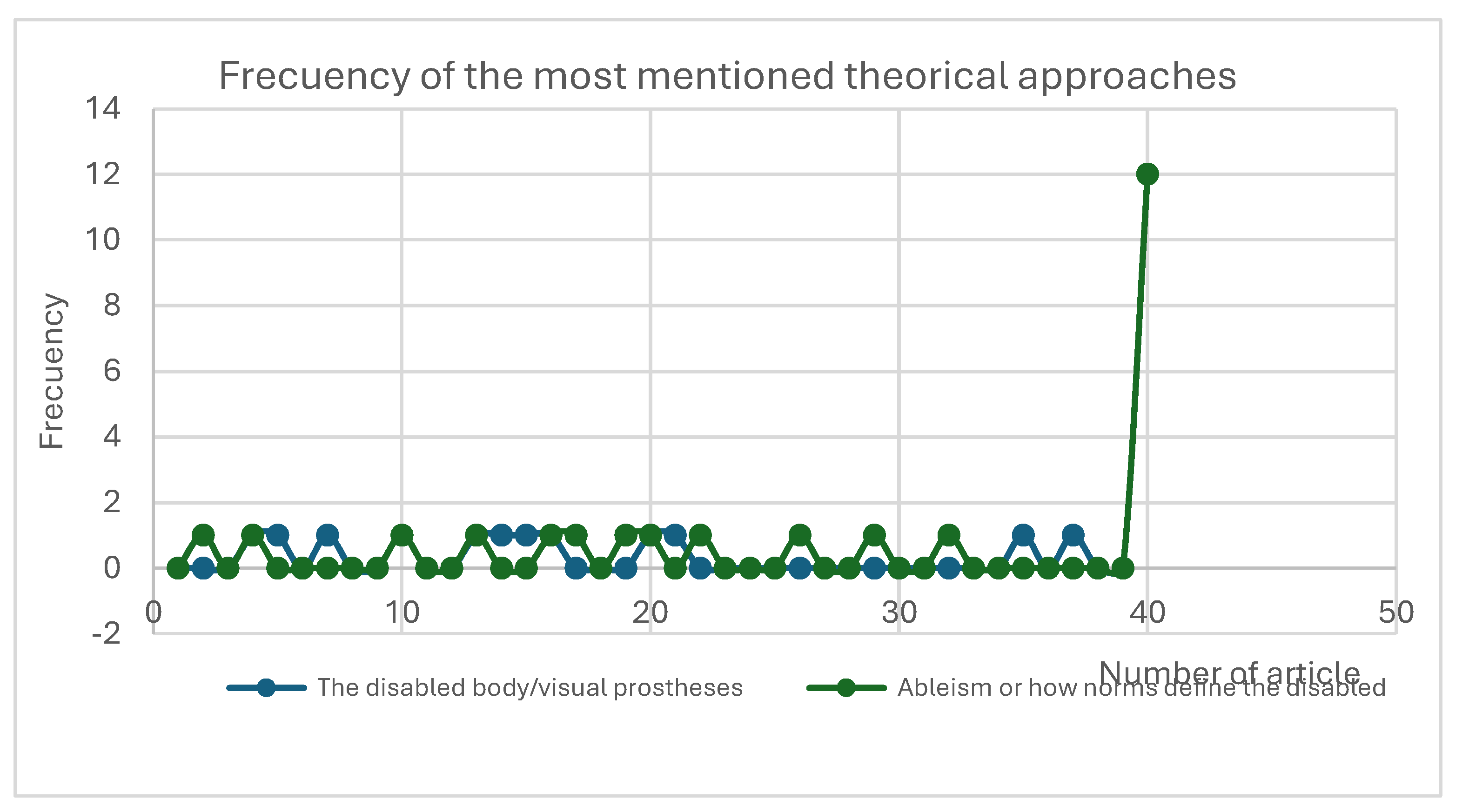
Figure 5.
Visual representation of the concept of “Narrative prosthesis” and corporality (MAXQDA).
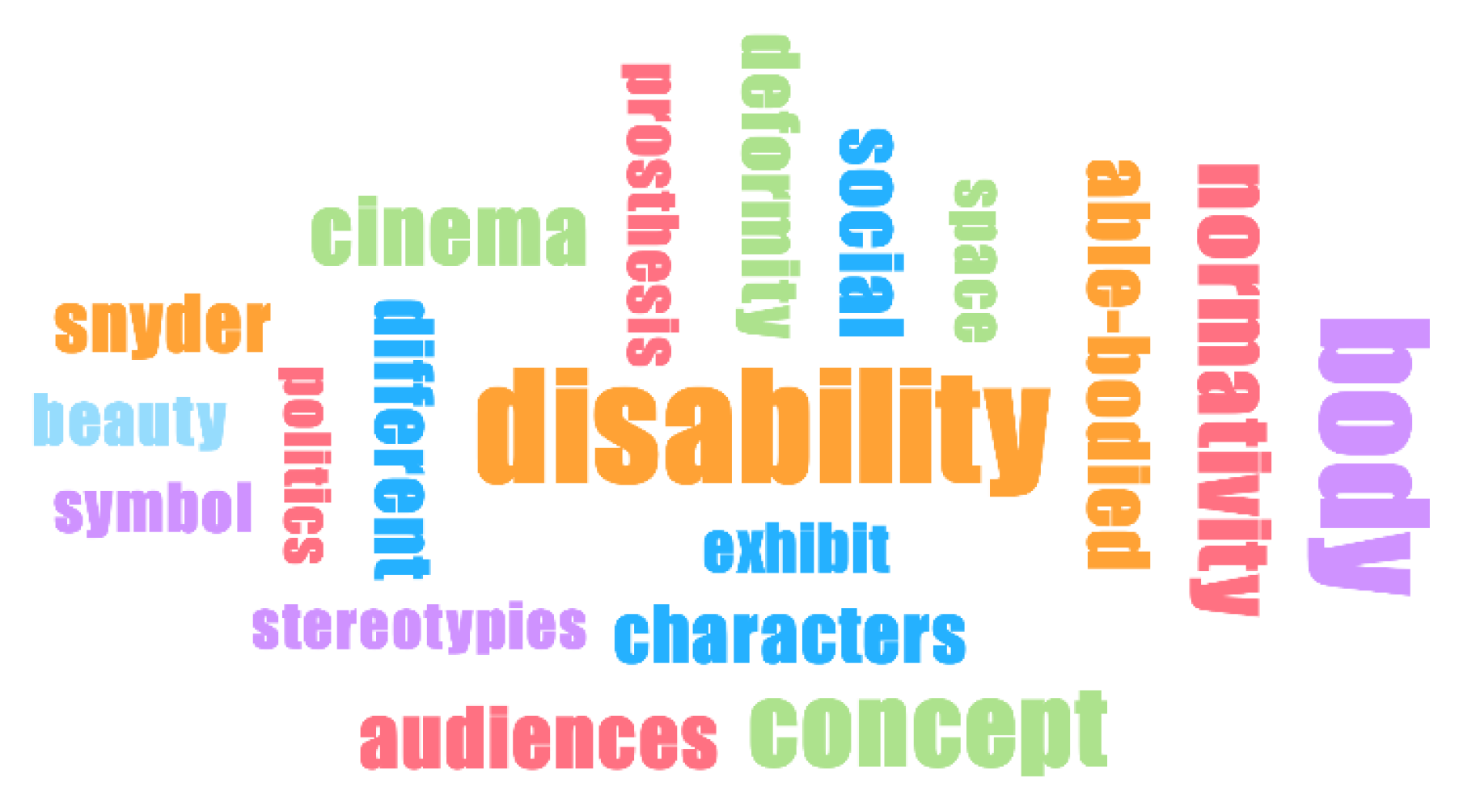
Figure 6.
Type of work analyzed in the corpus (Excel, using data from MAXQDA).
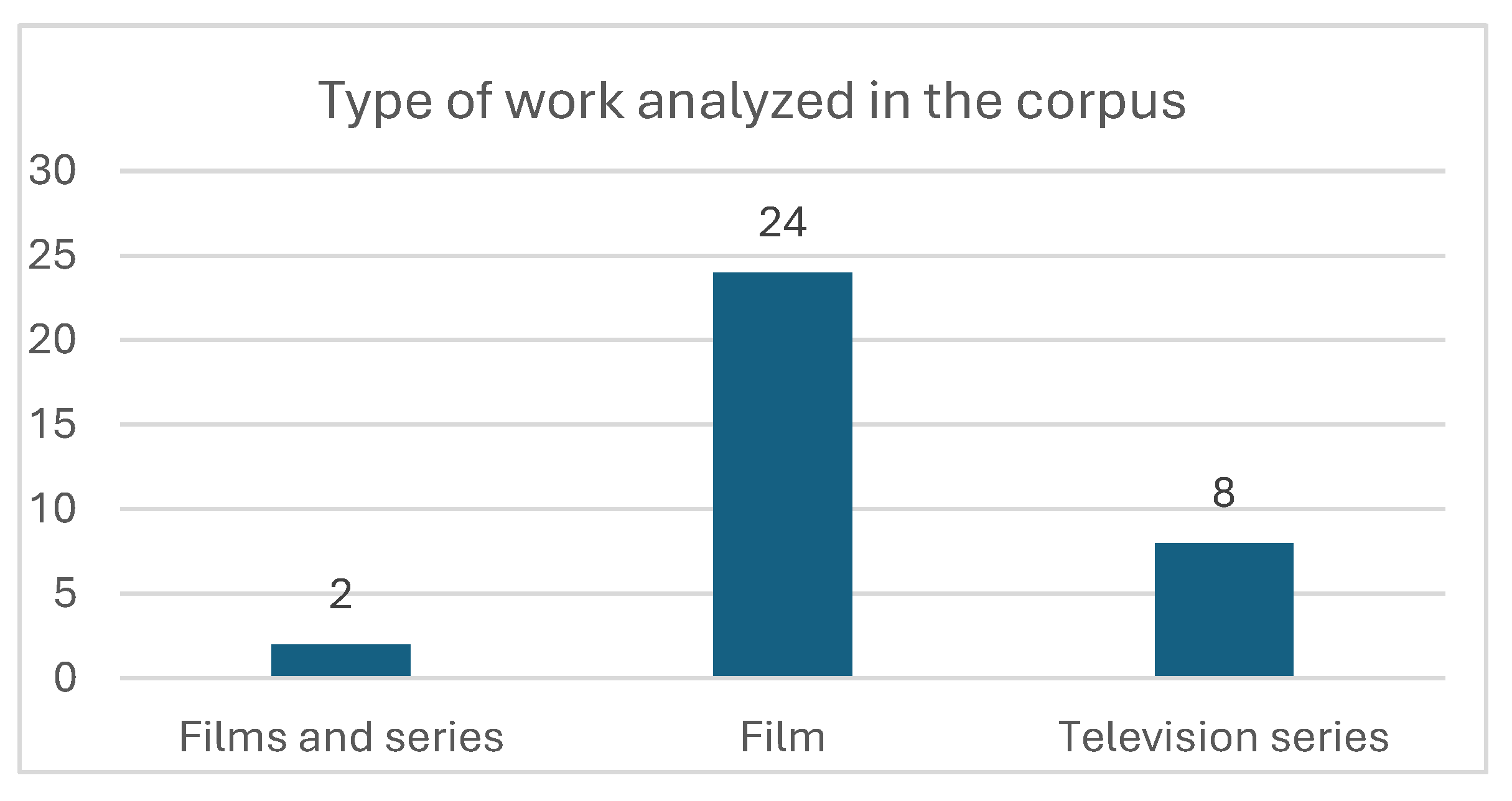
Figure 7.
Industry which produced the works analyzed (Excel, using data from MAXQDA).
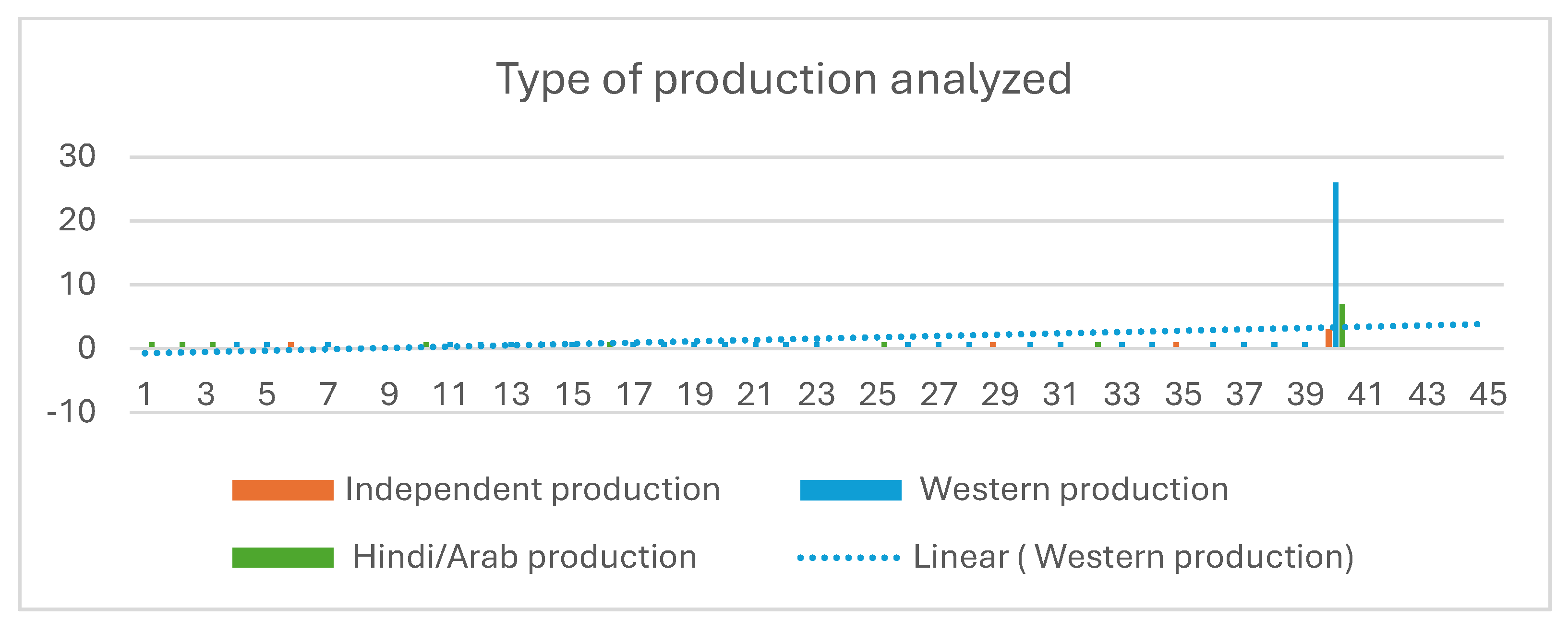
Figure 8.
Genre of the works analyzed (Excel, using data from MAXQDA).
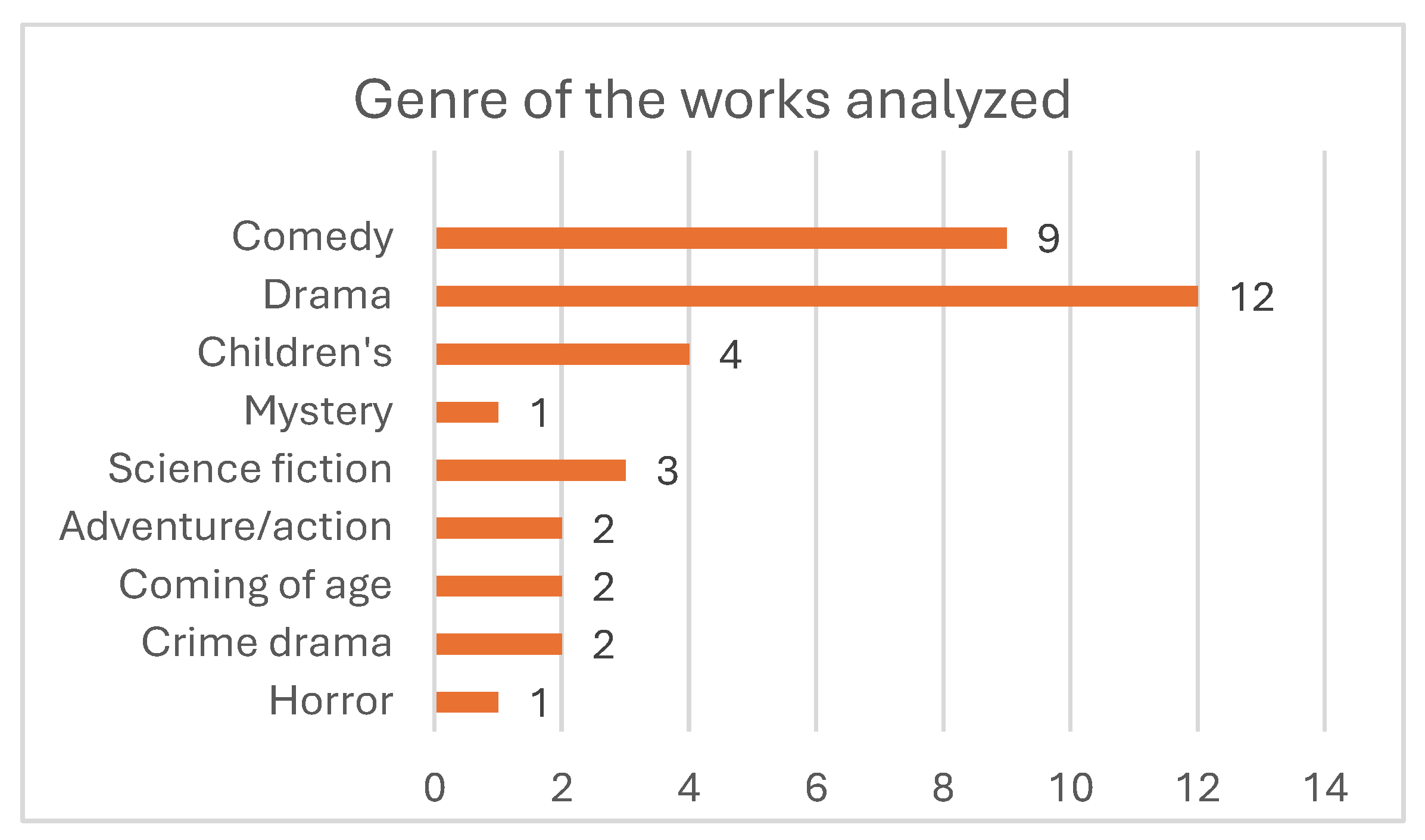
Figure 9.
Disability analyzed (Excel, using data from MAXQDA).
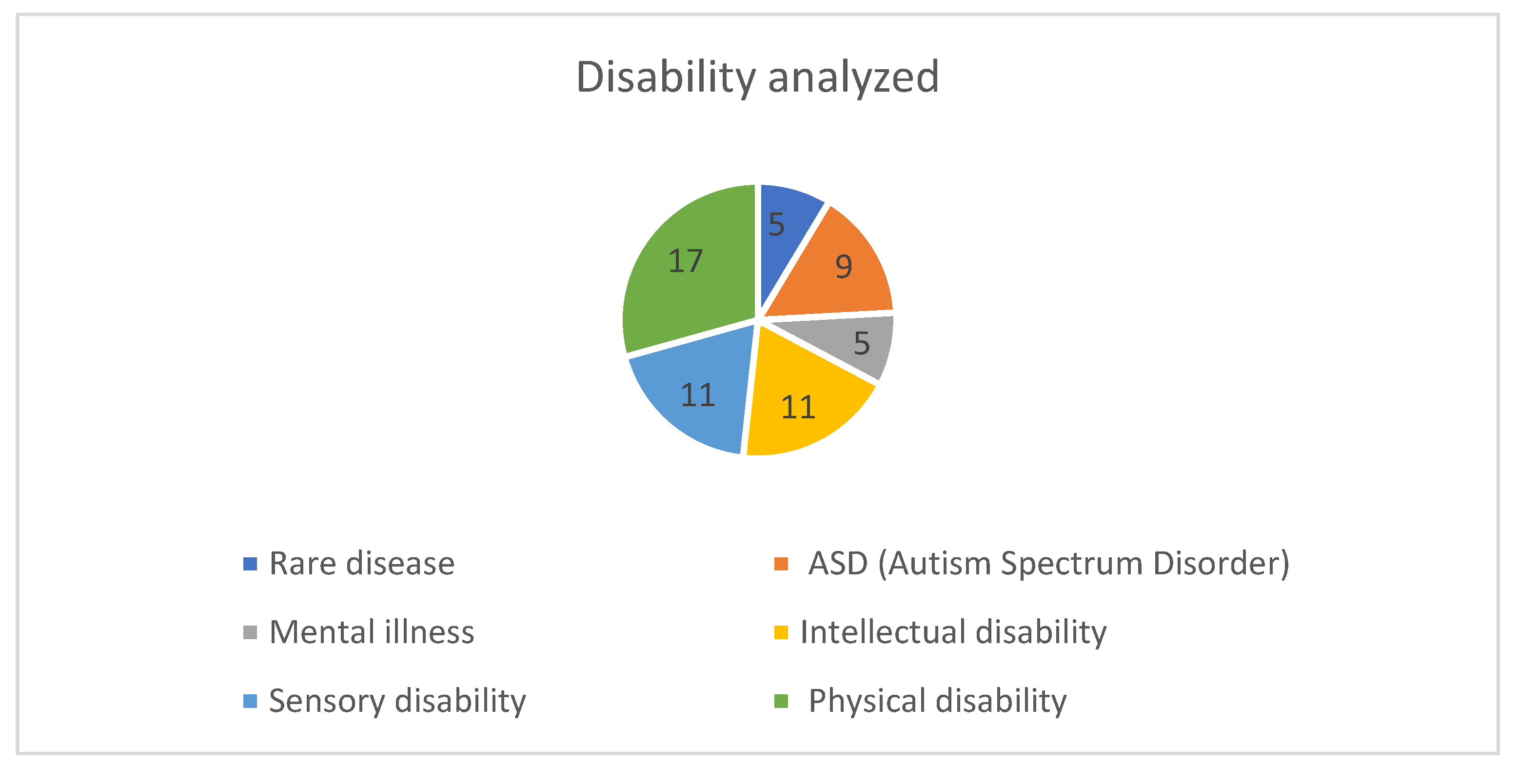

Table 1.
Database query strategies.
| Database | Query | Results |
| SCOPUS | TITLE-ABS-KEY(("disability" OR "disabled characters" OR "personas con discapacidad") AND ("stereotypes" OR "estereotipos") AND ("film" OR "movies" OR "TV series" OR "audiovisual media" OR "cine" OR "series de televisión")) | 53 |
| Web of Science (WOS) | TS=(("disability" OR "disabled characters" OR "personas con discapacidad") AND ("stereotypes" OR "estereotipos") AND ("film" OR "movies" OR "TV series" OR "audiovisual media" OR "cine" OR "series de televisión")) | 54 |
| ERIC | ("disability" OR "disabled characters" OR "personas con discapacidad") AND ("stereotypes" OR "estereotipos") AND ("film" OR "movies" OR "TV series" OR "audiovisual media" OR "cine" OR "series de televisión") | 24 |
| SCOPUS | TITLE-ABS-KEY(("disability" OR "representación de la discapacidad" OR "personas con discapacidad") AND ("representation" OR "depiction" OR "imagen" OR "portrayal") AND ("theory" OR "theoretical framework" OR "conceptual approach" OR "marco teórico" OR "enfoque conceptual" OR "perspective") AND ("film" OR "movie" OR "cinema" OR "television" OR "TV series" OR "media" OR "audiovisual" OR "cine" OR "series de televisión" OR "medios audiovisuales")) | 247 |
| Web of Science (WOS) | TS=(("disability" OR "representación de la discapacidad" OR "personas con discapacidad") AND ("representation" OR "depiction" OR "imagen" OR "portrayal") AND ("theory" OR "theoretical framework" OR "conceptual approach" OR "marco teórico" OR "enfoque conceptual" OR "perspective") AND ("film" OR "movie" OR "cinema" OR "television" OR "TV series" OR "media" OR "audiovisual" OR "cine" OR "series de televisión" OR "medios audiovisuales")) | 155 |
| ERIC | ("disability" OR "personas con discapacidad") AND ("representation" OR "media portrayal" OR "imagen" OR "representación") AND ("theory" OR "conceptual approach" OR "marco teórico" OR "enfoque conceptual" OR "perspective") AND ("film" OR "TV series" OR "media" OR "audiovisual" OR "cine" OR "series de televisión") | 25 |
| SCOPUS | TITLE-ABS-KEY (("disability" OR "personas con discapacidad") AND ("character traits" OR "rasgos de personajes" OR "genre" OR "género audiovisual" OR "themes" OR "temáticas") | 121 |
| Web of Science (WOS) | TS=(("disability" OR "personas con discapacidad") AND ("character traits" OR "rasgos de personajes" OR "genre" OR "género audiovisual" OR "themes" OR "temáticas") AND ("film" OR "movies" OR "TV series" OR "cine" OR "series de televisión")) | 92 |
| ERIC | ("disability" OR "personas con discapacidad") AND ("character traits" OR "rasgos de personajes" OR "genre" OR "género audiovisual" OR "themes" OR "temáticas") AND ("film" OR "movies" OR "TV series" OR "cine" OR "series de televisión" OR "audiovisual media") | 32 |
| SCOPUS | TITLE-ABS-KEY (("disability representation" OR "representación de la discapacidad" OR ("disability" AND "media")) AND ("review" OR "discussion" OR "limitations" OR "future research" OR "research agenda" OR "estado del arte") AND ("film" OR "movies" OR "TV series" OR "audiovisual media" OR "cine" OR "series de televisión")) | 57 |
| Web of Science (WOS) | TS=(("disability representation" OR "representación de la discapacidad" OR ("disability" AND "media")) AND ("review" OR "discussion" OR "limitations" OR "future research" OR "research agenda" OR "estado del arte") AND ("film" OR "movies" OR "TV series" OR "audiovisual media" OR "cine" OR "series de televisión")) | 68 |
| ERIC | ("disability" OR "discapacidad") AND ("media" OR "film" OR "cine" OR "audiovisual" OR "TV series" OR "series de televisión") | 32 |
Table 2.
Inclusion and Exclusion Criteria.
| Inclusion criteria | Exclusion criteria |
| Peer-reviewed journal articles, doctoral theses, or research reports with a clear methodology. | Studies that do not analyze representations of disability in audiovisual media. |
| Qualitative, quantitative, or mixed-method studies analyzing disability representations in audiovisual productions. | Complete books |
| Studies examining characters with disabilities in films, television series, telenovelas, or miniseries. | Studies focusing on formats such as documentaries, talk shows, reality shows, news, institutional campaigns, social media, video games, or literature. |
| Studies addressing stereotypes, visual discourses, theoretical models such as ableism or disability models, or character traits related to disability. | Publications lacking empirical basis or an explicit methodology (e.g., essays, editorials, or opinion reviews without systematic analysis). |
| Studies published from the year 2015 onward. | Studies published before 2015. |
| Studies written in English or Spanish. | Duplicated, incomplete studies, or those without full-text access. |
Table 3.
Bibliographic Characteristics of the Studies Included in the Corpus.
| Number and title of the article | Authorship | Country | Year | Journal | SJR, quartille | Media | Disability represented |
| 1.Language Teaching for Specific Purposes: A Case Study of the Degree of Accuracy in Describing the Character of Mental Disabilities in Modern Arabic Drama (Egyptian Film Toot-Toot as an Example) | Alkayed, Z. S., & Kitishat, A. R. | United Kingdom | 2021 | Journal of Language Teaching and Research | 0.282 (Q1) | Film | Intellectual disability |
| 2.From representation to re-presentation: A study of disability in cinematic and literary text | Anand, R. & Gupta, K. | India | 2022 | International Journal of Innovation and Multidisciplinary Research | Not available | Films | Multiple |
| 3.The portrayal of persons with disabilities in Arabic drama: A literature review | Al-Zoubi,S. M. & Al-Zoubi, S. M. | United Estates | 2022 | Research in Developmental Disabilities | 0.900 (Q2) | Films and Series | Multiple |
| 4.Representation Matters: Race, Gender, Class, and Intersectional Representations of Autistic and Disabled Characters on Television | Aspler, J., Harding, K. & Cascio, M. | Canada | 2022 | Studies in Social Justice | 0.284 (Q2) | Series | ASD (Autism Spectrum Disorder) |
| 5.Sacha Polak’s Dirty God and the Politics of Authenticity | Biernoff, S. | Italy | 2022 | Cinema et Cie | 0.103 (Q3) | Film | Physical deformity after an acid attack |
| 6.Disability cinema´s next wave: observational agency subverts the ableist gaze | Carter-Long, L. | United States | 2022 | Film Quarterly | 0.342 (Q1) | Films | Physical disability |
| 7.Azeem and the Witch: Race, Disability, and Medievalisms in Robin Hood: Prince of Thieves | Clark, R.E. | United Kingdom | 2023 | Open Library of Humanities | 0.225 (Q2) | Film | Physical deformity (physical disability) |
| 8.Análisis de la cinematografía del síndrome de Down | Coronel- Hidalgo, J., Cevallos-Solorzano, G., Torres-Galarza, A. & Bailón- Moscoso, N. | Spain | 2023 | Educación Médica | 0.218 (Q3) | Película | Down's syndrome (a rare disease in our coding system). |
| 9.A Review of Research Studying Film and Television Representations of ASD | Dean, M. & Nordahl- Hansen, A. | United States | 2022 | Review Journal of Autism and Developmental Disorders | 1.150 (Q1) | Films and Series | ASD (Autism Spectrum Disorder) |
| 10.Nuances of the unique and evolving conceptualisation of intellectual disability in India: A study of the changing artistic parlance of representing intellectually disabled people in mainstream Hindi cinema | Deb, P. | United Kingdom | 2022 | British Journal of Learning Disabilities- Special Isue | 0.437 (Q2) | Films | Intellectual disability |
| 11.Treating rare diseases with the cinema: Can popular movies enhance public understanding of rare diseases? | Domaradzki, J. | United Kingdom | 2022 | Orphanet Journal of Rare Diseases | 1.269 (Q1) | Films | Rare diseases |
| 12.Marketing the Prosthesis: Supercrip and Superhuman Narratives in Contemporary Cultural Representations | Fahn, C. W. | Switzerland | 2020 | Philosophies | 0.286 (Q2) | Films | Physical disability |
| 13.Cuerpo y discapacidad en el cine colombiano reciente. El caso de Porfirio (2019) de Alejandro Landes | García- León, L.D. | United Kingdom | 2021 | Bulletin of Hispanic Studies | 0.121 (Q2) | Film | Physical disability |
| 14.Representing male disability in colombian audiovisual media: The masking of social and political intersections in los informantes | García-León, L. D. & García-León, J.E. | United States | 2022 | Latin American Research Review | 0.442 (Q1) | Series | Physical disability and intellectual disability |
| 15.Enabling everything: scale, disability and the film The Theory of Everything | Gaucci, V. | United Kingdom | 2015 | Disability & Society | 0.951 (Q1) | Film | Physical disability |
| 16.Discovering impaired superheroes in Hindi movies: A study of characterization of disabled in movies and its impact on their social life | Gawande, V. & Kashyap, G. | India | 2017 | Journal of content, community & communication | 0.309 (Q2) | Film | Physical disability |
| 17.Crime media as cinematic “freak show”: Ableism and speciesism in retelling Dahmer | Kramer, R. | United Kingdom | 2023 | Crime, Media, Culture | 0.754 (Q1) | Series | ASD (Autism Spectrum Disorder) and intellectual disability |
| 18.Communicating Health: Depictions of Depression, Antisocial Personality Disorder, and Autism without Intellectual Disability in British and U.S. Coming-of-Age TV Series | Lopera- Mármol, M., Jiménez-Morales, M. & Jiménez- Morales, M. | Switzerland | 2022 | Hummanities | 0.155 (Q3) | Series | ASD (Autism Spectrum Disorder)Depression, Antisocial Personality Disorder (mental illness in our coding) |
| 19.Narrative representation of depression, ASD, and ASPD in “Atypical”, “My Mad Fat Diary” and “The End of The F**ing World” * | Lopera- Mármol, M., Jiménez-Morales, M. & Jiménez- Morales, M. | Spain | 2023 | Communicatiion and Society | 0.455 (Q1) | Series | ASD (Autistic Spectrum Disorder)Depression, Antisocial Personality Disorder (mental illness in our coding) |
| 20.La mirada rehabilitante en Campeones y Mar adentro: representación de la discapacidad desde la no discapacidad | Maestre Limiñana, S. | Spain | 2024 | Revista Española de Discapacidad | Not available | Films | Physical disability and intellectual disability |
| 21.Authenticity in representations of down syndrome in contemporary cinema: The “supercrip” in the Peanut Butter Falcon (2019) | Martausová, M. | Romania | 2021 | Ekphrasis | 0.105 (Q3) | Film | Down's syndrome (a rare disease in our coding system). |
| 22.El tratamiento de la discapacidad en El cochecito (1960) | Martos Contreras, E. | Spain | 2024 | Revista de Medicina y Cine | 0.189 (Q1) | Film | Physical disability |
| 23.La tartamudez en el cine: Análisis textual del cambio de paradigma en su representación | Mejías Martínez, G. & Mangado Martínez, M. | Spain | 2022 | Fonseca, Journal of Communication | 0.239 (Q2) | Film | Stuttering (Sensory disabilitylity in our coding) |
| 24.Las representaciones sociales en la discapacidad a partir de la cinematografía infantil | Mendivelso, R & Hoyos- Cuartas, L. A. | Colombia | 2016 | Revista Facultad de Ciencias de la Salud UDES | Not available | Films | Multiple |
| 25.Portrayal of Disability in Hindi Cinema | Mishra, S. | India | 2024 | International Journal For Multidisciplinary Research | Not available | Films | Multiple |
| 26.La visión de la discapacidad a través del cine. La película “Campeones” como estudio de caso | Planella-Ribera, J., Pallarès-Piquer, M., Chiva-Bartoll, O., & Muñoz-Escalada, M. C. | Spain | 2021 | Encuentros. Revista de Ciencias Humanas, Teoría Social y Pensamiento Crítico | 0.163 (Q2) | Film | Intellectual disability |
| 27.Histrionics of Autism in the Media and the Dangers of False Balance and False Identity on Neurotypical Viewers | Ressa, T. | Netherlands | 2021 | Journal of Disability Studies in Education | 0.475 (Q2) | Series | ASD (Autism Spectrum Disorder) |
| 28.An Analysis of Disability in The Little Mermaid: Examining Disparities and Similarities in the Fairytale and Its Movie Adaptation | R. Roshini, R. & Rajasekaran, V. | United States | 2023 | Studies in Media and Communication | 0.221 (Q3) | Film | Physical disability |
| 29.Impossible Paradise: Sex and Functional Diversity in Oasis (Oasiseu, 2002) | Santana- Quintana, M.P. | Argentina | 2019 | Anclajes | 0.147 (Q2) | Film | Physical disability |
| 30.The construction of characters with disabilities in film: The importance of verbal and non-verbal communication | Sanz-Simón, L. | Spain | 2022 | Visual Review. International Visual Culture Review/Revista Internacional de Cultura | 0.166 | Films | Multiple |
| 31.Challenging conventional heroism: Redefining heroism through the representation of disabled superheroes in Daredevil and X-men | Shaji, S. & C. S. | India | 2023 | ShodhKosh: Journal of Visual and Performing Arts | Not available | Films | Physical disability and sensory disability |
| 32.Representation of Disability- A Space of One's Own in Literature and Cinema | Sharma, A | India | 2022 | Lapis Lazuli: An International Literary Journal | Not available | Films | Sensory disability |
| 33.La visión de la discapacidad en la primera etapa de Disney: Blancanieves y los 7 enanitos, Alicia en el País de las Maravillas y Peter Pan | Solís- García, P. | Spain | 2019 | Revista de Medicina y Cine | 0.189 (Q1) | Films | Multiple |
| 34.Characters with autism spectrum disorder in fiction: where are the women and girls? | Tharian, P.R;Henderson, S., Wathanasin, N.,Hayden, N.,Chester, V. & Tromans, S. | United Kingdom | 2019 | Advances in autism | 0.530 (Q3) | Film and series | ASD (Autism Spectrum Disorder) |
| 35.The ambivalent vision: the “crip” invention of “blind vision” in blind massage | Wang-Xu, S. | Portugal | 2023 | International Journal of Film and Media Arts | 0.127 (Q2) | Film | Sensory disability |
| 36.Adaptation, Parody, and Disabled Masculinity in Motherless Brooklyn | Wilkins, C. | Switzerland | 2023 | Hummanities | 0.155 (Q3) | Film | Intellectual disability |
| 37.The Impulse-Image of Vampiric Capital and the Politics of Vision and Disability: Evil and Horror in Don’t Breathe | Wischert-Zielke, M. | United States | 2021 | Cinej Cinema Journal | 0.197 (Q2) | Film | Sensory disability |
| 38.To be continued: Serial narration, chronic disease, and disability | Wohlmann, A. y Harrison, M. | United States | 2019 | Literature and Medicine | 0.132 (Q2) | Series | Parkinson's (Physical disability in our codification) |
| 39.Análisis psicosocial de la representación televisiva de la diversidad funcional como estrategia de alfabetización mediática | A. Zaptsi, A., Moreno- Vera, B. & Garrido, R. | Spain | 2024 | Ámbitos | 0,109 (Q4) | Series | Multiple |
Disclaimer/Publisher’s Note: The statements, opinions and data contained in all publications are solely those of the individual author(s) and contributor(s) and not of MDPI and/or the editor(s). MDPI and/or the editor(s) disclaim responsibility for any injury to people or property resulting from any ideas, methods, instructions or products referred to in the content. |
© 2025 by the authors. Licensee MDPI, Basel, Switzerland. This article is an open access article distributed under the terms and conditions of the Creative Commons Attribution (CC BY) license (http://creativecommons.org/licenses/by/4.0/).
Copyright: This open access article is published under a Creative Commons CC BY 4.0 license, which permit the free download, distribution, and reuse, provided that the author and preprint are cited in any reuse.


