

Submitted:
31 July 2025
Posted:
01 August 2025
You are already at the latest version
Abstract
The mutagenic potential of coffee by-products, including Coffea leaves, blossoms, cherries, and silverskin, was studied using thin-layer chromatography coupled with the recent planar Ames bioassay via pH indicator endpoint. The 2LabsToGo-Eco allowed for the separation and detection of mutagens in complex samples. Hot water was the most effective extraction solvent in terms of yield and closely simulated the typical human consumption of coffee by-products. Separation was performed on TLC plates with a mixture of ethyl acetate, n-propanol, and water, followed by bioassay detection. The positive control 4-nitroquinoline 1-oxide exhibited clear mutagenic responses, confirming the proper bioassay performance. In the Ames bioautogram, none of the tested coffee by-products showed mutagenic zones, suggesting the absence of strongly acting, acute mutagens under the applied test conditions, given the only 5-h short incubation and use of TA98 strain only. The results provide new safety data for Coffea leaves and blossoms and are consistent with some previous studies demonstrating the safety of coffee by-products. However, further improvements in the sensitivity and selectivity of the planar Ames bioassay are demanded and further in vivo and long-term safety studies are recommended. Considering the natural variability, different treatments and use of pesticides, and different supply chains, coffee by-products may differ highly. The planar bioassay technology using the affordable 2LabsToGo-Eco is a powerful toxicological screening option for the increasing interest in utilizing coffee by-products.
Keywords:
Coffea leaves
; Coffea blossoms
; Coffea cherries
; Coffea silverskin
; mutagenicity screening
; Salmonella bioassay
; thin-layer chromatography
1. Introduction
Coffee is one of the most widely consumed beverages globally, with daily consumption exceeding 3.5 billion cups. Beyond its cultural and dietary significance, coffee is a major agricultural product with a substantial impact on international trade and the global economy [1,2]. Coffea arabica L. and Coffea canephora Pierre ex A. Froehner are the two primary species cultivated for commercial production, both of which are predominantly grown in tropical and subtropical regions [3]. While coffee production traditionally focuses on the utilization of the bean, the whole coffee fruit (cherry) comprises several other components—such as pulp, husk, mucilage, and silverskin—that are often discarded during processing. There has been a growing focus on the valorization of these by-products, also including the leaves and blossoms, due to their promising nutritional, functional, aroma and bioactive properties, supporting potential applications in the food, pharmaceutical, and cosmetic industries [4]. Increasing environmental awareness and consumer demand for sustainable solutions have driven significant interest in natural resource valorization and repurposing. Coffee by-products are increasingly viewed as valuable ingredients in green formulations in the food industry due to their biocompatibility and environmental benefits [5]. Within the European Union (EU), the use of such by-products as food requires compliance with the novel food regulation EU No. 2015/2283 [6]. Novel food must undergo a rigorous authorization, including safety assessment based on toxicological data [7].
Mutagenicity testing is crucial for risk assessment of novel foods and ingredients. The European Food Safety Authority (EFSA) recommends a tiered approach, beginning with in vitro tests and advancing to in vivo studies only if needed. The initial testing stage includes standard in vitro assays, such as the Ames test (OECD TG 471) and the in vitro micronucleus assay (OECD TG 487) [8,9]. The Ames test uses Salmonella strains that cannot produce histidine and assesses mutagenicity by counting revertant colonies grown on histidine-free culture medium. A positive result indicates that back mutations caused by point mutations, such as base substitutions or frameshifts, restore histidine synthesis [10,11]. The colony-count Ames assay was performed not only in the Petri dish but also by agar overlay on the TLC plate in the 1980s [12]. The Ames microtiter plate format (MPF) is a miniaturized, liquid-based adaptation of the traditional colony-count Ames test, conducted in 384-well plates with a pH indicator endpoint to detect revertants. However, the Ames MPF assay has limitations, such as low sensitivity and matrix interference in complex samples such as food contact materials [13,14]. It is primarily recommended for testing single compounds rather than complex mixtures such as coffee by-products, as the presence of acidic constituents, colored, or other interfering substances may lead to false-positive or false-negative results, potentially compromising the accuracy of the mutagenicity assessment [15].
Conflicting findings regarding the mutagenicity of coffee have been reported [16]. While some studies using the Ames test have demonstrated mutagenic effects for roasted, instant, and decaffeinated coffee [17,18,19], others have not observed such effects [20,21,22]. Two studies using the traditional Ames test and comet assay with the human hepatocellular carcinoma cell line HepG2 showed no effects on the mutagenicity/genotoxicity of spent coffee [23,24], which contradicts another study emphasizing environmental risks from improper waste disposal using the traditional Ames test with specific Salmonella Typhimurium strains and micronucleus assay with murine peripheral cells [25]. These discrepancies may be due to differences in experimental design, methodology, and assay sensitivity. As the mutagenicity of coffee by-products has hardly been investigated, the expanding use of coffee by-products in functional foods (novel foods) and sustainable materials also demands comprehensive safety assessments. Whole coffee fruit extracts from Coffea arabica were generally found to be non-mutagenic and non-genotoxic using micronucleus assay and traditional Ames test with specific Salmonella Typhimurium and Escherichia coli strains [26]. The comet assay revealed that the coffee silverskin extract was non-cytotoxic and non-genotoxic [27].
Thin-layer chromatography (TLC) or its high-performance HPTLC is a well-established technique widely used in food analysis and quality control due to its ability to simultaneously analyze complex samples [28]. In contrast to column chromatographic techniques, where analytes are typically eluted and discarded, this system retains compounds on the chromatographic layer and allows for subsequent in-depth characterization of zones of interest regarding their effects and structures [29,30]. Due to its open-format design, TLC/HPTLC can be coupled with planar bioassays to minimize matrix interference and detect beneficial (e.g., antioxidative, anti-diabetes, and anti-Alzheimer acting) [31,32]) or hazardous compounds (e.g., genotoxic, cytotoxic, antibacterial, neurotoxic, and endocrine-disrupting [33,34,35]), while supporting the Replacement, Reduction, and Refinement (3R) principles in toxicological testing [36]. Planar on-surface bioassays were validated by comparing them with counterpart microtiter plate formats, confirming their reliability [37,38]. Recent developments have expanded the potential of HPTLC by incorporating qualitative image analysis for profiling [39,40] and clustering [41] or quantitative image analysis [42,43] and advanced detection techniques, such as Raman spectroscopy, high-resolution mass spectrometry, and nuclear magnetic resonance spectroscopy to provide useful structural information of the compounds [44,45,46,47]. These capabilities make hyphenated HPTLC [48,49] particularly valuable for effect-directed analysis, allowing the fast assignment of bioactive substances in complex mixtures without the need for complex sample preparation [33].
All required equipment in both the HPTLC and bioassay laboratories was miniaturized into the all-in-one 2LabsToGo-Eco, allowing for portable on-site analysis with zero-energy consumption (solar panels) and fast, cost-effective, sustainable, and environmentally friendly non-target screening [50,51]. 2LabsToGo-Eco makes it easier to spot and focus on active or potentially hazardous compounds in complex samples, especially because it can detect their biological or toxicological effects. It yields results comparable in accuracy and reliability to those obtained using conventional, full-scale analytical equipment [33,34,51,52,53,54,55,56].
In this study, after selecting a suitable extractant and respective mobile phase [57], the recently reported planar Ames bioassay via pH indicator endpoint [15] was performed using the all-in-one 2LabsToGo-Eco [51] to assess the mutagenic potential of coffee by-products, i.e. Coffea leaves, cherries, blossoms, and silverskin. The Salmonella Typhimurium TA98 strain was used, designed for the detection of frameshift mutations, carrying the hisD3052 mutation, a frameshift within the GCGCGCGC sequence that causes histidine dependence. An rfa mutation increases the permeability of its outer membrane, whereas a uvrB mutation disables DNA excision repair. Additionally, the presence of the pKM101 plasmid enhances mutagenesis through error-prone repair mechanisms and confers resistance to ampicillin [58].
2. Materials and Methods
2.1. Chemicals and Materials
The distilled water used in this study was obtained from a laboratory tap connected to an in-house water purification system. Methanol, ethanol (96%), 1-propanol, acetone, ethyl acetate, dichloromethane, toluene, n-hexane (all chromatography grade), caffeine (>99%), and 4-nitroquinoline 1-oxide (4NQO, >98%) were purchased from Merck (Darmstadt, Germany). Salmonella enterica subspecies enterica serotype Typhimurium strain TA98 (Salmonella Typhimurium), exposure medium (liquid minimal histidine medium), and Salmonella reversion indicator medium (L-histidine-free medium with pH indicator) were delivered by Xenometrix (Allschwil, Switzerland). Chlorogenic acid (CGA, >97%), nutrient broth (for microbiology), glycerol (>99%), ampicillin sodium salt (> 99%), potassium hydroxide (≥85 %), 2-mL Brand microcentrifuge tubes with 0.3-mm thin caps, and TLC glass plates silica gel 60 F254, 10 cm × 10 cm, were purchased from Carl Roth (Karlsruhe, Germany). Coffea canephora leaves of the Old Paradenia variety from Badra Estates, Chikmagalur, India and Coffea canephora/arabica silverskin blend (obtained as a roasting by-product) were provided by the Coffee Store (Mannheim, Germany). Coffea liberica cherries (skin and pulp) and blossoms (flowers) from Sarawak, Malaysia, were obtained from Earthlings Coffee Workshop (Kuching, Sarawak, Malaysia).
2.2. Extraction of Coffee By-Product Plant Materials
Each finely powdered coffee by-product, i.e. leaves, cherries, silverskin, and blossoms, was accurately weighed (100 mg each), extracted each in 2 mL of boiling water (ethanol, ethyl acetate, and n-hexane were also studied) by ultrasonication for 30 min (35 kHz, 120 W, room temperature; mechanical shaking was also studied), and centrifuged at 3000×g for 15 min. The supernatants were ultrafiltrated (0.45 µm polytetrafluoroethylenemembrane syringe filter) into 2-mL tubes and stored at 4 °C for further analysis.
2.3. Preparation of Solutions and of Salmonella Suspension
The 4NQO was dissolved in methanol (1 mg/mL), and applied in increasing amounts of 0.5, 1, 1.5, 2, 2.5, and 3 µg per band. An aqueous ampicillin solution (100 mg/mL) was prepared using sterile distilled water.
For the culture medium, 30 mL of nutrient broth was dispensed into 125-mL Erlenmeyer flasks and sterilized by autoclaving at 120 °C for 20 min. An aqueous ampicillin solution was aseptically added at 25 µg/mL to the cool medium using a 0.2 µm polytetrafluoroethylene membrane syringe filter. For overnight cultivation, 25 µL of Salmonella Typhimurium TA98 cryostock (prepared by harvesting the cell pellet from a 10-mL, 16-hour culture, resuspending in 10 mL of fresh culture medium containing 10% glycerol, and stored in 0.5-mL aliquots at −80 °C) was inoculated into 30 mL culture medium in a 125-mL Erlenmeyer flask and incubated at 37 °C with shaking at 125 rpm in a mini-incubator (Cultura M, 70700R, Almedica, Galmiz, Switzerland) for 16 h. The overnight culture was diluted 1:10 with culture medium to achieve an optical density at 600 nm (OD600) of 0.4.
2.4. 2LabsToGo-Eco Analysis
The 2LabsToGo-Eco [51] was built from 3D printed parts and components by C.H. during a workshop at Justus Liebig University of Giessen, Giessen, Germany, in September 2024 (www.uni-giessen.de/food). Plant extracts and reference standards caffeine and CGA (1.5 or 3 µL/band each) were applied 3-fold onto the TLC plate, maintaining a distance of 10 mm from the lower, right, and left edges of the plate, with a 4 mm gap between the bands and dried in a cold stream of air (hair dryer) for 1 min. The 5 mL mobile phase mixture of ethyl acetate–n-propanol–water (1:6:3, v/v/v) migrated up to 65 mm. The chromatogram was dried for 4 min and detected under 254 nm ultraviolet (UV) light. Image preprocessing, including negative peak inversion, signal smoothing, baseline correction, and warping, was performed using the open-source quanTLC software [43]. Densitograms were automatically generated, and automatic peak integration was performed, with the minimum number of increasing and decreasing steps before and after each peak set to one. Method repeatability was evaluated by calculating the absolute and relative standard deviation (SD and %RSD) of the peak areas, utilizing spreadsheet software (Microsoft Excel, version 2021, Redmond, WA, USA).
2.5. Planar Ames-Vis bioassay
The mutagenicity bioassay was performed on the chromatogram according to [15]. Each experiment was conducted in four replicates to ensure reproducibility. The chromatogram was adjusted to pH 7.9 by spraying 2 mL of 3% KOH solution, followed by drying in an oven at 120 °C for 15 min. The solvent blank (1.5 µL/band) and positive control 4NQO (0.5, 1, 1.5, 2, 2.5, and 3 µg/band) were applied above the solvent front, followed by drying for 2 min. A 1.25-mL aliquot of the overnight culture was transferred into a 50 mL centrifuge tube and centrifuged at 3000×g for 5 min. The supernatant was discarded, and the resulting cell pellet was resuspended in 2.5 mL of exposure medium and incubated at 37 °C for 40 min. Subsequently, the suspension was centrifuged again at 3000×g for 5 min, and the supernatant was removed. The cell pellet was resuspended in 2.6 mL of reversion indicator medium (histidine-free medium containing a pH indicator). The entire suspension was sprayed onto the TLC plate, and incubated at 37 °C for 5 h. After the plate was dried for 5 min, detection of mutagens was performed as yellow zones under visible light (Vis).
3. Results
3.1. Optimization of the Extraction and Mobile Phase for TLC Analysis of Coffee By-Products
The extractant solvents were tested based on their polarity, ranging from nonpolar n-hexane, moderately polar ethyl acetate, to more polar ethanol and most polar hot water. Hot water was the most effective extraction solvent, detecting most compound zones (Supplementary Materials, Table S1). This suggests that most of the compounds in the coffee by-products tested were polar. Water is inexpensive, non-toxic, and nonflammable; however, it may promote bacterial and mold growth during storage [59]. Hot water is the typical medium used for the preparation of cherry, blossom, and leaf infusions intended for consumption. Thus, it best simulated the actual human consumption conditions and exposure. While ethanol extracted polar secondary plant substances (such as flavonoids, alkaloids, and glycosides), it was avoided due to its limited efficacy in dissolving high-molecular-weight or highly hydrophilic compounds such as polysaccharides (e.g., pectins and gums) and waxes [59]. This limitation is particularly relevant for Coffea cherry, which is rich in mucilage and polysaccharide constituents [60], often resulting in the precipitation of gel-like materials upon ethanol addition, thereby reducing the extraction efficiency. Ultrasound-assisted extraction uses high-frequency sound waves (>20 kHz) to disrupt plant cell walls, thereby increasing the contact surface area between plant tissues and solvents [57]. However, the comparison of ultrasonication with mechanical shaking revealed no significant difference in the extraction efficiency (Supplementary Materials, Table S1), suggesting that both methods are similarly effective.
Initial tests were conducted by applying the extract solutions with a 2-µL capillary on a silica gel 60 F254 TLC plate (cut to smaller formats), followed by development with various solvent combinations (Supplementary Materials, Table S1) in the TLC trough chamber, previously saturated with the mobile phase for 10 min. For mobile phases of lower polarity and thus elution power, most sample components—particularly from cherry and blossom extracts—remained near the start zone. With increasing mobile phase polarity and thus elution power, compound migration increased. As expected for hot water extracts, polar solvents were best suited, and the ethyl acetate, n-propanol, and water (1:6:3, v/v/v) mixture was selected as the mobile phase for compound separation.
3.2. Repeatability of the 2LabsToGo-Eco Analysis
To assess the repeatability of the developed TLC method, the plant extracts were applied in duplicate on the same plate along with the caffeine and CGA reference standards (Figure 1). Both references absorbed at UV 254 nm, and their respective hRF values of 82 and 87 matched the compound zones in the sample extracts. Based on the chromatograms at UV 254 nm as well as on the resulting quantTLC videodensitograms, the method exhibited an acceptable visual repeatability.
3.2. Reproducibility of the TLC-Ames-Vis Bioautograms
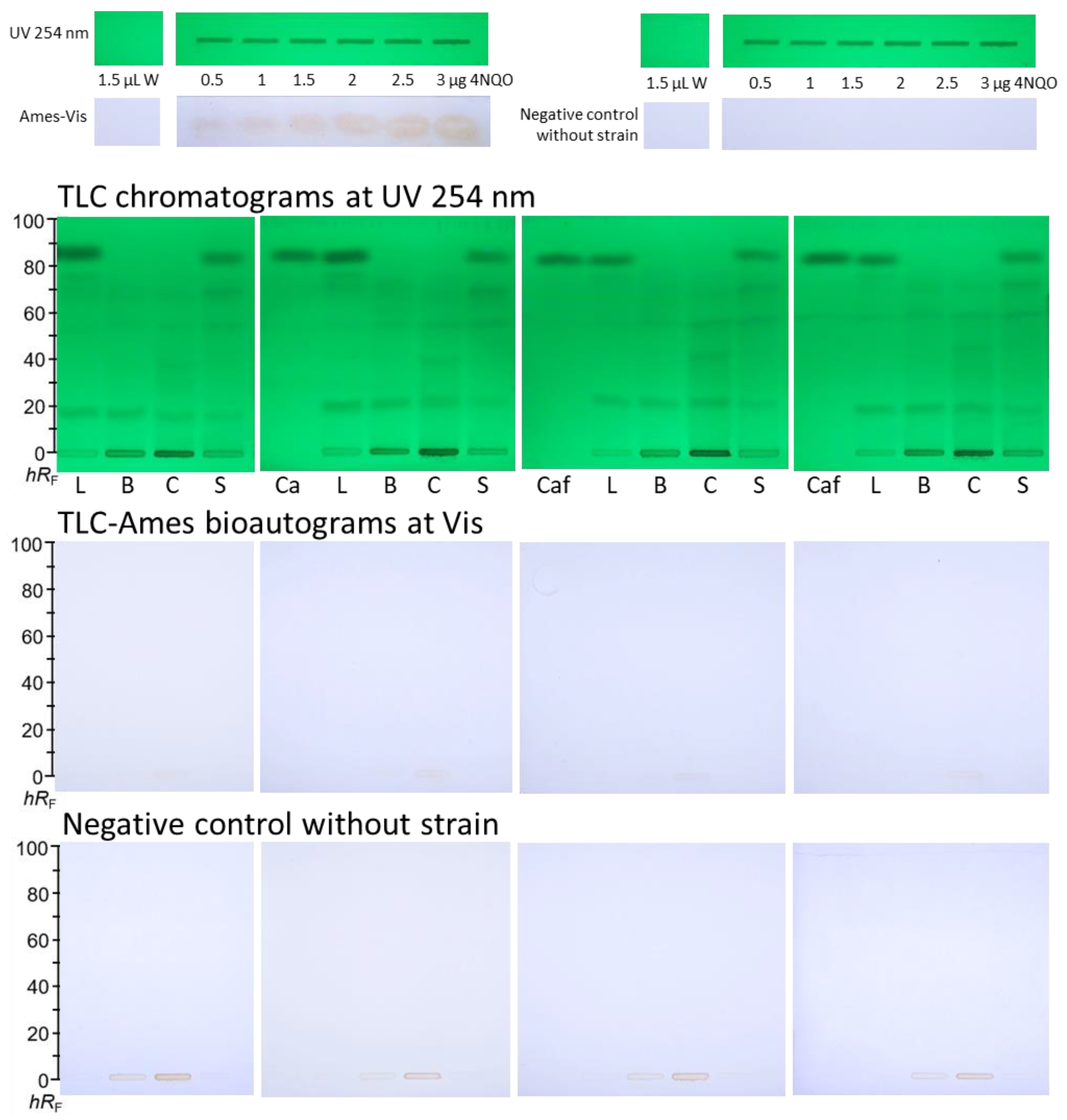
The reproducibility of the 2LabsToGo-Eco TLC chromatograms at UV 254 on different plates to confirm the proper sample separation and of the resulting TLC planar Ames bioautograms at Vis using the Salmonella Typhimurium TA98 strain was studied (Figure 2). Therefore, after the application of the positive control 4NQO and extractant blank in the upper plate part, which was not used for the separation, the TLC chromatogram was adjusted to pH 7.9 by spraying with 3% KOH solution. Thereafter, the planar Ames bioassay was successfully performed and verified by the positive control 4NQO, which showed the yellow response indicating mutagenicity. The 4NQO ranged 0.5–3.0 µg/band exhibited a linear dose-response relationship of the yellow response, with peak areas increasing from 4.8 to 8.0 area arbitrarily units (AU). Linear regression analysis with a slope of 1.3 AU per amount (in µg) showed a determination coefficient of R² = 0.97, which confirmed the concentration-dependent response. In contrast, the negative control without strain did not show the yellow response, supporting the specificity and reliability of the planar bioassay.
The tested coffee by-product samples, including the hot water extracts of Coffea leaves (L), blossoms (B), cherries (C), and silverskin (S) as well as the reference solutions of CGA and caffeine showed no visible yellow zones in any of the replicates, indicating the absence of any detectable mutagenic activity under the given bioassay conditions. The positive control 4NQO confirmed the proper performance of the assay and its capability to detect mutagenic compounds. The results demonstrated that the tested coffee by-products do not exhibit mutagenic potential under the given conditions of the planar Ames bioassay with pH indicator substrate with an incubation time of only 5 h and the strain TA98 only. Nevertheless, a longer exposure with an extended incubation time and testing with additional Salmonella strains, e.g., TA 100, is recommended to ensure the absence of mutagenicity.
4. Discussion
Hot water was the most effective extractant for Coffea leaves, blossoms, cherries, and silverskin, detecting most compound zones and indicating that predominantly polar compounds occur in the tested coffee by-products. It was found to be an ideal extractant as it also simulated best the actual human consumption conditions and exposure. Coffee cherries, which are naturally rich in pectin [61], formed gel-like particles using ethanol as the extractant. The application of such ethanolic cherry sample extracts with gel-like particles should be avoided using the autosampler of the 2LabsToGo-Eco system. Ethanol should be substituted not only as the extractant, but also as the rinsing solvent between applications, as the interaction between residual ethanol and the pectin-rich matrix may clog the autosampler tubing.
Comprehensive toxicological assessments, including mutagenicity testing, are essential for confirming the safety of coffee by-products intended for human consumption [62,63]. In the in vitro Ames MPF assay [36], Salmonella do not grow in the reversion medium, which lacks the essential amino acid histidine. However, Salmonella reverted by mutagens do grow and produce acidic metabolites in the reversion medium, which contains the purple bromocresol pH indicator, changing from purple to yellow due to acidification. Non-reverted Salmonella do not grow and the pH indicator remains purple. This principle was used in a recently reported planar Ames bioassay with pH indicator substrate [15]. However, the incubation was limited to 5 h because of the diffusion of compound zones for longer incubations. The slightly acidic pH of 6.4 of the original HPTLC plate reduced detection sensitivity, requiring pH adjustment to alkaline conditions using 3% KOH before the bioassay performance [15]. The planar Ames bioassay with pH indicator substrate was successfully performed and verified using the positive control 4NQO and a negative control plate without the strain. The tested coffee by-products, i.e., Coffea leaves, blossoms, cherries, and silverskin, did not show mutagenic potential under the given test conditions. Nevertheless, a longer exposure with an extended incubation time and the testing with additional Salmonella strains, e.g., TA 100, is recommended to comprehensively confirm their safety for human consumption.
These findings align with previous research studies that have similarly confirmed the safety of coffee by-products [26,27]. In one study, the safety of whole coffee fruits in both powdered and concentrated forms was reported using bacterial mutagenicity and mammalian genotoxicity test systems. Oral toxicity studies at high doses in rats showed good tolerability, with minor, non-adverse effects, such as reduced feed intake and reduced body weight gain, likely due to poor palatability rather than toxicity. No significant clinical, behavioral, or histopathological changes were observed. The established no-observed-adverse-effect level (NOAEL) was 50,000 mg/kg, supporting the safety of coffee fruit extracts in food applications [26]. In another study, a coffee silverskin extract was confirmed to be microbiologically safe, non-cytotoxic, and non-genotoxic based on the HepG2 liver cell and comet assays. The results showed that the coffee silverskin extract and its primary component, CGA, did not induce DNA damage or oxidative stress at the tested concentrations. It also provided protective effects against benzo[a]pyrene-induced oxidative DNA damage, likely due to its strong antioxidant activity. These results support the use of coffee silverskin extract as a safe, chemoprotective, and potentially valuable food ingredient [27].
Currently, information regarding the safety of coffee by-products is limited. Based on the results of existing literature and the present study, coffee by-products, including cherry and silverskin, do not exhibit mutagenicity. Additionally, this study provides new safety data for coffee blossoms and leaves, which have been less frequently evaluated. According to the EFSA guidelines, in vitro genotoxicity/mutagenicity tests with negative results are generally sufficient, and further in vivo studies are not required. However, considering the natural variability, different treatments, and the many pesticides used in coffee production as well as the different supply chains, coffee by-products may differ highly. Increasing interest in utilizing coffee by-products in novel food applications, requires powerful toxicological screening techniques. The planar bioassay technology using the affordable 2LabsToGo-Eco is a good option.
Supplementary Materials
The following supporting information can be downloaded at website of this paper posted on Preprints.org, Table S1: Tested mobile phase systems and respective TLC chromatograms at UV 254 nm of leave extracts obtained using water (1), ethanol (2), n-hexane (3), and ethyl acetate (4), blossom extracts obtained using water (5), ethanol (6), n-hexane (7), and ethyl acetate (8), and cherry extracts obtained using water (9), ethanol (10), n-hexane (11), and ethyl acetate (12).
Author Contributions
Conceptualization, M.M., and D.W.L.; methodology, G.E.M., M.M.; formal analysis, G.E.M., M.M.; investigation, M.M. and C.H.; writing—original draft preparation, M.M., G.E.M.; writing—review and editing, M.M., C.H., G.E.M., J.F., and D.W.L.; visualization, M.M., G.E.M.; supervision, D.W.L., and J.F.; project administration, D.W.L.; funding acquisition, M.M. All authors have read and agreed to the published version of the manuscript.
Funding
The traineeship of M.M. in Germany was funded by Erasmus+ programme of the European Union (Erasmus Code I PADOVA01, grant agreement number 305/2024, project code 2024-1-IT02-KA131-HED-000199330).
Institutional Review Board Statement
Not applicable
Informed Consent Statement
Not applicable
Data Availability Statement
The original contributions presented in this study are included in the article/supplementary material. Further inquiries can be directed to the corresponding author.
Conflicts of Interest
The authors declare no conflicts of interest. The funders had no role in the design of the study; in the collection, analyses, or interpretation of data; in the writing of the manuscript; or in the decision to publish the results.
References
- Blinová, L.; Sirotiak, M.; Bartošová, A.; Soldán, M. Utilization of Waste from Coffee Production. Vedecké Práce Materiálovotechnologickej Fakulty Slovenskej Technickej Univerzity v Bratislave so Sídlom v Trnave 2017, 25, 91–101. [Google Scholar] [CrossRef]
- Murthy, P.S.; Naidu, M.M. Sustainable Management of Coffee Industry By-Products and Value Addition—A Review. Resour. Conserv. Recycl. 2012, 66, 45–58. [Google Scholar] [CrossRef]
- Heeger, A.; Kosińska-Cagnazzo, A.; Cantergiani, E.; Andlauer, W. Bioactives of Coffee Cherry Pulp and Its Utilisation for Production of Cascara Beverage. Food Chem. 2017, 221, 969–975. [Google Scholar] [CrossRef]
- Alves, R.C.; Rodrigues, F.; Nunes, M.A.; Vinha, A.F.; Oliveira, M.B.P.P. State of the Art in Coffee Processing By-Products. In Handbook of coffee processing by-products; Galanakis, C.M., Ed.; Academic Press: London, UK, 2017; pp. 1–26. [Google Scholar]
- Carriço, C.; Ribeiro, H.M.; Marto, J. Converting Cork By-Products to Ecofriendly Cork Bioactive Ingredients: Novel Pharmaceutical and Cosmetics Applications. Ind. Crops Prod. 2018, 125, 72–84. [Google Scholar] [CrossRef]
- Kull, A.-K.; Lachenmeier, D.W. Comprehensive Update on European Union Labeling Standards for Coffee and Its By-Products. Proceedings 2024, 109, 1–13. [Google Scholar] [CrossRef]
- EFSA Panel on Dietetic Products, N. and A. (NDA); Turck, D.; Bresson, J.; Burlingame, B.; Dean, T.; Fairweather-Tait, S.; Heinonen, M.; Hirsch-Ernst, K.I.; Mangelsdorf, I.; McArdle, H. Guidance on the Preparation and Presentation of an Application for Authorisation of a Novel Food in the Context of Regulation (EU) 2015/2283. Efsa J. 2016, 14, e04594. [Google Scholar] [CrossRef]
- Organisation for Economic Co-operation and Development (OECD) Test No. 487: In Vitro Mammalian Cell Micronucleus Test; OECD Publishing: Paris, France, 2023; pp. 1–29.
- Organisation for Economic Co-operation and Development (OECD) Test No. 471: Bacterial Reverse Mutation Test; OECD Publishing: Paris, France, 2020; pp. 1–12.
- Wexler, P.; Anderson, B.D. Encyclopedia of Toxicology; Academic Press: San Diego, CA, USA, 2005; Vol. 1, ISBN 0127453547. [Google Scholar]
- Kier, L.D. Use of the Ames Test in Toxicology. Regul. Toxicol. Pharmacol. 1985, 5, 59–64. [Google Scholar] [CrossRef]
- Bjørseth, A.; Eidså, G.; Gether, J.; Landmark, L.; Møller, M. Detection of Mutagens in Complex Samples by the Salmonella Assay Applied Directly on Thin-Layer Chromatography Plates. Science (1979) 1982, 215, 87–89. [Google Scholar] [CrossRef] [PubMed]
- Schilter, B.; Burnett, K.; Eskes, C.; Geurts, L.; Jacquet, M.; Kirchnawy, C.; Oldring, P.; Pieper, G.; Pinter, E.; Tacker, M. Value and Limitation of in Vitro Bioassays to Support the Application of the Threshold of Toxicological Concern to Prioritise Unidentified Chemicals in Food Contact Materials. Food Addit. Contam.: Part A 2019, 36, 1903–1936. [Google Scholar] [CrossRef]
- Rainer, B.; Mayrhofer, E.; Redl, M.; Dolak, I.; Mislivececk, D.; Czerny, T.; Kirchnawy, C.; Marin-Kuan, M.; Schilter, B.; Tacker, M. Mutagenicity Assessment of Food Contact Material Migrates with the Ames MPF Assay. Food Addi. Contam.: Part A 2019, 36, 1419–1432. [Google Scholar] [CrossRef]
- Schmidtmann, K.; Lemme, J.; Morlock, G.E. Ames Assay Transferred from the Microtiter Plate to the Planar Assay Format. J. Xenobiot. 2025, 15, 67. [Google Scholar] [CrossRef] [PubMed]
- Monazzah, M.; Lachenmeier, D.W. Genotoxicity of Coffee, Coffee By-Products, and Coffee Bioactive Compounds: Contradictory Evidence from In Vitro Studies. Toxics 2025, 13, 409. [Google Scholar] [CrossRef] [PubMed]
- Albertini, S.; Friederich, U.; Schlatter, C.; Würgler, F.E. The Influence of Roasting Procedure on the Formation of Mutagenic Compounds in Coffee. Food Chem. Toxicol. 1985, 23, 593–597. [Google Scholar] [CrossRef]
- Shane, B.S.; Troxclair, A.M.; McMillin, D.J.; Henry, C.B. Comparative Mutagenicity of Nine Brands of Coffee to Salmonella Typhimurium TA100, TA102, and TA104. Environ. Mol. Mutagen 1988, 11, 195–206. [Google Scholar] [CrossRef]
- Fujita, Y.; Wakabayashi, K.; Nagao, M.; Sugimura, T. Characteristics of Major Mutagenicity of Instant Coffee. Mutat. Res. Lett. 1985, 142, 145–148. [Google Scholar] [CrossRef]
- Liu, Z.-S.; Chen, P.-W.; Wang, J.-Y.; Kuo, T.-C. Assessment of Cellular Mutagenicity of Americano Coffees from Popular Coffee Chains. J. Food Prot. 2017, 80, 1489–1495. [Google Scholar] [CrossRef]
- Duarte, M.P.; Laires, A.; Gaspar, J.; Oliveira, J.S.; Rueff, J. Genotoxicity of Instant Coffee and of Some Phenolic Compounds Present in Coffee upon Nitrosation. Teratog. Carcinog. Mutagen 2000, 20, 241–249. [Google Scholar] [CrossRef]
- Kato, T.; Hiramoto, K.; Kikugawa, K. Possible Occurrence of New Mutagens with the DNA Breaking Activity in Coffee. Mutat. Res. Fundam. Mol. Mech. Mutagen. 1994, 306, 9–17. [Google Scholar] [CrossRef]
- Bravo, J.; Arbillaga, L.; de Peña, M.P.; Cid, C. Antioxidant and Genoprotective Effects of Spent Coffee Extracts in Human Cells. Food Chem. Toxicol. 2013, 60, 397–403. [Google Scholar] [CrossRef] [PubMed]
- Monente, C.; Bravo, J.; Vitas, A.I.; Arbillaga, L.; De Peña, M.P.; Cid, C. Coffee and Spent Coffee Extracts Protect against Cell Mutagens and Inhibit Growth of Food-Borne Pathogen Microorganisms. J. Funct. Foods 2015, 12, 365–374. [Google Scholar] [CrossRef]
- Fernandes, A.S.; Mello, F.V.C.; Thode Filho, S.; Carpes, R.M.; Honório, J.G.; Marques, M.R.C.; Felzenszwalb, I.; Ferraz, E.R.A. Impacts of Discarded Coffee Waste on Human and Environmental Health. Ecotoxicol. Environ. Saf. 2017, 141, 30–36. [Google Scholar] [CrossRef]
- Heimbach, J.T.; Marone, P.A.; Hunter, J.M.; Nemzer, B. V; Stanley, S.M.; Kennepohl, E. Safety Studies on Products from Whole Coffee Fruit. Food Chem. Toxicol. 2010, 48, 2517–2525. [Google Scholar] [CrossRef]
- Iriondo-DeHond, A.; Haza, A.I.; Ávalos, A.; Del Castillo, M.D.; Morales, P. Validation of Coffee Silverskin Extract as a Food Ingredient by the Analysis of Cytotoxicity and Genotoxicity. Food Res. Int. 2017, 100, 791–797. [Google Scholar] [CrossRef]
- Cabezudo, I.; Salazar, M.O.; Ramallo, I.A.; Furlan, R.L.E. Effect-Directed Analysis in Food by Thin-Layer Chromatography Assays. Food Chem. 2022, 390, 132937. [Google Scholar] [CrossRef]
- Morlock, G.E. Chemical Safety Screening of Products–Better Proactive. J. Chromatogr A 2025, 1752, 465946. [Google Scholar] [CrossRef] [PubMed]
- Morlock, G.E. Planar Chromatographic Super-Hyphenations for Rapid Dereplication. Phytochem. Rev. 2025, 24, 1–12. [Google Scholar] [CrossRef]
- Morlock, G.E.; Heil, J.; Inarejos-Garcia, A.M.; Maeder, J. Effect-Directed Profiling of Powdered Tea Extracts for Catechins, Theaflavins, Flavonols and Caffeine. Antioxidants 2021, 10, 117. [Google Scholar] [CrossRef] [PubMed]
- Inarejos-Garcia, A.M.; Heil, J.; Martorell, P.; Álvarez, B.; Llopis, S.; Helbig, I.; Liu, J.; Quebbeman, B.; Nemeth, T.; Holmgren, D. Effect-Directed, Chemical and Taxonomic Profiling of Peppermint Proprietary Varieties and Corresponding Leaf Extracts. Antioxidants 2023, 12, 476. [Google Scholar] [CrossRef]
- Morlock, G.E.; Heil, J. Fast Unmasking Hazards of Safe Perfumes. J. Chromatogr. A 2025, 1754, 465959. [Google Scholar] [CrossRef]
- Windisch, M.; Kittinger, C.; Heil, J.; Morlock, G.E. Simple Performance of the Planar SOS-Umu-C–FLD Genotoxicity Bioassay Shown for Perfume and Packaging Material Analysis. JPC–J. Planar Chromatogr.–Mod. TLC 2023, 36, 513–520. [Google Scholar] [CrossRef]
- Oresanya, I.O.; Orhan, I.E.; Heil, J.; Morlock, G.E. African Under-Utilized Medicinal Leafy Vegetables Studied by Microtiter Plate Assays and High-Performance Thin-Layer Chromatography–Planar Assays. Molecules 2024, 29, 733. [Google Scholar] [CrossRef]
- Spiliotopoulos, D.; Koelbert, C. Assessment of the Miniaturized Liquid Ames Microplate Format (MPFTM) for a Selection of the Test Items from the Recommended List of Genotoxic and Non-Genotoxic Chemicals. Mutat. Res. Genet. Toxicol. Environ. Mutagen. 2020, 856, 503218. [Google Scholar] [CrossRef] [PubMed]
- Meyer, D.; Marin-Kuan, M.; Debon, E.; Serrant, P.; Cottet-Fontannaz, C.; Schilter, B.; Morlock, G.E. Detection of Low Levels of Genotoxic Compounds in Food Contact Materials Using an Alternative HPTLC-SOS-Umu-C Assay. ALTEX 2021, 38, 387–397. [Google Scholar] [CrossRef]
- Azadniya, E.; Mollergues, J.; Stroheker, T.; Billerbeck, K.; Morlock, G.E. New Incorporation of the S9 Metabolizing System into Methods for Detecting Acetylcholinesterase Inhibition. Anal. Chim. Acta. 2020, 1129, 76–84. [Google Scholar] [CrossRef] [PubMed]
- Fichou, D.; Morlock, G.E. Powerful Artificial Neural Network for Planar Chromatographic Image Evaluation, Shown for Denoising and Feature Extraction. Anal. Chem. 2018, 90, 6984–6991. [Google Scholar] [CrossRef] [PubMed]
- Fichou, D.; Ristivojevic, P.; Morlock, G.E. Proof-of-Principle of RTLC, an Open-Source Software Developed for Image Evaluation and Multivariate Analysis of Planar Chromatograms. Anal. Chem. 2016, 88, 12494–12501. [Google Scholar] [CrossRef]
- Fichou, D.; Yüce, I.; Morlock, G.E. EicCluster Software, an Open-Source in Silico Tool, and on-Surface Syntheses, an in Situ Concept, Both Exploited for Signal Highlighting in High-Resolution Mass Spectrometry to Ease Structure Elucidation in Planar Chromatography. J. Chromatogr. A 2018, 1577, 101–108. [Google Scholar] [CrossRef]
- Sereshti, H.; Poursorkh, Z.; Aliakbarzadeh, G.; Zarre, S. Quality Control of Saffron and Evaluation of Potential Adulteration by Means of Thin Layer Chromatography-Image Analysis and Chemometrics Methods. Food Control 2018, 90, 48–57. [Google Scholar] [CrossRef]
- Fichou, D.; Morlock, G.E. QuanTLC, an Online Open-Source Solution for Videodensitometric Quantification. J. Chromatogr. A 2018, 1560, 78–81. [Google Scholar] [CrossRef]
- Klingelhöfer, I.; Morlock, G.E. Sharp-Bounded Zones Link to the Effect in Planar Chromatography-Bioassay-Mass Spectrometry. J. Chromatogr. A 2014, 1360, 288–295. [Google Scholar] [CrossRef]
- Azadniya, E.; Goldoni, L.; Bandiera, T.; Morlock, G.E. Same Analytical Method for Both (Bio) Assay and Zone Isolation to Identify/Quantify Bioactive Compounds by Quantitative Nuclear Magnetic Resonance Spectroscopy. J. Chromatogr. A 2020, 1628, 461434. [Google Scholar] [CrossRef]
- Li, Y.; Zhao, C.; Lu, C.; Zhou, S.; Tian, G.; He, L.; Bao, Y.; Fauconnier, M.-L.; Xiao, H.; Zheng, J. Simultaneous Determination of 14 Bioactive Citrus Flavonoids Using Thin-Layer Chromatography Combined with Surface Enhanced Raman Spectroscopy. Food Chem. 2021, 338, 128115. [Google Scholar] [CrossRef]
- Meyer, D.; Marin-Kuan, M.; Debon, E.; Serrant, P.; Cottet-Fontannaz, C.; Schilter, B.; Morlock, G.E. Detection of Low Levels of Genotoxic Compounds in Food Contact Materials Using an Alternative HPTLC-SOS-Umu-C Assay. ALTEX 2021, 38, 387–397. [Google Scholar] [CrossRef] [PubMed]
- Morlock, G.E. High-Performance Thin-Layer Chromatography Combined with Effect-Directed Assays and High-Resolution Mass Spectrometry as an Emerging Hyphenated Technology: A Tutorial Review. Anal. Chim. Acta. 2021, 1180, 338644. [Google Scholar] [CrossRef]
- Schreiner, T.; Ronzheimer, A.; Friz, M.; Morlock, G.E. Multiplex Planar Bioassay with Reduced Diffusion on Normal Phase, Identifying Androgens, Verified Antiandrogens and Synergists in Botanicals via 12D Hyphenation. Food Chem. 2022, 395, 133610. [Google Scholar] [CrossRef] [PubMed]
- Morlock, G.E. Miniaturized Planar Chromatography Using Office Peripherals—Office Chromatography. J. Chromatogr. A 2015, 1382, 87–96. [Google Scholar] [CrossRef]
- Romero, M.C.O.; Jakob, K.; Schmidt, J.; Nimmerfroh, T.; Schwack, W.; Morlock, G.E. Consolidating Two Laboratories into the Most Sustainable Lab of the Future: 2LabsToGo-Eco. Anal. Chim. Acta. 2025, 344103. [Google Scholar] [CrossRef]
- Morlock, G.E.; Koch, J.; Schwack, W. Miniaturized Open-Source 2LabsToGo Screening of Lactose-Free Dairy Products and Saccharide-Containing Foods. J. Chromatogr. A 2023, 1688, 463720. [Google Scholar] [CrossRef]
- Sing, L.; Schwack, W.; Göttsche, R.; Morlock, G.E. 2LabsToGo─ Recipe for Building Your Own Chromatography Equipment Including Biological Assay and Effect Detection. Anal. Chem. 2022, 94, 14554–14564. [Google Scholar] [CrossRef]
- Jakob, K.; Schwack, W.; Morlock, G.E. All-in-One 2LabsToGo System for Analysis of Ergot Alkaloids in Whole Rye. Food Chem. 2024, 453, 139593. [Google Scholar] [CrossRef] [PubMed]
- Schade, F.; Schwack, W.; Demirbas, Y.; Morlock, G.E. Open-Source All-in-One LabToGo Office Chromatography. Anal. Chim. Acta. 2021, 1174, 338702. [Google Scholar] [CrossRef] [PubMed]
- Fichou, D.; Morlock, G.E. Office Chromatography: Miniaturized All-in-One Open-Source System for Planar Chromatography. Anal. Chem. 2018, 90, 12647–12654. [Google Scholar] [CrossRef]
- Altemimi, A.; Lakhssassi, N.; Baharlouei, A.; Watson, D.G.; Lightfoot, D.A. Phytochemicals: Extraction, Isolation, and Identification of Bioactive Compounds from Plant Extracts. Plants 2017, 6, 42. [Google Scholar] [CrossRef]
- Maron, D.M.; Ames, B.N. Revised Methods for the Salmonella Mutagenicity Test. Mutat. Res. Genet. Toxicol. Environ. Mutagen 1983, 113, 173–215. [Google Scholar] [CrossRef]
- Tiwari, P.; Kumar, B.; Kaur, M.; Kaur, G.; Kaur, H. Phytochemical Screening and Extraction: A Review. Int. Pharm. Sci. 2011, 1, 98–106. [Google Scholar]
- Chamyuang, S.; Owatworakit, A.; Intatha, U.; Duangphet, S. Coffee Pectin Production: An Alternative Way for Agricultural Waste Management in Coffee Farms. Sci. Asia 2021, 47, 90–95. [Google Scholar] [CrossRef]
- Blumenthal, P.; Steger, M.C.; Einfalt, D.; Rieke-Zapp, J.; Quintanilla Bellucci, A.; Sommerfeld, K.; Schwarz, S.; Lachenmeier, D.W. Methanol Mitigation during Manufacturing of Fruit Spirits with Special Consideration of Novel Coffee Cherry Spirits. Molecules 2021, 26, 2585. [Google Scholar] [CrossRef] [PubMed]
- Committee, E.S. Scientific Opinion on Genotoxicity Testing Strategies Applicable to Food and Feed Safety Assessment. EFSA J. 2011, 9, 2379. [Google Scholar] [CrossRef]
- EFSA Panel on Nutrition, N.F. and F.A. (NDA); Turck, D.; Bohn, T.; Castenmiller, J.; de Henauw, S.; Hirsch-Ernst, K.I.; Maciuk, A.; Mangelsdorf, I.; McArdle, H.J.; Naska, A. Guidance on the Scientific Requirements for an Application for Authorisation of a Novel Food in the Context of Regulation (EU) 2015/2283. EFSA J. 2024, 22, e8961. [CrossRef]
Figure 1.
Repeatability of the 2LabsToGo-Eco analysis: TLC chromatograms at UV 254 nm of hot water extracts of leaves (L), blossoms (B), cherries (C), and silverskin (S), each applied in duplicate along with CGA and caffeine (Caf) solutions, all 3 µL/band, separated on a TLC plate silica gel 60 F254 with ethyl acetate, n-propanol, and water (1:6:3, v/v/v) as well as the corresponding quantTLC videodensitograms with overlaid red/green/blue channels and grey value showing a good method repeatability.
Figure 1.
Repeatability of the 2LabsToGo-Eco analysis: TLC chromatograms at UV 254 nm of hot water extracts of leaves (L), blossoms (B), cherries (C), and silverskin (S), each applied in duplicate along with CGA and caffeine (Caf) solutions, all 3 µL/band, separated on a TLC plate silica gel 60 F254 with ethyl acetate, n-propanol, and water (1:6:3, v/v/v) as well as the corresponding quantTLC videodensitograms with overlaid red/green/blue channels and grey value showing a good method repeatability.
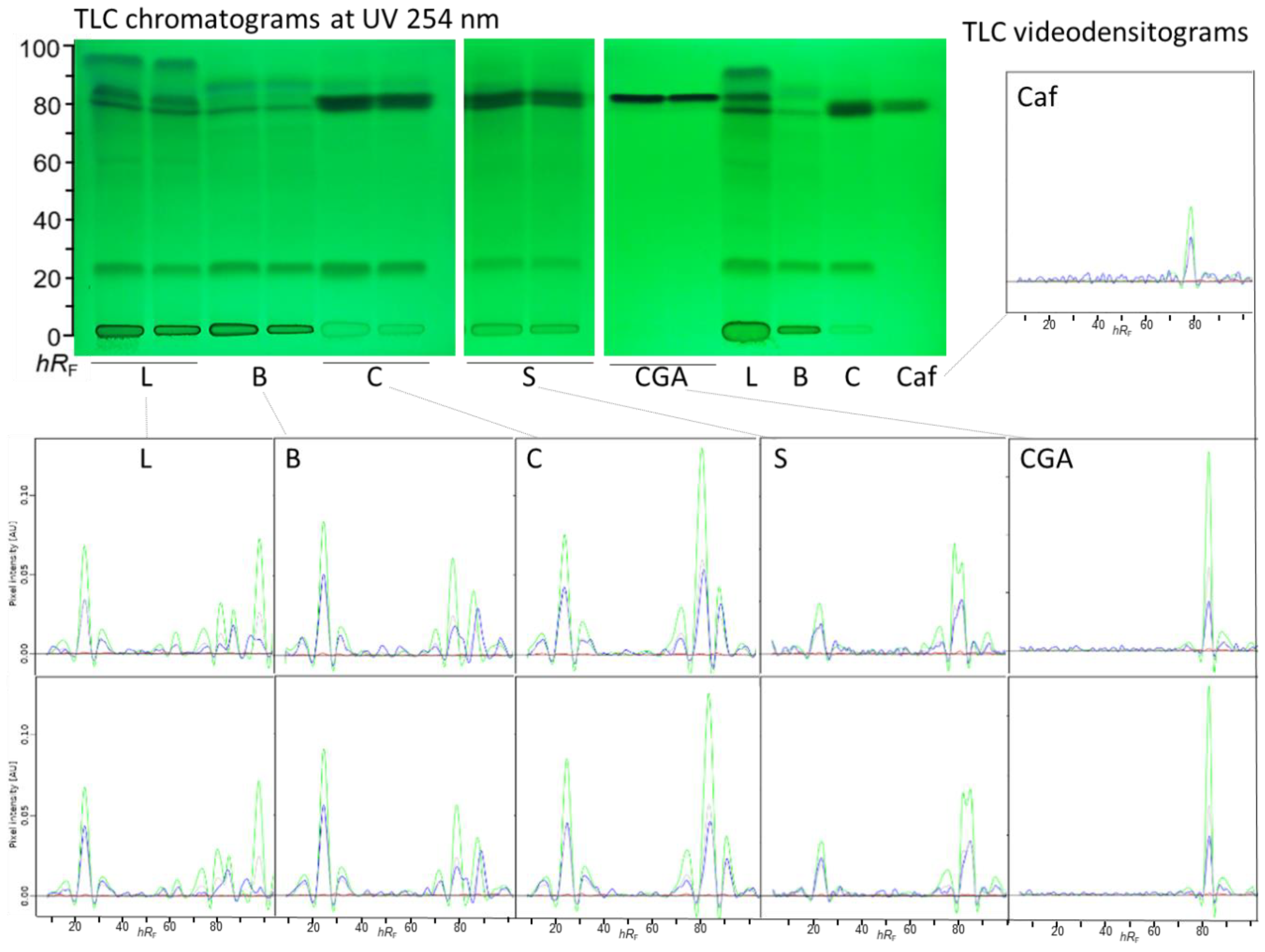
Figure 2.
Reproducibility of the TLC chromatograms at UV 254 and TLC-planar Ames bioautograms at Vis with Salmonella Typhimurium strain TA98 using the 2LabsToGo-Eco: hot water extracts of leaves (L), blossoms (B), cherries (C), and silverskin (S) as well as caffeine solution (Caf), all 1.5 µL/band analyzed as in Figure 1, along with extractant blank (hot water, W) and positive control 4NQO (0.5–3 µg/band), whereby the yellow mutagenic 4NQO zones verified the proper bioassay performance compared to the negative control without strain.
Figure 2.
Reproducibility of the TLC chromatograms at UV 254 and TLC-planar Ames bioautograms at Vis with Salmonella Typhimurium strain TA98 using the 2LabsToGo-Eco: hot water extracts of leaves (L), blossoms (B), cherries (C), and silverskin (S) as well as caffeine solution (Caf), all 1.5 µL/band analyzed as in Figure 1, along with extractant blank (hot water, W) and positive control 4NQO (0.5–3 µg/band), whereby the yellow mutagenic 4NQO zones verified the proper bioassay performance compared to the negative control without strain.
Disclaimer/Publisher’s Note: The statements, opinions and data contained in all publications are solely those of the individual author(s) and contributor(s) and not of MDPI and/or the editor(s). MDPI and/or the editor(s) disclaim responsibility for any injury to people or property resulting from any ideas, methods, instructions or products referred to in the content. |
© 2025 by the authors. Licensee MDPI, Basel, Switzerland. This article is an open access article distributed under the terms and conditions of the Creative Commons Attribution (CC BY) license (http://creativecommons.org/licenses/by/4.0/).
Copyright: This open access article is published under a Creative Commons CC BY 4.0 license, which permit the free download, distribution, and reuse, provided that the author and preprint are cited in any reuse.