
Submitted:
20 July 2025
Posted:
22 July 2025
You are already at the latest version
Abstract
Traditional purchasing and supply management (PSM) practices has primarily focused on cost optimization and transactional performance. However, sustainable purchasing and supply management (SPSM) broadens this perspective by incorporating social, economic, and environmental dimensions into procurement processes. Implementing such multidimensional objectives is complex, as PSM functions serve as interfaces among multiple organizational stakeholders across supply networks. In recent years, artificial intelligence (AI) has emerged as a pivotal enabler of this transformation, offering capabilities in data-driven decision-making, supplier assessment, and risk mitigation. This study undertakes a systematic examination of 183 peer-reviewed journal articles sourced from Scopus and Web of Science to investigate the intersection of AI and SPSM. Through a combined bibliometric and structural topic modeling approach, the review uncovers ten dominant research themes and traces the progression of AI applications across SPSM domains. The analysis culminates in the formulation of a conceptual framework that aligns AI technologies with the tactical and operational phases of procurement. In doing so, it identifies the opportunities associated with AI integration in sustainable purchasing practices. The review concludes by outlining research propositions and recommending future inquiries into adaptive, context sensitive AI governance for sustainability-oriented supply management.
Keywords:
artificial intelligence
; big data analytics
; sustainable purchasing and supply management
; sustainable supplier selection
; sustainable supplier evaluation
; Machine Learning
1. Introduction
Organizations today face growing pressure to adopt environmental and social initiatives, stemming not only from stringent government regulations but also from intensifying global competition and heightened customer expectations [1]. The escalating challenges of global warming, climate change, and resource depletion, coupled with increasing demands for improvements in business processes, economic standards, and technological advancements, have made it imperative for organizations to sustain and optimize processes along the entire value chain to contribute meaningfully to sustainability goals [2]. In this regard, the implementation of Sustainable Supply Chain Management (SSCM) is widely recognized as a key enabler, motivating organizations to address pressing environmental concerns while simultaneously delivering economic and social value [3]. As Stakeholders continue to increasingly hold firms accountable for environmental and social performance in their supply chains [4]. SSCM has emerged as a focal point of both academic inquiry and practical application, driven by a confluence of stakeholder expectations, regulatory frameworks, environmental imperatives, and societal demands related to corporate reputation and stakeholder trust [5]. SSCM represents a multidisciplinary approach aimed at advancing the simultaneous improvement of social, economic, and environmental performance through the adoption of responsible supply chain practices [6]. A firm’s reputation is now intrinsically linked not only to its internal sustainable practices but also to its ability to foster effective collaboration among supply chain partners to achieve collective sustainability objectives [7]. Empirical evidence suggests that supply chain sustainability is increasingly actualized through collaboration, and systematic monitoring of, suppliers, including second-tier suppliers and beyond [8]. Successful SSCM implementation requires sustainability to be embedded within a company’s core vision and operationalized throughout all organizational functions [9]. Within this context, the Purchasing and Supply Management (PSM) function is recognized as a critical strategic lever in contemporary organizations [10]. PSM holds unique influence over the global supply base and plays a pivotal role in shaping sustainable sourcing and procurement practices [11]. Historically viewed as a routine and transactional activity, PSM has evolved into a strategic function capable of delivering competitive advantage, a transformation largely driven by increased globalization, outsourcing trends, and the strategic emphasis on innovation and capability driven supply management [12,13]. Reflecting this shift, many multinational corporations now mandate compliance with well-defined social and environmental standards among their suppliers [14]. Consequently, PSM is positioned as a key organizational function and an intermediary between focal firms and their suppliers, facilitating the integration of sustainability within daily operations and across multi-tier supply networks [15]. Purchasing, at its core, refers to the acquisition of materials, supplies, services, components, and equipment from external sources in exchange for payment [16]. Traditionally, supply managers and purchasing agents have prioritized securing high-quality goods at the lowest possible cost [17]. However, growing expectations from top management, evolving regulatory landscapes, and adherence to internationally recognized standards such as ISO 14000 and ISO 20400 have increasingly compelled procurement professionals to embed environmental and social sustainability criteria within procurement and supply chain operations [18,19]. Sustainable purchasing and supply management (SPSM) integrates environmental, social, ethical, and economic considerations into the management of an organization’s external resources, ensuring that the procurement of goods, services, and knowledge supports both organizational objectives and broader societal and economic value [20]. The advent of Industry 4.0 has further revolutionized supply chain management and procurement through the integration of cutting-edge technologies such as the Internet of Things (IoT) and Artificial Intelligence (AI) into procurement processes [21].The widespread adoption of enterprise resource planning systems has resulted in an abundance of data within procurement functions [22]. Combined with advances in computing power, this data-rich environment provides new opportunities to enhance supply chain decision-making by leveraging AI, big data analytics, and sophisticated decision support systems [23,24]. Artificial intelligence (AI) was developed to create “thinking machines” capable of emulating, learning from, and potentially substituting human cognitive functions. Since the late 1970s, AI has demonstrated significant potential in enhancing human decision-making and increasing productivity across diverse business contexts, owing to its capacity to identify business patterns, comprehend complex phenomena, acquire information, and perform intelligent data analysis [25]. AI technologies encompass a broad spectrum of computational approaches designed to replicate human reasoning, learning, perception, and decision-making capabilities [26]. These technologies span symbolic and numeric paradigms and include methods such as predicate and propositional logic, probabilistic reasoning, decision tree learning, fuzzy logic, reinforcement learning, neural networks, deep learning, and support vector machines [27]. The evolution of AI has thus entailed the convergence of symbolic reasoning and data-driven techniques, enabling machines to autonomously process information, recognize patterns, adapt through experiential learning, and execute complex tasks across a range of sectors [28]. From healthcare and finance to manufacturing and retail, organizations are increasingly recognizing the significance of integrating AI into their core operations [29,30]. AI-based technologies offer a promising avenue for addressing managerial challenges related to sustainability and are increasingly adopted for sustainable development purposes [29,30]. By optimizing resource utilization, minimizing inefficiencies, and fostering innovative business practices, AI empowers firms to tackle pressing environmental and economic challenges [31]. Recent studies further reveal that AI is strategically deployed not only to enhance operational efficiency but also to address critical sustainability issues such as optimizing renewable energy consumption, reducing emissions, improving workplace safety, promoting diversity, and supporting community initiatives [32]. Thus, AI plays an essential role within SSCM by managing the vast data generated by complex industrial processes and supporting data-driven sustainability strategies [33]. An increasing number of systematic reviews have investigated the role of artificial intelligence (AI) in advancing sustainability in the entire supply chain [24,34,35] and across various supply chain subfields (production [36],logistics [37],finance [38],marketing and customer service [39],warehousing [40]). Despite extensive research on AI in supply chains, no existing review specifically examines the role of AI in sustainable purchasing and supply management (SPSM).To address this gap, our systematic review investigates the impact of AI-enabled technologies on SPSM sustainability by conducting a bibliometric analysis of 183 journal articles retrieved from the Scopus and web of science database. Utilizing topic modelling for text analysis, we identified key research themes and concepts, which informed the development of future research propositions aimed at advancing AI-enabled SPSM research and addressing the following research questions:
- Research Question 1 (RQ1): What are the existing trends in the application of artificial intelligence (AI) technologies within sustainable purchasing and supply management (SPSM)?
- Research Question 2 (RQ2): Which AI-integrated technologies are currently utilised in sustainable purchasing and supply management?
- Research Question 3 (RQ3): What are the prospective research directions for advancing the application of AI-integrated technologies in sustainable purchasing and supply management?
To address these questions, we performed bibliometric and text analyses to uncover key academic trends and emerging themes within the literature.Based on generated topics future propositions are formulated providing a framework for future research.
2. Materials and Methods
This study adopts a bibliometric analysis approach to analyse the current state of AI in Sustainable purchasing and supply management (SPSM). Then the Systematic literature review trough topic modelling to identify emerging themes and future research directions in the field. We synthesized the use of AI-integrated technologies within sustainable purchasing and supply management processes across the selected studies. Additionally, we developed a framework aimed at shaping future research directions related to AI integration in sustainable purchasing and supply management (SPSM).
2.1. Inclusion and Exclusion Criteria
To ensure transparency, reproducibility, and methodological rigor, this systematic review adheres to the Preferred Reporting Items for Systematic Reviews and Meta-Analyses (PRISMA) 2020 guidelines [45]. PRISMA 2020 revises the original 2009 statement [46] by incorporating advancements in systematic review methodologies, including improved practices for identifying, screening, appraising, and synthesizing research evidence.
The Figure 1 shows the systematic process followed to retrieve the database through a codified procedure. The literature search was conducted using two major scientific databases, Scopus and Web of Science (WoS).These two typically represent the major databases and citation indexes for general-purpose scientific literature, including journal articles, conference proceedings and books [47]. No time span restrictions were imposed, allowing the inclusion of all relevant records published until the date of the search. A search string was used to specify exactly what lies inside and outside the scope of the evidence synthesis [48]. As shown in Table 1, the search strings combined keywords related to AI (e.g. ’artificial intelligence’, ’machine learning’, ’deep learning’) and sustainable supply concepts (e.g. ’sustainable purchasing’, ’green procurement’, ’sustainable supply chain’, ’SPSM’) in the identification phase based on the During the identification phase, a total of 262 articles were collected, comprising 112 from Web of Science and 150 from Scopus. Following the removal of 43 duplicate records, the screening and selection process began. Each article was first reviewed on title and abstract by each reviewer, leading to the exclusion of 14 articles and 2 articles were retrieved. The articles were then fully reviewed by the reviewers, leading to the exclusion of 20 studies that lacked sufficient data or relevance. Consequently, 183 articles satisfied the inclusion criteria and were incorporated into the final analysis, facilitating a thorough and methodical examination of the relevant literature.

Table 1.
Boolean-based retrieval criteria
| Boolean search string |
|---|
| ("Artificial Intelligence" OR "Machine Learning" OR "Deep Learning" OR "Neural Network" OR "Decision Tree" OR "Natural Language Processing" OR "Clustering" OR "Genetic Algorithm" OR "Support Vector Machine" OR "Bayesian Network" OR "Back Propagation" OR "Linear Regression" OR "Fuzzy Logic" OR "Logistic Regression" OR "Big Data") AND ("Sustainable Supply Management" OR "Sustainable Procurement" OR "Sustainable Purchasing" OR "Sustainable Sourcing" OR "Green Supplier Selection" OR "Sustainable Supplier Selection") |
2.2. Bibliometric Analysis
Bibliometric analysis is a popular and rigorous method for exploring and analyzing large volumes of scientific data [49]. It help to identify the research clusters that form the field, capturing emerging trends, and getting a broad perspective on the concepts that are the focus of the field [50]. It is a quantitative analysis method that takes the external characteristics of scientific literature as research objects [51]. To conduct bibliometric research, scholars often employ four typical stages, define the aims and scope of the bibliometric study, Choose the techniques for bibliometric analysis, Collect the data for bibliometric analysis, and Run the bibliometric analysis and report the findings [49]. The bibliometric analysis was applied to our study To examine the structure and evolution of research on Artificial intelligence AI in Sustainable purchasing and supply management SPSM. The analysis was conducted utilizing the Bibliometrix package within the RStudio environment as the primary tool. Bibliometrix is an open-source R package for bibliometric and co-citation analysis [52] and science mapping analyses, supporting the entire workflow from data import and cleaning to advanced statistical analysis and visualization [53]. Bibliometrix enables R users to import bibliographic databases from sources such as SCOPUS or the Web of Science, with data files stored in either BibTeX (.bib) or Plain Text (.txt) formats [54].
2.3. Thematic Mapping and Topic Modeling
Topic modelling is a Natural Language Processing technique that has gained popularity over the last ten years, with applications in multiple fields of knowledge [55]. It is a statistical technique for revealing the underlying semantic structure in large collection of documents [56]. It make possible to derive insights that are difficult to derive from traditional text mining methods [57]. To support the identification of underlying thematic structures within the selected literature, this study employed Latent Dirichlet Allocation (LDA) as a topic modeling technique. LDA provides an unsupervised, data-driven approach to categorize and summarize large bodies of academic literature without prior manual coding [58]. In LDA, two Dirichlet distributions are utilized one governs the distribution of topics within documents, and the other governs the distribution of words within topics [59]. estimates two primary parameters the probability of a topic given a document () and the probability of a word given a topic ().Using algorithms such as Variational Bayes or Gibbs Sampling [60].To enhance topic interpretability, the study employed additional metrics such as FREX and lift, provided by the Bibliometrix R-package. FREX [61] balances word frequency and exclusivity it identifies terms that are not only frequent within a topic but also distinctive compared to other topics. Similarly, lift evaluates how strongly a word is associated with a given topic compared to its overall frequency across all topics [62].
3. Result
3.1. Bibliometric Analysis
3.1.1. Annual Scientific Production
The annual scientific output on the integration of artificial intelligence (AI) in sustainable purchasing and supply management (SPSM) has shown a clear growth trajectory over the last 15 years as depicted in Figure 2. Between 2010 and 2014, the number of publications remained modest, with fewer than five articles published annually. This period reflects the nascent stage of interdisciplinary research combining AI, sustainability, and supply chain management. A noticeable increase began in 2015, which can be attributed to several interrelated factors. The adoption of the United Nations Sustainable Development Goals (SDGs) and the signing of the Paris Agreement at COP21 in 2015 [63]. Around the same time, the development of the ISO 20400 standard on sustainable procurement began, encouraging organizations to restructure their sourcing practices using intelligent decision support tools [64]. The rise between 2019 and 2021 may also reflect the increased global focus on supply chain resilience and digitalization during and after the COVID-19 pandemic [65]. A temporary decline was observed in 2021,however, the overall upward trend persisted, reaching a peak in 2023 with over 35 articles published. Which can be explained by the maturity of AI technologies had to a level that enabled their application in complex supply chain contexts, including carbon footprint analysis, predictive sourcing, and ethical supplier selection, resulting in a significant body of empirical and review-based research [66].
3.1.2. Top Contributing Journals
The journal statistics presented in Table 2. Show that the Journal of Cleaner Production emerges as the most influential source. It possesses the highest h-index [15], g-index [16], and total citations (TC = 3,134), reflecting its longstanding and impactful contribution since 2010. Following this, journals such as International Journal of Production Research and Applied Soft Computing also show notable citation impact with total citations of 734 and 560, respectively, although their m-index values (0.455 and 0.286) indicate a relatively slower rate of scholarly influence over time. More recent contributors like Environmental Science and Pollution Research and PLOS ONE exhibit high m-index values (1.0), suggesting a rapid rise in citation frequency since their recent entries into the field in 2021 and 2022. Meanwhile, Sustainability demonstrates a balanced profile with a strong g-index [11] and high productivity 12 papers in a short time since 2019.
3.1.3. Top Countries
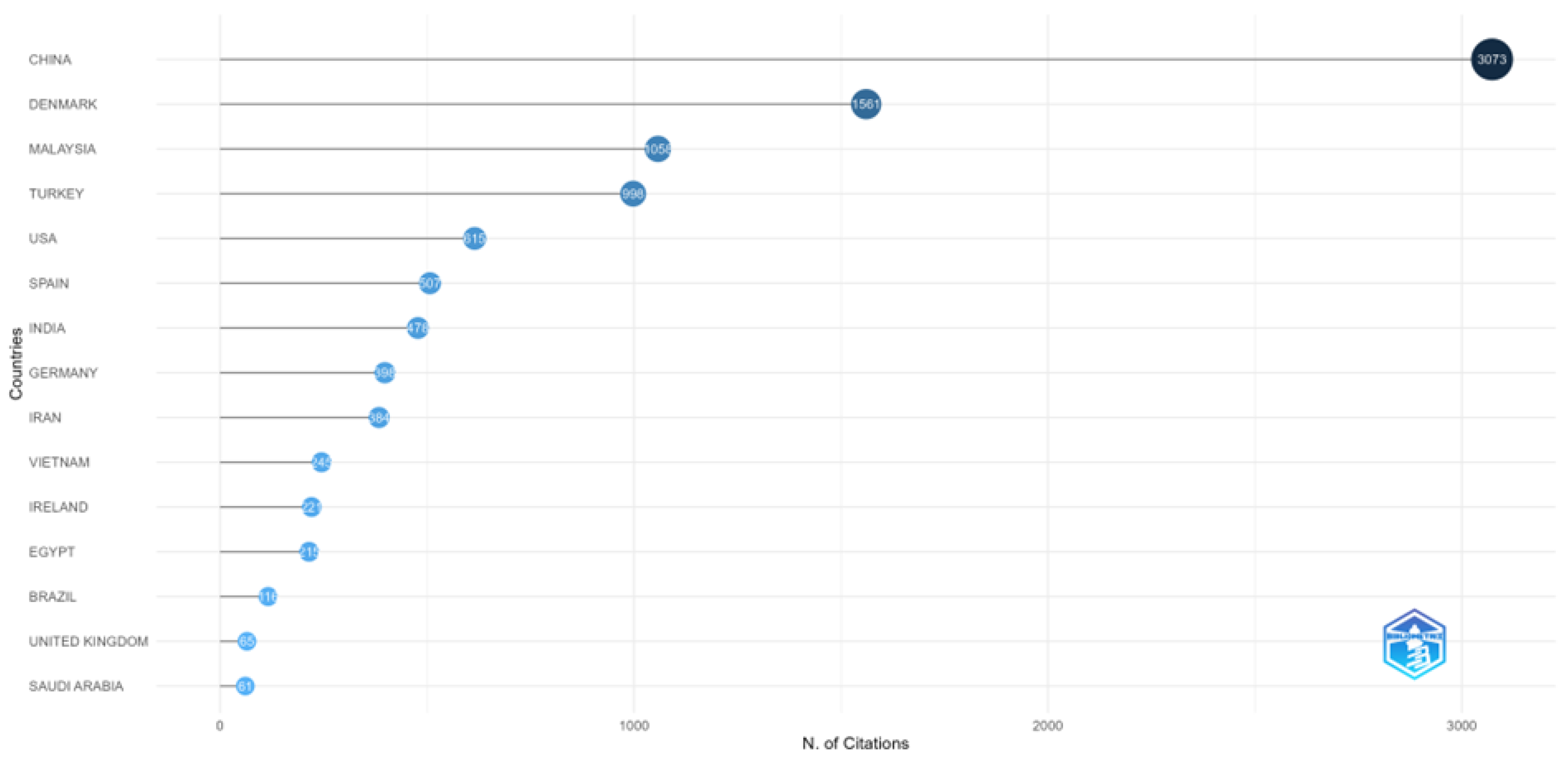
As illustrated in Figure 5, the bibliometric review highlights the top fifteen most cited countries contributing to the discourse on artificial intelligence (AI) in sustainable purchasing and supply management (SPSM). China emerges as the clear leader, with 3,073 citations.Denmark (1,561 citations), Malaysia (1,056), and Turkey (998) follow as prominent contributors, each demonstrating significant engagement in integrating digital innovation with sustainable supply chain practices. The United States, despite its foundational role in AI development, registers 615 citations in this specific domain.European nations, including Spain (507), Germany (398), and Ireland (221), display meaningful participation likely influenced by policy frameworks such as the European Green Deal and broader commitments to digital transformation. Meanwhile, rising economies such as India (478), Iran (384), and Vietnam (245) show increasing prominence, indicating growing scholarly attention and regional prioritization of AI-enabled sustainable procurement. Conversely, the United Kingdom (65) and Saudi Arabia (61) exhibit lower citation frequencies.Collectively, this geographic distribution reveals an uneven but converging global research landscape, where both established and developing nations contribute to the evolving integration of AI within sustainability-driven procurement.
Figure 3.
Most Cited Countries in the research area of AI in SPSM
3.2. Most Frequent Keywords
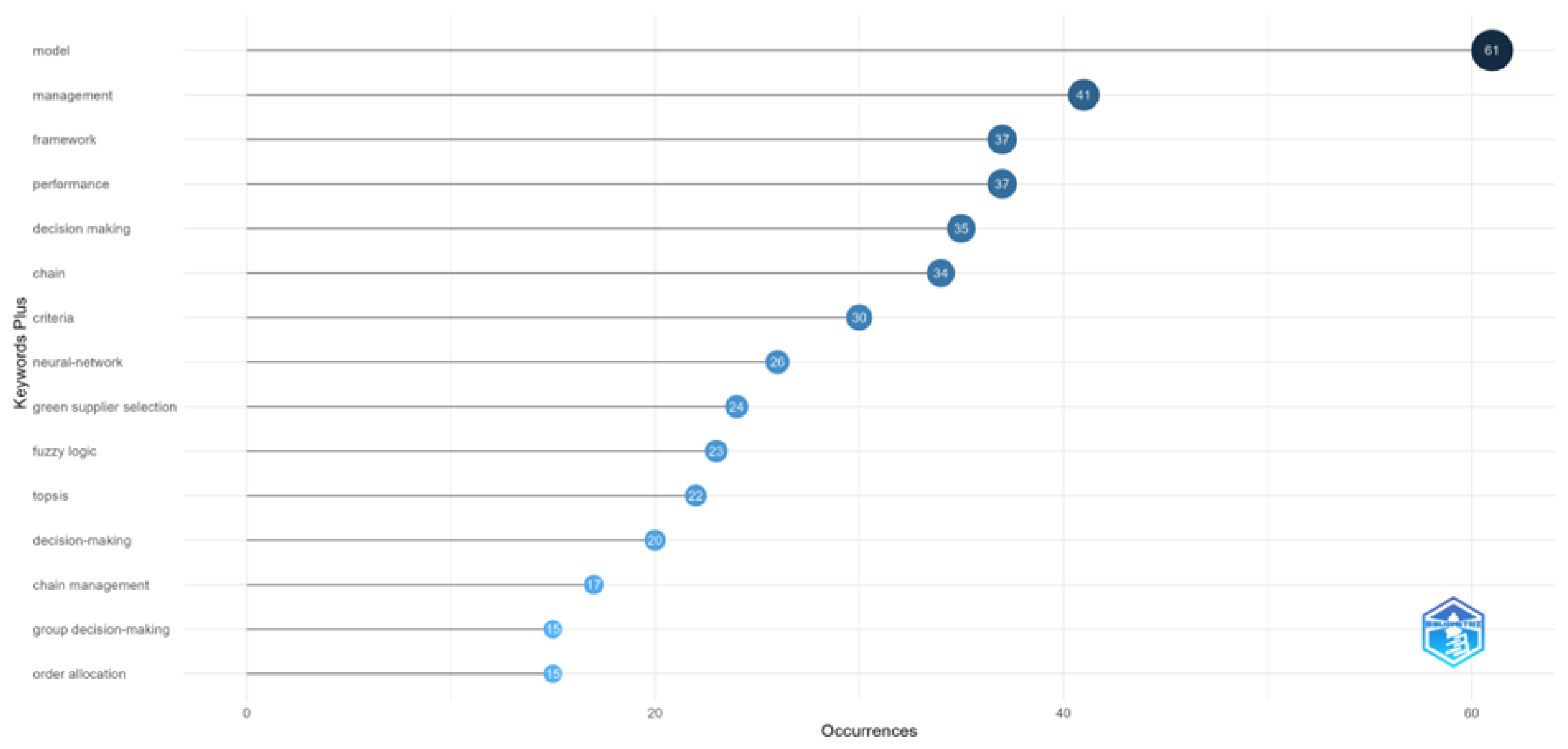
As the Figure 6 show, the term "model" is the most frequently occurring keyword, appearing 61 times, highlighting the dominant role of modeling approaches in structuring AI-driven decision-making in purchasing and suppy management.Following this, "management" (41 occurrences), "framework", and "performance" (each with 37 occurrences) suggest a strong focus on organizational implementation, conceptual structuring, and outcome measurement of sustainable AI practices. The keyword "decision making" appears 35 times, indicating its centrality to research in AI applications particularly within multi-criteria decision-making (MCDM) environments that are common in supplier selection, logistics, and resource allocation contexts. The presence of terms like "chain" [34], "criteria" [30], and "green supplier selection" [24] affirms the sustainability orientation of the field, with supply chain design and supplier selection.Technological terms such as "neural network" [26], "fuzzy logic" [23], and "TOPSIS" [22] reflect the methodological diversity applied in this area, pointing to a high reliance on soft computing techniques and hybrid AI tools for tackling complexity and uncertainty in sustainable operations. Furthermore, phrases like "group decision-making", "chain management", and "order allocation" emphasize collaborative, systemic approaches to optimizing resource distribution and strategic planning.
Figure 4.
Most Relevant words in the field of AI in SPSM
3.3. Keyword Co-Occurrence Networks
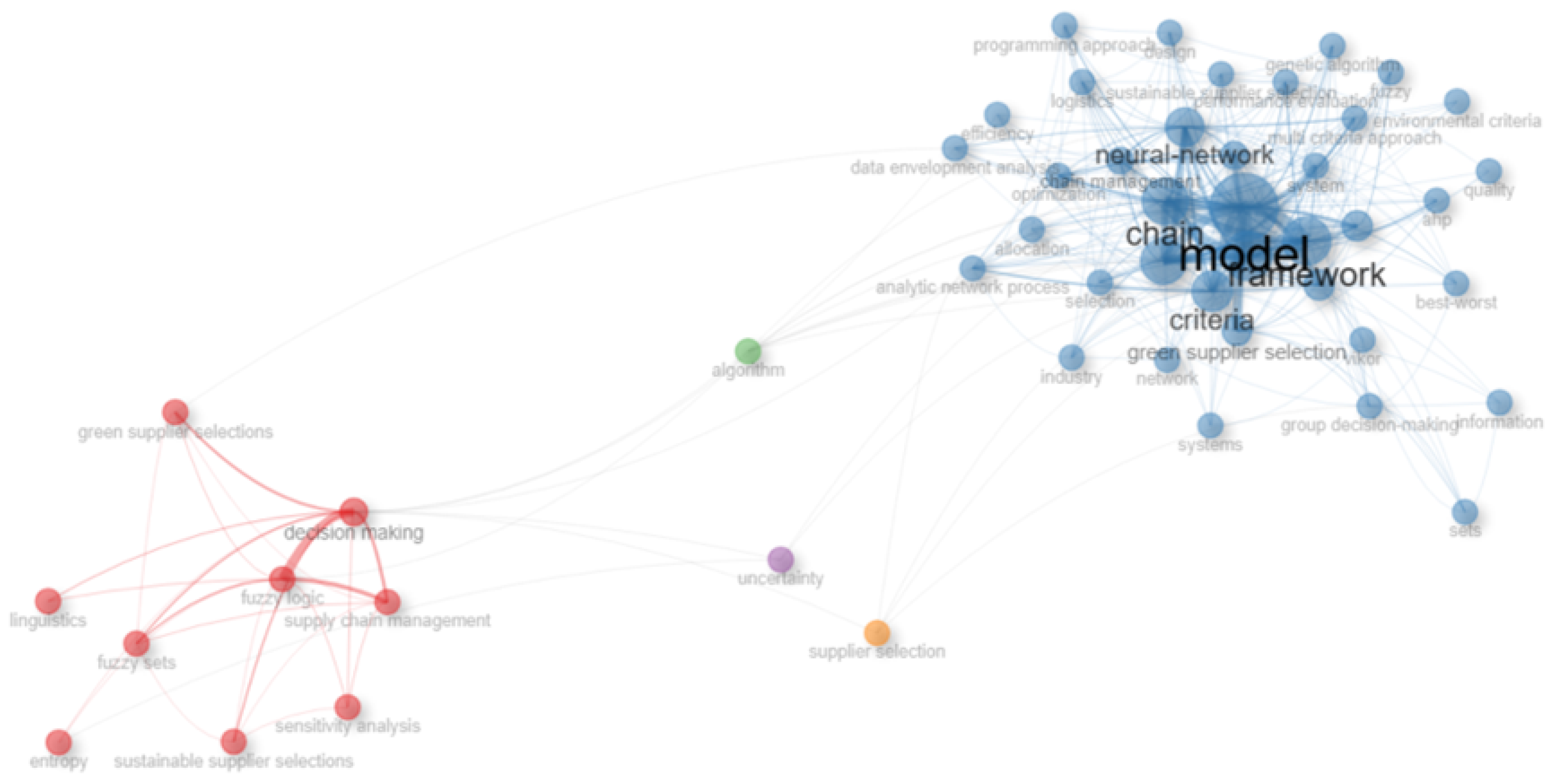
The co-occurrence network analysis based on the Keywords Plus field and visualized using the Walktrap clustering algorithm reveals the structural and thematic organization of research in AI-driven Sustainable Purchasing and Supply Management (SPSM). The network highlights five main clusters. The first, dominated by terms like “fuzzy logic” “decision making” and “green supplier selections,”. The second and densest cluster revolves around “model” “performance” “criteria” and “framework”. A third cluster emphasizes “uncertainty”. Meanwhile, “supplier selection” acts as a bridging concept across clusters. Finally, a smaller cluster including “algorithm,” “genetic algorithm,” and “efficiency”. This network structure illustrates a clear evolution from basic sustainability evaluation frameworks to advanced, data-driven, and adaptive systems that embody the convergence of AI, optimization, and resilience thinking in sustainable supply chains.
Figure 5.
Network of overlay keyword in AI in SPSM
3.3.1. Thematic Evolution
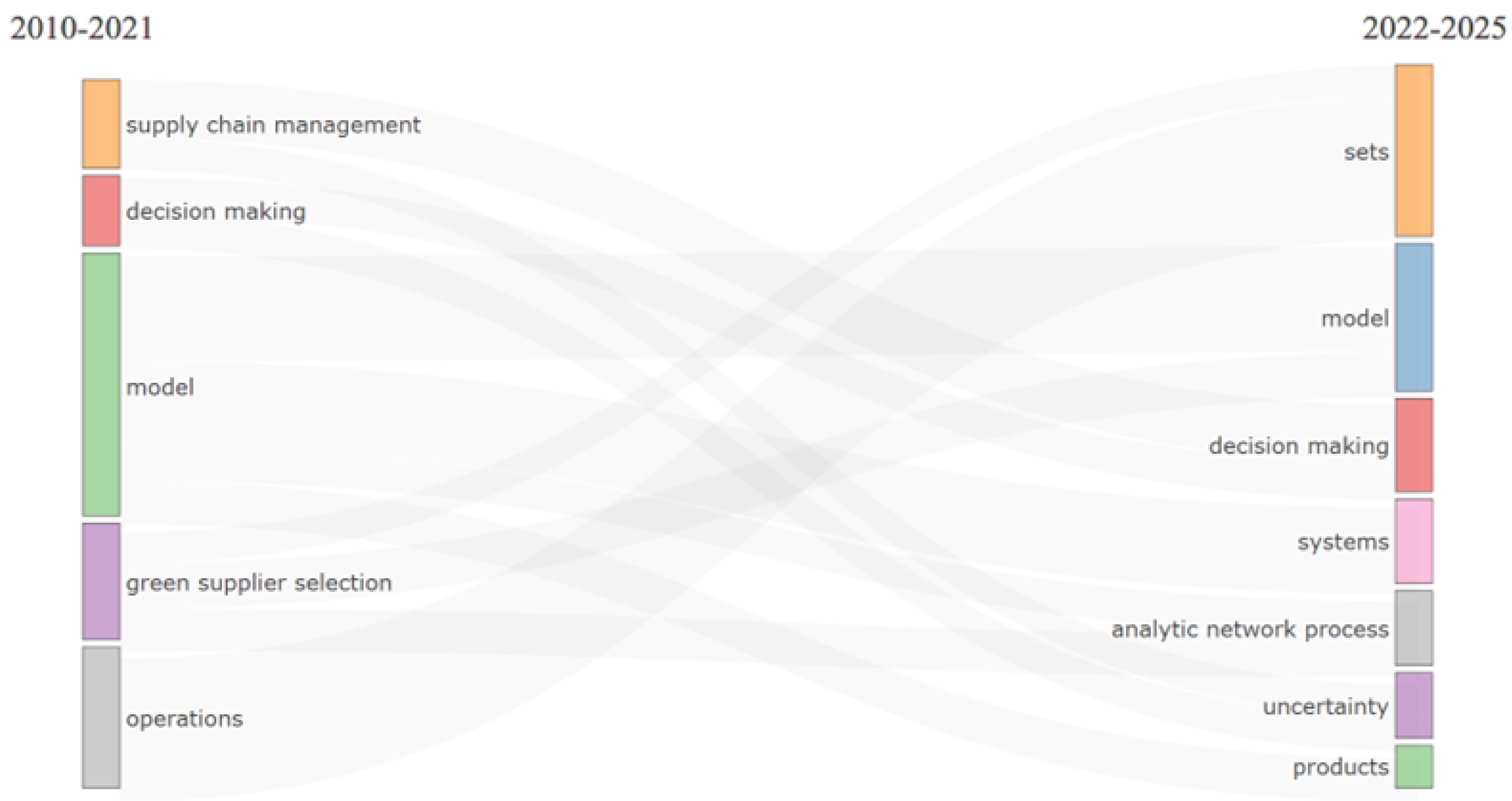
The Figure 8 illustrates how dominant research themes from 2010–2021 have evolved and branched into more advanced and application-oriented topics in the period 2022–2025.The analysis was based on the Keywords Plus field, which captures extended conceptual content beyond author-selected keywords [78]. To ensure relevance and clarity, 250 keywords were included, with a minimum cluster frequency of 5 per thousand documents. The Inclusion Index weighted by word occurrences was used as the weight index to emphasize the strength of intra-cluster associations, and a minimum weight index of 0.1 was applied to filter weak thematic links. Each cluster was limited to a maximum of three representative labels, with a label size of 0.3 to maintain visual clarity in the Sankey diagram. During the period 2010–2021, key themes included supply chain management, decision making, green supplier selection, operations, and model development. These topics reflected an early research agenda aimed at establishing the relevance of sustainability in procurement functions and operational strategy [79]. In contrast, the post 2021 period (2022–2025) has seen a distinct evolution in the nature, granularity, and intelligence of the research focus. Themes such as sets, systems, analytic network process, and uncertainty have emerged, reflecting a methodological shift toward AI-enabled, flexible, and uncertainty tolerant decision environments.
Figure 6.
Thematic Evolution in the field of AI and SPSM.
3.4. Text Analytics Using STM
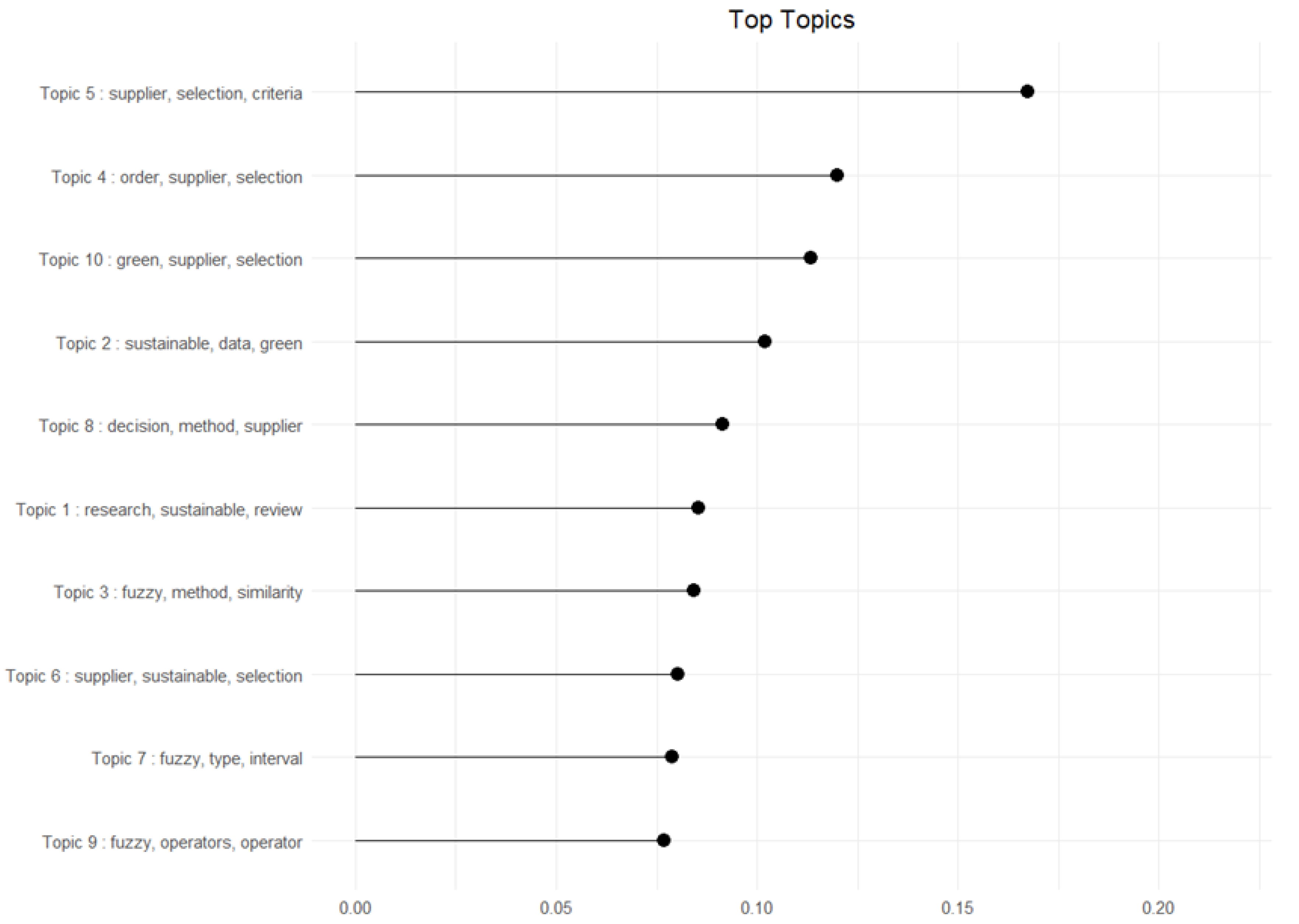
In this systematic literature review, Latent Dirichlet Allocation (LDA) was applied to a curated set of 183 academic documents to uncover underlying thematic structures across the domain. As a widely adopted probabilistic model, LDA facilitates topic discovery by analyzing large textual corpora through patterns of word co-occurrence and semantic relationships. The analysis drew from document titles, abstracts, and keywords to derive a data-driven understanding of scholarly discourse. For implementation, the R package topicmodels was employed due to its computational robustness and adaptability in processing large scale textual data. This package supports multiple topic modeling algorithms, including collapsed Gibbs sampling for LDA, and provides tools for estimating model parameters, inferring topics, and producing post-estimation visualizations. Preprocessing steps included converting text to lowercase, removing punctuation, numbers, stopwords, and collapsing excessive whitespace measures intended to reduce lexical noise and improve coherence. The resulting corpus was structured into a document-term matrix (DTM) to facilitate model training. To identify the optimal number of topics, perplexity scores a standard evaluation metric were computed across various model iterations. The configuration with the lowest score was selected for final modeling. Topic interpretability was enhanced using the ggplot2 and tidytext libraries, which visualized top-weighted terms within each topic along with their -values (topic-word distributions). These visualizations exposed the latent semantic architecture of the dataset, revealing both established and emerging research themes. Full topic-term results are provided in Table 3, with a visual representation of emerging themes shown in Figure 9.
Table 3.
Topics with Their Descriptions and Keywords
| No. | Topic Label | Keywords | FREX | Lift |
|---|---|---|---|---|
| 1 | Literature Review on Green and Sustainable Supply Chains | research, sustainable, review, supply, green, analysis, study, literature, management, chain | sss, dynamic, hesitant, mean, rapid, exhibit, explored, select, affecting, combined | advancing, avenues, bibliometric, blockchain, depth, journal, journals, papers, publications, science |
| 2 | Big Data in Sustainable Public Procurement | sustainable, data, green, procurement, big, public, sustainability, study, purchasing, supply | promoting, among, ahp, risk, germany, machine, hesitant, presented, reducing, represents | across, ecofriendly, marketing, samples, regression, hypotheses, user, explores, participants, equation |
| 3 | Fuzzy MCDM Methods for Green Supplier Selection | fuzzy, method, similarity, green, topsis, supplier, preference, can, ranking, grey | ahp, impact, mean, time, two, ambiguous, chains, prospect, relations, evolves | multiplicative, grey, picture, moora, similarity, measures, relational, code, computed, conceptual |
| 4 | Supplier Selection and Order Allocation | order, supplier, selection, allocation, model, multiobjective, algorithm, optimization, green, genetic | improvement, contribution, mean, hesitant, another, demonstrate, vendors, ensuring, numbers, pythagorean | multiperiod, multiproduct, scheme, shortage, parties, times, discount, scenario, allocate, quantities |
| 5 | Sustainable Supplier Selection Based on Evaluation Criteria | supplier, selection, criteria, suppliers, sustainable, fuzzy, sustainability, supply, environmental, chain | take, models, via, impact, hesitant, mean, prominent, copyright, purpose, conduct | phase, philosophy, scm, pressures, ahptopsis, mabac, border, resolve, transparency, era |
| 6 | Sustainable Supply Chain Systems and Performance | supplier, sustainable, selection, system, supply, chain, sustainability, model, performance, fuzzy | ahp, risk, hesitant, recent, methodology, comprehensive, selecting, numbers, pythagorean, presence | alterations, compete, correspond, globally, pharmaceutical, benchmarking, extends, dynamics, variable, efforts |
| 7 | Fuzzy Interval Approaches for Decision Making | fuzzy, type, interval, approach, method, sets, uncertainty, decision making, mcdm, proposed | ahp, presented, hesitant, time, present, chains, ordering, unique, practices, select | rise, choquet, interaction, space, interval, type, utility, methodologies, dairy, pattern |
| 8 | Group Decision Making in Sustainable Supply Chain | decision, method, supplier, selection, making, group, proposed, model, green, based | risk, ahp, substantial, time, mean, theoretical, better, practices, methodology, significant | medium, reaching, reputation, trust, consensus, mechanism, generated, types, assessments, verified |
| 9 | Fuzzy Operators and Aggregation | fuzzy, operators, operator, aggregation, weighted, mean, linguistic, pythagorean, supplier, proposed | ahp, among, makes, time, impact, systems, chains, rank, significant, practices | dombi, heronian, valued, operator, aos, tconorm, operators, orthopair, tnorm, qrung |
| 10 | Green and Sustainable Supplier Selection Approaches | green, supplier, selection, criteria, model, sustainable, fuzzy, suppliers, supply, approach | products, ahp, identify, mean, dss, strategic, twostage, comparing, another, decisionmaker | assignment, deployment, qfd, gmbh, springerverlag, heuristic, prioritize, side, envelopment, footprint |
Figure 7.
Generated topics from the STM approach
- Topic 1: Literature Review on Green and Sustainable Supply Chains
In recent years, the interest in sustainable and green supply chain management has increased significantly in both business and academic areas. This is reflected in the growing number of articles, conferences, special publications and websites devoted to the subject [85]. Bibliometric analyses have further uncovered key publication trends, leading authors, and influential journals, thereby helping scholars trace the intellectual structure and emerging frontiers of the field [86]. The academic discourse has expanded through numerous articles, conferences, and journals such as the Journal of Cleaner Production, where countries like China and the United States lead in contributions [87]. Several organizational theories have been applied to explain the adoption and implementation of GSCM, including the Resource-Based View (RBV), Stakeholder Theory, Institutional Theory, and Transaction Cost Economics [88]. Methodologically, research has ranged from descriptive studies to mathematical optimization and content-based analyses (85). Manufacturing remains the most studied sector [89]. Interpreted by Increasing rates of pollution and environmental calamities caused by industrial production [90]. Studies also highlight how GSCM practices such as eco-design, green purchasing, and internal environmental management are driven by regulatory pressure, CSR, and green market demands [91]. Furthermore, sustainable supply chain management (SSCM) is increasingly seen as a broader evolution of GSCM, encompassing not just environmental, but also economic and social considerations in a systemic and performance-oriented manner [92]. [93] defined SCC as the creation of coordinated supply chains through the voluntary integration of economic, environmental, and social considerations with key inter-organizational business systems designed to efficiently and effectively manage the material, information, and capital flows associated with the procurement, production, and distribution of products or services in order to meet stakeholder requirements and improve the profitability, competitiveness, and resilience of the organization over the short- and long-term.many of reviews have culminated in the development of conceptual or analytical models. For instance, [94] propose a conceptual framework for sustainable supply chain management, emphasizing supplier and supply chain management strategies that integrate environmental, social, and economic dimensions through stakeholder engagement and multi-tier collaboration. [12] propose a model linking drivers such as motivators and lean management to environmental and social practices. [95] review sustainable supply chain management (SSCM) in global supply chains, proposing a conceptual model that include such as governance mechanisms and supply chain configurations and synthesizing their relationship with sustainability outcomes. In terms of theory building (resource-based view (RBV), stakeholder theory and institutional theory) predominate the theory building effort in SCC [96]. [97] review quantitative models applied to SSC he found that life-cycle assessment-based approaches and impact criteria clearly dominate models in environmental side of SSC. On the modeling side there are three dominant approaches equilibrium models, multi-criteria decision making and analytical hierarchy process. Despite substantial advancements, several reviews highlight persistent gaps in modelling uncertainty, the role of digital technologies, and adoption challenges in developing countries [98]. Hence, we make the following propositions:
- Proposition 1: Future research should investigate the integration of social sustainability measures into existing sustainable supply chain models.
- Proposition 2: Future studies should explore how different supply chain configurations (e.g., closed, open, or hybrid structures) impact suppliers’ ability to engage in sustainability driven supply chains.
- Proposition 3: There is a need to empirically examine the role of non-traditional third-party actors such as NGOs, social enterprises, and public institutions in shaping sustainability outcomes.
- Proposition 3: There is a need to empirically examine the role of non-traditional third-party actors such as NGOs, social enterprises, and public institutions in shaping sustainability outcomes.
- Topic 2: Big Data Applications in Sustainable Public Procurement
One-third of total government spending across the globe goes to public procurement, amounting to about 10 trillion dollars a year [99]. Public procurement can be defined as the process by which public contracting authorities purchase goods, services, and works from private suppliers [100]. Traditionally public procurement has only to be economically efficient. However, due to a more general ascension of sustainable development concept governments have been in the position to use their purchasing power in order to advance the goals of sustainable development [101]. Public procurement has developed over time from an executive management function aimed at fulfilling an internal demand to a policy instrument that can collaboratively create public value, smart, life cycle-oriented, and relational ecosystem [102]. The procurer’s beliefs and values are of high relevance in a transformation towards circular public procurement, buy not going for the lowest price, but finding an optimum combination that includes risk, timeliness and cost for the public institution on a life-cycle basis. Eco-labels, standards, life cycle assessments and life cycle costing are core parts of the process [103].This move require more flexible and adaptive governance, integration of public value, different capabilities and competences, and a rebalancing of the different perspectives on public procurement [104]. Many disruptive innovations are adopted to support and advance procurement in terms of predictability, transactional automation and proactivity of supplier relationship management. With the development of IT technology and thus the digitization of the Public Procurement Process (PPP), the amount of available data is increasing [105]. Public procurement has enormous untapped potential for the application of data analytics tools [106]. Big Data is the Information asset characterized by such a High Volume, Velocity and Variety to require specific Technology and Analytical Methods for its transformation into Value [107]. Big Data has substantial potential in public procurement. It can aid in identifying new vendors, enhance transparency, and even offer predictive insights for better decision making [108]. Big data with either a reporting or predictive purpose has an impact on all strategic and sourcing activities. It also has an impact on risk management, supplier performance monitoring, supplier negotiation, and selection, while only data with a predictive purpose has an impact on sourcing planning and forecasting [109]. Analytical powers of big data. Help Organisations to process and analyse huge environmental data and conduct faster green spending analysis to make greener decision-making in procurement [110]. The accountability and transparency of the procuring agency may increase if big data analytics is being implemented [111]. Proposes a novel approach that integrates Big Data Analytics (BDA) with fuzzy cognitive maps (FCM) to improve decision-making in public sector IT service procurement [112]. Data analytics can be useful for supporting anticorruption in two broad areas to support investigations on the contract, organisation or market levels, and to analyse policy reform and support policy evaluations [113]. [114] develop a tool that automates data extraction from multiple sources, performs data cleansing, standardization, and database processing, and generates meaningful visualizations using big data analytics to streamline public procurement analysis. The available data led us to the conclusion that public procurement procedures conducted within exclusive commercial relations entail a significantly higher fraud risk. External audit of public acquisitions and fraud detection using big data analytics [115]. Significantly improved the detection of fraud-related anomalies compared to traditional methods based on manual checks and limited data [116]. Hence, we make the following propositions:
- Proposition 1: Future research should explore the use of AI and predictive analytics in real-time fraud detection across domain specific public procurement datasets.
- Proposition 2: There is a critical need to investigate the trade-offs between transparency, data privacy, and competitive strategy in public e-procurement systems, especially in the context of open data platforms.
- Proposition 3: Future studies should develop and validate modular, cognitive procurement analytics platforms that integrate dashboard visualization, real-time risk scoring, and scenario-based policy modeling to support sustainable and adaptive decision-making.
- Topic 3: Fuzzy Multi-Criteria Decision-Making (MCDM) Methods for Green Supplier selection
Supplier selection is the process by which firms identify, evaluate, and contract with suppliers. The supplier selection process deploys an enormous amount of a firm’s financial resources. Supplier selection can be seen as an important part of the green supply chain management concept due to its long-term effects. Many companies bestow a privilege on their partners if they have green consideration thanks to the positive perception of the customers [117]. Firms expect significant benefits from contracting with suppliers offering high value [118] The role of green supplier evaluation and selection (GSES) in supply chain management is recognized due to the intensification of competition, raising public consciousness, and environmental issues [119]. The Supplier Selection Problem (SSP) consists of analyzing and measuring the performance of a set of suppliers in order to rank and select them for improving the competitiveness of the whole supply system [120]. Supplier selection is a multi-criteria decision making problem involving multiple criteria that can be both qualitative and quantitative [121]. Multi-Criteria Decision-Making (MCDM) methods are Important instrument for solving complex problems with a huge number of alternatives, conflicting criteria and objectives [122]. Many multiple criteria decision making tools are developed to help manager in supplier selection process [123]. Those approaches are all capable of handling multiple quantitative and qualitative factors. The most prevalent individual approach is DEA, whereas the most popular integrated approach is AHP–GP [124]. [125] review multi-criteria decision making approaches for supplier evaluation and selection in literature from 1997 to 2011.found that the most widely used multi-criteria decision-making approach is analytical hierarchy process (AHP) .Similarly [126] review decision making model applied for green supplier evaluation found that the highest percentage around “62%” of studied articles used multi-criteria decision-making (MCDM) models.The most widely utilized Decision Making models to address the evaluation and selection of green supplier were found to be AHP, DEA, and TOPSIS. Thus, we make the following propositions:
- Proposition 1: Future research should conduct empirical, industry-specific case studies that combine fuzzy MCDM methods with practical data sources to validate model effectiveness and ensure decision relevance.
- Proposition 2: There is a need to integrate sensitivity analysis and behavioral decision making dimensions into fuzzy MCDM models for green supplier evaluation.
- Proposition 3: Future studies should expand the methodological diversity in fuzzy MCDM applications by comparing traditional approaches (e.g., fuzzy TOPSIS, BWM) with advanced or hybrid methods like fuzzy ANP, fuzzy SWARA, ELECTRE, or metaheuristic optimization models.
- Topic 4: Supplier Selection and Order Allocation Using Metaheuristic Optimization
Supplier selection is one of the most important decisions a buyer makes. Selecting an appropriate supplier is important because it commits resources while simultaneously impacting such activities as inventory management, production planning and control, cash flow requirements, and product quality [127]. The supplier selection and order allocation are two key strategic decisions in purchasing problem [128]. It involve both qualitative and quantitative factors such as quality, cost, and delivery time should be considered in the supplier selection [129]. Metaheuristic algorithms are computational intelligence paradigms especially used for sophisticated solving optimization problems [130]. Able to solve and give near optimal solutions to the problems of versatile domain without in-depth details and definition of the problems, provides an edge over traditional techniques [131]. Genetic algorithms, particle swarm optimization, ant colony optimization, simulated annealing, and tabu search are examples of popular metaheuristic algorithms [132]. They have been actively researched area due to their vast applications in engineering and artificial Intelligence application [133]. [134] Propose an integrated approach of analytic network process (ANP) and multi-objective mixed integer linear programming (MOMILP) is proposed to consider both tangible and intangible factors in choosing the best suppliers and define the optimum quantities among selected suppliers to maximize the total value of purchasing and minimize the budget and defect rate. PSO(particle swarm optimization) and Artificial Bee Colony (ABC) algorithms have been employed to optimize order quantity distribution under supplier capacity, lead time, and quality constraints [135]. [136] propose a new heuristic method lower total cost solution, but it also performs a more exhaustive search in shorter computational times for larger instances of the problem. [137] The proposed model is solved utilizing two metaheuristic algorithms including NSGA II and MOPSO. The designed mathematical model seeks to maximize total profit and minimize unsatisfied demand and total risk along with enforcing sustainability criteria in selecting suppliers. [138] introduced a model minimizing the total cost per time unit, considering ordering, purchasing, inventory, and transportation cost with freight rate discounts. Particle swarm optimization (PSO), genetic algorithm (GA), and differential evolution (DE), are implemented as optimizing solvers. [139] observed that most of the mathematical models in SSOA belong to the uncertain optimization models category. Such as fuzzy AHP, Fuzzy TOPSIS, and multi-objective optimization techniques. They confirm that supplier selection and order allocation methods may create competitive advantages for companies, and at the same time, poor selection of the suppliers may result in the failure of the companies. The basic criteria for supplier selection include cost, quality, and time. Additionally, more green and environmental factors such as minimization of carbon emissions have been considered in the SSOA process. Hence, we make the following propositions:
- Proposition 1 (Future Direction): Future research should incorporate social sustainability dimensions into supplier selection and order allocation models.
- Proposition 2 (Future Direction): There is a need to develop adaptive metaheuristic optimization models that address real-time uncertainty, supply disruptions, and contextual risks.
- Proposition 3 (Future Direction): Future studies should perform cross-sectoral of metaheuristic-based supplier selection models where sustainability factors and disruption risks differ.
- Topic 5: Sustainable Supplier Selection Based on Evaluation Criteria and Sub-Criteria
The competitive environment and recent regulations require corporations to implement sustainable and reinforced solutions in their business operations and, thereby, sustainable supplier selection (SSS) has become a critical concern of companies [140]. Sustainable supplier selection is a more complex version of supplier selection that considers economic, environmental, and social aspects, simultaneously, because the consequence of each action has economic, social, and environmental impacts [141]. Therefore multiple criteria are present to evaluate and select sustainable supplier [142]. The selection of the right criteria is a major challenge in the supplier evaluation process. Three aspects are of the crucial importance in specifying the criteria for the sustainable supplier selection economic, environmental, and social [143]. Commonly used economic criteria include cost efficiency, on-time delivery, and quality certification [125], while environmental criteria as it considered the most common criterion for green supplier selection often encompass energy consumption, waste management, and green design(144).Social aspects such as labor practices, community engagement, and occupational health and safety [88]. [145] applied the multi-criteria FUCOM method for criteria evaluation in order to assess the significance of the criteria. The results obtained by the applied methodology demonstrate that the most important criteria for the selection of suppliers are the quality, the price, productivity, partnership relations, safety at work, flexibility and the financial ability. [146] use AHP-VIKOR approach. The AHP used to evaluate the SSS criteria relative importance weights and the VIKOR technique has been used for selecting the most efficient sustainable supplier.The results indicate that “Environmental dimension” achieves maximum priority weight.Moreover, within the overall ranking ‘Environmental costs’ received the highest rank. [147] developed a fuzzy-Shannon entropy and fuzzy inference system-based model applied in a Pakistani manufacturing context, identifying ‘Quality’, ‘Cleaner Technology Implementation’, and ‘Information Disclosure’ as top-ranked criteria across economic, environmental, and social dimensions.Studies have proposed models for sustainable supplier selection without specifying criteria or sub criteria. For instance, [148] introduced a hybrid consensus decision-making approach combining Interval Type-2 Fuzzy AHP and TOPSIS, allowing for hierarchical evaluation of criteria and sub-criteria without requiring uniform sub-criteria structures across all criteria. Thus, we make the following propositions:
- Proposition 1: Future research should develop and continuously update a domain-specific for sustainable supplier selection (SSS), incorporating new and evolving environmental, economic, and social criteria.
- Proposition 2: Further research is required to incorporate advanced fuzzy based MCDM techniques (e.g., IT2FNs, fuzzy PROMETHEE, grey linguistic models) to better manage uncertainty and social complexity in green supplier selection.
- Proposition 3: Future studies should empirically validate and compare AHP integrated frameworks (e.g., AHP-TOPSIS, AHP-VIKOR) across diverse industrial sectors and over time.
- Topic 6: Sustainable Supply Chain Systems and Performance
(149)define SSCM as the strategic, transparent integration and achievement of an organization’s social, environmental, and economic goals in the systemic coordination of key interorganizational business processes for improving the long-term economic performance of the individual company and its supply chains. Sustainable supply chain management practices have become an important strategy for firms to improve performance and gain competitive advantage [150]. The performance of SSCM is based on the triple bottom line approach encompassing people-planet-profit, hence being defined not in only in social and environmental terms, but also the economic [151]. SSCM practices enhance financial outcomes, environmental performance, and competitive advantage by integrating economic, environmental, and social concerns into corporate strategy [152]. [153] underscore the strategic importance of integrating sustainability into supply chain processes to achieve superior organizational performance. [154] found that SSCM significantly enhances both competitive advantage and organizational performance, with competitive advantage mediating the relationship between SSCM and performance. Likewise, [155] asserted that Companies that implement Sustainable Supply Chain Management (SSCM) practices demonstrate significant improvements in their environmental performance.Key environmental performance indicators observed across many organizations include reductions in greenhouse gas emissions, enhanced energy efficiency, resource conservation, and increased logistics efficiency. Beyond environmental benefits, these companies also report gains in operational efficiency, cost reduction, enhanced risk management, improved service quality, increased sales and market share, revenue growth, and strengthened corporate reputation. [156] identify multiple pathways to high performance in sustainable supply chain (SCC), highlighting the importance of integrating agility with sustainability initiatives rather than focusing on individual practices alone. [157] emphasize collaboration as a key driver of sustainable performance in agri-food supply chain planning. By incorporating sustainable practices and utilizing digital technologies, organizations can create a more sustainable future and improve their overall performances [158]. [159] emphasize the importance of strategic information system utilization in supply chain integration, suggesting a sequential approach involving infrastructural support, value creation management, and logistical operations to enhance supply chain performance.In the context of decision-making. [160] developed a mathematical model based on neural networks to evaluate the performance of Sustainable Supply Chain Management (SSCM) systems within the automotive industry. Thus, we formulate the following propositions:
- Proposition 1: Future research should examine how sustainable supply chain management (SSCM) practices impact social and innovation performance.
- Proposition 2: The influence of stakeholder pressure on SSCM should be explored by distinguishing between different stakeholder types and incorporating contextual risk factors.
- Proposition 3: Future studies should employ dyadic and longitudinal designs to explore how internal (e.g., leadership, digitalization) and external (e.g., customer, supplier, societal) actors co-create sustainable performance in supply chain systems.
- Topic 7: Fuzzy Interval Approaches for Decision Making
Due to the diversity of information, many decision making problems cannot be solved based on a single criterion [161].The complexity of assessment objects and the limitations of individual cognition cause the opinions given by experts uncertain, which further aggravates decision-making difficulties [162].The subject of information processing and decision analysis, especially using data arising from human thought and cognition process, has occupied a prominent place in the information processing literature since the inception of fuzzy set theory in 1965 [163]. Fuzzy set, interval-valued fuzzy set and intuitionistic fuzzy set have been employed in dealing with imprecise data in engineering and social science problems [164]. The introduction of interval type-2 fuzzy sets has notably strengthened decision robustness, capturing both intra and inter-expert uncertainty in linguistic judgments [165]. Computational models, such as fuzzy neural networks and hesitant fuzzy linguistic systems, have been refined using these fuzzy intervals, enabling more flexible and adaptive inference mechanisms [166]. Several MCDM techniques like TOPSIS and AHP have been modified to integrate interval valued fuzzy soft sets, demonstrating improved performance in ranking and selection tasks [167]. This methods have been effectively used to prioritize alternatives when dealing with vague or linguistic input data [168]. [169] applied a fuzzy interval AHP-based methodology to energy decision-making, demonstrating its capacity to handle conflicting qualitative and quantitative criteria. [170] emphasized the value of fuzzy interval-based MCDM when decision-makers are unsure about weight assignments or performance scores. Moreover, [171] developed a robust fuzzy interval preference model for group decision-making, enhancing reliability under vague judgments. In recent applications, [172] extended fuzzy interval models to sustainability assessment by incorporating dynamic environmental indicators into the decision process. However, as [173] points out, the comparison of fuzzy interval models with other frameworks like hesitant fuzzy sets or probabilistic linguistic methods is still limited. Thus, we make the following propositions:
- Proposition 1: There is a need to integrate fuzzy interval decision-making models with AI techniques to enable real-time, adaptive evaluation in dynamic environments.
- Proposition 2: Future research should conduct a comparative analysis of fuzzy interval approaches versus other uncertainty-handling methods (e.g., hesitant fuzzy sets, rough sets).
- Proposition 3: Future research should explore dynamic fuzzy interval models that evolve over time, capturing changes in decision-maker preferences and contextual factors.
- Topic 8: Group Decision Making in Sustainable Supply Chain
Requirements for successful SSCM include organisational culture, strategy, risk management and transparency [149], all of which affect the nature of decision-making [174]. Group decision making (GDM)can be viewed as a task to consolidate and aggregate preferences or opinions that a group of decision makers express regarding a set of alternatives, which aims to find the best collective alternative solution to a decision problem [175]. GDM models such as fuzzy AHP, TOPSIS, and VIKOR are used for evaluating green suppliers, ethical sourcing, and environmental compliance. [177] reveals that interval valued fuzzy sets are extensively explored and frequently integrated with the TOPSIS method for supplier selection.Many group decision making model have been applied to sustainable supply chain.For instance, fuzzy multi-criteria approach applying fuzzy set theory has been proposed to translate subjective human assessments into quantitative evaluations for green suppliers, improving the reliability of supplier selection under uncertainty [125]. Moreover, fuzzy VIKOR embedded in interval-valued fuzzy expert systems has been utilized to evaluate suppliers environmental performance,facilitating the selection of suppliers that best align with green supply chain management goals [178]. An integrated fuzzy AHP-VIKOR approach was applied in the renewable energy sector to select green suppliers for solar power plant equipment, highlighting its practical utility in balancing economic and environmental criteria [179]. [180] develop a decision-making model for sustainable supply chain finance (SSCF) under uncertainty, integrating environmental, social, and economic factors to support risk management and sustainability goals. [181] presents a strategic decision framework for green supply chain management (GSCM) to help managers integrate environmental practices into supply chain operations.The framework covers key elements such as green procurement, production, distribution, packaging, and reverse logistics, emphasizing vendor selection based on environmental certifications like ISO 14000.It applies the Analytical Network Process (ANP) to support multi-criteria decision-making. [182] develop a LARG analytic network process (ANP) model integrating Lean, Agile, Resilient, and Green (LARG) supply chain management paradigms [183]. Group decision support systems integrating Quality Function Deployment (QFD) and TOPSIS have been designed to incorporate both technical and customer perspectives, including social responsibility and environmental criteria [184].Thus, we make the following propositions:
- Proposition 1: Future research should develop dynamic GDM models that adapt to evolving stakeholder preferences and changing sustainability objectives.
- Proposition 2: There is a need to investigate the behavioral and psychological aspects of group decision making in SSCM, such as trust, influence, and conflict resolution.
- Proposition 3: Further studies should explore the integration of digital platforms and AI in facilitating real-time, multi-stakeholder consensus building in sustainable supply chains.
- Topic 9: Fuzzy Operators and Aggregation
Data aggregation is crucial in optimal decision-making [185]. Fuzzy operators function are foundational tool in fuzzy set theory, enabling the transformation and combination of uncertain or imprecise information in decision-making processes [186]. Numerous specialized operators have been developed, including fuzzy ordered weighted averaging (FOWA), fuzzy weighted harmonic mean (FWHM), and their intuitionistic fuzzy counterparts (IFWA, IFOWA), which extend aggregation capabilities to handle different types of fuzzy sets and decision-maker preference [187]. These operators including t-norms, t-conorms, averaging functions, and ordered weighted averaging (OWA) help model linguistic judgments, partial truth values, and subjective assessments [188]. [189] introduced The intuitionistic fuzzy weighted geometric (IFWG), ordered weighted geometric (IFOWG), and hybrid geometric (IFHG) operators extend traditional geometric aggregation methods to intuitionistic fuzzy sets by incorporating both membership and non-membership functions, thus better handling the complexity of intuitionistic fuzzy information. Building upon this, [190] developed aggregation operators for intuitionistic fuzzy sets, introducing methods based on score and accuracy functions to compare values, and proposed operators like intuitionistic fuzzy weighted averaging, ordered weighted averaging, and hybrid aggregation for effectively combining intuitionistic fuzzy data. [191] established relationships between intuitionistic fuzzy sets and hesitant fuzzy sets, leading to the development of new aggregation operators suited for hesitant fuzzy data, thereby broadening the scope of fuzzy aggregation techniques in decision-making contexts. In addition, aggregation techniques like Harmonic Triangular Norm Operators are designed to aggregate uncertain information in expert systems, strengthening decision support in fuzzy environments [192]. [193] extended this trajectory by proposing Hamacher aggregation operators based on interval-valued intuitionistic fuzzy numbers, applying these to group decision-making scenarios and demonstrating their practical utility. [194] proposed extensions of probability-based intuitionistic fuzzy operators for fuzzy multiple criteria decision-making (MCDM).Their work underscores the importance of probabilistic considerations in fuzzy aggregation, especially in risk assessment contexts. [195] proposed distance-induced fuzzy operators that incorporate distance measures as order-inducing variables, allowing for more comprehensive decision making frameworks that consider both the proximity to ideal solutions and other parameters. However, challenges remain in integrating these operators into real-time intelligent decision frameworks or combining them with AI-based reasoning models [196]. Hence, we make the following propositions:
- Proposition 1: Future research should explore hybrid fuzzy operators that combine classical aggregation with AI or machine learning for improved decision adaptability.
- Proposition 2: Comparative studies are needed to benchmark new fuzzy operators (e.g., elliptical, Dombi-based) against traditional ones in various decision-making environments.
- Proposition 3: Researchers should investigate the role of fuzzy aggregation in dynamic and real-time group decision-making systems, particularly under high uncertainty.
- Topic 10: Green and Sustainable Supplier Selection Approaches
In recent years, procurement managers have introduced environmental considerations into supplier selection and evaluation as a response to strict environmental regulations implemented by governments [197]. Supplier selection is a critical decision with sustainability impacts in global supply chain [198]. Selecting the suppliers in a green supply chain (GSC) improves supply chain capabilities by considering environmental policies [199]. Companies can acquire competitive advantage by greening their suppliers which leads to green product innovation, green process innovation, and green managerial innovation [200]. Several approaches have been developed to address this process, some of which are based on MCDM methods, applied individually or combined with other MCDM methods [141]. [201] introduced a hybrid fuzzy entropy-TOPSIS approach for selecting green suppliers of thermal power equipment, combining fuzzy logic with entropy weighting and TOPSIS techniques to effectively manage uncertainty and multiple criteria. [202] applied an Analytic Network Process (ANP) to create an assessment framework for managing sustainability programs in supplier selection, with electronics company emphasizing the importance of identifying key factors influencing supplier choices within a complex, networked decision environment. [203] introduced a hybrid approach that combines the Best Worst Method (BWM) and TODIM under interval type-2 fuzzy sets to evaluate green suppliers selection in the textile sector. Similarly, [204] proposed an integrated AHP-TOPSIS framework tailored to the electronics industry, where AHP is used to derive criteria weights, and TOPSIS ranks suppliers based on their relative performance. [205] develop a hybrid multi-criteria decision-making approach combining fuzzy best-worst method (BWM) for weighting criteria and interval VIKOR for ranking suppliers under uncertainty. This approach addresses the complex trade-offs in sustainable supplier selection by incorporating social and environmental concerns alongside traditional economic factors. [206] proposes a cutting-edge approach combining big data analytics with a hybrid fuzzy multi-criteria decision-making (MCDM) framework to enhance green supplier selection. Thus, we make the following propositions:
- Proposition 1: Future research should develop and empirically validate integrated supplier selection models that simultaneously consider environmental, social, and economic criteria.
- Proposition 2: Future studies should explore how real-time data from digital technologies (e.g., IoT, blockchain, environmental sensors) can be integrated into supplier selection models.
- Proposition 3: Future research should develop advanced GSES models that integrate modern uncertainty theories such as probabilistic linguistic sets, interval-valued neutrosophic sets, or fuzzy rough sets to effectively manage incomplete, vague, or heterogeneous supplier performance data.
4. Discussion
This study aims to examine current research on AI-integrated technologies in the entire Purchasing and Supply process to inform future research directions. To address the first research questions, a bibliometric analysis was employed to examine the trends concerning applied AI and Purchasing and Supply Management. The integration of Artificial Intelligence (AI) into Sustainable Purchasing and Supply Management (SPSM) has experienced significant growth since 2015. Research has evolved from early model-based decision-making to sophisticated hybrid approaches combining fuzzy logic, neural networks, metaheuristics, and multi-agent systems.
Recent trends highlight a shift toward systemic, collaborative, and uncertainty-aware frameworks, with increased focus on group decision-making, circular economy, and explainable AI. China, Denmark, and Malaysia lead in scholarly output, while key journals such as Journal of Cleaner Production dominate citations. The literature identifies a wide array of tools applied in SPSM, including genetic algorithms, fuzzy systems, nondominated sorting, machine learning, artificial neural networks (ANNs), and big data analytics.
To deepen our understanding, this study employed Latent Dirichlet Allocation (LDA) to conduct a topic modeling analysis of relevant literature. The LDA analysis revealed ten major thematic clusters, including Literature Review on Green and Sustainable Supply Chains, Big Data Applications in Sustainable Public Procurement, Fuzzy Multi-Criteria Decision-Making (MCDM) Methods for Green Supplier Selection, Supplier Selection and Order Allocation, Sustainable Supplier Selection, Sustainable Supply Chain Systems and Performance, Fuzzy Interval Approaches for Decision Making, Group Decision Making in Sustainable Supply Chain, Fuzzy Operators and Aggregation, and Green and Sustainable Supplier Selection Approaches.
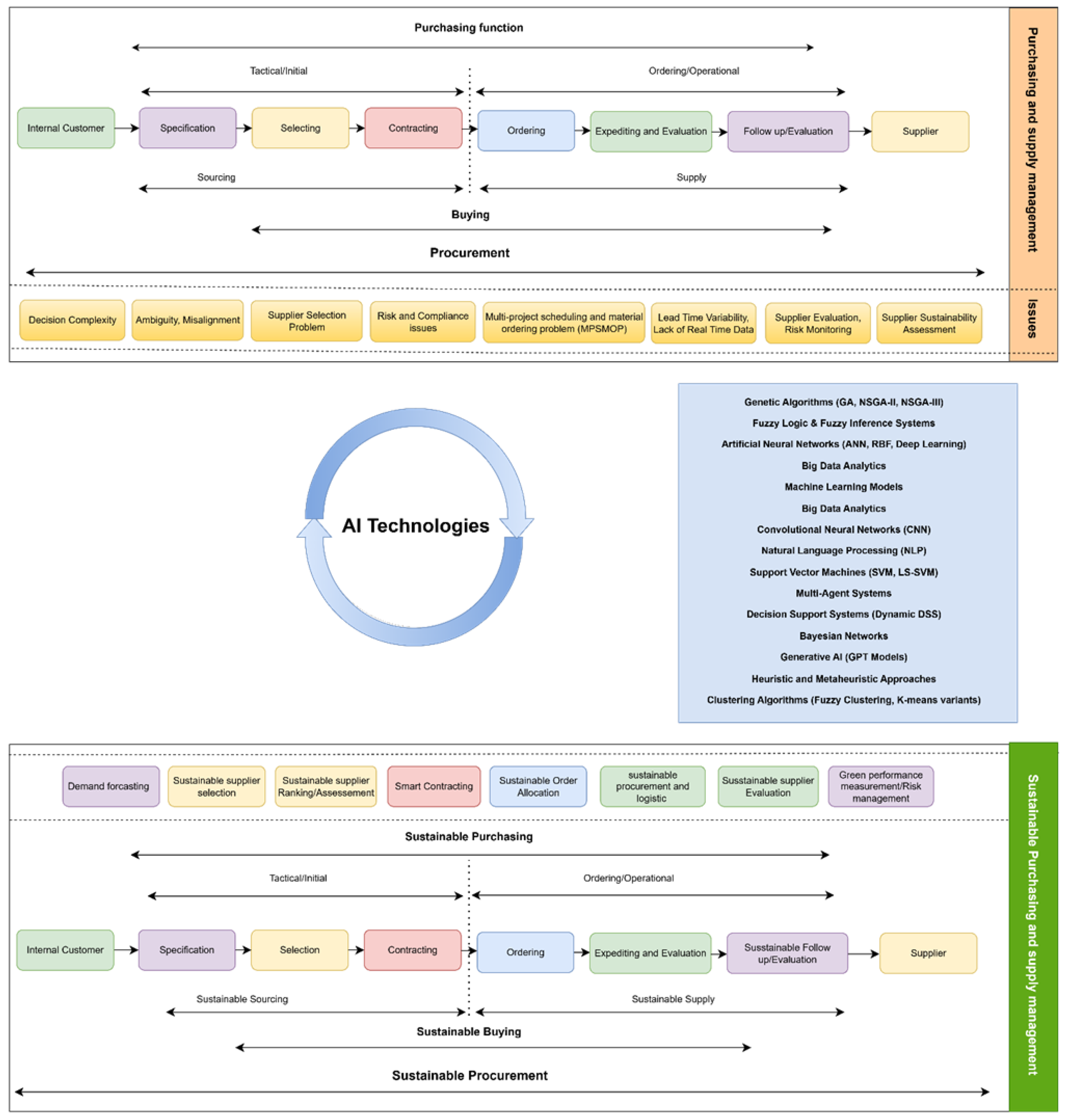
These themes reflect the growing significance of AI-driven tools in supporting sustainable purchasing strategies. The impact of AI on these topics is considerable, and many studies have shown its importance. Based on these insights, we propose a research framework adapted from [207], As shown in Figure 8,which is one of the most widely adopted models in purchasing literature. Within this framework, the purchasing process is conceptualized as a linear progression through six sequential stages. The model delineates these stages into two distinct phases a tactical phase encompassing specification, selection, and contracting, followed by an operational phase comprising ordering, monitoring, and evaluation [208].
Business needs and requirements are the input for the linear purchasing process model [207], expressed by internal customers as defined by [209] as anyone in an organization who uses what purchasing buys, influences the specification process, and impacts the supplier strategy.
After specifying the functional and technical requirements, the purchasing manager should develop and use an effective process for finding the qualified suppliers to award the business [210]. Then, decisions are made about what contract to put in place, including preparing and conducting negotiation of contract terms and conditions with the supplier, to establish an agreement and write up the legal contract [211]. In order for the organization to purchase products or services, a Purchase Order (PO) must be created which is a legally binding document between buyer and supplier [212]. After issuing a PO, the buyer may follow up and/or expedite the order. Follow-up is routine order tracking to ensure the supplier can meet delivery promises [213].
Traditional Purchasing and Supply Management (PSM) is characterized by several issues decision complexity [214], supplier selection problems [215], ambiguity [216], misalignment [217], risk and compliance challenges [218], multi-project scheduling and material ordering problems [219], lead time variability [220], supplier evaluation and risk monitoring [221], and supplier assessment [222].
The application of AI presents a great opportunity at each stage of sustainable purchasing. In the tactical part, AI helps organizations enhance decision-making, reduce costs, and improve supplier relationships [223]. Generative Pre-trained Transformers (GPT) and machine learning models such as LSTM and RBF networks can be trained on historical procurement data to predict the most sustainable suppliers [224]. Decision tree classifiers and random forest models help filter supplier candidates based on sustainability credentials (225).
Fuzzy AHP (Analytic Hierarchy Process), TOPSIS (Technique for Order Preference by Similarity to Ideal Solution), and DEMATEL (Decision Making Trial and Evaluation Laboratory) are frequently applied to balance conflicting sustainability criteria and stakeholder preferences [144]. Likewise, Multi-Attribute Border Approximation Area Comparison (MABAC) and Multi-Objective Genetic Algorithms (MOGA) are used to optimize trade-offs between environmental goals and operational constraints [226]. These techniques, combined with Data Envelopment Analysis (DEA), are enhanced through machine learning to improve the ranking accuracy of sustainable suppliers under uncertainty [227].
Through smart contracts and blockchain, Multi-Agent Systems enhance supply chain traceability [228], ensuring adherence to green compliance standards [229]. In the operational phase, stochastic programming supports quantity allocation decisions under uncertain demand and environmental constraints [230]. Reinforcement learning further adapts procurement decisions in real time, minimizing over-ordering and optimizing for low-emission transportation routes [231].
The Internet of Things (IoT), integrated with machine learning algorithms such as LSTM, enables real-time tracking of supplier delivery performance, CO2 emissions, and fuel usage [37]. Explainable AI (XAI) methods are used to identify root causes of performance issues [229]. AI also optimizes logistics through Multi-objective Fuzzy Systems (MCGDM-FMOO), balancing delivery speed, emissions, and cost. Deep learning models help predict green routing paths based on traffic, carbon zones, and fuel availability (232).
Smart sensor networks, as part of Industry 5.0, work with AI to coordinate low-carbon deliveries and dynamically adjust shipping schedules for greener outcomes [233]. Machine learning, deep learning, and natural language processing help evaluate suppliers against environmental, social, and economic criteria [234]. Two-tuple linguistic fuzzy models aggregate sustainability data across multiple suppliers for ongoing risk assessment and feedback [235]. Analytic Network Process (ANP) captures interdependencies among environmental, social, and economic criteria, supporting alignment of supplier performance with strategic goals [236]. Big Data Analytics compiles and visualizes supplier KPIs (emission intensity, circular economy adoption, regulatory compliance) [237]. Fuzzy-based evaluation systems offer flexible scorecards, while Q-Rung Orthopair Fuzzy Sets (q-ROFS) model uncertainty in long-term sustainability assessments [238].
Figure 8.
A proposed research framework for AI in SPSM
5. Conclusions
There is a growing imperative for organizations to embed sustainability principles within their operational and strategic functions. Within this context, purchasing and supply management (PSM), as a strategic organizational function, serves as a critical enabler for advancing sustainability objectives. Integrating sustainability into PSM is widely acknowledged as a foundational measure for fostering supply chain sustainability. Simultaneously, ongoing technological innovations offer significant potential to accelerate progress towards these sustainability goals. Notably, the deployment of artificial intelligence (AI) based technologies within PSM processes has brought about a profound transformation in traditional procurement and supply management practices. This study underscores the necessity of conducting a rigorous and systematic assessment of the extant scholarly discourse at the intersection of AI and sustainable purchasing and supply management (SPSM). To achieve this, a combined bibliometric analysis and structural topic modelling (STM) approach was utilised to produce a comprehensive review of the relevant body of literature. The STM analysis revealed ten emergent themes. Those themes are Literature Review on Green and Sustainable Supply Chains, Big Data in Sustainable Public Procurement, Fuzzy Multi-Criteria Decision-Making (MCDM) Methods for green supplier selection, Supplier Selection and Order Allocation ,Sustainable Supplier Selection Based on Evaluation Criteria and Sub-Criteria, Sustainable Supply Chain Systems and Performance, Fuzzy Interval Approaches for Decision Making, Group Decision Making in Sustainable Supply Chain, Fuzzy Operators and Aggregation, Green and Sustainable Supplier Selection Approaches supplemented with propositions. The findings of this review elucidate the multifaceted contributions of AI-integrated technologies and algorithms in addressing the environmental, economic, social, and managerial dimensions of SPSM. However, several technical and managerial barriers persist, including inadequate technological infrastructure, the absence of effective AI governance mechanisms, and the necessity for robust communication and continuous organisational learning. This study proposes a conceptual framework that highlights the pivotal role of AI-integrated technologies in dynamically tackling and resolving challenges inherent in conventional purchasing and supply management processes. Through the strategic deployment of AI, procurement professionals can continuously optimize Tactical and operational activities within purchasing and supply management process, thereby mitigating potential sustainability related issues proactively. Similarly to other reviews, this review is subject to certain limitations. First, the analysis exclusively considered journal articles indexed in the Web of Science and Scopus databases future research should broaden the scope by incorporating other types of scholarly publications and alternative academic databases. Additionally, the proposed framework is adapted from(207)linear procurement model, which is primarily suited for project-based or one-off purchasing scenarios where processes commence anew. To enhance its applicability, future studies might explore alternative frameworks, such as cyclical or iterative models, which may better reflect the dynamic and continuous nature of sustainable procurement practices.
Author Contributions
“Conceptualization, A.H. and S.S.; methodology, A.H.; software, A.H.; validation, A.H., S.S. and Z.Z.; investigation, A.H.; resources, X.X.; writing A.H and S.S original draft preparation, A.H.;supervision, s.s.All authors have read and agreed to the published version of the manuscript.
Funding
Not applicable.
Institutional Review Board Statement
Not applicable.
Informed Consent Statement
Not applicable.
Data Availability Statement
Data sharing is not applicable.
Acknowledgments
The authors have reviewed and edited the output and take full responsibility for the content of this publication.
Conflicts of Interest
The authors declare no conflicts of interest.
References
- Diabat, A.; Kannan, D.; Mathiyazhagan, K. Analysis of enablers for implementation of sustainable supply chain management – A textile case. Journal of Cleaner Production 2014, 83, 391–403. [Google Scholar] [CrossRef]
- Gopalakrishnan, K.; Yusuf, Y.Y.; Musa, A.; Abubakar, T.; Ambursa, H.M. Sustainable supply chain management: A case study of British Aerospace (BAe) Systems. International Journal of Production Economics 2012, 140, 193–203. [Google Scholar] [CrossRef]
- Zailani, S.; Jeyaraman, K.; Vengadasan, G.; Premkumar, R. Sustainable supply chain management (SSCM) in Malaysia: A survey. International Journal of Production Economics 2012, 140, 330–340. [Google Scholar] [CrossRef]
- Castillo, V.E.; Mollenkopf, D.A.; Bell, J.E.; Bozdogan, H. Supply Chain Integrity: A Key to Sustainable Supply Chain Management. Journal of Business Logistics 2018, 39, 38–56. [Google Scholar] [CrossRef]
- Morgane, M.C.P.D. Sustainable Supply Chain Management. Responsible Consumption and Production Encyclopedia of the UN Sustainable Development Goals [Internet]. 2019 Jan 1 [cited 2025 May 26]; Available online: https://www.academia.edu/40249916/Sustainable_Supply_Chain_Management.
- Diabat, A.; Kannan, D.; Mathiyazhagan, K. Analysis of enablers for implementation of sustainable supply chain management – A textile case. Journal of Cleaner Production 2014, 83, 391–403. [Google Scholar] [CrossRef]
- Gopalakrishnan, K.; Yusuf, Y.Y.; Musa, A.; Abubakar, T.; Ambursa, H.M. Sustainable supply chain management: A case study of British Aerospace (BAe) Systems. International Journal of Production Economics 2012, 140, 193–203. [Google Scholar] [CrossRef]
- Zailani, S.; Jeyaraman, K.; Vengadasan, G.; Premkumar, R. Sustainable supply chain management (SSCM) in Malaysia: A survey. International Journal of Production Economics 2012, 140, 330–340. [Google Scholar] [CrossRef]
- Castillo, V.E.; Mollenkopf, D.A.; Bell, J.E.; Bozdogan, H. Supply Chain Integrity: A Key to Sustainable Supply Chain Management. Journal of Business Logistics 2018, 39, 38–56. [Google Scholar] [CrossRef]
- Morgane, M.C.P.D. Sustainable Supply Chain Management. Responsible Consumption and Production Encyclopedia of the UN Sustainable Development Goals [Internet]. 2019 Jan 1 [cited 2025 May 26]; Available online: https://www.academia.edu/40249916/Sustainable_Supply_Chain_Management.
- Diabat, A.; Kannan, D.; Mathiyazhagan, K. Analysis of enablers for implementation of sustainable supply chain management – A textile case. Journal of Cleaner Production 2014, 83, 391–403. [Google Scholar] [CrossRef]
- Gopalakrishnan, K.; Yusuf, Y.Y.; Musa, A.; Abubakar, T.; Ambursa, H.M. Sustainable supply chain management: A case study of British Aerospace (BAe) Systems. International Journal of Production Economics 2012, 140, 193–203. [Google Scholar] [CrossRef]
- Zailani, S.; Jeyaraman, K.; Vengadasan, G.; Premkumar, R. Sustainable supply chain management (SSCM) in Malaysia: A survey. International Journal of Production Economics. 2012, 140, 330–340. [Google Scholar] [CrossRef]
- Castillo, V.E.; Mollenkopf, D.A.; Bell, J.E.; Bozdogan, H. Supply Chain Integrity: A Key to Sustainable Supply Chain Management. Journal of Business Logistics 2018, 39, 38–56. [Google Scholar] [CrossRef]
- Morgane, M.C.P.D. Sustainable Supply Chain Management. Responsible Consumption and Production Encyclopedia of the UN Sustainable Development Goals [Internet]. 2019 Jan 1 [cited 2025 May 26]; Available online: https://www.academia.edu/40249916/Sustainable_Supply_Chain_Management.
- Diabat, A.; Kannan, D.; Mathiyazhagan, K. Analysis of enablers for implementation of sustainable supply chain management – A textile case. Journal of Cleaner Production 2014, 83, 391–403. [Google Scholar] [CrossRef]
- Gopalakrishnan, K.; Yusuf, Y.Y.; Musa, A.; Abubakar, T.; Ambursa, H.M. Sustainable supply chain management: A case study of British Aerospace (BAe) Systems. International Journal of Production Economics 2012, 140, 193–203. [Google Scholar] [CrossRef]
- Zailani, S.; Jeyaraman, K.; Vengadasan, G.; Premkumar, R. Sustainable supply chain management (SSCM) in Malaysia: A survey. International Journal of Production Economics 2012, 140, 330–340. [Google Scholar] [CrossRef]
- Castillo, V.E.; Mollenkopf, D.A.; Bell, J.E.; Bozdogan, H. Supply Chain Integrity: A Key to Sustainable Supply Chain Management. Journal of Business Logistics 2018, 39, 38–56. [Google Scholar] [CrossRef]
- Morgane, M.C.P.D. Sustainable Supply Chain Management. Responsible Consumption and Production Encyclopedia of the UN Sustainable Development Goals [Internet]. 2019 Jan 1 [cited 2025 May 26]; Available online: https://www.academia.edu/40249916/Sustainable_Supply_Chain_Management.
- Diabat, A.; Kannan, D.; Mathiyazhagan, K. Analysis of enablers for implementation of sustainable supply chain management – A textile case. Journal of Cleaner Production 2014, 83, 391–403. [Google Scholar] [CrossRef]
- Gopalakrishnan, K.; Yusuf, Y.Y.; Musa, A.; Abubakar, T.; Ambursa, H.M. Sustainable supply chain management: A case study of British Aerospace (BAe) Systems. International Journal of Production Economics 2012, 140, 193–203. [Google Scholar] [CrossRef]
- Zailani, S.; Jeyaraman, K.; Vengadasan, G.; Premkumar, R. Sustainable supply chain management (SSCM) in Malaysia: A survey. International Journal of Production Economics 2012, 140, 330–340. [Google Scholar] [CrossRef]
- Castillo, V.E.; Mollenkopf, D.A.; Bell, J.E.; Bozdogan, H. Supply Chain Integrity: A Key to Sustainable Supply Chain Management. Journal of Business Logistics 2018, 39, 38–56. [Google Scholar] [CrossRef]
- Morgane, M.C.P.D. Sustainable Supply Chain Management. Responsible Consumption and Production Encyclopedia of the UN Sustainable Development Goals [Internet]. 2019 Jan 1 [cited 2025 May 26]; Available online: https://www.academia.edu/40249916/Sustainable_Supply_Chain_Management.
- Diabat, A.; Kannan, D.; Mathiyazhagan, K. Analysis of enablers for implementation of sustainable supply chain management – A textile case. Journal of Cleaner Production. 2014, 83, 391–403. [Google Scholar] [CrossRef]
- Gopalakrishnan, K.; Yusuf, Y.Y.; Musa, A.; Abubakar, T.; Ambursa, H.M. Sustainable supply chain management: A case study of British Aerospace (BAe) Systems. International Journal of Production Economics. 2012, 140, 193–203. [Google Scholar] [CrossRef]
- Zailani, S.; Jeyaraman, K.; Vengadasan, G.; Premkumar, R. Sustainable supply chain management (SSCM) in Malaysia: A survey. International Journal of Production Economics. 2012, 140, 330–340. [Google Scholar] [CrossRef]
- Castillo, V.E.; Mollenkopf, D.A.; Bell, J.E.; Bozdogan, H. Supply Chain Integrity: A Key to Sustainable Supply Chain Management. Journal of Business Logistics 2018, 39, 38–56. [Google Scholar] [CrossRef]
- Morgane, M.C.P.D. Sustainable Supply Chain Management. Responsible Consumption and Production Encyclopedia of the UN Sustainable Development Goals [Internet]. 2019 Jan 1 [cited 2025 May 26]; Available online: https://www.academia.edu/40249916/Sustainable_Supply_Chain_Management.
- Diabat, A.; Kannan, D.; Mathiyazhagan, K. Analysis of enablers for implementation of sustainable supply chain management – A textile case. Journal of Cleaner Production 2014, 83, 391–403. [Google Scholar] [CrossRef]
- Gopalakrishnan, K.; Yusuf, Y.Y.; Musa, A.; Abubakar, T.; Ambursa, H.M. Sustainable supply chain management: A case study of British Aerospace (BAe) Systems. International Journal of Production Economics 2012, 140, 193–203. [Google Scholar] [CrossRef]
- Zailani, S.; Jeyaraman, K.; Vengadasan, G.; Premkumar, R. Sustainable supply chain management (SSCM) in Malaysia: A survey. International Journal of Production Economics. 2012, 140, 330–340. [Google Scholar] [CrossRef]
- Castillo, V.E.; Mollenkopf, D.A.; Bell, J.E.; Bozdogan, H. Supply Chain Integrity: A Key to Sustainable Supply Chain Management. Journal of Business Logistics 2018, 39, 38–56. [Google Scholar] [CrossRef]
- Morgane, M.C.P.D. Sustainable Supply Chain Management. Responsible Consumption and Production Encyclopedia of the UN Sustainable Development Goals [Internet]. 2019 Jan 1 [cited 2025 May 26]; Available online: https://www.academia.edu/40249916/Sustainable_Supply_Chain_Management.
- Diabat, A.; Kannan, D.; Mathiyazhagan, K. Analysis of enablers for implementation of sustainable supply chain management – A textile case. Journal of Cleaner Production 2014, 83, 391–403. [Google Scholar] [CrossRef]
- Gopalakrishnan, K.; Yusuf, Y.Y.; Musa, A.; Abubakar, T.; Ambursa, H.M. Sustainable supply chain management: A case study of British Aerospace (BAe) Systems. International Journal of Production Economics 2012, 140, 193–203. [Google Scholar] [CrossRef]
- Zailani, S.; Jeyaraman, K.; Vengadasan, G.; Premkumar, R. Sustainable supply chain management (SSCM) in Malaysia: A survey. International Journal of Production Economics 2012, 140, 330–340. [Google Scholar] [CrossRef]
- Castillo, V.E.; Mollenkopf, D.A.; Bell, J.E.; Bozdogan, H. Supply Chain Integrity: A Key to Sustainable Supply Chain Management. Journal of Business Logistics 2018, 39, 38–56. [Google Scholar] [CrossRef]
- Morgane, M.C.P.D. Sustainable Supply Chain Management. Responsible Consumption and Production Encyclopedia of the UN Sustainable Development Goals [Internet]. 2019 Jan 1 [cited 2025 May 26]; Available online: https://www.academia.edu/40249916/Sustainable_Supply_Chain_Management.
- Diabat, A.; Kannan, D.; Mathiyazhagan, K. Analysis of enablers for implementation of sustainable supply chain management – A textile case. Journal of Cleaner Production 2014, 83, 391–403. [Google Scholar] [CrossRef]
- Gopalakrishnan, K.; Yusuf, Y.Y.; Musa, A.; Abubakar, T.; Ambursa, H.M. Sustainable supply chain management: A case study of British Aerospace (BAe) Systems. International Journal of Production Economics 2012, 140, 193–203. [Google Scholar] [CrossRef]
- Zailani, S.; Jeyaraman, K.; Vengadasan, G.; Premkumar, R. Sustainable supply chain management (SSCM) in Malaysia: A survey. International Journal of Production Economics 2012, 140, 330–340. [Google Scholar] [CrossRef]
- Castillo, V.E.; Mollenkopf, D.A.; Bell, J.E.; Bozdogan, H. Supply Chain Integrity: A Key to Sustainable Supply Chain Management. Journal of Business Logistics 2018, 39, 38–56. [Google Scholar] [CrossRef]
- Morgane, M.C.P.D. Sustainable Supply Chain Management. Responsible Consumption and Production Encyclopedia of the UN Sustainable Development Goals [Internet]. 2019 Jan 1 [cited 2025 May 26]; Available online: https://www.academia.edu/40249916/Sustainable_Supply_Chain_Management.
- Diabat, A.; Kannan, D.; Mathiyazhagan, K. Analysis of enablers for implementation of sustainable supply chain management – A textile case. Journal of Cleaner Production 2014, 83, 391–403. [Google Scholar] [CrossRef]
- Gopalakrishnan, K.; Yusuf, Y.Y.; Musa, A.; Abubakar, T.; Ambursa, H.M. Sustainable supply chain management: A case study of British Aerospace (BAe) Systems. International Journal of Production Economics 2012, 140, 193–203. [Google Scholar] [CrossRef]
- Zailani, S.; Jeyaraman, K.; Vengadasan, G.; Premkumar, R. Sustainable supply chain management (SSCM) in Malaysia: A survey. International Journal of Production Economics 2012, 140, 330–340. [Google Scholar] [CrossRef]
- Castillo, V.E.; Mollenkopf, D.A.; Bell, J.E.; Bozdogan, H. Supply Chain Integrity: A Key to Sustainable Supply Chain Management. Journal of Business Logistics 2018, 39, 38–56. [Google Scholar] [CrossRef]
- Morgane, M.C.P.D. Sustainable Supply Chain Management. Responsible Consumption and Production Encyclopedia of the UN Sustainable Development Goals [Internet]. 2019 Jan 1 [cited 2025 May 26]; Available online: https://www.academia.edu/40249916/Sustainable_Supply_Chain_Management.
- Diabat, A.; Kannan, D.; Mathiyazhagan, K. Analysis of enablers for implementation of sustainable supply chain management – A textile case. Journal of Cleaner Production 2014, 83, 391–403. [Google Scholar] [CrossRef]
- Gopalakrishnan, K.; Yusuf, Y.Y.; Musa, A.; Abubakar, T.; Ambursa, H.M. Sustainable supply chain management: A case study of British Aerospace (BAe) Systems. International Journal of Production Economics 2012, 140, 193–203. [Google Scholar] [CrossRef]
- Zailani, S.; Jeyaraman, K.; Vengadasan, G.; Premkumar, R. Sustainable supply chain management (SSCM) in Malaysia: A survey. International Journal of Production Economics 2012, 140, 330–340. [Google Scholar] [CrossRef]
- Castillo, V.E.; Mollenkopf, D.A.; Bell, J.E.; Bozdogan, H. Supply Chain Integrity: A Key to Sustainable Supply Chain Management. Journal of Business Logistics 2018, 39, 38–56. [Google Scholar] [CrossRef]
- Morgane, M.C.P.D. Sustainable Supply Chain Management. Responsible Consumption and Production Encyclopedia of the UN Sustainable Development Goals [Internet]. 2019 Jan 1 [cited 2025 May 26]; Available online: https://www.academia.edu/40249916/Sustainable_Supply_Chain_Management.
- Diabat, A.; Kannan, D.; Mathiyazhagan, K. Analysis of enablers for implementation of sustainable supply chain management – A textile case. Journal of Cleaner Production 2014, 83, 391–403. [Google Scholar] [CrossRef]
- Gopalakrishnan, K.; Yusuf, Y.Y.; Musa, A.; Abubakar, T.; Ambursa, H.M. Sustainable supply chain management: A case study of British Aerospace (BAe) Systems. International Journal of Production Economics 2012, 140, 193–203. [Google Scholar] [CrossRef]
- Zailani, S.; Jeyaraman, K.; Vengadasan, G.; Premkumar, R. Sustainable supply chain management (SSCM) in Malaysia: A survey. International Journal of Production Economics 2012, 140, 330–40. [Google Scholar] [CrossRef]
- Castillo, V.E.; Mollenkopf, D.A.; Bell, J.E.; Bozdogan, H. Supply Chain Integrity: A Key to Sustainable Supply Chain Management. Journal of Business Logistics 2018, 39, 38–56. [Google Scholar] [CrossRef]
- Morgane, M.C.P.D. Sustainable Supply Chain Management. Responsible Consumption and Production Encyclopedia of the UN Sustainable Development Goals [Internet]. 2019 Jan 1 [cited 2025 May 26]; Available online: https://www.academia.edu/40249916/Sustainable_Supply_Chain_Management.
- Diabat, A.; Kannan, D.; Mathiyazhagan, K. Analysis of enablers for implementation of sustainable supply chain management – A textile case. Journal of Cleaner Production. 2014, 83, 391–403. [Google Scholar] [CrossRef]
- Gopalakrishnan, K.; Yusuf, Y.Y.; Musa, A.; Abubakar, T.; Ambursa, H.M. Sustainable supply chain management: A case study of British Aerospace (BAe) Systems. International Journal of Production Economics 2012, 140, 193–203. [Google Scholar] [CrossRef]
- Zailani, S.; Jeyaraman, K.; Vengadasan, G.; Premkumar, R. Sustainable supply chain management (SSCM) in Malaysia: A survey. International Journal of Production Economics. 2012, 140, 330–340. [Google Scholar] [CrossRef]
- Castillo, V.E.; Mollenkopf, D.A.; Bell, J.E.; Bozdogan, H. Supply Chain Integrity: A Key to Sustainable Supply Chain Management. Journal of Business Logistics 2018, 39, 38–56. [Google Scholar] [CrossRef]
- Morgane, M.C.P.D. Sustainable Supply Chain Management. Responsible Consumption and Production Encyclopedia of the UN Sustainable Development Goals [Internet]. 2019 Jan 1 [cited 2025 May 26]; Available online: https://www.academia.edu/40249916/Sustainable_Supply_Chain_Management.
- Diabat, A.; Kannan, D.; Mathiyazhagan, K. Analysis of enablers for implementation of sustainable supply chain management – A textile case. Journal of Cleaner Production 2014, 83, 391–403. [Google Scholar] [CrossRef]
- Gopalakrishnan, K.; Yusuf, Y.Y.; Musa, A.; Abubakar, T.; Ambursa, H.M. Sustainable supply chain management: A case study of British Aerospace (BAe) Systems. International Journal of Production Economics 2012, 140, 193–203. [Google Scholar] [CrossRef]
- Zailani, S.; Jeyaraman, K.; Vengadasan, G.; Premkumar, R. Sustainable supply chain management (SSCM) in Malaysia: A survey. International Journal of Production Economics. 2012, 140, 330–340. [Google Scholar] [CrossRef]
- Castillo, V.E.; Mollenkopf, D.A.; Bell, J.E.; Bozdogan, H. Supply Chain Integrity: A Key to Sustainable Supply Chain Management. Journal of Business Logistics 2018, 39, 38–56. [Google Scholar] [CrossRef]
- Morgane, M.C.P.D. Sustainable Supply Chain Management. Responsible Consumption and Production Encyclopedia of the UN Sustainable Development Goals [Internet]. 2019 Jan 1 [cited 2025 May 26]; Available online: https://www.academia.edu/40249916/Sustainable_Supply_Chain_Management.
- Diabat, A.; Kannan, D.; Mathiyazhagan, K. Analysis of enablers for implementation of sustainable supply chain management – A textile case. Journal of Cleaner Production. 2014, 83, 391–403. [Google Scholar] [CrossRef]
- Gopalakrishnan, K.; Yusuf, Y.Y.; Musa, A.; Abubakar, T.; Ambursa, H.M. Sustainable supply chain management: A case study of British Aerospace (BAe) Systems. International Journal of Production Economics 2012, 140, 193–203. [Google Scholar] [CrossRef]
- Zailani, S.; Jeyaraman, K.; Vengadasan, G.; Premkumar, R. Sustainable supply chain management (SSCM) in Malaysia: A survey. International Journal of Production Economics. 2012, 140, 330–340. [Google Scholar] [CrossRef]
- Castillo, V.E.; Mollenkopf, D.A.; Bell, J.E.; Bozdogan, H. Supply Chain Integrity: A Key to Sustainable Supply Chain Management. Journal of Business Logistics 2018, 39, 38–56. [Google Scholar] [CrossRef]
- Morgane, M.C.P.D. Sustainable Supply Chain Management. Responsible Consumption and Production Encyclopedia of the UN Sustainable Development Goals [Internet]. 2019 Jan 1 [cited 2025 May 26]; Available online: https://www.academia.edu/40249916/Sustainable_Supply_Chain_Management.
- Diabat, A.; Kannan, D.; Mathiyazhagan, K. Analysis of enablers for implementation of sustainable supply chain management – A textile case. Journal of Cleaner Production 2014, 83, 391–403. [Google Scholar] [CrossRef]
- Gopalakrishnan, K.; Yusuf, Y.Y.; Musa, A.; Abubakar, T.; Ambursa, H.M. Sustainable supply chain management: A case study of British Aerospace (BAe) Systems. International Journal of Production Economics 2012, 140, 193–203. [Google Scholar] [CrossRef]
- Zailani, S.; Jeyaraman, K.; Vengadasan, G.; Premkumar, R. Sustainable supply chain management (SSCM) in Malaysia: A survey. International Journal of Production Economics 2012, 140, 330–340. [Google Scholar] [CrossRef]
- Castillo, V.E.; Mollenkopf, D.A.; Bell, J.E.; Bozdogan, H. Supply Chain Integrity: A Key to Sustainable Supply Chain Management. Journal of Business Logistics 2018, 39, 38–56. [Google Scholar] [CrossRef]
- Morgane, M.C.P.D. Sustainable Supply Chain Management. Responsible Consumption and Production Encyclopedia of the UN Sustainable Development Goals [Internet]. 2019 Jan 1 [cited 2025 May 26]; Available online: https://www.academia.edu/40249916/Sustainable_Supply_Chain_Management.
- Diabat, A.; Kannan, D.; Mathiyazhagan, K. Analysis of enablers for implementation of sustainable supply chain management – A textile case. Journal of Cleaner Production 2014, 83, 391–403. [Google Scholar] [CrossRef]
- Gopalakrishnan, K.; Yusuf, Y.Y.; Musa, A.; Abubakar, T.; Ambursa, H.M. Sustainable supply chain management: A case study of British Aerospace (BAe) Systems. International Journal of Production Economics 2012, 140, 193–203. [Google Scholar] [CrossRef]
- Zailani, S.; Jeyaraman, K.; Vengadasan, G.; Premkumar, R. Sustainable supply chain management (SSCM) in Malaysia: A survey. International Journal of Production Economics 2012, 140, 330–340. [Google Scholar] [CrossRef]
- Castillo, V.E.; Mollenkopf, D.A.; Bell, J.E.; Bozdogan, H. Supply Chain Integrity: A Key to Sustainable Supply Chain Management. Journal of Business Logistics 2018, 39, 38–56. [Google Scholar] [CrossRef]
- Morgane, M.C.P.D. Sustainable Supply Chain Management. Responsible Consumption and Production Encyclopedia of the UN Sustainable Development Goals [Internet]. 2019 Jan 1 [cited 2025 May 26]; Available online: https://www.academia.edu/40249916/Sustainable_Supply_Chain_Management.
- Diabat, A.; Kannan, D.; Mathiyazhagan, K. Analysis of enablers for implementation of sustainable supply chain management – A textile case. Journal of Cleaner Production 2014, 83, 391–403. [Google Scholar] [CrossRef]
- Gopalakrishnan, K.; Yusuf, Y.Y.; Musa, A.; Abubakar, T.; Ambursa, H.M. Sustainable supply chain management: A case study of British Aerospace (BAe) Systems. International Journal of Production Economics 2012, 140, 193–203. [Google Scholar] [CrossRef]
- Zailani, S.; Jeyaraman, K.; Vengadasan, G.; Premkumar, R. Sustainable supply chain management (SSCM) in Malaysia: A survey. International Journal of Production Economics 2012, 140, 330–340. [Google Scholar] [CrossRef]
- Castillo, V.E.; Mollenkopf, D.A.; Bell, J.E.; Bozdogan, H. Supply Chain Integrity: A Key to Sustainable Supply Chain Management. Journal of Business Logistics 2018, 39, 38–56. [Google Scholar] [CrossRef]
- Morgane, M.C.P.D. Sustainable Supply Chain Management. Responsible Consumption and Production Encyclopedia of the UN Sustainable Development Goals [Internet]. 2019 Jan 1 [cited 2025 May 26]; Available online: https://www.academia.edu/40249916/Sustainable_Supply_Chain_Management.
- Diabat, A.; Kannan, D.; Mathiyazhagan, K. Analysis of enablers for implementation of sustainable supply chain management – A textile case. Journal of Cleaner Production 2014, 83, 391–403. [Google Scholar] [CrossRef]
- Gopalakrishnan, K.; Yusuf, Y.Y.; Musa, A.; Abubakar, T.; Ambursa, H.M. Sustainable supply chain management: A case study of British Aerospace (BAe) Systems. International Journal of Production Economics 2012, 140, 193–203. [Google Scholar] [CrossRef]
- Zailani, S.; Jeyaraman, K.; Vengadasan, G.; Premkumar, R. Sustainable supply chain management (SSCM) in Malaysia: A survey. International Journal of Production Economics 2012, 140, 330–340. [Google Scholar] [CrossRef]
- Castillo, V.E.; Mollenkopf, D.A.; Bell, J.E.; Bozdogan, H. Supply Chain Integrity: A Key to Sustainable Supply Chain Management. Journal of Business Logistics 2018, 39, 38–56. [Google Scholar] [CrossRef]
- Morgane, M.C.P.D. Sustainable Supply Chain Management. Responsible Consumption and Production Encyclopedia of the UN Sustainable Development Goals [Internet]. 2019 Jan 1 [cited 2025 May 26]; Available online: https://www.academia.edu/40249916/Sustainable_Supply_Chain_Management.
- Diabat, A.; Kannan, D.; Mathiyazhagan, K. Analysis of enablers for implementation of sustainable supply chain management – A textile case. Journal of Cleaner Production 2014, 83, 391–403. [Google Scholar] [CrossRef]
- Gopalakrishnan, K.; Yusuf, Y.Y.; Musa, A.; Abubakar, T.; Ambursa, H.M. Sustainable supply chain management: A case study of British Aerospace (BAe) Systems. International Journal of Production Economics 2012, 140, 193–203. [Google Scholar] [CrossRef]
- Zailani, S.; Jeyaraman, K.; Vengadasan, G.; Premkumar, R. Sustainable supply chain management (SSCM) in Malaysia: A survey. International Journal of Production Economics 2012, 140, 330–340. [Google Scholar] [CrossRef]
- Castillo, V.E.; Mollenkopf, D.A.; Bell, J.E.; Bozdogan, H. Supply Chain Integrity: A Key to Sustainable Supply Chain Management. Journal of Business Logistics 2018, 39, 38–56. [Google Scholar] [CrossRef]
- Morgane, M.C.P.D. Sustainable Supply Chain Management. Responsible Consumption and Production Encyclopedia of the UN Sustainable Development Goals [Internet]. 2019 Jan 1 [cited 2025 May 26]; Available online: https://www.academia.edu/40249916/Sustainable_Supply_Chain_Management.
- Diabat, A.; Kannan, D.; Mathiyazhagan, K. Analysis of enablers for implementation of sustainable supply chain management – A textile case. Journal of Cleaner Production. 2014, 83, 391–403. [Google Scholar] [CrossRef]
- Gopalakrishnan, K.; Yusuf, Y.Y.; Musa, A.; Abubakar, T.; Ambursa, H.M. Sustainable supply chain management: A case study of British Aerospace (BAe) Systems. International Journal of Production Economics 2012, 140, 193–203. [Google Scholar] [CrossRef]
- Zailani, S.; Jeyaraman, K.; Vengadasan, G.; Premkumar, R. Sustainable supply chain management (SSCM) in Malaysia: A survey. International Journal of Production Economics 2012, 140, 330–340. [Google Scholar] [CrossRef]
- Castillo, V.E.; Mollenkopf, D.A.; Bell, J.E.; Bozdogan, H. Supply Chain Integrity: A Key to Sustainable Supply Chain Management. Journal of Business Logistics 2018, 39, 38–56. [Google Scholar] [CrossRef]
- Morgane, M.C.P.D. Sustainable Supply Chain Management. Responsible Consumption and Production Encyclopedia of the UN Sustainable Development Goals [Internet]. 2019 Jan 1 [cited 2025 May 26]; Available online: https://www.academia.edu/40249916/Sustainable_Supply_Chain_Management.
- Diabat, A.; Kannan, D.; Mathiyazhagan, K. Analysis of enablers for implementation of sustainable supply chain management – A textile case. Journal of Cleaner Production 2014, 83, 391–403. [Google Scholar] [CrossRef]
- Gopalakrishnan, K.; Yusuf, Y.Y.; Musa, A.; Abubakar, T.; Ambursa, H.M. Sustainable supply chain management: A case study of British Aerospace (BAe) Systems. International Journal of Production Economics 2012, 140, 193–203. [Google Scholar] [CrossRef]
- Zailani, S.; Jeyaraman, K.; Vengadasan, G.; Premkumar, R. Sustainable supply chain management (SSCM) in Malaysia: A survey. International Journal of Production Economics. 2012, 140, 330–340. [Google Scholar] [CrossRef]
- Castillo, V.E.; Mollenkopf, D.A.; Bell, J.E.; Bozdogan, H. Supply Chain Integrity: A Key to Sustainable Supply Chain Management. Journal of Business Logistics 2018, 39, 38–56. [Google Scholar] [CrossRef]
- Morgane, M.C.P.D. Sustainable Supply Chain Management. Responsible Consumption and Production Encyclopedia of the UN Sustainable Development Goals [Internet]. 2019 Jan 1 [cited 2025 May 26]; Available online: https://www.academia.edu/40249916/Sustainable_Supply_Chain_Management.
- Diabat, A.; Kannan, D.; Mathiyazhagan, K. Analysis of enablers for implementation of sustainable supply chain management – A textile case. Journal of Cleaner Production 2014, 83, 391–403. [Google Scholar] [CrossRef]
- Gopalakrishnan, K.; Yusuf, Y.Y.; Musa, A.; Abubakar, T.; Ambursa, H.M. Sustainable supply chain management: A case study of British Aerospace (BAe) Systems. International Journal of Production Economics 2012, 140, 193–203. [Google Scholar] [CrossRef]
- Zailani, S.; Jeyaraman, K.; Vengadasan, G.; Premkumar, R. Sustainable supply chain management (SSCM) in Malaysia: A survey. International Journal of Production Economics 2012, 140, 330–340. [Google Scholar] [CrossRef]
- Castillo, V.E.; Mollenkopf, D.A.; Bell, J.E.; Bozdogan, H. Supply Chain Integrity: A Key to Sustainable Supply Chain Management. Journal of Business Logistics 2018, 39, 38–56. [Google Scholar] [CrossRef]
- Morgane, M.C.P.D. Sustainable Supply Chain Management. Responsible Consumption and Production Encyclopedia of the UN Sustainable Development Goals [Internet]. 2019 Jan 1 [cited 2025 May 26]; Available online: https://www.academia.edu/40249916/Sustainable_Supply_Chain_Management.
- Diabat, A.; Kannan, D.; Mathiyazhagan, K. Analysis of enablers for implementation of sustainable supply chain management – A textile case. Journal of Cleaner Production 2014, 83, 391–403. [Google Scholar] [CrossRef]
- Gopalakrishnan, K.; Yusuf, Y.Y.; Musa, A.; Abubakar, T.; Ambursa, H.M. Sustainable supply chain management: A case study of British Aerospace (BAe) Systems. International Journal of Production Economics 2012, 140, 193–203. [Google Scholar] [CrossRef]
- Zailani, S.; Jeyaraman, K.; Vengadasan, G.; Premkumar, R. Sustainable supply chain management (SSCM) in Malaysia: A survey. International Journal of Production Economics. 2012, 140, 330–340. [Google Scholar] [CrossRef]
- Castillo, V.E.; Mollenkopf, D.A.; Bell, J.E.; Bozdogan, H. Supply Chain Integrity: A Key to Sustainable Supply Chain Management. Journal of Business Logistics 2018, 39, 38–56. [Google Scholar] [CrossRef]
- Morgane, M.C.P.D. Sustainable Supply Chain Management. Responsible Consumption and Production Encyclopedia of the UN Sustainable Development Goals [Internet]. 2019 Jan 1 [cited 2025 May 26]; Available online: https://www.academia.edu/40249916/Sustainable_Supply_Chain_Management.
- Diabat, A.; Kannan, D.; Mathiyazhagan, K. Analysis of enablers for implementation of sustainable supply chain management – A textile case. Journal of Cleaner Production 2014, 83, 391–403. [Google Scholar] [CrossRef]
- Gopalakrishnan, K.; Yusuf, Y.Y.; Musa, A.; Abubakar, T.; Ambursa, H.M. Sustainable supply chain management: A case study of British Aerospace (BAe) Systems. International Journal of Production Economics 2012, 140, 193–203. [Google Scholar] [CrossRef]
- Zailani, S.; Jeyaraman, K.; Vengadasan, G.; Premkumar, R. Sustainable supply chain management (SSCM) in Malaysia: A survey. International Journal of Production Economics 2012, 140, 330–40. [Google Scholar] [CrossRef]
- Castillo, V.E.; Mollenkopf, D.A.; Bell, J.E.; Bozdogan, H. Supply Chain Integrity: A Key to Sustainable Supply Chain Management. Journal of Business Logistics 2018, 39, 38–56. [Google Scholar] [CrossRef]
- Morgane, M.C.P.D. Sustainable Supply Chain Management. Responsible Consumption and Production Encyclopedia of the UN Sustainable Development Goals [Internet]. 2019 Jan 1 [cited 2025 May 26]; Available online: https://www.academia.edu/40249916/Sustainable_Supply_Chain_Management.
- Diabat, A.; Kannan, D.; Mathiyazhagan, K. Analysis of enablers for implementation of sustainable supply chain management – A textile case. Journal of Cleaner Production 2014, 83, 391–403. [Google Scholar] [CrossRef]
- Gopalakrishnan, K.; Yusuf, Y.Y.; Musa, A.; Abubakar, T.; Ambursa, H.M. Sustainable supply chain management: A case study of British Aerospace (BAe) Systems. International Journal of Production Economics 2012, 140, 193–203. [Google Scholar] [CrossRef]
- Zailani, S.; Jeyaraman, K.; Vengadasan, G.; Premkumar, R. Sustainable supply chain management (SSCM) in Malaysia: A survey. International Journal of Production Economics. 2012, 140, 330–340. [Google Scholar] [CrossRef]
- Castillo, V.E.; Mollenkopf, D.A.; Bell, J.E.; Bozdogan, H. Supply Chain Integrity: A Key to Sustainable Supply Chain Management. Journal of Business Logistics 2018, 39, 38–56. [Google Scholar] [CrossRef]
- Morgane, M.C.P.D. Sustainable Supply Chain Management. Responsible Consumption and Production Encyclopedia of the UN Sustainable Development Goals [Internet]. 2019 Jan 1 [cited 2025 May 26]; Available online: https://www.academia.edu/40249916/Sustainable_Supply_Chain_Management.
- Diabat, A.; Kannan, D.; Mathiyazhagan, K. Analysis of enablers for implementation of sustainable supply chain management – A textile case. Journal of Cleaner Production 2014, 83, 391–403. [Google Scholar] [CrossRef]
- Gopalakrishnan, K.; Yusuf, Y.Y.; Musa, A.; Abubakar, T.; Ambursa, H.M. Sustainable supply chain management: A case study of British Aerospace (BAe) Systems. International Journal of Production Economics 2012, 140, 193–203. [Google Scholar] [CrossRef]
- Zailani, S.; Jeyaraman, K.; Vengadasan, G.; Premkumar, R. Sustainable supply chain management (SSCM) in Malaysia: A survey. International Journal of Production Economics 2012, 140, 330–340. [Google Scholar] [CrossRef]
- Castillo, V.E.; Mollenkopf, D.A.; Bell, J.E.; Bozdogan, H. Supply Chain Integrity: A Key to Sustainable Supply Chain Management. Journal of Business Logistics 2018, 39, 38–56. [Google Scholar] [CrossRef]
- Morgane, M.C.P.D. Sustainable Supply Chain Management. Responsible Consumption and Production Encyclopedia of the UN Sustainable Development Goals [Internet]. 2019 Jan 1 [cited 2025 May 26]; Available online: https://www.academia.edu/40249916/Sustainable_Supply_Chain_Management.
- Diabat, A.; Kannan, D.; Mathiyazhagan, K. Analysis of enablers for implementation of sustainable supply chain management – A textile case. Journal of Cleaner Production 2014, 83, 391–403. [Google Scholar] [CrossRef]
- Gopalakrishnan, K.; Yusuf, Y.Y.; Musa, A.; Abubakar, T.; Ambursa, H.M. Sustainable supply chain management: A case study of British Aerospace (BAe) Systems. International Journal of Production Economics 2012, 140, 193–203. [Google Scholar] [CrossRef]
- Zailani, S.; Jeyaraman, K.; Vengadasan, G.; Premkumar, R. Sustainable supply chain management (SSCM) in Malaysia: A survey. International Journal of Production Economics. 2012, 140, 330–340. [Google Scholar] [CrossRef]
- Castillo, V.E.; Mollenkopf, D.A.; Bell, J.E.; Bozdogan, H. Supply Chain Integrity: A Key to Sustainable Supply Chain Management. Journal of Business Logistics 2018, 39, 38–56. [Google Scholar] [CrossRef]
- Morgane, M.C.P.D. Sustainable Supply Chain Management. Responsible Consumption and Production Encyclopedia of the UN Sustainable Development Goals [Internet]. 2019 Jan 1 [cited 2025 May 26]; Available online: https://www.academia.edu/40249916/Sustainable_Supply_Chain_Management.
- Diabat, A.; Kannan, D.; Mathiyazhagan, K. Analysis of enablers for implementation of sustainable supply chain management – A textile case. Journal of Cleaner Production 2014, 83, 391–403. [Google Scholar] [CrossRef]
- Gopalakrishnan, K.; Yusuf, Y.Y.; Musa, A.; Abubakar, T.; Ambursa, H.M. Sustainable supply chain management: A case study of British Aerospace (BAe) Systems. International Journal of Production Economics 2012, 140, 193–203. [Google Scholar] [CrossRef]
- Zailani, S.; Jeyaraman, K.; Vengadasan, G.; Premkumar, R. Sustainable supply chain management (SSCM) in Malaysia: A survey. International Journal of Production Economics. 2012, 140, 330–340. [Google Scholar] [CrossRef]
- Castillo, V.E.; Mollenkopf, D.A.; Bell, J.E.; Bozdogan, H. Supply Chain Integrity: A Key to Sustainable Supply Chain Management. Journal of Business Logistics 2018, 39, 38–56. [Google Scholar] [CrossRef]
- Morgane, M.C.P.D. Sustainable Supply Chain Management. Responsible Consumption and Production Encyclopedia of the UN Sustainable Development Goals [Internet]. 2019 Jan 1 [cited 2025 May 26]; Available online: https://www.academia.edu/40249916/Sustainable_Supply_Chain_Management.
- Diabat, A.; Kannan, D.; Mathiyazhagan, K. Analysis of enablers for implementation of sustainable supply chain management – A textile case. Journal of Cleaner Production 2014, 83, 391–403. [Google Scholar] [CrossRef]
- Gopalakrishnan, K.; Yusuf, Y.Y.; Musa, A.; Abubakar, T.; Ambursa, H.M. Sustainable supply chain management: A case study of British Aerospace (BAe) Systems. International Journal of Production Economics 2012, 140, 193–203. [Google Scholar] [CrossRef]
- Zailani, S.; Jeyaraman, K.; Vengadasan, G.; Premkumar, R. Sustainable supply chain management (SSCM) in Malaysia: A survey. International Journal of Production Economics 2012, 140, 330–340. [Google Scholar] [CrossRef]
- Castillo, V.E.; Mollenkopf, D.A.; Bell, J.E.; Bozdogan, H. Supply Chain Integrity: A Key to Sustainable Supply Chain Management. Journal of Business Logistics 2018, 39, 38–56. [Google Scholar] [CrossRef]
- Morgane, M.C.P.D. Sustainable Supply Chain Management. Responsible Consumption and Production Encyclopedia of the UN Sustainable Development Goals [Internet]. 2019 Jan 1 [cited 2025 May 26]; Available online: https://www.academia.edu/40249916/Sustainable_Supply_Chain_Management.
- Diabat, A.; Kannan, D.; Mathiyazhagan, K. Analysis of enablers for implementation of sustainable supply chain management – A textile case. Journal of Cleaner Production 2014, 83, 391–403. [Google Scholar] [CrossRef]
- Gopalakrishnan, K.; Yusuf, Y.Y.; Musa, A.; Abubakar, T.; Ambursa, H.M. Sustainable supply chain management: A case study of British Aerospace (BAe) Systems. International Journal of Production Economics 2012, 140, 193–203. [Google Scholar] [CrossRef]
- Zailani, S.; Jeyaraman, K.; Vengadasan, G.; Premkumar, R. Sustainable supply chain management (SSCM) in Malaysia: A survey. International Journal of Production Economics 2012, 140, 330–340. [Google Scholar] [CrossRef]
- Castillo, V.E.; Mollenkopf, D.A.; Bell, J.E.; Bozdogan, H. Supply Chain Integrity: A Key to Sustainable Supply Chain Management. Journal of Business Logistics 2018, 39, 38–56. [Google Scholar] [CrossRef]
- Morgane, M.C.P.D. Sustainable Supply Chain Management. Responsible Consumption and Production Encyclopedia of the UN Sustainable Development Goals [Internet]. 2019 Jan 1 [cited 2025 May 26]; Available online: https://www.academia.edu/40249916/Sustainable_Supply_Chain_Management.
- Diabat, A.; Kannan, D.; Mathiyazhagan, K. Analysis of enablers for implementation of sustainable supply chain management – A textile case. Journal of Cleaner Production 2014, 83, 391–403. [Google Scholar] [CrossRef]
- Gopalakrishnan, K.; Yusuf, Y.Y.; Musa, A.; Abubakar, T.; Ambursa, H.M. Sustainable supply chain management: A case study of British Aerospace (BAe) Systems. International Journal of Production Economics 2012, 140, 193–203. [Google Scholar] [CrossRef]
- Zailani, S.; Jeyaraman, K.; Vengadasan, G.; Premkumar, R. Sustainable supply chain management (SSCM) in Malaysia: A survey. International Journal of Production Economics 2012, 140, 330–340. [Google Scholar] [CrossRef]
- Castillo, V.E.; Mollenkopf, D.A.; Bell, J.E.; Bozdogan, H. Supply Chain Integrity: A Key to Sustainable Supply Chain Management. Journal of Business Logistics 2018, 39, 38–56. [Google Scholar] [CrossRef]
- Morgane, M.C.P.D. Sustainable Supply Chain Management. Responsible Consumption and Production Encyclopedia of the UN Sustainable Development Goals [Internet]. 2019 Jan 1 [cited 2025 May 26]; Available online: https://www.academia.edu/40249916/Sustainable_Supply_Chain_Management.
- Diabat, A.; Kannan, D.; Mathiyazhagan, K. Analysis of enablers for implementation of sustainable supply chain management – A textile case. Journal of Cleaner Production 2014, 83, 391–403. [Google Scholar] [CrossRef]
- Gopalakrishnan, K.; Yusuf, Y.Y.; Musa, A.; Abubakar, T.; Ambursa, H.M. Sustainable supply chain management: A case study of British Aerospace (BAe) Systems. International Journal of Production Economics. 2012, 140, 193–203. [Google Scholar] [CrossRef]
- Zailani, S.; Jeyaraman, K.; Vengadasan, G.; Premkumar, R. Sustainable supply chain management (SSCM) in Malaysia: A survey. International Journal of Production Economics 2012, 140, 330–340. [Google Scholar] [CrossRef]
- Castillo, V.E.; Mollenkopf, D.A.; Bell, J.E.; Bozdogan, H. Supply Chain Integrity: A Key to Sustainable Supply Chain Management. Journal of Business Logistics 2018, 39, 38–56. [Google Scholar] [CrossRef]
- Morgane, M.C.P.D. Sustainable Supply Chain Management. Responsible Consumption and Production Encyclopedia of the UN Sustainable Development Goals [Internet]. 2019 Jan 1 [cited 2025 May 26]; Available online: https://www.academia.edu/40249916/Sustainable_Supply_Chain_Management.
- Diabat, A.; Kannan, D.; Mathiyazhagan, K. Analysis of enablers for implementation of sustainable supply chain management – A textile case. Journal of Cleaner Production 2014, 83, 391–403. [Google Scholar] [CrossRef]
- Gopalakrishnan, K.; Yusuf, Y.Y.; Musa, A.; Abubakar, T.; Ambursa, H.M. Sustainable supply chain management: A case study of British Aerospace (BAe) Systems. International Journal of Production Economics 2012, 140, 193–203. [Google Scholar] [CrossRef]
- Zailani, S.; Jeyaraman, K.; Vengadasan, G.; Premkumar, R. Sustainable supply chain management (SSCM) in Malaysia: A survey. International Journal of Production Economics 2012, 140, 330–340. [Google Scholar] [CrossRef]
- Castillo, V.E.; Mollenkopf, D.A.; Bell, J.E.; Bozdogan, H. Supply Chain Integrity: A Key to Sustainable Supply Chain Management. Journal of Business Logistics 2018, 39, 38–56. [Google Scholar] [CrossRef]
- Morgane, M.C.P.D. Sustainable Supply Chain Management. Responsible Consumption and Production Encyclopedia of the UN Sustainable Development Goals [Internet]. 2019 Jan 1 [cited 2025 May 26]; Available online: https://www.academia.edu/40249916/Sustainable_Supply_Chain_Management.
- Diabat, A.; Kannan, D.; Mathiyazhagan, K. Analysis of enablers for implementation of sustainable supply chain management – A textile case. Journal of Cleaner Production 2014, 83, 391–403. [Google Scholar] [CrossRef]
- Gopalakrishnan, K.; Yusuf, Y.Y.; Musa, A.; Abubakar, T.; Ambursa, H.M. Sustainable supply chain management: A case study of British Aerospace (BAe) Systems. International Journal of Production Economics 2012, 140, 193–203. [Google Scholar] [CrossRef]
- Zailani, S.; Jeyaraman, K.; Vengadasan, G.; Premkumar, R. Sustainable supply chain management (SSCM) in Malaysia: A survey. International Journal of Production Economics. 2012, 140, 330–340. [Google Scholar] [CrossRef]
- Castillo, V.E.; Mollenkopf, D.A.; Bell, J.E.; Bozdogan, H. Supply Chain Integrity: A Key to Sustainable Supply Chain Management. Journal of Business Logistics 2018, 39, 38–56. [Google Scholar] [CrossRef]
- Morgane, M.C.P.D. Sustainable Supply Chain Management. Responsible Consumption and Production Encyclopedia of the UN Sustainable Development Goals [Internet]. 2019 Jan 1 [cited 2025 May 26]; Available online: https://www.academia.edu/40249916/Sustainable_Supply_Chain_Management.
- Diabat, A.; Kannan, D.; Mathiyazhagan, K. Analysis of enablers for implementation of sustainable supply chain management – A textile case. Journal of Cleaner Production 2014, 83, 391–403. [Google Scholar] [CrossRef]
- Gopalakrishnan, K.; Yusuf, Y.Y.; Musa, A.; Abubakar, T.; Ambursa, H.M. Sustainable supply chain management: A case study of British Aerospace (BAe) Systems. International Journal of Production Economics 2012, 140, 193–203. [Google Scholar] [CrossRef]
- Zailani, S.; Jeyaraman, K.; Vengadasan, G.; Premkumar, R. Sustainable supply chain management (SSCM) in Malaysia: A survey. International Journal of Production Economics 2012, 140, 330–340. [Google Scholar] [CrossRef]
- Castillo, V.E.; Mollenkopf, D.A.; Bell, J.E.; Bozdogan, H. Supply Chain Integrity: A Key to Sustainable Supply Chain Management. Journal of Business Logistics 2018, 39, 38–56. [Google Scholar] [CrossRef]
- Morgane, M.C.P.D. Sustainable Supply Chain Management. Responsible Consumption and Production Encyclopedia of the UN Sustainable Development Goals [Internet]. 2019 Jan 1 [cited 2025 May 26]; Available online: https://www.academia.edu/40249916/Sustainable_Supply_Chain_Management.
- Diabat, A.; Kannan, D.; Mathiyazhagan, K. Analysis of enablers for implementation of sustainable supply chain management – A textile case. Journal of Cleaner Production 2014, 83, 391–403. [Google Scholar] [CrossRef]
- Gopalakrishnan, K.; Yusuf, Y.Y.; Musa, A.; Abubakar, T.; Ambursa, H.M. Sustainable supply chain management: A case study of British Aerospace (BAe) Systems. International Journal of Production Economics 2012, 140, 193–203. [Google Scholar] [CrossRef]
- Zailani, S.; Jeyaraman, K.; Vengadasan, G.; Premkumar, R. Sustainable supply chain management (SSCM) in Malaysia: A survey. International Journal of Production Economics 2012, 140, 330–340. [Google Scholar] [CrossRef]
- Castillo, V.E.; Mollenkopf, D.A.; Bell, J.E.; Bozdogan, H. Supply Chain Integrity: A Key to Sustainable Supply Chain Management. Journal of Business Logistics 2018, 39, 38–56. [Google Scholar] [CrossRef]
- Morgane, M.C.P.D. Sustainable Supply Chain Management. Responsible Consumption and Production Encyclopedia of the UN Sustainable Development Goals [Internet]. 2019 Jan 1 [cited 2025 May 26]; Available online: https://www.academia.edu/40249916/Sustainable_Supply_Chain_Management.
- Diabat, A.; Kannan, D.; Mathiyazhagan, K. Analysis of enablers for implementation of sustainable supply chain management – A textile case. Journal of Cleaner Production 2014, 83, 391–403. [Google Scholar] [CrossRef]
- Gopalakrishnan, K.; Yusuf, Y.Y.; Musa, A.; Abubakar, T.; Ambursa, H.M. Sustainable supply chain management: A case study of British Aerospace (BAe) Systems. International Journal of Production Economics 2012, 140, 193–203. [Google Scholar] [CrossRef]
- Zailani, S.; Jeyaraman, K.; Vengadasan, G.; Premkumar, R. Sustainable supply chain management (SSCM) in Malaysia: A survey. International Journal of Production Economics 2012, 140, 330–340. [Google Scholar] [CrossRef]
- Castillo, V.E.; Mollenkopf, D.A.; Bell, J.E.; Bozdogan, H. Supply Chain Integrity: A Key to Sustainable Supply Chain Management. Journal of Business Logistics 2018, 39, 38–56. [Google Scholar] [CrossRef]
- Morgane, M.C.P.D. Sustainable Supply Chain Management. Responsible Consumption and Production Encyclopedia of the UN Sustainable Development Goals [Internet]. 2019 Jan 1 [cited 2025 May 26]; Available online: https://www.academia.edu/40249916/Sustainable_Supply_Chain_Management.
- Diabat, A.; Kannan, D.; Mathiyazhagan, K. Analysis of enablers for implementation of sustainable supply chain management – A textile case. Journal of Cleaner Production 2014, 83, 391–403. [Google Scholar] [CrossRef]
- Gopalakrishnan, K.; Yusuf, Y.Y.; Musa, A.; Abubakar, T.; Ambursa, H.M. Sustainable supply chain management: A case study of British Aerospace (BAe) Systems. International Journal of Production Economics 2012, 140, 193–203. [Google Scholar] [CrossRef]
- Zailani, S.; Jeyaraman, K.; Vengadasan, G.; Premkumar, R. Sustainable supply chain management (SSCM) in Malaysia: A survey. International Journal of Production Economics. 2012, 140, 330–340. [Google Scholar] [CrossRef]
- Castillo, V.E.; Mollenkopf, D.A.; Bell, J.E.; Bozdogan, H. Supply Chain Integrity: A Key to Sustainable Supply Chain Management. Journal of Business Logistics 2018, 39, 38–56. [Google Scholar] [CrossRef]
- Morgane, M.C.P.D. Sustainable Supply Chain Management. Responsible Consumption and Production Encyclopedia of the UN Sustainable Development Goals [Internet]. 2019 Jan 1 [cited 2025 May 26]; Available online: https://www.academia.edu/40249916/Sustainable_Supply_Chain_Management.
- Diabat, A.; Kannan, D.; Mathiyazhagan, K. Analysis of enablers for implementation of sustainable supply chain management – A textile case. Journal of Cleaner Production 2014, 83, 391–403. [Google Scholar] [CrossRef]
- Gopalakrishnan, K.; Yusuf, Y.Y.; Musa, A.; Abubakar, T.; Ambursa, H.M. Sustainable supply chain management: A case study of British Aerospace (BAe) Systems. International Journal of Production Economics 2012, 140, 193–203. [Google Scholar] [CrossRef]
- Zailani, S.; Jeyaraman, K.; Vengadasan, G.; Premkumar, R. Sustainable supply chain management (SSCM) in Malaysia: A survey. International Journal of Production Economics 2012, 140, 330–340. [Google Scholar] [CrossRef]
- Castillo, V.E.; Mollenkopf, D.A.; Bell, J.E.; Bozdogan, H. Supply Chain Integrity: A Key to Sustainable Supply Chain Management. Journal of Business Logistics 2018, 39, 38–56. [Google Scholar] [CrossRef]
- Morgane, M.C.P.D. Sustainable Supply Chain Management. Responsible Consumption and Production Encyclopedia of the UN Sustainable Development Goals [Internet]. 2019 Jan 1 [cited 2025 May 26]; Available online: https://www.academia.edu/40249916/Sustainable_Supply_Chain_Management.
- Diabat, A.; Kannan, D.; Mathiyazhagan, K. Analysis of enablers for implementation of sustainable supply chain management – A textile case. Journal of Cleaner Production 2014, 83, 391–403. [Google Scholar] [CrossRef]
- Gopalakrishnan, K.; Yusuf, Y.Y.; Musa, A.; Abubakar, T.; Ambursa, H.M. Sustainable supply chain management: A case study of British Aerospace (BAe) Systems. International Journal of Production Economics 2012, 140, 193–203. [Google Scholar] [CrossRef]
- Zailani, S.; Jeyaraman, K.; Vengadasan, G.; Premkumar, R. Sustainable supply chain management (SSCM) in Malaysia: A survey. International Journal of Production Economics 2012, 140, 330–340. [Google Scholar] [CrossRef]
- Castillo, V.E.; Mollenkopf, D.A.; Bell, J.E.; Bozdogan, H. Supply Chain Integrity: A Key to Sustainable Supply Chain Management. Journal of Business Logistics 2018, 39, 38–56. [Google Scholar] [CrossRef]
- Morgane, M.C.P.D. Sustainable Supply Chain Management. Responsible Consumption and Production Encyclopedia of the UN Sustainable Development Goals [Internet]. 2019 Jan 1 [cited 2025 May 26]; Available online: https://www.academia.edu/40249916/Sustainable_Supply_Chain_Management.
- Diabat, A.; Kannan, D.; Mathiyazhagan, K. Analysis of enablers for implementation of sustainable supply chain management – A textile case. Journal of Cleaner Production 2014, 83, 391–403. [Google Scholar] [CrossRef]
- Gopalakrishnan, K.; Yusuf, Y.Y.; Musa, A.; Abubakar, T.; Ambursa, H.M. Sustainable supply chain management: A case study of British Aerospace (BAe) Systems. International Journal of Production Economics 2012, 140, 193–203. [Google Scholar] [CrossRef]
- Zailani, S.; Jeyaraman, K.; Vengadasan, G.; Premkumar, R. Sustainable supply chain management (SSCM) in Malaysia: A survey. International Journal of Production Economics 2012, 140, 330–340. [Google Scholar] [CrossRef]
- Castillo, V.E.; Mollenkopf, D.A.; Bell, J.E.; Bozdogan, H. Supply Chain Integrity: A Key to Sustainable Supply Chain Management. Journal of Business Logistics 2018, 39, 38–56. [Google Scholar] [CrossRef]
- Morgane, M.C.P.D. Sustainable Supply Chain Management. Responsible Consumption and Production Encyclopedia of the UN Sustainable Development Goals [Internet]. 2019 Jan 1 [cited 2025 May 26]; Available online: https://www.academia.edu/40249916/Sustainable_Supply_Chain_Management.
- Diabat, A.; Kannan, D.; Mathiyazhagan, K. Analysis of enablers for implementation of sustainable supply chain management – A textile case. Journal of Cleaner Production 2014, 83, 391–403. [Google Scholar] [CrossRef]
- Gopalakrishnan, K.; Yusuf, Y.Y.; Musa, A.; Abubakar, T.; Ambursa, H.M. Sustainable supply chain management: A case study of British Aerospace (BAe) Systems. International Journal of Production Economics 2012, 140, 193–203. [Google Scholar] [CrossRef]
- Zailani, S.; Jeyaraman, K.; Vengadasan, G.; Premkumar, R. Sustainable supply chain management (SSCM) in Malaysia: A survey. International Journal of Production Economics 2012, 140, 330–340. [Google Scholar] [CrossRef]
- Castillo, V.E.; Mollenkopf, D.A.; Bell, J.E.; Bozdogan, H. Supply Chain Integrity: A Key to Sustainable Supply Chain Management. Journal of Business Logistics 2018, 39, 38–56. [Google Scholar] [CrossRef]
- Morgane, M.C.P.D. Sustainable Supply Chain Management. Responsible Consumption and Production Encyclopedia of the UN Sustainable Development Goals [Internet]. 2019 Jan 1 [cited 2025 May 26]; Available online: https://www.academia.edu/40249916/Sustainable_Supply_Chain_Management.
- Diabat, A.; Kannan, D.; Mathiyazhagan, K. Analysis of enablers for implementation of sustainable supply chain management – A textile case. Journal of Cleaner Production 2014, 83, 391–403. [Google Scholar] [CrossRef]
- Gopalakrishnan, K.; Yusuf, Y.Y.; Musa, A.; Abubakar, T.; Ambursa, H.M. Sustainable supply chain management: A case study of British Aerospace (BAe) Systems. International Journal of Production Economics 2012, 140, 193–203. [Google Scholar] [CrossRef]
- Zailani, S.; Jeyaraman, K.; Vengadasan, G.; Premkumar, R. Sustainable supply chain management (SSCM) in Malaysia: A survey. International Journal of Production Economics 2012, 140, 330–340. [Google Scholar] [CrossRef]
- Castillo, V.E.; Mollenkopf, D.A.; Bell, J.E.; Bozdogan, H. Supply Chain Integrity: A Key to Sustainable Supply Chain Management. Journal of Business Logistics 2018, 39, 38–56. [Google Scholar] [CrossRef]
- Morgane, M.C.P.D. Sustainable Supply Chain Management. Responsible Consumption and Production Encyclopedia of the UN Sustainable Development Goals [Internet]. 2019 Jan 1 [cited 2025 May 26]; Available online: https://www.academia.edu/40249916/Sustainable_Supply_Chain_Management.
- Diabat, A.; Kannan, D.; Mathiyazhagan, K. Analysis of enablers for implementation of sustainable supply chain management – A textile case. Journal of Cleaner Production 2014, 83, 391–403. [Google Scholar] [CrossRef]
- Gopalakrishnan, K.; Yusuf, Y.Y.; Musa, A.; Abubakar, T.; Ambursa, H.M. Sustainable supply chain management: A case study of British Aerospace (BAe) Systems. International Journal of Production Economics 2012, 140, 193–203. [Google Scholar] [CrossRef]
- Zailani, S.; Jeyaraman, K.; Vengadasan, G.; Premkumar, R. Sustainable supply chain management (SSCM) in Malaysia: A survey. International Journal of Production Economics 2012, 140, 330–340. [Google Scholar] [CrossRef]
- Castillo, V.E.; Mollenkopf, D.A.; Bell, J.E.; Bozdogan, H. Supply Chain Integrity: A Key to Sustainable Supply Chain Management. Journal of Business Logistics 2018, 39, 38–56. [Google Scholar] [CrossRef]
- Morgane, M.C.P.D. Sustainable Supply Chain Management. Responsible Consumption and Production Encyclopedia of the UN Sustainable Development Goals [Internet]. 2019 Jan 1 [cited 2025 May 26]; Available online: https://www.academia.edu/40249916/Sustainable_Supply_Chain_Management.
- Diabat, A.; Kannan, D.; Mathiyazhagan, K. Analysis of enablers for implementation of sustainable supply chain management – A textile case. Journal of Cleaner Production 2014, 83, 391–403. [Google Scholar] [CrossRef]
- Gopalakrishnan, K.; Yusuf, Y.Y.; Musa, A.; Abubakar, T.; Ambursa, H.M. Sustainable supply chain management: A case study of British Aerospace (BAe) Systems. International Journal of Production Economics 2012, 140, 193–203. [Google Scholar] [CrossRef]
- Zailani, S.; Jeyaraman, K.; Vengadasan, G.; Premkumar, R. Sustainable supply chain management (SSCM) in Malaysia: A survey. International Journal of Production Economics 2012, 140, 330–340. [Google Scholar] [CrossRef]
- Castillo, V.E.; Mollenkopf, D.A.; Bell, J.E.; Bozdogan, H. Supply Chain Integrity: A Key to Sustainable Supply Chain Management. Journal of Business Logistics 2018, 39, 38–56. [Google Scholar] [CrossRef]
- Morgane, M.C.P.D. Sustainable Supply Chain Management. Responsible Consumption and Production Encyclopedia of the UN Sustainable Development Goals [Internet]. 2019 Jan 1 [cited 2025 May 26]; Available online: https://www.academia.edu/40249916/Sustainable_Supply_Chain_Management.
- Diabat, A.; Kannan, D.; Mathiyazhagan, K. Analysis of enablers for implementation of sustainable supply chain management – A textile case. Journal of Cleaner Production 2014, 83, 391–403. [Google Scholar] [CrossRef]
- Gopalakrishnan, K.; Yusuf, Y.Y.; Musa, A.; Abubakar, T.; Ambursa, H.M. Sustainable supply chain management: A case study of British Aerospace (BAe) Systems. International Journal of Production Economics 2012, 140, 193–203. [Google Scholar] [CrossRef]
- Zailani, S.; Jeyaraman, K.; Vengadasan, G.; Premkumar, R. Sustainable supply chain management (SSCM) in Malaysia: A survey. International Journal of Production Economics 2012, 140, 330–340. [Google Scholar] [CrossRef]
- Castillo, V.E.; Mollenkopf, D.A.; Bell, J.E.; Bozdogan, H. Supply Chain Integrity: A Key to Sustainable Supply Chain Management. Journal of Business Logistics 2018, 39, 38–56. [Google Scholar] [CrossRef]
- Morgane, M.C.P.D. Sustainable Supply Chain Management. Responsible Consumption and Production Encyclopedia of the UN Sustainable Development Goals [Internet]. 2019 Jan 1 [cited 2025 May 26]; Available online: https://www.academia.edu/40249916/Sustainable_Supply_Chain_Management.
- Diabat, A.; Kannan, D.; Mathiyazhagan, K. Analysis of enablers for implementation of sustainable supply chain management – A textile case. Journal of Cleaner Production 2014, 83, 391–403. [Google Scholar] [CrossRef]
- Gopalakrishnan, K.; Yusuf, Y.Y.; Musa, A.; Abubakar, T.; Ambursa, H.M. Sustainable supply chain management: A case study of British Aerospace (BAe) Systems. International Journal of Production Economics 2012, 140, 193–203. [Google Scholar] [CrossRef]
- Zailani, S.; Jeyaraman, K.; Vengadasan, G.; Premkumar, R. Sustainable supply chain management (SSCM) in Malaysia: A survey. International Journal of Production Economics. 2012, 140, 330–340. [Google Scholar] [CrossRef]
Figure 1.
Data sampling process based on the PRISMA protocol.
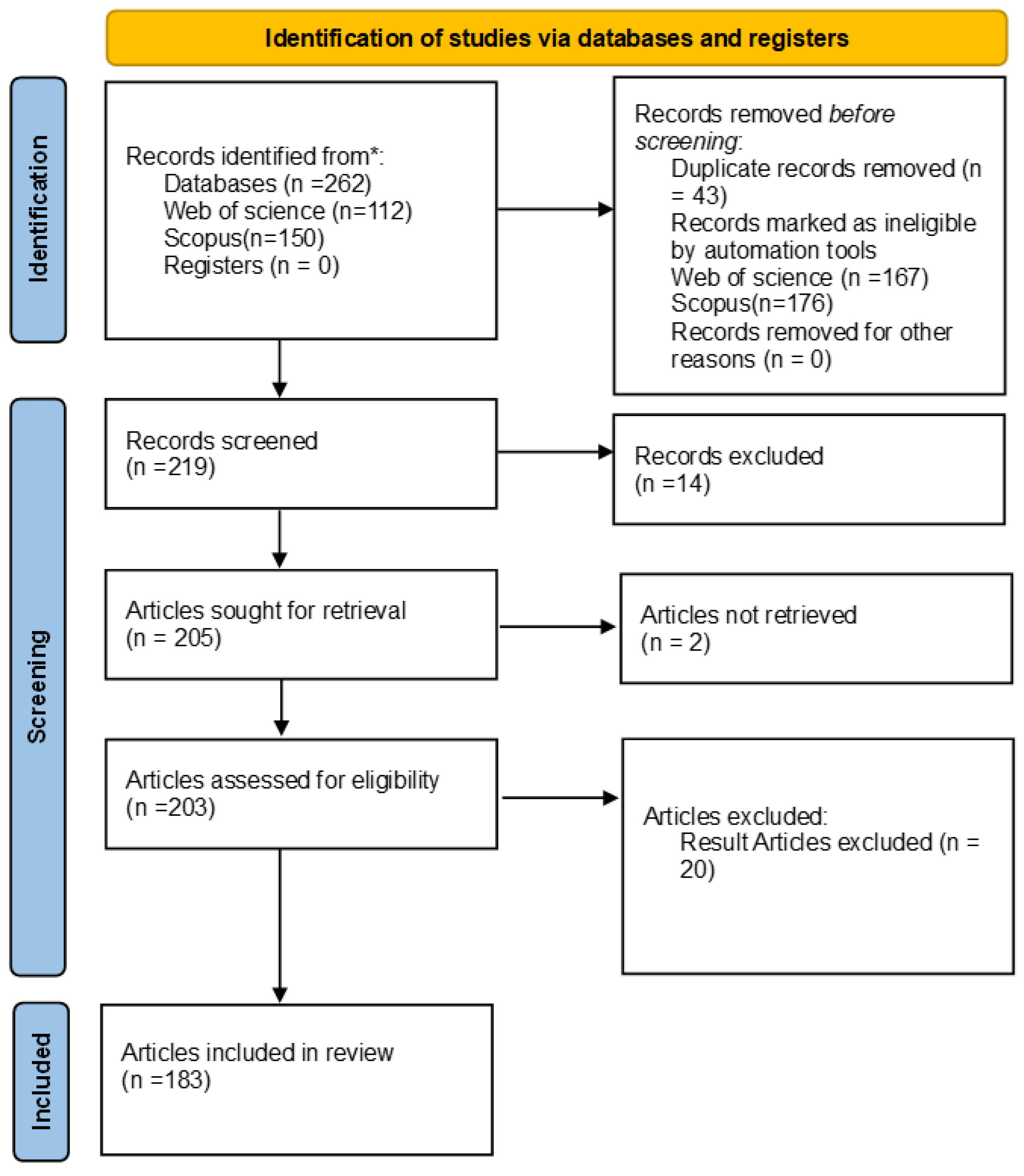
Figure 2.
Annual trend of articles published in the selected field of study
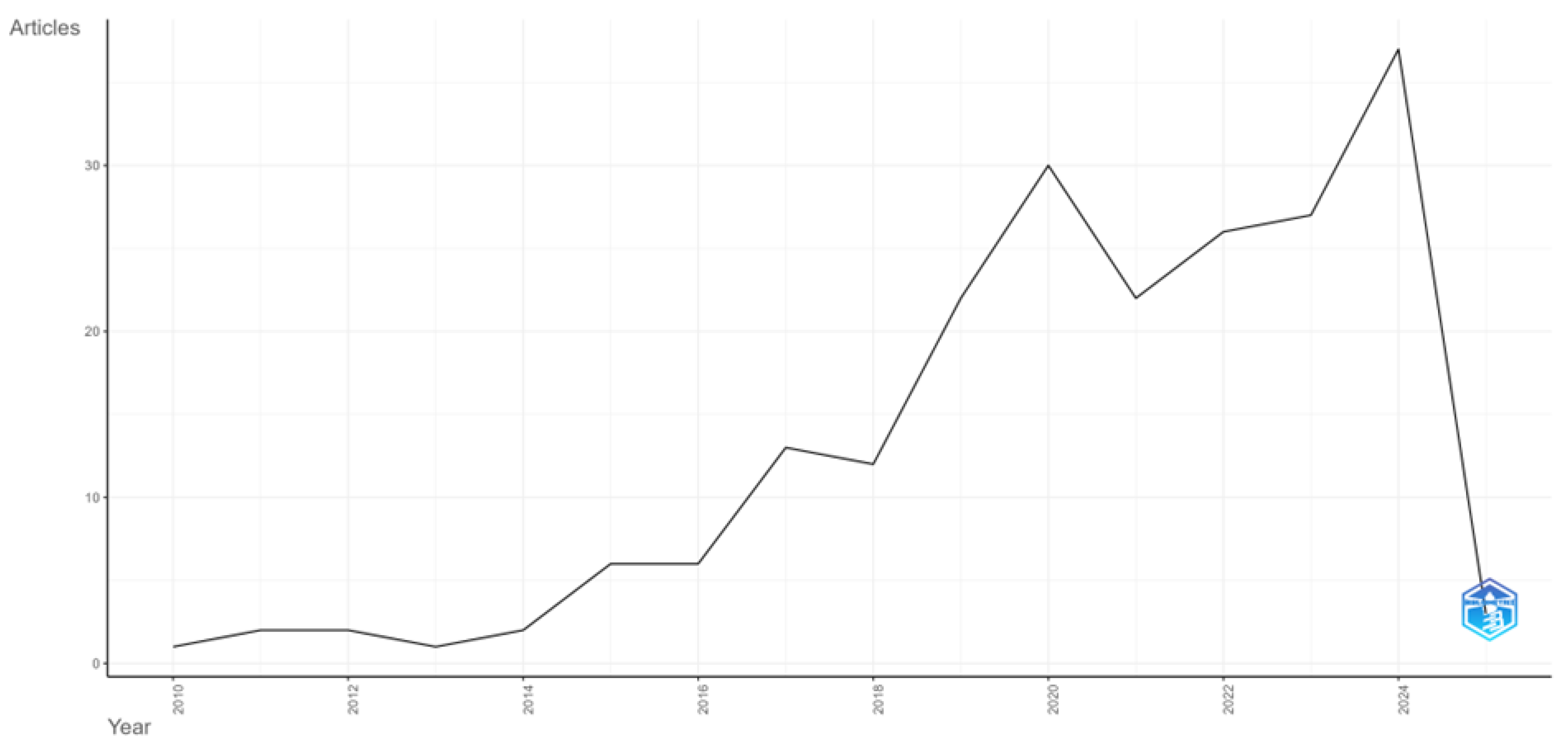
Table 2.
Bibliometric Indicators for Various Journals
| Source | h_index | g_index | m_index | TC | NP | PY_start |
|---|---|---|---|---|---|---|
| JOURNAL OF CLEANER PRODUCTION | 15 | 16 | 0.938 | 3134 | 16 | 2010 |
| SUSTAINABILITY | 6 | 11 | 0.857 | 139 | 12 | 2019 |
| ENVIRONMENTAL SCIENCE AND POLLUTION RESEARCH | 5 | 5 | 1 | 131 | 5 | 2021 |
| INTERNATIONAL JOURNAL OF PRODUCTION RESEARCH | 5 | 5 | 0.455 | 734 | 5 | 2015 |
| SOFT COMPUTING | 5 | 6 | 0.833 | 389 | 6 | 2020 |
| APPLIED SOFT COMPUTING | 4 | 6 | 0.286 | 560 | 6 | 2012 |
| COMPUTERS & INDUSTRIAL ENGINEERING | 4 | 5 | 0.364 | 428 | 5 | 2015 |
| EXPERT SYSTEMS WITH APPLICATIONS | 4 | 4 | 0.267 | 326 | 4 | 2011 |
| INTERNATIONAL JOURNAL OF PRODUCTION ECONOMICS | 4 | 6 | 0.5 | 349 | 6 | 2018 |
| PLOS ONE | 4 | 8 | 1 | 72 | 8 | 2022 |
Disclaimer/Publisher’s Note: The statements, opinions and data contained in all publications are solely those of the individual author(s) and contributor(s) and not of MDPI and/or the editor(s). MDPI and/or the editor(s) disclaim responsibility for any injury to people or property resulting from any ideas, methods, instructions or products referred to in the content. |
© 2025 by the authors. Licensee MDPI, Basel, Switzerland. This article is an open access article distributed under the terms and conditions of the Creative Commons Attribution (CC BY) license (http://creativecommons.org/licenses/by/4.0/).
Copyright: This open access article is published under a Creative Commons CC BY 4.0 license, which permit the free download, distribution, and reuse, provided that the author and preprint are cited in any reuse.


