

Submitted:
30 June 2025
Posted:
30 June 2025
You are already at the latest version
Abstract
Let G be a group and S be a subset of G such that S excludes the identity element and is closed under taking inverses. The graph Cay(G, S) is a simple Cayley graph in which the vertices correspond to the elements of G and two vertices are adjacent if and only if one can be obtained by multiplying the other by an element from S. Cay(G, S) is a |S|-regular.
This study is motivated by the work of Al-Kaseasbeh and Erfanian (2021), who explored the structure of Cayley graphs of dihedral groups with valencies 1, 2, and 3. Like dihedral groups, generalized quaternion groups are generated by two elements. In this research, the author aims to analyze the structure of Cayley graphs of the generalized quaternion group with valency at most 3.
Keywords:
Cayley Graph
; Generalized Quaternion Group
; Algebraic Graph
; Graph Isomorphism
; Valency
1. Introduction
A Cayley graph is a graph constructed from a group using a specified subset of its elements. Arthur Cayley introduced the concept of Cayley graph in 1878 [5]. In this paper, all groups are considered finite. In such graphs, the vertices correspond to the elements of the generating group. Two vertices in the Cayley graph will be adjacent if the operations of the corresponding elements belong to a connecting set, which is a subset of the generating group of the graph.
Let G be a group and S be a subset of G, with and . The Cayley graph generated by a group G and a connecting set , denoted by , is a graph whose vertex set is and two vertices are adjacent if and only if [2]. These conditions, namely and , ensure the resulting Cayley graph is simple and undirected. In this paper, all graphs are assumed to be simple and undirected. It is well-known that the Cayley graph is -regular, meaning that every vertex in the graph has the same valency (degree) as the number of elements in a set S. Furthermore, if the connecting set S generates the group G, then the Cayley graph is connected [7].
In this paper, we focus on finite groups. A group is a non-empty set equipped with a binary operation satisfying associativity, the existence of an identity element, and the existence of inverses [11]. If the set is finite, the group is referred to as a finite group. Let G be a group and . The order of G is the number of elements in G, denoted by [11]. Thus, G is a finite group if is finite. The order of an element a is the smallest positive integer n such that equal to the identity element of G [11]. In this paper, the order of an element a denoted by . For any group G with binary operation *, a subgroup H in G is a group generated by the set with the binary operations *. Equivalently, H is a subgroup of G if and only if for all , it follows that [1]. Let A be a set of a group G. Then is an intersection of all subgroups of G that contains A. Furthermore, subgroup is called subgroup generated by A [1]. If a group G is equal to , then G is said to be generated by A. If A is a singleton , then , and G is called cyclic group. From Malik et al.(1997) [11], we use the definition of right cosets and Lagrange theorem that in this paper. Let H be a subgroup of group G and element . The set is called right coset of H in G. For H is a subgroup of a finite group G, Lagrange theorem states that order of H divides the order of G.
In 2021, Al-Kaseasbeh and Erfanian [2] investigated the structure of the Cayley graph over the dihedral group with valencies 1, 2, and 3. The dihedral group with elements has two generators, x and y, whose order of x is n and the order of y is 2 [4]. On the other hand, there is a group with two generators known as the generalized quaternion group. Let n be a positive integer greater than or equal to 2. The generalized quaternion group with elements, denoted by , is a group generated by x and y, represented by the presentation [12]. For further characteristics of the generalized quaternion group, the author refers to Conrad (2014) [3]. Motivated by these results, this study further investigates the structure of the Cayley graph over the generalized quaternion group with the same valencies.
Let be a graph, where denotes the vertex set and denotes the edge set. In general, graph is usually written simply as . For every , the vertex a adjacent to vertex b, denoted . Some basic, well-known graph structures used in this paper are the null graph , the path graphs , the cycle graph , and the complete graph as introduced by Wilson et al.(1996)[14]. Some graph structures, such as the circulant graph , as defined by Golin et al.(2004)[8] and the Möbius ladder graph as introduced by Guy et al.(1967)[9], are also considered in this paper. Let and be a graph such that and . Then the is called a subgraph of . For any , the subgraph induced by S, denoted , is the subgraph with vertex set S, and all edges whose endpoints are contained in S [13]. In other words, for every , if then . Some operations over two graphs used in this research are disjoint union [15] and Cartesian product [10] of the two graphs. It is also proposed in some theories that two distinct graphs can be isomorphic. Any graphs and are isomorphic, denoted by , if and only if there exists an isomorphism from to . The isomorphism from to is a bijective function from to , such that for every , if and only if [13].
This research will investigate the isomorphism of the Cayley graph generated by with valencies less than or equal to 3, with the well-known graph, or those operations.
2. Results
The structure of the Cayley graph over a group is, in general, still an open problem for research. Kaseasbeh et al. (2021) [2] explored the structure of the Cayley graph over the dihedral group with maximal valencies 3. Farhan et al. (2024) [6] utilized computational methods to simulate and analyze the structure of Cayley graphs of the dihedral groups. Motivated by the insights from these studies, we are interested in examining the structure of Cayley graphs over other groups, particularly the generalized quaternion group.
Recall that the generalized quaternion group is the group defined by the presentation
where the order of x is and the order of y is 4. Let . Then . From the fact that , we have for . For any , we can generalize the properties of by using the following proposition.
Proposition 1.
For any k with , the equality holds.
We have . In general, for every , we have . Clearly, . For with in general, the inverse of will be provided in the following proposition.
Proposition 2.
For any , we have .
Using the following proposition, we can determine the orders of various elements in , excluding x and y, in general.
Proposition 3.
The only non-identity element in with order 2 is .
After establishing that is the only non-identity element of order 2 in , we now examine the orders of elements of the form , which are essential for understanding the structure of and its Cayley graphs.
Proposition 4.
For each , the order of is 4.
As an illustration of the concepts discussed in this section, the following graph presents an example of the Cayley graph with and the generating set . This example helps visualize the structure and connectivity of the generalized quaternion group through its associated Cayley graph.
Figure 1.
with .
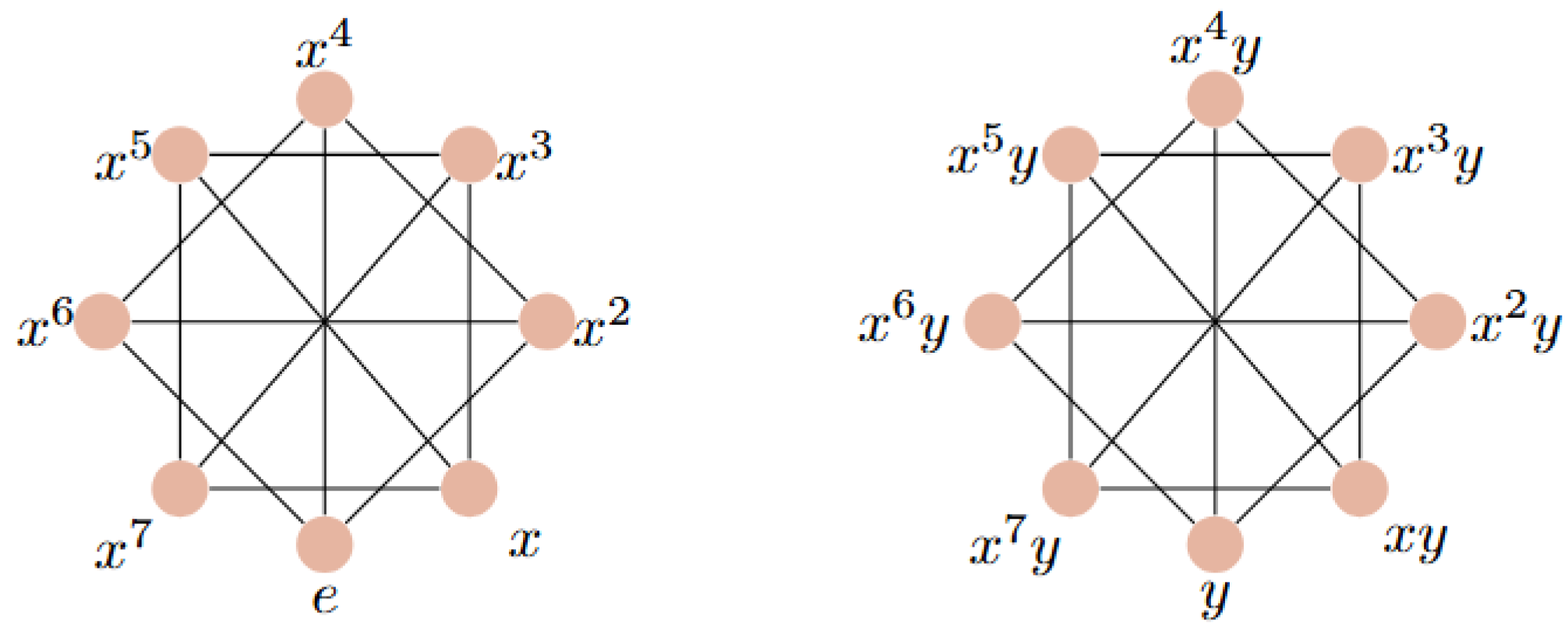
In the next discussion, we present the structure of the Cayley graph on the generalized quaternion group for valencies 1, 2, and 3. The Cayley graph’s structure on the generalized quaternion group for valencies 1 is shown in the subsequent theorem.
Theorem 1.
For any generator with , we have
Proof.
Consider any with for some . By Proposition 3, . Since , the Cayley graph is 1-regular. Now, we determine the pairs of vertices that are connected in . Since , it follows that , implying that vertex e is connected to vertex in . For the other vertices in , we examine the following cases:
- i.
-
For with .Consider any vertex such that . Then,This implies for . In other words, there are edges of the form for each .
- ii.
-
For , consider any vertex such that . Then,Therefore, the is connected by edge to vertex y in .
- iii.
-
For with .Consider any such that . Then,Consequently, for each . In other words, there are edges connecting and for each .
Furthermore, the graph has edges, and each vertex has degree 1. Therefore, .
□
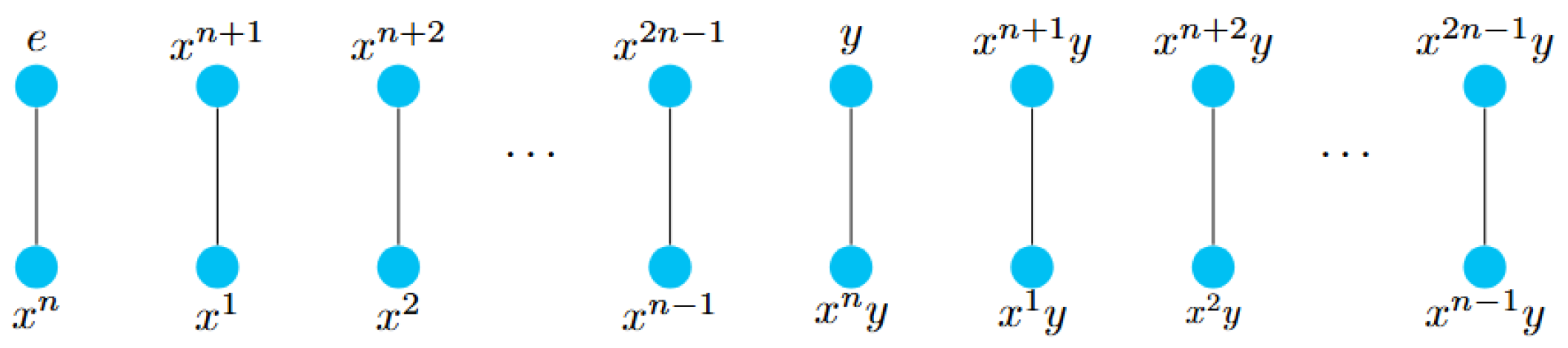
The Cayley graph as given in Theorem 1 can be illustrated in Figure 2.
In the next discussion, we present the structure of the Cayley graph on the generalized quaternion group for valencies 2. We consider with , , and . There are two cases, as follows.
- with for some and .
- for some with .
By Proposition 3 we know that in the , the only element of order 2 is . Hence, we conclude that the case is invalid. For valency 2, we only observe for for some with .
There are two possible cases for . That are when for any and , or when for any . In other words, for valency 2 we will investigate the set for any and , and also for any . In the following proposition we consider the case .
Proposition 5.
For any generator with or , we have
Proof.
Let for any or . Since , it follows that . Since the order of x is , it follows that the order of is for some or . Thus, we obtain with elements. Observe that
for each . Thus we have a cycle
of length . Therefore
Furthermore, let be a cyclic subgroup of of order . Consequently, which means there are exactly distinct right cosets, namely , where and
. For each right coset
, we obtain cycle of the form
for any , each of length .
Let be copies of cycle graph with order . Let be
It is clear that . Construct a function by
for every with . Then, is an isomorphism. Conversely, for every and for some with and for some , thus we have
In other words, and does not adjacent in . Every coset is an independent set, and every coset generates an induced subgraph that is isomorphic to . Consequently, .
□
In the following proposition, we prove for the case in the Cayley graph over the generalized quaternion group with valency 2.
Proposition 6.
For any generator with , we have .
Proof.
Given with . Since , it follows that . Furthermore, by Proposition 4, it is known that for every , so that
Note that for some for each , the following hold:
Therefore, we obtain a cycle of length 4 for every . Thus, for every .
Furthermore, is a cyclic subgroup of of order 4. Consequently, , which means there are n distinct right cosets: , where and . For each right coset
we can construct n cycles of the form for , each of length 4.
Let be n copies of the cycle graph of order 4. Let be
. Construct a function
by for every for some and for all . The function is an isomorphism. Using the same steps as before, it is clear that cosets are an independent set. In other words, the n distinct cosets are isomorphic to . Consequently, .
□
By Proposition 5 and Proposition 6, the general property for the Cayley graphs of the generalized quaternion group with valency 2 can be described as follows.
Theorem 2.
For any generator for some , where , we have .
Proof.
Consider with and for some , where . Since , it follows that . Therefore . There are two possible cases for , as follows.
- Case 1.
- for each or . If , then by Proposition 5, it follows that .
- Case 2.
- for each . If , then by Proposition 6, it follows that .
It is proven. □
In this subsection, we will present the structure of the Cayley graph on the generalized quaternion group for valency 3. The has valency 3 if the , , and . Two alternative scenarios for the set S that can produce as a graph with valency 3 are as follows.
- with for some each different.
- with for some and .
However, the first scenario cannot occur, as demonstrated by the following lemma.
Lemma 1.
Let . Then, if and only if S satisfying one of the following conditions :
- i.
- for some and .
- ii.
- for some .
Proof.
It is clear that for some and or for some . Conversely, we know that the . As previously stated, S with 3 elements can occur in the following two scenarios.
- Case 1.
- with for some 3 difference elements . By Proposition 3, we have . Thus, which contradicts to the fact . Therefore, this case doesn’t occur.
- Case 2.
-
with for some and . By Proposition 3, must be equal to . Thus, we have for some . There are only 2 possible cases, as follows.
- 2.a.
- For with or , we have , and hence .
- 2.b.
- For with , by Proposition 4, we have , and hence .
This completes the proof.
□
By Lemma 1, to observe the structure of the Cayley graph over the generalized quaternion group with valency 3, we only investigate the set with or and with .
First, for the case with or , we have 2 possible subgroups generated by S, as follows:
- i.
- , when for some .
- ii.
- , when n is not a multiple of k.
The following lemma provides the reader with the structure of the with valency 3 for generating the cyclic subgroup in of order 4.
Lemma 2.
For any generator for with where the and , we have .
Proof.
Clearly . Since for and , and , by Proposition 3 we get . Thus must be equal to . Therefore . For every , we have
Therefore, we get a cycle of length 4, for every . Moreover,
Thus, includes in
for every and .
Let be the complete graph with 4 vertices and let . Construct a function
by , for every and for every . It is easy to prove that the function g is an isomorphism. Thus, generates an induced subgraph that is isomorphic to .
Furthermore, is a cyclic subgroup of of order 4. Consequently, . Thus, there are n different right cosets in . All of the right cosets are as follows
where and . Each right coset is equal to for . Using the same steps as before, we can construct an isomorphism between the induced subgraph of generated by and the graph for every . As a result, each of the n distinct right cosets is isomorphic to . Thus, we can conclude that . □
The structure of the , with , which generates the cyclic subgroup in with order larger than 4, is detailed below.
Lemma 3.
For any generator for with , where the and , we have
Proof.
It is clear that . We have . Thus, . Since for and , also , we have
Since and , it follows that must be equal to for some . Thus, we obtain , which is equivalent to . For every and , we have
Therefore, we have a cycle of length for every . Furthermore,
Thus, the set
is included in for all with .
Let be a Möbius ladder graph of vertices with
Construct a function by for all and for all with . We obtain
and
for all . In other words, the function h is an isomorphism. Thus, in the generates an induced subgraph that is isomorphic to .
Furthermore, is subgroup of of order . As a result, indicates that contains unique right cosets. All of the right cosets are as follows
where and . Each right coset equals to for
. Using the same techniques as before, it is easy to demonstrate the isomorphism between the subgraph of induced by and the Möbius ladder graph graph for every . Therefore, each of the distinct subgraphs is isomorphic to . Thus, we may conclude that
□
In addition to the case , we now consider the scenario where the generating set S gives rise to a subgroup generated by both and , leading to a different structural form of the Cayley graph.
Lemma 4.
For any generator for some with , and the , we have
Proof.
It is clear that . for any with . We have
of elements. For every holds
Therefore, we have a cycle of length . For every , we obtain
In the same way, we also have a cycle of length . Furthermore, for every we have
Thus, the set
is included in for every and .
Let be a cartesian product graph of and . Let
and
Construct a function by and for all . We obtain
for all . In other words, l is an isomorphism. It is easy to verify that
generates an induced subgraph of that is isomorphic to .
Moreover, we can construct different right cosets, using the same techniques as Lemma 3. Furthermore, we can verify that every different right coset induces a subgraph that is isomorphic to . Thus,
□
Secondly, we observe for the case with . By Proposition 4, the order of is 4, so that we have
In other words, . In the following lemma, we characterize the structure of the Cayley graph with the connecting set for .
Lemma 5.
For any generator for some , we have .
Proof.
Clearly , thus . For , we have
Thus we have a cycle of length 4. Moreover, it holds
Thus, we have is a subset of for every .
Let be a complete graph of order 4 and size 6 with . Construct a function
with for . We obtain
Thus is an isomorphism. It follows that the subgraph induced by is isomorphic to .
Furthermore, we may construct subgraphs induced by the n right cosets using the same procedure as before. It can be shown that each distinct right coset induces a subgraph isomorphic to . Therefore, □
All generating sets S that give rise to Cayley graphs with valency 3 have been fully classified. The following theorem characterizes the structure of Cayley graphs over the generalized quaternion group with valency 3 in detail.
Theorem 3.
For any generator for some . It holds
- i.
- if and , we have ,
- ii.
- if and for some with we have ,
- iii.
- if and for some then we have .
3. Conclusion
This paper explores the structure of the Cayley graph over the generalized quaternion group with valencies up to 3. Future work may investigate the structure of the same Cayley graph with valencies greater than or equal to 4.
Acknowledgments
This work was carried out while the first author was studying at Universitas Gadjah Mada (UGM), Yogyakarta, Indonesia, with the support of the Department of Mathematics, UGM, and the Ministry of Finance of the Republic of Indonesia (Kementerian Keuangan Republik Indonesia) through the Indonesia Endowment Fund for Education Agency (Lembaga Pengelola Dana Pendidikan, LPDP) for the period 2023–2025.
References
- Adkins, W.A., Weintraub, S.H. (1992). Graduate Text in Mathematics (Algebra An Approach via Module Theory). Springer-Verlag, Inc, New York.
- Al-Kaseasbeh, S., Erfanian, A. (2021). The Structure of Cayley Graphs of Dihedral Groups of Valencies 1,2, and 3. Proyecciones Journal of Mathematics. Vol.40 pp 1683-1691.
- Conrad, K. (2014). Generalized quaternions. Retrieved from: https://kconrad. math. uconn. edu/blurbs/grouptheory/genquat. pdf. Accessed on December 10, 2024.
- Conrad, K. (2017). Dihedral groups. Lecture notes: https://kconrad. math. uconn. edu/blurbs/grouptheory/dihedral2. pdf. Accessed on December 23, 2024.
- Cayley, P. (1878). Desiderata and suggestions: No. 2. The Theory of groups: graphical representation. American journal of mathematics, 1(2), 174-176.
- Farhan, M., John, P., & Silaban, D. R. (2024). Simulations of Cayley graphs of dihedral group. In ITM Web of Conferences (Vol. 61, p. 01003). EDP Sciences.
- Godsil, C. & Royle, G. (2001). Algebraic Graph Theory, Graduate Text in Mathematics. Springer-Verlag. New York.
- Golin, M. J., & Leung, Y. C. (2004, June). Unhooking circulant graphs: A combinatorial method for counting spanning trees and other parameters. In International Workshop on Graph-Theoretic Concepts in Computer Science (pp. 296-307). Berlin, Heidelberg: Springer Berlin Heidelberg.
- Guy, R. K., & Harary, F. (1967). On the Möbius ladders. Canadian Mathematical Bulletin, 10(4), 493-496.
- Hammack, R. H., Imrich, W., Klavžar, S., Imrich, W., & Klavžar, S. (2011). Handbook of product graphs (Vol. 2). Boca Raton: CRC press.
- Malik, D.S., Mordeson, J. N., Sen, M.K. (1997). Fundamentals of Abstract Algebra. The McGraw-Hill Companies, Inc., New York.
- Nurhabibah, Syarifudin, A.G., & Wardhana, I.G.A.W. (2021). Some Results of The Coprime Graph of a Generalized Quaternion Group Q4n. Indonesian Journal of Pure and Applied Mathematics, (Vol. 3, No. 1 pp.29-33).
- West, D. B. (2001). Introduction to Graph Theory, Second Edition. Pearson Education, Inc. Singapore.
- Wilson, R. J. (1996). Introduction to Graph Theory, Fourth Edition. Addison Wesley Longman Limited., England.
- Susanti, Y. (2023). On the 2-Token Graphs of Some Disjoint Union of Graphs. Malaysian Journal of Mathematical Sciences, 17(4), 719-730.
Figure 2.
The with valency 1
Disclaimer/Publisher’s Note: The statements, opinions and data contained in all publications are solely those of the individual author(s) and contributor(s) and not of MDPI and/or the editor(s). MDPI and/or the editor(s) disclaim responsibility for any injury to people or property resulting from any ideas, methods, instructions or products referred to in the content. |
© 2025 by the authors. Licensee MDPI, Basel, Switzerland. This article is an open access article distributed under the terms and conditions of the Creative Commons Attribution (CC BY) license (http://creativecommons.org/licenses/by/4.0/).
Copyright: This open access article is published under a Creative Commons CC BY 4.0 license, which permit the free download, distribution, and reuse, provided that the author and preprint are cited in any reuse.


