
Submitted:
16 June 2025
Posted:
17 June 2025
You are already at the latest version
Abstract
This study explores how Philip Glass's post-minimalist techniques in the film score of *The Hours* interact with the film’s non-linear narrative structure. By integrating musicological analysis and film narrative theory, the paper examines the use of micro-variations, additive processes, and repetitive harmonic structures in Glass’s score. These techniques are shown to not only intensify the emotional resonance of the film but also reinforce its fragmented temporal flow across three interwoven storylines. Case studies of specific scenes illustrate how the music's subtle evolution parallels the narrative’s thematic continuity and psychological depth. This research contributes to the understanding of post-minimalist film scoring, emphasizing the aesthetic and structural synergies between music and moving image.
Keywords:
Philip Glass
; post-minimalism
; film music
; narrative structure
; The Hours
Introduction
Minimalist music emphasizes simplicity, repetition, and stable harmonies. Philip Glass, a pivotal figure in this genre, transitioned from minimalism to post-minimalism, introducing more flexibility in harmony and form. This paper examines how Glass's post-minimalist techniques in The Hours intersect with the film's non-linear narrative structure, influencing emotional expression and narrative coherence.
In Music and its Narrative Potential, The concept of musical narrative originates from narrative theory in literary theory. 'Narrative' in literature refers to the symbolic representation of events linked in time and cause and effect (Van Nerom et al., 2024: viii). Over time, the relationship between film and film music has become increasingly close. In the era of sound films, film music played an increasingly important role in films. According to Larsen in Film Music," Film music is part of the film, part of the film experience and part of the cultural context surrounding the film."(2007: 7). There is also connect between film narrative and musical narrative.
This thesis focuses on the 14-track film score composed by Philip Glass for The Hours and analyses how Philip Glass uses post-minimalist compositional techniques to combine the score with the non-linear narrative content of the film. At the same time, analyse how Philip Glass uses techniques typical of minimalist music such as static harmonies, motif repetition and micro-variations. Combined with Philip Glass's speciality of the additive process technique, a different approach is used from traditional Hollywood soundtracks and classical soundtracks, combining the content of the film to influence the emotions of the audience.
This study aims to use case studies and interdisciplinary research methods. Using case studies, select a few film clips and corresponding music clips from The Hour section and conduct a targeted harmonic analysis. Using an interdisciplinary research method, it achieves interdisciplinary and integrated research between film studies, music studies and psychology. Analyse the post-minimalist techniques of Philip Glass to promote and develop the narrative function of film music.
Research on minimalism and post-minimalism (Duckworth, 1995; Potter & Gann, 2016) provides theoretical foundations. Film narrative studies (Bordwell & Thompson, 2004; Crawford, 2024) indicate non-linear structures enhance emotional engagement. Ross (2007) and Huron (2008) discuss how minimalist techniques, such as micro-variation and additive processes, deepen emotional responses. This study bridges gaps in existing scholarship by closely analyzing Glass's soundtrack in The Hours.
The film adopts a non-linear narrative structure, interweaving three storylines: Virginia Woolf (Nicole Kidman), a British writer in the 1920s, who wrote Mrs. Dalloway while treating depression, representing the vanguard of modernism and feminism; Laura Brown (Julianne Moore) in the 1950s, a housewife who contemplates suicide under the pressure of a post-war family, and finally chooses to regain her self; and Clarissa Vaughan (Meryl Streep) in 2001, a publishing editor who experiences self-realization and bondage while caring for her former lover dying of AIDS.
Non-linear narrative, unlike chronological storytelling, uses flashbacks, flashforwards, or parallel storylines to enrich psychological depth and thematic complexity. Stephen Daldry's film The Hours utilizes such techniques, especially Parallel Editing and Cross-cutting, effectively highlighting the connections among its three intertwined storylines.
In different times and spaces, the three heroines play different female roles and spend their days leading repressed lives. Philip Glass's film music plays a significant role in film narrative and connection. It reflects the narrative significance of the connection between film music narrative and film narrative, etc. It reflects the humanistic and society cultural connotations of film music through the narrative techniques of music.
Literature Review
This study focuses on the relationship between music and narrative function in the movie The Hours. Explore how Philip Glass' post-minimalist music enhances the emotional expression of the film with its non-linear narrative editing techniques. The thesis not only reflects the cross-integration of music and film art but also provides a new perspective on how to convey emotions using film elements such as narrative techniques, editing techniques, camera language, and soundtracks. This literature review reviews and analyzes relevant literature. It aims to clarify the background, significance, purpose, and scope of this study and provides a solid theoretical basis for subsequent research.
Existing research has focused on minimalist music theory, film narrative structure, and the influence of music composition techniques and emotions. First, there is the theoretical study of minimalist and post-minimalist music. The work of Duckworth (1995), Potter and Gann (2016), and Cervo (1999) provide theoretical support for understanding the development and characteristics of these styles. These articles provide a very comprehensive understanding of the historical background and musical characteristics of minimalist compositions. Second, it is important to explore the narrative structure of the film. Bordwell, Thompson and Smith (2004) and Schasché (2010) analyse the editing techniques used in different narrative structures in film, comparing the use of editing techniques in linear and non-linear narratives. Crawford (2024) and Aldredge (2022) have shown that non-linear narratives can enhance emotional tension and audience engagement, distinguishing them from traditional linear narrative models and thereby allowing the audience to have a more intense emotional experience. Finally, Bakker and Martin (2015) found that even the most basic major and minor triads convey distinct emotional messages. This provides evidence that using simple harmonic elements in film soundtracks can arouse the audience's emotions. Huron's (2008) ITPRA model details how music triggers emotional responses. It demonstrates that small changes in pitch, rhythm, or harmony can trigger a complex interaction of anticipation and response in the listener, enhancing the emotional experience. At the same time, Alex Ross (2007) points out from a historical and critical perspective that Philip Glass uses micro-variation techniques and additive process technique. It not only enriches the structural layers of music, but it also gives movies a unique role in mobilizing the emotions of the audience in combination with music.
The above literature generally believes that minimalist music and post-minimalist music provide a unique way of expressing film music. Non-linear narratives have also played an active role in redefining film narrative patterns. However, some scholars (e.g. Hewett, 2025) question the repetitive and boring content of Philip Glass's music. It is believed that Philip Glass' repetitive and monotonous music may sometimes make it challenging to convey richer emotional connotations. These disputes show that although existing research has made important contributions to the theoretical basis and application of methods, there are still deficiencies in how to combine music technology with film narrative to achieve the best emotional expression.
Based on these literature reviews, this essay will explore the interactive mechanism between Philip Glass's soundtrack and the non-linear narrative structure in The Hours, filling the gaps in existing research on interdisciplinary integration and the expression of emotional narratives. Through a detailed analysis of the score of the soundtrack composed by Philip Glass, this essay aims to propose a new perspective to understand the role of film music in emotional construction more fully.
Non-linear Narrative Structure of The Hours
In past film productions, linear narrative was the mainstream technique, telling stories in chronological order so that the audience could empathise and be immersed (Schasché, 2010: 1). A non-linear narrative is a technique that reconstructs a story by breaking the natural chronological order. It usually uses flashbacks, flashforwards, or parallel multiple storylines to help the film portray a richer psychological and narrative dimension of the characters (Intro to film theory). The director wanted to explore the theme and characters more freely. Discuss deeper themes such as memory, identity and perception of reality. A film editing technique with a non-linear narrative is often chosen. Bordwell and Thompson (2013) discuss this narrative approach in Film Art: An Introduction. Describing falling in love does not necessarily have to start with the wedding; in guessing the chronology, start with their darkest moments, when it looks like they will never be together. Then, flashback to their happy times together. It makes the wedding more of an ending than the episode's main event, and such plots are often more engaging (2013: 75). These films often challenge audience expectations and perceptions through jumping timelines, repetitive plots, and ambiguous narrative foci (Rombes, 2005: 126-138). The non-linear narrative structure allows for a change in cinema's traditional storytelling structure while fuelling innovation in film style and expression.
In The Hours, director Stephen Daldry uses various narrative techniques, such as Montage (Parallel Editing and Cross-cutting Editing) and Flashbacks, to highlight the interrelationships between the three storylines. Techniques such as Crossfade are also used in soundtrack editing. These techniques not only enhance the story's emotional depth but also allow the audience to switch timelines without feeling stiff and sudden.
Parallel Editing in Montage involves replacing the main storyline with two (or more) different storylines, emphasizing temporal synchronicity and parallelism, which occur almost simultaneously with the main storyline (Aldredge, 2022). At the beginning of The Hours, minutes 4 to 9, director Stephen Daldry uses Parallel Editing to parallelise the early morning wake-up scenes of Virginia Woolf (Nicole Kidman), Laura Brown (Julianne Moore) and Clarissa Vaughan (Meryl Streep). Despite being from different generations, this series of linked shots show their similar state of life and mentality. According to Aldredge (2022)," When presented together with parallel editing, the audience feels this thematic connection between these different locations, and the odd juxtaposition becomes a part of the film language and style". Through Parallel Editing, the director cleverly shows the lifestyles and emotional states of the three protagonists. This allows the audience to see three different scenes simultaneously within a few minutes and clearly understand the historical context of the three women. This, in turn, drives the rhythm of the film and the expression of its themes.
Another editing technique similar to Parallel Editing is Cross-cutting, which is often used to build narrative suspense and create tension (Aldredge, 2022). From the 1 hour and 6 minutes to the 1 hour and 8 minutes in The Hours, the screen repeatedly switches between Virginia's conversation with the little girl and Laura alone in the hotel, preparing to commit suicide by taking pills. The plot twist comes when Virginia says, 'I was going to kill the heroine, but now I am going to kill someone else,' and Laura comes out of her reverie. Cross-cutting enhances the emotional response and anticipation of the audience by quickly switching between different scenes (Aldredge, 2022). Director Stephen Daldry uses cross-cutting to make the two protagonists more relevant at this moment. The audience can understand through these seemingly 'coincidental' images that Laura had committed suicide thoughts after reading Virginia's book, and what Virginia said at that moment seemed to have influenced Laura's decision to commit suicide. This editing technique makes this scene more representative.
The two editing techniques mentioned above enhance the relevance between the three storylines. Reverse chronology is a narrative technique that subverts the traditional telling story format. Instead of starting from the story's beginning, this narrative technique starts from the end. This allows director Stephen Daldry to seek more innovative techniques and depth in different narrative modes. At the same time, the audience will pay more attention to the importance of each scene as the film's background changes (Crawford, 2024). The Hours begin with the story of Virginia leaving her husband a farewell letter before committing suicide by drowning. Crawford (2024) points out that using this reverse chronology can. "It offers a unique angle, adds a layer of complexity and intrigue to their work, and encourages a deeper engagement with the narrative". In a normal narrative sequence, this scene would be at the end of the film, but director Stephen Daldry has placed it at the beginning. This reveals the background and motivation for everything Virginia does in the film and enhances the audience's interest in watching.
As mentioned earlier, the narrative techniques of montage editing and flashbacks enhance the complexity and emotional depth of the narrative through visual means. The music editing also plays a crucial role in the film. Crossfade is a common music editing technique often used to connect different music clips. It reduces sudden changes or interruptions and ensures a seamless transition between two sounds. It is not just a simple fade out and fade in but a dynamic change process (CLRN team, 2025). The most basic example of The Hours is the scene at the film's beginning where Virginia kills herself. The director, Stephen Daldry, uses Philip Glass's first piece of music, The Poet Acts. The second piece, Morning Passage, is used in the Main Feature after the Title Card. The last note of The Poet Acts is B flat, and the director Stephen Daldry chooses to prolong the sound of B flat until the end of the first measure of the Morning Passage before fading out. The first note of the Morning Passage is G, which forms a consonant interval of minor third with B flat. As the CLRN team says, Crossfade ensures a smooth transition between flashbacks at the beginning of a movie and the title card and main feature (2025). This ensures that the audience is not emotionally interrupted and enhances the narrative structure's continuity.
The diverse application of non-linear narrative techniques in The Hours enriches the film's narrative structure and enhances emotional expression and the audience's sense of participation. From the Montage techniques of Parallel Editing and Cross-cutting to the Crossfade in music editing, they have all been carefully designed by director Stephen Daldry and composer Philip Glass. The use of flashbacks breaks the film's traditional narrative method of being arranged chronologically, providing the audience with a new perspective and a more emotional experience.
The Depiction of Physical Forms and Atmospheres in the Film Music of The Hours
From the non-linear narrative structure of the film to an exploration of its musical structure. In The Hours, Philip Glass's music perfectly connects the three storylines without conflict and shapes the physical space and ambient atmosphere. Through the specific score analysis of the two film soundtracks, The Poet Acts and Morning Passages, a more comprehensive understanding of how Philip Glass enhances the emotional depth of the film while meticulously depicting the atmosphere of the scene can be gained.
Depicting Water Currents, Forests and the Chirping of Birds and Insects, The Poet Acts
The title music The Poet Arts uses the techniques of repetitive harmonic cycles and static harmonies to depict the physical environment well. It echoes the images of water, trees, and the chirping of birds and insects in the movie. Repetitive Harmonic Cycles is one of Philip Glass's post-minimalist music styles. It means a sequence of repeated chords or harmonies in a musical work (ISAC, 2021: 146). Repetitive Harmonic Cycles are the basic element of composition, allowing for variation while creating different musical structures. Static harmony is widely considered to have been invented by La Monte Young. The effect of the 'droning tone' in static harmony is derived from La Monte Young's childhood memories of the constant chirping of insects and birds (Grimshaw, 2005: 4).
The Poet Acts appears in the film at 1 minute and 52 seconds, corresponding to the scene where Virginia Woolf goes to the river to commit suicide. The river in the film is rushing at this time. According to Figure 1, the upper accompaniment is in a Triplet structure, with a large-wave melodic form constructed with fifths and intervals of more than a fifth. With the repeated note technique, the Triplet melody continue loops, depicting the unstoppable flow of the river. In the long shot, in contrast to the dynamic of the river, the trees and the continuous sound of birdsong in the trees remain static. The sustained static two-tone, octave and 'droning tone' effect of the sound interval 'G—G' in The Poet Acts embodies the original design concept of static harmony technology, imitating the scene and sound of insects chirping and birds singing in the image. The title music The Poet Acts is in G minor, with the static double tone as the main sustained tone, so presenting a harmonic tonal function of stability, depicting the tranquility and peace of the forest on a sunny day.
Depicting the Tense Atmosphere of Life in Morning Passages
The three heroines in The Hours, oppressed by life and mental stress, always lived in a tense atmosphere. Philip Glass uses different harmonic superposition based on repeated tones. Diminished chords, augmented chords and major and minor seventh chords are used to create a tense emotional atmosphere. Bakker and Martin have shown that minor chords, compared to major chords, and dissonant chords, compared to consonant chords, elicit stronger responses in multiple brain regions associated with emotion when passively listened to (2015: 15-31). Therefore, minor and major chords, as well as augmented and diminished chords, all have emotional connotations, and even an unprofessional listener can experience these different emotions quickly.
For example, in Figure 2 and Figure 3, in the piece Morning Passages in G minor, the G sharp major third augmented chord (bar 33), the C sharp minor third diminished chord (bar 36), the B flat major 7th augmented chord and the dominant seventh chord (bars 70 and 71) are all presented as broken chords and repeated as column chords, further intensifying the dissonant sound of the chords and creating a constant sense of tension.
Philip Glass added extended chords to these repetitive patterns to increase the harmonic tension. Extended chords are highly dissonant modern chords dominated by a triple superposition and consisting of five notes or more (Levine, 2011: 74). In Figure 4, between bars 38 and 44 of Morning Passages, the extended chords first appear and are referenced throughout the rest of the piece. This is an extended chord with five notes, formed by two different chords—a D major chord and an A diminished chord. Although the root and third of the chord form a major third, the remaining consecutive intervals are all minor thirds. This extended chord minor third structure brings about a drastic change in the chord, further deepening the tense atmosphere.
Finally, the trill of the repeated opening note simulates the sound of a hurried alarm clock, concretising the tense atmosphere. In the book On the Track: A Guide to contemporary film scoring, was also mentioned 'audio-visual isomorphism'. When Laurence Rosenthal was searching for the suitable soundtrack for Who Will Love My Children? (1983). The character in the film needs to explain something very simple to the children, which means it should be as simple as C major. It only requires a tiny movement (Karlin & Wright, 2013: 155). Placing music and film content on the same level is highly effective in creating a narrative atmosphere for the film's plot. From The Hours 4:27 to 6:19, the three protagonists are all asleep. The film reprises the musical material shown in Figure 5 between 6:19 and 6:36. The trill is repeated in a repeated pattern through the notes D sharp and E. This is superimposed on the alarm clock sounds from the three story lines in the film. This direct imitation method is used to imitate the sound of the alarm clock with music and achieve a more sustained effect. The tension of the emotional atmosphere is visually represented. The close-up of the heroine's expression as she wakes up and the alarm clock vibrating simultaneously the cinema image with the narrative mood of the music.
The Music of the Film The Hours, Composed Using the Technique of Micro-Variation, Depicts the Character's Feelings of Anxiety and Resistance
Traditional Hollywood soundtracks often use rich melodies and orchestrations to reflect the emotional depth of the characters. The grand themes of John Williams in films such as Star Wars and E.T. have become classics. These richly textured soundtracks capture the essence of the characters and the stories. Philip Glass challenged the traditional Hollywood soundtrack in The Hours. Philip Glass employs the concept of 'micro-variations'. The book Microsound mentions that micro-variations enrich musical expression by subtle changes to basic constant factors such as pitch, rhythm, beat, timbre, orchestration, sound, and harmony without changing them (Roads, 2001: 340). Although 'micro-variations' is not a compositional technique invented by minimalist composers, it embodies repetition and small changes based on stillness, which injects vitality into the aesthetic of the minimalist music.
In The Ego and the Id, Freud compares human thoughts, ideas and psychological mechanisms to the lenses in a telescope. When the psyche does not accept the reality of our true consciousness, and the outcome of events or the development of emotions runs counter to our preconceptions, our psychological mechanisms will resist and bring what we do not accept into the body's subconscious, where it is suppressed. The surface of our self-consciousness seems calm and placid (1923: 61). Micro-variations involve only minor changes to a single musical material, similar to the underlying psychological manifestations that people consistently exhibit. The potential psychology of the movie characters is imitated and revealed in the music composition, fulfilling the function of character psychological description in the narrative of film music.
In Ash's (2023) article What Is Minimalism in Music? point out that minimalism in music can enhance emotional depth. This view is widely accepted. However, the impact of minimalist music on the interpretation of complex film story content deserves more research. Hewett (2025) also questions whether these arpeggios with their minimal fluctuations can really convey the most subtle human emotions. In the article I admire Philip Glass, but sometimes I detest his music. He argues that "interminable arpeggios and scales and limp melodies was vacuous and strangely inept". However, these critiques prompt us to examine whether minimalist music's simple style might still reveal deep emotional layers in film narratives.
Micro-Variations in Pitch
Micro-variations of pitch change refer to the type of micro-variations in which other musical material factors are constant and only the pitch changes slightly. The connection between pitch and human psychology has always existed. This relationship is explained in the book A Generative Theory of Tonal Music. People's perception of pitch is determined first and foremost by the frequency of sound waves per second in physics. For long musical practice, humans have gradually eliminated and selected from the vast pitch range that the human ear can perceive a subset of sounds with simpler frequencies, higher clarity, a clear sense of pitch, and pleasing to the ear for use in music (Lerdahl and Jackendoff, 1983: 290). This reflects the natural quest of the human heart for harmonious and pleasing pitches. Furthermore, in Brain Organization for Music Processing, Peretz and Zatorre state, "The right temporal neocortex plays a particularly important role in the computation of pitch relations" (2005: 91-92). Peretz and Zatorre believe that high pitched sounds are emotionally charged because of the higher vibration rate, which stimulates the relevant areas of the brain more intensely. The higher rate of vibration stimulates the relevant areas of the brain more strongly, resulting in a higher state of excitation of neural activity, which in turn causes a more pronounced emotional response. Generally, composers use the upward and downward movement of pitch to express the back and forth between high and low mental and emotional.
In the film The Hours, the characters Laura Brown and Virginia Woolf create a relationship between the reader and the writer. In order to show the 'appearance' of Laura Brown and Virginia Woolf and the close relationship between Laura Brown and Virginia Woolf. Philip Glass creates musical motifs that are shared by both characters, emphasising their relationship again and again through variations, original reproductions and changes. Figure 6 and Figure 7 are excerpts from the morning passage of music. Figure 6 appears at 3:33 in the film, where the 'Laura and Woolf' theme is presented for the first time in the form of a musical theme with variations. The theme consists of disintegrated chords with a progressive second, and the rhythmic patterns are all in eighth note form. The rhythmic pattern is in eighth notes. Figure 7 is the first variation, where the eighth note is transformed into a triplet pattern. The linking of the theme to the triplet variations introduces Laura and Woolf for the first time in the film, as well as the circumstances and places in which they live.
In The Hours from 1 hour 06 minutes to 1 hour 08 minutes, Philip Glass composed the music Something She Has To Do (Figure 8 and Figure 9). The film goes through the cross-cutting. It depicts the events of Laura Brown's suicide attempt at the hotel and Virginia Woolf's contemplation of whether or not to end the life of the protagonist in Mrs Dalloway. This image appears in bars 27 to 57. Bars 27 to 57 correspond to The Hours. The bars 42 to 57 are reproductions of the musical motifs of the characters of Laura and Woolf. Through the technique of pitch micro-variations, the film music describes the apprehensive psychological emotions of Woolf and Laura. The pitch material within the phrase is constantly undergoing a chromatic, cascading, repetitive march. It shows Woolf's heart emotions as she reflects on her own life and death while being told what happened by her sister, and Laura's apprehension as she attempts suicide.
Micro-Variations in Harmonic
Harmonic micro-variation, a type of micro-variation in which there is a slight change in harmonic construction based on all other musical material remaining unchanged. Psychologically, Huron considers tension one of the important dimensions of emotion, as stress is usually accompanied by the expected excitement (2006: 305). On the other hand, tension is expressed in music as the anticipation of uncertainty about the outcome, which creates emotional turmoil in the listener. The tension of interval relation is at the heart of the acoustic tension of music. Cognitive Foundations of Musical Pitch point out, "Intervals considered consonant tend to predominate not only in Western music, but also in other musical cultures.... These intervals have special acoustic properties that have implications for how they are coded by the sensory system" (Krumhansl, 1990: 52). This means the consonant and dissonant character of the intervals, which determines the feeling of tension and relaxation in music. Interval relationships become the core of the musical sound's tension.
During The Hours from 1 hour 15 minutes 52 seconds to 1 hour 22 minutes 26 seconds, Philip Glass created For Your Own Benefit (Figure 10). This clip tells the story of Virginia Woolf running away from home, hoping to return to London and arguing with her husband at the train station. In this musical passage, the harmony is constantly being subtly varied, while all other factors remain constant. The continuous changes in the major triad reveal that the broad harmonic sound is the main direction of development for this musical fragment. It is quite different from the constriction when describing a state of mind with anxiety and a stressful living environment. This describes Virginia Woolf's psychological emotions of resistance.
Micro-Variations in Orchestration
Different instruments produce different musical colours due to their physical materials. The combination of different instruments in an orchestra achieves richness and variety in sound. 'Synesthesia' in psychology is defined as "the mental activity of one sense evoking another". In the book Synesthesia: A Union of the Senses point out "In those with synesthesia sensory interactions are entirely different: stimulation in one sensory modality automatically triggers a perception in a second modality, so that a sound, say, might instantly trigger a blob of color "(Cytowic, 2002: xii). In film music, different musical colours can also echo the different emotions of the characters. From 1 hour 44 minutes 29 seconds to 1 hour 45 minutes 33 seconds, the film explains how Virginia Woolf finally completed the process of committing suicide by jumping into the river. The cross-cutting of the panoramic shots of Laura Brown's tearful expression, Virginia Woolf's insomnia, and Clarissa Vaughan smiling as she enters the room appear at the same time. Meanwhile, Virginia Woolf's monologue: 'You must look into life... When you finally understand its meaning, you can love its brilliance. Then you can let it go,' reveals that Laura Brown and Clarissa Vaughan are both in the victory stage of psychological struggle, while Virginia Woolf chooses to end her life.
The music The Hours corresponds to this video (Figure 11, Figure 12 and Figure 13). This part consists of two musical phrases, which use orchestration micro-variations to depict Virginia Woolf's psychological emotions of resistance. In the video of Virginia Woolf, before she jumped into the river, a string ensemble is used as the orchestration. Furthermore, in Virginia Woolf jumping into the river, the orchestration of a two-part piano is added based on maintaining a consistent rhythm, beat, and pitch with the previous musical material. The overall sound of the instrument is enriched by the display of the piano in the form of column chords and double-note half-dismembered chords. This echoes Virginia Woolf's struggle against the expansion of her psychological emotions, which eventually led to the act of ending her life by jumping into the river in order to gain personal freedom. It propels the entire film to a climax.
The Use of the "Additive Process Technique" in the Film Music of Philip Glass Deepens the Main Theme of the Film's Narrative.
The 'additive process technique' comes from the 'additive structure' of Indian music. It refers to a simple melody or rhythm as the basis. In the process of repetition, a pattern is used that constantly increases or decreases using minor units to form a musical phrase. The rest is noise: Listening to the twentieth century point out, Inspired by Indian music, Philip Glass introduces continuous rhythmic changes. Similar to Indian music, changes are created by adding or removing notes.(Ross, 2007: 536). Therefore, 'Additive process technique' has become one of the typical creative techniques in the American minimalist music style.
Additive processes can generally be divided into two types: additive rhythmic processes and additive pitch processes. An additive rhythmic process is a regular rhythmic operation process that continuously expands, contracts, and returns to the basic rhythmic time value and rhythmic unit. The additive pitch process is the process of increasing and decreasing the basic pitch material. The ultimate goal of narrative in film is to express the emotions and themes of the film, making the film more enjoyable and educational. Film music serves the narrative and becomes an important tool for expressing emotions and elaborating and expanding the meaning of the plot. The 'additive process technique' seems similar to micro-variations but is different. The 'additive process technique' gradually increases or decreases the pitch and rhythm construction goes even deeper than the degree of fission presented in micro-variation technology. The characteristics of expansion and contraction in pitch and rhythm are more pronounced. Therefore, the changes in music under the 'additive process technique' are more easily recognised.
Dead Things—The Ultimate Insignificance of Human Life
From 44 minutes to 46 minutes and 20 seconds in The Hours, there is a scene music theme for "thinking about life" , which is in the title music Dead Things. The scene depicts Virginia Woolf, her sister, and their family observing the end of a bird's life in the garden and finally burying it. This is the first time in the entire film that the narrative theme of "life" is directly discussed through the demise of things, and it is an important part of the film's narrative. Through a series of dialogues between Virginia Woolf and her niece, the film explores the questions of "what happens after we die," "we return to where we came from," and "we become smaller after we die." The film leads the audience to ponder the origin and outcome of life and death and realizes the conclusion of the narrative theme: "In the end, human life is small".
Philip Glass uses the "additive process technique" in Dead Things. Musically, it deepens the narrative theme of "the ultimate insignificance of human life". The first appearance of theme motivation 1 and 2 is between 44 minutes and 46 minutes 19 seconds. It echoes the dialogue between Virginia Woolf and her niece. At this point, the long "crawling" gesture of the scale-like ascending and descending lines describes the length of life, its continuity and the difficulty of life choices (Figure 14). This theme underwent three additive processes. The first is an additive rhythmic process. While maintaining the basic form of the theme, the motive is extended by adding eighth notes to the pitch class of the sequence to a twelve-tone row (Figure 14 and Figure 15). This extension echoes Virginia Woolf's deepening reflections on life in the movie, revealing the splendor of life. The second and third are additive pitch processes (Figure 16). In the second additive pitch process, the upwardly moving thematic motive is reduced to a five-note sequence, and the downwardly moving thematic motive is reduced to a four-note sequence. In the third additive pitch process, the upwardly moving thematic motive is further reduced to a three-note sequence. The gradual reduction of the musical theme echoes the process of life from existence to nonexistence. The soundtrack enhances the film's theme with additive process technique, which deepens the film's narrative.
Tearing Herself Away— Relief from Self-Imposed Pressure
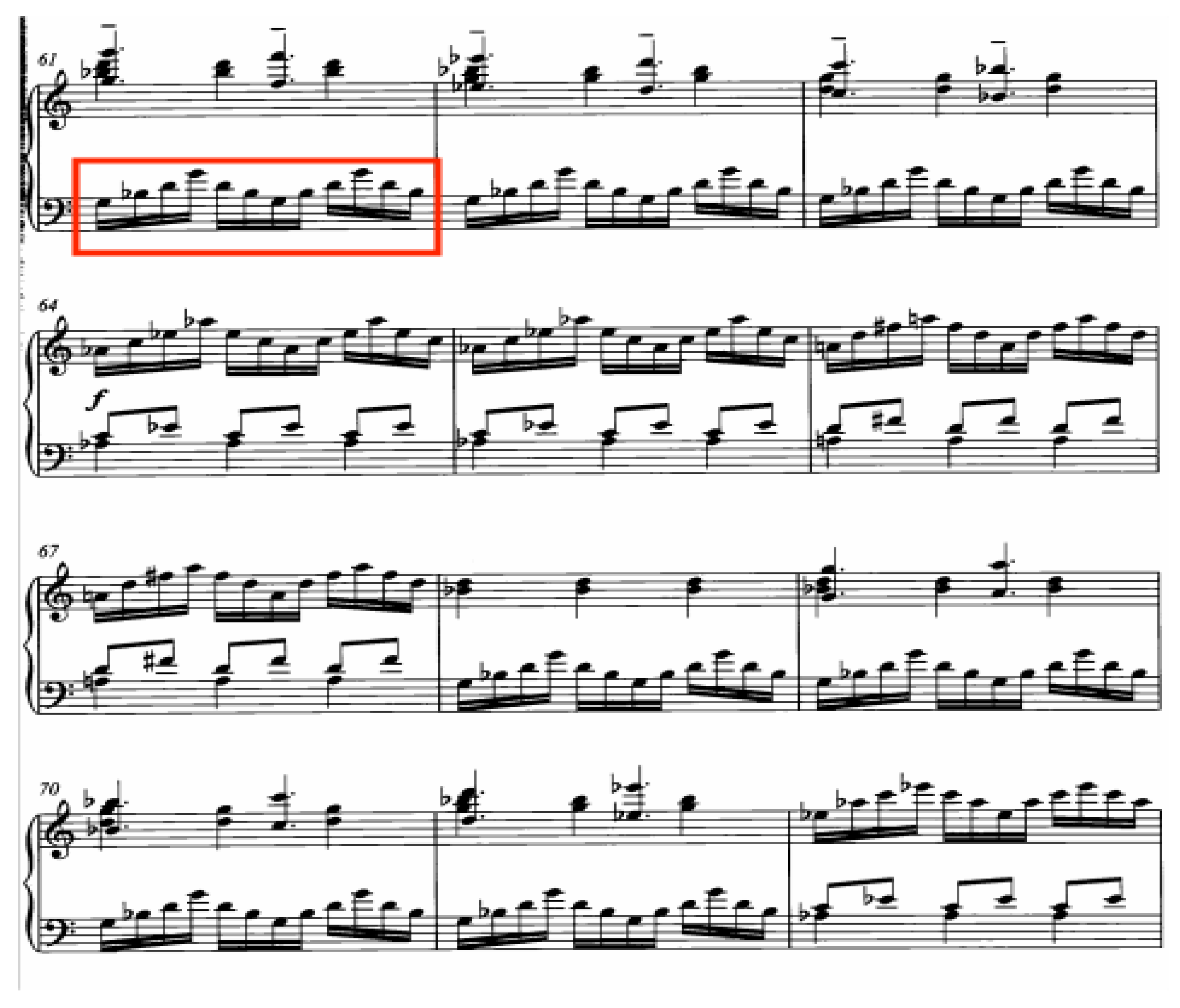
The scene in which Laura drives away from her child alone is another important narrative thread in the film. In this scene, the film shows Laura's increasing vehicle speed and Laura's increasingly desperate resistance through rapid switching between different camera angles. In Tearing Herself Away, the character music theme of "Laura and Woolf" is expanded by adding pitch cells, increasing the number of pitches (Figure 17 and Figure 18). From one measure with nine notes, it expanded to twelve notes, while the note values also changed from eighth notes to the shorter sixteenth notes. With sound and picture in sync, the overtaking and acceleration in the movie are shown. At this time, the extended state of the character's musical theme not only enhances the dramatic tension but also reveals the deepening of the narrative theme of the character's self-realization and the release of self-pressure.
Conclusion
This essay explores how Philip Glass uses post-minimalist techniques to promote and develop the narrative function of film music. Through the analysis of the editing techniques of the narrative structure of the movie The Hours, it is understood that the diverse application of non-linear narrative techniques not only enriches the narrative structure of the film but also enhances emotional expression and the audience's sense of participation. At the same time, detailed research of Philip Glass's score, from micro-variations and additive process techniques, etc., realizes the function of scene description, psychological description and deepening of the narrative theme on the narrative level of the film music. Demonstrates how Philip Glass's post-minimalist compositional technique can influence the narrative function of film music. Overall, Philip Glass's soundtrack breaks away from the traditional Hollywood soundtrack model, encouraging the audience to think more deeply and providing a unique way of expressing emotions in film narratives. It also shows that minimalist music is not limited to documentaries because of its repetitive and static musical characteristics. Minimalist music can also be used to score feature films, profoundly expressing the film's meaning and the characters' emotions.
Author Contributions
The author confirms sole responsibility for all aspects of this study, including research, analysis, and manuscript preparation.
Funding
This research received no external funding.
Data Availability Statement
Not applicable.
Conflicts of Interest
The author declares no conflict of interest.
References
- Aldredge, J. (2022) Everything you need to know about parallel editing and cross-cutting, Soundstripe Royalty Free Music. Available online: https://www.soundstripe.com/blogs/parallel-editing-and-cross-cutting (accessed on 16 March 2025).
- Ash, A. What Is Minimalism in Music? Exploring Its Impact and Application. 2023. Available online: https://audioapartment.com/music-theory-and-composition/what-is-minimalism-in-music/ (accessed on 16 March 2025).
- Bordwell, D.; Thompson, K.; Smith, J. Film art: An introduction; McGraw-Hill: New York, 2004; Vol. 7, pp. 477–479. [Google Scholar]
- Bakker, D.R.; Martin, F.H. Musical chords and emotion: Major and minor triads are processed for emotion. Cognitive, Affective, Behavioral Neuroscience 2015, 15, 15–31. [Google Scholar] [CrossRef] [PubMed]
- Cervo, D. Post-Minimalism: A Valid Terminology? Ictus 1999, 1, 37–52. [Google Scholar]
- Cytowic, R.E. Synesthesia: A union of the senses; MIT press, 2002. [Google Scholar]
- Crawford, M. What is reverse chronology in writing? A structural exploration, Filmmaking Lifestyle. 2024. Available online: https://filmlifestyle.com/what-is-reverse-chronology/ (accessed on 16 March 2025).
- CLRN team. (2025) Whatʼs Crossfade in music?, California Learning Resource Network. Available online: https://www.clrn.org/what%CA%BCs-crossfade-in-music/ (accessed on 16 March 2025).
- Duckworth, & Willian. Talking Music; Schirmer Books: New York, 1995. [Google Scholar]
- Grimshaw, J. Music of a" More Exalted Sphere": The Sonic Cosmology of La Monte Young. Dialogue: A Journal of Mormon Thought 2005, 38(1), 1–35. [Google Scholar] [CrossRef]
- Daldry, S. The Hours, [Film], Paramount Pictures, 2002.
- Glass, P. Words Without Music; Faber & Faber, 2015. [Google Scholar]
- Hewett, I. (2025) 'I admire Philip Glass, but sometimes I detest his music', The Telegraph. Available at: I admire Philip Glass, but sometimes I detest his music [Accessed: 16 March 2025].
- Huron, D. Sweet anticipation: Music and the psychology of expectation; MIT press, 2008. [Google Scholar]
- Isac, I. Repetitive minimalism in the work of Philip Glass. Composition techniques. Bulletin of the Transilvania University of Braşov, Series VIII: Performing Arts 2020, 13(2-Suppl), 141–148. [Google Scholar] [CrossRef]
- Karlin, F.; Wright, R. On the track: A guide to contemporary film scoring; Routledge, 2013. [Google Scholar]
- Krumhansl, C.L. Cognitive foundations of musical pitch; Oxford University Press, 2001. [Google Scholar]
- Shave, N. (2024) Philip Glass: the pioneering American composer who took us to the wilder shores of Minimalism and beyond. Available at: Philip Glass: the pioneering American composer who took us to the wilder shores of Minimalism and beyond Classical Music [Accessed: 16 March 2025].
- Schasché, V. Non-Linear narrative structure in contemporary cinema; na, 2010. [Google Scholar]
- Larsen, P. Film music; Reaktion Books, 2007. [Google Scholar]
- Lehrdahl, F.; Jackendoff, R. A generative theory of tonal music. In Cambridge. MA; 1983. [Google Scholar]
- Levine, M. The jazz theory book; "O'Reilly Media, Inc.", 2011. [Google Scholar]
- Potter, K.; Gann, K. The Ashgate research companion to minimalist and postminimalist music; Routledge, 2016. [Google Scholar]
- Peretz, I.; Zatorre, R.J. Brain organization for music processing. Annual review of psychology 2005, 56(1), 89–114. [Google Scholar] [CrossRef] [PubMed]
- Rombes, N. Sincerity and Irony. New punk cinema 2005, 72–85. [Google Scholar]
- Roads, C. Microsound. Cambridge, Mass.; London: Mit, 2001. [Google Scholar]
- Ross, A. The rest is noise: Listening to the twentieth century; Macmillan, 2007. [Google Scholar]
- Non-linear narratives-(intro to film theory)-vocab, definition, explanations: Fiveable (no date) All 38 AP Subjects. Available online: https://library.fiveable.me/key-terms/introduction-to-film-theory/non-linear-narratives (accessed on 16 March 2025).
- Van Nerom, C.; Peeters, A.; Bouckaert, B. (Eds.) Music and its Narrative Potential. In Paderborn: Brill Fink; 2024. [Google Scholar] [CrossRef]
Figure 1.
Philip Glass. The Hours. The Poet Acts. bars 1-8. (image taken from scorser, Philip Glass the hours - download free sheet music and scores, Accessed: 16 March 2025).
Figure 1.
Philip Glass. The Hours. The Poet Acts. bars 1-8. (image taken from scorser, Philip Glass the hours - download free sheet music and scores, Accessed: 16 March 2025).
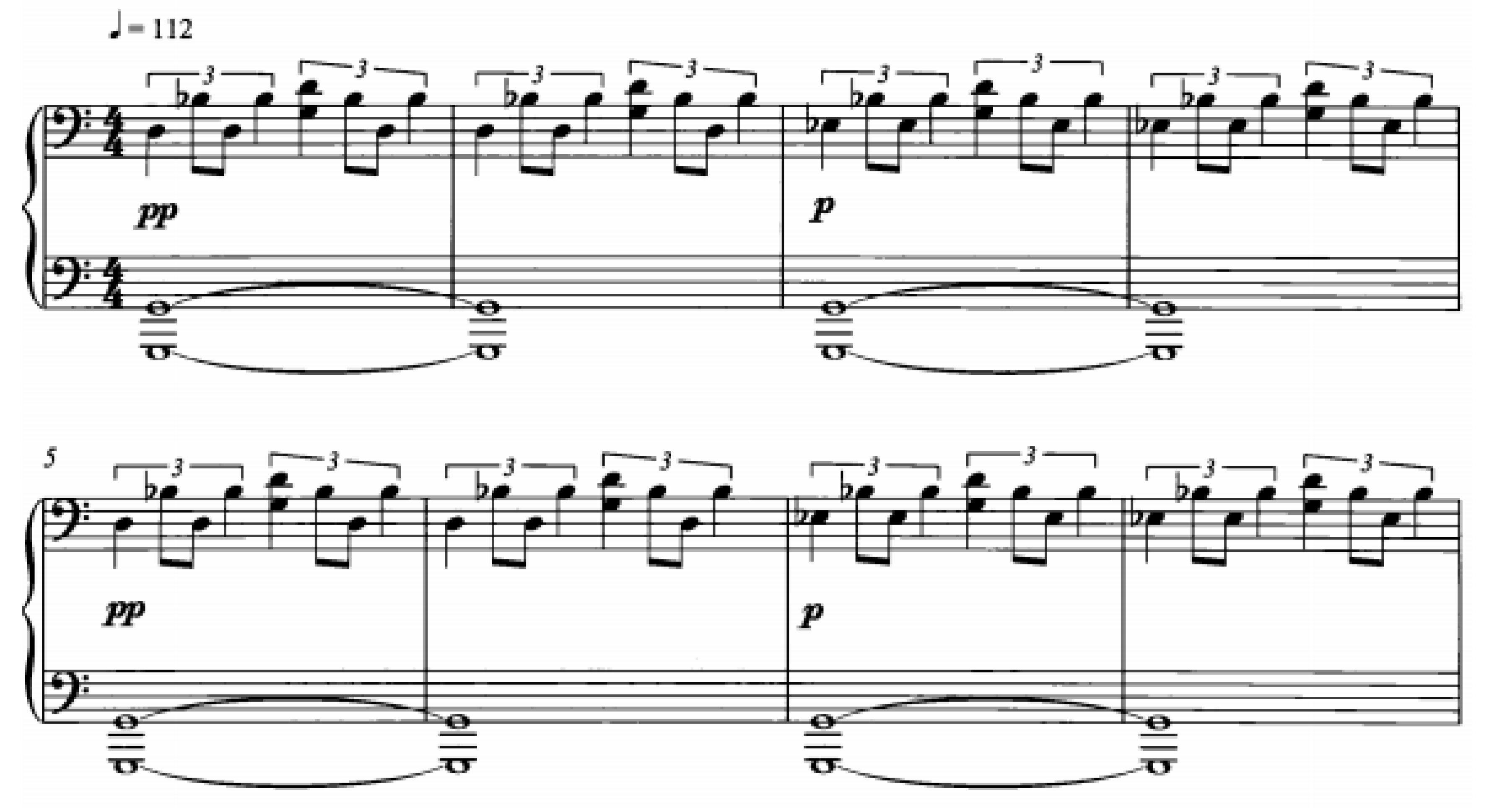
Figure 2.
Philip Glass. The Hours. Morning Passages. bars 32-33 and 36. (image taken from scorser, Philip Glass the hours - download free sheet music and scores, Accessed: 16 March 2025).
Figure 2.
Philip Glass. The Hours. Morning Passages. bars 32-33 and 36. (image taken from scorser, Philip Glass the hours - download free sheet music and scores, Accessed: 16 March 2025).
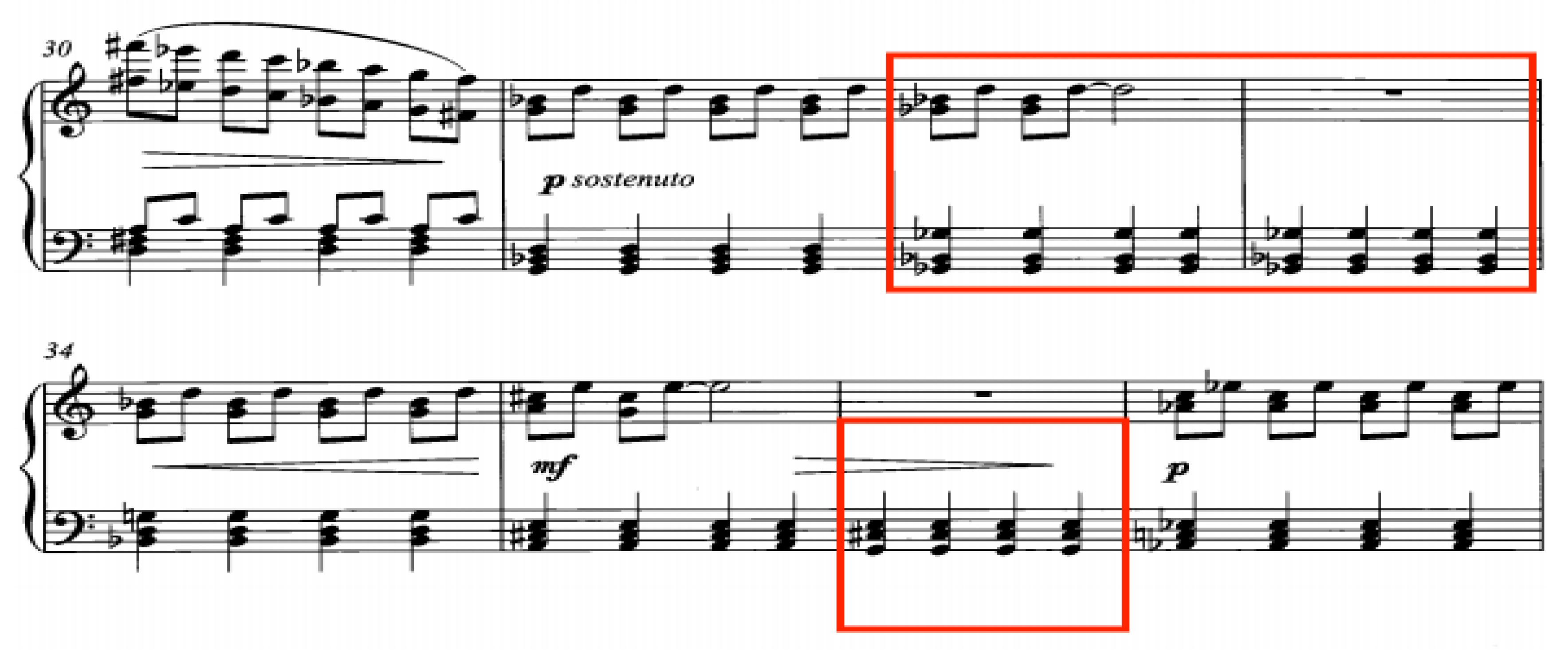
Figure 3.
Philip Glass. The Hours. Morning Passages. bars 70-73. (image taken from scorser, Philip Glass the hours - download free sheet music and scores, Accessed: 16 March 2025).
Figure 3.
Philip Glass. The Hours. Morning Passages. bars 70-73. (image taken from scorser, Philip Glass the hours - download free sheet music and scores, Accessed: 16 March 2025).
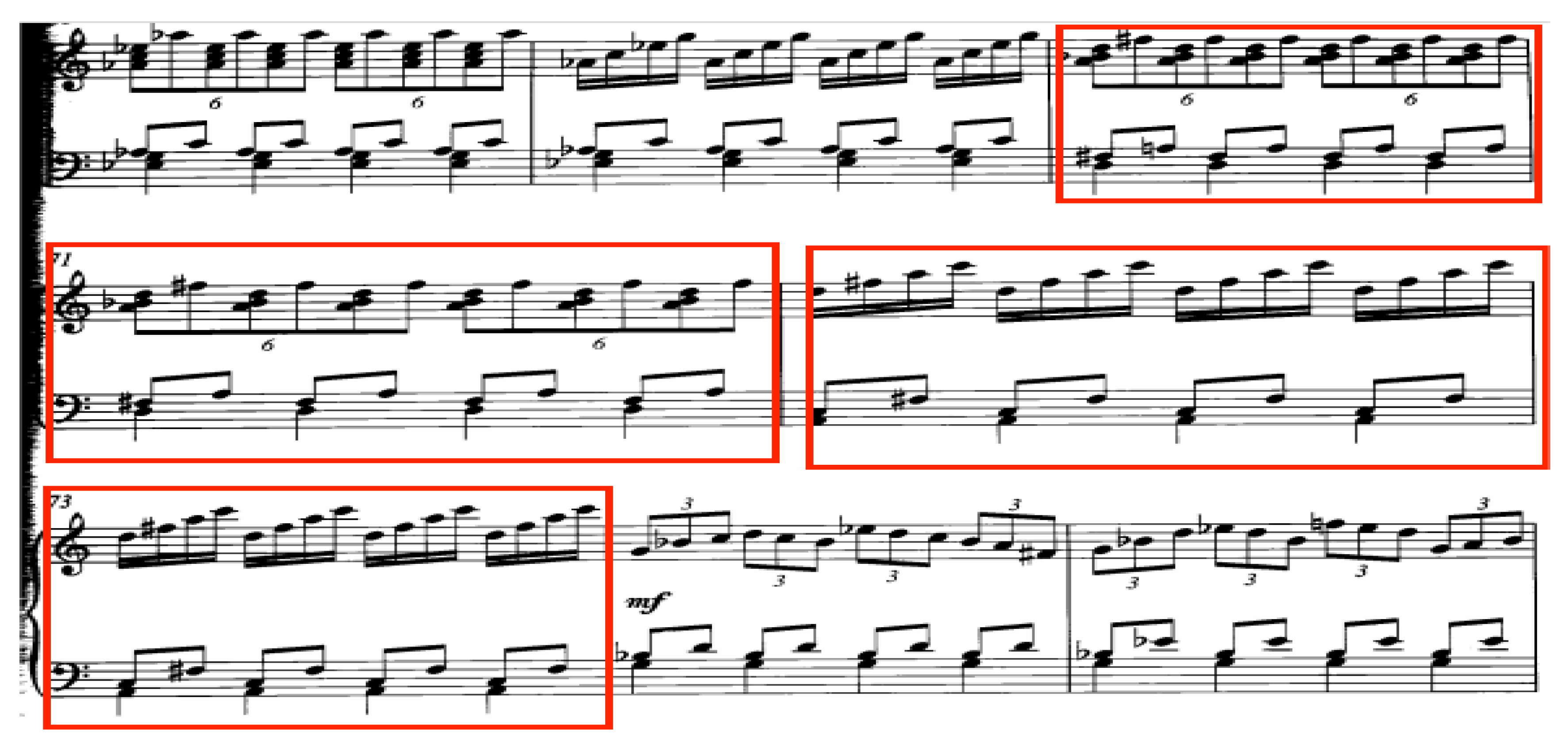
Figure 4.
Philip Glass. The Hours. Morning Passages. bars 38 and 44. (image taken from scorser, Philip Glass the hours - download free sheet music and scores, Accessed: 16 March 2025).
Figure 4.
Philip Glass. The Hours. Morning Passages. bars 38 and 44. (image taken from scorser, Philip Glass the hours - download free sheet music and scores, Accessed: 16 March 2025).
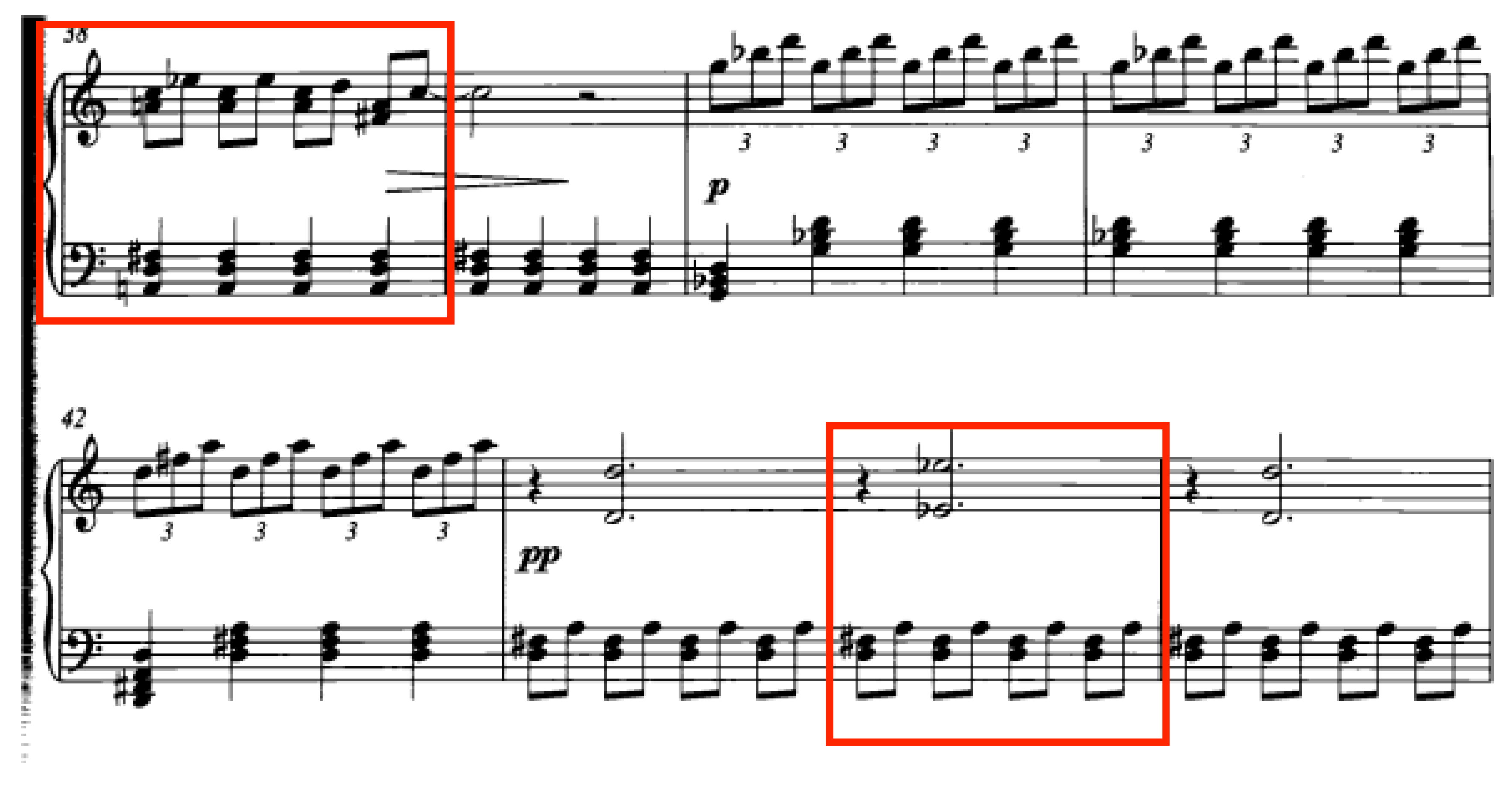
Figure 5.
Philip Glass. The Hours. Morning Passages. (image taken from scorser, Philip Glass the hours - download free sheet music and scores, Accessed: 16 March 2025).
Figure 5.
Philip Glass. The Hours. Morning Passages. (image taken from scorser, Philip Glass the hours - download free sheet music and scores, Accessed: 16 March 2025).
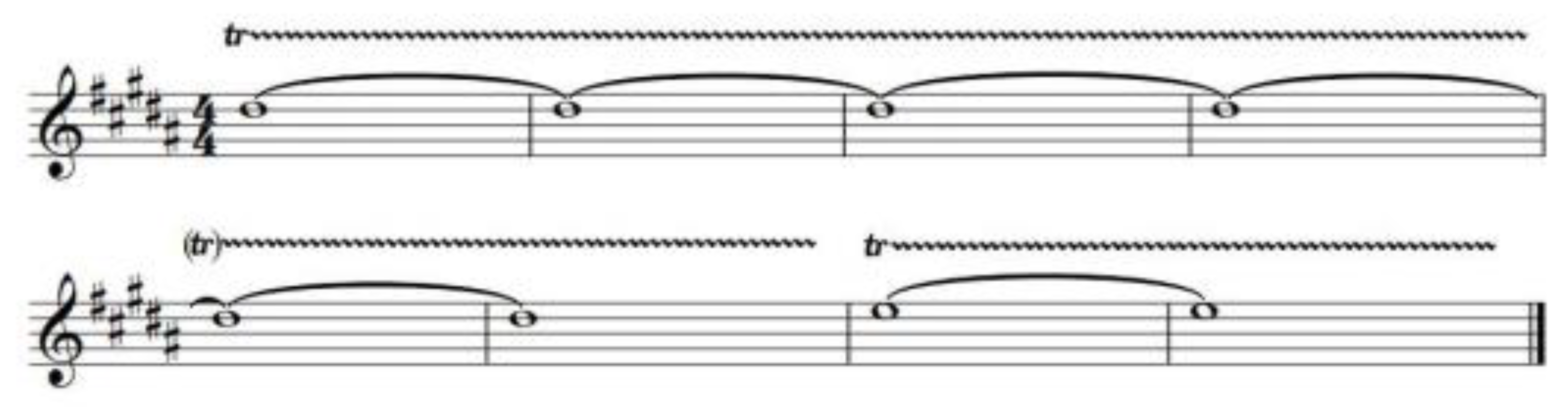
Figure 6.
Philip Glass. The Hours. Morning Passages. bars 1-3. (image taken from scorser, Philip Glass the hours - download free sheet music and scores, Accessed: 16 March 2025).
Figure 6.
Philip Glass. The Hours. Morning Passages. bars 1-3. (image taken from scorser, Philip Glass the hours - download free sheet music and scores, Accessed: 16 March 2025).
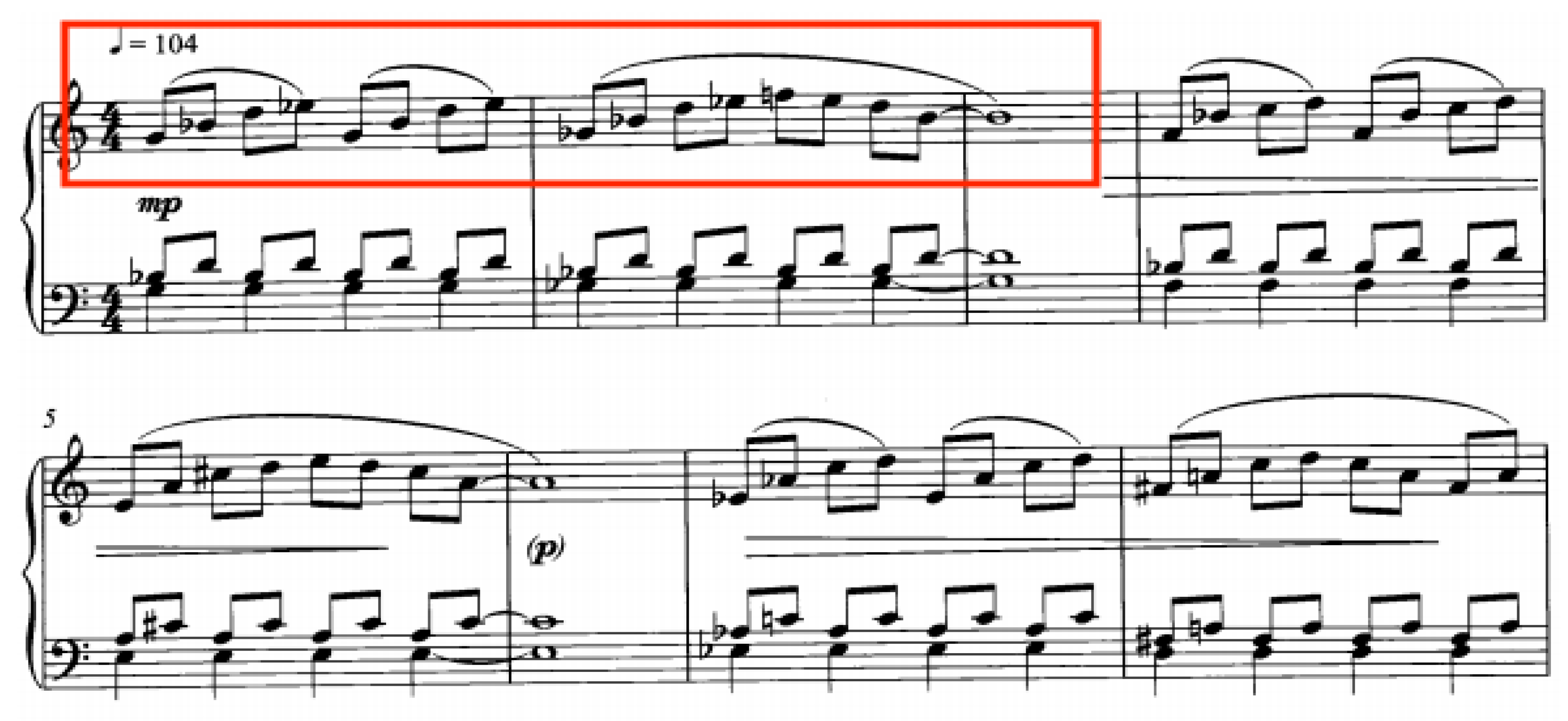
Figure 7.
Philip Glass. The Hours. Morning Passages. bars 40-42. (image taken from scorser, Philip Glass the hours - download free sheet music and scores, Accessed: 16 March 2025).
Figure 7.
Philip Glass. The Hours. Morning Passages. bars 40-42. (image taken from scorser, Philip Glass the hours - download free sheet music and scores, Accessed: 16 March 2025).
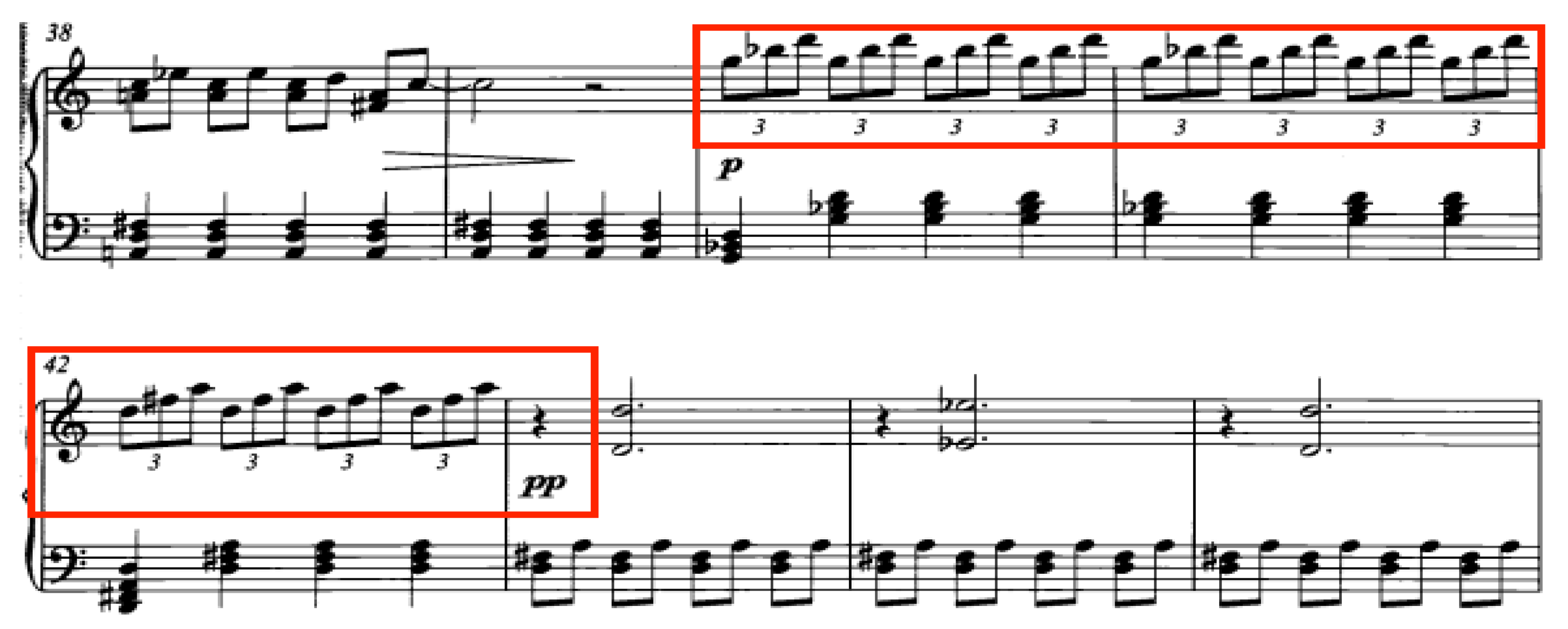
Figure 8.
Philip Glass. The Hours. Something She Has To Do. bars 27-34. (image taken from scorser, Philip Glass the hours - download free sheet music and scores, Accessed: 16 March 2025).
Figure 8.
Philip Glass. The Hours. Something She Has To Do. bars 27-34. (image taken from scorser, Philip Glass the hours - download free sheet music and scores, Accessed: 16 March 2025).
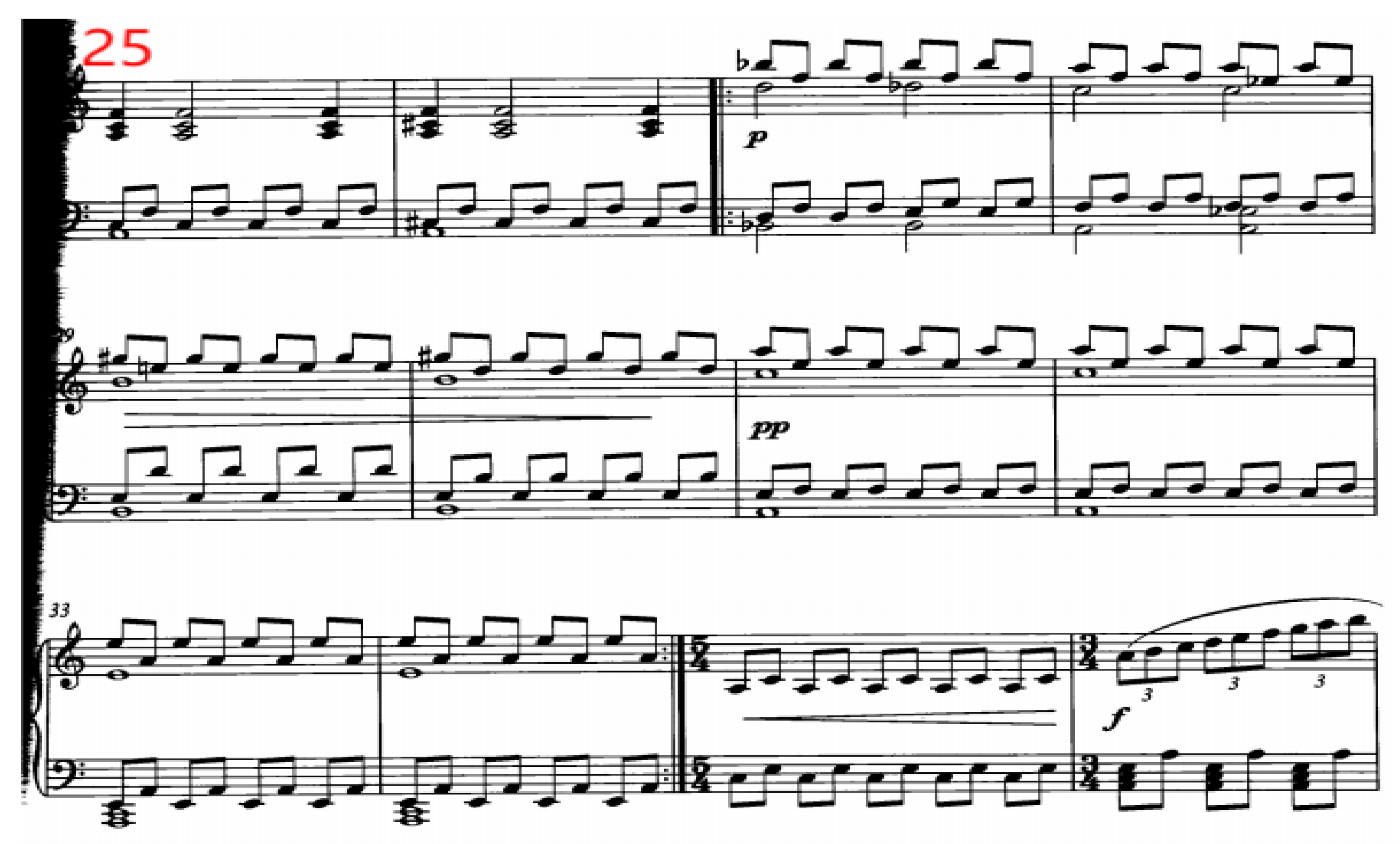
Figure 9.
Philip Glass. The Hours. Something She Has To Do. bars 41-57. (image taken from scorser, Philip Glass the hours - download free sheet music and scores, Accessed: 16 March 2025).
Figure 9.
Philip Glass. The Hours. Something She Has To Do. bars 41-57. (image taken from scorser, Philip Glass the hours - download free sheet music and scores, Accessed: 16 March 2025).
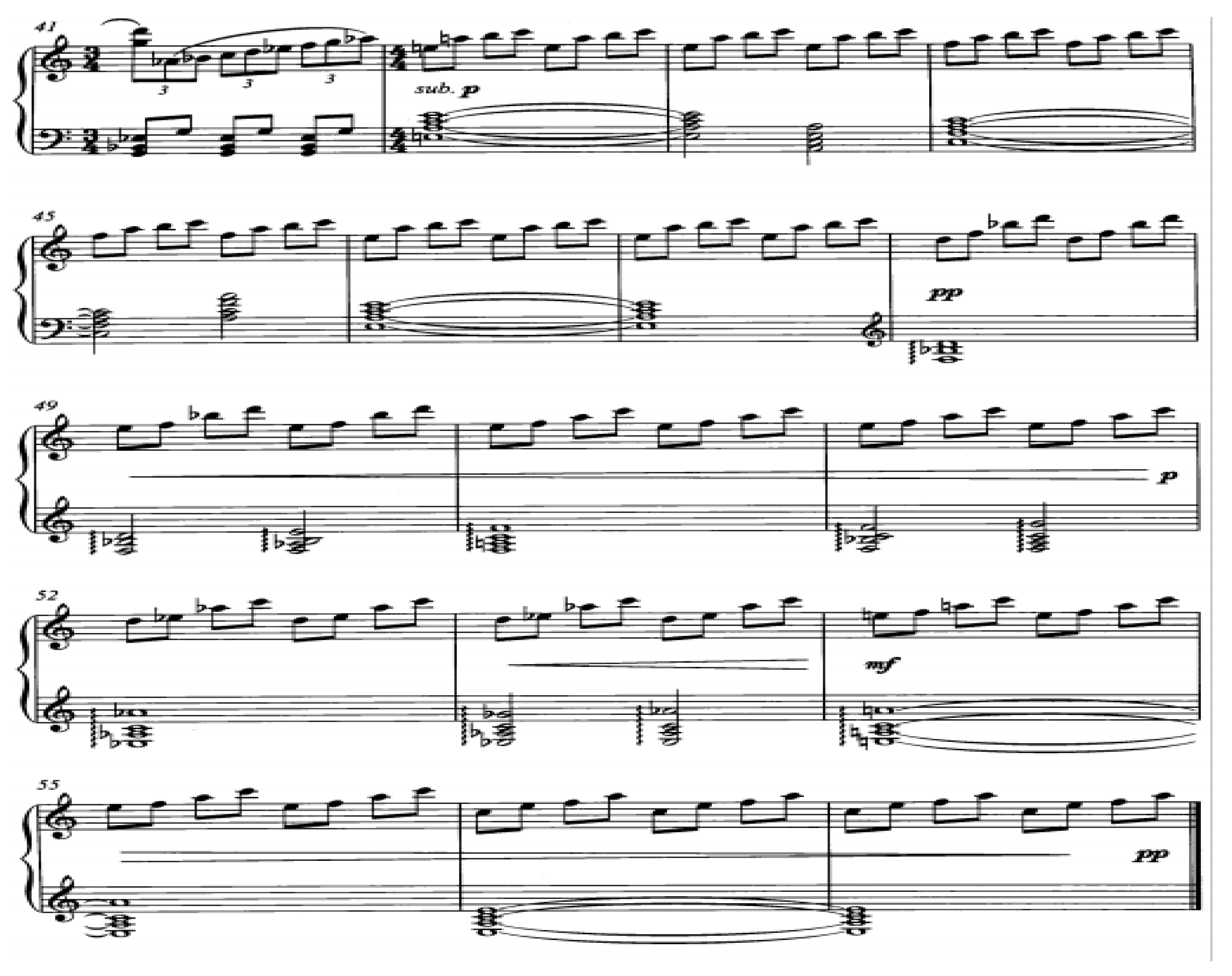
Figure 10.
Philip Glass. The Hours. For Your Own Benefit. (image taken from scorser, Philip Glass the hours - download free sheet music and scores, Accessed: 16 March 2025).
Figure 10.
Philip Glass. The Hours. For Your Own Benefit. (image taken from scorser, Philip Glass the hours - download free sheet music and scores, Accessed: 16 March 2025).

Figure 11.
Philip Glass. The Hours. The Hours. bars 1-24. (image taken from scorser, Philip Glass the hours - download free sheet music and scores, Accessed: 16 March 2025).
Figure 11.
Philip Glass. The Hours. The Hours. bars 1-24. (image taken from scorser, Philip Glass the hours - download free sheet music and scores, Accessed: 16 March 2025).
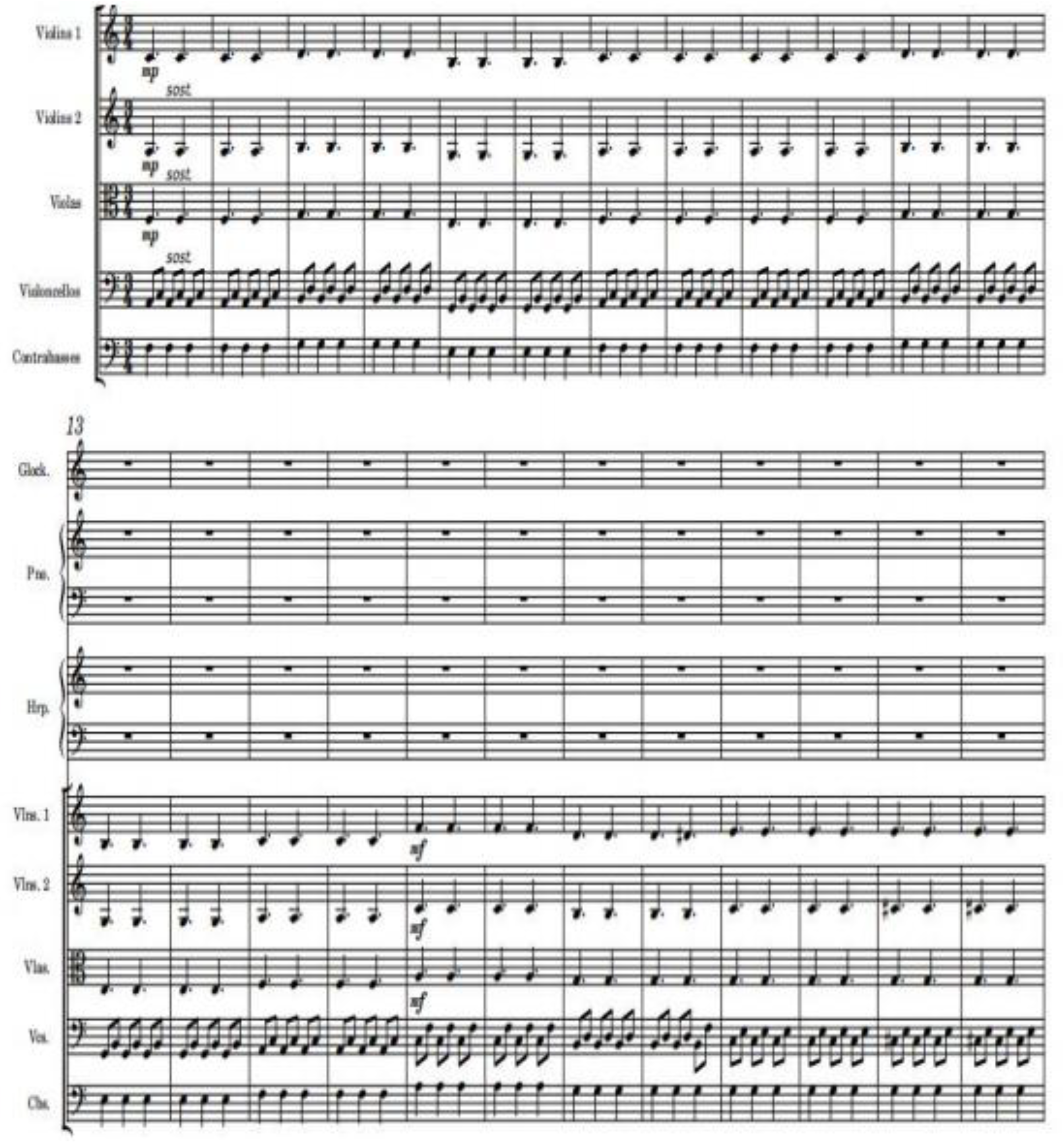
Figure 12.
Philip Glass. The Hours. The Hours. bars 25-36. (image taken from scorser, Philip Glass the hours - download free sheet music and scores, Accessed: 16 March 2025).
Figure 12.
Philip Glass. The Hours. The Hours. bars 25-36. (image taken from scorser, Philip Glass the hours - download free sheet music and scores, Accessed: 16 March 2025).
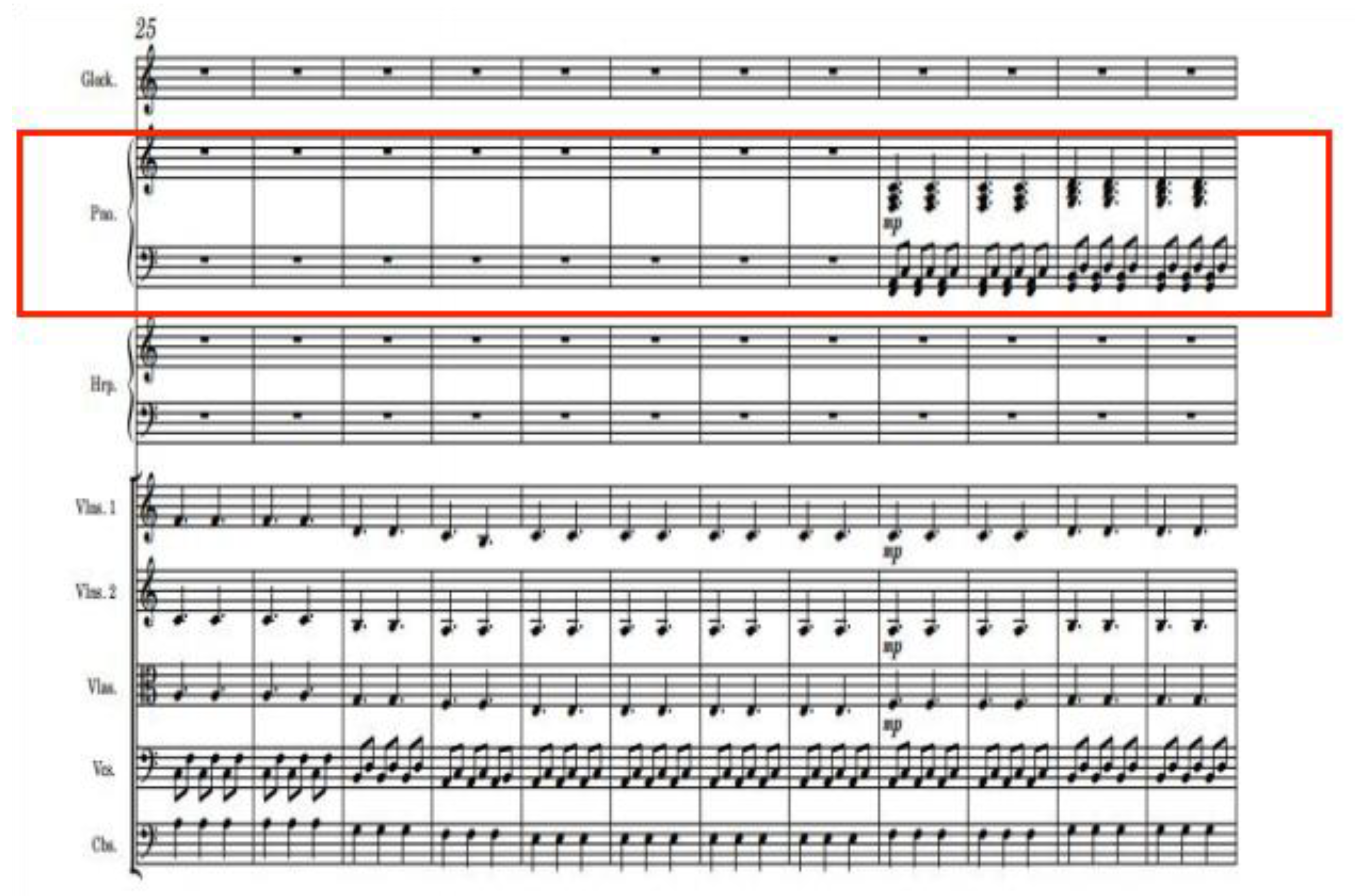
Figure 13.
Philip Glass. The Hours. The Hours. bars 37-48. (image taken from scorser, Philip Glass the hours - download free sheet music and scores, Accessed: 16 March 2025).
Figure 13.
Philip Glass. The Hours. The Hours. bars 37-48. (image taken from scorser, Philip Glass the hours - download free sheet music and scores, Accessed: 16 March 2025).
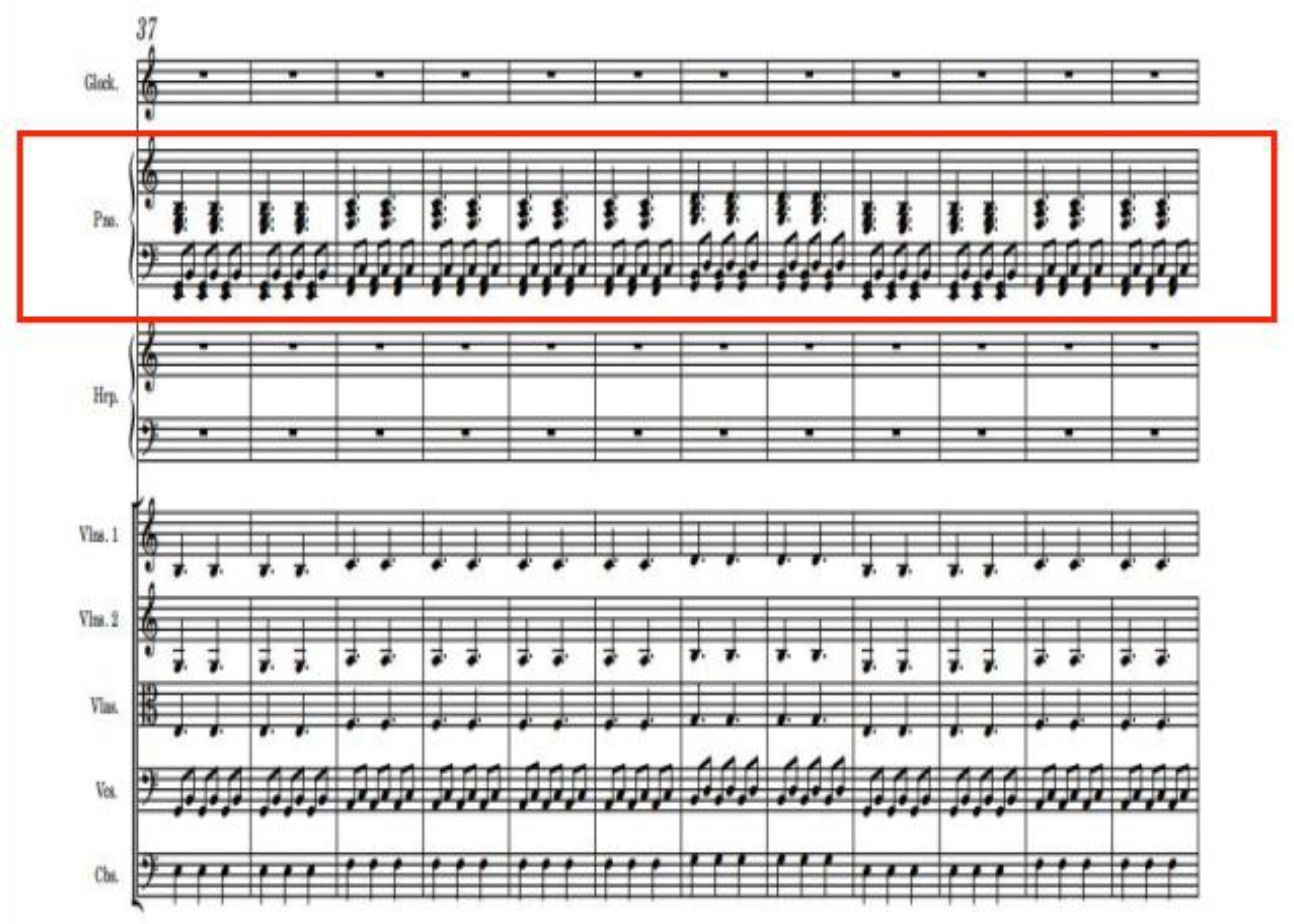
Figure 14.
Philip Glass. The Hours. Dead Things. bars 1-24. (image taken from scorser, Philip Glass the hours - download free sheet music and scores, Accessed: 16 March 2025).
Figure 14.
Philip Glass. The Hours. Dead Things. bars 1-24. (image taken from scorser, Philip Glass the hours - download free sheet music and scores, Accessed: 16 March 2025).
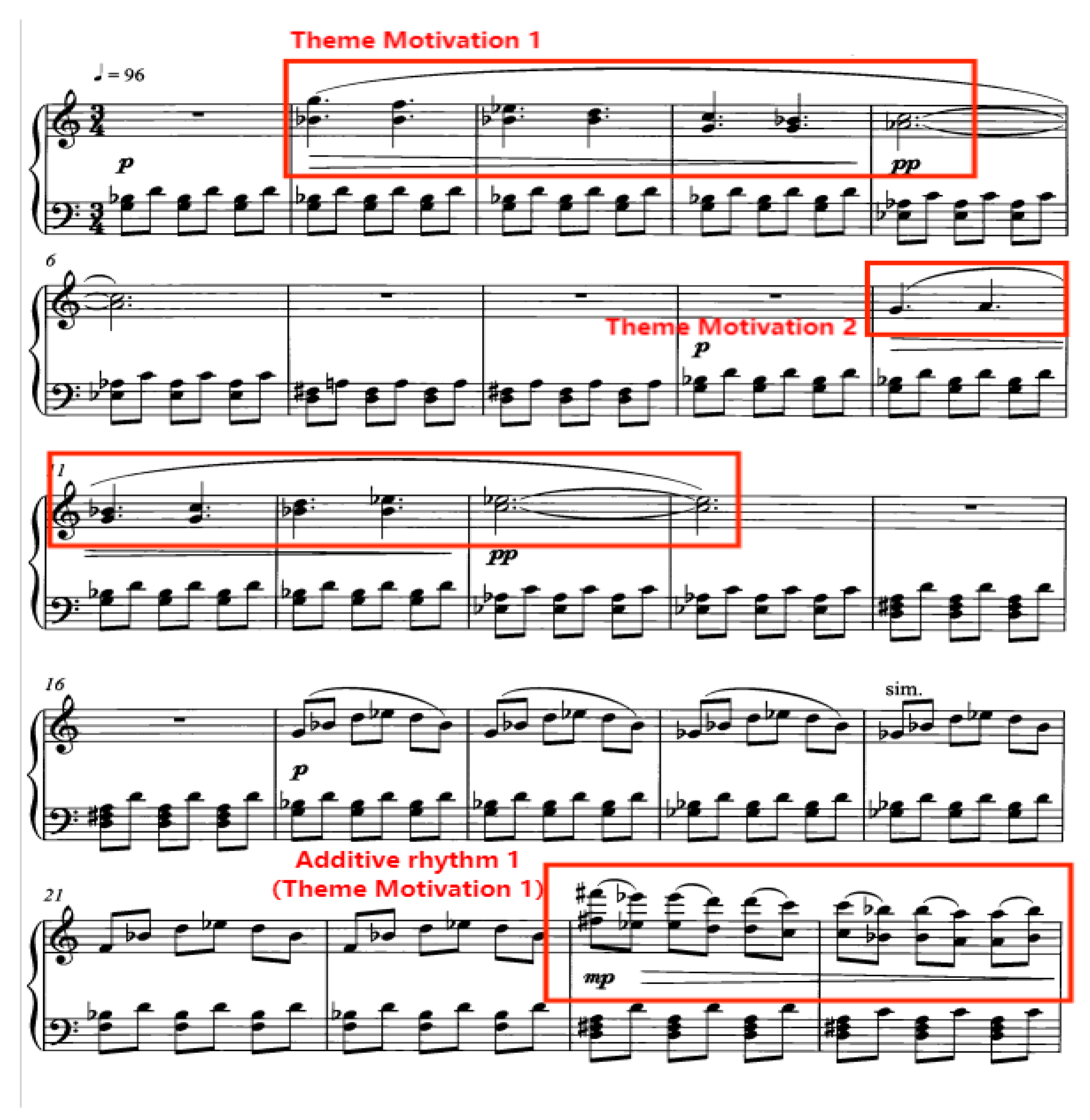
Figure 15.
Philip Glass. The Hours. Dead Things. bars 31-32. (image taken from scorser, Philip Glass the hours - download free sheet music and scores, Accessed: 16 March 2025).
Figure 15.
Philip Glass. The Hours. Dead Things. bars 31-32. (image taken from scorser, Philip Glass the hours - download free sheet music and scores, Accessed: 16 March 2025).
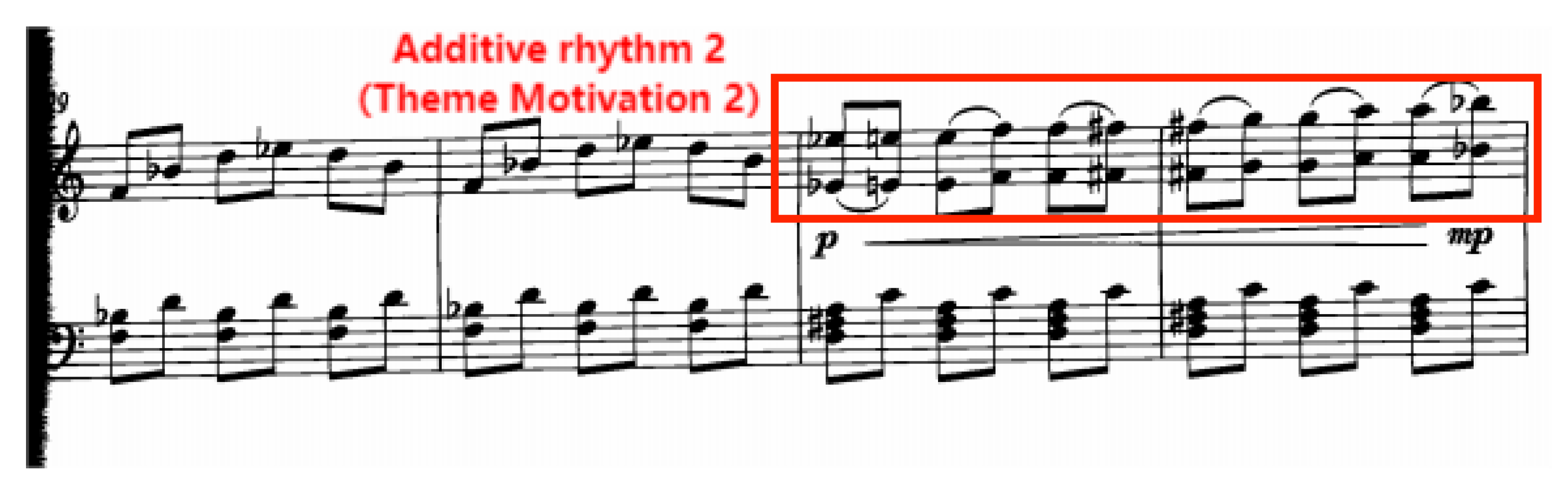
Figure 16.
Philip Glass. The Hours. Dead Things. bars 50-60. (image taken from scorser, Philip Glass the hours - download free sheet music and scores, Accessed: 16 March 2025).
Figure 16.
Philip Glass. The Hours. Dead Things. bars 50-60. (image taken from scorser, Philip Glass the hours - download free sheet music and scores, Accessed: 16 March 2025).
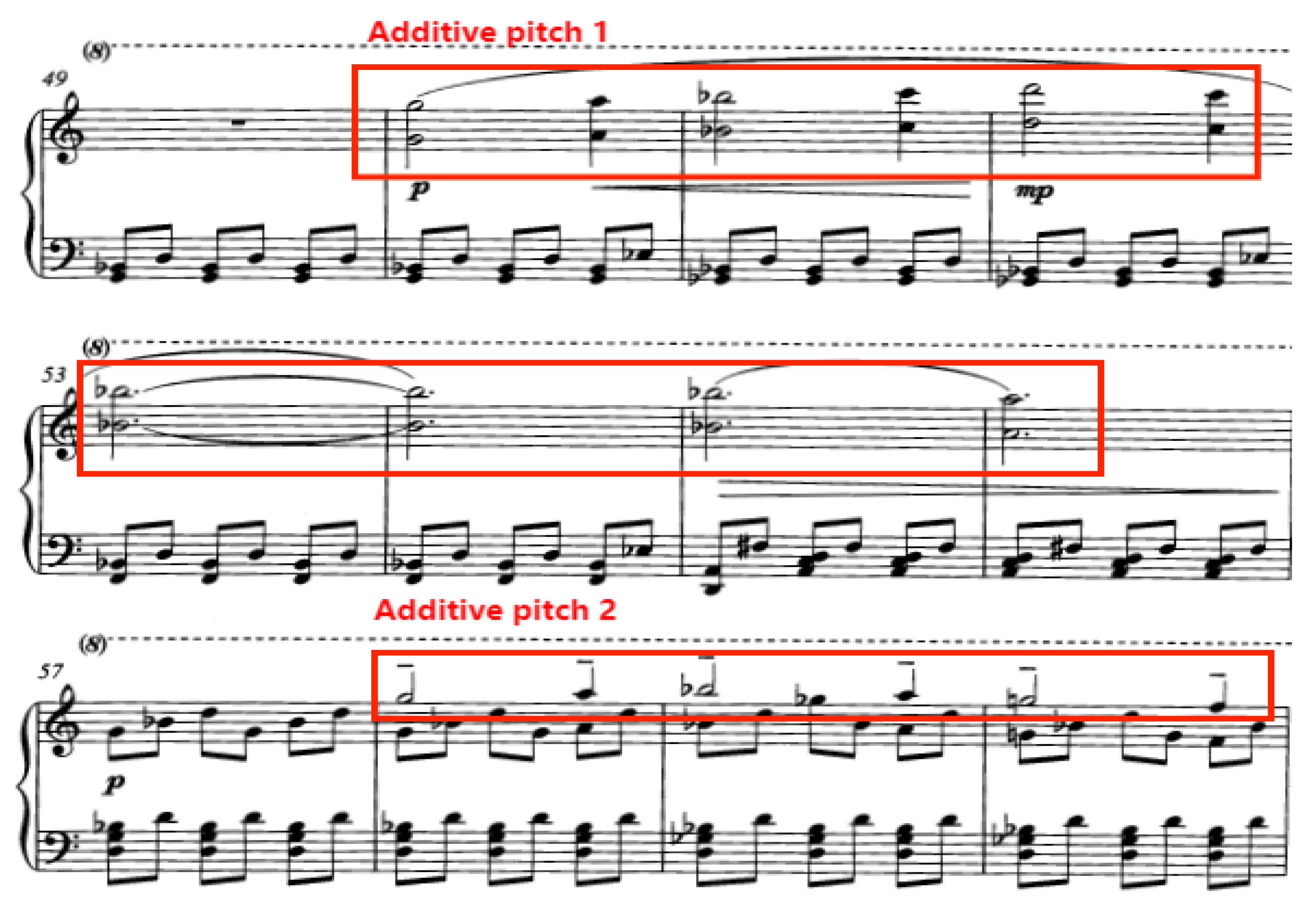
Figure 17.
Philip Glass. The Hours. Tearing Herself Away. bars 44-49. (image taken from scorser, Philip Glass the hours - download free sheet music and scores, Accessed: 16 March 2025).
Figure 17.
Philip Glass. The Hours. Tearing Herself Away. bars 44-49. (image taken from scorser, Philip Glass the hours - download free sheet music and scores, Accessed: 16 March 2025).
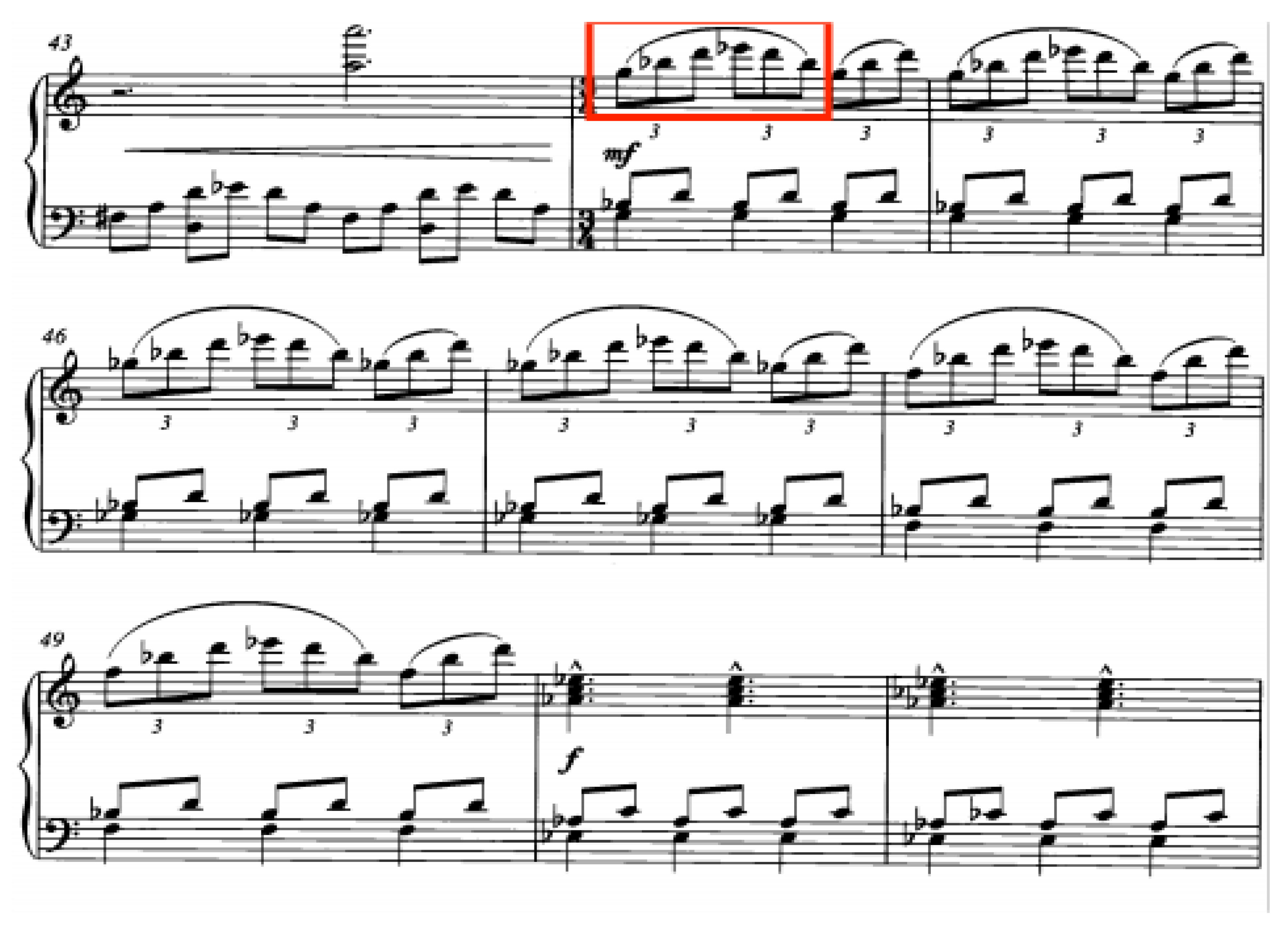
Figure 18.
Philip Glass. The Hours. Tearing Herself Away. bars 61-71. (image taken from scorser, Philip Glass the hours - download free sheet music and scores, Accessed: 16 March 2025).
Figure 18.
Philip Glass. The Hours. Tearing Herself Away. bars 61-71. (image taken from scorser, Philip Glass the hours - download free sheet music and scores, Accessed: 16 March 2025).
Disclaimer/Publisher’s Note: The statements, opinions and data contained in all publications are solely those of the individual author(s) and contributor(s) and not of MDPI and/or the editor(s). MDPI and/or the editor(s) disclaim responsibility for any injury to people or property resulting from any ideas, methods, instructions or products referred to in the content. |
© 2025 by the authors. Licensee MDPI, Basel, Switzerland. This article is an open access article distributed under the terms and conditions of the Creative Commons Attribution (CC BY) license (http://creativecommons.org/licenses/by/4.0/).
Copyright: This open access article is published under a Creative Commons CC BY 4.0 license, which permit the free download, distribution, and reuse, provided that the author and preprint are cited in any reuse.