
Submitted:
12 June 2025
Posted:
13 June 2025
You are already at the latest version
Abstract
The flight operations inside the cockpit and fuselage are moving towards technological based systems, such as Tablets and Mobile computers. The new technology also offers a variety of possible options to pick the right tools and gadgets for regular operations performed by the Pilot, inside the Cockpit and in the fuselage. This paper surveys different gadgets, Electronic Flight Bag (EFB) used by the aviation pilots as well as Inflight Entertainment Devices (IFE) used in the aviation industry. Moreover, the present work also surveys the variety of gadgets used to achieve various goals with the existing issues and challenges.
Keywords:
Electronic Flight Bag
; In-Flight Entertainment
; Mobile computing
; Software Components
I. Introduction
The aviation industry is a fast-growing field, which helps in connecting people across the globe [1]. Technology plays a very crucial role in the aviation operation from flight booking to reaching the customer’s destination the process evolves with technology. During the early ages paper charts were used by flight crew to determine the path and navigation route to reach the destination, after the technological advancements in the year 2011 FAA (Federal Aviation Administration) introduced the use of iPad for the flight operations by the airlines. American Airlines was the first to approve iPad [2]. The new term that come across by the pilots is EFB (Electronic Flight Bag) which is an Electro-Tablet used for various operations:
Storing the data – The flight charter which is in paper format is transformed into a digital paper and stored in the tablets for each interaction and minimizing the use of paper. According to United Airlines a conventional-Flight-Bag consists of 12,000 papers per pilot, and it requires 16 million paper sheets per year, by using the Electro-Tablets the airlines save huge amounts of trees and it reduces 326000 gallons of fuel amount and weight on board in the airplane [1].
Navigation process: The Electro-Tablets are used for the navigation by pilots to reach the destination, by using maps, virtual compass and the GPS (Global Positioning system). Sensors used for identifying the weather conditions such as storms [9].
Effective–Communication within the aircraft and outside the aircraft are done in an effective way by using the software which is compatible with the Electro-Tablets.
Weather prediction and Analysis: The weather change affects the aircraft operation on the ground and in the air while flying, to make the precautionary measures by the pilots, there are weather prediction software’s designed for aviation industry to predict the weather and tackle the situation caused by the change in weather and to analyze the route plan in the briefing session before entering the cockpit. By the flight crew.
Installation of Flight Software: There is software built especially for pilots which is significant for the flight operations, like the (foreflight app) which is used for the flight planning, weather monitoring and charts. The different operating systems and devices support various applications.
The In-Flight-Entertainment provided by the airlines for long-haul [7] and short-haul in the fuselage, where the customers are seated to reach their destination, also includes the use of Electro-tablets which helps the airlines in:
Storing the information: The in-Flight-Entertainment is a huge part of the airline industry which serves a hassle-free journey with the airline by facilitating the passengers with in-built music, movies and eBooks.
Connection – The connection between the devices can be established through satellite or ATG (air-to-ground) transmission.
Health Monitoring: The passengers inside the flight can become ill because of fatigue [3], sound of the engine or environmental discomfort. By using the sensor with the device, the IFE can detect the passenger’s health condition and send it to the flight crew.
II. Literature Review
The growth of EFB (Electronic Flight Bag) has drastically increased, the various classes of EFB provide various features and certification that proves to fit in the aviation industry for use the pilots [1]. The EFB has changed the analogue input devices in the cockpit [2] The EFB has a relationship with business operations, cost saving, operate EFB has increased productivity by providing effective results during the flight operations and limiting the use of paper charts.
Mobile computing becomes a major area for research and development of applications [8] and technologies that are bound to hardware. Development of mobile computing devices with the use of sensor helps in facilitating the gathering of the data and transforming the data according to the user needs. The mobile computing-based technologies helps in communication with the other devices and allows to install the software for the use of customers and in the organization with cost effective approach and ease of access to the resources, which helps in collaboration, access information, update and upgrade the features installed and provides security.
The in-flight entertainment devices offer a wide range such as newspapers, magazines, songs and movies [7]. With the help of software properties which includes videos, chat, games and games provided for the customers during their journey in the flight. The protocols and design approach followed for manufacturing the IFE help in reducing the efforts of passenger health monitoring and boredom during the long-haul [6] in the wide body flights [11].
III. Categories of Electro-Tablets Used in Flight Deck
A) Class-1 EFB [1]: The class-1 Electronic-Tablets is a portable plugin device which can be connected to the aircraft power supply. The class-1 devices are not connected to the mounting device or fixed devices in the aircraft power supply. The class-1 Electro-Tablet devices do not require airworthiness approval. But requires the approval of the certified power supply because they are connected to the aircraft power supply.
B) Class-2 EFB [1]: The class-2 Electro-Tablets require airworthiness approval, and they are connected to the aircraft power supply that requires the certified power supply certificate. The devices are mounted to aircraft, and they are controlled portable devices.
C) Class-3 EFB [1]: These systems are preinstalled, and it requires several certifications for working with the aircraft, the certificate includes (EFB Hardware installation integrity, such as the OS, servers, keyboard, screen, etc.) it also includes the aspect of human and machine interface, compatibility of the Hardware and software components qualities.
IV. Electro-Tablet Manufacturers for Aviation Sector
A) Apple: iPad and iPhone are mostly used by pilots for their aircraft operations and support more of the aviation software than any other OS.
B) Samsung: Android based system which is used for piloting operations and IFE for customer’s entertainment in long-haul and short-haul flights by some renowned airlines.
C) Microsoft: Surface editions which works as desktop and Electronic-Tablets with Windows as the main operating system and Microsoft has recently entered the aviation industry.
D) Thales: Provides a flagship edition for the pilots with Windows operating system and easy attachments features for the pilots in the cockpit. Avant Up manufactured by Thales group offers the highest storage and used for IFE (In Flight Entertainment) for customers in renowned airlines like Qatar Airways.
V. Specifications of Various Electro-Tablets Used by Pilots in the Flight Deck

Table 1.
Specification difference between various Electro-Tablet Manufacturers.
|
iPad 11 Pro [14] |
Galaxy Tab S 8.4 [13] |
|
Manufacturer: Apple |
Manufacture: Samsung |
|
Operating System – iOS 17 |
Operating System – Android |
|
Display – all-Screen OLED |
Display – AMOLED |
|
Weight – 188 grams |
Weight - 294g(Wi-Fi) / 298g(LTE) |
|
Storage – 8GB RAM (256GB-512GB) - 16GB RAM 512GB – 1TB (or) 2TB |
Storage – 16 GB |
| Sensors – Face ID Barometer Three-axis gyro Accelerometer Proximity sensor Ambient light |
Sensor – Accelerometer Fingerprint Geomagnetic Gyro sensor Hall sensor RGB sensor |
|
Location – GPS/GNSS Wi-Fi Digital Compass Cellular Bluetooth iBeacon micro location |
Location – GPS Glonass Beidou Bluetooth |
|
SURFACE PRO – 3 [15] |
THALES / AVANT UP [12] |
|
Manufacturer – Windows |
Manufacturer – Thales Group |
| Operating system – Windows 8.1 or Windows 10 | Operating system – Windows 10 Enterprise Edition Android for Avant Up |
| Display – 12’’ clear type full HD | Display – High-definition anti-glare system / Optiq display by Thales |
| Weight – 800 grs | Weight – 451 grs |
| Storage – 4GB RAM with 64GB or 128GB storage 8GB RAM with 256GB or 512GB. |
Connected with the Docking stations/Server on platform supports 20TB storage |
| Sensors – Ambient light sensor Compass Accelerometer Gyroscope |
Can be mounted with the existing Electro-Tablets and Docking system/Back of the seat |
| Locations (wireless) – Wi-fi Bluetooth |
Locations – Wi-Fi 3G 4G Bluetooth For Avant up – Two Bluetooth connections Built in Wi-Fi USB Headset port |
| Ports – Full size USB 3.0 Mini Display port Micro SD card reader Headset Jack Covert Port Charging Port Audio Jack |
Ports – Ethernet |
| Battery life – Up to 9 hours | Battery Life – Connected with the Thales Tab holder which is directly connected with aircraft power supply. |
VI. Methodology
Comparing the properties of the various Electro-Tablets specifications used in the Cockpit by the pilots, flight crew members and in-flight-entertainment. Collecting the data from various resources, we can define the following differences and similarities of the Electro-Tablets and their performance by using the software analysis tool Excel for comparing the Electro-Tablets and their performance provided by the manufacturers.
By defining the comparisons among the various Electro-Tablets, we will be able to define the following:
- 1)
- Specifications of the Electro-Tablets.
- 2)
- Battery status.
- 3)
- Display configurations.
- 4)
- Camera quality.
- 5)
- Navigation process support.
- 6)
- Weight of the devices.
VII. Results and Discussion
The discussion includes the features and specifications of the various Electro-Tablets used in the Aviation industry.
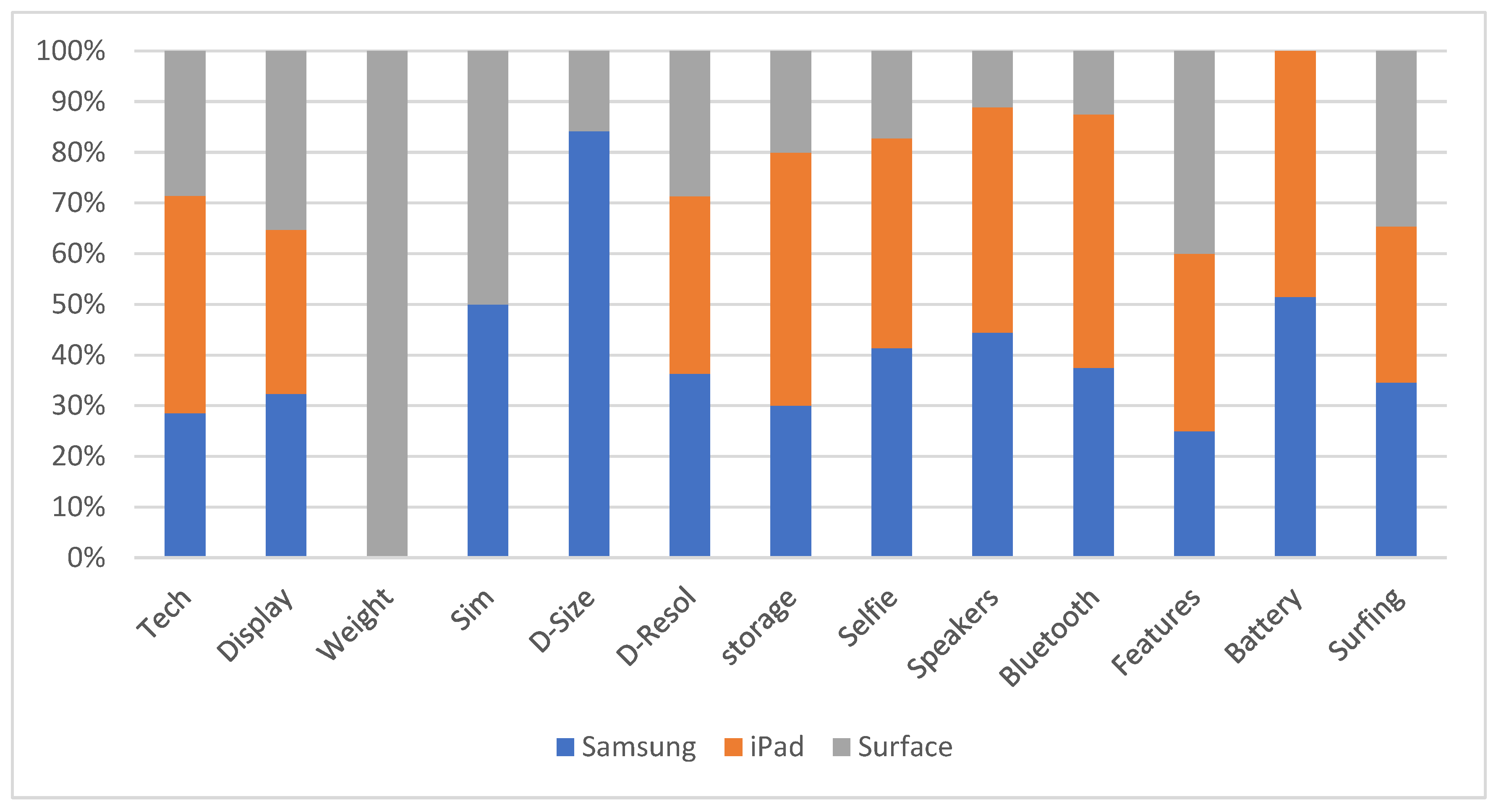
In the following Bar charts, which includes about the storage, selfie’s, battery, features, Bluetooth, Display-Resolution, Display-size, surfing, display and sim options which are separated in various charts and in the final Bar-chart combining all the specifications we can determine the features and specifications offered by the various Electro-tablet manufacturers for pilots.
The various colors portray the various Electro-Tablet manufacturers, for the Aviation industry and for the consumer use, for accomplishing regular tasks.
iPad is used by most of the pilots in major airlines Android and Windows based tablets are coming into the cockpit because of the usability, security and design constraints. The flexibility provided by iPad is more reliable than the Android and Windows based systems.
Thales Group Avant Up system is used in most of the airline for the in-flight-entertainment like the Air India airlines, Emirates and Qatar Airways, and the below chart only shows about the specifications of the pilot EFB
Figure 1.
Comparison of various tablets and manufactures.
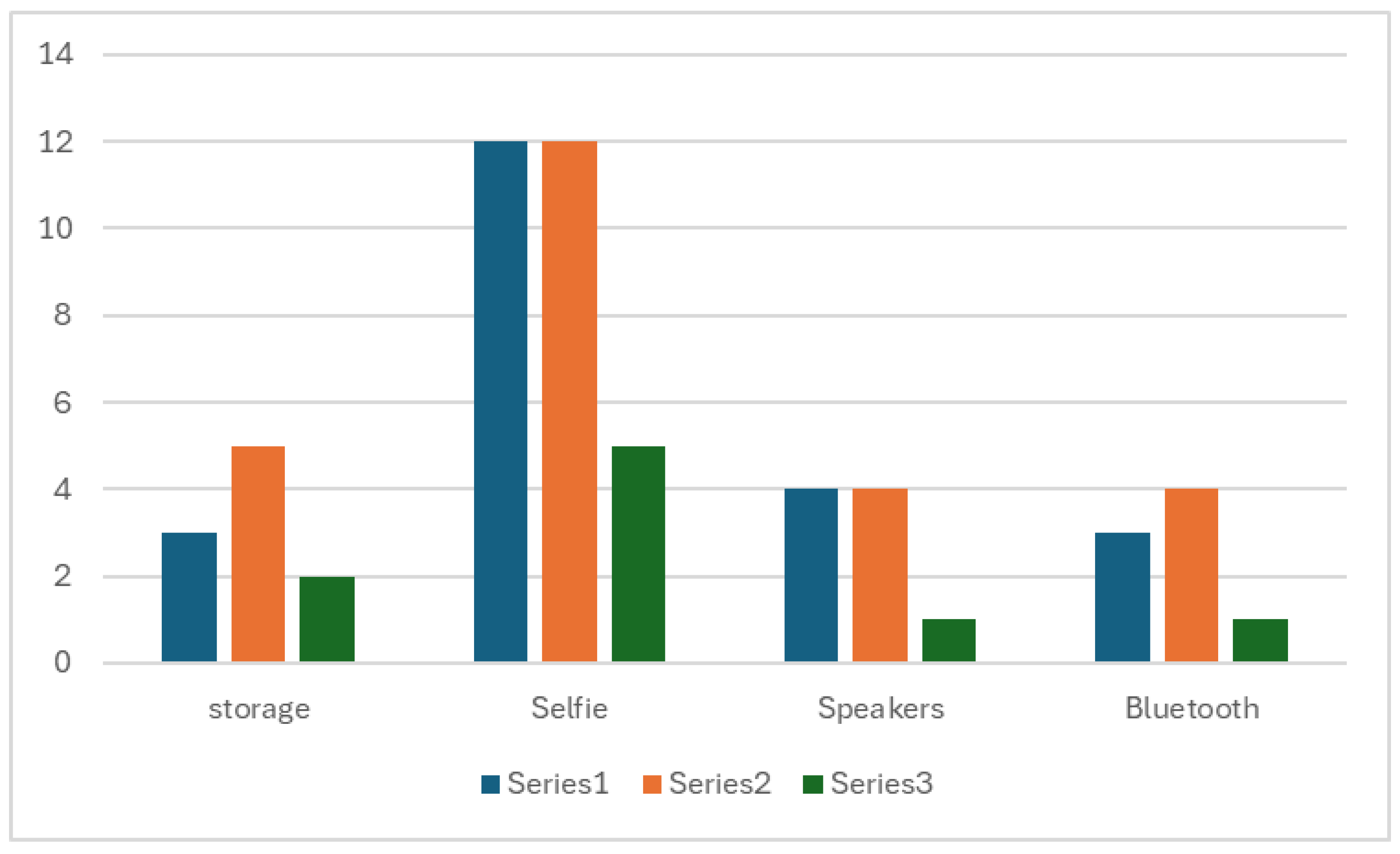
Figure 2.
Comparison of various screen size.
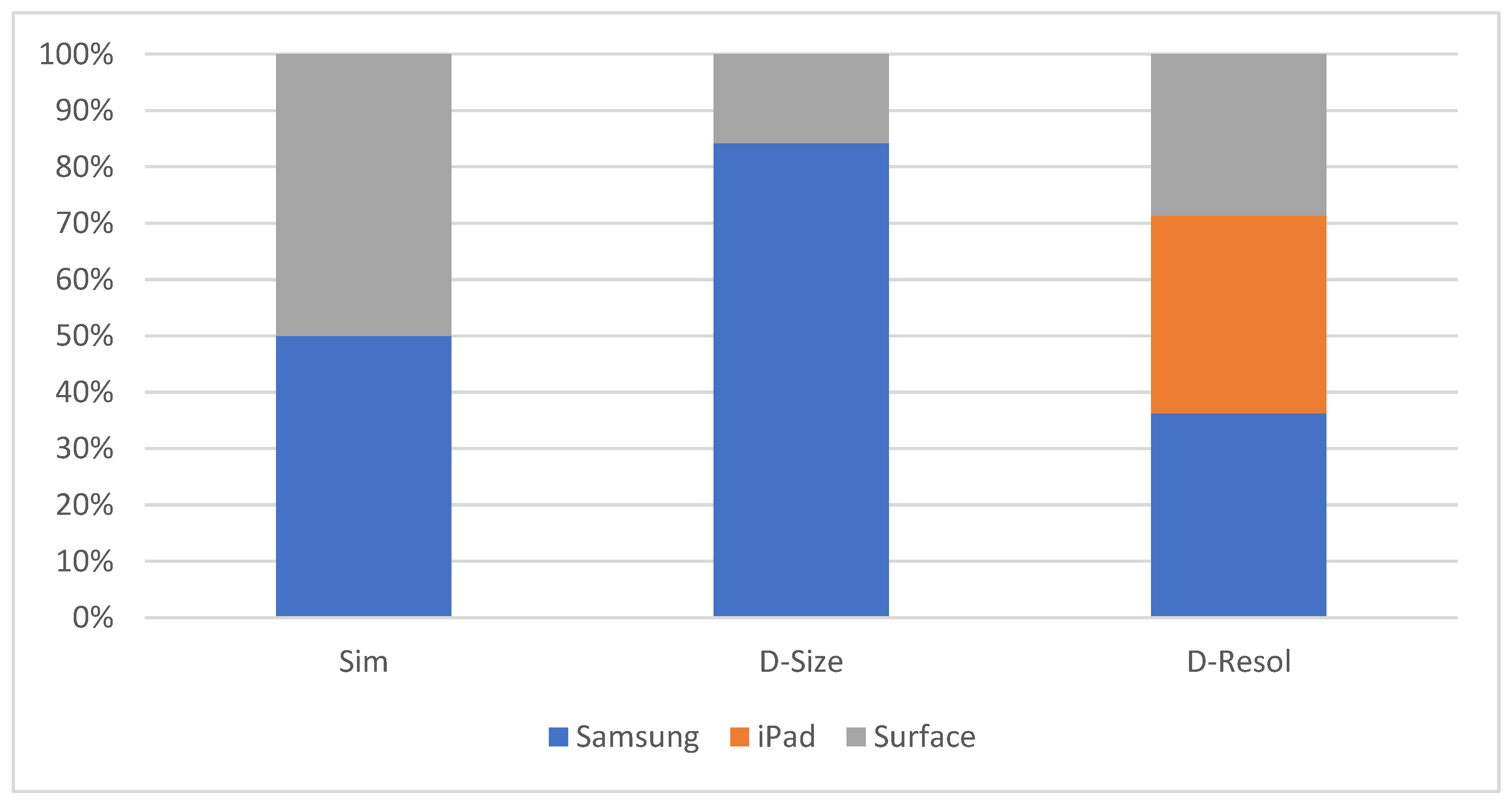
Figure 3.
Overall performance of the tablets.
VIII. Conclusion
The Aviation Industry is growing increasingly and the need for Electro-Tablets with high specifications adapt to the changing conditions inside and outside the flight.
The EFB (Electronic Flight Bags) and IFE (In Flight Environment) devices plays a vital role in the Aviation sector by making communication easy, monitoring and maintenance with cost effective solutions, gathering information from various sources, providing real time navigation and storage, supporting the required aviation related software’s for pilots and flight crew management and finally reduce the use of papers and save the trees.
IFE Electro-Tablets are designed by the Aerospace groups with high security standards, light solutions high storage options for the airlines to provide customers with the e-resources customers can enjoy during their journey by reducing the stress, anxiety and monitor the health of the customers. The result shows that the iPad is giving better performance than other tablets.
By combining both EFB and IFE devices as a solution for navigation, storage and entertainment the airline achieves a tremendous result in providing high safety, security standards and minimize costs and maximize efficiency.
References
- Ateş, Savaş S. „Electronic flight bag in the operation of airline companies: Application in urkey.” Computer Science and Information Technology 5, no. 4 (2017): 128-134. [CrossRef]
- Ohme, Marty. „Use of tablet computers as electronic flight bags in general aviation.” (2014).
- Schwartzentruber, Jeff. „A usability study for electronic flight bag (EFB) flight planning applications on tablet devices for ab-initio pilots.” International Journal of Aviation, Aeronautics, and Aerospace 4, no. 2 (2017): 3. [CrossRef]
- Avsar, H. Target size guidelines for interactive displays on the flight deck. 2015 IEEE/AIAA 34th Digital Avionics Systems Conference (DASC)(Prague, Sep. 2015). 3C4–1–3C4–15, 2015.
- Liu, Hao, and Matthias Rauterberg. „Context-aware in-flight entertainment system.” Proceedings of Posters at (2007): 1249-1254.
- Kamineni, Srikanth, and Sethu Rathinam. „Electronic moving map of airport surface on electronic flight bag.” In The 23rd Digital Avionics Systems Conference (IEEE Cat. No. 04CH37576), vol. 1, pp. 4-C. IEEE, 2004. [CrossRef]
- Jin, Min-Jung, and Jin Ki Kim. „Customer adoption factors for in-flight entertainment and connectivity.” Research in Transportation Business & Management 43 (2022): 100759. [CrossRef]
- Zaslavsky, Arkady, and Zahir Tari. „Mobile computing: Overview and current status.” Journal of Research and Practice in Information Technology 30, no. 2 (1998): 42-52.
- Mahapatra, Pravas R., and Dusan S. Zrnic. „Sensors and systems to enhance aviation safety against weather hazards.” Proceedings of the IEEE 79, no. 9 (1991): 1234-1267.
- Erdemir, Gökhan, Osman Selvi, Veysi Ertekin, and Gökhan Eşgi. „Project PISCES: Developing an in-flight entertainment system for smart devices.” In CEUR Workshop Proceedings. CEUR-WS, 2017.
- Ms. M. Anitha1, Ms. C. Priyadarshini2, Mrs. R. Ahila “In-Flight Entertainment Systems Inside aircraft Cabin using hybrid protocol” International Journal of Scientific & Engineering Research, Volume 7, Issue 4, April-2016.
- Available online: https://www.thalesgroup.com/en/global/activites/aeronautique/lexperience-thales-inflyt/flight-entertainment#hardware.
- Available online: https://www.samsung.com/hk_en/tablets/galaxy-tab-s/galaxy-tab-s-8-4-inch-white-16gb-wi-fi-sm-t700nzwatgy/#specs.
- Available online: https://support.apple.com/en-in/111879.
- Available online: https://support.microsoft.com/en-us/surface/surface-pro-3-specs-and-features-4c142a41-134f-f22b-0142-a5cf073b56ee.
Disclaimer/Publisher’s Note: The statements, opinions and data contained in all publications are solely those of the individual author(s) and contributor(s) and not of MDPI and/or the editor(s). MDPI and/or the editor(s) disclaim responsibility for any injury to people or property resulting from any ideas, methods, instructions or products referred to in the content. |
© 2025 by the authors. Licensee MDPI, Basel, Switzerland. This article is an open access article distributed under the terms and conditions of the Creative Commons Attribution (CC BY) license (http://creativecommons.org/licenses/by/4.0/).
Copyright: This open access article is published under a Creative Commons CC BY 4.0 license, which permit the free download, distribution, and reuse, provided that the author and preprint are cited in any reuse.


