

Submitted:
09 June 2025
Posted:
11 June 2025
You are already at the latest version
Abstract
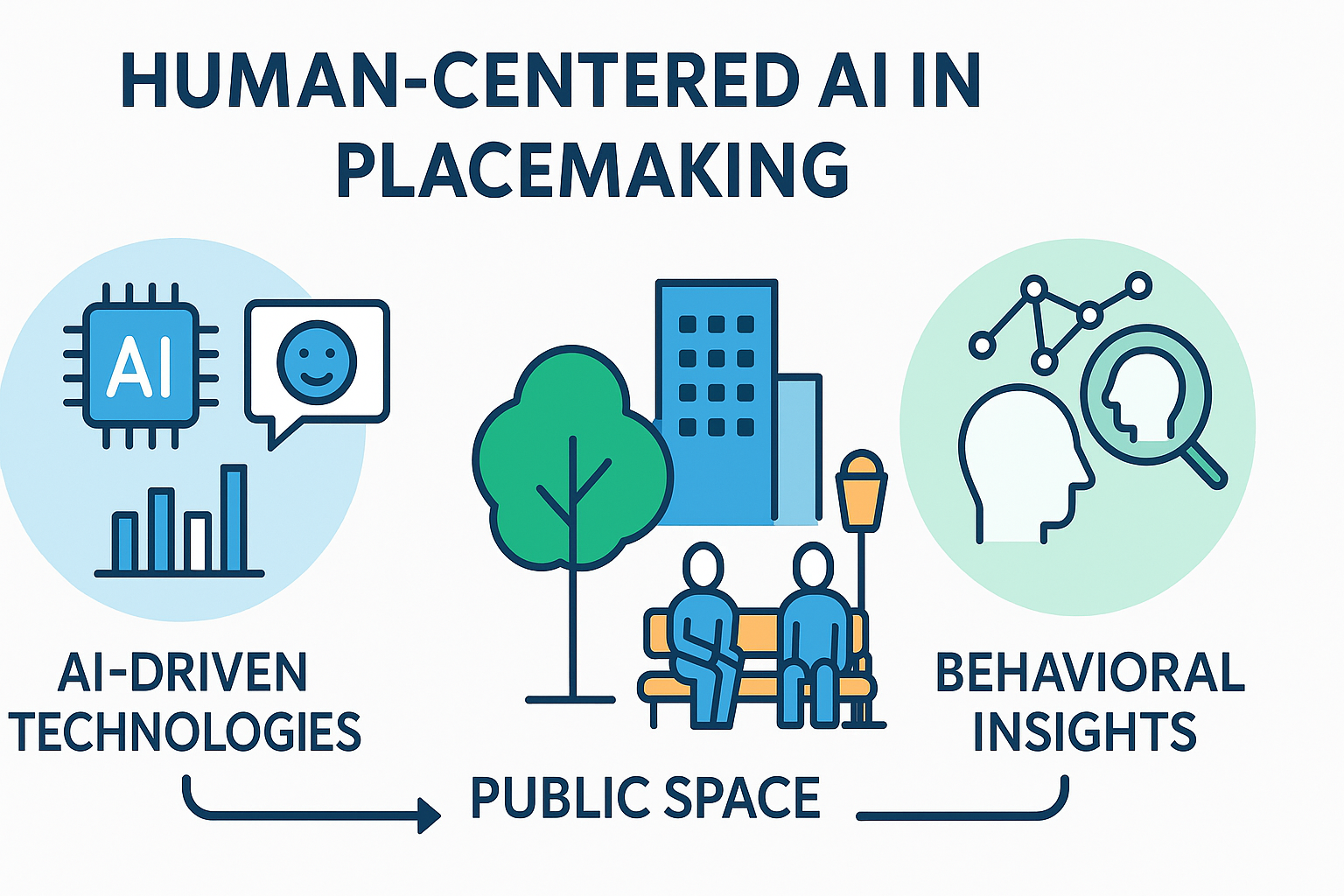
Artificial intelligence (AI) for placemaking holds the potential to revolutionize how we conceptualize, design, and manage urban spaces to create more vibrant, resilient, and people-centered cities. In this context, integrating Human-Centered AI (HCAI) into public infrastructure presents an exciting opportunity to reimagine the role of urban amenities and furniture in shaping inclusive, responsive, and technologically enhanced public spaces. This review examines the state-of-the-art in HCAI for placemaking, focusing on some of the main factors that must be analyzed to guide future technological research and development, such as: (a) AI-driven tools for community engagement in the placemaking process, including sentiment analysis, participatory design platforms, and virtual reality simulations; (b) AI sensors and image recognition technology for analyzing user behaviors within public spaces to inform evidence-based urban design decisions; (c) the role of HCAI in enhancing community engagement in the placemaking process, focusing on tools and approaches that facilitate more inclusive and participatory design practices; and (d) the utilization of AI in analyzing and understanding user behaviors within public spaces, highlighting how these insights can inform more responsive and user-centric design decisions. The paper identifies current innovations, implementation challenges, and emerging opportunities at the intersection of artificial intelligence, urban design, and human experience.
Keywords:
human-centered AI
; placemaking
; urban design
; community engagement
; behavior analysis
; smart cities
; public spaces
; participatory design
; urban computing
; user experience
1. Introduction
Placemaking is a multi-faceted approach to the planning, design, and management of public spaces that aims to create vibrant, inclusive, and people-centered urban environments. By engaging local communities in the process of shaping their surroundings, placemaking initiatives seek to foster a sense of ownership, identity, and social cohesion within neighborhoods, ultimately enhancing the quality of life for residents and visitors. Urban spaces, as hubs for public activities in urban life, should foster participation, comfort, entertainment, mutual communication, and regular engagement among citizens [1,2,3].
In recent years, advances in artificial intelligence (AI) have opened up new possibilities for capitalizing data-driven insights and predictive analytics to inform the design and management of public spaces. By the power of AI, urban planners and designers can gain a deeper understanding of how people interact with their environment, enabling them to create more responsive, adaptive, and user-centric urban landscapes [4,5].
This paper provides an investigation in Human-Centered AI (HCAI) for placemaking, examining the intersection of AI, community engagement, and user behavior in the context of urban planning and design. By exploring the potential of AI to transform the way we conceptualize, design, and manage public spaces, this review aims to shed light on the opportunities and challenges of integrating AI into placemaking initiatives, and to identify key areas for future research and development. It also examines and discusses how community engagement can be reflected in this field, how behaviour can influence placemaking, and how placemaking can influence behavior.
A key aspect of this review is the exploration of AI-driven tools for engaging communities in the placemaking process. These technologies, including sentiment analysis of public feedback, participatory design platforms, and virtual reality simulations, are transforming how citizens interact with urban planning processes. Sentiment analysis algorithms can process vast amounts of social media data, survey responses, and community forum discussions to extract insights about public perceptions of existing spaces and proposed developments. Meanwhile, participatory design platforms enhanced by AI can visualize potential changes in real-time, allowing community members to experiment with different design options and immediately see the potential impacts. Virtual and augmented reality applications further democratize the design process by enabling citizens without technical backgrounds to experience proposed changes before implementation, facilitating more informed feedback and fostering stronger community buy-in [5,6].
Another significant focus of this review is the utilization of AI sensors and image recognition technology to analyze user behavior within public spaces. Computer vision systems can anonymously monitor patterns of movement and social interactions, providing quantitative data on how spaces are actually used rather than how they were intended to be used. These systems can identify peak usage times, underutilized areas, accessibility challenges, kinds of activities, demographics of users etc. The insights derived from these analyses can inform evidence-based decisions about urban infrastructure placement, from the strategic positioning of seating and shade structures to the timing of lighting systems and interactive elements, ultimately creating spaces that better respond to actual human needs and behaviors [7].
By integrating these technological approaches with established placemaking principles, a new paradigm of HCAI for placemaking is emerging — one that balances the analytical power of artificial intelligence with the fundamental importance of human experience, community values, and social equity [8,9].
This review paper aims to achieve several key objectives. First, it seeks to systematically examine the current state-of-the-art in HCAI applications for placemaking, identifying key technologies, methodologies, and implementation strategies that are shaping this emerging field. Second, it explores how HCAI can enhance community engagement in the placemaking process, focusing on tools and approaches that facilitate more inclusive and participatory design practices. Third, it investigates the role of AI in analyzing and understanding user behaviors within public spaces, highlighting how these insights can inform more responsive and user-centric design decisions. Finally, it identifies challenges, gaps, and opportunities for future research and development in HCAI for placemaking.
The contribution of this research to the body of knowledge is multifaceted. From a theoretical perspective, it contributes to the growing body of knowledge at the intersection of AI, urban design, and human-computer interaction, offering a comprehensive framework for understanding how HCAI can be applied to placemaking challenges. From a practical standpoint, it provides urban planners, designers, and policymakers with valuable insights into how HCAI technologies can be leveraged to create more vibrant, inclusive, and responsive public spaces.
This review is particularly timely given the rapid advancements in AI technologies and the growing interest in creating more sustainable, resilient, and people-centered cities. As urbanization continues to accelerate globally, there is an urgent need for innovative approaches to placemaking that can address the complex challenges of contemporary urban life. By examining how HCAI can contribute to more effective placemaking practices, this research has the potential to influence how we design and manage public spaces in the future, ultimately enhancing the quality of life for urban residents around the world.
The remainder of this paper is structured as follows. Section 2 introduces the foundational concepts of Human-Centered Artificial Intelligence (HCAI), outlining its principles and relevance across various domains, with a particular focus on its application in placemaking. Section 3 delves into the integration of HCAI in placemaking practices, examining AI-driven tools for community engagement and technologies for analyzing user behavior. Section 4 explores how AI can be used to understand and influence user behaviors in public spaces, highlighting the reciprocal relationship between placemaking and human activity. Section 5 addresses the importance of inclusive placemaking across different age demographics, as well as gender-responsive design and the role of feminist planning in creating equitable public spaces. Section 6 synthesizes the key findings, discusses emerging trends, and identifies challenges and opportunities for future research. Finally, Section 7 concludes the paper by summarizing the contributions and outlining directions for advancing HCAI in placemaking.
2. Foundations of Human-Centered AI: Principles, Applications, and Relevance to Urban Design
Human Centered AI is an emerging field that seeks to develop AI systems that are designed to work in collaboration with humans, rather than replacing them. By focusing on the needs, preferences, and values of end-users, HCAI aims to create intelligent systems that are transparent, accountable, and responsive to human input. Several key principles underlie the development of HCAI, including fairness, accountability, transparency, and interpretability. These principles are designed to ensure that AI systems are developed and deployed in ways that are ethical, equitable, and aligned with human values [10,11].
General applications of HCAI are extensive. For instance in healthcare systems HCAI can be used to improve patient outcomes, reduce medical errors, and enhance the efficiency of healthcare delivery. This factors include human-centred explainable AI (HCXAI) where the AI system provides explanations for its decisions that are understandable and actionable by humans. This approach places humans at the core of AI design, emphasizing a holistic understanding of values, interpersonal dynamics, and the social context of AI systems [12].
Another example is HCAI and Learning Analytics (HCLA). HCLA are transforming education by enabling personalized, equitable, and adaptive learning while supporting educators and addressing ethical concerns. Key contributions include risk frameworks for HCAI in education, identifying challenges like mismatched AI pedagogy and ethical security concerns, and exploring how HCAI can facilitate dynamic feedback, streamline grading, and promote inclusivity [13].
In transportation, HCAI can optimize traffic flow, reduce congestion, and improve road safety through intelligent traffic management systems that adapt to real-time conditions while remaining responsive to human needs. These systems can analyze patterns of vehicle movement, pedestrian behavior, and environmental factors to make informed decisions about traffic signal timing, route recommendations, and emergency response coordination. Unlike traditional automated systems, HCAI in transportation prioritizes human factors such as driver comfort, pedestrian accessibility, and community preferences, ensuring that technological solutions enhance rather than disrupt the human experience of mobility [14].
In finance, HCAI enhances fraud detection, risk assessment, and customer service while maintaining human oversight and ethical considerations. Financial institutions employ AI algorithms to analyze transaction patterns, detect anomalies, and identify potential fraud attempts, but HCAI approaches try to ensure that these systems are explainable, transparent, and subject to human review. Additionally, HCAI in finance prioritizes ethical considerations such as fairness in lending decisions, transparency in investment advice, and accessibility of financial services for all users, regardless of their technical literacy or socioeconomic status [15].
Across these diverse domains — healthcare, education, transportation, finance, and others — HCAI offers the potential to transform how we work, live, and interact with the world enhancing, rather than replacing, human capabilities and decision-making processes.
2.1. Background and Context of HCAI in Placemaking
In the context of placemaking, HCAI offers a unique opportunity to leverage AI technologies to enhance the design and management of public spaces in ways that are sensitive to the needs and desires of local communities. By integrating AI into the placemaking process, urban planners and designers can gain valuable insights into how people interact with their environment, enabling them to create more user-centric, inclusive, and responsive urban landscapes [16].
Placemaking itself has evolved significantly over the past few decades, transitioning from top-down planning approaches to more community-centered and participatory methodologies. Traditional placemaking practices often relied on intuition, precedent studies, and limited observational research, which sometimes resulted in public spaces that failed to meet the diverse needs of their users [17]. With the advent of digital technologies and AI, there is now potential to capture and analyze vast amounts of data about how people use and experience public spaces, leading to more evidence-based design decisions.
HCAI in placemaking manifests in several key areas. First, AI-powered sentiment analysis tools can analyze public feedback from social media, surveys, and community forums to understand preferences, concerns, and patterns of use. Unlike traditional data collection methods, these tools can process large volumes of qualitative data quickly, identifying trends and insights that might otherwise be missed. Second, AI algorithms can process and analyze sensor data from public spaces, including pedestrian flow, dwell time, and environmental conditions, providing a comprehensive understanding of how spaces are used throughout different times of day, seasons, and weather conditions. Third, generative AI and design optimization tools can assist designers in creating multiple spatial configurations that respond to community needs and preferences, allowing for rapid prototyping and iteration [17].
However, the application of HCAI in placemaking must navigate several challenges. There are concerns about privacy and surveillance when deploying sensors and cameras in public spaces [18]. Additionally, there is the risk of algorithmic bias that might favor certain demographic groups over others in the analysis and design process. Furthermore, the digital divide may exclude marginalized communities from participating in technologically mediated placemaking processes [19]. These challenges highlight the importance of adopting a truly human-centered approach that prioritizes inclusivity, transparency, and community agency in the design and deployment of AI systems for placemaking [20].
Several pioneering projects have demonstrated the potential of HCAI in placemaking. For example, the Sidewalk Labs initiative in Toronto employed various sensors and data analytics to understand urban patterns and inform the design of more responsive public spaces [21]. Similarly, the Smart Parks project [22] by the National Recreation and Park Association utilizes AI to analyze visitor patterns, optimize resource allocation, and enhance visitor experiences while preserving natural environments. These examples illustrate how HCAI can contribute to creating public spaces that are not only functional and aesthetically pleasing but also responsive to the evolving needs and behaviors of their users.
In the following sections, this review will explore the specific applications of HCAI in placemaking, focusing on community engagement tools, user behavior analysis, and the broader implications for urban design and public space management. By examining these aspects, we aim to provide a comprehensive understanding of how HCAI can transform placemaking practices and contribute to more vibrant, inclusive, and responsive urban environments.
3. Integrating HCAI into Placemaking: Tools, Technologies, and Community Engagement
This section explores the role of HCAI in placemaking, focusing on two main factors that must be analyzed to guide future technological research and development: (a) AI-driven tools for community engagement in the placemaking process, including sentiment analysis, participatory design platforms, and virtual reality simulations; and (b) AI sensors and image recognition technology for analyzing user behaviors within public spaces to inform evidence-based urban design decisions.
3.1. AI for Community Engagement in Urban Design
Community engagement is central to placemaking, ensuring that public spaces meet the needs and aspirations of the people who use them. In this context, AI has introduced innovative ways to involve communities in the design process. For instance, sentiment analysis tools analyze public feedback from social media, surveys, and forums to understand community preferences and concerns. Participatory design platforms use AI algorithms to visualize proposed changes in real-time, allowing stakeholders to provide input during the decision-making process.
Several innovative approaches demonstrate how HCAI can enhance community engagement in placemaking. For instance, the significant role of video games in fostering community engagement within urban planning is a leveraging tool due to their interactive and immersive nature, as stated by Szot [23]. By benefiting from the interactive and engaging nature of video games, communities can participate more actively in the planning process. These games serve as platforms for dialogue, allowing diverse stakeholders, including children and young people, to visualize and contribute to the development of their local environments. The use of games like Minecraft [24] and Cities: Skylines [25] in real-life projects demonstrates their effectiveness in making complex urban issues more comprehensible and accessible. This approach not only democratizes the planning process but also enhances the inclusivity and sustainability of urban development efforts. E.g., the "Block by Block" initiative, a collaboration between UN-Habitat and Minecraft, uses a gamified environment where community members can virtually build and modify their neighborhoods, with AI tools analyzing patterns and preferences across different demographic groups. This approach has been successfully implemented in over 35 countries, enabling diverse communities to participate in the urban design process regardless of their technical expertise or literacy levels [19,26]. AI can play a crucial role in analyzing the data generated by these games, identifying patterns and preferences that can inform urban design decisions. For example, AI algorithms can analyze player interactions, choices, and feedback to identify common themes and preferences among different demographic groups. AI can therefore transform sustainable urban planning by offering innovative solutions and emphasizing the importance of data-driven decision-making, community engagement, and ethical considerations to promote sustainability, resilience, and social equity [27].
Still in the AI context, the Decidim platform used in Barcelona employs natural language processing to categorize and analyze citizen proposals for public space improvements, helping city officials identify patterns and priorities while ensuring transparency in the decision-making process. This digital democratic platform has facilitated over 70,000 citizen proposals and has directly influenced the implementation of hundreds of public space projects across the city [28,29]. In Singapore, the Urban Redevelopment Authority has deployed digital urban platforms that combine AI-powered sentiment analysis of social media discussions about public spaces with location-based data to identify areas of concern and opportunity. This approach enables urban planners to continuously monitor public sentiment about different urban spaces and respond with timely interventions when needed [30].
Immersive technologies such as virtual reality (VR) and augmented reality (AR) enable communities to experience proposed designs in a simulated environment. The CityScopeAR project at MIT’s Media Lab allows users to visualize urban designs in real-time using AR, enabling them to interact with proposed changes and provide feedback on their experiences [31]. Applications include post-war reconstruction planning for Kharkiv, the revitalization of the Champs Élysées - Paris, the community engagement in transportation improvements in Boston, to address various urban challenges such as tourism, energy management, and traffic congestion in Andorra, or to predict outcomes of various urban planning and development scenarios in Volpe [32,33,34]. Another example present a user-centered virtual city information model planned to enhance inclusive community design and decision-making by enabling non-expert stakeholders to actively participate in urban planning through immersive virtual environments [35,36]. AR can significantly boost citizen participation in urban planning, especially among young people, by visualizing building projects and environmental changes, thus enabling citizens to contribute design ideas. It can be complemented with haptic 3D tools like Lego or clay to engage low-tech users in designing high-tech solutions collaboratively and integrated into existing participation processes, offering a more interactive, engaging, and accessible approach to urban planning [37].
Despite these advancements, challenges remain in ensuring truly inclusive engagement. The digital divide continues to limit participation from certain demographic groups, particularly older adults, low-income communities, and those with limited digital literacy. For instance, while interest in digital placemaking has grown, senior people are underrepresented, and there is a need for more coordinated research to empower seniors as active participants in digital placemaking initiatives, as underlined by Najafi et al. [38]. The Augmented Reality Participatory Platform (ARPP), a mobile augmented reality tool, is designed to engage under-resourced communities in improving neighborhood walkability through participatory planning and two-way communication between residents and decision-makers [39].
However, ethical concerns related to data collection and usage persist. The Amsterdam City Council has pioneered the Responsible AI Registry, which makes all AI applications used in urban planning transparent to citizens, including information about data sources, algorithms, and decision-making processes [40]. This approach establishes accountability and builds trust with communities, essential elements for successful HCAI implementation in placemaking initiatives.
A study on collaborative governance in urban planning by Follador et al. [41], focusing on Curitiba and Montreal, concluded that collaborative governance is facilitated by inclusive participation and transparent processes but hindered by informal institutions, power asymmetries, and consultation fatigue. The geographic scale of the plan and its presentation to the public are crucial, as plans perceived as abstract or distant can demobilize stakeholders. Strong interdependence among stakeholders can perpetuate existing power imbalances, favoring certain groups over collective interests. Difficulties encountered included the persistence of informal institutions in Curitiba, leading to a controlled planning process by specific stakeholders despite the appearance of collaboration, and consultation fatigue in Montreal, where repeated consultative processes led to stakeholder demobilization and confusion.
The exploration of the top-down (techno-centric approach) and bottom-up (social-centric approach) dichotomy in urban planning emphasizes the historical context and evolution of these paradigms. In this context, new technologies, such as social media and real-time information systems, democratize access to urban information and facilitate citizen participation in urban planning. Collaborative platforms, like OpenIDEO1, are models for transforming architectural design into a property of the Creative Commons, allowing for crowdsourcing information and funding for urban projects, thus promoting a continuous and innovative re-programming of the built environment by its inhabitants [42,43,44].
The evolution of HCAI for community engagement in placemaking reflects a shift from merely collecting community input to establishing genuine collaborative relationships where AI serves as a facilitator rather than a replacement for human judgment and creativity. Future directions include, for example, the development of more culturally sensitive AI systems that can recognize and respect diverse forms of knowledge and expression in the placemaking process. This requires ongoing dialogue between technologists, urban planners, and community members to ensure that AI tools are designed and implemented in ways that truly reflect the values and aspirations of the communities they serve.
3.2. AI Models and Technologies for Smarter Urban Spaces
AI models play a crucial role in placemaking by processing vast amounts of data from diverse sources. Machine learning algorithms, for example, can predict traffic patterns, optimize public transportation systems, and recommend infrastructure improvements. Natural language processing (NLP) techniques are used to analyze textual data, providing insights into public sentiment and preferences.
The application of AI models in placemaking encompasses a diverse range of technologies and methodologies. Supervised learning algorithms, such as Artificial Neural Networks (ANNs), Support Vector Machines, or Random Forests, have been employed to classify urban spaces based on their physical attributes and usage patterns. An examples include a system to categorize the tone of outdoor and indoor photos, with and without people, posted on social media [45,46]. This systems are many times suportted on Convolutional Neural Network (CNN) topologies combining deep features with semantic information from scene characteristics to improve classification and cross-dataset generalization performance [47,48].
Multimodal sentiment classification models, e.g., incorporating both text and image uses image features to emphasize relevant text segments, enabling the machine to focus on text influencing sentiment polarity [49]. But the features do not always need to be extracted from the images. For example, cell phone data can be used for urban planning by mapping human movement and emotional responses during events, helping to create dynamic, adaptable urban environments tailored to the needs of inhabitants [50]. LiDAR (Light Detection and Ranging) data can also be used as a source to classify urban spaces based on physical attributes and usage patterns, as demonstrated by researchers at MIT’s Senseable City Lab. In their work, they developed models capable of classifying public spaces according to morphology, accessibility, and available amenities, allowing for more nuanced comparisons and evaluations of different urban environments [51].
The PlacemakingAI tool utilizes Generative Adversarial Networks (GANs) to facilitate participatory urban design by generating synthetic images of urban spaces, allowing stakeholders to visualize and manipulate design solutions in real-time [52]. The integration of AI in urban decision-making processes, such as the use of Multi-Criteria Decision Analysis (MCDA), enhances the evaluation and selection of urban development projects by providing a more comprehensive and efficient assessment framework [53].
Unsupervised learning approaches, particularly cluster analysis and dimensional reduction techniques, have proven valuable for identifying patterns in how people use public spaces without predefined categories [54].
In this large context, five main approaches are being used: (1) the use of computer vision algorithms to analyze street-level imagery and detect changes in urban environments, (2) the application of natural language processing techniques to analyze textual data related to public spaces, (3) the use of reinforcement learning approaches to optimize the design and management of public spaces, (4) the integration of Internet of Things (IoT) devices and edge computing for real-time data collection and processing, and (5) the use of big data analytics to extract insights from large datasets generated by IoT sensors and other sources. These approaches are transforming how urban planners understand and manage public spaces, enabling more responsive, adaptive, and user-centric design solutions. Other approaches are also being explored, such as the use of blockchain, edge AI technologies, and other emerging technologies, paving the way for ubiquitous sensing and data collection.
Elaborating on the first approach, computer vision algorithms have transformed how urban planners understand public space dynamics. These algorithms provide powerful tools for extracting insights from visual data, crucial for urban planning [55]. They enable the measurement of changes in the physical appearance of neighborhoods using street-level imagery, linking these changes to socioeconomic factors [56]. Computer vision facilitates the analysis of urban environments at various scales, from detecting street activity in real-time to evaluating the evolution of historical urban landscapes [57]. This technology aids in automating the extraction of quantitative and qualitative information from images, enhancing the understanding of urban patterns and human activities [58]. However, it is critical to move beyond simplistic measures and develop “urban-semantic” computer vision to capture the contextual understanding of people in urban spaces, addressing the critiques of current AI applications in urban settings [59].
Natural Language Processing has emerged as a powerful tool for analyzing textual data related to public spaces. It aids urban planners and researchers in processing extensive text data, such as public feedback and social media posts, to understand urban dynamics. NLP techniques, including sentiment analysis, are applied to mine public opinions and sentiments towards various aspects of the urban environment, such as neighborhoods, parks, and transportation [60,61]. Studies utilize NLP to analyze reviews and social media data to understand perceptions of living environments, assess urban livability, evaluate emotional responses evoked by urban places, and categorize unstructured data from various online platforms [62]. By processing large volumes of text, NLP can identify patterns, main topics, and sentiments within citizens’ comments, serving as a valuable tool to enhance decision-making in participatory urban planning. However, challenges remain, including accurately processing informal language, specialized terminology, and dealing with the inherent biases and noise present in data sources like social media [60,63].
Reinforcement learning approaches are beginning to show promise for optimizing the design and management of public spaces through simulation-based testing. These approaches, including Deep Reinforcement Learning (DRL) and Multi-Agent Reinforcement Learning (MARL), often model urban planning challenges—such as land use readjustment or road network design—as sequential decision-making problems. Complex urban environments and their spatial relationships are frequently represented using graph structures, with Graph Neural Networks (GNNs) employed to process topological information and learn effective representations [64]. AI agents learn optimal policies by interacting with simulated environments or models over millions of trials, seeking to maximize cumulative rewards based on objectives like achieving universal connectivity, improving accessibility (e.g., the 15-minute city concept), optimizing spatial efficiency, minimizing travel distance or construction costs, enhancing sustainability, promoting diversity, or balancing stakeholder interests [65]. Simulation-based experiments indicate these computational models can generate plans that outperform those derived from heuristic methods or even human experts on specific objective metrics, and they show potential for supporting participatory planning processes by modeling diverse stakeholder interactions and facilitating consensus [66]. A related example is CityLearn, an open-source simulation platform designed to support multi-agent reinforcement learning for managing energy demand in urban buildings. It enables researchers and developers to implement, test, and compare algorithms that coordinate energy use through strategies like load shifting and shedding. By doing so, CityLearn contributes to reducing peak electricity demand, improving grid efficiency, and supporting broader goals in sustainability and smart city development [67].
The integration of Internet of Things (IoT) devices and edge computing enables real-time data collection and processing, improving responsiveness and adaptability. In parallel, capable of addressing the challenges of real-time data processing and analysis, big data plays a crucial role in urban planning, providing insights into various aspects of city life, including air quality, traffic management, and healthcare [68]. For instance, an Apache Spark-based architecture efficiently processes large datasets generated by IoT sensors to classify air quality index levels, aiding in better urban planning and health risk management [69]. Urban informatics leverages sensor data, user-generated content, and administrative data to enhance resource management, civic participation, and policy analysis. Furthermore, edge computing reduces latency and enhances the effectiveness of IoT applications within smart cities, enabling real-time decision-making and fostering resilient, adaptive urban ecosystems. These technologies collectively contribute to the development of safe, efficient, and sustainable urban environments, addressing challenges like traffic congestion, energy management, and disaster resilience. By integrating IoT, edge computing, and Big Data analytics, urban planners can create smarter cities that enhance the quality of life for their inhabitants [70,71]. Furthermore, the use of blockchain and edge AI technologies further enhances smart city planning and management by improving security, transparency, and cost reduction, and addressing urban challenges such as traffic congestion and data security [72]. The comprehensive IoT-based systems for smart city development and urban planning leverage Big Data analytics to provide insights into energy consumption, traffic patterns, and environmental conditions, ultimately enhancing the quality of life in urban areas [73]. These advancements underscore the transformative potential of integrating IoT, edge computing, and Big Data analytics in urban planning, paving the way for smarter, more resilient, and sustainable cities.
However, the deployment of these technologies also raises concerns about data privacy, security, and the ethical implications of surveillance in public spaces. As cities increasingly rely on data-driven approaches to inform their planning and decision-making processes, it is essential to strike a balance between leveraging technology for urban improvement and safeguarding citizens’ rights and privacy [74].
Multi-modal data fusion techniques have emerged as particularly valuable for placemaking, combining information from diverse sources including sensors, social media, and traditional surveys. The City laboratory system developed by researchers at Beijing City Lab integrates these diverse data sources to provide a comprehensive understanding of urban environments. By leveraging high-resolution remote sensing images, street view pictures, activity trajectories, and user comments from social media platforms, the system can validate, update, and expand existing knowledge systems. This integration allows for a holistic approach to urban planning and design. The active urban sensing framework, which employs various sensors and IoT technologies, complements existing data sources by providing continuous monitoring and greater data coverage. This approach enables researchers to capture intricate urban dynamics and measure previously unmeasurable aspects of urban life, making placemaking initiatives more effective [75]. As another example, the Chicago’s Array of Things deploys urban-scale sensor networks to monitor air quality, noise, and pedestrian traffic, leveraging edge computing for local data processing and privacy-preserving analytics [76,77].
In terms of data acquisition techniques, the use of computer vision and image recognition technologies has gained prominence in placemaking. These technologies enable the analysis of visual data from public spaces, providing insights into user behavior, spatial patterns, and environmental conditions. RGB-D cameras, for example, are employed to capture images and depth information, allowing for the identification of objects, people, and activities in urban environments. These systems can be used to monitor pedestrian flow, assess the usage of public amenities, and evaluate the overall functionality of public spaces. Alternatives include LiDAR (Light Detection and Ranging), thermal imaging, or multispectral cameras, which offer different advantages in terms of data quality, resolution, and environmental adaptability. LiDAR technology is used to create detailed 3D maps of urban environments, enabling the analysis of spatial relationships and the identification of potential design improvements [78].
Multispectral cameras capture images across different wavelengths, providing insights into vegetation health, land use, and environmental conditions. Thermal cameras have emerged as powerful tools for privacy, preserving analysis of human behavior in public spaces, offering a unique combination of physiological monitoring, gesture recognition, and crowd analytics. By capturing heat signatures rather than identifiable visual features, these systems can unobtrusively monitor body temperature fluctuations-providing valuable physiological insights—while also enabling gesture recognition to study how individuals interact with their environment. These technologies facilitate the identification of conversational pairs or family units based on spatial proximity and shared movement patterns, which is particularly useful in understanding social dynamics in settings such as parks or transit hubs. In large gatherings, depending on the technology, these cameras can estimate crowd density with high accuracy and detect movement patterns, allowing for real-time assessment of congestion and early detection of potential conflicts or agitation through sudden changes in thermal activity. Thermal cameras also enable microclimate studies and heat island mitigation by mapping surface temperatures [79,80]. Importantly, the anonymized nature of thermal data addresses significant privacy concerns, making these systems ethically compliant for use in sensitive environments and among vulnerable populations, as they avoid capturing personally identifiable information or emotional states without consent.
However, ensuring data privacy and security remains a significant challenge in the deployment of these technologies. Several cities have adopted “privacy by design” approaches that minimize data collection, anonymize personal information, and implement strict data governance frameworks. For instance, the concept of cognitive cities, which augments smart cities with learning and behavioral change capabilities, relies heavily on the sharing of citizens’ daily-life data, making privacy and security critical issues [81]. To address these concerns, privacy-preserving authentication protocols and encryption algorithms have been proposed to ensure secure communication and data protection [82]. Additionally, Frameworks such as Attribute-Based Credentials (ABCs) and Privacy-Enhanced OAuth 2.0 have been developed to enable decentralized access control and enhance user privacy [83]. Despite these advancements, the complexity of smart city infrastructure and the integration of various technologies continue to pose significant risks, necessitating ongoing efforts to develop robust security measures and privacy-preserving techniques. An example of such efforts is the European DECODE project2, which aims to empower citizens with control over their personal data through decentralized and privacy-enhancing technologies.
As a conclusion, the integration of AI and advanced technologies in placemaking is transforming how urban planners and designers understand and engage with communities. By leveraging AI-driven tools for community engagement and analyzing user behaviors through sensors and image recognition, placemaking initiatives can become more inclusive, responsive, and data-informed. However, it is crucial to address ethical concerns related to privacy, bias, and the digital divide to ensure that these technologies serve the best interests of all community members. The future of placemaking lies in the collaboration between technology and human-centered design principles, creating public spaces that truly reflect the needs and aspirations of their users.
4. AI Understanding of Human Activity in Urban Environments
This section delves into the role of AI in analyzing user behaviors in public spaces, focusing on how AI and sensor technologies are used to track movement patterns, identify peak usage times, and assess accessibility requirements. By understanding user behaviors, urban planners can make evidence-based decisions that enhance the functionality and inclusivity of public spaces.
4.1. Behavior Analysis with AI
Analyzing user behavior in public spaces provides critical insights for effective placemaking. AI-powered sensors and image recognition technologies track movement patterns, identify peak usage times, and assess accessibility requirements. This data helps urban planners design spaces that are more functional and user-friendly.
For example, the Public Space and Public Life study conducted in Downtown Vancouver analyzed how people use public spaces and streets, focusing on activities such as walking, biking, and social interactions. The study highlighted the importance of public spaces in fostering social connections, promoting health, and supporting local businesses, and provided insights into the seasonal variations in public space usage and the need for more inclusive and inviting public spaces [84].
Recent advancements in AI and machine learning have transformed behavior analysis in placemaking, enabling the capture, processing, and interpretation of complex human activities in public spaces. Vision-based detection systems, leveraging advanced machine learning models like CNNs and Long Short-Term Memory (LSTM) networks, have significantly enhanced the accuracy and efficiency of Human Activity Recognition (HAR) by analyzing video data to identify and classify human actions in real-time [85,86,87]. The integration of advanced models further improves the precision of action detection, making it possible to predict and recognize human activities with high accuracy even in dynamic and crowded environments [88]. These systems can address a wide range of actions such as crossing, waiting, queueing, talking, dancing, sitting, jogging, playing, riding, or doing sports. Additionally, the development of comprehensive datasets such as the Public Life in Public Space dataset supports multi-task learning for activity, emotion, and social relation recognition, enabling a deeper understanding of human interactions and behaviors in diverse public settings. Emotions like valence, arousal, and dominance are analyzed, while social relations including friend, family, couple, professional, and commercial interactions are also considered [89].
In this context, crowd behavior analysis has emerged as a particularly valuable application of AI in placemaking. Models that can identify various types of social formations—individuals, pairs, small groups, and larger gatherings—and analyze their spatial relationships and dynamics have been developed [90,91]. These insights can inform the design of public spaces that accommodate different types of social interactions, from intimate conversations to community gatherings. By utilizing physical environment and crowd simulations to analyze movement patterns in urban settings, designers can optimize neighborhood public spaces in ways that not only enhance social interactions and functional efficiency, but also intentionally promote healing and resilience within the community [92,93].
Spatiotemporal pattern mining techniques have significantly advanced our understanding of how public space usage evolves over time. These techniques are crucial for analyzing the complex interactions between spatial and temporal factors that influence user behavior in urban environments [7]. For instance, a longitudinal study of Bryant Park in New York City utilized machine learning algorithms to analyze several years of behavioral data, identifying not only daily and seasonal patterns but also longer-term trends in how different demographic groups utilize the space [94]. This analysis revealed shifts in usage patterns that might have been overlooked by short-term observational studies, thereby informing more effective long-term management strategies. Also, climate change is increasingly affecting the livability and functionality of urban public open spaces, impacting user behavior in complex ways. Recent studies have highlighted the importance of understanding spatio-temporal interactions to design climate-adaptive solutions. For instance, a review identified 62 influencing factors, categorized into environmental factors, spatial attributes, population and society, and behavioral perceptions [95]. These factors, analyzed through a co-occurrence matrix, revealed that spatial and temporal dimensions interact significantly, influencing public open spaces usability. Temporal factors like temperature and wind speed, combined with spatial factors such as site facilities and greenness, play a crucial role in user behavior. Understanding these interactions is essential for optimizing public open spaces design to enhance climate adaptability and long-term usability.
Accessibility analysis has been significantly enhanced by AI approaches. Computer vision systems can now detect and quantify barriers to accessibility, such as gaps in pedestrian infrastructure, obstacles, or challenging terrain. E.g., Froehlich et al. [96] explore the transformative role of AI in enhancing urban accessibility for people with disabilities, focusing on applications such as autonomous vehicles, intelligent wheelchairs, and AI-driven mapping tools to assess and navigate pedestrian pathways, while addressing ethical, privacy, and inclusivity challenges. Cimini et al. [97] evaluated the accessibility of green urban public spaces in 14 Italian metropolitan cities, revealing that less than 30% of residents have access to a green space within 300 meters on foot, highlighting significant disparities and the need for improved urban planning and management. They collected data from OpenStreetMap (OSM) and Urban Atlas (UA), spatialized the population using ISTAT census data, and created a hexagonal mesh grid to define starting points. Green urban public spaces and their access points were identified, and network analysis tools were used to calculate the shortest walking routes to these spaces, assessing accessibility within 300 and 400 meters.
Beyond physical accessibility, AI systems are increasingly capable of analyzing inclusive usage patterns. In Barcelona, the Decidim project—a participatory democracy platform—demonstrates how AI can support diverse civic engagement by identifying and adapting to varied user interactions. By studying how individuals with different abilities navigate and contribute to the platform, the system can detect barriers and suggest modifications, such as simplifying interfaces or adjusting feedback mechanisms. These insights allow for more equitable digital participation, ensuring that civic technology is not only accessible but actively inclusive of marginalized voices [98].
However, as already mentioned, the deployment of AI technologies for behavior analysis in public spaces raises ethical concerns, particularly regarding privacy and surveillance. The use of cameras and sensors to monitor public spaces can lead to potential invasions of privacy and the collection of sensitive data without individuals’ consent. To address these concerns, researchers and practitioners are exploring privacy-preserving techniques, such as anonymizing data and implementing strict data governance frameworks, to ensure that the benefits of behavior analysis do not come at the expense of individual privacy rights [18].
The evolution of behavior analysis in placemaking reflects a shift from simple quantitative metrics toward more nuanced understandings of how different people experience and use public spaces. Future directions include the development of more culturally aware analysis models that can recognize diverse social practices and behaviors across different cultural contexts, as well as systems that can incorporate subjective experiences alongside objective behavioral patterns.
4.2. How Public Space Design Shapes Human Behavior
Well-designed public spaces influence user behavior by promoting social interaction, encouraging physical activity, and enhancing overall well-being. Placemaking initiatives that incorporate green spaces, interactive installations, and cultural elements have been shown to foster a sense of community and belonging. The relationship between public space design and human behavior has been a subject of growing interest, with AI technologies enabling more sophisticated analyses of this complex interaction.
In this context, a study from Loo and Fan [99] investigated the relationship between spatial features and social interaction in public spaces, using machine learning algorithms on time-lapse videos of the Belcher Bay Waterfront Park on Hong Kong Island, Hong Kong. They find that dynamic edges formed by moveable furniture and fixed landmarks like carousels significantly enhance social interaction and group activities. The study highlights the importance of flexible urban design elements in creating engaging public spaces, suggesting that planners should incorporate both fixed and movable features to foster community and well-being, underscoring the role of thoughtful placemaking in promoting social cohesion and active use of public spaces.
The characteristics that make communal open spaces in multi-story residential neighborhoods child-friendly, from the perspectives of children and parents, are investigated by Fatahi et al. [100]. Conducted in Sanandaj, Iran, the research identifies four key factors: connection with nature, spatial flexibility, social networking, and safety/security. Using online surveys with 441 children and 576 parents, the study reveals that water play, diverse play equipment, and natural environments are crucial for child-friendliness. Safety indicators include outdoor shelters and soft surface materials. The findings suggest incorporating biophilic and participatory design approaches to create engaging, safe, and flexible communal spaces that cater to both children’s and parents’ preferences.
The social impacts of self-build architectural interventions as part of urban regeneration strategies on a university campus in Cagliari, Italy, were studied by Manunza et al. [101]. It highlights significant increases in social activities, restorative behaviors, and inclusivity, particularly in areas with added shading and movable seating. The research underscores the potential of gender-sensitive design to promote equitable use of public spaces, noting a rise in female participation. The study also provides detailed demographic insights, revealing that the majority of users were in the 20-30 age group, with a notable increase in the presence of observer-rated females post-intervention. Despite a slight decline in reading and studying activities, the findings suggest that targeted urban regeneration interventions can enhance social connection, individual well-being, and inclusivity, emphasizing the importance of community involvement and multidisciplinary collaboration in sustainable urban development.
The transformation of the High Line in New York City from an abandoned railway into an elevated park has sparked significant urban revitalization, known as the “High Line Effect” [102,103]. This phenomenon has inspired similar projects across the United States, aiming to convert disused infrastructure into vibrant public spaces. Utilizing AI-powered computer vision, researchers have analyzed before-and-after patterns of pedestrian behavior, documenting substantial increases in social interaction, leisure activities, and extended dwell times. The High Line’s success has led to increased real estate values and gentrification, highlighting the need for equitable development practices. Studies reveal that gender-sensitive design and community engagement are crucial for promoting inclusivity and ensuring that the benefits of such transformations are shared across all demographics.
Li and Ma [104] leverage AI-powered computer vision to quantitatively assess changes in pedestrian dynamics before and after repurposing an abandoned railway into an elevated urban park. Longitudinal data from CCTV and mobile sensors (2023-2025) revealed significant shifts: post-transformation, social interactions increased by 42%, leisure activities (e.g., cycling, group gatherings) surged by 67%, and median dwell times expanded from 8.3 to 22.1 minutes. Gender-disaggregated analysis showed women’s participation in park usage rose by 28%, correlating with enhanced lighting and seating. Spatial heatmaps identified zones favoring spontaneous interactions, while temporal patterns highlighted evening peaks in multicultural exchanges. These findings underscore the role of green infrastructure in fostering inclusive urban vitality, providing actionable insights for policymakers to prioritize human-centric design in future urban renewal projects.
Placemaking significantly shapes human behavior by encouraging physical activity and contributing to better public health outcomes. A growing body of evidence underscores the behavioral impact of urban form and the built environment, especially in how they shape opportunities for walking, recreation, and social interaction. Gibson et al. [105] developed a simulation model to assess the health impacts of a proposed urban redesign in Raleigh, North Carolina, demonstrating that enhancing walkability through increased intersection density, land-use diversity, and pedestrian infrastructure could lead to a 17-minute increase in daily walking time per resident. This behavioral shift was projected to reduce premature mortality by 5.5% and significantly lower the incidence of chronic diseases such as diabetes and coronary heart disease. Similarly, Garden and Jalaludin [106] conducted a multilevel analysis in Sydney, Australia, revealing that residents in low-density, sprawling suburbs were substantially more likely to be overweight or obese and less likely to engage in adequate physical activity. Their findings suggest that urban sprawl discourages walking and fosters car dependency, thereby negatively influencing health behaviors. Complementing these quantitative insights, Koohsari et al. [107] emphasized the importance of public open spaces—such as parks, greenways, and plazas—not only in terms of proximity but also in terms of quality, accessibility, and contextual integration within neighborhoods. They argue that the behavioral impact of placemaking is mediated by both objective features (e.g., size, amenities, connectivity) and subjective perceptions (e.g., safety, aesthetics), and call for more nuanced, context-specific research to guide urban design. Collectively, these studies highlight that placemaking is not merely about physical transformation but also about shaping environments that support healthier, more active lifestyles.
Commercial behavior has also been shown to respond to placemaking interventions. As cities confront the decline of traditional shopping streets, recent research highlights the importance of spatial structure, accessibility, and experiential quality in shaping commercial vitality. Carmona [108] introduces the “sun model” and “place attraction paradigm” to explain how high streets can remain relevant by offering experiences that online retail cannot replicate. He argues that successful shopping streets must be curated as destinations—places where people want to linger, socialize, and engage with their surroundings—rather than merely spaces for transactional consumption. Empirical support for this approach is provided by Merten and Kuhnimhof [109], who analyze retail rents in Aachen, Germany, to assess how transport and parking infrastructure influence retail performance. Their findings show that proximity to pedestrian zones, public transport stops, and off-street parking garages significantly increases retail rents, while excessive on-street parking in the immediate vicinity has a negative effect. These results suggest that reallocating street space to prioritize walkability and multimodal access can enhance the attractiveness and economic viability of city-center retail. Importantly, their study also captures the lingering effects of the COVID-19 pandemic, which accelerated shifts in mobility and consumer behavior, further underscoring the need for adaptive urban strategies. Hagen [110] complements these insights with a comparative study of four Norwegian cities, examining how urban spatial structure affects the frequency of city-center visits. Her research finds that compact, clustered urban forms with high residential and employment density near the center are associated with more frequent visits. Moreover, perceived accessibility and emotional attachment to the city center—what she terms “city-center appreciation”—emerge as critical factors influencing behavior. Interestingly, the presence of competing retail destinations can reduce city-center footfall, but this effect can be mitigated by strong place-based appeal and integrated land-use and transport planning. Therefore, the future of traditional shopping streets depends on their ability to function as accessible, attractive, and socially meaningful places. Placemaking interventions that enhance walkability, support diverse uses, and foster emotional connections to place can help sustain commercial activity and reinforce the role of city centers as vibrant hubs of urban life.
Cultural and contextual variations in behavioral responses to similar design interventions have been identified through cross-cultural studies, revealing that a one-size-fits-all approach to urban planning and design is often inadequate. For instance, research on urban green spaces (UGS) has illuminated significant perceptual and preferential differences between cultures. A comparative study using crowdsourced big data from China and Japan [111] found that while both cultures value UGS, their users exhibit distinct priorities and engagement patterns. Chinese users, as reflected in social media, tended to emphasize aspects like overall green quantity, specific plant designs, and active recreational uses such as group dancing or brisk walking, perhaps reflecting needs within densely populated urban areas. In contrast, Japanese UGS often integrate specific cultural elements, such as shrine and temple forests, suggesting a valuation that intertwines nature with historical and spiritual dimensions, potentially leading to more contemplative or culturally specific activities. These detailed findings exemplify the broader challenges discussed by Bull et al. [112], which scrutinizes the push towards global standardization in urban form against the imperative of local relevance. As forces such as international population movement, tourism, and the global flow of capital reshape cities, there’s a risk of creating homogenized urban environments that fail to resonate with or serve the unique needs of local populations.
Consequently, effective urban planning must move beyond the mere acknowledgment of cultural diversity towards actively developing and implementing methodologies—such as the innovative use of big data analytics and image recognition—that can capture and interpret these nuanced behavioral responses. This allows for the creation of urban spaces that are not only functional but also deeply embedded within, and reflective of, the local cultural ecosystem, ultimately fostering more inclusive, sustainable, and meaningful urban experiences.
In summary, placemaking significantly influences human behavior by shaping social interaction, health outcomes, commercial vitality, and cultural engagement through intentional design of public spaces. Studies demonstrate that flexible elements like movable furniture and fixed landmarks enhance social cohesion, while child-friendly designs prioritizing nature, safety, and play foster community well-being. Urban regeneration projects reveal increased inclusivity, leisure activities, and dwell times, though gentrification risks underscore the need for equitable planning. Health-focused analyses link walkable, green urban designs to reduced chronic diseases and higher physical activity, while commercial studies emphasize experiential quality and walkability to revitalize retail. Cross-cultural comparisons highlight cautioning against one-size-fits-all approaches. Collectively, these findings stress the importance of adaptive, context-sensitive placemaking that balances AI-driven insights, community engagement, and cultural specificity to create inclusive, vibrant, and health-promoting urban environments.
5. Placemaking for All Ages and Genders
This section explores how placemaking can be designed to accommodate the diverse needs of different age groups and equity considerations, ensuring that public spaces are inclusive and accessible for all citizens. This will include a focus on multigenerational approaches to placemaking, examining how urban spaces can be designed to serve the needs of young children, adolescents, adults, and older adults. Additionally, we will discuss the role of equity in placemaking, emphasizing the importance of creating public spaces that are accessible and welcoming to all members of society, particularly marginalized communities. Although the focus will not be on the role of AI in these areas, it is important to note that AI can play a significant role in analyzing and understanding the needs of different age groups and communities, providing valuable insights for inclusive placemaking practices.
5.1. Designing for All Ages: Multigenerational Approaches to Inclusive Placemaking
Urban spaces should serve the needs of all citizens, yet the requirements and preferences of different age groups vary significantly. This section explores how placemaking can address the specific needs of young children, adolescents, adults, and older adults, examining both the challenges and opportunities in creating truly multigenerational public spaces.
Research on age-inclusive placemaking has identified distinct spatial preferences and usage patterns across the life course. Young children engage with spaces primarily through play, exploration, and sensory experiences, requiring environments that offer safety, discovery opportunities, and caregiving support. These needs are echoed in participatory planning efforts that emphasize the importance of green, accessible, and varied spaces that foster both independence and social connection [113]. Moreover, integrating children’s voices into urban resilience planning has shown that children not only identify vulnerabilities in their environments but also offer innovative, equity-focused solutions when given the opportunity to participate meaningfully [114]. McKoy et al. [115] further argue that planning just and joyful cities requires intergenerational collaboration, where young people—especially those from marginalized communities—are recognized as critical stakeholders in shaping urban futures. Adolescents seek spaces that support social interaction, identity formation, and gradual autonomy, often preferring places that allow for “hanging out” without excessive adult supervision [116].
Adults of working age utilize public spaces for diverse purposes including recreation, socialization, commuting, and restoration, with patterns often shaped by work schedules and family responsibilities. These patterns are influenced by the availability of time, proximity to green spaces, and the need to balance work and caregiving roles, which often dictate when and how public spaces are accessed. For instance, urban green spaces are frequently used by working adults for brief restorative breaks, active commuting, or family-oriented leisure, underscoring their multifunctional role in daily routines. Older adults, on the other hand, value spaces that offer accessibility, comfort, opportunities for social connection, and sensory enjoyment, with needs evolving further as mobility and health status change. As highlighted by Wong and Neo [117], age-friendly urban environments must integrate inclusive design, pedestrian-friendly infrastructure, and accessible public transport to support older adults’ independence and social engagement. Moreover, Boavida et al. [118] emphasize that smart public parks—when designed with older adults in mind—can significantly enhance physical activity, mental wellbeing, and social participation, especially when they include features such as shaded seating, fitness equipment, and intergenerational spaces. These findings underscore the importance of tailoring public space design to accommodate the diverse and evolving needs of all ages.
The concept of intergenerational placemaking has emerged as a vital response to the increasing age segregation in contemporary urban environments. Rather than designing cities around isolated age groups, intergenerational placemaking promotes inclusive, shared spaces that foster meaningful interactions between generations. Research from the Intergenerational Study Center at Penn State University and findings from the American Planning Association underscore the transformative potential of such approaches [119,120]. Purposefully designed intergenerational spaces—such as parks, community centers, and shared housing—can reduce ageism, enhance social cohesion, and support mutual learning and empathy across age groups. These environments not only improve health and well-being for both young and old but also contribute to more resilient, equitable communities. Successful examples of intergenerational placemaking include the Age-Friendly Living Ecosystem (AFLE) model, developed through international collaboration and highlighted in [121], emphasizes co-creation and participatory design to ensure that public spaces reflect the sensory, social, and cultural needs of all generations. Initiatives like this, align with the broader movement toward age-friendly and child-friendly cities, as advocated by Hammond and Saunders [119], which calls for urban practices that dismantle stereotypes and foster interdependence between generations. By embedding intergenerational principles into urban planning, cities can become more inclusive, dynamic, and supportive environments for people of all ages.
Safety concerns significantly influence how different age groups access and use public spaces. For children, parental perceptions of safety are a key determinant of independent mobility and spatial freedom. Contemporary children often experience far more restricted access to public space than previous generations, largely due to concerns about traffic, crime, and inadequate infrastructure [96,122]. This phenomenon, often described as a consequence of “motornormativity,” has led to a dramatic reduction in children’s independent mobility, which is foundational to their engagement in outdoor free play and active transportation [96]. Parents frequently limit their children’s range due to fears of stranger danger and road safety, even when recreational facilities are available [122]. Similarly, older adults often restrict their use of public spaces due to fear of falling, crime, or perceived social exclusion [123]. Design approaches that enhance both actual and perceived safety—such as clear sightlines, adequate lighting, reduced traffic speeds, and the presence of other users (“eyes on the street”)—can significantly increase the use of public spaces by vulnerable age groups [122,123]. These strategies not only support physical activity and social interaction but also contribute to more inclusive, resilient, and age-friendly urban environments.
Public spaces serve as fundamental building blocks for inclusive communities, supporting well-being and resilience across all stages of life. As this chapter has demonstrated, creating truly multigenerational environments requires urban planners and designers to carefully balance the diverse needs and safety considerations of different age groups.
The evidence presented throughout this section reveals how each generation benefits from thoughtfully designed public spaces. Children require secure, stimulating environments that support exploration and development. Adolescents need spaces that provide social connection while honoring their developing autonomy. Adults seek flexible environments that accommodate their complex lives while offering opportunities for restoration. Older adults depend on accessible, comfortable spaces that maintain their independence while fostering social engagement.
As we have seen, safety perceptions—particularly among parents and older adults—constitute the most significant barrier to public space utilization. The research examined in this section underscores that design interventions enhancing both actual and perceived safety, including improved lighting, traffic calming measures, and clear sightlines, are essential for enabling all generations to access and enjoy urban environments.
The intergenerational placemaking principles explored here—emphasizing co-creation, participatory design, and shared spaces—offer a transformative approach to urban development. These strategies provide a pathway toward more inclusive, equitable, and vibrant cities that respond to the full spectrum of community needs.
Moving forward, the integration of age-inclusive and safety-conscious design into urban planning practice represents more than a technical challenge—it embodies a commitment to communities where every resident can thrive. By centering the voices and needs of all generations, cities can evolve into more resilient, adaptive, and enriching environments that strengthen the social fabric binding communities together.
5.2. Equity by Design: Feminist and Gender-Inclusive Approaches to Public Space
Public spaces are not gender-neutral environments. Research has consistently demonstrated that men and women experience and use public spaces differently, influenced by social norms, safety concerns, caregiving responsibilities, and cultural expectations. Gender-responsive placemaking acknowledges these differences and seeks to create urban environments that equitably address the needs and preferences of people across the gender spectrum.
Studies by feminist urban planners have documented how traditional public space design has often prioritized male-dominated activities and patterns of use, resulting in environments that may unintentionally exclude or limit women’s participation. Urban planning and public space design have historically been shaped by patriarchal norms, leading to spaces—such as large plazas, sports fields, and certain transit hubs—that cater primarily to masculine uses and behaviors, while neglecting the safety, accessibility, and comfort needs of women and girls. Feminist urban scholars argue that this exclusion is not accidental but rooted in broader social structures that undervalue the spatial needs and rights of women, girls, and other marginalized groups [124]. For example, women and girls often experience public spaces differently from men and boys, with safety concerns, lack of adequate lighting, and limited access to amenities such as clean and private restrooms acting as significant barriers to their full participation in urban life. Additionally, the absence of childcare facilities and spaces for socializing with children further compounds these challenges, making many public environments less welcoming for women, especially those with caregiving responsibilities. Feminist urban planners advocate for participatory approaches that center the voices of women and girls in the design process, ensuring that public spaces reflect their lived experiences and aspirations. One recent study by Anneroth et al. [125] demonstrates how public spaces in cities like Stockholm fail to meet the needs of girls and women, who report feeling unsafe and unwelcome in many areas dominated by male users. The authors call for a paradigm shift toward feminist planning, which not only addresses physical safety but also challenges the underlying power dynamics that shape urban environments. This approach emphasizes co-creation, community engagement, and flexible design that responds to the diverse needs of all genders, ultimately aiming to create more inclusive, equitable, and vibrant public spaces for everyone.
The challenge of creating genuinely gender-inclusive spaces has led to innovations in participatory design approaches that elevate diverse gender perspectives. These approaches recognize some of the already mentioned ideas, such as, that public spaces are not neutral; they are often shaped by patriarchal norms and planning paradigms that historically excluded women, nonbinary, and gender-diverse individuals from both usage and decision-making processes. In response, participatory design has emerged as a transformative methodology that centers the lived experiences of marginalized genders, enabling them to actively shape the environments they inhabit. Participatory tools such as community workshops, exploratory walks, zine-making, and co-design sessions have been employed to surface the nuanced ways in which gender intersects with space, safety, mobility, and belonging. For example, in India, Myanmar, and Sweden, projects like Frizon in Umeå and Mya Malar Park in Yangon have demonstrated how engaging young girls in the design of public spaces can result in environments that are not only safer and more inclusive but also foster a sense of ownership and empowerment among participants [126]. These interventions often go beyond physical infrastructure, incorporating elements like music systems, ergonomic seating, and open layouts that reflect the specific needs and aspirations of girls and women.
In Los Angeles, similar efforts have been documented in the context of urban parks, where women and nonbinary individuals face barriers to access due to safety concerns, lack of inclusive programming, and underrepresentation in planning processes. Research has shown that women are more likely to use parks for caregiving or passive recreation rather than for physical activity, often due to the design of amenities that prioritize male-dominated sports [127]. To counter this, feminist planning advocates for inclusive engagement strategies that prioritize the voices of those most often excluded—particularly women of color, LGBTQ+ individuals, and low-income residents—through sustained dialogue, community-led design, and equitable resource allocation.
Vienna offers a compelling example of systemic gender mainstreaming in urban planning. Through initiatives like the Frauen-Werk-Stadt housing project and the integration of gender-sensitive criteria in public procurement, the city has institutionalized gender equity as a core planning principle. These efforts have led to the creation of multifunctional, pedestrian-friendly, and socially inclusive spaces that reflect the diverse rhythms of urban life, particularly those of women balancing caregiving, work, and mobility [128].
In summary, this section establishes that some public spaces are inherently gendered environments shaped by historical planning practices that have prioritized male-dominated activities while marginalizing women, girls, and gender-diverse individuals. Research reveals how traditional urban design—focused on elements like large plazas and sports fields—has created barriers for women through inadequate lighting, limited safety measures, and insufficient amenities such as clean restrooms and childcare facilities. In response, feminist urban planning advocates for participatory design approaches that center marginalized gender perspectives through community workshops, co-design sessions, and exploratory walks. International examples from Stockholm, India, Myanmar, Los Angeles, and Vienna demonstrate how engaging women and girls directly in the planning process creates more inclusive environments that address safety concerns, accommodate caregiving responsibilities, and foster community ownership. Vienna’s systematic gender mainstreaming approach exemplifies how cities can institutionalize gender equity as a core planning principle, resulting in multifunctional spaces that reflect the diverse needs and rhythms of all urban residents.
6. Synthesis and Discussion
The integration of Human-Centered AI in placemaking represents a paradigm shift in urban planning. By combining AI-driven community engagement tools with advanced behavior analysis techniques, planners can create spaces that are both functional and inclusive.
This review has identified several key trends and patterns in the application of HCAI to placemaking. First, there is a clear evolution from using AI primarily as an analytical tool toward more collaborative and co-creative applications where AI and humans work together throughout the placemaking process. Second, we observe a shift from general-purpose AI systems to more specialized tools designed specifically for placemaking contexts, often incorporating domain knowledge about urban design and human behavior. Third, there is growing emphasis on interpretable and transparent AI systems that can not only provide recommendations but also explain the reasoning behind them, enabling more informed decision-making by human stakeholders.
The review also reveals distinct approaches to HCAI across different geographical and cultural contexts. European implementations tend to emphasize privacy protection, democratic participation, and cultural heritage preservation. North American approaches often focus on efficiency, data-driven decision-making, and economic revitalization. Asian implementations frequently prioritize technological innovation, smart infrastructure integration, and large-scale urban transformation. These different emphases reflect not only technological choices but deeper cultural values and governance structures that shape how HCAI is conceived and implemented.
Despite these advancements, significant challenges persist in the application of HCAI to placemaking. Privacy concerns related to data collection in public spaces remain paramount, particularly regarding surveillance capabilities of visual sensing technologies. The European General Data Protection Regulation (GDPR) has established important precedents for privacy-preserving approaches, but global standards are still evolving. The digital divide continues to limit participation in technologically mediated placemaking processes, with older adults, low-income communities, and those with limited digital literacy often underrepresented. Several promising approaches to address this challenge have emerged, including “digital stewards” programs that train community members to facilitate engagement and multimodal interfaces that accommodate diverse abilities and preferences.
Algorithmic bias presents another significant challenge, as AI systems may perpetuate or amplify existing social inequities if not carefully designed and monitored. Audit methodologies developed by researchers provide frameworks for identifying and addressing bias in urban AI systems. Additionally, participatory design approaches that involve diverse stakeholders in the development and evaluation of AI systems show promise for creating more equitable technology.
The need for interdisciplinary collaboration emerges as both a challenge and an opportunity. Successful HCAI implementations in placemaking typically involve diverse teams of urban planners, designers, data scientists, social scientists, and community representatives. However, differences in professional languages, methodologies, and priorities can create barriers to effective collaboration. Emerging “urban science” programs at universities worldwide are developing new interdisciplinary frameworks and training a new generation of professionals equipped to bridge these divides.
Looking toward the future, several promising research directions emerge. First, the development of more context-aware AI systems that can recognize and adapt to local cultural, social, and environmental factors appears critical for effective placemaking across diverse settings. Second, the integration of AI with other emerging technologies—including augmented reality, digital twins, and responsive materials—offers new possibilities for creating public spaces that can dynamically adapt to changing needs and conditions. Third, longer-term studies of how AI-informed placemaking interventions impact communities over time are needed to better understand the sustained effects of these approaches.
Methodologically, there is growing interest in more participatory and co-creative approaches to AI development in placemaking. Rather than imposing technology-driven solutions, these approaches involve communities in defining problems, gathering data, developing algorithms, and evaluating outcomes. Such approaches not only produce more contextually appropriate solutions but also build community capacity and ownership.
From a policy perspective, the development of ethical frameworks and governance structures for HCAI in placemaking is urgently needed. Several cities have pioneered ethical AI policies specifically addressing public space applications, but more comprehensive and standardized approaches would benefit the field. Additionally, new funding and implementation models that balance public and private interests while ensuring equitable access to AI-enhanced public spaces warrant further exploration.
In summary, Human-Centered AI offers transformative potential for placemaking, enabling more responsive, inclusive, and evidence-based approaches to designing and managing public spaces. However, realizing this potential requires careful attention to ethical considerations, inclusion of diverse perspectives, and continued innovation in both technical and social dimensions of these systems.
7. Conclusions
This review highlights the transformative potential of Human-Centered AI in placemaking. By leveraging AI technologies, urban planners can enhance community engagement, analyze user behaviors, and create spaces that reflect the needs and aspirations of diverse communities. While challenges remain, the opportunities presented by AI are immense, paving the way for more inclusive and adaptive urban environments.
Our review on HCAI for placemaking reveals a rapidly evolving field at the intersection of artificial intelligence, urban design, and community engagement. Several key conclusions can be drawn from this analysis.
First, HCAI represents a fundamental shift in how we approach placemaking, moving from intuition-based design to evidence-informed processes that combine computational intelligence with human creativity and contextual knowledge. The most successful applications of HCAI in placemaking are those that enhance rather than replace human judgment, leveraging AI capabilities while respecting human agency and expertise.
Second, community engagement remains central to effective placemaking, and HCAI offers novel methods for broadening and deepening participation. From sentiment analysis of public feedback to immersive visualization tools and participatory design platforms, AI-powered approaches can make the placemaking process more accessible, inclusive, and responsive to community needs. However, these technologies must be deployed with careful attention to issues of digital literacy, accessibility, and representation to ensure that they do not exacerbate existing inequities.
Third, the analysis of user behavior through AI offers unprecedented insights into how people interact with public spaces, enabling more informed design decisions and more responsive management strategies. Computer vision, sensor networks, and other sensing technologies can reveal patterns and relationships that might not be apparent through traditional observational methods. However, these approaches must be balanced with respect for privacy, consent, and the right to anonymity in public space.
Fourth, the impact of placemaking on behavior is complex and context-dependent, with AI-enabled studies revealing how design interventions can influence social interaction, physical activity, emotional well-being, and other behavioral outcomes. These insights have significant implications for public health, social cohesion, and urban vitality, suggesting that well-designed public spaces can contribute to broader societal goals beyond aesthetics and functionality.
Fifth, the application of HCAI in placemaking faces significant challenges, including privacy concerns, algorithmic bias, the digital divide, and the need for interdisciplinary collaboration. Addressing these challenges requires not only technical solutions but also thoughtful governance frameworks, ethical guidelines, and inclusive development processes that engage diverse stakeholders throughout the design and implementation of AI systems.
Looking ahead, the future of HCAI in placemaking will likely be shaped by several key trends: increasing integration of AI with other emerging technologies such as digital twins, augmented reality, and responsive environments; growing emphasis on participatory and co-creative approaches to AI development; greater attention to cultural and contextual factors in designing AI systems; and the evolution of ethical frameworks and governance structures specifically addressing public space applications of AI.
In conclusion, Human-Centered AI offers promising new approaches to placemaking that can help create more vibrant, inclusive, and responsive public spaces. By centering human needs, values, and experiences in the development and application of AI technologies, we can harness the power of computational intelligence while ensuring that our public spaces remain fundamentally human places. As this field continues to evolve, ongoing research, thoughtful policy development, and inclusive stakeholder engagement will be essential to realizing the full potential of HCAI for enhancing urban life worldwide.
Author Contributions
Conceptualization, P.J.S.C. and J.M.F.R.; methodology, P.J.S.C. and J.M.F.R.; software, P.J.S.C. and J.M.F.R.; validation, P.J.S.C. and J.M.F.R.; formal analysis, P.J.S.C. and J.M.F.R.; investigation, P.J.S.C. and J.M.F.R.; resources, P.J.S.C. and J.M.F.R.; data curation, P.J.S.C. and J.M.F.R.; writing—-original draft preparation, P.J.S.C. and J.M.F.R.; writing—-review and editing, P.J.S.C. and J.M.F.R.; visualization, P.J.S.C. and J.M.F.R.; supervision, P.J.S.C. and J.M.F.R.; project administration, P.J.S.C. and J.M.F.R.; funding acquisition, P.J.S.C. and J.M.F.R.. All authors have read and agreed to the published version of the manuscript.
Funding
This work is supported by UID/04516/NOVA Laboratory for Computer Science and Informatics (NOVA LINCS) with the financial support of FCT.IP.
Use of Artificial Intelligence
The authors acknowledge the use of AI-assisted tools for language editing, grammar checking, and formatting assistance in the preparation of this manuscript. Specifically, Microsoft Copilot and was used to help with literature organization, citation formatting, and text refinement. All AI-generated content was thoroughly reviewed, edited, and validated by the authors to ensure accuracy and alignment with the authors’ intended meaning and scientific integrity.
Acknowledgments
The authors would like to acknowledge the support from BERL Unipessoal Lda. The authors would also like to thank the MDPI editorial team for their support during the preparation of this manuscript.
Conflicts of Interest
The authors declare no conflicts of interest.
Abbreviations
The following abbreviations are used in this manuscript:
| AI | Artificial Intelligence |
| AR | Augmented Reality |
| GDPR | General Data Protection Regulation |
| HCAI | Human-Centered Artificial Intelligence |
| HCLA | Human-Centered Learning Analytics |
| HCXAI | Human-Centered Explainable Artificial Intelligence |
| IoT | Internet of Things |
| NLP | Natural Language Processing |
| VR | Virtual Reality |
| RGB-D | Red Green Blue and Depth |
| CNN | Convolutional Neural Network |
| GAN | Generative Adversarial Network |
| MCDA | Multi-Criteria Decision Analysis |
| DRL | Deep Reinforcement Learning |
| MARL | Multi-Agent Reinforcement Learning |
| GNN | Graph Neural Network |
| PLPS | Public Life in Public Space |
| AFLE | Age-Friendly Living Ecosystem |
References
- Aelbrecht, P.; Arefi, M. What is new in Placemaking research and practice? URBAN DESIGN International 2024, 29, 1–3. [Google Scholar] [CrossRef]
- Ellery, P.J.; Ellery, J.; Borkowsky, M. Toward a Theoretical Understanding of Placemaking. International Journal of Community Well-Being 2020, 4, 55–76. [Google Scholar] [CrossRef]
- Hurtig, M.; Mosquera, J.; Habibi, R.; Árpád Szabó. Essencology of Placemaking: In Quest of an Inclusive System Dynamics between Power and Communities in the Urban Development Process. Technical report, Social Science Research Network, 2025.
- Othengrafen, F.; Sievers, L.; Reinecke, E. From Vision to Reality: The Use of Artificial Intelligence in Different Urban Planning Phases. Urban Planning 2025, 10. [Google Scholar] [CrossRef]
- Luusua, A.; Ylipulli, J.; Foth, M.; Aurigi, A. Urban AI: understanding the emerging role of artificial intelligence in smart cities. AI & Societ 2022, 38, 1039–1044. [Google Scholar] [CrossRef]
- Andrews, C.; Cooke, K.; Gomez, A.; Hurtado, P.; Sanchez, T.; Shah, S.; Wright, N. AI in Planning: Opportunities and Challenges and How to Prepare (White Paper). American Planning Association National, 2022.
- Wang, L.; He, W. Analysis of Community Outdoor Public Spaces Based on Computer Vision Behavior Detection Algorithm. Applied Sciences 2023, 13. [Google Scholar] [CrossRef]
- Shneiderman, B., Human-Centered AI: A New Synthesis. In Human-Computer Interaction – INTERACT 2021; Ardito, C.; Lanzilotti, R.; Malizia, A.; Petrie, H.; Piccinno, A.; Desolda, G.; Inkpen, K., Eds.; Springer International Publishing, 2021; pp. 3–8. [CrossRef]
- Zimmermann, A.; Schmidt, R., Human-Centered Intelligent Systems. In Human Centred Intelligent Systems; Zimmermann, A.; Schmidt, R.; Jain, L.C.; Howlett, R.J., Eds.; Springer Nature Singapore, 2025; pp. 3–6. [CrossRef]
- Xu, W.; Dainoff, M.J.; Ge, L.; Gao, Z. Transitioning to human interaction with AI systems: New challenges and opportunities for HCI professionals to enable human-centered AI. International Journal of Human–Computer Interaction 2022, 39, 494–518. [Google Scholar] [CrossRef]
- Ozmen Garibay, O.; Winslow, B.; Andolina, S.; Antona, M.; Bodenschatz, A.; Coursaris, C.; Falco, G.; Fiore, S.M.; Garibay, I.; Grieman, K.; et al. Six human-centered artificial intelligence grand challenges. International Journal of Human–Computer Interaction 2023, 39, 391–437. [Google Scholar] [CrossRef]
- van Leersum, C.M.; Maathuis, C. Human centred explainable AI decision-making in healthcare. Journal of Responsible Technology 2025, 21, 100108. [Google Scholar] [CrossRef]
- Le Dinh, T.; Le, T.D.; Uwizeyemungu, S.; Pelletier, C. Human-Centered Artificial Intelligence in Higher Education: A Framework for Systematic Literature Reviews. Information 2025, 16, 240. [Google Scholar] [CrossRef]
- Javaid, S.; Sufian, A.; Pervaiz, S.; Tanveer, M. Smart traffic management system using Internet of Things. In Proceedings of the 2018 20th International Conference on Advanced Communication Technology (ICACT). IEEE, 2018. [CrossRef]
- Xie, Y.; Konomi, S., Developing a Human-Centered AI Environment to Enhance Financial Literacy of College Students: A Systematic Review. In Cross-Cultural Design; Rau, P.L.P., Ed.; Springer Nature Switzerland, 2024; pp. 360–374. [CrossRef]
- He, W.; Chen, M. Advancing Urban Life: A Systematic Review of Emerging Technologies and Artificial Intelligence in Urban Design and Planning. Buildings 2024, 14, 835. [Google Scholar] [CrossRef]
- Sanaeipoor, S.; Emami, K.H. Smart [AR] Mini-Application: Engaging Citizens in Digital Placemaking Approach. In Proceedings of the 4th International Conference on Smart City, Internet of Things and Applications (SCIOT). IEEE, 2020, pp. 84–90. [CrossRef]
- Sugianto, N.; Tjondronegoro, D.; Stockdale, R.; Yuwono, E.I. Privacy-preserving AI-enabled video surveillance for social distancing: responsible design and deployment for public spaces. Information Technology & People 2021, 37, 998–1022. [Google Scholar] [CrossRef]
- Kundi, B.; El Morr, C.; Gorman, R.; Dua, E., Artificial intelligence and bias: a scoping review; Chapman and Hall/CRC, 2023; pp. 199–215.
- El Morr, C. AI and Society: Tensions and Opportunities; Chapman and Hall/CRC, 2022. [CrossRef]
- Filion, P.; Moos, M.; Sands, G. Urban neoliberalism, smart city, and Big Tech: The aborted Sidewalk Labs Toronto experiment. Journal of Urban Affairs 2023, 45, 1625–1643. [Google Scholar] [CrossRef]
- Recreation, N.; (NRPA), P.A. Perspectives on Automated Counting Technologies in Parks and Recreation. Technical report, National Recreation and Park Association, 2023.
- Szot, J. Video Games in Civic Engagement in Urban Planning, a Methodology for Effective and Informed Selection of Games for Specific Needs. Sustainability 2024, 16, 10411. [Google Scholar] [CrossRef]
- Mojang. Minecraft. Software, 2011.
- Colossal Order. Cities: Skylines. Stockholm: Paradox Interactive, 2015.
- UN-Habitat. Using Minecraft for Youth Participation in Urban Design and Governance. Technical report, United Nations Human Settlements Programme, 2015.
- Abbas, M.; Akhai, S.; Abbas, U.; Jafri, R.; Arif, S.M., AI-Enabled Sustainable Urban Planning and Management. In Real-World Applications of AI Innovation; Mallik, S.; Mathivanan, S.K.; Sangeetha, S.; Soufiene, B.O., Eds.; IGI Global, 2024; chapter 12, pp. 233–260. [CrossRef]
- Ayuntamiento de Barcelona. Decidim.Barcelona. https://www.decidim.barcelona/, 202510.3390/su12229458. Retrieved Apr. 16th, 2025.
- Barandiaran, X.E.; Calleja-López, A.; Monterde, A.; Romero, C. Decidim, a technopolitical network for participatory democracy: philosophy, practice and autonomy of a collective platform in the age of digital intelligence; Springer Nature, 2024. [CrossRef]
- Das, D.; Kwek, B. AI and data-driven urbanism: The Singapore experience. Digital Geography and Society 2024, 7, 100104. [Google Scholar] [CrossRef]
- Orii, L.; Alonso, L.; Larson, K. Methodology for Establishing Well-Being Urban Indicators at the District Level to be Used on the CityScope Platform. Sustainability 2020, 12, 9458. [Google Scholar] [CrossRef]
- Noyman, A. Virtual CityScope Champs-Élysées is an interactive and immersive platform that explores the future of Paris’ most important street. https://www.media.mit.edu/projects/champscope/, 2025. Retrived Apr. 16th, 2025.
- Alonso, L.; Zhang, Y.R.; Grignard, A.; Noyman, A.; Sakai, Y.; ElKatsha, M.; Doorley, R.; Larson, K., CityScope: A Data-Driven Interactive Simulation Tool for Urban Design. Use Case Volpe. In Unifying Themes in Complex Systems IX; Morales, A.J.; Gershenson, C.; Braha, D.; Minai, A.A.; Bar-Yam, Y., Eds.; Springer International Publishing, 2018; pp. 253–261. [CrossRef]
- Doorley, R.; Alonso, L.; Grignard, A.; Macia, N.; Larson, K. Travel Demand and Traffic Prediction with Cell Phone Data: Calibration by Mathematical Program with Equilibrium Constraints. In Proceedings of the 2020 IEEE 23rd International Conference on Intelligent Transportation Systems (ITSC). IEEE, 2020, pp. 1–8. [CrossRef]
- Najafi, P.; Mohammadi, M.; Le Blanc, P.M.; Van Wesemael, P. Experimenting a Healthy Ageing Community in Immersive Virtual Reality Environment: The Case of World’s Longest-lived Populations. In Proceedings of the 2021 17th International Conference on Intelligent Environments (IE). IEEE, 2021, pp. 1–5. [CrossRef]
- Najafi, P.; Mohammadi, M.; van Wesemael, P.; Le Blanc, P.M. A user-centred virtual city information model for inclusive community design: State-of-art. Cities 2023, 134, 104203. [Google Scholar] [CrossRef]
- Saßmannshausen, S.M.; Radtke, J.; Bohn, N.; Hussein, H.; Randall, D.; Pipek, V. Citizen-Centered Design in Urban Planning: How Augmented Reality can be used in Citizen Participation Processes. In Proceedings of the Designing Interactive Systems Conference 2021. ACM, 2021, DIS ’21, pp. 250–265. [CrossRef]
- Najafi, P.; Mohammadi, M.; Le Blanc, P.M.; van Wesemael, P. Insights into placemaking, senior people, and digital technology: a systematic quantitative review. Journal of Urbanism: International Research on Placemaking and Urban Sustainability 2022, 17, 525–554. [Google Scholar] [CrossRef]
- Ahmadi Oloonabadi, S.; Baran, P. Augmented reality participatory platform: A novel digital participatory planning tool to engage under-resourced communities in improving neighborhood walkability. Cities 2023, 141, 104441. [Google Scholar] [CrossRef]
- Ströer, S.; Verheijke, L. Knowledge Base: Citizen Participation for Human Centered AI. https://openresearch.amsterdam/en/page/106916/knowledge-base-citizen-participation-for-human-centered-ai, 2025. Retrieved Apr. 17th, 2025.
- Follador, D.; Tremblay-Racicot, F.; Duarte, F.; Carrier, M. Collaborative Governance in Urban Planning: Patterns of Interaction in Curitiba and Montreal. Journal of Urban Planning and Development 2021, 147. [Google Scholar] [CrossRef]
- Semeraro, T.; Nicola, Z.; Lara, A.; Sergi Cucinelli, F.; Aretano, R. A Bottom-Up and Top-Down Participatory Approach to Planning and Designing Local Urban Development: Evidence from an Urban University Center. Land 2020, 9, 98. [Google Scholar] [CrossRef]
- Tiwari, R.; Winters, J.; Trivedi, N., Balancing Participatory Design Approaches in Slum Upgradation: When Top-Down Meets Bottom-Up! In Resilient Urban Regeneration in Informal Settlements in the Tropics; García-Villalba, O.C., Ed.; Springer Singapore, 2020; pp. 127–147. [CrossRef]
- Hendawy, M.; da Silva, I.F.K. Hybrid Smartness: Seeking a Balance Between Top-Down and Bottom-Up Smart City Approaches. In Proceedings of the Intelligence for Future Cities. Springer Nature Switzerland; 2023; pp. 9–27. [Google Scholar] [CrossRef]
- Zhang, B.; Song, Y.; Liu, D.; Zeng, Z.; Guo, S.; Yang, Q.; Wen, Y.; Wang, W.; Shen, X. Descriptive and Network Post-Occupancy Evaluation of the Urban Public Space through Social Media: A Case Study of Bryant Park, NY. Land 2023, 12, 1403. [Google Scholar] [CrossRef]
- Silva, N.; Cardoso, P.J.S.; Rodrigues, J.M.F. Multimodal Sentiment Classifier Framework for Different Scene Contexts. Applied Sciences 2024, 14, 7065. [Google Scholar] [CrossRef]
- Oliveira, W.B.d.; Dorini, L.B.; Minetto, R.; Silva, T.H. OutdoorSent: Sentiment Analysis of Urban Outdoor Images by Using Semantic and Deep Features. ACM Transactions on Information Systems 2020, 38, 1–28. [Google Scholar] [CrossRef]
- Chatzistavros, K.; Pistola, T.; Diplaris, S.; Ioannidis, K.; Vrochidis, S.; Kompatsiaris, I. Sentiment analysis on 2D images of urban and indoor spaces using deep learning architectures. In Proceedings of the International Conference on Content-based Multimedia Indexing. ACM, 2022, CBMI 2022, pp. 43–49. [CrossRef]
- Du, Y.; Liu, Y.; Peng, Z.; Jin, X. Gated attention fusion network for multimodal sentiment classification. Knowledge-Based Systems 2022, 240, 108107. [Google Scholar] [CrossRef]
- Duarte, F.; Ratti, C. Designing cities within emerging geographies: the work of senseable city lab. In The new companion to urban design; Routledge, 2019; pp. 561–570.
- Miranda, A.S.; Du, G.; Gorman, C.; Duarte, F.; Fajardo, W.; Ratti, C. Favelas 4D: Scalable methods for morphology analysis of informal settlements using terrestrial laser scanning data. Environment and Planning B 2022, 49, 2345–2362. [Google Scholar] [CrossRef]
- Kim, D.; Guida, G.; García del Castillo y López, J.L. PlacemakingAI: Participatory Urban Design with Generative Adversarial Networks. In Proceedings of the Proceedings of the 27th Conference on Computer Aided Architectural Design Research in Asia (CAADRIA) [Volume 2]. CAADRIA, 2022, Vol. 2, CAADRIA 2022, pp. 485–494. [CrossRef]
- Guarini, M.R.; Sica, F.; Segura, A. Artificial Intelligence (AI) Integration in Urban Decision-Making Processes: Convergence and Divergence with the Multi-Criteria Analysis (MCA). Information 2024, 15, 678. [Google Scholar] [CrossRef]
- Wang, J.; Biljecki, F. Unsupervised machine learning in urban studies: A systematic review of applications. Cities 2022, 129, 103925. [Google Scholar] [CrossRef]
- Marasinghe, R.; Yigitcanlar, T.; Mayere, S.; Washington, T.; Limb, M. Computer vision applications for urban planning: A systematic review of opportunities and constraints. Sustainable Cities and Society 2024, 100, 105047. [Google Scholar] [CrossRef]
- Naik, N.; Kominers, S.D.; Raskar, R.; Glaeser, E.L.; Hidalgo, C.A. Computer vision uncovers predictors of physical urban change. Proceedings of the National Academy of Sciences 2017, 114, 7571–7576. [Google Scholar] [CrossRef]
- Salazar-Miranda, A.; Zhang, F.; Sun, M.; Leoni, P.; Duarte, F.; Ratti, C. Smart curbs: Measuring street activities in real-time using computer vision. Landscape and Urban Planning 2023, 234, 104715. [Google Scholar] [CrossRef]
- Ibrahim, M.R.; Haworth, J.; Cheng, T. Understanding cities with machine eyes: A review of deep computer vision in urban analytics. Cities 2020, 96, 102481. [Google Scholar] [CrossRef]
- Vanky, A.; Le, R. Urban-semantic computer vision: a framework for contextual understanding of people in urban spaces. AI & SOCIETY 2023, 38, 1193–1207. [Google Scholar] [CrossRef]
- Fu, X. Natural Language Processing in Urban Planning: A Research Agenda. Journal of Planning Literature 2024, 39, 395–407. [Google Scholar] [CrossRef]
- Consalter Diniz, M.L.; Polverini Boeing, L.; dos Santos Carvalho, W.; Bertola Duarte, R. Natural Language Processing, Sentiment Analysis, and Urban Studies: A Systematic Review. In Proceedings of the Blucher Design Proceedings. Editora Blucher, 2024, SIGraDi 2023, pp. 1740–1751. [CrossRef]
- Cai, M. Natural language processing for urban research: A systematic review. Heliyon 2021, 7, e06322. [Google Scholar] [CrossRef] [PubMed]
- Aman, J.; Matisziw, T.C. Urban sentiment mapping using language and vision models in spatial analysis. Frontiers in Computer Science 2025, 7. [Google Scholar] [CrossRef]
- Zheng, Y.; Lin, Y.; Zhao, L.; Wu, T.; Jin, D.; Li, Y. Spatial planning of urban communities via deep reinforcement learning. Nature Computational Science 2023, 3, 748–762. [Google Scholar] [CrossRef]
- Khelifa, B.; Laouar, M.R. Multi-agent Reinforcement Learning for Urban Projects Planning. In Proceedings of the Proceedings of the 7th International Conference on Software Engineering and New Technologies. ACM, 2018, ICSENT 2018, pp. 1–5. [CrossRef]
- Qian, K.; Mao, L.; Liang, X.; Ding, Y.; Gao, J.; Wei, X.; Guo, Z.; Li, J. AI Agent as Urban Planner: Steering Stakeholder Dynamics in Urban Planning via Consensus-based Multi-Agent Reinforcement Learning, 2023, [arXiv:cs.AI/2310.16772]. arXiv:cs.AI/2310.16772].
- Nweye, K.; Kaspar, K.; Buscemi, G.; Fonseca, T.; Pinto, G.; Ghose, D.; Duddukuru, S.; Pratapa, P.; Li, H.; Mohammadi, J.; et al. CityLearn v2: energy-flexible, resilient, occupant-centric, and carbon-aware management of grid-interactive communities. Journal of Building Performance Simulation 2024, 0, 1–22. [Google Scholar] [CrossRef]
- Gilman, E.; Bugiotti, F.; Khalid, A.; Mehmood, H.; Kostakos, P.; Tuovinen, L.; Ylipulli, J.; Su, X.; Ferreira, D. Addressing Data Challenges to Drive the Transformation of Smart Cities. ACM Transactions on Intelligent Systems and Technology 2024, 15, 1–65. [Google Scholar] [CrossRef]
- Ameer, S.; Shah, M.A. Exploiting Big Data Analytics for Smart Urban Planning. In Proceedings of the 2018 IEEE 88th Vehicular Technology Conference (VTC-Fall). IEEE; 2018; pp. 1–5. [Google Scholar] [CrossRef]
- Higashino, T.; Yamaguchi, H.; Hiromori, A.; Uchiyama, A.; Yasumoto, K. Edge Computing and IoT Based Research for Building Safe Smart Cities Resistant to Disasters. In Proceedings of the 2017 IEEE 37th International Conference on Distributed Computing Systems (ICDCS). IEEE; 2017; pp. 1729–1737. [Google Scholar] [CrossRef]
- Liu, Q.; Gu, J.; Yang, J.; Li, Y.; Sha, D.; Xu, M.; Shams, I.; Yu, M.; Yang, C., Cloud, Edge, and Mobile Computing for Smart Cities. In Urban Informatics; Springer Singapore, 2021; pp. 757–795. [CrossRef]
- Purushothaman, K.E.; Ragavendran, N.; Ramesh, S.P.; Karthikeyan, V.G.; Uma Maheswari, G.; Saravanakumar, R. Innovative Urban Planning for Harnessing Blockchain and Edge Artificial Intelligence for Smart City Solutions. In Proceedings of the 2024 Second International Conference on Intelligent Cyber Physical Systems and Internet of Things (ICoICI), 2024, pp. 65–68. [CrossRef]
- Talebkhah, M.; Sali, A.; Marjani, M.; Gordan, M.; Hashim, S.J.; Rokhani, F.Z. IoT and Big Data Applications in Smart Cities: Recent Advances, Challenges, and Critical Issues. IEEE Access 2021, 9, 55465–55484. [Google Scholar] [CrossRef]
- Rasoulzadeh Aghdam, S.; Bababei Morad, B.; Ghasemzadeh, B.; Irani, M.; Huovila, A. Social smart city research: interconnections between participatory governance, data privacy, artificial intelligence and ethical sustainable development. Frontiers in Sustainable Cities 2025, 6. [Google Scholar] [CrossRef]
- Long, Y.; Zhang, E. City laboratory: Embracing new data, new elements, and new pathways to invent new cities. Environment and Planning B: Urban Analytics and City Science 2024, 51, 1068–1072. [Google Scholar] [CrossRef]
- Catlett, C.E.; Beckman, P.H.; Sankaran, R.; Galvin, K.K. Array of things: a scientific research instrument in the public way: platform design and early lessons learned. In Proceedings of the Proceedings of the 2nd International Workshop on Science of Smart City Operations and Platforms Engineering. ACM, 2017, CPS Week ’17, pp. 26–33. [CrossRef]
- Catlett, C.; Beckman, P.; Ferrier, N.; Papka, M.E.; Sankaran, R.; Solin, J.; Taylor, V.; Pancoast, D.; Reed, D. Hands-On Computer Science: The Array of Things Experimental Urban Instrument. Computing in Science & Engineering 2022, 24, 57–63. [Google Scholar] [CrossRef]
- Takhtkeshha, N.; Mandlburger, G.; Remondino, F.; Hyyppä, J. Multispectral Light Detection and Ranging Technology and Applications: A Review. Sensors 2024, 24, 1669. [Google Scholar] [CrossRef]
- Ramani, V.; Ignatius, M.; Lim, J.; Biljecki, F.; Miller, C. A Dynamic Urban Digital Twin Integrating Longitudinal Thermal Imagery for Microclimate Studies. In Proceedings of the Proceedings of the 10th ACM International Conference on Systems for Energy-Efficient Buildings, Cities, and Transportation. ACM, 2023, BuildSys ’23, pp. 421–428. [CrossRef]
- Lee, S.; Moon, H.; Choi, Y.; Yoon, D.K. Analyzing Thermal Characteristics of Urban Streets Using a Thermal Imaging Camera: A Case Study on Commercial Streets in Seoul, Korea. Sustainability 2018, 10, 519. [Google Scholar] [CrossRef]
- Machin, J.; Batista, E.; Martínez-Ballesté, A.; Solanas, A. Privacy and Security in Cognitive Cities: A Systematic Review. Applied Sciences 2021, 11, 4471. [Google Scholar] [CrossRef]
- Ismagilova, E.; Hughes, L.; Rana, N.P.; Dwivedi, Y.K. Security, Privacy and Risks Within Smart Cities: Literature Review and Development of a Smart City Interaction Framework. Information Systems Frontiers 2020, 24, 393–414. [Google Scholar] [CrossRef]
- Fabrègue, B.F.G.; Bogoni, A. Privacy and Security Concerns in the Smart City. Smart Cities 2023, 6, 586–613. [Google Scholar] [CrossRef]
- Gehl.; of Vancouver, C. Public Space and Public Life: Downtown Vancouver. https://vancouver.ca/placesforpeople, 2018. Retrieved May 31st, 2025.
- Kaseris, M.; Kostavelis, I.; Malassiotis, S. A Comprehensive Survey on Deep Learning Methods in Human Activity Recognition. Machine Learning and Knowledge Extraction 2024, 6, 842–876. [Google Scholar] [CrossRef]
- Karim, M.; Khalid, S.; Aleryani, A.; Khan, J.; Ullah, I.; Ali, Z. Human Action Recognition Systems: A Review of the Trends and State-of-the-Art. IEEE Access 2024, 12, 36372–36390. [Google Scholar] [CrossRef]
- Gill, K.S.; Sharma, A.; Anand, V.; Sharma, K.; Gupta, R. Human Action Detection using EfficientNetB3 Model. In Proceedings of the 2023 7th International Conference on Computing Methodologies and Communication (ICCMC). IEEE, 2023, pp. 745–750. [CrossRef]
- Zhang, B.; Zhang, R.; Bisagno, N.; Conci, N.; De Natale, F.G.B.; Liu, H. Where Are They Going? Predicting Human Behaviors in Crowded Scenes. ACM Transactions on Multimedia Computing, Communications, and Applications 2021, 17, 1–19. [Google Scholar] [CrossRef]
- Qing, L.; Li, L.; Xu, S.; Huang, Y.; Liu, M.; Jin, R.; Liu, B.; Niu, T.; Wen, H.; Wang, Y.; et al. Public Life in Public Space (PLPS): A multi-task, multi-group video dataset for public life research. In Proceedings of the 2021 IEEE/CVF International Conference on Computer Vision Workshops (ICCVW). IEEE, 2021, pp. 3611–3620. [CrossRef]
- Corbetta, A.; Toschi, F. Physics of Human Crowds. Annual Review of Condensed Matter Physics 2023, 14, 311–333. [Google Scholar] [CrossRef]
- Nicolas, A.; Hassan, F.H. Social groups in pedestrian crowds: review of their influence on the dynamics and their modelling. Transportmetrica A: Transport Science 2021, 19. [Google Scholar] [CrossRef]
- Ye, Z.; Cao, X.; Gao, X.; Wang, K. Optimization of Neighborhood Public Space Design Based on Physical Environment Simulation and Crowd Simulation—A Case Study of Xiaomi’s Changping Campus. Buildings 2024, 14, 3390. [Google Scholar] [CrossRef]
- Ashima, G. The Role of Crowd in the Shaping of Urban Space. Journal of Progress in Civil Engineering 2022, 4. [Google Scholar] [CrossRef]
- Song, Y.; Fernandez, J.; Wang, T. Understanding Perceived Site Qualities and Experiences of Urban Public Spaces: A Case Study of Social Media Reviews in Bryant Park, New York City. Sustainability 2020, 12, 8036. [Google Scholar] [CrossRef]
- Luo, Z.; Marchi, L.; Gaspari, J. A Systematic Review of Factors Affecting User Behavior in Public Open Spaces Under a Changing Climate. Sustainability 2025, 17, 2724. [Google Scholar] [CrossRef]
- Froehlich, J.E.; Li, C.; Hosseini, M.; Miranda, F.; Sevtsuk, A.; Eisenberg, Y. The Future of Urban Accessibility: The Role of AI. In Proceedings of the The 26th International ACM SIGACCESS Conference on Computers and Accessibility. ACM, 2024, ASSETS ’24, pp. 1–6. [CrossRef]
- Cimini, A.; De Fioravante, P.; Marinosci, I.; Congedo, L.; Cipriano, P.; Dazzi, L.; Marchetti, M.; Scarascia Mugnozza, G.; Munafò, M. Green Urban Public Spaces Accessibility: A Spatial Analysis for the Urban Area of the 14 Italian Metropolitan Cities Based on SDG Methodology. Land 2024, 13, 2174. [Google Scholar] [CrossRef]
- Valera, S.; Casakin, H. Integrating Observation and Network Analysis to Identify Patterns of Use in the Public Space: A Gender Perspective. Frontiers in Psychology 2022, 13. [Google Scholar] [CrossRef]
- Loo, B.P.; Fan, Z. Social interaction in public space: Spatial edges, moveable furniture, and visual landmarks. Environment and Planning B: Urban Analytics and City Science 2023, 50, 2510–2526. [Google Scholar] [CrossRef]
- Fatahi, N.; Bahrami, B.; Aminpour, F. From the perspective of children and parents: What makes communal open spaces in multi-story residential neighborhoods child-friendly? Cities 2025, 158, 105605. [Google Scholar] [CrossRef]
- Manunza, A.; Giliberto, G.; Muroni, E.; Mosca, O.; Fornara, F.; Blečić, I.; Lauriola, M. “Build It and They Will Stay”: Assessing the Social Impact of Self-Build Practices in Urban Regeneration. Urban Science 2025, 9, 30. [Google Scholar] [CrossRef]
- Song, Y.; Yang, R.; Lu, H.; Fernandez, J.; Wang, T. Why do we love the high line? A case study of understanding long-term user experiences of urban greenways. Computational Urban Science 2023, 3. [Google Scholar] [CrossRef]
- Ascher, K.; Uffer, S., The high line effect. In Global Interchanges: Resurgence of the Skyscraper City; Council on Tall Buildings and Urban Habitat Chicago, IL, USA, 2015; pp. 243–228.
- Li, Z.; Ma, J. Discussing street tree planning based on pedestrian volume using machine learning and computer vision. Building and Environment 2022, 219, 109178. [Google Scholar] [CrossRef]
- Gibson, J.M.; Rodriguez, D.; Dennerlein, T.; Mead, J.; Hasch, T.; Meacci, G.; Levin, S. Predicting urban design effects on physical activity and public health: A case study. Health & Place 2015, 35, 79–84. [Google Scholar] [CrossRef]
- Garden, F.L.; Jalaludin, B.B. Impact of Urban Sprawl on Overweight, Obesity, and Physical Activity in Sydney, Australia. Journal of Urban Health 2008, 86, 19–30. [Google Scholar] [CrossRef] [PubMed]
- Koohsari, M.J.; Mavoa, S.; Villanueva, K.; Sugiyama, T.; Badland, H.; Kaczynski, A.T.; Owen, N.; Giles-Corti, B. Public open space, physical activity, urban design and public health: Concepts, methods and research agenda. Health & Place 2015, 33, 75–82. [Google Scholar] [CrossRef]
- Carmona, M. The existential crisis of traditional shopping streets: the sun model and the place attraction paradigm. Journal of Urban Design 2021, 27, 1–35. [Google Scholar] [CrossRef]
- Merten, L.; Kuhnimhof, T. Impacts of parking and accessibility on retail-oriented city centres. Journal of Transport Geography 2023, 113, 103733. [Google Scholar] [CrossRef]
- Hagen, O.H. The relationship of the city centre to its surroundings: Correlations between urban spatial structures and inhabitants’ frequency of city-centre visits in four Norwegian cities. Cities 2025, 156, 105499. [Google Scholar] [CrossRef]
- Liu, S.; Su, C.; Zhang, J.; Takeda, S.; Liu, J.; Yang, R. Cross-Cultural Comparison of Urban Green Space through Crowdsourced Big Data: A Natural Language Processing and Image Recognition Approach. Land 2023, 12, 767. [Google Scholar] [CrossRef]
- Bull, C.; Boontharm, D.; Parin, C.; Radovic, D., Eds. Cross-Cultural Urban Design; Routledge, 2007. [CrossRef]
- Jansson, M.; Herbert, E.; Zalar, A.; Johansson, M. Child-Friendly Environments—What, How and by Whom? Sustainability 2022, 14, 4852. [Google Scholar] [CrossRef]
- Derr, V.; Sitzoglou, M.; Gülgönen, T.; Corona, Y. Integrating Children and Youth Participation into Resilience Planning: Lessons from Three Resilient Cities. Canadian Journal of Children’s Rights / Revue canadienne des droits des enfants 2018, 5, 173–199. [Google Scholar] [CrossRef]
- McKoy, D.L.; Eppley, A.; Buss, S. Planning Cities With Young People and Schools: Forging Justice, Generating Joy; Routledge, 2021. [CrossRef]
- Loebach, J.; Little, S.; Cox, A.; Owens, P.E. The Routledge handbook of designing public spaces for young people: Processes, practices and policies for youth inclusion; Routledge, 2020.
- Wong, Y.; Neo, X.S. Smart Cities for Aging Populations: Future Trends in Age-Friendly Public Health Policies. Journal of Foresight and Public Health 2025, 2, 11–20. [Google Scholar] [CrossRef]
- Boavida, J.; Ayanoglu, H.; Pereira, C.V.; Hernandez-Ramirez, R. Active Aging and Smart Public Parks. Geriatrics 2023, 8, 94. [Google Scholar] [CrossRef]
- Hammond, M.; Saunders, N. A Design for life A Design for life; Manchester Metropolitan University: Manchester, England, 2021.
- Katz, I.; Kaplan, M. Intergenerational community planning; 2022.
- Fang, M.L.; Sixsmith, J.; Hamilton-Pryde, A.; Rogowsky, R.; Scrutton, P.; Pengelly, R.; Woolrych, R.; Creaney, R. Co-creating inclusive spaces and places: Towards an intergenerational and age-friendly living ecosystem. Frontiers in Public Health 2023, 10. [Google Scholar] [CrossRef]
- Galaviz, K.I.; Zytnick, D.; Kegler, M.C.; Cunningham, S.A. Parental Perception of Neighborhood Safety and Children’s Physical Activity. Journal of Physical Activity and Health 2016, 13, 1110–1116. [Google Scholar] [CrossRef]
- National Association of City Transportation Officials.; Global Designing Cities Initiative. Designing streets for kids; Island Press: Washington, D.C., DC, 2019.
- Zysk, E. Identification of Determinants That Reduce Women’s Safety and Comfort in Urban Public Spaces (UPS). Sustainability 2024, 16, 10075. [Google Scholar] [CrossRef]
- Anneroth, E.; Ferlander, S.; Jukkala, T. Public Spaces are Failing Girls and Women: How Feminist Planning can Learn from Social Innovation. The Journal of Public Space 2024, 9, 109–114. [Google Scholar] [CrossRef]
- Isha, A.; Raheja, G. Creating Gender-Inclusive Urban Public Spaces: Case Studies from India, Myanmar and Sweden. TJDSR 2022, 2, 80–11. [Google Scholar]
- Chu, C. Planning for Gender Inclusion: Gender-Inclusive Planning and DesignRecommendations for Los Angeles Parks. Master’s thesis, University of California, Los Angeles, 2022.
- Podestà, L. Gender Equality in Urban Planning: A Crucial Factor for Real Inclusive Development. Technical report, Malmö University, 2023.
| 1 | OpenIDEO, https://www.openideo.com/, accessed on June 5, 2026 |
| 2 | Decode Project, https://decodeproject.eu/, accessed on June 5, 2026 |
Disclaimer/Publisher’s Note: The statements, opinions and data contained in all publications are solely those of the individual author(s) and contributor(s) and not of MDPI and/or the editor(s). MDPI and/or the editor(s) disclaim responsibility for any injury to people or property resulting from any ideas, methods, instructions or products referred to in the content. |
© 2025 by the authors. Licensee MDPI, Basel, Switzerland. This article is an open access article distributed under the terms and conditions of the Creative Commons Attribution (CC BY) license (http://creativecommons.org/licenses/by/4.0/).
Copyright: This open access article is published under a Creative Commons CC BY 4.0 license, which permit the free download, distribution, and reuse, provided that the author and preprint are cited in any reuse.