

Submitted:
02 June 2025
Posted:
03 June 2025
You are already at the latest version
Abstract
The study developed an instrument to jointly assess the use of management controls, integrated risk management, innovation and ESG (environmental, social and corporate governance) practices on poultry farms. A descriptive, survey-type, mixed-method study was carried out, using the Delphi Technique to collect data from 15 experts who helped develop and validate the research instrument. The result was made up of 7 blocks, 34 questions and 197 assertions, enabling integrated studies in these four areas, with a focus on the poultry industry. A theoretical model was then built with 9 assumptions for future research, suggesting a joint relationship between management controls, integrated risk management, innovation and ESG practices, and highlighting innovation as a facilitator of these interactions. This focus on the poultry link addresses a gap in the literature, which generally deals with these issues in isolation and focused on the agro-industry. The study aims to meet the demands of poultry producers and support the development of this fundamental link for the efficiency of the broiler chain, which is essential for the sustainability and growth of the sector.
Keywords:
management controls
; risk management
; innovation
; ESG
; poultry farming
1. Introduction
The broiler meat agro-industrial production chain, mainly in the southern region of Brazil, is considered a leading sector at national and international level [1,2], accounting for more than 64% of national production and almost 80% of the country's exports. Brazil, led by the states of Paraná, Santa Catarina and Rio Grande do Sul, respectively, is the third largest producer in the world (14.5 million tons) and the main exporter (4.6 million tons) in the global ranking [3,4].
The poultry sector is characterized by production chains with a high level of verticalization [5]. Structuring companies in the form of a production chain provides a more assertive position in the market, precisely because of the search for opportunities that arise through aligned relationships between the organization, supplier and consumer [6,7]. The model for structuring companies into chains has adapted to this new reality, so companies perceive themselves as integral links in the chain.
Among the links in the broiler chain, the poultry producer link stands out. According to [8], it plays a very important role in the chain, due to its responsibility for breeding management, which directly influences the profitability of the other companies in the chain. This highlights the relationship between the producer (poultry farmer) and processor (agro-industry) links, which, in this chain, represents the focal company. According to [9], in the most common form of partnership (contract) between these two links, the agro-industry (slaughterhouse) provides the poultry farmer with day-old chicks (selected strains), feed, technical support, medicines and a purchase guarantee, through the integration contract. In this way, the poultry farmer is responsible for investments related to the poultry facilities, machinery and equipment, as well as labor. At the end of the fattening phase, payment for the batches of birds varies according to the efficiency indicators achieved in the process (feed conversion, mortality, fattening time).
In this context, research involving the poultry farmer is of great value, as production management takes place in the sheds for which they are responsible [5]. It should be noted that the demand on the poultry farmer's time and physical effort to carry out all the tasks involved in poultry farming means that the management of the risks surrounding the activity, the impacts generated in the environmental, social and governance (ESG) spheres, as well as the planning and management of poultry farming, take a back seat [10]. Following this line of reasoning, it should be noted that the constant growth of the poultry sector has led to consequences such as a significant increase in solid waste generated from production to the slaughter and processing of poultry and poultry farming. In this sense, for the sustainable evolution of the production chain, it is necessary to have adequate control of the waste originating from the production process, providing a better use of the discarded waste [11,12].
In this context, the literature provides evidence that management controls and integrated risk management can influence ESG practices in the beef poultry chain, since the performance and evolution of this chain have demonstrated the need to adhere to more qualified instruments for better management and control of production, thus being able to adequately manage the risks present in the activity that generate impacts on the environmental, social and governance segments [10,13,14,15,16]. Technological advances that have had a positive impact on the poultry sector can also be highlighted, as they have provided greater control over operational processes on farms, such as temperature monitoring, lighting, automation, labor optimization, better production efficiency, among others [28]. [29] point out that innovation has been fundamental in the dynamics of the production chain, and is necessary to obtain a competitive advantage.
In general, the performance and growth of poultry activities demonstrate the need to adhere to more appropriate methods of control within production, recognizing management controls as tools for diagnosis, intervention and evaluation of the processes developed and adapted to the reality in which they are inserted [15], in order to act efficiently in the control and management of the usual and potential risks [13,14,16] that can impact on the environmental, social and corporate governance spheres [10]. In this sense, it is understood that innovation has the fundamental role of mediating this process, that is, innovation has been discussed and understood as necessary for competitiveness in the market [17], therefore, implementing or increasing innovation practices as competitiveness tools in the economic development of rural property [18] can influence the control performance of activities and the management and mitigation of risks [19,20], in order to be able to implement and/or adhere to ESG practices aimed at productivity and development [21] in the poultry sector.
Considering the importance of management controls, integrated risk management, innovation and environmental, social and corporate governance practices, there are many studies on these topics focused on poultry farming. Studies on management controls [22,23,24], risk management [14,20], innovation [25,26,27] and ESG [30,31] aimed at the poultry production chain, however, these are studies that address only one or other of these four themes, and there is no evidence in the national and international literature of studies that work on the relationships between all the elements together, in addition to the fact that there are no studies in this format aimed at the poultry link, since most of the studies carried out on poultry chains focus on the agro-industry [14], making it a research gap, since it is in the management and production process that major transformations occur that will impact the other links in the chain, especially with regard to food safety, productivity and production efficiency [26].
In this sense, carrying out scientific research on the poultry sector is essential for the continuous improvement of the performance of the poultry industry [5], making it important to study how management controls, integrated risk management, innovation practices and ESG practices relate to each other. In this context, there is a lack of instruments to assess the relationships between these four research elements, which could contribute to better targeting and coordinating the actions carried out by poultry farmers. The construction of a tool that addresses these needs could provide the conditions to keep small and medium-sized producers in business, and is a relevant factor to consider.
In this context, the guiding question arises: how can we develop an instrument to assess the use of management controls, integrated risk management, innovation practices, as well as environmental, social and corporate governance practices on poultry farms? The aim of the study is to develop an instrument for jointly evaluating the use of management controls, integrated risk management, innovation practices, as well as environmental, social and corporate governance practices on poultry farms.
This study is justified by the need to generate mechanisms and tools to support managers in the management of poultry activities, with the aim of giving continuity and development to small and medium-sized farms [8]. In addition, it is worth noting the lack of these mechanisms to meet the existing demands of the poultry producer link, a very important link in the chain (since it is in the management and breeding of broilers that greater productivity can be gained, considering, of course, genetics and nutrition, as well as the need to think about better working conditions and quality of life for these producers), which directly reflects on productive performance and consequently on economic development [8,26]. Therefore, evaluating the joint influences of control, risk, innovation and ESG indicators could bring greater dynamic capacity to the production chain.
It should also be noted that the development of an evaluation tool will make it possible to carry out research, the results of which can help the focal company (agro-industry) to think about strategies to strengthen the integration system and the poultry farmer (their conditions in the field, both social and economic), better management control techniques, risks, possibilities for innovation and aspects related to ESG.
2. Management Controls, Integrated Risk Management, Innovation Practices and ESG Practices Applied to the Poultry Sector
Management control can be defined as a sequence of management activities and practices that are applied with the aim of achieving the desired results, supporting the execution of the planning [32,33]. Thus, [18] emphasize the importance of producers using management control tools to manage their property, as they guide managers to achieve the expected results, generating relevant and convenient information to help with decision-making.
On the other hand, the lack of controls to coordinate activities can lead to losses for the farm. The studies by [23,24] highlight the lack of use of management tools by poultry farmers to control and plan activities. [34] explains that this may be due to a lack of knowledge on the part of poultry farmers about the importance of the results obtained through proper management of their actions and the support these results provide for decision-making. It is therefore considered that management controls can enable the proper management of the property and the lack of knowledge to implement control methods becomes an obstacle to the proper management of activities on the property [34,35].
In light of this, [36] point out that implementing management controls for poultry farms makes it possible to plan, control and make appropriate decisions so that the poultry farmer, as well as the processing agro-industry, can keep up with the segment's evolution in terms of qualification and planning their production in an organized, efficient and sustainable way. In this sense, [13] points out that management controls can influence integrated risk management, since the implementation of management tools and efficient production control methods can help in the proper management of potential and usual risks. [14] corroborate this by explaining that although poultry farmers are an important agent in the production chain and are always exposed to risks, there are few actions and strategies to better assist them. Integrated risk management is responsible for adequately controlling events that could negatively affect the performance of activities. [20] add to this by emphasizing the need for better control and management of risks that could impact production and affect environmental, social and corporate governance aspects.
[37] emphasize that the risks present in the production chain can have negative consequences, affecting the control of activities and interrupting the continuity of the production process. In this context, [38] points out that the advances made in the poultry chain have produced various risks, including environmental, biological, financial, innovation, legalization, market and operational risks, among others, as well as risks related to impacts on natural resources, which can have repercussions on biodiversity, water availability, air quality, soil, human health and the sector's growth.
In this vein, [14] studied integrated risk management in poultry farming, focusing on the producer (poultry farmer) link, with the aim of identifying poultry farmers' perception of the risks that negatively impact the broiler chain. As the main gap in their research, the authors highlight the lack of identification of specific risks aimed at the poultry producer link in the literature, since the main focus of studies on this subject is on the processor link (agro-industry).
In this sense, [39] shows that proper management of the risks present in the segment is of great strategic importance for the production chain. However, it is essential to implement investments aimed at innovation in order to control and manage the usual and potential risks, making incentives from the public and private sectors important for promoting technological innovation practices in a chain with increasingly complex risks.
This makes it necessary to invest in more modern and up-to-date management to control the usual and potential risks that impact on the environmental, social and governance spheres, and it is increasingly important to seek a balance between public and private incentives for technological innovation in a market dominated by even more complex risks [38,39]. It can be seen that innovation is an essential source for boosting competitiveness and increasing production capacity in the agro-industrial sector, providing improvements in the technical and economic spheres of production and organizational performance. However, the biggest challenge lies in adapting innovative processes to meet market demands [40]. The poultry sector continuously innovates through the processing link (agro-industry), both in terms of product and process. Furthermore, within the broiler chain, innovation is mainly incremental and adaptable to technologies originating abroad for the different links in the chain, especially the poultry producer link [27,41,42].
[26,27] studied the influence of innovations in the broiler production chain. As the main results, these authors highlight the integration system, which enables a partnership between the poultry producer and the agro-industry, making better use of facilities, reducing industrial costs in the slaughter process for the integrator, as well as allowing the integrated company to achieve greater productivity, lower production costs and greater profit. This partnership optimizes the entire production process through new technologies (genetic and nutritional improvement, automated equipment for poultry houses, among others).
[15,43] also point out that the advantages for poultry farmers of using the technologies generated range from a reduction in labor (with the automation of processes), greater control of production (use of computers and control and management systems), improvements and growth in quality and sanitary control (biosecurity), adequate management of risks and impacts generated in the environmental, social and governance dimensions with the adherence to more sustainable practices.
In light of this, [38] emphasizes that concerns about the growing impacts generated by the poultry chain in the environmental, social and governance spheres have grown increasingly and, in this sense, considering innovation one of the main factors influencing the dynamics of the production chain [26,29], it becomes important to think about innovative strategies that can mitigate these effects on economic-sustainable development, with the aim of obtaining a competitive advantage in the market and continuing to generate profits [44]. [28] point out that managing ESG practices in the poultry chain has been a major challenge; after all, all the links that are part of the flow dynamics need to carry out actions that promote the conservation of natural resources, animal welfare, as well as promoting economic and sustainable development in a balanced way.
In general, the literature reviewed shows that there are limited studies on management controls, integrated risk management, ESG practices and innovation practices in the poultry production chain, especially in the poultry sector, which is one of the main gaps in this area. In addition, the literature shows some evidence that the implementation of innovation practices as a method for achieving high performance and the economic-sustainable development of rural property [18,21] can have an influence on the control of production activities and the management of risks generated by poultry farming. Therefore, it is important to study the joint influence of management controls, integrated risk management, ESG practices and innovation practices with a focus on poultry farmers, as well as to understand how these four elements relate to each other, through the construction of an assessment tool that can facilitate how these relationships occur in practice.
3. Materials and Methods
In order to meet the objectives proposed in this study, a descriptive survey was carried out with the aim of identifying the types of management controls applicable to poultry farms, describing the main risks to be controlled, reporting on innovation practices related to poultry farms and defining the environmental, social and corporate governance practices relevant to poultry farms. The research is characterized as a survey with a mixed approach to the problem.
3.1. Delphi Method
Data collection and analysis procedures were based on the Delphi Technique, used as a method to help structure a questionnaire with the aim of identifying and evaluating the joint influence of management controls, integrated risk management, innovation practices, as well as environmental, social and corporate governance practices, based on the observations and perspectives of the experts.
The Delphi methodology is a research technique that makes it possible to group together a set of ideas, positions and opinions of experts anonymously, obtaining expressive and concentrated results on complex and broad topics [45,46]. [47] explain that this method consists of applying a large number of questionnaires to experts, in an orderly manner, with a weighted opinion template. One of the main characteristics of this methodology is the preservation of the identity of the expert who gives their answer/opinion on a given subject.
This study used the "modified Delphi" method, which is usually carried out in up to two rounds. Although the technique provides for several continuous rounds of questionnaires, it is generally limited to two, without interfering with the quality of the results [48,49]. Therefore, following the steps of the "modified Delphi", initially, based on the literature, the instrument developed underwent an initial analysis and validation through discussions with professors specialized in the areas of management controls, risk management, innovation, ESG and agribusiness/poultry production. The questionnaire was then adapted to be applied to the specialists selected for the study. Two rounds were carried out to validate the instrument.
3.2. Research Construct
The research tool was designed based on a literature review to deepen the existing theoretical base, with the aim of contributing to the evaluation of the joint influence of management controls, integrated risk management, innovation practices and ESG practices on poultry farms.
The initial instrument was developed by selecting 35 studies and publications. Of these, only 19 have their own evaluation instrument, but these do not fully meet the objective of this research, making it necessary to construct a new instrument that covers all the areas of this study in a single questionnaire. To this end, the researchers had to draw up new questions and adapt the questions from the selected studies to the poultry scenario, organizing them for analysis and evaluation by the experts using the modified Delphi method. Table 1 shows the structure of the research construct.
The first round has 5 blocks: (i) profile of the expert respondent; (ii) management controls; (iii) integrated risk management; (iv) innovation practices and (v) environmental, social and corporate governance (ESG) practices. The questions were prepared using a 5-point Likert scale according to the degree of relevance, with 1 being not relevant at all and 5 being very relevant. For the first round, an online version was prepared using Google Forms, optimizing the work of the study participants and making the process of sending, collecting and recording data quick and efficient. In addition, the online questionnaire made it possible to insert commands to validate the answers sent in (for example, not allowing multiple or incomplete answers in the fields marked "mandatory"). The instrument for the initial round had 19 questions (and a total of 168 statements for the scale questions) divided into 5 blocks separated by sections.
In the second round, a new version of the questionnaire was produced, also using Google Forms, with questions that did not reach consensus in the previous round, as well as additional questions included based on the experts' suggestions. Thus, for the second round, a personalized questionnaire was drawn up for each panel member (according to the questions that the professional listed as not relevant for the instrument, i.e. only those that did not obtain general consensus). The questionnaire for the final round had a total of 13 questions and 59 statements in all for the scale questions.
3.3. Panel of Experts
Twenty-five experts were invited to take part in the survey, working in the areas of agribusiness/poultry, management controls, integrated risk management, innovation management and ESG. The selection of experts was made intentionally, taking into account their knowledge and experience in the areas under study, proven through publications and research, as well as their experience in the agro-industrial segment, in the case of professionals working in agro-industries.
Of the 25 professionals invited, 15 participated and contributed to the research. Three professionals were selected for each of the areas studied in this article. The selected participants include researchers, professors, consultants, entrepreneurs, managers and agribusiness agents, and more than half of the specialists (9) have a doctorate (in the areas of Agribusiness, Agronomy, Controllership and Accounting, Accounting Sciences and Rural Development) as their highest degree. Table 2 shows the characterization of the specialists who took part in the survey.
Initially, an invitation was sent to each specialist explaining the objectives of the study and asking them to collaborate with the research. Once the professional had accepted, the link to access the questionnaire was sent via Google Forms. Instructions for completing the form were provided in the body of the instrument.
The first round began on May 16, 2023 and ended on June 10, 2023. Once the responses had been obtained, the data was tabulated and then the variables in the Management Controls, Integrated Risk Management, Innovation Practices and ESG Practices question blocks were calculated, with particular importance given to the interquartile range (IQ). The data was analyzed taking into account the median, whenever the consensus of answers was verified (IQ less than or equal to 1). The questions on which there was no consensus among the experts were put back for a second round. A new version of the instrument was therefore produced, which also included questions and assertions that arose from the comments and recommendations of the respondents (study participants) on the open questions from the initial round.
The second (final) round began on August 11, 2023 and ended on August 16, 2023. The new version of the questionnaire indicated the median and the answer (according to the degree of relevance indicated by the professional) given by each participant on the questions that had already been asked in the previous round. In this way, the Round 2 questionnaire was customized for each panelist. Finally, the results were calculated and tabulated, again taking into account the median to check the respondents' opinion on the question and/or assertion and the IQ to assess whether there was consensus in the answers given. It should be noted that, for the questions included for evaluation in the second (final) round that obtained an IQ greater than 2, following the methodology applied in the study by Zanin et al. (2022), a cut-off point of 75% was established, i.e. if 75% (or more) of the panelists agree that the question is relevant (despite there being no consensus), this question is kept in the survey instrument.
3.4. Data Analysis Procedures
Descriptive statistics were used to analyze the data, the aim of which is to identify, describe and justify a set of data [78]. The results obtained from applying the questionnaires in the two rounds of the Delphi method were tabulated in an electronic spreadsheet. Subsequently, the main measures of central tendency and dispersion were calculated: mean, mode, median, maximum, minimum, standard deviation and IQ. The mean and median indicate the central tendency of the data distribution and the mode of the answers expressed most often by the experts. The maximum and minimum responses and the standard deviation indicate the level of dispersion in the data around the mean values.
Quartiles are the values that show the level of dispersion of the answers given. The first quartile (Q1) represents the 25th percentile, i.e. 25% of the answers are below this value and 75% are above it. The third quartile (Q3) represents the 75th percentile, indicating that 75% of the answers are below this value and 25% above it. Thus, between Q1 and Q3, we have half of the answers obtained (eliminating the half furthest from the median), i.e. the second quartile (Q2) or median, which represents the 50th percentile, indicating 50% of the most central values in the sample. The distance between the upper quartile (Q3) and the lower quartile (Q1) shows the IQ, which aims to assess the degree of dispersion around the median, and is used to validate the level of consensus of this response.
Consensus is indicated by the distance between the first and third quartiles and the median value. The median indicates the degree of support from the group of experts for each question. The greater the interval, the greater the dispersion in the data, and in the case of the interquartile range, a reduced value in the interval indicates that there is less dispersion in the data, i.e. there is little variation in the responses of the study participants, demonstrating that there is consensus among them. An IQ interval of 0 means that there is absolute consensus among the experts. In this case, consensus is accepted if the IQ is equal to or less than 1 [79].
4. Tool for Evaluating the Use of Management Controls, Integrated Risk Management, Innovation Practices and Esg Practices on Poultry Farms: Experts' Assessment
To develop the survey instrument, introductory blocks were created referring to the profile of the rural business owner (poultry farmer), information about the property and identification of the poultry activity, and family succession on the rural property. These questions were not included in the experts' assessment, as they have already been validated in previous studies and were adapted to the context of the poultry industry. Table 3 shows what the questions cover in these blocks and the theoretical basis used.
The intention of addressing these questions in the survey instrument is to collect detailed data that will allow us to understand the dynamics of the farms involved in poultry farming. This includes the socio-economic characterization of poultry farmers, the structure and management of farms, the level of technification and the impact of family succession on the continuity and development of the activity. This data is important for formulating policies and strategies to support the sector.
The questions and assertions from the blocks of management controls, integrated risk management, innovation practices and ESG practices were sent for analysis by the experts. Of the total of 168 scale assertions evaluated in the first round of the study, 145 were validated, i.e. they obtained an IQ of less than or equal to 1. These included 11 assertions (33.75% acceptance) on management controls, 78 (97.88% acceptance) on integrated risk management, 26 (72% acceptance) on innovation practices and 30 (76.5% acceptance) on ESG practices. There was no consensus (IQ greater than 1) among the experts in relation to 23 assertions in the first round, as shown in Table 4.
Therefore, the assertions that did not reach consensus among the panelists were sent to the second round of the study. The new questionnaire produced showed the percentage of relevance obtained for each assertion not validated in the previous round, as well as 36 new assertions suggested by the experts. In general, the most relevant suggestions and comments made by the professionals in the first round refer to: the need to check the technical language used in the assertions and adapt it to terms that poultry farmers can understand more easily, as well as the need to make it clear to poultry farmers what the concept adopted in the study is for management controls and to cite examples for better understanding.
Table 5 shows the results of the second round of the study. A total of 59 assertions were sent for a new evaluation, of which 52 reached consensus (IQ less than or equal to 1) among the experts to make up the final instrument. The management controls variable obtained 87.15% relevance (grades 4 and 5) in the final evaluation, with an overall acceptance of 91.5%. The integrated risk management variable registered 74.03% relevance and 88.13% acceptance among the professionals. The innovation practices variable achieved 77.35% relevance and 91.3% acceptance. Finally, the ESG practices variable achieved 81.75% relevance and 97% general acceptance.
In general, 7 assertions were not validated (IQ greater than 1) in the second round, falling below the cut-off point of 75% relevance among the experts. In summary, the results of the second round show that the block referring to management controls began with 15 control assertions in round 1. Subsequently, for round 2, 5 new assertions were included. After the two rounds, this block ended with a total of 20 management control assertions.
Table 6 shows the approach to the questions and assertions in this section and the theoretical basis used.
The integrated risk management block began with 87 assertions in the first round, plus 15 new assertions suggested for the final round. After the two rounds, this block ended up with a total of 101 validated assertions for the research instrument. This section is illustrated in Table 7, which also presents the theoretical basis used.
The innovation practices block started with 32 assertions. The second round included 2 new assertions suggested by the experts. After the two rounds, the section ended with a total of 31 validated assertions for the research instrument. Table 8 shows the approach of this section and the theoretical basis applied.
Finally, the block of ESG practices began with 34 assertions, divided between the environmental, social and governance dimensions, in the first round. For the second round, 14 new assertions were included. After two rounds, the environmental, social and corporate governance dimensions were validated with a total of 45 assertions for the research instrument. The environmental dimension started with 18 statements and remained with the same number after the rounds. The social dimension, which began with 9 assertions, was expanded to 12 validated assertions. The corporate governance dimension started with 7 assertions and ended with 15 validated assertions for the research instrument.
The approach discussed in this section and its theoretical basis are detailed in Table 9.
The final instrument, with all 34 questions and 197 validated assertions, can be accessed at the following link: https://abre.ai/kV5M.
4. Proposed Theoretical Model and Discussion of Assumptions
In view of the results presented and the theoretical review carried out, it was observed that various aspects of management controls, integrated risk management, innovation and ESG practices have some relationship or influence on each other. The management and development of poultry production activities highlight the need to adopt more efficient tools and methods to control production processes [15]. Thus, in a competitive scenario, market transformations are increasingly recurrent, making it relevant to use a management control system that provides practical and quality information to organize and plan risk management strategies present in the production stages that can generate impacts on the environmental, social, economic-financial and governance segments [10,13,14,16,38,82,83,84,85]. In this sense, previous studies have already shown the influence of management controls on risk management and environmental, social and governance practices, making this a promising relationship for research related to these themes.
In the same vein, it should be noted that, with the evolution of the poultry sector, many consequences have arisen, mainly focused on the impacts of production. According to [38], the growth of the poultry chain has given rise to various types of risks, such as environmental, biological, financial, innovation, legalization, market and operational risks, among others, affecting natural resources, human health, economic development and the evolution of the poultry chain, increasing concerns about the dimensions of ESG. In view of this, [86] point out that proper control and management of the risks that impact the environmental, social and governance dimensions can result in competitive advantage and profitability in the market, reflected in the other links in the production chain.
In this sense, innovation emerges as a facilitator of this relationship. Innovation practices are relevant to the growth of the poultry sector in the market, promoting improvements in its production performance, which can achieve efficiency and large-scale production capacity [40].
Therefore, summarizing these aspects, the performance of production activities lacks management tools capable of controlling and managing production activities, identifying and mitigating the risks that may influence ESG practices, thus, in order to achieve the desired efficiency, it becomes important to implement innovation practices as support instruments to increase competitiveness and achieve the economic-sustainable development of the chain as a whole [10,13,14,15,16,21,81]. Innovation is a strategy for improving process management in a wide range of organizations.
In this context, the broiler chain has been the subject of a number of studies related to management controls, risk management, innovation and ESG, but research in these areas specifically focused on the poultry sector, one of the main parties in the evolution of this chain, is scarce in the national and international literature.
In view of this, the results from the construction of the research tool (https://abre.ai/kV5M) seek to promote insights for studies aimed at the joint influence of the relationship between management controls, integrated risk management, innovation practices and ESG practices on poultry farms. Based on this, 9 assumptions were identified that indicate avenues for future research, as presented in the theoretical model in Figure 1, which can be carried out using the instrument developed in this research.
Assumption 1: Management controls can positively influence integrated risk management. The literature on the subject has shown some gaps with regard to the lack of more adequate controls within production [15] with a focus on the poultry link, highlighting only management accounting practices, with a focus on financial controls [22] of the property, as well as the lack of research related to the risks present in the management of the activity that the producer performs [14]. In this way, using production-oriented management controls tends to allow better control of the usual and potential risks present in the management of the activity, as well as providing adequate mitigation through risk control and prevention strategies, which can generate more efficient results for the poultry farmer.
Assumption 2: Integrated risk management can positively influence ESG practices. With adequate controls that can act efficiently in managing the risks of the activity, there is also the possibility of directly minimizing the impacts caused in the environmental, social and governance spheres on farms. Thus, with the risks of poultry farming identified and controlled, it is also possible to provide better ESG indicators, which can be reflected in better production practices [16,66] and in the management of the property, through action strategies aimed at promoting environmental preservation [75,76,77], contain the effects caused by climate change [63], insert actions aimed at benefiting the community and workers on the farm [14], offer adequate working conditions and safety [21,76,77], as well as helping to adopt ethical practices and transparency [77] in the management of the poultry farmer's business.
Assumption 3: Management controls can positively influence ESG practices. Management controls help to manage ESG practices through control tools capable of minimizing some of the day-to-day impacts on poultry farms. An example of this is the study by [75] applied to rural producers in Campo Novo (RS), in which 100% of the properties in the region were successful in their ESG indicators by adopting a management control to monitor the natural resources (water, soil, solar energy, wood, plantations, etc.) consumed. In this way, with the aim of improving environmental, social and governance indices, implementing management tools aimed at production, economic-financial and human capital activities, among others, can generate more efficient results that promote control and management of appropriate ESG actions for poultry farmers.
Assumption 4: Innovation can positively influence management controls. With the use of management control systems developed for the control and coordination of operations in the property's production flow, it is necessary to increase innovation practices in the management process, in order to measure the performance of the activities present in the production process. Innovation faces several stages that require different controls in its process as a whole, so innovation is fundamental in measuring its influence on the environment in which it operates [87]. In this context, the adherence to innovation practices used as strategy and competitiveness tools can be of great importance if combined with the use of management controls capable of stimulating the innovation process and having a positive effect on economic and financial performance [17]. In this way, the influence of innovation on management controls in poultry farms can provide the use of technical, managerial and innovative tools, which can result in cost reduction or optimization, higher quality in the handling and production stages, greater adherence to technological improvements and effective control of production processes in the poultry house.
Assumption 5: Innovation can positively influence integrated risk management. Various factors of uncertainty make poultry farming a risky activity [14]. Sources of risk such as climate change, waste generated in production, the emergence of pests, contamination, accidents at work, among others, are easily identified on farms [13,14,16]. For some risks, there are efficient means of mitigation available on the market or from the government [88]. However, for other types of risk it is necessary to adhere to more effective methods of control and management, especially when the producer becomes the most affected by the risks [14]. In this sense, the creation of risk management tools to measure the levels of impact present in the activity [13,14,16,81], can significantly improve production processes in the poultry house. Implementing innovation practices in these processes means implementing competitiveness tools capable of positively influencing the economic and financial development of the farm [18]. Thus, by implementing innovative methods in production processes, there is the possibility of using technological tools to identify and mitigate the most complex and multifaceted risks that exist during the rearing and management of broilers housed in the poultry house.
Assumption 6: Innovation can positively influence ESG practices. Innovation is a factor with a major impact that directly influences the flow of production, benefiting producers in their activities [18]. Innovation practices directed at poultry farms increase productivity rates, bringing better feed conversion indicators, genetic improvements, automation of poultry houses through the technology employed, as well as ensuring process optimization [14]. Therefore, promoting innovation in the poultry sector has become necessary, effective and profitable [43]. Furthermore, since innovation is an element of great economic growth and long-term survival, promoting innovative practices combined with sustainable development policies in poultry farming has become essential, as it tends to increase the ability to deal with different factors linked to the environmental, social and corporate governance dimensions [14,43,60,89,90]. In view of this, it is possible to cite the possibility of a relationship between innovation practices and ESG practices, in this way, innovation can contribute by providing support in measuring, mitigating and managing the environmental, social and governance impacts generated by the execution of poultry production activities on the property, with the aim of making the poultry farmer's work more sustainable and better developed economically, through systems aimed at controlling the production flow.
Based on this, considering that innovation is a stimulus to develop the market and make it more competitive, generating employment, income and economic and financial progress [91], it can be seen that the relationships between the management controls, integrated risk management and ESG variables are also influenced by the innovation variable, which acts as a facilitator of these relationships, i.e. a variable that influences the strength of the relationships between the other variables. The literature suggests that innovation can be a moderating variable in these relationships, but does not specify how this connection occurs. Therefore, based on the literature researched, the results found and the instrument constructed in this study, assumptions 7, 8 and 9 are presented.
Assumption 7: Innovation can positively influence the relationship between management controls and ESG practices. With the growth of the poultry sector, there has also been an increase in concern about the environmental indicator due to the large amount of solid waste generated from production management in the poultry house to slaughter in the agro-industry, and care and concern about social and governance indicators has also grown. Therefore, in order to make the production chain and its respective links more sustainable, it is essential to adopt management control mechanisms that act efficiently in managing the impacts caused in the environmental, social and corporate governance spheres [10,11,12,38]. In the same vein, the implementation of management controls focused on the poultry industry provides more effective decision-making [36] and enables poultry farmers to use management tools to help implement better ESG practices [38]. Innovation can influence this relationship, providing strategic and sustainable benefits for the farm's business. Therefore, with innovation acting on the strength of management control in ESG practices, there is the possibility of implementing modern and efficient control techniques, capable of more adequately measuring and managing the impacts on environmental, social and corporate governance indicators, making the management of the property more transparent and sustainable.
Assumption 8: Innovation can positively influence the relationship between integrated risk management and ESG practices. Managing the risks present in poultry farming is of great importance if production processes are to be successful [13,14,16]. In this way, having management that is active in identifying and mitigating potential and habitual risks directly influences the impacts of ESG [16,66]. In this sense, innovation can be a moderating variable in this relationship, i.e. innovation can influence the strength of integrated risk management in ESG practices, making it possible to implement innovative processes that quickly and competently map impact risks in the environmental, social and governance segments, and can also contribute to the formulation of more precise and influential strategies for mitigating, reducing or eliminating risks in poultry farming.
Assumption 9: Innovation can positively influence the relationship between management controls and integrated risk management. The performance of poultry production activities carried out by poultry farmers demonstrates the need to use more efficient control tools within production [15], capable of identifying and mitigating the risks of the activity [13,14,16]. Thus, it is suggested that innovation is the element that can influence the strength of management control in integrated risk management, i.e. there is the possibility of having better management tools for controlling the impacts of risks through better innovation practices. Adhering to innovative methods and processes with greater agility to identify potential and habitual risks, as well as reducing or eliminating them, enables a supposed competitive advantage and optimization of the poultry production flow.
In light of the above, it can be seen that assumptions 7, 8 and 9 suggest that innovation can be a powerful variable with a major influence on the relationships between the other variables. Following these assumptions from the literature, there is the possibility of having better risk control and management tools with better innovation practices. In addition, there is the possibility of effectively mapping, mitigating, reducing or eliminating the risks present in poultry handling and production, which can directly impact on ESG indicators, if innovative processes are implemented in this flow. It can also be assumed that in order to control the direct impacts on the environmental, social and governance spheres, innovation practices are needed to boost ESG indices and continuously improve the processes involved in poultry production.
In this context, innovation is an area that is very present in poultry production activities. The process of innovation, when assessed from the context of a production chain, needs to take into account the valorization of endogenous knowledge and the acquisition of exogenous knowledge present in the other links in the chain. In this sense, the creation of knowledge leads to constant innovation, not only by digesting information with the intention of solving existing problems and surviving in an environment full of changes, but also by generating new knowledge and information with the aim of solving both problems and reformulating solutions [92,93,94,95].
5. Conclusions
The aim of the study was to develop an instrument for jointly evaluating the use of management controls, integrated risk management, innovation practices, as well as environmental, social and corporate governance practices on poultry farms. In order to achieve the objective, it was necessary to carry out a literature review to deepen the existing theoretical base, with a focus on identifying the types of management controls applicable to poultry farms, describing the main risks to be controlled on poultry farms, reporting on innovation practices related to poultry farms and defining the environmental, social and corporate governance practices relevant to poultry farms.
Based on this, an initial research tool was developed based on the literature researched, with the aim of covering the four elements studied in this article, since, although there are studies that have studied one element or another, no relationships were found between all of them together, in addition to the fact that there are no studies in the national and international literature in this format aimed at the poultry industry, making it a research gap.
In this way, a questionnaire developed using the Delphi Technique (in two rounds) was applied online to 15 experts to evaluate, finalize and validate the research in question. After the two rounds of constructing and validating the research instrument, the questionnaire ended up with 07 blocks (the first three being introductory, in order to get to know the poultry farmer's profile and the main characteristics of the activities he carries out on the property: Block 1 - Profile of the rural business owner, Block 2 - Information on the property and identification of the poultry activity and Block 3 - Family succession on the rural property; and the last four focused on the areas of concentration addressed in this article: Block 04 - Management controls, Block 5 - Integrated risk management, Block 6 - Innovation practices and Block 7 - ESG practices), 34 questions and a total of 197 assertions (20 for the management controls block, 101 for the integrated risk management block, 31 for the innovation practices block and 45 for the ESG practices block).
Subsequently, based on the opinion of the professionals combined with the existing theory and the validation of the research instrument, a theoretical model was proposed which presents the possible relationships between the four elements studied. The model shows that management controls can positively influence integrated risk management and, individually, both can positively influence ESG practices. It also identified the possibility that innovation can positively (and individually) influence management controls, integrated risk management and ESG practices. In addition, the model suggests that the relationships between the variables management controls, integrated risk management and ESG are also influenced by the variable innovation, which acts as a facilitator of these relationships, i.e. a variable that influences the strength of the relationships between the other variables. It should be noted that the application of innovative processes can result in the adoption of more modern and effective control tools, help to map and mitigate certain risks and improve ESG practices, generating greater benefits for the property in a more optimized and efficient way.
Overall, the study offers a theoretical contribution by discussing the four elements together: management controls, integrated risk management, innovation practices and environmental, social and corporate governance practices, with a specific focus on the poultry industry. Thus, the research contextualizes the importance of providing support for the implementation of risk management and mitigation controls, as well as the adoption of innovative practices and indicators for measuring ESG practices in poultry activities carried out on farms.
In this way, by proposing a theoretical model that points the way for research into the joint influence of the use of the four elements studied in this article, as well as surveying the main aspects of these possible relationships, the study aims to provide support for efficient management of the chain as a whole and especially of one of the key links in this process, the poultry farmer.
Despite the results indicated in this study, the research has some limitations. As the focus of this work is to present the development of the instrument for data collection, it was not possible to present the results of the application of the instrument, collected in another study. It is worth highlighting the large number of statements that make up the final instrument, which we recommend should be applied face-to-face with poultry farmers, since not everyone has access to digital technologies to answer the instrument properly.
As a suggestion for future research, it is recommended that the instrument developed in this study be applied to poultry producers in different poultry chain contexts and in different regions, both in Brazil and in other countries, as this could generate valuable contributions to the literature on the subject. Knowing the reality in other regions can make a huge contribution to the sustainability of the poultry chain, especially for the poultry producer link. It should also be pointed out that the characteristics of poultry farmers differ in different regions, since in some there are predominantly small and medium-sized producers, while in others the reality is different, including large estates. Therefore, in addition to the joint analysis of the elements indicated here, great progress can be made in understanding these elements in different organizational contexts.
Funding
This research was funded by the National Council for Scientific and Technological Development (CNPq), through support granted under Call CNPq/MCTI/FNDCT Nº 18/2021.
Informed Consent Statement
Not applicable.
Conflicts of Interest
The authors declare no conflicts of interest. The funders had no role in the design of the study; in the collection, analyses, or interpretation of data; in the writing of the manuscript; or in the decision to publish the results.
References
- Brasil. (2021). Produtividade e comércio exterior. https://www.gov.br/produtividade-e-comercio-exterior/pt-br (accessed January 16, 2023).
- Cepea. (2022). PIB do agronegócio brasileiro. https://www.cepea.esalq.usp.br/br/pib-do-agronegocio-brasileiro.aspx (accessed January 16, 2023).
- Embrapa. (2020). Embrapa Suínos e Aves. https://www.embrapa.br/suinos-e-aves/cias/estatisticas/frangos/mundo (accessed January 17, 2023).
- Embrapa. (2021). Embrapa Suínos e Aves. https://www.embrapa.br/suinos-e-aves/cias/estatisticas (accessed January 17, 2023).
- Zanella, C. (2017). Determinantes da estrutura de governança na Cooperativa Central Aurora Alimentos (Aves) – Formas plurais e não plurais: uma análise a partir dos custos de transação, custos de mensuração e recursos estratégicos. [Tese de Doutoramento]. Programa de Pós-Graduação em Administração da Universidade Federal de Santa Catarina.
- Ferreira, G. C., & Padula, A. D. (2002). Gerenciamento de cadeias de suprimento: novas formas de organização na cadeia da carne bovina do Rio Grande do Sul. Journal of Contemporary Administration, 6(2), 167-184. [CrossRef]
- Assunção, M. V. D. de, Medeiros, M., Moreira, L. N. R., Paiva, I. V. L., & Souza Paes, D. C. A. de. (2020). Resilience of the Brazilian supply chains due to the impacts of COVID-19. Holos, 5, 1-20. [CrossRef]
- Zanella, C., Silva Leite, A. L. da, Fiates, G. G. S., & Cairo, S. A. F. (2013). A verticalização da cadeia produtiva de frango da região de Chapecó–SC. Revista Alcance, 20(4), 533-550.
- Nogueira, A. C. L. (2003). Custos de transação e arranjos institucionais alternativos: uma análise da avicultura de corte no estado de São Paulo. Dissertação de mestrado, Faculdade de Economia, Administração e Contabilidade da Universidade de São Paulo, São Paulo.
- Gross, J. (2014). Gestão de propriedades leiteiras familiares da região extremo-oeste catarinense, com ênfase na mitigação de riscos. Monografia de especialização, Universidade do Oeste de Santa Catarina, São Miguel do Oeste.
- Pinto, L. A. de M., Pinto, M. de M., Bovo, J., Mateus, G. A. P., Tavres, F. de O., Baptista, A. T. A., & Hirata, A. K. (2015). Aspectos ambientais do abate de aves: uma revisão. Revista UNINGÁ Review, 2(3), 44-50.
- Matos, F. de A., Silva, N. F. B. da, Costa, B. de A. M. da, Porto, A. L. F., & Oliveira, V. M. (2021). Agroindústria integrada à avicultura: uma mini-revisão focada na sustentabilidade. Artigo apresentado no 2th Congresso Internacional da Agroindústria (CIAGRO) 2021, Recife, Brasil. [CrossRef]
- Borges, J. A. R. (2010). Riscos e mecanismos para gerenciá-los: uma análise a partir das percepções dos produtores de commodities agrícolas. Dissertação de mestrado, Universidade Federal do Rio Grande do Sul, Porto Alegre.
- Oliveira, L. G., Freitas, D. C. de, Batalha, M. O., & Alcântara, R. L. C. (2015). Gerenciamento de riscos na cadeia agroindustrial de frango: análise da perspectiva dos avicultores em Ubá, Minas Gerais. Revista Produção Online, 15(4), 1305-1325. [CrossRef]
- Schmidt, N. S., & Silva, C. L. da. (2018). Pesquisa e desenvolvimento na cadeia produtiva de frangos de corte no Brasil. Revista de Economia e Sociologia Rural, 56(3), 467-482. [CrossRef]
- Alcântara, L. T. de. (2020). Gerenciamento de riscos no agronegócio: um estudo empírico sobre a percepção dos produtores rurais do Distrito Federal, Goiás e Entorno. Dissertação de mestrado, Universidade de Brasília, Brasília. https://repositorio.unb.br/handle/10482/38425 (accessed January 16, 2023).
- Davila, T. (2005). An exploratory study on the emergence of management control systems: formalizing human resources in small growing firms. Accounting, Organizations and Society, 30(3), 223-248. [CrossRef]
- Kruger, S. D., Link, C. P., Poli, O. L., Jacoski, C. A. (2020). Inovação como ferramenta competitiva no desenvolvimento econômico das atividades rurais. Latin American Journal of Business Management, 11(2).
- Oliveira, J. (2011). Modelo integrado para uma gestão eficiente e controlo do risco. Porto: Vida Económica.
- Tomas, R. N., & Alcantara, R. L. C. (2013). Modelos para gestão de riscos em cadeias de suprimentos: revisão, análise e diretrizes para futuras pesquisas. Gestão & Produção, 20(3), 695-712. [CrossRef]
- Caires, T. C. de L., & Aguiar, A. de O. (2015). Práticas de sustentabilidade e interfaces estratégicas em pequenas e médias propriedades rurais do interior paulista. Estudos Sociedade e Agricultura, 23(1), 62-83.
- Lepchak, A., Altoé, S. M. L., & Tedesco, O. A. (2015). As diferenças entre a contabilidade gerencial e o controle gerencial na percepção de especialistas. Artigo apresentado no EVINCI-UniBrasil 2015, 1(2), 26-26, Curitiba, Brasil.
- Kruger, S. D., Ceccato, L., Domenico, D. D., & Petri, S. M. (2017). Análise comparativa da viabilidade econômica e financeira das atividades avícola e leiteira. REVISTA AMBIENTE CONTÁBIL-Universidade Federal do Rio Grande do Norte, 9(1), 37-55. [CrossRef]
- Dagostini, L., Robetti, A., & Pereira, A. A. (2021). Percepção da contabilidade rural na atividade avícola: estudo de caso em uma propriedade rural do sudoeste do Paraná. Revista UNEMAT de Contabilidade, 9(18). [CrossRef]
- Vasconcelos, M. C., & Silva, C. L. (2015). Trajetória da estratégia e inovação na cadeia produtiva de frango de corte no Brasil: um estudo de caso em uma empresa brasileira. Revista ESPACIOS, 36(24).
- Pimentel, D. R., Queiroz, T. R., & Pigato, G. A. S. (2016). Inovação em processo na cadeia produtiva de ovos: mudanças nos equipamentos de acomodação de aves poedeiras. Artigo apresentado no Simpósio em Gestão do Agronegócio 2016, Jaboticabal, Brasil.
- Vasconcelos, M. C., Bassi, N. S. S., & Silva, C. L. da. (2016). Caracterização das tecnologias e inovação na cadeia produtiva do frango de corte no Brasil. In: Costa, R. S. da, Andrade, J. B. S. O. de, & DIAS, T. (Org.). (2016). Debates interdisciplinares VII. Palhoça: Ed. Unisul, 251-269.
- Souza, C. S., Vieites, F. M., Uribe, J. F. C., Nunes, R. V., & Lima, C. A. R. de. Tecnologia e sustentabilidade na cadeia avícola brasileira. Anais do X SIMBRAS – SIMPÓSIO BRASILEIRO DE AGROPECUÁRIA SUSTENTÁVEL, p. 239-267, 2020.
- Zanella, C., & Leite, A. L. da S. (2016). A Inovação na Cadeia Produtiva de Aves: um Estudo de Caso em uma Agroindústria do Estado de Santa Catarina. Organizações Rurais & Agroindustriais, 18(2), 186-202.
- Fei Jappur, R., Souza Campos, L. M. de, Hoffmann, V. E., & Selig, P. M. (2008). A visão de especialistas sobre a sustentabilidade corporativa frente às diversas formações de cadeias produtivas. Revista Produção Online, 8(3). [CrossRef]
- Mendes, C. M. I., Demattê Filho, L. C., Gameiro, A. H., & Souza, A. C. D. O. (2020). Percepções sobre desenvolvimento de norma de cadeia sustentável de avicultura baseada na agricultura natural: o caso da Korin. Artigo apresentado no Fórum Internacional on-line de Empreendedorismo e Inovação no Agro 2020, Campinas, Brasil. https://proceedings.science/forum-agro-2020/papers/percepcoes-sobre-desenvolvimento-de-norma-de-cadeia-sustentavel-de-avicultura-baseada-na-agricultura-natural--o-caso-da- (accessed January 18, 2023).
- Simons, R. (1987). Accounting control systems and business strategy: an empirical analysis. Accounting, Organizations and Society, 12(4), 357-374. [CrossRef]
- Chenhall, R. H. (2003). Management control systems design within its organizational context: findings from contingency-based research and directions for the future. Accounting, Organizations and Society, 28(2-3), 127-168. [CrossRef]
- Crepaldi, S. A. (2012). Contabilidade Rural: Uma abordagem Decisorial. 7. ed. São Paulo: Atlas.
- Hofer, E., Borilli, S. P., & Philippsen, R. B. (2006). Contabilidade como ferramenta gerencial para a atividade rural: um estudo de caso. Enfoque: Reflexão Contábil, 25(3), 5-16. http://www.periodicos.uem.br/ojs/index.php/Enfoque/article/view/3452 (accessed January 18, 2023).
- Kruger, S. D., Petri, S. M., Brighenti, J. B. J., Oenning, V., & Zanin, A. (2011). Análise da mensuração contábil dos custos da atividade avícola no sistema de parceria. Anais Do Congresso Brasileiro De Custos - ABC. https://anaiscbc.abcustos.org.br/anais/article/view/520 (accessed January 18, 2023).
- Christopher, M., & Peck, H. (2004). Building the resilient supply chain. The International Journal of Logistics Management, 15(2), 1-13. [CrossRef]
- Gomes, C. S. (2019). Impactos da expansão do agronegócio brasileiro na conservação dos recursos naturais. Cadernos do Leste, 19(19). [CrossRef]
- Lopes, M. A. (2017). O futuro da gestão de riscos na agropecuária. Revista de Política Agrícola, 26(3), 3-7.
- Goncharov, V. D., & Rau, V. V. (2009). Innovation activity in branches of Russia’s agroindustrial sector. Studies on Russian Economic Development, 20(5), 506-511.
- Alves, J. M. S., Martinelli, O., & Dewes, H. (2006). Dinâmica inovativa no agronegócio: a inovação tecnológica na avicultura industrial por meio da análise de patentes. Cadernos de Ciência & Tecnologia, 23(2/3), 207-233.
- Piantkoski, J., & Bertollo, E. (2020). Avicultura: relações e desafios com a Indústria 4.0. Anais de Agronomia, 1(1), 24 - 46. https://uceff.edu.br/anais/index.php/agronomia/article/view/327 (accessed January 18, 2023).
- Bassi, N. S. S., Silva, C. L. da, & Santoyo, A. (2013). Inovação, pesquisa e desenvolvimento na agroindústria avícola brasileira. Estudos Sociedade e Agricultura, 21(2), 392-417.
- Gonçalves-Dias, S. L. F., Guimaraes, L. F., & Santos, M. C. L. dos. (2012). Inovação no desenvolvimento de produtos “verdes”: integrando competências ao longo da cadeia produtiva. RAI Revista de Administração e Inovação, 9(3), 129-153. [CrossRef]
- Facione, P. A. Critical thinking: a statement of expert consensus for purposes of educational assessment and instruction. Research findings and recommendations (Report). Newark: American Philosophical Association, 1990.
- Marques, J. B. V.; Freitas, D. de. (2018). Método DELPHI: caracterização e potencialidades na pesquisa em Educação. Pro-Posições, 29, 389-415.
- Linstone, H. A., & Turoff, M. (2002). The Delphi method: Techniques and applications. Addison Wesley Newark, NJ: New Jersey Institute of Technology. https://web.njit.edu/~turoff/pubs/delphibook/index.html (accessed January 20, 2023).
- Godet, M. (1993). Manual de prospectiva estratégica: da antecipação à acção. Lisboa: Dom Quixote.
- Vergara, S. C. (2015). Métodos de pesquisa em administração. São Paulo: Atlas.
- Mazzioni, S., Zanin, A., Kruger, S. D., & Rocha, J. L. K. da. (2006). A importância dos controles gerenciais para o agribusiness. Revista Catarinense da Ciência Contábil, 6(16), 9-26. [CrossRef]
- Hofer, E., Pacheco, V., Souza, A., & Protil, R. M. (2011). A relevância do controle contábil para o desenvolvimento do agronegócio em pequenas e médias propriedades rurais. Revista Contabilidade e Controladoria, 3(1), 27-42. [CrossRef]
- Silva, M. Z.; Rech, L. C.; Rech, G. M. (2011). Estudo sobre as práticas de gestão utilizadas no gerenciamento das pequenas propriedades rurais de Guaramirim. Revista Ciências Sociais em Perspectiva, 9(17). [CrossRef]
- Grainer, C. C., Wink, C. A., Kuskick, F. A., & Travessini, D. (2017). Uso dos controles gerenciais, no processo de tomada de decisão nas propriedades rurais de atividade leiteira. Revista Visão: Gestão Organizacional, 6(1), 07-26. [CrossRef]
- Bittarello, A., Altoé, S. M. L., & Suave, R. (2021). Utilização de sistemas de informações gerenciais sob a perspectiva de produtores rurais. Revista Ambiente Contábil, 13(2), 318-334. [CrossRef]
- Jaenisch, F. R. F. (1999). Aspectos de biosseguridade para plantéis de matrizes de corte. Embrapa Suínos e Aves. http://www.cnpsa.embrapa.br/sgc/sgc_publicacoes/itav011.pdf (accessed January 20, 2023).
- Brasil. (2002). Manual de controle de roedores. https://cevs.rs.gov.br/upload/arquivos/201701/06105327-manual-de-controle-de-roedores-2002.pdf (accessed January 20, 2023).
- Carvalho, T. M. R. de; Moura, D. J. de; Souza, Z. M. de; Souza, G. S. de; Bueno, L. G. de F. (2011). Qualidade da cama e do ar em diferentes condições de alojamento de frangos de corte. Pesquisa Agropecuária Brasileira, 46(4), 351-361. [CrossRef]
- Palhares, J. C. P. (2011). Impacto ambiental na produção de frangos de corte–revisão do cenário brasileiro. Manejo Ambiental na Avicultura - Embrapa Suínos e Aves, pp. 11-34. https://ainfo.cnptia.embrapa.br/digital/bitstream/item/57056/1/impacto-ambiental-da-producao.pdf (accessed January 20, 2023).
- Viola, E. S., Viola, T. H., Lima, G. J. M. M. de, & Avila, V. S. de. (2011). Água na avicultura: importância, qualidade e exigências. Manejo Ambiental na Avicultura - Embrapa Suínos e Aves, pp. 35-123. https://ainfo.cnptia.embrapa.br/digital/bitstream/item/57058/1/agua-na-avicultura.pdf (accessed January 20, 2023).
- Oliveira, E. da S., & Biazoto, C. D. dos S. (2012). Análise dos possíveis impactos ambientais causados na construção e operação de aviários de frango. Conexão ciência (Online), 7(1), 30-34.
- Oliveira, L. G., Freitas, D. C. de, Batalha, M. O., & Alcântara, R. L. C. (2015). Gerenciamento de riscos na cadeia agroindustrial de frango: análise da perspectiva dos avicultores em Ubá, Minas Gerais. Revista Produção Online, 15(4), 1305-1325. [CrossRef]
- Sebrae, Serviço Brasileiro de Apoio às Micro e Pequenas Empresas. (2013). Boas práticas ambientais na produção em avicultura. https://www.sebrae.com.br/sites/PortalSebrae/artigos/boas-praticas-ambientais-na-producao-em-avicultura,9b089e665b182410VgnVCM100000b272010aRCRD (accessed January 20, 2023).
- Harvey, C. A., Rakotobe, Z. L., Rao, N. S., Dave, R., Razafimahatratra, H., Rabarijohn, R. H., Rajaofara, H., & MacKinnon, J. L. (2014). Extreme vulnerability of smallholder farmers to agricultural risks and climate change in Madagascar. Philosophical Transactions of the Royal Society B: Biological Sciences, 369(1639), 1-12. [CrossRef]
- Pan, K. F. (2015). Avaliação de sistemas de iluminação de aviários Dark House, com e sem isolamento térmico: um estudo de caso na região de Palotina - PR. Dissertação de mestrado, Universidade Estadual do Oeste do Paraná, Cascavel.
- Bishu, K. G., O’Reilly, S., Lahiff, E., & Steiner, B. (2016). Cattle farmers’ perceptions of risk and risk management strategies: evidence from Northern Ethiopia. Journal of Risk Research, 21(5), 1-29.
- Girotto, A. F., Bellaver, C., Paiva, D. P. de, Figueiredo, E. A. P. de, Jaenisch, F. R. F., Palhares, J. C. P., Abreu, P. G. de, Avila, V. S. de, & Abreu, V. M. N. (2016). Sistemas de Produção de Frangos de Corte. Sistemas de Produção Embrapa - Embrapa Suínos e Aves.
- Embrapa, Empresa Brasileira de Pesquisa Agropecuária. (2018). Embrapa valida técnica que inativa vírus na cama de frango reutilizada. https://www.embrapa.br/busca-de-noticias/-/noticia/34417763/embrapa-valida-tecnica-que-inativa-virus-na-cama-de-frango-reutilizada (accessed January 20, 2023).
- Duong, T. T., Brewer, T., Luck, J., & Zander, K. (2019). A global review of farmers’ perceptions of agricultural risks and risk management strategies. Agriculture, 9(1), 1-16. [CrossRef]
- Meeus, M. T., Oerlemans, L. A., & Hage, J. (2001). Patterns of interactive learning in a high-tech region. Organization Studies, 22(1), 145-172.
- Swafford, P. M., Ghosh, S., & Murthy, N. (2008). Achieving supply chain agility through IT integration and flexibility. International Journal of Production Economics, 116(2), 288-297. [CrossRef]
- Rui, B. R., Angrimani, D. de S. R., & Silva, M. A. A. da. (2011). Pontos críticos no manejo pré-abate de frango de corte: jejum, captura, carregamento, transporte e tempo de espera no abatedouro. Ciência Rural, 41(7), 1290-1296. [CrossRef]
- Pintec. (2017). Pesquisa de Inovação Tecnológica 2011. https://ftp.ibge.gov.br/Industrias_Extrativas_e_de_Transformacao/Pesquisa_de_Inovacao_Tecnologica/2011/qst_pintec2011.pdf (accessed January 20, 2023).
- Santos, D. F. L., Farinelli, J. B. de M., Neves, M. H. Z., & Basso, L. F. C. (2018). Inovação e desempenho no agronegócio: evidências em uma microrregião do estado de São Paulo. Desenvolvimento em Questão, 16(42), 442-483. [CrossRef]
- Bezerra, R. C. (2021). Sistema semiautomatizado para redução do desperdício de ração e otimização do conforto térmico no processo de criação avícola de pequenos produtores do interior da região Amazônica. Dissertação de mestrado, Universidade Federal do Pará, Belém.
- Aguiar, J. T., & Munaretto, L. F. (2016). Sustentabilidade em pequenas propriedades rurais de base familiar: o caso de Campo Novo-RS. RACEF – Revista de Administração, Contabilidade e Economia da FUNDACE, 7(3), 1-16. [CrossRef]
- Natalli, L. H., Munaretto, L. F., Bianchini, D. C., & Henkes, J. A. (2020). Práticas de sustentabilidade ambiental em propriedades rurais. RG&SA – Revista Gestão & Sustentabilidade Ambiental, 9(1), 351-374. [CrossRef]
- Bonfante, M. C. (2021). Modelo de gestão baseado em práticas ESG para a sustentabilidade do laboratório Fábrica de Ímãs de Terras Raras. Tese de doutorado, Universidade Federal de Santa Catarina, Florianópolis. https://repositorio.ufsc.br/handle/123456789/229234 (accessed January 20, 2023).
- Beuren, I. M. (2013). Como elaborar trabalhos monográficos em contabilidade: teoria e prática. 3. ed. São Paulo: Atlas.
- Zanin, A., Dal Magro, C. B., Levant, Y., & Afonso, P. S. L. P. Potencialidades gerenciais do Método UEP (Unidade de esforço de produção). Revista Mineira de Contabilidade, 23(1), 83-95. [CrossRef]
- Hoelscher, V. I. (2018). Caracterização da atividade suinícola independente no Noroeste Rio Grandense. Dissertação de mestrado, Universidade Federal de Santa Maria, Palmeiras das Missões.
- Kruger, S. D., Cecchin, R., & Mores, G. de V. (2020). A importância da contabilidade para a gestão e continuidade das propriedades rurais. Custos e Agronegócio On Line, 16(1), 276-295.
- Otley, D. (1999). Performance management: a framework for management control systems research. Management Accounting Research, 10(4), 363-382. [CrossRef]
- Naranjo-Gil, D., & Hartmann, F. (2006). How top management teams use management accounting systems to implement strategy. Journal of Management Accounting Research, 18(1), 21-53.
- Oyadomari, J. C. T., Frezatti, F., Neto, O. R. de M., Cardoso, R. L., & Souza Bido, D. de. (2011). Uso do sistema de controle gerencial e desempenho: um estudo em empresas brasileiras sob a perspectiva da resources-based view. REAd. Revista Eletrônica de Administração (Porto Alegre), 17(2), 298-329. [CrossRef]
- Panosso, A., Camacho, R. R., Espejo, M. M. dos S. B., & Abbas, K. (2017). Influência das ferramentas de controle gerencial no desempenho: estudo empírico em empresas industriais paranaenses. Enfoque: Reflexão Contábil, 36(2), 1-17. [CrossRef]
- Meira, J. M. de, Wanderley, C. de A., & Miranda, L. C. (2002). A importância da troca de informações no desempenho da cadeia de produção avícola. Artigo apresentado no XXII Encontro Nacional de Engenharia de Produção (ENEGEP) 2002, Curitiba, Brasil.
- Nisiyama, E. K., & Oyadomari, J. C. T. (2012). Sistemas de controle gerencial e o processo de inovação. RAI Revista de Administração e Inovação, 9(1), 106-125. [CrossRef]
- Moreira, V. R. (2009). Gestão de riscos do agronegócio no contexto cooperativista. Tese de doutorado, Fundação Getúlio Vargas, São Paulo.
- Gaiola, C. D. M. (2015). A relação entre a gestão de risco e a inovação e de que forma estes conceitos contribuem para a sustentabilidade e crescimento das empresas: estudo de caso. Dissertação de mestrado, Escola Superior de Tecnologia e Gestão do Instituto Politécnico de Leiria, Leiria, Portugal.
- Carvalho Junior, L. C. de, Giarola, P. da C. M. (2020). Um retrato da cadeia produtiva avícola em Santa Catarina e no Brasil no início do século XXI. Revista Americana de Empreendedorismo e Inovação, 2(2), 141-150.
- Matias-Pereira, J., & Kruglianskas, I. (2005). Gestão de inovação: a lei de inovação tecnológica como ferramenta de apoio às políticas industrial e tecnológica do Brasil. RAE eletrônica, 4(2), 1-21. [CrossRef]
- Nelson, R. (1994). The co-evolution of technology, industrial structure and supporting institutions. Industrial and Corporate Change, Oxford, 3(1), 47-63.
- Nelson, R. (2001). The coevolution of technology and institutions as the driver of economic growth. In: Foster, J., Metcalfe, J. (Ed.). (2001). Frontiers of evolutionary economics: competition, self-organization and innovation policy. Cheltenham: E. Elgar, pp. 19-30.
- Nelson, R. (2008) What enables rapid economic progress: what are the needed institutions? Research Policy, Amsterdam, 37(1), 1-11.
- Nonaka, I., & Takeuchi, H. (1997). Criação de conhecimento na empresa: como as empresas japonesas geram a dinâmica da inovação. 4. ed. Rio de Janeiro: Campus.
Figure 1.
Theoretical model developed from the results of constructing the research instrument. Legend: blue arrows = direct relationships between the variables of management controls, integrated risk management and ESG practices; green arrows = direct relationships between the innovation variable and the other variables; purple arrows = innovation variable as a moderator of the relationships between two variables.
Figure 1.
Theoretical model developed from the results of constructing the research instrument. Legend: blue arrows = direct relationships between the variables of management controls, integrated risk management and ESG practices; green arrows = direct relationships between the innovation variable and the other variables; purple arrows = innovation variable as a moderator of the relationships between two variables.
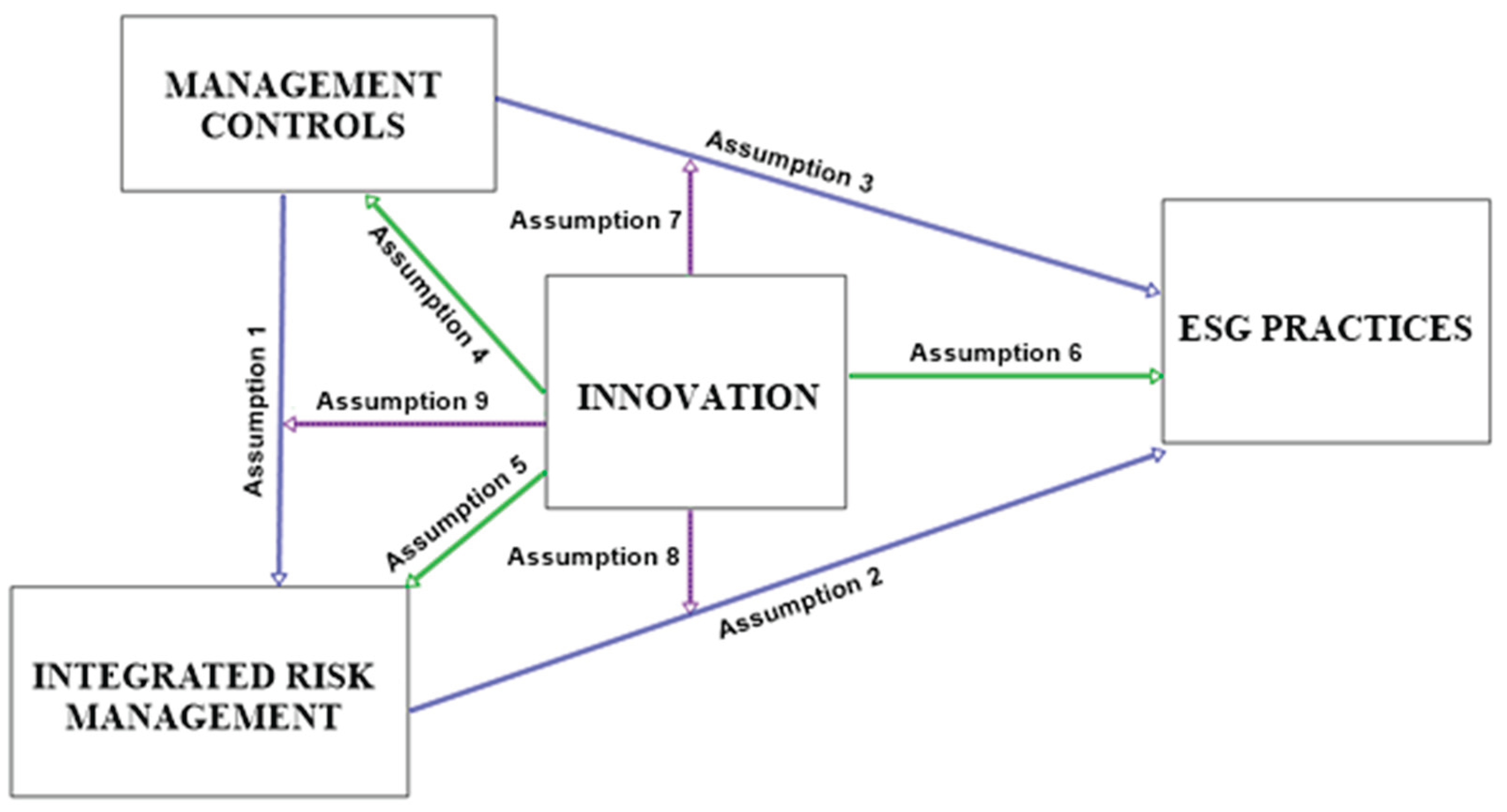

Table 1.
Research construct.
| Block 01 - Profile of the specialist respondent | |||
| Approach | Theoretical basis | 1st round questions | 2nd round questions |
| Name; age; degree course; highest qualification; professional activity; length of time in professional activity; organization or institution in which you work; length of time in this organization/institution. | Prepared by the authors. | 08 questions | 01 question |
| Block 02 - Management Controls | |||
| Approach | Theoretical basis | 1st round questions | 2nd round questions |
| Identify, based on the opinion of the experts, which management controls are the most important for controlling and managing poultry production and farm activities. | [18,50,51,52,53,54] | 04 questions (01 objective question, 01 open question and 02 scale questions) and 15 management control assertions | 04 questions (01 objective question, 01 open question and 02 scale questions - with 04 non-consensus statements and 05 additional ones) |
| Block 03 - Integrated Risk Management | |||
| Approach | Theoretical basis | 1st round questions | 2nd round questions |
| Identify the environmental, biological, financial, innovation, legal, market and operational risks that have the greatest impact on poultry farming through the experts' perceptions; the experts' perceptions of the most relevant risk mitigation strategies in poultry farming. | [13,14,16,55,56,57,58,59,60,61,62,63,64,65,66,67,68] | 2 scale questions (31 risk statements in the first question and 56 strategy statements in the second question) | 2 scale questions (with 08 non-consensus statements and 7 additional ones in the first question; and with 01 non-consensus statement and 11 additional ones in the second question) |
| Block 04 - Innovation Practices | |||
| Approach | Theoretical basis | 1st round questions | 2nd round questions |
| To identify, through the opinion of the experts, which innovation practices are the most relevant in poultry farming. | [14,18,64,69,70,71,72,73,74] | 04 questions (01 objective question and 03 scale questions - with 32 innovation statements) | 05 questions (01 objective question, 01 open question [additional] and 03 scale questions - with 06 non-consensus statements and 02 additional ones) |
| Block 05 - Environmental, Social and Corporate Governance Practices (ESG) | |||
| Approach | Theoretical basis | 1st round questions | 2nd round questions |
| Identify the most relevant environmental, social and corporate governance practices in poultry farming, based on the opinions of experts. | [21,75,76,77] | 01 scale question (with 34 statements) | 01 scale question (with 04 non-consensus statements and 14 additional ones) |
Table 2.
Panel of experts.
| Specialist | Professional activity | Graduation | Higher degree | Area |
|---|---|---|---|---|
| 1 | Entrepreneur and Technology and Innovation Consultant | Computer Science | Master's Degree | Administration |
| 2 | University professor, with research related to agribusiness and management controls | Economy | Post-Doctorate | Administration |
| 3 | Risk management and internal controls consultant | Accounting Sciences | Doctorate | Controlling and Accounting |
| 4 | University professor, with research related to innovation in agribusiness | Agronomy | Doctorate | Agronomy |
| 5 | ESG Coordinator | Environmental and Sanitary Engineering | Specialization | ESG |
| 6 | Sustainability Coordinator |
Social Sciences |
Doctorate | Rural Development |
| 7 | Manager of an innovation startup | Architecture and Urban Planning | Graduation | Architecture and Urban Planning |
| 8 | University professor and researcher in the field of management controls and risk management | Accounting and Administration | Doctorate | Accouting |
| 9 | Poultry Production Process Manager | Administration | Master's Degree | Accounting and Administration |
| 10 | Agricultural Manager of a poultry industry | Administration | Specialization | Agribusiness |
| 11 | University professor, with research related to management controls and risk management | Accounting Sciences | Doctorate | Accounting |
| 12 | Professor/Researcher in the area of management controls and risk management | Accounting | Doctorate | Accounting and Administration |
| 13 | University lecturer with research in agribusiness | Accounting Sciences | Doctorate | Agribusiness |
| 14 | Professor/Researcher in the area of management controls and risk management | Accounting | Doctorate | Accounting |
| 15 | University professor, with research in the areas of management controls and risk management | Accounting Sciences | Doctorate | Accounting and Administration |
Table 3.
Introductory blocks: profile of the poultry farmer, information on the property and identification of the poultry activity, and family succession on the farm.
Table 3.
Introductory blocks: profile of the poultry farmer, information on the property and identification of the poultry activity, and family succession on the farm.
| Block and approach | Theoretical basis |
|---|---|
|
Block 01 - Profile of the rural business owner: questions relating to gender, age, level of education, marital status, number of children and number of children working on the property. Block 02 - Information on the property and identification of the poultry business: questions related to the location of the property, size of the property in hectares, area used for poultry production, participation in the integration system with the agro-industry/cooperative, total number of people working on the property, type of labor, number of sheds, length of time in the poultry business, production capacity and gross revenue. Block 03 - Family succession on the rural property: issues related to family generation on the property, continuity of the business in the family and permanence of the family on the rural property. |
[80,81] |
Table 4.
Experts' assessment (1st Delphi Technical Round).
| Variable | Total number of assertions sent | Degree of relevance assessed by experts (%) | Acceptance | Overall quartile average | Validated assertions (IQ ≤ 1) | Non-validated assertions (IQ > 1) | Suggested assertions | ||||||
|---|---|---|---|---|---|---|---|---|---|---|---|---|---|
| N | % | 1 e 2 | 3 | 4 e 5 | % | Q1 | Q2 | Q3 | IQ | N | N | N | |
| Management Controls | 15 | 100 | 1,65 | 2,85 | 29,25 | 33,75 | 3,9 | 4,67 | 5 | 1,1 | 11 | 4 | 5 |
| Integrated Risk Management | 87 | 100 | 3,3 | 14,55 | 80,03 | 97,88 | 3,9 | 4,26 | 4,9 | 1 | 78 | 9 | 15 |
| Innovation Practices | 32 | 100 | 5,85 | 6,3 | 59,85 | 72 | 3,9 | 4,28 | 4,8 | 0,9 | 26 | 6 | 2 |
| ESG practices | 34 | 100 | 2,85 | 5,7 | 67,95 | 76,5 | 4 | 4,38 | 5 | 1 | 30 | 4 | 14 |
Table 5.
Experts' assessment (2nd Delphi Technical Round).
| Variable | Total number of assertions sent | Degree of relevance assessed by experts (%) | Acceptance | Overall quartile average | Validated assertions (IQ ≤ 1) | Non-validated assertions (IQ > 1) | ||||||
|---|---|---|---|---|---|---|---|---|---|---|---|---|
| N | % | 1 e 2 | 3 | 4 e 5 | % | Q1 | Q2 | Q3 | IQ | N | N | |
| Management Controls | 9 | 100 | 2,4 | 1,95 | 87,15 | 91,5 | 4 | 4 | 4 | 0 | 9 | 0 |
| Integrated Risk Management | 24 | 100 | 2,85 | 11,25 | 74,03 | 88,13 | 4 | 4 | 4 | 1 | 23 | 1 |
| Innovation Practices | 8 | 100 | 3,6 | 10,35 | 77,35 | 91,3 | 2,95 | 3,7 | 3,98 | 1,03 | 5 | 3 |
| ESG practices | 18 | 100 | 4,4 | 10,85 | 81,75 | 97 | 3 | 3 | 4 | 1 | 15 | 3 |
Table 6.
Management control block.
| Block and approach | Theoretical basis |
|---|---|
| Block 04 - Management controls: the questions and assertions in this block seek to understand whether farms use controls and what types are used to maintain and control poultry and farm activities. In addition, this section seeks to understand which of the controls listed in the questionnaire have the highest degree of adherence by farm managers. | [50,51,52,53,54,75,81] |
Table 7.
Management control block.
| Block and approach | Theoretical basis |
|---|---|
| Block 05 - Integrated risk management: the questions and assertions in this block seek to identify the impact of the risks present in the performance of poultry production activities and in the management of the farm. The risks were classified as: environmental risks, biological risks, financial risks, market risks, innovation risks and operational risks. In addition, mitigation strategies were listed for these risks, with the intention of preventing them from affecting the performance of poultry farming on the farm. | [50,51,52,53,54,75,81] |
Table 8.
Block of innovation practices.
| Block and approach | Theoretical basis |
|---|---|
| Block 06 - Innovation practices: In this block, the questions and assertions focus on the innovation practices present in the day-to-day running of the poultry business and the farm. The aim is to understand whether any improvements or new production processes have been implemented, measuring the extent to which the poultry farmer does or does not carry out a given innovation practice. In addition, the aim is to measure the impact generated by the adoption of these practices on poultry production activities. | [14,18,64,69,70,71,72,73,74] |
Table 9.
Block of ESG practices.
| Block and approach | Theoretical basis |
|---|---|
Block 07 - ESG practices: the questions and assertions in this block deal with environmental, social and corporate governance (ESG) practices, with the aim of identifying how these are carried out by poultry farmers when carrying out poultry activities and managing the farm. This section has been classified into three segments of ESG, in order to observe and understand how the poultry farmer works in each one:
|
[14,64,69,70,71,72,73,74,81] |
Disclaimer/Publisher’s Note: The statements, opinions and data contained in all publications are solely those of the individual author(s) and contributor(s) and not of MDPI and/or the editor(s). MDPI and/or the editor(s) disclaim responsibility for any injury to people or property resulting from any ideas, methods, instructions or products referred to in the content. |
© 2025 by the authors. Licensee MDPI, Basel, Switzerland. This article is an open access article distributed under the terms and conditions of the Creative Commons Attribution (CC BY) license (http://creativecommons.org/licenses/by/4.0/).
Copyright: This open access article is published under a Creative Commons CC BY 4.0 license, which permit the free download, distribution, and reuse, provided that the author and preprint are cited in any reuse.