

Submitted:
26 May 2025
Posted:
26 May 2025
You are already at the latest version
Abstract
The growing frequency and severity of extreme events, both natural and human-induced, have heightened concerns about the resilience of power systems. Enhancing the resilience of power systems alleviates the adverse impacts of power outages caused by unforeseen events, delivering substantial social and economic benefits. Energy storage systems play a crucial role in enhancing the resilience of power systems. Researchers have proposed various single and hybrid energy storage systems to enhance power system resilience. However, a comprehensive review of the latest trends in utilizing energy storage systems to address the challenges related to improving power system resilience is required. This critical review, therefore, discusses various aspects of energy storage systems, such as type, capacity, and efficacy as well as modeling and control in the context of power system resilience enhancement. Finally, this review suggests future research directions leading to optimal use of energy storage systems for enhancing resilience of power systems.
Keywords:
energy storage system
; extreme events
; power outage
; power system resilience
1. Introduction
Due to climate change, the frequency and intensity of natural disasters are increasing. Natural disasters such as wildfires, floods, earthquakes, and ice storms are significant causes of extensive, prolonged power outages that adversely affect industrial production, human health, and economy [1]. Table 1 shows the large-scale power outages caused by some recent natural disasters. Power system resilience refers to the capacity to minimize the severity, impact, and duration of degradation, ensuring the continuity of essential services after an extreme event [2]. Traditionally, diesel generators were used to provide backup power during prolonged outages for resilience enhancement. However, concerns regarding environmental impacts, fuel accessibility during natural disasters, and fuel costs have shifted the focus toward using Energy Storage Systems (ESSs) instead [3].
The deployment of ESSs is an effective strategy for improving power system resilience. They can bridge the gap between demand and supply, improving power system stability, reliability, and power quality [3]. Moreover, ESSs provide the initial energy during the transition from grid-connected mode to isolated mode of operation for microgrids (MGs) [3]. ESSs can be installed at all levels of the power system including generation (large-scale ESSs), transmission, distribution, and load side [9]. They can be utilized for system hardening, distributing, smartening, and building purposes against natural disasters [10]. Researchers have explored various single and hybrid ESSs in stationary and mobile configurations, each offering unique advantages in terms of performance, scalability, and cost-effectiveness. However, with evolving grid dynamics and increasing penetration of renewable energy sources, a comprehensive understanding of the latest advancements in ESS applications for resilience enhancement is essential.
This study aims to address the knowledge gap by critically reviewing recent literature about the impact of ESSs on power system resilience. It examines key aspects, such as the optimal sizing and placement of ESSs as well as the techno-economic implications of various topologies, to improve power system resilience against natural disasters.
The role of ESSs in enhancing power system resilience has been reviewed by several authors. The authors in [1] have reviewed the allocation and economic evaluation of mobile energy storage systems (MESSs) in improving power system resilience against natural disasters. However, most of the research on MESSs has been published in the last two years, which needs to be critically reviewed. In [11], the role of ESSs in providing black start services has been reviewed. Nevertheless, the role of ESSs in resilience improvement is a broader concept, which covers not only black start, but also some other roles performed by ESSs, before, during and after the occurrence of extreme events. The review in [6] focuses exclusively on electric vehicles (EVs) and examines their role in enhancing resilience. However, this work is limited to EVs, and most of the reviewed literature was published before 2021. Since then, many additional research studies on this topic have emerged. To address these gaps, this paper offers a comprehensive review of the impacts of ESSs on the resiliency of power systems. The contributions of this paper are outlined below:
- To assess the role of optimally sized and placed stationary ESSs (SESSs) in enhancing power system resilience.
- To investigate the optimal utilization of MESSs in providing emergency support during natural disasters.
- To highlight the effectiveness of stationary-mobile-integrated ESSs (SMI-ESSs) for improving resilience.
- To evaluate the impact on resilience by combining the ESSs with complementary characteristics to form hybrid energy storage systems (HESSs).
- To elaborate the correlation between resiliency indices and ESSs.
The paper is organized as follows: Section 2 explains the methodology used for this literature review. Section 3 discusses different aspects of power system resilience. Section 4 discusses the role of ESSs in enhancing power system resilience. Section 5 covers the impact of natural disasters on ESSs. Section 6 provides the conclusions, whereas the recommendations for future research are presented in Section 7.
2. Literature Review Methodology
This work aims to provide a comprehensive review of the critical role of ESSs in enhancing power system resilience. For this study, a step-by-step procedure has been followed for shortlisting the most relevant and recent articles. The selection and screening approach is depicted in Figure 1.
The final collection of articles comprises those published over the last five years, as this timespan covers most of the research carried out on improving power system resilience through ESSs.
Initially, the documents related to ESSs and power system resilience have been searched in eminent scientific databases including Scopus, IEEE Xplore, and Google Scholar. Specific keywords, such as (“energy storage” AND “power system” AND (“resilience” OR “resiliency”)) have been used as the primary selection criteria. Initially, 646 documents were found using the search terms. The first screening stage reduced the total number of papers to 575 by eliminating the papers related to cybersecurity and languages other than English. Cybersecurity-related studies were excluded from this review, which focuses specifically on power system resilience to natural disasters—such as wildfires, floods, earthquakes, and windstorms—as outlined in the previous section. In the second screening stage, papers unrelated to engineering and energy subjects were excluded, resulting in 526 remaining papers. In the third screening stage, only the journal articles and review papers were retained, thereby limiting the number to 251. The distribution of articles over the last decade is depicted in Figure 2.
It can be observed that a sharp rise in the publications has occurred since 2023. In the final screening stage, the manual elimination of the less relevant articles has been carried out, and 100 most relevant and recent articles, published in the last five years, have been shortlisted for review.
3. Power System Resilience
3.1. Definition and Indices
This section explores advancements in resilience metrics by examining their general attributes and characteristics.
3.1.1. General Characteristics of Power System Resilience Indices
Resilience metrics in power systems are generally classified into two categories: attribute-based and performance-based metrics [12,13]. Attribute-based metrics focus on identifying the characteristics that enhance or diminish system resilience compared to its current state. These metrics assess various attributes such as robustness, adaptability, resourcefulness, and recoverability [14,15]. Conversely, performance-based metrics provide a quantitative measure of system resilience by evaluating infrastructure outputs, disturbances, and resilience indicators.
Several key recommendations for developing resilience metrics have been proposed in [12,13,16]. These recommendations suggest that resilience metrics should:
- Focus on high-impact, low-probability (HILP) events and their consequences, such as loss of load, financial losses, recovery costs, the number of affected individuals, critical load disruptions, and business interruptions;
- Be performance-oriented rather than solely attribute-based;
- Incorporate intrinsic uncertainties influencing response and planning activities;
- Be straightforward, applicable for both retrospective and predictive analysis, and highly consistent;
- Account for the spatial and temporal correlations of natural disasters in their impact on power system resilience ;
- Provide assessments at both the system-wide and component-specific levels.
3.1.2. Reliability-Based Indices
Several reliability-based metrics have been introduced in [17,18,19,20] to assess power system resilience. In [17], a time-series analysis approach was developed to establish a link between system resilience and factors such as loss of load frequency (LOLF), energy not supplied (ENS), loss of load expectation (LOLE), capacity margin, and the occurrence of severe storms. Meanwhile, the work in [18] evaluated resilience by analyzing the extent of load loss following catastrophic events. In [19], four key metrics were proposed to assess the impact of extreme events on MGs:
- Metric-K – estimates the expected number of line outages caused by destructive events.
- LOLP (Loss of Load Probability) – quantifies the probability of load loss during extreme conditions.
- EDNS (Expected Demand Not Supplied) – measures the anticipated shortfall in demand due to disruptions.
- Metric-G – evaluates the complexity of grid recovery following an event.
3.1.3. Indices Based on Resilience Features
Numerous resilience metrics have been developed based on power system attributes such as resourcefulness, rapid recovery, robustness, and adaptability [21]. One study [22] proposed five key metrics: (i) load-shedding investment costs (resourcefulness), (ii) restoration savings costs (rapid recovery), (iii) algebraic connectivity (robustness), (iv) betweenness centrality (robustness), and (v) adaptability percentage (adaptability). These parameters are weighted to determine an overall resilience metric. Another study introduced three resilience metrics [23]: (i) flexibility metrics, which measure the proportion of load served after each recovery iteration through topology control relative to total demand; (ii) outage cost recovery metrics, assessing regained customer interruption costs after corrective actions; and (iii) outage recovery capacity metrics, evaluating the percentage of recovered load in each recovery step relative to the total lost demand.
The concept of resilience curve has been used to model and quantify resilience as a time-dependent function relative to disruptive events [16] . Based on this framework, a set of metrics, known as FLEP, has been proposed [24,25] :
F (Fast): How quickly resilience declines during the initial disturbance;
L (Low): The extent of resilience degradation in the first phase;
E (Extensive): The severity of system impairment in the post-disturbance phase;
P (Prompt): The speed at which the system recovers.
Additionally, the resilience curve has been employed to develop a metric that evaluates critical load supply in restorative and post-restorative states [26]:
In (1), represents the system performance function, while denotes the point in time when the restoration phase begins, and signifies the total duration of both the restoration and post-restoration phases. Comparable metrics have been introduced in prior research [27,28,29]. The resilience curve (Figure 3) is segmented into four distinct states and three transitions between these states. The four states include resilient state, post-event degraded state, post-restoration state, and infrastructure recovery state [30]. The three transitions consist of event progress, restoration, and maintenance. The system’s resilience level before an event occurs is represented by , where denotes an appropriate resilience metric. The first state, known as the resilient state (), continues until the disruptive event impacts the network at time . During this state, preventive strategies are recommended, and the system should exhibit robustness to maintain a high level of resilience. The degradation transition is illustrated as a curve over the duration , reflecting the decline in resilience. To enhance operational flexibility, the post-event degraded state is introduced as the second state, incorporating network reconfiguration strategies that leverage resourcefulness and redundancy. Following this, the restoration process marks the system’s gradual return to an intermediate resilience level , assuming a recovery process. The post-restoration state accounts for logistical delays, such as the travel time of repair crews and the procurement of spare components, while the system remains at the intermediate resilience level . Finally, during the maintenance period , the system undergoes full restoration, ultimately reaching the infrastructure recovery state and regaining its original resilience level .
Studies in [32,33,34] define power system resilience as the ratio of the area under the target performance curve to that of the actual performance curve. Typically, the target performance curve is modeled as a constant, whereas the actual performance curve fluctuates over time due to system restoration efforts and the impact of major disruptions. Additionally, a resilience metric based on the maximum decline in system performance and associated losses has been introduced in [35], [36], formulated as follows:
where represents the maximum observed decline in system performance, while denotes the total loss experienced by the operator in a scenario where all loads and distributed generators are completely disconnected.
A separate resilience metric, which considers the duration and profile of an event, has been introduced in [37] and is defined as follows:
where represents the failure profile, while denotes the recovery profile. Additionally, corresponds to the time of incident occurrence, indicates the duration of system failure, and represents the recovery period.
A resilience metric grounded in the Cobb-Douglas Production Function—incorporating the factors of anticipation, adaptation, perception, and response—has been introduced in [38] and is defined as follows:
where represents collective resilience, while , , , and correspond to the system’s ability to anticipate, adapt, perceive, and respond, respectively. The exponents (, , , and ) denote the relative importance of each ability, with their sum constrained by .
In [39], resilience was quantified as the inverse of the average comprehensive load loss, with a focus on critical loads. A separate metric introduced in [40] assessed resilience in multi-microgrid (MMG) systems by computing the average total energy curtailment during disruptions. In [41], a resilience metric was formulated to measure functional service degradation during extreme events. Graph theory and the Choquet integral were utilized in [42] to develop a resilience metric for distribution networks (DNs). This approach incorporates seven key factors: overlapping branches, path redundancy, repeated energy sources, switch operations, penalty factors, probability of availability, and the dominance of an aggregated central point. Moreover, [43] proposed a resilience evaluation metric specifically for earthquake scenarios. This metric is based on the ratio of discharged energy from a battery energy storage system (BESS) during emergencies to the energy required by critical loads.
Despite the existence of numerous metrics to assess power system resilience, these metrics often fall short of fully capturing the resilience of power systems [22,44]. The limitations include: (i) an underestimation of high-impact events while primarily focusing on normal operating conditions, thereby failing to adequately address outages caused by severe natural disasters; (ii) the use of a flat-rate pricing scheme for lost load, which does not account for the compounded cost when outages caused by natural disasters persist for extended periods [45]; (iii) relying solely on the probability of system failure may not be sufficient, as evaluting HILP probability using historical data can be difficult [46]; and (iv) focusing on short-range timescales to assess system performance during a single, isolated HILP event, cannot account for the entire temporal span and progression of the disruption [44].
To effectively capture power system resilience, resilience metrics should: (i) address the realistic and comprehensive impacts of HILP events such as extreme weather events; (ii) adjust the cost of lost load based on the duration of the outage caused by natural disasters; (iii) account for social, geographical and safety consequences of disruptions; and (iv) adopt a time-dependent quantification of resiliency that captures a wide range of disruption scenarios across the entire duration of a HILP event [44]-[46].
3.2. Challenges Associated with Power System Resilience
Aging infrastructure, rapid demand growth, environmental concerns, diverse generation sources, and political and regulatory challenges may compromise the resilient operation of power systems during HILP events [47]. Several challenges to the power system resiliency and their enabling factors are presented in Figure 4. A brief description of these challenges is given below.
3.2.1. Aging Infrastructure
Several power plants and their infrastructure are decades old, leading to higher failure frequencies compared to similar new components. In addition, they require regular, costly maintenance, which may be difficult due to the geographical disparity of the components and strict budget constraints.
3.2.2. Growing Demand
The growing demand is putting additional pressure on the existing infrastructure and necessitating its expansion.
3.2.3. Diversity of Generation
The integration of renewable-based resources, distributed energy resources (DERs), and storage is increasing the complexity of power systems. The power system nature is becoming more distributed and diversity of DERs is enabling several vulnerabilities in the network.
3.2.4. Political and Regulatory
Due to climate change and global warming, extreme weather events such as floods, earthquakes, and wildfires are increasing worldwide [48]. Lack of awareness and insufficient policies and regulations for power system resiliency pose major challenges in ensuring the resiliency of the power grid.
3.3. Measures to Enhance Power System Resilience
Enhancing power system resiliency is crucial to combat extreme events across generation, transmission, and distribution levels. The enhancement strategy of power system resilience can be categorized into four pillars – smartening the network, hardening the structure, integrating distributed generation, and building efficiency as shown in Figure 5 [10].
3.3.1. Smartening
Smart power systems integrated with emerging technologies, smart metering infrastructure, communication protocols, and digitalization and interconnected structures enable real-time monitoring, situational awareness, smart control and adaptive protection of the network [50]. Besides, automatic outage detection and reliable forecasting can significantly reduce power system vulnerability and enhance resilience in the face of disasters.
3.3.2. Hardening/Reinforcing
Hardening/reinforcing measures ensure robust and resistant infrastructure that can minimize the physical consequences of extreme events on the power system. Poles and towers can be upgraded, critical overhead lines can be replaced by underground lines, and substations can be elevated as resiliency enhancement measures to combat against disasters. For example, the failure probability of overhead lines is 0.3 whereas the failure probability of underground pipelines is 0.1 against natural disasters [51]. In addition, designing redundant transmission routes and vegetation management help to minimize power disruption.
3.3.3. Distributing
Distributing plays a significant role in enhancing resiliency through various planning and operational schemes such as renewable integration, MG formation, restructuring ancillary services, reconfiguring networks, and adopting control algorithms [49]. MGs with sufficient levels of generation capacity and ESSs can exchange power to the main grid and can be self-sustained during outages of the main grid as shown in Figure 6. As shown in Figure 6(a), consumers outside MGs experience degraded system performance and may suffer from outages during extreme events until the restoration process is completed. On the other hand, as shown in Figure 6(b), consumers within MGs benefit from a more sustained power supply during extreme events, due to the strategic management of DERs and ESSs, until reconnection to the main grid.
3.3.4. Building
Building mini and microgrids with energy-efficient structures, energy storage backup facilities, passive solar utilization, and use of thermal mass can reduce the dependencies on the power grid and accomplish a resilient power system. PV and BESS can be integrated to support the grid during emergencies and improve overall resilience [52]. In addition, during emergencies, power can be provided using MESSs. Furthermore, recent developments in EV charging infrastructure have excellent potential for enhancing resiliency during extreme events [53].
4. Role of Energy Storage Systems in Enhancing Resilience
ESSs in various configurations, such as SESSs, MESSs, SMI-ESSs, and HESSs, play a vital role in enhancing resilience. They enhance power system stability, support MG development, and offer black start capability, energy arbitrage, and ancillary services, thereby improving overall power system resilience.
4.1. Role of Stationary Energy Storage Systems (SESSs)
Several researchers have proposed optimal sizing and placement of SESSs to improve power system resilience against HILP events, as discussed below.
4.1.1. Specific Natural Disasters
Some researchers have modeled a typical natural disaster and its impact on power system to develop resilience against it. Using SESSs to enhance resilience against windstorms, hurricanes, typhoons, earthquakes, wildfires and ice disasters is discussed in this subsection. Figure 7 illustrates natural disasters considered in the reviewed SESS-related studies.
The techno-economic feasibility of the hybrid system comprising solar PV, ESS, and diesel generator, as well as optimal sizing of solar PV and BESS is provided in [54] to enhance the resilience of three critical buildings (high schools, fire stations, and residential areas for the elderly) against hurricanes. The results reveal that the addition of ESS makes the system more economical in improving resilience as it reduces the reliance on utility for meeting load demand. Moreover, although diesel generator has a lower initial cost, the lifecycle cost of solar PV and storage is lower than diesel generator. In [55], Hydrogen Storage System (HSS) is used to improve resilience against hurricanes, earthquakes, and extreme cold weather. Each of these events occurs once during 20-year planning horizon in that study. Information-gap decision theory (IGDT) is used to model the uncertainty of extreme events. The results indicate that a resilience improvement of over 93% can be achieved with a 10% increase in the resilience budget. Similarly, the work in [56] improves short-term resilience against hurricanes using a three-stage optimization strategy. The first stage minimizes the installation cost of MGs. The second stage minimizes electrical demand deviation from optimal value to implement demand side management (DSM). Lastly, the third stage, minimizes operation cost and loss of power supply probability (LPSP) while ensuring that ESSs are charged by local generation and their stored energy is consumed locally [56]. Consequently, the LPSP for an integrated energy hub (EH) comprising electricity-heat-gas is improved by 52.2%.
Resilience against windstorms for interconnected EHs is improved using ESSs in [57]. The stochastic optimization scheduling maximizes profit during normal operation hours and minimizes load shedding during outage duration. A 64% and 76% reduced load shedding is achieved using peer-to-peer (P2P) energy trading alone and P2P with the use of ESSs, respectively. The authors in [58] have proposed convex formulation for line hardening and outage probability modelling against windstorms, incorporating the use of ESSs. The proposed joint planning and operation strategy has brought 46.15% reduction in load shedding cost and 42.45% reduction in investment cost as compared to planning only results. Similarly, compared with only operational methodology, a 40.63% and 25.32% reduction in load shedding cost and investment cost is achieved. Hence, it is concluded that the combined planning and operation optimization provides improved results in terms of economy and resilience as compared to applying planning and operation individually. A two-stage optimization model is presented in [59] to improve distribution system (DS) resilience against extreme winds by optimally placing BESSs. The impact of critical period (from one hour to several hours after the disaster, obtained from historical data) on resilience index is plotted, which shows that for a shorter critical period, batteries with less power cost ($/MW) perform better in improving resilience index (RI). Conversely, for a longer critical period, batteries with low energy price ($/MWh) perform better. The authors in [60] propose a risk-averse three-stage robust reliable and resilient DS expansion planning model. The optimal location and sizing of BESSs has been suggested for resilience enhancement against the risk from extreme winds. Moreover, hourly reconfiguration design has been proposed. The results reveal that a higher resilience requires more investment as well as more penetration of BESSs. In [61], resilience against windstorms of an active distribution network (ADN) is improved by optimal placement of steam turbines, wind turbines (WTs), and BESS. The results suggest that the proposed scheme enhances resilience by 57.03% for IEEE 33-bus network.
In [62], a two-stage optimization is performed for optimized planning and operation of underground ESSs (UESSs) against ice and typhoon. The planning stage determines optimal capacity and power of UESS, and the operation stage performs daily optimal dispatch. The study suggests, although UESSs are more expensive than above-the-ground ESSs, they become economically justifiable in the case of severe extreme events. Resilience against typhoons is improved through restorative actions using the optimal number and location of PV-energy storage-charging station (PV-ES-CS) in [63]. A bi-level strategy for hybrid AC/DC DNs is used. The combined balancing of resilience and economy for finding the optimal size and location of BESSs increases resilience by 62.29% and economic benefit by 63.33% as compared to using individual single-objective models. A tri-layer stochastic robust optimization (SRO) strategy is proposed in [64] for pre-disaster planning of a hydrogen-electricity integrated energy system (H-EIES) to enhance resilience against typhoons. The outer layer determines the capacity and location of H2Ps. The middle layer finds out the most severe typhoons scenario, whereas the inner layer determines the optimal system operation. Wasserstein generative adversarial network with gradient penalty and spectral clustering method to model the typhoon behavior are used. A 95.7% reduction is achieved in losses related to load shedding.
The work in [65] combines grid side and demand side hardening by using SESSs to improve resilience against earthquakes. In the first level, the probabilistic model of earthquake is based on Monte-Carlo method, where peak ground acceleration (PGA) and fragility curve-based vulnerability assessment is performed along with determination of optimal clusters. The cost optimization is performed in the second level. In [66], the investment and operational costs (during normal and abnormal operating conditions) of photovoltaic distributed generation (PVDG) and BESS are minimized while minimizing load curtailment. Moreover, the impact of minimum state of charge (SOC) threshold during normal operating conditions on resilience against earthquakes is evaluated. The results reveal that the combined use of BESS and PVDG decreases load curtailment up to 55.46%, but with an 8.57% increase in total cost as compared to the use of PVDG alone. Moreover, the increase in minimum SOC during normal operation improves resilience by ensuring energy backup for certain minimum number of hours, albeit requires more investment in BESS. The work in [67] uses the released seismic energy from an earthquake to estimate PGA. The proposed dynamic generator resiliency model determines the impact of PGA on the mechanical power of generators and evaluates the impact on synchronism status of generators and transient stability of the power system. Resilience against wildfires is enhanced in [68] through the use of ESSs. The impact of wildfire is modeled using radiative heat gain to impact the dynamic thermal rating of the lines. The same wildfire modeling approach is also adopted in [69]. The operation cost is minimized by formulating the problem as a mixed-integer linear programming (MILP) optimization model. The authors in [70] have proposed a fire danger index forecast methodology using a novel deep feature selection neural network and a forecasting engine neural network. The study in [71] reviews the direct and indirect impacts of wildfires on power systems. It highlights that wildfires can impact energy resources, damage transmission lines and poles, as well as reduce the capacity of transmission and distribution lines. The BESS and thermal energy storage (TES) have been listed as the resilience enhancement measures.
Figure 8 presents a structured framework for analyzing the impacts of specific natural disasters on power systems, categorizing them into four primary types: earthquakes, extreme winds or windstorms, extreme cold or ice disasters, and wildfires.
Each disaster type is associated with a particular modeling approach tailored to capture its unique characteristics. For earthquakes, a fragility model is employed to evaluate seismic activities, specifically estimating the damage probability of electrical infrastructure [62,63]. Extreme cold or ice disasters are typically analyzed through snowfall intensity, frost depth, as well as duration and severity of sub-zero temperatures, focusing on, e.g., overhead line failures and wind turbine blade damages. Wildfires are assessed based on the effects of radiation and convection, with dynamic line rating considerations [65,71]. As conduction contributes to an increase in conductor temperature only when the fire is in direct contact with the conductor, only convective and radiative heat transfer mechanisms are considered here [78,79]. In the case of extreme winds or windstorms, the analysis focuses on wind speed and gusts using fragility models to assess line outages [57]. Although the Weibull distribution function remains the most commonly used method due to its simplicity, it may not accurately capture the uncertain and distinct statistical behavior of wind [54,55]. As a result, some researchers have proposed non-parametric distribution models [75], though studies in this area remain limited. To address these challenges more effectively, a more robust approach involves the use of zonal wind-speed-specific uncertainty sets [74], which better account for spatial and probabilistic variations of wind behavior, thereby enhancing resilience assessments.
The hierarchical framework in Figure 8 provides a comprehensive approach to evaluating the impacts of natural hazards on power system infrastructure, emphasizing the importance of adopting advanced modeling techniques, where innovative uncertainty models offer significant improvements over traditional methods.
4.1.2. Community-Level Solutions
Community-level storage projects provide benefits such as lower energy costs for the community, participation in ancillary services and energy arbitrage, provision of backup supply to enhance resilience, and support in integration of renewable generations. Victorian Neighbourhood Battery Initiative is a good example of community-level storage where batteries ranging from 100 kW to 5 MW, located at street level, are connected in front of the meter to the DS. They are also referred to as grid-scale batteries [80].
The work in [81] uses BESS as a cloud energy storage to enhance the resilience of IEEE 69-bus system. This multi-stage resilience strategy covers pre-avoidance, avoidance, survival and post-disaster phases of resilience. In [82], optimal sizing of distributed battery energy storage (DBES) and community battery energy storage (CBES) has been obtained to improve resilience against outages while minimizing net present cost (NPC). The results reveal that despite higher capacity requirement, CBES outperforms DBES in terms of NPC and resilience enhancement as it can participate in energy arbitration due to its larger size. The work in [83] uses geographical information system (GIS) integrated with multi-criteria decision-making to obtain optimum location and sizing of BESS to improve resilience of an urban area. This strategy proves to be effective as it reduces shortfall from 13,184 MWh to 12,931 MWh.
4.1.3. Behind the Meter Energy Storage
Nowadays, most of the behind the meter (BTM) ESSs are integrated with solar PV, with BESS as the leading storage technology [84]. BTM ESSs are utilized by many critical facilities to be used as a backup supply. BTM ESSs when coupled with rooftop solar PV, can provide longer backup during public safety power shutoffs (PSPSs) lasting for several days depending on the size of these systems and rating of the loads [85]. Their installed capacity is expected to approach 20 GW by the year 2025 [84]. However, most of the research works have focussed on the use of grid-side hardening solutions for resilience enhancement as compared to demand-side hardening. Some research works highlighting the effectiveness of BTM ESSs are discussed here.
In [86], BTM ESSs are analyzed in improving the resilience of mission critical facilities. It is observed that by selecting the ESSs rated at 75% of the peak demand of the facility and 4-hour discharge capacity, 70% of the critical loads can be served. The Brute force enumeration method has been used for scenario generation in that study. This work uses data from 24 facilities across diverse sectors, such as hospitals, residential buildings, and commercial buildings, to propose BTM ESS as a strategy for resilience enhancement. The work in [65] combines grid side and demand side hardening by using BESSs to improve resilience against earthquakes. The results suggest that the use of home batteries along with grid side ESSs provides improved resilience as compared to the use of grid-side batteries alone.
4.1.4. Integrated Energy Systems (IESs)
In [87], EES, TES and cooling energy storage (CES) have been used for improving the resilience of an EH. N-1 contingencies have been simulated to assess the efficacy of the design. The work in [88] has increased resilience of EHs by 16.86% by combining electrical, heating and cooling ESSs. Small, medium, and large EHs have been used as case studies. The work in [89] has proposed the use of HSS-TES-BESS for enhancing the resilience of isolated MGs. In that work, a customized Benders Decomposition Algorithm for solving the cost minimization problem has been used. A resilience-oriented planning strategy has been adopted in [90] to utilize EES-TES for integrated electricity and heat systems (IEHSs). An SDRO model has been converted to three-level min-max-min model and solved using a customized column-and-constraint generation (C&CG) algorithm. Optimal sizing of HSS-EES-TES has been demonstrated in [91] for improving the resilience against extreme weather events, such as hurricanes, for an integrated multi-energy system. This work considers life degradation models of ESSs while formulating a two-layer optimization problem. The upper layer of this problem determines the optimal capacity of the equipment, such as ESSs, whereas the lower layer minimizes daily operating cost including cost of load shedding. The results suggest that the inclusion of extreme disaster scenarios, such as hurricane, in the upper layer results in the higher capacity of ESSs, while leading to improvement in resilience. The resilience of a regional IES has been improved by using TES in [92]. A two-stage rolling optimization for minimizing the operation cost and required storage capacity has been used, which ensures that load-shedding does not exceed the users’ satisfaction level. As a result, the number of interruption intervals has been decreased from 47 to 15 in summer and from 22 to 4 in winter.
4.1.5. Other Resiliency-Related Applications of SESSs
The planning work in [93] improves resilience against natural disasters of a DS using a bi-level stochastic optimization approach. It performs day-ahead scheduling of MG excluding uncertainties in the first stage, while the stage-two performs real-time scheduling including uncertainties. The results of this study reveal that a 25% increase in operational cost has improved the resilience of the MG by 70%. The resilience against multi faults is increased in [94] using a two-layer optimization strategy. The location and capacity of ESSs is optimized in the outer layer, while fault recovery is optimized in the inner layer. Random sampling and k-mean clustering is used for scenario generation. Consequently, a 13.36% and 8.25% improvement in resilience is obtained for 33-bus and 118-bus systems. In [95], a flexible planning model equipped with ESSs is used to decrease the load shedding of IEEE 24-bus test system and a practical test system using a two-layer flexible model. The work in [96] proposes composite RIs as well as uses a three-stage optimal dispatch and reconfiguration to improve resilience of a campus building against extreme weather events. The first stage performs energy-level DER scheduling while optimizing RIs. The second stage adjusts system reconfiguration to satisfy grid codes. The third stage verifies the dynamic performance of the model considering uncertainties and fluctuations. The results outperform three existing strategies used for the same purpose.
The work in [97] proposes a two-level multi-stage optimization to improve the resilience of DSs against external shocks. The first level determines optimal bidding for day-ahead and real-time in two stages. The second level performs optimal scheduling for day-ahead, and real-time in the first two stages, whereas the third stage optimal dispatch of system resources is carried out in case of an external shock. The resilience, in this work, is improved using MMG formation. The operation cost is minimized considering day-ahead and real-time optimal energy arbitrage and considerable cost reduction is achieved. Moreover, a three-stage robust planning is performed in [98] for optimal sizing and location of WTs, BESSs, and diesel generators. The first stage minimizes the annual investment and operation cost. The second stage minimizes operational costs including wind uncertainty and operational constraints. The third stage minimizes the line outage under emergency conditions.
The resilience of a substation is improved using BESS in [99]. Machine learning is used for outage prediction, which is up to 78% accurate, and a multi-objective chance constraint optimization model is developed, with the objective function as weighted sum of cost reduction and outage prevention, for the scheduling of BESS. The authors in [100] have suggested a two-stage coordinated approach for high-voltage (HV)-medium-voltage (MV) systems using a combination of deep learning and optimization to obtain the optimal siting and sizing of ESSs while improving economy as well as resilience of the power system. The first stage minimizes investment and operation cost and calculates optimal rated power and capacity of ESS. The second stage determines ESS charge/discharge while optimizing HV and MV DNs. Moreover, this work has combined K-means clustering with deep learning-based scenario generation and clique spatial distribution to improve the uncertainty modeling. The proposed methodology provides superior results than stochastic and robust optimization (RO) methods. In [101], the impact of offshore wind farms’ configuration on the optimal size of BESS is determined while maximizing resilience. The results of this combined planning and operation study using a two-stage stochastic formulation suggest the optimal size of BESS is 16% of the daily wind generation at full capacity. The work in [102] uses a two-level deep reinforcement learning (DRL) to optimally utilize ESSs for maximizing load restoration. This data-driven approach performs better than model-based methods in terms of restoration and running time as demonstrated by the results. Similarly, the resilience of a DS is improved using ESSs in [103], where an analytic hierarchy process is used to evaluate different combinations of BESS and solar PV generation to improve resilience against extreme events. The optimal sizing and location of BESS have been found while minimizing investment and operational costs. The cost-effectiveness of the solutions against coverage levels is analyzed in that study. A fuzzy logic-based variable charging rate of BESS is proposed in [104] for improving resilience of a DS against natural disasters, and it is demonstrated that variable charging rate results in a better RI as compared to using fixed charging rate. The authors in [105] improve resilience of a DS using stochastic MILP optimization for finding optimal sizing and placement of ESSs. This planning strategy minimizes investment and operational costs. In [106], a new MG resilience index (MRI) is developed and the impact of increasing the installed capacity of BESS on MG resilience is evaluated. The results show that BESS has a significant impact on the resilience. An increase in capacity from 40 kW to 60 kW brings increase in MRI from 0.86 to 0.97. A further increase in BESS capacity has not brought considerable improvement in resilience. BESS is used as a part of VPP to increase resilience of IEEE 85-bus system against extreme weather events in [107]. Hunting Prey Optimization (HPO) is used to find optimal location and size of VPP components. In [108], a coordinated water and power recovery is proposed for the DS. The DN uses BESS to facilitate recovery. An 8.9% reduction in energy curtailment cost is achieved by this strategy. Supercapacitor (SC) has been suggested and validated in [109] to improve the resilience of an autonomous DC-MG against severe weather conditions. In [110], power-to-hydrogen (P2H) has been used for resilient day-ahead scheduling of a DS. The results show a 40.89% cost reduction for risk-neutral case and 40.32% cost reduction for risk-averse case due to the use of P2H. The work in [111] uses BESS with run-of-river plant for black-start service of a regional power system. The BESS with grid-following (GFL) droop control provides frequency support, whereas BESS with grid-forming (GFM) control can provide black-start service by operating alone. In [112], network resilience is maximized while finding the optimal placement and sizing of dispatchable generation, renewable generation, and BESS. The problem is formulated as MILP. The role of ESSs in resilience enhancement is feeding load during faults as well as increasing the renewable integration. The work in [113] uses BESS and EV to improve resilience of a MG against natural disasters. A resilient day-ahead two-stage scheduling strategy is adopted to minimize operational cost. The resilience of a hospital is improved in [114] by using BESSs in a MG. It is demonstrated that the increased duration of outages requires increased sizes of ESSs to maintain resiliency. Table 2 summarizes key information from the reviewed literature on SESSs for enhancing power system resilience.
Figure 9 illustrates that most of the reviewed SESSs are BESSs. Some research papers have considered TES and HSS, while only a few works have considered other ESSs to enhance power system resilience.
4.2. Role of Mobile Energy Storage Systems (MESSs)
MESSs, due to their mobility, provide more flexibility in operation as compared to SESSs. During natural disasters, MESSs demonstrate higher effectiveness in load recovery compared to SESSs [115]. They are generally vehicle mounted, where vehicles serve the purpose of storing and transporting ESSs [116]. MESSs are generally truck-mounted ESSs, however, they can also be rail-based ESSs [115] [117,118]. Rail-based transportation offers higher carrying capacity than other transportation means, as a single train can transport 1 GWh of battery storage, a capacity that would otherwise require 1,000 semi-trailers [115]. A typical vehicle-mounted MESS is shown in Figure 10. Some researchers have considered EVs, plug-in EVs (PEVs), battery electric buses (BEBs), and hydrogen vehicles as MESSs [73,119,120,121]. However, EVs utilizing vehicle-to-grid (V2G) feature require incentives for their owners to participate in grid support, whereas typical MESSs are usually utility owned and connected to a substation, unlike EVs that connect at charging stations [1]. MESSs can be fully charged and pre-allocated at optimum locations as a preventive measure to enhance the resilience of DSs [122]. They can effectively help meet the local demand during outages and be part of post-disaster restoration schemes [123]. They have the capability to provide backup power as well as black-start services [73]. They are particularly useful for MMGs, where they can store energy from operational MGs and transfer this energy by reaching the MGs under disasters [116,124]. However, the storage capacity of MESSs is generally lower than SESSs making them more suitable for short-term resilience enhancement [116]. Optimal sizing and allocation of MESSs is required to maximize resilience within affordable cost. In this regard, some researchers have designed MESSs for typical natural disasters, while others have designed MESSs for resilience enhancement against generalized extreme events. Both categories are discussed in the following subsections.
4.2.1. MESSs in Specific Natural Disasters
Several recent studies have explored the role of MESSs in enhancing power system resilience against extreme weather events such as hurricanes, typhoons, earthquakes, floods, wildfires, and winter storms. These works examine various MESS technologies, deployment strategies, and their combined use with other mobile resources, demand response, line repairs, and DS reconfiguration for resilience enhancement. Figure 11 displays the number of reviewed research works related to resilience enhancement using MESSs for different natural disasters. It is suggested by the Figure that most research works are related to extreme winds and earthquakes.
In [122], EH-integrated power system’s resilience against hurricanes has been improved using MESS and demand response. The placement of MESS acts as a preventive strategy in this work. The impact of MESS size on the resilience has been evaluated, which indicates that by increasing MESS size, the resilience increases almost linearly; however, after a certain value (250 MWh in that study), an increase in the MESS size does not improve resilience any further. Moreover, a 2.4% improvement in resilience has been observed using MESS in that study. Notably, demand response acting as a corrective action has resulted in a 7.1% improvement in resiliency. In [115], a rail-based MESS is used to enhance the resilience of joint power transmission and rail transportation system against hurricanes. The results show an 11.09% improvement in resilience by using MESS alone with transmission system, and if MESS and repairing of failed lines are used together with transmission system, a remarkable 74.39% improvement in resilience can be achieved. The resilience against typhoons has been improved in [118] using transportable battery energy system (TBES). It has been demonstrated that the MESS-based unit commitment (UC) is superior in improving resilience than SESS-based UC for IEEE RTS-24 and 118-bus systems. The authors in [121] have used HSS and hydrogen vehicles as MESS to improve resilience against typhoons. The operation cost has been minimized using MILP formulation while finding the optimal deployment of pre-disaster and post-disaster resources along with DS reconfiguration. It is found that the recovery using hydrogen vehicles is more effective during the daytime than the nighttime. Notably, among the studies mentioned above, only [115] has considered the impact of wind speed on the speed of vehicle carrying ESS.
MESSs and mobile emergency generators (MEGs) have been deployed for improving resilience against earthquakes in [125]. A stochastic bi-level optimization problem has been solved using Branch and Bound (B&B) algorithm that minimizes investment cost as well as the cost of loss of load. It is found that the combined use of MESSs and MEGs proves to be more cost-effective than MESSs, MEGs, or SESSs alone. Moreover, the joint optimization including distribution line hardening and investment in MESSs and MEGs is a more cost-effective scheme than some other combinations discussed in that work. Furthermore, it is shown that the efficacy of MESSs and MEGs is higher than DGs and SESSs for resilience improvement against earthquakes. In [120], resilience against earthquakes and floods of smart DN (SDN) having flexible renewable virtual power plant (VPP) has been improved using EVs as MESS. Operation cost and shut down cost due to natural disaster are minimized using a hybrid metaheuristic algorithm. The results prove a 95.15% improved resilience (reduced EENS) compared to load flow results. The resilience against earthquake has been increased in [126] by using MESSs and unmanned aerial vehicles (UAVs). The dispatch of MESSs and UAVs has been obtained by minimizing planning and operation costs for a coordinated distribution and transmission system, such as IEEE 39-bus transmission system and 3 IEEE 33-bus DSs. A 15.7% reduction in the reinforcement cost is achieved. So, MESSs can be combined with MEGs or UAVs to improve their efficacy in increasing power system resilience against earthquakes.
Along with floods-related work in [120], as described earlier, resilience against floods has been improved in [72] by using MESSs, and a bi-level stochastic MISOCP model has been solved for optimizing the operation cost. The results have been compared with SESSs and proved to be superior in terms of reduction in lost load and operation cost.
In [127], EVs are used as MESSs to improve resilience against wildfires for a MMG community. Machine learning-based graph convolutional networks (GCNs) are introduced to speed up the solution time, which proves to be 120 times shorter than the solution time of Gurobi. The results indicate that both 15 EVs and 18 EVs can stop the load shedding; however, 15 EVs require a higher incentive cost to be paid to the EV owners to move their vehicles among multiple MGs to supply their stored energy.
Resilience against winter storms has been improved in [128] using MESS by applying a three-stage (long-term investment stage, short-term mitigation stage, and post-disaster response stage) stochastic MILP model to optimize the investment cost as well as resilience metric. A 2000-bus Texas-based grid has been used as a case study to demonstrate the impact of this strategy. The sensitivity of the investment decision to parameters, such as budget, MESS cost, and risk aversion as well as permissible winterization, has been evaluated.
4.2.2. MESSs in Generalized Extreme Events
The work in [123] has proposed a post-event distribution restoration scheme that utilizes MESSs and MEGs in case of HILP events. The optimal dispatching and scheduling, considering traffic congestion and repair crews, have been performed to maximize the load restoration, while minimizing MEG fuel costs and battery aging costs. Sensors are deployed for extracting information about road conditions. Both MESSs and MEGs can provide black start services for forming MGs in this study. The optimization problem has been formulated as a MIQCP problem. The efficacy of the proposed methodology has been demonstrated using the modified 15-bus DS. The results suggest that the combined use of MESSs and MEGs in optimization provides superior results than using MESSs or MEGs alone. In [124], EVs have been used as MESSs for improving the resilience of MMGs. It has been illustrated that EVs controlled by a central energy management system (EMS) can store energy from healthy MGs and transfer it to islanded MGs to improve the resilience of islanded MGs. The authors in [129] have introduced four resiliency indices: withstand, recover, adapt, and prevent (WRAP) while optimally allocating MESSs for improving the resilience of a 33-bus ADN. Two-stage optimization scheme is used, where the first stage minimizes operation cost while the second stage maximizes critical load restoration. It is demonstrated that MMGs along with MESSs and tie-lines can enhance the resilience of DS. The work in [130] suggests optimal location and operation of MESSs in MMGs for enhancing resilience considering a four-stage RI. The use of IoT has reduced the operation cost by providing feedback in the EMS. PG&E 69-bus MMG power DN has been used for validating the usefulness of this approach. In [131], in the first stage, self-healing index is maximized, and current through boundary lines and cost of MESS allocation are minimized. In the second stage, the impact of external shock is minimized by finding the optimal topology of DS, the profit of active MGs (AMGs) in real-time ramp market is maximized, unserved load is minimized, and operation cost is minimized. The optimization formulations are modeled as an MILP problem in [131] for enhancing the resilience of an ADN having MGs. A 49.88% improvement in RI has been attained by the proposed strategy. The work in [119] has proposed the use of plug-in electric vehicles (PEVs) as MESSs for enhancing resilience against extreme events for multi-energy MGs (MEMGs) comprising power-heat-hydrogen systems. A stochastic optimization of EMS has been performed for scheduling of PEVs. A 25% improvement in resilience has been demonstrated by the use of the proposed strategy even without needing any tie-line. A three-stage stochastic distributed control scheme for routing and scheduling of MESSs for improving the resilience of networked MGs (NMGs) has been suggested in [74]. Although the proposed scheme is faster in terms of computation time as compared to centralized deterministic and stochastic schemes, its cost of load shedding is higher. In [117], a two-stage MILP strategy for optimal scheduling of MESSs has been used that decomposes power network and transportation networks. An 86% reduction in unmet load has been achieved by using truck-mounted mobile batteries for a DS. The work in [132] has proposed a bi-level optimization for scheduling of MESSs with the objective function of minimizing load loss as well as voltage offset to obtain post-disaster recovery. A considerable improvement in the resilience of IEEE 33-bus DS has been achieved. The work in [133] has used MESSs with PEV-parking lots to improve resilience of DS by post-disaster restoration and reconfiguration planning. It is formulated as a MIQCP problem. By solving this problem, a 12.68% higher load restoration is achieved compared to the case without MESSs and PEV-parking lots. In [134], a MEMG comprising electricity and gas networks has been selected for resilience improvement against natural disasters. N-1 contingency analysis has been undertaken to find out the most vulnerable parts of the network and post disaster ENS has been estimated. By formulating the optimization problem in the form of MILP, the optimized cost and resilience-based scheduling have been obtained. The results have been compared with three other techniques from the literature and the superiority of the proposed methodology in terms of resilience and operation cost has been illustrated. The work in [135] considers the cost of blocked roads and deployment of repair crews to clear the paths for MESSs to improve the resilience of IEEE 69-bus and 24-bus DSs against natural disasters. A 13.11% reduction in cost has been achieved by using MESSs, and repair crews have brought 12.75% reduction in cost by clearing the obstacles in the routes of MESSs. The work in [73] has utilized BEBs as dispatchable ESSs for enhancing self-healing and black start capability of a university MG. Electromagnetic Transient (EMT) simulation in MATLAB has been done to prove the efficacy of the proposed scheme. In [136], a two-stage stochastic MIP model has been developed to enhance the resilience of DS against severe and extreme weather events. The optimal size and placement of MESSs are obtained for minimizing load shedding cost. The resilience of NMGs has been improved in [137] by using a two-stage optimization scheme. The first stage finds the optimal size and initial position of MESSs prior to occurrence of a natural disaster. The second stage determines the re-allocation of MESSs and adjusts their active power after the occurrence of a natural disaster. A degradation-aware dispatch of MESSs has been proposed in [138]. The MILP formulation results in 42.52% and 34.77% improvement in the resilience of IEEE 33-bus and 118-bus networks. In [139], mobile multi-energy storages (MMESs) have been adopted for improving DS post-disaster recovery. The routing and scheduling of mobile multi-ESSs prove very effective in the recovery process. This energy-to-mobility approach brings 92.92% improvement in load restoration. The work in [140] has improved the resilience of an ADN using MESSs. In the pre-disaster phase, the pre-allocation of MESSs is achieved using C&CG algorithm. In the post-disaster recovery phase, the dynamic scheduling has been optimized while minimizing scheduling cost and load shedding cost. The focus of [141] is on optimal pre-allocation of MESSs, which has been obtained by building a pre-disaster RO model that minimizes pre-allocation cost and loss of load cost. The results indicate that for a DS having a small number of MESSs, the addition of every new MESS improves resilience by about 20%. The authors in [142] use VPPs in NMGs for joint optimization involving the weighted sum of resilience, reliability, stability, and emission indices to find the optimal capacity of VPPs that use EVs as MESSs. The results endorse the efficacy of the strategy in enhancing resilience against natural disasters. The salient features of MESS designs are summarized in Table 3.
4.3. Role of Stationary-Mobile Integrated ESSs (SMI-ESSs)
The integration of SESSs and MESSs is a comprehensive and adaptable storage strategy [143,144]. This combination of the strengths of both the systems is helpful in improving power system resilience against natural disasters [116]. SMI-ESSs are more flexible and reliable in ensuring uninterrupted power supply and stablity in case of power outages than SESSs and MESSs working alone. SMI-ESSs provide an efficient load shifting as SESSs can manage fluctuating load demands, whereas MESSs can be used during peak demand periods due to their higher cost than SESSs. Moroever, SMI-ESSs can support the integration of renewable energy by absorbing the excess energy during low demand periods and supplying this energy, whenever needed, to the loads directly connected to the associated MG or even located within neighboring MGs [116]. Some examples of SMI-ESSs’ applications in resilience enhancement are discussed here.
A novel planning scheme using stationary-mobile integrated BESS (SMI-BESS) for improving DS resilience against severe convective weather (SCW) has been presented in [145]. The impact of SCW events such as extreme wind, lightning, and hail on DS has been assessed using fragility model. This flexible design provides switching choice between SESSs and MESSs under normal and abnormal conditions. A two-stage adaptive distributionally robust optimization (2S-ADRO) has been performed for the sizing and placement of SMI-BESSs. The data of a 62-node DN from coastal region of China and 25-node DN in Guangdong Province, China have been used for demonstrating the efficacy of the design. The results validate the superiority of the proposed scheme in terms of investment cost and loss of load as compared to two other cases in this study that used SESSs alone or SESSs and mobile DGs, respectively. Similarly, the work in [116] explores the combined uses of stationary and mobile ESSs for enhancing the resilience of single and multi-area systems. Different scenarios of only stationary, only mobile, and combined stationary and mobile ESSs have been evaluated. The best resilience has been obtained by deploying both the stationary and mobile ESSs together. Moreover, the investment cost of MESSs proves to be higher than diesel generator for emergency operation in this study. The results also suggest that MESS is more beneficial for multi-area systems than for single-area system. Moreover, when the unit price of MESS is not excessively high as compared to SESS, it is advantageous to use MESS. The resilience against wildfire through reconfiguration has been improved in [146] by deploying both MESSs and SESSs. Battery-swapping station (BSS) acts as SESS. BSS can swap a fully charged battery with a depleted battery within a few minutes (e.g., 12 minutes) as compared to charging an EV that can typically take 80 minutes [147]. A smart resilience controller has been designed using dual rolling horizon optimization (DRHO) that can observe the spatiotemporal wildfire behavior, take real-time corrective actions before the arrival of wildfires, and schedule ESSs while minimizing load shedding cost. Real world wildfire data of Alberta wildfires and radiation-based wildfire propagation model have been used. The controller has demonstrated improved robustness against uncertainties as compared to stochastic approaches. Moreover, the results demonstrate that the use of DERs is more cost-effective and provides a higher load restoration as compared to the case that does not use DERs. In [148], resilience enhancement for a multi-energy DS is performed using post-disaster joint reconfiguration of heat and power networks and deployment of SESSs and MESSs along with MEGs and EVs. As a result of the dynamic dispatch, 20.5% more loads were served through the joint reconfiguration of power and heat networks. Also, 18.9% more loads were served while deploying SESSs and MESSs together.
The research on the optimal sizing and placement of SMI-ESSs for single and multi-energy networks provides heartening results. This strategy provides more economical and effective resilience enhancement compared to uncoordinated design of SESSs and MESSs. Table 4 summarizes this subsection.
4.4. Role of Hybrid Energy Storage Systems (HESSs)
ESSs can be categorized into high-energy and high-power ESSs. High-energy ESSs such as pumped storage (PS), compressed air energy storage (CAES), hydrogen fuel cell (HFC), and BESS can supply energy for hours. On the other hand, ESSs such as SC, superconducting magnetic energy storage (SMES), and flywheel energy storage (FES) are high-power ESSs as they can provide high instantaneous power but usually for a few seconds to minutes [149]. Therefore, to simultaneously meet both high-energy and high-power demands, high-energy and high-power ESSs can be combined to form a HESS, thereby benefiting from their complementary characteristics [150]. By forming a HESS, high power demands, transients and fast fluctuations can be handled by high-power ESSs as they are fast in response and have high lifecycles, whereas base load for long duration can be served by high-energy ESSs having low self-discharge [151]. A typical HESS formation is depicted in Figure 12. HESSs, by using high-power ESSs, can save batteries from premature failures caused by high depth-of-discharge due to high-power loads and frequent charge/discharge cycles caused by demand fluctuations [152]. HESS, such as SMES-BESS, is capable of injecting high instantaneous power and providing optimized operating conditions to battery, hence can provide an economical solution to improving power system resilience [153]. Similarly, a HESS formed as adiabatic-compressed air energy storage (A-CAES)-BESS can significantly improve the resilience of a PV-integrated power system as compared to the absence of ESS or use of single ESS for this purpose [154]. Careful consideration must be given to choose suitable ESSs with complementary characteristics to form a HESS. In this regard, complementary power and energy densities of ESSs need to be combined for lifetime enhancement of high-energy ESSs. Other factors such as geographical restrictions, ramping capabilities, investment and operation costs, efficiencies, self-discharge, and suitability for the desired task also need to be considered [150].
Some research studies have highlighted the impact of HESSs on resilience improvement by proposing their optimal sizes and locations.
A HESS composed of SMES and BESS has been suggested in [153] for improving the DC-bus voltage stability, which is one of the important indicators of DC MG resilience [155]. Dynamic voltage control initially relies on SMES to respond to disturbances, with BESS serving as a backup source when the energy stored in the SMES becomes insufficient. This arrangement saves battery from frequent charge-discharge cycles and sudden inrush current, thereby increasing the service lifetime of battery. The model predictive control (MPC) is used to share power between SMES and BESS while selecting predicted states which minimize the cost function. A HESS formed by A-CAES and BESS has been deployed in [154] to enhance the resilience of a university building against extreme weather-driven outages. In this HESS, A-CAES acts as high-energy ESS due to its long life and high energy but slow response while BESS acts as high-power ESS due to relatively faster response for meeting fluctuations in demand. A two-stage sizing and scheduling model is presented for this HESS. The results indicate 41.1% enhanced annual resilience compared to the case without using ESSs at all and relying solely on solar PV generation. Moreover, using A-CAES alone with solar PV provides 94% resilience but needs hybridization with BESS to boost the resilience to 100%. The authors in [156] have highlighted the effectiveness of a HESS (HSS-BESS) by solving a two-layer optimal sizing and placement problem to achieve 23.8% higher resilience as compared to the use of BESS alone. The results have been demonstrated on a modified IEEE RTS-96 test system. The work in [157] has suggested the use of HSS-BESS for improving the resilience of power grids against extreme weather events, such as typhoons and wildfires. Instead of using fixed minimum SOC for BESS and HSS, a variable minimum SOC adapting the requirements of the critical loads at each interval (hour) has been proposed and validated to provide superior results in terms of reducing blackout duration under most of the scenarios compared to the use of fixed SOC. However, the variable SOC strategy proves to be costly than fixed SOC. A HESS formed by EES and HSS has been incorporated for enhancing the resilience of a 118-bus ADN comprising four MGs and electric buses (EBs) in [158]. A two-layer RO framework has been used for MG planning. The use of all ESSs has brought 63.62% improvement in resilience.
The study of the research works on HESSs reveals that HESSs can produce superior results as compared to the individual ESSs in terms of improving resilience of power systems along with enhancing the lifetime of ESSs and providing cost-effective solutions. However, the promising research on HESSs for resilience improvement requires more combinations of ESSs to be designed and evaluated, especially, the HESSs involving more than two ESSs. The efficacy of HESSs in improving power system resilience is summarized in Table 5.
4.5. Correlation Between Resilience Indices and ESSs
Various resiliency indices are explored in the literature to quantify the resiliency of power systems [12,13,14,15,16]. ESSs are critical elements in a power system that have significant impacts on improving the system resilience. It is crucial to consider resiliency metrics alongside the technical and economical metrics to ensure resilience enhancement due to extreme events. A summary of the correlation between resiliency indices and ESSs is presented in Table 6 illustrating their impact on resilience.
5. Impact of Natural Disasters on ESSs
ESSs are vital for improving power system resilience against HILP events. Therefore, it is crucial to understand their own performance and availability when exposed to natural disasters. This understanding can be helpful in their optimal design and deployment to ensure safe and reliable operation, as well as to predict their efficacy under natural disasters. This section discusses the impact of wildfire and extreme cold on the performance of lithium-ion batteries (LIBs), which are widely being used in EVs, home ESSs, and power systems [159].
The wildfires at Eaton and Palisades in regional LA in January 2025 resulted in as many burnings of LIBs from home ESSs and EVs as never seen before [160]. Once an LIB catches fire, excessive water (about ten times) is required just to contain the fire within the burning cell and save the adjoining cells [160]. A recent research published by EV FireSafe, which is funded by Australian Government, Department of Defence, indicates that one of the leading causes of LIB fires is exposure to another fire, such as wildfire [161]. Moreover, in Australia, out of ten EV battery fire incidents, five were caused by the exposure to another fire. When an LIB cell is exposed to excessive heat, it suffers short-circuit leading to uncontrolled heating up of the cell, which is termed as thermal runaway [161]. As the heat increases, the tiny droplets of liquid electrolyte begin to boil, eventually vaporizing and bursting out of the cell. These vapours manifest as a white cloud containing extremely toxic and flammable gases. Inside the pack, heat penetrates other cells, which results in the same consequences. This phenomenon is called thermal runaway propagation [161]. Burning of LIBs created a micro problem in the macro problem of LA wildfire as the intensity and difficulty to combat LIB fire is high, and the normal firefighting tactics are not effective against them [162]. Another important aspect of LIB fire is that a partially damaged or burnt cell is still a fire hazard as it can cause a secondary ignition anytime. For example, such a secondary ignition has been observed after 68 days of the initial fire incident [161].
From the above discussion, cell temperature appears as a critical factor in thermal runaway of LIBs that can lead to a fire ignition. Therefore, it is desirable to know the threshold values of the external temperature that may lead to thermal runaway. In this context, [163] experimentally studies the impact of spatial distribution of firebrands on the burning of plywood to replicate a wildfire. The results suggest that a 10 mm proximity between firebrands results in the most severe fire damage, whereas 20 mm proximity burns the largest area. Moreover, in this experimental study (the impact of cell temperature on the 2.6 Ah LIB), thermal runaway under different SOCs is assessed. For this purpose, the cell is heated by electrical heating tape at a constant heating rate. The results indicate that the cell voltage drop is the first sign of cell failure due to temperature rise followed by cell venting, strong gas release, and thermal runaway. It is worth noting that cell voltage drop occurs at temperatures in the range of 113 °C to 140 °C and does not depend on SOC. Furthermore, although the dependency of cell venting on SOC is weak for SOCs below 75%, cell venting tends to start at a lower temperature when the SOC is higher than 75%. Additionally, it is clearly observed that thermal runaway requires lower temperatures at higher SOCs, which is consistent with other studies such as [164]. Notably, cell content ejection and intense fires are observed at 75% and 100% SOC during thermal runaway, posing significant risks to nearby cells and surrounding flammable materials, in agreement with similar studies such as [165].
An excellent research that can lead to modeling the impact of wildfire on the behavior of BESSs is presented in [166]. In this experimental study, a correlation between cell’s internal temperature and external air temperature has been established to issue an advanced warning, 1000 s to 6000 s prior to the thermal runaway of LIB. Advanced warnings can prevent thermal runaway in batteries [159]. Unlike most of the studies that are for under 300 Ah batteries, this study investigates a 314 Ah battery. For temperature increase, this study uses oven heating to represent heat radiation and plate heating for conductive heat transfer. The plate heating causes thermal runaway earlier as compared to oven heating. The results indicate that the relationship between internal and external temperatures is independent of SOC and mainly depends on battery capacity and chemistry. In the case of plate heating, the linear relationship between cell’s internal temperature and external temperature can be represented by [166]:
where represents interior temperature in °C, and represents exterior temperature in °C. A similar relationship is exhibited in the case of oven heating. It is suggested to issue a warning when the internal temperature is estimated to rise to 50 °C. The LIB station should be powered down in case of opening of the safety valve [166].
These findings can be used along with wildfire initiation and propagation models using radiative, conductive, and convective heat transfer models to estimate the cell’s internal temperature during wildfire to evaluate the performance of BESSs under wildfire. Moreover, warning signals can be generated to enable safety measures that prevent thermal runaway and fire initiation, thereby ensuring that ESSs remain part of the solution rather than becoming part of the problem.
Likewise, extreme cold also has detrimental impacts on the performance of the BESSs. At lower temperatures than room temperatures, the charging capacity of LIBs decreases, and mid-point voltage rises. For instance, at -20 °C, the charging capacity of LIB is almost halved as compared to the capacity at room temperature [167]. Similarly, discharging capacity drops exponentially with the drop in temperature [168]. Moreover, the degradation rate of LIBs at very low temperatures can be up to 47 times higher than at room temperature [168]. To enhance the accuracy of modeling the behavior of LIBs at low temperatures, circuit-based models can be improved by incorporating the Butler–Volmer equation, Nernst equation, and Arrhenius equations [169,170]. To improve the performance under extreme cold, internal heating, external heating, and hybrid heating can be used as suggested in [168].
6. Conclusions
ESSs, being part of system hardening, distributing, and building, facilitate the power system resilience enhancement. SESSs are suitable for long-term resilience enhancement due to their larger capacity and cost-effectiveness, whereas MESSs are more appropriate for short-term applications owing to their mobility, smaller capacity, and higher cost. A combination of stationary and mobile ESSs along with jointly optimized sizing and placement can improve resilience while maintaining economic feasibility. Furthermore, adopting a hybrid configuration including multiple ESSs with complementary characteristics can enhance the lifetime of ESSs and improve resilience and economy. The key findings from the reviewed literature are outlined below.
- A combination of system hardening and operational techniques has been shown to be more cost effective and resilient than applying these techniques in isolation.
- Although, underground ESSs (UESSs) are more expensive than above-the-ground ESSs, they become economically justifiable in case of severe extreme events.
- The combined optimization for resilience and economy provides superior results than optimizing resilience and economy in isolation.
- The use of home batteries (i.e., BTM ESS) along with grid side ESSs provides enhanced resilience as compared to the use of grid-side ESSs alone.
- CBES has been shown to be more cost-effective than DBES to enhance resilience against grid outage events for residential customers as it has a higher capacity and can participate in energy arbitrage.
- BESSs combined with run-of-river hydropower plants can enhance power system resilience by enabling localized bottom-up black start, allowing faster restoration of critical loads compared to conventional top-down methods. Rail-based MESSs are well-suited to the resilience enhancement solutions that require a large storage capacity, typically transmission level schemes.
- The adoption of an hourly demand-based variable minimum SOC for ESSs, as opposed to a fixed threshold, has been shown to be more effective in enhancing resilience, albeit with increased costs.
- The public transportation infrastructure is sometimes damaged by extreme events. Therefore, while designing MESSs to enhance resilience, proper consideration must be given to the real-time road condition and traffic congestion for a more accurate design. Moreover, repair crews can provide more economical solution by clearing the road obstacles for MESSs compared to the cases without crews.
- The combined use of MESSs and MEGs proves to be more cost-effective than MESSs, MEGs, or SESSs alone
- Joint resilience enhancement of multi-energy systems has been shown to be more effective than isolated efforts targeting either the power or heat network individually.
- A combination of stationary and mobile ESSs in the form of SMI-ESSs has been shown to be more effective in improving resilience than utilizing only stationary or mobile ESSs.
- The identification of critical loads to adopt flexible load shedding is a useful tool to increase resilience of the critical infrastructure.
- For LIB cells, the internal temperature is linearly related to the external temperature, which is about 1.1 times the external temperature plus 1.61°C. This relationship is independent of battery’s SOC. However, thermal runaway occurs at lower temperatures for higher SOCs in LIBs.
- If a wildfire burns an EV containing LIBs or a home ESS with LIBs, partially damaged battery packs must be carefully identified and managed during recovery efforts, as they can pose a risk of secondary ignition even months after the initial fire.
- Extreme cold has negative impacts on the operation and degradation of LIBs. Improved modeling and performance enhancement approaches have been discussed in the literature.
7. Future Research Directions
This study gives valuable insights into the role of ESSs for enhancing power system resilience. Addressing the following suggestions can further improve the utilization of ESSs in achieving a more resilient power system.
- (a)
- The current literature lacks comprehensive research on modeling the combined occurrence of multiple natural disasters and their collective impact on power systems. As an example in this regard, firestorm as a combination of wildfire and windstorm can be mentioned. Future studies should focus on developing robust resilience enhancement strategies that account for such multi-hazard scenarios.
- (b)
- Most of the research works have considered generalized natural disasters for planning resilience enhancement strategies. However, to obtain more practical insights, accurate models of typical natural disasters—encompassing their probability of occurrence, progression, and impact on the power system—must be evaluated.
- (c)
- The impact of extreme winds on the speed of MESSs needs to be modeled with more accuracy to improve the resilience enhancement results.
- (d)
- HESSs can produce improved results than the individual ESSs in terms of improving the resilience of power systems. However, the promising research on HESSs for resilience enhancement calls for the design and evaluation of more comprehensive ESS combinations, particularly HESSs comprising more than two ESS types.
- (e)
- Future research can assess the feasibility of FES and SC as community ESSs.
- (f)
- Instead of relying on fixed efficiency of ESSs, dynamic efficiency can be considered in the future to perform rolling optimization for the deployment of MESSs considering prediction errors regarding extreme events.
- (g)
- The role of MESSs for enhancing resilience is well-evaluated. However, their efficacy and economic feasibility under normal circumstances need to be evaluated in the future research.
- (h)
- The impact of large-scale penetration of EVs as MESSs on the resilience and stability of power systems can be assessed in future research.
- (i)
- SMI-ESSs provide improved resilience when their sizing and placement are optimized in a coordinated manner. However, few research works have been published on this strategy and further research is needed on this relatively new approach for resilience improvement.
- (j)
- The deployment of BESSs using GIS and multi-criteria decision-making process results in superior resilience and cost-effectiveness as compared to the decision-making without GIS and multi-criteria considerations. The deployment of other ESSs using GIS-informed decision-making can be evaluated in future research works.
- (k)
- (l)
- The impact of wildfire on outdoor BESSs needs to be modeled and considered during resiliency planning studies. This involves the calculations of heat transfer from wildfire to the BESSs and generating warning signals for precautionary measures to prevent the BESSs from thermal runaway and ultimately from escalating the wildfires.
- (m)
- The impact of probabilistic weather parameters on the behavior of an ongoing wildfire must be accurately modeled. Based on this, fire fragility models of DN equipment should reliably predict potential damage, leading to the development of a mechanism that suggests dynamic preventive actions for the safety of power equipment and operating staff.
- (n)
- Few studies have discussed the role of ESSs in mitigating the impacts of extreme cold weather on power systems. More research, especially on the role of HESSs and MESSs in improving resilience against extreme cold weather, is suggested.
- (o)
- Along with identification of partially damaged LIBs, global standard operating procedures (SOPs) need to be established for safely removing wildfire-damaged LIBs and EVs containing LIBs from the wildfire-impacted area, as well as for their quarantine period and disposal.
Author Contributions
“Conceptualization – Muhammad Usman Aslam, Rakibuzzaman Shah and Nima Amjady; methodology - Muhammad Usman Aslam, Rakibuzzaman Shah, and Nima Amjady; validation - Muhammad Usman Aslam, Rakibuzzaman Shah, and Nima Amjady; investigation - Muhammad Usman Aslam, Md Sazal Miah, and B. M. Ruhul Amin; data curation - Muhammad Usman Aslam, and Md Sazal Miah; writing- Muhammad Usman Aslam, Md Sazal Miah, and B. M. Ruhul Amin; writing—review and editing – Rakibuzzaman Shah and Nima Amjady; supervision – Rakibuzzaman Shah and Nima Amjady; project administration - Rakibuzzaman Shah and Nima Amjady; All authors have read and agreed to the published version of the manuscript.” Please turn to the CRediT taxonomy for the term explanation. Authorship must be limited to those who have contributed substantially to the work reported.
Conflicts of Interest
“The authors declare no conflicts of interest.”
Acknowledgments
The first author is supported by an Australian Government Research Training Program (RTP) Stipend and RTP Fee-Offset Scholarship through Federation University Australia.
Abbreviations
The following abbreviations are used in this manuscript:
| 2S-ADRO | Two-stage adaptive distributionally robust optimization |
| A-CAES | Adiabatic-Compressed Air Energy Storage |
| ADN | Active Distribution Network |
| ALOL | Avoided Loss of Load |
| AMGs | Active Microgrids |
| B&B | Branch and Bound |
| BEBs | Battery Electric Buses |
| BESS | Battery Energy Storage System |
| BSS | Battery-Swapping Station |
| BTM | Behind the Meter |
| C&CG | Column-and-Constraint Generation |
| CAES | Compressed Air Energy Storage |
| CBES | Community Battery Energy Storage |
| CES | Cooling Energy Storage |
| CHP | Combined Heat and Power |
| CIES | Community Integrated Energy System |
| CVaR | Conditional Value-at-Risk |
| DBES | Distributed Battery Energy Storage |
| DERs | Distributed Energy Resources |
| DG | Distributed Generation |
| DN | Distribution Network |
| DRHO | Dual Rolling Horizon Optimization |
| DRL | Deep Reinforcement Learning |
| DRO | Distributionally Robust Optimization |
| DS | Distribution System |
| DSM | Demand Side Management |
| EBs | Electric Buses |
| EDNS | Expected Demand Not Supplied |
| EENS | Expected Energy Not Supplied |
| EES | Electrical Energy Storage |
| EH | Energy Hub |
| ELNS | Expected Load Not Supplied |
| EMS | Energy Management System |
| EMT | Electromagnetic Transient |
| ENS | Energy Not Supplied/Served |
| ESS | Energy Storage System |
| EVPs | Electric Vehicle Parking Lots |
| EVs | Electric Vehicles |
| FES | Flywheel Energy Storage |
| FI | Fragility Index |
| FLS | Forced Load Shedding |
| GCNs | Graph Convolutional Networks |
| GFL | Grid-Following |
| GFM | Grid-Forming |
| GIS | Geographical Information System |
| H-EIES | Hydrogen-Electricity Integrated Energy System |
| HESS | Hybrid Energy Storage System |
| HFC | Hydrogen Fuel Cell |
| HILP | High-Impact, Low-Probability |
| HPO | Hunting Prey Optimization |
| HSS | Hydrogen Storage System |
| HV | High-Voltage |
| IEHS | Integrated Electricity and Heat System |
| IES | Integrated Energy System |
| IGDT | Information-Gap Decision Theory |
| LA | Los Angeles |
| LIB | Lithium-Ion Battery |
| LLI | Lost Load Index |
| LLR | Load Loss Rate |
| LOLE | Loss of Load Expectation |
| LOLF | Loss of Load Frequency |
| LOLP | Loss of Load Probability |
| LP | Linear Programming |
| LPSP | Loss of Power Supply Probability |
| MEGs | Mobile Emergency Generators |
| MEMG | Multi-Energy Microgrid |
| MERs | Mobile Energy Resources |
| MESS | Mobile Energy Storage System |
| MG | Microgrid |
| MIP | Mixed-Integer Programming |
| MILP | Mixed-Integer Linear Programming |
| MINLP | Mixed-Integer Nonlinear Programming |
| MIQCP | Mixed-Integer Quadratically Constrained Programming |
| MISOCP | Mixed-Integer Second-Order Cone Programming |
| MMES | Mobile Multi-Energy Storage |
| MMG | Multi-Microgrid |
| MPC | Model Predictive Control |
| MRI | Microgrid Resilience Index |
| MV | Medium-Voltage |
| MVI | Microgrid Voltage Index |
| NMGs | Networked Microgrids |
| NPC | Net Present Cost |
| OWFs | Offshore Wind Farms |
| P2H | Power-to-Hydrogen |
| P2P | Peer-to-Peer |
| PEV | Plug-in Electric Vehicle |
| PGA | Peak Ground Acceleration |
| PHEVs | Plug-in Hybrid Electric Vehicles |
| PS | Pumped Storage |
| PSPSs | Public Safety Power Shutoffs |
| PVDG | Photovoltaic Distributed Generation |
| PV-ES-CS | PV-Energy Storage-Charging Station |
| REI | Restoration Index |
| RTS | Reliability Test System |
| RF | Resilience Function |
| RI | Resilience Index |
| RO | Robust Optimization |
| SC | Supercapacitor |
| SCW | Severe Convective Weather |
| SDN | Smart Distribution Network |
| SDRO | Stochastic Distributionally Robust Optimization |
| SESS | Stationary Energy Storage System |
| SFL | Shuffled Frog Leaping |
| SMES | Superconducting Magnetic Energy Storage |
| SMI-ESS | Stationary-Mobile Integrated Energy Storage System |
| SMIP | Stochastic Mixed-Integer Programming |
| SOC | State of Charge |
| SOCP | Second-Order Cone Programming |
| SOP | Standard Operating Procedure |
| SRO | Stochastic Robust Optimization |
| TBES | Transportable Battery Energy System |
| TES | Thermal Energy Storage |
| UAVs | Unmanned Aerial Vehicles |
| UC | Unit Commitment |
| UESS | Underground Energy Storage System |
| V2G | Vehicle-to-Grid |
| VPP | Virtual Power Plant |
| VSG | Virtual Synchronous Generator |
| WRAP | Withstand, Recover, Adapt, and Prevent |
| WT | Wind Turbine |
References
- Dugan, J.; Mohagheghi, S.; Kroposki, B. Application of Mobile Energy Storage for Enhancing Power Grid Resilience: A Review. Energies 2021, 14, 6476. [Google Scholar] [CrossRef]
- Stanković, A.M.; Tomsovic, K.L.; Caro, F.D.; Braun, M.; Chow, J.H.; Čukalevski, N.; Dobson, I.; Eto, J.; Fink, B.; Hachmann, C.; Hill, D.; Ji, C.; Kavicky, J.A.; Levi, V.; Liu, C.C.; Mili, L.; Moreno, R.; Panteli, M.; Petit, F.D.; Sansavini, G.; Singh, C.; Srivastava, A.K.; Strunz, K.; Sun, H.; Xu, Y.; Zhao, S. Methods for Analysis and Quantification of Power System Resilience. IEEE Transactions on Power Systems 2023, 38, 4774–4787. [Google Scholar] [CrossRef]
- Yadav, M.; Pal, N.; Saini, D.K. Microgrid Control, Storage, and Communication Strategies to Enhance Resiliency for Survival of Critical Load. IEEE Access 2020, 8, 169047–169069. [Google Scholar] [CrossRef]
- Wolfe, S. California outages exceed 425,000 as wildfires continue to blaze. Available online: https://www.renewableenergyworld.com/power-grid/outage-management/california-outages-exceed-425000-as-wildfires-continue-to-blaze/ (accessed on 8 April 2025).
- Penn, B.J.D.G. a. I. Rising Frustration in Houston After Millions Lost Power in Storm. Available online: https://www.nytimes.com/2024/07/10/us/hurricane-beryl-texas-grid.html# (accessed on 8 April 2025).
- Scanlan, S. 308,000 households lose power after Taiwan quake. Available online: https://www.taiwannews.com.tw/news/5135776 (accessed on 8 April 2025).
- Brooks, B. US South, Midwest face 'generational' flood threat after severe storms, two dead. Available online: https://www.reuters.com/sustainability/climate-energy/warning-generational-floods-storms-hit-us-midwest-south-2025-04-03/ (accessed on 8 April 2025).
- Lofton, J. Northern Michigan ice storm was ‘orders of magnitude worse’ than Blizzard of 1978. Available online: https://www.mlive.com/news/2025/04/northern-michigan-ice-storm-was-orders-of-magnitude-worse-than-blizzard-of-1978.html (accessed on 8 April 2025).
- Abdolahi, A.; Samadi Gharehveran, S.; Shirini, K. Optimizing Energy Storage Solutions for Grid Resilience:A Comprehensive Overview. In Energy Storage Devices - A Comprehensive Overview, Abdelaziz, A.Y.; Mossa, M.A.; Bajaj, M. Eds. IntechOpen: Rijeka, 2025.
- Mishra, D.K.; Eskandari, M.; Abbasi, M.H.; Sanjeevikumar, P.; Zhang, J.; Li, L. A detailed review of power system resilience enhancement pillars. Electric Power Systems Research 2024, 230, 110223. [Google Scholar] [CrossRef]
- Zhao, Y.; Zhang, T.; Sun, L.; Zhao, X.; Tong, L.; Wang, L.; Ding, J.; Ding, Y. Energy storage for black start services: A review. International Journal of Minerals, Metallurgy and Materials 2022, 29, 691–704. [Google Scholar] [CrossRef]
- Vugrin, E.D.; Castillo, A.R.; Silva-Monroy, C.A. Resilience Metrics for the Electric Power System: A Performance-Based Approach; Sandia National Lab. (SNL-NM), Albuquerque, NM (United States): United States, 2017; p Medium: ED.; Size: 49 p.
- Watson, J.-P.; Guttromson, R.; Silva-Monroy, C.; Jeffers, R.; Jones, K.; Ellison, J.; Rath, C.; Gearhart, J.; Jones, D.; Corbet, T.; Hanley, C.; Walker, L.T. Conceptual Framework for Developing Resilience Metrics for the Electricity, Oil, and Gas Sectors in the United States; Sandia National Lab. (SNL-NM), Albuquerque, NM (United States): United States, 2014; p Medium: ED.; Size: 104 p.
- Izadi, M.; Hosseinian, S.H.; Dehghan, S.; Fakharian, A.; Amjady, N. A critical review on definitions, indices, and uncertainty characterization in resiliency-oriented operation of power systems. International Transactions on Electrical Energy Systems 2021, 31, e12680. [Google Scholar] [CrossRef]
- Miah, M.S.; Shah, R.; Amjady, N.; Surinkaew, T.; Islam, S. Resiliency Assessment and Enhancement of Renewable Dominated Edge of Grid Under High-Impact Low-Probability Events—A Review. IEEE Transactions on Industry Applications 2024, 60, 7578–7598. [Google Scholar] [CrossRef]
- Panteli, M.; Mancarella, P. The Grid: Stronger, Bigger, Smarter?: Presenting a Conceptual Framework of Power System Resilience. IEEE Power and Energy Magazine 2015, 13, 58–66. [Google Scholar] [CrossRef]
- Fu, G.; Wilkinson, S.; Dawson, R.J.; Fowler, H.J.; Kilsby, C.; Panteli, M.; Mancarella, P. Integrated Approach to Assess the Resilience of Future Electricity Infrastructure Networks to Climate Hazards. IEEE Systems Journal 2018, 12, 3169–3180. [Google Scholar] [CrossRef]
- Shao, C.; Shahidehpour, M.; Wang, X.; Wang, X.; Wang, B. Integrated Planning of Electricity and Natural Gas Transportation Systems for Enhancing the Power Grid Resilience. IEEE Transactions on Power Systems 2017, 32, 4418–4429. [Google Scholar] [CrossRef]
- Liu, X.; Shahidehpour, M.; Li, Z.; Liu, X.; Cao, Y.; Bie, Z. Microgrids for Enhancing the Power Grid Resilience in Extreme Conditions. IEEE Transactions on Smart Grid 2017, 8, 589–597. [Google Scholar]
- Cai, B.; Xie, M.; Liu, Y.; Liu, Y.; Feng, Q. Availability-based engineering resilience metric and its corresponding evaluation methodology. Reliability Engineering & System Safety 2018, 172, 216–224. [Google Scholar]
- COUNCIL, N.I.A. CRITICAL INFRASTRUCTURE RESILIENCE FINAL REPORT AND RECOMMENDATIONS; 2009.
- Abbasi, S.; Barati, M.; Lim, G.J. A Parallel Sectionalized Restoration Scheme for Resilient Smart Grid Systems. IEEE Transactions on Smart Grid 2019, 10, 1660–1670. [Google Scholar] [CrossRef]
- Dehghanian, P.; Aslan, S.; Dehghanian, P. In Quantifying power system resiliency improvement using network reconfiguration, 2017 IEEE 60th International Midwest Symposium on Circuits and Systems (MWSCAS), 6-9 Aug. 2017, 2017; 2017; pp 1364-1367.
- Panteli, M.; Trakas, D.N.; Mancarella, P.; Hatziargyriou, N.D. Power Systems Resilience Assessment: Hardening and Smart Operational Enhancement Strategies. Proceedings of the IEEE 2017, 105, 1202–1213. [Google Scholar] [CrossRef]
- Panteli, M.; Mancarella, P.; Trakas, D.N.; Kyriakides, E.; Hatziargyriou, N.D. Metrics and Quantification of Operational and Infrastructure Resilience in Power Systems. IEEE Transactions on Power Systems 2017, 32, 4732–4742. [Google Scholar] [CrossRef]
- Gao, H.; Chen, Y.; Xu, Y.; Liu, C.C. Resilience-Oriented Critical Load Restoration Using Microgrids in Distribution Systems. IEEE Transactions on Smart Grid 2016, 7, 2837–2848. [Google Scholar] [CrossRef]
- Gao, H.; Chen, Y.; Mei, S.; Huang, S.; Xu, Y. Resilience-Oriented Pre-Hurricane Resource Allocation in Distribution Systems Considering Electric Buses. Proceedings of the IEEE 2017, 105, 1214–1233. [Google Scholar] [CrossRef]
- Kavousi-Fard, A.; Wang, M.; Su, W. Stochastic Resilient Post-Hurricane Power System Recovery Based on Mobile Emergency Resources and Reconfigurable Networked Microgrids. IEEE Access 2018, 6, 72311–72326. [Google Scholar] [CrossRef]
- Xu, Y.; Liu, C.C.; Wang, Z.; Mo, K.; Schneider, K.P.; Tuffner, F.K.; Ton, D.T. DGs for Service Restoration to Critical Loads in a Secondary Network. IEEE Transactions on Smart Grid 2019, 10, 435–447. [Google Scholar] [CrossRef]
- Bruneau, M.; Chang, S.E.; Eguchi, R.T.; Lee, G.C.; O'Rourke, T.D.; Reinhorn, A.M.; Shinozuka, M.; Tierney, K.; Wallace, W.A.; von Winterfeldt, D. A Framework to Quantitatively Assess and Enhance the Seismic Resilience of Communities. Earthquake Spectra 2003, 19, 733–752. [Google Scholar] [CrossRef]
- Shi, Q.; Liu, W.; Zeng, B.; Hui, H.; Li, F. Enhancing distribution system resilience against extreme weather events: Concept review, algorithm summary, and future vision. International Journal of Electrical Power & Energy Systems 2022, 138, 107860. [Google Scholar]
- Lu, J.; Guo, J.; Jian, Z.; Yang, Y.; Tang, W. In Dynamic Assessment of Resilience of Power Transmission Systems in Ice Disasters, 2018 International Conference on Power System Technology (POWERCON), 6-8 Nov. 2018, 2018; 2018; pp 7-13.
- Li, W.; Li, Y.; Tan, Y.; Cao, Y.; Chen, C.; Cai, Y.; Lee, K.Y.; Pecht, M. Maximizing Network Resilience against Malicious Attacks. Scientific Reports 2019, 9, 2261. [Google Scholar] [CrossRef] [PubMed]
- Ouyang, M.; Dueñas-Osorio, L. Multi-dimensional hurricane resilience assessment of electric power systems. Structural Safety 2014, 48, 15–24. [Google Scholar] [CrossRef]
- Hiskens, D.S.S.A.I. Evaluating Resilience of Electricity Distribution Networks via A Modification of Generalized Benders Decomposition Method. In 2020.
- Devendra Shelar, S.A. Ian Hiskens, Resilience of Electricity Distribution Networks - Part II: Leveraging Microgrids. In 2019.
- Ayyub, B.M. Practical Resilience Metrics for Planning, Design, and Decision Making. ASCE-ASME Journal of Risk and Uncertainty in Engineering Systems, Part A: Civil Engineering 2015, 1, 04015008. [Google Scholar] [CrossRef]
- Stevens, L.M. HTGR Resilient Control System Strategy; Idaho National Lab. (INL), Idaho Falls, ID (United States): United States, 2010; p Medium: ED.
- Luo, D.; Xia, Y.; Zeng, Y.; Li, C.; Zhou, B.; Yu, H.; Wu, Q. Evaluation Method of Distribution Network Resilience Focusing on Critical Loads. IEEE Access 2018, 6, 61633–61639. [Google Scholar] [CrossRef]
- Farzin, H.; Fotuhi-Firuzabad, M.; Moeini-Aghtaie, M. Enhancing Power System Resilience Through Hierarchical Outage Management in Multi-Microgrids. IEEE Transactions on Smart Grid 2016, 7, 2869–2879. [Google Scholar] [CrossRef]
- Moslehi, S.; Reddy, T.A. Sustainability of integrated energy systems: A performance-based resilience assessment methodology. Applied Energy 2018, 228, 487–498. [Google Scholar] [CrossRef]
- Bajpai, P.; Chanda, S.; Srivastava, A.K. A Novel Metric to Quantify and Enable Resilient Distribution System Using Graph Theory and Choquet Integral. IEEE Transactions on Smart Grid 2018, 9, 2918–2929. [Google Scholar] [CrossRef]
- Nazemi, M.; Moeini-Aghtaie, M.; Fotuhi-Firuzabad, M.; Dehghanian, P. Energy Storage Planning for Enhanced Resilience of Power Distribution Networks Against Earthquakes. IEEE Transactions on Sustainable Energy 2020, 11, 795–806. [Google Scholar] [CrossRef]
- Chanda, S.; Srivastava, A.K.; Mohanpurkar, M.U.; Hovsapian, R. Quantifying Power Distribution System Resiliency Using Code-Based Metric. IEEE Transactions on Industry Applications 2018, 54, 3676–3686. [Google Scholar] [CrossRef]
- Keogh, M.; Cody, C. Resilience in Regulated Utilities; NARUC Grants & Research: November 2013, 2013.
- Raoufi, H.; Vahidinasab, V.; Mehran, K. Power Systems Resilience Metrics: A Comprehensive Review of Challenges and Outlook. Sustainability 2020, 12, 9698. [Google Scholar] [CrossRef]
- Mohanty, A.; Ramasamy, A.K.; Verayiah, R.; Bastia, S.; Dash, S.S.; Cuce, E.; Khan, T.M.Y.; Soudagar, M.E.M. Power system resilience and strategies for a sustainable infrastructure: A review. Alexandria Engineering Journal 2024, 105, 261–279. [Google Scholar] [CrossRef]
- Furtak, K.; Wolińska, A. The impact of extreme weather events as a consequence of climate change on the soil moisture and on the quality of the soil environment and agriculture – A review. CATENA 2023, 231, 107378. [Google Scholar] [CrossRef]
- Li, Z.; Shahidehpour, M.; Aminifar, F.; Alabdulwahab, A.; Al-Turki, Y. Networked Microgrids for Enhancing the Power System Resilience. Proceedings of the IEEE 2017, 105, 1289–1310. [Google Scholar] [CrossRef]
- Mohammadi, M.; Kavousi-Fard, A.; Dabbaghjamanesh, M.; Farughian, A.; Khosravi, A. Effective Management of Energy Internet in Renewable Hybrid Microgrids: A Secured Data Driven Resilient Architecture. IEEE Transactions on Industrial Informatics 2022, 18, 1896–1904. [Google Scholar] [CrossRef]
- He, C.; Dai, C.; Wu, L.; Liu, T. Robust Network Hardening Strategy for Enhancing Resilience of Integrated Electricity and Natural Gas Distribution Systems Against Natural Disasters. IEEE Transactions on Power Systems 2018, 33, 5787–5798. [Google Scholar] [CrossRef]
- De Loma-Osorio, I.; Borge-Diez, D.; Herskind Sejr, J.; Rosales-Asensio, E. Enhancing commercial building resiliency through microgrids with distributed energy sources and battery energy storage systems. Energy and Buildings 2024, 325, 114980. [Google Scholar] [CrossRef]
- Rahimi, K.; Davoudi, M. Electric vehicles for improving resilience of distribution systems. Sustainable Cities and Society 2018, 36, 246–256. [Google Scholar] [CrossRef]
- Rosales-Asensio, E.; de Simón-Martín, M.; Rosales, A.-E.; Colmenar-Santos, A. Solar-plus-storage benefits for end-users placed at radial and meshed grids: An economic and resiliency analysis. International Journal of Electrical Power & Energy Systems 2021, 128, 106675. [Google Scholar]
- Alizad, E.; Hasanzad, F.; Rastegar, H. A tri-level hybrid stochastic-IGDT dynamic planning model for resilience enhancement of community-integrated energy systems. Sustainable Cities and Society 2024, 117, 105948. [Google Scholar] [CrossRef]
- Kashanizadeh, B.; Shourkaei, H.M.; Fotuhi-Firuzabad, M. Short-term resilience-oriented enhancement in smart multiple residential energy system using local electrical storage system, demand side management and mobile generators. Journal of Energy Storage 2022, 52, 104825. [Google Scholar] [CrossRef]
- Rezaei, S.; Ghasemi, A. Stochastic scheduling of resilient interconnected energy hubs considering peer-to-peer energy trading and energy storages. Journal of Energy Storage 2022, 50, 104665. [Google Scholar] [CrossRef]
- Yousefian, H. a.; Jalilvand, A.; Bagheri, A.; Rabiee, A. Hybridization of planning and operational techniques for resiliency improvement of electrical distribution networks against multi-scenario natural disasters based on a convex model. Electric Power Systems Research 2024, 237, 111043. [Google Scholar] [CrossRef]
- Rajabzadeh, M.; Kalantar, M. Enhance the resilience of distribution system against direct and indirect effects of extreme winds using battery energy storage systems. Sustainable Cities and Society 2022, 76, 103486. [Google Scholar] [CrossRef]
- Jannati-Oskuee, M.-R.; Gholizadeh-Roshanagh, R.; Najafi-Ravadanegh, S. Robust expansion planning of reliable and resilient smart distribution network equipped by storage devices. Electric Power Systems Research 2024, 229, 110081. [Google Scholar] [CrossRef]
- Nourian, S.; Kazemi, A. Resilience enhancement of active distribution networks in the presence of wind turbines and energy storage systems by considering flexible loads. Journal of Energy Storage 2022, 48, 104042. [Google Scholar] [CrossRef]
- Qin, B.; Shi, W.; Fang, R.; Wu, D.; Zhu, Y.; Wang, H. Underground energy storage system supported resilience enhancement for power system in high penetration of renewable energy. Frontiers in Energy Research 2023, 11. [Google Scholar] [CrossRef]
- Ma, Z.; Zhang, L.; Cai, Y.; Tang, W.; Long, C. Allocation method of coupled PV-energy storage-charging station in hybrid AC/DC distribution networks balanced with economics and resilience. IET Renewable Power Generation 2024, 18, 1060–1071. [Google Scholar] [CrossRef]
- Wen, Z.; Zhang, X.; Wang, G.; Li, Y.; Qiu, J.; Wen, F. Data-Driven Stochastic-Robust Planning for Resilient Hydrogen-Electricity System with Progressive Hedging Decoupling. IEEE Transactions on Sustainable Energy 2024, 1–13. [Google Scholar] [CrossRef]
- Venkateswaran, V.B.; Saini, D.K.; Sharma, M. Techno-economic hardening strategies to enhance distribution system resilience against earthquake. Reliability Engineering & System Safety 2021, 213, 107682. [Google Scholar]
- Gilasi, Y.; Hosseini, S.H.; Ranjbar, H. Resilience-oriented planning and management of battery storage systems in distribution networks. IET Renewable Power Generation 2023, 17, 2575–2591. [Google Scholar] [CrossRef]
- Sayarshad, H.R.; Sabarshad, O.; Amjady, N. Evaluating resiliency of electric power generators against earthquake to maintain synchronism. Electric Power Systems Research 2022, 210, 108127. [Google Scholar] [CrossRef]
- Nazemi, M.; Dehghanian, P. Powering Through Wildfires: An Integrated Solution for Enhanced Safety and Resilience in Power Grids. IEEE Transactions on Industry Applications 2022, 58, 4192–4202. [Google Scholar] [CrossRef]
- Izadi, M.; Hossein Hosseinian, S.; Dehghan, S.; Fakharian, A.; Amjady, N. Resiliency-Oriented operation of distribution networks under unexpected wildfires using Multi-Horizon Information-Gap decision theory. Applied Energy 2023, 334, 120536. [Google Scholar] [CrossRef]
- Pham, T.N.; Shah, R.; Amjady, N.; Islam, S. Prediction of fire danger index using a new machine learning based method to enhance power system resiliency against wildfires. IET Generation, Transmission & Distribution 2024, 18, 4008–4022. [Google Scholar]
- Shah, R.; Amjady, N.; Shakhawat, N.S.B.; Aslam, M.U.; Miah, M.S. Wildfire Impacts on Security of Electric Power Systems: A Survey of Risk Identification and Mitigation Approaches. IEEE Access 2024, 12, 173047–173065. [Google Scholar] [CrossRef]
- Gharehveran, S.S.; Zadeh, S.G.; Rostami, N. Resilience-oriented planning and pre-positioning of vehicle-mounted energy storage facilities in community microgrids. Journal of Energy Storage 2023, 72, 108263. [Google Scholar] [CrossRef]
- Lee, J.; Razeghi, G.; Samuelsen, S. Utilization of Battery Electric Buses for the Resiliency of Islanded Microgrids. Applied Energy 2023, 347, 121295. [Google Scholar] [CrossRef]
- Wang, Y.; Rousis, A.O.; Qiu, D.; Strbac, G. A stochastic distributed control approach for load restoration of networked microgrids with mobile energy storage systems. International Journal of Electrical Power & Energy Systems 2023, 148, 108999. [Google Scholar]
- Rahmani, S.; Amjady, N. A new optimal power flow approach for wind energy integrated power systems. Energy 2017, 134, 349–359. [Google Scholar] [CrossRef]
- Amjady, N.; Rashidi, A.A.; Zareipour, H. Stochastic security-constrained joint market clearing for energy and reserves auctions considering uncertainties of wind power producers and unreliable equipment. International Transactions on Electrical Energy Systems 2013, 23, 451–472. [Google Scholar] [CrossRef]
- Esfahani, M.; Amjady, N.; Bagheri, B.; Hatziargyriou, N.D. Robust Resiliency-Oriented Operation of Active Distribution Networks Considering Windstorms. IEEE Transactions on Power Systems 2020, 35, 3481–3493. [Google Scholar] [CrossRef]
- Nazemi, M.; Dehghanian, P.; Darestani, Y.; Su, J. Parameterized Wildfire Fragility Functions for Overhead Power Line Conductors. IEEE Transactions on Power Systems 2024, 39, 2517–2527. [Google Scholar] [CrossRef]
- Koufakis, E.I.; Tsarabaris, P.T.; Katsanis, J.S.; Karagiannopoulos, C.G.; Bourkas, P.D. A Wildfire Model for the Estimation of the Temperature Rise of an Overhead Line Conductor. IEEE Transactions on Power Delivery 2010, 25, 1077–1082. [Google Scholar] [CrossRef]
- The State of Victoria Department of Environment, L. Water and Planning Victorian Neighbourhood Battery Initiative; 2020.
- Oskouei, M.Z.; Mehrjerdi, H. Multi-Stage Proactive Scheduling of Strategic DISCOs in Mutual Interaction With Cloud Energy Storage and Deferrable Loads. IEEE Transactions on Sustainable Energy 2023, 14, 1411–1424. [Google Scholar] [CrossRef]
- Bahramara, S.; Khezri, R.; Haque, M.H. Resiliency-Oriented Economic Sizing of Battery for a Residential Community: Cloud Versus Distributed Energy Storage Systems. IEEE Transactions on Industry Applications 2024, 60, 1963–1974. [Google Scholar] [CrossRef]
- Ping, D.; Li, C.; Yu, X.; Liu, Z.; Tu, R.; Zhou, Y. City-scale information modelling for urban energy resilience with optimal battery energy storages in Hong Kong. Applied Energy 2025, 378, 124813. [Google Scholar] [CrossRef]
- Rezaeimozafar, M.; Monaghan, R.F.D.; Barrett, E.; Duffy, M. A review of behind-the-meter energy storage systems in smart grids. Renewable and Sustainable Energy Reviews 2022, 164, 112573. [Google Scholar] [CrossRef]
- Zanocco, C.; Flora, J.; Rajagopal, R.; Boudet, H. When the lights go out: Californians’ experience with wildfire-related public safety power shutoffs increases intention to adopt solar and storage. Energy Research & Social Science 2021, 79, 102183. [Google Scholar]
- Angizeh, F.; Ghofrani, A.; Zaidan, E.; Jafari, M.A. Resilience-Oriented Behind-the-Meter Energy Storage System Evaluation for Mission-Critical Facilities. IEEE Access 2021, 9, 80854–80865. [Google Scholar] [CrossRef]
- Seyyedi, A.Z.G.; Armand, M.J.; Akbari, E.; Moosanezhad, J.; Khorasani, F.; Raeisinia, M. A non-linear resilient-oriented planning of the energy hub with integration of energy storage systems and flexible loads. Journal of Energy Storage 2022, 51, 104397. [Google Scholar] [CrossRef]
- Hosseini, S.E.; Ahmarinejad, A.; Tabrizian, M.; Bidgoli, M.A. Resilience enhancement of integrated electricity-gas-heating networks through automatic switching in the presence of energy storage systems. Journal of Energy Storage 2022, 47, 103662. [Google Scholar] [CrossRef]
- Shao, Z.; Cao, X.; Zhai, Q.; Guan, X. Risk-constrained planning of rural-area hydrogen-based microgrid considering multiscale and multi-energy storage systems. Applied Energy 2023, 334, 120682. [Google Scholar] [CrossRef]
- Zhou, Y.; Li, X.; Han, H.; Wei, Z.; Zang, H.; Sun, G.; Chen, S. Resilience-oriented planning of integrated electricity and heat systems: A stochastic distributionally robust optimization approach. Applied Energy 2024, 353, 122053. [Google Scholar] [CrossRef]
- Chen, Z.; Sun, Z.; Lin, D.; Li, Z.; Chen, J. Optimal Configuration of Multi-Energy Storage in an Electric–Thermal–Hydrogen Integrated Energy System Considering Extreme Disaster Scenarios. Sustainability 2024, 16, 2276. [Google Scholar] [CrossRef]
- Ren, H.; Jiang, Z.; Wu, Q.; Li, Q.; Yang, Y. Integrated optimization of a regional integrated energy system with thermal energy storage considering both resilience and reliability. Energy 2022, 261, 125333. [Google Scholar] [CrossRef]
- Younesi, A.; Shayeghi, H.; Siano, P.; Safari, A. A multi-objective resilience-economic stochastic scheduling method for microgrid. International Journal of Electrical Power & Energy Systems 2021, 131, 106974. [Google Scholar]
- Chen, L.; Jiang, Y.; Zheng, S.; Deng, X.; Chen, H.; Islam, M.R. A two-layer optimal configuration approach of energy storage systems for resilience enhancement of active distribution networks. Applied Energy 2023, 350, 121720. [Google Scholar] [CrossRef]
- Wang, Y.; Alharthi, Y.Z.; Safaraliev, M. A techno-economic model for flexibility-oriented planning of renewable-based power systems considering integrated features of generator, network, and energy storage systems. Journal of Energy Storage 2024, 89, 111763. [Google Scholar] [CrossRef]
- Wu, Y.-S.; Liao, J.-T.; Yang, H.-T. Three-stage resilience enhancement via optimal dispatch and reconfiguration for a microgrid. Frontiers in Energy Research 2024, 12. [Google Scholar] [CrossRef]
- Jafarpour, P.; Nazar, M.S.; Shafie-khah, M.; Catalão, J.P.S. Resiliency assessment of the distribution system considering smart homes equipped with electrical energy storage, distributed generation and plug-in hybrid electric vehicles. Journal of Energy Storage 2022, 55, 105516. [Google Scholar] [CrossRef]
- Guo, Z.; Zhou, M.; Wang, J.; Wu, Z.; Li, G. A three-stage robust model for resilient DERs planning in distribution networks. CSEE Journal of Power and Energy Systems 2023, 1–11. [Google Scholar]
- Gutierrez-Rojas, D.; Mashlakov, A.; Brester, C.; Niska, H.; Kolehmainen, M.; Narayanan, A.; Honkapuro, S.; Nardelli, P.H.J. Weather-Driven Predictive Control of a Battery Storage for Improved Microgrid Resilience. IEEE Access 2021, 9, 163108–163121. [Google Scholar] [CrossRef]
- Cao, K.; Liu, Y.; Wang, C. Coordinated Distributionally Robust Optimal Allocation of Energy Storage System for HV-MV Distribution Network Resilience Enhancement. IEEE Transactions on Industry Applications 2024, 1–13. [Google Scholar] [CrossRef]
- Pan, W.; Shittu, E. Optimizing energy storage capacity for enhanced resilience: The case of offshore wind farms. Applied Energy 2025, 378, 124718. [Google Scholar] [CrossRef]
- Momen, H.; Jadid, S. A novel microgrid formation strategy for resilience enhancement considering energy storage systems based on deep reinforcement learning. Journal of Energy Storage 2024, 100, 113565. [Google Scholar] [CrossRef]
- Kushal, T.R.B.; Illindala, M.S. Decision Support Framework for Resilience-Oriented Cost-Effective Distributed Generation Expansion in Power Systems. IEEE Transactions on Industry Applications 2021, 57, 1246–1254. [Google Scholar] [CrossRef]
- Mohan, G.N.V.; Bhende, C.N.; Srivastava, A.K. Intelligent Control of Battery Storage for Resiliency Enhancement of Distribution System. IEEE Systems Journal 2022, 16, 2229–2239. [Google Scholar] [CrossRef]
- Oraibi, W.A.; Mohammadi-Ivatloo, B.; Hosseini, S.H.; Abapour, M. A resilience-oriented optimal planning of energy storage systems in high renewable energy penetrated systems. Journal of Energy Storage 2023, 67, 107500. [Google Scholar] [CrossRef]
- Gholami, M.; Muyeen, S.M.; Mousavi, S.A. Development of new reliability metrics for microgrids: Integrating renewable energy sources and battery energy storage system. Energy Reports 2023, 10, 2251–2259. [Google Scholar] [CrossRef]
- Yuvaraj, T.; Krishnamoorthy, R.; Arun, S.; Thanikanti, S.B.; Nwulu, N. Optimizing virtual power plant allocation for enhanced resilience in smart microgrids under severe fault conditions using the hunting prey optimization algorithm. Energy Reports 2024, 11, 6094–6108. [Google Scholar] [CrossRef]
- Rodriguez-Garcia, L.; Panteli, M.; Parvania, M. Coordinated recovery of interdependent power and water distribution systems. IET Smart Grid 2024, 7, 760–775. [Google Scholar] [CrossRef]
- Wang, L.; Peng, X.L.; Li, T.Y.; Hsu, Y.C.; Tseng, C.C.; Prokhorov, A.V.; Mokhlis, H.; Chua, K.H.; Tripathy, M. Grid Resilience Enhancement and Stability Improvement of an Autonomous DC Microgrid Using a Supercapacitor-Based Energy Storage System. IEEE Transactions on Industry Applications 2024, 60, 1975–1985. [Google Scholar] [CrossRef]
- Yuan, Z.; Li, J. Photovoltaic-penetrated power distribution networks’ resiliency-oriented day-ahead scheduling equipped with power-to-hydrogen systems: A risk-driven decision framework. Energy 2024, 299, 131115. [Google Scholar] [CrossRef]
- Yan, W.; Gevorgian, V.; Koralewicz, P.; Alam, S.M.S.; Mendiola, E. Regional Power System Black Start with Run-of-River Hydropower Plant and Battery Energy Storage. Journal of Modern Power Systems and Clean Energy 2024, 12, 1596–1604. [Google Scholar] [CrossRef]
- Borghei, M.; Ghassemi, M. Optimal planning of microgrids for resilient distribution networks. International Journal of Electrical Power & Energy Systems 2021, 128, 106682. [Google Scholar]
- Niknami, A.; Tolou Askari, M.; Amir Ahmadi, M.; Babaei Nik, M.; Samiei Moghaddam, M. Resilient day-ahead microgrid energy management with uncertain demand, EVs, storage, and renewables. Cleaner Engineering and Technology 2024, 20, 100763. [Google Scholar] [CrossRef]
- Liu, J.; Jian, L.; Wang, W.; Qiu, Z.; Zhang, J.; Dastbaz, P. The role of energy storage systems in resilience enhancement of health care centers with critical loads. Journal of Energy Storage 2021, 33, 102086. [Google Scholar] [CrossRef]
- Yang, X.; Liu, X.; Zhao, T.; Yin, Z.; Xiao, G.; Fan, B.; Wang, P. A Two-Stage Robust Approach for Resilient Unit Commitment With Rail-Based Mobile Energy Storage Under Diffusional Uncertainties. IEEE Transactions on Sustainable Energy 2024, 1–14. [Google Scholar] [CrossRef]
- Yan, Z.; Zhang, Y.; Yu, J. An allocative method of stationary and vehicle-mounted mobile energy storage for emergency power supply in urban areas. Energy Storage 2024, 6, e681. [Google Scholar] [CrossRef]
- Saboori, H. Enhancing resilience and sustainability of distribution networks by emergency operation of a truck-mounted mobile battery energy storage fleet. Sustainable Energy, Grids and Networks 2023, 34, 101037. [Google Scholar] [CrossRef]
- Lee, Y.C.; Tan, W.S.; Wu, Y.K. Resilience Oriented Unit Commitment Considering Transportable Energy System Under Typhoon Impact. IEEE Transactions on Industry Applications 2024, 60, 2673–2684. [Google Scholar] [CrossRef]
- Ahmadi, S.E.; Marzband, M.; Ikpehai, A.; Abusorrah, A. Optimal stochastic scheduling of plug-in electric vehicles as mobile energy storage systems for resilience enhancement of multi-agent multi-energy networked microgrids. Journal of Energy Storage 2022, 55, 105566. [Google Scholar] [CrossRef]
- Piltan, G.; Pirouzi, S.; Azarhooshang, A.; Rezaee Jordehi, A.; Paeizi, A.; Ghadamyari, M. Storage-integrated virtual power plants for resiliency enhancement of smart distribution systems. Journal of Energy Storage 2022, 55, 105563. [Google Scholar] [CrossRef]
- Xie, P.; Zhao, R.; Chen, Y.; Yang, Y.; Yang, Q.; Lin, Y.; Li, G. Resilience enhancement strategies for power distribution network based on hydrogen storage and hydrogen vehicle. IET Energy Systems Integration 2024, (S1), 789–798. [Google Scholar] [CrossRef]
- Rezaee Jordehi, A.; Mansouri, S.A.; Tostado-Véliz, M.; Iqbal, A.; Marzband, M.; Jurado, F. Industrial energy hubs with electric, thermal and hydrogen demands for resilience enhancement of mobile storage-integrated power systems. International Journal of Hydrogen Energy 2024, 50, 77–91. [Google Scholar] [CrossRef]
- Erenoğlu, A.K.; Erdinç, O. Post-Event restoration strategy for coupled distribution-transportation system utilizing spatiotemporal flexibility of mobile emergency generator and mobile energy storage system. Electric Power Systems Research 2021, 199, 107432. [Google Scholar] [CrossRef]
- Ali, A.Y.; Hussain, A.; Baek, J.-W.; Kim, H.-M. Optimal Operation of Networked Microgrids for Enhancing Resilience Using Mobile Electric Vehicles. Energies 2021, 14, 142. [Google Scholar] [CrossRef]
- Shi, W.; Liang, H.; Bittner, M. Stochastic Planning for Power Distribution System Resilience Enhancement Against Earthquakes Considering Mobile Energy Resources. IEEE Transactions on Sustainable Energy 2024, 15, 414–428. [Google Scholar] [CrossRef]
- Wang, Z.; Ding, T.; Mu, C.; Huang, Y.; Yang, M.; Yang, Y.; Lin, Y.; Li, M. A distributionally robust resilience enhancement model for transmission and distribution coordinated system using mobile energy storage and unmanned aerial vehicle. International Journal of Electrical Power & Energy Systems 2023, 152, 109256. [Google Scholar]
- Bayani, R.; Manshadi, S. An Agile Mobilizing Framework for V2G-Enabled Electric Vehicles under Wildfire Risk. IEEE Transactions on Vehicular Technology 2024, 1–12. [Google Scholar] [CrossRef]
- Austgen, B.G.; Garcia, M.; Yip, J.J.; Arguello, B.; Pierre, B.J.; Kutanoglu, E.; Hasenbein, J.J.; Santoso, S. Three-Stage Optimization Model to Inform Risk-Averse Investment in Power System Resilience to Winter Storms. IEEE Access 2024, 12, 135117–135134. [Google Scholar] [CrossRef]
- Mishra, D.K.; Ghadi, M.J.; Li, L.; Zhang, J.; Hossain, M.J. Active distribution system resilience quantification and enhancement through multi-microgrid and mobile energy storage. Applied Energy 2022, 311, 118665. [Google Scholar] [CrossRef]
- Alam, M.S.; Arefifar, S.A. IoT-Based Mobile Energy Storage Operation in Multi-MG Power Distribution Systems to Enhance System Resiliency. In Energies, 2022; Vol. 15.
- Rahimi Sadegh, A.; Setayesh Nazar, M.; Shafie-khah, M.; Catalão, J.P.S. Optimal resilient allocation of mobile energy storages considering coordinated microgrids biddings. Applied Energy 2022, 328, 120117. [Google Scholar] [CrossRef]
- Shen, Y.; Qian, T.; Li, W.; Zhao, W.; Tang, W.; Chen, X.; Yu, Z. Mobile energy storage systems with spatial–temporal flexibility for post-disaster recovery of power distribution systems: A bilevel optimization approach. Energy 2023, 282, 128300. [Google Scholar] [CrossRef]
- Abdulrazzaq Oraibi, W.; Mohammadi-Ivatloo, B.; Hosseini, S.H.; Abapour, M. Multi Microgrid Framework for Resilience Enhancement Considering Mobile Energy Storage Systems and Parking Lots. Applied Sciences 2023, 13, 1285. [Google Scholar] [CrossRef]
- Zamani Gargari, M.; Tarafdar Hagh, M.; Ghassem Zadeh, S. Preventive scheduling of a multi-energy microgrid with mobile energy storage to enhance the resiliency of the system. Energy 2023, 263, 125597. [Google Scholar] [CrossRef]
- Noutash, A.; Kalantar, M. Resilience Enhancement with Transportable Storage Systems and Repair Crews in Coupled Transportation and Distribution Networks. Sustainable Cities and Society 2023, 99, 104922. [Google Scholar] [CrossRef]
- Chen, H.; Xiong, X.; Zhu, J.; Wang, J.; Wang, W.; He, Y. A Two-Stage Stochastic Programming Model for Resilience Enhancement of Active Distribution Networks With Mobile Energy Storage Systems. IEEE Transactions on Power Delivery 2024, 39, 2001–2014. [Google Scholar] [CrossRef]
- Lei, H.; Jiang, B.; Liu, Y.; Zhu, C.; Zhang, T. Two-Stage Optimization of Mobile Energy Storage Sizing, Pre-Positioning, and Re-Allocation for Resilient Networked Microgrids with Dynamic Boundaries. Applied Sciences 2024, 14, 10367. [Google Scholar] [CrossRef]
- He, Y.; Ruan, G.; Zhong, H. Resilient distribution network with degradation-aware mobile energy storage systems. Electric Power Systems Research 2024, 230, 110225. [Google Scholar] [CrossRef]
- Bai, Z.; Xu, D.; Zhou, B.; Yang, X.; Yang, H.; Liu, J. Computing Optimal Resilience-Oriented Operation of Distribution Systems Considering Heterogenous Consumer-Side Microgrids. IEEE Transactions on Consumer Electronics 2024, 1–1. [Google Scholar] [CrossRef]
- Zhang, M.; Fu, H.; Wang, X.; Shu, D.; Yang, J.; Yu, P.; Zhu, M.; Tao, J. Disaster management approaches for active distribution networks based on Mobile Energy Storage System. Electric Power Systems Research 2025, 239, 111242. [Google Scholar] [CrossRef]
- Yuan, H.; Shen, Y.; Xie, X. A novel robust optimization method for mobile energy storage pre-positioning. Applied Energy 2025, 379, 124810. [Google Scholar] [CrossRef]
- Kanchana, K.; Murali Krishna, T.; Yuvaraj, T.; Sudhakar Babu, T. Enhancing Smart Microgrid Resilience Under Natural Disaster Conditions: Virtual Power Plant Allocation Using the Jellyfish Search Algorithm. Sustainability 2025, 17, 1043. [Google Scholar] [CrossRef]
- Ghasemi, S.; Moshtagh, J. Distribution system restoration after extreme events considering distributed generators and static energy storage systems with mobile energy storage systems dispatch in transportation systems. Applied Energy 2022, 310, 118507. [Google Scholar] [CrossRef]
- Moura, P.; Sriram, U.; Mohammadi, J. In Sharing Mobile and Stationary Energy Storage Resources in Transactive Energy Communities, 2021 IEEE Madrid PowerTech, 28 June-2 July 2021, 2021; 2021; pp 1-6.
- Wang, Q.; Zhang, X.; Xu, Y.; Yi, Z.; Xu, D. Planning of Stationary-Mobile Integrated Battery Energy Storage Systems under Severe Convective Weather. IEEE Transactions on Sustainable Energy 2024, 1–14. [Google Scholar] [CrossRef]
- Shalaby, A.A.; Abdeltawab, H.; Mohamed, Y.A.R.I. Towards Resilient Self-Proactive Distribution Grids Against Wildfires: A Dual Rolling Horizon-based Framework. IEEE Transactions on Power Systems 2024, 1–15. [Google Scholar] [CrossRef]
- Shalaby, A.A.; Shaaban, M.F.; Mokhtar, M.; Zeineldin, H.H.; El-Saadany, E.F. A Dynamic Optimal Battery Swapping Mechanism for Electric Vehicles Using an LSTM-Based Rolling Horizon Approach. IEEE Transactions on Intelligent Transportation Systems 2022, 23, 15218–15232. [Google Scholar] [CrossRef]
- Shi, Z.; Xu, Y.; Li, Z.; Xie, D.; Ghias, A.M.Y.M. Resilience enhancement of a multi-energy distribution system via joint network reconfiguration and mobile sources scheduling. CSEE Journal of Power and Energy Systems 2024, 1–12. [Google Scholar]
- J. I, L.; Dominguez, E.; Wu, L.; Alcaide, A.M.; Reyes, M.; Liu, J. Hybrid Energy Storage Systems: Concepts, Advantages, and Applications. IEEE Industrial Electronics Magazine 2021, 15, 74–88. [CrossRef]
- Aslam, M.U.; Shakhawat, N.S.B.; Shah, R.; Amjady, N.; Miah, M.S.; Amin, B.M.R. Hybrid Energy Storage Modeling and Control for Power System Operation Studies: A Survey. Energies 2024, 17, 5976. [Google Scholar] [CrossRef]
- Adesanya, M.A.; Yakub, A.O.; Rabiu, A.; Owolabi, A.B.; Ogunlowo, Q.O.; Yahaya, A.; Na, W.-H.; Kim, M.-H.; Kim, H.-T.; Lee, H.-W. Dynamic modeling and techno-economic assessment of hybrid renewable energy and thermal storage systems for a net-zero energy greenhouse in South Korea. Clean Technologies and Environmental Policy 2024, 26, 551–576. [Google Scholar] [CrossRef]
- Sutikno, T.; Arsadiando, W.; Wangsupphaphol, A.; Yudhana, A.; Facta, M. A Review of Recent Advances on Hybrid Energy Storage System for Solar Photovoltaics Power Generation. IEEE Access 2022, 10, 42346–42364. [Google Scholar] [CrossRef]
- Ni, F.; Zheng, Z.; Xie, Q.; Xiao, X.; Zong, Y.; Huang, C. Enhancing resilience of DC microgrids with model predictive control based hybrid energy storage system. International Journal of Electrical Power & Energy Systems 2021, 128, 106738. [Google Scholar]
- Bazdar, E.; Nasiri, F.; Haghighat, F. Resilience-centered optimal sizing and scheduling of a building-integrated PV-based energy system with hybrid adiabatic-compressed air energy storage and battery systems. Energy 2024, 308, 132836. [Google Scholar] [CrossRef]
- Che, L.; Shahidehpour, M. DC microgrids: Economic operation and enhancement of resilience by hierarchical control. IEEE Transactions on Smart Grid 2014, 5, 2517–2526. [Google Scholar]
- Wang, H.; Qin, B.; Hong, S.; Cai, Q.; Li, F.; Ding, T.; Li, H. Optimal planning of hybrid hydrogen and battery energy storage for resilience enhancement using bi-layer decomposition algorithm. Journal of Energy Storage 2025, 110, 115367. [Google Scholar] [CrossRef]
- Son, Y.; Woo, H.; Noh, J.; Dehghanian, P.; Zhang, X.; Choi, S. Optimization of energy storage scheduling considering variable-type minimum SOC for enhanced disaster preparedness. Journal of Energy Storage 2024, 93, 112366. [Google Scholar] [CrossRef]
- Hashemifar, S.M.A.; Joorabian, M.; Javadi, M.S. Two-layer robust optimization framework for resilience enhancement of microgrids considering hydrogen and electrical energy storage systems. International Journal of Hydrogen Energy 2022, 47, 33597–33618. [Google Scholar] [CrossRef]
- Li, K.; Li, J.; Gao, X.; Lu, Y.; Wang, D.; Zhang, W.; Wu, W.; Han, X.; Cao, Y.-c.; Lu, L.; Wen, J.; Cheng, S.; Ouyang, M. Effect of preload forces on multidimensional signal dynamic behaviours for battery early safety warning. Journal of Energy Chemistry 2024, 92, 484–498. [Google Scholar] [CrossRef]
- Stone, E. The LA fires burned a lot of lithium-ion batteries. What does that say about a clean energy future? Available online: https://laist.com/news/climate-environment/la-fires-lithium-ion-batteries-clean-energy-future (accessed on 6 April 2025).
- EVs in Wildfires…The New Safety Risks As Recovery Begins. Available online: https://www.evfiresafe.com/post/evs-in-wildfires (accessed on 6 April 2025).
- Prada, L. Burning EV Batteries Are Delaying LA Wildfire Clean-Up. Available online: https://www.vice.com/en/article/burning-ev-batteries-are-delaying-la-wildfire-clean-up/ (accessed on 6 April 2025).
- Kwon, B. Ignition and Burning Behavior of Modern Fire Hazards: Firebrand Induced Ignition and Thermal Runaway of Lithium-Ion Batteries. Ph.D. Case Western Reserve University, United States -- Ohio, 2023.
- Joshi, T.; Azam, S.; Lopez, C.; Kinyon, S.; Jeevarajan, J. Safety of Lithium-Ion Cells and Batteries at Different States-of-Charge. Journal of The Electrochemical Society 2020, 167, 140547. [Google Scholar] [CrossRef]
- Ouyang, D.; He, Y.; Chen, M.; Liu, J.; Wang, J. Experimental study on the thermal behaviors of lithium-ion batteries under discharge and overcharge conditions. Journal of Thermal Analysis and Calorimetry 2018, 132, 65–75. [Google Scholar] [CrossRef]
- Ouyang, D.; Liu, X.; Sun, R.; Shi, D.; Liu, B.; Xiao, P.; Zhi, M.; Wang, Z. Relationship between interior temperature and exterior parameters for thermal runaway warning of large-format LiFePO4 energy storage cells with various heating patterns and heating powers. Applied Thermal Engineering 2025, 269, 126062. [Google Scholar] [CrossRef]
- Hamenu, L.; Lee, H.S.; Latifatu, M.; Kim, K.M.; Park, J.; Baek, Y.G.; Ko, J.M.; Kaner, R.B. Lithium-silica nanosalt as a low-temperature electrolyte additive for lithium-ion batteries. Current Applied Physics 2016, 16, 611–617. [Google Scholar] [CrossRef]
- Sun, B.; Qi, X.; Song, D.; Ruan, H. Review of Low-Temperature Performance, Modeling and Heating for Lithium-Ion Batteries. Energies 2023, 16, 7142. [Google Scholar] [CrossRef]
- Zhu, J.; Knapp, M.; Darma, M.S.D.; Fang, Q.; Wang, X.; Dai, H.; Wei, X.; Ehrenberg, H. An improved electro-thermal battery model complemented by current dependent parameters for vehicular low temperature application. Applied Energy 2019, 248, 149–161. [Google Scholar] [CrossRef]
- Chen, A.; Zhang, W.; Zhang, C.; Huang, W.; Liu, S. A Temperature and Current Rate Adaptive Model for High-Power Lithium-Titanate Batteries Used in Electric Vehicles. IEEE Transactions on Industrial Electronics 2020, 67, 9492–9502. [Google Scholar] [CrossRef]
Figure 1.
Step-by-step search and screening methodology.
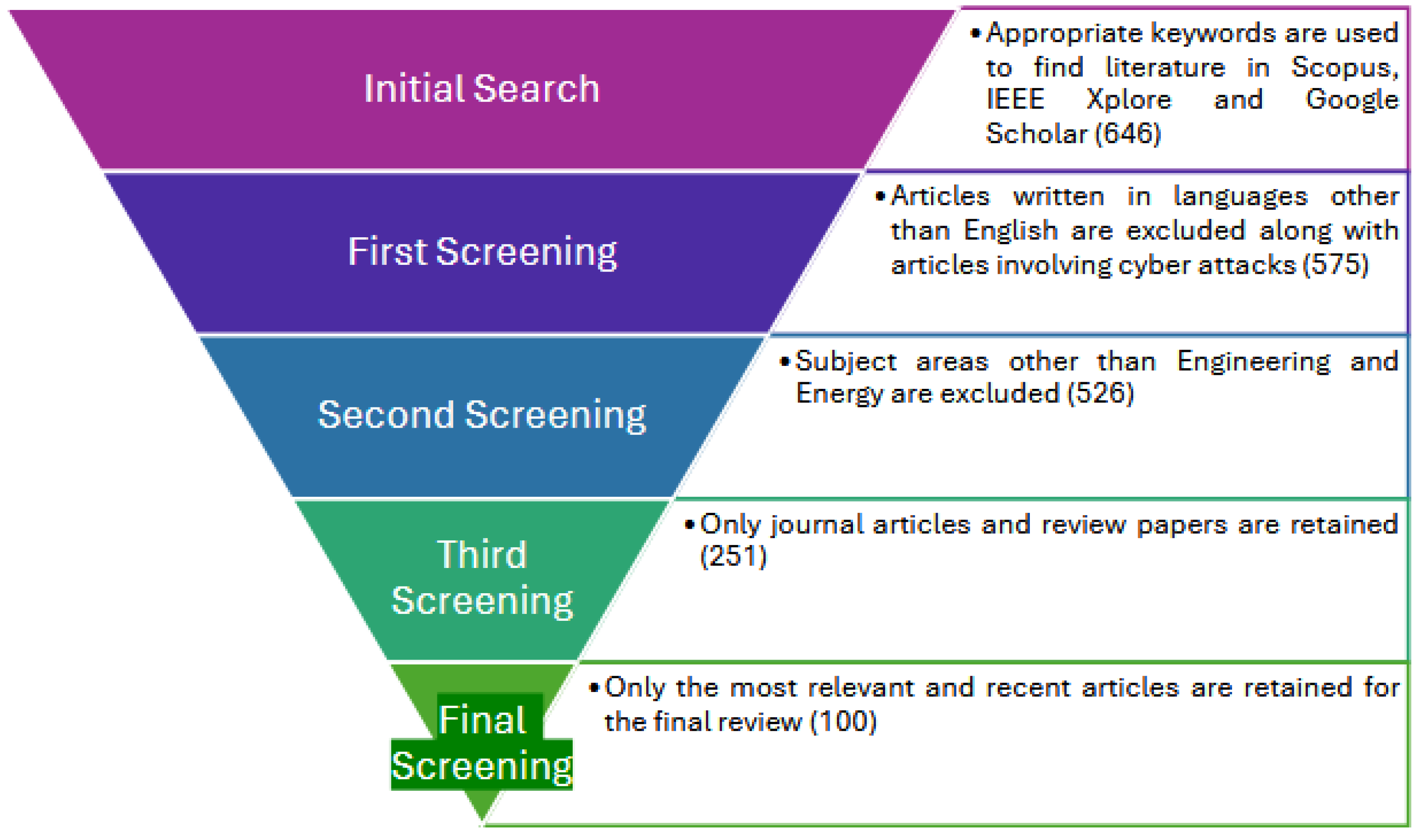
Figure 2.
Distribution of 251 articles obtained from the third screening stage over the last decade (2016 – January 2025).
Figure 2.
Distribution of 251 articles obtained from the third screening stage over the last decade (2016 – January 2025).
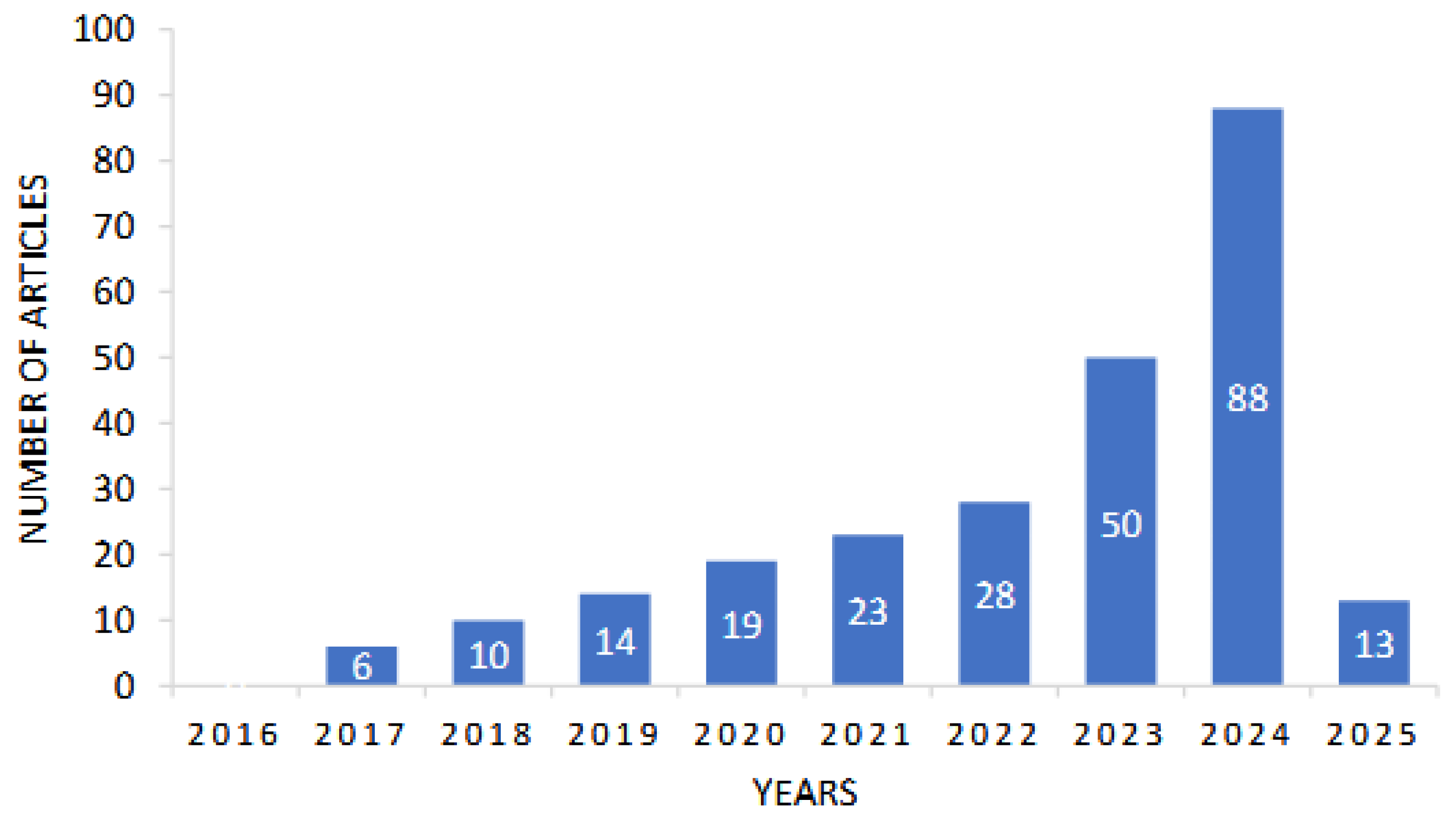
Figure 3.
Resilience vs. time curve [31].
Figure 3.
Resilience vs. time curve [31].
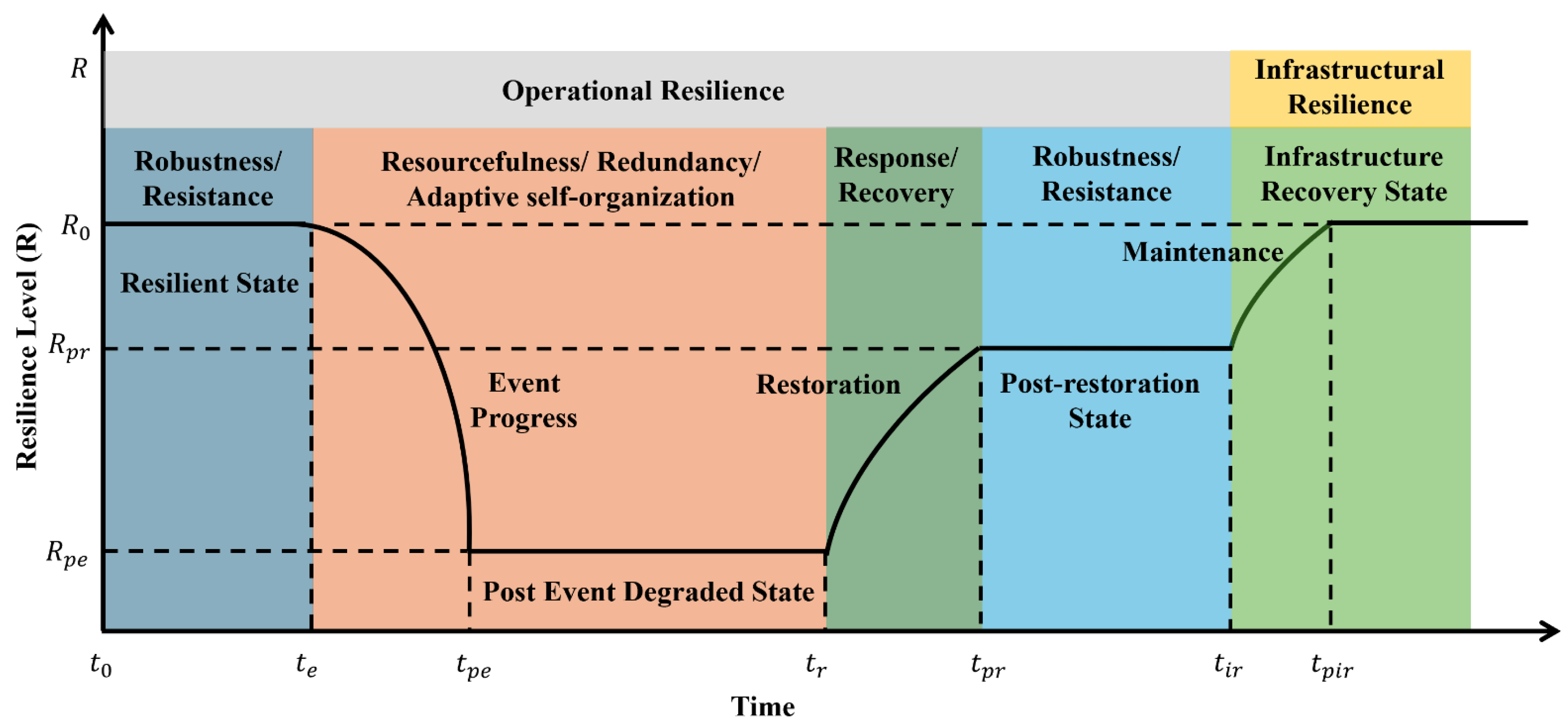
Figure 4.
Challenges for power system resilience [10].
Figure 4.
Challenges for power system resilience [10].
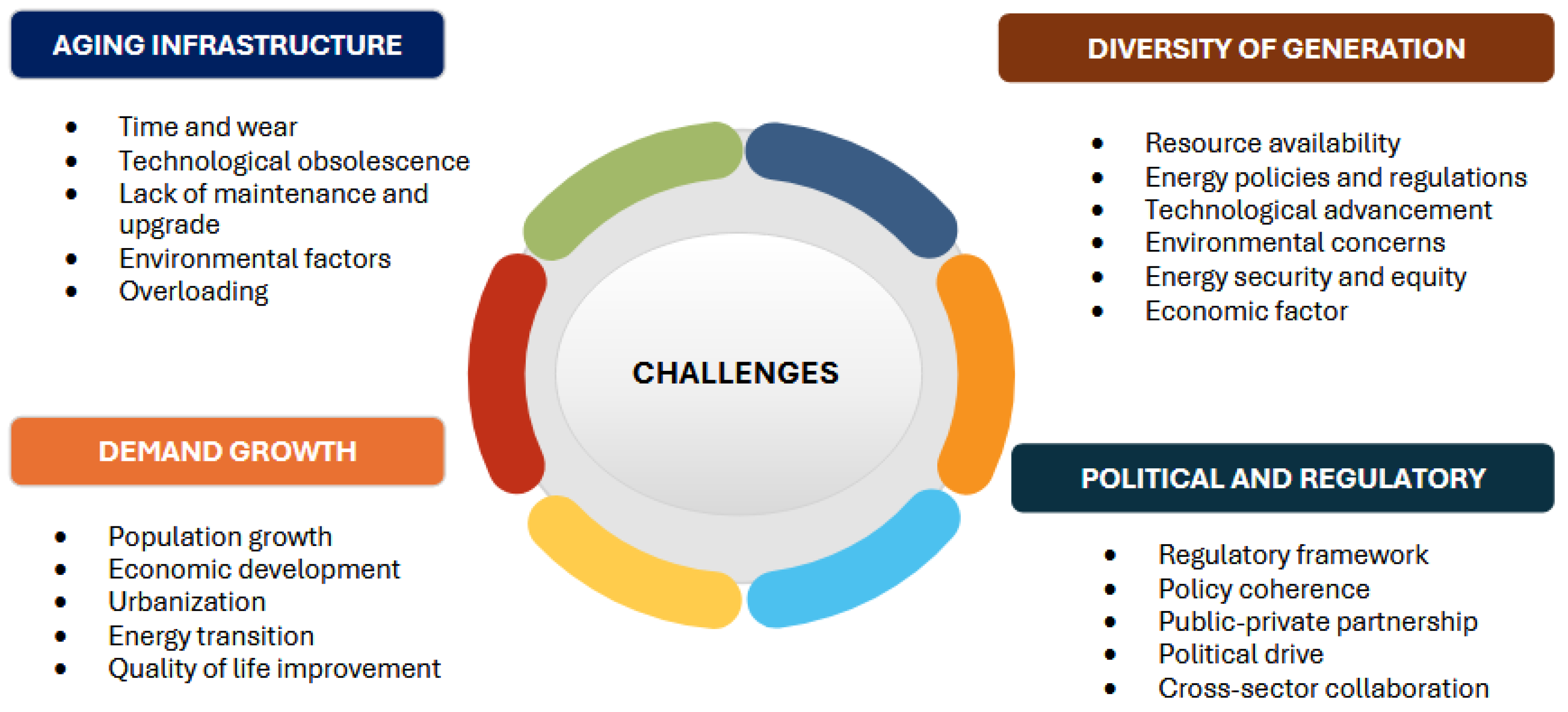
Figure 5.
Categories of enhancement strategies of power system resiliency [49].
Figure 5.
Categories of enhancement strategies of power system resiliency [49].
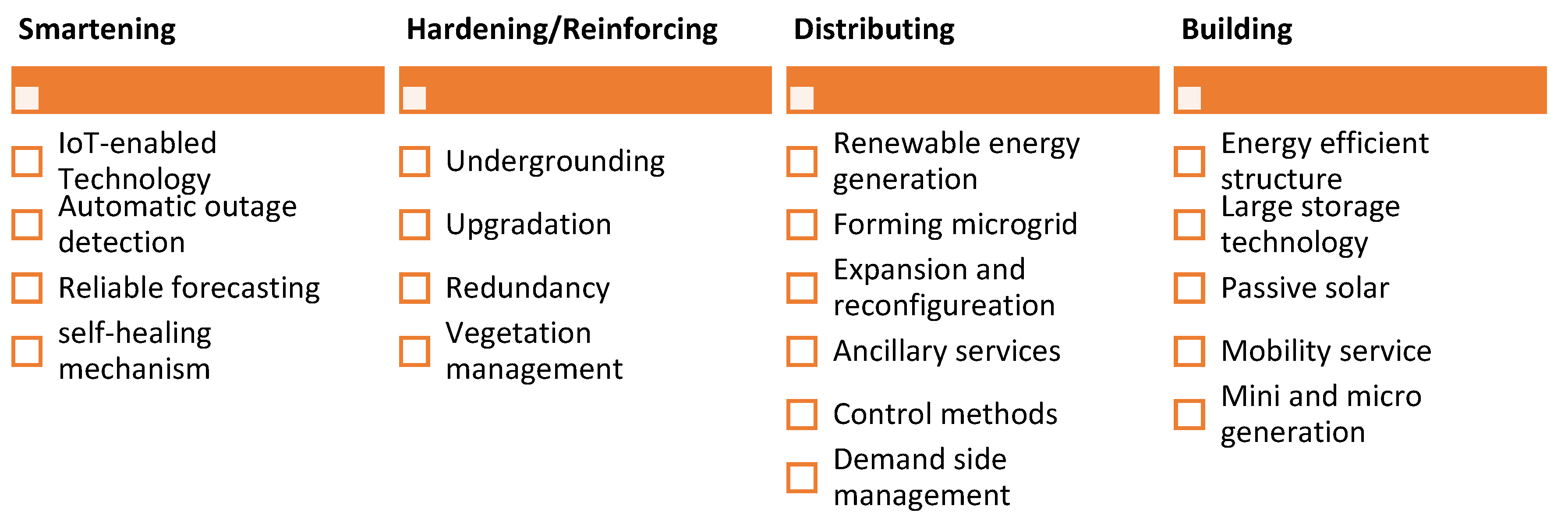
Figure 6.
Operating conditions of MG during critical events a) Outside MG b) Inside MG [49].
Figure 6.
Operating conditions of MG during critical events a) Outside MG b) Inside MG [49].

Figure 7.
Disastrous events considered in the reviewed studies related to SESSs.
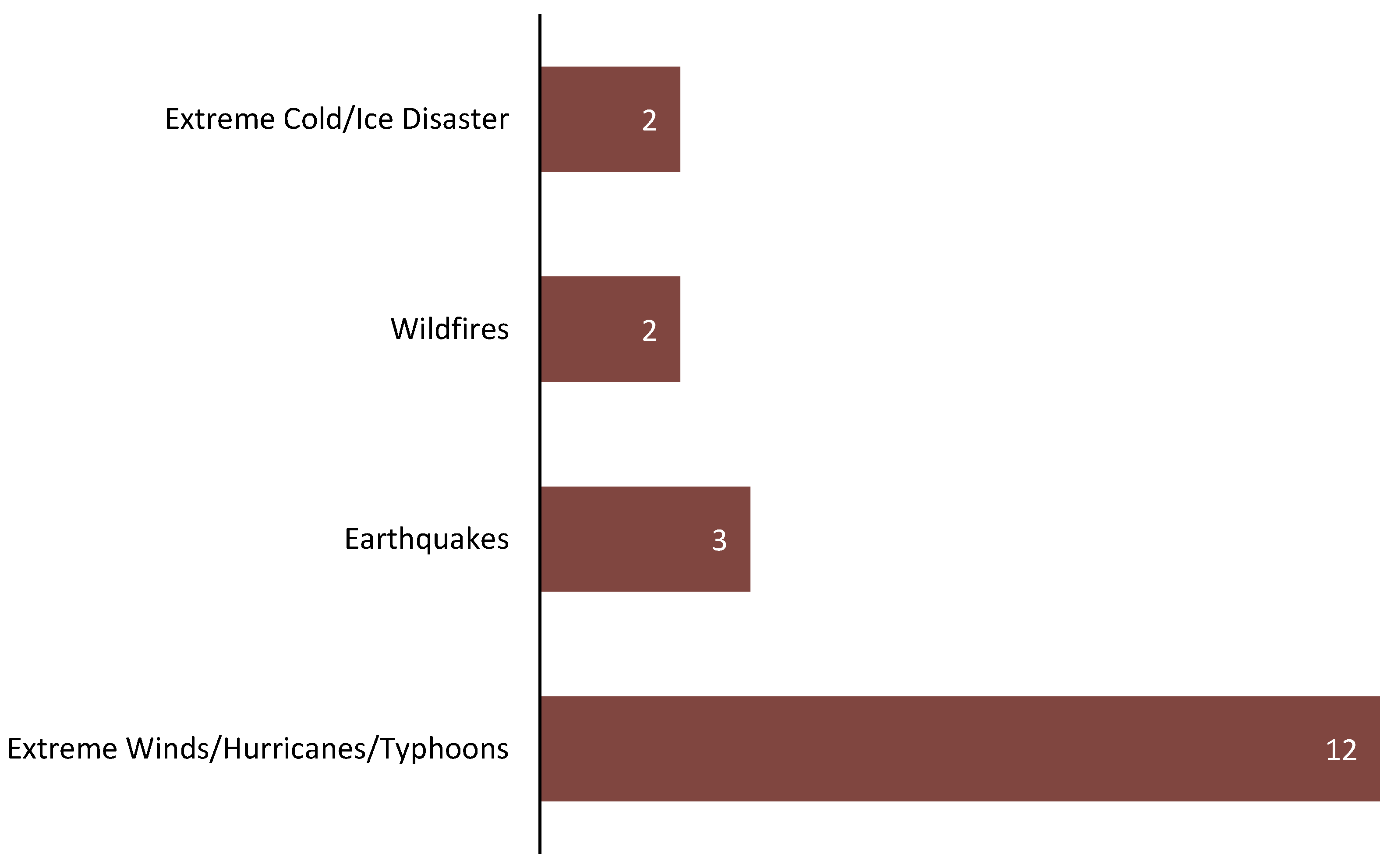
Figure 8.
Modeling the impact of natural disasters on power system.
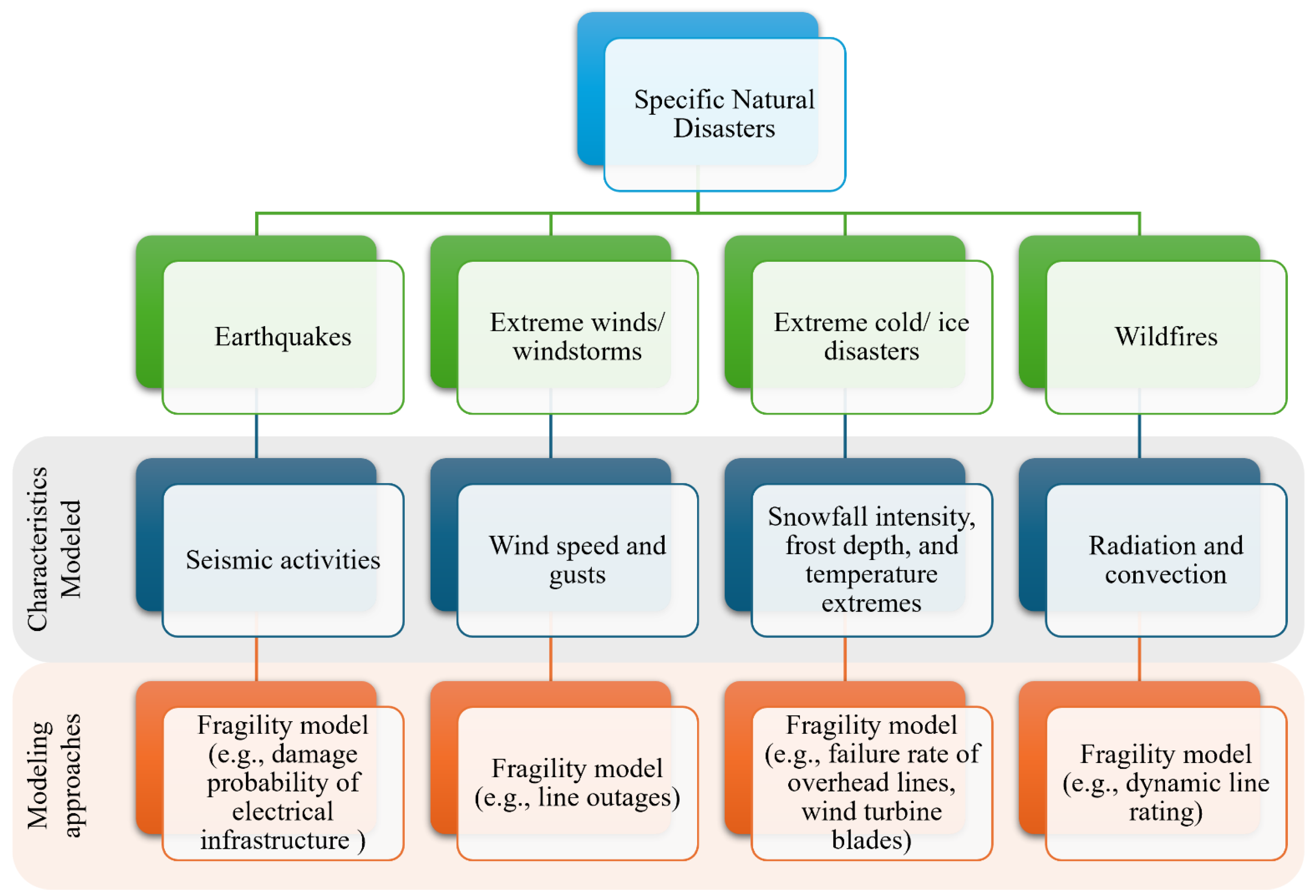
Figure 9.
Count of typical SESSs in the reviewed papers.
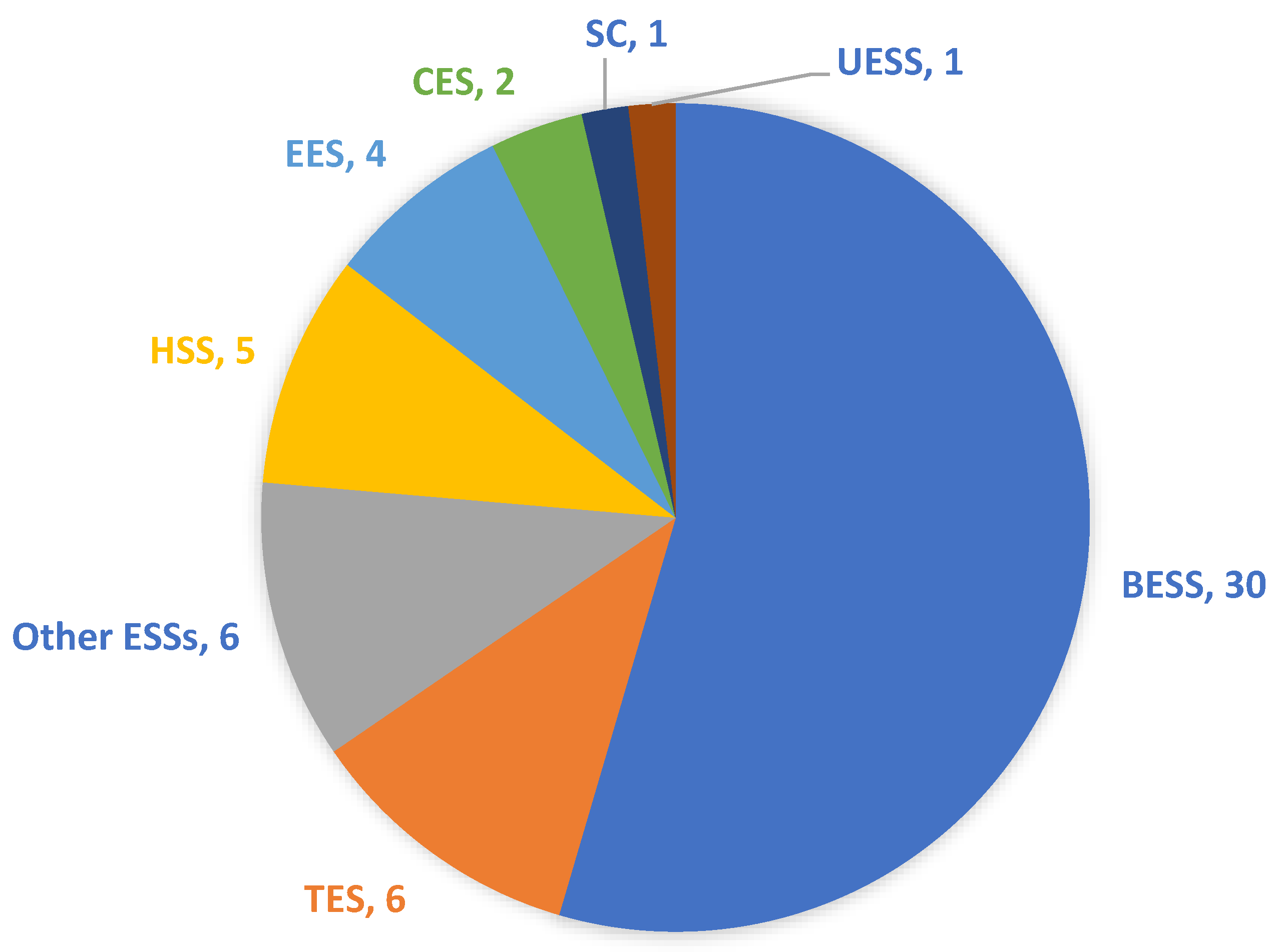
Figure 10.
A typical vehicle-mounted MESS [116].
Figure 10.
A typical vehicle-mounted MESS [116].
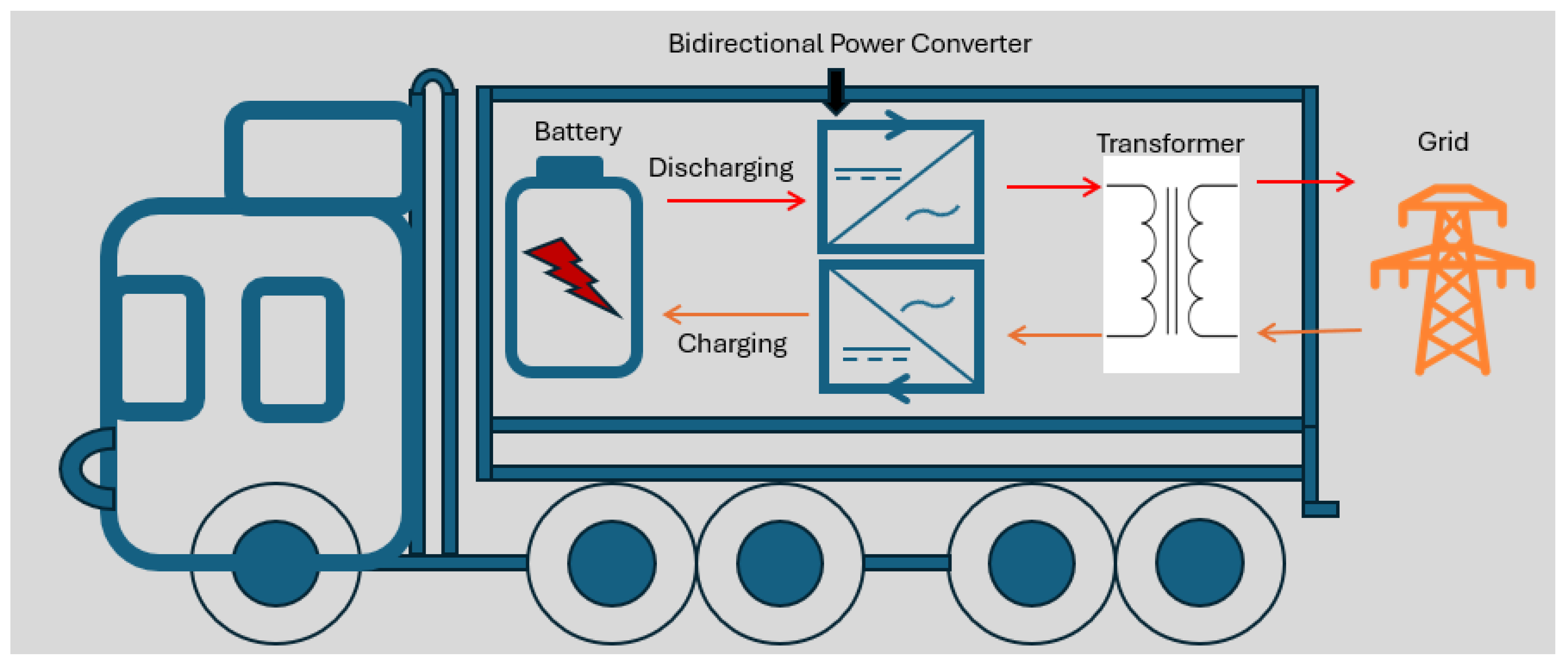
Figure 11.
Number of MESS-related reviewed works for different natural disasters.
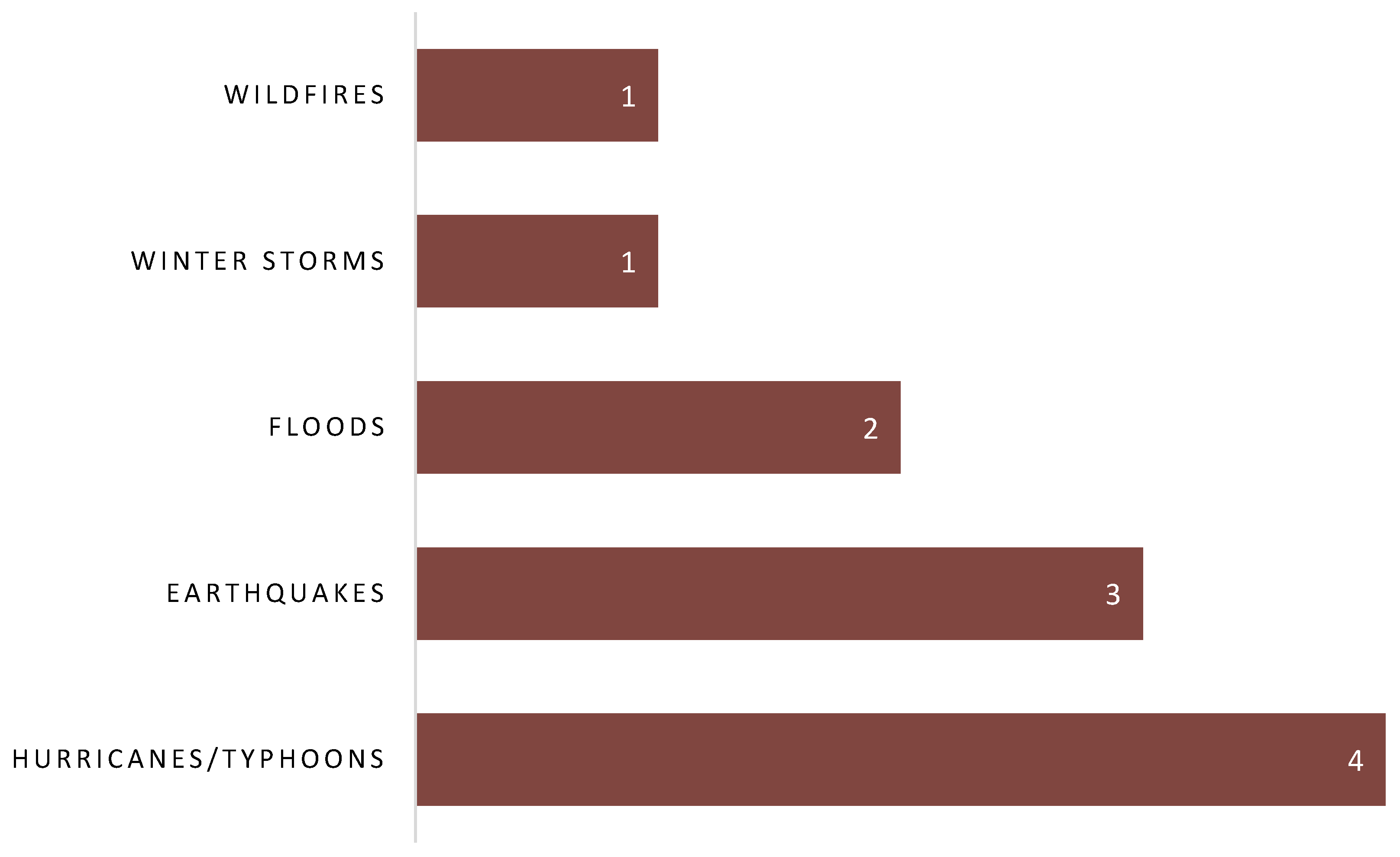
Figure 12.
HESS formation exemplified.
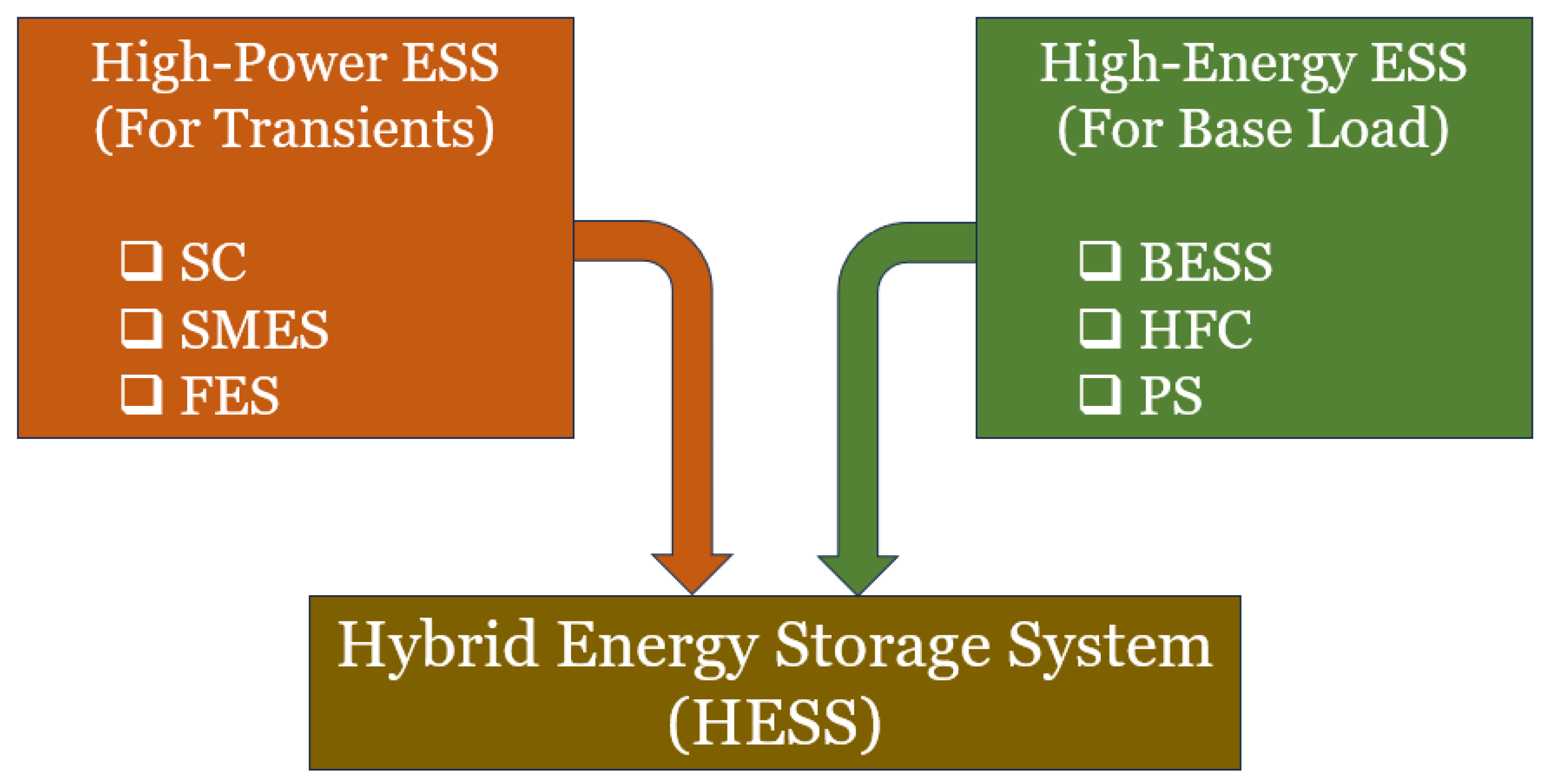

Table 1.
Some recent natural disasters and their power outages.
| HILP Event | Year | Number of power outages | Reference |
|---|---|---|---|
| Los Angeles (LA) Wildfire | 2025 | 425,000 | [4] |
| Hurricane Beryl in Texas | 2024 | 2,700,000 | [5] |
| Hualien Earthquake in Taiwan | 2024 | 308,000 | [6] |
| US Spring Storm and Flood Event | 2024 | 400,000 | [7] |
| Northern Michigan Ice Storm | 2025 | 100,000 | [8] |
Table 2.
Summary of SESS applications for improving power system resilience.
| Ref. | Type of SESS | Objective | Resilience Index/ Resilience Metric |
Event | Optimization Model |
Test System |
|---|---|---|---|---|---|---|
| [93] | BESS and Electric Vehicle Parking lots (EVPs) | To optimize MG operation cost and resilience function (RF) | Timely awareness capability, fragility index (FI), restoration index (REI), MG voltage index (MVI) and lost load index (LLI) | Natural disasters | A bi-level resilience-oriented stochastic scheduling, MILP | IEEE 33-bus |
| [54] | BESS | To minimize the cost of energy throughout the life cycle of project | Cost of interruption | Hurricane | MILP | 3 critical infrastructures in New York city (high schools, fire stations, and residences) |
| [55] | HSS | To minimize the total unserved load | Unserved load | Hurricane, earthquake, and extreme cold weather | LP | A community integrated energy system (CIES) |
| [56] | BESS | To minimize operation costs and LPSP | LPSP | Hurricanes | 3-stage optimization, shuffled frog leaping (SFL) algorithm for all stages | IEEE 33-bus |
| [57] | BESS | To maximize profit and minimize load shedding | The ratio of energy served during emergency response time to the expected energy demand | Windstorms | Stochastic optimization mixed-integer nonlinear programming (MINLP) | 3 EHs |
| [58] | BESS | To minimize Line hardening cost and load shedding cost | Mechanical strength of pole multiplied by the sum of pole and distribution line failure rates against windstorm | Windstorms | Mixed-integer quadratically constrained programming (MIQCP) | IEEE 33-bus |
| [59] | BESS | To increase RI and minimize penalty cost | The ratio of power injection by the total number of batteries to the total demand for critical loads | Extreme winds | 2-step linear programming (LP) optimization problem | DS of Urmia city |
| [62] | UESS | To minimize operation cost and load shedding cost | Load shedding cost | Ice storm, typhoon | 2-stage optimization MILP | Modified IEEE reliability test system (RTS)-79 |
| [63] | BESS | To minimize cost and maximize resilience | Reduction in power outage loss | Typhoon | A bi-level model that balances the economics and resilience | Coupled PV-ES-CS for restoration,Different topologies of hybrid AC/DC system |
| [64] | HSS | To minimize the investment and load shedding costs | Cost of load shedding | Typhoons | A tri-layer SRO,min-max-min model | H-EIES composed of a 24-bus power grid and a 5-node hydrogen network |
| [65] | BESS and EVs | To minimize the cost for establishing energy storage units, underground cables, and communication infrastructure for BESS | The ratio of energy served during emergency response time to the expected energy demand | Earthquake | MINLP | 156-bus DS of Dehradun district, India |
| [66] | BESS | To minimize the weighted sum of planning cost and normal/emergency operation cost | Load curtailment cost | Earthquake | MILP | IEEE 33-bus |
| [68] | ESS | To minimize operation cost | Load shedding cost | Wildfires | MILP | IEEE 33-bus |
| [81] | BESS | To minimize operating cost, maximize reserve index | Reserve index | Unexpected event | Multi-stage resilience-promoting proactive strategy,MILP | IEEE 69-bus |
| [82] | BESS | To minimize NPC | Outage duration | Grid outages due to extreme weather | Stochastic model for optimal sizing of CBES | A typical South Australian residential community feeder with 500 end-users |
| [83] | BESS | To minimize the demand-weighted distance between demand nodes and PV-BESS facilities, considering energy resilience | Cost of power outage | Extreme weather event | Capacitated p-Median Problem for optimal deployment of BESS | Yau Tsim Mong District in Hong Kong having residential and non-residential buildings |
| [86] | BTM-ESS | To minimize total operation cost | Avoided loss of load(ALOL) | Extreme weather events | MILP | 24 mission-critical facilities |
| [114] | BESS | To minimize cost | Unserved load | Unpredicted power outages | LP | A hospital in Iran |
| [92] | TES | To minimize system operation cost and required storage capacity | Energy satisfaction rate as the ratio of load shedding to load demand | Extreme weather events | 2-stage Rolling window optimization model | A regional IES located in Lin-gang Special Area of Shanghai, China |
| [94] | BESS | To minimize cost, maximize fault recovery | Resilience score is based on the node voltage deviation, fault recovery rate, and network loss rate. | Extreme weather-driven multi faults | 2-layer optimization model: outer layer as MILP and inner layer as mixed-integer second-order cone programming (MISOCP) | modified IEEE 33-bus and 118-bus test systems |
| [95] | ESS | To minimize operation cost | Cost of load shedding | Unplanned outage | Two-layer flexibility-oriented planning model | Modified two-region IEEE 24-bus test system and an operational test system in China |
| [100] | ESS | To maximize economy and resilience | Three planning RIs: voltage violation risk of bus, coverage rate of reserve power supply, reliability of power supply pathsOne operational RI: weighted load loss | Extreme event | A two-stage coordinated distributionally robust optimization (DRO) (integrating deep learning with optimization) | IEEE 14-bus and 33-bus, modified IEEE 123-bus |
| [101] | BESS | To minimize resilience cost for planning the backup BESSs |
Resilience cost | HILP events causing short to medium-term outages | 2-stage stochastic programming | Case-1 is derived from a real OWF network called Banc de Guérance, France, Case-2 and Case-3 involve OWFs comprising 80 WTs at FINO3 research platform, Germany |
| [96] | BESS | To optimize minimum load supply, total supplied energy, and recovery to degradation slope ratio | Three RIs: minimum load supply, total supplied energy, and recovery-to-degradation slope ratio | Extreme weather events | Three-stage resilience optimal dispatch and reconfiguration strategy | A practical large-scale manufacturing campus MG in Taiwan |
| [97] | Plug-in hybrid electric vehicles (PHEVs), EES and TES | To minimize operation cost in day-ahead and real-time | The ratio of the total served load in contingency conditions and the difference between the total served load in normal conditions and the total served load in contingency conditions | External shock | 2-level multi-stage stochastic optimization | IEEE 33-bus and123-bus test systems |
| [60] | BESS | To minimize planning and operation cost, cost of ENS and DN reconfiguration, and the proposed RI | RI is based on the supplied active power and the priority of loads | Extreme winds | 3-level optimization problem | 138-bus distribution test network |
| [98] | BESS | To minimize investment and operation cost | Unsupplied load, critical load shedding | Natural disasters | 3-stage optimization model for min-(max-min)-(max-min) mixed-integer programming (MIP) | IEEE 33-bus and 135-bus test systems |
| [99] | BESS | To minimize cost and maximize resilience | A daily resilience metric | Extreme weather events | Convex stochastic optimization with chance constraints | A substation in Finland |
| [102] | ESS | To maximize the restored load | The ratio of restored loads to the total system demand during the study period | Natural disasters | MILP,a two-level DRL | Modified IEEE 37- bus and 123-bus networks |
| [103] | BESS (Lead-Acid Battery) | To minimize investment and operation cost, and maximize resilience | Expected energy not supplied (EENS) | Extreme events | MILP | IEEE 33-bus test system |
| [104] | BESS | To minimize energy mismatch between resources and loads | Apparent power resiliency metric | Natural disaster | MILP | IEEE 33-bus test system |
| [61] | BESS | To minimize investment and operation costs | Energy not served | Windstorms | Stochastic MILP | Modified IEEE 33-bus test system |
| [105] | BESS and EVPs | To minimize investment and operation cost | Power curtailment cost, reduced load shedding | Natural disasters | Stochastic MILP | IEEE 33-bus test system |
| [106] | BESS | - | MRI assesses the MG’s ability to recover from interruptions | Forced outages | - | A proposed MG model |
| [107] | BESS | To minimize the operating cost of VPPs and ENS | Reciprocal of the system’s loss (0 to infinite) | Severe weather events | Two-stage stochastic optimization | IEEE 85-bus radial DS |
| [108] | BESS | To minimize water and energy demand curtailment | Energy curtailment cost | Extreme weather | MINLP model reformulated as a MISOCP model | IEEE 33-bus DN |
| [109] | SC | - | The modified short-term RI involving deviation in stored energy of DC-link capacitor due to deviation in DC-link voltage | Severe weather conditions | - | An autonomous DC MG |
| [110] | HSS | To minimize normal and resilience costs | Downside risk mean value ($) | Natural disaster | MILP | IEEE 33-bus test system |
| [111] | BESS | - | Black start capability | - | - | A 5.5 MVA hydropower generator in rural power system, USA |
| [112] | BESS | To maximize resiliency, emphasizing critical loads, and minimizing generation capacity requirement | Served critical load | Natural Disasters | MILP | IEEE 37-bus and IEEE 123-bus test systems |
| [113] | BESS | To minimize operational cost | Cost of load shedding | Natural disaster | Two-step optimization, MILP | A 33-bus MG |
| [87] | EES-TES-CES | To minimize planning and operation cost | Forced load shedding (FLS) | Emergency conditions (Islanding, outages) | MINLP | A generic EH |
| [88] | EES, TES, CES | To minimize operation cost | Cost of load shedding | Extreme weather | MINLP | IEEE 33-bus DS |
| [89] | HSS-TES-BESS | Minimize planning and operation cost | LPSP, Cost of load shedding | Plateau climatic conditions | MINLP reformulated as MILP (Via Data-driven linear regression) |
A real-world rural energy system in Southwestern China |
| [90] | Integrated ESSs | Minimize planning and operation cost | Load shedding cost | Hurricane | An SDRO model reformulated as three-level min-max-min model |
IEEE 33-bus DS |
| [91] | HSS-EES-TES | Minimize planning and operation cost | Cost of load shedding | Hurricanes | A two-layer capacity configuration optimization model | A typical electrothermal hydrogen-IES |
Table 3.
Summary of MESS applications for improving power system resilience.
| Ref | Mobile Energy Resources (MERs) | Objective | Resilience Index/ Resilience Metric |
Event | Optimization Model/ Formulation |
Test System |
|---|---|---|---|---|---|---|
| [122] | MESS | - | Expected load not supplied (ELNS) | Hurricane | Stochastic MILP | IEEE 24-bus DN with industrial EHs containing combined heat and power (CHP) units |
| [115] | Rail-based MESS | To minimize power generation cost, mobile battery degradation and transportation cost, and load shedding cost | EENS | Hurricanes | Two-stage robust resilient UC | IEEE RTS-79 with a 6-node railway network |
| [118] | Rail-based MESS (Sodium Sulphur battery) | To minimize the cost of load shedding | Cost of load shedding | Typhoon | Two-stage robust UC | IEEE RTS-24 and 118 bus systems |
| [121] | Hydrogen vehicles as MESS | To minimize power loss, operation and load shedding cost | Cost of load shedding | Typhoons | MILP | IEEE 33-bus DN |
| [125] | MESS and MEG | To minimize investment cost and cost of interruption, minimize expected loss of load | Loss of load | Earthquake | Risk-averse two-stage stochastic bi-level programming | IEEE 37-node test feeder and IEEE 123-node test feeder |
| [120] | EVs as MESS | To minimize operating and shut down cost | EENS | Floods and earthquakes | Hybrid stochastic-robust approach | IEEE 69-bus test system |
| [126] | MESSs and UAVs | To minimize investment and operation cost | Cost of load shedding | Earthquake | Multi-period distributionally robust resilience enhancement model | IEEE 39-bus TS and three modified IEEE 33-bus DSs |
| [72] | MESS (Vehicle-mounted BESS) | To minimize normal and emergency operation cost | Cost of load shedding | Floods | A bi-stage stochastic MISOCP | 15-bus, 33-bus, 85-bus DS |
| [127] | EVs as MESS | To minimize cost of load shedding, EV battery degradation cost, and monetary incentive to EV owners for emergency service relocation | Cost of load shedding | Wildfires | MIP, GCNs for predicting binary values for MIP | MMG community |
| [128] | MESS (BESS) | To minimize the conditional value-at-risk (CVaR) of future costs, shortfall, and unserved energy during storm | Unserved energy | Winter storms | 3-stage stochastic MILP | Texas-focused case study based on the ACTIVS 2000-bus synthetic grid |
| [123] | MESS-MEG | To maximize load restoration, minimize fuel cost, minimize battery aging cost | Load restoration | Extreme weather event | MIQCP | 15-bus DS |
| [124] | EVs as MESSs | To minimize operational cost and maximize resilience | RI calculated by using the survived load without EVs and survival load with EVs | Natural Disasters | MILP | An MMG system |
| [129] | MESSs | To minimize operational cost and maximize critical load restoration | 4 resilienceIndices: WRAP | Extreme weather events | A two-stage MIP model | IEEE 33-bus test system |
| [130] | MESS | To minimize power loss | A multi-stage event-based system resiliency index | Extreme events | Nonlinear programming | PG & E 69-bus MMG power DN |
| [131] | MESS | To maximize self-healing index, minimize allocation cost for MESSs, minimize unserved load | Self-healing index and coordinated gain index | External shocks | MILP | IEEE 123-bus test system |
| [119] | PEVs as MESSs | To minimize operating cost of networked MEMGs | Resilience enhancement factor | Extreme events | Stochastic hierarchical EMS optimization | 4 MEMGs |
| [74] | MESS | To minimize cost of load shedding and power mismatch between MGs | Cost of load shedding, critical load shedding, total load shedding | Extreme events | A three-stage stochastic optimization formulated as MILP | NMGs |
| [117] | MESS (Truck-mounted BESS) | To minimize operation cost | Load shedding cost | Extreme events | 2-stage MILP | IEEE 33-bus DS |
| [132] | MESS | To minimize load loss and voltage offset | Loss of load | Extreme events | Bilevel optimization, MILP | Modified IEEE 33-bus DS |
| [133] | MESSs and PEV-Parking Lots | To minimize operation cost | Interruption cost | Extreme events | MIQCP | IEEE 33-bus DS |
| [134] | MESSs, MEGs, Portable renewable generators | To minimize operation cost | ENS | Natural catastrophe | MILP | A typical 10-bus MG |
| [135] | MESS | To minimize operational cost | Load shedding cost | Extreme events | MILP | Modified IEEE 69-bus, 24-node Sioux Falls’ TN |
| [73] | BEBs as MESSs | - | Loss of load | Fault event | - | 20 MW-class MG at University of California Irvine |
| [136] | MESS | To minimize investment and operation cost | Load loss rate (LLR), cost of load shedding | Extreme weather events | A two-stage stochastic mixed-integer programming (SMIP) | Modified IEEE 33-bus, IEEE 123-bus test systems |
| [137] | MESSs | To minimize outage duration and operation cost | Load shedding | Natural disasters | Two-stage optimization, MILP | IEEE 33-bus and 69-bus DN |
| [138] | MESS | To maximize DS resilience and minimize degradation cost | Load interruption cost | Extreme event | MILP | IEEE 33-bus and 118-bus test systems |
| [139] | MMESs | To minimize operation cost | Customer interruption cost | Large area disaster | MILP | Modified IEEE 33-bus test system |
| [140] | MESSs | To minimize pre-allocation cost for MESSs, minimize MESS scheduling cost, and cost of load shedding | Load shedding cost | Extreme natural disaster | RO-MILP | IEEE 33-bus DN |
| [141] | MESSs (Truck-mounted BESSs) and EVs | To minimize pre-allocation cost for MESSs, minimize loss of load | Loss of load | Extreme weather event | RO-MILP | IEEE 33-bus and IEEE 141-node test systems |
| [142] | EVs as MESS | To maximize RI, reliability index, stability index, minimize emission index | Reciprocal of the system’s loss performance | Extreme weather conditions | Weighted sum multi-objective optimization model (Nonlinear programming) | IEEE 34-bus and Indian 52-bus radial DSs |
Table 4.
Summary of SMI-ESS applications for improving power system resilience.
| Ref. | ESSs | Objective | Resilience Index/ Resilience Metric |
Event | Optimization Model/ Formulation |
Test System |
|---|---|---|---|---|---|---|
| [145] | SMI-BESS | To minimize investment and operation cost under normal and extreme weather | Load loss | Strong wind, hail, lightning | 2S-ADRO with max-min optimization formulation | 62-node and 25-node DNs in the SCW area of the southeast coast of China |
| [116] | SESS and truck-mounted BESS | To minimize the weighted ENS index and total investment cost | Weighted ENS | Severe climate phenomenon | Nonlinear programming | Three adjacent geographical zones each comprising four sub-areas. |
| [146] | BSS, mobile diesel generator, MESS | To minimize load shedding and operational costs | Loss of load | Wildfires | MINLP | Modified IEEE 38-bus and IEEE 123-bus balanced DNs |
| [148] | BESSs, MESSs, MEGs, and EVs | To maximize the total weighted sum of the supplied electric and thermal load | Total load served | Natural disasters | MILP | Multi-energy DS (modified IEEE 33-bus DN and a 20-node heat network), a real-scale Southern California Edison 56-bus DN |
Table 5.
Summary of HESS applications for improving power system resilience.
| Ref. | HESS | Objective | Resilience Index/ Resilience Metric |
Event | Optimization Model/ Formulation |
Test System |
|---|---|---|---|---|---|---|
| [153] | SMES-BESS | To minimize DC-bus voltage deviation | DC-bus voltage stability | Unplanned MG operation mode switching, short circuit fault in the utility grid | MPC for sharing power between ESSs | A DC MG |
| [154] | A-CAES-BESS | To minimize investment and operation cost | LPSP | Extreme weather events | A two-stage optimization model | A university building in Montreal, Canada having building-integrated PV-based energy systems |
| [156] | HSS- BESS | To minimize operation cost | A formula of RI based on load loss | Extreme events | MILP | Modified IEEE RTS-96 |
| [157] | HSS-BESS | To minimize operation costs | Blackout time | Extreme weather events, typhoons, and wildfires | Second-order cone programming (SOCP) | IEEE 123-bus test system |
| [158] | EES and HSS | To minimize operation cost | Ratio of supplied load to total demand, FLS | Emergency conditions (Line outage, islanding) | A decentralized two-layer framework based on RO, MILP | 118-bus AND having four MGs |
Table 6.
Summary of the correlation between resiliency metrics and ESSs.
| Ref. | Resiliency Index (RI) Definition | Range | Storage Type | Impacts of ESSs on Resiliency |
|---|---|---|---|---|
| [93] | A function of timely awareness capability regarding the event occurrence (ϑ), FI, REI, MVI, and LLI. | For sufficient resilience, FI, MVI, and LLI should be near to 0, and REI should be close to 1. | BESSs and EVPs | EVPs and ESSs reduce load curtailments and thereby improve MG resilience. They can serve as redundant resources, thereby enhancing REI. |
| [65] | The ratio of energy served during emergency response time to the expected energy demand. | 0 to 1. A higher value represents better resiliency. | BESS and EVs | Energy Storage Units are used for optimal hardening of the grid that provides effectual capacity addition to enhance RI |
| [86] | ALOL | 0 to 100%. | BTM-ESS (Battery and EV) | Optimal operation of BTM-ESS recovers some/all parts of critical loads to enhance RI |
| [99] | The dependency index is used as the RI. It is an index that means ‘‘a linkage or connection between two infrastructures, through which the state of one infrastructure influences or is correlated to the state of the other.’’ | 0 to 1. A higher value represents better resiliency. | BESS | Day ahead scheduling of BESS is used for outage prevention which is directly related to enhancing RI (the withstanding capacity of the grid) |
| [59] | The ratio of power injection by the total number of batteries to the total demand for critical loads. | 0 to 1. A higher value represents better resiliency. | BESS | BESSs are placed optimally to curtail less critical loads which maximizes RI. |
| [97] | The ratio of the total served load in contingency conditions and the difference between the total served load in normal conditions and the total served load in contingency condition | 0 to infinity. A higher value represents better resiliency. | PHEVs, EES and TES | PHEVs, EES, and thermal storage increase the served loads in contingency conditions which directly enhances RI. |
| [57] | The ratio of energy served during emergency response time to the expected energy demand. | 0 to 1. A higher value represents better resiliency. | BESS | BESSs with other local resources are rescheduled to serve maximum loads during emergency response which directly enhances RI. |
| [94] | Resilience score is based on the node voltage deviation, fault recovery rate and network loss rate. | 0-to-100-mark system. A higher value represents better resiliency. | BESS | BESS improves fault recovery performance that increase resilience score |
| [106] | MRI assesses the MG’s ability to recover from interruptions | 0 to 1. A higher value represents better resiliency. | BESS | BESS integration reduces outage hours and lost energy that significantly improves MRI. Larger BESS provides higher MRI. |
| [102] | The ratio of restored loads to the total system demand during the study period | 0% to 100%. A higher value represents better resiliency. | BESS | Optimal scheduling of ESS maximizes the restored load, thereby enhancing RI. |
| [96] | minimum load supply, total supplied energy, and recovery-to degradation slope ratio | 0% to 100%. | BESS | Virtual synchronous generator (VSG) control of ESS can effectively support frequency, thereby reducing the need for load shedding and enhancing resilience. |
| [100] | Three planning RIs: voltage violation risk of bus, coverage rate of reserve power supply, reliability of power supply pathsOne operational RI: weighted load loss | - | BESS | Optimal allocation of BESS at selected nodes ensures effective power supply to critical loads during extreme faults, thereby enhancing RIs. |
| [60] | RI is related to the supplied active power and the priority of loads | 0 to 1. A lower value indicates higher resiliency. | BESS | Optimal sizing, siting, and scheduling of BESS supplies higher priority loads which improves resiliency. |
| [124] | RI is calculated by using the survived load without EVs and survival load with EVs | 0% to 100%. A higher value represents better resiliency. | EVs as MESS | Survival loads with EV increases with the optimal scheduling of EVs which is proportional to RI. |
| [129] | Resilience Indices: WRAP | - | MESS | Optimal allocation of MSU/MESS minimizes load curtailment, thereby directly maximizing the recovery index. |
| [130] | A multi-stage event-based system resiliency index | - | MESS | IoT-based optimal sizing and placement of MESSs minimizes load curtailment and maximizes RI. |
| [134] | RI is based on the energy not supplied in the network | RI is in kWh (energy not supplied) | MESS | MESS minimizes the total amount of disconnected energy, thereby enhancing RI. |
| [158] | The ratio of supplied load to total demand | 0 to 1. A higher value represents better resiliency. | HSS_EES | Hydrogen and electrical storage devices reduce FLS and increase the supplied load, directly enhancing resiliency. |
| [156] | RI is formulated based on load loss | 0 to 1. A higher value represents better resiliency | Household Battery Energy Storage (HHBES) | HHBES reduces load loss, which directly enhances RI. |
Disclaimer/Publisher’s Note: The statements, opinions and data contained in all publications are solely those of the individual author(s) and contributor(s) and not of MDPI and/or the editor(s). MDPI and/or the editor(s) disclaim responsibility for any injury to people or property resulting from any ideas, methods, instructions or products referred to in the content. |
© 2025 by the authors. Licensee MDPI, Basel, Switzerland. This article is an open access article distributed under the terms and conditions of the Creative Commons Attribution (CC BY) license (http://creativecommons.org/licenses/by/4.0/).
Copyright: This open access article is published under a Creative Commons CC BY 4.0 license, which permit the free download, distribution, and reuse, provided that the author and preprint are cited in any reuse.