

Submitted:
21 May 2025
Posted:
22 May 2025
You are already at the latest version
Abstract
Background: The motor response to human visual stimuli is unique and differs from the reaction to light-based visual stimuli. While laboratory-based tests offer valuable insights into athletes' basic perceptual-motor abilities, their translation to actual sports-specific tests is limited. Methods: Following a thorough warm-up, 44 collegiate-level male soccer players (age: 24.4 ± 2.5y, mass: 63.01 ± 7.3kg, Stature: 167.62 ± 6.3cm) from a tertiary institution completed the following tests: Sports Vision Test (SVT - 20-light proactive speed test), 40m sprint test (split times over 5, 10, and 20m), and a live Reactive Agility Test (RAT) entailing them to sprint, change direction (left or right in response to a live tester) and sprint again. Results: Numerous moderate correlations were seen between the RAT and various sprint distances (r > 0.3, ES > 0.3, P < 0.05). The reaction speed relationship between the light-based (SVT) and live stimuli (RAT) test yielded a weak relationship (r > 0.4, ES > 0.5, P < 0.05). Furthermore, hand-eye coordination speed did not predict acceleration or top speed, while the total RAT time did explain 10.5% of top speed (40m). Conclusions: Although limited, the correlations observed between the reaction to light test, sprint speed, and reaction to visual stimuli encourage the training thereof to maintain attentional focus and situational awareness, skills deemed crucial for reacting effectively in dynamic game situations. Future studies should aim to adapt contextual factors of laboratory-based tests to improve ecological validity to further explore the transferability of skills from the laboratory to the field.
Keywords:
reactive agility
; speed
; vision board
; hand-eye coordination
; soccer
1. Introduction
Soccer performance is dependent on the players' physical abilities, such as explosive strength, linear speed, and change of direction (COD) speed [1,2]. Elite competitive matches consist of an average of 305±50 CODs [3] which are performed in a changing environment, demanding almost constant reactions to external stimuli. Soccer players react predominantly to visual stimuli within a match environment, elements such as movement of the ball, opponents, and teammates, under constant time pressure [4]. Ade and colleagues [5], claim that only 15–20% of high-intensity match efforts are made to return to playing position. As a result, most intense soccer efforts are made for tactical or technical reasons in response to the game's circumstances.
Recent studies elucidate the importance of sensory and cognitive functions for soccer performance [6,7,8]. These aspects play a crucial role in agility performance, which in team sports differs from the pre-planned COD, i.e., planned agility [9]. Although planned agility performance is dependent on linear speed, strength properties, and COD technique [10,11], reactive agility (RA), in turn, includes additional cognitive aspects of performance and might therefore differ from planned agility performance [9]. RA can be measured by combining timing gates with light sensors or live stimuli. However, some studies suggest that light-based and live RA tests appear to measure different qualities [12,13,14]. Reaction to a pre-recorded video of a tester or a live tester simulates the game-specific environment and increases ecological validity. This is important since elite players are more effective in visual search behavior [15] and have greater knowledge of sport-specific situations, contributing to superior anticipation skills compared to amateurs [16]. Including sport-specific stimuli in the testing procedure forces the subjects to recognize human movement patterns through visual cues and pattern recognition, thereby enhancing the ecological value of RA assessments [17]. However, some studies prefer to use standardized light stimuli to trigger the COD movement [11,18] due to the potential bias of the human factor in the assessment procedure. Nevertheless, live RA tests have been found to differentiate elite and amateur team sport athletes [19].
More recently, the RA performance (live stimuli) differentiated between elite (ranked 5th and higher) and sub-elite (ranked 8th and lower) soccer players, while light-based RA only differentiated the amateur players (local players) from national players [13]. Supported by the existing relationship between the level of cognitive functions and sport-specific motor skills [7], soccer performance benefits from the high levels of perceptual skills and fast reaction time in combination with players’ neuromuscular qualities. Given that soccer players must sprint explosively for one to three seconds, the significance of response time in player performance becomes even more apparent [20]. Unfortunately, simple, straightforward visual reaction tests are not a predictive parameter of speed performance [20] nor can they differentiate the performance levels of soccer players [21].
Adaptation to sport-specific training enables players to react faster in complex tasks including choice reactions [22] or visual inhibition [23]. The interaction between sensory, cognitive, and motor functions reflects the performance in peripheral eye-hand coordination assessment [24]. This assessment, which requires multiple rapid reactions to randomly generated light stimuli, measures the players’ psychomotor functioning [25]. Hence, the visual system interacts with cognition when soccer players are confronted with tasks consisting of multiple reaction options [26], meaning the psychomotor performance may to some extent reflect the cognitive aspect of RA. Currently, several studies ascribe RA performance to the sensory and cognitive functioning of players [9,27]. It is suggested that reaction time contributes to the RA performance of soccer players while reacting to non-specific light stimuli in computer-based tasks [28]. However, it is not obvious whether the ability of athletes to react fast to light-based stimuli is associated with sport-specific COD movements. This may clarify the transferability of light-based psychomotor reaction speed and RA performance utilizing live stimuli.
Based on existing results, this study aimed to elucidate whether connections exist between laboratory-based measures of psychomotor reactive speed and field-based performance. The presence of any significant relationships would suggest that vision board tests and training can be used to assess or enhance perceptual and cognitive skills relevant to soccer performance. The findings may inform the development of tailored training programs to optimize players' psychomotor abilities within team sports. Understanding this relationship holds implications for sports diagnostics, training methodologies, talent identification, and performance optimization in sports.
2. Materials and Methods
2.1. Research design
An analytical cross-sectional study design was implemented to investigate the relationship between light-based visual stimuli, live-based visual stimuli, and speed over a certain distance. Participants first completed a thorough warm-up, after which they completed a light-based visual test on a vision board. Following this, they completed a speed test over 40 meters, measuring the 5, 10, 20, and 40m time splits. This was followed by a reactive agility test incorporating a live tester to both their left and right sides, in a randomized order.
2.2. Participants
The study comprised of 44 collegiate-level male soccer players (age: 24.4 ± 2.5y, mass: 63.01 ± 7.3kg, Stature: 167.62 ± 6.3cm, playing experience: 5 to +10 years) from a tertiary institution in South Africa competing in a senior competitive amateur league. Ethical approval was obtained from the lead author's institution’s ethical committee (NWU-00299-21-A1) before data collection commenced, on 23 March 2023.
2.3. Physical performance tests
2.3.1. Anthropometric measurements
Body mass was recorded to the nearest 0.1 kg, using a calibrated BFW 300 Platform scale (Adam Equipment Co. Ltd., U.K.) with the subject wearing minimal clothing and no shoes. Body stature was recorded to the nearest 0.1 cm, using a Harpenden portable stadiometer (Holtain Ltd., U.K.) with the subject standing upright and the head in the Frankfort plane.
2.3.2. The 40m Speed Test
The 40 m sprint is a valid and reliable test (r = -0.73, r = 0.9 respectively) to measure maximal speed velocities as observed during a match [29]. Electronic timing gates (SmartSpeed, Fusion Sport, Australia) were set at 0, 5, 10, 20, and 40 m intervals to record interval times. The participants performed two trials (with two-minute rest intervals) on a natural grass soccer field wearing their soccer boots. Split times (5 m, 10 m, and 20 m) and total time (40 m) were recorded to the nearest 0.01 second, with the fastest time for each split used in the final analysis.
2.3.3. Reactive Agility Test (RAT)
The reactive agility test (RAT) [30] required six electronic timing gates (SmartSpeed, Fusion Sport, Australia) were set up as illustrated in Figure 1. The first gate was at the start line (0 m), and the second gate was placed two meters straight away. Gates three and four were placed five meters to the left and right, respectively at 45° angles after which gates five and six were placed five meters straight in front of gates three and four, respectively. One run involved an initial left and then right 45° change of direction, whereas the alternate option will involve an initial right and then left 45° change of direction. A tester (who remained the same throughout all the measurements to ensure consistency) stood 6 m in front of the starting line.
The participants were instructed to sprint from gate one through gate two and then change direction to evade the tester (moving forward either to the left or the right) and sprint through gates three and five (step to left) or gates four and six (step to right). The participants were directed to respond to the change in direction cues as they would in a game situation, therefore, moving swiftly to evade the tester. The tester performed the following two movements three times respectively in a randomized order:
- Step forward with the right foot and change direction to the left
- Step forward with the left foot and change direction to the right
Participants completed three trials to the left and the right in a randomized order within five minutes, totaling six repetitions, with the best times recorded for split 1, 2, 3, and overall time (see Figure 1). The reaction time in the agility test was calculated from the moment the athlete broke the second beam and reacted to the stimulus to the time when the athlete correctly ran through the last gate, left or right.
2.3.4. Sports Vision Test (SVT)
Participants completed a sports vision test (SVT) using the sports vision (SVT™) sensor pad with 80 touch-sensitive red-light emitting diodes (LED’s). The SVT™ was programmed to use a proactive mode (Sport Vision, 2012), meaning that lights remained illuminated until the participant responded by hitting them. Participants stood face forward, in front of the sensor pad, which randomly illuminated a sequence of 20 lights (centre 16 lights, 4 by 4 array). Participants were asked to hit the illuminating light as fast as possible. The total time to hit the sequence of 20 lights was recorded in milliseconds. The test started with two practice trials (for familiarization purposes) followed by four test trials carried out with 10-second breaks between each trial. The SVT™ links to a laptop that controls the SVT™ board using a Windows-based software program. Using SVT to examine hand-eye coordination has been reported as a reliable measure, indicating an intraclass correlation coefficient ranging between 0.74 and 0.86 over four trials [25].
2.4. Statistical Analysis
SPSS software (version 29, IBM) and JASP (version 0.18.3) were used to perform the statistical analysis of the data gathered. Descriptive statistics (averages, standard deviation, minimum, and maximum values) were calculated for each variable and the Shapiro-Wilk test confirmed the normality of the data distribution (p > 0.05). For the RAT test exclusively, a paired sample T-test was performed to determine whether changes were present for dominant vs non-dominant leg. The Spearman’s rho was performed to determine relationship strengths between the test variables (speed [5, 10, 20, and 40m distances], reactive agility [split 1, 2, and 3, and total time] and sports vision [minimum, maximum, average and total time]). The correlation strength was interpreted as: r = < 0.1, trivial; 0.1-0.3, small; 0.31-0.49, moderate; 0.5-0.69, large; 0.7-0.89, very large; and 0.9-1, perfect correlation [31]. Fisher’s Z was used to measure the effect size (ES) and interpreted as follows: trivial: < 0.20; small: 0.20-0.49; medium: 0.50-0.79; large: 0.80-1.19; very large (1.20-2.0); and extremely large (>2.0) [32] Finally, a mediation analysis was conducted to evaluate, through regression analysis, whether the mediator (e.g., sports vision board results) could predict (P < 0.05) the performance of the dependent variable (speed and reactive agility test results) to a greater extent than in the absence of the mediator [33].
3. Results
Provided in Table 1 are the descriptive statistics of the physical test results.
As observed from Figure 2, the left and right RAT results revealed a significant difference for the total time (P < 0.05) and times obtained at split 3, with this split showcasing a moderate effect size (ES = 0.6).
The levels of correlation and significance among the test variables following Spearman’s rho are illustrated in Figure 3. As expected, significant relationships were observed between the variables within the same tests (i.e., speed, SVT, and reactive agility), while limited test relationships were observed. No significant relationships were seen between the sprint test and SVT variables. A moderate positive relationship was observed between split three (RAT) and the maximum SVT times (Right side: r = 0.43, P = 0.004, ES = 0.5, Left side: r = 0.48, P = 0.001, ES = 0.5). In addition, a small yet positive relationship was seen between the total time completed for the RAT to the left, and maximum SVT results (r = 0.31, P = 0.04, ES = 0.3).
The times recorded for RAT split 2 and 3 to the right showed a moderate correlation with the speed distances, recorded as: 10m (Split 2: r = 0.311, P = 0.04, ES = 0.3, Split 3: r = 0.39, P = 0.01, ES = 0.41), 20m (Split 2: r = 0.34, P = 0.02, ES = 0.36, Split 3: r = 0.35, P = 0.02, ES = 0.37) and 40m (Split 2: r = 0.36, P = 0.02, ES = 0.38, Split 3: r = 0.32, P = 0.04, ES = 0.33) speed results. Rendering the RAT results to the left, only split 3 correlated moderately with 10m (r = 0.4, P = 0.007, ES = 0.42), 20m (r = 0.42, P = 0.005, ES = 0.44) and 40m (r = 0.46, P = 0.002, ES = 0.49), with the total times obtained for the RAT test to the left correlating with the 40m (r = 0.33, P = 0.03, ES = 0.39) sprint results. Upon completing a linear regression model to investigate whether any performance measure can predict reactive agility abilities, a small but significant value was noted between the 40m speed and overall reactive agility performances for both legs (P = 0.03, R2 = 10.5%).
4. Discussion
Our study investigated the relationship between laboratory-based psychomotor reactive speed, live reactive agility performance, and acceleration speed in soccer players. To the authors’ knowledge, this is the first study to evaluate the relationship between psychomotor reactive speed and live reactive agility. As expected, moderate correlations were observed between the RAT and various sprint distances. We discovered a weak relationship between athletes' reaction to the light-based (SVT) and live stimuli (RAT) results. Furthermore, the psychomotor reactive speed was not related to acceleration speed, while the 40m sprint performance explained 10.5% of the total RAT.
Soccer involves various elements such as the ball, goalbox, and players, which, when combined with the diverse actions of teammates and opponents, place significant demands on the visual system, necessitating efficient perceptual and cognitive functioning [34,35]. The speed of reaction to visual stimuli is vital to effectively execute actions on the field [34]. Vision board training has emerged as a novel approach to improving athletes' visual skills and decision-making abilities [36]. Vision boards typically consist of visual stimuli, such as flashing lights, moving objects, or target patterns, presented in controlled environments to simulate game-like scenarios [36]. By engaging in repetitive tasks aimed at enhancing visual perception and processing speed, athletes may experience improvements in reactive times [36]. However, the ecological validity of these findings, i.e., their relevance to real-life sporting contexts, remains a subject of inquiry. Factors such as stimulus specificity, task complexity, and environmental unpredictability may influence the transferability of psychomotor test results to sports performance.
A moderate, yet significant correlation between the SVT and RAT (last split) which consisted of 5 m linear acceleration, was seen. This is quite surprising since the last split of RAT does not demand athletes’ perceptual or cognitive functions. Vision board reactive tests engage cognitive processes such as attention, perception, and decision-making, which are fundamental to reactive performance in sports [36]. Studies have shown that these cognitive processes are interconnected and contribute to athletes' ability to react quickly to stimuli both in laboratory settings and on the field [37]. The skills developed through vision board training, such as visual processing speed and decision-making, can transfer to real-life sports scenarios [25,38]. Research suggests that improvements in specific perceptual-cognitive skills acquired through training can generalize to various contexts, enhancing athletes' performance across different tasks, as seen in the split 3 results [39].
No significant correlations were found between the RAT split 2, which requires a reaction from visual stimuli, and the SVT. This might be ascribed to the low specificity of the SVT assessment, implying that the reaction to light in a lab versus the reaction to a live tester on the field possibly relies on different perceptual functioning. In contrast, Zemková and Hamar [40] reported how reaction time correlated with reactive ability performance, but only for short repetitive distances (0.8 m; r = 0.766) and not the longer distances (1.6 and 3.2 m). Therefore, reducing the contribution of motor performance during the RAT emphasizes the evaluation and contribution of perceptual-cognitive functioning during task execution. Previous findings proved that RATs can effectively detect differences between soccer players competing at different levels [14]. For example, RA time for U19 players was shorter compared to their U17 and U15 counterparts [14]. Noteworthy, another study demonstrated a significant difference in reaction times between elite and sub-elite soccer players following the same RAT as with the current study, with no differences seen when the live tester was replaced with light stimuli [13]. Using the same protocol, elite adult players overcame sub-elites identically in live but not light RA [13]. Therefore, the mentioned studies support our findings that the reaction speed to light stimuli does not determine reactive agility performance to live stimuli. This does not imply that athletes should not make use of vision training.
Vision board tests and training require athletes to maintain attentional focus and situational awareness, skills deemed crucial for reacting effectively to dynamic game situations [41]. Studies have demonstrated that attentional control and situational awareness contribute significantly to athletes' performance in sports requiring rapid reactions [42]. In addition, vision board training provides immediate feedback on performance, allowing athletes to adjust their strategies and refine their reactive abilities [43]. Research indicates that feedback plays a vital role in skill acquisition and motor learning, facilitating the development of efficient movement patterns and decision-making strategies [44]. While vision board tests offer standardized measures of reactive abilities, individual differences in perceptual-cognitive skills and motor proficiency exist [37]. However, studies have shown that vision board training can improve reactive performance across diverse athlete populations, with variations in initial skill levels [39].
The ability to process visual information rapidly and accurately is crucial for reacting swiftly in soccer. Athletes with faster linear speed often demonstrate superior perceptual-cognitive processing, enabling them to identify relevant cues and make rapid decisions under pressure [39]. Recently, Matlák and co [45] reported a significant correlation between choice reaction time and decision time among elite youth soccer players in the live RA test (r = 0.458). They further claimed that live RA performance cannot be explained by the linear sprint speed of soccer players, which is in contrast with the current findings, demonstrating how the final split of the RAT correlated significantly with acceleration (10 and 20 m) and top speed (40 m). The authors suggest that the correlations observed only for the final split of the RAT can be attributed to the contextual similarities with the 40m sprint test. As mentioned earlier, the first two splits of the RAT demand a cognitive (i.e., visual stimuli and decision making) and physical load (i.e., COD and sprint), while the final split of the RAT predominantly requires physical effort similar to the 40m sprint. Hence, the absence of cognitive aspects emphasizes the reliance on physical speed when performing the 40m sprint and the final split of the RAT. Faster linear speed requires players to possess high muscular strength, power, and sprinting mechanics [46]. These physical attributes contribute to efficient movement execution and enable players to initiate rapid responses to stimuli during gameplay [46]. Additionally, players with faster linear speed often demonstrate superior anticipatory skills, allowing them to predict opponents' movements and anticipate game events, as seen with the relationship between split 2 (which is referred to as the reaction time) and speed over 20m. This heightened anticipation enables players to react more quickly to unfolding situations, such as intercepting passes or closing down opponents [16]. Players with faster linear speed exhibit enhanced neural efficiency, facilitating quicker processing and execution of motor commands, which can translate into faster reaction times during soccer-specific tasks [37].
Irrespective of the novelty of the current study, the results should be interpreted by bearing the following limitations in mind. As mentioned earlier, the light reaction test (SVT) is less biased compared to the live RAT, but at the expense of ecological validity. Future studies should aim to increase ecological value from lab-based tests and decrease biases in field-based tests. For example, consider live eye-hand reaction time tests based on sport-specific video footage to increase ecological validity. In addition, future studies can also consider performing the live RAT by utilizing a large screen or projector displaying life-size pre-recordings of the tester to minimize human bias. Finally, positional differences were not accounted for, therefore, the authors suggest that future studies should consider measuring reaction speed from both an attacking and defensive perspective to gain insight regarding possible positional differences that might exist. Implementing the recommendations presented will improve the measurement and use of both laboratory and field-based tests, specifically in the sport domain. More research is required to effectively bridge the gap between lab- and field-based tests, to be utilized effectively by coaches, players, and sports scientists.
In summary, while both perceptual-cognitive and physical-motor skills are essential for developing real-life reactive agility in sports, research often emphasizes the significant role of perceptual-cognitive abilities in facilitating rapid decision-making and effective responses to dynamic situations on the field or court [35]. However, a holistic approach that integrates training for both perceptual-cognitive and physical-motor skills is likely to yield the most robust improvements in reactive agility performance. Coaching staff should incorporate training to improve linear speed, as this involves motor learning and skill acquisition processes that can generalize other aspects of performance, including reaction times. As athletes develop greater proficiency in sprinting mechanics and movement patterns, they may also exhibit improvements in their ability to react quickly to stimuli during soccer gameplay [38].
5. Conclusions
The motor response to human visual stimuli is a unique skill and differs from the reaction to light-based visual stimuli. While laboratory-based tests offer valuable insights into athletes' basic perceptual-motor abilities, their translation to actual sports scenarios is limited. The correlation between vision board reactive tests and real-life reactive tests arises from the transferability of perceptual-cognitive skills to players' reactive abilities in dynamic sports environments and on-field performance. Insights gained from this study may inform the development of more ecologically valid assessment tools that can be used for talent identification, athlete monitoring, and training intervention purposes tailored to the dynamic demands of team sports.
Supplementary Materials
The following supporting information can be downloaded at the website of this paper posted on Preprints.org.
Author Contributions
Conceptualization, Adele. Broodryk; methodology, Adele. Broodryk; software, Adele Broodryk and Filip Skala; validation, Filip Skala and Retief Broodryk; formal analysis, Adele Broodryk & Filip Skala; investigation, Adele Broodryk, Filip Skala and Retief Broodryk.; resources, Adele Broodryk; data curation, Filip Skala and Adele Broodryk; writing—original draft preparation, Adele Broodryk and Filip Skala; writing—review and editing, Retief Broodryk; visualization, Adele Broodryk and Retief Broodryk; supervision, Filip Skala; project administration, Adele Broodryk; funding acquisition, Adele Broodryk. All authors have read and agreed to the published version of the manuscript.
Funding
This research was funded by the Faculty of Health Sciences, North-West University, South Africa, for a larger study titled: “The effect of a sleep hygiene period on match performance, physical, physiological and psychological states of university-level football players (SLEEP study)”.
Institutional Review Board Statement
The study was conducted in accordance with the Declaration of Helsinki, and approved by the Health Research Ethics Committee (HREC) of the Faculty of Health Sciences of North-West University (NWU-00299-21-A1).
Informed Consent Statement
Informed consent was obtained from all subjects involved in the study.
Data Availability Statement
All supporting information can be made available upon request from the corresponding author.
Acknowledgments
The authors thank the field personnel actively involved in the data collection process, as well as the players partaking in the study.
Conflicts of Interest
The authors declare no conflicts of interest. The funders had no role in the design of the study; in the collection, analyses, or interpretation of data; in the writing of the manuscript; or in the decision to publish the results.
Abbreviations
The following abbreviations are used in this manuscript:
| RAT | Reactive Agility Test |
| SVT | Sports Vision Test |
| COD | Change of Direction |
| NWU | North-West University |
References
- Faude, O.; Koch, T.; Meyer, T. Straight Sprinting Is the Most Frequent Action in Goal Situations in Professional Football. J Sports Sci 2012, 30, 625–631, doi:10.1080/02640414.2012.665940. [CrossRef]
- Caldbeck, P.; Dos’Santos, T. How Do Soccer Players Sprint from a Tactical Context? Observations of an English Premier League Soccer Team. J Sports Sci 2022, 40, 2669–2680, doi:10.1080/02640414.2023.2183605. [CrossRef]
- Morgan, O.J.; Drust, B.; Ade, J.D.; Robinson, M.A. Change of Direction Frequency off the Ball: New Perspectives in Elite Youth Soccer. Science and Medicine in Football 2022, 6, 473–482, doi:10.1080/24733938.2021.1986635. [CrossRef]
- Young, W.; Rayner, R.; Talpey, S. It’s Time to Change Direction on Agility Research: A Call to Action. Sports Medicine 2021, 7, doi:10.1186/s40798-021-00304-y. [CrossRef]
- Ade, J.; Fitzpatrick, J.; Bradley, P.S. High-Intensity Efforts in Elite Soccer Matches and Associated Movement Patterns, Technical Skills and Tactical Actions. Information for Position-Specific Training Drills. J Sports Sci 2016, 34, 2205–2214, doi:10.1080/02640414.2016.1217343. [CrossRef]
- Casanova, F.; Oliveira, J.; Williams, M.; Garganta, J. Expertise and Perceptual-Cognitive Performance in Soccer: A Review. Revista portuguesa de Ciencias do Desporto 2009, 9, 115–122.
- Scharfen, H.E.; Memmert, D. The Relationship between Cognitive Functions and Sport-Specific Motor Skills in Elite Youth Soccer Players. Front Psychol 2019, 10, doi:10.3389/fpsyg.2019.00817. [CrossRef]
- Klatt, S.; Smeeton, N.J. Processing Visual Information in Elite Junior Soccer Players: Effects of Chronological Age and Training Experience on Visual Perception, Attention, and Decision Making. Eur J Sport Sci 2022, 22, 600–609, doi:10.1080/17461391.2021.1887366. [CrossRef]
- Young, W.B.; Dawson, B.; Henry, G.J. Agility and Change-of-Direction Speed Are Independent Skills: Implications for Training for Agility in Invasion Sports. Int J Sports Sci Coach 2015, 10, 159–169.
- Dos’santos, T.; Mcburnie, A.; Thomas, C.; Comfort, P.; Jones, P.; Corresponding, #; Dos, T.; Santos, ’ Biomechanical Comparison of Cutting Techniques: A Review and Practical Applications. Strength Cond J 2019, 4.
- Horníková, H.; Jeleň, M.; Zemková, E. Determinants of Reactive Agility in Tests with Different Demands on Sensory and Motor Components in Handball Players. Applied Sciences (Switzerland) 2021, 11, doi:10.3390/app11146531. [CrossRef]
- Scanlan, A.T., W.N., K.A.P., B.D.M., T.P.S. and D.V.J. Generic and Sport-Specific Reactive Agility Tests Assess Different Qualities in Court-Based Team Sport Athletes. J Sports Med Phys Fitness 2014, 3, 206–213.
- Trajković, N.; Sporiš, G.; Krističević, T.; Madić, D.M.; Bogataj, Š. The Importance of Reactive Agility Tests in Differentiating Adolescent Soccer Players. Int J Environ Res Public Health 2020, 17, doi:10.3390/ijerph17113839. [CrossRef]
- Andrašić, S.; Gušić, M.; Stanković, M.; Mačak, D.; Bradić, A.; Sporiš, G.; Trajković, N. Speed, Change of Direction Speed and Reactive Agility in Adolescent Soccer Players: Age Related Differences. Int J Environ Res Public Health 2021, 18, doi:10.3390/ijerph18115883. [CrossRef]
- Vaeyens, R.; Lenoir, M.; Williams, A.M.; Philippaerts, R.M. Mechanisms Underpinning Successful Decision Making in Skilled Youth Soccer Players: An Analysis of Visual Search Behaviors. J Mot Behav 2007, 39, 395–408, doi:10.3200/JMBR.39.5.395-408. [CrossRef]
- Martins, F.; Garganta, J.; Oliveira, J.; Casanova, F. The Contribution of Perceptual and Cognitive Skills in Anticipation Performance of Elite and Non-Elite Soccer Players. International Journal of Sports Science 2014, 2014, 143–151, doi:10.5923/j.sports.20140405.01. [CrossRef]
- Yepes, M.M.; Feliu, G.M.; Bishop, C.; Gonzalo-Skok, O. Assessing the Reliability and Validity of Agility Testing in Team Sports: A Systematic Review. The Journal of Strength & Conditioning Research 2022, 2035–2049.
- Hornikova, H.; Skala, F.; Zemkova, E. Sport-Specific Differences in Key Performance Factors among Handball, Basketball and Table Tennis Players. Int J Comput Sci Sport 2023, 22, 31–41, doi:10.2478/ijcss-2023-0003. [CrossRef]
- Gabbett, T.J.; Kelly, J.N.; Sheppard, J.M. Speed, Change of Direction Speed, and Reactive Agility of Rugby League Players. The Journal of Strength & Conditioning Research 2008, 1, 174–181.
- Senel, O.; Eroglu, H. Correlation between Reaction Time and Speed in Elite Soccer Players. J Exerc Sci Fit 2006, 4, 126–130.
- Ricotti, L.; Rigosa, J.; Niosi, A.; Menciassi, A. Analysis of Balance, Rapidity, Force and Reaction Times of Soccer Players at Different Levels of Competition. PLoS One 2013, 8, 1–21, doi:10.1371/journal.pone.0077264. [CrossRef]
- Hirose, N. Prediction of Talent in Youth Soccer Players: Prospective Study over 4-6 Years. Football Science 2011, 8, 1–7.
- Kida, N.; Oda, S.; Matsumura, M. Intensive Baseball Practice Improves the Go/Nogo Reaction Time, but Not the Simple Reaction Time. Cognitive Brain Research 2005, 22, 257–264, doi:10.1016/j.cogbrainres.2004.09.003. [CrossRef]
- Erickson, G.B. Visual Performance Evaluation. Sports vision: Vision care for the enhancement of sports performance 2007, 45–83.
- Ellison, P.H.; Sparks, S.A.; Murphy, P.N.; Carnegie, E.; Marchant, D.C. Determining Eye-Hand Coordination Using the Sport Vision Trainer: An Evaluation of Test-Retest Reliability. Research in Sports Medicine 2014, 22, 36–48, doi:10.1080/15438627.2013.852090. [CrossRef]
- Knöllner, A.; Memmert, D.; von Lehe, M.; Jungilligens, J.; Scharfen, H.E. Specific Relations of Visual Skills and Executive Functions in Elite Soccer Players. Front Psychol 2022, 13, doi:10.3389/fpsyg.2022.960092. [CrossRef]
- Coh, M.; Vodiˇ, J.; Car, V.; Zvan, M.; Jožef, J.J.; Jožefšimenko, J.; Stodolka, J.; Rauter, S.; Ma´, K.; Ckala, M.; et al. Are Change-of-Direction Speed and Reactive Agility Independent Skills Even When Using the Same Movement Pattern? The Journal of Strength & Conditioning Research 2018, 32, 1929–1936.
- Zemková, E. Differential Contribution of Reaction Time and Movement Velocity to the Agility Performance Reflects Sport-Specific Demands. Human Movement 2016, 17, 94–101, doi:10.1515/humo-2016-0013. [CrossRef]
- Altmann, S.; Ringhof, S.; Neumann, R.; Woll, A.; Rumpf, M.C. Validity and Reliability of Speed Tests Used in Soccer: A Systematic Review. PLoS One 2019, 14, doi:10.1371/journal.pone.0220982. [CrossRef]
- Veale, J.; Pearce, A.; Carlson, J.; John, S. Reliability and Validity of a Reactive Agility Test for Australian Football. Int J Sports Physiol Perform 2010, 5, 239–248.
- Cohen, J. Statistical Power Analysis for the Behavioral Sciences; L. Erlbaum Associates, 2013;
- Sawilowsky, S.S. New Effect Size Rules of Thumb. Journal of Modern Applied Statistical Methods 2009, 8, 597–599, doi:10.22237/jmasm/1257035100. [CrossRef]
- Warner, R.M. Applied Statistics: From Bivariate through Multivariate Techniques: From Bivariate through Multivariate Techniques.; 2nd ed.; Sage, 2013;
- Bergmann, F.; Gray, R.; Wachsmuth, S.; Höner, O. Perceptual-Motor and Perceptual-Cognitive Skill Acquisition in Soccer: A Systematic Review on the Influence of Practice Design and Coaching Behavior. Front Psychol 2021, 12.
- Scharfen, H.E.; Memmert, D. Cognitive Training in Elite Soccer Players: Evidence of Narrow, but Not Broad Transfer to Visual and Executive Function. German Journal of Exercise and Sport Research 2021, 51, 135–145, doi:10.1007/s12662-020-00699-y. [CrossRef]
- Appelbaum, L.G.; Erickson, G. Sports Vision Training: A Review of the State-of-the-Art in Digital Training Techniques. Int Rev Sport Exerc Psychol 2018, 11, 160–189.
- Mann, D.T.Y.; Williams, A.M.; Ward, P.; Janelle, C.M. Perceptual-Cognitive Expertise in Sport: A Meta-Analysis. J Sport Exerc Psychol 2007, 29, 457–461.
- Clark, J.F.; Ellis, J.K.; Bench, J.; Khoury, J.; Graman, P. High-Performance Vision Training Improves Batting Statistics for University of Cincinnati Baseball Players. PLoS One 2012, 7, doi:10.1371/journal.pone.0029109. [CrossRef]
- Voss, M.W.; Kramer, A.F.; Basak, C.; Prakash, R.S.; Roberts, B. Are Expert Athletes “expert” in the Cognitive Laboratory? A Meta-Analytic Review of Cognition and Sport Expertise. Appl Cogn Psychol 2010, 24, 812–826, doi:10.1002/acp.1588. [CrossRef]
- Zemková, E.; Hamar, D. Association of Speed of Decision Making and Change of Direction Speed With The Agility Performance. Functional Neurology, Rehabilitation, and Ergonomics • 2017, 7, 10–15.
- Buscemi, A.; Mondelli, F.; Biagini, I.; Gueli, S.; D’Agostino, A.; Coco, M. Role of Sport Vision in Performance: Systematic Review. J Funct Morphol Kinesiol 2024, 9.
- Presta, V.; Vitale, C.; Ambrosini, L.; Gobbi, G. Stereopsis in Sports: Visual Skills and Visuomotor Integration Models in Professional and Non-Professional Athletes. Int J Environ Res Public Health 2021, 18.
- Sheppard, J.M.; Young, W.B.; Doyle, T.L.A.; Sheppard, T.A.; Newton, R.U. An Evaluation of a New Test of Reactive Agility and Its Relationship to Sprint Speed and Change of Direction Speed. J Sci Med Sport 2006, 9, 342–349, doi:10.1016/j.jsams.2006.05.019. [CrossRef]
- Salmoni, A.W., S.R.A. and W.C.B. Knowledge of Results and Motor Learning: A Review and Critical Reappraisal. Psychol Bull 1984, 3, 355.
- Matlák, J., F.M., K.V., S.G., P.E., K.B., K.B., L.G. and R.L. Relationship between Cognitive Functions and Agility Performance in Elite Young Male Soccer Players. The Journal of Strength & Conditioning Research 2022, 10–1519.
- Stølen, T.; Chamari, K.; Castagna, C.; Wisløff, U. Physiology of Soccer An Update; 2005; Vol. 35;.
Figure 1.
Schematic representation of the Reactive Agility Test.
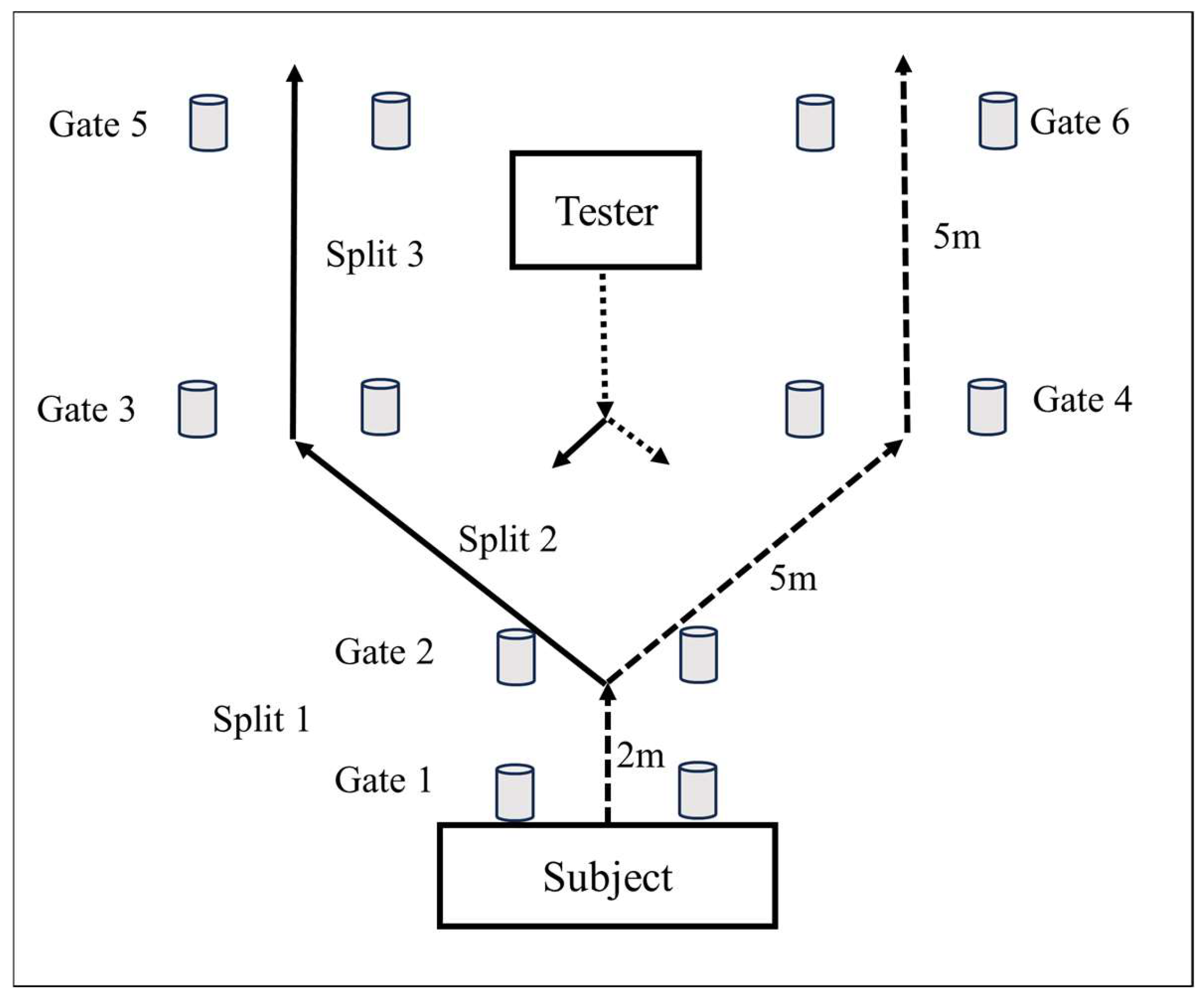
Figure 2.
Left vs Right directional changes during the RAT. RAT = Reactive Agility Test.
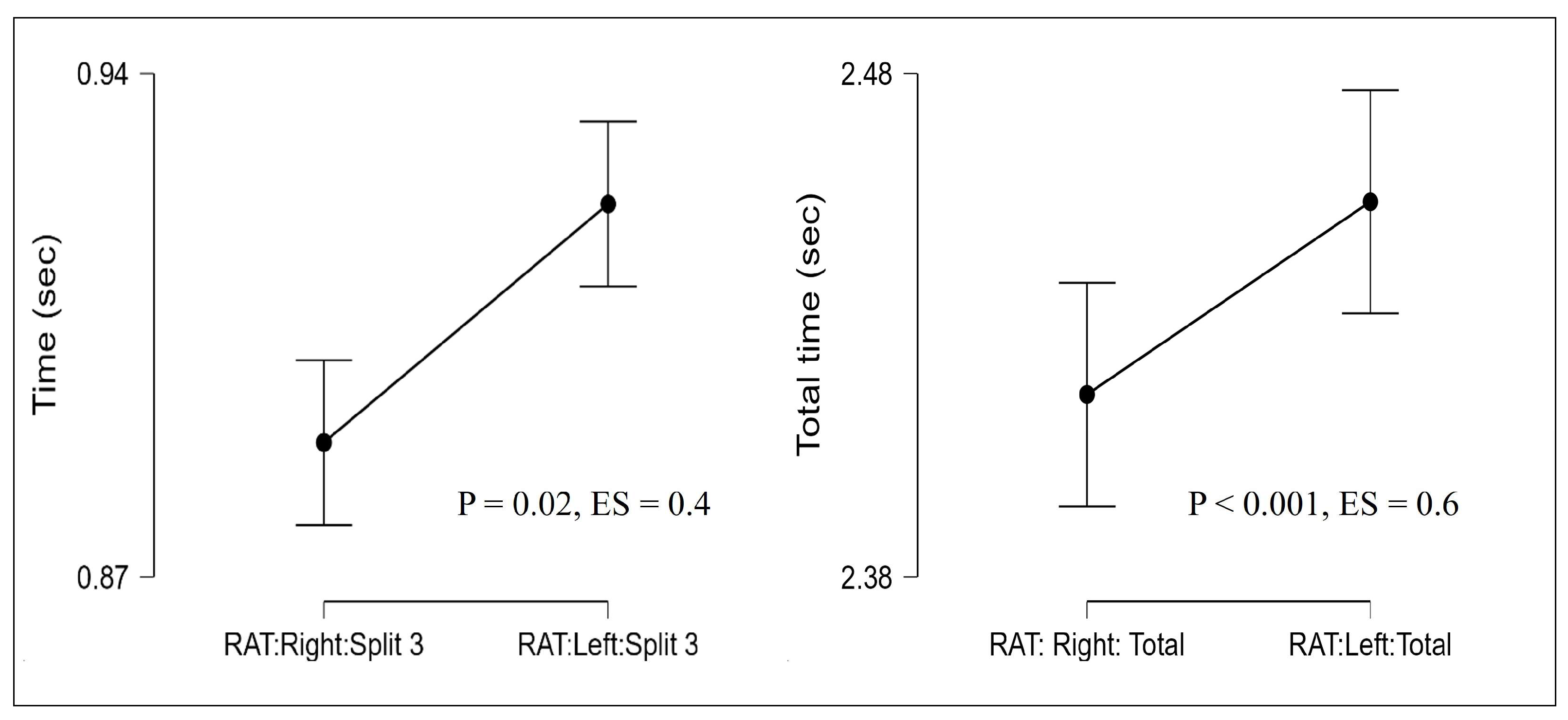
Figure 3.
Heatmap illustrating levels of correlation and significance among the speed, visual reactive, and live reactive tests. * = P < 0.05, ** = P < 0.01, *** = P < 0.001, L = Left; R = Right; SVT = Sports Vision Test; RAT = Reactive Agility Test; s = Seconds; m/s = millisecond.
Figure 3.
Heatmap illustrating levels of correlation and significance among the speed, visual reactive, and live reactive tests. * = P < 0.05, ** = P < 0.01, *** = P < 0.001, L = Left; R = Right; SVT = Sports Vision Test; RAT = Reactive Agility Test; s = Seconds; m/s = millisecond.
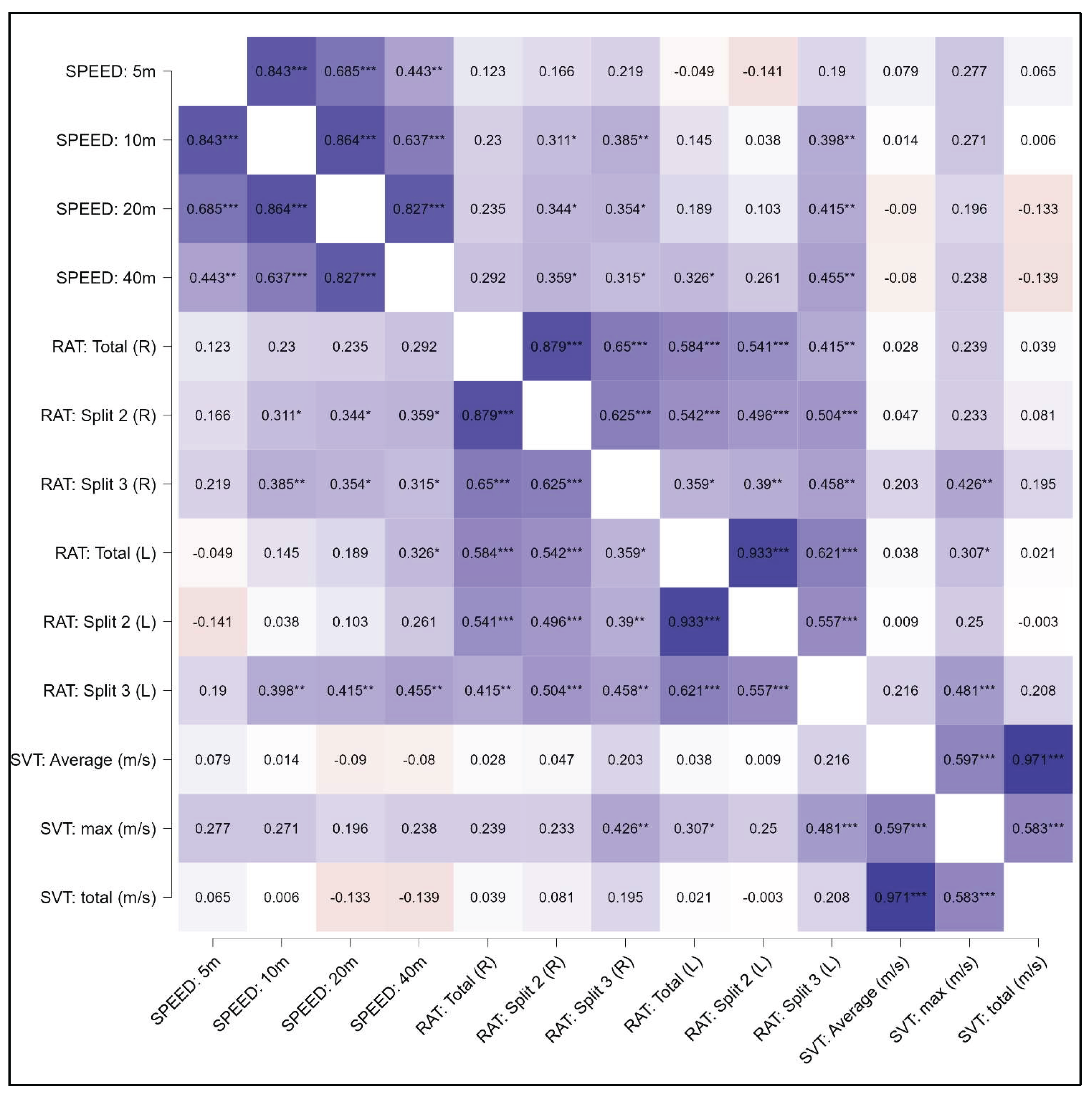

Table 1.
Descriptive statistics ± SD of physical test results. L = Left; R = Right; SVT = Sports Vision Test; RAT = Reactive Agility Test; s = Seconds; m/s = millisecond.
Table 1.
Descriptive statistics ± SD of physical test results. L = Left; R = Right; SVT = Sports Vision Test; RAT = Reactive Agility Test; s = Seconds; m/s = millisecond.
| Physical test | Mean ± SD |
|---|---|
| Speed: 5m (s) | 1,05 ± 0.05 |
| Speed: 10m (s) | 1,79 ± 0.06 |
| Speed 20m (s) | 3,08 ± 0.1 |
| Speed: 40m (s) | 5,51 ± 0.2 |
| RAT: Right: Total (s) | 2,42 ± 0.11 |
| RAT: Right: Split 2 (s) | 1,01 ± 0.07 |
| RAT: Right: Split 3 (s) | 0,89 ± 0.21 |
| RAT: Left: Total (s) | 2,45 ± 0.13 |
| RAT: Left: Split 2 (s) | 1,02 ± 0.08 |
| RAT: Left: Split 3 (s) | 0,92 ± 0.2 |
| SVT: minimum (ms-1) | 0,28 ± 0.1 |
| SVT: maximum (ms-1) | 0,52 ± 0.2 |
| SVT: average (ms-1) | 0,36 ± 0.12 |
| SVT: total (ms-1) | 7,11 ± 2.38 |
Disclaimer/Publisher’s Note: The statements, opinions and data contained in all publications are solely those of the individual author(s) and contributor(s) and not of MDPI and/or the editor(s). MDPI and/or the editor(s) disclaim responsibility for any injury to people or property resulting from any ideas, methods, instructions or products referred to in the content. |
© 2025 by the authors. Licensee MDPI, Basel, Switzerland. This article is an open access article distributed under the terms and conditions of the Creative Commons Attribution (CC BY) license (http://creativecommons.org/licenses/by/4.0/).
Copyright: This open access article is published under a Creative Commons CC BY 4.0 license, which permit the free download, distribution, and reuse, provided that the author and preprint are cited in any reuse.


