
Submitted:
19 May 2025
Posted:
19 May 2025
You are already at the latest version
Abstract
Death is one of the most profound existential dilemmas encountered in human development. The cognitive understanding of mortality and the artistic expression of emotions related to life and death constitute a critical subject that contemporary society cannot overlook. Based on the philosophical theories of life, this article applies the form of illustration in art education to propose innovative methods and strategies for life-and-death education. By integrating diverse artistic forms—such as commemorative sculptures expressing grief for departed loved ones, abstract sculptures envisioning the essence of the soul, a metaphorical art installation framing death as the closing stage of life’s theatrical play, a painting reflecting ancient cultural cosmologies of life and death, and interactive card game designs encouraging individuals to confront mortality—this research constructs a framework for illustrative design practices and artistic exhibitions centered on life-and-death education. Illustration-based art exhibitions focusing on life and death can guide individuals across all age groups to confront mortality, reflect on the significance of life and death, and ultimately establish a constructive perspective on life and existence. Our project aims to provide an innovative paradigm for illustration to engage in life-and-death education and to broaden its conceptual boundaries through practical experimentation.
Keywords:
life education
; death education
; illustrative design practice
; art exhibition
1. Introduction
Death constitutes an inevitable phase in the life cycle of all living beings and remains one of the most profound problems encountered throughout the human life process. Influenced by cultural norms, some societies exhibit taboos surrounding discussion on mortality, while life-and-death education remains underdeveloped in many countries. Artistic expressions can serve as a bridge for people to understand life and death, subtly influencing individuals to engage with existential questions. As societal taboos and educational gaps persist in confronting mortality, two pressing questions emerge: How can artistic mediums transcend cultural barriers to facilitate meaningful dialogues on life and death? Specifically, what unique capacities does illustration possess as a visual language to mediate death education in an age-appropriate and aesthetically pleasing manner? Building on these questions, this paper introduces an innovative methodological framework that extends illustration beyond its traditional two-dimensional boundaries by integrating it with sculpture, installation, interactive design, and curatorial practice. As education is a universal and lifelong journey, this article aims to raise awareness of existential themes across generations and cultures, providing individuals with philosophical enlightenment and establishing healthy psychological foundations for confronting mortality.
1.1. Theoretical Framework and Systematic Challenges in Life and Death Education
Life-and-death education operates at the intersection of philosophical inquiries and pedagogical innovation, yet its implementation remains hindered by disconnections between theoretical depth and practical applicability (Feng, 2020). This section underscores how existing theories in life philosophy, existentialism, and art philosophy provide grounding for an illustration-based approach to life and death education, yet none by themselves fully bridge the gap between abstract existential concepts and concrete visual strategies. Concurrently, this section maps three current challenges in life-and-death education: socio-cultural taboos hindering intergenerational dialogue, pedagogical reliance on didactic resources to existential themes, and institutional marginalization of holistic mortality education. By diagnosing these theoretical-practical gaps, we lay the groundwork for reimagining life-and-death education through art-based strategies that bridge philosophical depth with multimodal, cross-cultural engagement.
1.1.1. Philosophical Foundations and Pedagogical Gaps
Both Eastern and Western philosophical traditions provide rich resources for life-and-death education, yet their translation into accessible pedagogical practice remains fragmented. These theories serve as the framework and driving force for our applied illustration design rather than self-contained solutions. Traditional Chinese philosophy venerates life as a self-renewing process— “the supreme virtue of heaven and earth is to generate life" (天地之大德曰生); "constant renewal signifies flourishing virtue and ceaseless generation define change" (日新之谓盛德,生生之谓易) —revealing the dynamic, ever-evolving nature of life (Lu, 2010). While traditional Chinese life philosophy establishes a holistic framework for understanding life’s vitality and the continuous, interconvertible relationship between life and death, its pedagogical application remains constrained by text-based metaphorical frameworks that limits accessibility for younger and cross-cultural audiences.
Complementing this perspective, Western existentialism posits death as the catalyst for authenticity: Nietzsche interprets death not as an end but as a transformative opportunity for fulfillment; Kierkegaard maintained that “death is life’s teacher”, prompting the question “How should I exist?” (Weston, 2003); Heidegger argued that authentic existence arises only when one acknowledges finitude and chooses meaning beyond the obscurity of mundane life (Dreyfus, 1991). Meaning arises through human subjectivity—defined by openness, creativity, and the capacity to transcend given circumstances, emphasizing education’s role of cultivating self-awareness and a pluralistic view of truth (McMullin, 2013). However, existentialism’s abstract emphasis on individual reflection on existential crisis can be inaccessible to younger or non-Western audiences.
Theories of artistic vitality — from Chinese notions of “气韵生动” (qiyun shengdong) to Langer’s “living forms” that externalize emotion (Rusk, 1968) — underscore how art can embody and transmit existential feeling. Langer contended that linguistic symbols, constrained by logic and reason, are often inadequate for conveying the nuanced complexities of human emotional experiences. Instead, art serves as the essential medium through which ineffable emotions are externalized and rendered perceptible (Rusk, 1968). Such philosophy of artistic vitality affirms art’s capacity to embody emotional depth, which validates our use of illustration to evoke emotions beyond mere informational content. However, these theories leave the gap for prescribing how to integrate illustration with cultural narratives and spatial, tactile, or interactive media to establish a dynamic dialogue between the artist and the audience.
1.1.2. Systemic Challenges in Practice
Despite growing awareness of its value, life and death education remains unevenly developed across cultural and institutional contexts and faces cultural, methodological, and institutional barriers: socio-cultural taboos and parental reluctance around discussing mortality inhibit meaningful conversation; teaching relies largely on isolated didactic materials rather than experiential methods; formal curricula often marginalize death related topics, focusing on prevention rather than deeper meaning.
-
Cultural Taboos and Parental AvoidanceDeep-rooted cultural taboos around mortality deter parents from discussing death with children, limiting life education’s integration into into both public education and family contexts (Wu, 2010). Although intended as protection, such avoidance leaves children vulnerable to trauma when confronting mortality unprepared (Longbottom & Slaughter, 2018). Some adults grapple with existential anxieties about death themselves, further impeding their ability to articulate its meaning appropriately and guide children through these discussions.
-
Overreliance on Didactic ResourcesCurrent school-based curricula mainly rely on theoretical lectures and educational resources such as novels, picture books, films, and other audiovisual materials to introduce mortality, but often treat life-and-death topics as abstract concepts rather than creative experiences. The focus on didactic, two-dimensional materials fails to leverage more immersive, multimodal methods such as sculpture, installation, or interactive games.
-
Institutional MarginalizationWithin formal education systems—particularly in parts of China—life-and-death education is often marginalized, lacking pedagogical resources and curricular design (Feng, 2020). Emphasis is frequently placed on suicide prevention and resilience training (Feng, 2020) rather than broader existential inquiry or hands-on, art-based approaches. Most scholarly research remains tilted to theoretical explorations, with limited integration of art-based practices into formal curricula.
1.1.3. Toward an Integrated Framework
These challenges underscore the need for a theory-practice nexus that reinterprets philosophical insights through accessible visual strategies. For instance, traditional Chinese cyclical view of life (death and renewal) can be addressed by deriving visual heuristics or metaphors from life philosophical tenets. Existentialist perspective of finitude can be rendered through interactive and open-ended narrative prompts where participants co-create experiences, transforming existential anxiety into creative energy.
The concept of vitality and Langer’s “living forms” can guide tactile sculptural works that embody and re-energize the emotional core of existential themes, addressing cultural taboos through non-verbal expression. By integrating art-based strategies in cross-cultural life-and-death education, current pedagogical gaps can be bridged, fostering emotional and philosophical explorations across developmental stages.
1.2. Significance of Death-Themed Artistic Expression
Artistic expression addresses the challenges in life-and-death education by engaging audiences of all ages—especially children—through subtle, embodied, and narrative means. By challenging taboos, visualizing abstract ideas, and fostering cross-cultural dialogue, death-themed art practices redefine conventional understandings of mortality, promote psychological healing, enrich educational practices, and transform philosophical reflections into practical insights.
1.2.1. Challenging Taboos and Fostering Emotional Resilience
Death-themed art dismantles cultural taboos by translating abstract existential questions into accessible, concrete, and evocative imagery. Through metaphor, color, and form, illustrations invite audiences to engage with mortality without feeling lectured. At the same time, immersive and interactive works—such as narrative installations or participatory games—create safe and relaxing spaces for emotional engagement, helping both children and adults process grief, confront fear, and build psychological resilience. As highlighted by Cathy Malchiodi (2020), death-themed artworks encourage acceptance of mortality, effective grief navigation, and resilience.
1.2.2. Enriching Learning Through Multimodal Engagement
By fusing illustration with sculpture, installation, and interactive media, death-themed exhibitions offer a rich, multisensory learning environment. This multimodality encourages multi-perspective reflection by merging art, tradition, and personal narrative. Participants can move between observing two-dimensional visuals, touching sculptural elements, and navigating through immersive spaces, deepening their intellectual and emotional connection to life-and-death themes. Moreover, for children—especially those with psychological challenges—multimodal communication offers a more intuitive method of grasping abstract concepts than verbal explanations alone.
1.2.3. Cultivating Lifelong Curiosity and Philosophical Insight
Beyond immediate pedagogical aims, artistic explorations of existence and mortality spark ongoing philosophical inquiry and self-reflection. Thoughtfully designed exhibitions embed prompts and narrative threads that linger after the visit, encouraging visitors to question the meaning of life, celebrate life’s intrinsic value, understand cultural attitudes toward death, and position their own beliefs. In this way, death-themed art fosters a mindset of continuous philosophical exploration on existential themes and support personal growth throughout the life span.
2. Illustration-Based Strategies for Life and Death Education
In this section, we integrate the above theoretical foundations into a cohesive, practice-oriented methodology for art-based life-and-death education. Drawing on ancient Chinese life philosophy’s emphasis on cyclical renewal, existentialism’s view of death as a catalyst for authenticity, and theories of artistic vitality that affirm art’s emotional agency, our illustration-based methods both reflect and provoke philosophical reflection—serving as a conduit between viewers and underlying life-and-death philosophies and guiding audiences toward the existential questions themselves. Using illustration as our core medium, we integrate sculpture, installation, interactive design, and curatorial practice. These multimodal presentations translate abstract existential insights into concrete visual and tactile experiences, encouraging engagement with death-related discourse, cross-cultural perspectives, and reflective insights on life. As shown in Figure 1, our strategies expand the conceptual boundaries of illustration through diverse, integrated formats that facilitate multidimensional explorations of different life-and-death themes.
As can be concluded from Figure 1, our project incorporates four main approaches to illustration practice addressing the themes of life and death:
-
Translating death-related concepts and emotions into tactile formsIntegrating illustration with tactile sculpture, using both abstract and representational imagery to materialize bereavement experiences and ontological reflections on spiritual essence.
-
Mapping cultural metaphors of death in spaceEmploying installation art with thanatological and funerary metaphors to articulate socio-historical interpretations of death, and juxtaposing ancient cosmologies with contemporary discourses to facilitate cross-cultural transmission.
-
Enabling interactive exploration of death scenariosDesigning interactive, illustration-embedded game narratives that invite audiences to assume roles, make choices in fictional death scenarios, and process negative emotions through active participation.
-
Constructing immersive curatorial frameworksSynthesizing sculpture, installation, illustration, and derivative products into a cohesive exhibition setting that sustains emotional resonance, intellectual inquiry, and ongoing audience participation.
By merging the traditional method of illustration with spatial and tactile mediums, this methodological framework fosters an accessible dialogue on life and death within contemporary art practice.
2.1. Translating Death-Related Concepts and Emotions into Tactile Forms
This approach focuses on how planar illustration can be combined with three-dimensional sculptural form to construct concrete or abstract visual symbols for death-related concepts, cultivating emotional resonance with the audience. When integrated with sculpture, these visual elements translate complex philosophical perspectives on death into tangible forms through multidimensional expression, enhancing philosophical comprehension of abstract concepts such as the soul. In sculptural works addressing the theme of death, illustrative elements manifest as embedded imageries, specific color schemes, and symbolic shapes within allegorical sculptural forms. For example, as shown in Figure 2, applying figurative illustrations to metaphorically shaped sculpture amplifies semantic depth while bridging the gap between the artwork and viewers' lived experiences, thus enhancing emotional communication. Additionally, the strategic material selection for the sculpture reinforces its visual narrative and adds a new dimension to the emotional transmission of existential themes. This method demonstrates how integrating two-dimensional illustration and three-dimensional sculpture creates layered emotional expressions about mortality.
Another side of this approach is to embed abstract symbolic designs within sculptural forms, materializing intangible concepts such as the soul’s ephemerality into tactile forms to provoke metaphysical inquiry. Such works establish space for open interpretation and discussion, encouraging audiences to engage with fundamental questions about spiritual essence (Figure 2). Both strategies demonstrate how the interplay between planar illustration and three-dimensional sculpture can transform philosophical abstractions into tactile visual discourse, stimulating profound reflection on death and existential themes.
2.2. Mapping Cultural Metaphors of Death in Space
Beyond traditional sculpture, illustrations can be effectively incorporated into installation designs to interrogate death-related cultural metaphors and symbolic imageries, thereby fostering an accessible understanding of mortality, and promoting cross-cultural dialogue. The diverse forms of installation, combined with symbiotic illustrative elements, collectively articulate socio-cultural metaphors surrounding death. As Lakoff and Johnson (1980) posited, metaphor is a fundamental cognitive mechanism of all human beings that presents in our daily life, language and thinking, enabling humans to interpret abstract concepts through concrete experiences. The conceptual metaphor theory argues that metaphors structure our understanding of complex ideas by linking them to familiar experiences. Through metaphorical representations and symbolic imagery, illustration expresses concepts of death indirectly, thereby constructing a safe emotional buffer zone that enables viewers to lower psychological defenses.
Drawing upon the metaphorical approach that facilitates comprehension of abstract concepts through culturally specific associations, illustration combined with installation design can employ cross-cultural metaphors to convey abstract notions such as death. For example, the metaphor “life is like a play" assimilates life to theatrical performance, wherein death corresponds to the final act of the drama. By adopting a death-related metaphor as the central theme, designers can transform imagery—such as a “theatrical stage”—into an art installation, adapting its presentation to conform with specific cultural practices. Moreover, integrating illustration elements that align with the theme into the installation maximizes creativity in visual expression and enhances emotional resonance impact on the audience, as demonstrated by the three-dimensional illustrative approach shown in Figure 3. This synthetic approach of metaphorical representation not only reflects socio-cultural perspectives but also deepens the audience’s understanding of death and the meaning of life.
Furthermore, the integration of illustration and installation can re-create historical artifacts while conveying the ancient cosmological views on life and death, as exemplified by the artifact-inspired illustration installation shown in Figure 3. Ancient mythologies and early artistic expressions often recount narratives of divine and supernatural beings, offering profound cultural insights and stimulating human imagination. Cultural heritage has long served both to educate society and to inspire artistic creation. Narratives of death, imbued with fantastical elements, continue to influence modern thought. By integrating ancient cosmologies and perspectives on life and death, illustration revives historical narratives in a visually engaging format that bridges temporal and spatial divides. Ancient Chinese visions of the afterlife offer a poetic dimension to the human experience through accessible storytelling, which aligns with our goal as illustrators to foster public appreciation for the interplay between life and death comfortably and creatively. Moreover, embedding cultural narratives within illustration design provides an innovative avenue for educating the public about cultural heritage and its contemporary relevance. For example, the T-shaped painted silk garment from the Mawangdui Tombs can serve as a structural foundation for contemporary installation artwork, with surface illustrations conveying both the historical and modern interpretations of the afterlife (see Figure 3). This mediated approach encourages thoughtful engagement with death-related themes through culturally embedded visual metaphors.
2.3. Enabling Interactive Exploration of Death Scenarios
Interactive game design serves as a bridge between audiences, illustrations, and the theme of death. This approach explores how illustration-driven game design empowers audiences as co-creators, transforming passive viewing into active engagement with death-related scenarios, facilitating interpersonal dialogue, and prompting self-reflection. As shown in Figure 4, an illustration-based card game can incorporate creative character design, detailed backgrounds, decorative elements, and textual descriptions, thereby immersing the audience in its visually and narratively cohesive thematic world. Within this framework, players can choose from various death scenarios and ways of coping with death, engaging in activities such as answering questions to deepen their experiential understanding of death through proactive engagement. Moreover, the entertainment value of the game and its relaxed atmosphere encourage players to confront death and its associated negative emotions by reflecting on personal experiences, thereby gradually alleviating fear and traumatic memories. Ultimately, this approach of illustration-based game design enhances the efficacy of interaction by enabling audiences to directly engage with the artwork, transforming art appreciation from a static cognitive process into a dynamic, embodied experience that integrates both physical and cognitive engagement.
2.4. Constructing Immersive Curatorial Frameworks
Solitary modes of appreciating illustrations—such as scrolling through isolated images on a mobile device—may constrain conceptual exploration and emotional engagement when addressing profound themes like death, thereby diminishing both experiential engagement and the comprehension of multifaceted emotions. In contrast, by incorporating illustration into thematic exhibition spaces—as well as into derivative products that align with the exhibition’s theme, audiences can immerse themselves in an open and engaging atmosphere. As shown in Figure 5, this approach outlines a multimodal exhibition model that weaves illustration, sculpture, installation, and derivative products into a cohesive spatial narrative, enhancing sustained engagement and encouraging open discourse. Compared to textual communication alone, combining images, installations, and spatial elements more directly captures the audience's attention while establishing narrative relationships among the diverse visual components. Such multimodal engagement stimulates imagination and critical discourse, thereby deepening the understanding of both philosophical and cultural ideologies which has significant educational value for younger audiences.
Moreover, theme-related derivative products are displayed alongside the primary exhibits. These products—reflecting the artist’s style and derived from the original artworks—reinforce viewers’ impressions and enhance the viewing experience. Designated spaces for these print-based items, which include bookmarks, cards, and an introductory booklet featuring the artist’s reflections, increase the exhibition’s appeal and extend the exhibition’s impact beyond its duration. Additionally, integrating illustrative elements into derivative product design links artistic creation to market demand, generating additional philanthropic support for the charitable organizations supported by the exhibition.
3. Results and Practices
Death is both a universal and deeply personal experience that often provokes fear, anxiety, and avoidance—whether in response to the loss of loved ones or confrontation of one’s own mortality. Our project investigates the multifaceted nature of death, aiming not only to address emotional barriers but also to expand the understanding of diverse cultural perspectives and foster open dialogue across age groups.
Through employing a diverse range of media and innovative illustrative techniques, our project consolidates various artistic methodologies into a coherent and dynamic visual narrative. Centered on illustration as its unifying language, we explore the following thematic dimensions of death and incorporate them into the “Transcendence” exhibition:
-
Memento and Soul—Sculptures Incorporating Figurative and Abstract Visual SymbolsWe designed sculptural works using both figurative and abstract imagery to materialize personal commemorative activities and questions about the soul’s ephemerality and its relationship to the physical body.
-
Ritual and Metaphor—A Three-Dimensional IllustrationAn illustrated paper-theater that reimagine funerary customs and expresses the cultural metaphor of “life is a play” through visual narratives.
-
Ancient Cosmologies about Life and Death—An Illustrated InstallationAn installation piece that reinterpret ancient cosmological motifs and bridge historical beliefs of the afterlife with contemporary theories of human consciousness.
-
Experiencing Death—An Interactive Card Gamecard game that invites participants to assume roles, confront fictional death scenarios, and make choices—encouraging them to address negative emotions through self-reflection and interaction with other participants.
The “Transcendence” exhibition is the final curatorial work that weaves artworks, textual prompts, and derivative products into an immersive spatial narrative, encouraging conversation and extending reflection beyond the gallery. By employing creative visual narratives alongside reflective prompts, the exhibition invites audiences to reconceptualize their perceptions of death within an accessible, open framework. Moreover, the proceeds from this initiative contribute to charitable organizations, including Caledonia Funeral Aid and Richmond’s Hope, linking social engagement and community support to our artistic exploration.
3.1. Memento and Soul—Sculptures Incorporating Figurative and Abstract Visual Symbols
We designed the Mementos sculpture (Figure 6) that symbolizes the enduring connection between individuals and their deceased loved ones, emphasizing the role of mementos in the grieving process—a practice with a documented history spanning over 2,000 years. The sculpture’s form is inspired by the sacred bronze vessels of ancient Chinese sacrificial rituals and incorporates visual representations of personal mementos (e.g., urns, jewelry, voicemail recordings). These elements illuminate the intimate methods by which individuals preserve memories of the deceased, suggesting that loved ones persist within our recollections in transformed modalities.
The sculpture was fabricated using paper clay to emulate a traditional vessel. A flower emerging from its opening signifies perpetual love and longing for the departed. The illustrations were painted with ink on a white surface, making the images simple and clear to read. They were also printed through lino-cut and made into an anthology alongside the vessel. Drawn with a comforting retro style, the contents of the illustrations are easy to grasp for audiences of all age groups. Even through a limited color palette, we can feel a peaceful atmosphere with a sense of hope and positivity, which is due to the warmth and low saturation of the overall color tone.
In addition to the Mementos sculpture, we also explored the abstract side of visual communication. Our series of abstract sculptures, The Soul and Body, (Figure 7) explores the nature of the soul and the connection between soul and body. Souls are always mysterious and intangible—could it be that souls escape from the body, embracing a brand-new afterlife after death? Could ghosts—another form of soul, be among the liberated souls that haunt our world? Inspired by these intriguing conjectures that many people may have encountered, this body of work encourages reflection on the concept of the soul: Is it “trapped” in the body or only achieving freedom upon its release? According to our research, both philosophical and religious views on the soul-body relationship have suggested that the soul is made of different parts, each with a role, and the body could be seen as a container of the soul.
The cracks on the sculptures’ surface symbolize the soul’s “escape” from physical constraints, and the fragmental pieces represent that souls have different parts and roles. By creating a peaceful and calm atmosphere, these abstract and intriguing forms encourage open dialogues and invite viewers to think about the nature of the soul.
3.2. Ritual and Metaphor—A Three-Dimensional Illustration
We created a paper theater to reimagine a funeral scene, inspired by the traditional Chinese concept of “life is a play (人生如戏)” where an individual’s life plays like a film before their eyes when death comes. In the conceptual metaphor "life is a play", life is a relatively abstract entity that cannot be understood through our perceptions, while play is a familiar concept to us. Using the metaphor of life as a theatrical performance, the funeral can be seen as the closing ceremony of the “play” of life.
Inspired by the traditional Chinese “spirit house”, a finely paper-crafted miniature house burned during ancient funeral rites to honor the deceased and accompany them to the afterlife, this “paper theater” was crafted to look like a tombstone externally but contains a stage within, as shown in Figure 8. To enhance the metaphor of life and death, illustration was applied to the 3D paper sculpture as decorative elements of the stage. Even though it is painful to say goodbye to the dead, death may be a well-earned break to those who have completed their “play” after a lifetime of effort.
3.3. Ancient Cosmologies About Life and Death—An Illustrated Installation
Another installation artwork, Returning to the Universe, draws inspiration from the T-shaped painted silk garment found in Tomb No. 1 at Mawangdui, Changsha, Hunan Province. Dating from the 2nd century BCE, the tomb contained the remains and possessions of the Marquise of Dai (d. after 168 BCE) (Wang, 2009). Known as the “fei-garment,” the character “fei” may be interpreted as “flying,” “screening,” “long,” or “proxy,” each suggesting a distinct function (Wang, 2009). Early Chinese texts associate the garment with a funerary “soul-summoning” ritual, implying that it served as a medium through which the deceased’s soul could be recalled. However, its intricate design indicates a role extending beyond that of a mere ritual prop (Wang, 2009).
The artwork appears to invoke the revitalization of the deceased, culminating in a celestial state wherein the Marquise of Dai’s spirit ascends to merge with ancestral entities. Her spirit resurrects from the underworld and soars up into the heavens like the flow of dragons. Notable motifs—including intertwined dragons, the Jin Wu bird, and a jade disc—reinforce this symbolism. In ancient Chinese cosmology, the dragon represents life or “qi (气, vital breath)” ascending toward the heavens, thus encapsulating the belief that death marks not an end but a transformative rebirth (Wang, 2009). The cosmologies of ancient China, along with their narratives on life and death, are imbued with poetic romanticism that affirmatively directs toward life's cyclical renewal. The T-shaped painted silk garment from the Mawangdui Tombs, originally intended as a ritual medium for the tomb occupant’s celestial ascension, assumes dual significance today. As an artistic artifact, it visually expresses ancient notions of transcendence and posthumous ideals, offering modern viewers new perspectives on life and death, fostering existential enlightenment and psychological solace.
Modern quantum mechanics conceptualizes consciousness as quantum energy, paralleling ancient Chinese beliefs in an afterlife. Lanza and Berman (2010) argue that life gives rise to the universe and that consciousness precedes its physical existence. Within this framework, consciousness consists of energy particles that, while residing in the brain during life, undergo quantum entanglement upon death to transition into another realm. This installation bridges traditional views on life and death with modern scientific theory by positing that the soul may persist as “quantum messages” within the universe, highlighting the enduring significance of life beyond death and its potential for renewal. As shown in Figure 9, We created a T-shaped installation that was hung against a black background at the exhibition. The after-death scene was painted on sulfuric paper to make the entire piece feel light-weighted since the original robe was made to facilitate the soul’s ascension to the heavenly realm. The slightly wrinkled texture corresponds to the age and weathered look of the relic, while tissue paper was decorated around the ‘garment’ to suggest the look of sartorial tapestry. The vibrant and richly chromatic brushstrokes serve as an imaginative representation of cosmic consciousness or quantum messages that perpetually traverse the cosmos. Simultaneously, the ethereal color palette functions as a modern reinterpretation of the romanticized afterlife envisions of the ancient civilization, inviting contemporary viewers to engage in a dialogue that transcends spatial and temporal boundaries.
3.4. Experiencing Death—An Interactive Card Game
We also designed a card game called the Death Departments to facilitate interactions and discussions about death in a relaxing space, as shown in Figure 10-11. By encouraging players to confront death, explore cultural beliefs, and relate the topic to their own experiences, this interactive approach transforms the subject into a playful yet profound exploration of concepts, values, and emotions, fostering creativity and openness.
Some people’s fear about death may be more about the process of dying and the unknowns leading up to it. The various circumstances surrounding death in the game help players to confront them more openly and encourages them to face feelings of confusion, sorrow, fear, or even guilt arising from the different experiences of death. Additionally, the game encourages players to reflect and relate back to themselves to earn points and thrive. Rather than just perceiving the experiences of others they will have to engage in meaningful conversations, making the topic penetrate past their defenses and helping them build a healthier and more open relationship with death.
3.5. Transcendence: An Immersive Life-and-Death Exhibition
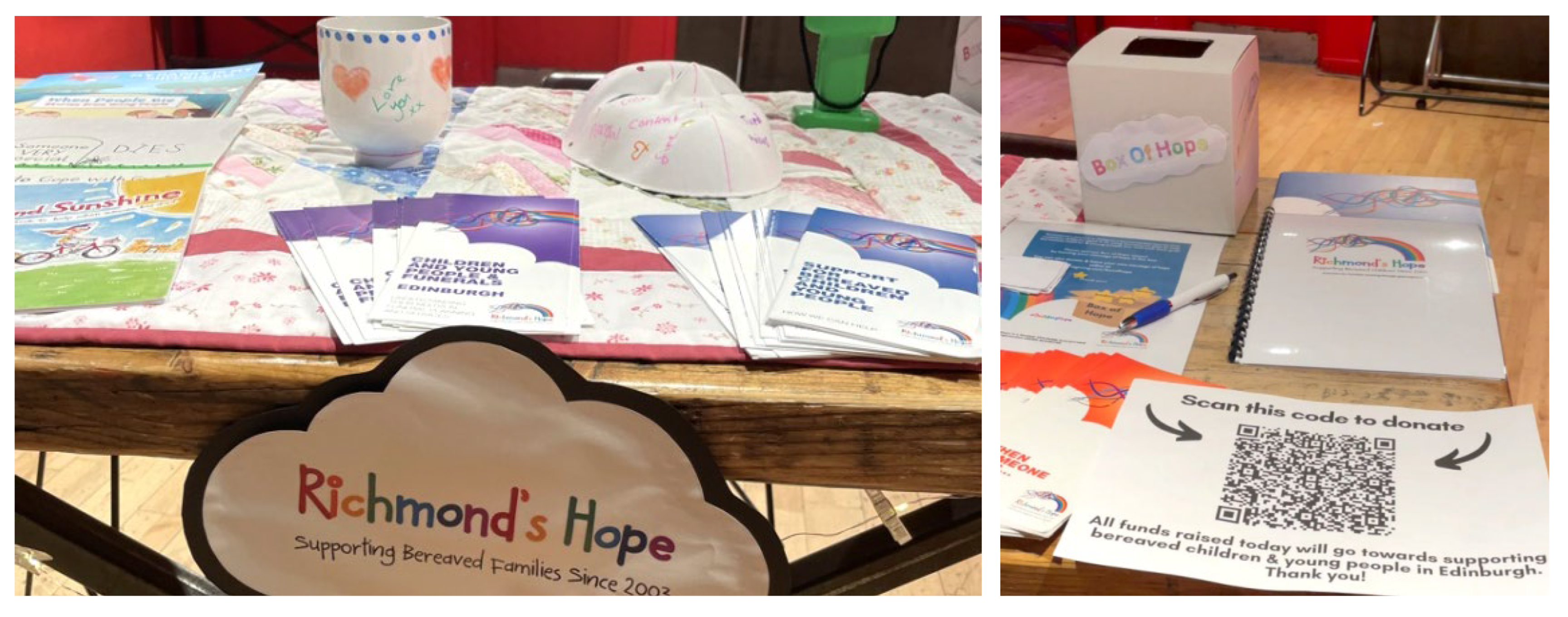
Ultimately, the artworks were consolidated into an exhibition titled Transcendence. The inaugural presentation, hosted in a showroom at the Edinburgh College of Art (ECA), was accessible to the entire university community. Each piece of artwork was displayed with an accompanying textual description, enabling visitors to navigate freely and engage with reflective prompts (Figure 12). The spatial arrangement of artworks reinforced the exhibition's thematic coherence. A designated area featured a table and chairs, inviting visitors to engage comfortably with the card game, thereby immersing themselves in profound existential themes in an approachable way without feeling overwhelmed. Moreover, visitors engaged in discussions among themselves and with the artists, fostering an interactive dialogue about the works. A sales table offering exhibition-derived prints successfully encouraged audiences to select a tangible memento of the experience (Figure 13, Figure 14 and Figure 15). Notably, the collaboratively designed publication—which introduced the works and articulated the artists’ reflections on life and death—emerged as the most popular item (see Figure 16 and Figure 17). Additionally, partner charity organizations participated by setting up tables for promotional materials and donations. The exhibition was later re-staged in the main sculpture court during the annual Winter Fair at the Edinburgh College of Art, further demonstrating the adaptability and flexibility of the exhibition model as an educational medium on themes of life and death for the wider public.
3.6. Promotional Materials
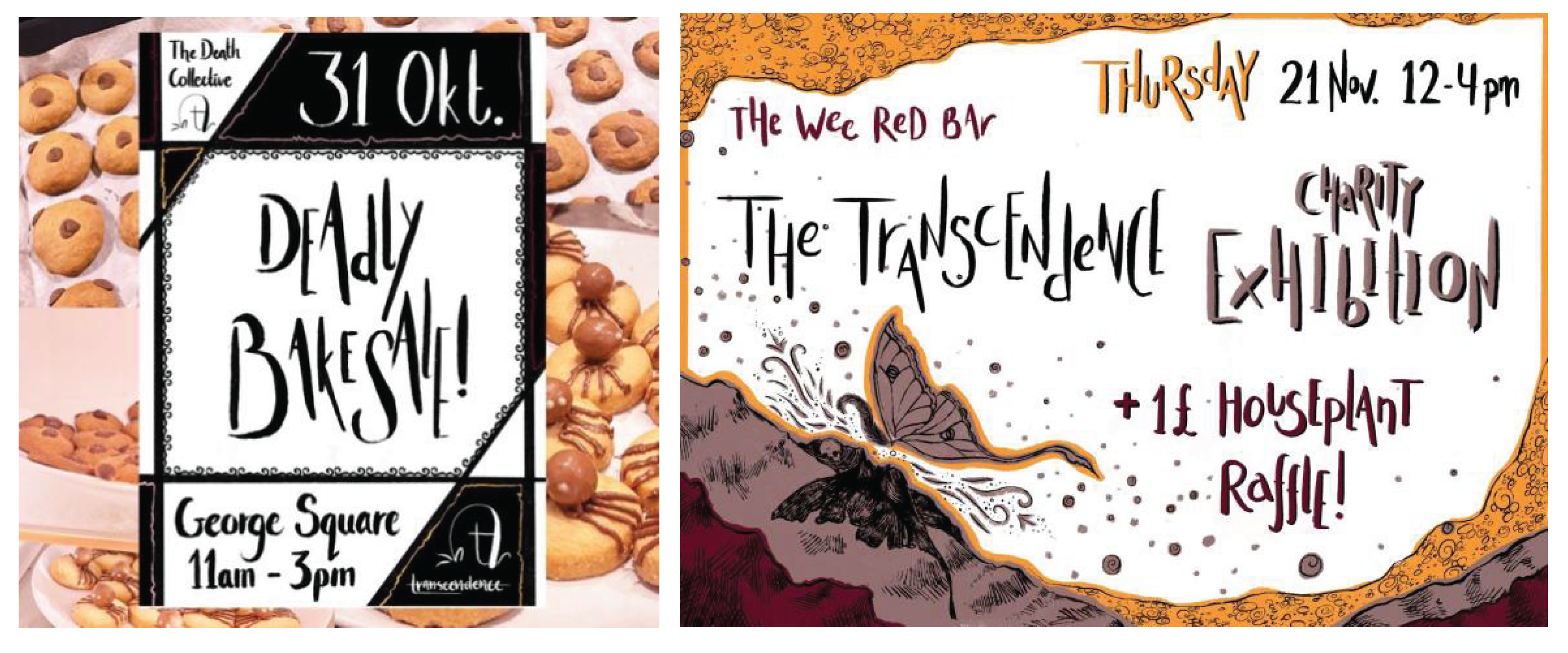
Leveraging the rapid dissemination, immediate feedback, interactivity, and extensive reach of social media, we promoted the death-themed exhibition through an integrated online campaign. This approach enhanced the exhibition's visibility and facilitated broader public engagement with life-and-death education through the impact of illustration. The campaign included the creation of a project logo and the establishment of an Instagram account featuring regular posts that introduced each artist and showcased exhibition-related content—ranging from digital posters to work-in-progress images. In addition, printed posters were displayed on campus to complement the online promotion. A pre-exhibition campus bake sale further supported these efforts by serving as both a promotional activity and a charity fundraiser, with all proceeds donated to our partner organizations.
Figure 19.
Exhibition logo design.
Figure 20.
Pre-exhibition bake sale poster design and Exhibition poster design, Jana Kollmansperger.
Figure 20.
Pre-exhibition bake sale poster design and Exhibition poster design, Jana Kollmansperger.
4. Conclusions and Future Directions
In this study, we have shown how illustration can be integrated with sculpture, installation, interactive design, and curatorial strategies to effectively dismantle cultural taboos and address gaps in life-and-death education. By grounding our methods in Traditional Chinese life philosophy, Western existentialism, and theories of artistic vitality, we translated abstract existential ideas into age-appropriate, cross-cultural visual metaphors, designed a multimodal learning environment, and curated the immersive “Transcendence” exhibition—a cohesive spatial narrative that sustained emotional resonance and deepened intellectual inquiry into life and death. By systematically aligning visual strategies with philosophical foundations and practical exhibition outcomes, this research offers a replicable and scalable model for life-and-death education that cultivates openness, resilience, and lasting philosophical inquiry.
Looking ahead, enriching this model with digital extensions—such as interactive projections, video installations, augmented-reality, and soundscapes—could further amplify audience agency and broaden accessibility, enabling remote audiences to engage in life-and-death education. Embedding these art-based methods into formal curricula and training educators to facilitate multimodal workshops will help institutionalize the approach, while engaging with cultural institutions in diverse regions can ensure that future works resonate with local histories, cultures, and social ideologies. Finally, embracing community-driven collaboration—inviting bereaved individuals, school groups, and social organizations into the design process—will ground the work in lived experience and generate more nuanced, empathetic pathways for exploring life and death.
Author Contributions
Conceptualization, X.H, J.K, A.L, H.Z, and R.C; methodology, X.H, J.K, A.L, H.Z, and R.C; writing—original draft preparation, X.H.; writing—review and editing, X.H.; visualization, X.H, J.K, A.L, H.Z, and R.C. All authors have read and agreed to the published version of the manuscript.
Funding
This research received no external funding.
Conflicts of Interest
The authors declare no conflicts of interest.
References
- Dreyfus, H.L. (1991). Being-in-the-world: a Commentary of Heidegger’s Being and time, Division 1. Cambridge (Mass.) Mit Press.
- Feng, J (冯建军). (2020). Woguo xuexiao shengming jiaoyu de jingyan, fansi yu zhanwang (我国学校生命教育的经验、反思与展望) [The experience, reflection, and Prospect of Life Education in Our country’s Schools]. Zhongguo Deyu (中国德育)[Moral Education China], [online] (9), pp.23–30 http://qikan.cqvip.com/Qikan/Article/Detail?id=7101846108.
- Lakoff, G. and Johnson, M. (1982). Metaphors We Live by. Leonardo, [online] 15(4), p.323. [CrossRef]
- Lanza, R.P. and Berman, B. (2010). Biocentrism : how life and consciousness are the keys to understanding the true nature of the universe. Dallas, Texas: Benbella Books.
- Longbottom, S. and Slaughter, V. (2018). Sources of children’s knowledge about death and dying. Philosophical Transactions of the Royal Society B: Biological Sciences, 373(1754), p.20170267. [CrossRef]
- Lu, L (芦雷). (2010). Zhongxi fang shengming guan de lishi huisu—shengming jiaoyu de lilun jichu yanjiu (中西方生命观的历史回溯—生命教育的理论基础研究) [A Historical Backtracking of Chinese and Western View of Life—A Basic Research of the Theory of Life Education]. Liaoning Shifan Daxue Xuebao (辽宁师范大学学报) [Journal of Liaoning Normal University (Social Science Edition)], [online] (5), pp.10–13 http://qikan.cqvip.com/Qikan/Article/Detail?id=35252420.
- Malchiodi, C.A. (2020). Trauma and Expressive Arts therapy: Brain, body, and Imagination in the Healing Process. New York: The Guilford Press.
- McMullin, I. (2013). Heidegger, Art, and Postmodernity by Iain D. Thomson (review). Journal of the History of Philosophy, 51(2), pp.324–325. [CrossRef]
- Rusk, W.S. (1968). Susanne K. Langer, Mind: an Essay on Human Feeling. Art Journal, 27(3), p.336. [CrossRef]
- Wang, E.Y. (2009). Why Pictures in Tombs? Mawangdui Once More. Orientations, [online] 40(2), pp.76–83 https://www.academia.edu/5892198/Why_Pictures_in_Tombs_Mawangdui_Once_More.
- Weston, M. (2003). Kierkegaard and Modern Continental Philosophy. Routledge.
- Wu, Y (吴艺). (2010). Shengming shiyu xia siwang jiaoyu fansi (生命视阈下死亡教育反思.) [Reflection on Death Education from the Perspective of the Philosophy of Life]. Xue Lilun (学理论) [Academic Research], [online] 2(17), pp.78–79 https://wenku.baidu.com/view/9279caa2824d2b160b4e767f5acfa1c7ab00821e?fr=xueshu&_wkts_=1740738888159&needWelcomeRecommand=1.
Figure 1.
Overview of themes and methodologies.
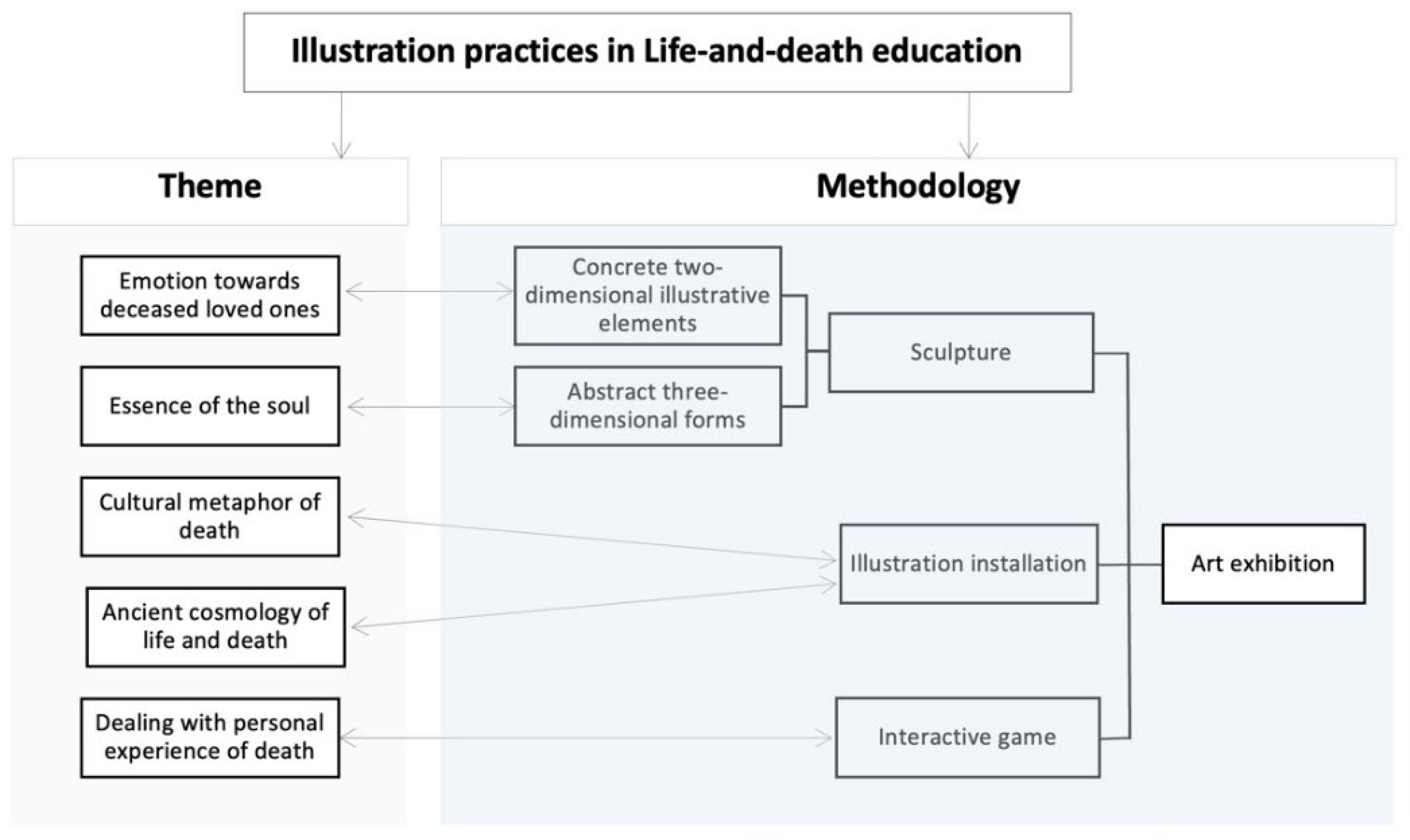
Figure 2.
Exploring death through combining illustration with tactile sculpture.
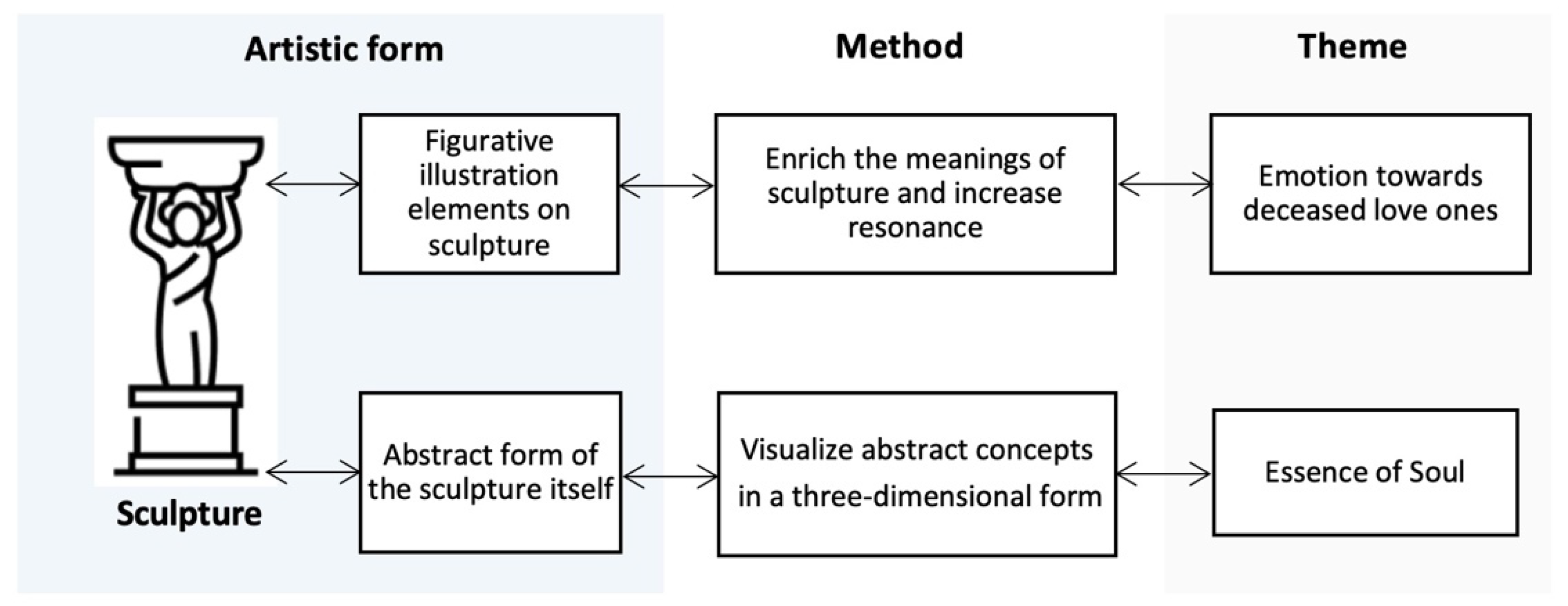
Figure 3.
Conveying socio-cultural metaphors of death through Illustrative installations.
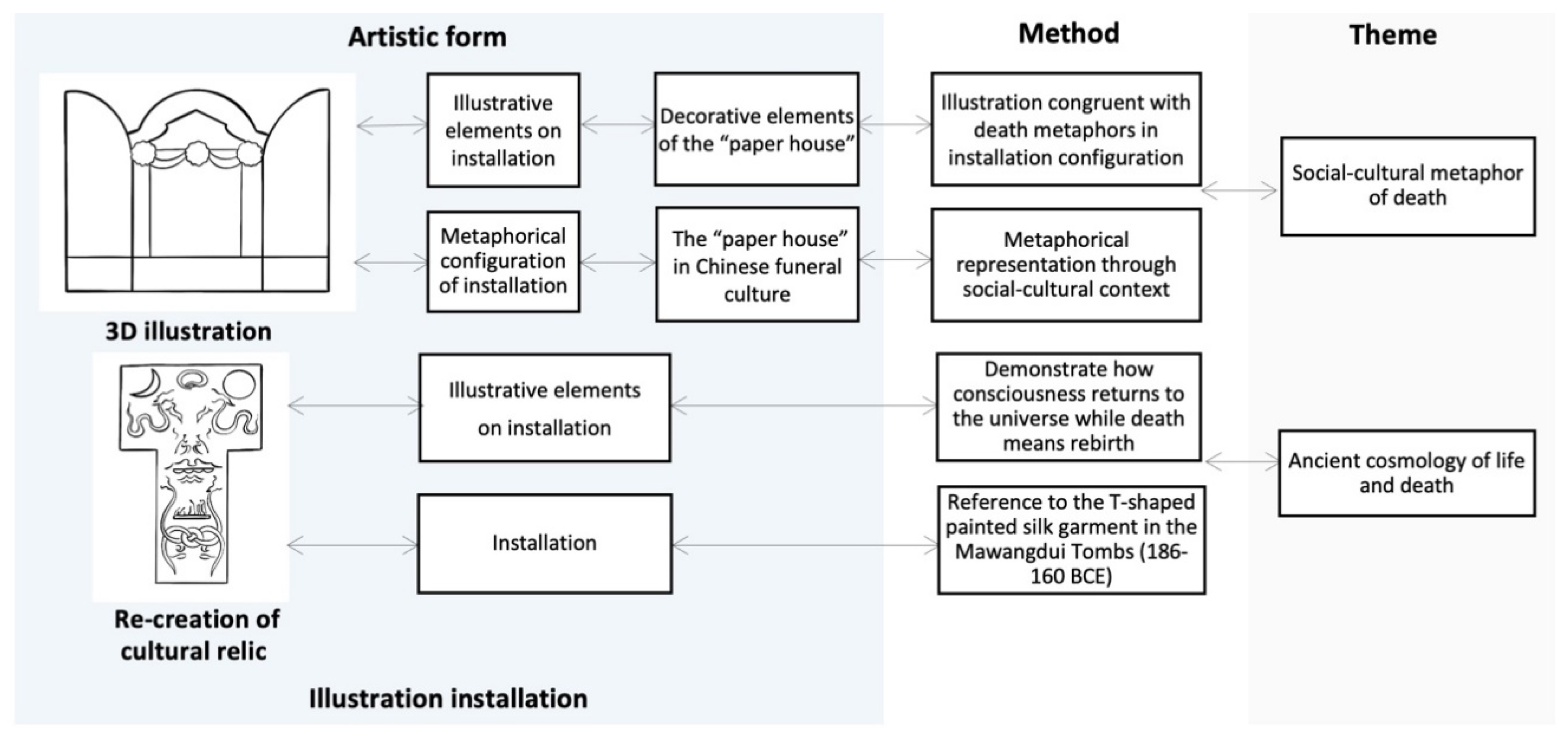
Figure 4.
Experiencing death through the interactive application of illustration.
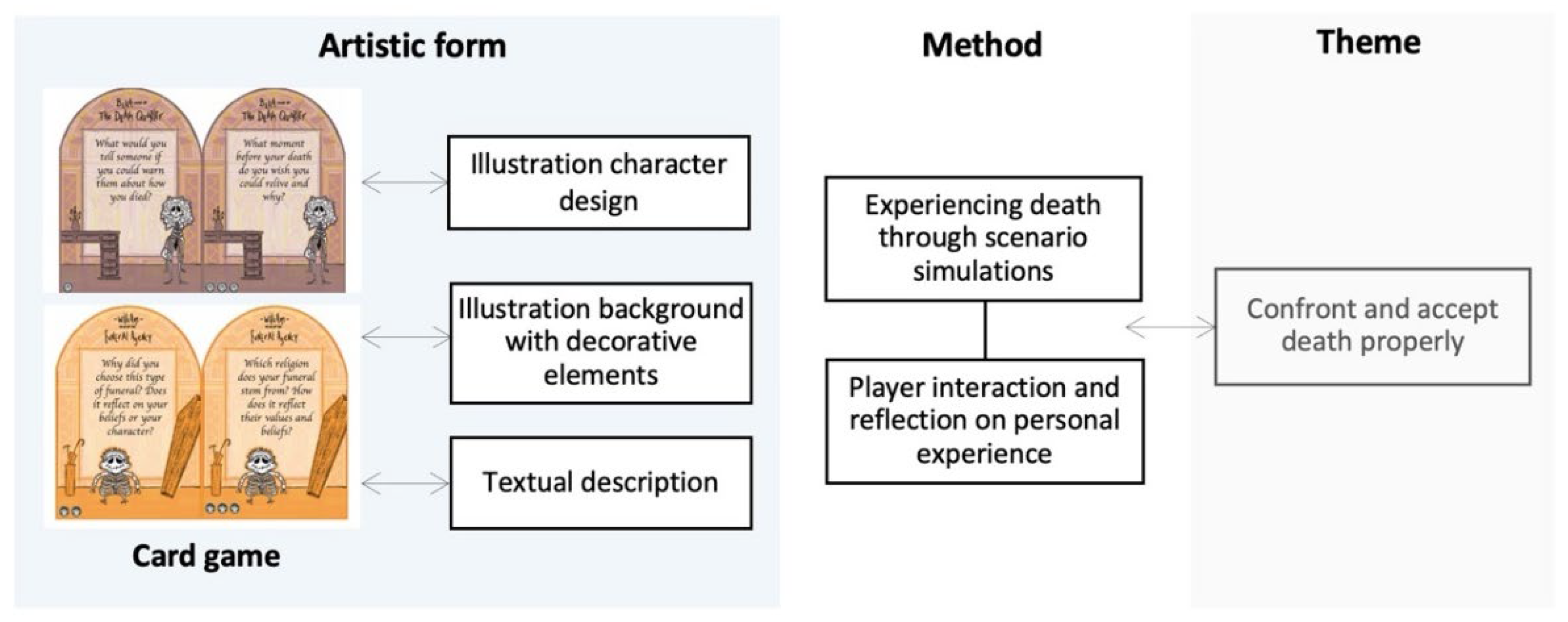
Figure 5.
Immersive experience through illustration-based exhibition setting.
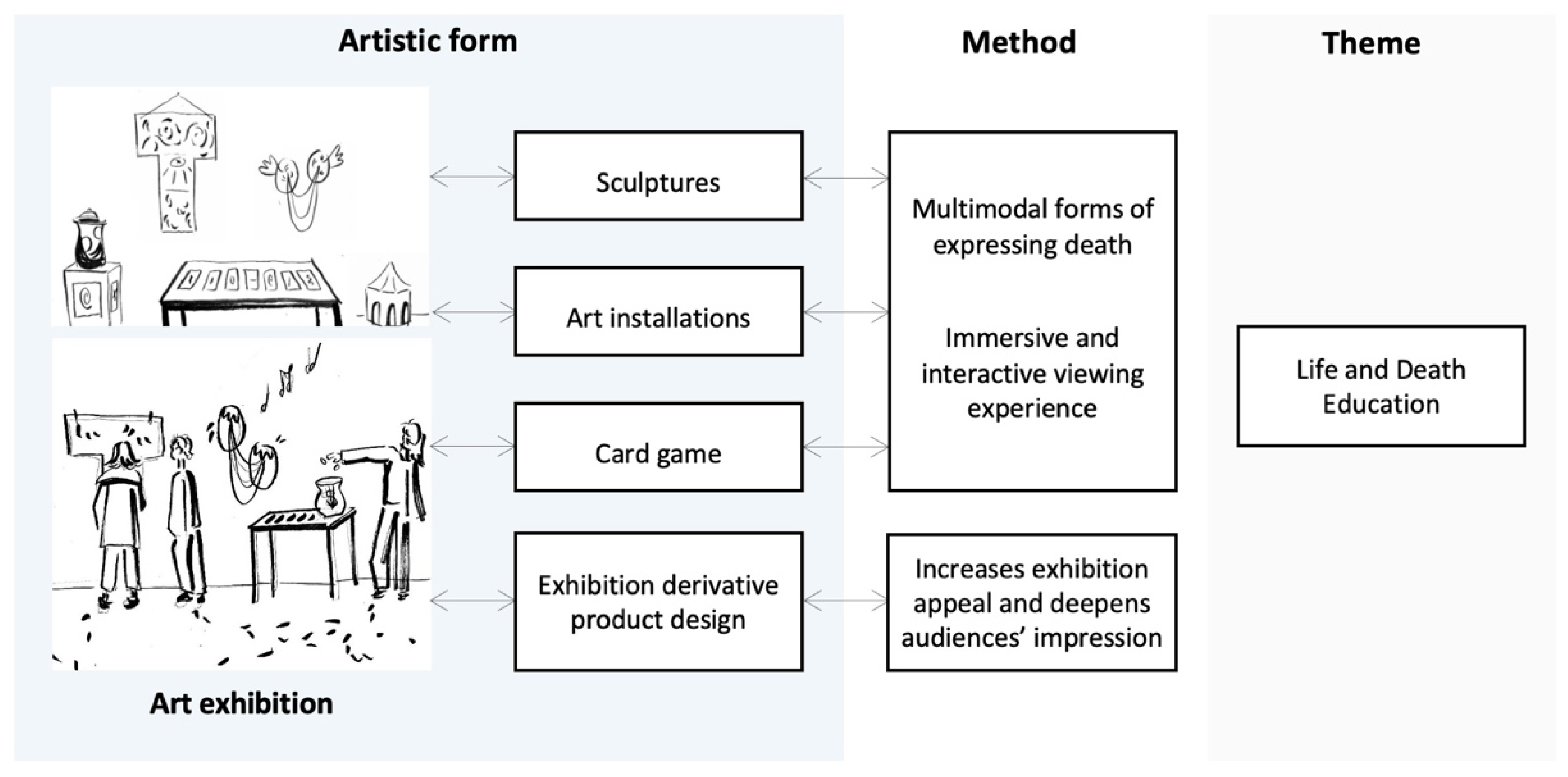
Figure 6.
Mementos, Antonia Lay, 2024, Ink on paper clay, Lino print.
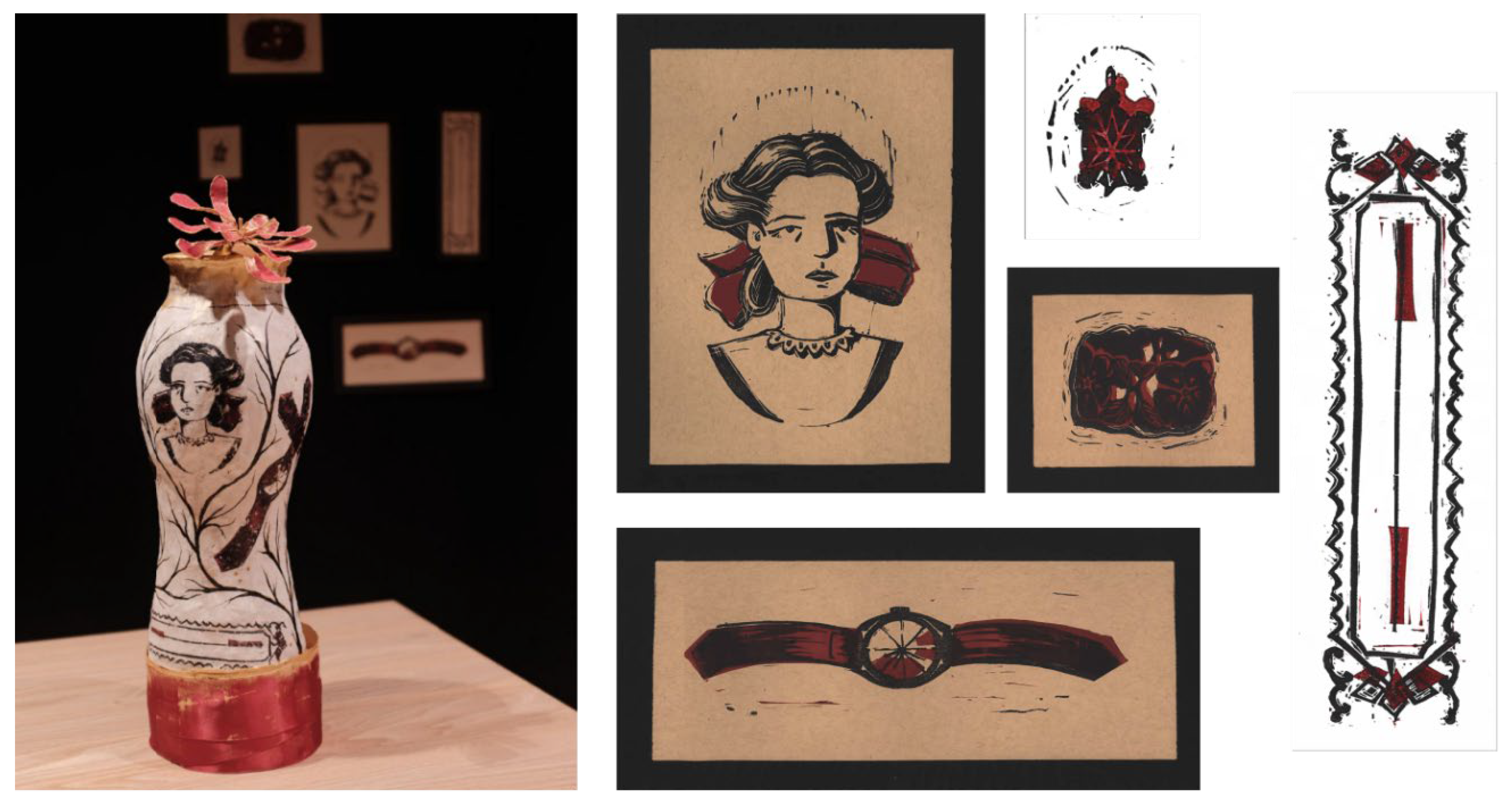
Figure 7.
The Soul and Body, Helen Zhang, 2024, clay, UV adhesive.
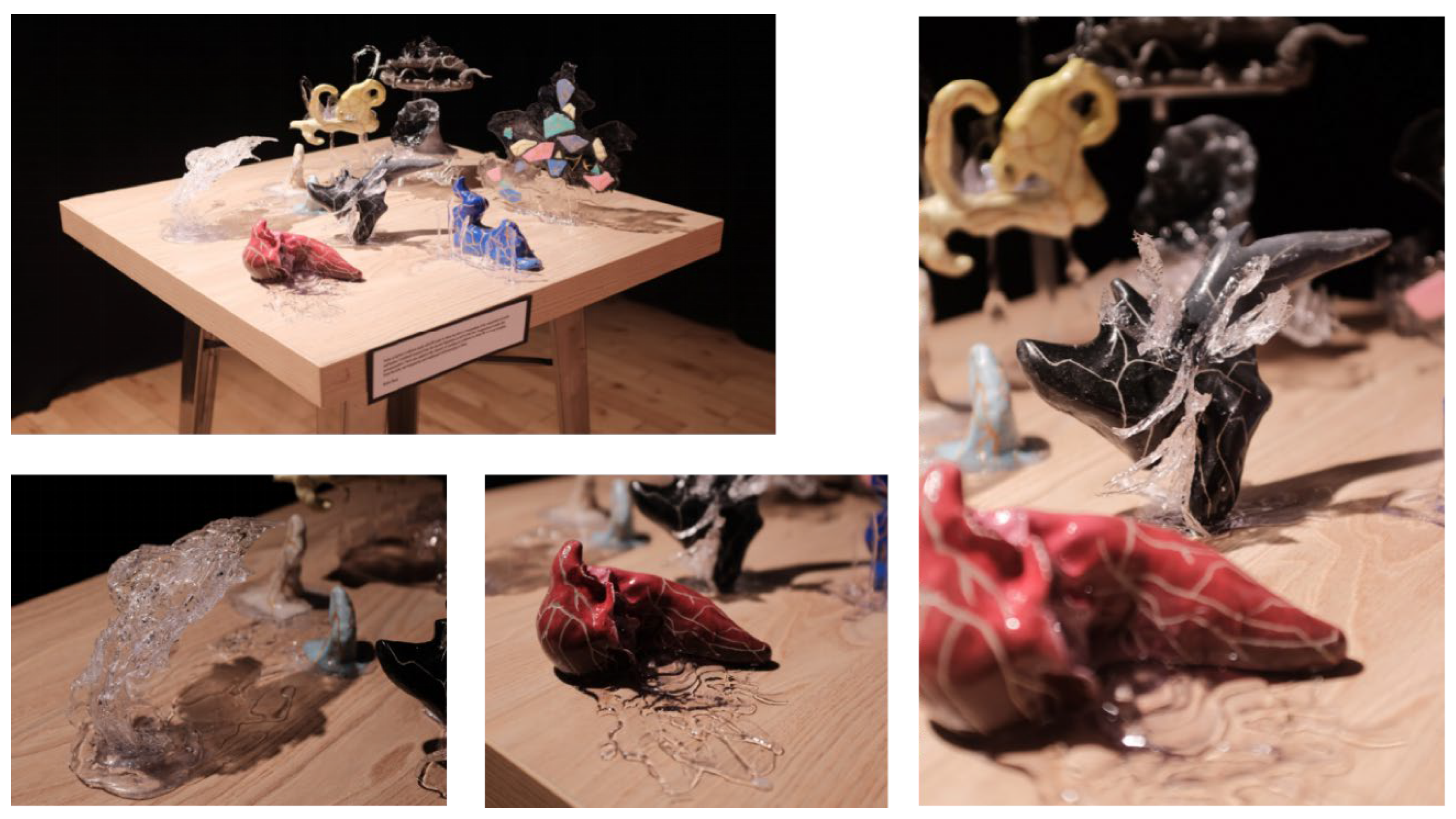
Figure 8.
Life is a Theater, Ronglin Chen, 2024, Ink on paper.
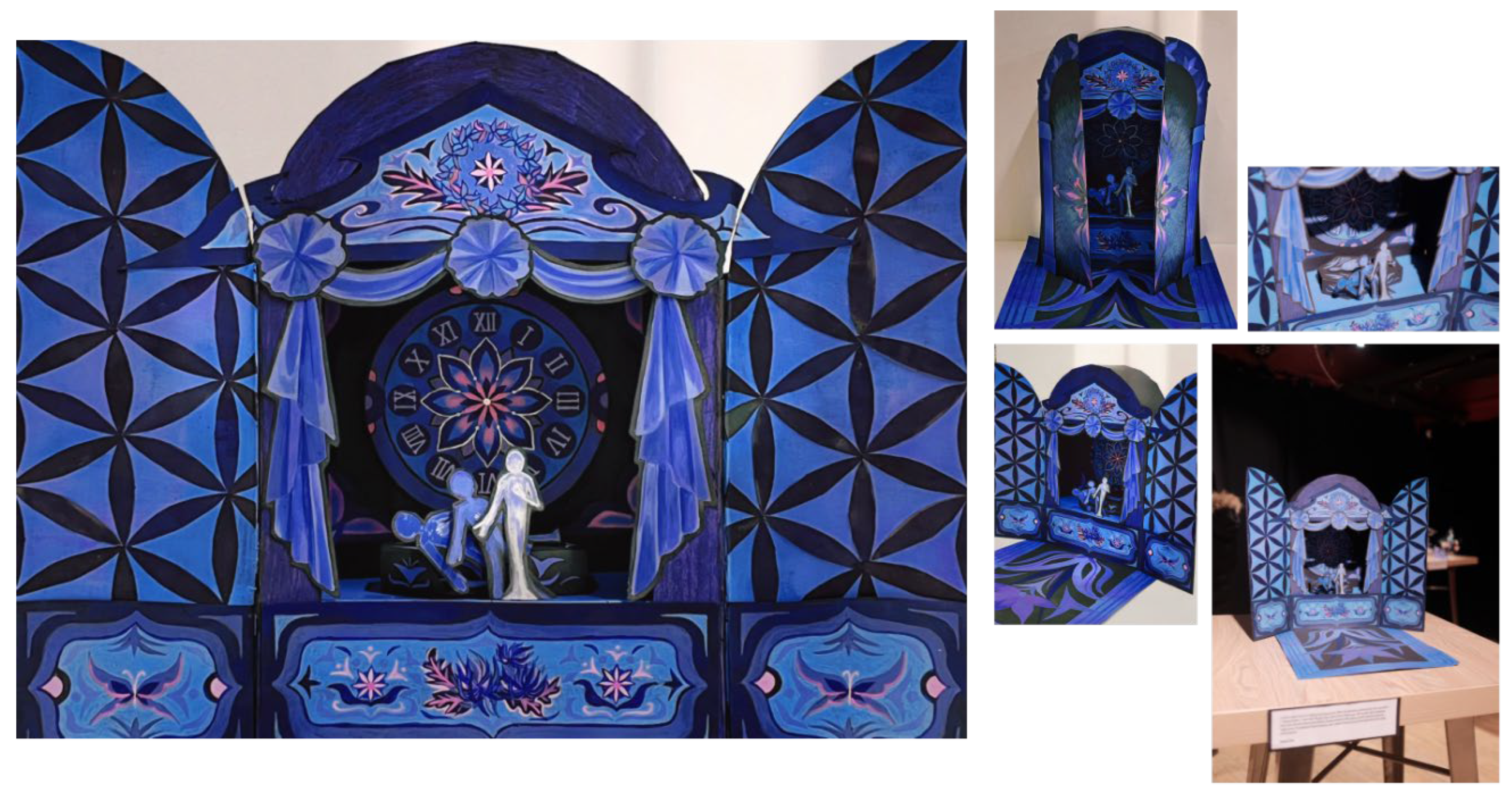
Figure 9.
Returning to the Universe, Xiyu Hu, 2024, acrylic and ink on sulfuric paper, tissue paper.
Figure 9.
Returning to the Universe, Xiyu Hu, 2024, acrylic and ink on sulfuric paper, tissue paper.
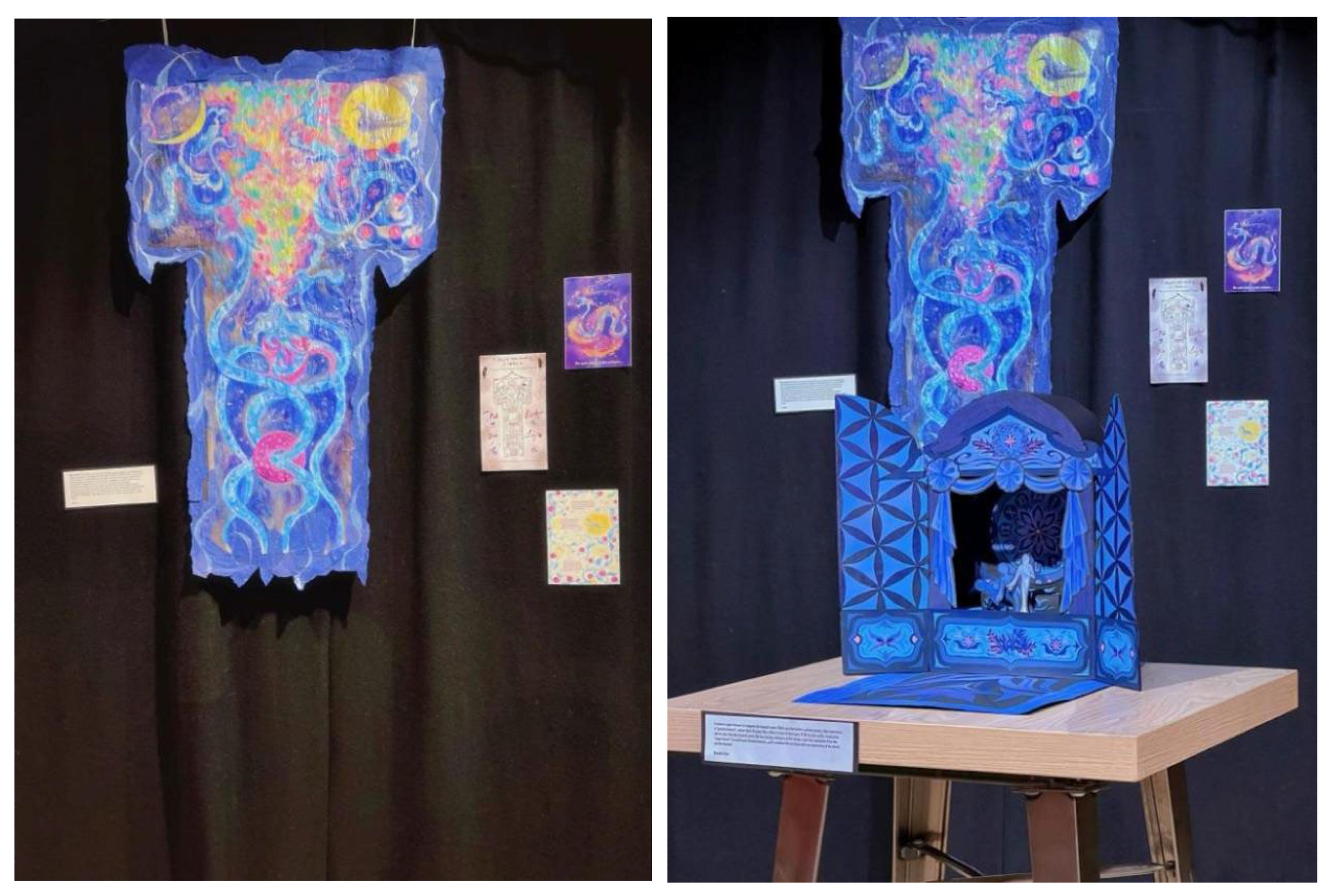
Figure 10.
the Death Departments (card game), Jana Kollmansperger, 2024, digital print.
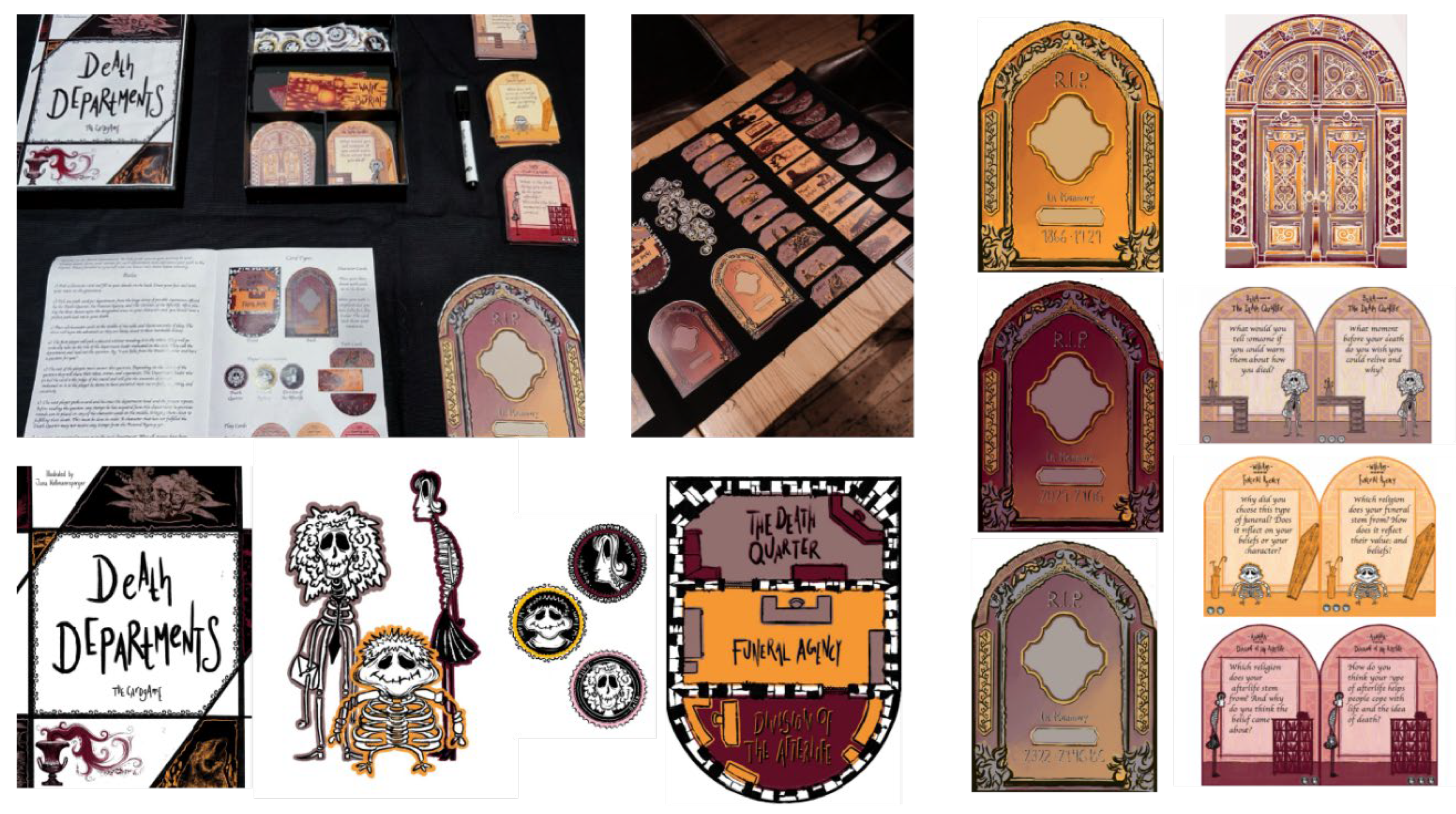
Figure 11.
The Death Departments (card game), Jana Kollmansperger, 2024, digital.
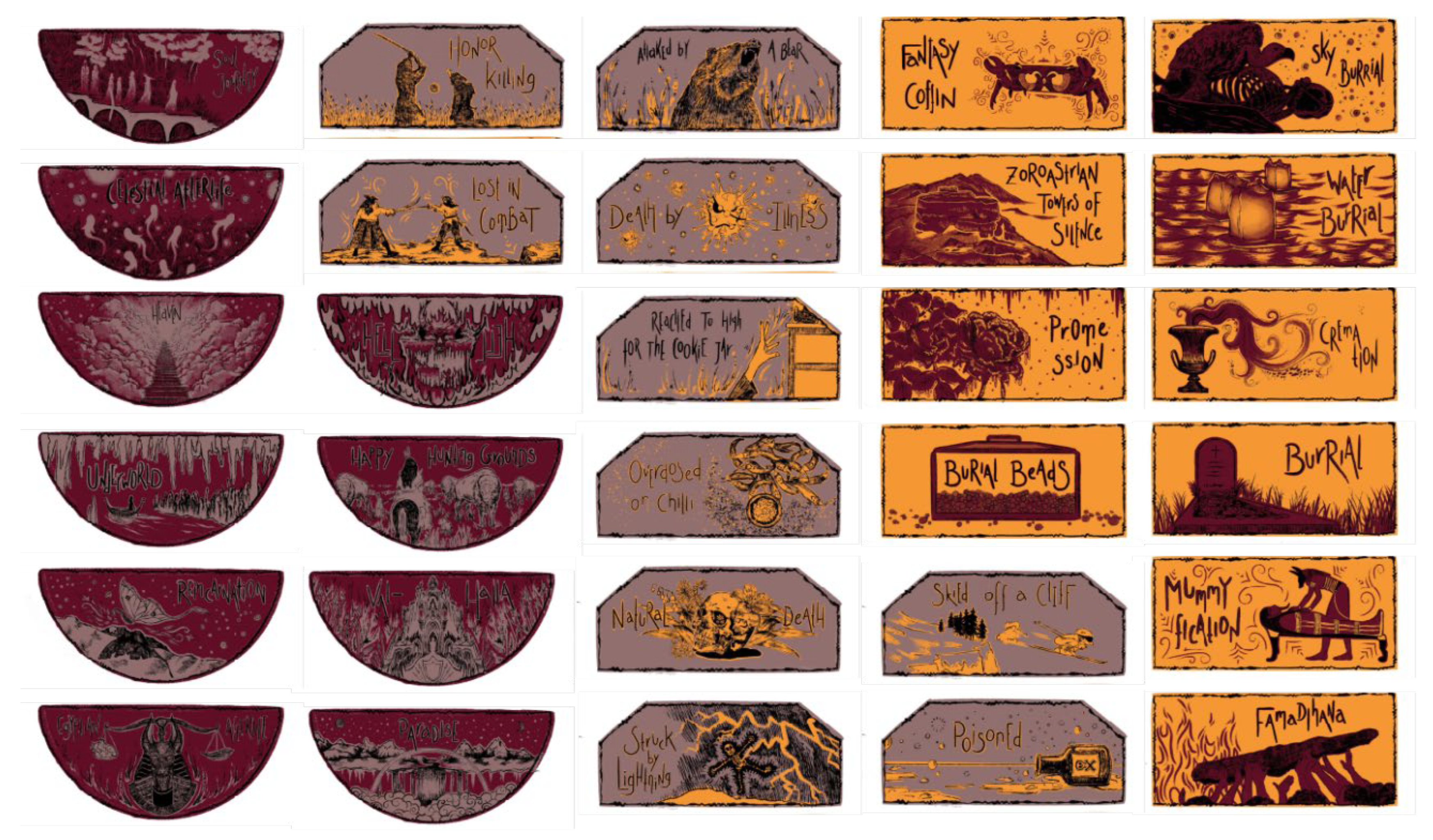
Figure 12.
Photos taken at the exhibitions.
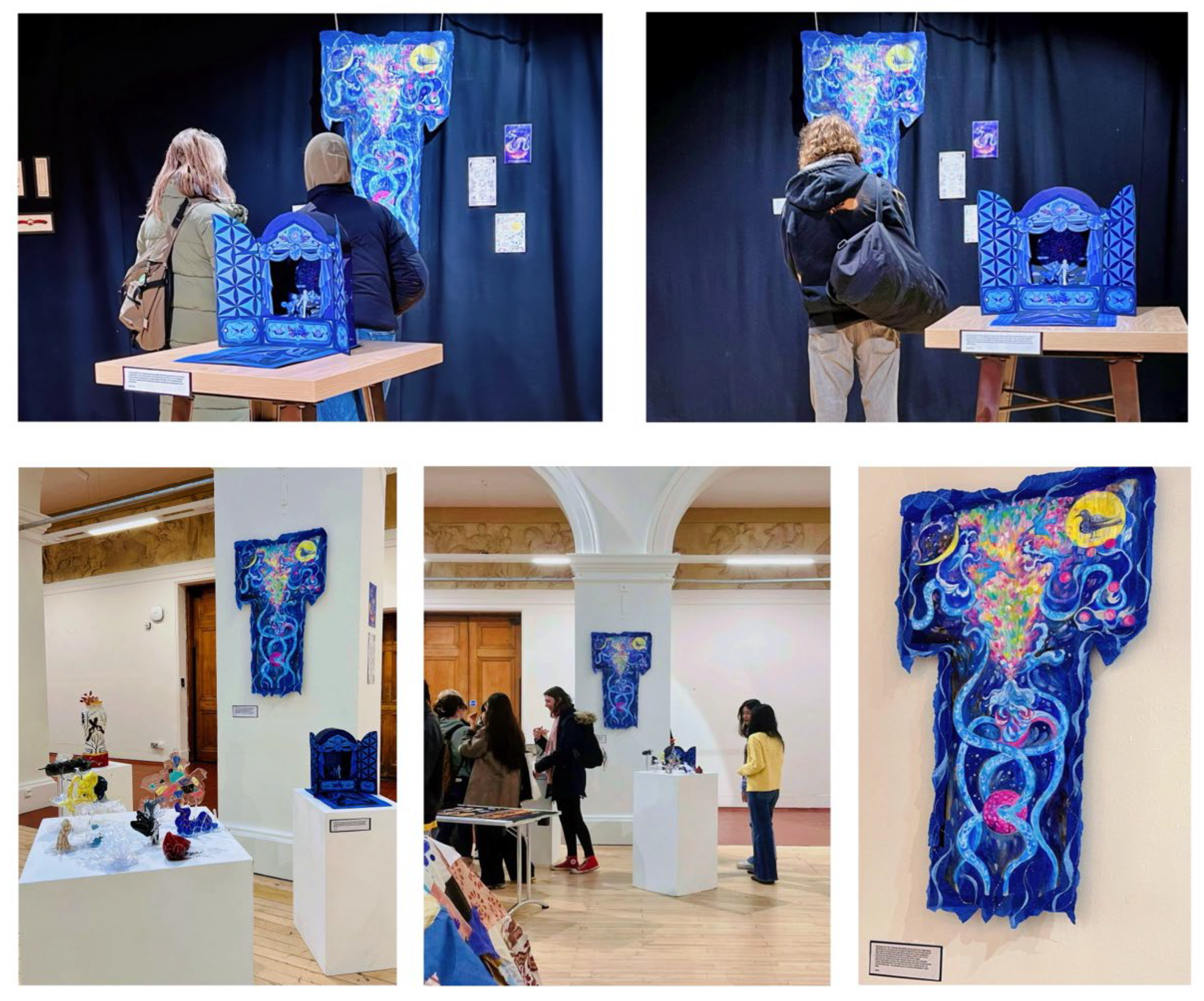
Figure 13.
Prints and publications for sale, photo taken at the exhibition.
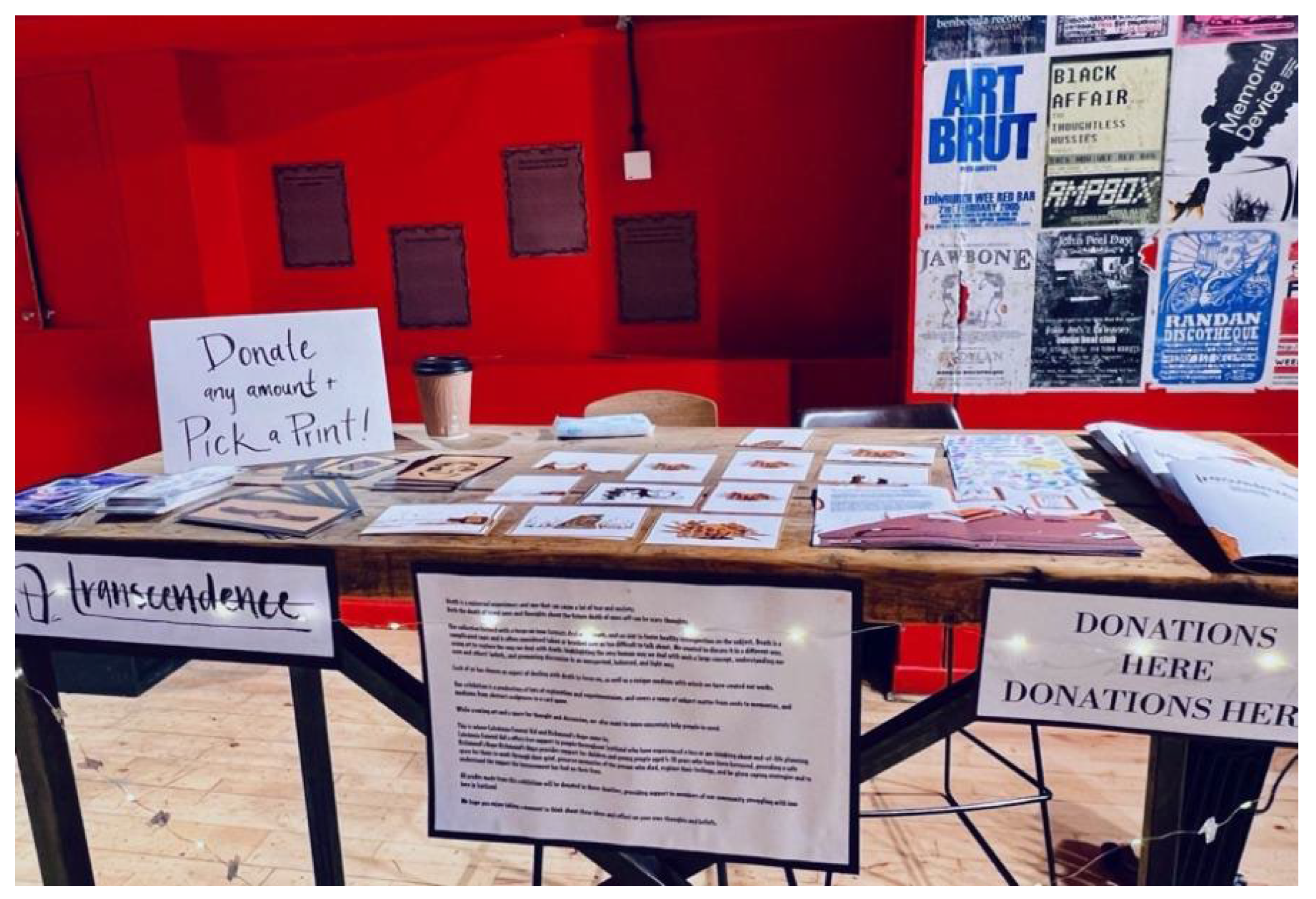
Figure 14.
Prints and publications for sale, photo taken at the exhibition.
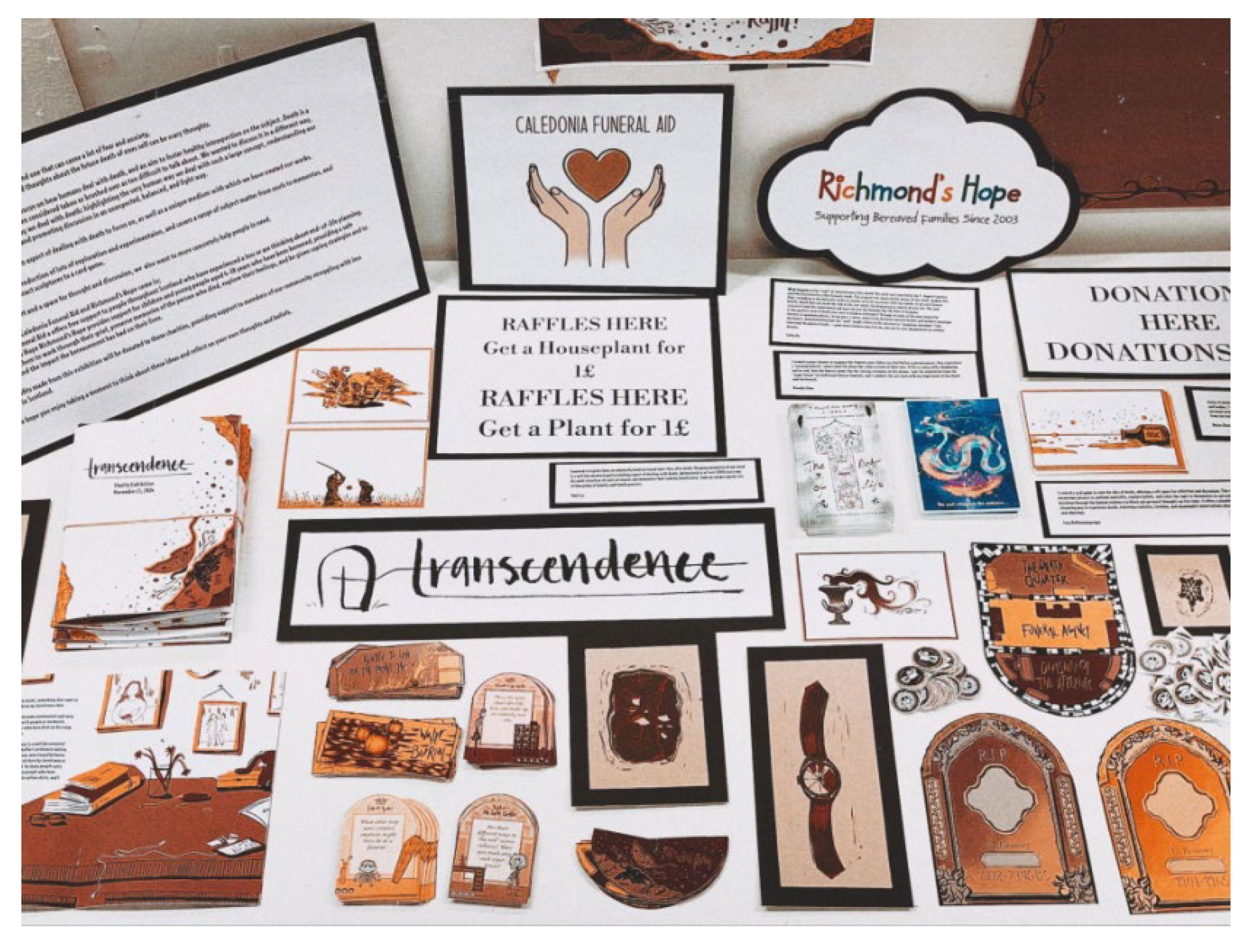
Figure 15.
Poster and prints design for Returning to the Universe, Xiyu Hu.
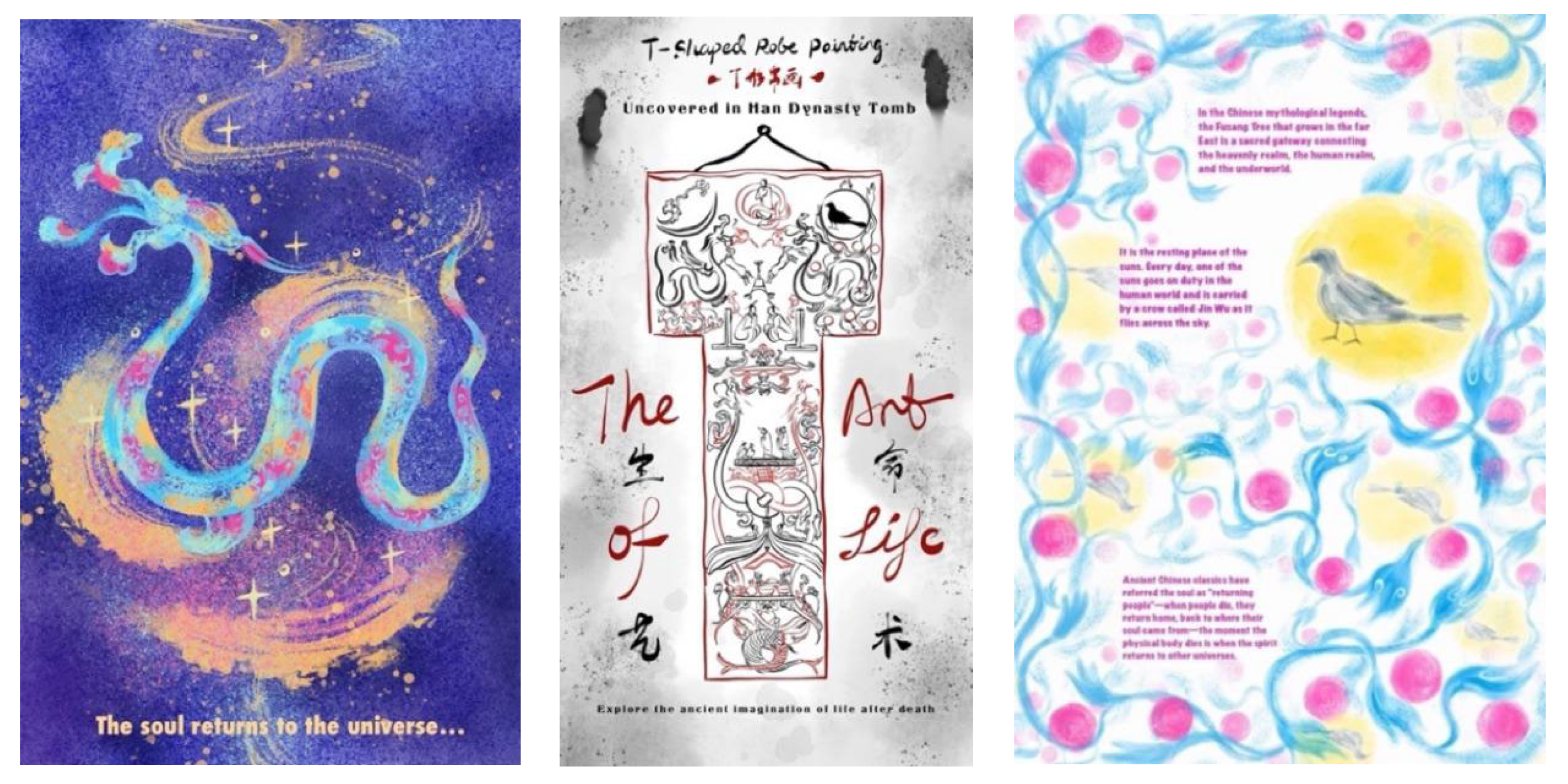
Figure 16.
Interior page designs for collaborative publication.
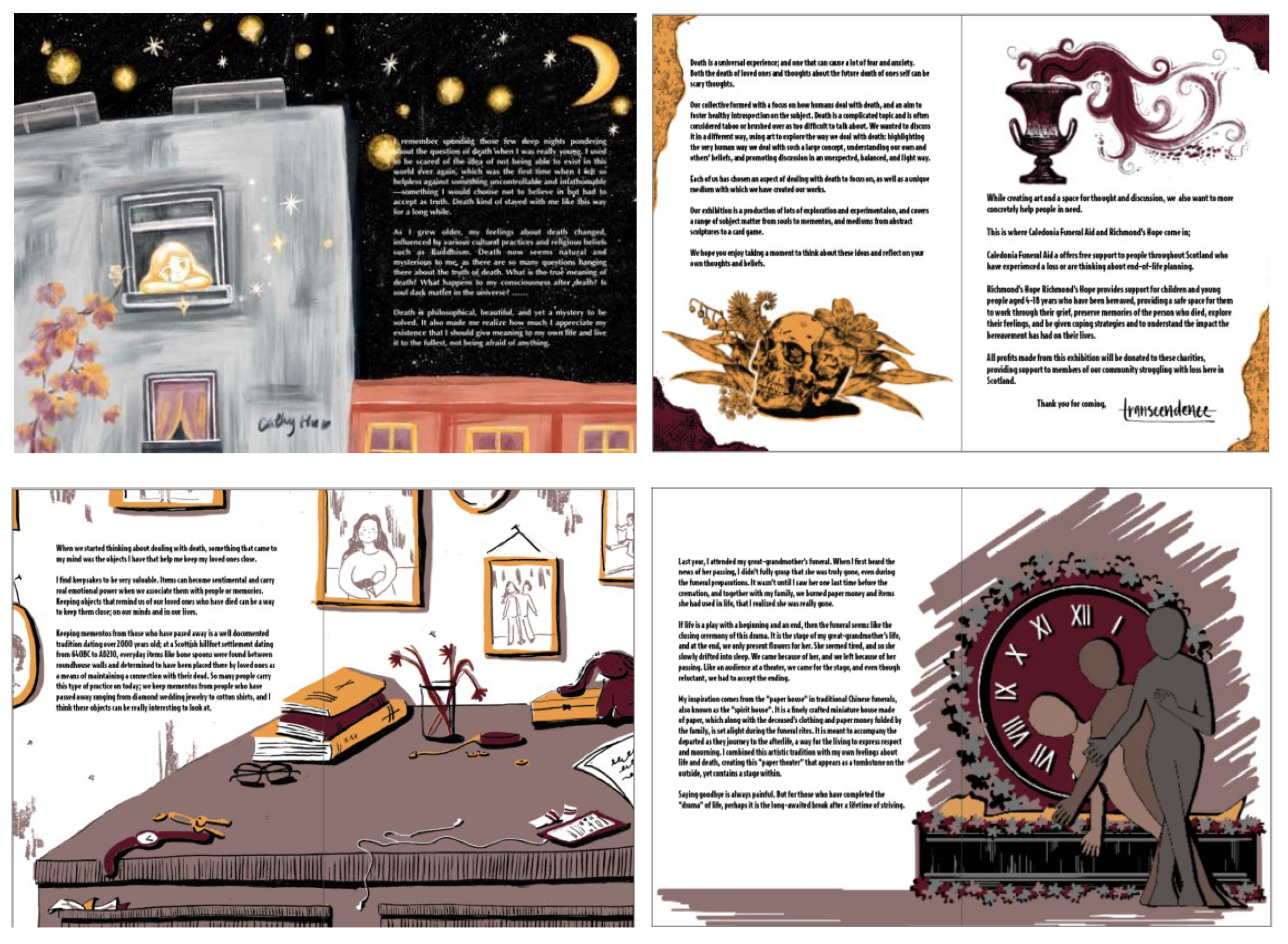
Figure 17.
Printed version of collaborative publication, photos taken at the exhibition.
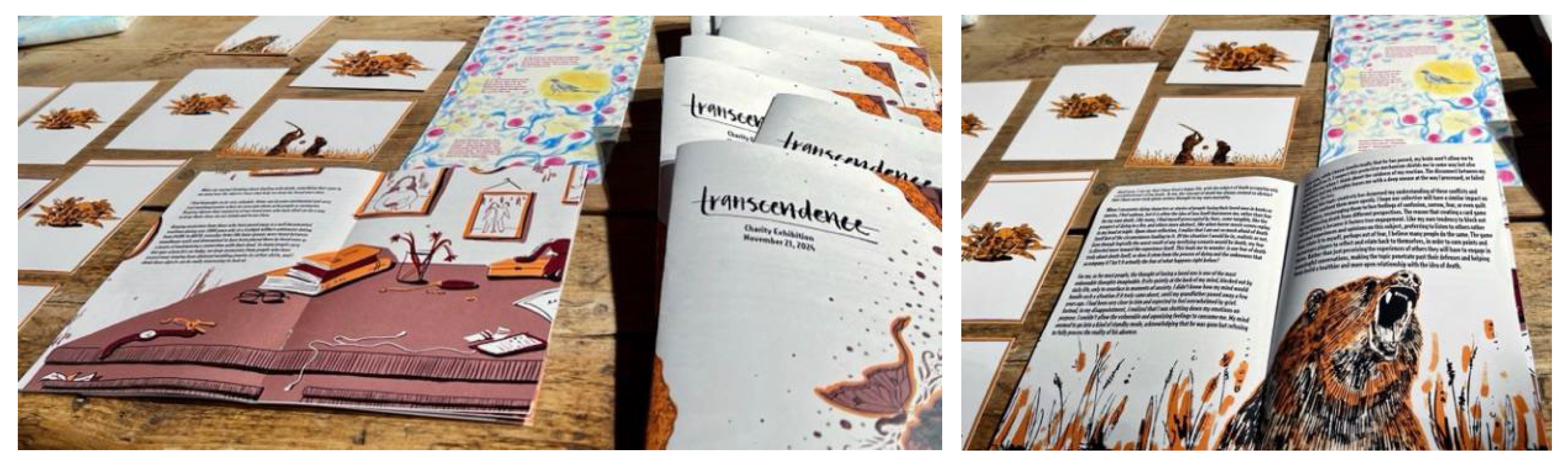
Figure 18.
The charities’ space for donation, photo taken at the exhibition.
Disclaimer/Publisher’s Note: The statements, opinions and data contained in all publications are solely those of the individual author(s) and contributor(s) and not of MDPI and/or the editor(s). MDPI and/or the editor(s) disclaim responsibility for any injury to people or property resulting from any ideas, methods, instructions or products referred to in the content. |
© 2025 by the authors. Licensee MDPI, Basel, Switzerland. This article is an open access article distributed under the terms and conditions of the Creative Commons Attribution (CC BY) license (http://creativecommons.org/licenses/by/4.0/).
Copyright: This open access article is published under a Creative Commons CC BY 4.0 license, which permit the free download, distribution, and reuse, provided that the author and preprint are cited in any reuse.