
Submitted:
15 May 2025
Posted:
19 May 2025
You are already at the latest version
Abstract
Currently, the development of electronic equipment is becoming an increasingly complex and at the same time increasingly important task. Among the many tasks that an electronic equipment designer has to solve, one of the most routine and at the same time labor-intensive work is the selection of an element component base for the implementation of the corresponding electronic equipment units. The authors have attempted to prepare the most complete review of technical solutions for the automation of this type of activity, as well as to offer their own ideas for creating a System that would best meet the needs of the modern electronics industry. Some principles, key approaches and algorithms for solving this problem are also proposed. The proposed algorithms formed the basis of the developed software products, successfully tested at an enterprise specializing in the production of electronic products.
Keywords:
electronic component base
; CAD
; expert system
; artificial intelligence
; machine learning
; deep learning
; DSAM
1. Introduction
The life cycle of development, production, application and disposal of electronic and radio-electronic equipment (REA) products has been sharply reduced recently due to rapid obsolescence. At the same time, the demand for such products in all types of human activity is sharply increasing, as are the technical requirements for them. This requires the use of software (SW) based on intelligent self-learning algorithms to accelerate the design of REA. These tools are subject to increasing requirements for functionality, the breadth of coverage of the element component base (ECB), the reliability and accuracy of the information they provide and many other characteristics. Even compiling a list of all the requirements for such technical means is a relatively complex scientific and technical task, and the development, research, application and implementation of these tools requires even greater efforts.
This article is devoted to an overview of known solutions for creating such systems, including the most modern patents registered at the beginning of this year. The authors also offer their vision and some algorithms for solving the tasks.
2. Relevance of the Research Topic
Many authors note the lack of universal software platforms or products for solving all the problems of selecting electronic components for designing electronic equipment [1]. These problems arise at various stages of the life cycle. At the development stage, at the production stage, at the support and modification stage, these problems are not entirely identical.
One of the main trends of recent years has been the active implementation of artificial intelligence in component selection tools, including machine learning and expert systems. While early systems were mainly reference books and filters, modern solutions are increasingly acquiring the features of intelligent assistants.
According to the research of the journal “ Electronics (MDPI)”, the most frequently published articles are currently on the topic of “Artificial Intelligence”, which makes up 15.08% of all articles in this journal. The next position is occupied by the topic of “Electronic Engineering”, which gives 9.98% of all publications [2]. There is an abundance of articles in the field of machine learning elements [3,4,5,6,7], computer vision [8,9,10,11,12], recognition of electronic components on a printed circuit board using pattern recognition [13,14,15,16,17,18,19].
Among the tasks for the electronics industry, the most frequently solved and related in theme are: recognition of electronic components on printed circuit boards during their production [20,21], as well as during their disposal [22,23], recognition of defective electronic parts [24,25,26] and counterfeit electronic components [27,28,29,30,31,32], analysis of failure causes and their prevention [33], recognition of signs of possible degradation of elements and signs of poor assembly [34,35], poor soldering and insufficiently high-quality tracks in printed circuit boards [36], analysis of the condition of contacts and connectors [37,38], detection of corrosion in electronic products [38,39,40]. It is noted that the problem of supplying poor-quality components and counterfeit electronic components is very acute [41]. For this reason, it is necessary to track the entire supply chain [42].
Research is also being conducted in the field of recognizing types of electronic components for automated recycling of printed circuit boards. There are also publications in the field of using mathematical models of individual elements to predict the behavior of these elements in various modes, for example, associated with abnormal temperature ranges [43], increased radiation, and certain types of electromagnetic noise [44,45,46,47,48,49].
Also, for example, electromagnetic compatibility is being investigated for device design and system integration [50].
There are also publications on the development of transport logistics using the most modern Internet technologies [51].
Of interest are publications in the field of component analysis [52,53,54] and in the field of classification of electronic components using neural networks [55].
There are even dissertations on a very similar topic, however, it is devoted mainly to the economic aspects of organizing the production of electronic components [56].
At the same time, there are much fewer publications in the field of choosing electronic components, and there are simply no publications in the field of a comprehensive solution to all problems associated with choosing electronic components taking into account their electrical and other parameters, as well as their availability. Presumably, these problems can be solved with existing software products and hardware platforms only by sequential or parallel use of various tools. That is, the manufacturer should use some systems to obtain information on the availability of electronic components, and other search systems, including regulatory documents, standards, and documents for the supply of products, to obtain and analyze their electrical and other parameters. In fact, for each type of electronic components, it is necessary to carry out a separate study using a set of information systems, which significantly complicates the process of development, modification, production, and quality control of electronic equipment.
At the same time, in the field of choosing electronic components for software engineering, such problems are being actively addressed, and articles about this are regularly published in highly rated scientific journals [57,58,59].
Thus, as shown by the results of bibliographic studies, conducted surveys, interviews, expert assessments, results of meetings and forums, by the time of the start of dissertation research, the developers of electronic electronic equipment were not sufficiently provided with information systems capable of fully, reliably and up-to-dately providing information on domestic electronic electronic components in the required formats and with the required functionality. Communities of electronic equipment manufacturers have repeatedly set the task of filling these gaps by developing corresponding domestic software products.
Thus, the task set, despite its importance, has not yet been fully solved, there are only separate reports on the solution of certain subtasks. At the same time, the need for such a System is extremely high.
3. Review of the Current State of the Art in the Subject Area of the Article
The main reasons for the absence of the information systems required for these purposes are the complexity of the complex task of creating such a software tool, as well as the absence of a sufficiently complete scientifically substantiated concept for its construction. The required concept must be created based on a study of the advantages and disadvantages of existing software tools. It must provide for the key requirements for an algorithm or a set of methods for the automated development of formalized descriptions of all elements of an accessible and promising component base, for integrating existing mathematical models of elements and other structural components of data on these objects into the created system, as well as for developing algorithms and programs that ensure the processes of collecting relevant and reliable information that is continuously supplemented, for assessing its completeness at each current stage, for processing and analyzing these data and for intelligent assistance in making decisions on the selection and use of ECB in REA, including with the prospect of automated selection and proposal based on customizable data filters for a set of required characteristics. Some preliminary foundations for similar systems can be found in the literature, such as in [60], where the creation of a system is proposed not to meet the requirements of ECB consumers, but, on the contrary, to plan the activities of electronic component manufacturers. Some preliminary ideas can also be found in the publications of V.N. Shvedenko, O.V. Shchekochikhin and co-authors, which discuss the methodology of searching for scientific and technical information and ways to create information retrieval systems for these purposes [61,62,63,64].
At the same time, modern electronic equipment (EE) is characterized by an ever-increasing complexity and number of electronic components. There are tens of millions of electronic components on the world market [1], and according to some estimates, engineers have access to over 600 million different components [65]. Each new product may include hundreds or even thousands of unique positional elements [65]. In such conditions, the correct selection of components becomes a critically important stage of development: the functionality, reliability, production time, and cost of the product depend on it. An inappropriate choice of components, for example, with a short service life or limited availability, can lead to an unjustified increase in the labor intensity of development, to an increase in time due to delivery delays, and/or to an increase in costs due to the acquisition of components at a non-optimal cost [66].
At the same time, the components themselves are becoming more complex and the rate at which new electronic component base (ECB) products are emerging is increasing. It is becoming increasingly difficult for engineers to manually track new products, analogues, and the life cycle status of components. According to research, about 750,000 components were withdrawn from production in 2022 [66] - without automated systems, it is almost impossible to take such changes into account in a timely manner. In addition, global logistics and crises (e.g., semiconductor shortages) have led to the fact that the availability of components in supply chains has become dynamic and unpredictable [66]. This increases the need for intelligent support when choosing ECB, including data on warehouse availability, delivery times, and forecasts of the validity of the choice.
Thus, automation and intelligent support of component selection are extremely relevant today. Specialized information systems are designed to facilitate the work of an engineer and a purchaser, providing tools for effective search and comparison of components, assessment of their parameters, cost, availability and risks. Below we consider the capabilities of such systems, an overview of existing solutions (both commercial and research) over the past 10 years, their advantages and disadvantages, as well as identified problems and ways to solve them.
4. Functional Capabilities of Electronic Component Selection Systems
Modern information systems for the selection of electronic components provide a wide range of functional capabilities aimed at supporting engineers in the process of selecting components:
- Search for components by name and parameters. The basic option is to search for the component of interest by its name, article number, or keywords. A more advanced option is parametric search, when the user sets filters by technical characteristics (for example, voltage range, case type, frequency, power, etc.) and the system displays all components that meet the specified criteria [1]. Parametric search allows you to narrow down tens of thousands of options to a few suitable ones without knowing the specific article number of the part. Most platforms provide catalogs with a hierarchy of component categories and a set of attributes for filtering.
- Access to technical information. Systems contain extensive information about components: basic technical characteristics, descriptions, images, connection diagrams, etc. Links to passport data (datasheet) in PDF format are often integrated. Some platforms (for example, large distributors) publish technical documentation and reference books on their websites, as well as articles or notes on the use of components [1]. The presence of reliable and up-to-date technical information directly in the system saves the engineer’s time and reduces the risk of errors.
- Comparison and selection of analogs. An important function is the selection of similar components. If the required component is unavailable or expensive, the system can offer a list of analogs - components with similar parameters, compatible in basic characteristics. Some platforms support cross - reference between components from different manufacturers [1]. For example, domestic search sites eFind.ru, ChipFind.ru and Optochip.org implement the selection of analogs of imported and domestic microcircuits interchangeably [1]. The selection of analogs can be carried out according to interchangeability tables previously entered into the database or by comparing parameters (including tolerances). Modern intelligent systems can use recommender system methods to find the closest analog, even if the parameters do not match exactly.
- Analysis of suppliers, prices and availability of electronic components. For each component, information about suppliers is usually provided: which distributors or manufacturers have this component in stock and at what price. Large aggregators collect data on the warehouses of hundreds of suppliers and allow you to quickly assess the availability of a component on the market [67,68]. For example, the Octopart system is directly linked to supplier data and shows current balances, prices and life cycle statuses for more than 61 million components [69]. This makes it possible to immediately take into account economic and logistical factors when choosing a component - prices, minimum lots, delivery times. Some systems offer price analysis tools (price trend charts, price comparisons from different sellers) and even price change forecasts.
- Comparison of components by parameters. A useful feature is the side-by-side comparison of several selected components. The system displays a table of parameters for two or more components, highlighting the differences. This makes it easier to select the best option from a group of functionally similar parts. For example, the Wizerr smart platform allows you to instantly compare the pins, packages, dimensions, and electrical parameters of several components [70]. Such a comparison table saves time when analyzing trade-offs (e.g., current consumption and cost).
- Intelligent search and filtering methods. Advanced systems implement elements of artificial intelligence for smarter searching. This may include auto-completion and input correction (understanding the engineer’s intentions in case of an imprecise request), searching by synonyms and related terms, rating sorting of results by relevance or popularity in the industry. Solutions are emerging that allow for dialog search: for example, upload a text description of requirements or a fragment of a diagram and receive component recommendations. Some recent developments make it possible to search in natural language or even using images (visual search), although this is less common at the moment [71]. Another direction is the integration of chatbots for interaction with a knowledge base about components. For example, the Wizerr platform claims a function for interactive communication with datasheets: an engineer can ask a question to an AI model, which, having “read” thousands of technical documentation, will give an answer based on the specific characteristics of the component of interest [70].
- Group search and list management. In the case of large projects, the function of one-time verification of the list of components (for example, loading the bill of materials – BOM) is useful. A number of systems can perform group search – processing several positions at once: this allows, for example, to load a list of required denominations and get a summary for each (found/not found, availability, analogs, etc.). According to the analysis, only a few platforms have group search [1], for example, Optochip.org [72], FindChips.com [73] and Farnell.com [74]. Large platforms also offer personal accounts for project and BOM management: storing lists of selected components, exporting to CAD or ERP, notification of status changes (for example, obsolescence), etc.
- Additional services and integrations. Many systems complement the search with a whole range of related services: calculators, links to the application, communities. For example, some foreign platforms (Digi-Key, Farnell, etc.) contain sections with thematic literature, reference books, and forums for engineers [1]. This allows users to share experiences, receive recommendations, and receive support. Commercial platforms often offer APIs for integration (more on this below) and even mobile applications for access to search on the go [1]. Finally, specialized corporate systems can integrate with CAD systems, product data management systems (PDM/PLM), and purchasing modules, providing an end-to-end process - from selection at the design stage to ordering and supporting the component in production.
Thus, the functionality of modern MDM systems and search portals for electronic components covers the full cycle of work with components: from technical comparison and selection to risk assessment and procurement organization. Specific implemented systems, their features, advantages and disadvantages are considered below.
5. Review of Existing Systems and Solutions
Over the last ~10 years, many information systems have appeared that facilitate the search and selection of components. They can be divided into several groups: open online platforms (search engines and aggregators), corporate databases (MDM systems) and integrated solutions in the CAD environment (CAD/EDA). Let’s consider examples of each group, noting their capabilities.
5.1. Search Engines and Aggregators of Electronic Components
Component search engines are web platforms that allow you to find components in the catalogs of various suppliers. This category includes distributor sites (Digi-Key, Mouser, Farnell /element14, TTI, etc.), as well as independent aggregators (Octopart, FindChips, ChipFinder, etc.).
Major distributors such as Digi-Key and Mouser have accumulated extensive product catalogs (hundreds of thousands of items) and provide powerful parametric searches across their warehouses. For example, Digi-Key offers selection by technical characteristics in all component categories (from resistors to microprocessors) and updates availability and prices daily. Their sites also contain datasheets, lists of alternatives and accessories, reviews, articles, and even forums for the engineering community [1]. The advantage of such systems is the relevance of product information and the ability to immediately place an order. However, the search is limited to the nomenclature of a given distributor; components that are not sold by Digi-Key will not appear in the results. In addition, the focus on the commercial component means that the engineer sees only the positions available on the market, but does not receive, for example, a forecast of obsolescence in 5 years (this is done by other classes of systems).
Aggregators do not sell components directly, but collect data from multiple sources. An example is the popular Octopart platform (owned by Altium). Octopart combines data on more than 60 million components from hundreds of suppliers, including global distributors and manufacturers [69]. The user can perform a single search and get consolidated results: a list of all sellers with prices and balances, links to datasheets, status information (active, NRND, EOL). Octopart also supports parametric mode: you can set filters by parameters, similar to searching on a distributor’s website, but covering several companies at once. The strength of aggregators is comprehensive market coverage and time savings: there is no need to search separately on a dozen sites. According to analysis, aggregators are usually simpler in functionality than search engines: they are mainly focused on availability and prices, and not on an in-depth comparison of specifications [1]. However, Octopart successfully combines both search by characteristics and supply aggregation. The platform is integrated via API with many CAD and corporate systems, allowing you to pull up-to-date data directly into design tools. It should be noted that the interface of most international aggregators is English; the lack of support for the Russian language is noted as a disadvantage from the point of view of domestic users [1].
Other well-known aggregators include FindChips (SupplyFrame), one of the first search engines for distributor warehouses, ECiaauthorized, an aggregator from the UIAS industry association with a focus on authorized suppliers, and regional solutions. In Russia, ChipFind.ru, eFind.ru, Component (components.ru), and others are very popular, aggregating offers from Russian suppliers [1]. For example, ChipFind.ru [68] searches the largest domestic warehouse bases and price lists, providing a convenient tool for suppliers [1]. These systems are often focused only on the local market and do not include foreign positions [1]. Interestingly, there are also hybrid ones: the Optochip.org portal [72] supports both parameter search and warehouse aggregation, including the unique ability to search for domestic components by parameters (as of January 2018, this was the only platform with this function) [1]. An analysis of the functionality of Russian and foreign platforms conducted by D. Ireshev [1] showed that there is no universal solution: foreign resources ignore the domestic element base, and Russian ones do not cover the foreign market, so specialists often have to use a whole set of tools.
Advantages of search engines and aggregators: quick access to information on availability and prices, intuitive web interface, powerful filters, large user base. Many have additional services for engineers: communication (forums), a selection of technical articles, notifications about updates. For example, Farnell (element14) and Digi-Key have created entire engineering communities on their platforms, due to which they received high marks for the breadth of capabilities [1].
Disadvantages: limited language and geographic focus (for the Russian Federation - the lack of Russian-language interfaces for foreign systems, and for Russian ones - the lack of data on foreign components [1]), advertising and commercial interest (for example, distributor sites may not have a neutral comparison with competitive components). Aggregators may suffer from heterogeneity and data updates, since they depend on third-party sources (some aggregators simply parse the sites of Digi-Key, Mouser, etc. [1]). Nevertheless, these tools have already become an integral part of the work of engineers, allowing to significantly speed up the selection of electronic components according to basic criteria.
5.2. Specialized Information Systems (MDM) and Component Databases
For the professional activities of large organizations, public search sites alone are not enough. Systems are required that provide a single reliable source of data on components - the so-called MDM systems (Master Data Management) for the electronic component base. Systems such as SiliconExpert, IHS Markit (now Accuris), Z2Data, etc., are extensive databases filled with technical, commercial, and regulatory information about components from many manufacturers.
SiliconExpert is one of the leaders in this market, founded in 2000. The company has a platform that includes information from 20,000 distributors and manufacturers [75] and provides a complete overview of the component at all stages of the life cycle [75]. The SiliconExpert database contains characteristics of more than 1 billion elements (according to the company) - active components, passive, electromechanical devices, etc. The system is focused on solving industrial problems: risk assessment in BOM, selection of replacements when justifying long-term production, ensuring compliance of components with standards (RoHS, REACH, etc.). For example, SiliconExpert displays the predicted years until End-of-Life (discontinuation of production) for a specific component, calculated on the basis of AI models and statistics [75]. It also signals if the component is in the risk zone (for example, the only source of supply or close to obsolescence) [75]. An engineer or purchasing manager, using such a system, can plan in advance measures to reduce risks: select a secondary source, set aside a reserve, select a more “durable” analogue.
Markit platform provides similar capabilities Parts (more recently called Accuris after the merger of IHS Markit with S&P Global). The IHS database was historically known as CAPS (Component Attributes Parsing System) Database, and is considered one of the most comprehensive: more than 540 million records on electronic and electromechanical components. IHS Markit Parts Intelligence is positioned as a tool that allows engineers and procurement specialists to identify the optimal components for a product, having access to a database of more than half a billion components [76]. The system contains not only parameters and datasheets, but also critical data for lifecycle management - production statuses, obsolescence forecasts, information on possible replacements, environmental compliance data, etc. [77]. It is noted that the integration of such databases into development processes helps to create a sustainable supply chain and reduce the risks of shortages or disappearance of components [77]. Recently, IHS/ Accuris and similar services have increasingly become a background source of data for other solutions. For example, the Celus automated design platform integrates Accuris data directly into its software, receiving reliable information about components and their availability in real time [77]. At the same time, Celus supplements this data with verification from the manufacturers themselves to increase the relevance and accuracy of the information [77].
Also worth mentioning are Z2Data and DigiLens (formerly known as Octopart Enterprise). They offer cloud-based systems for inventory management and risk analysis, which compete in many ways with SiliconExpert and IHS. For example, Z2Data Part Risk Manager focuses on monitoring the validity of the choice in terms of market opportunities: tracking news, political factors, sanctions, mergers of manufacturers and their impact on the availability of components [76].
Advantages of specialized MDM platforms: extremely detailed data (including historical and forecast), coverage of almost all brands and types of components, availability of analytical tools. They allow a company to build a strategy for working with a component base: to form an internal list of approved components (AVL), automatically receive notifications about PCN releases (notifications of changes from manufacturers) [76], generate reports on a sufficiently high-quality state of specifications (BOM Health) with an assessment of the durability of each component. Such systems often support API for integration - for example, IHS Markit offers Parts XML web services, through which external programs can request information from their database [78]. This is important for embedding into corporate processes (ERP, PLM, CAD).
Disadvantages: The main barrier is the high cost and closed nature of such solutions. They are usually licensed per organization, require a subscription, and are often not available for free online access. The interface and documentation are almost always in English, aimed at a global audience. In addition, these platforms themselves will not “tell” which component to choose - they provide data, but the responsibility for the final decision lies with the engineer. The amount of information can be excessive and require filtering. However, for large projects, the use of SiliconExpert / IHS has become a de facto standard when working on durable products (aviation, automotive electronics, telecom, etc.), where betting on the wrong component can be very expensive.
5.3. Integration with CAD and Corporate Development Systems
The third important layer of solutions are systems integrated directly into electronics development tools – CAD/EDA systems and their component library management modules. Here we are talking about such products as Siemens EDA Xpedition & PartQuest, Zuken CR-8000/ECAD with the DS-2 library module, Cadence Allegro / OrCAD CIS (Component Information System), Altium Concord Pro /365 and others. Their main purpose is to provide the designer within the circuit and PCB design environment with all the necessary information about the components and to guarantee the data coherence from the circuit stage to the release of design documentation.
For example, the Zuken system Component Management (included in CR-8000 and E 3.series) allows you to maintain a single component library with attributes, linked circuit symbols and board footprints. An engineer, selecting a component on a circuit, accesses this library: sees a list of approved corporate components, their parameters, acceptable manufacturers and part numbers. The library itself can be filled both manually (by engineers-librarians) and through import from external sources. Zuken offers a cloud service Component Cloud, which contains verified data on many common components that can be loaded directly [79]. The advantage of integrated systems is a direct connection with the project: the choice of a component is immediately reflected in the diagram, eliminating situations where there is a parametric match, but no housing or schematic symbol. In addition, integration with PDM allows you to immediately assign an internal code to a part, take it into account in the specification and transfer it to the supply department.
Siemens EDA (Mentor Graphics) has similar capabilities. Thus, Xpedition (former Mentor) has a Library module Manager and integration option with Siemens PLM Teamcenter for managing component data. Mentor also developed the PartQuest web platform, integrated with distributors, which allowed searching for components online and downloading symbols/ footprints directly into CAD. PartQuest collaborated with Digi-Key, providing parametric searching of Digi-Key warehouses from the Mentor interface. Xpedition: After the acquisition of Mentor by Siemens, the focus shifted to integration with Teamcenter and third-party databases (for example, Xpedition is supported by a connection with SiliconExpert to obtain vital characteristics directly in CAD).
Altium has historically built component search capabilities into its PCB CAD: back in the 2010s, Altium Designer gets Content panel Vault, later transformed into the cloud service Altium 365. Thanks to the acquisition of Octopart, Altium integrated the aggregator directly into the design environment. This means that an engineer can search for the desired component inside the CAD, see the Octopart results (list of manufacturers, prices, availability) and immediately place the component in the schematic with the associated symbol and footprint. Altium Concord Pro (Collaboration Platform) complements this with MDM functionality – storing company-approved components, their revisions, document and model file links, and synchronizing with Octopart to keep market data up to date.
Cadence OrCAD / Allegro offers the CIS (Component Information System) and a joint solution with EMA Design Automation – Component Information Portal (CIP). This bundle allows you to pull characteristics from the database (including possible connection to external data providers) and maintain a catalog of components with parameters and links to purchases within the company.
The common feature of all these integrated solutions is that they aim to provide an end-to-end process from component selection to product release. When an engineer selects a part, the system automatically picks up the necessary documentation, assigns a symbol on the diagram, and inserts it into the list of purchased items. If the part is changed, the changes reflexively pass along the entire chain (diagram - board - BOM). Many large companies customize such processes for themselves, using either EDA vendor products or developing their own corporate reference books of electronic components. The latter can be implemented on the basis of common systems (for example, PLM with a module for components, or even ERP). In any case, the key is the connection with the real development process, as opposed to third-party web search engines.
The advantages of integrated systems: ensuring data consistency, no manual duplication (a person does not need to copy a parameter from a datasheet to a diagram – it is enough to select a component with the required parameter), version and status control (for example, you can block the use of “unapproved” components or obsolete elements). Such systems reduce the likelihood of compatibility errors – when the selected component does not fit the project in terms of dimensions or electrical restrictions: the library initially contains proven models.
Disadvantages: complexity of implementation and support. It is necessary to constantly keep the component library up to date, update the production status, add new parts as they appear. This is labor-intensive and often requires dedicated specialists. In addition, without connecting to global databases, the integrated system “stews in its own juice” - i.e., it only knows what was entered there. Therefore, the current trend is to combine corporate libraries with external data sources (via API). We have already mentioned examples: a bundle of Cadence CIP + SiliconExpert, or Altium + Octopart, or Celus + IHS Accuris [77]. Such a hybrid model allows you to get the best of both worlds: both local verification and broad market awareness.
5.4. Comparative Analysis of Existing Systems
Table 1 provides a comparison of a number of well-known systems based on key parameters.
The table shows that there is no universal solution yet – each system has its own niche and specialization. For example, Digi-Key and similar distributors are strong in operational information on product aspects, but do not provide deep analytics on the life cycle. MDM platforms provide analytics and data reliability, but require integration and are not aimed at one-time users. CAD tools are well connected to the design process, but without external data they can be closed to the market.
5.5. The Most Significant Scientific Publications on Developments for the Period 2015 – 2025
The most relevant scientific publications for the last ten years have been studied. Of greatest interest are dissertations and patents for inventions, registered software products and publications in highly rated scientific journals devoted to the problems of choosing an electronic component base and methods for automating such a choice. The number of publications on choosing software components has been found to be dozens of times greater than the number of publications on choosing electronic components. Among the publications on automating the choice of electronic components, more than 90% of publications are devoted to the problem of recognizing electronic components on printed circuit boards in order to automate the process of recycling electronic products. Recognizing various elements by appearance in order to classify them into different waste groups intended for different types of recycling is, of course, also relevant, but this is far from the task at hand, although search engines do not distinguish between queries on these fundamentally different problems, and it is necessary to analyze the found sources, looking through them all.
The results of processing these search queries allowed us to find not so many reliable literary sources that would be of sufficient interest for solving the tasks set in order to use or modify the solutions found, adapt them to the requirements of the tasks set.
The results of these searches are presented below, where only the most interesting literary sources in this aspect are considered.
Scientific articles and dissertations. In academic publications, the topic of automated component selection is often closely related to problems solved by multi-criteria optimization methods, as well as in connection with the description of individual technical solutions for creating decision support systems and applying artificial intelligence. Thus, in 2022, M. Abbas Rizvi (University of Twente) defended his master’s thesis on automated selection of electronic components based on machine learning [82]. It proposes a hybrid method based on clustering and classification for recommending optimal components at Signify (former Philips Lighting). Rizvi’s approach consists of two stages: first, components are grouped according to the similarity of parameters (clustering algorithms such as Hierarchical Agglomerative, DBSCAN, etc.), and then a classifier (k-nearest neighbors, SVM, random forest, etc.) is trained for each group, selecting the best components for the given technical and commercial requirements. Such a model takes into account not only compliance with the parameters, but also business requirements, such as the price of the components, delivery time, prevalence of the component in other products, which affects the life cycle of these components, that is, the reliability of their supplies in the future, which is designated by the term “ commonality “. The results, according to the author, showed high accuracy of predictions: approximately 84% for the selection of capacitors and approximately 81% for resistors, compared to the expert assessment method. The model can also offer a replacement if the component is in the “obsolete” status. This work is an example of the application of modern data mining methods (Data Mining) to the problem of selecting electronic components, the results demonstrate excellent prospects for reducing development time by creating a system using artificial intelligence (AI) and machine learning (ML).
Another group of scientific publications is related to the method of solving the set problems, which is quite interesting even if the focus of these publications does not coincide with the problems we are interested in. This method is related to the problems of multi-criteria selection of components using decision-making methods such as the process of analytic hierarchy processes (Analytic Hierarchy Process) [83,84,85,86], in particular the Method of ranking by the degree of similarity to the ideal solution, (Technique for Order of Preference by Similarity to Ideal Solution, TOPSIS) [87] and so on. In the literature on supply chain management, the task of selecting a supplier or component is often considered as an MCDM problem. For example, in [82] it is proposed to use fuzzy clustering to select suppliers and components taking into account reliability and cost. However, these studies are usually focused on the macro level (strategic choice of supplier or technology), and are less focused on tools for a practicing engineer. It is possible to note the abundance of publications on optimizing the search for suppliers [88], and even on the simultaneous optimization of the interests of suppliers and consumers, but this is too narrow and only a small and not the most difficult part of the problem. Also, many articles on optimization are related to selecting a supplier for an already selected product. In this case, many methods are quite suitable, including such simple ones as the BOCR method, that is, a joint analysis of benefits, losses, risks and opportunities, which gave the name to this method: Benefits, Opportunities, Costs, Risks (BOCR) [88].
The aim of our research is primarily to facilitate the decision (automation) and in the long term a fully automated decision on the selection of the element base for the development of electronic products, whereas the BOCR method is rather to facilitate the adoption of a commercial decision on ensuring optimal supplies, which automates only the functions of the supply department - an important, but far from primary department in the production process. This is especially typical for small productions, which may not even have their own supply department, but delegate these functions with all logistics to companies under the outsourcing scheme.
An intermediate solution to this problem is to implement only the advisory functions of such decision support systems. In particular, much attention is paid to such a solution in the study [82]. This work discusses approaches that can be extrapolated to electronic components. Among other things, a method of ensembles of solutions in the form of a graph is proposed. In this case, a well-developed graph theory, including optimal graph traversal, can be used to solve the problem. These ideas can be perceived as one of the possible tools for solving the stated problems of selecting electronic components. At present, no scientific publications have been found that would use or reasonably recommend such an approach for selecting electronic components.
The patent search yields the most adequate publication “Electronic Component Selection System and Electronic Component Selection Method” [89]. This system selects an electronic component satisfying a customer request specification from a plurality of electronic component candidates and includes: a comparison element extraction processing unit that outputs a comparison element of the specification for evaluation by comparing the customer request specification and an electronic component catalog that describes a plurality of electronic component candidates; a definition analysis table generation unit that, based on the comparison element of the specifications for evaluation, creates a definition analysis table for selecting an electronic component candidate; and a selection result output unit that outputs the electronic component selection result based on the definition analysis table. In addition to the main invention formula, this patent has five additional invention formulas with various improvements. In general, this patent is noteworthy; however, it patents only the most general approaches and the most basic principles for solving the set problems. The detailed description of the patent is linked to the problem of selecting a microcontroller, that is, a control processor, which is called a system on a chip in the patent (System on a Chip, on Chip SoC). It is stated that each manufacturer of such semiconductor products offers a wide range of SoC, and it is important for suppliers to select components that best meet the customer’s required specifications during the design process of the electronic control unit (Electronic Control Unit (ECU).
It is stated that currently the selection of parts that meet customer requirements is carried out by conducting a decision analysis to compare and evaluate candidate parts based on customer requirements and catalogs provided by part manufacturers. The design engineer needs to create a DA (Distressed Assets (DA), i.e., such material components that the ECU manufacturer does not produce itself, but is forced to purchase from an external supplier. The main problematic DA is SoC. Creating such a table is a very labor-intensive operation, given that a decision must be made on where it is advisable to purchase these elements. In addition, choosing a supplier is not the professional competence of such a designer. The purpose of this invention was to exclude the subjective factor from this process, instead it is supposed to create a system of certain criteria and their automatic use. This statement is not new in general, the novelty can only be contained in the methodology for creating such a system and the methods of its application.
For this reason it is appropriate to discuss the invention formula. The formulations are extremely complicated, and the complexity arises not because of great content, but because of long names and tautology.
The first link of the formula states that the system includes a block that facilitates the comparison of the required and actual parameters of the ECB [89]. The catalog describes a multitude of ECBs. There is a block for forming a decision analysis table and a block for outputting the results of the selection based on the decision analysis table. This first formula of inventions does not offer anything new at all. Even a non-specialist in this field could assume that there should be mandatory blocks: a catalog, a source of customer requirements, a means of comparing customer requirements with parameters from the catalog, and a means of forming and outputting a report on the results of the comparison.
The second formula introduces a clarification. The system according to the first point, in which the comparison block includes: the requirements specification analysis block, the specification element extraction block, and the comparison processing block. It seems that this is also a completely obvious scheme for dividing a fragment of an algorithm or device into three simpler components. The result of the comparison is output as a file [89].
Let us turn to the third link of the invention formula [89]. The system according to the second claim, in which the processing unit processes numerical and non-numerical characteristics differently. Namely, numerical characteristics are compared in the traditional way, as in inequalities, and those characteristics that are difficult to represent as numerical characteristics are assessed using specially introduced assessment points. It is noted that different assessment methods are used for each element. The assessment device quantitatively assesses the degree to which candidates for electronic components satisfy the customer’s requirements. The result in the form of a set of assessment points is entered into the decision analysis table. This is already something significant, but also a completely obvious solution. However, at least an objection arises here.
Conformity to customer requirements can rarely be assessed using a rating evaluation expressed in points. There are, strictly speaking, two answers to the question of whether an element meets customer requirements: either yes or no. Fuzzy logic is inappropriate here, as is evaluating the answer in points, percentages, or other indicators. Points can be entered in relation to those elements that meet customer requirements, and not partially, but completely. In other words, points can be entered in relation to those characteristics that are not mandatory, but recommended. In other words, a device that implements an evaluation in the form of points can be used to select the best of those solutions, each of which is correct.
The fourth formula declares the system under the third point, in which the evaluation method for elements described by numerical values involves determining evaluation points by comparison with evaluation criteria based on numerical values, and the evaluation method for elements that are difficult to quantify involves recording the results in the form of tabular data in which agreement with the evaluation criteria is converted into an assessment on a multi-level scale [89].
To understand this, let’s split this statement into two. The first statement suggests converting numerical characteristics into points. This is a completely ridiculous idea. If, for example, two 16-bit ADCs are required at the input, then the presence of two or more ADCs of 16 or more bits in the SoC gives the answer “compliant”, and the absence of at least one ADC with such characteristics, or the presence of any number of ADCs with a bit depth of less than 16, gives the answer “not compliant”. All other answer options are redundant. That is, this is a way of turning sufficient binary information into insufficient, since it is not clear what to do, for example, if 99 points are scored out of 100 possible points, or 51. Formally, both options exceed 50%, but in practice even 99.99% compliance should be recognized as non-compliance. And if, for example, a requirement for a conversion frequency of at least 100 MHz is added to the requirements, then all other devices are simply rejected, regardless of how well they meet the other two requirements. Thus, the first half of the fourth formula of the invention should be recognized as inadequate for the task of selecting an electronic component block; it can only work in the case of selecting the best element from a set of elements that meet the requirements. The second part of the fourth formula of the invention suggests organizing the points in a table. This is also quite strange. If it were advisable to convert non-numeric data into numerical data, then a single target function can be formed based on them, which would be expressed by a single number, provided that more points are required to make a decision. If all such criteria must be met, then it is advisable to convert not into a table, but into a vector in a multidimensional space, where the coordinates are individual parameters, each of which has an independent value. For example, the ADC speed is one coordinate, the number of ADCs is another coordinate, the ADC bit depth is a third coordinate. From this it is easy to single out the region where at least one of the coordinates goes beyond the required interval; in such a region there are unacceptable solutions. It is also easy to indicate the region where all coordinates meet the requirements; this region contains a set of admissible solutions.
One of the few parameters that can be assessed by the rating system is the cost of components. It is doubtful that the customer would limit the cost of individual components. Only the total cost of the product is of significant economic interest, and if some component does not meet the manufacturer’s expectations in terms of cost, and other components do not meet other parameters, technical ones, then you will have to choose this expensive component due to the lack of an alternative. Thus, the fourth link of the invention formula is not applicable or is of no interest for the problem we are considering.
We can offer several stages of evaluation: selection by a binary criterion: “suitable - not suitable”; among those selected by this criterion, selection can be made by the rating principle “better - worse”; according to this selection, a set from the Pareto region is created, that is, a set of elements that are better than others by at least one criterion. Then, for each criterion, it is necessary to establish a weight coefficient taking into account which of these characteristics is more important.
Another option for specifying the required properties of an element is to specify a prototype that meets all the parameters. In this case, you need to find the best option from all available analogues, or leave the previous choice. If the prototype is planned to be discontinued, then you cannot leave the previous choice, but the situation is made easier by the fact that manufacturers planning to discontinue a product usually indicate the recommended replacement for this part on their website.
The fifth claim declares a system according to the fourth claim, in which the evaluation of numerical indicators is carried out by referring to data on past evaluations registered in the corresponding section of the database [89]. In addition, the fifth claim declares that the section of the database records the results of the regression analysis of past values of specifications and evaluations, the evaluation on the regression analysis graph is derived from the current values of specifications, the results of the current regression analysis are added to the regression analysis data and are again subjected to regression analysis for use as reference data for the next selection work. In this case, the evaluation method for elements that are difficult to quantify includes referring to a table of past evaluations registered in the section of the database and to the conclusions of the evaluations from this table.
In essence, this is a declaration that the performance of work similar to previously performed work takes into account previously accumulated experience. This obvious clarification can also hardly claim to be original, but it is useful to clarify that hardly every similar case of assessment is applicable to subsequent similar situations. For example, assessing the suitability of an element for one product has little to do with assessing its suitability for another product.
Finally, the sixth formula of the invention declares a method for selecting electronic components that meet the customer’s specifications from a set of candidates for electronic components, in which the algorithm performs the following processes: output of comparison results; creation of a decision analysis table for selecting candidates for electronic components based on a comparison of elements by parameters and output of the results of selecting electronic components. We were unable to see anything new, meaningful or useful in this formula, other than obvious actions and even in some ways a repetition of what has already been said.
The general conclusion from the analysis of the patent [89] is that the authors of the invention simply took the trouble to describe quite obvious actions in the most general terms and tried to cover all the variants of such actions with the six formulas from the invention.
Commercial reports and conferences. The topic of automatic selection of electronic component base is also actively discussed at industry conferences. At events on electronics and supply chain management (APEC, IPC, HICL, etc.), reports are devoted to the implementation of AI for component management. In the cycle of Hamburg International Conferences on Logistics [90,91,92,93,94], the problems of digital transformation of supply chain management are regularly discussed, and the need to use machine learning for product range and supply management is regularly noted and the relevance of this topic is confirmed. However, no information on the practical solution to the problems of selecting an electronic component base for electronic products was found in the conference proceedings.
Expert systems and knowledge bases. Even before the rapid growth of machine learning applications, attempts were made to create expert systems that would incorporate rules from engineers for selecting components. In particular, operational amplifiers are grouped in reference books by sections: broadband amplifiers, low-noise amplifiers, precision amplifiers, general-purpose amplifiers, and so on. This classification is often quite chaotic, but it is the first and effective step in formalizing the choice. It is advisable, at the very least, to use in an intelligent system, as a basis for the first steps in this direction, the classification of products by their key features. But here a difficulty arises, consisting in the fact that even among such a widespread and easily classified product as operational amplifiers, the presence of a completely chaotic and non-standard classification among different manufacturers, among different suppliers, and even within one reference book, the classification is a tree without a strict priority of features. For example, in the top-level classification we can find such features as “single”, “dual” and “quadruple” along with the features “ rail -to -rail “, “precision”, “ broadband “, “low-noise”, “universal”, “low-power”, “high-voltage” and so on. In the list of lower-level classifications we can find the same features as secondary ones. So these features can follow in any order without a clear hierarchy of such parameters.
In modern conditions, expert systems are giving way to hybrid approaches that combine rigid and flexible selection rules in the form of inequalities, ratings, learning, and multiparameter optimization. However, an element of expert knowledge is still present. For example, when ranking results, the search can take into account expert assessments, such as component ratings, ratings of manufacturers, suppliers, or even producing countries, the interests and preferences of consumers, and so on.
Recommendation generation algorithms. Methods similar to recommendation systems, such as those used in e-commerce, are increasingly being used. One approach is precedent-based: if a company has accumulated statistics on which components were most often selected together, or which solutions were most often selected from which alternatives, then recommendations can be made to new users based on this. In fact, the system can act as an advisor, reporting that in similar cases, users who selected this type of microcontroller also often selected the following coprocessors, power modules, and other components from the proposed list. Advice such as “the following products are also often bought with this product” is, of course, not reliable enough. This approach may be implemented within some corporate search tools, but no reliable reports on this have been found in the scientific literature.
Natural language processing and document knowledge. The breakthrough of recent years is large language models (LLM), capable of understanding text queries and extracting information from unstructured data (documentation, datasheets). For the first time in electronics, this is used by a startup Wizerr AI, which has developed AI agents trained on component technical documentation [70]. The Wizerr system can answer questions about the features of a component by reading its datasheet, and even conduct a comparative analysis of two PDF documents for microcircuits, identifying differences in parameters [70]. In addition, Wizerr positions the functions of selecting drop-in replacements - that is, searching for a fully compatible analogue with the same pin assignment and characteristics [70]. Such capabilities have become achievable thanks to the combination of NLP and traditional databases: the neural network recognizes the meanings of the parameters and then operates on structured data to provide an accurate answer. It can be expected that large players will also begin to implement chatbot assistants on their platforms. For example, in 2023, Digi-Key already launched a beta version of a chatbot based on OpenAI for navigating its website [91].
Application of artificial intelligence for forecasting and optimization. Artificial intelligence is used in many systems to improve data quality. For example, obsolescence prediction: analytical models (including ML) process large arrays of data on the duration of life cycles to predict how long a particular component will be available [75]. Another example is data normalization and comparison: to consolidate information from different manufacturers, systems can use machine learning algorithms to compare parameters, translate them into a common ontology, clean them from redundant information, duplicate records, bring identical data to a single format, and so on. It is possible to use natural language processing methods for parsing (collecting and structuring data) product passports: automatic extraction of parameters from PDF files data sheet and update records in the database.
Overall, the use of AI in ECB selection systems is on the rise. While the early 2010s were characterized mainly by the creation of databases and interfaces, by the mid-2020s smart functions are coming to the fore: recommendations, forecasts, natural language communication. This does not negate the importance of high-quality data - on the contrary, AI is most effective when based on rich and reliable information.
5.6. Problems and Difficulties According to Literature and Practice
Despite impressive progress, there remain a number of serious technological and methodological difficulties in the automation of component selection, widely discussed in the literature and confirmed by practice:
Data heterogeneity and standardization. One of the main challenges is that different manufacturers present the parameters of their products differently. There is no single standard for the name and format of characteristics: somewhere the capacity is indicated as “Capacitance (F)”, somewhere “Capacitance, nominal”, and somewhere it is simply written into the description. Units of measurement, measurement conditions (temperature, frequency) – all this makes direct comparison difficult. The process of data normalization is extremely labor-intensive. Standards, such as the IEC 61360 specification (dictionaries of component properties), only partially solve the problem – in practice, a lot of information still has to be entered manually or semi-automatically. The creation of a “single electronic passport” for a component would create a solid foundation for the success of any system [95], but such standardization is unlikely to be implemented. This cannot be expected from manufacturers, since their interests do not always coincide, and this cannot be expected from a hypothetical consortium of consumers, since their interests and preferences also do not always coincide, just like the standards of different countries and different industry standards. But it can be expected that this standardization will still emerge fragmentarily and gradually expand its scope, and this can be foreseen only if rather large resources are used for this, including powerful neural networks, AI and ML. It is also worth mentioning the problem of language localization: most data is available in English, and the translation of terms into other languages is often ambiguous, which leads to misunderstandings. The same can be said about the reverse translation - from the language of manufacturers into English. The lack of national interfaces for global platforms is a consequence of the fact that the translation of a huge array of terms is a non-trivial task that requires industry expertise [1].
Integration with other systems. The component selection information system does not exist in isolation; it must interact with CAD systems, production planning systems, ERP and MDM systems. Setting up such integrations is extremely complex. Synchronization problems often arise: for example, an element is present in the CAD library but is absent from the MDM, or vice versa. The difficulty of providing a single source of truth (single source of truth) is noted. source of truth): when the component status changes (say, it gets the End status of Life, EOL) all related systems must be updated. In reality, this does not always happen smoothly, causing inconsistencies. Therefore, companies often implement processes and regulations that describe who and how introduces new components, how data is updated, who is responsible for validation. Methodologically, this is a complex organizational issue that goes beyond purely technical means.
Data reliability and relevance. Even with integration, designers have to rely on external sources to provide accurate information. Database errors are not uncommon. There have been cases where an automatic service recommended unsuitable analogs due to an incorrectly entered parameter. The literature emphasizes the importance of data validation: cross-checking from several sources, approval by a responsible expert. Commercial databases (IHS, SiliconExpert) invest in maintaining relevance - they update data daily or weekly [69], but free sources may not be updated for a long time. The problem of data obsolescence is especially critical: if the system does not learn about the discontinuation notice (PCN) in time, it may continue to recommend a component that will not exist in a year. These are risks for users. Therefore, reliable systems implement regular updates and notifications, which is technically difficult, parsing (automated collection and structuring of information from sites using a program or service) is required, as well as multiple notifications from manufacturers.
Processing multi-criteria. The choice of a component is almost always multi-criterial: it is necessary to take into account the parameters, cost, availability, compatibility, trust in the brand, and much more. Formalizing all the criteria is a big task. An intelligent system can “drown” in combinations of rules. Some criteria are difficult to formalize - for example, just the experience of an engineer who knows that “it’s better not to take this chip, it’s capricious.” Decision-making methodologies (AHP, Weighted scoring) help, but intuitive aspects always remain. The MCDM literature notes that formal methods should complement, not replace, engineering thinking [87,96]. Otherwise, there is a risk of focusing too much on optimizing search by measurable parameters and at the same time overlooking informal but very important factors.
The problem of compliance with special requirements. Some industries (aviation, medicine, military equipment) impose special requirements for components in terms of reliability, tolerances, certification. Not all information systems have data on these nuances (for example, whether a component has passed MIL-STD tests). The difficulty is that such information is often closed or requires separate permission. A gap arises: a general system can offer a component, but an engineer must manually check whether it has the necessary certificates or qualities. Separate specialized databases (for example, for aerospace components) exist, but they are narrowly focused and inaccessible to the general public.
The human factor in the implementation of technologies. There is also a non-technical problem: the conservatism of engineers and trust in the system. The implementation of even an excellent AI system does not guarantee that engineers will immediately start using it. Many designers are accustomed to relying on their own experience and on catalogs that have been tested for decades. Systems must be convenient, transparent, that is, they must show why this or that component is recommended [1,65]. Without argumentation of recommendations from AI, it is difficult to gain trust in them, and this is right. In addition, if the interface is inconvenient or the search works slower than the usual manual method, users will bypass the system. Therefore, developers have to pay attention to the user experience (user experience, UX) and interaction with users, collecting feedback. This is noted, for example, in the materials of Celus, they encountered skepticism and were forced to prove the effectiveness of the platform to engineers in practice [65].
Practical experience of companies implementing MDM shows that the listed problems can be overcome, but a comprehensive solution is needed: a combination of technologies (data standards, API) and processes (regulations, those responsible for data, training of personnel to work with the system).
6. Ways to Overcome Difficulties and Development Prospects
The literature and industry trends suggest a number of areas in which work is being done to improve component selection systems and overcome the identified problems:
Standardization and data exchange. Standards for the representation of component data are being promoted at the international level. In addition to the aforementioned IEC 61360 (aka ISO 13584-42), it is worth noting the efforts of consortiums such as ECIA (Electronic Components Industry Association), which promotes common catalog formats. Many large manufacturers agree to provide their catalog data in EDA-XML format or tables convenient for machine reading [78]. This makes the work of aggregators and MDM easier - instead of parsing PDF, they receive ready-made structures. The prospects include the creation of a global open database. Some enthusiasts suggest the concept of a “ Wikipedia for electronic components”. If communities of engineers and the manufacturers themselves jointly fill and edit an open database, this could become a valuable resource. In practice, something similar has already been partially implemented for models and drawings, for example, SnapEDA, UltraLibrarian - open model libraries, the next step is to extend to the parameters themselves.
Integration platforms and APIs. To facilitate communication between systems, more and more attention is paid to open APIs and connectors. Digi-Key, Octopart, Mouser – all offer API access to their data [81]. Third-party developers can create applications that combine data from several sources. In the corporate segment, emerging middleware solutions are able to connect CAD, PLM and external databases. For example, projects based on the GraphQL API, launched several years ago, seek to combine requests to various component databases through a single interface. A promising approach is when, when selecting a component in CAD, API requests are automatically made to several sources: one will return the price, another – availability, the third – the EOL forecast. This is presented to the user as a single panel. Thus, an assembly system of several specialized services can give a better result than any single database.
Improving data quality through AI. AI itself helps to solve the problem of heterogeneity: modern methods of semantic analysis can compare different parameter names and understand that, say, “Врmax” and “Reverse Voltage” is the same thing in different languages. Using NLP for semantic normalization can automate a significant part of the work of bringing reference books to a common form. Machine learning can also detect anomalies and errors in data: a model trained on thousands of “correct” records will notice if a transistor’s current units suddenly become amperes instead of milliamps – and will mark the record for verification. Such intelligent algorithms are already being implemented by large aggregators for data quality control.
Combining expert knowledge and AI (XAI). To overcome the mistrust and closed nature of models, the direction of explainable AI (XAI) is developing. In the context of component selection, this means that the system should not only issue a recommendation, but also explain: “I recommend component X because it meets your parameters, there is enough stock in stock, the price is 10% lower, and the service life is predicted until 2030.” Such explanations can be generated based on the rules and data accompanying the model’s forecast. Integrating expert rules (e.g., component blacklists based on past experience) into the decision-making model is also important. It is promising when the system allows the user to adjust recommendations: reject unsuitable ones and learn from this (reinforcement learning with human participation).
Expanding functionality (new types of search). In the future, new search methods are expected to appear: by images and diagrams, when, for example, you can provide a photo of a board or a fragment of a circuit diagram, and the system will recognize the components or offer functional analogs of the units. The development of component ontologies can lead to the fact that an engineer will search not for a specific part, but for a functional block, for example, “an amplifier with such and such parameters”, and the system will already sort through the options for implementing this block with different combinations of components and offer the optimal one. This is a step towards a higher level of abstraction - not choosing a separate transistor, but choosing a solution to a problem, where the transistor is part of the solution. Similar ideas can be traced in the concepts of generative design of electronics, which are promoted by the same Celus: from requirements directly to circuit design, bypassing routine selection.
Localization and globalization. For national markets, it is promising to create or develop platforms that will bridge them with global markets. One way is to integrate national aggregators (for example, ChipFind, eFind) with global databases through partnership. Or an interesting solution could be to use automatic translation of interfaces and data to reduce the language barrier. Perhaps, national analogues of the SiliconExpert system will appear, accumulating information taking into account the specifics of the national market and import substitution requirements, but integrated with global data sources. In recent years, such steps have already been taken: for example, the Habr community and independent developers publish reviews and ratings of platforms, stimulating competition and exchange of experience [1]. This contributes to increased transparency of the market for solutions for searching for components and the emergence of new players.
Promising areas of development include further intellectualization of systems – up to the creation of a fully-fledged digital assistant for an engineer who, having received a technical task from a developer, will select the optimal components, generate a specification, check compatibility and indicate where it is more profitable to buy. Advances in AI and big data allow us to hope that such functionality will become a reality in the next year [65]. Already today, platforms like Celus clearly demonstrate the ability to automatically design circuit nodes based on requirements, selecting components in a matter of minutes [65]. This radically speeds up the “ Define-Design-Develop ” cycle, leaving the engineer more time for creativity and high-level optimization.
In conclusion, it can be said that information systems for the selection of electronic component base have come a long way - from simple electronic catalogs to complex intelligent ecosystems. The relevance of their application is beyond doubt in view of the avalanche-like growth of the complexity of electronic equipment and the component market. Scientific research, patents and commercial developments of the last decade have laid the foundation for a new generation of tools that combine the vastness of data, the wisdom of experts and the power of artificial intelligence. It is expected that further development in this direction will lead to the emergence of even more integrated, intelligent and reliable systems capable of significantly increasing the efficiency and quality of electronic equipment development. This, in turn, will allow engineers to cope with the challenges of complex projects and quickly bring innovative products to market, relying on objective information and recommendations provided by new-generation MDM systems.
7. Proposed Steps for the Development of the System
7.1. Masking Unnecessary Information
Manufacturers often provide unnecessary information. Thus, almost every parameter is given in three variants of values - minimum, typical and maximum. In fact, you can expect that a specific part will have average characteristics, but this indicator is not a sufficient basis for choosing it, it is a lottery. Also of no interest is the possibility that the product will have a parameter better than average. It is important to know what this parameter will be equal to in the worst case, that is, this is the minimum guarantee of the product’s quality. For example, if the gain of a transistor is given in three variants, then the user should only be interested in its minimum value, since it is desirable for a transistor to have as high a gain as possible. Accordingly, each of the characteristics can only be represented by its worst value. So, for example, for an operational amplifier, the following parameters should be as small as possible, and therefore only their maximum values should be taken into account: zero offset, input current, input current difference, offset temperature drift, input current difference temperature drift, input RMS noise level reduced to the input, and so on. It is also desirable for the operational amplifier to have the following parameters as large as possible, and, accordingly, you only need to pay attention to the minimum value of these parameters for a given type of operational amplifier: static gain, unity gain frequency, output signal slew rate, output signal swing, permissible output current, and so on.
Some parameters are given not in tolerances, but as a single-valued characteristic. For example, the ADC bit depth is a fixed characteristic. But even in this case, there are variations, for example, for an ADC with sigma-delta conversion, the bit depth depends on its polling frequency.
7.2. Creating Lists of Favorites and Underdogs
It is reasonable to call elements that are superior to other elements of the same type by at least one important parameter, or by a combination of two or more parameters, favorites. Thus, for example, operational amplifiers with the lowest input-referred noise level, or the highest unity gain frequency, or the lowest offset and zero drift (these two parameters are usually related) will be absolute favorites.
Also, operational amplifiers that are the best in a group of features will be among the favorites. For example, an operational amplifier that does not have the best characteristics in terms of noise level brought to the input, but is the best in the class of amplifiers with a similar frequency band.
Also, the favorites will include not only the ADC with the highest conversion frequency, or with the highest bit depth, but also the ADC with the highest bit depth among a set of ADCs with the same conversion frequency value. Also among the favorites will be an ADC that, for example, is not the fastest at a given bit depth, but is the only one with such speed and with such bit depth in the class of four-quadrant multiplying ADCs. In this case, it is meant that other ADCs with the same or better speed and the same or better bit depth are not multiplying four-quadrant ADCs.
In a similar way, you can indicate the favorites in each class of elements. If the cost of the elements is also important for the manufacturer of electronic equipment, then the list of favorites may also include elements that are unremarkable except for their low cost compared to their analogs. But from the experience of developing control electronic equipment, we can say that there are no such tasks of developing electronic control equipment in which the cost of components would be a characteristic commensurate in importance compared to its electrical characteristics. The entire product as a whole costs many orders of magnitude more than individual components, and if we consider its consumer value and take into account the potential damage from insufficient quality, then no overpayment for the cost of an individual element can seem unreasonable. In special scientific and industrial systems, the cost of electronic components is insignificant compared to the cost of the rest of the installations that these electronic products control, so saving on the cost of electronic components is contraindicated for such products, and, accordingly, the cost of components is not a basis for selecting favorites from a class of products of the same purpose.
The list of outsiders is equally useful. A product is an outsider if there is at least one product that is better than it in at least one parameter, and at the same time is not worse than it in any other parameter. For example, if there is an ADC with a conversion time of 250 MHz and a number of bits of 14, then all ADCs of the same or less bit depth, but with a longer conversion time are candidates for being on the list of outsiders, as are all ADCs with the same or greater conversion time, but with a smaller bit depth. Such ADCs may not be on the list of outsiders only if they have some other advantages compared to this ADC.
7.3. Creating a List of Typical Reliable Solutions
Often, some units do not require record-breaking performance of specific electronic components. For example, when creating active filters based on operational amplifiers for signals in the audio frequency range, it is enough for the frequency band of such operational amplifiers to exceed the required minimum, and for the noise level brought to the input to be at least an order of magnitude lower than the noise level of the input signals. For such typical solutions, so-called universal operational amplifiers can be selected from a very large class of operational amplifiers. The set of their parameters corresponds quite well to the task at hand. To solve such problems, any amplifier from a very large set can be selected without a significant difference in results. In this case, the criteria for selection may be, along with ease of use, their reliability and cost. Also, one of the criteria may be the desirability of not needlessly multiplying the variety of the list of component parts. For example, if a single product requires many operational amplifiers of the same type, and, say, 2% of operational amplifiers from this list can be taken with worse parameters, but, say, 1.5 times cheaper, then, most likely, it is not advisable to complicate the supply chains and include another 2% of cheaper operational amplifiers in the list of nomenclature in pursuit of such an insignificant reduction in cost: the product can be equipped with a single position from this entire list. It may be advisable not to multiply the number of types of component products, but to cover these positions with amplifiers that are slightly better than required.
7.4. Proposals for the Creation of the System
It is advisable to design a system from the end, based on the form in which the final judgments issued by this system to the designer are needed. It is obvious that, for example, to select SoC, it is desirable to obtain a table that includes only those elements that 100% meet all customer requirements, and, in addition, it is necessary to arrange them according to the rating according to those parameters that are designated as desirable, but not mandatory. In particular, such parameters include the excess of desirable numerical characteristics over the required ones.
For example, if a 16-bit ADC is required, then any ADC with a smaller number of bits is not included in this table, 16-bit ADCs are included in the table with an excess rating equal to zero, and N-bit ADCs, where N > 16, are included in the table with a rating for this parameter equal to R = N – 16. In other words, the value of such a rating can be calculated for all ADCs, and in the case of a negative value, this ADC is automatically excluded from the table, and all ADCs with a zero or positive rating are placed in the table according to this value, in order from largest to smallest. But since there are many more such parameters than one, and there are also parameters that are not expressed by numerical values, the table will be more complex. It is the method of presenting the final results that determines the method of forming this table.
To solve the problem with characteristics that cannot be expressed numerically, it is proposed, firstly, to find an adequate numerical expression, at least based on the rating assessment, and secondly, to rank these ratings among themselves using weight functions.
Thus, it is possible to eliminate the fundamental difference between parameters that have a numerical expression and parameters that do not have such a numerical equivalent by creating a flexible methodology for forming numerical characteristics.
Thus, we can reduce all characteristics to numerical ones. Then it is proposed to separate the cutoff characteristics from the rating ones using the method specified above. And among the rating characteristics, it is proposed to introduce a system of weight coefficients that allow them to be reduced to one target function.
On this basis, the algorithms that must solve the given problem will presumably operate according to the following scheme:
First, they must generate multiple solutions for each choice;
Secondly, they must cut off unacceptable solutions according to cut-off criteria,
Thirdly, they should provide ranking of acceptable solutions and highlight Pareto regions;
Fourthly, they must, taking into account the weighting coefficients, select the most preferable solution options from the Pareto region, using, for example, the final objective function, which is the sum of all ratings with their weights,
Fifth, the network must offer finally ranked solutions;
Sixthly, the system should, if necessary, provide the designer with information about the criteria used, product parameters and the reasons for the choice,
Seventh, the system should allow changes to be made to the weighting factors, after which optimization should be resumed and the modified solution should be offered in the form of a ranked table,
Eighth, to implement the learning function, the system must take into account adjustments of weighting factors for subsequent decisions.
As such systems are created and developed, this list of requirements will be increasingly satisfied and further expanded.
In this case, the proposed adjustments, at the designer’s discretion, can be marked as global, which will be used primarily in the majority of similar optimization problems, or as local, which are used only in this optimization cycle and in similar cycles only for this electronic product.
The objective function should include various components, such as the technical characteristics of the selected element, its cost, availability of delivery on time, full compliance with requirements, additional benefits that distinguish this element from its analogues and, possibly, other requirements specified by the designer.
In different technical and economic projects, different technical characteristics may have different weighting factors in rating assessments. For example, when using a replacement element in a manufactured product, the product case and the purpose of its terminals may be significant, since this will make it easier to use this product without developing a new printed circuit board, whereas when developing a new product, these characteristics, as a rule, are completely insignificant. Also, parameters that may have different degrees of importance in different projects include such characteristics as power consumption, dimensions, climatic conditions of consumption, required supply voltage, etc. It is impossible to take into account all the features of these parameters in one project, therefore, in a pilot project of the system, it is necessary to focus only on the most important parameters and implement, test and verify the system to automate decisions on the most important and expensive electronic components. Based on the results of testing such a system, it should be able to develop in the direction of expanding the element base covered by it and in the direction of increasing the number of analyzed parameters.
The system must therefore contain the following software blocks:
1. Block for forming candidates for selection based on global characteristics, including the element type and its most basic characteristics.
2. Block for comparing numerical characteristics using cut-off parameters to eliminate unsuitable elements.
3. Block for converting non-numeric characteristics into numerical ones using a scoring system.
4. Block for evaluating numerical and non-numerical characteristics through ratings.
5. Block for forming a table of proposed solutions with their ranking by rating.
6. Glock for recording decisions made to train the system for future decisions.
7. Auxiliary blocks such as comparison processing blocks and so on.
8. Blocks for ergonomic presentation of results and interaction with the operator for making his decisions on specifying the task, changing weighting factors, making a decision or manually entering an imposed decision.
8. Block for entering the selection result into the design documentation.
10. Means of manual and semi-automatic database replenishment.
11. Means of automatic data entry into the database.
12. Means of exchange with other trusted databases.
13. Data cleaning and standardization tools.
14. Means of servicing authorized requests and protecting information from unauthorized access.
15. Parsing tools.
16. Means for generating, if necessary, requests and appeals to external artificial intelligence tools.
17. Machine learning tools.
18. Self-testing tools.
In this case, the decision support subsystems DSS perform the selection and analysis of data according to various characteristics and include the following tools:
- -
- access to the database;
- -
- extracting data from various arrays;
- -
- modeling the rules for processing and analyzing information;
- -
- modeling forms of presentation of analysis results;
- -
- artificial intelligence at the level of expert subsystems.
Online analytical processing (OLAP) subsystems use the following tools for decision making:
- -
- powerful multiprocessor computing machines in the form of special OLAP servers;
- -
- special methods of multivariate analysis;
- -
- special data warehouses (DWh).
7.5. Example of Choosing an Operational Amplifier
The foreign classification of operational amplifiers is different. This is determined by other achievements in this area. Thus, in the catalog of the company Analog Devices of the operational units are given according to a two-stage classification [101], in some cases subdivisions are additionally distinguished according to special features:
- I.
- Precision J-FET Amplifiers.
- I.
- II. Single Supply Amplifiers.
- I.
- III. Precision Bipolar Amplifiers.
- I.
- IV. High Speed Video Buffers.
- I.
- V. Current Voltage Feedback Amplifiers.
- I.
- VI. Low Power Amplifiers.
Each of them has its own subsections (not all positions are necessarily present in the classification):
- ◊
- Single; Dual; Quad;
- ◊
- Precision;
- ◊
- Bipolar;
- ◊
- Low Power; Very Low Power;
- ◊
- Low Noise;
- ◊
- Fast;
- ◊
- Electrometer;
- ◊
- Rail - to - Rail;
- ◊
- High Speed;
- ◊
- Voltage Feedback;
- ◊
- Current Feedback;
- ◊
- Low Initial Offset;
- ◊
- Input Bias Current;
- ◊
- Super Beta Versions;
- ◊
- Low Voltage Noise;
- ◊
- Input Bias Current;
- ◊
- First Generation;
- ◊
- Second Generation;
- ◊
- Special Function;
- ◊
- Clamp Amplifiers;
- ◊
- Buffer.
We are analyzing far from the latest data because the latest catalogs are not so widely available, and for the discussion of the concept of construction, it is not the filling of the System with information that is important, but the solution to the problem of creating an algorithm by which such a System works. Parsing from sources that are not in the public domain is an additional complication of the task.
MAXIM company adheres to a similar classification [102]. Two subsections are considered: precision and low-power. Each of them is divided into subclasses:
1. Precision amplifiers: stabilized by cutoff (chopper stabilized), low offset voltage, programmable gain, low current offset, low noise.
2. Low-power amplifiers: single-supply, single-supply and high-speed, high-speed.
Company Burr Brown also gives a different classification [103].
1. Special purpose op amps → two-channel, with voltage-controlled gain.
2. Low Drift Op-Amp → FET (field effect transistor) and bipolar, single and dual, wide band, low power.
3. Low Current Bias Op Amp → FET and bipolar, single, dual and quad, ultra-low bias op amps, low cost, wideband.
4. Low noise → FET and bipolar, single and dual, cheap.
5. Unity Gain Buffer Op Amps → high quality, low cost, high slew rate transconductance amplifiers and buffers.
6. Broadband → FET and bipolar, single, dual and quad, current feedback op amps, low power current feedback op amps, transconductance amplifiers and buffers, dual and quad, low noise, low distortion, very wideband, low noise, high power, high slew rate, fast settling, very fast with switched output, low cost, voltage controlled gain.
7. High-voltage and high-current op amps → single-channel and dual.
The most important parameters for operational amplifiers are:
1. Voltage gain coefficient KU.
This is the ratio of the change in output voltage to the change in input voltage that caused it, without taking into account the effect of feedback, equal to the product of K i of all its stages. This dimensionless value reaches more than 107. It should be distinguished from the gain of the circuit, which depends on the frequency.
2. Unity gain frequency f1 is the value of the output signal frequency at which the gain of the op amp drops to unity: W(2π f1) = 1. In a proportional amplifier with resistive feedback, the product of the uniform gain band by the coefficient of this gain is constant and equal to f 1 of the given op amp.
3. Maximum output voltage UOut. max – the maximum value of the output voltage at which signal limitations do not occur. This parameter depends on the supply voltage and load resistance.
4. Output voltage rise rate VU. Out – the ratio of the change in output voltage from 10 to 90% of the nominal value to the time during which this change occurred. It characterizes the response speed of the Op-Amp to a step change in the input signal; when measuring the op-amp, the feedback is covered with a total gain factor from 1 to 10.
5. The offset voltage U OS is the absolute value of the voltage that must be applied to the op-amp input so that the output voltage is zero.
6. Input currents I In are the currents flowing through the input contacts of the op-amp. These currents are caused by the base currents of the input transistors (or leakage currents of the gates of field-effect transistors). The input currents additionally load the signal source, passing through its internal resistance.
7. Input current difference ΔIIn. Input currents can differ by 10…20%.
8. Drift of the bias voltage ΔUOS (or ΔUOS / ΔT). Changes in the parameter with temperature change are called drift. Changes in parameters over time are also given. Usually, the magnitude of the change in the parameter over one month is comparable to a drift of 1°C.
9. Drift of the difference in input currents ΔΔIIn (or ΔΔIIn / ΔT, drift of the value according to item 8).
10. Maximum input voltage U In – voltage applied between the input terminals of the op amp, exceeding which leads to the parameters going beyond the established limits or to the destruction of the device.
11. Maximum common-mode input voltage UInCM is the highest value of voltage applied simultaneously to both input terminals of the op amp relative to zero potential, exceeding which disrupts the operability of the device.
12. Common mode rejection ratio KCMRR is the ratio of the gain (KU) of the voltage applied between the op amp inputs to the KU of the voltage common to both inputs.
13. Output current IOut – the maximum value of the output current of the op-amp, at which the operability of the device is guaranteed. This value determines the minimum value of the load resistance R L, which is often given instead of the value IOut.
14. Power supply influence suppression coefficient K PS – the sensitivity of the output voltage to changes in power supply voltage, reduced to the input.
15. Spectral density of noise referred to the input in a given band, en, (nV / Hz 1/2).
Maximum, minimum and typical values can be specified for all parameters. To apply the OU, it is sufficient to know the maximum values of the parameters that are advisable to reduce (items 5–9, 15) and the minimum values of the parameters that are advisable to increase (items 1–8, 10–14).
Analog company Devices offers a guide in its catalogs to find the necessary components. For example, to select operational amplifiers, a number of trees are offered that reflect the selection algorithm.
Figure 1.
Tree for selecting the type of precision operational amplifiers, taken from the Analog reference book Devices [101].
Figure 1.
Tree for selecting the type of precision operational amplifiers, taken from the Analog reference book Devices [101].
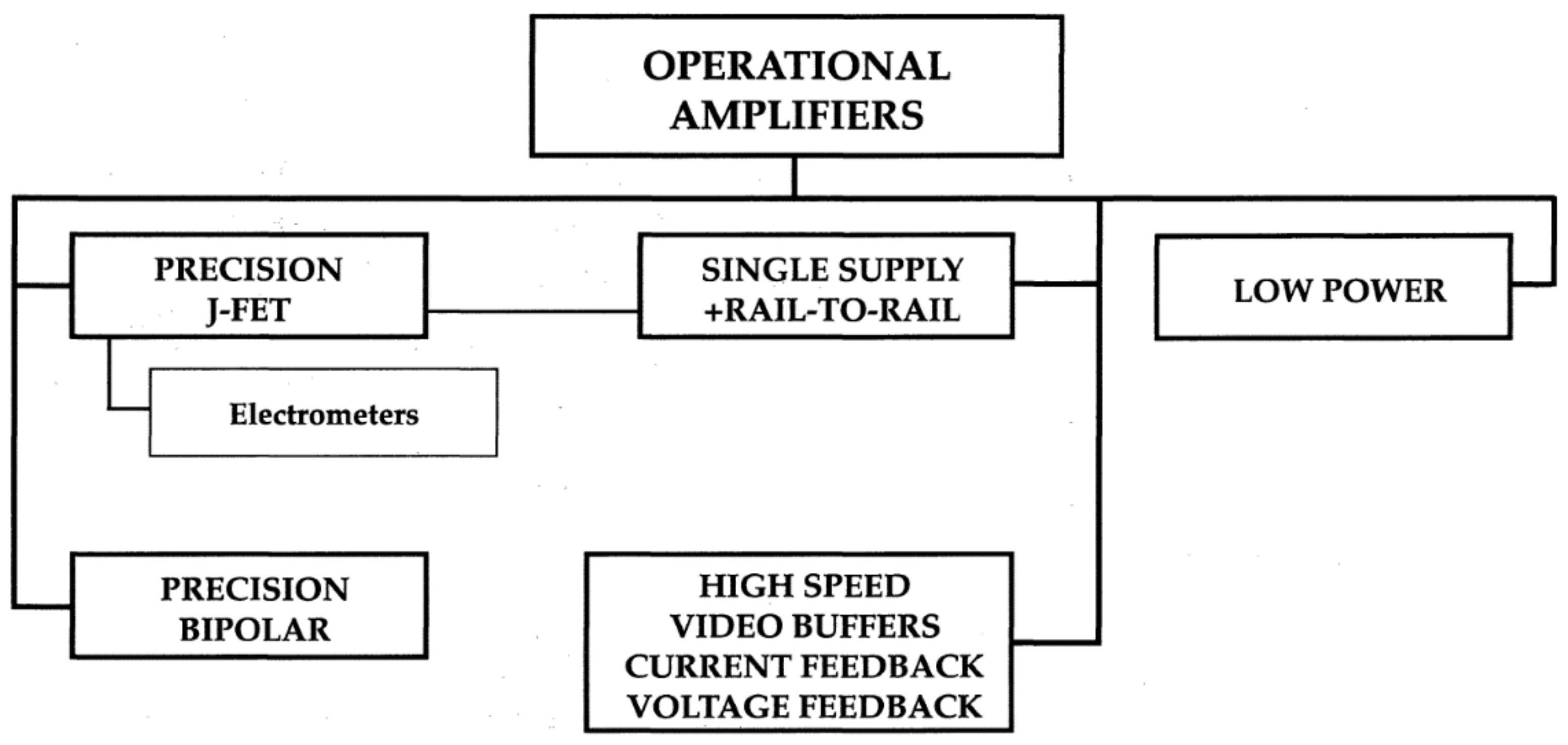
Figure 2.
A tree for more detailed selection of precision operational amplifiers based on field-effect transistors, taken from the Analog reference book Devices [101]: here are the best representatives at the time of publication, according to the manufacturer.
Figure 2.
A tree for more detailed selection of precision operational amplifiers based on field-effect transistors, taken from the Analog reference book Devices [101]: here are the best representatives at the time of publication, according to the manufacturer.
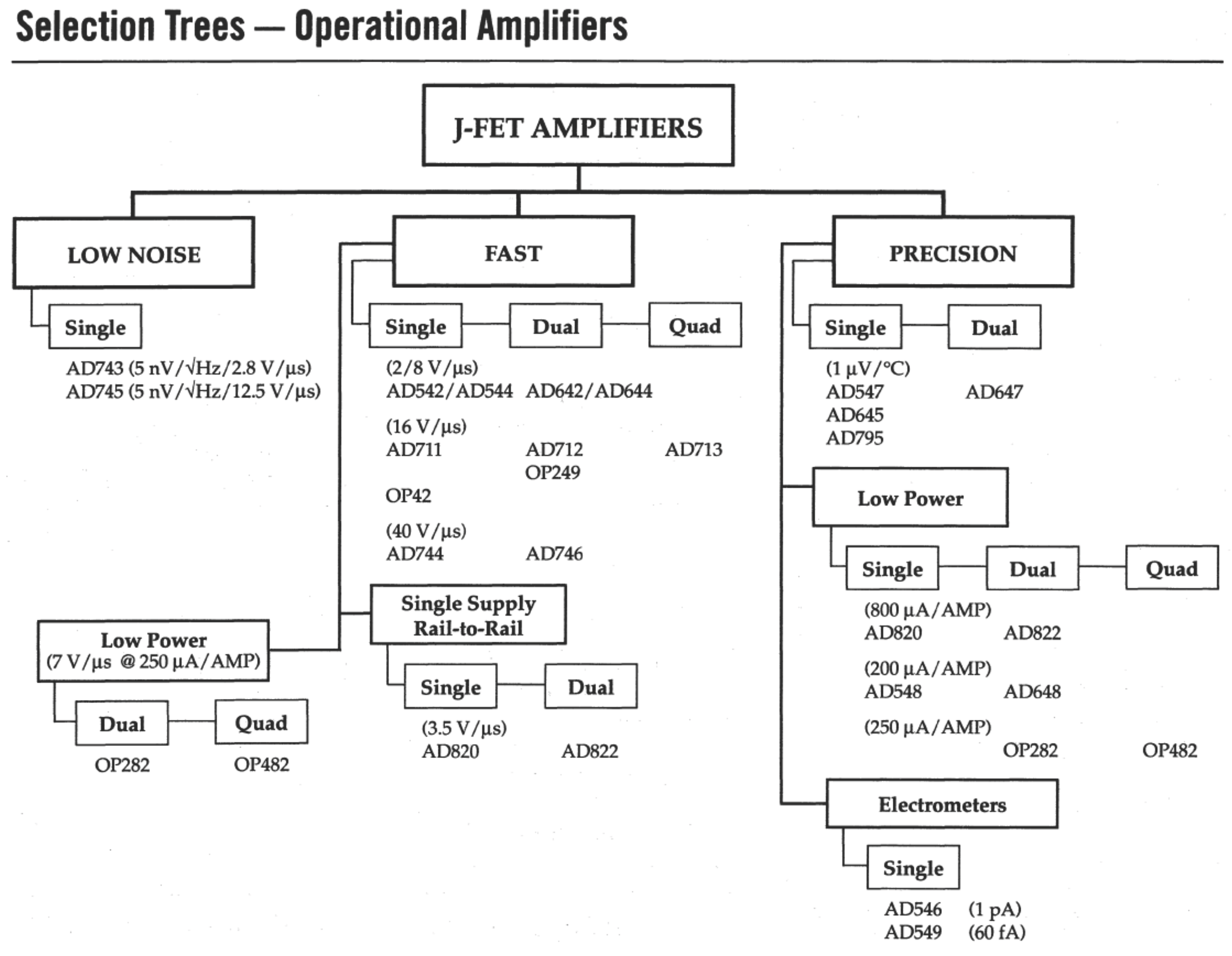
Figure 3.
A tree for a more detailed selection of precision operational amplifiers based on bipolar transistors, taken from the Analog reference book Devices [101]: here are the best representatives at the time of publication, according to the manufacturer.
Figure 3.
A tree for a more detailed selection of precision operational amplifiers based on bipolar transistors, taken from the Analog reference book Devices [101]: here are the best representatives at the time of publication, according to the manufacturer.
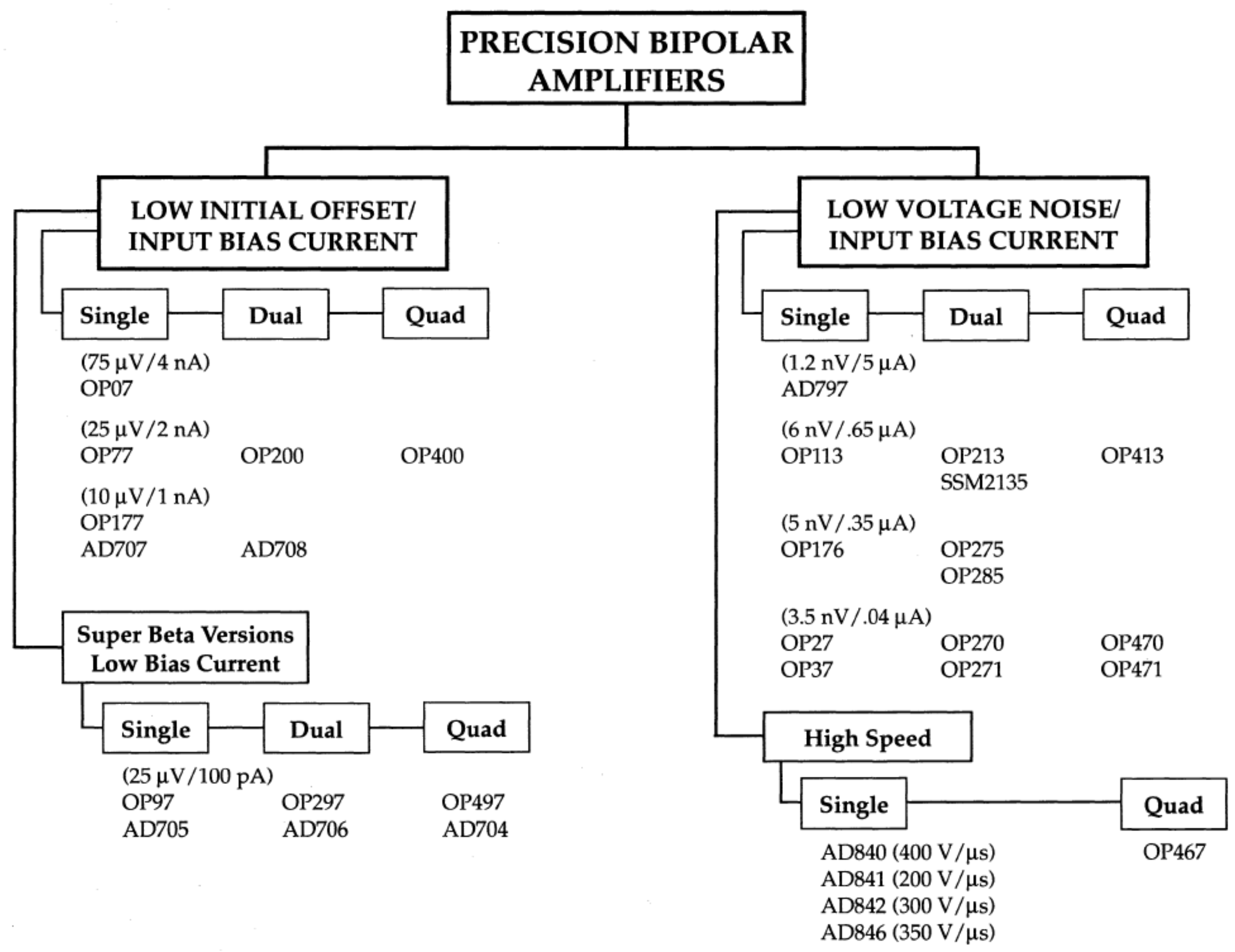
Processing these two tables separately gives grounds to highlight record indicators in each column. It is then advisable to consider these tables together, which shows that in the second table there are only two types of operational amplifiers in which the input current is record low, the remaining operational amplifiers are inferior in their parameters to the record holders from the previous table.
However, it is necessary to consider the possibility of record indicators in the aggregate, for example, the best suppression of common mode interference among amplifiers with the highest speed, or the best speed in combination with the smallest zero drift. Also, operational amplifiers can be selected, the best by a combination of three features, by a combination of four features, and so on. This processing is difficult manually, but for the system such data processing does not present any difficulties, since the selection algorithm is quite simple.
Let us also pay attention to the fact that in this case the table often gives typical parameters, while the maximum or minimum values are important.
Based on the data obtained, it is proposed to compile a new table, which we present as Table 2. It consists only of the leaders in the original two tables, shown in Figure 4 and Figure 5. It is also desirable to eliminate ambiguity if possible, namely: where typical values of a parameter are indicated, they should be replaced by the maximum or minimum value, depending on what type of parameter it is. For parameters that are needed as little as possible, the maximum values should be entered there, for parameters that are needed as much as possible, the minimum values should be entered; typical values should be eliminated from this table.
First, we note that two elements should be immediately excluded from this Table 2: amplifiers OP27 and OP37 are not, strictly speaking, operational amplifiers, since the slope of this function on a logarithmic scale does not correspond to the first order of attenuation in the entire frequency range where the transfer function of an open amplifier is greater than unity. For this reason, the unity gain frequency of these amplifiers does not at all characterize the line on which the product of the frequency and the gain at this frequency is equal to the value of F. In other words, at some frequencies the product of the frequency and the gain is indeed equal to this value, but these amplifiers do not ensure the transmission of a signal with unity gain at a frequency equal to this value.
We also see that the name of the microcircuit may additionally contain a letter, on which some characteristics depend, so, for example, there are microcircuits OP177A, OP177B and so on, and their parameters differ. We will choose the best of them. But operational amplifiers with worse parameters are produced for some reason. Obviously, they should be cheaper, but we will not consider the cost as an important indicator, if it is important, then the request to the System will simply require taking into account this parameter, as one of many. We also see that the parameter characterizing the instability of the offset per month is given not in terms of the maximum value, but in terms of the typical one, which violates our logic of choosing the element base. The value of the noise voltage in the proposed terms is not given in the reference book, it must be calculated, because if in the summary table the noise is specified in the range of 0.1 - 10 Hz, then in the reference book the noise level is given in the band 1 - 100 Hz, and this value is 118 nV of the typical effective voltage, and the maximum value for this value is 150 nV. Accordingly, in terms of peak to peak this value will be greater and it is necessary to additionally take into account the difference in the frequency band by 10 times, which will give a decrease of times. It turns out the typical value in the same terms is 0.1 mV, the maximum value is 0.27 mV. This discrepancy with the indicator in the generalized table may occur due to the fact that the spectral density of the noise is not uniform, apparently with an increase in frequencies it decreases noticeably. Therefore, we cannot give a reliable value of this value in the terms given in the generalized table for the maximum value, and we are again forced to be satisfied with the typical value from the generalized table. For this reason, we can refuse to specify the parameters from date sheets, and specify only the data that is given in the range.
For AD707 we can find not only typical parameters for the values of the first two columns, but also maximum ones, but for comparison it is better to take the same type of values. Therefore, the System must take into account all these parameters. Using the example of the first three lines in this table, we should clarify the parameters of all the remaining “favorites”, and also conduct a new comparison based on the already clarified characteristics, as a result of which some favorites will be deprived of this status. Data that is missing in the summary table can in some cases be calculated. For example, for AD846 A, the spectral noise density is given . From here, we can calculate the noise in the 10 Hz band in terms of peak to peak. In Table 2, the first five lines are processed manually, then all the other lines should be processed by analogy, which we do not do in this case, since the method, apparently, has already been described quite clearly in these examples.
Yellow fill shows record indicators in comparison with neighboring rows, orange fill shows the worst indicators in comparison with neighboring ones, and gray or blue show cells with indicators identical to neighboring rows. For example, it is clear that in this table some unnecessary rows can be clearly removed. Here are two most obvious examples.
For example, the parameters of the OP 213 and OP 413 amplifiers are inferior in the characteristics in the first column, and are identical in all other positions to the parameters of the OP113 amplifier.
We can also ignore OP297 in comparison with OP497, and so on. So these amplifiers could never be considered again if this table contained all the parameters of these operational amplifiers. But in fact, operational amplifiers have many more parameters, so we do not make such a conclusion, but only demonstrate how the System should work. For similar reasons, you could refuse to use OP 41 amplifiers if you have AD 795 amplifiers, which are no worse in all parameters. Note that we equate the lack of information on some parameter to the worst case scenario, although perhaps this information can be obtained somewhere, taken into account, and perhaps in this case the decision can be revised. As a result, after deleting all unnecessary lines, we obtain Table 3, where, as for each type of operational amplifiers, there is at least one parameter that is the best in this table. And although, for example, AD705A is identical to the OP177A amplifier in terms of the record parameter, and at the same time is inferior to the offset voltage by 9 times, it is also inferior in many other parameters, but it is characterized by a significantly lower input current, and in this parameter it is inferior only to the AD795 amplifier. Thus, for this task we received a set of favorites, but, let us recall, we considered only one manufacturer.
Figure 6 shows a simplified diagram of request processing and selection of electronic component base. It should be noted that a top-level system is also required to ensure the interconnection of all selected elements with each other, including compatibility testing. For example, if the task is to create a digital device on discrete elements, and if the customer’s requirement does not clearly define a single type of logic, then as a result of the selection the fastest registers, counters and gates may be proposed for implementation on the highest-speed element base, while units that do not require high speed may be implemented on the least energy-consuming series, so that there is a need to ensure signal compatibility. This is only a simplified example of the compatibility problem, which should be understood much more broadly, including in terms of power supply, heat generation and many other parameters.
7.6. Рarsing Algorithms and Methods
At the first stage, the tasks and actions of individual branches of the algorithm are developed on the basis of expert assessments. Many even generally accepted terms are not precise enough to be used in the automation of the selection of the component base. For example, as we have seen, the manufacturer classifies the OP 27 and OP 37 amplifiers as operational amplifiers, which are not, strictly speaking, operational amplifiers. Many manufacturers also include video buffers in this class, that is, high-frequency amplifiers with a frequency band of about 1 GHz and higher, designed to amplify signals with a gain factor of . At the same time, operational amplifiers are very often used to amplify weak signals or signals from sources with high output impedance. Such amplifiers are also often called instrumentation amplifiers, as well as electrometers. Therefore, when a user requests a precision operational amplifier to create an instrumentation amplifier, it is required that the System ignore offers with video buffers, but process offers with instrumentation amplifiers, such as AMP04 [102]. It should be noted, however, that this amplifier has a typical offset of 30 µV and a maximum drift of 30 µV/S, the typical input current is 22 nA [102], but since temperature drift is one of the most important parameters when measuring weak signals, it should be as small as possible, this instrumentation amplifier does not compete with the operational amplifiers listed in Table 3.
Ideally, it would be preferable for the system to also analyze the circuit itself in which the designer intends to use the element base, and in the event that the designer intends to make an instrumentation amplifier based on two, three or four operational amplifiers, it would suggest that he use a single instrumentation amplifier of this type instead, as shown in Figure 7. This figure shows that the structure of this amplifier includes four operational amplifiers, two of which operate in buffer mode.
Therefore, if a precision operational amplifier is required, another section should also be processed: “Instrumentation amplifiers”. In particular, the Analog Devices reference book contains the following instrumentation amplifiers: AD524, AD526, AD620, AD621, AD624, AD625, AD626, AMPO1, AMP02, AMP04, all of which are located in another section [101].
Another example: if a designer, for example, wants to select an operational amplifier as an input device to an ADC, then it is possible that when selecting some specific types of ADC, an input instrumentation or operational amplifier is not required, since it is available as a built-in element in this ADC. An example is the AD7714 ADC [105].
Another example is that ADC should be looked for not only in the topic section dedicated to analog-to-digital converters, but also in the section “ Data Acquisition Subsystems » [101].
The opposite scheme may also take place. For example, if a developer is looking for a high-voltage operational amplifier, or an operational amplifier with a high output power, then even taking into account that such elements exist, it may be more effective to use a series connection of the operational amplifier and a powerful output stage or a powerful output buffer, perhaps even in an integrated design. At the current stage, this problem is discussed only in theory, a practical approach to its solution has not yet been formed, however, if developers, in the case of adopting such innovative solutions, enter them as a precedent for selection in queries of this type, then the machine learning system can probably take them into account and, in the case of a similar query, can issue a comment that the specified technical solution has been used in similar cases. This is the point of the fastest possible implementation of a learning system with the ability to accumulate comments on user reviews, on the precedent of developer decisions and on the facts of successful selection of elements. At the same time, due to the rapid obsolescence of the element base, previously effective solutions may turn out to be hopelessly outdated in a few years, which should also be taken into account. This increases the load and responsibility on the parsing system.
To implement the decision tree for selecting the electronic component base, an algorithm has been developed, shown in Figure 8.
The following principle underlies the decision tree learning algorithms: a set for the MO is given: M, containing m variants, for each of which the target discrete variables of class K of electronic components Ki (i =1… k) and F attributes associated with the functional purpose of the products Fa (j =1… m) and attributes o associated with the area of application of the products Qg(g =1… n).
The main properties of this algorithm are: discreteness, certainty, effectiveness and clarity. This algorithm has linear sections where operations are performed sequentially, in the order they are recorded. Each operation is independent, independent of any conditions. In the diagram, the blocks displaying these operations are arranged in a linear sequence.
Also, the algorithm being developed has branches, when several directions (branches) are provided. Each separate direction of the data processing algorithm is a separate branch of calculations. The direction of branching is selected by a logical check, as a result of which a transition for further execution of the algorithm in one of the directions is possible.
An algorithm for managing the information flow depending on its type has also been developed, generating control actions based on information received from external sources. This algorithm is shown in Figure 9.
When comparing information images of electronic components, there is active selective processing of information associated with the search for distinctive features between images and the establishment of relationships between them. Recognition is completed with alternative answers or a transition to a more specific level. The corresponding algorithm is shown in Figure 10. Information about the product enters the feature study and image formation unit. Reference hypotheses enter the same unit from the database (DB) through the RAM, which pass through the unit for accounting for a priori probabilities. Based on the accounting for a priori information, element-by-element or holistic comparison of the formed image with the standards, a hypothesis is selected and its a posteriori probability is estimated. Basically, when recognizing individual objects based on the use of independent, equally probable, direct features, this process is described with a certain degree of approximation by Bayes’ theorem.
Even a simplified decision tree remains excessively complex for visual perception and interpretation. In this case, it is advisable to extract decision rules from the tree and organize them into sets that describe the classes. After the decision tree has been built, it is tested on new data to ensure that it functions correctly. The accuracy assessment indicator for the built decision tree KAccuracy is the ratio of the number of correct decisions made by the model to the total number of decisions , namely:
8. Discussion and Conclusions
The proposed principles of constructing a system for automated and subsequently fully automated selection of the element component base for developing electronic equipment were tested in the created system and have already been partially used in creating the System for collecting, processing, analyzing and presenting information on the electronic component base for making a decision on using the electronic component base in electronic equipment, which is an information reference system and is intended for the efficient organization of related resources that collect and process information on the electronic component base, conduct analysis, search and generate proposals for making a decision by developers (designers) on using the electronic component base in electronic equipment.
9. Conclusions
The article combines a review of the state of affairs in the field of development and application of the System for automation of the selection of elemental component base for the production of electronic products with the authors’ own developments.
10. Patents
Author Contributions
Conceptualization, Yu. R. and V.Z.; methodology, software, validation, formal analysis, investigation, resources data curation, Yu. R. writing—original draft preparation, Yu.R. and V.Z.; writing—review and editing, Yu.R. and V.Z.; visualization, Yu.R.; and V.Z.; supervision, Yu.R.; project administration, Yu.R.; funding acquisition, Yu.R. and V.Z. All authors have read and agreed to the published version of the manuscript.
Funding
This research received no external funding
Abbreviations
The following abbreviations are used in this manuscript:
| MDPI | Multidisciplinary Digital Publishing Institute |
| CAD | Computer aided design |
| DSAM | Decision Science Applications and Models |
| REA | Radio-electronic equipment |
| SW | Software |
| ECB | Element component base |
| BOM | Bill of materials |
| ERP | Enterprise resource planning (systems) |
| PDM | Product data management |
| PLM | Product life-cycle management |
| EDA(D) | Electronic computer-aided design |
| NDND | Not recommended for new design |
| EOL | End of Life (after some data) |
| API | Application programming interface |
| UIAS | Unified identification and authentication system |
| IHS | IHS Markit – name of company |
| AVL | Balanced binary search tree (named after inventors Adelson-Velsky and Landis) |
| PCN | Personal communications network: a system for connecting mobile phones: |
| XML | eXtensible Markup Language |
| CIS | Component Information System |
| CIP | Component Information Portal |
References
- Dmitry Ireshev. Rating of platforms for searching electronic components. 2018. https://habr.com/ru/articles/410031/ (In Russian).
- Best Journals - Electronics and Electrical Engineering. Electronics (MDPI). https://research.com/journal/electronics-mdpi.
- Janiesch, C.; Zschech, P.; Heinrich, K. Machine learning and deep learning. Electron. Mark. 2021, 31, 685–695. [Google Scholar] [CrossRef]
- Sharma, N.; Sharma, R.; Jindal, N. Machine Learning and Deep Learning Applications-A Vision. Glob. Transit. Proc. 2021, 2, 24–28. [Google Scholar] [CrossRef]
- Sarker, IH Deep Learning: A Comprehensive Overview on Techniques, Taxonomy, Applications and Research Directions. SN Comput. Sci. 2021, 2, 420. [CrossRef]
- Shalev-Shwartz, S.; Ben-David, S. Understanding Machine Learning: From Theory to Algorithms; Cambridge University Press: New York, NY, USA, 2014; p. 410. [Google Scholar]
- Goodfellow, I.; Bengio, Y.; Courville, A. Deep Learning; MIT Press: Cambridge, MA, USA, 2016; p. 800. [Google Scholar]
- Khan, S.; Sajjad, M.; Hussain, T.; Ullah, A. ; Imran, AS A Review on Traditional Machine Learning and Deep Learning Models for WBCs Classification in Blood Smear Images. IEEE Access 2021, 9, 10657–10673. [Google Scholar] [CrossRef]
- Lai, Y. A Comparison of Traditional Machine Learning and Deep Learning in Image Recognition. J. Phys. Conf. Ser. 2019, 1314, 012148. [Google Scholar] [CrossRef]
- Reza, M.A.; Chen, Z. ; Crandall, DJ Deep Neural Network–Based Detection and Verification of Microelectronic Images. J.Hardw. Syst. Secur. 2020, 4, 44–54. [Google Scholar] [CrossRef]
- Goobar, L. Machine Learning Based Image Classification of Electronic Components; KTH: Stockholm, Sweden, 2013. [Google Scholar]
- Xu, Y.; Yang, G.; Luo, J.; He, J. An Electronic Component Recognition Algorithm Based on Deep Learning with a Faster SqueezeNet. Math. Probl. Eng. 2020, 2020, 2940286. [Google Scholar] [CrossRef]
- Huang, R.; Gu, J.; Sun, X.; Hou, Y.; Uddin, S. A Rapid Recognition Method for Electronic Components Based on the Improved YOLO-V3 Network. Electronics 2019, 8, 825. [Google Scholar] [CrossRef]
- Radeva, P.; Bressan, M.; Tovar, A.; Vitria, J. Bayesian Classification for Inspection of Industrial Products. In Catalonian Conference on Artificial Intelligence; Springer: Berlin/Heidelberg, Germany, 2002; pp. 399–407. [Google Scholar]
- Luo, S.; Wan, F.; Lei, G.; Xu, L.; Ye, Z.; Liu, W.; Zhou, W.; Xu, C. EC-YOLO: Improved YOLOv7 Model for PCB Electronic Component Detection. Sensors 2024, 24, 4363. [Google Scholar] [CrossRef]
- Starodubov, D.; Danishvar, S. ; Abu Ebayyeh, AARM; Mousavi, A. Advancements in PCB Components Recognition Using WaferCaps: A Data Fusion and Deep Learning Approach. Electronics 2024, 13, 1863. [Google Scholar] [CrossRef]
- Atik, I. Classification of Electronic Components Based on Convolutional Neural Network Architecture. Energies 2022, 15, 2347. [Google Scholar] [CrossRef]
- Hożyń, S. Convolutional Neural Networks for Classifying Electronic Components in Industrial Applications. Energies. 2023, 16, 887. [Google Scholar] [CrossRef]
- Xia, Z.; Gu, J.; Zhang, K.; Wang, W.; Li, J. Research on Multi-Scene Electronic Component Detection Algorithm with Anchor Assignment Based on K-Means. Electronics 2022, 11, 514. [Google Scholar] [CrossRef]
- Hu, X.; Xu, J.; Wu, J. A Novel Electronic Component Classification Algorithm Based on Hierarchical Convolution Neural Network. In Proceedings of the IOP Conference Series: Earth and Environmental Science, Changchun, China, 21–23 August 2020; Volume 474, p. 052081. [Google Scholar]
- Hu, X.; Xu, J.; Wu, J. A Novel Electronic Component Classification Algorithm Based on Hierarchical Convolution Neural Network. In Proceedings of the IOP Conference Series: Earth and Environmental Science, Changchun, China, 21–23 August 2020; Volume 474, p. 052081. [Google Scholar]
- Kiddee, P.; Naidu, R.; Wong, M. H. Electronic waste management approaches: An overview. Waste Manag. 2013, 33, 1237–1250. [Google Scholar] [CrossRef]
- Tanskanen, P. Management and recycling of electronic waste. Acta Mater. 2013, 61, 1001–1011. [Google Scholar] [CrossRef]
- Weiss, E.; Caplan, S.; Horn, K.; Sharabi, M. Real-Time Defect Detection in Electronic Components during Assembly through Deep Learning. Electronics 2024, 13, 1551. [Google Scholar] [CrossRef]
- Andersson, C.; Ingman, J.; Varescon, E.; Kiviniemi, M. Detection of Cracks in Multilayer Ceramic Capacitors by X-ray Imaging. Microelectron. Reliab. 2016, 64, 352–356. [Google Scholar] [CrossRef]
- Weiss, E. Revealing Hidden Defects in Electronic Components with an AI-Based Inspection Method: A Corrosion Case Study. IEEE Trans. Compon. Packag. Manuf. Technol. 2023, 13, 1078–1080. [Google Scholar] [CrossRef]
- Government Accountability Office. Defense Supply Chain DOD Needs Complete Information on Single Sources of Supply to Proactively Manage the Risks; Government Accountability Office: Washington, DC, USA, 2017. [Google Scholar]
- Spieske, A.; Birkel, H. Improving Supply Chain Resilience through Industry 4. 0: A Systematic Literature Review under the Impressions of the COVID-19 Pandemic. Comput. Ind. Eng. 2021, 158, 107452. [Google Scholar]
- He, X.; Chang, Z.; Zhang, L.; Xu, H.; Chen, H.; Luo, Z. A Survey of Defect Detection Applications Based on Generative Adversarial Networks. IEEE Access 2022, 10, 113493–113512. [Google Scholar] [CrossRef]
- Tehranipoor, M.M.; Guin, U.; Forte, D. Counterfeit Integrated Circuits; Springer: Berlin/Heidelberg, Germany, 2015; pp. 15–36. [Google Scholar]
- Kessler, L. W.; Sharpe, T. Faked Parts Detection of Counterfeiting of Electronics Components and Related Parts Is Widespread. but Newly Developed Methods Promise now to Help Identify Counterfeit Plastic-Encapsulated Components Using Detection Methods that Cannot Be Tricked. PLUS: The industry’s best up-close look at just how electronics components are faked and remarketed. Print. Circuit Des. Fab 2010, 27, 64.
- Aerospace Industries Association. Counterfeit Parts: Increasing Awareness and Developing Countermeasures; Aerospace Industries Association: Arlington, VA, USA, 2011. [Google Scholar]
- Kishore, K. On the Crucial Role of On-Site and Visual Observations in Failure Analysis and Prevention. J. Fail. Anal. Prev. 2021, 21, 1126–1132. [Google Scholar] [CrossRef]
- Haase, G.S.; McPherson, J. W. Modeling of Interconnect Dielectric Lifetime under Stress Conditions and New Extrapolation Methodologies for Time-Dependent Dielectric Breakdown. In Proceedings of the 2007 IEEE International Reliability Physics Symposium Proceedings, 45th Annual, Phoenix, AZ, USA, 15–19 April 2007; IEEE: Piscataway, NJ, USA, 2007; pp. 390–398. [Google Scholar]
- Ohring, M.; Kasprzak, L. Chapter 9–Degradation of Contacts and Package Interconnections. In Reliability and Failure of Electronic Materials and Devices; Ohring, M., Ed.; Academic Press: Cambridge, MA, USA, 1998; pp. 475–537. [Google Scholar]
- Zhang, K.; Shen, H. Solder Joint Defect Detection in the Connectors Using Improved Faster- Rcnn Algorithm. Appl. Sci. 2021, 11, 576. [Google Scholar] [CrossRef]
- Song, J.; Shukla, A.; Probst, R. The State of Health of Electrical Connectors. Machines 2024, 12, 474. [Google Scholar] [CrossRef]
- Chen, M.; Liu, Y.; Wei, X.; Zhang, Z.; Gaidai, O.; Sui, H.; Li, B. PO-YOLOv5: A Defect Detection Model for Solenoid Connector Based on YOLOv5. PLoS ONE 2024, 19, e0297059. [Google Scholar] [CrossRef]
- Ambat, R.; Conseil-Gudla, H.; Verdingovas, V. Corrosion in Electronics. In Encyclopedia of Interfacial Chemistry: Surface Science and Electrochemistry; Elsevier: Amsterdam, The Netherlands, 2018; pp. 134–144. ISBN 9780128098943. [Google Scholar]
- Weiss, E. Preventing Corrosion-Related Failures in Electronic Assembly: A Multi-Case Study Analysis. IEEE Trans. Compon. Packag. Manuf. Technol. 2023, 13, 743–749. [Google Scholar] [CrossRef]
- Al- Zogbi, L.M.; Das, D.; Rundle, P.; Pecht, M. Breaking the Trust: How Companies Are Failing Their Customers. IEEE Access 2019, 7, 52522–52531. [Google Scholar] [CrossRef]
- Razak, GM; Hendry, L. C.; Stevenson, M. Supply Chain Traceability: A Review of the Benefits and Its Relationship with Supply Chain Resilience. Prod. Plan. Control 2023, 34, 1114–1134.
- Hienonen, R.; Lahtinen, R. Corrosion and Climatic Effects in Electronics; VTT Technical Research Center of Finland: Espoo, Finland, 2000; ISBN 9513858529. [Google Scholar]
- Sabat, W.; Klepacki, D.; Kamuda, K.; Kuryło, K. Analysis of LED Lamps’ Sensitivity to Surge Impulse. Electronics 2022, 11, 1140. [Google Scholar] [CrossRef]
- Wendsche, S.; Vick, R.; Habiger, E. Modeling and testing of immunity of computerized equipment to fast electrical transients. IEEE Trans. Electromagnetic Compat. 1999, 41, 452–459. [Google Scholar] [CrossRef]
- Joo, J.; Kwak, S.I.; Kwon, J. H.; Song, E. Simulation-Based System-Level Conducted Susceptibility Testing Method and Application to the Evaluation of Conducted-Noise Filters. Electronics 2019, 8, 908. [Google Scholar] [CrossRef]
- Miller, D.; Kennel, R.; Reddig, M.; Schlenk, M. Surge immunity test analysis for modern switching mode power supplies. In Proceedings of the IEEE International Telecommunications Energy Conference (INTELEC), Austin, TX, USA, 23–27 October 2016; pp. 1–6. [Google Scholar]
- Vrignon, B.; Caunegre, P.; Shepherd, J.; Wu, J. Automatic verification of EMC immunity by simulation. In Proceedings of the 9th International Workshop on Electromagnetic Compatibility of Integrated Circuits (EMC Compo), Nara, Japan, 15–18 December 2013; pp. 202–207. [Google Scholar]
- Sabat, W.; Klepacki, D.; Kuryło, K.; Kamuda, K. Mathematical Model of the Susceptibility of an Electronic Element to a Standardized Type of Electromagnetic Disturbance. Energies 2023, 16, 7022. [Google Scholar] [CrossRef]
- Gonschorek, K.-H.; Vick, R. Electromagnetic Compatibility for Device Design and System Integration; Springer: Berlin/Heidelberg, Germany, 2009. [Google Scholar]
- Humayun, M.; Jhanjhi, N.; Hamid, B.; Ahmed, G. Emerging Smart Logistics and Transportation Using IoT and Blockchain. IEEE Internet Things Mag. 2020, 3, 58–62. [Google Scholar] [CrossRef]
- Wold, S.; Esbensen, K.; Geladi, P. Principal component analysis. Chemom. Intell. Lab. Syst. 1987, 2, 37–52. [Google Scholar] [CrossRef]
- Guo, Q.; Wu, W.; Massart, D.L.; Boucon, C.; de Jong, S. Feature selection in principal component analysis of analytical data. Chemom. Intell. Lab. Syst. 2002, 61, 123–132. [Google Scholar] [CrossRef]
- Song, F.; Guo, Z.; Mei, D. Feature Selection Using Principal Component Analysis. In Proceedings of the 2010 International Conference on System Science, Engineering Design and Manufacturing Informatization, Yichang, China, 12–14 November 2010; pp. 27–30. [Google Scholar]
- Atik, I. Classification of Electronic Components Based on Convolutional Neural Network Architecture. Energies 2022, 15, 2347. [Google Scholar] [CrossRef]
- Chelenko Alexandra Viktorovna. “Scientific and technological directions of increasing the efficiency of the organization of production of electronic component base products in the context of import substitution “. diss. for the degree of candidate of technical sciences. 2017. Specialist. 05.02.22. https :// www . dissercat . com / content / nauchno - tekhnologicheskie - napravleniya - povysheniya - effektivnosti - organizatsii - proizvodstva - i (In Russian).
- Ali, S.; Hafeez, Y.; Humayun, M. ; Jhanjhi, NZ; Ghoniem, R. M. An Aspects Framework for Component-Based Requirements Prediction and Regression Testing. Sustainability 2022, 14, 14563. [Google Scholar] [CrossRef]
- Borg, M.; Chatzipetrou, P.; Wnuk, K.; Alégroth, E.; Gorschek, T.; Papatheocharous, E.; Shah, S. M. A.; Axelsson, J. Selecting Component Sourcing Options: A Survey of Software Engineering’s Broader Make-or-Buy Decisions. Inf. Softw. Technol. 2019, 112, 18–34. https://www.sciencedirect.com/science/article/abs/pii/S0950584919300710?via%3Dihub.
- Umran Alrubaee, A.; Cetinkaya, D.; Liebchen, G.; Dogan, H. A Process Model for Component-Based Model-Driven Software Development. Information 2020, 11, 302. [Google Scholar] [CrossRef]
- Cho, W. C.; Atukeren, E.; Yim, H. Overseas Market Expansion Strategy of the Global Electronic Components Company Based on the AHP Analysis of Factors in Technology, Organization, and Environment Context: A Case of Samsung Electro-Mechanics. Systems 2023, 11, 532. [Google Scholar] [CrossRef]
- Methodology for constructing a distributed information system for searching scientific and technical information based on an object data model. Shvedenko V.N., Shchekochikhin O.V., Sinkevich E.A. VINITI RAS, Journal: Scientific and technical information. Series 2: Information processes and systems, 2020, no. 2. pp. 7–14. (In Russian).
- Shvedenko V. N., Shvedenko V. V., Shchekochikhin O. V. Application of structural polymorphism in the creation of process management information systems // Scientific and technical information. Ser. 2. - 2018. - No. 11. - P. 9-15. (In Russian).
- Shvedenko V. N., Shvedenko V. V., Shchekochikhin O. V. Using structural and parametric polymorphism in creating digital twins // Scientific and technical information. Ser. 2. - 2019. - No. 3. - P. 21-24. (In Russian).
- Shvedenko V.N., Shchekochikhin O.V., Cherkasova N.V. Search for an architectural solution for information support of a digital twin of a complex system // Scientific and technical information. Ser. 2. - 2020. - No. 4. - P. 18-21. (In Russian).
- Component selection tool employs AI algorithms. https://www.edn.com/component-selection-tool-employs-ai-algorithms/#:~:text=At%20a%20time%20when%20there,time%20component%20recommendations%20that%20work.
- Michael Mariani. Why Mitigating Obsolescence During Electronic Component Selection Is a Critical Risk Management Strategy. https://www.z2data.com/insights/mitigating-obsolescence-during-electronic-component-selection-is-critical#:~:text=Component%20Obsolescence%20Is%20on%20the,Rise.
- Search for electronic components and electrical equipment from more than 900 suppliers in Russia and abroad. https://efind.ru/ (In Russian).
- ChipFind: Search for electronic components in 3050 supplier warehouses: Russia, Ukraine, foreign suppliers. https://www.chipfind.ru/ (In Russian).
- Octopart. Platform for access to data on electronic components. https://www.altium.com/ru/.
- Wizerr, AI. Wizerr AI. Your AI -Teammate for Electronic Components. https://www.wizerr.ai/.
- Conrad Wolfenstein . Search Engines and AI: Crawling Websites and AI to Trustworthy Search Results. https://xpert.digital/ru/%D1%80%D0%B5%D0%B7%D1%83%D0%BB%D1%8C%D1%82%D0%B0%D1%82%D1%8B-%D0%BF%D0%BE%D0%B8%D1%81%D0%BA%D0%B0-m8jwayk5/#:~:text=%D0%9F%D0%BE%D0%B8%D1%81%D0%BA%D0%BE%D0%B2%D1%8B%D0% B5%20%D1%81%D0%B8%D1%81%D1%82%D0%B5%D0%BC%D1%8B%20%D0%B8%20%D0%B8%D1%81%D0%BA%D1%83%D1%81%D1%81%D 1%82%D0%B2%D0%B5%D0%BD%D0%BD%D1%8B%D0%B9%20%D0%B8%D0%BD%D1%82%D0%B5%D0%BB%D0%BB%D0%B5%D0%BA%D1%82 , (In Russian).
- https://optochip.org/.
- https://www.findchips.com/.
- https://www.farnell.com/.
- siliconexpert.com.
- cdn.ihs.com.
- The New Era of Electronics Design. https://www.celus.io/.
- https://cdn.ihsmarkit.com/.
- Transforming Electrical and Electronic Systems Design. https://www.zuken.com/en/.
- https://www.altium.com/.
- http://developer.digikey.com/.
- Mohd. Abbas Rizvi. Automated Electronic Component Selection: A Machine Learning approach. Final Thesis MSc. Business Information Technology. 67 p. 2022. Faculty of Electrical Engineering, Mathematics & Computer Science University of Twente Drienerlolaan 5. 7522 NB Enschede The Netherlands. https://essay.utwente.nl/90637/1/RIZVI_MBIT_EEMCS.pdf.
- Stofkova, J.; Krejnus, M.; Stofkova, KR; Malega, P.; Binasova, V. Use of the Analytic Hierarchy Process and Selected Methods in the Managerial Decision-Making Process in the Context of Sustainable Development. Sustainability 2022, 14, 11546. https://www.mdpi.com/2071-1050/14/18/11546. [CrossRef]
- Chai, J.; Liu, J.N.K.; Ngai, EWT Application of Decision-Making Techniques in Supplier Selection: A Systematic Review of Literature. Expert Syst. Appl. 2013, 40, 3872–3885. https://www.sciencedirect.com/science/article/abs/pii/S095741741201281X?via%3Dihub.
- Subrata Chakraborty. TOPSIS and Modified TOPSIS: A comparative analysis. Decision Analytics Journal . Volume 2 , March 2022, 100021. https://doi.org/10.1016/j.dajour.2021.100021 . https://www.sciencedirect.com/science/article/pii/S277266222100014X.
- Petrillo, A.; Salomon, V.A.P. ; Tramarico, CL State-of-the-Art Review on the Analytic Hierarchy Process with Benefits, Opportunities, Costs, and Risks. J. Risk Financial Manag. 2023, 16, 372. [Google Scholar] [CrossRef]
- Gunantara N. A review of multi-objective optimization: Methods and its applications. Cogent Engineering, 2018, vol. 5. https://www.tandfonline.com/doi/epdf/10.1080/23311916.2018.1502242?needAccess=true. [CrossRef]
- Khan, S. A.; Chaabane, A.; Dweiri, FT Multi-criteria decision-making methods application in supply chain management: A systematic literature review. In Multi-Criteria Methods and Techniques Applied to Supply Chain Management; Salomon, V., Ed.; Tech Open: London, UK, 2018; pp. 3–31. https://www.intechopen.com/chapters/59664.
- Y. Fukano, S. Obara. K. Hoshino, Y. Sugure. Japanese Patent JP 2023-025831. “Electronic component selection system and method.” Geneva, Jan. 19. Hitachi Astemo, Ltd. 2520, Takaba, Hitachinaka-shi, Ibaraki 3128503. Published on Jan 16, 2025. https://patentscope.wipo.int/search/en/WO2025013271 (In Japanese).
- Changing tides: the new role of resilience and sustainability in logistics and supply chain management: innovative approaches for the shift to a new era. ISBN 978-3-756541-95-9. [CrossRef]
- Adapting to the future: how digitalization shapes sustainable logistics and resilient supply chain management. ISBN 978-3-754927-70-0. [CrossRef]
- Data science and innovation in supply chain management: how data transforms the value chain. ISBN 978-3-750249-49-3. [CrossRef]
- Artificial intelligence and digital transformation in supply chain management: innovative approaches for supply chains. ISBN 978-3-750249-47-9. [CrossRef]
- The road to a digitalized supply chain management. ISBN 978-3-746765-35-8. [CrossRef]
- Where do we get information about our components? Cellus Knowledge Base. https://www.celus.io/knowledge/where-do-we-get-information-about-our-components#:~:text=supporting%20electronics%20engineers%20and%20technical,shortages%2C%20and%20ensuring%20environmental%20compliance.
- Zakeri, S. , Chatterjee, P., Konstantas, D. et al. A decision analysis model for material selection using simple ranking process. Sci Rep 13, 8631 (2023). [CrossRef]
- Certificate of state registration of computer program No. 2023614155 Russian Federation, Program for visualization of data on electronic products: application No. 2023612746, date of receipt 02/14/2023: date of state registration in the Register of computer programs 02/27/2023 / Rubtsov Yu.V., Dormidoshina D.A., Krinitsky V.V., Kurilov A.V., Okunev K.E.; applicant JSC Central Design Bureau Dayton.
- Certificate of state registration of computer program No. 2022683437 Russian Federation, Program for the formation of a database of electronic products: application No. 2022682511, date of receipt 11/22/2022: date of state registration in the Register of computer programs 12/05/2022 / Rubtsov Yu.V., Dormidoshina D.A., Krinitsky V.V., Shishkova Yu.M., Okunev K.E.; applicant JSC Central Design Bureau Dayton.
- Certificate of state registration of computer program No. 2022668891 Russian Federation, Program for managing data on electronic products: application No. 2022667557, date of receipt 09/27/2022: date of state registration in the Register of computer programs 10/13/2022 / Rubtsov Yu.V., Dormidoshina D.A., Krinitsky V.V., Vladimirov A.I., Okunev K.E.; applicant JSC Central Design Bureau Dayton.
- Certificate of state registration of the database No. 2015621293 Russian Federation, Electronic Components Buildings: application No. 2015620803, date of receipt 06/26/2015: date of state registration in the Database Register 08/26/2015 / Gryaznova T.V., Dovgan I.D., Rubtsov Yu.V. applicant JSC Central Design Bureau Dayton.
- Analog Devices, Inc., 1994. Design-in Reference Manual: Data converters, Amplifiers, Special linear products, Support Components. https://dn721907.ca.archive.org/0/items/bitsavers_analogDevilogDevicesDesignInReferenceManual_187344457/1994_Analog_Devices_Design-In_Reference_Manual.pdf.
- MAXIM 1995 New Releases Data Book. Vol. 4.
- Burr Bruwn IC Data Book, Linear Products, 1995. https://archive.org/details/burrbrownintegra00burr.
- AMP04. Data Sheet. Analog Devices. https://www.rlocman.ru/i/File/2020/09/09/AMP04.pdf.
- AMP04. Data Sheet. Analog Devices. https://www.rlocman.ru/i/File/2017/10/09/AD7714.pdf.
Figure 4.
Table from the reference book [101] with the main parameters of precision operational amplifiers (CMRR – Common mode rejection ratio): the best parameters of some operational amplifiers that claim to be favorites are highlighted in colored frames.
Figure 4.
Table from the reference book [101] with the main parameters of precision operational amplifiers (CMRR – Common mode rejection ratio): the best parameters of some operational amplifiers that claim to be favorites are highlighted in colored frames.
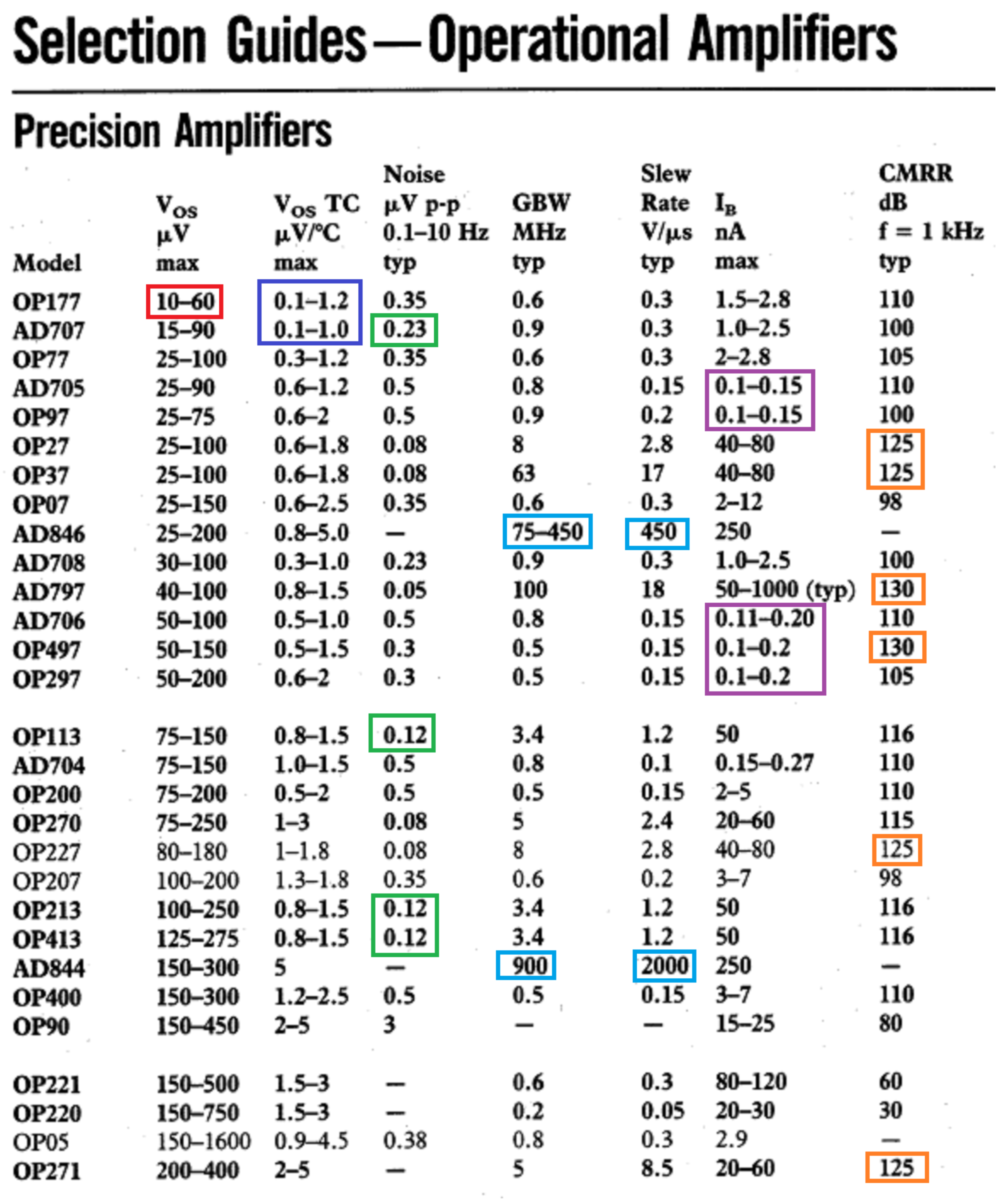
Figure 5.
Continuation of Figure 4: table from the reference book [101] with the main parameters of precision operational amplifiers.
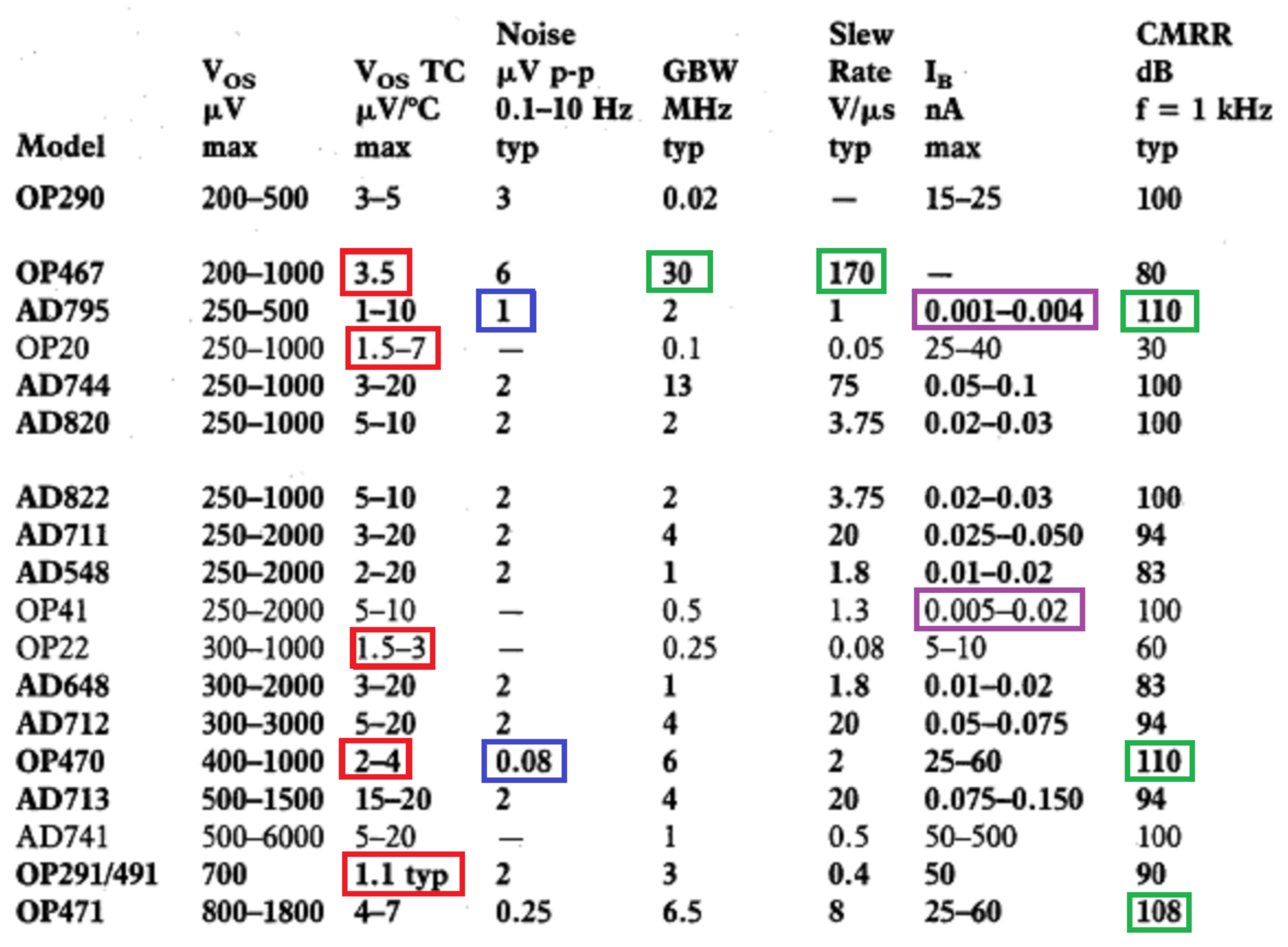
Figure 6.
Simplified diagram of interaction of individual software blocks for selection of electronic component base.
Figure 6.
Simplified diagram of interaction of individual software blocks for selection of electronic component base.

Figure 7.
Internal structure of the instrumentation amplifier AMP 04, according to [104].
Figure 7.
Internal structure of the instrumentation amplifier AMP 04, according to [104].
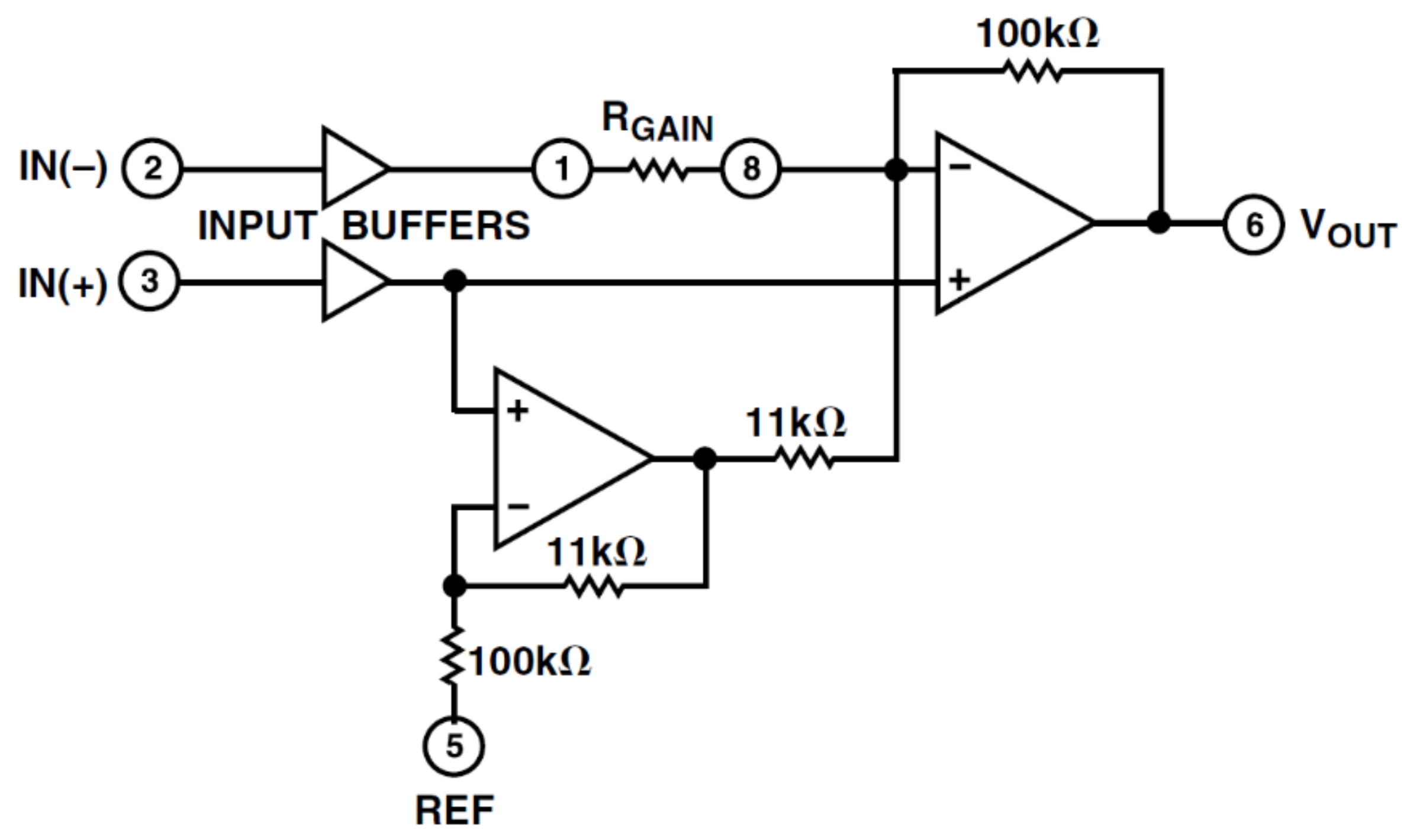
Figure 8.
Decision tree algorithm for selecting electronic components according to class, functional purpose and area of application: K – product class, F – product attribute related to its functional purpose, Q – product attributes related to its application.
Figure 8.
Decision tree algorithm for selecting electronic components according to class, functional purpose and area of application: K – product class, F – product attribute related to its functional purpose, Q – product attributes related to its application.
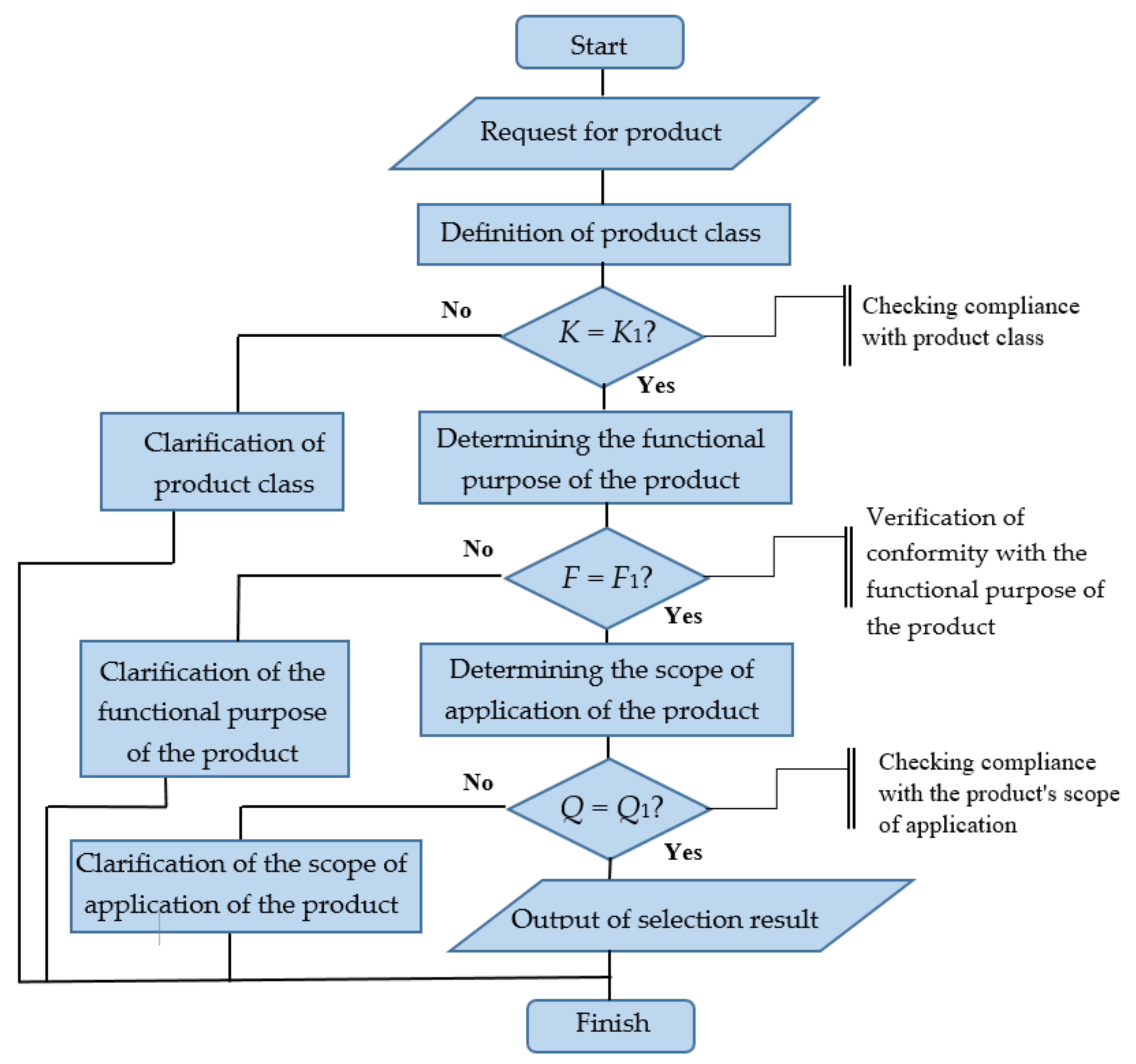
Figure 9.
Algorithm for managing the information flow depending on its type.
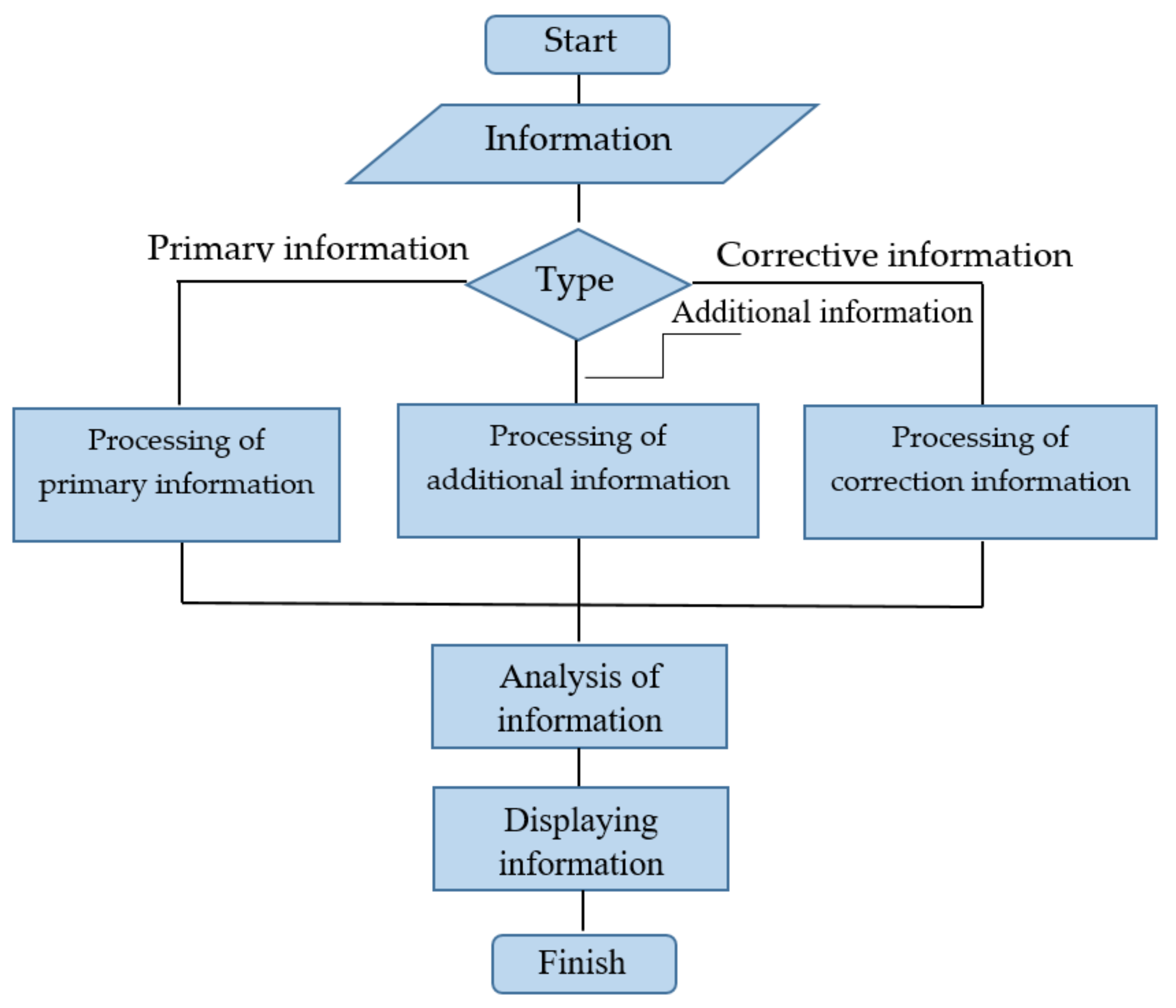
Figure 10.
Algorithm for selecting the reference hypothesis.
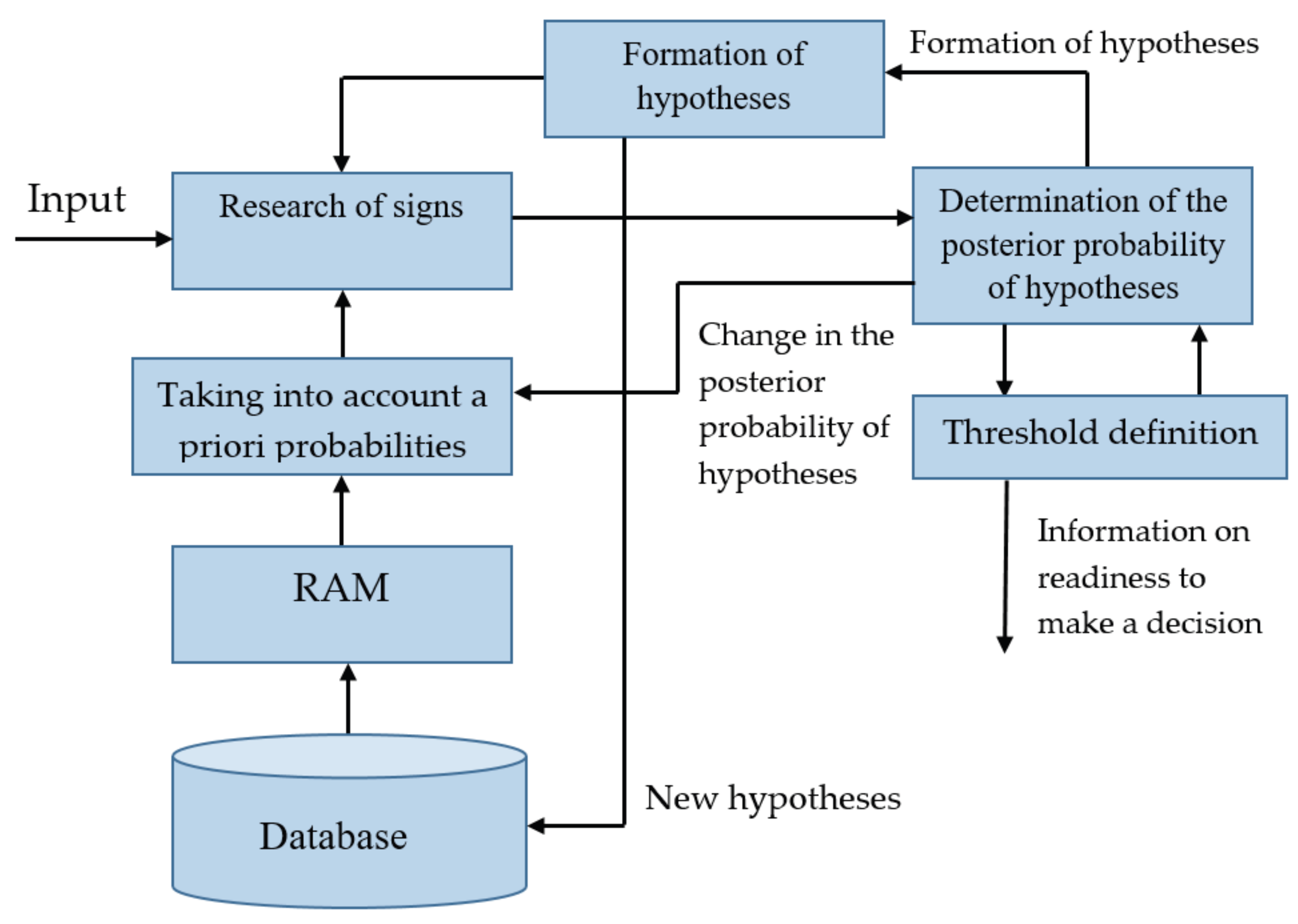

Table 1.
Summary table comparing the capabilities of some common systems and platforms for component selection.
Table 1.
Summary table comparing the capabilities of some common systems and platforms for component selection.
| System | Functionality | Using AI | Supplier support | Selection of analogues | Interface (languages) | API Openness |
|---|---|---|---|---|---|---|
| Digi-Key (search in wiki, distribu tor) | Parametric search by catalog; current prices and balances; datasheets, applications; community forums. | No (traditional filters and search). | One supplier (Digi-Key’s own warehouse, + Market place). | Partially (alternatives are recommended when the product is unavailable). | English + partial translation into other languages [1]. | Yes (REST API for catalog and orders [81]). |
| Octopart (aggregator / search engine) | Search by name and parameters in a database of >60 million components [80]; information about many distributors; integration with CAD. | Clearly not (focus on data aggregation; intelligent search by parameters). | Multiple suppliers (data directly from distributors and manufacturers) [80]. | Yes (there are lists of substitutions and equivalents, if known). | Interface in English (Altium website with description is multi lingual). | Yes (open API for search and BOM services [75]). |
| SiliconExpert (MDM platform) | Global database; deep attributes, EOL/PCN statuses; BOM analysis; change notifications; regulatory compliance. | Yes (lifetime prediction, ML-based risk analysis) [75]. | Thousands of suppliers (neutral database) [75]. | Yes (shows recommended substitutes, secondary sources). | English (focused on the global market; localizations are limited). | Partially (API access for clients, integration with CAD/PLM [76]). |
| IHS Markit (Accuris) (MDM platform) | Huge database (>540 million records) [76]; technical data + life cycle, compliance; search for components and manufac turers; reports and analytics. | There are elements (obsolescence analytics, reliability ratings). | Wide coverage of manufacturers and distributors (neutral base) [77]. | Yes (provides lists of cross- references, replace ments). | English ( de facto industry standard; possibly some Chinese/Japanese for local versions). | Yes ( Parts XML web services, integration with systems like Celus [77]). |
| Zuken Component Manage ment (CAD) / PLM integ ration) | Corporate component library; search within approved components by parameters; model binding; Component Cloud with validated data [79]. | No (traditional base, filled manually or by import). | Depends on the content (usually data on suppliers manually or from external sources). | Limited (analogues are set manually or through a filter by parameters). | English, Japanese (developer – Zuken, Japan; no Russian interface). | Limited (API for integration with PLM, but not publicly open). |
| Siemens EDA / PartQuest (CAD integra tion) | Integrated component search; corporate catalog in Xpedition; connection to Teamcenter PLM; component status management. | No (basic functionality without ML, rules and filters). | Several (via PartQuest access to a number of distributors, otherwise - only your own lists). | Yes, partially (PartQuest issued similar Digi-Key items, the internal catalog may contain substitutes). | English (Mentor / Siemens interfaces, possibly support for individual languages locally). | Yes, for corporate integration (scripts, ODBC/SQL to the library; PartQuest open API was for partners). |
| Note: The table only covers some of the systems presented; there are others (e.g., Cadence CIP, Celus, domestic eFind / chipfind, Wizerr AI platform, etc.). The data provided is relevant for recent years and may change as the systems evolve. | ||||||
Table 2.
Second step of forming list of favorites.
| V OS mcV | V OSTC mcV /C | S N mcV | GBW MHz | SR V/ mcs | I B nA | F1, kHz | |
|---|---|---|---|---|---|---|---|
| OP 177 A | 10 max | 0.2 type | 0.3 5 type | 0.6 type | 0.3 type | 1.5 max | 110 |
| AD 70 7 | 25 max | 15 max 5 type |
0.23 type | 0.9 type | 0.3 type | 1.0 max | 1 0 0 |
| AD 705 A | 90 max | 1.2 max 0.2 type |
0.5 type | 0.8 type | 0.3 type | 0.06 typ 0.15 max |
110 |
| OP97 A | 25 max 10 type |
0.3 type | 0.5 type | 0.9 | 0.2 | 0.1 max 0.03 typ |
100 |
| AD846 A | 2 00 max 25 type |
5 max 0.8 type |
0.2 | 80 | 450 | 250 | 80 small 16 full amp |
| AD797 | 40 – 100 | 0.8 – 1.5 | 0.05 | 100 | 18 | 50– 1000 | 130 |
| AD706 | 50 – 100 | 0.5 – 1.0 | 0.5 | 0.8 | 0.15 | 0.11– 0.2 | 110 |
| OP497 | 50 – 150 | 0.5 – 1.5 | 0.3 | 0.5 | 0.15 | 0.1– 0.2 | 130 |
| OP297 | 50 – 200 | 0.6 – 2 | 0.3 | 0.5 | 0.15 | 0.1– 0.2 | 105 |
| OP113 | 75 – 250 | 0.8 – 1.5 | 0.12 | 3.4 | 1.2 | 50 | 116 |
| OP213 | 100–250 | 0.8 – 1.5 | 0.12 | 3.4 | 1.2 | 50 | 116 |
| OP413 | 125–275 | 0.8 – 1.5 | 0.12 | 3.4 | 1.2 | 50 | 116 |
| OP227 | 80–180 | 1 – 1.8 | 0.08 | 8 | 2.8 | 40 – 80 | 125 |
| AD844 | 150–300 | 1.2 – 2.5 | 0.5 | 900 | 2000 | 250 | - |
| OP271 | 200-400 | 2 – 5 | - | 5 | 8.5 | 20 – 60 | 126 |
| AD795 | 250–500 | 1 – 10 | 1 | 2 | 1 | 0.001–0.004 | 110 |
| OP41 | 250–2000 | 5 – 10 | - | 0.5 | 1.3 | 0.005–0.02 | 100 |
| OP470 | 400–1000 | 2 – 4 | 0.08 | 6 | 2 | 25 – 60 | 110 |
Table 3.
The third step of forming of the list of favorites.
| V OS mcV | V OSTC mcV /C | S N mcV | GBW MHz | SR V/ mcs | I B nA | F1, kHz | |
|---|---|---|---|---|---|---|---|
| OP 177 A | 10 max | 0.2 type | 0.3 5 type | 0.6 type | 0.3 type | 1.5 max | 110 |
| AD 705 A | 90 max | 1.2 max 0.2 type |
0.5 type | 0.8 type | 0.3 type | 0.06 typ 0.15 max |
110 |
| AD797 | 40 – 100 | 0.8 – 1.5 | 0.05 | 100 | 18 | 50– 1000 | 130 |
| AD706 | 50 – 100 | 0.5 – 1.0 | 0.5 | 0.8 | 0.15 | 0.11– 0.2 | 110 |
| OP497 | 50 – 150 | 0.5 – 1.5 | 0.3 | 0.5 | 0.15 | 0.1– 0.2 | 130 |
| OP227 | 80–180 | 1 – 1.8 | 0.08 | 8 | 2.8 | 40 – 80 | 125 |
| AD844 | 150–300 | 1.2 – 2.5 | 0.5 | 900 | 2000 | 250 | - |
| AD795 | 250–500 | 1 – 10 | 1 | 2 | 1 | 0.001–0.004 | 110 |
| OP470 | 400–1000 | 2 – 4 | 0.08 | 6 | 2 | 25 – 60 | 110 |
Disclaimer/Publisher’s Note: The statements, opinions and data contained in all publications are solely those of the individual author(s) and contributor(s) and not of MDPI and/or the editor(s). MDPI and/or the editor(s) disclaim responsibility for any injury to people or property resulting from any ideas, methods, instructions or products referred to in the content. |
© 2025 by the authors. Licensee MDPI, Basel, Switzerland. This article is an open access article distributed under the terms and conditions of the Creative Commons Attribution (CC BY) license (http://creativecommons.org/licenses/by/4.0/).
Copyright: This open access article is published under a Creative Commons CC BY 4.0 license, which permit the free download, distribution, and reuse, provided that the author and preprint are cited in any reuse.