
Submitted:
15 May 2025
Posted:
16 May 2025
You are already at the latest version
Abstract
I investigated the probability $P$ that a uniformly random point within a regular n-gon ($n>6$) maintains a distance greater than the polygon's side length $l$ from every vertex. By partitioning the polygon into exclusion zones around each vertex and rigorously applying inclusion-exclusion principles, I established a closed-form expression about \( P=\frac{3n\tan{\frac{(n-2)\pi}{2n}}-2n\pi+12\pi-3\sqrt{3}n}{3n\tan{\frac{(n-2)\pi}{2n}}} \)The proof combines exclusion-zone geometry with careful handling of overlapping regions, and the result aligns with both analytic limits and numerical experiments.
Keywords:
regular polygon
; geometry
; probability
1. Introduction
Regular polygons are fundamental geometric shapes with applications spanning from material science (e.g., graphene lattices) to wireless sensor networks. A key problem in geometric probability is to determine the likelihood that a random point within a polygon satisfies specific distance constraints.
Previous studies have characterized special cases: when , no point in a regular polygon can satisfy that the distance between this point and all the vertices of the polygon is greater than the side length of the regular polygon. This leads to a trivial probability: when . For the other cases, numerical integration or probabilistic bounds are typically employed.
In this paper, I partition the polygon into exclusion zones around each vertex and meticulously account for overlapping regions through inclusion-exclusion principles, I establish the theorem.
2. Proof
2.1. Find Out the Area Formed by All Points That Meet the Requirements
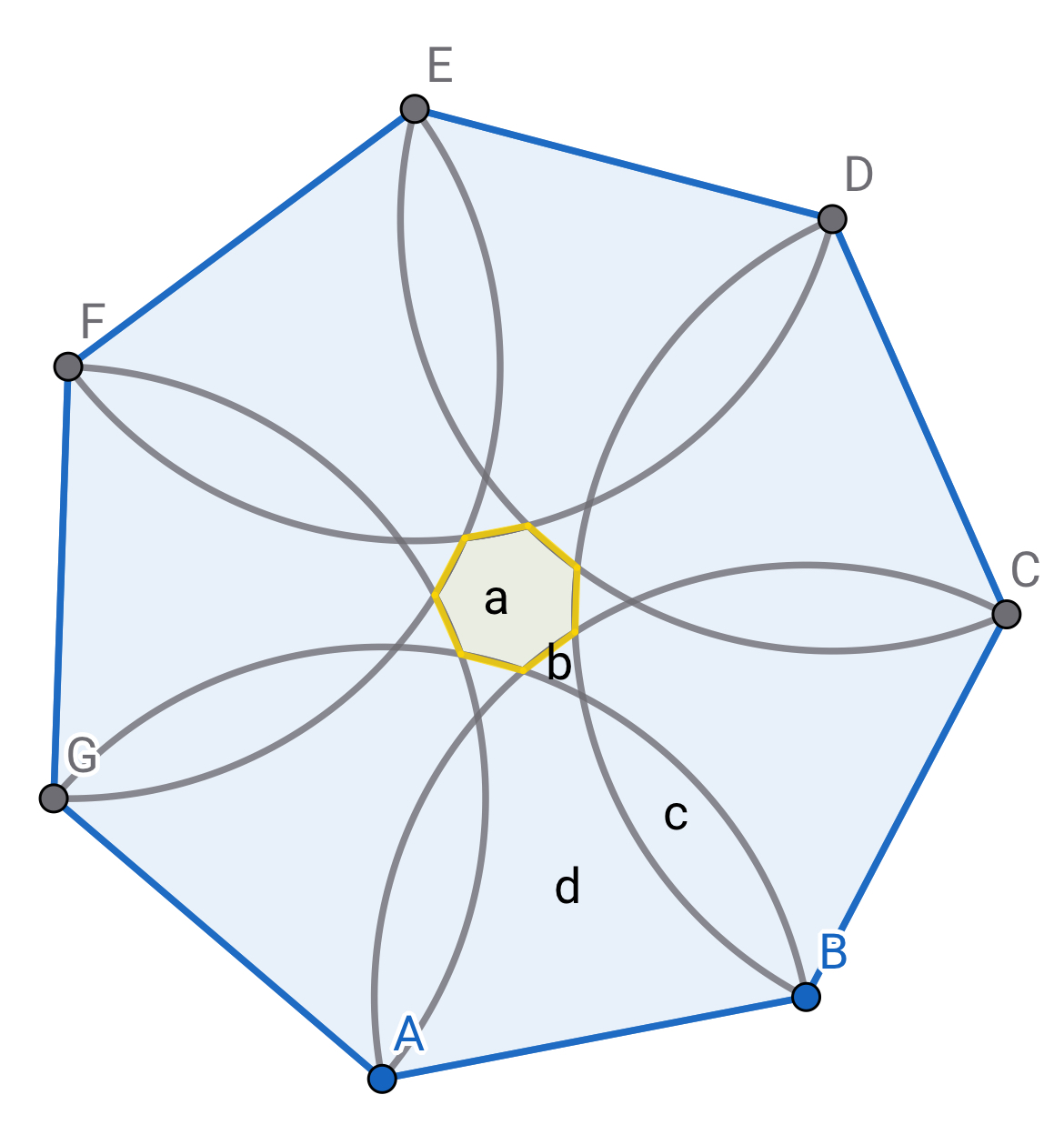
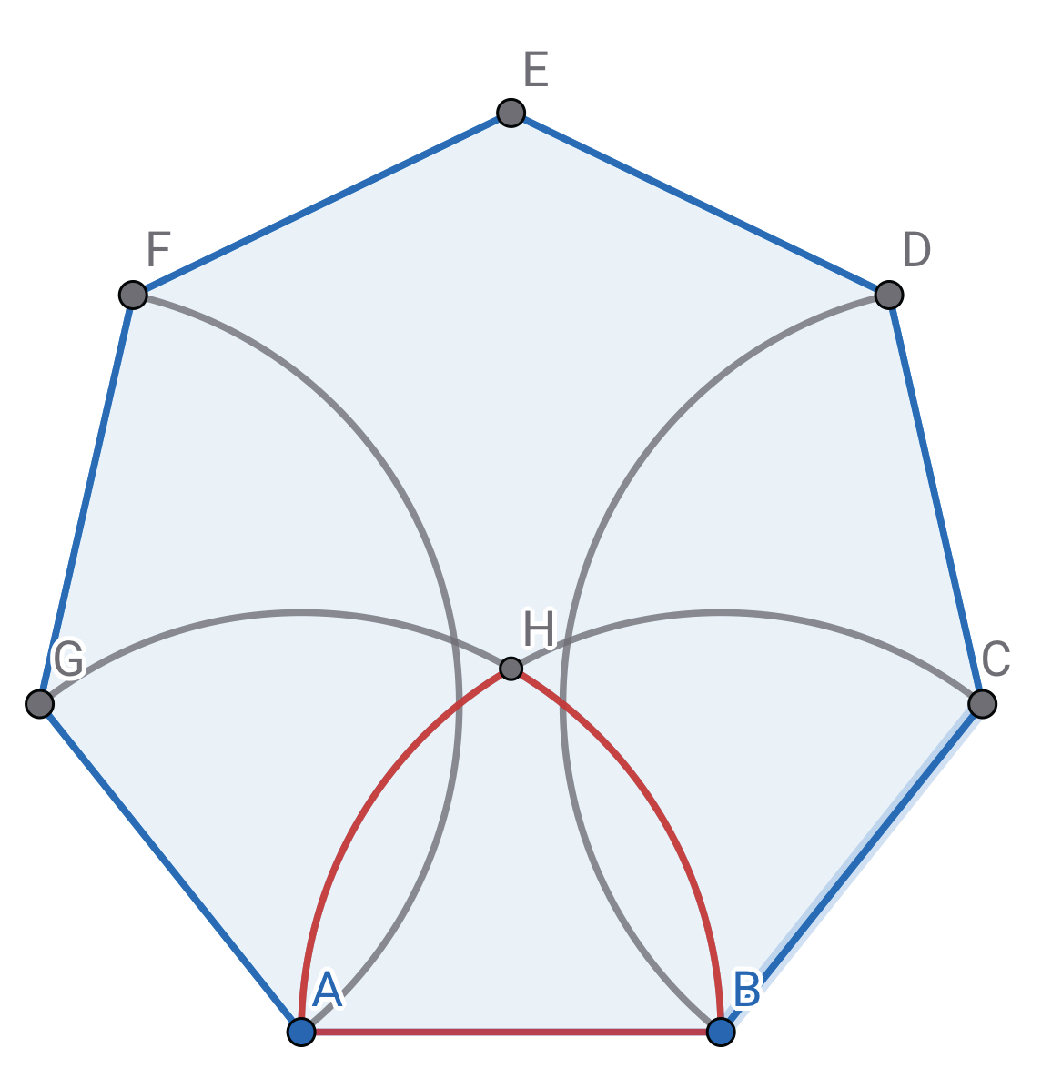
Find out the area that meets the requirements. Taking a regular heptagon as an example(), it is not difficult for us to draw such a picture like Figure 1.
The yellow part in the middle in Figure 2 is the area that meets the requirements.
In order to find out the area of this area of any regular polygon with a side number greater than 6, we can divide the polygon into multiple parts and classify these parts like Figure 3, then we got the area and d. It is not difficult to find that every b in the same polygon is equal, every c in the same polygon is equal, and every d in the same polygon is also equal, because the whole figure is symmetrical about the center point of a. And the area of the polygon in Figure 3 is composed of and .
Assume the area of the whole regular polygon is S, When the number of sides of a regular polygon continues to increase, this law will not change, that is:
So we can follow this rule to find a more specific expression of the area of a, then we can calculate the probability through this expression. but first we need to find a way to find .
2.2. Find Out the Measure
Let’s first calculate the angle composed of two adjacent sides of a regular polygon with a number of sides n(), assume the angle is ,that is
We can use the ratio of this angle to to find the area of the sector k enclosed by this angle with the side length of the polygon as the radius. Assume that the radius is l.
Referring to Figure 3, it is not difficult to find that
Then we find out the area of the red part in Figure 4. To express it more clearly, it is better to take the regular hepetagon as an example again. Obviously, the red area consists of an area d and two areas c.
In Figure 4, , It is not difficult to find that when the number of sides increases, these three line segments are still equal, and ∠= . Through a method similar to our method of calculating the sector area just now, we can get the area of the sector , assume the sector is q.
The area of the equilateral triangle we just mentioned is
Assume the red area is h, so the area of h is
Since region h is composed of a region d and two regions c, region k is composed of two regions d, three regions c and one region b, and the areas of the two regions are subtracted to obtain the area of a region b, a region c and a region d.
And we have the measure of the polygon
So we got the area of a
And the probability is
So the probability of meeting the conditions will be
Finishes the proof.
References
- Santaló, L. A. (1976). Integral Geometry and Geometric Probability. Addison-Wesley.
- Weisstein, E. W. (2003). Regular Polygon. In CRC Concise Encyclopedia of Mathematics (2nd ed.). Chapman & Hall.
- Flajolet, P., & Sedgewick, R. (2009). Analytic Combinatorics. Cambridge University Press.
- Bárány, I., & Larman, D. G. (1998). Convex bodies, economic cap coverings, random polytopes. Mathematika, 45(1), 1-18.
Figure 1.
The regular heptagon and the area.
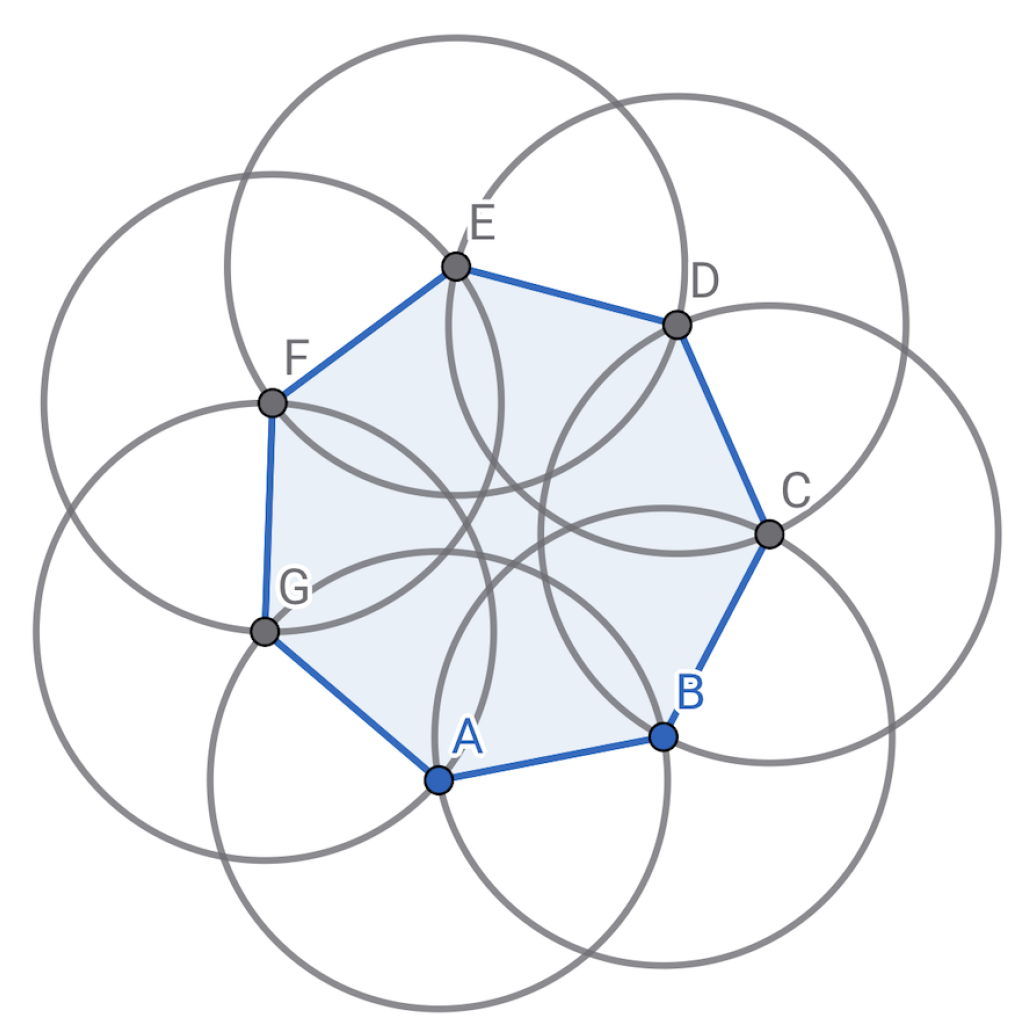
Figure 2.
The regular heptagon and the area.
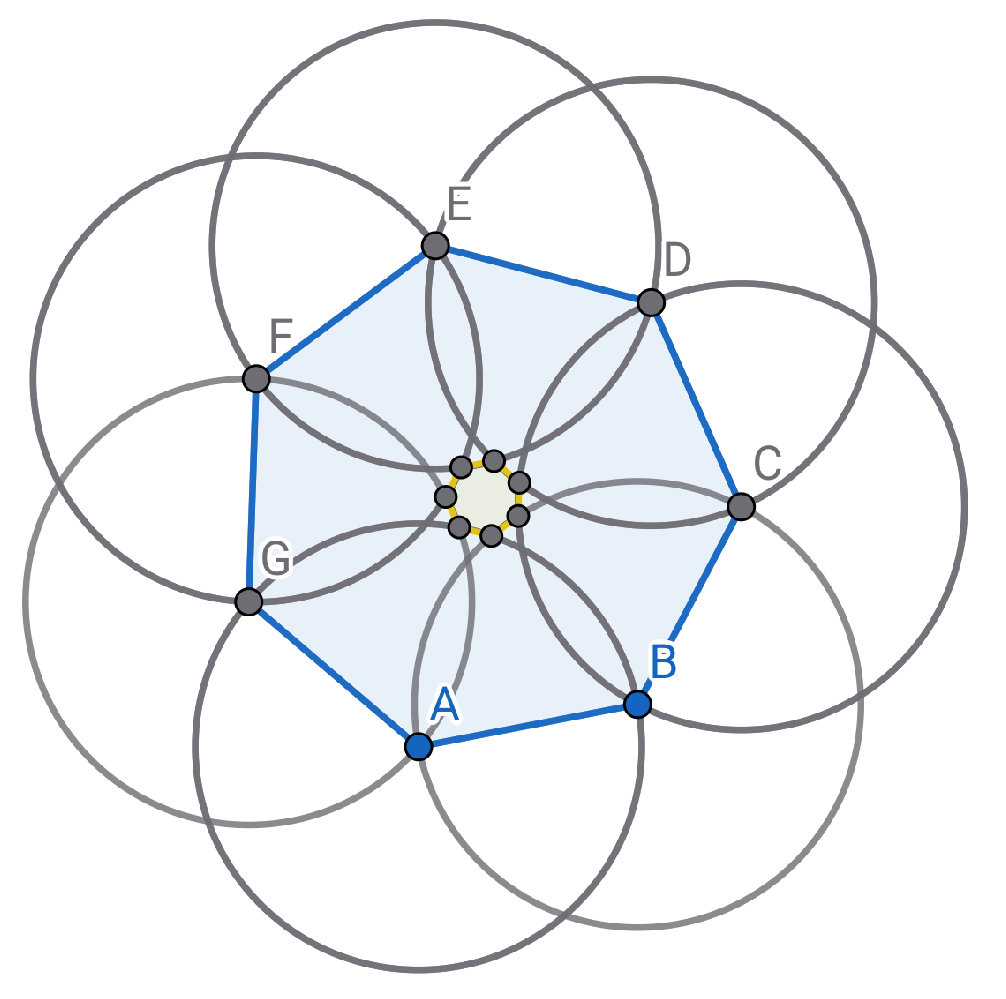
Figure 3.
Divided polygon.
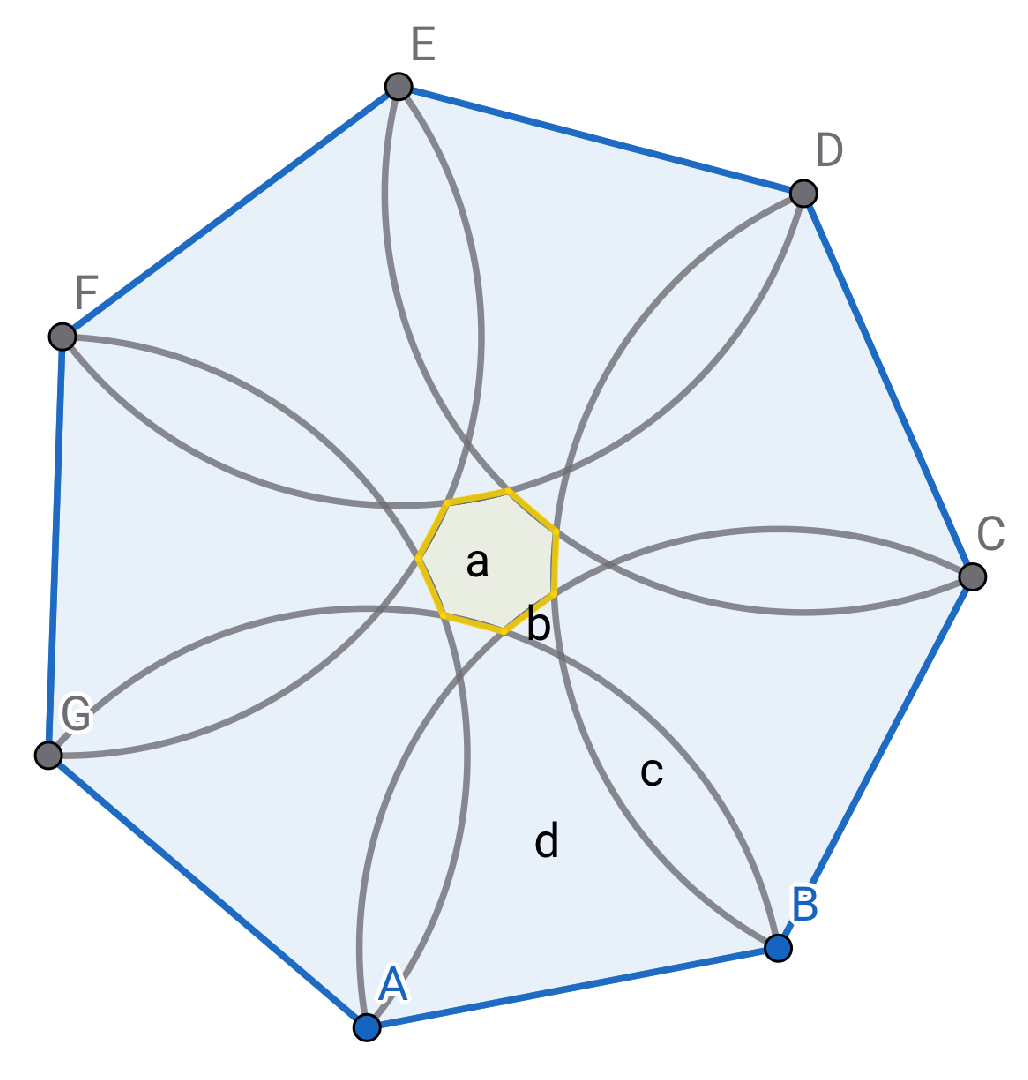
Figure 4.
The red area.
Disclaimer/Publisher’s Note: The statements, opinions and data contained in all publications are solely those of the individual author(s) and contributor(s) and not of MDPI and/or the editor(s). MDPI and/or the editor(s) disclaim responsibility for any injury to people or property resulting from any ideas, methods, instructions or products referred to in the content. |
© 2025 by the authors. Licensee MDPI, Basel, Switzerland. This article is an open access article distributed under the terms and conditions of the Creative Commons Attribution (CC BY) license (http://creativecommons.org/licenses/by/4.0/).
Copyright: This open access article is published under a Creative Commons CC BY 4.0 license, which permit the free download, distribution, and reuse, provided that the author and preprint are cited in any reuse.


