

Submitted:
11 May 2025
Posted:
12 May 2025
You are already at the latest version
Abstract
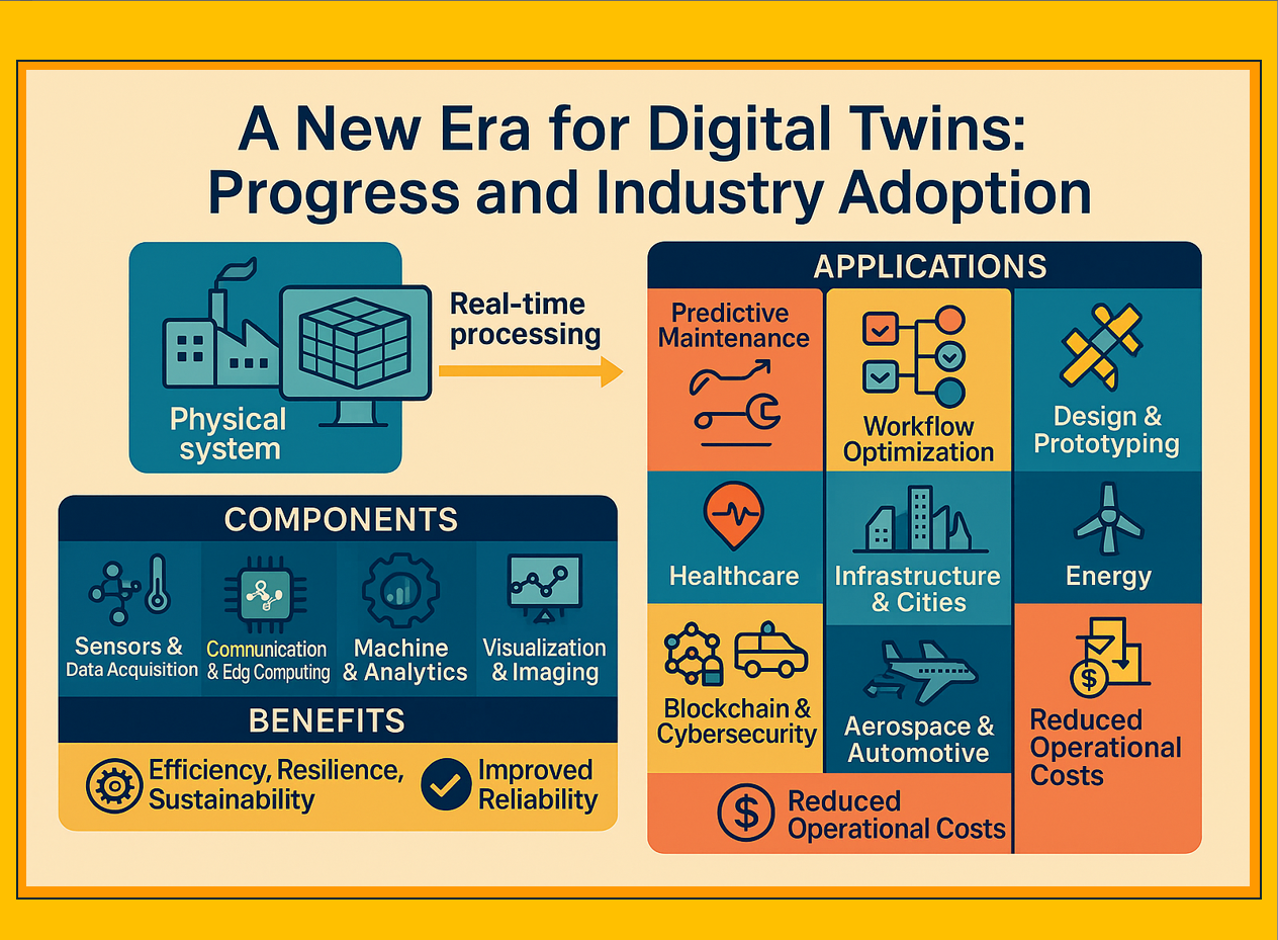
This systematic review highlights the core elements and broad applications of Digital Twin (DT) technology, emphasizing its role in transforming various industries. A DT is a real-time digital replica of a physical system, built on a foundation of key components such as sensors, data acquisition systems, communication networks, and computational infrastructure for real-time processing. Integrated machine learning and analytics enable predictive insights, while edge computing ensures fast, secure data handling. High-resolution imaging, 3D visualization, and scanning technologies enhance modeling accuracy, and blockchain-based cybersecurity frameworks safeguard data integrity. Feedback-driven databases support continuous system optimization. DTs are widely applied across sectors: in manufacturing for predictive maintenance and process efficiency; in healthcare for personalized diagnostics and treatments; in urban planning for smart, sustainable infrastructure; and in energy for operational optimization and renewable integration. They also enhance immersive training, improve the reliability of autonomous systems, and strengthen supply chain resilience. Industries such as aerospace, automotive, oil and gas, transportation, and marine engineering increasingly rely on DTs to boost performance, reduce risk, and support innovation. This review synthesizes current developments and identifies key research directions to advance, scale, and secure next-generation DT systems.
Keywords:
Digital Twin
; Digital Twin Components
; Digital Twin Applications
1. Introduction
Digital Twin (DT) technology is a transformative innovation that bridges the physical and digital worlds. It creates virtual replicas of real-world systems, enabling real time monitoring, simulation, and optimization. By integrating data with computational models, DT enhances efficiency, sustainability, and resilience across various industrial systems, giving operators full visibility of production processes [1].
Originally developed for aerospace applications, Digital Twin technology has expanded to offer transformative solutions for complex challenges in numerous sectors, including manufacturing, healthcare, infrastructure and urban planning, energy, logistics, education, transportation, and autonomous systems [2].
DT technology relies on sensors, data acquisition systems, and computational infrastructures for seamless data collection and real time processing. Machine learning and analytics improve predictive capabilities, allowing for proactive decision-making [3]. Connectivity solutions ensure smooth data exchange, while visualization tools, high-resolution imaging, and scanning techniques enhance digital modeling accuracy [4]. Advanced features in modern IoT devices further improve their performance [5,6]. To ensure security and data integrity, blockchain and cybersecurity mechanisms play a critical role [7].
Digital twins offer several key applications, including predictive maintenance, process optimization, design and prototyping, and healthcare advancements. In predictive maintenance, digital twins facilitate the identification of potential system failures before they occur, thereby reducing downtime, extending equipment lifespan, and lowering operational costs [8]. Process optimization is another significant application, where digital twins streamline workflows and enhance resource allocation, leading to increased efficiency [7]. Furthermore, design and prototyping benefit from digital twins, as they enable virtual testing, accelerate development cycles, and reduce the need for physical prototypes [9]. In the healthcare sector, digital twins enable patient-specific modeling, which improves diagnosis, treatment planning, and surgical simulations [10].
Digital twins also play a crucial role in smart infrastructure and urban planning. Engineers use them to monitor structural health and predict potential failures [11] , while urban planners utilize them to simulate traffic flow and optimize resource distribution, fostering the development of sustainable cities [12]. In the energy sector, digital twins enhance grid operations, facilitate the integration of renewable energy sources, and improve system safety [13]. Furthermore, both renewable and nuclear energy plants employ digital twins for real-time monitoring, efficiency optimization, and risk assessment [14].
DT also plays a vital role in training and education by providing interactive and immersive simulations that enhance learning and skill development [15]. It improves autonomous systems by creating high-fidelity virtual environments, allowing for safe algorithm testing before deployment [16]. In supply chain management, DT improves demand forecasting, route planning, and real-time tracking, thereby increasing operational efficiency [17]. In manufacturing and aerospace, DT optimizes production quality, monitors equipment performance, and facilitates predictive maintenance, leading to improved safety and productivity [18].
The impact of DT extends further into energy production and distribution, where it enhances the reliability of utilities and optimizes power management [19]. In civil engineering, DT supports real-time infrastructure monitoring, improving safety and extending the lifespan of critical structures [20]. Robotics and automation also benefit from DT, as it enables real-time system optimization and process refinement, improving accuracy and efficiency [21]. Oil and gas industries utilize DT to optimize workflows, enhance predictive maintenance, and improve risk management [22]. Similarly, transportation and marine engineering leverage DT for fleet management, route optimization, and operational safety, reducing costs and improving overall system reliability [23].
Despite its vast potential, DT faces several challenges, including high computational demands, data integration complexity, cybersecurity threats, and a lack of standardization [24]. To Address these challenges requires collaboration among researchers, industry experts, and policymakers to develop scalable and secure DT implementations [7]. Future research should focus on AI-driven analytics, hybrid DT models, edge computing for real-time processing, and blockchain-based security solutions [25]. Establishing standardized frameworks and interdisciplinary training programs will also be essential in driving the widespread adoption of DT across industries.
This systematic review examines the current state of DT technology encompassing commonly integrated elements, its most impactful applications across industries, and future research directions.
This article is structured into six comprehensive sections. Section 1 introduces digital twin technology and its diverse applications. Section 2 details the systematic review methodology, including research question formulation, literature search strategies, inclusion and exclusion criteria, study selection procedures, data extraction techniques, and validation methods. Section 3 delves into the core components and underlying technologies of digital twins. Section 4 presents a detailed overview of DT applications across various industries. Section 5 discusses existing technologies, current challenges, and future research directions. Finally, Section 6 concludes the article, summarizing key findings and implications.
2. Methodology
This systematic review followed a structured and comprehensive approach to examine the structure and application of various types of digital twins across different industries. The review process was conducted in five distinct stages: defining the research questions, identifying relevant studies, selecting studies based on inclusion and exclusion criteria, extracting data, and analyzing the findings.
2.1. Research Question Formulation
This systematic review aimed to synthesize evidence regarding the applications of different types of digital twins. The review addressed the following specific questions:
- ▪ What are the essential components of a functional digital twin system?
- ▪ In what industries are digital twins currently being used successfully?
2.2. Literature Search Strategy
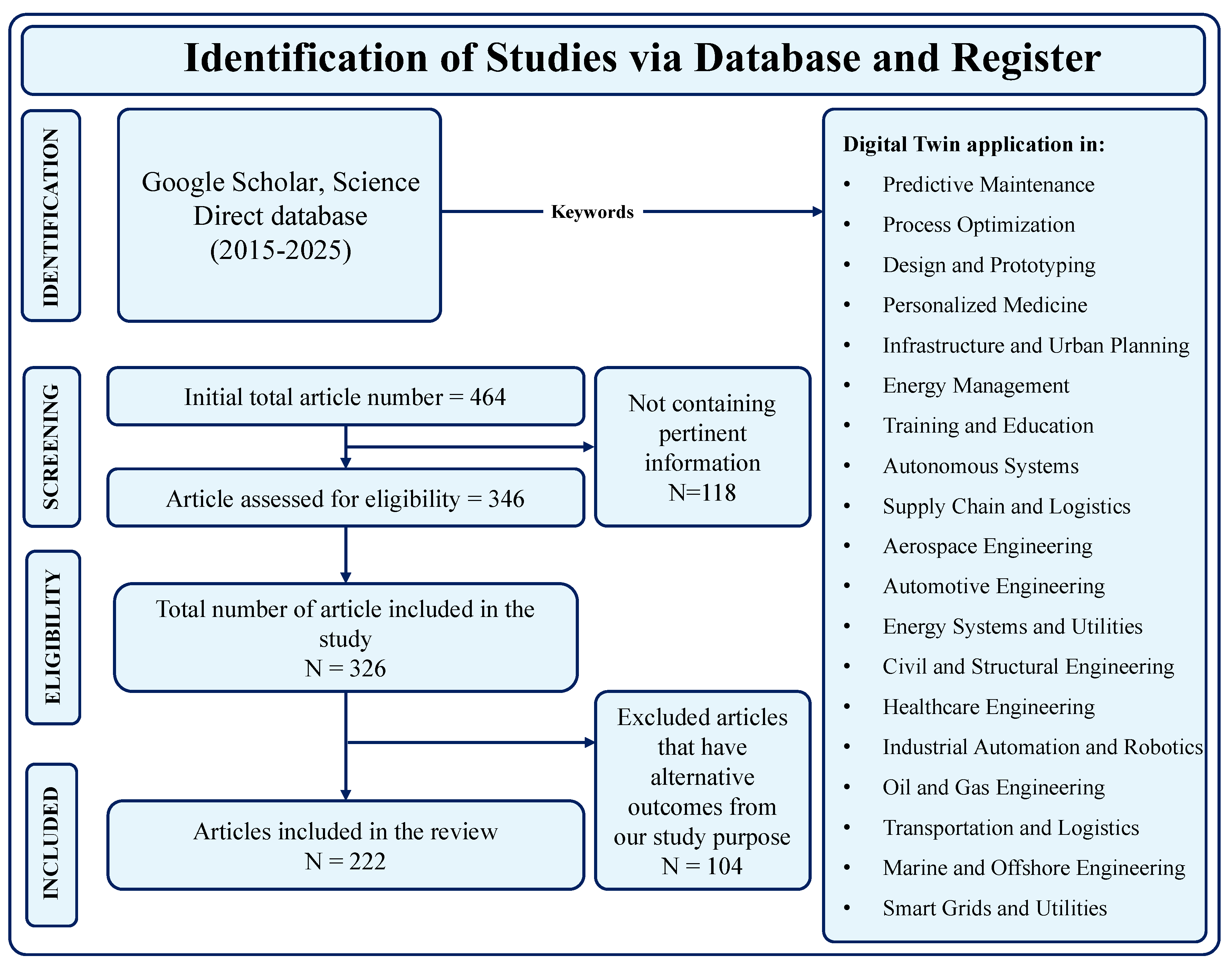
Searches were conducted using the phrase “the elements of a Digital twin” and "the application of Digital twin" in relation to the following areas: Predictive Maintenance, Process Optimization, Design and Prototyping, Personalized Medicine, Infrastructure and Urban Planning, Energy Management, Training and Education, Autonomous Systems, Supply Chain and Logistics, Aerospace Engineering, Automotive Engineering, Energy Systems and Utilities, Civil and Structural Engineering, Healthcare Engineering, Industrial Automation and Robotics, Oil and Gas Engineering, Transportation and Logistics, Marine and Offshore Engineering, and Smart Grids and Utilities. The search was limited to articles published in peer-reviewed journals between 2020 and 2025. To ensure thorough coverage, both backward and forward citation tracking of selected articles was performed.
2.3. Inclusion and Exclusion Criteria
Studies were included/excluded based on the following criteria:
Inclusion criteria:
- -
- Studies published between 2020 to 2025.
- -
- Studies published in English
- -
- Studies that explicitly define or describe the technology being used as a "digital twin".
- -
- Application Area: Studies that describe the application of digital twins in one or more of the following areas:
- ▪ Predictive Maintenance
- ▪ Process Optimization
- ▪ Design and Prototyping
- ▪ Personalized Medicine
- ▪ Infrastructure and Urban Planning
- ▪ Energy Management
- ▪ Training and Education
- ▪ Autonomous Systems
- ▪ Supply Chain and Logistics
- ▪ Aerospace Engineering
- ▪ Automotive Engineering
- ▪ Energy Systems and Utilities
- ▪ Civil and Structural Engineering
- ▪ Healthcare Engineering
- ▪ Industrial Automation and Robotics
- ▪ Oil and Gas Engineering
- ▪ Transportation and Logistics
- ▪ Marine and Offshore Engineering
- ▪ Smart Grids and Utilities
Exclusion criteria:
- -
- Editorials, letters to the editor, and opinion pieces
- -
- Conferences
- -
- Books and book chapters (unless they contain primary research)
- -
- Patents
- -
- Websites, blogs, and other non-peer-reviewed sources
- -
- Language: Studies published in languages other than English
- -
- Studies published before 2020
- -
- Studies that do not provide a clear definition or description of a digital twin. Studies that use the term "digital twin" loosely or interchangeably with other concepts (e.g., simulation, modeling) without meeting the core components.
- -
- Application Area: Studies that do not focus on the specified application areas.
- -
- Studies that describe the theoretical concepts of digital twins without empirical data or real-world applications.
2.4. Study Selection
Following database searches, duplicates were removed. Two independent reviewers then screened the titles and abstracts of the remaining studies and subsequently assessed the full-text articles for eligibility based on the inclusion and exclusion criteria. Disagreements were resolved through discussion.
2.5. Data Extraction and Synthesis
For the selected studies, data were extracted on the following parameters: type of digital twin system used, industrial application, technology used. A qualitative synthesis was performed to analyze the findings and categorize the digital twin applications based on their functionality.
2.6. Quality Assessment
The quality of the included studies was evaluated using a modified version of the Newcastle-Ottawa Scale, specifically adapted to assess the methodological rigor and relevance of control system used in rehabilitation research.
2.7. Data Analysis
and practical application as the primary criteria. Out of 385 reviewed articles, 198 were shortlisted for detailed analysis.
Figure 1.
Flow Chart of the Search and Inclusion Process.
3. Key Elements of Digital Twin
Digital twin (DT) technology creates virtual replicas of physical assets, enabling real-time monitoring, simulation, and optimization. A robust DT system relies on several key components. Sensors and IoT devices collect real-time data, while data acquisition and integration systems consolidate information from diverse sources. High-performance computing infrastructure and cloud platforms process and analyze the vast data streams. Simulation and modeling software build accurate virtual models, supported by advanced analytics and machine learning tools that enhance prediction and decision-making.
Visualization tools, including dashboards and 3D simulations, provide intuitive user interaction. Blockchain technology ensures data security and transparency, while cybersecurity frameworks protect DT systems from evolving threats. Edge computing enables low-latency data processing close to the source, and standardized communication protocols ensure seamless interoperability across systems. High-resolution imaging technologies like LiDAR and 3D scanning create detailed models, and advanced databases manage the large and dynamic datasets.
Together, these elements form the foundation of effective digital twin systems, driving innovation and efficiency across industries such as manufacturing, healthcare, infrastructure, and smart cities.
3.1. Sensors and IoT Devices
Sensors and Internet of Things (IoT) devices are essential for Digital Twin (DT) systems. They gather real-time data from physical assets, enabling accurate monitoring and analysis. Key parameters like temperature, pressure, vibration, and environmental conditions are captured by these devices, providing critical inputs for DT models [24].
Sensors link the physical and digital worlds by transmitting data to DT systems for processing and analysis. For instance, temperature sensors in manufacturing system detect temperature changes, allowing DT models to simulate equipment performance and predict potential issues [7]. Similarly, the accelerometer can identify unusual patterns in machinery, offering early warnings for mechanical failures [14].
Accuracy is vital for reliable DT systems. High-quality sensors reduce data errors, ensuring digital models mirror their physical counterparts effectively [15]. In healthcare, wearable IoT devices track heart rate and blood pressure. These real-time readings help digital twins support timely medical decisions [10].
Reliability is equally important, especially in safety-critical industries. Faulty sensors can cause incorrect predictions or delays, leading to significant issues. For example, smart city systems use environmental sensors to track air quality. Accurate data enables timely actions like adjusting traffic flows or deploying air-purification measures [12]. Dependable sensors ensure smooth system operations and informed decision-making [20].
3.2. Data Acquisition and Integration Systems
Robust data acquisition and integration are fundamental to the operation of Digital Twin (DT) systems. These processes involve consolidating data from diverse sources, including IoT devices, enterprise systems, and historical datasets, each provides essential information for accurate system representation [1].
IoT devices capture real-time physical-world conditions through sensors, measuring variables like temperature, pressure, and movement. This continuous stream of data enhances the DT's precision in mirroring its physical counterpart and providing up-to-the-minute insights into system performance [1,24].
Enterprise systems, such as Enterprise Resource Planning (ERP), Customer Relationship Management (CRM), and supply chain management tools, contribute critical operational and transactional data. This integration provides a comprehensive view of an organization's operations, thereby improving efficiency and decision-making [26,27].
Historical datasets, containing past records, trends, and performance patterns, further enhance DT capabilities. By supporting predictive analytics, these datasets enable the identification of potential future outcomes. Combining historical data with real-time data strengthens forecasting accuracy and decision support systems [1,6].
Integrating these diverse data sources necessitates advanced integration tools. These tools ensure seamless communication and data flow between different components, minimizing delays and bottlenecks to facilitate real-time data processing [27]. A key aspect of this integration is data harmonization, which standardizes varying data formats from different systems to ensure compatibility and accessibility for analysis. This process enhances interoperability across platforms and devices [28].
The ability to perform real-time data analysis, enabled by seamless integration, is crucial for DT performance. This capability allows for the immediate detection of anomalies, prediction of failures, and optimization of operations. This is particularly valuable in industries like manufacturing, healthcare, and logistics, where timely decisions can significantly impact efficiency and safety [29].
Finally, effective data acquisition and integration, achieved through the consolidation of data from IoT devices, enterprise systems, and historical records, provides organizations with a comprehensive, real-time view of their operations. Advanced integration tools are essential in this process, facilitating efficient analysis and informed decision-making [30].
3.3. Computational Infrastructure
High-performance computing (HPC) infrastructure plays a vital role in managing the enormous volumes of data generated by digital twin (DT) systems. These systems produce and analyze data at an extraordinary rate, making robust computing capabilities indispensable [31]. HPC provides the processing power required to handle such large-scale operations efficiently, ensuring the effective simulation, analysis, and optimization of complex systems [32].
Cloud computing platforms, including widely recognized services such as Amazon Web Services (AWS), Microsoft Azure, and Google Cloud, offer significant advantages in addressing these computational demands [33]. These platforms are designed to provide scalable resources for both data storage and analysis [34]. Their scalability is a key feature, as it allows organizations to expand their computational capacity on demand without the need for substantial upfront investment in physical infrastructure [35]. This flexibility enables businesses to adapt to varying workloads and operational requirements, making cloud solutions an attractive option for supporting DT systems [36].
In addition to storage and analysis, cloud platforms provide a wide array of advanced tools and services. These include machine learning capabilities, data visualization tools, and specialized analytics engines, which enhance the ability of organizations to extract actionable insights from their data [37]. With these resources, businesses can streamline operations, improve decision-making, and achieve higher levels of efficiency in managing DT systems [38].
3.4. The Role of Simulation and Modeling Software in Digital Twin Systems
Simulation and modeling software are essential for digital twin (DT) systems. These tools create virtual replicas of physical assets, enabling detailed analysis, real time simulations, and performance monitoring [4]. By accurately replicating real world objects, they help organizations to optimize operations, reduce costs, and enhance decision-making [24]. Their integration is crucial for ensuring DT systems deliver reliable and valuable insights [32]
Popular platforms in this domain include ANSYS, Siemens NX, and MATLAB [39]. Each offers unique capabilities suited to various industries. ANSYS provides extensive simulation tools for structural analysis, fluid dynamics, and thermal simulations [34]. Siemens NX supports product design, engineering, and manufacturing, making it popular in automotive and aerospace industries [4]. MATLAB excels in numerical computing, data analysis, and system modeling, making it valuable for research and development.
A major strength of these platforms is their ability to combine physics-based models with data-driven approaches [24]. Physics-based models simulate real-world phenomena using established scientific principles [15]. They help understand system behaviors, such as stress distribution in materials or fluid flow in pipelines [39]. However, real-world systems are complex, requiring additional insights beyond physics alone [6].
Data-driven techniques complement traditional modeling methods by incorporating machine learning and artificial intelligence. These tools analyze large volumes of historical and real-time data, identifying patterns, trends, and anomalies that may not be visible through conventional simulations [9]. This integration of physics-based accuracy with data-driven insights enhances predictive capabilities, improving the reliability of DT systems.
Real-time simulation capabilities are another key feature of these tools [1]. By linking digital models to live data from sensors and IoT devices, organizations can continuously monitor physical assets [40]. This real-time connectivity supports proactive decision-making, allowing early detection and resolution of potential issues before they escalate [24]. For example, real-time simulations can identify equipment wear, optimize maintenance schedules, and minimize downtime [32].
Simulation and modeling software also play a critical role in product design and testing [15]. Virtual prototypes enable engineers to explore different designs, materials, and configurations without the cost and time associated with physical prototyping [32]. This speeds up the development process and encourages innovation by allowing the testing of unconventional solutions [6].
3.5. Analytics and Machine Learning (ML) Tools
Advanced analytics and machine learning (ML) tools are essential for processing data derived from digital twin (DT) models. These tools transform raw data into actionable insights through advanced computational techniques [9]. ML algorithms can accurately identify patterns within data, detect anomalies for early issue identification, and predict future outcomes based on historical trends and real-time inputs [24]. These capabilities enhance decision-making and operational efficiency in various industries.
The ability to uncover patterns in data provides immense value across multiple sectors. By analyzing complex datasets, ML algorithms reveal trends that may not be immediately apparent through traditional methods, enabling evidence-based decision-making [32]. Additionally, detecting anomalies in operational data allows organizations to proactively address potential risks or inefficiencies, reducing downtime and improving system reliability [41].
Predictive maintenance is one of the most impactful applications of ML tools in digital twin environments. ML models use data from DT simulations to anticipate equipment failures before they occur, enabling organizations to schedule maintenance at optimal times [15]. By understanding the conditions under which failures are likely to happen, businesses can minimize disruptions to operations, extend the lifespan of machinery, and reduce maintenance costs by avoiding unnecessary repairs [40].
Another key application of these tools is the process optimization. ML algorithms analyze data from digital twins to identify inefficiencies in workflows, resource allocation, or system configurations [4]. By providing data-driven recommendations, these tools help organizations streamline operations, reduce waste, and improve productivity. This is particularly crucial in industries where precision and efficiency determine competitiveness and profitability [37].
Operational efficiency is further enhanced by ML-driven analytics. Continuous real-time data analysis offers organizations a clear view of current performance, helping optimize resource utilization, support informed decision-making, and adapt quickly to changing conditions [42]. By leveraging these capabilities, businesses can ensure sustained operational excellence and long-term success [1].
Advanced analytics and ML tools are foundational for getting predictive and prescriptive insights from digital twin models. Their ability to identify patterns, detect anomalies, and predict outcomes with high accuracy makes them indispensable across various applications [9]. Whether improving predictive maintenance, optimizing processes, or enhancing operational efficiency, these tools empower organizations to maximize the value of their data. By harnessing ML-enhanced analytics, businesses can achieve greater reliability, efficiency, and performance in their operations [27].
3.6. Visualization Tools
Visualization tools are essential for intuitive interaction with digital twin (DT) models, bridging the gap between complex datasets and actionable insights [23]. These tools simplify data interpretation, enabling informed decision-making through user-friendly interfaces [43,44].
Key features include dashboards, which consolidate data streams into a single view for real-time monitoring, anomaly identification, and efficiency evaluation [32,45,46]. 3D simulations, which replicate physical systems in virtual environments for in-depth analysis and risk-free experimentation [9,15,47,48].
Augmented reality (AR) interfaces enhance interaction by overlaying digital information onto the physical world, improving efficiency in operations [1,43,49]. Platforms like Unity, Unreal Engine, and specialized AR frameworks support these advanced visualization capabilities. Unity and Unreal Engine are used for realistic 3D simulations in industries like manufacturing and automotive [39,45,50]. Specialized AR platforms integrate with IoT devices for visually engaging, real-time insights, enhancing situational awareness [1,49,51].
The ability to visualize system performance has broad implications across industries. In manufacturing, it improves production line monitoring; in healthcare, it advances training and surgical simulations [48,49] and in infrastructure management, it aids in planning and maintenance [47].
In conclusion, visualization tools transform complex data into actionable insights via dashboards, 3D simulations, and AR interfaces [45]. Platforms like Unity, Unreal Engine, and specialized AR frameworks empower effective user engagement with virtual environments [49]. These tools enhance decision-making, streamline operations, and drive innovation across industries, with their role expanding as technology evolves [9,52].
3.7. Blockchain Technology
Blockchain enhances data security and transparency in digital twin (DT) systems by creating immutable transaction records, ensuring data integrity [53,54,55].
Blockchain secures sensitive data in sectors like healthcare and supply chain management, preventing unauthorized access [55,56,57,58]. It also provides transparency through a decentralized ledger, allowing stakeholders to trace data history [55,59]. This is valuable in collaborative environments like smart energy grids [60].
By providing a single source of truth and verifying transactions through consensus mechanisms, blockchain enhances trust and accountability [55,58,61]. Its immutability creates a robust audit trail, useful in supply chains for resolving disputes [61]. Smart contracts can automate processes, such as payment release upon delivery verification, streamlining operations [58,62,63].
3.8. Cybersecurity Frameworks
As connectivity grows, cybersecurity is a vital concern for digital twin (DT) systems, which are vulnerable to cyber threats due to constant data exchange, [44,63]. Robust cybersecurity measures are essential to ensure their reliability and safety [45], A comprehensive security framework is crucial for protecting DT systems and ensuring data confidentiality and integrity [65,66,67].
Key components include encryption, which secures data during transmission and storage [44,68,69], and access control, which defines and manages user access through methods like role-based access controls and multi-factor authentication [63,65,70]. Real-time threat detection using machine learning and AI is also essential for identifying and responding to potential threats [66,67,69,70].
The importance of cybersecurity spans industries, including manufacturing, healthcare, and energy, where cyberattacks could have severe consequences [65,66,70].
Implementing strong cybersecurity measures also builds trust among stakeholders, which is essential for the adoption and growth of DT technologies [63,67].
In conclusion, cybersecurity is critical for DT systems. Robust frameworks with encryption, access control, and real-time threat detection are necessary to protect data, ensure reliable operations, and foster trust. The importance of strong security measures will only increase as cyber threats evolve [44,65]
3.9. Edge Computing Devices
Edge computing devices process data locally, reducing reliance on centralized cloud infrastructure and improve response times for real-time applications [71,72].
DT systems with real-time processing needs benefit from edge computing, which processes data closer to its source (sensors, IoT devices) instead of relying on a centralized cloud [71,73]. This reduces latency, which is crucial for applications like autonomous vehicles, industrial automation, and healthcare monitoring [9,71,73]. Edge computing also alleviates network strain and reduces data transfer, enhancing efficiency and lowering costs [71]. Edge solutions can operate in areas with limited connectivity [71].
3.10. Digital Communication Protocols
Standardized communication protocols are essential for effective interoperability among digital twin (DT) system elements [76]. They facilitate seamless data exchange between physical assets, IoT devices, and digital models across diverse platforms [77]. This efficient communication enhances the scalability and flexibility of DT implementations [77]. Standardized protocols create a common language for data exchange [78], which is crucial because DT ecosystems often comprise systems from various manufacturers and frameworks [79]. Without standardization, these systems may struggle to communicate, leading to inefficiencies or compatibility issues [80]. Protocols like MQTT, OPC UA, and REST APIs bridge this gap, enabling effortless sharing among components [51]. The following section reviews the commonly used digital communication protocols used in digital twin systems.
MQTT (Message Queuing Telemetry Transport) is widely recognized for its lightweight design and efficiency [81]. It is particularly well-suited for IoT environments where bandwidth and resource constraints are common [82]. MQTT operates on a publish-subscribe model, which enables devices to share data with minimal latency [83]. This makes it an ideal choice for DT applications requiring real-time updates, such as monitoring equipment performance or tracking environmental conditions [51].
OPC UA (Open Platform Communications Unified Architecture) is another key protocol for DT systems. Known for its versatility, OPC UA provides a robust framework for integrating industrial systems and devices [80]. It supports platform independence, ensuring that components can exchange data regardless of the underlying hardware or software [84]. Additionally, OPC UA offers built-in security features, such as encryption and authentication, making it a reliable choice for industries with strict security requirements [85].
REST APIs (Representational State Transfer Application Programming Interfaces) further enhance interoperability by providing a standardized way for systems to interact over the web [84]. REST APIs use simple HTTP methods to enable seamless communication between applications, devices, and DT modules [85]. Their widespread adoption and simplicity make them an excellent choice for integrating modern DT systems with cloud services and third-party platforms [51].
Standardized communication protocols are essential for effective interoperability among digital twin (DT) systems [76]. They facilitate seamless data exchange between physical assets, IoT devices, and digital models across diverse platforms [77] .This efficient communication enhances the scalability and flexibility of DT implementations [77]. Standardized protocols create a common language for data exchange [78], which is crucial because DT ecosystems often comprise systems from various manufacturers and frameworks [79]. Without standardization, these systems may struggle to communicate, leading to inefficiencies or compatibility issues [80]. Protocols like MQTT, OPC UA, and REST APIs bridge this gap, enabling effortless information sharing among components [51].
Standardized protocols contribute to the scalability of DT implementations, allowing for the addition of new elements without major overhauls [84]. They also provide flexibility for DT systems to adapt to changing requirements, integrate new technologies, and support evolving business needs [85,89,90].
3.11. High-Resolution Imaging and Scanning Equipment
Technologies like LiDAR, 3D scanners, and high-resolution cameras are crucial for creating detailed virtual models, which are fundamental to digital twin (DT) systems [91,92]. These tools capture the physical attributes of objects, spaces, and environments, enabling the development of accurate and reliable virtual representations [90].
LiDAR uses laser beams to measure distance and build clear 3D models, even when lighting conditions changes [92,93,94,95].
3D scanners use laser or structured light to create detailed 3D models, which are essential in manufacturing industries for applications such as reverse engineering and quality control [90], [91,96,97].
High-resolution cameras capture visual details like texture and color, enhancing the realism of virtual models, particularly in applications like VR simulations [90].
In infrastructure modeling, LiDAR and 3D scanners aid in visualizing projects and optimize designs, contributing to cost savings and efficiency [98,99]. In healthcare, 3D scanning is revolutionizing diagnostics and treatment planning by enabling the creation of detailed models of the human body [100,101].
These technologies also benefit other industries. LiDAR is used in entertainment and gaming to develop lifelike digital environments, while 3D scanners help preserve artifacts in archaeology and enable virtual try-on experiences in retail [99].
In conclusion, LiDAR and 3D scanners are essential for developing detailed virtual models by capturing precise physical attributes. Their role in creating realistic and reliable digital representations is transforming industries and driving innovation [90].
3.12. Advanced Databases
Advanced database systems are essential for managing the vast datasets required by digital twin (DT) systems and support their complex operations [102]. Modern databases offer features like scalability, reliability, and performance to handle the diverse data demands of DT systems.
Distributed databases, such as Cassandra and MongoDB, are commonly used in DT implementations for their ability to handle large data volumes across multiple servers, ensuring scalability and fault tolerance [103,104,105,106,107]. Cassandra is well-suited for high availability and write-heavy workloads, like those in IoT-based DT systems [103,104]. MongoDB offers a flexible schema design for handling diverse datasets, simplifying the mapping of physical assets to virtual models [91,108,109,110]. Time-series databases, like InfluxDB, are crucial for DT systems that rely on real-time data, such as sensor monitoring [111,112]. They efficiently handle time-stamped data, which is essential for DT systems monitoring dynamic environments [102,112]. The integration of distributed and time-series databases supports hybrid storage solutions, optimize the performance of DT systems [102,109,111].
Advanced databases contribute to the scalability and flexibility of DT systems and support analytics and visualization tools, enabling stakeholders to gain actionable insights [104,108,110], [111,112,113]. This integration enhances decision-making, operational efficiency, and system reliability across industries [113,114].
4. Comprehensive Applications of Digital Twins
Digital twin technology is reshaping industries by creating virtual models of physical assets. It enables real-time monitoring, simulation, and predictive analytics. Key applications include predictive maintenance to reduce failures and downtime, and process optimization to boost efficiency in manufacturing, healthcare, and logistics.
In design and prototyping, digital twins allow rapid testing before production, cutting costs and improving quality. Healthcare uses them for personalized treatments, improving outcomes. Urban planning and infrastructure benefit through better traffic flow, city layouts, and public service management.
Energy management leverages digital twins for smarter, cleaner, and more resilient systems. They also support risk-free training in fields like healthcare and aviation. Autonomous systems, such as self-driving cars and robotics, rely on digital twins for learning and operational improvements.
Supply chain and logistics use digital twins for real-time tracking, forecasting, and inventory control. Aerospace and automotive industries apply them for design, structural assessments, and maintenance. Utilities improve grid stability and efficiency with their help.
In engineering fields, digital twins strengthen building resilience, hospital operations, and industrial automation. They also enhance operations in oil and gas, marine engineering, transportation, and smart grids, driving better monitoring, maintenance, and performance.
4.1. DT in Personal Medicine
Digital Twins (DTs) are transforming healthcare by creating dynamic virtual replicas of physical entities. These models integrate real-time data, simulations, and predictive analytics to improve medical outcomes. They play a key role in personalized medicine, clinical decision-making, and public health management. This study explores DTs by examining their applications, underlying technologies, benefits, and challenges. By analyzing these aspects, we aim to understand their impact on modern healthcare and their potential to improve patient care. Figure 2 shows how DT is used to present the personalized medicine.
Applications of DT in Personal Medicine
Digital Twins (DTs) have found diverse applications across healthcare, fundamentally transforming approaches from individualized patient care to public health interventions. Kamel Boulos & Zhang discuss DTs' potential in personalized diagnostics and preventive medicine, demonstrating their effectiveness through real-time integration of data from electronic health records (EHRs), genomics, wearable devices, and environmental sensors [124]. This integrative approach enables accurate silico simulations to predict disease progression and tailor treatment outcomes effectively.
Papachristou et al. extend this application scope by introducing Digital Human Twins (DHTs), which are detailed virtual representations of individual physiological characteristics [125]. They underscore DHTs' practical utility in precision cardiology, diabetes management, and virtual surgical planning, enhances both safety and precision. Similarly, Sahal et al. discuss Personal Digital Twins (PDTs), emphasize their unique integration of biological, mental, physical, and social data [131]. PDTs demonstrate significant advantages in COVID-19 management, osteoporosis prevention, and cancer treatment through improved diagnostic accuracy and disease prevention.
Okegbile et al. explore Human Digital Twins (HDTs), focusing on proactive disease diagnosis, personalized treatment regimens, and surgical simulations [132]. They underline the importance of proactive health monitoring and individual care. Complementing these insights, Venkatesh et al. highlight how HDTs extend beyond personal care into virtual clinical trials and public health management, notably in addressing public health crises like COVID-19 [133].
Underlying DT Technologies used in Personal Medicine
Digital Twins rely on advanced technological infrastructure, including artificial intelligence (AI), big data analytics, the Internet of Things (IoT), cloud computing, and virtual reality (VR). Armeni et al. and Cellina et al. specifically recognize AI and big data analytics as crucial elements enhancing DTs' predictive accuracy and simulation capabilities [128,137]. These technologies enable applications such as virtual clinical trials which significantly reduce reliance on human participants and address related ethical concerns.
Gaebel et al. introduced a modular, multi-layered approach employing natural language processing (NLP) and machine learning (ML) for integrating heterogeneous medical data [127]. This technology significantly improves the scalability and flexibility of clinical decision support systems (CDSS). Similarly, Papachristou et al. emphasize the importance of IoT, cloud computing, and VR in real-time data collection and analysis within DHTs, enhance the effectiveness of these digital representations [125].
Additionally, Sahal et al. and Okegbile et al. highlight blockchain technology alongside AI and IoT for secure data management [131,132]. They stress ultra-reliable, low-latency communications (URLLC) as vital for real-time synchronization between physical and virtual entities, ensure accuracy and timeliness in data-driven healthcare decisions.
Benefits of Using DT in Personal Medicine
Digital Twins offer extensive benefits, prominently improving clinical decision-making, patient outcomes, and public health management. Sun et al. highlight DTs' significant impact on clinical decision-making by simulating disease progression accurately and predicting treatment outcomes, thus enabling more timely and effective interventions [115]. This capability enhances patient outcomes and reduces overall healthcare costs.
Abd Elaziz et al. further underscore DTs’ role in disease prediction, early diagnosis, and optimized treatment strategies [116]. These capabilities lead to improved patient engagement, substantial cost savings, and higher-quality care. Moreover, Papachristou et al. note the use of DTs in surgical planning, reducing complications through virtual simulations, thus enhance patient safety [125].
DTs also improve patient engagement by offering individualized health insights, fostering proactive health management. Venkatesh et al. emphasize the role of DTs during public health crises such as COVID-19, highlighting how DTs enable better resource allocation and effective risk assessment [133]. Furthermore, Sahal et al. emphasize the holistic advantages of PDTs, delivering actionable insights for mental and nutritional health, ultimately contributing to overall well-being [131].
Challenges Involved in the Use of DT in Personal Medicine
Despite their promising benefits, the adoption and implementation of Digital Twins in healthcare face numerous challenges. One of the most significant is data privacy, a critical issue consistently raised across the references reviewed. Kamel Boulos & Zhang, Papachristou et al., and Sahal et al. identify substantial privacy and ethical concerns related to digital representations of patients, data ownership, and biases in AI algorithms [124,125,131]. Armeni et al. specifically warn of risks associated with inequitable healthcare delivery due to biases inherent in AI training datasets [137].
Integration complexities and the lack of standardized data protocols are additional significant barriers. Okegbile et al. and Venkatesh et al. stress these integration challenges, noting the difficulty of managing heterogeneous data streams and ensuring seamless interoperability [132,133]. Additionally, computational demands and the need for robust technological infrastructure represent major technical hurdles. Meijer et al. emphasize the challenges in data standardization and management, highlighting the requirement for significant advancements in non-invasive data collection, computational modeling, and high-throughput analytics [117].
Financial considerations also pose challenges, as Cellina et al. note the high costs associated with developing and maintaining DT infrastructures [128]. Furthermore, evolving regulatory landscapes and clinical acceptance issues add complexity. Venkatesh et al. highlight concerns among clinicians regarding AI transparency and algorithmic reliability, stressing the importance of building clinician trust and developing robust regulatory frameworks [133].
Digital Twins (DTs) hold significant promise for transforming healthcare through personalized medicine, clinical decisions, and public health. Their diverse applications and benefits position them as vital tools. However, realizing this potential requires addressing challenges like data privacy, integration, computational needs, and regulations. Overcoming these barriers through collaboration, research, and strong regulations is crucial for the successful adoption of DTs to improve patient outcomes and healthcare delivery.
4.2. Applications of DT in Training and Education
Digital Twin (DT) technology is being widely adopted across diverse fields, including education, training, cybersecurity, and industry. While its primary goal is to improve efficiency, learning, and security, its implementation varies across domains. In education, DTs enhance hands-on learning experiences, while in safety training and cybersecurity, they strengthen preparedness and threat mitigation. Additionally, the integration of Augmented Reality (AR) and Virtual Reality (VR) further expands DT capabilities, creating immersive and interactive environments. The following study explores the different approaches to DT adoption, highlighting their role in advancing knowledge, security, and operational effectiveness. Figure 3 shows the use of DT in immersive learning.
Educational Applications of Digital Twin
Zhou et al. and Kuhn et al. explore the role of DT in education and training, using different methodologies and target audiences [118,119]. Zhou et al. investigate how AR enhanced chemical engineering education by allowing students to visualize and interact with complex chemical processes [118]. The integration of AR and Computational Fluid Dynamics (CFD) simulations helps in understanding airflow dynamics and internal structures of laboratory equipment. The study highlights that AR-driven learning improves engagement, reduces safety risks, and enhances students' technical proficiency.
In contrast, Kuhn et al. focus on a modular DT training system designed to bridge the digital skills gap for non-technical individuals in industrial environments [119]. Their framework uses low-cost, hands-on training modules equipped with microprocessors, sensors, and actuators, helping participants learn data analysis, real-time monitoring, and system optimization. Unlike Zhou et al., which integrates AR for immersive learning, Kuhn et al. emphasize a progressive learning approach, allowing users to gradually build DTs using open-source tools like Unity and Node-Red [118,126]. Both studies highlight DT’s educational benefits, Zhou et al. is more focused on visualization, whereas Kuhn et al. offers a structured, hands-on approach for broader digital competency development [118,119].
Digital Twin for Safety and Training
Speiser & Teizer and Martínez-Gutiérrez et al. focus on DT applications in training, particularly in safety-critical environments [120,121]. Speiser & Teizer present the Digital Twin for Construction Safety (DTCS) framework, which generates personalized safety training environments using real-time construction data [120]. The system automatically updates training scenarios to match evolving site conditions, allowing trainers to tailor safety lessons based on specific risks present at the worksite. The study emphasizes the importance of hazard recognition and risk-based decision-making in dynamic construction environments.
Martínez-Gutiérrez et al. explore the combination of DT and VR for industrial operator training [121]. Their study assesses how VR-based training compares with traditional equipment-based training and computer-based training. Results show that while real-equipment training provides the highest skill improvement (47%), VR-based training achieves a significant 38% improvement while reducing costs and safety risks. VR enhances situational awareness and allows workers to practice in high-risk scenarios without real-world dangers.
Cybersecurity Applications in Digital Twin
Unlike the other studies that focus on education and training, Kandasamy et al. investigates DT’s role in cybersecurity research [122]. Their study introduces the EPIC DT, a digital replica of an electric power microgrid designed for cybersecurity testing. Traditional physical testbeds are expensive and difficult to scale, whereas the EPIC DT provides a cost-effective alternative for simulating cyberattacks, testing defense mechanisms, and developing intrusion detection systems (IDS). Developed platform supports multiple communication protocols, including MMS, GOOSE, MQTT, and Modbus, allowing researchers to evaluate vulnerabilities across different smart grid components.
A key contribution of this study is the development of tools like the Attack Designer (AD) and Attack Launcher (AL), which systematically deploy cyberattacks, such as man-in-the-middle (MITM) attacks, to assess the resilience of smart grid security measures. The study highlights how DTs enable extensive cybersecurity research without risking live infrastructure.
Unlike the other references, which focus on improving education, workforce skills, or safety, Kandasamy et al. emphasize DT’s application in cyber defense, demonstrating its significance in securing critical infrastructure [122].
Key Differences in Implementation and Technologies Among the Representative Articles
Each study integrates different technological solutions to enhance DT’s effectiveness in its respective applications. Zhou et al. incorporates AR and CFD simulations to improve visualization in education, while Kuhn et al. focus on a hands-on modular learning approach using IoT-based tools [118,119]. Speiser & Teizer use real-time construction data and game engine technology (Unity) to create personalized training scenarios, whereas Martínez-Gutiérrez et al. leverage VR for immersive learning experiences [120,121].
Kandasamy et al. take a completely different approach, focusing on cybersecurity and using DT to simulate real-world cyberattacks [122]. Their study integrates cybersecurity-specific tools like the Attack Designer and various communication protocols, making it the only reference that applies DT to security and infrastructure protection rather than education or training.
Another notable contrast is in automation and real-time adaptation. Speiser & Teizer and Kandasamy et al. emphasize automation, with the former dynamically generating training environments and the latter simulating real-time cyberattacks [120,122]. In contrast, Zhou et al. and Kuhn et al. focus more on structured learning experiences, with predefined exercises and step-by-step training approaches [118,119].
While all studies explore DT applications, their focus areas and technological implementations vary significantly. Some studies emphasize immersive technologies like AR (Zhou et al.) and VR (Martínez-Gutiérrez et al.), while others prioritize hands-on training for digital literacy (Kuhn et al.) or real-time hazard awareness (Speiser & Teizer) [118,119,120,121]. Kandasamy et al. stands out by focusing on cybersecurity, demonstrating DT’s potential beyond training and education [122].
Despite these differences, all studies highlight the transformative potential of DT technology in their respective fields. Whether improving education, enhancing safety, training workers, or securing infrastructure, DT continues to be a versatile tool driving innovation across industries. Future research may explore the convergence of these applications, such as integrating cybersecurity awareness into DT-based training or using VR-enhanced DT models for both industrial education and security testing.
4.3. Applications of DT in Design and Optimization
Digital twin technology in design and optimization leverages AI, IoT, simulation, and cloud computing to create virtual replicas of physical systems. It enables real-time performance analysis, predictive simulations, and iterative design improvements, reduce development time and costs. By integrating data-driven insights, digital twins optimize product lifecycles, structural integrity, and energy efficiency. These applications enhance decision-making, streamline manufacturing, and drive innovation across various industries. The following sections analyze the application of DT in design and optimization from different prospectives. Figure 4 shows the use of DT for Design and optimization in various sectors.
Application Domains of DT in Design and Optimization
The selected references present diverse applications of Digital Twin (DT) technology tailored to specific industry needs and objectives. Bellalouna focuses on product design optimization, aiming to reduce material usage and improve structural efficiency through precise stress simulations in an arbor press [123]. Conversely, Kalantari et al. apply DT in architectural design prototyping, aiming to bridge physical creativity with digital analytics through their Ph2D system, enhancing spatial understanding and energy performance [124].
In facility management, Asare et al. utilize DT for predictive maintenance, integrated Building Information Modeling (BIM) and Internet of Things (IoT) to enhance decision-making, reduce costs, and improve maintenance efficiency [125]. Sreedharan et al. target mining automation, employing DT and Industrial IoT (IIoT) to address safety, connectivity, and productivity challenges in mining operations, particularly in remote sites [126].
Bellavista et al. explore adaptive DTs for digital factories, aiming to improve flexibility, resilience, and operational efficiency in Industry 4.0 environments [127]. Sifat et al. focus on electric grid management, developing a DT framework for enhancing grid stability, predictive maintenance, and cybersecurity through advanced analytics [128]. Lee et al. emphasize user-centric DT applications in building management, prioritizing occupant comfort, energy efficiency, and personalized environmental control [129].
Innovations of DT in Design and Optimization
Selected studies employ specific technological frameworks that highlight DT versatility. Bellalouna integrates IoT platforms and Finite Element Analysis (FEA) to enable accurate real-time data collection and structural simulations [123]. In contrast, Kalantari et al. leverage 3D printing, modular tiles, and digital analytical tools for real-time synchronization of physical and digital architectural prototypes [124].
Asare et al. compare Autodesk Tandem and Unreal Engine combined with Microsoft Azure, evaluating their effectiveness in real-time data management and advanced visualization for facility maintenance [125]. Sreedharan et al. adopt Business Process Modeling Notation (BPMN), mesh networking and simulation analytics to ensure reliable data transmission and robust decision-making support in harsh mining environments [126].
Bellavista et al. implement micro-services architecture coordinated by Kubernetes, using patterns like microkernel, sidecar, ambassador, and adapter to enhance scalability and adaptability in digital factories [127]. Sifat et al. employ cloud platforms, machine learning algorithms, and bi-directional communication systems for dynamic grid optimization [128]. Lee et al. integrate 3D visualization, AI-driven recommendations, and intuitive interfaces, significantly enhancing building management and occupant interactions [129].
Benefits and Performance Outcomes of DT in Design and Optimization
The implementation of DTs in the selected studies yields significant performance benefits. Bellalouna achieves notable reductions in material waste and improved sustainability due to precise simulations and optimized designs [123]. Kalantari et al. enhance creative exploration, spatial visualization, and interdisciplinary collaboration in architectural design through the Ph2D system [124].
Asare et al. report substantial improvements in facility maintenance efficiency, proactive maintenance strategies, and reduced operational costs, enabled by their predictive DT prototypes [125]. Sreedharan et al. achieve enhanced safety, productivity, and resource optimization in mining operations, highlighting the transformative impact of DT and IIoT integration [126].
Bellavista et al. demonstrate improved adaptability, autonomous operations, and legacy system integration capabilities, enhancing digital factory operations' reliability and flexibility [127]. Sifat et al. report increased grid stability, optimized resource allocation, and enhanced cybersecurity, enabled by their DT framework [128]. Lee et al. significantly improve occupant comfort, energy efficiency, and empowerment in building management, underlining the advantages of democratized DT systems [129].
Challenges and Implementation Considerations of DT in Design and Optimization
Despite significant benefits, each reference identifies specific implementation challenges. Bellalouna emphasizes challenges related to sensor placement accuracy and data reliability crucial for effective structural optimizations [123]. Kalantari et al. express concerns over simplifying complex architectural details and recommend refining digital functionalities for broader usability [124].
Asare et al. highlight difficulties in system integration, scalability, data security, and managing costs associated with deploying advanced DT platforms in facility management [125]. Sreedharan et al. note significant challenges due to poor connectivity, extreme environmental conditions, and integrating automated systems with traditional mining practices [126].
Bellavista et al. acknowledge difficulties in managing real-time data processing and complexity in rapidly changing industrial contexts [127]. Sifat et al. mention challenges in accurately modeling complex electric grid subsystems and ensuring robust cybersecurity measures [128]. Lee et al. address challenges related to data privacy, intuitive user interface design, and balancing occupant comfort with energy efficiency in democratized building management systems [129].
This comparative analysis among the prominent innovations emphasizes Digital Twins' extensive applicability, technological diversity, significant performance improvements, and implementation challenges across varied industries. Overcoming these challenges through innovative solutions and interdisciplinary collaboration will be critical to harness the full potential of Digital Twin technologies and promoting their broader adoption.
4.4. DT in Infrastructure and Urban Planning
Digital twin technology in infrastructure and urban planning employs IoT, AI, GIS, and simulation models to construct virtual replicas of cities and infrastructure systems. It enables real-time monitoring, predictive maintenance, and optimized resource management for smart cities and sustainable urban development. Applications include traffic flow optimization, energy efficiency planning, and disaster response simulations to enhance urban resilience. By integrating real-time data and analytics, digital twins improve decision-making and support the creation of more efficient, livable, and sustainable urban environments.
Application Domains of DT in Infrastructure and Urban Planning
The selected references cover diverse applications of Digital Twin (DT) technology across various urban and infrastructure domains. Wan et al. focus on city-level DT development, emphasizing policy-driven approaches and cross-sector data integration, particularly for smart infrastructure and urban planning [130]. Their study, centered around Cambridge, highlights DT’s role in improving policy coordination across transport, housing, energy, and environmental sectors. Similarly, Abdeen et al. prioritize citizen engagement through Citizen-Centric Digital Twins (CCDTs), aiming to foster transparency and inclusivity in urban governance [131].
In stormwater management, Sharifi et al. utilize AI-enhanced DTs to predict system performance and proactively optimize operations, demonstrate how DT can contribute to address urban environmental challenges [132]. Bellalouna applies DT in product design optimization, notably in an arbor press, improving material efficiency and structural performance [123]. Meanwhile, Gürdür Broo et al. and Marai et al. discuss DTs in smart infrastructure and road infrastructure management respectively, focusing on real-time monitoring and predictive maintenance to enhance resilience and operational efficiency [133,134]. Lastly, Ye et al. emphasize community resilience through human-centered Urban Digital Twins (UDTs), particularly for climate adaptation planning in vulnerable coastal areas [135]. Figure 5 shows how DT can be used to facilitate the Infrastructure and Urban Planning.
Technological Specifications of DT in Infrastructure and Urban Planning
The selected references integrate various technological frameworks into their DT implementations. Wan et al. leverage data science and machine learning, complementing traditional urban theories, to enhance predictive capabilities [130]. Abdeen et al. employ volunteered geographic information (VGI), remote sensors, machine learning algorithms, and Application Programming Interfaces (APIs) for dynamic, interactive management [131]. Sharifi et al. utilize AI, machine learning (ML), deep learning (DL), and IoT sensors to enable accurate stormwater predictions and real-time system adjustments [132].
Bellalouna incorporates IoT platforms, computer-aided design (CAD), and finite element analysis (FEA) for structural optimization, while Gürdür Broo et al. implement a multi-layered DT framework integrating sensors, data analytics, and visualization tools [123,133]. Marai et al. rely on IoT devices, edge computing, and advanced object detection algorithms for real-time road infrastructure monitoring [134]. Ye et al. propose integrating big data, AI, and multi-agent interaction models within human-centered UDT frameworks to enhance decision-making and resilience [135].
Benefits and Outcomes of DT in Infrastructure and Urban Planning
Implementing DT technology yields numerous benefits across these studies. Wan et al. demonstrate DT's effectiveness in identifying systemic urban risks and facilitating policy experimentation [130]. Abdeen et al. report improved urban infrastructure governance through enhanced citizen participation and real-time responsiveness [131]. Sharifi et al. highlight improved stormwater management, optimized resource allocation, and proactive maintenance through AI-enhanced DTs [132].
Bellalouna achieves significant material reductions and structural efficiency improvements, emphasizing sustainability [123]. Gürdür Broo et al. enhance infrastructure resilience, operational efficiency, and predictive maintenance through real-time data analytics [133]. Marai et al. note improved road safety, optimized traffic management, and reduced operational risks, while Ye et al. emphasize enhanced community resilience and improved adaptation planning capabilities for climate risks [134].
Challenges and Implementation Considerations of DT in Infrastructure and Urban Planning
Despite their advantages, these DT implementations face significant challenges. Wan et al. stress the necessity of aligning technical development with governance frameworks [130]. Abdeen et al. highlight challenges related to data interoperability, crowd-sourced data quality, and advanced AI integration [131]. Sharifi et al. discuss issues in data integration, model accuracy, and standardization within AI-powered DTs [132].
Bellalouna emphasizes precise sensor placement, data synchronization, and real-time monitoring as critical challenges [123]. Gürdür Broo et al. note data quality, system integration, and multidisciplinary collaboration as significant barriers [133]. Marai et al. point out cybersecurity risks, high deployment costs, and limitations in detection accuracy under poor conditions [134]. Ye et al. underline the complexity of integrating socio-environmental data, ensuring data privacy, and developing standardized methodologies [135].
This comparative analysis among the selected articles highlights the diverse applications, robust technological frameworks, significant benefits, and notable challenges associated with Digital Twins across various urban infrastructure domains. Addressing these challenges through innovative approaches and interdisciplinary collaboration is essential for maximizing DT potential and fostering broader adoption in urban planning and infrastructure management.
4.5. DT in Transportation and Logistics
Digital twin technology in transportation and logistics integrates IoT, AI, and simulation models to optimize operations and decision-making. It enables real-time tracking of fleets, predictive maintenance of vehicles, and route optimization to reduce delays and fuel consumption. In logistics, digital twins enhance warehouse automation, supply chain resilience, and demand forecasting through data-driven simulations. These applications improve efficiency, reduce costs, and enhance sustainability in transportation networks. Figure 6 presents the applications of DT in Transportation and Logistics.
Application Domains of DT in Transportation and Logistics
The selected references demonstrate diverse applications of Digital Twin (DT) technology across various logistics and manufacturing domains, addressing specific operational challenges and objectives. Cuñat Negueroles et al. focus on logistics and transportation, integrating blockchain with DT to improve data security, traceability, and operational efficiency in vehicle fleet management and supply chain processes [136]. Z. Zhang et al. target open production logistics, using DT and blockchain to enhance trusted synchronization and dynamic decision-making in manufacturing environments [137].
L. Zhang et al. address crowdsourcing logistics, combining DT with a four-party evolutionary game model to optimize logistics operations amongst e-commerce growth [138]. Hong et al. aim to improve cross-enterprise synchronization in production-delivery processes, leveraging DT to coordinate manufacturers and third-party logistics providers (3PLs) effectively [139]. Zhao et al. apply DT to production logistics resource allocation, introduce dynamic spatial-temporal knowledge graphs to enhance efficiency [137]. Coelho et al. focus on in-house logistics, employing DT combined with simulation-based decision support tools to optimize warehousing, material handling, and order picking [140]. Greif et al. concentrate on construction site logistics, specifically bulk material supply, proposing a lightweight DT model to improve operational efficiency and resource management [141].
Technological Specifications of DT in Transportation and Logistics
Each selected reference employs distinct technological frameworks within their DT implementations. Cuñat Negueroles et al. integrate blockchain technology with DT, using FIWARE, Ethereum-based Canis Major, Orion Context Broker, and KrakenD API Gateway to ensure secure data flow and immutability [136]. Z. Zhang et al. combine blockchain for secure resource management with DT for real-time monitoring and control, utilizing analytical target cascading (ATC) for synchronization decisions [142].
L. Zhang et al. integrate DT with evolutionary game theory and multi-agent reinforcement learning, employing blockchain for data transparency and predictive analytics for strategic decision-making [138]. Hong et al. develop a DT-based bidirectional interactive synchronization mechanism, including distributed decision-making models and optimization algorithms for dynamic cross-enterprise collaboration [139]. Zhao et al. utilize DT technology with dynamic spatial-temporal knowledge graphs powered by deep neural networks, enabling real-time resource tracking and optimized allocation [137].
Coelho et al. apply DT through simulation-based decision support using Simio software, creating virtual replicas of logistics systems for real-time monitoring and analysis [140]. Greif et al. introduce lightweight DT models integrated with decision support systems (DSS) for continuous monitoring, predictive analytics, and optimized resource allocation in construction logistics [141].
Benefits and Outcomes DT in Transportation and Logistics
DT implementations across these studies deliver substantial performance improvements. Cuñat Negueroles et al. demonstrate enhanced operational efficiency, reduced delays, and improved decision-making in freight transportation through blockchain-enabled DTs [136]. Z. Zhang et al. report improved reliability, operational cost reductions, and increased adaptability in production logistics synchronization [142].
L. Zhang et al. achieve system stability and efficiency in crowdsourcing logistics, discouraging dishonest behavior and improving logistics performance through predictive insights [138]. Hong et al. highlight improved production-delivery coordination, cost efficiency, and system resilience under dynamic conditions, favoring bidirectional collaboration over traditional unidirectional models [139]. Zhao et al. demonstrate optimized travel routes, reduced waiting times, and enhanced operational efficiency in production logistics resource allocation [137].
Coelho et al. validate improved decision-making, bottleneck identification, and resource allocation accuracy in in-house logistics, enhancing operational productivity [140]. Greif et al. show significant cost reductions, improved logistics planning, and enhanced sustainability in construction logistics through DT-based strategies, achieving a 25% decrease in truck-related costs [141].
Implementation Considerations of DT in Transportation and Logistics
Despite their advantages, these DT implementations encounter various challenges. Cuñat Negueroles et al. emphasize scalability and data validation issues in centralized systems, highlighting the importance of blockchain integration [136]. Z. Zhang et al. identify the need for interoperability and optimization of dynamic decision algorithms within complex logistics systems [137].
L. Zhang et al. face challenges in refining incentive mechanisms and preventing behaviors like collusion and false reporting in crowdsourcing logistics [138]. Hong et al. discuss difficulties related to data privacy, synchronization mechanisms, and dynamic disruption management between collaborating enterprises [139]. Zhao et al. highlight challenges in real-time performance enhancement and dynamic disturbance incorporation in spatial-temporal logistics models [137].
Coelho et al. recognize limitations due to reliance on simulated data and the need for integration with real-time systems and sustainability aspects in in-house logistics [140]. Greif et al. acknowledge challenges in extending lightweight DT frameworks to broader low-tech industries and enhancing predictive analytics for dynamic decision-making [141].
This comparative analysis among the selected articles underscores the transformative potential of Digital Twin technology across logistics and manufacturing sectors. Each study reveals significant operational improvements, highlighting DT's capability to enhance efficiency, security, and decision-making. Addressed implementation challenges through technological innovation, interdisciplinary collaboration, and advanced algorithm development will be crucial for maximizing DT's impact and achieving widespread industrial adoption.
4.6. DT application in Process Optimization
The selected references illustrate the extensive range of Digital Twin (DT) applications across diverse sectors, each targeting specific industrial or operational challenges. Zhou et al. focus on ironmaking, employing DT integrated with self-adaptive genetic algorithms (SAPGAs) to optimize blast furnace operations by reducing coke consumption and enhancing operational efficiency [143]. Bellalouna applies DT to product design optimization, specifically for an arbor press, aiming to achieve material efficiency and precise structural performance through real-time operational data [123]. Zheng et al. utilize DT technology to optimize oil and gas production, integrating real-time data, physical models, and intelligent algorithms to enhance production efficiency, reduce energy consumption, and extend asset life [1].
Bayer et al. explore DT's potential in bioprocessing, combining digital twins with model-based design of experiments (DoE) to maximize bioprocess yields efficiently [144]. Davies et al. implement DT for predictive maintenance of engineering assets, focusing on component degradation monitoring and maintenance optimization [145]. Liu et al. adopt DT for process planning in manufacturing, emphasizing the reuse and real-time evaluation of machining processes [146]. Lim et al. highlight DT's application in product family design and optimization, integrating context awareness to support dynamic industrial environments [147]. Figure 7 shows the use of DT for Real-Time Supply Chain and Industrial Process Optimization.
Technological Specifications of DT in Process Optimization
The references exhibit diverse technological integrations within their DT frameworks. Zhou et al. (2020) combine SAPGAs with autoregressive moving average (ARMA) models, leveraging cloud-based platforms like Apache Spark for real-time analytics [143]. Bellalouna integrates IoT sensors, computer-aided design (CAD), and finite element analysis (FEA) for structural optimization and material reduction [123]. Zheng et al. employ multi-disciplinary, multi-scale models combined with IoT, artificial intelligence, and virtual/augmented reality to simulate and optimize oilfield operations [1].
Bayer et al. utilize hybrid modeling techniques, combining mechanistic and data-driven approaches with iterative model validation for bioprocess optimization [144]. Davies et al. incorporate simulation-based digital twins with mathematical degradation models and MATLAB-based dashboards for maintenance decision-making [145]. Liu et al. implement a Digital Twin-based Process Knowledge Model (DT-PKM), integrating geometric information, process constraints, and real-time equipment data for dynamic process evaluation [146]. Lim et al. propose a three-layer digital twin architecture comprising cyber-physical interaction, data processing, and knowledge computation layers. This architecture integrates IoT sensors, cloud computing, and big data analytics to enable context-aware product design. [147].
Benefits and Outcomes of DT in Process Optimization
DT implementations across these studies demonstrate substantial performance improvements. Zhou et al. achieve a reduction in coke consumption during ironmaking by approximately 14 kg per ton of iron. This improvement enhances both the economic and environmental performance of the process. [143]. Bellalouna achieves a 60% reduction in material use for an arbor press, enhancing design efficiency and sustainability [123]. Zheng et al. report increased oilfield efficiency, reduced energy costs, and improved production predictions through digital twin optimization [1].
Bayer et al. demonstrate efficient bioprocess optimization, significantly reduces experimental efforts from twenty-seven to nine experiments while maximizing yields [144]. Davies et al. effectively predict the remaining useful life (RUL) of engineering components, supporting proactive maintenance and reduced downtime [145]. Liu et al. enhance manufacturing efficiency, tripling process planning speed and increasing process knowledge reuse by over 60% [146]. Lim et al. enhance operational safety and efficiency in smart manufacturing by implementing context-aware asset optimization. This approach effectively addresses supply chain and operational disruptions [147].
Implementation Considerations of DT in Process Optimization
Despite these benefits, the references identify various challenges. Zhou et al. highlight occasional deviations due to abnormal conditions and the need for robust anomaly handling in optimization frameworks [143]. Bellalouna emphasizes challenges in precise sensor placement and data synchronization for accurate DT operation [123]. Zheng et al. note challenges in model accuracy, data integration, and adapting complex digital twins to diverse oilfield conditions [1].
Bayer et al. discuss challenges related to model bias and reliability in higher-dimensional design spaces for bioprocessing [144]. Davies et al. acknowledge limitations due to reliance on simulated data, suggesting the need for validation with real-world assets [145]. Liu et al. identify limited application scope and the requirement for robust data acquisition systems [146]. Lim et al. point out challenges associated with cyber-physical synchronization and the transition from lab-based simulations to real-world applications [147].
This comparative analysis among the selective articles highlight the extensive and transformative applications of Digital Twin technology across diverse industries. Each study leverages DTs for significant operational improvements, demonstrating their potential to enhance efficiency, sustainability, and decision-making capabilities. However, addressing implementation challenges through innovative solutions, advanced computational methods, and interdisciplinary collaboration will be critical for maximizing DT effectiveness and achieving widespread industrial adoption.
4.7. DT in Manufacturing, Supply Chain Management, and Logistics
The following section reviewed studies illustrate the diverse applications of Digital Twin (DT) technology in manufacturing, supply chain management, and logistics. The integration of artificial intelligence (AI), machine learning (ML), and optimization techniques has significantly enhanced decision-making, efficiency, and resilience across various sectors.
Use of DT in Process Optimization in Manufacturing
Shan et al. and Yuan et al. both emphasize process optimization in manufacturing through DT-driven approach. While Shan et al. focus on optimizing pharmaceutical manufacturing, particularly in solvent recovery, Yuan et al. address production efficiency in electrical cable manufacturing [148], [149]. Both studies implement advanced optimization techniques Shan et al. using NSGA-II and CNN-LSTM models, while Yuan et al. employ multi-objective algorithms and a piecewise coupling mechanism [148,149]. The outcomes in both cases showcase notable improvements in efficiency, yield, and defect reduction, highlighting DT’s potential to refine manufacturing processes. Figure 8 presents the application of DT in Smart Warehousing and Supply Chain management.
Use of DT in Production Layout and Internal Supply Chain Optimization
Lee et al. and Cimino et al. explore DT applications in production layout and supply chain optimization, respectively [150,151]. Lee et al. focus on enhancing production flexibility in SMEs through a Simulation-Optimization with Multi-Criteria Decision-Making (SOMCDM) framework, whereas Cimino et al. develop a modular DT platform to optimize internal supply chains [150]. Both approaches integrate simulation models, but Lee et al. utilize Multivariate Adaptive Regression Splines (MARS) for parameter optimization, while Cimino et al. adopt object-oriented modeling for ISC management [150,151]. The studies differ in scope Lee et al. target SMEs struggling with Industry 4.0 adoption, whereas Cimino et al. cater to multi-plant production planning, making their findings more relevant for large-scale manufacturers.
Use of DT in Supply Chain Coordination and Resilience
Pan et al. and Singh et al. examine DT's role in improving supply chain coordination and resilience [152,153]. Pan et al. propose a multi-level DT architecture for kitting production logistics, incorporating real-time data integration and a cloud-fog-edge-terminal model to optimize operations dynamically [152]. In contrast, Singh et al. analyze DT’s influence on resilient and sustainable manufacturing supply chains, identifying key factors through the Grey Influence Analysis (GINA) methodology [153]. Pan et al. focus on synchronization and efficiency improvements in manufacturing logistics, but Singh et al. take a broader approach by considering environmental and operational sustainability aspects in MSCs [152,153]. Both studies emphasize DT’s ability to enhance coordination, but Singh et al. extend the analysis to resilience and sustainability, making their work more applicable to long-term strategic planning.
Use of DT in Predictive Modeling and Resilient Production Strategies
Corsini et al. and Perno et al. explore DT applications in production resilience and predictive modeling [25,154]. Corsini et al. investigate DT-driven replenishment strategies for semiconductor production, leveraging an Artificial Neural Network (ANN) and Particle Swarm Optimization (PSO) to manage supply chain disruptions [25]. Perno et al., on the other hand, focus on ML-based DT frameworks for catalyst manufacturing, comparing multiple machine learning algorithms to optimize process monitoring [154]. Both studies employ predictive analytics, Corsini et al. apply their model to inventory and supply chain resilience, but Perno et al. concentrate on real-time process parameter prediction [25,154]. The findings from Corsini et al. are valuable for industries requiring robust supply chain adaptability, whereas Perno et al.’s work benefits process industries looking to enhance precision in manufacturing.
Use of DT in Environmental and Quality Control Applications
Rietdorf et al. and Fu et al. integrate DT with environmental and quality control measures [155], [156]. Rietdorf et al. develop a real-time environmental monitoring DT prototype for battery manufacturing, linking it to Life Cycle Assessment (LCA) and regulatory compliance [155]. Fu et al. introduce a simulation-in-the-loop framework for real-time structural validation in additive manufacturing, utilizing finite element analysis (FEA) and image segmentation for defect detection [156]. Both studies use DT for monitoring and optimization, Rietdorf et al. focus on sustainability and regulatory compliance, whereas Fu et al. enhance real-time defect detection and material efficiency in AM. Their contributions highlight DT’s versatility in improving both environmental impact tracking and product quality control.
Use of DT in Human-Robot Collaboration in Manufacturing
Park et al. stands out by integrating DT with human–robot collaboration (HRC) using exoskeleton-type robots [157]. Unlike the other studies, which emphasize manufacturing optimization, supply chain resilience, or sustainability. Park et al. explore DT’s role in enhancing intuitive human-robot interaction through real-time motion tracking, haptic feedback, and VR visualization. This work presents an unique perspective on how DT can be leveraged beyond traditional manufacturing improvements, extending its application to ergonomic and operational enhancements in industrial robotics.
While all studies examine the impact of Digital Twin (DT) technology on manufacturing, they differ in their areas of emphasis. Some focus on process and layout optimization, as explored by Shan et al., Yuan et al., Lee et al., and Cimino et al [40,149,151,158]. Others investigate supply chain resilience. Real-time monitoring is also addressed by Rietdorf et al. and Fu et al., while predictive modeling is the central theme in the study by Perno et al. [155], Additionally, Park et al. highlight the role of DT in facilitating human-robot collaboration. Collectively, these studies underscore the transformative potential of DT across various dimensions of manufacturing, reinforcing its position as a critical enabler of Industry 4.0 advancements.
4.8. Digital Twin Technology in Healthcare: Advancements, Applications, and Challenges
Digital Twin (DT) technology is transforming healthcare by enabling advancements in personalized medicine, clinical decision-making, disease prevention, and public health monitoring. Originally developed for engineering and manufacturing, DTs now play a crucial role in medicine by improving diagnostics, treatment planning, patient monitoring, and hospital operations [159]. A DT is a virtual replica of a physical entity that continuously updates using real-time data from electronic health records, wearable devices, imaging, and biological markers [160]. Figure 9 demonstrates the use of DT for diagnosis, treatment, and training.
The following section explores the applications, technological foundations, challenges, and future directions of DTs in healthcare by analyzing findings from multiple studies.
Applications of Digital Twins for Personalized Medicine and Precision Healthcare
Digital Twins are transforming precision medicine by enabling patient-specific modeling that supports optimized treatment strategies and accurate disease prediction. These models integrate genomics, physiological data, wearables, and AI-driven analytics to simulate potential outcomes and improve medical decisions [159].
Papachristou et al. introduce Digital Human Twins, which leverage IoT, AI, virtual reality, and cloud computing to monitor patient health in real time [160]. These models help predict disease progression, optimize drug therapies, and improve chronic disease management. Similarly, Sun et al. highlight DT applications in orthopedics, cardiology, and pharmacology, showing their effectiveness in biomechanical simulations, cardiovascular modeling, and drug response optimization [115].
DTs also contribute to oncology treatment. Gaebel et al. propose a modular DT framework that integrates electronic health records, imaging, and decision-support modules to refine cancer therapy strategies [161]. Cellina et al. emphasize the potential of multi-omics data integration, demonstrating how DTs can simulate tumor behavior and adjust treatment plans accordingly [162].
Applications of Digital Twins in Ophthalmology and Neurology
DTs are also being developed for ophthalmology applications. Iliuţă et al. present a DT framework for glaucoma prediction, integrating genetic, demographic, and clinical data to assess patient risk [163]. Their model achieves 84 percent accuracy in detecting early glaucoma signs, offering potential for early intervention and prevention.
Neurological applications are explored by Gazerani, who introduces Intelligent Digital Twins for migraine management [164]. These models analyze biosensor data to predict migraine triggers, optimize treatments, and provide personalized interventions. This demonstrates how specialized DTs improve treatment strategies for complex neurological conditions.
Use of DT in Pandemic Response and Population Health Monitoring
DTs enhance public health surveillance by enabling real-time tracking of disease outbreaks and risk assessment. Kamel Boulos & Zhang highlight their use in COVID-19 monitoring, demonstrating how DTs helped predict outbreaks and guide public health responses [159]. Similarly, Sahal et al. introduce Personal Digital Twins that integrate biological, mental, and environmental data to provide early health warnings and insights [165].
Okegbile et al. and Venkatesh et al. propose Health Digital Twins, which optimize pandemic response, vaccine distribution, and healthcare resource allocation [173,166]. Their research suggests that DTs can improve crisis management by integrating real-time epidemiological data, patient tracking, and hospital capacity monitoring.
Cardiovascular Disease Management Using Digital Twins
Cardiovascular disease is another area benefiting from DT applications. Coorey et al. explore Health Digital Twins in cardiovascular healthcare, particularly for ischemic heart disease, heart failure, and aneurysm repair [167]. Their study shows that real-time data synchronization enhances risk assessments and treatment decisions.
Abd Elaziz et al. extend DT applications to remote cardiac monitoring, patient stratification, and surgical planning [116]. By integrating electronic health records and wearable sensor data, DTs can predict cardiac events, support preoperative simulations, and optimize long-term disease management.
Data Integration, Standardization, and Computational Complexity Associated with the Use of DT in Health Care System
A major challenge in DT implementation is data standardization and integration. Meijer et al. highlight difficulties in merging heterogeneous datasets from electronic health records, wearable sensors, and multi-omics sources [117]. Armeni et al. emphasize the computational complexity involved in real-time data fusion and AI-driven modeling [168].
Ethical Concerns and Data Privacy Risks of Using DT in Health Care System
DTs raise significant ethical concerns regarding data ownership, privacy, and AI biases. Meijer et al. and Armeni et al. highlight privacy risks, algorithmic biases, and clinician skepticism as barriers to DT adoption [117,168].
To address these concerns, Sahal et al. and Gazerani propose blockchain and federated learning as solutions for enhancing data security and reducing AI biases [165,171]. Regulatory frameworks such as the FDA’s Medical Device Development Tools program are evolving to ensure AI-based medical technologies meet safety and ethical standards [166].
Future Directions and Innovations in Digital Twin Healthcare
Future directions in digital twin healthcare focus on integrating AI-driven predictive analytics to forecast diseases and optimize personalized treatment plans. Real-time IoT integration will enhance continuous monitoring, allowing for precision healthcare through seamless data exchange. Blockchain technology is expected to play a crucial role in ensuring secure and interoperable data sharing, protecting patient information while fostering collaboration among healthcare providers. Additionally, advancements in genomic and biomolecular simulations will enable more accurate drug testing and genetic therapy simulations, paving the way for truly personalized medicine.
Expanding Digital Twin Applications in Telemedicine and Virtual Clinical Trials
Future developments will expand DT applications in telemedicine, remote patient monitoring, and virtual clinical trials. Abd Elaziz et al. predict that AI-driven diagnostics will play a crucial role in digital healthcare ecosystems [116]. Papachristou et al. foresee DTs reducing reliance on human control groups by providing virtual patient models for drug trials [160].
Advancements in AI-Driven Predictive Models
Enhancing AI-driven predictive capabilities is crucial to the success of digital transformation. According to Iliuţă et al. and Gazerani, deep learning models have the potential to significantly improve early disease detection and enable more personalized treatment approaches [163,164]. The integration of natural language processing will further enhance data interpretation in clinical decision-making.
Integration with Emerging Technologies
DTs will increasingly integrate with edge computing, blockchain, and the Internet of Things to enhance real-time processing and cybersecurity. Okegbile et al. emphasize the role of secure cloud architecture, while Sahal et al. propose blockchain-based solutions for data transparency and interoperability [165,169].
Digital Twin technology is revolutionizing healthcare by advancing personalized medicine, optimizing disease management, and improving public health monitoring. Digital Human Twins, Personal Digital Twins, and Health Digital Twins are transforming precision medicine through real-time simulations, predictive analytics, and AI-driven diagnostics.
Despite these benefits, challenges such as data privacy, standardization, and computational demands must be addressed. Future research should focus on improving AI-driven predictive models, integrating blockchain for security, and expanding DT applications in telemedicine and virtual trials.
As digital twin technology continues to evolve, its potential to enhance patient outcomes, reduce healthcare costs, and revolutionize medical practice remains vast. Continued innovation in this field will pave the way for smarter, data-driven, and patient-centric healthcare systems.
4.9. DT in Autonomous Systems
Digital Twin (DT) technology is revolutionizing autonomous systems by creating real-time digital replicas of physical systems, continuously updated through sensors and data analytics. These replicas enable monitoring, predictive maintenance, virtual testing, and performance optimization for autonomous vehicles, drones, and robots. DTs reduce costs, mitigate risks, and accelerate innovation by allowing engineers to test and improve systems safely and efficiently. They also enhance adaptability and safety in dynamic environments. A recent review highlights the growing relevance of DTs across various domains, comparing their applications by domain, methodology, performance, scalability, and future potential. Figure 10 shows the use of DT for autonomous systems and smart mobility control.
Digital Twin (DT) technology is being effectively applied across multiple autonomous system domains, demonstrating its versatility and impact. In autonomous driving, Shoukat et al. [170] leverage DT to integrate hybrid reality with real-time simulations, enhancing safety and test efficiency. In the field of autonomous marine systems, Hasan et al. [171] utilize DT for fault diagnosis, particularly focusing on propulsion systems, enabling precise detection and minimal operational disruption.
In industrial applications, Khawale et al. [172] implement a DT-based hybrid modeling framework for fault mitigation in autonomous diesel engines. Their approach combines data-driven and physics-based methods to achieve high fault detection accuracy and rapid recovery. Agriculture also benefits from DT innovations. De Bortoli et al. [173], applied a DT-based computer vision algorithm to improve the alignment accuracy of autonomous cultivators during weeding operations.
These application domains highlight the adaptability of DT technology to address unique operational challenges ranging from transportation and energy systems to maritime and agricultural automation. Each case underscores how DTs enhance reliability, safety, and performance in autonomous environments.
A range of Digital Twin (DT) technologies has been employed to support autonomous system functionality through real-time data processing, hybrid modeling, and simulation integration. In autonomous driving systems, Shoukat et al. [170] combine real and virtual environments using 3D coordinate mapping, collision detection, and virtual scene registration. This hybrid reality approach allows for synchronized interaction between physical vehicles and their digital counterparts.
Khawale et al. [172] introduce a hybrid engine model that integrates neural networks with physics-based equations, implemented within a hierarchical control architecture. This design enables real-time fault detection and recovery in diesel engines with high computational efficiency. Hasan et al. [171] incorporate an Adaptive Extended Kalman Filter (AEKF) algorithm into their DT framework for autonomous ships. This allows precise estimation of fault parameters using real-time sensor data, enhancing diagnostic accuracy.
In precision agriculture, De Bortoli et al. [173] implement a computer vision-based DT system utilizing template matching and color segmentation within the Lab color space. This facilitates accurate row detection and cultivator alignment under challenging field conditions.
These technologies highlight the wide range of DT applications across sectors, all centered on creating dynamic digital replicas to enable smart decision-making in autonomous systems.
Performance evaluation is critical to validating the effectiveness of Digital Twin (DT) technologies in autonomous systems. Various metrics have been used across studies to assess accuracy, responsiveness, and stability under operational conditions.
Shoukat et al. [170] conducted performance tests at multiple sampling intervals (50 ms, 200 ms, and 800 ms) and found 200 ms to be optimal. This rate offered a balanced trade-off between real-time responsiveness and system stability in autonomous driving simulations. Khawale et al. [172] reported a 96% fault detection accuracy in their DT-enabled diesel engine model, coupled with rapid recovery times following detected anomalies. The system maintained stable torque output and exhibited minimal overshoot even during fault scenarios.
Hasan et al. [171] demonstrated high diagnostic precision in maritime environments using real-time DT frameworks. Their system is effectively distinguished between normal and faulty states, enhancing fault detection reliability.
These metrics highlight the impact of DT on fault tolerance, system resilience, and predictive capability. The consistent emphasis on real-time performance and diagnostic accuracy underscores DT’s potential as a foundational technology in high-stakes autonomous applications.
DT Scalability in Autonomous Systems
The scalability of Digital Twin (DT) technology in autonomous systems is a key theme across multiple domains discussed among the selected articles. In autonomous driving, Shoukat et al. illustrate a DT-based hybrid reality test system that integrates real and virtual environments [170]. This scalable framework supports variable sampling rates and real-time feedback, making it suitable for evolving vehicle models and complex road scenarios.
In the context of diesel engines, Khawale et al. demonstrate a scalable DT-enabled fault mitigation system [172]. Their approach uses a hybrid engine model and hierarchical control to adapt to different fault types. Validated through simulations and hardware testing, the system shows potential for extension to various engine configurations and autonomous platforms such as unmanned marine vessels.
Hasan et al. highlight scalability in maritime systems through a DT framework for fault diagnosis in autonomous ships [171]. Their model processes real-time sensor data and adapts fault estimation to different operational states using the AEKF algorithm. Its application to a specific vessel (the Otter) with successful experimental validation suggests readiness for broader use in similar maritime platforms.
In agriculture, De Bortoli et al. apply a DT-based vision algorithm to autonomous cultivators [173]. The modular design of the algorithm, including template matching and adaptive measurement confidence, allows it to perform well across diverse environmental conditions and crop types. The system’s success in real field conditions underscores its potential for scaling to other agricultural machinery and larger fields.
DT Unique Contributions in Autonomous Systems
Each Digital Twin (DT) implementation across autonomous systems introduces distinct innovations tailored to domain-specific challenges, showcasing the versatility and creative potential of DT technology.
Shoukat et al. [170] uniquely integrate DT with hybrid reality, enabling dynamic testing environments that blend virtual and real-world conditions. Their system enhances simulation fidelity and supports real-time interaction for autonomous driving evaluations. Khawale et al. [172] contribute a hybrid engine modeling framework that fuses neural networks with physics-based formulations, offering high fault detection accuracy and rapid system recovery, which is particularly valuable in safety-critical applications.
Hasan et al. [171] validate their DT system for autonomous ships using both simulation and experimental data, demonstrating strong diagnostic precision and real-time responsiveness. Their integration of an adaptive extended Kalman filter allows for nuanced fault parameter estimation. De Bortoli et al. [173] bring innovation to agricultural automation by developing a DT-based vision algorithm that uses template matching and color segmentation, achieving robust performance even under variable field conditions.
Future Directions
Future research in Digital Twin (DT) technologies for autonomous systems emphasize enhancing predictive capabilities, expanding sensor integration, and improving system adaptability across diverse environments.
Several studies propose strengthening the predictive functionality of DT frameworks. Shoukat et al. [170] and Khawale et al. [172] both highlight the need to refine real-time data integration and forecasting in complex, dynamic environments. Improved predictions would enhance system safety and operational planning, particularly in high-risk or fast-changing scenarios.
Sensor fusion and hardware integration are also key areas for advancement. De Bortoli et al. [173] and Khawale et al. [172] suggest incorporating additional sensors to capture more nuanced environmental or operational data, which could improve system responsiveness and decision accuracy. Enhanced sensor integration is especially relevant in fields such as agriculture and heavy machinery, where external conditions vary significantly.
Scalability remains a central concern. Lin et al. [174] and Khawale et al. [172] all envision broader industrial deployment of their DT models, adapting them to new domains such as marine systems, manufacturing, and energy infrastructure. This will require more modular and interoperable DT architectures that can be efficiently customized to fit different use cases.
Overall, the future of DT in autonomous systems lies in more intelligent, adaptive, and context-aware models that can learn from data, interact with complex environments, and scale across sectors without loss of reliability or performance.
Digital Twin (DT) Technology Applications Across Various Supply Chains
Digital Twin (DT) technology has emerged as a transformative force in modern supply chains, offering unprecedented capabilities to optimize operations and enhance decision-making. Selected articles examine DT applications across diverse supply chains, focusing on key properties such as operational impact, scalability, strategic decision-making, resilience, and sector-specific adaptations. Digital Twins enhance operational efficiency and streamline processes by combining real-time monitoring, predictive analytics, and modular architecture.
DT frameworks facilitate strategic insights and fairness among stakeholders, ensuring robust supply chain resilience. Sector-specific adaptations further demonstrate DT’s versatility, addressing unique challenges in areas like agri-food, manufacturing, and logistics.
Operational Impact of DT on Supply Chains
Singh et al. and Cimino et al. both emphasize DT’s role in enhancing visibility and coordination [153,151]. Singh et al. highlight real-time monitoring for better decision-making, while Cimino et al. focus on predictive analytics and “what-if” analyses that improve key operational metrics like flow time and order tardiness.
Cimino et al. uniquely address DT’s modular architecture, making it adaptable for multi-plant environments [151]. This property sets it apart from Singh et al., which broadly recommends exploring DT across different industries but does not detail scalability [153].
Strategic Decision-Making and Fairness
Zhang et al. uniquely focus on strategic decision-making and fairness in DT applications [175]. Unlike other studies that emphasize operational efficiencies, Zhang et al. address the interactions among manufacturers, consumers, and regulators. The study highlights the challenges posed by investment costs, tax incentives, and data transparency, emphasizing the need for governmental policies to facilitate DT adoption in ESG contexts.
Resilience
Resilience is another crucial property explored differently by Singh et al. [176]. This study highlights the roles of supply chain resilience (SCR) and supply chain performance (SCP) as key mediators of Digital Twin (DT) technology’s sustainability impact. Using Structural Equation Modeling to demonstrate DT’s positive effects on agility, waste reduction, and customer satisfaction.
Sector-Specific Adaptations
Sector-specific adaptations are prominently featured in Gallego-García et al. and the refrigerated supply chain research [177,178]. Gallego-García et al. adapt DT technology specifically for agri-food supply chains, focusing on smallholder vulnerabilities and integrating tools like SWOT and Material Flow Analysis. In contrast, refrigerated supply chain research uniquely addresses temperature management and biochemical quality of perishable fruits, highlighting DT’s precise applications in product-level logistics.
4.10. Digital Twin (DT) Technology in Oil and Gas
Digital Twin (DT) technology has emerged as a transformative force in the oil and gas industry. This review highlights the recent research on DT applications in oil and gas, focusing on technology integration, application scope, real-time capabilities, innovation, and industry impact. Several studies emphasize diverse integration strategies, ranging from cloud and edge computing to SCADA, GIS, IoT, and advanced AI methods. Research spans broad operational areas, such as predictive maintenance and reservoir simulation, to specialized functions like pipeline management and leak detection. Furthermore, real-time monitoring and adaptive learning innovations highlight DT’s potential to enhance safety, efficiency, and decision-making. By evaluating these distinct criteria, the review underscores DT’s transformative impact and identifies future research directions to further optimize operational performance significantly in diverse environments. Figure 11 shows the use of DT for offshore oil platforms: Real-Time monitoring and predictive maintenance.
Technology Integration
Knebel et al. emphasize DT integration with cloud and edge computing, providing scalable computational power and low latency [179]. Similarly, Bo et al. highlight integration with SCADA, GIS, and IoT for centralized pipeline management [180]. Wei et al. integrate 3D modeling and AI methods like Case-Based Reasoning (CBR), distinct from Knebel and Bo's focus on infrastructure integration [181]. Liang et al. and Wen et al. integrate DT with deep learning and hybrid control algorithms, respectively, showing a more specialized technology fusion [182,183].
Application Scope
Knebel et al. broadly address various oil and gas operations, from predictive maintenance to reservoir simulation [179]. In contrast, Bo et al. narrowly focus on pipeline management [180]. Wei et al. target offshore oil/gas field development, emphasizing FEED processes [181]. Liang et al. further narrow their focus to leak detection, while Wen et al. concentrate on natural gas flowmeter calibration, representing the most specialized scope [182,183].
Real-Time Capabilities
Knebel et al. highlight cloud-edge architectures enabling real-time data analysis and remote monitoring [179]. Similarly, Liang et al. prioritize real-time anomaly detection through continuous adaptive learning [182]. Bo et al. acknowledge real-time monitoring challenges, while Wei et al. and Wen et al. both incorporate real-time data to enhance visualization and calibration precision, respectively [180,181,183].
Innovation
Liang et al. present a significant innovation with adaptive learning in leak detection, outperforming traditional methods [182]. Wen et al. innovate by combining physics-based models with advanced machine learning controls, achieving high calibration accuracy [183]. Wei et al. introduce innovative AI-driven case-based reasoning for rapid FEED design [181]. Knebel et al. and Bo et al. innovate mainly through integration strategies rather than novel methodologies [179,180].
Industry Impact
Knebel et al. argue DTs enhance overall operational efficiency, safety, and decision-making [179]. Bo et al. stress pipeline safety, cost reduction, and sustainability [180]. Wei et al. highlight efficiency improvements in offshore projects, reducing design time and costs [181]. Liang et al. provide impactful improvements in leak detection accuracy and reliability [182]. Wen et al. significantly impact calibration practices, reducing time and operational costs [183].
These studies highlight DT’s diverse benefits in oil and gas based on distinct criteria. Knebel et al. and Bo et al. broadly integrate existing technologies for infrastructure management [179,180]. Wei et al. and Wen et al. focus on specific operational improvements [181,183]. Liang et al. uniquely innovate in real-time detection capabilities [182]. Future research should further investigate these criteria to expand DT’s transformative potential in various operational contexts.
4.11. Digital Twin (DT) Technology in Aerospace Applications
Digital twin technology is emerging as a transformative tool in the aerospace industry, driving improvements across monitoring, assembly, machining, and security. This comprehensive analysis examines four significant studies that explore diverse aspects of digital twins. Selvarajan et al. emphasize uncertainty reduction in aerospace monitoring through deep learning, while Aggarwal et al. focus on enhancing data privacy and security using blockchain technologies [184,185]. Jin et al. extend digital twin applications to aerospace assembly by integrating advanced models for reconfigurable tooling [186]. Liu et al. introduce a biomimicry-inspired method to optimize machining processes with real-time monitoring and adaptive control [187]. Together, these studies illustrate the multifaceted potential of digital twins to revolutionize aerospace operations by improving efficiency, precision, and safety in complex environments. This review highlights current trends and future potential. Figure 12 shows immersive aerospace engineering with DT Technology.
Application Domain and Focus of DT in Aerospace Applications
Selvarajan et al. concentrate on aerospace monitoring by employing digital twins to reduce uncertainties in aero engines [184]. Their work replaces traditional manual inspections with advanced virtual models, leading to enhanced data accuracy even under extreme operational conditions. In contrast, Aggarwal et al. address a different but equally critical challenge: data privacy and security in cloud-based digital twin platforms [185]. Their study secures data exchanges between aerospace assets and cloud servers, ensuring robust protection against cyber threats. Jin et al. expand the application of digital twins to aerospace assembly, focusing on the monitoring of reconfigurable tooling systems, which are pivotal in maintaining product quality and reducing production cycles [188]. Meanwhile, Liu et al. focus on machining aerospace components, using a biomimicry-inspired approach to enable real-time monitoring and adaptive control during complex machining processes, thereby improving overall precision [90].
Methodological Approach of DT in Aerospace Applications
Selvarajan et al. integrate aero transfer functions with deep learning models, specifically employing Convolutional Neural Networks (CNN) and Radial Basis Networks (RBN) [184]. This combination is designed to optimize data representation and reduce uncertainties, ensuring improved performance in high-speed conditions. Aggarwal et al. take a markedly different route by incorporating blockchain technology with elliptic curve cryptography (ECC), fuzzy verifiers, and BAN logic [185]. This integrated approach not only secures data exchange but also minimizes computation and communication overhead. Jin et al. develop a comprehensive digital twin system that merges geometric, physical, behavioral, and rule-based models, embedding calibration parameters to address variations and improve monitoring accuracy [188]. Liu et al. propose a novel modeling method inspired by biological systems [187]. By combining geometric, behavioral, and contextual sub-models with an XML-based data integration framework, they enable adaptive real-time updates that capture dynamic changes during the machining process.
Performance and Key Findings of DT in Aerospace Applications
The performance outcomes reported by these studies vary according to their specific objectives. Selvarajan et al. report achieving a data transmission efficiency of 91% while reducing uncertainties to 8%, a result that underscores the effectiveness of deep learning in high-demand aerospace environments [184]. Aggarwal et al. demonstrate remarkable efficiency by reducing computation time to 178.297 ms and lowering communication costs to 5184 bits [185]. Their approach also provides strong resistance against various cyber-attacks, highlighting its real-world applicability. Jin et al. show that their digital twin system effectively detects positioning deviations and optimizes assembly sequences, thus reducing manual inspections and minimizing errors in aerospace assembly [188]. Liu et al. highlight that their biomimicry-based approach outperforms traditional systems by significantly enhancing machining precision and enabling predictive maintenance through real-time data fusion and adaptive control [187].
Security and Data Privacy of DT in Aerospace Applications
Security and data privacy emerge as a critical focus, particularly in the work of Aggarwal et al. [185]. Their blockchain-based approach ensures data verifiability and integrity by integrating cryptographic techniques and secure authentication protocols. This emphasis on protecting sensitive aerospace data sets their study apart from the others, which primarily focus on performance enhancements and operational efficiency. While Selvarajan et al., Jin et al. and Liu et al. prioritize reducing uncertainties and optimizing monitoring processes, Aggarwal et al. provide an indispensable security layer for digital twin applications in increasingly interconnected aerospace environments [184,185,187,188].
Future Research Directions of DT in Aerospace Applications
Looking toward the future, each study outlines clear avenues for further development. Selvarajan et al. suggest that integrating artificial intelligence for multi-item detection could further enhance control and predictive capabilities within digital twin systems [184]. Aggarwal et al. propose further incorporation of AI and machine learning to boost big data analytics, thereby expanding the utility of their security framework in real-world scenarios [185]. Jin et al. recommend the adoption of advanced sensors and AI-driven analytics to further refine real-time monitoring and system effectiveness in aerospace assembly [188]. Finally, Liu et al. aim to improve modeling speed through cloud technologies and to address simulation lag, ensuring that their biomimicry-based approach remains both scalable and robust [187]. Collectively, these future research directions underscore the evolving nature of digital twin technology in aerospace, where performance, security, and adaptability are continuously refined.
Accuracy Improvement of DT in Aerospace Applications
Selvarajan et al. utilize deep learning (CNN, RBN) with aero transfer functions to minimize uncertainties in aerospace systems, achieve a notable 8% uncertainty reduction [184]. Liu et al. also focuses on accuracy through biomimicry-based DT modeling, improving machining precision and real-time predictive accuracy [187]. Jin et al. enhance accuracy in reconfigurable tooling by embedding calibration parameters and rule models, improving detection of positioning deviations [186].
Adaptability of DT in Aerospace Applications
Liu et al. employ biomimicry-inspired models (geometric, behavioral, contextual) for dynamic and adaptive DT updates, reflecting physical changes during machining in real-time [187]. Jin et al. provide adaptability through reconfigurable tooling systems, supporting multiple product types. Selvarajan et al. use deep learning for adaptive uncertainty management, primarily in predictive maintenance, Aggarwal et al. do not emphasize adaptability [184,185]
Digital twin technologies are revolutionizing aerospace applications by enhancing monitoring, precision, and security. Their innovative methodologies drive operational efficiency and robust data management across diverse aerospace processes. Future research will likely yield even greater integration of AI, advanced sensors, and cloud computing to address current limitations and foster further advancements.
4.12. Digital Twin (DT) Technology in the Automotive Sector
Digital Twin (DT) technology has emerged as a revolutionary tool in the automotive sector. It drives technological innovation by enabling accurate virtual representations of physical vehicles and systems. DT offers a practical impact by optimizing design, production, and maintenance processes. Manufacturers can simulate scenarios and predict outcomes with high precision. The technology is highly adaptable to various automotive applications, including autonomous driving, connected vehicles, and smart manufacturing. Its adaptability makes it an essential asset in managing complex systems and integrating new technologies. Sustainability is a core benefit of DT technology. It supports efficient resource management, reduces waste, and lowers environmental impacts. DT also contributes to the lifecycle management of vehicles. This technology paves the way for safer, greener, and more efficient automotive solutions while encouraging continuous improvement and innovative practices. Overall, DT transforms the automotive industry with significant lasting benefits.
The following section highlights the recent progress in research on Digital Twin (DT) technology in the automotive sector using specific criteria: technological innovation, practical impact, adaptability, and sustainability. Figure 13 shows the use of DT for virtual testing and smart manufacturing
Application of DT in Energy Management in Electric Vehicles
Ye et al. (2024) demonstrate technological innovation by integrating DT with deep reinforcement learning (DRL) for electric vehicles (EVs). This innovation leads to practical impacts, improving energy efficiency by 7.08% and reducing battery degradation by 25.28%. Their approach showcases adaptability through real-time updates based on driving conditions. Sustainability is indirectly supported by extending battery lifespan, thus reducing waste and resource consumption.
Application of DT in Riding Profile Prediction for Motorcycles
Smeets et al. exhibit technological innovation by developing a comprehensive DT model incorporating motorcycle mechanics, rider behavior, and environmental factors [189]. The practical impact is high, as accurate predictions of speed and banking angles enhance safety systems and vehicle design. Their model demonstrates adaptability by integrating various data sources and adjusting to different riding conditions. Sustainability aspects are less emphasized, with the focus primarily on performance and safety.
Circular Economy Strategies Using DT
Mügge et al. focus significantly on sustainability by utilizing DT to optimize end-of-life (EoL) decisions, supporting circular economy (CE) practices [190]. Technological innovation lies in creating transparent, product-specific DT models across vehicle lifecycles. Practical impacts include improved resource efficiency and sustainable dismantling. Adaptability is demonstrated by applying the framework across different vehicle components and scenarios, although real-time adaptability is less prominent.
Classic Car Restoration Using DT
Ferreira et al. bring technological innovation by integrating IoT sensors with DT for classic car restoration [191]. Practical impacts include enhanced workshop efficiency, accurate resource management, and authenticity preservation. Adaptability is present through real-time monitoring and predictive analytics tailored to unique restoration needs. Sustainability is indirectly addressed through improved resource management but is not the primary focus.
In technological innovation, Ye et al. and Ferreira et al. stand out for integrating advanced technologies (DRL, IoT sensors) [191,192]. Smeets et al. are innovative by incorporating human factors [189]. Mügge et al. innovate through comprehensive lifecycle modeling [190].
Practical impacts are strong across all studies. Ye et al. and Ferreira et al. significantly enhance operational efficiency [191,192]. Smeets et al. impact vehicle safety and design, while Mügge et al. improve sustainability practices [189,190].
These studies highlight DT's diverse applications and strengths across criteria like innovation, impact, adaptability, and sustainability. Integrating these criteria can develop robust, multi-functional DT systems beneficial for future automotive industry advancements.
4.13. Digital Twin in Energy System
Digital twin technology is transforming energy systems by creating accurate digital replicas of physical assets. These virtual models allow operators to monitor real-time performance and simulate various operational scenarios. They support predictive maintenance and enhance decision-making across generation, transmission, and distribution networks. Digital twins provide detailed insights into system efficiency and help optimize energy production. They also improve reliability by identifying potential faults before they escalate. This technology encourages innovation in renewable energy integration and grid management. As a result, digital twin solutions drive cost savings and improve environmental sustainability. Overall, digital twins offer a powerful tool for modernizing energy systems and ensuring secure, efficient, and resilient operations. These innovative systems support strategic planning and foster sustainable growth in the evolving energy landscape globally today.
The following section provides a comprehensive analysis of the selected articles focused on the use of digital twin technologies across energy domain. Figure 14 shows smart energy ecosystem powered by Digital Twin Technology.
Application Domains and Key Focus Areas on Energy System
Jamil et al. optimize energy management in smart nano grids using AIoT and blockchain [193]. Their work enhances energy trading efficiency. Spinti et al. apply digital twins and Bayesian Decision Theory to biomass energy systems [194]. They focus on improving operational efficiency and reducing emissions at a biomass power plant. In contrast, Deakin et al. develop digital twin frameworks for electrical distribution networks [195]. They aim to improve system state estimation, voltage control, and energy trading in microgrids. Padovano et al. emphasize sustainability [196]. They address environmental impacts through lifecycle assessment and waste management in cognitive digital twins.
Sifat et al. propose a comprehensive digital twin (DT) framework for electric grid operations [128]. They integrate IoE and IIoT technologies to improve grid stability, operational efficiency, and cybersecurity. Manfren et al. address building energy management by developing lean, interpretable DT models [197]. Their approach incorporates smart thermostatic radiator valves and gas absorption heat pumps. This method significantly reduces energy consumption in residential buildings.
Mousavi et al. present a novel method for structural health monitoring of floating wind turbines [198]. They combine DT technology with deep learning for damage detection under variable loading conditions. Bardeeniz et al. employ DT-aided transfer learning to boost energy efficiency in thermal spray dryers [199]. Their technique substantially reduces energy demand and environmental impacts in industrial processes. Meanwhile, Diz et al. integrate DT with edge computing for real-time condition monitoring of three-phase power converters [200]. Their work enhances maintenance reliability.
Technological Innovation of DT in Energy System
Technological innovation is diverse across studies. Jamil et al. utilize AIoT and blockchain, highlighting advanced data security and trading optimization [193]. Spinti et al. innovate by applying Bayesian decision theory to biomass energy systems, integrate real-time sensor data [194]. Deakin et al. implement real-time power flow algorithms, addressing dynamic distribution system challenges [195]. Padovano et al. introduce a lifecycle assessment-based framework for managing digital waste, while Sifat et al. integrate IoE, IIoT, and machine learning for predictive grid maintenance [128,196]. Manfren et al. develop lean, interpretable regression models for building energy management [197]. Mousavi et al. combine deep learning with simulated data for structural health monitoring [198]. Bardeeniz et al. use LSTM-based transfer learning for spray dryer efficiency, and Diz et al. leverage PSO and GA algorithms for real-time power converter monitoring [200,206].
Practical Impact of DT in Energy System
All studies demonstrate significant practical impacts. Jamil et al. reduce peak load and increase renewable energy use [193]. Spinti et al. improve boiler efficiency and reduce emissions in biomass systems [194]. Deakin et al. achieve substantial energy curtailment reductions [195]. Padovano et al. effectively identify and mitigate digital waste [196]. Sifat et al. enhance grid stability and operational efficiency [128]. Manfren et al. significantly reduce natural gas consumption in buildings [197]. Mousavi et al. effectively detect structural damage in wind turbines [198]. Bardeeniz et al. considerably reduce energy demand and emissions in spray dryers [199]. Diz et al. efficiently detect component degradation in power converters [200].
Adaptability of DT in Energy System
Adaptability is well demonstrated across the references. Jamil et al. showcase real-time adaptability in energy trading and monitoring [193]. Spinti et al. dynamically update operational strategies every five minutes [194]. Deakin et al. include dynamic voltage control and energy trading adaptability [195]. Padovano et al. apply their methodology across various CDT lifecycle stages [196]. Sifat et al. offer a modular, scalable system design [128]. Manfren et al. capture real-time energy performance variations [197]. Mousavi et al. validate their approach under varying environmental conditions [198]. Bardeeniz et al. demonstrate adaptability by transferring learning between simulations and real applications [199]. Diz et al. highlight real-time adaptability through edge computing [200].
Sustainability of DT in Energy System
Sustainability focus varies among studies. Padovano et al. and Manfren et al. explicitly address sustainability through lifecycle assessment and energy consumption reduction, respectively [197,203]. Jamil et al. directly enhance sustainability via renewable energy utilization [193]. Spinti et al. and Deakin et al. indirectly support sustainability by reducing emissions and enhancing efficiency [195,201]. Sifat et al. promote sustainability through renewable energy integration [128]. Mousavi et al. and Diz et al. indirectly contribute to sustainability by extending infrastructure lifespan and reducing maintenance needs [198,200]. Bardeeniz et al. directly address sustainability by significantly cutting energy consumption and emissions [199].
In technological innovation, the studies use varied approaches like advanced algorithms, real-time systems, and deep learning. Practical impacts are universally strong, ranging from operational efficiencies to structural integrity enhancements. Adaptability is robust across all references, evident in real-time adjustments and scalability. Sustainability approaches differ, some directly address environmental goals, while others achieve sustainability indirectly through improved efficiency and reduced resource consumption.
Technological Integration and Optimization Methods of DT in Energy System
Artificial intelligence and machine learning are common across these studies. Jamil et al. and Sifat et al. emphasize blockchain and cybersecurity in energy trading and grid management [193], [128]. Optimization methods differ among the studies. For example, Jamil et al. and Diz et al. use heuristic approaches like Particle Swarm Optimization [193,200]. Spinti et al. uniquely apply Bayesian methods [194]. Transfer learning appears only in Bardeeniz et al.'s work [199]. Performance metrics often focus on energy efficiency and sustainability, as noted by Jamil et al., Bardeeniz et al., and Manfren et al. [193,197,199]. In contrast, predictive accuracy and real-time control are emphasized by Spinti et al., Deakin et al., Sifat et al. and Diz et al. [128,195,200].
Unique Technological Features and Challenges
Technologically, the studies differ in their focus and approach. Manfren et al. stress interpretability and actionable insights for building energy management [197]. Mousavi et al. apply digital twin technology for offshore wind turbine structural health monitoring [198]. Padovano et al. highlight lifecycle management and environmental impacts [196]. Other studies place less emphasis on these aspects. Common challenges include data quality and model uncertainty. These issues are noted by Deakin et al., Spinti et al. , and Mousavi et al. [195,205].
Future Research Directions
Future research may focus on integrating advanced machine learning techniques. Researchers are exploring ways to increase scalability and improve automated decision-making capabilities. These findings show that digital twins have broad applicability. They also reveal a varied technological focus. Digital twins can improve operational efficiency, sustainability, and technological advancement across many sectors. This research paves the way for future interdisciplinary collaboration. Further studies will unlock even more potential in digital twin technology.
4.14. DT in Marine and Offshore Engineering
Digital twin technology plays a significant role in marine and offshore engineering. It creates accurate digital replicas of vessels, offshore platforms, and marine structures. Engineers use these models for real-time monitoring and to simulate various operating conditions. Digital twins help predict maintenance needs and prevent potential failures. They also support design optimization and enhance safety measures. This technology improves operational efficiency and reduces downtime. It aids decision-making by providing detailed data on structural health and environmental impacts. Digital twins drive innovation and offer promising solutions for the challenges faced in the marine and offshore industry.
The following section explores references on various applications of Digital Twin (DT) technology across the marine and offshore sectors, each with distinct focuses and methodologies. Figure 15 shows the use of DT in offshore energy systems.
Applications of DT in Marine Renewable Energy
Majidi Nezhad et al. discuss the transformative role of digital twins in marine renewable energy [201]. They emphasize operational efficiency, predictive maintenance, and environmental sustainability. Their work follows a holistic approach that integrates IoT, AI, and big data analytics. The aim is to achieve extensive data interoperability. They also target a wide range of applications, such as offshore wind and carbon capture.
DT applications for Offshore Structural Safety
Fang et al. focus on predicting fatigue crack growth in offshore platforms [202]. They use finite element surrogate modeling and dynamic Bayesian networks. Their primary aim is to ensure structural safety and precise maintenance. They rigorously validate their approach with experiments on material specimens. They emphasize real-time updating and accuracy in handling complex and variable loading conditions.
Use DT in Floating Wind Turbine (FWT) Management
Liu et al. and Mousavi et al. (2024) both focus on Floating Wind Turbines (FWTs) [198]. Their methodologies differ significantly [203]. Liu et al. present a comprehensive DT framework that integrates lifecycle data [203]. Their work emphasizes simulation, real-time monitoring, and predictive maintenance. The framework follows a structured, multi-layer approach. They validate their method with real-world installations, offering practical insights into lifecycle management and cost efficiency. In contrast, Mousavi et al. combine DT with deep learning techniques [198]. They use a Deep Convolution Long Short-Term Memory Neural Network (DCLSTMNN) for advanced structural health monitoring. Their work relies on simulated data and sophisticated signal processing. This method accurately detects structural damage under uncertain loading conditions, reducing the need for physical inspections.
Applications for DT in Ecological and Coastal Management
Pillai et al. (2022) stand apart with their focus on ecological and coastal management [204]. They apply digital twin technology to evaluate seagrass effectiveness in mitigating storm surges. Their method integrates numerical models with ecological variables, such as vegetation dynamics. Their validation approach is scenario-based and offers significant insights into climate resilience strategies. This method is distinctly different from the engineering-centric approaches used by other references.
Common Challenges for DT in Marine and Offshore Engineering
Common challenges among the references on use of digital twin applications in Marine and Offshore Engineering include data integration complexities, cybersecurity concerns, and uncertainties in real-world conditions. There is also a need for standardized frameworks. Majidi Nezhad et al. and Liu et al. address these issues within marine energy systems [201,203]. Fang et al. and Mousavi et al. focus on technical challenges related to structural health uncertainties [198,202]. Pillai et al. uniquely address ecological modeling challenges [204]. They work on flexible vegetation dynamics and real-time data assimilation.
Summary and Future Directions
In summary, each selected reference uniquely contributes to digital twin applications. Majidi Nezhad et al. provide broad best practices [201]. Fang et al. focus on structural safety [202]. Liu et al. offer lifecycle management frameworks [203]. Mousavi et al. enhance structural monitoring through deep learning. Pillai et al. pioneer ecological applications [198,204].
Future research directions include advancing data interoperability and AI analytics. They also call for refining models with real-world data and integrating flexible environmental dynamics. These studies highlight digital twin's diverse potential in marine and offshore applications.
4.15. DT in Civil Engineering
Digital twin technology is revolutionizing civil engineering by creating accurate digital replicas of physical structures. These virtual models enable real-time monitoring, predictive maintenance, and improved decision-making throughout design, construction, and management. Engineers can simulate complex scenarios to assess structural performance and optimize resource use, leading to early detection of issues and proactive maintenance. This technology promotes innovation, sustainability, and efficiency in infrastructure projects, offering benefits like enhanced safety, cost reduction, and improved overall performance. It is shaping a more resilient and future-focused civil engineering industry. Figure 16 presents integrated urban ecosystems with structural digital twins.
Scope and Application
The selected references cover a broad range of applications for digital twin (DT) technology in civil engineering. Pregnolato et al. focus on implementing DTs for existing infrastructure maintenance [205]. Wang et al. address automated post-earthquake structural inspections [206]. Adeagbo et al. explore DTs in advanced rail transit systems [207]. Torzoni et al. discuss predictive maintenance frameworks for civil structures [208]. Sun et al. and Chen et al. concentrate on improving 3D point cloud accuracy for DT modeling [205,209], Hielscher et al. focus on reinforced concrete bridges [210]. Chiachío et al. present a DT framework for general structural health monitoring (SHM) [211]. Xu et al. integrate DT with Building Information Modeling (BIM) for buildings, and Teng et al. leverage DTs for bridge damage detection using transfer learning [206,212].
Methodological Approaches
Selected references adopts distinct methodological approaches. Pregnolato et al. provide a structured five-step workflow integrating finite element modeling [205]. Wang et al. use graphics-based DT frameworks involving UAVs and photorealistic modeling [206]. Adeagbo et al. implement bi-directional communication and adaptive data fusion [207]. Torzoni et al. utilize probabilistic Bayesian networks combined with deep learning [208]. Sun et al. and Chen et al. develop a Cost Volume Pyramid-Based Depth Completion (CVP-DC) deep learning model [213,216]. Hielscher et al. employ neural networks combined with fiber-optic sensor data [210]. Chiachío et al. integrate IoT sensors with Bayesian inference and Petri nets [211]. Xu et al. merge BIM with real-scene 3D models, and Teng et al. apply CNNs trained with DT-generated data and transfer learning [206,212].
DT Technologies Integrated in Civil Engineering
The references demonstrate diverse technological integrations. Pregnolato et al. primarily use finite element models and sensor data [205]. Wang et al. integrate UAVs, finite element models, and computer graphics [206]. Adeagbo et al. use sensors, AI, and adaptive data fusion [207]. Torzoni et al. incorporate dynamic Bayesian networks and deep learning [208]. Sun et al. and Chen et al. utilize deep learning and multi-view stereo algorithms [231,216]. Hielscher et al. implement fibre-optic sensors and deep neural networks [210]. Chiachío et al. employ IoT sensors, Bayesian learning, and Petri nets [211]. Xu et al. integrate IoT sensors with BIM and real-scene 3D models [211]. Teng et al. combine CNNs, transfer learning, and Bayesian optimization [212].
Practical Impact of DT in Civil Engineering
All studies demonstrate significant practical impacts. Pregnolato et al. enhance predictive maintenance for infrastructure [205]. Wang et al. improve safety and efficiency in post-earthquake inspections [206]. Adeagbo et al. enhance rail system monitoring and decision-making [207]. Torzoni et al. track structural health effectively, optimizing maintenance [208]. Sun et al. and Chen et al. improve 3D model completeness, aiding accurate structural analysis. Hielscher et al. achieve precise bridge monitoring [209,210]. Chiachío et al. autonomously assess structural conditions, improving maintenance schedules [211]. Xu et al. offer comprehensive real-time building monitoring [211]. Teng et al. enhance structural damage detection accuracy [212].
Adaptability of DT in Civil Engineering
Adaptability is consistently strong across studies. Pregnolato et al. propose a flexible workflow adaptable to various infrastructures [205]. Wang et al. dynamically adapt UAV inspection paths [206]. Adeagbo et al. emphasize modularity and adaptive updating rates. Torzoni et al. (2024) utilize continuous Bayesian updates [208]. Sun et al. (2024) and Chen et al. (2023) adapt their models to different structures [213,216]. Hielscher et al. use adaptable neural network models based on sensor data [210]. Chiachío et al. demonstrate adaptability in workflow management [211]. Xu et al. (2023) adapt by integrating BIM and real-scene models. Teng et al. adapt CNN models from simulated to real conditions using transfer learning [212].
Sustainability of DT in Civil Engineering
Sustainability is mostly addressed indirectly. Pregnolato et al. suggest improved efficiency leading to sustainable practices [205]. Wang et al. support sustainability by efficient disaster response [206]. Adeagbo et al. aim for long-term asset management, indirectly promoting sustainability [207]. Torzoni et al. focus explicitly on reducing lifecycle costs and improving safety [208]. Sun et al. and Chen et al. support sustainability by improving long-term monitoring accuracy [213,216]. Hielscher et al. and Chiachío et al. (2022) indirectly enhance sustainability through extended structural lifespans [210,211]. Xu et al. and Teng et al. contribute to sustainability by facilitating predictive maintenance, reducing waste [212,214].
Validation and Practical Implementation of DT in Civil Engineering
Wang et al., Sun et al., Chen et al., and Teng et al. provide substantial real-world validation through practical case studies, enhancing their credibility [206,209,212,213]. Hielscher et al. also provide experimental validation with high precision results [210]. In contrast, Pregnolato et al., Torzoni et al., and Chiachío et al. primarily validate their frameworks through synthetic or laboratory-scale models [205,208,211]. Xu et al. effectively demonstrate validation through the integration of real BIM and real-scene data [214].
Strengths and Challenges of DT in Civil Engineering
The selected references reveal several strengths. They show methodological clarity and enable rapid, safer inspections [206,212]. Other studies demonstrate real-time monitoring capabilities and support predictive maintenance [208,214]. Accuracy in 3D modeling is highlighted by Sun et al. and Chen et al. [209,213]. Hielscher et al. emphasize precision with sensor data [210]. Chiachío et al. focus on autonomous decision-making [211]. Teng et al. show improved accuracy through transfer learning [212]. Common challenges include standardization, data validation, and integration complexity. Other challenges are data security, high costs, sensor management issues, and extensive training requirements.
Collectively selected references highlight the transformative potential of DT technology in civil engineering, particularly emphasizing structural health monitoring, predictive maintenance, and response optimization. Differences in scope, methodological approaches, integrated technologies, and validation strategies underscore the diverse and evolving nature of DT applications, demonstrating significant promises but also considerable challenges in implementation.
4.16. DT in Industrial Automation and Robotics
Digital twins are rapidly transforming industrial automation and robotics by providing dynamic, real-time simulations of physical assets and processes. By integrating sensor data with advanced algorithms, digital twins allow predictive maintenance, optimization, and performance analysis, reducing downtime and enhancing operational efficiency. In robotics, they enable virtual testing of robotic systems, improving design and functionality before physical deployment. This technology bridges the gap between digital models and the real world, fostering innovation in automation strategies and manufacturing processes. As digital twin applications evolve, they are poised to drive substantial improvements in reliability, safety, and productivity across industries. Embracing these innovations consistently. The following section outlines innovative technologies and applications from multiple perspectives. Figure 17 shows DT integration in smart manufacturing and robotics.
Application Domains of DT in Industrial Automation and Robotics
Based on the available references on uses of Digital Twin (DT) in robotics and automation, several key application domains have emerged prominently. Z. Zhang et al. and Dallel et al. center their research on enhancing Human-Robot Collaboration (HRC), specifically within assembly tasks, utilizing sophisticated algorithms and virtual reality respectively [215,222]. Baratta et al. adopt a broader analytical approach, reviewing DT applications across various manufacturing processes such as assembly, material handling, and welding, without introducing novel experimental setups [216].
Methodological Innovations of DT in Industrial Automation and Robotics
Distinct methodological innovations appear among the references. Z. Zhang et al. use advanced algorithms such as Occlusion Robust Mesh Recovery (ORMR) and Enhanced Spatiotemporal Graph Convolutional Networks (EST-GCN) [217]. Their approach improves human modeling and action recognition accuracy. In contrast, X. Zhang et al. focuses on knowledge management and structured data representation [218]. They integrate Knowledge Graphs (KG) and Function Blocks (FB) for robotic machining. Lee et al. incorporates Deep Reinforcement Learning (DRL) within DT frameworks [219]. Their method supports adaptive task allocation in unpredictable construction environments and shows significant efficiency gains.
User-Centric Innovations of DT in Industrial Automation and Robotics
Niermann et al. and Li et al. prioritize ease of use and user engagement [144,220]. They focus on user-centric innovation. Niermann et al. propose a visual programming interface integrated with DT. Their design reduces the cognitive load for operators. It makes complex automation tasks accessible to non-experts. Li et al. combine Augmented Reality (AR) with DT [220]. Their approach enhances intuitive teleoperation and improves coordination in multi-robot systems. Their work demonstrates flexibility and user-friendly interaction.
Validation and Outcomes of DT in Industrial Automation and Robotics
In terms of validation and outcomes, several studies highlight substantial performance improvements and safety enhancements. Z. Zhang et al., Dallel et al., and Lu et al. validate their DT systems in realistic scenarios, showcasing marked advancements in operational efficiency, accuracy, and safety [214,215,222]. Hu distinguishes their research through remarkable improvements in vision-guided robotic grasping, achieving near-perfect success rates via mutual information-driven DT, significantly outperforming conventional methods [221]. X. Zhang et al. and Lee et al. emphasize adaptive process control and optimization, achieving notable reductions in process steps and time, reflecting DT’s robust predictive and adaptive capabilities [142,219].
Overall, each selected representative reference underscores DT’s potential across different domains, they diverge significantly in their methodological approaches, user engagement strategies, and validation outcomes, collectively illustrating DT’s multifaceted capabilities in improving industrial processes and human-robot interactions.
4.17. Application of DT in Various Supply Chain Domains
The six references explore the role of Digital Twin (DT) technology across various supply chain domains, each focusing on different applications, methodologies, key findings, technological integrations, sustainability aspects, and future research directions. Although all the studies recognize the transformative potential of digital transformation (DT), they each apply it within different industrial contexts, utilizing distinct analytical methods to tackle specific challenges. Together, these studies underscore the increasing importance of DT in strengthening supply chain resilience, improving efficiency, promoting sustainability, and enhancing decision-making processes. Figure 18 shows DT driven smart logistics and supply chain ecosystem.
Major Uses of DT in Supply Chain Domains
The application of DT varies across different supply chain environments. Singh et al. focus on manufacturing supply chains, with the former emphasizing resilience and sustainability, and the latter exploring how DT influences resilience and supply chain performance to drive sustainability outcomes[153,176]. Cimino et al. investigates the optimization of internal supply chain management in manufacturing through a simulation-based DT platform [216]. Zhang et al. uniquely examines ESG decision-making in semiconductor supply chains, considering the role of fairness concerns and regulatory policies in DT-enabled environments [175]. Gallego-García et al. extends DT applications beyond manufacturing to the agri-food sector, focusing on smallholder farmers who often face challenges related to resource allocation and sustainability [177]. Defraeye et al. addresses the cold chain logistics of perishable food products, particularly mangoes, leveraging DT for improved temperature management and quality preservation [178]. These diverse applications demonstrate the versatility of DT in tackling different supply chain complexities across industries.
Technologies Enabling the Use of Digital Twin in Supply Chain Domains
Each study employs a distinct methodology to analyze DT’s impact. Singh et al. (2024) utilizes Grey Influence Analysis (GINA) to identify 17 key resilience and sustainability factors in manufacturing supply chains, highlighting visibility and coordination as critical elements. Cimino et al. adopts a simulation-based DT platform, designed with object-oriented structures, to conduct “what-if” analyses and optimize internal supply chain configurations [216]. Zhang et al. applies an evolutionary game model to study strategic interactions among manufacturers, consumers, and government regulatory agencies in the semiconductor industry [175]. Singh et al. uses Partial Least Squares Structural Equation Modeling (PLS-SEM) to quantify DT’s influence on supply chain resilience and performance based on data from 203 industry professionals [176]. Gallego-García et al. combines system dynamics modeling with simulation techniques to develop the "Farmer Manager 4.0" framework, helping farmers predict disruptions and optimize processes [177]. Defraeye et al. integrates a biophysical fruit simulator with DT modeling to assess thermal behavior, enabling real-time tracking of temperature fluctuations in refrigerated supply chains [178]. These methodologies illustrate the diverse analytical approaches used to evaluate DT’s role in enhancing supply chains.
Key Findings in the Use of Digital Twin in Supply Chain Domains
The studies highlight significant insights into DT’s impact on supply chains. Singh et al. finds that DT improves supply chain visibility, coordination, demand forecasting, and energy efficiency, thereby enhancing resilience and sustainability [176]. Cimino et al. demonstrates that DT-driven simulations significantly reduce scheduling inefficiencies, improve production flow, minimizing tardiness, and optimizing resource allocation in internal supply chains[153,216]. Zhang et al. emphasizes the role of fairness concerns in ESG decision-making, revealing that high investment demands and low regulatory tax rates hinder manufacturers’ motivation to adopt ESG measures [175]. Singh et al. establishes that DT strengthens supply chain resilience and performance, indirectly contributing to sustainability through better waste reduction, quality control, and customer satisfaction [176]. Gallego-García et al. shows that DT enables smallholder farmers to improve decision-making, mitigate risks, and enhance operational efficiency through real-time monitoring and predictive analytics [177]. Defraeye et al. highlights that DT enhances cold chain logistics by identifying temperature fluctuations that impact fruit quality, reduce food waste and post-harvest losses [178]. These findings underscore DT’s role in driving efficiency, resilience, and sustainability across various supply chain sectors.
Technologies Integration in the Use of Digital Twin in Supply Chain Domains
DT integration varies significantly across studies based on industry requirements. Singh et al. highlights how DT improves real-time tracking, decision-making, and risk management in manufacturing supply chains [153]. Cimino et al. leverages DT with predictive analytics and simulation-based architectures to optimize supply chain performance dynamically [216]. Zhang et al. focuses on DT’s role in ESG transparency and governance, particularly its influence on regulatory compliance and consumer perception [175]. Singh et al. explores DT’s ability to enhance real-time monitoring, coordination, and flexibility in manufacturing operations [176]. Gallego-García et al. integrates DT with emerging Industry 4.0 technologies, such as IoT, big data analytics, and cloud computing, to strengthen agri-food supply chain sustainability [177]. Defraeye et al. utilizes DT in combination with real-time environmental monitoring tools to track perishable goods’ temperature-sensitive attributes [178]. These integrations demonstrate how DT can be customized to different supply chain needs, offering real-time insights, predictive capabilities, and automated decision-making tools.
Driving Sustainability Through Digital Twin Technology in Supply Chain Operations
Sustainability is a common theme across all studies but with different focal points. Singh et al. emphasizes DT’s role in sustainable manufacturing, particularly in improving energy efficiency and reducing supply-demand mismatches [153]. Cimino et al. focuses on optimizing resource utilization and enhancing agility in industrial supply chains [216]. Zhang et al. explores DT’s influence on ESG decision-making, highlighting how regulatory policies and fairness concerns affect sustainability outcomes [175]. Singh et al. links DT adoption to supply chain sustainability, showing how improved resilience and performance contribute to waste reduction and long-term environmental benefits [176]. Gallego-García et al. prioritizes sustainability in smallholder farming by enabling better risk management, resource allocation, and supply chain coordination [177]. Defraeye et al. demonstrates DT’s potential in reducing food waste and improving refrigeration efficiency in perishable goods logistics [178]. These studies collectively show how DT plays a crucial role in advancing sustainability across diverse supply chain environments.
Future Research Directions of Digital Twin Technology in Supply Chain Operations
Each study suggests future research directions to enhance DT applications. Singh et al. advocates for expanding DT applications across industries to support dynamic decision-making and long-term sustainability strategies [153]. Cimino et al. proposes integrating optimization algorithms and testing the DT platform’s scalability in different industrial settings [216]. Zhang et al. calls for stronger regulatory policies and fairness mechanisms to ensure transparent ESG adoption in DT-enabled supply chains [175]. Singh et al. suggests broader geographic and industry-specific research to validate the impact of DT on supply chain resilience and performance [176]. Gallego-García et al. aims to extend its DT-based sustainability framework to other agricultural sectors and integrate life cycle assessment methodologies [177]. Defraeye et al. recommends incorporating real-time data inputs and expanding DT applications to other perishable goods beyond mangoes, considering additional variables such as moisture loss and chilling injuries [178]. These recommendations highlight the potential for further advancements in DT technology and its cross-sector applicability.
Overall, the studies illustrate how DT technology is transforming supply chain management by enhancing resilience, efficiency, sustainability, and decision-making. While some studies focus on operational and logistical improvements, others emphasize ESG concerns, regulatory implications, and industry-specific sustainability goals. The findings collectively demonstrate that DT is not just a tool for optimization but also a strategic enabler for sustainable and data-driven supply chains. As DT continues to evolve, further research and industry adoption will be crucial in unlocking its full potential across various global supply chain networks.
4.18. Digital Twin Applications in Energy System
Digital Twin (DT) technology is revolutionizing the energy sector by enabling real-time monitoring, predictive analytics, and system optimization. By creating virtual replicas of physical assets, DTs facilitate enhanced decision-making, improved efficiency, and proactive maintenance in power generation, transmission, and distribution. From smart grids to renewable energy integration, DT applications help optimize energy flow, reduce operational risks, and enhance sustainability. As the energy sector transitions toward digitalization and decarbonization, DT technology plays a crucial role in improving reliability, performance, and resilience across the industry. Figure 19 shows DT applications in smart energy and power plant management.
Scope of DT in Energy System
DT applications vary significantly across the studies. Energy systems are a primary focus for Das et al., Jamil et al., Mourtzis et al., and Yuan & Xie, who examine how DT enhances smart grids, microgrids, and nanogrids [193,222,223,224] Das et al. highlight DT’s synergy with Machine Learning (ML) for real-time energy management, while Jamil et al. introduce blockchain-based decentralized energy trading [128,193]. Mourtzis et al. optimize energy distribution through IoT and cloud computing, whereas Yuan & Xie employ reinforcement learning (RL) for demand-response optimization in microgrids [223,224].
In contrast, Peldon et al. examine DT’s integration into urban planning, emphasizing infrastructure sustainability and disaster response [12]. Wu et al. focus on DT’s role in smart water grids, demonstrating its effectiveness in real-time anomaly detection and leakage prevention [225]. These studies highlight DT’s versatility beyond energy management, demonstrating its potential in urban governance and water infrastructure monitoring.
Technological Advancements of DT Applications in Energy Systems
The studies employ various technologies to enhance DT functionality. AI and ML play a crucial role in energy forecasting, predictive maintenance, and optimization, as seen in Das et al. and Jamil et al. [193,226]. Wu et al. integrates physics-based models with ML to detect anomalies in water grids, while Yuan & Xie leverage RL for adaptive energy scheduling [220,224] .
Jamil et al. distinguish themselves by incorporating blockchain to secure and enhance transparency in decentralized energy trading, whereas other studies acknowledge cybersecurity risks but do not propose blockchain-based solutions [193]. IoT is another key enabler of DT applications, with Mourtzis et al. and Das et al. utilizing IoT sensors for real-time energy monitoring [78,128]. Wu et al. employ IoT-based pressure and flow sensors for water grid anomaly detection, while Peldon et al. emphasize Geographic Information Systems (GIS) and Building Information Modeling (BIM) for urban DT applications [12,225].
Performance Evaluation of DT in Energy System
The effectiveness of DT applications is validated through experimental studies and real-world implementations. Jamil et al. demonstrate a 53% reduction in peak load and a 24% increase in renewable energy utilization, showcasing DT’s potential in energy trading [193]. Similarly, Mourtzis et al. report an 18.6% reduction in energy consumption in a university smart grid pilot, while Yuan & Xie validate RL-based scheduling against other optimization techniques, showing improved efficiency [223,224].
Wu et al. conduct a large-scale case study in Singapore’s water grid, achieving over 80% anomaly detection accuracy with a localization precision of 400 meters [225]. Peldon et al. highlights DT’s effectiveness in urban infrastructure planning through case studies in Zurich, Helsinki, and Herrenberg, demonstrating its potential for smart city governance and public engagement [12]. These case studies provide empirical evidence supporting DT’s impact across various domains.
Challenges and Limitations of DT in Energy System
Despite these advancements, several challenges hinder DT implementation. Cybersecurity remains a significant concern, particularly in decentralized energy trading and water grid management, as discussed by Jamil et al., Wu et al. Peldon et al. and Mourtzis et al. emphasize interoperability challenges, calling for standardized frameworks to enhance data integration [12,193223,225].
Computational complexity is another barrier, with Yuan & Xie pointing to RL-based scheduling’s high processing demands [224]. Mourtzis et al. and Das et al. highlight scalability issues in large-scale energy distribution, while Wu et al. underscore the challenges of managing vast sensor networks in smart water grids [128,223,225] . Cost constraints also limit DT adoption, with Peldon et al. (2024) citing high implementation costs in smart cities and Wu et al. (2023) discussing infrastructure challenges in water grid systems [12,225].
Future Research Directions of DT in Energy System
To address these limitations, future research should enhance AI and ML integration, as proposed by Das et al. and Jamil et al. , to improve DT-driven forecasting and optimization [193,222]. Wu et al. suggest refining ML-based anomaly detection for water grid monitoring [225]. Standardization efforts are also critical, with Peldon et al. calling for unified DT frameworks in urban planning and Mourtzis et al. advocating for modularized smart grid components to enhance interoperability [12,223].
Sustainability remains a major research priority, as Yuan & Xie propose integrating energy storage systems for improved microgrid resilience, while Mourtzis et al. highlight the need to incorporate alternative power sources to reduce carbon emissions [223,224]. Addressing these challenges will be crucial in scaling DT technology for broader applications.
Overall, the studies collectively reinforce DT’s transformative impact on energy systems, smart cities, and water management. Energy-focused studies emphasize AI and IoT-driven optimization but differ in centralization and security approaches, [193,222,223,224]. Wu et al. and Peldon et al. extend DT applications to non-energy sectors, demonstrating their versatility in infrastructure management [12,225].
Future research should prioritize AI-ML advancements, improved cybersecurity measures, and standardized DT architectures to fully unlock DT’s potential in sustainable and intelligent infrastructure development. By addressing these key challenges, DT can further enhance decision-making, operational efficiency, and sustainability across multiple domains.
5. Future Research Scope
The future of Digital Twin (DT) technology offers many research opportunities that can improve its implementation and impact. Despite rapid adoption, several challenges remain. One major issue is the lack of standardization across industries. This creates barriers in data exchange and system integration. As healthcare, manufacturing, energy, and logistics continue adopting DTs, the need for universal standards grows. Future research should focus on developing common data formats and communication protocols. Establishing the best practices and governance models will also help ensure consistency. Collaboration between regulatory bodies is necessary to create policies for ethical DT use, especially in sensitive areas like healthcare and defense.
AI-driven analytics and automation present another key research area. Current DT models rely on machine learning (ML) for predictive capabilities. However, future advancements in deep learning and reinforcement learning can enhance decision-making. AI-driven DTs can process real-time data, optimize workflows, and detect inefficiencies. Hybrid AI models that combine physics-based simulations with data-driven insights will improve accuracy. Self-learning DTs that adapt to new conditions can revolutionize industries like healthcare and manufacturing. Generative AI can further enhance simulations, making DTs more responsive to changes in their environment.
Edge computing and real-time processing also require further study. Many DT applications, such as autonomous vehicles and industrial automation, need instant data processing. Cloud computing supports large-scale DTs, but edge computing can reduce latency and improve efficiency. Future research should focus on optimizing edge computing architecture for real-time applications. Energy-efficient edge computing can help lower the environmental impact of DT systems. In smart cities, faster processing can improve traffic management, emergency response, and urban infrastructure maintenance. A balanced approach between cloud and edge computing will allow DTs to scale while maintaining real-time responsiveness.
Security and data integrity are critical concerns for DT systems. As these systems handle large amounts of sensitive data, cybersecurity risks increase. Blockchain technology offers a promising solution. It can ensure tamper-proof data storage and secure data-sharing. However, its integration with DTs remains an open research area. Future studies should explore scalable blockchain architectures that allow high-speed data exchange while maintaining security. Smart contracts can automate processes within DTs, reducing the need for human intervention. Strong cybersecurity frameworks will protect DTs from data breaches and unauthorized access.
Expanding DT applications into emerging industries is another promising direction. While DTs are widely used in healthcare, manufacturing, and energy, they have potential in quantum computing and biotechnology. In quantum computing, DTs could simulate quantum states and accelerate breakthroughs in material science. In biotechnology, they could model genetic interactions and improve drug development. Space exploration could also benefit from DTs, enabling real-time monitoring of spacecraft and mission planning. Research in these areas could open new opportunities for innovation.
Human-DT interaction is another important area for future research. Augmented Reality (AR) and Virtual Reality (VR) can improve visualization and decision-making in DT applications. Interactive interfaces can help users engage with DT models more effectively. In healthcare, 3D DT visualizations can assist surgeons in planning procedures. In manufacturing, AR-enabled DTs can provide real-time diagnostics. Research should also explore neural interfaces that allow direct human-machine interaction with DTs. Haptic feedback and AI-powered assistants can further enhance usability. These advancements will make DT technology more accessible to a wider range of users.
DTs also have the potential to drive sustainability and environmental efficiency. They can be used to optimize resource use, track carbon footprints, and reduce waste. Research should focus on developing energy-efficient DT models that lower computational demands. Integrating DTs with smart grids can improve energy distribution and storage. In urban planning, DTs can optimize public transportation and simulate environmental impacts of new developments. They can also support conservation efforts by monitoring biodiversity and tracking climate change patterns.
The ethical, legal, and social implications (ELSI) of DT technology must be examined. As DTs influence decision-making in healthcare and governance, data privacy and accountability become critical. Ethical AI frameworks should be developed to prevent biases in DT predictions. Legal regulations should address data ownership and liability in DT-driven decisions. The impact of DTs on employment should also be studied. Workforce adaptation programs can help employees transition into new roles as DT-driven automation grows. Ensuring fairness and transparency in DT applications is key to their responsible adoption.
Addressing these research challenges will help Digital Twin technology evolve into a more secure, intelligent, and sustainable tool. Collaboration between researchers, industry experts, and policymakers will be essential in overcoming technical barriers. Advancements in AI, cybersecurity, and edge computing will shape the next generation of DTs. These innovations will drive efficiency, sustainability, and resilience across industries. DTs will play a central role in the future of digital transformation, bridging the gap between physical and digital systems.
6. Conclusion
The rapid advancement and growing adoption of Digital Twin (DT) technology mark a transformative shift in how industries design, monitor, and optimize complex systems. As this systematic review illustrates, DTs are no longer a futuristic concept but a tangible, multi-functional framework with real-world applications across healthcare, infrastructure, manufacturing, energy, transportation, and beyond. By creating a real-time digital counterpart of a physical system, DTs enable continuous monitoring, predictive analytics, and adaptive optimization-ultimately improving efficiency, resilience, and sustainability.
One of the most profound contributions of DTs lies in their capacity for predictive maintenance and risk mitigation. By harnessing real-time data streams, advanced machine learning models, and feedback loops, organizations can anticipate failures, reduce downtime, and extend the lifecycle of critical assets. These capabilities translate into significant operational cost savings and improved safety across sectors such as aerospace, oil and gas, and marine engineering.
The enabling technologies behind DTs-artificial intelligence, the Internet of Things (IoT), edge computing, and secure communication protocols-are central to their success. Together, these technologies facilitate fast, decentralized decision-making and seamless interaction between the physical and digital worlds. The integration of blockchain and robust cybersecurity frameworks further ensures data integrity, trust, and system reliability, addressing one of the primary concerns hindering broader adoption.
Applications of DTs are not limited to engineering and operations. In healthcare, patient-specific digital models allow for personalized diagnostics and treatment planning, while in education and training, high-fidelity simulations offer immersive, risk-free environments for skill development. In smart cities and infrastructure planning, DTs enable sustainable design, efficient resource management, and enhanced public services.
As industries increasingly adopt DTs, future research must focus on scalability, interoperability, standardization, and enhanced cybersecurity. Expanding DT capabilities to support more complex, interconnected systems will be vital in realizing their full potential. Additionally, developing ethical guidelines and data governance frameworks will be essential as these systems become more autonomous and data intensive.
In summary, Digital Twin technology represents a cornerstone of the ongoing digital transformation across industries. Its ability to deliver data-driven insights, improve operational agility, and foster innovation positions it as a key driver of the next industrial era. Continued interdisciplinary collaboration and investment in foundational technologies will ensure that DTs evolve to meet the demands of an increasingly connected and dynamic world.
References
- Boschert, S.; Rosen, R. , “Digital twin-the simulation aspect,” Mechatronic Futures: Challenges and Solutions for Mechatronic Systems and Their Designers, pp. 59–74, Jan. 2016. [CrossRef]
- Tuegel, E.J.; Ingraffea, A.R.; Eason, T.G.; Spottswood, S.M. , “Reengineering Aircraft Structural Life Prediction Using a Digital Twin,” International Journal of Aerospace Engineering, vol. 2011, no. 1, p. 154798, Jan. 2011. [CrossRef]
- Lee, J.; Davari, H.; Singh, J.; Pandhare, V. , “Industrial Artificial Intelligence for industry 4.0-based manufacturing systems,” Manuf Lett, vol. 18, pp. 20–23, Oct. 2018. [CrossRef]
- Rosen, R.; Von Wichert, G.; Lo, G.; Bettenhausen, K.D. , “About The Importance of Autonomy and Digital Twins for the Future of Manufacturing,” IFAC-PapersOnLine, vol. 48, no. 3, pp. 567–572, Jan. 2015. [CrossRef]
- Leng, J.; Zhang, H.; Yan, D.; Liu, Q.; Chen, X.; Zhang, D. , “Digital twin-driven manufacturing cyber-physical system for parallel controlling of smart workshop,” J Ambient Intell Humaniz Comput, vol. 10, no. 3, pp. 1155–1166, Mar. 2019. [CrossRef]
- Grieves, M.; Vickers, J. , “Digital Twin: Mitigating Unpredictable, Undesirable Emergent Behavior in Complex Systems,” Transdisciplinary Perspectives on Complex Systems: New Findings and Approaches, pp. 85–113, Jan. 2017. [CrossRef]
- Negri, E.; Fumagalli, L.; Macchi, M. , “A Review of the Roles of Digital Twin in CPS-based Production Systems,” Procedia Manuf, vol. 11, pp. 939–948, Jan. 2017. [CrossRef]
- Uhlemann, T.H.J.; Lehmann, C.; Steinhilper, R. , “The Digital Twin: Realizing the Cyber-Physical Production System for Industry 4.0,” Procedia CIRP, vol. 61, pp. 335–340, Jan. 2017. [CrossRef]
- Qi, Q.; Tao, F. , “Digital Twin and Big Data Towards Smart Manufacturing and Industry 4.0: 360 Degree Comparison,” IEEE Access, vol. 6, pp. 3585–3593, Jan. 2018. [CrossRef]
- Bruynseels, K.; de Sio, F.S.; van den Hoven, J. , “Digital Twins in health care: Ethical implications of an emerging engineering paradigm,” Front Genet, vol. 9, no. FEB, p. 320848, Feb. 2018. [CrossRef]
- Zhang, B.; Ren, Y.; He, S.; Gao, Z.; Li, B.; Song, J. , “A review of methods and applications in structural health monitoring (SHM) for bridges,” Measurement, vol. 245, p. 116575, Mar. 2025. [CrossRef]
- Peldon, D.; Banihashemi, S.; LeNguyen, K.; Derrible, S. , “Navigating urban complexity: The transformative role of digital twins in smart city development,” Sustain Cities Soc, vol. 111, p. 105583, Sep. 2024. [CrossRef]
- Zhaoyun, Z.; Linjun, L. , “Application status and prospects of digital twin technology in distribution grid,” Energy Reports, vol. 8, pp. 14170–14182, Nov. 2022. [CrossRef]
- Mousavi, Z.; Varahram, S.; Ettefagh, M.M.; Sadeghi, M.H.; Feng, W.Q.; Bayat, M. , “A digital twin-based framework for damage detection of a floating wind turbine structure under various loading conditions based on deep learning approach,” Ocean Engineering, vol. 292, p. 116563, Jan. 2024. [CrossRef]
- Tao, F.; Zhang, H.; Liu, A.; Nee, A.Y.C. , “Digital Twin in Industry: State-of-the-Art,” IEEE Trans Industr Inform, vol. 15, no. 4, pp. 2405–2415, Apr. 2019. [CrossRef]
- Yu, B.; Chen, C.; Tang, J.; Liu, S.; Gaudiot, J.L. , “Autonomous Vehicles Digital Twin: A Practical Paradigm for Autonomous Driving System Development,” Computer (Long Beach Calif), vol. 55, no. 9, pp. 26–34, Sep. 2022. [CrossRef]
- Ivanov, D.; Dolgui, A. , “A digital supply chain twin for managing the disruption risks and resilience in the era of Industry 4.0,” Production Planning & Control, vol. 32, no. 9, pp. 775–788, 2020. [CrossRef]
- Chen, C.; Fu, H.; Zheng, Y.; Tao, F.; Liu, Y. , “The advance of digital twin for predictive maintenance: The role and function of machine learning,” J Manuf Syst, vol. 71, pp. 581–594, Dec. 2023. [CrossRef]
- Yassin, M.A.M.; Shrestha, A.; Rabie, S. , “Digital twin in power system research and development: Principle, scope, and challenges,” Energy Reviews, vol. 2, no. 3, p. 100039, Sep. 2023. [CrossRef]
- Boje, C.; Guerriero, A.; Kubicki, S.; Rezgui, Y. , “Towards a semantic Construction Digital Twin: Directions for future research,” Autom Constr, vol. 114, p. 103179, Jun. 2020. [CrossRef]
- Leng, J.; Wang, D.; Shen, W.; Li, X.; Liu, Q.; Chen, X. , “Digital twins-based smart manufacturing system design in Industry 4.0: A review,” J Manuf Syst, vol. 60, pp. 119–137, Jul. 2021. [CrossRef]
- Wanasinghe, T.R.; et al. , “Digital Twin for the Oil and Gas Industry: Overview, Research Trends, Opportunities, and Challenges,” IEEE Access, vol. 8, pp. 104175–104197, 2020. [CrossRef]
- Kinaci, K., “Ship digital twin architecture for optimizing sailing automation,” Ocean Engineering, vol. 275, p. 114128, May 2023. [CrossRef]
- Fuller; Fan, Z.; Day, C.; Barlow, C., “Digital Twin: Enabling Technologies, Challenges and Open Research,” IEEE Access, vol. 8, pp. 108952–108971, 2020. Barlow, C., “Digital Twin: Enabling Technologies, Challenges and Open Research,” IEEE Access, vol. 8, pp. 108952–108971. [CrossRef]
- Corsini, R.R.; Costa, A.; Fichera, S.; Framinan, J.M., “Digital twin model with machine learning and optimization for resilient production–distribution systems under disruptions,” Comput Ind Eng, vol. 191, p. 110145, May 2024. [CrossRef]
- Zheng, Y.; Yang, S.; Cheng, H. , “An application framework of digital twin and its case study,” J Ambient Intell Humaniz Comput, vol. 10, no. 3, pp. 1141–1153, Mar. 2019. [CrossRef]
- Tao, F.; Zhang, M.; Nee, A.Y.C. , “Digital Twin Driven Smart Manufacturing,” Digital Twin Driven Smart Manufacturing, pp. 1–269, Jan. 2019. [CrossRef]
- Adnan, M.; Ahmed, I.; Iqbal, S.; Fazal, M.R.; Siddiqi, S.J.; Tariq, M. , “Exploring the convergence of Metaverse, Blockchain, Artificial Intelligence, and digital twin for pioneering the digitization in the envision smart grid 3.0,” Computers and Electrical Engineering, vol. 120, p. 109709, Dec. 2024. [CrossRef]
- Meng, W.; Yang, Y.; Zang, J.; Li, H.; Lu, R. , “DTUAV: a novel cloud–based digital twin system for unmanned aerial vehicles,” Simulation, vol. 99, no. 1, pp. 69–87, Jan. 2023.
- Rajput, S.; Singh, S.P. , “Industry 4.0 Model for circular economy and cleaner production,” J Clean Prod, vol. 277, Dec. 2020. [CrossRef]
- Kitchin, R. , “Big Data,” The Data Revolution: Big Data, Open Data, Data Infrastructures & Their Consequences, pp. 67–79, Dec. 2014. [CrossRef]
- Lu, Y.; Liu, C.; Wang, K.I.K.; Huang, H.; Xu, X. , “Digital Twin-driven smart manufacturing: Connotation, reference model, applications and research issues,” Robot Comput Integr Manuf, vol. 61, p. 101837, Feb. 2020. [CrossRef]
- Armbrust, M.; et al. , “A view of cloud computing,” Commun ACM, vol. 53, no. 4, pp. 50–58, Apr. 2010. [CrossRef]
- Hashem, A.T.; Yaqoob, I.; Anuar, N.B.; Mokhtar, S.; Gani, A.; Khan, S.U. , “The rise of ‘big data’ on cloud computing: Review and open research issues,” Inf Syst, vol. 47, pp. 98–115, Jan. 2015. [CrossRef]
- Odun-Ayo; Ananya, M.; Agono, F.; Goddy-Worlu, R., “Cloud Computing Architecture: A Critical Analysis,” Proceedings of the 2018 18th International Conference on Computational Science and Its Applications, ICCSA 2018, Aug. 2018. [CrossRef]
- Buyya, R.; Vecchiola, C.; Selvi, S.T., “Mastering cloud computing: Foundations and applications programming,” Mastering Cloud Computing: Foundations and Applications Programming, pp. 1–452, May 2013. [CrossRef]
- Sadiku, M.N.O.; Musa, S.M.; Momoh, O.D. , “Cloud computing: Opportunities and challenges,” IEEE Potentials, vol. 33, no. 1, pp. 34–36, Feb. 2014. [CrossRef]
- Santos; Wauters, T.; Volckaert, B.; De Turck, F., “Resource provisioning for IoT application services in smart cities,” 2017 13th International Conference on Network and Service Management, CNSM 2017, vol. 2018-January, pp. 1–9, Jul. 2017. [CrossRef]
- Schleich, B.; Anwer, N.; Mathieu, L.; Wartzack, S. , “Shaping the digital twin for design and production engineering,” CIRP Ann Manuf Technol, vol. 66, no. 1, pp. 141–144, 2017. [CrossRef]
- Lee, *!!! REPLACE !!!*; Bagheri, B.; Kao, H.A. Lee; Bagheri, B.; Kao, H.A., “A Cyber-Physical Systems architecture for Industry 4.0-based manufacturing systems,” Manuf Lett, vol. 3, pp. 18–23, Jan. 2015. [CrossRef]
- Zhuang, C.; Liu, J.; Xiong, H. , “Digital twin-based smart production management and control framework for the complex product assembly shop-floor,” International Journal of Advanced Manufacturing Technology, vol. 96, no. 1–4, pp. 1149–1163, Apr. 2018. [CrossRef]
- Nee, Y.C.; Ong, S.K. , “Virtual and Augmented Reality Applications in Manufacturing,” IFAC Proceedings Volumes, vol. 46, no. 9, pp. 15–26, Jan. 2013. [CrossRef]
- Batty; Hudson-Smith, A.; Hugel, S.; Roumpani, F., “Visualising data for smart cities,” Smart Technologies: Breakthroughs in Research and Practice, pp. 453–475, Jun. 2017. [CrossRef]
- de Azambuja, J.G.; Giese, T.; Schützer, K.; Anderl, R.; Schleich, B.; Almeida, V.R. , “Digital Twins in Industry 4.0 – Opportunities and challenges related to Cyber Security,” Procedia CIRP, vol. 121, pp. 25–30, Jan. 2024. [CrossRef]
- Rasheed; San, O.; Kvamsdal, T., “Digital twin: Values, challenges and enablers from a modeling perspective,” IEEE Access, vol. 8, pp. 21980–22012, 2020. [CrossRef]
- Eswaran, U.; Eswaran, V.; Murali, K.; Eswaran, V. , “Data analytics and visualization using digital twins,” Digital Twins for Smart Cities and Villages, pp. 537–559, Jan. 2025. [CrossRef]
- Soori; Arezoo, B.; Dastres, R., “Digital twin for smart manufacturing, A review,” Sustainable Manufacturing and Service Economics, vol. 2, p. 100017, Apr. 2023. [CrossRef]
- Qamsane, Y.; et al. , “A unified digital twin framework for real-time monitoring and evaluation of smart manufacturing systems,” IEEE International Conference on Automation Science and Engineering, vol. 2019-August, pp. 1394–1401, Aug. 2019. [CrossRef]
- Bimber; Raskar, R., “Spatial augmented reality: Merging real and virtual worlds,” Spatial Augmented Reality: Merging Real and Virtual Worlds, pp. 1–371, Jan. 2005.
- Stacchio, L.; Angeli, A.; Marfia, G. , “Empowering digital twins with eXtended reality collaborations,” Virtual Reality & Intelligent Hardware, vol. 4, no. 6, pp. 487–505, Dec. 2022. [CrossRef]
- Lu, Y.; Liu, C.; Wang, K.I.K.; Huang, H.; Xu, X. , “Digital Twin-driven smart manufacturing: Connotation, reference model, applications and research issues,” Robot Comput Integr Manuf, vol. 61, Feb. 2020. [CrossRef]
- Qi, Q.; Tao, F.; Zuo, Y.; Zhao, D. , “Digital Twin Service towards Smart Manufacturing,” Procedia CIRP, vol. 72, pp. 237–242, 2018. [CrossRef]
- Shen, W.; Hu, T.; Zhang, C.; Ma, S. , “Secure sharing of big digital twin data for smart manufacturing based on blockchain,” J Manuf Syst, vol. 61, pp. 338–350, Oct. 2021. [CrossRef]
- Wang, Y.; Singgih, M.; Wang, J.; Rit, M. , “Making sense of blockchain technology: How will it transform supply chains?,” Int J Prod Econ, vol. 211, pp. 221–236, 19. [CrossRef]
- Casino, F.; Dasaklis, T.K.; Patsakis, C. , “A systematic literature review of blockchain-based applications: Current status, classification and open issues,” Telematics and Informatics, vol. 36, pp. 55–81, Mar. 2019. [CrossRef]
- Azzi, R.; Chamoun, R.K.; Sokhn, M. , “The power of a blockchain-based supply chain,” Comput Ind Eng, vol. 135, pp. 582–592, Sep. 2019. [CrossRef]
- Kuo, T.T.; Kim, H.E.; Ohno-Machado, L. , “Blockchain distributed ledger technologies for biomedical and health care applications,” J Am Med Inform Assoc, vol. 24, no. 6, pp. 1211–1220, Nov. 2017. [CrossRef]
- Kim, H.M.; Laskowski, M. , “Toward an ontology-driven blockchain design for supply-chain provenance,” Intelligent Systems in Accounting, Finance and Management, vol. 25, no. 1, pp. 18–27, Jan. 2018. [CrossRef]
- Lee, H.J.; Kim, K.S.; Kim, S. , “Generalized Control Framework for Exoskeleton Robots by Interaction Force Feedback Control,” Int J Control Autom Syst, vol. 19, no. 10, pp. 3419–3427, Oct. 2021. [CrossRef]
- , “Blockchain technology in the energy sector: A systematic review of challenges and opportunities,” Renewable and Sustainable Energy Reviews, vol. 100, pp. 143–174, Feb. 2019. [CrossRef]
- Saberi, S.; Kouhizadeh, M.; Sarkis, J.; Shen, L. , “Blockchain technology and its relationships to sustainable supply chain management,” Int J Prod Res, vol. 57, no. 7, pp. 2117–2135, Apr. 2019. [CrossRef]
- Xu, X.; Weber, I.; Staples, M. , “Architecture for Blockchain Applications,” Architecture for Blockchain Applications, 2019. [CrossRef]
- Christidis; Devetsikiotis, M., “Blockchains and Smart Contracts for the Internet of Things,” IEEE Access, vol. 4, pp. 2292–2303, 2016. [CrossRef]
- El-Hajj, M. , “Enhancing Security in Digital Twin Ecosystems: A Lightweight Cryptographic Algorithm Perspective with TinyJambu,” International Conference on Electrical Engineering, Computer Science and Informatics (EECSI), pp. 295–301, 2024. [CrossRef]
- Tao, F.; Qi, Q.; Wang, L.; Nee, A.Y.C. , “Digital Twins and Cyber–Physical Systems toward Smart Manufacturing and Industry 4.0: Correlation and Comparison,” Engineering, vol. 5, no. 4, pp. 653–661, Aug. 2019. [CrossRef]
- Bolat-Akça; Bozkaya-Aras, E., “Digital twin-assisted intelligent anomaly detection system for Internet of Things,” Ad Hoc Networks, vol. 158, p. 103484, May 2024. [CrossRef]
- Kumar; Kumar, R.; Kumar, A.; Franklin, A.A.; Garg, S.; Singh, S., “Blockchain and Deep Learning for Secure Communication in Digital Twin Empowered Industrial IoT Network,” IEEE Trans Netw Sci Eng, vol. 10, no. 5, pp. 2802–2813, Sep. 2023. [CrossRef]
- Masi, M.; Sellitto, G.P.; Aranha, H.; Pavleska, T. , “Securing critical infrastructures with a cybersecurity digital twin,” Softw Syst Model, vol. 22, no. 2, pp. 689–707, Apr. 2023. [CrossRef]
- Varlamis; Himeur, Y.; Chronis, C.; Sardianos, C., “Blockchain technology for secure digital twin data management,” Blockchain and Digital Twin for Smart Healthcare, pp. 439–452, Jan. 2025. [CrossRef]
- Shi, W.; Dustdar, S., “The Promise of Edge Computing,” Computer (Long Beach Calif), vol. 49, no. 5, pp. 78–81, May 2016. [CrossRef]
- Satyanarayanan, M. , “The emergence of edge computing,” Computer (Long Beach Calif), vol. 50, no. 1, pp. 30–39, Jan. 2017. [CrossRef]
- Qiu, T.; Chi, J.; Zhou, X.; Ning, Z.; Atiquzzaman, M.; Wu, D.O. , “Edge Computing in Industrial Internet of Things: Architecture, Advances and Challenges,” IEEE Communications Surveys and Tutorials, vol. 22, no. 4, pp. 2462–2488, Oct. 2020. [CrossRef]
- Fongsamut; Kanangnanon, T.; Jantarakongkul, B.; Jitngernmadan, P., “Digital Twin in Automation Industry: Optimal Communication Protocol,” 7th International Conference on Information Technology, InCIT 2023, pp. 33–37, 2023. [CrossRef]
- Zribi, H.; Abid, T.B.; Elloumi, A.; Hani, Y.; Graba, B.B.; Elmhamedi, A. , “Industry 4.0: digital twins characteristics, applications, and challenges in-built environments,” Prod Manuf Res, vol. 13, no. 1, 2025. [CrossRef]
- Mourtzis; Togias, T.; Angelopoulos, J.; Stavropoulos, P., “A Digital Twin architecture for monitoring and optimization of Fused Deposition Modeling processes,” Procedia CIRP, vol. 103, pp. 97–102, Jan. 2021. [CrossRef]
- Hananto, L.; et al. , “Digital Twin and 3D Digital Twin: Concepts, Applications, and Challenges in Industry 4.0 for Digital Twin,” Computers 2024, Vol. 13, Page 100, vol. 13, no. 4, p. 100, Apr. 2024. [CrossRef]
- Anto, M.D.B. , “Digital Twin System Interoperability Framework,” A Digital Twin Consortium Whitepaper, 2021.
- Hunkeler, U.; Truong, H.L.; Stanford-Clark, A. , “MQTT-S — A publish/subscribe protocol for Wireless Sensor Networks,” ICST International Conference on Communication System Software and Middleware, pp. 791–798, 2008. [CrossRef]
- Laghari, S.U.A.; Li, W.; Manickam, S.; Nanda, P.; Al-Ani, A.K.; Karuppayah, S. , “Securing MQTT Ecosystem: Exploring Vulnerabilities, Mitigations, and Future Trajectories,” IEEE Access, 2024. [CrossRef]
- Bandyopadhyay; Sen, J., “Internet of things: Applications and challenges in technology and standardization,” Wirel Pers Commun, vol. 58, no. 1, pp. 49–69, May 2011. [CrossRef]
- Gerodimos; Maglaras, L.; Ferrag, M.A.; Ayres, N.; Kantzavelou, I., “IoT: Communication protocols and security threats,” Internet of Things and Cyber-Physical Systems, vol. 3, pp. 1–13, Jan. 2023. [CrossRef]
- Rocha, M.S.; Sestito, G.S.; Dias, A.L.; Turcato, A.C.; Brandao, D. , “Performance Comparison between OPC UA and MQTT for Data Exchange,” 2018 Workshop on Metrology for Industry 4.0 and IoT, MetroInd 4.0 and IoT 2018 - Proceedings, pp. 175–179, Aug. 2018. [CrossRef]
- Hunkeler, U.; Truong, H.L.; Stanford-Clark, A. , “MQTT-S - A publish/subscribe protocol for wireless sensor networks,” 3rd IEEE/Create-Net International Conference on Communication System Software and Middleware, COMSWARE, pp. 791–798, 2008. [CrossRef]
- Grüner, S.; Pfrommer, J.; Palm, F. , “RESTful Industrial Communication with OPC UA,” IEEE Trans Industr Inform, vol. 12, no. 5, pp. 1832–1841, Oct. 2016. [CrossRef]
- Mohanraj, R.; Vaishnavi, B.K. , “Data enabling technology in digital twin and its frameworks in different industrial applications,” J Ind Inf Integr, vol. 44, p. 100793, Mar. 2025. [CrossRef]
- Liu, M.; Fang, S.; Dong, H.; Xu, C. , “Review of digital twin about concepts, technologies, and industrial applications,” J Manuf Syst, vol. 58, pp. 346–361, Jan. 2021. [CrossRef]
- Javaid, M.; Haleem, A.; Singh, R.P.; Suman, R. , “Industrial perspectives of 3D scanning: Features, roles and it’s analytical applications,” Sensors International, vol. 2, p. 100114, Jan. 2021. [CrossRef]
- Brock; Huang, C.; Wu, D.; Liang, Y., “LIDAR-BASED REAL-TIME MAPPING FOR DIGITAL TWIN DEVELOPMENT,” Proc (IEEE Int Conf Multimed Expo), 2021. [CrossRef]
- Yang, Y.; Shuo, J.; Bo, L.; Yang, Y.; Shuo, J. , “Review of advances in LiDAR detection and 3D imaging,” Opto-Electronic Engineering, vol. 46, no. 7, pp. 190167–1, Jul. 2019. [CrossRef]
- Wang, R. , “3D building modeling using images and LiDAR: a review,” Int J Image Data Fusion, vol. 4, no. 4, pp. 273–292, 2013. [CrossRef]
- Jiang; Ma, L.; Broyd, T.; Chen, K., “Digital twin and its implementations in the civil engineering sector,” Autom Constr, vol. 130, p. 103838, Oct. 2021. [CrossRef]
- , “Exploring the potential of 3D scanning in Industry 4.0: An overview,” International Journal of Cognitive Computing in Engineering, vol. 3, pp. 161–171, Jun. 2022. [CrossRef]
- Gibson; Rosen, D.; Stucker, B., “Additive manufacturing technologies: 3D printing, rapid prototyping, and direct digital manufacturing, second edition,” Additive Manufacturing Technologies: 3D Printing, Rapid Prototyping, and Direct Digital Manufacturing, Second Edition, pp. 1–498, Jan. 2015. [CrossRef]
- Liu; Xu, D.; Hyyppa, J.; Liang, Y., “A Survey of Applications with Combined BIM and 3D Laser Scanning in the Life Cycle of Buildings,” IEEE J Sel Top Appl Earth Obs Remote Sens, vol. 14, pp. 5627–5637, 2021. [CrossRef]
- Geng, “Structured-light 3D surface imaging: a tutorial,” Adv Opt Photonics, vol. 3, no. 2, p. 128, Jun. 2011. [CrossRef]
- Treleaven; Wells, J., “3D body scanning and healthcare applications,” Computer (Long Beach Calif), vol. 40, no. 7, pp. 28–34, Jul. 2007. [CrossRef]
- Grubišić; Gjenero, L.; Lipić, T.; Sović, I.; Skala, T., “Active 3D scanning based 3D thermography system and medical applications,” in 2011 Proceedings of the 34th International Convention MIPRO, 2011, pp. 269–273.
- Acharya, S.; Khan, A.A.; Päivärinta, T. , “Interoperability levels and challenges of digital twins in cyber–physical systems,” J Ind Inf Integr, vol. 42, p. 100714, Nov. 2024. [CrossRef]
- Plageras, P.; Psannis, K.E. , “Digital twins and multi-access edge computing for IIoT,” Virtual Reality & Intelligent Hardware, vol. 4, no. 6, pp. 521–534, Dec. 2022. [CrossRef]
- Lakshman; Malik, P., “Cassandra,” ACM SIGOPS Operating Systems Review, vol. 44, no. 2, pp. 35–40, Apr. 2010. [CrossRef]
- Weil; Bibri, S.E.; Longchamp, R.; Golay, F.; Alahi, A., “Urban Digital Twin Challenges: A Systematic Review and Perspectives for Sustainable Smart Cities,” Sustain Cities Soc, vol. 99, p. 104862, Dec. 2023. [CrossRef]
- Cooper, F.; et al. , “PNUTS: Yahoo!’s Hosted Data Serving Platform,” 2008.
- Somma; De Benedictis, A.; Esposito, C.; Mazzocca, N., “The convergence of Digital Twins and Distributed Ledger Technologies: A systematic literature review and an architectural proposal,” Journal of Network and Computer Applications, vol. 225, p. 103857, May 2024. [CrossRef]
- Bradshaw, S.; Brazil, E.; Chodorow, K., “MongoDB : the definitive guide : powerful and scalable data storage,” p. 492, 2020, Accessed: Feb. 17, 2025. [Online]. Available: https://www.oreilly.com/library/view/mongodb-the-definitive/9781491954454/.
- Pan, S.; Trentesaux, D.; McFarlane, D.; Montreuil, B.; Ballot, E.; Huang, G.Q. , “Digital interoperability in logistics and supply chain management: state-of-the-art and research avenues towards Physical Internet,” Comput Ind, vol. 128, p. 103435, Jun. 2021. [CrossRef]
- Chodorow, “12 - Mongo DB: The Definitive Guide,” Mongo DB: The Definitive Guide, p. 432, 2013, Accessed: Feb. 07, 2025. [Online]. Available: https://www.oreilly.com/library/view/mongodb-the-definitive/9781449344795/.
- Jensen, S.K.; Pedersen, T.B.; Thomsen, C. , “Time Series Management Systems: A Survey,” IEEE Trans Knowl Data Eng, vol. 29, no. 11, pp. 2581–2600, Nov. 2017. [CrossRef]
- Grzesik; Mrozek, D., “Comparative Analysis of Time Series Databases in the Context of Edge Computing for Low Power Sensor Networks,” Computational Science – ICCS 2020, vol. 12141, p. 371, 2020. [CrossRef]
- Malaibari; Siddiqui, M.; Xie, S.; Bahramimianrood, B.; Abdoli, S.; Djukic, L., “Digital Twin as A New Approach to Data Management: A Review,” Procedia CIRP, vol. 128, pp. 375–380, Jan. 2024. [CrossRef]
- Zhao; Liu, Z.; Zheng, C.; Zhu, L.; Wang, Y., “Research on Mechanical Leg Structure Design and Control System of Lower Limb Exoskeleton Rehabilitation Robot Based on Magnetorheological Variable Stiffness and Damping Actuator,” Actuators 2024, Vol. 13, Page 132, vol. 13, no. 4, p. 132, Apr. 2024. [CrossRef]
- Sun, T.; He, X.; Song, X.; Shu, L.; Li, Z. , “The Digital Twin in Medicine: A Key to the Future of Healthcare?,” Front Med (Lausanne), vol. 9, Jul. 2022. [CrossRef]
- Elaziz, A.; et al. , “Digital twins in healthcare: Applications, technologies, simulations, and future trends,” Wiley Interdiscip Rev Data Min Knowl Discov, Nov. 2024. [CrossRef]
- Meijer; Uh, H.W.; el Bouhaddani, S., “Digital Twins in Healthcare: Methodological Challenges and Opportunities,” Oct. 01, 2023, Multidisciplinary Digital Publishing Institute (MDPI). [CrossRef]
- Zhou, Z.; Oveissi, F.; Langrish, T. , “Applications of augmented reality (AR) in chemical engineering education: Virtual laboratory work demonstration to digital twin development,” Comput Chem Eng, vol. 188, Sep. 2024. [CrossRef]
- Kuhn; Hermann, J.; Lackner, T.; Lucke, D., “Fostering Digital Competences: A Modular System and Practical Training for Digital Twins,” in IFAC-PapersOnLine, Elsevier B.V., 2024, pp. 743–748. [CrossRef]
- Speiser; Teizer, J., “Automatic creation of personalised virtual construction safety training using digital twins,” Proceedings of Institution of Civil Engineers: Management, Procurement and Law, May 2024. [CrossRef]
- Martínez-Gutiérrez; Díez-González, J.; Verde, P.; Perez, H., “Convergence of Virtual Reality and Digital Twin technologies to enhance digital operators’ training in industry 4.0,” International Journal of Human Computer Studies, vol. 180, Dec. 2023. [CrossRef]
- Kandasamy, K.; Venugopalan, S.; Wong, T.K.; Leu, N.J. , “An electric power digital twin for cyber security testing, research and education,” Computers and Electrical Engineering, vol. 101, Jul. 2022. [CrossRef]
- Bellalouna, “Case study for design optimization using the digital twin approach,” Procedia CIRP, vol. 100, pp. 595–600, Jan. 2021. [CrossRef]
- Kalantari; Pourjabar, S.; Xu, T.B.; Kan, J., “Developing and user-testing a ‘Digital Twins’ prototyping tool for architectural design,” Autom Constr, vol. 135, p. 104140, Mar. 2022. [CrossRef]
- Asare, A.B.; Liu, R.; Anumba, C.J.; Issa, R.R.A. , “Real-world prototyping and evaluation of digital twins for predictive facility maintenance,” Journal of Building Engineering, vol. 97, p. 110890, Nov. 2024. [CrossRef]
- Sreedharan; Ramachandran, M.; Ramesh, D., “Harnessing digital twins and industrial-IoT for cutting-edge mining automation: A methodological and technology assessment prototype,” Comput Ind Eng, vol. 201, p. 110871, Mar. 2025. [CrossRef]
- Bellavista; Bicocchi, N.; Fogli, M.; Giannelli, C.; Mamei, M.; Picone, M., “Requirements and design patterns for adaptive, autonomous, and context-aware digital twins in industry 4.0 digital factories,” Comput Ind, vol. 149, p. 103918, Aug. 2023. [CrossRef]
- Sifat, M.H.; Das, S.K.; Choudhury, S.M. , “Design, development, and optimization of a conceptual framework of digital twin electric grid using systems engineering approach,” Electric Power Systems Research, vol. 226, Jan. 2024. [CrossRef]
- Lee, S.; Lee, J.J.; Aucremanne, C.; Shah, I.; Ghahramani, A. , “Towards democratization of digital twins: Design principles for transformation into a human-building interface,” Build Environ, vol. 244, p. 110771, Oct. 2023. [CrossRef]
- Wan; Nochta, T.; Schooling, J.M., “Developing a city-level digital twin - Propositions and a case study,” International Conference on Smart Infrastructure and Construction 2019, ICSIC 2019: Driving Data-Informed Decision-Making, pp. 187–193, 2019. [CrossRef]
- Abdeen, N.; Shirowzhan, S.; Sepasgozar, S.M.E. , “Citizen-centric digital twin development with machine learning and interfaces for maintaining urban infrastructure,” Telematics and Informatics, vol. 84, p. 102032, Oct. 2023. [CrossRef]
- Sharifi; Beris, A.T.; Javidi, A.S.; Nouri, M.; Lonbar, A.G.; Ahmadi, M., “Application of artificial intelligence in digital twin models for stormwater infrastructure systems in smart cities,” Advanced Engineering Informatics, vol. 61, p. 102485, Aug. 2024. [CrossRef]
- Broo, G.; Bravo-Haro, M.; Schooling, J. , “Design and implementation of a smart infrastructure digital twin,” Autom Constr, vol. 136, p. 104171, Apr. 2022. [CrossRef]
- Marai, E.; Taleb, T.; Song, J. , “Roads Infrastructure Digital Twin: A Step Toward Smarter Cities Realization,” IEEE Netw, vol. 35, no. 2, pp. 136–143, Mar. 2021. [CrossRef]
- Ye, X.; et al. , “Developing Human-Centered Urban Digital Twins for Community Infrastructure Resilience: A Research Agenda,” J Plan Lit, vol. 38, no. 2, pp. 187–199, 23.
- Negueroles, C.; et al. , “A Blockchain-based Digital Twin for IoT deployments in logistics and transportation,” Future Generation Computer Systems, vol. 158, pp. 73–88, Sep. 2024. [CrossRef]
- Zhao, Z.; Zhang, M.; Chen, J.; Qu, T.; Huang, G.Q. , “Digital twin-enabled dynamic spatial-temporal knowledge graph for production logistics resource allocation,” Comput Ind Eng, vol. 171, p. 108454, Sep. 2022. [CrossRef]
- Zhang, *!!! REPLACE !!!*; Wang, X.; Lin, H.; Piran, M.J. Zhang; Wang, X.; Lin, H.; Piran, M.J., “A crowdsourcing logistics solution based on digital twin and four-party evolutionary game,” Eng Appl Artif Intell, vol. 130, p. 107797, Apr. 2024. [CrossRef]
- Hong, Z.; Qu, T.; Zhang, Y.; Li, M.; Huang, G.Q.; Chen, Z. , “Digital twin-based cross-enterprise production-delivery synchronization in a highly dynamic environment,” Comput Ind Eng, vol. 198, p. 110680, Dec. 2024. [CrossRef]
- Coelho; Relvas, S.; Barbosa-Póvoa, A.P., “Simulation-based decision support tool for in-house logistics: the basis for a digital twin,” Comput Ind Eng, vol. 153, p. 107094, Mar. 2021. [CrossRef]
- Greif; Stein, N.; Flath, C.M., “Peeking into the void: Digital twins for construction site logistics,” Comput Ind, vol. 121, p. 103264, Oct. 2020. [CrossRef]
- Zhang, Z.; et al. , “Enhancing trusted synchronization in open production logistics: A platform framework integrating blockchain and digital twin under social manufacturing,” Advanced Engineering Informatics, vol. 61, p. 102404, Aug. 2024. [CrossRef]
- Zhou; Yang, C.; Sun, Y., “A collaborative optimization strategy for energy reduction in ironmaking digital twin,” IEEE Access, vol. 8, pp. 177570–177579, 2020. [CrossRef]
- Bayer; Diaz, R.D.; Melcher, M.; Striedner, G.; Duerkop, M., “Digital Twin Application for Model-Based DoE to Rapidly Identify Ideal Process Conditions for Space-Time Yield Optimization,” Processes 2021, Vol. 9, Page 1109, vol. 9, no. 7, p. 1109, Jun. 2021. [CrossRef]
- Davies; Makkattil, A.; Jiang, C.; Farsi, M., “A Digital Twin Design for Maintenance Optimization,” Procedia CIRP, vol. 109, pp. 395–400, Jan. 2022. [CrossRef]
- Liu; Zhou, H.; Tian, G.; Liu, X.; Jing, X., “Digital twin-based process reuse and evaluation approach for smart process planning,” International Journal of Advanced Manufacturing Technology, vol. 100, no. 5–8, pp. 1619–1634, Feb. 2019. [CrossRef]
- Lim, Y.H.; Zheng, P.; Chen, C.H.; Huang, L. , “A digital twin-enhanced system for engineering product family design and optimization,” J Manuf Syst, vol. 57, pp. 82–93, Oct. 2020. [CrossRef]
- Shan et al., “Digital twinning, prediction and multi-objective optimization of an azeotrope system separation process in pharmaceutical manufacturing process,” Chemical Engineering and Processing - Process Intensification, vol. 203, p. 109898, Sep. 2024. [CrossRef]
- Yuan; Liu, X.; Zhu, C.; Wang, C.; Zhu, M.; Sun, Y., “Multi-objective coupling optimization of electrical cable intelligent production line driven by digital twin,” Robot Comput Integr Manuf, vol. 86, p. 102682, Apr. 2024. [CrossRef]
- Lee; Chua, P.C.; Liu, B.; Moon, S.K.; Lopez, M., “A hybrid data-driven optimization and decision-making approach for a digital twin environment: Towards customizing production platforms,” Int J Prod Econ, vol. 279, p. 109447, Jan. 2025. [CrossRef]
- Cimino; Longo, F.; Mirabelli, G.; Solina, V.; Veltri, P., “Enhancing internal supply chain management in manufacturing through a simulation-based digital twin platform,” Comput Ind Eng, vol. 198, p. 110670, Dec. 2024. [CrossRef]
- Pan, Y.; Zhong, R.Y.; Qu, T.; Ding, L.; Zhang, J. , “Multi-level digital twin-driven kitting-synchronized optimization for production logistics system,” Int J Prod Econ, vol. 271, p. 109176, 24. [CrossRef]
- Singh; Rajesh, R.; Misra, S.C.; Singh, S., “Analyzing the role of digital twins in developing a resilient sustainable manufacturing supply chain: A grey influence analysis (GINA) approach,” Technol Forecast Soc Change, vol. 209, p. 123763, Dec. 2024. [CrossRef]
- Perno; Hvam, L.; Haug, A., “A machine learning digital twin approach for critical process parameter prediction in a catalyst manufacturing line,” Comput Ind, vol. 151, p. 103987, Oct. 2023. [CrossRef]
- Rietdorf et al., “Leveraging Digital Twins for Real-Time Environmental Monitoring in Battery Manufacturing,” Procedia CIRP, vol. 130, no. 27, pp. 749–754, Jan. 2024. [CrossRef]
- Fu, Y.; Downey, A.R.J.; Yuan, L.; Huang, H.T.; Ogunniyi, E.A. , “Simulation-in-the-loop additive manufacturing for real-time structural validation and digital twin development,” Addit Manuf, vol. 98, p. 104631, Jan. 2025. [CrossRef]
- Park et al., “Integration of an exoskeleton robotic system into a digital twin for industrial manufacturing applications,” Robot Comput Integr Manuf, vol. 89, p. 102746, Oct. 2024. [CrossRef]
- Shan et al., “Digital twinning, prediction and multi-objective optimization of an azeotrope system separation process in pharmaceutical manufacturing process,” Chemical Engineering and Processing - Process Intensification, vol. 203, Sep. 2024. [CrossRef]
- Boulos, N.K.; Zhang, P. , “Digital twins: From personalised medicine to precision public health,” Aug. 01, 2021, MDPI AG. [CrossRef]
- Papachristou; Katsakiori, P.F.; Papadimitroulas, P.; Strigari, L.; Kagadis, G.C., “Digital Twins’ Advancements and Applications in Healthcare, Towards Precision Medicine,” Nov. 01, 2024, Multidisciplinary Digital Publishing Institute (MDPI). [CrossRef]
- Gaebel; Keller, J.; Schneider, D.; Lindenmeyer, A.; Neumuth, T.; Franke, S., “The Digital Twin: Modular Model-Based Approach to Personalized Medicine,” in Current Directions in Biomedical Engineering, Walter de Gruyter GmbH, Oct. 2021, pp. 223–226. [CrossRef]
- Cellina et al., “Digital Twins: The New Frontier for Personalized Medicine?,” Jul. 01, 2023, Multidisciplinary Digital Publishing Institute (MDPI). [CrossRef]
- Iliuţă, E.; et al. , “Digital Twin Models for Personalised and Predictive Medicine in Ophthalmology,” Technologies (Basel), vol. 12, no. 4, Apr. 2024. [CrossRef]
- Gazerani, “Intelligent Digital Twins for Personalized Migraine Care,” Aug. 01, 2023, Multidisciplinary Digital Publishing Institute (MDPI). [CrossRef]
- Sahal; Alsamhi, S.H.; Brown, K.N., “Personal Digital Twin: A Close Look into the Present and a Step towards the Future of Personalised Healthcare Industry,” Sensors, vol. 22, no. 15, Aug. 2022. [CrossRef]
- Venkatesh, K.P.; Raza, M.M.; Kvedar, J.C. , “Health digital twins as tools for precision medicine: Considerations for computation, implementation, and regulation,” Dec. 01, 2022, Nature Research. [CrossRef]
- Coorey et al., “The health digital twin to tackle cardiovascular disease—a review of an emerging interdisciplinary field,” Dec. 01, 2022, Nature Research. [CrossRef]
- Armeni, P.; Polat, I.; De Rossi, L.M.; Diaferia, L.; Meregalli, S.; Gatti, A. , “Digital Twins in Healthcare: Is It the Beginning of a New Era of Evidence-Based Medicine? A Critical Review,” Aug. 01, 2022, MDPI. [CrossRef]
- Okegbile, D.; Cai, J.; Niyato, D.; Yi, C. , “Human Digital Twin for Personalized Healthcare: Vision, Architecture and Future Directions,” IEEE Netw, vol. 37, no. 2, pp. 262–269, Mar. 2023. [CrossRef]
- Shoukat, U.; et al. , “Autonomous driving test system under hybrid reality: The role of digital twin technology,” Internet of Things (Netherlands), vol. 27, Oct. 2024. [CrossRef]
- Hasan; Asfihani, T.; Osen, O.; Bye, R.T., “Leveraging digital twins for fault diagnosis in autonomous ships,” Ocean Engineering, vol. 292, Jan. 2024. [CrossRef]
- Khawale, P.; et al. , “Digital twin-enabled autonomous fault mitigation in diesel engines: An experimental validation,” Control Eng Pract, vol. 152, Nov. 2024. [CrossRef]
- De Bortoli, L.; Marsi, S.; Marinello, F.; Gallina, P. , “Cost-efficient algorithm for autonomous cultivators: Implementing template matching with field digital twins for precision agriculture,” Comput Electron Agric, vol. 227, Dec. 2024. [CrossRef]
- Lin, L.; et al. , “Digital-twin-based improvements to diagnosis, prognosis, strategy assessment, and discrepancy checking in a nearly autonomous management and control system,” Ann Nucl Energy, vol. 166, Feb. 2022. [CrossRef]
- Zhang; Yang, W.; Zhao, Z.; Wang, S.; Huang, G.Q., “Do fairness concerns matter for ESG decision-making? Strategic interactions in digital twin-enabled sustainable semiconductor supply chain,” Int J Prod Econ, vol. 276, Oct. 2024. [CrossRef]
- Singh, G.; Singh, S.; Daultani, Y.; Chouhan, M. , “Measuring the influence of digital twins on the sustainability of manufacturing supply chain: A mediating role of supply chain resilience and performance,” Comput Ind Eng, vol. 186, p. 109711, Dec. 2023. [CrossRef]
- Gallego-García; Gallego-García, D.; García-García, M., “Sustainability in the agri-food supply chain: a combined digital twin and simulation approach for farmers,” Procedia Comput Sci, vol. 217, pp. 1280–1295, Jan. 2023. [CrossRef]
- Defraeye et al., “Digital twins probe into food cooling and biochemical quality changes for reducing losses in refrigerated supply chains,” Resour Conserv Recycl, vol. 149, pp. 778–794, Oct. 2019. [CrossRef]
- Knebel, P.; Trevisan, R.; Nascimento, G.S.D.; Abel, M.; Wickboldt, J.A. , “A study on cloud and edge computing for the implementation of digital twins in the Oil & Gas industries,” Aug. 01, 2023, Elsevier Ltd. [CrossRef]
- Bo, L.; Jiannan, G.; Xiangdong, X. , “The Digital Twin of Oil and Gas Pipeline System,” in IFAC-PapersOnLine, Elsevier B.V., 2020, pp. 710–714. [CrossRef]
- Wei, L.; Pu, D.; Huang, M.; Miao, Q. , “Applications of Digital Twins to Offshore Oil/Gas Exploitation: From Visualization to Evaluation,” in IFAC-PapersOnLine, Elsevier B.V., 2020, pp. 738–743. [CrossRef]
- Liang; Ma, L.; Liang, S.; Zhang, H.; Zuo, Z.; Dai, J., “Data-driven digital twin method for leak detection in natural gas pipelines,” Computers and Electrical Engineering, vol. 110, Sep. 2023. [CrossRef]
- Wen et al., “Digital twin-driven intelligent control of natural gas flowmeter calibration station,” Measurement (Lond), vol. 217, Aug. 2023. [CrossRef]
- Selvarajan, S.; Manoharan, H.; Shankar, A.; Khadidos, A.O.; Khadidos, A.O. ; A. galletta, “PUDT: Plummeting uncertainties in digital twins for aerospace applications using deep learning algorithms,” Future Generation Computer Systems, vol. 153, pp. 575–586, Apr. 2024. [CrossRef]
- Aggarwal; Narwal, B.; Purohit, S.; Mohapatra, A.K., “BPADTA: Blockchain-based privacy-preserving authentication scheme for digital twin empowered aerospace industry,” Computers and Electrical Engineering, vol. 111, Oct. 2023. [CrossRef]
- Jin; Hu, J.; Li, C.; Shi, Z.; Lei, P.; Tian, W., “A Digital Twin system of reconfigurable tooling for monitoring and evaluating in aerospace assembly,” J Manuf Syst, vol. 68, pp. 56–71, Jun. 2023. [CrossRef]
- Liu, S.; Bao, J.; Lu, Y.; Li, J.; Lu, S.; Sun, X. , “Digital twin modeling method based on biomimicry for machining aerospace components,” J Manuf Syst, vol. 58, pp. 180–195, Jan. 2021. [CrossRef]
- Jin, J.; Hu, J.; Li, C.; Shi, Z.; Lei, P.; Tian, W. , “A Digital Twin system of reconfigurable tooling for monitoring and evaluating in aerospace assembly,” J Manuf Syst, vol. 68, pp. 56–71, Jun. 2023. [CrossRef]
- Smeets, J.; Öztürk, K.; Liebich, R. , “Digital twin for motorcycle riding profile prediction,” Transp Res Part C Emerg Technol, vol. 161, Apr. 2024. [CrossRef]
- Mügge, J.; Hahn, I.R.; Riedelsheimer, T.; Chatzis, J.; Boes, J. , “End-of-life decision support to enable circular economy in the automotive industry based on digital twin data,” in Procedia CIRP, Elsevier B.V., 2023, pp. 1071–1077. [CrossRef]
- Ferreira; Amaral, V.; Abreu, F.B.E., “Digital twinning for smart restoration of classic cars,” in Procedia Computer Science, Elsevier B.V., 2024, pp. 2521–2530. [CrossRef]
- Ye, Y.; Xu, B.; Wang, H.; Zhang, J.; Lawler, B.; Ayalew, B. , “Deep reinforcement learning-based energy management system enhancement using digital twin for electric vehicles,” Energy, vol. 312, Dec. 2024. [CrossRef]
- Jamil; Jian, Y.; Jamil, F.; Hijjawi, M.; Muthanna, A., “Digital twin-driven architecture for AIoT-based energy service provision and optimal energy trading between smart nanogrids,” Energy Build, vol. 319, Sep. 2024. [CrossRef]
- Spinti, J.P.; Smith, P.J.; Smith, S.T.; Díaz-Ibarra, O.H. , “Atikokan Digital Twin, Part B: Bayesian decision theory for process optimization in a biomass energy system,” Appl Energy, vol. 334, Mar. 2023. [CrossRef]
- Deakin; Vanin, M.; Fan, Z.; Van Hertem, D., “Smart energy network digital twins: Findings from a UK-based demonstrator project,” International Journal of Electrical Power and Energy Systems, vol. 162, Nov. 2024. [CrossRef]
- Padovano; Sammarco, C.; Balakera, N.; Konstantinidis, F., “Towards sustainable cognitive digital twins: A portfolio management tool for waste mitigation,” Comput Ind Eng, vol. 198, Dec. 2024. [CrossRef]
- Manfren; James, P.A.; Aragon, V.; Tronchin, L., “Lean and interpretable digital twins for building energy monitoring – A case study with smart thermostatic radiator valves and gas absorption heat pumps,” Energy and AI, vol. 14, Oct. 2023. [CrossRef]
- Mousavi, Z.; Varahram, S.; Ettefagh, M.M.; Sadeghi, M.H.; Feng, W.Q.; Bayat, M. , “A digital twin-based framework for damage detection of a floating wind turbine structure under various loading conditions based on deep learning approach,” Ocean Engineering, vol. 292, Jan. 2024. [CrossRef]
- Bardeeniz, S.; Panjapornpon, C.; Fongsamut, C.; Ngaotrakanwiwat, P.; Hussain, M.A. , “Digital twin-aided transfer learning for energy efficiency optimization of thermal spray dryers: Leveraging shared drying characteristics across chemicals with limited data,” Appl Therm Eng, vol. 242, Apr. 2024. [CrossRef]
- de L, S.; López, R.M.; Sánchez, F.J.R.; Llerena, E.D.; Peña, E.J.B. , “A real-time digital twin approach on three-phase power converters applied to condition monitoring,” Appl Energy, vol. 334, Mar. 2023. [CrossRef]
- Nezhad, M.; Neshat, M.; Sylaios, G.; Garcia, D.A. , “Marine energy digitalization digital twin’s approaches,” Renewable and Sustainable Energy Reviews, vol. 191, p. 114065, Mar. 2024. [CrossRef]
- Fang, X.; Wang, H.; Li, W.; Liu, G.; Cai, B. , “Fatigue crack growth prediction method for offshore platform based on digital twin,” Ocean Engineering, vol. 244, p. 110320, Jan. 2022. [CrossRef]
- Liu, Y.; Zhang, J.M.; Min, Y.T.; Yu, Y.; Lin, C.; Hu, Z.Z. , “A digital twin-based framework for simulation and monitoring analysis of floating wind turbine structures,” Ocean Engineering, vol. 283, p. 115009, Sep. 2023. [CrossRef]
- Pillai, M.; Owatchaiyapong, P.; Treratanakulchai, S.; Sivaraman, D.; Ongwattanakul, S.; Suthakorn, J. , “Lower Limb Exoskeleton With Energy-Storing Mechanism for Spinal Cord Injury Rehabilitation,” IEEE Access, vol. 11, pp. 133850–133866, 2023. [CrossRef]
- Pregnolato et al., “Towards Civil Engineering 4.0: Concept, workflow and application of Digital Twins for existing infrastructure,” Autom Constr, vol. 141, Sep. 2022. [CrossRef]
- Wang, S.; et al. , “A graphics-based digital twin framework for computer vision-based post-earthquake structural inspection and evaluation using unmanned aerial vehicles,” Journal of Infrastructure Intelligence and Resilience, vol. 1, no. 1, Sep. 2022. [CrossRef]
- Adeagbo, O.; Wang, S.M.; Ni, Y.Q. , “Revamping structural health monitoring of advanced rail transit systems: A paradigmatic shift from digital shadows to digital twins,” Advanced Engineering Informatics, vol. 61, Aug. 2024. [CrossRef]
- Torzoni, M.; Tezzele, M.; Mariani, S.; Manzoni, A.; Willcox, K.E. , “A digital twin framework for civil engineering structures,” Comput Methods Appl Mech Eng, vol. 418, Jan. 2024. [CrossRef]
- Sun, L.; Sun, H.; Zhang, W.; Li, Y. , “Hybrid monitoring methodology: A model-data integrated digital twin framework for structural health monitoring and full-field virtual sensing,” Advanced Engineering Informatics, vol. 60, Apr. 2024. [CrossRef]
- Hielscher, T.; Khalil, S.; Virgona, N.; Hadigheh, S.A. , “A neural network based digital twin model for the structural health monitoring of reinforced concrete bridges,” Structures, vol. 57, Nov. 2023. [CrossRef]
- Chiachío, M.; Megía, M.; Chiachío, J.; Fernandez, J.; Jalón, M.L. , “Structural digital twin framework: Formulation and technology integration,” Autom Constr, vol. 140, Aug. 2022. [CrossRef]
- Teng, S.; Chen, X.; Chen, G.; Cheng, L. , “Structural damage detection based on transfer learning strategy using digital twins of bridges,” Mech Syst Signal Process, vol. 191, 23. [CrossRef]
- Chen, S.; Fan, G.; Li, J. , “Improving completeness and accuracy of 3D point clouds by using deep learning for applications of digital twins to civil structures,” Advanced Engineering Informatics, vol. 58, Oct. 2023. [CrossRef]
- Xu, J.; Shu, X.; Qiao, P.; Li, S.; Xu, J. , “Developing a digital twin model for monitoring building structural health by combining a building information model and a real-scene 3D model,” Measurement (Lond), vol. 217, Aug. 2023. [CrossRef]
- Dallel, M.; Havard, V.; Dupuis, Y.; Baudry, D. , “Digital twin of an industrial workstation: A novel method of an auto-labeled data generator using virtual reality for human action recognition in the context of human–robot collaboration,” Eng Appl Artif Intell, vol. 118, Feb. 2023. [CrossRef]
- Baratta; Cimino, A.; Longo, F.; Nicoletti, L., “Digital twin for human-robot collaboration enhancement in manufacturing systems: Literature review and direction for future developments,” Comput Ind Eng, vol. 187, Jan. 2024. [CrossRef]
- Zhang, Z.; Ji, Y.; Tang, D.; Chen, J.; Liu, C. , “Enabling collaborative assembly between humans and robots using a digital twin system,” Robot Comput Integr Manuf, vol. 86, Apr. 2024. [CrossRef]
- Zhang, X.; Zheng, L.; Fan, W.; Ji, W.; Mao, L.; Wang, L. , “Knowledge graph and function block based Digital Twin modeling for robotic machining of large-scale components,” Robot Comput Integr Manuf, vol. 85, Feb. 2024. [CrossRef]
- Lee; Lee, S.H.; Masoud, N.; Krishnan, M.S.; Li, V.C., “Digital twin-driven deep reinforcement learning for adaptive task allocation in robotic construction,” Advanced Engineering Informatics, vol. 53, Aug. 2022. [CrossRef]
- Li, C.; Zheng, P.; Li, S.; Pang, Y.; Lee, C.K.M. , “AR-assisted digital twin-enabled robot collaborative manufacturing system with human-in-the-loop,” Robot Comput Integr Manuf, vol. 76, Aug. 2022. [CrossRef]
- “Mutual information-enhanced digital twin promotes vision-guided robotic grasping,” Advanced Engineering Informatics, vol. 52, Apr. 2022. [CrossRef]
- Das Zafar, M.H.; Sanfilippo, F.; Rudra, S.; Kolhe, M.L. , “Advancements in digital twin technology and machine learning for energy systems: A comprehensive review of applications in smart grids, renewable energy, and electric vehicle optimisation,” Oct. 01, 2024, Elsevier Ltd. [CrossRef]
- Mourtzis, D.; Angelopoulos, J.; Panopoulos, N. , “Development of a PSS for Smart Grid Energy Distribution Optimization based on Digital Twin,” in Procedia CIRP, Elsevier B.V., 2022, pp. 1138–1143. [CrossRef]
- Yuan; Xie, F., “Digital Twin-Based economic assessment of solar energy in smart microgrids using reinforcement learning technique,” Solar Energy, vol. 250, pp. 398–408, Jan. 2023. [CrossRef]
- Wu, Z.Y.; et al. , “High Fidelity Digital Twin-Based Anomaly Detection and Localization for Smart Water Grid Operation Management,” Sustain Cities Soc, vol. 91, p. 104446, Apr. 2023. [CrossRef]
- Ardebili, A.; Zappatore, M.; Ramadan, A.I.H.A.; Longo, A.; Ficarella, A. , “Digital Twins of smart energy systems: a systematic literature review on enablers, design, management and computational challenges,” Energy Informatics 2024 7:1, vol. 7, no. 1, pp. 1–62, Oct. 2024. [CrossRef]
Figure 2.
Digital Twin in Healthcare: Personalized Medicine and Predictive Diagnosis.
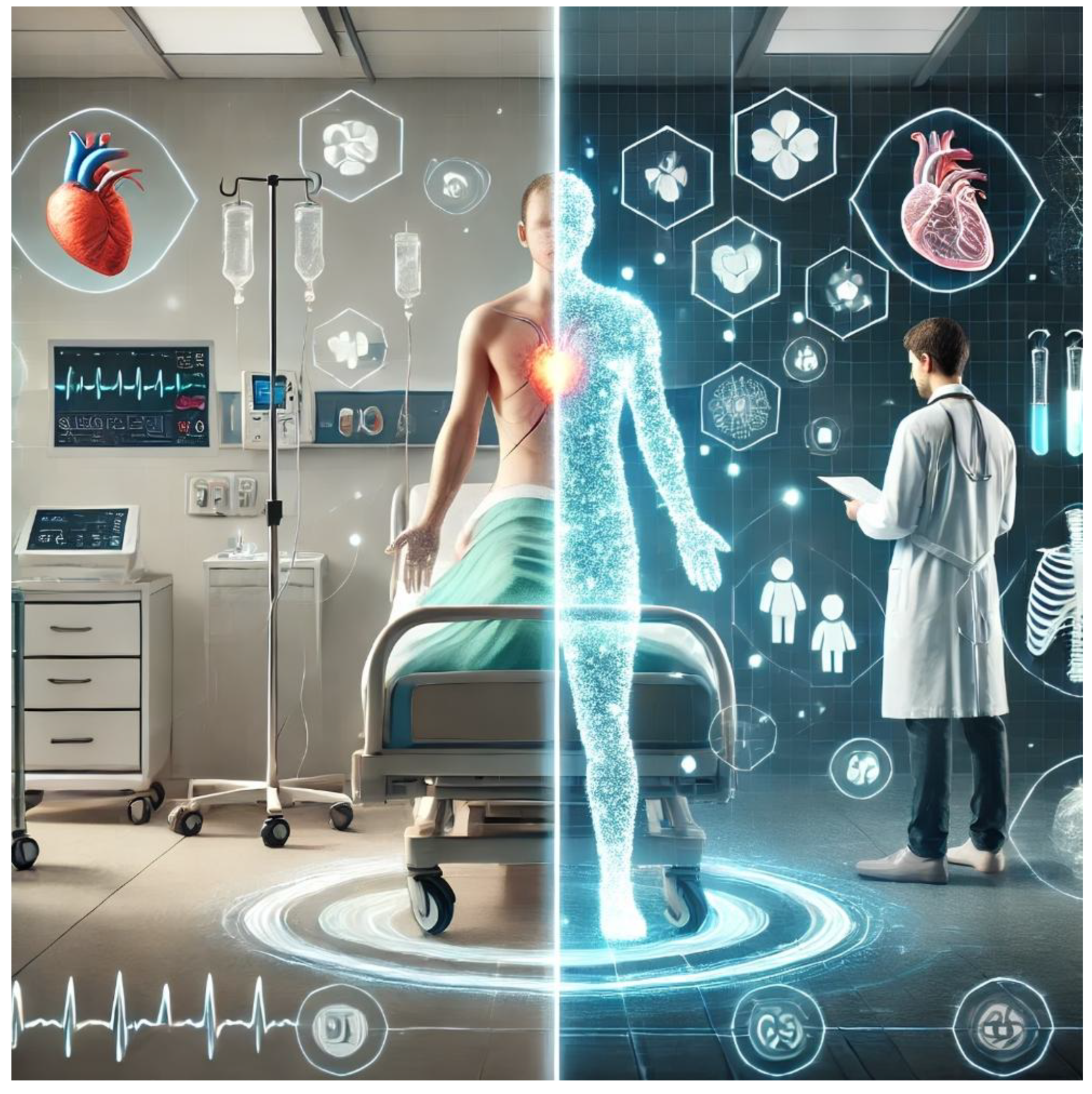
Figure 3.
Immersive Learning with Digital Twin Technology in Education and Research.
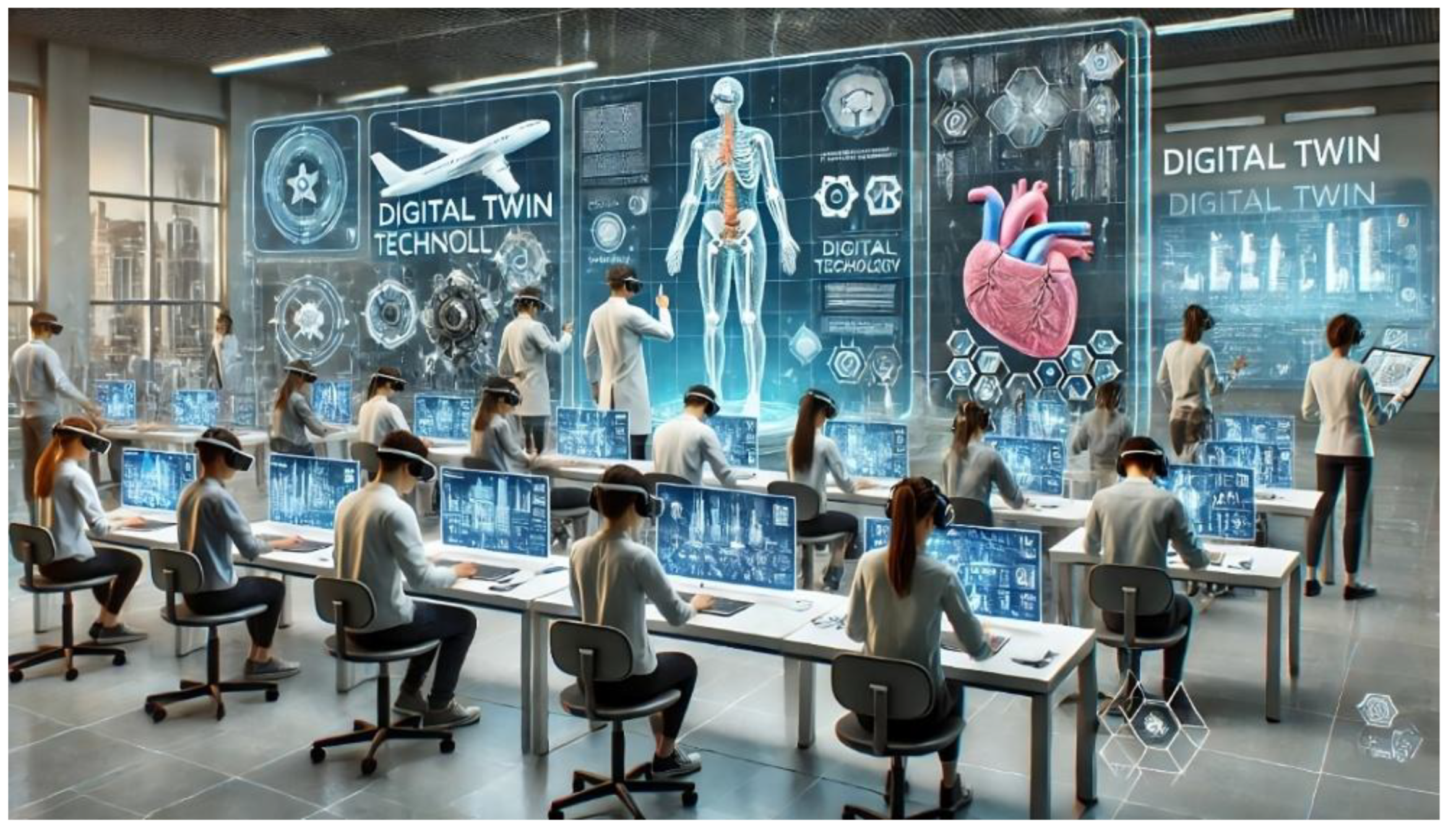
Figure 4.
Digital Twin Ecosystem for Design and Optimization.
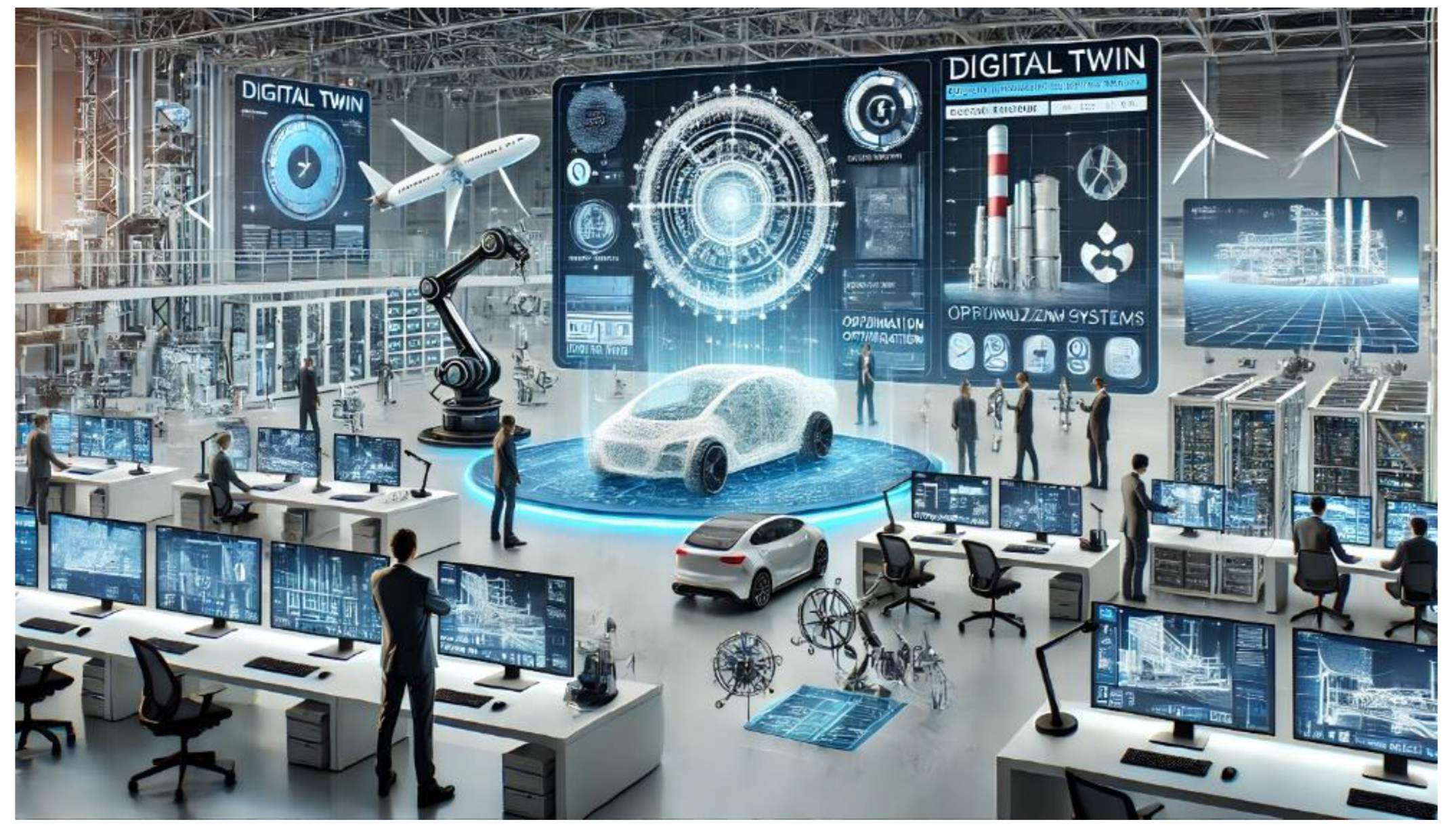
Figure 5.
Digital Twin Application in Infrastructure and Urban Planning.
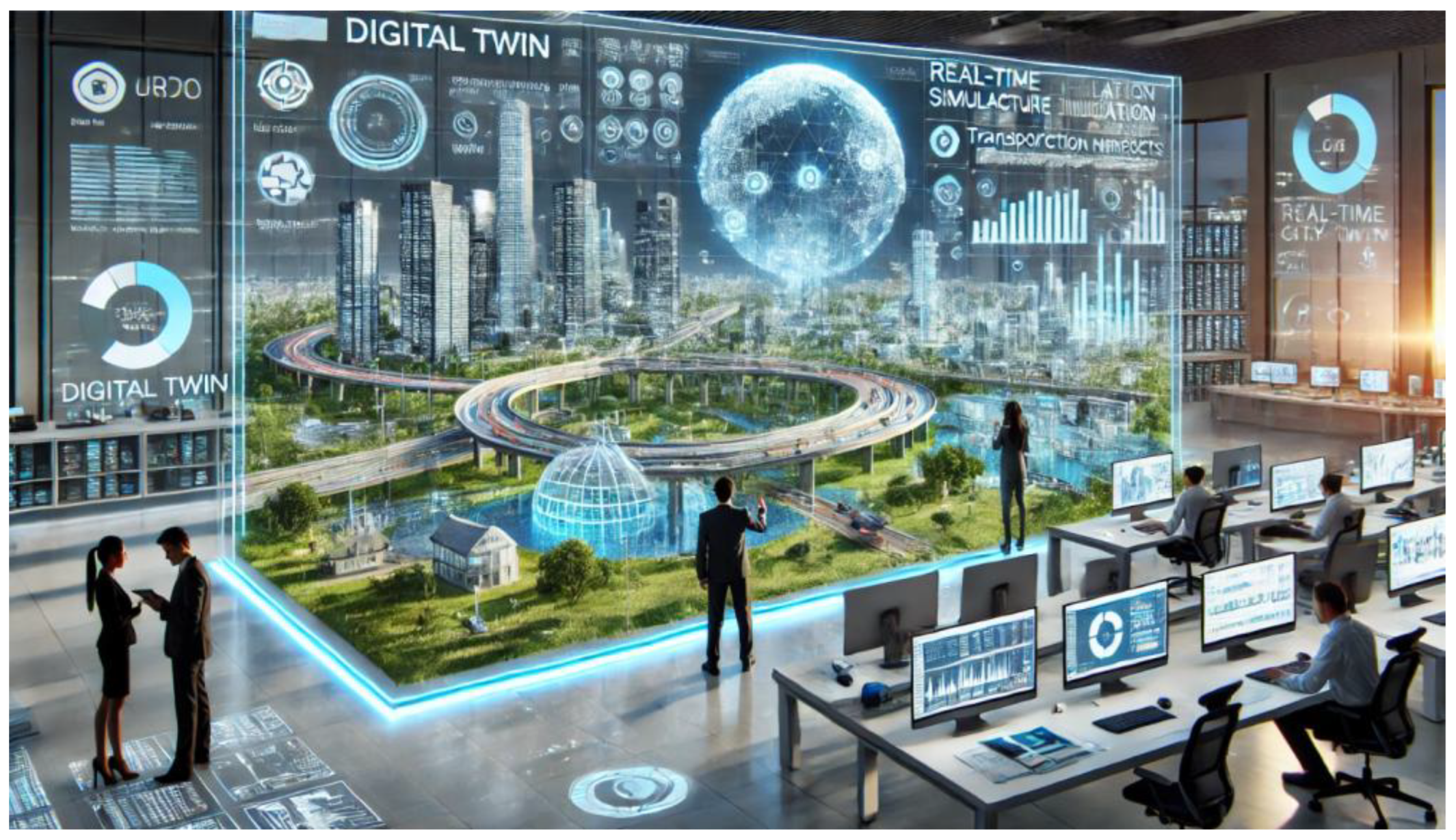
Figure 6.
Applications of Digital Twin in Transportation and Logistics.
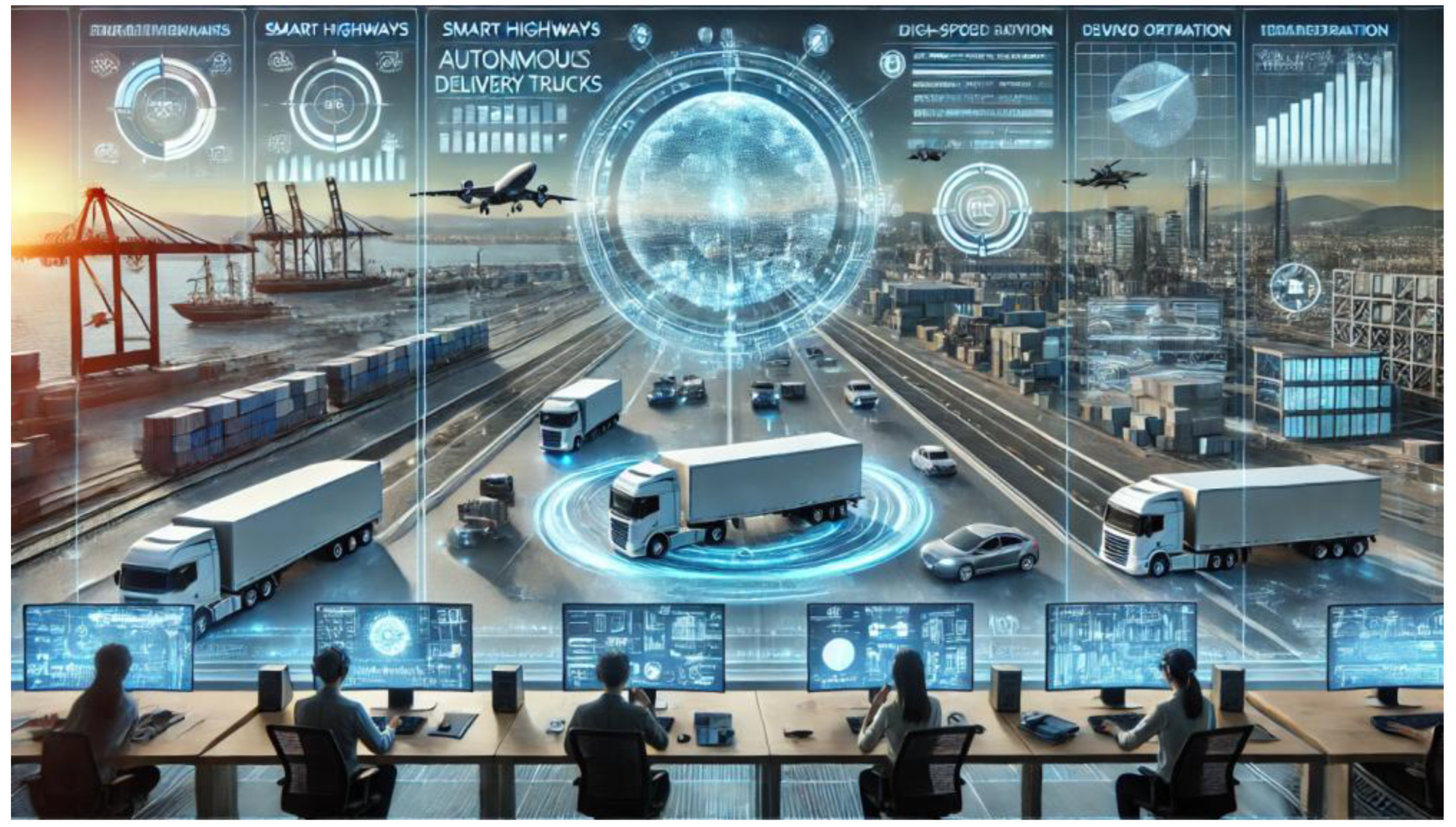
Figure 7.
Digital Twin for Real-Time Supply Chain and Industrial Process Optimization.
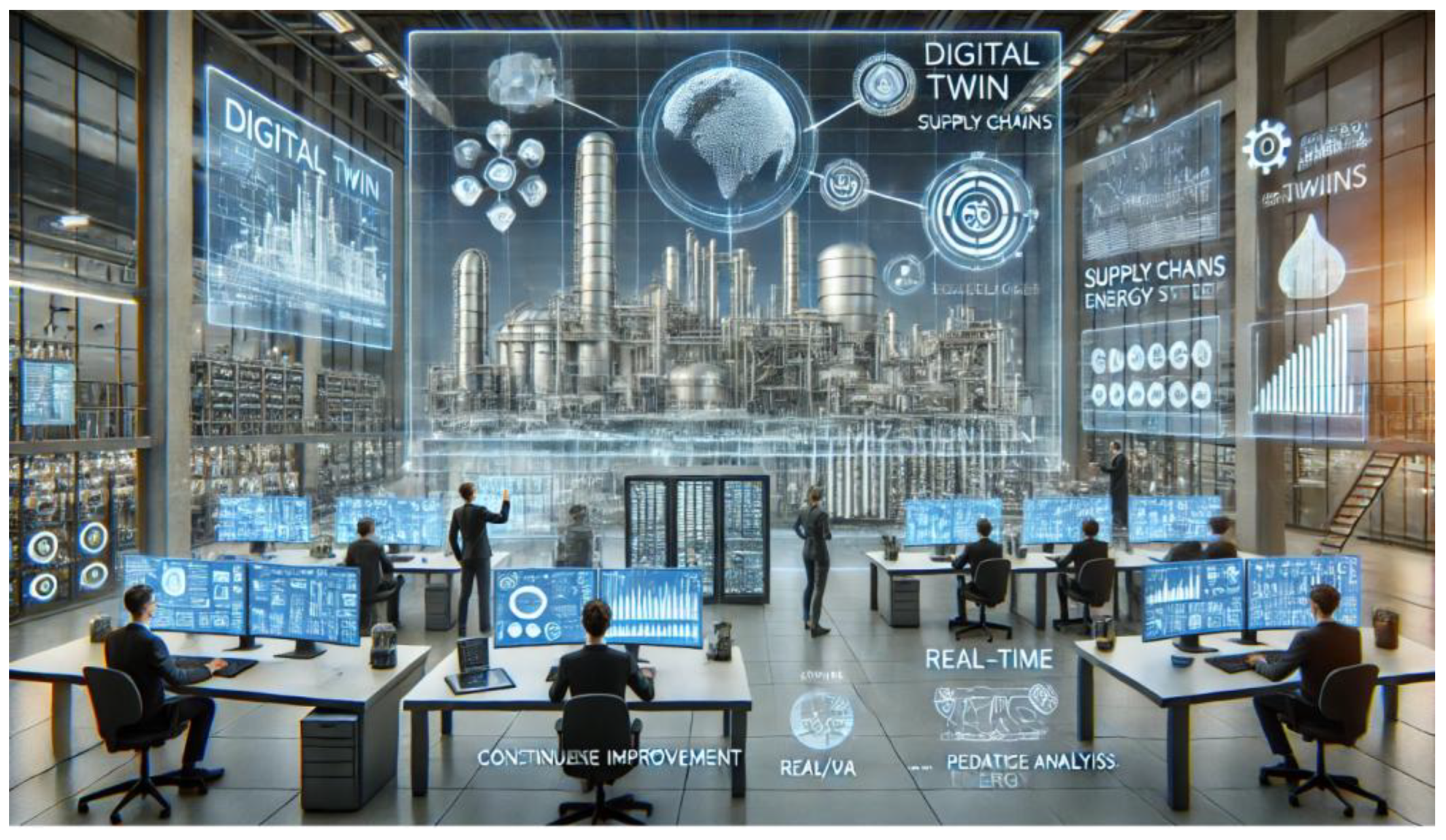
Figure 8.
Digital Twin-Enabled Smart Warehousing and Supply Chain Intelligence.
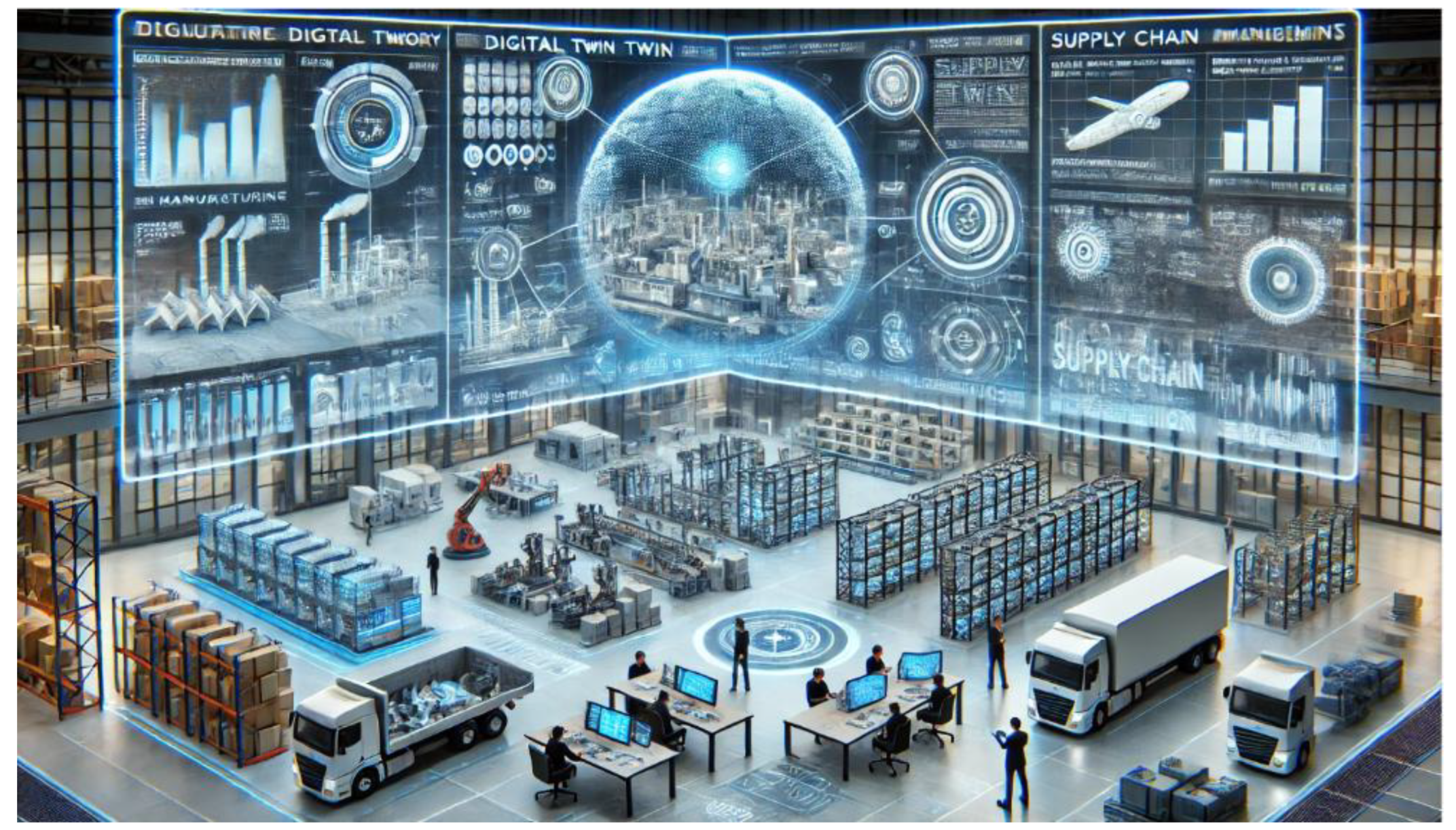
Figure 9.
Revolutionizing Medicine: Digital Twins for Diagnosis, Treatment, and Training.
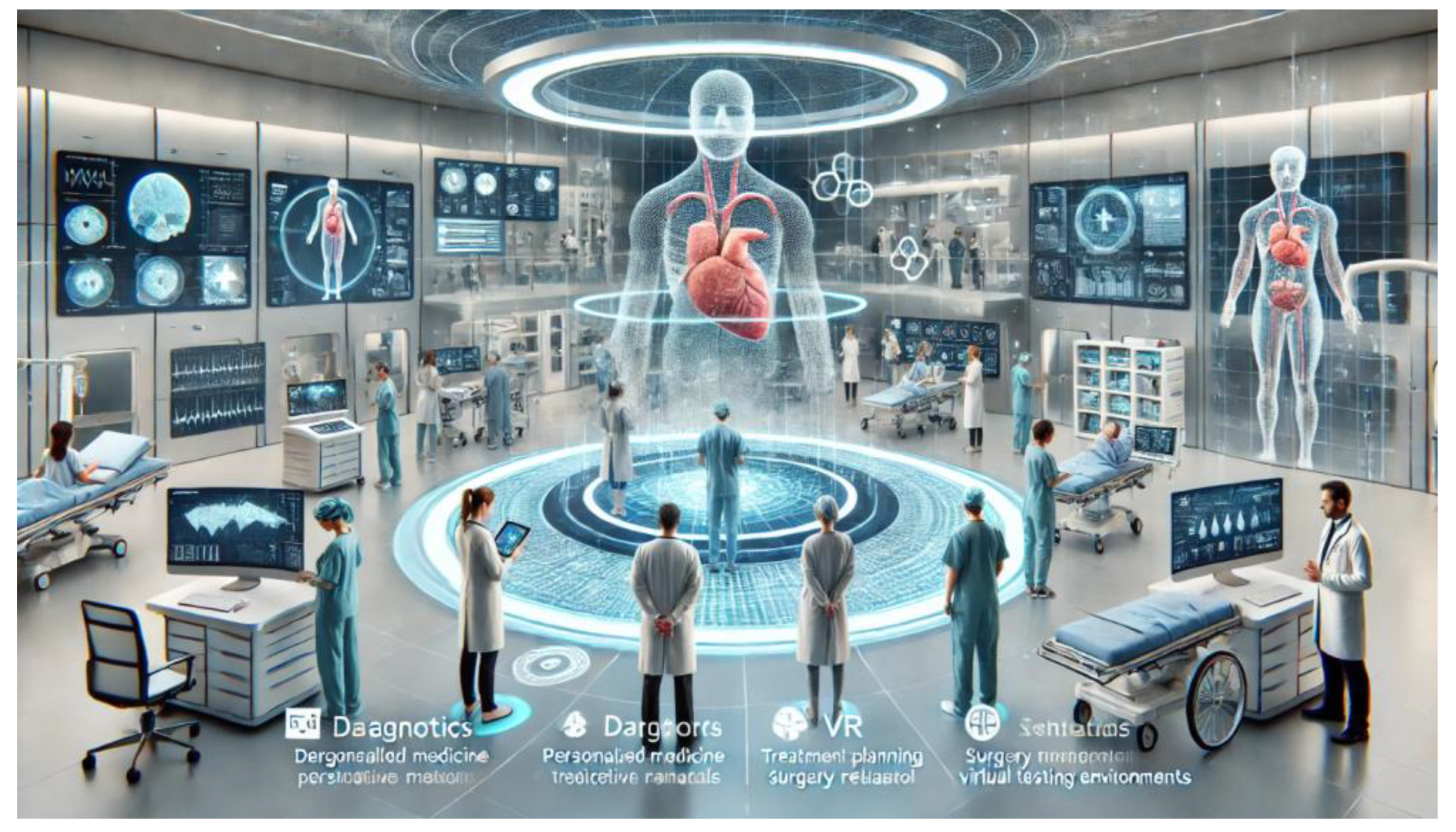
Figure 10.
Digital Twin Technology for Autonomous Systems and Smart Mobility Control.
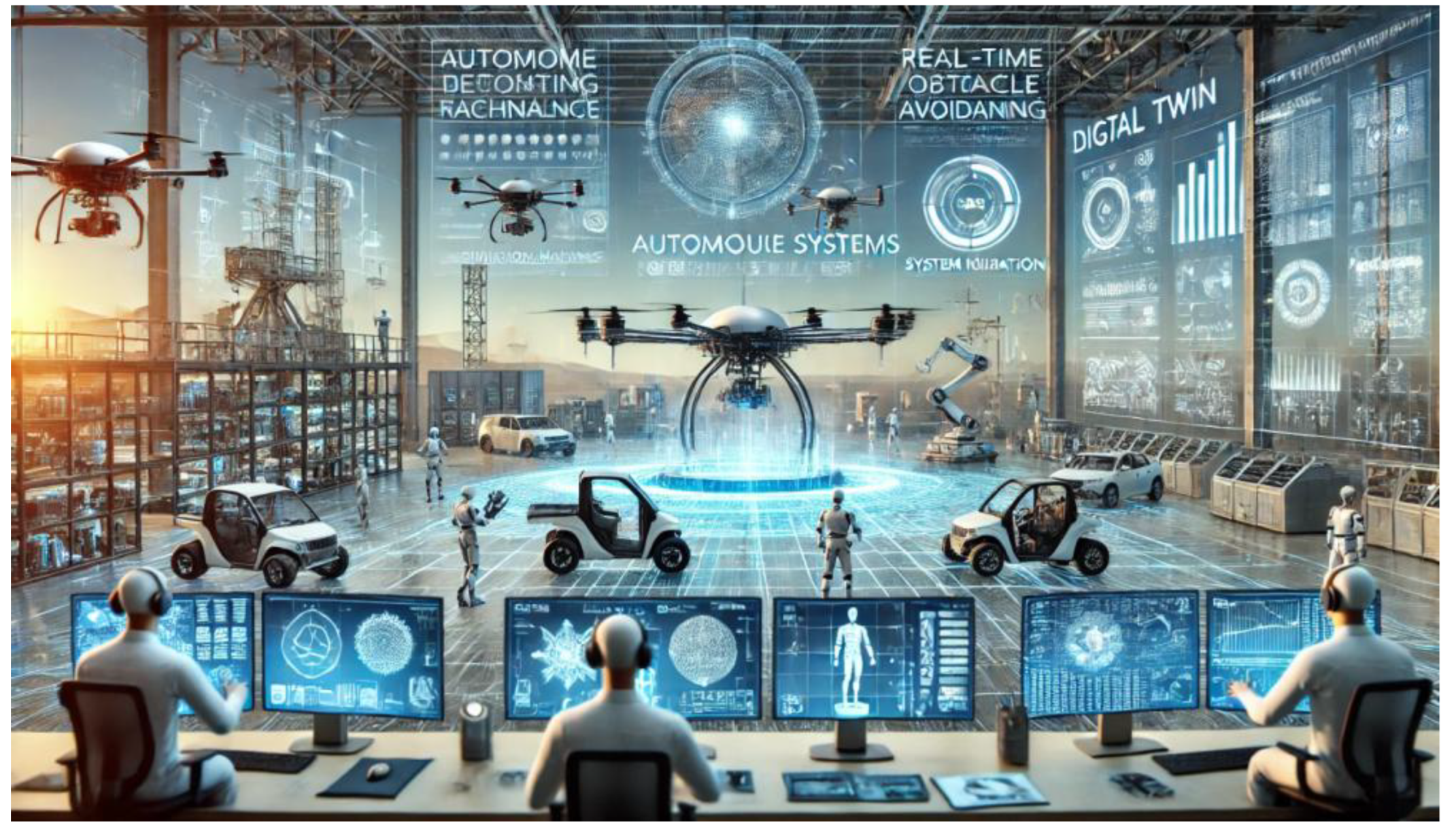
Figure 11.
Digital Twin for Offshore Oil Platforms: Real-Time Monitoring and Predictive Maintenance.
Figure 11.
Digital Twin for Offshore Oil Platforms: Real-Time Monitoring and Predictive Maintenance.
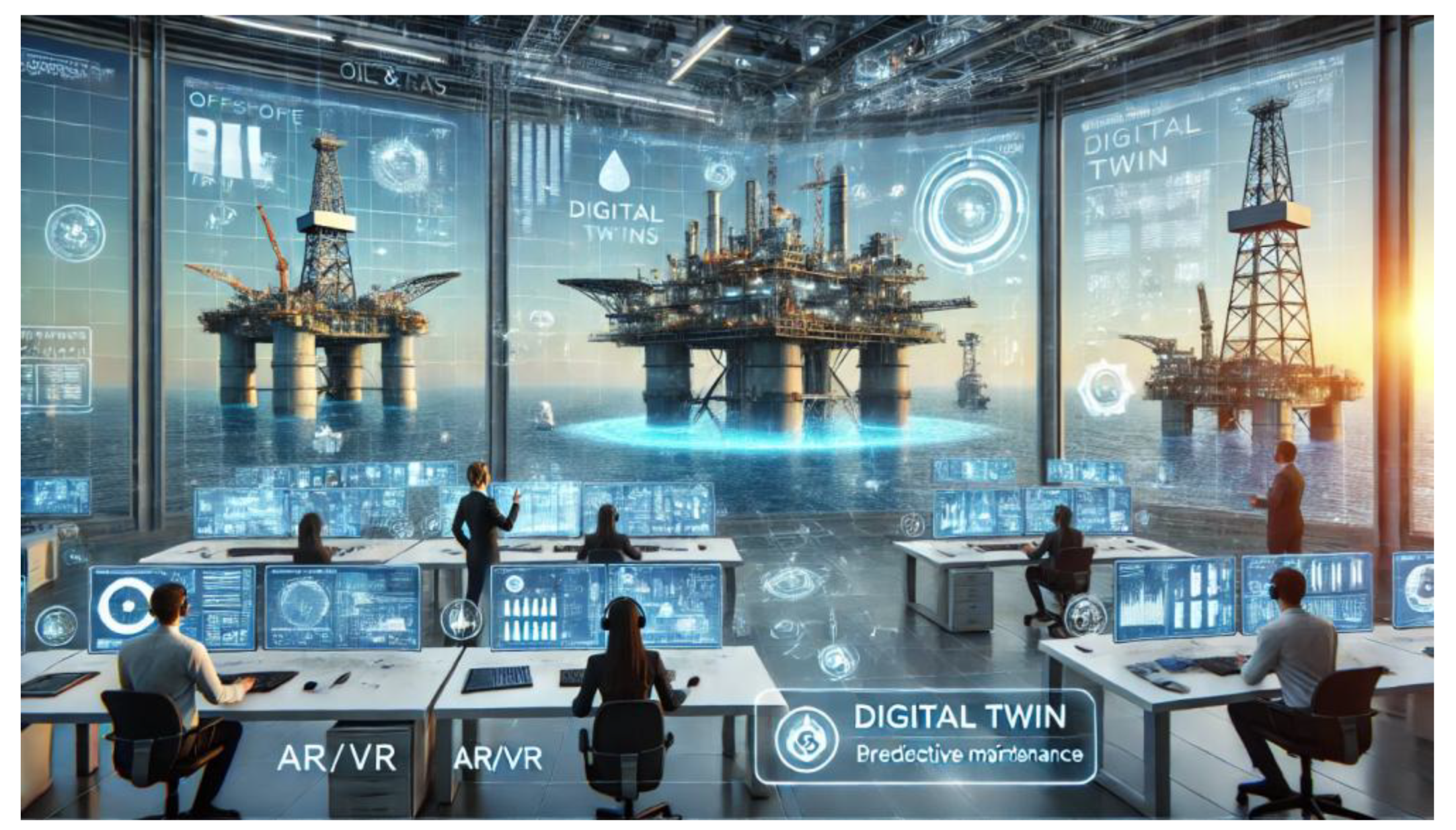
Figure 12.
Immersive Aerospace Engineering with Digital Twin Technology.
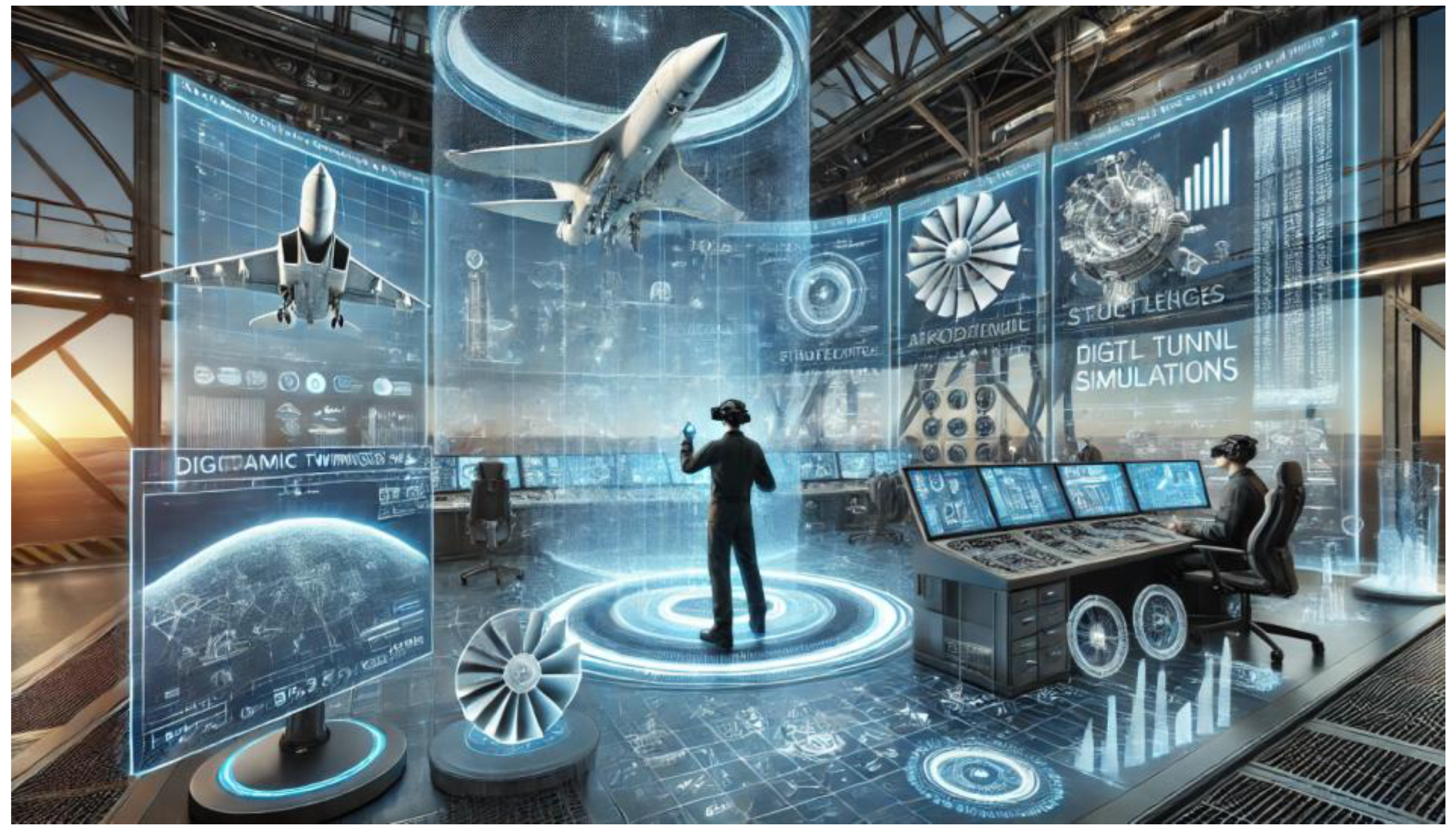
Figure 13.
Automotive Innovation with Digital Twins: Virtual Testing and Smart Manufacturing.
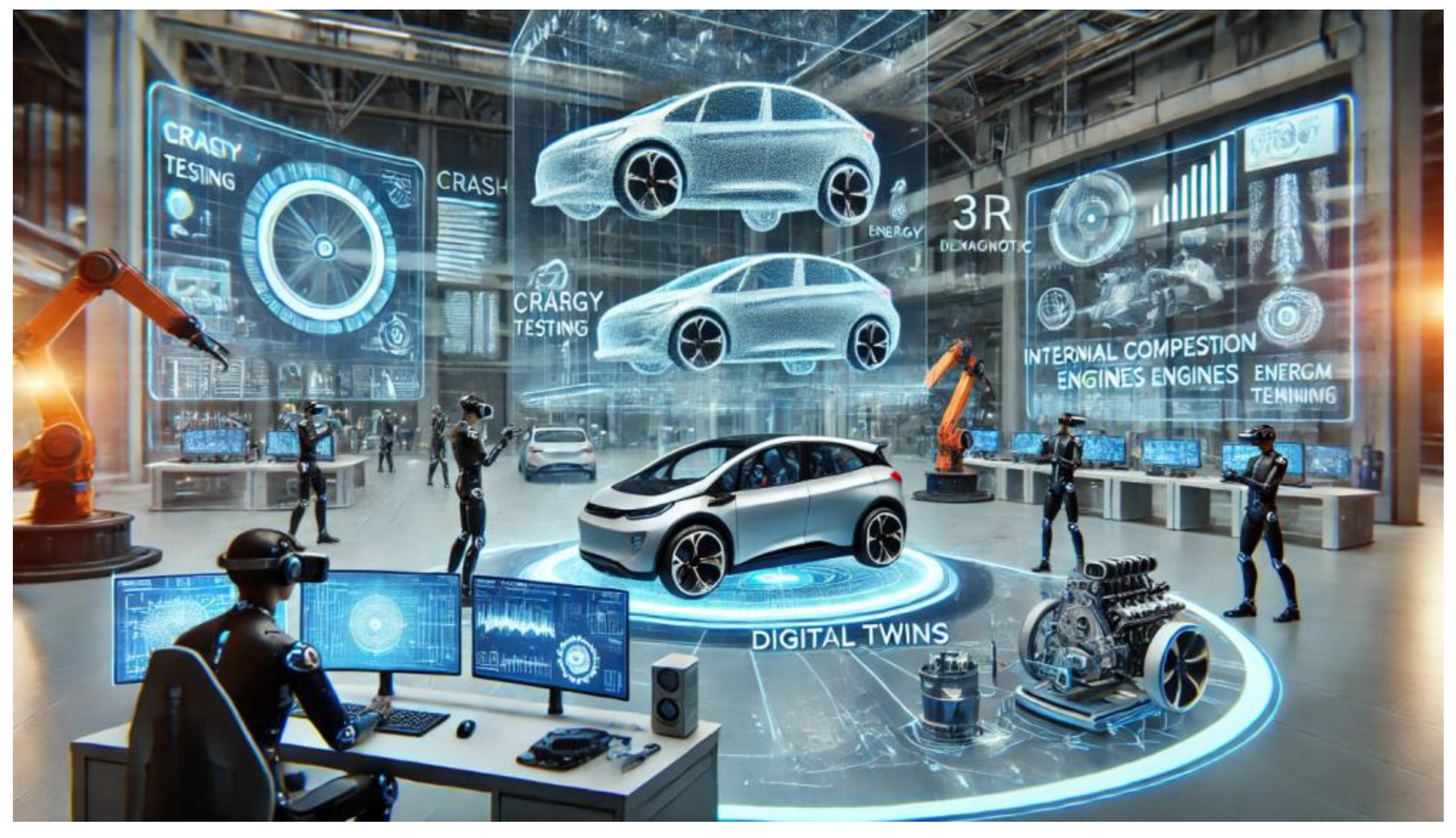
Figure 14.
Smart Energy Ecosystem Powered by Digital Twin Technology.
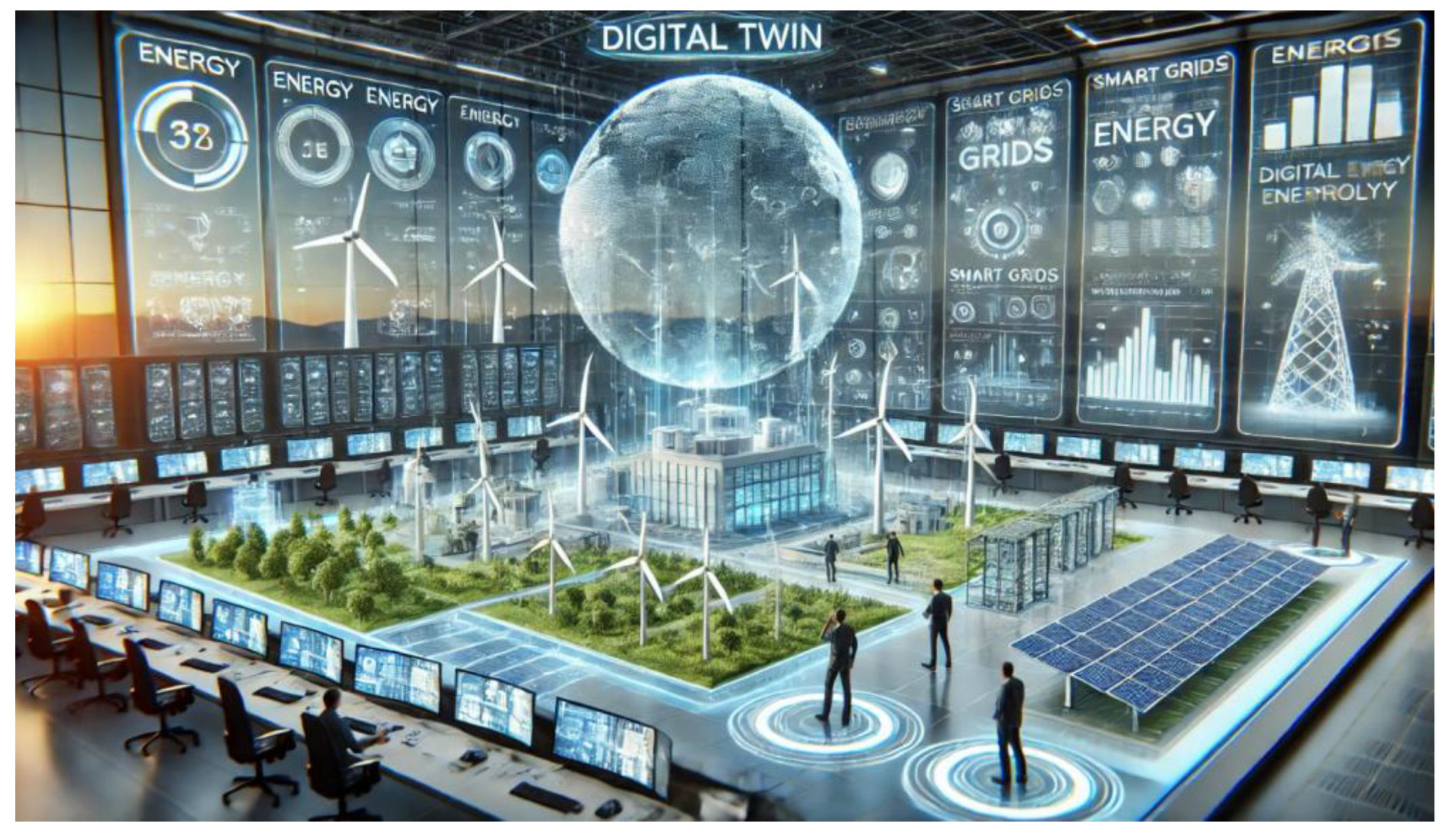
Figure 15.
Digital Transformation of Offshore Energy Systems with 3D and Immersive Technologies.
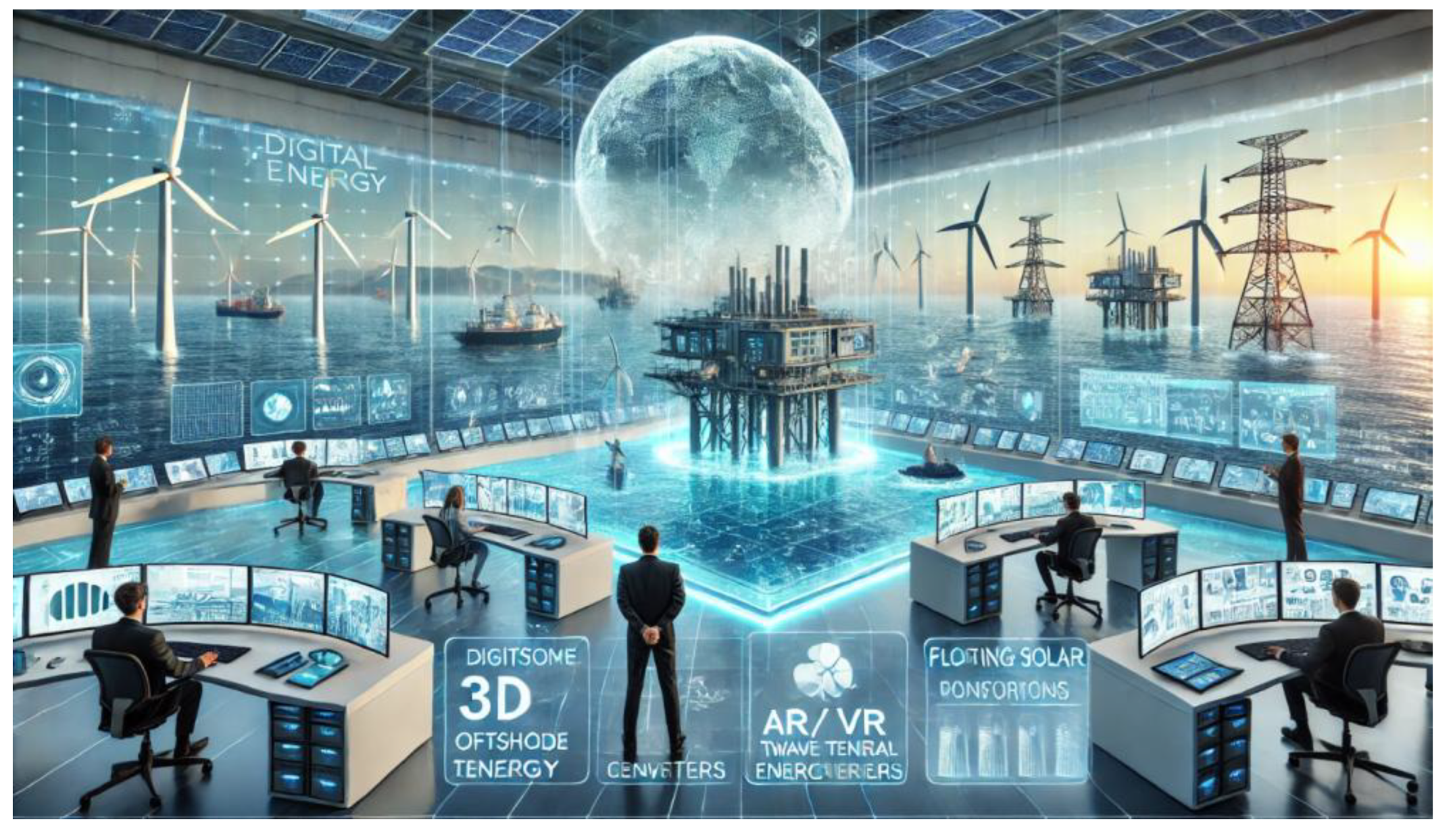
Figure 16.
Integrated Urban Ecosystems with Structural Digital Twins.
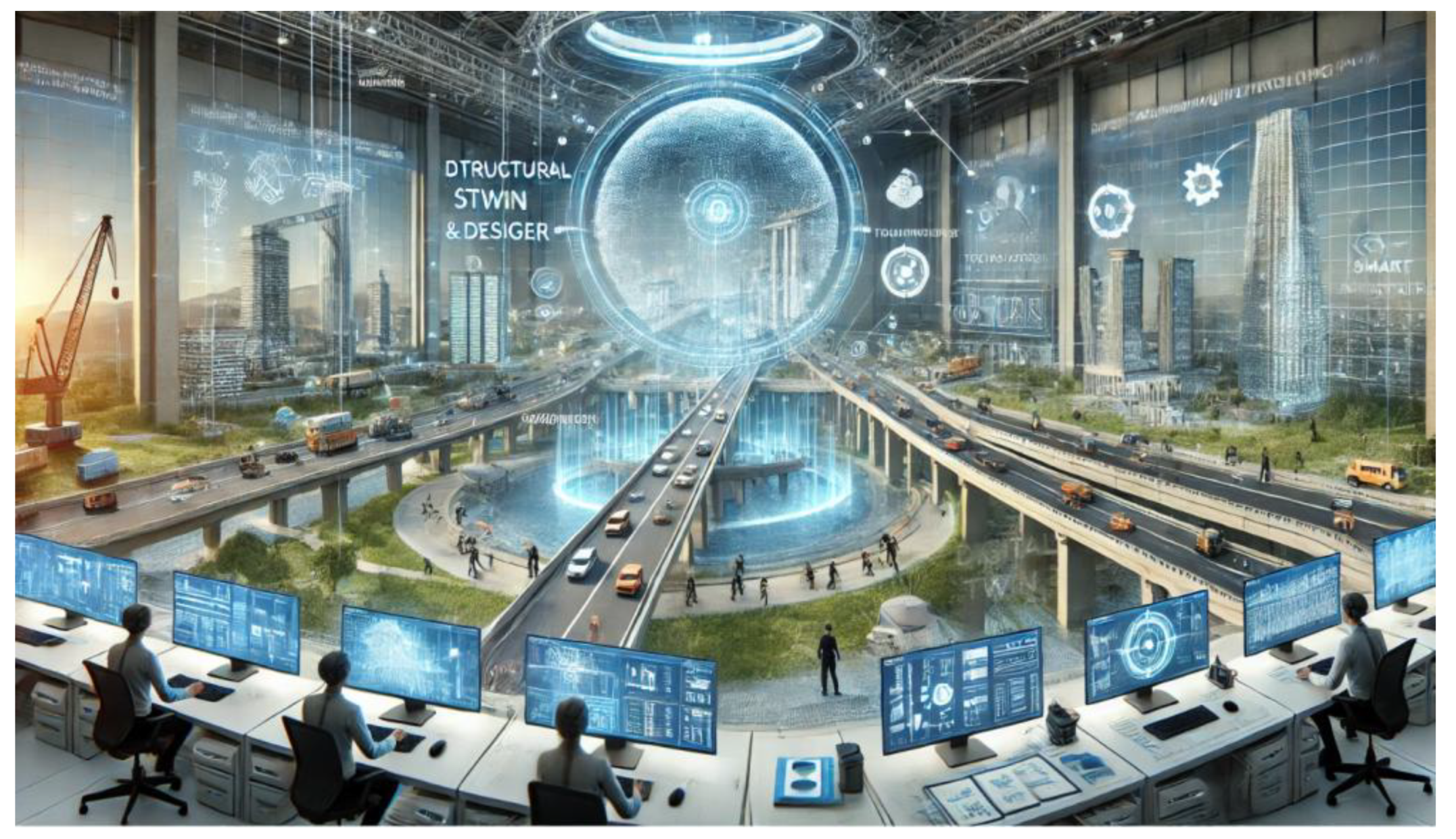
Figure 17.
Digital Twin Integration in Smart Manufacturing and Robotics.
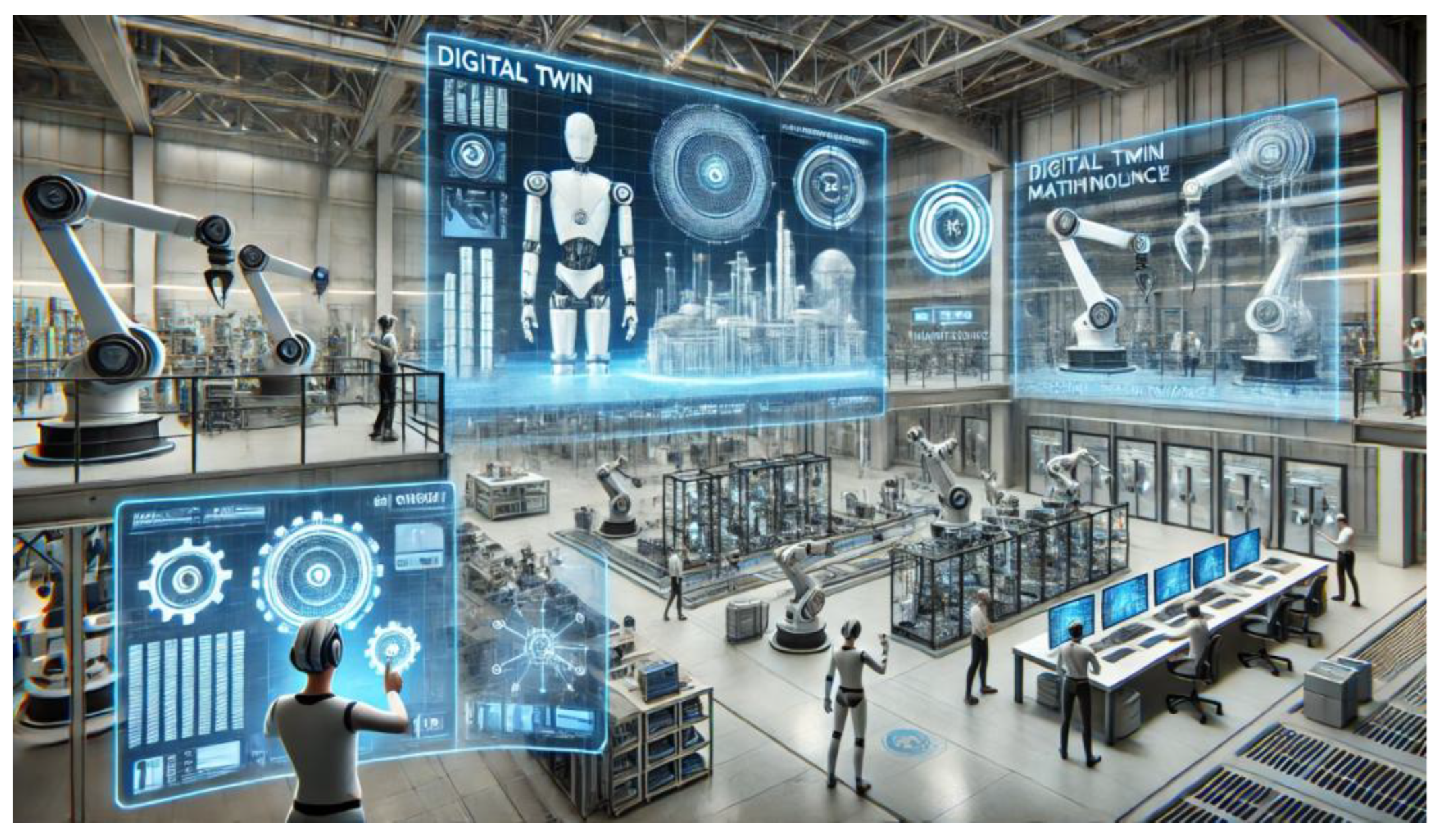
Figure 18.
Digital Twin-Driven Smart Logistics and Supply Chain Ecosystem.
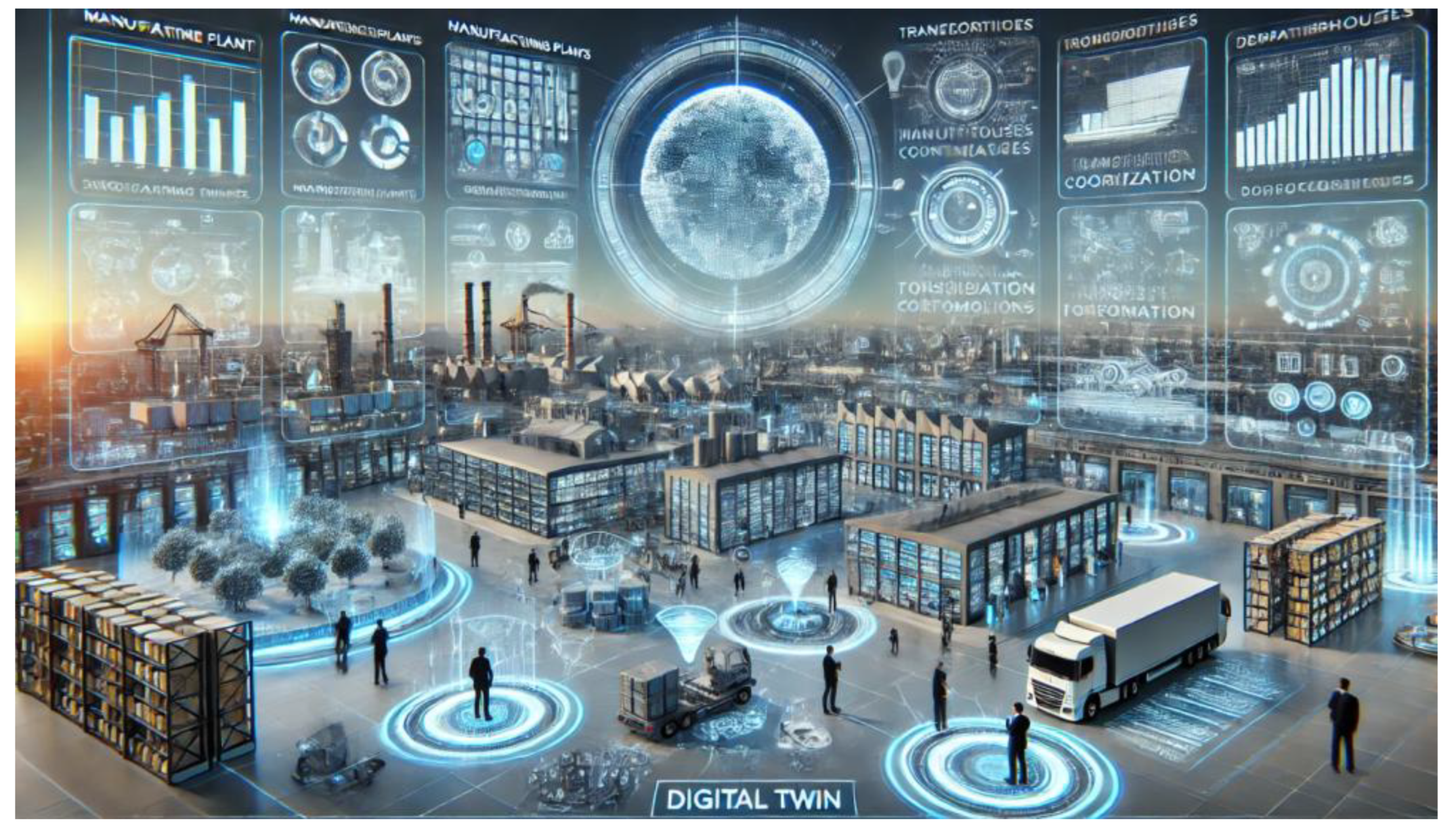
Figure 19.
Digital Twin Applications in Smart Energy and Power Plant Management.
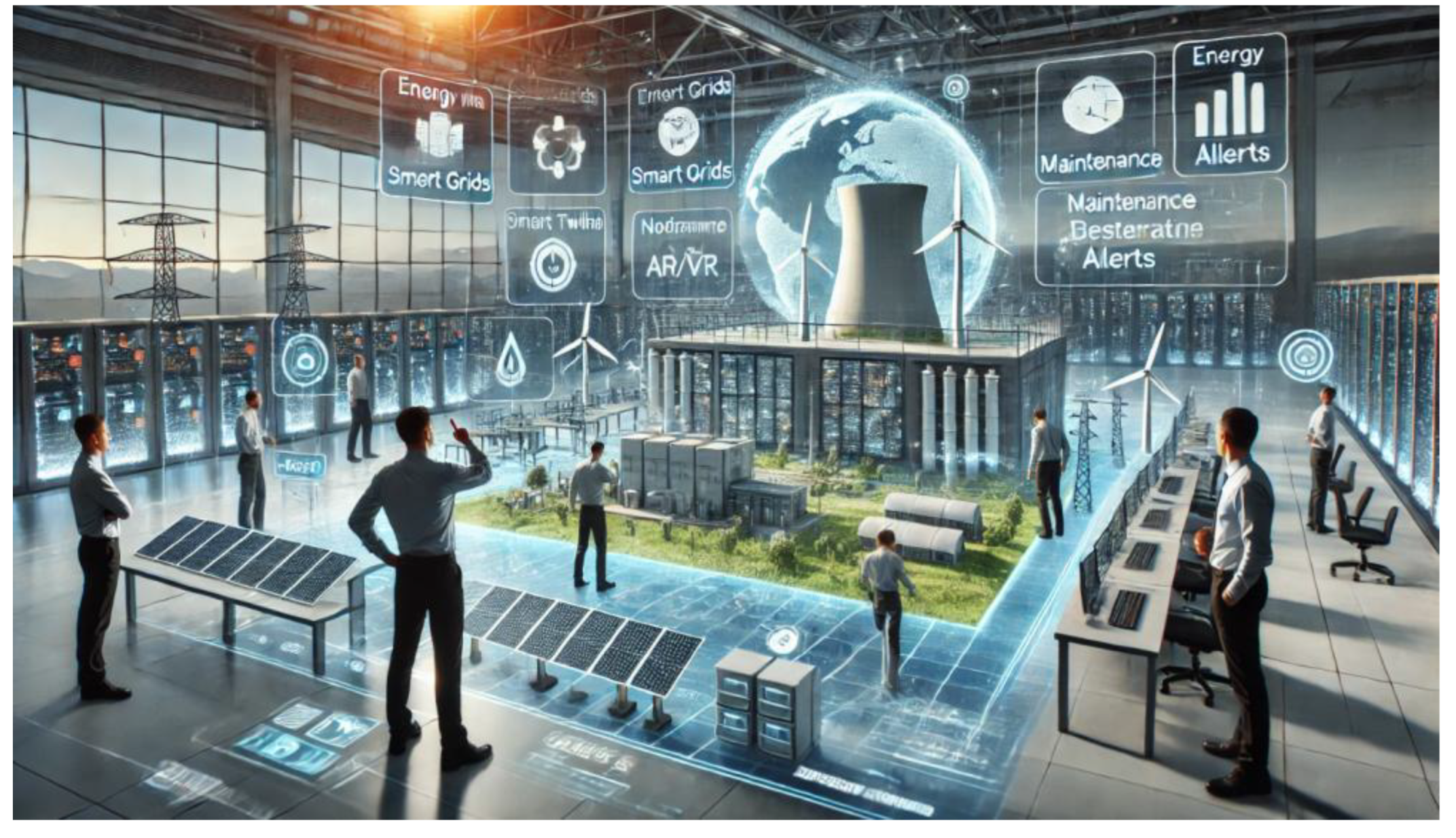
Disclaimer/Publisher’s Note: The statements, opinions and data contained in all publications are solely those of the individual author(s) and contributor(s) and not of MDPI and/or the editor(s). MDPI and/or the editor(s) disclaim responsibility for any injury to people or property resulting from any ideas, methods, instructions or products referred to in the content. |
© 2025 by the authors. Licensee MDPI, Basel, Switzerland. This article is an open access article distributed under the terms and conditions of the Creative Commons Attribution (CC BY) license (http://creativecommons.org/licenses/by/4.0/).
Copyright: This open access article is published under a Creative Commons CC BY 4.0 license, which permit the free download, distribution, and reuse, provided that the author and preprint are cited in any reuse.


