

Submitted:
04 May 2025
Posted:
08 May 2025
You are already at the latest version
Abstract
Augmented Reality (AR) and Virtual Reality (VR) technologies have the potential to transform education by creating immersive, interactive, and engaging learning experiences. However, adopting these technologies in developing countries like Nepal faces significant challenges, including limited infrastructure, high costs, and insufficient teacher training. This study provides the definitions and technologies of AR and VR comparing both advantages. It examines factors that influence AR/VR integration, such as infrastructure, teacher training, cost, and cultural relevance. The findings reveal a significant digital divide. The study recommends strategies for policymakers, educators, and developers to promote equitable and sustainable AR/VR integration. It tries to find the uses, challenges in other developed country who used the technology.
Keywords:
augmented reality
; virtual reality
; education system
; extended reality
; personalized education
Introduction
AR and VR technologies have gained significant attention in recent years due to their potential to create immersive and interactive learning environments. These technologies allow students to engage with complex concepts in a more tangible and memorable way, fostering deeper understanding and retention of material. Students will be able to discover new knowledge, motivate to learn, develop their own experiences with the help of AR/VR [1]. A study conducted by the National Training Laboratory [2] compared the effectiveness of different learning methods by measuring how well people retain information. The results showed that virtual reality (VR) training is highly effective, with participants retaining 75% of what they learned. This is a dramatic improvement over traditional learning approach. For example, when learning through reading alone, people only remember about 10% of the material, while lecture-based learning—where students passively listen to an instructor—has the lowest retention rate at just 5%. These findings highlight how immersive technologies like VR can significantly enhance learning outcomes compared to conventional methods.
Studies show that VR helps students learn better—it improves understanding, skills, and even attitudes toward learning [3]. Because VR feels so real and immersive, it makes learning more engaging and motivating [4]. It’s especially useful for tough subjects like math, physics, and engineering, where hands-on practice matters most [5].
Specific projects like Duke University's Bass Connections are developing advanced learning environments using VR technology, focusing on health education. The report shows that Augmented Reality (AR) enhances workplace safety by enabling employees to practice high-risk procedures in a controlled virtual environment before performing them in real-world scenarios [6]. This immersive training approach reduces accidents and improves operational safety standards.
The AR/VR market is predicted to grow significantly, reaching 2.593 million users by 2027. In the tech industry, about 91% of companies are already using or planning to use AR/VR. By 2030, it's expected that 23 million jobs will utilize AR/VR for training, meetings, and creating products [7]. Market research reveals rapid growth in virtual reality adoption, with global active VR users forecasted to nearly triple—from 58.9 million in 2021 to 171 million by the end of 2024. [8] This surge mirrors hardware trends, as annual AR/VR headset shipments are predicted to jump from 9.7 million units in 2021 to over 32.8 million by 2024, reflecting accelerating consumer and enterprise demand for immersive technologies.
The government of south Korea has been making great efforts to encourage teachers to use AR and VR be included in digital textbooks [9]. This requirement of technology is further proved by researchers and educators have sought to integrate AR into augmented books, student guides, and classroom instruction for subjects like chemistry, mathematics, biology, physics, and astronomy across K-12 and higher education levels [10].
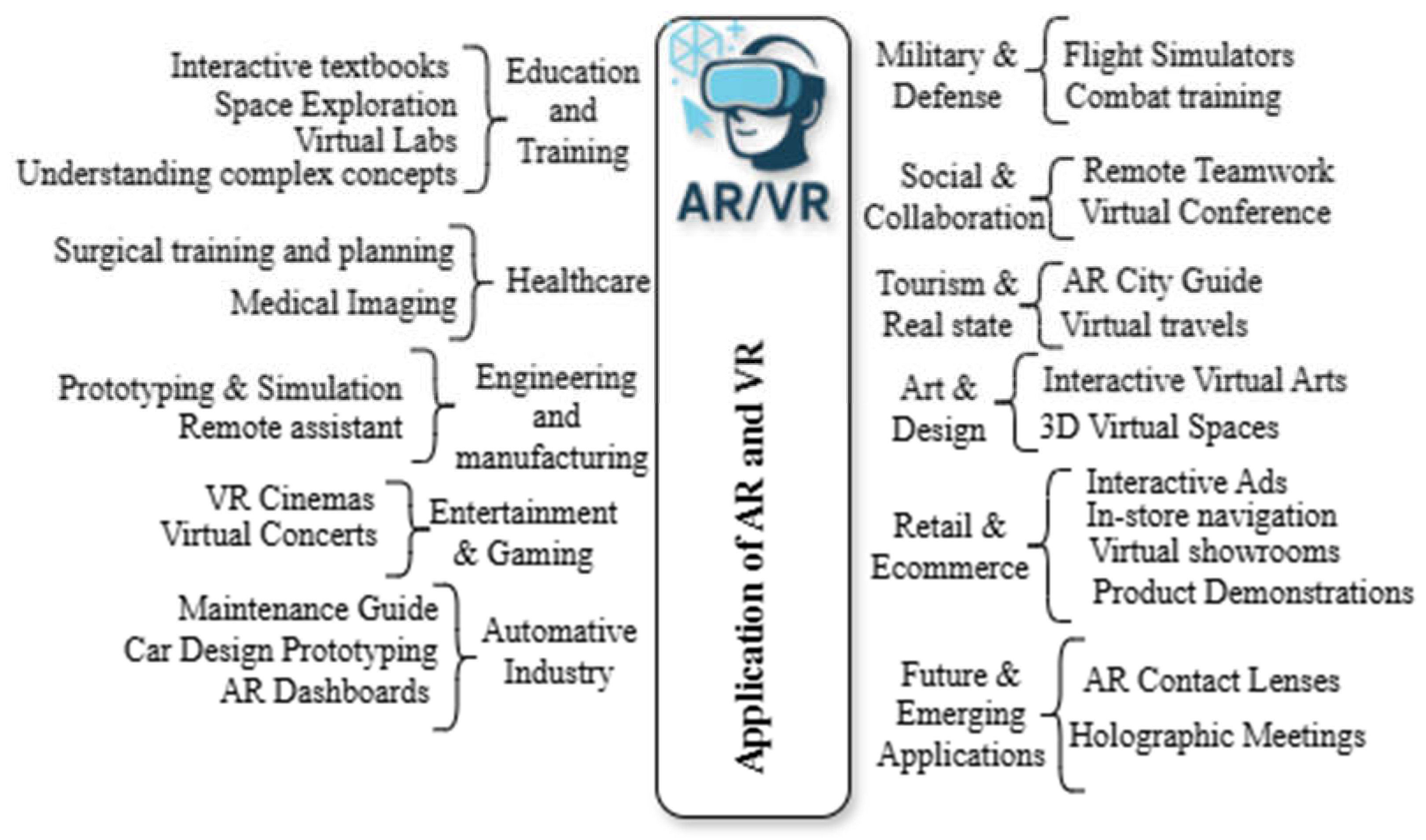
Figure 1.
Application of AR VR.
- Definition: Augmented Reality and Virtual reality
Augmented Reality (AR) is an interactive technology that overlays computer-generated perceptual information—such as visuals, sounds, or haptic feedback—onto the real-world environment in real time. Augmented Reality is an example of a technology that can make classroom learning more transformational and engaging. AR systems use devices like smartphones, tablets, or AR glasses to capture the real-world environment through cameras and sensors. Software then processes this information and overlays digital content, such as images, videos, or 3D models, onto the user's view.
Augmented Reality is transforming modern classrooms by creating interactive, immersive learning experiences. In STEM education (Science, Technology, Engineering, Mathematics), apps like Anatomy 4D allow students to explore 3D models of human organs by scanning textbook images, while Elements 4D brings chemistry to life by demonstrating molecular interactions through AR-enabled blocks. For language learning, tools like Mondly AR enable students to practice conversational skills with virtual characters, and QuiverVision turns coloring pages into animated 3D objects, enhancing engagement for younger learners. History classes benefit from apps like Google Expeditions AR, which overlays historical artifacts or ancient civilizations into the classroom, allowing students to examine them from all angles. Additionally, AR-powered textbooks, such as those developed by McGraw-Hill, integrate interactive videos and simulations to reinforce complex concepts. These applications not only boost student motivation but also improve retention by making abstract subjects tangible. As AR technology advances, its role in personalized and collaborative learning continues to expand, offering educators innovative ways to enrich curricula.
Virtual Reality is rapidly gaining traction as a transformative educational medium, offering deeply immersive learning experiences that transcend the limitations of conventional classroom settings. By simulating fully interactive, 360-degree environments, VR enables students to interact with educational material in a vivid, lifelike manner that enhances both engagement and knowledge retention.
VR has the potential to transform pedagogical approaches by providing experiential learning environments that minimize risk. For instance, Google Expeditions VR enables students to participate in guided virtual field trips to locations such as the Great Barrier Reef and Mars, fostering a sense of presence and enhancing spatial understanding. In the medical field, Osso VR provides realistic surgical simulations that allow students to develop procedural skills in a controlled setting. Similarly, platforms like ENGAGE VR facilitate collaborative design and prototyping among engineering students within virtual laboratory spaces. Language acquisition is also being enhanced through VR applications like Mondly VR, which immerses learners in foreign cultural contexts and provides opportunities for interaction with AI-driven avatars.
- Benefits of AR and VR
- -
- Dynamic Learning Environment: AR creates responsive learning environments with features like virtual labs and gamified assessments, stimulating critical thinking and problem-solving skills.[11]
- -
- Real Time Guidance: AR provides immediate feedback and guidance, enhancing the learning process by allowing students to correct mistakes in real time.
- -
- Interactive Learning: AR makes lesions more engaging and effective by offering by unique and interactive learning experience where student can manipulate virtual objects within their real environments [12].
- -
- Immersive Experience: VR has the potential to motivate students to explore new academic interests and tackle complex concepts with greater enthusiasm[13].
- -
- Improved Student Outcomes: VR has been reported to improve student attention, with certain implementations increasing exam result by up to 20% by enhancing retention through experimental learning [14].
- -
- Enhanced problem-solving skills: The use of simulation and multimedia content in VR environments helps students develop and enhance their problem-solving skills through scenario-based learning [15].
Methodology
A literature review was conducted to examine the integration of Extended Reality (XR) technologies, including Virtual Reality, Augmented Reality, and Mixed Reality (MR), within educational settings, focusing on publications from 2012 to 2025. A comprehensive keyword strategy, encompassing "virtual reality," "augmented reality," "mixed reality," "extended reality,", “classroom”, “pedagogy” and "immersive learning," guided the search across academic databases, web resources, and book chapters. Peer reviewed articles, conference papers that meet the eligibility criteria was included. Non-English, unrelated to technology and education are excluded. No primary data was collected.
This rigorous approach facilitated the identification of emerging trends, documentation of key benefits and challenges, and analysis of effective implementation strategies across various educational settings. The methodology was designed to ensure both comprehensive coverage of the literature and methodological rigor in the analysis of this rapidly evolving domain, and critically analyzed to provide a comprehensive overview of the current state of VR and AR in education.
- Challenges of AR and VR in Education
AR and VR in gaming is not a new concept. It has been used in military, medicine, engineering, manufacturing, robotics and so on. These technologies can also be applied in education, learning or edutainment[16] Edutainment is a blend of education and entertainment, designed to make learning enjoyable and engaging [17]. Integrating VR and AR technologies into education has significantly enhanced the immersive nature of both teaching and learning experiences [18]. However, the complexity of AR systems is a commonly cited challenge in educational settings, according to various research [19-21]. Lack of formal pedagogical approaches when integrating AR applications is another issue. Some common challenges are:
- -
- High initial costs for devices [22]. High costs can exacerbate the digital divide, as only those with higher incomes can afford AR/VR devices.
- -
- It's not enough to simply use AR/VR; teachers need to understand how to effectively integrate these technologies into their teaching methodologies. They require training on how to design engaging and effective AR/VR-based learning experiences that align with curriculum objectives. VR training programs often demonstrate greater effectiveness compared to traditional training methods [23].
- -
- Potential motion sickness in VR is a common issue. It occurs when there is a mismatch between the visual motion perceived through the VR headset and the lack of corresponding physical movement felt by the body. This sensory conflict can lead to symptoms such as dizziness, nausea, headaches, sweating, and disorientation [24].
- -
- High production cost. AR/VR devices rely on sophisticated components like high-resolution displays, powerful processors, advanced sensors, and specialized cameras. These components are often expensive to manufacture, especially in early production stages.
- -
- AR/VR technologies gather a unique and highly sensitive data profile of a user and can be used to infer sensitive information that users may not explicitly share.
- -
- The performance of AR applications varies based on the device used [25].
- -
- AR applications rely on online access and will not work without it [25].
- -
- Even well-designed applications can introduce security risks through coding flaws or implementation weaknesses [26].
Despite their current limitations and relatively early stage of widespread adoption, there is increasing optimism that AR and VR technologies will become integral parts of everyday life in the near future. As hardware becomes more affordable, compact, and powerful, and as software continues to evolve to deliver more intuitive and engaging experiences, AR and VR are gradually moving beyond niche applications into mainstream use.
In sectors like education, healthcare, retail, real estate, and entertainment, these immersive technologies are already demonstrating significant value. For example, AR can enhance shopping experiences by allowing customers to visualize products in their environment before purchase, while VR can simulate complex medical procedures for training purposes without real-world risks. Furthermore, with advancements in 5G connectivity, AI integration, and cloud computing, the performance and accessibility of AR and VR experiences are expected to improve substantially.

Table 1.
Comparative Analysis of AR VR on different basis.
| Basis | AR | VR |
|---|---|---|
| Concept | Overlays digital content on the real world | Creates a fully immersive virtual environment. |
| Accessibility and Implementation | AR can be implemented using existing devices like smartphone and tablets, making it relatively more accessible in the developing countries like Nepal. No additional hardware cost. | VR requires specialized equipment hardware such as headsets and powerful computers, which can be challenging in rural areas where infrastructure is limited. |
| Engagement and Interaction | AR excels in providing contextual, real-time guidance, and feedback while maintaining connection with the real world. | VR creates fully immersive environments that can transport students to different worlds and scenario, completely removing external distractions. |
| Learning Outcomes | AR has shown particular effectiveness in providing dynamic learning environments that stimulate critical thinking and problem-solving skills. | VR has demonstrated potential in improving exam results and reducing learning error through immersive experience. |
| Cost | Lower | Higher |
| Primary Devices | Smartphones, tablets, AR glasses (e.g., Microsoft HoloLens) | VR headsets (e.g., Meta Quest, Valve Index) |
| Processing Power | Moderate (runs on smartphones) | High (requires powerful GPUs) |
- Future Prospects and Recommendations
To overcome existing limitations and fully leverage the educational potential of immersive technologies, the following measures are recommended:
- Tiered Implementation Strategy: Develop a national strategy that prioritizes AR implementation in schools with limited resources while supporting VR adoption in select institutions that can serve as centers of excellence and shared resources.
- Public-Private Partnerships: Establish partnerships between educational institutions and technology companies to reduce costs and develop localized content relevant to the curriculum.
- Teacher Training Programs: Implement comprehensive training programs specifically designed for educators to build capacity in effectively utilizing AR and VR technologies.
- Infrastructure Development: Coordinate with telecommunications and internet service providers to improve connectivity in educational institutions, particularly in rural areas.
- Content Development: Invest in developing AR and VR content that specifically addresses the cultural context, rather than relying solely on imported educational materials.
Future of Technology in Classroom
The days of chalkboards and dusty textbooks in classrooms are long gone, as over the past two decades, technology has steadily integrated into education, fundamentally altering how students’ study and access information. Looking ahead, the future of technology in the classroom promises even more profound transformations. The demand for digital teaching assistants, powered by AI, is expected to increase, offering personalized support and guidance to individual learners. Virtual classrooms will become more sophisticated, providing immersive and interactive learning environments that transcend geographical limitations.
Numerous studies have demonstrated the transformative potential of AR and VR in education [27]. As these technologies become increasingly affordable and accessible, their integration into secondary and higher education curricula is anticipated to expand significantly. Concurrently, Artificial Intelligence (AI) is emerging as a pivotal innovation in educational settings, enabling personalized learning experiences. Mixed Reality (MR), which seamlessly merges physical and digital environments, is also gaining prominence for collaborative learning—allowing students to interact with holographic objects using devices such as Microsoft HoloLens. Additionally, Mobile Augmented Reality (MAR) systems, integrated into smartphones, facilitate experiential learning beyond traditional classroom boundaries [28] .
Looking ahead, advancements in 5G networks, cloud computing, and blockchain technology are expected to mitigate current limitations, such as latency and data security concerns, thereby enhancing the reliability of AR/VR applications and streamlining digital credentialing for online education. Nevertheless, persistent challenges—including equitable access, educator training, and ethical considerations—must be systematically addressed to maximize the benefits of these technologies. As they continue to evolve, AR, VR, and associated innovations hold immense promise for fostering inclusive, dynamic learning ecosystems that equip students with future-ready skills.
Furthermore, the potential to collaborate to educate on a global scale is immense; by seamlessly integrating various technological elements, schools can connect locally and internationally, enabling students from different countries to work together on common assignments, fostering cross-cultural understanding and enriching the learning experience. Today's younger generations are true digital natives, embracing these technological advancements will not only cater to their inherent familiarity but also unlock new possibilities for engaging, effective, and collaborative education.
Limitations
While this study provides valuable insights, several limitations highlight opportunities for future research. The keyword search focused on broad terms like education, virtual reality, and augmented reality, potentially overlooking more specialized concepts such as experiential learning. Additionally, incorporating quantitative measures to assess learning outcomes could strengthen future investigations. Given the rapid evolution of technology, this study could have explored the connections with artificial intelligence and big data in greater depth, as these are increasingly important for advancing this field of research.
Conclusions
The integration of AR and VR in education presents distinct advantages and challenges. AR offers greater accessibility and integration with existing infrastructure, facilitating more immediate application across diverse educational institutions. VR, while providing a superior immersive experience that can significantly enhance learning outcomes, faces more substantial implementation barriers due to cost and infrastructure requirements.
This comparative analysis reveals that the technologies possess complementary strengths that can be strategically leveraged within the educational system. AR can serve as an initial entry point for many schools, given its lower implementation threshold, while VR offers unique benefits for specialized learning scenarios that justify additional investment where resources permit. AR's capacity to transform the learning environment enables students to construct exciting educational experiences across various scales, from the atomic to the cosmic.
Several studies demonstrate the potential of VR in reducing learning errors and enhancing educational outcomes. The AR VR technology has significant benefit for the future of education. This research provides how these technologies and interactive learning technologies can be integrated to create a more inclusive, personalized, and adaptive education system.
References
- Ardiny, H.; Khanmirza, E. The role of AR and VR technologies in education developments: opportunities and challenges. Proceedings of 2018 6th rsi international conference on robotics and mechatronics (icrom); pp. 482–487.
- Zhang, X.; Jiang, S.; Ordóñez de Pablos, P.; Lytras, M.D.; Sun, Y. How virtual reality affects perceived learning effectiveness: A task–technology fit perspective. Behaviour & Information Technology 2017, 36, 548–556. [Google Scholar]
- Chang, Y.-S.; Chou, C.-H.; Chuang, M.-J.; Li, W.-H.; Tsai, I.-F. Effects of virtual reality on creative design performance and creative experiential learning. Interactive Learning Environments 2023, 31, 1142–1157. [Google Scholar] [CrossRef]
- Meyer, O.A.; Omdahl, M.K.; Makransky, G. Investigating the effect of pre-training when learning through immersive virtual reality and video: A media and methods experiment. Computers & Education 2019, 140, 103603. [Google Scholar]
- Cheng, K.; Tsai, C. A case study of immersive virtual field trips in an elementary classroom: Students’ learning experience and teacher-student interaction behaviors. Comp Edu 140: 103600. 2019.
- Reddy, K.V. Cost-Benefit Analysis of Implementing AR in Manufacturing Training Programs. Availabe online: https://www.aidoos.com/blog/cost-benefit-analysis-of-implementing-ar-in-manufacturing-training-programs/?
- HQSoftware. How to Implement AR/VR Solutions for Your Business. Availabe online: https://hqsoftwarelab.
- n.d. Science & Tech Spotlight: Extended Reality Technologies. Availabe online: https://www.gao. 1055.
- Jang, J.; Ko, Y.; Shin, W.S.; Han, I. Augmented Reality and Virtual Reality for Learning: An Examination Using an Extended Technology Acceptance Model. IEEE Access 2021, 9, 6798–6809. [Google Scholar] [CrossRef]
- Lee, K. Augmented Reality in Education and Training. TechTrends 2012, 56, 13–21. [Google Scholar] [CrossRef]
- Navigating Tomorrow: The Future of Education in the Digital Age. Availabe online: https://nepaledu.
- Augmented Reality in Education. Availabe online: https://www.swifttech.com.
- Bhattarai, D. Revamping Nepal's Education: Innovation and AI at the Forefront. Edusanjal: 2024.
- Virtual Reality for Schools. Availabe online: https://www.classvr.
- Pal, R. Technology in Education. Availabe online: https://www.21kschool.
- Kesim, M.; Ozarslan, Y. Augmented Reality in Education: Current Technologies and the Potential for Education. Procedia - Social and Behavioral Sciences 2012, 47, 297–302. [Google Scholar] [CrossRef]
- What Is Edutainment? Tips for Mixing Education and Entertainment in the Classroom. Availabe online: https://soeonline.american.
- Gervasi, O.; Perri, D.; Simonetti, M. Empowering Knowledge With Virtual and Augmented Reality. IEEE Access 2023, 11, 144649–144662. [Google Scholar] [CrossRef]
- Dey, A.; Billinghurst, M.; Lindeman, R.W.; Swan, J.E. A systematic review of 10 years of augmented reality usability studies: 2005 to 2014. Frontiers in Robotics and AI 2018, 5, 37. [Google Scholar] [CrossRef]
- Garzón, J.; Pavón, J.; Baldiris, S. Systematic review and meta-analysis of augmented reality in educational settings. Virtual reality 2019, 23, 447–459. [Google Scholar] [CrossRef]
- Radu, I. Augmented reality in education: a meta-review and cross-media analysis. Personal and ubiquitous computing 2014, 18, 1533–1543. [Google Scholar] [CrossRef]
- Naugolnova, I.A. VR/AR Technologies in Cost Management Throughout the Product Life Cycle Stages. In Proceedings of Proceedings of the XI International Scientific Conference "Digital Transformation of the Economy: Challenges, Trends and New Opportunities" (ISCDTE 2024), Cham, 2024//.
- Howard, M.C.; Gutworth, M.B.; Jacobs, R.R. A meta-analysis of virtual reality training programs. Computers in Human Behavior 2021, 121, 106808. [Google Scholar] [CrossRef]
- Chattha, U.A.; Janjua, U.I.; Anwar, F.; Madni, T.M.; Cheema, M.F.; Janjua, S.I. Motion Sickness in Virtual Reality: An Empirical Evaluation. IEEE Access 2020, 8, 130486–130499. [Google Scholar] [CrossRef]
- Zulfiqar, F.; Raza, R.; Khan, M.O.; Arif, M.; Alvi, A.; Alam, T. Augmented Reality and its Applications in Education: A Systematic Survey. IEEE Access 2023, 11, 143250–143271. [Google Scholar] [CrossRef]
- Chapagain, D.; Kshetri, N.; Sihag, V.K. webCyberBlock: Cybersecurity and Cyber Ethics via Blockchain Technology–Need for Web Security, Software Practices, and End-User Cyber Education. In Blockchain Technology for Cyber Defense, Cybersecurity, and Countermeasures, CRC Press: 2025; pp. 123-138.
- AlGerafi, M.A.M.; Zhou, Y.; Oubibi, M.; Wijaya, T.T. Unlocking the Potential: A Comprehensive Evaluation of Augmented Reality and Virtual Reality in Education. Electronics 2023, 12, 3953. [Google Scholar] [CrossRef]
- V. Magomadov, "Examining the potential of VR and AR technologies for education," in Journal of Physics: Conference Series, 2020, vol. 1691, no. 1: IOP Publishing, p. 012160.
- Y. Koumpouros, "Revealing the true potential and prospects of augmented reality in education," Smart Learning Environments, vol. 11, no. 1, p. 2024; 2. [CrossRef]
- K. Takrouri, E. K. Takrouri, E. Causton, and B. Simpson, "AR Technologies in Engineering Education: Applications, Potential, and Limitations," Digital, vol. 2, no. 2, pp. 171-190, 2022. [Online]. Available: https://www.mdpi.com/2673-6470/2/2/11.
- Nincarean, D.; Alia, M.B.; Halim, N.D.A.; Rahman, M.H.A. Mobile Augmented Reality: The Potential for Education. Procedia - Social and Behavioral Sciences 2013, 103, 657–664. [Google Scholar] [CrossRef]
Disclaimer/Publisher’s Note: The statements, opinions and data contained in all publications are solely those of the individual author(s) and contributor(s) and not of MDPI and/or the editor(s). MDPI and/or the editor(s) disclaim responsibility for any injury to people or property resulting from any ideas, methods, instructions or products referred to in the content. |
© 2025 by the authors. Licensee MDPI, Basel, Switzerland. This article is an open access article distributed under the terms and conditions of the Creative Commons Attribution (CC BY) license (http://creativecommons.org/licenses/by/4.0/).
Copyright: This open access article is published under a Creative Commons CC BY 4.0 license, which permit the free download, distribution, and reuse, provided that the author and preprint are cited in any reuse.