

Submitted:
06 May 2025
Posted:
08 May 2025
You are already at the latest version
Abstract
Nowadays there is an acknowledged need for greater transparency, operational efficiency and stakeholder trust inside the food supply chain. The integration of traceability system within value networks is therefore of considerable importance in the context of contemporary food globalized markets. Despite growing research and policy interest in digital traceability systems, significant implementation challenges persist. In this paper, we propose an analytical framework for understanding the role of digital traceability systems in the optimization of value networks and in the value creation for agri-food companies, by answering the research question: ‘What are the implications of different supply chain governance structures for digital traceability?’, applying it to real-world scenarios in the agri-food sector considering different supply chains. Through theoretical grounding and empirical research as well, the findings underscore several common themes that contribute to the effectiveness and value creation of traceability systems in these sectors. Finding out how governance structures have profound and multifaceted implications for traceability systems. In supply chains with high transaction complexity, such as wine, governance structures tend to ensure compliance and standardization but may limit innovation and flexibility. Conversely, in olive oil and cheese supply chains, there is greater room for innovation and differentiation, which is crucial for building consumer trust and meeting market demands.
Keywords:
digitalization
; business models
; agrifood
; traceability
; value networks
; blockchain
; digital ledger technologies
; supply chain
; framework
1. Introduction
The European agricultural sector is undergoing a critical transition, shaped by policy frameworks promoting digitalization and sustainability. Initiatives such as the Digital Services Act (DSA), the Digital Markets Act (DMA), the Data Governance Act, and the Data Act establish the regulatory foundations for broader technological integration and enhanced connectivity [2,3]. Within this context, the European Commission’s Digital Decade agenda (2020–2030) sets targets to foster innovation and embed digital practices across agricultural value chains [4]. These developments seek to address systemic challenges, including the projected 70% increase in food demand by 2050, resource scarcity, climate change impacts on productivity, and inefficiencies across the sector. Enhanced traceability is identified as a key strategy to meet these objectives.
Traceability systems monitor and record the history, application, and location of products throughout production, processing, and distribution stages. They are critical for ensuring transparency, quality control, and regulatory compliance across agri-food supply chains. Digitalization enhances traceability by enabling real-time data collection and management, supporting the development of more efficient and secure information systems. Technologies such as blockchain, the Internet of Things (IoT), and big data analytics reinforce transparency, prevent fraud [5,6], and strengthen security and authentication measures [5,6]. By improving supply chain governance, optimizing resource management, reducing waste, and promoting fair trade practices, digital traceability systems contribute to more sustainable and responsible agricultural production [7].
Despite the growing interest in digital traceability, several implementation challenges persist [8,9,10]. Key barriers include the integration of new technologies into traditional agricultural practices, unequal access to digital tools, and infrastructural and educational constraints. Traditional traceability models, often based on centralized governance, limit consumers’ ability to access meaningful information and develop trust. Furthermore, many agricultural enterprises remain ill-prepared for digital transformation, facing uncertainties about the role and impact of emerging technologies. Consumer acceptance also remains a critical obstacle, with reluctance to pay premium prices for digitally enhanced products.
The digitalization of agriculture, often referred to as Agri 4.0, emphasizes data integration through various information and communication technologies (ICTs) to enhance productivity and efficiency. This transformation involves automating tasks, improving planning and control processes, and transitioning from traditional to digital business models. By leveraging data from field sensors, equipment, and third-party sources, digitalization fosters interconnected value chains, improves resource management, and enhances transparency, security, and sustainability [7].
While significant research has focused on enabling technologies, often targeting specific innovations such as unmanned aerial vehicles (UAVs) and IoT devices [11,12] studies tend to adopt a "vertical" approach. As noted by [13], research frequently isolates individual technologies rather than exploring their integrated application across systems. This has led to the under-exploration of technologies such as decentralized and distributed ledger systems like blockchain. Current analyses of traceability primarily focus on data collection from IoT-enabled devices, including Radio Frequency Identification (RFID), Wireless Sensor Networks (WSN), QR codes, and NFC. Although blockchain has been integrated with these technologies alongside cloud computing and big data in some cases, its potential to enhance traceability through improved security and transparency remains underdeveloped [14].
Blockchain technology is designed to record transactions in a tamper-proof manner. It operates as an immutable database maintained across a decentralized network of nodes, where no single entity exercises control [15]. This structure, based on interconnected blocks secured through cryptographic mechanisms, ensures data integrity and security [16]. In agricultural supply chains, blockchain can enhance traceability by providing secure, transparent, and verifiable transaction records, reducing fraud, minimizing errors, and ensuring that stakeholders have access to reliable information throughout the traceability process. This, in turn, can lead to more efficient and trustworthy supply chains. Understanding and integrating blockchain within the broader digitalization framework is therefore crucial to fully realizing its potential and its synergies with other digital technologies. The objective of this study is to investigate how blockchain enabled traceability systems can contribute to value creation and equitable value distribution across agri-food supply chains. This study highlights the need for further research into the application of distributed ledger technologies to strengthen traceability and support the development of more resilient and transparent agricultural value chains. Specifically, the research aims to provide business model insights and operational guidelines for building innovative agri-food value networks. It draws on activities conducted within the National Research Centre for Agricultural Technologies (AGRITECH), SPOKE 9, focused on "New technologies and methodologies for traceability, quality, safety, measurements, and certifications to enhance and protect the distinctive traits of agri-food chains".
In this context, several in-depth semi-structured interviews and case study analysis were conducted across multiple supply chains, including wine, olive oil, cheese and pasta. The analysis covers activities from farm input procurement to processing, distribution, consumption, and disposal. Each case study examines the traceability of the product, focusing on specific entities within the value chain (e.g., production, processing, marketing). The investigation extends beyond individual farms to include cooperatives, ICT developers, and consulting firms, reflecting the broader ecosystem involved in value creation.
Although these stakeholders ideally contribute to enhancing the final product's value, empirical observations indicate that farmers often retain only a modest share of the final price paid by consumers. Consequently, this study proposes a framework to better understand how traceability systems can support value creation, capture, and distribution in agri-food supply chains, with a particular focus on improving outcomes for primary producers.
2. Materials and Methods
Traceability has evolved unevenly across food supply chains, driven by increasing complexity and diverse needs for efficiency, control, food safety, and quality [17]. According to Islam and Cullen’s framework, traceability is defined as "the ability to access specific information about a food product that has been captured and integrated with the product’s recorded identification throughout the supply chain." This close connection between traceability and supply chain operations is well-documented, with terms such as "track, trace, or follow" commonly linked to specific stages of the supply chain [18,19,20,21].
Today, traceability plays a strategic role in developing business value networks and managing supply chains. It is essential for quality management and technological advancement, requiring robust data communication, security, interoperability, and sustainability mechanisms [22]. Traceability systems collect and share information across supply chains to meet regulatory requirements and enhance transparency, enabling more efficient and integrated network operations [23].
While Islam and Cullen’s framework provides a comprehensive overview of traceability within the broader food system, it is less suited for analysing applications within specific supply chains. To address this gap, this study develops an analytical framework to explore how traceability systems contribute to value creation, capture, and enhancement in agri-food supply chains, focusing on the following research questions:
Why trace? What are the implications of different supply chain governance structures for digital traceability?
Where to trace? How does specialization in certain stages of the supply chain influence the effectiveness of digital traceability?
How to trace? What are the consequences of varying degrees of integration between supply chain stages for the collection and management of information through different technologies?
Who is involved? How do the roles and relationships of different actors affect the choice, implementation, and effectiveness of digital traceability systems?
To answer these questions, a clear definition and understanding of value networks is required. By analysing value networks comprehensively, it becomes possible to map the contributions of diverse stakeholders across agri-food chains, thereby supporting more efficient, transparent, and sustainable value creation and distribution.
2.1. Analytical Framework
The concept of value networks builds upon the foundational idea of value chains introduced by Porter [24], which describes the sequence of activities through which value is created within an organization. Moving beyond linear intra-firm processes, subsequent contributions [25,26,27,28] emphasize the distributed and collaborative nature of value creation across interconnected actors, extending throughout the entire life cycle of products, from resource extraction to disposal or recycling.
In the context of the circular economy, the term "value network" highlights the dynamic and interactive relationships among diverse stakeholders engaged in producing and distributing goods and services [29]. This perspective frames agri-food supply chains not as linear processes but as interconnected systems where actors, operations, and information flows are tightly linked [30,31,32,33].
Value networks are characterized by three elements: actors (organizations involved), operations (production and distribution steps), and linkages (flows of inputs, outputs, and information). These components collectively determine how value is created, shared, and sustained across the network [34,35,36].
The governance structures of value networks, ranging from market-driven to modular, relational, and captive systems [26], influence information flows and traceability mechanisms, ultimately affecting how value is captured and distributed. In agri-food systems, understanding these structures is crucial to designing effective digital traceability strategies that enhance transparency, efficiency, and equitable value sharing.
By integrating the traceability principles of [17], identification, data recording, integration, and accessibility, we optimize the structure of value networks (Figure 1). Governance models can facilitate or hinder the implementation of traceability systems, affecting the overall efficiency, transparency, and value distribution within supply chains.
In the following sections we will analyze how traceability systems interact with governance structures, operations, actor roles, and data flows within value networks.
2.1.1. Why Trace? Governance Structures and Transaction Complexity
The motivation for implementing traceability systems varies across different value network configurations and is strongly linked to governance structures and transaction complexity. We distinguish between market, modular, relational, and captive forms of governance, each associated with different degrees of control, coordination, and information asymmetry [26].
We link this typology to the distinction between mandatory and voluntary traceability. Mandatory traceability is typically driven by regulatory requirements to ensure food safety, quality standards, and legal compliance. It is prevalent in captive and modular networks, where transaction complexity is high and lead firms impose strict protocols. These configurations require the codification and verification of technical specifications, supported by standardized data formats and centralized platforms. While centralization may enhance control, it does not eliminate risks of data manipulation or asymmetrical access to information [42].
Voluntary traceability, in contrast, is adopted as a strategic tool to improve transparency, build consumer trust, support sustainability claims, or differentiate products. It is more common in market and relational networks, where transactions are less complex and suppliers operate with greater autonomy. In these contexts, blockchain technologies are increasingly employed to support decentralized information management, enhance data integrity, and reinforce trust-based relationships among stakeholders [43].
Thus, the type of governance structure directly influences the role and configuration of traceability systems within the value network.
2.1.2. Where to Trace? Internal vs. External Operations and Specialization
The question of where to trace concerns the points along the supply chain where data collection and information management are most critical. [17] distinguish between internal traceability, tracking within a single organization, and external traceability, which covers the entire chain from production to consumption, involving multiple actors and interactions.
Our framework considers how organizational specialization and functional division affect traceability requirements. Different departments or stages (e.g., production, processing, marketing) possess varying competencies, access to technology, and incentives to collect and manage data. In our fieldwork, we observed that information often concentrates in technically skilled departments, creating asymmetries that can hinder coordination and limit the distribution of value. Moreover, specialization affects the nature and relevance of the data collected. For example, technical units may focus on process parameters, while commercial actors prioritize certification, labeling, and market communication. These differences underscore the need to align traceability systems with the specific informational needs of each operational unit, and to ensure interoperability across internal and external interfaces. Understanding where traceability adds value helps identify critical control points and informs the design of efficient and targeted systems within complex value chains.
2.1.3. Who Traces? Actors, Responsibilities, and Governance of Information
The implementation of a traceability system depends not only on technological tools, but also on clearly defined roles and responsibilities among the actors involved. In mandatory systems, roles are typically pre-defined by regulatory frameworks, with actors required to follow strict protocols. However, in voluntary settings, determining who collects, owns, shares, and governs data becomes a central design issue.
Traceability systems must identify: i) who collects the data; ii) who provides the technological infrastructure and services; iii) who accesses and verifies the data; iv) who sets the rules and standards for information use.
This implies that traceability is embedded in a broader institutional and infrastructural ecosystem involving producers, cooperatives, ICT developers, certification bodies, and regulatory authorities. Our fieldwork confirms the importance of stakeholder coordination: fragmented or unclear responsibilities can lead to gaps in the information flow, duplication of efforts, or distrust in the system. A robust traceability framework therefore requires negotiated agreements and shared governance mechanisms to ensure participation, transparency, and legitimacy across the value network.
2.1.4. How to Trace? Mechanisms of Data Capture, Integration, and Use
The final question—how to trace—concerns the technical and organizational mechanisms through which data are captured, recorded, integrated, and made accessible along the value chain. Following the definition provided in [39], a traceability system comprises the “totality of data and operations capable of maintaining desired information about a product and its components through all or part of its production and utilization chain.”
The core elements include: i) Traceable Resource Units (TRUs): identifiable items or batches that can be monitored; ii) Data recording: systematic and timely documentation of relevant information; iii) System integration: interoperability across software, hardware, and organizational units; iv) Data accessibility: availability of information to authorized actors when needed.
Olsen and Borit [40] emphasize the importance of being able to access information across the life cycle of a product, including origin, transformation, and movement between actors. In our framework, how data is managed depends on the technological infrastructure available (e.g., IoT, RFID, blockchain), the degree of standardization, and the trust relationships between actors. Designing effective traceability systems thus requires attention to both information architecture and governance: technical solutions must be aligned with organizational capabilities, access rights, and institutional arrangements to ensure reliability, usability, and value generation.
2.1.5. Identification
Identifying and labeling each TRU is fundamental to ensuring that every unit can be uniquely identified and tracked trhoughout the supply chain, from production to consumption. This step is crucial for maintaining the integrity and accuracy of the traceability system. Traceability units can have different levels of granularity, ranging from individual items to aggregates. The digitalization process reaches its highest realization with the creation of a Digital Twin, which carries the entire product history from birth to disposal or recovery. A Digital Twin is connected to the physical object through a unique identifier composed of symols or aplphanumeric codes. The main technological drivers, supporting these processes include the Internet of Things (IoT), Cloud Computing, Blockchain, and Artificial Intelligence (AI). These technologies facilitate the acquisition of heterogenous data.
2.1.6. Data Recording
Accurate and consistent data recording is necessary at every stage of the supply chain. This involves capturing relevant information about the TRUs, such as their origin, processing history, and movement. Paper data recording ensures that all relavant information is documented, enabling effective tracking and management of products.
2.1.7. Integration Data
Across the supply chain, the emphasis of external traceability is on integrating data from multiple companies and ensuring that all stakeholders can access relevant information. This includes establishing protocols for data sharing and interoperability between different systems used by various actors in the supply chain. To maximize the benefits of data integration, it is essential to organize information within data lake or data space structures. Digital technologies for data integration include data standardization, data source connectivity, data transformation, data modelling, and advanced analytics. Integrating data from various sources and stages of the supply chain is vital for creating a comprehensive traceability system. This includes linking data recorded at different points to form a complete history of each TRU, ensuring a seamless flow of information.
2.1.8. Data Accessibility
Ensuring that the collected data is accessible to all relevant stakehoders is crucial. This involves setting up systems that allow authorized users to access, share, and utilize the data efficiently, thus maintaining transparency across the supply chain. Real-time data sharing enables better information management and timely responses to potential issues. However, sharing data raises privacy and security concerns. Technologies for data access management include mechanisms to manage permissions and access rights, and systems for data authorization and security management, ensuring authentication, authorization and encryption of information.
2.2. Data Collection
The current study explores how advanced digital traceability systems can create and increase value for agri-food companies, considering the implications of various supply chain structures and governance models. This analysis is conducted in three steps. The first phase includes a desk-based review, proceeding with in-depth semi-strucutred interviews on different dimensions of investigation, ending with an ex-post refelxisive exercise on the data collected to develop the use cases, using the developed analytical framework as a guide for interpreting and discussing the results.
A literature review aimed at identifying the existing theoretical contributions to the concepts of traceability, digitalization, and value chains was primarily conducted. It was framed around the research question: “What are the most frequently used fundamental theoretical concepts in traceability systems?” To achieve this, we utilized database such as Google Scolar and Scopus as evidence sources. Initial research terms included keywords like “traceability”, “food”, “digitalisation”, “blockchain”, and combination of these keywords and others like ‘traceability + food+ concept’, ‘traceability + food + value-chain’, ‘traceability + food + digitalisation’, ‘blockchain + food + governance’, ‘ blockchain + food + applications’. Following an iterative literature review method gounded in foundational literature identified through successive searches, all relevant papers were collected [21,41]. Titles and abstracts were screened for relevance and credibility, and those deemed relevant were read in full. These screening helped ensure that the papers supported the development of a theoretical framework, ensuring relevance and coherence among the three main theoretical domains: Traceability, Value-chain and Digitalisation. This strategy yielded 50 articles, predominantly from academic literature, of which 6 were determined to be relevant and used to support the theoretical development of this paper.
Subsequently, the study conducted 28 in-depth semi-structured interviews to gather experiential data from different supply chain actors. We began with a list of 6 participants from the AGRITECH Centere, ensuring coverage of various essential competencies, including experts in agri-food supply chains, IT specialists, engineers, and legal professionals. Subsequently, a list of 145 entities from diverse fileds, including agri-food companies, ICT members, and consulants, was developed. From this initial list, we selected the 28 companies which were available to being interviewed. These companies covered the following supply chains: Cereals and pasta, Olives and oil, Grapes and wine, Cow milk and dairy products, Sheep milk and dairy products. These sectors formed the basis for the development of use cases. Additionally, a couple of interviews were conducted with developers working across multiple sectors.
The interviews were carries out online, between March 2023 and May 2024. Given the varying levels of the different actors’ knowledge about traceability, value networks, and specific technologies like blockcahin, the interviews began briefly introducing the study’s topic and concisely defining the key concepts. In some cases, the interviews included a presentation phase (with video support or Power Point Presentation) by the company representatives and a subsequent phase of questions by the research team, which allowed an in-depth investigation of aspects charaterizing both the technology in question and its management in the broad sense. The interview was structured in different parts, and it collects information about the activity, context and business strategies (8 Questions), the traceability system (19 Questions), and the description of the company (4 Questions). The questions were used as a basic guide, allowing ample space for further exploration and interaction among key elements emerged during the interview and considered important for the research. The guided interviews were carried out by personnel with managerial positions within the company, to ensure maximum completeness of information.
The next phase capitalized on the empirical work involving the definition of use cases, which was based on the interviews done with companies and consortiums active in the agri-food sector as reported in Table 1. All of them already implement traceability systems and are located in different Italian regions. Varying in term of complexity and level of digitalization. The use cases’ companies have been selected by the research team with the aim to ensure coverage of strategic supply chains for the national agri-food sector, and provide a substantial sample closely aligns with the state of the art in traceability able to generate product information appreciation among consumers and a positive impact on the value creation network.
The analysis of the use cases includes an introduction to the company responsible for implementing the traceability system and its objectives, a section dedicated to the characteristics of the supply chain in which it operates, followed by four sections that address the main questions guiding the analytical framework: ‘Who?, ‘Where?’, ‘How?’, and ‘Why?’.

Table 2.
Use cases overview and related traceability systems.
| ID | Traceability object | Traceability driver | Who Benefits | ||
|---|---|---|---|---|---|
| C5 | Wine production process from grapes to bottles | Regulatory compliance, quality assurance, brand trust | Producers, regulatory bodies, consumers | ||
| ICT1 | Milk collection to cheese production and aging | Quality assurance, regulatory compliance, consumer transparency | Farmers, cheese producers, consumers | ||
| ICT4 | Cheese production from raw milk to final product | Quality assurance, compliance, consumer transparency | Producers, processors, consumers, brand owners | ||
| P3 | Olive oil production from harvest to bottling | Quality certification (DOP, organic), consumer transparency | Producers, consumers, certification bodies | ||
| T3 | Wheat cultivation to pasta production and packaging | Quality assurance, consumer transparency, origin verification | Farmers, millers, pasta producers, consumers |
3. Results
3.1. Actors, Who?
Several factors can determine the success of the implementation and the effectiveness of digital traceability systems. Among these, the type of company, economic and operational characteristics and market performances, as well as the development of a complex network of relationships among different types of companies, can be decisive (Table 3).
The analyzed sample is sufficiently heterogenous and as mentioned in the paragraph 2.2, includes companies not only from the agri-food sector. In detail it comprises primary producers: vertically integrated companies who produce wine and oil with ownership of mills, and cooperatives who aggregate products from small producers, ensuring quality standards, and bringing the products to market; processing companies, certification and control companies, traceability and consulting companies, as well as ICT specialized companies interested in promoting the adoption of traceability technologies in the agri- food sector.
In the ensuing paragraphs, an analysis is conducted of the companies interviewed and selected for the use case in their own interviewed sample group: primary producers; agri-food industry and ICT company. Secondly, they are given due consideration with regard to their supply chain.
3.1.1. Primary Producers (P,C)
A common feature of these groups of companies is their ability to centralize decision-making within the supply chain. Wine cooperatives, for example, provide a management framework that aligns agricultural choices of member suppliers with enhanced market remuneration. Similarly, vertically integrated firms, such as those controlling their own olive oil mills, perform a comparable role. For companies still modernizing, there is a pressing need to ensure product quality and origin. In contrast, more developed companies focus on expanding their offerings and brands, seeking better pricing, and adopting innovative sustainability practice to remain competitive. While digital traceability could enhance transparency, consumer trust, and supply chain management, the capacity to invest in such technologies varies based on company size, financial health, and available incentives. Group P shows considerable financial variability. P1 and P6, both in the EVO oil sector, demonstrate strong profitability and efficiency with positive ROE and ROA, while P2, despite high revenues, shows no net profit, reflecting potential reinvestment or restructuring efforts but maintaining positive ROA. P3 struggles with negative net profit, ROE, and ROA, indicating severe profitability and efficiency issues. Primary producers in Group P are vulnerable to external factors like climate change and raw material price fluctuations. Group C, consisting of medium to large cooperatives, generally exhibits better financial performance compared to smaller producers, with C1, C2, and C5 showing positive ROE and ROA, suggesting effective resource management and good investment returns. Conversely, C4 struggles with negative net profit and ROE, indicating profitability and efficiency challenges. The availability of resources influences the deployment of traceability technologies. Financially robust companies as P1, P6, C1, C2, C5 can leverage digital traceability to enhance transparency, build consumer trust, and justify premium pricing. In contrast, companies in modernization phases with financial difficulties such as P3, C4 may use traceability to improve operational efficiency and potentially recover financial performance.
For other firms, traceability can optimize production and distribution process, reducing costs and enhancing resource management. The role of cooperatives and producers is crucial for fostering trust and transparency throughout the supply chain. While digital traceability can strengthen brand image and improve consumer communication, its implementation can be hindered by how companies interact. For cooperative, centralized decision-making involves member suppliers who may resist or not adopt certain technologies, creating barriers. For other producers, the challenge lies in implementing a centralized program and making necessary investments.
‘The high cost of the software, an investment of 75,000 euros, with an amortization period of approximately 2 years.’ [C1]
3.1.2. Agri-Food Industry (T)
For the T group, comprising food processing companies like artisanal chips, cheese, PGI pasta, and olive oil, the adoption of digital traceability technologies presents a varied challenge depending on each company’s financial health. T5, with a high ROE (34.99%), is poised to lead in technological innovation, while T1 may need financial restructuring before embracing such solutions. T2, in a more stable positions, has room to invest in traceability to enhance competitiveness. IoT and ledger technologies can offer significant benefits by optimizing production processes, ensuring product quality and origin, and improving operational efficiency. For T2, traceability systems can secure cheese’s quality and certifications, meeting market standards. Companies investing in quality certifications can differentiate themselves, justify premium pricing, has done by T3 which attract quality-conscious consumers.
Overall, digital traceability enhances brand image, fosters transparency, and strengthens market positioning, with T1 and T3 benefiting from cost reductions and product certification, while T2 and T5 can further improve product quality and differentiation.
3.1.3. ICT Companies (ICT)
ICT companies, particularly those with strong focus on R&D, are at the forefront of developing and promoting advanced technologies like IoT and Blockchain. These firms aim to drive the adoption of these technologies in the agri-food sector and beyond, showcasing the value of their solutions to expand their market research. Financial performance varies significantly across these companies; for instance, ICT2 boasts a strong ROE of 36.83%, while ICT4 struggles with negative performance (-1.5%). Companies with solid ROE and ROA, such as ICT2 and ICT3, have substantial growth potential and market leadership opportunities. For those facing financial challenges like ICT1 and ICT4, IoT and Blockchain adoption could serve as strategic tools for enhancing management, reducing costs, and improving quality, potentially aiding in financial recovery. The objectives of these companies range from market expansion to demonstrating the value of their technologies and fostering innovation leadership. Demonstrating success narratives helps expand their customer base and penetrate new markets. Investments in projects that highlight the benefits of their technologies can reinforce their position as innovation leaders. Additionally, client adoption of these technologies can bolster their reputation as technology leaders and open further market opportunities. These companies engage in a mix of R&D partnerships and strategic alliances, showing strong interest in ensuring data security and immutability through blockchain, as well as providing scalable, efficient solutions to improve the operational efficiency of the industries they serve. They influence decision-making by offering advanced solutions and demonstrating tangible benefits, while also providing technical support and consultation to ensure effective integration of these technologies into their clients’ processes.
3.2. Define Operations, Where?
To address the second research question, ‘ How specialization in certain supply chain stages influences the effectiveness of digital traceability?’, we focused on the wine, olive oil, pasta and cheese supply chains (Table 4, Table 5 and Table 6). Our goal was to identify and summarize the impact of digitalization on specific primary and support activities within each chain. We analysed how digital tools like blockchain, IoT devices, software management systems, and smart lables enhance these activities, considering that each company has distinctive activities that form the basis of its value strategy within the supply chain. The discussion of results aims to highlight the necessary competencies, communication, coordination, and control required to improve the value network.
3.2.1. Wine Supply Chain
For companies in the wine supply chain, integrating digital traceability tools can lead to significant improvements in operational control and process standardization. This enhance the overall quality of the finished product and ensures better compliance with regulations and standards, such as origin and organic certifications. In the bottling and packaging phases, greater control can reduce processing times, minimize errors and waste, and consequently lower costs. On the marketing and distribution front, traceability can strengthen the collective brand and improve market perception.
These outcomes align with the literature on differentiation strategies in mature markets like wine [42,43]. Enhancing transparency through tools like QR codes and digital traceability platforms increases consumer trust and regulatory compliance, contributing to stronger brand reputation and market competitiveness. This benefit extends not only to producers but also to Consortia and certification bodies:
‘Digital traceability helps client companies comply with food safety regulations and organic certifications, simplifying CC1’s task of ensuring compliance. It enables the rapid identification of issues within the production chain, facilitating timely interventions and improving the safety of certified products’ [CC1].
An opportunity to accelerate this process lies in adopting interoperable platforms and data management systems, which, through better communication, especially with the agricultural phases, could facilitate the coordination of harvest timing and processes to ensure higher grape quality. Moreover, it could enable better planning and control in the transformation and commercialization phases. CC1 could offer consultancy services to help clients implement and optimize traceability technologies, creating a new revenue stream.
‘The company could develop continuous monitoring and advanced reporting services based on data collected from IoT and Blockchain technologies, adding value for clients’ [CC1].
However, the integration of digital technologies is still in its early stages. In most cases, the various systems and technologies do not communicate effectively with one another, particularly when it comes to mandatory and voluntary traceability. This results in duplicated operational tasks and the management of parallel systems, significantly increasing operational costs without fully leveraging the benefits of enhanced information availability. This issue, which is critical for wine cooperatives, is common across all the supply chains examined. Close collaboration among supply chain actors is essential to effectively integrate digital technologies into every stage of production and distribution.
In the context of significant climate change, the ability to plan production could become a key competency for enhancing the competitive advantage of wine companies. Additionally, investments in staff training and the use of external technical expertise are crucial for the successful development of these systems. Wine companies must cultivate advanced technical skills to integrate and manage complex digital systems. For many, continuous investment in staff training is vital to ensure the effective use of new technologies.
3.2.2. Olive Oil Supply Chain
For companies in the olive oil supply chain, integrating digital traceability tools has proven to be crucial in enhancing transparency and compliance through the entire process, from olive harvesting to bottling.
The adoption of these technologies ensures meticulous documentation and monitoring, which is essential for meeting high quality attributes like Evo and other certifications related to origin and organic production.
‘These tools allow companies to meet customer demands for detailed certifications of individual batches, which standard organic certification alone could not satisfy. This system enables the company to efficiently and quickly provide the necessary documentation, enhancing customer satisfaction and enabling timely deliveries, even for urgent and high standard orders’ [P3].
Building on this, P3 explains that:
‘The motivation for adopting blockchain was to provide transparency to customers, offering a unique commercial advantage and differentiation in the niche market. However, current market conditions to not justify the cost for a management company to modify its software to integrate blockchain. The primary motivation for integrating blockchain is to achieve a competitive edge through enhanced transparency and differentiation. By adopting blockchain technology, the company can offer a unique value proposition that sets it apart from competitors, particularly in niche markets where such innovation is rare’ [P3].
Similarly, A|1 emphasizes that:
‘The company decided to implement blockchain technology primarily to re-establish its distinctiveness in the market. As consumers increasingly demanded supply chain transparency, the company sought a way to substantiate and differentiate its claims about its products begin from a specific supply chain. Initially, the company was unique in asserting its products were sourced from its own network of suppliers. However, as competitors began to offer similar claims, the company needed a new method to stand out. Blockchain technology was chosen as a means to advance beyond the competition and to provide a new differentiating channel. This initiative includes a project to update product labels with QR codes, allowing consumers to access detailed information about the supply chain and thus reinforcing the company’s distinctiveness in an increasingly crowded market’ [A|1].
This improved traceability not only boots product quality but also reinforces consumer trust and brand reputation, aligning with the growing market demand for transparency and authenticity in food products. In the marketing phase, the use of QR codes on bottles allows consumers to access detailed information about the product’s origin and production process. This transparency strengthens the brand’s value proposition, as consumers increasingly seek products with clear and verifiable origins. However, for many producers, this transition is not automatic and requires training, as consumers may not yet be fully prepared:
‘Obviously, to justify this price, it was necessary to clearly convey the added value. Often, a bottle left on the shelf without adequate explanation was not appreciated by consumers, even if accompanied by a descriptive tag that might have been unclear. At that time, this communication was much more challenging’ [P1].
On the operational side, blockchain technology ensures that every step of the production process is documented and accessible, simplifying audits and enhancing compliance with regulatory standards. This dual focus on quality and transparency supports stronger market positioning and can justify premium pricing strategies. Again, not all producers agree, and premiumization must also consider other socio-economic dynamics, not just the improvement of the offering:
‘The reduction in yields due to drought has led to a contraction in supply and a rise in prices. This increase conflicts with the price level associated with quality, so the company decided to align with the market (a 20% rise) by increasing prices by only 10%. This decision was made because their product was already positioned in the premium segment of the market’ [P1].
Improving data management through the integration of internal servers, cloud systems, and digital platforms has also been instrumental in ensuring secure and reliable traceability. The seamless management of data across different stages of production and distribution allows for better coordination and planning, particularly in aligning harvest and production schedules. This enhanced synchronization between the agricultural and processing phases can lead to better quality control and efficiency, ultimately reducing costs and increasing the overall value of the final product.
Moreover, the adoption of advanced monitoring technologies, such as field sensors and IoT devices, although still under evaluation for their effectiveness, presents an opportunity for future improvements. These technologies can provide real-time data on environmental conditions, which can be critical for ensuring the optimal quality of olives and, consequently, the olive oil produced.
To fully leverage these digital tools, companies in the olive oil sector must develop strong technical competencies in managing and integrating the data provided by these technologies with cloud-based systems and digital ledgers. The ability to handle these complex technologies can be essential for maintaining the security and transparency of the supply chain. Additionally, the implementation of advanced monitoring systems requires expertise in data analytics and sensor technology, further emphasizing the need for continuous training and development within the workforce. Blockchain technologies and cloud systems must be constantly updated and managed to ensure data security and transparency, which are key to maintaining consumer trust. An essential area for improvement lies in enhancing communication and coordination among the various stakeholders in the supply chain, particularly between the agricultural and processing stages. By adopting interoperable platforms and improving data sharing, companies can better align production processes with real-time field data, leading to more efficient operations and higher product quality. Additionally, offering consultancy services to help smaller producers implement these technologies could open up new revenue streams and strengthen the overall competitiveness of the sector.
Close collaboration among all actors in the supply chain, from farmers to distributors, is necessary to ensure that digital technologies are effectively integrated into each stage of production. This collaboration can help address potential challenges, such as the variability in agricultural outputs due to climate change, by enabling more precise and adaptive production planning. Finally, continuous investment in staff training and the use of external technical expertise is vital for the successful adoption and optimization of these digital systems, ensuring that companies can maintain a competitive edge in the market.
3.2.3. Pasta and Cheese Supply Chain
For companies in the pasta and cheese supply chains, the integration of digital traceability tools such as IoT devices, blockchain and QR codes is crucial for robust monitoring and compliance throughout the production process. These technologies not only enable tracing the entire journey of raw materials, from wheat cultivation to pasta production, milk collection to cheese processing, but also ensure that each phase is precisely recorded, enhancing transparency and building consumer trust.
‘The company decided to focus on Pecorino Romano. This choice was made because, according to regulations, it had the necessary markings from the origin, making it more suitable for standardization in a digital process’ [ICT1].
In the pasta industry, blockchain is used to securely document and track every step of production, from wheat cultivation through milling to pasta manufacturing.
‘We have identified the most suitable production area for durum wheat, which is the Subappennino Dauno. There, we have established supply chain contracts with farmers who have started cultivating wheat for us using a three-year crop rotation system. A certified product is certainly a value with a strong competitive differential that facilitates the consumer’s choice’ [T3].
This system integrates internal data servers with blockchain platforms, offering a seamless way to manage and verify product quality and origin.
‘The motivation behind adopting traceability systems for the durum wheat pasta supply chain includes several key factors: effective tracking and monitoring of the fields. This initiative began with areas designated for seed multiplication, ensuring the production of high-quality seeds for distribution to farmers. The system enables monitoring of field vigor indices, providing a comprenhensive and precise overview of field conditions without the need for constant physical presence by technical personell’ [T4].
While QR codes on packaging provide consumers with detailed information about the wheat’s origin and the production process, strenghtening the brand’s position in the market by appealing to consumers’ growing demand for transparency, the current use of IoT devices and field sensors for crop monitoring remains limited, with significant reliance on manual data entry. Future advancements in IoT integration could further optimize crop monitoring accuracy and efficiency, enhancing the overall traceability system.
‘Collaboration with the XFarm platform aims to integrate various production data. This includes data from both the supply chain fields and seed multiplication areas, ensuring complete traceability of field operations conducted by agricultural enterprises. The recent acquisition of a 4.0 combine harvester, used specifically in seed multiplication fields, further enhance yield mapping capabilities. This equipment, integrated with the mapping system and XFarm platform, aims to build a medium to long-term historical record of field activities’ [T4].
In the dairy cheese sector, blockchain technology is vital for tracking the production process from milk collection to the final cheese product.
‘The process begins with milk collection, including monitoring its origin and quantity, followed by transport to the diary, transformation, maturation, and aging until product is ready for market. Once the product is ready for sale, a QR code is activated for each production batch, allowing consumers to verify all production steps. The process continues until commercialization, with all data recorded in the system and stored on the blockchain for security’ [ICT1].
‘To address potential disputes, a role called the ‘insurer’ was introduced. This third party, such as an agronomist or consortium, verifies and maps farmers based on their business records. Farmers receive credentials to access an app where they can view and dispute delivery information digitally, improving accuracy and reducing manual errors. Each user on the platform has a blockchain wallet generated for them, securing the supply chain data. Instead of notarizing individual records, a daily hash of all data is created and registred on the blockchain, ensuring data integrity by making any changes detectable’ [ICT1].
The potential integration of IoT devices in under consideration, which could significantly improve the accuracy of data collected during milk processing and cheese production. QR codes on cheese packaging link consumer to comprehensive details about the product’s journey, from the specific cattle pastures to the cheese-making process, ensuring a high level of transparency that bolsters consumer confidence and justifies premium positioning.
Because the system allows the product purchased by a consumer to tell the story of its production, it enhance perceived quality. By increasing perceived quality, it creates a differntiating factor and offer the possibility of higher remuneration. If this quality is recognized and appreciated, the higher remuneration can then be redistributed within the supply chain.
‘Growing by Sharing, Sharing by Growing means growing through the sharing of information. This approach increases profitability, enhances the perceived value of the company and the entire supply chain, and creates the opportunity to share more information through this growth. We are quite certain of this, as studies conducted by academia, research institutes, and consultancy firms indicate that with technology becoming so mature in the next 5 years, those unable to provide consumers with detailed information will likely be perceived as unwilling to do so far some reason. Therefore, those with value to offer must position themselves to share it’ [ICT1].
The implementation of advanced digital systems across these supply chains also supports better data management and security. The integration of blockchain with internal servers and cloud systems ensures that all traceability information is securely stored and easily accessible for audits and compliance checks. This seamless management of data across production and distribution stages allows companies to better coordinate and plan, improving operational efficiency and product quality. To fully benefit from these digital tools, companies in the pasta and dairy sectors must develop robust technical competencies in manging and integrating blockchain and IoT systems. Mastery of these technologies is crucial for maintaining the security, transparency, and reliability of the supply chain. Additionally, expertise in data analytics and sensor technology is needed to effictively implement and utilize advanced monitoring systems. Continuous staff training and the use of external technical expertise are also critical to ensure the successful adoption and optimization of these digital systems.
An essential area for improvement lies in enhancing communication and coordination among the various stakeholders within the supply chains, particularly between the agricultural, processing, and distribution stages. By adopting interoperable platforms and improving data sharing, companies can better align production processes with real-time field data, leading to more efficient operations and higher product quality. Additionally, offering consultancy services to smaller producers to help them implement these technologies could open up new revenue streams and enhance the overall competitiveness of the sector. Close collaboration among all actors in the suplly chain, from farmers to distributors, is necessary to ensure that digital technologies are effectively integrated into each stage of production. This collaboration can help address potential challenges, such as variability in agricultural outputs due to climate change or disease, by enabling more precise and adaptive production planning.
3.3. Optimised Linkages – How?
To address the research question: ‘What are the consequences of varying degrees of relationships between supply chain stages and the impact on the information collected and stored through different technologies?’, it is crucial to recognize that the effectiveness of digital traceability dpends not just on the technoloy itself but on how well-integrated and collaborative the supply chain stages are. A high degree of relationship between stages- characterized by fluid communication and effective coordination allows for better data integration, ensuring that the information collected is accurate, consistent, and easily accessible trhoughout the entire supply chain. Conversely, weak relationships can lead to data fragmentation, where information is collected and managed in isolation, resulting in inconsistent or incomplete data. This not only compromises transparency and trust but can also lead to inefficiencies where, due to a lack of communication or trust between supply chain actors, data is collected multiple times, increasing both the time and cost of data management.
Building on five use cases, we examined key aspect of data management. According to our framework, first, we looked at ‘Identification’, fosusing on the specific Traceability Resource Units (TRUs) tracked throughout the supply chain, ranging from individual items to aggregated batches, and the level of granularity applied. Next, we considered ‘Data Recording’, evaluating the methods and technologies used to capture and document data, wether trough manual entry or automated systems. We then assessed ‘Data Integration’, exploring how effectively data is integrated across different satages of the supply chain to ensure coherence and traceability. Finally, we analyzed ‘Accessibility’, determining the availability of data to stakeholders and how it is impacted by the relationships between the supply chain stages. These aspects were evaluated in relation to the types of relationships identified between supply chain stages (Table 3), as detailed in Table 7. A more detailed breakdown of operations and the specific types of data tracked supply chain is provided in APPENDIX A.
The analysis of traceability across the wine , olive oil, cheese and pasta supply chains reveals a diverse array of approaches and varying degrees of effectiveness in how data is managed, integrated, and accessed. Each supply chain has developed unique strategies for identifying and tracking their Traceable Resouce Units (TRUs), and the relationships among the different stages within each supply chain vary significantly. Despite these differences, common challenges and opportunities for improvement emerge across all sectors.
In the wine supply chain (C5), traceability is higly developed, with robust identification processes that track bottles and batches of grapes and fermentation tanks using QR codes and digital identifiers. This system ensures comprehensive traceability from vineyard to bottle. Data integration is moderate, with some challenges stemming from system interoperability issues. However, strong relationships among producers, consortia, and regulatory bodies facilitate effective data flow and compliance with stringent quality standards. Data accessibility is high for regulatory bodies but more limited for other stakeholders, relying heavily on cloud-based solutions.
The olive oil supply chain, exemplified by P3, similarly employs a detailed traceability system, tracking product from oilve trees to the final bottles of oil. However, the process is heavily dependent on manual data entry before digitalization, which is managed by an external service provider. This reliance on manual processes results in a moderate level of data integration, with potential risks due to errors in manual input. Accessibility is moderate; while consumer can access product information via QR codes, more detailed blockchain data remains controlled and restricted. Collaborative relationships exist, particularly between producers, mills, and external providers, but these could be further stengthened with improved system integration to reduce reliance on manual processes.
In the cheese supply chain (ICT1, ICT4), the traceability framework encompasses the entire process, from batches of milk to final cheese products trhough various stages of processing and aging. Data recording involves a mix of IoT devices, manual entry, and digital systems, resulting in low to moderate integration. The significant reliance on manual data entry introduces risks of error and inefficiencies. Data accessibility is also moderate, with consumer access primarily provided through QR codes, while more detailed blockchain data is restricted to specific stakehoders. The relationships in this supply chain are functional but could benefit from greater automation and integration to enhance data flow and reduce dependence on manual processes.
The pasta supply chain (T3) tracks from individaul lots of wheat trhoguh to the final pasta products. Identification is comprehensive, covering wheat lots, semolina batches, and finished products, with data recorded via a combination of manual entry, IoT devices, and blockchain. However, data integration is low to moderate, with manual data entry at various stages increasing the risk of errors and inefficiencies. Data accessibility is moderate, with transaprency provided through QR codes, but more detailed data remains controlled within the supply chain. The relationships between farmers, millers, and producers are collaborative but are hampered by the manual processes that dominate data entry and integration.
Comparing these four supply chains highlights several key themes. Integration and accessibility of data are critical factors influencing the overall effectiveness of traceability systems. The wine supply chain, with its strong relationships and moderate data integration, demnostrates relatively effective traceability. However, challenges with system interoperability indicate that further improvement are possible. In constrast, the olive oil, cheese, pasta supply chains face more significant challenges. The widesoread reiance on manual data entry undermines the effectiveness of data integration, introducing errors and slowing down the process, which reduces the ability to respond swiftly to issues within the supply chain.
Data accessibility is another area where these supply chains could improve. While consumer-facing transparency is generally well handled through QR codes providing access to basic product information, deeper access to the data, especially blockchain data, is often restricted. This limitation can impede broader transparency and diminish trust among stakeholders, ultimately weakening the overall effectiveness of the traceability system.
The relationships within each supply chain also play a crucial role in determing effctiveness. Strong relationships, as seen in the wine supply chain, facilitate better data flow and compliance, while weaker relationships, often characterized by fragmented systems and manual processes, limit the ability of stakeholders to collaborate effectively. For instance, in the cheese and pasta supply chains, strenghtening relationships trhough improved integration and more automated systems could lead to significant gains in efficiency and transparency.
3.4. Set Conditions for Why?
In the evolving landscape of supply chain management, digital traceability has emerged as a critical tool for ensuring transparency, compliance, and quality across various industries. The effectiveness of digital traceability systems, however, is closely interwined with the underlying governance structures of the supply chains they support. In this section, we finally explore the relationship between different supply chain governance structures and digital traceability for focusing on five key aspects: Complexity of transactions, Ability to codify transactions, Supplier autonomy, Data intermediaries, and Governance type (Table 8). By examing these factors across multiple supply chains – wine, olive oil, cheese, and pasta this analysis aims to elucidate the implications of governance structures on the success of digital traceability systems and to contribute to answering the broader question. ‘Why Trace?’.
The wine supply chain is highly complex due to multiple production stages, strict regulatory compliance such as PDO, and complex data management, further challenged by unique wine making practices, like drying of grapes, ageing, etc. This complexity is amplified by the need for tracking, involvement of various actors, and challenges in system interoperability and manual data entry.
The transaction complexity in the wine supply chain is high, necessitating robust traceability systems to manage the complex flow of information and ensure compliance with quality and regulatory standards. The ability to codify transactions is supported by standardized processes and digital tools but is challenged by system interoperability issues and the need for manual data entry, which can complicate full codification.
Supplier autonomy within the C5 wine supply chain is limited by strict regulatory standards, centralized control by consortia or regulatory bodies, and the need for compliance with digital traceability systems. Suppliers operate within a tightly controlled framework that prioritizes consistency, quality, and traceability over individual autonomy. Data intermediaries in the C5 wine supply chain include digital platforms, regulatory bodies, and technology providers. C5 centralizes and manages data from producers, acting as the primary intermediary. Digital platforms and technology providers support data management and traceability, while regulatory bodies enforce compliance with PDO standards, all playing crucial roles in the flow and integrity of information across the supply chain.
The governance of the wine supply chain within C5 is best characterized as a captive network due to the strong, centralized control exerted by the Consortia, which dictates production criteria and maintains strict oversight. However, the presence of relational governance elements reflects the close-knit community of producers and the collaborative aspects that enhance information flow. The modular elements are minimal, as the PDO’s standards leave limited room for individual innovation outside the established norms. The governance structure of C5 wine supply chain significantly influences the implementation of digital traceability systems. Centralized control by the Consortia ensures consistent compliance with quality standards, facilitating reliable traceability but also creating dependency on the central authority’s effectiveness. Limited supplier autonomy restricts innovation and customization of traceability practices, potentially leading to resistance from producers. However, strong relational ties among producers enhance information flow and collaboration, which can be further supported by digital tools like blockchain. The system faces challenges in data integration due to manual entry and interoperability issues. Ultimately, traceability is vital for regulatory compliance, protecting the wine's reputation, and building consumer trust.
The Complexity of Transactions in the Olive Oil supply chain is high, driven by the involvement of multiple actors (olive growers, external mill, external certification bodies) varied processes, a mix of manual and digital data management, and the need for strict compliance with certification standards. This is further challenged by the requirement for additional documentation in certain markets (e.g., Japan). The ability to codify transactions is moderately high, supported by standardized processes and the use of blockchain technology. However, the reliance on manual data entry and the need for careful integration across different systems pose challenges that could impact the overall effectiveness of the codification process. Supplier Autonomy in P3 is relatively low. Suppliers are bound by the strict standards of PDO and organic certifications, the operational requirements of the external mill, and the digital traceability protocols enforced by blockchain technology. While these constraints ensure high quality and transparency, they limit the ability of suppliers to operate independently or introduce significant innovations. However, some degree of flexibility can be found in regions where small producers have significant influence. Data Intermediaries are integral to the functioning of P3 supply chain, with the certification bodies, and the external mill playing central roles. These intermediaries manage the flow of information, ensure compliance with standards, and maintain the integrity of the traceability system. However, the reliance on external intermediaries also means that P3 depends on these entities for the smooth operation of its digital traceability processes.
The governance structure of the P3 supply chain is best described as a captive network with significant modular governance elements and some relational characteristics. The strong influence of external certification bodies and the central role of the blockchain service provider create a controlled environment where suppliers have limited autonomy and must adhere to strict standards. However, the expertise and capabilities of the suppliers, particularly the external mill, allow for some degree of independence within the prescribed framework. This is a situation where voluntary traceability plays a key role in product differentiation and market positioning. Furthermore, the collaborative relationships among the actors add a relational dimension, but these are secondary to the formal governance structures. The modular elements enhance information flow and coordination, while the dependence on data intermediaries introduces potential vulnerabilities. Understanding these dynamics is essential for assessing the broader implications of governance structures on digital traceability. In this case, the question "Why trace?" is answered by the need to maintain high standards, ensure transparency, and meet regulatory and market demands in a competitive industry.
The cheese supply chain, as discussed in the ICT1 and ICT4 interviews, is characterized by moderate to high transaction complexity due to the involvement of multiple stages and actors, including farmers, transporters, processing facilities, IoT technology providers, certification bodies, and data management platforms. Coordinating activities and data exchanges among these diverse actors requires significant effort and introduces complexity. These interactions, particularly when it comes to sharing sensitive data and ensuring compliance, are crucial for the smooth functioning of the supply chain. The use of advanced technologies like blockchain and IoT devices for traceability further adds to the complexity through system integration and data management. ICT4 highlights that managing and integrating data from various sources is a significant challenge. This complexity is heightened by the need to ensure that all data is accurately recorded, processed, and made accessible to the relevant stakeholders, necessitating robust data management systems capable of handling large volumes of data while ensuring its integrity throughout the supply chain. Manual data entry and strict regulatory compliance requirements, including adherence to PDO/PGI and other quality certifications, further complicate transactions. The use of blockchain for certification purposes adds complexity by introducing additional layers of data verification and immutability. Moreover, blockchain’s dispute resolution mechanisms require clear protocols, contributing to the overall complexity of the supply chain.
The ability to codify transactions in this supply chain is moderately high, supported by standardized processes, blockchain technology, and stringent regulatory requirements. However, challenges related to system interoperability and the reliance on manual data entry pose potential risks that could undermine the overall effectiveness of the codification process.
Supplier autonomy within this supply chain is relatively low. Suppliers operate in a tightly controlled environment where regulatory requirements, centralized data management, and market demands dictate much of their operations. While this structure ensures high levels of quality and traceability, it also limits the flexibility and independence of suppliers in managing their processes. External stakeholders, such as technology providers, certification bodies, and potentially even retailers or brand owners, exert significant influence over operational decisions. These stakeholders set the standards for data collection, technology usage, and compliance verification, further constraining the autonomy of individual suppliers.
Data intermediaries are integral to the cheese supply chain, with blockchain providers, certification bodies, IoT technology providers, and centralized data management systems all playing critical roles. These intermediaries manage data flow, ensure compliance with standards, and maintain the transparency and integrity of the traceability system. However, this centralization also means that the effectiveness of the traceability system heavily depends on the reliability and efficiency of these intermediaries.
The governance structure of the cheese supply chain can be best described as a hybrid governance model with elements of captive, modular, and relational governance. The strong influence of certification bodies and centralized control through digital traceability tools like blockchain create a controlled environment, characteristic of captive governance, where suppliers have limited autonomy. The high capabilities of suppliers and the detailed flow of information reflect modular governance traits. Additionally, the collaborative relationships and shared responsibilities among stakeholders introduce relational elements into the governance structure.
This governance structure has significant implications for digital traceability. Centralized control ensures compliance and standardization, which are critical for maintaining product quality and meeting certification requirements. However, the limited autonomy of suppliers may hinder innovation and reduce flexibility in managing their processes. The modular elements, with their emphasis on information flow and supplier capabilities, support the effective implementation of traceability systems, while the relational aspects enhance collaboration and trust among stakeholders. Understanding these dynamics is essential for assessing the broader implications of governance structures on digital traceability. In this context, the rationale for traceability is driven by both regulatory requirements and the strategic need to maintain transparency, quality, and consumer trust.
In the pasta supply chain (T3), the complexity of transactions is relatively high. This complexity stems from the need to track multiple stages, including the cultivation of durum wheat, the milling process, and the production and packaging of the pasta. Each stage involves several critical points where data must be collected, such as the quality and origin of the wheat, the milling process specifics, and the final product's attributes. The use of blockchain technology further adds to this complexity by requiring the meticulous recording of each transaction and interaction between different supply chain actors. The ability to codify transactions in this supply chain is high thanks the use of blockchain and QR codes on final products. Supplier autonomy in this supply chain is moderate to low. The involvement of multiple stakeholders, including technology providers and certification bodies, means that suppliers have limited flexibility in how they operate. They must adhere to strict standards and protocols imposed by external parties. However, within these constraints, suppliers do have some autonomy in managing their internal processes as long as they meet the required standards. Also, in this supply chain data intermediaries play a critical role. Blockchain providers, IoT technology managers, and certification bodies act as central points of control for data management, ensuring that all information is accurately recorded and securely stored. This reliance on intermediaries helps to prevent data tampering and ensures that the traceability system is robust and reliable. However, the dependency on these intermediaries also introduces potential vulnerabilities. If these external entities face operational issues or inefficiencies, it could affect the entire supply chain’s traceability, leading to delays or data inaccuracies. The governance structure of the pasta supply chain can be characterized as modular with some captive network elements. The use of blockchain technology, which requires precise data entry and adherence to standardized protocols, indicates a modular structure where detailed information flows between different stages of the supply chain. However, the involvement of dominant technology providers and certification bodies, who set the standards and control the data flow, introduces captive elements into the governance structure. This blend of modular and captive governance ensures that while suppliers have some degree of autonomy, they are still bound by the overarching requirements of the traceability system.
3.5. Successful Value Networks
Having established the role of governance structures in shaping the digital traceability systems across various supply chains, it becomes essential to delve into the specific attributes that determine the success of these systems. The effectiveness of a digital traceability system is not solely dependent on its governance framework but also on a range of attributes that influence its performance and impact. By analyzing positive and negative attributes, such as capacity building, cost efficiency, product differentiation, and societal value, we can better understand how these factors contribute to or hinder the success of traceability systems (Table 9).
The analysis of digital traceability systems, across the wine, olive oil, cheese and pasta supply chains, reveals a range of attributes that contribute to the success of these systems, particularly in terms of increased capacity, cost management, product differentiation, and societal impact. [36], as cited by [26], argues that a firm's ability to capture value hinges on the creation and retention of competencies that are difficult for competitors to replicate. This notion is confirmed through our analysis, which demonstrates that traceability systems operate along a dual trajectory. Firstly, they enhance transparency towards the external business environment, improving visibility and accountability throughout the value chain. Secondly, they cultivate distinctive competencies by providing a deeper understanding of processes and enabling firms to leverage these insights for strategic advantage. Increased capacity, particularly through research, education, and knowledge exchange, is a consistently positive attribute across all supply chains. These factors indicate that the success of traceability systems is closely linked to continuous learning and collaboration among stakeholders, allowing industries to adapt and innovate effectively. However, the implementation of these systems has not significantly reduced variable or fixed costs in most supply chains, with the olive oil supply chain being a notable exception where some cost reductions were achieved. This suggests that while traceability enhances other aspects of supply chain management, cost reduction is not a primary benefit, likely due to the initial investments and ongoing maintenance required. Despite the challenges in cost management, all supply chains exhibit enhanced production resilience, reflecting the stability and robustness that traceability systems bring to operations. This resilience likely stems from improved data management, more efficient operations, and the ability to respond quickly to issues. Product differentiation is another critical attribute valued by the market. Digital traceability systems across all supply chains enhance product differentiation, market access, and marketing opportunities, underscoring the importance of traceability as a strategic tool for market positioning. Products with verified traceability can command greater market trust and open up new avenues, particularly in premium or regulated markets. For example, in the pasta supply chain, the implementation of external traceability focused on local wheat varieties has allowed the certification of the Italian nature of the entire production process, adding significant value to the final product and differentiating it from competitors. Certification plays a vital role in supporting product differentiation, with organic and sustainability certifications well-supported across most supply chains. In particular, the olive oil use case illustrates how digitizing traceability through blockchain facilitated market access in Japan, where organic certification was a purchase requirement. Animal welfare certification is notably strong in the cheese supply chains, reflecting varying priorities and market demands in different sectors. Societal value and farmer well-being are also positively impacted by digital traceability systems. While cost reductions are limited, the positive effects on farmer satisfaction, community engagement, and perceived environmental benefits are evident across all use cases. Olive oil is a prime example, where digital traceability contributes to a sense of satisfaction and reduced stress among farmers due to clearer processes and better control over market performance. Positive community engagement and perceived environmental benefits are consistently reported, demonstrating the broader societal value provided by traceability systems through increased transparency and sustainable practices.
Finally, the role of government finance for digitalization is a significant positive attribute across all supply chains. Public funding plays a crucial role in enabling the adoption of advanced traceability systems, particularly for smaller producers who might find such investments financially challenging. This government support is essential for fostering innovation and ensuring that traceability systems can be effectively implemented and maintained across diverse agricultural sectors.
4. Discussion and Conclusions
This study provides a comprehensive analysis of digital traceability systems across four key agri-food supply chains, wine, olive oil, cheese and pasta, highlighting the critical role of governance structures, market demands, and technological capabilities in shaping these systems. Through both theoretical grounding and empirical research, the findings underscore several common themes that contribute to the effectiveness and value creation of traceability systems in these sectors.
The research began by addressing significant gaps in the understanding and application of digital traceability systems within agri-food supply chains. Traditional models often failed to account for the unique challenges and opportunities in these sectors, particularly regarding how traceability systems could be optimized for different governance structures and market demands. To bridge these gaps, a tailored framework was developed, integrating key elements such as transaction complexity, the ability to codify transactions, supplier autonomy, and the role of data intermediaries. This framework was systematically applied across the four supply chains, revealing how different governance structures influence the effectiveness of digital traceability systems. The primary research question was: "What are the implications of different supply chain governance structures for digital traceability?" The study found that governance structures have profound and multifaceted implications for traceability systems. In supply chains with high transaction complexity, such as wine, governance structures that emphasize centralized control tend to ensure compliance and standardization but may limit innovation and flexibility. Conversely, in supply chains like olive oil and cheese, where governance is more modular or relational, there is greater room for innovation and differentiation, which is crucial for building consumer trust and meeting market demands.
The secondary question, "Why Trace?", was also addressed through this framework. Digital traceability systems serve not only as tools for compliance but also as strategic assets for market positioning and resilience. They facilitate the differentiation of products, support market access through certifications, and enhance overall supply chain resilience. Moreover, traceability systems contribute to societal values by promoting transparency, sustainability, and community engagement.
Empirical research within the study reinforces these theoretical findings, providing concrete examples of how governance structures influence traceability outcomes. The wine industry, characterized by high transaction complexity, relies heavily on digital traceability systems to maintain quality and regulatory compliance. However, the reliance on centralized control can stifle innovation, as seen in these sectors, where the introduction of advanced technologies like blockchain and IoT is often tightly controlled by dominant firms. Conversely, in supply chains with a more collaborative governance structure, such as olive oil and cheese, traceability systems are more effective in facilitating product differentiation and building consumer trust. These systems enable suppliers to leverage traceability for strategic market positioning, particularly through certifications that are increasingly demanded by consumers. However, the pasta supply chain, where manual data entry is still prevalent, highlights ongoing challenges in effectively codifying transactions. This finding points to the need for greater automation and better integration of digital tools to reduce errors and inefficiencies.
The role of data intermediaries, especially in managing blockchain systems, is crucial in ensuring data integrity and accessibility. However, reliance on these intermediaries can introduce risks, particularly when data integration across different stages of the supply chain is not seamless. While these systems maintain a high level of data integrity, they often limit consumer access to detailed information, providing only basic insights through mechanisms like QR codes. This restricted access raises questions about the broader transparency and consumer empowerment goals of digital traceability systems. One of the key insights from this research is that while digital traceability systems have not significantly reduced costs across most supply chains, they have contributed to production and financial resilience. Product differentiation and market access are significant benefits of digital traceability systems across all supply chains. These systems not only support market-valued certifications but also enhance brand reputation and consumer trust, making them powerful tools for market positioning. Additionally, the positive societal impacts of traceability systems, including improved community engagement and perceived environmental benefits, are evident across most supply chains. However, the impact on farmer well-being is less consistently highlighted, indicating that more efforts are needed to ensure that traceability systems also contribute to the livelihoods and satisfaction of producers.
Author Contributions
“Conceptualization, Daniele Vergamini, Gianluca Brunori and Maria Bonaria Lai; Methodology, Daniele Vergamini, Gianluca Brunori and Maria Bonaria Lai; Software, Daniele Vergamini; Validation, Daniele Vergamini, Gianluca Brunori and Maria Bonaria Lai; Formal analysis, Daniele Vergamini and Maria Bonaria Lai; Investigation, Daniele Vergamini, Gianluca Brunori and Maria Bonaria Lai; Resources, Daniele Vergamini; Data curation, Daniele Vergamini and Maria Bonaria Lai; Writing—original draft preparation, Daniele Vergamini, Gianluca Brunori and Maria Bonaria Lai; Writing—review and editing, Daniele Vergamini, Gianluca Brunori and Maria Bonaria Lai.; Supervision, Gianluca Brunori; Project administration, Gianluca Brunori and Maria Bonaria Lai; Funding acquisition, Gianluca Brunori. All authors have read and agreed to the published version of the manuscript.”.
Funding
This work is funded partially within the project AGRITECH Spoke 9 – Codice Progetto MUR: AGRITECH “National Research Centre for Agricultural Technologies” – CUP CN00000022, of the National Recovery and Resilience Plan (PNRR) financed by the European Union “Next Generation EU”.
Data Availability Statement
The datasets presented in this article are not readily available because the data are part of an ongoing study. Requests to access the datasets should be directed to Corresponding author.
Conflicts of Interest
The authors declare no conflicts of interest.
Abbreviations
The following abbreviations are used in this manuscript:
| EVO | Extra-virgin olive oil |
| PDO | Protected Designation of Origin |
| PGI | Protected Geographical Indication |
| TRU | Traceable Resource Unit |
Appendix A
Appendix A.1
Table A1.
Olive Oil Supply Chain.
| Operation and Type of data traced | |||
|---|---|---|---|
| Origin and Cultivation Data | Farm records: Details about specific plots, number of trees, geographic layout, and treatments applied | Agricultural operations: Pruning, fertilization, pest control and other agronomic practices | |
| Harvesting and Transportation | Harvest details: Date, type and quantity of olives harvested | Transport documents: Origin of olives, supplier, fields, and delivery notes to the mill | Transportation data: Vehicle details, capacity, transport conditions |
| Processing and Milling |
Processing stages: Quantity of olives received, washing, milling and crushing, malaxation, extraction, storage, and filtration |
Milling log: Date of milling, type of extraction, yield, and quality of the product (Chemical-physical tests) | Oil storage: Tank number, movements, labelling (barcodes) and weight records |
| Quality Control and Certification |
Quality control: Accompanying documents, PDO/PGI certification, acidity, phenol content, peroxide levels, organoleptic analysis parameters. |
Certification details: Compliance certificates, hygienic conditions of storage tanks | Analytical reports and panel test evaluations |
| Bottling and Labelling | Bottling process: Entry of oil from the mill, yield from each milling batch, caps and bottles used | Labelling: Bottle tracking number, label generation, batch number, QR codes for traceability | Packaging data: Quantity of bottles produced, bottle format, minimum shelf life |
| Distribution and Sales | Sales data: Details of product transfer to customers, online and offline sales tracking | Transport and logistics: Tracking shipment routes, transit times, temperature and humidity monitoring | Warehouse management: Product flow, customer orders, storage, and dispatch |
Table A2.
Wine Supply Chain.
| Operation and Type of data traced | |||
|---|---|---|---|
| Origin and Cultivation Data | Field operations: Agricultural activities, water resources, pesticides, crop protection, and other environmental data | ||
| Harvesting and Transportation | Grape harvest: Harvesting period, geolocation of vineyards | Grape batches: Grape type, year, quantity, alcohol content | Transportation data: Vehicle details, capacity, transport conditions |
| Processing | Crushing or destemming: Date, operation number, client, grapes being unloaded, products obtained. | Racking: Date, operation number, product being unloaded, new wine, products obtained. | Vinification and aging process: Tank identification (barcode), quality checks during processing. |
| Quality Control and Certification | Quality control: Analytical tests, quality control parameters | Certification: Compliance with PDO/PGI and Organic regulations, chemical analysis, and certification | |
| Bottling and Labelling | Bottling process: Test and quality check during bottling step, batch number, production records | Labelling: Barcode tracking, label generation, lot number | Packaging data: Bottles, caps, cartons, labels used |
| Distribution and Sales | Sales data: Product transfer, customer tracking (QR code) | Logistics: Shipment tracking, temperature and humidity monitoring, transit times | |
Table A3.
Cheese Supply Chain.
| Operation and Type of data traced | |||
|---|---|---|---|
| Origin and Cultivation Data | Crop protection: pesticides, water resources | IoT sensors in the field: plant health, soil moisture | |
| Breeding and Milk production | Diets of cows and sheep: lactation, dry periods | Milk production: quantity and quality of milk | IoT sensors in the barn: tempera ture and humidity |
| Processing | Milk collection and pasteurization | Transformation into fresh cheeses and pecorino | Identification of cheese forms: taleggio, ricotta, pecorino |
| Packaging and Labelling | Batch traceability: milk batch, tank number, production date | Certification details: Compliance certificates, hygienic conditions of storage tanks | |
| Transport and Distribution | Transportation data: Vehicle details, capacity, transport conditions | Distribution traceability: wholesalers, retailers, final customers | |
Table A4.
Pasta Supply Chain.
| Operation and Type of data traced | |||
|---|---|---|---|
| Origin and Cultivation Data | Agricultural operations: Pesticides, fertilization, pest control, water resources | ||
| Harvesting and Transportation | Harvesting: date, variety, field location | Transport documents: Origin, supplier, fields, and delivery notes to the mill | Transportation data: Vehicle details, capacity, transport conditions |
| Processing and Milling (Semolina production) | Processing date, Semolina batch number, Orders details from the pasta factory | ||
| Pasta production | Processing conditions | Pasta batch number | |
| Packaging and Labelling | Batch traceability: tank number, production date | Packaging: quantity of cartons, labels | |
| Distribution | Distribution traceability: wholesalers, retailers, final customers | Packaging: quantity of cartons, labels | |
References
- Daniele Vergamini, Maria Bonaria Lai, Gianluca Brunori. Trace to Treasure: What’s the role of traceability systems in adding value across diverse agrifood value networks?. In Proceedings of LX Convegno SIDEA 2024 ‘Dalla Strategia Farm-To-Fork All’Approccio One-Health: Soluzioni Per Il Modello Agricolo Europeo Alla Luce Dei Nuovi Scenari Economici’, Anacapri, Italy, 16 Settembre 2024.
- Garske, B; Bau, A; & Ekardt, F. Digitalization and AI in European agriculture: A strategy for achieving climate and biodiversity targets?. Sustainability 2021, Volume 13(9), 4652. [CrossRef]
- Brunori, G. Agriculture and rural areas facing the “twin transition”: principles for a sustainable rural digitalisation. Italian Review of Agricultural Economics 2022, Volume 77(3), pp. 3-14. [CrossRef]
- Finger, R. Digital innovations for sustainable and resilient agricultural systems. European Review of Agricultural Economics 2023, 50(4); pp. 1277-1309. [CrossRef]
- Kshetri, N. Blockchain’s roles in meeting key supply chain management objectives. International Journal of information management,2018, 39, 80-89. [CrossRef]
- Galvez JF, Mejuto JC, Simal-Gandara J. Future challenges on the use of blockchain for food traceability analysis. TrAC Trends Anal Chem 2018;107:222–32. [CrossRef]
- Giganti, P., Borrello, M., Falcone, P. M., & Cembalo, L. The impact of blockchain technology on enhancing sustainability in the agri-food sector: A scoping review. Journal of Cleaner Production 2024, 142379. [CrossRef]
- Ferrari, A.; Bacco, M.; Gaber, K.; Jedlitschka, A.; Hess, S.; Kaipainen, J.; Koltsida, P.; Toli, E.; Brunori, G. Drivers, barriers and impacts of digitalization in rural areas from the viewpoint of experts. Information and Software Technology, 2022, 145, 106816. [CrossRef]
- Ingram, J.; Maye, D.; Bailye, C.; Barnes, A.; Bear, C.; Bell, M.; Cutress, D.; Davies, L.; de Boon, A.; Dinnie, L.; Gairdner, J.; Hafferty, C.; Holloway, L.; Kindred, D.; Kirby, D.; Leake, B.; Manning, L.; Marchant, B.; Morse, A.; Oxley, S.; Phillips, M.; Regan, Á.; Rial-Lovera, K.; Rose, D.C.; Schillings, J.; Williams, F.; Williams, H.; Wilson, L. What are the priority research questions for digital agriculture? Land Use Policy, 2022, 114, 105962.
- Rolandi, S., Brunori, G., Bacco, M., & Scotti, I. The digitalization of agriculture and rural areas: Towards a taxonomy of the impacts. Sustainability, 2021, 13(9), 5172. [CrossRef]
- Tsouros, D. C., Bibi, S., & Sarigiannidis, P. G. (2019). A review on UAV-based applications for precision agriculture. Information, 10(11), 349. [CrossRef]
- Ray, P. P. Internet of things for smart agriculture: Technologies, practices and future direction. Journal of Ambient Intelligence and Smart Environments, 2017, 9(4), 395–420. [CrossRef]
- Maffezzoli, F., Ardolino, M., Bacchetti, A., Perona, M., & Renga, F. Agriculture 4.0: A systematic literature review on the paradigm, technologies and benefits. Futures, 2022,142, 102998. [CrossRef]
- Gupta, M., Abdelsalam, M., Khorsandroo, S., & Mittal, S. (2020). Security and privacy in smart farming: Challenges and opportunities. IEEE Access, 8, 34564–34584. [CrossRef]
- Muzammal, M., Qu, Q., Nasrulin, B., 2019. Renovating blockchain with distributed databases: an open source system. Future Generat. Comput. Syst. 90, 105–117. [CrossRef]
- Islam, N., Marinakis, Y., Olson, S., White, R., & Walsh, S. Is blockchain mining profitable in the long run?. IEEE Transactions on Engineering Management, 2023, 70(2), 386-399. [CrossRef]
- Islam, S.; Cullen, J.M. Food traceability: A generic Theoretical framework. Food Control, 2021; 123, 107848. [CrossRef]
- ISO/TC 176/SC 1 22005:2005, Traceability in the feed and food chain- general principles and basic requirements for system design and implementation (2005).
- FAO/WHO Codex Alimentarius. (1997). Joint FAO. Rome: WHO Food Standards Programme Codex Alimentarius Commission, 1997.
- EU. Regulation (EC) No 178/2002 of the European Parliament and of the Council of 28 January 2002 laying down the general principles and requirements of food law, establishing the European Food Safety Authority and laying down procedures in matters of food safety. Official Journal of the European Communities, 2002, 31, 1–24, 2002.
- Bosona, T., & Gebresenbet, G. (2013). Food traceability as an integral part of logistics management in food and agricultural supply chain. Food control, 33(1), 32-48. [CrossRef]
- Kafetzopoulos, D., Margariti, S., Stylios, C., Arvaniti, E., & Kafetzopoulos, P. Managing the traceability system for food supply chain performance. International Journal of Productivity and Performance Management, 2023, 73(2), 563-582. [CrossRef]
- Latino, M. E., Menegoli, M., Lazoi, M., & Corallo, A. Voluntary traceability in food supply chain: a framework leading its implementation in Agriculture 4.0. Technological Forecasting and Social Change, 2022,178, 121564. [CrossRef]
- Porter, M.E. Competitive Advantage: Creating and Sustaining Superior Performance. Free Press, New York, NY, 1985.
- Kogut, B. (Designing global strategies: comparative and competitive value added chains. Sloan Management Review, 1985, 26, 15–28.
- Gereffi, G.; Humphrey, J.; Sturgeo, T. The governance of global value chains. Review of International Political Economy 2005, Volume 12, pp. 78-104. [CrossRef]
- Henrsiksen, L.F., Riisgaard, L., Ponte, S., Hartwich, F., Kormawa, P. (2010). Agro-Food Value Chain Interventions in Asia. A review and analysis of case studies. International Fund for Agricultural Development. United Nations Industrial Development Organisation, Austria. https://www.unido.org/sites/default/files/2011-01/WorkingPaper_VC_AsiaFinal_0.pdf.
- WBCSD (2011) Collaboration, innovation, transformation: Ideas and inspiration to accelerate sustainable growth – A value chain approach. https://www.wbcsd.org/Archive/Sustainable- Lifestyles/Resources/Collaboration-Innovation-Transformation-Ideas-and-Inspiration-to- Accelerate-Sustainable-Growth-A-value-chain-approach.
- Peppard, J.; Rylander, A. (2006). From value chain to value network: insights for mobile operators. European Management Journal 2006; Volume 24, pp. 128–141. [CrossRef]
- Moretti, M., Brunori, G., Scotti, I., Ievoli, C., & UNIMOL, A. B. (2021). MOVING Conceptual Framework.
- European Commission. (2018). Value Chain Analysis for Development (VCA4D), Methodological Brief - Frame and Tools. Version 1.2.
- Galli, F., Bartolini, F., Brunori, G., Colombo, L., Gava, O., Grando, S., & Marescotti, A. Sustainability assessment of food supply chains: an application to local and global bread in Italy. Agricultural and Food Economics, 2015, 3, 1-17. [CrossRef]
- Christopher, M., & Peck, H. (2004). Building the resilient supply chain.
- Bolwig, S., Ponte, S., du Toit, A., Riisgaard L., Halberg, N. Integrating poverty and environmental concerns into value-chain analysis: a conceptual framework. Development Policy Review, 2010, 28, 173- 194. [CrossRef]
- Reddy Amarender, A. (2013). Training Manual on Value Chain Analysis of Dryland Agricultural Commodities. Patancheru 502 324, Andhra Pradesh, India: International Crops Research Institute for the Semi- Arid Tropics (ICRISAT). 88 pp. https://oar.icrisat.org/6888/1/Reddy_a_Train_Manual_2013.pdf.
- Penrose, E. The Theory of the Growth of the Firm; Oxford: Basil Blackwell, 1959.
- Imeri, D. Khadraoui, 9th IFIP International Conference on New Technologies, Mobility and Security. Paris, France, 26-28 February 2018. Paris, FranceThe Security and Traceability of Shared Information in the Process of Transportation of Dangerous Goods2018, The Security and Traceability of Shared Information in the Process of Transportation of Dangerous Goods (2018).
- Saberi, S., Kouhizadeh, M., Sarkis, J., & Shen, L. Blockchain technology and its relationships to sustainable supply chain management. International journal of production research, 2019, 57(7), 2117-2135. [CrossRef]
- EN ISO 22005; 2007 CEN. (2007). EN ISO 22005:2007, Traceability in the feed and food chain – General principles and basic requirements for system design and implementation. Brussels: European Committee for Standardization (CEN). (VERIFICARE SILVIA).
- Olsen, P., & Borit, M. (2013). How to define traceability. Trends in food science & technology, 29(2), 142-150. [CrossRef]
- Kowalska, A., & Manning, L. Using the rapid alert system for food and feed: Potential benefits and problems on data interpretation. Critical Reviews in Food Science and Nutrition, 2021, 61(6), 906-919. [CrossRef]
- Vergamini, D., Bartolini, F., Prosperi, P., & Brunori, G. Explaining regional dynamics of marketing strategies: The experience of the Tuscan wine producers. Journal of Rural Studies, 2019, 72, 136-152. [CrossRef]
- Da Rocha Oliveira Teixeira, R., Arcuri, S., Cavicchi, A., Galli, F., Brunori, G., & Vergamini, D. Can alternative wine networks foster sustainable business model innovation and value creation? The case of organic and biodynamic wine in Tuscany. Frontiers in Sustainable Food Systems, 2023, 7, 1241062. [CrossRef]
Figure 1.
Analytical framework of Value Chain Network traceability.
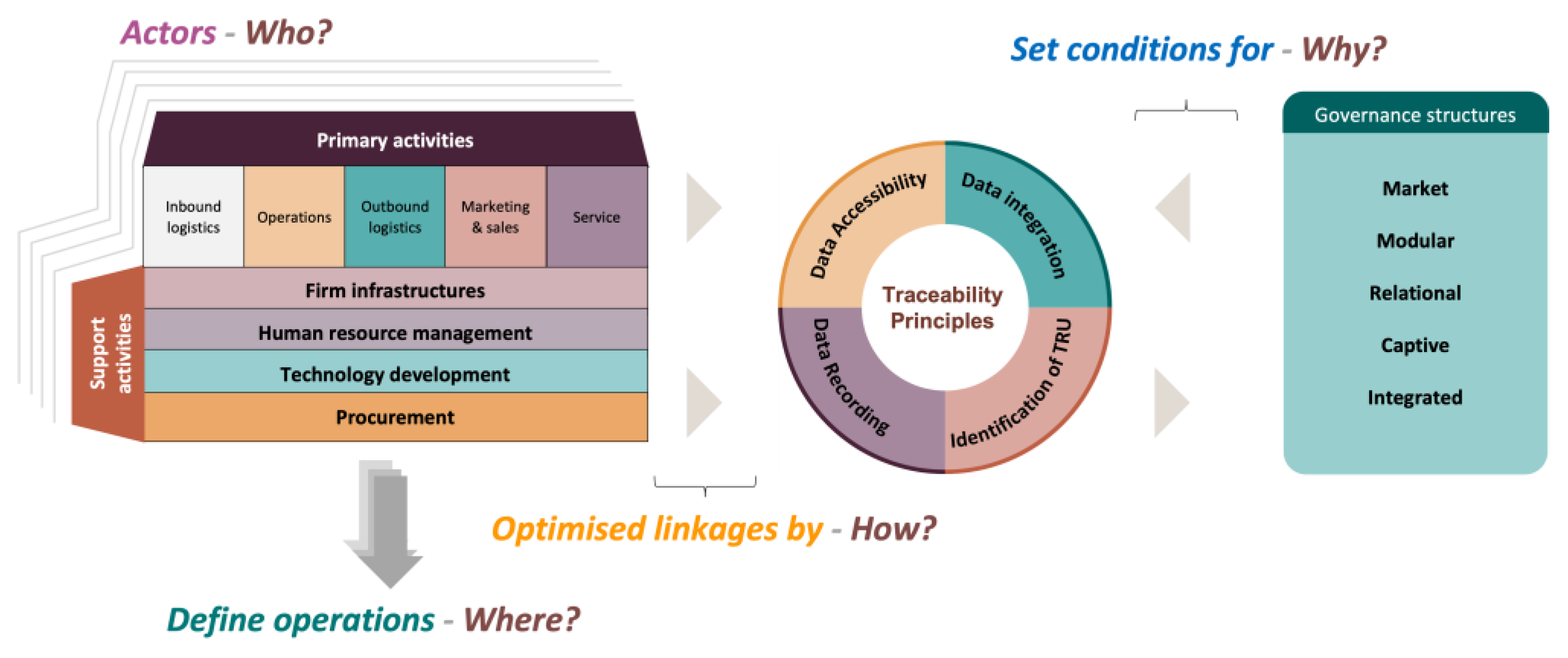
Table 1.
Interviews overview and sample characteristics.
| ID | Type | Location | Supply chain | Traceability | Technologies | |
|---|---|---|---|---|---|---|
| Int | Est | |||||
| A|1 | Organic Food supplier | Emilia Romagna | Olive oil | ü | ü | Blockchain |
| A|2 | Meat supplier | Lombardy | Meat | ü | ü | Management software+e-commerce |
| C1 | Cooperative | Tuscany | Wine | ü | ü | BI software+vinification software |
| C2 | Cooperative | Tuscany | Wine | ü | ü | Management Software + sensors |
| C3 | Cooperative | Apulia | Olive Oil | ü | ü | ERP |
| C4 | Cooperative | Tuscany | Wine | ü | ü | ERP + temperature sensors |
| C5 | Consortium | Veneto | Wine | ü | ü | Management software+APP |
| C6 | Cooperative | Sardinia | Wine | ü | ü | Management software |
| C7 | Consortium | Campania | Olive oil | ü | ü | Blockchain+Management software |
| C8 | Cooperative | Tuscany | Olive Oil | ü | ü | Milling software |
| CC1 | Certification company | Lazio | Various | ü | Dataloger + App + +AR+VR+Blockchain | |
| E1 | Consulting firm | Tuscany | Various | Scanner software+RFID systems | ||
| E2 | Consulting firm | Pidemont | Various | Blockchain+AI+smart collars | ||
| ICT1 | Tech. company | Sardinia | Dairy | ü | ü | APP+blockchain+sc |
| ICT2 | Tech. company | Campania | Trust services | |||
| ICT3 | Tech. company | Aosta Valley | Various | LoRa+low energy sensors+blockchain | ||
| ICT4 | Tech. company | Sardinia | Various | |||
| P1 | Farm | Apulia | Olive Oil | ü | ü | Blockchain |
| P2 | Winery | Tuscany | Wine | ü | ü | 2 in-house software |
| P3 | Farm | Tuscany | Olive Oil | ü | ü | Blockchain+sc |
| P4 | Farm+mill | Campania | Olive Oil | ü | ü | Blockchain+ERP |
| P5 | Farm+mill | Sardinia | Olive Oil | ü | Milling software+ TAG NFC | |
| P6 | Farm | Sardinia | Olive Oil | ü | ü | Excel+Management Software+GPS |
| T1 | Snack Factory | Sardinia | Snacks | ü | ü | - |
| T2 | Dairy factor | Abruzzo | Cheeses | ü | IoT+ blockchain+ERP | |
| T3 | Pasta factory | Campania | Pasta | ü | ü | Blockchain+sc |
| T4 | Pasta factory | Sardinia | Pasta | ü | 2 farming platforms + smart harvester | |
| T5 | Mill company | Tuscany | Olive Oil | ü | ü | Management software |
Table 3.
Interviewed companies - Products traced and economics performance.
| ID | Main Spec. | Product traced | Revenue | Net Profit | Employee | ROE | ROA |
|---|---|---|---|---|---|---|---|
| Euros | Number | % | |||||
| A|1 | Marketing | EVO oil | 73,214,825 | 51,791 | 100 | 0.33 | 0.22 |
| A|2 | Marketing | Meat | 1,194,426 | -1,406,267 | 8 | n.s. | -143.14 |
| C1 | Prod./marketing | Wine | 5,019,906 | 23,983 | 21 | 1.56 | 0.78 |
| C2 | Prod./marketing | Wine | 13,822,793 | 0 | 14 | 0 | 1.06 |
| C3 | Prod./marketing | Olive Oil | 7,107,887 | 9,931 | 3 | 4.36 | 1.45 |
| C4 | Prod./marketing | Wine | 2,933,033 | 15,149 | 10 | 1.67 | 1.04 |
| C5 | Protection/prom. | Wine | 510,555 | 34,902 | 10 | 6.34 | 1 |
| C6 | Production | Wine | 11,916,258 | 258 | 34 | 0 | 0.59 |
| C7 | Protection/prom. | EVO Oil | 291 | -10,381 | - | n.s. | -159.42 |
| C8 | Prod./marketing | Olive Oil | 392,255 | 144,880 | 7 | 29.84 | 15.32 |
| CC1 | Quality controls | Various | 36,165,329 | 411,467 | 217 | 19.44 | 4.22 |
| E1 | R&D | Several | 550,898 | 24,075 | 6 | 12.61 | 8.14 |
| E2 | Traceability services | Alpine grazing | - | - | - | - | - |
| P1 | Olive growing | EVO Oil | 72,868 | 3,746 | 0 | 65.19 | 11.32 |
| P2 | Prod./marketing | Wine | 16,330,351 | 0 | 36 | 0 | 1.6 |
| P3 | Arable/Olive growing | EVO Oil | 57,479 | -212,470 | 4 | -4.33 | -2.18 |
| P4 | Milling | PDO Olive oil | - | - | - | - | - |
| P5 | Milling | EVO Oil | - | - | - | - | - |
| P6 | Prod./marketing | EVO Oil | 1,887,480 | 6,166 | 3 | 5.86 | 1.28 |
| T1 | Transformation | Artisanal Chips | 2,343,398 | 1,799 | 13 | 0.18 | 1.38 |
| T2 | Transformation | Cheese | 3,373,397 | 64,685 | 21 | 5.97 | 5.42 |
| T3 | Transformation | PGI pasta | 5,007,000 | 11,000 | 15 | 0.06 | 0.26 |
| T4 | Transformation | Pasta | - | - | - | - | - |
| T5 | Milling | Olive oil | 398,139 | 79,856 | 3 | 34.99 | 17.34 |
| ICT1 | Traceability techn. | Cheese | 0 | -13,217 | 0 | - | -4.22 |
| ICT2 | Trust services | Various | 23,125,341 | 3,611,997 | 99 | 36.83 | 28.66 |
| ICT3 | IoT solutions | Pesto sauce | 45,455 | 13,464 | 0 | 92.57 | 56.49 |
| ICT4 | IoT solutions | 77,971,000 | -3,796,000 | -1.5 | -1.84 | ||
Table 4.
Impact of digital traceability on key primary and support activities in the wine supply chain.
Table 4.
Impact of digital traceability on key primary and support activities in the wine supply chain.
| C1 | C4 | C5 | CC1 | P2 | |
|---|---|---|---|---|---|
| Primary activities | |||||
| Inbound | Monitor weather conditions and collect field data | ||||
| Operation | Tracking grapes from harvest to wine production |
Partial integration of Industry 4.0 technologies in vinification and grape reception |
Managing certifications, traceability, and data monitoring (e.g., sustainability certifications, bottling, and stock management) | Implemented digital tools like the "Dioniso" database, inspection systems (PC, tablet), and AR/VR for vineyard monitoring and training |
Tracks production from grape reception to packaging, using barcodes to manage wine flow |
| Outbond | Managing distribution logistics | Use of QR codes on labels for regulatory purposes | Barcodes are used during the bottling process, and products are tracked until they reach the final packaging stage | ||
| Marketing | Enhance brand strength and market perception of the product |
Use of QR codes for commercial purposes | |||
| Service | Members support | Facilitate market analysis and ensure product traceability up to the consumer level (e.g., QR codes and digital labels for product information) | Use of digital platforms for traceability and certification, including tools for ensuring compliance with environmental and sustainability standards | ||
| Support activities | |||||
| Infrast. | Software systems for data management and process integration | Digital sensors for temperature monitoring | Implementation of software systems for administrative tasks, certification processes, and monitoring | Developed interoperable platforms, integrated data sources, and engaged in European projects | Data is stored on physical and virtual servers, managed by in-house software |
| Hum. Res. | Staff training | Training and use of external consultants for digital implementation | Collaboration with external consultants and use of software-specific support services | Internal quality and safety team, supported by external software and system consultants | |
| Tech. Dev. | QR code e smart labels |
Deployment of AR and VR tools for inspections and training, and use of digital loggers for monitoring conditions during product transport |
Uses manual and automatic systems for data entry and tracking, including readers in bottling | ||
| Proc. | Quality focus | ||||
| Value creation | Ensuring quality, efficiency, compliance, and market differentiation |
Improved product quality and process efficiency, better compliance with regulations |
Improved operational control, enhanced product quality, and increased compliance with market and regulatory demands |
Digital integration boosts efficiency, certification reliability, and environmental compliance, adding product value |
Improved production control enhances quality, safety, brand reputation, and regulatory compliance |
| Value capture | Enhancing relationships, brand reputation, pricing, and profit through efficiency | Increased market positioning, higher customer trust, and enhanced profitability |
Increased consumer trust, brand value, and market positioning through transparent product information |
Enhanced certification transparency strengthens market position, builds trust, and opens access to premium markets |
Better traceability and data management boost customer trust and market competitiveness, enhancing sales and positioning |
Table 5.
Impact of digital traceability on key primary and support activities in the Olive Oil supply chain.
Table 5.
Impact of digital traceability on key primary and support activities in the Olive Oil supply chain.
| A|1 | C7 | P1 | P3 | P4 | |
|---|---|---|---|---|---|
| Primary activities | |||||
| Inbound | |||||
| Operation | Blockchain tracks olive oil from harvest to bottling, including DOP and organic certifications | Use of the "Sian" system and blockchain to ensure traceability of olive oil from olive harvesting through milling, bottling, and storage, including quality checks and compliance with standards | The company, use sensors, digital records, and blockchain to track and document olive oil production from field to bottiling | Uses blockchain to trace olive oil from field to bottling, ensuring transparency and PDO/organic compliance through detailed documentation | Mandatory traceability through the "Sian" system, tracking olive oil production from harvest to bottling, including by-product and waste management |
| Outbound | |||||
| Marketing | QR codes on bottles link consumers to product origin and production details via blockchain | QR codes on bottles to provide consumers with access to product origin and production details, promoting transparency and enhancing the brand’s value | QR codes enable consumers to access detailed product information and traceability from bottle to olive tree via blockchain | QR codes on bottles allow consumers to access detailed information about the product's origin, production process, and quality metrics | |
| Service | Real-time updates to regulatory bodies via the "Sian" system, ensuring compliance and facilitating audits | ||||
| Support activities | |||||
| Infrast. | Internal servers and cloud systems manage data, integrated with SIAN for compliance | Data managed through internal servers, cloud systems, and FederItaly's blockchain platform, ensuring secure and reliable data storage and access. | Use of digital platforms for managing and storing data, including blockchain for secure and transparent data tracking | An external platform manages blockchain data, with documents digitized on internal servers before transfer | Use of internal servers and cloud systems for secure data management, with automated data transfer to external platforms |
| Hum. Res. | |||||
| Tech. Dev. | Field sensors monitor conditions in real-time for organic compliance, though data entry remains largely manual | Consideration of drones and other monitoring technologies for future implementation to improve agricultural monitoring and production forecasting | Deployment of sensors in the field for real-time data collection and integration with digital platforms for data management | Field sensors were discontinued due to poor results; QR codes now manage product identification and traceability | Sensors for temperature monitoring during the cold extraction process to ensure product quality |
| Proc. | |||||
| Value creation | Improved traceability and transparency enhance product quality and compliance | Enhanced traceability, product quality, and transparency through digital tools, contributing to stronger consumer trust and compliance with market regulations | Digital tools enhance traceability, quality assurance, and compliance, adding value through improved product transparency | Blockchain and QR codes boost transparency and traceability, meeting consumer demand and ensuring quality compliance, adding value | Enhances the traceability and quality control of the production process, adding value by ensuring the product meets high standards and is fully compliant with regulatory requirements |
| Value capture | Increased consumer trust and brand differentiation through transparency | Potential for premium pricing and market differentiation by leveraging transparency and product authenticity through digital traceability systems. | Digital traceability strengthens trust, justifies premium pricing, and improves market positioning | Digital tools enhance brand differentiation and loyalty, leading to better market positioning and premium pricing opportunities | Strengthened consumer trust and brand reputation, enabling market differentiation |
Table 6.
Impact of digital traceability on key primary and support activities in the Pasta, and Cheese supply chain.
Table 6.
Impact of digital traceability on key primary and support activities in the Pasta, and Cheese supply chain.
| E2 | ICT1 | T3 | T4 | |
|---|---|---|---|---|
| Primary activities | ||||
| Inbound | Digital platforms monitor and track wheat production using field sensors and machinery data | |||
| Operation | Blockchain tracks cheese production from milk collection to processing, ensuring traceability of each step, including the specific cattle pasture | Blockchain tracks cheese production ensuring full traceability and transparency | Blockchain tracks the entire pasta production process, from wheat cultivation to manufacturing | |
| Outbond | Barcodes ensure traceability from packaging to distribution | |||
| Marketing | QR codes on cheese packaging provide consumers with detailed product information, including production process and origin | QR codes on cheese packaging give consumers access to detailed production information, enhancing product authenticity and market appeal | QR codes on pasta packaging provide consumers with detailed origin and production process information (wheat fields) | QR codes on packaging provide product origin and production details to consumers |
| Service | ||||
| Support activities | ||||
| Infrast. | Integration of blockchain with internal data systems to securely manage and store information related to dairy production and traceability | Use of internal servers and cloud systems integrated with blockchain to manage and secure data related to production and traceability | Integration of internal servers and blockchain platforms to manage, store, and secure data on wheat sourcing, milling, and pasta production | Integration of internal systems with external platforms for secure data management |
| Hum. Res. | ||||
| Tech. Dev. | IoT devices and sensors monitor cattle locations and behavior, linking pasture data to cheese production for enhanced traceability | Potential integration of IoT devices to improve data accuracy during milk collection and cheese production processes | Potential use of IoT devices and field sensors for crop monitoring, with much data entry still manual | Field sensors and advanced machinery enhance crop monitoring and yield data collection |
| Proc. | Integrating data from field sensors and machinery for real-time crop monitoring and planning | |||
| Value creation | Improved product traceability and quality control, enhancing consumer trust and product authenticity | Improved traceability and transparency strengthen product quality and compliance with industry standards | Blockchain-enhanced traceability boosts product quality, compliance, and consumer trust. | Integrated digital systems enhance traceability and quality control, boosting product reliability and consumer confidence |
| Value capture | Increased brand reputation and differentiation through transparency and detailed product information | Enhanced brand reputation and consumer trust through detailed, accessible product information | Increased brand reputation and market differentiation through transparency and authenticated product origin | Strengthened brand reputation and market differentiation through transparency and detailed product information |
Table 7.
Detailed management and traceability metrics across different supply chains.
| ID | Identification (TRUs) | Granularity of TRU | Data Recording | Integrating data | Data accessibility |
|---|---|---|---|---|---|
| C5 | Bottles, Batches (grapes, fermentation tanks, bottles), Process (QR codes, IDs) | Individual bottles, batches of grapes, fermentation tanks, bottle batches | Mixed: Manual entry + Automated systems (compliance-focused) | Moderate; challenges with interoperability | Variable: High for authorities, moderate for others (cloud-based) |
| ICT1 | Milk, batches of milk, cheese products (tracked via blockchain and QR codes) | Individual milk deliveries, processing batches, final cheese products | Manual entry, mobile apps, digital system mirrored on blockchain | Moderate; centralized database with blockchain mirroring, some manual processes | Moderate; QR codes provide consumer access, but blockchain data is encrypted and access-controlled |
| ICT4 | Batches of milk, Cheese products, batches of cheese during production and aging | Individual cheese products, batches during milk collection, processing, and aging | IoT devices, manual entry, centralized database, potential blockchain integration | Low-Moderate; combination of manual and digital processes, fragmented integration | Moderate; QR codes for consumer access, controlled blockchain access |
| P3 | Olive trees, batches of olives (based on harvest time), bottles | Individual bottles, batches of olives based on harvesting periods | Manual entry, digitalization by external service (EZ Lab) | Moderate; managed by external provider, manual to digital data transfer | Moderate; QR codes for consumers, centralized control by external provider |
| T3 | Wheat lots, batches of semolina, final pasta products | Individual wheat lots, semolina batches, pasta products | Manual entry, IoT devices, blockchain integration | Low-Moderate; manual data entry with some digital integration, potential for errors | Moderate; QR codes for consumer access, controlled access to detailed blockchain data |
Table 8.
Digital traceability and governance structures.
| ID | Supply chain | Complexity of transactions | Supplier autonomy | Data intermediaries | Governance type |
|---|---|---|---|---|---|
| C5 | Wine | High | Low | Integral; Central role of C5 | Captive network with elements of relational governance |
| ICT1 | Cheese | Moderate-high | Low | Integral with a central role | Mix of captive modular and relational |
| ICT4 | Cheese | Moderate-high | Low | Integral with a central role | Mix of captive and modular |
| P3 | Olive Oil | High | Low | Integral; Key role of external mill and certification bodies | Mix of captive and modular |
| T3 | Pasta | Moderate-high | Moderate-low | Critical role | Modular with some captive network elements |
Table 9.
Identified positive or negative attributes of successful digital traceability system.
| ID | C5 | ICT1 | ICT4 | P3 | T3 |
|---|---|---|---|---|---|
| Increased capacity | |||||
| Research/education | √ | √ | √ | √ | √ |
| Knowledge exchange | √ | √ | √ | √ | √ |
| Reduced costs | |||||
| Reduced variable cost | X | X | X | √ | X |
| Reduced fixed costs | X | X | X | X | X |
| Production resilience | √ | √ | √ | √ | √ |
| Financial resilience | - | - | - | - | - |
| Product differentiation valued by market | |||||
| Differentiation by traceability | √ | √ | √ | √ | √ |
| Enhance market access | √ | √ | √ | √ | √ |
| Enabling marketing opportunities | √ | √ | √ | √ | √ |
| Certification organic | X | √ | √ | √ | √ |
| Certification animal welfare | X | √ | √ | X | X |
| Certification Sustainability | √ | √ | √ | √ | √ |
| Societal value and farmer well-being | |||||
| Enjoyment/improved well-being for farmer | - | - | - | √ | - |
| Community engagement | √ | √ | √ | √ | √ |
| Perceived environmental benefits by farmer | √ | √ | √ | √ | √ |
| Perceived animal welfare benefits by farmer | X | √ | √ | X | X |
| Government finance for digitalisation | √ | √ | √ | √ | √ |
| Other support | - | - | - | - | - |
√ Positive factor mentioned; X Negative factor mentioned; - Non relevant factor or not mentioned.
Disclaimer/Publisher’s Note: The statements, opinions and data contained in all publications are solely those of the individual author(s) and contributor(s) and not of MDPI and/or the editor(s). MDPI and/or the editor(s) disclaim responsibility for any injury to people or property resulting from any ideas, methods, instructions or products referred to in the content. |
© 2025 by the authors. Licensee MDPI, Basel, Switzerland. This article is an open access article distributed under the terms and conditions of the Creative Commons Attribution (CC BY) license (http://creativecommons.org/licenses/by/4.0/).
Copyright: This open access article is published under a Creative Commons CC BY 4.0 license, which permit the free download, distribution, and reuse, provided that the author and preprint are cited in any reuse.