

Submitted:
30 April 2025
Posted:
02 May 2025
You are already at the latest version
Abstract
Ammonium nitrate (NH4NO3) is a major constituent of fine particulate matter 13 (PM2.5), playing a critical role in air quality and atmospheric chemistry. However, the dual 14 regulatory role of ammonia (NH3) in both the formation and volatilization of NH4NO3 15 under ambient atmospheric conditions remains inadequately understood. To address this 16 gap, we conducted high-resolution field measurements at a clean tropical coastal site in 17 China using an integrated system of Aerosol Ion Monitor-Ion Chromatography (AIM-IC), 18 Scanning Mobility Particle Sizer (SMPS), and online OC/EC analyzers. These observations 19 were complemented by thermodynamic modeling (E-AIM) and source apportionment via 20 Positive Matrix Factorization (PMF) model. The E-AIM simulations revealed persistent 21 thermodynamic disequilibrium, with particulate NO3- tending to volatilize even under 22 NH3gas-rich conditions during the northeast monsoon. This suggests that NH4NO3 in PM2.5 23 forms rapidly within fresh combustion plumes and/or those modified by non-precipita-24 tion clouds, and then undergoes substantial evaporation as it disperses through the at-25 mosphere. Under the southeast monsoon conditions, reactions constrained by sea salt aer-26 osols became dominant, promoting the formation of particulate NO3- while suppressing 27 NH4NO3 formation despite ongoing plume influence. In scenarios of regional accumula-28 tion, elevated NH3 concentrations suppressed NH4NO3 volatilization, thereby enhancing 29 the stability of particulate NO3- in PM2.5. PMF analysis identified five source factors, with 30 NO3- in PM2.5 primarily associated with emissions from local power plants and the large-31 scale regional background, showing marked seasonal variability. These findings highlight 32 the complex and dynamic interplay between the formation and evaporation of NH4NO3 33 in NH3gas-rich coastal atmospheres.
Keywords:
particulate nitrate
; primary sources
; gas-aerosol partitioning
; atmospheric NH3
; source apportionment
1. Introduction
Ammonium nitrate (NH4NO3), a significant water-soluble inorganic component in atmospheric particles, plays a critical role in influencing regional visibility, cloud condensation nuclei (CCN) activity, and radiative forcing through its spatial distribution and gas-particle partitioning behavior [1,2,3,4,5,6,7,8,9,10,11,12]. The thermodynamic properties of NH4NO3 make its concentration highly sensitive to changes in ambient temperature (T) and relative humidity (RH) [2,13,14,15,16,17,18,19,20]. For example, elevated RH enhances the partitioning of both HNO3gas and NH3gas into the submicron particle phase, as well as the transfer of HNO3gas to supermicron particles through the neutralization of negative charges by non-volatile metal ions, thereby further regulating the formation and stability of NH4NO3 and nitrate metal salts [2,14,15,17,18,19]. Conversely, elevated temperatures and low humidity conditions tend to drive the dissociation of NH4NO3 back into the gas phase [17,18,19]. These coupled thermodynamic and chemical interactions underscore the importance of elucidating the formation and depletion mechanisms of NH4NO3 in the atmosphere [9,11,21,22,23].
In the formation of NH4NO3 through the transfer of HNO3gas to submicron particles, NH3gas, the primary component of atmospheric alkaline gases, serves as both a key precursor and a stabilizing agent [24,25,26,27,28,29,30]. Additionally, N2O5gas contributes to nighttime nitrate formation through particle-phase condensation processes, during which NH3gas further enhances the stability of NH4NO3 aerosols, particularly under conditions of low alkali metal ion concentrations (such as Na+ and K+) in the submicron particles [31,32,33,34,35,36]. Globally, the primary source of NH3 is agricultural activities, although transportation and industrial emissions in urban areas also contribute to NH3 emissions [37,38,39,40,41,42,43]. Thus, the regulatory effect of NH3 on NH4NO3 demonstrates significant spatial heterogeneity and concentration dependence [12,24,44,45,46,47,48]. Observational evidence suggests that when the NH3 concentration exceeds the stoichiometric threshold required for the complete neutralization of sulfate, its role shifts from “precursor-limited” to “thermodynamic-limited,” fundamentally altering the pathways of NH4NO3 formation and its phase stability [10,48,49,50,51,52,53].
In contrast to previous studies that primarily focused on the formation pathways, environmental impacts, climatic effects, and policy implications of NH4NO3, Shen et al. [23] provided comprehensive evidence showing that high concentrations of NH4NO3 during severe PM2.5 (atmospheric particles with diameter less than 2.5 μm) air pollution events are primarily due to prolonged, rapid conversion within combustion plumes under cold, humid and stable meteorological conditions, followed by subsequent evaporation along the plume dispersion track in ambient air. Using isotopic traces, Xiao et al. [54] found that nitrate in PM2.5 primarily originated from primary combustion in a central Chinese city. Furthermore, two independent thermodynamic modeling studies in Beijing showed that thermodynamic force did not support the formation of NH4NO3, even under NH3gas-rich atmospheres [49,55]. More recently, Sun et al. [8] and Yang et al. [44] identified high concentrations of NH4NO3 at approximately 400 meters in altitude in northern and eastern China, consistent with emission heights and plume rise from strong industrial sources. If NH4NO3 aerosols in ambient air primarily originated from primary emissions and prolonged combustion plumes, NH4NO3 evaporation would generally be expected to occur [56,57]. This raises the question: does atmospheric NH3 play a role in reducing NH4NO3 evaporation or in promoting NH4NO3 formation in ambient air?
This paper aims to comprehensively investigate the dual regulatory roles of ammonia in both the formation and evaporation of NH4NO3, using high-resolution data collected at a clean coastal site on a tropical island in China [58]. The simplicity and clarity of pollution sources at this location offer an ideal environment for isolating the effects of NH3, thereby enhancing the robustness of the analysis. By combining field observational data analysis, thermodynamic equilibrium modeling, and source apportionment analysis, this work provides novel scientific insights into the synergistic regulation of nitrate aerosols in PM2.5. The findings are expected to offer theoretical foundations for improved air pollution mitigation strategies and for advancing our understanding of aerosol-climate interactions.
2. Materials and Methods
The sampling site for this study is situated on the third floor of a research building within a high-tech industrial park in southeastern Hainan Province (18.328°N, 109.169°E, Figure 1a-b). This region represents a typical land-sea transition zone, positioned approximately 1.9 km west of the South China Sea coastline [58]. It is seasonally influenced by alternating southeasterly and northeasterly monsoons under the overarching control of the East Asian monsoon system. To the south of the site, a 487-meter-high hill situated 1.3 km away acts as a local topographic barrier, fostering local circulation patterns under weak synoptic forcing. Between the sampling site and the hill lies the Huaneng Nanshan Power Plant-a natural gas-fired facility located 1.2 km to the south at the hill’s base (Figure 1cd). The plant has a total installed capacity of 2 × 46 MW (new generators visible on the left side of Figure 1c) and 132 MW (original units largely obscured on the right side of Figure 1c), and serves as a major source of industrial air pollutant emissions in the area. Plumes from the facility are occasionally observed traversing the sampling location. Additionally, within a 5 km radius of the park, the surrounding landscape comprises undeveloped wastelands and agricultural land, with approximately 2.3 km2 designated for future development. A major traffic road is located 50 meters east of the sampling point, with traffic volumes reaching 810 vehicles per hour during peak periods (07:00-09:00 and 17:00-19:00), 24% of which are electric vehicles (zero-emission models), classifying it as a low mobile pollution source area.
The study utilized an Aerosol Ion Monitor-Ion Chromatography system (AIM-IC) (Thermo Fisher, Waltham, MA, USA) for the continuous monitoring of both gaseous and particulate matter in the atmosphere. The detection limits for NO3- and NH4+ were 5 × 10⁻² μg m-3 and 4 × 10⁻⁴ μg m-3, respectively. The AIM-IC system was installed within the laboratory and connected to ambient air via a 2.5-meter-long stainless steel inlet tube (3.5 cm inner diameter), with the sampling probe positioned approximately 10 meters above ground level. Regular maintenance and calibration procedures were carried out throughout the observation period to ensure the accuracy and instrument stability. Data collected during two periods-November to December 2023 and June 2024 were used for analysis, capturing atmospheric composition under varying meteorological conditions. Detailed operational information for the AIM-IC system is available in our previous publications [18,58,59]. The AIM-IC system is equipped with two analytical columns, one for cations (Ion Pac CS20, 2 × 250 mm) and one for anions (Ion Pac AS 11-HC, 2 × 250 mm), along with two guard columns, one for cations (CG20, 2 × 50 mm) and one for anions (AG 11-HC, 2 × 50 mm). Additionally, the system is equipped with a PM2.5 cyclone separator to ensure accurate sampling of fine particulates, operating at a flow rate of 3 L min-1. The system provides hourly concentration data for reactive gases (NH3, SO2, HNO3, etc.) and water-soluble ions (NH4+, NO3-, etc.). It is important to note that the HNO3 signal measured by AIM-IC includes not only gaseous HNO3 but also contributions from its atmospheric precursors, such as N2O5, a fraction of organic nitrate, and trace amounts of NO2 in ambient air, similar to other acidic vapor species measured by the system [59]. Therefore, HNO3* was used instead of HNO3 in the subsequent analysis.
Particle size spectrum data were measured simultaneously using a Scanning Mobility Particle Sizer (SMPS, Grimm, Germany). During sampling, the air was dried before entering a differential analyzer, where the number concentration size distribution from 11 to 1110 nm was obtained at a sampling flow rate of 0.3 L min-1, with a 4-minute resolution and 112 sampling channels, providing high-precision particle size distribution data. Additionally, an OC-EC online analyzer (Model 4, Sunset, USA) was employed for the continuous monitoring of organic carbon (OC) and elemental carbon (EC) in PM2.5. Owing to the relatively clean atmospheric conditions at the sampling site (annual mean PM2.5 < 10 μg m-3), OC and EC concentrations were monitored with a time resolution of 2 hours to improve signal-to-noise reliability. However, the OC-EC analyzer experienced frequent malfunctions. Data points identified as outliers due to instrument malfunction or external contamination events were excluded during quality control to ensure the accuracy and integrity of the dataset.
For model applications, this study utilized the Extended AIM Aerosol Thermodynamics Model (E-AIM, versions Model II and Model IV, available at: http://www.aim.env.uea.ac.uk/aim/aim.php) to simulate the gas-particle partitioning equilibrium of NH4NO3. E-AIM remains the only publicly available thermodynamic model capable of simultaneously resolving multiphase equilibrium processes involving both inorganic and organic aerosols. The core assumptions of E-AIM are as follows: (1) homogeneous internal mixing of aerosol components, and (2) thermodynamic equilibrium between aerosols and ambient gases [58,59]. In this study, both Model II and Model IV were used to calculate equilibrium partitioning among gaseous, aqueous, and solid phases. Model II is suitable across a broad range of relative humidity (0.1 < RH < 1.0) and accounts for the multiphase behavior of the NH3-HNO3-H2SO4-NH4+-NO3--SO42- (including solid salt precipitation and liquid water dissolution), resolving the distribution of species such as (NH4)2SO4, NH4NO3, etc. Model IV extends the capabilities of Model II by incorporating Cl- and Na+ to represent the influence of sea salt aerosols. Meteorological data were obtained from the China Meteorological Data Service Center (http://data.cma.cn/), and hourly PM2.5 mass concentration data were retrieved from three national monitoring sites in Sanya. Using the NOAA HYSPLIT model (https://www.ready.noaa.gov/HYSPLIT.php), 24-hour backward trajectories were calculated at a height of 500 m, reflecting air mass transport characteristics at the top of the boundary layer during the day or above it at night, with a time resolution of 1 hour.
To apportion the source contributions of NO3- in PM2.5 ([NO3-]PM2.5), the study integrated the modified particle number concentration spectrum (11-700 nm, with 39 size segments reduced from the original ones) with the [NO3-]PM2.5 composition matrix using the Positive Matrix Factorization (PMF) model for positive matrix decomposition. This method clarified the contributions of various source aerosols to the formation and evolution of NO3-. Strong new particle formation (NPF) events were excluded during the PMF analysis to minimize their dominant effect on the dataset. The study used the Q-value (Q/Qexp) as a fitting evaluation index, comparing changes in Q-values across different factor solutions and considering residual distribution and the physical significance of factor spectra to determine the optimal solution[60]. After running the model 20 times with data from 2023 and 2024, the five best factors were identified, with a Q/Qexp ratio of 1.12.
3. Results
3.1. Overview of Observational Results at the Coastal Site
Figure 2 illustrates time series of concentrations of major ions (including NO3−, NH4+, SO42−, and Na+) and carbonaceous components (OC and EC) in PM2.5, along with hourly measurements of NH3 and HNO3* gases during the observation periods (14 November to 12 December 2023 and 7-20 June 2024). During the continuous observation in November 2023 (excluding 27-30 November), the [NO3-]PM2.5 remained relatively low, fluctuating around 0.6 ± 0.3 μg m-3, with a maximum value of only 1.7 μg m-3. However, between 27 and 30 November, several peaks in [NO3-]PM2.5 were observed, with the highest concentration reaching 3.9 μg m-3. A weak correlation was observed between [NO3-]PM2.5 and the corresponding SO42- and NH4+ concentrations (R2 = 0.42 and 0.52, respectively; P < 0.01), whereas, SO42- and NH4+ showed a strongly correlated (R2 = 0.91; P < 0.01). These results suggested that NO3- in PM2.5 partly existed as NH4NO3, while SO42- was primarily existed as NH4+ salts. Furthermore, no correlation was found between [NO3-]PM2.5 and Na+ concentrations, indicating that aged sea salts, such as NaNO3, were not major contributors to the observed NO3- in PM2.5. Additionally, NO3- in PM2.5 and other ions exhibited significant diurnal variations, although the characteristics of these variations were inconsistent.
In contrast, the diurnal variations of the concurrently observed HNO3*gas were consistent clear, with peaks consistently occurring around noon and before sunset, and low values observed before sunrise (Figure 2c). Similarly, NH3gas showed a generally consistent diurnal pattern, characterized by peak concentrations shortly after sunrise and around midnight, and minimum concentrations occurring before and after sunset. A comparison of the diurnal variations of ions in PM2.5 and the concurrently observed gases suggested that diurnal meteorological factors (such as T, RH, wind speed, wind direction, and sunlight) may significantly influence the concentration variations of each component. The sources of ions in PM2.5 appear to be more variable than HNO3*gas and NH3gas.
Furthermore, during the one-month observation period, atmospheric NH3gas concentrations fluctuated around 8.2 ± 3.3 μg m-3, with a maximum of 23 μg m-3 and a minimum of 2.5 μg m-3. In contrast, HNO3*gas concentrations remained much lower, fluctuating around 0.1 ± 0.04 μg m-3, with the maximum of 0.3 μg m-3. Despite the fact that the formation of particulate [NO3-]PM2.5 is governed by the product of NH3 and HNO3 concentrations[13], the markedly lower levels of HNO3*gas suggest that it was a more significant limiting factor for [NO3-]PM2.5 formation in this environment. The carbonaceous components in PM2.5, particularly OC, significantly exceeded the concentrations of inorganic ions, with concentration ranging from 4.7 to 12 μg m-3 C (6.7 ± 1.3 μg m-3 C). The corresponding EC ranged from 0.2 to 1.5 μg m-3 C (0.4 ± 0.1 μg m-3 C), which were slightly lower than [NO3-]PM2.5. The high OC and OC/EC ratios might be related to nearby cooking emissions, as suggested by the concurrently low SO42- and NO3- concentrations [61].
Similar to the data from November-December 2023, the [NO3-]PM2.5 in June 2024 remained at a low concentration level of 0.2 ± 0.1 μg m-3, except for June 16. During this period, the maximum concentration observed was 0.7 μg m-3. However, on June 16, a distinct anomaly in [NO3-]PM2.5 was observed, with a peak of 1.8 μg m-3, significantly higher than the concentrations on the preceding and following days. During the two-week observation period in June, [NO3-]PM2.5 exhibited noticeable diurnal variation, but the timing and width of the daily peaks were inconsistencies, suggesting the complexity of its influencing factors. A weak correlation was observed between [NO3-]PM2.5 and the corresponding SO42- and NH4+ concentrations (R2 = 0.46 and 0.51, respectively; P < 0.01), whereas SO42- and NH4+ were strongly correlated (R2 = 0.88, P < 0.01). These results suggest that NO3- in PM2.5 partly existed in the form of NH4NO3, while SO42- predominantly existed as NH4+ salts. A significant correlation was found between NO3- and Na+ in PM2.5 (R2 = 0.64, P < 0.01), indicating that aged sea salts, such as NaNO3, may have contributed to the formation of NO3- in PM2.5.
The diurnal variation of the concurrently observed NH3gas concentrations also exhibited strong fluctuations, but the shape and timing of the peaks varied considerably. During the June observation period, the maximum and minimum NH3 concentrations ranged were 13 μg m-3 and 0.5 μg m-3, respectively. Concentrations below 1 μg m-3 predominantly occurred between midnight and sunrise. The diurnal variation of HNO3*gas generally showed an inverse pattern to that of NH3gas, except on 16 June. HNO3*gas concentrations fluctuated around 0.06 ± 0.06 μg m-3, with the maximum of 0.6 μg m-3. However, nighttime concentrations remained below 0.1 μg m-3. On 16 June, between 06:00 and 12:00, HNO3*gas concentrations exceeded 2 μg m-3 during four separate intervals. The impact of high concentrations of HNO3*gas on [NO3-]PM2.5 will be discussed later. Throughout the observation period, the carbonaceous components in PM2.5 exhibited relatively low concentrations. Specifically, OC ranged from 0.5 to 2.7 μg m-3 C (1.1 ± 0.4 μg m-3 C), and EC ranged from 0.01 to 0.4 μg m-3 C (0.1 ± 0.1 μg m-3 C). These values were among the lowest compared with recent measurements in the U.S. [62]. This reduction in OC and EC concentrations can be attributed to the influence of the southwest monsoon, which brought air masses primarily from the ocean.
3.2. Thermodynamic Equilibrium Simulations for the Four Cases
To understand the causes for NO3- peaks in PM2.5, thermodynamic equilibrium simulations were conducted to examine the gas-aerosol partitioning states. Figure 3 shows a comparison between the thermodynamic equilibrium simulations and observations for HNO3gas, NH3gas, and HClgas. During 27-29 November 2023, the simulated concentrations of HNO3gas deviated from the 1:1 line in over 90% of the time, indicating that the NO3- in PM2.5 has not reached equilibrium with HNO3gas and was undergoing volatilization into the gas phase. The degree of deviation was independent on the corresponding [NO3-]PM2.5, as indicated by the color scale in Figure 3. However, the simulation did not account for the presence of K+, which may bind with a fraction of NO3-. K+ had an appreciable contribution in PM2.5 as analyzed in Section 3.3-3.6. This omission could partially explain the positive biased simulated HNO3gas. Nevertheless, given the elevated levels of atmospheric NH3 observed during this period, the potential impact of this error is expected to be minimal. Moreover, on 27 and 29 November, approximately 10% of the data points aligned with the 1:1 line, suggesting that NO3- in PM2.5 and gaseous HNO3 reached equilibrium during these periods. Conversely, no negative deviations from the 1:1 line were observed, providing strong evidence that particulate nitrate formation did not occur. Recall that the observed HNO3* includes not only gaseous HNO3 but also N2O5, organic nitrate and minor hydrolyzed NO2. This may introduce a positive bias in the observed HNO3gas, which could theoretically result in a negative deviation in the simulation. This effect is likely more pronounced at night, when N2O5 concentrations may exceed those of HNO3. However, no such negative deviations were observed. Additionally, when NaCl is not considered in the model, a more pronounced positive bias in simulated HNO3gas was observed on 28 and 29 November, especially those cases under conditions with higher [NO3-]PM2.5 (Figure S1). This suggests that a portion of HNO3gas may undergo heterogeneous reactions with NaCl to form particulate NaNO3. However, the difference was negligible on 27 November.
On 16 June 2024, the modeled concentrations of HNO3gas closely aligned with the 1:1 line for case with higher-[NO3-]PM2.5, and were positively deviated from the 1:1 line to some extent for other cases. Again, when NaCl was excluded from the model, a more pronounced overestimation of HNO3gas was observed including some higher-[NO3-]PM2.5 cases. Thus, it can be inferred that 1) NO3- associated with NH4+ in PM2.5 was undergoing volatilization to HNO3gas; 2) NO3- associated with Na+ was achieved the gas-aerosol equilibrium on that day.
The simulated equilibrium NH3gas concentration slightly exceeded the observed value, primarily because the observed NH3gas concentration is sufficiently high, meaning the gas-particle equilibrium has minimal impact. The simulated HClgas concentration shows a mix of both positive and negative deviations from the 1:1 line. These inconsistencies may stem from the presence of sea salt and ammonium salts in externally mixed forms, which are treated as internally mixed in the thermodynamic simulation. Fresh sea salt tends to produce a positive deviation, whereas aged sea salt may lead to a negative one. Additionally, the observed HCl*gas includes contributions not only from HCl but also from Cl2 and NO2Cl [63], potentially introducing a positive measurement bias that could account for negative deviations in the simulated HCl concentrations.
From a theoretical perspective, the elevated atmospheric temperatures typical of tropical regions facilitate the attainment of gas-particle equilibrium for NH4NO3, with equilibrium timescales on the order of minutes [64,65]. The simulation results for 16 June also corroborated this behavior. However, in particles produced by fresh combustion, NH4NO3 may be encapsulated by organic material [66,67,68] , significantly prolonging the time required to reach equilibrium.
3.3. Case 1: Synergistic Effects of Primary Emissions and Meteorological Conditions on the Rapid In-Plume Formation and Subsequent Volatilization of Fresh Ammonium Nitrate
The case analysis is further conducted to characterize the NO3- peaks. Case 1 is based on observations obtained on 27 November 2023. Figure 4a-e displayed the concentrations of NO3-, NH4+, and Na+ in PM2.5, along with the concurrent atmospheric NH3gas concentrations, particle number size distributions, and changes in PM2.5 mass concentration at three national control sites in Sanya. They also included the correlation between the normalized [NO3-]PM2.5 and the sum of particle number concentrations larger than 100 nm (N>100) (as defined in the caption of Figure 4), as well as 24-hour air mass back trajectories for that day. Figure S2ab illustrated the correlations between NH4+ and NO3-, and between NH4+ and the equivalent concentrations of (NO3- + SO42-) in PM2.5. The results in Figure 4a revealed a bimodal distribution of [NO3-]PM2.5, with a lower peak at 09:00 and a higher peak at 21:00. PM2.5 mass concentrations at the three national control sites in Sanya also exhibited a similar bimodal distribution, except for a trough observed at the Junyue Sea-Beach station, which may be related to localized showers. This suggested that the increase in [NO3-]PM2.5 may have been a widespread phenomenon. However, the calculated air mass back trajectories indicated that 1) the sampling site was neither downwind nor upwind of the national control sites, and 2) the trajectories nearly overlapped during both peak and the non-peak period (Figure 4e). Therefore, it can be inferred that the atypical diurnal variations observed on that day were more likely due to local atmospheric processes rather than regional pollutant transport.
The concentrations of NH4+ and Na+ in PM2.5 exhibited unidirectional increases and decreases in their diurnal variations, respectively, and did not show a statistically significant correlation with NO3- (Figure S2 and S3a). This indicates that sea salt and atmospheric NH3gas were not the primary controlling factors for the increase in [NO3-]PM2.5. However, atmospheric NH3gas also displayed a bimodal distribution and a weak statistically significant correlation with NO3- (R2 = 0.32, P < 0.01). A more detailed analysis revealed that changes in the concentration of NH3gas concentrations lagged behind those of [NO3-]PM2.5 (Figure 4ab). Additionally, the strong correlation between the equivalent concentration of NH4+ and that of (NO3- + SO42-) (Figure S2) suggested that NH4+ in PM2.5 predominantly existed as inorganic ammonium salts. Thus, the delayed peaks of atmospheric NH3gas are more likely attributed to the volatilization of NH4NO3 [8,23,56], supporting by the thermodynamic equilibrium stimulation analysis presented in Section 3.2 . In this specific case, atmospheric NH3gas likely played a role in restricting its volatilization as gaseous (HNO3 + NH3).
The particle number size distribution presented in Figure 4c indicated that, during periods of elevated [NO3-]PM2.5, the median accumulation mode particle diameter was notably smaller than during periods with lower [NO3-]PM2.5. Additionally, the normalized [NO3-]PM2.5 exhibited a strong positive correlation with the normalized N>100, with a regression slope of 0.7. This strongly suggests that NH4NO3 primarily originated from primary sources [23,54,63,64]. The slope of less than unity also confirmed that NH4NO3 was undergoing volatilization (Figure 4d). Furthermore, the high-resolution particle number size distributions further demonstrated that, during the NO3- peak periods, the number concentration spectra fluctuated dramatically (Figure 4c), a typical feature indicative of the influence of nearby pollution sources.
3.4. Case 2: Biomass-Burning-Derived Potassium Salts and Cloud-Processing of KNO₃ and NH4NO3 by Mixing with Additional Anthropocentric Sources, Followed by NH4NO3 Volatilization
The second case occurred on 28 November 2023. On this day, the diurnal variation of [NO3-]PM2.5 exhibited a distinct pattern compared to that on 27 November (Figure 4 and Figure 5). Between 00:00 and 20:00, [NO3-]PM2.5 remained relatively stable at 1.3 ± 0.2 µg m-3 (Figure 4a), followed by a statistically significant increase to 1.5 - 3.0 µg m-3 (P < 0.05). Notably, no corresponding increase in PM2.5 mass concentration was recorded at the three national control sites (Figure 5b). This suggested that the increase in [NO3-]PM2.5 was a localized phenomenon rather than a regionally distributed event. Simultaneous particle number size distributions revealed that, during the [NO3-]PM2.5 increase, the median diameter of the accumulation mode particles decreased rather than increased (Figure 5c). Furthermore, a strong positive correlation was identified between the normalized [NO3-]PM2.5 and the normalized N>100 (Figure 5d), with the regression slope of 2.2, significantly exceeded unity. These findings suggested that [NO3-]PM2.5 was influenced by primary sources; however, primary emissions alone cannot fully account for the observed increase.
On 28 November, the concentrations of NH4+ and Na+ in PM2.5 exhibited diurnal variations similar to those observed on 27 November, although with substantially larger fluctuations. Although no statistically significant correlation was identified between [NO3-]PM2.5 and NH4+ concentrations in PM2.5 (P > 0.05, Figure S2c), NH4+ showed a strong correlation with the equivalent concentrations of (NO3- + SO42-), with a regression slope close to unity. Based on this, using 20:00-23:00 as the analysis window (t0, t1, t2, t3), the net increases in NH4+ concentrations at t1-t3 relative to t0 can be calculated by the difference. Assuming NH4+ was fully associated with (NO3- + SO42-) at a 1:1 equivalent concentration ratio, the corresponding net increase in NO3- attributed to NH4NO3 at t1-t3 was calculated to be 0.02 µg m-3, 0.04 µg m-3, and 0.05 µg m-3, respectively. These contributions account for 3.0%, 2.4%, and 4.2% of the total net increase in [NO3-]PM2.5 during the same periods. Recall that thermodynamic equilibrium stimulation analysis indicated the volatilization of NH4NO3 into gas phase. The significant increase in [NO3-]PM2.5 between 21:00 and 23:00 was likely related to the formation of other nitrates, such as KNO3 and NaNO3. However, the minimal increase in Na+ concentration in PM2.5 during this period (Figure 5a) suggested that NaNO3 may accounted for only a small fraction. In contrast, a marked increase in K⁺ concentration was observed in PM2.5 between 21:00 and 23:00 (Figure S4), indicating that biomass burning emissions may be a major contributor [69,70]. Concurrently, atmospheric NH3 also increased (Figure 5b), which may similarly be attributed to biomass burning emissions [33]. Other anthropogenic or natural sources of NH3 during nighttime are considered less likely [18,33,71]. It is noteworthy that, compared with 27 November, the nucleation mode in the particle number size spectrum nearly disappeared during the NO3- increase, suggesting that the biomass burning aerosols may have undergone atmospheric processing, such as cloud modification under non-precipitating conditions [60]. Therefore, the significant increase in [NO3-]PM2.5 during 21:00-23:00 was more likely driven by secondary formation processes within non-precipitating clouds, rather than direct primary emissions. Interestingly, a secondary increase in K+ was also observed between 01:00 and 03:00 on the same day (Figure S4), accompanied by a pronounced rise in the particle number concentration within the accumulation mode (Figure 5c). Surprisingly, the increase in concentrations of NO3- and atmospheric NH3gas during this period were almost negligible. Therefore, primary biomass burning aerosols and non-precipitation modification alone were insufficient to explain the increase in [NO3-]PM2.5 between 21:00 and 23:00, leaving additional anthropogenic sources as co-contributors. Importantly, no significant shift was observed in the air mass back trajectories before and after the [NO3-]PM2.5 increase (Figure 5e).
3.5. Case 3: Transition from Regional Transport to Local Combustion Sources Induces Strong Phase Instability and NH₄NO₃ Volatilization
On 29 November 2023, [NO3-]PM2.5 exhibited two distinct periods: from 00:00 to 18:00 and after 18:00. During the first period, the concentration changes of NO3- and NH4+ were consistent with the trends observed in PM2.5 concentrations at the national monitoring stations (Figures 6ab), suggesting a common regional source. In contrast, after 18:00, [NO3-]PM2.5 rapidly increased from 1.4 µg m-3 to a peak of 3.9 µg m-3, without a corresponding rise in PM2.5 concentrations at the national stations. Furthermore, the correlation between [NO3-]PM2.5 and NH4+ concentrations over the full day (R2 = 0.34) was significantly lower than that during the first period (R2 = 0.92) (Figure S2e). These results point to the hypothesis that the increase in [NO3-]PM2.5 after 18:00 was primarily attributable to local sources. Moreover, the air mass trajectories during the period of elevated [NO3-]PM2.5 were in between two slightly separately trajectories before 18:00 (Figure 6e).
However, whether the equivalent concentrations were calculated using data from 00:00-23:00 or from 00:00-18:00, the results consistently showed that [NH4+] = 0.9 * ([SO42-] + [NO3-]) + 0.02, with an R2 of 0.99 and P < 0.01 (Figure S1f). This suggested that NO3- in PM2.5 both before and after 18:00 primarily existed in the form of NH4NO3. Consequently, the observed decrease in [NO3-]PM2.5 between 00:00 and 18:00, along with the declining proportion of NH4NO3 among ammonium salts, may be attributed to the volatilization of NH4NO3, consistent with thermodynamic simulations aforementioned. However, the amount of NH3gas released through this process was considerably smaller than the total reduction in ambient NH3gas concentrations. The concurrent decline in atmospheric NH3gas levels may have further promoted the volatilization of NH4NO3 (Figure 6b).
Additionally, the diurnal variations of Na+ and NO3- in PM2.5 were nearly opposite (Figure S3c), indicating that NO3- associated with NaNO3 in PM2.5 was likely negligible. The particle number size distributions demonstrated that after 18:00, the particle number concentration was dominated by the smaller-sized Aitken mode (Figure 6c). The median Aitken mode diameters showed significant variation at minute-scale resolution and showed an overall increasing trend, although it remained significantly smaller than the accumulation mode diameter dominant before 06:00 that day. According to particle emission fingerprints from different sources reported in the literature [72], the particles observed after 18:00 were most likely emitted from combustion sources rather than formed via ambient nucleation processes [73].
Further analysis of the normalized [NO3-]PM2.5 and N>100 revealed a strong correlation during the period from 00:00 to 18:00, with a regression slope of 1.5. Once Again, primary emissions alone could not fully account for the observed [NO3-]PM2.5. However, it is likely that secondary NO3- formation occurred earlier during air mass transport to the observation site, considering that NH4NO3 appeared to have predominantly volatilized from the particle phase. This will be further confirmed in the following thermodynamic simulations. In contrast, after 18:00, the correlation between normalized [NO3-]PM2.5 and N>100 weakened significantly, and the regression slope increased to 8.1. The slope value alone implied that NO3- in PM2.5 was mainly derived from secondary sources, although the observed HNO3*gas concentration remained relatively low (0.13-0.21 µg m-3). Therefore, the pathway of large-scale N2O5 production, which could promote NH4NO3 formation, is ruled out. On the contrary, NH4NO3 may have formed rapidly during the cooling of combustion plumes, followed by dilution and NH3-limited volatilization [23,54].
3.6. Case 4: Primary Emissions and Marine Aerosol Interactions Drive Diurnal Sea-Salt-Restricted Nitrate Formation Under Southeast Monsoon Influence
Figure 7a-h showed a unique case observed under the influence of southeast monsoon. During this period, the nearby natural gas-fired power plant was intermittently located directly upwind of the sampling site. On 16 June 2024, the concentrations of NO3-, Na+, and NH4+ in PM2.5 exhibited distinct temporal patterns before and after 12:00 (Figure 7a). After 12:00, [NO3-]PM2.5 exhibited a bell-shaped temporal that closely resembled the pattern of Na+ in PM2.5. The strong correlation between [NO3-]PM2.5 and Na+ in PM2.5 supported the heterogenous formation of NaNO3 through the reaction of HNO3gas with sea-salt aerosols at the time [74]. In contrast, the observed low concentrations of HNO3gas and the thermodynamic simulations didn’t support the formation of NH4NO3 during the moments. Note that the diurnal variation of Na+ concentrations in PM2.5 on that day was reasonably consistent with the tide height (Figure S5).
Before 12:00 on that day, the concentrations of NO3-, Na+, and NH4+ all increased synchronously, exhibiting a bimodal distribution with peaks at 07:00 and 09:00. Three peaks of HNO3*gas were observed before 12:00 ranged from 2.1 to 2.9 µg m-3, which were approximately an order of magnitude higher than other values recorded throughout the study. However, low concentrations of OC were recorded at only 1.3-1.6 µg m-3 during the peak periods. Although the concentration of EC increased to 0.7 μg m-3 between 08:00 and 10:00, the ratio of OC/EC was only 2.1, a typical value for primary particulate carbonaceous emissions [75]. Moreover, PM2.5 levels at three national sites did not show a proportional rise during these peak times, indicating no large-scale influx of air pollutants. Therefore, the large sawtooth-pattern increases in [HNO3*gas] and [NO3-]PM2.5 were more likely associated with primary emissions from the nearby natural gas-fired power plant, rather than the secondary formation of HNO3*gas in the atmosphere followed by the heterogeneous reaction with sea-salt aerosols [74]. In this case, the amount of sea-salt aerosols appeared to be a controlling factor for [NO3-]PM2.5, considering that no corresponding peak in [NO3-]PM2.5 occurred concurrently with the third peak of HNO3*gas in the absence of [Na+]PM2.5 peak. The trough of [Na+]PM2.5 at 08:00 was likely due to temporary wet scavenging when low cloud crossed over the hill (Figure S5).
Unlike those on 27-29 November 2023, there was no significant correlation between the normalized [NO3-]PM2.5 and N>100 with P > 0.05 on 16 June. The particle number size distributions showed an increase concentrations of accumulation mode particles after 08:00, which coincided with the increase in EC and NH4+ in PM2.5. These results suggested that the strongest emissions from the nearby power plant likely occurred between 08:00 and 12:00, which were apparently consistent with these larger values of HNO3*gas.
3.7. Source Apportionment of NO3- in PM2.5 During the Four Cases
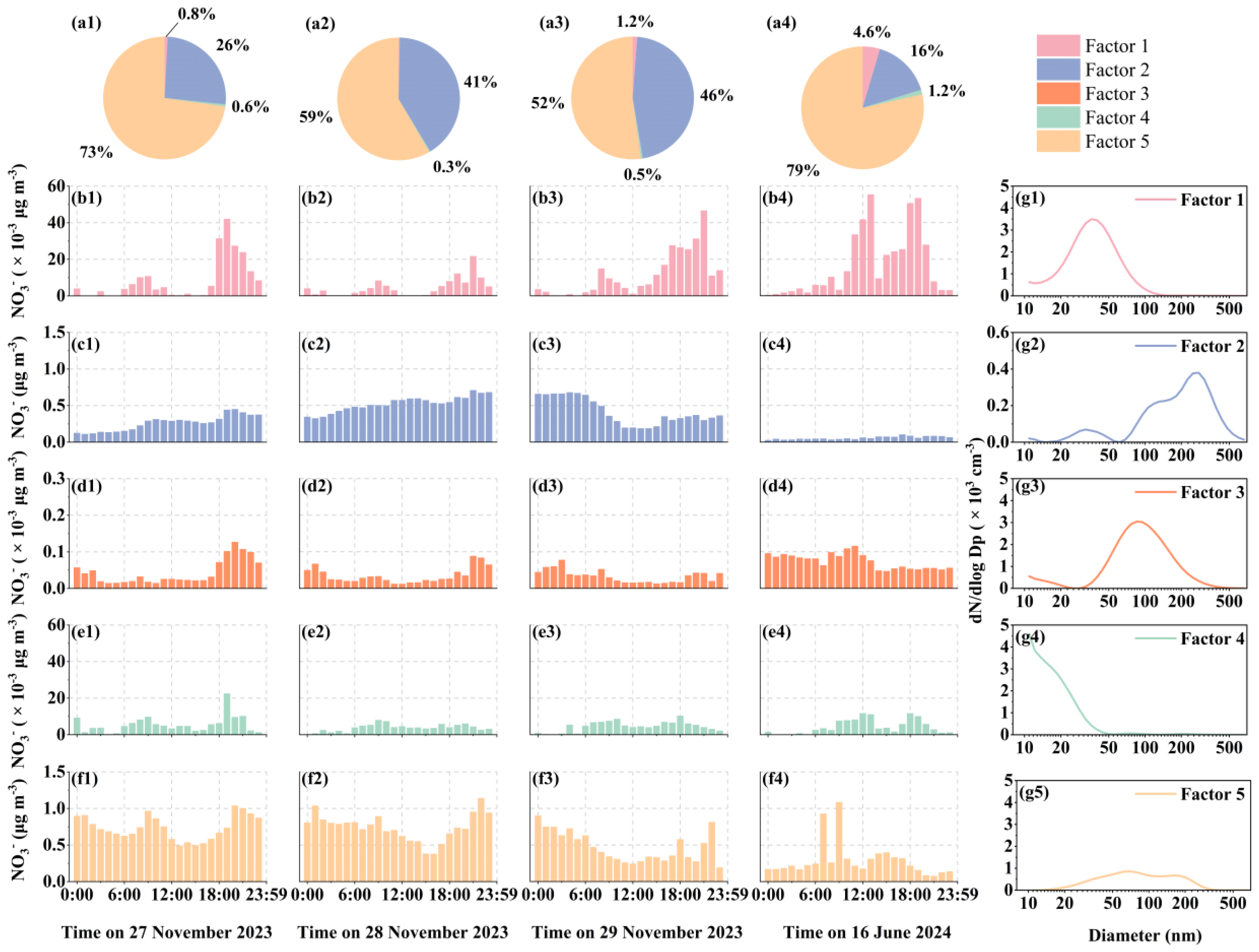
The analysis of observation cases from 2023 and 2024 highlights the critical role of both primary and secondary sources in partitioning the gas-particle distribution of nitrate. Therefore, this study quantitatively evaluated the contributions of aerosols from various sources to nitrate using the PMF model (Figure 8). In November, NO3- in PM2.5 was predominantly attributed to Factor 2 and Factor 5 only. Factor 5 contributed between 52% and 73%, while Factor 2 contributed between 26% and 46%. By contrast, on 16 June, Factor 1 made a limited contribution (4.6%), whereas the contribution from Factor 5 increased to 79%, and Factor 2 decreased to 16%.
Factor 1 exhibited a unimodal particle size distribution, with a median diameter centered approximately 40 nm. This source factor displayed distinct peaks during both morning and evening rush hours, suggesting a potential association with non-electric vehicular emissions [72,73,76,77]. The relatively weaker morning peak may be attributed to the widespread use of electric motorcycles for commuting in tropical regions. In contrast, Factor 2 presented a complex trimodal size distribution, with the dominant mode characterized by a median particle diameter exceeding 200 nm. Despite this, its total number concentration was the lowest among all five factors, approximately an order of magnitude lower than those of Factors 1, 3, and 4, indicating that it likely represents a regional background source, particularly of marine origin [72,78]. Factor 3 demonstrated a bimodal distribution, with prominent peaks at approximately 70 nm and a minor mode below 20 nm. This factor was likely attributed to emissions from Chinese-style cooking, where high-temperature oil use leads to substantial particle generation, particularly between 18:00 and 20:00. However, its contribution to NO3- in PM2.5 was found to be negligible. Factor 4 was dominated by nucleation-mode particles, indicative of short atmospheric nucleation times. Its occurrence was more frequent during nighttime, implying that these events were likely influenced by transient coastal atmospheric conditions [78,79]. Correspondingly, this factor also exhibited minimal contribution to NO3- levels in PM2.5. Lastly, Factor 5 displayed a bimodal particle size distribution and was primarily associated with emissions from a nearby natural gas-fired power plant (~1 km distance), with additional influence from regional background sources. Factor 5 exhibited a distinct trough in the particle size distribution around 100 nm, a feature resembling the Hoppel-effect modified distribution under an environmental supersaturation of 0.2%. This suggests that the gas-fired power plant plume, when emitted into an environment with a substantial temperature contrast, may promote the formation of microdroplets, thereby leading to an aerosol size distribution akin to that observed in non-precipitating cloud processing. Consequently, it is anticipated that Factor 5 will contribute a higher mass concentration of nitrate in winter compared to summer (Figure 8).
As shown in Figure 1, the gas-fired power plant emits substantial amounts of water vapor droplets, which facilitate the formation of liquid-phase (NH4+ + NO3-). The residence time of the vapor droplets, ranging from several tens of seconds to a few minutes, is primarily influenced by ambient temperature and atmospheric humidity; lower temperatures and higher humidity extending their residence time [23]. This may account for the elevated NO3- concentrations observed in PM2.5 during the humid November nights. It is evident that the (NH4+ + NO3-) formed rapidly through water vapor condensation and subsequent flue gas dilution is likely to volatilize from the particulate to the gas phase. Compared to Factor 2, Factor 5 appears to represent a more unstable component, as approximately 20% of high-concentration NO3- cases could not be resolved in the PMF analysis (Figure S6). In these instances, the PMF model clearly underestimates NO3-, possibly because the NO3- captured by the analysis reflects aged and relatively stable NH4NO3. In contrast, high-concentration NO3- in PM2.5 is relatively fresh and in the NH3-restricted volatilization process of NH4NO3. It is worth noting that a slight difference in the extracted profile of each factor was observed when NO3- concentrations were used to replace those in the final particle size bin (Figure S7), which may be attributed to subtle differences in their respective sources.
4. Conclusions
This study systematically investigates the dual regulatory effects of atmospheric NH3 on the formation and evaporation of NH4NO3 at a clean tropical coastal site. By integrating high-resolution field measurements, E-AIM modeling, and PNF source apportionment analysis, we demonstrate that NH3 plays a role in suppressing the volatilization of NH4NO3 under varying atmospheric conditions rather than acting solely as a precursor promoting its formation.
Multiple case studies revealed that NH4NO3 in PM2.5 originated from both primary emissions-particularly from local combustion plumes and in-cloud processing of KNO3 and/or NH4NO3, especially under the influence of the northeast monsoon. Under NH3-rich but HNO3-limited conditions, particle-phase NH4NO3 tended to volatilize as confirmed by thermodynamic modeling and various supporting lines of evidence. Source apportionment using the PMF model indicated that regional background transport and emissions from a nearby natural gas power plant were the dominant contributors to nitrate in PM2.5. Under the southwest monsoon, the clean marine air mass was not conductive to NH4NO3 formation even when perturbed by plumes from local gas-fired power plants. In the case, the sea-salt-aerosol-restricted reactions between HNO3*gas and sea-salt aerosols dominantly contributed to NO3- in PM2.5.
These findings challenge the conventional understanding of nitrate formation as purely precursor-limited, highlighting the importance of simultaneously accounting for formation and volatilization dynamics. This study refines the understanding of NH4NO3 behavior in ammonia-rich marine boundary layers and has important implications for optimizing future nitrate control strategies in coastal and urban environments.
Supplementary Materials
The following supporting information can be downloaded at the website of this paper posted on Preprints.org, Figure S1: Comparison of modeled and observed gas concentrations for 27-29 November 2023, and 16 June 2024 using the E-AIM with only three components including SO42-, NH4+ and NO3- as inputs. (a) Modeled HNO3 vs. Observed HNO3*. (b) Modeled NH3 vs. Observed NH3. The color bar indicates NO3- concentration in μg m-3. Figure S2: Correlations between NH4+ and NO3-, and NH4+ with the equivalent concentrations of (NO3- + SO42-) in PM2.5 from November 27-29, 2023, and June 16, 2024 (empty and full symbols represent the data before and after 18:00 in c), and; represent the data before and after 12:00 in g) and h)). Figure S3. Correlations between NO3- and Na+ in PM2.5 from November 27-29, 2023. Figure S4: (a-b) Correlations between NH3 and NO3- on November 27-28, 2023. (c) K⁺ Concentration from November 24 to December 3, 2023; Figure S5: (a) Sky picture taken on June 16, 2024. (b) Tidal height on June 16, 2024. Figure S6: PMF simulation closure validation results. (a-b) Closure of total particle size concentration before and after combination of particle size spectrum and [NO3-]PM2.5; (c) Closure of the channel with the largest particle size in the particle size spectrum; (d) Closure of [NO3-]PM2.5 (empty and full symbols represents the modeled values within 15% difference from the observations and beyond the 15% margins, respectively. Figure S7: Comparison of factor modes before and after replacing nitrate ion concentration in the last particle size channel.
Author Contributions
Methodology, X.Y., Y.G. (Yang Gao) and H.G.; formal analysis, X.Y., Y.G. (Yang Gao) and H.G.; data curation, L.S.; writing—original draft, H.H. and Y.G. (Yating Gao); writing—review and editing, H.H., Y.G. (Yating Gao). and X.Y. All authors have read and agreed to the published version of the manuscript.
Funding
This research was funded by the Natural Science Foundation of China, grant number 42276036 and the Hainan Provincial Natural Science Foundation of China, grant number 422MS098.
Institutional Review Board Statement
Not applicable
Informed Consent Statement
Not applicable
Data Availability Statement
Acknowledgments
This work was supported by the Natural Science Foundation of China (grant no. 42276036) and the Hainan Provincial Natural Science Foundation of China (grant no. 422MS098).
Conflicts of Interest
The authors declare no conflicts of interest.
Abbreviations
AIM-IC, Aerosol Ion Monitor-Ion Chromatography; SMPS, Scanning Mobility Particle Sizer; E-AIM, Extended AIM Aerosol Thermodynamics Model; RH, relative humidity relative humidity; T, temperature; N + 2*S, the sum of the molar concentration of nitrate and twice the molar concentration of sulfate; PM2.5, particulate matter with the aerodynamic diameter below 2.5 μm collected by AIM-IC.
References
- Barthelmie, R.J.; Pryor, S.C. Implications of ammonia emissions for fine aerosol formation and visibility impairment: A case study from the Lower Fraser Valley, British Columbia. Atmos. Environ. 1998, 32(3), 345-352. [CrossRef]
- Pathak, R.K.; Wu, W.S.; Wang, T. Summertime PM2.5 ionic species in four major cities of China: Nitrate formation in an ammonia-deficient atmosphere. Atmos. Chem. Phys. 2009, 9, 1711-1722. [CrossRef]
- Wang, X.; Ding, X.; Fu, X.; He, Q.; Wang, S.; Bernard, F.; Zhao, X.; Wu, D. Aerosol scattering coefficients and major chemical compositions of fine particles observed at a rural site in the Central Pearl River Delta, South China. J. Environ. Sci. 2012, 24, 72-77. [CrossRef]
- Park, R.S.; Lee, S.; Shin, S.-K.; Song, C.H. Contribution of ammonium nitrate to aerosol optical depth and direct radiative forcing by aerosols over East Asia. Atmos. Chem. Phys. 2014, 14, 2185-2201. [CrossRef]
- Zhang, R.; Wang, G.; Guo, S.; Zamora, M.L.; Ying, Q.; Lin, Y.; Wang, W.; Hu, M.; Wang, Y. Formation of urban fine particulate matter. Chem. Rev. 2015, 115, 3803-3855. [CrossRef]
- Höpfner, M.; Ungermann, J.; Borrmann, S.; Wagner, R.; Spang, R.; Riese, M.; Stiller, G.; Appel, O.; Batenburg, A.M.; Bucci, S.; et al. Ammonium nitrate particles formed in upper troposphere from ground ammonia sources during Asian monsoons. Nat. Geosci. 2019, 12, 608-612. [CrossRef]
- An, Z.; Huang, R.-J.; Zhang, R.; Tie, X.; Li, G.; Cao, J.; Zhou, W.; Shi, Z.; Han, Y.; Gu, Z.; et al. Severe haze in northern China: A synergy of anthropogenic emissions and atmospheric processes. Proc. Natl. Acad. Sci. USA 2019, 116, 8657-8666. [CrossRef]
- Sun, P.; Wang, J.; Liu, Y.; Nie, W.; Chi, X.; Xu, Z.; Ge, D.; Ren, C.; Zhu, C.; Huang, X.; et al. Enhanced particulate nitrate formation in residual layer exacerbates near-surface pollution: Insights from tethered airship and long-term ground measurements. J. Geophys. Res. Atmospheres 2025, 130, e2024JD042672. [CrossRef]
- Pitchford, M.L.; Poirot, R.L.; Schichtel, B.A.; Malm, W.C. Characterization of the winter Midwestern particulate nitrate bulge. J. Air Waste Manag. Assoc. 2009, 59, 1061-1069. [CrossRef]
- Shon, Z.-H.; Kim, K.-H.; Song, S.-K.; Jung, K.; Kim, N.-J.; Lee, J.-B. Relationship between water-soluble ions in PM2.5 and their precursor gases in Seoul megacity. Atmos. Environ. 2012, 59, 540-550. [CrossRef]
- Shah, V.; Jaeglé, L.; Thornton, J.A.; Lopez-Hilfiker, F.D.; Lee, B.H.; Schroder, J.C.; Campuzano-Jost, P.; Jimenez, J.L.; Guo, H.; Sullivan, A.P.; et al. Chemical feedbacks weaken the wintertime response of particulate sulfate and nitrate to emissions reductions over the eastern United States. Proc. Natl. Acad. Sci. USA 2018, 115, 8110-8115. [CrossRef]
- Guo, H.; Sullivan, A.P.; Campuzano-Jost, P.; Schroder, J.C.; Lopez-Hilfiker, F.D.; Dibb, J.E.; Jimenez, J.L.; Thornton, J.A.; Brown, S.S.; Nenes, A.; et al. Fine particle pH and the partitioning of nitric acid during winter in the northeastern United States. J. Geophys. Res. Atmos. 2016, 121. 10355-10376 . [CrossRef]
- Seinfeld, J.H.; Pandis, S.N. Atmospheric Chemistry and Physics: From Air Pollution to Climate Change, 3rd ed.; John Wiley & Sons: Hoboken, New Jersey, 2016; ISBN 978-1-119-22116-6.
- Li, Y.; Schwandner, F.M.; Sewell, H.J.; Zivkovich, A.; Tigges, M.; Raja, S.; Holcomb, S.; Molenar, J.V.; Sherman, L.; Archuleta, C.; et al. Observations of ammonia, nitric acid, and fine particles in a rural gas production region. Atmos. Environ. 2014, 83, 80-89. [CrossRef]
- Wang, Q.; Zhang, Q.; Ma, Z.; Ge, B.; Xie, C.; Zhou, W.; Zhao, J.; Xu, W.; Du, W.; Fu, P.; et al. Temporal characteristics and vertical distribution of atmospheric ammonia and ammonium in winter in Beijing. Sci. Total Environ. 2019, 681, 226-234. [CrossRef]
- Watson, J.G.; Chow, J.C.; Lurmann, F.W.; Musarra, S.P. Ammonium nitrate, nitric acid, and ammonia equilibrium in wintertime Phoenix, Arizona. Air Waste Manag. Assoc. 1994, 44, 405-412. [CrossRef]
- Sharma, M.; Kishore, S.; Tripathi, S.N.; Behera, S.N. Role of atmospheric ammonia in the formation of inorganic secondary particulate matter: A study at Kanpur, India. J. Atmos. Chem. 2007, 58, 1-17. [CrossRef]
- Chen, D.; Yao, X.; Chan, C.K.; Tian, X.; Chu, Y.; Clegg, S.L.; Shen, Y.; Gao, Y.; Gao, H. Competitive uptake of dimethylamine and trimethylamine against ammonia on acidic particles in marine atmospheres. Environ. Sci. Technol. 2022, 56, 5430-5439. [CrossRef]
- Xu, Z.; Liu, M.; Zhang, M.; Song, Y.; Wang, S.; Zhang, L.; Xu, T.; Wang, T.; Yan, C.; Zhou, T.; et al. High efficiency of livestock ammonia emission controls in alleviating particulate nitrate during a severe winter haze episode in northern China. Atmos. Chem. Phys. 2019, 19, 5605-5613. [CrossRef]
- Saraswati; Sharma, S.K.; Saxena, M.; Mandal, T.K. Characteristics of gaseous and particulate ammonia and their role in the formation of secondary inorganic particulate matter at Delhi, India. Atmos. Res. 2019, 218, 34-49. [CrossRef]
- Franchin, A.; Fibiger, D.L.; Goldberger, L.; McDuffie, E.E.; Moravek, A.; Womack, C.C.; Crosman, E.T.; Docherty, K.S.; Dube, W.P.; Hoch, S.W.; et al. Airborne and ground-based observations of ammonium-nitrate-dominated aerosols in a shallow boundary layer during intense winter pollution episodes in northern Utah. Atmos. Chem. Phys. 2018, 18, 17259-17276. [CrossRef]
- Zhang, Z.; Guan, H.; Luo, L.; Zheng, N.; Xiao, H.; Liang, Y.; Xiao, H. Sources and transformation of nitrate aerosol in winter 2017-2018 of megacity Beijing: Insights from an alternative approach. Atmos. Environ. 2020, 241, 117842. [CrossRef]
- Shen, Y.; Meng, H.; Yao, X.; Peng, Z.; Sun, Y.; Zhang, J.; Gao, Y.; Feng, L.; Liu, X.; Gao, H. Does ambient secondary conversion or the prolonged fast conversion in combustion plumes cause severe PM2.5 air pollution in China? Atmosphere 2022, 13, 673. [CrossRef]
- Dang, R.; Jacob, D.J.; Zhai, S.; Yang, L.H.; Pendergrass, D.C.; Coheur, P.; Clarisse, L.; Van Damme, M.; Choi, J.; Park, J.; et al. A satellite-based indicator for diagnosing particulate nitrate sensitivity to precursor emissions: Application to East Asia, Europe, and North America. Environ. Sci. Technol. 2024, 58, 20101-20113. [CrossRef]
- Tsimpidi, A.P.; Karydis, V.A.; Pandis, S.N. Response of inorganic fine particulate matter to emission changes of sulfur dioxide and ammonia: The eastern United States as a case study. J. Air Waste Manag. Assoc. 2007, 57, 1489-1498. [CrossRef]
- Wen, L.; Xue, L.; Wang, X.; Xu, C.; Chen, T.; Yang, L.; Wang, T.; Zhang, Q.; Wang, W. Summertime fine particulate nitrate pollution in the North China Plain: Increasing trends, formation mechanisms and implications for control policy. Atmos. Chem. Phys. 2018, 18, 11261-11275. [CrossRef]
- Kim, N.K.; Kim, Y.P.; Ghim, Y.S.; Song, M.J.; Kim, C.H.; Jang, K.S.; Lee, K.Y.; Shin, H.J.; Jung, J.S.; Wu, Z.; et al. Spatial distribution of PM2.5 chemical components during winter at five sites in Northeast Asia: High temporal resolution measurement study. Atmos. Environ. 2022, 290, 119359. [CrossRef]
- Walker, J.T.; Whitall, D.R.; Robarge, W.; Paerl, H.W. Ambient ammonia and ammonium aerosol across a region of variable ammonia emission density. Atmos. Environ. 2004, 38, 1235-1246. [CrossRef]
- Ye, X.; Ma, Z.; Zhang, J.; Du, H.; Chen, J.; Chen, H.; Yang, X.; Gao, W.; Geng, F. Important role of ammonia on haze formation in Shanghai. Environ. Res. Lett. 2011, 6, 024019. [CrossRef]
- Weber, R.J.; Guo, H.; Russell, A.G.; Nenes, A. High aerosol acidity despite declining atmospheric sulfate concentrations over the past 15 years. Nature Geosci. 2016, 9, 282-285. [CrossRef]
- Wang, H.; Lu, K.; Chen, X.; Zhu, Q.; Wu, Z.; Wu, Y.; Sun, K. Fast particulate nitrate formation via N2O5 uptake aloft in winter in Beijing. Atmos. Chem. Phys. 2018, 18, 10483-10495. [CrossRef]
- Jo, H.-Y.; Lee, H.-J.; Jo, Y.-J.; Lee, J.-J.; Ban, S.; Lee, J.-J.; Chang, L.-S.; Heo, G.; Kim, C.-H. Nocturnal fine particulate nitrate formation by N2O5 heterogeneous chemistry in Seoul metropolitan area, Korea. Atmos. Res. 2019, 225, 58-69. [CrossRef]
- Bertram, T.H.; Thornton, J.A.; Riedel, T.P.; Middlebrook, A.M.; Bahreini, R.; Bates, T.S.; Quinn, P.K.; Coffman, D.J. Direct observations of N2O5 reactivity on ambient aerosol particles. Geophys. Res. Lett. 2009, 36, 2009GL040248. [CrossRef]
- Zhou, M.; Nie, W.; Qiao, L.; Huang, D.D.; Zhu, S.; Lou, S.; Wang, H.; Wang, Q.; Tao, S.; Sun, P.; et al. Elevated formation of particulate nitrate from N2O5 hydrolysis in the Yangtze River Delta region from 2011 to 2019. Geophys. Res. Lett. 2022, 49, e2021GL097393. [CrossRef]
- Yan, C.; Tham, Y.J.; Nie, W.; Xia, M.; Wang, H.; Guo, Y.; Ma, W.; Zhan, J.; Hua, C.; Li, Y.; et al. Increasing contribution of nighttime nitrogen chemistry to wintertime haze formation in Beijing observed during COVID-19 lockdowns. Nat. Geosci. 2023, 16, 975-981. [CrossRef]
- Zhao, X.; Zhao, X.; Liu, P.; Chen, D.; Zhang, C.; Xue, C.; Liu, J.; Xu, J.; Mu, Y. Transport pathways of nitrate formed from nocturnal N2O5 hydrolysis aloft to the ground level in winter North China Plain. Environ. Sci. Technol. 2023, 57, 2715-2725. [CrossRef]
- Behera, S.N.; Sharma, M.; Aneja, V.P.; Balasubramanian, R. Ammonia in the atmosphere: A review on emission sources, atmospheric chemistry and deposition on terrestrial bodies. Environ. Sci. Pollut. Res. 2013, 20, 8092-8131. [CrossRef]
- Zhu, L.; Henze, D.K.; Bash, J.O.; Cady-Pereira, K.E.; Shephard, M.W.; Luo, M.; Capps, S.L. Sources and impacts of atmospheric NH3: Current understanding and frontiers for modeling, measurements, and remote sensing in North America. Curr. Pollut. Rep. 2015, 1, 95-116. [CrossRef]
- Dammers, E.; Shephard, M.W.; Palm, M.; Cady-Pereira, K.; Capps, S.; Lutsch, E.; Strong, K.; Hannigan, J.W.; Ortega, I.; Toon, G.C.; et al. Validation of the CrIS fast physical NH3 retrieval with ground-based FTIR. Atmos. Meas. Tech. 2017, 10, 2645-2667. [CrossRef]
- Wu, L.; Ren, H.; Wang, P.; Chen, J.; Fang, Y.; Hu, W.; Ren, L.; Deng, J.; Song, Y.; Li, J.; et al. Aerosol ammonium in the urban boundary layer in Beijing: Insights from nitrogen isotope ratios and simulations in summer 2015. Environ. Sci. Technol. Lett. 2019, 6, 389-395. [CrossRef]
- Cao, H.; Henze, D.K.; Shephard, M.W.; Dammers, E.; Cady-Pereira, K.; Alvarado, M.; Lonsdale, C.; Luo, G.; Yu, F.; Zhu, L.; et al. Inverse modeling of NH3 sources using CrIS remote sensing measurements. Environ. Res. Lett. 2020, 15, 104082. [CrossRef]
- Van Damme, M.; Clarisse, L.; Franco, B.; Sutton, M.A.; Erisman, J.W.; Wichink Kruit, R.; Van Zanten, M.; Whitburn, S.; Hadji-Lazaro, J.; Hurtmans, D.; et al. Global, regional and national trends of atmospheric ammonia derived from a decadal (2008-2018) satellite record. Environ. Res. Lett. 2021, 16, 055017. [CrossRef]
- Wyer, K.E.; Kelleghan, D.B.; Blanes-Vidal, V.; Schauberger, G.; Curran, T.P. Ammonia emissions from agriculture and their contribution to fine particulate matter: A review of implications for human health. J. Environ. Manag. 2022, 323, 116285. [CrossRef]
- Yang, T.; Li, H.; Xu, W.; Song, Y.; Xu, L.; Wang, H.; Wang, F.; Sun, Y.; Wang, Z.; Fu, P. Strong impacts of regional atmospheric transport on the vertical distribution of aerosol ammonium over Beijing. Environ. Sci. Technol. Lett. 2024, 11, 29-34. [CrossRef]
- Guo, H.; Otjes, R.; Schlag, P.; Kiendler-Scharr, A.; Nenes, A.; Weber, R.J. Effectiveness of ammonia reduction on control of fine particle nitrate. Atmos. Chem. Phys. 2018, 18, 12241-12256. [CrossRef]
- Roig Rodelas, R.; Perdrix, E.; Herbin, B.; Riffault, V. Characterization and variability of inorganic aerosols and their gaseous precursors at a suburban site in northern France over one year (2015-2016). Atmos. Environ. 2019, 200, 142-157. [CrossRef]
- Dang, R.; Jacob, D.J.; Zhai, S.; Coheur, P.; Clarisse, L.; Van Damme, M.; Pendergrass, D.C.; Choi, J.; Park, J.; Liu, Z.; et al. Diagnosing the sensitivity of particulate nitrate to precursor emissions using satellite observations of ammonia and nitrogen dioxide. Geophys. Res. Lett. 2023, 50, e2023GL105761. [CrossRef]
- Pinder, R.W.; Dennis, R.L.; Bhave, P.V. Observable indicators of the sensitivity of PM2.5 nitrate to emission reductions—Part I: Derivation of the adjusted gas ratio and applicability at regulatory-relevant time scales. Atmos. Environ. 2008, 42, 1275-1286. [CrossRef]
- Meng, Z.; Xu, X.; Lin, W.; Ge, B.; Xie, Y.; Song, B.; Jia, S.; Zhang, R.; Peng, W.; Wang, Y.; et al. Role of ambient ammonia in particulate ammonium formation at a rural site in the North China Plain. Atmos. Chem. Phys. 2018, 18, 167-184. [CrossRef]
- Ge, B.; Xu, X.; Ma, Z.; Pan, X.; Wang, Z.; Lin, W.; Ouyang, B.; Xu, D.; Lee, J.; Zheng, M.; et al. Role of ammonia on the feedback between AWC and inorganic aerosol formation during heavy pollution in the North China Plain. Earth Space Sci. 2019, 6, 1675-1693. [CrossRef]
- Lin, Y.-C.; Zhang, Y.-L.; Fan, M.-Y.; Bao, M. Heterogeneous formation of particulate nitrate under ammonium-rich regimes during the high-PM2.5 events in Nanjing, China. Atmos. Chem. Phys. 2020, 20, 3999-4011. [CrossRef]
- Huang, X.; Qiu, R.; Chan, C.K.; Ravi Kant, P. Evidence of high PM2.5 strong acidity in ammonia-rich atmosphere of Guangzhou, China: Transition in pathways of ambient ammonia to form aerosol ammonium at [NH4+]/[SO42-] = 1.5. Atmos. Res. 2011, 99, 488-495. [CrossRef]
- Schiferl, L.D.; Heald, C.L.; Nowak, J.B.; Holloway, J.S.; Neuman, J.A.; Bahreini, R.; Pollack, I.B.; Ryerson, T.B.; Wiedinmyer, C.; Murphy, J.G. An investigation of ammonia and inorganic particulate matter in California during the CalNex campaign: CALNEX ammonia and inorganic fine PM. J. Geophys. Res. Atmos. 2014, 119, 1883-1902. [CrossRef]
- Xiao, H.; Xiao, H.-W.; Xu, Y.; Zheng, N.-J.; Xiao, H.-Y. Combustion-driven inorganic nitrogen in PM2.5 from a city in central China has the potential to enhance the nitrogen load of North China. J. Hazard. Mater. 2025, 483, 136620. [CrossRef]
- Ianniello, A.; Spataro, F.; Esposito, G.; Allegrini, I.; Hu, M.; Zhu, T. Chemical characteristics of inorganic ammonium salts in PM2.5 in the atmosphere of Beijing (China). Atmos. Chem. Phys. 2011, 11, 10803-10822. [CrossRef]
- Peng, W.; Zhu, B.; Kang, H.; Chen, K.; Lu, W.; Lu, C.; Kang, N.; Hu, J.; Chen, H.; Liao, H. Inconsistent 3-D structures and sources of sulfate ammonium and nitrate ammonium aerosols during cold front episodes. J. Geophys. Res. Atmos. 2024, 129, e2023JD039958. [CrossRef]
- Chow, J.C.; Watson, J.G.; Lowenthal, D.H.; Magliano, K.L. Loss of PM2.5 nitrate from filter samples in central California. J. Air Waste Manag. Assoc. 2005, 55, 1158-1168. [CrossRef]
- Yan, L.; Gao, Y.; Chen, D.; Sun, L.; Gao, Y.; Gao, H.; Yao, X. Seasonally dependent daytime and nighttime formation of oxalic acid vapor and particulate oxalate in tropical coastal and marine atmospheres. Atmosphere 2025, 16, 98. [CrossRef]
- Chen, D.; Shen, Y.; Wang, J.; Gao, Y.; Gao, H.; Yao, X. Mapping gaseous dimethylamine, trimethylamine, ammonia, and their particulate counterparts in marine atmospheres of China’s marginal seas – Part 1: Differentiating marine emission from continental transport. Atmos. Chem. Phys. 2021, 21, 16413-16425. [CrossRef]
- Sun, L.; Cui, W.; Ma, N.; Hong, J.; Zhu, Y.; Gao, Y.; Gao, H.; Yao, X. Variations in cloud concentration nuclei related to continental air pollution control and maritime fuel regulation over the Northwest Pacific Ocean. Atmosphere 2024, 15, 972. [CrossRef]
- Pikmann, J.; Drewnick, F.; Fachinger, F.; Borrmann, S. Particulate emissions from cooking: Emission factors, emission dynamics, and mass spectrometric analysis for different cooking methods. Atmos. Chem. Phys. 2024, 24, 12295-12321. [CrossRef]
- Cheng, B.; Alapaty, K.; Arunachalam, S. Spatiotemporal trends in PM2.5 chemical composition in the conterminous U.S. during 2006-2020. Atmos. Environ. 2024, 316, 120188. [CrossRef]
- Peng, X.; Wang, T.; Wang, W.; Ravishankara, A.R.; George, C.; Xia, M.; Cai, M.; Li, Q.; Salvador, C.M.; Lau, C.; et al. Photodissociation of particulate nitrate as a source of daytime tropospheric Cl2. Nat. Commun. 2022, 13, 939. [CrossRef]
- Wexler, A.S.; Seinfeld, J.H. The distribution of ammonium salts among a size and composition dispersed aerosol. Atmos. Environ. Part A Gen. Topics 1990, 24, 1231-1246. [CrossRef]
- Shiraiwa, M.; Seinfeld, J.H. Equilibration timescale of atmospheric secondary organic aerosol partitioning. Geophys. Res. Lett. 2012, 39, 2012GL054008. [CrossRef]
- Cai, J.; Zheng, M.; Yan, C.-Q.; Fu, H.-Y.; Zhang, Y.-J.; Li, M.; Zhou, Z.; Zhang, Y.-H. Application and progress of single particle aerosol time-of-flight mass spectrometry in fine particulate matter research. Chinese J. Anal. Chem. 2015, 43, 765-774. [CrossRef]
- Gunsch, M.J.; Liu, J.; Moffett, C.E.; Sheesley, R.J.; Wang, N.; Zhang, Q.; Watson, T.B.; Pratt, K.A. Diesel soot and amine-containing organic sulfate aerosols in an Arctic oil field. Environ. Sci. Technol. 2020, 54, 92-101. [CrossRef]
- Silvern, R.F.; Jacob, D.J.; Kim, P.S.; Marais, E.A.; Turner, J.R.; Campuzano-Jost, P.; Jimenez, J.L. Inconsistency of ammonium-sulfate aerosol ratios with thermodynamic models in the eastern US: A possible role of organic aerosol. Atmos. Chem. Phys. 2017, 17, 5107-5118. [CrossRef]
- Hecobian, A.; Liu, Z.; Hennigan, C.J.; Huey, L.G.; Jimenez, J.L.; Cubison, M.J.; Vay, S.; Diskin, G.S.; Sachse, G.W.; Wisthaler, A.; et al. Comparison of chemical characteristics of biomass burning plumes intercepted by the NASADC-8 aircraft during the ARCTAS/CARB-2008 field campaign. Atmos. Chem. Phys. 2011, 11, 13325-13337. [CrossRef]
- Allen, A.G.; Miguel, A.H. Biomass burning in the Amazon: Characterization of the ionic component of aerosols generated from flaming and smoldering rainforest and savannah. Environ. Sci. Technol. 1995, 29, 486-493. [CrossRef]
- Teng, X.; Hu, Q.; Zhang, L.; Qi, J.; Shi, J.; Xie, H.; Gao, H.; Yao, X. Identification of major sources of atmospheric NH₃ in an urban environment in northern China during wintertime. Environ. Sci. Technol. 2017, 51, 6839-6848. [CrossRef]
- Vu, T.V.; Delgado-Saborit, J.M.; Harrison, R.M. Review: Particle number size distributions from seven major sources and implications for source apportionment studies. Atmos. Environ. 2015, 122, 114-132. [CrossRef]
- Hopke, P.K.; Feng, Y.; Dai, Q. Source apportionment of particle number concentrations: A global review. Sci. Total Environ. 2022, 819, 153104. [CrossRef]
- Yao, X.; Fang, M.; Chan, C.K. Experimental study of the sampling artifact of chloride depletion from collected sea salt aerosols. Environ. Sci. Technol. 2001, 35, 600-605. [CrossRef]
- Yu, S.; Dennis, R.L.; Bhave, P.V.; Eder, B.K. Primary and secondary organic aerosols over the United States: Estimates on the basis of observed organic carbon (OC) and elemental carbon (EC), and air quality modeled primary OC/EC ratios. Atmos. Environ. 2004, 38, 5257-5268. [CrossRef]
- Ridolfo, S.; Amato, F.; Querol, X. Particle number size distributions and concentrations in transportation environments: A review. Environ. Int. 2024, 187, 108696. [CrossRef]
- Zhu, Y.; Shen, Y.; Li, K.; Meng, H.; Sun, Y.; Yao, X.; Gao, H.; Xue, L.; Wang, W. Investigation of particle number concentrations and new particle formation with largely reduced air pollutant emissions at a coastal semi-urban site in northern China. J. Geophys. Res. Atmos. 2021, 126, e2021JD035419. [CrossRef]
- Ueda, S.; Miura, K.; Kawata, R.; Furutani, H.; Uematsu, M.; Omori, Y.; Tanimoto, H. Number-size distribution of aerosol particles and new particle formation events in tropical and subtropical Pacific Oceans. Atmos. Environ. 2016, 142, 324-339. [CrossRef]
- Shen, Y.; Wang, J.; Gao, Y.; Chan, C.K.; Zhu, Y.; Gao, H.; Petäjä, T.; Yao, X. Sources and formation of nucleation mode particles in remote tropical marine atmospheres over the South China Sea and the northwest Pacific Ocean. Sci. Total Environ. 2020, 735, 139302. [CrossRef]
Figure 1.
Map of the sampling site: (a-b) High-resolution terrain map from Google Earth, with red markers indicating the sampling site and power plant locations, and blue markers showing the locations of the three national control points in Sanya. (c) Dispersion of emissions from the power plant under dry weather. (d) Dispersion of emissions under humid weather.
Figure 1.
Map of the sampling site: (a-b) High-resolution terrain map from Google Earth, with red markers indicating the sampling site and power plant locations, and blue markers showing the locations of the three national control points in Sanya. (c) Dispersion of emissions from the power plant under dry weather. (d) Dispersion of emissions under humid weather.
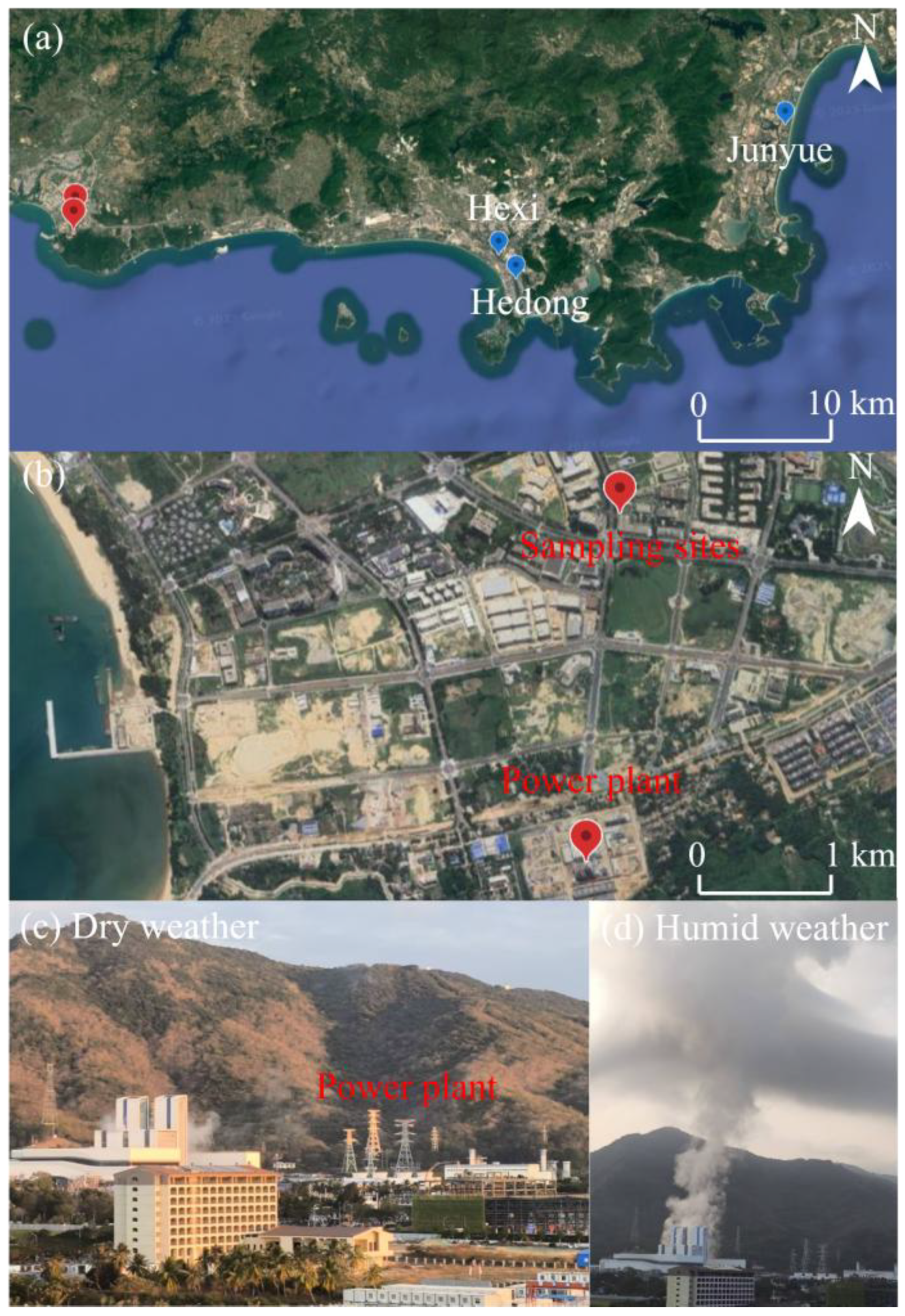
Figure 2.
Time series of various species concentrations in PM2.5 during the study periods in 2023 and 2024. Panels (a-b) show the concentrations of NH4+, Na+, NO3-, and SO42-; panel (c) displays the concentrations of NH3 and HNO3* gases; panel (d) shows OC and EC concentrations in PM2.5.
Figure 2.
Time series of various species concentrations in PM2.5 during the study periods in 2023 and 2024. Panels (a-b) show the concentrations of NH4+, Na+, NO3-, and SO42-; panel (c) displays the concentrations of NH3 and HNO3* gases; panel (d) shows OC and EC concentrations in PM2.5.
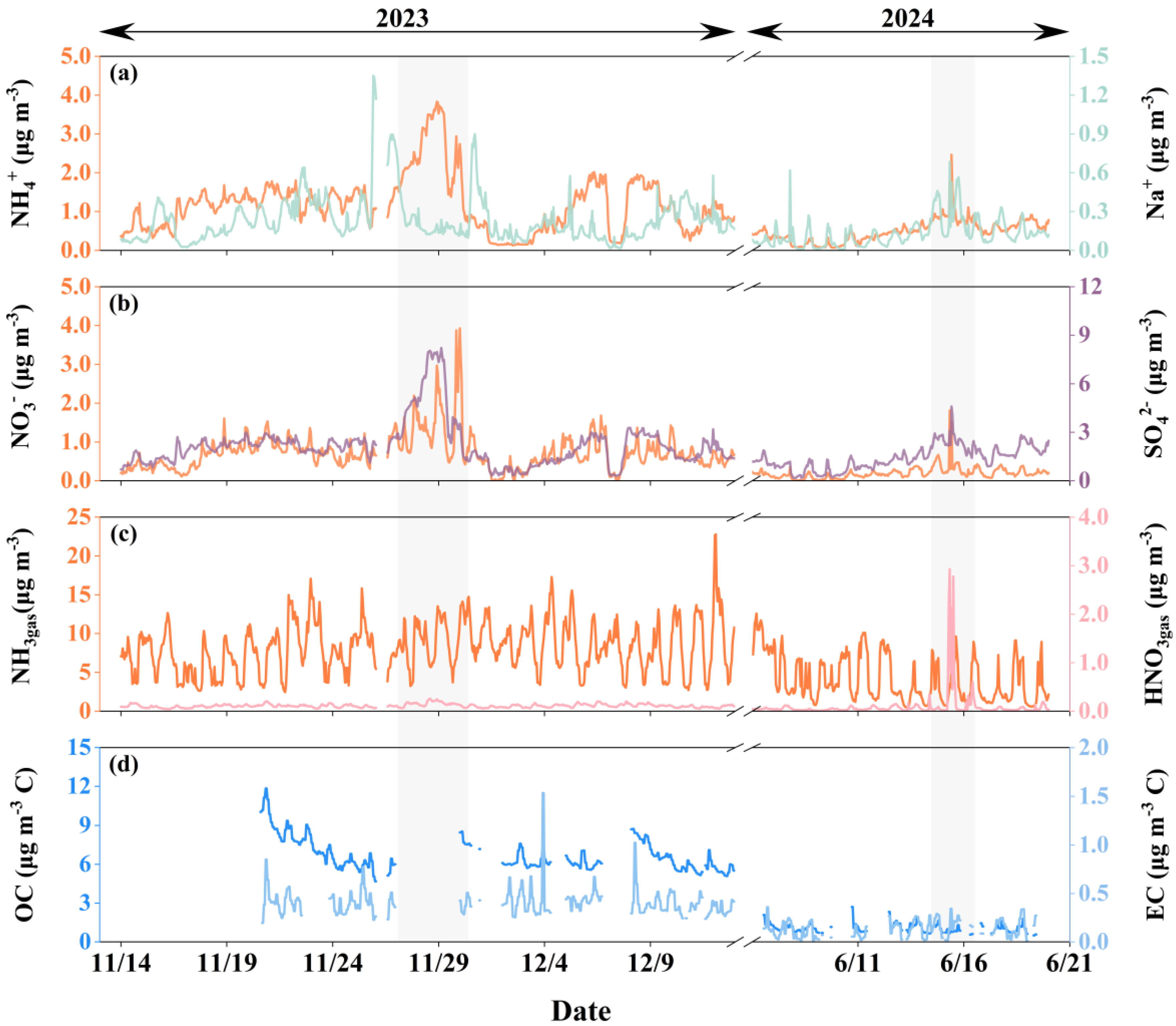
Figure 3.
Comparison of modeled and observed gas concentrations for 27-29 November 2023, and 16 June 2024. (a) Modeled HNO3 vs. Observed HNO3*. (b) Modeled NH3 vs. Observed NH3. (c) Modeled HClgas vs. Observed HClgas. The color bar indicates NO3- concentration in µg m-3.
Figure 3.
Comparison of modeled and observed gas concentrations for 27-29 November 2023, and 16 June 2024. (a) Modeled HNO3 vs. Observed HNO3*. (b) Modeled NH3 vs. Observed NH3. (c) Modeled HClgas vs. Observed HClgas. The color bar indicates NO3- concentration in µg m-3.
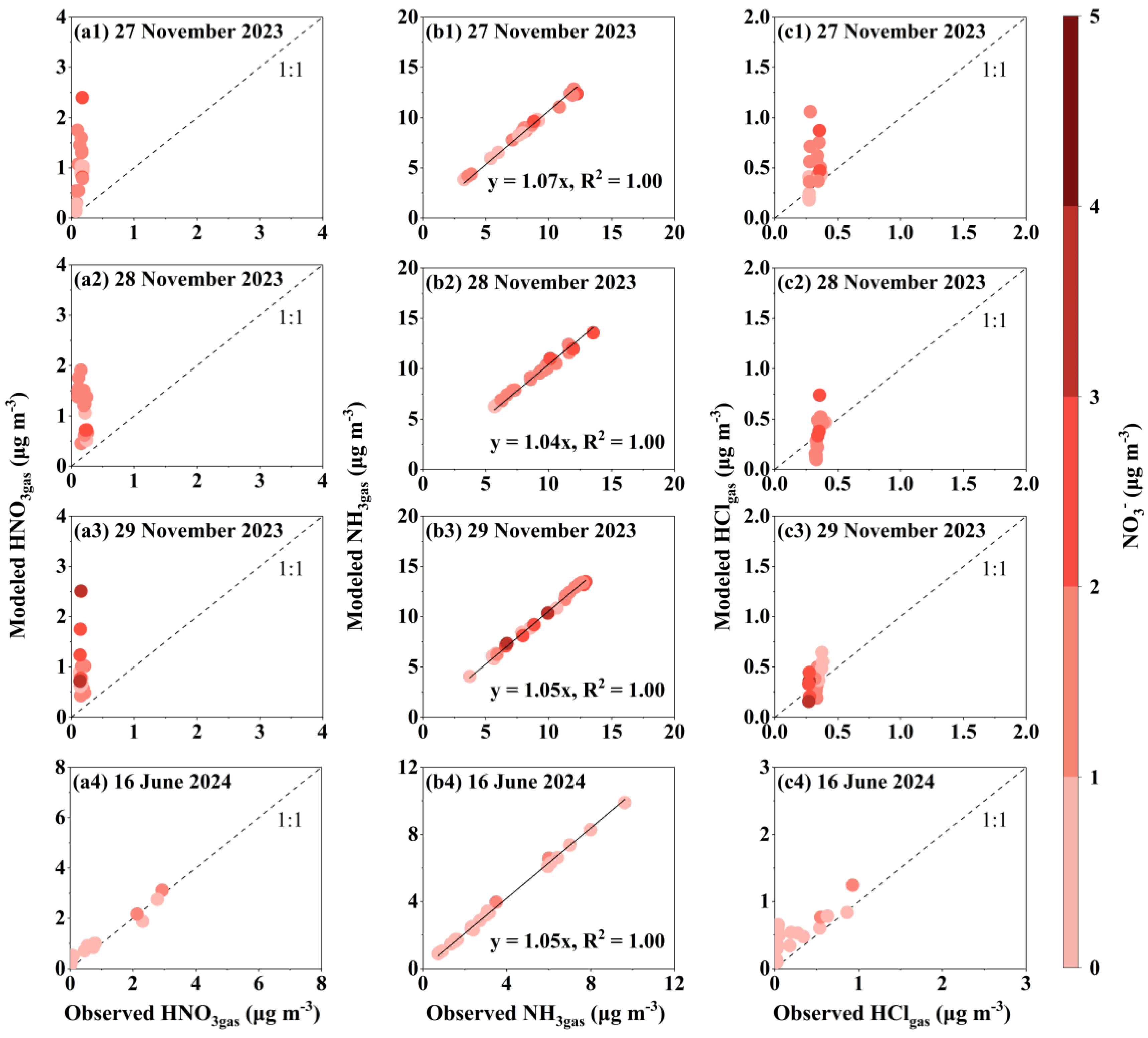
Figure 4.
Observational and calculated data on 27 November 2023. (a) daily variations of NO3-, Na+, and NH4+ concentrations in PM2.5; (b) daily variations of PM2.5 mass concentrations at three national monitoring sites; (c) contour plotting of particle number size distributions; (d) correlation between normalized NO3- concentration and N > 100, with the normalized values calculated by dividing all NO3- concentrations by the minimum NO3- concentration and all particle counts by the minimum particle count; (e) 24-hour air mass back trajectories (red trajectories correspond to NO3- peaks).
Figure 4.
Observational and calculated data on 27 November 2023. (a) daily variations of NO3-, Na+, and NH4+ concentrations in PM2.5; (b) daily variations of PM2.5 mass concentrations at three national monitoring sites; (c) contour plotting of particle number size distributions; (d) correlation between normalized NO3- concentration and N > 100, with the normalized values calculated by dividing all NO3- concentrations by the minimum NO3- concentration and all particle counts by the minimum particle count; (e) 24-hour air mass back trajectories (red trajectories correspond to NO3- peaks).
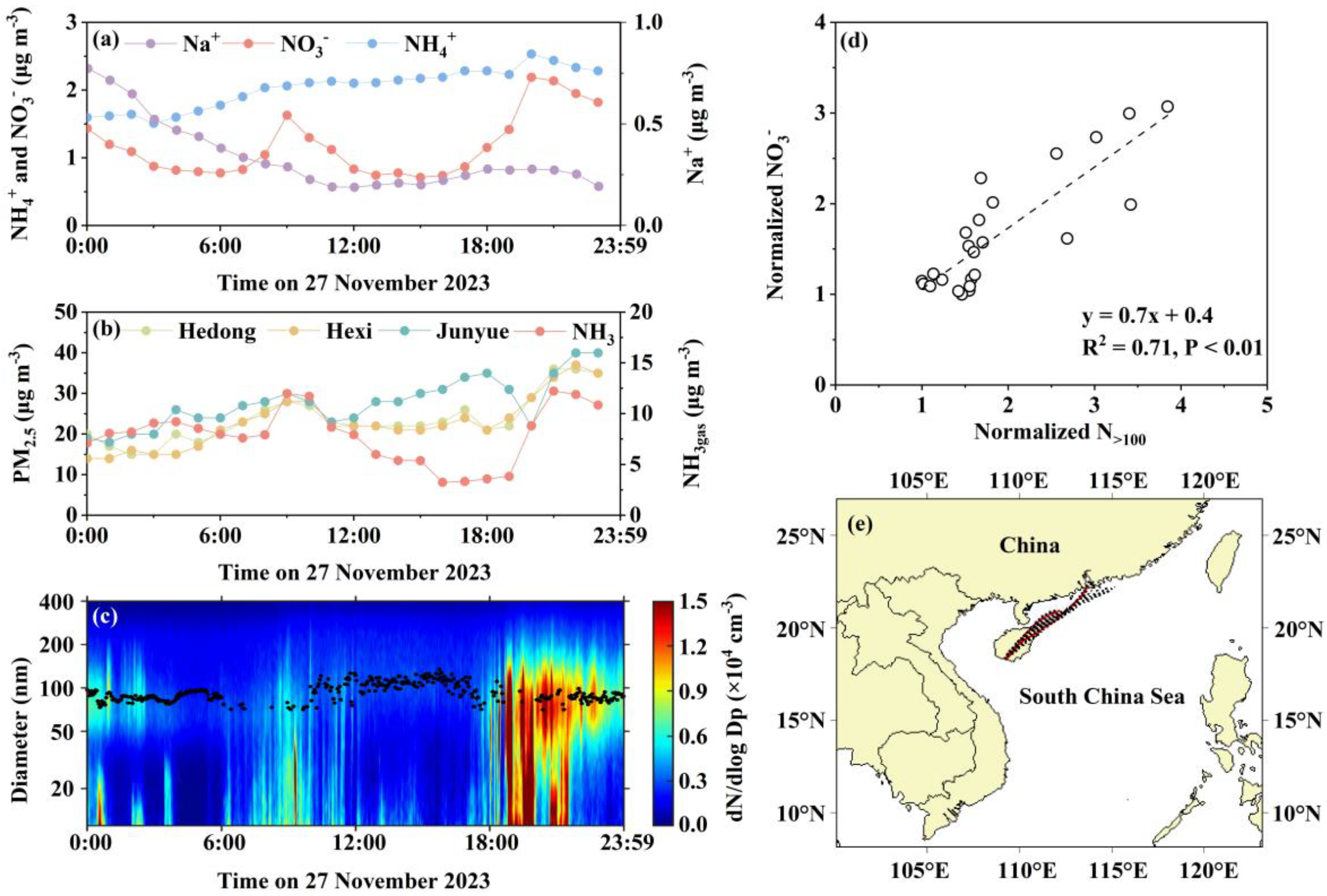
Figure 5.
Same as Figure 4, except on 28 November 2023.
Figure 5.
Same as Figure 4, except on 28 November 2023.
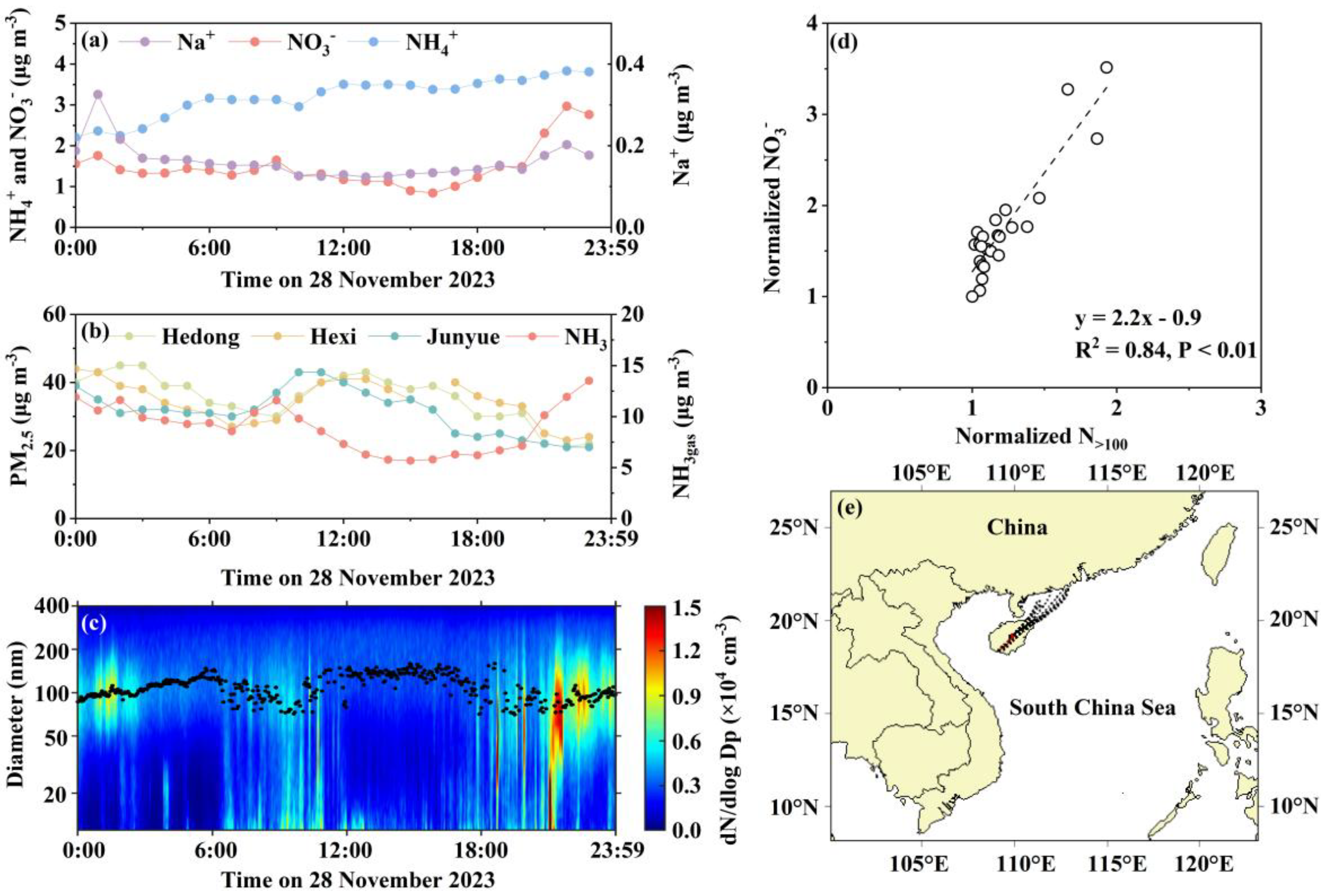
Figure 6.
Same as Figure 4, except on 29 November 2023.
Figure 6.
Same as Figure 4, except on 29 November 2023.
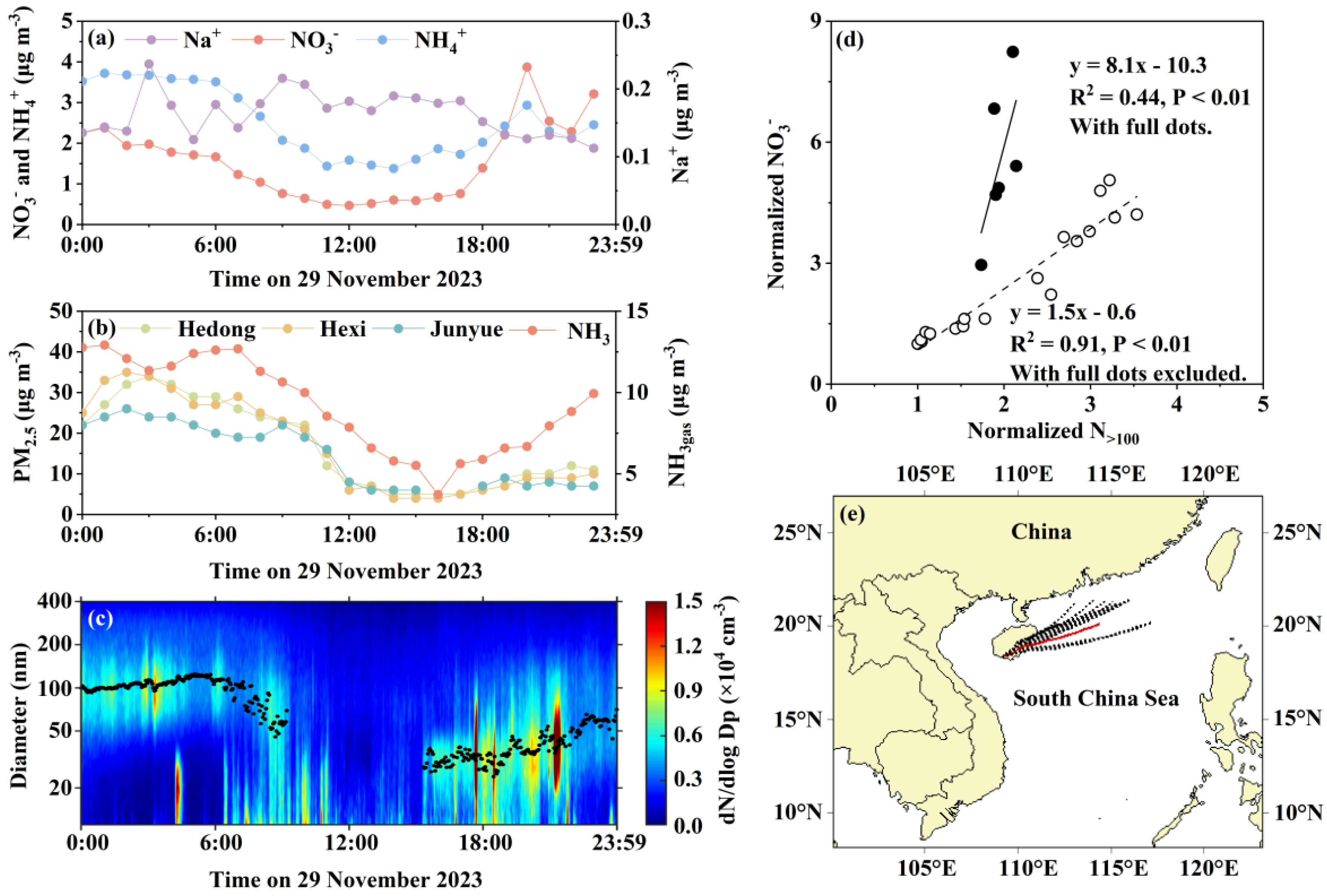
Figure 7.
Observations and calculations on 16 June 2024. (a) daily variations of Na+, NO3-, and NH4+ concentrations in PM2.5; (b) daily variations of PM2.5 mass concentrations at three national monitoring sites; (c) contour plotting of particle number size distributions; (d) correlation between Na+ and NO3- concentrations in PM2.5 (empty and full symbols represent the values before and after 12:00); (e) daily variations of HNO3* and NH3 concentrations; (f) daily variations of OC and EC concentrations; (g) correlation between normalized [NO3-]PM2.5 and N>100; (h) 24-hour air mass back trajectories (red trajectories correspond to peak periods).
Figure 7.
Observations and calculations on 16 June 2024. (a) daily variations of Na+, NO3-, and NH4+ concentrations in PM2.5; (b) daily variations of PM2.5 mass concentrations at three national monitoring sites; (c) contour plotting of particle number size distributions; (d) correlation between Na+ and NO3- concentrations in PM2.5 (empty and full symbols represent the values before and after 12:00); (e) daily variations of HNO3* and NH3 concentrations; (f) daily variations of OC and EC concentrations; (g) correlation between normalized [NO3-]PM2.5 and N>100; (h) 24-hour air mass back trajectories (red trajectories correspond to peak periods).
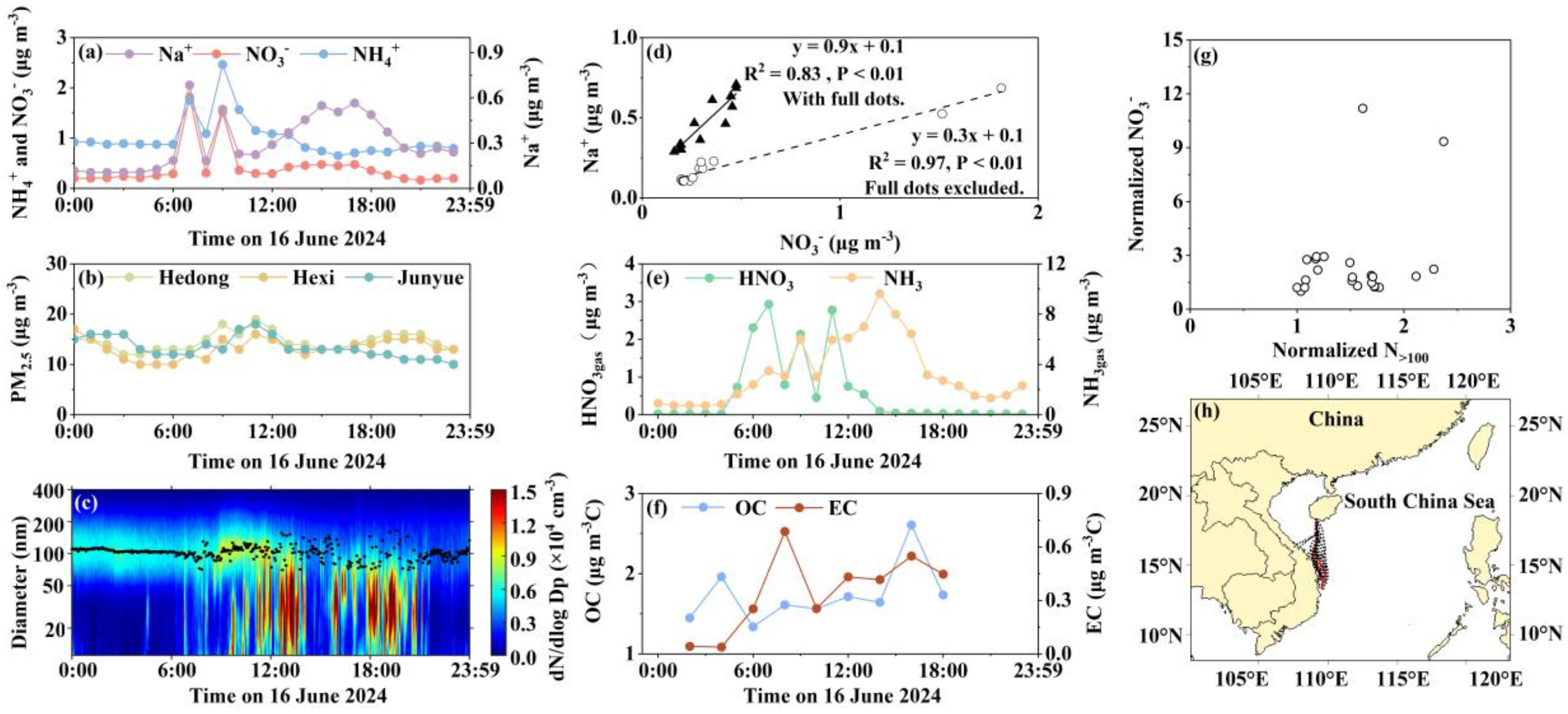
Figure 8.
Source apportionment and daily variation of NO3- in PM2.5. (a) Contribution of five factors to NO3-. (b-f) Daily variation in the contribution of each factor to NO3-. (g) The particle number size distribution profile of each factor.
Figure 8.
Source apportionment and daily variation of NO3- in PM2.5. (a) Contribution of five factors to NO3-. (b-f) Daily variation in the contribution of each factor to NO3-. (g) The particle number size distribution profile of each factor.
Disclaimer/Publisher’s Note: The statements, opinions and data contained in all publications are solely those of the individual author(s) and contributor(s) and not of MDPI and/or the editor(s). MDPI and/or the editor(s) disclaim responsibility for any injury to people or property resulting from any ideas, methods, instructions or products referred to in the content. |
© 2025 by the authors. Licensee MDPI, Basel, Switzerland. This article is an open access article distributed under the terms and conditions of the Creative Commons Attribution (CC BY) license (http://creativecommons.org/licenses/by/4.0/).
Copyright: This open access article is published under a Creative Commons CC BY 4.0 license, which permit the free download, distribution, and reuse, provided that the author and preprint are cited in any reuse.


