

Submitted:
15 April 2025
Posted:
16 April 2025
You are already at the latest version
Abstract
Humans are a curious mix of biology and culture, and one interaction area between these two that has recently come into focus is located in the senses, our biological apparatus to connect with the world. In this essay I address the variation in appreciation of the senses in various cultures, both historical and contemporaneous, in order to glean the measure in which culture steers not so much our observations, as our appreciation of the epistemological weight of our various senses. I concentrate on three, vision, hearing and smell, and show how the relative weight attributed to each of them shifts in different cultures or historical periods. Using data from anthropology, literature, psychology and linguistics, I argue that vision, sound and smell accrue different positions in various cultures, and that our sensorial balance shifts with culture. Thus, our present epistemological dominance of sight over all other senses, is neither a biological given, nor a cultural necessity.
Keywords:
senses
; vision
; hearing
; smell
; culture
; balance
1. Cultural senses?
In his Phénoménologie de la Perception, the French philosopher Merleau Ponty (1962: 246) summarized his approach to embodiment as ‘Je suis mon corps, comme esprit incarnée, ouvert au monde’ (I am my body as an incarnate spirit, open to the world). He did not mean that we have an independent spirit that dwells inside our body, for such a Cartesian dualism would be just what he refutes, but that we perceive ourselves as an incarnate spirit, as something inexorably connected to our body but still operating at a distance. His first few words make any Cartesian notion untenable: ‘I am my body’. An operative word is ‘incarnate’, embedded in the flesh, and as his (and our) focus is on perception, the main thrust of his maxim is that we are ‘fleshy perceivers’, carnal observers as well as corporeal interpreters of our observations. This is the position I want to start from, the theoretical notion that we are our body, and that any other influence comes through our senses as they form our bodily opening to the world. A recent and dynamic formulation of this stance would be dual inheritance theory or gene-culture co-evolution in which the transmission of information through genes and through culture become one interrelated process, the mechanisms of cultural evolution working in tandem with genetic modification (Richerson & Boyd 2005). However, as my approach will be synchronic and my aim is to balance and ‘weigh’ culture and biology, the ultimate conflation of genetics and culture in dual inheritance is an interesting panorama at the far horizon, but in the here and now culture and biology follow diverging pathways.1
Anyway, this ‘interactive’ approach of the relation between nature and culture implies that whatever we are and do always bears some imprint of our corporeal existence plus just as inevitably of our culture, and that interrelation is always dynamic. We are not a corporeal tabula rasa on which culture inscribes, but biology-cum-culture in any instant: our nature is mediated by culture just as our culture is grounded in nature. This implies that culture, which is the other factor in the transition of sensorial input to organized perception, is always intertwined with the body. Though cultural expressions follow rules different from biology, under the tremendous cultural variation lies the simple fact, increasingly acknowledged, that all culture is mediated by biology, and – less generally acknowledged – that any biology is mediated by culture (Waring & Woods 2021). It is on this latter mediation that my contribution will dwell. And what could illustrate this cultural mediation of our basic biology better than our primary relation with the world, our senses?
The second operative word in Merleau-Ponty’s quote is ‘open to the world’. Senses make no sense without something to sense, and any weight the senses carry has to be read against the measuring stick of our interaction with the outside world. We live towards the world and the world exists towards us. Take for instance our ears: as animals go we have reasonable ears (though any antelope world be ashamed of them). The way we use them, i.e. the meaning they transmit, has changed dramatically. Language has been crucial in our anthropogenesis, so for humans hearing is more important than it is for apes. Our primate ancestors had already long lost the maneuverability of their ears, and evolution does not ‘give things back’. Our head did become more versatile with a longer neck, and thus sight and hearing could and had to be directed through movements of the whole neck. In intra-group communication this head-directionality joined with our heightened facial looseness, allowing for a complex system of facial and verbal expression, underwriting the hugely increased volume of information our ears carry.2
But not only information is at stake, also aesthetics. All human cultures make music, i.e. all human beings like music (Sacks 2007), even if what is considered music differs and rhythm and melody seems to have their own history and dynamics. This apparently gene-based musicality of Homo sapiens is astonishing, as it is hard to see how our evolutionary history should have selected for it. So it might be a side-product of our evolution, unless, as Stephen Mithen argues, it has been essential in the evolution of language (Mithen 2005) in which case our musicality makes excellent sense. There is no culture without people singing, and as far as I know apes do not sing, so somewhere in the last few million years this quality has been acquired, according to Mithen with the Neanderthal. Some other animal species do sing, of course, like whales and birds, but these are communication systems clearly relevant for mating (whales) and territory (birds), so limited purpose communication systems. In contrast, human ears not only open us towards the surrounding world, but especially tuned in to producers of meaning, i.e. fellow human beings; in short, we have a sensorial-cum-communication system that predisposes us towards our group members. Since, as has often been said, we are ‘wired to hunt and gather in the savanna’, our senses do define us a relation-oriented ape, so we are ‘wired for togetherness’. If, as Menzon suggests, ‘society is the natural life-form for clever apes who learned to sing and dance before they learned to analyze and rationalize’ (Menzon 2005:84), our aesthetic and sensorial apparatus is even of more importance in our anthropogenesis than the calculating neo-cortex, underscoring the weight of the senses in our human condition. That would mean that culture comes in very early in our anthropogenesis, which renders the relation between biology and culture highly relevant.
In this article I explore this relationship in three of our senses, seeing, hearing and smelling, trying to establish in what measure their relative importance varies with culture, so my focus will be on the balance between these three senses. I start with the eye versus the ear, and later will move to the nose, and our first port of call is among the Fulbe of Central Mali.
2. The Eye Against the (Good) Ear?
It was a beautiful moment. In the house of the Fulbe marabout Boura Moodi in the small village of Boni in Mali, a dozen local dignitaries were gathered as their scholar would read to them from his books. We were introduced properly, as anthropologists, but they already knew my colleagues well, who both had been working in the area for several months. After some waiting, as was fit, he emerged from the house: a tall, dignified figure dressed in white, who greeted the people, his arms loaded with books. Manuscript books they were, loose-leaf bundles of written text, among which were the Qur’an, some commentaries and the books we came for, the tarikh, the (written) local history of the region. Boura Moodi sat down and opened the book, a hush falling over the small crowd: recitation! Slowly and clearly he read some passages, his finger following the lines of intricate writing, his audience listening enraptured, us included (see Photo 1). Reading the book meant listening to the voice of the scholar, and through him to the voices of earlier scholars who had kept records through the generations. The spoken word linked us with the past and the book was the vehicle for that very spoken word, even if part of the text came from Boura Moodi himself.
Photo 1.
Boura Moodi reciting (Mali 1993) 3.
Photo 1.
Boura Moodi reciting (Mali 1993) 3.
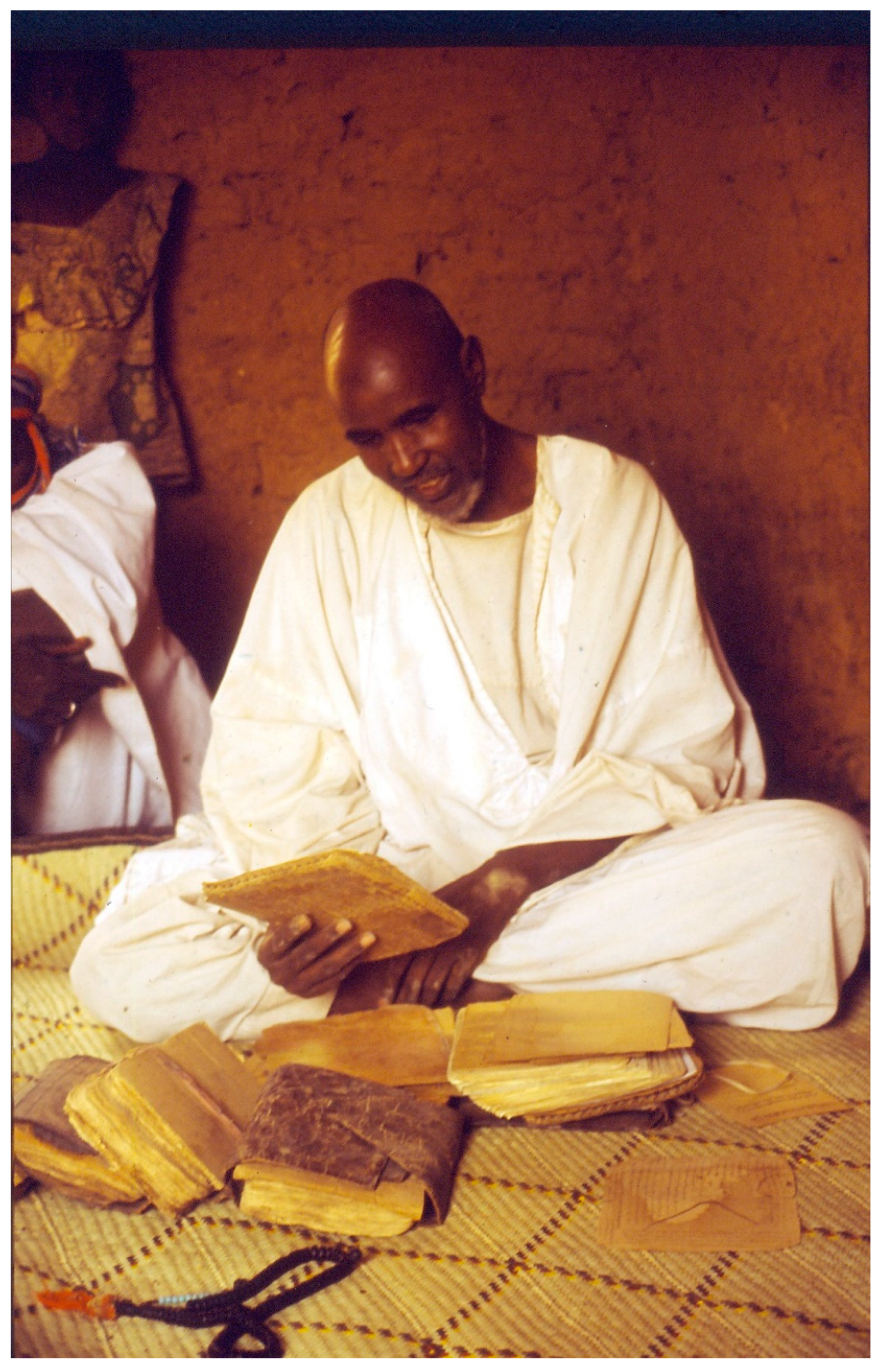
Here, as has been usual in our own culture until relatively recently, reading means listening, and the one who reads should do so aloud, listening to his own voice speaking the words of others. The change from reading aloud to reading quietly occurred in the 19th century, mainly as a corollary of the printing press, but a late corollary (A. Classen 1998). The book changed from being a recitation device that was supposed to be heard, to a viewing device, the social tongue and ear being replaced by a lonely pair of eyes. Western culture has become highly visual, with scholars taking the printing of books as a watershed and calling it the ‘Gutenberg Galaxy’ (McLuhan, cited in Ingold 2000). Since the arrival of the printing press, our eyes have not only been given pictorial information but also written text: language has become a visual thing, information comes silently.
Now the screen has been added with its powerful combination of vision and sound, all the more powerful because it is interactive. The screen was first a movie screen without sound, but with oral explanation. It has now become a world of its own, both as a window on the wider existence and as a carrier of its own virtual worlds with sight or sound. Screens are continuously on, even without people watching them, and the multitasking of speaking on the phone while watching TV is well known. Visual information is much more than a distraction or an illustration: the screen has produced its own models of and models for the world. We have learned more about the world around us through visual information than ever was possible with print alone. The screen gives us a model of the world. But the visuals also impose their own standards. Advertising, theatre and sports give us the models for the life to be lived, the person one might want to be and aspirations that should be set. Role models have shifted from the heroes in tales to actors on the movie screen, later to be replaced by the lead singers of rock bands and, increasingly, top sportsmen and women. None of this would have been possible without visual information.
Our visual culture is clear in science as well. The computer is used for modelling and models are increasingly visual. For instance, major breakthroughs have been made in diagnostics and the visualization of diseases. Important medical technological innovations include new ways of seeing problems: after X-rays came ultrasound scans, magnetic resonance, computer tomography and the increased use of miniaturized viewing probes.
The orality-literacy debate of the 1970s and 1980s considered at length the changes that resulted from the move from oral to written cultures (Ong 1982). The implications have been huge: the transfer of spoken authority to text, another view of history, larger scales of organization and bureaucracy, the composition of religious script, and a new view of one’s own identity. Writing eliminated many of the life-like characteristics of oral performances; no longer did the rhythm of the text, style figures of redundancy and repetitions, audience participation and praise songs bring us close to the lived experience, but instead we read lists, numbers, names and stories in a strict timeline. Our little pastiche on Fulbé books in Boni is set in a traditional situation but exemplifies the changes. It is the person who can read who has authority, not the oldest man, as in neighbouring Dogon villages. The scholar himself alludes to the authority of the book, even if he wrote some of the text himself. The arrival of the book thus produces emotion, awe and respect, and is a highpoint in itself.
The example also illustrates how many oral characteristics still remain after the introduction of writing: it served as coagulated speech for a long time, and this holds even more so for the sacred texts that have shaped world religions. What is ‘real text’? The revolution of writing resulted in the Unsterblichkeitskarakter of text which became an Offenbarungstrager (Graham 1989), and the book itself became a ‘heavenly book’ (Cantwell Smith 1989). This was not the case everywhere, such as in Greece, India and Africa, but there talismans, divination and the so-called maraboutage showed the power of writing. Books became important in some religions, for example in Tibet, in Mahayana Buddhism, and in Islam a cult of the book developed, sometimes called ‘bibliolatry’. Yet, despite their written form, many of these texts were about recitation. When the ‘Word’ is mentioned as an act of creation (John 1:1) it is the spoken word, not the written text; and when in the text of Apocalypse, a written book appears, it is first forbidden to write – because the text has to remain secret – and then the book is to be eaten, not read (Apocalypse 10: 4,9). The word Qu’ran means recitation, and indeed the book should be learnt by heart and then recited. The oldest texts in the world, the RigVeda, are known in a written form in Sanskrit but scholars have been adamant that, despite this old textual form, the ‘real’ Veda is the oral recitation as well as the performance of the texts during the rituals of early Hinduism. The Veda is considered as oral scripture: ‘In the actual sounded syllables of the Veda lie the points of contact with transcendent reality’, or ‘Veda non sunt libri’ (Veda are not books) (Graham 1989: 146, 147).
So scripture is originally an oral phenomenon, and this is made clear throughout the texts, for example, in the insistence on hearing: ‘Whoever has ears to hear …,’ and of course in the Shema, the ultimate Jewish credo: ‘Hear, O Israel. The Lord is God. The Lord is one’ (Deut 6:4). Evidently, reciting a text is not the same as telling a story, as the reciting of a sacred text can be interpreted as God speaking. St Paul’s letters are the most scriptural in the Bible, including the New Testament, but these too were meant to be read aloud.
Some theorists have stressed that viewing results in a different relationship with the world than hearing: vision divides the sensory experience into the viewer and the viewed, objectifying a world that is first of all lived in, not viewed. Hearing, they think, offers more unity with the world, less distance, more co-existence. Ong’s (1982: 91) remark breathes that spirit: ‘The interiorizing force of the oral world relates in a special way to the sacral, to the ultimate concerns of existence’. One argument for this distinction is the way the blind participate in society compared to the way the deaf do. Oliver Sacks (1990, 1997, 2007) has written extensively on both. One of his cases is a blind man whose eyesight was restored surgically thanks to the untiring efforts of his fiancée (Sacks 1997: 159). What follows illustrates how regaining one’s eyesight – the paradigm miracle in the New Testament – is not as easy a process as it might seem. The previously blind man has to manage major adaptations in his life and, in fact, does not succeed. When viewing a statue, he easily falls back into his ‘blind mode’, feeling it with his hands for a ‘proper sight’. In the end he returns to his blind existence, ending his engagement with his fiancé as well as with the sighted world and settling for his familiar and comfortable blind life. In general, the blind find a niche in the margins of the sighted society quite easily, even if they remain marginalized.
The contrast with the life of the deaf is striking. Without special attention, deaf children have a huge problem developing language and not only remain marginalized but also have difficulties reaching their full potential as human beings (Sacks 1989). The difference is, of course, language: without speech, man is barely considered human. This in itself would be an argument in favour of the special existential place of hearing but the situation is more complicated. When deaf people bond and develop their sign language, they clearly reach their full potential. Sacks convincingly argues that sign language is a full and complete language, comparable to natural acoustic languages. If the deaf are bereft of sign language, as has been the case in many countries due to well-meaning but ill-advised policies to thrust remnants of an acoustic language upon them and forbid sign language (because it was deemed inferior), they remain marginal and have problems with their development (ibid.). So, the deaf as a category can function well as a separate society, an island of stillness in the soundscape of the world. To be deaf calls for ‘deafmanship’ (Ingold 2000: 274):
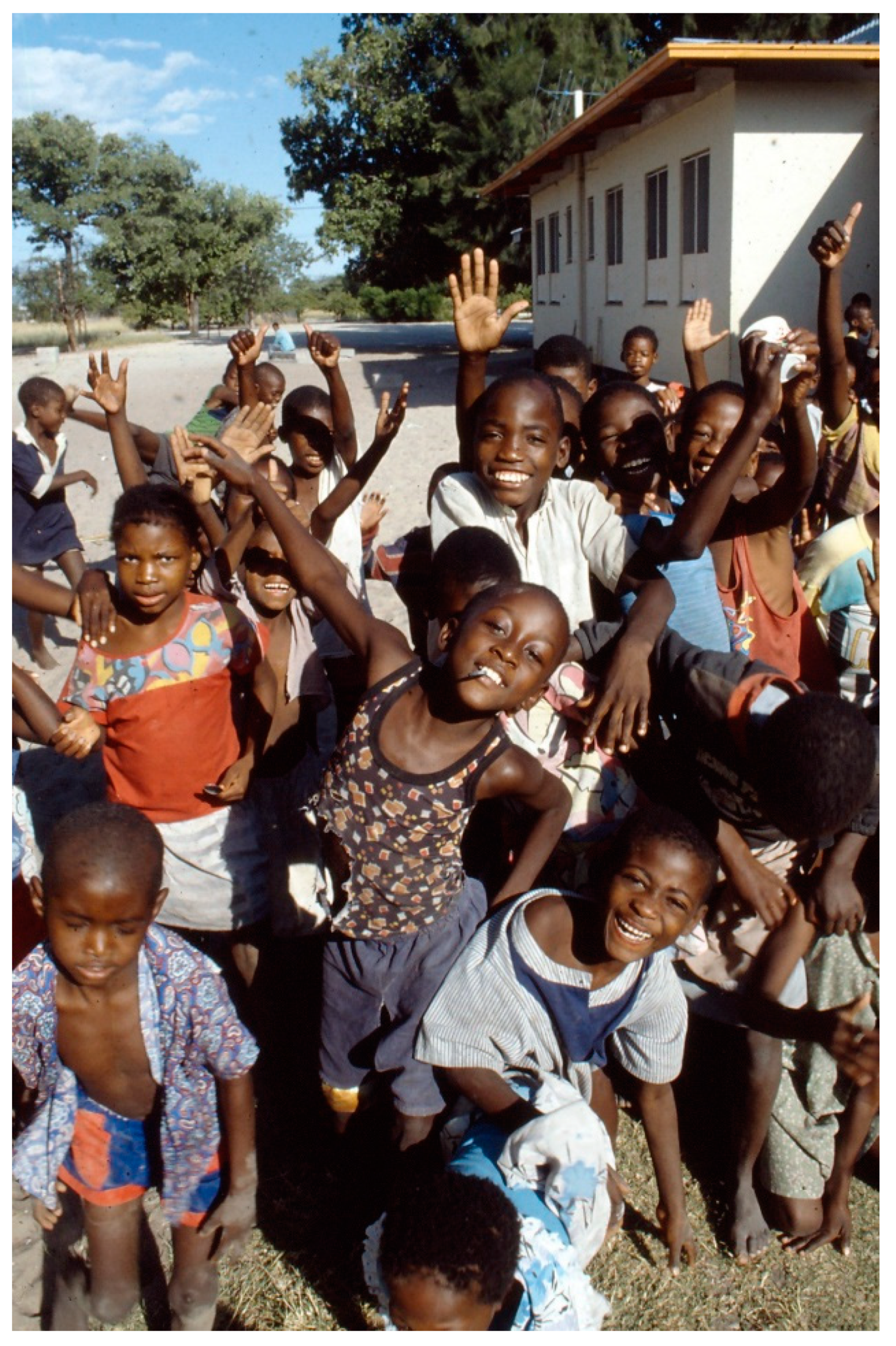
Another field experience. One of my Utrecht anthropology students was going to do research on a school for the deaf in North Namibia. We arrived at noon at the school gate. Immediately our car was surrounding by a throng of beaming children, delight streaming out of their eyes, their hands waving at us: the sign for welcome. Not a sound was heard, but for some low soft grunts while the children communicated fast with each other with their hands (see Photo 2). Never I have felt so welcome, and seldom so elated. The student later commented on her sense of isolation during her fieldwork, despite her mastery of sign language. The children made it very clear that now she was the outsider, as a speaker in the ‘world of silence’.
Photo 2.
Reception at the deaf school (Namibia 1995).
Hearing is crucial for humanity and if that holds even more so than for seeing then it is a question of language, not so much of the senses. Ingold criticizes field reports that extol the importance of sound over sight. Acoustics are not without their revolution either. Today in our cities we have a general background of noise, as Karin Bijsterveld notes (2008). In the 19th century, factories were in the middle of cities, with their sirens and machine noises, and the devilish symphony of mechanical noises made silence only within reach for the lucky few. More than odours, technical innovations have made the ‘civilization’ history of noise quite complex: nowadays we can live in a world of sound that we choose ourselves, and the options between a loudspeaker and a headphone imply that we can decide whether or not our neighbours will hear it too. Sound can be privatized, and whether we do so is the very arena of public debate. Of course, some sounds, like trains, cars, and airports, cannot be shut down and, as such, are the arena of bitter fights and huge investments. Anyway, silence is precious, the larger the city, the more precious it becomes.
My own experiences with the importance of hearing have more to do with language than with hearing per se. The Dogon of Mali have great respect for the ear. Someone with ‘good ears’ understands other people, and a wise man ‘knows the words of the world’. Speaking is valued as an art, as story-telling, but especially in blessings: old men are expected to utter a stream of blessings over the heads of their descendants, and virtuoso performers of this art are highly regarded. The main ritual leaders of the village are those who have learned the sacred masque language to perfection and can perform their recitations in it. In the ritual complex of the funeral, the apex of the many rituals is the performance of a lengthy song by a group of specialists between 23:00 and 06:00. This wonderful song, with its simple but captivating melody that indeed lasts all night and never stops during seven hours, is not so much listened to but forms a soundscape for the women who sleep through most of the performance on the warm sand in the village’s dancing area (Van Beek, Ongoiba and Saye 2025), see Photo 3.. Listening is important but mainly in the framework of language.
Photo 3.
The village audience during the all-night baja ni performance (Mali 2008).

Any theory that starts with the distinction between ‘us and them’ should be screened carefully, because if there is anything we have learned from anthropology it is that we have a deep common humanity. Especially in the present heyday of genetics, arguments for extreme cultural or linguistic relativism have a lot more to explain than three decades ago. Ingold (2000: 277) rightly insists that the dichotomy between seeing and hearing is predominantly artificial, that they are both coterminous as ways of relating to the world, making sense of oneself and one another: ‘But just because here vision, or there touch or hearing, have been singled out as vehicles for symbolic elaboration, this does not mean that people will see, hear or touch any differently in consequence.’ His critique of the ‘anthropology of the senses’ sticks, and I will follow him in that. The important thing is not that people live ‘in a world of hearing’ instead of a ‘world of seeing’ but that through the internal discourse on the senses they shape the symbolism of the senses differently, and have a diverging appreciation of the information coming through the various senses. It is not the ways of observation that differ but the cognitive styles (Fabian 1983: 123). In short, what weight does a culture attach to visual information and what to auditory evidence? Western science has elaborated the visual cognitive style to an unprecedented level, accepting its primarily visual information as evidence for correctness.
Besides, viewing not always carries information. When the Kapsiki of Cameroon experience a severe loss of a loved one, i.e. someone who died before his or her years, the usual cultural tool of the funeral rites, with their dances and plaintive songs, are no longer sufficient. Confronted with that much grief one simply sits and looks, kanewe le ntsu, litt. ‘look with the eyes’, not so much to see people or things, but in order not to see them, to shut oneself off from the world, lost in the own private world of grief through a visual void.
The weight of auditory evidence is, indeed, higher than in our Western society. Kapsiki and Dogon discourses on hearing primarily focus on language, on the spoken word, so the relevant soundscape is made up of oral communication, not out of the general background of general sound or even noise. Waking up in the morning in a Dogon village, one first hears the roosters crowing and some donkeys braying, but the soundscape is soon dominated by human voices, of women greeting each other. Going downhill to fetch water for the morning household tasks, those on the way down greet the women on the way up, long, loud and clear. As is standard in Dogon interaction, each of them asks for the well being of the other, her husband, her children, her family. Then the other woman asks the same, and always the answer is that all is well, thank you. With these heavy load on their head, the women do not halt, but perform the whole greeting ritual in passing, so towards the end they have to raise their voice to be audible for her conversation partner way behind her back, their voice ricocheting against the backdrop of the cliffside.
Human sound is much more important than non-human sound, and even animal sounds are often interpreted as human. For instance, among the Cameroonian Kapsiki, blacksmiths use a special bird that whistles inside a dark hut (van Beek 2008). The communication is very direct and highly verbal: the client asks his questions directly to the ‘bird’ and receives a tone melody back in whistles, which is immediately filled in by the blacksmith as a sentence with the same tonal structure,4 offering the answer to the question posed. The evidence is here strictly aural, as the client never sees the ‘bird’, which for all practical purposes might be the result of ventriloquism. The principal divination method for the Kapsiki is, however, with a visible animal, a crab. It is placed inside a pot of wet sand replete with fixed straws, which indicate the relevant parties in the session, and moveable calabash shards. The blacksmith then explains the problem and exhorts the crab to do its work: ‘Speak, speak with your feet, speak clearly and do not lie’. The pot is closed for a quarter of an hour and then the traces of the crab are ‘read’ as the answer to the question. Again it is the blacksmith who translates the visual information into words, and the main communication is done through language. The client has no key to read the prints of the crab and considers verbal information as the main outcome of the divination.
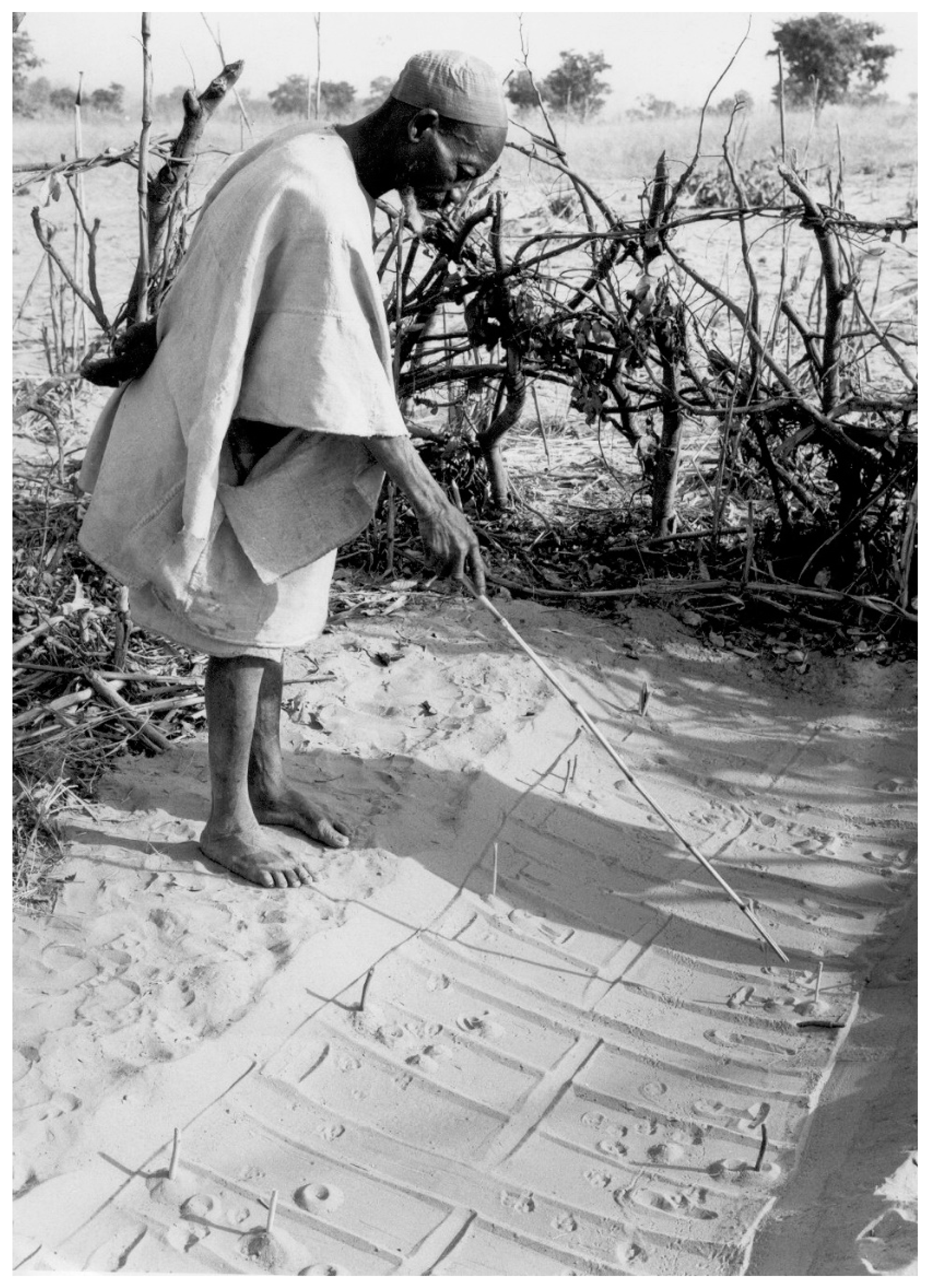
The Dogon have several methods of divination, the most famous being the fox divination in which the traces of fox paws in the sand are read as communication (van Beek 2007). Essentially it is human communication since no other communication is thinkable. Other animals could just as well be utilized for divination, such as the hyena, the red ant or the pigeon, though the eminence of the fox in predicting the future is established in mythical tales. After all, who can control a hyena and who can read the prints of an ant? As for the pigeon, its cooing is ‘heard’ as the tone of a standard Dogon utterance. This is the same in the fox divination of the Dogon. In the case of the fox, the client does not visit the sandy patch out in the fields but leaves everything to the diviner. The client has told the diviner of his problem and expects an expert to do his work, just waiting till the next morning (divination bridges a night during which the fox should visit the patch) for the diviner to come to his compound and reveal the answer (see Photo 4, where the diviner reads the traces of the fox in the absence of the client). In this case there is a clear contrast between the very visibility, even aesthetics of the divination technique and the lack of interest of the client in the visual outcome. Virtually none of the film makers who have zoomed in on the Dogon – and there have been numerous films made about the Dogon – have ever left a fox divination out of their account, as it is usually a visual highpoint; but no client ever shows up at the patch. So here the diverging appreciation of the senses between Europeans and Dogon is evident: Europeans want to see traces of the fox, the Dogon want to ‘hear’ the fox. And of course, being an anthropologist, I want both!
Photo 4.
Ani Saye reading the prints of the fox (Mali 1987).
3. The Elusive Smell
They haven’t got no nosesThe fallen sons of Eve;Even the smell of rosesIs not what they supposesBut more than mind disclosesAnd more than they believe.Chesterton
This third section deals with the sense that has gained considerable attention in the last decades, smell.5 As an animal species our sense of smell is not particularly acute, but neither is it as badly developed as we are sometimes inclined to believe. In our culture we have learnt to distrust our perceptions of smell (Deroy 2022). Though a dog, a shark or an elephant would be in trouble with our nose, we can still discern scores of molecular compounds in minute concentrations. One major problem with smell, as Leroy Gourhan (1993: 292) remarked, is that: ‘The sense of smell, being purely receptive, has no complementary organ for the emission of symbols of odours’. Smell lacks any symbolic system such as a referential grid, which makes it elusive but at the same time open to the influences of our cultural history. As Alfred Gell (2006: 404) put it: … ‘a smell is always incomplete by itself; it acquires a meaning not by contrast with other smells. But by association with a context within which it is typical’, while Jim Drobnick (2006: 346) compared it to the 4th dimension.
In The Perfume, a gem in German literature and the towering novel in the international field of odours, Patrick Süskind (1985) stages a hero who can smell extraordinarily well, but who produces no smell himself. This alone sets him aside from the rest of humanity, and though he develops himself an expert on perfume, when he sets out to create his ultimate perfume he is completely ‘outside’ humanity, as the perfume is an amalgam of a serious of horrendous murders. According to Classen (1994: 4), one of the attractions of the book is the ‘confirmation of the validity of many of our most cherished olfactory stereotypes – the maniac sniffing out his prey; the fragrant, hapless maiden; the dangerous savagery inherent in the sense of smell’. Richard Gray analyses the cultural rational in the novel, which has been translated into some 25 languages, as an inversion of the Enlightenment agenda. In the 19th century Freud connected the rise of civilization with the suppression of olfactory stimuli, while Kant condemned the olfaction as ‘opposed to freedom’, since smells are unavoidable, and unworthy of cultivation (Gray 2006: 237). Süskind’s anti-hero Grenouille recognizes both the inescapability and subliminal impact of odours, concluding: ‘He who rules scents ruled the hearts of people’ (Gray 2006: 239).6 So, the novel is a fundamental critique on a purely rational view of man and on the dominance of ocular vision, and as such highlights Merleau-Ponty’s warning: ‘For a philosophy that is installed in pure vision, in the aerial view of the panorama, there can be no encounter with another: for the look dominates; it can dominate only things, and if it falls upon men it transforms them into puppets which move only by strings.’ (Merleau-Ponty v1968: 77-8).
Many authors have witnessed the power of smell in eliciting emotions, the most eloquent probably being Marcel Proust in À la recherche du temps perdu in which the smell of madeleine cookies brings back floods of memories and feelings, and psychologists have elaborated on this aspect as well (Vroon, van Amerongen & de Vries 1994, Engen 1982, Gough & Christie 2002). Drobnick (2006: 350) calls this Nosealgia – the field of smell is full of wordplays and neologisms – a reaction that ‘make myths possible’(ibid: 371). In the Hindu tradition smells can evoke former incarnations from a repressed karmic memory (Shulman 2006: 417), not a déjà vu, but an extended déjà senti, one could say. And these memories are not always pleasant, since also the horrors of one’s past can be evoked through the nose, like for those who have experienced the ‘stenches of power: Khmer victims (Hinten et al. 2006), and holocaust survivors (Rindisbacher 2006); or more civilised, the ‘odour of law’ (Marusek 2023). On the reverse, people experiencing a so-called After Death Communication often speak of a fragrance coming over them when thinking of a beloved dead, a smell strongly associated with the deceased mother of father, and then not as a whiff, but as an extremely strong olfactory presence that does not fade quickly (Guggenheim & Guggenheim 2006: 427), these reports that are always positive.
Not only on the individual level smell can be crucial, but this hold also for a whole society. In his trailblazing study of odours in French history, Corbin (1986) describes the stench that must have pervaded French cities, and the transformation of society made possible by and through the ‘deodorization’ of France. Smell in France was a bit like noise in our cities: a continuous, inescapable presence, the mastery of which was a mark of election, of wealth and power, hence the tremendous importance of perfumes. We have learned in the process of civilization not to smell, to suppress our bodily odours, to choose non-intrusive smells and to clean up our backyards. The West has been deodorized in what Classen et al. (1994: 78) called the ‘olfactory revolution’.
Analyses of other societies with different olfactory histories have been following on Corbin’s footsteps: China (Huang 2023), 19th century England (Tullet 2023) and various others (Smith 2019). Different olfactory history give rise to varying smellscapes, which may be difficult to define in words, but inescapable for those who live in them (Marinucci 2023). Some of these are what Uri Almagor (1990) calls an ‘olfactory society’, i.e. one in which smell is utilized to make lasting social distinctions. Almagor’s example comes from Ethiopia, but other cases can be cited too: the Ilahita Arapesh of Papua New Guinea (Tuzin 2006), the Umeda Sepik of New Guinea, but this also holds for parts of a culture, like Japanese scent ceremonies (Gatten 2006) or Arab devotional practices (Auballe-Sallenave 2006).
My central case is that of the Kapsiki in northern Cameroon, who are known as the Higi in northeastern Nigeria. One major division runs through all the societies in the area and between blacksmiths and non-smiths. ‘Blacksmith’ means much more than just an iron worker as the rerhɛ or blacksmiths have many roles and functions. They make up about 5% of Kapsiki society with many of the characteristics of a ‘caste’ in this village-based society: they are strictly endogamous, have different food taboos and are confined to a certain set of occupations: they forge iron, bury the dead, make pottery (the women), perform divinations, administer medicine/magic, and are the musicians on many occasions, especially during rituals. Eating is an important definition of self in Kapsiki society and the blacksmiths eat several animals that the melu, the non-smith majority, shun, such as the meat of horses, donkeys, serpents and other reptiles, cicadas and black-feathered birds. In my view, this is a culinary definition of self (van Beek 1982), as the total picture of food taboos boils down to the blacksmith eating those animals that have a similar position in the animal world as they have in the human world: they eat their ‘mirror self’.
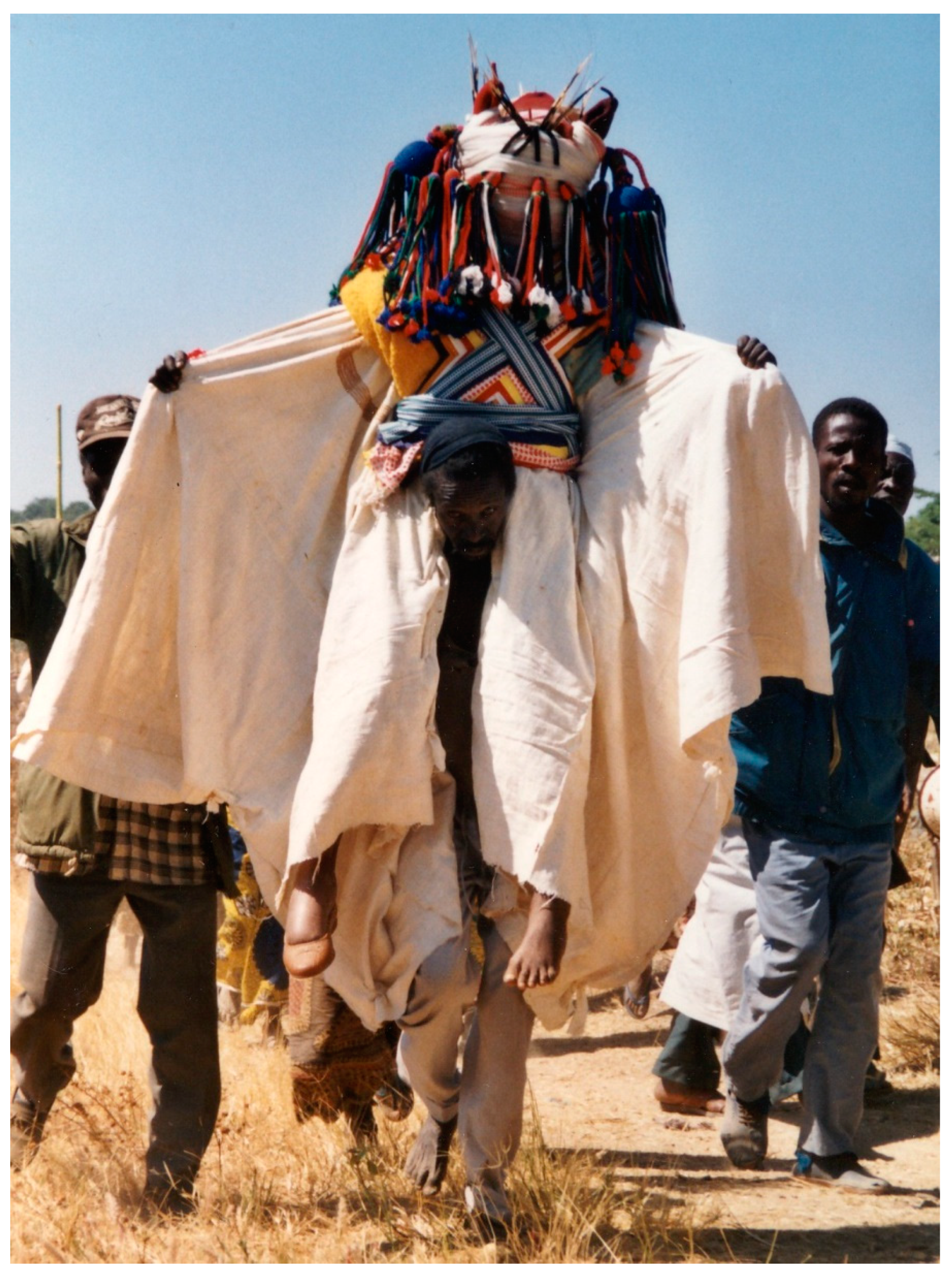
One of the smiths’ most important functions is to bury the dead, and they are absolutely indispensable in this central ritual and burials would be impossible without them. Kapsiki burial focuses on the corpse itself and over three days of ritual the corpse is dressed up and smiths dance with it on their shoulders. The accompanying rituals – such as its dressing, drumming, playing the flutes, digging the grave plus the actual burial – are also done by the rerhɛ. Three days is a long time for a corpse to be above ground in the tropics and at the end of the third day its odour pervades all the proceedings and the smiths who carry the body. One emic rationale for keeping the corpse around for so long is the rhythm of the funeral proceedings themselves, with the mourners having to see the deceased and the deceased having to see them in return. These three days allow an ever-widening circle of relatives to attend the funeral: the first day is for immediate kin living nearby, while messengers go to neighbouring villages to announce the death. The whole village of some 3,000-7,000 people gathers on the second day in a main dance to say a fond farewell to the deceased. The third day is for ‘strangers’, the neighbouring villages where the wives of the deceased come from originally and where his daughters are married now, his in-laws. Finally at the end of that day everybody has had their view of the deceased, who is elaborately dressed, and has danced in front of the corpse, wailed and lamented. The burial can then take place. It is the chief blacksmith who does this in the presence of just a few kin. So the Kapsiki ‘need’ three days for a burial and ‘need’ to bury the corpse when it has a definite ‘olfactory impact’. In the past, the corpse’s epidermis was washed away by the blacksmiths but this ritual element has disappeared. For the Kapsiki, the smell of the corpse is crucial in the definition of smells, and for the blacksmiths as a group.
Now for individual smells. It is extremely difficult to construct a scientific classification of smells, as Leroy Gourhan (1993) and Classen et al. (1994) remark, because the number of chemical compounds detectable by our (mediocre) noses is enormous and amorphous: ‘Odours have consistently defied attempts at rational (or ‘objective”) classification, and probably always will’ (Classen et al. 1994: 103, see also Howes 1991: 139-40). This means that one has to rely on culture-specific distinctions, in this case on the emic distinctions the Kapsiki make between smells, through their special vocabulary of smells. European languages usually have very few words for different smells and the few that there are relate either to taste (sweet, sour) or opinions (rotten, foul). In contrast, the Kapsiki/Higi language has fourteen lexemes indicating smells, most quite explicit, referring to the smell of something specific. The referent is usually an object: ‘it smells like …’ and the words belong to the class of ideophones, expressions of specific actions or observations. In fact, the Kapsiki language is quite rich in ideophones, using different ones for actions such as ‘biting with a large mouth’, ‘biting with a small mouth’, ‘the bite of a serpent’ etc. The smell ideophones are:
- mɛdɛke: the smell of various animals
- vɛrvɛre: the smell of the civet
- rhwazhake: the smell of urine
- ‘urduk’duk: the smell of milk
- shireshire: the smell of animal faeces
- ndrimin’ye: the smell of rotten food
- ndalɛke: the smell of a (three-day-old) corpse
- duf’duf: the smell of white millet beer (mpedli)
- hes’hese: the smell of roast food (peanuts, meat)
- zebe: the smell of edible food
- kalawuvɛ: the smell of human faeces (wuv¡)
- kamerhweme: the smell of old grain in a granary
- rhweredlake: the smell of fresh meat
- dzafe: the fleeting smell of something that is noticed just for a moment
I was surprised at the ease with which all informants came up with all the fourteen lexemes on the list, and the general consensus on them. However, there are differences in the interpretation of these terms between smiths and non-smiths, as well as to a lesser extent between women and men (van Beek 1992: 43, 44). Throughout, edibility is an important criterion and that is something smiths and melu define in their own ways. The biggest difference is smell no. 7 (ndalɛke) which is considered as the worst smell of all by the melu, but the smell of a corpse is not even mentioned by blacksmith informants. When pressed, they admit that the body does smell but not enough to honour it with its own ideophone. The women, smith-women as well as non-smith, have a sort of intermediate position in this, less diametrically opposed than the men. The whole ‘smell machine’ runs on the fact that non-smiths think that smiths smell bad, and the list reveals two reasons for this: the things they eat and the corpses they carry, both make them malodorous (see Photo 5). Thus, a curious contradiction at the heart of the Kapsiki funeral comes to light in these odour terms. To say a proper farewell to an honoured fellow member of society, the deceased has to turn into the foulest smelling thing on earth. And the very people who bridge this divide and make the burial and the farewell possible in a proper fashion – the blacksmiths – turn into ‘stinking people’, a lower caste of corpse carriers, the underbelly of society. The smell of the smith is the smell of ambivalence, of ‘people out of place’, in the words of Mary Douglas. Kapsiki society is divided in two by the nose, so a major distinction between people in this ‘olfactory society’ is highlighted by smell. Of course, the daily reality might well be that everybody knows who is a blacksmith and who is not, and that the smell element follows social distinctions and not the reverse. But smell is a strong metaphor for hierarchical relations and the discourse on smell is hard to counter.
Photo 5.
Smith Kwada dances with a corpse (Cameroon 2003).
Uri Almagor reported a similar situation with the Ethiopian Dassanetch, where the distinction was made between cattle owners (smelling like cattle, so wonderful!) and their lower-ranked fishing compatriots ‘reeking of old fish’ (Almagor 1987, 1990). And both groups washed frequently, as do the Kapsiki. Among the Serer Ndut of Senegal too, similar equations are made between smells and types of people. For instance, Europeans smell like ‘urine’ to the Serer Ndut, a definition of self versus the other, as we barely smell ourselves but turn up our noses at the foreign other (Dupire 1981: 13).
So our ‘small nose’ can be discriminating, and talking about our nose can quite effectively separate people. There is no reason to suppose that the Kapsiki – or the Dassanetch – have different or better noses than people from other cultures, but they chose to elaborate upon this sense in a social discriminatory discourse that runs through Kapsiki culture. Thus they mediate a fundamental contradiction in their culture at the cost of constructing an underclass, a caste. In daily practice, the blacksmiths’ lower position is to some extent balanced by their better nutrition, as they eat various animals that are quite nutritious, like serpents, horses and donkeys, as well as the sacrificial goats they consume at each funeral. During that three day ritual the blacksmiths eat one goat for every day the corpse is not buried so they have every incentive not to bury it too quickly, and the coming of Islam and Christianity – with their faster burial of their dead – has been a threat. Their lower status is increasingly being resented, but they do cherish the economic gains they accrue, and fully exploit them in new developments in the region (Van Beek 2015b).
Thus, smell can be important if a culture so chooses. Higher or lower than eye or ear is not the question and the inclusion of this third sense in the debate between seeing and hearing shows that the notion of hierarchy is not productive. Thus the preference for the ear over the eye, as expressed by Stoller (1989, 1997), C.D. Classen (1998) and Howes (1991), may bear a subtext of criticism of our Western society, as an expression of the charm of those small-scale societies we not only study in depth but also easily identify with. That this is part of a romantic streak in Western culture is perhaps a more charitable explanation than linking it to the colonial past and post-colonial Western anthropology, though both notions might be productive.
4. Conclusion: Balancing the Senses
All senses are created equalbut some are more equal than others
The Kapsiki use of smell as evidence that their social differentiation points to a particular cognitive style, carrying a particular weight inside a cultural discourse. With its evocative powers, smell is well suited to creating barriers between humans, and our Western culture has turned non-smelling into a lucrative business: smelling like a rose, overcoming the odour of the body and not smelling one’s environment have become conditional on what Gell calls ‘the transcendence of a sweet life’ (Gell 2006:405). We are far removed from Napoleon Bonaparte who, when writing to his beloved Josephine as he was returning from Moscow, requested that she not wash herself for the next two weeks as he liked the smell of her body so much (Corbin 1986: 223). However, when reading Süskind one understands. In our society we have succeeded reasonably well in de-odourising ourselves and our environment, and now face a challenge with noise similar to the one eighteenth-century France did with smell. Our ears should no longer be assaulted at random with unwarranted noise, as we want to be in control of our acoustic environment in the same way we are of our smells. Technology offers us the options to either saturate our environment with the noise of our own choice or to privatize our hearing, with orchestras reduced to earphones, and pop concerts to mobile telephones. The same is true of our visuals: we want to be in control of our visual environment and cleaning them up is extremely important. ‘The eye also wants something’ (het oog wil ook wat) is a Dutch expression indicating that the eye is not just an organ of registration but also a demanding one, just like the ear and the nose. Well, we have at least domesticated the nose.
City architecture and landscaping give us control over our environment, and woe is the planner who wants to build a big industrial plant in the middle of a town near where workers live. The congestion on highways, resulting from the separation of home and work, has to be shielded from view and from the ear, as well as from the nose, which makes transport a purely technical way of changing places with as few links to the environment as possible: all our senses should be directed towards the hazards of the road, and with good reason too, which means just vision and nothing else. So we want to control the input into our senses, and our view of ourselves demands that we obey the dictates of our senses. Technically, the eye has one different characteristic from the ear and the nose, as it can shut down, a difference that has drawn diverging interpretations from various theoreticians (Ingold 2000 vs. Stoller 1997), either as a distancing organ (Howes 1991) or as a sense that consciously includes oneself in the world (Merleau-Ponty 1962). In practice, the difference is not that big. The dictates of these senses on our appreciation of our environment run parallel, towards an environment with a screened sensorial input.
This is the aesthetic weight of our senses, our sensorial regime. The other question is about cognitive style, the cultural logic of the senses. How the input through our senses weigh into the ways we make up mind does depend to some extent on one’s culture. Ingold cogently argues that the notion of inversed hierarchies of the senses does not hold water, and he is right. It is not a question of simply inverting a hierarchy but of balancing input from various senses and deciding on their authority in a particular area. Anyway, the discourse on the senses, i.e. the cultural definition of what is an important sensorial input, and the ‘convincingness’ of the senses, i.e. the weight people attach to the various senses in establishing their truth, do differ between cultures. The relationship between the eyes, the ear and the nose is not competitive but a variable attribution of authority: which of the senses is to be trusted for what kind of information? The notions of ‘smelling out witches’ (Parkin 1985), ‘the immigrant odour’ (Manalansan 2006) and ‘smelling the poor’ (Talle 1999) indicate that smells can be used to judge people, usually downwards in fact, as well as being a definition of ourselves (Low 2005, 2007). On the other hand smell can be erotic, like the smell of sweat (Tyrell 2004, Mavor 2006), or a sign of divine presence (Krügler 2000, Classen 2006, Toner 2015) or essential in defining liminal times (Roubin 2006). The point is that in our present Western culture, ears and noses are valued less than the information offered by the eye, a cultural observation, not a biological one. The basis of odours is chemical, the instruments for observation biological, but the appreciation is cultural. So, in our view a stench could be defined simply as an ‘odour out of place’ (cf. ‘dirt’ Douglas 1966) though that might take relativism a bit far.
A text from ancient Egypt gives an example of how the hierarchy between people can be eloquently expressed in smell. The setting is the mating of two godlike humans, the Pharao Tutmosis IV mating with his sister, the text is a temple inscription: ‘He found her as she slept within the innermost part of her palace. She awoke on account of the divine fragrance and turned towards His Majesty…. His love, it entered her body. The palace was flooded with the divine fragrance and all his odours were those of the land of Punt’. (Cohn 1993: 13)
It is not that the activity of seeing has become more important but that the weight of the information from viewing has increased relative to that received by the ear or the nose. ‘I see what you mean’ is a frequently heard expression in oral communication, also between blind people. Our scientific endeavour goes to visualization and visual models to understand and teach: we want to show more than to argue. In the Mande area of West Africa, it is commonly understood that the world is continuously being constructed through text. Whenever the Malian griots sing their version of the Sunjata epic, they recreate society through their rendering of the past. Their versions consequently differentiate, making the historical approach extremely difficult and hazardous. It is the word that creates the world, not the other way around. To be wise among the Dogon is to ‘know the words of the world’, as the word is deemed to be the key to reality. Yet, no one could ever say that the Dogon are not into visuals, as through their mask performances and art they create vivid spectacles to be lived and relived. But that is what they call yogoro (amusement), and not the real thing. The real link with the lived world is through the word, spoken, uttered without hesitation, without stuttering or stumbling, in a single prose performance, and if possible in the ritual language. Or sung in an endless song during an interminable night, a song rendering the world so secure that women and children can sleep. In the daily rituals of the Dogon funeral, the gods, spirits and ancestors are given a splendid show of what the world is and should remain, but they react only when spoken to, when the right words are addressed in the correct fashion. And those words have their own exigencies, their own regime: speaking carries weight because it is the very communication with the other part of the world that eyes cannot see, ears cannot hear and the nose seldom smells. But words do reach them, and the smell of burnt sacrifices does titillate their noses.
Many of my examples have to do with the ‘other world’, so with religion, a world populated with invisible beings, gods, spirits, ancestors, genies and the like. In defining the otherworld, or ‘the supernatural’ for that matter, it is usually the absence of vision that is mentioned, not sound or smell. Gods and spirits do speak, either directly in thunder or a soft wind, or through intermediaries like prophets and diviners. Smell is, in short, the ultimate proof of otherness, convincing it its inescapability, while its elusiveness feeds into notions of the divine. Early Christianity mystics raved about the sweet smell of the Holy Spirit and the Breath of God (Classen 2006), and one of the most persisting storylines in his field smell revels on Christian saints with a magnificent after-death odour.
Theresa of Avila, one of the most famous examples, not only was sweet smelling during her life, in death she retained a lasting fragrance: ‘After Theresa’s death, in 1582, her body retained its fragrance. So overpowering was this scent, indeed, that is was necessary to keep the window of the room open during the saint’s wake… When Theresa was interred, odors were noted coming from the sepulchre, particularly on the feast days of those saints for whom she had had a special devotion. These odors were said to sometimes smell like lilies, and sometimes like jasmine or violet.’(Classen 2006: 377) Her corpse later was stolen by priests from her place of birth, leaving only one arm of her in Alba, the place of her convent. That arm on itself kept smelling wonderfully, generating many healing miracles. Ultimately the pope ordered that her body should be returned to Alba: ‘On its trip back, in 1586, the body reportedly exhaled such an irresistible odor that, as it was carried by a cornfield, the workers were enticed to drop their flails, and follow it.’ (ibid. 379.)
In cultures less into visual proof the notion of invisible beings thus is less separated from the visible world, since the fact that they cannot be seen carries less weight. The case of the tweaking bird in Kapsiki divination is an interesting case in point: the being can be heard but not seen. My own interpretation, as stated above, runs into ventriloquism, though I have of course never mentioned this to my informants. However well adapted I may be to Kapsiki culture, as a westerner I am fundamentally a ‘visual agnostic’: I have difficulty believing that something I cannot see does exist. During the analysis of the séance, my assistant noticed that the bird’s answers were evasive, avoiding close identification of some female culprit. For me, it signalled a blacksmith who did not want to commit himself too deeply, but for him it meant that the blacksmith was not as good a technician of the ‘bird’ as he should be: ‘He does not really know it’. Living in a landscape where mythical history has left its trace, the Kapsiki often point at holes in the granite outcroppings that dot their plateau where Hwempetla, fleeing from the pursuit of Death, pierced the mountain in his flight. The holes can be seen but can only be truly grasped as a story, as seeing the holes immediately invokes the well-known tale of Hwempetla, the cultural hero of the village who liberated the village and initiated much of Kapsiki culture (see Photo 6 for such a performance). Seeing incites hearing, and seeing again is hearing again.
Photo 6.
Teri Puwe telling the story of Hwempetla (Cameroon 2003).
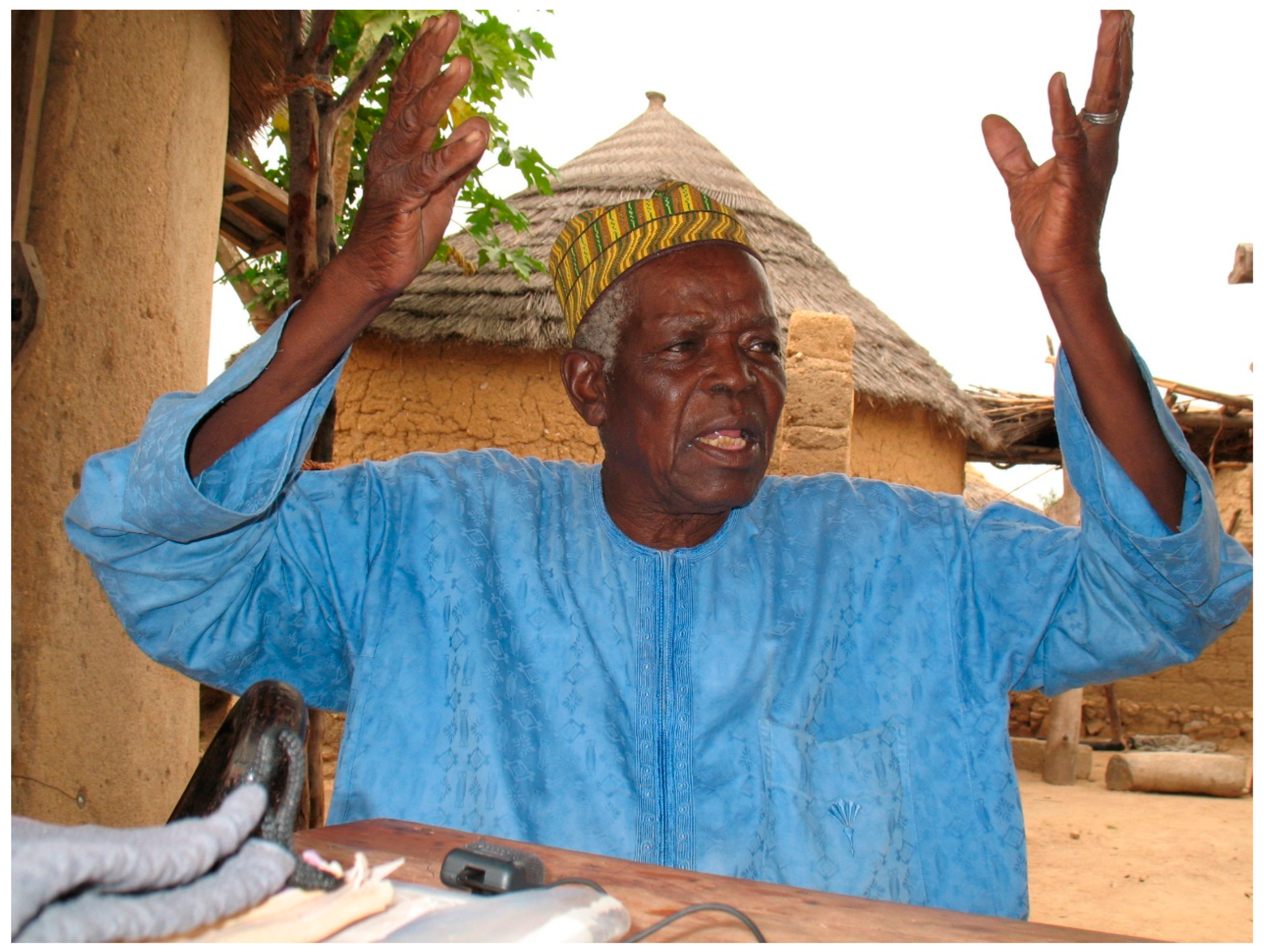
Another example is the Kwoma opposition between seeing and smelling. For this New Guinea society sight can be deceiving, especially for the non-initiated such as women and children. Men, on the other hand, can see because theirs are the visual powers, also the powers to conceal. Smell, on the other hand, reveals identities, however hidden from sight, and not only is associated more with women, but also is more lasting and reliable, as an olfactory identity endures despite changing visual appearances (Howes 2003: 146, 147). The same holds in principle for all African masquerades: what you see is not what is actually there. At least the women and small children who form the main audience are taught to believe that they see bush spirits dancing, while the men who shout exhortations to the dancers not only know that there are men inside, just like them, but also know exactly who is in what mask. But then, belief is never simple, and most women know the same, but are not allow to show that they are ‘on the know’. Senses, belief and the invisible have a very complex relationship. But some masks are not visible at all, just an acoustic presence by a lot of orchestrated noise, and this in no way detracts from their perceive reality (Van Beek & Leyten 2023).
Within a historical religion, the shift from the ‘authority of the ear’ to the ‘authority of the eye’ is discernible. Of the recognized – canonized – prophets in the Old Testament, the large majority (17) were called by the ear: ‘The Lord came and spoke’, ‘the voice of the Lord’, ‘The Lord spoke’,7 sometimes to be followed by a vision,8 but usually not. A minority (6) of the prophets were called in a vision,9 which was always followed by a voice carrying the message. If we compare this with more recent hiërophanies in the Roman Catholic church, the ones that led to pilgrimage shrines, the difference is striking. As Nolan & Nolan (1989) show, the large majority of the total 3126 shrines they investigated, started around an object, a relic, a miracle object or an object that was cured. Of the 347 that started with an apparition (11%), it was nearly always a vision, very seldom a hearing.10 One of the very few cases of hearing a voice is Kevelaer in West Germany, where in 1641 and 1642 the travelling merchant Busman heard the voice of Mary. In fact he had to hear it twice before he acted, and then he had to obtain – through his wife’s dream – an object, a print of Mary from Luxemburg. The voice of Yahweh has been replaced by the image of Mary
In a culture where smell and sound carry a more convincing argument than in our culture, invisible beings have less of a burden of proof resting on their shoulders. The French mathematician and philosopher Blaise Pascal, when speaking about God’s relationship with nature, remarked that: ‘Nature shows us a God who hides himself’ (Pascal 2008: 76). This more or less summarizes the attitude of many religions to their invisible world: the fact that they cannot be seen highlights their existence and their power, as well as their presence in this world. One can hear them in trances, see them in dreams and visions, communicate in divination and smell them in sacrifices (Clements 2015). That is more than enough. Seeing them would make little difference and, anyway, not seeing them allows for a different relationship with them.
All of which brings in the notion of synaesthesia, since the senses seem to translate into each other. Ingold (2000: 276) speaks, with great gusto, about the interchangeability of visual and auditory perception, i.e. about the ‘hearing eye’ and the ‘seeing ear’. Although that discourse would run into some problems with smell, tactile hands can very well see – and that is one sense Homo sapiens excels at. The senses are not that separate. Sacks’s title on the deaf is revealing: ‘Seeing Voices’. On the road to Damascus, St. Paul encountered the risen Jesus mainly through his ears: bathed in light he heard a voice (Acts 9 3:4). In his rendering of the event in his Letter to the Corinthians he speaks of ‘seeing the Lord’ (I Cor. 9:1). In fact, as Merleau-Ponty argues, the senses are seldom very separate, as perception does not occur in the sensorial organs but in the brain, which integrates all senses into one perception mode. And our experience of perception has always some totality: ‘My body is not a collection of adjacent organs but a synergic system, all the functions of which are exercised and linked together in the general action of being in the world’ (Merleau-Ponty 1962: 234, cited in Ingold 2000: 268). If more senses are involved, which is usually the case, it is difficult to separate and identify information coming from one or the other.
To be truly convincing, one has to appeal to more senses, optimally using the synergy of synaesthesia. Rituals, the very expression of the presence of the invisible, routinely appeal to as many senses as possible, as theatrical performances, participation and bodily exertion are part of the experience of the supernatural other. In his vivid and detailed description of Aztec rain rituals, Carrasco (1991) highlights the combined assault on the senses of the sacrificial procession winding through the sacred landscape of he valley of Mexico city. In fact he portrays the colours, movements, smells and songs of the impressive royal retinue so vividly that one almost forgets people are being sacrificed. Through the synaesthetic synergy any challenges of invisibility disappear during the performance of the ritual as the ritual not only negates the ravages of time but also any differences between this world and its other side. When the Dogon dance their masks during the final funeral rites of the dama, performing individually as well as in a group inside an overwhelming soundscape of drums, bells, and shout in the secret language, the audience watches, enraptured. Though they do discern good and bad performances, the input through all their senses shouts the unity of the village with the bush, of animals and men, and of past and present. The invisible world becomes self-evident in the performance, as the senses, however differently they may be weighed, join together to ensure the collapse of all distinctions.
References
- Almagor, Uri. 1987. The cycle and stagnation of smells: pastoralist-fishermen relationships in an East African society, Res 13, 106-121. [CrossRef]
- 1990 Odours, and private language: observations on the phenomenology of scent, Human Studies 13, 253-74.
- Auballe-Sallenave, Françoise. 2006. Bodies, odors and perfumes in Arab Muslim societies, in Jim Drovnick (ed.) The smell culture reader, London: Routledge, 391-399.
- Beek, Walter E.A. van. 1992. The dirty smith: smell as a social frontier among the Kapsiki/Higi of North Cameroon and North-Eastern Nigeria, Africa 62, 1, 38-58. [CrossRef]
- 2010. Crab divination among the Kapsiki of North Cameroon, in W.E.A. van Beek & P. Peek (eds.) Realities reviewed. Dynamics of African divination, Münster: LIT Verlag.
- 2015 The forge and the funeral. The smith in Kapsiki/Higi culture. East Lansing: Michigan State University Press.
- 2020. Smithing in Africa, the enigma. In Wim J.M. Van Binsbergen (ed.) Rethinking Africa’s transcontinental continuities. Proceedings of the Leiden 2012 international conference. Quest: An African Journal of Philosophy 26-28: 429-448.
- Beek, Walter E.A. van, Oumar Ongoiba and Atimè Saye, 2025. Dogon Songs of Life and Death. A Performance of Dogon Mourning Songs in Tireli, Mali (with Oumar Ongoiba & Atimè Saye). ASAH 19. Leiden: Brill.
- Benzon, William L. 2005. Synch, song, and society, in Human Nature Review 5, 66-86.
- Bijsterveld, Karin. 2008. Mechanical sounds, Boston: MIT Press.
- Cantwell Smith, William. 1989. Scripture as form and concept: their emergence for the Western world, in M. Levering (ed.) Rethinking scripture. Essays from a comparative perspective, New York: State University Press, 29-57.
- Camporesi, Piero. 1994. The Anatomy of the senses. Natural symbols in medieval and Early Modern Italy, Cambridge: Polity Press.
- Carasco, David. 1991. To change place. Aztec ceremonial landscape, Denver: Colorado University Press.
- Classen, Albrecht. 1998. The book and the magic of reading in the Middle Ages, New York: Garland.
- Classen, Constance. 2006. The breath of God: Sacred histories of scent, in Jim Drovnick (ed.) The smell culture reader, London: Routledge, 375-390.
- Classen, Constance, D. Howes & A. Synnott. 1994. Aroma. The cultural history of smell, London: Routledge.
- Clements, Ashley. 2015. Divine scents and presences, in Mark Bradley (ed.) Smell and the ancient senses, London: Routledge, p. 46-59.
- Corbin, Alain. 1986. The foul and the fragrant: Odours and the french social imagination, Leamington Spa: Berg.
- 1995. Time, desire and horror. Towards a history of the senses, Cambridge: Polity Press.
- Deroy, Ophelia. 2022. The meta-cognitive gap: Why we both trust and mistrust our sense of smell, in Andreas Keller and Benjamin Young, Theoretical Perspectives on Smell, New York: Routledge, p. 34-51.
- Douglas, Mary. 1966. Purity and danger, London: Routledge.
- Drobnik, Jim. Introduction, in Jim Drovnick (ed.) The smell culture reader, London: Routledge, 1-12.
- Dupire, Marguerite. 1981. Des gouts et des odeurs: classifications et universaux, l’Homme 27, 4, 11-14. [CrossRef]
- Ede, Yvonne van. 2009. Bezinning. Over zin en zingeving en de antropologie van de zintuigen, in T. Sunier (ed.) Antropologie in een zee van verhalen, Amsterdam: Aksant, 89-110.
- Engen, T.. 1982. The perception of odors, New York: Academic Press.
- Gatten, Aileen. 2006. A whisp of smoke: Scent and character in the tale of Genji, in Jim Drovnick (ed.) The smell culture reader, London: Routledge, 331-341.
- Gell, Alfred. 2006. Magic, perfume, dream…, in Jim Drovnick (ed.) The smell culture reader, London: Routledge, 400-410.
- Gough, R. & J. Christie. 2003. On smell, Abingdon: Taylor & Francis.
- Graham, W. 1989. Scripture as spoken word, in M. Levering (ed.) Rethinking scripture. Essays from a comparative perspective, New York: State University Press, 129-169.
- Gray, Richard T. 2006. The dialectic of “Enscentment”: Patrick Süskind’s Perfume as critical history of enlightenment culture, in Jim Drovnick (ed.) The smell culture reader, London: Routledge, 235-256.
- Guggenheim, William & Judith, 2006. Olfactory after-death communications, in Jim Drovnick (ed.) The smell culture reader, London: Routledge, 427-430.
- Huang, Xuelei, 2023. Scents of China : a modern history of smell. Cambridge: Cambridge University Press.
- Hinten, Devon E., Vuth Pich, Dara Chhean and Mark H. Pollack. 2006. Olfactory-triggered panic attacks among Khmer refugees, in Jim Drovnick (ed.) The smell culture reader, London: Routledge, 68-84.
- Howes, D. 1991. The varieties of sensory experience: a sourcebook in the anthropology of the senses, Toronto: University of Toronto Press.
- 2003. Sensual relations. Engaging the senses in culture and social theory, Ann Arbor: University of Michigan Press.
- 2005. Hyperesthesia, or the sensual logic of late capitalism, in D. Howes (ed.) Empire of the Senses. The Sensual Culture Reader, London: Sage Publications.
- Ingold, Tim. 2000. The perception of the environment. Essays on livelihood, dwelling and skill, London: Routledge.
- Kenneally, C. 2007. The first word. The search for the origins of language, New York: Viking.
- Krügler, J. 2000. Die Macht der Nase: zur religiösen Bedeutung des Duftes, Stuttgart: VKB.
- Laing, D., R. Doty & W. Breipohl. 1991. The human sense of smell, Berlin: Springer.
- Lerio-Gourhan, A. 1993. Gesture and speech, Boston: MIT Press.
- Low, K.E.Y. 2007. Olfactive frames of remembering: notes on the smell of memories, Working paper 179, Dept. of sociology, National University of Singapore.
- Manalansan, Martin IV. 2006. Immigrant lives and the politics of olfaction in the global city, in Jim Drovnick (ed.) The smell culture reader, London: Routledge, 41-52.
- Marinucci, Lorenzo. 2023. Different Smellscapes: Olfactory Patterns Through the Japanese Worldview, in Andreas Philippopoulos-Mihalopoulos, Danilo Mandic, Caterina Nirta, and Andrea Pavoni, Smell. University of Westminster press, p. 117-170.
- Marusek, Sarah. 2023. Law and the odour-ing of order: Smell, air and the public forum, in Andreas Philippopoulos-Mihalopoulos, Danilo Mandic, Caterina Nirta, and Andrea Pavoni, Smell. University of Westminster press, p. 257-282.
- Mavor, Carol. 2006. Odor di femina: Though you may not see her, you can certainly smell her, in Jim Drovnick (ed.) The smell culture reader, London: Routledge, 277-288.
- Merleau-Ponty, Marcel. 1962. Phenomonology of perception, London: Routledge.
- Mithen, S.J. 2006. The singing Neanderthals. The origins of music, language, mind, and body, Harvard University Press. [CrossRef]
- Nolan, M.L. & S. Nolan. 1989. Christian pilgrimage in modern Western Europe, Chapel Hill: University of North Carolina Press.
- Ong, W. 1982. Orality and literacy: the technologizing of the word, London: Methuen.
- Parkin, David. (ed.). 1985. The anthropology of evil, Oxford: Blackwell.
- Pascal, Blaise. 2008. Pensées and other writings, Oxford: Oxford University Press.
- Pelosi, Paolo. 2016. On the scent: a journey through the science of smell. Oxford: Oxford University Press.
- Richerson, P.J. & R. Boyd. 2005. Not by genes alone: how culture transformed human evolution, Chicago: University of Chicago Press.
- Rindisbacher, Hans, J. 2006. The stench of power, in Jim Drovnick (ed.) The smell culture reader, London: Routledge, 137-147.
- Roubin, Lucienne A. 2006. Fragrant signals and festive spaces in Eurasia. in Jim Drovnick (ed.) The smell culture reader, London: Routledge, in Jim Drovnick (ed.) The smell culture reader, London: Routledge, 128-136.
- Sacks, Oliver. 1990. Seeing voices. A journey into the world of the deaf, New York, Picador.
- 1997. Een antropoloog op Mars. Zeven paradoxale verhalen, Amsterdam: Meulenhoff.
- 2007. Musicophilia. Tales of music and brain, New York: Alfred Knopf.
- Shulman, David. 2006. The scent of memory in Hindu South India, in Jim Drovnick (ed.) The smell culture reader, London: Routledge, 411-426.
- Smith, Mark M. 2019. Smell and history : a reader. Morgantown: West Virginia University Press.
- Stoller, Paul. 1989. The Taste of ethnographic things. The senses in anthropology, Philadelphia: University of Pennsylvania Press.
- 1997. Sensuous scholarship, Philadelphia, University of Pennsylvania Press.
- Süskind, Patrick. 1985. Das Parfum, die Geschichte eines Mörderes. Zürich: Diogenes Verlag.
- Talle, A. 1999. Pastoralists at the border: Maasai poverty and the development discourse in Tanzania, in D.M. Anderson & V. Broch-Due (eds.) The poor are not us: poverty and pastoralism in Eastern Africa. Oxford: Currey, 106-124.
- Toner, Jerry, 2015. Smell and Christianity, in Mark Bradley (ed.) Smell and the ancient senses, London: Routledge, p. 158-170.
- Tullett, William. 2019. Smell in eighteenth-century England : a social sense. Oxford : Oxford University Press.
- Tremblay, Jean-Thomas, Hsuan L. Hsu and Aleesa Cohene, 2023. Skunk: Olfactory Violence and Morbid Speculation, in Andreas Philippopoulos-Mihalopoulos, Danilo Mandic, Caterina Nirta, and Andrea Pavoni. 2023. Smell. University of Westminster press, p. 75-100).
- Tyrell, W.B. 2004. The smell of sweat: Greek athletics, Olympics and culture, Waucunda Ill: Bolchazy-Caducci.
- Vroon, Piet, A. van Amerongen, & H. de Vries. 1994. Verborgen verleider: psychologie van de reuk, Baarn: Ambo.
- Waring, Timothy M., and Zachary T. Wood. 2021. Long-term gene-culture coevolution and the human evolutionary transition. Proceedings of the Royal Society. B, Biological sciences, 2021-06, Vol.288 (1952), p.20210538-20210538. [CrossRef]
| 1 | I thank my colleagues Raymond Corbey (Tilburg University) and Diederik Raven (Utrecht University) for their constructive and incisive comments on an earlier draft. |
| 2 | It has become clear lately not only that language did evolve, but also that we can indeed say something sensible about its evolutionary pathways despite the decennia-long reticence among linguists to address the topic (Kenneally 2007). |
| 3 | All photos are by the author |
| 4 | Both the Kapsiki and the Dogon have a two-tone system, that for Kapsiki (Psekye) is mainly lexical, and for the Dogon also syntactic. |
| 5 | And very recently through the anosmia that results from Covid infections. |
| 6 | Foul smells even today can be weaponized, for instance used by police in riot containment, see Tremblay et al. 2023). Or used for tracking people in an oppressive totalitarian state: in the former DDR (East Germany) the secret police gathered smells of their citizens to track them down later with dogs. |
| 7 | Moses, Bileam, Joshua, Samuel, Nathan, Deutero-Isaiah, Jeremiah, Hosea, Joel, Amos, Obadiah, Jonah, Micah, Zephaniah, Haggai, Zechariah, Malachi. |
| 8 | Amos, Obadiah, Micah, Zechariah. |
| 9 | Samson, Isaiah, Ezekiel, Daniel, Nahum, Habakkuk. |
| 10 | The same goes for the BIN database of the Royal Dutch Academy, ‘Pilgrimages in the Netherlands’ (Bedevaartplaatsen in Nederland). The Dutch apparition shrines are also almost exclusively visual. My thanks go to my Tilburg colleague Paul Post for his guidance on this matter. |
Disclaimer/Publisher’s Note: The statements, opinions and data contained in all publications are solely those of the individual author(s) and contributor(s) and not of MDPI and/or the editor(s). MDPI and/or the editor(s) disclaim responsibility for any injury to people or property resulting from any ideas, methods, instructions or products referred to in the content. |
© 2025 by the authors. Licensee MDPI, Basel, Switzerland. This article is an open access article distributed under the terms and conditions of the Creative Commons Attribution (CC BY) license (http://creativecommons.org/licenses/by/4.0/).
Copyright: This open access article is published under a Creative Commons CC BY 4.0 license, which permit the free download, distribution, and reuse, provided that the author and preprint are cited in any reuse.


