

Submitted:
04 April 2025
Posted:
05 April 2025
You are already at the latest version
Abstract
Predicting the behaviour of the Earth's ionosphere is crucial for ground-based and space borne technologies relying on it. This paper presents a novel way of inferring the ionospheric electron density profiles and electron temperature profiles using machine learning. The analysis is based on the Nearest Neighbor (NNB) and Radial Basis Function (RBF) regression models. Synthetic data sets used to train and validate these two inference models are constructed using the International Reference Ionosphere (IRI 2020) model with randomly chosen years (1987-2022), months (1-12), days (1-31), latitudes (-60 to 60°), longitudes (0, 360°), times (0-23h), at altitudes ranging from 95 to 600 kilometres. The NNB and RBF models use the constructed ionosonde-like profiles to infer complete ISR-like profiles. The results presented show that the inference of ionospheric electron density profiles is better with the NNB model than with the RBF model while the RBF model is better at inferring the electron temperature profiles than the NNB model. A major and unexpected finding of this research is the ability of the two models in inferring full electron temperature profiles that are not provided by ionosondes using the same truncated electron density dataset used to infer electron density profiles. NNB and RBF models generally overestimate or underestimate the inferred electron density and electron temperature values, especially at higher altitudes, but they tend to produce good matches at lower altitudes.
Keywords:
Ionosphere
; electron density and temperature profiles
; machine learning
; regression models
; ionosonde
1. Introduction
Ionospheric variability in electron and ion density and temperature predominantly affects ground-based and space borne instruments by interfering with transmitted signals. The magnitude of these ionospheric perturbations depend on the local time, latitude, longitude, season, and solar activity. The Earth’s ionosphere (a quasi-neutral plasma) was discovered by Appleton [1]. Later on, it was shown that the ionosphere is actually stratified into 3 main different layers known as D layer, E layer (Kennelly-Heaviside layer), and F layer (Appleton-Barnet layer) according to their corresponding critical frequencies. The F layer is subdivided into that exists only during daytime and that persists even at night when, the electron-ion recombination rate is high due to the absence of sunlight, which explains the disappearance of the D layer and the thinner E layer. Marconi was the first researcher to establish a trans-atlantic communication system by taking advantage of the ionospheric electron and ion densities to reflect transmitted signals in 1901 [2]. Following the discovery of the ionosphere and its related technologies, ground-based instruments such as ionosondes [3,4] and incoherent scattering radars (ISR) [5] have been developed and used to study the behaviour of the ionosphere with the collected data. Recently, space borne techniques have also been implemented to learn more on the variability of the Earth’s ionosphere given its costly effects on telecommunication satellites orbiting within and above it [6,7,8]. With these data from ground and space instruments, several researchers have attempted to model and forecast the behaviour of the ionospheric electron density profiles (day and night) as well as the ionospheric electron temperature. Anderson et al. [9] inferred the night-time electron density integrated along a magnetic field line by comparing whistler dispersions, measured from a sounding rocket, with model ionospheric calculations. Using ionosonde data from 2014 to 2018, Hughes et al. [10] constructed a model for Observation System Simulation Experiments (OSSEs). He et al. [11] used the Total Electron Content (TEC) data from the Constellation Observing System for Meteorology, Ionosphere and Climate (COSMIC) to reconstruct a global ionospheric electron density for one complete solar cycle (2006-2016). In their paper, Giovanni and Radicella [12] developed an analytical model to infer complete ionospheric electron density profiles from the E layer to the F2 layer. The inputs of their model were the altitude at the peak of the F2 layer, at the point of inflection below that peak, at the maximum or point of inflection in the F1 layer, and at the peak of the E region. Another study was conducted by McKay et al. [13] who used a multi-frequency riometry to assess the possibility to estimate the ionospheric electron density altitude profiles. However, they found out that the use of a RIOMETER (Relative Ionospheric Opacity Meter for Extra-Terrestrial Emissions of Radio noise) was not effective without a priori assumption of the electron density profile, such as a parameterized model for the source of ionization. In 2011, Sibanda and McKinnell [14] reconstructed the topside ionospheric vertical electron density profiles using GPS and ionosonde data over South Africa. They compared the constructed electron density profiles with the profiles from ionosondes and IRI-2007 model. In 2021, Habarulema et al. [15] used radio occultation (RO) data, and neural network model (3D-NN) to globally reconstruct the ionospheric electron density. In 2024, Habarulema et al. [16] improved their previous 3D-NN model, which is only valid at quiet times, and developed a 3D storm-time model based on artificial neural networks and RO data to globally reconstruct the ionospheric electron density. Moreover, there are several models that provide various ionospheric parameters such as the IRI models valid from 60 km up to 2000 km [17,18]. The IRI-Plas 2017 model is an extension of the IRI model which accounts for the plasmaspheric electron contribution to the total electron content (up to 20200 km). The above mentioned models are global ones, but there exist other regional models such as E-CHAIM model for high-latitude regions [19] and AfriTEC model for Africa [20]. Larson et al. [21] compared the inferred E-CHAIN electron densities to ISR observations over Resolute bay. It was concluded that the model-to-measured ratios of the ionospheric electron densities in the central part of the F layer and around its peak are close to unity. In 2023, Chen et al. [22] developed a four-dimensional physical grid model of ionospheric electron density using electron density profiles from FORMOSAT-3/COSMIC (Constellation Observation System for Meteorology, Ionosphere, and Climate) from 2006 to 2013. Their model, known as EDG-DNN, runs a DNN (deep neural network) to infer the electron density and display it on a physical grid. In order to retrieve ionospheric electron density profiles, Zakharenkova et al. [23] used the Radio Occultation (RO) technique applied to measurements from the Global Positioning System (GPS) receivers onboard two Geostationary Operational Environmental Satellites (GOES). Regarding inference of electron temperature, Köhnlein et al. [24] implemented an empirical model of the electron and ion temperatures in the altitude interval of 50–4000 km as a function of time (diurnal, annual), space (position, altitude) and solar flux (F10.7) using observations from six satellites, five incoherent scatter stations (Arecibo, Chatanika, Jicamarca, Millstone Hill, St Santin) and rocket measurements during quiet geophysical conditions. Matta et al. [25] constructed a model to infer electron ad ion temperatures at Mars using numerical simulations in one-dimensional fluid model of the martian ionosphere coupled to a kinetic supra-thermal electron transport model in order to self-consistently estimate ion and electron densities and temperatures. Their model revealed hundreds of degrees Kelvin variations in dayside electron and ion temperatures at a fixed altitude above Mars.
Mathematically, electron density and electron temperature are related via the electron critical angular frequency and the Debye wavelength with = and = where is the electron density, is the electron temperature, e is the elementary charge, is the electron mass, k is the Boltzmann constant, and is the space permittivity. Several studies have been conducted to establish a correlation (positive or negative) between ionospheric electron density and electron temperature using various techniques. For instance, Pignalberi et al. [26] investigated the main features of the correlation between electron density and temperature in the topside ionosphere using Swarm B satellite Data. Their study characterized the correlation between ionospheric electron density and electron temperature at high latitude and described the diurnal trend at all latitudes. They also noticed a positive correlation dependence on season at very high latitudes. In 2015, Su et al. [27] investigated the global relationship between electron density and electron temperature in the topside ionosphere from 2006 to 2009 using satellite detection of electromagnetic emissions transmitted from earthquake regions. Their study did not find longitudinal variations in the correlation between electron density and electron temperature.
2. Materials and Methods
Two multivariate regression techniques, the Nearest Neighbor (NNB) and the Radial Basis Function (RBF) [28], are used to infer and extend the ionospheric electron density and temperature profiles. The input used in these inferences consists of low altitude ionosonde density profiles, and the output are profiles extending to higher altitudes, beyond the E and F layers, which cannot be diagnosed with ionosondes. The constructed models can also be used to infer temperature altitude profiles between the E and F density maxima and beyond, not accessible by ionosonde measurements. The NNB and RBF models are trained and validated using a large synthetic data set derived from the International Reference Ionosphere (IRI 2020) model. The entries in the input data set consist of ionosonde-like altitude profiles calculated from an IRI random distribution of latitude, longitude, month, day of the month, local time, and daily solar activity index , followed by full density profiles to be inferred. These synthetic density profiles are parameterized with 200-tuples of densities and temperatures values derived from the IRI 2020 data at as many altitudes uniformly distributed between 95 and 600 km divided into 200 equidistant intervals. In these constructed 200-tuples, densities above the E-region maximum (), when it exists, up to the altitude in the F-region where the density is equal to the F-region maximum (), are set to zero, in order to mimic the gap in density profiles obtained from ionosonde measurements in this region. Similarly, densities at altitudes above F-region maximum () are also set to zero as illustrated in Figure 1. The dependent density profile to be inferred is also parameterized using a 200-tuple of densities at the same altitudes, in which none of the densities are set to zero. The construction of the inference model follows standard machine learning (ML) techniques involving disjoint training, validation, and test sets; only the first being used to optimize the model, and the other two, to assess the training skill. Machine learning is a subset of artificial intelligent (AI) that was introduced by Arthur Samuel in 1959 [29]. Commonly used ML algorithms are the linear regression, logistic regression, clustering, decision trees, random forests and artificial neural networks [30,31,32,33]. So far, there exist four main approaches to machine learning: supervised ML, unsupervised ML, semi-supervised ML [34] and reinforcement ML [35]. Supervised ML (with labelled datasets) was used to construct the NNB and RBF models and infer electron density and temperature profiles. Inferred results are presented and compared with full IRI 2020 profiles and ISR profiles. Figure 1 below is an example of a truncated and full electron density profile.
2.1. Nearest Neighbour
The nearest neighbor method is used to do regression or classification tasks [36,37]. In regression, the goal is to infer a value of a continuous variable, i.e., inferring electron profiles or electron temperatures without discontinuities. The distances between different electron density 200-tuple profiles are estimated using Equation (1) and then used in order to determine the nearest neighbor one. In 2022, Monte-Moreno et al. [38] proposed a global TEC forecast using the nearest neighbor method. In this study, a large number of 200-tuple inputs of electron density profiles and electron temperatures are used to construct the electron density and electron temperature inference models. In machine learning, the Manhattan or L1 distance is usually preferred over the Euclidean or L2 distance to avoid the curse of dimensionality in high dimensional space where traditional indexing and algorithmic techniques fail from an efficiency and/or effectiveness perspective [39,40]. The distance between two respective electron density profiles or electron temperature profiles A and B is determined using the following equation:
where i=1,...,N and and are the components of A and B respectively. The denominator in Equation (1) is introduced to prevent large overestimations in the inferences [41].
2.2. Radial Basis Function
The Radial Basis Function method is a regression method that performs interpolations of dependent variables at locations in a multi-dimensional space from selected reference points, also known as centers [41,42,43,44,45]. The RBF method generally does not require many centers in order to construct accurate models. Computer-based or synthetic based inferences require large number of data entries/nodes for the training and validation of the model. In this study, the number of centers is varied between 8 and 12. As with the nearest neignbor approach, the independent input data set consists of X=() and the inferred dependent densities are in 200-tuple arrays Y calculated mathematically using the equation below:
where G is the interpolating function, are the interpolation coefficients calculated from 2, X represent the independent input and represent the N centers. The interpolation coefficients are the solutions of the following system of linear equations:
As indicated by the argument of function in Equation (2) and (3), radial basis functions depend on the distance (Euclidean in our study) which is denoted as . This distance dependence is the reason why those function is are called radial basis functions. The interpolating function G can either be local or global and have different types as discussed bellow where and c is an adjustable parameter for accuracy maximization by minimizing the loss function on the training and validation sets. Examples of interpolating functions are given by the following equations.
Among the above equations, (6) and (7) are examples of global functions whereas Equations (4) and (5) are examples of local functions. In this study, local equation given by (4) was used to construct the RBF model. Global functions vanish at the center but are finite elsewhere whereas local functions are non zero at the center where they are defined but tend to zero far from their centers. Using global functions, regression of the dependent variable Y will be calculated by combining all the centers. However, with local functions , the determination of the dependent variable Y at a given n-tuple X is evaluated mostly from nearest neighbors in the set of all the centers. The choice of local or global functions in regression depends on the specifics of the problem, the number of centers, and the accuracy required. With a few centers, global functions are preferred to local ones whereas local functions are preferred when there are many centers. Another consideration is the distribution of centers in the multivariate space, in order to optimize inference accuracy [46].
2.3. Loss Function
Finally a key component of these regression techniques is the loss, or cost function. This is the function which quantifies the discrepancy between an inference and the known data from the training set. Training an inference model consists of minimizing the loss function of a given data set. The loss function must generally have the following properties:
- (1)
- it must be nonnegative;
- (2)
- if the inferred data match the modelled ones, the loss function vanishes;
- (3)
- the loss function increases as the discrepancy between inferred and known training data increases.
Various mathematical expressions can be used to evaluate the loss function, for instance:
1) the Maximum Absolute Error (MAE)
2) the maximum absolute relative error (MARE)
3) the Root Mean Square Error (RMSE)
4) the Root Mean Square Relative Error (RMSRE)
where N is the number of entries in the training and validation sets. In this work, 200-tuple profiles from IRI-2020 model or ISR observations are used for training and testing the NNB and RBF models. The type of loss function used with nearest neighbor model is the maximum relative absolute error in Equation (9) whereas the RBF model estimates the accuracy with the Root Mean Square Relative Error given by the Equation (11).
3. Results
As mentioned in previous sections, the results were obtained using ionosonde-like profiles truncated from IRI-2020 and two multivariate regression models (NNB and RBF). The inference results are discussed in 2 groups: the first results are for electron density inferences and the second results are for the electron temperature profiles. The two regression models were assessed by applying them to ten randomly selected cases. The best inferences among these ten, referred to as the “best inferences”, correspond to the cases for which the loss functions are the smallest. Conversely, the cases for which the loss functions are the largest are referred to as the “worst inferences”. The comparisons between these inferences and their known profiles are presented as a visual cue to assess the accuracy of the inference methods considered.
3.1. Inference of Electron Density Profiles with NNB and RBF Models
In order to illustrate the accuracy for both the NNB and RBF models, best and worst inferences for each model are considered and compared for discussion. Figure 2 represents the best-inference for the NNB model while Figure 3 shows the worst-inference also for the NNB model. Similarly, Figure 4 represents the best-inference for the RBF model and Figure 5 shows the best-inference for the same model.
It can be seen in the Figure 2 above that the NNB model’s inference almost matches the IRI electron profile values at higher altitudes from 400 km and above. However, the NNB model could not infer well the peak electron number densities of E-layer (NmE ) in the inferred densities. The deviations become larger in the E and F regions from around 95 km to 400 km. This good inference above the hmF2 region may suggest that NNB would be a good candidate to infer plasmaspheric electron densities which would be compared with satellite (GPS) data. One can notice a slight translation of the IRI electron density against the inferred electron density from around 150 km to 300 km which shifts the hmF2 from 180 km to 220 km at NmF2 . Another observation is that in the best inference, NNB only overestimates the electron density values below the peak values in the F region from 95 km to around 200 km and then changes the trend to underestimate them above it from 200 km to 400 km.
On the other hand, for the worst inference with NNB model, the electron densities are largely overestimated below the F region peak (1.7 × m−3) from around 115 km to 260 km. Above the F region, the electron densities were underestimated from about 260 km to 340 km and again from 470 km to 600 km whereas an other overestimation is observed from 340 km to 470 km. It is worth mentioning that NNB models mostly follows the usual trend of electron density profiles for both the best and worst inferences.
Figure 4 shows the best-inference from the RBF model. This model underestimates the electron densities at altitudes from around 135 km to 600 km. However, the RBF best-inference is able to better reconstruct well the density peak in the E region than the NNB model. On the other hand, the RBF best-inference largely underestimates the electron densities around the F-region peak (NmF2 ≃ 2.5 × 10¹² m−3), while the NNB model does not. This observation suggests a possible improvement to inferences by combining both NNB and RBF models.
Figure 5 above suggests again that the RBF model yields good inferences of electron densities at lower altitudes even in the E region layer. Given that the E region normally displays a single peak (hmE), an interesting feature would be to train and validate the RBF model with data on days with pronounced E sporadic and see its accuracy in the E region.
Table 1 shows the values of maximum absolute relative error and their corresponding altitudes at which they occur for both best and worst electron density profile inferences using NNB and RBF models.
It is observed that the NNB model has smaller MARE values than the RBF model for both best and worst inferences. The altitudes at which MARE values are large are generally found above the hmF2 except for the best inference of electron density profiles at 145 km. For the best inference from NNB model, maximum MARE is almost constant and smaller from hmE through hmF2 to around 300 km.
3.2. Inference of electron temperature profiles with NNB and RBF models
It is found that both NNB and RBF models perform well at lower altitude for both the best and worst inferences. [47] were among the first researchers to model the ionospheric temperature profiles with IRI-79 model. They found that IRI electron temperatures were not well estimated between 300 and 600 km, which is the same range where NNB and RBF models mostly underestimate or overestimate the inferred temperatures.
Figure 6 shows the best inference of electron temperature profiles with the NNB model. It is observed that the NNB model reconstructed well the electron temperatures values from 95 km to 150 km with a slighter underestimation than the remaining. From 260 km to 600 km, the slope or shift of the IRI against the inferred electron profiles is almost uniform and this feature has also been revealed in the inference of electron density profiles with NNB model as seen in Figure 2.
Figure 7 shows a worst inference for the NNB model and displays again that temperature inferences made with NNB are only reliable at lower altitudes up to around 200 km as for the best inference. From around 300 km to 600 km the NNB model largely overestimated the inferred electron temperature values. In this case even the altitude at which the electron temperature is maximum (0.2 eV) is shifted from 260 km (IRI) to just 220 km (inferred) compared to the best inference where this altitude is almost the same (250 km) for both IRI and inferred temperature profiles.
Figure 8 above illustrate a best inference for RBF model. The RBF model shows a near-perfect match at all altitudes from 95 km to 600 km. The deviation between IRI and inferred values is also small. A slight underestimation and overestimation is only noticeable from 350 km to 600 km.
However, a significant deviation is at altitudes above 400 km on the worst inference in Figure 9. RBF overestimated the hmF peak (265 km) with a deviation of almost 0.01 eV. The underestimation becomes large from the second peak (0.12 eV), but the model inferred well the second peak altitude (h km) with a deviation of about 0.02 eV.
The values of maximum absolute relative error and their corresponding altitudes for electron temperature profile inference are given for the NNB and RBF inferences (see Table 2). It can be seen that RBF model infers better the electron temperature profiles than the NNB model. Again, the corresponding altitudes are at or above hmF2 as seen in Table 2.
4. Conclusions
In conclusion, both NNB and RBF models are able to reproduce the trend of the ionospheric electron density profiles well except at peak densities of the E and F regions where there is usually either a larger underestimation or overestimation of the inferred profiles. NNB and RBF models generally infer the electron density profiles and electron temperature profiles with a larger MARE from hmF2 to 600 km except for the best inferences. However, the two models can be used to infer the electron density and temperature profiles below the maximum densities and peak temperatures. Electron density profiles are observed to be well inferred with the NNB model for the best and worst inferences than with the RBF model. On the other hand, RBF infer well the electron temperature profiles than the NNB model. An important finding of this study is that standard machine learning regression techniques, optimized to extend electron density profiles beyond altitudes accessible to ionosonde measurements, can also be used to infer electron temperature profiles. The two models considered here have been trained and validated with synthetic data constructed with the IRI 2020 model. A question remains as to how well these model inferences will compare with actual measurements made in situ with satellites, or remotely with arrays of GPS signals or incoherent scatter radars; considerations that will be addressed in future studies.
Author Contributions
The authors contributed equally to this work
Funding
“This research was funded by the Natural Sciences and Engineering Research Council of Canada”
Data Availability Statement
IRI 2020 data are available at https://ccmc.gsfc.nasa.gov/models/IRI 2020/)
Acknowledgments
The authors of this article would like to thank the University of Alberta for its partial financial support.
Conflicts of Interest
“The authors declare no conflicts of interest.”
Abbreviations
The following abbreviations are used in this manuscript:
| NNB | Nearest Neighbor |
| RBF | Radial Basis Function |
| IRI | International Reference Ionosphere |
| E-CHAIM | Empirical Canadian High Arctic Ionospheric Model |
| GPS | Global Positioning System |
| AfriTEC | Africa Total Electron Content |
| ISR | Incoherent Scattering Radars |
| OSSEs | Observation System Simulation Experiments |
| TEC | Total Electron Content |
| COSMIC | Constellation Observing System for Meteorology, Ionosphere and Climate |
| RIOMETER | Relative Ionospheric Opacity Meter for Extra-Terrestrial Emissions of Radio noise |
| RO | Radio Occultation |
| RIOMETER | Relative Ionospheric Opacity Meter for Extra-Terrestrial Emissions of Radio noise |
| hmE | Height at Maximum E layer |
| hmF2 | Height at Maximum F2 layer |
| NmE | Maximum electron density in E layer |
| NmF2 | Maximum electron density in F2 layer |
| GOES | Geostationary Operational Environmental Satellites |
References
- Appleton, E. V. Geophysical influences on the transmission of wireless waves. Proceedings of the Physical Society of London 1924, 37, 16D–22D. [Google Scholar] [CrossRef]
- Marconi, G. Radio telegraphy. Journal of the American Institute of Electrical Engineers 1922, 41, 561–570. [Google Scholar] [CrossRef]
- Breit, G.; Tuve M., A. A test of the existence of the conducting layer. Phys. Rev. 1926, 28, 554–575. [Google Scholar] [CrossRef]
- Yao, M.; Chen, G.; Zhao, Z.; Wang, Y.; Bai, B. A novel low-power multifunctional ionospheric sounding system. IEEE Transactions on Instrumentation and Measurement 2011, 61, 1252–12591. [Google Scholar] [CrossRef]
- Lei, J.; Liu, L.; Wan, W.; Zhang, S. Variations of electron density based on long-term incoherent scatter radar and ionosonde measurements over millstone hill. in Radio Science 2015, 40, 1–10. [Google Scholar] [CrossRef]
- Olsen, N.; Friis-Christensen, E.; Floberghagen, R.; Alken, P.; Beggan, C.D.; Chulliat, A.; Doornbos, E.; Da Encarnação, J.T.; Hamilton, B.; Hulot, G.; van den IJssel, J. The Swarm Satellite Constellation Application and Research Facility (SCARF) and Swarm data products. Earth Planet 2013, 65, 1189–1200. [Google Scholar] [CrossRef]
- Ware, R.; Exner, M.; Feng, D.; Gorbunov, M.; Hardy, K.; Herman, B.; Kuo, Y.; Meehan, T.; Melbourne, W.; Rocken, C.; Schreiner, W. Gps sounding of the atmosphere from low earth orbit: Preliminary results. B. Am. Meteorol. Soc., 1996, 77, 19–40. [Google Scholar] [CrossRef]
- Anthes, R. A. Exploring earth’s atmosphere with radio occultation: Contributions to weather, climate and space weather. Atmospheric Measurement Techniques, 2011, 4, 1077–1103. [Google Scholar] [CrossRef]
- Anderson, D.N.; Kintner, P.M.; Kelley, M.C. Inference of equatorial field-line-integrated electron density values using whistlers. Journal of Atmospheric and Terrestrial Physics, 1985, 47, 989–997. [Google Scholar] [CrossRef]
- Hughes, J.; Forsythe, V.; Blay, R.; Azeem, I.; Crowley, G.; Wilson, W.J.; Dao, E.; Colman, J.; Parris, R. On constructing a realistic truth model using ionosonde data for observation system simulation experiments. Radio Science, 2022, 57, 1–19. [Google Scholar] [CrossRef]
- He, J.; Yue, X.; Astafyeva, E.; Le, H.; Ren, Z.; Pedatella, N.M.; Ding, F.; Wei, Y. Global gridded ionospheric electron density derivation during 2006–2016 by assimilating cosmic tec and its validation. Journal of Geo- physical Research: Space Physics, 2022, 127, e2022JA030955. [Google Scholar] [CrossRef]
- Giovanni G., D.; Radicella, S. M. An analytical model of the electron density profile in the ionosphere. Advances in Space Research, 1990, 10, 27–30. [Google Scholar] [CrossRef]
- McKay, D.; Vierinen, J. ; Kero,A.; Partamies,N. On the determination of ionospheric electron density profiles using multi-frequency riometry, 2022, Geosci. Instrum. Method. Data Syst., 25–35. [CrossRef]
- Sibanda, P.; McKinnell, L. Topside ionospheric vertical electron density profile reconstruction using gps and ionosonde data: Possibilities for south africa. in Annales Geophysicae, 2011, 9, 229–236. [Google Scholar] [CrossRef]
- Habarulema, J.B.; Okoh, D.; Burešová, D.; Rabiu, B.; Tshisaphungo, M.; Kosch, M.; Häggström, I.; Erickson, P.J.; Milla, M.A. A global 3-d electron density reconstruction model based on radio occultation data and neural networks. Journal of Atmospheric and Solar-Terrestrial Physics, 2022, 221, 105–702. [Google Scholar] [CrossRef]
- Habarulema, J.B.; Okoh, D.; Burešová, D.; Rabiu, B.; Scipión, D.; Häggström, I.; Erickson, P.J.; Milla, M.A. A storm-time global electron density reconstruction model in three-dimensions based on artificial neural networks. Advances in Space Research, 2019, 124, 4639–4657. [Google Scholar] [CrossRef]
- Bilitza, D.; Truhlik, V.; Yoshihara, O.; Moldwin, M. B. Development and Improvement of the International Reference Ionosphere with special emphasis on the topside and extension to the plasmasphere. Annals of Geophysics, 204, 67, SA443. [CrossRef]
- Nibigira, J.D. D; Ratnam, D. V.; Sivavaraprasad, G. Performance analysis of IRI-2016 model TEC predictions over Northern and Southern Hemispheric IGS stations during descending phase of solar cycle 24. Acta Geophys., 2021, 69, 1509–1527. [Google Scholar] [CrossRef]
- Jayachandran, P. T.; Langley, R. B.; MacDougall, J. W.; Mushini, S. C.; Pokhotelov, D.; Hamza, A. M. Canadian high arctic ionospheric network (chain). Radio Science, 2009, 44, 342–351. [Google Scholar] [CrossRef]
- Nibigira, J. D. D.; Ratnam, D.; Sivakrishna, K. Performance analysis of Nequick-G, IRI-2016, IRI-Plas 2017 and AfriTEC models over the African region during the geomagnetic storm of March 2015. Geomagn. Aeron., 2023, 63, S83––S98. [Google Scholar] [CrossRef]
- Larson, B.; Koustov, A.V.; Themens, D.R.; Gillies, R.G. Ionospheric electron density over Resolute Bay according to E-CHAIM model and RISR radar measurements. Advances in Space Research, 2023, 71, 2759–2769. [Google Scholar] [CrossRef]
- Chen, Z.; An, B.; Liao, W.; Wang, Y.; Tang, R.; Wang, J.; Deng, X. Ionospheric Electron Density Model by Electron Density Grid Deep Neural Network (EDG-DNN). Atmosphere, 2023, 14, 810. [Google Scholar] [CrossRef]
- Zakharenkova, I; Cherniak I; Gleason, S; Hunt, D; Freesland, D; Krimchansky, A.; McCorkel, J.; Ramsey, G.; Chapel, J. Statistical validation of ionospheric electron density profiles retrievals from GOES geosynchronous satellites. J. Space Weather Space Clim., 2023, 13, 23. [CrossRef]
- Köhnlein, W. (1986). A model of the electron and ion temperatures in the ionosphere. Planetary and Space Science, 1986, 34, 609–630. [Google Scholar] [CrossRef]
- Matta, M.; Galand, M.; Moore, L.; Mendillo, M.; Withers, P. Numerical simulations of ion and electron temperatures in the ionosphere of Mars: Multiple ions and diurnal variations. Icarus, 2014, 227, 78–88. [Google Scholar] [CrossRef]
- Pignalberi, A.; Giannattasio, F.; Truhlik, V.; Coco, I.; Pezzopane, M; and Alberti, T. Investigating the main features of the correlation between electron density and temperature in the topside ionosphere through swarm satellites data. J. Geophys. Res. Space Phys., 2024, 129, e2023JA032201. [CrossRef]
- Su, F.; Wang, W.; Burns, A. G.; Yue, X.; Zhu, F. The correlation between electron temperature and density in the topside ionosphere during 2006–2009. Journal of Geophysical Research: Space Physics, 2015, 120, 724–10. [Google Scholar] [CrossRef]
- Grant, S. W.; Hickey,G. L.; Head, S. J. Statistical primer: Multivariable regression considerations and pitfalls. European Journal of Cardio-Thoracic Surgery, 2019, 55, 179–185. [CrossRef]
- Samuel, A. L. Some studies in machine learning using the game of checkers. IBM Journal of Research and Development, 1959, 3, 210–229. [Google Scholar] [CrossRef]
- Aggarwal, C. Neural networks and deep learning. Cham: springer, 2018, 978, 3. [Google Scholar] [CrossRef]
- Mallika, I. L.; Ratnam, D. V.; Ostuka, Y.; Sivavaraprasad, G.; Raman, S. Implementation of hybrid ionospheric tec forecasting algorithm using pca-nn method. IEEE Journal of Selected Topics in Applied Earth Observations and Remote Sensing, 2018, 12, 371–381. [Google Scholar] [CrossRef]
- Azari, A.; Biersteker, J. B.; Dewey, R. M.,;Doran, G.; Forsberg, E. J.; Harris, C. D. K.; Kerner, H. R.; Skinner, K. A.; Smith, A. W.; Amini, R.; Cambioni, S.; Poian, V. D.; Garton, T. M.; Himes, M. D.; Millholland, S.; Ruhunusiri, S. Integrating Machine Learning for Planetary Science: Perspectives for the Next Decade. Bulletin of the AAS, 2021, 53. [CrossRef]
- Han,Y. ; Wang, L.; Fu, W.; Zhou, H.;Li, T.; Chen, R. Machine learning- based short-term gps tec forecasting during high solar activity and magnetic storm periods. IEEE Journal of Selected Topics in Applied Earth Observations and Remote Sensing, 2022, 15, 115–126. [CrossRef]
- Azari, A.R.; Lockhart, J.W.; Liemohn, M.W.; Jia, X. Incorporating physical knowledge into machine learning for planetary space physics. Frontiers in Astronomy and Space Sciences. [CrossRef]
- Sarker, I. Machine learning: Algorithms, real-world applications and research directions. SN COMPUT. SCI., 2021, 2, 179–185. [Google Scholar] [CrossRef] [PubMed]
- Wang, J.; Neskovic, P.; Cooper, L. N. An adaptive nearest neighbor algorithm for classification. In 2005 international conference on machine learning and cybernetics, 2005, 5, 3069–3074. [Google Scholar] [CrossRef]
- Gu, X.; Akoglu, L.; Rinaldo, A. Statistical analysis of nearest neighbor methods for anomaly detection. Advances in Neural Information Processing Systems, 2019, 32. [Google Scholar]
- Monte-Moreno, E.; Yang, H.; Hern´andez-Pajares, M. Forecast of the global tec by nearest neighbour technique. Remote Sensing, 2022, 14, 1361. [Google Scholar] [CrossRef]
- Aggarwal, C.; Hinneburg, A.; Keim, D. On the surprising behavior of distance metrics in high dimensional space. In: Van den Bussche, J., Vianu, V. (eds) Database Theory — ICDT 2001. ICDT 2001. Lecture Notes in Com- puter Science 2001, 1973. [Google Scholar] [CrossRef]
- Bellman, R. Dynamic programming. science, 2019, 153. [Google Scholar] [CrossRef]
- Marchand, R. , Shahsavani, S.; Sanchez-Arriaga, G. Beyond analytic ap- proximations with machine learning inference of plasma parameters and confidence intervals. Journal of Plasma Physics, 2023, 89, 905890111. [Google Scholar] [CrossRef]
- Huang, Z. and Yuan, H. Ionospheric single-station tec short-term forecast using rbf neural network. Radio Science, 2014 49, 283–292. [CrossRef]
- Olowookere, A.; Marchand, R. A new technique to infer plasma density, flow velocity, and satellite potential from ion currents collected by a segmented langmuir probe. IEEE Transactions on Plasma Science, 2022, 50, 3774–3786. [Google Scholar] [CrossRef]
- Liu, G.; Marholm, S.; Eklund, A.; Clausen, L.; Marchand, R. M-nlp infer- ence models using simulation and regression techniques. Journal of Geophysical Research: Space Physics, 2023, 128, e2022JA030835. [Google Scholar] [CrossRef] [PubMed]
- Tang, S.; Huang, Z.; Yuan, H. Improving regional ionospheric tec mapping based on rbf interpolation. Advances in Space Research, 2021, 7, 722–730. [Google Scholar] [CrossRef]
- Liu, G.; Marchand, R. Inference of m-NLP data using radial basis function regression with center-evolving algorithm. Computer Physics Communication, 2022, 280, 108497. [Google Scholar] [CrossRef]
- Bilitza, D.; Brace, L. H.; and Theis, R. F. Modelling of ionospheric temperature profiles. Advances in Space Research, 2019, 5, 53–58. [Google Scholar] [CrossRef]
Figure 1.
This is a figure. Schemes follow the same formatting.
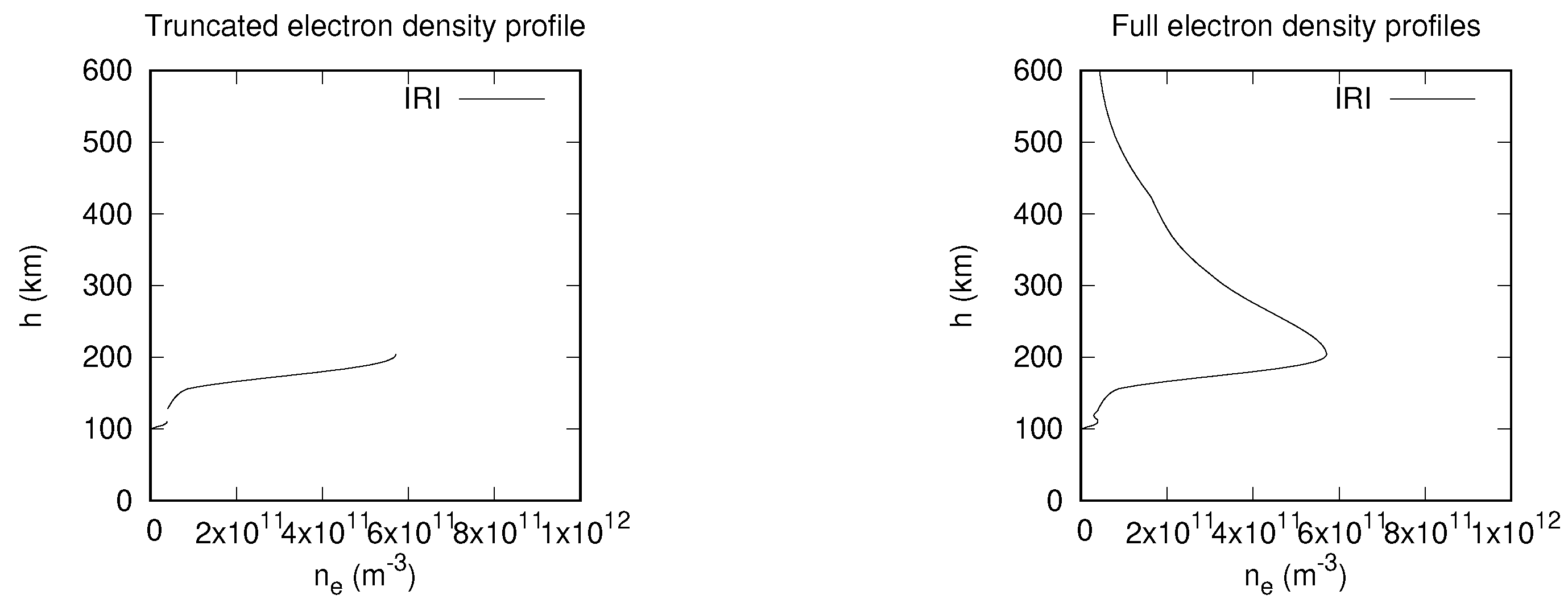
Figure 2.
Truncated (left) and best-inference (right) profiles inferred with NNB model compared with the corresponding IRI density profile.
Figure 2.
Truncated (left) and best-inference (right) profiles inferred with NNB model compared with the corresponding IRI density profile.
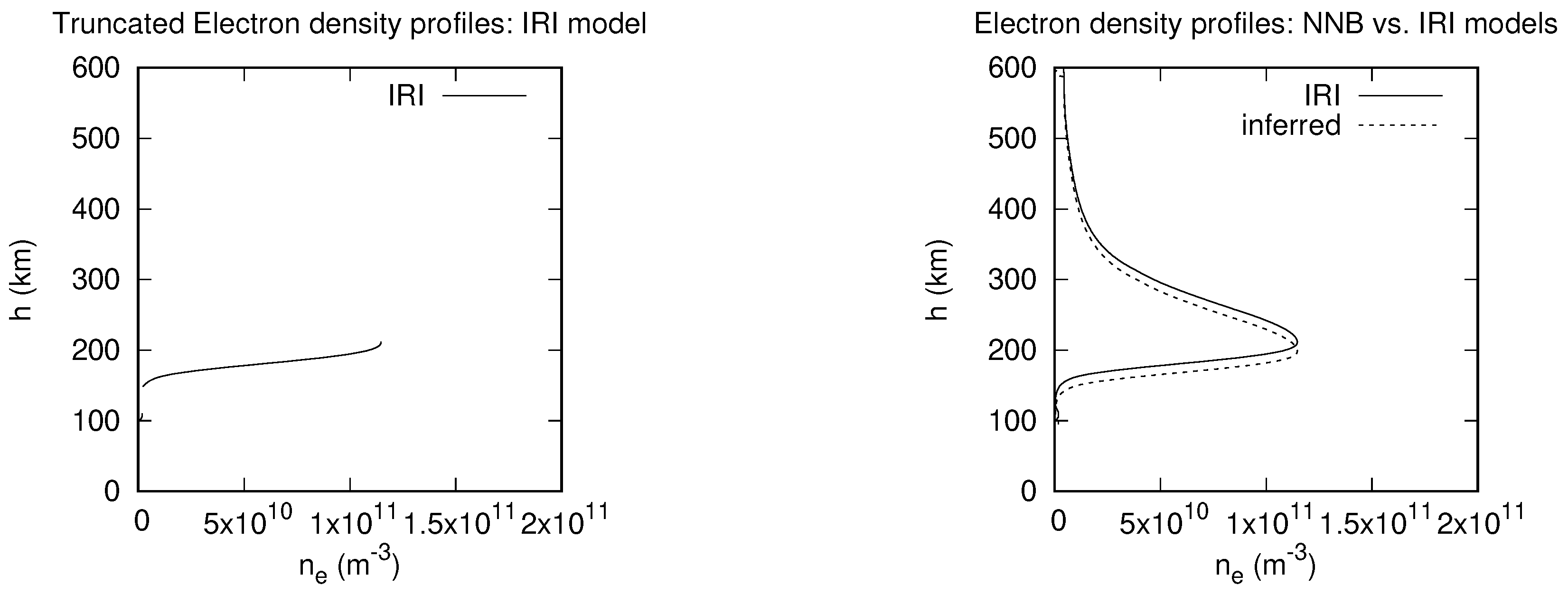
Figure 3.
Truncated (left) and worst-inference (right) profiles inferred with NNB model.
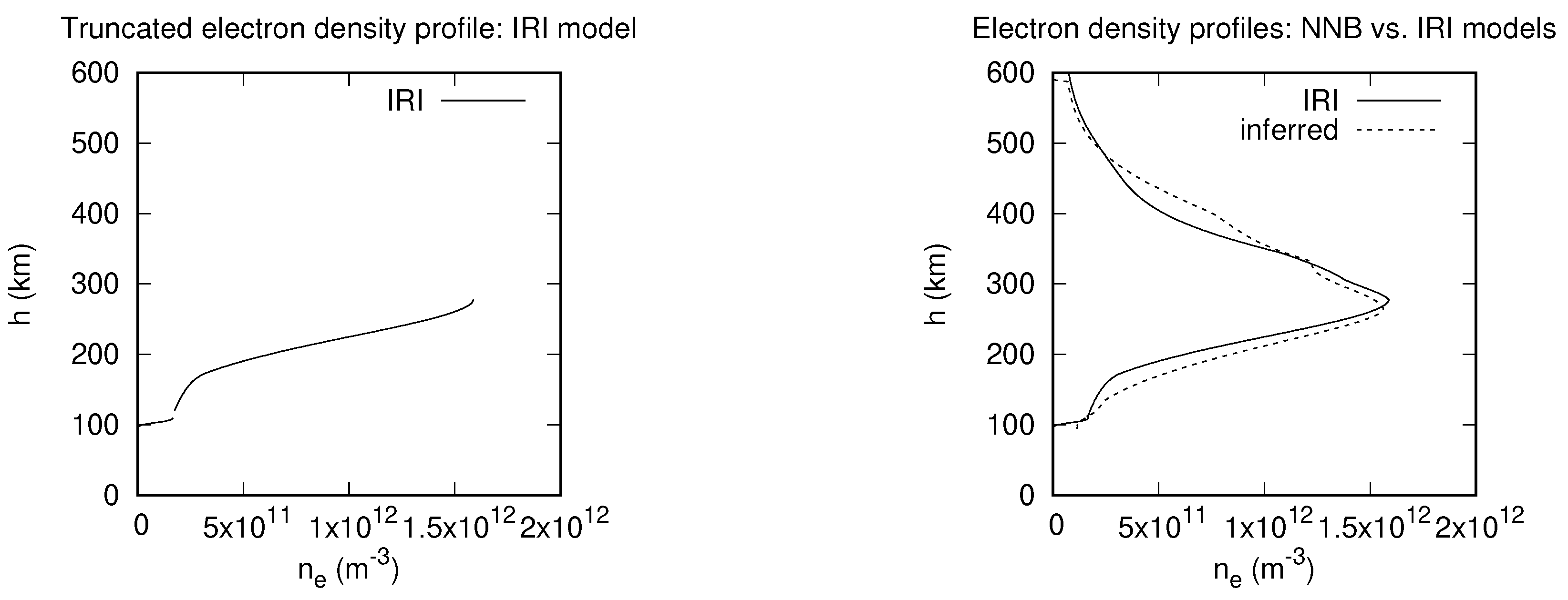
Figure 4.
Truncated (left) and best-inference (right) profiles inferred with RBF model.
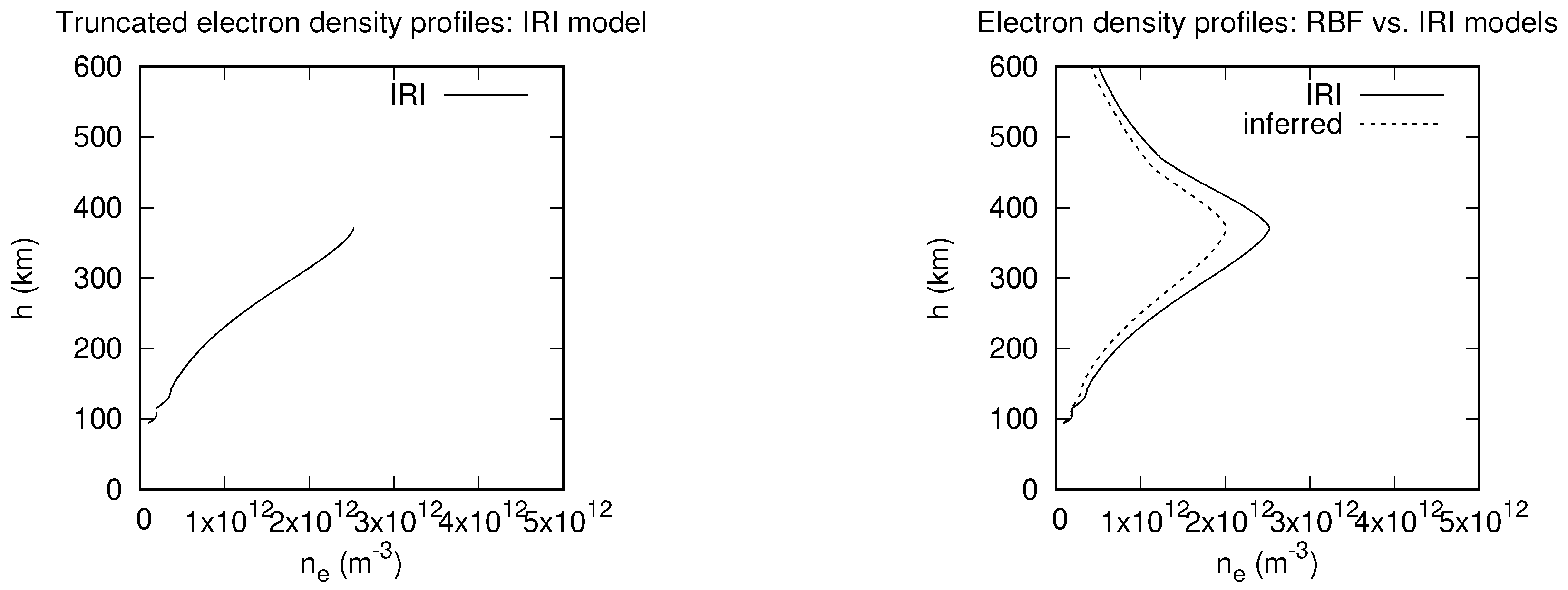
Figure 5.
Truncated (left) and worst-inference (right) profiles inferred with RBF model.

Figure 6.
Best inference of the electron temperature with NNB model.
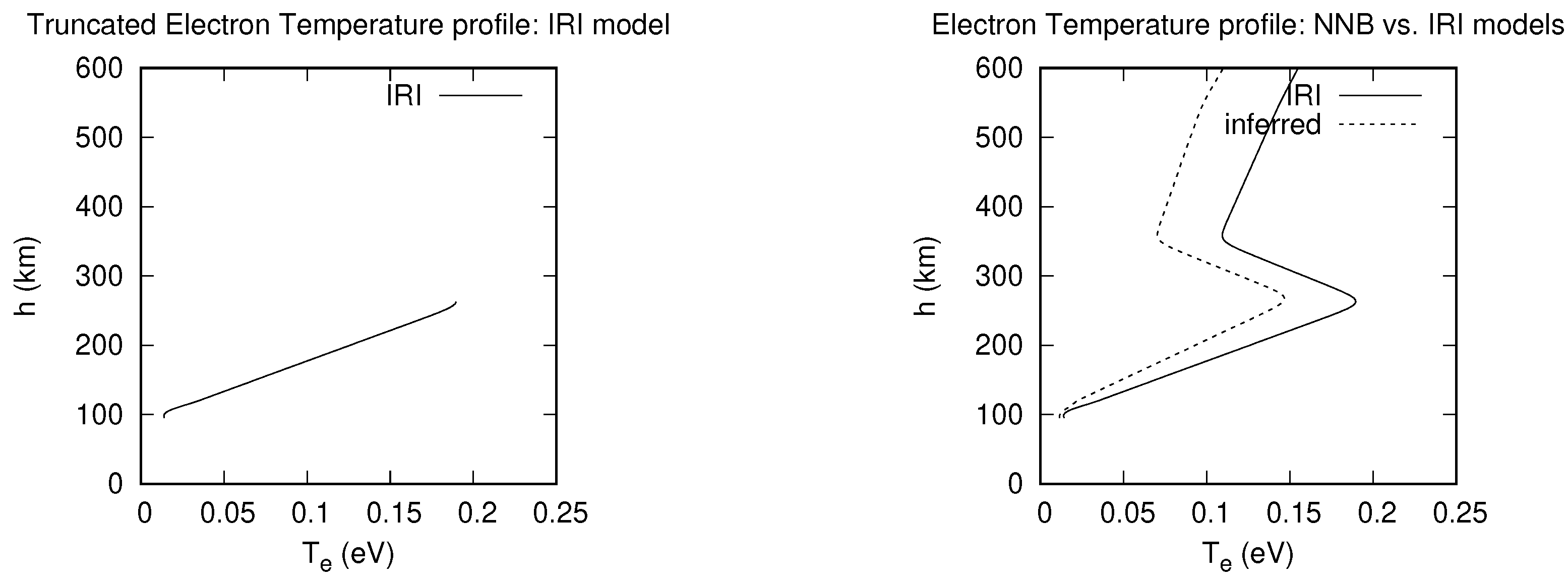
Figure 7.
Worst inference of electron temperature inferred with the NNB model.
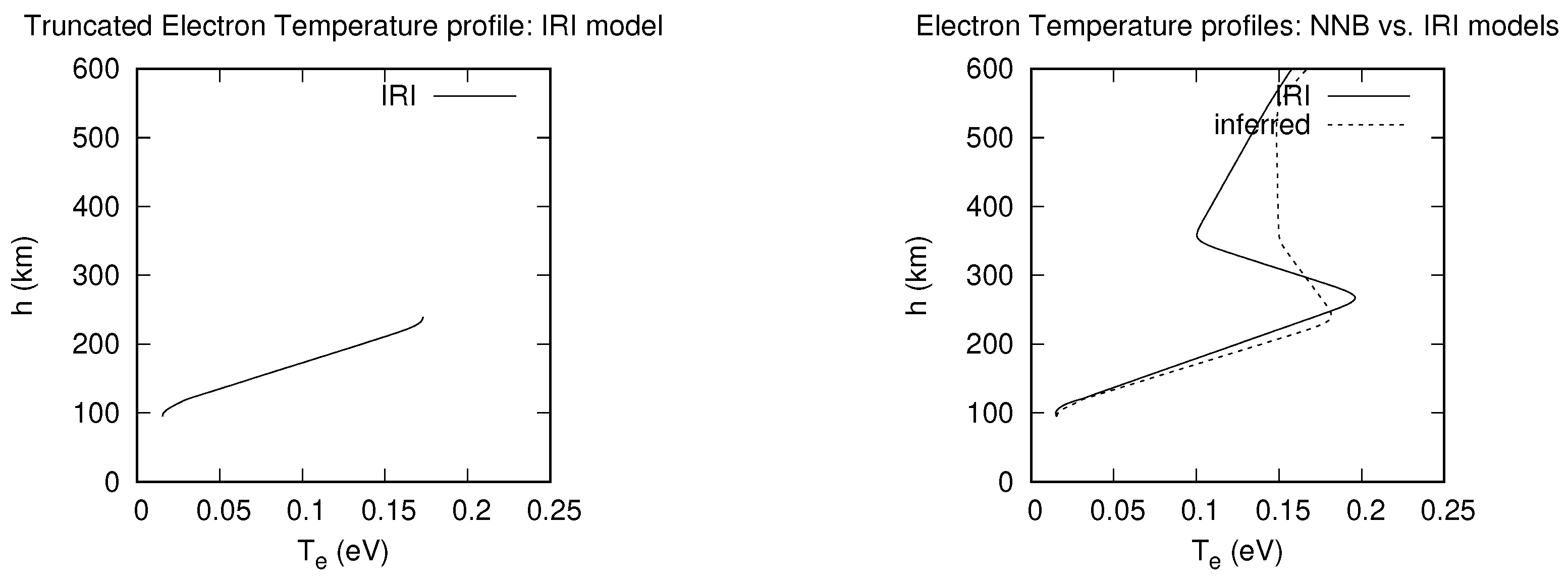
Figure 8.
Plot of best temperature inference inferred with the RBF model.
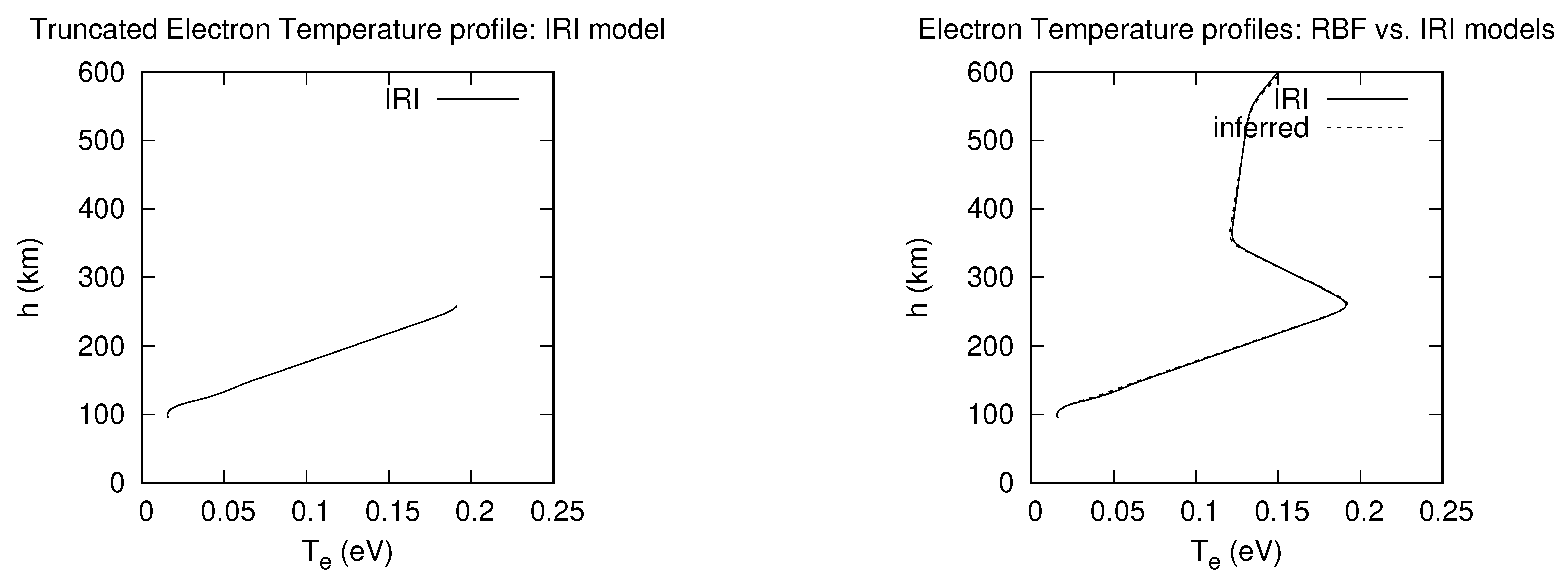
Figure 9.
Plot of worst temperature inference with RBF model.
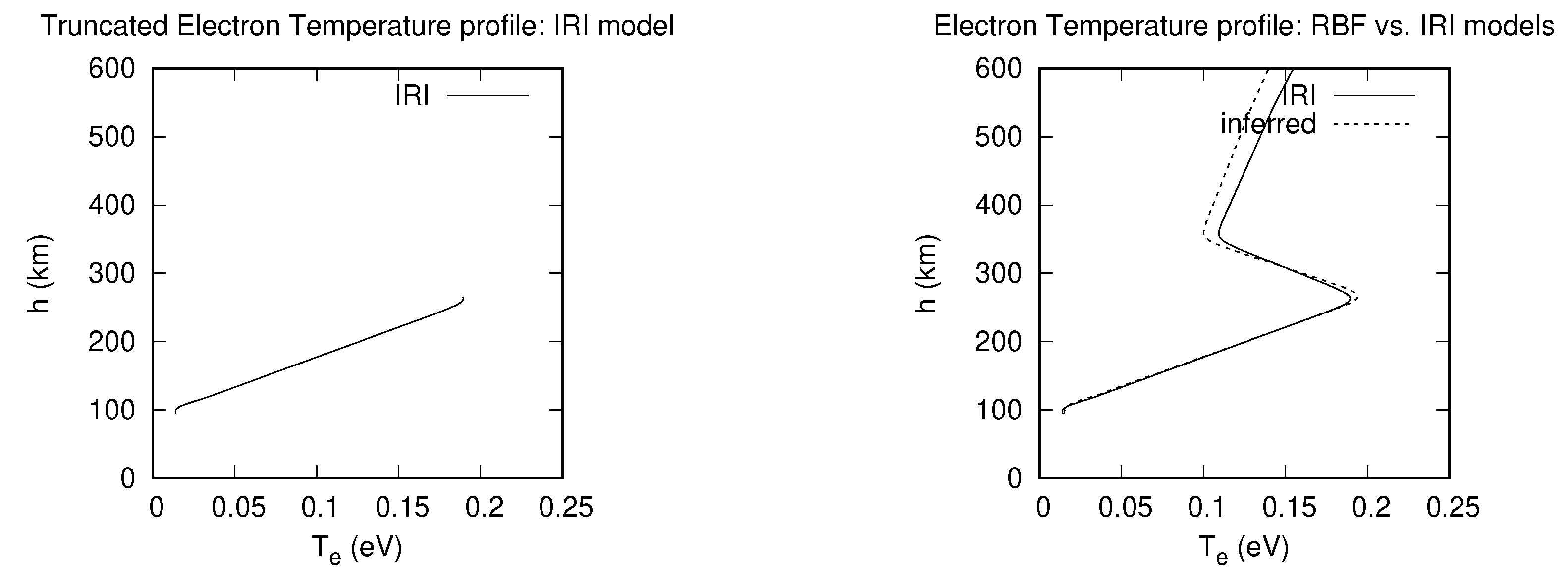

Table 1.
Maximum absolute relative error and corresponding altitudes for electron density profile inferences with NNB and RBF models.
Table 1.
Maximum absolute relative error and corresponding altitudes for electron density profile inferences with NNB and RBF models.
| Model-inference | MARE | h (km) |
|---|---|---|
| NNB-Best | 0.20 | 145 |
| RBF-Best | 0.25 | 360 |
| NNB-Worst | 0.60 | 415 |
| RBF-Worst | 0.83 | 420 |
Table 2.
Maximum absolute relative error and corresponding altitudes for electron temperature profile inferences with the NNB and RBF models.
Table 2.
Maximum absolute relative error and corresponding altitudes for electron temperature profile inferences with the NNB and RBF models.
| Model-inference | MARE | h (km) |
|---|---|---|
| NNB-Best | 0.27 | 255 |
| RBF-Best | 0.01 | 360 |
| NNB-Worst | 0.50 | 350 |
| RBF-Worst | 0.12 | 420 |
Disclaimer/Publisher’s Note: The statements, opinions and data contained in all publications are solely those of the individual author(s) and contributor(s) and not of MDPI and/or the editor(s). MDPI and/or the editor(s) disclaim responsibility for any injury to people or property resulting from any ideas, methods, instructions or products referred to in the content. |
© 2025 by the authors. Licensee MDPI, Basel, Switzerland. This article is an open access article distributed under the terms and conditions of the Creative Commons Attribution (CC BY) license (http://creativecommons.org/licenses/by/4.0/).
Copyright: This open access article is published under a Creative Commons CC BY 4.0 license, which permit the free download, distribution, and reuse, provided that the author and preprint are cited in any reuse.


