
Submitted:
02 April 2025
Posted:
03 April 2025
You are already at the latest version
Abstract
In the context of an increasingly volatile and crisis-prone business environment, the ability of an enterprise to develop a robust and resilient business model is critical for its long-term sustainability. While existing research has explored the relationship between enterprise behavior and business model resilience, the majority of these studies adopt an enterprise-centric perspective and rely predominantly on qualitative methodologies. Consequently, there is a notable gap in quantitative research examining the relation-ship between enterprise-user interaction and business model resilience. Addressing this gap, this study employs dynamic capability theory as its theoretical foundation and utilizes a sample of 300 questionnaires to investigate the internal mechanisms through which enterprise-user interaction influences business model resilience. The findings reveal that enterprises engaging in more frequent interactions with users tend to exhibit stronger business model resilience. Furthermore, dynamic capability serves as a mediating mechanism in the relationship between enterprise-user interaction and business model resilience. Additionally, knowledge-oriented leadership, as an emerg-ing leadership style, plays a moderating role in the relationship between enter-prise-user interaction and dynamic capability, as well as in the mediating effect of dy-namic capability. This study contributes to the literature by deepening the under-standing of the interplay between enterprise-user interaction and business model re-silience. Moreover, it offers practical insights for enterprises seeking to enhance their business model resilience in the VUCA era.
Keywords:
enterprise-user interaction
; enterprise dynamic capability
; business model resilience
; knowledge-oriented leadership
1. Introduction
In a business environment where the characteristics of the VUCA (Volatility, Uncertainty, Complexity, and Ambiguity) era are increasingly prominent and sudden crisis events keep emerging[1], why can some business models continuously create value for enterprises and their stakeholders, while others fail to support enterprises in successfully weathering business crises? Based on previous research, whether an enterprise’s business model is resilient can effectively answer this question[2]. Resilience is understood as the ability of a system to continue to function and achieve its goals when facing challenges[3]. It reflects the system’s capacity to rapidly recover from adversity and utilize relevant resources for effective decision-making[4]. On this basis, business model resilience can be defined as the ability of an enterprise’s business model to resist the interference of the external volatile environment, enabling the enterprise to quickly recover from a crisis and even exceed its original production capacity, continuously create value[5]. Generally speaking, a highly resilient business model exhibits a high degree of flexibility and adaptability[6]. It can often assist an enterprise in rapidly recovering from a crisis and even achieving a comeback in an adverse situation[5]. Conversely, if a business model lacks resilience, when facing sudden crisis events, it is often difficult for the enterprise to turn the situation around, and its business model may be damaged or even destroyed. Therefore, in today’s increasingly volatile business environment with frequent adverse events, how to enhance business model resilience to continuously create value urgently requires the high attention of researchers.
As a specific manifestation of resilience in the context of business models, business model resilience, to a certain extent, reflects the sustainable and hard-to-replicate competitive advantages of an enterprise. According to the dynamic capability theory, dynamic capability refers to an enterprise’s ability to efficiently integrate, build, and reconfigure internal and external knowledge, resources, and skills[7]. As a dynamic and high-order ability, it has the function of optimizing the organizational mode on which the organization depends for survival. When the existing organizational mode fails to adapt to the changes in internal and external environmental goals and becomes inefficient or even ineffective[8], dynamic capability can play a crucial role in enabling the enterprise to maintain long-term performance[9], establish long-term competitive advantages, and adapt to a rapidly changing environment[7,10]. Based on this, enterprise dynamic capability may be an important antecedent for enhancing business model resilience. Furthermore, different from the traditional resource-based view which mainly adopts a static perspective, the dynamic capability theory places enterprises in a dynamic development process. It holds that relying solely on the enterprise’s original resource advantages is difficult for the enterprise to establish and maintain sustainable competitive advantages. Coupled with the increasingly volatile and fierce competition in the business environment, enterprises urgently need to re-integrate their internal and external resources according to external environmental changes[11]. This means that enterprises should actively perceive changes in the external environment and can reconstruct their resource base through cooperation with other stakeholders in the business system[12], ultimately forming an ability that can bring sustainable competitive advantages to the enterprise[13]. This requires us to further explore the sources of dynamic capability that contribute to enhancing business model resilience.
Dynamic capability theory posits that an enterprise’s dynamic capability does not merely reside within the enterprise nor remain static. Instead, they gradually take shape and develop during the interaction process between the enterprise and its external environment[14]. In the current era of user economy, the development of emerging technologies such as big data and AI is gradually altering the power and status of users in the course of enterprise development[15]. As one of the enterprise’s stakeholders, users are no longer just the purchasers and beneficiaries of enterprise products and services, they have become a crucial source for enterprises to acquire heterogeneous market knowledge and significant value-based resources[16]. Based on this, an increasing number of enterprises have started to engage in interaction behaviors with users, the aim is to excavate valuable resources from the in-depth perspective of users, thereby achieving the integration, reconstruction, and re-configuration of the enterprise’s internal and external resources. By continuously enhancing the enterprise’s dynamic capability[7], the continuous and efficient operation of the enterprise’s business model can ultimately be ensured. However, a review of existing research reveals that both domestic and foreign scholars’ research on business model resilience mostly focuses on the enterprise-centered perspective. They mainly explore the impacts of individual (such as enterprise employees, entrepreneurs) characteristics and their behaviors on business model resilience from perspectives such as knowledge empowerment and network theory[17]. Moreover, these studies are mostly qualitative, there is a lack of quantitative research methods based on the dynamic capability theory to explore how enterprise-user interaction enhance enterprise dynamic capability and ultimately enhance business model resilience. To some extent, this may lead to the ambiguity in the formation mechanism of business model resilience. On the other hand, regarding the research on enterprise-user interaction, previous scholars mainly focused on its impacts on aspects such as product innovation performance[18], product innovation paths, and user innovation performance[19]. They seldom explored, from the theoretical perspective of dynamic capability, whether enterprise-user interaction can accelerate the enterprise’s integration and reconstruction of its resource base. Although some scholars have pointed out that this interaction behavior is conducive to the innovation of the business model[20], they have not investigated the impact mechanism of this interaction behavior on business model resilience. To a certain extent, this weakens the theoretical explanation of enterprise-user interaction.
In fact, in today’s increasingly volatile business environment, enterprise-user interaction offers a new research perspective for enhancing business model resilience. In a rapidly changing market environment, valuable, scarce, inimitable, and non-substitutable resources constitute an important foundation for the formation of an enterprise’s dynamic capability[11,14]. Enterprise-user interaction, as an interaction behavior between an enterprise and its stakeholders, provides a favorable channel for the enterprise to acquire valuable and scarce resources. During the process of interacting with users, the enterprise can deeply excavate rich user-demand information and heterogeneous resources from the user’s perspective[18]. Moreover, in the continuous process of interaction, the enterprise can innovatively update and allocate its internal and external resources. It can continuously renew the value-creation logic of its business model, enhancing the adaptability and sustainability of the business model in the commercial environment. Furthermore, the formation of enterprise dynamic capability requires two major processes: resource identification and allocation[11]. However, in the actual business environment, due to the dual influence of environmental complexity and the enterprise’s actual goals, a large number of resources obtained through enterprise-user interaction may be difficult to be efficiently allocated into valuable resources required for enhancing dynamic capability. In other words, only through efficient integration and allocation can the resources acquired from enterprise-user interaction contribute to improving enterprise dynamic capability and further strengthening business model resilience[9]. From the perspective of the planning view, enterprise dynamic capability is continuously accumulated under the strategic plans formulated by leaders[21]. The individual characteristics of leaders will, to a certain extent, affect the transformation process of enterprise resources, thus determining the evolution of dynamic capability. Based on this, from the perspective of leadership style, we introduce the moderating variable of knowledge-oriented leadership to explain the mechanism of enterprise integration and allocation of heterogeneous knowledge resources. Knowledge-oriented leaders attach importance to the role of knowledge in enterprise development and encourage employees to actively engage in knowledge learning and resource innovation[22,23]. Under this influence, the user resources obtained after enterprise-user interaction will be more efficiently allocated into valuable and unique resources. This promotes the renewal and reconstruction of the enterprise’s resource base, strengthens the positive impact of enterprise-user interaction on enterprise dynamic capability, and further enhances the indirect effect of enterprise-user interaction on business model resilience through enterprise dynamic capability.
Based on the above-mentioned analysis, this study explores the impact mechanism of enterprise-user interaction on enhancing business model resilience from the perspective of dynamic capability theory, and deeply analyzes the mediating role of enterprise dynamic capability and the moderating role of knowledge-oriented leadership. This study may have the following theoretical contributions. Firstly, this study starts from the perspective of enterprise-user interaction, explores the impact mechanism of enterprise-user interaction on business model resilience, and conducts an empirical test, which contributes to promoting the research on the antecedent variables of business model resilience. Secondly, based on the dynamic capability theory, this study examines the mediating role of enterprise dynamic capability between enterprise-user interaction and business model resilience. By applying the dynamic capability theory to the research field of business model resilience, it expands the application scenarios of the dynamic capability theory and provides a new theoretical perspective for the explanation of business model resilience. Thirdly, this study introduces the moderating role of knowledge-oriented leadership in the relationship between enterprise-user interaction and dynamic capability as well as the mediating mechanism of dynamic capability. From the perspective of leadership style, it expands the boundary conditions of the impact of enterprise-user interaction on business model resilience through enterprise dynamic capability, and also provides new ideas for leaders on how to play their roles to strengthen the positive impact of enterprise-user interaction on enterprise dynamic capability.
2. Theoretical Basis and Hypotheses
2.1. The Application of Dynamic Capability Theory in the Research of Business Model Resilience
Business model reflects the logic or framework by which an enterprise creates, delivers, and captures value[24]. Its elements include value network, value creation, value capture, and strategic choices, among others. Value creation is the core element of a business model[25]. This research highlights the crucial role of users in delivering the enterprise’s value proposition and constructing its business model. With the deepening complexity of the business environment and the application of emerging technologies, unpredictable crisis events have occurred more frequently. These events have brought huge challenges and impacts to the business model of enterprises. In this context, the academic community has introduced the research on resilience into the field of business models and proposed the concept of business model resilience to measure the adaptability and recovery ability of an enterprise’s business model in adverse situations[5]. Based on previous studies, heterogeneous information and resources obtained by enterprises from the external environment form an important foundation for enhancing business model resilience[17]. However, most existing studies take external heterogeneous information and resources as preconditions to explore their impact on the process of business model resilience, while rarely addressing how enterprises acquire such heterogeneous information and resources and transform them into business model advantages.
With the rapid changes in the market environment, the resource-based view, which mainly adopts a static perspective, has gradually become difficult to explain how enterprises can continuously obtain competitive advantages in a dynamic environment. Based on this, Teece proposed the dynamic capability theory by placing enterprises in a dynamic development environment. They argued that dynamic capability refers to an enterprise’s ability to integrate, build, and reconfigure internal and external resources to respond to rapid environmental changes[7]. This perspective emphasizes that enterprises should update their resource base and dynamic capability in an ever-changing market environment to meet new market requirements and establish and maintain sustainable competitive advantages[14]. Consequently, this study is based on the dynamic capability theory to explore how the heterogeneous information and resources obtained after enterprise-user interaction are transformed into the enterprise’s value advantages and ultimately enhance the business model resilience. The justifications are as follows: First, the impact mechanism of enterprise-user interaction on business model resilience involves the enterprise’s integration and allocation of heterogeneous information and resources, which aligns with the analytical framework of the dynamic capability theory[7,26]. Second, business model resilience reflects the recovery and sustainability of an enterprise’s business model in a volatile environment. A highly resilient business model often implies that the enterprise has sustainable competitive advantages. Therefore, to some extent, business model resilience can be understood as the manifestation of the sustainable competitive advantages brought about by the enterprise’s dynamic capability in the business model. Third, existing research on resilience mostly adopts an individual-psychological perspective and attributes resilience to three aspects: adaptability, stress resistance, and post-traumatic growth. However, in the research on business model resilience at the organizational level, there is relatively little exploration of the capability that serves as the source of such resilience. Thus, this paper applies the dynamic capability theory to the research on business model resilience, which, to a certain extent, expands the application scenarios and scope of the dynamic capability theory and also provides a new theoretical perspective for the research on business model resilience.
2.2. Enterprise-User Interaction and Business Model Resilience
As one of the core variables in positive psychology, resilience is regarded as a positive psychological capital[27]. It reflects an individual’s resilience, stress resistance, and post-traumatic growth ability, enabling individuals to quickly recover from adversity[3]. As a specific manifestation of resilience in the context of business models, business model resilience can, to some extent, be understood as the business model of an enterprise possessing unique, sustainable competitive advantages and long-term sustainability[28]. In this study, we define business model resilience as the ability of an enterprise’s business model to resist the interference and impact of the external environment, helping the enterprise maintain long-term competitive advantages and continuously create value[5]. Previous research has indicated that the enhancement of business model resilience is inseparable from heterogeneous information and resources in the external environment[17]. Enterprise-user interaction, as one of the channels for enterprises to obtain user information and resources, plays a non-negligible role in the process of enterprises forming highly resilient business models.
Dynamic capability theory focuses on how enterprises maintain their competitive advantages in a rapidly changing environment by integrating, constructing, and reconfiguring their resources and capabilities[7]. Based on this, valuable and scarce resources in the external environment serve as an important foundation for enterprises to achieve sustainable competitive advantages[11]. Enterprises need to efficiently integrate these resources and continuously update their existing resource and capability bases to sustain their long-term survival in a volatile environment. According to this framework, business model resilience, as the manifestation of an enterprise’s sustainable competitive advantages in its business model, largely depends on the transformation of the competitive advantages of the heterogeneous resources obtained during the enterprise-user interaction process. During the enterprise-user interaction, users, as carriers, offer more possibilities for enterprises to acquire rich market information and user resources. Enterprises can start from the in-depth perspective of users, understand users’ true inner thoughts and tap into their latent needs through various means such as online and offline channels[18], and extract valuable resources that can be integrated and allocated by the enterprise from users’ feedback and expressions. Subsequently, based on a further analysis of these valuable resources, enterprises can more accurately predict the development trends of the user market and unexpected events that may impact the business model. Thereby, they can continuously update the underlying value logic of the business model and construct a business model that aligns with user needs according to the enterprise’s existing resource base[29], so as to adjust business strategies in a timely manner. Eventually, the resilience and sustainability of the business model can be continuously enhanced[17]. In summary, the following hypothesis is proposed:
H1
:Enterprise-User interaction has a positive impact on business model resilience.
2.3. The Mediating Role of Enterprise Dynamic Capability
2.3.1. Enterprise-User Interaction and Enterprise Dynamic Capability
In the context of the burgeoning user economy, the role of users has transcended the traditional confines of being mere consumers[19]. The advent of personalized and dynamic consumption demands has spurred users to actively engage in the product design process. In this regard, enterprise-user interaction serves as an efficacious conduit for users to articulate their personalized requirements. By means of interacting with users, enterprises are enabled to comprehensively acquire crucial information and resources within the user market, as well as gain access to users’ authentic evaluations of the enterprise’s products and services. Consequently, enterprises can innovate their products and services in a more targeted fashion, enhance the congruence between enterprise offerings and user demands[30], and unearth new competitive opportunities. This, in turn, contributes to the augmentation of the enterprise’s dynamic capability within the business environment.
According to the dynamic capability theory, the formation of enterprise dynamic capability does not occur solely within the enterprise[31]. Relying merely on the enterprise’s original internal resources makes it difficult for the enterprise to maintain its long-term competitiveness in a dynamic environment. Hence, during the process of integrating and reconfiguring internal and external resources, enterprises need to develop a high-order capability that enables them to cope with environmental changes[7]. Enterprise-user interaction, as a novel form of interaction, offers a new approach for enhancing such high-order enterprise dynamic capability. During the interaction with users, enterprises can gather diverse users’ usage experiences and feedback regarding the enterprise’s products or services through direct means (such as interviews and product launches) or indirect methods (questionnaires, online platforms, etc.)[18]. Based on the interaction outcomes, enterprises can delve into users’ profound inner needs, while users can actively voice their personalized requirements, genuine evaluations of existing products, and future expectations. Consequently, this interaction behavior furnishes an opportunity for resource exchange between enterprises and users, and also expedites the efficiency of enterprises in integrating resources in the user market. Subsequently, drawing on these valuable resources obtained, enterprises can perceive the overall market from the users’ perspective and continuously roll out new products and services accordingly[18]. Meanwhile, in the course of meeting users’ personalized demands, enterprises can accomplish a profound renewal and reconfiguration of their resource base, continuously upgrade their capacity to respond to complex and ever-changing environments[32], and further enhance their dynamic capability. In summary, the following hypothesis is put forward:
H2a:
Enterprise-user interaction has a positive impact on enterprise dynamic capability.
2.3.2. Enterprise Dynamic Capability and Business Model Resilience
The dynamic capability theory posits that dynamic capability, as a type of high-order capability, exert a significant influence on the formation and maintenance of an enterprise’s long-term competitive advantages[33]. Robust dynamic capability can assist an enterprise in achieving long-term adaptability in a competitive environment and promoting its sustainable growth in a volatile context[14,34]. In a rapidly changing business environment, the business model, being a crucial factor influencing an enterprise’s survival, development, and competitive success, the strength of its resilience reflects, to some extent, whether the enterprise possesses sustainable competitive advantages. Based on this, strong enterprise dynamic capability is highly likely to enhance the resilience of the enterprise’s business model and facilitate its sustainable growth. On the one hand, dynamic capability are an important source of an enterprise’s sustained competitive advantages and a key competence essential for the enterprise to achieve business model innovation and enhance business model resilience[33,35]. When the market environment undergoes turbulent changes, powerful dynamic capability can support the enterprise to respond flexibly, thereby reducing the impact of unexpected events on the business model and improving the adaptability and sustainability of the business model[36]. On the other hand, from the perspective of the business model, enterprise dynamic capability plays a role in promoting the optimization and renewal of the business model[37]. When problems arise in the enterprise’s development, dynamic capability can help the enterprise optimize and update the underlying logic of the business model in a timely manner based on the internal and external environment[8]. This includes resource allocation methods, new product development, optimization of the operation mode, and technological iteration and upgrading, etc., thus ensuring that the business model can continuously create value for the enterprise and its stakeholders[38]. In summary, the following hypothesis is proposed:
H2b:
Enterprise dynamic capability has a positive impact on business model resilience.
Integrating H1, H2a, and H2b, we postulate that the impact of enterprise-user interaction on business model resilience might be mediated by enterprise dynamic capability. Specifically, in line with the dynamic capability theory, enterprises are required to develop a high-order capability, namely dynamic capability, which can endow the enterprise with sustainable competitive advantages during the process of integrating, constructing, and reconfiguring internal and external resources. In this process, enterprise-user interaction, as a novel interaction behavior, offers more possibilities for enterprises to acquire market resources. The heterogeneous resources obtained during the enterprise-user interaction can assist enterprises in continuously integrating and reconstructing their resource base in accordance with external environmental changes and realizing the enhancement of enterprise dynamic capability in the continuous interaction process. Powerful dynamic capability provides a prerequisite for enhancing the resilience of an enterprise’s business model. Dynamic capability enables enterprises to accurately grasp the development trends of the user market and formulate new value-creation logics based on changes in the market environment. Meanwhile, dynamic capability also contributes to improving the enterprise’s perception of unexpected events and potential crises. When a crisis looms, the enterprise can make advance arrangements and adjust its business strategies in a timely manner, thereby reducing the impact of unexpected events on the business model and further enhancing business model resilience. Based on this, the following hypothesis is further proposed:
H2:
Enterprise dynamic capability plays a mediating role in the process of the impact of enterprise-user interaction on business model resilience.
2.4. The Moderating Role of Knowledge-Oriented Leadership
As a novel leadership style, knowledge-oriented leadership exerts two major functions: communication and motivation[22]. Communication here implies that leaders are adept at listening to employees’ opinions, bestowing them with ample trust and respect. Meanwhile, they tolerate employees’ mistakes and encourage continuous innovation among them[23]. Motivation means that leaders attach great importance to both internal and external knowledge and endeavor to lead by example. They strive to foster a favorable learning and innovation atmosphere within the organization to rectify employees’ learning attitudes and enhance their knowledge utilization efficiency. Additionally, knowledge-oriented leaders reward employees for their learning and innovation behaviors[39] , thereby stimulating employees’ enthusiasm for learning, utilizing heterogeneous knowledge, and sustaining innovation. Consequently, to a certain extent, knowledge-oriented leadership accelerates the process of resource integration and allocation following enterprise-user interaction, and thus strengthens the positive impact of enterprise-user interaction on enterprise dynamic capability.
The dynamic capability theory posits that resources obtained from the external environment do not always contribute to the enhancement of enterprise dynamic capability. Only when internal and external resources are fully integrated and efficiently allocated can the enterprise’s resource base be continuously updated and reconfigured[11], thereby improving the enterprise’s dynamic capability. During the dynamic interaction between enterprises and users, from the in-depth perspective of users, it can bring different user demand information and heterogeneous market resources to the enterprise. These unique resources form an important foundation for the enterprise to enhance its dynamic capability[7]. Under the influence of knowledge-oriented leadership, the unique resources obtained after enterprise-user interaction can be rapidly transformed into the enterprise’s dynamic capability advantage, facilitating the improvement of the enterprise’s dynamic capability[9]. Specifically, knowledge-oriented leadership encourages enterprise employees to actively engage in knowledge learning and innovation[22,39]. Driven by the leadership’s example, employees will actively integrate new knowledge and develop new thinking[40]. As a result, the enterprise can fully absorb the valuable user information resources obtained after enterprise-user interaction and creatively integrate them with the enterprise’s original resources. This accelerates the process of the enterprise constructing and reconfiguring its resource base, improves the enterprise’s ability to allocate and restructure internal and external resources. However, without the promoting effect of knowledge-oriented leadership, even if enterprise-user interaction brings a large number of heterogeneous resources to the enterprise, these resources are difficult to be efficiently integrated and cannot contribute to the reconstruction of the enterprise’s resource base. At this time, the promoting effect of enterprise-user interaction on the enterprise’s dynamic capability will be weakened. In summary, the following hypothesis is proposed:
H3:
Knowledge-oriented leadership positively moderates the relationship between enterprise-user interaction and enterprise dynamic capability.
Integrating H2 and H3, this paper constructs a moderated-mediation model to explore the impact process of enterprise-user interaction on business model resilience and the moderating role of knowledge-oriented leadership. Specifically, the stronger the knowledge-oriented leadership, the stronger the learning and innovation atmosphere within the enterprise. Employees possess strong knowledge-learning and innovation capability, enabling them to continuously generate new ideas and develop new approaches. In this case, the enterprise can innovatively integrate the vast resources obtained from user interaction and reconfigure its resource base in accordance with external environmental changes. During this process, the enterprise can achieve continuous upgrading of its dynamic capability, thereby strengthening the positive impact of enterprise-user interaction on enterprise dynamic capability. Once the enterprise’s dynamic capability is enhanced, the enterprise can better respond to external environmental emergencies, which will improve the adaptability and sustainability of the business model and ultimately enhance business model resilience. Conversely, if the knowledge-oriented leadership in the enterprise is weaker, the knowledge resources obtained after enterprise-user interaction are difficult to be efficiently transformed into resource advantages. As a result, the positive impact of enterprise-user interaction on enterprise dynamic capability and its indirect effect on business model resilience will be weakened. In summary, the following hypothesis is further proposed:
H4:
The mediating role of enterprise dynamic capability between enterprise-user interaction and business model resilience is moderated by knowledge-oriented leadership.
Based on the above analysis, the theoretical model of this paper is presented in Figure 1.
3. Research Design
3.1. Samples
A questionnaire survey approach was employed to collect date using three methods from June to August 2024. First, for online data collection, we utilized a professional questionnaire-collecting company to gather data samples. The target sample population was set as enterprise employees. Moreover, in the questionnaire instructions, the purpose of this survey and the requirements for filling out the questionnaire were elaborated in detail to enhance the quality of questionnaire collection. In this way, a total of 354 questionnaires were distributed, and 325 were collected. Second, for offline data collection, paper-based questionnaires were distributed to researchers and their relatives and friends working in enterprises, and their questions were patiently answered. Through this method, a total of 50 questionnaires were distributed, and 47 were collected. In total, 404 questionnaires were distributed in the two-phase survey, and 372 were collected. Subsequently, questionnaires that did not meet the research conditions and those with obvious filling problems (such as choosing only one option throughout or having obvious logical errors) were excluded. As a result, a total of 300 questionnaires were valid, for an effective response rate of 74.26%. The distribution of statistical characteristics of the research sample is presented in Table 1.
Due to the use of three methods to collect data for this article, it was necessary to examine the possibility of sample differences across these questionnaire collection methods. One-way analyses of variance (ANOVAs) were conducted to test data from different sample sources, and the results revealed that the samples basically belonged to the same matrix; thus, the differences caused by the use of three different data collection methods were not significant. Next, Harman’s single-factor analysis was used to test the possibility of common method variance. The main factor identified resulted in a 35.55% difference, less than 40% of the general standard, thus indicating that the common method variation was within an acceptable range.
3.2. Measurement
Mature, previously developed scales were used to measure variables in this study. All variables were scored on a Likert scale, in which context “1” indicated complete disagreement and “7” indicated complete agreement.
Enterprise-User Interaction (EUI):The scale developed by GUO Runping et al.[18],which featured a total of 8 items and exhibited an internal consistency coefficient of 0.864, was used in this research.
Business Model Resilience (BMR):The scale developed by Kantur and Say[6], which featured a total of 4 items and exhibited an internal consistency coefficient of 0.865, was used in this research.
Enterprise Dynamic Capability (EDC): The scale developed by LI Dayuan et al.[8], which featured a total of 16 items and exhibited an internal consistency coefficient of 0.927, was used in this research.
Knowledge-Oriented Leadership (KOL):The scale developed by Donate and de Pablo[22], which featured a total of 6 items and exhibited an internal consistency coefficient of 0.855, was used in this research.
Control variables:Drawing on previous research, variables such as the prior experience of enterprise managers, the scale of the enterprise, its years since establishment, industry type, and ownership attributes can influence its business model[5,41]. Therefore, in this study, prior experience (PE), firm size (FM), establishment length (EL), enterprise industry (EI), and enterprise attribute (EA), were included as control variables.
3.3. Reliability and Validity
Regarding reliability, the SPSS 27.0 software was employed to test the reliability of each scale. Table 2 presents the results of the reliability and validity tests for each variable. As shown in Table 2, the Cronbach’s α coefficient values and composite reliability (CR) values of all variables are higher than 0.7, exceeding the international general standard, indicating that the questionnaire has good reliability.
Regarding validity, the AMOS 28.0 software was utilized for validity testing. A confirmatory factor analysis was conducted to fit-test the measurement model composed of four variables. Table 3 presents the results of the confirmatory factor analysis. The results show that the goodness-of-fit indices of the four-factor model () reached a favorable fitting effect and were superior to those of other models. Furthermore, as shown in Table 2, the standardized factor loading coefficients of all variables were greater than 0.6, the average variance extraction (AVE) value of each variable was greater than 0.4, and combined with the results in Table 4, the square roots of the AVE values were significantly greater than the correlation coefficients among the variables, thus indicating good discriminant validity.
4. Data Analysis
4.1. Descriptive Statistics and Correlations
The mean, standard deviation (SD), and correlation coefficient of each variable are shown in Table 4. A significant positive correlation between enterprise-user interaction and business model resilience (), a significant negative correlation between enterprise-user interaction and enterprise dynamic capability (), and a significant negative correlation between enterprise dynamic capability and business model resilience () were observed. These results thus preliminarily met our theoretical expectations.
4.2. Hypothesis Testing
4.2.1. Test of the Main Effect and Intermediate Effect
A common sophisticated method was used to examine the direct impact of enterprise-user interaction on business model resilience as well as the mediating effect of enterprise dynamic capability on the relationship between these two factors, thereby testing H1, H2, H2a and H2b, and a structural equation model of the relationships among the three variables was constructed, as shown in Figure 2. The goodness-of-fit index of the structural equation model was ,which meets international standards and proved that the model exhibited a good fit. Figure 2 indicates that the path coefficient pertaining to the impact of enterprise-user interaction on business model resilience was 0.33 (), thus indicating that enterprise-user interaction has a positive impact on business model resilience; H1 was therefore supported. The path coefficient pertaining to the impact of enterprise-user interaction on enterprise dynamic capability was 0.51 (), thus indicating that enterprise-user interaction has a positive impact on enterprise dynamic capability; H2a was therefore supported. The path coefficient pertaining to the impact of enterprise dynamic capability on business model resilience was 0.56(), thus indicating that enterprise dynamic capability has a positive impact on business model resilience; H2b was therefore supported. In light of these results, enterprise dynamic capability plays a mediating role in the relationship between enterprise-user interaction and business model resilience, H2 was therefore supported.
To enhance the rigor of this research, we further tested the hypothesis discussed above using the methods developed by Hayes et al. Taking prior experience (PE), firm size (GM), establishment length (EL), enterprise industry (EI), and enterprise attribute (EA) as control variables, with Bootstraps set to 5000 and a 95% confidence interval, the mediating role of enterprise dynamic capability was further examined. The results are presented in Table 5, the results indicate that the mediating effect of enterprise dynamic capability is significant, with an effect size of 0.226, accounting for 39.09% of the total effect, this finding further supports Hypothesis H2.
4.2.2. Test of the Moderating Effect
This study adopted a hierarchical regression approach to test the moderating effect of knowledge-oriented leadership on the relationship between enterprise-user interaction and enterprise dynamic capability. Firstly, the variance inflation factor (VIF) values of each model were examined to rule out the impact of multicollinearity. The results showed that the VIF values of all models were below 1.650, which is lower than the international general standard of 10. This indicates that there is no serious multicollinearity problem in this study. Secondly, enterprise-user interaction and knowledge-oriented leadership were centered, and an interaction term was constructed. Finally, regression analysis was carried out step by step. The regression results are presented in Table 6. M1 tested the impact of control variables on enterprise dynamic capability. After controlling for the control variables, M2, based on M1, tested the direct impacts of enterprise-user interaction and knowledge-oriented leadership on enterprise dynamic capability. The results showed that the explanatory effect of M2 was significant (, ). M3, on the basis of M2, added the impact of the interaction term between enterprise-user interaction and knowledge-oriented leadership on enterprise dynamic capability. The results indicated that knowledge-oriented leadership strengthened the positive impact of enterprise-user interaction on enterprise dynamic capability (, , ), and Hypothesis H3 was supported.
To present the moderating effect of knowledge-oriented leadership on the relationship between enterprise-user interaction and enterprise dynamic capability more intuitively and rigorously, this study plotted a Johnson-Neyman plot for the moderating effect of knowledge-oriented leadership between enterprise-user interaction and enterprise dynamic capability, as shown in Figure 3.When knowledge-oriented leadership is to the right of the critical value of -1.56, both the upper and lower limits of the 95% confidence interval exclude 0, and the simple slope line is consistently above the X-axis. This indicates that knowledge-oriented leadership positively moderates the relationship between enterprise-user interaction and enterprise dynamic capability. This result further supports Hypothesis H3.
4.2.3. Test of the Moderated Mediation Effect
Finally, this study employed the Monte Carlo method to test the moderated mediation effect[42], namely Hypothesis H4. The Process macro program in SPSS 27.0 software was used to calculate whether the mediation effect of knowledge-oriented leadership at different values was significant within the 95% confidence interval, with Bootstraps set to 5000. The results are presented in Table 7. When knowledge-oriented leadership is at a low level (mean minus one standard deviation), the effect value of the path “enterprise-user interaction → enterprise dynamic capability → business model resilience” is 0.102, and the 95% confidence interval is [-0.006, 0.228], which includes 0. When knowledge-oriented leadership is at a high level (mean plus one standard deviation), the effect value of the path “enterprise-user interaction → enterprise dynamic capability → business model resilience” is 0.261, and the 95% confidence interval is [0.114, 0.405], which does not include 0. This indicates that the indirect effect of enterprise-user interaction on business model resilience through enterprise dynamic capability changes from being non-significant to significant. In other words, the mediating role of enterprise dynamic capability between enterprise-user interaction and business model resilience is moderated by knowledge-oriented leadership, and Hypothesis H4 is supported.
To further elucidate the moderated mediation effect, this study utilized the Johnson-Neyman plot to display the effects of knowledge-oriented leadership under different conditions and their significance levels. As depicted in Figure 4, when the value of knowledge-oriented leadership is to the right of the critical value of -1.281, both the upper and lower limits of the 95% confidence interval exclude 0, and the simple slope line remains consistently above the X-axis. This indicates that knowledge-oriented leadership positively moderates the indirect effect of enterprise-user interaction on business model resilience via enterprise dynamic capability. This finding further validates Hypothesis H4.
5. Conclusions
5.1. Findings
Based on the dynamic capability theory, this study explored the influence mechanism of enterprise-user interaction on business model resilience. It also examined the mediating role of enterprise dynamic capability between the two and the moderating effect of knowledge-oriented leadership. Through the construction of a theoretical model and empirical testing, the following conclusions were drawn: Enterprises that interact more frequently with users tend to have stronger business model resilience. Enterprise-user interaction enables enterprises to acquire a large amount of rich user information and resources, thereby enhancing their ability to integrate, build, and reconfigure internal and external resources, namely enterprise dynamic capability. The improvement of enterprise dynamic capability, in turn, promotes the enhancement of business model resilience. In other words, enterprise dynamic capability serves as a mediating mechanism between enterprise-user interaction and business model resilience. Knowledge-oriented leadership, as a new-style leadership, acts as a moderating mechanism in the relationship between enterprise-user interaction and enterprise dynamic capability and its mediating role. Under the influence of a high-level knowledge-oriented leadership, both the relationship between enterprise-user interaction and enterprise dynamic capability and the indirect effect of enterprise-user interaction on business model resilience through enterprise dynamic capability are strengthened.
5.2. Theoretical Contributions
Firstly, this study, from the perspective of multi-agent interaction between enterprises and users, explored the influence mechanism of enterprise-user interaction on business model resilience and conducted empirical tests, which is conducive to promoting the research on the antecedents of business model resilience. Existing research suggests that the influencing factors of business model resilience can be classified into three aspects: individual, organizational, and external environment[17]. For instance, Niemimaa et al. posited that unexpected external environmental events can impact and disrupt the business model resilience of enterprises[5]. Regrettably, few studies have probed into the influence of the relationship between individuals and organizations on business model resilience. Even if there are such studies, they mostly adopt qualitative research methods. This blurs the theoretical explanation and testing of enterprise-user interaction, weakening the internal mechanism of enterprise-user interaction and reducing its universality. In view of this, this study took the perspective of multi-agent interaction between enterprises and users to explore the influence mechanism of enterprise-user interaction on business model resilience and carried out empirical verification. The study found that enterprise-user interaction can bring diverse user knowledge and resources to enterprises, thereby helping enterprises continuously optimize the underlying logic of the business model and ultimately enhance business model resilience. This research result expands the findings of Honglei Li、Bingcheng Wang et al. from the empirical perspective of the interaction relationship between individuals and organizations rather than the construction perspective[2,20], further enriching the research on the antecedents of business model resilience.
Secondly, based on the dynamic capability theory, this study examined the mediating role of enterprise dynamic capability in the process of how enterprise-user interaction affects business model resilience. This not only deepens the explanatory power of the dynamic capability theory in the research of business model resilience but also empirically explores the source of enterprise dynamic capability. Scholars such as Teece and Pisano believe that exploring the source of enterprise dynamic capability and how to improve them are important issues in management research [7,33]. Reviewing existing research, organizational resources are regarded as an important source of enterprise dynamic capability[43]. Dentoni et al. from the perspective of enterprise stakeholders, pointed out that if an enterprise can interact effectively with its stakeholders, it can obtain more heterogeneous resources from the perspective of stakeholders and accurately perceive their needs, and then adjust the enterprise’s resource base and business processes, thereby improving enterprise dynamic capability[44]. However, regrettably, as one of the most important stakeholders of an enterprise, few studies have started from the user perspective and used quantitative methods to explore how enterprises can obtain heterogeneous resources from the interaction with users and transform them into dynamic capability advantages. Based on this, this study, from the perspective of enterprise-user interaction, theoretically and empirically tested that the heterogeneous resources obtained through enterprise-user interaction help enterprises continuously update their resource base in the dynamic process and thus improve enterprise dynamic capability. This conclusion actually expands the view of Dentoni et al. that the interaction process between enterprises and stakeholders helps enhance enterprise dynamic capability[44], and enriches the impact of enterprise dynamic capability from the perspective of business model resilience. At the same time, the resource interaction mechanism between enterprises and users proposed in this study also plays a certain role in promoting the further development of relevant research on the dynamic capability theory.
5.3. Practical Implications
Firstly, enterprise-user interaction serves as a crucial behavioral pathway for enhancing an enterprise’s business model resilience in the era of knowledge-based economy. In management practice, enterprises should regard enterprise-user interaction as a key strategy for strengthening business model resilience. They can deepen communication and connection with users through diversified online and offline interaction channels and ensure the quality and efficiency of such interactions. Furthermore, enterprises should efficiently utilize the heterogeneous resources obtained from enterprise-user interaction according to their actual development status. These resources should be treated as crucial resources for updating the underlying logic of the business model. Based on this, a more flexible and robust business model can be constructed. Enterprises should also continuously adjust their business models and operating strategies in response to external environmental changes to reduce the interference and impact of sudden crisis events on the business model, thus maximizing the contribution of enterprise-user interaction to business model resilience.
Secondly, enterprise dynamic capability plays a mediating role in the impact of enterprise-user interaction on business model resilience. In a rapidly changing business environment, dynamic capability is the key capability that help enterprises form sustainable competitive advantages and ensure the efficient and continuous operation of their business models. Enterprise managers should attach great importance to the cultivation and enhancement of enterprise dynamic capability. In management practice, enterprises should maintain a high degree of sensitivity to external environmental changes and quickly acquire heterogeneous resources during the interaction with users. Subsequently, they should rapidly integrate and efficiently allocate internal and external resources based on their actual development status, thereby continuously updating and reconstructing the enterprise’s resource base. In the continuous interaction with users, the enterprise should also continuously upgrade its dynamic capability.
Thirdly, as a new-style leadership, knowledge-oriented leadership plays an important promoting role in the impact of enterprise-user interaction on enterprise dynamic capability and business model resilience. Enterprise leaders should deeply understand the core driving role of the integration and allocation of heterogeneous knowledge resources in improving enterprise dynamic capability and establishing and maintaining sustainable competitive advantages. In management practice, enterprise leaders should clearly express their recognition and emphasis on knowledge resources, regard heterogeneous knowledge resources as the core driving force for enterprise development, and create a favorable atmosphere within the organization to encourage employees to actively engage in the integration and allocation of heterogeneous knowledge resources. This can accelerate the rapid integration and efficient allocation of knowledge resources by the enterprise, so as to better exert the promoting effect of enterprise-user interaction on enterprise dynamic capability and business model resilience.
5.4. Limitations and Directions for Future Research
Firstly, the exploration of enterprise dynamic capability is rather general, lacking depth and refinement. The dimensions of enterprise dynamic capability have not been differentiated. Follow-up research, building upon our study, can further distinguish different dimensions of enterprise dynamic capability and explore in more detail the mediating role of each dimension between enterprise-user interaction and business model resilience. Secondly, this study focused on the moderating role of knowledge-oriented leadership, a new-style leadership, between enterprise-user interaction and enterprise dynamic capability, arguing that knowledge-oriented leadership can effectively accelerate the integration and allocation process of enterprise knowledge resources. However, there may be other promoting mechanisms in the integration and allocation process of enterprise knowledge resources. In the future, from the perspective of enterprise organizational structure characteristics and other aspects, it is possible to explore the moderating effect of the integration and allocation of enterprise knowledge resources on external resource acquisition channels and enterprise dynamic capability. For example, a distributed organizational structure can better share knowledge resources, thus enriching and expanding the boundary conditions of the dynamic capability theory. Thirdly, due to the limitations of research conditions, this study only collected data through questionnaires. The results of this data may be affected by the subjective cognitive biases of the respondents. In the future, experimental methods or longitudinal tracking data from multiple time points and multiple sources can be adopted to further verify the relationships among variables.
Author Contributions
Conceptualization, H.Z.; methodology, H.Z.; software, W.T.; validation, H.Z., and W.T.; formal analysis, H.Z. and W.T.; investigation, W.T.; resources, H.Z. and X.S.; data curation, W.T.; writing—original draft preparation, W.T.; writing—review and editing, H.Z.; visualization, H.Z.; supervision, H.Z.; project administration, H.Z. and X.S.; funding acquisition, H.Z. and X.S. All authors have read and agreed to the published version of the manuscript.
Funding
This research was funded by the National Natural Science Foundation of China (Grant number: 72102062, 72332001) and National Social Science Fund of China (Grant number: 24&ZD080)
Institutional Review Board Statement
Not applicable.
Informed Consent Statement
Not applicable.
Data Availability Statement
The data presented in this study are available on request from the
corresponding author.
Conflicts of Interest
The authors declare no conflicts of interest.
References
- X. Jinghua; H. Yangsong; W. Yao. Evolving Product:A Case Study of Data-Driven Enterprise and User-Interactive Innovation. Journal of Management World 2020, 36, 183–205.
- L. Honglei. Business Model Resilience in Major Emergencies: A Pair-case Study of Business Continuity Evaluation Based on Network Theory. Business and Management Journal 2023, 45, 91–110.
- Barasa, E.; Mbau, R.; Gilson, L. What is resilience and how can it be nurtured? A systematic review of empirical literature on organizational resilience. Int J Health Policy 2018, 7, 491–503. [Google Scholar] [CrossRef] [PubMed]
- Williams, T.A.; Gruber, D.A.; Sutcliffe, K.M.; Shepherd, D.A.; Zhao, E.Y. Organizational response to adversity: Fusing crisis management and resilience research streams. Acad Manag Ann 2017, 11, 733–769. [Google Scholar] [CrossRef]
- Niemimaa, M.; Järveläinen, J.; Heikkilä, M.; Heikkilä, J. Business continuity of business models: Evaluating the resilience of business models for contingencies. Int J Inform Manage 2019, 49, 208–216. [Google Scholar] [CrossRef]
- Kantur, D.; Say, A.I. Measuring organizational resilience: A scale development. Journal of Business Economics and Finance 2015, 4, 456–472. [Google Scholar] [CrossRef]
- Teece, D.J.; Pisano, G.; Shuen, A. Dynamic capabilities and strategic management. Strategic Manage J 1997, 18, 509–533. [Google Scholar] [CrossRef]
- L. Dayuan; X. Baohua; C. Yinglong. Dynamic Capabilities and Their Functions: The Impact of Perceived Environmental Uncertainty. Nankai Business Review 2009, 12, 60–68.
- Wang, C.L.; Ahmed, P.K. Dynamic capabilities: A review and research agenda. Int J Manag Rev 2007. [Google Scholar] [CrossRef]
- Augier, M.; Teece, D.J. Dynamic capabilities and multinational enterprise: Penrosean insights and omissions. Manage Int Rev 2007, 47, 175–192. [Google Scholar] [CrossRef]
- D. Baobao; G. Baoshan; W. Kan. Resource Integration Process, Dynamic Capability and Competitive Advantage: Mechanism and Path. Journal of Management World 2011, 92–101.
- Giudici, A.; Reinmoeller, P.; Ravasi, D. Open-system orchestration as a relational source of sensing capabilities: Evidence from a venture association. Acad Manage J 2018, 61, 1369–1402. [Google Scholar] [CrossRef]
- Wu, L. Applicability of the resource-based and dynamic-capability views under environmental volatility. J Bus Res 2010, 63, 27–31. [Google Scholar] [CrossRef]
- Teece, D.J. Explicating dynamic capabilities: the nature and microfoundations of (sustainable) enterprise performance. Strategic Manage J 2007, 28, 1319–1350. [Google Scholar] [CrossRef]
- C. Xin; OUYANG. Taohua; H. Jiangming. Research on How Smart Connected Products Reshape Enterprise Boundaries: The Case of Xiaomi. Journal of Management World 2022, 38, 125–142.
- Cui, A.S.; Wu, F. Utilizing customer knowledge in innovation: antecedents and impact of customer involvement on new product performance. J Acad Market Sci 2016, 44, 516–538. [Google Scholar] [CrossRef]
- W. Bingcheng; H. Xinglin; J. Aiping. Multiple Realization Paths of Business Model Resilience from the Perspective of Knowledge. Journal of Statistics and Information 2021, 36, 106–116.
- G. Runping; F. Ziqing; G. Rong; W. Yuan. Enterprise-User Interaction, Agile Development, and Digital Product Innovation Performance. R&D Management 2024, 36, 108–120.
- Zhang, J.; Qi, G.; Wei, K.; Chen, J. Spillover effects of interactions on user innovation: Evidence from a firm-hosted open innovation platform. Inform Manage-Amster 2024, 61, 103947. [Google Scholar] [CrossRef]
- W. Bingcheng; Z. Yuxiang; C. Mengjie. Research on the Impact of Digital Interaction on Business Model Innovation. Science Research Management 2024, 45, 136–145.
- H. Xiaogang; L. Xinchun; F. Haiying. Measurement and Efficacy of Dynamic Capability: an Empirical Study Based on Chinese Experience. Journal of Management World 2006, 94–103.
- Donate, M.J.; de Pablo, J.D.S. The role of knowledge-oriented leadership in knowledge management practices and innovation. J Bus Res 2015, 68, 360–370. [Google Scholar] [CrossRef]
- Naqshbandi, M.M.; Jasimuddin, S.M. Knowledge-oriented leadership and open innovation: Role of knowledge management capability in France-based multinationals. Int Bus Rev 2018, 27, 701–713. [Google Scholar] [CrossRef]
- Zott, C.; Amit, R. Business Models and Lean Startup. J Manage 2024, 192532437. [Google Scholar] [CrossRef]
- Amit, R.; Zott, C. Value creation in e-business. Strategic Manage J 2001, 22, 493–520. [Google Scholar] [CrossRef]
- Teece, D.; Pisano, G. The dynamic capabilities of firms: An introduction. Operations Management: Critical Perspectives On Business and Management 2003, 1, 411. [Google Scholar]
- W. Lingling; Z. Wenhong; L. Lingfu; X. Zhuang; G. Meng. Cognitive Style,Entrepreneurial Resilience and Business Model Innovation in New Venture. Management Review 2023, 35, 135–145.
- Gómez, J.; Krammer, S.M.S.; Pérez-Aradros, B.; Salazar, I. Resilience to the pandemic: The role of female management, multi-unit structure, and business model innovation. J Bus Res 2024, 172. [Google Scholar] [CrossRef]
- W. Bingcheng; Z. Qiang; C. Xuelian. Configuration Research on Business Model Innovation of Internet Service Companies: Based on a Strategy and Resource Perspective. J Manage 2022, 35, 119–135.
- X.Kang; H.Yangsong; X.Jinghua. Big Data-Driven Firm-User Interactive Innovation: Theoretical Framework and Cutting-Edge Topics. R&D Management 2024, 36, 147–161.
- Helfat, C.E.; Peteraf, M.A. The dynamic resource-based view: Capability lifecycles. Strategic Manage J 2003, 24, 997–1010. [Google Scholar] [CrossRef]
- Jalkala, A.; Salminen, R.T. Practices and functions of customer reference marketing—Leveraging customer references as marketing assets. Ind Market Manag 2010, 39, 975–985. [Google Scholar] [CrossRef]
- Teece, D.; Pisano, G. The Dynamic Capabilities of Firms: an Introduction. Industrial and Corporate ChangeIndustrial and Corporate Change 1994, 3, 537–556. [Google Scholar] [CrossRef]
- Fainshmidt, S.; Wenger, L.; Pezeshkan, A.; Mallon, M.R. When do dynamic capabilities lead to competitive advantage? The importance of strategic fit. J Manage Stud 2019, 56, 758–787. [Google Scholar] [CrossRef]
- Z. Lu; Z. Shuang; C. Qing; C. Li Across the Organizational Hierarchy: A Study of the Dynamic Construction Mechanism of Enterprise Innovation Capability. Management Review 2019, 31, 287–300.
- Huang, W.; Ichikohji, T. How dynamic capabilities enable Chinese SMEs to survive and thrive during COVID-19: Exploring the mediating role of business model innovation. Plos One 2024, 19. [Google Scholar] [CrossRef]
- C. Yantai; L. Zuqing; H. Xuhui; X. Zaiyang. Big Data Analysis Capability, Dynamic Capability and Business Model Innovation for Manufacturing Enterprises:The Perspective of Resource Orchestration. Science & Technology Progress and Policy 2024, 1–11.
- Buyukbalci, P.; Sanguineti, F.; Sacco, F. Rejuvenating business models via startup collaborations: Evidence from the Turkish context. J Bus Res 2024, 174, 114521. [Google Scholar] [CrossRef]
- Owusu-Manu, D.; Edwards, D.J.; Pärn, E.A.; Antwi-Afari, M.F.; Aigbavboa, C. The knowledge enablers of knowledge transfer: a study in the construction industries in Ghana. Journal of Engineering, Design and Technology 2018, 16, 194–210. [Google Scholar] [CrossRef]
- Sadeghi, A.; Rad, F. The role of knowledge-oriented leadership in knowledge management and innovation. Management Science Letters 2018, 8, 151–160. [Google Scholar] [CrossRef]
- Grego, M.; Magnani, G.; Denicolai, S. Transform to adapt or resilient by design? How organizations can foster resilience through business model transformation. J Bus Res 2024, 171, 114359. [Google Scholar] [CrossRef]
- Selig, J.P.; Preacher, K.J. Monte Carlo method for assessing mediation: An interactive tool for creating confidence intervals for indirect effects [Computer software]. In 2008.
- J. Hao; Y. Jifeng; Y. Ying Dynamic Capabilities: A Systematic Literature Review and An Agenda for the Chinese Future Research. Journal of Management World 2021, 37, 191–210.
- Dentoni, D.; Bitzer, V.; Pascucci, S. Cross-sector partnerships and the co-creation of dynamic capabilities for stakeholder orientation. J Bus Ethics 2016, 135, 35–53. [Google Scholar] [CrossRef]
Figure 1.
Theoretical model.
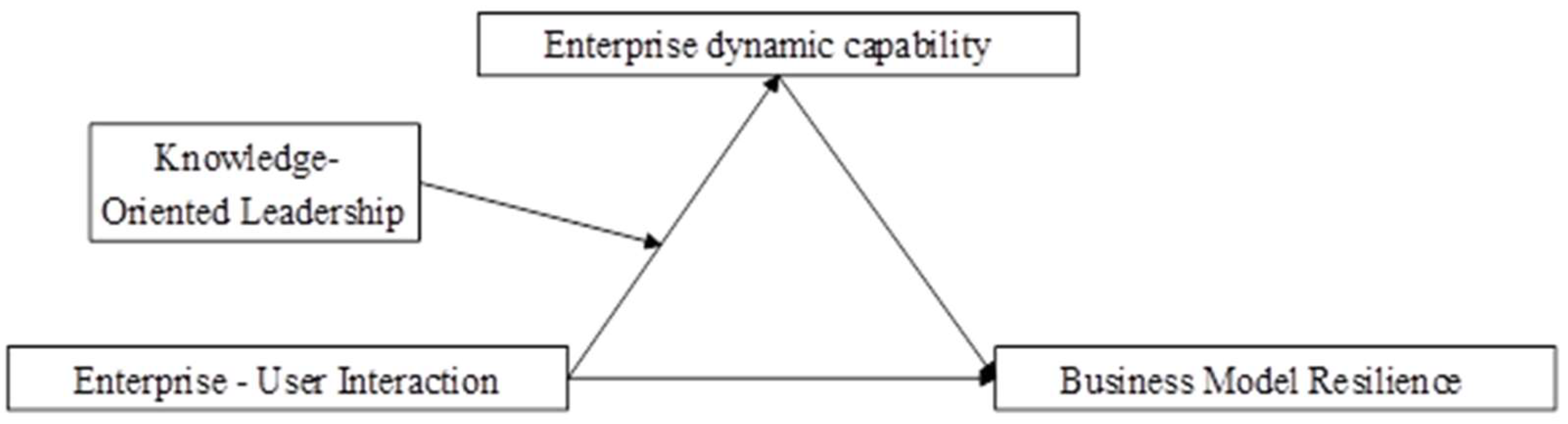
Figure 2.
Best fit model.
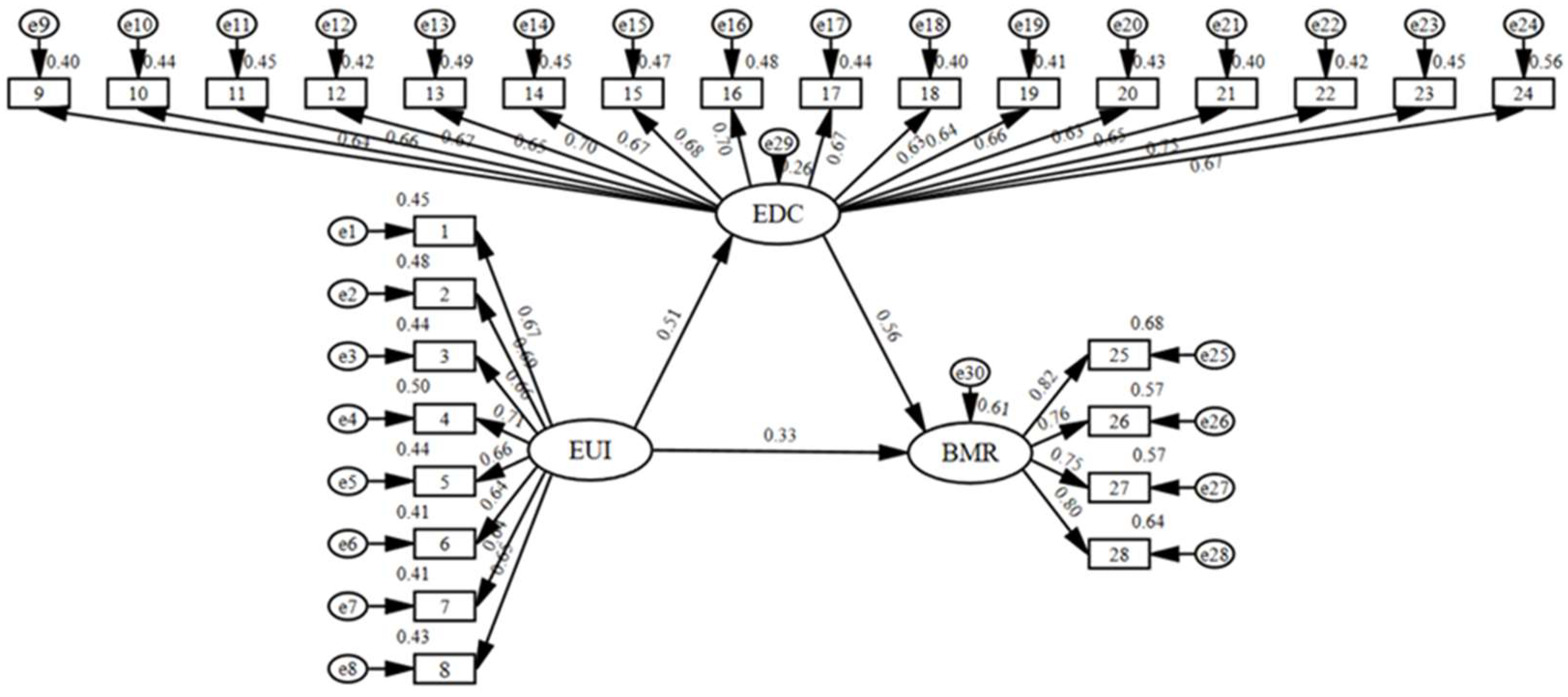
Figure 3.
The moderating role of knowledge-oriented leadership.
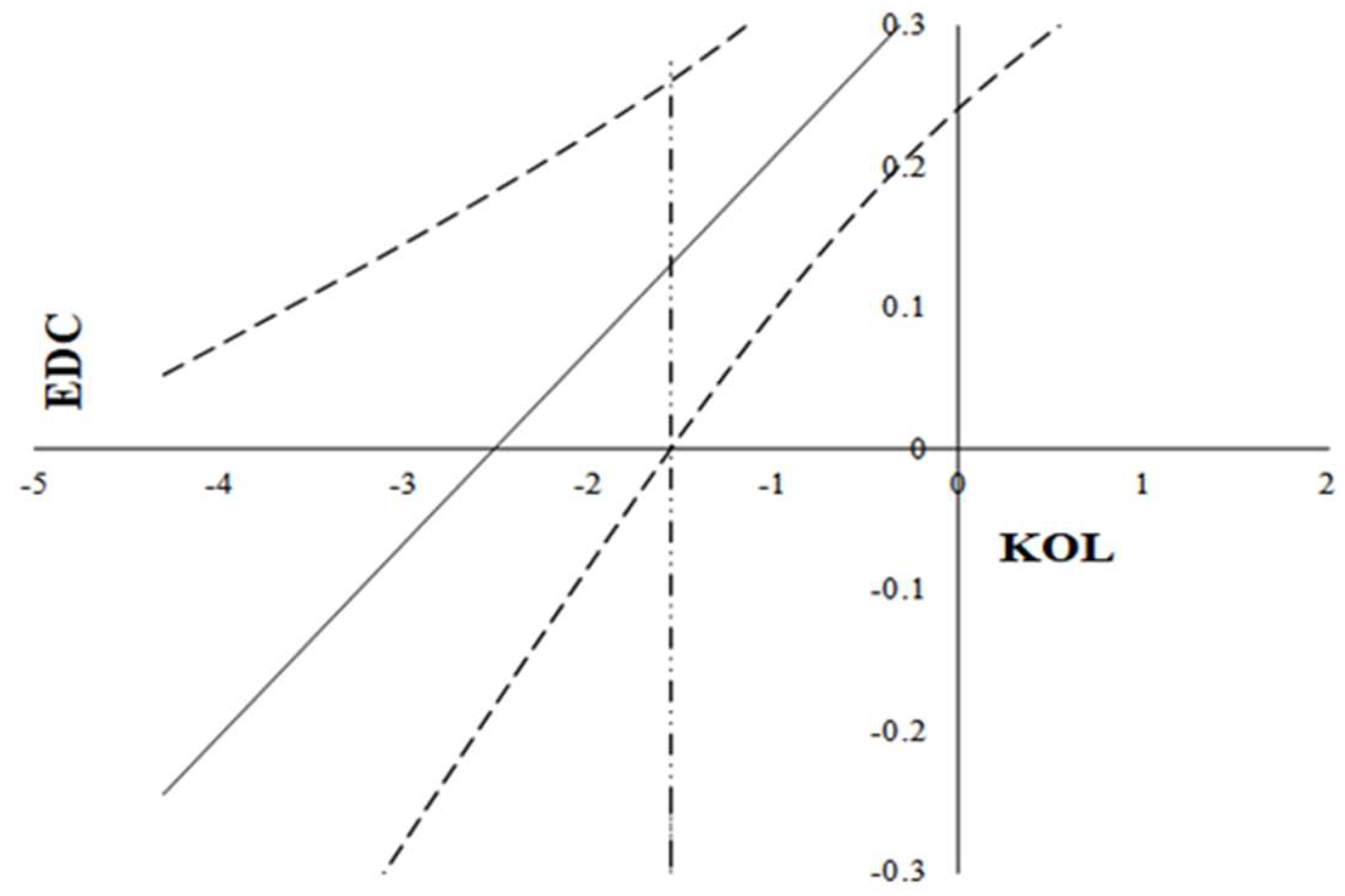
Figure 4.
The result of the moderated mediating effect.
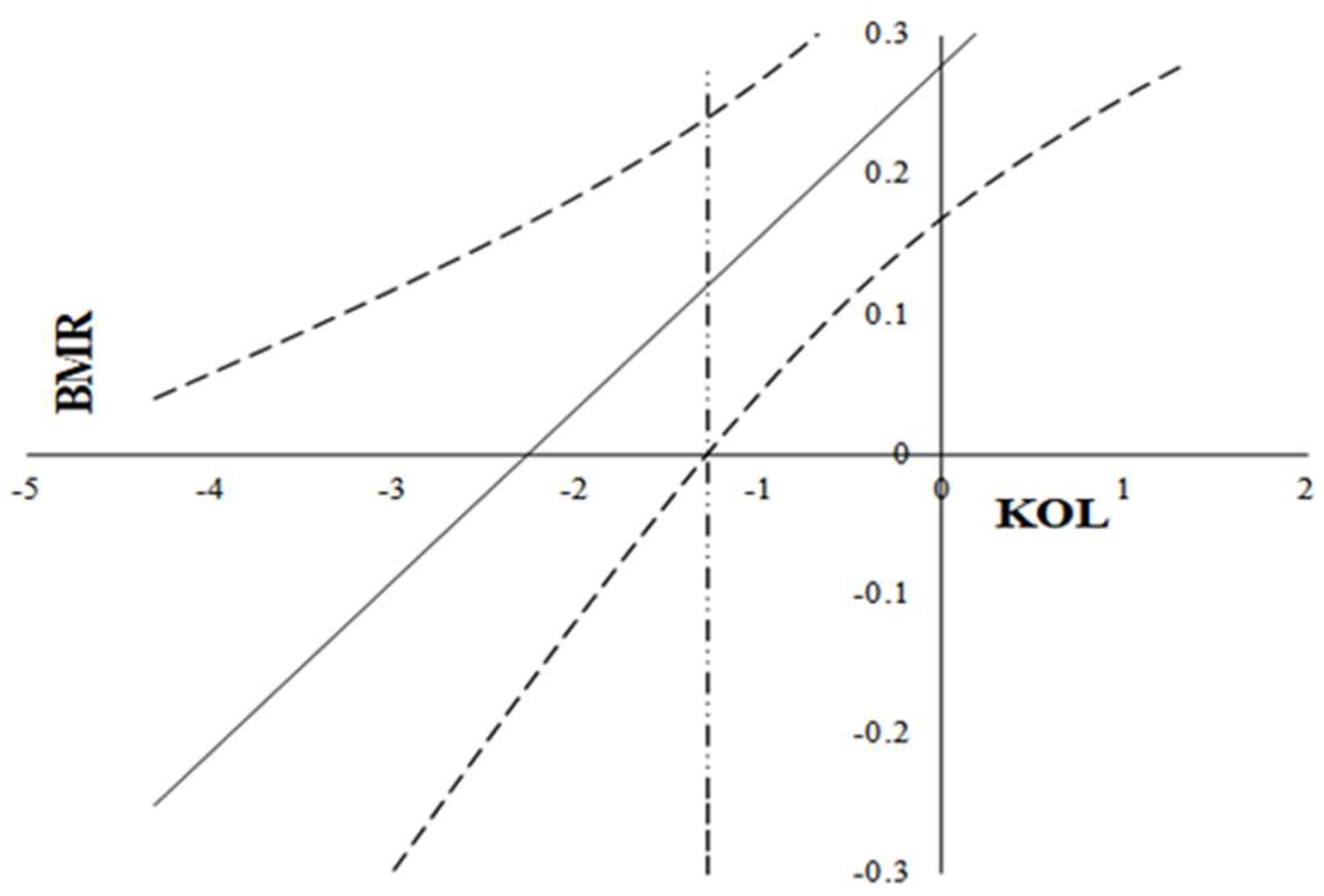

Table 1.
Statistical distribution of sample characteristics (N=300).
| Category | Classification standard | Sample size (Pcs) | Percentage (%) |
|---|---|---|---|
| Gender | Male | 133 | 44.30 |
| Female | 167 | 55.67 | |
| Age | Below the age of 18 | 3 | 1.00 |
| Age between 18 and 39 | 245 | 81.67 | |
| Age between 40 and 59 | 48 | 16.00 | |
| Above the age of 60 | 4 | 1.33 | |
| Education | High school or below | 12 | 4.00 |
| Junior college | 30 | 10.00 | |
| Undergraduate course | 237 | 79.00 | |
| Postgraduate and above | 21 | 7.00 | |
| Enterprise life | Less than 1 year | 6 | 2.00 |
| Between 1 and 4 years | 29 | 9.67 | |
| Between 4 and 8 years | 78 | 26.00 | |
| More than 8 years | 187 | 62.33 | |
| Enterprise size | Fewer than 20 people | 8 | 2.67 |
| Number of people 20-100 | 81 | 27.00 | |
| Number of people 100-500 | 144 | 48.00 | |
| More than 500 people | 67 | 22.33 | |
| Region | Eastern | 166 | 55.33 |
| Central | 88 | 29.33 | |
| Western | 46 | 15.33 | |
| Industry | Manufacturing Industry | 125 | 41.67 |
| agriculture | 4 | 1.33 | |
| High-Tech Industry | 96 | 32.00 | |
| Service Industry | 51 | 17.00 | |
| Other | 24 | 8.00 |
Table 2.
Reliability and validity.
| Variable | Cronbach’s α | KMO | CR | AVE | Factor loading range |
|---|---|---|---|---|---|
| EUI | 0.864 | 0.908 | 0.865 | 0.445 | 0.636~0.711 |
| BMR | 0.865 | 0.829 | 0.865 | 0.617 | 0.754~0.822 |
| EDC | 0.927 | 0.944 | 0.927 | 0.444 | 0.631~0.748 |
| KOL | 0.855 | 0.891 | 0.857 | 0.501 | 0.632~0.765 |
Table 3.
Confirmatory factor analysis.
| Model | χ2 | df | χ2/df | CFI | TLI | IFI | RMSEA |
|---|---|---|---|---|---|---|---|
| quartet model | 878.736 | 521 | 1.687 | 0.926 | 0.926 | 0.926 | 0.048 |
| Three-factor model | 1371.690 | 524 | 2.618 | 0.824 | 0.812 | 0.825 | 0.074 |
| Two-factor model | 1853.779 | 526 | 3.524 | 0.724 | 0.706 | 0.726 | 0.092 |
| Single factor model | 1992.676 | 527 | 3.781 | 0.696 | 0.676 | 0.698 | 0.096 |
Table 4.
Descriptive statistics and correlations.
| Mean | SD | 1 | 2 | 3 | 4 | 5 | 6 | 7 | 8 | 9 | |
| EUI | 5.475 | 0.867 | 1.000 | ||||||||
| EDC | 5.524 | 0.804 | 0.465** | 1.000 | |||||||
| BMR | 5.341 | 1.105 | 0.539** | 0.651** | 1.000 | ||||||
| KOL | 5.469 | 0.987 | 0.466** | 0.462** | 0.614** | 1.000 | |||||
| PE | 1.290 | 0.456 | -0.382** | -0.354** | -0.307** | -0.191** | 1.000 | ||||
| GM | 2.900 | 0.769 | -0.041 | 0.005 | 0.015 | 0.027 | -0.031 | 1.000 | |||
| EL | 3.490 | 0.752 | 0.103 | 0.186** | 0.300** | 0.182** | -0.047 | 0.431** | 1.000 | ||
| EI | 2.480 | 1.382 | -0.237** | -0.114* | -0.195** | -0.118* | 0.140* | -0.162** | -0.234** | 1.000 | |
| EA | 1.700 | 0.458 | 0.087 | 0.020 | 0.116* | -0.004 | -0.062 | -0.161** | 0.052 | -0.164** | 1.000 |
Note: * p<0.050,** p<0.010,*** p<0.001.
Table 5.
Mediating effect result.
| Effect class | Effect size | Bootstrap standard error | Bootstrap lower limit | Bootstrap upper limit | Effect ratio |
|---|---|---|---|---|---|
| mediating effect | 0.226 | 0.062 | 0.125 | 0.367 | 39.09% |
| direct effect | 0.353 | 0.061 | 0.233 | 0.473 | 60.91% |
| total effect | 0.579 | 0.065 | 0.450 | 0.709 | - |
Table 6.
Regression results of the moderating effect of knowledge-oriented leadership.
| EDC | |||
|---|---|---|---|
| M1 | M2 | M3 | |
| PE | -0.344***(-6.376) | -0.206***(-3.986) | -0.187***(-3.672) |
| GM | -0.109(-1.788) | -0.055(-1.016) | -0.043(-0.801) |
| EL | 0.209***(3.463) | 0.129*(2.362) | 0.126*(2.342) |
| EI | -0.040(-0.709) | 0.024(0.477) | 0.033(0.655) |
| EA | -0.036(-0.647) | -0.024(-0.481) | -0.024(-0.499) |
| EUI | 0.243***(4.160) | 0.299***(5.024) | |
| KOL | 0.290***(5.331) | 0.326***(5.981) | |
| EUI*KOL | 0.177***(3.451) | ||
| F | 11.526*** | 21.533*** | 21.035*** |
| R2 | 0.150 | 0.325 | 0.349 |
| ΔR2 | - | 0.177 | 0.026 |
Notes: *p<0.050;**p<0.010;***p<0.001;The value of t is shown in parentheses.
Table 7.
Analysis results of the moderated mediating effects.
| KOL | Coefficient value | Standard error | 95% confidence interval | |
|---|---|---|---|---|
| Lower limit | Upper limit | |||
| Low level | 0.102 | 0.057 | -0.006 | 0.228 |
| Average level | 0.182 | 0.060 | 0.068 | 0.306 |
| High level | 0.261 | 0.075 | 0.114 | 0.405 |
Note:Bootstraps=5000.
Disclaimer/Publisher’s Note: The statements, opinions and data contained in all publications are solely those of the individual author(s) and contributor(s) and not of MDPI and/or the editor(s). MDPI and/or the editor(s) disclaim responsibility for any injury to people or property resulting from any ideas, methods, instructions or products referred to in the content. |
© 2025 by the authors. Licensee MDPI, Basel, Switzerland. This article is an open access article distributed under the terms and conditions of the Creative Commons Attribution (CC BY) license (http://creativecommons.org/licenses/by/4.0/).
Copyright: This open access article is published under a Creative Commons CC BY 4.0 license, which permit the free download, distribution, and reuse, provided that the author and preprint are cited in any reuse.