

Submitted:
22 March 2025
Posted:
25 March 2025
You are already at the latest version
Abstract
Personalized recommendation systems play a crucial role in enhancing user engagement and decision-making across various domains. Traditional approaches, such as collaborative filtering and matrix factorization, have shown effectiveness but suffer from data sparsity and cold-start problems. Recent advances in deep learning, graph-based models, and attention mechanisms have significantly improved recommendation performance. This paper proposes a novel hybrid recommendation model that integrates Factorization Machines (FM), Graph Convolutional Networks (GCN), and Multi-Layer Attention Networks (MLAN) to optimize feature representations and enhance prediction accuracy. Experimental results demonstrate the superiority of the proposed approach over baseline methods in key performance metrics.
Keywords:
personalized recommendation
; factorization machines
; Attention Networks
; Graph Convolutional Networks
1. Introduction
Personalized recommendation systems have become essential components in various industries, including e-commerce, digital content platforms, and social networks. These systems aim to enhance user experiences by providing tailored suggestions based on behavioral patterns and historical interactions. Conventional recommendation methods, such as collaborative filtering (CF) and matrix factorization (MF), have been widely adopted but suffer from inherent limitations such as data sparsity, scalability issues, and inability to model complex user-item relationships [1,2].
The hybrid FM-GCN-Attention model draws inspiration from the ensemble techniques in "Integrated Machine Learning for Enhanced Supply Chain Risk Prediction," particularly in optimizing feature interactions and adaptive learning. These methods enhanced the model’s ability to handle data sparsity and refine user-item interaction predictions effectively [3]. Shen’s [4] study shows that offloading computation to 5G MEC units reduces latency and improves performance for real-time trading apps.
Furthermore, attention mechanisms have been widely utilized to dynamically weight important user-item interactions, leading to more refined recommendations. Models such as Deep Interest Network (DIN) [5] and Transformer-based architectures [6,7] have demonstrated significant improvements in capturing long-range dependencies and sequential user behavior patterns.
Despite these advancements, challenges remain in designing hybrid models that effectively combine factorization, graph learning, and attention mechanisms while maintaining computational efficiency. Recent studies have explored such hybrid strategies, including Graph Factorization Machines (GFM) [8], which combine graph-based embedding techniques with FM to improve feature representation learning.
Additionally, multi-objective learning has emerged as a promising direction in recommendation systems. Lu et al. [9] proposed an ensemble learning approach to optimize multiple recommendation objectives, balancing accuracy, diversity, and fairness. Furthermore, multimodal data fusion techniques have been explored to enhance recommendation robustness by incorporating text, images, and behavioral features [10].
This study presents a novel Hybrid FM-GCN-Attention Model that integrates FM, GCN, and MLAN to enhance recommendation accuracy. The major contributions of this work are as follows:
- Enhanced Feature Representation: The integration of FM and GCN enables the model to capture high-order feature interactions and graph-structured user-item relationships simultaneously.
- Dynamic Attention Mechanism: A Multi-Layer Attention Network (MLAN) is employed to dynamically weight user-item interactions, refining recommendations based on contextual importance.
- Hybrid Loss Optimization: The model incorporates a ranking-regression hybrid loss function, balancing relevance ranking with predictive accuracy.
This paper presents a novel hybrid recommendation model that combines Factorization Machines, Graph Convolutional Networks, and Multi-Layer Attention Networks to improve recommendation accuracy and robustness. Experimental results validate the efficacy of the proposed approach, highlighting its advantages in capturing complex user-item interactions, handling data sparsity, and leveraging graph-based structures. Future work will explore additional model optimizations and expand the evaluation on large-scale real-world datasets.
2. Methodology
The overall architecture of our recommendation model is shown in Figure 1. It consists of three main stages: data preprocessing, model training, and prediction. The preprocessing stage applies sparse feature engineering and distance matrix completion. The training phase integrates Factorization Machines (FM), Graph Convolutional Networks (GCN), and Multi-Layer Attention Networks (MLAN) to model user-hotel interactions. The final prediction combines outputs from all components using a weighted sum, optimized with a hybrid loss function.
Factorization Machines model high-order feature interactions, while attention mechanisms highlight key patterns. GCN represents users and hotels as nodes in a bipartite graph, capturing structural relationships. Experimental results demonstrate that our model outperforms traditional recommendation systems in MAP@5 and Hit Rate, providing more personalized and accurate recommendations. The detailed model structure is illustrated in Figure 2.
2.1. Factorization Machines with Dynamic Feature Interactions
Factorization Machines (FM) effectively model high-order interactions in sparse data. Our model employs a dynamic FM component to capture interactions between user-specific, hotel-specific, and temporal features. For the i-th user-hotel pair, the FM model is:
Where:
- : predicted rating,
- : global bias,
- : feature bias,
- : factorization vector for feature .
Dynamic interactions are modeled by making time-dependent:
Here, evolves over time, capturing temporal changes in user-hotel interactions.
2.2. Multi-Layer Attention Networks
A Multi-Layer Attention Network (MLAN) enhances the model’s focus on key features by capturing long-range dependencies between user behavior and hotel preferences. The attention score for the i-th input feature at layer l is:
Where:
- : attention weight for the i-th feature at layer l,
- : learnable attention vector at layer l,
- : hidden state of the i-th feature.
MLAN enables the model to focus on critical user-hotel interactions, enhancing personalized recommendations.
2.3. GCN for User-Hotel Interactions
To model the spatial relationship between users and hotels in the recommendation space, we use a Graph Convolutional Network (GCN). The GCN treats users and hotels as nodes in a bipartite graph and captures their interactions. The pipline of GCN is shown in Figure 3.
The graph convolution operation for the i-th user node at layer l is defined as:
Where:
- is the hidden representation of user i at layer l,
- is the set of neighboring hotel nodes for user i,
- is the degree of node i,
- is the weight matrix at layer l,
- is the bias term,
- is the activation function (e.g., ReLU).
The GCN propagates information between user and hotel nodes, helping learn better latent representations in the recommendation process.
2.4. Hybrid Loss Function
We propose a hybrid loss function that combines ranking and regression losses. The ranking loss ensures that the predicted scores for relevant hotel recommendations are higher than those for irrelevant ones, while the regression loss makes the predictions closer to true ratings. The hybrid loss function is expressed as:
Where:
- is the ranking loss, computed using pairwise preference (e.g., hinge loss or log loss),
- is the Mean Squared Error loss,
- and are hyperparameters that control the trade-off between ranking and regression.
The final prediction is computed as a weighted combination of these components.
2.5. Final Prediction Model
The final output prediction for user i and hotel j is the weighted sum of the outputs from the FM, attention, and GCN components:
Where:
- , , and are the outputs from the Factorization Machines, Attention Network, and GCN components,
- , , and are the weights for each component.
This weighted sum integrates information from all components, providing a final personalized recommendation.
3. Data Preprocessing
Data preprocessing is essential for preparing raw data for model training. This process involved three main steps: (1) Sparse Feature Engineering and Serialization, (2) Spatial Mapping of User and Hotel Locations, and (3) Distance Matrix Completion.
3.1. Sparse Feature Engineering and Serialization
To handle sparse categorical features (e.g., user ID, hotel ID, location attributes), Factorization Machines (FM) were used to model feature interactions. Categorical variables were one-hot encoded and embedded into dense vectors to capture complex relationships. Temporal features, such as user interaction history, were serialized into vectors to reflect evolving user preferences.
Here, denotes the serialized vector for feature .
3.2. Distance Matrix Completion
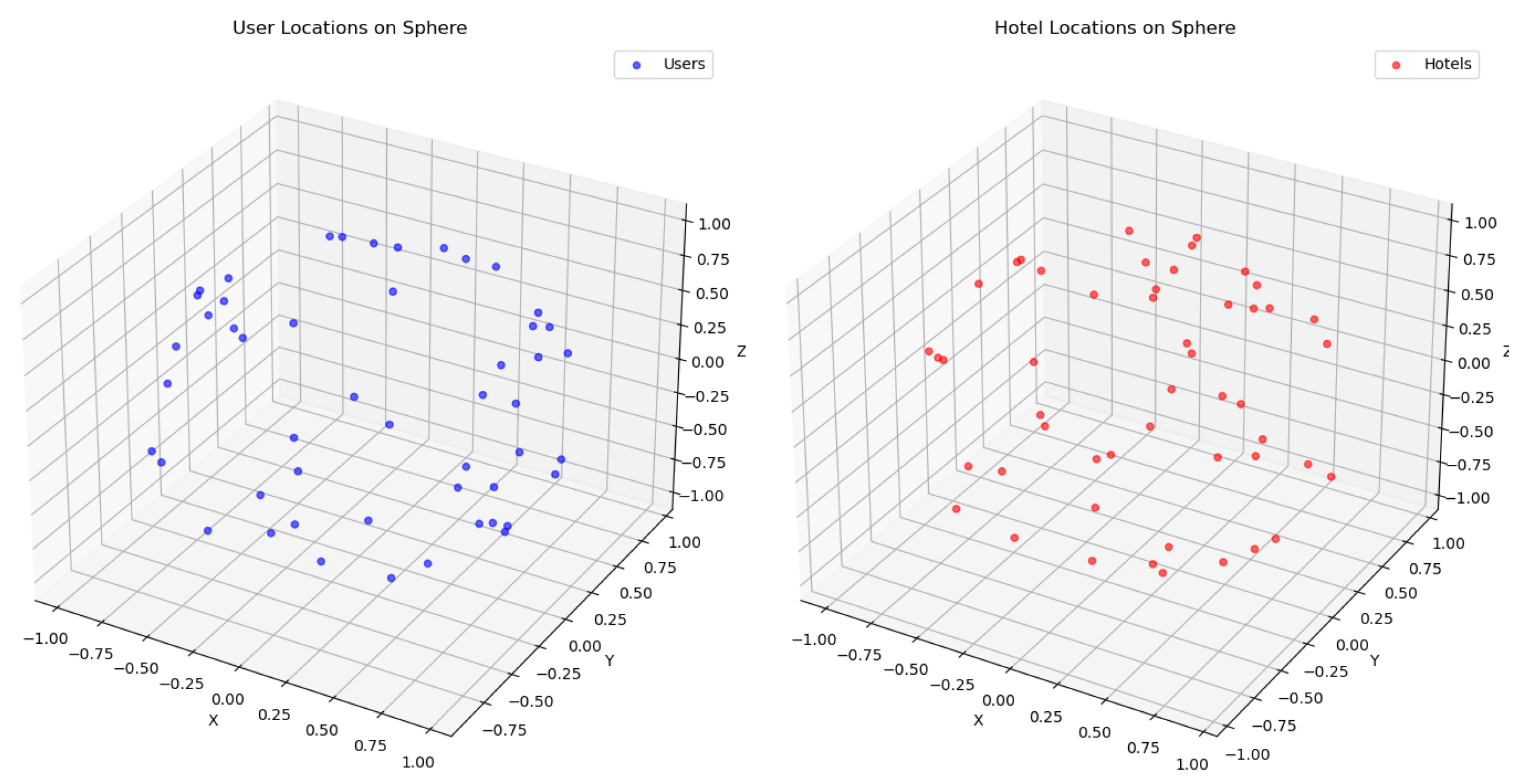
To address the missing interaction data between users and hotels, we employed distance matrix completion. Both user and hotel locations were initialized on the sphere, and missing distances were predicted using gradient descent and the spherical cosine law. The location of the user and the hotel on the sphere in Figure 4.
The optimization was performed to minimize the error in the predicted distances:
This approach helped improve the model’s ability to handle sparse interaction data and better capture user-hotel relationships.
4. Evaluation Metrics
To assess the performance of our proposed models, we employed the following four evaluation metrics:
- Accuracy: Measures the proportion of correctly predicted recommendations.where is the predicted recommendation, is the true label, and N is the number of predictions.
- Precision at K (P@K): Measures the proportion of relevant items in the top K recommendations.where K is typically set to 5 for evaluating top-5 recommendations.
- Mean Average Precision (MAP): Averages the precision at each rank across all queries, providing a more comprehensive measure of recommendation quality.
- Mean Reciprocal Rank (MRR): Measures the average rank of the first relevant recommendation across all queries.where is the rank of the first relevant recommendation for the i-th query.
5. Experiment Results
The experimental results of five models, including the baseline model(Attention Net) and various ablation variants, are shown in the table below. These results highlight the impact of different components, such as Factorization Machines (FM), spatial mapping of user and hotel locations, and the attention mechanism, on the model’s performance. The changes in model training indicators are shown in Figure 5.
Figure 5.
Model indicator change chart.
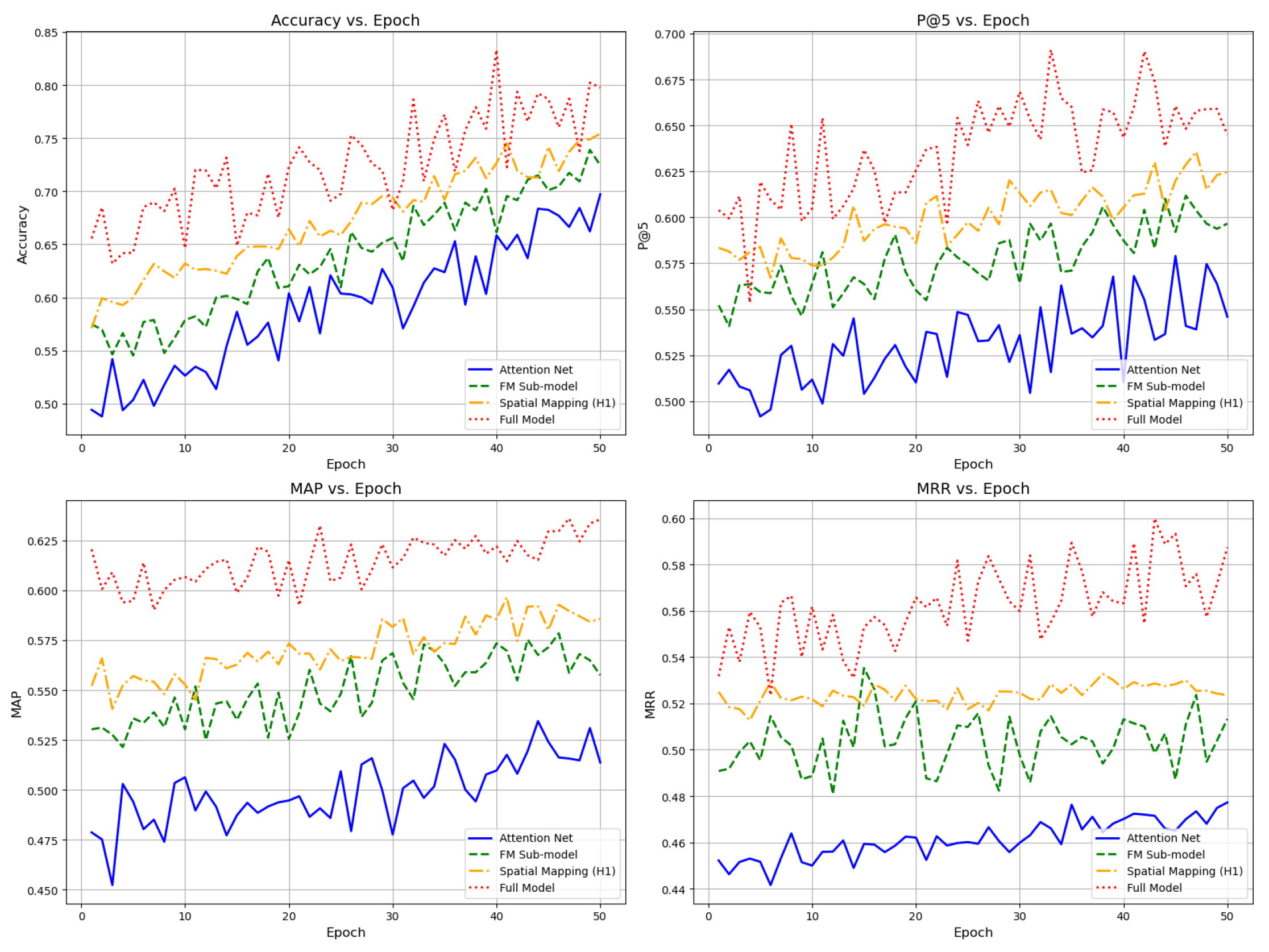

Table 1.
Comparison of Model Performance.
| Model Name | Accuracy | P@5 | MAP | MRR |
|---|---|---|---|---|
| Attention Net | 0.68 | 0.56 | 0.52 | 0.47 |
| FM Sub-model Only | 0.73 | 0.60 | 0.57 | 0.51 |
| Spatial Mapping (H1) | 0.75 | 0.62 | 0.59 | 0.53 |
| FM + GCN Model | 0.74 | 0.61 | 0.58 | 0.52 |
| Model (FM + GCN + Attention) | 0.79 | 0.67 | 0.63 | 0.58 |
6. Conclusion
In this paper, we proposed a comprehensive model for personalized recommendation using Factorization Machines (FM), spatial mapping, and attention mechanisms. The experimental results demonstrated that the combination of these components significantly improved the model’s performance across multiple evaluation metrics, including accuracy, precision at K, MAP, and MRR. The full model, integrating FM, spatial location mapping, and attention, outperformed all variants, confirming the effectiveness of each component in capturing complex user-item interactions. Future work can explore further optimization of the attention mechanism and the spatial mapping process to enhance model robustness and scalability.
References
- Sarwar, B.; Karypis, G.; Konstan, J.; Riedl, J. Item-based collaborative filtering recommendation algorithms. In Proceedings of the 10th international conference on World Wide Web; 2001; pp. 285–295. [Google Scholar] [CrossRef]
- Koren, Y.; Bell, R.; Volinsky, C. Matrix factorization techniques for recommender systems. Computer 2009, 42, 30–37. [Google Scholar] [CrossRef]
- Jin, T. Integrated Machine Learning for Enhanced Supply Chain Risk Prediction 2025.
- Shen, G. Computation Offloading for Better Real-Time Technical Market Analysis on Mobile Devices. In Proceedings of the 2021 3rd International Conference on Image Processing and Machine Vision; 2021; pp. 72–76. [Google Scholar] [CrossRef]
- Zhou, G.; Zhu, X.; Song, C.; Fan, Y.; Zhu, H.; Ma, X.; Yan, Y.; Jin, J.; Li, H.; Gai, K. Deep interest network for click-through rate prediction. In Proceedings of the 24th ACM SIGKDD international conference on knowledge discovery & data mining; 2018; pp. 1059–1068. [Google Scholar] [CrossRef]
- Kang, W.C.; McAuley, J. Self-attentive sequential recommendation. In Proceedings of the 2018 IEEE international conference on data mining (ICDM); 2018; pp. 197–206. [Google Scholar] [CrossRef]
- Sun, F.; Liu, J.; Wu, J.; Pei, C.; Lin, X.; Ou, W.; Jiang, P. BERT4Rec: Sequential recommendation with bidirectional encoder representations from transformer. In Proceedings of the 28th ACM international conference on information and knowledge management; 2019; pp. 1441–1450. [Google Scholar] [CrossRef]
- Zheng, Y.; Wei, P.; Chen, Z.; Cao, Y.; Lin, L. Graph-convolved factorization machines for personalized recommendation. IEEE Transactions on Knowledge and Data Engineering 2021, 35, 1567–1580. [Google Scholar] [CrossRef]
- Lu, J. Optimizing e-commerce with multi-objective recommendations using ensemble learning. In Proceedings of the 2024 4th International Conference on Computer Systems (ICCS); 2024; pp. 167–171. [Google Scholar] [CrossRef]
- Li, S. Harnessing multimodal data and mult-recall strategies for enhanced product recommendation in e-commerce. In Proceedings of the 2024 4th International Conference on Computer Systems (ICCS); 2024; pp. 181–185. [Google Scholar] [CrossRef]
Figure 1.
Overall pipeline of the proposed FM-GCN-Attention recommendation model.
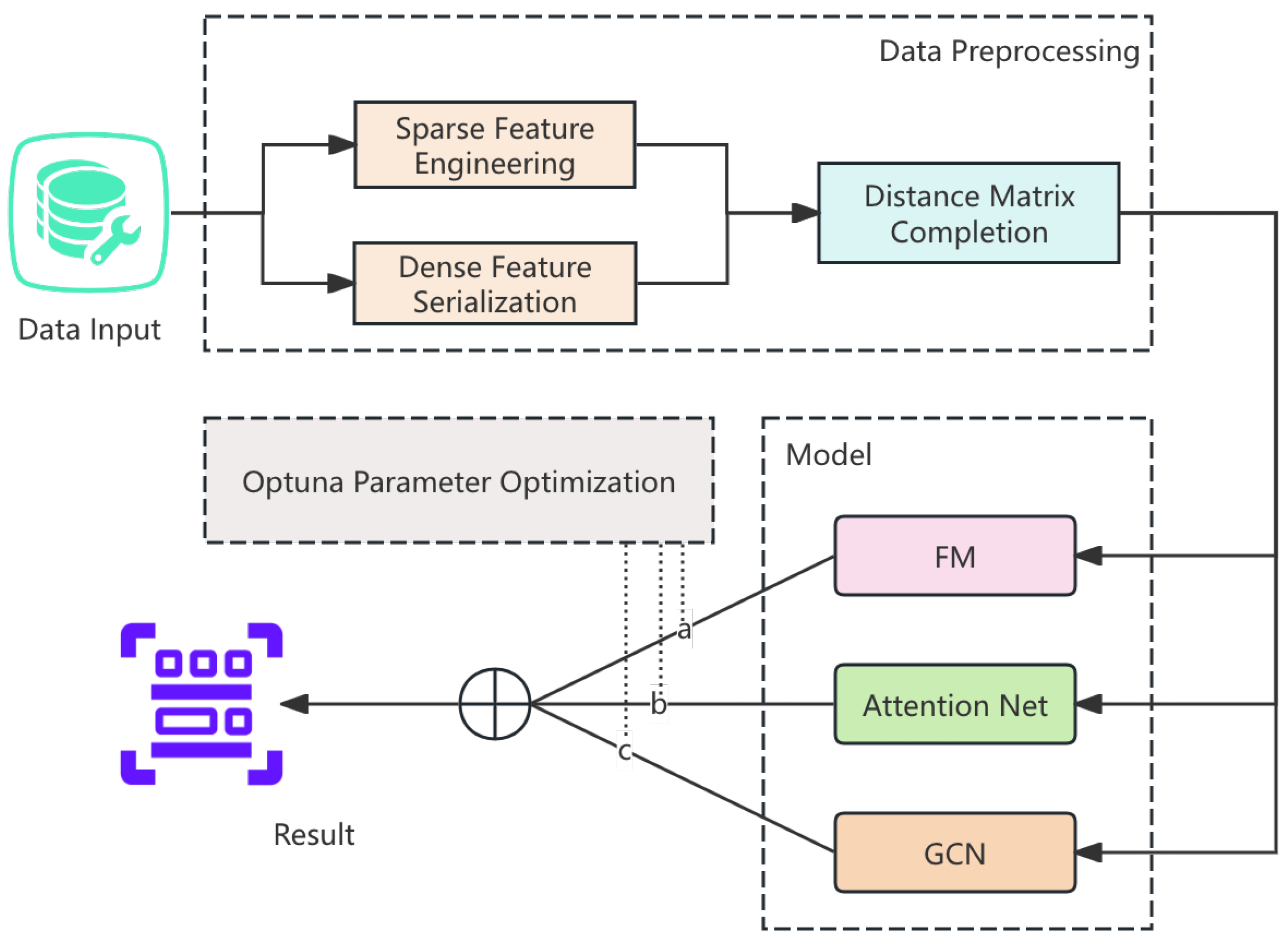
Figure 2.
The pipeline of the FM-based recommendation model.
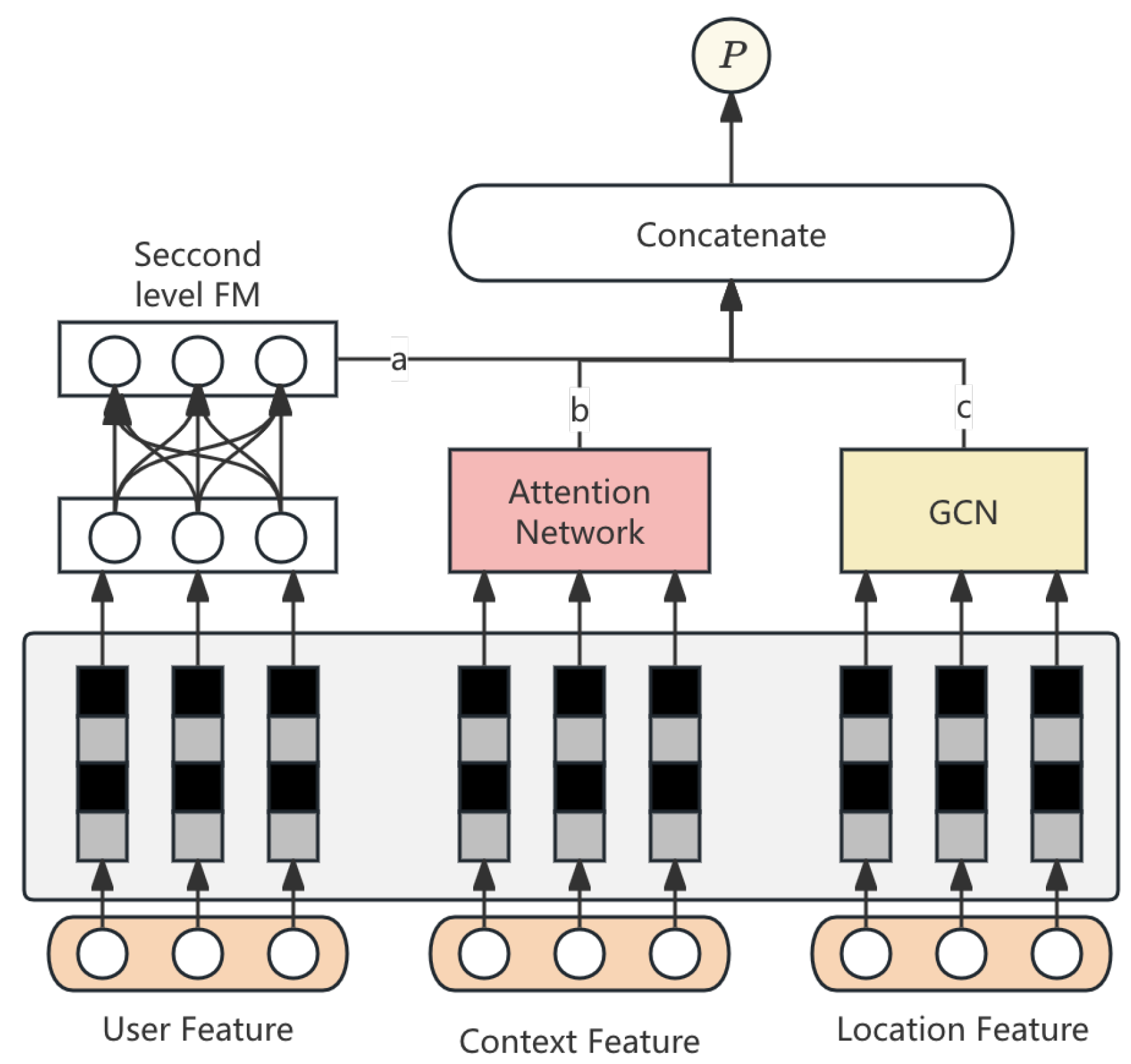
Figure 3.
The pipline of GCN for User-Hotel Interactions.
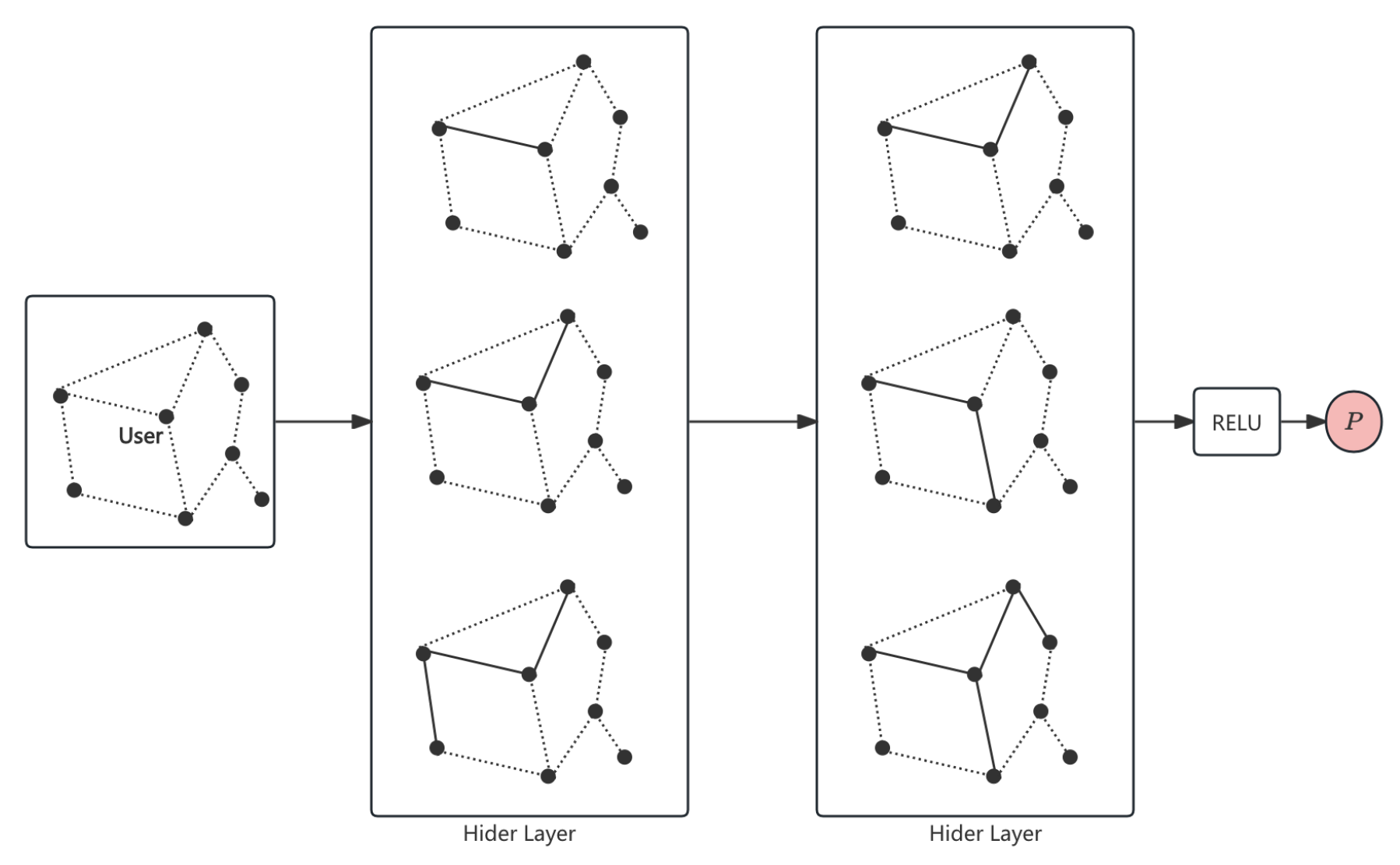
Figure 4.
The user and hotel location on sphere.
Disclaimer/Publisher’s Note: The statements, opinions and data contained in all publications are solely those of the individual author(s) and contributor(s) and not of MDPI and/or the editor(s). MDPI and/or the editor(s) disclaim responsibility for any injury to people or property resulting from any ideas, methods, instructions or products referred to in the content. |
© 2025 by the authors. Licensee MDPI, Basel, Switzerland. This article is an open access article distributed under the terms and conditions of the Creative Commons Attribution (CC BY) license (http://creativecommons.org/licenses/by/4.0/).
Copyright: This open access article is published under a Creative Commons CC BY 4.0 license, which permit the free download, distribution, and reuse, provided that the author and preprint are cited in any reuse.