

Submitted:
12 March 2025
Posted:
13 March 2025
You are already at the latest version
Abstract
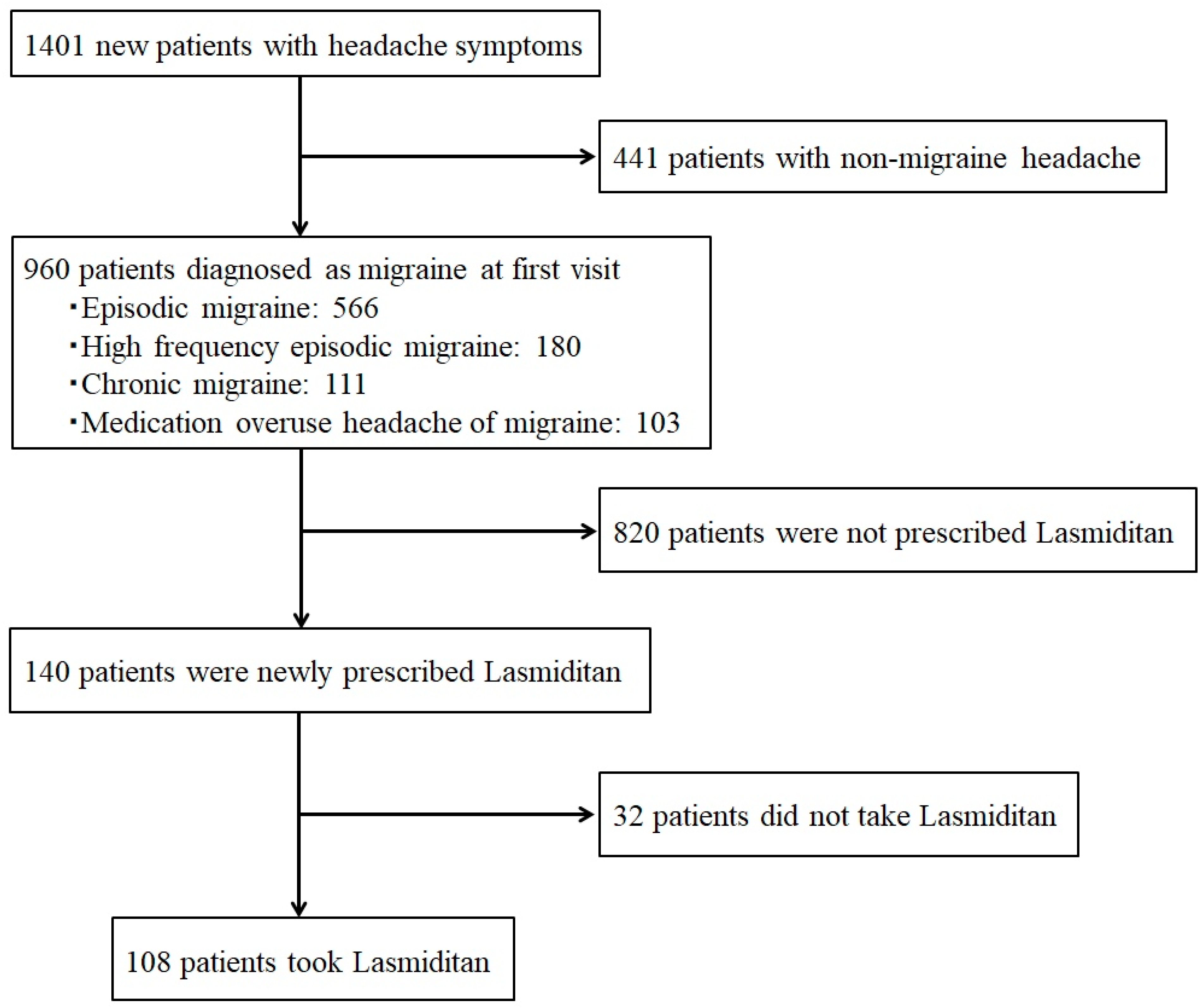
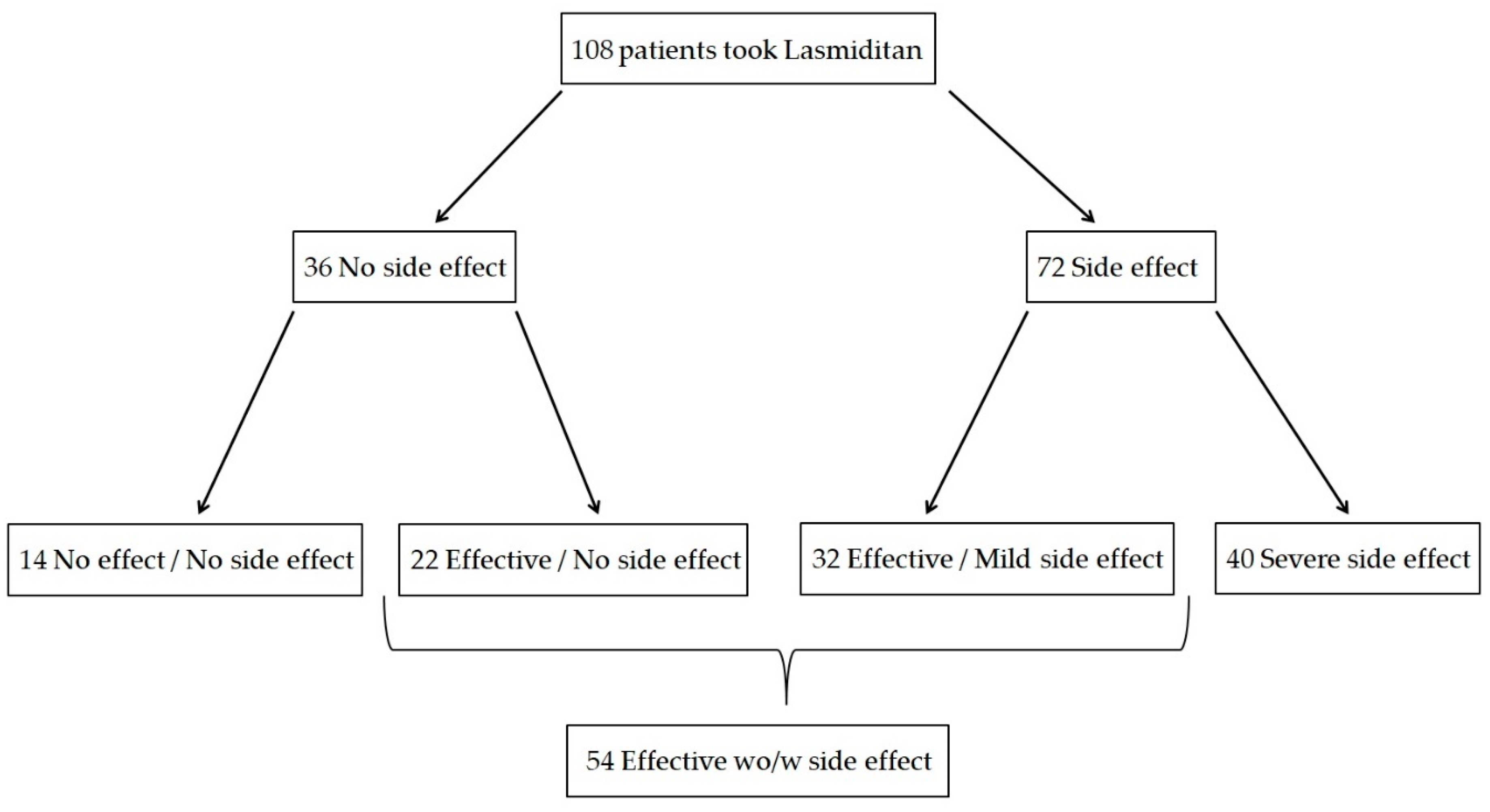
Background/Objectives: Lasmiditan is a newly developed drug for the acute treatment of migraine attacks, but factors associated with its efficacy remain unclear. This study aimed to confirm the efficacy of lasmiditan started at 50 mg under various dosing conditions and identify factors associated with its efficacy. Methods: There were four reasons for prescribing lasmiditan: add-on to triptan, ineffectiveness of triptan, side effects of triptan, and triptan contraindicated. Lasmiditan was started at a dose of 50 mg. Efficacy of lasmiditan was defined as the disappearance of headache or a 50% or greater reduction in headache intensity within two hours after dosing. This study included 108 patients with migraine who took lasmiditan. Results: The results for efficacy and the side effects of lasmiditan were as follows: effective without side effects (22), effective with mild side effects (32), ineffective (14), and severe side effects (40). The efficacy rate of lasmiditan 50 mg was 50.0% (54/108). The following factors were found to be associated with lasmiditan efficacy: sex, migraine classification, calcium channel blockers, and anti-calcitonin gene-related peptide monoclonal antibody (CGRP-mAb) treatment. The overall incidence of side effects was 66.7%, and the dropout rate was 37.0%. Somnolence was more prevalent in the effective group, and other side effects were more prevalent in patients who dropped out due to side effects of lasmiditan. Conclusions: Lasmiditan is likely to be effective in male, severe migraine classification, and receiving CGRP-mAb treatment. If mild somnolence is a side effect, the drug can be continued and may be effective.
Keywords:
1. Introduction
2. Materials and Methods
2.1. Study Design
2.2. Data Collection
2.3. Assessments and Statistical Analysis
3. Results
3.1. Participants’ Demographic Characteristics
3.2. Efficacy of Lasmiditan
3.3. Side Effects of Lasmiditan
4. Discussion
5. Conclusions
Author Contributions
Funding
Institutional Review Board Statement
Informed Consent Statement
Data Availability Statement
Acknowledgments
Conflicts of Interest
Abbreviations
| CGRP-mAb | Anti-calcitonin gene-related peptide monoclonal antibody |
| NSAIDs | Nonsteroidal anti-inflammatory drugs |
| Ca | Calcium |
| BMI | Body mass index |
| EM | Episodic migraine |
| HFEM | High frequency episodic migraine |
| CM | Chronic migraine |
| MOH | Medication overuse headache |
References
- Ashina, M.; Katsarava, Z.; Do, T.P.; Buse, D.C.; Pozo-Rosich, P.; Özge, A.; Krymchantowski, A.V.; Lebedeva, E.R.; Ravishankar, K.; Yu, S.; et. al. Migraine: epidemiology and systems of care. Lancet 2021, 397, 1485–1495. [Google Scholar] [PubMed]
- Shimizu, T. : Sakai, F.; Miyake, H.; Sone, T.; Sato, M.; Tanabe, S.; Azuma, Y.; Dodick, D.W. Disability, quality of life, productivity impairment and employer costs of migraine in the workplace. J. Headache Pain 2021, 22, 29. [Google Scholar]
- Goadsby, P.J.; Reuter, U.; Hallström, Y.; Broessner, G.; Bonner, J.H.; Zhang, F.; Sapra, S.; Picard, H.; Mikol, D.D.; Lenz, R.A. A Controlled Trial of Erenumab for Episodic Migraine. N. Engl. J. Med. 2017, 377, 2123–2132. [Google Scholar]
- Skljarevski, V.; Matharu, M.; Millen, B.A.; Ossipov, M.H.; Kim, B.K.; Yang, J.Y. Efficacy and safety of galcanezumab for the prevention of episodic migraine: Results of the EVOLVE-2 Phase 3 randomized controlled clinical trial. Cephalalgia 2018, 38, 1442–1454. [Google Scholar]
- Dodick, D.W.; Silberstein, S.D.; Bigal, M.E.; Yeung, P.P.; Goadsby, P.J.; Blankenbiller, T.; Grozinski-Wolff, M.; Yang, R.; Ma, Y.; Aycardi, E. Effect of Fremanezumab Compared With Placebo for Prevention of Episodic Migraine: A Randomized Clinical Trial. J.A.M.A. 2018, 319, 1999–2008. [Google Scholar]
- Sakai, F.; Suzuki, N.; Kim, B.K.; Tatsuoka, Y.; Imai, N.; Ning, X.; Ishida, M.; Nagano, K.; Iba, K.; Kondo, H.; et al. Efficacy and safety of fremanezumab for episodic migraine prevention: multicenter, randomized, double-blind, placebo-controlled, parallel-group trial in Japanese and Korean patients. Headache 2021, 61, 1102–1111. [Google Scholar]
- Takeshima, T.; Sakai, F.; Hirata, K.; Imai, N.; Matsumori, Y.; Yoshida, R.; Peng, C.; Cheng, S.; Mikol, D.D. Erenumab treatment for migraine prevention in Japanese patients: efficacy and safety results from a phase 3, randomized, double-blind, placebo-controlled study. Headache 2021, 61, 927–935. [Google Scholar] [CrossRef]
- Tanei, T.; Fuse, Y.; Maesawa, S.; Nishimura, Y.; Ishizaki, T.; Nagashima, Y.; Mutoh, M.; Ito, Y.; Hashida, M.; Suzuki, T.; et al. Real-world clinical results of CGRP monoclonal antibody treatment for medication overuse headache of migraine without abrupt drug discontinuation and no hospitalization. Heliyon 2024, 10, e40190. [Google Scholar]
- Kelley, N.E.; Tepper, D.E. Rescue therapy for acute migraine, part 1: triptans, dihydroergotamine, and magnesium. Headache 2012, 52, 114–128. [Google Scholar]
- Pascual, J. Clinical benefits of early triptan therapy for migraine. Headache 2002, Suppl 1, 10–17. [Google Scholar]
- Clemow, D.B.; Johnson, K.W.; Hochstetler, H.M.; Ossipov, M.H.; Hake, A.M.; Blumenfeld, A.M. Lasmiditan mechanism of action - review of a selective 5-HT1F agonist. J. Headache Pain 2020, 21, 71. [Google Scholar] [CrossRef]
- Nelson, D.L.; Phebus, L.A.; Johnson, K.W.; Wainscott, D.B.; Cohen, M.L.; Calligaro, D.O.; Xu, Y.C. Preclinical pharmacological profile of the selective 5-HT1F receptor agonist lasmiditan. Cephalalgia 2010, 30, 1159–1169. [Google Scholar] [CrossRef] [PubMed]
- Goadsby, P.J.; Wietecha, L.A.; Dennehy, E.B.; Kuca, B.; Case, M.G.; Aurora, S.K.; Gaul, C. Phase 3 randomized, placebo-controlled, double-blind study of lasmiditan for acute treatment of migraine. Brain 2019, 142, 1894–1904. [Google Scholar] [CrossRef] [PubMed]
- Kuca, B.; Silberstein, S.D.; Wietecha, L.; Berg, P.H.; Dozier, G.; Lipton, R.B. Lasmiditan is an effective acute treatment for migraine: A phase 3 randomized study. Neurology 2018, 91, e2222–e2232. [Google Scholar] [CrossRef] [PubMed]
- Sakai, F.; Takeshima, T.; Homma, G.; Tanji, Y.; Katagiri, H.; Komori, M. Phase 2 randomized placebo-controlled study of lasmiditan for the acute treatment of migraine in Japanese patients. Headache 2021, 61, 755–765. [Google Scholar] [CrossRef]
- Tepper, S.J.; Vasudeva, R.; Krege, J.H.; Rathmann, S.S.; Doty, E.; Vargas, B.B.; Magis, D.; Komori, M. Evaluation of 2-Hour Post-Dose Efficacy of Lasmiditan for the Acute Treatment of Difficult-to-Treat Migraine Attacks. Headache 2020, 60, 1601–1615. [Google Scholar] [CrossRef]
- Ashina, M.; Reuter, U.; Smith, T.; Krikke-Workel, J.; Klise, S.R.; Bragg, S.; Doty, E.G.; Dowsett, S.A.; Lin, Q.; Krege, J.H. Randomized, controlled trial of lasmiditan over four migraine attacks: Findings from the CENTURION study. Cephalalgia 2021, 41, 294–304. [Google Scholar] [CrossRef]
- Tepper, S.J.; Krege, J.H.; Lombard, L.; Asafu-Adjei, J.K.; Dowsett, S.A.; Raskin, J.; Buchanan, A.S.; Friedman, D.I. Characterization of Dizziness After Lasmiditan Usage: Findings From the SAMURAI and SPARTAN Acute Migraine Treatment Randomized Trials. Headache 2019, 59, 1052–1062. [Google Scholar] [CrossRef]
- Shibata, Y.; Sato, H.; Sato, A.; Harada, Y. Efficacy of Lasmiditan as a Secondary Treatment for Migraine Attacks after Unsuccessful Treatment with a Triptan. Neurol. Int. 2024, 16, 643–652. [Google Scholar] [CrossRef]
- Ishii, R.; Ishizuchi, K.; Watanabe, N.; Fukazawa, R.; Trivedi, M.; Nakahara, J.; Takizawa, T. Efficacy and tolerability of 100 mg of lasmiditan for migraine: A multi-center, prospective observational real-world study in Japan. Cephalalgia 2024, 44, 3331024241258695. [Google Scholar] [CrossRef]
- Laohapiboolrattana, W.; Jansem, P.; Anukoolwittaya, P.; Roongpiboonsopit, D.; Hiransuthikul, A.; Pongpitakmetha, T.; Thanprasertsuk, S.; Rattanawong, W. Efficacy of lasmiditan, rimegepant and ubrogepant for acute treatment of migraine in triptan insufficient responders: systematic review and network meta-analysis. J. Headache Pain 2024, 25, 194. [Google Scholar] [PubMed]
- Headache Classification Committee of the International Headache Society (IHS) The International Classification of Headache Disorders, 3rd edition. Cephalalgia 2018, 38, 1–211.
- Frattale, I.; Caponnetto, V.; Casalena, A.; Assetta, M.; Maddestra, M.; Marzoli, F.; Affaitati, G.; Giamberardino, M.A.; Viola, S.; Gabriele, A.; et al. Association between response to triptans and response to erenumab: real-life data. J. Headache Pain 2021, 22, 1. [Google Scholar]

| Characteristics | n = 108 |
|---|---|
| Age (years), mean ± SD | 34.6 ± 12.3 |
| Sex, female; n (%) | 90 (83.3%) |
| Onset years; n (%) | |
| Teens and younger | 65 (60.2%) |
| 20s | 31 (28.7%) |
| 30s | 9 (8.3%) |
| 40s and older | 3 (2.8%) |
| Family history of headaches; n (%) | 72 (66.7%) |
| History of psychiatric disorders; n (%) | 13 (12.0%) |
| Depression | 8 (7.4%) |
| Others | 5 (4.6%) |
| Migraine with aura; n (%) | 49 (45.4%) |
| Classification of migraine | |
| EM | 57 (52.8%) |
| HFEM | 20 (18.5%) |
| CM | 16 (14.8%) |
| Migraine with MOH | 15 (13.9%) |
| Oral prophylactic medication available | 80 (74.1%) |
| Single | 46 (42.6%) |
| Multiple | 34 (31.5%) |
| Types of prophylactic medications (includes duplicates) | |
| Anticonvulsants | 63 (58.3%) |
| Antidepressants | 41 (38.0%) |
| Ca channel blockers | 23 (21.3%) |
| Beta blockers | 2 (1.9%) |
| CGRP-mAb treatment | 37 (34.3%) |
| Effective group | Ineffective group | p-value | |
|---|---|---|---|
| n = 54 | n = 54 | ||
| Age (years), mean ± SD | 33.7±10.6 | 35.5±13.8 | 0.5 |
| Sex, female; n (%) | 41 (75.9%) | 49 (90.7%) | 0.039 |
| Onset years; n (%) | |||
| Teens and younger | 33 (61.1%) | 32 (59.3%) | 0.8 |
| 20s | 15 (27.8%) | 16 (29.6%) | 0.8 |
| 30s | 4 (7.4%) | 5 (9.3%) | >0.9 |
| 40s and older | 2 (3.7%) | 1 (1.9%) | >0.9 |
| Family history of headaches; n (%) | 39 (72.2%) | 33 (61.1%) | 0.2 |
| History of psychiatric disorders; n (%) | 6 (11.1%) | 7 (13.0%) | 0.8 |
| Migraine with aura; n (%) | 23 (42.6%) | 26 (48.1%) | 0.6 |
| Classification of migraine | |||
| EM | 22 (40.7%) | 35 (64.8%) | 0.012 |
| HFEM | 11 (20.4%) | 9 (16.7%) | 0.6 |
| CM | 12 (22.2%) | 4 (7.4%) | 0.03 |
| Migraine with MOH | 9 (16.7%) | 6 (11.1%) | 0.4 |
| Oral prophylactic medication available | 42 (77.8%) | 38 (70.4%) | 0.4 |
| Types of prophylactic medications (includes duplicates) | |||
| Anticonvulsants | 32 (59.3%) | 31 (57.4%) | 0.8 |
| Antidepressants | 22 (40.7%) | 19 (35.2%) | 0.6 |
| Ca channel blockers | 16 (29.6%) | 7 (13.0%) | 0.034 |
| Beta blockers | 2 (3.7%) | 0 (0.0%) | 0.5 |
| CGRP-mAb treatment | 25 (46.3%) | 12 (22.2%) | 0.0008 |
| Reasons for prescribing lasmiditan | |||
| Add-on to triptan | 43 (79.6%) | 46 (85.2%) | 0.6 |
| Triptan ineffective | 2 (3.7%) | 2 (3.7%) | >0.9 |
| Triptan side effect | 4 (7.4%) | 1 (1.9%) | 0.6 |
| Contraindicated triptan | 5 (9.3%) | 5 (9.3%) | >0.9 |
| Effective with mild side effects | Severe side effects | p-value | |
|---|---|---|---|
| n =32 | n = 40 | ||
| Dizziness | 11 (34.4%) | 17 (42.5%) | 0.5 |
| Somnolence | 19 (59.4%) | 14 (35.0%) | 0.039 |
| Malaise | 4 (12.5%) | 7 (17.5%) | 0.5 |
| Nausea | 2 (6.3%) | 5 (12.5%) | 0.5 |
| Others | 3 (9.4%) | 12 (30.0%) | 0.032 |
Disclaimer/Publisher’s Note: The statements, opinions and data contained in all publications are solely those of the individual author(s) and contributor(s) and not of MDPI and/or the editor(s). MDPI and/or the editor(s) disclaim responsibility for any injury to people or property resulting from any ideas, methods, instructions or products referred to in the content. |
© 2025 by the authors. Licensee MDPI, Basel, Switzerland. This article is an open access article distributed under the terms and conditions of the Creative Commons Attribution (CC BY) license (http://creativecommons.org/licenses/by/4.0/).